Serum Extracellular Vesicle Protein Signatures Associated with Early-Stage High-Grade Serous Ovarian Carcinoma

 ,
,
Highlights
- This study identifies extracellular vesicles (EVs) as a promising source of protein biomarkers for the early detection of HGSOC.
- EV-associated proteins demonstrate greater sensitivity and specificity than traditional serum proteins.
- These findings contribute to advancements in discovering and validating novel EV proteins as biomarkers for early-stage HGSOC.
Abstract
1. Introduction
2. Methods
3. Results
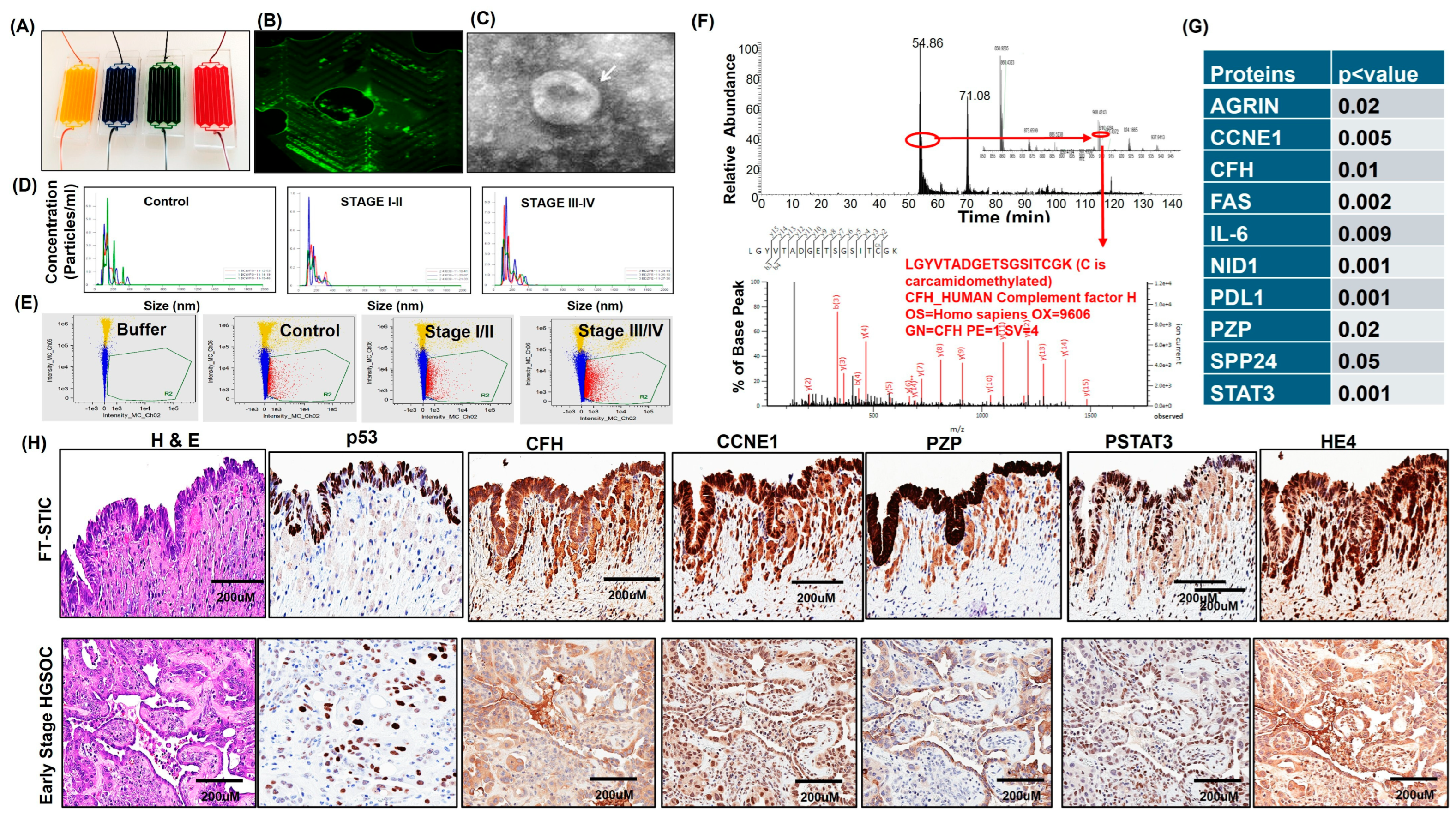
3.1. Identification of EV-Associated Proteins Linked to Early-Stage HGSOC
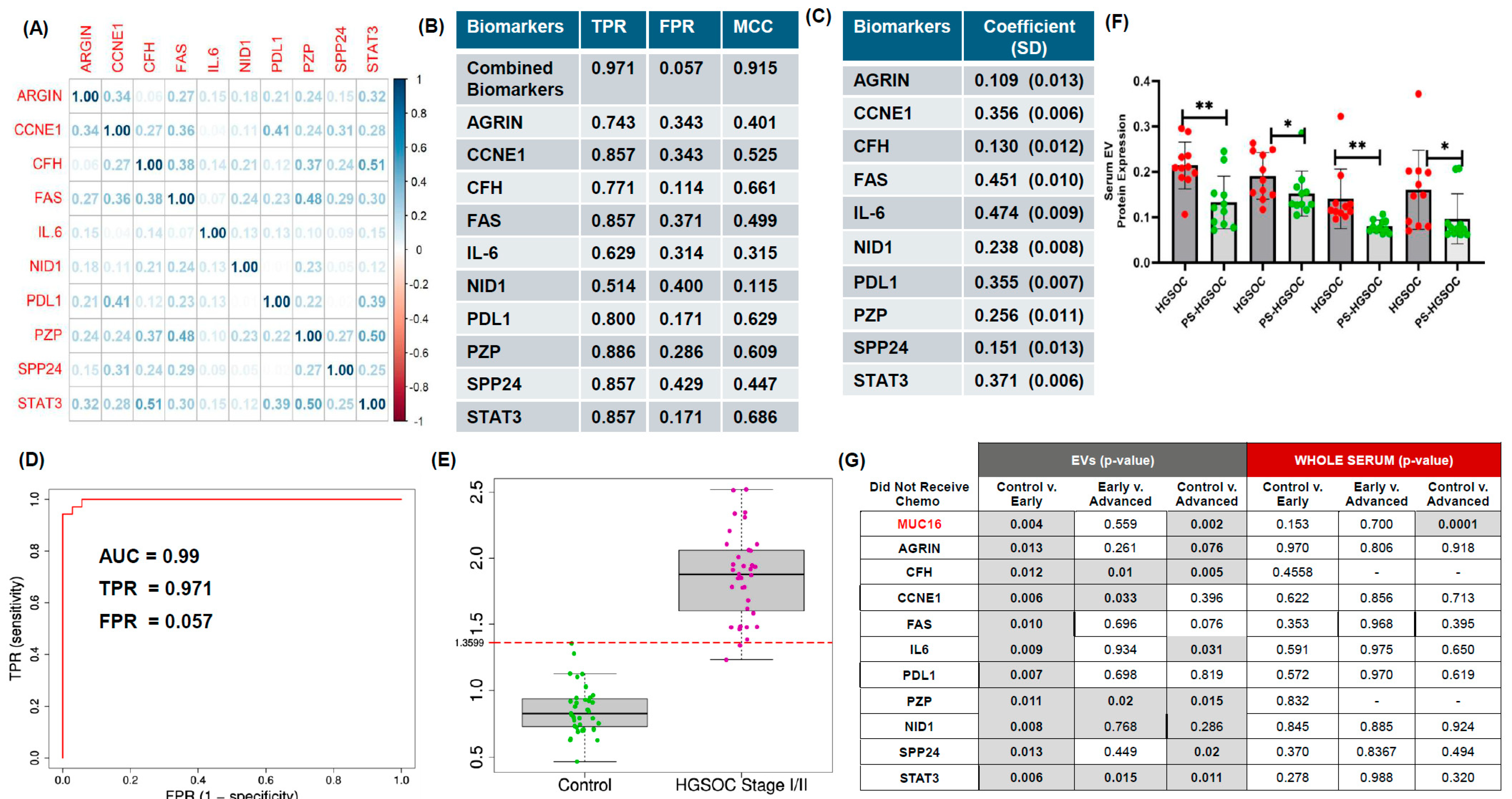
3.2. Combined EV-Associated Proteins Distinguish Early-Stage HGSOC from Healthy Controls in the Study Cohort
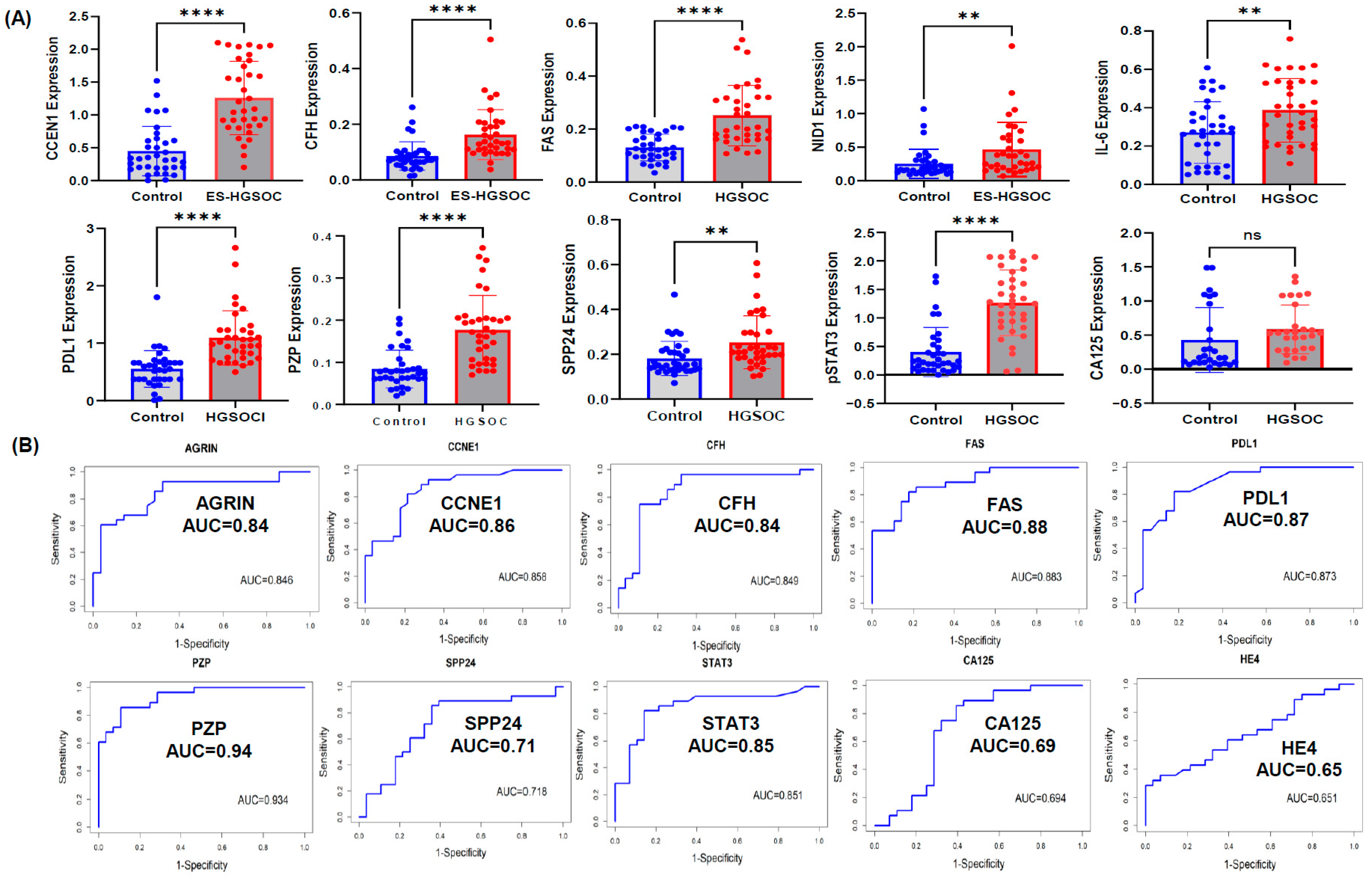
3.3. Candidate Protein Expression in EVs and Whole Serum
4. Discussion
5. Conclusions
6. Future Directions
Supplementary Materials
Author Contributions
Funding
Institutional Review Board Statement
Informed Consent Statement
Data Availability Statement
Acknowledgments
Conflicts of Interest
Abbreviations
References
- Coleman, R.L.; Monk, B.J.; Sood, A.K.; Herzog, T.J. Latest research and treatment of advanced-stage epithelial ovarian cancer. Nat. Rev. Clin. Oncol. 2013, 10, 211–224. [Google Scholar] [CrossRef]
- Matulonis, U.A.; Sood, A.K.; Fallowfield, L.; Howitt, B.E.; Sehouli, J.; Karlan, B.Y. Ovarian cancer. Nat. Rev. Dis. Primers 2016, 2, 16061. [Google Scholar] [CrossRef]
- Siegel, R.L.; Kratzer, T.B.; Giaquinto, A.N.; Sung, H.; Jemal, A. Cancer statistics, 2025. CA Cancer J Clin 2025, 75, 10–45. [Google Scholar] [CrossRef] [PubMed]
- Siegel, R.L.; Miller, K.D.; Jemal, A. Cancer statistics, 2019. CA Cancer J. Clin. 2019, 69, 7–34. [Google Scholar] [CrossRef] [PubMed]
- Vaughan, S.; Coward, J.I.; Bast, R.C., Jr.; Berchuck, A.; Berek, J.S.; Brenton, J.D.; Coukos, G.; Crum, C.C.; Drapkin, R.; Etemadmoghadam, D.; et al. Rethinking ovarian cancer: Recommendations for improving outcomes. Nat. Rev. Cancer 2011, 11, 719–725. [Google Scholar] [CrossRef] [PubMed]
- Dao, F.; Schlappe, B.A.; Tseng, J.; Lester, J.; Nick, A.M.; Lutgendorf, S.K.; McMeekin, S.; Coleman, R.L.; Moore, K.N.; Karlan, B.Y.; et al. Characteristics of 10-year survivors of high-grade serous ovarian carcinoma. Gynecol. Oncol. 2016, 141, 260–263. [Google Scholar] [CrossRef]
- Menon, U.; Gentry-Maharaj, A.; Burnell, M.; Singh, N.; Ryan, A.; Karpinskyj, C.; Carlino, G.; Taylor, J.; Massingham, S.K.; Raikou, M.; et al. Ovarian cancer population screening and mortality after long-term follow-up in the UK Collaborative Trial of Ovarian Cancer Screening (UKCTOCS): A randomised controlled trial. Lancet 2021, 397, 2182–2193. [Google Scholar] [CrossRef]
- Peres, L.C.; Cushing-Haugen, K.L.; Anglesio, M.; Wicklund, K.; Bentley, R.; Berchuck, A.; Kelemen, L.E.; Nazeran, T.M.; Gilks, C.B.; Harris, H.R.; et al. Histotype classification of ovarian carcinoma: A comparison of approaches. Gynecol. Oncol. 2018, 151, 53–60. [Google Scholar] [CrossRef]
- Postovit, L.M.; Dieters-Castator, D.Z.; Rambau, P.F.; Kelemen, L.E.; Siegers, G.M.; Lajoie, G.A.; Kobel, M. Proteomics derived biomarker panel improves diagnostic precision to classify endometrioid and high-grade serous ovarian carcinoma. Clin. Cancer Res. 2019, 25, 4309–4319. [Google Scholar] [CrossRef]
- Labidi-Galy, S.I.; Papp, E.; Hallberg, D.; Niknafs, N.; Adleff, V.; Noe, M.; Bhattacharya, R.; Novak, M.; Jones, S.; Phallen, J.; et al. High grade serous ovarian carcinomas originate in the fallopian tube. Nat. Commun. 2017, 8, 1093. [Google Scholar] [CrossRef]
- Sarojini, S.; Tamir, A.; Lim, H.; Li, S.; Zhang, S.; Goy, A.; Pecora, A.; Suh, K.S. Early detection biomarkers for ovarian cancer. J. Oncol. 2012, 2012, 709049. [Google Scholar] [CrossRef]
- Soletormos, G.; Duffy, M.J.; Othman Abu Hassan, S.; Verheijen, R.H.; Tholander, B.; Bast, R.C., Jr.; Gaarenstroom, K.N.; Sturgeon, C.M.; Bonfrer, J.M.; Petersen, P.H.; et al. Clinical Use of Cancer Biomarkers in Epithelial Ovarian Cancer: Updated Guidelines From the European Group on Tumor Markers. Int. J. Gynecol. Cancer 2016, 26, 43–51. [Google Scholar] [CrossRef]
- Visintin, I.; Feng, Z.; Longton, G.; Ward, D.C.; Alvero, A.B.; Lai, Y.; Tenthorey, J.; Leiser, A.; Flores-Saaib, R.; Yu, H.; et al. Diagnostic markers for early detection of ovarian cancer. Clin. Cancer Res. 2008, 14, 1065–1072. [Google Scholar] [CrossRef] [PubMed]
- Scholler, N.; Urban, N. CA125 in ovarian cancer. Biomark. Med. 2007, 1, 513–523. [Google Scholar] [CrossRef] [PubMed]
- Skates, S.J.; Greene, M.H.; Buys, S.S.; Mai, P.L.; Brown, P.; Piedmonte, M.; Rodriguez, G.; Schorge, J.O.; Sherman, M.; Daly, M.B.; et al. Early Detection of Ovarian Cancer using the Risk of Ovarian Cancer Algorithm with Frequent CA125 Testing in Women at Increased Familial Risk—Combined Results from Two Screening Trials. Clin. Cancer Res. 2017, 23, 3628–3637. [Google Scholar] [CrossRef] [PubMed]
- Zhao, T.; Hu, W. CA125 and HE4: Measurement Tools for Ovarian Cancer. Gynecol. Obstet. Investig. 2016, 81, 430–435. [Google Scholar] [CrossRef]
- Chandramouli, K.; Qian, P.Y. Proteomics: Challenges, techniques and possibilities to overcome biological sample complexity. Hum. Genom. Proteom. 2009, 1, 239204. [Google Scholar] [CrossRef]
- Farrah, T.; Deutsch, E.W.; Omenn, G.S.; Campbell, D.S.; Sun, Z.; Bletz, J.A.; Mallick, P.; Katz, J.E.; Malmstrom, J.; Ossola, R.; et al. A high-confidence human plasma proteome reference set with estimated concentrations in PeptideAtlas. Mol. Cell. Proteom. 2011, 10, M110-006353. [Google Scholar] [CrossRef]
- Dorayappan, K.D.; Wallbillich, J.J.; Cohn, D.E.; Selvendiran, K. The biological significance and clinical applications of exosomes in ovarian cancer. Gynecol. Oncol. 2016, 142, 199–205. [Google Scholar] [CrossRef]
- Melo, S.A.; Luecke, L.B.; Kahlert, C.; Fernandez, A.F.; Gammon, S.T.; Kaye, J.; LeBleu, V.S.; Mittendorf, E.A.; Weitz, J.; Rahbari, N.; et al. Glypican-1 identifies cancer exosomes and detects early pancreatic cancer. Nature 2015, 523, 177–182, Correction in Nature 2022, 610, E15–E17.. [Google Scholar] [CrossRef]
- Kalluri, R.; LeBleu, V.S. The biology, function, and biomedical applications of exosomes. Science 2020, 367, eaau6977. [Google Scholar] [CrossRef] [PubMed]
- Shih, K.K.; Levine, D.A. Exosomal microRNAs step into the biomarker arena. Gynecol. Oncol. 2008, 110, 1–2. [Google Scholar] [CrossRef] [PubMed]
- Kugeratski, F.G.; Hodge, K.; Lilla, S.; McAndrews, K.M.; Zhou, X.; Hwang, R.F.; Zanivan, S.; Kalluri, R. Quantitative proteomics identifies the core proteome of exosomes with syntenin-1 as the highest abundant protein and a putative universal biomarker. Nat. Cell Biol. 2021, 23, 631–641. [Google Scholar] [CrossRef] [PubMed]
- Kalluri, R. The biology and function of exosomes in cancer. J. Clin. Investig. 2016, 126, 1208–1215. [Google Scholar] [CrossRef]
- Chen, G.; Huang, A.C.; Zhang, W.; Zhang, G.; Wu, M.; Xu, W.; Yu, Z.; Yang, J.; Wang, B.; Sun, H.; et al. Exosomal PD-L1 contributes to immunosuppression and is associated with anti-PD-1 response. Nature 2018, 560, 382–386. [Google Scholar] [CrossRef]
- Kamerkar, S.; LeBleu, V.S.; Sugimoto, H.; Yang, S.; Ruivo, C.F.; Melo, S.A.; Lee, J.J.; Kalluri, R. Exosomes facilitate therapeutic targeting of oncogenic KRAS in pancreatic cancer. Nature 2017, 546, 498–503. [Google Scholar] [CrossRef]
- Dorayappan, K.D.P.; Gardner, M.L.; Hisey, C.L.; Zingarelli, R.A.; Smith, B.Q.; Lightfoot, M.D.S.; Gogna, R.; Flannery, M.M.; Hays, J.; Hansford, D.J.; et al. A Microfluidic Chip Enables Isolation of Exosomes and Establishment of Their Protein Profiles and Associated Signaling Pathways in Ovarian Cancer. Cancer Res. 2019, 79, 3503–3513. [Google Scholar] [CrossRef]
- Hisey, C.L.; Dorayappan, K.D.P.; Cohn, D.E.; Selvendiran, K.; Hansford, D.J. Microfluidic affinity separation chip for selective capture and release of label-free ovarian cancer exosomes. Lab. A Chip 2018, 18, 3144–3153. [Google Scholar] [CrossRef]
- Hisey, C.L.; Rima, X.Y.; Doon-Ralls, J.; Nagaraj, C.K.; Mayone, S.; Nguyen, K.T.; Wiggins, S.; Dorayappan, K.D.P.; Huang, X.; Hade, M.D.; et al. Light-induced extracellular vesicle and particle adsorption. Nat. Methods 2025, 22, 2609–2621. [Google Scholar] [CrossRef]
- Dorayappan, K.D.P.; Wanner, R.; Wallbillich, J.J.; Saini, U.; Zingarelli, R.; Suarez, A.A.; Cohn, D.E.; Selvendiran, K. Hypoxia-induced exosomes contribute to a more aggressive and chemoresistant ovarian cancer phenotype: A novel mechanism linking STAT3/Rab proteins. Oncogene 2018, 37, 3806–3821. [Google Scholar] [CrossRef]
- Gao, J.; Xue, J.F.; Xu, M.; Gui, B.S.; Wang, F.X.; Ouyang, J.M. Nanouric acid or nanocalcium phosphate as central nidus to induce calcium oxalate stone formation: A high-resolution transmission electron microscopy study on urinary nanocrystallites. Int. J. Nanomed. 2014, 9, 4399–4409. [Google Scholar] [CrossRef] [PubMed]
- Pepe, M.S.; Thompson, M.L. Combining diagnostic test results to increase accuracy. Biostatistics 2000, 1, 123–140. [Google Scholar] [CrossRef] [PubMed]
- Maiti, R.; Li, J.; Das, P.; Liu, X.; Feng, L.; Hausenloy, D.J.; Chakraborty, B. A distribution-free smoothed combination method to improve discrimination accuracy in multi-category classification. Stat. Methods Med. Res. 2023, 32, 242–266. [Google Scholar] [CrossRef] [PubMed]
- Das, P.; De, D.; Maiti, R.; Kamal, M.; Hutcheson, K.A.; Fuller, C.D.; Chakraborty, B.; Peterson, C.B. Estimating the optimal linear combination of predictors using spherically constrained optimization. BMC Bioinform. 2022, 23, 436. [Google Scholar] [CrossRef]
- Youden, W.J. Index for rating diagnostic tests. Cancer 1950, 3, 32–35. [Google Scholar] [CrossRef]
- Ahn, E.; Kim, S.I.; Park, S.; Kim, S.; Lee, H.; Kim, Y.; Park, S.; Lee, S.; Hwang, D.W.; Kim, H.; et al. Catalyzing early ovarian cancer detection: Platelet RNA-based precision screening. iScience 2025, 28, 112280. [Google Scholar] [CrossRef]
- Gaspar-Maia, A.; Sasamoto, N. Prevention, early detection & interception: 15th biennial ovarian cancer research symposium. Gynecol. Oncol. 2025, 201, 83–85. [Google Scholar] [CrossRef]
- Giles, B.M.; Culp-Hill, R.; Law, R.A.; Nichols, C.M.; Goldberg, M.; Radnaa, E.; Wong, M.; Hansen, C.; Zapata, M.; Hill, C.; et al. Utilizing Serum-Derived Lipidomics with Protein Biomarkers and Machine Learning for Early Detection of Ovarian Cancer in the Symptomatic Population. Cancer Res. Commun. 2025, 5, 1516–1529. [Google Scholar] [CrossRef]
- Menon, U.; Ryan, A.; Kalsi, J.; Gentry-Maharaj, A.; Dawnay, A.; Habib, M.; Apostolidou, S.; Singh, N.; Benjamin, E.; Burnell, M.; et al. Risk Algorithm Using Serial Biomarker Measurements Doubles the Number of Screen-Detected Cancers Compared With a Single-Threshold Rule in the United Kingdom Collaborative Trial of Ovarian Cancer Screening. J. Clin. Oncol. 2015, 33, 2062–2071. [Google Scholar] [CrossRef]
- Kader, T.; Lin, J.R.; Hug, C.B.; Coy, S.; Chen, Y.A.; de Bruijn, I.; Shih, N.; Jung, E.; Pelletier, R.J.; Lopez Leon, M.; et al. Multimodal Spatial Profiling Reveals Immune Suppression and Microenvironment Remodeling in Fallopian Tube Precursors to High-Grade Serous Ovarian Carcinoma. Cancer Discov. 2025, 15, 1180–1202. [Google Scholar] [CrossRef]
- Medina, J.E.; Annapragada, A.V.; Lof, P.; Short, S.; Bartolomucci, A.L.; Mathios, D.; Koul, S.; Niknafs, N.; Noe, M.; Foda, Z.H.; et al. Early Detection of Ovarian Cancer Using Cell-Free DNA Fragmentomes and Protein Biomarkers. Cancer Discov. 2025, 15, 105–118. [Google Scholar] [CrossRef]
- Saini, U.; Suarez, A.A.; Naidu, S.; Wallbillich, J.J.; Bixel, K.; Wanner, R.A.; Bice, J.; Kladney, R.D.; Lester, J.; Karlan, B.Y.; et al. STAT3/PIAS3 Levels Serve as “Early Signature” Genes in the Development of High-Grade Serous Carcinoma from the Fallopian Tube. Cancer Res. 2018, 78, 1739–1750. [Google Scholar] [CrossRef]
- Karst, A.M.; Jones, P.M.; Vena, N.; Ligon, A.H.; Liu, J.F.; Hirsch, M.S.; Etemadmoghadam, D.; Bowtell, D.D.; Drapkin, R. Cyclin E1 deregulation occurs early in secretory cell transformation to promote formation of fallopian tube-derived high-grade serous ovarian cancers. Cancer Res. 2014, 74, 1141–1152. [Google Scholar] [CrossRef]
- Cancer Genome Atlas Research, N. Integrated genomic analyses of ovarian carcinoma. Nature 2011, 474, 609–615. [Google Scholar] [CrossRef]
- Su, L.; Zhang, G.; Kong, X. Prognostic Significance of Pregnancy Zone Protein and Its Correlation with Immune Infiltrates in Hepatocellular Carcinoma. Cancer Manag. Res. 2020, 12, 9883–9891. [Google Scholar] [CrossRef]
- Cui, T.; Chen, Y.; Knosel, T.; Yang, L.; Zoller, K.; Galler, K.; Berndt, A.; Mihlan, M.; Zipfel, P.F.; Petersen, I. Human complement factor H is a novel diagnostic marker for lung adenocarcinoma. Int. J. Oncol. 2011, 39, 161–168. [Google Scholar] [CrossRef]


Disclaimer/Publisher’s Note: The statements, opinions and data contained in all publications are solely those of the individual author(s) and contributor(s) and not of MDPI and/or the editor(s). MDPI and/or the editor(s) disclaim responsibility for any injury to people or property resulting from any ideas, methods, instructions or products referred to in the content. |
© 2026 by the authors. Licensee MDPI, Basel, Switzerland. This article is an open access article distributed under the terms and conditions of the Creative Commons Attribution (CC BY) license.
Share and Cite
Lightfoot, M.; Dorayappan, K.D.P.; Vudatha, V.; Chakrapani, L.N.; Das, P.; Yu, L.; Hisey, C.; Sakaue, T.; Muthusamy, T.; Panneerselvam, P.; et al. Serum Extracellular Vesicle Protein Signatures Associated with Early-Stage High-Grade Serous Ovarian Carcinoma. Cells 2026, 15, 706. https://doi.org/10.3390/cells15080706
Lightfoot M, Dorayappan KDP, Vudatha V, Chakrapani LN, Das P, Yu L, Hisey C, Sakaue T, Muthusamy T, Panneerselvam P, et al. Serum Extracellular Vesicle Protein Signatures Associated with Early-Stage High-Grade Serous Ovarian Carcinoma. Cells. 2026; 15(8):706. https://doi.org/10.3390/cells15080706
Chicago/Turabian StyleLightfoot, Michelle, Kalpana Deepa Priya Dorayappan, Vignesh Vudatha, Lakshmi Narasimhan. Chakrapani, Priyam Das, Lianbo Yu, Colin Hisey, Takahiko Sakaue, Thangavel Muthusamy, Parthiban Panneerselvam, and et al. 2026. "Serum Extracellular Vesicle Protein Signatures Associated with Early-Stage High-Grade Serous Ovarian Carcinoma" Cells 15, no. 8: 706. https://doi.org/10.3390/cells15080706
APA StyleLightfoot, M., Dorayappan, K. D. P., Vudatha, V., Chakrapani, L. N., Das, P., Yu, L., Hisey, C., Sakaue, T., Muthusamy, T., Panneerselvam, P., Backes, F., Cosgrove, C., Hansford, D., Cohn, D. E., O’Malley, D. M., Gogna, R., & Selvendiran, K. (2026). Serum Extracellular Vesicle Protein Signatures Associated with Early-Stage High-Grade Serous Ovarian Carcinoma. Cells, 15(8), 706. https://doi.org/10.3390/cells15080706