Article

Astro-Versus Microglia-Enriched Transcriptomes from Aged Atxn2-CAG100-Knockin Mice Suggest Underlying Pathology of RNA Processing at Ribosomes, and Possibly at U-Bodies


by
Georg Auburger
1,2,*,†,
Arvind Reddy Kandi
1,†,
Rajkumar Vutukuri
3,
Luis-Enrique Almaguer-Mederos
1,
Suzana Gispert
1,
Nesli-Ece Sen
1 and
Jana Key
1,*
1
Experimental Neurology, Clinic of Neurology, University Hospital, Goethe University Frankfurt, Heinrich-Hoffmann-Str. 7, 60528 Frankfurt am Main, Germany
2
Institute for Clinical Neuroanatomy, Dr. Senckenberg Anatomy, Fachbereich Medizin, Goethe University Frankfurt, 60528 Frankfurt am Main, Germany
3
Institute of General Pharmacology and Toxicology, University Hospital, Goethe University Frankfurt, 60528 Frankfurt am Main, Germany
*
Authors to whom correspondence should be addressed.
These authors contributed equally to this work.
Cells 2026, 15(8), 699; https://doi.org/10.3390/cells15080699
Submission received: 25 March 2026 / Accepted: 13 April 2026 / Published: 15 April 2026

Abstract

Spinocerebellar Ataxia type 2 (SCA2) and Amyotrophic Lateral Sclerosis type 13 (ALS13) are triggered by polyglutamine expansion in Ataxin-2 (ATXN2). To understand these neurodegenerative disorders at the molecular level, the brains of 10-month-old Atxn2-CAG100-knockin mice were analyzed as microglial, astroglial and neuronal fractions via global RNA sequencing. Data were validated by comparison with the spinal cord oligonucleotide microarray profile or filtered by RNA-seq consistency. Here, we show that the mutation causes a massive inflammatory response in microglia and a reciprocal loss of neuronal transcripts in glial fractions, suggesting severe synapse loss. Beyond these general neurodegenerative signs, we identify pathognomonic changes in the machinery for protein translation and RNA splicing. Glial fractions showed upregulation of Gpnmb (to 2082%), Cst7, Clec7a, Axl, Csf1, Lgals3, Lgals3bp, Slc11a1, and Usp18 as an unspecific neuroinflammatory signature, versus downregulation of axonal Nefh (to <19%), and synaptic Scn4b, Camk2b, Rab15, and Grin1 mRNAs correlating with circuit disconnection. In all fractions, reductions in Kif5a, Rph3a, and Cplx1 were noted versus disease-specific inductions of ribosomal subunits, presumably mirroring the partial loss-of-function of ATXN2 as RNA translation modulator. Selective accumulations of embryonic factors Rnu1b2 and Eef1a1 versus downregulation of adult Eef1a2 specify the mutation impact on splicing and translation elongation. As a potential underpinning of toxic gain-of-function, the proteostasis transcript Rnf213 appeared increased in astroglial and microglial fractions. These transcriptome data suggest altered ribosomal and spliceosome machinery, with massive microgliosis versus mild astrogliosis, at the core of SCA2 and ALS13.

1. Introduction

Our research on molecular mechanisms in neurodegenerative disorders is focused on a rare disease named Spinocerebellar Ataxia type 2 (SCA2), which is caused by a CAG repeat expansion with autosomal dominant inheritance and occurs worldwide [1,2,3,4]. This entity was first described in India [5], and the further definition of its characteristic features was pioneered in a large Cuban founder population [6,7,8,9,10,11,12,13,14,15,16,17,18,19,20,21], as well as in Japan, India, Europe, the USA, and China [22,23,24,25,26,27,28,29,30,31,32,33,34,35,36,37,38,39,40,41,42,43,44,45,46]. Three teams in parallel identified Ataxin-2 (ATXN2) as the responsible disease protein, demonstrating that unstable expansions of its poly-glutamine (polyQ) domain from the normal size of 22 (or 23) to >33 residues represent the causal event that triggers this multi-system atrophy [47,48,49].
Intermediate size expansions in the polyQ domain of ATXN2 do not have the strength to cause monogenic disease, but at lengths perhaps from 27Q, and certainly from 31Q until 33Q render motor neurons of the spinal cord and the brain cortex more vulnerable to manifestation of Amyotrophic Lateral Sclerosis (ALS) at adult ages [50,51,52,53,54]. The pathogenesis involving intermediate-sized polyQ expansions in ATXN2 has been named ALS type 13 (see https://omim.org/entry/601517, last accessed on 25 January 2026).
ATXN2 is a large protein with sizes between 600 and 1300 amino acids, which evolved during the time early eukaryotic life had sustained exposure to oxidative stress from endosymbionts, surrounding them with protective double membranes [55]. Thus, its functions were necessary for all fungi, insects, animals, and plants across evolution, but remain to be understood. All orthologs and paralogs of the protein family across evolution share a characteristic order of an N-terminal Like-Sm (LSm) domain containing five beta-barrels, followed by an LSm-associated domain (LSmAD) with some alpha-helix structures, and at about 3/5 of the protein length, the linear PABP-interacting motif 2 (PAM2) (in plants also known as CID) motif [56,57,58,59], with all of these conserved sequences being surrounded by intrinsically disordered regions (IDRs) of relatively high variability [55,60,61]. The LSm and PAM2 sequences are also found in other protein families, while the LSmAD seems specific to the Ataxin-2 gene family and has the strongest sequence conservation. RNA association is known to occur directly for the LSm domain [62], indirectly somewhere between LSm and LSmAD via the RNA helicase DDX6 [63,64], and indirectly via the poly(A)-binding protein (PABP) for the PAM2 motif [60,65], while the function of LSmAD remains to be understood. Although the interaction with poly(A) tails of mRNAs clearly indicates a role of ATXN2 for coding transcripts, extensive mRNA profiling efforts in diverse organisms were unable to define individual transcripts affected by ATXN2 polyQ expansions with consistency across different tissues.
Gene duplication events occurred independently when organisms moved from protected freshwater environments to enhanced stress exposures during terrestrial life. In all animals since chordate development (except flying birds), ATXN2 coexists with its duplicated shorter homolog ATXN2L, which shows even stronger expression. LSm/LSmAD/PAM2 deletions in ATXN2L were shown to interfere with mouse embryonic development, similar to the essential role of single-copy Ataxin-2 for the development of nematodes, flies and yeast, while targeted deletion of the N-terminal IDR1 with the polyQ domain of ATXN2 in mice produced only mild phenotypes with adult progressive obesity, high blood fats, insulin resistance, locomotor hyperactivity and subtly altered ribosomal translation efficiency [66,67,68,69,70,71,72,73,74,75,76,77,78,79,80,81,82,83,84,85,86,87]. An independent gene duplication event in the evolution of pioneer terrestrial plants with enhanced stress exposure, such as Amborella shrub and Araucaria conifer monocots [55], produced Ataxin-2 orthologs that were named CID3 and CID4, but apparently failed to develop distinguishing sequence features, and play enigmatic roles for development [88]. Clearly, a necessity of Ataxin-2 for cellular stress responses and RNA quality control was documented in multiple species across evolution, and its re-localization in stress periods from ribosomes to stress granules for RNA triage (and somewhat to P-bodies where RNA degradation occurs) is its characteristic feature upon microscopic analyses in cells before and during oxidative stress [63,81,83,84,89,90,91,92,93,94]. During normal cellular growth, the experimental manipulation of the Ataxin-2 orthologs, e.g., in flies, and their association with the ribosomal translation machinery was documented. However, Ataxin-2 mutations also prominently affect the actin cytoskeleton, and this phenotype is not understood at a mechanistic level until today [56,85,95].
Previous PAR-CLIP studies in human HEK293T cells showed that ATXN2 binds directly to AU-rich sequences in the 3′ ends of mRNAs, while luciferase assays in HEK293T and SH-SY5Y cells demonstrated reduced protein expression in the presence of ATXN2-Q31 and ATXN2-Q39 expansions [62]. The analysis of Drosophila melanogaster Atx2 mutant brain homogenates confirmed this binding selectivity and showed decreased levels of Atx2-target mRNAs in post-mitotic neurons upon Atx2 knockdown [96,97]. Beyond the role of Ataxin-2 family members for mRNA processing, spurious findings by RNA sequencing technologies in mice, flies, and plants also suggested some dysregulation of microRNA [77,88,98,99], without clear consistencies or a detailed understanding of the mechanism involved.
In our current study, we employed aged mouse brains to generate cell-type-enriched fractions using equipment and reagents from the company Miltenyi Biotech. To have maximal mutation effects, a Q100 domain encoded by a pure CAG100 expansion was substituted for the physiological single Q residue in mouse ATXN2 by targeted knockin technology [100]. This mouse mutant was previously shown to model the spatio-temporal SCA2/ALS13 pattern of neurodegeneration and locomotor behavior deficits, with several pathology aspects in peripheral tissues, in an authentic manner [100,101]. The RNA yields from neuronal fractions turned out to be insufficient for standard RNA-seq analyses, but the highly sensitive MACE-seq enabled quantification of >10,000 mRNAs in each fraction, and the comparison of compound KINvsWT data with individual data from astroglial KINvsWT and microglial KINvsWT permitted stringent data filtering based on consistency criteria. Overall, a prominent impact of ATXN2 polyQ expansion on ribosomal translation was elucidated, with the exploratory data pointing to an impairment of the translation elongation step. Furthermore, an impact of the mutation on RNA processing, involving non-coding small RNAs, was documented, and preliminary insights regarding a plausible mechanism were identified.

2. Materials and Methods

2.1. Mouse Husbandry

All mouse experiments were approved by regional authorities and performed in compliance with the German Animal Welfare Act, the Council Directive of 24 November 1986 (86/609/EWG), with Annex II and the ETS123 (European Convention for the Protection of Vertebrate Animals). Mice were provided with food and water ad libitum and were housed in a regular 12 h light-dark cycle at the central animal facility (ZFE) of the University Hospital Frankfurt. Heterozygous mating was employed to generate Atxn2-CAG100-KIN mice with a C57BL/6 background. The offspring littermates, namely homozygous Atxn2-CAG100-knockin (KIN) and wild-type animals of the same sex, were aged in neighboring cages for subsequent comparisons. Of the 10-month-old mice studied by RNA-seq, two mutant-WT pairs were male, and one pair was female.

2.2. Genotyping

DNA was isolated from ear punches. In total, 50 µL of alkaline lysis buffer (10 mM NaOH, 0.2 mM disodium EDTA, pH 12) was added to ear punches or tail clips, followed by incubation at 95 °C for 30 min. Samples were cooled down on ice, followed by adding 50 µL of neutralization buffer (40 mM Tris-HCl, pH 5). 1 µL of this extracted DNA was used for polymerase chain reaction (PCR). TaKaRa LA Taq-Polymerase (Takara Bio Inc., #RR002A, Takara Bio USA, San Jose, CA, USA) was used to identify wild-type and Atxn2-KIN alleles with primer pair F-NOW1 5′-TGAGTTGACTCCACAGGGAGGTGAGC-3′ and R-NOW1 5′-CCATCTCGCCAGCCCGTAAGATTC-3′. The wild-type allele yields an amplicon size of 793 bp, and the KIN allele yields 948 bp.

2.3. Isolation of Cell Types from the Mouse Brain

The subsequent protocol is adapted from Miltenyi adult brain dissociation (Miltenyi, #130-107-677, Miltenyi Biotech, Bergisch Gladbach, Germany): adult neuron isolation, mouse (Miltenyi, #130-126-603); Anti-ACSA2 MicroBead Kit, mouse (Miltenyi, #130-097-679); and CD11b (Microglia) MicroBeads, human and mouse (Miltenyi, #130-093-636)—see [102,103]. All steps were performed with ice-cold buffers unless stated otherwise.

2.3.1. Tissue Dissociation

Mouse brains were isolated, weighed, and transferred to gentleMACS C-tubes (Miltenyi, #130-096-334) containing ice-cold DPBS with Ca2+ and Mg2+ (DPBS). Each C-tube never exceeded 500 mg of tissue. DPBS was replaced with 1950 µL of enzyme mix 1, as mentioned in the Miltenyi adult brain dissociation kit (Miltenyi #130-107-677). To this, 30 µL of enzyme mix 2 wereadded, and sealed C-tubes were attached to the gentleMACS Octo Dissociator with heaters (Miltenyi, #130-096-427). After 30 min of gentle tissue dissociation at 37 °C, samples were briefly centrifuged in 15 s pulses, never allowing them to cross 300× g. All material was allowed to collect at the bottom of the tube, the supernatant was discarded, and the cell pellet was resuspended gently in 10 mL of ice-cold DPBS. The MACS SmartStrainer (Miltenyi, #130-098-462) was rinsed with ice-cold DBPS, and the cell suspension was passed through and collected in a 15 mL tube. Samples were centrifuged at 300× g for 10 min at 4 °C. The supernatant was aspirated, the cell pellet was resuspended in ice-cold DBPS, and samples were processed for debris removal. For culturing, brain tissue from 3-day-old pups was dissociated using the Neural Tissue Dissociation Kit (P) (Miltenyi Biotech, #130-029-628), following the manufacturer’s instructions.

2.3.2. Debris Removal

For debris removal, a density gradient approach was used where the cells were resuspended with 3100 µL of ice-cold DBPS, to which 900 µL of debris removal solution was added and gently mixed well. About 4 mL of ice-cold DPBS was added gradually to form two layers. Samples were then centrifuged at 3000× g for 10 min at 4 °C. The top two layers were aspirated off, and ice-cold DPBS was added to the bottom layer and mixed well by inverting the tube. This tube was again centrifuged at 1000× g for 10 min at 4 °C, and the supernatant was discarded.

2.3.3. Red Blood Cell Removal

To eliminate red blood cells, 1 mL of 1× red blood cell solution (Miltenyi, #130-096-334) was added to the cell pellet and incubated at 4 °C. After 10 min, 5 mL of ice-cold DBPS was added and mixed well. Samples were centrifuged at 4 °C and 300× g for 10 min, and the supernatant was discarded.

2.3.4. Magnetic Separation

Before magnetic separation, cell number was determined, and 80 µL of ice-cold DPBS with Ca2+ and Mg2+ + 0.5% BSA were added to the cell pellet for a total number of cells in the range of 5 × 10⁶–4 × 10⁷. Microglia, astrocytes and neurons were isolated sequentially from a single mouse brain. (i) In total, 20 µL of CD11b (Microglia) MicroBeads (Miltenyi #130-093-636) was added to the cell suspension and incubated at 2–8 °C for 10 min. The LS columns (Miltenyi, #130-042-401) were rinsed with 2 mL of ice-cold DPBS with Ca2+ and Mg2+ + 0.5% BSA, and flow-through was discarded. A final volume of 500 µL of cell suspension was allowed to flow through the LS columns, and the flow-through was collected, which contained unlabeled cells. The LS column was washed 3 times with ice-cold DPBS with Ca2+ and Mg2+ + 0.5% BSA. The microglia fraction was eluted into a new tube by firmly pushing the plunger onto the LS column containing 1 mL of ice-cold DPBS with Ca2+ and Mg2+ + 0.5% BSA. This process was repeated once again to enrich purity. (ii) The unlabeled cell fraction was centrifuged at 4 °C at 300× g for 10 min, and the cell pellet was resuspended in 80 µL of ice-cold DPBS with Ca2+ and Mg2+ + 0.5% BSA. In total, 10 µL of FcR blocking reagent (Miltenyi #130-115-390) was added to the cell suspension and incubated at 2–8 °C. After 10 min, Anti-ACSA-2 MicroBeads (Miltenyi #130-115-390) were added and again incubated at 2–8 °C for 15 min. Magnetic separation was performed similarly to the microglia fraction. (iii) The unlabeled cell fraction after astrocyte isolation was centrifuged at 4 °C at 300× g for 10 min, and the cell pellet was resuspended in 80 µL of ice-cold DPBS with Ca2+ and Mg2+ + 0.5% BSA. In total, 20 µL of non-neuronal cell biotin-antibody cocktail (Miltenyi #130-115-390) was added to the cell suspension and incubated at 2–8 °C. After 5 min, 20 µL of anti-biotin MicroBeads (Miltenyi #130-115-390) and 10 µL of CD31 MicroBeads (Miltenyi #130-097-418) were added to the cell suspension and incubated at 2–8 °C for 12 min. A final volume of 500 µL of cell mixture was allowed to flow through the LS columns. The columns were washed twice with 1 mL of ice-cold DPBS with Ca2+ and Mg2+ + 0.5% BSA. The flow-through contained neuronal cells.

2.3.5. Culture of Primary Cells

The 24-well culture dishes were coated with 0.01 mg/mL poly-L-Lysine (PDL, Merck Millipore, Burlington, MA, USA) for 3 h at 37 °C, followed by washing once with sterile H2O. The microglia were cultured in DMEM/F12 (Gibco, Waltham, MA, USA) supplemented with 10% FBS (Gibco), 1% non-essential amino acids solution (Gibco), and 1× Pen-strep (Gibco). Astrocytes were cultured in MACS® Neuro Medium (Miltenyi # 130-117-031) supplemented with 0.2% AstroMACS Supplement, 2% MACS NeuroBrew-21, 0.25% L-glutamine (0.5 mM) (Gibco) and 1× Pen-strep (Gibco). Neurons were cultured in Neuro Basal Media (Gibco), 2% B27 supplement (Thermo), 1% L-glutamine, 0.2% FGF (PeproTech), 0.2% PDGF (Proteintech) and 1× Penstrep (Gibco).

2.3.6. RNA Extraction, Library Preparation, RNA-Seq, Differential Expression Analysis, and GSEA

Total RNA was extracted from all the isolated cell fractions using TRIzol (Sigma Aldrich, St. Louis, MO, USA) as per the manufacturer’s protocol. RNA quantification and quality scores were measured using a LabChipDX equipment (Revvity Inc., Waltham, MA, USA), and were adequate for subsequent sequencing in all fractions. The company GenXPro (Frankfurt am Main, Germany) performed the RNA sequencing. Sequencing libraries were prepared using the MACE-seq protocol (GenXPro GmbH, Frankfurt am Main, Germany). While standard RNA-seq requires between 100 ng and 1 µg of high-quality total RNA, MACE-seq focuses exclusively on the highly informative 3′-untranslated region, sequences short fragments of 50–800 bp, and generates reliable expression profiles even from single-cell amounts such as 0.03 ng of total RNA, being suitable even for degraded RNA from archived fixed and embedded tissue after a dozen years of storage, or for laser capture microdissected tissue, or for exosomal cargo [104,105,106,107,108,109]. Ribosomal RNA was depleted using the Qiagen FastSelect system (Qiagen Inc., Hilden, Germany), followed by polyadenylation of RNA molecules with E. coli poly(A) polymerase (New England Biolabs, Ipswich, MA, USA). Subsequent NGS library preparation, including the incorporation of “TrueQuant” unique molecular identifiers with dual indexing as molecular barcodes to eliminate PCR-induced bias and allow for precise quantification of mRNAs, was performed using the MACE-Seq kit (GenXPro GmbH, Frankfurt, Germany) according to the manufacturer’s instructions (see https://genxpro.net/sequencing/transcriptome/mace-massive-analysis-of-cdna-ends/, last accessed on 21 March 2026). Libraries were sequenced on an Illumina NextSeq 500 platform with 1 × 76 bps (Illumina Inc., San Diego, CA, USA). The differential expression analysis was performed with DESeq2 version 1.38, using the Benjamini–Hochberg correction for multiple testing, and employing cutoffs with an FDR-adjusted p-value lesser or equal to 0.05 and an absolute log2FC greater than or equal to 1.0 to establish significance. Further details on the panRNA-seq analysis procedures, quality control assessments, and gene set enrichment analyses (GSEA) can be found in Supplementary Materials S1 and S2, which were generated by the company GenXPro.

2.4. Reverse Transcription-Quantitative Polymerase Chain Reaction (RT-qPCRs)

TRIzol reagent (Sigma, #102543131) was used to isolate total RNA as per the manufacturer’s instructions. To convert RNA to cDNA, we used SuperScript™ IV VILO™ Master Mix with ezDNase™ Enzyme (Invitrogen #11766050, Waltham, MA, USA) with about 1 µg of total RNA as a template for all samples. After cDNA synthesis, the samples were diluted to a 1:10 ratio with ultrapure water. Each sample had biological replicates and technical duplicates. qPCR was performed using 2× FastStart Universal Probe Master (Roche, Basel, Switzerland, #4913957001) with TaqMan Gene Expression Assays (Applied Biosystems, Waltham, MA, USA) in StepOnePlus Real-Time PCR System (Applied Biosystems). The 2−ΔΔCT method [110] was used for data analysis, from which expression values were averaged across biological/technical replicates per condition. The following Taqman assays were used: Aif1: Mm00520165_m1, Atxn2: Mm01199894_m1, Cd31: Mm01242576_m1, Cldn5: Mm00727012_s1, Dlg4: Mm00492193_m1 Gfap: Mm01253033_m1, Kcnj8: Mm00434620_m1, Map2: Mm00485231_m1, Olig2: Mm01210556_m1, Tmem119: Mm00525305_m1, and Tbp: Mm00446973_m1.

2.5. Immunohistochemistry

The respective cell types were cultured for 5 days post-isolation before immunocytochemical analysis. Cells were washed once with 1x phosphate-buffered saline (PBS) and fixed with 4% paraformaldehyde (PFA) in 1x PBS for 5 min at room temperature. Following fixation, cells were permeabilized with 0.1% Triton X-100 in 1× PBS for 2 min and subsequently blocked with Roti®-Block solution (Carl Roth, Karlsruhe, Germany) for 30 min at room temperature. For microglia and astrocyte staining, cells were incubated overnight at 4 °C in Roti®-Block containing the following primary antibodies: anti-IBA1 (Proteintech, CL647-81728, 1:200) or anti-GFAP (Proteintech, Rosemont, IL, USA, CL488-60190, 1:200), respectively. After primary antibody incubation, cells were washed three times with 1× PBS and counterstained with DAPI (Sigma-Aldrich, 1 mg/mL, D9542) to label nuclei. For neuronal staining, cells were incubated overnight at 4 °C with anti-MAP2 primary antibody (Proteintech, 17490-1-AP, 1:200) diluted in Roti®-Block. After washing with 1× PBS, cells were incubated with Donkey anti-Rabbit IgG (H+L) Cross-Adsorbed Secondary Antibody, DyLight™ 550 (Invitrogen, SA5-10039, 1:1000) for 1 h at room temperature. Following final washes with 1× PBS, all samples were mounted using DAKO mounting medium (Agilent, Santa Clara, CA, USA, #S3023) prior to imaging. Cell imaging was performed using Keyence, Frankfurt, Germany, BZ-X series, and ImageJ software (version 1.54) was used to merge images.

2.6. Quantification and Statistical Analysis

2.6.1. Statistics

Statistical analysis was performed using GraphPad Prism (Boston, MA, USA, version 8). Volcano Plots were generated with GraphPad Prism (version 11). Bar graphs represent mean ± SEM and p-values from Welch’s t-test for spinal cord tissue. For cell culture experiments, bar graphs represent mean ± SEM, and 2-way ANOVA with multiple comparisons was used to determine p-values (T 0.05 < p < 0.1; * p < 0.05; ** p < 0.01; *** p < 0.001; **** p < 0.0001).

2.6.2. STRING Pathway Interaction and Enrichment Analysis

The web server https://string-db.org/ was used from 2024 to 2026 with version 12.0, with the last access on 15 January 2026.

3. Results

To understand and characterize the diseases SCA2 and ALS13 in different cell populations of the central nervous system, the Atxn2-CAG100-KIN model was used to isolate microglia, astrocytes, and neuron fractions from the whole mouse brain. This study aimed to obtain insights into the contribution of various cell types in pathology and to enable insights into aberrant RNA processing, via the RNA-seq approach rather than previously employed oligonucleotide microarrays, and to assess small RNA species (e.g., tRNAs and microRNAs).

3.1. Isolation of Murine Brain Cell Types Using MACS Technology

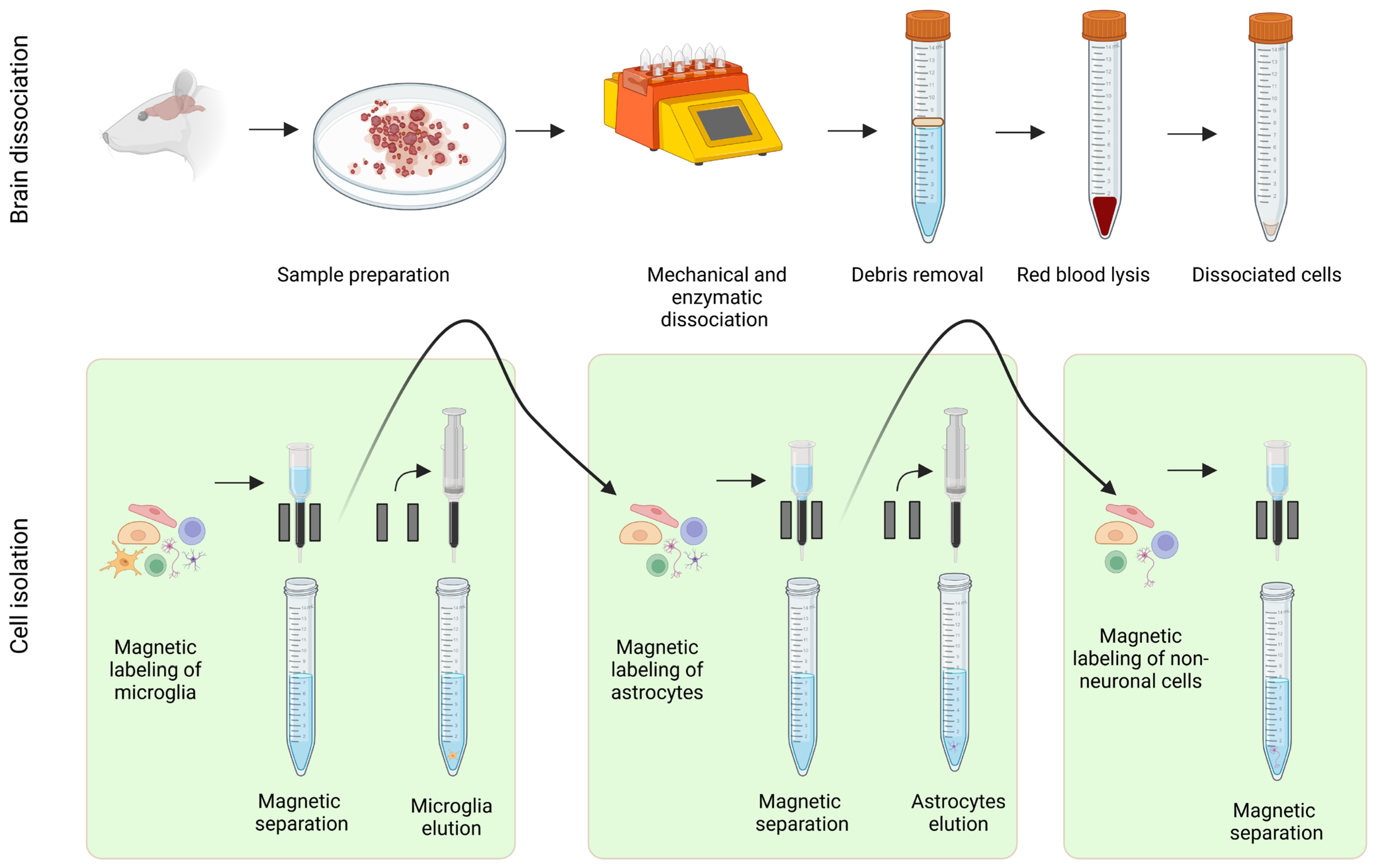
The workflow of the cell isolations is shown in Figure 1. Overall, brain dissociation followed the procedure described by [111] to isolate several cell types from a single mouse brain. Brains were dissected and collected in ice-cold DPBS with Ca2+ and Mg2+, then chopped into eight pieces and placed in gentleMACS C-tubes. Mechanical dissociation was performed with the Adult Brain Dissociation Kit (mouse and rat) and the 37C_ABDK_01 program of the gentleMACS Octo Dissociator with Heaters.
After dissociation, debris removal, and red blood cell lysis, cells were magnetically labeled and isolated using MACS technology as follows: (i) microglia with anti-CD11b MicroBeads (positive selection), (ii) astrocytes with anti-ACSA-2 MicroBeads (positive selection), and (iii) neurons with a non-neuronal cell biotin-antibody cocktail followed by anti-biotin MicroBeads (negative selection).
Initial trials showed high endothelial cell contamination in the neuron population. To resolve this, anti-CD31b MicroBeads were added alongside anti-biotin MicroBeads before magnetic separation, significantly improving neuron purity.

3.2. The Impact of the Atxn2-CAG100-KIN Mutation on the Brain and Its Cell Types

After establishing and validating the protocol by RT-qPCR (Supplementary Figure S1) and immunocytochemistry, we isolated microglia, astrocytes, and neurons from three wild-type (WT) and three approximately 10-month-old Atxn2-CAG100-KIN mutant-WT pairs to identify dysregulated molecules in different cell types due to SCA2 pathology.
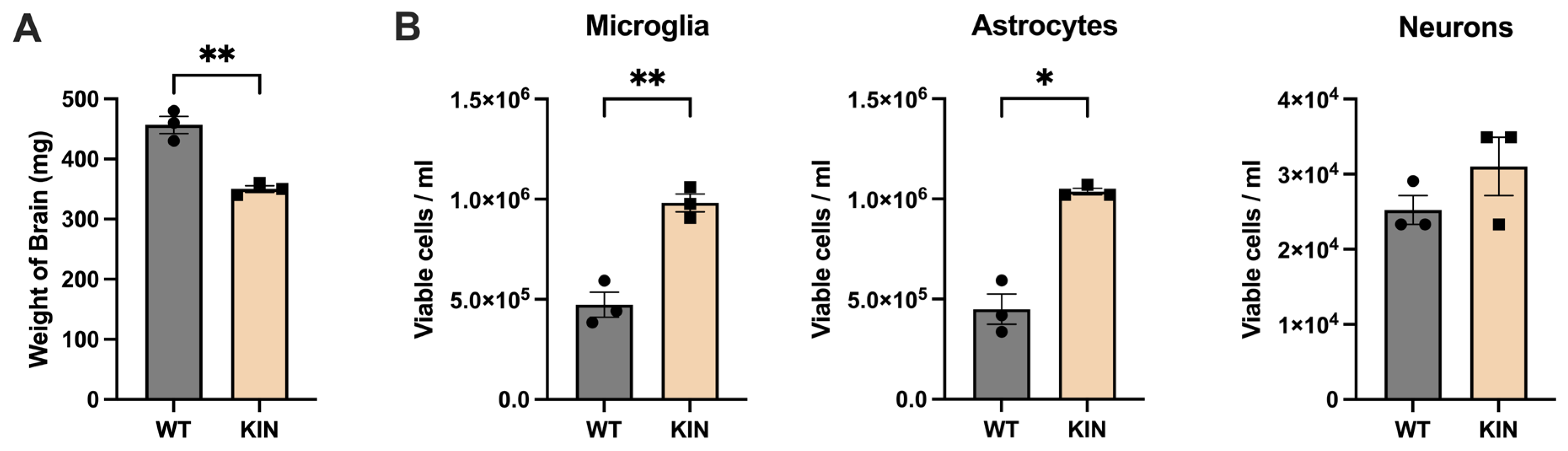
At the age of 10 months, Atxn2-CAG100-KIN mutant brains showed significant weight reduction, averaging 350 mg compared to the wild-type average of 450 mg, consistent with previous findings regarding the severe cerebellar and moderate cortical atrophy [100] (Figure 2A). Post-isolated individual cells had 92% viable single-cell suspension. An average of 444,000 microglia, 419,667 astrocytes, and 23,666 neurons was obtained. Atxn2-CAG100-KIN mutants had significantly higher numbers of microglia and astrocytes, averaging 981,333 cells/mL and 1.03 million cells/mL, respectively (Figure 2B), in good agreement with the reactive microgliosis and astrogliosis expected during a neurodegenerative process with loss of neuronal processes. In view of the two-fold increase in microglial and astroglial cell numbers, normalized transcript levels of any markers of microglia and astroglia mass would therefore be expected around 200% even in the absence of reactive astrogliosis processes that imply active transcriptional upregulation. No difference in neuronal cell numbers was observed.
Upon RT-qPCR quality control analyses of purity in fractions from the 10-month-old brains, the factors studied included microglia markers (Aif1, Tmem119), an astrocyte marker (Gfap), a neuron marker (Map2), endothelial cell markers (Cldn5, Cd31), an oligodendrocyte marker (Olig2), and a pericyte marker (Kcnj8) (Figure S1).

3.3. Further Purity Analyses of Isolated Individual Brain Cell Types

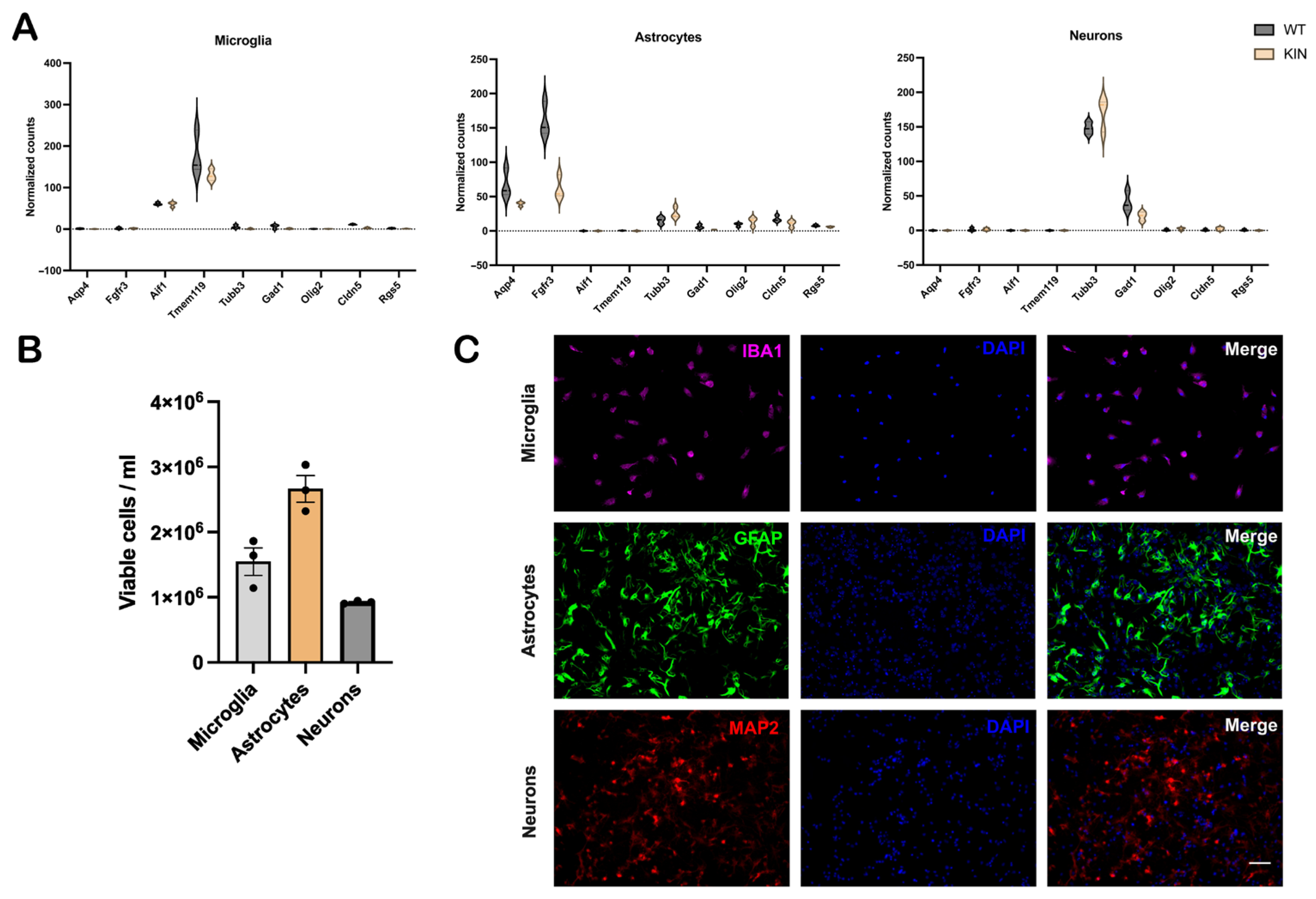
Given that microglia have the physiological function to prune synapses and protect them from injury [112,113,114], mechanically disconnected synapses will co-purify with microglia. Similarly, astrocytes function to surround and protect synapses as well as Ranvier nodes from pulsating blood vessels, modulating the morphology of synapses, axons, and dendrites [115,116,117], so astrocytes will also co-sediment with severed neural projections. Finally, it is known that the non-labeled flow-through cells will not only contain neurons, but also endothelial cells [118]. Therefore, the purity of the isolated cell populations was further assessed by analyzing the expression of a complementary set of specific marker mRNAs in the RNA-seq output from 10-month-old brains as violin plots (Supplementary Material S1 and Figure 3A). Here, Aqp4 and Fgfr3 were documented as astroglia (as well as radial glia and ependymal cells) markers, Aif1 and Tmem119 as microglia markers, Tubb3 as neuronal differentiation marker, Gad1 as interneuron marker, Olig2 as oligodendroglia marker, Cldn5 as endothelial marker, and Rgs5 as pericyte marker.
Microglia and neuron populations were approximately 90% pure; however, in the astrocyte population, there was a minor presence of Map2, Cldn5, Olig2, and Kcnj8. Importantly, data from brainrnaseq.org (last accessed on 5 February 2026) indicates that these latter transcripts exhibit mild expressions in astrocytes, which could explain their appearance in the RT-qPCR results [119].
Immunocytochemistry was performed to further validate the isolated cells on a cytological level. 3-day-old pups were used for cultivation (Figure 3B), since cells from 10-month-old mice showed reduced survivability. All cells were plated in a 24-well plate with the following seeding density: microglia at 2 × 10⁵ cells/well, astrocytes and neurons at 3 × 10⁵ cells/well. All isolated cells survived in culture for ~7 days post-isolation and seeding. However, the morphology and growth were best at two days for microglia and five days for astrocytes and neurons. Anti- IBA1, GFAP, and MAP2 antibodies were used for microglia, astrocytes, and neurons, respectively, in immunofluorescence staining (Figure 3C). All isolated cell types showed a cell-type-specific morphology and cellular marker expression.

3.4. Global Volcano Plots of RNA-Seq Profiles, as Well as Consistency Between New RNA-Seq Transcript Analysis and Previous Oligonucleotide Microarray Data Document Loss of mRNA in Synapses and Neurites from Glial Fractions, with an Elevated Neuroinflammation Signature

The extraction of RNA yielded sufficient amounts in astroglial and microglial fractions, but lower amounts in the neuronal fraction (Table S1) made it impossible to use the standard RNA-seq protocol. Therefore, in the present study, sequencing libraries of all fractions were prepared using the highly sensitive MACE-seq (Massive Analysis of cDNA Ends-sequencing) protocol with the inclusion of additional rRNA depletion and polyadenylation steps, thus allowing the capture of all RNA molecules simultaneously in comparable quality, including small RNA. The company GenXPro uses the term”panRNA-Seq” for this combination of MACE-Seq with polyadenylation. The standard RNA-seq procedure with traditional protocols uses hexamer primers to generate cDNA and analyze mRNAs in 10–30 fragments, thus generating shorter cDNA products, requiring at least 100 ng RNA as well as length-based normalization in typically 20 million reads. In contrast, the MACE-seq technique (which was developed in 2008 and optimized repeatedly, with >100 citations at present) focuses on a single highly specific fragment at the 3′-end of each mRNA where alternative splicing and alternative polyadenylation are frequent, with equivalent analytic depth being achieved from 0.03 ng samples at much lower cost, even in degraded RNA [104,120] and in circulating tumor cells (https://edocs.tib.eu/files/e01fb24/1896619908.pdf, last accessed on 21 March 2026) even at single-cell resolution.
In this manner, the expression in the neuronal fraction was quantifiable for 12,000 genes, despite the low cell number and RNA amount there. While the data are therefore comparable among all fractions, only the more abundant neuronal transcripts may reveal consistency with glial transcripts.
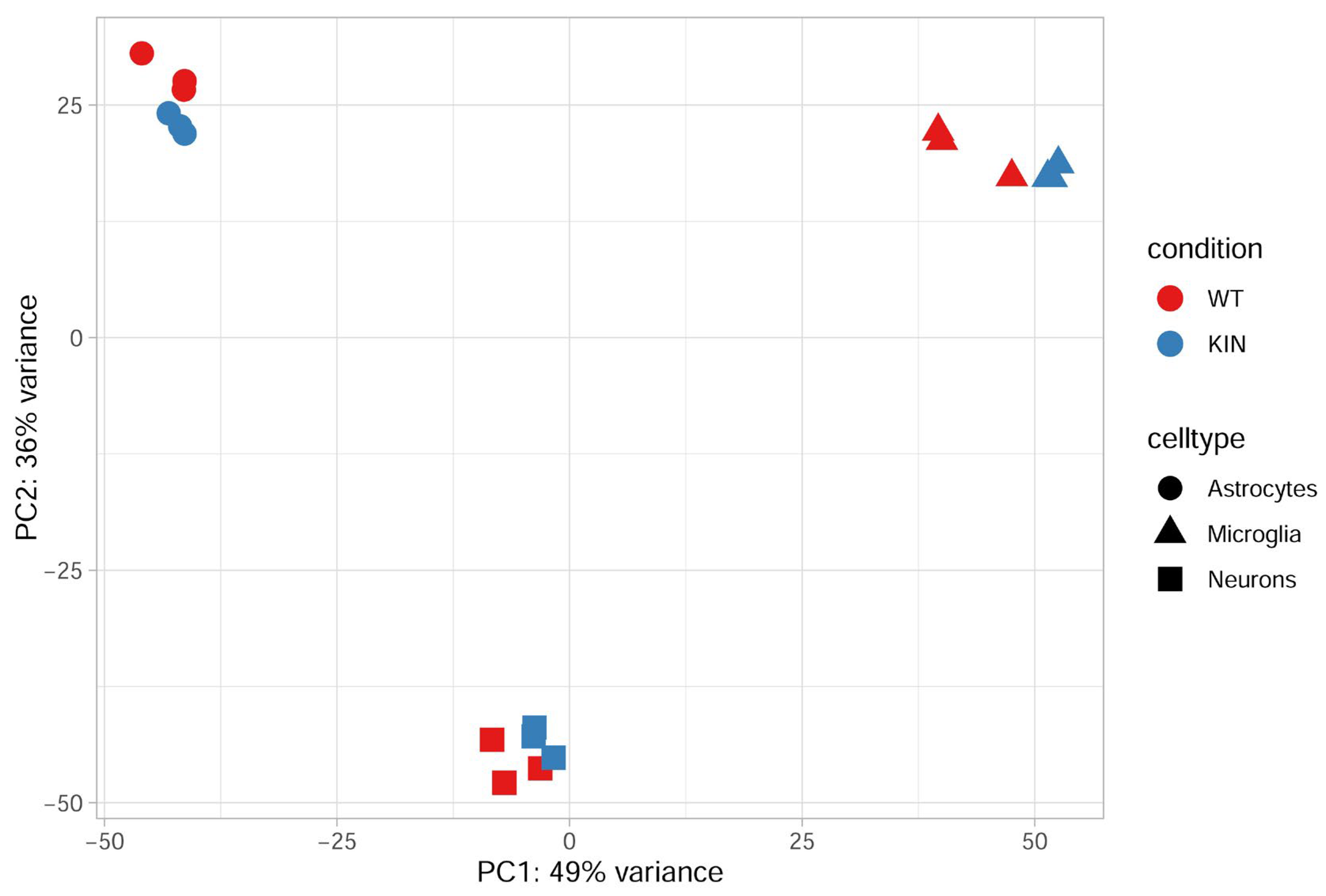
In general, the assessment confirmed the high quality of data, with a quantitative detection of 21,375 transcripts (isoforms of 16,387 genes) in the different fractions. Relevant quality control steps for each fraction involved FastQC 0.11.9 and MultiQC 1.32, including principal component analyses (Figure 4) as well as heatmaps showing Pearson Correlation Coefficients based on expression of the top 500 genes among all samples, boxplots of Cook’s distances from DESeq2 analysis to illustrate the distributions of values across samples, and dispersion plots from DESeq2 analysis to show gene-wise, fitted, and final dispersion estimates (Supplementary Materials S1 and S2).
Within each cell type, WT and KIN samples formed distinct but closely related subclusters (Figure 4), suggesting genotype-dependent transcriptional alterations that are smaller in magnitude compared to cell-type-specific differences. Importantly, biological replicates clustered tightly together, demonstrating high data consistency and experimental reproducibility.
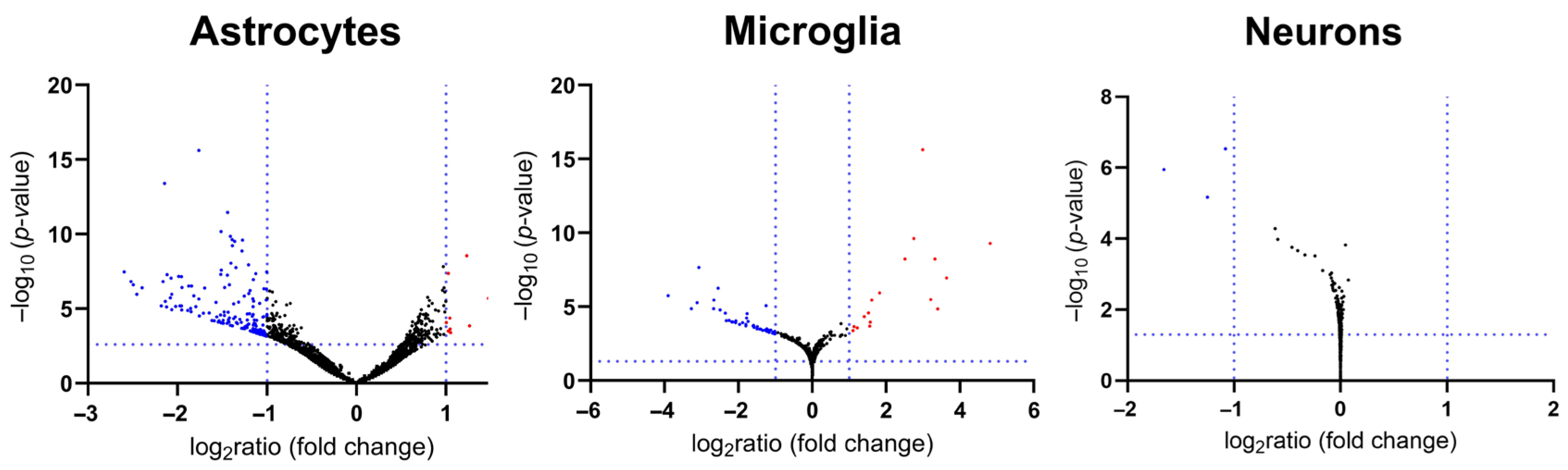
As documented by global Volcano plots (Figure 5), decreased mRNA levels dominated in all fractions. Mainly, the microglial fraction showed strong upregulations. The differential expression analysis across all KIN brain fractions as compound DESeq2 aggregate, with subsequent GSEA documentation of enriched pathways, highlighted the “transmission across chemical synapses” in the Reactome database, “voltage-gated channel activity” among GO-MF terms, “regulated exocytosis” among GO-BP terms, and “synaptic membrane” among GO-CC terms, as prominently downregulated mRNA clusters (Supplementary Material S1).
To filter the crucial data that are reproducible (independent of the transcriptomic techniques used) and are correlates of the disease process (independent of the region of the nervous system under analysis), all novel RNA-seq transcript data from 10-month-old brain fractions with dysregulations of nominal significance were compared to all previously documented [101] dysregulations of nominal significance in 14-month-old spinal cord Affymetrix Clariom D oligonucleotide microarray data. It is important to note that the unstable repeat in Atxn2-CAG100-KIN mice is continuously expanding over successive generations since the generation of this mutant [100], and an ever earlier onset of locomotor deficits was observed. It is also relevant that the spinal cord is affected earlier in SCA2 than the cerebellum and much earlier than the rest of the brain. Thus, both datasets were selected to represent disease-relevant stages rather than strictly age- or tissue-matched conditions. It must be considered that the spinal cord consists of many neuronal projections with myelination but relatively few neurons, resulting in a transcriptional profile that differs significantly from that of the brain. Consequently, this comparison of both approaches may identify the dysregulation of crucial molecules that are invariably associated with the SCA2/ALS13 disease process in any neuro-glial tissue, but risks ignoring many relevant molecular adaptations (particularly those with tissue-specificity).
Initial assessment of markers for specific compartments among the new RNA-seq transcript isoform profiles may provide a notion about data consistency and also about the severity of the disease process at the age under analysis. This comparison also enables the normalization of RNA-seq data, to distinguish which abnormalities will be due to the loss of neural projections and their corresponding myelin sheaths, versus increased glia mass together with reactive astrogliosis and microgliosis, or alternatively represent truly active transcriptional regulations.
Firstly, neuronal loss was substantial with reduced levels for the dendrite markers Map1b (log2FC −1.70 in astroglial, and −1.60 in microglial fraction) and Mapt (log2FC −2.10 in microglial fraction), postsynaptic marker Nrgn (log2FC −2.03 and −3.64, respectively), extracellular postsynapse marker Nptx1 (log2FC −3.31 and −2.53, respectively), presynaptic markers Snap25 (log2FC −4.43 in astroglial fraction) and Gap43 (log2FC −2.69 in astroglial fraction), axonal marker Nefl (log2FC −0.65 and −0.30, respectively), neuron cytoskeleton marker Sptan1 (log2FC −2.04 in microglial fraction), neuron soma marker Eno2 (log2FC −1.37 and −1.17), neuron nucleus marker Rbfox3 (encoding NeuN, log2FC −0.50 and −0.12), glutamatergic neuron marker Slc17a7 (log2FC −1.85 and −0.65), glutamatergic neuron markers Gls (log2FC −0.33 and −0.003) and Grin1 (log2FC −0.55 and −0.37), GABAergic interneuron markers Gad1 (log2FC −0.42 and −0.08) and Gad2 (log2FC −0.33 in astroglial fraction), glutamatergic neuron marker Neurod2 (log2FC −0.50 in astroglial fraction), and interneuron marker Pvalb (log2FC −0.21 in astroglial fraction). Overall, the strongest dysregulation among markers of neuronal loss was found for the postsynaptic marker Nrgn and the presynaptic marker Snap25, suggesting that synaptic components may be present only at around levels of 5% in some compartments of the mutant brain.
Secondly, astrogliosis was not conspicuous, with astrocyte markers Sox9, Gs, Acsbg1, C3 and Stat3 at normal levels, Gfap showing almost normal levels (log2FC 0.33 without significance in astroglial fraction), astrocyte markers Vim (log2FC 1.05 and 0.005, respectively) and S100b (log2FC 0.59 and 0.01) showing significant upregulations, but astrocyte markers Aldh1l1 (log2FC −0.50 in astroglial fraction), Ndrg2 (log2FC −1.1 in astroglial fraction), Slc1a2 (log2FC −1.27 in astroglial fraction), and Aqp4 (log2FC −0.47) showing significant downregulations. Overall, the strongest dysregulations among markers of reactive astrogliosis were found for Vim and Slc1a2, with approximately two-fold changes up and down, corresponding to the increased astroglial cell number in the mutant brain.
Thirdly, microgliosis markers Aif1, Trem2, Hexb, Sall1, Olfml3, Hexb, Fcrls, Spi1, Cx3cr1, the microglia homeostasis marker P2ry12, and the mature microglia marker Tmem119 appeared unchanged, while the Trem2-signaling partner Tyrobp exhibited a statistical trend towards upregulation (log2FC 0.02 in microglial fraction). Lysosomal Cd68 as a marker of microglial activation showed a significant upregulation (log2FC 0.73 in microglial fraction). Importantly, selected known markers of reactive microgliosis, like Trem2-dependent Apoe, Cst3, Cst7, Lpl, Clec7a, Axl, Spp1, Lgals3, Lgals3bp, Itgax, Cd63 and Gpnmb, as disease-associated microgliosis markers, showed massive and strongly significant upregulations that are detailed below. Overall, the strongest dysregulation among markers of reactive microgliosis was found for Gpnmb (log2FC 4.38, corresponding to 2082%), well above the two-fold increase in cell number documented for microglia in the mutant brain.
A significantly reduced expression of the disease gene Atxn2 with the CAG-repeat expansion was documented only in the microglial fraction (log2FC −0.03).
Overall, the constitutive markers of astroglial and microglial mass did not exhibit increases in proportion to the two-fold increase in their cell numbers, suggesting partial efficacy of compensatory experimental efforts (with equal RNA amounts being used for cDNA preparation, and sequencing data being normalized). There was a prominent loss of synaptic components and a massive upregulation of several disease-associated microgliosis markers.
Within the global comparison of microarray with RNA-seq profiles, the consistent downregulations (Table S2A) showed the strongest effects for (i) the 0.06-fold reduction in Scn4b encoding the sodium voltage-gated channel beta subunit 4 (also known as Navbeta4 or LQT10), in both tissues and in the astrocytic fraction. The SCN4B protein regulates the depolarization of excitable membranes [121]. Other consistent prominent decreases were documented for (ii) the synaptic factor Snap25 (encoding the Synaptosome-Associated Protein 25, as t-SNARE complex member involved in the molecular regulation of neurotransmitter release) in both tissues and astrocytic fraction, (iii) the synaptic factor Unc13c (encoding Munc13-3, as exocytosis factor in the presynaptic active zone), as well as (iv) the neurite transport factor Kif5a (encoding the Neuronal Kinesin Heavy Chain, as a microtubule-dependent motor is required for slow axonal transport) again in both tissues and astrocytic fraction. In addition, a strong decrease of (v) Hmgcr (encoding 3-hydroxy-3-methylglutaryl-CoA reductase, as the rate-limiting enzyme for cholesterol synthesis, regulated via negative feedback by sterols) was apparent in both tissues and the astrocytic fraction. Overall, these downregulations provide molecular insights into the detrimental changes that affect the functions of the astrocyte–microglia–synapse–neurite unit.
Among the consistent upregulations (Table S2B), the strongest effects were observed in both tissues and the microglia fraction, regarding (i) Gpnmb to log2FC of 4.38, equal to 2082% (encoding the glycoprotein nonmetastatic melanoma protein B, also known as hematopoietic growth factor inducible neurokinin-1, as integrin binding factor associated with amyloidosis type PLCA3), (ii) Cst7 (encoding cystatin-F, as protease-inhibitory factor associated with cerebral amyloid angiopathy), (iii) Clec7a (encoding the C-type lectin domain containing protein 7A, also known as CD369, as pattern-recognition receptor in the innate immune system that recognizes a variety of beta-1,3-linked and beta-1,6-linked glucans from fungi and plants, activating NF-kappa-B and MAP kinase p38 pathways and enhancing cytokine production), (iv) Slc11a1 (encoding the solute carrier family 11, member 1, as proton-coupled divalent metal ion transporter that sequestrates Fe2+ and Mn2+, localized to late-endosomal/lysosomal membranes), (v) Lgals3 (encoding lectin, galactoside-binding, soluble factor 3, as advanced glycation end-product receptor that coordinates the recognition of membrane damage with mobilization of core autophagy regulators), (vi) Lgals3bp (encoding galectin-3 binding protein, as factor that promotes integrin-mediated cell adhesion and stimulates host defense). Overall, these upregulations provide molecular insights into the mechanisms of the reactive microgliosis in a neurodegenerative process.

3.5. RNA-Seq Transcript Consistency Analysis Among Glial Fractions Shows a Prominent Increase in Transcripts Encoding Cytoplasmic Ribosomal Proteins of Large and Small Subunits

Thus, the new RNA-seq profiles showed consistency with previously validated microarray data. Given that RNA-seq findings may reveal RNA processing changes that cannot be detected by rigid oligonucleotide approaches, the subsequent effort considered only RNA-seq consistency. For this purpose, all RNA-seq data were filtered to identify effects with reproducibility between the overall brain compound RNA-seq, the astrocytic fraction, and the microglial fraction.
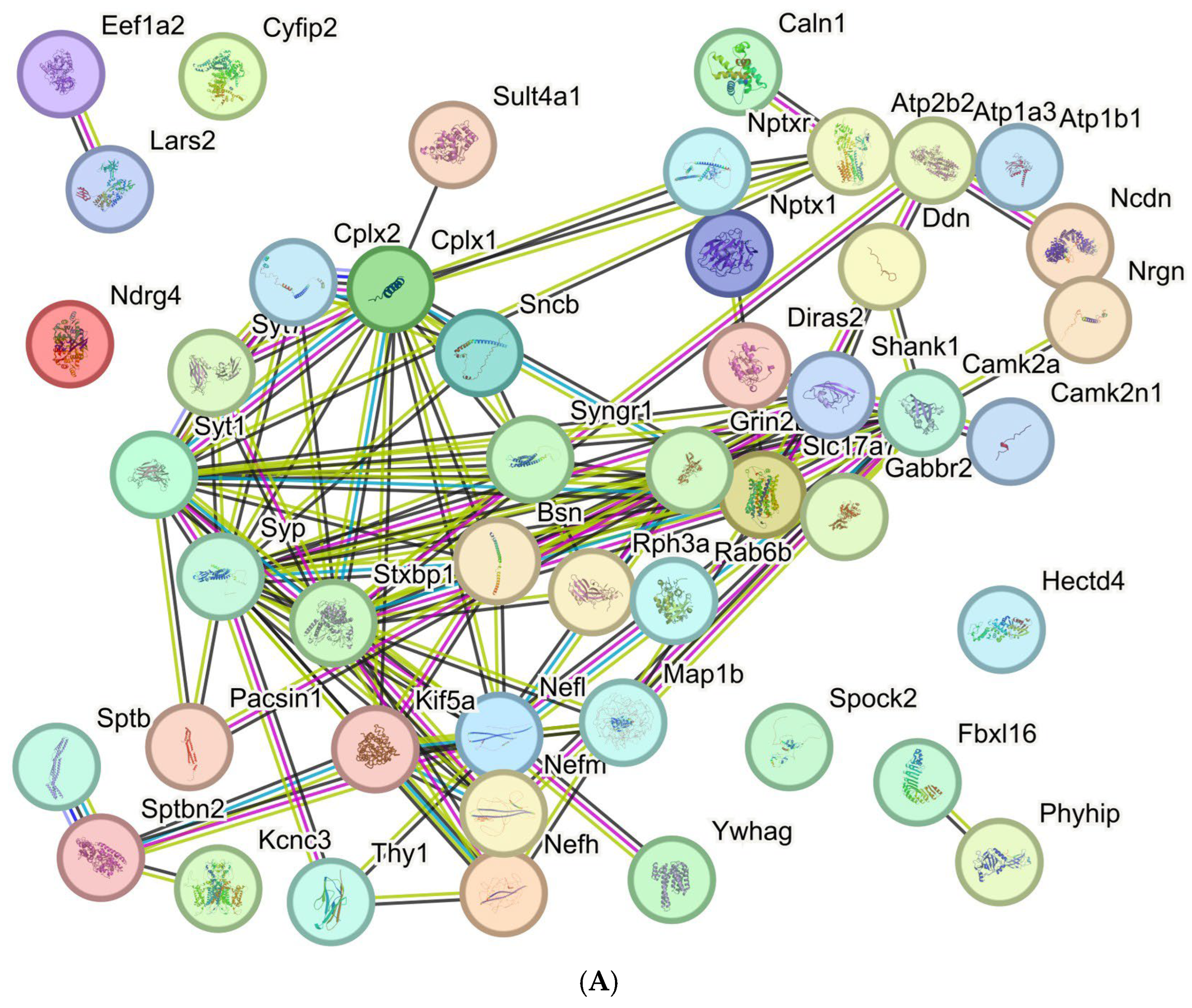
Among the consistent downregulations (Table S3A), known glial factors (Ndrg4, encoding N-myc downstream-regulated gene 4 protein, required for mitogenic signaling and cell cycle progression), but also synaptic factors (Slc17a7 encoding the vesicular glutamate transporter 1, Cplx1 encoding complexin 1, Syt1 encoding syntaxin 1, Scnb encoding synuclein beta), axonal factors (Nefh below the log2FC of −2.4 in the microglial fraction, corresponding to 19%, and with Nefl, both encoding neurofilament subunits), and dendritic factors (Nptx1 encoding neuronal pentraxin 1 as AMPA receptor clustering factor) were prominent, as unspecific correlates of the neurodegenerative process. As the strongest impact by the polyQ-expansion of the translation modulator ATXN2, with immediate credibility, strong decreases in Cyfip2 (encoding cytoplasmic FMR1 interacting protein 2) and Eef1a2 (encoding eukaryotic translation elongation factor 1 alpha 2, as a neuron-specific, monomeric, adult paralog) were observed. In view of the effect of mutant cytoplasmic ATXN2 on Cyfip2 expression here, it is noteworthy that knockout of its more nuclear paralog ATXN2L was reported to selectively deplete the levels of Nufip2 (encoding nuclear FMR1 interacting protein 2) [67].
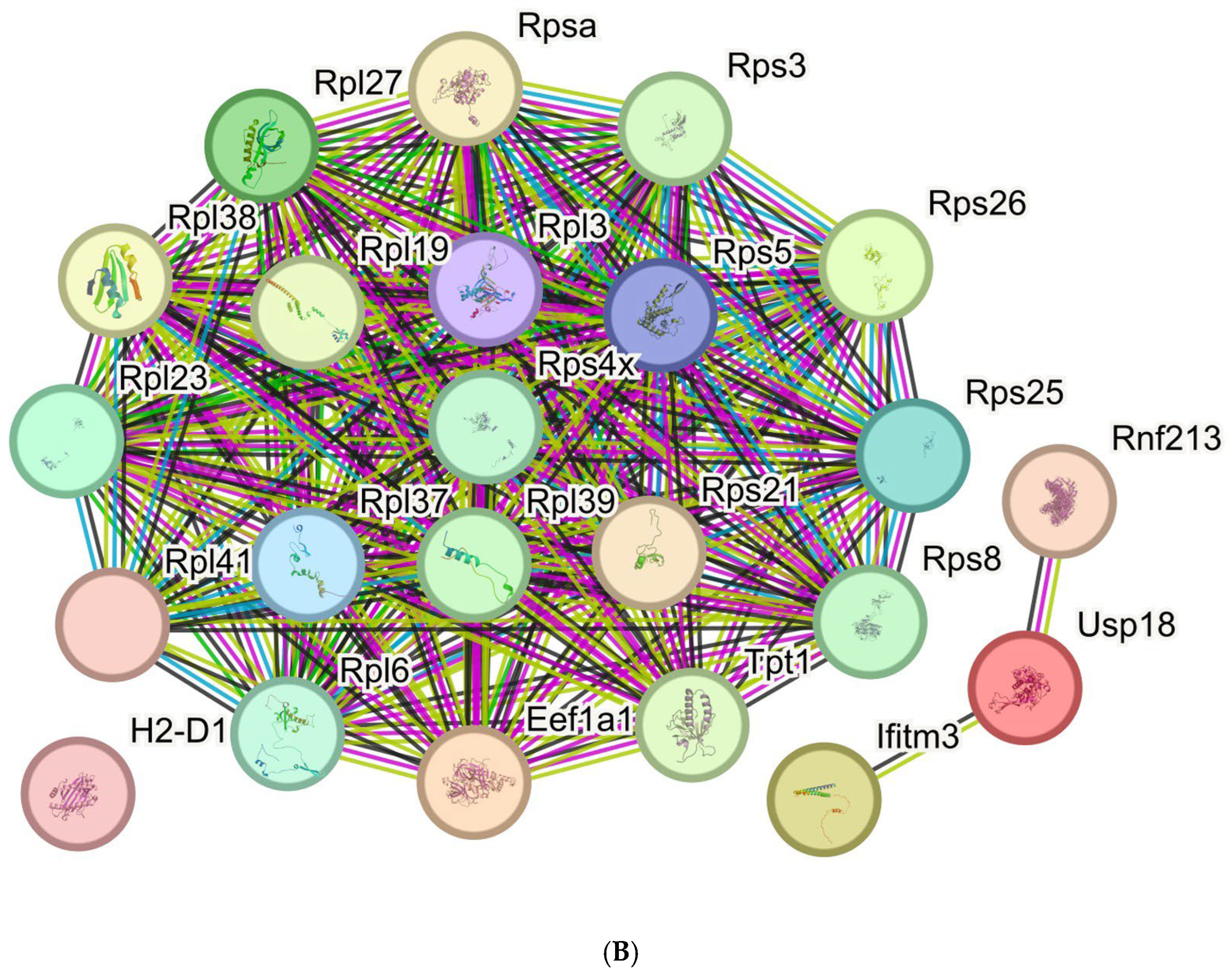
Among the consistent upregulations (Table S3B), prominent effects included the inductions of immunological factors Usp18 (encoding ubiquitin specific peptidase 18, as interferon-induced ISG15-specific processing protease) and Ifitm3 (encoding the interferon-induced transmembrane protein 3, as antiviral protein that disrupts intracellular cholesterol homeostasis), as well as Eef1a1 (encoding the eukaryotic translation elongation factor 1 alpha 1, as a ubiquitous, dimeric, embryonic paralog), while practically all other consistent increases were mild and concerned selectively the cytoplasmic ribosomal factors, both for the large and the small subunit.

3.6. STRING Analysis of Interactions and Bioinformatics Enrichments in Glial Fractions Extends the Observations of Transcript Reduction in Synapses, Axons, and Dendrites, Versus Induction of Ribosomal and Inflammatory Factors

Analyzing the consistent dysregulations in brain compound, astroglial, and microglial fractions further, and evaluating comprehensively also medium and small effects, not only the strong effects, an additional bioinformatics STRING interaction and pathways enrichment analysis was performed.
Regarding consistent downregulations, statistically significant deficits were found (Figure 6A) for transcripts in presynapses (Gene Ontology term Cellular Compartment 0098793, false discovery rate 4.55 × 10⁻¹⁹), postsynapses (GOCC 0098794, FDR 6.40 × 10⁻¹⁸), dendrites (GOCC 0030425, FDR 3.50 × 10⁻¹⁶), axons (GOCC 0030424, FDR 1.09 × 10⁻¹⁶), with an overall protein–protein-interaction enrichment p-value < 1.0 × 10⁻¹⁶. It was noteworthy that Spock2 (encoding secreted protein acidic and rich in cysteine, or SPARC, as a glial and neuronal factor that is usually induced during diseases or injury [122]) showed decreased levels. It was also interesting to note that reduced Fbxl16 (encoding F-box and leucine-rich repeat protein 16, as a C-myc stabilizer [123]) was in direct correlation with the reduction in Ndrg4 (encoding an N-myc downstream-regulated factor [124]), suggesting altered growth signaling in the myc oncogenic pathway.
Regarding consistent upregulations, statistically significant deficits were found (Figure 6B) for cytoplasmic translation (GO term Biological Process 002181, FDR 4.82 × 10⁻²⁹) and for ribosome assembly (GO term Biological Process 0042255, FDR 6.27 × 10⁻⁶), with an overall protein-protein-interaction enrichment p-value < 1.0 × 10⁻¹⁶.

3.7. RNA-Seq Consistency Analysis Among Glial Fractions for Small RNAs Finds Upregulation of All tRNAs Versus Downregulation of All Antisense RNAs and All Processed Pseudogenes

Performing also a small RNA sequencing analysis (sRNA-seq, including, e.g., antisense RNA, lincRNA, miRNA, mt-tRNA, piRNA, processed pseudogene RNA, processed transcripts, small protein coding mRNA, pseudogene RNA, retained intron RNA, ribozyme RNA, scaRNA, sense intronic RNA, snoRNA, tRNA and unprocessed pseudogene RNA), again consistency criteria were applied to define effects in direct correlation among astroglial and microglial fractions. Details on quality control assessment are provided in Supplementary Material S2.
Exclusively, downregulations were observed for two sRNA classes: antisense RNA and processed pseudogene RNA (Table S4A). The strongest effect concerned Gm36043-201, a predicted long non-coding RNA documented in the Ensembl genome browser to contain two exons on mouse chromosome 19.
Exclusively upregulations were observed for one sRNA class: cytoplasmic tRNAs (Table S4B). These effects were all mild. The relatively biggest effect concerned tRNAs for threonine.

3.8. RNA-Seq Analysis at the Gene Level of Microglia-Specific Effects Reveals ~Eight-Fold Accumulation of Uridine-Rich Small Nuclear RNA Rnu1b2

Given that the dysregulations were much stronger for microglial than for astroglial factors, we explored them without consistency filtering, based on gene-based analysis rather than on the previous transcript-based analysis that takes different isoforms into account. This slightly different strategy identified various dysregulations that are specific to microglia and not recognized in brain homogenate as a complex tissue (Table S5A). This approach, without consistency evaluation, has great potential to identify cell-specific dysregulations that get diluted in the complete tissue, but it is also the most artifact-prone strategy, so future validation will be critical. Given that reactive microgliosis and astrogliosis are expected during any neurodegenerative processes, moderately increased glial mRNA levels (below two-fold) must be viewed with caution. During this study, great care was taken to use equal amounts of RNA for cDNA preparation and to normalize the sequencing data, but of course, the relative decrease in neuronal transcripts may cause a converse relative increase in glial transcripts in any normalized homogenate. Clearly, increased mass or number of glial cells may also act as confounders (see Figure 2), and pathological RNA accumulation due to a processing block upon Atxn2 mutation may be present, so increased expression levels are not necessarily due to transcriptional upregulations.
In addition to the previously mentioned strong upregulations of Gpnmb, Cst7, Clec7a, Slc11a1, Lgals3, and Lgals3bp, further strong inductions were noted for Itgax, Spp1, Apoe, Axl, and below two-fold inductions for Csf, Cd63, Fam20c, Lpl, and Mpeg1, as a probably unspecific neuroinflammatory signature. Interestingly, a potentially Atxn2 mutation-specific massive mutation effect was noted for the pre-mRNA splicing factor Rnu1b2, which increased 14-fold (log2FC of 3.8, corresponding to 1390%), well above the levels that can result from the two-fold increase in microglia cell numbers. This uridine-rich small RNA is a potential target of the LSM domain in ATXN2, so this novel exploratory observation is interesting and merits future follow-up experiments, although it is microglia-specific and currently unconfirmed.
In addition to the previously mentioned strong downregulations of the glial factor Ndrg4 and of several synaptic/axonal/dendritic factors, further strong reduction was noted for the long non-coding small nucleolar RNA Rian, which was previously found downregulated in Parkinson’s disease and shown to modulate its neuroinflammatory process [125]. Furthermore, the observation of reduced Syne1 levels has particular credibility given that the SYNE1 protein was previously reported to co-accumulate with ATXN2 aggregates in the Atxn2-CAG100-KIN mouse brain [67].

3.9. RNA-Seq Analysis at the Gene Level of Astroglia-Specific Effects Mainly Documents the Neurite Retraction

To gain similar insights also in the astroglia-specific effects, again gene-based analysis was conducted and showed milder dysregulations (Table S5B).
The expression increases were close to the two-fold threshold that could be explained by relative enrichment of glial transcripts upon relative loss of neuronal transcripts in any normalized homogenate, and by increased astrocyte mass during a process of reactive astrogliosis.
In addition to the previously mentioned decreases in Cplx1, Camk2b, Snap25, Ndrg4, Kif5a, Eef1a2, only the new decreases in Agt (encoding Angiotensinogen, also known as Serine Proteinase Inhibitor A8, as potent regulator of blood pressure, body fluid and electrolyte homeostasis) and Etnppl (encoding ethanolamine-phosphate phospho-lyase, as cellular response factor to glucocorticoid stimulus, implicated in the ceramide phosphoethanolamine catabolic process and the phospholipid transfer to membranes) represent astrocyte-enriched transcripts, while the other decreases affect inhibitory neuron factors (Dnm1, Sptbn2, Adcy1, Kcnq2, Slc12a5, Celsr3, Cplx2, Unc13a, Trank1, Camk2a, and Atp1a3) or excitatory neuron factors (Mical2, Ppfia4, and Slc17a7), according to http://www.braincellatlas.org (last accessed on 23 January 2026) cerebellar data. Overall, the reactive astrogliosis appears to be of little relevance in comparison to the strong reactive microgliosis and the massive neurite retraction according to these RNA-seq data.

3.10. RNA-Seq Analysis at the Gene Level of Neuron-Specific Effects Documents Novel DNA Effects

To also gain similar insights into the neuron-specific effects, pathway enrichments were considered instead of a tabular compilation of the strongest dysregulation, in view of the low fold-changes that are usual for neurons.
Expression increases in most histone isoforms led to significant enrichment for several DNA damage response pathways (Supplementary Material S1, Figures S17–S20, Tables S16–S19). Although these exploratory data are unconfirmed, they represent the first evidence that DNA handling and repair mechanisms are relevant for the disease course in SCA2, as was previously reported for Huntington’s disease [126,127,128].
Conversely, the expression decrease in many mitochondrial factors was reflected by significant enrichment for several pathways of respiratory activity and oxidative phosphorylation (Supplementary Material S1, Figures S17–S20, Tables S16–S19). Certainly, the general loss of respiration-dependent neuronal tissue in the aged SCA2 mouse model may have contributed to these decreases.

3.11. Systematic Interrogation of RNA-Seq Findings at the Gene Level for Uridine-Rich snRNAs and the SMN Pathway Shows Increases Selectively in the Astroglial Fraction That Could Be Explained by Astrogliosis

To assess if the strong Rnu1b2 accumulation in microglia was a unique finding or recapitulated for other uridine-rich snRNAs with a weaker effect size in any fraction, a systematic compilation of all Rnu gene family data is shown in Table S6. Indeed, many Rnu family members were detected, sometimes with two isoforms and additional pseudogenes. But the strong Rnu1b2 accumulation in microglia was not recapitulated for other Rnu variants destined to the spliceosome. Curiously, several of these Rnu genes showed significantly but mildly increased expression, and two isoforms showed converse decreases, always in the astroglia-enriched fraction. Here, it has to be taken into account that astrogliosis is present in the mutant brains, and that effect sizes with log2FC values around 0.4 can simply be due to the relative increase in glial transcripts due to the relative decrease in neural transcripts in any normalized homogenate. They need not be explained by transcriptional upregulation or by accumulation due to impaired processing.
To also understand if the pathways of spliceosome biogenesis and subsequent splice activities are affected, we interrogated the RNA-seq data for dysregulations of components of (i) the SMN complex that acts as assembly site for the spliceosome, (ii) the Sm proteins within the spliceosome, and (iii) the PRMT5 complex that is responsible for the methylation of Sm proteins to form 6S Sm-subcomplexes that get loaded onto snRNA by the SMN complex [129]. Significant changes were only found in the astroglial fraction for Gemin7 (log2FC 1.80), Snrpd1 (log2FC 1.73), and Snrpd3 (log2FC 1.36), while Smn1, Gemin2, Gemin4, Gemin8, Strap, Snrpd2, Snrpf, Snrpg, Prmt5, Clns1a and Wdr77 showed non-significant results, and all other components were not detected. Thus, these upregulations do not appear connected with the microglial Rnu1b2 excess and are within the range of changes that occur during reactive astrogliosis.

4. Discussion

Recent research showed that most of the disease genes underlying the neurodegenerative processes of Alzheimer’s disease and Parkinson’s disease are strongly expressed in glial cells (astrocytes, microglia, and oligodendrocytes, not only neurons) [115,130]. In the case of SCA2/ALS13, it is well established that the responsible disease protein Ataxin-2 is best detected in the vulnerable neurons due to their large cytoplasm, but it is ubiquitously expressed according to comprehensive databases (www.proteinatlas.org, last accessed on 23 January 2026) and gets transcriptionally induced during stress periods of glial cells [131,132]. However, the role of glial cells upon polyQ-expansion or knockout of Ataxin-2 and its orthologs/paralogs has not been studied previously. All transcriptomic, proteomic, phospho-proteomic, lipidomic, and metabolomic studies done so far were in whole tissue homogenates or organismal extracts in humans, mice, flies, yeast, and plants [66,67,68,69,72,82,83,86,88,96,99,101,133,134,135,136,137,138,139]. As a matter of course, relevant mutation effects in specific cell types may get diluted and obscured when complex tissue extracts are used for subsequent analyses.
The present study successfully enriched astroglial and microglial fractions. In contrast, the neuronal fraction showed 20-fold fewer cell numbers and a low RNA yield. This prompted the highly sensitive MACE protocol for RNA-seq to be employed for all fractions, achieving the quantification of >10,000 among the most abundant transcripts even in the neuronal fraction. It remains unclear whether the significance of dysregulations is detected with similar efficacy in the neuronal fraction as in the two glial fractions, where sequencing depth and the number of unique reads were much higher. Fraction purity was assessed by RT-qPCR and immunocytochemistry, showing an approximately two-fold higher glial cell number from mutants, despite the lower brain weight of mutants. Both glial fractions from 10-month-old Atxn2-CAG100-knockin mice, as an authentic model of SCA2/ALS13, were compared. Overall, the data indicate that the loss of synaptic/axonal/dendritic transcripts is prominent at this stage (with Nefh mRNA for the neurofilament heavy chain transcript as an axonal factor down in glial fractions to below 19%), and microglial dysregulations are strong (with the Gpnmb transcript encoding Osteoactivin up to above 2000%), while astroglial dysregulations are minor. The unspecific signs of the neurodegenerative process include the induction of a microglial neuroinflammatory signature including not only Gpnmb, but also Cst7, Clec7a, Slc11a1, Lgals3, Lgals3bp, Itgax (CD11c), Spp1 (Osteopontin), Apoe, Axl, Usp18, Ifitm3, Rnf213, in a response pattern that has been observed also in neurodegenerative processes such as Alzheimer’s, Fronto-temporal dementia, and Parkinson’s disease, as well as nervous system trauma and infarction [140,141,142,143,144,145,146,147,148,149,150,151,152,153,154,155]. These findings lead us to propose that disease severity and progression in our SCA2 mouse model should be quantified by measuring the ratio between Gpnmb increase and Nefh decrease. These nonspecific findings in glial cells showed high consistency and are in excellent agreement with the robust literature on neuroinflammatory signatures in other neurodegenerative disorders, so they are very credible.
There were also specific dysregulations that relate to the altered function and interactome of the disease protein ATXN2, firstly at the translation apparatus. Strong decreases in the Cyfip2 and Eef1a2 transcripts were documented, with a parallel increase in Eef1a1, suggesting that polyQ expansion of ATXN2 selectively impairs the translation at the initiation and re-initiation (i.e., elongation) steps. In good agreement, ATXN2 has a known direct protein interaction with PABPC1 (polyA-binding protein, cytoplasmic, type 1), which associates with the 3′ tail of mRNAs to mediate their circularization, in a step before ribosome recruitment and translation initiation, and their association is affected by the polyQ expansion [65]. The two translation elongation factor paralogs are 97% identical. Eef1a2 serves as a monomeric, adult form with selective neuronal expression and high phosphorylation, particularly on tyrosine residues, with established functions in neuronal signaling (e.g., mTOR-dependent axonal repair). In comparison, Eef1a1 functions as a dimeric, embryonic ubiquitous form with a seven-fold higher GDP dissociation rate, with known roles for cytoskeletal modifications [156]. The Cyfip family is thought to modulate translation initiation, with the isoform Cyfip1 acting at the 5′ end while Cyfip2 targets the 3′ end of mRNAs, affecting mainly the expression of actin cytoskeleton factors that are crucial for synaptic plasticity [157]. This deleterious effect of polyQ-expansions in ATXN2 on mRNA circularization and re-initiation of translation for elongation efficiency may be the underlying cause for the transcriptional upregulation of cytoplasmic ribosomal factors in the large and small subunits, and of the cytoplasmic tRNAs. These mild but systematic and consistent RNA-seq observations are likely to represent a cellular compensation effort to maintain sufficient protein biosynthesis. However, a partial substitution of deficient neuronal Eef1a2, which mediates the necessary stimulus-dependent protein synthesis for synapses, by enhanced levels of embryonal high-yield Eef1a1 and elevated levels of translation machinery (ribosomes and tRNA) would be inadequately governed by the excitatory versus inhibitory signals within synapses. Overall, these data elucidate how ATXN2 polyQ expansion impacts the translation regulation steps, in similar ways as was reported for ATXN2-null mice [69,70,72]. Although these data are novel and are complementary to previously published knowledge on ATXN2, we have to caution that independent validation in patient tissue or other SCA2 models, with additional techniques, is necessary to establish their value.
Secondly, there were additional specific dysregulations that relate to ATXN2 functions in RNA processing upstream from translation events. The finding that significantly dysregulated small RNAs invariably showed decreases for all antisense RNAs and for all processed pseudogenes indicates that the impact of ATXN2 polyQ expansion is not restricted to translation. This notion is supported by the deficient levels of the long non-coding small nucleolar RNA Rian. Apparently, the processing of non-translated sRNAs is affected by cytoplasmic ATXN2, even if an RNA like Rian is trafficked to the nucleolus rather than the cytoplasm. Of course, indirect effects might be responsible, but the exploratory observation of a 13.9-fold accumulation of Rnu1b2 levels provides an interesting potential explanation via a direct mechanism. ATXN2 structure is dominated by its N-terminal LSm-fold with five beta-barrels. LSm domains are derived from bacterial Escherichia coli Hfq/YlxS and archaeal Sm1/Sm2 proteins, which function as RNA chaperones, with preferential binding to regulatory small uridine-rich RNAs, and crucial roles for spliceosome evolution and ribosomal translation [62,158,159,160,161]. Five primary uridine-rich small nuclear RNAs are present in the spliceosome (U1, U2, U4, U5, and U6), having an essential role for pre-mRNA splicing [162,163], and another uridine-rich snRNA (U7) modulates histone mRNA 3′ end maturation [164]. The murine Rnu1b2 snRNA (corresponding to human RNU1-2) represents one isoform of the murine U1 snRNA [165]. U1 RNA is essential for recognizing the 5′ splice site of mRNA precursors to facilitate intron removal [163,166]. Rnu1b2 and its paralog Rnu1b1 are chromosomally located five kilobases apart, coded on opposite DNA strands, with juxtaposed 5′ ends, and share identical flanking sequences 5′ and 3′ to the gene [167,168,169,170,171]. Rnu1b paralogs show embryonic and fetal expression, while Rnu1a paralogs show constitutive expression in differentiated cell types [172,173,174]. It remains unclear what the functional differences between Rnu1b2 and Rnu1b1 might be. Crucially, the uridine-rich snRNAs undergo several processing steps. U1, as a Sm-class snRNA, is transcribed by RNA polymerase-II and receives a 7-methylguanosine (m7G) cap in the nucleus. It is then exported to the cytoplasmic U-bodies, where 3′-end trimming occurs together with cap hypermethylation to 2,2,7-trimethylguanosine (m3G). U-bodies form upon cellular stress in the vicinity of P-bodies, where 5′-cap processing and 3′-end trimming also occur, but are taken further until the complete degradation of RNA [175,176,177]. For P-bodies, a perturbation upon experimental manipulation of ATXN2 was already documented [63]. In U-bodies, the SMN complex recognizes the 3′-end trimming of uridine-rich snRNAs and assembles their Sm sites with seven Sm proteins (B/B’, D3, D2, D1, E, F, and G) [178]. The resulting ribonucleoprotein complex is re-imported into the nucleus to become the spliceosome [175,179,180,181]. Clearly, the U1 processing step at U-bodies via the SMN complex provides an opportunity where cytoplasmic ATXN2 with its LSm domain has access to uridine-rich snRNAs before they become part of the spliceosome. In this context, it is interesting to note that mutations in the SMN1 protein as part of the SMN complex result in axonal motor neuron degeneration with fetal, pediatric or juvenile onset [182,183,184,185,186,187], and mutations in ATXN2 cause pathologically indistinguishable axonal motor neuron degeneration with adult onset [7,101,188,189,190], in good agreement with these thoughts about a functional interaction between ATXN2 and SMN1 at U-bodies. Altogether, the observed about 14-fold accumulation of the small nuclear Rnu1b2 isoform seems a plausible specific effect of ATXN2 polyQ expansion, which was documented only in microglial fractions by gene-based analysis, and may have been diluted in previous global transcriptome surveys of complex nervous tissues that were focused on mRNAs. While it is tempting to interpret the increased levels of Rnu1b2 as a consequence of impaired processing in U-bodies due to altered conformation of the LSm domain in ATXN2 upon polyQ expansion, of course it should also be considered that this 14-fold increase may represent an active transcriptional upregulation in response to stress, possibly secondary to microglial activation, in analogy to the 2082% induction of Gpnmb. Thus, at present is remains completely unclear whether the Rnu1b2 is part of the pathology, or part of compensatory neuroprotective efforts in the brain tissue. It is important to know that U1 snRNPs act as potent triggers of innate immunity in monocytes, having established relevance for autoimmune pathology and (for the neuroinflammatory process, or for stress-triggered splice adaptations?) in Alzheimer’s disease [191,192,193,194,195]. Furthermore, it is noteworthy that U1 snRNAs were previously proposed as useful biomarkers [196] and that their manipulation has therapeutic value [197,198,199,200,201,202,203,204]. Despite the novelty and the plausible mechanistic consequences of the Rnu1b2 increase, this preliminary, single-fraction observation strongly requires independent validation before it can be considered a relevant molecular event within SCA2/ALS13 pathogenesis. The scenario of ATXN2-LSm interaction with Rnu1b2 at U-bodies is worthwhile considering, but at this stage purely speculative.
In this context, another isolated observation without consistency in the current RNA-seq dataset becomes noteworthy. Only in the neuronal fraction, where the quantification may be reliable only for very abundant transcripts, the levels of Eftud2 showed a significant accumulation (log2FC 4.37). As a component of the minor spliceosome, the putative GTPase protein EFTUD2 (also known as U5 snRNP Specific Protein with 116 KD, or SNU114 Homolog) is integrated in the U5 snRNP and the U4/U6-U5 tri-snRNP complexes, serving to enable the splicing of U12-type introns in pre-mRNAs [205,206,207]. Eftud2 dysregulation is particularly deleterious for cerebellar Purkinje neurons [208,209] and has a prominent role in antiviral splice adaptations [210,211]. However, this RNA-seq observation is clearly exploratory and cannot provide mechanistic insights at present without further confirmation.
Thirdly, there was a specific dysregulation that relates to ATXN2 function, regarding the highly dynamic actin cytoskeleton at the nuclear envelope, in addition to the synaptic terminals. The finding of reduced Syne1 levels was previously observed together with a reduction in SYNE1 protein levels and a co-accumulation of SYNE1 protein with the ATXN2 aggregates in aged Atxn2-CAG100-KIN mouse brain [67], as mentioned above. This previous report analyzed knockout mice of ATXN2L as a nucleus–cytoplasm shuttling paralog of ATXN2 [67], observing a prominent impact on the actin modulator SYNE2 (also known as Nesprin-2) at the nuclear envelope [212], and on the nuclear protein NUFIP2 as a target of an O-GlcNAcylation-mediated condensation in the context of actin-binding and focal adhesion factors [213]. Parallel investigations of conditional ATXN2L-depletion at adult age documented a clear alteration of the nuclear splicing pathway [68]. This knowledge is now complemented by novel RNA-seq evidence that the polyQ expansion in the completely cytoplasmic paralog ATXN2 causes reductions in Syne1 and Cyfip2 levels. As functional similarities, both giant SYNE/Nesprin proteins have paired N-terminal calponin-homology (CH) domains for actin binding and C-terminal KASH domains for membrane anchoring. These domains are encoded in multiple isoforms that are subject to alternate splicing, getting positioned in overlapping localizations at nuclear and other membranes (where they ensure actin-dependent proximity towards synaptic signals or other stimuli). These domains also regulate cell polarity and filopodia [214,215,216,217,218]. As a functional difference, SYNE2 was found to be critical for cortical and hippocampal neurons, while SYNE1 is more relevant for cerebellar neurons, with its mutations resulting in spinocerebellar ataxia type SCAR8 and motor neuron degeneration [219,220,221]. Regarding the other gene family with dysregulated expression upon ATXN2/ATXN2L mutations, both the NUFIP2 and CYFIP2 proteins are interactors of the Fragile X Mental Retardation protein (FMRP), as members of a family of regulators of neuronal translation, of activity-dependent bulk endocytosis, and of synaptic function, acting as adaptors of ribonucleoprotein complexes and actin [222,223,224,225,226,227]. NUFIP isoforms are thought to connect FMRP with nuclear export, RNA processing, the control of protein synthesis at synaptic sites, and the autophagolysosomal degradation pathway [228,229,230,231,232,233,234], while CYFIP isoforms connect FMRP with translation suppression (CYFIP2 acting at the 3′ untranslated region of mRNAs), actin polymerization, and cytoskeleton remodeling [157,235,236,237,238,239,240,241,242,243,244,245,246,247]. The impact of Ataxin-2 family members on the NUFIP/CYFIP family might explain previous findings in the nematode Caenorhabditis elegans that deletion of its single-copy Ataxin-2 ortholog regulates centrosomes at the nuclear envelope and cytoskeletal dynamics [248]. These observations are also in good agreement with observations in the fly Drosophila melanogaster that its single-copy Ataxin-2 ortholog interacts with FMRP [98,249] and impacts the actin cytoskeleton [56]. Again, these data are novel and are complementary to previously published knowledge on ATXN2, but independent validation in patient tissue or other SCA2 models, with additional techniques, will be needed to establish their value.
Fourth, there were very consistent downregulations of Sptbn2 in both glial and neuronal fractions (Tables S3A and S5A). This is remarkable in view of the roles of ATXN2 and SPTBN2 as disease proteins responsible for spinocerebellar ataxia. Mutations in SPTBN2 cause autosomal dominant spinocerebellar ataxia type 5 (SCA5) and autosomal recessive SCAR14/SPARCA1 [250,251,252,253]. SPTBN2 is a structural constituent of the postsynapse, essential for anchoring glutamate receptors and transporters (such as EAAT4 and mGluR1) at the plasma membrane [254,255]. It helps shape the dendritic spine neck, regulating synaptic transmission to prevent excessive excitation [256,257]. SPTBN2 plays a vital role in trafficking proteins, maintaining the structural integrity of the Golgi apparatus, and managing vesicle transport within neurons [258,259,260]. In particular, it supports cerebellar Purkinje cells [261,262]. The impact of ATXN2 polyQ expansion on the expression of beta-spectrin isoforms in general, and on their roles to connect the cortical actin cytoskeleton with synaptic membranes via ankyrin-binding and pleckstrin-homology domains [263,264], was substantiated by the significant decreased expression (Table S3A) of Sptb (log2FC −2.36 in astroglial and −3.78 in microglial fraction), Sptbn4 (log2FC −1.4 in astroglial, −1.23 in microglial fraction) and Sptbn1 (log2FC −0.72 in microglial fraction). Similar to the statements above, these data are novel and are complementary to previously published knowledge on ATXN2, but independent validation in patient tissue or other SCA2 models, with additional techniques, will be needed to establish their value.
There are clear limitations of this study. Unfortunately, not enough aged Atxn2-CAG100-KIN mice were available to obtain sufficient material in the neuronal fraction for standard RNA-seq(given that the progressive expansion in the polyQ domain of ATXN2 has an ever more profound impact on fertility due to its expression changes in peripheral tissues [69,100]), so the highly sensitive MACE technique was employed instead across all fractions and the data therefore reflect only the 3′-ends of mRNA. Thus, only a small part of all isoforms is represented in the expression profiles. While all the RNA profiles reported here are preliminary (given that we were unable to perform validation experiments in additional samples with complementary techniques), we endeavored to ensure that neuronal data above the detection threshold are similarly powered and of comparable quality as the glial data. The advanced neurodegeneration in the aged mice under study causes a loss of neural tissue in parallel to reactive microgliosis and astrogliosis, so it is impossible to distinguish clearly whether lower neural transcript levels and higher glial transcript levels are due to altered cell mass/cell numbers, or indeed reflect active transcriptional regulation. Although we made efforts to compare crucial data with markers of microglia and astroglia mass/numbers and to visualize these background effects in a heatmap where massive transcriptional dysregulations are easily appreciated, validation experiments, e.g., regarding the promoter methylation pattern of key genes, should be conducted in the future. It will also be useful to assess crucial data such as the increased expression of Gpnmb and the decreased expression, e.g., of Nefh and of Cyfip2 at the protein level, employing quantitative immunoblots, immunohistochemistry, and coimmunoprecipitation experiments. Our team discontinued breeding of the Atxn2-CAG100-KIN mouse line upon closure of the lab due to retirement of the principal investigator, but the sperm is cryoconserved at the company genOway (Lyon, France) and at the European Mouse Mutant Archive (EMMA ID EM:13598, see https://www.infrafrontier.eu/emma/strain-details/?q=13598, last accessed on 3 February 2026), so that independent teams can assess the present data. Finally, it is clearly possible that RNA-seq findings about SCA2/ALS13-unique dysregulations that are not reproduced by oligonucleotide microarray data, or RNA-seq data in a single fraction (such as the accumulation of Rnu1b2, or the deficiency of Rian) might be technical or analytical artifacts.
Potential next experiments might of course include (i) the analysis of frozen or fresh patient samples such as nervous tissues (very few are available, with their preservation state always being a cause of concern) or the analysis of patient peripheral blood macrophages, (ii) the analysis of independent SCA2/ALS13 models in mice, flies, nematodes, zebrafish, yeast, or plants, (iii) the analysis of independent SCA2/ALS13 models in vitro, such as microglial cell lines, cultures of primary microglia, extracts from microglial fractions. For cell culture experiments, it should be considered that the microglia-specific dysregulations described here may have arisen only after the exposure of these cells to stress and debris, while the effects may not be detectable in complex brain tissue and cell cultures during normal growth phases. Clearly, the maturation of uridine-rich snRNAs and their incorporation into spliceosome precursors by the SMN complex is concentrated in U-bodies only after cellular stress, while it occurs diffusely in the cytoplasm of unstressed cells [265,266,267]. Beyond microglia- and astroglia-enriched fractions, it would be desirable to breed and age the Atxn2-CAG100-KIN mouse line again, complementing the present data with the analysis of neuronal and oligodendroglial fractions, to understand more cell-type-specific disease mechanisms in view of the strong and early neurite retraction and demyelination in SCA2 [101,268,269,270,271,272,273]. If the evidence about non-coding small RNA dysregulations is substantiated, a systematic study about the processing of all uridine-rich snRNAs, snoRNAs, antisense RNAs, and pseudogenes should follow. Crucially, it is worthwhile considering the possibility that a lack of completely processed uridine-rich snRNAs would impair spliceosomal activity, and that synthetic substitutes with slow turnover due to pseudouridylation might provide a causal therapeutic opportunity [274,275,276,277,278,279]. As stated before, all these confirmatory studies with different biological material and varying technical approaches will have to be conducted by independent research teams.

5. Conclusions

In conclusion, the transcriptome profiling from microglia- and astroglia-enriched fractions from 10-month-old Atxn2-CAG100-KIN brain documented a severe retraction of neural terminals from their glia-association, together with strong reactive microgliosis at this stage, while the astrogliosis was mild, as unspecific signatures of the neurodegenerative process. As potential SCA2/ALS13-specific dysregulations that relate to the known phenotype, functions, and interactomes of ATXN2, four new effects complement previous findings. (i) Altered levels were documented for two translation elongation factors in converse direction; (ii) reduced levels were found for a cytoplasmic member of the CYFIP family (in analogy, its nuclear homolog is affected by ATXN2L mutation); (iii) decreased levels were also observed for another member of the Nesprin/SYNE family that mediates membrane movement (in analogy, a second member is affected by ATXN2L mutation); and (iv) decreased transcript levels were observed for several members of the beta-spectrin family. The functional roles of all these molecules converge in the stimulus-dependent mRNA splicing and translation, particularly for actin-associated cytoskeletal factors, to enable plasticity of synaptic as well as nuclear membranes. The impact of ATXN2 polyQ expansion was not restricted to coding mRNAs, but among small non-coding RNAs, mild but consistent effects were documented for all antisense RNAs and all processed pseudogenes, which invariably showed downregulations, similar to the small nucleolar non-coding RNA Rian. As a single, exploratory, and currently unvalidated observation about possible mechanisms that mediate this impact upstream from cytoplasmic ribosomal translation, the 13.9-fold accumulation of the uridine-rich small nuclear RNA Rnu1b2 stands out. As a plausible scenario, the mutation directly adjacent to the LSM domain of cytoplasmic ATXN2 could affect its binding and processing of uridine-rich RNAs as its known targets, when they are exported from the nucleus to cytoplasmic U-bodies for hypermethylation of their 5′ cap, and trimming of their 3′ ends. Subsequently, the processed U-rich snRNAs will interact with the SMN complex, so that they can assemble with the seven Sm proteins to form the spliceosome, before this ribonucleoprotein complex gets re-imported into the nucleus and assumes its activity there. Unfortunately, this microglia-specific effect could not be validated further by this team, and future assessment by independent groups is urgently needed.

Supplementary Materials

The following supporting information can be downloaded at: https://www.mdpi.com/article/10.3390/cells15080699/s1. Supplementary Material S1: Quality assessment of RNA-seq data for mRNA. Supplementary Material S2: Quality assessment of RNA-seq data for small RNA. Figure S1: RT-qPCR analyses of dissociation purity in CD11b-labeled microglial fraction, ACSA2-labeled astroglial fraction, and unlabeled neuronal/endothelial fraction. Table S1: RNA concentrations per sample, before RNA-seq. Table S2A,B: Consistency analysis between the new 10-month-old brain compound and cell-type-specific RNA-seq transcript profiles and previously reported 14-month-old spinal cord oligonucleotide microarray data. Table S3A,B: Consistency analysis between new RNA-seq profiles in brain compound, astroglial, and microglial fractions. Table S4A,B: Consistency analysis between new sRNA-seq profiles in astroglial and microglial fractions. Table S5A: Strongest dysregulations in the new RNA-seq gene profile of microglial fraction. Table S5B: Strongest dysregulations in the new RNA-seq profile of astroglial fraction. Table S6: Compilation of expression data for Rnu gene family.

Author Contributions

Conceptualization, G.A., A.R.K. and J.K.; methodology, A.R.K., R.V., L.-E.A.-M., S.G., N.-E.S. and J.K.; software, G.A., A.R.K. and J.K.; validation, A.R.K. and R.V.; formal analysis, G.A., A.R.K. and J.K.; investigation, G.A., A.R.K., R.V., S.G. and J.K.; resources, R.V., S.G. and N.-E.S.; data curation, G.A. and J.K.; writing—original draft preparation, G.A., A.R.K. and J.K.; writing—review and editing, G.A., A.R.K., R.V., L.-E.A.-M., S.G., N.-E.S. and J.K.; visualization, G.A., A.R.K., J.K.; supervision, G.A., R.V., S.G. and J.K.; project administration, G.A.; funding acquisition, G.A. All authors have read and agreed to the published version of the manuscript.

Funding

This research was funded by the Deutsche Forschungsgemeinschaft, grant number AU96/21-1 (G.A.) and SFB1039 (R.V.).

Institutional Review Board Statement

The study was conducted in accordance with the Declaration of Helsinki. The animal study protocol was approved by the Regierungspräsidium Darmstadt (protocol code V54-19c18-FK/1083, approved on 27 March 2017).

Informed Consent Statement

Not applicable (study not involving humans).

Data Availability Statement

Complete analyses in EXCEL files supporting the conclusions of this article, as well as MultiQC reports, are available from the authors upon reasonable request. All raw RNA-seq data were deposited publicly at GEO with the accession numbers GSE319876 and GSE319875.

Acknowledgments

The authors thank technical assistants Gabriele Köpf and Hildegard König for invaluable help. We are grateful to the staff of the Zentrale Forschungs-Einrichtung (ZFE) of the Goethe University Medical School in Frankfurt/Main for their help with animal breeding and aging. We are indebted to the staff of the company GenXPro in Frankfurt/Main for their RNA-seq work and bioinformatics analyses.

Conflicts of Interest

The authors declare that the research was conducted in the absence of any commercial or financial relationships that could be construed as a potential conflict of interest. The funders had no role in the design of the study; in the collection, analyses, or interpretation of data; in the writing of the manuscript; or in the decision to publish the results.

Abbreviations

The following abbreviations are used in this manuscript:
ACSA2Astrocyte Cell Surface Antigen-2
Adcy1Adenylate Cyclase 1
AgtAngiotensinogen, Serine Proteinase Inhibitor A8
Aif1Allograft Inflammatory Factor 1 = IBA1
Ald1l1Aldehyde Dehydrogenase 1 Family Member L1
ALS13Amyotrophic Lateral Sclerosis type 13
AMPAAlpha-amino-3-hydroxy-5-methyl-4-isoxazolepropionic acid
ApoeApolipoprotein E
Atp1a3ATPase Na+/K+ Transporting Subunit Alpha 3
Atx2Ataxin-2 in flies
Atxn2Ataxin-2
Atxn2lAtaxin-2-like
AxlAXL Receptor Tyrosine Kinase
Camk2aCalcium/Calmodulin-Dependent Protein Kinase II Alpha
Camk2bCalcium/Calmodulin-Dependent Protein Kinase II Beat
Cd32Cluster of Differentiation 32
Cd63Cluster of Differentiation 63
Cd68Cluster of Differentiation 68
cDNAComplementary DNA
Celsr3Cadherin EGF LAG Seven-Pass G-Type Receptor 3
CHCalponin-Homology
CID3/4Chemical-Inducible Dimerization
Cldn5Claudin 5
Clec7aC-type lectin Domain-Containing Protein 7A
Cplx1Complexin 1/2
Cst7Cystatin-F
Cyfip2Cytoplasmic FMR1 Interacting Protein 2
Ddx6DEAD-Box Helicase 6
Dnm1Dynamin 1
Eaat4Excitatory Amino Acid Transporter 4, Solute Carrier Family 1 Member 6
EDTAEthylenediaminetetraacetic Acid
Eef1a1/2Eukaryotic translation elongation factor 1 alpha 1/2
Eftud2Elongation Factor Tu GTP Binding Domain Containing 2
Eno2Enolase 2
EtnpplEthanolamine-phosphate phospho-lyase
Fam20cFamily With Sequence Similarity 20, Member C
Fbxl16F-box and leucine-rich repeat protein 16
FCFold Change
FcrlsFc Receptor-Like S
FDRFalse Discovery Rate
FMRPFragile X Mental Retardation Protein
Gad1/2Glutamate Decarboxylase 1
GDPGuanosine diphosphate
GfapGlial Fibrillary Acidic Protein
GlsGlutaminase
GOGene Ontology
GO-BPGene Ontology—Biological Process
GO-CCGene Ontology—Cellular Component
GO-MFGene Ontology—Molecular Function
GpnmbGlycoprotein Nmb
Grin1Glutamate Receptor, Ionotropic, N-Methyl D-Aspartate 1
GSEAGene Set Enrichment Analysis
HexbHexosaminidase Subunit Beta
Hmgcr3-Hydroxy-3-Methylglutaryl-CoA Reductase
Hmgcs13-Hydroxy-3-Methylglutaryl-CoA Synthase 1
IBA1Ionized calcium-binding adapter molecule 1, = AIF1
Ifitm3Interferon-induced transmembrane protein 3
ItgaxIntegrin Subunit Alpha X
Kcnj8Potassium Inwardly Rectifying Channel Subfamily J Member 8
Kcnq2Potassium Voltage-Gated Channel Subfamily Q Member 2
Kif5aNeuronal Kinesin Heavy Chain
KINKnockin
Lgals3Lectin, galactoside-binding, soluble factor 3
Lgals3bpGalectin-3 binding protein
lincRNALong intergenic non-coding RNA
LplLipoprotein Lipase
LSmADLSm-Associated Domain
MACEMassive Analysis of cDNA Ends
MACSMagnetic-Activated Cell Sorting
Map1bMicrotubule-Associated Protein 1B
Map2Microtubule-Associated Protein 2
mGLUR1Glutamate Metabotropic Receptor 1
Mical2Microtubule-Associated Monooxygenase, Calponin and LIM Domain-Containing 2
miRNAMicroRNA
Mpeg1Macrophage Expressed 1
Mt-tRNAMitochondrial transfer RNA
Ndrg4N-myc downstream-regulated gene 4
NefhNeurofilament Heavy Chain
NeflNeurofilament Light Chain
Neurod2Neuronal Differentiation 2
NGSNext-Generation Sequencing
Nptx1Neuronal Pentraxin 1
Nufip2Nuclear FMR1-interacting protein 2
Olfml3Olfactomedin-Like 3
Olig2Oligodendrocyte Transcription Factor 2
P2ry12Purinergic Receptor P2Y12
PABPPoly(A)-binding protein
Pabpc1polyA-binding protein, cytoplasmic, type 1
PAR-CLIPPhotoactivatable Ribonucleoside-Enhanced Crosslinking and Immunoprecipitation
PCAPrincipal component analysis
piRNAPiwi-interacting RNA
Plca3= Gpnmb, Glycoprotein Nonmetastatic Melanoma Protein B
Ppfia4PPFI Scaffold Protein A4
PvalbParvalbumin
Rab15Ras-Related Protein Rab-15
Rbfox3RNA Binding Fox-1 Homolog 3
RianRNA Imprinted and Accumulated in Nucleus
RNARibonucleic Acid
Rnf213Ring Finger Protein 213
Rnu1b2RNA, U1 Small Nuclear 2
Rph3aRabphilin 3A
rRNARibonucleic acid
RT-qPCRReverse Transcriptase Quantitative Real-Time Polymerase Chain Reaction
S100bS100 Calcium Binding Protein B
Sall1Spalt-Like Transcription Factor 1
SCA2Spinocerebellar Ataxia type 2
SCA5Spinocerebellar Ataxia Type 5
SCAR14Spectrin Beta, Non-Erythrocytic 2
scaRNASmall Cajal body-specific RNA
Scn4bSodium voltage-gated channel beta subunit 4
SEMStandard error of the mean
Slc11a1Solute carrier family 11, member 1
Slc12a5Solute Carrier Family 12 Member 5
Slc17a7Vesicular glutamate transporter 1
SMN1Survival Of Motor Neuron 1, Telomeric
Snap25Synaptosome-associated Protein 25
snoRNASmall Nucleolar RNA
snRNASmall nuclear RNA
snRNPSmall nuclear ribonucleoprotein
SPARCA1Spectrin-Associated Autosomal Recessive Cerebellar Ataxia
Spi1Spi-1 Proto-Oncogene
Spp1Secreted Phosphoprotein 1
Spock2secreted protein acidic and rich in cysteine
Sptbn1Spectrin Beta, Non-Erythrocytic 1
Sptbn2Spectrin Beta, Non-Erythrocytic 2
sRNASmall RNA
STRINGSearch Tool for Recurring Instances of Neighboring Genes
Syne1Spectrin Repeat Containing Nuclear Envelope Protein 1
Syt1Syntaxin 1
Tmem119Transmembrane Protein 119
Trank1Tetratricopeptide Repeat And Ankyrin Repeat Containing 1
Trem2Triggering Receptor Expressed On Myeloid Cells 2
tRNATransfer RNA
TyrobpTYRO Protein Tyrosine Kinase-Binding Protein
Unc13aUnc-13 Homolog A
Usp18Ubiquitin-Specific Peptidase 18
VimVimentin
WTWild-type
ZFECentral Animal Facility

References

  1. Hernandez, A.; Magarino, C.; Gispert, S.; Santos, N.; Lunkes, A.; Orozco, G.; Heredero, L.; Beckmann, J.; Auburger, G. Genetic mapping of the spinocerebellar ataxia 2 (SCA2) locus on chromosome 12q23-q24.1. Genomics 1995, 25, 433–435. [Google Scholar] [CrossRef]
  2. Belal, S.; Cancel, G.; Stevanin, G.; Hentati, F.; Khati, C.; Ben Hamida, C.; Auburger, G.; Agid, Y.; Ben Hamida, M.; Brice, A. Clinical and genetic analysis of a Tunisian family with autosomal dominant cerebellar ataxia type 1 linked to the SCA2 locus. Neurology 1994, 44, 1423–1426. [Google Scholar] [CrossRef] [PubMed]
  3. Auburger, G.; Diaz, G.O.; Capote, R.F.; Sanchez, S.G.; Perez, M.P.; del Cueto, M.E.; Meneses, M.G.; Farrall, M.; Williamson, R.; Chamberlain, S.; et al. Autosomal dominant ataxia: Genetic evidence for locus heterogeneity from a Cuban founder-effect population. Am. J. Hum. Genet. 1990, 46, 1163–1177. [Google Scholar] [PubMed]
  4. Gispert, S.; Twells, R.; Orozco, G.; Brice, A.; Weber, J.; Heredero, L.; Scheufler, K.; Riley, B.; Allotey, R.; Nothers, C.; et al. Chromosomal assignment of the second locus for autosomal dominant cerebellar ataxia (SCA2) to chromosome 12q23-24.1. Nat. Genet. 1993, 4, 295–299. [Google Scholar] [CrossRef] [PubMed]
  5. Wadia, N.H.; Swami, R.K. A new form of heredo-familial spinocerebellar degeneration with slow eye movements (nine families). Brain 1971, 94, 359–374. [Google Scholar] [CrossRef]
  6. Orozco Diaz, G.; Nodarse Fleites, A.; Cordoves Sagaz, R.; Auburger, G. Autosomal dominant cerebellar ataxia: Clinical analysis of 263 patients from a homogeneous population in Holguin, Cuba. Neurology 1990, 40, 1369–1375. [Google Scholar] [CrossRef]
  7. Estrada, R.; Galarraga, J.; Orozco, G.; Nodarse, A.; Auburger, G. Spinocerebellar ataxia 2 (SCA2): Morphometric analyses in 11 autopsies. Acta Neuropathol. 1999, 97, 306–310. [Google Scholar] [CrossRef]
  8. Velazquez-Perez, L.; Seifried, C.; Santos-Falcon, N.; Abele, M.; Ziemann, U.; Almaguer, L.E.; Martinez-Gongora, E.; Sanchez-Cruz, G.; Canales, N.; Perez-Gonzalez, R.; et al. Saccade velocity is controlled by polyglutamine size in spinocerebellar ataxia 2. Ann. Neurol. 2004, 56, 444–447. [Google Scholar] [CrossRef]
  9. Almaguer-Mederos, L.E.; Falcon, N.S.; Almira, Y.R.; Zaldivar, Y.G.; Almarales, D.C.; Gongora, E.M.; Herrera, M.P.; Batallan, K.E.; Arminan, R.R.; Manresa, M.V.; et al. Estimation of the age at onset in spinocerebellar ataxia type 2 Cuban patients by survival analysis. Clin. Genet. 2010, 78, 169–174. [Google Scholar] [CrossRef]
  10. Almaguer-Mederos, L.E.; Aguilera Rodriguez, R.; Gonzalez Zaldivar, Y.; Almaguer Gotay, D.; Cuello Almarales, D.; Laffita Mesa, J.; Vazquez Mojena, Y.; Zayas Feria, P.; Auburger, G.; Gispert, S.; et al. Estimation of survival in spinocerebellar ataxia type 2 Cuban patients. Clin. Genet. 2013, 83, 293–294. [Google Scholar] [CrossRef]
  11. Velazquez-Perez, L.; Tunnerhoff, J.; Rodriguez-Labrada, R.; Torres-Vega, R.; Belardinelli, P.; Medrano-Montero, J.; Pena-Acosta, A.; Canales-Ochoa, N.; Vazquez-Mojena, Y.; Gonzalez-Zaldivar, Y.; et al. Corticomuscular Coherence: A Novel Tool to Assess the Pyramidal Tract Dysfunction in Spinocerebellar Ataxia Type 2. Cerebellum 2017, 16, 602–606. [Google Scholar] [CrossRef] [PubMed]
  12. Rodriguez-Labrada, R.; Galicia-Polo, L.; Canales-Ochoa, N.; Voss, U.; Tuin, I.; Pena-Acosta, A.; Estupinan-Rodriguez, A.; Medrano-Montero, J.; Vazquez-Mojena, Y.; Gonzalez-Zaldivar, Y.; et al. Sleep spindles and K-complex activities are decreased in spinocerebellar ataxia type 2: Relationship to memory and motor performances. Sleep. Med. 2019, 60, 188–196. [Google Scholar] [CrossRef] [PubMed]
  13. Velazquez-Perez, L.; Tunnerhoff, J.; Rodriguez-Labrada, R.; Torres-Vega, R.; Ruiz-Gonzalez, Y.; Belardinelli, P.; Medrano-Montero, J.; Canales-Ochoa, N.; Gonzalez-Zaldivar, Y.; Vazquez-Mojena, Y.; et al. Early corticospinal tract damage in prodromal SCA2 revealed by EEG-EMG and EMG-EMG coherence. Clin. Neurophysiol. 2017, 128, 2493–2502. [Google Scholar] [CrossRef]
  14. Reetz, K.; Rodriguez-Labrada, R.; Dogan, I.; Mirzazade, S.; Romanzetti, S.; Schulz, J.B.; Cruz-Rivas, E.M.; Alvarez-Cuesta, J.A.; Aguilera Rodriguez, R.; Gonzalez Zaldivar, Y.; et al. Brain atrophy measures in preclinical and manifest spinocerebellar ataxia type 2. Ann. Clin. Transl. Neurol. 2018, 5, 128–137. [Google Scholar] [CrossRef]
  15. Rodriguez-Grana, T.; Rodriguez-Labrada, R.; Santana-Porben, S.; Reynaldo-Cejas, L.; Medrano-Montero, J.; Canales-Ochoa, N.; Silva-Ricardo, Y.; Torres-Vega, R.; Gonzalez-Zaldivar, Y.; Almaguer-Gotay, D.; et al. Weight loss is correlated with disease severity in Spinocerebellar ataxia type 2: A cross-sectional cohort study. Nutr. Neurosci. 2022, 25, 1747–1755. [Google Scholar] [CrossRef]
  16. Almaguer-Mederos, L.E.; Perez-Avila, I.; Aguilera-Rodriguez, R.; Velazquez-Garces, M.; Almaguer-Gotay, D.; Hechavarria-Pupo, R.; Rodriguez-Estupinan, A.; Auburger, G. Body Mass Index Is Significantly Associated With Disease Severity in Spinocerebellar Ataxia Type 2 Patients. Mov. Disord. 2021, 36, 1372–1380. [Google Scholar] [CrossRef]
  17. Velazquez-Perez, L.; Rodriguez-Labrada, R.; Gonzalez-Garces, Y.; Arrufat-Pie, E.; Torres-Vega, R.; Medrano-Montero, J.; Ramirez-Bautista, B.; Vazquez-Mojena, Y.; Auburger, G.; Horak, F.; et al. Prodromal Spinocerebellar Ataxia Type 2 Subjects Have Quantifiable Gait and Postural Sway Deficits. Mov. Disord. 2021, 36, 471–480. [Google Scholar] [CrossRef]
  18. Velazquez-Perez, L.; Rodriguez-Labrada, R.; Gonzalez-Garces, Y.; Canales-Ochoa, N.; Medrano-Montero, J.; Dominguez-Barrios, Y.; Carrillo-Rodes, F.J.; Ramirez-Bautista, M.B.; Caballero-Laguna, A.; Gamez-Rodriguez, O.; et al. COVID-19 Impacts the Mental Health and Speech Function in Spinocerebellar Ataxia Type 2: Evidences from a Follow-Up Study. Cerebellum 2024, 23, 1101–1111. [Google Scholar] [CrossRef]
  19. Vazquez-Mojena, Y.; Rodriguez-Cordova, Y.; Dominguez-Barrios, Y.; Leon-Arcia, K.; Miranda-Becerra, D.; Gonzalez-Zaldivar, Y.; Guerra-Bustillos, G.; Ziemann, U.; Auburger, G.; Rodriguez-Labrada, R.; et al. Peripheral Inflammation Links with the Severity of Clinical Phenotype in Spinocerebellar Ataxia 2. Mov. Disord. 2023, 38, 880–885. [Google Scholar] [CrossRef]
  20. Rodriguez-Labrada, R.; Gonzalez-Garces, Y.; Carrillo-Rodes, F.J.; Rodriguez-Diaz, J.C.; Vazquez-Mojena, Y.; Ziemann, U.; Auburger, G.; Horak, F.; Gomez, C.; Velazquez-Perez, L. Progression of Gait Ataxia in Spinocerebellar Ataxia Type 2: Clinical Utility of Digitally Measured Gait Metrics. Cerebellum 2025, 24, 184. [Google Scholar] [CrossRef] [PubMed]
  21. Rodriguez-Labrada, R.; Canales-Ochoa, N.; Galicia-Polo, M.L.; Cruz-Rivas, E.; Romanzetti, S.; Pena-Acosta, A.; Estupinan-Rodriguez, A.; Vazquez-Mojena, Y.; Dogan, I.; Auburger, G.; et al. Structural Brain Correlates of Sleep Microstructure in Spinocerebellar Ataxia Type 2 and its Role on Clinical Phenotype. Cerebellum 2024, 23, 1839–1847. [Google Scholar] [CrossRef]
  22. Schols, L.; Gispert, S.; Vorgerd, M.; Menezes Vieira-Saecker, A.M.; Blanke, P.; Auburger, G.; Amoiridis, G.; Meves, S.; Epplen, J.T.; Przuntek, H.; et al. Spinocerebellar ataxia type 2. Genotype and phenotype in German kindreds. Arch. Neurol. 1997, 54, 1073–1080. [Google Scholar] [CrossRef] [PubMed]
  23. Lastres-Becker, I.; Rub, U.; Auburger, G. Spinocerebellar ataxia 2 (SCA2). Cerebellum 2008, 7, 115–124. [Google Scholar] [CrossRef]
  24. Freund, H.J.; Barnikol, U.B.; Nolte, D.; Treuer, H.; Auburger, G.; Tass, P.A.; Samii, M.; Sturm, V. Subthalamic-thalamic DBS in a case with spinocerebellar ataxia type 2 and severe tremor-A unusual clinical benefit. Mov. Disord. 2007, 22, 732–735. [Google Scholar] [CrossRef]
  25. Tuin, I.; Voss, U.; Kang, J.S.; Kessler, K.; Rub, U.; Nolte, D.; Lochmuller, H.; Tinschert, S.; Claus, D.; Krakow, K.; et al. Stages of sleep pathology in spinocerebellar ataxia type 2 (SCA2). Neurology 2006, 67, 1966–1972. [Google Scholar] [CrossRef]
  26. Auburger, G.W. Spinocerebellar ataxia type 2. Handb. Clin. Neurol. 2012, 103, 423–436. [Google Scholar] [CrossRef]
  27. Hoche, F.; Baliko, L.; den Dunnen, W.; Steinecker, K.; Bartos, L.; Safrany, E.; Auburger, G.; Deller, T.; Korf, H.W.; Klockgether, T.; et al. Spinocerebellar ataxia type 2 (SCA2): Identification of early brain degeneration in one monozygous twin in the initial disease stage. Cerebellum 2011, 10, 245–253. [Google Scholar] [CrossRef]
  28. Rub, U.; Schols, L.; Paulson, H.; Auburger, G.; Kermer, P.; Jen, J.C.; Seidel, K.; Korf, H.W.; Deller, T. Clinical features, neurogenetics and neuropathology of the polyglutamine spinocerebellar ataxias type 1, 2, 3, 6 and 7. Prog. Neurobiol. 2013, 104, 38–66. [Google Scholar] [CrossRef] [PubMed]
  29. Yagishita, S.; Inoue, M. Clinicopathology of spinocerebellar degeneration: Its correlation to the unstable CAG repeat of the affected gene. Pathol. Int. 1997, 47, 1–15. [Google Scholar] [CrossRef] [PubMed]
  30. Mizushima, K.; Watanabe, M.; Abe, K.; Aoki, M.; Itoyama, Y.; Shizuka, M.; Okamoto, K.; Shoji, M. Analysis of spinocerebellar ataxia type 2 in Gunma Prefecture in Japan: CAG trinucleotide expansion and clinical characteristics. J. Neurol. Sci. 1998, 156, 180–185. [Google Scholar] [CrossRef]
  31. Yokota, T.; Sasaki, H.; Iwabuchi, K.; Shiojiri, T.; Yoshino, A.; Otagiri, A.; Inaba, A.; Yuasa, T. Electrophysiological features of central motor conduction in spinocerebellar atrophy type 1, type 2, and Machado-Joseph disease. J. Neurol. Neurosurg. Psychiatry 1998, 65, 530–534. [Google Scholar] [CrossRef]
  32. Durr, A.; Brice, A.; Lepage-Lezin, A.; Cancel, G.; Smadja, D.; Vernant, J.C.; Agid, Y. Autosomal dominant cerebellar ataxia type I linked to chromosome 12q (SCA2: Spinocerebellar ataxia type 2). Clin. Neurosci. 1995, 3, 12–16. [Google Scholar]
  33. Rivaud-Pechoux, S.; Durr, A.; Gaymard, B.; Cancel, G.; Ploner, C.J.; Agid, Y.; Brice, A.; Pierrot-Deseilligny, C. Eye movement abnormalities correlate with genotype in autosomal dominant cerebellar ataxia type I. Ann. Neurol. 1998, 43, 297–302. [Google Scholar] [CrossRef]
  34. Cancel, G.; Durr, A.; Didierjean, O.; Imbert, G.; Burk, K.; Lezin, A.; Belal, S.; Benomar, A.; Abada-Bendib, M.; Vial, C.; et al. Molecular and clinical correlations in spinocerebellar ataxia 2: A study of 32 families. Hum. Mol. Genet. 1997, 6, 709–715. [Google Scholar] [CrossRef]
  35. Durr, A.; Smadja, D.; Cancel, G.; Lezin, A.; Stevanin, G.; Mikol, J.; Bellance, R.; Buisson, G.G.; Chneiweiss, H.; Dellanave, J.; et al. Autosomal dominant cerebellar ataxia type I in Martinique (French West Indies). Clinical and neuropathological analysis of 53 patients from three unrelated SCA2 families. Brain 1995, 118, 1573–1581. [Google Scholar] [CrossRef]
  36. Giunti, P.; Sabbadini, G.; Sweeney, M.G.; Davis, M.B.; Veneziano, L.; Mantuano, E.; Federico, A.; Plasmati, R.; Frontali, M.; Wood, N.W. The role of the SCA2 trinucleotide repeat expansion in 89 autosomal dominant cerebellar ataxia families. Frequency, clinical and genetic correlates. Brain 1998, 121, 459–467. [Google Scholar] [CrossRef]
  37. Wadia, N.; Pang, J.; Desai, J.; Mankodi, A.; Desai, M.; Chamberlain, S. A clinicogenetic analysis of six Indian spinocerebellar ataxia (SCA2) pedigrees. The significance of slow saccades in diagnosis. Brain 1998, 121, 2341–2355. [Google Scholar] [CrossRef] [PubMed]
  38. Pang, J.; Allotey, R.; Wadia, N.; Sasaki, H.; Bindoff, L.; Chamberlain, S. A common disease haplotype segregating in spinocerebellar ataxia 2 (SCA2) pedigrees of diverse ethnic origin. Eur. J. Hum. Genet. 1999, 7, 841–845. [Google Scholar] [CrossRef] [PubMed][Green Version]
  39. Zhou, Y.X.; Wang, G.X.; Tang, B.S.; Li, W.D.; Wang, D.A.; Lee, H.S.; Sambuughin, N.; Zhou, L.S.; Tsuji, S.; Yang, B.X.; et al. Spinocerebellar ataxia type 2 in China: Molecular analysis and genotype-phenotype correlation in nine families. Neurology 1998, 51, 595–598. [Google Scholar] [CrossRef] [PubMed]
  40. Buttner, N.; Geschwind, D.; Jen, J.C.; Perlman, S.; Pulst, S.M.; Baloh, R.W. Oculomotor phenotypes in autosomal dominant ataxias. Arch. Neurol. 1998, 55, 1353–1357. [Google Scholar] [CrossRef]
  41. Babovic-Vuksanovic, D.; Snow, K.; Patterson, M.C.; Michels, V.V. Spinocerebellar ataxia type 2 (SCA 2) in an infant with extreme CAG repeat expansion. Am. J. Med. Genet. 1998, 79, 383–387. [Google Scholar] [CrossRef]
  42. Koeppen, A.H. The hereditary ataxias. J. Neuropathol. Exp. Neurol. 1998, 57, 531–543. [Google Scholar] [CrossRef] [PubMed]
  43. Adams, C.; Starkman, S.; Pulst, S.M. Clinical and molecular analysis of a pedigree of southern Italian ancestry with spinocerebellar ataxia type 2. Neurology 1997, 49, 1163–1166. [Google Scholar] [CrossRef] [PubMed]
  44. Geschwind, D.H.; Perlman, S.; Figueroa, C.P.; Treiman, L.J.; Pulst, S.M. The prevalence and wide clinical spectrum of the spinocerebellar ataxia type 2 trinucleotide repeat in patients with autosomal dominant cerebellar ataxia. Am. J. Hum. Genet. 1997, 60, 842–850. [Google Scholar] [PubMed]
  45. Paulson, H.L.; Fischbeck, K.H. Trinucleotide repeats in neurogenetic disorders. Annu. Rev. Neurosci. 1996, 19, 79–107. [Google Scholar] [CrossRef]
  46. Subramony, S.H. Clinical aspects of hereditary ataxias. J. Child Neurol. 1995, 10, 353–362. [Google Scholar] [CrossRef]
  47. Sanpei, K.; Takano, H.; Igarashi, S.; Sato, T.; Oyake, M.; Sasaki, H.; Wakisaka, A.; Tashiro, K.; Ishida, Y.; Ikeuchi, T.; et al. Identification of the spinocerebellar ataxia type 2 gene using a direct identification of repeat expansion and cloning technique, DIRECT. Nat. Genet. 1996, 14, 277–284. [Google Scholar] [CrossRef]
  48. Imbert, G.; Saudou, F.; Yvert, G.; Devys, D.; Trottier, Y.; Garnier, J.M.; Weber, C.; Mandel, J.L.; Cancel, G.; Abbas, N.; et al. Cloning of the gene for spinocerebellar ataxia 2 reveals a locus with high sensitivity to expanded CAG/glutamine repeats. Nat. Genet. 1996, 14, 285–291. [Google Scholar] [CrossRef]
  49. Pulst, S.M.; Nechiporuk, A.; Nechiporuk, T.; Gispert, S.; Chen, X.N.; Lopes-Cendes, I.; Pearlman, S.; Starkman, S.; Orozco-Diaz, G.; Lunkes, A.; et al. Moderate expansion of a normally biallelic trinucleotide repeat in spinocerebellar ataxia type 2. Nat. Genet. 1996, 14, 269–276. [Google Scholar] [CrossRef]
  50. Elden, A.C.; Kim, H.J.; Hart, M.P.; Chen-Plotkin, A.S.; Johnson, B.S.; Fang, X.; Armakola, M.; Geser, F.; Greene, R.; Lu, M.M.; et al. Ataxin-2 intermediate-length polyglutamine expansions are associated with increased risk for ALS. Nature 2010, 466, 1069–1075. [Google Scholar] [CrossRef]
  51. Lee, T.; Li, Y.R.; Ingre, C.; Weber, M.; Grehl, T.; Gredal, O.; de Carvalho, M.; Meyer, T.; Tysnes, O.B.; Auburger, G.; et al. Ataxin-2 intermediate-length polyglutamine expansions in European ALS patients. Hum. Mol. Genet. 2011, 20, 1697–1700. [Google Scholar] [CrossRef] [PubMed]
  52. Gispert, S.; Kurz, A.; Waibel, S.; Bauer, P.; Liepelt, I.; Geisen, C.; Gitler, A.D.; Becker, T.; Weber, M.; Berg, D.; et al. The modulation of Amyotrophic Lateral Sclerosis risk by ataxin-2 intermediate polyglutamine expansions is a specific effect. Neurobiol. Dis. 2012, 45, 356–361. [Google Scholar] [CrossRef] [PubMed]
  53. Neuenschwander, A.G.; Thai, K.K.; Figueroa, K.P.; Pulst, S.M. Amyotrophic lateral sclerosis risk for spinocerebellar ataxia type 2 ATXN2 CAG repeat alleles: A meta-analysis. JAMA Neurol. 2014, 71, 1529–1534. [Google Scholar] [CrossRef] [PubMed]
  54. Vieira de Sa, R.; Sudria-Lopez, E.; Canizares Luna, M.; Harschnitz, O.; van den Heuvel, D.M.A.; Kling, S.; Vonk, D.; Westeneng, H.J.; Karst, H.; Bloemenkamp, L.; et al. ATAXIN-2 intermediate-length polyglutamine expansions elicit ALS-associated metabolic and immune phenotypes. Nat. Commun. 2024, 15, 7484. [Google Scholar] [CrossRef]
  55. Auburger, G.W.J.; Key, J.; Gispert, S.; Lastres-Becker, I.; Almaguer-Mederos, L.E.; Bassa, C.; Auburger, A.; Auburger, G.; Arsovic, A.; Deller, T.; et al. Bioinformatic Analyses of the Ataxin-2 Family Since Algae Emphasize Its Small Isoforms, Large Chimerisms, and the Importance of Human Exon 1B as Target of Therapies to Prevent Neurodegeneration. Int. J. Mol. Sci. 2026, 27, 1499. [Google Scholar] [CrossRef]
  56. Satterfield, T.F.; Jackson, S.M.; Pallanck, L.J. A Drosophila homolog of the polyglutamine disease gene SCA2 is a dosage-sensitive regulator of actin filament formation. Genetics 2002, 162, 1687–1702. [Google Scholar] [CrossRef]
  57. Albrecht, M.; Golatta, M.; Wullner, U.; Lengauer, T. Structural and functional analysis of ataxin-2 and ataxin-3. Eur. J. Biochem. 2004, 271, 3155–3170. [Google Scholar] [CrossRef]
  58. Jimenez-Lopez, D.; Guzman, P. Insights into the evolution and domain structure of Ataxin-2 proteins across eukaryotes. BMC Res. Notes 2014, 7, 453. [Google Scholar] [CrossRef]
  59. Auburger, G.; Sen, N.E.; Meierhofer, D.; Basak, A.N.; Gitler, A.D. Efficient Prevention of Neurodegenerative Diseases by Depletion of Starvation Response Factor Ataxin-2. Trends Neurosci. 2017, 40, 507–516. [Google Scholar] [CrossRef]
  60. Boeynaems, S.; Dorone, Y.; Zhuang, Y.; Shabardina, V.; Huang, G.; Marian, A.; Kim, G.; Sanyal, A.; Sen, N.E.; Griffith, D.; et al. Poly(A)-binding protein is an ataxin-2 chaperone that regulates biomolecular condensates. Mol. Cell 2023, 83, 2020–2034.E6. [Google Scholar] [CrossRef]
  61. Bakthavachalu, B.; Huelsmeier, J.; Sudhakaran, I.P.; Hillebrand, J.; Singh, A.; Petrauskas, A.; Thiagarajan, D.; Sankaranarayanan, M.; Mizoue, L.; Anderson, E.N.; et al. RNP-Granule Assembly via Ataxin-2 Disordered Domains Is Required for Long-Term Memory and Neurodegeneration. Neuron 2018, 98, 754–766.E4. [Google Scholar] [CrossRef]
  62. Yokoshi, M.; Li, Q.; Yamamoto, M.; Okada, H.; Suzuki, Y.; Kawahara, Y. Direct binding of Ataxin-2 to distinct elements in 3′ UTRs promotes mRNA stability and protein expression. Mol. Cell 2014, 55, 186–198. [Google Scholar] [CrossRef]
  63. Nonhoff, U.; Ralser, M.; Welzel, F.; Piccini, I.; Balzereit, D.; Yaspo, M.L.; Lehrach, H.; Krobitsch, S. Ataxin-2 interacts with the DEAD/H-box RNA helicase DDX6 and interferes with P-bodies and stress granules. Mol. Biol. Cell 2007, 18, 1385–1396. [Google Scholar] [CrossRef]
  64. Wang, J.Y.; Liu, Y.J.; Zhang, X.L.; Liu, Y.H.; Jiang, L.L.; Hu, H.Y. PolyQ-expanded ataxin-2 aggregation impairs cellular processing-body homeostasis via sequestering the RNA helicase DDX6. J. Biol. Chem. 2024, 300, 107413. [Google Scholar] [CrossRef] [PubMed]
  65. Damrath, E.; Heck, M.V.; Gispert, S.; Azizov, M.; Nowock, J.; Seifried, C.; Rub, U.; Walter, M.; Auburger, G. ATXN2-CAG42 sequesters PABPC1 into insolubility and induces FBXW8 in cerebellum of old ataxic knock-in mice. PLoS Genet. 2012, 8, e1002920. [Google Scholar] [CrossRef] [PubMed]
  66. Key, J.; Harter, P.N.; Sen, N.E.; Gradhand, E.; Auburger, G.; Gispert, S. Mid-Gestation lethality of Atxn2l-Ablated Mice. Int. J. Mol. Sci. 2020, 21, 5124. [Google Scholar] [CrossRef]
  67. Key, J.; Almaguer-Mederos, L.E.; Kandi, A.R.; Sen, N.E.; Gispert, S.; Kopf, G.; Meierhofer, D.; Auburger, G. ATXN2L primarily interacts with NUFIP2, the absence of ATXN2L results in NUFIP2 depletion, and the ATXN2-polyQ expansion triggers NUFIP2 accumulation. Neurobiol. Dis. 2025, 209, 106903. [Google Scholar] [CrossRef]
  68. Key, J.; Almaguer-Mederos, L.E.; Kandi, A.R.; Fellenz, M.; Gispert, S.; Kopf, G.; Meierhofer, D.; Deller, T.; Auburger, G. Conditional ATXN2L-Null in Adult Frontal Cortex CamK2a+ Neurons Does Not Cause Cell Death but Restricts Spontaneous Mobility and Affects the Alternative Splicing Pathway. Cells 2025, 14, 1532. [Google Scholar] [CrossRef] [PubMed]
  69. Lastres-Becker, I.; Brodesser, S.; Lutjohann, D.; Azizov, M.; Buchmann, J.; Hintermann, E.; Sandhoff, K.; Schurmann, A.; Nowock, J.; Auburger, G. Insulin receptor and lipid metabolism pathology in ataxin-2 knock-out mice. Hum. Mol. Genet. 2008, 17, 1465–1481. [Google Scholar] [CrossRef]
  70. Lastres-Becker, I.; Nonis, D.; Eich, F.; Klinkenberg, M.; Gorospe, M.; Kotter, P.; Klein, F.A.; Kedersha, N.; Auburger, G. Mammalian ataxin-2 modulates translation control at the pre-initiation complex via PI3K/mTOR and is induced by starvation. Biochim. Biophys. Acta 2016, 1862, 1558–1569. [Google Scholar] [CrossRef]
  71. Kiehl, T.R.; Nechiporuk, A.; Figueroa, K.P.; Keating, M.T.; Huynh, D.P.; Pulst, S.M. Generation and characterization of Sca2 (ataxin-2) knockout mice. Biochem. Biophys. Res. Commun. 2006, 339, 17–24. [Google Scholar] [CrossRef] [PubMed]
  72. Fittschen, M.; Lastres-Becker, I.; Halbach, M.V.; Damrath, E.; Gispert, S.; Azizov, M.; Walter, M.; Muller, S.; Auburger, G. Genetic ablation of ataxin-2 increases several global translation factors in their transcript abundance but decreases translation rate. Neurogenetics 2015, 16, 181–192. [Google Scholar] [CrossRef]
  73. Ciosk, R.; DePalma, M.; Priess, J.R. ATX-2, the C. elegans ortholog of ataxin 2, functions in translational regulation in the germline. Development 2004, 131, 4831–4841. [Google Scholar] [CrossRef]
  74. Kiehl, T.R.; Shibata, H.; Pulst, S.M. The ortholog of human ataxin-2 is essential for early embryonic patterning in C. elegans. J. Mol. Neurosci. 2000, 15, 231–241. [Google Scholar] [CrossRef]
  75. Bar, D.Z.; Charar, C.; Dorfman, J.; Yadid, T.; Tafforeau, L.; Lafontaine, D.L.; Gruenbaum, Y. Cell size and fat content of dietary-restricted Caenorhabditis elegans are regulated by ATX-2, an mTOR repressor. Proc. Natl. Acad. Sci. USA 2016, 113, E4620–E4629. [Google Scholar] [CrossRef]
  76. Lim, C.; Allada, R. ATAXIN-2 activates PERIOD translation to sustain circadian rhythms in Drosophila. Science 2013, 340, 875–879. [Google Scholar] [CrossRef] [PubMed]
  77. McCann, C.; Holohan, E.E.; Das, S.; Dervan, A.; Larkin, A.; Lee, J.A.; Rodrigues, V.; Parker, R.; Ramaswami, M. The Ataxin-2 protein is required for microRNA function and synapse-specific long-term olfactory habituation. Proc. Natl. Acad. Sci. USA 2011, 108, E655–E662. [Google Scholar] [CrossRef]
  78. Lee, J.; Yoo, E.; Lee, H.; Park, K.; Hur, J.H.; Lim, C. LSM12 and ME31B/DDX6 Define Distinct Modes of Posttranscriptional Regulation by ATAXIN-2 Protein Complex in Drosophila Circadian Pacemaker Neurons. Mol. Cell 2017, 66, 129–140.E7. [Google Scholar] [CrossRef]
  79. Zhang, Y.; Ling, J.; Yuan, C.; Dubruille, R.; Emery, P. A role for Drosophila ATX2 in activation of PER translation and circadian behavior. Science 2013, 340, 879–882. [Google Scholar] [CrossRef] [PubMed]
  80. Kimura, Y.; Irie, K.; Irie, K. Pbp1 is involved in Ccr4- and Khd1-mediated regulation of cell growth through association with ribosomal proteins Rpl12a and Rpl12b. Eukaryot. Cell 2013, 12, 864–874. [Google Scholar] [CrossRef]
  81. Swisher, K.D.; Parker, R. Localization to, and effects of Pbp1, Pbp4, Lsm12, Dhh1, and Pab1 on stress granules in Saccharomyces cerevisiae. PLoS ONE 2010, 5, e10006. [Google Scholar] [CrossRef] [PubMed]
  82. Meierhofer, D.; Halbach, M.; Sen, N.E.; Gispert, S.; Auburger, G. Ataxin-2 (Atxn2)-Knock-Out Mice Show Branched Chain Amino Acids and Fatty Acids Pathway Alterations. Mol. Cell. Proteom. 2016, 15, 1728–1739. [Google Scholar] [CrossRef]
  83. Seidel, G.; Meierhofer, D.; Sen, N.E.; Guenther, A.; Krobitsch, S.; Auburger, G. Quantitative Global Proteomics of Yeast PBP1 Deletion Mutants and Their Stress Responses Identifies Glucose Metabolism, Mitochondrial, and Stress Granule Changes. J. Proteome Res. 2017, 16, 504–515. [Google Scholar] [CrossRef]
  84. van de Loo, S.; Eich, F.; Nonis, D.; Auburger, G.; Nowock, J. Ataxin-2 associates with rough endoplasmic reticulum. Exp. Neurol. 2009, 215, 110–118. [Google Scholar] [CrossRef]
  85. Satterfield, T.F.; Pallanck, L.J. Ataxin-2 and its Drosophila homolog, ATX2, physically assemble with polyribosomes. Hum. Mol. Genet. 2006, 15, 2523–2532. [Google Scholar] [CrossRef] [PubMed]
  86. Dansithong, W.; Paul, S.; Figueroa, K.P.; Rinehart, M.D.; Wiest, S.; Pflieger, L.T.; Scoles, D.R.; Pulst, S.M. Ataxin-2 regulates RGS8 translation in a new BAC-SCA2 transgenic mouse model. PLoS Genet. 2015, 11, e1005182. [Google Scholar] [CrossRef] [PubMed]
  87. van de Poll, F.; Sutter, B.M.; Acoba, M.G.; Caballero, D.; Jahangiri, S.; Yang, Y.S.; Lee, C.D.; Tu, B.P. Pbp1 associates with Puf3 and promotes translation of its target mRNAs involved in mitochondrial biogenesis. PLoS Genet. 2023, 19, e1010774. [Google Scholar] [CrossRef]
  88. Lopez-Juarez, Z.M.; Aguilar-Henonin, L.; Guzman, P. The ATXN2 Orthologs CID3 and CID4, Act Redundantly to In-Fluence Developmental Pathways throughout the Life Cycle of Arabidopsis thaliana. Int. J. Mol. Sci. 2021, 22, 3068. [Google Scholar] [CrossRef]
  89. Kaehler, C.; Isensee, J.; Nonhoff, U.; Terrey, M.; Hucho, T.; Lehrach, H.; Krobitsch, S. Ataxin-2-like is a regulator of stress granules and processing bodies. PLoS ONE 2012, 7, e50134. [Google Scholar] [CrossRef]
  90. Sen, N.E.; Drost, J.; Gispert, S.; Torres-Odio, S.; Damrath, E.; Klinkenberg, M.; Hamzeiy, H.; Akdal, G.; Gulluoglu, H.; Basak, A.N.; et al. Search for SCA2 blood RNA biomarkers highlights Ataxin-2 as strong modifier of the mitochondrial factor PINK1 levels. Neurobiol. Dis. 2016, 96, 115–126. [Google Scholar] [CrossRef]
  91. Zhang, K.; Daigle, J.G.; Cunningham, K.M.; Coyne, A.N.; Ruan, K.; Grima, J.C.; Bowen, K.E.; Wadhwa, H.; Yang, P.; Rigo, F.; et al. Stress Granule Assembly Disrupts Nucleocytoplasmic Transport. Cell 2018, 173, 958–971.E17. [Google Scholar] [CrossRef]
  92. Yamagishi, R.; Inagaki, H.; Suzuki, J.; Hosoda, N.; Sugiyama, H.; Tomita, K.; Hotta, T.; Hoshino, S.I. Concerted action of ataxin-2 and PABPC1-bound mRNA poly(A) tail in the formation of stress granules. Nucleic Acids Res. 2024, 52, 9193–9209. [Google Scholar] [CrossRef]
  93. Koppenol, R.; Conceicao, A.; Afonso, I.T.; Afonso-Reis, R.; Costa, R.G.; Tome, S.; Teixeira, D.; da Silva, J.P.; Codesso, J.M.; Brito, D.V.C.; et al. The stress granule protein G3BP1 alleviates spinocerebellar ataxia-associated deficits. Brain 2023, 146, 2346–2363. [Google Scholar] [CrossRef]
  94. Santos, C.C.; Schweizer, N.; Cairrao, F.; Ramirez, J.; Osinalde, N.; Yang, M.; Gaspar, C.J.; Rasheva, V.I.; Trigo, M.L.; Hensel, Z.; et al. Fbxo42 promotes the degradation of Ataxin-2 granules to trigger terminal Xbp1 signaling. Nat. Commun. 2025, 16, 7523. [Google Scholar] [CrossRef]
  95. Del Castillo, U.; Norkett, R.; Lu, W.; Serpinskaya, A.; Gelfand, V.I. Ataxin-2 is essential for cytoskeletal dynamics and neurodevelopment in Drosophila. iScience 2022, 25, 103536. [Google Scholar] [CrossRef]
  96. Petrauskas, A.; Fortunati, D.L.; Kandi, A.R.; Pothapragada, S.S.; Agrawal, K.; Singh, A.; Huelsmeier, J.; Hillebrand, J.; Brown, G.; Chaturvedi, D.; et al. Structured and disordered regions of Ataxin-2 contribute differently to the specificity and efficiency of mRNP granule formation. PLoS Genet. 2024, 20, e1011251. [Google Scholar] [CrossRef]
  97. Singh, A.; Hulsmeier, J.; Kandi, A.R.; Pothapragada, S.S.; Hillebrand, J.; Petrauskas, A.; Agrawal, K.; Rt, K.; Thiagarajan, D.; Jayaprakashappa, D.; et al. Antagonistic roles for Ataxin-2 structured and disordered domains in RNP condensation. elife 2021, 10, e60326. [Google Scholar] [CrossRef]
  98. Sudhakaran, I.P.; Hillebrand, J.; Dervan, A.; Das, S.; Holohan, E.E.; Hulsmeier, J.; Sarov, M.; Parker, R.; VijayRaghavan, K.; Ramaswami, M. FMRP and Ataxin-2 function together in long-term olfactory habituation and neuronal translational control. Proc. Natl. Acad. Sci. USA 2014, 111, E99–E108. [Google Scholar] [CrossRef]
  99. Paul, S.; Dansithong, W.; Gandelman, M.; Figueroa, K.P.; Scoles, D.R.; Pulst, S.M. Cerebellar Micro-RNA Profile in a Mouse Model of Spinocerebellar Ataxia Type 2. Neurol. Genet. 2024, 10, e200144. [Google Scholar] [CrossRef]
  100. Sen, N.E.; Canet-Pons, J.; Halbach, M.V.; Arsovic, A.; Pilatus, U.; Chae, W.H.; Kaya, Z.E.; Seidel, K.; Rollmann, E.; Mittelbronn, M.; et al. Generation of an Atxn2-CAG100 knock-in mouse reveals N-acetylaspartate production deficit due to early Nat8l dysregulation. Neurobiol. Dis. 2019, 132, 104559. [Google Scholar] [CrossRef]
  101. Canet-Pons, J.; Sen, N.E.; Arsovic, A.; Almaguer-Mederos, L.E.; Halbach, M.V.; Key, J.; Doring, C.; Kerksiek, A.; Picchiarelli, G.; Cassel, R.; et al. Atxn2-CAG100-KnockIn mouse spinal cord shows progressive TDP43 pathology associated with cholesterol biosynthesis suppression. Neurobiol. Dis. 2021, 152, 105289. [Google Scholar] [CrossRef]
  102. Buenaventura, R.G.; Harvey, A.C.; Burns, M.P.; Main, B.S. Sequential Isolation of Microglia and Astrocytes from Young and Aged Adult Mouse Brains for Downstream Transcriptomic Analysis. Methods Protoc. 2022, 5, 77. [Google Scholar] [CrossRef]
  103. van Niekerk, E.A.; Kawaguchi, R.; Marques de Freria, C.; Groeniger, K.; Marchetto, M.C.; Dupraz, S.; Bradke, F.; Geschwind, D.H.; Gage, F.H.; Tuszynski, M.H. Methods for culturing adult CNS neurons reveal a CNS conditioning effect. Cell Rep. Methods 2022, 2, 100255. [Google Scholar] [CrossRef]
  104. Boneva, S.; Schlecht, A.; Bohringer, D.; Mittelviefhaus, H.; Reinhard, T.; Agostini, H.; Auw-Haedrich, C.; Schlunck, G.; Wolf, J.; Lange, C. 3′ MACE RNA-sequencing allows for transcriptome profiling in human tissue samples after long-term storage. Lab. Investig. 2020, 100, 1345–1355. [Google Scholar] [CrossRef] [PubMed]
  105. Asmann, Y.W.; Klee, E.W.; Thompson, E.A.; Perez, E.A.; Middha, S.; Oberg, A.L.; Therneau, T.M.; Smith, D.I.; Poland, G.A.; Wieben, E.D.; et al. 3′ tag digital gene expression profiling of human brain and universal reference RNA using Illumina Genome Analyzer. BMC Genomics 2009, 10, 531. [Google Scholar] [CrossRef] [PubMed]
  106. Lenz, T.L.; Eizaguirre, C.; Rotter, B.; Kalbe, M.; Milinski, M. Exploring local immunological adaptation of two stickleback ecotypes by experimental infection and transcriptome-wide digital gene expression analysis. Mol. Ecol. 2013, 22, 774–786. [Google Scholar] [CrossRef]
  107. Zawada, A.M.; Rogacev, K.S.; Muller, S.; Rotter, B.; Winter, P.; Fliser, D.; Heine, G.H. Massive analysis of cDNA Ends (MACE) and miRNA expression profiling identifies proatherogenic pathways in chronic kidney disease. Epigenetics 2014, 9, 161–172. [Google Scholar] [CrossRef]
  108. Tushev, G.; Glock, C.; Heumuller, M.; Biever, A.; Jovanovic, M.; Schuman, E.M. Alternative 3′ UTRs Modify the Localization, Regulatory Potential, Stability, and Plasticity of mRNAs in Neuronal Compartments. Neuron 2018, 98, 495–511.E6. [Google Scholar] [CrossRef]
  109. Tosches, M.A.; Yamawaki, T.M.; Naumann, R.K.; Jacobi, A.A.; Tushev, G.; Laurent, G. Evolution of pallium, hippocampus, and cortical cell types revealed by single-cell transcriptomics in reptiles. Science 2018, 360, 881–888. [Google Scholar] [CrossRef] [PubMed]
  110. Livak, K.J.; Schmittgen, T.D. Analysis of relative gene expression data using real-time quantitative PCR and the 2(-Delta Delta C(T)) Method. Methods 2001, 25, 402–408. [Google Scholar] [CrossRef]
  111. Leites, E.P.; Morais, V.A. Protocol for the isolation and culture of microglia, astrocytes, and neurons from the same mouse brain. STAR Protoc. 2024, 5, 102869. [Google Scholar] [CrossRef]
  112. Flury, A.; St-Pierre, M.K.; Ayata, P.; Tremblay, M.E. Evolving insights into the identity and function of dark microglia. Trends Neurosci. 2026, 49, 20–34. [Google Scholar] [CrossRef]
  113. Hume, D.A. Life without microglia. Trends Neurosci. 2025, 48, 560–569. [Google Scholar] [CrossRef]
  114. Pereira-Iglesias, M.; Maldonado-Teixido, J.; Melero, A.; Piriz, J.; Galea, E.; Ransohoff, R.M.; Sierra, A. Microglia as hunters or gatherers of brain synapses. Nat. Neurosci. 2025, 28, 15–23. [Google Scholar] [CrossRef] [PubMed]
  115. Arranz, A.M.; De Strooper, B. The role of astroglia in Alzheimer’s disease: Pathophysiology and clinical implications. Lancet Neurol. 2019, 18, 406–414. [Google Scholar] [CrossRef] [PubMed]
  116. Allen, N.J.; Lyons, D.A. Glia as architects of central nervous system formation and function. Science 2018, 362, 181–185. [Google Scholar] [CrossRef] [PubMed]
  117. Slezak, M.; Pfrieger, F.W.; Soltys, Z. Synaptic plasticity, astrocytes and morphological homeostasis. J. Physiol. Paris 2006, 99, 84–91. [Google Scholar] [CrossRef]
  118. Houmam, S.; Siodlak, D.; Pham, K.D.; Salinas-Salinas, C.; Ocanas, S.R.; Freeman, W.M.; Rice, H.C. Protocol to sequentially isolate mouse oligodendrocytes, microglia, endothelial cells, astrocytes, and neurons via magnetic cell sorting. STAR Protoc. 2025, 6, 104139. [Google Scholar] [CrossRef]
  119. Clarke, L.E.; Liddelow, S.A.; Chakraborty, C.; Munch, A.E.; Heiman, M.; Barres, B.A. Normal aging induces A1-like astrocyte reactivity. Proc. Natl. Acad. Sci. USA 2018, 115, E1896–E1905. [Google Scholar] [CrossRef]
  120. Frederick, M.J.; Perez-Bello, D.; Yadollahi, P.; Castro, P.; Frederick, A.; Frederick, A.; Osman, R.A.; Essien, F.; Yebra, I.; Hamlin, A.; et al. Reliable RNA-seq analysis from FFPE specimens as a means to accelerate cancer-related health disparities research. PLoS ONE 2025, 20, e0321631. [Google Scholar] [CrossRef]
  121. Bouza, A.A.; Isom, L.L. Voltage-Gated Sodium Channel beta Subunits and Their Related Diseases. Handb. Exp. Pharmacol. 2018, 246, 423–450. [Google Scholar] [CrossRef]
  122. Chen, S.; Zou, Q.; Chen, Y.; Kuang, X.; Wu, W.; Guo, M.; Cai, Y.; Li, Q. Regulation of SPARC family proteins in disorders of the central nervous system. Brain Res. Bull. 2020, 163, 178–189. [Google Scholar] [CrossRef]
  123. Morel, M.; Shah, K.N.; Long, W. The F-box protein FBXL16 up-regulates the stability of C-MYC oncoprotein by antagonizing the activity of the F-box protein FBW7. J. Biol. Chem. 2020, 295, 7970–7980. [Google Scholar] [CrossRef]
  124. Schonkeren, S.L.; Massen, M.; van der Horst, R.; Koch, A.; Vaes, N.; Melotte, V. Nervous NDRGs: The N-myc downstream-regulated gene family in the central and peripheral nervous system. Neurogenetics 2019, 20, 173–186. [Google Scholar] [CrossRef]
  125. Lin, X.; Tao, T.; He, X.; Mao, L.; Pan, L.; Chen, L. LncRNA MEG8 ameliorates Parkinson’s disease neuro-inflammation through miR-485-3p/FBXO45 axis. Acta Neurol. Belg. 2024, 124, 549–557. [Google Scholar] [CrossRef] [PubMed]
  126. Genetic Modifiers of Huntington’s Disease, C. Identification of Genetic Factors that Modify Clinical Onset of Huntington’s Disease. Cell 2015, 162, 516–526. [Google Scholar] [CrossRef] [PubMed]
  127. Loupe, J.M.; Pinto, R.M.; Kim, K.H.; Gillis, T.; Mysore, J.S.; Andrew, M.A.; Kovalenko, M.; Murtha, R.; Seong, I.; Gusella, J.F.; et al. Promotion of somatic CAG repeat expansion by Fan1 knock-out in Huntington’s disease knock-in mice is blocked by Mlh1 knock-out. Hum. Mol. Genet. 2020, 29, 3044–3053. [Google Scholar] [CrossRef] [PubMed]
  128. McAllister, B.; Donaldson, J.; Binda, C.S.; Powell, S.; Chughtai, U.; Edwards, G.; Stone, J.; Lobanov, S.; Elliston, L.; Schuhmacher, L.N.; et al. Exome sequencing of individuals with Huntington’s disease implicates FAN1 nuclease activity in slowing CAG expansion and disease onset. Nat. Neurosci. 2022, 25, 446–457. [Google Scholar] [CrossRef]
  129. Grimm, C.; Chari, A.; Pelz, J.-P.; Kuper, J.; Kisker, C.; Diederichs, K.; Stark, H.; Schindelin, H.; Fischer, U. Structural basis of assembly chaperone- mediated snRNP formation. Mol. Cell 2013, 49, 692–703. [Google Scholar] [CrossRef]
  130. Kam, T.I.; Hinkle, J.T.; Dawson, T.M.; Dawson, V.L. Microglia and astrocyte dysfunction in parkinson’s disease. Neurobiol. Dis. 2020, 144, 105028. [Google Scholar] [CrossRef]
  131. Mendonca, P.; Taka, E.; Soliman, K.F.A. Proteomic analysis of the effect of the polyphenol pentagalloyl glucose on proteins involved in neurodegenerative diseases in activated BV-2 microglial cells. Mol. Med. Rep. 2019, 20, 1736–1746. [Google Scholar] [CrossRef]
  132. Capuz, A.; Osien, S.; Karnoub, M.A.; Aboulouard, S.; Laurent, E.; Coyaud, E.; Raffo-Romero, A.; Duhamel, M.; Bonnefond, A.; Derhourhi, M.; et al. Astrocytes express aberrant immunoglobulins as putative gatekeeper of astrocytes to neuronal progenitor conversion. Cell Death Dis. 2023, 14, 237. [Google Scholar] [CrossRef]
  133. Almaguer-Mederos, L.E.; Key, J.; Sen, N.E.; Canet-Pons, J.; Doring, C.; Meierhofer, D.; Gispert-Sanchez, S.; Cuello-Almarales, D.; Almaguer-Gotay, D.; Osorio-Gonzalez, L.M.; et al. Multiomics approach identifies SERPINB1 as candidate biomarker for spinocerebellar ataxia type 2. Sci. Rep. 2025, 15, 42559. [Google Scholar] [CrossRef]
  134. Scoles, D.R.; Dansithong, W.; Pflieger, L.T.; Paul, S.; Gandelman, M.; Figueroa, K.P.; Rigo, F.; Bennett, C.F.; Pulst, S.M. ALS-associated genes in SCA2 mouse spinal cord transcriptomes. Hum. Mol. Genet. 2020, 29, 1658–1672. [Google Scholar] [CrossRef]
  135. Sen, N.E.; Arsovic, A.; Meierhofer, D.; Brodesser, S.; Oberschmidt, C.; Canet-Pons, J.; Kaya, Z.E.; Halbach, M.V.; Gispert, S.; Sandhoff, K.; et al. In Human and Mouse Spino-Cerebellar Tissue, Ataxin-2 Expansion Affects Ceramide-Sphingomyelin Metabolism. Int. J. Mol. Sci. 2019, 20, 5854. [Google Scholar] [CrossRef] [PubMed]
  136. Pflieger, L.T.; Dansithong, W.; Paul, S.; Scoles, D.R.; Figueroa, K.P.; Meera, P.; Otis, T.S.; Facelli, J.C.; Pulst, S.M. Gene co-expression network analysis for identifying modules and functionally enriched pathways in SCA2. Hum. Mol. Genet. 2017, 26, 3069–3080. [Google Scholar] [CrossRef]
  137. Halbach, M.V.; Gispert, S.; Stehning, T.; Damrath, E.; Walter, M.; Auburger, G. Atxn2 Knockout and CAG42-Knock-in Cerebellum Shows Similarly Dysregulated Expression in Calcium Homeostasis Pathway. Cerebellum 2017, 16, 68–81. [Google Scholar] [CrossRef]
  138. Halbach, M.V.; Stehning, T.; Damrath, E.; Jendrach, M.; Sen, N.E.; Basak, A.N.; Auburger, G. Both ubiquitin ligases FBXW8 and PARK2 are sequestrated into insolubility by ATXN2 PolyQ expansions, but only FBXW8 expression is dysregulated. PLoS ONE 2015, 10, e0121089. [Google Scholar] [CrossRef]
  139. Almaguer-Mederos, L.E.; Kandi, A.R.; Sen, N.E.; Canet-Pons, J.; Berger, L.M.; Stokes, M.P.; Abell, K.; Key, J.; Gispert, S.; Auburger, G. Spinal Cord Phosphoproteome of SCA2 Mouse Model Reveals Alteration of ATXN2-N-Term PRM-SH3-Actin Interactome and of Autophagy. Mol. Cell. Proteom. 2025, 24, 101072. [Google Scholar] [CrossRef]
  140. Diaz-Ortiz, M.E.; Seo, Y.; Posavi, M.; Carceles Cordon, M.; Clark, E.; Jain, N.; Charan, R.; Gallagher, M.D.; Unger, T.L.; Amari, N.; et al. GPNMB confers risk for Parkinson’s disease through interaction with alpha-synuclein. Science 2022, 377, eabk0637. [Google Scholar] [CrossRef] [PubMed]
  141. Huttenrauch, M.; Ogorek, I.; Klafki, H.; Otto, M.; Stadelmann, C.; Weggen, S.; Wiltfang, J.; Wirths, O. Glycoprotein NMB: A novel Alzheimer’s disease associated marker expressed in a subset of activated microglia. Acta Neuropathol. Commun. 2018, 6, 108. [Google Scholar] [CrossRef]
  142. Li, X.; Xu, J.; Su, W.; Su, L.; Chen, X.; Yang, J.; Lin, X.; Yang, L. GPNMB Modulates Autophagy to Enhance Functional Recovery After Spinal Cord Injury in Rats. Cell Transplant. 2024, 33, 9636897241233040. [Google Scholar] [CrossRef]
  143. Zhang, X.; Li, H.; Gu, Y.; Ping, A.; Chen, J.; Zhang, Q.; Xu, Z.; Wang, J.; Tang, S.; Wang, R.; et al. Repair-associated macrophages increase after early-phase microglia attenuation to promote ischemic stroke recovery. Nat. Commun. 2025, 16, 3089. [Google Scholar] [CrossRef] [PubMed]
  144. Li, J.; Durose, W.W.; Ito, J.; Kakita, A.; Iguchi, Y.; Katsuno, M.; Kunisawa, K.; Shimizu, T.; Ikenaka, K. Exploring the factors underlying remyelination arrest by studying the post-transcriptional regulatory mechanisms of cystatin F gene. J. Neurochem. 2021, 157, 2070–2090. [Google Scholar] [CrossRef]
  145. Rasmussen, J.; Ewing, A.D.; Bodea, L.G.; Bodea, G.O.; Gearing, M.; Faulkner, G.J. An early proinflammatory transcriptional response to tau pathology is age-specific and foreshadows reduced tau burden. Brain Pathol. 2022, 32, e13018. [Google Scholar] [CrossRef]
  146. Zhou, H.; Peng, Y.; Huo, X.; Li, B.; Liu, H.; Wang, J.; Zhang, G. Integrating Bulk and Single-Cell Transcriptomic Data to Identify Ferroptosis-Associated Inflammatory Gene in Alzheimer’s Disease. J. Inflamm. Res. 2025, 18, 2105–2122. [Google Scholar] [CrossRef]
  147. Yin, Z.; Rosenzweig, N.; Kleemann, K.L.; Zhang, X.; Brandao, W.; Margeta, M.A.; Schroeder, C.; Sivanathan, K.N.; Silveira, S.; Gauthier, C.; et al. APOE4 impairs the microglial response in Alzheimer’s disease by inducing TGFbeta-mediated checkpoints. Nat. Immunol. 2023, 24, 1839–1853. [Google Scholar] [CrossRef] [PubMed]
  148. Arutyunov, A.; Duran-Laforet, V.; Ai, S.; Ferrari, L.; Murphy, R.; Schafer, D.P.; Klein, R.S. West Nile Virus-Induced Expression of Senescent Gene Lgals3bp Regulates Microglial Phenotype within Cerebral Cortex. Biomolecules 2024, 14, 808. [Google Scholar] [CrossRef] [PubMed]
  149. Kohno, K.; Shirasaka, R.; Yoshihara, K.; Mikuriya, S.; Tanaka, K.; Takanami, K.; Inoue, K.; Sakamoto, H.; Ohkawa, Y.; Masuda, T.; et al. A spinal microglia population involved in remitting and relapsing neuropathic pain. Science 2022, 376, 86–90. [Google Scholar] [CrossRef]
  150. De Schepper, S.; Ge, J.Z.; Crowley, G.; Ferreira, L.S.S.; Garceau, D.; Toomey, C.E.; Sokolova, D.; Rueda-Carrasco, J.; Shin, S.H.; Kim, J.S.; et al. Perivascular cells induce microglial phagocytic states and synaptic engulfment via SPP1 in mouse models of Alzheimer’s disease. Nat. Neurosci. 2023, 26, 406–415. [Google Scholar] [CrossRef]
  151. Nguyen, A.T.; Wang, K.; Hu, G.; Wang, X.; Miao, Z.; Azevedo, J.A.; Suh, E.; Van Deerlin, V.M.; Choi, D.; Roeder, K.; et al. APOE and TREM2 regulate amyloid-responsive microglia in Alzheimer’s disease. Acta Neuropathol. 2020, 140, 477–493. [Google Scholar] [CrossRef] [PubMed]
  152. Huang, Y.; Happonen, K.E.; Burrola, P.G.; O’Connor, C.; Hah, N.; Huang, L.; Nimmerjahn, A.; Lemke, G. Microglia use TAM receptors to detect and engulf amyloid beta plaques. Nat. Immunol. 2021, 22, 586–594. [Google Scholar] [CrossRef]
  153. Schwabenland, M.; Mossad, O.; Peres, A.G.; Kessler, F.; Maron, F.J.M.; Harsan, L.A.; Bienert, T.; von Elverfeldt, D.; Knobeloch, K.P.; Staszewski, O.; et al. Loss of USP18 in microglia induces white matter pathology. Acta Neuropathol. Commun. 2019, 7, 106. [Google Scholar] [CrossRef]
  154. Wu, Z.; Tang, W.; Ibrahim, F.; Chen, X.; Yan, H.; Tao, C.; Wang, Z.; Guo, Y.; Fu, Y.; Wang, Q.; et al. Abeta Induces Neuroinflammation and Microglial M1 Polarization via cGAS-STING-IFITM3 Signaling Pathway in BV-2 Cells. Neurochem. Res. 2023, 48, 2881–2894. [Google Scholar] [CrossRef] [PubMed]
  155. Li, W.; Niu, X.; Dai, Y.; Wu, X.; Li, J.; Sheng, W. Rnf-213 Knockout Induces Pericyte Reduction and Blood-Brain Barrier Impairment in Mouse. Mol. Neurobiol. 2023, 60, 6188–6200. [Google Scholar] [CrossRef]
  156. Negrutskii, B.S.; Shalak, V.F.; Novosylna, O.V.; Porubleva, L.V.; Lozhko, D.M.; El’skaya, A.V. The eEF1 family of mammalian translation elongation factors. BBA Adv. 2023, 3, 100067. [Google Scholar] [CrossRef]
  157. Biembengut, I.V.; Silva, I.L.Z.; Souza, T.; Shigunov, P. Cytoplasmic FMR1 interacting protein (CYFIP) family members and their function in neural development and disorders. Mol. Biol. Rep. 2021, 48, 6131–6143. [Google Scholar] [CrossRef]
  158. Zhang, S.; Zhang, Y.; Chen, T.; Hu, H.Y.; Lu, C. The LSmAD Domain of Ataxin-2 Modulates the Structure and RNA Binding of Its Preceding LSm Domain. Cells 2025, 14, 383. [Google Scholar] [CrossRef]
  159. Achsel, T.; Stark, H.; Luhrmann, R. The Sm domain is an ancient RNA-binding motif with oligo(U) specificity. Proc. Natl. Acad. Sci. USA 2001, 98, 3685–3689. [Google Scholar] [CrossRef]
  160. Weichenrieder, O. RNA binding by Hfq and ring-forming (L)Sm proteins: A trade-off between optimal sequence readout and RNA backbone conformation. RNA Biol. 2014, 11, 537–549. [Google Scholar] [CrossRef] [PubMed]
  161. Mu, L.; Hou, Y.; Hu, Y.; Wang, Y.; Shen, C.; Luo, Y.; Su, D.; Zhang, R. Interconversion and mechanisms between Lsm-type and Sm-type heteroheptameric rings: Implications for spliceosome evolution and RNA metabolism. Nucleic Acids Res. 2025, 53, gkaf451. [Google Scholar] [CrossRef]
  162. Kaida, D.; Berg, M.G.; Younis, I.; Kasim, M.; Singh, L.N.; Wan, L.; Dreyfuss, G. U1 snRNP protects pre-mRNAs from premature cleavage and polyadenylation. Nature 2010, 468, 664–668. [Google Scholar] [CrossRef] [PubMed]
  163. Cohen, J.B.; Broz, S.D.; Levinson, A.D. U1 small nuclear RNAs with altered specificity can be stably expressed in mammalian cells and promote permanent changes in pre-mRNA splicing. Mol. Cell. Biol. 1993, 13, 2666–2676. [Google Scholar] [CrossRef][Green Version]
  164. Gadgil, A.; Walczak, A.; Stepien, A.; Mechtersheimer, J.; Nishimura, A.L.; Shaw, C.E.; Ruepp, M.D.; Raczynska, K.D. ALS-linked FUS mutants affect the localization of U7 snRNP and replication-dependent histone gene expression in human cells. Sci. Rep. 2021, 11, 11868. [Google Scholar] [CrossRef]
  165. Nakashima, T.; Miyauchi, T.; Takeuchi, R.; Sugihara, Y.; Funakoshi, Y.; Ohka, F.; Maeda, S.; Hirato, J.; Yoshioka, T.; Okita, H.; et al. Diversity of U1 Small Nuclear RNAs and Diagnostic Methods for Their Mutations. Cancer Sci. 2025, 116, 2270–2280. [Google Scholar] [CrossRef]
  166. Suzuki, H.; Kumar, S.A.; Shuai, S.; Diaz-Navarro, A.; Gutierrez-Fernandez, A.; De Antonellis, P.; Cavalli, F.M.G.; Juraschka, K.; Farooq, H.; Shibahara, I.; et al. Recurrent noncoding U1 snRNA mutations drive cryptic splicing in SHH medulloblastoma. Nature 2019, 574, 707–711. [Google Scholar] [CrossRef]
  167. Nojima, H.; Kornberg, R.D. Genes and pseudogenes for mouse U1 and U2 small nuclear RNAs. J. Biol. Chem. 1983, 258, 8151–8155. [Google Scholar] [CrossRef]
  168. Kato, N.; Harada, F. New U1 RNA species found in Friend SFFV (spleen focus forming virus)-transformed mouse cells. J. Biol. Chem. 1985, 260, 7775–7782. [Google Scholar] [CrossRef] [PubMed]
  169. Howard, E.F.; Michael, S.K.; Dahlberg, J.E.; Lund, E. Functional, developmentally expressed genes for mouse U1a and U1b snRNAs contain both conserved and non-conserved transcription signals. Nucleic Acids Res. 1986, 14, 9811–9825. [Google Scholar] [CrossRef]
  170. Lund, E.; Dahlberg, J.E.; Forbes, D.J. The two embryonic U1 small nuclear RNAs of Xenopus laevis are encoded by a major family of tandemly repeated genes. Mol. Cell. Biol. 1984, 4, 2580–2586. [Google Scholar] [CrossRef] [PubMed]
  171. Marzluff, W.F.; Brown, D.T.; Lobo, S.; Wang, S.S. Isolation and characterization of two linked mouse U1b small nuclear RNA genes. Nucleic Acids Res. 1983, 11, 6255–6270. [Google Scholar] [CrossRef] [PubMed][Green Version]
  172. Lund, E.; Kahan, B.; Dahlberg, J.E. Differential control of U1 small nuclear RNA expression during mouse development. Science 1985, 229, 1271–1274. [Google Scholar] [CrossRef]
  173. Forbes, D.J.; Kirschner, M.W.; Caput, D.; Dahlberg, J.E.; Lund, E. Differential expression of multiple U1 small nuclear RNAs in oocytes and embryos of Xenopus laevis. Cell 1984, 38, 681–689. [Google Scholar] [CrossRef]
  174. Lund, E.; Dahlberg, J.E. Differential accumulation of U1 and U4 small nuclear RNAs during Xenopus development. Genes Dev. 1987, 1, 39–46. [Google Scholar] [CrossRef]
  175. Liu, J.L.; Gall, J.G. U bodies are cytoplasmic structures that contain uridine-rich small nuclear ribonucleoproteins and associate with P bodies. Proc. Natl. Acad. Sci. USA 2007, 104, 11655–11659. [Google Scholar] [CrossRef]
  176. Buckingham, M.; Liu, J.L. U bodies respond to nutrient stress in Drosophila. Exp. Cell Res. 2011, 317, 2835–2844. [Google Scholar] [CrossRef] [PubMed]
  177. Tsalikis, J.; Tattoli, I.; Ling, A.; Sorbara, M.T.; Croitoru, D.O.; Philpott, D.J.; Girardin, S.E. Intracellular Bacterial Pathogens Trigger the Formation of U Small Nuclear RNA Bodies (U Bodies) through Metabolic Stress Induction. J. Biol. Chem. 2015, 290, 20904–20918. [Google Scholar] [CrossRef]
  178. Lee, L.; Davies, S.E.; Liu, J.L. The spinal muscular atrophy protein SMN affects Drosophila germline nuclear organization through the U body-P body pathway. Dev. Biol. 2009, 332, 142–155. [Google Scholar] [CrossRef]
  179. Patel, S.B.; Bellini, M. The assembly of a spliceosomal small nuclear ribonucleoprotein particle. Nucleic Acids Res. 2008, 36, 6482–6493. [Google Scholar] [CrossRef]
  180. Hamm, J.; Darzynkiewicz, E.; Tahara, S.M.; Mattaj, I.W. The trimethylguanosine cap structure of U1 snRNA is a component of a bipartite nuclear targeting signal. Cell 1990, 62, 569–577. [Google Scholar] [CrossRef] [PubMed]
  181. Hyjek, M.; Wojciechowska, N.; Rudzka, M.; Kolowerzo-Lubnau, A.; Smolinski, D.J. Spatial regulation of cytoplasmic snRNP assembly at the cellular level. J. Exp. Bot. 2015, 66, 7019–7030. [Google Scholar] [CrossRef] [PubMed][Green Version]
  182. Rossoll, W.; Jablonka, S.; Andreassi, C.; Kroning, A.K.; Karle, K.; Monani, U.R.; Sendtner, M. Smn, the spinal muscular atrophy-determining gene product, modulates axon growth and localization of beta-actin mRNA in growth cones of motoneurons. J. Cell Biol. 2003, 163, 801–812. [Google Scholar] [CrossRef] [PubMed]
  183. Eggert, C.; Chari, A.; Laggerbauer, B.; Fischer, U. Spinal muscular atrophy: The RNP connection. Trends Mol. Med. 2006, 12, 113–121. [Google Scholar] [CrossRef] [PubMed]
  184. Piazzon, N.; Rage, F.; Schlotter, F.; Moine, H.; Branlant, C.; Massenet, S. In vitro and in cellulo evidences for association of the survival of motor neuron complex with the fragile X mental retardation protein. J. Biol. Chem. 2008, 283, 5598–5610. [Google Scholar] [CrossRef][Green Version]
  185. Baumer, D.; Lee, S.; Nicholson, G.; Davies, J.L.; Parkinson, N.J.; Murray, L.M.; Gillingwater, T.H.; Ansorge, O.; Davies, K.E.; Talbot, K. Alternative splicing events are a late feature of pathology in a mouse model of spinal muscular atrophy. PLoS Genet. 2009, 5, e1000773. [Google Scholar] [CrossRef]
  186. Tapia, O.; Narcis, J.O.; Riancho, J.; Tarabal, O.; Piedrafita, L.; Caldero, J.; Berciano, M.T.; Lafarga, M. Cellular bases of the RNA metabolism dysfunction in motor neurons of a murine model of spinal muscular atrophy: Role of Cajal bodies and the nucleolus. Neurobiol. Dis. 2017, 108, 83–99. [Google Scholar] [CrossRef]
  187. Beattie, C.E.; Kolb, S.J. Spinal muscular atrophy: Selective motor neuron loss and global defect in the assembly of ribonucleoproteins. Brain Res. 2018, 1693, 92–97. [Google Scholar] [CrossRef]
  188. Koyano, S.; Yagishita, S.; Tada, M.; Doi, H.; Uchihara, T.; Tanaka, F. Parallel Appearance of Polyglutamine and Transactivation-Responsive DNA-Binding Protein 43 and Their Complementary Subcellular Localization in Brains of Patients With Spinocerebellar Ataxia Type 2. J. Neuropathol. Exp. Neurol. 2022, 81, 535–544. [Google Scholar] [CrossRef]
  189. van de Warrenburg, B.P.; Notermans, N.C.; Schelhaas, H.J.; van Alfen, N.; Sinke, R.J.; Knoers, N.V.; Zwarts, M.J.; Kremer, B.P. Peripheral nerve involvement in spinocerebellar ataxias. Arch. Neurol. 2004, 61, 257–261. [Google Scholar] [CrossRef]
  190. Abele, M.; Burk, K.; Andres, F.; Topka, H.; Laccone, F.; Bosch, S.; Brice, A.; Cancel, G.; Dichgans, J.; Klockgether, T. Autosomal dominant cerebellar ataxia type I. Nerve conduction and evoked potential studies in families with SCA1, SCA2 and SCA3. Brain 1997, 120, 2141–2148. [Google Scholar] [CrossRef]
  191. Shin, M.S.; Kang, Y.; Lee, N.; Kim, S.H.; Kang, K.S.; Lazova, R.; Kang, I. U1-small nuclear ribonucleoprotein activates the NLRP3 inflammasome in human monocytes. J. Immunol. 2012, 188, 4769–4775. [Google Scholar] [CrossRef] [PubMed]
  192. Somarelli, J.A.; Mesa, A.; Rodriguez, R.; Avellan, R.; Martinez, L.; Zang, Y.J.; Greidinger, E.L.; Herrera, R.J. Epitope mapping of the U1 small nuclear ribonucleoprotein particle in patients with systemic lupus erythematosus and mixed connective tissue disease. Lupus 2011, 20, 274–289. [Google Scholar] [CrossRef]
  193. Sato, T.; Fujii, T.; Yokoyama, T.; Fujita, Y.; Imura, Y.; Yukawa, N.; Kawabata, D.; Nojima, T.; Ohmura, K.; Usui, T.; et al. Anti-U1 RNP antibodies in cerebrospinal fluid are associated with central neuropsychiatric manifestations in systemic lupus erythematosus and mixed connective tissue disease. Arthritis Rheum. 2010, 62, 3730–3740. [Google Scholar] [CrossRef]
  194. Nadeu, F.; Shuai, S.; Clot, G.; Hilton, L.K.; Diaz-Navarro, A.; Martin, S.; Royo, R.; Baumann, T.; Kulis, M.; Lopez-Oreja, I.; et al. Disease-specific U1 spliceosomal RNA mutations in mature B-cell neoplasms. Leukemia 2025, 39, 2076–2086. [Google Scholar] [CrossRef]
  195. Cheng, Z.; Shang, Y.; Gao, S.; Zhang, T. Overexpression of U1 snRNA induces decrease of U1 spliceosome function associated with Alzheimer’s disease. J. Neurogenet. 2017, 31, 337–343. [Google Scholar] [CrossRef]
  196. Dong, X.; Ding, S.; Yu, M.; Niu, L.; Xue, L.; Zhao, Y.; Xie, L.; Song, X.; Song, X. Small Nuclear RNAs (U1, U2, U5) in Tumor-Educated Platelets Are Downregulated and Act as Promising Biomarkers in Lung Cancer. Front. Oncol. 2020, 10, 1627. [Google Scholar] [CrossRef]
  197. Pigini, P.; Giorgi, F.M.; Wee, K.B. Utargetome: A targetome prediction tool for modified U1-snRNAs to identify distal-target positions with improved selectivity. PLoS Comput. Biol. 2025, 21, e1013534. [Google Scholar] [CrossRef]
  198. Peretto, L.; D’Angiolillo, C.; Ferraresi, P.; Balestra, D.; Pinotti, M. Rescue of a panel of Hemophilia A-causing 5′ss splicing mutations by unique Exon-specific U1snRNA variants. Mol. Med. 2025, 31, 121. [Google Scholar] [CrossRef]
  199. Goncalves, M.; Santos, J.I.; Coutinho, M.F.; Matos, L.; Alves, S. Development of Engineered-U1 snRNA Therapies: Current Status. Int. J. Mol. Sci. 2023, 24, 14617. [Google Scholar] [CrossRef] [PubMed]
  200. Romano, G.; Riccardi, F.; Bussani, E.; Vodret, S.; Licastro, D.; Ragone, I.; Ronzitti, G.; Morini, E.; Slaugenhaupt, S.A.; Pagani, F. Rescue of a familial dysautonomia mouse model by AAV9-Exon-specific U1 snRNA. Am. J. Hum. Genet. 2022, 109, 1534–1548. [Google Scholar] [CrossRef] [PubMed]
  201. Hatch, S.T.; Smargon, A.A.; Yeo, G.W. Engineered U1 snRNAs to modulate alternatively spliced exons. Methods 2022, 205, 140–148. [Google Scholar] [CrossRef]
  202. Donega, S.; Rogalska, M.E.; Pianigiani, G.; Igreja, S.; Amaral, M.D.; Pagani, F. Rescue of common exon-skipping mutations in cystic fibrosis with modified U1 snRNAs. Hum. Mutat. 2020, 41, 2143–2154. [Google Scholar] [CrossRef] [PubMed]
  203. Breuel, S.; Vorm, M.; Brauer, A.U.; Owczarek-Lipska, M.; Neidhardt, J. Combining Engineered U1 snRNA and Antisense Oligonucleotides to Improve the Treatment of a BBS1 Splice Site Mutation. Mol. Ther. Nucleic Acids 2019, 18, 123–130. [Google Scholar] [CrossRef] [PubMed]
  204. Rogalska, M.E.; Tajnik, M.; Licastro, D.; Bussani, E.; Camparini, L.; Mattioli, C.; Pagani, F. Therapeutic activity of modified U1 core spliceosomal particles. Nat. Commun. 2016, 7, 11168. [Google Scholar] [CrossRef]
  205. Liu, S.; Rauhut, R.; Vornlocher, H.P.; Luhrmann, R. The network of protein-protein interactions within the human U4/U6.U5 tri-snRNP. RNA 2006, 12, 1418–1430. [Google Scholar] [CrossRef]
  206. Zhang, X.; Yan, C.; Hang, J.; Finci, L.I.; Lei, J.; Shi, Y. An Atomic Structure of the Human Spliceosome. Cell 2017, 169, 918–929.E14. [Google Scholar] [CrossRef]
  207. Zhang, X.; Yan, C.; Zhan, X.; Li, L.; Lei, J.; Shi, Y. Structure of the human activated spliceosome in three conformational states. Cell Res. 2018, 28, 307–322. [Google Scholar] [CrossRef]
  208. Yang, G.; Yang, Y.; Song, Z.; Chen, L.; Liu, F.; Li, Y.; Jiang, S.; Xue, S.; Pei, J.; Wu, Y.; et al. Spliceosomal GTPase Eftud2 deficiency-triggered ferroptosis leads to Purkinje cell degeneration. Neuron 2024, 112, 3452–3469.E9. [Google Scholar] [CrossRef]
  209. Park, B.Y.; Tachi-Duprat, M.; Ihewulezi, C.; Devotta, A.; Saint-Jeannet, J.P. The Core Splicing Factors EFTUD2, SNRPB and TXNL4A Are Essential for Neural Crest and Craniofacial Development. J. Dev. Biol. 2022, 10, 29. [Google Scholar] [CrossRef]
  210. Boudreault, S.; Lemay, G.; Bisaillon, M. U5 snRNP Core Proteins Are Key Components of the Defense Response against Viral Infection through Their Roles in Programmed Cell Death and Interferon Induction. Viruses 2022, 14, 2710. [Google Scholar] [CrossRef] [PubMed]
  211. De Arras, L.; Laws, R.; Leach, S.M.; Pontis, K.; Freedman, J.H.; Schwartz, D.A.; Alper, S. Comparative genomics RNAi screen identifies Eftud2 as a novel regulator of innate immunity. Genetics 2014, 197, 485–496. [Google Scholar] [CrossRef] [PubMed]
  212. Lu, W.; Schneider, M.; Neumann, S.; Jaeger, V.M.; Taranum, S.; Munck, M.; Cartwright, S.; Richardson, C.; Carthew, J.; Noh, K.; et al. Nesprin interchain associations control nuclear size. Cell. Mol. Life Sci. 2012, 69, 3493–3509. [Google Scholar] [CrossRef]
  213. Xu, S.; Yin, K.; Xu, X.; Fu, L.; Wu, R. O-GlcNAcylation reduces proteome solubility and regulates the formation of biomolecular condensates in human cells. Nat. Commun. 2025, 16, 4068. [Google Scholar] [CrossRef] [PubMed]
  214. Zhang, X.; Xu, R.; Zhu, B.; Yang, X.; Ding, X.; Duan, S.; Xu, T.; Zhuang, Y.; Han, M. Syne-1 and Syne-2 play crucial roles in myonuclear anchorage and motor neuron innervation. Development 2007, 134, 901–908. [Google Scholar] [CrossRef]
  215. Yu, J.; Lei, K.; Zhou, M.; Craft, C.M.; Xu, G.; Xu, T.; Zhuang, Y.; Xu, R.; Han, M. KASH protein Syne-2/Nesprin-2 and SUN proteins SUN1/2 mediate nuclear migration during mammalian retinal development. Hum. Mol. Genet. 2011, 20, 1061–1073. [Google Scholar] [CrossRef]
  216. Luke, Y.; Zaim, H.; Karakesisoglou, I.; Jaeger, V.M.; Sellin, L.; Lu, W.; Schneider, M.; Neumann, S.; Beijer, A.; Munck, M.; et al. Nesprin-2 Giant (NUANCE) maintains nuclear envelope architecture and composition in skin. J. Cell Sci. 2008, 121, 1887–1898. [Google Scholar] [CrossRef]
  217. Zhang, Q.; Ragnauth, C.D.; Skepper, J.N.; Worth, N.F.; Warren, D.T.; Roberts, R.G.; Weissberg, P.L.; Ellis, J.A.; Shanahan, C.M. Nesprin-2 is a multi-isomeric protein that binds lamin and emerin at the nuclear envelope and forms a subcellular network in skeletal muscle. J. Cell Sci. 2005, 118, 673–687. [Google Scholar] [CrossRef]
  218. Dawe, H.R.; Adams, M.; Wheway, G.; Szymanska, K.; Logan, C.V.; Noegel, A.A.; Gull, K.; Johnson, C.A. Nesprin-2 interacts with meckelin and mediates ciliogenesis via remodelling of the actin cytoskeleton. J. Cell Sci. 2009, 122, 2716–2726. [Google Scholar] [CrossRef]
  219. Zhang, X.; Lei, K.; Yuan, X.; Wu, X.; Zhuang, Y.; Xu, T.; Xu, R.; Han, M. SUN1/2 and Syne/Nesprin-1/2 complexes connect centrosome to the nucleus during neurogenesis and neuronal migration in mice. Neuron 2009, 64, 173–187. [Google Scholar] [CrossRef]
  220. Synofzik, M.; Smets, K.; Mallaret, M.; Di Bella, D.; Gallenmuller, C.; Baets, J.; Schulze, M.; Magri, S.; Sarto, E.; Mustafa, M.; et al. SYNE1 ataxia is a common recessive ataxia with major non-cerebellar features: A large multi-centre study. Brain 2016, 139, 1378–1393. [Google Scholar] [CrossRef] [PubMed]
  221. Senghor, H.V.F.; Rubio, R.D.; Marco, C.; Salazar-Villacorta, A.; Padro-Miquel, A.; Beltran, S.; Matalonga, L.; Marquez, F.; Sy, H.A.; Sy, M.; et al. SYNE1 Deficiency Manifesting Primarily With Motor Neuron Disease. Neurol. Genet. 2025, 11, e200306. [Google Scholar] [CrossRef]
  222. Bonnycastle, K.; Kind, P.C.; Cousin, M.A. FMRP Sustains Presynaptic Function via Control of Activity-Dependent Bulk Endocytosis. J. Neurosci. 2022, 42, 1618–1628. [Google Scholar] [CrossRef]
  223. Ceman, S.; Nelson, R.; Warren, S.T. Identification of mouse YB1/p50 as a component of the FMRP-associated mRNP particle. Biochem. Biophys. Res. Commun. 2000, 279, 904–908. [Google Scholar] [CrossRef][Green Version]
  224. Malone, T.J.; Wu, J.; Zhang, Y.; Licznerski, P.; Chen, R.; Nahiyan, S.; Pedram, M.; Jonas, E.A.; Kaczmarek, L.K. Neuronal potassium channel activity triggers initiation of mRNA translation through binding of translation regulators. Sci. Adv. 2025, 11, eadv3140. [Google Scholar] [CrossRef]
  225. Zhang, Y.; Lee, Y.; Han, K. Neuronal function and dysfunction of CYFIP2: From actin dynamics to early infantile epileptic encephalopathy. BMB Rep. 2019, 52, 304–311. [Google Scholar] [CrossRef]
  226. Cioni, J.M.; Wong, H.H.; Bressan, D.; Kodama, L.; Harris, W.A.; Holt, C.E. Axon-Axon Interactions Regulate Topographic Optic Tract Sorting via CYFIP2-Dependent WAVE Complex Function. Neuron 2018, 97, 1078–1093.E6. [Google Scholar] [CrossRef] [PubMed]
  227. Santini, E.; Huynh, T.N.; Longo, F.; Koo, S.Y.; Mojica, E.; D’Andrea, L.; Bagni, C.; Klann, E. Reducing eIF4E-eIF4G interactions restores the balance between protein synthesis and actin dynamics in fragile X syndrome model mice. Sci. Signal. 2017, 10, eaan0665. [Google Scholar] [CrossRef] [PubMed]
  228. Bardoni, B.; Schenck, A.; Mandel, J.L. A novel RNA-binding nuclear protein that interacts with the fragile X mental retardation (FMR1) protein. Hum. Mol. Genet. 1999, 8, 2557–2566. [Google Scholar] [CrossRef] [PubMed]
  229. Bardoni, B.; Willemsen, R.; Weiler, I.J.; Schenck, A.; Severijnen, L.A.; Hindelang, C.; Lalli, E.; Mandel, J.L. NUFIP1 (nuclear FMRP interacting protein 1) is a nucleocytoplasmic shuttling protein associated with active synaptoneurosomes. Exp. Cell Res. 2003, 289, 95–107. [Google Scholar] [CrossRef]
  230. Taha, M.S.; Haghighi, F.; Stefanski, A.; Nakhaei-Rad, S.; Kazemein Jasemi, N.S.; Al Kabbani, M.A.; Gorg, B.; Fujii, M.; Lang, P.A.; Haussinger, D.; et al. Novel FMRP interaction networks linked to cellular stress. FEBS J. 2021, 288, 837–860. [Google Scholar] [CrossRef]
  231. Jia, J.; Wang, F.; Bhujabal, Z.; Peters, R.; Mudd, M.; Duque, T.; Allers, L.; Javed, R.; Salemi, M.; Behrends, C.; et al. Membrane Atg8ylation, stress granule formation, and MTOR regulation during lysosomal damage. Autophagy 2023, 19, 1893–1895. [Google Scholar] [CrossRef] [PubMed]
  232. Ramos, A.; Hollingworth, D.; Adinolfi, S.; Castets, M.; Kelly, G.; Frenkiel, T.A.; Bardoni, B.; Pastore, A. The structure of the N-terminal domain of the fragile X mental retardation protein: A platform for protein-protein interaction. Structure 2006, 14, 21–31. [Google Scholar] [CrossRef]
  233. Bardoni, B.; Castets, M.; Huot, M.E.; Schenck, A.; Adinolfi, S.; Corbin, F.; Pastore, A.; Khandjian, E.W.; Mandel, J.L. 82-FIP, a novel FMRP (fragile X mental retardation protein) interacting protein, shows a cell cycle-dependent intracellular localization. Hum. Mol. Genet. 2003, 12, 1689–1698. [Google Scholar] [CrossRef]
  234. Tan, W.; Schauder, C.; Naryshkina, T.; Minakhina, S.; Steward, R. Zfrp8 forms a complex with fragile-X mental retardation protein and regulates its localization and function. Dev. Biol. 2016, 410, 202–212. [Google Scholar] [CrossRef]
  235. Schenck, A.; Bardoni, B.; Moro, A.; Bagni, C.; Mandel, J.L. A highly conserved protein family interacting with the fragile X mental retardation protein (FMRP) and displaying selective interactions with FMRP-related proteins FXR1P and FXR2P. Proc. Natl. Acad. Sci. USA 2001, 98, 8844–8849. [Google Scholar] [CrossRef]
  236. Abekhoukh, S.; Sahin, H.B.; Grossi, M.; Zongaro, S.; Maurin, T.; Madrigal, I.; Kazue-Sugioka, D.; Raas-Rothschild, A.; Doulazmi, M.; Carrera, P.; et al. New insights into the regulatory function of CYFIP1 in the context of WAVE- and FMRP-containing complexes. Dis. Model. Mech. 2017, 10, 463–474. [Google Scholar] [CrossRef]
  237. Richter, J.D.; Zhao, X. The molecular biology of FMRP: New insights into fragile X syndrome. Nat. Rev. Neurosci. 2021, 22, 209–222. [Google Scholar] [CrossRef] [PubMed]
  238. La Via, L.; Ndoj, E.; Bertoli, M.; Mutti, V.; Carini, G.; Filippini, A.; Bono, F.; Fiorentini, C.; Ribaudo, G.; Gianoncelli, A.; et al. Functional impact of CYFIP2 RNA editing on actin regulation, axon growth, and spinogenesis. Neurochem. Int. 2025, 191, 106084. [Google Scholar] [CrossRef]
  239. Kim, N.S.; Ringeling, F.R.; Zhou, Y.; Nguyen, H.N.; Temme, S.J.; Lin, Y.T.; Eacker, S.; Dawson, V.L.; Dawson, T.M.; Xiao, B.; et al. CYFIP1 Dosages Exhibit Divergent Behavioral Impact via Diametric Regulation of NMDA Receptor Complex Translation in Mouse Models of Psychiatric Disorders. Biol. Psychiatry 2022, 92, 815–826. [Google Scholar] [CrossRef] [PubMed]
  240. Majumder, P.; Chu, J.F.; Chatterjee, B.; Swamy, K.B.; Shen, C.J. Co-regulation of mRNA translation by TDP-43 and Fragile X Syndrome protein FMRP. Acta Neuropathol. 2016, 132, 721–738. [Google Scholar] [CrossRef]
  241. Di Marino, D.; D’Annessa, I.; Tancredi, H.; Bagni, C.; Gallicchio, E. A unique binding mode of the eukaryotic translation initiation factor 4E for guiding the design of novel peptide inhibitors. Protein Sci. 2015, 24, 1370–1382. [Google Scholar] [CrossRef]
  242. Genheden, M.; Kenney, J.W.; Johnston, H.E.; Manousopoulou, A.; Garbis, S.D.; Proud, C.G. BDNF stimulation of protein synthesis in cortical neurons requires the MAP kinase-interacting kinase MNK1. J. Neurosci. 2015, 35, 972–984. [Google Scholar] [CrossRef] [PubMed]
  243. Oguro-Ando, A.; Rosensweig, C.; Herman, E.; Nishimura, Y.; Werling, D.; Bill, B.R.; Berg, J.M.; Gao, F.; Coppola, G.; Abrahams, B.S.; et al. Increased CYFIP1 dosage alters cellular and dendritic morphology and dysregulates mTOR. Mol. Psychiatry 2015, 20, 1069–1078. [Google Scholar] [CrossRef]
  244. De Rubeis, S.; Pasciuto, E.; Li, K.W.; Fernandez, E.; Di Marino, D.; Buzzi, A.; Ostroff, L.E.; Klann, E.; Zwartkruis, F.J.; Komiyama, N.H.; et al. CYFIP1 coordinates mRNA translation and cytoskeleton remodeling to ensure proper dendritic spine formation. Neuron 2013, 79, 1169–1182. [Google Scholar] [CrossRef]
  245. Bozdagi, O.; Sakurai, T.; Dorr, N.; Pilorge, M.; Takahashi, N.; Buxbaum, J.D. Haploinsufficiency of Cyfip1 produces fragile X-like phenotypes in mice. PLoS ONE 2012, 7, e42422. [Google Scholar] [CrossRef]
  246. Napoli, I.; Mercaldo, V.; Boyl, P.P.; Eleuteri, B.; Zalfa, F.; De Rubeis, S.; Di Marino, D.; Mohr, E.; Massimi, M.; Falconi, M.; et al. The fragile X syndrome protein represses activity-dependent translation through CYFIP1, a new 4E-BP. Cell 2008, 134, 1042–1054. [Google Scholar] [CrossRef]
  247. Schenck, A.; Bardoni, B.; Langmann, C.; Harden, N.; Mandel, J.L.; Giangrande, A. CYFIP/Sra-1 controls neuronal connectivity in Drosophila and links the Rac1 GTPase pathway to the fragile X protein. Neuron 2003, 38, 887–898. [Google Scholar] [CrossRef]
  248. Stubenvoll, M.D.; Medley, J.C.; Irwin, M.; Song, M.H. ATX-2, the C. elegans Ortholog of Human Ataxin-2, Regulates Centrosome Size and Microtubule Dynamics. PLoS Genet. 2016, 12, e1006370. [Google Scholar] [CrossRef]
  249. Cha, I.J.; Lee, D.; Park, S.S.; Chung, C.G.; Kim, S.Y.; Jo, M.G.; Kim, S.Y.; Lee, B.H.; Lee, Y.S.; Lee, S.B. Ataxin-2 Dysregulation Triggers a Compensatory Fragile X Mental Retardation Protein Decrease in Drosophila C4da Neurons. Mol. Cells 2020, 43, 870–879. [Google Scholar] [CrossRef] [PubMed]
  250. Ikeda, Y.; Dick, K.A.; Weatherspoon, M.R.; Gincel, D.; Armbrust, K.R.; Dalton, J.C.; Stevanin, G.; Durr, A.; Zuhlke, C.; Burk, K.; et al. Spectrin mutations cause spinocerebellar ataxia type 5. Nat. Genet. 2006, 38, 184–190. [Google Scholar] [CrossRef] [PubMed]
  251. Dick, K.A.; Ikeda, Y.; Day, J.W.; Ranum, L.P. Spinocerebellar ataxia type 5. Handb. Clin. Neurol. 2012, 103, 451–459. [Google Scholar] [CrossRef]
  252. Yildiz Bolukbasi, E.; Afzal, M.; Mumtaz, S.; Ahmad, N.; Malik, S.; Tolun, A. Progressive SCAR14 with unclear speech, developmental delay, tremor, and behavioral problems caused by a homozygous deletion of the SPTBN2 pleckstrin homology domain. Am. J. Med. Genet. A 2017, 173, 2494–2499. [Google Scholar] [CrossRef]
  253. Nicita, F.; Nardella, M.; Bellacchio, E.; Alfieri, P.; Terrone, G.; Piccini, G.; Graziola, F.; Pignata, C.; Capuano, A.; Bertini, E.; et al. Heterozygous missense variants of SPTBN2 are a frequent cause of congenital cerebellar ataxia. Clin. Genet. 2019, 96, 169–175. [Google Scholar] [CrossRef]
  254. Perkins, E.M.; Suminaite, D.; Clarkson, Y.L.; Lee, S.K.; Lyndon, A.R.; Rothstein, J.D.; Wyllie, D.J.; Tanaka, K.; Jackson, M. Posterior cerebellar Purkinje cells in an SCA5/SPARCA1 mouse model are especially vulnerable to the synergistic effect of loss of beta-III spectrin and GLAST. Hum. Mol. Genet. 2016, 25, 4448–4461. [Google Scholar] [CrossRef] [PubMed][Green Version]
  255. Armbrust, K.R.; Wang, X.; Hathorn, T.J.; Cramer, S.W.; Chen, G.; Zu, T.; Kangas, T.; Zink, A.N.; Oz, G.; Ebner, T.J.; et al. Mutant beta-III spectrin causes mGluR1alpha mislocalization and functional deficits in a mouse model of spinocerebellar ataxia type 5. J. Neurosci. 2014, 34, 9891–9904. [Google Scholar] [CrossRef] [PubMed]
  256. Bar, J.; Kobler, O.; van Bommel, B.; Mikhaylova, M. Periodic F-actin structures shape the neck of dendritic spines. Sci. Rep. 2016, 6, 37136. [Google Scholar] [CrossRef] [PubMed]
  257. Pielage, J.; Fetter, R.D.; Davis, G.W. A postsynaptic spectrin scaffold defines active zone size, spacing, and efficacy at the Drosophila neuromuscular junction. J. Cell Biol. 2006, 175, 491–503. [Google Scholar] [CrossRef]
  258. Denha, S.A.; DeLaet, N.R.; Abukamil, A.W.; Alexopoulos, A.N.; Keller, A.R.; Thiel, M.T.; Atang, A.E.; Avery, A.W. Molecular consequences of SCA5 mutations in the spectrin-repeat domains of beta-III-spectrin. J. Biol. Chem. 2025, 301, 110350. [Google Scholar] [CrossRef]
  259. Salcedo-Sicilia, L.; Granell, S.; Jovic, M.; Sicart, A.; Mato, E.; Johannes, L.; Balla, T.; Egea, G. betaIII spectrin regulates the structural integrity and the secretory protein transport of the Golgi complex. J. Biol. Chem. 2013, 288, 2157–2166. [Google Scholar] [CrossRef]
  260. Lorenzo, D.N.; Li, M.G.; Mische, S.E.; Armbrust, K.R.; Ranum, L.P.; Hays, T.S. Spectrin mutations that cause spinocerebellar ataxia type 5 impair axonal transport and induce neurodegeneration in Drosophila. J. Cell Biol. 2010, 189, 143–158. [Google Scholar] [CrossRef]
  261. Perkins, E.; Suminaite, D.; Jackson, M. Cerebellar ataxias: Beta-III spectrin’s interactions suggest common pathogenic pathways. J. Physiol. 2016, 594, 4661–4676. [Google Scholar] [CrossRef]
  262. Gao, Y.; Perkins, E.M.; Clarkson, Y.L.; Tobia, S.; Lyndon, A.R.; Jackson, M.; Rothstein, J.D. beta-III spectrin is critical for development of purkinje cell dendritic tree and spine morphogenesis. J. Neurosci. 2011, 31, 16581–16590. [Google Scholar] [CrossRef]
  263. Machnicka, B.; Czogalla, A.; Hryniewicz-Jankowska, A.; Boguslawska, D.M.; Grochowalska, R.; Heger, E.; Sikorski, A.F. Spectrins: A structural platform for stabilization and activation of membrane channels, receptors and transporters. Biochim. Biophys. Acta 2014, 1838, 620–634. [Google Scholar] [CrossRef]
  264. Hulsmeier, J.; Pielage, J.; Rickert, C.; Technau, G.M.; Klambt, C.; Stork, T. Distinct functions of alpha-Spectrin and beta-Spectrin during axonal pathfinding. Development 2007, 134, 713–722. [Google Scholar] [CrossRef]
  265. Glineburg, M.R.; Nguyen, C. Diverse roles of stress-responsive RNP granules in oogenesis and infertility. Biol. Reprod. 2025, 112, 1039–1053. [Google Scholar] [CrossRef] [PubMed]
  266. van Leeuwen, W.; Rabouille, C. Cellular stress leads to the formation of membraneless stress assemblies in eukaryotic cells. Traffic 2019, 20, 623–638. [Google Scholar] [CrossRef] [PubMed]
  267. Ripin, N.; Parker, R. Formation, function, and pathology of RNP granules. Cell 2023, 186, 4737–4756. [Google Scholar] [CrossRef] [PubMed]
  268. Rub, U.; Schultz, C.; Del Tredici, K.; Gierga, K.; Reifenberger, G.; de Vos, R.A.; Seifried, C.; Braak, H.; Auburger, G. Anatomically based guidelines for systematic investigation of the central somatosensory system and their application to a spinocerebellar ataxia type 2 (SCA2) patient. Neuropathol. Appl. Neurobiol. 2003, 29, 418–433. [Google Scholar] [CrossRef]
  269. Restivo, D.A.; Giuffrida, S.; Rapisarda, G.; Antonuzzo, A.; Saponara, R.; Reggio, A.; Trovato Salinaro, A.; Raffaele, R.; Domina, E.; Trovato, A.; et al. Central motor conduction to lower limb after transcranial magnetic stimulation in spinocerebellar ataxia type 2 (SCA2). Clin. Neurophysiol. 2000, 111, 630–635. [Google Scholar] [CrossRef]
  270. Stezin, A.; Bhardwaj, S.; Khokhar, S.; Hegde, S.; Jain, S.; Bharath, R.D.; Saini, J.; Pal, P.K. In vivo microstructural white matter changes in early spinocerebellar ataxia 2. Acta Neurol. Scand. 2021, 143, 326–332. [Google Scholar] [CrossRef]
  271. Velazquez-Perez, L.; Rodriguez-Labrada, R.; Torres-Vega, R.; Medrano Montero, J.; Vazquez-Mojena, Y.; Auburger, G.; Ziemann, U. Abnormal corticospinal tract function and motor cortex excitability in non-ataxic SCA2 mutation carriers: A TMS study. Clin. Neurophysiol. 2016, 127, 2713–2719. [Google Scholar] [CrossRef]
  272. Velazquez-Perez, L.; Rodriguez-Labrada, R.; Torres-Vega, R.; Ortega-Sanchez, R.; Medrano-Montero, J.; Gonzalez-Pina, R.; Vazquez-Mojena, Y.; Auburger, G.; Ziemann, U. Progression of corticospinal tract dysfunction in pre-ataxic spinocerebellar ataxia type 2: A two-years follow-up TMS study. Clin. Neurophysiol. 2018, 129, 895–900. [Google Scholar] [CrossRef]
  273. Paciorkowski, A.R.; Shafrir, Y.; Hrivnak, J.; Patterson, M.C.; Tennison, M.B.; Clark, H.B.; Gomez, C.M. Massive expansion of SCA2 with autonomic dysfunction, retinitis pigmentosa, and infantile spasms. Neurology 2011, 77, 1055–1060. [Google Scholar] [CrossRef]
  274. Chen, J.L.; Leeder, W.M.; Morais, P.; Adachi, H.; Yu, Y.T. Pseudouridylation-mediated gene expression modulation. Biochem. J. 2024, 481, 1–16. [Google Scholar] [CrossRef]
  275. Borchardt, E.K.; Martinez, N.M.; Gilbert, W.V. Regulation and Function of RNA Pseudouridylation in Human Cells. Annu. Rev. Genet. 2020, 54, 309–336. [Google Scholar] [CrossRef] [PubMed]
  276. Luo, N.; Huang, Q.; Zhang, M.; Yi, C. Functions and therapeutic applications of pseudouridylation. Nat. Rev. Mol. Cell Biol. 2025, 26, 691–705. [Google Scholar] [CrossRef] [PubMed]
  277. Weissman, D.; Kariko, K. mRNA: Fulfilling the Promise of Gene Therapy. Mol. Ther. 2015, 23, 1416–1417. [Google Scholar] [CrossRef] [PubMed]
  278. Weissman, D.; Pardi, N.; Muramatsu, H.; Kariko, K. HPLC purification of in vitro transcribed long RNA. Methods Mol. Biol. 2013, 969, 43–54. [Google Scholar] [CrossRef]
  279. Becker, L.A.; Huang, B.; Bieri, G.; Ma, R.; Knowles, D.A.; Jafar-Nejad, P.; Messing, J.; Kim, H.J.; Soriano, A.; Auburger, G.; et al. Therapeutic reduction of ataxin-2 extends lifespan and reduces pathology in TDP-43 mice. Nature 2017, 544, 367–371. [Google Scholar] [CrossRef]
Figure 1. Schematic workflow for adult brain dissociation and sequential isolation of cell types (microglia, astrocytes, and neurons). Tissue is harvested rapidly, placed in ice-cold DPBS with Ca2+ and Mg2+, and cut into small pieces, then transferred to C-tubes and dissociated by a combination of enzymatic buffer solution containing papain with gentle mechanical dissociation, using a gentleMACS Octo Dissociator with heaters. Gradient centrifugation forms a compact ring containing debris (dead cells and myelin). After debris removal, red blood cells are lysed, and the dissociated cells are magnetically labeled with anti-CD11b MicroBeads against microglia. The labeled cells are passed through LS columns twice and placed on a magnetic stand. CD11b-positively selected cells remain in the column and are eluted with a plunger into a fresh tube. The negative flow-through is processed to isolate astrocytes labeled with anti-ACSA2 MicroBeads, and the process is repeated. For neuron isolation, the negative flow-through from astrocyte extraction is labeled with a non-neuronal biotin cocktail and anti-biotin MicroBeads, and the subsequent negative flow-through contains the neuron population. The arrows show the workflow handling of the cell suspensions. Image created in BioRender, Reddy, A. (2026) https://BioRender.com/mj9rqid, last accessed on 2 March 2026 and adapted from [111].
Cells 15 00699 g001
Figure 2. Analysis of the brain and its cell types from Atxn2-CAG100-KIN mice. (A) Statistical evaluation of brain weights from WT and Atxn2-CAG100-KIN mice at ages of ~10 months (n = 3). (B) Viable cell counts of microglia, astrocytes, and neurons from WT and Atxn2-CAG100-KIN mice (n = 3). Data are mean ± SEM, Student’s t-test with Welch’s correction, p < 0.05 *, p < 0.01 **, p < 0.001.
Cells 15 00699 g002
Figure 3. Purity validation of isolated microglia, astrocytes, and neurons. (A) Expression of specific markers in the gene sequencing data of 10-month-old mice. (B) Viable cell counts from 3-day-old wild-type mice (n = 3). Data are mean ± SEM. (C) Immunofluorescence staining of microglia with the marker IBA1, astrocytes with GFAP, and neurons with MAP2 after 5 days in culture. DAPI was used for staining the nucleus. Scale bar: 5 µM.
Cells 15 00699 g003
Figure 4. Principal component analysis (PCA) of RNA-seq data from astrocytes, microglia, and neurons derived from WT and KIN mice. PC1 (49% variance) and PC2 (36% variance) are shown. This plot shows potential clusters based on gene expression.
Cells 15 00699 g004
Figure 5. Volcano plots of different cell populations from 10-month-old Atxn2-CAG100-KIN mouse brains. Log2-fold changes and -log10 (p-values) of all sequenced genes are provided. Downregulations are shown in blue and upregulations in red.
Cells 15 00699 g005
Figure 6. (A): STRING protein–protein interaction diagram of all downregulated transcripts that are consistent between brain compound, astroglial, and microglial fractions, upon RNA-seq of 10-month-old Atxn2-CAG100-KIN mice; (B): STRING protein–protein interaction diagram of all upregulated transcripts that are consistent between brain compound, astroglial, and microglial fractions, upon RNA-seq of 10-month-old Atxn2-CAG100-KIN mice.
Cells 15 00699 g006aCells 15 00699 g006b
Disclaimer/Publisher’s Note: The statements, opinions and data contained in all publications are solely those of the individual author(s) and contributor(s) and not of MDPI and/or the editor(s). MDPI and/or the editor(s) disclaim responsibility for any injury to people or property resulting from any ideas, methods, instructions or products referred to in the content.