Astro-Versus Microglia-Enriched Transcriptomes from Aged Atxn2-CAG100-Knockin Mice Suggest Underlying Pathology of RNA Processing at Ribosomes, and Possibly at U-Bodies

 , , ,
, , ,
Abstract
1. Introduction
2. Materials and Methods
2.1. Mouse Husbandry
2.2. Genotyping
2.3. Isolation of Cell Types from the Mouse Brain
2.3.1. Tissue Dissociation
2.3.2. Debris Removal
2.3.3. Red Blood Cell Removal
2.3.4. Magnetic Separation
2.3.5. Culture of Primary Cells
2.3.6. RNA Extraction, Library Preparation, RNA-Seq, Differential Expression Analysis, and GSEA
2.4. Reverse Transcription-Quantitative Polymerase Chain Reaction (RT-qPCRs)
2.5. Immunohistochemistry
2.6. Quantification and Statistical Analysis
2.6.1. Statistics
2.6.2. STRING Pathway Interaction and Enrichment Analysis
3. Results
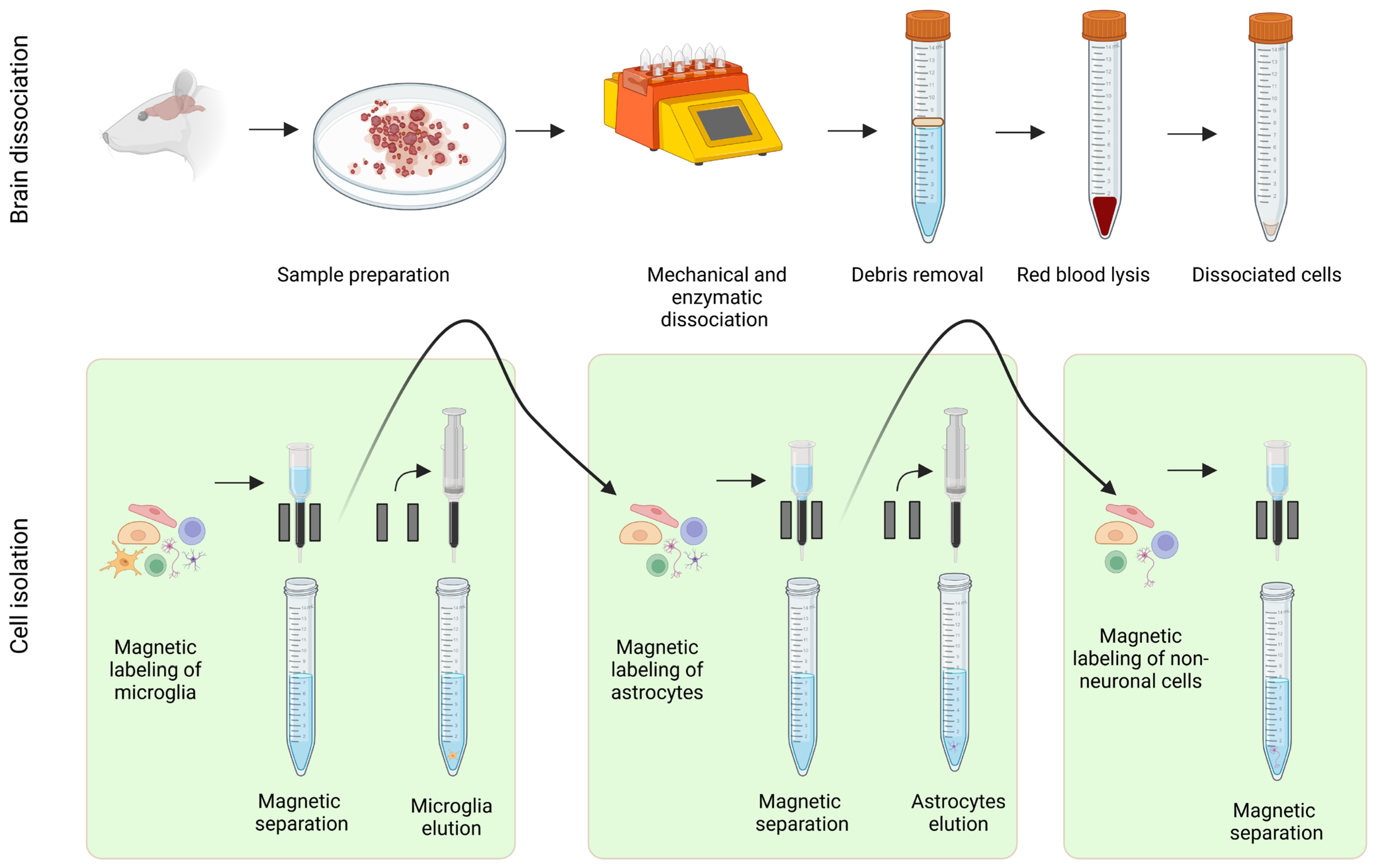
3.1. Isolation of Murine Brain Cell Types Using MACS Technology
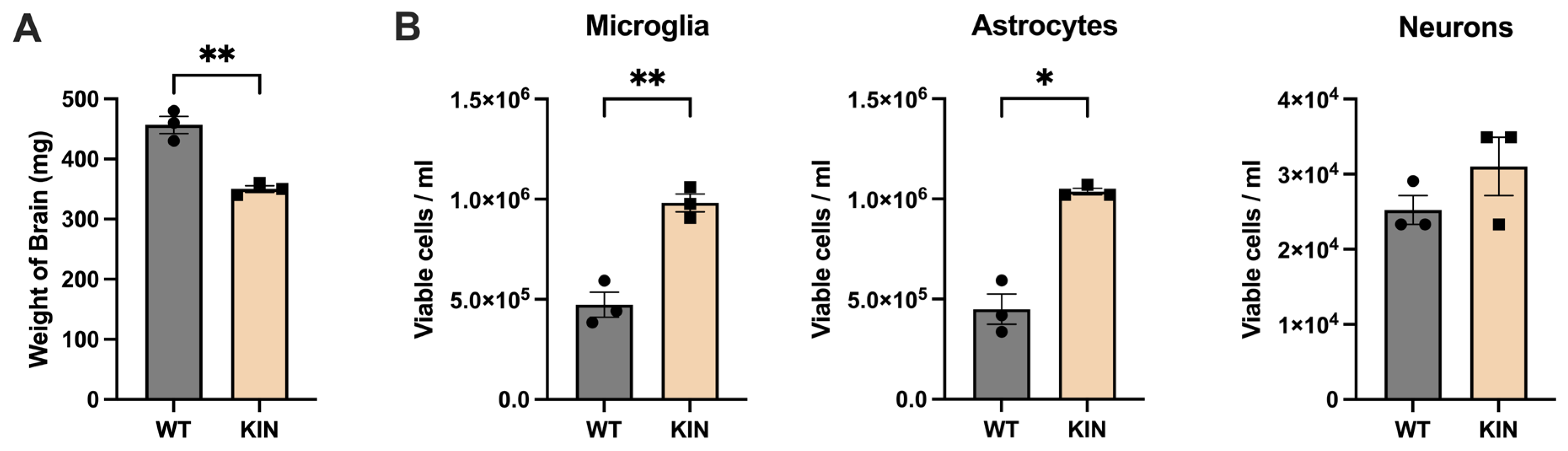
3.2. The Impact of the Atxn2-CAG100-KIN Mutation on the Brain and Its Cell Types
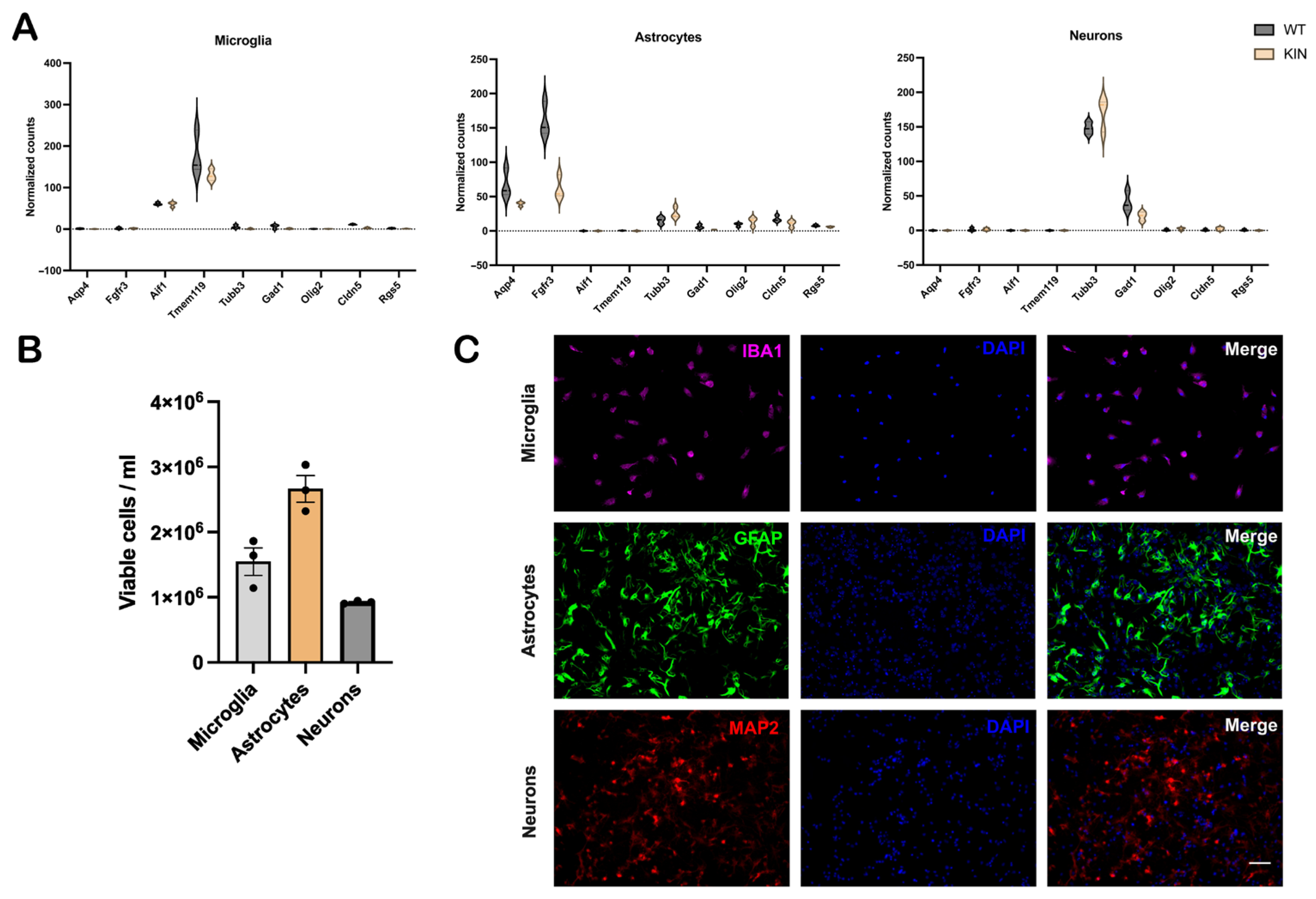
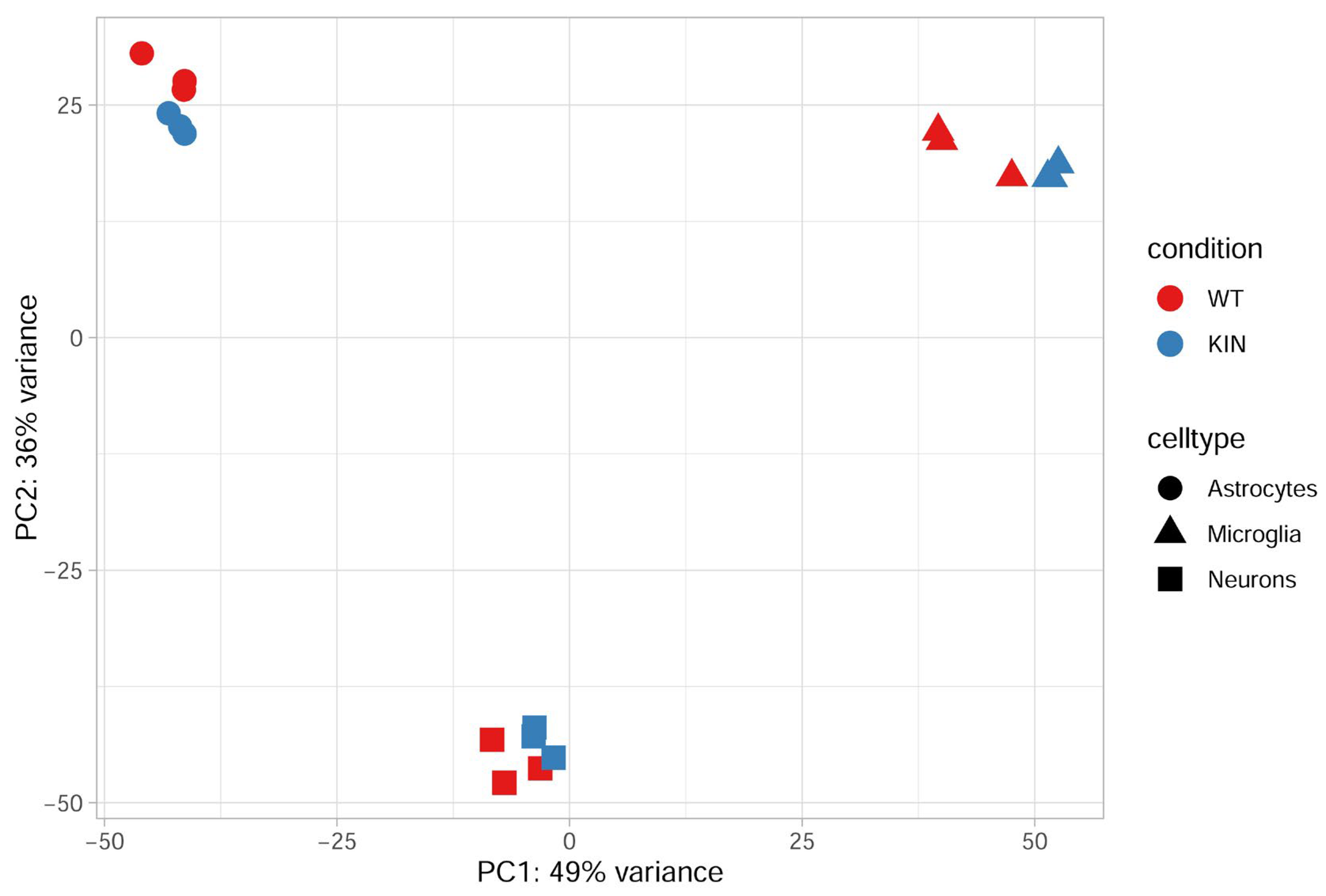
3.3. Further Purity Analyses of Isolated Individual Brain Cell Types
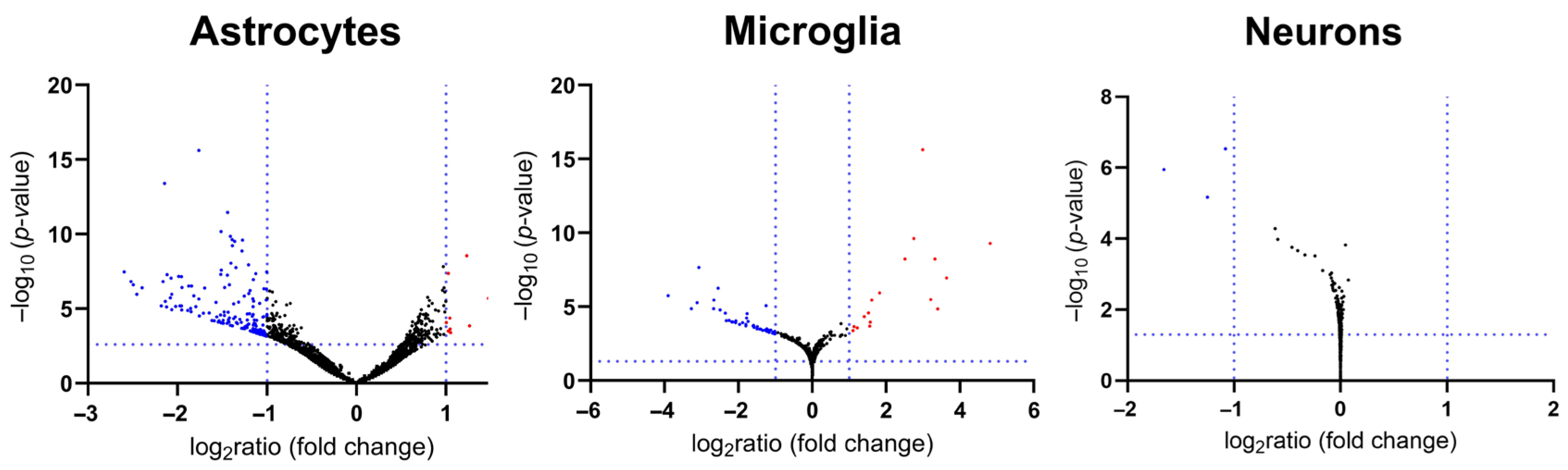
3.4. Global Volcano Plots of RNA-Seq Profiles, as Well as Consistency Between New RNA-Seq Transcript Analysis and Previous Oligonucleotide Microarray Data Document Loss of mRNA in Synapses and Neurites from Glial Fractions, with an Elevated Neuroinflammation Signature
3.5. RNA-Seq Transcript Consistency Analysis Among Glial Fractions Shows a Prominent Increase in Transcripts Encoding Cytoplasmic Ribosomal Proteins of Large and Small Subunits
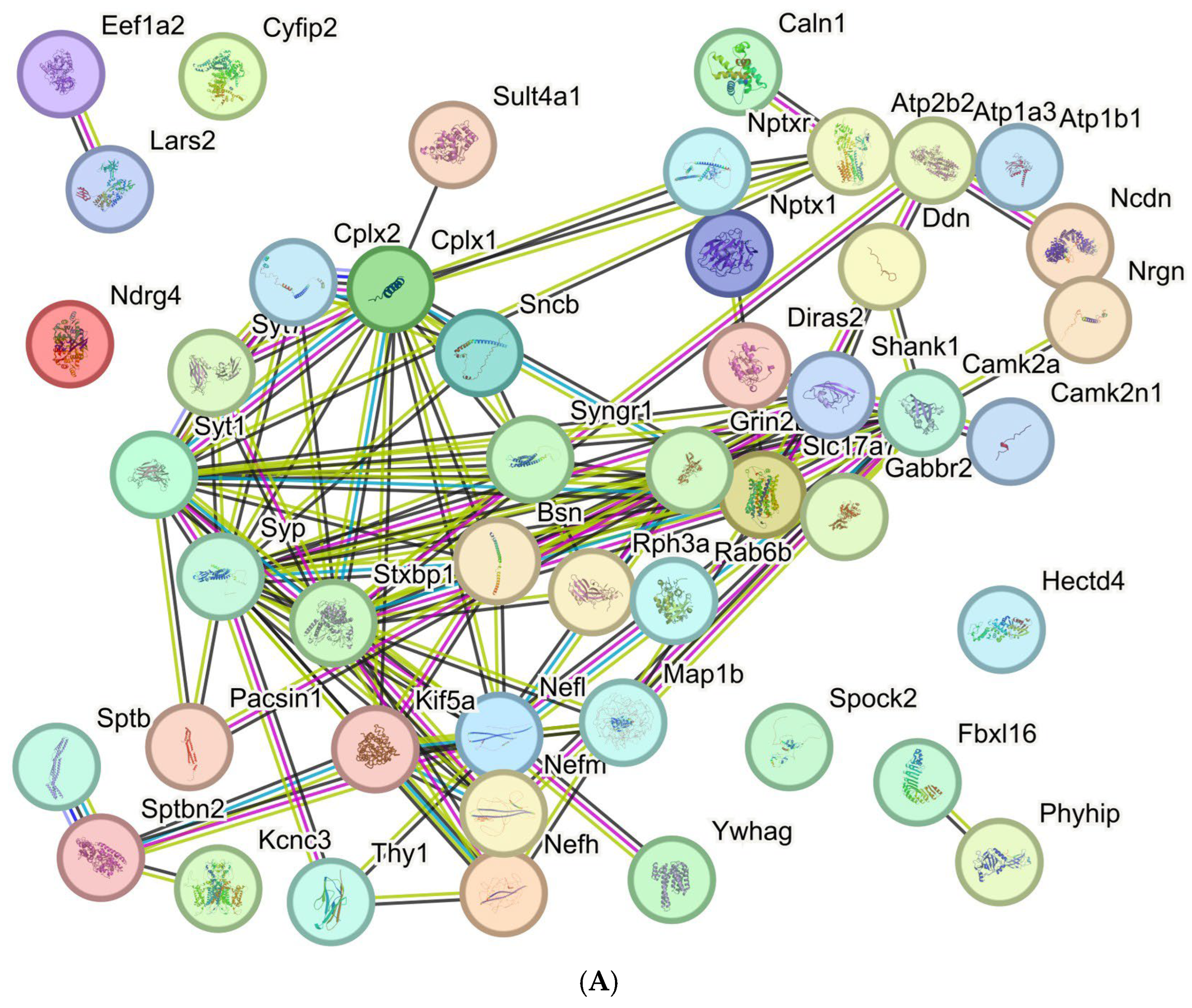
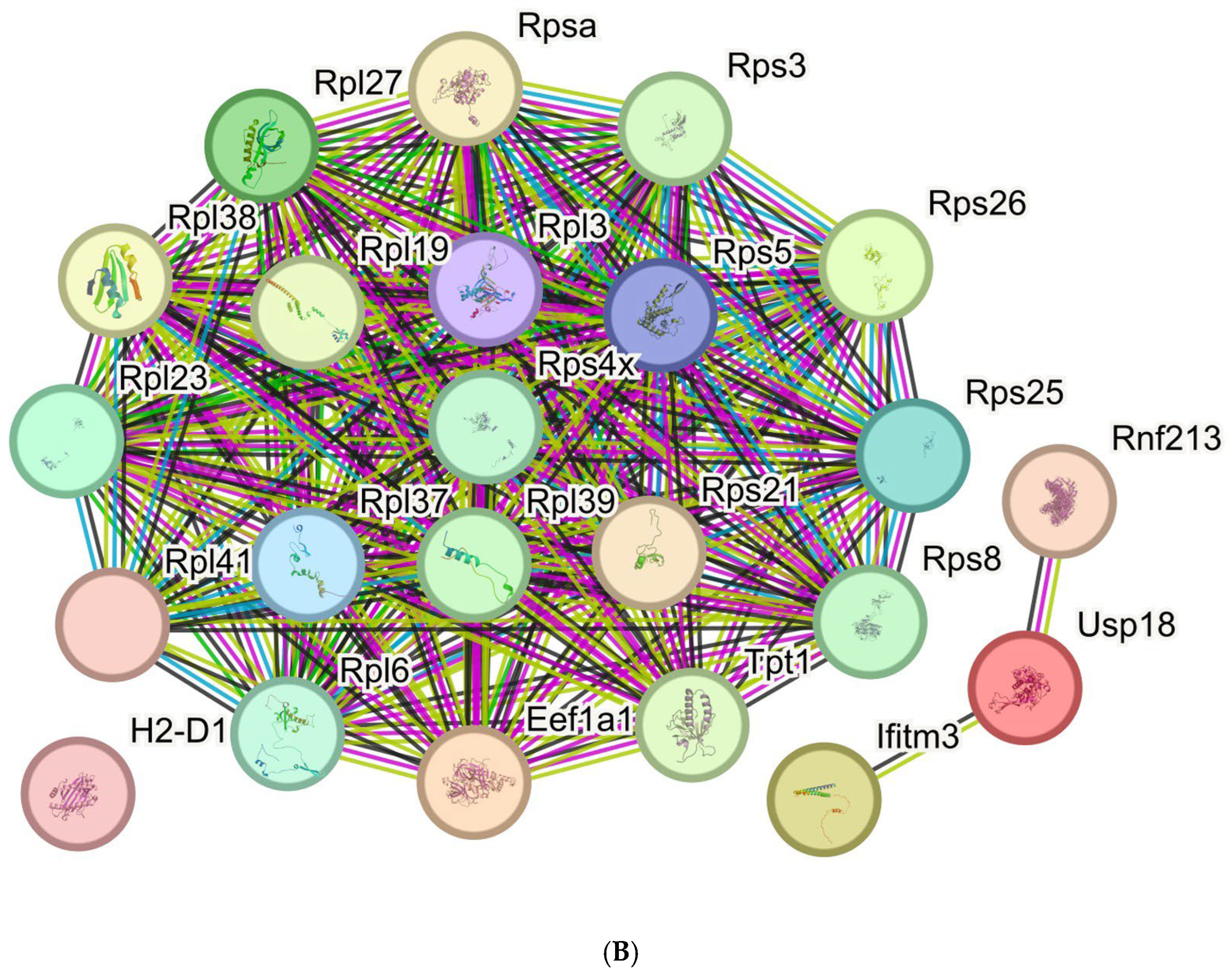
3.6. STRING Analysis of Interactions and Bioinformatics Enrichments in Glial Fractions Extends the Observations of Transcript Reduction in Synapses, Axons, and Dendrites, Versus Induction of Ribosomal and Inflammatory Factors
3.7. RNA-Seq Consistency Analysis Among Glial Fractions for Small RNAs Finds Upregulation of All tRNAs Versus Downregulation of All Antisense RNAs and All Processed Pseudogenes
3.8. RNA-Seq Analysis at the Gene Level of Microglia-Specific Effects Reveals ~Eight-Fold Accumulation of Uridine-Rich Small Nuclear RNA Rnu1b2
3.9. RNA-Seq Analysis at the Gene Level of Astroglia-Specific Effects Mainly Documents the Neurite Retraction
3.10. RNA-Seq Analysis at the Gene Level of Neuron-Specific Effects Documents Novel DNA Effects
3.11. Systematic Interrogation of RNA-Seq Findings at the Gene Level for Uridine-Rich snRNAs and the SMN Pathway Shows Increases Selectively in the Astroglial Fraction That Could Be Explained by Astrogliosis
4. Discussion
5. Conclusions
Supplementary Materials
Author Contributions
Funding
Institutional Review Board Statement
Informed Consent Statement
Data Availability Statement
Acknowledgments
Conflicts of Interest
Abbreviations
| ACSA2 | Astrocyte Cell Surface Antigen-2 |
| Adcy1 | Adenylate Cyclase 1 |
| Agt | Angiotensinogen, Serine Proteinase Inhibitor A8 |
| Aif1 | Allograft Inflammatory Factor 1 = IBA1 |
| Ald1l1 | Aldehyde Dehydrogenase 1 Family Member L1 |
| ALS13 | Amyotrophic Lateral Sclerosis type 13 |
| AMPA | Alpha-amino-3-hydroxy-5-methyl-4-isoxazolepropionic acid |
| Apoe | Apolipoprotein E |
| Atp1a3 | ATPase Na+/K+ Transporting Subunit Alpha 3 |
| Atx2 | Ataxin-2 in flies |
| Atxn2 | Ataxin-2 |
| Atxn2l | Ataxin-2-like |
| Axl | AXL Receptor Tyrosine Kinase |
| Camk2a | Calcium/Calmodulin-Dependent Protein Kinase II Alpha |
| Camk2b | Calcium/Calmodulin-Dependent Protein Kinase II Beat |
| Cd32 | Cluster of Differentiation 32 |
| Cd63 | Cluster of Differentiation 63 |
| Cd68 | Cluster of Differentiation 68 |
| cDNA | Complementary DNA |
| Celsr3 | Cadherin EGF LAG Seven-Pass G-Type Receptor 3 |
| CH | Calponin-Homology |
| CID3/4 | Chemical-Inducible Dimerization |
| Cldn5 | Claudin 5 |
| Clec7a | C-type lectin Domain-Containing Protein 7A |
| Cplx1 | Complexin 1/2 |
| Cst7 | Cystatin-F |
| Cyfip2 | Cytoplasmic FMR1 Interacting Protein 2 |
| Ddx6 | DEAD-Box Helicase 6 |
| Dnm1 | Dynamin 1 |
| Eaat4 | Excitatory Amino Acid Transporter 4, Solute Carrier Family 1 Member 6 |
| EDTA | Ethylenediaminetetraacetic Acid |
| Eef1a1/2 | Eukaryotic translation elongation factor 1 alpha 1/2 |
| Eftud2 | Elongation Factor Tu GTP Binding Domain Containing 2 |
| Eno2 | Enolase 2 |
| Etnppl | Ethanolamine-phosphate phospho-lyase |
| Fam20c | Family With Sequence Similarity 20, Member C |
| Fbxl16 | F-box and leucine-rich repeat protein 16 |
| FC | Fold Change |
| Fcrls | Fc Receptor-Like S |
| FDR | False Discovery Rate |
| FMRP | Fragile X Mental Retardation Protein |
| Gad1/2 | Glutamate Decarboxylase 1 |
| GDP | Guanosine diphosphate |
| Gfap | Glial Fibrillary Acidic Protein |
| Gls | Glutaminase |
| GO | Gene Ontology |
| GO-BP | Gene Ontology—Biological Process |
| GO-CC | Gene Ontology—Cellular Component |
| GO-MF | Gene Ontology—Molecular Function |
| Gpnmb | Glycoprotein Nmb |
| Grin1 | Glutamate Receptor, Ionotropic, N-Methyl D-Aspartate 1 |
| GSEA | Gene Set Enrichment Analysis |
| Hexb | Hexosaminidase Subunit Beta |
| Hmgcr | 3-Hydroxy-3-Methylglutaryl-CoA Reductase |
| Hmgcs1 | 3-Hydroxy-3-Methylglutaryl-CoA Synthase 1 |
| IBA1 | Ionized calcium-binding adapter molecule 1, = AIF1 |
| Ifitm3 | Interferon-induced transmembrane protein 3 |
| Itgax | Integrin Subunit Alpha X |
| Kcnj8 | Potassium Inwardly Rectifying Channel Subfamily J Member 8 |
| Kcnq2 | Potassium Voltage-Gated Channel Subfamily Q Member 2 |
| Kif5a | Neuronal Kinesin Heavy Chain |
| KIN | Knockin |
| Lgals3 | Lectin, galactoside-binding, soluble factor 3 |
| Lgals3bp | Galectin-3 binding protein |
| lincRNA | Long intergenic non-coding RNA |
| Lpl | Lipoprotein Lipase |
| LSmAD | LSm-Associated Domain |
| MACE | Massive Analysis of cDNA Ends |
| MACS | Magnetic-Activated Cell Sorting |
| Map1b | Microtubule-Associated Protein 1B |
| Map2 | Microtubule-Associated Protein 2 |
| mGLUR1 | Glutamate Metabotropic Receptor 1 |
| Mical2 | Microtubule-Associated Monooxygenase, Calponin and LIM Domain-Containing 2 |
| miRNA | MicroRNA |
| Mpeg1 | Macrophage Expressed 1 |
| Mt-tRNA | Mitochondrial transfer RNA |
| Ndrg4 | N-myc downstream-regulated gene 4 |
| Nefh | Neurofilament Heavy Chain |
| Nefl | Neurofilament Light Chain |
| Neurod2 | Neuronal Differentiation 2 |
| NGS | Next-Generation Sequencing |
| Nptx1 | Neuronal Pentraxin 1 |
| Nufip2 | Nuclear FMR1-interacting protein 2 |
| Olfml3 | Olfactomedin-Like 3 |
| Olig2 | Oligodendrocyte Transcription Factor 2 |
| P2ry12 | Purinergic Receptor P2Y12 |
| PABP | Poly(A)-binding protein |
| Pabpc1 | polyA-binding protein, cytoplasmic, type 1 |
| PAR-CLIP | Photoactivatable Ribonucleoside-Enhanced Crosslinking and Immunoprecipitation |
| PCA | Principal component analysis |
| piRNA | Piwi-interacting RNA |
| Plca3 | = Gpnmb, Glycoprotein Nonmetastatic Melanoma Protein B |
| Ppfia4 | PPFI Scaffold Protein A4 |
| Pvalb | Parvalbumin |
| Rab15 | Ras-Related Protein Rab-15 |
| Rbfox3 | RNA Binding Fox-1 Homolog 3 |
| Rian | RNA Imprinted and Accumulated in Nucleus |
| RNA | Ribonucleic Acid |
| Rnf213 | Ring Finger Protein 213 |
| Rnu1b2 | RNA, U1 Small Nuclear 2 |
| Rph3a | Rabphilin 3A |
| rRNA | Ribonucleic acid |
| RT-qPCR | Reverse Transcriptase Quantitative Real-Time Polymerase Chain Reaction |
| S100b | S100 Calcium Binding Protein B |
| Sall1 | Spalt-Like Transcription Factor 1 |
| SCA2 | Spinocerebellar Ataxia type 2 |
| SCA5 | Spinocerebellar Ataxia Type 5 |
| SCAR14 | Spectrin Beta, Non-Erythrocytic 2 |
| scaRNA | Small Cajal body-specific RNA |
| Scn4b | Sodium voltage-gated channel beta subunit 4 |
| SEM | Standard error of the mean |
| Slc11a1 | Solute carrier family 11, member 1 |
| Slc12a5 | Solute Carrier Family 12 Member 5 |
| Slc17a7 | Vesicular glutamate transporter 1 |
| SMN1 | Survival Of Motor Neuron 1, Telomeric |
| Snap25 | Synaptosome-associated Protein 25 |
| snoRNA | Small Nucleolar RNA |
| snRNA | Small nuclear RNA |
| snRNP | Small nuclear ribonucleoprotein |
| SPARCA1 | Spectrin-Associated Autosomal Recessive Cerebellar Ataxia |
| Spi1 | Spi-1 Proto-Oncogene |
| Spp1 | Secreted Phosphoprotein 1 |
| Spock2 | secreted protein acidic and rich in cysteine |
| Sptbn1 | Spectrin Beta, Non-Erythrocytic 1 |
| Sptbn2 | Spectrin Beta, Non-Erythrocytic 2 |
| sRNA | Small RNA |
| STRING | Search Tool for Recurring Instances of Neighboring Genes |
| Syne1 | Spectrin Repeat Containing Nuclear Envelope Protein 1 |
| Syt1 | Syntaxin 1 |
| Tmem119 | Transmembrane Protein 119 |
| Trank1 | Tetratricopeptide Repeat And Ankyrin Repeat Containing 1 |
| Trem2 | Triggering Receptor Expressed On Myeloid Cells 2 |
| tRNA | Transfer RNA |
| Tyrobp | TYRO Protein Tyrosine Kinase-Binding Protein |
| Unc13a | Unc-13 Homolog A |
| Usp18 | Ubiquitin-Specific Peptidase 18 |
| Vim | Vimentin |
| WT | Wild-type |
| ZFE | Central Animal Facility |
References
- Hernandez, A.; Magarino, C.; Gispert, S.; Santos, N.; Lunkes, A.; Orozco, G.; Heredero, L.; Beckmann, J.; Auburger, G. Genetic mapping of the spinocerebellar ataxia 2 (SCA2) locus on chromosome 12q23-q24.1. Genomics 1995, 25, 433–435. [Google Scholar] [CrossRef]
- Belal, S.; Cancel, G.; Stevanin, G.; Hentati, F.; Khati, C.; Ben Hamida, C.; Auburger, G.; Agid, Y.; Ben Hamida, M.; Brice, A. Clinical and genetic analysis of a Tunisian family with autosomal dominant cerebellar ataxia type 1 linked to the SCA2 locus. Neurology 1994, 44, 1423–1426. [Google Scholar] [CrossRef] [PubMed]
- Auburger, G.; Diaz, G.O.; Capote, R.F.; Sanchez, S.G.; Perez, M.P.; del Cueto, M.E.; Meneses, M.G.; Farrall, M.; Williamson, R.; Chamberlain, S.; et al. Autosomal dominant ataxia: Genetic evidence for locus heterogeneity from a Cuban founder-effect population. Am. J. Hum. Genet. 1990, 46, 1163–1177. [Google Scholar] [PubMed]
- Gispert, S.; Twells, R.; Orozco, G.; Brice, A.; Weber, J.; Heredero, L.; Scheufler, K.; Riley, B.; Allotey, R.; Nothers, C.; et al. Chromosomal assignment of the second locus for autosomal dominant cerebellar ataxia (SCA2) to chromosome 12q23-24.1. Nat. Genet. 1993, 4, 295–299. [Google Scholar] [CrossRef] [PubMed]
- Wadia, N.H.; Swami, R.K. A new form of heredo-familial spinocerebellar degeneration with slow eye movements (nine families). Brain 1971, 94, 359–374. [Google Scholar] [CrossRef]
- Orozco Diaz, G.; Nodarse Fleites, A.; Cordoves Sagaz, R.; Auburger, G. Autosomal dominant cerebellar ataxia: Clinical analysis of 263 patients from a homogeneous population in Holguin, Cuba. Neurology 1990, 40, 1369–1375. [Google Scholar] [CrossRef]
- Estrada, R.; Galarraga, J.; Orozco, G.; Nodarse, A.; Auburger, G. Spinocerebellar ataxia 2 (SCA2): Morphometric analyses in 11 autopsies. Acta Neuropathol. 1999, 97, 306–310. [Google Scholar] [CrossRef]
- Velazquez-Perez, L.; Seifried, C.; Santos-Falcon, N.; Abele, M.; Ziemann, U.; Almaguer, L.E.; Martinez-Gongora, E.; Sanchez-Cruz, G.; Canales, N.; Perez-Gonzalez, R.; et al. Saccade velocity is controlled by polyglutamine size in spinocerebellar ataxia 2. Ann. Neurol. 2004, 56, 444–447. [Google Scholar] [CrossRef]
- Almaguer-Mederos, L.E.; Falcon, N.S.; Almira, Y.R.; Zaldivar, Y.G.; Almarales, D.C.; Gongora, E.M.; Herrera, M.P.; Batallan, K.E.; Arminan, R.R.; Manresa, M.V.; et al. Estimation of the age at onset in spinocerebellar ataxia type 2 Cuban patients by survival analysis. Clin. Genet. 2010, 78, 169–174. [Google Scholar] [CrossRef]
- Almaguer-Mederos, L.E.; Aguilera Rodriguez, R.; Gonzalez Zaldivar, Y.; Almaguer Gotay, D.; Cuello Almarales, D.; Laffita Mesa, J.; Vazquez Mojena, Y.; Zayas Feria, P.; Auburger, G.; Gispert, S.; et al. Estimation of survival in spinocerebellar ataxia type 2 Cuban patients. Clin. Genet. 2013, 83, 293–294. [Google Scholar] [CrossRef]
- Velazquez-Perez, L.; Tunnerhoff, J.; Rodriguez-Labrada, R.; Torres-Vega, R.; Belardinelli, P.; Medrano-Montero, J.; Pena-Acosta, A.; Canales-Ochoa, N.; Vazquez-Mojena, Y.; Gonzalez-Zaldivar, Y.; et al. Corticomuscular Coherence: A Novel Tool to Assess the Pyramidal Tract Dysfunction in Spinocerebellar Ataxia Type 2. Cerebellum 2017, 16, 602–606. [Google Scholar] [CrossRef] [PubMed]
- Rodriguez-Labrada, R.; Galicia-Polo, L.; Canales-Ochoa, N.; Voss, U.; Tuin, I.; Pena-Acosta, A.; Estupinan-Rodriguez, A.; Medrano-Montero, J.; Vazquez-Mojena, Y.; Gonzalez-Zaldivar, Y.; et al. Sleep spindles and K-complex activities are decreased in spinocerebellar ataxia type 2: Relationship to memory and motor performances. Sleep. Med. 2019, 60, 188–196. [Google Scholar] [CrossRef] [PubMed]
- Velazquez-Perez, L.; Tunnerhoff, J.; Rodriguez-Labrada, R.; Torres-Vega, R.; Ruiz-Gonzalez, Y.; Belardinelli, P.; Medrano-Montero, J.; Canales-Ochoa, N.; Gonzalez-Zaldivar, Y.; Vazquez-Mojena, Y.; et al. Early corticospinal tract damage in prodromal SCA2 revealed by EEG-EMG and EMG-EMG coherence. Clin. Neurophysiol. 2017, 128, 2493–2502. [Google Scholar] [CrossRef]
- Reetz, K.; Rodriguez-Labrada, R.; Dogan, I.; Mirzazade, S.; Romanzetti, S.; Schulz, J.B.; Cruz-Rivas, E.M.; Alvarez-Cuesta, J.A.; Aguilera Rodriguez, R.; Gonzalez Zaldivar, Y.; et al. Brain atrophy measures in preclinical and manifest spinocerebellar ataxia type 2. Ann. Clin. Transl. Neurol. 2018, 5, 128–137. [Google Scholar] [CrossRef]
- Rodriguez-Grana, T.; Rodriguez-Labrada, R.; Santana-Porben, S.; Reynaldo-Cejas, L.; Medrano-Montero, J.; Canales-Ochoa, N.; Silva-Ricardo, Y.; Torres-Vega, R.; Gonzalez-Zaldivar, Y.; Almaguer-Gotay, D.; et al. Weight loss is correlated with disease severity in Spinocerebellar ataxia type 2: A cross-sectional cohort study. Nutr. Neurosci. 2022, 25, 1747–1755. [Google Scholar] [CrossRef]
- Almaguer-Mederos, L.E.; Perez-Avila, I.; Aguilera-Rodriguez, R.; Velazquez-Garces, M.; Almaguer-Gotay, D.; Hechavarria-Pupo, R.; Rodriguez-Estupinan, A.; Auburger, G. Body Mass Index Is Significantly Associated With Disease Severity in Spinocerebellar Ataxia Type 2 Patients. Mov. Disord. 2021, 36, 1372–1380. [Google Scholar] [CrossRef]
- Velazquez-Perez, L.; Rodriguez-Labrada, R.; Gonzalez-Garces, Y.; Arrufat-Pie, E.; Torres-Vega, R.; Medrano-Montero, J.; Ramirez-Bautista, B.; Vazquez-Mojena, Y.; Auburger, G.; Horak, F.; et al. Prodromal Spinocerebellar Ataxia Type 2 Subjects Have Quantifiable Gait and Postural Sway Deficits. Mov. Disord. 2021, 36, 471–480. [Google Scholar] [CrossRef]
- Velazquez-Perez, L.; Rodriguez-Labrada, R.; Gonzalez-Garces, Y.; Canales-Ochoa, N.; Medrano-Montero, J.; Dominguez-Barrios, Y.; Carrillo-Rodes, F.J.; Ramirez-Bautista, M.B.; Caballero-Laguna, A.; Gamez-Rodriguez, O.; et al. COVID-19 Impacts the Mental Health and Speech Function in Spinocerebellar Ataxia Type 2: Evidences from a Follow-Up Study. Cerebellum 2024, 23, 1101–1111. [Google Scholar] [CrossRef]
- Vazquez-Mojena, Y.; Rodriguez-Cordova, Y.; Dominguez-Barrios, Y.; Leon-Arcia, K.; Miranda-Becerra, D.; Gonzalez-Zaldivar, Y.; Guerra-Bustillos, G.; Ziemann, U.; Auburger, G.; Rodriguez-Labrada, R.; et al. Peripheral Inflammation Links with the Severity of Clinical Phenotype in Spinocerebellar Ataxia 2. Mov. Disord. 2023, 38, 880–885. [Google Scholar] [CrossRef]
- Rodriguez-Labrada, R.; Gonzalez-Garces, Y.; Carrillo-Rodes, F.J.; Rodriguez-Diaz, J.C.; Vazquez-Mojena, Y.; Ziemann, U.; Auburger, G.; Horak, F.; Gomez, C.; Velazquez-Perez, L. Progression of Gait Ataxia in Spinocerebellar Ataxia Type 2: Clinical Utility of Digitally Measured Gait Metrics. Cerebellum 2025, 24, 184. [Google Scholar] [CrossRef] [PubMed]
- Rodriguez-Labrada, R.; Canales-Ochoa, N.; Galicia-Polo, M.L.; Cruz-Rivas, E.; Romanzetti, S.; Pena-Acosta, A.; Estupinan-Rodriguez, A.; Vazquez-Mojena, Y.; Dogan, I.; Auburger, G.; et al. Structural Brain Correlates of Sleep Microstructure in Spinocerebellar Ataxia Type 2 and its Role on Clinical Phenotype. Cerebellum 2024, 23, 1839–1847. [Google Scholar] [CrossRef]
- Schols, L.; Gispert, S.; Vorgerd, M.; Menezes Vieira-Saecker, A.M.; Blanke, P.; Auburger, G.; Amoiridis, G.; Meves, S.; Epplen, J.T.; Przuntek, H.; et al. Spinocerebellar ataxia type 2. Genotype and phenotype in German kindreds. Arch. Neurol. 1997, 54, 1073–1080. [Google Scholar] [CrossRef] [PubMed]
- Lastres-Becker, I.; Rub, U.; Auburger, G. Spinocerebellar ataxia 2 (SCA2). Cerebellum 2008, 7, 115–124. [Google Scholar] [CrossRef]
- Freund, H.J.; Barnikol, U.B.; Nolte, D.; Treuer, H.; Auburger, G.; Tass, P.A.; Samii, M.; Sturm, V. Subthalamic-thalamic DBS in a case with spinocerebellar ataxia type 2 and severe tremor-A unusual clinical benefit. Mov. Disord. 2007, 22, 732–735. [Google Scholar] [CrossRef]
- Tuin, I.; Voss, U.; Kang, J.S.; Kessler, K.; Rub, U.; Nolte, D.; Lochmuller, H.; Tinschert, S.; Claus, D.; Krakow, K.; et al. Stages of sleep pathology in spinocerebellar ataxia type 2 (SCA2). Neurology 2006, 67, 1966–1972. [Google Scholar] [CrossRef]
- Auburger, G.W. Spinocerebellar ataxia type 2. Handb. Clin. Neurol. 2012, 103, 423–436. [Google Scholar] [CrossRef]
- Hoche, F.; Baliko, L.; den Dunnen, W.; Steinecker, K.; Bartos, L.; Safrany, E.; Auburger, G.; Deller, T.; Korf, H.W.; Klockgether, T.; et al. Spinocerebellar ataxia type 2 (SCA2): Identification of early brain degeneration in one monozygous twin in the initial disease stage. Cerebellum 2011, 10, 245–253. [Google Scholar] [CrossRef]
- Rub, U.; Schols, L.; Paulson, H.; Auburger, G.; Kermer, P.; Jen, J.C.; Seidel, K.; Korf, H.W.; Deller, T. Clinical features, neurogenetics and neuropathology of the polyglutamine spinocerebellar ataxias type 1, 2, 3, 6 and 7. Prog. Neurobiol. 2013, 104, 38–66. [Google Scholar] [CrossRef] [PubMed]
- Yagishita, S.; Inoue, M. Clinicopathology of spinocerebellar degeneration: Its correlation to the unstable CAG repeat of the affected gene. Pathol. Int. 1997, 47, 1–15. [Google Scholar] [CrossRef] [PubMed]
- Mizushima, K.; Watanabe, M.; Abe, K.; Aoki, M.; Itoyama, Y.; Shizuka, M.; Okamoto, K.; Shoji, M. Analysis of spinocerebellar ataxia type 2 in Gunma Prefecture in Japan: CAG trinucleotide expansion and clinical characteristics. J. Neurol. Sci. 1998, 156, 180–185. [Google Scholar] [CrossRef]
- Yokota, T.; Sasaki, H.; Iwabuchi, K.; Shiojiri, T.; Yoshino, A.; Otagiri, A.; Inaba, A.; Yuasa, T. Electrophysiological features of central motor conduction in spinocerebellar atrophy type 1, type 2, and Machado-Joseph disease. J. Neurol. Neurosurg. Psychiatry 1998, 65, 530–534. [Google Scholar] [CrossRef]
- Durr, A.; Brice, A.; Lepage-Lezin, A.; Cancel, G.; Smadja, D.; Vernant, J.C.; Agid, Y. Autosomal dominant cerebellar ataxia type I linked to chromosome 12q (SCA2: Spinocerebellar ataxia type 2). Clin. Neurosci. 1995, 3, 12–16. [Google Scholar]
- Rivaud-Pechoux, S.; Durr, A.; Gaymard, B.; Cancel, G.; Ploner, C.J.; Agid, Y.; Brice, A.; Pierrot-Deseilligny, C. Eye movement abnormalities correlate with genotype in autosomal dominant cerebellar ataxia type I. Ann. Neurol. 1998, 43, 297–302. [Google Scholar] [CrossRef]
- Cancel, G.; Durr, A.; Didierjean, O.; Imbert, G.; Burk, K.; Lezin, A.; Belal, S.; Benomar, A.; Abada-Bendib, M.; Vial, C.; et al. Molecular and clinical correlations in spinocerebellar ataxia 2: A study of 32 families. Hum. Mol. Genet. 1997, 6, 709–715. [Google Scholar] [CrossRef]
- Durr, A.; Smadja, D.; Cancel, G.; Lezin, A.; Stevanin, G.; Mikol, J.; Bellance, R.; Buisson, G.G.; Chneiweiss, H.; Dellanave, J.; et al. Autosomal dominant cerebellar ataxia type I in Martinique (French West Indies). Clinical and neuropathological analysis of 53 patients from three unrelated SCA2 families. Brain 1995, 118, 1573–1581. [Google Scholar] [CrossRef]
- Giunti, P.; Sabbadini, G.; Sweeney, M.G.; Davis, M.B.; Veneziano, L.; Mantuano, E.; Federico, A.; Plasmati, R.; Frontali, M.; Wood, N.W. The role of the SCA2 trinucleotide repeat expansion in 89 autosomal dominant cerebellar ataxia families. Frequency, clinical and genetic correlates. Brain 1998, 121, 459–467. [Google Scholar] [CrossRef]
- Wadia, N.; Pang, J.; Desai, J.; Mankodi, A.; Desai, M.; Chamberlain, S. A clinicogenetic analysis of six Indian spinocerebellar ataxia (SCA2) pedigrees. The significance of slow saccades in diagnosis. Brain 1998, 121, 2341–2355. [Google Scholar] [CrossRef] [PubMed]
- Pang, J.; Allotey, R.; Wadia, N.; Sasaki, H.; Bindoff, L.; Chamberlain, S. A common disease haplotype segregating in spinocerebellar ataxia 2 (SCA2) pedigrees of diverse ethnic origin. Eur. J. Hum. Genet. 1999, 7, 841–845. [Google Scholar] [CrossRef] [PubMed][Green Version]
- Zhou, Y.X.; Wang, G.X.; Tang, B.S.; Li, W.D.; Wang, D.A.; Lee, H.S.; Sambuughin, N.; Zhou, L.S.; Tsuji, S.; Yang, B.X.; et al. Spinocerebellar ataxia type 2 in China: Molecular analysis and genotype-phenotype correlation in nine families. Neurology 1998, 51, 595–598. [Google Scholar] [CrossRef] [PubMed]
- Buttner, N.; Geschwind, D.; Jen, J.C.; Perlman, S.; Pulst, S.M.; Baloh, R.W. Oculomotor phenotypes in autosomal dominant ataxias. Arch. Neurol. 1998, 55, 1353–1357. [Google Scholar] [CrossRef]
- Babovic-Vuksanovic, D.; Snow, K.; Patterson, M.C.; Michels, V.V. Spinocerebellar ataxia type 2 (SCA 2) in an infant with extreme CAG repeat expansion. Am. J. Med. Genet. 1998, 79, 383–387. [Google Scholar] [CrossRef]
- Koeppen, A.H. The hereditary ataxias. J. Neuropathol. Exp. Neurol. 1998, 57, 531–543. [Google Scholar] [CrossRef] [PubMed]
- Adams, C.; Starkman, S.; Pulst, S.M. Clinical and molecular analysis of a pedigree of southern Italian ancestry with spinocerebellar ataxia type 2. Neurology 1997, 49, 1163–1166. [Google Scholar] [CrossRef] [PubMed]
- Geschwind, D.H.; Perlman, S.; Figueroa, C.P.; Treiman, L.J.; Pulst, S.M. The prevalence and wide clinical spectrum of the spinocerebellar ataxia type 2 trinucleotide repeat in patients with autosomal dominant cerebellar ataxia. Am. J. Hum. Genet. 1997, 60, 842–850. [Google Scholar] [PubMed]
- Paulson, H.L.; Fischbeck, K.H. Trinucleotide repeats in neurogenetic disorders. Annu. Rev. Neurosci. 1996, 19, 79–107. [Google Scholar] [CrossRef]
- Subramony, S.H. Clinical aspects of hereditary ataxias. J. Child Neurol. 1995, 10, 353–362. [Google Scholar] [CrossRef]
- Sanpei, K.; Takano, H.; Igarashi, S.; Sato, T.; Oyake, M.; Sasaki, H.; Wakisaka, A.; Tashiro, K.; Ishida, Y.; Ikeuchi, T.; et al. Identification of the spinocerebellar ataxia type 2 gene using a direct identification of repeat expansion and cloning technique, DIRECT. Nat. Genet. 1996, 14, 277–284. [Google Scholar] [CrossRef]
- Imbert, G.; Saudou, F.; Yvert, G.; Devys, D.; Trottier, Y.; Garnier, J.M.; Weber, C.; Mandel, J.L.; Cancel, G.; Abbas, N.; et al. Cloning of the gene for spinocerebellar ataxia 2 reveals a locus with high sensitivity to expanded CAG/glutamine repeats. Nat. Genet. 1996, 14, 285–291. [Google Scholar] [CrossRef]
- Pulst, S.M.; Nechiporuk, A.; Nechiporuk, T.; Gispert, S.; Chen, X.N.; Lopes-Cendes, I.; Pearlman, S.; Starkman, S.; Orozco-Diaz, G.; Lunkes, A.; et al. Moderate expansion of a normally biallelic trinucleotide repeat in spinocerebellar ataxia type 2. Nat. Genet. 1996, 14, 269–276. [Google Scholar] [CrossRef]
- Elden, A.C.; Kim, H.J.; Hart, M.P.; Chen-Plotkin, A.S.; Johnson, B.S.; Fang, X.; Armakola, M.; Geser, F.; Greene, R.; Lu, M.M.; et al. Ataxin-2 intermediate-length polyglutamine expansions are associated with increased risk for ALS. Nature 2010, 466, 1069–1075. [Google Scholar] [CrossRef]
- Lee, T.; Li, Y.R.; Ingre, C.; Weber, M.; Grehl, T.; Gredal, O.; de Carvalho, M.; Meyer, T.; Tysnes, O.B.; Auburger, G.; et al. Ataxin-2 intermediate-length polyglutamine expansions in European ALS patients. Hum. Mol. Genet. 2011, 20, 1697–1700. [Google Scholar] [CrossRef] [PubMed]
- Gispert, S.; Kurz, A.; Waibel, S.; Bauer, P.; Liepelt, I.; Geisen, C.; Gitler, A.D.; Becker, T.; Weber, M.; Berg, D.; et al. The modulation of Amyotrophic Lateral Sclerosis risk by ataxin-2 intermediate polyglutamine expansions is a specific effect. Neurobiol. Dis. 2012, 45, 356–361. [Google Scholar] [CrossRef] [PubMed]
- Neuenschwander, A.G.; Thai, K.K.; Figueroa, K.P.; Pulst, S.M. Amyotrophic lateral sclerosis risk for spinocerebellar ataxia type 2 ATXN2 CAG repeat alleles: A meta-analysis. JAMA Neurol. 2014, 71, 1529–1534. [Google Scholar] [CrossRef] [PubMed]
- Vieira de Sa, R.; Sudria-Lopez, E.; Canizares Luna, M.; Harschnitz, O.; van den Heuvel, D.M.A.; Kling, S.; Vonk, D.; Westeneng, H.J.; Karst, H.; Bloemenkamp, L.; et al. ATAXIN-2 intermediate-length polyglutamine expansions elicit ALS-associated metabolic and immune phenotypes. Nat. Commun. 2024, 15, 7484. [Google Scholar] [CrossRef]
- Auburger, G.W.J.; Key, J.; Gispert, S.; Lastres-Becker, I.; Almaguer-Mederos, L.E.; Bassa, C.; Auburger, A.; Auburger, G.; Arsovic, A.; Deller, T.; et al. Bioinformatic Analyses of the Ataxin-2 Family Since Algae Emphasize Its Small Isoforms, Large Chimerisms, and the Importance of Human Exon 1B as Target of Therapies to Prevent Neurodegeneration. Int. J. Mol. Sci. 2026, 27, 1499. [Google Scholar] [CrossRef]
- Satterfield, T.F.; Jackson, S.M.; Pallanck, L.J. A Drosophila homolog of the polyglutamine disease gene SCA2 is a dosage-sensitive regulator of actin filament formation. Genetics 2002, 162, 1687–1702. [Google Scholar] [CrossRef]
- Albrecht, M.; Golatta, M.; Wullner, U.; Lengauer, T. Structural and functional analysis of ataxin-2 and ataxin-3. Eur. J. Biochem. 2004, 271, 3155–3170. [Google Scholar] [CrossRef]
- Jimenez-Lopez, D.; Guzman, P. Insights into the evolution and domain structure of Ataxin-2 proteins across eukaryotes. BMC Res. Notes 2014, 7, 453. [Google Scholar] [CrossRef]
- Auburger, G.; Sen, N.E.; Meierhofer, D.; Basak, A.N.; Gitler, A.D. Efficient Prevention of Neurodegenerative Diseases by Depletion of Starvation Response Factor Ataxin-2. Trends Neurosci. 2017, 40, 507–516. [Google Scholar] [CrossRef]
- Boeynaems, S.; Dorone, Y.; Zhuang, Y.; Shabardina, V.; Huang, G.; Marian, A.; Kim, G.; Sanyal, A.; Sen, N.E.; Griffith, D.; et al. Poly(A)-binding protein is an ataxin-2 chaperone that regulates biomolecular condensates. Mol. Cell 2023, 83, 2020–2034.E6. [Google Scholar] [CrossRef]
- Bakthavachalu, B.; Huelsmeier, J.; Sudhakaran, I.P.; Hillebrand, J.; Singh, A.; Petrauskas, A.; Thiagarajan, D.; Sankaranarayanan, M.; Mizoue, L.; Anderson, E.N.; et al. RNP-Granule Assembly via Ataxin-2 Disordered Domains Is Required for Long-Term Memory and Neurodegeneration. Neuron 2018, 98, 754–766.E4. [Google Scholar] [CrossRef]
- Yokoshi, M.; Li, Q.; Yamamoto, M.; Okada, H.; Suzuki, Y.; Kawahara, Y. Direct binding of Ataxin-2 to distinct elements in 3′ UTRs promotes mRNA stability and protein expression. Mol. Cell 2014, 55, 186–198. [Google Scholar] [CrossRef]
- Nonhoff, U.; Ralser, M.; Welzel, F.; Piccini, I.; Balzereit, D.; Yaspo, M.L.; Lehrach, H.; Krobitsch, S. Ataxin-2 interacts with the DEAD/H-box RNA helicase DDX6 and interferes with P-bodies and stress granules. Mol. Biol. Cell 2007, 18, 1385–1396. [Google Scholar] [CrossRef]
- Wang, J.Y.; Liu, Y.J.; Zhang, X.L.; Liu, Y.H.; Jiang, L.L.; Hu, H.Y. PolyQ-expanded ataxin-2 aggregation impairs cellular processing-body homeostasis via sequestering the RNA helicase DDX6. J. Biol. Chem. 2024, 300, 107413. [Google Scholar] [CrossRef] [PubMed]
- Damrath, E.; Heck, M.V.; Gispert, S.; Azizov, M.; Nowock, J.; Seifried, C.; Rub, U.; Walter, M.; Auburger, G. ATXN2-CAG42 sequesters PABPC1 into insolubility and induces FBXW8 in cerebellum of old ataxic knock-in mice. PLoS Genet. 2012, 8, e1002920. [Google Scholar] [CrossRef] [PubMed]
- Key, J.; Harter, P.N.; Sen, N.E.; Gradhand, E.; Auburger, G.; Gispert, S. Mid-Gestation lethality of Atxn2l-Ablated Mice. Int. J. Mol. Sci. 2020, 21, 5124. [Google Scholar] [CrossRef]
- Key, J.; Almaguer-Mederos, L.E.; Kandi, A.R.; Sen, N.E.; Gispert, S.; Kopf, G.; Meierhofer, D.; Auburger, G. ATXN2L primarily interacts with NUFIP2, the absence of ATXN2L results in NUFIP2 depletion, and the ATXN2-polyQ expansion triggers NUFIP2 accumulation. Neurobiol. Dis. 2025, 209, 106903. [Google Scholar] [CrossRef]
- Key, J.; Almaguer-Mederos, L.E.; Kandi, A.R.; Fellenz, M.; Gispert, S.; Kopf, G.; Meierhofer, D.; Deller, T.; Auburger, G. Conditional ATXN2L-Null in Adult Frontal Cortex CamK2a+ Neurons Does Not Cause Cell Death but Restricts Spontaneous Mobility and Affects the Alternative Splicing Pathway. Cells 2025, 14, 1532. [Google Scholar] [CrossRef] [PubMed]
- Lastres-Becker, I.; Brodesser, S.; Lutjohann, D.; Azizov, M.; Buchmann, J.; Hintermann, E.; Sandhoff, K.; Schurmann, A.; Nowock, J.; Auburger, G. Insulin receptor and lipid metabolism pathology in ataxin-2 knock-out mice. Hum. Mol. Genet. 2008, 17, 1465–1481. [Google Scholar] [CrossRef]
- Lastres-Becker, I.; Nonis, D.; Eich, F.; Klinkenberg, M.; Gorospe, M.; Kotter, P.; Klein, F.A.; Kedersha, N.; Auburger, G. Mammalian ataxin-2 modulates translation control at the pre-initiation complex via PI3K/mTOR and is induced by starvation. Biochim. Biophys. Acta 2016, 1862, 1558–1569. [Google Scholar] [CrossRef]
- Kiehl, T.R.; Nechiporuk, A.; Figueroa, K.P.; Keating, M.T.; Huynh, D.P.; Pulst, S.M. Generation and characterization of Sca2 (ataxin-2) knockout mice. Biochem. Biophys. Res. Commun. 2006, 339, 17–24. [Google Scholar] [CrossRef] [PubMed]
- Fittschen, M.; Lastres-Becker, I.; Halbach, M.V.; Damrath, E.; Gispert, S.; Azizov, M.; Walter, M.; Muller, S.; Auburger, G. Genetic ablation of ataxin-2 increases several global translation factors in their transcript abundance but decreases translation rate. Neurogenetics 2015, 16, 181–192. [Google Scholar] [CrossRef]
- Ciosk, R.; DePalma, M.; Priess, J.R. ATX-2, the C. elegans ortholog of ataxin 2, functions in translational regulation in the germline. Development 2004, 131, 4831–4841. [Google Scholar] [CrossRef]
- Kiehl, T.R.; Shibata, H.; Pulst, S.M. The ortholog of human ataxin-2 is essential for early embryonic patterning in C. elegans. J. Mol. Neurosci. 2000, 15, 231–241. [Google Scholar] [CrossRef]
- Bar, D.Z.; Charar, C.; Dorfman, J.; Yadid, T.; Tafforeau, L.; Lafontaine, D.L.; Gruenbaum, Y. Cell size and fat content of dietary-restricted Caenorhabditis elegans are regulated by ATX-2, an mTOR repressor. Proc. Natl. Acad. Sci. USA 2016, 113, E4620–E4629. [Google Scholar] [CrossRef]
- Lim, C.; Allada, R. ATAXIN-2 activates PERIOD translation to sustain circadian rhythms in Drosophila. Science 2013, 340, 875–879. [Google Scholar] [CrossRef] [PubMed]
- McCann, C.; Holohan, E.E.; Das, S.; Dervan, A.; Larkin, A.; Lee, J.A.; Rodrigues, V.; Parker, R.; Ramaswami, M. The Ataxin-2 protein is required for microRNA function and synapse-specific long-term olfactory habituation. Proc. Natl. Acad. Sci. USA 2011, 108, E655–E662. [Google Scholar] [CrossRef]
- Lee, J.; Yoo, E.; Lee, H.; Park, K.; Hur, J.H.; Lim, C. LSM12 and ME31B/DDX6 Define Distinct Modes of Posttranscriptional Regulation by ATAXIN-2 Protein Complex in Drosophila Circadian Pacemaker Neurons. Mol. Cell 2017, 66, 129–140.E7. [Google Scholar] [CrossRef]
- Zhang, Y.; Ling, J.; Yuan, C.; Dubruille, R.; Emery, P. A role for Drosophila ATX2 in activation of PER translation and circadian behavior. Science 2013, 340, 879–882. [Google Scholar] [CrossRef] [PubMed]
- Kimura, Y.; Irie, K.; Irie, K. Pbp1 is involved in Ccr4- and Khd1-mediated regulation of cell growth through association with ribosomal proteins Rpl12a and Rpl12b. Eukaryot. Cell 2013, 12, 864–874. [Google Scholar] [CrossRef]
- Swisher, K.D.; Parker, R. Localization to, and effects of Pbp1, Pbp4, Lsm12, Dhh1, and Pab1 on stress granules in Saccharomyces cerevisiae. PLoS ONE 2010, 5, e10006. [Google Scholar] [CrossRef] [PubMed]
- Meierhofer, D.; Halbach, M.; Sen, N.E.; Gispert, S.; Auburger, G. Ataxin-2 (Atxn2)-Knock-Out Mice Show Branched Chain Amino Acids and Fatty Acids Pathway Alterations. Mol. Cell. Proteom. 2016, 15, 1728–1739. [Google Scholar] [CrossRef]
- Seidel, G.; Meierhofer, D.; Sen, N.E.; Guenther, A.; Krobitsch, S.; Auburger, G. Quantitative Global Proteomics of Yeast PBP1 Deletion Mutants and Their Stress Responses Identifies Glucose Metabolism, Mitochondrial, and Stress Granule Changes. J. Proteome Res. 2017, 16, 504–515. [Google Scholar] [CrossRef]
- van de Loo, S.; Eich, F.; Nonis, D.; Auburger, G.; Nowock, J. Ataxin-2 associates with rough endoplasmic reticulum. Exp. Neurol. 2009, 215, 110–118. [Google Scholar] [CrossRef]
- Satterfield, T.F.; Pallanck, L.J. Ataxin-2 and its Drosophila homolog, ATX2, physically assemble with polyribosomes. Hum. Mol. Genet. 2006, 15, 2523–2532. [Google Scholar] [CrossRef] [PubMed]
- Dansithong, W.; Paul, S.; Figueroa, K.P.; Rinehart, M.D.; Wiest, S.; Pflieger, L.T.; Scoles, D.R.; Pulst, S.M. Ataxin-2 regulates RGS8 translation in a new BAC-SCA2 transgenic mouse model. PLoS Genet. 2015, 11, e1005182. [Google Scholar] [CrossRef] [PubMed]
- van de Poll, F.; Sutter, B.M.; Acoba, M.G.; Caballero, D.; Jahangiri, S.; Yang, Y.S.; Lee, C.D.; Tu, B.P. Pbp1 associates with Puf3 and promotes translation of its target mRNAs involved in mitochondrial biogenesis. PLoS Genet. 2023, 19, e1010774. [Google Scholar] [CrossRef]
- Lopez-Juarez, Z.M.; Aguilar-Henonin, L.; Guzman, P. The ATXN2 Orthologs CID3 and CID4, Act Redundantly to In-Fluence Developmental Pathways throughout the Life Cycle of Arabidopsis thaliana. Int. J. Mol. Sci. 2021, 22, 3068. [Google Scholar] [CrossRef]
- Kaehler, C.; Isensee, J.; Nonhoff, U.; Terrey, M.; Hucho, T.; Lehrach, H.; Krobitsch, S. Ataxin-2-like is a regulator of stress granules and processing bodies. PLoS ONE 2012, 7, e50134. [Google Scholar] [CrossRef]
- Sen, N.E.; Drost, J.; Gispert, S.; Torres-Odio, S.; Damrath, E.; Klinkenberg, M.; Hamzeiy, H.; Akdal, G.; Gulluoglu, H.; Basak, A.N.; et al. Search for SCA2 blood RNA biomarkers highlights Ataxin-2 as strong modifier of the mitochondrial factor PINK1 levels. Neurobiol. Dis. 2016, 96, 115–126. [Google Scholar] [CrossRef]
- Zhang, K.; Daigle, J.G.; Cunningham, K.M.; Coyne, A.N.; Ruan, K.; Grima, J.C.; Bowen, K.E.; Wadhwa, H.; Yang, P.; Rigo, F.; et al. Stress Granule Assembly Disrupts Nucleocytoplasmic Transport. Cell 2018, 173, 958–971.E17. [Google Scholar] [CrossRef]
- Yamagishi, R.; Inagaki, H.; Suzuki, J.; Hosoda, N.; Sugiyama, H.; Tomita, K.; Hotta, T.; Hoshino, S.I. Concerted action of ataxin-2 and PABPC1-bound mRNA poly(A) tail in the formation of stress granules. Nucleic Acids Res. 2024, 52, 9193–9209. [Google Scholar] [CrossRef]
- Koppenol, R.; Conceicao, A.; Afonso, I.T.; Afonso-Reis, R.; Costa, R.G.; Tome, S.; Teixeira, D.; da Silva, J.P.; Codesso, J.M.; Brito, D.V.C.; et al. The stress granule protein G3BP1 alleviates spinocerebellar ataxia-associated deficits. Brain 2023, 146, 2346–2363. [Google Scholar] [CrossRef]
- Santos, C.C.; Schweizer, N.; Cairrao, F.; Ramirez, J.; Osinalde, N.; Yang, M.; Gaspar, C.J.; Rasheva, V.I.; Trigo, M.L.; Hensel, Z.; et al. Fbxo42 promotes the degradation of Ataxin-2 granules to trigger terminal Xbp1 signaling. Nat. Commun. 2025, 16, 7523. [Google Scholar] [CrossRef]
- Del Castillo, U.; Norkett, R.; Lu, W.; Serpinskaya, A.; Gelfand, V.I. Ataxin-2 is essential for cytoskeletal dynamics and neurodevelopment in Drosophila. iScience 2022, 25, 103536. [Google Scholar] [CrossRef]
- Petrauskas, A.; Fortunati, D.L.; Kandi, A.R.; Pothapragada, S.S.; Agrawal, K.; Singh, A.; Huelsmeier, J.; Hillebrand, J.; Brown, G.; Chaturvedi, D.; et al. Structured and disordered regions of Ataxin-2 contribute differently to the specificity and efficiency of mRNP granule formation. PLoS Genet. 2024, 20, e1011251. [Google Scholar] [CrossRef]
- Singh, A.; Hulsmeier, J.; Kandi, A.R.; Pothapragada, S.S.; Hillebrand, J.; Petrauskas, A.; Agrawal, K.; Rt, K.; Thiagarajan, D.; Jayaprakashappa, D.; et al. Antagonistic roles for Ataxin-2 structured and disordered domains in RNP condensation. elife 2021, 10, e60326. [Google Scholar] [CrossRef]
- Sudhakaran, I.P.; Hillebrand, J.; Dervan, A.; Das, S.; Holohan, E.E.; Hulsmeier, J.; Sarov, M.; Parker, R.; VijayRaghavan, K.; Ramaswami, M. FMRP and Ataxin-2 function together in long-term olfactory habituation and neuronal translational control. Proc. Natl. Acad. Sci. USA 2014, 111, E99–E108. [Google Scholar] [CrossRef]
- Paul, S.; Dansithong, W.; Gandelman, M.; Figueroa, K.P.; Scoles, D.R.; Pulst, S.M. Cerebellar Micro-RNA Profile in a Mouse Model of Spinocerebellar Ataxia Type 2. Neurol. Genet. 2024, 10, e200144. [Google Scholar] [CrossRef]
- Sen, N.E.; Canet-Pons, J.; Halbach, M.V.; Arsovic, A.; Pilatus, U.; Chae, W.H.; Kaya, Z.E.; Seidel, K.; Rollmann, E.; Mittelbronn, M.; et al. Generation of an Atxn2-CAG100 knock-in mouse reveals N-acetylaspartate production deficit due to early Nat8l dysregulation. Neurobiol. Dis. 2019, 132, 104559. [Google Scholar] [CrossRef]
- Canet-Pons, J.; Sen, N.E.; Arsovic, A.; Almaguer-Mederos, L.E.; Halbach, M.V.; Key, J.; Doring, C.; Kerksiek, A.; Picchiarelli, G.; Cassel, R.; et al. Atxn2-CAG100-KnockIn mouse spinal cord shows progressive TDP43 pathology associated with cholesterol biosynthesis suppression. Neurobiol. Dis. 2021, 152, 105289. [Google Scholar] [CrossRef]
- Buenaventura, R.G.; Harvey, A.C.; Burns, M.P.; Main, B.S. Sequential Isolation of Microglia and Astrocytes from Young and Aged Adult Mouse Brains for Downstream Transcriptomic Analysis. Methods Protoc. 2022, 5, 77. [Google Scholar] [CrossRef]
- van Niekerk, E.A.; Kawaguchi, R.; Marques de Freria, C.; Groeniger, K.; Marchetto, M.C.; Dupraz, S.; Bradke, F.; Geschwind, D.H.; Gage, F.H.; Tuszynski, M.H. Methods for culturing adult CNS neurons reveal a CNS conditioning effect. Cell Rep. Methods 2022, 2, 100255. [Google Scholar] [CrossRef]
- Boneva, S.; Schlecht, A.; Bohringer, D.; Mittelviefhaus, H.; Reinhard, T.; Agostini, H.; Auw-Haedrich, C.; Schlunck, G.; Wolf, J.; Lange, C. 3′ MACE RNA-sequencing allows for transcriptome profiling in human tissue samples after long-term storage. Lab. Investig. 2020, 100, 1345–1355. [Google Scholar] [CrossRef] [PubMed]
- Asmann, Y.W.; Klee, E.W.; Thompson, E.A.; Perez, E.A.; Middha, S.; Oberg, A.L.; Therneau, T.M.; Smith, D.I.; Poland, G.A.; Wieben, E.D.; et al. 3′ tag digital gene expression profiling of human brain and universal reference RNA using Illumina Genome Analyzer. BMC Genomics 2009, 10, 531. [Google Scholar] [CrossRef] [PubMed]
- Lenz, T.L.; Eizaguirre, C.; Rotter, B.; Kalbe, M.; Milinski, M. Exploring local immunological adaptation of two stickleback ecotypes by experimental infection and transcriptome-wide digital gene expression analysis. Mol. Ecol. 2013, 22, 774–786. [Google Scholar] [CrossRef]
- Zawada, A.M.; Rogacev, K.S.; Muller, S.; Rotter, B.; Winter, P.; Fliser, D.; Heine, G.H. Massive analysis of cDNA Ends (MACE) and miRNA expression profiling identifies proatherogenic pathways in chronic kidney disease. Epigenetics 2014, 9, 161–172. [Google Scholar] [CrossRef]
- Tushev, G.; Glock, C.; Heumuller, M.; Biever, A.; Jovanovic, M.; Schuman, E.M. Alternative 3′ UTRs Modify the Localization, Regulatory Potential, Stability, and Plasticity of mRNAs in Neuronal Compartments. Neuron 2018, 98, 495–511.E6. [Google Scholar] [CrossRef]
- Tosches, M.A.; Yamawaki, T.M.; Naumann, R.K.; Jacobi, A.A.; Tushev, G.; Laurent, G. Evolution of pallium, hippocampus, and cortical cell types revealed by single-cell transcriptomics in reptiles. Science 2018, 360, 881–888. [Google Scholar] [CrossRef] [PubMed]
- Livak, K.J.; Schmittgen, T.D. Analysis of relative gene expression data using real-time quantitative PCR and the 2(-Delta Delta C(T)) Method. Methods 2001, 25, 402–408. [Google Scholar] [CrossRef]
- Leites, E.P.; Morais, V.A. Protocol for the isolation and culture of microglia, astrocytes, and neurons from the same mouse brain. STAR Protoc. 2024, 5, 102869. [Google Scholar] [CrossRef]
- Flury, A.; St-Pierre, M.K.; Ayata, P.; Tremblay, M.E. Evolving insights into the identity and function of dark microglia. Trends Neurosci. 2026, 49, 20–34. [Google Scholar] [CrossRef]
- Hume, D.A. Life without microglia. Trends Neurosci. 2025, 48, 560–569. [Google Scholar] [CrossRef]
- Pereira-Iglesias, M.; Maldonado-Teixido, J.; Melero, A.; Piriz, J.; Galea, E.; Ransohoff, R.M.; Sierra, A. Microglia as hunters or gatherers of brain synapses. Nat. Neurosci. 2025, 28, 15–23. [Google Scholar] [CrossRef] [PubMed]
- Arranz, A.M.; De Strooper, B. The role of astroglia in Alzheimer’s disease: Pathophysiology and clinical implications. Lancet Neurol. 2019, 18, 406–414. [Google Scholar] [CrossRef] [PubMed]
- Allen, N.J.; Lyons, D.A. Glia as architects of central nervous system formation and function. Science 2018, 362, 181–185. [Google Scholar] [CrossRef] [PubMed]
- Slezak, M.; Pfrieger, F.W.; Soltys, Z. Synaptic plasticity, astrocytes and morphological homeostasis. J. Physiol. Paris 2006, 99, 84–91. [Google Scholar] [CrossRef]
- Houmam, S.; Siodlak, D.; Pham, K.D.; Salinas-Salinas, C.; Ocanas, S.R.; Freeman, W.M.; Rice, H.C. Protocol to sequentially isolate mouse oligodendrocytes, microglia, endothelial cells, astrocytes, and neurons via magnetic cell sorting. STAR Protoc. 2025, 6, 104139. [Google Scholar] [CrossRef]
- Clarke, L.E.; Liddelow, S.A.; Chakraborty, C.; Munch, A.E.; Heiman, M.; Barres, B.A. Normal aging induces A1-like astrocyte reactivity. Proc. Natl. Acad. Sci. USA 2018, 115, E1896–E1905. [Google Scholar] [CrossRef]
- Frederick, M.J.; Perez-Bello, D.; Yadollahi, P.; Castro, P.; Frederick, A.; Frederick, A.; Osman, R.A.; Essien, F.; Yebra, I.; Hamlin, A.; et al. Reliable RNA-seq analysis from FFPE specimens as a means to accelerate cancer-related health disparities research. PLoS ONE 2025, 20, e0321631. [Google Scholar] [CrossRef]
- Bouza, A.A.; Isom, L.L. Voltage-Gated Sodium Channel beta Subunits and Their Related Diseases. Handb. Exp. Pharmacol. 2018, 246, 423–450. [Google Scholar] [CrossRef]
- Chen, S.; Zou, Q.; Chen, Y.; Kuang, X.; Wu, W.; Guo, M.; Cai, Y.; Li, Q. Regulation of SPARC family proteins in disorders of the central nervous system. Brain Res. Bull. 2020, 163, 178–189. [Google Scholar] [CrossRef]
- Morel, M.; Shah, K.N.; Long, W. The F-box protein FBXL16 up-regulates the stability of C-MYC oncoprotein by antagonizing the activity of the F-box protein FBW7. J. Biol. Chem. 2020, 295, 7970–7980. [Google Scholar] [CrossRef]
- Schonkeren, S.L.; Massen, M.; van der Horst, R.; Koch, A.; Vaes, N.; Melotte, V. Nervous NDRGs: The N-myc downstream-regulated gene family in the central and peripheral nervous system. Neurogenetics 2019, 20, 173–186. [Google Scholar] [CrossRef]
- Lin, X.; Tao, T.; He, X.; Mao, L.; Pan, L.; Chen, L. LncRNA MEG8 ameliorates Parkinson’s disease neuro-inflammation through miR-485-3p/FBXO45 axis. Acta Neurol. Belg. 2024, 124, 549–557. [Google Scholar] [CrossRef] [PubMed]
- Genetic Modifiers of Huntington’s Disease, C. Identification of Genetic Factors that Modify Clinical Onset of Huntington’s Disease. Cell 2015, 162, 516–526. [Google Scholar] [CrossRef] [PubMed]
- Loupe, J.M.; Pinto, R.M.; Kim, K.H.; Gillis, T.; Mysore, J.S.; Andrew, M.A.; Kovalenko, M.; Murtha, R.; Seong, I.; Gusella, J.F.; et al. Promotion of somatic CAG repeat expansion by Fan1 knock-out in Huntington’s disease knock-in mice is blocked by Mlh1 knock-out. Hum. Mol. Genet. 2020, 29, 3044–3053. [Google Scholar] [CrossRef] [PubMed]
- McAllister, B.; Donaldson, J.; Binda, C.S.; Powell, S.; Chughtai, U.; Edwards, G.; Stone, J.; Lobanov, S.; Elliston, L.; Schuhmacher, L.N.; et al. Exome sequencing of individuals with Huntington’s disease implicates FAN1 nuclease activity in slowing CAG expansion and disease onset. Nat. Neurosci. 2022, 25, 446–457. [Google Scholar] [CrossRef]
- Grimm, C.; Chari, A.; Pelz, J.-P.; Kuper, J.; Kisker, C.; Diederichs, K.; Stark, H.; Schindelin, H.; Fischer, U. Structural basis of assembly chaperone- mediated snRNP formation. Mol. Cell 2013, 49, 692–703. [Google Scholar] [CrossRef]
- Kam, T.I.; Hinkle, J.T.; Dawson, T.M.; Dawson, V.L. Microglia and astrocyte dysfunction in parkinson’s disease. Neurobiol. Dis. 2020, 144, 105028. [Google Scholar] [CrossRef]
- Mendonca, P.; Taka, E.; Soliman, K.F.A. Proteomic analysis of the effect of the polyphenol pentagalloyl glucose on proteins involved in neurodegenerative diseases in activated BV-2 microglial cells. Mol. Med. Rep. 2019, 20, 1736–1746. [Google Scholar] [CrossRef]
- Capuz, A.; Osien, S.; Karnoub, M.A.; Aboulouard, S.; Laurent, E.; Coyaud, E.; Raffo-Romero, A.; Duhamel, M.; Bonnefond, A.; Derhourhi, M.; et al. Astrocytes express aberrant immunoglobulins as putative gatekeeper of astrocytes to neuronal progenitor conversion. Cell Death Dis. 2023, 14, 237. [Google Scholar] [CrossRef]
- Almaguer-Mederos, L.E.; Key, J.; Sen, N.E.; Canet-Pons, J.; Doring, C.; Meierhofer, D.; Gispert-Sanchez, S.; Cuello-Almarales, D.; Almaguer-Gotay, D.; Osorio-Gonzalez, L.M.; et al. Multiomics approach identifies SERPINB1 as candidate biomarker for spinocerebellar ataxia type 2. Sci. Rep. 2025, 15, 42559. [Google Scholar] [CrossRef]
- Scoles, D.R.; Dansithong, W.; Pflieger, L.T.; Paul, S.; Gandelman, M.; Figueroa, K.P.; Rigo, F.; Bennett, C.F.; Pulst, S.M. ALS-associated genes in SCA2 mouse spinal cord transcriptomes. Hum. Mol. Genet. 2020, 29, 1658–1672. [Google Scholar] [CrossRef]
- Sen, N.E.; Arsovic, A.; Meierhofer, D.; Brodesser, S.; Oberschmidt, C.; Canet-Pons, J.; Kaya, Z.E.; Halbach, M.V.; Gispert, S.; Sandhoff, K.; et al. In Human and Mouse Spino-Cerebellar Tissue, Ataxin-2 Expansion Affects Ceramide-Sphingomyelin Metabolism. Int. J. Mol. Sci. 2019, 20, 5854. [Google Scholar] [CrossRef] [PubMed]
- Pflieger, L.T.; Dansithong, W.; Paul, S.; Scoles, D.R.; Figueroa, K.P.; Meera, P.; Otis, T.S.; Facelli, J.C.; Pulst, S.M. Gene co-expression network analysis for identifying modules and functionally enriched pathways in SCA2. Hum. Mol. Genet. 2017, 26, 3069–3080. [Google Scholar] [CrossRef]
- Halbach, M.V.; Gispert, S.; Stehning, T.; Damrath, E.; Walter, M.; Auburger, G. Atxn2 Knockout and CAG42-Knock-in Cerebellum Shows Similarly Dysregulated Expression in Calcium Homeostasis Pathway. Cerebellum 2017, 16, 68–81. [Google Scholar] [CrossRef]
- Halbach, M.V.; Stehning, T.; Damrath, E.; Jendrach, M.; Sen, N.E.; Basak, A.N.; Auburger, G. Both ubiquitin ligases FBXW8 and PARK2 are sequestrated into insolubility by ATXN2 PolyQ expansions, but only FBXW8 expression is dysregulated. PLoS ONE 2015, 10, e0121089. [Google Scholar] [CrossRef]
- Almaguer-Mederos, L.E.; Kandi, A.R.; Sen, N.E.; Canet-Pons, J.; Berger, L.M.; Stokes, M.P.; Abell, K.; Key, J.; Gispert, S.; Auburger, G. Spinal Cord Phosphoproteome of SCA2 Mouse Model Reveals Alteration of ATXN2-N-Term PRM-SH3-Actin Interactome and of Autophagy. Mol. Cell. Proteom. 2025, 24, 101072. [Google Scholar] [CrossRef]
- Diaz-Ortiz, M.E.; Seo, Y.; Posavi, M.; Carceles Cordon, M.; Clark, E.; Jain, N.; Charan, R.; Gallagher, M.D.; Unger, T.L.; Amari, N.; et al. GPNMB confers risk for Parkinson’s disease through interaction with alpha-synuclein. Science 2022, 377, eabk0637. [Google Scholar] [CrossRef] [PubMed]
- Huttenrauch, M.; Ogorek, I.; Klafki, H.; Otto, M.; Stadelmann, C.; Weggen, S.; Wiltfang, J.; Wirths, O. Glycoprotein NMB: A novel Alzheimer’s disease associated marker expressed in a subset of activated microglia. Acta Neuropathol. Commun. 2018, 6, 108. [Google Scholar] [CrossRef]
- Li, X.; Xu, J.; Su, W.; Su, L.; Chen, X.; Yang, J.; Lin, X.; Yang, L. GPNMB Modulates Autophagy to Enhance Functional Recovery After Spinal Cord Injury in Rats. Cell Transplant. 2024, 33, 9636897241233040. [Google Scholar] [CrossRef]
- Zhang, X.; Li, H.; Gu, Y.; Ping, A.; Chen, J.; Zhang, Q.; Xu, Z.; Wang, J.; Tang, S.; Wang, R.; et al. Repair-associated macrophages increase after early-phase microglia attenuation to promote ischemic stroke recovery. Nat. Commun. 2025, 16, 3089. [Google Scholar] [CrossRef] [PubMed]
- Li, J.; Durose, W.W.; Ito, J.; Kakita, A.; Iguchi, Y.; Katsuno, M.; Kunisawa, K.; Shimizu, T.; Ikenaka, K. Exploring the factors underlying remyelination arrest by studying the post-transcriptional regulatory mechanisms of cystatin F gene. J. Neurochem. 2021, 157, 2070–2090. [Google Scholar] [CrossRef]
- Rasmussen, J.; Ewing, A.D.; Bodea, L.G.; Bodea, G.O.; Gearing, M.; Faulkner, G.J. An early proinflammatory transcriptional response to tau pathology is age-specific and foreshadows reduced tau burden. Brain Pathol. 2022, 32, e13018. [Google Scholar] [CrossRef]
- Zhou, H.; Peng, Y.; Huo, X.; Li, B.; Liu, H.; Wang, J.; Zhang, G. Integrating Bulk and Single-Cell Transcriptomic Data to Identify Ferroptosis-Associated Inflammatory Gene in Alzheimer’s Disease. J. Inflamm. Res. 2025, 18, 2105–2122. [Google Scholar] [CrossRef]
- Yin, Z.; Rosenzweig, N.; Kleemann, K.L.; Zhang, X.; Brandao, W.; Margeta, M.A.; Schroeder, C.; Sivanathan, K.N.; Silveira, S.; Gauthier, C.; et al. APOE4 impairs the microglial response in Alzheimer’s disease by inducing TGFbeta-mediated checkpoints. Nat. Immunol. 2023, 24, 1839–1853. [Google Scholar] [CrossRef] [PubMed]
- Arutyunov, A.; Duran-Laforet, V.; Ai, S.; Ferrari, L.; Murphy, R.; Schafer, D.P.; Klein, R.S. West Nile Virus-Induced Expression of Senescent Gene Lgals3bp Regulates Microglial Phenotype within Cerebral Cortex. Biomolecules 2024, 14, 808. [Google Scholar] [CrossRef] [PubMed]
- Kohno, K.; Shirasaka, R.; Yoshihara, K.; Mikuriya, S.; Tanaka, K.; Takanami, K.; Inoue, K.; Sakamoto, H.; Ohkawa, Y.; Masuda, T.; et al. A spinal microglia population involved in remitting and relapsing neuropathic pain. Science 2022, 376, 86–90. [Google Scholar] [CrossRef]
- De Schepper, S.; Ge, J.Z.; Crowley, G.; Ferreira, L.S.S.; Garceau, D.; Toomey, C.E.; Sokolova, D.; Rueda-Carrasco, J.; Shin, S.H.; Kim, J.S.; et al. Perivascular cells induce microglial phagocytic states and synaptic engulfment via SPP1 in mouse models of Alzheimer’s disease. Nat. Neurosci. 2023, 26, 406–415. [Google Scholar] [CrossRef]
- Nguyen, A.T.; Wang, K.; Hu, G.; Wang, X.; Miao, Z.; Azevedo, J.A.; Suh, E.; Van Deerlin, V.M.; Choi, D.; Roeder, K.; et al. APOE and TREM2 regulate amyloid-responsive microglia in Alzheimer’s disease. Acta Neuropathol. 2020, 140, 477–493. [Google Scholar] [CrossRef] [PubMed]
- Huang, Y.; Happonen, K.E.; Burrola, P.G.; O’Connor, C.; Hah, N.; Huang, L.; Nimmerjahn, A.; Lemke, G. Microglia use TAM receptors to detect and engulf amyloid beta plaques. Nat. Immunol. 2021, 22, 586–594. [Google Scholar] [CrossRef]
- Schwabenland, M.; Mossad, O.; Peres, A.G.; Kessler, F.; Maron, F.J.M.; Harsan, L.A.; Bienert, T.; von Elverfeldt, D.; Knobeloch, K.P.; Staszewski, O.; et al. Loss of USP18 in microglia induces white matter pathology. Acta Neuropathol. Commun. 2019, 7, 106. [Google Scholar] [CrossRef]
- Wu, Z.; Tang, W.; Ibrahim, F.; Chen, X.; Yan, H.; Tao, C.; Wang, Z.; Guo, Y.; Fu, Y.; Wang, Q.; et al. Abeta Induces Neuroinflammation and Microglial M1 Polarization via cGAS-STING-IFITM3 Signaling Pathway in BV-2 Cells. Neurochem. Res. 2023, 48, 2881–2894. [Google Scholar] [CrossRef] [PubMed]
- Li, W.; Niu, X.; Dai, Y.; Wu, X.; Li, J.; Sheng, W. Rnf-213 Knockout Induces Pericyte Reduction and Blood-Brain Barrier Impairment in Mouse. Mol. Neurobiol. 2023, 60, 6188–6200. [Google Scholar] [CrossRef]
- Negrutskii, B.S.; Shalak, V.F.; Novosylna, O.V.; Porubleva, L.V.; Lozhko, D.M.; El’skaya, A.V. The eEF1 family of mammalian translation elongation factors. BBA Adv. 2023, 3, 100067. [Google Scholar] [CrossRef]
- Biembengut, I.V.; Silva, I.L.Z.; Souza, T.; Shigunov, P. Cytoplasmic FMR1 interacting protein (CYFIP) family members and their function in neural development and disorders. Mol. Biol. Rep. 2021, 48, 6131–6143. [Google Scholar] [CrossRef]
- Zhang, S.; Zhang, Y.; Chen, T.; Hu, H.Y.; Lu, C. The LSmAD Domain of Ataxin-2 Modulates the Structure and RNA Binding of Its Preceding LSm Domain. Cells 2025, 14, 383. [Google Scholar] [CrossRef]
- Achsel, T.; Stark, H.; Luhrmann, R. The Sm domain is an ancient RNA-binding motif with oligo(U) specificity. Proc. Natl. Acad. Sci. USA 2001, 98, 3685–3689. [Google Scholar] [CrossRef]
- Weichenrieder, O. RNA binding by Hfq and ring-forming (L)Sm proteins: A trade-off between optimal sequence readout and RNA backbone conformation. RNA Biol. 2014, 11, 537–549. [Google Scholar] [CrossRef] [PubMed]
- Mu, L.; Hou, Y.; Hu, Y.; Wang, Y.; Shen, C.; Luo, Y.; Su, D.; Zhang, R. Interconversion and mechanisms between Lsm-type and Sm-type heteroheptameric rings: Implications for spliceosome evolution and RNA metabolism. Nucleic Acids Res. 2025, 53, gkaf451. [Google Scholar] [CrossRef]
- Kaida, D.; Berg, M.G.; Younis, I.; Kasim, M.; Singh, L.N.; Wan, L.; Dreyfuss, G. U1 snRNP protects pre-mRNAs from premature cleavage and polyadenylation. Nature 2010, 468, 664–668. [Google Scholar] [CrossRef] [PubMed]
- Cohen, J.B.; Broz, S.D.; Levinson, A.D. U1 small nuclear RNAs with altered specificity can be stably expressed in mammalian cells and promote permanent changes in pre-mRNA splicing. Mol. Cell. Biol. 1993, 13, 2666–2676. [Google Scholar] [CrossRef][Green Version]
- Gadgil, A.; Walczak, A.; Stepien, A.; Mechtersheimer, J.; Nishimura, A.L.; Shaw, C.E.; Ruepp, M.D.; Raczynska, K.D. ALS-linked FUS mutants affect the localization of U7 snRNP and replication-dependent histone gene expression in human cells. Sci. Rep. 2021, 11, 11868. [Google Scholar] [CrossRef]
- Nakashima, T.; Miyauchi, T.; Takeuchi, R.; Sugihara, Y.; Funakoshi, Y.; Ohka, F.; Maeda, S.; Hirato, J.; Yoshioka, T.; Okita, H.; et al. Diversity of U1 Small Nuclear RNAs and Diagnostic Methods for Their Mutations. Cancer Sci. 2025, 116, 2270–2280. [Google Scholar] [CrossRef]
- Suzuki, H.; Kumar, S.A.; Shuai, S.; Diaz-Navarro, A.; Gutierrez-Fernandez, A.; De Antonellis, P.; Cavalli, F.M.G.; Juraschka, K.; Farooq, H.; Shibahara, I.; et al. Recurrent noncoding U1 snRNA mutations drive cryptic splicing in SHH medulloblastoma. Nature 2019, 574, 707–711. [Google Scholar] [CrossRef]
- Nojima, H.; Kornberg, R.D. Genes and pseudogenes for mouse U1 and U2 small nuclear RNAs. J. Biol. Chem. 1983, 258, 8151–8155. [Google Scholar] [CrossRef]
- Kato, N.; Harada, F. New U1 RNA species found in Friend SFFV (spleen focus forming virus)-transformed mouse cells. J. Biol. Chem. 1985, 260, 7775–7782. [Google Scholar] [CrossRef] [PubMed]
- Howard, E.F.; Michael, S.K.; Dahlberg, J.E.; Lund, E. Functional, developmentally expressed genes for mouse U1a and U1b snRNAs contain both conserved and non-conserved transcription signals. Nucleic Acids Res. 1986, 14, 9811–9825. [Google Scholar] [CrossRef]
- Lund, E.; Dahlberg, J.E.; Forbes, D.J. The two embryonic U1 small nuclear RNAs of Xenopus laevis are encoded by a major family of tandemly repeated genes. Mol. Cell. Biol. 1984, 4, 2580–2586. [Google Scholar] [CrossRef] [PubMed]
- Marzluff, W.F.; Brown, D.T.; Lobo, S.; Wang, S.S. Isolation and characterization of two linked mouse U1b small nuclear RNA genes. Nucleic Acids Res. 1983, 11, 6255–6270. [Google Scholar] [CrossRef] [PubMed][Green Version]
- Lund, E.; Kahan, B.; Dahlberg, J.E. Differential control of U1 small nuclear RNA expression during mouse development. Science 1985, 229, 1271–1274. [Google Scholar] [CrossRef]
- Forbes, D.J.; Kirschner, M.W.; Caput, D.; Dahlberg, J.E.; Lund, E. Differential expression of multiple U1 small nuclear RNAs in oocytes and embryos of Xenopus laevis. Cell 1984, 38, 681–689. [Google Scholar] [CrossRef]
- Lund, E.; Dahlberg, J.E. Differential accumulation of U1 and U4 small nuclear RNAs during Xenopus development. Genes Dev. 1987, 1, 39–46. [Google Scholar] [CrossRef]
- Liu, J.L.; Gall, J.G. U bodies are cytoplasmic structures that contain uridine-rich small nuclear ribonucleoproteins and associate with P bodies. Proc. Natl. Acad. Sci. USA 2007, 104, 11655–11659. [Google Scholar] [CrossRef]
- Buckingham, M.; Liu, J.L. U bodies respond to nutrient stress in Drosophila. Exp. Cell Res. 2011, 317, 2835–2844. [Google Scholar] [CrossRef] [PubMed]
- Tsalikis, J.; Tattoli, I.; Ling, A.; Sorbara, M.T.; Croitoru, D.O.; Philpott, D.J.; Girardin, S.E. Intracellular Bacterial Pathogens Trigger the Formation of U Small Nuclear RNA Bodies (U Bodies) through Metabolic Stress Induction. J. Biol. Chem. 2015, 290, 20904–20918. [Google Scholar] [CrossRef]
- Lee, L.; Davies, S.E.; Liu, J.L. The spinal muscular atrophy protein SMN affects Drosophila germline nuclear organization through the U body-P body pathway. Dev. Biol. 2009, 332, 142–155. [Google Scholar] [CrossRef]
- Patel, S.B.; Bellini, M. The assembly of a spliceosomal small nuclear ribonucleoprotein particle. Nucleic Acids Res. 2008, 36, 6482–6493. [Google Scholar] [CrossRef]
- Hamm, J.; Darzynkiewicz, E.; Tahara, S.M.; Mattaj, I.W. The trimethylguanosine cap structure of U1 snRNA is a component of a bipartite nuclear targeting signal. Cell 1990, 62, 569–577. [Google Scholar] [CrossRef] [PubMed]
- Hyjek, M.; Wojciechowska, N.; Rudzka, M.; Kolowerzo-Lubnau, A.; Smolinski, D.J. Spatial regulation of cytoplasmic snRNP assembly at the cellular level. J. Exp. Bot. 2015, 66, 7019–7030. [Google Scholar] [CrossRef] [PubMed][Green Version]
- Rossoll, W.; Jablonka, S.; Andreassi, C.; Kroning, A.K.; Karle, K.; Monani, U.R.; Sendtner, M. Smn, the spinal muscular atrophy-determining gene product, modulates axon growth and localization of beta-actin mRNA in growth cones of motoneurons. J. Cell Biol. 2003, 163, 801–812. [Google Scholar] [CrossRef] [PubMed]
- Eggert, C.; Chari, A.; Laggerbauer, B.; Fischer, U. Spinal muscular atrophy: The RNP connection. Trends Mol. Med. 2006, 12, 113–121. [Google Scholar] [CrossRef] [PubMed]
- Piazzon, N.; Rage, F.; Schlotter, F.; Moine, H.; Branlant, C.; Massenet, S. In vitro and in cellulo evidences for association of the survival of motor neuron complex with the fragile X mental retardation protein. J. Biol. Chem. 2008, 283, 5598–5610. [Google Scholar] [CrossRef][Green Version]
- Baumer, D.; Lee, S.; Nicholson, G.; Davies, J.L.; Parkinson, N.J.; Murray, L.M.; Gillingwater, T.H.; Ansorge, O.; Davies, K.E.; Talbot, K. Alternative splicing events are a late feature of pathology in a mouse model of spinal muscular atrophy. PLoS Genet. 2009, 5, e1000773. [Google Scholar] [CrossRef]
- Tapia, O.; Narcis, J.O.; Riancho, J.; Tarabal, O.; Piedrafita, L.; Caldero, J.; Berciano, M.T.; Lafarga, M. Cellular bases of the RNA metabolism dysfunction in motor neurons of a murine model of spinal muscular atrophy: Role of Cajal bodies and the nucleolus. Neurobiol. Dis. 2017, 108, 83–99. [Google Scholar] [CrossRef]
- Beattie, C.E.; Kolb, S.J. Spinal muscular atrophy: Selective motor neuron loss and global defect in the assembly of ribonucleoproteins. Brain Res. 2018, 1693, 92–97. [Google Scholar] [CrossRef]
- Koyano, S.; Yagishita, S.; Tada, M.; Doi, H.; Uchihara, T.; Tanaka, F. Parallel Appearance of Polyglutamine and Transactivation-Responsive DNA-Binding Protein 43 and Their Complementary Subcellular Localization in Brains of Patients With Spinocerebellar Ataxia Type 2. J. Neuropathol. Exp. Neurol. 2022, 81, 535–544. [Google Scholar] [CrossRef]
- van de Warrenburg, B.P.; Notermans, N.C.; Schelhaas, H.J.; van Alfen, N.; Sinke, R.J.; Knoers, N.V.; Zwarts, M.J.; Kremer, B.P. Peripheral nerve involvement in spinocerebellar ataxias. Arch. Neurol. 2004, 61, 257–261. [Google Scholar] [CrossRef]
- Abele, M.; Burk, K.; Andres, F.; Topka, H.; Laccone, F.; Bosch, S.; Brice, A.; Cancel, G.; Dichgans, J.; Klockgether, T. Autosomal dominant cerebellar ataxia type I. Nerve conduction and evoked potential studies in families with SCA1, SCA2 and SCA3. Brain 1997, 120, 2141–2148. [Google Scholar] [CrossRef]
- Shin, M.S.; Kang, Y.; Lee, N.; Kim, S.H.; Kang, K.S.; Lazova, R.; Kang, I. U1-small nuclear ribonucleoprotein activates the NLRP3 inflammasome in human monocytes. J. Immunol. 2012, 188, 4769–4775. [Google Scholar] [CrossRef] [PubMed]
- Somarelli, J.A.; Mesa, A.; Rodriguez, R.; Avellan, R.; Martinez, L.; Zang, Y.J.; Greidinger, E.L.; Herrera, R.J. Epitope mapping of the U1 small nuclear ribonucleoprotein particle in patients with systemic lupus erythematosus and mixed connective tissue disease. Lupus 2011, 20, 274–289. [Google Scholar] [CrossRef]
- Sato, T.; Fujii, T.; Yokoyama, T.; Fujita, Y.; Imura, Y.; Yukawa, N.; Kawabata, D.; Nojima, T.; Ohmura, K.; Usui, T.; et al. Anti-U1 RNP antibodies in cerebrospinal fluid are associated with central neuropsychiatric manifestations in systemic lupus erythematosus and mixed connective tissue disease. Arthritis Rheum. 2010, 62, 3730–3740. [Google Scholar] [CrossRef]
- Nadeu, F.; Shuai, S.; Clot, G.; Hilton, L.K.; Diaz-Navarro, A.; Martin, S.; Royo, R.; Baumann, T.; Kulis, M.; Lopez-Oreja, I.; et al. Disease-specific U1 spliceosomal RNA mutations in mature B-cell neoplasms. Leukemia 2025, 39, 2076–2086. [Google Scholar] [CrossRef]
- Cheng, Z.; Shang, Y.; Gao, S.; Zhang, T. Overexpression of U1 snRNA induces decrease of U1 spliceosome function associated with Alzheimer’s disease. J. Neurogenet. 2017, 31, 337–343. [Google Scholar] [CrossRef]
- Dong, X.; Ding, S.; Yu, M.; Niu, L.; Xue, L.; Zhao, Y.; Xie, L.; Song, X.; Song, X. Small Nuclear RNAs (U1, U2, U5) in Tumor-Educated Platelets Are Downregulated and Act as Promising Biomarkers in Lung Cancer. Front. Oncol. 2020, 10, 1627. [Google Scholar] [CrossRef]
- Pigini, P.; Giorgi, F.M.; Wee, K.B. Utargetome: A targetome prediction tool for modified U1-snRNAs to identify distal-target positions with improved selectivity. PLoS Comput. Biol. 2025, 21, e1013534. [Google Scholar] [CrossRef]
- Peretto, L.; D’Angiolillo, C.; Ferraresi, P.; Balestra, D.; Pinotti, M. Rescue of a panel of Hemophilia A-causing 5′ss splicing mutations by unique Exon-specific U1snRNA variants. Mol. Med. 2025, 31, 121. [Google Scholar] [CrossRef]
- Goncalves, M.; Santos, J.I.; Coutinho, M.F.; Matos, L.; Alves, S. Development of Engineered-U1 snRNA Therapies: Current Status. Int. J. Mol. Sci. 2023, 24, 14617. [Google Scholar] [CrossRef] [PubMed]
- Romano, G.; Riccardi, F.; Bussani, E.; Vodret, S.; Licastro, D.; Ragone, I.; Ronzitti, G.; Morini, E.; Slaugenhaupt, S.A.; Pagani, F. Rescue of a familial dysautonomia mouse model by AAV9-Exon-specific U1 snRNA. Am. J. Hum. Genet. 2022, 109, 1534–1548. [Google Scholar] [CrossRef] [PubMed]
- Hatch, S.T.; Smargon, A.A.; Yeo, G.W. Engineered U1 snRNAs to modulate alternatively spliced exons. Methods 2022, 205, 140–148. [Google Scholar] [CrossRef]
- Donega, S.; Rogalska, M.E.; Pianigiani, G.; Igreja, S.; Amaral, M.D.; Pagani, F. Rescue of common exon-skipping mutations in cystic fibrosis with modified U1 snRNAs. Hum. Mutat. 2020, 41, 2143–2154. [Google Scholar] [CrossRef] [PubMed]
- Breuel, S.; Vorm, M.; Brauer, A.U.; Owczarek-Lipska, M.; Neidhardt, J. Combining Engineered U1 snRNA and Antisense Oligonucleotides to Improve the Treatment of a BBS1 Splice Site Mutation. Mol. Ther. Nucleic Acids 2019, 18, 123–130. [Google Scholar] [CrossRef] [PubMed]
- Rogalska, M.E.; Tajnik, M.; Licastro, D.; Bussani, E.; Camparini, L.; Mattioli, C.; Pagani, F. Therapeutic activity of modified U1 core spliceosomal particles. Nat. Commun. 2016, 7, 11168. [Google Scholar] [CrossRef]
- Liu, S.; Rauhut, R.; Vornlocher, H.P.; Luhrmann, R. The network of protein-protein interactions within the human U4/U6.U5 tri-snRNP. RNA 2006, 12, 1418–1430. [Google Scholar] [CrossRef]
- Zhang, X.; Yan, C.; Hang, J.; Finci, L.I.; Lei, J.; Shi, Y. An Atomic Structure of the Human Spliceosome. Cell 2017, 169, 918–929.E14. [Google Scholar] [CrossRef]
- Zhang, X.; Yan, C.; Zhan, X.; Li, L.; Lei, J.; Shi, Y. Structure of the human activated spliceosome in three conformational states. Cell Res. 2018, 28, 307–322. [Google Scholar] [CrossRef]
- Yang, G.; Yang, Y.; Song, Z.; Chen, L.; Liu, F.; Li, Y.; Jiang, S.; Xue, S.; Pei, J.; Wu, Y.; et al. Spliceosomal GTPase Eftud2 deficiency-triggered ferroptosis leads to Purkinje cell degeneration. Neuron 2024, 112, 3452–3469.E9. [Google Scholar] [CrossRef]
- Park, B.Y.; Tachi-Duprat, M.; Ihewulezi, C.; Devotta, A.; Saint-Jeannet, J.P. The Core Splicing Factors EFTUD2, SNRPB and TXNL4A Are Essential for Neural Crest and Craniofacial Development. J. Dev. Biol. 2022, 10, 29. [Google Scholar] [CrossRef]
- Boudreault, S.; Lemay, G.; Bisaillon, M. U5 snRNP Core Proteins Are Key Components of the Defense Response against Viral Infection through Their Roles in Programmed Cell Death and Interferon Induction. Viruses 2022, 14, 2710. [Google Scholar] [CrossRef] [PubMed]
- De Arras, L.; Laws, R.; Leach, S.M.; Pontis, K.; Freedman, J.H.; Schwartz, D.A.; Alper, S. Comparative genomics RNAi screen identifies Eftud2 as a novel regulator of innate immunity. Genetics 2014, 197, 485–496. [Google Scholar] [CrossRef] [PubMed]
- Lu, W.; Schneider, M.; Neumann, S.; Jaeger, V.M.; Taranum, S.; Munck, M.; Cartwright, S.; Richardson, C.; Carthew, J.; Noh, K.; et al. Nesprin interchain associations control nuclear size. Cell. Mol. Life Sci. 2012, 69, 3493–3509. [Google Scholar] [CrossRef]
- Xu, S.; Yin, K.; Xu, X.; Fu, L.; Wu, R. O-GlcNAcylation reduces proteome solubility and regulates the formation of biomolecular condensates in human cells. Nat. Commun. 2025, 16, 4068. [Google Scholar] [CrossRef] [PubMed]
- Zhang, X.; Xu, R.; Zhu, B.; Yang, X.; Ding, X.; Duan, S.; Xu, T.; Zhuang, Y.; Han, M. Syne-1 and Syne-2 play crucial roles in myonuclear anchorage and motor neuron innervation. Development 2007, 134, 901–908. [Google Scholar] [CrossRef]
- Yu, J.; Lei, K.; Zhou, M.; Craft, C.M.; Xu, G.; Xu, T.; Zhuang, Y.; Xu, R.; Han, M. KASH protein Syne-2/Nesprin-2 and SUN proteins SUN1/2 mediate nuclear migration during mammalian retinal development. Hum. Mol. Genet. 2011, 20, 1061–1073. [Google Scholar] [CrossRef]
- Luke, Y.; Zaim, H.; Karakesisoglou, I.; Jaeger, V.M.; Sellin, L.; Lu, W.; Schneider, M.; Neumann, S.; Beijer, A.; Munck, M.; et al. Nesprin-2 Giant (NUANCE) maintains nuclear envelope architecture and composition in skin. J. Cell Sci. 2008, 121, 1887–1898. [Google Scholar] [CrossRef]
- Zhang, Q.; Ragnauth, C.D.; Skepper, J.N.; Worth, N.F.; Warren, D.T.; Roberts, R.G.; Weissberg, P.L.; Ellis, J.A.; Shanahan, C.M. Nesprin-2 is a multi-isomeric protein that binds lamin and emerin at the nuclear envelope and forms a subcellular network in skeletal muscle. J. Cell Sci. 2005, 118, 673–687. [Google Scholar] [CrossRef]
- Dawe, H.R.; Adams, M.; Wheway, G.; Szymanska, K.; Logan, C.V.; Noegel, A.A.; Gull, K.; Johnson, C.A. Nesprin-2 interacts with meckelin and mediates ciliogenesis via remodelling of the actin cytoskeleton. J. Cell Sci. 2009, 122, 2716–2726. [Google Scholar] [CrossRef]
- Zhang, X.; Lei, K.; Yuan, X.; Wu, X.; Zhuang, Y.; Xu, T.; Xu, R.; Han, M. SUN1/2 and Syne/Nesprin-1/2 complexes connect centrosome to the nucleus during neurogenesis and neuronal migration in mice. Neuron 2009, 64, 173–187. [Google Scholar] [CrossRef]
- Synofzik, M.; Smets, K.; Mallaret, M.; Di Bella, D.; Gallenmuller, C.; Baets, J.; Schulze, M.; Magri, S.; Sarto, E.; Mustafa, M.; et al. SYNE1 ataxia is a common recessive ataxia with major non-cerebellar features: A large multi-centre study. Brain 2016, 139, 1378–1393. [Google Scholar] [CrossRef] [PubMed]
- Senghor, H.V.F.; Rubio, R.D.; Marco, C.; Salazar-Villacorta, A.; Padro-Miquel, A.; Beltran, S.; Matalonga, L.; Marquez, F.; Sy, H.A.; Sy, M.; et al. SYNE1 Deficiency Manifesting Primarily With Motor Neuron Disease. Neurol. Genet. 2025, 11, e200306. [Google Scholar] [CrossRef]
- Bonnycastle, K.; Kind, P.C.; Cousin, M.A. FMRP Sustains Presynaptic Function via Control of Activity-Dependent Bulk Endocytosis. J. Neurosci. 2022, 42, 1618–1628. [Google Scholar] [CrossRef]
- Ceman, S.; Nelson, R.; Warren, S.T. Identification of mouse YB1/p50 as a component of the FMRP-associated mRNP particle. Biochem. Biophys. Res. Commun. 2000, 279, 904–908. [Google Scholar] [CrossRef][Green Version]
- Malone, T.J.; Wu, J.; Zhang, Y.; Licznerski, P.; Chen, R.; Nahiyan, S.; Pedram, M.; Jonas, E.A.; Kaczmarek, L.K. Neuronal potassium channel activity triggers initiation of mRNA translation through binding of translation regulators. Sci. Adv. 2025, 11, eadv3140. [Google Scholar] [CrossRef]
- Zhang, Y.; Lee, Y.; Han, K. Neuronal function and dysfunction of CYFIP2: From actin dynamics to early infantile epileptic encephalopathy. BMB Rep. 2019, 52, 304–311. [Google Scholar] [CrossRef]
- Cioni, J.M.; Wong, H.H.; Bressan, D.; Kodama, L.; Harris, W.A.; Holt, C.E. Axon-Axon Interactions Regulate Topographic Optic Tract Sorting via CYFIP2-Dependent WAVE Complex Function. Neuron 2018, 97, 1078–1093.E6. [Google Scholar] [CrossRef] [PubMed]
- Santini, E.; Huynh, T.N.; Longo, F.; Koo, S.Y.; Mojica, E.; D’Andrea, L.; Bagni, C.; Klann, E. Reducing eIF4E-eIF4G interactions restores the balance between protein synthesis and actin dynamics in fragile X syndrome model mice. Sci. Signal. 2017, 10, eaan0665. [Google Scholar] [CrossRef] [PubMed]
- Bardoni, B.; Schenck, A.; Mandel, J.L. A novel RNA-binding nuclear protein that interacts with the fragile X mental retardation (FMR1) protein. Hum. Mol. Genet. 1999, 8, 2557–2566. [Google Scholar] [CrossRef] [PubMed]
- Bardoni, B.; Willemsen, R.; Weiler, I.J.; Schenck, A.; Severijnen, L.A.; Hindelang, C.; Lalli, E.; Mandel, J.L. NUFIP1 (nuclear FMRP interacting protein 1) is a nucleocytoplasmic shuttling protein associated with active synaptoneurosomes. Exp. Cell Res. 2003, 289, 95–107. [Google Scholar] [CrossRef]
- Taha, M.S.; Haghighi, F.; Stefanski, A.; Nakhaei-Rad, S.; Kazemein Jasemi, N.S.; Al Kabbani, M.A.; Gorg, B.; Fujii, M.; Lang, P.A.; Haussinger, D.; et al. Novel FMRP interaction networks linked to cellular stress. FEBS J. 2021, 288, 837–860. [Google Scholar] [CrossRef]
- Jia, J.; Wang, F.; Bhujabal, Z.; Peters, R.; Mudd, M.; Duque, T.; Allers, L.; Javed, R.; Salemi, M.; Behrends, C.; et al. Membrane Atg8ylation, stress granule formation, and MTOR regulation during lysosomal damage. Autophagy 2023, 19, 1893–1895. [Google Scholar] [CrossRef] [PubMed]
- Ramos, A.; Hollingworth, D.; Adinolfi, S.; Castets, M.; Kelly, G.; Frenkiel, T.A.; Bardoni, B.; Pastore, A. The structure of the N-terminal domain of the fragile X mental retardation protein: A platform for protein-protein interaction. Structure 2006, 14, 21–31. [Google Scholar] [CrossRef]
- Bardoni, B.; Castets, M.; Huot, M.E.; Schenck, A.; Adinolfi, S.; Corbin, F.; Pastore, A.; Khandjian, E.W.; Mandel, J.L. 82-FIP, a novel FMRP (fragile X mental retardation protein) interacting protein, shows a cell cycle-dependent intracellular localization. Hum. Mol. Genet. 2003, 12, 1689–1698. [Google Scholar] [CrossRef]
- Tan, W.; Schauder, C.; Naryshkina, T.; Minakhina, S.; Steward, R. Zfrp8 forms a complex with fragile-X mental retardation protein and regulates its localization and function. Dev. Biol. 2016, 410, 202–212. [Google Scholar] [CrossRef]
- Schenck, A.; Bardoni, B.; Moro, A.; Bagni, C.; Mandel, J.L. A highly conserved protein family interacting with the fragile X mental retardation protein (FMRP) and displaying selective interactions with FMRP-related proteins FXR1P and FXR2P. Proc. Natl. Acad. Sci. USA 2001, 98, 8844–8849. [Google Scholar] [CrossRef]
- Abekhoukh, S.; Sahin, H.B.; Grossi, M.; Zongaro, S.; Maurin, T.; Madrigal, I.; Kazue-Sugioka, D.; Raas-Rothschild, A.; Doulazmi, M.; Carrera, P.; et al. New insights into the regulatory function of CYFIP1 in the context of WAVE- and FMRP-containing complexes. Dis. Model. Mech. 2017, 10, 463–474. [Google Scholar] [CrossRef]
- Richter, J.D.; Zhao, X. The molecular biology of FMRP: New insights into fragile X syndrome. Nat. Rev. Neurosci. 2021, 22, 209–222. [Google Scholar] [CrossRef] [PubMed]
- La Via, L.; Ndoj, E.; Bertoli, M.; Mutti, V.; Carini, G.; Filippini, A.; Bono, F.; Fiorentini, C.; Ribaudo, G.; Gianoncelli, A.; et al. Functional impact of CYFIP2 RNA editing on actin regulation, axon growth, and spinogenesis. Neurochem. Int. 2025, 191, 106084. [Google Scholar] [CrossRef]
- Kim, N.S.; Ringeling, F.R.; Zhou, Y.; Nguyen, H.N.; Temme, S.J.; Lin, Y.T.; Eacker, S.; Dawson, V.L.; Dawson, T.M.; Xiao, B.; et al. CYFIP1 Dosages Exhibit Divergent Behavioral Impact via Diametric Regulation of NMDA Receptor Complex Translation in Mouse Models of Psychiatric Disorders. Biol. Psychiatry 2022, 92, 815–826. [Google Scholar] [CrossRef] [PubMed]
- Majumder, P.; Chu, J.F.; Chatterjee, B.; Swamy, K.B.; Shen, C.J. Co-regulation of mRNA translation by TDP-43 and Fragile X Syndrome protein FMRP. Acta Neuropathol. 2016, 132, 721–738. [Google Scholar] [CrossRef]
- Di Marino, D.; D’Annessa, I.; Tancredi, H.; Bagni, C.; Gallicchio, E. A unique binding mode of the eukaryotic translation initiation factor 4E for guiding the design of novel peptide inhibitors. Protein Sci. 2015, 24, 1370–1382. [Google Scholar] [CrossRef]
- Genheden, M.; Kenney, J.W.; Johnston, H.E.; Manousopoulou, A.; Garbis, S.D.; Proud, C.G. BDNF stimulation of protein synthesis in cortical neurons requires the MAP kinase-interacting kinase MNK1. J. Neurosci. 2015, 35, 972–984. [Google Scholar] [CrossRef] [PubMed]
- Oguro-Ando, A.; Rosensweig, C.; Herman, E.; Nishimura, Y.; Werling, D.; Bill, B.R.; Berg, J.M.; Gao, F.; Coppola, G.; Abrahams, B.S.; et al. Increased CYFIP1 dosage alters cellular and dendritic morphology and dysregulates mTOR. Mol. Psychiatry 2015, 20, 1069–1078. [Google Scholar] [CrossRef]
- De Rubeis, S.; Pasciuto, E.; Li, K.W.; Fernandez, E.; Di Marino, D.; Buzzi, A.; Ostroff, L.E.; Klann, E.; Zwartkruis, F.J.; Komiyama, N.H.; et al. CYFIP1 coordinates mRNA translation and cytoskeleton remodeling to ensure proper dendritic spine formation. Neuron 2013, 79, 1169–1182. [Google Scholar] [CrossRef]
- Bozdagi, O.; Sakurai, T.; Dorr, N.; Pilorge, M.; Takahashi, N.; Buxbaum, J.D. Haploinsufficiency of Cyfip1 produces fragile X-like phenotypes in mice. PLoS ONE 2012, 7, e42422. [Google Scholar] [CrossRef]
- Napoli, I.; Mercaldo, V.; Boyl, P.P.; Eleuteri, B.; Zalfa, F.; De Rubeis, S.; Di Marino, D.; Mohr, E.; Massimi, M.; Falconi, M.; et al. The fragile X syndrome protein represses activity-dependent translation through CYFIP1, a new 4E-BP. Cell 2008, 134, 1042–1054. [Google Scholar] [CrossRef]
- Schenck, A.; Bardoni, B.; Langmann, C.; Harden, N.; Mandel, J.L.; Giangrande, A. CYFIP/Sra-1 controls neuronal connectivity in Drosophila and links the Rac1 GTPase pathway to the fragile X protein. Neuron 2003, 38, 887–898. [Google Scholar] [CrossRef]
- Stubenvoll, M.D.; Medley, J.C.; Irwin, M.; Song, M.H. ATX-2, the C. elegans Ortholog of Human Ataxin-2, Regulates Centrosome Size and Microtubule Dynamics. PLoS Genet. 2016, 12, e1006370. [Google Scholar] [CrossRef]
- Cha, I.J.; Lee, D.; Park, S.S.; Chung, C.G.; Kim, S.Y.; Jo, M.G.; Kim, S.Y.; Lee, B.H.; Lee, Y.S.; Lee, S.B. Ataxin-2 Dysregulation Triggers a Compensatory Fragile X Mental Retardation Protein Decrease in Drosophila C4da Neurons. Mol. Cells 2020, 43, 870–879. [Google Scholar] [CrossRef] [PubMed]
- Ikeda, Y.; Dick, K.A.; Weatherspoon, M.R.; Gincel, D.; Armbrust, K.R.; Dalton, J.C.; Stevanin, G.; Durr, A.; Zuhlke, C.; Burk, K.; et al. Spectrin mutations cause spinocerebellar ataxia type 5. Nat. Genet. 2006, 38, 184–190. [Google Scholar] [CrossRef] [PubMed]
- Dick, K.A.; Ikeda, Y.; Day, J.W.; Ranum, L.P. Spinocerebellar ataxia type 5. Handb. Clin. Neurol. 2012, 103, 451–459. [Google Scholar] [CrossRef]
- Yildiz Bolukbasi, E.; Afzal, M.; Mumtaz, S.; Ahmad, N.; Malik, S.; Tolun, A. Progressive SCAR14 with unclear speech, developmental delay, tremor, and behavioral problems caused by a homozygous deletion of the SPTBN2 pleckstrin homology domain. Am. J. Med. Genet. A 2017, 173, 2494–2499. [Google Scholar] [CrossRef]
- Nicita, F.; Nardella, M.; Bellacchio, E.; Alfieri, P.; Terrone, G.; Piccini, G.; Graziola, F.; Pignata, C.; Capuano, A.; Bertini, E.; et al. Heterozygous missense variants of SPTBN2 are a frequent cause of congenital cerebellar ataxia. Clin. Genet. 2019, 96, 169–175. [Google Scholar] [CrossRef]
- Perkins, E.M.; Suminaite, D.; Clarkson, Y.L.; Lee, S.K.; Lyndon, A.R.; Rothstein, J.D.; Wyllie, D.J.; Tanaka, K.; Jackson, M. Posterior cerebellar Purkinje cells in an SCA5/SPARCA1 mouse model are especially vulnerable to the synergistic effect of loss of beta-III spectrin and GLAST. Hum. Mol. Genet. 2016, 25, 4448–4461. [Google Scholar] [CrossRef] [PubMed][Green Version]
- Armbrust, K.R.; Wang, X.; Hathorn, T.J.; Cramer, S.W.; Chen, G.; Zu, T.; Kangas, T.; Zink, A.N.; Oz, G.; Ebner, T.J.; et al. Mutant beta-III spectrin causes mGluR1alpha mislocalization and functional deficits in a mouse model of spinocerebellar ataxia type 5. J. Neurosci. 2014, 34, 9891–9904. [Google Scholar] [CrossRef] [PubMed]
- Bar, J.; Kobler, O.; van Bommel, B.; Mikhaylova, M. Periodic F-actin structures shape the neck of dendritic spines. Sci. Rep. 2016, 6, 37136. [Google Scholar] [CrossRef] [PubMed]
- Pielage, J.; Fetter, R.D.; Davis, G.W. A postsynaptic spectrin scaffold defines active zone size, spacing, and efficacy at the Drosophila neuromuscular junction. J. Cell Biol. 2006, 175, 491–503. [Google Scholar] [CrossRef]
- Denha, S.A.; DeLaet, N.R.; Abukamil, A.W.; Alexopoulos, A.N.; Keller, A.R.; Thiel, M.T.; Atang, A.E.; Avery, A.W. Molecular consequences of SCA5 mutations in the spectrin-repeat domains of beta-III-spectrin. J. Biol. Chem. 2025, 301, 110350. [Google Scholar] [CrossRef]
- Salcedo-Sicilia, L.; Granell, S.; Jovic, M.; Sicart, A.; Mato, E.; Johannes, L.; Balla, T.; Egea, G. betaIII spectrin regulates the structural integrity and the secretory protein transport of the Golgi complex. J. Biol. Chem. 2013, 288, 2157–2166. [Google Scholar] [CrossRef]
- Lorenzo, D.N.; Li, M.G.; Mische, S.E.; Armbrust, K.R.; Ranum, L.P.; Hays, T.S. Spectrin mutations that cause spinocerebellar ataxia type 5 impair axonal transport and induce neurodegeneration in Drosophila. J. Cell Biol. 2010, 189, 143–158. [Google Scholar] [CrossRef]
- Perkins, E.; Suminaite, D.; Jackson, M. Cerebellar ataxias: Beta-III spectrin’s interactions suggest common pathogenic pathways. J. Physiol. 2016, 594, 4661–4676. [Google Scholar] [CrossRef]
- Gao, Y.; Perkins, E.M.; Clarkson, Y.L.; Tobia, S.; Lyndon, A.R.; Jackson, M.; Rothstein, J.D. beta-III spectrin is critical for development of purkinje cell dendritic tree and spine morphogenesis. J. Neurosci. 2011, 31, 16581–16590. [Google Scholar] [CrossRef]
- Machnicka, B.; Czogalla, A.; Hryniewicz-Jankowska, A.; Boguslawska, D.M.; Grochowalska, R.; Heger, E.; Sikorski, A.F. Spectrins: A structural platform for stabilization and activation of membrane channels, receptors and transporters. Biochim. Biophys. Acta 2014, 1838, 620–634. [Google Scholar] [CrossRef]
- Hulsmeier, J.; Pielage, J.; Rickert, C.; Technau, G.M.; Klambt, C.; Stork, T. Distinct functions of alpha-Spectrin and beta-Spectrin during axonal pathfinding. Development 2007, 134, 713–722. [Google Scholar] [CrossRef]
- Glineburg, M.R.; Nguyen, C. Diverse roles of stress-responsive RNP granules in oogenesis and infertility. Biol. Reprod. 2025, 112, 1039–1053. [Google Scholar] [CrossRef] [PubMed]
- van Leeuwen, W.; Rabouille, C. Cellular stress leads to the formation of membraneless stress assemblies in eukaryotic cells. Traffic 2019, 20, 623–638. [Google Scholar] [CrossRef] [PubMed]
- Ripin, N.; Parker, R. Formation, function, and pathology of RNP granules. Cell 2023, 186, 4737–4756. [Google Scholar] [CrossRef] [PubMed]
- Rub, U.; Schultz, C.; Del Tredici, K.; Gierga, K.; Reifenberger, G.; de Vos, R.A.; Seifried, C.; Braak, H.; Auburger, G. Anatomically based guidelines for systematic investigation of the central somatosensory system and their application to a spinocerebellar ataxia type 2 (SCA2) patient. Neuropathol. Appl. Neurobiol. 2003, 29, 418–433. [Google Scholar] [CrossRef]
- Restivo, D.A.; Giuffrida, S.; Rapisarda, G.; Antonuzzo, A.; Saponara, R.; Reggio, A.; Trovato Salinaro, A.; Raffaele, R.; Domina, E.; Trovato, A.; et al. Central motor conduction to lower limb after transcranial magnetic stimulation in spinocerebellar ataxia type 2 (SCA2). Clin. Neurophysiol. 2000, 111, 630–635. [Google Scholar] [CrossRef]
- Stezin, A.; Bhardwaj, S.; Khokhar, S.; Hegde, S.; Jain, S.; Bharath, R.D.; Saini, J.; Pal, P.K. In vivo microstructural white matter changes in early spinocerebellar ataxia 2. Acta Neurol. Scand. 2021, 143, 326–332. [Google Scholar] [CrossRef]
- Velazquez-Perez, L.; Rodriguez-Labrada, R.; Torres-Vega, R.; Medrano Montero, J.; Vazquez-Mojena, Y.; Auburger, G.; Ziemann, U. Abnormal corticospinal tract function and motor cortex excitability in non-ataxic SCA2 mutation carriers: A TMS study. Clin. Neurophysiol. 2016, 127, 2713–2719. [Google Scholar] [CrossRef]
- Velazquez-Perez, L.; Rodriguez-Labrada, R.; Torres-Vega, R.; Ortega-Sanchez, R.; Medrano-Montero, J.; Gonzalez-Pina, R.; Vazquez-Mojena, Y.; Auburger, G.; Ziemann, U. Progression of corticospinal tract dysfunction in pre-ataxic spinocerebellar ataxia type 2: A two-years follow-up TMS study. Clin. Neurophysiol. 2018, 129, 895–900. [Google Scholar] [CrossRef]
- Paciorkowski, A.R.; Shafrir, Y.; Hrivnak, J.; Patterson, M.C.; Tennison, M.B.; Clark, H.B.; Gomez, C.M. Massive expansion of SCA2 with autonomic dysfunction, retinitis pigmentosa, and infantile spasms. Neurology 2011, 77, 1055–1060. [Google Scholar] [CrossRef]
- Chen, J.L.; Leeder, W.M.; Morais, P.; Adachi, H.; Yu, Y.T. Pseudouridylation-mediated gene expression modulation. Biochem. J. 2024, 481, 1–16. [Google Scholar] [CrossRef]
- Borchardt, E.K.; Martinez, N.M.; Gilbert, W.V. Regulation and Function of RNA Pseudouridylation in Human Cells. Annu. Rev. Genet. 2020, 54, 309–336. [Google Scholar] [CrossRef] [PubMed]
- Luo, N.; Huang, Q.; Zhang, M.; Yi, C. Functions and therapeutic applications of pseudouridylation. Nat. Rev. Mol. Cell Biol. 2025, 26, 691–705. [Google Scholar] [CrossRef] [PubMed]
- Weissman, D.; Kariko, K. mRNA: Fulfilling the Promise of Gene Therapy. Mol. Ther. 2015, 23, 1416–1417. [Google Scholar] [CrossRef] [PubMed]
- Weissman, D.; Pardi, N.; Muramatsu, H.; Kariko, K. HPLC purification of in vitro transcribed long RNA. Methods Mol. Biol. 2013, 969, 43–54. [Google Scholar] [CrossRef]
- Becker, L.A.; Huang, B.; Bieri, G.; Ma, R.; Knowles, D.A.; Jafar-Nejad, P.; Messing, J.; Kim, H.J.; Soriano, A.; Auburger, G.; et al. Therapeutic reduction of ataxin-2 extends lifespan and reduces pathology in TDP-43 mice. Nature 2017, 544, 367–371. [Google Scholar] [CrossRef]


Disclaimer/Publisher’s Note: The statements, opinions and data contained in all publications are solely those of the individual author(s) and contributor(s) and not of MDPI and/or the editor(s). MDPI and/or the editor(s) disclaim responsibility for any injury to people or property resulting from any ideas, methods, instructions or products referred to in the content. |
© 2026 by the authors. Licensee MDPI, Basel, Switzerland. This article is an open access article distributed under the terms and conditions of the Creative Commons Attribution (CC BY) license.
Share and Cite
Auburger, G.; Kandi, A.R.; Vutukuri, R.; Almaguer-Mederos, L.-E.; Gispert, S.; Sen, N.-E.; Key, J. Astro-Versus Microglia-Enriched Transcriptomes from Aged Atxn2-CAG100-Knockin Mice Suggest Underlying Pathology of RNA Processing at Ribosomes, and Possibly at U-Bodies. Cells 2026, 15, 699. https://doi.org/10.3390/cells15080699
Auburger G, Kandi AR, Vutukuri R, Almaguer-Mederos L-E, Gispert S, Sen N-E, Key J. Astro-Versus Microglia-Enriched Transcriptomes from Aged Atxn2-CAG100-Knockin Mice Suggest Underlying Pathology of RNA Processing at Ribosomes, and Possibly at U-Bodies. Cells. 2026; 15(8):699. https://doi.org/10.3390/cells15080699
Chicago/Turabian StyleAuburger, Georg, Arvind Reddy Kandi, Rajkumar Vutukuri, Luis-Enrique Almaguer-Mederos, Suzana Gispert, Nesli-Ece Sen, and Jana Key. 2026. "Astro-Versus Microglia-Enriched Transcriptomes from Aged Atxn2-CAG100-Knockin Mice Suggest Underlying Pathology of RNA Processing at Ribosomes, and Possibly at U-Bodies" Cells 15, no. 8: 699. https://doi.org/10.3390/cells15080699
APA StyleAuburger, G., Kandi, A. R., Vutukuri, R., Almaguer-Mederos, L.-E., Gispert, S., Sen, N.-E., & Key, J. (2026). Astro-Versus Microglia-Enriched Transcriptomes from Aged Atxn2-CAG100-Knockin Mice Suggest Underlying Pathology of RNA Processing at Ribosomes, and Possibly at U-Bodies. Cells, 15(8), 699. https://doi.org/10.3390/cells15080699