Stem Cells and Their Derivatives in Cardiac Fibrosis Therapy: Challenges and Perspectives

 , , and
Highlights
- Cell-based therapies, which may be potentially useful in the treatment of structural cardiac damage, are limited by challenges such as low cell survival rates and the risk of immune rejection.
- The use of exosomes may emerge as a preferred therapeutic strategy due to their low immunogenicity and lack of tumorigenic potential.
- The implementation of clinical trials with a long-term perspective is of critical importance.
- Particular attention should be paid to the personalization of therapy, including, among other factors, the selection of cell types and administration strategies.
Abstract
1. Introduction
2. Materials and Methods
3. Stem Cell-Based Therapy
3.1. Mechanisms of Action and Delivery Techniques
3.2. Strategies for Optimising Therapeutic Approaches
4. Therapies Based on Stem Cell-Secreted Factors
4.1. Exosomes as Key Mediators
4.1.1. hucMSCs-Derived Exosomes
4.1.2. ADSCs-Derived Exosomes
4.1.3. BMSCs-Derived Exosomes
4.1.4. hiPSCs- and iPSCs-Derived Exosomes
4.1.5. hAFMSC-Derived Exosomes
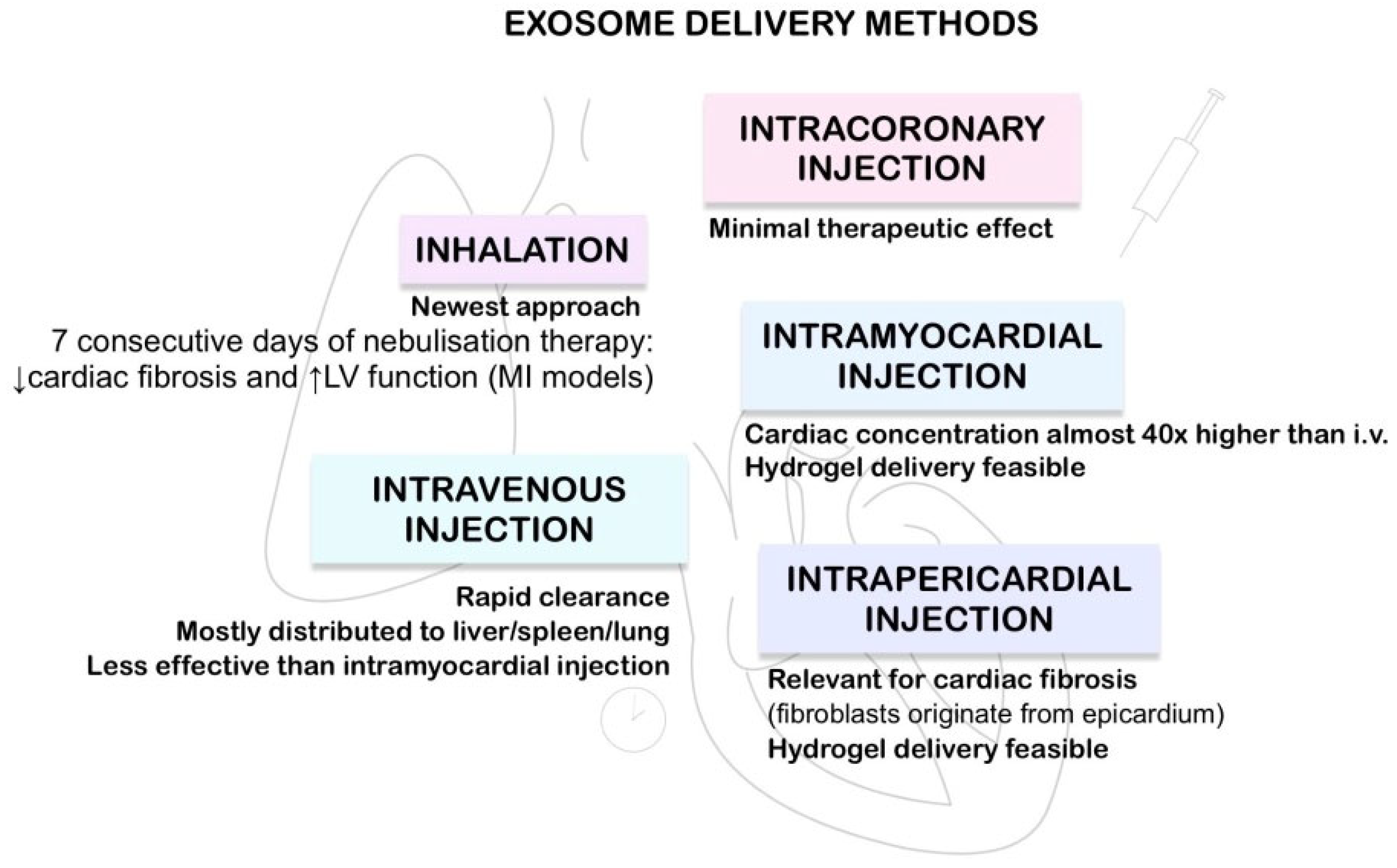
4.2. Exosome Delivery Methods
5. Discussion
5.1. Standardisation of Stem Cell- and EV-Based Therapies
5.2. Challenges of Stem Cell Therapy
5.3. Challenges of EV-Based Therapy
5.4. Comparison of Therapies Based on EVs and EV Mimetics
5.5. Potential Advantages of Stem Cell and Their Derivatives Therapy
5.6. Development Opportunities and Future
6. Conclusions
Author Contributions
Funding
Institutional Review Board Statement
Informed Consent Statement
Data Availability Statement
Conflicts of Interest
Abbreviations
| ADSCs | Adipose-derived stem cells |
| ADSCs-exos | ADSC-derived exosomes |
| BMSCs | Bone marrow stem cells |
| BMSCs-exos | BMSCs-derived exosomes |
| CPCs | Cardiac progenitor cells |
| ECM | Extracellular matrix |
| EF | Ejection fraction |
| EVs | Extracellular vesicles |
| FS | Fractional shortening |
| hAFMSCs | Human amniotic fluid-derived stem cells |
| hiPSCMs | hiPSC–derived cardiomyocytes |
| hiPSCMs-exos | hiPSCM-derived exosomes |
| hiPSCs | Human-induced pluripotent stem cells |
| hiPSCs-exos | hiPSC-derived exosomes |
| hucMSCs | Human umbilical cord MSCs |
| hucMSCs-exos | hucMSC-derived exosomes |
| iPSCs | Induced pluripotent stem cells |
| iPSCs-exos | iPSC-derived exosomes |
| LVEDD | Left ventricular end-diastolic dimensions |
| LVEDV | Left ventricular end-diastolic volume |
| LVESD | Left ventricular end-systolic dimension |
| LVESV | Left ventricular end-systolic volume |
| LVEF | Left ventricular ejection fraction |
| LVFS | Left ventricular fractional shortening |
| LVID | Left ventricular inner diameter |
| MI | Myocardial infarction |
| MSCs | Mesenchymal stem cells |
References
- Liu, M.; López de Juan Abad, B.; Cheng, K. Cardiac Fibrosis: Myofibroblast-Mediated Pathological Regulation and Drug Delivery Strategies. Adv. Drug Deliv. Rev. 2021, 173, 504. [Google Scholar] [CrossRef]
- Segura, A.M.; Frazier, O.H.; Buja, L.M. Fibrosis and Heart Failure. Heart Fail. Rev. 2014, 19, 173–185. [Google Scholar] [CrossRef]
- Almehmadi, F.; Joncas, S.X.; Nevis, I.; Zahrani, M.; Bokhari, M.; Stirrat, J.; Fine, N.M.; Yee, R.; White, J.A. Prevalence of Myocardial Fibrosis Patterns in Patients with Systolic Dysfunction: Prognostic Significance for the Prediction of Sudden Cardiac Arrest or Appropriate Implantable Cardiac Defibrillator Therapy. Circ. Cardiovasc. Imaging 2014, 7, 593–600. [Google Scholar] [CrossRef]
- Yeo, T.M.; Chin, C.W.L.; Seah, C.W.A.; Cheng, L.J.; Lin, W.; Dalakoti, M.; Foo, R.; Wang, W. Global Prevalence of Myocardial Fibrosis among Individuals with Cardiometabolic Conditions: A Systematic Review and Meta-Analysis. Eur. J. Prev. Cardiol. 2025, 32, 1077–1091. [Google Scholar] [CrossRef]
- de Boer, R.A.; De Keulenaer, G.; Bauersachs, J.; Brutsaert, D.; Cleland, J.G.; Diez, J.; Du, X.J.; Ford, P.; Heinzel, F.R.; Lipson, K.E.; et al. Towards Better Definition, Quantification and Treatment of Fibrosis in Heart Failure. A Scientific Roadmap by the Committee of Translational Research of the Heart Failure Association (HFA) of the European Society of Cardiology. Eur. J. Heart Fail. 2019, 21, 272. [Google Scholar] [CrossRef]
- Li, L.; Zhao, Q.; Kong, W. Extracellular Matrix Remodeling and Cardiac Fibrosis. Matrix Biol. 2018, 68–69, 490–506. [Google Scholar] [CrossRef]
- Maruyama, K.; Imanaka-Yoshida, K. The Pathogenesis of Cardiac Fibrosis: A Review of Recent Progress. Int. J. Mol. Sci. 2022, 23, 2617. [Google Scholar] [CrossRef]
- Ravassa, S.; López, B.; Treibel, T.A.; San José, G.; Losada-Fuentenebro, B.; Tapia, L.; Bayés-Genís, A.; Díez, J.; González, A. Cardiac Fibrosis in Heart Failure: Focus on Non-Invasive Diagnosis and Emerging Therapeutic Strategies. Mol. Asp. Med. 2023, 93, 101194. [Google Scholar] [CrossRef]
- Frangogiannis, N.G. Cardiac Fibrosis. Cardiovasc. Res. 2020, 117, 1450. [Google Scholar] [CrossRef]
- Travers, J.G.; Kamal, F.A.; Robbins, J.; Yutzey, K.E.; Blaxall, B.C. Cardiac Fibrosis: The Fibroblast Awakens. Circ. Res. 2016, 118, 1021–1040. [Google Scholar] [CrossRef]
- Nguyen, M.N.; Kiriazis, H.; Gao, X.M.; Du, X.J. Cardiac Fibrosis and Arrhythmogenesis. Compr. Physiol. 2017, 7, 1009–1049. [Google Scholar] [CrossRef]
- Hara, H.; Takeda, N.; Komuro, I. Pathophysiology and Therapeutic Potential of Cardiac Fibrosis. Inflamm. Regen. 2017, 37, 13. [Google Scholar] [CrossRef]
- Felisbino, M.B.; McKinsey, T.A. Epigenetics in Cardiac Fibrosis: Emphasis on Inflammation and Fibroblast Activation. JACC Basic Transl. Sci. 2018, 3, 704–715. [Google Scholar] [CrossRef]
- Banerjee, M.N.; Bolli, R.; Hare, J.M. Clinical Studies of Cell Therapy in Cardiovascular Medicine: Recent Developments and Future Directions. Circ. Res. 2018, 123, 266–287. [Google Scholar] [CrossRef]
- Zhang, H.; Tian, L.; Shen, M.; Tu, C.; Wu, H.; Gu, M.; Paik, D.T.; Wu, J.C. Generation of Quiescent Cardiac Fibroblasts from Human Induced Pluripotent Stem Cells for In Vitro Modeling of Cardiac Fibrosis. Circ. Res. 2019, 125, 552–566. [Google Scholar] [CrossRef]
- Wang, S.; Dong, J.; Li, L.; Wu, R.; Xu, L.; Ren, Y.; Hu, X. Exosomes Derived from MiR-129-5p Modified Bone Marrow Mesenchymal Stem Cells Represses Ventricular Remolding of Mice with Myocardial Infarction. J. Tissue Eng. Regen. Med. 2022, 16, 177–187. [Google Scholar] [CrossRef]
- Feng, Y.; Wang, Y.; Li, L.; Yang, Y.; Tan, X.; Chen, T. Exosomes Induce Crosstalk Between Multiple Types of Cells and Cardiac Fibroblasts: Therapeutic Potential for Remodeling After Myocardial Infarction. Int. J. Nanomed. 2024, 19, 10605–10621. [Google Scholar] [CrossRef]
- Liguori, T.T.A.; Liguori, G.R.; Sinkunas, V.; Correia, C.J.; dos Santos Coutinho e Silva, R.; Zanoni, F.L.; Aiello, V.D.; Harmsen, M.C.; Moreira, L.F.P. Intrapericardial Injection of Hydrogels with ASC and Their Secretome to Treat Dilated Cardiomyopathies. Sci. Rep. 2025, 15, 3529. [Google Scholar] [CrossRef]
- Bracco Gartner, T.C.L.; Deddens, J.C.; Mol, E.A.; Magin Ferrer, M.; van Laake, L.W.; Bouten, C.V.C.; Khademhosseini, A.; Doevendans, P.A.; Suyker, W.J.L.; Sluijter, J.P.G.; et al. Anti-Fibrotic Effects of Cardiac Progenitor Cells in a 3D-Model of Human Cardiac Fibrosis. Front. Cardiovasc. Med. 2019, 6, 52. [Google Scholar] [CrossRef]
- Liu, B.; Wei, Y.; He, J.; Feng, B.; Chen, Y.; Guo, R.; Griffin, M.D.; Hynes, S.O.; Shen, S.; Liu, Y.; et al. Human Umbilical Cord-Derived Mesenchymal Stromal Cells Improve Myocardial Fibrosis and Restore MiRNA-133a Expression in Diabetic Cardiomyopathy. Stem Cell Res. Ther. 2024, 15, 120. [Google Scholar] [CrossRef]
- Chen, F.; Li, X.; Zhao, J.; Geng, J.; Xie, J.; Xu, B. Bone Marrow Mesenchymal Stem Cell-Derived Exosomes Attenuate Cardiac Hypertrophy and Fibrosis in Pressure Overload Induced Remodeling. Vitr. Cell. Dev. Biol. Anim. 2020, 56, 567–576. [Google Scholar] [CrossRef]
- Hu, J.; Chen, X.; Li, P.; Lu, X.; Yan, J.; Tan, H.; Zhang, C. Exosomes Derived from Human Amniotic Fluid Mesenchymal Stem Cells Alleviate Cardiac Fibrosis via Enhancing Angiogenesis in Vivo and in Vitro. Cardiovasc. Diagn. Ther. 2021, 11, 348–361. [Google Scholar] [CrossRef]
- Wu, T.; Xie, Y.; Huang, J.; Li, P.; Wang, X.; Yan, Y.; Xia, T.; Li, L.; Zhu, F.; Li, H.; et al. The Optimal Intervention Time of Bone Marrow Mesenchymal Stem Cells in Ameliorating Cardiac Fibrosis Induced by Viral Myocarditis: A Randomized Controlled Trial in Mice. Stem Cells Int. 2017, 2017, 3258035. [Google Scholar] [CrossRef]
- Shah, S.; Nawaz, H.S.; Qazi, M.S.; Jain, H.; Lucke-Wold, B. Living Biodrugs and How Tissue Source Influences Mesenchymal Stem Cell Therapeutics for Heart Failure. World J. Cardiol. 2024, 16, 619–625. [Google Scholar] [CrossRef]
- Chen, T.J.; Yeh, Y.T.; Peng, F.S.; Li, A.H.; Wu, S.C. S100a8/A9 Enhances Immunomodulatory and Tissue-Repairing Properties of Human Amniotic Mesenchymal Stem Cells in Myocardial Ischemia-Reperfusion Injury. Int. J. Mol. Sci. 2021, 22, 11175. [Google Scholar] [CrossRef]
- Xuan, W.; Wang, Y.; Tang, Y.; Ali, A.; Hu, H.; Maienschein-Cline, M.; Ashraf, M. Cardiac Progenitors Induced from Human Induced Pluripotent Stem Cells with Cardiogenic Small Molecule Effectively Regenerate Infarcted Hearts and Attenuate Fibrosis. Shock 2018, 50, 627–639. [Google Scholar] [CrossRef]
- Rannou, A.; Toumaniantz, G.; Larcher, T.; Leroux, I.; Ledevin, M.; Hivonnait, A.; Babarit, C.; Fleurisson, R.; Dubreil, L.; Ménoret, S.; et al. Human MuStem Cell Grafting into Infarcted Rat Heart Attenuates Adverse Tissue Remodeling and Preserves Cardiac Function. Mol. Ther. Methods Clin. Dev. 2020, 18, 446–463. [Google Scholar] [CrossRef]
- Li, J.; Yao, Y.; Zhou, J.; Yang, Z.; Qiu, C.; Lu, Y.; Xie, J.; Liu, J.; Jiang, T.; Kou, Y.; et al. Epicardial Transplantation of Antioxidant Polyurethane Scaffold Based Human Amniotic Epithelial Stem Cell Patch for Myocardial Infarction Treatment. Nat. Commun. 2024, 15, 9105. [Google Scholar] [CrossRef] [PubMed]
- Dong, X.; Zhang, T.; Liu, Q.; Zhu, J.; Zhao, J.; Li, J.; Sun, B.; Ding, G.; Hu, X.; Yang, Z.; et al. Beneficial Effects of Urine-Derived Stem Cells on Fibrosis and Apoptosis of Myocardial, Glomerular and Bladder Cells. Mol. Cell. Endocrinol. 2016, 427, 21–32. [Google Scholar] [CrossRef] [PubMed]
- Soczyńska, J.; Gawełczyk, W.; Majcherczyk, K.; Rydzek, J.; Muzyka, A.; Żołyniak, M.; Woźniak, S. Cells Versus Cell-Derived Signals in Cardiac Regenerative Therapy: A Comparative Analysis of Mechanisms and Clinical Evidence. Cells 2025, 14, 1674. [Google Scholar] [CrossRef] [PubMed]
- Moraddahande, F.M.; Meybodi, S.M.E.; Matin, M.; Soleimani, N.; Ghasemzadeh, N.; Firoozabadi, A.D. Current Status and New Horizons in Stem Cell Therapy in Cardiovascular Regenerative Medicine (CaVaReM): An Update. Eur. J. Med. Res. 2025, 30, 837. [Google Scholar] [CrossRef] [PubMed]
- Zhang, J.; Li, J.; Qu, X.; Liu, Y.; Harada, A.; Hua, Y.; Yoshida, N.; Ishida, M.; Tabata, A.; Sun, L.; et al. Development of a Thick and Functional Human Adipose-Derived Stem Cell Tissue Sheet for Myocardial Infarction Repair in Rat Hearts. Stem Cell Res. Ther. 2023, 14, 380. [Google Scholar] [CrossRef]
- Jin, L.; Zhang, J.; Deng, Z.; Liu, J.; Han, W.; Chen, G.; Si, Y.; Ye, P. Mesenchymal Stem Cells Ameliorate Myocardial Fibrosis in Diabetic Cardiomyopathy via the Secretion of Prostaglandin E2. Stem Cell Res. Ther. 2020, 11, 122. [Google Scholar] [CrossRef]
- Chen, J.; Zhan, Y.; Wang, Y.; Han, D.; Tao, B.; Luo, Z.; Ma, S.; Wang, Q.; Li, X.; Fan, L.; et al. Chitosan/Silk Fibroin Modified Nanofibrous Patches with Mesenchymal Stem Cells Prevent Heart Remodeling Post-Myocardial Infarction in Rats. Acta Biomater. 2018, 80, 154–168. [Google Scholar] [CrossRef]
- Luger, D.; Lipinski, M.J.; Westman, P.C.; Glover, D.K.; Dimastromatteo, J.; Frias, J.C.; Albelda, M.T.; Sikora, S.; Kharazi, A.; Vertelov, G.; et al. Intravenously Delivered Mesenchymal Stem Cells: Systemic Anti-Inflammatory Effects Improve Left Ventricular Dysfunction in Acute Myocardial Infarction and Ischemic Cardiomyopathy. Circ. Res. 2017, 120, 1598–1613. [Google Scholar] [CrossRef]
- Bolli, R.; Hare, J.M.; Henry, T.D.; Lenneman, C.G.; March, K.L.; Miller, K.; Pepine, C.J.; Perin, E.C.; Traverse, J.H.; Willerson, J.T.; et al. Rationale and Design of the SENECA (StEm Cell INjECtion in CAncer Survivors) Trial. Am. Heart J. 2018, 201, 54–62. [Google Scholar] [CrossRef]
- Attar, A.; Farjoud Kouhanjani, M.; Hessami, K.; Vosough, M.; Kojuri, J.; Ramzi, M.; Hosseini, S.A.; Faghih, M.; Monabati, A. Effect of Once versus Twice Intracoronary Injection of Allogeneic-Derived Mesenchymal Stromal Cells after Acute Myocardial Infarction: BOOSTER-TAHA7 Randomized Clinical Trial. Stem Cell Res. Ther. 2023, 14, 264. [Google Scholar] [CrossRef] [PubMed]
- Melhem, M.R.; Park, J.; Knapp, L.; Reinkensmeyer, L.; Cvetkovic, C.; Flewellyn, J.; Lee, M.K.; Jensen, T.W.; Bashir, R.; Kong, H.; et al. 3D Printed Stem-Cell-Laden, Microchanneled Hydrogel Patch for the Enhanced Release of Cell-Secreting Factors and Treatment of Myocardial Infarctions. ACS Biomater. Sci. Eng. 2017, 3, 1980–1987. [Google Scholar] [CrossRef]
- Mokhtari, B.; Aboutaleb, N.; Nazarinia, D.; Nikougoftar, M.; Tousi, S.M.T.R.; Molazem, M.; Azadi, M.R. Comparison of the Effects of Intramyocardial and Intravenous Injections of Human Mesenchymal Stem Cells on Cardiac Regeneration after Heart Failure. Iran. J. Basic Med. Sci. 2020, 23, 879. [Google Scholar] [CrossRef]
- Zhang, J.; Wu, Z.; Fan, Z.; Qin, Z.; Wang, Y.; Chen, J.; Wu, M.; Chen, Y.; Wu, C.; Wang, J. Pericardial Application as a New Route for Implanting Stem-Cell Cardiospheres to Treat Myocardial Infarction. J. Physiol. 2018, 596, 2037–2054. [Google Scholar] [CrossRef] [PubMed]
- Tang, X.L.; Wysoczynski, M.; Gumpert, A.M.; Solanki, M.; Li, Y.; Wu, W.J.; Zheng, S.; Ruble, H.; Li, H.; Stowers, H.; et al. Intravenous Infusions of Mesenchymal Stromal Cells Have Cumulative Beneficial Effects in a Porcine Model of Chronic Ischaemic Cardiomyopathy. Cardiovasc. Res. 2024, 120, 1939–1952. [Google Scholar] [CrossRef] [PubMed]
- Lee, C.Y.; Lee, S.; Jeong, S.; Lee, J.; Seo, H.H.; Shin, S.; Park, J.H.; Song, B.W.; Kim, I.K.; Choi, J.W.; et al. Suppressing Pyroptosis Augments Post-Transplant Survival of Stem Cells and Cardiac Function Following Ischemic Injury. Int. J. Mol. Sci. 2021, 22, 7946. [Google Scholar] [CrossRef]
- Sirish, P.; Thai, P.N.; Lee, J.H.; Yang, J.; Zhang, X.D.; Ren, L.; Li, N.; Timofeyev, V.; Lee, K.S.S.; Nader, C.E.; et al. Suppression of Inflammation and Fibrosis Using Soluble Epoxide Hydrolase Inhibitors Enhances Cardiac Stem Cell-Based Therapy. Stem Cells Transl. Med. 2020, 9, 1570–1584. [Google Scholar] [CrossRef]
- Shao, L.; Zhang, Y.; Pan, X.; Liu, B.; Liang, C.; Zhang, Y.; Wang, Y.; Yan, B.; Xie, W.; Sun, Y.; et al. Knockout of Beta-2 Microglobulin Enhances Cardiac Repair by Modulating Exosome Imprinting and Inhibiting Stem Cell-Induced Immune Rejection. Cell. Mol. Life Sci. 2020, 77, 937–952. [Google Scholar] [CrossRef]
- Chen, Y.; Li, C.; Li, C.; Chen, J.; Li, Y.; Xie, H.; Lin, C.; Fan, M.; Guo, Y.; Gao, E.; et al. Tailorable Hydrogel Improves Retention and Cardioprotection of Intramyocardial Transplanted Mesenchymal Stem Cells for the Treatment of Acute Myocardial Infarction in Mice. J. Am. Heart Assoc. 2020, 9, e013784. [Google Scholar] [CrossRef]
- Abdelmonem, M.; Shahin, N.N.; Rashed, L.A.; Amin, H.A.A.; Shamaa, A.A.; Shaheen, A.A. Hydrogen Sulfide Enhances the Effectiveness of Mesenchymal Stem Cell Therapy in Rats with Heart Failure: In Vitro Preconditioning versus in Vivo Co-Delivery. Biomed. Pharmacother. 2019, 112, 108584. [Google Scholar] [CrossRef]
- Cho, H.M.; Lee, K.H.; Shen, Y.M.; Shin, T.J.; Ryu, P.D.; Choi, M.C.; Kang, K.S.; Cho, J.Y. Transplantation of HMSCs Genome Edited with LEF1 Improves Cardio-Protective Effects in Myocardial Infarction. Mol. Ther. Nucleic Acids 2020, 19, 1186–1197. [Google Scholar] [CrossRef]
- Cai, W.F.; Jiang, L.; Liang, J.; Dutta, S.; Huang, W.; He, X.; Wu, Z.; Paul, C.; Gao, X.; Xu, M.; et al. HAX1-Overexpression Augments Cardioprotective Efficacy of Stem Cell-Based Therapy Through Mediating Hippo-Yap Signaling. Stem Cell Rev. Rep. 2024, 20, 1569–1586. [Google Scholar] [CrossRef]
- Han, W.; Xiong, W.; Sun, W.; Liu, W.; Zhang, Y.; Li, C.; Gu, N.; Shen, Y.; Qiu, Z.; Li, C.; et al. YTHDC1 Mitigates Apoptosis in Bone Marrow Mesenchymal Stem Cells by Inhibiting NfƙBiα and Augmenting Cardiac Function Following Myocardial Infarction. Cell Transplant. 2024, 33, 9636897241290910. [Google Scholar] [CrossRef] [PubMed]
- Fang, Y.H.; Wang, S.P.H.; Gao, Z.H.; Wu, S.N.; Chang, H.Y.; Yang, P.J.; Liu, P.Y.; Liu, Y.W. Efficient Cardiac Differentiation of Human Amniotic Fluid-Derived Stem Cells into Induced Pluripotent Stem Cells and Their Potential Immune Privilege. Int. J. Mol. Sci. 2020, 21, 2359. [Google Scholar] [CrossRef] [PubMed]
- Cao, Y.; Chen, X.; Cheng, B.; Tao, X.; Zhang, W.; Shi, Y.; Gao, J.; Fu, M. Therapeutic Potential of MiR-133a-Transfected Bone Marrow Mesenchymal Stem Cell Transplantation in Improving Cardiac Function Post-Myocardial Infarction. J. Cardiothorac. Surg. 2025, 20, 139. [Google Scholar] [CrossRef]
- Meng, K.; Cai, H.; Cai, S.; Hong, Y.; Zhang, X. Adiponectin Modified BMSCs Alleviate Heart Fibrosis via Inhibition TGF-Beta1/Smad in Diabetic Rats. Front. Cell Dev. Biol. 2021, 9, 644160. [Google Scholar] [CrossRef] [PubMed]
- Li, L.L.; Peng, C.; Zhang, M.; Liu, Y.; Li, H.; Chen, H.; Sun, Y.; Zhu, C.; Zhang, Y. Mesenchymal Stem Cells Overexpressing Adrenomedullin Improve Heart Function through Antifibrotic Action in Rats Experiencing Heart Failure. Mol. Med. Rep. 2018, 17, 1437–1444. [Google Scholar] [CrossRef]
- Lee, T.M.; Harn, H.J.; Chiou, T.W.; Chuang, M.H.; Chen, C.H.; Chuang, C.H.; Lin, P.C.; Lin, S.Z. Preconditioned Adipose-Derived Stem Cells Ameliorate Cardiac Fibrosis by Regulating Macrophage Polarization in Infarcted Rat Hearts through the PI3K/STAT3 Pathway. Lab. Investig. 2019, 99, 634–647. [Google Scholar] [CrossRef]
- Lim, S.Y.; Cho, D.I.; Jeong, H.-Y.; Kang, H.-J.; Kim, M.R.; Cho, M.; Kim, Y.S.; Ahn, Y. Adjuvant Role of Macrophages in Stem Cell-Induced Cardiac Repair in Rats. Exp. Mol. Med. 2018, 50, 1–10. [Google Scholar] [CrossRef]
- Park, J.H.; Kim, H.; Moon, H.R.; Park, B.W.; Park, J.H.; Sim, W.S.; Kim, J.J.; Lim, H.J.; Kim, Y.J.; Ji, S.T.; et al. Human Cardiac Stem Cells Rejuvenated by Modulating Autophagy with MHY-1685 Enhance the Therapeutic Potential for Cardiac Repair. Exp. Mol. Med. 2021, 53, 1423–1436. [Google Scholar] [CrossRef]
- Zhao, Y.T.; Wang, J.; Yano, N.; Zhang, L.X.; Wang, H.; Zhang, S.; Qin, G.; Dubielecka, P.M.; Zhuang, S.; Liu, P.Y.; et al. Irisin Promotes Cardiac Progenitor Cell-Induced Myocardial Repair and Functional Improvement in Infarcted Heart. J. Cell. Physiol. 2019, 234, 1671–1681. [Google Scholar] [CrossRef] [PubMed]
- Yamamoto, K.; Kurata, Y.; Inoue, Y.; Adachi, M.; Tsuneto, M.; Miake, J.; Ogino, K.; Ninomiya, H.; Yoshida, A.; Shirayoshi, Y.; et al. Pretreatment with an Angiotensin II Receptor Blocker Abolished Ameliorating Actions of Adipose-Derived Stem Cell Sheets on Cardiac Dysfunction and Remodeling after Myocardial Infarction. Regen. Ther. 2018, 9, 79–88. [Google Scholar] [CrossRef] [PubMed]
- Adachi, M.; Watanabe, M.; Kurata, Y.; Inoue, Y.; Notsu, T.; Yamamoto, K.; Horie, H.; Tanno, S.; Morita, M.; Miake, J.; et al. β-Adrenergic Blocker, Carvedilol, Abolishes Ameliorating Actions of Adipose-Derived Stem Cell Sheets on Cardiac Dysfunction and Remodeling After Myocardial Infarction. Circ. J. 2019, 83, 2282–2291. [Google Scholar] [CrossRef] [PubMed]
- Trigo, C.M.; Rodrigues, J.S.; Camões, S.P.; Solá, S.; Miranda, J.P. Mesenchymal Stem Cell Secretome for Regenerative Medicine: Where Do We Stand? J. Adv. Res. 2024, 70, 103. [Google Scholar] [CrossRef]
- Maacha, S.; Sidahmed, H.; Jacob, S.; Gentilcore, G.; Calzone, R.; Grivel, J.C.; Cugno, C. Paracrine Mechanisms of Mesenchymal Stromal Cells in Angiogenesis. Stem Cells Int. 2020, 2020, 4356359. [Google Scholar] [CrossRef]
- Pankajakshan, D.; Agrawal, D.K. Mesenchymal Stem Cell Paracrine Factors in Vascular Repair and Regeneration. J. Biomed. Technol. Res. 2014, 1, 10.19104/jbtr.2014.107. [Google Scholar] [CrossRef]
- Da Silva, K.; Kumar, P.; Choonara, Y.E. The Paradigm of Stem Cell Secretome in Tissue Repair and Regeneration: Present and Future Perspectives. Wound Repair Regen. 2025, 33, e13251. [Google Scholar] [CrossRef]
- Tang, H.; Luo, H.; Zhang, Z.; Yang, D. Mesenchymal Stem Cell-Derived Apoptotic Bodies: Biological Functions and Therapeutic Potential. Cells 2022, 11, 3879. [Google Scholar] [CrossRef]
- Rayat Pisheh, H.; Sani, M. Mesenchymal Stem Cells Derived Exosomes: A New Era in Cardiac Regeneration. Stem Cell Res. Ther. 2025, 16, 16. [Google Scholar] [CrossRef]
- Moghaddam, A.S.; Afshari, J.T.; Esmaeili, S.A.; Saburi, E.; Joneidi, Z.; Momtazi-Borojeni, A.A. Cardioprotective MicroRNAs: Lessons from Stem Cell-Derived Exosomal MicroRNAs to Treat Cardiovascular Disease. Atherosclerosis 2019, 285, 1–9. [Google Scholar] [CrossRef]
- Wang, T.; Li, T.; Niu, X.; Hu, L.; Cheng, J.; Guo, D.; Ren, H.; Zhao, R.; Ji, Z.; Liu, P.; et al. ADSC-Derived Exosomes Attenuate Myocardial Infarction Injury by Promoting MiR-205-Mediated Cardiac Angiogenesis. Biol. Direct 2023, 18, 6. [Google Scholar] [CrossRef] [PubMed]
- Charoenviriyakul, C.; Takahashi, Y.; Morishita, M.; Matsumoto, A.; Nishikawa, M.; Takakura, Y. Cell Type-Specific and Common Characteristics of Exosomes Derived from Mouse Cell Lines: Yield, Physicochemical Properties, and Pharmacokinetics. Eur. J. Pharm. Sci. 2017, 96, 316–322. [Google Scholar] [CrossRef] [PubMed]
- Lai, T.C.; Lee, T.L.; Chang, Y.C.; Chen, Y.C.; Lin, S.R.; Lin, S.W.; Pu, C.M.; Tsai, J.S.; Chen, Y.L. MicroRNA-221/222 Mediates ADSC-Exosome-Induced Cardioprotection Against Ischemia/Reperfusion by Targeting PUMA and ETS-1. Front. Cell Dev. Biol. 2020, 8, 569150. [Google Scholar] [CrossRef]
- Asgarpour, K.; Shojaei, Z.; Amiri, F.; Ai, J.; Mahjoubin-Tehran, M.; Ghasemi, F.; Arefnezhad, R.; Hamblin, M.R.; Mirzaei, H. Exosomal MicroRNAs Derived from Mesenchymal Stem Cells: Cell-to-Cell Messages. Cell Commun. Signal. 2020, 18, 149. [Google Scholar] [CrossRef] [PubMed]
- Yang, M.; Liao, M.; Liu, R.; Zhang, Q.; Zhang, S.; He, Y.; Jin, J.; Zhang, P.; Zhou, L. Human Umbilical Cord Mesenchymal Stem Cell-Derived Extracellular Vesicles Loaded with MiR-223 Ameliorate Myocardial Infarction through P53/S100A9 Axis. Genomics 2022, 114, 110319. [Google Scholar] [CrossRef] [PubMed]
- Lesizza, P.; Prosdocimo, G.; Martinelli, V.; Sinagra, G.; Zacchigna, S.; Giacca, M. Single-Dose Intracardiac Injection of Pro-Regenerative MicroRNAs Improves Cardiac Function after Myocardial Infarction. Circ. Res. 2017, 120, 1298–1304. [Google Scholar] [CrossRef] [PubMed]
- Gabisonia, K.; Prosdocimo, G.; Aquaro, G.D.; Carlucci, L.; Zentilin, L.; Secco, I.; Ali, H.; Braga, L.; Gorgodze, N.; Bernini, F.; et al. MicroRNA Therapy Stimulates Uncontrolled Cardiac Repair after Myocardial Infarction in Pigs. Nature 2019, 569, 418–422. [Google Scholar] [CrossRef]
- Peng, H.; Ji, W.; Zhao, R.; Yang, J.; Lu, Z.; Li, Y.; Zhang, X. Exosome: A Significant Nano-Scale Drug Delivery Carrier. J. Mater. Chem. B 2020, 8, 7591–7608. [Google Scholar] [CrossRef] [PubMed]
- Gallet, R.; Dawkins, J.; Valle, J.; Simsolo, E.; De Couto, G.; Middleton, R.; Tseliou, E.; Luthringer, D.; Kreke, M.; Smith, R.R.; et al. Exosomes Secreted by Cardiosphere-Derived Cells Reduce Scarring, Attenuate Adverse Remodelling, and Improve Function in Acute and Chronic Porcine Myocardial Infarction. Eur. Heart J. 2017, 38, 201–211. [Google Scholar] [CrossRef]
- Yuan, J.; Yang, H.; Liu, C.; Shao, L.; Zhang, H.; Lu, K.; Wang, J.; Wang, Y.; Yu, Q.; Zhang, Y.; et al. Microneedle Patch Loaded with Exosomes Containing MicroRNA-29b Prevents Cardiac Fibrosis after Myocardial Infarction. Adv. Healthc. Mater. 2023, 12, e2202959. [Google Scholar] [CrossRef]
- Zhao, Y.; Sun, X.; Cao, W.; Ma, J.; Sun, L.; Qian, H.; Zhu, W.; Xu, W. Exosomes Derived from Human Umbilical Cord Mesenchymal Stem Cells Relieve Acute Myocardial Ischemic Injury. Stem Cells Int. 2015, 2015, 761643. [Google Scholar] [CrossRef]
- Wang, R.; Liu, L.; Han, F.; Ma, Q.; He, H. Exosomes Derived from Human Umbilical Cord Mesenchymal Stem Cells Can Reverse Ventricular Remodeling and Improve Long-Term Cardiac Function after Acute Myocardial Infarction. Biochem. Biophys. Res. Commun. 2025, 768, 151920. [Google Scholar] [CrossRef]
- Zhu, W.; Sun, L.; Zhao, P.; Liu, Y.; Zhang, J.; Zhang, Y.; Hong, Y.; Zhu, Y.; Lu, Y.; Zhao, W.; et al. Macrophage Migration Inhibitory Factor Facilitates the Therapeutic Efficacy of Mesenchymal Stem Cells Derived Exosomes in Acute Myocardial Infarction through Upregulating MiR-133a-3p. J. Nanobiotechnol. 2021, 19, 61. [Google Scholar] [CrossRef]
- Lee, T.L.; Lai, T.C.; Lin, S.R.; Lin, S.W.; Chen, Y.C.; Pu, C.M.; Lee, I.T.; Tsai, J.S.; Lee, C.W.; Chen, Y.L. Conditioned Medium from Adipose-Derived Stem Cells Attenuates Ischemia/Reperfusion-Induced Cardiac Injury through the MicroRNA-221/222/PUMA/ETS-1 Pathway. Theranostics 2021, 11, 3131–3149. [Google Scholar] [CrossRef]
- Sanz-Ros, J.; Huete-Acevedo, J.; Mas-Bargues, C.; Romero-García, N.; Dromant, M.; van Weeghel, M.; Janssens, G.E.; Borrás, C. Small Extracellular Vesicles from Young Adipose-Derived Stem Cells Ameliorate Age-Related Changes in the Heart of Old Mice. Stem Cell Res. Ther. 2025, 16, 138. [Google Scholar] [CrossRef]
- Luo, Q.; Guo, D.; Liu, G.; Chen, G.; Hang, M.; Jin, M. Exosomes from MiR-126-Overexpressing Adscs Are Therapeutic in Relieving Acute Myocardial Ischaemic Injury. Cell. Physiol. Biochem. 2018, 44, 2105–2116. [Google Scholar] [CrossRef] [PubMed]
- Deng, S.; Zhou, X.; Ge, Z.; Song, Y.; Wang, H.; Liu, X.; Zhang, D. Exosomes from Adipose-Derived Mesenchymal Stem Cells Ameliorate Cardiac Damage after Myocardial Infarction by Activating S1P/SK1/S1PR1 Signaling and Promoting Macrophage M2 Polarization. Int. J. Biochem. Cell Biol. 2019, 114, 105564. [Google Scholar] [CrossRef] [PubMed]
- Xu, L.; Fan, Y.; Wu, L.; Zhang, C.; Chu, M.; Wang, Y.; Zhuang, W. Exosomes from Bone Marrow Mesenchymal Stem Cells with Overexpressed Nrf2 Inhibit Cardiac Fibrosis in Rats with Atrial Fibrillation. Cardiovasc. Ther. 2022, 2022, 2687807. [Google Scholar] [CrossRef]
- Chen, S.; Zeng, X.; Wu, M.; Zhu, J.; Wu, Y. Sodium Alginate Hydrogel Infusion of Bone Marrow Mesenchymal Stem Cell-Derived Extracellular Vesicles and P38α Antagonistic Peptides in Myocardial Infarction Fibrosis Mitigation. J. Am. Heart Assoc. 2025, 14, 36887. [Google Scholar] [CrossRef]
- Jiao, W.; Hao, J.; Xie, Y.; Meng, M.; Gao, W. EZH2 Mitigates the Cardioprotective Effects of Mesenchymal Stem Cell-Secreted Exosomes against Infarction via HMGA2-Mediated PI3K/AKT Signaling. BMC Cardiovasc. Disord. 2022, 22, 95. [Google Scholar] [CrossRef]
- Wang, S.; Li, L.; Liu, T.; Jiang, W.; Hu, X. MiR-19a/19b-Loaded Exosomes in Combination with Mesenchymal Stem Cell Transplantation in a Preclinical Model of Myocardial Infarction. Regen. Med. 2020, 15, 1749–1759. [Google Scholar] [CrossRef] [PubMed]
- Adamiak, M.; Sahoo, S. Exosomes in Myocardial Repair: Advances and Challenges in the Development of Next-Generation Therapeutics. Mol. Ther. 2018, 26, 1635. [Google Scholar] [CrossRef]
- Paw, M.; Kusiak, A.A.; Nit, K.; Litewka, J.J.; Piejko, M.; Wnuk, D.; Sarna, M.; Fic, K.; Stopa, K.B.; Hammad, R.; et al. Hypoxia Enhances Anti-Fibrotic Properties of Extracellular Vesicles Derived from HiPSCs via the MiR302b-3p/TGFβ/SMAD2 Axis. BMC Med. 2023, 21, 412. [Google Scholar] [CrossRef]
- Tzng, E.; Bayardo, N.; Ikeda, G.; Vadgama, N.; Takashima, H.; Lyons, J.; Ieki, H.; Bennett, M.; Snyder, M.; Wu, J.C.; et al. Molecular Mechanisms of Exosomes from Human IPSC-Cardiomyocytes and Mesenchymal Stem Cells in Restoring the Injured Myocardium. J. Am. Heart Assoc. 2025, 14, e037005. [Google Scholar] [CrossRef]
- Tominaga, Y.; Kawamura, T.; Ito, E.; Takeda, M.; Harada, A.; Torigata, K.; Sakaniwa, R.; Sawa, Y.; Miyagawa, S. Pleiotropic Effects of Extracellular Vesicles from Induced Pluripotent Stem Cell–Derived Cardiomyocytes on Ischemic Cardiomyopathy: A Preclinical Study. J. Heart Lung Transplant. 2024, 43, 85–99. [Google Scholar] [CrossRef]
- Kawasumi, R.; Kawamura, T.; Yamashita, K.; Tominaga, Y.; Harada, A.; Ito, E.; Takeda, M.; Kita, S.; Shimomura, I.; Miyagawa, S. Systemic Administration of Induced Pluripotent Stem Cell-Derived Mesenchymal Stem Cells Improves Cardiac Function through Extracellular Vesicle-Mediated Tissue Repair in a Rat Model of Ischemic Cardiomyopathy. Regen. Ther. 2025, 28, 253–261. [Google Scholar] [CrossRef] [PubMed]
- Wang, X.; Zhu, Y.; Wu, C.; Liu, W.; He, Y.; Yang, Q. Adipose-Derived Mesenchymal Stem Cells-Derived Exosomes Carry MicroRNA-671 to Alleviate Myocardial Infarction Through Inactivating the TGFBR2/Smad2 Axis. Inflammation 2021, 44, 1815–1830. [Google Scholar] [CrossRef] [PubMed]
- Huang, C.; Zhang, X.; Wu, S.X.; Chang, Q.; Zheng, Z.K.; Xu, J. Cardioprotective Effects of HUCMSCs-Exosi-EGR1 MN Patch in MI/RI by Modulating Oxidative Stress and Mitophagy. Mater. Today Bio 2025, 31, 101500. [Google Scholar] [CrossRef]
- Ren, Y.; Zhao, X. Bone Marrow Mesenchymal Stem Cells-Derived Exosomal LncRNA GAS5 Mitigates Heart Failure by Inhibiting UL3/Hippo Pathway-Mediated Ferroptosis. Eur. J. Med. Res. 2024, 29, 303. [Google Scholar] [CrossRef] [PubMed]
- Jin, J.J.; Liu, R.H.; Chen, J.Y.; Wang, K.; Han, J.Y.; Nie, D.S.; Gong, Y.Q.; Lin, B.; Weng, G.X. MiR-21-5p-Enriched Exosomes from HiPSC-Derived Cardiomyocytes Exhibit Superior Cardiac Repair Efficacy Compared to HiPSC-Derived Exosomes in a Murine MI Model. World J. Stem Cells 2025, 17, 101454. [Google Scholar] [CrossRef]
- Zhao, M.; Nakada, Y.; Wei, Y.; Bian, W.; Chu, Y.; Borovjagin, A.V.; Xie, M.; Zhu, W.; Nguyen, T.; Zhou, Y.; et al. Cyclin D2 Overexpression Enhances the Efficacy of Human Induced Pluripotent Stem Cell-Derived Cardiomyocytes for Myocardial Repair in a Swine Model of Myocardial Infarction. Circulation 2021, 144, 210. [Google Scholar] [CrossRef]
- Jeong, S.Y.; Park, B.W.; Kim, J.; Lee, S.; You, H.; Lee, J.; Lee, S.; Park, J.H.; Kim, J.; Sim, W.; et al. Hyaluronic Acid Stimulation of Stem Cells for Cardiac Repair: A Cell-Free Strategy for Myocardial Infarct. J. Nanobiotechnol. 2024, 22, 149. [Google Scholar] [CrossRef]
- Smyth, T.; Kullberg, M.; Malik, N.; Smith-Jones, P.; Graner, M.W.; Anchordoquy, T.J. Biodistribution and Delivery Efficiency of Unmodified Tumor-Derived Exosomes. J. Control. Release 2015, 199, 145–155. [Google Scholar] [CrossRef]
- Johnsen, K.B.; Gudbergsson, J.M.; Duroux, M.; Moos, T.; Andresen, T.L.; Simonsen, J.B. On the Use of Liposome Controls in Studies Investigating the Clinical Potential of Extracellular Vesicle-Based Drug Delivery Systems—A Commentary. J. Control. Release 2018, 269, 10–14. [Google Scholar] [CrossRef]
- Luo, H.; Wang, K.; Zhang, Y.; Li, T.; Jia, X.; Feng, R.; Zhao, R.; Yu, R.; Hu, L.; Zhang, M.; et al. Targeted Engineered Exosomes Alleviate Myocardial Infarction Injury by Enhancing Angiogenesis and Improving Mitochondrial Function. J. Control. Release 2026, 389, 114404. [Google Scholar] [CrossRef]
- Wang, X.; Chen, Y.; Zhao, Z.; Meng, Q.; Yu, Y.; Sun, J.; Yang, Z.; Chen, Y.; Li, J.; Ma, T.; et al. Engineered Exosomes with Ischemic Myocardium-Targeting Peptide for Targeted Therapy in Myocardial Infarction. J. Am. Heart Assoc. 2018, 7, e008737. [Google Scholar] [CrossRef]
- Vandergriff, A.; Huang, K.; Shen, D.; Hu, S.; Hensley, M.T.; Caranasos, T.G.; Qian, L.; Cheng, K. Targeting Regenerative Exosomes to Myocardial Infarction Using Cardiac Homing Peptide. Theranostics 2018, 8, 1869–1878. [Google Scholar] [CrossRef]
- Zou, Y.; Li, L.; Li, Y.; Chen, S.; Xie, X.; Jin, X.; Wang, X.; Ma, C.; Fan, G.; Wang, W. Restoring Cardiac Functions after Myocardial Infarction-Ischemia/Reperfusion via an Exosome Anchoring Conductive Hydrogel. ACS Appl. Mater. Interfaces 2021, 13, 56892–56908. [Google Scholar] [CrossRef]
- Varderidou-Minasian, S.; Lorenowicz, M.J. Mesenchymal Stromal/Stem Cell-Derived Extracellular Vesicles in Tissue Repair: Challenges and Opportunities. Theranostics 2020, 10, 5979–5997. [Google Scholar] [CrossRef] [PubMed]
- Chen, P.; Wang, L.; Fan, X.; Ning, X.; Yu, B.; Ou, C.; Chen, M. Targeted Delivery of Extracellular Vesicles in Heart Injury. Theranostics 2021, 11, 2263. [Google Scholar] [CrossRef] [PubMed]
- Riau, A.K.; Ong, H.S.; Yam, G.H.F.; Mehta, J.S. Sustained Delivery System for Stem Cell-Derived Exosomes. Front. Pharmacol. 2019, 10, 1368. [Google Scholar] [CrossRef] [PubMed]
- Hu, X.; Ning, X.; Zhao, Q.; Zhang, Z.; Zhang, C.; Xie, M.; Huang, W.; Cai, Y.; Xiang, Q.; Ou, C. Islet-1 Mesenchymal Stem Cells-Derived Exosome-Incorporated Angiogenin-1 Hydrogel for Enhanced Acute Myocardial Infarction Therapy. ACS Appl. Mater. Interfaces 2022, 14, 36289–36303. [Google Scholar] [CrossRef]
- Chen, C.W.; Wang, L.L.; Zaman, S.; Gordon, J.; Arisi, M.F.; Venkataraman, C.M.; Chung, J.J.; Hung, G.; Gaffey, A.C.; Spruce, L.A.; et al. Sustained Release of Endothelial Progenitor Cell-Derived Extracellular Vesicles from Shear-Thinning Hydrogels Improves Angiogenesis and Promotes Function after Myocardial Infarction. Cardiovasc. Res. 2018, 114, 1029. [Google Scholar] [CrossRef]
- Liu, B.; Lee, B.W.; Nakanishi, K.; Villasante, A.; Williamson, R.; Metz, J.; Kim, J.; Kanai, M.; Bi, L.; Brown, K.; et al. Cardiac Recovery via Extended Cell-Free Delivery of Extracellular Vesicles Secreted by Cardiomyocytes Derived from Induced Pluripotent Stem Cells. Nat. Biomed. Eng. 2018, 2, 293–303. [Google Scholar] [CrossRef]
- Waters, R.; Alam, P.; Pacelli, S.; Chakravarti, A.R.; Ahmed, R.P.H.; Paul, A. Stem Cell-Inspired Secretome-Rich Injectable Hydrogel to Repair Injured Cardiac Tissue. Acta Biomater. 2018, 69, 95–106. [Google Scholar] [CrossRef]
- Zhu, D.; Liu, S.; Huang, K.; Li, J.; Mei, X.; Li, Z.; Cheng, K. Intrapericardial Long Non-Coding RNA-Tcf21 Antisense RNA Inducing Demethylation Administration Promotes Cardiac Repair. Eur. Heart J. 2023, 44, 1748–1760. [Google Scholar] [CrossRef] [PubMed]
- Han, C.; Zhou, J.; Liang, C.; Liu, B.; Pan, X.; Zhang, Y.; Wang, Y.; Yan, B.; Xie, W.; Liu, F.; et al. Human Umbilical Cord Mesenchymal Stem Cell Derived Exosomes Encapsulated in Functional Peptide Hydrogels Promote Cardiac Repair. Biomater. Sci. 2019, 7, 2920–2933. [Google Scholar] [CrossRef] [PubMed]
- Zhu, D.; Li, Z.; Huang, K.; Caranasos, T.G.; Rossi, J.S.; Cheng, K. Minimally Invasive Delivery of Therapeutic Agents by Hydrogel Injection into the Pericardial Cavity for Cardiac Repair. Nat. Commun. 2021, 12, 1412. [Google Scholar] [CrossRef]
- Li, J.; Sun, S.; Zhu, D.; Mei, X.; Lyu, Y.; Huang, K.; Li, Y.; Liu, S.; Wang, Z.; Hu, S.; et al. Inhalable Stem Cell Exosomes Promote Heart Repair After Myocardial Infarction. Circulation 2024, 150, 710–723. [Google Scholar] [CrossRef]
- Guo, M.; Watanabe, T.; Shinoka, T. Injectable Stem Cell-Based Therapies for Myocardial Regeneration: A Review of the Literature. J. Funct. Biomater. 2025, 16, 152. [Google Scholar] [CrossRef]
- Mazzola, M.; Di Pasquale, E. Toward Cardiac Regeneration: Combination of Pluripotent Stem Cell-Based Therapies and Bioengineering Strategies. Front. Bioeng. Biotechnol. 2020, 8, 521909. [Google Scholar] [CrossRef] [PubMed]
- Kouroupis, D.; Correa, D. Increased Mesenchymal Stem Cell Functionalization in Three-Dimensional Manufacturing Settings for Enhanced Therapeutic Applications. Front. Bioeng. Biotechnol. 2021, 9, 621748. [Google Scholar] [CrossRef] [PubMed]
- Menasché, P.; Vanneaux, V. Stem Cells for the Treatment of Heart Failure. Curr. Res. Transl. Med. 2016, 64, 97–106. [Google Scholar] [CrossRef]
- Kumar, R.; Mishra, N.; Tran, T.; Kumar, M.; Vijayaraghavalu, S.; Gurusamy, N. Emerging Strategies in Mesenchymal Stem Cell-Based Cardiovascular Therapeutics. Cells 2024, 13, 855. [Google Scholar] [CrossRef]
- Cao, J.; Hao, J.; Wang, L.; Tan, Y.; Tian, Y.; Li, S.; Ma, A.; Fu, B.; Dai, J.; Zhai, P.; et al. Developing Standards to Support the Clinical Translation of Stem Cells. Stem Cells Transl. Med. 2021, 10, S85–S95. [Google Scholar] [CrossRef] [PubMed]
- Česnik, A.B.; Švajger, U. The Issue of Heterogeneity of MSC-Based Advanced Therapy Medicinal Products–a Review. Front. Cell Dev. Biol. 2024, 12, 1400347. [Google Scholar] [CrossRef]
- Selfa Aspiroz, L.; Mennecozzi, M.; Batlle, L.; Corneo, B.; Healy, L.; Kotter, M.; Kurtz, A.; Ludwig, T.E.; Mummery, C.; Pera, M.; et al. Promoting the Adoption of Best Practices and Standards to Enhance Quality and Reproducibility of Stem Cell Research. Stem Cell Rep. 2025, 20, 102531. [Google Scholar] [CrossRef]
- Hirai, T.; Yasuda, S.; Umezawa, A.; Sato, Y. Country-Specific Regulation and International Standardization of Cell-Based Therapeutic Products Derived from Pluripotent Stem Cells. Stem Cell Rep. 2023, 18, 1573–1591. [Google Scholar] [CrossRef]
- Ludwig, T.E.; Andrews, P.W.; Barbaric, I.; Benvenisty, N.; Bhattacharyya, A.; Crook, J.M.; Daheron, L.M.; Draper, J.S.; Healy, L.E.; Huch, M.; et al. ISSCR Standards for the Use of Human Stem Cells in Basic Research. Stem Cell Rep. 2023, 18, 1744–1752. [Google Scholar] [CrossRef]
- Human Cell-Based Medicinal Products—Scientific Guideline|European Medicines Agency (EMA). Available online: https://www.ema.europa.eu/en/human-cell-based-medicinal-products-scientific-guideline (accessed on 19 March 2026).
- Becker, F.; Martins, S.; Hernandez-Bautista, C.A.; Greber, B.; Zweigerdt, R.; Kogler, G. Improved Cryopreservation of Cardiomyocyte Aggregates Differentiated from GMP IPSC in a 3D Culture Format. Sci. Rep. 2026, 16, 1640. [Google Scholar] [CrossRef]
- Mallya, A.S.; Burrows, T.; Hsieh, J.; Louwagie, T.; Dutton, J.R.; Ogle, B.M.; Hubel, A. DMSO-Free Cryopreservation of HiPSC-Derived Cardiomyocytes: Low Temperature Characterization and Protocol Development. Stem Cell Res. Ther. 2025, 16, 301. [Google Scholar] [CrossRef]
- Welsh, J.A.; Goberdhan, D.C.I.; O’Driscoll, L.; Buzas, E.I.; Blenkiron, C.; Bussolati, B.; Cai, H.; Di Vizio, D.; Driedonks, T.A.P.; Erdbrügger, U.; et al. Minimal Information for Studies of Extracellular Vesicles (MISEV2023): From Basic to Advanced Approaches. J. Extracell. Vesicles 2024, 13, e12404. [Google Scholar] [CrossRef] [PubMed]
- Théry, C.; Witwer, K.W.; Aikawa, E.; Alcaraz, M.J.; Anderson, J.D.; Andriantsitohaina, R.; Antoniou, A.; Arab, T.; Archer, F.; Atkin-Smith, G.K.; et al. Minimal Information for Studies of Extracellular Vesicles 2018 (MISEV2018): A Position Statement of the International Society for Extracellular Vesicles and Update of the MISEV2014 Guidelines. J. Extracell. Vesicles 2018, 7, 1535750. [Google Scholar] [CrossRef] [PubMed]
- Witwer, K.W.; Goberdhan, D.C.; O’Driscoll, L.; Théry, C.; Welsh, J.A.; Blenkiron, C.; Buzás, E.I.; Di Vizio, D.; Erdbrügger, U.; Falcón-Pérez, J.M.; et al. Updating MISEV: Evolving the Minimal Requirements for Studies of Extracellular Vesicles. J. Extracell. Vesicles 2021, 10, e12182. [Google Scholar] [CrossRef] [PubMed]
- Zhang, J.; Suo, M.; Wang, J.; Liu, X.; Huang, H.; Wang, K.; Liu, X.; Sun, T.; Li, Z.; Liu, J. Standardisation Is the Key to the Sustained, Rapid and Healthy Development of Stem Cell-based Therapy. Clin. Transl. Med. 2024, 14, e1646. [Google Scholar] [CrossRef] [PubMed]
- Gimona, M.; Brizzi, M.F.; Choo, A.B.H.; Dominici, M.; Davidson, S.M.; Grillari, J.; Hermann, D.M.; Hill, A.F.; de Kleijn, D.; Lai, R.C.; et al. Critical Considerations for the Development of Potency Tests for Therapeutic Applications of Mesenchymal Stromal Cell-Derived Small Extracellular Vesicles. Cytotherapy 2021, 23, 373–380. [Google Scholar] [CrossRef]
- Wu, M.; Guo, Y.; Wu, Y.; Xu, K.; Lin, L. Protective Effects of Sacubitril/Valsartan on Cardiac Fibrosis and Function in Rats with Experimental Myocardial Infarction Involves Inhibition of Collagen Synthesis by Myocardial Fibroblasts Through Downregulating TGF-Β1/Smads Pathway. Front. Pharmacol. 2021, 12, 696472. [Google Scholar] [CrossRef]
- Hall, C.; Law, J.P.; Reyat, J.S.; Cumberland, M.J.; Hang, S.; Vo, N.T.N.; Raniga, K.; Weston, C.J.; O’Shea, C.; Townend, J.N.; et al. Chronic Activation of Human Cardiac Fibroblasts in Vitro Attenuates the Reversibility of the Myofibroblast Phenotype. Sci. Rep. 2023, 13, 12137. [Google Scholar] [CrossRef]
- He, Y.; Dai, M.; Tao, L.; Gu, X.; Wang, H.; Liu, P. Pericarpium Trichosanthis Inhibits TGF-β1-Smad3 Pathway-Induced Cardiac Fibrosis in Heart Failure Rats via Upregulation of MicroRNA-29b. J. Gene Med. 2025, 27, e70003. [Google Scholar] [CrossRef]
- Capelli, C.; Cuofano, C.; Pavoni, C.; Frigerio, S.; Lisini, D.; Nava, S.; Quaroni, M.; Colombo, V.; Galli, F.; Bezukladova, S.; et al. Potency Assays and Biomarkers for Cell-Based Advanced Therapy Medicinal Products. Front. Immunol. 2023, 14, 1186224. [Google Scholar] [CrossRef]
- Abdellatif, A.; Bou Jaoudeh, M.; Zwiers, A.; Breda, G. Advancing Potency Assay Development for Advanced Therapy Medicinal Products: A Comprehensive Approach and Regulatory Insights. Hum. Gene Ther. 2025, 36, 1371–1386. [Google Scholar] [CrossRef] [PubMed]
- Witwer, K.W.; Van Balkom, B.W.M.; Bruno, S.; Choo, A.; Dominici, M.; Gimona, M.; Hill, A.F.; De Kleijn, D.; Koh, M.; Lai, R.C.; et al. Defining Mesenchymal Stromal Cell (MSC)-derived Small Extracellular Vesicles for Therapeutic Applications. J. Extracell. Vesicles 2019, 8, 1609206. [Google Scholar] [CrossRef]
- Mushahary, D.; Spittler, A.; Kasper, C.; Weber, V.; Charwat, V. Isolation, Cultivation, and Characterization of Human Mesenchymal Stem Cells. Cytom. Part A 2018, 93, 19–31. [Google Scholar] [CrossRef] [PubMed]
- Almeria, C.; Kreß, S.; Weber, V.; Egger, D.; Kasper, C. Heterogeneity of Mesenchymal Stem Cell-Derived Extracellular Vesicles Is Highly Impacted by the Tissue/Cell Source and Culture Conditions. Cell Biosci. 2022, 12, 51. [Google Scholar] [CrossRef]
- Mas-Bargues, C.; Borrás, C. Importance of Stem Cell Culture Conditions for Their Derived Extracellular Vesicles Therapeutic Effect. Free Radic. Biol. Med. 2021, 168, 16–24. [Google Scholar] [CrossRef]
- Gimona, M.; Pachler, K.; Laner-Plamberger, S.; Schallmoser, K.; Rohde, E. Manufacturing of Human Extracellular Vesicle-Based Therapeutics for Clinical Use. Int. J. Mol. Sci. 2017, 18, 1190. [Google Scholar] [CrossRef]
- Nguyen, V.V.T.; Witwer, K.W.; Verhaar, M.C.; Strunk, D.; van Balkom, B.W.M. Functional Assays to Assess the Therapeutic Potential of Extracellular Vesicles. J. Extracell. Vesicles 2020, 10, e12033. [Google Scholar] [CrossRef] [PubMed]
- Tieu, A.; Lalu, M.M.; Slobodian, M.; Gnyra, C.; Fergusson, D.A.; Montroy, J.; Burger, D.; Stewart, D.J.; Allan, D.S. An Analysis of Mesenchymal Stem Cell-Derived Extracellular Vesicles for Preclinical Use. ACS Nano 2020, 14, 9728–9743. [Google Scholar] [CrossRef]
- Rankin-Turner, S.; Vader, P.; O’Driscoll, L.; Giebel, B.; Heaney, L.M.; Davies, O.G. A Call for the Standardised Reporting of Factors Affecting the Exogenous Loading of Extracellular Vesicles with Therapeutic Cargos. Adv. Drug Deliv. Rev. 2021, 173, 479–491. [Google Scholar] [CrossRef]
- Buschmann, D.; Mussack, V.; Byrd, J.B. Separation, Characterization, and Standardization of Extracellular Vesicles for Drug Delivery Applications. Adv. Drug Deliv. Rev. 2021, 174, 348–368. [Google Scholar] [CrossRef]
- Soukup, R.; Gerner, I.; Gültekin, S.; Baik, H.; Oesterreicher, J.; Grillari, J.; Jenner, F. Characterisation of Extracellular Vesicles from Equine Mesenchymal Stem Cells. Int. J. Mol. Sci. 2022, 23, 5858. [Google Scholar] [CrossRef]
- Wang, Y.; Zhu, J.; Ma, Q.; Zhou, W.; Yang, L.; Sheng, S.; Zhu, F.; Xia, Z. Trends in Mesenchymal Stem Cell-Derived Extracellular Vesicles Clinical Trials 2014–2024: Is Efficacy Optimal in a Narrow Dose Range? Front. Med. 2025, 12, 1625787. [Google Scholar] [CrossRef] [PubMed]
- Van Delen, M.; Derdelinckx, J.; Wouters, K.; Nelissen, I.; Cools, N. A Systematic Review and Meta-analysis of Clinical Trials Assessing Safety and Efficacy of Human Extracellular Vesicle-based Therapy. J. Extracell. Vesicles 2024, 13, e12458. [Google Scholar] [CrossRef] [PubMed]
- Gupta, D.; Zickler, A.M.; El Andaloussi, S. Dosing Extracellular Vesicles. Adv. Drug Deliv. Rev. 2021, 178, 113961. [Google Scholar] [CrossRef]
- Mussin, N.M.; Zhilisbayeva, K.R.; Baspakova, A.; Kurmanalina, M.A.; Tamadon, A. Umbrella Review of Mesenchymal Stem Cell-Derived Extracellular Vesicles in Preclinical Models: Therapeutic Efficacy across Diverse Conditions. Front. Cell Dev. Biol. 2025, 13, 1655623. [Google Scholar] [CrossRef]
- Nguyen, P.K.; Neofytou, E.; Rhee, J.W.; Wu, J.C. Potential Strategies to Address the Major Clinical Barriers Facing Stem Cell Regenerative Therapy for Cardiovascular Disease: A Review. JAMA Cardiol. 2016, 1, 953–962. [Google Scholar] [CrossRef]
- Yamanaka, S. Pluripotent Stem Cell-Based Cell Therapy—Promise and Challenges. Cell Stem Cell 2020, 27, 523–531. [Google Scholar] [CrossRef] [PubMed]
- Chour, T.; Tian, L.; Lau, E.; Thomas, D.; Itzhaki, I.; Malak, O.; Zhang, J.Z.; Qin, X.; Wardak, M.; Liu, Y.; et al. Method for Selective Ablation of Undifferentiated Human Pluripotent Stem Cell Populations for Cell-Based Therapies. JCI Insight 2021, 6, e142000. [Google Scholar] [CrossRef] [PubMed]
- Mashali, M.A.; Deschênes, I.; Saad, N.S. Transformative Potential of Induced Pluripotent Stem Cells in Congenital Heart Disease Research and Treatment. Children 2025, 12, 669. [Google Scholar] [CrossRef]
- Park, M.; Yoon, Y.S. Cardiac Regeneration with Human Pluripotent Stem Cell-Derived Cardiomyocytes. Korean Circ. J. 2018, 48, 974–988. [Google Scholar] [CrossRef]
- Lin, Y.C.; Ku, C.C.; Wuputra, K.; Liu, C.J.; Wu, D.C.; Satou, M.; Mitsui, Y.; Saito, S.; Yokoyama, K.K. Possible Strategies to Reduce the Tumorigenic Risk of Reprogrammed Normal and Cancer Cells. Int. J. Mol. Sci. 2024, 25, 5177. [Google Scholar] [CrossRef] [PubMed]
- Guo, Y.; Yu, Y.; Hu, S.; Chen, Y.; Shen, Z. The Therapeutic Potential of Mesenchymal Stem Cells for Cardiovascular Diseases. Cell Death Dis. 2020, 11, 349. [Google Scholar] [CrossRef]
- Kobayashi, K.; Suzuki, K. Mesenchymal Stem/Stromal Cell-Based Therapy for Heart Failure―What Is the Best Source? Circ. J. 2018, 82, 2222–2232. [Google Scholar] [CrossRef]
- Yan, W.; Xia, Y.; Zhao, H.; Xu, X.; Ma, X.; Tao, L. Stem Cell-Based Therapy in Cardiac Repair after Myocardial Infarction: Promise, Challenges, and Future Directions. J. Mol. Cell. Cardiol. 2024, 188, 1–14. [Google Scholar] [CrossRef]
- Yong, J.; Tao, J.; Wang, K.; Li, X.; Yang, Y. Post-Myocardial Infarction Cardiac Remodeling: Multidimensional Mechanisms and Clinical Prospects of Stem Cell Therapy. Stem Cell Rev. Rep. 2025, 21, 1369–1427. [Google Scholar] [CrossRef]
- An, C.; Zhao, Y.; Guo, L.; Zhang, Z.; Yan, C.; Zhang, S.; Zhang, Y.; Shao, F.; Qi, Y.; Wang, X.; et al. Innovative Approaches to Boost Mesenchymal Stem Cells Efficacy in Myocardial Infarction Therapy. Mater. Today Bio 2025, 31, 101476. [Google Scholar] [CrossRef]
- Le, N.T.; Dunleavy, M.W.; Zhou, W.; Bhatia, S.S.; Kumar, R.D.; Woo, S.T.; Ramirez-Pulido, G.; Ramakrishnan, K.S.; El-Hashash, A.H. Stem Cell Therapy for Myocardial Infarction Recovery: Advances, Challenges, and Future Directions. Biomedicines 2025, 13, 1209. [Google Scholar] [CrossRef]
- Selvakumar, D.; Reyes, L.; Chong, J.J.H. Cardiac Cell Therapy with Pluripotent Stem Cell-Derived Cardiomyocytes: What Has Been Done and What Remains to Do? Curr. Cardiol. Rep. 2022, 24, 445–461. [Google Scholar] [CrossRef]
- Liew, L.C.; Ho, B.X.; Soh, B.S. Mending a Broken Heart: Current Strategies and Limitations of Cell-Based Therapy. Stem Cell Res. Ther. 2020, 11, 138. [Google Scholar] [CrossRef]
- Yang, H.; Yang, Y.; Kiskin, F.N.; Shen, M.; Zhang, J.Z. Recent Advances in Regulating the Proliferation or Maturation of Human-Induced Pluripotent Stem Cell-Derived Cardiomyocytes. Stem Cell Res. Ther. 2023, 14, 228. [Google Scholar] [CrossRef] [PubMed]
- Jiang, X.; Lian, X.; Wei, K.; Zhang, J.; Yu, K.; Li, H.; Ma, H.; Cai, Y.; Pang, L. Maturation of Pluripotent Stem Cell-Derived Cardiomyocytes: Limitations and Challenges from Metabolic Aspects. Stem Cell Res. Ther. 2024, 15, 354. [Google Scholar] [CrossRef] [PubMed]
- Yanamandala, M.; Zhu, W.; Garry, D.J.; Kamp, T.J.; Hare, J.M.; Jun, H.W.; Yoon, Y.-s.; Bursac, N.; Prabhu, S.D.; Dorn, G.W.; et al. Overcoming the Roadblocks to Cardiac Cell Therapy Using Tissue Engineering. J. Am. Coll. Cardiol. 2017, 70, 766–775. [Google Scholar] [CrossRef] [PubMed]
- Gibbs, C.E.; Boyle, P.M. Population-Based Computational Simulations Elucidate Mechanisms of Focal Arrhythmia Following Stem Cell Injection. J. Mol. Cell. Cardiol. 2025, 204, 5–16. [Google Scholar] [CrossRef]
- Marchiano, S.; Nakamura, K.; Reinecke, H.; Neidig, L.; Lai, M.; Kadota, S.; Perbellini, F.; Yang, X.; Klaiman, J.M.; Blakely, L.P.; et al. Gene Editing to Prevent Ventricular Arrhythmias Associated with Cardiomyocyte Cell Therapy. Cell Stem Cell 2023, 30, 396–414.e9. [Google Scholar] [CrossRef]
- Chen, K.; Huang, Y.; Singh, R.; Wang, Z.Z. Arrhythmogenic Risks of Stem Cell Replacement Therapy for Cardiovascular Diseases. J. Cell. Physiol. 2020, 235, 6257–6267. [Google Scholar] [CrossRef]
- Selvakumar, D.; Clayton, Z.E.; Prowse, A.; Dingwall, S.; Kim, S.K.; Reyes, L.; George, J.; Shah, H.; Chen, S.; Leung, H.H.L.; et al. Cellular Heterogeneity of Pluripotent Stem Cell-Derived Cardiomyocyte Grafts Is Mechanistically Linked to Treatable Arrhythmias. Nat. Cardiovasc. Res. 2024, 3, 145–165. [Google Scholar] [CrossRef] [PubMed]
- Ali, S.A.; Mahmood, Z.; Mubarak, Z.; Asad, M.; Chaudhri, M.T.S.; Bilal, L.; Ashraf, T.; Khalifa, T.N.; Ashraf, T.; Saleem, F.; et al. Assessing the Potential Benefits of Stem Cell Therapy in Cardiac Regeneration for Patients with Ischemic Heart Disease. Cureus 2025, 17, e76770. [Google Scholar] [CrossRef]
- Müller, P.; Lemcke, H.; David, R. Stem Cell Therapy in Heart Diseases–Cell Types, Mechanisms and Improvement Strategies. Cell Physiol. Biochem. 2018, 48, 2607–2655. [Google Scholar] [CrossRef]
- Lee, H.; Cho, H.J.; Han, Y.; Lee, S.H. Mid- to Long-Term Efficacy and Safety of Stem Cell Therapy for Acute Myocardial Infarction: A Systematic Review and Meta-Analysis. Stem Cell Res. Ther. 2024, 15, 290. [Google Scholar] [CrossRef]
- Gubert, F.; da Silva, J.S.; Vasques, J.F.; de Jesus Gonçalves, R.G.; Martins, R.S.; de Sá, M.P.L.; Mendez-otero, R.; Zapata-sudo, G. Mesenchymal Stem Cells Therapies on Fibrotic Heart Diseases. Int. J. Mol. Sci. 2021, 22, 7447. [Google Scholar] [CrossRef]
- Bagno, L.; Hatzistergos, K.E.; Balkan, W.; Hare, J.M. Mesenchymal Stem Cell-Based Therapy for Cardiovascular Disease: Progress and Challenges. Mol. Ther. 2018, 26, 1610–1623. [Google Scholar] [CrossRef]
- Khalili, M.R.; Ahmadloo, S.; Mousavi, S.A.; Joghataei, M.T.; Brouki Milan, P.; Naderi Gharahgheshlagh, S.; Mohebi, S.L.; Haramshahi, S.M.A.; Hosseinpour Sarmadi, V. Navigating Mesenchymal Stem Cells Doses and Delivery Routes in Heart Disease Trials: A Comprehensive Overview. Regen. Ther. 2025, 29, 117–127. [Google Scholar] [CrossRef] [PubMed]
- Clark, A.P.; Krogh-Madsen, T.; Christini, D.J. Stem Cell-Derived Cardiomyocyte Heterogeneity Confounds Electrophysiological Insights. J. Physiol. 2024, 602, 5155. [Google Scholar] [CrossRef]
- Gunasekaran, M.; Mishra, R.; Saha, P.; Morales, D.; Cheng, W.C.; Jayaraman, A.R.; Hoffman, J.R.; Davidson, L.; Chen, L.; Shah, A.M.; et al. Comparative Efficacy and Mechanism of Action of Cardiac Progenitor Cells after Cardiac Injury. iScience 2022, 25, 104656. [Google Scholar] [CrossRef] [PubMed]
- Mallaredy, V.; Roy, R.; Cheng, Z.; Thej, C.; Benedict, C.; Truongcao, M.; Joladarashi, D.; Magadum, A.; Ibetti, J.; Cimini, M.; et al. Tipifarnib Reduces Extracellular Vesicles and Protects from Heart Failure. Circ. Res. 2024, 135, 280–297. [Google Scholar] [CrossRef]
- Tikhomirov, R.; Reilly-O’Donnell, B.; Catapano, F.; Faggian, G.; Gorelik, J.; Martelli, F.; Emanueli, C. Exosomes: From Potential Culprits to New Therapeutic Promise in the Setting of Cardiac Fibrosis. Cells 2020, 9, 592. [Google Scholar] [CrossRef]
- Hohn, J.; Tan, W.; Carver, A.; Barrett, H.; Carver, W. Roles of Exosomes in Cardiac Fibroblast Activation and Fibrosis. Cells 2021, 10, 2933. [Google Scholar] [CrossRef]
- Jiang, W.; Xiong, Y.; Li, X.; Yang, Y. Cardiac Fibrosis: Cellular Effectors, Molecular Pathways, and Exosomal Roles. Front. Cardiovasc. Med. 2021, 8, 715258. [Google Scholar] [CrossRef] [PubMed]
- Tang, X.; Leng, M.; Tang, W.; Cai, Z.; Yang, L.; Wang, L.; Zhang, Y.; Guo, J. The Roles of Exosome-Derived MicroRNAs in Cardiac Fibrosis. Molecules 2024, 29, 1199. [Google Scholar] [CrossRef] [PubMed]
- Ranjan, P.; Kumari, R.; Verma, S.K. Cardiac Fibroblasts and Cardiac Fibrosis: Precise Role of Exosomes. Front. Cell Dev. Biol. 2019, 7, 318. [Google Scholar] [CrossRef]
- Li, H.; Zhang, J.; Tan, M.; Yin, Y.; Song, Y.; Zhao, Y.; Yan, L.; Li, N.; Zhang, X.; Bai, J.; et al. Exosomes Based Strategies for Cardiovascular Diseases: Opportunities and Challenges. Biomaterials 2024, 308, 122544. [Google Scholar] [CrossRef] [PubMed]
- McMullan, E.; Joladarashi, D.; Kishore, R. Unpacking Exosomes: A Therapeutic Frontier for Cardiac Repair. Curr. Cardiol. Rep. 2025, 27, 73. [Google Scholar] [CrossRef]
- Schoettler, F.I.; Fatehi Hassanabad, A.; Jadli, A.S.; Patel, V.B.; Fedak, P.W.M. Exploring the Role of Pericardial MiRNAs and Exosomes in Modulating Cardiac Fibrosis. Cardiovasc. Pathol. 2024, 73, 107671. [Google Scholar] [CrossRef]
- Nasiri Kenari, A.; Cheng, L.; Hill, A.F. Methods for Loading Therapeutics into Extracellular Vesicles and Generating Extracellular Vesicles Mimetic-Nanovesicles. Methods 2020, 177, 103–113. [Google Scholar] [CrossRef]
- Du, Y.; Wang, H.; Yang, Y.; Zhang, J.; Huang, Y.; Fan, S.; Gu, C.; Shangguan, L.; Lin, X. Extracellular Vesicle Mimetics: Preparation from Top-Down Approaches and Biological Functions. Adv. Healthc. Mater. 2022, 11, 2200142. [Google Scholar] [CrossRef]
- Huang, C.; Chng, W.H.; Neupane, Y.R.; Lai, Y.; Cui, W.; Yang, M.; Wolfram, J.; Chong, S.Y.; Yu, X.; Zhang, S.; et al. Adipose Stem Cell-Derived Nanovesicles for Cardioprotection: Production and Identification of Therapeutic Components. J. Control. Release 2025, 385, 113989. [Google Scholar] [CrossRef]
- Lee, J.R.; Park, B.W.; Kim, J.; Choo, Y.W.; Kim, H.Y.; Yoon, J.K.; Kim, H.; Hwang, J.W.; Kang, M.; Kwon, S.P.; et al. Nanovesicles Derived from Iron Oxide Nanoparticles-Incorporated Mesenchymal Stem Cells for Cardiac Repair. Sci. Adv. 2020, 6, eaaz0952. [Google Scholar] [CrossRef]
- Kooijmans, S.A.A.; Vader, P.; van Dommelen, S.M.; van Solinge, W.W.; Schiffelers, R.M. Exosome Mimetics: A Novel Class of Drug Delivery Systems. Int. J. Nanomed. 2012, 7, 1525. [Google Scholar] [CrossRef]
- Villarreal-Leal, R.A.; Cooke, J.P.; Corradetti, B. Biomimetic and Immunomodulatory Therapeutics as an Alternative to Natural Exosomes for Vascular and Cardiac Applications. Nanomedicine 2021, 35, 102385. [Google Scholar] [CrossRef]
- Xu, X.; Xu, L.; Wen, C.; Xia, J.; Zhang, Y.; Liang, Y. Programming Assembly of Biomimetic Exosomes: An Emerging Theranostic Nanomedicine Platform. Mater. Today Bio 2023, 22, 100760. [Google Scholar] [CrossRef]
- Ma, D.; Guan, B.; Song, L.; Liu, Q.; Fan, Y.; Zhao, L.; Wang, T.; Zhang, Z.; Gao, Z.; Li, S.; et al. A Bibliometric Analysis of Exosomes in Cardiovascular Diseases from 2001 to 2021. Front. Cardiovasc. Med. 2021, 8, 734514. [Google Scholar] [CrossRef]
- Mao, C.; Hou, X.; Wang, B.; Chi, J.; Jiang, Y.; Zhang, C.; Li, Z. Intramuscular Injection of Human Umbilical Cord-Derived Mesenchymal Stem Cells Improves Cardiac Function in Dilated Cardiomyopathy Rats. Stem Cell Res. Ther. 2017, 8, 18. [Google Scholar] [CrossRef] [PubMed]
- Wang, J.; Chen, Z.; Dai, Q.; Zhao, J.; Wei, Z.; Hu, J.; Sun, X.; Xie, J.; Xu, B. Intravenously Delivered Mesenchymal Stem Cells Prevent Microvascular Obstruction Formation after Myocardial Ischemia/Reperfusion Injury. Basic Res. Cardiol. 2020, 115, 40. [Google Scholar] [CrossRef] [PubMed]
- Chen, C.; Zhong, W.; Zheng, H.; Zhao, W.; Wang, Y.; Shen, B. Current State of Heart Failure Treatment: Are Mesenchymal Stem Cells and Their Exosomes a Future Therapy? Front. Cardiovasc. Med. 2025, 12, 1518036. [Google Scholar] [CrossRef] [PubMed]
- Tan, F.; Li, X.; Wang, Z.; Li, J.; Shahzad, K.; Zheng, J. Clinical Applications of Stem Cell-Derived Exosomes. Signal Transduct. Target. Ther. 2024, 9, 17. [Google Scholar] [CrossRef]
- Zhang, J.; Tian, X.; Li, Y.; Fang, C.; Yang, F.; Dong, L.; Shen, Y.; Pu, S.; Li, J.; Chang, D.; et al. Stem Cell-Derived Exosomes: A Comprehensive Review of Biomedical Applications, Challenges, and Future Directions. Int. J. Nanomed. 2025, 20, 10857–10905. [Google Scholar] [CrossRef] [PubMed]
- Choudhery, M.S.; Arif, T.; Mahmood, R.; Harris, D.T. Stem Cell-Based Acellular Therapy: Insight into Biogenesis, Bioengineering and Therapeutic Applications of Exosomes. Biomolecules 2024, 14, 792. [Google Scholar] [CrossRef]
- Sadeghi, S.; Tehrani, F.R.; Tahmasebi, S.; Shafiee, A.; Hashemi, S.M. Exosome Engineering in Cell Therapy and Drug Delivery. Inflammopharmacology 2023, 31, 145–169. [Google Scholar] [CrossRef]
- Abdulmalek, O.A.A.Y.; Husain, K.H.; AlKhalifa, H.K.A.A.; Alturani, M.M.A.B.; Butler, A.E.; Moin, A.S.M. Therapeutic Applications of Stem Cell-Derived Exosomes. Int. J. Mol. Sci. 2024, 25, 3562. [Google Scholar] [CrossRef]
- Lotfy, A.; AboQuella, N.M.; Wang, H. Mesenchymal Stromal/Stem Cell (MSC)-Derived Exosomes in Clinical Trials. Stem Cell Res. Ther. 2023, 14, 66. [Google Scholar] [CrossRef]
- Barbetta, C.; Bonomi, F.; Lepri, G.; Furst, D.E.; Randone, S.B.; Guiducci, S. Mesenchymal Stem-Cell-Derived Exosomes and MicroRNAs: Advancing Cell-Free Therapy in Systemic Sclerosis. Cells 2025, 14, 1018. [Google Scholar] [CrossRef]
- Nikfarjam, S.; Rezaie, J.; Zolbanin, N.M.; Jafari, R. Mesenchymal Stem Cell Derived-Exosomes: A Modern Approach in Translational Medicine. J. Transl. Med. 2020, 18, 449. [Google Scholar] [CrossRef] [PubMed]
- Mostafavi, S.; Arasteh, A.; Mostafavi Montazeri, S.M.; Hejazian, S.M.; Farnood, F.; Abediazar, S.; Barzegari, A.; Zununi Vahed, S. MicroRNAs Shuttled by Mesenchymal Stromal Cell-Derived Exosomes in Coronary Artery Disease: A Systematic Review of Preclinical Studies. BioImpacts 2025, 15, 30989. [Google Scholar] [CrossRef]
- Mu, D.; Zhang, X.L.; Xie, J.; Yuan, H.H.; Wang, K.; Huang, W.; Li, G.N.; Lu, J.R.; Mao, L.J.; Wang, L.; et al. Intracoronary Transplantation of Mesenchymal Stem Cells with Overexpressed Integrin-Linked Kinase Improves Cardiac Function in Porcine Myocardial Infarction. Sci. Rep. 2016, 6, 19155. [Google Scholar] [CrossRef] [PubMed]
- Mao, Q.; Lin, C.; Gao, J.; Liang, X.; Gao, W.; Shen, L.; Kang, L.; Xu, B. Mesenchymal Stem Cells Overexpressing Integrin-Linked Kinase Attenuate Left Ventricular Remodeling and Improve Cardiac Function after Myocardial Infarction. Mol. Cell. Biochem. 2014, 397, 203–214. [Google Scholar] [CrossRef]
- Gan, Y.; Wang, C.; Liao, R.; Zhang, P.; Nie, Y.; Yu, F.; Wan, J.; Liao, B.; Mao, L.; Liu, H.; et al. Myocardial Infarction Serum Preconditioning Bone Marrow Mesenchymal Stem Cell-Derived Exosomes Enhance Anti-Fibrosis in Rat Myocardial Infarction Hearts. Mol. Cell. Biochem. 2025, 480, 4417–4429. [Google Scholar] [CrossRef] [PubMed]
- Nasser, M.I.; Masood, M.; Adlat, S.; Gang, D.; Zhu, S.; Li, G.; Li, N.; Chen, J.; Zhu, P. Mesenchymal Stem Cell-Derived Exosome MicroRNA as Therapy for Cardiac Ischemic Injury. Biomed. Pharmacother. 2021, 143, 112118. [Google Scholar] [CrossRef] [PubMed]
- Chowdhury, M.A.; Zhang, J.J.; Rizk, R.; Chen, W.C.W. Stem Cell Therapy for Heart Failure in the Clinics: New Perspectives in the Era of Precision Medicine and Artificial Intelligence. Front. Physiol. 2023, 14, 1344885. [Google Scholar] [CrossRef]
- Singla, D.K. Stem Cells and Exosomes in Cardiac Repair. Curr. Opin. Pharmacol. 2016, 27, 19–23. [Google Scholar] [CrossRef]
- Hasan, A.; Waters, R.; Roula, B.; Dana, R.; Yara, S.; Alexandre, T.; Paul, A. Engineered Biomaterials to Enhance Stem Cell-Based Cardiac Tissue Engineering and Therapy. Macromol. Biosci. 2016, 16, 958–977. [Google Scholar] [CrossRef] [PubMed]
- Smagul, S.; Kim, Y.; Smagulova, A.; Raziyeva, K.; Nurkesh, A.; Saparov, A. Biomaterials Loaded with Growth Factors/Cytokines and Stem Cells for Cardiac Tissue Regeneration. Int. J. Mol. Sci. 2020, 21, 5952. [Google Scholar] [CrossRef]
- Kharaziha, M.; Memic, A.; Akbari, M.; Brafman, D.A.; Nikkhah, M. Nano-Enabled Approaches for Stem Cell-Based Cardiac Tissue Engineering. Adv. Healthc. Mater. 2016, 5, 1533–1553. [Google Scholar] [CrossRef]
- Li, K.; Luo, R.; Yu, X.; Dong, W.; Hao, G.; Hu, D.; Yu, Z.; Liu, M.; Lu, T.; Wang, X.; et al. Enhanced Human Adipose-Derived Stem Cells with VEGFA and BFGF MRNA Promote Stable Vascular Regeneration and Improve Cardiac Function Following Myocardial Infarction. Clin. Transl. Med. 2025, 15, e70250. [Google Scholar] [CrossRef]
- Nie, J.; Zhu, H.; Gao, Z.; Wang, L. Hypoxia-Preconditioned MiotEVs from Bone Marrow Mesenchymal Stem Cells Inhibit Myocardial Infarction-Induced Cardiac Fibrosis. Bioeng. Transl. Med. 2025, 11, e70046. [Google Scholar] [CrossRef]
- Raziyeva, K.; Smagulova, A.; Kim, Y.; Smagul, S.; Nurkesh, A.; Saparov, A. Preconditioned and Genetically Modified Stem Cells for Myocardial Infarction Treatment. Int. J. Mol. Sci. 2020, 21, 7301. [Google Scholar] [CrossRef] [PubMed]
- Matta, A.; Nader, V.; Lebrin, M.; Gross, F.; Prats, A.C.; Cussac, D.; Galinier, M.; Roncalli, J. Pre-Conditioning Methods and Novel Approaches with Mesenchymal Stem Cells Therapy in Cardiovascular Disease. Cells 2022, 11, 1620. [Google Scholar] [CrossRef] [PubMed]
- Patel, T.; Mešić, J.; Meretzki, S.; Bronshtein, T.; Brlek, P.; Kivity, V.; Pancholy, S.B.; Petrović, M.; Primorac, D. Therapeutic Potential and Mechanisms of Mesenchymal Stem Cells in Coronary Artery Disease: Narrative Review. Int. J. Mol. Sci. 2025, 26, 5414. [Google Scholar] [CrossRef] [PubMed]


| Aim of Procedure | Type of Cells | Mechanism of Action | Results | Therapeutic Effects | References |
|---|---|---|---|---|---|
| suppressing pyroptosis | human ADSCs | delivery of exogenous miRNA-762 downregulates IL-1b expression and subsequently mitigates pyroptosis of stem cells | ↑ survival rate of the cells | ↑ EF ↓ area of fibrosis in comparison to the control group | [42] |
| reduction in inflammation by administering soluble epoxide hydrolase inhibitor | human-induced pluripotent stem cell-derived cardiomyocytes (hiPSCMs) | diminishes the pathological MAPK signalling cascade, reactive oxygen species, and apoptosis in administered cells, reducing oxidative stress and apoptosis of cardiomyocytes | ↑ survival rate of the cells | ↑ fractional shortening (FS) in comparison to the control group | [43] |
| knock-out of β-2-microglobulin gene | allogeneic hucMSCs | knock-out of β-2-microglobulin gene results in limiting function of HLA-I, which presents antigens to CD8+ T cells that can attack transplanted cells | prevention of immune rejection of the cells | ↑ EF in comparison to the control group | [44] |
| cellular delivery using transglutaminase cross-linked gelatine as scaffolding | ADSCs | transglutaminase cross-linked gelatine provides microenvironment for maintaining survival and proliferation of cells in ischaemic heart tissue | ↑ longevity of the cells survival | ↑ EF ↓ area of fibrosis in comparison to the control group | [45] |
| overexpression of LEF1 gene | human umbilical cord blood-derived MSCs | LEF1 expression protects cells from oxidative stress by increasing Bcl-2 expression | ↑ longevity of the cell survival | ↑ EF and FS ↓ area of fibrosis in comparison to the control group | [47] |
| overexpression of HAX1 gene | cardiac stem cells | HAX1 inhibits activity of Mst1 kinase and modulates the Hippo–Yap pathway, which results in increased cell survival under hypoxic conditions | ↑ survival rate and proliferation of the cells | ↑ EF and FS ↓ area of fibrosis in comparison to the control group | [48] |
| overexpression of YTHDC1 gene | BMSCs | YTHDC1 inhibits NfƙBiα, and by that regulates apoptosis and reactive oxygen species production | ↑ survival rate of the cells | ↑ EF and FS ↓ area of fibrosis in comparison to the control group | [49] |
| transfecting BMSCs with miRNA-133a | BMSCs | miRNA-133a inhibits transformation of cardiac fibroblasts into myofibroblasts and reduces collagen deposition | ↑ survival rate of the cells | ↑ left ventricular ejection fraction (LVEF) ↓ area of fibrosis in comparison to the control group | [51] |
| Type of Exosomes | Type of RNA | Mechanism of Action | Therapeutic Effects Observed in Treatment Group | References |
|---|---|---|---|---|
| ADSCs-exos | miRNA-205 | increasing expression of HIF1a and VEGF, decreasing the level of caspase-3 | common: ↑ LVEF, angiogenesis ↓ inflammation, area of fibrosis, apoptosis miRNA-205 ↑ LVFS miRNA-126: ↓ expression of IL-1b, IL-6, TNF-a | [67,80,82,93] |
| miRNA-126 | enhancing VEGF signalling pathway | |||
| miRNA-221/222 | regulating PUMA/p53/BCL2 pathway and ETS-1/fibronectin/collagen 3 pathway | |||
| miRNA-671 | inactivation of the TGFBR2/Smad2 axis | |||
| hucMSCs-exos | miRNA-223 | regulation of S100A9 expression, modulation of the P53/S100A9 axis | common: ↑ angiogenesis, LVEF, LVFS, ↓ area of fibrosis, apoptosis, LVID, LVEDD siRNA targeting EGR1: ↑ mitophagy ↓ cytoplasmic cytochrome C levels, number of damaged mitochondria | [71,76,94] |
| miRNA-29b | Inhibition of the TGF-β/Smad signalling pathway, reducing expression of MMP-2, MMP-9, collagen type I and III | |||
| siRNA targeting EGR1 | upregulation of Bcl-2, decreasing Bax protein level, increasing the LC3II/LC3I ratio, reducing p62 expression | |||
| BMSCs-exos | miRNA-19a/19b | reducing the expression of BIM and PTEN genes, reducing expression of collagen type I and III | common: ↑ LVEF ↓ area of fibrosis, inflammation, apoptosis, oxidative stress IncRNA: ↓ LVEDD, left ventricular end-systolic dimension (LVESD), ferroptosis | [16,87,95] |
| miRNA-129-5p | inhibiting HMGB1 expression | |||
| miRNA-29b-3p | inhibiting ADAMTS16 expression | |||
| lncRNA | upregulating GAS5-mediated UL3/Hippo pathway | |||
| hiPSCMs-exos | miRNA-21-5p | increasing expression of Bcl-2, decreasing expression of Bax | common: ↑ LVEF, angiogenesis ↓ area of fibrosis miRNA-21-5p: ↓ apoptosis miRNA-302b-3p and miRNA-373-3p: ↑ cardiac cells proliferation, left ventricular end-diastolic volume (LVEDV), left ventricular end-systolic volume (LVESV) | [96,97] |
| miRNA-302b-3p and miRNA-373-3p | regulating HIPPO signalling pathway |
| Category | Recommended Minimum Reporting Items | References |
|---|---|---|
| Stem cell source | Tissue of origin, donor characteristics, autologous or allogeneic origin | [139,140,141] |
| Cell culture parameters | Passage number, culture medium, expansion conditions | [129,140,141,142] |
| Cell characterisation | Surface marker profile, differentiation capacity, viability | [139,140,141] |
| Potency assays | Functional assays demonstrating anti-fibrotic activity (e.g., inhibition of fibroblast activation, reduction in collagen production) | [133,143,144] |
| EV isolation method | Ultracentrifugation, size-exclusion chromatography, precipitation-based methods | [129,141,142,145,146,147] |
| EV characterisation | Particle size distribution, particle concentration, morphology | [129,145,146,147] |
| EV markers | CD63, CD81, CD9, TSG101 and absence of contaminants | [129,141,146,148] |
| Dose definition | Particle number, protein concentration or equivalent dosing unit | [129,145,149,150,151] |
| Storage conditions | Storage temperature, duration, freeze–thaw cycles | [129,142,147] |
| Administration protocol | Route of administration, dosing frequency and timing | [144,145,149,150,152] |
| Type of a Problem | Impact of the Problem on the Therapy: | References | |
|---|---|---|---|
| Stem Cells Therapy | Exosome-Based Therapy | ||
| Immunogenicity/Inflammatory potential | High | Low/variable | [116,154,156] |
| Bioavailability/Off-target effects | Low | Low | [17,36,159,161,162,163,164,188] |
| Functional maturity/Predictability | Low | Variable | [165,166,167,168,184,185,186] |
| Manufacturing complexity/Standardisation | High | High | [65,116,117,118,119,120,187,188] |
| Lack of clinical evidence | High | Very high | [65,153,162,176,177,189,190] |
| Biological EVs | EVs Mimetics | |
|---|---|---|
| Advantages | Limited or negligible unwanted immunogenicity; effective delivery to target cells [195]. | Pure, well-defined systems; lower immunogenicity; reduced production costs; specific biodistribution; cargo stability [196]. |
| Limitations | Roles remain poorly understood in both health and disease; challenges with large-scale production [197]; exosomes derived from aged MSCs exhibit reduced regenerative potential [198]. | Lack of an optimised synthesis protocol [197]. Incorporation of multiple proteins is time-consuming and complex [195]. |
| Requirements | Isolation, production, and storage lack standardised protocols; limited availability of reliable assays to evaluate therapeutic efficacy [198]. | Quantification and isolation methods remain similar to those used for conventional EVs; new quality standards are required [197]. |
Disclaimer/Publisher’s Note: The statements, opinions and data contained in all publications are solely those of the individual author(s) and contributor(s) and not of MDPI and/or the editor(s). MDPI and/or the editor(s) disclaim responsibility for any injury to people or property resulting from any ideas, methods, instructions or products referred to in the content. |
© 2026 by the authors. Licensee MDPI, Basel, Switzerland. This article is an open access article distributed under the terms and conditions of the Creative Commons Attribution (CC BY) license.
Share and Cite
Piwowar, A.; Zolbach, Z.; Rydzek, J.; Skonieczna, N.; Rojek, K.; Żołyniak, M.; Soczyńska, J.; Woźniak, S. Stem Cells and Their Derivatives in Cardiac Fibrosis Therapy: Challenges and Perspectives. Cells 2026, 15, 656. https://doi.org/10.3390/cells15080656
Piwowar A, Zolbach Z, Rydzek J, Skonieczna N, Rojek K, Żołyniak M, Soczyńska J, Woźniak S. Stem Cells and Their Derivatives in Cardiac Fibrosis Therapy: Challenges and Perspectives. Cells. 2026; 15(8):656. https://doi.org/10.3390/cells15080656
Chicago/Turabian StylePiwowar, Adrian, Zuzanna Zolbach, Julia Rydzek, Natalia Skonieczna, Katarzyna Rojek, Mateusz Żołyniak, Julia Soczyńska, and Sławomir Woźniak. 2026. "Stem Cells and Their Derivatives in Cardiac Fibrosis Therapy: Challenges and Perspectives" Cells 15, no. 8: 656. https://doi.org/10.3390/cells15080656
APA StylePiwowar, A., Zolbach, Z., Rydzek, J., Skonieczna, N., Rojek, K., Żołyniak, M., Soczyńska, J., & Woźniak, S. (2026). Stem Cells and Their Derivatives in Cardiac Fibrosis Therapy: Challenges and Perspectives. Cells, 15(8), 656. https://doi.org/10.3390/cells15080656