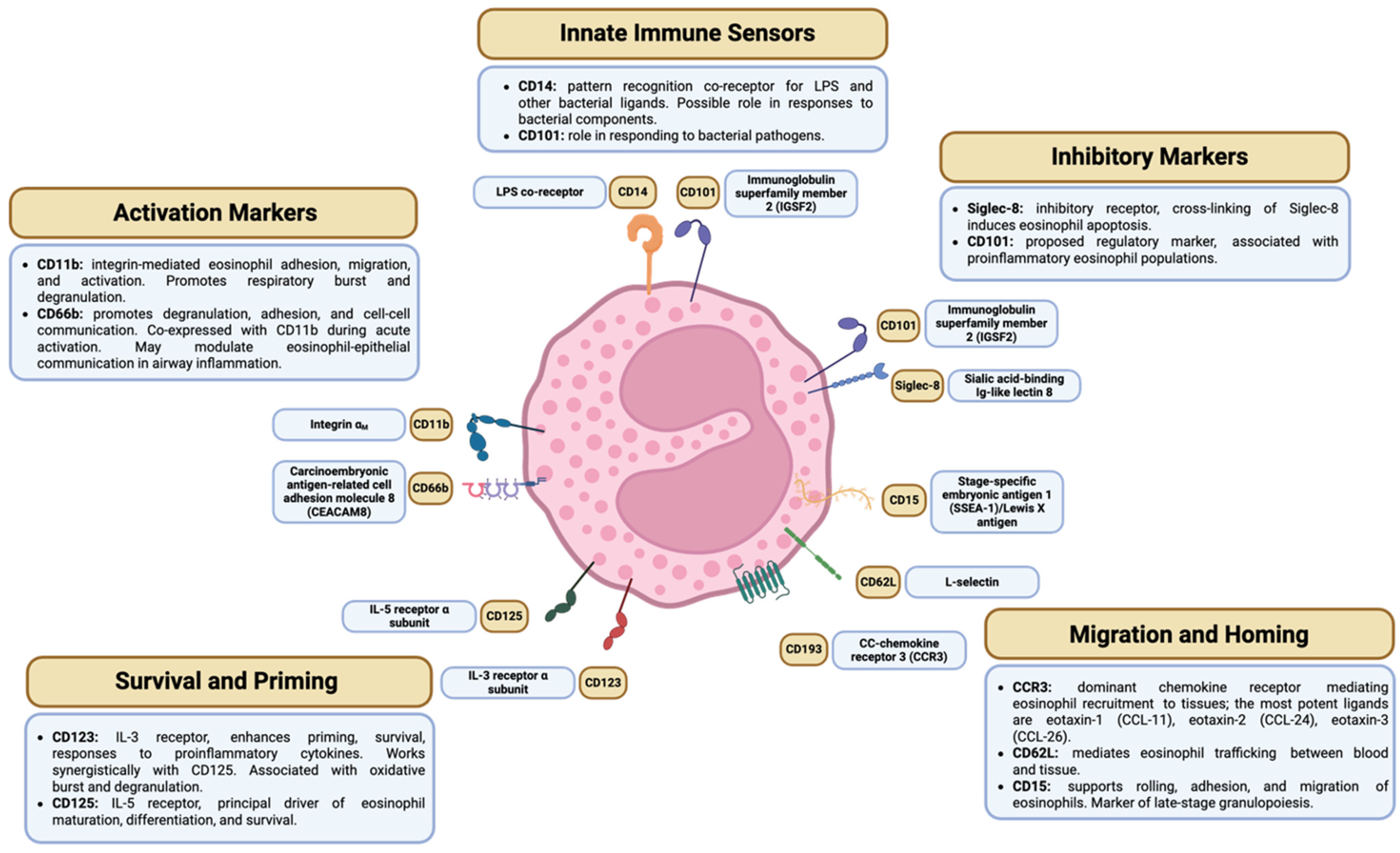
Understanding Eosinophil Heterogeneity: The Known and Unknown


Abstract
1. Introduction
1.1. Eosinophils in Airway Diseases
1.2. Eosinophil Heterogeneity
2. Surface Marker-Defined Eosinophil Heterogeneity
2.1. Surface Markers Reflect Eosinophil Activation and Maturation States

| Study | Disease | Compartment | Markers Used to Subtype Eosinophils | Defined Eosinophil Populations |
|---|---|---|---|---|
| [63] | Mild AA patients Severe EA patients | Peripheral blood | CD62L, CD101 | rEos: CD62LhiCD101lo iEos: CD62LloCD101hi |
| [64] | Mild AA patients | Peripheral blood | CD62L | rEos: CD62Lhi iEos: CD62Llo |
| [65] | Mild AA patients | Peripheral blood | CD62L | rEos: CD62Lhi iEos: CD62Llo |
| [66] | Mild AA patients | Peripheral blood | CD62L | rEos: CD62Lhi iEos: CD62Llo |
| [67] | Mild-moderate AA patients | Induced sputum | CD15, CD66b | E1: CD15+ CD66b+ E2: CD15− CD66b− |
| [68] | Severe EA patients | Peripheral blood Nasal polyp tissue | CD62L | rEos: CD62Lhi iEos: CD62Llo |
| [69] | Severe EA patients | Peripheral blood | CD62L | rEos: CD62Lhi iEos: CD62Llo |
| [70] | Severe EA patients | Peripheral blood | CD62L | rEos: CD62Lhi iEos: CD62Llo |
| [71] | Severe EA patients | Peripheral blood | CD62L | hEos: CD62Lhi iEos: CD62Llo |
| [72] | Mild-moderate asthma and COPD patients | Peripheral blood Induced sputum | CD11b, CD14, CD62L, CD66b, CD125, CD193 | 1: CD125−CD193+ 2: CD125+CD193+ 3: CD66b+CD193+ |
| [73] | Mild-severe asthma and COPD patients | Peripheral blood | Siglec-8, CD62L, CD123 | rEos: Siglec-8+CD62LhiCD123lo iEos: Siglec-8+CD62LloCD123hi |
| [74] | Severe EA patients * | Induced sputum | CD62L | C1-C4: CD62Llo C6 and C7: CD62Lint C5 and C8: CD62Lhi |
| [79] | CRSwNP Patients | Nasal polyp tissue | CD62L | rEos: CD62Lhi iEos: CD62Llo |
2.2. Compartment-Specific Eosinophil Phenotypes
2.3. Associations with Disease Severity and Clinical Outcomes
2.4. Modulation by Corticosteroids and Biologic Therapies
3. Limitations of CD62L-Based Subtyping of Eosinophils
4. Transcriptomic/Proteomic Approaches to Eosinophil Heterogeneity
4.1. Transcriptional and Proteomic Heterogeneity
4.2. Bridging Gaps in Transcriptomic and Proteomic-Defined Eosinophil Heterogeneity
5. Conclusions and Future Directions
Author Contributions
Funding
Institutional Review Board Statement
Informed Consent Statement
Data Availability Statement
Conflicts of Interest
References
- Blanchard, C.; Rothenberg, M.E. Chapter 3 Biology of the Eosinophil; Elsevier: Amsterdam, The Netherlands, 2009; pp. 81–121. [Google Scholar]
- Jesenak, M.; Diamant, Z.; Simon, D.; Tufvesson, E.; Seys, S.F.; Mukherjee, M.; Lacy, P.; Vijverberg, S.; Slisz, T.; Sediva, A.; et al. Eosinophils—From cradle to grave. Allergy 2023, 78, 3077–3102. [Google Scholar] [CrossRef] [PubMed]
- Gigon, L.; Fettrelet, T.; Yousefi, S.; Simon, D.; Simon, H.U. Eosinophils from A to Z. Allergy 2023, 78, 1810–1846. [Google Scholar] [CrossRef] [PubMed]
- Kay, A.B. The early history of the eosinophil. Clin. Exp. Allergy 2015, 45, 575–582. [Google Scholar] [CrossRef] [PubMed]
- Uhm, T.G.; Kim, B.S.; Chung, I.Y. Eosinophil Development, Regulation of Eosinophil-Specific Genes, and Role of Eosinophils in the Pathogenesis of Asthma. Allergy Asthma Immunol. Res. 2012, 4, 68. [Google Scholar] [CrossRef]
- Esnault, S.; Delaunay, E.; Dendooven, A.; Johansson, M.W.; Dezoteux, F.; Chenivesse, C.; Mortuaire, G.; Meresse, B.; Staumont-Sallé, D.; Jarjour, N.N.; et al. Identification of the Cytokines, Growth Factors andTheir Receptors Expressed by Human Blood Eosinophils A Transcriptomics Approach. Clin. Exp. Allergy 2025, 55, 1247–1250. [Google Scholar] [CrossRef]
- Klion, A.D.; Ackerman, S.J.; Bochner, B.S. Contributions of Eosinophils to Human Health and Disease. Annu. Rev. Pathol. Mech. Dis. 2020, 15, 179–209. [Google Scholar] [CrossRef]
- Ravin, K.A.; Loy, M. The Eosinophil in Infection. Clin. Rev. Allergy Immunol. 2016, 50, 214–227. [Google Scholar] [CrossRef]
- Acharya, K.R.; Ackerman, S.J. Eosinophil Granule Proteins: Form and Function. J. Biol. Chem. 2014, 289, 17406–17415. [Google Scholar] [CrossRef]
- Yousefi, S.; Gold, J.A.; Andina, N.; Lee, J.J.; Kelly, A.M.; Kozlowski, E.; Schmid, I.; Straumann, A.; Reichenbach, J.; Gleich, G.J.; et al. Catapult-like release of mitochondrial DNA by eosinophils contributes to antibacterial defense. Nat. Med. 2008, 14, 949–953. [Google Scholar] [CrossRef]
- Ueki, S.; Melo, R.C.N.; Ghiran, I.; Spencer, L.A.; Dvorak, A.M.; Weller, P.F. Eosinophil extracellular DNA trap cell death mediates lytic release of free secretion-competent eosinophil granules in humans. Blood 2013, 121, 2074–2083. [Google Scholar] [CrossRef]
- Ueki, S.; Konno, Y.; Takeda, M.; Moritoki, Y.; Hirokawa, M.; Matsuwaki, Y.; Honda, K.; Ohta, N.; Yamamoto, S.; Takagi, Y.; et al. Eosinophil extracellular trap cell death–derived DNA traps: Their presence in secretions and functional attributes. J. Allergy Clin. Immunol. 2016, 137, 258–267. [Google Scholar] [CrossRef] [PubMed]
- Fukuchi, M.; Miyabe, Y.; Furutani, C.; Saga, T.; Moritoki, Y.; Yamada, T.; Weller, P.F.; Ueki, S. How to detect eosinophil ETosis (EETosis) and extracellular traps. Allergol. Int. 2021, 70, 19–29. [Google Scholar] [CrossRef] [PubMed]
- Mukherjee, M.; Lacy, P.; Ueki, S. Eosinophil Extracellular Traps and Inflammatory Pathologies—Untangling the Web! Front. Immunol. 2018, 9, 2763. [Google Scholar] [CrossRef] [PubMed]
- Hussain, M.; Liu, G. Eosinophilic Asthma: Pathophysiology and Therapeutic Horizons. Cells 2024, 13, 384. [Google Scholar] [CrossRef]
- Boers, E.; Barrett, M.; Su, J.G.; Benjafield, A.V.; Sinha, S.; Kaye, L.; Zar, H.J.; Vuong, V.; Tellez, D.; Gondalia, R.; et al. Global Burden of Chronic Obstructive Pulmonary Disease Through 2050. JAMA Netw. Open 2023, 6, e2346598. [Google Scholar] [CrossRef]
- Svenningsen, S.; Nair, P. Asthma Endotypes and an Overview of Targeted Therapy for Asthma. Front. Med. 2017, 4, 158. [Google Scholar] [CrossRef]
- Morrow Brown, H. Treatment of chronic asthma with prednisolone significance of eosinophils in the sputum. Lancet 1958, 272, 1245–1247. [Google Scholar] [CrossRef]
- Hastie, A.T.; Martinez, F.J.; Curtis, J.L.; Doerschuk, C.M.; Hansel, N.N.; Christenson, S.; Putcha, N.; Ortega, V.E.; Li, X.; Barr, R.G.; et al. Association of sputum and blood eosinophil concentrations with clinical measures of COPD severity: An analysis of the SPIROMICS cohort. Lancet Respir. Med. 2017, 5, 956–967. [Google Scholar] [CrossRef]
- Lemiere, C.; Ernst, P.; Olivenstein, R.; Yamauchi, Y.; Govindaraju, K.; Ludwig, M.; Martin, J.; Hamid, Q. Airway inflammation assessed by invasive and noninvasive means in severe asthma: Eosinophilic and noneosinophilic phenotypes. J. Allergy Clin. Immunol. 2006, 118, 1033–1039. [Google Scholar] [CrossRef]
- Schleich, F.N.; Chevremont, A.; Paulus, V.; Henket, M.; Manise, M.; Seidel, L.; Louis, R. Importance of concomitant local and systemic eosinophilia in uncontrolled asthma. Eur. Respir. J. 2014, 44, 97–108. [Google Scholar] [CrossRef]
- Van Veen, I.H.; Ten Brinke, A.; Gauw, S.A.; Sterk, P.J.; Rabe, K.F.; Bel, E.H. Consistency of sputum eosinophilia in difficult-to-treat asthma: A 5-year follow-up study. J. Allergy Clin. Immunol. 2009, 124, 615–617.e612. [Google Scholar] [CrossRef] [PubMed]
- Nair, P.; Pizzichini, M.M.M.; Kjarsgaard, M.; Inman, M.D.; Efthimiadis, A.; Pizzichini, E.; Hargreave, F.E.; O’Byrne, P.M. Mepolizumab for Prednisone-Dependent Asthma with Sputum Eosinophilia. N. Engl. J. Med. 2009, 360, 985–993. [Google Scholar] [CrossRef] [PubMed]
- Green, R.H.; Brightling, C.E.; McKenna, S.; Hargadon, B.; Parker, D.; Bradding, P.; Wardlaw, A.J.; Pavord, I.D. Asthma exacerbations and sputum eosinophil counts: A randomised controlled trial. Lancet 2002, 360, 1715–1721. [Google Scholar] [CrossRef] [PubMed]
- Pavord, I.D.; Korn, S.; Howarth, P.; Bleecker, E.R.; Buhl, R.; Keene, O.N.; Ortega, H.; Chanez, P. Mepolizumab for severe eosinophilic asthma (DREAM): A multicentre, double-blind, placebo-controlled trial. Lancet 2012, 380, 651–659. [Google Scholar] [CrossRef]
- Bleecker, E.R.; Fitzgerald, J.M.; Chanez, P.; Papi, A.; Weinstein, S.F.; Barker, P.; Sproule, S.; Gilmartin, G.; Aurivillius, M.; Werkström, V.; et al. Efficacy and safety of benralizumab for patients with severe asthma uncontrolled with high-dosage inhaled corticosteroids and long-acting β2-agonists (SIROCCO): A randomised, multicentre, placebo-controlled phase 3 trial. Lancet 2016, 388, 2115–2127. [Google Scholar] [CrossRef]
- Siva, R.; Green, R.H.; Brightling, C.E.; Shelley, M.; Hargadon, B.; McKenna, S.; Monteiro, W.; Berry, M.; Parker, D.; Wardlaw, A.J.; et al. Eosinophilic airway inflammation and exacerbations of COPD: A randomised controlled trial. Eur. Respir. J. 2007, 29, 906–913. [Google Scholar] [CrossRef]
- Hargreave, F.E.; Parameswaran, K. Asthma, COPD and bronchitis are just components of airway disease. Eur. Respir. J. 2006, 28, 264–267. [Google Scholar] [CrossRef]
- Hargreave, F.E.; Nair, P. The definition and diagnosis of Asthma. Clin. Exp. Allergy 2009, 39, 1652–1658. [Google Scholar] [CrossRef]
- Wenzel, S.E. Allergen challenge, eosinophils and the long road to asthma endotypes. Eur. Respir. J. 2024, 64, 2401316. [Google Scholar] [CrossRef]
- Gauvreau, G.M.; Jordana, M.; Watson, R.M.; Cockcroft, D.W.; O’Byrne, P.M. Effect of Regular Inhaled Albuterol on Allergen-induced Late Responses and Sputum Eosinophils in Asthmatic Subjects. Am. J. Respir. Crit. Care Med. 1997, 156, 1738–1745. [Google Scholar] [CrossRef]
- Gauvreau, G.M.; O’Byrne, P.M.; Boulet, L.-P.; Wang, Y.; Cockcroft, D.; Bigler, J.; Fitzgerald, J.M.; Boedigheimer, M.; Davis, B.E.; Dias, C.; et al. Effects of an Anti-TSLP Antibody on Allergen-Induced Asthmatic Responses. N. Engl. J. Med. 2014, 370, 2102–2110. [Google Scholar] [CrossRef]
- Gauvreau, G.M.; Sehmi, R.; Fitzgerald, J.M.; Leigh, R.; Cockcroft, D.W.; Davis, B.E.; Mayers, I.; Boulet, L.-P.; Al-Sajee, D.; Salter, B.M.; et al. Benralizumab for allergic asthma: A randomised, double-blind, placebo-controlled trial. Eur. Respir. J. 2024, 64, 2400512. [Google Scholar] [CrossRef] [PubMed]
- Pavord, I.D.; Chanez, P.; Criner, G.J.; Kerstjens, H.A.M.; Korn, S.; Lugogo, N.; Martinot, J.-B.; Sagara, H.; Albers, F.C.; Bradford, E.S.; et al. Mepolizumab for Eosinophilic Chronic Obstructive Pulmonary Disease. N. Engl. J. Med. 2017, 377, 1613–1629. [Google Scholar] [CrossRef] [PubMed]
- Criner, G.J.; Celli, B.R.; Brightling, C.E.; Agusti, A.; Papi, A.; Singh, D.; Sin, D.D.; Vogelmeier, C.F.; Sciurba, F.C.; Bafadhel, M.; et al. Benralizumab for the Prevention of COPD Exacerbations. N. Engl. J. Med. 2019, 381, 1023–1034. [Google Scholar] [CrossRef] [PubMed]
- Sciurba, F.C.; Criner, G.J.; Christenson, S.A.; Martinez, F.J.; Papi, A.; Roche, N.; Bourbeau, J.; Korn, S.; Bafadhel, M.; Han, M.K.; et al. Mepolizumab to Prevent Exacerbations of COPD with an Eosinophilic Phenotype. N. Engl. J. Med. 2025, 392, 1710–1720. [Google Scholar] [CrossRef]
- Bhatt, S.P.; Rabe, K.F.; Hanania, N.A.; Vogelmeier, C.F.; Cole, J.; Bafadhel, M.; Christenson, S.A.; Papi, A.; Singh, D.; Laws, E.; et al. Dupilumab for COPD with Type 2 Inflammation Indicated by Eosinophil Counts. N. Engl. J. Med. 2023, 389, 205–214. [Google Scholar] [CrossRef]
- Castro, M.; Corren, J.; Pavord, I.D.; Maspero, J.; Wenzel, S.; Rabe, K.F.; Busse, W.W.; Ford, L.; Sher, L.; FitzGerald, J.M.; et al. Dupilumab Efficacy and Safety in Moderate-to-Severe Uncontrolled Asthma. N. Engl. J. Med. 2018, 378, 2486–2496. [Google Scholar] [CrossRef]
- Rabe, K.F.; Nair, P.; Brusselle, G.; Maspero, J.F.; Castro, M.; Sher, L.; Zhu, H.; Hamilton, J.D.; Swanson, B.N.; Khan, A.; et al. Efficacy and Safety of Dupilumab in Glucocorticoid-Dependent Severe Asthma. N. Engl. J. Med. 2018, 378, 2475–2485. [Google Scholar] [CrossRef]
- Pope, S.M.; Brandt, E.B.; Mishra, A.; Hogan, S.P.; Zimmermann, N.; Matthaei, K.I.; Foster, P.S.; Rothenberg, M.E. IL-13 induces eosinophil recruitment into the lung by an IL-5– and eotaxin-dependent mechanism. J. Allergy Clin. Immunol. 2001, 108, 594–601. [Google Scholar] [CrossRef]
- Nakagome, K.; Nagata, M. The Possible Roles of IL-4/IL-13 in the Development of Eosinophil-Predominant Severe Asthma. Biomolecules 2024, 14, 546. [Google Scholar] [CrossRef]
- Svenningsen, S.; Kjarsgaard, M.; Zhang, K.; Serajeddini, H.; Garrido, C.V.; Bhalla, A.; Radford, K.; Huang, C.; Ho, T.; Ragunayakam, N.; et al. Effect of dupilumab on sputum eosinophils in patients with moderate-to-severe asthma. Allergy 2024, 79, 509–513. [Google Scholar] [CrossRef] [PubMed]
- Eger, K.; Pet, L.; Weersink, E.J.M.; Bel, E.H. Complications of switching from anti–IL-5 or anti–IL-5R to dupilumab in corticosteroid-dependent severe asthma. J. Allergy Clin. Immunol. Pract. 2021, 9, 2913–2915. [Google Scholar] [CrossRef] [PubMed]
- Mathur, S.K.; Schwantes, E.A.; Jarjour, N.N.; Busse, W.W. Age-Related Changes in Eosinophil Function in Human Subjects. Chest 2008, 133, 412–419. [Google Scholar] [CrossRef] [PubMed]
- Puttur, F.; Traves, W.J.; Martin, M.G.; Di Carmine, S.; Fercoq, F.; Gaboriau, D.C.A.; Entwistle, L.J.; Yates, L.; Joulia, R.; Patti, S.; et al. Epithelial cell derived lumican modulates extracellular matrix dynamics in early-life airways disease. J. Allergy Clin. Immunol. 2026, 157, 176–189. [Google Scholar] [CrossRef]
- Marshall, C.L.; Mostafa, D.; Hemshehkar, M.; Lao, Y.; Balshaw, R.; Spicer, V.; Mookherjee, N. Biological Sex Is an Effect Modifier of Allergen-Mediated Alteration of the Lung Proteome. J. Proteome Res. 2024, 23, 4203–4215. [Google Scholar] [CrossRef]
- Pepels, J.; Visser, E.; Ten Brinke, A.; De Jong, K. Air pollution and incidence of adult-onset eosinophilic airway disease. Eur. Respir. J. 2022, 60, 1807. [Google Scholar] [CrossRef]
- Winqvist, I.; Olofsson, T.; Olsson, I.; Persson, A.M.; Hallberg, T. Altered density, metabolism and surface receptors of eosinophils in eosinophilia. Immunology 1982, 40, 531–539. [Google Scholar]
- Prin, L.; Capron, M.; Tonnel, A.-B.; Bletry, O.; Capron, A. Heterogeneity of Human Peripheral Blood Eosinophils: Variability in Cell Density and Cytotoxic Ability in Relation to the Level and the Origin of Hypereosinophilia. Int. Arch. Allergy Immunol. 1983, 72, 336–346. [Google Scholar] [CrossRef]
- Peters, M.S.; Gleich, G.J.; Dunnette, S.L.; Fukuda, T. Ultrastructural study of eosinophils from patients with the hypereosinophilic syndrome: A morphological basis of hypodense eosinophils. Blood 1988, 71, 780–785. [Google Scholar] [CrossRef][Green Version]
- Fukuda, T.; Dunnette, S.L.; Reed, C.E.; Ackerman, S.J.; Peters, M.S.; Gleich, G.J. Increased numbers of hypodense eosinophils in the blood of patients with bronchial asthma. Am. Rev. Respir. Dis. 1985, 132, 981–985. [Google Scholar]
- Kuo, H.; Yu, T.; Yu, C. Hypodense eosinophil number relates to clinical severity, airway hyperresponsiveness and response to inhaled corticosteroids in asthmatic subjects. Eur. Respir. J. 1994, 7, 1452–1459. [Google Scholar] [CrossRef]
- Xenakis, J.J.; Howard, E.D.; Smith, K.M.; Olbrich, C.L.; Huang, Y.; Anketell, D.; Maldonado, S.; Cornwell, E.W.; Spencer, L.A. Resident intestinal eosinophils constitutively express antigen presentation markers and include two phenotypically distinct subsets of eosinophils. Immunology 2018, 154, 298–308. [Google Scholar] [CrossRef] [PubMed]
- Larsen, L.D.; Dockstader, K.; Olbrich, C.L.; Cartwright, I.M.; Spencer, L.A. Modulation of surface CD11c expression tracks plasticity in murine intestinal tissue eosinophils. J. Leukoc. Biol. 2022, 111, 943–952. [Google Scholar] [CrossRef] [PubMed]
- Chojnacki, A.; Wojcik, K.; Petri, B.; Aulakh, G.; Jacobsen, E.A.; Lesuer, W.E.; Colarusso, P.; Patel, K.D. Intravital imaging allows real-time characterization of tissue resident eosinophils. Commun. Biol. 2019, 2, 181. [Google Scholar] [CrossRef] [PubMed]
- Li, Y.; Liu, S.; Zhou, K.; Wang, Y.; Chen, Y.; Hu, W.; Li, S.; Li, H.; Wang, Y.; Wang, Q.; et al. Neuromedin U programs eosinophils to promote mucosal immunity of the small intestine. Science 2023, 381, 1189–1196. [Google Scholar] [CrossRef]
- Denburg, J.A.; O’Byrne, P.M.; Gauvreau, G.M. Eosinophil plasticity and diversity: Proceedings of the 2023 International Eosinophil Society Symposium. J. Leukoc. Biol. 2024, 116, 244–246. [Google Scholar] [CrossRef]
- Lommatzsch, M.; Buhl, R.; Bergmann, K.-C.; Brusselle, G.G.; Canonica, G.W.; Jackson, D.J.; Heaney, L.G.; Nair, P.; Virchow, J.C. Eosinophils in asthma phenotypes: Perpetrators or guilty by association? Lancet Respir. Med. 2025, 13, 943–950. [Google Scholar] [CrossRef]
- Graf, L.-M.; Radtke, D.; Voehringer, D. Regulation of eosinophil recruitment and heterogeneity during allergic airway inflammation. Front. Allergy 2025, 6, 1585142. [Google Scholar] [CrossRef]
- Gurtner, A.; Crepaz, D.; Arnold, I.C. Emerging functions of tissue-resident eosinophils. J. Exp. Med. 2023, 220, e20221435. [Google Scholar] [CrossRef]
- Sanchez Santos, A.; Socorro Avila, I.; Galvan Fernandez, H.; Cazorla Rivero, S.; Lemes Castellano, A.; Cabrera Lopez, C. Eosinophils: Old cells, new directions. Front. Med. 2025, 11, 1470381. [Google Scholar] [CrossRef]
- Mesnil, C.; Raulier, S.; Paulissen, G.; Xiao, X.; Birrell, M.A.; Pirottin, D.; Janss, T.; Starkl, P.; Ramery, E.; Henket, M.; et al. Lung-resident eosinophils represent a distinct regulatory eosinophil subset. J. Clin. Investig. 2016, 126, 3279–3295. [Google Scholar] [CrossRef]
- Januskevicius, A.; Jurkeviciute, E.; Janulaityte, I.; Kalinauskaite-Zukauske, V.; Miliauskas, S.; Malakauskas, K. Blood Eosinophils Subtypes and Their Survivability in Asthma Patients. Cells 2020, 9, 1248. [Google Scholar] [CrossRef] [PubMed]
- Jurkeviciute, E.; Januskevicius, A.; Rimkunas, A.; Palacionyte, J.; Malakauskas, K. α4β1 and αMβ2 Integrin Expression and Pro-Proliferative Properties of Eosinophil Subtypes in Asthma. J. Pers. Med. 2021, 11, 829. [Google Scholar] [CrossRef] [PubMed]
- Palacionyte, J.; Januskevicius, A.; Vasyle, E.; Rimkunas, A.; Bajoriuniene, I.; Miliauskas, S.; Malakauskas, K. IL-5 and GM-CSF, but Not IL-3, Promote the Proliferative Properties of Inflammatory-like and Lung Resident-like Eosinophils in the Blood of Asthma Patients. Cells 2022, 11, 3804. [Google Scholar] [CrossRef] [PubMed]
- Rimkunas, A.; Januskevicius, A.; Vasyle, E.; Palacionyte, J.; Janulaityte, I.; Miliauskas, S.; Malakauskas, K. Blood Inflammatory-like and Lung Resident-like Eosinophils Affect Migration of Airway Smooth Muscle Cells and Their ECM-Related Proliferation in Asthma. Int. J. Mol. Sci. 2023, 24, 3469. [Google Scholar] [CrossRef]
- Curto, E.; Mateus-Medina, É.F.; Crespo-Lessmann, A.; Osuna-Gómez, R.; Ujaldón-Miró, C.; García-Moral, A.; Galván-Blasco, P.; Soto-Retes, L.; Ramos-Barbón, D.; Plaza, V. Identification of Two Eosinophil Subsets in Induced Sputum from Patients with Allergic Asthma According to CD15 and CD66b Expression. Int. J. Environ. Res. Public Health 2022, 19, 13400. [Google Scholar] [CrossRef]
- Matucci, A.; Nencini, F.; Maggiore, G.; Chiccoli, F.; Accinno, M.; Vivarelli, E.; Bruno, C.; Locatello, L.G.; Palomba, A.; Nucci, E.; et al. High proportion of inflammatory CD62Llow eosinophils in blood and nasal polyps of severe asthma patients. Clin. Exp. Allergy 2023, 53, 78–87. [Google Scholar] [CrossRef]
- Vultaggio, A.; Accinno, M.; Vivarelli, E.; Mecheri, V.; Maggiore, G.; Cosmi, L.; Parronchi, P.; Rossi, O.; Maggi, E.; Gallo, O.; et al. Blood CD62Llow inflammatory eosinophils are related to the severity of asthma and reduced by mepolizumab. Allergy 2023, 78, 3154–3165. [Google Scholar] [CrossRef]
- Rimkunas, A.; Januskevicius, A.; Vasyle, E.; Palacionyte, J.; Kalinauskaite-Zukauske, V.; Miliauskas, S.; Malakauskas, K. The Effect of Mepolizumab on Blood Eosinophil Subtype Distribution and Granule Protein Gene Expression in Severe Eosinophilic Asthma. J. Asthma Allergy 2025, 18, 455–466. [Google Scholar] [CrossRef]
- Fricker, M.; Harrington, J.; Hiles, S.A.; Gibson, P.G. Mepolizumab depletes inflammatory but preserves homeostatic eosinophils in severe asthma. Allergy 2024, 79, 3118–3128. [Google Scholar] [CrossRef]
- Mycroft, K.; Paplińska-Goryca, M.; Proboszcz, M.; Nejman-Gryz, P.; Krenke, R.; Górska, K. Blood and Sputum Eosinophils of COPD Patients Are Differently Polarized than in Asthma. Cells 2023, 12, 1631. [Google Scholar] [CrossRef] [PubMed]
- Cabrera López, C.; Sánchez Santos, A.; Lemes Castellano, A.; Cazorla Rivero, S.; Breña Atienza, J.; González Dávila, E.; Celli, B.; Casanova Macario, C. Eosinophil Subtypes in Adults with Asthma and Adults with Chronic Obstructive Pulmonary Disease. Am. J. Respir. Crit. Care Med. 2023, 208, 155–162. [Google Scholar] [CrossRef] [PubMed]
- Wilson, G.E.; Knight, J.; Liu, Q.; Shelar, A.; Stewart, E.; Wang, X.; Yan, X.; Sanders, J.; Visness, C.; Gill, M.; et al. Activated sputum eosinophils associated with exacerbations in children on mepolizumab. J. Allergy Clin. Immunol. 2024, 154, 297–307.e213. [Google Scholar] [CrossRef] [PubMed]
- Son, K.; Mukherjee, M.; McIntyre, B.A.S.; Eguez, J.C.; Radford, K.; Lavigne, N.; Ethier, C.; Davoine, F.; Janssen, L.; Lacy, P.; et al. Improved recovery of functionally active eosinophils and neutrophils using novel immunomagnetic technology. J. Immunol. Methods 2017, 449, 44–55. [Google Scholar] [CrossRef]
- Son, K.; Lacy, P.; Mukherjee, M. Functionally Active Eosinophil Purification from Peripheral Blood; Springer: New York, NY, USA, 2021; pp. 15–25. [Google Scholar]
- Zhu, C.; Weng, Q.-Y.; Zhou, L.-R.; Cao, C.; Li, F.; Wu, Y.-F.; Wu, Y.-P.; Li, M.; Hu, Y.; Shen, J.-X.; et al. Homeostatic and early-recruited CD101−eosinophils suppress endotoxin-induced acute lung injury. Eur. Respir. J. 2020, 56, 1902354. [Google Scholar] [CrossRef]
- Venkateshaiah, S.; Kandikattu, H.; Yadavalli, C.; Mishra, A. Eosinophils and T cell surface molecule transcript levels in the blood differentiate eosinophilic esophagitis (EoE) from GERD. Int. J. Basic. Clin. Immunol. 2021, 4, 1–8. [Google Scholar]
- Matucci, A.; Accinno, M.; Maggiore, G.; Brugnoli, B.; Vivarelli, E.; Cosmi, L.; Parronchi, P.; Perlato, M.; Milanese, M.; Licci, G.; et al. Mepolizumab Reduces Inflammatory Eosinophils in Nasal Polyp Tissue and Restores Histological Alterations. J. Investig. Allergol. Clin. Immunol. 2025, 36. [Google Scholar] [CrossRef]
- Ivetic, A.; Hoskins Green, H.L.; Hart, S.J. L-selectin: A Major Regulator of Leukocyte Adhesion, Migration and Signaling. Front. Immunol. 2019, 10, 1068. [Google Scholar] [CrossRef]
- Yun, Y.; Kanda, A.; Kobayashi, Y.; Van Bui, D.; Suzuki, K.; Sawada, S.; Baba, K.; Yagi, M.; Asako, M.; Okazaki, H.; et al. Increased CD69 expression on activated eosinophils in eosinophilic chronic rhinosinusitis correlates with clinical findings. Allergol. Int. 2020, 69, 232–238. [Google Scholar] [CrossRef]
- Kuhns, D.B.; Priel, D.A.L.; Gallin, J.I. Loss of L-Selectin (CD62L) on Human Neutrophils Following Exudation in Vivo. Cell. Immunol. 1995, 164, 306–310. [Google Scholar] [CrossRef]
- Tak, T.; Wijten, P.; Heeres, M.; Pickkers, P.; Scholten, A.; Heck, A.J.R.; Vrisekoop, N.; Leenen, L.P.; Borghans, J.A.M.; Tesselaar, K.; et al. Human CD62Ldim neutrophils identified as a separate subset by proteome profiling and in vivo pulse-chase labeling. Blood 2017, 129, 3476–3485. [Google Scholar] [CrossRef] [PubMed]
- Bonner, K.L.; Fontanella, S.; Gore, M.; Cook, J.; Hoffland, A.; Scotney, E.; Tian, K.; Hillson, K.; Shamji, M.; Layhadi, J.; et al. Lower airway immunophenotyping in severe preschool wheeze reveals distinct clusters described by heterogeneity in neutrophil phenotypes. Am. J. Respir. Crit. Care Med. 2026, aamaf119. [Google Scholar] [CrossRef] [PubMed]
- Bar-Ephraim, Y.E.; Koning, J.J.; Burniol Ruiz, E.; Konijn, T.; Mourits, V.P.; Lakeman, K.A.; Boon, L.; Bögels, M.; Van Maanen, J.P.; Den Haan, J.M.M.; et al. CD62L Is a Functional and Phenotypic Marker for Circulating Innate Lymphoid Cell Precursors. J. Immunol. 2019, 202, 171–182. [Google Scholar] [CrossRef]
- Campana, S.; De Pasquale, C.; Barberi, C.; Oliveri, D.; Sidoti Migliore, G.; Galletti, B.; Guarneri, C.; Cannavò, S.P.; Ferlazzo, G. Circulating ILC precursors expressing CD62L exhibit a type 2 signature distinctly decreased in psoriatic patients. Eur. J. Immunol. 2021, 51, 1792–1798. [Google Scholar] [CrossRef] [PubMed]
- Hartl, S.; Breyer, M.-K.; Burghuber, O.C.; Ofenheimer, A.; Schrott, A.; Urban, M.H.; Agusti, A.; Studnicka, M.; Wouters, E.F.M.; Breyer-Kohansal, R. Blood eosinophil count in the general population: Typical values and potential confounders. Eur. Respir. J. 2020, 55, 1901874. [Google Scholar] [CrossRef]
- Malm-Erjefält, M.; Persson, C.G.A.; Erjefält, J.S. Degranulation Status of Airway Tissue Eosinophils in Mouse Models of Allergic Airway Inflammation. Am. J. Respir. Cell Mol. Biol. 2001, 24, 352–359. [Google Scholar] [CrossRef]
- Denzler, K.L.; Borchers, M.T.; Crosby, J.R.; Cieslewicz, G.; Hines, E.M.; Justice, J.P.; Cormier, S.A.; Lindenberger, K.A.; Song, W.; Wu, W.; et al. Extensive Eosinophil Degranulation and Peroxidase-Mediated Oxidation of Airway Proteins Do Not Occur in a Mouse Ovalbumin-Challenge Model of Pulmonary Inflammation. J. Immunol. 2001, 167, 1672–1682. [Google Scholar] [CrossRef]
- Denzler, K.L.; Farmer, S.C.; Crosby, J.R.; Borchers, M.; Cieslewicz, G.; Larson, K.A.; Cormier-Regard, S.; Lee, N.A.; Lee, J.J. Eosinophil Major Basic Protein-1 Does Not Contribute to Allergen-Induced Airway Pathologies in Mouse Models of Asthma. J. Immunol. 2000, 165, 5509–5517. [Google Scholar] [CrossRef]
- Jackson, D.J.; Pavord, I.D. Living without eosinophils: Evidence from mouse and man. Eur. Respir. J. 2023, 61, 2201217. [Google Scholar] [CrossRef]
- Wirth, L.; Weigel, W.; Stamper, C.T.; Kolmert, J.; De Souza Ferreira, S.; Hammer, Q.; Sparreman Mikus, M.; Theorell, J.; Andersson, L.; Lantz, A.S.; et al. High-Dimensional Analysis of Type 2 Lymphocyte Dynamics During Mepolizumab or Dupilumab Treatment in Severe Asthma. Allergy 2025, 80, 2541–2556. [Google Scholar] [CrossRef]
- Ju, X.; Fard, N.E.; Bhalla, A.; Dvorkin-Gheva, A.; Xiao, M.; Radford, K.; Zhang, K.; Ditta, R.; Oliveria, J.P.; Paré, G.; et al. A population of c-kit+ IL-17A+ ILC2s in sputum from individuals with severe asthma supports ILC2 to ILC3 trans-differentiation. Sci. Transl. Med. 2025, 17, eado6649. [Google Scholar] [CrossRef]
- Ben-Baruch Morgenstern, N.; Rochman, M.; Kotliar, M.; Dunn, J.L.M.; Mack, L.; Besse, J.; Natale, M.A.; Klingler, A.M.; Felton, J.M.; Caldwell, J.M.; et al. Single-cell RNA-sequencing of human eosinophils in allergic inflammation in the esophagus. J. Allergy Clin. Immunol. 2024, 154, 974–987. [Google Scholar] [CrossRef]
- Iwasaki, N.; Poposki, J.A.; Oka, A.; Kidoguchi, M.; Klingler, A.I.; Suh, L.A.; Bai, J.; Stevens, W.W.; Peters, A.T.; Grammer, L.C.; et al. Single cell RNA sequencing of human eosinophils from nasal polyps reveals eosinophil heterogeneity in chronic rhinosinusitis tissue. J. Allergy Clin. Immunol. 2024, 154, 952–964. [Google Scholar] [CrossRef] [PubMed]
- Barnig, C.; Alsaleh, G.; Jung, N.; Dembélé, D.; Paul, N.; Poirot, A.; Uring-Lambert, B.; Georgel, P.; De Blay, F.; Bahram, S. Circulating Human Eosinophils Share a Similar Transcriptional Profile in Asthma and Other Hypereosinophilic Disorders. PLoS ONE 2015, 10, e0141740. [Google Scholar] [CrossRef] [PubMed]
- Rodrigo-Muñoz, J.M.; Naharro-González, S.; Callejas, S.; Relaño-Ruperez, C.; Torroja, C.; Benguria, A.; Lorente-Sorolla, C.; Gil-Martínez, M.; García De Castro, Z.; Cañas, J.A.; et al. Single-cell RNA sequencing of human blood eosinophils reveals plasticity and absence of canonical cell subsets. Allergy 2025, 80, 570–574. [Google Scholar] [CrossRef] [PubMed]
- Goss, K.; Grant, M.L.; Caldwell, C.; Dallalio, G.A.; Stephenson, S.T.; Fitzpatrick, A.M.; Horwitz, E.M. Single-cell RNA-sequencing of circulating eosinophils from asthma patients reveals an inflammatory signature. iScience 2025, 28, 112609. [Google Scholar] [CrossRef]
- Rodríguez González, D.; Cañas, J.; Cosío, B.; Iglesias, A.; Bernaola, J.; Pinillos-Robles, E.; Betancor, D.; Sastre, J.; Rodríguez Nieto, M.J.; Del Pozo, V. Characterization of Eosinophils in Induced Sputum and Lung Biopsy Using Single Cell RNA-SEQ Without Subtype Distinction. Open Respir. Arch. 2026, 8, 100567. [Google Scholar] [CrossRef]
- Mycroft, K.; Proboszcz, M.; Paplińska-Goryca, M.; Krenke, R.; Górska, K. Transcriptional profiles of peripheral eosinophils in chronic obstructive pulmonary disease and asthma—An exploratory study. J. Cell. Mol. Med. 2024, 28, e70110. [Google Scholar] [CrossRef]
- Sunata, K.; Miyata, J.; Kawashima, Y.; Konno, R.; Ishikawa, M.; Hasegawa, Y.; Onozato, R.; Otsu, Y.; Matsuyama, E.; Sasaki, H.; et al. Inflammatory profile of eosinophils in asthma-COPD overlap and eosinophilic COPD: A multi-omics study. Front. Immunol. 2024, 15, 1445769. [Google Scholar] [CrossRef]
- Doni Jayavelu, N.; Liu, A.H.; Gaberino, C.; Freeman, K.; Lawrance, M.; Pribitzer, S.; Seifert, C.; Dutmer, C.; Togias, A.; Becker, P.M.; et al. Single-cell transcriptomic profiling of eosinophils and airway immune cells in childhood asthma. J. Allergy Clin. Immunol. 2025, 156, 923–936. [Google Scholar] [CrossRef]
- Sakai, C.; Matsuyama, M.; Nakajima, M.; Matsumura, S.; Nonaka, M.; Arai, N.; Kuramoto, K.; Yoshida, K.; Morishima, Y.; Muratani, M.; et al. Blood eosinophil phenotype during treatment with mepolizumab in patients with severe eosinophilic asthma. Allergol. Int. 2024, 73, 473–476. [Google Scholar] [CrossRef] [PubMed]
- Haruna, N.-F.; Politanska, Y.; Connelly, A.R.; O’Connor, K.; Bhattacharya, S.; Miklaszewski, G.E.; Pérez-Leonor, X.G.; Rerko, G.; Hentenaar, I.T.; Nguyen, D.C.; et al. scRNA-seq profiling of human granulocytes reveals expansion of developmentally flexible neutrophil precursors with mixed neutrophil and eosinophil properties in asthma. J. Leukoc. Biol. 2024, 116, 1184–1197. [Google Scholar] [CrossRef] [PubMed]
- Dolitzky, A.; Shapira, G.; Grisaru-Tal, S.; Hazut, I.; Avlas, S.; Gordon, Y.; Itan, M.; Shomron, N.; Munitz, A. Transcriptional Profiling of Mouse Eosinophils Identifies Distinct Gene Signatures Following Cellular Activation. Front. Immunol. 2021, 12, 802839. [Google Scholar] [CrossRef]
- Dolitzky, A.; Hazut, I.; Avlas, S.; Grisaru-Tal, S.; Itan, M.; Zaffran, I.; Levi-Schaffer, F.; Gerlic, M.; Munitz, A. Differential regulation of Type 1 and Type 2 mouse eosinophil activation by apoptotic cells. Front. Immunol. 2022, 13, 1041660. [Google Scholar] [CrossRef] [PubMed]
- Hu, Y.; Wu, L.; Qu, S.; Kong, W.T.; Yu, X.; Xu, J.; Xu, Z.; He, J.; Wang, C.; Liu, Z.; et al. Temporal and spatial atlas of eosinophil specialization across tissues. Nat. Immunol. 2026, 27, 364–375. [Google Scholar] [CrossRef]
- Janssen, P.; Abinet, J.; Karim, L.; Coppieters, W.; Moermans, C.; Guiot, J.; Schleich, F.; Radermecker, C.; Marichal, T. Comparison of Droplet- and Microwell-based Methods to Analyze Cryopreserved Human BAL Cells by Single-Cell RNA Sequencing. Am. J. Respir. Cell Mol. Biol. 2025, 73, 16–25. [Google Scholar] [CrossRef]
- Diny, N.L.; Schonfeldova, B.; Shapiro, M.; Winder, M.L.; Varsani-Brown, S.; Stockinger, B. The aryl hydrocarbon receptor contributes to tissue adaptation of intestinal eosinophils in mice. J. Exp. Med. 2022, 219, e20210970. [Google Scholar] [CrossRef]
- Gurtner, A.; Borrelli, C.; Gonzalez-Perez, I.; Bach, K.; Acar, I.E.; Núñez, N.G.; Crepaz, D.; Handler, K.; Vu, V.P.; Lafzi, A.; et al. Active eosinophils regulate host defence and immune responses in colitis. Nature 2023, 615, 151–157. [Google Scholar] [CrossRef]
- Dunn, J.L.M.; Szep, A.; Gonzalez Galan, E.; Zhang, S.; Marlman, J.; Caldwell, J.M.; Troutman, T.D.; Rothenberg, M.E. Eosinophil specialization is regulated by exposure to the esophageal epithelial microenvironment. J. Leukoc. Biol. 2024, 116, 1007–1020. [Google Scholar] [CrossRef]
- Benkstein, C.; Mosig, L.; Vondran, D.; Schlichting, H.; Kissing, L.; Wohlert, B.; Gensmer, I.; Nogueira De Almeida, L.; König, P.; Fibelkorn, K.; et al. Phenotypically distinguishable eosinophilic cells do not impact epithelial functions in a triple-culture in vitro intestinal model. Front. Immunol. 2025, 16, 1641651. [Google Scholar] [CrossRef]

| Study | Disease | Compartment | Population(s) of Interest | Representative Upregulated Genes or Proteins | Implicated Biological Pathways | Clinical or Biologic Relevance |
|---|---|---|---|---|---|---|
| [94] | Eosinophilic esophagitis | Peripheral blood | Circulating eosinophils | MT-ND1, MT-ND2, MT-ND3 | Cellular respiration, aerobic respiration, ATP synthesis | Circulating eosinophils are inactive despite active disease |
| Esophageal tissue | Tissue eosinophils | SUCNR1, HRH4, DNAAF1, OLIG2, CLC, CCR3 | Immune regulation, cell activation, leukocyte activation, regulation of apoptosis | Tissue microenvironment modulates eosinophil biology | ||
| [95] | Chronic rhinosinusitis | Peripheral blood | Circulating eosinophils | CCL4, CCL4L2, IGKC, CLDN4 | Leukocyte migration, cell adhesion | Circulating eosinophils are inactive despite active disease |
| Nasal polyp tissue | Tissue eosinophils | CD44, CD69, NFKB1/2, IL1A, IL1B, IL1RL1, PTGS2, CXCL8, BCL2A1, BCL2L1 | Inflammatory response, NF-κB signaling pathway, cytokine signaling in immune system, negative regulation of apoptosis | Tissue microenvironment and cytokine signaling drive functional heterogeneity | ||
| [96] | Severe asthma | Peripheral blood | Circulating eosinophils | ISG20, IL2RA, IL3RA, LIPA, S100A10, CCS, GSTT1 | Response to stimuli, homeostasis, wound healing | Circulating eosinophils are not intrinsically proinflammatory |
| [97] | Severe asthma | Peripheral blood | Circulating eosinophils; cluster 0 | LENG8, CAPN15 | ATPase activity, ion transmembrane transport, NOD pathways | Circulating eosinophils are largely transcriptionally similar; CD62L is enriched in poor disease outcomes |
| Circulating eosinophils; cluster 1 | CCR3, ANXA1, SIGLEC10, ITGB2, HLA-C | Pathogen immune defense, calcium signaling | ||||
| Circulating eosinophils; cluster 3 | IFIT3, MX1, SP100, XAF1 | Interferon responses, nucleoside triphosphate response | ||||
| Circulating eosinophils; cluster 4 | CLC, SELL, S100P, VIM, TRIR, CXCR4 | Granule secretion, oxidative stress, TLR signaling pathways | ||||
| [98] | Moderate-to- severe asthma | Peripheral blood | Circulating eosinophils; cluster 1 | CCL4, S100P, CLC, HLA-A, HLA-B, HLA-C | Antigen processing and presentation, actin filament organization, leukocyte migration | Enrichment of cluster 3 and interferon responses in severe asthma |
| Circulating eosinophils; cluster 2 | EXOC4, ASXL2, ATP11B, MALAT1, DENND1A | Small GTPase mediated signal transduction, dendrite development | ||||
| Circulating eosinophils; cluster 3 | MX1, MX2, IFI6, IFIT3, IFIT5, ISG15, EPSTI1 | IFN-α/γ response, defense response to virus, regulation of viral processes | ||||
| [99] | Severe asthma | Airway tissue | Sputum eosinophils | EPX, CCR3, CD101, CLC, SELL, ANXA1, SIGLEC10, ADGRE1, ITGAX, ITGB2, ALOX15 | Immune regulation, cell activation, cytokine signaling | Sputum eosinophils can be Reliably assessed with single-cell sequencing; no distinct subtypes observed |
| Lung biopsy eosinophils | ||||||
| [100] | Mild-to- moderate asthma | Peripheral blood | Circulating eosinophils | JUN, IFITM3, DUSP1, ZNF107, BCL6 | Stress responses, leukocyte migration, IL-4/13 signaling pathways, IL-6 signaling pathways | Subtle differences found in eosinophil transcriptomes between diseases suggests divergent inflammatory processes |
| Mild-to- moderate COPD | Peripheral blood | Circulating eosinophils | CCL3L1, CCL4L2, RSAD2, SERPINB2, PRSS21 | Protein metabolism, GPCR ligand binding | ||
| [101] | Eosinophilic COPD | Peripheral blood | Circulating eosinophils | TMEM176B, FCER1G, ALOX5, PTGDR2, SQLE, MVD | Cholesterol metabolism, PI3K-Akt-mTOR signaling, NF-κB signaling pathways, regulation of viral processes | Differential gene and protein expression in circulating eosinophils between eosinophilic and non-eosinophilic COPD supports that inflammatory endotypes may be reflected in eosinophil programming |
| Selectin P ligand, MX Dynamin Like GTPase 2, ORMDL sphingolipid biosynthesis regulator 3 | Protein processing, cholesterol synthesis, sterol regulatory element binding protein signaling | |||||
| Non- eosinophilic COPD | Peripheral blood | Circulating eosinophils | ELANE, AZU1, CTSG, NOD2 | TNF signaling pathways, oxidative stress, PI3K-Akt signaling | ||
| Cathepsin G, Azurocidin 1, neutrophil elastase, myeloperoxidase, defensin alpha 1B | Antibacterial processes, glutathione metabolism, regulation of phagocytosis | |||||
| [102] | Pediatric asthma | Nasal lavage | Tissue eosinophils; cluster 0 | PLAUR, IKZF1, IL3RA, ANPEP, NR4A1, NR4A3 | Cell communication, cell signaling, leukocyte migration | Multiple transcriptionally distinct eosinophil and neutrophil populations observed in the airways, supporting a model in which eosinophil heterogeneity is driven by tissue-specific microenvironment cues |
| Tissue eosinophils; cluster 1 | JAML, TMSB4X | Cytoskeletal processes, vesicle-associated proteins | ||||
| Tissue eosinophils; cluster 2 | CD69, IL5RA, SIGLEC10 | Granule secretion, innate immune response, membrane protein synthesis | ||||
| Tissue eosinophils; cluster 3 | IL1R2, AQP9, CSF3R, SOD2, CXCL8 | Enrichment of neutrophil effector function? | ||||
| Tissue neutrophils; cluster 0 | CXCR1, CXCR2, ITGB2, NCF4, RGS2, RNF149 | Neutrophil extracellular trap pathways, granule secretion | ||||
| Tissue neutrophils; cluster 1 | G0S2, CXCL8, ITGAX, IL1B, NAMPT, CCRL2 | TNF signaling pathways, NF-κb signaling pathways, inflammatory response | ||||
| Tissue neutrophils; cluster 3 | MX1, IFIT2, IFI44, ISG15, ISG20, IFITM2, IFITM3 | Interferon signaling, defense response to virus | ||||
| Tissue neutrophils; cluster 4 | CD69, IL3RA, SIGLEC10, IKZF1, CD300LF | Enrichment of eosinophil effector function? | ||||
| [103] | Severe asthma | Peripheral blood | Circulating eosinophils | CD274, GBP2, GBP5, TLR6, ISG20, NFKB2 | T1 response? | Biological therapies influence eosinophil states by gene expression modulation |
Disclaimer/Publisher’s Note: The statements, opinions and data contained in all publications are solely those of the individual author(s) and contributor(s) and not of MDPI and/or the editor(s). MDPI and/or the editor(s) disclaim responsibility for any injury to people or property resulting from any ideas, methods, instructions or products referred to in the content. |
© 2026 by the authors. Licensee MDPI, Basel, Switzerland. This article is an open access article distributed under the terms and conditions of the Creative Commons Attribution (CC BY) license.
Share and Cite
Ruzic, A.; Trus, M.; Sehmi, R.; Mukherjee, M. Understanding Eosinophil Heterogeneity: The Known and Unknown. Cells 2026, 15, 564. https://doi.org/10.3390/cells15060564
Ruzic A, Trus M, Sehmi R, Mukherjee M. Understanding Eosinophil Heterogeneity: The Known and Unknown. Cells. 2026; 15(6):564. https://doi.org/10.3390/cells15060564
Chicago/Turabian StyleRuzic, Alexander, Michael Trus, Roma Sehmi, and Manali Mukherjee. 2026. "Understanding Eosinophil Heterogeneity: The Known and Unknown" Cells 15, no. 6: 564. https://doi.org/10.3390/cells15060564
APA StyleRuzic, A., Trus, M., Sehmi, R., & Mukherjee, M. (2026). Understanding Eosinophil Heterogeneity: The Known and Unknown. Cells, 15(6), 564. https://doi.org/10.3390/cells15060564