Advances in Spatial Multi-Omics in Gastric Cancer

Abstract
1. Introduction
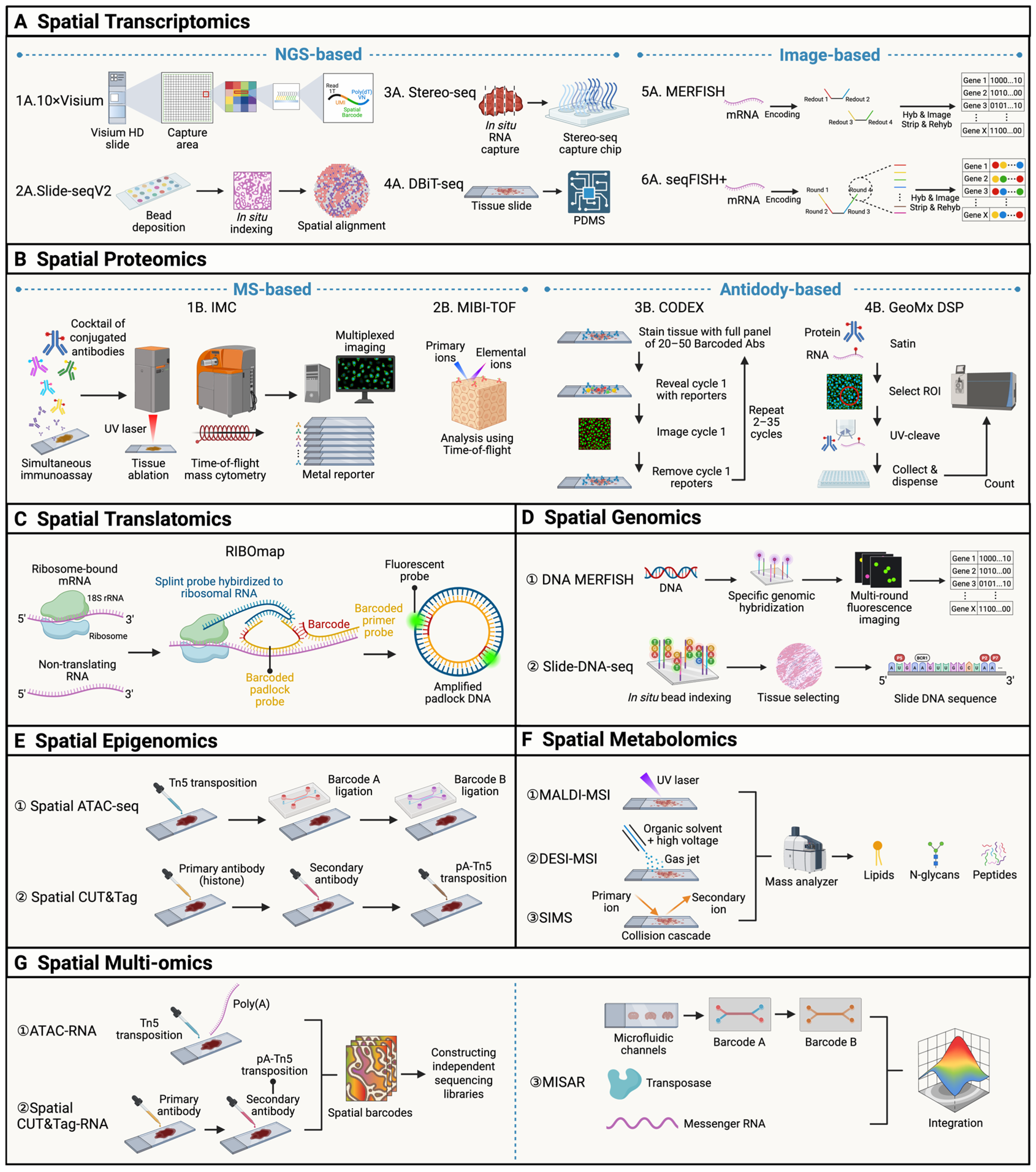
2. Spatial Omics Technologies
2.1. Spatial Transcriptomics
2.2. Spatial Proteomics
2.3. Spatial Translatomics
2.4. Spatial Genomics
2.5. Spatial Epigenomics
2.6. Spatial Metabolomics
2.7. Spatial Multi-Omics
2.7.1. Transcriptomics and Epigenomics
2.7.2. Transcriptomics and Proteomics
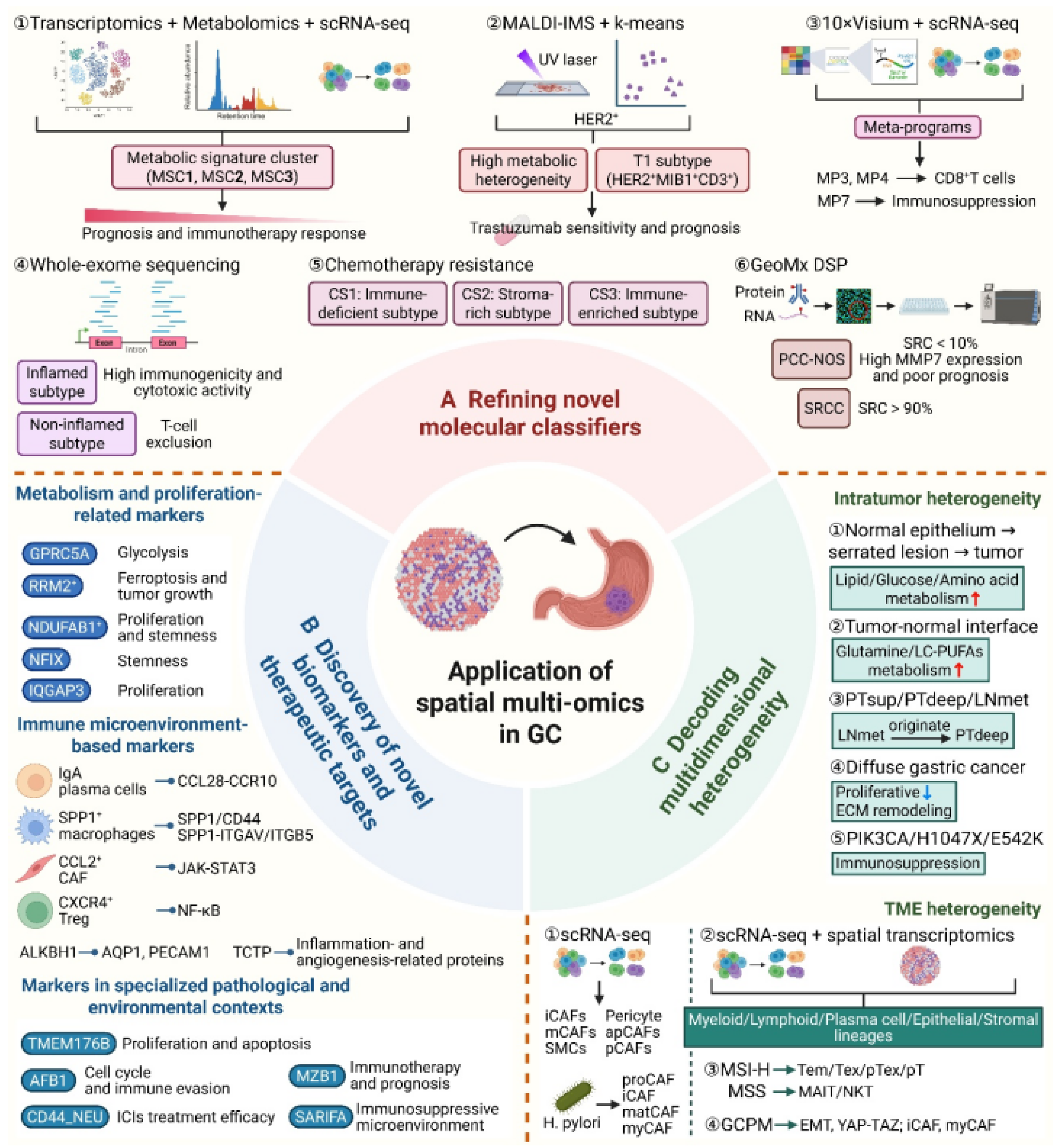
3. Spatial Multi-Omics Approach in GC
3.1. Advancing Molecular Classification in GC
3.2. Discovery of Novel Biomarkers and Therapeutic Targets in GC
3.2.1. Metabolism and Proliferation-Related Markers
3.2.2. Immune Microenvironment-Based Markers
3.2.3. Markers in Specialized Pathological and Environmental Contexts
4. Decoding Multidimensional Heterogeneity in GC
4.1. Intratumor Heterogeneity
4.2. TME Heterogeneity
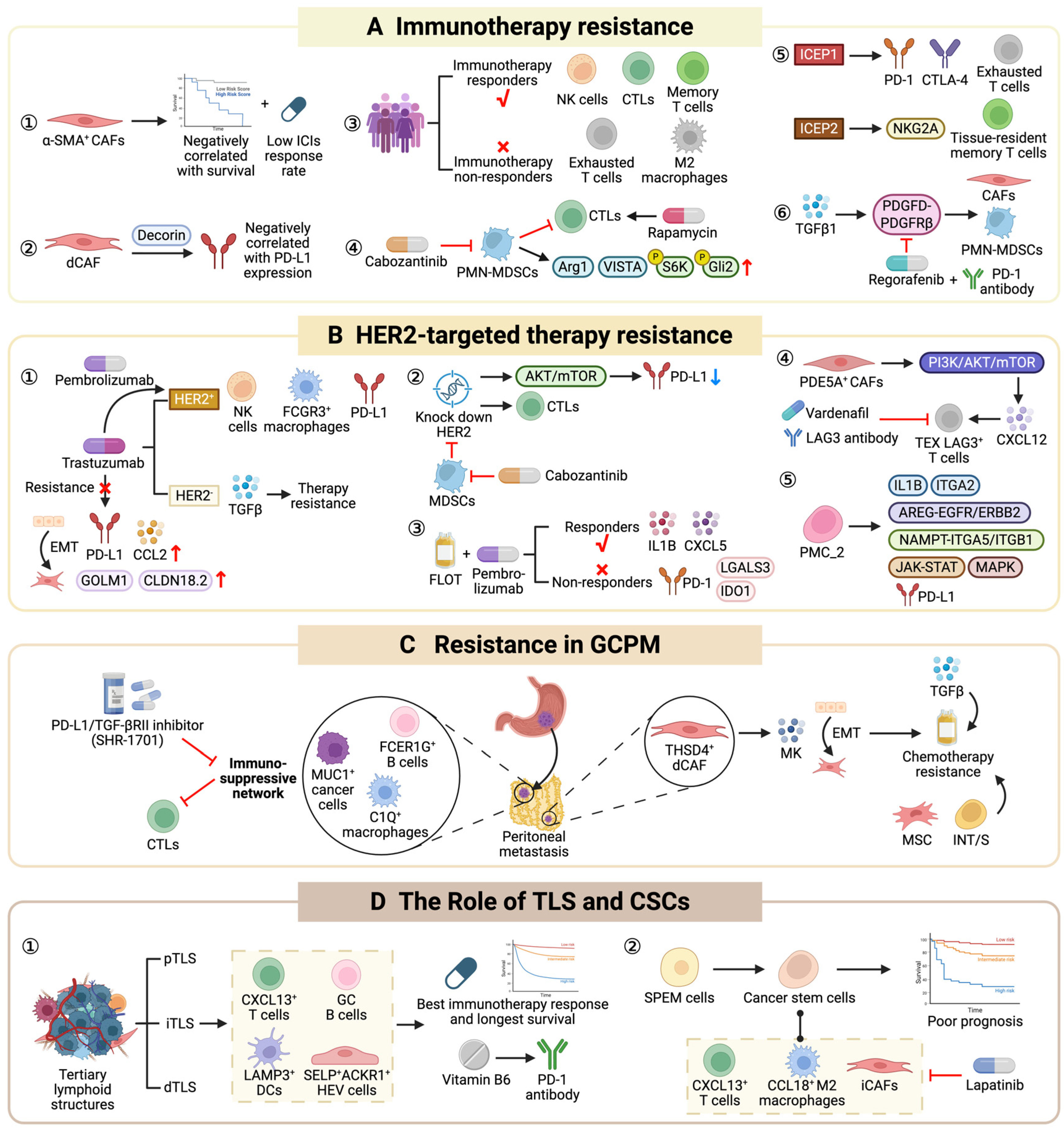
5. Unraveling the Mechanisms of Therapeutic Resistance in GC
5.1. Immunotherapy Resistance
5.2. HER2-Targeted Therapy Resistance
5.3. Resistance in Gastric Cancer Peritoneal Metastasis
5.4. The Role of TLSs and CSCs
6. Future and Perspectives
Author Contributions
Funding
Institutional Review Board Statement
Informed Consent Statement
Data Availability Statement
Acknowledgments
Conflicts of Interest
Abbreviations
| GC | Gastric cancer |
| TME | Tumor microenvironment |
| ST | Spatial transcriptomics |
| NGS | Next-Generation Sequencing |
| FFPE | Formalin-fixed paraffin-embedded |
| DBiT-seq | Deterministic Barcoding in Tissue for spatial omics sequencing |
| ISH | In situ hybridization |
| IMC | Imaging Mass Cytometry |
| MIBI-TOF | Multiplexed Ion Beam Imaging |
| DSP | Digital Spatial Profiling |
| ROI | Region of Interest |
| CNV | Copy number variation |
| MSI | Mass spectrometry imaging |
| MALDI-MSI | Matrix-assisted laser desorption/ionization mass spectrometry imaging |
| DESI-MSI | Desorption electrospray ionization–mass spectrometry imaging |
| SIMS | Secondary ion mass spectrometry |
| TCGA | The Cancer Genome Atlas |
| ACRG | Asian Cancer Research Group |
| EBV | Epstein–Barr virus |
| MSI | Microsatellite Instability |
| CIN | Chromosomal Instability |
| GS | Genomically Stable |
| ITH | Intra-tumoral heterogeneity |
| MSC | Metabolic signature cluster |
| MP | Meta-program |
| PCC | Poorly cohesive carcinoma |
| CSC | Cancer stem cell |
| CAF | Cancer-associated fibroblast |
| DGC | Diffuse Gastric Cancer |
| SRC | Signet ring cell |
| PDC | Poorly differentiated cell |
| GSRC | Gastric signet ring cell carcinoma |
| ICI | Immune checkpoint inhibitor |
| CPS | Combined positive score |
| TMB-H | High tumor mutational burden |
| PMN-MDSC | Polymorphonuclear myeloid-derived suppressor cell |
| CTL | Cytotoxic T lymphocyte |
| ICEP | Immune checkpoint expression pattern |
| ERAD | Endoplasmic reticulum-associated degradation |
| T-DXd | Trastuzumab deruxtecan |
| PMC_P | Precancerous metastatic niche |
| GCPM | Gastric cancer peritoneal metastasis |
| THSD4 | Thrombospondin type 1 domain-containing protein 4 |
| INT/S | Intestinal with stem-like features |
| TLS | Tertiary lymphoid structure |
| iTLS | Intra-tumoral tertiary lymphoid structure |
| pTLS | Peritumoral tertiary lymphoid structure |
| HEV | High endothelial venule |
| GCY | Young gastric cancer |
| TCR | Tumor core region |
| CAT | Cancer-adjacent tissues |
| SARIFA | Stroma AReactive Invasion Front Areas |
References
- Siegel, R.L.; Kratzer, T.B.; Giaquinto, A.N.; Sung, H.; Jemal, A. Cancer statistics, 2025. CA Cancer J. Clin. 2025, 75, 10–45. [Google Scholar] [CrossRef]
- Patel, A.K.; Sethi, N.S.; Park, H. Gastric Cancer: A Review. JAMA 2026, 335, 439–450. [Google Scholar] [CrossRef]
- Sundar, R.; Nakayama, I.; Markar, S.R.; Shitara, K.; van Laarhoven, H.W.M.; Janjigian, Y.Y.; Smyth, E.C. Gastric cancer. Lancet 2025, 405, 2087–2102. [Google Scholar] [CrossRef]
- Piccioni, S.A.; Costantini, M.; Petrioli, R.; Bagnacci, G.; Ferrara, D.; Andreucci, E.; Carbone, L.; Ongaro, A.; Calomino, N.; Sandini, M.; et al. Impact of HER2 and microsatellite instability status on response to neoadjuvant/conversion therapy and survival in patients with gastric cancer. Eur. J. Cancer Prev. 2026, 35, 66–77. [Google Scholar] [CrossRef] [PubMed]
- Lee, H.S. Spatial and Temporal Tumor Heterogeneity in Gastric Cancer: Discordance of Predictive Biomarkers. J. Gastric Cancer 2025, 25, 192–209. [Google Scholar] [CrossRef]
- Migliore, C.; Fenocchio, E.; Giordano, S.; Corso, S. Precision oncology in gastric cancer: Shaping the future of personalized treatment. Cancer Treat. Rev. 2025, 141, 103038. [Google Scholar] [CrossRef]
- Yasuda, T.; Wang, Y.A. Gastric cancer immunosuppressive microenvironment heterogeneity: Implications for therapy development. Trends Cancer 2024, 10, 627–642. [Google Scholar] [CrossRef]
- Marusyk, A.; Janiszewska, M.; Polyak, K. Intratumor Heterogeneity: The Rosetta Stone of Therapy Resistance. Cancer Cell 2020, 37, 471–484. [Google Scholar] [CrossRef]
- Quintanal-Villalonga, A.; Chan, J.M.; Yu, H.A.; Pe’er, D.; Sawyers, C.L.; Sen, T.; Rudin, C.M. Lineage plasticity in cancer: A shared pathway of therapeutic resistance. Nat. Rev. Clin. Oncol. 2020, 17, 360–371. [Google Scholar] [CrossRef] [PubMed]
- Hui, T.; Zhou, J.; Yao, M.; Xie, Y.; Zeng, H. Advances in Spatial Omics Technologies. Small Methods 2025, 9, e2401171. [Google Scholar] [CrossRef] [PubMed]
- Cheng, X.; Peng, T.; Chu, T.; Yang, Y.; Liu, J.; Gao, Q.; Cao, C.; Wei, J. Application of single-cell and spatial omics in deciphering cellular hallmarks of cancer drug response and resistance. J. Hematol. Oncol. 2025, 18, 70. [Google Scholar] [CrossRef]
- Liu, L.; Chen, A.; Li, Y.; Mulder, J.; Heyn, H.; Xu, X. Spatiotemporal omics for biology and medicine. Cell 2024, 187, 4488–4519. [Google Scholar] [CrossRef]
- See, J.E.; Barlow, S.; Arjumand, W.; DuBose, H.; Segato Dezem, F.; Plummer, J. Spatial omics: Applications and utility in profiling the tumor microenvironment. Cancer Metastasis Rev. 2025, 44, 87. [Google Scholar] [CrossRef]
- Xie, F.; Xi, N.; Han, Z.; Luo, W.; Shen, J.; Luo, J.; Tang, X.; Pang, T.; Lv, Y.; Liang, J.; et al. Progress in research on tumor microenvironment-based spatial omics technologies. Oncol. Res. 2023, 31, 877–885. [Google Scholar] [CrossRef] [PubMed]
- Lan, Z.; Yang, Y.; Li, L.; Wang, C.; Sun, Z.; Wang, Q.; Liu, Y. Spatial omics technology potentially promotes the progress of tumor immunotherapy. Br. J. Cancer 2025, 133, 421–434. [Google Scholar] [CrossRef]
- Huang, K.K.; Ma, H.; Chong, R.H.H.; Uchihara, T.; Lian, B.S.X.; Zhu, F.; Sheng, T.; Srivastava, S.; Tay, S.T.; Sundar, R.; et al. Spatiotemporal genomic profiling of intestinal metaplasia reveals clonal dynamics of gastric cancer progression. Cancer Cell 2023, 41, 2019–2037. [Google Scholar] [CrossRef] [PubMed]
- Dong, J.; Wu, X.; Zhou, X.; Gao, Y.; Wang, C.; Wang, W.; He, W.; Li, J.; Deng, W.; Liao, J.; et al. Spatially resolved expression landscape and gene-regulatory network of human gastric corpus epithelium. Protein Cell 2023, 14, 433–447. [Google Scholar] [CrossRef]
- Rao, A.; Barkley, D.; Franca, G.S.; Yanai, I. Exploring tissue architecture using spatial transcriptomics. Nature 2021, 596, 211–220. [Google Scholar] [CrossRef]
- Stahl, P.L.; Salmen, F.; Vickovic, S.; Lundmark, A.; Navarro, J.F.; Magnusson, J.; Giacomello, S.; Asp, M.; Westholm, J.O.; Huss, M.; et al. Visualization and analysis of gene expression in tissue sections by spatial transcriptomics. Science 2016, 353, 78–82. [Google Scholar] [CrossRef]
- Rodriques, S.G.; Stickels, R.R.; Goeva, A.; Martin, C.A.; Murray, E.; Vanderburg, C.R.; Welch, J.; Chen, L.M.; Chen, F.; Macosko, E.Z. Slide-seq: A scalable technology for measuring genome-wide expression at high spatial resolution. Science 2019, 363, 1463–1467. [Google Scholar] [CrossRef] [PubMed]
- Stickels, R.R.; Murray, E.; Kumar, P.; Li, J.; Marshall, J.L.; Di Bella, D.J.; Arlotta, P.; Macosko, E.Z.; Chen, F. Highly sensitive spatial transcriptomics at near-cellular resolution with Slide-seqV2. Nat. Biotechnol. 2021, 39, 313–319. [Google Scholar] [CrossRef]
- Chen, A.; Liao, S.; Cheng, M.; Ma, K.; Wu, L.; Lai, Y.; Qiu, X.; Yang, J.; Xu, J.; Hao, S.; et al. Spatiotemporal transcriptomic atlas of mouse organogenesis using DNA nanoball-patterned arrays. Cell 2022, 185, 1777–1792. [Google Scholar] [CrossRef] [PubMed]
- Liu, Y.; Yang, M.; Deng, Y.; Su, G.; Enninful, A.; Guo, C.C.; Tebaldi, T.; Zhang, D.; Kim, D.; Bai, Z.; et al. High-Spatial-Resolution Multi-Omics Sequencing via Deterministic Barcoding in Tissue. Cell 2020, 183, 1665–1681. [Google Scholar] [CrossRef]
- Bai, Z.; Zhang, D.; Gao, Y.; Tao, B.; Zhang, D.; Bao, S.; Enninful, A.; Wang, Y.; Li, H.; Su, G.; et al. Spatially exploring RNA biology in archival formalin-fixed paraffin-embedded tissues. Cell 2024, 187, 6760–6779. [Google Scholar] [CrossRef] [PubMed]
- Tian, L.; Chen, F.; Macosko, E.Z. The expanding vistas of spatial transcriptomics. Nat. Biotechnol. 2023, 41, 773–782. [Google Scholar] [CrossRef]
- Su, J.H.; Zheng, P.; Kinrot, S.S.; Bintu, B.; Zhuang, X. Genome-Scale Imaging of the 3D Organization and Transcriptional Activity of Chromatin. Cell 2020, 182, 1641–1659. [Google Scholar] [CrossRef] [PubMed]
- Chen, K.H.; Boettiger, A.N.; Moffitt, J.R.; Wang, S.; Zhuang, X. RNA imaging. Spatially resolved, highly multiplexed RNA profiling in single cells. Science 2015, 348, aaa6090. [Google Scholar] [CrossRef]
- Lubeck, E.; Coskun, A.F.; Zhiyentayev, T.; Ahmad, M.; Cai, L. Single-cell in situ RNA profiling by sequential hybridization. Nat. Methods 2014, 11, 360–361. [Google Scholar] [CrossRef]
- Eng, C.L.; Lawson, M.; Zhu, Q.; Dries, R.; Koulena, N.; Takei, Y.; Yun, J.; Cronin, C.; Karp, C.; Yuan, G.C.; et al. Transcriptome-scale super-resolved imaging in tissues by RNA seqFISH. Nature 2019, 568, 235–239. [Google Scholar] [CrossRef]
- Sudhakar, M.; Vignesh, H.; Natarajan, K.N. Crosstalk between tumor and microenvironment: Insights from spatial transcriptomics. Adv. Cancer Res. 2024, 163, 187–222. [Google Scholar] [CrossRef] [PubMed]
- Pattabiram, S.; Gangadaran, P.; Dhayalan, S.; Chatterjee, G.; Reyaz, D.; Prakash, K.; Arun, R.; Rajendran, R.L.; Ahn, B.C.; Aruljothi, K.N. Decoding the Tumor Microenvironment: Insights and New Targets from Single-Cell Sequencing and Spatial Transcriptomics. Curr. Issues Mol. Biol. 2025, 47, 730. [Google Scholar] [CrossRef] [PubMed]
- Lundberg, E.; Borner, G.H.H. Spatial proteomics: A powerful discovery tool for cell biology. Nat. Rev. Mol. Cell Biol. 2019, 20, 285–302. [Google Scholar] [CrossRef]
- Li, L.; Sun, C.; Sun, Y.; Dong, Z.; Wu, R.; Sun, X.; Zhang, H.; Jiang, W.; Zhou, Y.; Cen, X.; et al. Spatially resolved proteomics via tissue expansion. Nat. Commun. 2022, 13, 7242. [Google Scholar] [CrossRef] [PubMed]
- Giesen, C.; Wang, H.A.; Schapiro, D.; Zivanovic, N.; Jacobs, A.; Hattendorf, B.; Schuffler, P.J.; Grolimund, D.; Buhmann, J.M.; Brandt, S.; et al. Highly multiplexed imaging of tumor tissues with subcellular resolution by mass cytometry. Nat. Methods 2014, 11, 417–422. [Google Scholar] [CrossRef] [PubMed]
- Kim, E.N.; Chen, P.Z.; Bressan, D.; Tripathi, M.; Miremadi, A.; di Pietro, M.; Coussens, L.M.; Hannon, G.J.; Fitzgerald, R.C.; Zhuang, L.; et al. Dual-modality imaging of immunofluorescence and imaging mass cytometry for whole-slide imaging and accurate segmentation. Cell Rep. Methods 2023, 3, 100595. [Google Scholar] [CrossRef]
- Rost, S.; Giltnane, J.; Bordeaux, J.M.; Hitzman, C.; Koeppen, H.; Liu, S.D. Multiplexed ion beam imaging analysis for quantitation of protein expresssion in cancer tissue sections. Lab. Investig. 2017, 97, 1263. [Google Scholar] [CrossRef]
- Ptacek, J.; Locke, D.; Finck, R.; Cvijic, M.E.; Li, Z.; Tarolli, J.G.; Aksoy, M.; Sigal, Y.; Zhang, Y.; Newgren, M.; et al. Multiplexed ion beam imaging (MIBI) for characterization of the tumor microenvironment across tumor types. Lab. Investig. 2020, 100, 1111–1123. [Google Scholar] [CrossRef]
- Black, S.; Phillips, D.; Hickey, J.W.; Kennedy-Darling, J.; Venkataraaman, V.G.; Samusik, N.; Goltsev, Y.; Schurch, C.M.; Nolan, G.P. CODEX multiplexed tissue imaging with DNA-conjugated antibodies. Nat. Protoc. 2021, 16, 3802–3835. [Google Scholar] [CrossRef]
- Merritt, C.R.; Ong, G.T.; Church, S.E.; Barker, K.; Danaher, P.; Geiss, G.; Hoang, M.; Jung, J.; Liang, Y.; McKay-Fleisch, J.; et al. Multiplex digital spatial profiling of proteins and RNA in fixed tissue. Nat. Biotechnol. 2020, 38, 586–599. [Google Scholar] [CrossRef]
- Zeng, H.; Huang, J.; Ren, J.; Wang, C.K.; Tang, Z.; Zhou, H.; Zhou, Y.; Shi, H.; Aditham, A.; Sui, X.; et al. Spatially resolved single-cell translatomics at molecular resolution. Science 2023, 380, eadd3067. [Google Scholar] [CrossRef]
- VanInsberghe, M.; van den Berg, J.; Andersson-Rolf, A.; Clevers, H.; van Oudenaarden, A. Single-cell Ribo-seq reveals cell cycle-dependent translational pausing. Nature 2021, 597, 561–565. [Google Scholar] [CrossRef]
- Wang, J.; Ye, F.; Chai, H.; Jiang, Y.; Wang, T.; Ran, X.; Xia, Q.; Xu, Z.; Fu, Y.; Zhang, G.; et al. Advances and applications in single-cell and spatial genomics. Sci. China Life Sci. 2025, 68, 1226–1282. [Google Scholar] [CrossRef]
- Zhao, T.; Chiang, Z.D.; Morriss, J.W.; LaFave, L.M.; Murray, E.M.; Del Priore, I.; Meli, K.; Lareau, C.A.; Nadaf, N.M.; Li, J.; et al. Spatial genomics enables multi-modal study of clonal heterogeneity in tissues. Nature 2022, 601, 85–91. [Google Scholar] [CrossRef]
- Deng, Y.; Bartosovic, M.; Ma, S.; Zhang, D.; Kukanja, P.; Xiao, Y.; Su, G.; Liu, Y.; Qin, X.; Rosoklija, G.B.; et al. Spatial profiling of chromatin accessibility in mouse and human tissues. Nature 2022, 609, 375–383. [Google Scholar] [CrossRef]
- Deng, Y.; Bartosovic, M.; Kukanja, P.; Zhang, D.; Liu, Y.; Su, G.; Enninful, A.; Bai, Z.; Castelo-Branco, G.; Fan, R. Spatial-CUT&Tag: Spatially resolved chromatin modification profiling at the cellular level. Science 2022, 375, 681–686. [Google Scholar] [CrossRef]
- Buenrostro, J.D.; Giresi, P.G.; Zaba, L.C.; Chang, H.Y.; Greenleaf, W.J. Transposition of native chromatin for fast and sensitive epigenomic profiling of open chromatin, DNA-binding proteins and nucleosome position. Nat. Methods 2013, 10, 1213–1218. [Google Scholar] [CrossRef]
- Buenrostro, J.D.; Wu, B.; Litzenburger, U.M.; Ruff, D.; Gonzales, M.L.; Snyder, M.P.; Chang, H.Y.; Greenleaf, W.J. Single-cell chromatin accessibility reveals principles of regulatory variation. Nature 2015, 523, 486–490. [Google Scholar] [CrossRef]
- Cornett, D.S.; Reyzer, M.L.; Chaurand, P.; Caprioli, R.M. MALDI imaging mass spectrometry: Molecular snapshots of biochemical systems. Nat. Methods 2007, 4, 828–833. [Google Scholar] [CrossRef]
- Cooks, R.G.; Ouyang, Z.; Takats, Z.; Wiseman, J.M. Detection Technologies. Ambient mass spectrometry. Science 2006, 311, 1566–1570. [Google Scholar] [CrossRef]
- Kraft, M.L.; Klitzing, H.A. Imaging lipids with secondary ion mass spectrometry. Biochim. Biophys. Acta 2014, 1841, 1108–1119. [Google Scholar] [CrossRef]
- Ma, X.; Fernandez, F.M. Advances in mass spectrometry imaging for spatial cancer metabolomics. Mass Spectrom. Rev. 2024, 43, 235–268. [Google Scholar] [CrossRef]
- Zhao, H.; Shi, C.; Han, W.; Luo, G.; Huang, Y.; Fu, Y.; Lu, W.; Hu, Q.; Shang, Z.; Yang, X. Advanced progress of spatial metabolomics in head and neck cancer research. Neoplasia 2024, 47, 100958. [Google Scholar] [CrossRef]
- Zhang, D.; Deng, Y.; Kukanja, P.; Agirre, E.; Bartosovic, M.; Dong, M.; Ma, C.; Ma, S.; Su, G.; Bao, S.; et al. Spatial epigenome-transcriptome co-profiling of mammalian tissues. Nature 2023, 616, 113–122. [Google Scholar] [CrossRef]
- Lee, C.N.; Fu, H.; Cardilla, A.; Zhou, W.; Deng, Y. Spatial joint profiling of DNA methylome and transcriptome in tissues. Nature 2025, 646, 1261–1271. [Google Scholar] [CrossRef]
- Jiang, F.; Zhou, X.; Qian, Y.; Zhu, M.; Wang, L.; Li, Z.; Shen, Q.; Wang, M.; Qu, F.; Cui, G.; et al. Simultaneous profiling of spatial gene expression and chromatin accessibility during mouse brain development. Nat. Methods 2023, 20, 1048–1057. [Google Scholar] [CrossRef]
- Liu, Y.; DiStasio, M.; Su, G.; Asashima, H.; Enninful, A.; Qin, X.; Deng, Y.; Nam, J.; Gao, F.; Bordignon, P.; et al. High-plex protein and whole transcriptome co-mapping at cellular resolution with spatial CITE-seq. Nat. Biotechnol. 2023, 41, 1405–1409. [Google Scholar] [CrossRef]
- Liao, S.; Heng, Y.; Liu, W.; Xiang, J.; Ma, Y.; Chen, L.; Feng, X.; Jia, D.; Liang, D.; Huang, C.; et al. Integrated Spatial Transcriptomic and Proteomic Analysis of Fresh Frozen Tissue Based on Stereo-seq. bioRxiv 2023. [Google Scholar] [CrossRef]
- Ben-Chetrit, N.; Niu, X.; Swett, A.D.; Sotelo, J.; Jiao, M.S.; Stewart, C.M.; Potenski, C.; Mielinis, P.; Roelli, P.; Stoeckius, M.; et al. Integration of whole transcriptome spatial profiling with protein markers. Nat. Biotechnol. 2023, 41, 788–793. [Google Scholar] [CrossRef]
- Vickovic, S.; Lotstedt, B.; Klughammer, J.; Mages, S.; Segerstolpe, A.; Rozenblatt-Rosen, O.; Regev, A. SM-Omics is an automated platform for high-throughput spatial multi-omics. Nat. Commun. 2022, 13, 795. [Google Scholar] [CrossRef]
- Wang, X.; Liu, Z.; Angelov, M.; Feng, Z.; Li, X.; Li, A.; Yang, Y.; Gong, H.; Gao, Z. Excitatory nucleo-olivary pathway shapes cerebellar outputs for motor control. Nat. Neurosci. 2023, 26, 1394–1406. [Google Scholar] [CrossRef]
- Vu, T.; Vallmitjana, A.; Gu, J.; La, K.; Xu, Q.; Flores, J.; Zimak, J.; Shiu, J.; Hosohama, L.; Wu, J.; et al. Spatial transcriptomics using combinatorial fluorescence spectral and lifetime encoding, imaging and analysis. Nat. Commun. 2022, 13, 169. [Google Scholar] [CrossRef]
- Cancer Genome Atlas Research Network. Comprehensive molecular characterization of gastric adenocarcinoma. Nature 2014, 513, 202–209. [Google Scholar] [CrossRef]
- Cristescu, R.; Lee, J.; Nebozhyn, M.; Kim, K.M.; Ting, J.C.; Wong, S.S.; Liu, J.; Yue, Y.G.; Wang, J.; Yu, K.; et al. Molecular analysis of gastric cancer identifies subtypes associated with distinct clinical outcomes. Nat. Med. 2015, 21, 449–456. [Google Scholar] [CrossRef]
- Lei, Z.; Tan, I.B.; Das, K.; Deng, N.; Zouridis, H.; Pattison, S.; Chua, C.; Feng, Z.; Guan, Y.K.; Ooi, C.H.; et al. Identification of molecular subtypes of gastric cancer with different responses to PI3-kinase inhibitors and 5-fluorouracil. Gastroenterology 2013, 145, 554–565. [Google Scholar] [CrossRef] [PubMed]
- Chen, K.; Yang, D.; Li, X.; Sun, B.; Song, F.; Cao, W.; Brat, D.J.; Gao, Z.; Li, H.; Liang, H.; et al. Mutational landscape of gastric adenocarcinoma in Chinese: Implications for prognosis and therapy. Proc. Natl. Acad. Sci. USA 2015, 112, 1107–1112. [Google Scholar] [CrossRef]
- Chen, H.; Jing, C.; Shang, L.; Zhu, X.; Zhang, R.; Liu, Y.; Wang, M.; Xu, K.; Ma, T.; Jing, H.; et al. Molecular characterization and clinical relevance of metabolic signature subtypes in gastric cancer. Cell Rep. 2024, 43, 114424. [Google Scholar] [CrossRef] [PubMed]
- Wang, J.; Sun, N.; Kunzke, T.; Shen, J.; Feuchtinger, A.; Wang, Q.; Meixner, R.; Gleut, R.L.; Haffner, I.; Luber, B.; et al. Metabolic heterogeneity affects trastuzumab response and survival in HER2-positive advanced gastric cancer. Br. J. Cancer 2024, 130, 1036–1045. [Google Scholar] [CrossRef]
- Wang, J.; Kunzke, T.; Prade, V.M.; Shen, J.; Buck, A.; Feuchtinger, A.; Haffner, I.; Luber, B.; Liu, D.H.W.; Langer, R.; et al. Spatial Metabolomics Identifies Distinct Tumor-Specific Subtypes in Gastric Cancer Patients. Clin. Cancer Res. 2022, 28, 2865–2877. [Google Scholar] [CrossRef]
- Wu, X.; Jin, Z.; Li, B.; Lu, Y.; Hou, J.; Yao, L.; Yu, Z.; Sang, Q.; Yu, B.; Li, J.; et al. Deciphering of intra-tumoural heterogeneity and the interplay between metastasis-associated meta-program and myofibroblasts in gastric cancer. Clin. Transl. Med. 2025, 15, e70319. [Google Scholar] [CrossRef] [PubMed]
- Veas Rodriguez, J.; Pinol, M.; Sorolla, M.A.; Parisi, E.; Sorolla, A.; Santacana, M.; Ruiz, M.; Parra, G.; Bernabeu, M.; Iglesias, M.; et al. Comprehensive immunophenotyping of gastric adenocarcinoma identifies an inflamed class of tumors amenable to immunotherapies. J. Immunother. Cancer 2025, 13, e010024. [Google Scholar] [CrossRef]
- Zhang, P.; Wang, L.; Lin, H.; Han, Y.; Zhou, J.; Song, H.; Wang, P.; Tan, H.; Fu, Y. Integrative multiomics analysis reveals the subtypes and key mechanisms of platinum resistance in gastric cancer: Identification of KLF9 as a promising therapeutic target. J. Transl. Med. 2025, 23, 877. [Google Scholar] [CrossRef] [PubMed]
- Yen, H.H.; Chen, P.Y.; Huang, R.Y.; Jeng, J.M.; Lai, I.R. Clinicopathological features and cancer transcriptomic profiling of poorly cohesive gastric carcinoma subtypes. J. Pathol. Clin. Res. 2024, 10, e12387. [Google Scholar] [CrossRef] [PubMed]
- Repetto, O.; Vettori, R.; Steffan, A.; Cannizzaro, R.; De Re, V. Circulating Proteins as Diagnostic Markers in Gastric Cancer. Int. J. Mol. Sci. 2023, 24, 16931. [Google Scholar] [CrossRef]
- Matsuoka, T.; Yashiro, M. Novel biomarkers for early detection of gastric cancer. World J. Gastroenterol. 2023, 29, 2515–2533. [Google Scholar] [CrossRef]
- Xu, Y.; Zhang, C.; Wu, J.; Qiu, M.; Zhu, M.; Wang, C.; Feng, Y. Integrating single-cell RNA sequencing and spatial transcriptomics to reveal the Glycolysis-related gene GPRC5A as a potential biomarker for gastric cancer by machine learning. Int. J. Biol. Macromol. 2025, 323, 147059. [Google Scholar] [CrossRef]
- Ping, S.; Jia, X.; Tian, Y. Integration of scRNA-seq and ST-seq identifies hyperproliferative RRM2+ cells features and therapeutic targets in gastric cancer. J. Transl. Med. 2025, 23, 795. [Google Scholar] [CrossRef]
- Sun, Y.; Nie, W.; Xiahou, Z.; Wang, X.; Liu, W.; Liu, Z.; Lin, Z.; Liu, Z. Integrative single-cell and spatial transcriptomics uncover ELK4-mediated mechanisms in NDUFAB1+ tumor cells driving gastric cancer progression, metabolic reprogramming, and immune evasion. Front. Immunol. 2025, 16, 1591123. [Google Scholar] [CrossRef] [PubMed]
- Ishikawa, A.; Fukui, T.; Kido, A.; Katsuya, N.; Kuraoka, K.; Uraoka, N.; Suzuki, T.; Oka, S.; Kotachi, T.; Ashktorab, H.; et al. Discovering cancer stem-like molecule, nuclear factor I X, using spatial transcriptome in gastric cancer. Cancer Sci. 2024, 115, 3180–3193. [Google Scholar] [CrossRef]
- Shimura, M.; Matsuo, J.; Pang, S.; Jangphattananont, N.; Hussain, A.; Rahmat, M.B.; Lee, J.W.; Douchi, D.; Tong, J.J.L.; Myint, K.; et al. IQGAP3 signalling mediates intratumoral functional heterogeneity to enhance malignant growth. Gut 2025, 74, 364–386. [Google Scholar] [CrossRef]
- Cai, X.; Yang, J.; Guo, Y.; Yu, Y.; Zheng, C.; Dai, X. Re-analysis of single cell and spatial transcriptomics data reveals B cell landscape in gastric cancer microenvironment and its potential crosstalk with tumor cells for clinical prognosis. J. Transl. Med. 2024, 22, 807. [Google Scholar] [CrossRef]
- Palma, A. The Landscape of SPP1+ Macrophages Across Tissues and Diseases: A Comprehensive Review. Immunology 2025, 176, 179–196. [Google Scholar] [CrossRef]
- Goenka, A.; Khan, F.; Verma, B.; Sinha, P.; Dmello, C.C.; Jogalekar, M.P.; Gangadaran, P.; Ahn, B.C. Tumor microenvironment signaling and therapeutics in cancer progression. Cancer Commun. 2023, 43, 525–561. [Google Scholar] [CrossRef]
- Korbecki, J.; Kojder, K.; Siminska, D.; Bohatyrewicz, R.; Gutowska, I.; Chlubek, D.; Baranowska-Bosiacka, I. CC Chemokines in a Tumor: A Review of Pro-Cancer and Anti-Cancer Properties of the Ligands of Receptors CCR1, CCR2, CCR3, and CCR4. Int. J. Mol. Sci. 2020, 21, 8412. [Google Scholar] [CrossRef] [PubMed]
- Lee, S.H.; Lee, D.; Choi, J.; Oh, H.J.; Ham, I.H.; Ryu, D.; Lee, S.Y.; Han, D.J.; Kim, S.; Moon, Y.; et al. Spatial dissection of tumour microenvironments in gastric cancers reveals the immunosuppressive crosstalk between CCL2+ fibroblasts and STAT3-activated macrophages. Gut 2025, 74, 714–727. [Google Scholar] [CrossRef] [PubMed]
- Tang, J.; Wei, W.; Xu, Y.; Chen, K.; Miao, Y.; Fan, W.; Huang, Z.; Liu, J.; Chen, P.; Luo, H.; et al. CXC chemokine receptor 4-mediated immune modulation and tumor microenvironment heterogeneity in gastric cancer: Utilizing multi-omics approaches to identify potential therapeutic targets. Biofactors 2025, 51, e2130. [Google Scholar] [CrossRef] [PubMed]
- Chang, R.; Tsui, K.H.; Pan, L.F.; Li, C.J. Spatial and single-cell analyses uncover links between ALKBH1 and tumor-associated macrophages in gastric cancer. Cancer Cell Int. 2024, 24, 57. [Google Scholar] [CrossRef] [PubMed]
- Kim, H.D.; Jung, S.; Bang, Y.H.; Kim, J.; Kim, H.J.; Lee, H.E.; Hyung, J.; Yoo, C.; Kim, W.T.; Yoon, M.J.; et al. Blood TCTP as a potential biomarker associated with immunosuppressive features and poor clinical outcomes in metastatic gastric cancer. J. Immunother. Cancer 2025, 13, e010455. [Google Scholar] [CrossRef]
- Jiang, Z.; Wang, Y.; Zhang, C.; Han, S. Spatial transcriptomic characteristics of gastric cancer in young and the expression and role of TMEM176B in gastric cancer cells. Eur. J. Med. Res. 2025, 30, 368. [Google Scholar] [CrossRef]
- Li, Y.L.; Liu, C.; Tang, M.; Wei, W.S.; Xie, X.M.; Gan, Y.; Chen, X.H.; Dong, S.S.; Jiang, L.H. Spatial transcriptomics unravels the interactive network of aflatoxin B1-driven gastric cancer: Multi-omics integration of transcriptome and mendelian randomization. Ecotoxicol. Environ. Saf. 2025, 303, 118919. [Google Scholar] [CrossRef]
- Zhang, J.; Zhang, M.; Lou, J.; Wu, L.; Zhang, S.; Liu, X.; Ke, Y.; Zhao, S.; Song, Z.; Bai, X.; et al. Machine Learning Integration with Single-Cell Transcriptome Sequencing Datasets Reveals the Impact of Tumor-Associated Neutrophils on the Immune Microenvironment and Immunotherapy Outcomes in Gastric Cancer. Int. J. Mol. Sci. 2024, 25, 12715. [Google Scholar] [CrossRef]
- Wang, J.B.; Jiang, C.Y.; Ye, Y.H.; Gao, Y.X.; Zheng, Q.L.; Luo, H.Y.; Wang, S.H.; Zhang, T.; Jin, Q.W.; Zheng, C.H.; et al. Intratumoral plasma cells predict patient prognosis and responsiveness to neoadjuvant immunotherapy in advanced gastric cancer. NPJ Precis. Oncol. 2025, 9, 333. [Google Scholar] [CrossRef] [PubMed]
- Grosser, B.; Gluckstein, M.I.; Dhillon, C.; Schiele, S.; Dintner, S.; VanSchoiack, A.; Kroeppler, D.; Martin, B.; Probst, A.; Vlasenko, D.; et al. Stroma AReactive Invasion Front Areas (SARIFA)―A new prognostic biomarker in gastric cancer related to tumor-promoting adipocytes. J. Pathol. 2022, 256, 71–82. [Google Scholar] [CrossRef]
- Xie, W.; Cheng, J.; Hong, Z.; Cai, W.; Zhuo, H.; Hou, J.; Lin, L.; Wei, X.; Wang, K.; Chen, X.; et al. Multi-Transcriptomic Analysis Reveals the Heterogeneity and Tumor-Promoting Role of SPP1/CD44-Mediated Intratumoral Crosstalk in Gastric Cancer. Cancers 2022, 15, 164. [Google Scholar] [CrossRef] [PubMed]
- Qiu, L.; Zhao, X.; Yao, S.; Fei, Y.; Gong, Y.; Zhou, Z.; Jiao, S.; Xu, J. Multi-omics analyses reveal interactions between GREM1+ fibroblasts and SPP1+ macrophages in gastric cancer. NPJ Precis. Oncol. 2025, 9, 164. [Google Scholar] [CrossRef]
- Grosser, B.; Heyer, C.M.; Austgen, J.; Sipos, E.; Reitsam, N.G.; Hauser, A.; VanSchoiack, A.; Kroeppler, D.; Vlasenko, D.; Probst, A.; et al. Stroma AReactive Invasion Front Areas (SARIFA) proves prognostic relevance in gastric carcinoma and is based on a tumor-adipocyte interaction indicating an altered immune response. Gastric Cancer 2024, 27, 72–85. [Google Scholar] [CrossRef]
- Sun, C.; Wang, A.; Zhou, Y.; Chen, P.; Wang, X.; Huang, J.; Gao, J.; Wang, X.; Shu, L.; Lu, J.; et al. Spatially resolved multi-omics highlights cell-specific metabolic remodeling and interactions in gastric cancer. Nat. Commun. 2023, 14, 2692. [Google Scholar] [CrossRef]
- Sundar, R.; Liu, D.H.; Hutchins, G.G.; Slaney, H.L.; Silva, A.N.; Oosting, J.; Hayden, J.D.; Hewitt, L.C.; Ng, C.C.; Mangalvedhekar, A.; et al. Spatial profiling of gastric cancer patient-matched primary and locoregional metastases reveals principles of tumour dissemination. Gut 2021, 70, 1823–1832. [Google Scholar] [CrossRef]
- Wu, L.W.; Jang, S.J.; Shapiro, C.; Fazlollahi, L.; Wang, T.C.; Ryeom, S.W.; Moy, R.H. Diffuse Gastric Cancer: A Comprehensive Review of Molecular Features and Emerging Therapeutics. Target Oncol. 2024, 19, 845–865. [Google Scholar] [CrossRef] [PubMed]
- Blair, V.R.; McLeod, M.; Carneiro, F.; Coit, D.G.; D’Addario, J.L.; van Dieren, J.M.; Harris, K.L.; Hoogerbrugge, N.; Oliveira, C.; van der Post, R.S.; et al. Hereditary diffuse gastric cancer: Updated clinical practice guidelines. Lancet Oncol. 2020, 21, e386–e397. [Google Scholar] [CrossRef]
- Gallanis, A.F.; Gamble, L.A.; Oguz, C.; Samaranayake, S.G.; Kedei, N.; Hernandez, M.O.; Wong, M.; Tillo, D.; Green, B.L.; McClelland, P.; et al. Spatial Analysis of Hereditary Diffuse Gastric Cancer Reveals Indolent Phenotype of Signet Ring Cell Precursors. Mol. Cancer Res. 2025, 23, 699–709. [Google Scholar] [CrossRef] [PubMed]
- Kemp, L.J.S.; Monster, J.L.; Wood, C.S.; Moers, M.; Vliem, M.J.; Khalil, A.A.; Jamieson, N.B.; Brosens, L.A.A.; Kodach, L.L.; van Dieren, J.M.; et al. Tumour-intrinsic alterations and stromal matrix remodelling promote Wnt-niche independence during diffuse-type gastric cancer progression. Gut 2025, 74, 1219–1229. [Google Scholar] [CrossRef]
- Shi, Y.; Yang, Q.; Xu, B.; Yuan, C.; Qi, K.; Pan, Y.; Wang, Z.; Chen, Q.; Sun, D.; Zhao, W.; et al. Key Lipid Reprogramming Revealed in Gastric Signet Ring Cell Carcinoma by Spatial Mass Spectrometry Metabolomics. J. Am. Soc. Mass Spectrom. 2025, 36, 1598–1608. [Google Scholar] [CrossRef]
- Choi, S.; Kim, H.; Heo, Y.J.; Kang, S.Y.; Ahn, S.; Lee, J.; Kim, K.M. PIK3CA mutation subtype delineates distinct immune profiles in gastric carcinoma. J. Pathol. 2023, 260, 443–454. [Google Scholar] [CrossRef]
- Zhang, X.; Ren, B.; Liu, B.; Wang, R.; Li, S.; Zhao, Y.; Zhou, W. Single-cell RNA sequencing and spatial transcriptomics reveal the heterogeneity and intercellular communication of cancer-associated fibroblasts in gastric cancer. J. Transl. Med. 2025, 23, 344. [Google Scholar] [CrossRef]
- Chen, B.; Tang, H.; Zheng, X.; Xie, F.; Yu, P.; Lyu, Y.; Feng, T.; Wu, J.; Liu, J.; Xu, Y.; et al. Spatial and functional dissection of cancer-associated fibroblasts-mediated immune modulation in H. pylori-associated gastric cancer. Mol. Cancer 2025, 24, 282. [Google Scholar] [CrossRef]
- Kumar, V.; Ramnarayanan, K.; Sundar, R.; Padmanabhan, N.; Srivastava, S.; Koiwa, M.; Yasuda, T.; Koh, V.; Huang, K.K.; Tay, S.T.; et al. Single-Cell Atlas of Lineage States, Tumor Microenvironment, and Subtype-Specific Expression Programs in Gastric Cancer. Cancer Discov. 2022, 12, 670–691. [Google Scholar] [CrossRef]
- Tay, R.Y.K.; Sachdeva, M.; Ma, H.; Kim, Y.W.; Kook, M.C.; Kim, H.; Cheong, J.H.; Hewitt, L.C.; Nekolla, K.; Schmidt, G.; et al. Spatial organization of B lymphocytes and prognosis prediction in patients with gastric cancer. Gastric Cancer 2025, 28, 384–396. [Google Scholar] [CrossRef] [PubMed]
- Han, D.S.; Kwak, Y.; Lee, S.; Nam, S.K.; Kong, S.H.; Park, D.J.; Lee, H.J.; Kwon, N.J.; Lee, H.S.; Yang, H.K. Effector Function Characteristics of Exhausted CD8+ T-Cell in Microsatellite Stable and Unstable Gastric Cancer. Cancer Res. Treat. 2024, 56, 1146–1163. [Google Scholar] [CrossRef] [PubMed]
- Zhao, J.J.; Ong, C.J.; Srivastava, S.; Chia, D.K.A.; Ma, H.; Huang, K.; Sheng, T.; Ramnarayanan, K.; Ong, X.; Tay, S.T.; et al. Spatially Resolved Niche and Tumor Microenvironmental Alterations in Gastric Cancer Peritoneal Metastases. Gastroenterology 2024, 167, 1384–1398. [Google Scholar] [CrossRef] [PubMed]
- Groen-van Schooten, T.S.; Franco Fernandez, R.; van Grieken, N.C.T.; Bos, E.N.; Seidel, J.; Saris, J.; Martinez-Ciarpaglini, C.; Fleitas, T.C.; Thommen, D.S.; de Gruijl, T.D.; et al. Mapping the complexity and diversity of tertiary lymphoid structures in primary and peritoneal metastatic gastric cancer. J. Immunother. Cancer 2024, 12, e009243. [Google Scholar] [CrossRef]
- Fotakopoulos, G.; Christodoulidis, G.; Georgakopoulou, V.E.; Trakas, N.; Skapani, P.; Panagiotopoulos, K.; Spandidos, D.A.; Foroglou, N. Gastric cancer and brain metastasis: A systematic review and meta-analysis. Mol. Clin. Oncol. 2024, 21, 77. [Google Scholar] [CrossRef] [PubMed]
- Liu, K.; Wang, Y.; Wang, C.; Guo, C.; Zhang, D.; Zhong, Y.; Yin, L.; Lu, Y.; Liu, F.; Zhang, Y.; et al. Spatial transcriptomics of gastric cancer brain metastasis reveals atypical vasculature strategies with supportive immune profiles. Gastroenterol. Rep. 2024, 12, goae067. [Google Scholar] [CrossRef] [PubMed]
- Ajani, J.A.; D’Amico, T.A.; Bentrem, D.J.; Corvera, C.U.; Das, P.; Enzinger, P.C.; Enzler, T.; Gerdes, H.; Gibson, M.K.; Grierson, P.; et al. Gastric Cancer, Version 2.2025, NCCN Clinical Practice Guidelines in Oncology. J. Natl. Compr. Canc. Netw. 2025, 23, 169–191. [Google Scholar] [CrossRef] [PubMed]
- Cunningham, D.; Allum, W.H.; Stenning, S.P.; Thompson, J.N.; Van de Velde, C.J.; Nicolson, M.; Scarffe, J.H.; Lofts, F.J.; Falk, S.J.; Iveson, T.J.; et al. Perioperative chemotherapy versus surgery alone for resectable gastroesophageal cancer. N. Engl. J. Med. 2006, 355, 11–20. [Google Scholar] [CrossRef]
- Guan, W.L.; He, Y.; Xu, R.H. Gastric cancer treatment: Recent progress and future perspectives. J. Hematol. Oncol. 2023, 16, 57. [Google Scholar] [CrossRef] [PubMed]
- Zhu, Y.; Zhu, X.; Wei, X.; Tang, C.; Zhang, W. HER2-targeted therapies in gastric cancer. Biochim. Biophys. Acta Rev. Cancer 2021, 1876, 188549. [Google Scholar] [CrossRef]
- Qi, C.; Liu, C.; Gong, J.; Liu, D.; Wang, X.; Zhang, P.; Qin, Y.; Ge, S.; Zhang, M.; Peng, Z.; et al. Claudin18.2-specific CAR T cells in gastrointestinal cancers: Phase 1 trial final results. Nat. Med. 2024, 30, 2224–2234. [Google Scholar] [CrossRef] [PubMed]
- Lau, D.K.; Collin, J.P.; Mariadason, J.M. Clinical Developments and Challenges in Treating FGFR2-Driven Gastric Cancer. Biomedicines 2024, 12, 1117. [Google Scholar] [CrossRef] [PubMed]
- Chao, J.; Fuchs, C.S.; Shitara, K.; Tabernero, J.; Muro, K.; Van Cutsem, E.; Bang, Y.J.; De Vita, F.; Landers, G.; Yen, C.J.; et al. Assessment of Pembrolizumab Therapy for the Treatment of Microsatellite Instability-High Gastric or Gastroesophageal Junction Cancer Among Patients in the KEYNOTE-059, KEYNOTE-061, and KEYNOTE-062 Clinical Trials. JAMA Oncol. 2021, 7, 895–902. [Google Scholar] [CrossRef]
- Moehler, M.; Dvorkin, M.; Boku, N.; Ozguroglu, M.; Ryu, M.H.; Muntean, A.S.; Lonardi, S.; Nechaeva, M.; Bragagnoli, A.C.; Coskun, H.S.; et al. Phase III Trial of Avelumab Maintenance After First-Line Induction Chemotherapy Versus Continuation of Chemotherapy in Patients with Gastric Cancers: Results from JAVELIN Gastric 100. J. Clin. Oncol. 2021, 39, 966–977. [Google Scholar] [CrossRef]
- Zhang, X.; Wang, J.; Wang, G.; Zhang, Y.; Fan, Q.; Lu, C.; Hu, C.; Sun, M.; Wan, Y.; Sun, S.; et al. First-Line Sugemalimab Plus Chemotherapy for Advanced Gastric Cancer: The GEMSTONE-303 Randomized Clinical Trial. JAMA 2025, 333, 1305–1314. [Google Scholar] [CrossRef] [PubMed]
- Park, S.; Karalis, J.D.; Hong, C.; Clemenceau, J.R.; Porembka, M.R.; Kim, I.H.; Lee, S.H.; Wang, S.C.; Cheong, J.H.; Hwang, T.H. ACTA2 Expression Predicts Survival and Is Associated with Response to Immune Checkpoint Inhibitors in Gastric Cancer. Clin. Cancer Res. 2023, 29, 1077–1085. [Google Scholar] [CrossRef] [PubMed]
- Kim, K.T.; Lee, M.H.; Shin, S.J.; Cho, I.; Kuk, J.C.; Yun, J.; Choi, Y.Y. Decorin as a key marker of desmoplastic cancer-associated fibroblasts mediating first-line immune checkpoint blockade resistance in metastatic gastric cancer. Gastric Cancer 2025, 28, 12–26. [Google Scholar] [CrossRef]
- Jung, J.; Heo, Y.J.; Park, S. High tumor mutational burden predicts favorable response to anti-PD-(L)1 therapy in patients with solid tumor: A real-world pan-tumor analysis. J. Immunother. Cancer 2023, 11, e006454. [Google Scholar] [CrossRef]
- Koh, V.; Chakrabarti, J.; Torvund, M.; Steele, N.; Hawkins, J.A.; Ito, Y.; Wang, J.; Helmrath, M.A.; Merchant, J.L.; Ahmed, S.A.; et al. Hedgehog transcriptional effector GLI mediates mTOR-Induced PD-L1 expression in gastric cancer organoids. Cancer Lett. 2021, 518, 59–71. [Google Scholar] [CrossRef]
- Li, G.; Liu, X.; Gu, C.; Ma, G.; Li, S.; Ma, Z.; Xiong, Y.; Jiang, Y.; Huang, Q.; Wu, J.; et al. Mutual exclusivity and co-occurrence patterns of immune checkpoints indicate NKG2A relates to anti-PD-1 resistance in gastric cancer. J. Transl. Med. 2024, 22, 718. [Google Scholar] [CrossRef]
- Akiyama, T.; Yasuda, T.; Uchihara, T.; Yasuda-Yoshihara, N.; Tan, B.J.Y.; Yonemura, A.; Semba, T.; Yamasaki, J.; Komohara, Y.; Ohnishi, K.; et al. Stromal Reprogramming through Dual PDGFRalpha/beta Blockade Boosts the Efficacy of Anti-PD-1 Immunotherapy in Fibrotic Tumors. Cancer Res. 2023, 83, 753–770. [Google Scholar] [CrossRef]
- Cousin, S.; Guegan, J.P.; Shitara, K.; Palmieri, L.J.; Metges, J.P.; Pernot, S.; Fukuoka, S.; Koyama, S.; Nishikawa, H.; Bellera, C.A.; et al. Identification of microenvironment features associated with primary resistance to anti-PD-1/PD-L1 + antiangiogenesis in gastric cancer through spatial transcriptomics and plasma proteomics. Mol. Cancer 2024, 23, 197. [Google Scholar] [CrossRef]
- Lim, S.H.; An, M.; Lee, H.; Heo, Y.J.; Min, B.H.; Mehta, A.; Wright, S.; Kim, K.M.; Kim, S.T.; Klempner, S.J.; et al. Determinants of Response to Sequential Pembrolizumab with Trastuzumab plus Platinum/5-FU in HER2-Positive Gastric Cancer: A Phase II Chemoimmunotherapy Trial. Clin. Cancer Res. 2025, 31, 1476–1490. [Google Scholar] [CrossRef] [PubMed]
- Sheng, T.; Sundar, R.; Srivastava, S.; Ong, X.; Tay, S.T.; Ma, H.; Uchihara, T.; Lian, B.S.X.; Hagihara, T.; Kong, M.S.; et al. Spatial profiling of patient-matched HER2 positive gastric cancer reveals resistance mechanisms to targeted therapy. Gut 2026, 75, 733–747. [Google Scholar] [CrossRef] [PubMed]
- Chakrabarti, J.; Koh, V.; Steele, N.; Hawkins, J.; Ito, Y.; Merchant, J.L.; Wang, J.; Helmrath, M.A.; Ahmad, S.A.; So, J.B.Y.; et al. Disruption of Her2-Induced PD-L1 Inhibits Tumor Cell Immune Evasion in Patient-Derived Gastric Cancer Organoids. Cancers 2021, 13, 6158. [Google Scholar] [CrossRef]
- Tashireva, L.A.; Kalinchuk, A.Y.; Shmakova, E.O.; Tsarenkova, E.A.; Loos, D.M.; Iamschikov, P.; Patskan, I.A.; Avgustinovich, A.V.; Vtorushin, S.V.; Larionova, I.V.; et al. PD-1-Positive CD8+ T Cells and PD-1-Positive FoxP3+ Cells in Tumor Microenvironment Predict Response to Neoadjuvant Chemoimmunotherapy in Gastric Cancer Patients. Cancers 2025, 17, 2407. [Google Scholar] [CrossRef]
- Wang, K.; Xie, C.J.; Ding, Z.; Shan, T.; Zhong, Z.; Yuan, F.L.; Wu, J.J.; Yuan, Z.D.; Qian, C.; Yu, L.; et al. PDE5A+ cancer-associated fibroblasts enhance immune suppression in gastric cancer. Gut 2026, 75, 486–501. [Google Scholar] [CrossRef]
- Gao, P.; Zuo, C.; Yuan, W.; Cai, J.; Chai, X.; Gong, R.; Yu, J.; Yao, L.; Su, W.; Liu, Z.; et al. Spatiotemporal multi-omics analysis uncovers NAD-dependent immunosuppressive niche triggering early gastric cancer. Signal Transduct. Target Ther. 2025, 10, 313. [Google Scholar] [CrossRef]
- Peng, H.; Jiang, L.; Yuan, J.; Wu, X.; Chen, N.; Liu, D.; Liang, Y.; Xie, Y.; Jia, K.; Li, Y.; et al. Single-cell characterization of differentiation trajectories and drug resistance features in gastric cancer with peritoneal metastasis. Clin. Transl. Med. 2024, 14, e70054. [Google Scholar] [CrossRef] [PubMed]
- Seo, W.J.; Kim, K.T.; Jang, Y.J.; Choi, Y.Y.; Kim, J.H. Molecular signals associated with intraperitoneal chemotherapy resistance in gastric cancer with peritoneal metastasis through PIPS GC trial integrated translational research. Sci. Rep. 2025, 15, 35682. [Google Scholar] [CrossRef] [PubMed]
- Jang, E.; Shin, M.K.; Kim, H.; Lim, J.Y.; Lee, J.E.; Park, J.; Kim, J.; Kim, H.; Shin, Y.; Son, H.Y.; et al. Clinical molecular subtyping reveals intrinsic mesenchymal reprogramming in gastric cancer cells. Exp. Mol. Med. 2023, 55, 974–986. [Google Scholar] [CrossRef] [PubMed]
- Liu, X.; Xu, D.; Zhou, C.; Zhong, Y.; Geng, H.; Huang, C.; Shen, Y.; Xia, X.; Wang, C.; Zhu, C.; et al. Association of PD-1 + Treg/PD-1 + CD8 ratio and tertiary lymphoid structures with prognosis and response in advanced gastric cancer patients receiving preoperative treatment. J. Transl. Med. 2024, 22, 1152. [Google Scholar] [CrossRef]
- Hu, C.; You, W.; Kong, D.; Huang, Y.; Lu, J.; Zhao, M.; Jin, Y.; Peng, R.; Hua, D.; Kuang, D.M.; et al. Tertiary lymphoid structure-associated B cells enhance CXCL13+CD103+CD8+Trm cell response to PD-1 blockade in gastric cancer. Gastroenterology 2024, 166, 1069–1084. [Google Scholar] [CrossRef]
- Wang, Y.; Zhang, G.; Zhang, X.; Liu, G.; Zhang, L.; Chen, L.; Sang, S.; Yao, S.; Fei, Y.; Tian, Z.; et al. Single-cell and spatial transcriptomics implicate a prognostic function of tertiary lymphoid structures in gastric cancer. Nat. Commun. 2025, 16, 10435. [Google Scholar] [CrossRef]
- Wang, J.; Liang, Y.; Xue, A.; Xiao, J.; Zhao, X.; Cao, S.; Li, P.; Dong, J.; Li, Y.; Xu, Z.; et al. Intratumoral CXCL13+ CD160+ CD8+ T cells promote the formation of tertiary lymphoid structures to enhance the efficacy of immunotherapy in advanced gastric cancer. J. Immunother. Cancer 2024, 12, e009603. [Google Scholar] [CrossRef] [PubMed]
- Zhang, G.; Zhang, X.; Pan, W.; Chen, X.; Wan, L.; Liu, C.; Yong, Y.; Zhao, Y.; Sang, S.; Zhang, L.; et al. Dissecting the Spatial and Single-Cell Transcriptomic Architecture of Cancer Stem Cell Niche Driving Tumor Progression in Gastric Cancer. Adv. Sci. 2025, 12, e2413019. [Google Scholar] [CrossRef] [PubMed]
- Zhao, F.; An, R.; Ma, Y.; Yu, S.; Gao, Y.; Wang, Y.; Yu, H.; Xie, X.; Zhang, J. Integrated spatial multi-omics profiling of Fusobacterium nucleatum in breast cancer unveils its role in tumour microenvironment modulation and cancer progression. Clin. Transl. Med. 2025, 15, e70273. [Google Scholar] [CrossRef] [PubMed]



| Technology Layer | Detection Principle | Representative Platforms | Spatial Resolution | Key Strengths and Limitations | Application in GC |
|---|---|---|---|---|---|
| Transcriptomics | NGS-based: spatial barcoding and mRNA capture | 10× Visium (HD) | 500 nm–55 μm | Pros: Whole-transcriptome coverage. | Molecular classification, biomarker discovery, decoding heterogeneity, drug resistance mechanism analysis |
| Slide-seqV2 | 10 μm | Cons: Diffusion effects; variable sensitivity. | |||
| Stereo-seq | 0.5 μm | ||||
| DBiT-seq | 10 μm | ||||
| Image-based: cyclic ISH and combinatorial coding | MERFISH | Subcellular (<1 μm) | Pros: High detection efficiency; single-molecule resolution. | ||
| seqFISH+ | Cons: Limited gene plex; complex imaging. | ||||
| Proteomics | MS-based; metal-tagged antibodies and laser/ion ablation | IMC | 1 μm (subcellular) | Pros: High multiplexing (40+ proteins); no autofluorescence. | Molecular classification, decoding heterogeneity |
| MIBI-TOF | Cons: Destructive to tissue; low throughput. | ||||
| Antibody-based; DNA-barcoding/photocleavable indexing | PhenoCycler (CODEX) | 0.5 μm (CODEX) | Pros: High-plex protein imaging; FFPE compatible. | ||
| GeoMx DSP | Region-based (DSP) | Cons: Long cycle times (CODEX); not true single-cell (DSP). | |||
| Translatomics | Probes for ribosome-bound mRNA + in situ sequencing | RIBOmap | Subcellular | Pros: Direct mapping of protein synthesis activity. | |
| Cons: Limited gene throughput; experimental complexity. | |||||
| Genomics | ISH-based or barcoded sequencing | DNA MERFISH | Subcellular to 10 μm | Pros: Resolves CNVs and clonal evolution spatially. | |
| Slide-DNA-seq | Cons: Technical difficulty; low genomic coverage. | ||||
| Epigenomics | Tn5 transposase-mediated in situ barcoding | Spatial ATAC-seq | 20–50 μm | Pros: Maps chromatin accessibility and histone marks. | |
| Spatial CUT&Tag | Cons: High background noise; restricted to fresh tissue. | ||||
| Metabolomics | Mass spectrometry imaging (MSI) | MALDI-MSI | <1 μm (SIMS) to 200 μm (DESI) | Pros: Unlabeled detection of lipids/metabolites. | Molecular classification, decoding heterogeneity |
| DESI-MSI | Cons: Vacuum requirements (MALDI); low resolution (DESI). | ||||
| SIMS | |||||
| Spatial Multi-omics | ST + ATAC | Spatial ATAC-RNA-seq | High-resolution (10–20 μm) | Pros: Co-profiles chromatin accessibility and gene expression; uncovers regulatory relationships (e.g., enhancer–promoter interactions). | |
| Cons: Complex workflow; restricted to fresh tissue. | |||||
| ST + ATAC | MISAR-seq | High-resolution (10–20 μm) | Pros: Integrates spatial barcoding with transposase-mediated epigenetic labeling and mRNA capture; identifies key transcription factors and gene regulatory networks. | ||
| Cons: Microfluidic-based operation requires specialized equipment. | |||||
| ST + DNA Methylation | Spatial DNA methylation and transcription detection | High-resolution (10–20 μm) | Pros: Enables simultaneous spatial detection of DNA methylation and gene expression using spatial barcoding technology. | ||
| Cons: Technical details and broad applicability remain to be fully validated. | |||||
| ST + Histone Modification | Spatial CUT&Tag-RNA-seq | High-resolution (10–20 μm) | Pros: Simultaneously profiles histone modifications and RNA expression; provides high-resolution nucleosome positioning. | ||
| Cons: High background noise; dependent on specific antibodies. | |||||
| ST + Proteomic (ADTs) | Spatial-CITE-seq | 10 μm | Pros: Retains whole-transcriptome coverage | ||
| Cons: Lacks true single-cell resolution; ADT panel size is limited. | |||||
| ST + Proteomic (ADTs) | Stereo-CITE-seq | 0.5 μm (subcellular) | Pros: Leverages DNA nanoball arrays; achieves precise spatial correlation of transcriptomics and proteomics | ||
| Cons: Compatible only with fresh-frozen tissues; high experimental cost. | |||||
| ST + Proteomic | GeoMx DSP | 10–600 μm | Pros: Compatible with FFPE samples; supports flexible region-specific ROI selection; enables targeted co-detection of RNA and proteins. | Molecular classification, decoding heterogeneity, drug resistance mechanism analysis | |
| Region-based (ROI-selective) | Cons: Not true single-cell resolution; relatively lower throughput. | ||||
| ST + Proteomic (ADTs) | SPOTS | 55 μm | Pros: Uses Visium-like oligo(dT)-incubated arrays; simple workflow; compatible with fresh-frozen and FFPE samples. | ||
| Cons: Limited multiplexing capability compared to other platforms. | |||||
| ST + Proteomic | SM-Omics | 100 μm | Pros: Visium-like array-based capture; high-throughput; automated operation for large-scale transcriptome–proteome co-profiling. | ||
| Cons: Requires specialized automation equipment; data analysis pipeline is complex. | |||||
| ST + Proteomic | STARmap PLUS | 0.2–0.3 μm (subcellular) | Pros: Combines antibody staining and chemical labeling; ultra-high spatial resolution. | ||
| Cons: Complex staining and labeling procedures; limited to specific tissue types. | |||||
| Targeted ST + Proteomic | MOSAICA | 3 μm | Pros: Uses primary hybridization probes and double-ended secondary probes; incorporates lifetime imaging and combinatorial encoding with error-correction cycles; suitable for complex tissue samples. | ||
| Cons: Long experimental cycle; requires advanced imaging and data decoding systems. |
| Biomarker | Full Name | Source Cell/Localization | Functional Role (Prognostic/Therapeutic) | Ref |
|---|---|---|---|---|
| Metabolism and Proliferation-Related Markers | ||||
| GPRC5A | G Protein-Coupled Receptor Class C Group 5 Member A | Tumor core cells | Diagnostic/Prognostic: Early diagnostic marker linked to enhanced glycolysis. | [75] |
| RRM2 | Ribonucleotide Reductase Regulatory Subunit M2 | Hyper-proliferative cell clusters | Therapeutic: Regulates ferroptosis; inhibitors (e.g., Osalmid) show anti-tumor potential. | [76] |
| NDUFAB1 | NADH:Ubiquinone Oxidoreductase Subunit AB1 | Tumor–stroma interface | Prognostic/Therapeutic: Driver of progression; regulates cell cycle genes and stemness. | [77] |
| NFIX | Nuclear Factor I X | Cancer1 subpopulation (CSC) | Therapeutic: Key molecule regulating cancer stem cell-like properties. | [78] |
| IQGAP3 | IQ Motif Containing GTPase Activating Protein 3 | Gastric proliferative stem cells | Prognostic: Hub for KRAS/TGF-beta maintains proliferative and slow-cycling niches. | [79] |
| Immune Microenvironment-Based Markers | ||||
| CCL28 | C-C Motif Chemokine Ligand 28 | GC cells/IgA+ plasma cells | Therapeutic: Synergizes with anti-PD-L1 to enhance anti-tumor efficacy. | [80] |
| SPP1 | Secreted Phosphoprotein 1 | M2 macrophages (deep tissue) | Prognostic: Activates pro-tumorigenic pathways via SPP1/CD44 axis; poor prognosis. | [81] |
| CCL2 | C-C Motif Chemokine Ligand 2 | CCL2+ CAFs | Therapeutic: Recruits myeloid cells to create immunosuppression; neutralizing targets. | [82,83,84] |
| CXCR4 | C-X-C Motif Chemokine Receptor 4 | Tregs (oxidative stress zones) | Therapeutic: Associated with immunotherapy resistance. | [85] |
| ALKBH1 | AlkB Homolog 1, Histone Demethylase | Spatially enriched tumor regions | Prognostic/Therapeutic: Independent prognostic marker and immunotherapy target. | [86] |
| TCTP | Translationally Controlled Tumor Protein | Tumor cells | Prognostic: Limits T cell infiltration; poor prognosis for chemo/immunotherapy. | [87] |
| Markers in Specialized Pathological and Environmental Contexts | ||||
| TMEM176B | Transmembrane Protein 176B | Young GC (GCY) tumor core | Therapeutic: Potential target regulating proliferation and apoptosis in GCY. | [88] |
| AFB1 | Aflatoxin B1 | Gastric cancer cells | Therapeutic: Drive GC cells to immune escape via the MAPK3–FOXM1–Cyclin E axis. | [89] |
| CD44 | Cluster of Differentiation 44 | Neutrophils (CD44_NEU) | Therapeutic: Predicts low response to immune checkpoint inhibitors (ICIs). | [90] |
| MZB1 | Marginal Zone B And B1 Cell-Specific Protein | Mature TLS/plasma cells | Prognostic/Therapeutic: High MPS score predicts better neoadjuvant PD-1 response. | [91] |
| SARIFA | Stroma AReactive Invasion Front Areas | Tumor–adipocyte contact areas | Prognostic: High FABP4 in macrophages at the front indicates poor overall survival. | [92] |
Disclaimer/Publisher’s Note: The statements, opinions and data contained in all publications are solely those of the individual author(s) and contributor(s) and not of MDPI and/or the editor(s). MDPI and/or the editor(s) disclaim responsibility for any injury to people or property resulting from any ideas, methods, instructions or products referred to in the content. |
© 2026 by the authors. Licensee MDPI, Basel, Switzerland. This article is an open access article distributed under the terms and conditions of the Creative Commons Attribution (CC BY) license.
Share and Cite
Yan, H.; Liu, Y. Advances in Spatial Multi-Omics in Gastric Cancer. Cells 2026, 15, 535. https://doi.org/10.3390/cells15060535
Yan H, Liu Y. Advances in Spatial Multi-Omics in Gastric Cancer. Cells. 2026; 15(6):535. https://doi.org/10.3390/cells15060535
Chicago/Turabian StyleYan, Hongfei, and Yang Liu. 2026. "Advances in Spatial Multi-Omics in Gastric Cancer" Cells 15, no. 6: 535. https://doi.org/10.3390/cells15060535
APA StyleYan, H., & Liu, Y. (2026). Advances in Spatial Multi-Omics in Gastric Cancer. Cells, 15(6), 535. https://doi.org/10.3390/cells15060535