γδ T Cells in Autoinflammatory Diseases

Rheumatology Unit, Department of Medicine, Sheba Medical Center, Tel Hashomer, Ramat Gan 52621, Israel
Cells 2026, 15(5), 388; https://doi.org/10.3390/cells15050388
Submission received: 19 January 2026
/
Revised: 19 February 2026
/
Accepted: 22 February 2026
/
Published: 24 February 2026
(This article belongs to the Special Issue Role of T Cells in Immune Disease Treatment)
Abstract
Autoinflammatory diseases are characterized by inappropriate activation of innate immunity resulting in excessive or persistent inflammation in the absence of infection. γδ T cells possess innate-like properties, including rapid responsiveness to stress-induced self-molecules, phosphoantigens, and inflammasome-derived cytokines, while retaining adaptive effector functions. Neutrophils and macrophages are well-established drivers of autoinflammatory disease, but increasing evidence implicates γδ T cells as key intermediaries by linking innate immune activation to tissue-specific inflammatory pathology. Here, we review evidence that in both monogenic and multifactorial autoinflammatory diseases—including, for example, familial Mediterranean fever, hyper-immunoglobulin (Ig) D syndrome, gout, Behçet’s disease, Still’s disease, atherosclerosis, and neurodegenerative disorders—γδ T cells display altered frequencies, activation states, cytokine polarization, and tissue recruitment. In inflammasome-driven diseases, skewing of γδ T cells toward interleukin (IL)-17 production has been observed, often accompanied by reduced interferon (IFN)γ secretion, thereby amplifying neutrophilic inflammation and tissue damage. In other diseases, e.g., Behcet’s disease, IFNγ and tumor necrosis factor (TNF)α producton predominate. Transcriptomic and tissue-based analyses support the accumulation and functional specialization of γδ T cells at sites of sterile inflammation. Collectively, these findings position γδ T cells as central amplifiers and modulators of inappropriate innate immune activation in the context of autoinflammatory diseases. Improved understanding of γδ T cell subset-specific regulation may inform novel therapeutic strategies targeting autoinflammatory diseases.
1. Inappropriate Innate Immunity Activation
Inappropriate activation of innate immunity refers to situations where first-line immune defenses are activated in the absence of appropriate triggers (i.e., infection, noxious chemicals, or adaptive immune responses) or remain activated longer or more potently than required to restore homeostasis. This can cause significant tissue damage and due to acute or chronic inflammation, and thus lead to systemic autoinflammatory diseases. Thus, these diseases are characterized by sterile inflammatory responses resulting from dysregulation of the innate immunity in the absence of a causative intercurrent infectious process or autoimmunity.
Autoinflammatory diseases may be classified according to the causative inflammatory pathway pathogenically involved [1]. The monogenic autoinflammatory disorders are divided into inflammasomopathies, i.e., those caused by mutations in inflammasome components, interleukin (IL)-1-mediated syndromes, tumor necrosis factor (TNF)-related syndromes, interferonopathies, and nuclear factor kappa B (NF-κB) or ubiquitin pathway disorders including the recently described vacuoles, E1 enzyme, X-linked, autoinflammatory, and somatic (VEXAS) syndrome. In addition, deficiency of adenosine deaminase 2 (DADA2) and IL-18-mediated macrophage activation syndrome are also included within this spectrum, as is pyogenic arthritis, pyoderma gangrenosum, and acne (PAPA) syndrome caused by mutations in the PSTPIP1 gene [2,3,4]. Autoinflammatory diseases, in which no single specific causative mutation has been identified, are defined as polygenic or multifactorial autoinflammatory diseases and include periodic fever syndromes such as periodic fever, aphthous stomatitis, pharyngitis, adenitis syndrome (PFAPA), adult-onset Still’s disease, systemic juvenile idiopathic arthritis (sJIA), neutrophilic diseases [Behçet’s disease (BD), Sweet syndrome, synovitis–acne–pustulosis–hyperostosis–osteitis syndrome (SAPHO), and hydradenitis supporativa], and crystal-induced autoinflammation (gout and pseudogout). Organ-specific autoinflammatory conditions are also multifactorial since they may encompass metabolic, infectious, or autoimmune components, and they include idiopathic recurrent pericarditis, Kawasaki disease (KD), polyarteritis nodosa, and chronic diseases, such as atherosclerosis and neurodegenerative diseases.
2. γδ T Cells and the Autoinflammatory Response
The main cellular components of the autoinflammatory response are neutrophils and macrophages. Whereas neutrophils (discovered by Paul Ehrlich in 1879) and macrophages (discovered by Metchnikoff in 1882) are known as prime mediators of inflammation, the role of γδ T cells, discovered more than a century later, in 1986, has only been addressed over the past several decades [5,6]. These cells, which originate from bone marrow-derived precursors developing in the thymus in fetal and post-natal life, express on their cell surface a T cell receptor (TCR) heterodimer encoded by the rearranging γ and δ TCR genes and emerge from the thymus to populate lymphatic and non-lymphatic niches [7]. As opposed to αβ TCRs expressed on conventional cluster of differentiation (CD)4+ and CD8+ T cells, most γδ T cells do not express CD4 or CD8 co-receptors, a feature commensurate with their ability to recognize antigens directly, in a manner independent of major histocompatibility complex (MHC) molecules, which are required for peptide–antigen presentation to αβ TCRs [8]. γδ T cells comprise 1–10% of all circulating T cells in human peripheral blood (PB), increasing to 30% during certain infections, but they constitute a higher percentage (up to 20%) of intraepithelial T cells in the gut and in the liver at homeostasis [9].
There are two major types of γδ T cells in humans, categorized on the basis of the type of TCR genes expressed on the cell surface. The first, which predominates in the circulation, comprising up to 50–70% of the γδ T cells, expresses the Vγ9 and Vδ2 TCR genes (Vγ9δ2 cells) [9]. The second major subset uses Vδ1 and one of several Vγ genes in the TCR, and it is less numerous in the PB but exhibits marked tissue tropism, predominating in intraepithelial locations (Vδ1+ γδ T cells) [9]. A third relatively rare subset uses Vδ3 with various Vγ partners and exhibits features similar to those of the Vδ1+ subset [9].
γδ T cells occupy a unique niche in immunology by straddling innate and adaptive immune responses, and their innate reactivities serve as a direct link to autoinflammatory responses. For example, the TCR of the vast majority of Vγ9δ2 cells is selected very early in ontogeny for recognition of phospho-antigens, primarily (E)-4-hydroxy-3-methyl-but-2-enyl pyrophosphate (HMBPP), expressed by pathogens [10]. During infections, HMBPP binds to the intracellular B30.2 domain of BTN3A1, a member of the butyrophilin (BTN) family of cell surface molecules, which is ubiquitously expressed on many types of cells, including antigen-presenting cells (APCs) [11]. This results in the linking of BTN3A1 to BTN2A1 and conformationally perturbed heterodimeric BTN3A1-BTN2A1 complexes on the cell surface membrane [11]. Specific sites of the extracellular domain of this novel structure are recognized by germline conserved motifs of Vγ9 and by complementarity-determining region (CDR)2 of Vδ2 polypeptides of the Vγ9δ2 TCR, driving Vγ9δ2 T cell activation to secrete inflammatory cytokines, primarily IFNγ and TNFα [9]. Thus, the predominant Vγ9δ2 TCR is an innate receptor for a “pathogen associated molecular pattern”, formed by interaction of the conserved pathogen-derived molecule (HMBPP) with BTN3A1-BTN2A1 [12]. Interestingly, isopentenyl pyrophosphate (IPP), an endogenous phosphoantigen, is a product of the mevalonate metabolic pathway in humans. This pathway is upregulated in cells undergoing metabolic stress during malignant transformation or inflammation or by aminobisphosponate drugs. This leads to increased levels of IPP binding to BTN3A1 (albeit with far lower affinity than HMBPP), which induces Vγ9δ2+ T cell activation to induce secretion of inflammatory cytokines [13].
The second major set of γδ T cells, i.e., Vδ1+ γδ T cells, typically exhibit tissue tropism culminating in epithelial surfaces and express a greater degree of TCR variability and clonal selection, which is dependent upon exposure to pathogens, e.g., cytomegalovirus (CMV) and tuberculosis, suggesting a more “adaptive feature” of this and, similarly, of the Vδ3+ and Vδ5+ γδ T cell subsets. These subsets recognize cell surface membrane molecules, some of which are induced during cellular stress, including annexin, ephrin A2, endothelial protein C receptor (EPCR), and MHC or MHC-like molecules (CD1d, a, b and c), as well as MHC class I polypeptide-related sequence A (MICA) and MHC class I-related gene protein (MR1), either in their native form or complexed to lipids [8,14]. In these instances, recognition is mediated primarily by the hypervariable CDR3 of Vδ1 chains. Moreover, Vδ1+ γδ T cells can recognize shared haptens common to foreign and endogenous proteins [15]. These γδ TCRs may thus exhibit polyspecificity, recognizing multiple ligands of diverse molecular nature, and they are poised to respond very early in an inflammatory reaction that may result in the induction of such Vδ1+ γδ TCR ligands [15].
γδ T cells in the periphery that are triggered by antigens binding to the TCR become activated and exhibit a functional repertoire highly reminiscent of classical αβ T cells, including cytotoxicity, cytokine production, and even B cell helper functions [16]. In addition, tissue-localized γδ T cells help maintain and repair damaged tissues by secreting amphiregulin, keratinocyte growth factor, and insulin growth factor (IGF)-1 [17]. The vast majority of human γδ T cells exhibit a T helper (Th)1-like cytokine-producing repertoire, i.e., by the production of IFNγ, but a small yet important proportion may express a Th2-like profile [18]. By virtue of the ability to recognize stress-induced cell surface molecules, γδ T cells can interact with multiple immune and non-immune cell types undergoing stress, and these interactions lead to activation of the appropriate functional programs. For example, interactions with CD14+ monocytes with activated Vγ9+ γδ T cells may result in the release of inflammatory cytokines, including IL-1β and IFNγ, by the monocytes, which enhances differentiation of macrophages to an M1 phenotype, whereas in adipose tissues, γδ T cells may drive their differentiation to an M2 phenotype [19,20].
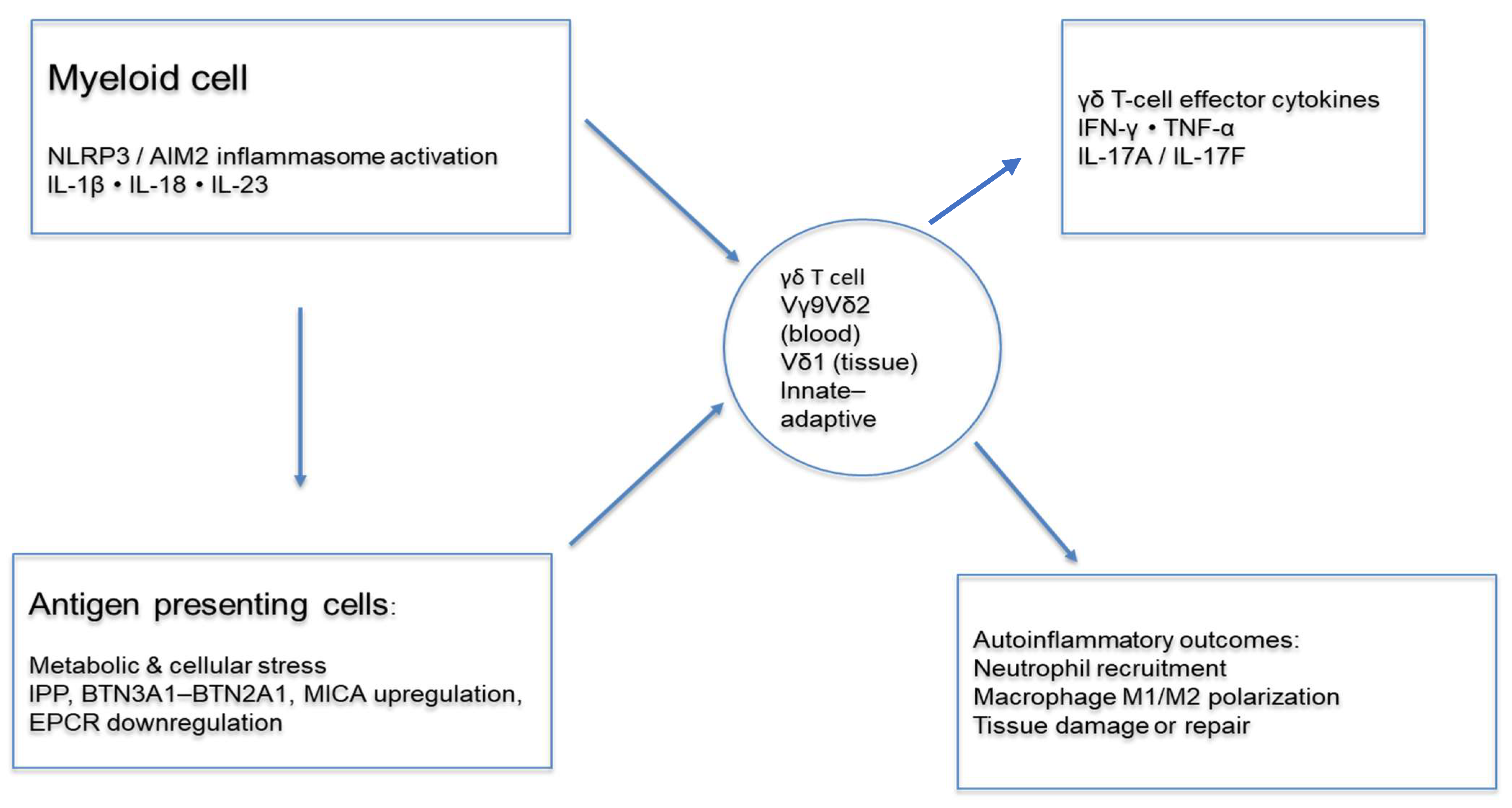
Interestingly, in mice, a subset of γδ T cells is pre-programmed in the thymus to emerge as an “innate” IL-17-producing subset [21]. These γδT17 cells undergo “functional pre-commitment” in the thymus, express the canonical Th17 transcription factor retinoic acid receptor-related orphan receptor gamma (RORγ)t, and are also characterized by expression of chemokine receptor 6 (CCR6), IL-23 receptor(R) and IL-1R while lacking expression of CD27 [21]. Importantly, the thymic pre-programming obviates the necessity for TCR engagement for these cells to become activated to produce and secrete IL-17. Rather, they become directly activated by inflammasome-induced cytokines, IL-1β, IL-18, and IL-23, which directly induce production of IL-17A and IL-17F and sometimes granulocyte–macrophage colony-stimulating factor (GM-CSF) and IL-22. Thus, murine γδT17 cells are poised for rapid reactivity to inflammasome activation occurring in response to pathogens but also during inappropriate inflammasome activation, which can occur in autoinflammatory conditions [22]. In humans, it is not clear whether an innate γδT17 subset emerges from the thymus. However, it has been found that human Vγ9δ2+ γδ T cells in the periphery can also be activated directly by inflammasome-related products, including IL-18, to produce cytokines [23]. Furthermore, nucleotide-binding oligomerization domain (NOD)-like receptors and pyrin domain-containing 3 (NLRP3) inflammasome have been directly linked to γδT17 cell activation, as demonstrated by the finding that tofacitinib, a Janus kinase (JAK) inhibitor, inhibits excessive NLRP3 inflammasome activation and concomitantly decreases γδT17 cell activation in a model of collagen-induced arthritis [24]. In addition, endocytosed neutrophil extracellular trap (NET)-associated DNA components bind to an intracellular DNA sensor, absent in melanoma 2 (AIM2), which promotes AIM2 inflammasome activation and subsequent gasdermin D-mediated mitochondrial dysfunction, which suppresses the development of regulatory γδ T cells [25]. The nature of γδ TCR reactivity, obviating MHC presentation, functional programs, tissue distribution, and innate reactivity to stress-induced molecules suggests that they could participate not only in appropriate inflammatory reactions, e.g., to external pathogens, but could also be triggered during inappropriate autoinflammation, leading to autoinflammatory diseases, as depicted in Figure 1. Despite the inherent link of γδ T cells to inflammatory responses, the role of these cells has been studied in only a few of the diseases considered to exhibit a prominent autoinflammatory component. Herein, we summarized the currently available data in the scientific literature published in Pubmed, focusing on human diseases, in which the involvement of γδ T cells was addressed. Our major goal was to obtain insights into the potential protective and/or pathogenic contribution of these cells to these diseases, which could suggest new investigative and therapeutic approaches.
3. γδ T Cells in Monogenic Autoinflammatory Diseases
An increasing number of diseases characterized by monogenic mutations result in inappropriate inflammatory responses, but γδ T cells have been evaluated in only a few, as described herein.
Familial Mediterranean fever (FMF). This disease results from gain-of-function mutations in the MEFV gene on chromosome 16, which codes the pyrin molecule. Whereas in healthy individuals, dephosphorylation of pyrin is not sufficient to provoke its activity, in FMF, dephosphorylation alone drives pyrin binding to the adaptor molecule apoptosis-associated speck-like protein containing a caspase recruitment domain (CARD) (ASC) and to caspase I, driving inflammasome activation and thus unprovoked inflammatory reactions. In this classical autoinflammatory disease, the percentage of PB γδ T cells was not different from that of normal individuals, but the ability of the Vδ2+ subset to secrete IFNγ was diminished, and there was a trend to increased number of CCR8+ Vδ2+ T cells in FMF patients, suggesting increased homing capacity to the sites of inflammation in joints and serous surfaces [26,27].
HyperIgD syndrome (HIDS). This inflammatory syndrome, caused by mutations in the MVK gene, which codes for the enzyme mevalonate kinase, is characterized by attacks of chills, arthralgia, myalgia, and abdominal pain, instigated by an increased secretion of IL-1β resulting from defective protein prenylation. γδ T cells in this syndrome have been found to be uniquely defective in their ability to produce TNFα and IFNγ, possibly due to defects in the production of IPP, a downstream product of the mevalonate pathway that triggers the activation of Vγ9δ2 γδ T cells [28].
SAVI (STING-associated vasculopathy with onset in infancy). SAVI is a compound autoimmune and autoinflammatory disease caused by heterozygous gain-of-function mutations of stimulator of interferon genes (STING) [29]. Although no studies of γδ T cells in SAVI have been reported, the characteristic T lymphocytopenia selectively affected the αβ T cell population but not γδ T cells in a murine model of this disease, suggesting their possible involvement in some of the inflammatory manifestations in humans as well [29].
Haploinsufficiency of A20. This disease is caused by either a heterozygous tumor necrosis factor, alpha-induced protein 3 (TNFAIP3) pathogenic variant (~95% of affected individuals) or a heterozygous deletion of 6q23, including TNFAIP3. Patients exhibit febrile episodes, oral or genital ulcers, abdominal pain, and arthritis, thus resembling BD. While no studies of γδ T cells in humans with this disease have been reported, a murine model of Tnfaip3LysM-KO mice revealed a reduction in γδ T cells in 18-week-old mice compared to normal mice and spontaneous accumulation of pulmonary Th1, Th17, and γδ17 T cells in Tnfaip3LysM-KO Il17raKO mice [30].
Deficiency of adenosine deaminase type 2 (ADA2) (DADA2). DADA2 is a rare inborn error of immunity caused by deleterious biallelic mutations in ADA2 causing a rare inborn error of immunity with recurrent fevers and vasculitis (ranging from livedo racemosa to polyarteritis nodosa and lacunar stroke), immunodeficiency, and cytopenia, either due to autoimmunity or bone marrow (BM) failure and hematological malignancy. In this disease, the proportions of γδ T cells were similar in healthy donors, heterozygous carriers, and DADA2 patients, but DADA2 patients had significantly fewer Vδ2+ cells (as well as other non-conventional T cell subsets) than healthy donors [31].
VEXAS. VEXAS is caused by a reduction in the cytoplasmic UBA1 isoform by somatic UBA1 mutations, which decreases the efficiency of endoplasmic reticulum (ER)-associated protein degradation. In this disease, characterized by recurrent fever, relapsing polychondritis, vasculitis, pneumonitis, orbital inflammatory syndrome, and Sweet syndrome, γδ T cells exhibited an elevated IFNα and IFNγ gene module score (a quantitative measurement of the overall activity of these genes within a single cell) relative to healthy individuals, revealing their participation in the inflammatory process [32].
The pertinent features relating to γδ T cell perturbations in monogenic autoinflammatory diseases are summarized in Table 1.
4. γδ T Cells in Multifactorial/Polygenic Autoinflammatory Disease
4.1. Diseases of Inappropriate Autoinflammatory Responses to Well-Defined Endogenous Triggers
Gout. Gout is an autoinflammatory disease induced by inflammasome activation driven by monosodium urate (MSU) crystals, resulting in the release of IL-1β and a downstream inflammatory response involving chiefly neutrophils in joints [33,34]. The NLRP3 inflammasome is a critical component in MSU-induced inflammation. Liu et al. showed that serum IL-17 levels are significantly elevated in the PB early in the onset of symptoms of gout, and they decrease as symptoms diminish [35]. IL-17 expression correlated with serum levels of IL-1β. Flow cytometry analysis indicated that γδ T cells in the PB were the major source of IL-17 production during the early onset of acute gouty arthritis, when approximately 2% of the γδ T cells produced IL-17, reducing to close to 0% when the attack abated [35]. By contrast, the percentages of IFNγ-producing Vδ2+ T cells were lower than in normal individuals [27]. Interestingly, moreover, an integrative bioinformatics analysis of the immune cell composition in the joints afflicted by gout revealed significant upregulation of M2 macrophages, activated mast cells, activated NK cells, and γδ T cells [36]. This study further showed upregulation of cell–cell adhesion, leukocyte activation, cell activation, and positive regulation of leukocyte cell–cell adhesion, suggesting that these properties apply to the γδ T cells, and thus they have a pro-inflammatory contribution [36]. An increase in γδ T cells in the joints was likewise reported in a Cibersort analysis of gouty arthritis [37]. These gout samples also exhibited a heightened chemokine (C-C motif) ligand 18 (CCL18), which is a chemokine for adaptive immune cells, but its relevance to γδ T cell migration to joints is unknown [37]. Finally, a study of differentially expressed genes (DEG) relative to normal of primary gout and atherosclerosis patients revealed a number of genes that were significantly upregulated in activated CD4+ T cells, γδ T cells, T follicular helper cells, CD56dim natural killer cells, and eosinophils, suggesting that γδ T cells in gout express a unique gene expression profile relative to healthy individuals [38]. Importantly, moreover, the DEGs were mostly enriched in the chemokine signaling pathway, the regulation of actin cytoskeleton, and the TNF signaling pathway, suggesting that, along with other types of immune cells in gout, γδ T cells are pro-inflammatory [38]. In summary, the data strongly reveal involvement of γδ T cells in gout, both in the PB and in the joint space, which is characterized by increased IL-17 and reduced IFNγ secretion by these cells.
Atherosclerosis. Activation of NLRP3 inflammasomes by cholesterol crystals and oxidized low-density lipoproteins (LDL) plays a critical role in atherogenesis, and an inflammatory response is triggered by the NLRP3 inflammasome in foam cells in atherosclerotic plaques, contributing to disease progression and plaque instability [39]. In healthy individuals, there was no prognostic association, between the number of γδ T cells in PB and subsequent occurrence of acute coronary events [40]. Interestingly, however, the frequencies and absolute numbers of total γδ T cells and Vδ2+ γδ T cells were found to be significantly decreased in patients with coronary artery disease (CAD) when compared to healthy individuals, and the proportion of Vδ1+ T cells was much lower in the patients. However, there was a positive correlation between serum LDL-C levels and frequencies of CD3+ γδ T cells, CD69+Vδ2+ T cells, natural killer group 2D (NKG2D)+Vδ2+ γδ T cells, and NKp46+Vδ2+ γδ T cells [41]. Furthermore, γδ T cells in the cardiac tissue during acute myocardial infarction were also depleted relative to normal tissues [42]. Using CIBERSORT and ESTIMATE algorithms, the association between higher LGALS3BP (Galectin-3-binding protein), a glycoprotein that is implicated in inflammation, fibrosis, and cell–cell communication and upregulated in response to cardiovascular stressors associated with adverse cardiac remodeling and immune cell infiltration, was studied. A positive correlation of LGALS3BP with activated dendritic cells, NK cells, memory CD4 T cells, naïve CD4 T cells, CD8 T cells, follicular helper T cells, and γδ T cells in atherosclerotic plaques was revealed, linking γδ T cells to adverse atherosclerosis outcomes [43]. Together, the data suggest that PB Vδ2+ T cells may become activated in the presence of LDL, driving their entrance into atherosclerotic plaques and resulting in peripheral depletion. The detrimental contribution of γδ T cells in the context of cardiac atherosclerotic disease is compounded by the finding that higher proportions of γδ T cells in PB were associated with lower absolute (worse) left ventricular global circumferential strain per a 1 SD higher proportion of γδ T cells in a study of older adults [44]. Moreover, in a study to evaluate the link of rheumatoid arthritis (RA) to atherosclerosis, two hub-shared genes, CD52 and tumor necrosis factor receptor superfamily (TNFRSF) 17 genes, were identified. Significant correlations between γδ T cells and TNFRSF17—also known as B cell maturation antigen (BCMA), which is primarily expressed in mature B lymphocytes—in the infiltrate of immune cells, suggest pathogenic interactions of γδ T cells with B cells in atherosclerotic plaques and in RA [45]. Indeed, a separate study confirms increased γδ T cells in atherosclerotic plaques, residing along with M0 macrophages, memory B cells, activated mast cells, and CD4+ T cells, which correlates with increased expression of collagen type I alpha 1 (COL1A1) [46]. Atheromatous plaque samples with a high pyroptosis score cluster, as a consequence of inflammasome activation, had higher proportions of γδ T cells, M2 macrophages, myeloid dendritic cells (DCs), and cytotoxic lymphocytes (CTLs) but lower proportions of endothelial cells (ECs) [47]. NOD-like receptor signaling pathways and NFκB signaling pathways were highly enriched in the pyroptosis score high cluster, suggesting a contribution of γδ T cells activated by pyroptotic products in atherosclerotic vessels [47]. Further confirmation of the role of γδ T cells in atherosclerotic plaques was obtained in an analysis of DEGs in atherosclerotic plaques and the correlation of γδ T cells with expression of CD52, a marker present on foam cells [48,49]. Atheromatous plaques in which immune cells were more highly expressed had higher proportions of M0 macrophages and γδ T cells but lower proportions of plasma cells and monocytes (p < 0.05). IL18 and other markers were commonly related to these immune cells, suggesting a role for IL-18 in the activation of plaque γδ T cells [50]. Finally, although in mice, IL-23R+ γδ T cells are predominantly found in the aortic root, where they promote early atherosclerotic lesion formation, plaque necrosis, and inflammation, a study of human atherosclerotic plaques showed that IL-23 signaling activity was negatively associated with γδ T cells [51,52]. IL-23 signaling may thus be instrumental in inducing elevated levels of αβ and γδ T IL-17A+ T cells in the aortas of 21-week-old Apoe(-/-) mice fed a Western diet for 15 weeks, but not in humans [53]. Taken together, these studies suggest a model wherein γδ T cells recruited from the PB accumulate in atherosclerotic plaques in response to LDL-C-activated inflammasomes in myeloid-derived foam cells, where they could contribute to local inflammation and plaque instability.
Parkinson’s disease (PD). In this common neurodegenerative disease of motor function, over-activation of the NLRP3 inflammasome in microglia is triggered by α–synuclein that accumulates in PD and indirectly leads to the loss of nigrostriatal dopaminergic neurons [54]. A highly unusual CD4+ γδ T cell population secreting IL-17, but not IFNγ, was detected to be significantly increased in the PB of PD patients relative to healthy controls [55]. However, an analysis of the proportions of 22 immune cell types in PB using the CIBERSORT method as well as by flow cytometry revealed that compared with the immune cell proportions in blood samples of healthy control subjects, naïve CD4+ T cells and γδ T cells were significantly decreased in PD [56,57]. On the other hand, PB γδ T cells in PD patients were higher than in other neurological diseases, and the γδ T cells in the cerebrospinal fluid more frequently expressed CD25, suggesting an activated state [58]. Thus, the current limited data suggest activation of PB γδ T cells to secrete IL-17 and that γδ T cells in PD may be recruited to the central nervous system and become activated, perhaps by inflammatory products released by α–synuclein-induced activation of inflammasomes.
Alzheimer’s disease (AD). In AD, microglial exposure to pathological amyloid β (Aβ42) and tau peptide aggregates results in an NLRP3 inflammasome-activated pro-inflammatory response [59]. AD patients showed notably elevated proportions of γδ T cells and activated CD4+ memory T cells in afflicted brain tissue in comparison to healthy individuals, but not in PB, where they were, however, elevated relative to patients with mild cognitive impairment [60,61,62,63,64,65]. The γδ T cells in the brain exhibited reduced TCR gamma variable (TRGV) 9 clonotypes but were enriched in TRGV2, 4, and 8 clonotypes, which suggests that interactions with BTNL8 expressed in the brain may play a role in the activity of γδ T cells in AD [66]. AD-associated TRG profiles were found in both the PB and brain, and some groups of clonotypes were more specific for the brain or blood in patients with AD compared to those in controls [67]. Recently, it was reported that a higher total cognitive score correlated with a lower expression of genes related to cytotoxicity, antigen presentation, and antimicrobial defense in PB γδ T cells in AD [68,69]. Interestingly, in the murine 3xTg-AD model, an accumulation of IL-17-producing cells, mostly γδ T cells, in the brain and the meninges of female, but not male mice, concomitant with the onset of cognitive decline, suggests early involvement of γδ T cells in the pathogenesis of AD [70].
4.2. Diseases of Inappropriate Autoinflammatory Responses to Poorly Defined Endogenous Triggers
Behcet’s disease (BD). Although the underlying causes of this systemic chronic inflammatory disease are complex, BD, a systemic vasculitis with protean clinical manifestations, bears hallmarks of inappropriate inflammatory responses as well as autoimmunity [71]. Triggers of the autoinflammatory response may include bacteria (Streptococcus sanguis), herpes simplex virus, heat shock proteins, environmental cues, and gut dysbiosis [71]. Due to their innate responsiveness to bacterial phosphoantigens, pathogen-related haptens, and stress molecules, γδ T cells appear to be well positioned to respond to these putative triggers of inappropriate inflammation [72]. In fact, γδ T cell response to heat shock proteins was proposed as a useful diagnostic criterion for BD [73]. Furthermore, γδ T cells from BD patients responded to a greater degree to a supernatant of bacterial cultures derived from the oral ulcers of a BD patient [26]. Likewise, an augmented response to Streptococcus sanguis is a specific property of BD CD8+ γδ T cells [74]. In active disease, γδ T cells secreted IFNγ but not IL-17A, as opposed to CD4+ T cells, which secreted both cytokines but could be triggered to secrete higher levels of both cytokines than normal under IL-17-inducing conditions [75,76]. Other studies suggest that PB γδ T cells in both BD as well as in patients with recurrent aphthous ulcers are increased, express more CD69 and CD29 than healthy controls, and secrete both IFNγ and TNFα [77]. In addition, the Vδ1+ subset among CD8+ γδ T cells is increased in BD and secretes IFNγ and TNFα [78]. There are conflicting reports with regard to the degree of expansion of γδ T cells in the PB of patients, most consistently indicating expansion during active disease [79,80,81]. At a functional level, it has been found that BD Vγ9δ2+ γδ T cells secrete higher levels of granzyme A than normal [82]. Moreover, these cells also expanded fivefold more in patients with active disease than in those with inactive disease or in control individuals in response to the phosphoantigen dimethylallyl pyrophosphate, suggesting inappropriate response to phosphoantigens [83]. One of the major organs afflicted in BD is the eye. High numbers of γδ T cells, predominantly expressing Vγ9δ2 TCR, were detected in the intraocular fluid and responded to phosphoantigens by secreting IFNγ and upregulating CD69 [84]. Likewise, γδ T cells were numerous and observed in all recurrent aphthous lesions of BD patients within the epithelium, inflammatory infiltrates, and at perivascular locations [85]. Taken together, the data indicate an active pathogenic participation of γδ T cells of both major subsets—Vγ9δ2+ and Vδ1+—in BD, both in the circulating compartment as well as in afflicted organs, by secreting pro-inflammatory cytokines and cytotoxic mediators.
Systemic onset juvenile idiopathic arthritis (Still’s disease, sJIA). Both the percentage and absolute number of γδ T cells increased in active adult Still’s disease [86]. IL-17A was prevalent in sera from patients with Still’s disease, and ex-vivo and in-vitro experiments revealed γδ T cells overexpressing this cytokine. This was not seen with CD4+ T cells, which expressed strikingly low levels of IFNγ. Therapeutic IL-1 blockade was associated with partial normalization of both cytokine expression phenotypes. Furthermore, culturing healthy donor γδ T cells in serum from sJIA patients or in medium containing IL-1β, IL-18, and S100A12 induced IL-17 overexpression at levels similar to those observed in the patients’ cells [87]. These data suggest a central role for innate IL-1β- and IL-18-activated and IL-17-producing γδ T cells during active Still’s disease.
Multisystem inflammatory syndrome in children associated with SARS-CoV-2 infection (MIS-C). Although MIS-C is triggered by an external pathogen, its categorization within the scope of autoinflammation resides in the highly exaggerated and pathogenic inflammatory response, suggesting dysregulation of innate immunity, as well as in its clinical similarity to KD. This rare syndrome presents 4–6 weeks after SARS-CoV-2 infection with high fever, organ dysfunction, including cardiac and vascular involvement, and strongly elevated markers of inflammation. The pathogenesis is unclear but has overlapping features with KD as well as likely autoimmune features [88,89]. High levels of IL-1β, IL-6, IL-8, IL-10, IL-17, IFNγ, and differential T and B cell subset lymphopenia are found in the PB during acute disease. High human leukocyte antigen (HLA)-DR expression on γδ and CD4+CCR7+ T cells is found in the acute phase, and it normalizes at convalescence, suggesting that these immune cell populations are activated and play a role in disease pathogenesis [89]. On the other hand, the number of γδ T cells, along with other T cell subsets, including mucosal-associated invariant T cells (MAIT) and natural killer T (NKT) cells, is reduced, in particular during severe disease [90,91]. Interestingly, 2.2% of MIS-C patients harbor predicted-deleterious variants in BTNL8, which encodes a ligand for Vγ4δ1+ γδ T cells in the gut and which were not found in controls. Most of these variants were in the B30.2 domain of BTNL8, a molecule expressed on intestinal epithelium, and the ability of the encoded ligand to activate Vγ4δ1+ T cells was impaired. These data suggest a role for functional defects of Vγ4δ1+ γδ T cells in the gut, related to the inability to recognize defective BTNL8, in the development of MIS-C-associated enteropathy [92]. In support of this, cells expressing the defective genes exhibited impaired capacity to induce CD69 upregulation and TCR γδ downregulation, indicative of cellular activation [92].
Kawasaki disease (KD). KD, or muco-cutaneous lymph node syndrome, is a form of autoinflammatory vasculitis of medium-sized arteries, including coronary arteries, manifesting with fever, cervical lymphadenopathy, and skin rash. CIBERSORTx-immune cell infiltration analysis revealed that γδ T cells, monocytes, M0 macrophages, activated dendritic cells, activated mast cells, and neutrophils were all elevated in the arterial wall immune infiltrate in KD compared to healthy controls. In patients with coronary artery lesions, there was systemic upregulation of TNFSF13B, C-X-C chemokine ligand 16 (CXCL16), TNFSF10, and interleukin 1 receptor antagonist (IL1RN), mainly produced by monocytes [93]. On the other hand, in the PB, in general, patients with KD had an increasing trend in B cells and monocytes and a reducing trend in CD4+ T, CD8+ T, MAIT, NK, and γδ T cells compared with controls [94]. A different study showed, however, an increase in γδ T cells in the PB of patients [95]. These results suggest active systemic and local involvement of γδ T cells at sites of inflammation in KD, which may be instigated by the cytokine storm characterizing this disease.
Inflammatory bowel diseases (IBDs). IBDs include several entities—most prominently Crohn’s disease (CrD) and ulcerative colitis (UC). These are pathogenetically highly complex chronic inflammatory diseases with infectious, autoimmune, and autoinflammatory components [96]. While γδ T cells play a prominent role in these diseases, their link to the possible defects of autoinflammatory pathways, e.g., NOD2 and ATG16L1 (Autophagy-Related 16 Like 1), is not well defined [97]. Nevertheless, a general theme appears to be the replacement of homeostatic intraepithelial protective γδ T cells by pro-inflammatory γδ T cells that invade the mucosa. Indeed, recent studies reveal that CD103+Vγ4+ γδ T cell dysregulation and loss are displayed by humans with germline BTNL3/BTNL8 hypomorphism, and these were identified as a risk factor for penetrating CrD, strongly suggesting a protective role of γδ T cells in this context [66]. Similarly, in UC, it has recently been shown that there are fewer CD103+Vγ4δ1+ γδ intraepithelial lymphocytes (γδ IELs) and increased γδ T cell subsets with stemlike phenotypes expressing TCF-1 (T cell factor 1) and PD-1 (programmed cell death receptor 1) or effector-like phenotypes expressing granzyme B, perforin, and T-bet in the lamina propria [98]. For detailed analyses of γδ T cell subsets in CrD and UC, the reader is referred to recent reviews on the subject [99,100]. In celiac disease (CeD), classically considered an autoimmune response triggered by gliadin, the alcohol soluble portion of gluten, γδ T cells participate in the exaggerated chronic inflammatory response as well as [101]. Thus, during active CeD, downregulation of BTNL3/BTNL8 on epithelial cells results in loss of the normal Vγ4δ1+ γδ T cell intraepithelial population, which bears innate-like cytolytic potential but also expresses genes associated with tissue repair [102,103,104]. These are replaced by Vδ1+ T cells enriched in IFNγ-secreting potential upon exposure to gluten, thus contributing to diet-induced inflammation [102,103,104]. Moreover, after gluten ingestion, γδ T cell clones, bearing hallmarks of having been selected by specific antigens, are circulated systemically along with gluten-specific CD4+ T cells and assume a cytotoxic phenotype [102,103,104].
A summary of the pertinent features of γδ T cells in the multifactorial/polygenic autoinflammatory diseases is displayed in Table 2.
5. Discussion
Autoinflammatory diseases exemplify the pathological consequences of dysregulated innate immune activation, most commonly driven by aberrant inflammasome signaling and excessive production of IL-1 family cytokines [1,2,3,4]. While neutrophils and macrophages are central executors of these responses, γδ T cells appear to function as critical intermediaries that translate innate immune activation into sustained cellular and cytokine-driven inflammation.
A defining feature of γδ T cells is their capacity to respond rapidly to stress signals without the need for classical antigen processing or MHC-restricted presentation [8,10]. This property allows them to sense both exogenous danger signals, such as pathogen-derived phosphoantigens, and endogenous cues, including cell surface molecules and intracellular phosphoantigens generated during metabolic stress and tissue injury, e.g., resulting from crystal deposition [10,11,12,13]. Specific examples include upregulation of MICA molecule by inflammation, which could affect functional outcomes of γδ T cells via interactions with NKG2D, and downregulation of EPCR during inflammation, decreasing interactions of EPCR reactive γδ T cell clones [105,106].
Evidence from monogenic autoinflammatory diseases suggests that γδ T cell dysfunction is not uniform but instead reflects disease-specific alterations in signaling pathways. In FMF, γδ T cell frequencies are preserved, yet Vδ2+ cells display impaired IFNγ production and altered chemokine receptor expression, suggesting defective effector function and enhanced tissue homing [25,26]. The driver of the shift toward impaired IFNγ production could be related to the effect of excess IL-1β released due to the genetic defect resulting in inflammasome activation in FMF patients, which would tend to primarily affect putative “innate γδT17 cells” in the circulation. Moreover, recently, it was shown in M694I knock-in (MefvM694I/M694I) mice serving as a model of FMF that Th17 differentiation was enhanced, suggesting that γδT17 subset differentiation might also be affected directly by MEFV mutations in humans [107]. However, given the data indicating tissue homing capacity of the γδ T cells in FMF, which might affect the arthritis and serositis, future studies are required in order to clarify the mechanism of the reduction in IFNγ-secreting γδ T cells and its clinical implications and to examine the possible role of IL-17-secreting γδ T cells in this disease.
In HIDS, γδ T cells exhibit reduced TNFα and IFNγ secretion, likely reflecting impaired production of endogenous phosphoantigens downstream of the mevalonate pathway [27]. Murine models of interferonopathies and NFκB dysregulation further implicate γδ T cells—particularly IL-17- and IFNγ-producing subsets—in shaping inflammatory phenotypes [28,29]. For example, in SAVI, the increased expression of STING ligands could serve to co-stimulate cytokine induction by Vδ2+ γδ T cells in the presence of monocytes [108]. Thus, STING ligands strongly stimulated IL-1β and TNFα secretion in monocytes and co-stimulated cytokine induction in short-term expanded Vδ2 γδ T cell lines [108]. In VEXAS, on the other hand, IFNγ profiles increase, demonstrating adaptation of γδ T cells to the immune environment specifically generated in each of the genetically distinct monogenic diseases and reflecting the plasticity of the γδ T cell functional repertoire [32]. A recent study has revealed that mechanistically, the UBA1 defect in VEXAS results in monocyte apoptosis and necroptosis that are strongly enhanced and may be dependent on TNFα and IFNγ, suggesting that the cytokine profile of the γδ T cells in this disease may be contributing to disease pathogenesis [109]. In DADA2, there are no human studies showing γδ T cell involvement, but the pivotal role of innate immunity in the DADA2 pathogenic mechanism is underscored by a skewed polarization from the M2 macrophage subtype to the pro-inflammatory M1 subtype, with an increased production of inflammatory cytokines, such as TNFα, a cytokine highly produced by γδ T cells [110]. Moreover, γδ T cells express receptors for adenosine, which is increased due to the genetic defect of ADA2, and γδ T cells expressing adenosine 2A receptor (A2AR) in vitro generated IL-1, IL-6, IL-17A, and IFNα in response to adenosine [111]. Thus, future studies on the expression and functional repertoire of γδ T cells in DADA2 could be important both for mechanistic and therapeutic understanding.
In the multifactorial autoinflammatory diseases in which defined endogenous triggers have been identified, the contribution of γδ T cells is also apparent, having been studied in more detail. In gout, γδ T cells are a major early source of IL-17 in PB, with cytokine production tightly correlating with IL-1β levels and disease activity [30,31]. Transcriptomic and immune deconvolution analyses further demonstrate enrichment of γδ T cells within inflamed joints and altered γδ T cell gene expression profiles, supporting a direct role in disease pathogenesis [32,33,34]. Together, these findings place γδ T cells downstream of NLRP3 inflammasome activation and upstream of neutrophil-dominated joint inflammation.
A similar paradigm emerges in atherosclerosis, where cholesterol crystals and oxidized LDL activate NLRP3 inflammasomes within foam cells [35,36]. Although circulating γδ T cells—particularly Vδ2+ cells—are reduced in CAD, multiple studies demonstrate their accumulation within atherosclerotic plaques, where they associate with macrophages, dendritic cells, pyroptotic signaling, and markers of plaque instability [37,38,39,40,41,42,43,44,45,46]. Correlations between γδ T cell abundance, IL-18 signaling, and adverse cardiac remodeling further support a pathogenic role in vascular inflammation [40,43,46]. Differences between murine and human studies regarding IL-23 signaling and γδT17 cell expansion may be attributed to the unique species-specific nature of γδ T cells, exemplified by the absence of phosphoantigen-reactive murine γδ T cells and the as-yet-unidentified innate γδT17 subset in humans [47,48,49,112].
The involvement of γδ T cells in neurodegenerative diseases with an autoinflammatory component extends the concept that autoinflammation-induced T cells, in addition to those induced by classical immune-mediated mechanisms, may play a role in central nervous system disease. In PD, α-synuclein-induced NLRP3 inflammasome activation in microglia is accompanied by altered γδ T cell frequencies and the emergence of IL-17-producing γδ T cell subsets, both in PB and cerebrospinal fluid [50,51,52,53,54]. In AD, γδ T cells accumulate within affected brain regions and display distinct TCR clonotypes, suggesting ligand-driven selection within the inflamed central nervous system, linking innate and antigen-driven mechanisms of involvement in this disease [55,56,57,58,59,60,61,62,63]. Associations between γδ T cell gene expression signatures and cognitive performance further implicate these cells in disease progression [64,65,66].
Diseases characterized by poorly defined endogenous triggers, including BD, Still’s disease, KD, and MIS-C, provide additional insight into γδ T cell biology in cytokine-rich inflammatory environments. In BD, γδ T cells respond vigorously to microbial products, heat shock proteins, and phosphoantigens, expand during active disease, and secrete pro-inflammatory cytokines and cytotoxic mediators within affected tissues [67,68,69,70,71,72,73,74,75,76,77,78,79,80,81]. In Still’s disease, IL-1β- and IL-18-driven activation of IL-17-producing γδ T cells appears central to systemic inflammation and is partially reversed by IL-1 blockade [82,83]. In MIS-C and KD, immune profiling reveals activation and tissue infiltration of γδ T cells in the context of cytokine storms and vascular inflammation, implicating them in disease pathogenesis despite peripheral lymphopenia [84,85,86,87,88,89]. Moreover, in diseases where autoinflammation as well as autoimmunity have been implicated, such as BD, γδ T cells activated during the inflammatory phase could serve as instigators and regulators of the autoimmune component of the disease by virtue of their ability to present antigens to αβ T cells, activate autoreactive B cells, or act as regulatory T cells [113,114,115,116].
Despite growing evidence linking γδ T cells to autoinflammatory pathology, important gaps remain. γδ T cells have been studied in only a small proportion of autoinflammatory diseases. Moreover, human γδ T cell subsets exhibit marked heterogeneity, and most available data are cross-sectional and derived from PB rather than inflamed tissues. Longitudinal studies, spatially resolved analyses, and functional perturbation experiments in each disease individually will be essential to distinguish precise pathogenic and regulatory roles of γδ T cells in these instances.
From a therapeutic perspective, γδ T cells represent both a challenge and an opportunity. Indirect modulation through inflammasome inhibition, IL-1/IL-18 blockade, or metabolic pathway targeting already shows promise [23,83]. The contribution of IL-17 produced by γδ T cells may explain in part the therapeutic efficacy of anti-IL-17 therapy in gout [117]. The contribution of γδ T cells to TNFα production may be partly responsible for the efficacy of anti-TNFα treatment in BD [118]. A more refined understanding of subset-specific γδ T cell functions may ultimately enable targeted interventions that suppress pathogenic inflammation while preserving tissue-protective immunity.
In summary, γδ T cells emerge as pivotal sensors and amplifiers of inappropriate innate immune activation across a wide range of autoinflammatory diseases. Their ability to integrate inflammasome-derived signals with tissue-specific stress responses positions them at the crossroads of innate and adaptive immunity, with significant implications for disease classification, pathogenesis, and therapy.
Funding
This research received no external funding.
Data Availability Statement
No new data were created or analyzed in this study. Data sharing is not applicable to this article.
Conflicts of Interest
The author declares no conflicts of interest.
Abbreviations
| Abbreviation | Explanation |
| 3xTg-AD | Triple-transgenic Alzheimer’s disease |
| A2AR | Adenosine A2A receptor |
| AD | Alzheimer’s disease |
| AIM2 | Absent in melanoma 2 |
| APC | Antigen-presenting cell |
| Apoe | Apolipoprotein E |
| ASC | Apoptosis-associated speck-like protein containing a CARD |
| ATG16L1 | Autophagy-related 16 like 1 |
| BD | Behçet’s disease |
| BCMA | B cell maturation antigen |
| BM | Bone marrow |
| CAD | Coronary artery disease |
| CARD | Caspase recruitment domain |
| CCL18 | Chemokine (C–C motif) ligand 18 |
| CD | Cluster of differentiation |
| CDR | Complementarity-determining region |
| CeD | Celiac disease |
| CNS | Central nervous system |
| COL1A1 | Collagen type I alpha 1 chain |
| COVID-19 | Coronavirus disease 2019 |
| CrD | Crohn`s disease |
| CTL | Cytotoxic T lymphocyte |
| CXCL | Chemokine (C–X–C motif) ligand |
| DADA2 | Deficiency of adenosine deaminase 2 |
| DC | Dendritic cell |
| EC | Endothelial cell |
| EPCR | Endothelial protein C receptor |
| ER | Endoplasmic reticulum |
| FMF | Familial Mediterranean fever |
| GM-CSF | Granulocyte–macrophage colony-stimulating factor |
| HA20 | Haploinsufficiency of A20 |
| HIDS | Hyper-IgD syndrome |
| HLA | Human leukocyte antigen |
| HMBPP | (E)-4-hydroxy-3-methyl-but-2-enyl pyrophosphate |
| IFN | Interferon |
| Ig | Immunoglobulin |
| IL | Interleukin |
| IL1RN | Interleukin-1 receptor antagonist |
| IPP | Isopentenyl pyrophosphate |
| JAK | Janus kinase |
| JIA | Juvenile idiopathic arthritis |
| KD | Kawasaki disease |
| LDL | Low-density lipoprotein |
| LDL-C | Low-density lipoprotein cholesterol |
| LGALS3BP | Galectin-3-binding protein |
| MAIT | Mucosal-associated invariant T cell |
| MEFV | Mediterranean fever gene (pyrin) |
| MHC | Major histocompatibility complex |
| MICA | MHC class I polypeptide-related sequence A |
| MIS-C | Multisystem inflammatory syndrome in children |
| M1/M2 | Classically vs. alternatively activated macrophages |
| MR1 | MHC class I-related protein 1 |
| MSU | Monosodium urate |
| MVK | Mevalonate kinase |
| NOD2 | Nucleotide-binding oligomerization domain-containing protein 2 |
| NET | Neutrophil extracellular trap |
| NFκB | Nuclear factor kappa B |
| NK | Natural killer cell |
| NKG2D | Natural killer group 2D receptor |
| NKp46 | Natural cytotoxicity receptor 1 |
| NKT | Natural killer T cell |
| NLRP3 | NOD-like receptor family pyrin domain-containing 3 |
| NOD | Nucleotide-binding oligomerization domain |
| oxLDL | Oxidized low-density lipoprotein |
| PAPA | Pyogenic arthritis, pyoderma gangrenosum, and acne |
| PB | Peripheral blood |
| PD | Parkinson’s disease |
| PFAPA | Periodic fever, aphthous stomatitis, pharyngitis, and adenitis |
| PSTPIP1 | Proline–serine–threonine phosphatase-interacting protein 1 |
| R | Receptor |
| RA | Rheumatoid arthritis |
| SAPHO | Synovitis, acne, pustulosis, hyperostosis, and osteitis |
| SARS-CoV-2 | Severe acute respiratory syndrome coronavirus 2 |
| SAVI | STING-associated vasculopathy with onset in infancy |
| SD | Standard deviation |
| sJIA | Systemic juvenile idiopathic arthritis |
| STING | Stimulator of interferon genes |
| TCR | T cell receptor |
| Th | T helper cell |
| TMEM173 | Transmembrane protein 173 (STING gene) |
| TNF | Tumor necrosis factor |
| TNFAIP3 | TNF alpha-induced protein 3 |
| TNFRSF17 | Tumor necrosis factor receptor superfamily member 17 |
| TNFSF13B | Tumor necrosis factor ligand superfamily member 13B |
| TRGV | T cell receptor gamma variable |
| UBA1 | Ubiquitin-like modifier activating enzyme 1 |
| VEXAS | Vacuoles, E1 enzyme, X-linked, autoinflammatory, somatic |
| Vγ/Vδ | Variable regions of γ or δ T cell receptor chains |
References
- Parentelli, A.S.; Lopes, A.A.; Rieux-Laucat, F.; Hermine, O. Systemic auto-inflammatory diseases, auto-immune diseases and immune deficiencies: From independent to overlapped diseases approach. Autoimmun. Rev. 2025, 24, 103901. [Google Scholar] [CrossRef]
- Kozu, K.T.; Nascimento, R.; Aires, P.P.; Cordeiro, R.A.; Moura, T.C.L.; Sztajnbok, F.R.; Pereira, I.A.; Almeida de Jesus, A.; Perazzio, S.F. Inflammatory turmoil within: An exploration of autoinflammatory disease genetic underpinnings, clinical presentations, and therapeutic approaches. Adv. Rheumatol. 2024, 64, 62. [Google Scholar] [CrossRef]
- An, J.; Marwaha, A.; Laxer, R.M. Autoinflammatory Diseases: A Review. J. Rheumatol. 2024, 51, 848–861. [Google Scholar] [CrossRef]
- Klotgen, H.W.; Beltraminelli, H.; Yawalkar, N.; van Gijn, M.E.; Holzinger, D.; Borradori, L. The expanding spectrum of clinical phenotypes associated with PSTPIP1 mutations: From PAPA to PAMI syndrome and beyond. Br. J. Dermatol. 2018, 178, 982–983. [Google Scholar] [CrossRef] [PubMed]
- Bank, I.; DePinho, R.A.; Brenner, M.B.; Cassimeris, J.; Alt, F.W.; Chess, L. A functional T3 molecule associated with a novel heterodimer on the surface of immature human thymocytes. Nature 1986, 322, 179–181. [Google Scholar] [CrossRef]
- Brenner, M.B.; McLean, J.; Dialynas, D.P.; Strominger, J.L.; Smith, J.A.; Owen, F.L.; Seidman, J.G.; Ip, S.; Rosen, F.; Krangel, M.S. Identification of a putative second T-cell receptor. Nature 1986, 322, 145–149. [Google Scholar] [CrossRef] [PubMed]
- Hayday, A.C. γδ cells: A right time and a right place for a conserved third way of protection. Annu. Rev. Immunol. 2000, 18, 975–1026. [Google Scholar] [CrossRef]
- Sok, C.L.; Rossjohn, J.; Gully, B.S. The Evolving Portrait of γδ TCR Recognition Determinants. J. Immunol. 2024, 213, 543–552. [Google Scholar] [CrossRef]
- Hu, Y.; Hu, Q.; Li, Y.; Lu, L.; Xiang, Z.; Yin, Z.; Kabelitz, D.; Wu, Y. γδ T cells: Origin and fate, subsets, diseases and immunotherapy. Signal Transduct. Target. Ther. 2023, 8, 434. [Google Scholar] [CrossRef] [PubMed]
- Sanchez Sanchez, G.; Papadopoulou, M.; Azouz, A.; Tafesse, Y.; Mishra, A.; Chan, J.K.Y.; Fan, Y.; Verdebout, I.; Porco, S.; Libert, F.; et al. Identification of distinct functional thymic programming of fetal and pediatric human γδ thymocytes via single-cell analysis. Nat. Commun. 2022, 13, 5842. [Google Scholar] [CrossRef]
- Herrmann, T.; Karunakaran, M.M. Butyrophilins: γδ T Cell Receptor Ligands, Immunomodulators and More. Front. Immunol. 2022, 13, 876493. [Google Scholar] [CrossRef]
- Zhu, Y.; Gao, W.; Zheng, J.; Bai, Y.; Tian, X.; Huang, T.; Lu, Z.; Dong, D.; Zhang, A.; Guo, C.; et al. Phosphoantigen-induced inside-out stabilization of butyrophilin receptor complexes drives dimerization-dependent γδ TCR activation. Immunity 2025, 58, 1646–1659 e1645. [Google Scholar] [CrossRef] [PubMed]
- Boutin, L.; Scotet, E. Towards Deciphering the Hidden Mechanisms That Contribute to the Antigenic Activation Process of Human Vγ9Vδ2 T Cells. Front. Immunol. 2018, 9, 828. [Google Scholar] [CrossRef]
- Willcox, B.E.; Willcox, C.R. γδ TCR ligands: The quest to solve a 500-million-year-old mystery. Nat. Immunol. 2019, 20, 121–128. [Google Scholar] [CrossRef]
- Guo, J.; Chowdhury, R.R.; Mallajosyula, V.; Xie, J.; Dubey, M.; Liu, Y.; Li, J.; Wei, Y.L.; Palanski, B.A.; Wang, C.; et al. γδ T cell antigen receptor polyspecificity enables T cell responses to a broad range of immune challenges. Proc. Natl. Acad. Sci. USA 2024, 121, e2315592121. [Google Scholar] [CrossRef]
- Hayday, A.C.; Vantourout, P. The Innate Biologies of Adaptive Antigen Receptors. Annu. Rev. Immunol. 2020, 38, 487–510. [Google Scholar] [CrossRef]
- Ribot, J.C.; Lopes, N.; Silva-Santos, B. γδ T cells in tissue physiology and surveillance. Nat. Rev. Immunol. 2021, 21, 221–232. [Google Scholar] [CrossRef]
- Hsu, U.H.; Chiang, B.L. γδ T Cells and Allergic Diseases. Clin. Rev. Allergy Immunol. 2023, 65, 172–182. [Google Scholar] [CrossRef] [PubMed]
- Takimoto, R.; Suzawa, T.; Yamada, A.; Sasa, K.; Miyamoto, Y.; Yoshimura, K.; Sasama, Y.; Tanaka, M.; Kinoshita, M.; Ikezaki, K.; et al. Zoledronate promotes inflammatory cytokine expression in human CD14-positive monocytes among peripheral mononuclear cells in the presence of γδ T cells. Immunology 2021, 162, 306–313. [Google Scholar] [CrossRef] [PubMed]
- LaMarche, N.M.; Kohlgruber, A.C.; Brenner, M.B. Innate T Cells Govern Adipose Tissue Biology. J. Immunol. 2018, 201, 1827–1834. [Google Scholar] [CrossRef]
- Ribot, J.C.; Silva-Santos, B. Differentiation and activation of γδ T Lymphocytes: Focus on CD27 and CD28 costimulatory receptors. Adv. Exp. Med. Biol. 2013, 785, 95–105. [Google Scholar] [CrossRef] [PubMed]
- Papotto, P.H.; Ribot, J.C.; Silva-Santos, B. IL-17(+) γδ T cells as kick-starters of inflammation. Nat. Immunol. 2017, 18, 604–611. [Google Scholar] [CrossRef] [PubMed]
- Gombert, D.; Simeonov, J.; Klein, K.; Agaugue, S.; Scheffold, A.; Kabelitz, D.; Peters, C. Butyrophilin 3A/2A1-independent activation of human Vγ9Vδ2 γδ T cells by bacteria. PNAS Nexus 2025, 4, pgaf358. [Google Scholar] [CrossRef]
- Yang, X.; Zhan, N.; Jin, Y.; Ling, H.; Xiao, C.; Xie, Z.; Zhong, H.; Yu, X.; Tang, R.; Ma, J.; et al. Tofacitinib restores the balance of γδTreg/γδT17cells in rheumatoid arthritis by inhibiting the NLRP3 inflammasome. Theranostics 2021, 11, 1446–1457. [Google Scholar] [CrossRef] [PubMed]
- Zeng, Y.; Lin, J.; Xiao, Z.; Li, Z.; Zheng, G.; Zhou, Y.; Li, Q.; Zeng, C.; Su, Z.; Yu, W.; et al. Neutrophil extracellular traps exacerbate inflammatory arthritis by inhibiting γδ Treg cell differentiation via the AIM2 inflammasome. Redox Biol. 2025, 87, 103881. [Google Scholar] [CrossRef]
- Bank, I.; Duvdevani, M.; Livneh, A. Expansion of γδ T-cells in Behcet’s disease: Role of disease activity and microbial flora in oral ulcers. J. Lab. Clin. Med. 2003, 141, 33–40. [Google Scholar] [CrossRef]
- Al, B.; Bruno, M.; Roring, R.J.; Moorlag, S.; Suen, T.K.; Kluck, V.; Liu, R.; Debisarun, P.A.; Gaal, O.; Bhat, J.; et al. Peripheral T Cell Populations are Differentially Affected in Familial Mediterranean Fever, Chronic Granulomatous Disease, and Gout. J. Clin. Immunol. 2023, 43, 2033–2048. [Google Scholar] [CrossRef]
- Suen, T.K.; Al, B.; Ulas, T.; Reusch, N.; Bahrar, H.; Bekkering, S.; Bhat, J.; Kabelitz, D.; Schultze, J.L.; van de Veerdonk, F.L.; et al. Human γδ T Cell Function Is Impaired Upon Mevalonate Pathway Inhibition. Immunology 2025, 175, 300–322. [Google Scholar] [CrossRef]
- Siedel, H.; Roers, A.; Rosen-Wolff, A.; Luksch, H. Type I interferon-independent T cell impairment in a Tmem173 N153S/WT mouse model of STING associated vasculopathy with onset in infancy (SAVI). Clin. Immunol. 2020, 216, 108466. [Google Scholar] [CrossRef]
- Vroman, H.; Das, T.; Bergen, I.M.; van Hulst, J.A.C.; Ahmadi, F.; van Loo, G.; Lubberts, E.; Hendriks, R.W.; Kool, M. House dust mite-driven neutrophilic airway inflammation in mice with TNFAIP3-deficient myeloid cells is IL-17-independent. Clin. Exp. Allergy 2018, 48, 1705–1714. [Google Scholar] [CrossRef]
- Yap, J.Y.; Moens, L.; Lin, M.W.; Kane, A.; Kelleher, A.; Toong, C.; Wu, K.H.C.; Sewell, W.A.; Phan, T.G.; Hollway, G.E.; et al. Intrinsic Defects in B Cell Development and Differentiation, T Cell Exhaustion and Altered Unconventional T Cell Generation Characterize Human Adenosine Deaminase Type 2 Deficiency. J. Clin. Immunol. 2021, 41, 1915–1935. [Google Scholar] [CrossRef]
- Mizumaki, H.; Gao, S.; Wu, Z.; Gutierrez-Rodrigues, F.; Bissa, M.; Feng, X.; Groarke, E.M.; Li, H.; Alemu, L.; Raffo, D.Q.; et al. In depth transcriptomic profiling defines a landscape of dysfunctional immune responses in patients with VEXAS syndrome. Nat. Commun. 2025, 16, 4690. [Google Scholar] [CrossRef]
- Martinon, F.; Petrilli, V.; Mayor, A.; Tardivel, A.; Tschopp, J. Gout-associated uric acid crystals activate the NALP3 inflammasome. Nature 2006, 440, 237–241. [Google Scholar] [CrossRef]
- So, A.K.; Martinon, F. Inflammation in gout: Mechanisms and therapeutic targets. Nat. Rev. Rheumatol. 2017, 13, 639–647. [Google Scholar] [CrossRef]
- Liu, Y.; Zhao, Q.; Yin, Y.; McNutt, M.A.; Zhang, T.; Cao, Y. Serum levels of IL-17 are elevated in patients with acute gouty arthritis. Biochem. Biophys. Res. Commun. 2018, 497, 897–902. [Google Scholar] [CrossRef]
- Yuan, Y.; Gao, Z.; Chen, J.; Liu, Y.; Zhou, J. Integrative bioinformatics analysis and experimental validation reveals key genes and regulatory mechanisms in the development of gout. Front. Genet. 2025, 16, 1598835. [Google Scholar] [CrossRef] [PubMed]
- Zhang, M.; Lin, Z.; Liu, W. The immune microenvironment related biomarker CCL18 for patients with gout by comprehensive analysis. Comput. Biol. Chem. 2025, 115, 108334. [Google Scholar] [CrossRef] [PubMed]
- Xiao, L.; Lin, S.; Zhan, F. Identification of hub genes and transcription factors in patients with primary gout complicated with atherosclerosis. Sci. Rep. 2024, 14, 3992. [Google Scholar] [CrossRef] [PubMed]
- Duewell, P.; Kono, H.; Rayner, K.J.; Sirois, C.M.; Vladimer, G.; Bauernfeind, F.G.; Abela, G.S.; Franchi, L.; Nunez, G.; Schnurr, M.; et al. NLRP3 inflammasomes are required for atherogenesis and activated by cholesterol crystals. Nature 2010, 464, 1357–1361. [Google Scholar] [CrossRef]
- Olson, N.C.; Sitlani, C.M.; Doyle, M.F.; Huber, S.A.; Landay, A.L.; Tracy, R.P.; Psaty, B.M.; Delaney, J.A. Innate and adaptive immune cell subsets as risk factors for coronary heart disease in two population-based cohorts. Atherosclerosis 2020, 300, 47–53. [Google Scholar] [CrossRef]
- Li, Y.; Jiang, S.; Li, J.; Yin, M.; Yan, F.; Chen, Y.; Chen, Y.; Wu, T.; Cheng, M.; He, Y.; et al. Phenotypic Changes of Peripheral γδ T Cell and Its Subsets in Patients with Coronary Artery Disease. Front. Immunol. 2022, 13, 900334. [Google Scholar] [CrossRef]
- Zhao, E.; Xie, H.; Zhang, Y. Predicting Diagnostic Gene Biomarkers Associated With Immune Infiltration in Patients With Acute Myocardial Infarction. Front. Cardiovasc. Med. 2020, 7, 586871. [Google Scholar] [CrossRef]
- Zhao, S.; Zhao, C.; Wang, L.; Cheng, B.; Zheng, M.; Wang, X. Elucidating the role of LGALS3BP in coronary atherosclerosis: Integrating bioinformatics and machine learning for advanced insights. J. Cardiothorac. Surg. 2025, 20, 338. [Google Scholar] [CrossRef]
- Sinha, A.; Rivera, A.S.; Doyle, M.F.; Sitlani, C.; Fohner, A.; Huber, S.A.; Olson, N.C.; Lima, J.A.; Delaney, J.A.; Feinstein, M.J.; et al. Association of immune cell subsets with cardiac mechanics in the Multi-Ethnic Study of Atherosclerosis. JCI Insight 2021, 6, e149193. [Google Scholar] [CrossRef] [PubMed]
- Zhao, P.; Yuan, K.; Tang, Z.; Li, Y.; Yu, Y.; Gao, W.; Zhang, Y.; Wang, J.; Li, X.; Tie, Y. Investigation of hub-shared genes and regulatory mechanisms of rheumatoid arthritis and atherosclerosis. Clin. Rheumatol. 2025, 44, 2241–2256. [Google Scholar] [CrossRef]
- Yong, X.; Kang, T.; Li, M.; Li, S.; Yan, X.; Li, J.; Lin, J.; Lu, B.; Zheng, J.; Xu, Z.; et al. Identification of novel biomarkers for atherosclerosis using single-cell RNA sequencing and machine learning. Mamm. Genome 2025, 36, 183–199. [Google Scholar] [CrossRef]
- Liu, J.W.; Zhang, Z.H.; Lv, X.S.; Xu, M.Y.; Ni, B.; He, B.; Wang, F.; Chen, J.; Zhang, J.B.; Ye, Z.D.; et al. Identification of key pyroptosis-related genes and microimmune environment among peripheral arterial beds in atherosclerotic arteries. Sci. Rep. 2024, 14, 233. [Google Scholar] [CrossRef] [PubMed]
- Zheng, Z.; Yuan, D.; Shen, C.; Zhang, Z.; Ye, J.; Zhu, L. Identification of potential diagnostic biomarkers of atherosclerosis based on bioinformatics strategy. BMC Med. Genom. 2023, 16, 100. [Google Scholar] [CrossRef]
- Yin, Y.; Xie, Z.; Chen, D.; Guo, H.; Han, M.; Zhu, Z.; Bi, J. Integrated investigation of DNA methylation, gene expression and immune cell population revealed immune cell infiltration associated with atherosclerotic plaque formation. BMC Med. Genom. 2022, 15, 108. [Google Scholar] [CrossRef]
- Shen, Y.; Xu, L.R.; Tang, X.; Lin, C.P.; Yan, D.; Xue, S.; Qian, R.Z.; Guo, D.Q. Identification of potential therapeutic targets for atherosclerosis by analysing the gene signature related to different immune cells and immune regulators in atheromatous plaques. BMC Med. Genom. 2021, 14, 145. [Google Scholar] [CrossRef] [PubMed]
- Gil-Pulido, J.; Amezaga, N.; Jorgacevic, I.; Manthey, H.D.; Rosch, M.; Brand, T.; Cidlinsky, P.; Schafer, S.; Beilhack, A.; Saliba, A.E.; et al. Interleukin-23 receptor expressing γδ T cells locally promote early atherosclerotic lesion formation and plaque necrosis in mice. Cardiovasc. Res. 2022, 118, 2932–2945. [Google Scholar] [CrossRef]
- Han, H.; Du, R.; Cheng, P.; Zhang, J.; Chen, Y.; Li, G. Comprehensive Analysis of the Immune Infiltrates and Aberrant Pathways Activation in Atherosclerotic Plaque. Front. Cardiovasc. Med. 2020, 7, 602345. [Google Scholar] [CrossRef]
- Smith, E.; Prasad, K.M.; Butcher, M.; Dobrian, A.; Kolls, J.K.; Ley, K.; Galkina, E. Blockade of interleukin-17A results in reduced atherosclerosis in apolipoprotein E-deficient mice. Circulation 2010, 121, 1746–1755. [Google Scholar] [CrossRef]
- Yu, J.; Zhao, Z.; Li, Y.; Chen, J.; Huang, N.; Luo, Y. Role of NLRP3 in Parkinson’s disease: Specific activation especially in dopaminergic neurons. Heliyon 2024, 10, e28838. [Google Scholar] [CrossRef]
- Diener, C.; Hart, M.; Kehl, T.; Becker-Dorison, A.; Tanzer, T.; Schub, D.; Krammes, L.; Sester, M.; Keller, A.; Unger, M.; et al. Time-resolved RNA signatures of CD4+ T cells in Parkinson’s disease. Cell Death Discov. 2023, 9, 18. [Google Scholar] [CrossRef] [PubMed]
- Huang, Y.; Liu, H.; Hu, J.; Han, C.; Zhong, Z.; Luo, W.; Zhang, Y.; Ling, F. Significant Difference of Immune Cell Fractions and Their Correlations With Differential Expression Genes in Parkinson’s Disease. Front. Aging Neurosci. 2021, 13, 686066. [Google Scholar] [CrossRef] [PubMed]
- Zhou, C.; Zhou, X.; He, D.; Li, Z.; Xie, X.; Ren, Y. Reduction of Peripheral Blood iNKT and γδT Cells in Patients With Parkinson’s Disease: An Observational Study. Front. Immunol. 2020, 11, 1329. [Google Scholar] [CrossRef] [PubMed]
- Fiszer, U.; Mix, E.; Fredrikson, S.; Kostulas, V.; Olsson, T.; Link, H. γδ+T cells are increased in patients with Parkinson’s disease. J. Neurol. Sci. 1994, 121, 39–45. [Google Scholar] [CrossRef]
- Ravichandran, K.A.; Brosseron, F.; McManus, R.M.; Ising, C.; Gorgen, S.; Schmidt, S.; Santarelli, F.; Lee, S.Y.; Jung, H.; Chung, W.S.; et al. Enhancing Tyro3 signalling ameliorates IL-1β production through STAT1 in Alzheimer’s disease models. J. Leukoc. Biol. 2025, 117, qiaf157. [Google Scholar] [CrossRef]
- Du, W.; Yu, S.; Liu, R.; Kong, Q.; Hao, X.; Liu, Y. Precision Prediction of Alzheimer’s Disease: Integrating Mitochondrial Energy Metabolism and Immunological Insights. J. Mol. Neurosci. 2025, 75, 5. [Google Scholar] [CrossRef]
- Chen, G.; Xi, E.; Gu, X.; Wang, H.; Tang, Q. The study on cuproptosis in Alzheimer’s disease based on the cuproptosis key gene FDX1. Front. Aging Neurosci. 2024, 16, 1480332. [Google Scholar] [CrossRef]
- Lin, H.; Su, L.; Mao, D.; Yang, G.; Huang, Q.; Lan, Y.; Zeng, J.; Song, W.; Liang, G.; Wei, Q.; et al. Identification of altered immune cell types and molecular mechanisms in Alzheimer’s disease progression by single-cell RNA sequencing. Front. Aging Neurosci. 2024, 16, 1477327. [Google Scholar] [CrossRef]
- Wang, Y.; Shen, Z.; Wu, H.; Yu, Z.; Wu, X.; Zhou, L.; Guo, F. Identification of genes related to glucose metabolism and analysis of the immune characteristics in Alzheimer’s disease. Brain Res. 2023, 1819, 148545. [Google Scholar] [CrossRef] [PubMed]
- Zhuang, X.; Zhang, G.; Bao, M.; Jiang, G.; Wang, H.; Li, S.; Wang, Z.; Sun, X. Development of a novel immune infiltration-related diagnostic model for Alzheimer’s disease using bioinformatic strategies. Front. Immunol. 2023, 14, 1147501. [Google Scholar] [CrossRef]
- Shigemizu, D.; Mori, T.; Akiyama, S.; Higaki, S.; Watanabe, H.; Sakurai, T.; Niida, S.; Ozaki, K. Identification of potential blood biomarkers for early diagnosis of Alzheimer’s disease through RNA sequencing analysis. Alzheimers Res. Ther. 2020, 12, 87. [Google Scholar] [CrossRef]
- Dart, R.J.; Zlatareva, I.; Vantourout, P.; Theodoridis, E.; Amar, A.; Kannambath, S.; East, P.; Recaldin, T.; Mansfield, J.C.; Lamb, C.A.; et al. Conserved γδ T cell selection by BTNL proteins limits progression of human inflammatory bowel disease. Science 2023, 381, eadh0301. [Google Scholar] [CrossRef]
- Aliseychik, M.; Patrikeev, A.; Gusev, F.; Grigorenko, A.; Andreeva, T.; Biragyn, A.; Rogaev, E. Dissection of the Human T-Cell Receptor gamma Gene Repertoire in the Brain and Peripheral Blood Identifies Age- and Alzheimer’s Disease-Associated Clonotype Profiles. Front. Immunol. 2020, 11, 12. [Google Scholar] [CrossRef]
- Dressman, D.; Winford, E.D.; Vardarajan, B.N.; Yidenk, M.; Talcoff, R.; Mazen, J.; Bradshaw, E.M.; Manly, J.J.; Brickman, A.; Elyaman, W. Basic Science and Pathogenesis. Alzheimer’s Dement. 2025, 21, e107352. [Google Scholar] [CrossRef]
- Kloske, C.M.; Mahinrad, S.; Barnum, C.J.; Batista, A.F.; Bradshaw, E.M.; Butts, B.; Carrillo, M.C.; Chakrabarty, P.; Chen, X.; Craft, S.; et al. Advancements in Immunity and Dementia Research: Highlights from the 2023 AAIC Advancements: Immunity Conference. Alzheimer’s Dement. 2025, 21, e14291. [Google Scholar] [CrossRef]
- Brigas, H.C.; Ribeiro, M.; Coelho, J.E.; Gomes, R.; Gomez-Murcia, V.; Carvalho, K.; Faivre, E.; Costa-Pereira, S.; Darrigues, J.; de Almeida, A.A.; et al. IL-17 triggers the onset of cognitive and synaptic deficits in early stages of Alzheimer’s disease. Cell Rep. 2021, 36, 109574. [Google Scholar] [CrossRef]
- Emmi, G.; Bettiol, A.; Hatemi, G.; Prisco, D. Behcet’s syndrome. Lancet 2024, 403, 1093–1108. [Google Scholar] [CrossRef] [PubMed]
- Hayday, A.C. γδ T Cell Update: Adaptate Orchestrators of Immune Surveillance. J. Immunol. 2019, 203, 311–320. [Google Scholar] [CrossRef]
- Hasan, A.; Fortune, F.; Wilson, A.; Warr, K.; Shinnick, T.; Mizushima, Y.; van der Zee, R.; Stanford, M.R.; Sanderson, J.; Lehner, T. Role of gamma delta T cells in pathogenesis and diagnosis of Behcet’s disease. Lancet 1996, 347, 789–794. [Google Scholar] [CrossRef]
- Nishida, T.; Hirayama, K.; Nakamura, S.; Ohno, S. Proliferative response of CD8+ γδ+ T cells to Streptococcus sanguis in patients with Behcet’s disease. Ocul. Immunol. Inflamm. 1998, 6, 139–144. [Google Scholar] [CrossRef]
- Matteo, A.D.; Emery, P. Rheumatoid arthritis: A review of the key clinical features and ongoing challenges of the disease. Panminerva Med. 2024, 66, 427–442. [Google Scholar] [CrossRef]
- Deniz, R.; Tulunay-Virlan, A.; Ture Ozdemir, F.; Unal, A.U.; Ozen, G.; Alibaz-Oner, F.; Aydin-Tatli, I.; Mumcu, G.; Ergun, T.; Direskeneli, H. Th17-Inducing Conditions Lead to in vitro Activation of Both Th17 and Th1 Responses in Behcet’s Disease. Immunol. Investig. 2017, 46, 518–525. [Google Scholar] [CrossRef]
- Freysdottir, J.; Lau, S.; Fortune, F. Γδ T cells in Behcet’s disease (BD) and recurrent aphthous stomatitis (RAS). Clin. Exp. Immunol. 1999, 118, 451–457. [Google Scholar] [CrossRef] [PubMed]
- Clemente Ximenis, A.; Crespi Bestard, C.; Cambra Conejero, A.; Pallares Ferreres, L.; Juan Mas, A.; Olea Vallejo, J.L.; Julia Benique, M.R. In vitro evaluation of γδ T cells regulatory function in Behcet’s disease patients and healthy controls. Hum. Immunol. 2016, 77, 20–28. [Google Scholar] [CrossRef] [PubMed]
- Parlakgul, G.; Guney, E.; Erer, B.; Kilicaslan, Z.; Direskeneli, H.; Gul, A.; Saruhan-Direskeneli, G. Expression of regulatory receptors on γδ T cells and their cytokine production in Behcet’s disease. Arthritis Res. Ther. 2013, 15, R15. [Google Scholar] [CrossRef]
- Yasuoka, H.; Yamaguchi, Y.; Mizuki, N.; Nishida, T.; Kawakami, Y.; Kuwana, M. Preferential activation of circulating CD8+ and γδ T cells in patients with active Behcet’s disease and HLA-B51. Clin. Exp. Rheumatol. 2008, 26, S59–S63. [Google Scholar]
- Treusch, M.; Vonthein, R.; Baur, M.; Gunaydin, I.; Koch, S.; Stubiger, N.; Eckstein, A.K.; Peter, H.H.; Ness, T.; Zierhut, M.; et al. Influence of human recombinant interferon-alpha2a (rhIFN-alpha2a) on altered lymphocyte subpopulations and monocytes in Behcet’s disease. Rheumatology 2004, 43, 1275–1282. [Google Scholar] [CrossRef] [PubMed][Green Version]
- Accardo-Palumbo, A.; Ferrante, A.; Cadelo, M.; Ciccia, F.; Parrinello, G.; Lipari, L.; Giardina, A.R.; Riili, M.; Giardina, E.; Dieli, F.; et al. The level of soluble Granzyme A is elevated in the plasma and in the Vγ9/Vδ2 T cell culture supernatants of patients with active Behcet’s disease. Clin. Exp. Rheumatol. 2004, 22, S45–S49. [Google Scholar]
- Triolo, G.; Accardo-Palumbo, A.; Dieli, F.; Ciccia, F.; Ferrante, A.; Giardina, E.; Sano, C.D.; Licata, G. Vγ9/Vδ2 T lymphocytes in Italian patients with Behcet’s disease: Evidence for expansion, and tumour necrosis factor receptor II and interleukin-12 receptor beta1 expression in active disease. Arthritis Res. Ther. 2003, 5, R262–R268. [Google Scholar] [CrossRef]
- Verjans, G.M.; van Hagen, P.M.; van der Kooi, A.; Osterhaus, A.D.; Baarsma, G.S. Vγ9Vδ2 T cells recovered from eyes of patients with Behcet’s disease recognize non-peptide prenyl pyrophosphate antigens. J. Neuroimmunol. 2002, 130, 46–54. [Google Scholar] [CrossRef]
- Natah, S.S.; Hayrinen-Immonen, R.; Hietanen, J.; Patinen, P.; Malmstrom, M.; Savilahti, E.; Konttinen, Y.T. Increased density of lymphocytes bearing gamma/delta T-cell receptors in recurrent aphthous ulceration (RAU). Int. J. Oral. Maxillofac. Surg. 2000, 29, 375–380. [Google Scholar] [CrossRef]
- Hoshino, T.; Ohta, A.; Nakao, M.; Ota, T.; Inokuchi, T.; Matsueda, S.; Gouhara, R.; Yamada, A.; Itoh, K.; Oizumi, K. TCR gamma delta + T cells in peripheral blood of patients with adult Still’s disease. J. Rheumatol. 1996, 23, 124–129. [Google Scholar]
- Kessel, C.; Lippitz, K.; Weinhage, T.; Hinze, C.; Wittkowski, H.; Holzinger, D.; Fall, N.; Grom, A.A.; Gruen, N.; Foell, D. Proinflammatory Cytokine Environments Can Drive Interleukin-17 Overexpression by γ/δ T Cells in Systemic Juvenile Idiopathic Arthritis. Arthritis Rheumatol. 2017, 69, 1480–1494. [Google Scholar] [CrossRef] [PubMed]
- Consiglio, C.R.; Cotugno, N.; Sardh, F.; Pou, C.; Amodio, D.; Rodriguez, L.; Tan, Z.; Zicari, S.; Ruggiero, A.; Pascucci, G.R.; et al. The Immunology of Multisystem Inflammatory Syndrome in Children with COVID-19. Cell 2020, 183, 968–981 e967. [Google Scholar] [CrossRef]
- Carter, M.J.; Fish, M.; Jennings, A.; Doores, K.J.; Wellman, P.; Seow, J.; Acors, S.; Graham, C.; Timms, E.; Kenny, J.; et al. Peripheral immunophenotypes in children with multisystem inflammatory syndrome associated with SARS-CoV-2 infection. Nat. Med. 2020, 26, 1701–1707. [Google Scholar] [CrossRef]
- Mukund, K.; Nayak, P.; Ashokkumar, C.; Rao, S.; Almeda, J.; Betancourt-Garcia, M.M.; Sindhi, R.; Subramaniam, S. Immune Response in Severe and Non-Severe Coronavirus Disease 2019 (COVID-19) Infection: A Mechanistic Landscape. Front. Immunol. 2021, 12, 738073. [Google Scholar] [CrossRef] [PubMed]
- Cerapio, J.P.; Perrier, M.; Pont, F.; Tosolini, M.; Laurent, C.; Bertani, S.; Fournie, J.J. Single-Cell RNAseq Profiling of Human γδ T Lymphocytes in Virus-Related Cancers and COVID-19 Disease. Viruses 2021, 13, 2212. [Google Scholar] [CrossRef]
- Bellos, E.; Santillo, D.; Vantourout, P.; Jackson, H.R.; Duret, A.; Hearn, H.; Seeleuthner, Y.; Talouarn, E.; Hodeib, S.; Patel, H.; et al. Heterozygous BTNL8 variants in individuals with multisystem inflammatory syndrome in children (MIS-C). J. Exp. Med. 2024, 221, e920240699. [Google Scholar] [CrossRef] [PubMed]
- Xie, Y.; Shi, H.; Han, B. Bioinformatic analysis of underlying mechanisms of Kawasaki disease via Weighted Gene Correlation Network Analysis (WGCNA) and the Least Absolute Shrinkage and Selection Operator method (LASSO) regression model. BMC Pediatr. 2023, 23, 90. [Google Scholar] [CrossRef]
- Chen, Y.; Yang, M.; Zhang, M.; Wang, H.; Zheng, Y.; Sun, R.; Li, X. Single-Cell Transcriptome Reveals Potential Mechanisms for Coronary Artery Lesions in Kawasaki Disease. Arterioscler. Thromb. Vasc. Biol. 2024, 44, 866–882. [Google Scholar] [CrossRef] [PubMed]
- Liu, D.; Song, M.; Jing, F.; Liu, B.; Yi, Q. Diagnostic Value of Immune-Related Genes in Kawasaki Disease. Front. Genet. 2021, 12, 763496. [Google Scholar] [CrossRef]
- Baum, S.; Hamedi, K.; Loftus, C.; Loftus, G.; Zhou, E.R.; Arce, S. From Cytokines to Biomarkers: Mapping the Immunopathology of Inflammatory Bowel Disease. Cells 2025, 14, 1589. [Google Scholar] [CrossRef]
- Lopetuso, L.R.; Murgiano, M.; Mantuano, E.; Schiavone, V.; Costa, A.; Masciana, G.; Bezzerri, V.; Costa, G. The Molecular Landscape of Inflammation in Inflammatory Bowel Disease (IBD): Targets for Precision Medicine. Biomedicines 2025, 13, 2738. [Google Scholar] [CrossRef] [PubMed]
- Mayer, L.S.; Arnold, J.; Roettele, F.; Reuter, N.; Pattekar, A.; Ohtani, T.; Ribeiro, M.M.; Siwicki, R.; Bruder, K.; Obwegs, D.; et al. Single-cell profiling reveals diverse γδ T cell subsets in ulcerative colitis. Sci. Immunol. 2026, 11, eadx8474. [Google Scholar] [CrossRef]
- Parthasarathy, A.; Li, T.; Edelblum, K.L. Crosstalk between the microbiota and intestinal γδ T cell compartments in health and IBD. Gut Microbes 2026, 18, 2604908. [Google Scholar] [CrossRef]
- Catalan-Serra, I.; Sandvik, A.K.; Bruland, T.; Andreu-Ballester, J.C. Gammadelta T Cells in Crohn’s Disease: A New Player in the Disease Pathogenesis? J. Crohns Colitis 2017, 11, 1135–1145. [Google Scholar] [CrossRef]
- Marietta, E.; Choung, R.S.; Rubio-Tapia, A.; Murray, J.A. Immunology in Celiac Disease. Gastrointest. Endosc. Clin. N. Am. 2025, 35, 855–867. [Google Scholar] [CrossRef]
- Mayassi, T.; Ladell, K.; Gudjonson, H.; McLaren, J.E.; Shaw, D.G.; Tran, M.T.; Rokicka, J.J.; Lawrence, I.; Grenier, J.C.; van Unen, V.; et al. Chronic Inflammation Permanently Reshapes Tissue-Resident Immunity in Celiac Disease. Cell 2019, 176, 967–981 e919. [Google Scholar] [CrossRef]
- Kornberg, A.; Botella, T.; Moon, C.S.; Rao, S.; Gelbs, J.; Cheng, L.; Miller, J.; Bacarella, A.M.; Garcia-Vilas, J.A.; Vargas, J.; et al. Gluten induces rapid reprogramming of natural memory αβ and γδ intraepithelial T cells to induce cytotoxicity in celiac disease. Sci. Immunol. 2023, 8, eadf4312. [Google Scholar] [CrossRef]
- Han, A.; Newell, E.W.; Glanville, J.; Fernandez-Becker, N.; Khosla, C.; Chien, Y.H.; Davis, M.M. Dietary gluten triggers concomitant activation of CD4+ and CD8+ alphabeta T cells and γδ T cells in celiac disease. Proc. Natl. Acad. Sci. USA 2013, 110, 13073–13078. [Google Scholar] [CrossRef]
- Kohga, K.; Tatsumi, T.; Tsunematsu, H.; Aono, S.; Shimizu, S.; Kodama, T.; Hikita, H.; Yamamoto, M.; Oze, T.; Aketa, H.; et al. Interleukin-1beta enhances the production of soluble MICA in human hepatocellular carcinoma. Cancer Immunol. Immunother. 2012, 61, 1425–1432. [Google Scholar] [CrossRef] [PubMed]
- Kondreddy, V.; Keshava, S.; Esmon, C.T.; Pendurthi, U.R.; Rao, L.V.M. A critical role of endothelial cell protein C receptor in the intestinal homeostasis in experimental colitis. Sci. Rep. 2020, 10, 20569. [Google Scholar] [CrossRef] [PubMed]
- Koga, T.; Tsuji, Y.; Furukawa, K.; Endo, Y.; Umeda, M.; Mohamed, L.Y.H.; Matsumoto, H.; Kawakami, A. M694I variant of MEFV drives pathogenesis of familial Mediterranean fever through enhanced Th17 cell differentiation. Rheumatology 2025, 64, 5172–5177. [Google Scholar] [CrossRef] [PubMed]
- Serrano, R.; Lettau, M.; Zarobkiewicz, M.; Wesch, D.; Peters, C.; Kabelitz, D. Stimulatory and inhibitory activity of STING ligands on tumor-reactive human gamma/delta T cells. Oncoimmunology 2022, 11, 2030021. [Google Scholar] [CrossRef]
- Narendra, V.K.; Das, T.; Wierciszewski, L.J.; Londoner, R.J.; Morrison, J.K.; Martindale, P.; Devine, T.; Chen, K.; Trombetta, M.; Kanno, Y.; et al. Independent mechanisms of inflammation and myeloid bias in VEXAS syndrome. Nature 2026, 649, 1273–1281. [Google Scholar] [CrossRef]
- Signa, S.; Bertoni, A.; Penco, F.; Caorsi, R.; Cafaro, A.; Cangemi, G.; Volpi, S.; Gattorno, M.; Schena, F. Adenosine Deaminase 2 Deficiency (DADA2): A Crosstalk Between Innate and Adaptive Immunity. Front. Immunol. 2022, 13, 935957. [Google Scholar] [CrossRef]
- Dong, L.W.; Chen, Y.Y.; Chen, C.C.; Ma, Z.C.; Fu, J.; Huang, B.L.; Liu, F.J.; Liang, D.C.; Sun, D.M.; Lan, C. Adenosine 2A receptor contributes to the facilitation of post-infectious irritable bowel syndrome by γδ T cells via the PKA/CREB/NF-kappaB signaling pathway. World J. Gastroenterol. 2023, 29, 1475–1491. [Google Scholar] [CrossRef]
- Pinheiro, R.G.R.; Silva-Santos, B. Reaching maturity: Thymic γδ T cell differentiation in mice and humans. Sci. Immunol. 2025, 10, eadn2093. [Google Scholar] [CrossRef]
- Khoshbakht, S.; Baskurt, D.; Vural, A.; Vural, S. Behcet’s Disease: A Comprehensive Review on the Role of HLA-B*51, Antigen Presentation, and Inflammatory Cascade. Int. J. Mol. Sci. 2023, 24, 16382. [Google Scholar] [CrossRef]
- Brandes, M.; Willimann, K.; Moser, B. Professional antigen-presentation function by human γδ T Cells. Science 2005, 309, 264–268. [Google Scholar] [CrossRef] [PubMed]
- Huang, Y.; Getahun, A.; Heiser, R.A.; Detanico, T.O.; Aviszus, K.; Kirchenbaum, G.A.; Casper, T.L.; Huang, C.; Aydintug, M.K.; Carding, S.R.; et al. γδ T Cells Shape Preimmune Peripheral B Cell Populations. J. Immunol. 2016, 196, 217–231. [Google Scholar] [CrossRef] [PubMed]
- Peters, C.; Kabelitz, D.; Wesch, D. Regulatory functions of γδ T cells. Cell Mol. Life Sci. 2018, 75, 2125–2135. [Google Scholar] [CrossRef]
- Raucci, F.; Iqbal, A.J.; Saviano, A.; Minosi, P.; Piccolo, M.; Irace, C.; Caso, F.; Scarpa, R.; Pieretti, S.; Mascolo, N.; et al. IL-17A neutralizing antibody regulates monosodium urate crystal-induced gouty inflammation. Pharmacol. Res. 2019, 147, 104351. [Google Scholar] [CrossRef]
- Talarico, R.; Italiano, N.; Emmi, G.; Piga, M.; Cantarini, L.; Mattioli, I.; Floris, A.; Gentileschi, S.; Di Cianni, F.; Urban, M.L.; et al. Efficacy and safety of infliximab or adalimumab in severe mucocutaneous Behcet’s syndrome refractory to traditional immunosuppressants: A 6-month, multicentre, randomised controlled, prospective, parallel group, single-blind trial. Ann. Rheum. Dis. 2025, 84, 504–515. [Google Scholar] [CrossRef]
Figure 1.
A depiction of how γδ T cells are integrated into the pathogenic mechanisms of autoinflammation is presented. Inappropriate innate immune activation through the NLRP3 and AIM2 inflammasomes in myeloid cells leads to the release of IL-1β and IL-18 and the enhanced production of IL-23, while concomitant metabolic and cellular stress are partly affected by these cytokines, inducing the accumulation of phosphoantigens (IPP), upregulation of BTN3A1–BTN2A1 and stress ligands, such as MICA, and downregulation of endothelial protein C receptor (EPCR) in the cells presenting these antigens. These signals converge on γδ T cells, via TCR-independent (cytokine) or TCR-dependent mechanisms (via recognition of stress-induced molecules), including circulating Vγ9δ2 cells and tissue-resident Vδ1 cells. Activated γδ T cells rapidly produce effector cytokines (IFNγ, TNFα, IL-17A/F), thereby shaping downstream autoinflammatory outcomes, such as neutrophil recruitment, macrophage M1/M2 polarization, and the balance between tissue damage and repair.
Figure 1.
A depiction of how γδ T cells are integrated into the pathogenic mechanisms of autoinflammation is presented. Inappropriate innate immune activation through the NLRP3 and AIM2 inflammasomes in myeloid cells leads to the release of IL-1β and IL-18 and the enhanced production of IL-23, while concomitant metabolic and cellular stress are partly affected by these cytokines, inducing the accumulation of phosphoantigens (IPP), upregulation of BTN3A1–BTN2A1 and stress ligands, such as MICA, and downregulation of endothelial protein C receptor (EPCR) in the cells presenting these antigens. These signals converge on γδ T cells, via TCR-independent (cytokine) or TCR-dependent mechanisms (via recognition of stress-induced molecules), including circulating Vγ9δ2 cells and tissue-resident Vδ1 cells. Activated γδ T cells rapidly produce effector cytokines (IFNγ, TNFα, IL-17A/F), thereby shaping downstream autoinflammatory outcomes, such as neutrophil recruitment, macrophage M1/M2 polarization, and the balance between tissue damage and repair.


Table 1.
γδ T cells in monogenic autoinflammatory diseases.
| Disease | Gene | Dominant Inflammatory Pathway | Key γδ T Cell Insight | Refs. |
|---|---|---|---|---|
| FMF | MEFV | Pyrin inflammasome → IL-1β | Preserved numbers but reduced IFNγ production by Vδ2+ T cells; increased CCR8+ subset suggests enhanced tissue homing | [25,26] |
| HIDS | MVK | Mevalonate pathway defect → IL-1β | Impaired TNFα and IFNγ secretion due to defective Vγ9δ2 activation (decreased IPP) | [27] |
| SAVI | TMEM173 | Constitutive STING → type I IFN | Relative γδ T cell preservation amid αβ lymphopenia suggests participation in IFN-driven inflammation | [28] |
| HA20 | TNFAIP3 | NFκB dysregulation | Reduced number, but pathogenic γδT17 accumulation in inflamed tissues (murine models) | [29] |
| DADA2 | ADA2 | Inborn error of immunity | Vδ2+ cells reduced | [31] |
| VEXAS | UBA1 | Myeloid ubiquitin–stress inflammation | Elevated IFNα and IFNγ gene module scores | [32] |
Summary of monogenic autoinflammatory disorders, their causative genes and dominant inflammatory pathways, and the principal quantitative or functional alterations described in γδ T cell subsets, highlighting disease-specific insights into γδ T cell involvement in autoinflammatory pathogenesis.
Table 2.
γδ T cells in multifactorial/polygenic autoinflammatory diseases.
| Disease | Key Trigger/Pathway | Dominant Autoinflammatory Mechanism | γδ T Cell Signature (Key Findings) | References |
|---|---|---|---|---|
| Gout | Monosodium urate crystals; NLRP3 | IL-1β–driven inflammasome activation with neutrophil-mediated joint inflammation | Major early source of IL-17 in blood and joints; reduced IFNγ production by Vδ2+ cells | [30,31,32,33,34] |
| Atherosclerosis | Cholesterol crystals, oxLDL; NLRP3 | Foam-cell inflammasome activation, pyroptosis, chronic plaque inflammation | Decreased γδ T cells in blood; accumulation in plaques; associated with IL-18 signaling, macrophages, and plaque instability | [35,36,37,38,39,40,41,42,43,44,45,46,47,48,49] |
| Parkinson’s disease | α-synuclein; NLRP3 | Microglial inflammasome activation and neuroinflammation | Activated IL-17–CD4+γδ T cells; variable blood levels; recruitment to CNS and activation | [50,51,52,53,54] |
| Alzheimer’s disease | Amyloid-β, tau; NLRP3 | Chronic microglial inflammasome-driven neuroinflammation | Enrichment in brain tissue; skewed TCR repertoire (decreased TRGV9, increased TRGV2/4/8); IL-17-producing γδ T cells in mouse model early in disease | [55,56,57,58,59,60,61,62,63,64,65,66] |
| Behçet’s disease | Microbial, stress, and heat-shock antigens | Innate-like immune activation with autoinflammatory and autoimmune features | Expansion and activation of Vγ9δ2+ and Vδ1+ γδ T cells; secretion of IFNγ, TNFα, granzyme A; prominent tissue infiltration | [67,68,69,70,71,72,73,74,75,76,77,78,79,80,81] |
| Systemic-onset JIA (Still’s disease) | IL-1β, IL-18 | Cytokine-driven innate autoinflammation | Increased circulating γδ T cells with dominant IL-17A production; phenotype partially normalizes with IL-1 blockade | [82,83] |
| MIS-C (SARS-CoV-2) | Post-infectious immune dysregulation | Systemic cytokine storm with lymphopenia | Numerical reduction but strong activation (HLA-DR+); BTNL8 variants impair gut Vγ4δ1+ γδ T cell responses | [84,85,86] |
| Kawasaki disease | Unknown (likely infection-triggered inflammation) | Medium-vessel vasculitis with cytokine storm | γδ T cells enriched in coronary artery infiltrates; peripheral blood findings suggesting redistribution to inflamed tissue | [87,88,89] |
| Inflammatory bowel diseases (Crohn’s disease, ulcerative colitis) and celiac disease | Microbial dysbiosis; barrier dysfunction; innate sensing pathways (NOD2, ATG16L1); BTNL3/BTNL8 | Chronic mucosal autoinflammation with mixed innate and adaptive features | Loss of homeostatic protective CD103+ Vγ4+ γδ intraepithelial lymphocytes with replacement by pro-inflammatory γδ T cells | [66,96,97,98,99,100,101,102,103,104] |
A summary of multifactorial autoinflammatory conditions, their principal triggers and pathogenic pathways, and the characteristic γδ T cell alterations observed in blood and tissues, highlighting shared and disease-specific γδ T cell signatures across crystal-, metabolic-, infection-, and neuroinflammation-driven disorders.
Disclaimer/Publisher’s Note: The statements, opinions and data contained in all publications are solely those of the individual author(s) and contributor(s) and not of MDPI and/or the editor(s). MDPI and/or the editor(s) disclaim responsibility for any injury to people or property resulting from any ideas, methods, instructions or products referred to in the content. |
© 2026 by the author. Licensee MDPI, Basel, Switzerland. This article is an open access article distributed under the terms and conditions of the Creative Commons Attribution (CC BY) license.
Share and Cite
MDPI and ACS Style
Bank, I. γδ T Cells in Autoinflammatory Diseases. Cells 2026, 15, 388. https://doi.org/10.3390/cells15050388
AMA Style
Bank I. γδ T Cells in Autoinflammatory Diseases. Cells. 2026; 15(5):388. https://doi.org/10.3390/cells15050388
Chicago/Turabian StyleBank, Ilan. 2026. "γδ T Cells in Autoinflammatory Diseases" Cells 15, no. 5: 388. https://doi.org/10.3390/cells15050388
APA StyleBank, I. (2026). γδ T Cells in Autoinflammatory Diseases. Cells, 15(5), 388. https://doi.org/10.3390/cells15050388
Note that from the first issue of 2016, this journal uses article numbers instead of page numbers. See further details here.