Review

The Role of Raf Kinase Inhibitor Protein (RKIP) in HER2+ Breast Cancer Immune Evasion

Department of Microbiology, Immunology & Molecular Genetics, David Geffen School of Medicine, Jonsson Comprehensive Cancer Center, University of California, Los Angeles, CA 90095, USA
*
Author to whom correspondence should be addressed.
These authors contributed equally to this work.
Cells 2026, 15(4), 319; https://doi.org/10.3390/cells15040319
Submission received: 14 November 2025 / Revised: 18 January 2026 / Accepted: 4 February 2026 / Published: 8 February 2026
(This article belongs to the Special Issue Novel Insights into Cancer Immune Responsiveness)

Abstract

Breast cancer (BC) is a prevalent malignancy worldwide among women. HER2 overexpression in a subset of BC (HER2+ BC) serves as a critical oncogenic driver and contributes to immune evasion. The Raf Kinase Inhibitor Protein (RKIP), a metastasis suppressor and an immune enhancer, is underexpressed in HER2+ BC. The treatment of HER2+ BC with anti-HER2 mAbs or chemical inhibitors has resulted in significant clinical responses in a subset of patients; however, unresponsiveness in a larger subset was due to acquired and induced resistance. These findings highlight the need for the development of new effective therapies. By analyzing the signaling pathways mediated by both RKIP and HER2 in HER2+ BC, we have found that RKIP and HER2 downstream signaling and inductions showed an inverse relationship. These suggested the presence of a dysregulated RKIP-HER2 axis in HER2+ BC mediating immune evasion. These findings were corroborated by bioinformatic analyses. The immune evasion induced by the overexpression of HER2 was due, in part, to its regulation of the expression of PD-L1, the polarization of TAMs, the infiltration of suppressor cells (Tregs, MDSCs), and the inhibition of anti-tumor CD8+ T cells, resulting in an overall immunosuppressive TME. In contrast, RKIP expression inhibits critical signaling pathways that regulate HER2 expression, including the Raf-MEK-ERK, NF-kB, and PI3K/Akt pathways, thereby aborting HER2-mediated mechanisms of immune evasion. Overall, we analyzed the cross-talk signaling pathways between RKIP and HER2, established a novel dysregulated axis in HER2+ BC, and delineated the various mechanisms involved in the regulation of immune evasion by RKIP and HER2. Hence, we present various therapeutic strategies aimed at targeting the RKIP-HER2 axis in HER2+ BC to circumvent unresponsiveness to therapeutics and immune evasion.

1. Introduction

Breast cancer (BC) is a leading malignancy affecting millions globally, predominantly women, with 2.3 million new cases and 670,000 deaths reported in 2022 [1]. If current trends continue, the concerning rise in incidence and mortality rates will reach 38% and 68%, respectively, by 2050 [2]. BC is highly heterogeneous, further classified into molecular subtypes like luminal A, luminal B, human epidermal receptor 2 (HER2)-positive BC, and triple-negative BC (TNBC) [3].
HER2+ BC accounts for approximately 15–20% of all BC diagnoses [4]. Historically, the HER2 protein has been considered one of the most aggressive markers in BC and is strongly associated with poor prognosis [5]. However, the development of trastuzumab (Herceptin), the first anti-HER2 agent, has led to significant improvements in survival outcomes for a subset of patients with HER2+ BC—especially when treated at earlier stages [6]. Subsequent monoclonal antibodies (mAbs), including pertuzumab and margetuximab, along with small-molecule inhibitors like lapatinib, similarly target HER1/HER2 kinases to block the formation of HER2–HER2 homodimers and ligand-independent HER2–HER3, HER2–HER1, and HER2–HER4 heterodimers [7]. Newer versions of trastuzumab, such as T-DXd (trastuzumab deruxtecan), can act as an antibody-drug conjugate (ADC) to deliver a potent chemotherapy payload directly to the cancer cell, reducing systemic toxicity [8,9].
While the above treatment modalities have significantly improved survival rates for patients with HER2+ BC, the development of metastatic HER2+ tumors will eventually lead to acquired or de novo resistance in the majority of patients [3]. In cases where HER2+ BC tumors eventually recur, the continued reliance of tumors on HER2 signaling underscores the need for novel therapeutic strategies. Ongoing research across preclinical and clinical domains aims to develop the next-generation HER2-targeted treatments that can overcome resistance and further improve outcomes for patients with HER2+ BC. Such undertakings also seek to target factors beyond HER2, designing novel combination strategies that can simultaneously target proteins such as Programmed Death-Ligand 1 (PD-L1), Cytotoxic T-Lymphocyte-Associated Protein 4 (CTLA4), Natural Killer Group 2 family of receptor A (NKG2A), A Serine/Threonine Protein Kinase (Akt), and phosphoinositide 3-kinase (PI3K) and provide a molecular basis to explore the HER2′s regulatory network with other gene products in the tumor microenvironment (TME), including key interactions with proteins such as the Raf Kinase Inhibitory Protein (RKIP) [10,11].
RKIP has emerged as a promising therapeutic target for various solid cancers, including BC. Initially identified as part of the phosphatidylcholine-binding protein (PEBP) superfamily, RKIP is known for inhibiting the Raf-MEK-ERK signaling pathway. By preventing MEK phosphorylation, RKIP blocks downstream activation of extracellular signal-regulated kinase (ERK), thereby suppressing the oncogenic Raf-MEK-ERK (MAPK) signaling pathway, which is upregulated in almost 40% of all cancers [12,13,14]. Elevated RKIP levels are often associated with improved clinical outcomes, and their overexpression reverses resistance to conventional therapies [15]. Conversely, reduced RKIP expression is associated with increased metastasis, tumor aggressiveness, and chemoresistance [16,17,18,19]. RKIP regulates the infiltration of specific immune cells and the secretion of anti-metastatic factors that are critical to address immune evasion mechanisms present in recurrent HER2+ BC [20,21].
The main objective of this review is to examine the regulation of RKIP and HER2 expressions in HER2+ BC, analyze the cross-talk signaling pathways between RKIP and HER2, establish a novel dysregulated RKIP-HER2 axis in HER2+ BC, delineate the underlying mechanisms involved in immune evasion by RKIP and HER2, explore the axis as a potential therapeutic target, address challenges associated with RKIP and HER2 targeting agents directly on the cancer cells, and offer future perspectives.

2. RKIP and HER2 Expressions in HER2+ BC

2.1. RKIP

Different subtypes of BC exhibit varying levels of RKIP expression. RKIP is significantly downregulated in HER2+, luminal, and TNBC tissues compared with normal breast tissue, as derived from analyses using the UALCAN cancer-omics portal, which integrates public datasets from The Cancer Genome Atlas (TCGA) and the Clinical Proteomic Tumor Analysis Consortium (CPTAC). UALCAN allows users to query RKIP in BC and visualize expression across normal tissue and molecular subtypes (including HER2-enriched, luminal, and basal/TNBC), from which we observed lower RKIP levels in these tumor subtypes relative to normal breast samples. RKIP expression varies significantly across BC subtypes. Luminal A and B tumors generally exhibit higher RKIP expressions, whereas HER2-enriched, basal-like, and claudin-low subtypes show reduced RKIP levels. In HER2+ BC specifically, RKIP is consistently downregulated at the protein level compared to normal breast tissue and luminal tumors, despite variable mRNA expression [3,22,23]. This reduction aligns with aggressive tumor behavior, enhanced HER2 signaling, immune evasion, and therapy resistance. These findings are summarized in a dedicated table focusing on HER2+ BC (Table 1).
In various aggressive BC subtypes, RKIP expression may be lost or significantly reduced [15]. In the study by Lai et al. [15], two types of BC cells were analyzed to establish RKIP as a promising metastasis suppressor. MCF-7 cells with high RKIP expression levels and MDA-MB-231 cells with low RKIP levels were used. Manipulating RKIP in different experimental settings revealed an uneven migration between MCF-7 and MDA-MB-231 cells, which was mainly characterized by differences in RKIP expression levels [15]. In BC, lower RKIP levels have been correlated with specific tumor sizes and grades [23]. Additionally, RKIP expression levels are known to be drastically induced during chemotherapeutic drug treatment, with the highest levels of RKIP correlating with higher apoptosis rates [24]. Briefly, Li et al. demonstrated that RKIP expression is inversely associated with the invasiveness of MDA-MB-435 cells [25]. In addition, Zhang et al. reported a significant negative correlation between RKIP expression and HER-2/neu status (p = 0.013), deeming RKIP as a negative predictor of the HER2/neu status [26]. In vitro, they further demonstrated a dose-dependent reduction in RKIP expression in BT-474 cells upon HER2/neu modulation. We have also expanded on the discussion of the study by Al-Mulla et al., whereby they demonstrated that HER2-enriched breast tumors ranked second lowest in terms of RKIP expression using three independent BC cohorts [23].

2.2. HER2

HER2 is a member of the epidermal growth factor receptor (EGFR) family. It is a transmembrane glycoprotein that plays a significant role in influencing cell proliferation and differentiation [11]. Patients diagnosed with HER2+ BC are not always fully cured, and those who acquire the HER2+ metastatic variant cultivate a very deadly disease [27,28]. HER2 overexpression in BC accounts for approximately 15–20% of all cases and is characterized by HER2 gene amplification or HER2 protein overexpression [28].
Unlike most receptors, HER2 does not require a ligand for activation; instead, it becomes active by forming dimers [11]. The key signaling pathways involving HER2 include PI3K/Akt, MAPK, and NF-κB. The PI3K pathway involves Akt phosphorylation, which activates the downstream mammalian target of rapamycin (mTOR) through a negative feedback loop while simultaneously inhibiting the mammalian target of rapamycin complex 1 (mTORC1) [11,29,30]. This interaction activates PI3K, converting PIP2 to PIP3, which recruits Akt and triggers downstream signaling [31]. HER2′s stronger, sustained signaling enhances Akt activation and mTOR activity, promoting cell survival, growth, and resistance to apoptosis [32]. Thus, HER2 overexpression amplifies PI3K signaling, contributing to oncogenic transformation and therapeutic resistance.

3. Regulation of RKIP and HER2 Expressions in HER2+ BC

Regulation at the transcriptional, epigenetic, and post-translational levels is crucial for understanding RKIP and HER2 regulation in HER2+ BC. RKIP expression levels and molecular assemblies with various protein partners are essential for regulating the progression and metastatic potential of HER2+ BC cells. As such, the absence of RKIP allows multiple oncogenic genes, such as HER2, to be expressed, contributing to cancer progression [33,34]. Below, we summarize key modulators of RKIP and HER2 expressions, transcriptionally and post-transcriptionally.

3.1. RKIP

Various transcription factors (TFs) regulate RKIP expression [35]. A significant RKIP regulator is SNAIL, an EMT protein that can transcriptionally repress RKIP [16,35]. The induction of SNAIL can be promoted through NFκB and its downstream target Yin Yang 1 (YY1), thereby repressing RKIP feedback [16,36,37]. The overexpression of SNAIL and YY1 is common in many cancers, while RKIP is downregulated [38]. Another significant factor in cancer metastasis is the basic leucine zipper transcription factor 1 (BACH1) [18,35,36,37,38]. RKIP and BACH1 work together by regulating each other; an anti-metastatic state corresponds with high RKIP and low BACH1 expressions, while a pro-metastatic state corresponds with RKIP inhibition [39]. In addition, it is essential to highlight that RKIP inhibits BACH1 by targeting the Erk1/2-myc-let7 pathway [40]. Aside from SNAIL and BACH1, RKIP transcription is modulated by the Enhancer of Zeste Homolog 2 (EZH2), an enzymatic subunit of the Polycomb Repressive Complex 2 (PRC2) [41,42]. At the epigenetic level, histone deacetylation and DNA methylation can tighten chromatin structure at the promoters of the regulator of G protein signaling (RGS) genes, obstructing transcriptional access [41]. At this level, the RKIP promoter is methylated in most cancers [41]. As such, both SNAIL and YY1 can repress RKIP transcription by recruiting the EZH2 repressive complex to the proximal RKIP promoter [41] (Table 2).
Regarding post-transcriptional regulation, miRNAs play a significant role in targeting RKIP mRNA for degradation. miRNA complexes can bind to miRNA recognition elements (MREs) on target mRNA within the 3′ untranslated region (3′UTR). This binding leads to silencing of mRNA through cleavage, destabilization, or reduced translation efficiency [43]. Several miRNAs target RKIP mRNA and inhibit its expression, a phenomenon observed across various cancer types. For instance, in prostate cancer, miR-543 and miR-23a have been identified as suppressors of RKIP expression [44,45]. In lung cancer, miR-27a is an RKIP suppressor [45], and in BC, miR-224 has been reported to suppress RKIP expression [46]. MiR-224, miR-27a, miR-23a, and miR-543 target and inhibit RKIP transcription [34,44,45,46,47,48] (Table 2).
At the protein level, post-translational modifications can affect RKIP stability and function [49]. Studies by Skinner et al. [49] demonstrate that RKIP phosphorylation controls the stability of RKIP kinase, thereby affecting its state and ability to regulate. Phosphorylation of RKIP at Serine 153 (pSer153-RKIP) by protein kinase C ζ (PKCζ) redirects RKIP to bind and inhibit GRK2 instead of Raf-1, thereby functioning as a proto-oncogene [50,51,52,53,54,55,56]. However, there have not been any reports specifically for HER2+BC, and that needs to be further investigated. Phosphorylation of RKIP at specific residues (notably Ser153 by PKCζ) alters RKIP’s binding partners and functional role. Instead of inhibiting Raf-1, phosphorylated RKIP preferentially inhibits GRK2, which can promote GPCR signaling, cell migration, invasion, and therapy resistance. This functional switch has been shown to support oncogenic behavior in several cancers. As such, in certain cancers, pSer153-RKIP is associated with poor therapy response and prognosis while also amplifying the proliferation and invasion of cancerous cells by inhibiting GRK2 [13,54,57]. Moreover, RKIP exists in multiple states and features an allosteric structure controlled by phosphorylation and dynamics within a pocket loop [49,58]. With that said, the impact of RKIP phosphorylation extends to promoting signaling degradation, autophagy via LC3 and Rab8, invasion via IQGAP proteins, and mechanosensing [59] (Table 2). The regulation of RKIP is summarized in Table 2.
Table 2. Regulation of RKIP expression.
Types of RegulationFactors InvolvedEffect on RKIPReferences
Transcriptional
-
SNAIL, NFκB, YY1
-
BACH1
-
EZH2 + PRC2
-
Downregulation of RKIP
-
RKIP and BACH1 regulate each other and foster a negatively correlated relationship
-
EZH2 and PRC2 are repressive complexes
[16,18,35,36,37,38,39,41,42]
Epigenetic
-
RKIP promoter methylation
-
Leads to RKIP silencing (reduction in RKIP expression when the promoter undergoes methylation)
[44,60,61,62]
Post-Transcriptional
-
MicroRNAs and mRNA-binding proteins
-
PKCζ phosphorylation
-
Many miRNAs inhibit RKIP expression (e.g., miR-224)
-
Suppresses RKIP activity (Ser153-RKIP by PKCζ leads to RKIP activity loss)
[48,50,51,52,53,54,55,56,63,64]
Translational
-
Global and mRNA-specific mechanisms
-
RKIP is able to regulate processes crucial for tumor growth and treatment resistance
[65,66]
This table illustrates the key factors that regulate RKIP expression. RKIP is pivotal in regulating key signaling pathways and gene expression, significantly impacting cancer progression, metastasis, and therapeutic resistance.

3.2. HER2

At the transcriptional level, several TFs influence the upregulation or downregulation of HER2. HER2 also translocates into the nucleus, where it is involved in transcriptional activity, associating with p185neu to activate transcription [67,68,69,70]. TFs associated with HER2 include the transcription factor family activator protein 2 (TFAP2) [71,72,73], the specificity protein 1 (Sp1) [74], the palindrome binding protein (PBP) [75], the YY1 [76], the E26 transformation specific (ETS) [77], the Y-box binding protein-1 (YB-1) [78,79], the early growth response protein 2 (EGR2) [80], the myeloblastosis (MYB) [81], the forkhead box protein P3 (FOXP3) [82], the GATA-binding protein 4 (GATA4) [83], the polyomavirus enhancer activator 3 (PEA3) [84], the c-MYC promoter-binding protein-1 (MBP-1) [85,86], the membrane bound NOTCH and the recombination signal binding protein for immunoglobulin kappa J region (RBP-Jk) [87,88]. Of those TFs listed, seven are known to upregulate HER2: TFAP2, Sp1, PBP, YY1, ETS, YB-1, and EGR2 [89]. For example, a report by Begon et al. [76] examined YY1 and its interactions with the activator protein 2 (AP-2), supporting the notion that YY1 and AP-2 collaborate to promote the HER2 oncogene by binding to AP-2 sites [76]. However, the remaining TFs—MYB, FOXP3, GATA4, PEA3, MBP-1, NOTCH, and RBP-Jk—have been shown to negatively regulate HER2 expression in BC [89]. More specifically, MYB can repress HER2 despite its role as a transcriptional activator [81]. FOXP3 binds to the HER2/ErbB2 promoter and suppresses its transcription. In addition, an inverse correlation between FOXP3 and HER2 levels has also been observed in tumor samples [82]. GATA4 has been detected in breast tumors and contributes to the transcriptional control of HER2. Additionally, MBP-1, NOTCH, and RBP-Jk are associated with ERbB2 but also are significant in negatively influencing HER2 [86,87]. At the transcriptional level, adenovirus early region 1A (E1A) is responsible for repressing HER2 by inactivating and inhibiting the p300/CBP complex [87,90,91,92,93,94] (Table 3).
Epigenetic and genetic mechanisms work hand in hand to control cancer proliferation [95]. DNA methylation, histone modifications, non-coding RNAs (ncRNAs), and miRNAs collectively constitute epigenetic mechanisms that contribute to cancer heterogeneity [96]. For example, histone modifications, such as dysregulation, are linked to the HER2 chromatin complex, while ncRNAs aim to weaken proteins essential to the HER2 signaling pathway [95,97]. Histone modifications in the HER2 gene body enhancer (HGE) from intron 19 to intron 22 can promote transcriptional activity [89]. However, in terms of DNA methylation, HER2 promoter methylation results in HER2 downregulation, whereas demethylation results in HER2 upregulation [94,98]. On the same note, DNA methylation in the HGE region shows an inverse relationship with HER2 expression and can inhibit histone modifications that could enhance transcription of HER2 promoters [89]. In a study by Liu et al. [47], histone three lysine four trimethylation (H3K4me3) and histone three lysine nine acetylation (H3K9ac) are critical in active transcription and co-localize at the HER2 promoter region [89,99,100,101,102]. The HGE was a significant finding, enhancing transcription at HER2 promoters through its histone modification marks [89]. This was demonstrated using a luciferase reporter assay, incorporating 293T, SKBR3, and BT474 cell lines. The study also highlighted that TFAP2C positively influences HGE. Therefore, epigenetic factors can also affect accessibility to transcriptional mechanisms [11,103] (Table 3).
Regarding post-transcriptional regulation, lncRNAs are paramount in gene expression regulation [131,132]. Compared to other types of BCs involving HER2, such as HER2+/ER+/PR+ and HER2-negative/ER+/PR+ BCs, LINK-A expression levels were higher in TNBC, particularly in stage III [104].
Alongside lncRNAs, multiple microRNAs (miRNAs) play critical roles in HER2 post-transcriptional regulation. Specific miRNAs such as miR-342-5p, miR-124, and miR-193a-3p have been shown to directly target ERBB2 mRNA, which encodes the HER2 protein, by binding to its 3′ untranslated region and suppressing its translation.
Notably, miRNAs are relevant in clinical settings, as they can serve as a prognostic signature, enabling patients to receive personalized treatment based on their unique responses [105,106]. Although not all of the miRNAs discussed directly affect ERBB2 mRNA, many of them—such as miR-96, miR-10b, miR-17, miR-148a, and miR-335-5p—modulate HER2-related signaling pathways, thereby impacting proliferation, apoptosis, and metastasis in HER2+ BC [107] (Table 3).
An essential aspect of HER2 regulation involves translational control and protein stability. Translation may be inhibited as miRNAs bind to the 3′UTR of targeted mRNAs to regulate HER2 expression post-transcriptionally [11]. However, in terms of stability, various regulatory proteins intervene in dimerization. For instance, Hsp90 is critical in cellular signaling and cell survival [120]. As a chaperone protein, Hsp90 can stabilize HER2 and act as a therapeutic target in many disorders, infections, and cancers [11,120,121,122]. In addition, specific regulatory proteins like Hsp90 are also involved in HER2 activity, which helps regulate tyrosine kinase activity and dimerization [11]. The proteasome plays a key role in this process, mediating the degradation of cellular proteins [123,124]. Proteasomes are crucial in DNA repair and cell proliferation in both normal and malignant cells [125,126]. Similarly, proteasome inhibitors (PIs) are also involved in cell survival and anti-cancer activity [126]. In cancerous cells, PIs induce apoptosis through various mechanisms, such as NF-kB inhibition [126]. The NF-kB pathway is deactivated when IκBα remains intact and bound to the heterodimer p50/p65, as proteasome activity is suppressed by inhibition [126]. PIs are relevant to HER2 in BC, as they may have therapeutic relevance [127]. PIs may suppress mutant HER2 activity while reversing autophosphorylation [127]. Furthermore, a study by Thaler et al. [127] suggests that PIs may also target HER2-negative/ER+ BC and serve as a therapeutic regimen [127,128].
Regarding HER2 stability, protein tyrosine phosphatase non-receptor type 18 (PTPN18) has been shown to function as a negative regulator [108,129]. The active site of PTPN18, where catalytic reactions occur, mediates dephosphorylation of HER2 at the pY site, Y1112, which interferes with c-Cbl recruitment and delays HER2 degradation by limiting lysosomal trafficking [108,130]. In BC, elevated expression of PTPN18 has been correlated with HER2 protein levels, suggesting that PTPN18 may contribute to sustained HER2 signaling and tumor progression [108]. Table 3 outlines the key mechanisms regulating HER2 expression.

4. The Dysregulated RKIP-HER2 Axis in HER2+ BC

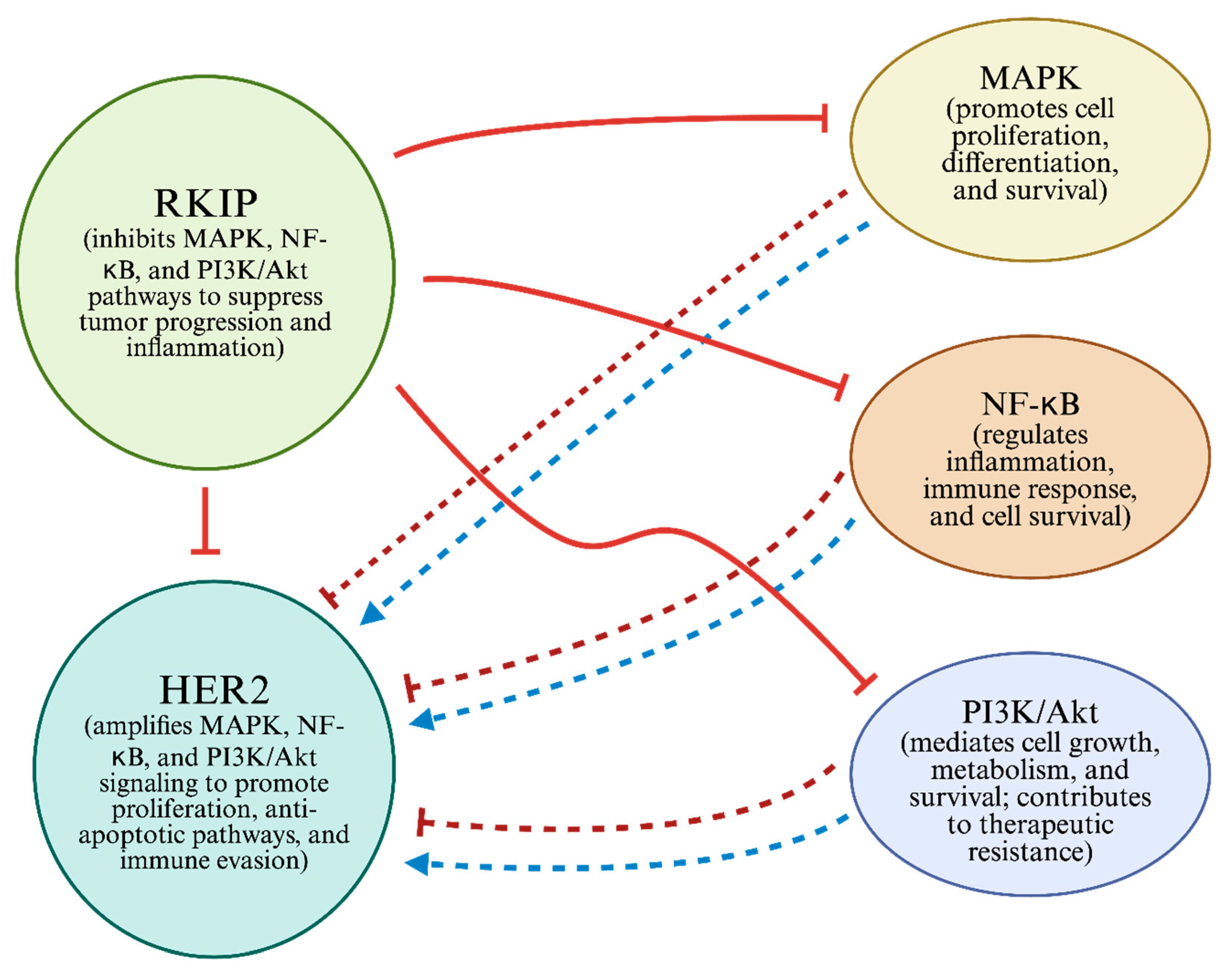
RKIP plays a central role in regulating oncogenic signaling pathways, many of which are often dysregulated in HER2+ BCs. HER2 expression is positively regulated by (i) the MAPK pathway, (ii) the NF-kB pathway, and (iii) the PI3K/Akt pathway, and RKIP negatively regulates each to varying degrees [12,133,134,135]. HER2 and RKIP co-regulate these major signaling pathways in an antagonistic manner, with HER2 acting as an upstream activator and RKIP serving as a suppressor of pathway activities.
The inhibitory function of RKIP has been demonstrated in HER2-overexpressing BT-474 BC cells, where RKIP reintroduction led to decreased ERK activity and impaired cellular proliferation. Similarly, NF-κB signaling, another downstream effector of HER2, is blocked by RKIP through inhibition of upstream kinases such as TAK1 and NIK, preventing NF-κB nuclear translocation and limiting pro-inflammatory transcription [23,24]. HER2 itself can activate NF-κB through PI3K/Akt-mediated phosphorylation of IKKa, promoting the transcription of NF-κB target genes involved in survival, inflammation, and immune evasion [24]. RKIP loss has also been linked to the epithelial–mesenchymal transition (EMT), a critical driver of metastasis and therapeutic resistance in HER2+ BCs. HER2 promotes EMT by activating TFs such as SNAIL and ZEB-1 [135,136,137,138,139,140,141]. In contrast, RKIP suppresses EMT by inhibiting NF-κB, repressing SNAIL transcription, and negatively regulating STAT3 activity, a major TF involved in tumor progression and resistance to HER2-targeted therapies [134,142,143]. This relationship between HER2 signaling and RKIP suggests an intricate axis in which HER2 promotes EMT and metastasis, while RKIP acts as a counter-regulatory molecule inhibiting these processes.
The opposing activities of HER2 and RKIP form a regulatory axis that determines the strength and persistence of oncogenic signaling in HER2+ BC. A defining feature of the RKIP-HER2 axis is the inverse correlation between HER2 overexpression and RKIP downregulation. While HER2 promotes oncogenic signaling and immune evasion, RKIP acts as a counterbalance, suppressing MAPK, NF-κB, and PI3K/Akt activities [144] (see Figure 1). In a recent study, Cardoso-Carneiro et al. [144] demonstrated a consistent inverse correlation between RKIP and EGFR expression across 25 of 30 solid tumor types in cervical cancer models. Their analyses revealed a feedback loop where RKIP loss increased EGFR transcription and phosphorylation, while EGFR overactivation suppressed RKIP expression. Although these findings are not BC-specific, the conserved role of HER-family signaling across epithelial tumors suggests that these findings are highly relevant to HER2+ BC. Given that HER2 and EGFR share structural and functional homologies and activate overlapping downstream pathways, the amplification of EGFR signaling upon RKIP loss supports a broader paradigm in which RKIP downregulation may similarly amplify HER2-driven oncogenic and immunosuppressive pathways in BC.
Altogether, the above findings highlight the RKIP–HER2 axis as a complex regulatory network in HER2-driven BCs, characterized by dynamic interplay between RKIP-mediated signaling suppression and HER2-driven oncogenic activation that collectively shapes tumor progression, therapeutic response, and disease aggressiveness. Loss of RKIP permits sustained HER2 signaling, immune suppression, and metastasis, whereas its restoration can simultaneously impair multiple tumor-promoting pathways. A deeper mechanistic understanding of RKIP’s role, especially regarding EMT, STAT3, and immunogenicity, may inform the development of more effective, targeted therapies. RKIP downregulation and HER2 activation reshape the tumor microenvironment and the immune response, underscoring their roles in immune evasion and setting the stage for further exploration of their immunological impact (Figure 1).

5. The RKIP-HER2 Axis in HER2+ BC and Immune Evasion

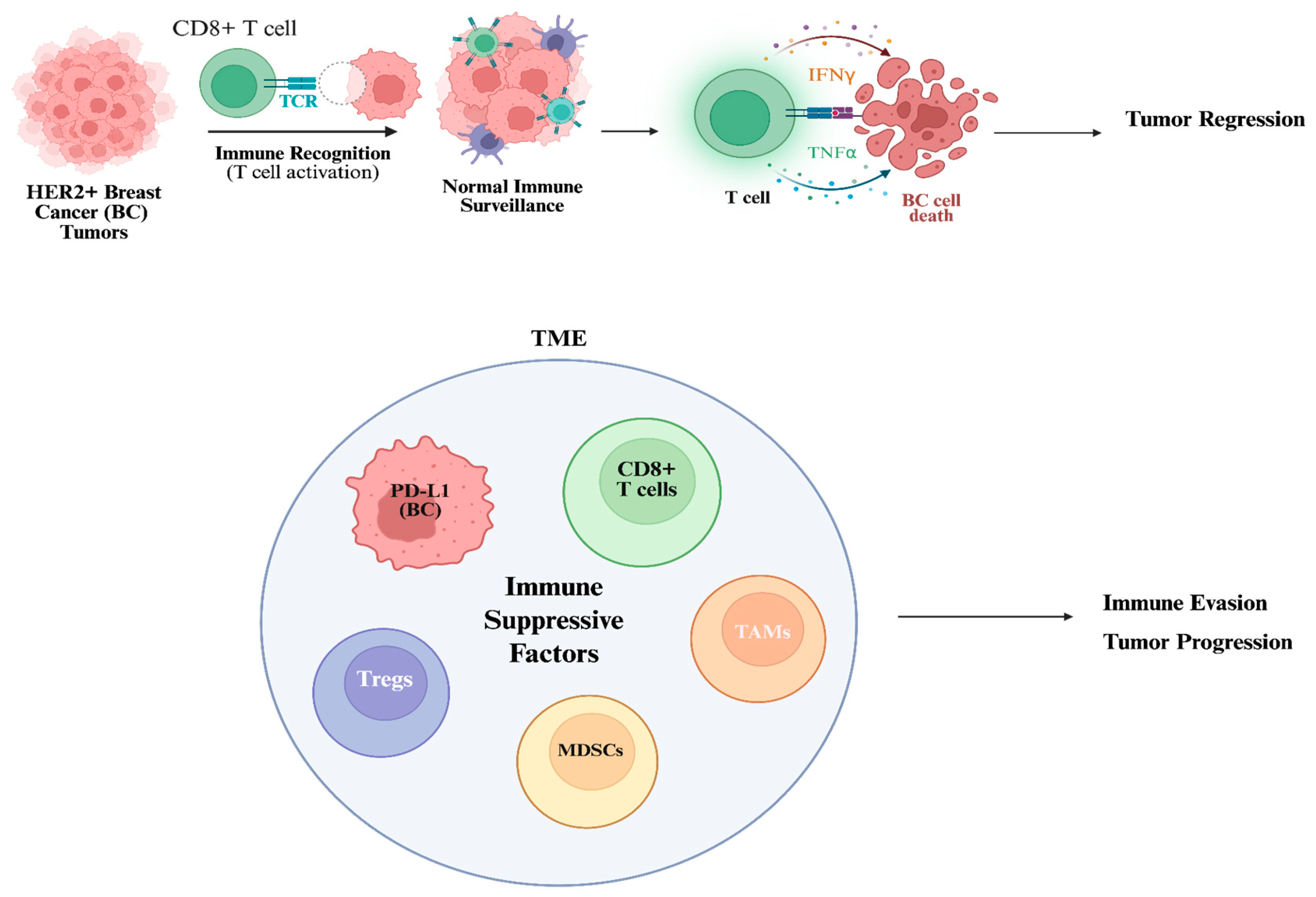
Immune evasion refers to the strategies by which cancer cells escape recognition and destruction by the immune system. These strategies fall into three broad categories—camouflage, coercion, and cytoprotection—as outlined in the conceptual framework proposed by Galassi and colleagues [147]. Within this, it involves antigen presentation, immune checkpoint molecules (e.g., PD-1/PD-L1), tumor plasticity, immunosuppressive immune cells, and T-cell exhaustion (Figure 2).
In HER2+ BC, trastuzumab-resistant tumors can exploit immune escape mechanisms to sustain tumor progression [148]. Such strategies include upregulating immune checkpoint proteins and recruiting immunosuppressive signals [149]. For example, Martinez et al. [149] reported a mechanism where BC cells can overexpress the neuropeptide, Neuromedin U (NmU), and their extracellular vesicles (EVs) to increase levels of transforming growth factor beta-1 (TGFβ1) and PD-L1, contributing to enhanced resistance to antibody-dependent cell cytotoxicity (ADCC) [149]. This mechanism is highly important, given that ADCC is one of trastuzumab’s primary mechanisms of action [149,150]. Clinically, TGFβ1 levels were also significantly higher in EVs isolated from the serum of HER2+ BC patients who did not respond to HER2-targeted treatments compared to those who experienced complete or partial responses [149,151]. Cytokines, such as tumor necrosis factor-alpha (TNFα), can also induce recruitment of immunosuppressive immune cells to promote trastuzumab resistance [152] (Figure 2). TNFα can upregulate the transmembrane glycoprotein MUC4 to shield the HER2 epitope through heavy glycosylation, hindering trastuzumab binding and therapeutic effects [152]. MUC4 expression is linked to an immune desert TME with low tumor-infiltrating lymphocytes (TILs), further contributing to immune evasion and poor response to therapy [152,153].
TME infiltration in HER2+ BC has also been associated with other inhibitory immune cells, including Tregs and MDSCs, correlating with poor survival [154] (Figure 2). In a real-world study involving 124 patients with HER2+ metastatic BC (mBC), Steenbruggen et al. [154] found that Treg infiltration was linked to reduced overall survival (OS) across the entire cohort and in patients who achieved radiological complete remission (rCR). Additionally, other T cell subsets, like CD8+ T cells, were associated with a trend toward decreased OS in patients with primary BC. In a study by Bailur et al. [155], patients who exhibited HER2-reactive CD8+ T cell responses and low levels of MDSCs had a 100% 5-year survival rate, in contrast to a 38% rate in those with elevated MDSCs and absent CD8+ responses [155] (Figure 2). Mechanistically, MDSCs may promote tumor progression through the induction of Tregs, as supported by earlier studies [156,157]. Furthermore, Treg infiltration has been linked to activation of the PI3K signaling pathway—a known driver of resistance in HER2+ and ER+ BC—highlighting a potential rationale for combining HER2-targeted therapies with PI3K inhibitors and agents that deplete Tregs [158,159].
In early-stage HER2+ BC, higher densities of stromal CD8+ and FOXP3+ T cells, as well as immune cell aggregates, were associated with achieving pathologic complete response (pCR) to neoadjuvant therapy [160]. Comparative studies indicate that HER2+ tumors harbor significantly higher densities of CD3+, CD8+, and Treg cells than HER2-negative tumors, suggesting a unique immune microenvironment that may influence treatment response [160,161,162,163]. Moreover, molecular subtyping has revealed at least five distinct HER2+ BC subtypes characterized by differences in both tumor-intrinsic and microenvironmental factors, which have allowed for the characterization and validation of molecular subtypes associated with the risk of distant recurrence in patients receiving adjuvant trastuzumab.
HER2 can further potentiate immune evasion mechanisms by upregulating immune checkpoint proteins (i.e., PD-1, PD-L1, CTLA-4, and LAG3) to inhibit cytotoxic CD8+ T cell activity [164,165]. In gastric cancer, studies have reported a direct association between HER2 and PD-L1 expression, whereby patient-derived organoid models demonstrated higher PD-L1 levels in HER2+ tumors compared to HER2-negative counterparts. PD-L1 expression was shown to be reduced following HER2 pathway inhibition [166,167,168,169,170]. Chakrabati et al. [167] also observed that reduced PD-L1 expression in gastric cancer organoids correlated with a significant increase in cytotoxic T lymphocyte (CTL) proliferation and survival, supporting the role of HER2-induced PD-L1 in tumor immune evasion.
Previously, we described an inverse relationship between RKIP and PD-L1 expression via cross-talk signaling, via pathways such as MAPK and JAK/STAT, or cytokines such as IFN-γ and IL-1β [171] (Figure 2). These analyses were also corroborated by bioinformatic analyses, which showed a significant negative mRNA correlation between RKIP and PD-L1 across multiple cancer types, including Breast Invasive Carcinoma (BRCA) [171]. As such, one mechanism contributing to immune evasion could be the downregulation of RKIP to promote PD-L1 expression, considering HER2′s positive relationship with PD-L1 in the TME.
While much attention has been given to TILs as favorable prognostic markers in HER2+ BC, emerging evidence highlights the significance of tumor-associated macrophages (TAMs) in their density, localization, and polarization state in influencing the efficacy of HER2-targeted therapies [172] (Figure 2). Studies have shown that high TAM infiltration, especially of the M2-like (CD163+) subtype, is associated with poor disease-free survival in BC, including the HER2+ subset [173,174]. In HER2-overexpressing tumors, TAMs can directly affect the response to trastuzumab and pertuzumab [173,174,175]. TAMs also contribute to a pro-tumorigenic microenvironment by secreting cytokines such as interleukin-8 (IL-8) and CCL2, which promote cancer cell migration, stemness, and EMT [176,177]. Conversely, RKIP expression has been shown to inhibit the recruitment of TAMs through suppression of the chemokine ligand 5 (CCL5) in TNBC, thereby reducing tumor vascularization and metastatic potential [10,178,179]. Experimental restoration of RKIP expression in BC cells with low baseline RKIP levels significantly decreases TAM infiltration in vivo, as demonstrated in orthotopic mouse models [178]. TAMs isolated from RKIP-expressing tumors show reduced capacity to secrete metastasis-promoting factors like progranulin (PRGN) and tumor necrosis factor receptor 2 (TNFR2) [177]. These effects are mediated through RKIP’s inhibition of CCL5, which disrupts macrophage chemotaxis and alters the tumor microenvironment’s pro-metastatic signaling landscape. These findings show promising evidence for RKIP as a negative regulator of TAMs in the HER2 tumor landscape—capable of limiting the recruitment of immunosuppressive immune cells.
In the context of tumor plasticity and stemness, HER2+ tumors often show features of EMT, which is linked to an immune-evasive phenotype. Gupta and Srivastava have noted specific mechanisms whereby HER2 can regulate the TGFβ/SMAD pathway by inducing TGFβ de novo to promote EMT in BC [141]. In HER2+ patients with PTEN loss, continual administration of trastuzumab has also led to EMT induction and subtype switching towards TNBC [180]. Conversely, RKIP normally suppresses EMT through the inhibition of EMT-related gene products like SNAI1, TWIST, ZEB, Vimentin, and Notch1 while upregulating the epithelial E-Cadherin [181,182]. In addition, RKIP can inhibit the NF-κB/SNAIL/YY1 circuit, a pathway critical for the early steps of EMT induction [135,183]. Further, HER2 also positively upregulates EMT factors downregulated by RKIP, such as ZEB1 and TWIST1, to support the acquisition of stem-like properties [141,184,185]. TWIST1 has also been implicated in CD8+ T cell exhaustion through PD-L1 upregulation in BC cells [186]. Cross-talk between RKIP and HER2 highlights their roles in maintaining epithelial identity and immune visibility, especially in the context of HER2+ BC. Thus, restoring RKIP function may be a critical node for overcoming resistance in aggressive BC subtypes that are resistant to first-line therapies and for inhibiting immune evasion.
Previous studies have that shown cell lines with high RKIP (MCF-7) have low metastatic potential, and overexpressing RKIP in TNBC cell lines (MDA-MB-231) was able to reduce their migratory pattern [15]. In addition, a study by Kalpana et al. has shown RKIP can suppress BC cell invasion (specifically in triple-negative basal epithelial-like BC cell lines) through RhoA-mediated regulation of E-cadherin with EMT-associated proteins and transcription factors (e.g., Snail, Slug, and ZEB1/2) [187]. Many other studies have also established RKIP as a potential inhibitor of EMT in BC [178,188].
At the same time, HER2+-specific evidence directly demonstrating that RKIP loss drives EMT in patient-derived HER2+ samples or dedicated HER2+ cell-line models remains limited. Briefly, existing datasets have not stratified EMT phenotypes by both HER2 status and RKIP expression, and functional studies in HER2-amplified contexts are largely lacking. To avoid overstating the current clinical evidence, (1) RKIP robustly modulates EMT and invasion in BC models in general, and (2) by analogy and pathway overlap, RKIP loss is strongly suspected—but not yet conclusively proven—to promote EMT in HER2+ BC. Collectively, these findings reinforce the multifaceted role of RKIP–HER2 cross-talk in shaping an immunosuppressive TME (Table 4).

6. Bioinformatics Analyses

To explore the potential roles of HER2 and RKIP in cancer biology, we performed a series of bioinformatics analyses using publicly available data from The Cancer Genome Atlas (TCGA) [189] and the Clinical Proteomic Tumor Analysis Consortium (CPTAC) [190]. Our study focused on the co-expression, dysregulation, phosphorylation, and survival impact of these two molecules across various cancer types.

6.1. Expression and Correlation Analyses

Utilizing the GEPIA2 platform with TCGA and GTEx datasets, we observed a significant positive correlation in mRNA expressions across 12 various cancers, including breast, bladder, glioblastoma, kidney, prostate cancers, etc. (Figure 3). This positive correlation was unexpected, given RKIP’s known role as a tumor suppressor. However, several factors could explain this observation. Firstly, mRNA expression does not always directly correlate with protein abundance, which aligns with our subsequent finding (discussed below) of inverse trends at the protein level in HER2+ BC. Secondly, mRNA analysis does not distinguish between the inactive phosphorylated and the active unphosphorylated forms of RKIP, and phosphorylated RKIP has been documented to have oncogenic roles in certain contexts.
In our study, mRNA-level analyses using large pan-cancer datasets showed an unexpected positive correlation of RKIP (PEBP1) expression across multiple tumor types, despite RKIP’s established function as a metastasis suppressor in experimental models. These transcriptomic data do not distinguish between active (unphosphorylated) and inactive (phosphorylated) RKIP, and, importantly, mRNA abundance frequently diverges from total and phospho-protein levels in clinical samples. Because currently available clinical datasets do not yet allow a clear separation of prognostic or predictive value for pRKIP versus unphosphorylated RKIP, these phospho-proteomic findings are hypothesis-generating, and the clinical significance of pRKIP and active RKIP remains unresolved.

6.2. Dysregulation of HER2 and RKIP Expressions in BC

In contrast to mRNA expression, protein-level analysis of RKIP using UALCAN [191] demonstrated a negative relationship pattern in BC subtypes, with RKIP significantly downregulated in HER2+, luminal, and triple-negative BC compared to normal tissues (Supplemental Figure S1). This downregulation is consistent with the previous literature and our hypothesis of an inverse relationship between RKIP and HER2 in the TME. To further elucidate the role of RKIP in cancer progression, we extended our investigation to analyze RKIP and pRKIP S60 protein expression patterns across various clinical stages and pan-cancer subtypes. This could provide useful insights to identify any subtype-specific trends for treatment stratification. Across the four clinical stages of BC, both RKIP and RKIP (S60) exhibit a similar decline in expression as BC progresses, with a few key differences between the two markers. The expression level of RKIP in normal tissue is notably higher compared to RKIP (S60), suggesting that RKIP has a higher baseline expression in normal tissues than its phosphorylated form. Additionally, RKIP (S60) exhibits a wider range of expression in the cancer stages, indicating greater variability in its levels during cancer progression. These differences between phosphorylated versions of RKIP are also highlighted in the pan-cancer proteomic profile of RKIP (Supplemental Figure S1).
Phosphorylated RKIP S60 is not currently recognized in the literature as a major regulatory site; in contrast, phosphorylation at Serine 153 (pRKIP-S153) is the best-characterized and functionally critical modification. Phosphorylation of S153 by PKC induces a conformational and binding shift in RKIP that leads to dissociation from Raf-1, thereby lifting its inhibitory effect on the MAP kinase pathway. This same modification promotes RKIP binding to GRK2, effectively switching its role from inhibiting Raf-1 to inhibiting G protein-coupled receptor (GPCR) signaling, with important consequences for cell proliferation and cancer metastasis. In our dataset, the “RKIP S60” signal originates from the UALCAN portal, where it represents a phosphosite-specific feature derived from large-scale phosphoproteomic analyses, in which any recurrently detected phosphoserine on RKIP is annotated as an individual variable. Thus, the S60-associated changes we report reflect a mass-spectrometry–defined phosphopeptide whose expression levels correlate with BC progression.
The pan-cancer subtypes K1 through K10 represent molecular classifications identified using mass-spectrometry-based proteomic data from CPTAC cohorts. These subtypes are characterized by distinct molecular signatures explained in these pan-cancer studies [192,193,194,195]. Briefly, K1 is associated with the proteasome complex and metabolic pathway proteins; K2 and K3 are linked to adaptive and innate immune responses, respectively; K4 represents basal-like BC with YAP1 and MYC target overexpression; K5 exhibits epithelial and normoxia signatures with oxidative phosphorylation proteins; K6 and K7 are stromal-related with distinct matrix protein expressions; K8 is associated with the Ras pathway; K9 is characterized by hemoglobin complex association; and K10 is linked to endoplasmic reticulum and steroid biosynthesis pathways. Supplemental Figure S1, which examines RKIP and RKIP (S60) expressions across these subtypes, reveals several important insights. Both forms show the highest RKIP expression in normal tissue, with significant downregulation in most cancer subtypes, supporting RKIP’s tumor suppressor role. Notably, RKIP shows no significant difference between normal tissue and the K1 subtype, while RKIP (S60) shows no significant difference between normal tissue and both K1 and K3 subtypes (Supplemental Figure S1). All other subtypes display significantly lower expression compared to normal tissue for both RKIP and RKIP (S60). The variability in expression across subtypes suggests subtype-specific regulation mechanisms. RKIP expression is relatively higher in K5 and K7 subtypes, while K2 and K6 exhibit the lowest levels. For RKIP (S60), K3 and K7 show relatively higher median expression levels. The greater variability observed in RKIP (S60) expression indicates more dynamic phosphorylation regulation in cancer. These expression patterns could have prognostic implications for targeting subtypes with lower RKIP expression for HER2+ BC.
Next, we looked at dysregulated expression levels of RKIP and HER2 between normal and tumor tissues. Consistent with the literature, HER2 was significantly overexpressed in BC tissues compared to normal tissues (p < 0.001) (Supplemental Figure S2). HER2 was also overexpressed in 12 out of the 33 TCGA cancer types (p < 0.01) (Supplemental Figure S3). Specifically, the 12 cancers include ACC, BRCA, CHOL, DLBC, GBM, KIRC, LUAD, PAAD, READ, SKCM, STAD, and THYM. In contrast, RKIP expression showed variability, with higher expression levels detected in THYM, CHOL, and DLBC. However, in tumors such as KIRC, PCPG, and SARC, downregulated RKIP expression levels were observed. In BRCA, RKIP is slightly upregulated; however, this is not statistically significant. Thus, the observed expression levels might reflect a subset of tumors where RKIP has not been entirely downregulated or where alternative regulatory mechanisms are in place.

6.3. Phosphorylation and Functional Profiling

Using UALCAN, we examined phosphorylation levels of HER2 and RKIP in BC. We observed significant decreases in phosphorylation at multiple HER2 amino acid sites (e.g., S1043, S1036, and Y1218) in breast tumor samples compared to normal tissues (Supplemental Figure S3), while HER2 phosphorylation at site Y1109 showed a significant increase in expression. We also observed significant phosphorylation of RKIP at site S60, but less than in normal tissues (Supplemental Figure S3), which might contribute to the regulatory interactions between RKIP and HER2. This finding corroborated our postulated positive correlation between HER2 and RKIP in BC (see Section 6.1).

6.4. Survival Analysis

Kaplan–Meier survival analyses and heatmaps were generated using GEIPA2 to assess the prognostic impact of HER2 and RKIP expressions on overall survival (OS) and disease-free survival (DFS) across various cancers. Each heatmap represents the log10-transformed hazard ratio (HR) values for a range of cancer types, where red indicates a positive HR (higher risk associated with higher expression) and blue indicates a negative HR (lower risk associated with higher expression). High HER2 expression acts as a significant adverse prognostic factor in Low-Grade Glioma (LGG), Ovarian Cancer (OV), and Skin Cutaneous Melanoma (SKCM), correlating with worse OS. Conversely, HER2 expression is a protective factor in various cancers such as kidney renal clear cell carcinoma (KIRC), MESO, COAD, and READ, where higher expression is linked to improved survival outcomes (Supplemental Figure S4). Similarly, RKIP expression is significantly associated with worse OS in SKCM. However, in many cancers, RKIP expression serves as a significant protective factor (LUAD, PAAD, UCEC, CESC, KIRC, LIHC, THCA), significantly improving both OS and DFS. The Kaplan–Meier plots further highlight the survival impact of RKIP and HER2 mRNA expression in BC. For RKIP, patients with low expression (red curve) have a better OS compared to those with high expression (blue curve), as shown by the log-rank p-value of 0.71 and HR suggesting worse survival outcomes for the high RKIP group. The possibilities of this were discussed earlier, pertaining to the roles between pRKIP and unphosphorylated RKIP. Similarly, for HER2, patients with high expression (red curve) show worse OS compared to the low HER2 group (blue curve), supported by a log-rank p-value of 0.09 and a corresponding HR (Supplemental Figure S4). These trends are suggestive and not statistically reliable. While the p-value meets conventional thresholds, we agree this reflects a modest trend rather than a robust prognostic signal, especially in TCGA-derived data prone to cohort heterogeneity.
Regarding the expectation that a classic tumor suppressor should show a strong association between low expression and worse overall survival, it is important to emphasize that RKIP functions primarily as a metastasis suppressor rather than a classic tumor suppressor like p53, meaning it permits primary tumor growth but inhibits later progression steps. This could explain the lack of clear OS prognostic significance in bulk analyses like TCGA, where high-RKIP tumors may still progress locally. In addition, associations with OS often lack statistical significance in large cohorts due to confounders like heterogeneous treatments, comorbidities, and competing risks (e.g., early deaths from non-metastatic causes).
Hagan et al.’s (CCR 2005) findings can also explain the positive mRNA correlations observed in bulk pan-cancer analyses like TCGA/GEPIA2, complementing the prior points on RKIP’s metastasis-suppressor role (rather than classic tumor suppression) and the disconnect between mRNA/protein forms [196].
The potential causes of the mRNA-protein discrepancy for RKIP include (1) post-transcriptional regulation (e.g., miRNA-mediated degradation, alternative splicing); (2) differential protein stability and turnover influenced by phosphorylation status or ubiquitination; (3) technical factors such as mRNA normalization in bulk TCGA data versus proteomics sensitivity for low-abundance proteins; and (4) intratumoral heterogeneity, where bulk mRNA averages mask protein-level losses in metastatic subclones.

7. Targeting the RKIP-HER2 Axis in HER2+ BC

Currently, several therapeutic modalities have been used to treat HER2 BC. Table 5 summarizes these modalities.
Multiple clinical studies demonstrate reduced or lost RKIP expression in lymph node metastases compared to matched primary breast tumors [10]. Additional evidence indicates that RKIP loss is associated with aggressive disease features and resistance to therapy [199]. However, HER2-specific longitudinal datasets remain limited. Various treatments for HER2-related BCs persist. Trastuzumab, lapatinib, pertuzumab, and margetuximab are standard therapies that have proven effective throughout years of use. Advances in understanding tumor immune surveillance have underscored the potential of immunotherapy as a treatment strategy for BC [148]. In this context, targeting the RKIP-HER2 axis and implementing strategies to restore RKIP function could present a novelty in therapeutic research as a cancer treatment, given RKIPs’ ability to block signaling pathways.
RKIP induction can occur in various ways. Some involve inhibiting RKIP repressors and suppressors such as SNAIL, BACH1, and EZH2 [39,63]. As EZH2 methyltransferase inhibitors, PCR2 inhibitors, and degradation take action, the induction of RKIP expression can be achieved as EZH2 is directly involved in suppressing RKIP and regulating its transcription in BC [39,63]. In particular, Ren et al. [39] demonstrated that RKIP inhibition leads to cancer cell invasion by EZH2. This suggests that by inhibiting EZH2, RKIP expression may be induced, which may impede tumor proliferation and progression. Other EZH2 inhibitors that may induce RKIP and inhibit HER2 include Tazemetostat (EPZ-6438, also known as Tazverik), GSK126, EPZ005687, and SHR2554. Tazemetostat can incorporate oncogenic signaling and immune modulation in inducing RKIP and inhibiting HER2 for cancer treatment. It has undergone several preclinical and clinical trials, demonstrating efficacy and high anti-cancer activity [200]. GSK126 is another selective EZH2 inhibitor that demonstrates anti-cancer properties by reducing H3K27me3 levels in tumors and altering oncogenic pathways. GSK126 has 1000 times more selectivity for EZH2 than the other 20 methyltransferases [200]. On the other hand, EPZ005687 was the first EZH2-specific inhibitor with high EZH2 affinity and has over 500-fold selectivity. However, its unsatisfactory pharmacokinetic characteristics result in limited clinical application [200]. On the same note, SHR2554 is a small-molecule EZH2 inhibitor and a growing therapeutic agent for cancer [200].
Furthermore, NO mediation has been shown to be effective in the chemical induction of RKIP [37,191,201,202]. An NO donor, DETANONOate, provides NO, and the overexpression of RKIP mimics NO in tumor cells, sensitizing them to apoptosis. As NO induces RKIP, SNAIL is repressed downstream of NFκB [36]. This NO donor also inhibits SNAIL, YY1, and NFκB, disrupting the NFκB/SNAIL/YY1/RKIP feedback loop [36,190,191]. NO nitrosylates YY1 and inhibits its DNA-binding activity; hence, it inhibits SNAIL expression, a repressor of RKIP, leading to RKIP expression [203].
Similarly, RKIP can be induced by inhibiting the NF-κB and SNAIL pathways. Proteasome inhibitors such as NPI-0052 or NF-κB inhibitors like Dehydroxymethylepoxyquinomicin (DHMEQ) [142] have shown effectiveness. NPI-0052, for example, blocks the transcription and expression of NF-κB promoter activity, leading to RKIP induction [36,204]. Baritaki et al. [36] also demonstrated that treatment with DHMEQ reduced SNAIL mRNA and increased RKIP mRNA levels. Findings also showed that treatment with DHMEQ enhanced apoptosis when combined with CDDP or TRAIL. With that said, both NPI-0052 and DHMEQ sensitize tumors to apoptosis by suppressing NF-κB and anti-apoptotic targets like Bcl-xL [36]. SNAIL siRNA treatment is another agent used to induce RKIP expression [142]. Immunomodulatory drugs, including antibodies like rituximab and LFB-R603, can also upregulate RKIP by targeting pathways such as NF-κB, PI3K/Akt, and ERK1/2 [142,205].
Another innovative approach that has emerged as a promising therapeutic for BC and restoring RKIP function involves Proteolysis-Targeting Chimeras (PROTACs) [206]. By harnessing a cell’s ubiquitin-proteasome system, PROTACs allocate targeted protein degradation and help overcome HER2 therapy resistance [206]. Specifically, in a study by Zhang et al. [206], PI3K PROTAC was examined for its ability to overcome HER2-targeted therapy resistance through induced PIK3CA gene mutation. Results revealed that the PI3K PROTAC demonstrated excellent efficacy in HER2+ resistant cell lines. Further analysis determined whether PI3K PROTAC had the potential to enhance the therapeutic effects of lapatinib, showing that PI3K PROTAC increased the sensitivity of lapatinib in BT474 and HER2+ cell lines [206]. Although drug resistance to anti-HER2 medications may develop due to PI3K-Akt-mTOR activation, PI3K inhibitors have the potential to reverse such resistance and resensitize cell lines to undergo repeated cycles of protein degradation, a mechanism that is reminiscent of RKIP’s inhibitory role on HER2-driven signaling through the same pathway [206]. PI3K PROTAC has demonstrated efficacy through degrading p110α and p85β [206]. However, other PROTACs, such as EZH2 PROTACs, can suppress BC cell growth by degrading EZH2. This degradation leads to lower target gene expression, contributing to the suppression of cancer cell growth [207]. Off-target effects, such as the degradation of non-specific proteins, variability in tumor microenvironment, and immunogenicity, are factors that may hinder and pose challenges to PROTAC effectiveness, similar to other therapeutic approaches.
In addition to the promise of PROTACs in overcoming HER2 therapy resistance, nanotechnology has advanced the development of novel therapeutic approaches for treating BC. A study by Zhang et al. [208] demonstrated the design of non-toxic transformable peptides that bind to HER2 on cancer cells. These peptides then transform into nanofibrils upon binding, disrupting HER2 dimerization and signaling, ultimately leading to cancer cell death. This process blocks cell proliferation, impeding signaling pathways supporting tumor progression [208].
Photodynamic therapy (PDT) also emerges as an innovative therapeutic approach to induce RKIP and reverse resistance [209]. PDT combines photosensitizers, light, and oxygen to produce reactive oxygen species (ROS) and NO, which can promote cell apoptosis and autophagy [209,210,211]. PDT enhances its inhibitory effects through these mechanisms, inducing RKIP expression and disrupting resistance pathways.
Further supporting innovative strategies, a study by Yun et al. [40] identified RKIP as a prominent BC biomarker. The study found that RKIP induces the expression of let-7, suppressing tumor progression by blocking novel targets of let-7, including BACH1 and HMGA2. By blocking these targets, RKIP contributes to BC development and suppression, thereby reinforcing the potential RKIP holds as a novel form of treatment in combating HER2+ BC.
The potential of immune checkpoint inhibitors (ICIs) has also emerged in many clinical trials to overcome immune evasion mechanisms in HER2+ BC. For example, the PANACEA trial assessed a PD-1 inhibitor with trastuzumab in trastuzumab-resistant, advanced HER2+ BC through two-phase cohorts, which demonstrated efficacy and safety in treating patients with programmed cell death 1 ligand 1 (PD-L1)-positive tumors that are also trastuzumab-resistant in advanced HER2+ BC [212]. However, the KATE2 trial, a randomized, double-blind, placebo-controlled study, evaluated the combination of atezolizumab, a PD-L1 inhibitor, with trastuzumab emtansine in patients with HER2+ advanced BC [213]. Results showed that the combination did not provide a meaningful improvement, as the progression-free survival median was 8.2 months for the atezolizumab group and 6.8 months for the placebo group, with a 0.82 hazard ratio (p = 0.33), highlighting no meaningful clinical benefit [213].
Despite advancements in HER2-targeted therapies, resistance to these treatments remains a major challenge, and primary resistance can occur due to impaired drug binding or constitutive activation of downstream signaling pathways, while acquired resistance often arises from the selection of subclones with genetic alterations that bypass HER2 inhibition [214]. Mechanisms such as activation of parallel pathways (e.g., MET and FGFR), mutations in PI3K/Akt, and metabolic reprogramming contribute to therapeutic resistance [215]. Additionally, HER2 overexpression itself can play a role in resistance by promoting receptor dimerization and sustained signaling, even in the presence of targeted agents, which can potentially lead to PI3K/Akt activation, contributing to treatment resistance [216]. Moreover, reduced immune system activation in the tumor microenvironment limits the effectiveness of immunotherapies.
ADCs represent a targeted therapeutic strategy that combines the specificity of monoclonal antibodies with the cytotoxic potency of small-molecule payloads [217]. In HER2+ BC, trastuzumab deruxtecan has demonstrated superior clinical efficacy compared to earlier HER2-directed therapies, owing to its high drug-to-antibody ratio, cleavable linker, and membrane-permeable payload, which enable killing in heterogeneous tumors [218,219].
Beyond direct cytotoxicity, emerging evidence indicates that ADCs can exert immunomodulatory effects within the TME [217,220]. ADC-induced tumor cell death can promote immunogenic cell death, leading to enhanced antigen release, dendritic cell activation, and improved CD8+ T-cell priming [220]. In addition, HER2-targeted ADCs retain Fc-mediated immune functions, including antibody-dependent cellular cytotoxicity (ADCC), further contributing to anti-tumor immune responses [221,222,223].
Given the central role of immune evasion mechanisms in therapy resistance, ADCs represent a clinically relevant platform that intersects targeted cytotoxicity with immune modulation.

8. Discussion, Challenges, and Future Perspectives

While RKIP’s role as a tumor suppressor has been extensively studied over the past decades, its function in regulating immune responses has only recently begun to be elucidated in vivo. Emerging evidence highlights RKIP as a promising immune modulator in BC, a finding of relevance given the persistent challenge of immune evasion in HER2+ BC, especially in patients with de novo stage IV disease or acquired resistance to trastuzumab. We suspect an inverse relationship between RKIP and HER2 that is central to immune suppression and evasion. The downregulation of RKIP correlates with overexpression of HER2, contributing to an immunosuppressive TME and enhanced tumor immune evasion. These findings provide compelling evidence for the existence of a dysregulated RKIP-HER2 axis as a critical regulator of anti-tumor immunity in HER2+ BC.
RKIP has long been established as a metastasis suppressor and negative regulator of the MAPK/ERK signaling pathway, and its deficiency correlates with HER2 activation. HER2 signaling is linked to immune evasion through downstream activation of the PI3K/Akt and STAT3 pathways, upregulating immune checkpoint molecules such as PD-L1 and promoting the secretion of immunosuppressive cytokines. These changes not only impair cytotoxic T-cell infiltration but also enhance the recruitment and polarization of regulatory T cells and myeloid-derived suppressor cells, creating a permissive niche for tumor progression. Restoration of RKIP expression in HER2-overexpressing cells results in diminished PD-L1 expression and improves T-cell activation, underscoring the therapeutic potential of modulating this axis.
Recent reviews and original studies have highlighted how dysregulated oncogenic signaling pathways contribute to immune escape and resistance to both targeted therapies and immunotherapy in BC [147,224]. Additional recent reports have emphasized the role of HER2-directed therapies, including ADCs, in reshaping the TME and improving anti-tumor immunity, particularly when combined with immune-based strategies [222,223,224,225].
Compelling data additionally support the cross-talk between HER2 and RKIP within the tumor milieu. Beyond its direct effects on tumor cells, RKIP modulates the TME by restricting TAM recruitment through the suppression of chemokines, such as CCL5, and by blocking HMGA2-mediated pathways [178]. Since TAMs are major sources of PD-L1 and contribute to resistance to HER2-targeted therapies, RKIP’s ability to limit TAM infiltration may enhance anti-tumor immunity and improve therapeutic efficacy.
Our bioinformatics analyses revealed an inverse correlation between RKIP expression and HER2+ BC across multiple subtypes. Interestingly, mRNA-level analyses showed a positive association between RKIP and HER2, potentially reflecting the prevalence of phosphorylated (and thus functionally inactive) RKIP isoforms. To address this discrepancy, we have evaluated multiple strategies—both direct transcriptional activation and indirect pathway modulation—to upregulate functional RKIP in HER2+ BC models, emphasizing the need for systematic validation through preclinical investigations followed by clinical translation. We also found that RKIP-low/HER2-high tumors were associated with poor infiltration of CD8+ T cells and higher expression of immune exhaustion markers. These findings align with recent observations that HER2-positive tumors with low immunogenicity exhibit limited response to immune checkpoint blockade (ICB).
Recent system-level analyses further reveal that RKIP and the pro-metastatic transcription factor BACH1 operate as mutually antagonistic regulators of cancer cell plasticity and immune evasion [226]. While BACH1 drives EMT, stemness, and immune checkpoint expression, RKIP maintains an epithelial phenotype, suppresses EMT, and correlates with improved patient survival. This antagonism extends to the regulation of immune cell infiltration and checkpoint protein expression, reinforcing RKIP’s broader impact in the TME. Although some resistance mechanisms, such as epigenetic alterations and the reactivation of the PI3K/Akt/mTOR axis, have been characterized in both preclinical and clinical settings, further research is needed to refine combination therapies to delay or overcome resistance in metastatic HER2+ BC [28].
Across various cancers, RKIP plays a pleiotropic role in suppressing metastasis and reshaping the TME. By downregulating checkpoints, inhibiting pro-metastatic signaling, and limiting the recruitment of immunosuppressive TAMs, RKIP emerges as a central node in the regulation of cancer-immune interactions. Strategies to restore or mimic RKIP function, or to combine HER2-targeted therapies with TAM or checkpoint inhibitors, offer a promising route to enhance efficacy and overcome resistance.
Clinically, the inverse relationship between RKIP and HER2 expression may have prognostic significance. Targeting the RKIP-HER2 axis could reprogram the TME and sensitize tumors to immunotherapy. Combinatorial strategies involving HER2 inhibitors (e.g., trastuzumab, pertuzumab) and immunomodulatory agents, particularly in RKIP-low tumors, are warranted. Additionally, pharmacologic or gene therapy-based restoration of RKIP may represent a novel strategy to enhance tumor immunogenicity.
Current evidence supports a reproducible inverse relationship between RKIP and HER2 signaling activity at the mechanistic and bioinformatic levels; however, definitive prognostic significance has not yet been established. While inverse expression patterns are observed across multiple datasets, survival correlations are modest and cohort-dependent. We therefore emphasize that the RKIP-HER2 relationship is biologically meaningful but requires validation in large, clinically annotated HER2+ BC cohorts before being considered prognostic.

Supplementary Materials

The following supporting information can be downloaded at: https://www.mdpi.com/article/10.3390/cells15040319/s1, Figure S1: RKIP and RKIP (S60) Proteomic Expressions. RKIP and RKIP (S60) proteomic expression profiles across major subclasses (A), clinical stages (B), and pan-cancer subtypes (C) of breast cancer (BC), analyzed using UALCAN from CPTAC datasets. Boxplots represent the Z-scores of expression levels, with statistical significance denoted by asterisks (* p < 0.05, ** p < 0.01, *** p < 0.001, **** p < 0.0001, ns = not significant). Each panel highlights the differential expression trends of RKIP and RKIP (S60) in normal tissue and cancer categories; Figure S2: Expression Analysis of RKIP and HER2 Expression in Various Cancers. Box plots illustrate the differential expression of HER2 and RKIP in tumor versus normal tissues across various cancer types. The analysis highlights significant dysregulation (p < 0.01) of these genes in tumor samples compared to normal tissues. Gene expression data were retrieved from TCGA. Abbreviations: ACC, Adrenocortical carcinoma; CHOL, Cholangiocarcinoma; DLBC, Lymphoid Neoplasm Diffuse Large B-cell Lymphoma; READ, Rectum adenocarcinoma; STAD, Stomach adenocarcinoma; Figure S3: RKIP and HER2 Phosphorylation Sites. The figure shows box plots of phosphorylation levels of HER2 at different phosphorylation sites (T671, S1036, S1043, Y1109, and Y1218) and RKIP at S60. Phosphorylation levels are represented by Z-values, indicating deviations from the median. Differences between normal tissues (n = 18) and primary tumors (n = 125) are shown, with p-values indicating statistical significance for each phosphorylation site. The data is derived from log2 spectral count ratio values from the CPTAC dataset, normalized within each sample and across samples to account for variations; Figure S4: Heatmaps and Kaplan-Meier plots of RKIP and HER2 mRNA expression in various cancers using GEPIA 2 with TCGA datasets. (A) Heatmaps show log10-transformed hazard ratios (HR) for overall survival (OS) and disease-free survival (DFS), with significant associations outlined in bold. Red indicates adverse prognosis (higher expression linked to worse survival), while blue indicates protective prognosis. (B) Kaplan-Meier plots demonstrate OS for RKIP and HER2 in BC, with significant differences between high- and low-expression groups.

Funding

This research received no external funding.

Data Availability Statement

No new data were created or analyzed in this study.

Acknowledgments

We acknowledge the UCLA Department of Microbiology, Immunology & Molecular Genetics and the Jonsson Comprehensive Cancer Center for their support. We also acknowledge the UCLA Jonsson Comprehensive Cancer Center’s Office of Cancer Training and Education (OCTE) for their continuous support and assistance.

Conflicts of Interest

The authors declare no conflicts of interest. A poster was presented at a conference and its abstract was published as follows: PCO25-215: The RKIP-HER2 Axis in Breast Cancer and Role in Immune Evasion. Khachikian A, Ho M, Bonavida B.J Natl Compr Canc Netw. 2025 Mar 28;23(3.5):PCO25-215. doi:10.6004/jnccn.2024.7301 [227]. This abstract has little common features to this review and there were no additional materials used for this poster presentation.

Abbreviations

The following abbreviations are used in this manuscript:
Akt Protein Kinase B
BACH1 Basic Leucine Zipper Transcription Factor 1
BC Breast Cancer
BRCA Breast Invasive Carcinoma
CCL5 Chemokine Ligand 5
CD8+ Cluster of Differentiation 8 Positive
CHOL Cholangiocarcinoma
CPTAC Clinical Proteomic Tumor Analysis Consortium
DFS Disease-Free Survival
DLBC Diffuse Large B-Cell Lymphoma
E1A Adenovirus Early Region 1A
EGR2 Early Growth Response Protein 2
EMT Epithelial–Mesenchymal Transition
ERK Extracellular Signal-Regulated Kinase
ETS E26 Transformation-Specific
EZH2 Enhancer of Zeste Homolog 2
FOXP3 Forkhead Box Protein P3
GATA4 GATA-Binding Protein 4
GRK2 G-Coupled Receptor Kinase 2
HER2 Human Epidermal Growth Factor Receptor 2
HGE HER2 Gene Body Enhancer
Hsp90 Heat Shock Protein 90
KIRC Kidney Renal Clear Cell Carcinoma
lncRNA Long Non-Coding RNA
MAPK Mitogen-Activated Protein Kinase
MBP-1 c-Myc Promoter-Binding Protein-1
MDSCs Myeloid-Derived Suppressor Cells
miRNA microRNA
mTOR Mammalian Target of Rapamycin
MYB Myeloblastosis Oncogene
NF-κB Nuclear Factor Kappa B
NOTCH Notch Receptor
OS Overall Survival
pCR Pathologic Complete Response
PD-1 Programmed Death-1
PD-L1 Programmed Death-Ligand 1
PEA3 Polyomavirus Enhancer Activator 3
PI3K Phosphoinositide 3-Kinase
PIs Proteasome Inhibitors
PKCζProtein Kinase C Zeta
PRC2 Polycomb Repressive Complex 2
PRLR Prolactin Receptor
RBP-Jk Recombination Signal Binding Protein for Immunoglobulin Kappa J Region
READ Rectum Adenocarcinoma
RKIP Raf Kinase Inhibitor Protein
S60 Phosphorylation Sites
SKCM Skin Cutaneous Melanoma
Sp1 Specificity Protein 1
STAT3 Signal Transducer and Activator of Transcription 3
TAMs Tumor-Associated Macrophages
TCGA The Cancer Genome Atlas
THYM Thymoma
TFAP2 Transcription Factor Activator Protein 2
TFs Transcription Factors
TNBC Triple-Negative Breast Cancer
Tregs Regulatory T Cells
UALCAN University of Alabama at Birmingham Cancer Data Portal
YY1 Yin Yang 1

References

  1. World Health Organization. Breast Cancer: Prevention and Control; World Health Organization: Geneva, Switzerland, 2024. [Google Scholar]
  2. Kim, J.; Harper, A.; McCormack, V.; Sung, H.; Houssami, N.; Morgan, E.; Mutebi, M.; Garvey, G.; Soerjomataram, I.; Fidler-Benaoudia, M.M. Global patterns and trends in breast cancer incidence and mortality across 185 countries. Nat. Med. 2025, 31, 1154–1162. [Google Scholar] [CrossRef]
  3. Burguin, A.; Diorio, C.; Durocher, F. Breast cancer treatments: Updates and new challenges. J. Pers. Med. 2021, 11, 808. [Google Scholar] [CrossRef] [PubMed]
  4. Exman, P.; Tolaney, S.M. HER2-positive metastatic breast cancer: A comprehensive review. Clin. Adv. Hematol. Oncol. 2021, 19, 40–50. [Google Scholar] [PubMed]
  5. Swain, S.M.; Shastry, M.; Hamilton, E. Targeting HER2-positive breast cancer: Advances and future directions. Nat. Rev. Drug Discov. 2023, 22, 101–126. [Google Scholar] [CrossRef] [PubMed]
  6. Slamon, D.J.; Leyland-Jones, B.; Shak, S.; Fuchs, H.; Paton, V.; Bajamonde, A.; Fleming, T.; Eiermann, W.; Wolter, J.; Pegram, M.; et al. Use of chemotherapy plus a monoclonal antibody against HER2 for metastatic breast cancer that overexpresses HER2. N. Engl. J. Med. 2001, 344, 783–792. [Google Scholar] [CrossRef] [PubMed]
  7. Yoon, J.; Oh, D. HER2-targeted therapies beyond breast cancer—An update. Nat. Rev. Clin. Oncol. 2024, 21, 675–700. [Google Scholar] [CrossRef]
  8. Swain, S.M.; Baselga, J.; Kim, S.B.; Ro, J.; Semiglazov, V.; Campone, M.; Ciruelos, E.; Ferrero, J.M.; Schneeweiss, A.; Heeson, S.; et al. Pertuzumab, trastuzumab, and docetaxel in HER2-positive metastatic breast cancer. N. Engl. J. Med. 2015, 372, 724–734. [Google Scholar] [CrossRef]
  9. Hurvitz, S.A.; Hegg, R.; Chung, W.P.; Im, S.A.; Jacot, W.; Ganju, V.; Chiu, J.W.Y.; Xu, B.; Hamilton, E.; Madhusudan, S.; et al. Trastuzumab deruxtecan versus trastuzumab emtansine in patients with HER2-positive metastatic breast cancer: Updated results from DESTINY-Breast03, a randomised, open-label, phase 3 trial. Lancet 2023, 401, 105–117. [Google Scholar] [CrossRef]
  10. Figy, C.; Guo, A.; Fernando, V.R.; Furuta, S.; Al-Mulla, F.; Yeung, K.C. Changes in expression of tumor suppressor gene RKIP impact how cancers interact with their complex environment. Cancers 2023, 15, 958. [Google Scholar] [CrossRef]
  11. Cheng, X. A comprehensive review of HER2 in cancer biology and therapeutics. Genes 2024, 15, 903. [Google Scholar] [CrossRef]
  12. Yeung, K.; Seitz, T.; Li, S.; Janosch, P.; McFerran, B.; Kaiser, C.; Fee, F.; Katsanakis, K.D.; Rose, D.W.; Mischak, H.; et al. Suppression of Raf-1 kinase activity and MAP kinase signalling by RKIP. Nature 1999, 401, 173–177. [Google Scholar] [CrossRef]
  13. Escara-Wilke, J.; Yeung, K.; Keller, E.T. Raf kinase inhibitor protein (RKIP) in cancer. Cancer Metastasis Rev. 2012, 31, 615–620. [Google Scholar] [CrossRef] [PubMed]
  14. Ullah, R.; Yin, Q.; Snell, A.H.; Wan, L. RAF–MEK–ERK pathway in cancer evolution and treatment. Semin. Cancer Biol. 2022, 85, 123–154. [Google Scholar] [CrossRef]
  15. Lai, T.H.; Ahmed, M.; Hwang, J.S.; Bahar, M.E.; Pham, T.M.; Yang, J.; Kim, W.; Maulidi, R.F.; Lee, D.K.; Kim, D.H.; et al. Manipulating RKIP reverses the metastatic potential of breast cancer cells. Front. Oncol. 2023, 13, 1189350. [Google Scholar] [CrossRef]
  16. Beach, S.; Tang, H.; Park, S.; Dhillon, A.S.; Keller, E.T.; Kolch, W.; Yeung, K.C. Snail is a repressor of RKIP transcription in metastatic prostate cancer cells. Oncogene 2008, 27, 2243–2248. [Google Scholar] [CrossRef]
  17. Wei, H.; Gao, H.Q.; Li, H.B.; Qi, S.J.; Liu, W.L.; Xu, L.; Li, H.; Liu, J.X.; Dong, Z.M. Correlation among RKIP expression, NF-κB p65 levels, and T-lymphocyte subsets in gastric cardia adenocarcinoma. Genet. Mol. Res. GMR 2015, 14, 16491–16496. [Google Scholar] [CrossRef]
  18. Lee, J.; Lee, J.; Farquhar, K.S.; Yun, J.; Frankenberger, C.A.; Bevilacqua, E.; Yeung, K.; Kim, E.J.; Balázsi, G.; Rosner, M.R. Network of mutually repressive metastasis regulators can promote cell heterogeneity and metastatic transitions. Proc. Natl. Acad. Sci. USA 2014, 111, E364–E373. [Google Scholar] [CrossRef]
  19. Zaravinos, A.; Bonavida, B.; Chatzaki, E.; Baritaki, S. RKIP: A key regulator in tumor metastasis initiation and resistance to apoptosis: Therapeutic targeting and impact. Cancers 2018, 10, 287. [Google Scholar] [CrossRef] [PubMed]
  20. Crassini, K.; Pyke, T.; Shen, Y.; Stevenson, W.S.; Christopherson, R.I.; Mulligan, S.P.; Best, O.G. Inhibition of the Raf-1 kinase inhibitory protein (RKIP) by locostatin induces cell death and reduces the CXCR4-mediated migration of chronic lymphocytic leukemia cells. Leuk. Lymphoma 2018, 59, 2917–2928. [Google Scholar] [CrossRef] [PubMed]
  21. Bonavida, B.; Baritaki, S. Prognostic and therapeutic applications of RKIP in cancer. In RKIP in Cancer Metastasis and Drug Resistance; Bonavida, B., Baritaki, S., Eds.; Academic Press: Cambridge, MA, USA, 2020; pp. 323–333. [Google Scholar]
  22. Al-Mulla, F.; Marafie, M.; Tan, T.Z.; Thiery, J.P. Raf kinase inhibitory protein role in the molecular subtyping of breast cancer. J. Cell. Biochem. 2014, 115, 488–497. [Google Scholar] [CrossRef]
  23. Al-Mulla, F.; Bitar, M.S.; Thiery, J.P.; Zea, T.T.; Chatterjee, D.; Bennett, L.; Park, S.; Edwards, J.; Yeung, K.C. Clinical implications for loss or diminution of expression of Raf-1 kinase inhibitory protein and its phosphorylated form in ductal breast cancer. Am. J. Cancer Res. 2013, 3, 446–464. [Google Scholar]
  24. Chatterjee, D.; Bai, Y.; Wang, Z.; Beach, S.; Mott, S.; Roy, R.; Braastad, C.; Sun, Y.; Mukhopadhyay, A.; Aggarwal, B.B.; et al. RKIP sensitizes prostate and breast cancer cells to drug-induced apoptosis. J. Biol. Chem. 2004, 279, 17515–17523. [Google Scholar] [CrossRef] [PubMed]
  25. Li, H.Z.; Gao, Y.; Zhao, X.L.; Liu, Y.X.; Sun, B.C.; Yang, J.; Yao, Z. Effects of Raf Kinase Inhibitor Protein Expression on Metastasis and Progression of Human Breast Cancer. Mol. Cancer Res. 2009, 7, 832–840. [Google Scholar] [CrossRef]
  26. Zhang, D.; Tai, L.K.; Wong, L.L.; Putti, T.C.; Sethi, S.K.; Teh, M.; Koay, E.S.C. Proteomic characterization of differentially expressed proteins in breast cancer: Expression of hnRNP H1, RKIP and GRP78 is strongly associated with HER-2/neu status. Proteom.—Clin. Appl. 2008, 2, 99–107. [Google Scholar] [CrossRef]
  27. Campiglio, M.; Bufalino, R.; Sasso, M.; Ferri, E.; Casalini, P.; Adamo, V.; Fabi, A.; Aiello, R.; Riccardi, F.; Valle, E.; et al. Effect of adjuvant trastuzumab treatment in conventional clinical setting: An observational retrospective multicenter Italian study. Breast Cancer Res. Treat. 2013, 141, 101–110. [Google Scholar] [CrossRef]
  28. Vernieri, C.; Milano, M.; Brambilla, M.; Mennitto, A.; Maggi, C.; Cona, M.S.; Prisciandaro, M.; Fabbroni, C.; Celio, L.; Mariani, G.; et al. Resistance mechanisms to anti-HER2 therapies in HER2-positive breast cancer: Current knowledge, new research directions and therapeutic perspectives. Crit. Rev. Oncol./Hematol. 2019, 139, 53–66. [Google Scholar] [CrossRef]
  29. Chen, X.G.; Liu, F.; Song, X.F.; Wang, Z.H.; Dong, Z.Q.; Hu, Z.Q.; Lan, R.Z.; Guan, W.; Zhou, T.G.; Xu, X.M.; et al. Rapamycin regulates Akt and ERK phosphorylation through mTORC1 and mTORC2 signaling pathways. Mol. Carcinog. 2010, 49, 603–610. [Google Scholar] [CrossRef]
  30. Saxton, R.A.; Sabatini, D.M. mTOR signaling in growth, metabolism, and disease. Cell 2017, 168, 960–976. [Google Scholar] [CrossRef] [PubMed]
  31. Hassan, B.; Akcakanat, A.; Holder, A.M.; Meric-Bernstam, F. Targeting the PI3-kinase/Akt/mTOR signaling pathway. Surg. Oncol. Clin. N. Am. 2013, 22, 641–664. [Google Scholar] [CrossRef] [PubMed]
  32. Pan, L.; Li, J.; Xu, Q.; Gao, Z.; Yang, M.; Wu, X.; Li, X. HER2/PI3K/AKT pathway in HER2-positive breast cancer: A review. Medicine 2024, 103, e38508. [Google Scholar] [CrossRef]
  33. Moasser, M.M. The oncogene HER2: Its signaling and transforming functions and its role in human cancer pathogenesis. Oncogene 2007, 26, 6469–6487. [Google Scholar] [CrossRef]
  34. De Castro, J.; Odeh, H.N.; Figy, C.; Yeung, M.L.; Trumbly, R.; Yeung, K.C. Regulation of RKIP expression in breast cancer cells by miRNAs. In Prognostic and Therapeutic Applications of RKIP in Cancer; Bonavida, B., Baritaki, S., Eds.; Academic Press: Cambridge, MA, USA, 2020; pp. 139–146. [Google Scholar] [CrossRef]
  35. Papale, M.; Netti, G.S.; Stallone, G.; Ranieri, E. Understanding mechanisms of RKIP regulation to improve the development of new diagnostic tools. Cancers 2022, 14, 5070. [Google Scholar] [CrossRef] [PubMed]
  36. Bonavida, B.; Baritaki, S. Dual role of NO donors in the reversal of tumor cell resistance and EMT: Downregulation of the NF-κB/Snail/YY1/RKIP circuitry. Nitric Oxide 2011, 24, 1–7. [Google Scholar] [CrossRef]
  37. Yesilkanal, A.E.; Rosner, M.R. Targeting Raf kinase inhibitory protein regulation and function. Cancers 2018, 10, 306. [Google Scholar] [CrossRef] [PubMed]
  38. Özenver, N.; Efferth, T. Therapeutic targeting of SNAIL, RKIP, and YY1 in tumor metastasis and drug resistance. In Prognostic and Therapeutic Applications of RKIP in Cancer; Bonavida, B., Baritaki, S., Eds.; Academic Press: Cambridge, MA, USA, 2020; pp. 357–387. [Google Scholar] [CrossRef]
  39. Ren, G.; Baritaki, S.; Marathe, H.; Feng, J.; Park, S.; Beach, S.; Bazeley, P.S.; Beshir, A.B.; Fenteany, G.; Mehra, R.; et al. Polycomb protein EZH2 regulates tumor invasion via the transcriptional repression of the metastasis suppressor RKIP in breast and prostate cancer. Cancer Res. 2012, 72, 3091–3104. [Google Scholar] [CrossRef]
  40. Yun, J.; Frankenberger, C.A.; Kuo, W.L.; Boelens, M.C.; Eves, E.M.; Cheng, N.; Liang, H.; Li, W.H.; Ishwaran, H.; Minn, A.J.; et al. Signalling pathway for RKIP and Let-7 regulates and predicts metastatic breast cancer. EMBO J. 2011, 30, 4500–4514. [Google Scholar] [CrossRef]
  41. Datar, I.; Tegegne, H.; Qin, K.; Al-Mulla, F.; Bitar, M.S.; Trumbly, R.J.; Yeung, K.C. Genetic and epigenetic control of RKIP transcription. Crit. Rev. Oncog. 2014, 19, 417–430. [Google Scholar] [CrossRef]
  42. Duan, R.; Du, W.; Guo, W. EZH2: A novel target for cancer treatment. J. Hematol. Oncol. 2020, 13, 104. [Google Scholar] [CrossRef]
  43. Pasquinelli, A.E. MicroRNAs and their targets: Recognition, regulation and an emerging reciprocal relationship. Nat. Rev. Genet. 2012, 13, 271–282. [Google Scholar] [CrossRef] [PubMed]
  44. Li, J.; Wang, Y.; Song, Y.; Fu, Z.; Yu, W. miR-27a regulates cisplatin resistance and metastasis by targeting RKIP in human lung adenocarcinoma cells. Mol. Cancer 2014, 13, 193. [Google Scholar] [CrossRef]
  45. Du, Y.; Liu, X.H.; Zhu, H.C.; Wang, L.; Ning, J.Z.; Xiao, C.C. MiR-543 promotes proliferation and epithelial-mesenchymal transition in prostate cancer via targeting RKIP. Cell. Physiol. Biochem. 2017, 41, 1135–1146. [Google Scholar] [CrossRef]
  46. Huang, L.; Dai, T.; Lin, X.; Zhao, X.; Chen, X.; Wang, C.; Li, X.; Shen, H.; Wang, X. MicroRNA-224 targets RKIP to control cell invasion and expression of metastasis genes in human breast cancer cells. Biochem. Biophys. Res. Commun. 2012, 425, 127–133. [Google Scholar] [CrossRef]
  47. Liu, H.; Li, P.; Li, B.; Sun, P.; Zhang, J.; Wang, B.; Jia, B. RKIP suppresses gastric cancer cell proliferation and invasion and enhances apoptosis regulated by microRNA-224. Tumour Biol. 2014, 35, 10095–10103. [Google Scholar] [CrossRef]
  48. Hatzl, S.; Geiger, O.; Kuepper, M.K.; Caraffini, V.; Seime, T.; Furlan, T.; Nussbaumer, E.; Wieser, R.; Pichler, M.; Scheideler, M.; et al. Increased expression of miR-23a mediates a loss of expression in the RAF kinase inhibitor protein RKIP. Cancer Res. 2016, 76, 3644–3654. [Google Scholar] [CrossRef] [PubMed]
  49. Skinner, J.J.; Rosner, M.R. RKIP structure drives its function: A three-state model for regulation of RKIP. Crit. Rev. Oncog. 2014, 19, 483–496. [Google Scholar] [CrossRef] [PubMed]
  50. Lorenz, K.; Lohse, M.J.; Quitterer, U. Protein kinase C switches the Raf kinase inhibitor from Raf-1 to GRK-2. Nature 2003, 426, 574–579. [Google Scholar] [CrossRef] [PubMed]
  51. Kolch, W. Coordinating ERK/MAPK signalling through scaffolds and inhibitors. Nat. Rev. Mol. Cell Biol. 2005, 6, 827–837. [Google Scholar] [CrossRef]
  52. Baritaki, S.; Militello, L.; Malaponte, G.; Spandidos, D.A.; Salcedo, M.; Bonavida, B. The anti-CD20 mAb LFB-R603 interrupts the dysregulated NF-κB/Snail/RKIP/PTEN resistance loop in B-NHL cells: Role in sensitization to TRAIL apoptosis. Int. J. Oncol. 2011, 38, 1683–1694. [Google Scholar] [CrossRef]
  53. Deiss, K.; Kisker, C.; Lohse, M.J.; Lorenz, K. Raf kinase inhibitor protein (RKIP) dimer formation controls its target switch from Raf1 to G protein-coupled receptor kinase (GRK) 2. J. Biol. Chem. 2012, 287, 23407–23417. [Google Scholar] [CrossRef]
  54. Cross-Knorr, S.; Lu, S.; Perez, K.; Guevara, S.; Brilliant, K.; Pisano, C.; Quesenberry, P.J.; Resnick, M.B.; Chatterjee, D. RKIP phosphorylation and STAT3 activation is inhibited by oxaliplatin and camptothecin and are associated with poor prognosis in stage II colon cancer patients. BMC Cancer 2013, 13, 463. [Google Scholar] [CrossRef]
  55. Nisimova, L.; Wen, S.; Cross-Knorr, S.; Rogers, A.B.; Moss, S.F.; Chatterjee, D. Role of Raf kinase inhibitor protein in Helicobacter pylori-mediated signaling in gastric cancer. Crit. Rev. Oncog. 2014, 19, 469–481. [Google Scholar] [CrossRef] [PubMed]
  56. Wottrich, S.; Kaufhold, S.; Chrysos, E.; Zoras, O.; Baritaki, S.; Bonavida, B. Inverse correlation between the metastasis suppressor RKIP and the metastasis inducer YY1: Contrasting roles in the regulation of chemo/immuno-resistance in cancer. Drug Resist. Updates 2017, 30, 28–38. [Google Scholar] [CrossRef]
  57. Papale, M.; Vocino, G.; Lucarelli, G.; Rutigliano, M.; Gigante, M.; Rocchetti, M.T.; Pesce, F.; Sanguedolce, F.; Bufo, P.; Battaglia, M.; et al. Urinary RKIP/p-RKIP is a potential diagnostic and prognostic marker of clear cell renal cell carcinoma. Oncotarget 2017, 8, 40412–40424. [Google Scholar] [CrossRef]
  58. Granovsky, A.E.; Clark, M.C.; McElheny, D.; Heil, G.; Hong, J.; Liu, X.; Kim, Y.; Joachimiak, G.; Joachimiak, A.; Koide, S.; et al. Raf kinase inhibitory protein function is regulated via a flexible pocket and novel phosphorylation-dependent mechanism. Mol. Cell. Biol. 2009, 29, 1306–1320. [Google Scholar] [CrossRef]
  59. Schoentgen, F.; Jonic, S. PEBP1/RKIP behavior: A mirror of actin-membrane organization. Cell. Mol. Life Sci. 2020, 77, 859–874. [Google Scholar] [CrossRef]
  60. Minoo, P.; Baker, K.; Goswami, R.; Minoo, P.; Baker, K.; Goswami, R.; Chong, C.; Foulkes, W.; Ruszkiewicz, A.; Barker, M.; et al. Extensive DNA methylation in normal colorectal mucosa in hyperplastic polyposis. Gut 2006, 55, 1467–1474. [Google Scholar] [CrossRef] [PubMed]
  61. Kim, G.E.; Kim, N.I.; Lee, J.S.; Park, M.H.; Yoon, J.H. Reduced RKIP expression is associated with breast neoplastic progression and is correlated with poor outcomes and aberrant methylation in breast carcinoma. Appl. Immunohistochem. Mol. Morphol. 2017, 25, 467–474. [Google Scholar] [CrossRef]
  62. Wei, H.; Liu, Z.; She, H.; Liu, B.; Gu, J.; Wei, D.; Zhang, X.; Wang, J.; Qi, S.; Ping, F. Promoter methylation and expression of Raf kinase inhibitory protein in esophageal squamous cell carcinoma. Oncol. Lett. 2017, 13, 1866–1872. [Google Scholar] [CrossRef] [PubMed]
  63. Touboul, R.; Baritaki, S.; Zaravinos, A.; Bonavida, B. RKIP pleiotropic activities in cancer and inflammatory diseases: Role in immunity. Cancers 2021, 13, 6247. [Google Scholar] [CrossRef]
  64. Kim, S.W.; Ramasamy, K.; Bouamar, H.; Lin, A.P.; Jiang, D.; Aguiar, R.C. MicroRNAs miR-125a and miR-125b constitutively activate the NF-κB pathway by targeting the tumor necrosis factor alpha-induced protein 3 (TNFAIP3, A20). Proc. Natl. Acad. Sci. USA 2012, 109, 7865–7870. [Google Scholar] [CrossRef]
  65. Gebauer, F.; Hentze, M. Molecular mechanisms of translational control. Nat. Rev. Mol. Cell Biol. 2004, 5, 827–835. [Google Scholar] [CrossRef]
  66. Jia, X.; He, X.; Huang, C.; Li, J.; Dong, Z.; Liu, K. Protein translation: Biological processes and therapeutic strategies for human diseases. Signal Transduct. Target. Ther. 2024, 9, 44. [Google Scholar] [CrossRef] [PubMed]
  67. Xie, Y.; Hung, M.C. Nuclear localization of p185neu tyrosine kinase and its association with transcriptional transactivation. Biochem. Biophys. Res. Commun. 1994, 203, 1589–1598. [Google Scholar] [CrossRef]
  68. Wang, S.C.; Lien, H.C.; Xia, W.; Chen, I.F.; Lo, H.W.; Wang, Z.; Ali-Seyed, M.; Lee, D.F.; Bartholomeusz, G.; Ou-Yang, F.; et al. Binding at and transactivation of the COX-2 promoter by nuclear tyrosine kinase receptor ErbB-2. Cancer Cell 2004, 6, 251–261. [Google Scholar] [CrossRef]
  69. Wang, Y.; Shi, J.; Chai, K.; Ying, X.; Zhou, B. The role of Snail in EMT and tumorigenesis. Curr. Cancer Drug Targets 2013, 13, 963–972. [Google Scholar] [CrossRef] [PubMed]
  70. Hsu, J.L.; Hung, C. The role of HER2, EGFR, and other receptor tyrosine kinases in breast cancer. Cancer Metastasis Rev. 2016, 35, 575. [Google Scholar] [CrossRef] [PubMed]
  71. Vernimmen, D.; Begon, D.; Salvador, C.; Gofflot, S.; Grooteclaes, M.; Winkler, R. Identification of HTF (HER2 transcription factor) as an AP-2 transcription factor and contribution of the HTF binding site to ERBB2 gene overexpression. Biochem. J. 2003, 370, 323–329. [Google Scholar] [CrossRef]
  72. Delacroix, L.; Begon, D.; Chatel, G.; Jackers, P.; Winkler, R. Distal ERBB2 promoter fragment displays specific transcriptional and nuclear binding activities in ERBB2 overexpressing breast cancer cells. DNA Cell Biol. 2005, 24, 582–594. [Google Scholar] [CrossRef]
  73. Jin, C.; Luo, Y.; Liang, Z.; Li, X.; Kołat, D.; Zhao, L.; Xiong, W. Crucial role of the transcription factors family activator protein 2 in cancer: Current clue and views. J. Transl. Med. 2023, 21, 371. [Google Scholar] [CrossRef]
  74. Chen, Y.; Gill, G.N. Positive and negative regulatory elements in the human erbB-2 gene promoter. Oncogene 1994, 9, 2269–2276. [Google Scholar]
  75. Chen, Y.; Gill, G.N. A heterodimeric nuclear protein complex binds two palindromic sequences in the proximal enhancer of the human erbB-2 gene. J. Biol. Chem. 1996, 271, 5183–5188. [Google Scholar] [CrossRef] [PubMed]
  76. Begon, D.Y.; Delacroix, L.; Vernimmen, D.; Jackers, P.; Winkler, R. Yin Yang 1 cooperates with activator protein 2 to stimulate ERBB2 gene expression in mammary cancer cells. J. Biol. Chem. 2005, 280, 24428–24434. [Google Scholar] [CrossRef]
  77. Scott, G.K.; Chang, C.H.; Erny, K.M.; Xu, F.; Fredericks, W.J.; Rauscher, F.J., 3rd; Thor, A.D.; Benz, C.C. Ets regulation of the erbB2 promoter. Oncogene 2000, 19, 6490–6502. [Google Scholar] [CrossRef][Green Version]
  78. Wu, J.; Lee, C.; Yokom, D.; Jiang, H.; Cheang, M.C.; Yorida, E.; Turbin, D.; Berquin, I.M.; Mertens, P.R.; Iftner, T.; et al. Disruption of the Y-box binding protein-1 results in suppression of the epidermal growth factor receptor and HER-2. Cancer Res. 2006, 66, 4872–4879. [Google Scholar] [CrossRef]
  79. Wu, J.; Stratford, A.L.; Astanehe, A.; Dunn, S.E. YB-1 is a transcription/translation factor that orchestrates the oncogenome by hardwiring signal transduction to gene expression. Transl. Oncogenom. 2007, 2, 49–65. [Google Scholar]
  80. Dillon, R.L.; Brown, S.T.; Ling, C.; Shioda, T.; Muller, W.J. An EGR2/CITED1 transcription factor complex and the 14-3-3σ tumor suppressor are involved in regulating ErbB2 expression in a transgenic-mouse model of human breast cancer. Mol. Cell. Biol. 2007, 27, 8648–8657. [Google Scholar] [CrossRef]
  81. Mizuguchi, G.; Kanei-Ishii, C.; Takahashi, T.; Yasukawa, T.; Nagase, T.; Horikoshi, M.; Yamamoto, T.; Ishii, S. c-Myb repression of c-erbB-2 transcription by direct binding to the c-erbB-2 promoter. J. Biol. Chem. 1995, 270, 9384–9389. [Google Scholar] [CrossRef] [PubMed]
  82. Zuo, T.; Wang, L.; Morrison, C.; Chang, X.; Zhang, H.; Li, W.; Liu, Y.; Wang, Y.; Liu, X.; Chan, M.W.; et al. FOXP3 is an X-linked breast cancer suppressor gene and an important repressor of the HER-2/ErbB2 oncogene. Cell 2007, 129, 1275–1286. [Google Scholar] [CrossRef]
  83. Hua, G.; Zhu, B.; Rosa, F.; Deblon, N.; Adélaïde, J.; Kahn-Perlès, B.; Birnbaum, D.; Imbert, J. A negative feedback regulatory loop associates the tyrosine kinase receptor ERBB2 and the transcription factor GATA4 in breast cancer cells. Mol. Cancer Res. 2009, 7, 402–414. [Google Scholar] [CrossRef]
  84. Xing, X.; Wang, S.C.; Xia, W.; Zou, Y.; Shao, R.; Kwong, K.Y.; Yu, Z.; Zhang, S.; Miller, S.; Huang, L.; et al. The ETS protein PEA3 suppresses HER-2/neu overexpression and inhibits tumorigenesis. Nat. Med. 2000, 6, 189–195. [Google Scholar] [CrossRef]
  85. Lung, J.; Liu, K.J.; Chang, J.Y.; Leu, S.J.; Shih, N.Y. MBP-1 is efficiently encoded by an alternative transcript of the ENO1 gene but post-translationally regulated by proteasome-dependent protein turnover. FEBS J. 2010, 277, 4308–4321. [Google Scholar] [CrossRef] [PubMed]
  86. Contino, F.; Mazzarella, C.; Ferro, A.; Lo Presti, M.; Roz, E.; Lupo, C.; Perconti, G.; Giallongo, A.; Feo, S. Negative transcriptional control of ERBB2 gene by MBP-1 and HDAC1: Diagnostic implications in breast cancer. BMC Cancer 2013, 13, 81. [Google Scholar] [CrossRef] [PubMed]
  87. Chen, H.; Hung, M.C. Involvement of co-activator p300 in the transcriptional regulation of the HER-2/neu gene. J. Biol. Chem. 1997, 272, 6101–6104. [Google Scholar] [CrossRef]
  88. Luo, Z.; Dai, Y.; Chen, M.; Zhu, C.; Wu, K.; Li, G.; Shang, X. Silencing of RBP-JK promotes the differentiation of bone marrow mesenchymal stem cells into vascular endothelial cells. Mol. Med. Rep. 2020, 21, 69–76. [Google Scholar] [CrossRef]
  89. Liu, Q.; Kulak, M.V.; Borcherding, N.; Maina, P.K.; Zhang, W.; Weigel, R.J.; Qi, H.H. A novel HER2 gene body enhancer contributes to HER2 expression. Oncogene 2018, 37, 687–694. [Google Scholar] [CrossRef]
  90. Yu, D.; Suen, T.C.; Yan, D.H.; Chang, L.S.; Hung, M.C. Transcriptional repression of the neu protooncogene by the adenovirus 5 E1A gene products. Proc. Natl. Acad. Sci. USA 1990, 87, 4499–4503. [Google Scholar] [CrossRef]
  91. Dyson, N.; Harlow, E. Adenovirus E1A targets key regulators of cell proliferation. Cancer Surv. 1992, 12, 161–195. [Google Scholar]
  92. Wang, H.G.; Rikitake, Y.; Carter, M.C.; Yaciuk, P.; Abraham, S.E.; Zerler, B.; Moran, E. Identification of specific adenovirus E1A N-terminal residues critical to the binding of cellular proteins and to the control of cell growth. J. Virol. 1993, 67, 476–488. [Google Scholar] [CrossRef] [PubMed]
  93. Janknecht, R.; Hunter, T. Versatile molecular glue. Transcr. Control Curr. Biol. 1996, 6, 951–954. [Google Scholar] [CrossRef]
  94. Lin, K.; Baritaki, S.; Vivarelli, S.; Falzone, L.; Scalisi, A.; Libra, M.; Bonavida, B. The breast cancer proto-oncogenes HER2, BRCA1 and BRCA2 and their regulation by the iNOS/NOS2 axis. Antioxidants 2022, 11, 1195. [Google Scholar] [CrossRef]
  95. Kanwal, R.; Gupta, S. Epigenetic modifications in cancer. Clin. Genet. 2012, 81, 303–311. [Google Scholar] [CrossRef]
  96. Sadida, H.Q.; Abdulla, A.; Marzooqi, S.A.; Hashem, S.; Macha, M.A.; Al-Shabeeb Akil, A.S.; Bhat, A.A. Epigenetic modifications: Key players in cancer heterogeneity and drug resistance. Transl. Oncol. 2024, 39, 101821. [Google Scholar] [CrossRef]
  97. Singla, H.; Ludhiadch, A.; Kaur, R.P.; Chander, H.; Kumar, V.; Munshi, A. Recent advances in HER2 positive breast cancer epigenetics: Susceptibility and therapeutic strategies. Eur. J. Med. Chem. 2017, 142, 316–327. [Google Scholar] [CrossRef]
  98. Hattori, M.; Sakamoto, H.; Satoh, K.; Yamamoto, T. DNA demethylase is expressed in ovarian cancers and the expression correlates with demethylation of CpG sites in the promoter region of c-erbB-2 and survivin genes. Cancer Lett. 2001, 169, 155–164. [Google Scholar] [CrossRef] [PubMed]
  99. Garee, J.P.; Chien, C.D.; Li, J.V.; Wellstein, A.; Riegel, A.T. Regulation of HER2 oncogene transcription by a multifunctional coactivator/corepressor complex. Mol. Endocrinol. 2014, 28, 846–859. [Google Scholar] [CrossRef] [PubMed]
  100. Gates, L.A.; Shi, J.; Rohira, A.D.; Feng, Q.; Zhu, B.; Bedford, M.T.; Sagum, C.A.; Jung, S.Y.; Qin, J.; Tsai, J.; et al. Acetylation on histone H3 lysine 9 mediates a switch from transcription initiation to elongation. J. Biol. Chem. 2017, 292, 14456–14472. [Google Scholar] [CrossRef]
  101. Park, S.; Kim, G.W.; Kwon, S.H.; Lee, J.S. Broad domains of histone H3 lysine 4 trimethylation in transcriptional regulation and disease. FEBS J. 2020, 287, 2891–2902. [Google Scholar] [CrossRef] [PubMed]
  102. Yu, H.; Lesch, B.J. Functional roles of H3K4 methylation in transcriptional regulation. Mol. Cell. Biol. 2024, 44, 505–515. [Google Scholar] [CrossRef]
  103. Jin, W.; Li, Q.Z.; Liu, Y.; Zuo, Y.C. Effect of the key histone modifications on the expression of genes related to breast cancer. Genomics 2020, 112, 853–858. [Google Scholar] [CrossRef]
  104. Das, P.K.; Siddika, A.; Rashel, K.M.; Auwal, A.; Soha, K.; Rahman, M.A.; Pillai, S.; Islam, F. Roles of long noncoding RNA in triple-negative breast cancer. Cancer Med. 2023, 12, 20365–20379. [Google Scholar] [CrossRef]
  105. Cava, C.; Bertoli, G.; Ripamonti, M.; Mauri, G.; Zoppis, I.; Della Rosa, P.A.; Gilardi, M.C.; Castiglioni, I. Integration of mRNA expression profile, copy number alterations, and microRNA expression levels in breast cancer to improve grade definition. PLoS ONE 2014, 9, e97681. [Google Scholar] [CrossRef] [PubMed]
  106. Du, F.; Yuan, P.; Zhao, Z.T.; Yang, Z.; Wang, T.; Zhao, J.D.; Luo, Y.; Ma, F.; Wang, J.Y.; Fan, Y.; et al. A miRNA-based signature predicts development of disease recurrence in HER2-positive breast cancer after adjuvant trastuzumab-based treatment. Sci. Rep. 2016, 6, 33825. [Google Scholar] [CrossRef]
  107. Volinia, S.; Galasso, M.; Sana, M.E.; Wise, T.F.; Palatini, J.; Huebner, K.; Croce, C.M. Breast cancer signatures for invasiveness and prognosis defined by deep sequencing of microRNA. Proc. Natl. Acad. Sci. USA 2012, 109, 3024–3029. [Google Scholar] [CrossRef]
  108. Wang, H.; Xu, Y.; Ning, S.; Yang, D.; Li, Y.; Du, Y.; Yang, F.; Zhang, Y.; Liang, N.; Yao, W.; et al. The catalytic region and PEST domain of PTPN18 distinctly regulate the HER2 phosphorylation and ubiquitination barcodes. Cell Res. 2014, 24, 1067–1090. [Google Scholar] [CrossRef]
  109. Uhlmann, S.; Mannsperger, H.; Zhang, J.D.; Horvat, E.Á.; Schmidt, C.; Küblbeck, M.; Henjes, F.; Ward, A.; Tschulena, U.; Zweig, K.; et al. Global microRNA level regulation of EGFR-driven cell-cycle protein network in breast cancer. Mol. Syst. Biol. 2012, 8, 570. [Google Scholar] [CrossRef]
  110. Anfossi, S.; Giordano, A.; Gao, H.; Cohen, E.N.; Tin, S.; Wu, Q.; Garza, R.J.; Debeb, B.G.; Alvarez, R.H.; Valero, V.; et al. High serum miR-19a levels are associated with inflammatory breast cancer and are predictive of favorable clinical outcome in patients with metastatic HER2+ inflammatory breast cancer. PLoS ONE 2014, 9, e83113. [Google Scholar] [CrossRef]
  111. Leivonen, S.K.; Sahlberg, K.K.; Mäkelä, R.; Due, E.U.; Kallioniemi, O.; Børresen-Dale, A.L.; Perälä, M. High-throughput screens identify microRNAs essential for HER2 positive breast cancer cell growth. Mol. Oncol. 2014, 8, 93–104. [Google Scholar] [CrossRef] [PubMed]
  112. Ye, X.; Bai, W.; Zhu, H.; Zhang, X.; Chen, Y.; Wang, L.; Yang, A.; Zhao, J.; Jia, L. MiR-221 promotes trastuzumab-resistance and metastasis in HER2-positive breast cancers by targeting PTEN. BMB Rep. 2014, 47, 268–273. [Google Scholar] [CrossRef] [PubMed]
  113. Graveel, C.R.; Calderone, H.M.; Westerhuis, J.J.; Winn, M.E.; Sempere, L.F. Critical analysis of the potential for microRNA biomarkers in breast cancer management. Breast Cancer 2015, 7, 59–79. [Google Scholar] [CrossRef][Green Version]
  114. Chiang, C.H.; Chu, P.Y.; Hou, M.F.; Hung, W.C. miR-182 promotes proliferation and invasion and elevates the HIF-1α–VEGF-A axis in breast cancer cells by targeting FBXW7. Am. J. Cancer Res. 2016, 6, 1785–1798. [Google Scholar]
  115. Hong, Y.; Liang, H.; Wang, Y.; Zhang, W.; Zhou, Y.; Yu, M.; Cui, S.; Liu, M.; Wang, N.; Ye, C.; et al. MiR-96 promotes cell proliferation, migration and invasion by targeting PTPN9 in breast cancer. Sci. Rep. 2016, 6, 37421. [Google Scholar] [CrossRef]
  116. Barbano, R.; Pasculli, B.; Rendina, M.; Fontana, A.; Fusilli, C.; Copetti, M.; Castellana, S.; Valori, V.M.; Morritti, M.; Graziano, P.; et al. Stepwise analysis of MIR9 loci identifies miR-9-5p to be involved in Oestrogen regulated pathways in breast cancer patients. Sci. Rep. 2017, 7, 45283. [Google Scholar] [CrossRef]
  117. Yang, F.; Li, Y.; Xu, L.; Zhu, Y. miR-17 as a diagnostic biomarker regulates cell proliferation in breast cancer. OncoTargets Ther. 2017, 10, 543–550. [Google Scholar] [CrossRef] [PubMed]
  118. Luo, L.; Yang, R.; Zhao, S.; Chen, Y.; Hong, S.; Wang, K.; Wang, T.; Cheng, J.; Zhang, T.; Chen, D. Decreased miR-320 expression is associated with breast cancer progression, cell migration, and invasiveness via targeting Aquaporin 1. Acta Biochim. Et Biophys. Sin. 2018, 50, 473–480. [Google Scholar] [CrossRef]
  119. Zhang, J.; Li, Z.; Liu, L.; Wang, Q.; Li, S.; Chen, D.; Hu, Z.; Yu, T.; Ding, J.; Li, J.; et al. Long noncoding RNA TSLNC8 is a tumor suppressor that inactivates the interleukin-6/STAT3 signaling pathway. Hepatology 2018, 67, 171–187. [Google Scholar] [CrossRef] [PubMed]
  120. Jackson, S.E. Hsp90: Structure and function. Top. Curr. Chem. 2013, 328, 155–240. [Google Scholar] [CrossRef] [PubMed]
  121. Citri, A.; Kochupurakkal, B.S.; Yarden, Y. The Achilles’ heel of ErbB-2/HER2: Regulation by the Hsp90 chaperone machine and potential for pharmacological intervention. Cell Cycle 2004, 3, 50–59. [Google Scholar] [CrossRef]
  122. Biebl, M.M.; Buchner, J. Structure, function, and regulation of the Hsp90 machinery. Cold Spring Harb. Perspect. Biol. 2019, 11, a034017. [Google Scholar] [CrossRef]
  123. Goldberg, A.L.; Kim, H.T.; Lee, D.; Collins, G.A. Mechanisms that activate 26S proteasomes and enhance protein degradation. Biomolecules 2021, 11, 779. [Google Scholar] [CrossRef]
  124. Guo, X. Localized proteasomal degradation: From the nucleus to cell periphery. Biomolecules 2022, 12, 229. [Google Scholar] [CrossRef]
  125. King, R.W.; Deshaies, R.J.; Peters, J.M.; Kirschner, M.W. How proteolysis drives the cell cycle. Science 1996, 274, 1652–1659. [Google Scholar] [CrossRef]
  126. Nunes, A.T.; Annunziata, C.M. Proteasome inhibitors: Structure and function. Semin. Oncol. 2017, 44, 377. [Google Scholar] [CrossRef]
  127. Thaler, S.; Schmidt, M.; Roßwag, S.; Thiede, G.; Schad, A.; Sleeman, J.P. Proteasome inhibitors prevent bi-directional HER2/estrogen-receptor cross-talk leading to cell death in endocrine and lapatinib-resistant HER2+/ER+ breast cancer cells. Oncotarget 2017, 8, 72281–72301. [Google Scholar] [CrossRef]
  128. Greulich, H.; Kaplan, B.; Mertins, P.; Chen, T.H.; Tanaka, K.E.; Yun, C.H.; Zhang, X.; Lee, S.H.; Cho, J.; Ambrogio, L.; et al. Functional analysis of receptor tyrosine kinase mutations in lung cancer identifies oncogenic extracellular domain mutations of ERBB2. Proc. Natl. Acad. Sci. USA 2012, 109, 14476–14481. [Google Scholar] [CrossRef] [PubMed]
  129. Li, C.; Li, S.Z.; Huang, X.C.; Chen, J.; Liu, W.; Zhang, X.D.; Song, X.M.; Du, R.L. PTPN18 promotes colorectal cancer progression by regulating the c-MYC–CDK4 axis. Genes Dis. 2020, 8, 838–848. [Google Scholar] [CrossRef]
  130. Maadi, H.; Wang, Z. A novel mechanism underlying the inhibitory effects of trastuzumab on the growth of HER2-positive breast cancer cells. Cells 2022, 11, 4093. [Google Scholar] [CrossRef] [PubMed]
  131. Ratti, M.; Lampis, A.; Ghidini, M.; Salati, M.; Mirchev, M.B.; Valeri, N.; Hahne, J.C. MicroRNAs (miRNAs) and long non-coding RNAs (lncRNAs) as new tools for cancer therapy: First steps from bench to bedside. Target. Oncol. 2020, 15, 261–278. [Google Scholar] [CrossRef] [PubMed]
  132. Meng, X.; Li, A.; Yu, B.; Li, S. Interplay between miRNAs and lncRNAs: Mode of action and biological roles in plant development and stress adaptation. Comput. Struct. Biotechnol. J. 2021, 19, 2567–2574. [Google Scholar] [CrossRef]
  133. Yeung, K.; Janosch, P.; McFerran, B.; Rose, D.W.; Mischak, H.; Sedivy, J.M.; Kolch, W. Mechanism of suppression of the Raf/MEK/extracellular signal-regulated kinase pathway by the Raf kinase inhibitor protein. Mol. Cell. Biol. 2000, 20, 3079–3085. [Google Scholar] [CrossRef]
  134. Yeung, K.C.; Rose, D.W.; Dhillon, A.S.; Yaros, D.; Gustafsson, M.; Chatterjee, D.; McFerran, B.; Wyche, J.; Kolch, W.; Sedivy, J.M. Raf kinase inhibitor protein interacts with NF-κB–inducing kinase and TAK1 and inhibits NF-κB activation. Mol. Cell. Biol. 2001, 21, 7207–7217. [Google Scholar] [CrossRef]
  135. Christofi, T.; Zaravinos, A. RKIP in human diseases and its potential as a prognostic indicator and therapeutic target. In Prognostic and Therapeutic Applications of RKIP in Cancer; Bonavida, B., Baritaki, S., Eds.; Academic Press: Cambridge, MA, USA, 2020; pp. 337–356. [Google Scholar] [CrossRef]
  136. Karin, M.; Cao, Y.; Greten, F.R.; Li, Z.W. NF-κB in cancer: From innocent bystander to major culprit. Nat. Rev. Cancer 2002, 2, 301–310. [Google Scholar] [CrossRef] [PubMed]
  137. Wang, Z.; Wang, W.; Xu, S.; Wang, S.; Tu, Y.; Xiong, Y.; Mei, J.; Wang, C. The role of MAPK signaling pathway in the Her-2-positive meningiomas. Oncol. Rep. 2016, 36, 685–695. [Google Scholar] [CrossRef]
  138. Carpenter, R.L.; Lo, W. Regulation of apoptosis by HER2 in breast cancer. J. Carcinog. Mutagen. 2013, 2013, S7-003. [Google Scholar] [CrossRef]
  139. Dong, Y.; Lin, X.; Kapoor, A.; Gu, Y.; Xu, H.; Major, P.; Tang, D. Insights of RKIP-derived suppression of prostate cancer. Cancers 2021, 13, 6388. [Google Scholar] [CrossRef]
  140. Cessna, H.; Baritaki, S.; Zaravinos, A.; Bonavida, B. The role of RKIP in the regulation of EMT in the tumor microenvironment. Cancers 2022, 14, 4596. [Google Scholar] [CrossRef] [PubMed]
  141. Gupta, P.; Srivastava, S.K. HER2-mediated de novo production of TGF-β leads to SNAIL-driven epithelial-to-mesenchymal transition and metastasis of breast cancer. Mol. Oncol. 2014, 8, 1532–1547. [Google Scholar] [CrossRef] [PubMed]
  142. Gabriela-Freitas, M.; Pinheiro, J.; Raquel-Cunha, A.; Cardoso-Carneiro, D.; Martinho, O. RKIP as an inflammatory and immune system modulator: Implications in cancer. Biomolecules 2019, 9, 769. [Google Scholar] [CrossRef]
  143. Bustamante, A.; Baritaki, S.; Zaravinos, A.; Bonavida, B. Relationship of signaling pathways between RKIP expression and the inhibition of EMT-inducing transcription factors SNAIL1/2, TWIST1/2 and ZEB1/2. Cancers 2024, 16, 3180. [Google Scholar] [CrossRef]
  144. Cardoso-Carneiro, D.; Pinheiro, J.; Fontão, P.; Nogueira, R.; Gabriela-Freitas, M.; Raquel-Cunha, A.; Mendes, A.; Longatto-Filho, A.; Marques, F.; Moreira, M.A.R.; et al. Unveiling the RKIP and EGFR inverse relationship in solid tumors: A case study in cervical cancer. Cancers 2024, 16, 2182. [Google Scholar] [CrossRef]
  145. Park, S.; Rath, O.; Beach, S.; Xiang, X.; Kelly, S.M.; Luo, Z.; Kolch, W.; Yeung, K.C. Regulation of RKIP binding to the N-region of the Raf-1 kinase. FEBS Lett. 2006, 580, 6405–6412. [Google Scholar] [CrossRef]
  146. Rath, O.; Park, S.; Tang, H.H.; Banfield, M.J.; Brady, R.L.; Lee, Y.C.; Dignam, J.D.; Sedivy, J.M.; Kolch, W.; Yeung, K.C. The RKIP conserved pocket binds the phosphorylated N-region of Raf-1 and inhibits Raf-1-mediated MEK activation. Cell. Signal. 2008, 20, 935–941. [Google Scholar] [CrossRef] [PubMed]
  147. Galassi, C.; Chan, T.A.; Vitale, I.; Galluzzi, L. The hallmarks of cancer immune evasion. Cancer Cell 2024, 42, 1825–1863. [Google Scholar] [CrossRef]
  148. Bates, J.P.; Derakhshandeh, R.; Jones, L.; Webb, T.J. Mechanisms of immune evasion in breast cancer. BMC Cancer 2018, 18, 556. [Google Scholar] [CrossRef] [PubMed]
  149. Martínez, M.E.; Unkart, J.T.; Tao, L.; Kroenke, C.H.; Schwab, R.; Komenaka, I.; Gomez, S.L. Prognostic significance of marital status in breast cancer survival: A population-based study. PLoS ONE 2017, 12, e0175515. [Google Scholar] [CrossRef]
  150. Collins, L.C.; Marotti, J.D.; Gelber, S.; Cole, K.; Ruddy, K.; Kereakoglow, S.; Brachtel, E.F.; Schapira, L.; Come, S.E.; Winer, E.P.; et al. Pathologic features and molecular phenotype by patient age in a large cohort of young women with breast cancer. Breast Cancer Res. Treat. 2012, 131, 1061–1066. [Google Scholar] [CrossRef]
  151. Mancini, D.; Monteagudo, J.; Suárez-Fariñas, M.; Bander, J.; Varshney, R.; Gonzalez, J.; Coller, B.S.; Ahamed, J. New methodologies to accurately assess circulating active TGF-β1 levels: Implications for evaluating heart failure and the impact of left ventricular assist devices. Transl. Res. 2017, 192, 15. [Google Scholar] [CrossRef] [PubMed]
  152. Mercogliano, M.F.; De Martino, M.; Venturutti, L.; Rivas, M.A.; Proietti, C.J.; Inurrigarro, G.; Frahm, I.; Allemand, D.H.; Deza, E.G.; Ares, S.; et al. TNFα-induced Mucin 4 expression elicits trastuzumab resistance in HER2-positive breast cancer. Clin. Cancer Res. 2017, 23, 636–648. [Google Scholar] [CrossRef]
  153. Mauro, M.J.; Hughes, T.P.; Kim, D.W.; Rea, D.; Cortes, J.E.; Hochhaus, A.; Sasaki, K.; Breccia, M.; Talpaz, M.; Ottmann, O.; et al. Asciminib monotherapy in CML-CP without BCR::ABL1 T315I mutations after ≥2 TKIs: 4-year phase 1 safety and efficacy results. Leukemia 2023, 37, 1048–1059. [Google Scholar] [CrossRef]
  154. Steenbruggen, T.G.; Wolf, D.M.; Campbell, M.J.; Sanders, J.; Cornelissen, S.; Thijssen, B.; Salgado, R.A.; Yau, C.; O’Grady, N.; Basu, A.; et al. B cells and regulatory T cells in the microenvironment of HER2+ breast cancer are associated with decreased survival: A real-world analysis. Breast Cancer Res. 2023, 25, 117. [Google Scholar] [CrossRef]
  155. Bailur, J.K.; Gueckel, B.; Derhovanessian, E.; Pawelec, G. Presence of circulating HER2-reactive CD8+ T cells is associated with lower frequencies of myeloid-derived suppressor cells and regulatory T cells, and better survival in older breast cancer patients. Breast Cancer Res. 2015, 17, 34. [Google Scholar] [CrossRef]
  156. Centuori, S.M.; Trad, M.; LaCasse, C.J.; Alizadeh, D.; Larmonier, C.B.; Hanke, N.T.; Kartchner, J.; Janikashvili, N.; Bonnotte, B.; Larmonier, N.; et al. Myeloid-derived suppressor cells from tumor-bearing mice impair TGF-β-induced differentiation of CD4+CD25+FoxP3+ Tregs. J. Leukoc. Biol. 2012, 92, 987–997. [Google Scholar] [CrossRef] [PubMed]
  157. Haist, C.; Schulte, E.; Bartels, N.; Bister, A.; Poschinski, Z.; Ibach, T.C.; Geipel, K.; Wiek, C.; Wagenmann, M.; Monzel, C.; et al. CD44v6-targeted CAR T cells eliminate CD44 isoform 6–expressing head/neck squamous cell carcinoma cells. Oral Oncol. 2021, 116, 105259. [Google Scholar] [CrossRef]
  158. Abu-Eid, R.; Samara, R.N.; Ozbun, L.; Abdalla, M.Y.; Berzofsky, J.A.; Friedman, K.M.; Mkrtichyan, M.; Khleif, S.N. Selective inhibition of regulatory T cells by targeting the PI3K–Akt pathway. Cancer Immunol. Res. 2014, 2, 1080–1089. [Google Scholar] [CrossRef] [PubMed]
  159. Lim, E.L.; Okkenhaug, K. Phosphoinositide 3-kinase δ is a regulatory T-cell target in cancer immunotherapy. Immunology 2019, 157, 210–218. [Google Scholar] [CrossRef] [PubMed]
  160. Vanguri, R.S.; Luo, J.; Aukerman, A.T.; Egger, J.V.; Fong, C.J.; Horvat, N.; Pagano, A.; Batista, A.; Geneslaw, L.; Rizvi, H.; et al. Multimodal integration of radiology, pathology and genomics predicts response to PD-(L)1 blockade in NSCLC. Nat. Cancer 2022, 3, 1151–1164. [Google Scholar] [CrossRef]
  161. Papaioannou, M.D.; Djuric, U.; Kao, J.; Karimi, S.; Zadeh, G.; Aldape, K.; Diamandis, P. Proteomic analysis of meningiomas reveals clinically distinct molecular patterns. Neuro Oncol. 2019, 21, 1028–1038. [Google Scholar] [CrossRef]
  162. Miglietta, F.; Griguolo, G.; Bottosso, M.; Giarratano, T.; Lo Mele, M.; Fassan, M.; Cacciatore, M.; Genovesi, E.; De Bartolo, D.; Vernaci, G.; et al. HER2-low–positive breast cancer: Evolution from primary tumor to residual disease after neoadjuvant treatment. npj Breast Cancer 2022, 8, 66. [Google Scholar] [CrossRef]
  163. Otterlei Fjørtoft, M.; Huse, K.; Rye, I.H. The tumor immune microenvironment in breast cancer progression. Acta Oncol. 2024, 63, 359–367. [Google Scholar] [CrossRef]
  164. Padmanabhan, R.; Kheraldine, H.S.; Meskin, N.; Vranic, S.; Al Moustafa, A.E. Crosstalk between HER2 and PD-1/PD-L1 in breast cancer: From clinical applications to mathematical models. Cancers 2020, 12, 636. [Google Scholar] [CrossRef]
  165. Meng, L.; Wu, H.; Wu, J.; Ding, P.; He, J.; Sang, M.; Liu, L. Mechanisms of immune checkpoint inhibitors: Insights into regulation of circular RNAs in cancer hallmarks. Cell Death Dis. 2024, 15, 3. [Google Scholar] [CrossRef]
  166. Suh, K.J.; Sung, J.H.; Kim, J.W.; Han, H.; Lee, H.S.; Min, A.; Kang, M.H.; Kim, J.E.; Kim, W.; Kim, S.H.; et al. EGFR or HER2 inhibition modulates the tumor microenvironment by suppressing PD-L1 and cytokine release. Oncotarget 2017, 8, 63901. [Google Scholar] [CrossRef]
  167. Chakrabarti, J.; Koh, V.; Steele, N.; Hawkins, J.; Ito, Y.; Merchant, J.L.; Wang, J.; Helmrath, M.A.; Ahmad, S.A.; So, J.B.Y.; et al. Disruption of HER2-induced PD-L1 inhibits tumor cell immune evasion in patient-derived gastric cancer organoids. Cancers 2021, 13, 6158. [Google Scholar] [CrossRef]
  168. Lian, J.; Zhang, G.; Zhang, Y.; Liu, H.; Zhang, J.; Nan, P.; Tian, W. PD-L1 and HER2 expression in gastric adenocarcinoma and their prognostic significance. Dig. Liver Dis. 2022, 54, 1419–1427. [Google Scholar] [CrossRef]
  169. Chen, Y.; Jia, K.; Chong, X.; Xie, Y.; Jiang, L.; Peng, H.; Liu, D.; Yuan, J.; Li, Y.; Feng, X.; et al. Implications of PD-L1 expression on the immune microenvironment in HER2-positive gastric cancer. Mol. Cancer 2024, 23, 169. [Google Scholar] [CrossRef]
  170. Freitas, M.B.; Gullo, I.; Leitão, D.; Águas, L.; Oliveira, C.; Polónia, A.; Gomes, J.; Carneiro, F.; Reis, C.A.; Duarte, H.O. HER2 and PD-L1 expression in gastric and gastroesophageal junction cancer: Insights for combinatorial targeting approaches. Cancers 2024, 16, 1227. [Google Scholar] [CrossRef]
  171. Ho, M.; Bonavida, B. Cross-talks between Raf kinase inhibitor protein and programmed cell death ligand-1 expressions in cancer: Role in immune evasion and therapeutic implications. Cells 2024, 13, 864. [Google Scholar] [CrossRef]
  172. Honkanen, T.J.; Tikkanen, A.; Karihtala, P.; Mäkinen, M.; Väyrynen, J.P.; Koivunen, J.P. Prognostic and predictive role of tumor-associated macrophages in HER2-positive breast cancer. Sci. Rep. 2019, 9, 10961. [Google Scholar] [CrossRef]
  173. Loi, M.; Salvatore, G.; Sottili, M.; Calosi, L.; Desideri, I.; Becherini, C.; Salvestrini, V.; Ciccone, L.P.; Stocchi, G.; Meattini, I.; et al. Tumor-associated macrophages modulate response to HER2-targeted agents in a humanized mouse model of breast cancer. Clin. Transl. Oncol. 2022, 24, 1395–1402. [Google Scholar] [CrossRef] [PubMed]
  174. Jääskeläinen, M.M.; Tumelius, R.; Hämäläinen, K.; Rilla, K.; Oikari, S.; Rönkä, A.; Selander, T.; Mannermaa, A.; Tiainen, S.; Auvinen, P. High numbers of CD163+ tumor-associated macrophages predict poor prognosis in HER2+ breast cancer. Cancers 2024, 16, 634. [Google Scholar] [CrossRef] [PubMed]
  175. Tsao, L.C.; Crosby, E.J.; Trotter, T.N.; Agarwal, P.; Hwang, B.J.; Acharya, C.; Shuptrine, C.W.; Wang, T.; Wei, J.; Yang, X.; et al. CD47 blockade augments trastuzumab antitumor efficacy via antibody-dependent cellular phagocytosis. JCI Insight 2019, 4, e131882. [Google Scholar] [CrossRef] [PubMed]
  176. Fiszman, G.L.; Jasnis, M.A. Molecular mechanisms of trastuzumab resistance in HER2-overexpressing breast cancer. Int. J. Breast Cancer 2011, 2011, 352182. [Google Scholar] [CrossRef] [PubMed]
  177. Yang, Q.; Guo, N.; Zhou, Y.; Chen, J.; Wei, Q.; Han, M. The role of tumor-associated macrophages (TAMs) in tumor progression and relevant advance in targeted therapy. Acta Pharm. Sin. B 2020, 10, 2156–2170. [Google Scholar] [CrossRef] [PubMed]
  178. Datar, I.; Qiu, X.; Ma, H.Z.; Yeung, M.; Aras, S.; de la Serna, I.; Al-Mulla, F.; Thiery, J.P.; Trumbly, R.; Fan, X.; et al. RKIP regulates CCL5 expression to inhibit breast cancer invasion and metastasis by controlling macrophage infiltration. Oncotarget 2015, 6, 39050–39061. [Google Scholar] [CrossRef]
  179. Frankenberger, C.; Rabe, D.; Bainer, R.; Sankarasharma, D.; Chada, K.; Krausz, T.; Gilad, Y.; Becker, L.; Rosner, M.R. Metastasis suppressors regulate the tumor microenvironment by blocking recruitment of prometastatic tumor-associated macrophages. Cancer Res. 2015, 75, 4063–4073. [Google Scholar] [CrossRef]
  180. Burnett, J.P.; Korkaya, H.; Ouzounova, M.D.; Jiang, H.; Conley, S.J.; Newman, B.W.; Sun, L.; Connarn, J.N.; Chen, C.S.; Zhang, N.; et al. Trastuzumab resistance induces EMT to transform HER2(+) PTEN(-) to a triple negative breast cancer that requires unique treatment options. Sci. Rep. 2015, 5, 15821. [Google Scholar] [CrossRef]
  181. Nieto, M.A.; Huang, R.Y.-J.; Jackson, R.A.; Thiery, J.P. EMT: 2016. Cell 2016, 166, 21–45. [Google Scholar] [CrossRef]
  182. Chartoumpekis, D.V.; Kyriazopoulou, V.; Zaravinos, A. EMT factors and metabolic pathways in cancer. Front. Oncol. 2020, 10, 524949. [Google Scholar] [CrossRef]
  183. Wu, K.; Bonavida, B. The activated NF-κB–Snail–RKIP circuitry in cancer regulates both the metastatic cascade and resistance to apoptosis by cytotoxic drugs. Crit. Rev. Immunol. 2009, 29, 241–254. [Google Scholar] [CrossRef]
  184. Nami, B.; Ghanaeian, A.; Black, C.; Wang, Z. Epigenetic silencing of HER2 expression during epithelial–mesenchymal transition leads to trastuzumab resistance in breast cancer. Life 2021, 11, 868. [Google Scholar] [CrossRef]
  185. Pires, B.R.B.; Binato, R.; Ferreira, G.M.; Corrêa, S.; Du Rocher, B.; Bulzico, D.; Crocamo, S.; Dos Santos, E.C.; Lima, L.G.; Abdelhay, E. Twist1 Influences the Expression of Leading Members of the IL-17 Signaling Pathway in HER2-Positive Breast Cancer Cells. Int. J. Mol. Sci. 2021, 22, 12144. [Google Scholar] [CrossRef] [PubMed]
  186. Yu, X.; Xu, J. TWIST1 drives cytotoxic CD8+ T-cell exhaustion through transcriptional activation of CD274 (PD-L1) expression in breast cancer cells. Cancers 2024, 16, 1973. [Google Scholar] [CrossRef]
  187. Kalpana, G.; Figy, C.; Feng, J.; Tipton, C.; De Castro, J.N.; Bach, V.N.; Borile, C.; LaSalla, A.; Odeh, H.N.; Yeung, M.; et al. The RhoA dependent anti-metastatic function of RKIP in breast cancer. Sci. Rep. 2021, 11, 17455. [Google Scholar] [CrossRef] [PubMed]
  188. Ahmed, M.; Lai, T.H.; Kim, W.; Kim, D.R. A Functional Network Model of the Metastasis Suppressor PEBP1/RKIP and Its Regulators in Breast Cancer Cells. Cancers 2021, 13, 6098. [Google Scholar] [CrossRef]
  189. Cancer Genome Atlas Research Network; Weinstein, J.N.; Collisson, E.A.; Mills, G.B.; Shaw, K.R.; Ozenberger, B.A.; Ellrott, K.; Shmulevich, I.; Sander, C.; Stuart, J.M. The Cancer Genome Atlas Pan-Cancer analysis project. Nat. Genet. 2013, 45, 1113–1120. [Google Scholar] [CrossRef] [PubMed]
  190. Bonavida, B.; Baritaki, S.; Huerta-Yepez, S.; Vega, M.I.; Chatterjee, D.; Yeung, K. Novel therapeutic applications of nitric oxide donors in cancer: Roles in chemo- and immunosensitization to apoptosis and inhibition of metastases. Nitric Oxide 2008, 19, 152–157. [Google Scholar] [CrossRef]
  191. Bonavida, B. RKIP-mediated chemo-immunosensitization of resistant cancer cells via disruption of the NF-κB/Snail/YY1/RKIP resistance-driver loop. Crit. Rev. Oncog. 2014, 19, 431–445. [Google Scholar] [CrossRef]
  192. Edwards, N.J.; Oberti, M.; Thangudu, R.R.; Cai, S.; McGarvey, P.B.; Jacob, S.; Madhavan, S.; Ketchum, K.A. The CPTAC Data Portal: A Resource for Cancer Proteomics Research. J. Proteome Res. 2015, 14, 2707–2713. [Google Scholar] [CrossRef]
  193. Chandrashekar, D.S.; Karthikeyan, S.K.; Korla, P.K.; Patel, H.; Shovon, A.R.; Athar, M.; Netto, G.J.; Qin, Z.S.; Kumar, S.; Manne, U.; et al. UALCAN: An update to the integrated cancer data analysis platform. Neoplasia 2022, 25, 18–27. [Google Scholar] [CrossRef]
  194. Chen, H.H.; Tarn, W.Y. uORF-mediated translational control: Recently elucidated mechanisms and implications in cancer. RNA Biol. 2019, 16, 1327–1338. [Google Scholar] [CrossRef]
  195. Zhang, J.; Ji, D.; Cai, L.; Yao, H.; Yan, M.; Wang, X.; Shen, W.; Du, Y.; Pang, H.; Lai, X.; et al. First-in-human HER2-targeted Bispecific Antibody KN026 for the Treatment of Patients with HER2-positive Metastatic Breast Cancer: Results from a Phase I Study. Clin. Cancer Res. Off. J. Am. Assoc. Cancer Res. 2022, 28, 618–628. [Google Scholar] [CrossRef] [PubMed]
  196. Hagan, S.; Al-Mulla, F.; Mallon, E.; Oien, K.; Ferrier, R.; Gusterson, B.; García, J.J.; Kolch, W. Reduction of Raf-1 kinase inhibitor protein expression correlates with breast cancer metastasis. Clin. Cancer Res. 2005, 11, 7392–7397. [Google Scholar] [CrossRef]
  197. Kreutzfeldt, J.; Rozeboom, B.; Dey, N.; De, P. The trastuzumab era: Current and upcoming targeted HER2+ breast cancer therapies. Am. J. Cancer Res. 2020, 10, 1045–1067. [Google Scholar]
  198. Gradishar, W.J.; O’Regan, R.; Rimawi, M.F.; Nordstrom, J.L.; Rosales, M.K.; Rugo, H.S. Margetuximab in HER2-positive metastatic breast cancer. Future Oncol. 2023, 19, 1099–1112. [Google Scholar] [CrossRef]
  199. Dervan, E.; Bhattacharyya, D.; Glynn, S.A. A review of RKIP promotion of tumor progression, metastasis and poor outcome in multiple solid tumor types. In Prognostic and Therapeutic Applications of RKIP in Cancer; Academic Press: Cambridge, MA, USA, 2020; pp. 95–113. [Google Scholar] [CrossRef]
  200. Zeng, J.; Zhang, J.; Sun, Y.; Wang, J.; Ren, C.; Banerjee, S.; Ouyang, L.; Wang, Y. Targeting EZH2 for cancer therapy: From current progress to novel strategies. Eur. J. Med. Chem. 2022, 238, 114419. [Google Scholar] [CrossRef]
  201. Tsao, D.A.; Yu, H.S.; Chang, H.R. Nitric oxide enhances expression of Raf kinase inhibitor protein in keratinocytes. Exp. Dermatol. 2009, 18, 571–573. [Google Scholar] [CrossRef] [PubMed]
  202. Baritaki, S.; Huerta-Yepez, S.; Sahakyan, A.; Karagiannides, I.; Bakirtzi, K.; Jazirehi, A.R.; Bonavida, B. Mechanisms of nitric oxide-mediated inhibition of EMT in cancer: Inhibition of the metastasis-inducer Snail and induction of the metastasis-suppressor RKIP. Cell Cycle 2010, 9, 4931. [Google Scholar] [CrossRef]
  203. Hongo, F.; Garban, H.; Huerta-Yepez, S.; Vega, M.; Jazirehi, A.R.; Mizutani, Y.; Miki, T.; Bonavida, B. Inhibition of the transcription factor Yin Yang 1 activity by S-nitrosation. Biochem. Biophys. Res. Commun. 2005, 336, 692–701. [Google Scholar] [CrossRef] [PubMed]
  204. Baritaki, S.; Yeung, K.; Palladino, M.; Berenson, J.; Bonavida, B. Pivotal roles of Snail inhibition and RKIP induction by the proteasome inhibitor NPI-0052 in tumor cell chemoimmunosensitization. Cancer Res. 2009, 69, 8376–8385. [Google Scholar] [CrossRef]
  205. Jazirehi, A.R.; Bonavida, B. Cellular and molecular signal transduction pathways modulated by rituximab (Rituxan, anti-CD20 mAb) in non-Hodgkin’s lymphoma: Implications in chemosensitization and therapeutic intervention. Oncogene 2005, 24, 2121–2143. [Google Scholar] [CrossRef]
  206. Zhang, H.; Zhang, L.; He, Y.; Jiang, D.; Sun, J.; Luo, Q.; Liang, H.; Wang, T.; Li, F.; Tang, Y.; et al. PI3K PROTAC overcomes the lapatinib resistance in PIK3CA-mutant HER2 positive breast cancer. Cancer Lett. 2024, 598, 217112. [Google Scholar] [CrossRef]
  207. Corbin, J.; Yu, X.; Jin, J.; Cai, L.; Wang, G.G. EZH2 PROTACs target EZH2- and FOXM1-associated oncogenic nodes, suppressing breast cancer cell growth. Oncogene 2024, 43, 2722–2736. [Google Scholar] [CrossRef]
  208. Zhang, L.; Jing, D.; Jiang, N.; Rojalin, T.; Baehr, C.M.; Zhang, D.; Xiao, W.; Wu, Y.; Cong, Z.; Li, J.J.; et al. Transformable peptide nanoparticles arrest HER2 signalling and cause cancer cell death in vivo. Nat. Nanotechnol. 2020, 15, 145–153. [Google Scholar] [CrossRef] [PubMed]
  209. Agostinis, P.; Berg, K.; Cengel, K.A.; Foster, T.H.; Girotti, A.W.; Gollnick, S.O.; Hahn, S.M.; Hamblin, M.R.; Juzeniene, A.; Kessel, D.; et al. Photodynamic therapy of cancer: An update. CA A Cancer J. Clin. 2011, 61, 250–281. [Google Scholar] [CrossRef] [PubMed]
  210. Dougherty, T.J.; Gomer, C.J.; Henderson, B.W.; Jori, G.; Kessel, D.; Korbelik, M.; Moan, J.; Peng, Q. Photodynamic therapy. J. Natl. Cancer Inst. 1998, 90, 889–905. [Google Scholar] [CrossRef]
  211. Rapozzi, V.; Della Pietra, E.; Zorzet, S.; Zacchigna, M.; Bonavida, B.; Xodo, L.E. Nitric oxide–mediated activity in anti-cancer photodynamic therapy. Nitric Oxide 2013, 30, 26–35. [Google Scholar] [CrossRef]
  212. Loi, S.; Giobbie-Hurder, A.; Gombos, A.; Bachelot, T.; Hui, R.; Curigliano, G.; Campone, M.; Biganzoli, L.; Bonnefoi, H.; Jerusalem, G.; et al. Pembrolizumab plus trastuzumab in trastuzumab-resistant, advanced, HER2-positive breast cancer (PANACEA): A single-arm, multicentre, phase 1b-2 trial. Lancet. Oncol. 2019, 20, 371–382. [Google Scholar] [CrossRef] [PubMed]
  213. Emens, L.A.; Esteva, F.J.; Beresford, M.; Saura, C.; De Laurentiis, M.; Kim, S.B.; Im, S.A.; Wang, Y.; Salgado, R.; Mani, A.; et al. Trastuzumab emtansine plus atezolizumab versus trastuzumab emtansine plus placebo in previously treated, HER2-positive advanced breast cancer (KATE2): A phase 2, multicentre, randomised, double-blind trial. Lancet. Oncol. 2020, 21, 1283–1295. [Google Scholar] [CrossRef]
  214. Nakajima, H.; Mukohara, T. Understanding mechanisms of resistance to HER2-targeted therapies in HER2-positive breast cancer. In Overcoming Cancers Resistant to HER-2 Antibodies; Academic Press: Cambridge, MA, USA, 2024; pp. 45–56. [Google Scholar] [CrossRef]
  215. Rivas, S.; Marín, A.; Samtani, S.; González-Feliú, E.; Armisén, R. MET signaling pathways, resistance mechanisms, and opportunities for target therapies. Int. J. Mol. Sci. 2022, 23, 13898. [Google Scholar] [CrossRef]
  216. Schlam, I.; Tarantino, P.; Tolaney, S.M. Overcoming resistance to HER2-directed therapies in breast cancer. Cancers 2022, 14, 3996. [Google Scholar] [CrossRef]
  217. Esteva, F.J.; Miller, K.D.; Teicher, B.A. What Can We Learn about Antibody-Drug Conjugates from the T-DM1 Experience? Am. Soc. Clin. Oncol. Educ. Book 2015, 35, e117–e125. [Google Scholar] [CrossRef]
  218. Modi, S.; Saura, C.; Yamashita, T.; Park, Y.H.; Kim, S.B.; Tamura, K.; Andre, F.; Iwata, H.; Ito, Y.; Tsurutani, J.; et al. Trastuzumab Deruxtecan in Previously Treated HER2-Positive Breast Cancer. N. Engl. J. Med. 2020, 382, 610–621. [Google Scholar] [CrossRef]
  219. Shi, R.; Jia, L.; Lv, Z.; Cui, J. Another power of antibody-drug conjugates: Immunomodulatory effect and clinical applications. Front. Immunol. 2025, 16, 1632705. [Google Scholar] [CrossRef]
  220. Kepp, O.; Kroemer, G. Immunogenic cell death and bystander killing: Expanding the therapeutic potential of modern antibody-drug conjugates. Oncoimmunology 2025, 14, 2533488. [Google Scholar] [CrossRef]
  221. Slamon, D.; Eiermann, W.; Robert, N.; Pienkowski, T.; Martin, M.; Press, M.; Mackey, J.; Glaspy, J.; Chan, A.; Pawlicki, M.; et al. Adjuvant trastuzumab in HER2-positive breast cancer. N. Engl. J. Med. 2011, 365, 1273–1283. [Google Scholar] [CrossRef] [PubMed]
  222. Yu, J.; Li, M.; Liu, X.; Wu, S.; Li, R.; Jiang, Y.; Zheng, J.; Li, Z.; Xin, K.; Xu, Z.; et al. Implementation of antibody-drug conjugates in HER2-positive solid cancers: Recent advances and future directions. Biomed. Pharmacother. 2024, 174, 116522. [Google Scholar] [CrossRef] [PubMed]
  223. Zimmerman, B.S.; Esteva, F.J. Next-Generation HER2-Targeted Antibody–Drug Conjugates in Breast Cancer. Cancers 2024, 16, 800. [Google Scholar] [CrossRef]
  224. Terry, S.; Savagner, P.; Ortiz-Cuaran, S.; Mahjoubi, L.; Saintigny, P.; Thiery, J.P.; Chouaib, S. New insights into the role of EMT in tumor immune escape. Mol. Oncol. 2017, 11, 824–846. [Google Scholar] [CrossRef] [PubMed]
  225. Bruni, S.; Mercogliano, M.F.; Mauro, F.L.; Cordo Russo, R.I.; Schillaci, R. Cancer immune exclusion: Breaking the barricade for a successful immunotherapy. Front. Oncol. 2023, 13, 1135456. [Google Scholar] [CrossRef]
  226. Shyam, S.; Ramu, S.; Sehgal, M.; Jolly, M.K. A systems-level analysis of the mutually antagonistic roles of RKIP and BACH1 in dynamics of cancer cell plasticity. J. R. Soc. Interface 2023, 20, 20230389. [Google Scholar] [CrossRef]
  227. Khachikian, A.; Ho, M.; Bonavida, B. PCO25-215: The RKIP-HER2 Axis in Breast Cancer and Role in Immune Evasion. J. Natl. Compr. Canc. Netw. 2025, 23, PCO25-215. [Google Scholar] [CrossRef]
Figure 1. RKIP and HER2 cross-talk signaling. The MAPK, NF-κB, and Akt pathways regulated by HER2 expression are shown (⇢). RKIP blocks critical signaling pathways, such as the MAPK, NF-κB, and PI3K/Akt pathways (Cells 15 00319 i001) [144,145,146,147]. However, by inhibiting these signaling cascades, RKIP reduces HER2-related signaling [12,133,134,135,136]. This figure demonstrates the antagonistic relationship between RKIP and HER2 and the regulatory feedback loop they form. Additionally, it illustrates three common mechanisms by which RKIP and HER2 interact, influencing cancer treatment and HER2-mediated cell proliferation. Created with BioRender.com. Accessed on 1 November 2025.
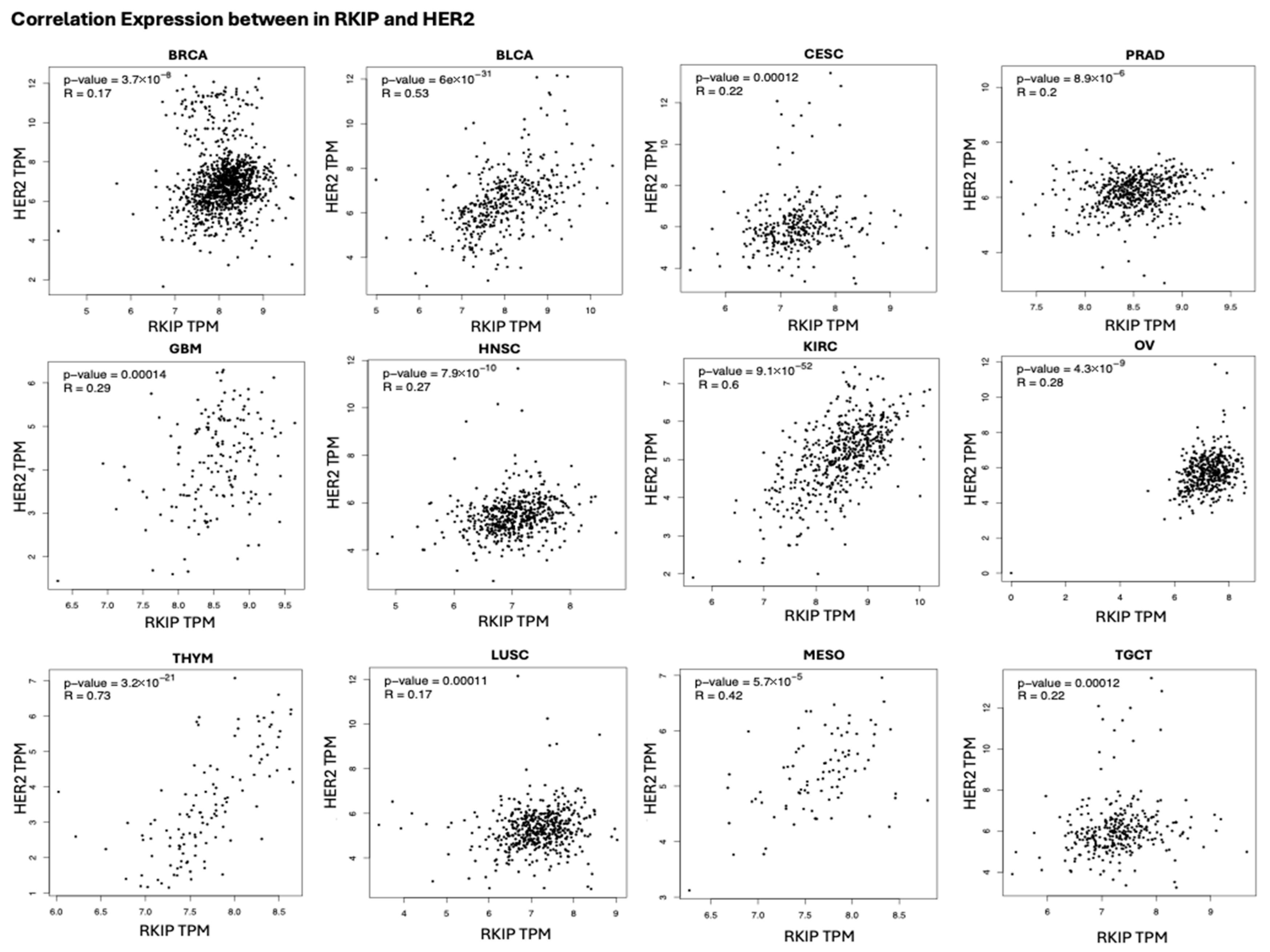
Cells 15 00319 g001
Figure 2. HER2+ BC immune recognition and evasion. The top figure represents immune surveillance via the recognition of the anti-tumor CD8+ T cells targeting the HER2+ BC cells and leading to their cell death. This results in tumor regression. The bottom figure represents the tumor microenvironment (TME) in which multiple cells and factors combined lead to immune evasion. In the TME are represented the tumor cells expressing PD-L1, CD8+ T cells expressing PD1, the infiltration of Tregs, MDSCs, and TAMs cells, and, in addition, various immunosuppressive factors are derived from these cells. This leads to immune evasion and tumor progression. Created with BioRender.com. Accessed on 12 November 2025.
Cells 15 00319 g002
Figure 3. Significant positive correlations between RKIP and HER2 expressions in various cancers. Spearman correlation (R) and p-values are indicated in each graph. Graphs are produced using GEIPA with data from TCGA (Accessed on October 2024). Abbreviations: BRCA, Breast Invasive Carcinoma; BLCA, Bladder Urothelial Carcinoma; CESC, cervical squamous cell carcinoma and endocervical adenocarcinoma; PRAD, prostate adenocarcinoma; GBM, glioblastoma; HNSC, head and neck squamous cell carcinoma; KIRC, kidney renal clear cell carcinoma; OV, ovarian serous cystadenocarcinoma; THYM, thymoma; LUSC, lung squamous cell carcinoma; MESO, mesothelioma; TGCT, Testicular Germ Cell Tumors.
Cells 15 00319 g003
Table 1. RKIP expression across BC molecular subtypes with emphasis on HER2+ BC.
BC SubtypeRKIP Expression LevelKey ObservationsReferences
Luminal AHighRKIP expression is generally preserved at both the mRNA and protein levels in luminal A tumors compared to other subtypes.[3,23]
Luminal BModerate to HighRKIP expression remains relatively higher than in non-luminal subtypes but may show some reduction compared to luminal A tumors.[3,23]
HER2-enriched (HER2+ BC)Low (protein level)RKIP expression is frequently reduced in HER2+ tumors compared to normal breast tissue and luminal subtypes.[17,22]
Basal-likeLowMarked reduction in RKIP expression relative to luminal subtypes.[22,23]
Claudin-lowLowRKIP expression is diminished.[22,23]
Table 3. Regulation of HER2 expression in HER2+ BC.
Types of RegulationFactors InvolvedReferences
Transcriptional
-
HER2-p185neu nuclear complex
-
Transcription factors: TFAP2, Sp1, PBP, YY1, ETS, YB-1, EGR2 (upregulate HER2); MYB, FOXP3, GATA4, PEA3, MBP-1, NOTCH, RBP-Jk (downregulate HER2); E1A represses HER2 via p300/CBP inhibition
[67,68,69,70,71,72,73,74,75,76,78,79,81,82,83,84,85,86,87,88,89,94]
Epigenetic
-
Histone modifications (e.g., H3K4me3, H3K9ac)
-
HER2 gene body enhancer (HGE)
-
DNA methylation/demethylation of the HER2 promoter
-
ncRNAs interfering with chromatin accessibility
[11,89,95,96,97,98,99,100,101,102,103]
Post-Transcriptional
-
lncRNA: LINK-A
-
miR-342-5p
-
miR-124 and miR-193a-3p
-
miR-96, miR-10b, and miR-17
-
miR-335-5p
-
miR-148a
[104,105,106,107,108,109,110,111,112,113,114,115,116,117,118,119]
Translational
-
miRNAs targeting 3′UTR
-
Hsp90
-
Proteasome inhibitors (PIs)
-
PTPN18
[11,108,120,121,122,123,124,125,126,127,128,129,130]
Table 4. Interplay between RKIP and HER2 signaling in HER2+ BC.
Model/ContextRKIP StatusHER2 Status Mechanistic/Immune EffectsPhenotype Related to Immune Evasion or ProgressionKey FindingReferences
HER2-enriched subtypeLowHighLoss of RKIP permits sustained MAPK, NF-κB, and PI3K/Akt signaling downstream of HER2Immunosuppressive TME, increased tumor aggressivenessInverse correlation between RKIP and HER2 expression [22]
HER2-enriched subtypeLowHighHER2 signaling inversely regulates RKIP expression; dose-dependent reduction in RKIP upon HER2 modulationAssociated with increased invasiveness and aggressive HER2+ phenotypeRKIP is negatively correlated with HER2 status and serves as a negative predictor of HER2; HER2-enriched tumors show among the lowest RKIP levels[23,26]
HER2+ BC with EMT featuresLowHighHER2 induces EMT via SNAIL, ZEB1, STAT3; RKIP inhibits NF-κB/SNAIL/YY1 circuitEMT-associated immune evasion and metastatic progressionRKIP loss facilitates EMT, whereby EMT is a key feature of immune escape in HER2+ BC[134,141,142,143]
HER2+ BC tumor microenvironmentLowHighHER2 upregulates PD-L1 via MAPK and PI3K/Akt; RKIP inversely correlates with PD-L1 expressionCD8+ T-cell inhibition, checkpoint-mediated immune evasionRKIP downregulation contributes to PD-L1–mediated immune suppression[164,165,166,167,168,169,170,171]
HER2+ BC with TAM infiltrationLowHighHER2 promotes M2-like TAM recruitment; RKIP suppresses CCL5-mediated macrophage chemotaxisImmunosuppressive, pro-tumorigenic macrophage-rich TMERKIP expression limits TAM infiltration and metastatic signaling[172,173,174,175,176,177,178,179]
Table 5. HER2-targeted therapies for BC overview.
HER2-Targeted TherapyApproval YearMechanism of ActionUseReferences
Trastuzumab (Herceptin®, Genentech, Inc., San Francisco, CA, USA)1998Binds to HER2′s extracellular domain, subsequently inhibiting the PI3K and MAPK pathways, suppressing cellular growthFirst targeted molecular treatment for HER2+ BC[197]
Lapatinib (Tykerb®, GlaxoSmithKline (GSK), London, UK)2007HER1/HER2 kinase inhibitorFrequently combined with capecitabine to treat metastatic BC[197]
Pertuzumab (Perjeta®, Genentech, Inc., San Francisco, CA, USA)2012HER2/HER3 antibody that binds to HER2′s extracellular dimerization domain IIUsed with trastuzumab and docetaxel for HER2-positive cases[197]
Margetuximab (Margenza®, MacroGenics, Rockville, MD, USA)2020Monoclonal antibody (mAb) similar to trastuzumab, derived from 4D5Can be paired with chemotherapy, effective for HER2-positive BC (SOPHIA trial)[11,198]
Disclaimer/Publisher’s Note: The statements, opinions and data contained in all publications are solely those of the individual author(s) and contributor(s) and not of MDPI and/or the editor(s). MDPI and/or the editor(s) disclaim responsibility for any injury to people or property resulting from any ideas, methods, instructions or products referred to in the content.