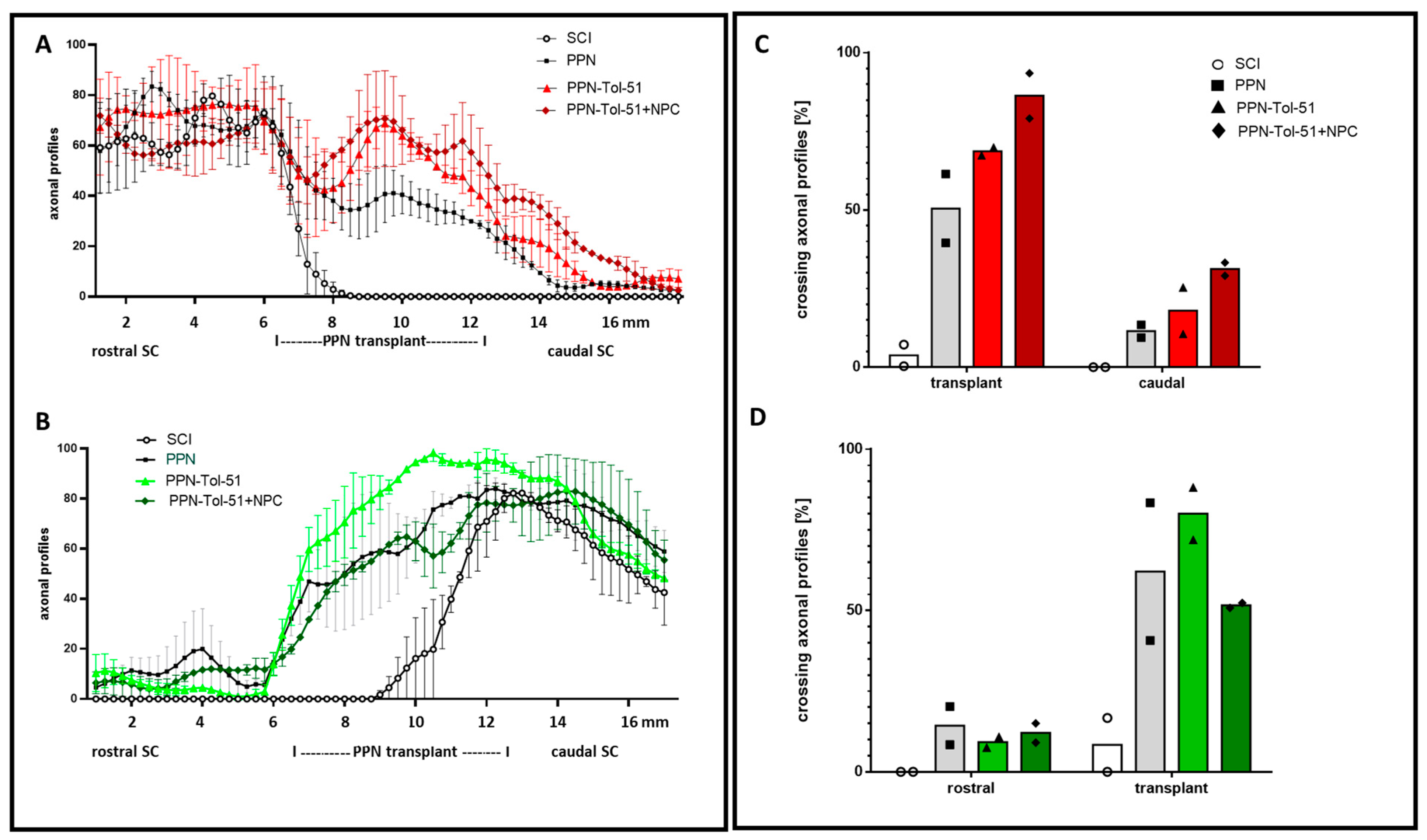
Correction: Arriero-Cabañero et al. Transplantation of Predegenerated Peripheral Nerves after Complete Spinal Cord Transection in Rats: Effect of Neural Precursor Cells and Pharmacological Treatment with the Sulfoglycolipid Tol-51. Cells 2024, 13, 1324

 , , , , , , ,
  and
and Reference
- Arriero-Cabañero, A.; García-Vences, E.; Sánchez-Torres, S.; Aristizabal-Hernandez, S.; García-Rama, C.; Pérez-Rizo, E.; Fernández-Mayoralas, A.; Grijalva, I.; Buzoianu-Anguiano, V.; Doncel-Pérez, E.; et al. Transplantation of Predegenerated Peripheral Nerves after Complete Spinal Cord Transection in Rats: Effect of Neural Precursor Cells and Pharmacological Treatment with the Sulfoglycolipid Tol-51. Cells 2024, 13, 1324. [Google Scholar] [CrossRef] [PubMed]


| Experimental Groups | SCI | SCI+Alk-Fibrin | PPN | PPN+Tol-51 | PPN+Tol-51+NPC |
|---|---|---|---|---|---|
| n (total = 62) | 12 | 12 | 12 | 12 | 14 |
| Animals lost after SCI: | |||||
| Before transplant | 6 | 6 | 5 | 7 | 3 |
| Animals lost after transplant surgery: | |||||
| Month 1 | 1 | 0 | 2 | 1 | 2 |
| Month 2 | 0 | 0 | 0 | 0 | 2 |
| Month 3 | 0 | 0 | 0 | 0 | 0 |
| Month 4 | 0 | 0 | 0 | 0 | 0 |
| Final group size: | |||||
| SCI | SCI+Alk+Fibrin | PPN | PPN+Tol-51 | PPN+Tol-51+NPC | |
| n (total = 27) | 5 | 6 | 5 | 4 | 7 |
Disclaimer/Publisher’s Note: The statements, opinions and data contained in all publications are solely those of the individual author(s) and contributor(s) and not of MDPI and/or the editor(s). MDPI and/or the editor(s) disclaim responsibility for any injury to people or property resulting from any ideas, methods, instructions or products referred to in the content. |
© 2026 by the authors. Licensee MDPI, Basel, Switzerland. This article is an open access article distributed under the terms and conditions of the Creative Commons Attribution (CC BY) license.
Share and Cite
Arriero-Cabañero, A.; García-Vences, E.; Sánchez-Torres, S.; Aristizabal-Hernandez, S.; García-Rama, C.; Pérez-Rizo, E.; Fernández-Mayoralas, A.; Grijalva, I.; Buzoianu-Anguiano, V.; Doncel-Pérez, E.; et al. Correction: Arriero-Cabañero et al. Transplantation of Predegenerated Peripheral Nerves after Complete Spinal Cord Transection in Rats: Effect of Neural Precursor Cells and Pharmacological Treatment with the Sulfoglycolipid Tol-51. Cells 2024, 13, 1324. Cells 2026, 15, 249. https://doi.org/10.3390/cells15030249
Arriero-Cabañero A, García-Vences E, Sánchez-Torres S, Aristizabal-Hernandez S, García-Rama C, Pérez-Rizo E, Fernández-Mayoralas A, Grijalva I, Buzoianu-Anguiano V, Doncel-Pérez E, et al. Correction: Arriero-Cabañero et al. Transplantation of Predegenerated Peripheral Nerves after Complete Spinal Cord Transection in Rats: Effect of Neural Precursor Cells and Pharmacological Treatment with the Sulfoglycolipid Tol-51. Cells 2024, 13, 1324. Cells. 2026; 15(3):249. https://doi.org/10.3390/cells15030249
Chicago/Turabian StyleArriero-Cabañero, Alejandro, Elisa García-Vences, Stephanie Sánchez-Torres, Sergio Aristizabal-Hernandez, Concepción García-Rama, Enrique Pérez-Rizo, Alfonso Fernández-Mayoralas, Israel Grijalva, Vinnitsa Buzoianu-Anguiano, Ernesto Doncel-Pérez, and et al. 2026. "Correction: Arriero-Cabañero et al. Transplantation of Predegenerated Peripheral Nerves after Complete Spinal Cord Transection in Rats: Effect of Neural Precursor Cells and Pharmacological Treatment with the Sulfoglycolipid Tol-51. Cells 2024, 13, 1324" Cells 15, no. 3: 249. https://doi.org/10.3390/cells15030249
APA StyleArriero-Cabañero, A., García-Vences, E., Sánchez-Torres, S., Aristizabal-Hernandez, S., García-Rama, C., Pérez-Rizo, E., Fernández-Mayoralas, A., Grijalva, I., Buzoianu-Anguiano, V., Doncel-Pérez, E., & Mey, J. (2026). Correction: Arriero-Cabañero et al. Transplantation of Predegenerated Peripheral Nerves after Complete Spinal Cord Transection in Rats: Effect of Neural Precursor Cells and Pharmacological Treatment with the Sulfoglycolipid Tol-51. Cells 2024, 13, 1324. Cells, 15(3), 249. https://doi.org/10.3390/cells15030249