Reduced TIGIT Expression on T Cells Links Hyperglycemia to Immune Dysregulation in Type 1 Diabetes

 , , , ,
  and
and
Highlights
- Type 1 diabetes is characterized by a lower percentage of TIGIT+ CD4-positive T cells.
- Hyperglycemia reduces the frequency of TIGIT+ and CTLA-4+ T regulatory cells.
- Reduced TIGIT+ Tregs in type 1 diabetes is associated with impaired glucose metabolism.
- Hyperglycemia may weaken immune tolerance by targeting TIGIT+ Tregs.
- Loss of TIGIT+ Tconvs under high glucose may promote autoimmune activity.
Abstract
1. Introduction
2. Materials and Methods
2.1. Study Design
2.2. Cell Isolation, Sorting, and Culture
- 1–2 mln cells suspended in PBS for phenotype analysis;
- 1–2 mln cells dry-pellet-frozen for mTOR and p38 MAPK phosphorylation analysis;
- 1–40 mln cells suspended in PBS (concentration: 10 mln cells in 200 uL of PBS) for enzymatic activity analysis.
2.3. Flow Cytometry
2.4. Spectrometry—Enzymatic Activity
2.5. mTOR and p38 Phosphorylation
2.6. Data Analysis
3. Results
3.1. TIGIT Is Underexpressed in T Cells from the Peripheral Blood of Type 1 Diabetes Patients
3.2. Enzymatic Activity and mTOR and p38 MAPK Phosphorylation in the Peripheral Blood T Cells
3.3. Hyperglycemia Reduces the Percentage of TIGIT+ T Cells and Influences Glucose Metabolism in T Cells
4. Discussion
4.1. Conclusions
4.2. Study Limitations
Supplementary Materials
Author Contributions
Funding
Informed Consent Statement
Data Availability Statement
Acknowledgments
Conflicts of Interest
Abbreviations
| ACO | Aconitase |
| CD | Cluster of differentiation |
| CTLA-4 | Cytotoxic T lymphocyte antigen 4 |
| DTT | Dithiothreitol |
| EDTA | Ethylenediaminetetraacetic acid |
| FAS | Fatty acid synthase |
| FoxP3 | Transcriptional factor forkhead box P3 |
| G6P | Glucose-6-phosphate dehydrogenase |
| GLUT | Glucose transporter |
| GMP | Good manufacturing practice |
| HC | Healthy control |
| HX | Hexokinase |
| IDH | Isocitric dehydrogenase |
| IL | Interleukin |
| LDH | Lactate dehydrogenase |
| MAPK | Mitogen-activated protein kinase |
| MFI | Mean fluorescence activity |
| mTOR | Mechanistic target of rapamycin |
| NAD | Nicotinamide adenine dinucleotide |
| NADH | Reduced form of nicotinamide adenine dinucleotide |
| NADP | Nicotinamide adenine dinucleotide phosphate |
| NADPH | Reduced form of nicotinamide adenine dinucleotide phosphate |
| PBMC | Peripheral mononuclear blood cell |
| PBS | Phosphate-buffered saline |
| PD-1 | Programmed cell death receptor 1 |
| PDL1 | Ligand for protein cell death protein 1 |
| T1D | Type 1 diabetes |
| Tconv | T conventional cells/T effector cells |
| TCR | T cell receptor |
| TIGIT | T cell immunoreceptor with Ig and ITIM domains |
| Treg | T regulatory cell |
References
- DiMeglio, L.A.; Evans-Molina, C.; Oram, R.A. Type 1 diabetes. Lancet 2018, 391, 2449. [Google Scholar] [CrossRef]
- Zieliński, M.; Żalińska, M.; Iwaszkiewicz-Grześ, D.; Gliwiński, M.; Henning, M.; Jaźwińska-Curyłło, A.; Kamińska, H.; Sakowska, J.; Wołoszyn-Durkiewicz, A.; Owczuk, R.; et al. Combined therapy with CD4 CD25highCD127 T regulatory cells and anti-CD20 antibody in recent-onset type 1 diabetes is superior to monotherapy: Randomized phase I/II trial. Diabetes Obes. Metab. 2022, 24, 1534–1543. [Google Scholar] [CrossRef] [PubMed]
- Gliwiński, M.; Iwaszkiewicz-Grześ, D.; Wołoszyn-Durkiewicz, A.; Tarnowska, M.; Żalińska, M.; Hennig, M.; Zielińska, H.; Dukat-Mazurek, A.; Dębska-Zielkowska, J.; Zieliński, M.; et al. Proinsulin-specific T regulatory cells may control immune responses in type 1 diabetes: Implications for adoptive therapy. BMJ Open Diabetes Res. Care 2020, 8, e000873. [Google Scholar] [CrossRef] [PubMed]
- Bluestone, J.A.; Buckner, J.H.; Fitch, M.; Gitelman, S.E.; Gupta, S.; Hellerstein, M.K.; Herold, K.C.; Lares, A.; Lee, M.R.; Li, K.; et al. Type 1 diabetes immunotherapy using polyclonal regulatory T cells. Sci. Transl. Med. 2015, 7, 315ra189. [Google Scholar] [CrossRef] [PubMed]
- Sakowska, J.; Arcimowicz, Ł.; Jankowiak, M.; Papak, I.; Markiewicz, A.; Dziubek, K.; Kurkowiak, M.; Kote, S.; Kazimierczak-Siedlecka, K.; Połom, K.; et al. Autoimmunity and Cancer—Two Sides of the Same Coin. Front. Immunol. 2022, 13, 793234. [Google Scholar] [CrossRef]
- Kojima, M.; Suzuki, K.; Takeshita, M.; Ohyagi, M.; Lizuka, M.; Yamane, H.; Koga, K.; Kouro, T.; Kassai, Y.; Yoshihara, T.; et al. Anti-human-TIGIT agonistic antibody ameliorates autoimmune diseases by inhibiting Tfh and Tph cells and enhancing Treg cells. Commun. Biol. 2023, 6, 500. [Google Scholar] [CrossRef]
- Lee, Y.H.; Bae, S.C.; Kim, J.H.; Song, G.G. Meta-analysis of genetic polymorphisms in programmed cell death 1. Associations with rheumatoid arthritis, ankylosing spondylitis, and type 1 diabetes susceptibility. Z Rheumatol. 2015, 74, 230–239. [Google Scholar] [CrossRef]
- Huang, Z.; Qi, G.; Miller, J.S.; Zheng, S.G. CD226: An Emerging Role in Immunologic Diseases. Front. Cell Dev. Biol. 2020, 8, 550904. [Google Scholar] [CrossRef]
- Thirawatananond, P.; Brown, M.E.; Sachs, L.K.; Arnoletti, J.M.; Yeh, W.I.; Posgai, A.L.; Shapiro, M.R.; Chen, Y.G.; Brusko, T.M. Treg-Specific CD226 Deletion Reduces Diabetes Incidence in NOD Mice by Improving Regulatory T-Cell Stability. Diabetes 2023, 72, 1629–1640. [Google Scholar] [CrossRef]
- Peters, K.; McDonald, T.; Muhammad, F.; Brady, A.; Dostal, J.; Lee, D.J. TIGIT stimulation suppresses autoimmune uveitis by inhibiting Th17 cell infiltration. J. Leukoc. Biol. 2024, 116, 1054–1060. [Google Scholar] [CrossRef]
- Zieliński, M.; Sakowska, J.; Iwaszkiewicz-Grześ, D.; Gliwiński, M.; Henning, M.; Żalińska, M.; Wołoszyn-Durkiewicz, A.; Jaźwińska-Curyłło, A.; Kamińska, H.; Owczuk, R.; et al. PD-1 Receptor (+) T cells are associated with the efficacy of the combined treatment with regulatory t cells and rituximab in type 1 diabetes children via regulatory t cells suppressive activity amelioration. Int. Immunopharmacol. 2024, 132, 111919. [Google Scholar] [CrossRef] [PubMed]
- Long, S.A.; Thorpe, J.; DeBerg, H.A.; Gersuk, V.; Eddy, J.; Harris, K.M.; Ehlers, M.; Herold, K.C.; Nepom, G.T.; Linsley, P.S. Partial exhaustion of CD8 T cells and clinical response to teplizumab in new-onset type 1 diabetes. Sci. Immunol. 2016, 1, eaai7793. [Google Scholar] [CrossRef] [PubMed]
- Marek-Trzonkowska, N.; Mysliwiec, M.; Dobyszuk, A.; Grabowska, M.; Techmanska, I.; Juscinska, J.; Mujtowicz, M.A.; Witkowski, P.; Mlynarski, W.; Balcerska, A.; et al. Administration of CD4+CD25highCD127- regulatory T cells preserves β-cell function in type 1 diabetes in children. Diabetes Care 2012, 35, 1817–1820. [Google Scholar] [CrossRef] [PubMed]
- Marek-Trzonkowska, N.; Piekarska, K.; Filipowicz, N.; Piotrowski, A.; Gucwa, M.; Vogt, K.; Sawitzki Siebert, J.; Trzonkowski, P. Mild hypothermia provides Treg stability. Sci. Rep. 2017, 7, 11915. [Google Scholar] [CrossRef]
- Joller, N.; Lozano, E.; Burkett, P.R.; Patel, B.; Xiao, S.; Zhu, C.; Xia, J.; Tan, T.G.; Sefik, E.; Yajnik, V.; et al. Treg cells expressing the co-inhibitory molecule TIGIT selectively inhibit pro-inflammatory Th1 and Th17 cell responses. Immunity 2014, 40, 569. [Google Scholar] [CrossRef]
- Urszula, Ł.; Ulana, J.; Bartosz, S.; Okońska, M.; Myśliwiec, M.; Ryba- Stanisławowska, M. Exploring CCR5 + T regulatory cell subset dysfunction in type 1 diabetes patients: Implications for immune regulation. Immunol. Res. 2024, 72, 1061–1070. [Google Scholar] [CrossRef]
- Ma, X.; Cao, L.; Raneri, M.; Wang, H.; Cao, Q.; Zhao, Y.; Bediga, N.; Naselli, G.; Harrison, L.C.; Hawthorne, W.J.; et al. Human HLA-DR+CD27+ regulatory T cells show enhanced antigen-specific suppressive function. JCI Insight 2023, 8, e162978. [Google Scholar] [CrossRef]
- Flores-Borja, F.; Jury, E.C.; Mauri, C.; Egrenstein, M.R. Defects in CTLA-4 are associated with abnormal regulatory T cell function in rheumatoid arthritis. Proc. Natl. Acad. Sci. USA 2008, 105, 19396–19401. [Google Scholar] [CrossRef]
- Tomaszewicz, M.; Ronowska, A.; Zieliński, M.; Jankowska-Kulawy, A.; Trzonkowski, P. T regulatory cells metabolism: The influence on functional properties and treatment potential. Front. Immunol. 2023, 14, 1122063. [Google Scholar] [CrossRef]
- Cluxton, D.; Petrasca, A.; Moran, B.; Fletcher, J.M. Differential Regulation of Human Treg and Th17 Cells by Fatty Acid Synthesis and Glycolysis. Front. Immunol. 2019, 10, 410044. [Google Scholar] [CrossRef]
- Borsellino, G.; Kleinewietfeld, M.; Di Mitri, D.; Sternjak, A.; Diamantini, A.; Giomettom, R.; Hopner, S.; Centoze, D.; Bernardi, G.; Dell’Aqua, M.L.; et al. Expression of ectonucleotidase CD39 by Foxp3+ Treg cells: Hydrolysis of extracellular ATP and immune suppression. Blood 2007, 110, 1225–1232. [Google Scholar] [CrossRef]
- Chew, G.M.; Fujita, T.; Webb, G.M.; Burwitz, B.J.; Wu, H.J.; Reed, J.S.; Hammond, K.B.; Clayton, K.L.; Ishii, N.; Abdel-Mohsen, M.; et al. TIGIT Marks Exhausted T Cells, Correlates with Disease Progression, and Serves as a Target for Immune Restoration in HIV and SIV Infection. PLoS Pathog. 2016, 12, e1005349. [Google Scholar] [CrossRef]
- Catakovic, K.; Gassner, F.J.; Ratswohl, C.; Zaborsky, N.; Rebhandl, S.; Schubert, M.; Steiner, M.; Gutjahr, J.C.; Pleyer, L.; Egle, A.; et al. TIGIT expressing CD4+T cells represent a tumor-supportive T cell subset in chronic lymphocytic leukemia. Oncoimmunology 2017, 7, e1371399. [Google Scholar] [CrossRef]
- Brenner, D.; Krammer, P.H.; Rudiger, A. Concepts of activated T cell death. Crit. Rev. Oncol./Hematol. 2008, 66, 52–64. [Google Scholar] [CrossRef] [PubMed]
- Waring, P.; Müllbacher, A. Cell death induced by the Fas/Fas ligand pathway and its role in pathology. Immunol. Cell Biol. 1999, 77, 312–317. [Google Scholar] [CrossRef] [PubMed]
- Green, D.R.; Droin, N.; Pinkoski, M. Activation-induced cell death in T cells. Immunol. Rev. 2003, 193, 70–81. [Google Scholar] [CrossRef] [PubMed]
- Zhong, T.; Li, X.; Lei, K.; Tang, R.; Deng, Q.; Love, P.E.; Zhou, Z.; Zhao, B.; Li, X. TGF-β-mediated crosstalk between TIGIT+ Tregs and CD226+CD8+ T cells in the progression and remission of type 1 diabetes. Nat. Commun. 2024, 15, 8894. [Google Scholar] [CrossRef]
- Yu, S.; Gu, J.; Wang, R.; Lee, S.; Shan, Y.; Wang, J.; Sun, Y.; Ma, X. TIGIT reverses IFN-α-promoted Th1-like Tregs via in-sequence effects dependent on STAT4. Arthritis Res. Ther. 2023, 25, 221. [Google Scholar] [CrossRef]
- Zhao, J.; Li, L.; Feng, X.; Feng, X.; Gao, C.; Gao, L.; Zhan, Y.; Wang, Z.; Zhao, M.; Yin, H.; et al. TIGIT-Fc fusion protein alleviates murine lupus nephritis through the regulation of SPI-B-PAX5-XBP1 axis-mediated B-cell differentiation. J. Autoimmun. 2023, 139, 103087. [Google Scholar] [CrossRef]
- Lucca, L.E.; Axisa, P.-P.; Singer, E.R.; Nolan, N.M.; Dominiguez-Villar, M.; Hafler, D.A. TIGIT signaling restores suppressor function of Th1 Tregs. JCI Insight 2019, 4, e124427. [Google Scholar] [CrossRef]
- Ma, X.; Yu, S.; Gu, J.; Jiang, H.; Shan, Y. Ab0564 tigit activator alleviates systemic lupus erythematosus by negatively regulating th1-like Treg cell differentiation. Ann. Rheum. Dis. 2023, 82, 1479. [Google Scholar] [CrossRef]
- Schneider, E.; Winzer, R.; Rissiek, A.; Ricklefs, I.; Mayer-Schwesinger, C.; Ricklefs, F.L.; Bauche, A.; Behrends, J.; Reimer, R.; Brenna, S.; et al. CD73-mediated adenosine production by CD8 T cell-derived extracellular vesicles constitutes an intrinsic mechanism of immune suppression. Nat. Commun. 2021, 12, 5911. [Google Scholar] [CrossRef]


| Parameter | Type 1 Diabetes | Healthy Controls | Graph |
|---|---|---|---|
| Age [median; min–max] Mann–Whitney test | 12; 7–15 | 27; 19–43 |  **** p < 0.0001 |
| Sex [%] (male/female) | 81/19 | 69/31 |  |
| Control | Maturation and Differentation | Suppression | MitoTracker | |
|---|---|---|---|---|
| Antigen (clone) fluorochrome | CD4 (RPA-T4) BUV 395 | CD4 (RPA-T4) BUV 395 | CD4 (RPA-T4) BUV 395 | CD4 (RPA-T4) BUV 395 |
| CD3 (UCHT1) Pacific Orange | CD3 (UCHT1) Pacific Orange | CD3 (UCHT1) Pacific Orange | CD3 (UCHT1) Pacific Orange | |
| CD45RA (HI100) SuperBright 600 | CD45RA (HI100) SuperBright 600 | |||
| CD62L (DREG-56) APC-eFluor 780 | CD62L (DREG-56) APC-eFluor 780 | |||
| CD27 (O323) SuperBright 645 | CCR5 (3A9) BV 650 | |||
| CD279 (J105) SuperBright 702 | CD39 (TU66) BV 711 | |||
| CD178 (NOK-1) PE | CD152 (14D3) PE | |||
| CD28 (CD28.2) PE-Cy7 | CD184 (12G5) PE-Cy7 | |||
| CD57 (TB01) eFluor 450 | TIGIT (MBSA43) eFluor 450 | |||
| GLUT 1 (202915) APC | GLUT 1 (202915) APC | |||
| GLUT 3 (202017) Texas Red | GLUT 3 (202017) Texas Red | |||
| FoxP3 (PCH101) Per CP-Cy5 | FoxP3 (PCH101) Per CP-Cy5 | |||
| Helios (22F6) Alexa 700 | Helios (22F6) Alexa 700 | |||
| MitoTracker Green | MitoTracker Green | MitoTracker Green | ||
| MitoTracker Red |
| Parameter | Association | Spearman r | p |
|---|---|---|---|
| Treg | |||
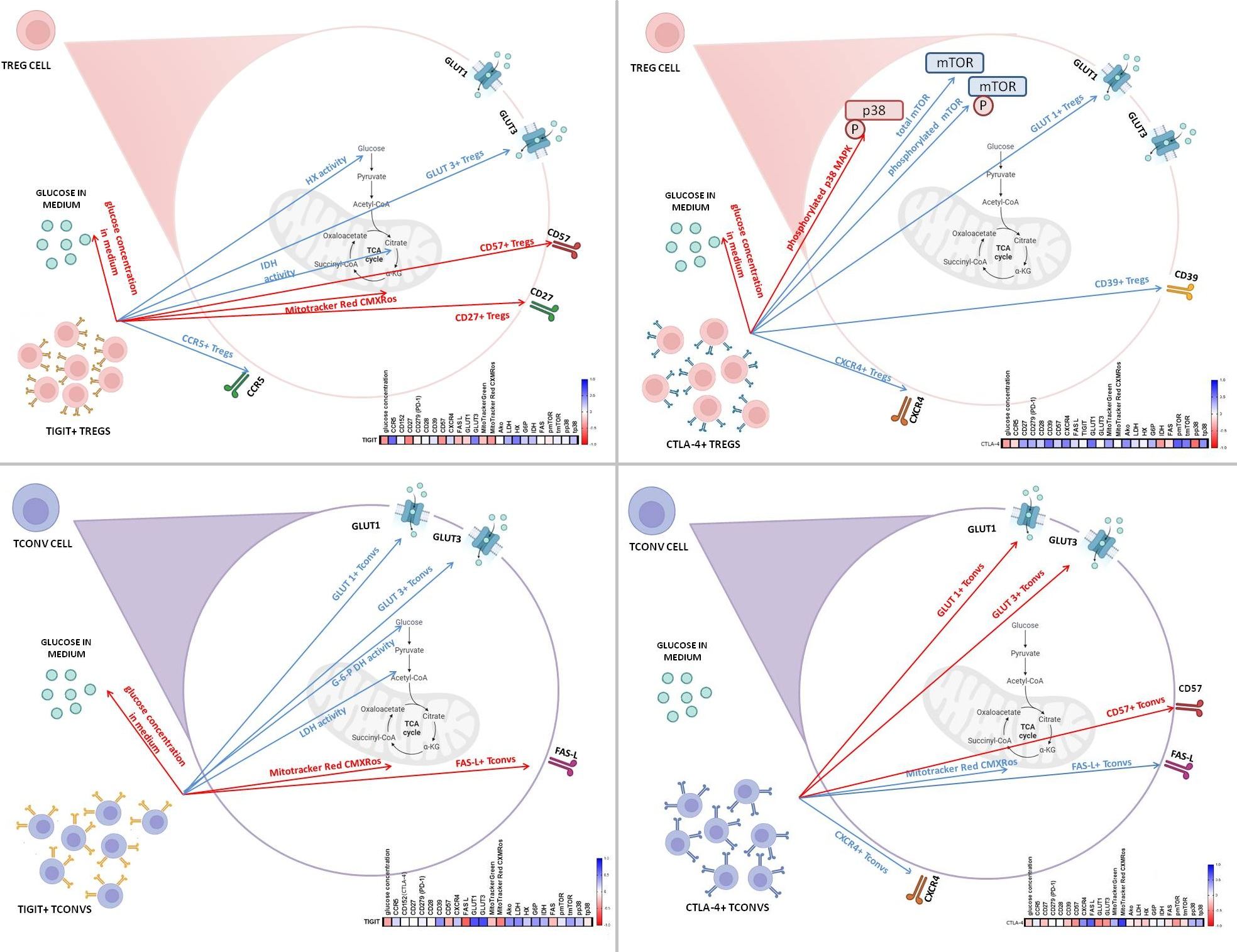
| CCR5 | Positive | 0.587 | 0.0051 |
| GLUT 3 | Positive | 0.5 | 0.0508 |
| Isocitrate dehydrogenase | Positive | 0.3315 | 0.0912 |
| Hexokinase | Positive | 0.5709 | 0.0055 |
| CD27 | Negative | −0.509 | 0.007 |
| Glucose concentration | Negative | −0.4315 | 0.0246 |
| MitoTracker Red CXMRos | Negative | −0.4283 | 0.099 |
| CD57 | Negative | −0.4345 | 0.0265 |
| Tconv | |||
| GLUT1 | Positive | 0.6834 | 0.0062 |
| GLUT3 | Positive | 0.7069 | 0.0029 |
| Glucose-6-phosphate dehydrogenase | Positive | 0.4047 | 0.0448 |
| Lactate dehydrogenase | Positive | 0.4617 | 0.0153 |
| Glucose concentration | Negative | −0.3583 | 0.0665 |
| MitoTracker Red CXMRos | Negative | −0.5048 | 0.0481 |
| FAS-L | Negative | −0.63 | 0.0238 |
 .
.| Parameter | Association | Spearman r | p |
|---|---|---|---|
| Treg | |||
| GLUT1 | Positive | 0.5559 | 0.0337 |
| tmTOR | Positive | 0.5245 | 0.0839 |
| pmTOR | Positive | 0.6364 | 0.0299 |
| CD39 | Positive | 0.5704 | 0.0056 |
| CXCR4 | Positive | 0.4917 | 0.0467 |
| pp38 | Negative | −0.578 | 0.067 |
| Glucose concentration | Negative | −0.3864 | 0.057 |
| Tconv | |||
| CXCR4 | Positive | 0.4535 | 0.0512 |
| MitoTracker Red CXMRos | Positive | 0.7653 | 0.0008 |
| FAS-L | Positive | 0.638 | 0.052 |
| GLUT1 | Negative | −0.4794 | 0.0722 |
| GLUT3 | Negative | −0.4352 | 0.0927 |
| CD57 | Negative | −0.4516 | 0.0399 |
 .
.Disclaimer/Publisher’s Note: The statements, opinions and data contained in all publications are solely those of the individual author(s) and contributor(s) and not of MDPI and/or the editor(s). MDPI and/or the editor(s) disclaim responsibility for any injury to people or property resulting from any ideas, methods, instructions or products referred to in the content. |
© 2026 by the authors. Licensee MDPI, Basel, Switzerland. This article is an open access article distributed under the terms and conditions of the Creative Commons Attribution (CC BY) license.
Share and Cite
Tomaszewicz, M.; Ronowska, A.; Strzelecka, J.; Jankowska-Kulawy, A.; Stefańska, K.; Trzonkowski, P.; Zieliński, M. Reduced TIGIT Expression on T Cells Links Hyperglycemia to Immune Dysregulation in Type 1 Diabetes. Cells 2026, 15, 195. https://doi.org/10.3390/cells15020195
Tomaszewicz M, Ronowska A, Strzelecka J, Jankowska-Kulawy A, Stefańska K, Trzonkowski P, Zieliński M. Reduced TIGIT Expression on T Cells Links Hyperglycemia to Immune Dysregulation in Type 1 Diabetes. Cells. 2026; 15(2):195. https://doi.org/10.3390/cells15020195
Chicago/Turabian StyleTomaszewicz, Martyna, Anna Ronowska, Julia Strzelecka, Agnieszka Jankowska-Kulawy, Katarzyna Stefańska, Piotr Trzonkowski, and Maciej Zieliński. 2026. "Reduced TIGIT Expression on T Cells Links Hyperglycemia to Immune Dysregulation in Type 1 Diabetes" Cells 15, no. 2: 195. https://doi.org/10.3390/cells15020195
APA StyleTomaszewicz, M., Ronowska, A., Strzelecka, J., Jankowska-Kulawy, A., Stefańska, K., Trzonkowski, P., & Zieliński, M. (2026). Reduced TIGIT Expression on T Cells Links Hyperglycemia to Immune Dysregulation in Type 1 Diabetes. Cells, 15(2), 195. https://doi.org/10.3390/cells15020195