Advancing Bioconjugated Quantum Dots with Click Chemistry and Artificial Intelligence to Image and Treat Glioblastoma


Abstract
1. Introduction
2. Challenges with Precision Imaging, Detecting, and Treating GB
3. Click Chemistry for Producing Bioconjugated QDs for Biomedical Applications
4. Applications of Bioconjugated QDs for Management of GB
4.1. Design and Bioconjugation of QDs
4.2. Development of Amphiphilic Bioconjugated QDs
4.3. Bioconjugated QDs for Precision Imaging, Detecting, and Treating GB
5. Improving BBB Permeability and Intracellular Intake Mechanisms of Bioconjugated QDs
6. Bioconjugated QDs in Conjunction with PDT for Treatment of GB
7. Toxicity of QDs Following Use in Precision Imaging, Diagnosis, and Treatment
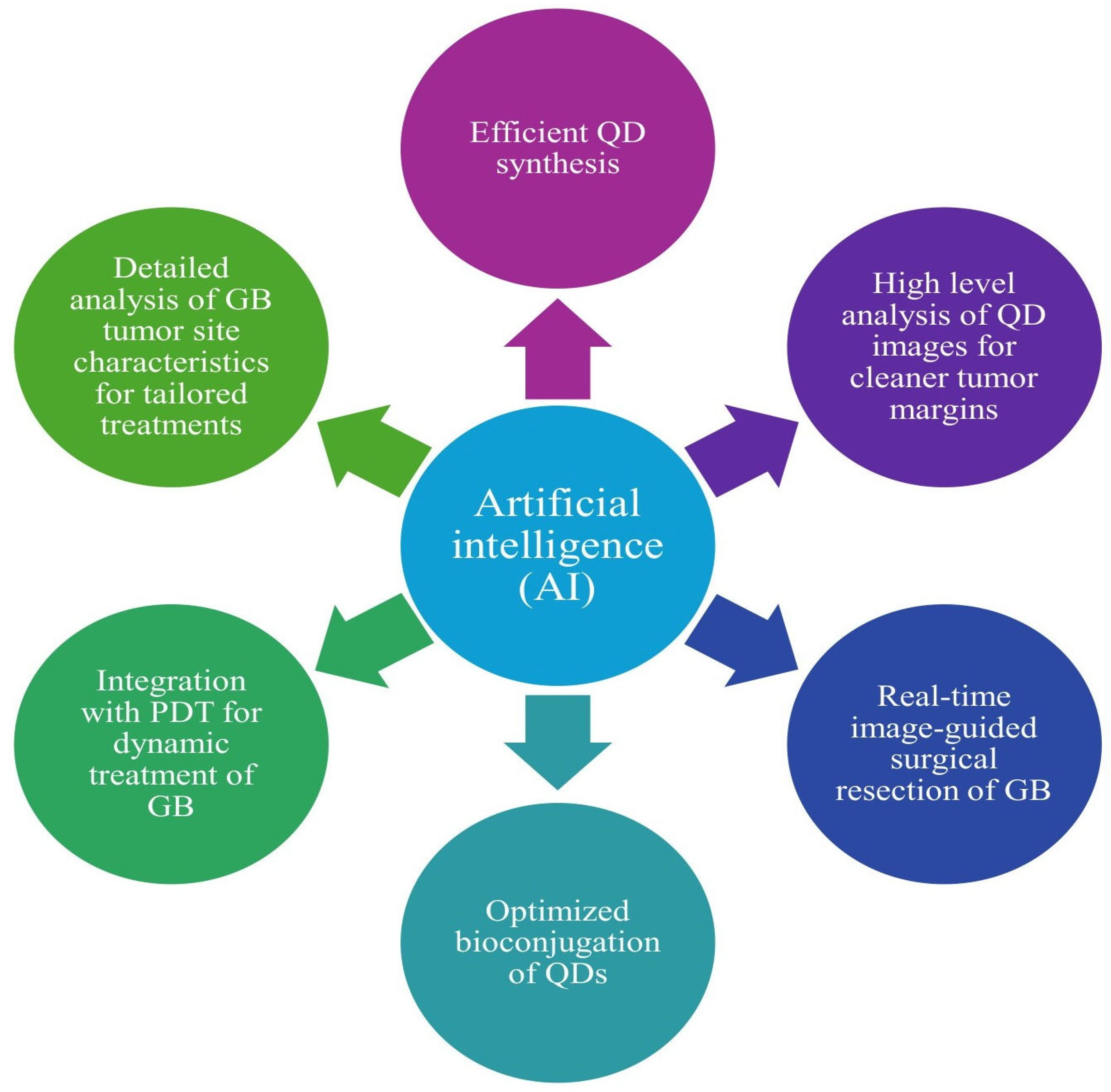
8. Advancing QDs with AI for Precision Imaging, Diagnosing, and Treating GB
9. Conclusions and Future Prospects
Author Contributions
Funding
Institutional Review Board Statement
Informed Consent Statement
Data Availability Statement
Acknowledgments
Conflicts of Interest
References
- Chen, B.; Chen, C.; Zhang, Y.; Xu, J. Recent Incidence Trend of Elderly Patients with Glioblastoma in the United States, 2000–2017. BMC Cancer 2021, 21, 54. [Google Scholar] [CrossRef] [PubMed]
- Grech, N.; Dalli, T.; Mizzi, S.; Meilak, L.; Calleja, N.; Zrinzo, A. Rising Incidence of Glioblastoma Multiforme in a Well-Defined Population. Cureus 2020, 12, e8195. [Google Scholar] [CrossRef] [PubMed]
- Mohammed, S.; Dinesan, M.; Ajayakumar, T. Survival and Quality of Life Analysis in Glioblastoma Multiforme with Adjuvant Chemoradiotherapy: A Retrospective Study. Rep. Pract. Oncol. Radiother. 2022, 27, 1026–1036. [Google Scholar] [CrossRef]
- Rodgers, L.T.; Villano, J.L.; Hartz, A.; Bauer, B. Glioblastoma Standard of Care: Effects on Tumor Evolution and Reverse Translation in Preclinical Models. Cancers 2024, 16, 2638. [Google Scholar] [CrossRef]
- He, Y.; Kaina, B. Are There Thresholds in Glioblastoma Cell Death Responses Triggered by Temozolomide? Int. J. Mol. Sci. 2019, 20, 1562. [Google Scholar] [CrossRef]
- Sallbach, J.; Woods, M.; Rasenberger, B.; Christmann, M.; Tomicic, M.T. The Cell Cycle Inhibitor P21CIP1 Is Essential for Irinotecan-Induced Senescence and Plays a Decisive Role in Re-Sensitization of Temozolomide-Resistant Glioblastoma Cells to Irinotecan. Biomed. Pharmacother. 2024, 181, 117634. [Google Scholar] [CrossRef] [PubMed]
- Wang, P.; Liao, B.; Gong, S.; Guo, H.; Zhao, L.; Liu, J.; Wu, N. Temozolomide Promotes Glioblastoma Stemness Expression through Senescence-Associated Reprogramming via HIF1α/HIF2α Regulation. Cell Death Dis. 2025, 16, 317. [Google Scholar] [CrossRef]
- Djamel-Eddine, Y.-C.; De Witte, O.; Mélot, C.; Lefranc, F. Recurrent Glioblastomas: Should We Operate a Second and Even a Third Time? Interdiscip. Neurosurg. 2019, 18, 100551. [Google Scholar] [CrossRef]
- Shergalis, A.; Bankhead, A.; Luesakul, U.; Muangsin, N.; Neamati, N. Current Challenges and Opportunities in Treating Glioblastoma. Pharmacol. Rev. 2018, 70, 412–445. [Google Scholar] [CrossRef]
- Kairdolf, B.A.; Smith, A.M.; Stokes, T.H.; Wang, M.D.; Young, A.N.; Nie, S. Semiconductor Quantum Dots for Bioimaging and Biodiagnostic Applications. Annu. Rev. Anal. Chem. 2013, 6, 143–162. [Google Scholar] [CrossRef]
- Abdellatif, A.A.; Younis, M.A.; Alsharidah, M.; Al Rugaie, O.; Tawfeek, H.M. Biomedical Applications of Quantum Dots: Overview, Challenges, and Clinical Potential. Int. J. Nanomed. 2022, 17, 1951–1970. [Google Scholar] [CrossRef]
- Gao, P.; Xiao, Y.; Wang, Y.; Li, L.; Li, W.; Tao, W. Biomedical Applications of 2D Monoelemental Materials Formed by Group va and VIA: A Concise Review. J. Nanobiotechnol. 2021, 19, 96. [Google Scholar] [CrossRef] [PubMed]
- Xu, Y.; Li, P.; Cheng, D.; Wu, C.; Lu, Q.; Yang, W.; Zhu, X.; Yin, P.; Liu, M.; Li, H.; et al. Group IV Nanodots: Synthesis, Surface Engineering and Application in Bioimaging and Biotherapy. J. Mater. Chem. B 2020, 8, 10290–10308. [Google Scholar] [CrossRef]
- Deerinck, T.J. The Application of Fluorescent Quantum Dots to Confocal, Multiphoton, and Electron Microscopic Imaging. Toxicol. Pathol. 2008, 36, 112–116. [Google Scholar] [CrossRef]
- Tandale, P.; Choudhary, N.; Singh, J.; Sharma, A.; Shukla, A.; Sriram, P.; Soni, U.; Singla, N.; Barnwal, R.P.; Singh, G.; et al. Fluorescent Quantum Dots: An Insight on Synthesis and Potential Biological Application as Drug Carrier in Cancer. Biochem. Biophys. Rep. 2021, 26, 100962. [Google Scholar] [CrossRef] [PubMed]
- Gawełczyk, M. Atypical Dependence of Excited Exciton Energy Levels and Electron-Hole Correlation on Emission Energy in Pyramidal InP-Based Quantum Dots. Sci. Rep. 2022, 12, 164. [Google Scholar] [CrossRef] [PubMed]
- Vasudevan, D.; Gaddam, R.R.; Trinchi, A.; Cole, I. Core–Shell Quantum Dots: Properties and Applications. J. Alloys Compd. 2015, 636, 395–404. [Google Scholar] [CrossRef]
- Bera, D.; Qian, L.; Tseng, T.-K.; Holloway, P.H. Quantum Dots and Their Multimodal Applications: A Review. Materials 2010, 3, 2260–2345. [Google Scholar] [CrossRef]
- Zhang, Q.; Wang, R.; Feng, B.; Zhong, X.; Ostrikov, K. Photoluminescence Mechanism of Carbon Dots: Triggering High-Color-Purity Red Fluorescence Emission through Edge Amino Protonation. Nat. Commun. 2021, 12, 6856. [Google Scholar] [CrossRef]
- Medintz, I.L.; Uyeda, H.T.; Goldman, E.R.; Mattoussi, H. Quantum Dot Bioconjugates for Imaging, Labelling and Sensing. Nat. Mater. 2005, 4, 435–446. [Google Scholar] [CrossRef]
- Schroeder, K.L.; Goreham, R.V.; Nann, T. Graphene Quantum Dots for Theranostics and Bioimaging. Pharm. Res. 2016, 33, 2337–2357. [Google Scholar] [CrossRef]
- Li, Y.; Ma, Y.; Wu, Z.; Xie, R.; Zeng, F.; Cai, H.; Lui, S.; Song, B.; Chen, L.; Wu, M. Advanced Imaging Techniques for Differentiating Pseudoprogression and Tumor Recurrence after Immunotherapy for Glioblastoma. Front. Immunol. 2021, 12, 790674. [Google Scholar] [CrossRef]
- Young, J.S.; Al-Adli, N.; Scotford, K.; Cha, S.; Berger, M.S. Pseudoprogression versus True Progression in Glioblastoma: What Neurosurgeons Need to Know. J. Neurosurg. 2023, 139, 748–759. [Google Scholar] [CrossRef]
- Blakstad, H.; Mendoza Mireles, E.E.; Heggebø, L.C.; Magelssen, H.; Sprauten, M.; Johannesen, T.B.; Vik-Mo, E.O.; Leske, H.; Niehusmann, P.; Skogen, K.; et al. Incidence and Outcome of Pseudoprogression after Radiation Therapy in Glioblastoma Patients: A Cohort Study. Neuro-Oncol. Pract. 2023, 11, 36–45. [Google Scholar] [CrossRef]
- Brandes, A.A.; Franceschi, E.; Tosoni, A.; Blatt, V.; Pession, A.; Tallini, G.; Bertorelle, R.; Bartolini, S.; Calbucci, F.; Andreoli, A.; et al. MGMT Promoter Methylation Status Can Predict the Incidence and Outcome of Pseudoprogression after Concomitant Radiochemotherapy in Newly Diagnosed Glioblastoma Patients. J. Clin. Oncol. 2008, 26, 2192–2197. [Google Scholar] [CrossRef]
- Butler, M.; Pongor, L.; Su, Y.-T.; Xi, L.; Raffeld, M.; Quezado, M.; Trepel, J.; Aldape, K.; Pommier, Y.; Wu, J. MGMT Status as a Clinical Biomarker in Glioblastoma. Trends Cancer 2020, 6, 380–391. [Google Scholar] [CrossRef]
- McAvoy, M.; Prieto, P.C.; Kaczmarzyk, J.R.; Fernández, I.S.; McNulty, J.; Smith, T.; Yu, K.-H.; Gormley, W.B.; Arnaout, O. Classification of Glioblastoma versus Primary Central Nervous System Lymphoma Using Convolutional Neural Networks. Sci. Rep. 2021, 11, 15219. [Google Scholar] [CrossRef] [PubMed]
- Kunimatsu, A.; Kunimatsu, N.; Kamiya, K.; Watadani, T.; Mori, H.; Abe, O. Comparison between Glioblastoma and Primary Central Nervous System Lymphoma Using MR Image-Based Texture Analysis. Magn. Reson. Med. Sci. 2018, 17, 50–57. [Google Scholar] [CrossRef] [PubMed]
- Önder, E.; Arıkök, A.; Önder, S.; Han, Ü.; Sorar, M.; Kertmen, H.; Yılmaz, E.; Fesli, R.; Alper, M. Corticosteroid Pre-Treated Primary CNS Lymphoma: A Detailed Analysis of Stereotactic Biopsy Findings and Consideration of Interobserver Variability. Int. J. Clin. Exp. Pathol. 2015, 8, 7798–7808. [Google Scholar] [PubMed]
- Feng, A.; Li, L.; Huang, T.; Li, S.; He, N.; Huang, L.; Zeng, M.; Lyu, J. Differentiating Glioblastoma from Primary Central Nervous System Lymphoma of Atypical Manifestation Using Multiparametric Magnetic Resonance Imaging: A Comparative Study. Heliyon 2023, 9, e15150. [Google Scholar] [CrossRef]
- Chaligne, R.; Gaiti, F.; Silverbush, D.; Schiffman, J.S.; Weisman, H.R.; Kluegel, L.; Gritsch, S.; Deochand, S.D.; Gonzalez Castro, L.N.; Richman, A.R.; et al. Epigenetic Encoding, Heritability and Plasticity of Glioma Transcriptional Cell States. Nat. Genet. 2021, 53, 1469–1479. [Google Scholar] [CrossRef]
- Sottoriva, A.; Spiteri, I.; Piccirillo, S.G.M.; Touloumis, A.; Collins, V.P.; Marioni, J.C.; Curtis, C.; Watts, C.; Tavare, S. Intratumor Heterogeneity in Human Glioblastoma Reflects Cancer Evolutionary Dynamics. Proc. Natl. Acad. Sci. USA 2013, 110, 4009–4014. [Google Scholar] [CrossRef] [PubMed]
- Cheng, F.; Guo, D. MET in Glioma: Signaling Pathways and Targeted Therapies. J. Exp. Clin. Cancer Res. 2019, 38, 270. [Google Scholar] [CrossRef] [PubMed]
- Manzoor, H.; Khan, M.U.; Rehman, R.; Shabbir, C.A.; Ullah, M.I.; Ghanem, H.B.; Mohammed, A.; Javed, M.A.; Ali, Q.; Haider, N. Identification and Evaluation of Pyrimidine Based CDK6 Inhibitors against Glioblastoma Using Integrated Computational Approaches. Sci. Rep. 2025, 15, 25387. [Google Scholar] [CrossRef]
- Sun, P.; Yan, F.; Fang, W.; Zhao, J.; Chen, H.; Ma, X.; Song, J. MDM4 Contributes to the Increased Risk of Glioma Susceptibility in Han Chinese Population. Sci. Rep. 2018, 8, 11093. [Google Scholar] [CrossRef]
- Higa, N.; Akahane, T.; Yokoyama, S.; Yonezawa, H.; Uchida, H.; Takajo, T.; Otsuji, R.; Hamada, T.; Matsuo, K.; Kirishima, M.; et al. Prognostic Impact of PDGFRA Gain/Amplification and MGMT Promoter Methylation Status in Patients with IDH Wild-Type Glioblastoma. Neuro-Oncol. Adv. 2022, 4, vdac097. [Google Scholar] [CrossRef] [PubMed]
- Du, L.; Zhang, Q.; Li, Y.; Li, T.; Deng, Q.; Jia, Y.; Lei, K.; Kan, D.; Xie, F.; Huang, S. Research Progress on the Role of PTEN Deletion or Mutation in the Immune Microenvironment of Glioblastoma. Front. Oncol. 2024, 14, 1409519. [Google Scholar] [CrossRef]
- Rabah, N.; Ait Mohand, F.E.; Kravchenko-Balasha, N. Understanding Glioblastoma Signaling, Heterogeneity, Invasiveness, and Drug Delivery Barriers. Int. J. Mol. Sci. 2023, 24, 14256. [Google Scholar] [CrossRef]
- Jubran, M.R.; Rubinstein, A.M.; Cojocari, I.; Adejumobi, I.A.; Mogilevsky, M.; Tibi, S.; Sionov, R.V.; Verreault, M.; Idbaih, A.; Karni, R.; et al. Dissecting the Role of Crosstalk between Glioblastoma Subpopulations in Tumor Cell Spreading. Oncogenesis 2020, 9, 11. [Google Scholar] [CrossRef]
- Zhao, W.; Ouyang, C.; Zhang, L.; Wang, J.; Zhang, J.; Zhang, Y.; Huang, C.; Xiao, Q.; Jiang, B.; Lin, F.; et al. The Proto-Oncogene Tyrosine Kinase C-SRC Facilitates Glioblastoma Progression by Remodeling Fatty Acid Synthesis. Nat. Commun. 2024, 15, 7455. [Google Scholar] [CrossRef]
- Zhou, S.; Huang, Y.; Chen, Y.; Liu, Y.; Xie, L.; You, Y.; Tong, S.; Xu, J.; Jiang, G.; Song, Q.; et al. Reprogramming Systemic and Local Immune Function to Empower Immunotherapy against Glioblastoma. Nat. Commun. 2023, 14, 435. [Google Scholar] [CrossRef]
- Sarkar, S.; Greer, J.; Marlowe, N.J.; Medvid, A.; Ivan, M.E.; Kolishetti, N.; Dhar, S. Stemness, Invasion, and Immunosuppression Modulation in Recurrent Glioblastoma Using Nanotherapy. Wiley Interdiscip. Rev. Nanomed. Nanobiotechnol. 2024, 16, e1976. [Google Scholar] [CrossRef] [PubMed]
- Burster, T.; Gärtner, F.; Bulach, C.; Zhanapiya, A.; Gihring, A.; Knippschild, U. Regulation of MHC I Molecules in Glioblastoma Cells and the Sensitizing of NK Cells. Pharmaceuticals 2021, 14, 236. [Google Scholar] [CrossRef]
- Lu, Y.J.; Vayalakkara, R.K.; Dash, B.S.; Hu, S.-H.; Premji, T.P.; Wu, C.Y.; Shen, Y.J.; Chen, J.P. Immunomodulatory R848-Loaded Anti-PD-L1-Conjugated Reduced Graphene Oxide Quantum Dots for Photothermal Immunotherapy of Glioblastoma. Pharmaceutics 2024, 16, 1064. [Google Scholar] [CrossRef] [PubMed]
- Turco, V.; Pfleiderer, K.; Hunger, J.; Horvat, N.K.; Karimian-Jazi, K.; Schregel, K.; Fischer, M.; Brugnara, G.; Jähne, K.; Sturm, V.; et al. T Cell-Independent Eradication of Experimental Glioma by Intravenous TLR7/8-Agonist-Loaded Nanoparticles. Nat. Commun. 2023, 14, 771. [Google Scholar] [CrossRef]
- Stylianou, M.; Kisby, T.; Despotopoulou, D.; Parker, H.; Thawley, A.; Arashvand, K.; Lozano, N.; MacDonald, A.S.; Kostarelos, K. Engineering the Glioblastoma Microenvironment Using TLR7/8 Agonist-Complexed Graphene Oxide Nanosheets. Cell Rep. Phys. Sci. 2025, 6, 102342. [Google Scholar] [CrossRef]
- Hao, C.; Chen, G.; Zhao, H.; Li, Y.; Chen, J.; Zhang, H.; Li, S.; Zhao, Y.; Chen, F.; Li, W.; et al. PD-L1 Expression in Glioblastoma, the Clinical and Prognostic Significance: A Systematic Literature Review and Meta-Analysis. Front. Oncol. 2020, 10, 1015. [Google Scholar] [CrossRef]
- Dong, J.; Cui, J.; Guo, Y.; Wang, S.; Liu, W.; Hong, X. Research Progress and Challenges of the PD-1/PD-L1 Axis in Gliomas. Cell Biosci. 2024, 14, 123. [Google Scholar] [CrossRef]
- Perini, G.; Palmieri, V.; Friggeri, G.; Augello, A.; Spirito, M.D.; Papi, M. Carboxylated Graphene Quantum Dots-Mediated Photothermal Therapy Enhances Drug-Membrane Permeability, ROS Production, and the Immune System Recruitment on 3D Glioblastoma Models. Cancer Nanotechnol. 2023, 14, 13. [Google Scholar] [CrossRef]
- Li, G.; Wang, C.; Jin, B.; Sun, T.; Sun, K.; Wang, S.; Fan, Z. Advances in Smart Nanotechnology-Supported Photodynamic Therapy for Cancer. Cell Death Discov. 2024, 10, 466. [Google Scholar] [CrossRef]
- Yang, Y.C.; Zhu, Y.; Sun, S.J.; Zhao, C.J.; Bai, Y.; Wang, J.; Ma, L.T. ROS Regulation in Gliomas: Implications for Treatment Strategies. Front. Immunol. 2023, 14, 1259797. [Google Scholar] [CrossRef]
- Saeboe, A.M.; Kays, J.C.; Dennis, A.M. Encapsulating Quantum Dots in Lipid–PEG Micelles and Subsequent Copper-Free Click Chemistry Bioconjugation. Methods Mol. Biol. 2020, 2135, 95–108. [Google Scholar] [CrossRef]
- Yang, Y.; Mao, G.; Ji, X.; He, Z. Synthesis of Bio-Templated Clickable Quantum Dots and a Dual-Emitting Organic/Inorganic Complex for Ratiometric Fluorescence Visual Assay of Blood Glucose. J. Mater. Chem. B 2022, 10, 4473–4478. [Google Scholar] [CrossRef]
- Kaur, J.; Saxena, M.; Rishi, N. An Overview of Recent Advances in Biomedical Applications of Click Chemistry. Bioconjugate Chem. 2021, 32, 1455–1471. [Google Scholar] [CrossRef] [PubMed]
- Zhang, Y.; Clapp, A. Overview of Stabilizing Ligands for Biocompatible Quantum Dot Nanocrystals. Sensors 2011, 11, 11036–11055. [Google Scholar] [CrossRef] [PubMed]
- Pham, X.-H.; Park, S.-M.; Ham, K.-M.; Kyeong, S.; Son, B.S.; Kim, J.; Hahm, E.; Kim, Y.-H.; Bock, S.; Kim, W.; et al. Synthesis and Application of Silica-Coated Quantum Dots in Biomedicine. Int. J. Mol. Sci. 2021, 22, 10116. [Google Scholar] [CrossRef]
- Banerjee, A.; Pons, T.; Lequeux, N.; Dubertret, B. Quantum Dots–DNA Bioconjugates: Synthesis to Applications. Interface Focus 2016, 6, 20160064. [Google Scholar] [CrossRef]
- Smith, A.; Duan, H.; Mohs, A.; Nie, S. Bioconjugated Quantum Dots for In Vivo Molecular and Cellular Imaging. Adv. Drug Deliv. Rev. 2008, 60, 1226–1240. [Google Scholar] [CrossRef] [PubMed]
- Kolb, H.C.; Finn, M.G.; Sharpless, K.B. Click Chemistry: Diverse Chemical Function from a Few Good Reactions. Angew. Chem. Int. Ed. 2001, 40, 2004–2021. [Google Scholar] [CrossRef]
- Dai, J.; Xue, X.; Jiang, X.; Liu, X.; Zhan, P. Advances in Click Chemistry for Drug Discovery and Development. Expert Opin. Drug Discov. 2025, 20, 1327–1343. [Google Scholar] [CrossRef]
- Luu, T.; Gristwood, K.; Knight, J.C.; Jörg, M. Click Chemistry: Reaction Rates and Their Suitability for Biomedical Applications. Bioconjugate Chem. 2024, 35, 715–731. [Google Scholar] [CrossRef] [PubMed]
- Bernardin, A.; Cazet, A.; Guyon, L.; Delannoy, P.; Vinet, F.; Bonnaffe, D.; Texier, I. Copper-Free Click Chemistry for Highly Luminescent Quantum Dot Conjugates: Application to In Vivo Metabolic Imaging. Bioconjugate Chem. 2010, 21, 583–588. [Google Scholar] [CrossRef]
- Hu, M.; He, Y.; Song, S.; Yan, J.; Lu, H.-T.; Weng, L.-X.; Wang, L.-H.; Fan, C. DNA-Bridged Bioconjugation of Fluorescent Quantum Dots for Highly Sensitive Microfluidic Protein Chips. Chem. Commun. 2010, 46, 6126. [Google Scholar] [CrossRef]
- Kregielewski, K.; Fraczek, W.; Grodzik, M. Graphene Quantum Dots for Glioblastoma Treatment and Detection–Systematic Review. Molecules 2025, 30, 2483. [Google Scholar] [CrossRef]
- He, Z.; Huang, H.; Jiang, R.; Mao, L.; Liu, M.; Chen, J.; Deng, F.; Zhou, N.; Zhang, X.; Wei, Y. Click Multiwalled Carbon Nanotubes: A Novel Method for Preparation of Carboxyl Groups Functionalized Carbon Quantum Dots. Mater. Sci. Eng. C Biomim. Mater. Sens. Syst. 2020, 108, 110376. [Google Scholar] [CrossRef]
- Mao, G.; Ma, Y.; Wu, G.; Du, M.; Tian, S.; Huang, S.; Ji, X.; He, Z. Novel Method of Clickable Quantum Dot Construction for Bioorthogonal Labeling. Anal. Chem. 2020, 93, 777–783. [Google Scholar] [CrossRef] [PubMed]
- Trapiella-Alfonso, L.; Pons, T.; Lequeux, N.; Leleu, L.; Grimaldi, J.; Tasso, M.; Oujagir, E.; Seguin, J.; d’Orlyé, F.; Girard, C.; et al. Clickable-Zwitterionic Copolymer Capped-Quantum Dots for In Vivo Fluorescence Tumor Imaging. ACS Appl. Mater. Interfaces 2018, 10, 17107–17116. [Google Scholar] [CrossRef]
- Wang, Z.; Li, D.; Tian, X.; Zhang, C. A Copper-Free and Enzyme-Free Click Chemistry-Mediated Single Quantum Dot Nanosensor for Accurate Detection of MicroRNAs in Cancer Cells and Tissues. Chem. Sci. 2021, 12, 10426–10435. [Google Scholar] [CrossRef]
- Chen, Y.; Cordero, J.M.; Wang, H.; Franke, D.; Achorn, O.B.; Freyria, F.S.; Coropceanu, I.; Wei, H.; Chen, O.; Mooney, D.J.; et al. A Ligand System for the Flexible Functionalization of Quantum Dots via Click Chemistry. Angew. Chem. Int. Ed. 2018, 57, 4652–4656. [Google Scholar] [CrossRef]
- Mann, V.R.; Powers, A.S.; Tilley, D.C.; Sack, J.T.; Cohen, B.E. Azide–Alkyne Click Conjugation on Quantum Dots by Selective Copper Coordination. ACS Nano 2018, 12, 4469–4477. [Google Scholar] [CrossRef] [PubMed]
- Yadav, N.; Mudgal, D.; Mishra, V. Nanobiotic Formulations Utilizing Quinoline-Based-Triazole Functionalized Carbon Quantum Dots via Click Chemistry for Combatting Clinical-Resistant Bacterial Pathogens. Indian J. Microbiol. 2024, 65, 424–438. [Google Scholar] [CrossRef]
- Rees, K.; Tran, M.V.; Massey, M.; Kim, H.; Krause, K.D.; Algar, W.R. Dextran-Functionalized Semiconductor Quantum Dot Bioconjugates for Bioanalysis and Imaging. Bioconjugate Chem. 2020, 31, 861–874. [Google Scholar] [CrossRef]
- Deng, H.; Konopka, C.J.; Prabhu, S.; Sarkar, S.; Medina, N.G.; Fayyaz, M.; Arogundade, O.H.; Vidana, E.; Shahoei, S.H.; Nall, D.; et al. Dextran-Mimetic Quantum Dots for Multimodal Macrophage Imaging In Vivo, Ex Vivo, and In Situ. ACS Nano 2022, 16, 1999–2012. [Google Scholar] [CrossRef]
- Rees, K.; Darwish, G.H.; Algar, W.R. Dextran-Functionalized Super-Nanoparticle Assemblies of Quantum Dots for Enhanced Cellular Immunolabeling and Imaging. ACS Appl. Mater. Interfaces 2023, 15, 18672–18684. [Google Scholar] [CrossRef]
- Darwish, G.H.; Baker, D.V.; Algar, W.R. Supra-Quantum Dot Assemblies to Maximize Color-Based Multiplexed Fluorescence Detection with a Smartphone Camera. ACS Sens. 2023, 8, 4686–4695. [Google Scholar] [CrossRef]
- Sun, Y.; Wang, S.; Wang, M.; Wang, M.; Liu, C.; Liu, L. Development of a Biomimetic DNA Delivery System by Encapsulating Polyethyleneimine Functionalized Silicon Quantum Dots with Cell Membranes. Colloids Surf. B Biointerfaces 2023, 230, 113507. [Google Scholar] [CrossRef] [PubMed]
- Park, W.; Park, S.; Na, K. The Controlled Photoactivity of Nanoparticles Derived from Ionic Interactions between a Water Soluble Polymeric Photosensitizer and Polysaccharide Quencher. Biomaterials 2011, 32, 8261–8270. [Google Scholar] [CrossRef] [PubMed]
- Tran, L.; Park, S. Highly Sensitive Detection of Dengue Biomarker Using Streptavidin-Conjugated Quantum Dots. Sci. Rep. 2021, 11, 15196. [Google Scholar] [CrossRef]
- Tripathi, R.; Guglani, A.; Ghorpade, R.; Wang, B. Biotin Conjugates in Targeted Drug Delivery: Is It Mediated by a Biotin Transporter, a yet to Be Identified Receptor, or (An)Other Unknown Mechanism(S)? J. Enzym. Inhib. Med. Chem. 2023, 38, 2276663. [Google Scholar] [CrossRef] [PubMed]
- Ding, S.; Hu, H.; Yue, X.; Feng, K.; Gao, X.; Dong, Q.; Yang, M.; Tamer, U.; Huang, G.; Zhang, J. A Fluorescent Biosensor Based on Quantum Dot–Labeled Streptavidin and Poly-L-Lysine for the Rapid Detection of Salmonella in Milk. J. Dairy Sci. 2022, 105, 2895–2907. [Google Scholar] [CrossRef]
- Niemuth, N.J.; Williams, D.N.; Mensch, A.C.; Cui, Y.; Orr, G.; Rosenzweig, Z.; Klaper, R.D. Redesign of Hydrophobic Quantum Dots Mitigates Ligand-Dependent Toxicity in the Nematode C. elegans. NanoImpact 2021, 22, 100318. [Google Scholar] [CrossRef] [PubMed]
- Talib, A.; Pandey, S.; Thakur, M.; Wu, H.-F. Synthesis of Highly Fluorescent Hydrophobic Carbon Dots by Hot Injection Method Using Paraplast as Precursor. Mater. Sci. Eng. C 2015, 48, 700–703. [Google Scholar] [CrossRef]
- Zhan, N.; Palui, G.; Mattoussi, H. Preparation of Compact Biocompatible Quantum Dots Using Multicoordinating Molecular-Scale Ligands Based on a Zwitterionic Hydrophilic Motif and Lipoic Acid Anchors. Nat. Protoc. 2015, 10, 859–874. [Google Scholar] [CrossRef] [PubMed]
- Brichkin, S.B.; Chernykh, E.V. Hydrophilic Semiconductor Quantum Dots. High Energy Chem. 2011, 45, 1–12. [Google Scholar] [CrossRef]
- Yang, G.; Park, S.-J. Conventional and Microwave Hydrothermal Synthesis and Application of Functional Materials: A Review. Materials 2019, 12, 1177. [Google Scholar] [CrossRef]
- Liu, J.; Xue, W.; Jin, G.; Zhai, Z.; Lv, J.; Hong, W.; Chen, Y. Preparation of Tin Oxide Quantum Dots in Aqueous Solution and Applications in Semiconductor Gas Sensors. Nanomaterials 2019, 9, 240. [Google Scholar] [CrossRef]
- Karimi, B.; Shafiee Afarani, M.; Arabi, A.M. Hydrothermal Synthesis of Cadmium Selenide Quantum Dots: Effect of Reducing Agent. Appl. Phys. A 2020, 126, 706. [Google Scholar] [CrossRef]
- Facure, M.H.M.; Schneider, R.; Mercante, L.A.; Correa, D.S. Rational Hydrothermal Synthesis of Graphene Quantum Dots with Optimized Luminescent Properties for Sensing Applications. Mater. Today Chem. 2022, 23, 100755. [Google Scholar] [CrossRef]
- Lim, S.J.; Ma, L.; Schleife, A.; Smith, A.M. Quantum Dot Surface Engineering: Toward Inert Fluorophores with Compact Size and Bright, Stable Emission. Coord. Chem. Rev. 2016, 320, 216–237. [Google Scholar] [CrossRef]
- Giles, B.; Nakhjavani, M.; Wiesa, A.; Knight, T.; Shigdar, S.; Samarasinghe, R.M. Unravelling the Glioblastoma Tumour Microenvironment: Can Aptamer Targeted Delivery Become Successful in Treating Brain Cancers? Cancers 2023, 15, 4376. [Google Scholar] [CrossRef]
- Tang, J.; Huang, N.; Zhang, X.; Zhou, T.; Tan, Y.; Pi, J.; Pi, L.; Cheng, S.; Zheng, H.; Cheng, Y. Aptamer-Conjugated PEGylated Quantum Dots Targeting Epidermal Growth Factor Receptor Variant III for Fluorescence Imaging of Glioma. Int. J. Nanomed. 2017, 12, 3899–3911. [Google Scholar] [CrossRef] [PubMed]
- Kim, C.; Kozakci, I.; Lee, S.Y.; Kim, B.; Kim, J.; Lee, J.; Ma, B.S.; Oh, E.S.; Kim, T.; Lee, J. Quantum Dot-Siloxane Anchoring on Colloidal Quantum Dot Film for Flexible Photovoltaic Cell. Small 2023, 19, 2302195. [Google Scholar] [CrossRef] [PubMed]
- Hyeok Kim, Y.; Koh, S.; Lee, H.; Kang, S.; Lee, D.; Bae, B. Photo-Patternable Quantum Dots/Siloxane Composite with Long-Term Stability for Quantum Dot Color Filters. ACS Appl. Mater. Interfaces 2019, 12, 3961–3968. [Google Scholar] [CrossRef]
- Yoon Kim, H.; Yoon, D.; Jang, J.; Lee, D.; Choi, G.M.; Chang, J.H.; Lee, J.Y.; Lee, D.C.; Bae, B.S. Quantum Dot/Siloxane Composite Film Exceptionally Stable against Oxidation under Heat and Moisture. J. Am. Chem. Soc. 2016, 138, 16478–16485. [Google Scholar] [CrossRef] [PubMed]
- Nida, D.L.; Nitin, N.; Yu, W.W.; Colvin, V.L.; Richards-Kortum, R. Photostability of Quantum Dots with Amphiphilic Polymer-Based Passivation Strategies. Nanotechnology 2007, 19, 035701. [Google Scholar] [CrossRef]
- Tang, B.; Liu, B.H.; Liu, Z.Y.; Luo, M.Y.; Shi, X.H.; Pang, D.W. Quantum Dots with a Compact Amphiphilic Zwitterionic Coating. ACS Appl. Mater. Interfaces 2022, 14, 28097–28104. [Google Scholar] [CrossRef]
- Zhao, M.; Li, Y.; Dai, C.; Chen, Y.; Sun, X.; Ge, X.; Ma, S. Synthesis of Amphiphilic Silicon Quantum Dots and Its Application in High Efficiency Imbibition Oil Recovery in Low Permeability Reservoirs. Colloids Surf. A Physicochem. Eng. Asp. 2024, 701, 134917. [Google Scholar] [CrossRef]
- Chinnathambi, S.; Chen, S.; Ganesan, S.; Hanagata, N. Silicon Quantum Dots for Biological Applications. Adv. Healthc. Mater. 2013, 3, 10–29. [Google Scholar] [CrossRef]
- Chen, Z.L.; Lin, Y.; Yu, X.J.; Zhu, D.L.; Guo, S.W.; Zhang, J.J.; Wang, J.J.; Wang, B.S.; Zhang, Z.L.; Pang, D.W. Preparation of Monodisperse Hydrophilic Quantum Dots with Amphiphilic Polymers. ACS Appl. Mater. Interfaces 2017, 9, 39901–39906. [Google Scholar] [CrossRef]
- Le, P.; Vaidya, R.; Smith, L.D.; Han, Z.; Zahid, M.U.; Winter, J.; Sarkar, S.; Chung, H.J.; Perez-Pinera, P.; Selvin, P.R.; et al. Optimizing Quantum Dot Probe Size for Single-Receptor Imaging. ACS Nano 2020, 14, 8343–8358. [Google Scholar] [CrossRef]
- Wang, W.; van Niekerk, E.A.; Zhang, Y.; Du, L.; Ji, X.; Wang, S.; Baker, J.D.; Groeniger, K.; Raymo, F.M.; Mattoussi, H. Compact, “Clickable” Quantum Dots Photoligated with Multifunctional Zwitterionic Polymers for Immunofluorescence and In Vivo Imaging. Bioconjugate Chem. 2020, 31, 1497–1509. [Google Scholar] [CrossRef]
- Cai, W.; Shin, D.W.; Chen, K.; Gheysens, O.; Cao, Q.; Wang, S.X.; Gambhir, S.S.; Chen, X. Peptide-Labeled Near-Infrared Quantum Dots for Imaging Tumor Vasculature in Living Subjects. Nano Lett. 2006, 6, 669–676. [Google Scholar] [CrossRef]
- Javid, H.; Oryani, M.A.; Rezagholinejad, N.; Esparham, A.; Tajaldini, M.; Karimi-Shahri, M. RGD Peptide in Cancer Targeting: Benefits, Challenges, Solutions, and Possible Integrin–RGD Interactions. Cancer Med. 2024, 13, e6800. [Google Scholar] [CrossRef]
- Gu, Y.; Dong, B.; He, X.; Qiu, Z.; Zhang, J.; Zhang, M.; Liu, H.; Pang, X.; Chen, Y. The Challenges and Opportunities of Avβ3-Based Therapeutics in Cancer: From Bench to Clinical Trials. Pharmacol. Res. 2023, 189, 106694. [Google Scholar] [CrossRef] [PubMed]
- Li, B.; Wang, G.; Tong, Y.; Zhang, Y.; Sun, S.K.; Yu, C. Noninvasive Gastrointestinal Tract Imaging Using BSA-Ag2Te Quantum Dots as a CT/NIR-II Fluorescence Dual-Modal Imaging Probe In Vivo. ACS Biomater. Sci. Eng. 2022, 9, 449–457. [Google Scholar] [CrossRef]
- Li, C.H.; Kuo, T.R.; Su, H.J.; Lai, W.Y.; Yang, P.C.; Chen, J.S.; Wang, D.Y.; Wu, Y.C.; Chen, C.C. Fluorescence-Guided Probes of Aptamer-Targeted Gold Nanoparticles with Computed Tomography Imaging Accesses for In Vivo Tumor Resection. Sci. Rep. 2015, 5, 15675. [Google Scholar] [CrossRef]
- Du, J.; Zhou, S.; Ma, Y.; Wei, Y.; Li, Q.; Huang, H.; Chen, L.; Yang, Y.; Yu, S. Folic Acid Functionalized Gadolinium-Doped Carbon Dots as Fluorescence / Magnetic Resonance Imaging Contrast Agent for Targeted Imaging of Liver Cancer. Colloids Surf. B Biointerfaces 2023, 234, 113721. [Google Scholar] [CrossRef]
- Wang, H.; Revia, R.; Wang, K.; Kant, R.J.; Mu, Q.; Gai, Z.; Hong, K.; Zhang, M. Paramagnetic Properties of Metal-Free Boron-Doped Graphene Quantum Dots and Their Application for Safe Magnetic Resonance Imaging. Adv. Mater. 2017, 29, 1605416. [Google Scholar] [CrossRef] [PubMed]
- Yan, H.; Wang, Q.; Wang, J.; Shang, W.; Xiong, Z.; Zhao, L.; Sun, X.; Tian, J.; Kang, F.; Yun, S. Planted Graphene Quantum Dots for Targeted, Enhanced Tumor Imaging and Long-Term Visualization of Local Pharmacokinetics. Adv. Mater. 2023, 35, 2210809. [Google Scholar] [CrossRef] [PubMed]
- Zhao, Z.; Otsuka, A.; Nakamura, N.; Tatsumi, T.; Nakatsui, K.; Tsuzukiishi, T.; Sakanoue, T.; Shimazoe, K.; Ohta, S. 64Cu-Chelated InP/ZnSe/ZnS QDs as PET/Fluorescence Dual-Modal Probe for Tumor Imaging. Sci. Technol. Adv. Mater. 2025, 26, 2463317. [Google Scholar] [CrossRef]
- Domena, J.B.; Ferreira, B.C.L.B.; Cilingir, E.K.; Zhou, Y.; Chen, J.; Johnson, Q.R.; Chauhan, B.P.S.; Bartoli, M.; Tagliaferro, A.; Vanni, S.; et al. Advancing Glioblastoma Imaging: Exploring the Potential of Organic Fluorophore-Based Red Emissive Carbon Dots. J. Colloid Interface Sci. 2023, 650, 1619–1637. [Google Scholar] [CrossRef]
- Fatehi, D.; Baral, T.N.; Abulrob, A. In Vivo Imaging of Brain Cancer Using Epidermal Growth Factor Single Domain Antibody Bioconjugated to Near-Infrared Quantum Dots. J. Nanosci. Nanotechnol. 2014, 14, 5355–5362. [Google Scholar] [CrossRef]
- Guo, W.; Sun, X.; Jacobson, O.; Yan, X.; Min, K.; Srivatsan, A.; Niu, G.; Kiesewetter, D.O.; Chang, J.; Chen, X. Intrinsically Radioactive [64Cu]CuInS/ZnS Quantum Dots for PET and Optical Imaging: Improved Radiochemical Stability and Controllable Cerenkov Luminescence. ACS Nano 2015, 9, 488–495. [Google Scholar] [CrossRef]
- Madhankumar, A.; Mrowczynski, O.; Patel, S.; Rizk, E.; Weston, C.; Glantz, M.; Xu, L.; Siedlecki, C.; Connor, J. TMIC-01 Tumor Targeted Quantum Dots to Identify Glioma Initiating Cells and Exosomes. Neuro-Oncol. 2015, 17, v214. [Google Scholar] [CrossRef][Green Version]
- Mansur, A.A.P.; Paiva, M.R.B.; Cotta, O.A.L.; Silva, L.M.; Carvalho, I.C.; Capanema, N.S.V.; Carvalho, S.M.; Costa, É.A.; Martin, N.R.; Ecco, R.; et al. Carboxymethylcellulose Biofunctionalized Ternary Quantum Dots for Subcellular-Targeted Brain Cancer Nanotheranostics. Int. J. Biol. Macromol. 2022, 210, 530–544. [Google Scholar] [CrossRef] [PubMed]
- Liang, Z.; Yang, Y.; Jia, F.; Sai, K.; Ullah, S.; Fidelis, C.; Lin, Z.; Li, F. Intrathecal Delivery of Folate Conjugated Near-Infrared Quantum Dots for Targeted In Vivo Imaging of Gliomas in Mice Brains. ACS Appl. Bio Mater. 2019, 2, 1432–1439. [Google Scholar] [CrossRef] [PubMed]
- Perini, G.; Palmieri, V.; Ciasca, G.; D’Ascenzo, M.; Gervasoni, J.; Primiano, A.; Rinaldi, M.; Fioretti, D.; Prampolini, C.; Tiberio, F.; et al. Graphene Quantum Dots’ Surface Chemistry Modulates the Sensitivity of Glioblastoma Cells to Chemotherapeutics. Int. J. Mol. Sci. 2020, 21, 6301. [Google Scholar] [CrossRef]
- Zhang, J.; Hao, G.; Yao, C.; Hu, S.; Hu, C.; Zhang, B. Paramagnetic Albumin Decorated CuInS2/ZnS QDs for CD133+ Glioma Bimodal MR/Fluorescence Targeted Imaging. J. Mater. Chem. B 2016, 4, 4110–4118. [Google Scholar] [CrossRef]
- Zheng, M.; Ruan, S.; Liu, S.; Sun, T.; Qu, D.; Zhao, H.; Xie, Z.; Gao, H.; Jing, X.; Sun, Z. Self-Targeting Fluorescent Carbon Dots for Diagnosis of Brain Cancer Cells. ACS Nano 2015, 9, 11455–11461. [Google Scholar] [CrossRef]
- Ag Seleci, D.; Maurer, V.; Barlas, F.B.; Porsiel, J.C.; Temel, B.; Ceylan, E.; Timur, S.; Stahl, F.; Scheper, T.; Garnweitner, G. Transferrin-Decorated Niosomes with Integrated InP/ZnS Quantum Dots and Magnetic Iron Oxide Nanoparticles: Dual Targeting and Imaging of Glioma. Int. J. Mol. Sci. 2021, 22, 4556. [Google Scholar] [CrossRef]
- Wu, Q.-L.; Xu, H.L.; Xiong, C.; Lan, Q.H.; Fang, M.L.; Cai, J.H.; Li, H.; Zhu, S.T.; Xu, J.H.; Tao, F.Y.; et al. C(RGDyk)-Modified Nanoparticles Encapsulating Quantum Dots as a Stable Fluorescence Probe for Imaging-Guided Surgical Resection of Glioma under the Auxiliary UTMD. Artif. Cells Nanomed. Biotechnol. 2019, 48, 143–158. [Google Scholar] [CrossRef]
- Seabra, M.A.B.L.; Dubois, L.G.; dos Santos-Júnior, E.F.; Santos, R.V.C.; de Castro Neto, A.G.; Isaac, A.R.; Fontes, A.; Hochhaus, G.; da Silveira Andrade da Costa, B.L.; Neto, V.M.; et al. CdTe Quantum Dots as Fluorescent Nanotools for In Vivo Glioblastoma Imaging. Opt. Mater. X 2024, 21, 100282. [Google Scholar] [CrossRef]
- Ye, X.; Zhong, H.; Liu, L.; Huang, J.; Xia, Z.; Tang, Z.; Wei, W.; Huang, W.; Ye, Y.; Jiang, Q. A Novel and High-Performance Tumor Inhibitor of La, N Co-Doped Carbon Dots for U251 and LN229 Cells. Colloids Surf. B Biointerfaces 2025, 249, 114520. [Google Scholar] [CrossRef] [PubMed]
- Deng, K.; Zhang, L.; Gao, W.; Lin, X.; Long, X.; Wang, Y.; Wu, M. A Functional Carbon Dots Induce Ferroptosis by Suppressing PLPP4 Activity to Inhibit Glioblastoma Growth. Chem. Eng. J. 2023, 475, 146473. [Google Scholar] [CrossRef]
- Hamidu, A.; Pitt, W.G.; Husseini, G.A. Recent Breakthroughs in Using Quantum Dots for Cancer Imaging and Drug Delivery Purposes. Nanomaterials 2023, 13, 2566. [Google Scholar] [CrossRef]
- Kazemi, K.; Amini, A.; Omidifar, N.; Aghabdollahian, S.; Raee, M.J.; Gholami, A. Empowering Rapid Diagnosis and Treatment of Glioblastoma with Biofunctionalized Carbon Quantum Dots: A Review. Cancer Nanotechnol. 2025, 16, 13. [Google Scholar] [CrossRef]
- Mansur, A.A.P.; Mansur, H.S.; Carvalho, S.M.; Caires, A.J. One-Pot Aqueous Synthesis of Fluorescent Ag-In-Zn-S Quantum Dot/Polymer Bioconjugates for Multiplex Optical Bioimaging of Glioblastoma Cells. Contrast Media Mol. Imaging 2017, 2017, 1–15. [Google Scholar] [CrossRef]
- Pareek, A.; Kumar, D.; Pareek, A.; Gupta, M.M. Advancing Cancer Therapy with Quantum Dots and Other Nanostructures: A Review of Drug Delivery Innovations, Applications, and Challenges. Cancers 2025, 17, 878. [Google Scholar] [CrossRef]
- Guan, S.; Tang, M. Exposure of Quantum Dots in the Nervous System: Central Nervous System Risks and the Blood–Brain Barrier Interface. J. Appl. Toxicol. 2023, 44, 936–952. [Google Scholar] [CrossRef]
- Zhou, Y.; Liyanage, P.Y.; Devadoss, D.; Rebeca, L.; Cheng, L.; Graham, R.M.; Chand, H.S.; Al-Youbi, A.O.; Bashammakh, A.S.; El-Shahawi, M.S. Nontoxic Amphiphilic Carbon Dots as Promising Drug Nanocarriers across the Blood–Brain Barrier and Inhibitors of β-Amyloid. Nanoscale 2019, 11, 22387–22397. [Google Scholar] [CrossRef] [PubMed]
- Wang, F.; Qi, L.; Zhang, Z.; Duan, H.; Wang, Y.; Zhang, K.; Li, J. The Mechanism and Latest Research Progress of Blood–Brain Barrier Breakthrough. Biomedicines 2024, 12, 2302. [Google Scholar] [CrossRef]
- Pardridge, W.M. Receptor-Mediated Drug Delivery of Bispecific Therapeutic Antibodies through the Blood-Brain Barrier. Front. Drug Deliv. 2023, 3, 1227816. [Google Scholar] [CrossRef] [PubMed]
- Kim, S.Y.; Choi, E.S.; Lee, H.J.; Moon, C.; Kim, E. Transthyretin as a New Transporter of Nanoparticles for Receptor-Mediated Transcytosis in Rat Brain Microvessels. Colloids Surf. B Biointerfaces 2015, 136, 989–996. [Google Scholar] [CrossRef] [PubMed]
- Chen, Y.; Joo, J.; Chu, J.M.T.; Chang, R.C.C.; Wong, G.T.C. Downregulation of the Glucose Transporter GLUT 1 in the Cerebral Microvasculature Contributes to Postoperative Neurocognitive Disorders in Aged Mice. J. Neuroinflamm. 2023, 20, 237. [Google Scholar] [CrossRef]
- Seven, E.S.; Seven, Y.B.; Zhou, Y.; Poudel-Sharma, S.; Diaz-Rucco, J.J.; Cilingir, E.K.; Mitchell, G.S.; Van Dyken, J.D.; Leblanc, R.M. Crossing the Blood–Brain Barrier with Carbon Dots: Uptake Mechanism and In Vivo Cargo Delivery. Nanoscale Adv. 2021, 3, 3942–3953. [Google Scholar] [CrossRef]
- Le, N.; Zhang, M.; Kim, K. Quantum Dots and Their Interaction with Biological Systems. Int. J. Mol. Sci. 2022, 23, 10763. [Google Scholar] [CrossRef] [PubMed]
- Liu, Y.Y.; Chang, Q.; Sun, Z.X.; Liu, J.; Deng, X.; Liu, Y.; Cao, A.; Wang, H. Fate of CdSe/ZnS Quantum Dots in Cells: Endocytosis, Translocation and Exocytosis. Colloids Surf. B Biointerfaces 2021, 208, 112140. [Google Scholar] [CrossRef]
- Mettlen, M.; Chen, P.H.; Srinivasan, S.; Danuser, G.; Schmid, S.L. Regulation of Clathrin-Mediated Endocytosis. Annu. Rev. Biochem. 2018, 87, 871–896. [Google Scholar] [CrossRef]
- Engelberg, S.; Modrejewski, J.; Walter, J.G.; Livney, Y.D.; Assaraf, Y.G. Cancer Cell-Selective, Clathrin-Mediated Endocytosis of Aptamer Decorated Nanoparticles. Oncotarget 2018, 9, 20993–21006. [Google Scholar] [CrossRef]
- Du, L.; Hou, Y.N.; Fu, D.D.; Li, J.; Ao, J.; Ma, A.X.; Wan, Q.Q.; Wang, Z.G.; Liu, S.L.; Zhang, L.J.; et al. Revealing Different Pathways for Influenza a Virus to Reach Microtubules after Endocytosis by Quantum Dot-Based Single-Virus Tracking. ACS Nano 2024, 18, 23090–23103. [Google Scholar] [CrossRef]
- Kiss, A.L. Caveolae and the Regulation of Endocytosis. Adv. Exp. Med. Biol. 2012, 729, 14–28. [Google Scholar] [CrossRef]
- Asadian, Z.; Zare, H.; Aghaei, M.; Panjehpour, M. Caveolae-Dependent Endocytosis Mediates the Cellular Uptake of CdTe Quantum Dots in Ovarian Cancer Cell Lines. Res. Pharm. Sci. 2022, 17, 527–539. [Google Scholar] [CrossRef] [PubMed]
- Rennick, J.J.; Johnston, A.P.R.; Parton, R.G. Key Principles and Methods for Studying the Endocytosis of Biological and Nanoparticle Therapeutics. Nat. Nanotechnol. 2021, 16, 266–276. [Google Scholar] [CrossRef]
- Lin, X.P.; Mintern, J.D.; Gleeson, P.A. Macropinocytosis in Different Cell Types: Similarities and Differences. Membranes 2020, 10, 177. [Google Scholar] [CrossRef] [PubMed]
- Dai, J.; Wang, J.; Yang, X.; Xu, Z.; Ruan, G. Examining the Cellular Transport Pathway of Fusogenic Quantum Dots Conjugated with Tat Peptide. Front. Bioeng. Biotechnol. 2022, 10, 831379. [Google Scholar] [CrossRef]
- Pal, A.; Arshad, F.; Sk, M.P. Emergence of Sulfur Quantum Dots: Unfolding Their Synthesis, Properties, and Applications. Adv. Colloid Interface Sci. 2020, 285, 102274. [Google Scholar] [CrossRef] [PubMed]
- Wu, Y.; Lopez, G.P.; Sklar, L.A.; Buranda, T. Spectroscopic Characterization of Streptavidin Functionalized Quantum Dots. Anal. Biochem. 2007, 364, 193–203. [Google Scholar] [CrossRef]
- Liu, B.; Lu, X.; Liao, X.; Zou, H.; Tao, J.; Ni, C.; Pan, J.; Li, C.; Zheng, Y. Water-Soluble Pillar[5]arene Modified Amphiphilic Graphene Quantum Dots with Excellent Penetration for Intracellular Imaging. Appl. Surf. Sci. 2021, 566, 150739. [Google Scholar] [CrossRef]
- Sezgin, E. Giant Plasma Membrane Vesicles to Study Plasma Membrane Structure and Dynamics. Biochim. Biophys. Acta Biomembr. 2022, 1864, 183857. [Google Scholar] [CrossRef]
- Dubavik, A.; Sezgin, E.; Lesnyak, V.; Gaponik, N.; Schwille, P.; Eychmüller, A. Penetration of Amphiphilic Quantum Dots through Model and Cellular Plasma Membranes. ACS Nano 2012, 6, 2150–2156. [Google Scholar] [CrossRef]
- Chen, J.; Zhang, X.; Zhang, Y.; Wang, W.; Li, S.; Wang, Y.; Hu, M.; Liu, L.; Bi, H. Understanding the Capsanthin Tails in Regulating the Hydrophilic–Lipophilic Balance of Carbon Dots for a Rapid Crossing Cell Membrane. Langmuir 2017, 33, 10259–10270. [Google Scholar] [CrossRef]
- Shrestha, R.; Mallik, S.K.; Lim, J.; Gurung, P.; Magar, T.B.T.; Kim, Y.W. Efficient Synthesis of Chlorin E6 and Its Potential Photodynamic Immunotherapy in Mouse Melanoma by the Abscopal Effect. Int. J. Mol. Sci. 2023, 24, 3901. [Google Scholar] [CrossRef]
- Kolarikova, M.; Hošíková, B.; Dilenko, H.; Barton-Tomankova, K.; Válková, L.; Bajgar, R.; Malina, L.; Kolářová, H. Photodynamic Therapy: Innovative Approaches for Antibacterial and Anticancer Treatments. Med. Res. Rev. 2023, 43, 717–774. [Google Scholar] [CrossRef]
- Zhao, W.; Wang, L.; Zhang, M.; Liu, Z.; Wu, C.; Pan, X.; Huang, Z.; Lu, C.; Quan, G. Photodynamic Therapy for Cancer: Mechanisms, Photosensitizers, Nanocarriers, and Clinical Studies. MedComm 2024, 5, e603. [Google Scholar] [CrossRef]
- Yu, L.; Liu, Z.; Xu, W.; Jin, K.; Liu, J.; Zhu, X.; Zhang, Y.; Wu, Y. Towards Overcoming Obstacles of Type II Photodynamic Therapy: Endogenous Production of Light, Photosensitizer, and Oxygen. Acta Pharm. Sin. B 2023, 14, 1111–1131. [Google Scholar] [CrossRef] [PubMed]
- Przygoda, M.; Bartusik-Aebisher, D.; Dynarowicz, K.; Cieślar, G.; Kawczyk-Krupka, A.; Aebisher, D. Cellular Mechanisms of Singlet Oxygen in Photodynamic Therapy. Int. J. Mol. Sci. 2023, 24, 16890. [Google Scholar] [CrossRef]
- Tang, Y.; Li, Y.; Li, B.; Song, W.; Qi, G.; Tian, J.; Huang, W.; Fan, Q.; Liu, B. Oxygen-Independent Organic Photosensitizer with Ultralow-Power NIR Photoexcitation for Tumor-Specific Photodynamic Therapy. Nat. Commun. 2024, 15, 2530. [Google Scholar] [CrossRef] [PubMed]
- Li, D.; Liu, P.; Tan, Y.; Zhang, Z.; Kang, M.; Wang, D.; Tang, B.Z. Type I Photosensitizers Based on Aggregation-Induced Emission: A Rising Star in Photodynamic Therapy. Biosensors 2022, 12, 722. [Google Scholar] [CrossRef]
- Liu, S.; Wang, B.; Yu, Y.; Liu, Y.; Zhuang, Z.; Zhao, Z.; Feng, G.; Qin, A.; Tang, B.Z. Cationization-Enhanced Type I and Type II ROS Generation for Photodynamic Treatment of Drug-Resistant Bacteria. ACS Nano 2022, 16, 9130–9141. [Google Scholar] [CrossRef]
- Wang, H.; Chu, D.; Zhang, M.; Huang, X.; Shi, Y.; Zhao, Y.; Qu, H.; Li, D.; Xu, Z.; Gao, L.; et al. Manganese-Doped Carbon Dots with Catalase-like Activity Enable MRI-Guided Enhanced Photodynamic Therapy. Colloids Surf. B Biointerfaces 2025, 246, 114398. [Google Scholar] [CrossRef] [PubMed]
- Efendiev, K.; Alekseeva, P.; Shiryaev, A.; Voitova, A.; Linkov, K.; Pisareva, T.; Reshetov, I.; Loschenov, V. Near-Infrared Phototheranostics of Tumors with Protoporphyrin IX and Chlorin E6 Photosensitizers. Photodiagnosis Photodyn. Ther. 2023, 42, 103566. [Google Scholar] [CrossRef]
- Yang, S.W.; Jeong, Y.I.; Kook, M.S.; Kim, B.H. Reactive Oxygen Species and Folate Receptor-Targeted Nanophotosensitizers Composed of Folic Acid-Conjugated and Poly(Ethylene Glycol)-Chlorin E6 Tetramer Having Diselenide Linkages for Targeted Photodynamic Treatment of Cancer Cells. Int. J. Mol. Sci. 2022, 23, 3117. [Google Scholar] [CrossRef]
- Pham, T.C.; Nguyen, V.N.; Choi, Y.; Lee, S.; Yoon, J. Recent Strategies to Develop Innovative Photosensitizers for Enhanced Photodynamic Therapy. Chem. Rev. 2021, 121, 13454–13619. [Google Scholar] [CrossRef] [PubMed]
- Hu, F.; Xu, S.; Liu, B. Photosensitizers with Aggregation-Induced Emission: Materials and Biomedical Applications. Adv. Mater. 2018, 30, 1801350. [Google Scholar] [CrossRef]
- Feng, G.; Liu, B. Aggregation-Induced Emission (AIE) Dots: Emerging Theranostic Nanolights. Acc. Chem. Res. 2018, 51, 1404–1414. [Google Scholar] [CrossRef] [PubMed]
- Gao, Y.; Zheng, Q.C.; Xu, S.; Yuan, Y.; Cheng, X.; Jiang, S.; Kenry; Yu, Q.; Song, Z.; Liu, B.; et al. Theranostic Nanodots with Aggregation-Induced Emission Characteristic for Targeted and Image-Guided Photodynamic Therapy of Hepatocellular Carcinoma. Theranostics 2019, 9, 1264–1279. [Google Scholar] [CrossRef] [PubMed]
- Liu, M.X.; Zhong, J.; Dou, N.-N.; Visocchi, M.; Gao, G. One-Pot Aqueous Synthesization of Near-Infrared Quantum Dots for Bioimaging and Photodynamic Therapy of Gliomas. Acta Neurochir. Suppl. 2017, 124, 303–308. [Google Scholar] [CrossRef]
- Lorenzoni, S.; Rodríguez-Nogales, C.; Blanco-Prieto, M.J. Targeting Tumor Microenvironment with RGD-Functionalized Nanoparticles for Precision Cancer Therapy. Cancer Lett. 2025, 614, 217536. [Google Scholar] [CrossRef]
- Echavidre, W.; Picco, V.; Faraggi, M.; Montemagno, C. Integrin-Avβ3 as a Therapeutic Target in Glioblastoma: Back to the Future? Pharmaceutics 2022, 14, 1053. [Google Scholar] [CrossRef]
- Ortega, G.A.; Del Sol-Fernández, S.; Portilla, Y.; Cedeño, E.; Reguera, E.; Srinivasan, S.; Barber, D.F.; Marin, E.; Rajabzadeh, A.R. Rodlike Particles of Polydopamine-CdTe Quantum Dots: An Actuator as a Photothermal Agent and Reactive Oxygen Species-Generating Nanoplatform for Cancer Therapy. ACS Appl. Mater. Interfaces 2021, 13, 42357–42369. [Google Scholar] [CrossRef]
- Yadav, P.; Mimansa; Kailasam, K.; Shanavas, A. Nontoxic Metal-Free Visible Light-Responsive Carbon Nitride Quantum Dots Cause Oxidative Stress and Cancer-Specific Membrane Damage. ACS Appl. Bio Mater. 2022, 5, 1169–1178. [Google Scholar] [CrossRef]
- El-Harakeh, M.D.; Njeim, R.; Youssef, A.; Youssef, N.; Eid, A.A.; Bouhadir, K.H. Novel Triazine-Based Pyrimidines Suppress Glomerular Mesangial Cells Proliferation and Matrix Protein Accumulation through a ROS-Dependent Mechanism in the Diabetic Milieu. Bioorganic Med. Chem. Lett. 2019, 29, 1580–1585. [Google Scholar] [CrossRef]
- Zhang, W.; Dang, G.; Dong, J.; Li, Y.; Jiao, P.; Yang, M.; Zou, X.; Cao, Y.; Ji, H.; Dong, L. A Multifunctional Nanoplatform Based on Graphitic Carbon Nitride Quantum Dots for Imaging-Guided and Tumor-Targeted Chemo-Photodynamic Combination Therapy. Colloids Surf. B Biointerfaces 2021, 199, 111549. [Google Scholar] [CrossRef]
- Gonzalez, T.; Muminovic, M.; Nano, O.; Vulfovich, M. Folate Receptor Alpha—A Novel Approach to Cancer Therapy. Int. J. Mol. Sci. 2024, 25, 1046. [Google Scholar] [CrossRef] [PubMed]
- Liu, H.; Lv, X.; Qian, J.; Li, H.; Qian, Y.; Wang, X.; Meng, X.; Lin, W.; Wang, H. Graphitic Carbon Nitride Quantum Dots Embedded in Carbon Nanosheets for Near-Infrared Imaging-Guided Combined Photo-Chemotherapy. ACS Nano 2020, 14, 13304–13315. [Google Scholar] [CrossRef]
- Parvin, N.; Kumar, V.; Joo, S.W.; Mandal, T.K. Emerging Trends in Nanomedicine: Carbon-Based Nanomaterials for Healthcare. Nanomaterials 2024, 14, 1085. [Google Scholar] [CrossRef]
- Xu, Y.; Zou, M.; Wang, H.; Zhang, L.; Xing, M.; He, M.; Jiang, H.; Zhang, Q.; Kauppinen, E.I.; Xin, F.; et al. Upconversion Nanoparticles@Single-Walled Carbon Nanotubes Composites as Efficient Self-Monitored Photo-Thermal Agents. Spectrochim. Acta Part A Mol. Biomol. Spectrosc. 2023, 303, 123173. [Google Scholar] [CrossRef]
- Wen, S.; Zhou, J.; Zheng, K.; Bednarkiewicz, A.; Liu, X.; Jin, D. Advances in Highly Doped Upconversion Nanoparticles. Nat. Commun. 2018, 9, 2415. [Google Scholar] [CrossRef] [PubMed]
- Chan, M.H.; Chen, C.W.; Lee, I.J.; Chan, Y.C.; Tu, D.; Hsiao, M.; Chen, C.H.; Chen, X.; Liu, R.S. Near-Infrared Light-Mediated Photodynamic Therapy Nanoplatform by the Electrostatic Assembly of Upconversion Nanoparticles with Graphitic Carbon Nitride Quantum Dots. Inorg. Chem. 2016, 55, 10267–10277. [Google Scholar] [CrossRef]
- Xu, M.; Yang, G.; Bi, H.; Xu, J.; Feng, L.; Yang, D.; Sun, Q.; Gai, S.; Dai, Y.; Zhong, C.; et al. Combination of CuS and g-C3N4 QDs on Upconversion Nanoparticles for Targeted Photothermal and Photodynamic Cancer Therapy. Chem. Eng. J. 2019, 360, 866–878. [Google Scholar] [CrossRef]
- Sun, B.; Rahmat, J.N.B.; Zhang, Y. Advanced Techniques for Performing Photodynamic Therapy in Deep-Seated Tissues. Biomaterials 2022, 291, 121875. [Google Scholar] [CrossRef]
- Barolet, D. Near-Infrared Light and Skin: Why Intensity Matters. Curr. Probl. Dermatol. 2021, 55, 374–384. [Google Scholar] [CrossRef] [PubMed]
- Sun, L.; Zhao, Y.; Peng, H.; Zhou, J.; Zhang, Q.; Yan, J.; Liu, Y.; Guo, S.; Wu, X.; Li, B. Carbon Dots as a Novel Photosensitizer for Photodynamic Therapy of Cancer and Bacterial Infectious Diseases: Recent Advances. J. Nanobiotechnol. 2024, 22, 210. [Google Scholar] [CrossRef]
- Dash, B.S.; Lu, Y.J.; Chen, J.P. Enhancing Photothermal/Photodynamic Therapy for Glioblastoma by Tumor Hypoxia Alleviation and Heat Shock Protein Inhibition Using IR820-Conjugated Reduced Graphene Oxide Quantum Dots. ACS Appl. Mater. Interfaces 2024, 16, 13543–13562. [Google Scholar] [CrossRef] [PubMed]
- Tian, L.; Guo, H.; Bai, Y.; Zhong, Y.; Zhou, S.F.; Chen, L. One-Pot Preparation of Biocompatible Folate-Functionalized Graphitic Carbon Nitride Quantum Dots for Targeted Bioimaging. Chem. Eng. J. 2022, 446, 136932. [Google Scholar] [CrossRef]
- Hardman, R. A Toxicologic Review of Quantum Dots: Toxicity Depends on Physicochemical and Environmental Factors. Environ. Health Perspect. 2006, 114, 165–172. [Google Scholar] [CrossRef]
- Mohkam, M.; Sadraeian, M.; Lauto, A.; Gholami, A.; Nabavizadeh, S.H.; Esmaeilzadeh, H.; Alyasin, S. Exploring the Potential and Safety of Quantum Dots in Allergy Diagnostics. Microsyst. Nanoeng. 2023, 9, 145. [Google Scholar] [CrossRef]
- Hu, L.; Zhong, H.; He, Z. Toxicity Evaluation of Cadmium-Containing Quantum Dots: A Review of Optimizing Physicochemical Properties to Diminish Toxicity. Colloids Surf. B Biointerfaces 2021, 200, 111609. [Google Scholar] [CrossRef] [PubMed]
- Su, Y.; He, Y.; Lu, H.; Sai, L.; Li, Q.; Li, W.; Wang, L.; Shen, P.; Huang, Q.; Fan, C. The Cytotoxicity of Cadmium Based, Aqueous Phase—Synthesized, Quantum Dots and Its Modulation by Surface Coating. Biomaterials 2009, 30, 19–25. [Google Scholar] [CrossRef]
- Dubertret, B.; Skourides, P.; Norris, D.J.; Noireaux, V.; Brivanlou, A.H.; Libchaber, A. In Vivo Imaging of Quantum Dots Encapsulated in Phospholipid Micelles. Science 2002, 298, 1759–1762. [Google Scholar] [CrossRef]
- Kuznietsova, H.; Géloën, A.; Dziubenko, N.; Zaderko, A.; Alekseev, S.; Lysenko, V.; Skryshevsky, V. In Vitro and In Vivo Toxicity of Carbon Dots with Different Chemical Compositions. Discov. Nano 2023, 18, 111. [Google Scholar] [CrossRef] [PubMed]
- Du, Y.; Zhong, Y.; Dong, J.; Qian, C.; Sun, S.; Gao, L.; Yang, D. The Effect of PEG Functionalization on the In Vivo Behavior and Toxicity of CdTe Quantum Dots. RSC Adv. 2019, 9, 12218–12225. [Google Scholar] [CrossRef] [PubMed]
- Nancy, M.; Chamundeeswari, M.; Selvaraj, R.; Palani, S. Toxicity Optimization of Green Zinc Oxide Quantum Dots in Zebrafish Using Box-Behnken Design: A Novel Approach for Safer Nanoparticle Synthesis. Drug Chem. Toxicol. 2024, 48, 367–380. [Google Scholar] [CrossRef]
- Singh, V.; Rawat, K.S.; Mishra, S.; Baghel, T.; Fatima, S.; John, A.A.; Kalleti, N.; Singh, D.; Nazir, A.; Rath, S.K.; et al. Biocompatible Fluorescent Carbon Quantum Dots Prepared from Beetroot Extract for In Vivo Live Imaging in C. Elegans and BALB/c Mice. J. Mater. Chem. B 2018, 6, 3366–3371. [Google Scholar] [CrossRef]
- Li, L.; Chen, Y.; Xu, G.; Liu, D.; Yang, Z.; Chen, T.; Wang, X.; Jiang, W.; Xue, D.; Lin, G. In Vivo Comparison of the Biodistribution and Toxicity of InP/ZnS Quantum Dots with Different Surface Modifications. Int. J. Nanomed. 2020, 15, 1951–1965. [Google Scholar] [CrossRef]
- Huang, Y.F.; Zhou, X.; Zhou, R.; Zhang, H.; Kang, K.B.; Zhao, M.; Peng, Y.; Wang, Q.; Zhang, H.L.; Qiu, W.Y. One-Pot Synthesis of Highly Luminescent Carbon Quantum Dots and Their Nontoxic Ingestion by Zebrafish for In Vivo Imaging. Chemistry 2014, 20, 5640–5648. [Google Scholar] [CrossRef]
- Liu, J.; Erogbogbo, F.; Yong, K.T.; Ye, L.; Liu, J.; Hu, R.; Chen, H.; Hu, Y.; Yang, Y.; Yang, J.; et al. Assessing Clinical Prospects of Silicon Quantum Dots: Studies in Mice and Monkeys. ACS Nano 2013, 7, 7303–7310. [Google Scholar] [CrossRef] [PubMed]
- Fu, C.; Qin, X.; Zhang, J.; Zhang, T.; Song, Y.; Yang, J.; Wu, G.; Luo, D.; Jiang, N.; Bikker, F.J. In Vitro and In Vivo Toxicological Evaluation of Carbon Quantum Dots Originating from Spinacia Oleracea. Heliyon 2023, 9, e13422. [Google Scholar] [CrossRef]
- Nurunnabi, M.; Khatun, Z.; Huh, K.M.; Park, S.Y.; Lee, D.Y.; Cho, K.J.; Lee, Y.K. In Vivo Biodistribution and Toxicology of Carboxylated Graphene Quantum Dots. ACS Nano 2013, 7, 6858–6867. [Google Scholar] [CrossRef]
- de Carvalho, S.M.; Mansur, A.A.P.; Mansur, H.S.; Guedes, M.I.M.C.; Lobato, Z.I.P.; Leite, M.F. In Vitro and In Vivo Assessment of Nanotoxicity of CdS Quantum Dot/Aminopolysaccharide Bionanoconjugates. Mater. Sci. Eng. C 2017, 71, 412–424. [Google Scholar] [CrossRef]
- Hopkins, L.E.; Patchin, E.S.; Chiu, P.L.; Brandenberger, C.; Smiley-Jewell, S.; Pinkerton, K.E. Nose-To-Brain Transport of Aerosolised Quantum Dots Following Acute Exposure. Nanotoxicology 2013, 8, 885–893. [Google Scholar] [CrossRef] [PubMed]
- Wu, T.; Liang, X.; He, K.; Liu, X.; Li, Y.; Wang, Y.; Kong, L.; Tang, M. The NLRP3-Mediated Neuroinflammatory Responses to CdTe Quantum Dots and the Protection of ZnS Shell. Int. J. Nanomed. 2020, 15, 3217–3233. [Google Scholar] [CrossRef] [PubMed]
- Swanson, K.V.; Deng, M.; Ting, J.P.Y. The NLRP3 Inflammasome: Molecular Activation and Regulation to Therapeutics. Nat. Rev. Immunol. 2019, 19, 477–489. [Google Scholar] [CrossRef]
- Cao, Z.; Yang, F.; Lin, Y.; Shan, J.; Cao, H.; Zhang, C.; Zhuang, Y.; Xing, C.; Hu, G. Selenium Antagonizes Cadmium-Induced Inflammation and Oxidative Stress via Suppressing the Interplay between NLRP3 Inflammasome and HMGB1/NF-ΚB Pathway in Duck Hepatocytes. Int. J. Mol. Sci. 2022, 23, 6252. [Google Scholar] [CrossRef]
- Tsoi, K.M.; Dai, Q.; Alman, B.A.; Chan, W.C.W. Are Quantum Dots Toxic? Exploring the Discrepancy between Cell Culture and Animal Studies. Acc. Chem. Res. 2013, 46, 662–671. [Google Scholar] [CrossRef] [PubMed]
- Fu, M.; Mrziglod, T.; Luan, W.; Tu, S.T.; Mleczko, L. Neural Network Modeling and Simulation of the Synthesis of CuInS2/ZnS Quantum Dots. Eng. Rep. 2020, 2, e12122. [Google Scholar] [CrossRef]
- Kannouma, R.E.; Gab Allah, A.M.; Kamal, A.H.; Hammad, M.A.; Mansour, F.R. Machine Learning and Genetic Algorithm Prediction of High Quantum Yield Carbon Quantum Dots for Chemical Analysis. Microchem. J. 2025, 208, 112499. [Google Scholar] [CrossRef]
- Shen, C.; Zhan, W.; Xin, K.; Li, M.; Sun, Z.; Cong, H.; Xu, C.; Tang, J.; Wu, Z.; Xu, B.; et al. Machine-Learning-Assisted and Real-Time-Feedback-Controlled Growth of InAs/GaAs Quantum Dots. Nat. Commun. 2024, 15, 2724. [Google Scholar] [CrossRef]
- Dager, A.; Uchida, T.; Maekawa, T.; Tachibana, M. Synthesis and Characterization of Mono-Disperse Carbon Quantum Dots from Fennel Seeds: Photoluminescence Analysis Using Machine Learning. Sci. Rep. 2019, 9, 14004. [Google Scholar] [CrossRef]
- Baum, F.; Pretto, T.; Köche, A.; Santos, M.J.L. Machine Learning Tools to Predict Hot Injection Syntheses Outcomes for II–VI and IV–VI Quantum Dots. J. Phys. Chem. C 2020, 124, 24298–24305. [Google Scholar] [CrossRef]
- Li, K.; Fang, S.; Wu, T.; Zheng, C.; Zeng, Y.; He, J.; Zhang, Y.; Lu, Z. Aptamer-Functionalized Graphene Quantum Dots Combined with Artificial Intelligence Detect Bacteria for Urinary Tract Infections. Front. Cell. Infect. Microbiol. 2025, 15, 1555617. [Google Scholar] [CrossRef]
- Li, J.; Wu, S.; Shi, X.; Cao, Y.; Hao, H.; Wang, J.; Han, Q. Machine Learning-Assisted Biomass-Derived Carbon Dots as Fluorescent Sensor Array for Discrimination of Warfarin and Its Metabolites. Langmuir 2025, 41, 1694–1702. [Google Scholar] [CrossRef]
- Karthik, A.; Shiek Aalam, S.; Sivakumar, M.; Rama Sundari, M.V.; Dafni Rose, J.; Elangovan, M.; Rajaram, A. Improving Brain Tumor Treatment with Better Imaging and Real-Time Therapy Using Quantum Dots. Biomed. Signal Process. Control. 2024, 95, 106286. [Google Scholar] [CrossRef]
- El-Assy, A.M.; Amer, H.M.; Ibrahim, H.M.; Mohamed, M.A. A Novel CNN Architecture for Accurate Early Detection and Classification of Alzheimer’s Disease Using MRI Data. Sci. Rep. 2024, 14, 3463. [Google Scholar] [CrossRef]
- Huda, N.; Ku-Mahamud, K.R. CNN-Based Image Segmentation Approach in Brain Tumor Classification: A Review. Eng. Proc. 2025, 84, 66. [Google Scholar] [CrossRef]
- Li, M.; Tang, H.; Chan, M.D.; Zhou, X.; Qian, X. DC-al GAN: Pseudoprogression and True Tumor Progression of Glioblastoma Multiform Image Classification Based on DCGAN and AlexNet. Med. Phys. 2020, 47, 1139–1150. [Google Scholar] [CrossRef] [PubMed]
- Song, Z.; Qiu, D.; Zhao, X.; Lin, D.; Hui, Y. Channel Attention Generative Adversarial Network for Super-Resolution of Glioma Magnetic Resonance Image. Comput. Methods Programs Biomed. 2022, 229, 107255. [Google Scholar] [CrossRef]
- Teng, Y.; Chen, C.; Zhang, Y.; Xu, J. The Feasibility of MRI Texture Analysis in Distinguishing Glioblastoma, Anaplastic Astrocytoma and Anaplastic Oligodendroglioma. Transl. Cancer Res. 2022, 11, 4079–4088. [Google Scholar] [CrossRef]
- Liu, Z.; Zhang, J.; Hong, L.; Nie, Q.; Sun, X. Multiscale Mathematical Model-Informed Reinforcement Learning Optimizes Combination Treatment Scheduling in Glioblastoma Evolution. Sci. Adv. 2025, 11, eadv3316. [Google Scholar] [CrossRef] [PubMed]
- Karabacak, M.; Patil, S.; Gersey, Z.C.; Komotar, R.J.; Margetis, K. Radiomics-Based Machine Learning with Natural Gradient Boosting for Continuous Survival Prediction in Glioblastoma. Cancers 2024, 16, 3614. [Google Scholar] [CrossRef]
- Kabir, T.; Hsieh, K.L.; Nunez, L.; Hsu, Y.C.; Rodriguez Quintero, J.C.; Arevalo, O.; Zhao, K.; Zhu, J.J.; Riascos, R.F.; Madadi, M.; et al. A Bayesian Deep Segmentation Framework for Glioblastoma Tumor Segmentation Using Follow-up MRIs. Front. Neuroimaging 2025, 4, 1630245. [Google Scholar] [CrossRef]
- Nguyen, T.; Rana, M.M.; Mukta, F.T.; Nguyen, D.D.; Zhan, C.G. Geometric Multi-Color Message Passing Graph Neural Networks for Blood-Brain Barrier Permeability Prediction. Mol. Syst. Des. Eng. 2025, 10. [Google Scholar] [CrossRef]
- Kumar, S.; Yadav, S.; Vora, D.S.; Paul, P.; Dhanjal, J.K. GraphB3-an Interpretable Graph Learning Approach for Predicting Blood-Brain Barrier Permeability. Brief. Bioinform. 2025, 26, bbaf679. [Google Scholar] [CrossRef] [PubMed]
- Liang, Z.; Khawar, M.B.; Liang, J.; Sun, H. Bio-Conjugated Quantum Dots for Cancer Research: Detection and Imaging. Front. Oncol. 2021, 11, 749970. [Google Scholar] [CrossRef] [PubMed]
- Zarepour, A.; Khosravi, A.; Ayten, N.Y.; Hatır, P.C.; Iravani, S.; Zarrabi, A. Innovative Approaches for Cancer Treatment: Graphene Quantum Dots for Photodynamic and Photothermal Therapies. J. Mater. Chem. B 2024, 12, 4307–4334. [Google Scholar] [CrossRef]
- Spielvogel, C.P.; Schindler, N.; Schröder, C.; Stellnberger, S.L.; Wadsak, W.; Mitterhauser, M.; Papp, L.; Hacker, M.; Pichler, V.; Vraka, C. Enhancing Blood–Brain Barrier Penetration Prediction by Machine Learning-Based Integration of Novel and Existing, in Silico and Experimental Molecular Parameters from a Standardized Database. J. Chem. Inf. Model. 2025, 65, 2773–2784. [Google Scholar] [CrossRef]
- Kaushik, N.K.; Kaushik, N.; Wahab, R.; Bhartiya, P.; Linh, N.N.; Khan, F.; Al-Khedhairy, A.A.; Choi, E.H. Cold Atmospheric Plasma and Gold Quantum Dots Exert Dual Cytotoxicity Mediated by the Cell Receptor-Activated Apoptotic Pathway in Glioblastoma Cells. Cancers 2020, 12, 457. [Google Scholar] [CrossRef]
- Bai, C.; Wei, T.; Zou, L.; Liu, N.; Huang, X.; Tang, M. The Apoptosis Induced by CdTe Quantum Dots through the Mitochondrial Pathway in Dorsal Root Ganglion Cell Line ND7/23. J. Appl. Toxicol. 2022, 42, 1218–1229. [Google Scholar] [CrossRef]
- Bai, C.; Tang, M. CdTe Quantum Dots Induce Apoptosis in RSC96 Cells by Disrupting Calcium Homeostasis and Triggering Subcellular Structural Dysfunction. NanoImpact 2025, 39, 100572. [Google Scholar] [CrossRef] [PubMed]
- Qi, L.; Pan, T.; Ou, L.; Ye, Z.; Yu, C.; Bao, B.; Wu, Z.; Cao, D.; Dai, L. Biocompatible Nucleus-Targeted Graphene Quantum Dots for Selective Killing of Cancer Cells via DNA Damage. Commun. Biol. 2021, 4, 214. [Google Scholar] [CrossRef]
- Nobari, S.A.; Doustvandi, M.A.; Yaghoubi, S.M.; Oskouei, S.S.S.; Alizadeh, E.; Nour, M.A.; Khiabani, N.A.; Baradaran, B.; Rahmati, M. Emerging Trends in Quantum Dot-Based Photosensitizers for Enhanced Photodynamic Therapy in Cancer Treatment. J. Pharm. Investig. 2024, 55, 55–90. [Google Scholar] [CrossRef]
- Chakrabarti, M.; Klionsky, D.J.; Ray, S.K. miR-30e Blocks Autophagy and Acts Synergistically with Proanthocyanidin for Inhibition of AVEN and BIRC6 to Increase Apoptosis in Glioblastoma Stem Cells and Glioblastoma SNB19 Cells. PLoS ONE 2016, 11, e0158537. [Google Scholar] [CrossRef][Green Version]
- Manea, A.J.; Ray, S.K. Regulation of autophagy as a therapeutic option in glioblastoma. Apoptosis 2021, 26, 574–599. [Google Scholar] [CrossRef] [PubMed]
- Manea, A.J.; Ray, S.K. Advanced Bioinformatics Analysis and Genetic Technologies for Targeting Autophagy in Glioblastoma Multiforme. Cells 2023, 12, 897. [Google Scholar] [CrossRef]
- Chu, X.; Li, K.; Guo, H.; Zheng, H.; Shuda, S.; Wang, X.; Zhang, J.; Chen, W.; Zhang, Y. Exploration of Graphitic-C3N4 Quantum Dots for Microwave-Induced Photodynamic Therapy. ACS Biomater. Sci. Eng. 2017, 3, 1836–1844. [Google Scholar] [CrossRef]
- Majdoub, M.; Sengottuvelu, D.; Nouranian, S.; Al-Ostaz, A. Graphitic Carbon Nitride Quantum Dots (g-C3N4 QDs): From Chemistry to Applications. ChemSusChem 2024, 17, e202301462. [Google Scholar] [CrossRef]
- Munyebvu, N.; Lane, E.; Grisan, E.; Howes, P.D. Accelerating Colloidal Quantum Dot Innovation with Algorithms and Automation. Mater. Adv. 2022, 3, 6950–6967. [Google Scholar] [CrossRef]
- Chehelgerdi, M.; Chehelgerdi, M.; Allela, O.Q.B.; Cosme, D.; Jayasankar, N.; Rao, D.P.; Thamaraikani, T.; Vasanthan, M.; Viktor, P.; Lakshmaiya, N.; et al. Progressing Nanotechnology to Improve Targeted Cancer Treatment: Overcoming Hurdles in Its Clinical Implementation. Mol. Cancer 2023, 22, 169. [Google Scholar] [CrossRef] [PubMed]
- Pallares, R.M.; Kiessling, F.; Lammers, T. Clinical Translation of Quantum Dots. Nanomedicine 2024, 19, 2433–2435. [Google Scholar] [CrossRef] [PubMed]
- Rodríguez-Gómez, F.D.; Monferrer, D.; Penon, O.; Rivera-Gil, P. Regulatory Pathways and Guidelines for Nanotechnology-Enabled Health Products: A Comparative Review of EU and US Frameworks. Front. Med. 2025, 12, 1544393. [Google Scholar] [CrossRef]
- Topol, E.J. High-Performance Medicine: The Convergence of Human and Artificial Intelligence. Nat. Med. 2019, 25, 44–56. [Google Scholar] [CrossRef] [PubMed]
- Hare, J.I.; Lammers, T.; Ashford, M.B.; Puri, S.; Storm, G.; Barry, S.T. Challenges and Strategies in Anti-Cancer Nanomedicine Development: An Industry Perspective. Adv. Drug Deliv. Rev. 2017, 108, 25–38. [Google Scholar] [CrossRef] [PubMed]



| Bioconjugated Molecule | QDs | Function of Bioconjugated QDs | Results and Biocompatibility | Reference |
|---|---|---|---|---|
| Thiomalic acid | Carbon QDs | Fluorescent agents for in vitro and in vivo imaging | The reaction proceeded via a one-pot thiol-ene click approach, and researchers observed a strong yield of the bioconjugated carbon QDs. L929 cells were incubated with the bioconjugated carbon QDs, and researchers noted strong biocompatibility and low cytotoxicity. The fluorescence signals showed that the bioconjugated carbon QDs displayed even distribution in the cytoplasm of the L929 cells. | [65] |
| Dibenzocyclooctyne (DBCO) and DNA modified with phosphorothioate (PS) | Zn-doped CdTe QDs | In situ labeling of HeLa cells | The DNA was bound on one end by DBCO and by PS on the other end. The -SH end of the PS-bound DNA showed great affinity for the Zn-Doped CdTe QDs, enabling a clickable reaction that does not require a copper catalyst. Research noted a good yield of the bioconjugated QD, as well as no significant cytotoxicity due to the lack of a copper catalyst. The bioconjugated QDs were able to freely enter the HeLa cells and displayed strong fluorescence. | [66] |
| Arginylglycylaspartic acid (RGD) and DBCO | CdSe/CdS/ZnS core/multishell QDs and ZnCuInSe/ZnS core/shell QDs | Fluorescent agents for in vitro and in vivo tumor imaging | The QDs were coated with a polymer of SPP-N3-4VIM, which presented with an azide functionality on the surface. RGD is bound to DBCO, which has alkyne functionality. This enables a clickable reaction that does not need a copper catalyst. RGD shows high affinity for the ανβ3 integrin proteins expressed on tumor cells, and the bioconjugated QDs displayed high specificity for CT26 cells in vitro. In mice with CT26 cells, the bioconjugated QDs demonstrated prolonged circulation, good biocompatibility, and strong fluorescence in vivo. | [67] |
| Azide, biotin, Cy5, DBCO, DNA probes, streptavidin | CdSe/ZnS core/shell QDs | Detection of miRNAs in vitro and in vivo | The DNA probes were modified with either azide or DBCO. The probes were then joined via click chemistry without a copper catalyst. The probes were then conjugated with Cy5, a dye for labeling miRNAs, and biotin, which was bound to the QDs that were conjugated with streptavidin. This sensor showed great efficacy in detection of miRNA-155 in HeLa cells and MCF-7 cells. It was also effective at comparing levels of miRNA-155 between control subjects and patients with non-small cell lung cancer. | [68] |
| 5–Norbornene–2–nonanoic acid, tetrazine-PEG, azide | CdSe/CdS core/shell QDs | Labeling of 4T1 cells in vitro | The carboxyl group on 5–norbornene–2–nonanoic acid shows great affinity for metal-based QDs and binds accordingly. Then, the tetrazine-PEG molecules can bind the 5–norbornene–2–nonanoic acid-capped QDs via click chemistry. Azides are added to the other terminus of PEG molecules. The 4T1 cells were treated with DBCO, which could form click reactions with azides. The bioconjugated QDs showed good efficacy in binding to and labeling 4T1 cells that displayed membrane-bound DBCO. | [69] |
| PEG, azide, alkyne-bearing guangxitoxin-1E | CdSe/CdS core/shell QDs | Imaging of CHO-K1 cells in vitro | The QDs are first coated in PAOA and PMAO, which are amphiphilic copolymers. Then, PEG and azides were added to the surface of the coated QDs. Afterwards, the QDs with the azide functionality were conjugated with the alkyne-bearing guangxitoxin-1E, a potassium channel-specific toxin, in a cooper-catalyzed click reaction. The conjugated QDs showed high affinity for cells with high potassium channel expression. | [70] |
| Ethylenediamine, citric acid, 2-azidoacetic acid, propargyl alcohol, 8-hydroxy quinoline | Carbon QDs | Inhibiting clinical-resistant bacterial pathogens in vitro | Carbon QDs were treated with ethylenediamine and citric acid to gain amine functionality. The amine-functionalized carbon QDs were then coupled with 2-azidoacetic acid to produce azide functionalized carbon QDs. The azide functionalized QDs were then modified with either propargyl alcohol or 8-hydroxy quinoline via cooper catalyzed click reaction. The QDs conjugated with 8-hydroxy quinoline showed greater effectiveness in inhibiting multi-drug resistant Staphylococcus aureus strains compared to the QD conjugated with propargyl alcohol. Furthermore, both conjugated QDs showed no significant cytotoxicity in human cell lines. | [71] |
| Functionalization | Model | Purpose | Results | Mechanisms | Reference |
|---|---|---|---|---|---|
| CDs conjugated with AKRGARSTA | Glio3, Glio 9, and Glio 38 cell lines as well as zebrafish | Imaging | The conjugated CDs exhibited strong biocompatibility and fluorescent imaging in the GB cell lines. These were also able to cross the BBB in the GB zebrafish. | AKRGARSTA showed strong affinity for the p32 receptor, known to be upregulated in GB. This enabled targeted delivery of the conjugated CDs. | [111] |
| Invitrogen QDot 800 conjugated with EG2-cys | U87MG.EGFRVIII mice | Imaging | The conjugated QDot 800 showed specific binding to GB cells and provided clear imaging free of photobleaching. | EG2-cys showed strong affinity for the EGFRVIII receptor and were widely upregulated in GB. This enabled targeted delivery of the conjugated QDot 800s. | [112] |
| [64Cu]CuInS/ZnS radioactive QDs (RQDs) conjugated with methoxy-PEG-thiol | U87MG mouse xenograft | Imaging | The PEGylated [64Cu]CuInS/ZnS RQDs demonstrated functionality with positron emission tomography (PET) scans. PEGylated RQDs had higher levels of uptake in GB cells than glutathione-conjugated RQDs. | PEGylation was key to biocompatibility and tumor uptake. Addition of the [64Cu] contributed to radiochemical stability and was key to the conjugated QDs’ PET functionality. | [113] |
| QDs conjugated with IL-13 | GB stem cells | Imaging | The conjugated QDs, composition not specified, were able to bind GB stem cells as well as the exosomes excreted by the GB stem cells. | IL-13 showed strong affinity for the IL13Rα2 receptor and were found to be upregulated in GB. This enabled targeted delivery of the conjugated QDs. | [114] |
| Ag-In-S ternary QDs conjugated with carboxymethylcellulose (CMC), L-cysteine, and mitochondrial-targeting-peptide (KLA) | U87MG cells grown on chick chorioallantoic membrane | Imaging and treating | The conjugated ternary QDs showed greater efficacy in killing GB cells than treatment with doxorubicin. The conjugated ternary QDs were also effective in reducing tumor angiogenesis. The conjugated ternary QDs retained strong imaging properties. | The CMC helped stabilize the ternary QD for conjugation with L-Cys and KLA. L-Cys functions as a cell-penetrating peptide and shows anti-tumor effects. Once in the tumor cells, KLA disrupted mitochondrial membrane potential, triggering apoptosis. | [115] |
| CdSeTe/ZnS QDs conjugated with folic acid | U87MG mice | Imaging | The conjugated QDs were delivered through the intrathecal space and showed good efficacy in reaching the tumor site for clear imaging. | Folic acid showed strong affinity for the folate receptor α and was reported to be upregulated in GB. This enabled targeted delivery of the conjugated CdSeTe/ZnS QDs. | [116] |
| Carboxylated graphene QDs used in coordination with doxorubicin | U87MG cells | Imaging and treating | The carboxylated graphene QDs demonstrated strong membrane permeability as well as specificity for the U87MG cells. When used in coordination with doxorubicin, there was a decrease in tumor cell viability and no reported cytotoxicity to neuronal cells. | It was conjectured that the van der Waals interactions between the carboxyl groups on the conjugated QD and the cell membrane of the U87MG cells were key to increasing the membrane permeability of the graphene QDs. | [117] |
| CuInS2/ZnS QDs conjugated with Gd3+ functionalized bovine serum albumin (BSA) protein and anti-CD133 monoclonal antibody | Mice injected with human GB stem cell SU2 line | Imaging | The conjugated CuInS2/ZnS QDs showed functionality with magnetic resonance imaging (MRI). The conjugated QD also showed high specificity for targeting the GB stem cells. Analysis of the liver and kidneys presented no measurable signs of cytotoxicity. | The Gd3+ functionalized BSA was conjugated to CuInS2/ZnS QDs to make the resulting conjugated QDs hydrophilic. Furthermore, the Gd3+ functionalized BSA was key for the conjugated QDs’ MRI functionality. The anti-CD133 monoclonal antibody enabled high targeting specificity since the glycoprotein CD133 was upregulated in GB. | [118] |
| CDs synthesized from L-aspartic acid (L-Asp) | C6 mice | Imaging | The CDs emitted higher fluorescence in the C6 cell site compared to the healthy brain tissue, suggesting high specificity for imaging GB cells. Furthermore, the CDs were able to reach the tumor site following injection in the tail vein, indicating good efficiency in crossing the BBB. | It was proposed that CDs that were synthesized from L-Asp containing functional groups would be picked up by the GLUT-1 and ACT2 transporters, the two transporters responsible for transport across the BBB. Furthermore, L-Asp is a component of RGDs, peptides that show affinity for the αvβ3 integrin receptor. The αvβ3 integrin receptor is upregulated in GB, explaining the high targeting specificity of these CDs. | [119] |
| Magnetic iron oxide nanoparticles (MIONs) and InP/ZnS QDs loaded into niosomes conjugated with transferrin | U87MG cells | Imaging | The conjugated InP/ZnS QDs showed functionality with MRI. The conjugated QD also showed high specificity for targeting the GB cells. | The MIONSs were conjugated to the QDs to provide MRI functionality. The niosomes (non-ionic surfactant-based vesicles) served as loading molecules to carry transferrin. The transferrin receptor was upregulated in GB, which highlighted the high targeting specificity of these QDs. | [120] |
| ZnCdSe/ZnS QDs conjugated with c(RGDyk)-poloxamer 188 and bound to microbubbles | Rats injected with C6 cells | Image-guided surgical resection | The conjugated QDs were able to cross the BBB and reach the C6 cells, showing high targeting specificity for the C6 cells. Researchers also used fluorescence imaging from the QDs for image-guided surgical resection and reported clean margins. | c(RGDyk) is an RGD peptide that shows affinity for the αvβ3 integrin receptor. This allowed for specific imaging of the tumor cells. Poloxamer 188 is a derivative of PEG and helps c(RGDyk) bind to the QDs. Microbubbles are transport molecules that demonstrate efficacy in crossing the BBB and enable specific delivery of the conjugated QDs. | [121] |
| CdTe QDs conjugated with anti-glial fibrillar acidic protein (anti-GFAP) | Mice injected with U87MG cells | Imaging | The conjugated QDs were excellent imaging agents and provided clear fluorescence. The conjugated QDs also showed highly specific targeting of the tumor cells. | Glial fibrillary acidic protein (GFAP) is a well-known biomarker of GB. Anti-GFAP is an antibody that binds GFAP, explaining the high tumor specificity of the bioconjugated QDs. | [122] |
| CDs conjugated with folic acid and lanthanum (La) | U251 cells | Treating | The conjugated QDs were effective at inhibiting the growth of the U251 cells. Researchers observed a dose-dependent cytotoxic effect on the tumor cells as well as minimal cytotoxic effects on HEK 293 and human umbilical vein endothelial cells (HUVECs). | La has anti-tumor effects, and it also has a tendency to accumulate in GB cells. Folic acid shows a strong affinity for the folate receptor α, which is upregulated in GB. This enabled targeted delivery of the bioconjugated CDs. | [123] |
| CDs synthesized from metformin and gallic acid | Mice injected with U251 cells | Treating | The CDs showed good capability of crossing the BBB. Researchers reported an increase in tumor death after injection with the CDs. The CDs showed good renal clearance and a lack of renal cytotoxic effects. | The CDs were able to cross the BBB due to their small size, only 2 nm. Tumor cell death was caused by the CDs triggering ferroptosis, a type of cell death caused by the buildup of lipid peroxides and ROS from iron metabolism. The CDs interfere with the function of phospholipid phosphatase 4 (PLPP4), which causes suppression of ferroptosis. Furthermore, the CDs accumulated in the mitochondria, causing morphological changes indicative of ferroptosis. | [124] |
| Functionalization | Model | Results | Reference |
|---|---|---|---|
| CDs functionalized with nitric groups | C57BL/6 mice | There was a decrease in body weight, and 4 out of the 7 mice passed away. However, of the mice that passed away, there were no signs of gross toxicity. Furthermore, histopathological analysis of the surviving mice showed no evidence for toxicity. | [191] |
| CdTe QDs functionalized with PEG | Kunming mice | In mice exposed to CdTe QDs without PEG functionalization, researchers noted oxidative stress in the liver and kidneys. However, mice exposed to CdTe QDs with PEG functionalization showed no oxidative stress in the liver and kidneys, as well as a lack of toxic CD accumulation. | [192] |
| ZnO QDs | Zebrafish | At concentrations of 2 μg/L of ZnO QDs, the zebrafish embryos displayed no signs of toxicity from the QDs. However, after exposure to concentrations greater than 200 μg/L of ZnO QDs, zebrafish embryos displayed signs of significant toxicity. | [193] |
| CDs functionalized with carbonyl, hydroxyl, and carboxyl groups | C. elegans and BALB/c mice | The CDs showed good biodistribution and a lack of negative effects in both models. Analysis of the dissected stomach and intestinal tissue of the BALB/c mice showed no signs of toxicity. | [194] |
| InP/ZnS QDs functionalized with either hydroxyl, amino, or carboxyl groups | BALB/c mice | Mice exposed to 2.5 mg of QDs per kg of body weight showed no adverse response to any of the three functionalized InP/ZnS QDs. Mice exposed to 25 mg of QDs per kg of body weight showed no effects on kidney function. However, at this concentration, the InP/ZnS QD functionalized with hydroxyl groups displayed a significant impact on liver function. | [195] |
| CDs functionalized with hydroxyl and carbonyl groups | Zebrafish | After exposure to the CDs, the zebrafish embryos displayed no significant signs of malformation or morphological change. Furthermore, mortality rates were below 5%. | [196] |
| Pluronic-encapsulated silicon QDs | Mice and Rhesus macaques | Even after injection of 200 mg of silicon QDs per kg of body weight, both the mice and Rhesus macaques exhibited no significant signs of toxicity over a 3-month period. Researchers observed an elevated presence of silicon within the liver, spleen, and kidneys of the mice. However, this effect was not noticed within the Rhesus macaques. | [197] |
| CDs functionalized with hydroxyl and carbonyl groups | C57BL/6 mice | At concentrations below 100 μg/mL, the CDs had no immediate negative effects. Furthermore, after 2 weeks, researchers noted no damage to any of the major organs. However, at a concentration of 1 mg/mL, the CDs triggered an immune response and liver damage after 2 weeks. | [198] |
| Graphene QDs functionalized with carboxyl groups | SKH1 (euthymic, immunocompetent, and hairless) mice | At doses of 5 mg and 10 mg per kg of body weight, researchers were unable to find any signs of toxicity from hematological analysis. Furthermore, after 22 days, analysis of the liver, kidneys, spleen, heart, and lungs found no signs of inflammation or toxicity. | [199] |
| CdSe QDs coated with a shell of chitosan | BALB/c mice | After injection of the coated CdSe QDs, researchers were unable to find signs of toxicity or physiological changes in the mice for the following 30 days. However, postmortem analysis of liver tissue indicated elevated accumulation of the QDs within liver tissue. | [200] |
| AI Methodology | Representative Algorithms/Architectures | Training Data Inputs | Proposed Role of QDs | Proposed Applications | Improvements/Outcomes | References |
|---|---|---|---|---|---|---|
| Supervised deep learning | CNNs (U-Net, ResNet, DenseNet, and Visual Geometry Group or VGG) | Multimodal MRI (T1, T2, and FLAIR), QD fluorescence images, voxel-level tumor annotations, and histopathology | QDs provide tumor-specific fluorescence contrast and molecular targeting | Tumor segmentation, surgical planning, and image analysis | Dice similarity coefficient (DSC) is consistently greater than 0.90 with improved tumor boundary detection | [215] |
| Generative deep learning | GANs (Pix2Pix, CycleGAN) | Paired/unpaired MRI–fluorescence datasets and radiomic features | QDs enhance molecular contrast for high-resolution image synthesis | Radiotherapy guidance, image reconstruction, and enhancement | Greater accuracy in discriminating between PsP and true GB progression than CNN models, and reconstructed images reached a structural similarity index measure (SSIM) of 0.883 | [216,217] |
| Classical machine learning | Linear Discriminant Analysis (LDA), Support Vector Machine (SVM), Random Forest, and k-Nearest Neighbors (k-NN) | QD emission spectra, fluorescence intensity ratios, and lifetime data | QDs function as sensitive fluorescent sensors responsive to molecular differences | Biosensing, molecular discrimination, and fluorescence classification | LDA and SVM differentiated between grade 3 and grade 4 GB with an area under the receiver operating characteristic curve (AUC) of 0.999 and 1, respectively | [218] |
| Reinforcement learning | Q-learning, Deep Q-Networks (DQN), Policy Gradient Methods | Longitudinal imaging data, QD biodistribution, and tumor response metrics | QDs for analyzing tumor characteristics and supporting treatment | Personalized therapy, adaptive treatment, and treatment optimization | Development of a stimulated tumor microenvironment that includes cytokines, drugs, signaling pathways, and tumor-associated macrophages; obtained an AUC of 0.708 in estimating the survival outcomes of patients with GB | [219,220] |
| Bayesian optimization | Gaussian Process Regression, Bayesian Search Algorithms | Treatment parameters, imaging feedback, and patient-specific constraints | QDs provide continuous feedback on the tumor site and imaging | Treatment personalization and tumor segmentation | DSC of 0.901 and 0.931 when identifying the enhancing tumor and non-enhancing central necrosis regions of GB in MRI scans | [221] |
| Graph Neural Networks (GNNs) | Graph Convolutional Networks (GCN), Message Passing Neural Networks | QD size, charge, ligand chemistry, biological performance datasets, and BBB permeability data | QDs are computationally screened prior to synthesis, and ligand-core is modeled for BBB penetration prediction | Drug delivery and nanotherapeutic design | AUC of 0.947 and 0.9212 when identifying compounds as BBB permeable or impermeable, respectively; new GCN models can go beyond prediction and identify key structural elements relevant to BBB permeability | [222,223] |
Disclaimer/Publisher’s Note: The statements, opinions and data contained in all publications are solely those of the individual author(s) and contributor(s) and not of MDPI and/or the editor(s). MDPI and/or the editor(s) disclaim responsibility for any injury to people or property resulting from any ideas, methods, instructions or products referred to in the content. |
© 2026 by the authors. Licensee MDPI, Basel, Switzerland. This article is an open access article distributed under the terms and conditions of the Creative Commons Attribution (CC BY) license.
Share and Cite
Kalaga, P.; Ray, S.K. Advancing Bioconjugated Quantum Dots with Click Chemistry and Artificial Intelligence to Image and Treat Glioblastoma. Cells 2026, 15, 185. https://doi.org/10.3390/cells15020185
Kalaga P, Ray SK. Advancing Bioconjugated Quantum Dots with Click Chemistry and Artificial Intelligence to Image and Treat Glioblastoma. Cells. 2026; 15(2):185. https://doi.org/10.3390/cells15020185
Chicago/Turabian StyleKalaga, Pranav, and Swapan K. Ray. 2026. "Advancing Bioconjugated Quantum Dots with Click Chemistry and Artificial Intelligence to Image and Treat Glioblastoma" Cells 15, no. 2: 185. https://doi.org/10.3390/cells15020185
APA StyleKalaga, P., & Ray, S. K. (2026). Advancing Bioconjugated Quantum Dots with Click Chemistry and Artificial Intelligence to Image and Treat Glioblastoma. Cells, 15(2), 185. https://doi.org/10.3390/cells15020185