1. Introduction
For cell biologists, it is of the utmost importance to understand factors that influence the subcellular location of proteins. A newly synthesized protein must first be trafficked to the nucleus or the cytoplasm and thereafter to the appropriate sub-region such as the endoplasmic reticulum or mitochondria. Highly specific signals must be involved at each step, and if a protein needs to change its location because of developmental or environmental events, then additional signals and interpretation of signals must be involved. Much of the cell’s machinery must be devoted to delivering its proteins to the right places, and researchers have made it a high priority to clarify the factors involved.
A landmark in the field occurred in the early 1980s when highly specific amino acid sequences were found to be able to direct proteins to the nucleus [
1,
2]. Identification of similar features that influence localization to the cytoplasm, however, are complicated by the fact that proteins are synthesized in the cytoplasm, making their transport to the cytoplasm unnecessary. Nevertheless, important advances have been made in identifying features that prevent proteins from leaving the cytoplasm: the cytoplasmic retention signals. For instance, a four-amino-acid sequence at the C-terminus of grp78 (HSPA5) has been found to mediate endoplasmic reticulum retention localization in COS cells [
3]. Studies with fusion proteins involving a reporter protein linked to a candidate cytoplasmic retention sequence have been a rich source of information about the identity of cytoplasmic retention sequences [
4,
5,
6,
7]. Ankyrin repeats in NF-κB have been demonstrated to have cytoplasmic retention function [
8].
We have taken the view that it would be an advancement if researchers had access to a rapid method to identify cytoplasmic retention protein sequences. This could be used as a first step in identifying protein–protein interactions that underlie cytoplasmic structure and function. Here, we describe a bioinformatic method designed to identify amino acid sequences able to confer cytoplasmic retention (CR) function on their home protein. Short amino acid sequences proposed for analysis were first tested for their presence in human proteins using NCBI-BLAST. Positive proteins were then screened further for the presence of the sequence at the C- or N-terminus and for protein location in the cytoplasm. Sequences with all three properties are suggested to have CR activity.
The above method was then used to test the amino acid sequence MLPRLVLNS for CR activity in human proteins, and three candidate proteins were identified. The same analysis was performed with a second candidate sequence and with isoforms of all positive proteins. The experimental pathway resulted in the identification of fifteen novel candidate CR sequences.
2. Materials and Methods
2.1. Short Amino Acid Sequences Chosen for Analysis
Initial studies were carried out with two short sequences, MLPRLVLNS and MLARLVSNS. The two were selected because preliminary analysis of short sequences (6–9 amino acids in length) demonstrated the relative abundance of MLPRLVLNS and MLARLVSNS, compared with other short sequences, among human proteins.
2.2. Blast Analysis
NCBI-BLAST (
https://blast.ncbi.nlm.nih.gov/Blast.cgi, accessed on 7 November 2025) was used to identify homologous sequences in test sequences and in human proteins. Options employed were blastp and ClusteredNR. Sequence identities were considered to be those where six or more contiguous sites are each occupied by the same amino acid. The choice of six or more continuous amino acids was considered as a compromise between accepting all the results suggested by NCBI BLAST and a more manageable number. Analysis was pursued only with proteins where the homologous region is at or near the C- or the N-terminus because these sites are expected to be exposed on the protein surface and able to interact with other components of the cytoplasm.
3. Results
3.1. Study Beginning with MLPRLVLNS
The overall project consisted of two parallel studies, each beginning with one of the two main test sequences, MLPRLVLNS and MLARLVSNS. In each case, BLAST was used to probe the human genome for amino acid sequences matching the test sequence. Proteins with matches of six contiguous amino acids or more were then further examined for the presence of the other two features expected of a CR sequence: (1) location of the candidate sequence at or near the C- or N-terminus of the matching protein, and (2) location of the protein in the cytoplasm. Proteins with all three properties are suggested to have cytoplasmic retention function.
Table 1 shows the results of the study carried out, beginning with MLPRLVLNS. Proteins with sequences matching MLPRLVLNS or regions of it are shown in the “protein” column lines 1–18. Three proteins, MAP3K5, TRPC1, and TTPA (lines 1–3), were found to have the other two properties described above and are therefore proposed as proteins with CR activity. While proteins in lines 4–18 have matches with the test sequence, all fail one or both of the other CR properties and are not included in the CR candidate group. BCLC7, for instance, has a good match with the test protein sequence, but the matching sequence is not found at an end of the protein, and the protein is found in the nucleus, not the cytoplasm (see line 4). While MYCBPAP has a good matching sequence located near a protein end (PRLVLNS; see line 15), the matching sequence is also found in CNOT6L, a protein present in the nucleus (line 16). Therefore, neither protein is included in the list of CR candidates.
A control experiment was performed with a randomized version of the test protein sequence (see line 19). BLAST analysis was performed with the randomized sequence in the expectation that it would yield fewer matches with human proteins and fewer of the other properties expected of candidate CR sequences. The expected result would help validate use of the test sequence to identify novel CR-active sequences. The outcome supported the expected result (
Table 1, lines 20–22). While 18 human proteins had matches with the authentic test sequence, only 3 were observed with the randomized version. Also, none of the matches with the randomized sequence were found at the end of its home protein.
Support for the bioinformatic approach used here comes from a study in which CR activity was found to be conferred by a short amino acid sequence of the human protein ERK2 (MAPK3) [
6]. The active sequence was found near the C-terminus of the target gene as required of candidate CR peptides in the analysis reported here (
Table 1, line 23).
3.2. Study Beginning with MLARLVSNS
Results of the study beginning with MLARLVSNS are shown in
Table 2. They show that four proteins, CCDC57, MYH1, TNFAIP3, and SLC11A1, have qualifying sequence matches near a protein end and are also found in the cytoplasm but not the nucleus. The four are therefore suggested for CR function. The remaining matches between MLARLVSNS and a human protein fail the other tests for inclusion in the CR group because the sequence is not located at a match protein end or the protein has evidence of localization in the nucleus (
Table 2, lines 5–19). For instance, while the match of TTC22 with MLARLVSNS is found near the C-terminus, the protein is found in the nucleus (line 6). A similar situation is observed with PDZD7 (line 19).
The BLAST results with MLARLVSNS stand out because 14 of the 19 sequence matches with human proteins involve the same six-amino-acid sequence, RLVSNS (lines 5–19). This result was not expected as three other contiguous six-amino-acid sequences are found in the test peptide (i.e., ARLVSN, LARLVL, and MLARLV) and would have a chance of being found in human genes. It is suggested that the missing sequences may have an unknown toxicity or, alternatively, that RLVSNS-containing proteins could have additional properties that extend the abundance of RLVSNS.
As in the case of the MLPRLVLNS study, a control analysis was carried out with a randomized version of MLARLVSNS using the same BLAST procedure used for the unmodified sequence (
Table 2, lines 20–24). The results with randomized MLARLVSNS yielded a lower number of matches with human genes than the unmodified sequence. Four matches were found with the randomized version compared with 19 in the original one (see the protein column in
Table 2). Other features of the randomized sequence, such as location in the nucleus, disqualify the randomized version for inclusion in the candidate CR group.
3.3. Protein Isoform Analysis
Isoforms of proteins with candidate CR sequences were examined in case they would be found to have candidate CR sequences different from the original isoforms identified. Novel candidate CR sequences were found in isoforms of five of the proteins described above to have proposed CR signals: MAP3K5, TRPC1, TTPA, CCDC57, and MYH7 (
Table 3 and
Table 4). In each case, the CR sequence found in the new isoform was observed in the same location as that in the original peptide. This situation is illustrated in the case of MAP3K5 (
Table 3). Here, the original test amino acid sequence, MLPRLVLNS, is found in two isoforms, X8 and X9, where it is located 18 amino acids away from the C-terminal end (see
Table 3, lines 1 and 2). In agreement, the novel sequence DLKCLRLRG is found in isoforms 1, 2, and 6 where it is also located 18 amino acids away from the C-terminal end. This similarity is observed even though isoforms X8/X9 and 1/2/6 differ substantially in length (i.e., ~800 aa in X8/X9 vs. 1155–1465 aa in isoforms 1, 2, and 6; see
Table 3 and
Table 5). The same identity of isoform and proposed CR location was observed with isoforms of TTPA. Here, each of the three isoforms examined has a different candidate CR peptide, yet each is located at the C-terminus of the protein (
Table 3, lines 9–11). The results are interpretated to indicate that the location of the CR sequence is the same in all isoforms of a particular protein, while isoforms may be the same or different in the sequence of their CR sequence.
The highest number of novel CR sequences was observed in CCDC57 (
Table 4). Here, a total of five distinct proposed CR sequences is distributed among 13 isoforms. In each isoform, the proposed CR sequence is located at the same position in the CCDC57 protein beginning 5–6 amino acids away from the N-terminus. An unusual feature was observed in CCDC57 isoform X10 where two different, novel CR sequences were found at the N-terminal site usually occupied by only one. Here, both LCKKTMMCH and SEPALNELL are found between positions 5 and 34 (line 9).
3.4. Predicted Structures of Candidate CR Peptides
The analysis described above yielded identification of 15 novel, candidate CR amino acid sequences (
Table 6). The list is noteworthy for the amino acid sequence heterogeneity observed. Heterogeneity was observed in all but five of the candidate CR sequences identified here (
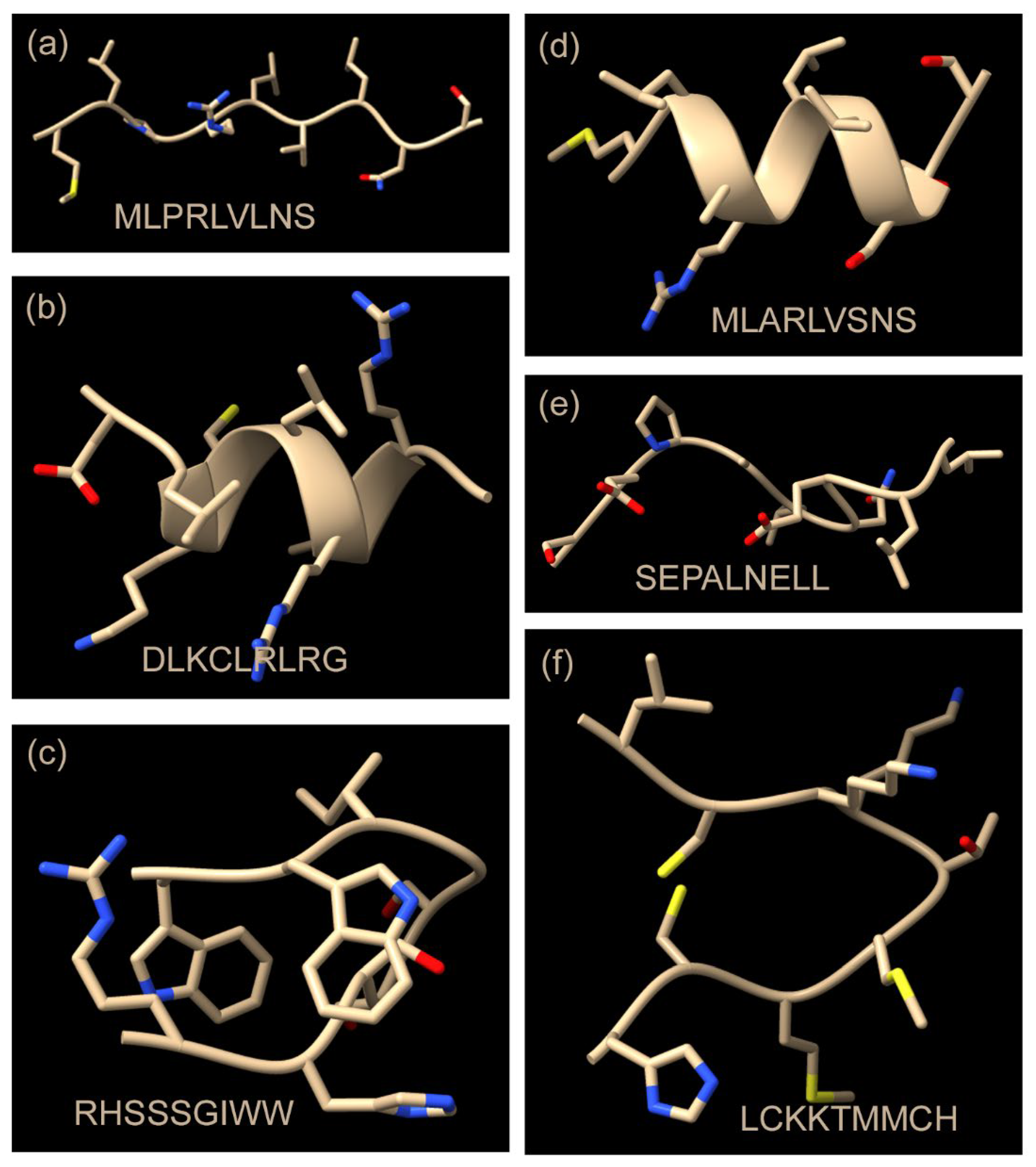
Table 6, lines 1 and 7–10). Apart from the five sequences, however, it is difficult to identify sequences that have obvious regions of similarity. The observed sequence heterogeneity suggests a corresponding heterogeneity in peptide structure, and this feature was examined by using AlphaFold to predict the structure of each peptide. It was expected that the structures predicted by AlphaFold would confirm that the structures of the candidate CR sequences are indeed distinct. A sample of the results is shown in
Figure 1.
Most of the structures could be assigned to one of three groups: (1) an extended array of amino acids as found in MLPRLVLNS and SEPALNELL; (2) a short α-helix (MLARLVSNS and DLKCLRLRG); and (3) a structure in which the peptide is folded into a U shape shown with the closed end shown at the right in RHSSSGIWW and LCKKTMMCH. In all three cases, the structures are interpreted to support the view that they are highly distinct from each other. This can be seen in the α-helical pair shown in
Figure 1. While DLKCLRLRG is found to be rich in positively charged amino acids, MLARLVSNS is less so (compare panels (b) and (d) in
Figure 1). DLKCLRLRG has regularly spaced leucine residues characteristic of α-helices [
9]. In the extended chain pair, SEPALNELL is found to have a hydrophobic C-terminus not found in the other extended chain structure (compare panels (a) and (e)). In the LCKKTMMCH structure, two cysteine residues are near each other and potentially able to form a disulfide bond not seen in the other structures. The results of the predicted structures are interpreted to be consistent with the diverse sequences of the peptides examined and with the function of the sequences in the CR of the parent protein.
4. Discussion
The major contribution described here is a bioinformatic method to identify protein amino acid sequences involved in retaining their parent protein in the cytoplasm. In its environment in the cell, each sequence identified is expected to be a part of a donor–acceptor pair in which both proteins spend at least a part of their lives in the cytoplasm. As there are many such cytoplasmic proteins, it is expected that there are many amino acid sequences devoted to moving proteins to the right place in the cytoplasm (e.g., the mitochondria) and keeping them in place unless movement serves another requirement of the cell. The method described here is expected to provide researchers with a rapid process to identify candidate CR sequences by focusing on their basic properties, presence of the parent protein in the cytoplasm, and location of the CR sequence at an end of the protein amino acid sequence.
To validate the proposed method, it has been used to identify fifteen novel candidate CR sequences in human proteins. All have the properties expected of a CR sequence, including the observation that the group is quite diverse in an amino acid sequence, as would be expected of a small number of sequences selected from a much larger pool. It is hoped that the new method will enable further characterization of CR sequences, including information about the nature of the binding sites recognized by CR sequences.
In creating the new method for identification of CR sequences, a decision had to be made about what location(s) in the parent protein was to be accepted. The C-terminus and the N-terminus were both accepted as good experimental evidence supports the involvement of both [
4,
6,
7,
10,
11,
12,
13,
14]. However, it is acknowledged that sequences in the middle of a protein may also have cytoplasmic retention function. A disordered three-dimensional structure is one property found in sequences at protein ends, and disordered regions are also found in the middle of cytoplasmic proteins. Future studies of CR signals may therefore benefit from consideration of sequences in the middle of the parent protein.
Of the observations reported here, the most consequential may be those regarding isoforms of CR-containing proteins. It is observed that while different isoforms of a cytoplasmic protein may have CR sequences that are the same or different, the location of the CR sequence is the same in all isoforms. This was found to be the case even in the protein CCDC57 that has the most isoforms (13) and the most distinct CR sequences (5) of the proteins examined. Although other explanations may apply, we assume this arises by alternative splicing of the relevant gene followed by evolutionary adjustment of the isoform length so that the CR sequence can be accommodated by its binding site in the cytoplasm [
15].
The presence of different CR sequences in the same isoform of a protein as described here could have important consequences for the overall organization of the cytoplasm. By using distinct CR sequences, the cell could direct the same protein isoform to distinct locations in the cytoplasm. For example, by using separate CR signals, an isoform of protein A could be directed to distinct locations in the cytoplasm such as lysosomes and the mitochondria. This would enable the cell to use its genes economically by distributing them to separate sites.
It is assumed that retention of a protein in the cytoplasm involves contact between its CR sequence and a protein receptor site in the cytoplasm. Protein–receptor contact is expected to be similar to those involved in other protein–protein interactions, except that one of the pair needs to be a resident of the cytoplasm such as a microtubule or a component of the endoplasmic reticulum membrane. In the future, it may be productive to examine the nature of the relevant interactions using bioinformatic software available for studying protein–protein interactions.
5. Conclusions
Three important, novel findings are reported here. (1) A total of 15 novel human cytoplasmic retention sequences are reported. All 15 are 7–9 amino acids in length, found in proteins present in the cytoplasm for at least a part of their lifetime in the cell, and located at or near the N- or the C-terminus of the protein (see
Table 6). (2) A novel experimental pathway is described that allows researchers to identify additional cytoplasmic retention sequences. Using NCBI BLAST, test sequences are examined for homology with sequences in protein-coding genes of the human genome. Proteins with homologous regions of six or more contiguous amino acids are accepted as cytoplasmic retention sequences if they are also found in a cytoplasmic gene and located at or near a protein end. Since many cytoplasmic retention sequences are expected, researchers should be able to find many ways to employ the new method. (3) Among isoforms of the same protein, novel cytoplasmic retention sequences were found to be located at the same position in the amino acid sequence. This feature permits a protein isoform to be distributed to distinct locations in the cytoplasm.
Author Contributions
Both authors, J.C.B. and B.W. were involved in all aspects of the research described here. All authors have read and agreed to the published version of the manuscript.
Funding
The research described here was supported by local funds from the University of Virginia.
Institutional Review Board Statement
The human DNA sequence information reported here is all found in aggregated form from publicly available databases including UCSC Genome Browser (
https://genome.ucsc.edu). No data from any individual person was used in the analysis reported.
Informed Consent Statement
No data from any individual patient was used in this study.
Data Availability Statement
The data presented in this study are available in the article itself.
Conflicts of Interest
The authors declare no conflicts of interest.
References
- Dingwall, C.; Sharnick, S.V.; Laskey, R.A. A polypeptide domain that specifies migration of nucleoplasmin into the nucleus. Cell 1982, 30, 449–458. [Google Scholar] [CrossRef] [PubMed]
- Kalderon, D.; Richardson, W.D.; Markham, A.F.; Smith, A.E. Sequence requirements for nuclear location of simian virus 40 large-T antigen. Nature 1984, 311, 33–38. [Google Scholar] [CrossRef] [PubMed]
- Munro, S.; Pelham, H.R. A C-terminal signal prevents secretion of luminal ER proteins. Cell 1987, 48, 899–907. [Google Scholar] [CrossRef] [PubMed]
- Jackson, M.R.; Nilsson, T.; Peterson, P.A. Identification of a consensus motif for retention of transmembrane proteins in the endoplasmic reticulum. EMBO J. 1990, 9, 3153–3162. [Google Scholar] [CrossRef] [PubMed]
- Martire, G.; Mottola, G.; Pascale, M.C.; Malagolini, N.; Turrini, I.; Serafini-Cessi, F.; Jackson, M.R.; Bonatti, S. Different fate of a single reporter protein containing KDEL or KKXX targeting signals stably expressed in mammalian cells. J. Biol. Chem. 1996, 271, 3541–3547. [Google Scholar] [CrossRef] [PubMed]
- Rubinfeld, H.; Hanoch, T.; Seger, R. Identification of a cytoplasmic-retention sequence in ERK2. J. Biol. Chem. 1999, 274, 30349–30352. [Google Scholar] [CrossRef] [PubMed]
- Nilsson, T.; Jackson, M.; Peterson, P.A. Short cytoplasmic sequences serve as retention signals for transmembrane proteins in the endoplasmic reticulum. Cell 1989, 58, 707–718. [Google Scholar] [CrossRef] [PubMed]
- Blank, V.; Kourilsky, P.; Israel, A. Cytoplasmic retention, DNA binding and processing of the NF-kappa B p50 precursor are controlled by a small region in its C-terminus. EMBO J. 1991, 10, 4159–4167. [Google Scholar] [CrossRef] [PubMed]
- Liu, J.; Zheng, Q.; Deng, Y.; Cheng, C.S.; Kallenbach, N.R.; Lu, M. A seven-helix coiled coil. Proc. Natl. Acad. Sci. USA 2006, 103, 15457–15462. [Google Scholar] [CrossRef] [PubMed]
- Denning, G.; Jean-Joseph, B.; Prince, C.; Durden, D.L.; Vogt, P.K. A short N-terminal sequence of PTEN controls cytoplasmic localization and is required for suppression of cell growth. Oncogene 2007, 26, 3930–3940. [Google Scholar] [CrossRef] [PubMed]
- Kuroki, K.; Russnak, R.; Ganem, D. Novel N-terminal amino acid sequence required for retention of a hepatitis virus glycoprotein in the endoplasmic reticulum. Mol. Cell. Biol. 1989, 9, 4459–4466. [Google Scholar] [PubMed]
- Prigent, M.; Barlat, I.; Langen, H.; Dargemont, C. IκBα and IκBα/NF-κB Complexes Are Retained in the Cytoplasm through Interaction with a Novel Partner, RasGAP SH3-binding Protein 2. J. Biol. Chem. 2000, 275, 36441–36449. [Google Scholar] [CrossRef] [PubMed]
- Sudo, M.; Kobayashi, Y.; Watanabe, N. Presence of a cytoplasmic retention sequence within the human interleukin-1alpha precursor. Zool. Sci. 2005, 22, 891–896. [Google Scholar] [CrossRef] [PubMed]
- Walsh, S.; Margolis, S.S.; Kornbluth, S. Phosphorylation of the cyclin b1 cytoplasmic retention sequence by mitogen-activated protein kinase and Plx. Mol. Cancer Res. 2003, 1, 280–289. [Google Scholar] [PubMed]
- Ulicevic, J.; Shao, Z.; Jasnovidova, O.; Bressin, A.; Gajos, M.; Ng, A.H.; Annaldasula, S.; Meierhofer, D.; Church, G.M.; Busskamp, V.; et al. Uncovering the dynamics and consequences of RNA isoform changes during neuronal differentiation. Mol. Syst. Biol. 2024, 20, 767–798. [Google Scholar] [CrossRef] [PubMed]
| Disclaimer/Publisher’s Note: The statements, opinions and data contained in all publications are solely those of the individual author(s) and contributor(s) and not of MDPI and/or the editor(s). MDPI and/or the editor(s) disclaim responsibility for any injury to people or property resulting from any ideas, methods, instructions or products referred to in the content. |