Diabetes Alters microRNA Expression in Epicardial and Subcutaneous Adipose Tissue from Patients Undergoing Elective Cardiac Surgery

 , , , and
Highlights
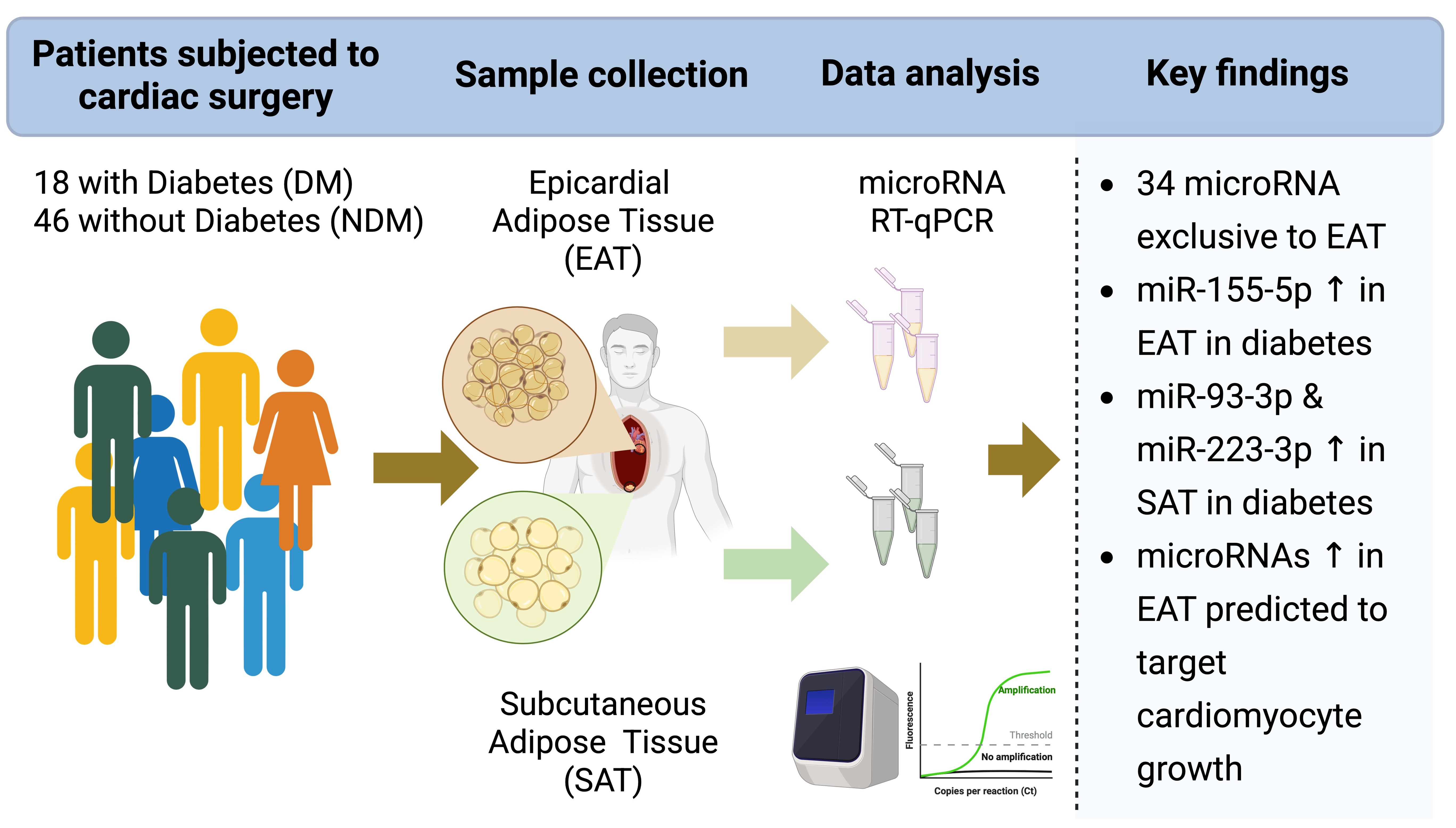
- A microRNA discovery panel identified 34 microRNAs to be uniquely expressed in epicardial adipose tissue (EAT).
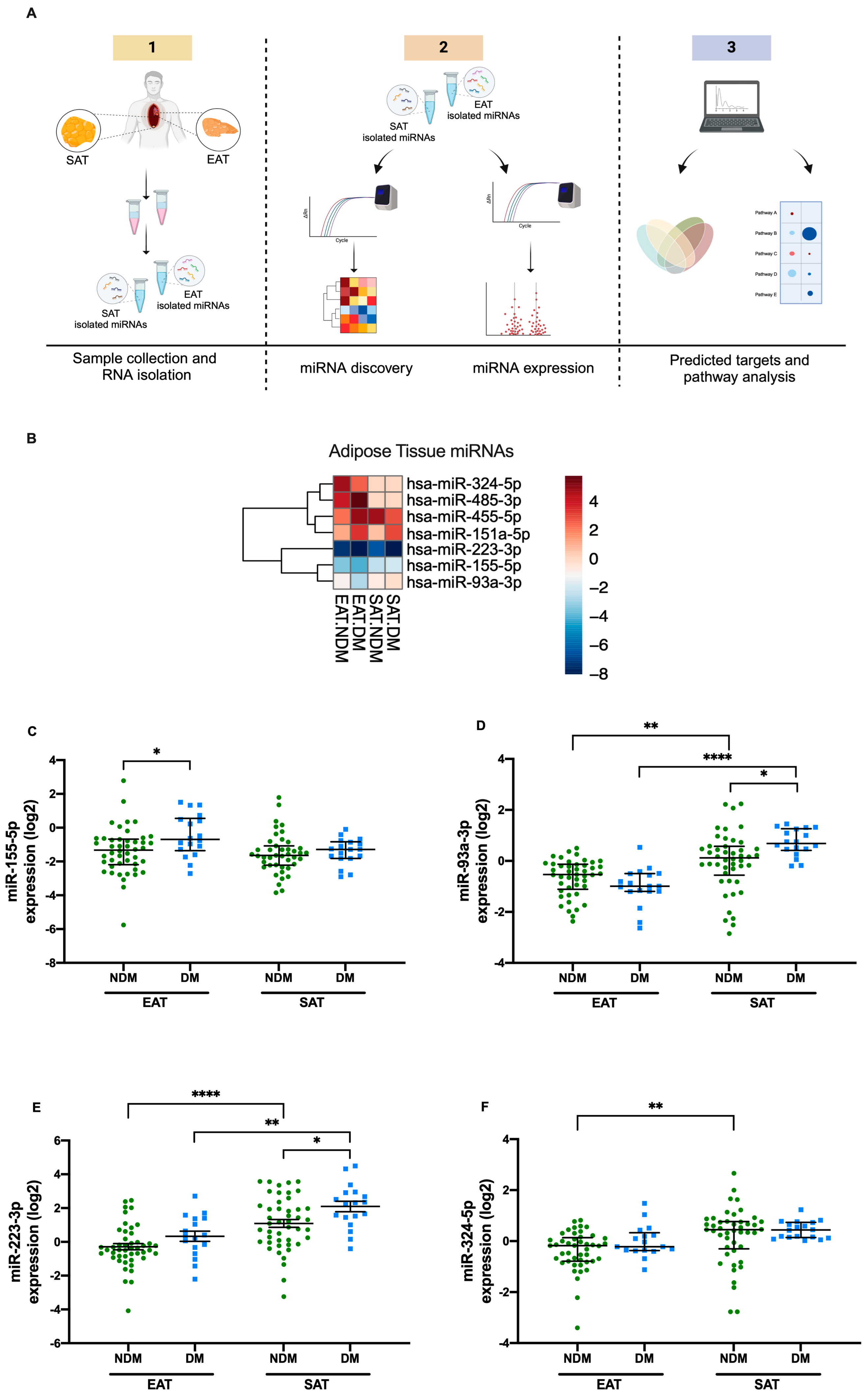
- Diabetes increases the expression of miR-155-5p in EAT and of miR-93-3p and miR-223-3p in subcutaneous AT.
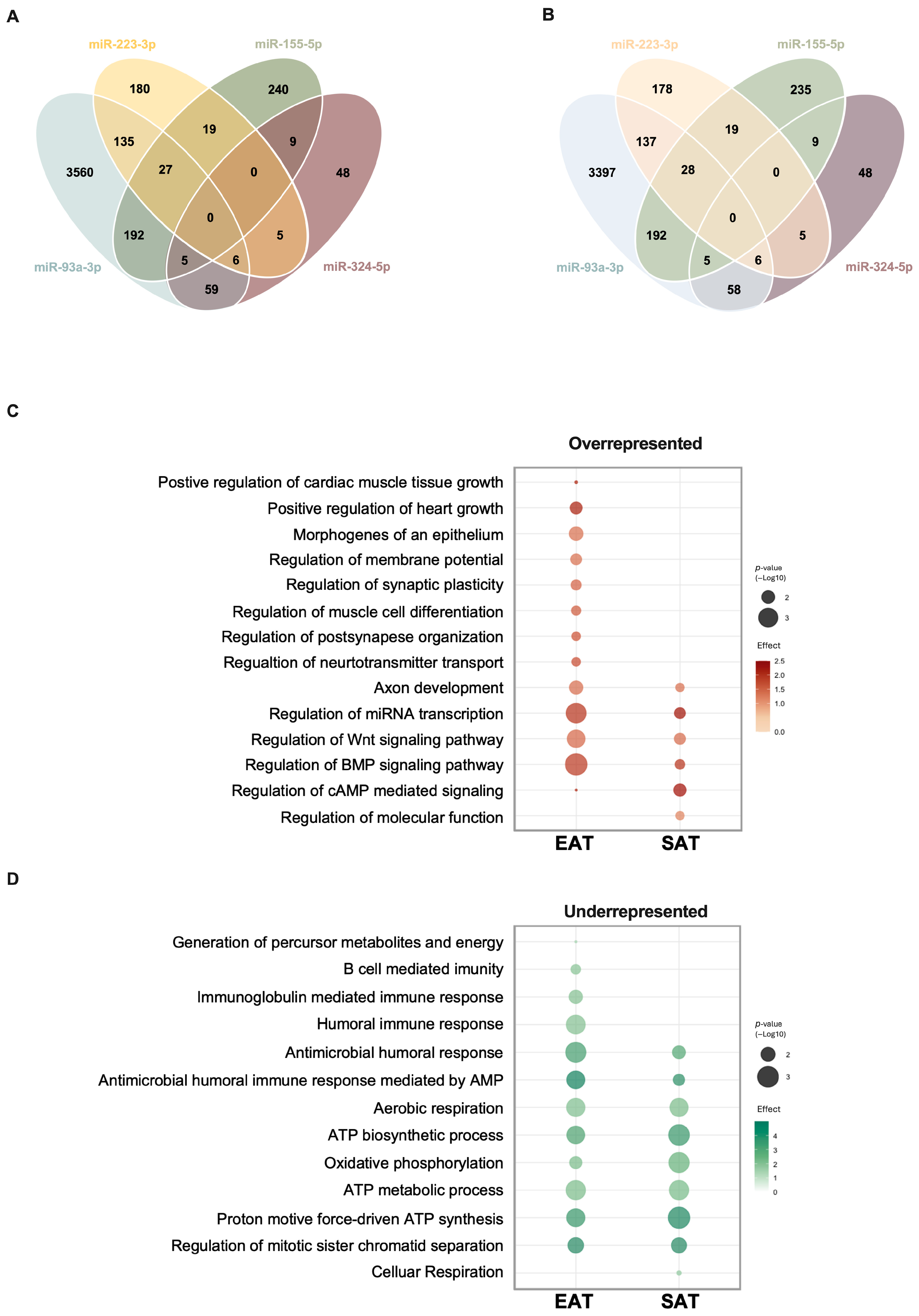
- EAT microRNA targets are enriched in pathways for heart cell growth and differentiation.
Abstract
1. Introduction
2. Materials and Methods
2.1. Ethical Approval
2.2. Adipose Tissue Donors
2.3. MicroRNA Analysis
2.3.1. RNA Isolation
2.3.2. Participant Selection for miRNA Discovery
2.3.3. Microarray Discovery Analysis of miRNAs
2.3.4. Validation and Targeted Analysis of Selected miRNAs
2.4. Statistical Analysis
3. Results
3.1. Characteristics of the Study Population
3.2. miRNA Discovery: Cohort Description and Adipose Tissue-Dependent Profiling
3.3. Altered miRNA Expression in EAT and SAT from Patients Elected for Cardiac Surgery
3.4. Interaction Between miRNAS and Anthropometric Disease Status Variables
3.5. Pathway Analysis
4. Discussion
5. Conclusions
Supplementary Materials
Author Contributions
Funding
Institutional Review Board Statement
Informed Consent Statement
Data Availability Statement
Acknowledgments
Conflicts of Interest
Abbreviations
| ACEI | Angiotensin-converting enzyme inhibitor |
| ARB | Angiotensin II receptor blockers |
| AMP | Antimicrobial peptide |
| ATP | Adenosine triphosphate |
| BAT | Brown adipose tissue |
| BMI | Body mass index |
| BMP | Bone morphogenic protein |
| BP | Biological process |
| cAMP | Cyclic adenosine monophosphate |
| CABG | Coronary artery bypass grafting |
| CAD | Coronary artery disease/coronary artery disease group |
| CVD | Cardiovascular disease |
| DEPC | Diethyl pyrocarbonate |
| DM | Diabetes mellitus/diabetes mellitus group |
| DPP-4 | Dipeptidyl peptidase-4 |
| EAT | Epicardial adipose tissue |
| GEO | Gene expression omnibus |
| miRNA | microRNA |
| NCAD | Non-diabetes mellitus group |
| NDM | Non-coronary artery disease group |
| SAT | Subcutaneous adipose tissue |
| SEM | Stander error of the median |
| WAT | White adipose tissue |
| WNT | Wingless-related integration site |
References
- Britton, K.A.; Massaro, J.M.; Murabito, J.M.; Kreger, B.E.; Hoffmann, U.; Fox, C.S. Body fat distribution, incident cardiovascular disease, cancer, and all-cause mortality. J. Am. Coll. Cardiol. 2013, 62, 921–925. [Google Scholar] [CrossRef]
- Alkhalaqi, A.; Al-Naimi, F.; Qassmi, R.; Shi, Z.; Ganji, V.; Salih, R.; Bawadi, H. Visceral adiposity index is a better predictor of type 2 diabetes than body mass index in Qatari population. Medicine 2020, 99, e21327. [Google Scholar] [CrossRef] [PubMed]
- Marchington, J.M.; Mattacks, C.A.; Pond, C.M. Adipose tissue in the mammalian heart and pericardium: Structure, fetal development and biochemical properties. Comp. Biochem. Physiol. 1989, 94, 225–232. [Google Scholar] [CrossRef]
- Liu, Y.; Fu, W.; Lu, M.; Huai, S.; Song, Y.; Wei, Y. Role of miRNAs in Epicardial Adipose Tissue in CAD Patients with T2DM. BioMed Res. Int. 2016, 2016, 1–7. [Google Scholar] [CrossRef] [PubMed]
- Chechi, K.; Vijay, J.; Voisine, P.; Mathieu, P.; Bossé, Y.; Tchernof, A.; Grundberg, E.; Richard, D. UCP1 expression–associated gene signatures of human epicardial adipose tissue. JCI Insight 2019, 4, e123618. [Google Scholar] [CrossRef]
- Chechi, K.; Blanchard, P.G.; Mathieu, P.; Deshaies, Y.; Richard, D. Brown fat like gene expression in the epicardial fat depot correlates with circulating HDL-cholesterol and triglycerides in patients with coronary artery disease. Int. J. Cardiol. 2013, 167, 2264–2270. [Google Scholar] [CrossRef]
- Jiang, D.-S.; Zeng, H.-L.; Li, R.; Huo, B.; Su, Y.-S.; Fang, J.; Yang, Q.; Liu, L.-G.; Hu, M.; Cheng, C.; et al. Aberrant Epicardial Adipose Tissue Extracellular Matrix Remodeling in Patients with Severe Ischemic Cardiomyopathy: Insight from Comparative Quantitative Proteomics. Sci. Rep. 2017, 7, 43787. [Google Scholar] [CrossRef]
- Salatzki, J.; Foryst-Ludwig, A.; Bentele, K.; Blumrich, A.; Smeir, E.; Ban, Z.; Brix, S.; Grune, J.; Beyhoff, N.; Klopfleisch, R.; et al. Adipose tissue ATGL modifies the cardiac lipidome in pressure-overload-induced left ventricular failure. PLoS Genet. 2018, 14, e1007171. [Google Scholar] [CrossRef]
- Pérez-Belmonte, L.M.; Moreno-Santos, I.; Gómez-Doblas, J.J.; García-Pinilla, J.M.; Morcillo-Hidalgo, L.; Garrido-Sánchez, L.; Santiago-Fernández, C.; Crespo-Leiro, M.G.; Carrasco-Chinchilla, F.; Sánchez-Fernández, P.L.; et al. Expression of epicardial adipose tissue thermogenic genes in patients with reduced and preserved ejection fraction heart failure. Int. J. Med. Sci. 2017, 14, 891–895. [Google Scholar] [CrossRef]
- Bartel, D.P. MicroRNAs: Genomics, Biogenesis, Mechanism, and Function. Cell 2004, 116, 281–297. [Google Scholar] [CrossRef]
- Shantikumar, S.; Caporali, A.; Emanueli, C. Role of microRNAs in diabetes and its cardiovascular complications. Cardiovasc. Res. 2012, 93, 583–593. [Google Scholar] [CrossRef]
- Wronska, A. The Role of microRNA in the Development, Diagnosis, and Treatment of Cardiovascular Disease: Recent Developments. J. Pharmacol. Exp. Ther. 2023, 384, 123–132. [Google Scholar] [CrossRef]
- Santos, D.; Carvalho, E. Adipose-related microRNAs as modulators of the cardiovascular system: The role of epicardial adipose tissue. J. Physiol. 2022, 600, 1171–1187. [Google Scholar] [CrossRef] [PubMed]
- Burgeiro, A.; Fuhrmann, A.; Cherian, S.; Espinoza, D.; Jarak, I.; Carvalho, R.A.; Loureiro, M.; Patrício, M.; Antunes, M.; Carvalho, E. Glucose uptake and lipid metabolism are impaired in epicardial adipose tissue from heart failure patients with or without diabetes. Am. J. Physiol. Endocrinol. Metab. 2016, 310, E550–E564. [Google Scholar] [CrossRef] [PubMed]
- Burgeiro, A.; Fonseca, A.C.; Espinoza, D.; Carvalho, L.; Lourenço, N.; Antunes, M.; Carvalho, E. Proteostasis in epicardial versus subcutaneous adipose tissue in heart failure subjects with and without diabetes. Biochim. Biophys. Acta Mol. Basis Dis. 2018, 1864, 2183–2198. [Google Scholar] [CrossRef] [PubMed]
- Antunes, P.E.; Ferrao de Oliveira, J.; Prieto, D.; Coutinho, G.F.; Correia, P.; Branco, C.F.; Antunes, M.J. Coronary artery bypass surgery without cardioplegia: Hospital results in 8515 patients. Eur. J. Cardiothorac. Surg. 2016, 49, 918–925. [Google Scholar] [CrossRef]
- Antunes, P.E.; de Oliveira, J.F.; Antunes, M.J. Risk-prediction for postoperative major morbidity in coronary surgery. Eur. J. Cardiothorac. Surg. 2009, 35, 760–767. [Google Scholar] [CrossRef]
- Chen, X.; Ba, Y.; Ma, L.; Cai, X.; Yin, Y.; Wang, K.; Guo, J.; Zhang, Y.; Chen, J.; Guo, X.; et al. Characterization of microRNAs in serum: A novel class of biomarkers for diagnosis of cancer and other diseases. Cell Res. 2008, 18, 997–1006. [Google Scholar] [CrossRef]
- Sørensen, A.E.; van Poppel, M.N.M.; Desoye, G.; Simmons, D.; Damm, P.; Jensen, D.M.; Dalgaard, L.T.; The DALI Core Investigator Group. The Temporal Profile of Circulating miRNAs during Gestation in Overweight and Obese Women with or without Gestational Diabetes Mellitus. Biomedicines 2022, 10, 482. [Google Scholar] [CrossRef]
- Agarwal, V.; Bell, G.W.; Nam, J.-W.; Bartel, D.P. Predicting effective microRNA target sites in mammalian mRNAs. eLife 2015, 4, e05005. [Google Scholar] [CrossRef]
- Wei, T.; Simko, V. R Package “corrplot” Title Visualization of a Correlation Matrix, Version 0.84; GitHub: San Francisco, CA, USA, 2017. Available online: http://gthub.com/corplot/ (accessed on 23 September 2025).
- Du, F.; Yu, F.; Wang, Y.; Hui, Y.; Carnevale, K.; Fu, M.; Lu, H.; Fan, D. MicroRNA-155 deficiency results in decreased macrophage inflammation and attenuated atherogenesis in apolipoprotein E-deficient mice. Arter. Thromb. Vasc. Biol. 2014, 34, 759–767. [Google Scholar] [CrossRef] [PubMed]
- Chuang, T.Y.; Wu, H.L.; Chen, C.C.; Gamboa, G.M.; Layman, L.C.; Diamond, M.P.; Azziz, R.; Chen, Y.H. MicroRNA-223 expression is upregulated in insulin resistant human adipose tissue. J. Diabetes Res. 2015, 2015. [Google Scholar] [CrossRef]
- Sánchez-Ceinos, J.; Rangel-Zuñiga, O.A.; Clemente-Postigo, M.; Podadera-Herreros, A.; Camargo, A.; Alcalá-Diaz, J.F.; Guzmán-Ruiz, R.; López-Miranda, J.; Malagón, M.M. miR-223-3p as a potential biomarker and player for adipose tissue dysfunction preceding type 2 diabetes onset. Mol. Ther. Nucleic Acids 2021, 23, 1035–1052. [Google Scholar] [CrossRef]
- Singh, S.; de Ronde, M.W.J.; Kok, M.G.M.; Beijk, M.A.; De Winter, R.J.; van der Wal, A.C.; Sondermeijer, B.M.; Meijers, J.C.M.; Creemers, E.E.; Pinto-Sietsma, S.-J. MiR-223-3p and miR-122-5p as circulating biomarkers for plaque instability. Open Heart 2020, 7, e001223. [Google Scholar] [CrossRef]
- Taïbi, F.; Metzinger-Le Meuth, V.; Massy, Z.A.; Metzinger, L. miR-223: An inflammatory oncomiR enters the car-diovascular field. Biochim. Biophys. Acta (BBA) Mol. Basis Dis. 2014, 1842, 1001–1009. [Google Scholar] [CrossRef]
- Wu, W.; Shan, Z.; Wang, R.; Chang, G.; Wang, M.; Wu, R.; Li, Z.; Zhang, C.; Li, W.; Wang, S. Overexpression of miR-223 inhibits foam cell formation by inducing autophagy in vascular smooth muscle cells. Am. J. Transl. Res. 2019, 11, 4326–4336. [Google Scholar] [PubMed]
- Wang, J.; Bai, X.; Song, Q.; Fan, F.; Hu, Z.; Cheng, G.; Zhang, Y. miR-223 Inhibits Lipid Deposition and Inflammation by Suppressing Toll-Like Receptor 4 Signaling in Macrophages. Int. J. Mol. Sci. 2015, 16, 24965–24982. [Google Scholar] [CrossRef] [PubMed]
- Chen, E.; Wu, H.L.; Chen, Y.H. MicroRNA (miR-93) Overexpression Selectively in Adipose Tissue Induces Obesity. FASEB J. 2019, 33, lb563. [Google Scholar] [CrossRef]
- Gong, J.; Yang, Y.; Wang, J.; Li, Y.; Guo, X.; Huang, Q.; Kuang, T.; Yang, S.; Li, J.; Miao, R. Expression of miR-93-5p as a Potential Predictor of the Severity of Chronic Thromboembolic Pulmonary Hypertension. BioMed Res. Int. 2021, 2021, 6634417. [Google Scholar] [CrossRef]
- O’Sullivan, J.F.; Neylon, A.; Fahy, E.F.; Yang, P.; Mcgorrian, C.; Blake, G.J. MiR-93-5p is a novel predictor of coronary in-stent restenosis. Heart Asia 2019, 11, e011134. [Google Scholar] [CrossRef]
- Infante, T.; Forte, E.; Punzo, B.; Cademartiri, F.; Cavaliere, C.; Soricelli, A.; Salvatore, M.; Napoli, C. Correlation of Circulating miR-765, miR-93-5p, and miR-433-3p to Obstructive Coronary Heart Disease Evaluated by Cardiac Computed Tomography. Am. J. Cardiol. 2019, 124, 176–182. [Google Scholar] [CrossRef]
- Ke, Z.-P.; Xu, P.; Shi, Y.; Gao, A.-M. MicroRNA-93 inhibits ischemia-reperfusion induced cardiomyocyte apoptosis by targeting PTEN. Oncotarget 2016, 7, 28796–28805. [Google Scholar] [CrossRef]
- Liu, J.; Jiang, M.; Deng, S.; Lu, J.; Huang, H.; Zhang, Y.; Gong, P.; Shen, X.; Ruan, H.; Jin, M.; et al. miR-93-5p-Containing Exosomes Treatment Attenuates Acute Myocardial Infarction-Induced Myocardial Damage. Mol. Ther. Nucleic Acids 2018, 11, 103–115. [Google Scholar] [CrossRef]
- Zhou, X.; Shi, X.; Wang, J.; Zhang, X.; Xu, Y.; Liu, Y.; Li, X.; Yang, G. miR-324-5p promotes adipocyte differentiation and lipid droplet accumulation by targeting Krueppel-like factor 3 (KLF3). J. Cell Physiol. 2020, 235, 7484–7495. [Google Scholar] [CrossRef]
- Liu, Y.; Wang, J.; Zhou, X.; Cao, H.; Zhang, X.; Huang, K.; Li, X.; Yang, G.; Shi, X. miR-324-5p Inhibits C2C12 cell Differentiation and Promotes Intramuscular Lipid Deposition through lncDUM and PM20D1. Mol. Ther. Nucleic Acids 2020, 22, 722–732. [Google Scholar] [CrossRef]
- Li, D.; Liu, Y.; Gao, W.; Han, J.; Yuan, R.; Zhang, M.; Pang, W. Inhibition of miR-324-5p increases PM20D1-mediated white and brown adipose loss and reduces body weight in juvenile mice. Eur. J. Pharmacol. 2019, 863, 172708. [Google Scholar] [CrossRef]
- Guo, J.; Yang, C.; Lin, Y.; Hu, G.; Wei, J.; Zhang, X.; Chen, X.; Li, J. Enhanced peripheral blood miR-324-5p is associated with the risk of metabolic syndrome by suppressing ROCK1. Biochim. Biophys. Acta (BBA) Mol. Cell Biol. Lipids 2020, 1865, 158727. [Google Scholar] [CrossRef]
- Neiburga, K.D.; Vilne, B.; Bauer, S.; Bongiovanni, D.; Ziegler, T.; Lachmann, M.; Wengert, S.; Hawe, J.S.; Güldener, U.; Westerlund, A.M.; et al. Vascular Tissue Specific miRNA Profiles Reveal Novel Correlations with Risk Factors in Coronary Artery Disease. Biomolecules 2021, 11, 1683. [Google Scholar] [CrossRef] [PubMed]
- Miao, L.; Yin, R.X.; Pan, S.L.; Yang, S.; Yang, D.Z.; Lin, W.X. Circulating miR-3659 may be a potential biomarker of dyslipidemia in patients with obesity. J. Transl. Med. 2019, 17, 25. [Google Scholar] [CrossRef] [PubMed]
- Ahlin, F.; Arfvidsson, J.; Vargas, K.G.; Stojkovic, S.; Huber, K.; Wojta, J. MicroRNAs as circulating biomarkers in acute coronary syndromes: A review. Vascul Pharmacol. 2016, 81, 15–21. [Google Scholar] [CrossRef] [PubMed]
- Liu, J.; Gao, A.; Liu, Y.; Sun, Y.; Zhang, D.; Lin, X.; Hu, C.; Zhu, Y.; Du, Y.; Han, H.; et al. MicroRNA Expression Profiles of Epicardial Adipose Tissue-Derived Exosomes in Patients with Coronary Atherosclerosis. Rev. Cardiovasc. Med. 2022, 23, 206. [Google Scholar] [CrossRef]
- Lin, J.C. Multi-posttranscriptional regulations lessen the repressive effect of SRPK1 on brown adipogenesis. Biochim. Biophys. Acta (BBA) Mol. Cell Biol. Lipids 2018, 1863, 503–514. [Google Scholar] [CrossRef]
- You, L.; Wang, Y.; Gao, Y.; Wang, X.; Cui, X.; Zhang, Y.; Pang, L.; Ji, C.; Guo, X.; Chi, X. The role of microRNA-23b-5p in regulating brown adipogenesis and thermogenic program. Endocr. Connect. 2020, 9, 457–470. [Google Scholar] [CrossRef]
- Xu, X.; Li, H. Integrated microRNA-gene analysis of coronary artery disease based on miRNA and gene expression profiles. Mol. Med. Rep. 2016, 13, 3063–3073. [Google Scholar] [CrossRef]
- Fowler, M.J. Microvascular and Macrovascular Complications of Diabetes. Clin. Diabetes 2011, 29, 116–122. [Google Scholar] [CrossRef]
- Lemoine, A.Y.; Ledoux, S.; Larger, E. Adipose tissue angiogenesis in obesity. Thromb. Haemost. 2013, 110, 661–669. [Google Scholar] [CrossRef]
- Lee, R.C.; Feinbaum, R.L.; Ambros, V. The C. elegans heterochronic gene lin-4 encodes small RNAs with antisense complementarity to lin-14. Cell 1993, 75, 843–854. [Google Scholar] [CrossRef] [PubMed]
- Peters, L.J.F.; Biessen, E.A.L.; Hohl, M.; Weber, C.; van der Vorst, E.P.C.; Santovito, D. Small Things Matter: Relevance of MicroRNAs in Cardiovascular Disease. Front. Physiol. 2020, 11, 793. [Google Scholar] [CrossRef] [PubMed]
- Chen, Y.; Siegel, F.; Kipschull, S.; Haas, B.; Fröhlich, H.; Meister, G.; Pfeifer, A. MiR-155 regulates differentiation of brown and beige adipocytes via a bistable circuit. Nat. Commun. 2013, 4, 1769. [Google Scholar] [CrossRef]
- Lin, X.; Qin, Y.; Jia, J.; Lin, T.; Chen, L.; Zeng, H.; Han, Y.; Wu, L.; Huang, S.; Wang, M.; et al. MiR-155 Enhances Insulin Sensitivity by Coordinated Regulation of Multiple Genes in Mice. PLoS Genet. 2016, 12, e1006308. [Google Scholar] [CrossRef]
- Moura, J.; Sørensen, A.; Leal, E.C.; Svendsen, R.; Carvalho, L.; Willemoes, R.J.; Jørgensen, P.T.; Jenssen, H.; Wengel, J.; Dalgaard, L.T.; et al. microRNA-155 inhibition restores Fibroblast Growth Factor 7 expression in diabetic skin and decreases wound inflammation. Sci. Rep. 2019, 9, 5836. [Google Scholar] [CrossRef] [PubMed]
- Da Silva, J.; Santos, D.; Vilaça, M.; Carvalho, A.; Carvalho, R.; Jesus Dantas Mde Pereira, M.G.; Carvalho, E. Impact of Psychological Distress on Physiological Indicators of Healing Prognosis in Patients with Chronic Diabetic Foot Ulcers: A Longitudinal Study. Adv Wound Care 2023, 13, 308–321. [Google Scholar] [CrossRef]
- Kurylowicz, A. microRNAs in Human Adipose Tissue Physiology and Dysfunction. Cells 2021, 10, 3342. [Google Scholar] [CrossRef] [PubMed]
- Marzolla, V.; Armani, A.; Zennaro, M.C.; Cinti, F.; Mammi, C.; Fabbri, A.; Rosano, G.M.C.; Caprio, M. The role of the mineralocorticoid receptor in adipocyte biology and fat metabolism. Mol. Cell Endocrinol. 2012, 350, 281–288. [Google Scholar] [CrossRef]
- Iacobellis, G. Epicardial adipose tissue in contemporary cardiology. Nat. Rev. Cardiol. 2022, 19, 593–606. [Google Scholar] [CrossRef] [PubMed]
- Koefoed Petersen, R.; Madsen, L.; Møller Pedersen, L.; Hallenborg, P.; Hagland, H.; Viste, K.; Ove Døskeland, S.; Kristiansen, K. Cyclic AMP (cAMP)-Mediated Stimulation of Adipocyte Differentiation Requires the Synergistic Action of Epac-and cAMP-Dependent Protein Kinase-Dependent Processes. Mol. Cell Biol. 2008, 28, 3804–3816. [Google Scholar] [CrossRef]
- So, J.; Taleb, S.; Wann, J.; Strobel, O.; Kim, K.; Roh, H.C. Chronic cAMP activation induces adipocyte browning through discordant biphasic remodeling of transcriptome and chromatin accessibility. Mol. Metab. 2022, 66, 101619. [Google Scholar] [CrossRef]
- Kosmas, C.E.; Bousvarou, M.D.; Kostara, C.E.; Papakonstantinou, E.J.; Salamou, E.; Guzman, E. Insulin resistance and cardiovascular disease. J. Int. Med. Res. 2023, 51, 1–49. [Google Scholar] [CrossRef]
- Bódis, K.; Roden, M. Energy metabolism of white adipose tissue and insulin resistance in humans. Eur. J. Clin. Investig. 2018, 48, e13017. [Google Scholar] [CrossRef]



| NDM | DM | p-Value | |
|---|---|---|---|
| N | 46 | 18 | |
| Male (M) | 25 (54%) | 10 (56%) | 0.93 |
| Age (years) | 70.1 ± 1.6 | 72.2 ± 1.5 | 0.34 |
| Cardiovascular risk factors | |||
| Hypertension | 32 (70%) | 18 (100%) | 0.008 |
| Dyslipidemia | 36 (78%) | 13 (72%) | 0.61 |
| Smoking | 11 (24%) | 4 (22%) | 0.89 |
| BMI | 27.3 ± 0.5 | 27.0 ± 0.7 | 0.74 |
| Family history of heart disease | 1 (2%) | 1 (6%) | 0.58 |
| Medication | |||
| Antiplatelet | 14 (30%) | 9 (50%) | 0.32 |
| Antiarrhythmic | 4 (9%) | 4 (22%) | 0.23 |
| Anticoagulant | 8 (17%) | 5 (28%) | 0.56 |
| Insulin | 0 (0%) | 6 (33%) | ≤0.001 |
| Oral antidiabetic | |||
| Biguanide | 0 (0%) | 8 (44%) | ≤0.001 |
| DPP4 inhibitor | 0 (0%) | 1 (6%) | 0.14 |
| DPP4 inhibitor + Biguanide | 0 (0%) | 3 (17%) | 0.009 |
| Sulfonylurea | 0 (0%) | 1 (6%) | 0.14 |
| Diuretic | 15 (33%) | 12 (67%) | 0.041 |
| ACEI | 13 (28%) | 8 (44%) | 0.43 |
| ARB | 12 (26%) | 5 (28%) | 0.72 |
| β blocker | 13 (28%) | 9 (50%) | 0.23 |
| Calcium channel blocker | 6 (13%) | 2 (11%) | 0.64 |
| Electrolyte—KCl | 1 (2%) | 1 (6%) | 0.58 |
| Statins | 27 (59%) | 12 (67%) | 0.73 |
| Term | miR- 155-5p | miR- 93a-3p | miR- 223-3p | miR- 324-5p | miR- 151a-5p | miR- 455-5p | miR- 485-3p |
|---|---|---|---|---|---|---|---|
| Intercept | −2.557 (0.882) ** | −0.938 (0.705) | −1.023 (0.886) | −1.726 (0.697) * | −1.395 (0.748) | −2.002 (0.726) ** | −0.833 (0.527) |
| DM | 0.796 (0.331) * | −0.323 (0.253) | 0.502 (0.385) | 0.340 (0.241) | 0.297 (0.259) | 0.084 (0.269) | −0.376 (0.218) |
| Tissue | −0.328 (0.230) | 0.650 (0.144) *** | 1.292 (0.282) *** | 0.581 (0.127) *** | 0.354 (0.132) ** | 0.313 (0.165) | −0.063 (0.165) |
| Age | 0.018 (0.012) | 0.003 (0.010) | 0.010 (0.012) | 0.019 (0.010) | 0.015 (0.011) | 0.016 (0.010) | 0.003 (0.007) |
| Sex | −0.044 (0.230) | 0.027 (0.193) | 0.279 (0.242) | 0.092 (0.187) | 0.123 (0.205) | −0.018 (0.199) | 0.253 (0.140) * |
| DM: Tissue | −0.625 (0.427) | 1.069 (0.270) *** | 0.483 (0.536) | −0.141 (0.240) | −0.065 (0.248) | −0.019 (0.310) | 0.380 (0.308) |
| DM: EAT | −0.796 (0.331) * | 0.323 (0.253) | −0.502 (0.385) | −0.340 (0.242) | −0.297 (0.259) | −0.084 (0.270) | 0.376 (0.218) |
| DM: SAT | −0.170 (0.332) | −0.747 (0.253) *** | −0.985 (0.375) *** | −0.199 (0.237) | −0.233 (0.259) | −0.064 (0.269) | −0.004 (0.218) |
| ANOVA | Mixed-Methods Analysis | ||||
|---|---|---|---|---|---|
| miRNA | Effect of Tissue | Effect of DM | Effect of Tissue | Effect of DM | Interaction (DM: Tissue) |
| miR- 155-5p | – | EAT: ↑ in DM vs. NDM (p = 0.043) | – | ↑ associated with EAT (p = 0.02) | – |
| miR- 93a-3p | NDM: ↓ 50% in EAT vs. SAT (p = 0.006) | SAT: ↑ in DM vs. NDM (p = 0.015) | + associated with SAT (p ≤ 0.001) | NS | + associated with SAT (p ≤ 0.001) |
| DM: ↓ 30% in EAT vs. SAT (p ≤ 0.0001) | |||||
| miR- 223-3p | NDM: ↓ ~67% in EAT vs. SAT (p ≤ 0.0001) | SAT: ↑ in DM vs. NDM (p = 0.042) | - associated with SAT (p ≤ 0.001) | NS | - associated with SAT (p ≤ 0.001) |
| DM: ↓ 30% in EAT vs. SAT (p = 0.001) | |||||
| miR- 324-5p | NDM: ↓ ~50% in EAT vs. SAT (p = 0.0009) | – | + associated with SAT (p ≤ 0.001) | – | – |
| miR- 151a-5p | – | – | + associated with SAT (p = 0.009) | – | – |
| miR- 455-5p | – | – | – | – | – |
| miR- 485-3p | – | – | – | – | – |
Disclaimer/Publisher’s Note: The statements, opinions and data contained in all publications are solely those of the individual author(s) and contributor(s) and not of MDPI and/or the editor(s). MDPI and/or the editor(s) disclaim responsibility for any injury to people or property resulting from any ideas, methods, instructions or products referred to in the content. |
© 2026 by the authors. Licensee MDPI, Basel, Switzerland. This article is an open access article distributed under the terms and conditions of the Creative Commons Attribution (CC BY) license.
Share and Cite
Santos, D.; Canotilho, A.; Coutinho, G.; Prieto, D.; Antunes, P.; Antunes, M.; Moreira, A.F.L.; Falcão-Pires, I.; Carvalho, E.; Dalgaard, L.T. Diabetes Alters microRNA Expression in Epicardial and Subcutaneous Adipose Tissue from Patients Undergoing Elective Cardiac Surgery. Cells 2026, 15, 122. https://doi.org/10.3390/cells15020122
Santos D, Canotilho A, Coutinho G, Prieto D, Antunes P, Antunes M, Moreira AFL, Falcão-Pires I, Carvalho E, Dalgaard LT. Diabetes Alters microRNA Expression in Epicardial and Subcutaneous Adipose Tissue from Patients Undergoing Elective Cardiac Surgery. Cells. 2026; 15(2):122. https://doi.org/10.3390/cells15020122
Chicago/Turabian StyleSantos, Diana, António Canotilho, Gonçalo Coutinho, David Prieto, Pedro Antunes, Manuel Antunes, Adelino F. Leite Moreira, Inês Falcão-Pires, Eugenia Carvalho, and Louise Torp Dalgaard. 2026. "Diabetes Alters microRNA Expression in Epicardial and Subcutaneous Adipose Tissue from Patients Undergoing Elective Cardiac Surgery" Cells 15, no. 2: 122. https://doi.org/10.3390/cells15020122
APA StyleSantos, D., Canotilho, A., Coutinho, G., Prieto, D., Antunes, P., Antunes, M., Moreira, A. F. L., Falcão-Pires, I., Carvalho, E., & Dalgaard, L. T. (2026). Diabetes Alters microRNA Expression in Epicardial and Subcutaneous Adipose Tissue from Patients Undergoing Elective Cardiac Surgery. Cells, 15(2), 122. https://doi.org/10.3390/cells15020122