Molecular Basis of Glia–ECM Interplay in Central Nervous System Homeostasis and Plasticity


Highlights
- The extracellular matrix and glial cells form a dynamic bidirectional signaling network that governs central nervous system (CNS) homeostasis and plasticity.
- Mechanical cues, biochemical signaling, and glia-driven extracellular matrix (ECM) remodeling cooperatively regulate neuroinflammation, synaptic stability, and myelination.
- Dysregulation of the glia-ECM interactome contributes to neurodegeneration, demyelination, and regenerative failure in neurological disorders.
- Targeting ECM mechanics, matrix composition, and glial phenotypes offers an integrated therapeutic framework for neural repair and translational neuroscience.
Abstract
1. Introduction
2. Structural and Biomechanical Features of ECM
2.1. Interstitial/Diffuse ECM
2.2. Perineuronal Nets (PNNs)
2.3. Perinodal ECM
2.4. Basement Membrane
2.5. Detection and Experimental Manipulation Technologies for CNS Biomechanics
2.6. Neurological Disorders with Altered CNS Biomechanics
2.6.1. Alzheimer’s Disease (AD)
2.6.2. Multiple Sclerosis (MS)
2.6.3. Traumatic Brain Injury (TBI)
3. Core Mechanisms of Glia–ECM Interactions
3.1. Instructive Regulation of Glia by ECM via Mechanical Signals
3.1.1. Microglia: Immunomechanosensation of Substrate Mechanical Properties
Mechanosensitive Channels as Stiffness Decoders
3.1.2. Astrocytes: Morphological and Phenotypic Plasticity Driven by Mechanics
Integrin-Mediated Sensing and Cytoskeletal Reorganization
3.1.3. Oligodendrocyte Lineage: Mechanoregulation of Myelination
3.2. Specific Regulation of Glia by ECM Biochemical Components
3.2.1. Regulation of Astrocyte Function by ECM Cues
Structural and Functional Polarization via Basement Membrane Components
Modulation of Reactivity and Plasticity by Diffuse Matrix and PNNs
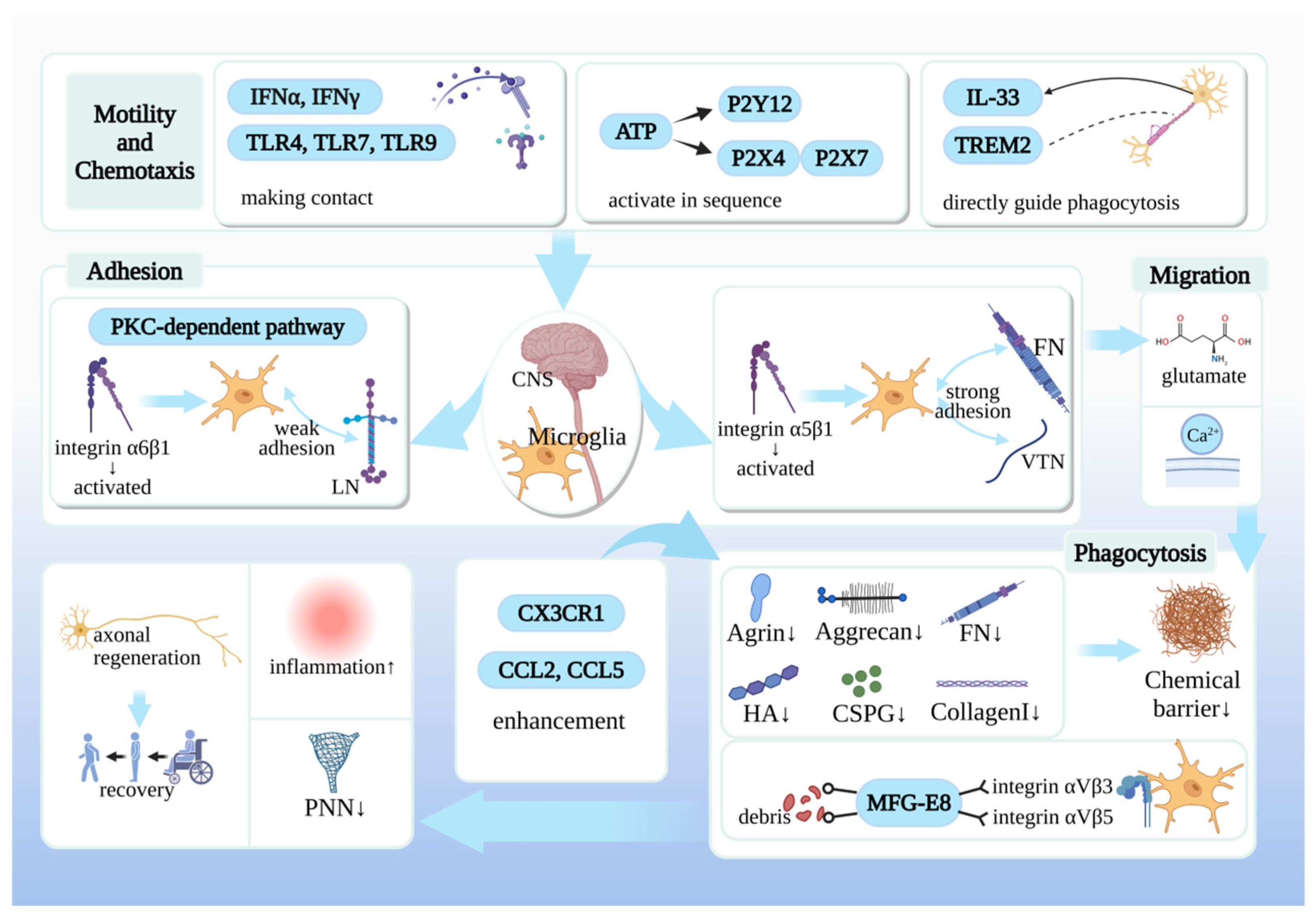
3.2.2. Regulation of Microglia Phenotype and Function by ECM Signals
Adhesion-Dependent Activation and Phagocytic Priming
Sensing Damage and Driving Inflammation via Degradation Products
3.2.3. Regulation of Oligodendrocyte Lineage Dynamics by ECM
Stage-Specific Cues for Development and Remyelination
Modulation by Other Matrix Components
3.3. Remodeling of the ECM by Glial Cells
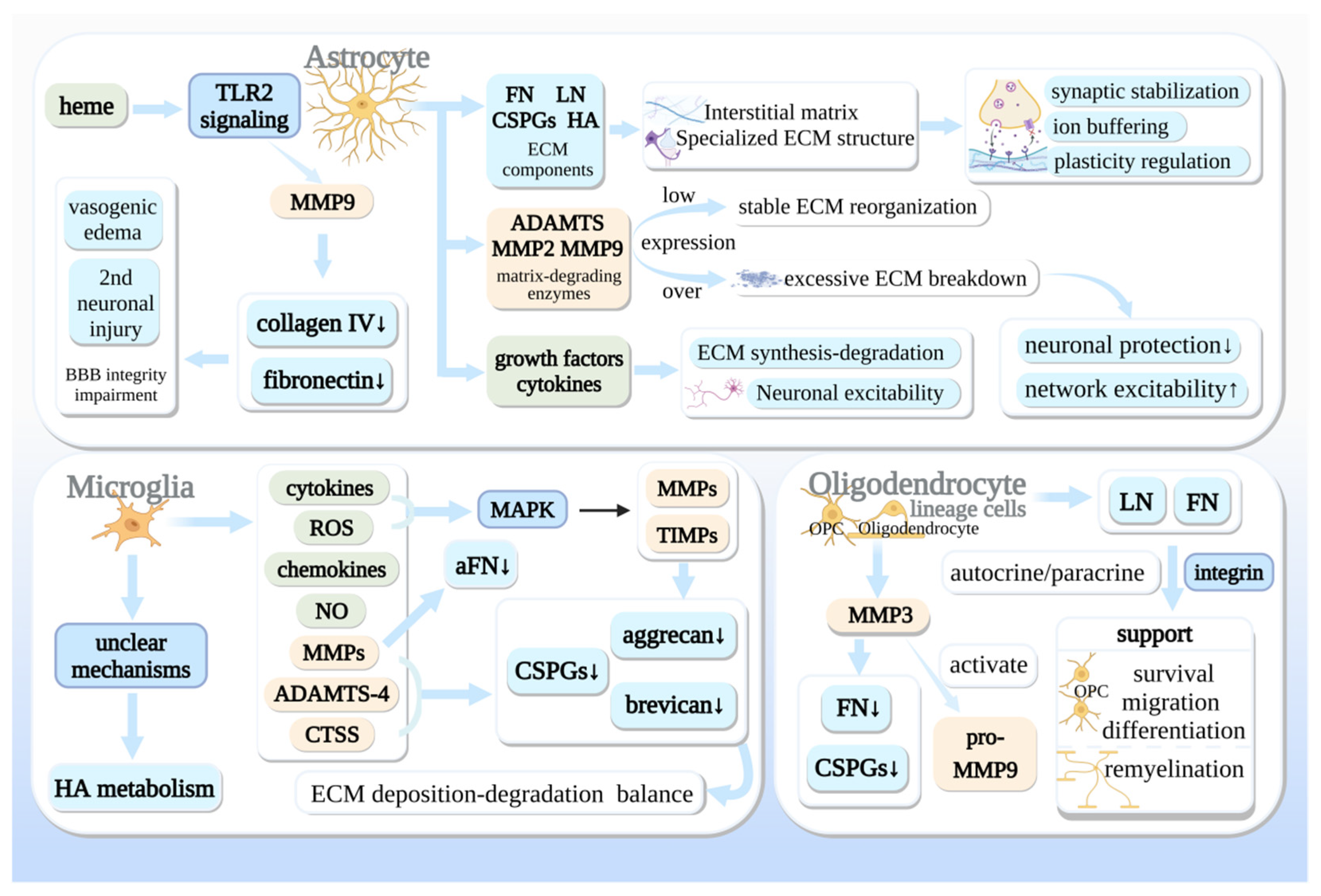
3.3.1. Astrocytes: Key Regulators of ECM Structure and Stability
Synthesis and Assembly of the ECM Scaffold
Proteolytic Remodeling and Its Consequences
3.3.2. Microglia: The Specialized Phagocytes and Precision Modulators
Phagocytic Clearance of ECM Debris
Targeted Enzymatic Degradation
3.3.3. Oligodendrocytes: ECM Contributors in Myelination and Repair

| Components | Neurons | NSCs | Astrocytes (NA/RA) | OL Lineage (OL/Pre-OL/OPC) | Microglia |
|---|---|---|---|---|---|
| PNN and Lectican Family | |||||
| Aggrecan [14,126,127,128] | ++ | + | +/+ | +/ /+ | + |
| Brevican [126,127,129,130] | + | ++/++ | ++/ /++ | ||
| Versican [14,126,127,129,130,131] | ++ | + | ++/++ | −/++/+ | |
| Neurocan [14,126,127,129,130,132] | ++ | + | +/++ | +/+/+ | + |
| Phosphacan [127,129,130] | ++ | ++/++ | ++/ /++ | ||
| HAPLN1/Crtl1 [126,127,129] | ++ | ||||
| HAPLN4/Bral2 [104,133] | ++ | −/− | −/ / | − | |
| Adhesive and Matrix Glycoproteins | |||||
| Tenascin-C [101,126,127,134,135,136] | ++ | + | +/++ | ||
| Tenascin-R [104,126,127,129,131,134] | ++ | +/ | ++/++/++ | ||
| Lectican [126,127,128] | +/+ | +/ / | |||
| Fibronectin [126,130,137] | +/+ | + | |||
| Collagen [130,137,138] | + | +/+ | |||
| Perlecan [13,137,139,140] | + | /+ | + | ||
| Agrin [104,130] | ++ | +/ | |||
| MMPs [127,141,142] | ++ | + | ++/++ | +/+/+ | ++ |
4. Therapeutic Strategies Targeting Glia–ECM Interactions
4.1. Modulating ECM Mechanical Properties
4.1.1. Engineering Biomimetic Hydrogels to Restore a Permissive Niche
4.1.2. Pharmacological Targeting of Mechanosensory Pathways
4.1.3. Harnessing and Manipulating Dynamic Mechanical Signals
4.2. Modulating ECM Composition
4.2.1. Degradation of Inhibitory ECM Components: From Proof-of-Concept to Precision Delivery
4.2.2. Regulating Hyaluronan Dynamics: Harnessing Its Dual Nature
4.2.3. Supplementation and Engineering of Protective ECM Molecules: From Replacement to Mimicry
4.3. Reprogramming Glial Phenotypes
4.3.1. Targeting Extracellular Proteases and Their Inhibitors
4.3.2. Modulating Astrocyte Reactivity via ECM Cues
5. Summary, Open Questions and Future Perspectives
5.1. Current Research Achievements
5.2. Key Open Questions and Existing Bottlenecks
5.3. Future Research Directions
5.4. Concluding Remarks
Author Contributions
Funding
Institutional Review Board Statement
Informed Consent Statement
Data Availability Statement
Acknowledgments
Conflicts of Interest
Abbreviations
| AD | Alzheimer’s disease |
| ADAMTS | A Disintegrin And Metalloproteinase with Thrombospondin Motifs |
| AQP4 | Aquaporin-4 |
| BBB | Blood–Brain Barrier |
| CNS | Central Nervous System |
| CSPGs | Chondroitin Sulfate Proteoglycans |
| ECM | Extracellular Matrix |
| FAK | Focal Adhesion Kinase |
| FN | Fibronectin |
| GLT-1 | Glutamate Transporter 1 |
| HA | Hyaluronan |
| HMW-HA | High-Molecular-Weight Hyaluronan |
| IGF-1 | Insulin-like Growth Factor 1 |
| IL-1β | Interleukin-1β |
| ILK | Integrin-Linked Kinase |
| Kir4.1 | Inwardly Rectifying Potassium Channel 4.1 |
| LMW-HA | Low-Molecular-Weight Hyaluronan |
| LN | Laminin |
| MMPs | Matrix Metalloproteinases |
| MRE | Magnetic Resonance Elastography |
| NMII | Non-muscle Myosin II |
| OPCs | Oligodendrocyte Precursor Cells |
| PIEZO1 | Piezo type mechanosensitive ion channel component 1 |
| PKC | Protein Kinase C |
| PNNs | Perineuronal Nets |
| ROS | Reactive Oxygen Species |
| TIMP | Tissue Inhibitor of Metalloproteinases |
| TLR2/4 | Toll-like Receptors 2 and 4 |
| TN-C | Tenascin-C |
| TN-R | Tenascin-R |
| TNF-α | Tumor Necrosis Factor-α |
| tPA | Tissue Plasminogen Activator |
References
- Iadecola, C. The Neurovascular Unit Coming of Age: A Journey through Neurovascular Coupling in Health and Disease. Neuron 2017, 96, 17–42. [Google Scholar] [CrossRef] [PubMed]
- Zhang, W.; Xiang, Y.; Lu, C.; Wang, F.; Ren, H.; Wu, H.; Yan, M. The extracellular matrix in inflammation and cancer. Mol. Biomed. 2026, 7, 21. [Google Scholar] [CrossRef] [PubMed]
- Müller, L.; Di Benedetto, S.; Müller, V. From Homeostasis to Neuroinflammation: Insights into Cellular and Molecular Interactions and Network Dynamics. Cells 2025, 14, 54. [Google Scholar] [CrossRef] [PubMed]
- Melrose, J.; Hayes, A.J.; Bix, G. The CNS/PNS Extracellular Matrix Provides Instructive Guidance Cues to Neural Cells and Neuroregulatory Proteins in Neural Development and Repair. Int. J. Mol. Sci. 2021, 22, 5583. [Google Scholar] [CrossRef] [PubMed]
- Chelyshev, Y.A.; Kabdesh, I.M.; Mukhamedshina, Y.O. Extracellular Matrix in Neural Plasticity and Regeneration. Cell. Mol. Neurobiol. 2022, 42, 647–664. [Google Scholar] [CrossRef] [PubMed]
- Tewari, B.P.; Chaunsali, L.; Prim, C.E.; Sontheimer, H. A glial perspective on the extracellular matrix and perineuronal net remodeling in the central nervous system. Front. Cell. Neurosci. 2022, 16, 1022754. [Google Scholar] [CrossRef] [PubMed]
- Sanchez, B.; Kraszewski, P.; Lee, S.; Cope, E.C. From molecules to behavior: Implications for perineuronal net remodeling in learning and memory. J. Neurochem. 2024, 168, 1854–1876. [Google Scholar] [CrossRef] [PubMed]
- Strat, A.N.; Ahmed, A.; Viapiano, M.; Ganapathy, P.S. Astrocyte Mechanobiology: Linking Biomechanical Forces to Biochemical Signaling in the Central Nervous System. Glia 2026, 74, e70167. [Google Scholar] [CrossRef] [PubMed]
- Makhija, E.P.; Espinosa-Hoyos, D.; Jagielska, A.; Van Vliet, K.J. Mechanical regulation of oligodendrocyte biology. Neurosci. Lett. 2020, 717, 134673. [Google Scholar] [CrossRef] [PubMed]
- Georges, P.C.; Miller, W.J.; Meaney, D.F.; Sawyer, E.S.; Janmey, P.A. Matrices with compliance comparable to that of brain tissue select neuronal over glial growth in mixed cortical cultures. Biophys. J. 2006, 90, 3012–3018. [Google Scholar] [CrossRef] [PubMed]
- Ayata, P.; Schaefer, A. Innate sensing of mechanical properties of brain tissue by microglia. Curr. Opin. Immunol. 2020, 62, 123–130. [Google Scholar] [CrossRef] [PubMed]
- Crapser, J.D.; Spangenberg, E.E.; Barahona, R.A.; Arreola, M.A.; Hohsfield, L.A.; Green, K.N. Microglia facilitate loss of perineuronal nets in the Alzheimer’s disease brain. eBioMedicine 2020, 58, 102919. [Google Scholar] [CrossRef] [PubMed]
- Pu, A.; Stephenson, E.L.; Yong, V.W. The extracellular matrix: Focus on oligodendrocyte biology and targeting CSPGs for remyelination therapies. Glia 2018, 66, 1809–1825. [Google Scholar] [CrossRef] [PubMed]
- Abaskharoun, M.; Bellemare, M.; Lau, E.; Margolis, R.U. Expression of hyaluronan and the hyaluronan-binding proteoglycans neurocan, aggrecan, and versican by neural stem cells and neural cells derived from embryonic stem cells. Brain Res. 2010, 1327, 6–15. [Google Scholar] [CrossRef] [PubMed]
- Wareham, L.K.; Calkins, D.J. Making tracks: Microglia and the extracellular matrix. Mol. Neurodegener. 2025, 20, 101. [Google Scholar] [CrossRef] [PubMed]
- Procès, A.; Luciano, M.; Kalukula, Y.; Ris, L.; Gabriele, S. Multiscale Mechanobiology in Brain Physiology and Diseases. Front. Cell Dev. Biol. 2022, 10, 823857. [Google Scholar] [CrossRef] [PubMed]
- Yang, R.; Zhang, Y.; Kang, J.; Zhang, C.; Ning, B. Chondroitin Sulfate Proteoglycans Revisited: Its Mechanism of Generation and Action for Spinal Cord Injury. Aging Dis. 2024, 15, 153–168. [Google Scholar] [CrossRef] [PubMed]
- Milner, R.; Campbell, I.L. Cytokines regulate microglial adhesion to laminin and astrocyte extracellular matrix via protein kinase C-dependent activation of the alpha6beta1 integrin. J. Neurosci. 2002, 22, 1562–1572. [Google Scholar] [CrossRef] [PubMed]
- Milner, R.; Campbell, I.L. The extracellular matrix and cytokines regulate microglial integrin expression and activation. J. Immunol. 2003, 170, 3850–3858. [Google Scholar] [CrossRef] [PubMed]
- Smolders, S.M.; Kessels, S.; Vangansewinkel, T.; Rigo, J.M.; Legendre, P.; Brône, B. Microglia: Brain cells on the move. Prog. Neurobiol. 2019, 178, 101612. [Google Scholar] [CrossRef] [PubMed]
- Zakusilo, F.T.; Kerry O’Banion, M.; Gelbard, H.A.; Seluanov, A.; Gorbunova, V. Matters of size: Roles of hyaluronan in CNS aging and disease. Ageing Res. Rev. 2021, 72, 101485. [Google Scholar] [CrossRef] [PubMed]
- Lau, L.W.; Cua, R.; Keough, M.B.; Haylock-Jacobs, S.; Yong, V.W. Pathophysiology of the brain extracellular matrix: A new target for remyelination. Nat. Rev. Neurosci. 2013, 14, 722–729. [Google Scholar] [CrossRef] [PubMed]
- Crapser, J.D.; Arreola, M.A.; Tsourmas, K.I.; Green, K.N. Microglia as hackers of the matrix: Sculpting synapses and the extracellular space. Cell. Mol. Immunol. 2021, 18, 2472–2488. [Google Scholar] [CrossRef] [PubMed]
- Tewari, B.P.; Woo, A.M.; Prim, C.E.; Chaunsali, L.; Patel, D.C.; Kimbrough, I.F.; Engel, K.; Browning, J.L.; Campbell, S.L.; Sontheimer, H. Astrocytes require perineuronal nets to maintain synaptic homeostasis in mice. Nat. Neurosci. 2024, 27, 1475–1488. [Google Scholar] [CrossRef] [PubMed]
- Pintér, P.; Alpár, A. The Role of Extracellular Matrix in Human Neurodegenerative Diseases. Int. J. Mol. Sci. 2022, 23, 11085. [Google Scholar] [CrossRef] [PubMed]
- Kim, S.Y.; Porter, B.E.; Friedman, A.; Kaufer, D. A potential role for glia-derived extracellular matrix remodeling in postinjury epilepsy. J. Neurosci. Res. 2016, 94, 794–803. [Google Scholar] [CrossRef] [PubMed]
- Fawcett, J.W.; Oohashi, T.; Pizzorusso, T. The roles of perineuronal nets and the perinodal extracellular matrix in neuronal function. Nat. Rev. Neurosci. 2019, 20, 451–465. [Google Scholar] [CrossRef] [PubMed]
- Dours-Zimmermann, M.T.; Maurer, K.; Rauch, U.; Stoffel, W.; Fässler, R.; Zimmermann, D.R. Versican V2 assembles the extracellular matrix surrounding the nodes of ranvier in the CNS. J. Neurosci. 2009, 29, 7731–7742. [Google Scholar] [CrossRef] [PubMed]
- van Horssen, J.; Dijkstra, C.D.; de Vries, H.E. The extracellular matrix in multiple sclerosis pathology. J. Neurochem. 2007, 103, 1293–1301. [Google Scholar] [CrossRef] [PubMed]
- Lennon, R.; Sherwood, D.R. Basement membranes at a glance. J. Cell Sci. 2025, 138, jcs263947. [Google Scholar] [CrossRef] [PubMed]
- Castillo Ransanz, L.; Van Altena, P.; Heine, V.M.; Accardo, A. Engineered cell culture microenvironments for mechanobiology studies of brain neural cells. Front. Bioeng. Biotechnol. 2022, 10, 1096054. [Google Scholar] [CrossRef] [PubMed]
- Romani, P.; Valcarcel-Jimenez, L.; Frezza, C.; Dupont, S. Crosstalk between mechanotransduction and metabolism. Nat. Rev. Mol. Cell Biol. 2021, 22, 22–38. [Google Scholar] [CrossRef] [PubMed]
- Majda, M. Atomic Force Microscopy to Study Cell Wall Mechanics in Plants. Methods Mol. Biol. 2021, 2200, 349–369. [Google Scholar] [CrossRef] [PubMed]
- Najera, J.; Rosenberger, M.R.; Datta, M. Atomic Force Microscopy Methods to Measure Tumor Mechanical Properties. Cancers 2023, 15, 3285. [Google Scholar] [CrossRef] [PubMed]
- Huang, J.; Hu, X.; Chen, Z.; Ouyang, F.; Li, J.; Hu, Y.; Zhao, Y.; Wang, J.; Yao, F.; Jing, J.; et al. Fascin-1 limits myosin activity in microglia to control mechanical characterization of the injured spinal cord. J. Neuroinflamm. 2024, 21, 88. [Google Scholar] [CrossRef] [PubMed]
- Li, Y.; Okamoto, R.; Badachhape, A.; Wu, C.; Bayly, P.; Daphalapurkar, N. Simulation of harmonic shear waves in the human brain and comparison with measurements from magnetic resonance elastography. J. Mech. Behav. Biomed. Mater. 2021, 118, 104449. [Google Scholar] [CrossRef] [PubMed]
- Small, G.; Ballatore, F.; Giverso, C.; Balbi, V. Modelling the non-linear viscoelastic behaviour of brain tissue in torsion. Soft Matter 2025, 21, 5268–5283. [Google Scholar] [CrossRef] [PubMed]
- Budday, S.; Sommer, G.; Haybaeck, J.; Steinmann, P.; Holzapfel, G.A.; Kuhl, E. Rheological characterization of human brain tissue. Acta Biomater. 2017, 60, 315–329. [Google Scholar] [CrossRef] [PubMed]
- Calhoun, M.A.; Bentil, S.A.; Elliott, E.; Otero, J.J.; Winter, J.O.; Dupaix, R.B. Beyond Linear Elastic Modulus: Viscoelastic Models for Brain and Brain Mimetic Hydrogels. ACS Biomater. Sci. Eng. 2019, 5, 3964–3973. [Google Scholar] [CrossRef] [PubMed]
- Liu, Y.; Zhang, J.; Li, Y.; Zhao, Y.; Kuermanbayi, S.; Zhuang, J.; Zhang, H.; Xu, F.; Li, F. Matrix stiffness-dependent microglia activation in response to inflammatory cues: In situ investigation by scanning electrochemical microscopy. Chem. Sci. 2023, 15, 171–184. [Google Scholar] [CrossRef] [PubMed]
- Zhang, B.; Wang, W.; Gao, P.; Li, X.; Chen, L.; Lin, Z.; Chen, H.; Liang, W.; Kong, Z.; Lin, D.; et al. Injectable, Electroconductive, Free Radical Scavenging Silk Fibroin/Black Phosphorus/Glycyrrhizic Acid Nanocomposite Hydrogel for Enhancing Spinal Cord Repair. Adv. Healthc. Mater. 2024, 13, e2304300. [Google Scholar] [CrossRef] [PubMed]
- Chen, S.; Cao, Y.; Wang, Y.; Liu, C. Gelatin Methacryloyl Hydrogels as a Multifaceted Platform for Promoting Nerve Regeneration. Tissue Eng. Part B Rev. 2026, 19373368261450049. [Google Scholar] [CrossRef] [PubMed]
- Jin, G.Z. Exercise-Based Mechanotherapy: From Biomechanical Principles and Mechanotransduction to Precision Regenerative Rehabilitation. Int. J. Mol. Sci. 2026, 27, 694. [Google Scholar] [CrossRef] [PubMed]
- Murphy, M.C.; Huston, J.; Jack, C.R.; Glaser, K.J.; Senjem, M.L.; Chen, J.; Manduca, A.; Felmlee, J.P.; Ehman, R.L. Measuring the characteristic topography of brain stiffness with magnetic resonance elastography. PLoS ONE 2013, 8, e81668. [Google Scholar] [CrossRef] [PubMed]
- Yin, Z.; Romano, A.J.; Manduca, A.; Ehman, R.L.; Huston, J. Stiffness and Beyond: What MR Elastography Can Tell Us About Brain Structure and Function Under Physiologic and Pathologic Conditions. Top. Magn. Reson. Imaging TMRI 2018, 27, 305–318. [Google Scholar] [CrossRef] [PubMed]
- Zhu, J.; Sun, D.; Zeng, G.; Wu, K.; Yang, X.; Zhu, X.; Aierken, D.; Ding, S.; Wang, X.; Ge, J.; et al. Histaminylation alters collagen matrix mechanics and attenuates cardiac fibrosis post-myocardial infarction via mechanotransduction signaling axis. Signal Transduct. Target. Ther. 2026, 11, 229. [Google Scholar] [CrossRef] [PubMed]
- Murphy, M.C.; Huston, J.; Jack, C.R.; Glaser, K.J.; Manduca, A.; Felmlee, J.P.; Ehman, R.L. Decreased brain stiffness in Alzheimer’s disease determined by magnetic resonance elastography. J. Magn. Reson. Imaging 2011, 34, 494–498. [Google Scholar] [CrossRef] [PubMed]
- Hu, J.; Chen, Q.; Zhu, H.; Hou, L.; Liu, W.; Yang, Q.; Shen, H.; Chai, G.; Zhang, B.; Chen, S.; et al. Microglial Piezo1 senses Aβ fibril stiffness to restrict Alzheimer’s disease. Neuron 2023, 111, 15–29.e8. [Google Scholar] [CrossRef] [PubMed]
- Liu, Y.; Zhang, J.; Zhao, Y.; Fang, F.; Zhang, S.; An, Q.; Zhuang, J.; Xu, F.; Li, F. Mechanotransduction Activates Microglia and Impairs Phagocytosis in Stiff Amyloid-β Plaques. Adv. Sci. 2025, 12, e03389. [Google Scholar] [CrossRef] [PubMed]
- Schregel, K.; Wuerfel, E.; Garteiser, P.; Gemeinhardt, I.; Prozorovski, T.; Aktas, O.; Merz, H.; Petersen, D.; Wuerfel, J.; Sinkus, R. Demyelination reduces brain parenchymal stiffness quantified in vivo by magnetic resonance elastography. Proc. Natl. Acad. Sci. USA 2012, 109, 6650–6655. [Google Scholar] [CrossRef] [PubMed]
- Streitberger, K.J.; Sack, I.; Krefting, D.; Pfüller, C.; Braun, J.; Paul, F.; Wuerfel, J. Brain viscoelasticity alteration in chronic-progressive multiple sclerosis. PLoS ONE 2012, 7, e29888. [Google Scholar] [CrossRef] [PubMed]
- Herthum, H.; Hetzer, S.; Scheel, M.; Shahryari, M.; Braun, J.; Paul, F.; Sack, I. In vivo stiffness of multiple sclerosis lesions is similar to that of normal-appearing white matter. Acta Biomater. 2022, 138, 410–421. [Google Scholar] [CrossRef] [PubMed]
- Cooper, J.G.; Sicard, D.; Sharma, S.; Van Gulden, S.; McGuire, T.L.; Cajiao, M.P.; Tschumperlin, D.J.; Kessler, J.A. Spinal Cord Injury Results in Chronic Mechanical Stiffening. J. Neurotrauma 2020, 37, 494–506. [Google Scholar] [CrossRef] [PubMed]
- Benincasa, J.C.; Madias, M.I.; Kandell, R.M.; Delgado-Garcia, L.M.; Engler, A.J.; Kwon, E.J.; Porcionatto, M.A. Mechanobiological Modulation of In Vitro Astrocyte Reactivity Using Variable Gel Stiffness. ACS Biomater. Sci. Eng. 2024, 10, 4279–4296. [Google Scholar] [CrossRef] [PubMed]
- Moeendarbary, E.; Weber, I.P.; Sheridan, G.K.; Koser, D.E.; Soleman, S.; Haenzi, B.; Bradbury, E.J.; Fawcett, J.; Franze, K. The soft mechanical signature of glial scars in the central nervous system. Nat. Commun. 2017, 8, 14787. [Google Scholar] [CrossRef] [PubMed]
- Pokharel, R.; Dhakate, V.; Onyak, J.; Ertugral, E.; Kothapalli, C.R.; Leipzig, N.D. Matrix-bound Tenascin-C directs neuronal differentiation through stiffness-tuned MeHA hydrogels mimicking the spinal cord microenvironment. J. Mater. Chem. B 2026, 14, 6419–6434. [Google Scholar] [CrossRef] [PubMed]
- Franze, K.; Janmey, P.A.; Guck, J. Mechanics in neuronal development and repair. Annu. Rev. Biomed. Eng. 2013, 15, 227–251. [Google Scholar] [CrossRef] [PubMed]
- Ouyang, M.; Zhang, Q.; Zhu, Y.; Luo, M.; Bu, B.; Deng, L. α-Catenin and Piezo1 Mediate Cell Mechanical Communication via Cell Adhesions. Biology 2024, 13, 357. [Google Scholar] [CrossRef] [PubMed]
- Khanmohammadi, M.; Mirzaalikhan, Y.; Baratchi, S. Immunity in motion: The role of mechanics in macrophage biology. Cell Chem. Biol. 2025, 32, 1442–1457. [Google Scholar] [CrossRef] [PubMed]
- Zhu, T.; Guo, J.; Wu, Y.; Lei, T.; Zhu, J.; Chen, H.; Kala, S.; Wong, K.F.; Cheung, C.P.; Huang, X.; et al. The mechanosensitive ion channel Piezo1 modulates the migration and immune response of microglia. iScience 2023, 26, 105993. [Google Scholar] [CrossRef] [PubMed]
- Schweller, R.M.; West, J.L. Encoding Hydrogel Mechanics via Network Cross-Linking Structure. ACS Biomater. Sci. Eng. 2015, 1, 335–344. [Google Scholar] [CrossRef] [PubMed]
- Wouters, O.Y.; Ploeger, D.T.; van Putten, S.M.; Bank, R.A. 3,4-Dihydroxy-L-Phenylalanine as a Novel Covalent Linker of Extracellular Matrix Proteins to Polyacrylamide Hydrogels with a Tunable Stiffness. Tissue Eng. Part C Methods 2016, 22, 91–101. [Google Scholar] [CrossRef] [PubMed]
- Lyu, J.; Jiang, X.; Leak, R.K.; Shi, Y.; Hu, X.; Chen, J. Microglial Responses to Brain Injury and Disease: Functional Diversity and New Opportunities. Transl. Stroke Res. 2021, 12, 474–495. [Google Scholar] [CrossRef] [PubMed]
- Yalçın, B.; Monje, M. Microenvironmental interactions of oligodendroglial cells. Dev. Cell 2021, 56, 1821–1832. [Google Scholar] [CrossRef] [PubMed]
- Milner, R.; Edwards, G.; Streuli, C.; Ffrench-Constant, C. A role in migration for the alpha V beta 1 integrin expressed on oligodendrocyte precursors. J. Neurosci. 1996, 16, 7240–7252. [Google Scholar] [CrossRef] [PubMed]
- Espinosa-Hoyos, D.; Burstein, S.R.; Cha, J.; Jain, T.; Nijsure, M.; Jagielska, A.; Fossati, V.; Van Vliet, K.J. Mechanosensitivity of Human Oligodendrocytes. Front. Cell. Neurosci. 2020, 14, 222. [Google Scholar] [CrossRef] [PubMed]
- Emamnejad, R.; Dass, M.; Mahlis, M.; Bozkurt, S.; Ye, S.; Pagnin, M.; Theotokis, P.; Grigoriadis, N.; Petratos, S. Thyroid hormone-dependent oligodendroglial cell lineage genomic and non-genomic signaling through integrin receptors. Front. Pharmacol. 2022, 13, 934971. [Google Scholar] [CrossRef] [PubMed]
- Cai, Y.; Rossier, O.; Gauthier, N.C.; Biais, N.; Fardin, M.A.; Zhang, X.; Miller, L.W.; Ladoux, B.; Cornish, V.W.; Sheetz, M.P. Cytoskeletal coherence requires myosin-IIA contractility. J. Cell Sci. 2010, 123, 413–423. [Google Scholar] [CrossRef] [PubMed]
- Urbanski, M.M.; Kingsbury, L.; Moussouros, D.; Kassim, I.; Mehjabeen, S.; Paknejad, N.; Melendez-Vasquez, C.V. Myelinating glia differentiation is regulated by extracellular matrix elasticity. Sci. Rep. 2016, 6, 33751. [Google Scholar] [CrossRef] [PubMed]
- Karamanos, N.K.; Theocharis, A.D.; Piperigkou, Z.; Manou, D.; Passi, A.; Skandalis, S.S.; Vynios, D.H.; Orian-Rousseau, V.; Ricard-Blum, S.; Schmelzer, C.; et al. A guide to the composition and functions of the extracellular matrix. FEBS J. 2021, 288, 6850–6912. [Google Scholar] [CrossRef] [PubMed]
- Guadagno, E.; Moukhles, H. Laminin-induced aggregation of the inwardly rectifying potassium channel, Kir4.1, and the water-permeable channel, AQP4, via a dystroglycan-containing complex in astrocytes. Glia 2004, 47, 138–149. [Google Scholar] [CrossRef] [PubMed]
- Noël, G.; Tham, D.; Guadagno, E.; MacVicar, B.; Moukhles, H. The Laminin-Induced Phosphorylation of PKCδ Regulates AQP4 Distribution and Water Permeability in Rat Astrocytes. Cell. Mol. Neurobiol. 2021, 41, 1743–1757. [Google Scholar] [CrossRef] [PubMed]
- MacAulay, N. Molecular mechanisms of brain water transport. Nat. Rev. Neurosci. 2021, 22, 326–344. [Google Scholar] [CrossRef] [PubMed]
- Kálmán, M.; Oszwald, E.; Adorján, I. Appearance of β-dystroglycan precedes the formation of glio-vascular end-feet in developing rat brain. Eur. J. Histochem. 2018, 62, 2908. [Google Scholar] [CrossRef] [PubMed]
- MacAulay, N. Molecular mechanisms of K(+) clearance and extracellular space shrinkage-Glia cells as the stars. Glia 2020, 68, 2192–2211. [Google Scholar] [CrossRef] [PubMed]
- Ye, Z.C.; Sontheimer, H. Modulation of glial glutamate transport through cell interactions with the extracellular matrix. Int. J. Dev. Neurosci. 2002, 20, 209–217. [Google Scholar] [CrossRef] [PubMed]
- Jimenez-Vergara, A.C.; Van Drunen, R.; Cagle, T.; Munoz-Pinto, D.J. Modeling the effects of hyaluronic acid degradation on the regulation of human astrocyte phenotype using multicomponent interpenetrating polymer networks (mIPNs). Sci. Rep. 2020, 10, 20734. [Google Scholar] [CrossRef] [PubMed]
- Struve, J.; Maher, P.C.; Li, Y.Q.; Kinney, S.; Fehlings, M.G.; Kuntz, C.; Sherman, L.S. Disruption of the hyaluronan-based extracellular matrix in spinal cord promotes astrocyte proliferation. Glia 2005, 52, 16–24. [Google Scholar] [CrossRef] [PubMed]
- Tucić, M.; Stamenković, V.; Andjus, P. The Extracellular Matrix Glycoprotein Tenascin C and Adult Neurogenesis. Front. Cell Dev. Biol. 2021, 9, 674199. [Google Scholar] [CrossRef] [PubMed]
- Welser-Alves, J.V.; Boroujerdi, A.; Tigges, U.; Milner, R. Microglia use multiple mechanisms to mediate interactions with vitronectin; non-essential roles for the highly-expressed αvβ3 and αvβ5 integrins. J. Neuroinflamm. 2011, 8, 157. [Google Scholar] [CrossRef] [PubMed]
- Shaughness, M.C.; Pierron, N.; Smith, A.N.; Byrnes, K.R. The Integrin Pathway Partially Mediates Stretch-Induced Deficits in Primary Rat Microglia. Mol. Neurobiol. 2023, 60, 3396–3412. [Google Scholar] [CrossRef] [PubMed]
- Méndez-Flores, O.G.; Costa, A.; de Aguiar, A.; Paes-Colli, Y.; Batista, C.M.; Ribeiro-Resende, V.T.; Ortega, A.; de Melo Reis, R.A. Extracellular Matrix Proteins Differentiate Postnatal Mouse Retina Neurospheres into Neurons or Glia Profiles. Neurochem. Res. 2025, 50, 242. [Google Scholar] [CrossRef] [PubMed]
- Berdiaki, A.; Neagu, M.; Spyridaki, I.; Kuskov, A.; Perez, S.; Nikitovic, D. Hyaluronan and Reactive Oxygen Species Signaling-Novel Cues from the Matrix. Antioxidants 2023, 12, 824. [Google Scholar] [CrossRef] [PubMed]
- Zheng, Y.; Zhang, Z.; Fu, Z.; Wang, Q.; Zhang, S.; Zhang, T.; Zhu, M.; Fan, S.; Shen, Y.; Xiang, J.; et al. Disrupting CSPG-Driven Microglia-Astrocyte Crosstalk Enables Scar-Free Repair in Spinal Cord Injury. Adv. Sci. 2026, 13, e16269. [Google Scholar] [CrossRef] [PubMed]
- Stoffels, J.M.; de Jonge, J.C.; Stancic, M.; Nomden, A.; van Strien, M.E.; Ma, D.; Sisková, Z.; Maier, O.; Ffrench-Constant, C.; Franklin, R.J.; et al. Fibronectin aggregation in multiple sclerosis lesions impairs remyelination. Brain 2013, 136, 116–131. [Google Scholar] [CrossRef] [PubMed]
- Bauch, J.; Ort, S.V.; Ulc, A.; Faissner, A. Tenascins Interfere with Remyelination in an Ex Vivo Cerebellar Explant Model of Demyelination. Front. Cell Dev. Biol. 2022, 10, 819967. [Google Scholar] [CrossRef] [PubMed]
- Xiong, Y.J.; Soomro, S.H.; Huang, Z.H.; Yu, P.P.; Ping, J.; Fu, H. Poly-L-ornithine blocks the inhibitory effects of fibronectin on oligodendrocyte differentiation and promotes myelin repair. Neural Regen. Res. 2023, 18, 832–839. [Google Scholar] [CrossRef] [PubMed]
- Silva, M.E.; Lange, S.; Hinrichsen, B.; Philp, A.R.; Reyes, C.R.; Halabi, D.; Mansilla, J.B.; Rotheneichner, P.; Guzman de la Fuente, A.; Couillard-Despres, S.; et al. Pericytes Favor Oligodendrocyte Fate Choice in Adult Neural Stem Cells. Front. Cell. Neurosci. 2019, 13, 85. [Google Scholar] [CrossRef] [PubMed]
- Suzuki, N.; Hyodo, M.; Hayashi, C.; Mabuchi, Y.; Sekimoto, K.; Onchi, C.; Sekiguchi, K.; Akazawa, C. Laminin α2, α4, and α5 Chains Positively Regulate Migration and Survival of Oligodendrocyte Precursor Cells. Sci. Rep. 2019, 9, 19882. [Google Scholar] [CrossRef] [PubMed]
- Patel, D.C.; Tewari, B.P.; Chaunsali, L.; Sontheimer, H. Neuron-glia interactions in the pathophysiology of epilepsy. Nat. Rev. Neurosci. 2019, 20, 282–297. [Google Scholar] [CrossRef] [PubMed]
- Su, W.; Matsumoto, S.; Banine, F.; Srivastava, T.; Dean, J.; Foster, S.; Pham, P.; Hammond, B.; Peters, A.; Girish, K.S.; et al. A modified flavonoid accelerates oligodendrocyte maturation and functional remyelination. Glia 2020, 68, 263–279. [Google Scholar] [CrossRef] [PubMed]
- Karus, M.; Denecke, B.; ffrench-Constant, C.; Wiese, S.; Faissner, A. The extracellular matrix molecule tenascin C modulates expression levels and territories of key patterning genes during spinal cord astrocyte specification. Development 2011, 138, 5321–5331. [Google Scholar] [CrossRef] [PubMed]
- Gan, S.; Macalinao, D.G.; Shahoei, S.H.; Tian, L.; Jin, X.; Basnet, H.; Bibby, C.; Muller, J.T.; Atri, P.; Seffar, E.; et al. Distinct tumor architectures and microenvironments for the initiation of breast cancer metastasis in the brain. Cancer Cell 2024, 42, 1693–1712.e24. [Google Scholar] [CrossRef] [PubMed]
- Frost, E.; Kiernan, B.W.; Faissner, A.; ffrench-Constant, C. Regulation of oligodendrocyte precursor migration by extracellular matrix: Evidence for substrate-specific inhibition of migration by tenascin-C. Dev. Neurosci. 1996, 18, 266–273. [Google Scholar] [CrossRef] [PubMed]
- Czopka, T.; von Holst, A.; ffrench-Constant, C.; Faissner, A. Regulatory mechanisms that mediate tenascin C-dependent inhibition of oligodendrocyte precursor differentiation. J. Neurosci. 2010, 30, 12310–12322. [Google Scholar] [CrossRef] [PubMed]
- Jakovljević, A.; Stamenković, V.; Poleksić, J.; Hamad, M.; Reiss, G.; Jakovcevski, I.; Andjus, P.R. The Role of Tenascin-C on the Structural Plasticity of Perineuronal Nets and Synaptic Expression in the Hippocampus of Male Mice. Biomolecules 2024, 14, 508. [Google Scholar] [CrossRef] [PubMed]
- Wang, B.; Wang, Z.X.; Lv, L.M.; Wang, X.; Lu, J.C.; Zhao, Y.F.; Jiang, R.; Li, Q.F.; Kong, Y.; Yang, X.W.; et al. Tenascin-R aggravates Aβ production in the perforant pathway by regulating Nav1.6 activity in APP/PS1 mice. Alzheimer’s Dement. J. Alzheimer’s Assoc. 2025, 21, e70633, Correction in Alzheimer’s Dement. J. Alzheimer’s Assoc. 2025, 21, e70759. https://doi.org/10.1002/alz.70759. [Google Scholar] [CrossRef]
- Hodebourg, R.; Scofield, M.D.; Kalivas, P.W.; Kuhn, B.N. Nonneuronal contributions to synaptic function. Neuron 2025, 113, 2399–2415. [Google Scholar] [CrossRef] [PubMed]
- Chung, W.S.; Baldwin, K.T.; Allen, N.J. Astrocyte Regulation of Synapse Formation, Maturation, and Elimination. Cold Spring Harb. Perspect. Biol. 2024, 16, a041352. [Google Scholar] [CrossRef] [PubMed]
- Huber, R.E.; Babbitt, C.; Peyton, S.R. Heterogeneity of brain extracellular matrix and astrocyte activation. J. Neurosci. Res. 2024, 102, e25356. [Google Scholar] [CrossRef] [PubMed]
- Jones, E.V.; Bouvier, D.S. Astrocyte-secreted matricellular proteins in CNS remodelling during development and disease. Neural Plast. 2014, 2014, 321209. [Google Scholar] [CrossRef] [PubMed]
- Zhang, X.; Hashimoto, J.G.; Han, X.; Zhang, F.; Linhardt, R.J.; Guizzetti, M. Characterization of Glycosaminoglycan Disaccharide Composition in Astrocyte Primary Cultures and the Cortex of Neonatal Rats. Neurochem. Res. 2021, 46, 595–610. [Google Scholar] [CrossRef] [PubMed]
- Morawski, M.; Reinert, T.; Meyer-Klaucke, W.; Wagner, F.E.; Tröger, W.; Reinert, A.; Jäger, C.; Brückner, G.; Arendt, T. Ion exchanger in the brain: Quantitative analysis of perineuronally fixed anionic binding sites suggests diffusion barriers with ion sorting properties. Sci. Rep. 2015, 5, 16471. [Google Scholar] [CrossRef] [PubMed]
- Carulli, D.; Rhodes, K.E.; Brown, D.J.; Bonnert, T.P.; Pollack, S.J.; Oliver, K.; Strata, P.; Fawcett, J.W. Composition of perineuronal nets in the adult rat cerebellum and the cellular origin of their components. J. Comp. Neurol. 2006, 494, 559–577. [Google Scholar] [CrossRef] [PubMed]
- Cieri, M.B.; Ramos, A.J. Astrocytes, reactive astrogliosis, and glial scar formation in traumatic brain injury. Neural Regen. Res. 2025, 20, 973–989. [Google Scholar] [CrossRef] [PubMed]
- Zhou, Y.; Shao, A.; Yao, Y.; Tu, S.; Deng, Y.; Zhang, J. Dual roles of astrocytes in plasticity and reconstruction after traumatic brain injury. Cell Commun. Signal. 2020, 18, 62. [Google Scholar] [CrossRef] [PubMed]
- Mohamedi, Y.; Fontanil, T.; Cobo, T.; Cal, S.; Obaya, A.J. New Insights into ADAMTS Metalloproteases in the Central Nervous System. Biomolecules 2020, 10, 403. [Google Scholar] [CrossRef] [PubMed]
- Cheung, S.W.; Bhavnani, E.; Simmons, D.G.; Bellingham, M.C.; Noakes, P.G. Perineuronal nets are phagocytosed by MMP-9 expressing microglia and astrocytes in the SOD1G93A ALS mouse model. Neuropathol. Appl. Neurobiol. 2024, 50, e12982. [Google Scholar] [CrossRef] [PubMed]
- Qi, S.; Wang, S.; Tan, Y.; Pan, C.; Bi, X. Extracellular Matrix (ECM)-Regulated Molecular Switches: Tissue Inhibitors of Metalloproteinases in Synaptic Formation and Neuropathic Diseases. Cell. Mol. Neurobiol. 2025, 45, 100. [Google Scholar] [CrossRef] [PubMed]
- Min, H.; Hong, J.; Cho, I.H.; Jang, Y.H.; Lee, H.; Kim, D.; Yu, S.W.; Lee, S.; Lee, S.J. TLR2-induced astrocyte MMP9 activation compromises the blood brain barrier and exacerbates intracerebral hemorrhage in animal models. Mol. Brain 2015, 8, 23. [Google Scholar] [CrossRef] [PubMed]
- Chmelova, M.; Androvic, P.; Kirdajova, D.; Tureckova, J.; Kriska, J.; Valihrach, L.; Anderova, M.; Vargova, L. A view of the genetic and proteomic profile of extracellular matrix molecules in aging and stroke. Front. Cell. Neurosci. 2023, 17, 1296455. [Google Scholar] [CrossRef] [PubMed]
- Wolosowicz, M.; Prokopiuk, S.; Kaminski, T.W. The Complex Role of Matrix Metalloproteinase-2 (MMP-2) in Health and Disease. Int. J. Mol. Sci. 2024, 25, 13691. [Google Scholar] [CrossRef] [PubMed]
- Nguyen, P.T.; Dorman, L.C.; Pan, S.; Vainchtein, I.D.; Han, R.T.; Nakao-Inoue, H.; Taloma, S.E.; Barron, J.J.; Molofsky, A.B.; Kheirbek, M.A.; et al. Microglial Remodeling of the Extracellular Matrix Promotes Synapse Plasticity. Cell 2020, 182, 388–403.e15. [Google Scholar] [CrossRef] [PubMed]
- Watanabe, A.; Hirayama, S.; Kominato, I.; Marchese, S.; Esposito, P.; Metodieva, V.; Kimura, T.; Kameda, H.; Sano, T.; Takao, M.; et al. HAPLN2 forms aggregates and promotes microglial inflammation during brain aging in mice. PLoS Biol. 2025, 23, e3003006. [Google Scholar] [CrossRef] [PubMed]
- Pang, J.; Hu, Z.; Zhao, Y.; Liu, X.; Wang, B.; Fang, Q.; Xu, Y.; Hu, Y.; Zeng, H.; Wu, W. Bioinformatics and validation reveal spinal cord cathepsin S potential degradation of perineuronal nets in neuropathic pain. Neuropharmacology 2025, 278, 110577. [Google Scholar] [CrossRef] [PubMed]
- Cheng, X.; Gao, H.; Tao, Z.; Yin, Z.; Cha, Z.; Huang, X.; Zhang, Y.; Zeng, Y.; He, J.; Ge, L.; et al. Repopulated retinal microglia promote Müller glia reprogramming and preserve visual function in retinal degenerative mice. Theranostics 2023, 13, 1698–1715. [Google Scholar] [CrossRef] [PubMed]
- Van Hove, H.; Glück, C.; Mildenberger, W.; Petrova, E.; Maheshwari, U.; Häne, P.; Kreiner, V.; Bijnen, M.; Mussak, C.; Utz, S.G.; et al. Interleukin-34-dependent perivascular macrophages promote vascular function in the brain. Immunity 2025, 58, 1289–1305.e8. [Google Scholar] [CrossRef] [PubMed]
- Schilling, S.; Chausse, B.; Dikmen, H.O.; Almouhanna, F.; Hollnagel, J.O.; Lewen, A.; Kann, O. TLR2- and TLR3-activated microglia induce different levels of neuronal network dysfunction in a context-dependent manner. Brain Behav. Immun. 2021, 96, 80–91. [Google Scholar] [CrossRef] [PubMed]
- Takata, T.; Araki, S.; Tsuchiya, Y.; Watanabe, Y. Oxidative Stress Orchestrates MAPK and Nitric-Oxide Synthase Signal. Int. J. Mol. Sci. 2020, 21, 8750. [Google Scholar] [CrossRef] [PubMed]
- Shin, M.H.; Kwon, Y.; Lee, S.; Kim, H.B.; Kim, H.; Jeong, S.; Yun, S.; Park, C.H.; Kwon, O. Protective effect of a novel metal-phenolic network composite against ultraviolet-induced skin damage by modulating MAPK/AP-1/NF-κB signaling pathways and attenuating oxidative stress in human keratinocytes. Biomed. Pharmacother. Biomed. Pharmacother. 2025, 193, 118874. [Google Scholar] [CrossRef] [PubMed]
- Sikkema, A.H.; Stoffels, J.; Wang, P.; Basedow, F.J.; Bulsink, R.; Bajramovic, J.J.; Baron, W. Fibronectin aggregates promote features of a classically and alternatively activated phenotype in macrophages. J. Neuroinflamm. 2018, 15, 218. [Google Scholar] [CrossRef] [PubMed]
- Van Hove, I.; Lemmens, K.; Van de Velde, S.; Verslegers, M.; Moons, L. Matrix metalloproteinase-3 in the central nervous system: A look on the bright side. J. Neurochem. 2012, 123, 203–216. [Google Scholar] [CrossRef] [PubMed]
- Kang, M.; Yao, Y. Laminin regulates oligodendrocyte development and myelination. Glia 2022, 70, 414–429. [Google Scholar] [CrossRef] [PubMed]
- Sasaki, B.; Oishi, M.; Aoki, T.; Hyodo, M.; Onchi, C.; Yamada, N.; Misawa, H.; Yamada, M.; Hayashi, C.; Sekiguchi, K.; et al. Myelin Formation by Oligodendrocytes Is Enhanced Through Laminin-411 and Its Derived Peptide. Glia 2025, 73, 1692–1706. [Google Scholar] [CrossRef] [PubMed]
- Maeda, A.; Sobel, R.A. Matrix metalloproteinases in the normal human central nervous system, microglial nodules, and multiple sclerosis lesions. J. Neuropathol. Exp. Neurol. 1996, 55, 300–309. [Google Scholar] [CrossRef] [PubMed]
- Dzyubenko, E.; Hermann, D.M. Neuroglia and extracellular matrix molecules. Handb. Clin. Neurol. 2025, 209, 197–211. [Google Scholar] [CrossRef] [PubMed]
- Song, I.; Dityatev, A. Crosstalk between glia, extracellular matrix and neurons. Brain Res. Bull. 2018, 136, 101–108. [Google Scholar] [CrossRef] [PubMed]
- Zhang, G.; Jin, L.Q.; Rodemer, W.; Hu, J.; Root, Z.D.; Medeiros, D.M.; Selzer, M.E. The Composition and Cellular Sources of CSPGs in the Glial Scar After Spinal Cord Injury in the Lamprey. Front. Mol. Neurosci. 2022, 15, 918871. [Google Scholar] [CrossRef] [PubMed]
- Carulli, D.; Rhodes, K.E.; Fawcett, J.W. Upregulation of aggrecan, link protein 1, and hyaluronan synthases during formation of perineuronal nets in the rat cerebellum. J. Comp. Neurol. 2007, 501, 83–94. [Google Scholar] [CrossRef] [PubMed]
- Roll, L.; Faissner, A. Influence of the extracellular matrix on endogenous and transplanted stem cells after brain damage. Front. Cell. Neurosci. 2014, 8, 219. [Google Scholar] [CrossRef] [PubMed]
- Asher, R.A.; Morgenstern, D.A.; Shearer, M.C.; Adcock, K.H.; Pesheva, P.; Fawcett, J.W. Versican is upregulated in CNS injury and is a product of oligodendrocyte lineage cells. J. Neurosci. 2002, 22, 2225–2236. [Google Scholar] [CrossRef] [PubMed]
- Li, H.; Ghorbani, S.; Zhang, R.; Ebacher, V.; Stephenson, E.L.; Keough, M.B.; Yong, V.W.; Xue, M. Prominent elevation of extracellular matrix molecules in intracerebral hemorrhage. Front. Mol. Neurosci. 2023, 16, 1251432. [Google Scholar] [CrossRef] [PubMed]
- Bekku, Y.; Su, W.D.; Hirakawa, S.; Fässler, R.; Ohtsuka, A.; Kang, J.S.; Sanders, J.; Murakami, T.; Ninomiya, Y.; Oohashi, T. Molecular cloning of Bral2, a novel brain-specific link protein, and immunohistochemical colocalization with brevican in perineuronal nets. Mol. Cell. Neurosci. 2003, 24, 148–159. [Google Scholar] [CrossRef] [PubMed]
- Bauch, J.; Faissner, A. The Extracellular Matrix Proteins Tenascin-C and Tenascin-R Retard Oligodendrocyte Precursor Maturation and Myelin Regeneration in a Cuprizone-Induced Long-Term Demyelination Animal Model. Cells 2022, 11, 1773. [Google Scholar] [CrossRef] [PubMed]
- Virgintino, D.; Maiorano, E.; Errede, M.; Vimercati, A.; Greco, P.; Selvaggi, L.; Roncali, L.; Bertossi, M. Astroglia-microvessel relationship in the developing human telencephalon. Int. J. Dev. Biol. 1998, 42, 1165–1168. [Google Scholar] [CrossRef] [PubMed]
- Yuasa, S. Development of astrocytes in the mouse hippocampus as tracked by tenascin-C gene expression. Arch. Histol. Cytol. 2001, 64, 149–158. [Google Scholar] [CrossRef] [PubMed]
- Haist, V.; Ulrich, R.; Kalkuhl, A.; Deschl, U.; Baumgärtner, W. Distinct spatio-temporal extracellular matrix accumulation within demyelinated spinal cord lesions in Theiler’s murine encephalomyelitis. Brain Pathol. 2012, 22, 188–204. [Google Scholar] [CrossRef] [PubMed]
- Thomas, M.H.; Gui, Y.; Garcia, P.; Karout, M.; Gomez Ramos, B.; Jaeger, C.; Michelucci, A.; Gaigneaux, A.; Kollmus, H.; Centeno, A.; et al. Quantitative trait locus mapping identifies a locus linked to striatal dopamine and points to collagen IV alpha-6 chain as a novel regulator of striatal axonal branching in mice. Genes Brain Behav. 2021, 20, e12769. [Google Scholar] [CrossRef] [PubMed]
- de Yébenes, E.G.; Ho, A.; Damani, T.; Fillit, H.; Blum, M. Regulation of the heparan sulfate proteoglycan, perlecan, by injury and interleukin-1alpha. J. Neurochem. 1999, 73, 812–820. [Google Scholar] [CrossRef] [PubMed]
- Gotoh, M.; Miyamoto, Y.; Ikeshima-Kataoka, H. Astrocytic Neuroimmunological Roles Interacting with Microglial Cells in Neurodegenerative Diseases. Int. J. Mol. Sci. 2023, 24, 1599. [Google Scholar] [CrossRef] [PubMed]
- Muir, E.M.; Adcock, K.H.; Morgenstern, D.A.; Clayton, R.; von Stillfried, N.; Rhodes, K.; Ellis, C.; Fawcett, J.W.; Rogers, J.H. Matrix metalloproteases and their inhibitors are produced by overlapping populations of activated astrocytes. Brain Res. Mol. Brain Res. 2002, 100, 103–117. [Google Scholar] [CrossRef] [PubMed]
- Frölichsthal-Schoeller, P.; Vescovi, A.L.; Krekoski, C.A.; Murphy, G.; Edwards, D.R.; Forsyth, P. Expression and modulation of matrix metalloproteinase-2 and tissue inhibitors of metalloproteinases in human embryonic CNS stem cells. Neuroreport 1999, 10, 345–351. [Google Scholar] [CrossRef] [PubMed]
- Ho, M.T.; Teal, C.J.; Shoichet, M.S. A hyaluronan/methylcellulose-based hydrogel for local cell and biomolecule delivery to the central nervous system. Brain Res. Bull. 2019, 148, 46–54. [Google Scholar] [CrossRef] [PubMed]
- Wareham, L.K.; Baratta, R.O.; Del Buono, B.J.; Schlumpf, E.; Calkins, D.J. Collagen in the central nervous system: Contributions to neurodegeneration and promise as a therapeutic target. Mol. Neurodegener. 2024, 19, 11. [Google Scholar] [CrossRef] [PubMed]
- Li, W.; Shi, Z.; Jing, H.; Dou, Y.; Liu, X.; Zhang, M.; Qiu, Z.; Heger, Z.; Li, N. Streamlined metal-based hydrogel facilitates stem cell differentiation, extracellular matrix homeostasis and cartilage repair in male rats. Nat. Commun. 2025, 16, 4344. [Google Scholar] [CrossRef] [PubMed]
- Zhang, D.; Chen, J.; Lin, H.; Zhou, M.; Hou, J.; Sun, W.; Xing, Q.; Huang, W.; Zhang, Y.; Guo, Y.; et al. A cocktail hydrogel promoting the functional interneurons regeneration of human neural progenitor cells for brain injury therapy. J. Adv. Res. 2026, 81, 657–672. [Google Scholar] [CrossRef] [PubMed]
- Liu, X.; Niu, W.; Zhao, S.; Zhang, W.; Zhao, Y.; Li, J. Piezo1: The potential new therapeutic target for fibrotic diseases. Prog. Biophys. Mol. Biol. 2023, 184, 42–49. [Google Scholar] [CrossRef] [PubMed]
- Liu, H.; Bian, W.; Yang, D.; Yang, M.; Luo, H. Inhibiting the Piezo1 channel protects microglia from acute hyperglycaemia damage through the JNK1 and mTOR signalling pathways. Life Sci. 2021, 264, 118667. [Google Scholar] [CrossRef] [PubMed]
- Zhang, X.; Jiang, E.; Fu, W.; Wang, Y.; Wang, Y.; Fang, Z.; Zhang, Z.; Duan, J.; Zeng, J.; Yan, Y.; et al. Engineered endoplasmic reticulum-targeting nanodrugs with Piezo1 inhibition and promotion of cell uptake for subarachnoid hemorrhage inflammation repair. J. Nanobiotechnol. 2025, 23, 274. [Google Scholar] [CrossRef] [PubMed]
- Xuan, X.; Li, Y.; Xu, X.; Pan, Z.; Li, Y.; Luo, Y.; Sun, L. Three-Dimensional Printable Magnetic Hydrogels with Adjustable Stiffness and Adhesion for Magnetic Actuation and Magnetic Hyperthermia Applications. Gels 2025, 11, 67. [Google Scholar] [CrossRef] [PubMed]
- Yang, J.; Kim, K.; Liu, Y.; Luo, X.; Ma, C.; Man, W.; Zhao, Y.; Cao, Z.; Hu, P.; Chen, J.; et al. 3D bioprinted dynamic bioactive living construct enhances mechanotransduction-assisted rapid neural network self-organization for spinal cord injury repair. Bioact. Mater. 2025, 46, 531–554. [Google Scholar] [CrossRef] [PubMed]
- Milton, A.J.; Kwok, J.; McClellan, J.; Randall, S.G.; Lathia, J.D.; Warren, P.M.; Silver, D.J.; Silver, J. Recovery of Forearm and Fine Digit Function After Chronic Spinal Cord Injury by Simultaneous Blockade of Inhibitory Matrix Chondroitin Sulfate Proteoglycan Production and the Receptor PTPσ. J. Neurotrauma 2023, 40, 2500–2521. [Google Scholar] [CrossRef] [PubMed]
- Hu, J.; Rodemer, W.; Zhang, G.; Jin, L.Q.; Li, S.; Selzer, M.E. Chondroitinase ABC Promotes Axon Regeneration and Reduces Retrograde Apoptosis Signaling in Lamprey. Front. Cell Dev. Biol. 2021, 9, 653638. [Google Scholar] [CrossRef] [PubMed]
- Hettiaratchi, M.H.; O’Meara, M.J.; O’Meara, T.R.; Pickering, A.J.; Letko-Khait, N.; Shoichet, M.S. Reengineering biocatalysts: Computational redesign of chondroitinase ABC improves efficacy and stability. Sci. Adv. 2020, 6, eabc6378. [Google Scholar] [CrossRef] [PubMed]
- Letko Khait, N.; Zuccaro, S.; Abdo, D.; Cui, H.; Siu, R.; Ho, E.; Morshead, C.M.; Shoichet, M.S. Redesigned chondroitinase ABC degrades inhibitory chondroitin sulfate proteoglycans in vitro and in vivo in the stroke-injured rat brain. Biomaterials 2025, 314, 122818. [Google Scholar] [CrossRef] [PubMed]
- Vinukonda, G.; Dohare, P.; Arshad, A.; Zia, M.T.; Panda, S.; Korumilli, R.; Kayton, R.; Hascall, V.C.; Lauer, M.E.; Ballabh, P. Hyaluronidase and Hyaluronan Oligosaccharides Promote Neurological Recovery after Intraventricular Hemorrhage. J. Neurosci. 2016, 36, 872–889. [Google Scholar] [CrossRef] [PubMed]
- D’Ascola, A.; Scuruchi, M.; Ruggeri, R.M.; Avenoso, A.; Mandraffino, G.; Vicchio, T.M.; Campo, S.; Campo, G.M. Hyaluronan oligosaccharides modulate inflammatory response, NIS and thyreoglobulin expression in human thyrocytes. Arch. Biochem. Biophys. 2020, 694, 108598. [Google Scholar] [CrossRef] [PubMed]
- Cheng, J.; Chen, Z.; Lin, D.; Yang, Y.; Bai, Y.; Wang, L.; Li, J.; Wang, Y.; Wang, H.; Chen, Y.; et al. A high clinically translatable strategy to anti-aging using hyaluronic acid and silk fibroin co-crosslinked hydrogels as dermal regenerative fillers. Acta Pharm. Sin. B 2025, 15, 3767–3787, Erratum in Acta Pharm. Sin. B 2026, 16, 1170–1172. https://doi.org/10.1016/j.apsb.2025.12.034. [Google Scholar] [CrossRef] [PubMed]
- Longstreth, J.H.; Wang, K. The role of fibronectin in mediating cell migration. Am. J. Physiol. Cell Physiol. 2024, 326, C1212–C1225. [Google Scholar] [CrossRef] [PubMed]
- Goddi, A.; Schroedl, L.; Brey, E.M.; Cohen, R.N. Laminins in metabolic tissues. Metabolism 2021, 120, 154775. [Google Scholar] [CrossRef] [PubMed]
- Dartora, V.; Carney, R.; Wang, A.; Qiu, P.; Panitch, A. Extracellular matrix ligands modulate the endothelial progenitor cell secretome for enhanced angiogenesis. Acta Biomater. 2025, 195, 240–255. [Google Scholar] [CrossRef] [PubMed]
- Mishra, R.R.; Nielsen, B.E.; Trudrung, M.A.; Lee, S.; Bolstad, L.J.; Hellenbrand, D.J.; Hanna, A.S. The Effect of Tissue Inhibitor of Metalloproteinases on Scar Formation after Spinal Cord Injury. Cells 2024, 13, 1547. [Google Scholar] [CrossRef] [PubMed]
- Zhong, L.; Zhao, L.; Tang, Q.; Zhang, X.; Zhou, M.; Luo, J.; Wang, Y. Multifunctionality of tissue inhibitor of metalloproteinase-1 in central nervous system diseases. Brain Res. Bull. 2025, 233, 111647. [Google Scholar] [CrossRef] [PubMed]
- Holley, J.E.; Gveric, D.; Whatmore, J.L.; Gutowski, N.J. Tenascin C induces a quiescent phenotype in cultured adult human astrocytes. Glia 2005, 52, 53–58. [Google Scholar] [CrossRef] [PubMed]



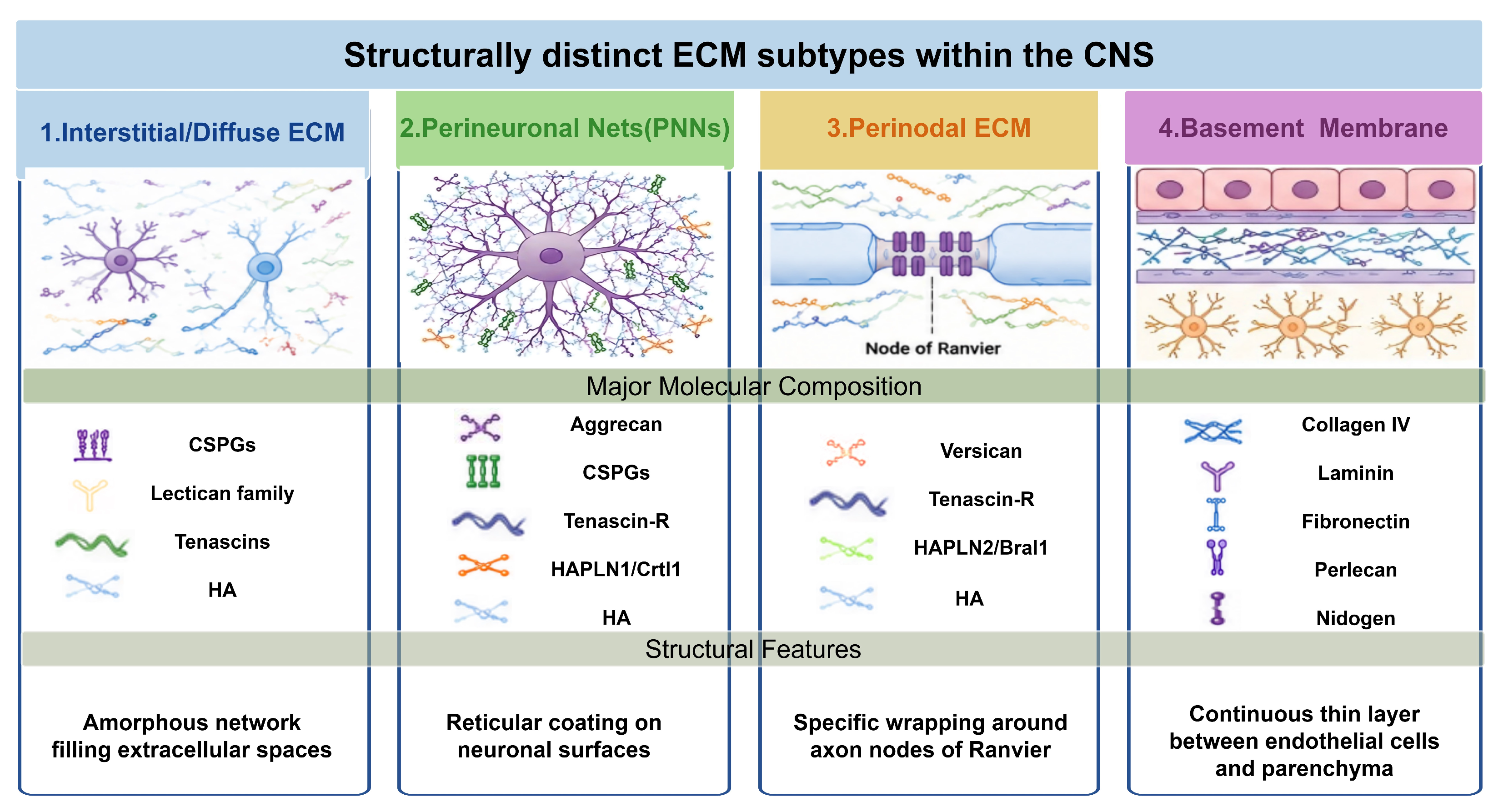
| ECM Subtype | Major Molecular Composition | Structural Features | Core Functions |
|---|---|---|---|
| Interstitial ECM | HA, Lectican family, CSPGs, Tenascins | Amorphous network filling extracellular spaces | Ion buffering, neurotransmitter diffusion regulation, hydration |
| Perineuronal Nets (PNNs) | CSPGs, Aggrecan, Tenascin-R, HA, HAPLN1/Crtl1 | Reticular coating on neuronal surfaces | Synaptic stabilization, excitation/inhibition balance, critical period plasticity control |
| Perinodal ECM | Tenascin-R, Versican, HA HAPLN2/Bral1 | Specific wrapping around axon nodes of Ranvier | Sodium channel anchoring, action potential conduction |
| Basement Membrane | Collagen IV, Laminin, Fibronectin, Perlecan, Nidogen | Continuous thin layer between endothelial cells and parenchyma | Blood–brain barrier, cell polarity regulation, ion channel anchoring |
| ECM Component | Receptors | Astrocytes | Microglia | Oligodendrocytes |
|---|---|---|---|---|
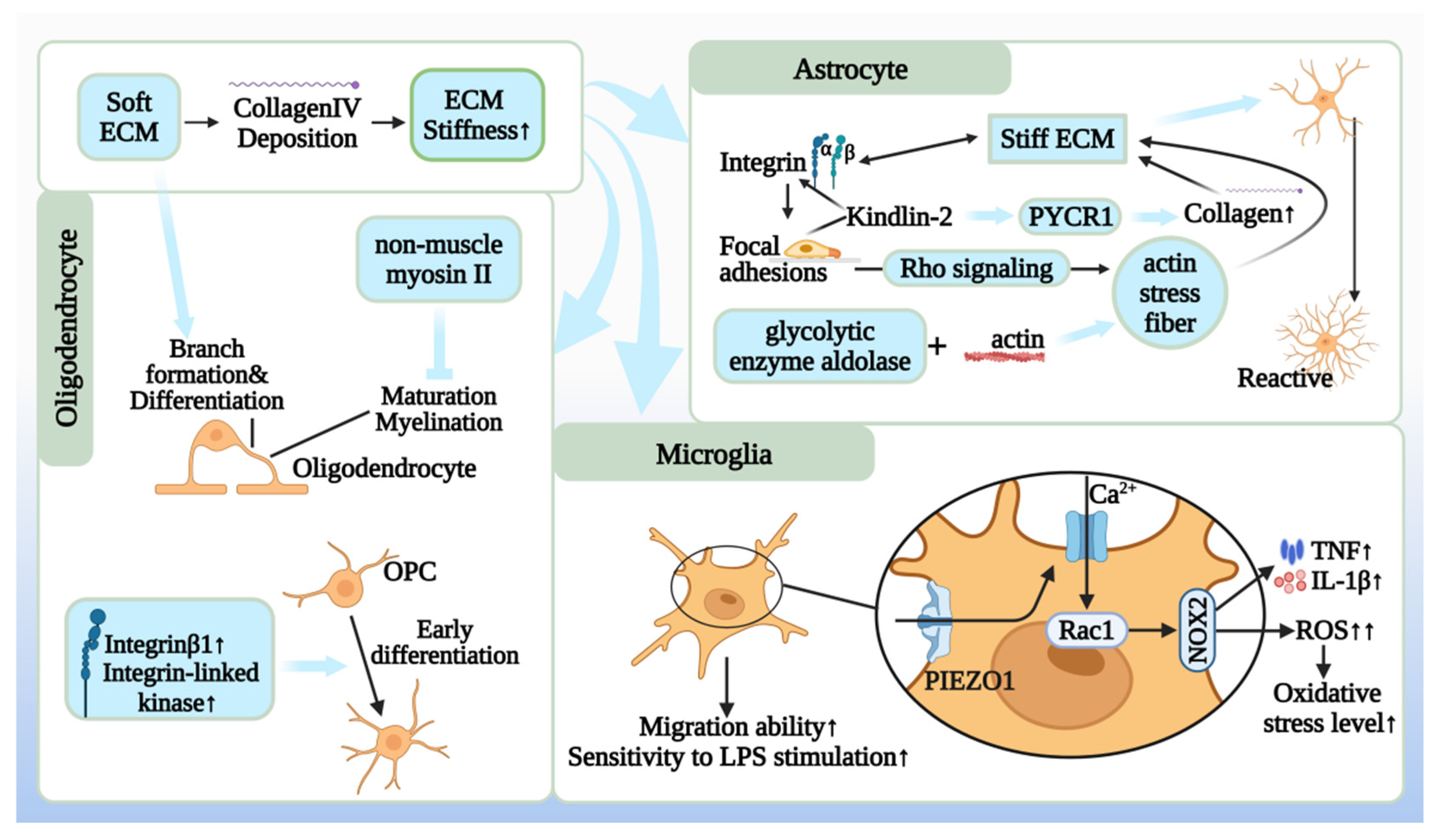
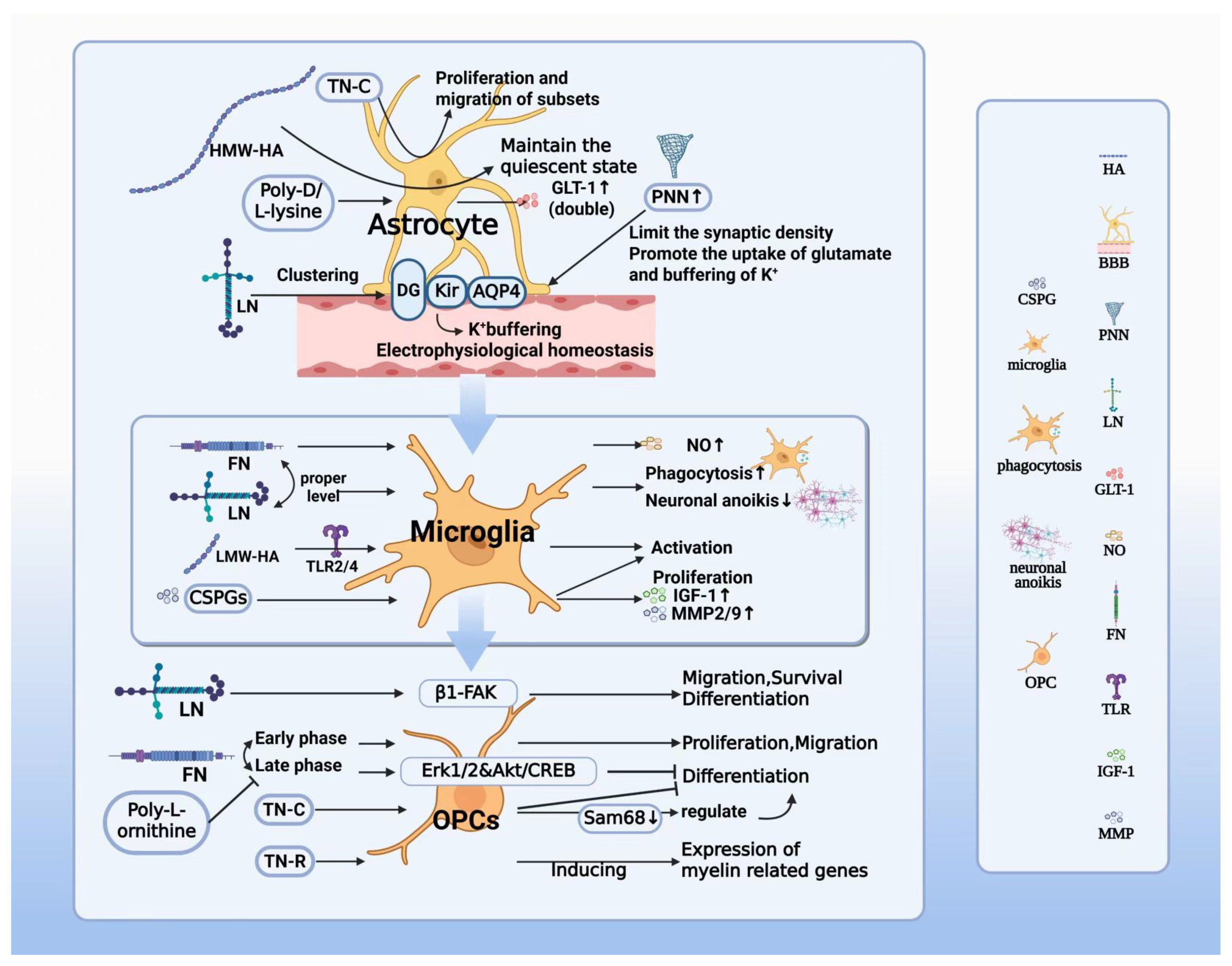
| Laminin | Integrin β1, Dystroglycan | Mediates Kir4.1/AQP4 clustering, regulates ion homeostasis [71,75,78] | Weak adhesion via α6β1 integrin, PKC-dependent activation [18] | Promotes OPC migration, differentiation, myelination via integrin β1-FAK [88,89] |
| Fibronectin | Integrin α5β1 | - | Promotes adhesion proinflammatory activation [18] | Early: supports OPC recruitment; late: inhibits differentiation [90] |
| HA | TLR2/4, CD44 | HMW-HA maintains quiescence; LMW-HA promotes reactivity [57] | LMW-HA drives proinflammatory activation via TLR2/4 [23] | High concentrations inhibit OPC differentiation and remyelination [91] |
| CSPGs | PTPσ | Form PNN ion-buffering structure; over-secretion creates inhibitory scar [24] | Induces activation, proliferation, IGF-1, MMP-2/9 expression [23] | |
| Tenascin-C | Integrins, FnIII domains | Supports migration/proliferation of reactive astrocyte subsets during scar formation [92]. | Modulates inflammatory responses [93]; context-dependent. | Inhibits OPC migration [94], promote differentiation via intracellular pathways [29,95] |
| Tenascin-R | Contactin, F3/11 | Contributes to PNN stability; modulates excitability and plasticity [96] | modulate inflammatory signaling [97]. | Stabilizes axon-OL contact and induces myelin-specific gene expression [86]. |
Disclaimer/Publisher’s Note: The statements, opinions and data contained in all publications are solely those of the individual author(s) and contributor(s) and not of MDPI and/or the editor(s). MDPI and/or the editor(s) disclaim responsibility for any injury to people or property resulting from any ideas, methods, instructions or products referred to in the content. |
© 2026 by the authors. Licensee MDPI, Basel, Switzerland. This article is an open access article distributed under the terms and conditions of the Creative Commons Attribution (CC BY) license.
Share and Cite
Wang, L.; Ma, X.; Zeng, Q.; Liu, M.; Yue, Z.; Hu, R. Molecular Basis of Glia–ECM Interplay in Central Nervous System Homeostasis and Plasticity. Cells 2026, 15, 1268. https://doi.org/10.3390/cells15141268
Wang L, Ma X, Zeng Q, Liu M, Yue Z, Hu R. Molecular Basis of Glia–ECM Interplay in Central Nervous System Homeostasis and Plasticity. Cells. 2026; 15(14):1268. https://doi.org/10.3390/cells15141268
Chicago/Turabian StyleWang, Lanlan, Xinyuan Ma, Qinghong Zeng, Mi Liu, Zenghui Yue, and Rong Hu. 2026. "Molecular Basis of Glia–ECM Interplay in Central Nervous System Homeostasis and Plasticity" Cells 15, no. 14: 1268. https://doi.org/10.3390/cells15141268
APA StyleWang, L., Ma, X., Zeng, Q., Liu, M., Yue, Z., & Hu, R. (2026). Molecular Basis of Glia–ECM Interplay in Central Nervous System Homeostasis and Plasticity. Cells, 15(14), 1268. https://doi.org/10.3390/cells15141268