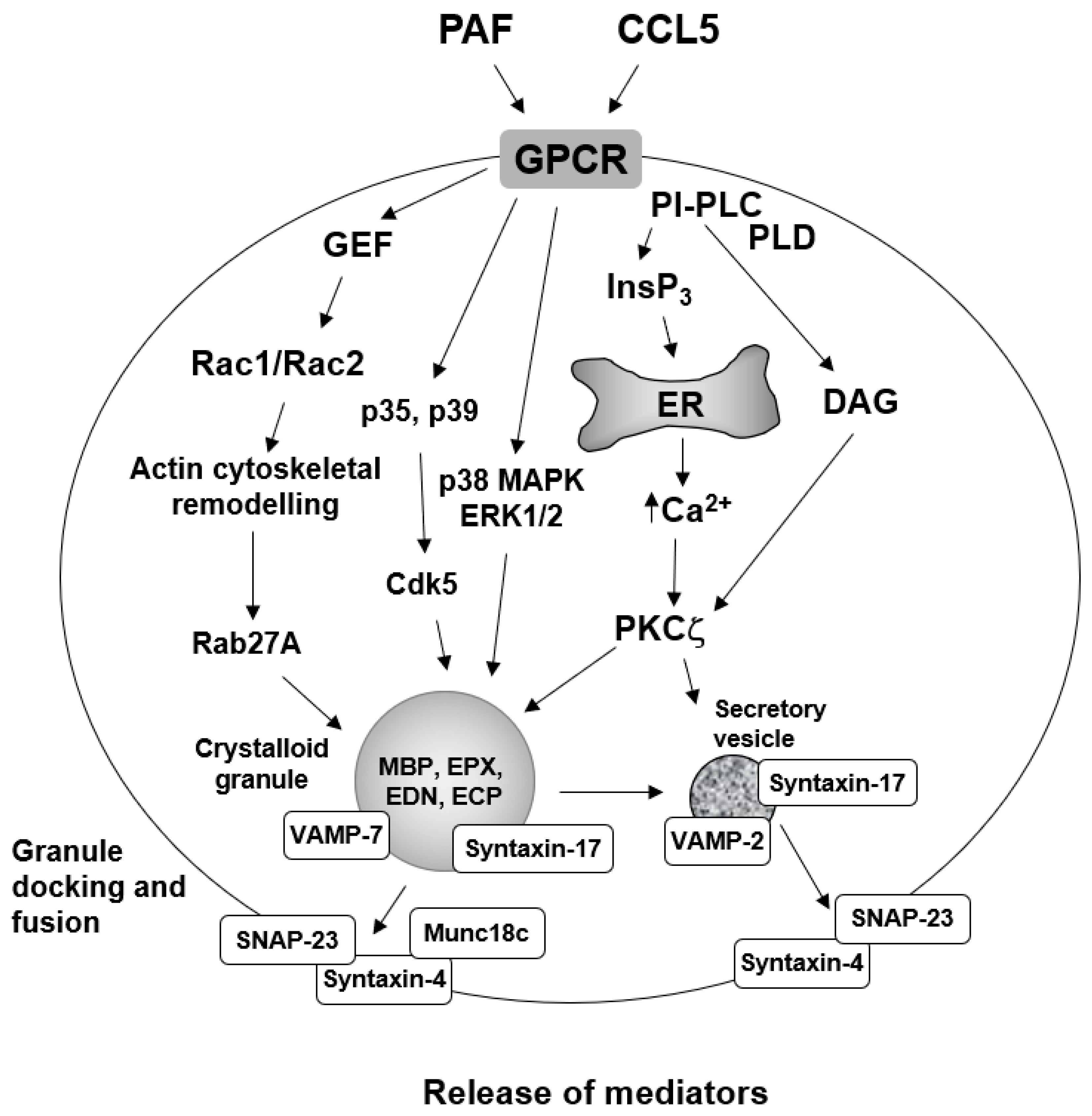
Mechanisms of Eosinophil Degranulation



Abstract
1. Introduction
2. Granule Populations in Eosinophils
3. Modes of Degranulation
4. Mechanisms Regulating Degranulation
4.1. Ca2+ Signaling
4.2. Phospholipid Signaling
4.3. Protein Kinases
4.4. Ras-Related Guanosine Triphosphatases
4.5. SNAREs
4.6. Other Regulatory Molecules of Exocytosis in Eosinophils
5. Summary
Author Contributions
Funding
Data Availability Statement
Conflicts of Interest
References
- Hogan, S.P.; Rosenberg, H.F.; Moqbel, R.; Phipps, S.; Foster, P.S.; Lacy, P.; Kay, A.B.; Rothenberg, M.E. Eosinophils: Biological properties and role in health and disease. Clin. Exp. Allergy 2008, 38, 709–750. [Google Scholar] [CrossRef] [PubMed]
- Mukherjee, M.; Lacy, P.; Nair, P. The Human Eosinophil. In Wintrobe’s Clinical Hematology; Means, R.T., Dispenzieri, A., Rodgers, G.M., Fehniger, T.A., Glader, B., Michaelis, L., Arber, D.A., Leonard, J.P., Appelbaum, F.R., Eds.; Wolters Kluwer: Philadelphia, PA, USA, 2024; pp. 168–195. [Google Scholar]
- Vieira, B.M.; Xavier-Elsas, P.; Moura-Neto, V.; Gaspar-Elsas, M.I.C. Eosinophil Biology Today-A Primer for Basic and Clinical Investigators. Immunology 2026, 178, 79–96. [Google Scholar] [CrossRef] [PubMed]
- Jorssen, J.; Van Hulst, G.; Mollers, K.; Pujol, J.; Petrellis, G.; Baptista, A.P.; Schetters, S.; Baron, F.; Caers, J.; Lambrecht, B.N.; et al. Single-cell proteomics and transcriptomics capture eosinophil development and identify the role of IL-5 in their lineage transit amplification. Immunity 2024, 57, 1549–1566.e8. [Google Scholar] [CrossRef] [PubMed]
- Kita, H. Eosinophils: Multifaceted biological properties and roles in health and disease. Immunol. Rev. 2011, 242, 161–177. [Google Scholar] [CrossRef] [PubMed]
- Nixon, J.; Newbold, P.; Mustelin, T.; Anderson, G.P.; Kolbeck, R. Monoclonal antibody therapy for the treatment of asthma and chronic obstructive pulmonary disease with eosinophilic inflammation. Pharmacol. Ther. 2017, 169, 57–77. [Google Scholar] [CrossRef] [PubMed]
- Gentil, K.; Hoerauf, A.; Layland, L.E. Eosinophil-Mediated Responses Toward Helminths. In Eosinophils in Health and Disease; Lee, J.J., Rosenberg, H.F., Eds.; Elsevier: New York, NY, USA, 2013; pp. 303–312. [Google Scholar]
- Kita, H. Antifungal Immunity by Eosinophils: Mechanisms and Implications in Human Diseases. In Eosinophils in Health and Disease; Lee, J.J., Rosenberg, H.F., Eds.; Elsevier: New York, NY, USA, 2013; pp. 291–299. [Google Scholar]
- Nutman, T.B. Immune Responses in Helminth Infections. In Eosinophils in Health and Disease; Lee, J.J., Rosenberg, H.F., Eds.; Elsevier: New York, NY, USA, 2013; pp. 312–320. [Google Scholar]
- Rosenberg, H.F.; Dyer, K.D.; Domachowske, J.B. Interactions of Eosinophils with Respiratory Virus Pathogens. In Eosinophils in Health and Disease; Lee, J.J., Rosenberg, H.F., Eds.; Elsevier: New York, NY, USA, 2013; pp. 281–290. [Google Scholar]
- Gaur, P.; Zaffran, I.; George, T.; Rahimli Alekberli, F.; Ben-Zimra, M.; Levi-Schaffer, F. The regulatory role of eosinophils in viral, bacterial, and fungal infections. Clin. Exp. Immunol. 2022, 209, 72–82. [Google Scholar] [CrossRef] [PubMed]
- Lee, J.J.; Jacobsen, E.A.; McGarry, M.P.; Schleimer, R.P.; Lee, N.A. Eosinophils in health and disease: The LIAR hypothesis. Clin. Exp. Allergy 2010, 40, 563–575. [Google Scholar] [CrossRef] [PubMed]
- Gleich, G.J.; Klion, A.D.; Lee, J.J.; Weller, P.F. The consequences of not having eosinophils. Allergy 2013, 68, 829–835. [Google Scholar] [CrossRef] [PubMed]
- Jacobsen, E.A.; Jackson, D.J.; Heffler, E.; Mathur, S.K.; Bredenoord, A.J.; Pavord, I.D.; Akuthota, P.; Roufosse, F.; Rothenberg, M.E. Eosinophil Knockout Humans: Uncovering the Role of Eosinophils Through Eosinophil-Directed Biological Therapies. Annu. Rev. Immunol. 2021, 39, 719–757. [Google Scholar] [CrossRef] [PubMed]
- AlBloushi, S.; Al-Ahmad, M. Exploring the immunopathology of type 2 inflammatory airway diseases. Front. Immunol. 2024, 15, 1285598. [Google Scholar] [CrossRef] [PubMed]
- Lombardi, C.; Berti, A.; Cottini, M. The emerging roles of eosinophils: Implications for the targeted treatment of eosinophilic-associated inflammatory conditions. Curr. Res. Immunol. 2022, 3, 42–53. [Google Scholar] [CrossRef] [PubMed]
- Mukherjee, M.; Lacy, P.; Ueki, S. Eosinophil extracellular traps and inflammatory pathologies-untangling the web! Front. Immunol. 2018, 9, 2763. [Google Scholar] [CrossRef] [PubMed]
- Zhang, J.; Liu, X.; Shi, G.P.; Chen, W.; Zhang, S. Eosinophil extracellular traps: Heterogeneity of their stimuli, components, and functions. Trends Cell Biol. 2026, 36, 578–593. [Google Scholar] [CrossRef] [PubMed]
- Fettrelet, T.; Gigon, L.; Karaulov, A.; Yousefi, S.; Simon, H.U. The Enigma of Eosinophil Degranulation. Int. J. Mol. Sci. 2021, 22, 7091. [Google Scholar] [CrossRef] [PubMed]
- Dellon, E.S.; Peterson, K.A.; Mitlyng, B.L.; Iuga, A.; Bookhout, C.E.; Cortright, L.M.; Walker, K.B.; Gee, T.S.; McGee, S.J.; Cameron, B.A.; et al. Mepolizumab for treatment of adolescents and adults with eosinophilic oesophagitis: A multicentre, randomised, double-blind, placebo-controlled clinical trial. Gut 2023, 72, 1828–1837. [Google Scholar] [CrossRef] [PubMed]
- Saffari, H.; Hoffman, L.H.; Peterson, K.A.; Fang, J.C.; Leiferman, K.M.; Pease, L.F., 3rd; Gleich, G.J. Electron microscopy elucidates eosinophil degranulation patterns in patients with eosinophilic esophagitis. J. Allergy Clin. Immunol. 2014, 133, 1728–1734. [Google Scholar] [CrossRef] [PubMed]
- Brusselle, G.G.; Koppelman, G.H. Biologic Therapies for Severe Asthma. N. Engl. J. Med. 2022, 386, 157–171. [Google Scholar] [CrossRef] [PubMed]
- Delemarre, T.; Holtappels, G.; De Ruyck, N.; Zhang, N.; Nauwynck, H.; Bachert, C.; Gevaert, E. Type 2 inflammation in chronic rhinosinusitis without nasal polyps: Another relevant endotype. J. Allergy Clin. Immunol. 2020, 146, 337–343.e6. [Google Scholar] [CrossRef] [PubMed]
- Israel, E.; Wechsler, M.E.; Jackson, D.J.; Moore, W.C. Anti-cytokine biologics for asthma in adults. Lancet 2025, 406, 2282–2294. [Google Scholar] [CrossRef] [PubMed]
- Dvorak, A.M.; Letourneau, L.; Login, G.R.; Weller, P.F.; Ackerman, S.J. Ultrastructural localization of the Charcot-Leyden crystal protein (lysophospholipase) to a distinct crystalloid-free granule population in mature human eosinophils. Blood 1988, 72, 150–158. [Google Scholar] [PubMed]
- Melo, R.C.N.; Wang, H.; Silva, T.P.; Imoto, Y.; Fujieda, S.; Fukuchi, M.; Miyabe, Y.; Hirokawa, M.; Ueki, S.; Weller, P.F. Galectin-10, the protein that forms Charcot-Leyden crystals, is not stored in granules but resides in the peripheral cytoplasm of human eosinophils. J. Leukoc. Biol. 2020, 108, 139–149. [Google Scholar] [CrossRef] [PubMed]
- Dvorak, A.M.; Furitsu, T.; Estrella, P.; Letourneau, L.; Ishizaka, T.; Ackerman, S.J. Ultrastructural localization of major basic protein in the human eosinophil lineage in vitro. J. Histochem. Cytochem. 1994, 42, 1443–1451. [Google Scholar] [CrossRef] [PubMed]
- Melo, R.C.; Spencer, L.A.; Perez, S.A.; Neves, J.S.; Bafford, S.P.; Morgan, E.S.; Dvorak, A.M.; Weller, P.F. Vesicle-mediated secretion of human eosinophil granule-derived major basic protein. Lab. Investig. 2009, 89, 769–781. [Google Scholar] [CrossRef] [PubMed][Green Version]
- Davoine, F.; Lacy, P. Eosinophil cytokines, chemokines, and growth factors: Emerging roles in immunity. Front. Immunol. 2014, 5, 570. [Google Scholar] [CrossRef] [PubMed]
- Melo, R.C.N.; Weller, P.F. Contemporary understanding of the secretory granules in human eosinophils. J. Leukoc. Biol. 2018, 104, 85–93. [Google Scholar] [CrossRef] [PubMed]
- Neves, V.H.; Palazzi, C.; Malta, K.K.; Bonjour, K.; Kneip, F.; Dias, F.F.; Neves, J.S.; Weller, P.F.; Melo, R.C.N. Extracellular sombrero vesicles are hallmarks of eosinophilic cytolytic degranulation in tissue sites of human diseases. J. Leukoc. Biol. 2024, 116, 398–408. [Google Scholar] [CrossRef] [PubMed]
- Gleich, G.J.; Adolphson, C.R. The eosinophilic leukocyte: Structure and function. Adv. Immunol. 1986, 39, 177–253. [Google Scholar] [CrossRef] [PubMed]
- Melo, R.C.; Perez, S.A.; Spencer, L.A.; Dvorak, A.M.; Weller, P.F. Intragranular vesiculotubular compartments are involved in piecemeal degranulation by activated human eosinophils. Traffic 2005, 6, 866–879. [Google Scholar] [CrossRef] [PubMed]
- Melo, R.C.; Spencer, L.A.; Perez, S.A.; Ghiran, I.; Dvorak, A.M.; Weller, P.F. Human eosinophils secrete preformed, granule-stored interleukin-4 through distinct vesicular compartments. Traffic 2005, 6, 1047–1057. [Google Scholar] [CrossRef] [PubMed]
- Melo, R.C.; Spencer, L.A.; Dvorak, A.M.; Weller, P.F. Mechanisms of eosinophil secretion: Large vesiculotubular carriers mediate transport and release of granule-derived cytokines and other proteins. J. Leukoc. Biol. 2008, 83, 229–236. [Google Scholar] [CrossRef] [PubMed]
- Melo, R.C.; Weller, P.F. Piecemeal degranulation in human eosinophils: A distinct secretion mechanism underlying inflammatory responses. Histol. Histopath 2010, 25, 1341–1354. [Google Scholar] [CrossRef]
- Kaneko, M.; Swanson, M.C.; Gleich, G.J.; Kita, H. Allergen-specific IgG1 and IgG3 through Fc gamma RII induce eosinophil degranulation. J. Clin. Investig. 1995, 95, 2813–2821. [Google Scholar] [CrossRef] [PubMed]
- Dyer, K.D.; Percopo, C.M.; Xie, Z.; Yang, Z.; Kim, J.D.; Davoine, F.; Lacy, P.; Druey, K.M.; Moqbel, R.; Rosenberg, H.F. Mouse and human eosinophils degranulate in response to platelet-activating factor (PAF) and lysoPAF via a PAF-receptor-independent mechanism: Evidence for a novel receptor. J. Immunol. 2010, 184, 6327–6334. [Google Scholar] [CrossRef] [PubMed]
- Almas, S.; Fayad, N.; Srivastava, O.; Siddique, M.; Touret, N.; Lacy, P. Cytokine trafficking of IL-9 and IL-13 through TfnRc+ vesicles in activated human eosinophils. J. Leukoc. Biol. 2020, 109, 753–762. [Google Scholar] [CrossRef] [PubMed]
- Carmo, L.A.; Bonjour, K.; Ueki, S.; Neves, J.S.; Liu, L.; Spencer, L.A.; Dvorak, A.M.; Weller, P.F.; Melo, R.C. CD63 is tightly associated with intracellular, secretory events chaperoning piecemeal degranulation and compound exocytosis in human eosinophils. J. Leukoc. Biol. 2016, 100, 391–401. [Google Scholar] [CrossRef] [PubMed]
- Lacy, P.; Moqbel, R. Signaling and Degranulation. In Eosinophils in Health and Disease; Lee, J.J., Rosenberg, H.F., Eds.; Elsevier: New York, NY, USA, 2013; pp. 206–219. [Google Scholar]
- Ueki, S.; Melo, R.C.; Ghiran, I.; Spencer, L.A.; Dvorak, A.M.; Weller, P.F. Eosinophil extracellular DNA trap cell death mediates lytic release of free secretion-competent eosinophil granules in humans. Blood 2013, 121, 2074–2083. [Google Scholar] [CrossRef] [PubMed]
- Radonjic-Hoesli, S.; Wang, X.; de Graauw, E.; Stoeckle, C.; Styp-Rekowska, B.; Hlushchuk, R.; Simon, D.; Spaeth, P.J.; Yousefi, S.; Simon, H.U. Adhesion-induced eosinophil cytolysis requires the receptor-interacting protein kinase 3 (RIPK3)-mixed lineage kinase-like (MLKL) signaling pathway, which is counterregulated by autophagy. J. Allergy Clin. Immunol. 2017, 140, 1632–1642. [Google Scholar] [CrossRef] [PubMed]
- Mazzeo, C.; Canas, J.A.; Zafra, M.P.; Rojas Marco, A.; Fernandez-Nieto, M.; Sanz, V.; Mittelbrunn, M.; Izquierdo, M.; Baixaulli, F.; Sastre, J.; et al. Exosome secretion by eosinophils: A possible role in asthma pathogenesis. J. Allergy Clin. Immunol. 2015, 135, 1603–1613. [Google Scholar] [CrossRef] [PubMed]
- Nusse, O.; Lindau, M.; Cromwell, O.; Kay, A.B.; Gomperts, B.D. Intracellular application of guanosine-5′-O-(3-thiotriphosphate) induces exocytotic granule fusion in guinea pig eosinophils. J. Exp. Med. 1990, 171, 775–786. [Google Scholar] [PubMed]
- Cromwell, O.; Bennett, J.P.; Hide, I.; Kay, A.B.; Gomperts, B.D. Mechanisms of granule enzyme secretion from permeabilized guinea pig eosinophils. Dependence on Ca2+ and guanine nucleotides. J. Immunol. 1991, 147, 1905–1911. [Google Scholar] [CrossRef] [PubMed]
- Lacy, P.; Willetts, L.; Kim, J.D.; Lo, A.N.; Lam, B.; Maclean, E.I.; Moqbel, R.; Rothenberg, M.E.; Zimmermann, N. Agonist activation of f-actin-mediated eosinophil shape change and mediator release is dependent on Rac2. Int. Arch. Allergy Immunol. 2011, 156, 137–147. [Google Scholar] [CrossRef] [PubMed]
- Fukuda, T.; Ackerman, S.J.; Reed, C.E.; Peters, M.S.; Dunnette, S.L.; Gleich, G.J. Calcium ionophore A23187 calcium-dependent cytolytic degranulation in human eosinophils. J. Immunol. 1985, 135, 1349–1356. [Google Scholar] [CrossRef] [PubMed]
- Scepek, S.; Lindau, M. Focal exocytosis by eosinophils—Compound exocytosis and cumulative fusion. EMBO J. 1993, 12, 1811–1817. [Google Scholar] [CrossRef] [PubMed]
- Aizawa, T.; Kakuta, Y.; Yamauchi, K.; Ohkawara, Y.; Maruyama, N.; Nitta, Y.; Tamura, G.; Sasaki, H.; Takishima, T. Induction of granule release by intracellular application of calcium and guanosine-5′-O-(3-thiotriphosphate) in human eosinophils. J. Allergy Clin. Immunol. 1992, 90, 789–795. [Google Scholar] [CrossRef] [PubMed]
- Lindau, M.; Nusse, O.; Bennett, J.; Cromwell, O. The membrane fusion events in degranulating guinea pig eosinophils. J. Cell Sci. 1993, 104, 203–210. [Google Scholar] [CrossRef] [PubMed]
- Kim, H.J.; Sim, M.S.; Lee, D.H.; Kim, C.; Choi, Y.; Park, H.S.; Chung, I.Y. Lysophosphatidylserine induces eosinophil extracellular trap formation and degranulation: Implications in severe asthma. Allergy 2020, 75, 3159–3170. [Google Scholar] [CrossRef] [PubMed]
- Kampe, M.; Lampinen, M.; Stolt, I.; Janson, C.; Stalenheim, G.; Carlson, M. PI3-kinase regulates eosinophil and neutrophil degranulation in patients with allergic rhinitis and allergic asthma irrespective of allergen challenge model. Inflammation 2012, 35, 230–239. [Google Scholar] [CrossRef] [PubMed]
- Knuplez, E.; Sturm, E.M.; Marsche, G. Emerging Role of Phospholipase-Derived Cleavage Products in Regulating Eosinophil Activity: Focus on Lysophospholipids, Polyunsaturated Fatty Acids and Eicosanoids. Int. J. Mol. Sci. 2021, 22, 4356. [Google Scholar] [CrossRef] [PubMed]
- Kato, M.; Yamaguchi, T.; Tachibana, A.; Suzuki, M.; Izumi, T.; Maruyama, K.; Hayashi, Y.; Kimura, H. An atypical protein kinase C, PKC zeta, regulates human eosinophil effector functions. Immunology 2005, 116, 193–202. [Google Scholar] [PubMed]
- Ueki, S.; Konno, Y.; Takeda, M.; Moritoki, Y.; Hirokawa, M.; Matsuwaki, Y.; Honda, K.; Ohta, N.; Yamamoto, S.; Takagi, Y.; et al. Eosinophil extracellular trap cell death-derived DNA traps: Their presence in secretions and functional attributes. J. Allergy Clin. Immunol. 2016, 137, 258–267. [Google Scholar] [CrossRef] [PubMed]
- Lach-Trifilieff, E.; Menear, K.; Schweighoffer, E.; Tybulewicz, V.L.; Walker, C. Syk-deficient eosinophils show normal interleukin-5-mediated differentiation, maturation, and survival but no longer respond to FcgammaR activation. Blood 2000, 96, 2506–2510. [Google Scholar] [PubMed]
- Chen, Y.A.; Scales, S.J.; Patel, S.M.; Doung, Y.C.; Scheller, R.H. SNARE complex formation is triggered by Ca2+ and drives membrane fusion. Cell 1999, 97, 165–174. [Google Scholar] [PubMed]
- Schiavo, G.; Matteoli, M.; Montecucco, C. Neurotoxins affecting neuroexocytosis. Physiol. Rev. 2000, 80, 717–766. [Google Scholar] [CrossRef] [PubMed]
- Rossetto, O.; Gorza, L.; Schiavo, G.; Schiavo, N.; Scheller, R.H.; Montecucco, C. VAMP/synaptobrevin isoforms 1 and 2 are widely and differentially expressed in nonneuronal tissues. J. Cell Biol. 1996, 132, 167–179. [Google Scholar] [CrossRef] [PubMed]
- Hibi, T.; Hirashima, N.; Nakanishi, M. Rat basophilic leukemia cells express syntaxin-3 and VAMP-7 in granule membranes. Biochem. Biophys. Res. Commun. 2000, 271, 36–41. [Google Scholar] [CrossRef] [PubMed]
- Ravichandran, V.; Chawla, A.; Roche, P.A. Identification of a novel syntaxin- and synaptobrevin/VAMP-binding protein, SNAP-23, expressed in non-neuronal tissues. J. Biol. Chem. 1996, 271, 13300–13303. [Google Scholar] [CrossRef] [PubMed]
- Galli, T.; Zahraoui, A.; Vaidyanathan, V.V.; Raposo, G.; Tian, J.M.; Karin, M.; Niemann, H.; Louvard, D. A novel tetanus neurotoxin-insensitive vesicle-associated membrane protein in SNARE complexes of the apical plasma membrane of epithelial cells. Mol. Biol. Cell 1998, 9, 1437–1448. [Google Scholar] [PubMed]
- Mullock, B.M.; Smith, C.W.; Ihrke, G.; Bright, N.A.; Lindsay, M.; Parkinson, E.J.; Brooks, D.A.; Parton, R.G.; James, D.E.; Luzio, J.P.; et al. Syntaxin 7 is localized to late endosome compartments, associates with Vamp 8, and Is required for late endosome-lysosome fusion. Mol. Biol. Cell 2000, 11, 3137–3153. [Google Scholar] [PubMed]
- Hafez, I.; Stolpe, A.; Lindau, M. Compound exocytosis and cumulative fusion in eosinophils. J. Biol. Chem. 2003, 278, 44921–44928. [Google Scholar] [CrossRef] [PubMed]
- Condliffe, A.M.; Cadwallader, K.A.; Walker, T.R.; Rintoul, R.C.; Cowburn, A.S.; Chilvers, E.R. Phosphoinositide 3-kinase: A critical signalling event in pulmonary cells. Respir. Res. 2000, 1, 24–29. [Google Scholar] [CrossRef] [PubMed]
- Sano, A.; Sano, H.; Iwanaga, T.; Tohda, Y. Functional role of phosphatidylcholine-specific phospholipase C in regulating leukotriene synthesis and degranulation in human eosinophils. Eur. J. Pharmacol. 2020, 884, 173353. [Google Scholar] [CrossRef] [PubMed]
- Peng, X.; Frohman, M.A. Mammalian phospholipase D physiological and pathological roles. Acta Physiol. 2012, 204, 219–226. [Google Scholar] [CrossRef] [PubMed]
- Esnault, S.; Leet, J.P.; Johansson, M.W.; Barretto, K.T.; Fichtinger, P.S.; Fogerty, F.J.; Bernau, K.; Mathur, S.K.; Mosher, D.F.; Sandbo, N.; et al. Eosinophil cytolysis on Immunoglobulin G is associated with microtubule formation and suppression of rho-associated protein kinase signalling. Clin. Exp. Allergy 2020, 50, 198–212. [Google Scholar] [CrossRef] [PubMed]
- Yamaguchi, T.; Suzuki, M.; Kimura, H.; Kato, M. Role of protein kinase C in eosinophil function. Allergol. Int. Off. J. Jpn. Soc. Allergol. 2006, 55, 245–252. [Google Scholar] [CrossRef] [PubMed][Green Version]
- Kampen, G.T.; Stafford, S.; Adachi, T.; Jinquan, T.; Quan, S.; Grant, J.A.; Skov, P.S.; Poulsen, L.K.; Alam, R. Eotaxin induces degranulation and chemotaxis of eosinophils through the activation of ERK2 and p38 mitogen-activated protein kinases. Blood 2000, 95, 1911–1917. [Google Scholar] [CrossRef] [PubMed]
- Takizawa, T.; Kato, M.; Suzuki, M.; Tachibana, A.; Motegi, Y.; Fujiu, T.; Kimura, H.; Arakawa, H.; Mochizuki, H.; Tokuyama, K.; et al. Distinct isoforms of protein kinase C are involved in human eosinophil functions induced by platelet-activating factor. Int. Arch. Allergy Immunol. 2003, 131, 15–19. [Google Scholar] [CrossRef] [PubMed]
- Shamri, R.; Young, K.M.; Weller, P.F. PI3K, ERK, p38 MAPK and integrins regulate CCR3-mediated secretion of mouse and human eosinophil-associated RNases. Allergy 2013, 68, 880–889. [Google Scholar] [CrossRef] [PubMed]
- Odemuyiwa, S.O.; Ilarraza, R.; Davoine, F.; Logan, M.R.; Shayeganpour, A.; Wu, Y.; Majaesic, C.; Adamko, D.J.; Moqbel, R.; Lacy, P. Cyclin-Dependent Kinase 5 Regulates Degranulation in Human Eosinophils. Immunology 2014, 144, 641–648. [Google Scholar] [CrossRef] [PubMed]
- Harada, T.; Morooka, T.; Ogawa, S.; Nishida, E. ERK induces p35, a neuron-specific activator of Cdk5, through induction of Egr1. Nat. Cell Biol. 2001, 3, 453–459. [Google Scholar] [CrossRef] [PubMed]
- Fukuchi, M.; Miyabe, Y.; Furutani, C.; Saga, T.; Moritoki, Y.; Yamada, T.; Weller, P.F.; Ueki, S. How to detect eosinophil ETosis (EETosis) and extracellular traps. Allergol. Int. Off. J. Jpn. Soc. Allergol. 2021, 70, 19–29. [Google Scholar] [CrossRef] [PubMed]
- Ueki, S.; Tokunaga, T.; Melo, R.C.N.; Saito, H.; Honda, K.; Fukuchi, M.; Konno, Y.; Takeda, M.; Yamamoto, Y.; Hirokawa, M.; et al. Charcot-Leyden crystal formation is closely associated with eosinophil extracellular trap cell death. Blood 2018, 132, 2183–2187. [Google Scholar] [CrossRef] [PubMed]
- Kato, M.; Kita, H.; Morikawa, A. Role of tyrosine kinases in human eosinophil degranulation. Int. Arch. Allergy Immunol. 1997, 114, 14–17. [Google Scholar] [CrossRef] [PubMed]
- Pazdrak, K.; Olszewska-Pazdrak, B.; Stafford, S.; Garofalo, R.P.; Alam, R. Lyn, Jak2, and Raf-1 kinases are critical for the antiapoptotic effect of interleukin 5, whereas only Raf-1 kinase is essential for eosinophil activation and degranulation. J. Exp. Med. 1998, 188, 421–429. [Google Scholar] [CrossRef] [PubMed]
- Stafford, S.; Lowell, C.; Sur, S.; Alam, R. Lyn tyrosine kinase is important for IL-5-stimulated eosinophil differentiation. J. Immunol. 2002, 168, 1978–1983. [Google Scholar] [CrossRef] [PubMed]
- El-Shazly, A.; Yamaguchi, N.; Masuyama, K.; Suda, T.; Ishikawa, T. Novel association of the src family kinases, hck and c-fgr, with CCR3 receptor stimulation: A possible mechanism for eotaxin-induced human eosinophil chemotaxis. Biochem. Biophys. Res. Commun. 1999, 264, 163–170. [Google Scholar] [PubMed]
- Barlic, J.; Andrews, J.D.; Kelvin, A.A.; Bosinger, S.E.; DeVries, M.E.; Xu, L.; Dobransky, T.; Feldman, R.D.; Ferguson, S.S.; Kelvin, D.J. Regulation of tyrosine kinase activation and granule release through b-arrestin by CXCRI. Nat. Immunol. 2000, 1, 227–233. [Google Scholar] [CrossRef] [PubMed]
- Xue, R.; Meng, H.; Yin, J.; Xia, J.; Hu, Z.; Liu, H. The Role of Calmodulin vs. Synaptotagmin in Exocytosis. Front. Mol. Neurosci. 2021, 14, 691363. [Google Scholar] [CrossRef] [PubMed]
- Morstein, J.; Bowcut, V.; Fernando, M.; Yang, Y.; Zhu, L.; Jenkins, M.L.; Evans, J.T.; Guiley, K.Z.; Peacock, D.M.; Krahnke, S.; et al. Targeting Ras-, Rho-, and Rab-family GTPases via a conserved cryptic pocket. Cell 2024, 187, 6379–6392.e17. [Google Scholar] [CrossRef] [PubMed]
- Lacy, P.; Thompson, N.; Tian, M.; Solari, R.; Hide, I.; Newman, T.M.; Gomperts, B.D. A survey of GTP-binding proteins and other potential key regulators of exocytotic secretion in eosinophils: Apparent absence of rab3 and vesicle fusion protein homologues. J. Cell Sci. 1995, 108, 3547–3556. [Google Scholar] [CrossRef] [PubMed]
- Wilkerson, E.M.; Johansson, M.W.; Hebert, A.S.; Westphall, M.S.; Mathur, S.K.; Jarjour, N.N.; Schwantes, E.A.; Mosher, D.F.; Coon, J.J. The Peripheral Blood Eosinophil Proteome. J. Proteome Res. 2016, 15, 1524–1533. [Google Scholar] [CrossRef] [PubMed]
- Kim, J.D.; Willetts, L.; Ochkur, S.; Srivastava, N.; Hamburg, R.; Shayeganpour, A.; Seabra, M.C.; Lee, J.J.; Moqbel, R.; Lacy, P. An essential role for Rab27a GTPase in eosinophil exocytosis. J. Leukoc. Biol. 2013, 94, 1265–1274. [Google Scholar] [CrossRef] [PubMed]
- Ochkur, S.I.; Jacobsen, E.A.; Protheroe, C.A.; Biechele, T.L.; Pero, R.S.; McGarry, M.P.; Wang, H.; O’Neill, K.R.; Colbert, D.C.; Colby, T.V.; et al. Coexpression of IL-5 and eotaxin-2 in mice creates an eosinophil-dependent model of respiratory inflammation with characteristics of severe asthma. J. Immunol. 2007, 178, 7879–7889. [Google Scholar] [CrossRef] [PubMed]
- Liao, Y.; Li, M.; Song, S.; Xu, X.; Xiao, X.; Liu, Y.; Yang, G.; Yang, P. The Immunosuppressive Functions of Eosinophils Are Compromised in Patients with Allergic Rhinitis, Particularly Concerning Rab27a Expression. Immun. Inflamm. Dis. 2024, 12, e70091. [Google Scholar] [CrossRef] [PubMed]
- Wennerberg, K.; Der, C.J. Rho-family GTPases: It’s not only Rac and Rho (and I like it). J. Cell Sci. 2004, 117, 1301–1312. [Google Scholar] [CrossRef] [PubMed]
- Etienne-Manneville, S.; Hall, A. Rho GTPases in cell biology. Nature 2002, 420, 629–635. [Google Scholar] [CrossRef] [PubMed]
- Ridley, A.J. Historical overview of Rho GTPases. Methods Mol. Biol. 2012, 827, 3–12. [Google Scholar] [CrossRef] [PubMed]
- Sollner, T.; Whiteheart, S.W.; Brunner, M.; Erdjument-Bromage, H.; Geromanos, S.; Tempst, P.; Rothman, J.E. SNAP receptors implicated in vesicle targeting and fusion. Nature 1993, 362, 318–324. [Google Scholar] [CrossRef] [PubMed]
- Sutton, R.B.; Fasshauer, D.; Jahn, R.; Brunger, A.T. Crystal structure of a SNARE complex involved in synaptic exocytosis at 2.4 A resolution. Nature 1998, 395, 347–353. [Google Scholar] [CrossRef] [PubMed]
- Jahn, R.; Cafiso, D.C.; Tamm, L.K. Mechanisms of SNARE proteins in membrane fusion. Nat. Rev. Mol. Cell Biol. 2024, 25, 101–118. [Google Scholar] [CrossRef] [PubMed]
- Ward, D.M.; Pevsner, J.; Scullion, M.A.; Vaughn, M.; Kaplan, J. Syntaxin 7 and VAMP-7 are soluble N-ethylmaleimide-sensitive factor attachment protein receptors required for late endosome-lysosome and homotypic lysosome fusion in alveolar macrophages. Mol. Biol. Cell 2000, 11, 2327–2333. [Google Scholar] [PubMed]
- Advani, R.J.; Yang, B.; Prekeris, R.; Lee, K.C.; Klumperman, J.; Scheller, R.H. VAMP-7 mediates vesicular transport from endosomes to lysosomes. J. Cell Biol. 1999, 146, 765–776. [Google Scholar] [CrossRef] [PubMed]
- Paumet, F.; Le Mao, J.; Martin, S.; Galli, T.; David, B.; Blank, U.; Roa, M. Soluble NSF attachment protein receptors (SNAREs) in RBL-2H3 mast cells: Functional role of syntaxin 4 in exocytosis and identification of a vesicle-associated membrane protein 8-containing secretory compartment. J. Immunol. 2000, 164, 5850–5857. [Google Scholar] [CrossRef] [PubMed]
- Polgar, J.; Chung, S.H.; Reed, G.L. Vesicle-associated membrane protein 3 (VAMP-3) and VAMP-8 are present in human platelets and are required for granule secretion. Blood 2002, 100, 1081–1083. [Google Scholar] [CrossRef] [PubMed]
- Hoffmann, H.J.; Bjerke, T.; Karawajczyk, M.; Dahl, R.; Knepper, M.A.; Nielsen, S. SNARE proteins are critical for regulated exocytosis of ECP from human eosinophils. Biochem. Biophys. Res. Commun. 2001, 282, 194–199. [Google Scholar] [CrossRef] [PubMed]
- Lacy, P.; Logan, M.R.; Bablitz, B.; Moqbel, R. Fusion protein vesicle-associated membrane protein 2 is implicated in IFN-gamma-induced piecemeal degranulation in human eosinophils from atopic individuals. J. Allergy Clin. Immunol. 2001, 107, 671–678. [Google Scholar] [PubMed]
- Logan, M.R.; Lacy, P.; Bablitz, B.; Moqbel, R. Expression of eosinophil target SNAREs as potential cognate receptors for vesicle-associated membrane protein-2 in exocytosis. J. Allergy Clin. Immunol. 2002, 109, 299–306. [Google Scholar] [CrossRef] [PubMed]
- Logan, M.R.; Lacy, P.; Odemuyiwa, S.O.; Steward, M.; Davoine, F.; Kita, H.; Moqbel, R. A critical role for vesicle-associated membrane protein-7 in exocytosis from human eosinophils and neutrophils. Allergy 2006, 61, 777–784. [Google Scholar] [CrossRef] [PubMed]
- Carmo, L.A.S.; Dias, F.F.; Malta, K.K.; Amaral, K.B.; Shamri, R.; Weller, P.F.; Melo, R.C.N. Expression and subcellular localization of the Qa-SNARE syntaxin17 in human eosinophils. Exp. Cell Res. 2015, 337, 129–135. [Google Scholar] [CrossRef] [PubMed][Green Version]
- Marcet-Palacios, M.; Odemuyiwa, S.O.; Coughlin, J.J.; Garofoli, D.; Ewen, C.; Davidson, C.E.; Ghaffari, M.; Kane, K.P.; Lacy, P.; Logan, M.R.; et al. Vesicle-associated membrane protein 7 (VAMP-7) is essential for target cell killing in a natural killer cell line. Biochem. Biophys. Res. Commun. 2008, 366, 617–623. [Google Scholar] [CrossRef] [PubMed]
- Willetts, L.; Felix, L.C.; Jacobsen, E.A.; Puttagunta, L.; Condjella, R.M.; Zellner, K.R.; Ochkur, S.I.; Kim, J.D.; Luo, H.; Lee, N.A.; et al. Vesicle-associated membrane protein 7-mediated eosinophil degranulation promotes allergic airway inflammation in mice. Commun. Biol. 2018, 1, 83. [Google Scholar] [CrossRef] [PubMed]
- Doyle, A.D.; Jacobsen, E.A.; Ochkur, S.I.; Willetts, L.; Shim, K.; Neely, J.; Kloeber, J.; Lesuer, W.E.; Pero, R.S.; Lacy, P.; et al. Homologous recombination into the eosinophil peroxidase locus generates a strain of mice expressing Cre recombinase exclusively in eosinophils. J. Leukoc. Biol. 2013, 94, 17–24. [Google Scholar] [CrossRef] [PubMed]
- Gigon, L.; Fettrelet, T.; Miholic, M.; McLeish, K.R.; Yousefi, S.; Stojkov, D.; Simon, H.U. Syntaxin-4 and SNAP23 are involved in neutrophil degranulation, but not in the release of mitochondrial DNA during NET formation. Front. Immunol. 2023, 14, 1272699. [Google Scholar] [CrossRef] [PubMed]
- Changotra, H.; Kaur, S.; Yadav, S.S.; Gupta, G.L.; Parkash, J.; Duseja, A. ATG5: A central autophagy regulator implicated in various human diseases. Cell Biochem. Funct. 2022, 40, 650–667. [Google Scholar] [CrossRef] [PubMed]
- Germic, N.; Hosseini, A.; Stojkov, D.; Oberson, K.; Claus, M.; Benarafa, C.; Calzavarini, S.; Angelillo-Scherrer, A.; Arnold, I.C.; Muller, A.; et al. ATG5 promotes eosinopoiesis but inhibits eosinophil effector functions. Blood 2021, 137, 2958–2969. [Google Scholar] [CrossRef] [PubMed]
- Jahn, R.; Fasshauer, D. Molecular machines governing exocytosis of synaptic vesicles. Nature 2012, 490, 201–207. [Google Scholar] [CrossRef] [PubMed]
- Malacombe, M.; Bader, M.F.; Gasman, S. Exocytosis in neuroendocrine cells: New tasks for actin. Biochim. Biophys. Acta 2006, 1763, 1175–1183. [Google Scholar] [CrossRef] [PubMed]
- Acharya, K.R.; Ackerman, S.J. Eosinophil granule proteins: Form and function. J. Biol. Chem. 2014, 289, 17406–17415. [Google Scholar] [CrossRef] [PubMed]
- Carr, T.F.; Berdnikovs, S.; Simon, H.U.; Bochner, B.S.; Rosenwasser, L.J. Eosinophilic bioactivities in severe asthma. World Allergy Organ. J. 2016, 9, 21. [Google Scholar] [CrossRef] [PubMed]
- Tang, M.; Charbit, A.R.; Johansson, M.W.; Jarjour, N.N.; Denlinger, L.C.; Raymond, W.W.; Peters, M.C.; Dunican, E.M.; Castro, M.; Sumino, K.; et al. Utility of eosinophil peroxidase as a biomarker of eosinophilic inflammation in asthma. J. Allergy Clin. Immunol. 2024, 154, 580–591.e6. [Google Scholar] [CrossRef] [PubMed]


| Regulatory Factor | Site Within Cell | References |
|---|---|---|
| Phospholipids and Related Molecules | ||
| PIP2 | Inner leaflet of plasma membrane | [47,48,49] |
| PIP3 | Inner leaflet of plasma membrane | [47] |
| PI-PLC | Cytoplasm | [47,48,49] |
| IP3 | Cytoplasm | [38] |
| DAG | Cytoplasm | [38] |
| PLD1, PLD2 | Cytoplasm | [50] |
| PA | Cytoplasm | [51] |
| Kinases (Serine/Threonine) | ||
| PKC | Cytoplasm | [52] |
| p38 MAPK | Cytoplasm | [53] |
| ERK2 | Cytoplasm | [53] |
| Cdk5 | Cytoplasm | [54] |
| Raf-1 | Cytoplasm | [55] |
| Small Monomeric GTPases | ||
| Rab27A | Granule membrane | [56,57] |
| Rac1/Rac2 | Cytoplasm | [40] |
| SNAREs | ||
| VAMP-2 | Small secretory vesicles | [58,59] |
| VAMP-7 | Crystalloid granules, small secretory vesicles | [60,61] |
| VAMP-8 | Crystalloid granules, small secretory vesicles | [60] |
| Syntaxin-4 | Inner leaflet of plasma membrane | [62] |
| Syntaxin-17 | Granule membrane | [63] |
| SNAP-23 | Inner leaflet of plasma membrane | [62] |
| Additional Proteins | ||
| Munc18c | Cytoplasm | [54] |
| ATG5 | Cytoplasm | [64] |
Disclaimer/Publisher’s Note: The statements, opinions and data contained in all publications are solely those of the individual author(s) and contributor(s) and not of MDPI and/or the editor(s). MDPI and/or the editor(s) disclaim responsibility for any injury to people or property resulting from any ideas, methods, instructions or products referred to in the content. |
© 2026 by the authors. Licensee MDPI, Basel, Switzerland. This article is an open access article distributed under the terms and conditions of the Creative Commons Attribution (CC BY) license.
Share and Cite
Almas, S.; Lacy, P. Mechanisms of Eosinophil Degranulation. Cells 2026, 15, 1211. https://doi.org/10.3390/cells15131211
Almas S, Lacy P. Mechanisms of Eosinophil Degranulation. Cells. 2026; 15(13):1211. https://doi.org/10.3390/cells15131211
Chicago/Turabian StyleAlmas, Sarah, and Paige Lacy. 2026. "Mechanisms of Eosinophil Degranulation" Cells 15, no. 13: 1211. https://doi.org/10.3390/cells15131211
APA StyleAlmas, S., & Lacy, P. (2026). Mechanisms of Eosinophil Degranulation. Cells, 15(13), 1211. https://doi.org/10.3390/cells15131211