Human Microglial Molecular Alterations in Aging and Alzheimer’s Disease

 , , , , ,
Highlights
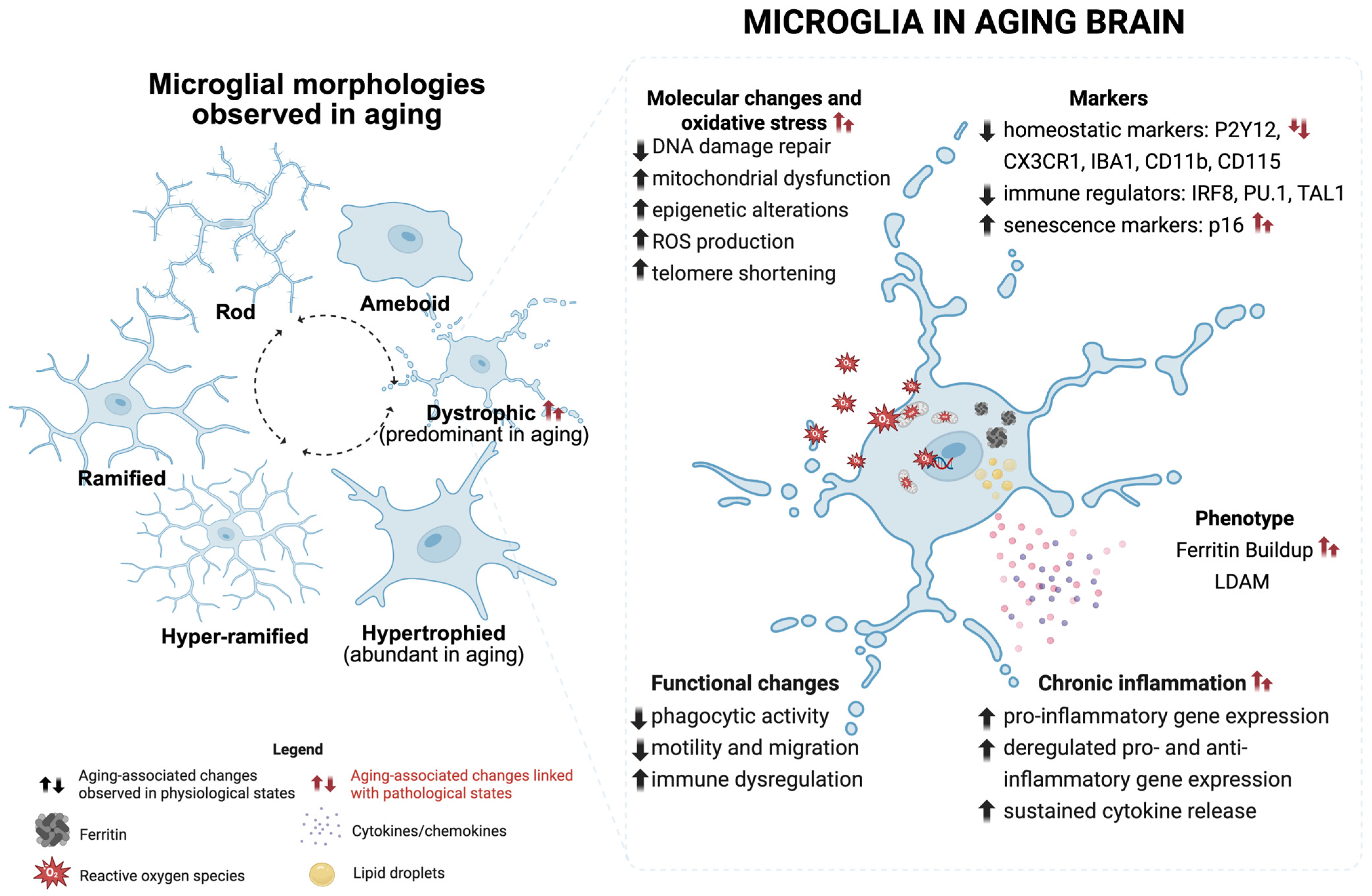
- Human microglia in aged brain exhibit morphological and molecular perturbation that could be linked with a shift from homeostatic states to chronic reactivity, as well as dystrophy and impairment of physiological functions.
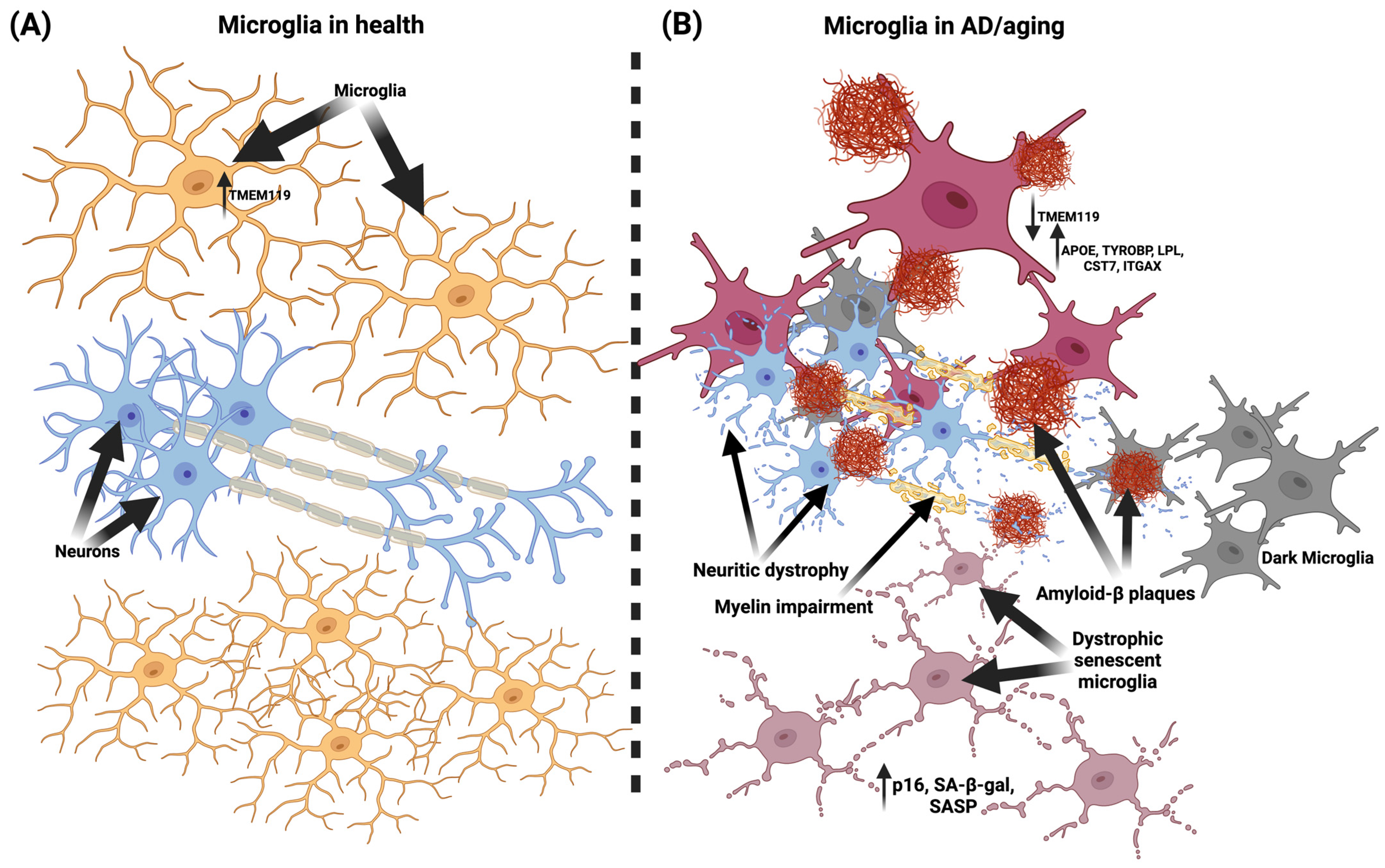
- Dysregulated microglia-mediated oxidative stress, pro-inflammatory states, and senescent milieu in aged human brain may pose a potential link between physiological brain aging and Alzheimer’s disease (AD)-related pathological trajectories.
- Microglial dysfunction in overall brain inflammation and AD pathogenesis underscores an imperative priority in the advancement of microglia-targeted therapeutic strategies to modulate pathology and disease progression.
Abstract
1. Introduction
2. The Aged Brain and Microglia
2.1. Microglial Morphological Alterations in Physiological Aging
2.2. Molecular Drivers of Aging-Associated Microglial Phenotype
2.2.1. Molecular Landscape in Aging Microglia
2.2.2. Alterations in Regulatory Immune Response in Aging Microglia
2.2.3. Role of MicroRNAs in Aging Microglia
2.3. Lipid Droplet-Accumulating Microglia as an Aging Phenotype
2.4. Oxidative Stress, Inflammaging, and Cellular Senescence in Aging Microglia
3. Microglia in AD Pathology
3.1. Microglial Molecular Signatures in AD
3.2. Microglial Phenotypic and Morphological Alterations in AD
3.3. Microglial Senescence in AD Pathology
4. Therapeutic Implications: Emerging Strategies Targeting Microglia in AD
Pharmacologic Modulation and Immunotherapeutic Approaches Targeting Microglia in AD

| Type/Action | Drug Name | Experimental Outcomes | Findings in Clinical Trials | Identified Constraints | References |
|---|---|---|---|---|---|
| TREM2 agonist | AL002 | From Phase 1 in vitro and in vivo data: ↓ Filamentous plaques [206] ↓ Neurite dystrophy [206] ↓ Microglia inflammatory response [206] | INVOKE-2 Phase 2 trial in patients with early-onset AD:
| Could pose immune adverse effects [208] | [206,207,208] |
| Anti-CD33 antibody | Lintuzumab | ↑ Aβ phagocytosis [209] ↓ CD33-mediated neurotoxicity | - | Not yet tested clinically | [209] |
| Cysteinyl leukotriene receptor antagonist | Montelukast | Human cohort data: ↓ Cognitive decline [210] ↑ Preserved functions in non-amnesic cognitive domain in AD dementia [210] | Phase 2 trial in patients with MCI and early AD:
| AD fly and mouse models: Disease stage dependent [212] | [210,211,212,213] |
| Non-steroidal anti-inflammatory Drugs (NSAIDS) | e.g., Naproxen | From epidemiologic studies: ↓ risk of AD or delayed onset [214] | INTREPAD trial with Naproxen in elderly patients with AD family history and without cognitive disorders:
| In randomized trials:
| [214,215] |
| PPARγ agonist | Pioglitazone | ↓ Pro-inflammatory genes expressed in microglia [216] | TOMORROW Phase 3 trial with cognitively healthy participants aged 65–83, at high and low risk of developing AD:
| In early AD patients:
| [216,217] |
| Cannabidiol and other cannabinoids | In vitro: modulates microglia reactivity [218] In mice: neuroprotective of memory [218] | Phase 2 trial in patients with AD-associated dementia, aged 60–80:
| Larger and longer trials required to confirm effects [219] | [218,219] | |
| NLRP3 inflammasome modulating agents | Minocycline | ↓ Inflammation [220] ↓ Microglial recruitment [220] ↓ Aβ burden [220] | 2-Year randomized clinical trial in patients with mild AD:
| - | [220,221] |
| Edaravone | In vitro: ↓ Mitochondrial dysfunction [222] ↓ Aβ induced microglia reactivity [222] | - | Clinical relevance remains to be proven | [222] | |
| Immunomodulatory Approaches | |||||
| Amyloid targeting monoclonal antibodies (mAbs) | Lecanemab, Donanemab | ↓ Aβ markers in early AD [223] ↓ Decline of cognitive function [223] | Phase 3 trial of lecanemab in patients aged 50 to 90 with mild AD:
| Only ↓ disease progression by 20–30% [223] Serious side effects (ARIA) [225] | [223,224,225] |
| TNF inhibitors | Etanercept | ↑ Cognition in one patient with AD [226] | Phase 2 trial in patients with mild to moderate AD-associated dementia: | Larger trials including placebo group still missing [227] | [226,227] |
| Adalimumab, Infliximab | ↓ AD and dementia risk in large inflammatory cohorts | Trials specific for AD are limited | Not established causality | [228] | |
| Xpro1595 | ↓ Inflammatory activity without impeding essential TNF functions [229] | Phase 1 trial in 20 patients with AD: ↓ CSF inflammation and neurodegeneration biomarkers and MRI inflammation markers [229] Phase 2:
| - | [229,230] | |
| Complement inhibitors | C1q antagonists | ↓ Maladaptive microglia-mediated phagocytosis and synaptic pruning [231,232] | - | - | [231,232] |
| Other immune-modulating agents | JAK/STAT pathway modulators [233], p38 MAPK inhibitors [234], PD-1 inhibitors [235], lenalidomide [233], galectin-3 antibodies [236] | Advancing through clinical trials | Efficacy is yet to be established | [233,234,235,236] | |
| Emerging strategies | CRISPR-based | Lack cell-specificity and have off-target effects [237] | [237] | ||
| Engineering immune cells to ↑ Aβ clearance, modulate regulatory T-cells, repurpose vaccine adjuvants to induce protective microglial phenotypes [238,239] | - | - | [238,239] | ||
5. Perspectives and Future Directions
6. Conclusions
Author Contributions
Funding
Data Availability Statement
Acknowledgments
Conflicts of Interest
Abbreviations
| AD | Alzheimer’s disease |
| ADAPT | Alzheimer’s Disease Anti-Inflammatory Prevention Trial |
| APOE | apolipoprotein E 4 |
| ARIA | Amyloid-Related Imaging Abnormalities |
| ASC | apoptosis-associated speck-like protein containing caspase recruitment domains |
| Aβ | amyloid-beta |
| BBB | blood–brain barrier |
| C1q | complement component 1q |
| CB | cannabinoid receptor |
| CCL3/4 | macrophage inflammatory protein1α/β |
| CD33 | cluster of differentiation 33 |
| CD68 | cluster of differentiation 68 |
| CD83 | cluster of differentiation 83 |
| ChIP-Seq | chromatic immunoprecipitation sequencing |
| CNS | central nervous system |
| CRISPR | clustered regularly interspaced short palindromic repeats |
| CSF | cerebrospinal fluid |
| CSP | canonical senescence pathway |
| CST7 | cystatin F |
| CX3CR1 | cell surface chemokine receptor 1 |
| CyTOF | comprehensive multiplexed mass cytometry |
| DAM | disease-associated microglia |
| DNA | deoxyribonucleic acid |
| ER | endoplasmic reticulum |
| GWAS | genome-wide association studies |
| HIF1α | mTOR-hypoxia-inducible factor-1α |
| IBA1 | ionized calcium-binding adapter molecule 1 |
| IFI16 | interferon gamma inducible protein 16 |
| IMG | human hPSC-derived microglia |
| IRF8 | interferon regulatory factor 8 |
| ITGAX; CD11c | integrin subunit alpha X |
| JAK | Janus kinases |
| LDAM | Lipid droplet accumulation microglia |
| LPL | lipoprotein lipase |
| mAbs | monoclonal antibodies |
| MCI | mild cognitive impairment |
| MGnD | microglial neurodegenerative phenotype |
| MHC | major histocompatibility complex |
| miRNA, miR | microRNAs |
| MMSE | Mini-Mental State Examination |
| MRI | magnetic resonance imaging |
| MRs | master transcriptional regulators |
| mTOR | mechanistic target of rapamycin |
| NFKB1 | nuclear factor kappa b subunit 1 |
| NFTs | neurofibrillary tangles |
| NK | natural killer |
| NLRP3 | NOD-like receptor family, pyrin domain-containing 3 |
| NSAIDS | non-steroidal anti-inflammatory drugs |
| OPCs | oligodendrocyte progenitor cells |
| p16 | cyclin-dependent kinase inhibitor 2A/p16INK4A |
| P22 | subtype-selective sialic acid mimetic |
| P2RY12 | purinergic receptor P2Y, G-protein coupled, 12 |
| P2X7R | purinergic P2X7 receptor |
| p38 MAPK | p38 mitogen activated protein kinase |
| PD-1 | programmed cell death protein 1 |
| PET | positron emission tomography |
| PLIN2 | lipid droplet surface protein perilipin 2 |
| PPARy | peroxisome proliferator-activated receptor gamma |
| PS19 | mouse tauopathy model expressing MAPT P301S |
| PU.1 | purine rich box binding protein 1 |
| RONS | reactive oxygen and nitrogen species |
| ROS | reactive oxygen species |
| RUNX1 | runt-related transcription factor 1 |
| SASP | senescence-associated secretory phenotype |
| SA-β-gal | senescence-associated β-galactosidase |
| scRNA-seq | single-cell RNA sequencing |
| SIRT1 | sirtuin 1 |
| snRNA-seq | single-nucleus RNA sequencing |
| STAT | signal transducer and activator of transcription proteins |
| sTNF | soluble TNF |
| TAL1 | T-cell acute lymphocytic leukemia protein 1 |
| TGFB | transforming growth factor-β |
| TMEM119 | transmembrane protein 119 |
| TNF | tumor necrosis factor |
| TREM2 | Triggering receptor expressed on myeloid cells 2 |
| TREM2+/− | TREM2 haplodeficiency |
| TYROBP | TYRO protein tyrosine kinase binding protein |
| WHO | World Health Organization |
References
- Olshansky, S.J.; Willcox, B.J.; Demetrius, L.; Beltrán-Sánchez, H. Implausibility of Radical Life Extension in Humans in the Twenty-First Century. Nat. Aging 2024, 4, 1635–1642. [Google Scholar] [CrossRef] [PubMed]
- World Health Organization. Ageing and Health. Available online: https://www.who.int/news-room/fact-sheets/detail/ageing-and-health (accessed on 13 March 2026).
- National Institute on Aging. Global Aging. Available online: https://www.nia.nih.gov/research/dbsr/global-aging (accessed on 13 March 2026).
- Guo, L.; Choi, S.; Bikkannavar, P.; Cordeiro, M.F. Microglia: Key Players in Retinal Ageing and Neurodegeneration. Front. Cell. Neurosci. 2022, 16, 804782. [Google Scholar] [CrossRef] [PubMed]
- Tuttle, C.S.L.; Luesken, S.W.M.; Waaijer, M.E.C.; Maier, A.B. Senescence in Tissue Samples of Humans with Age-Related Diseases: A Systematic Review. Ageing Res. Rev. 2021, 68, 101334. [Google Scholar] [CrossRef] [PubMed]
- Ferrari, A.J.; Santomauro, D.F.; Aali, A.; Abate, Y.H.; Abbafati, C.; Abbastabar, H.; Abd ElHafeez, S.; Abdelmasseh, M.; Abd-Elsalam, S.; Abdollahi, A.; et al. Global Incidence, Prevalence, Years Lived with Disability (YLDs), Disability-Adjusted Life-Years (DALYs), and Healthy Life Expectancy (HALE) for 371 Diseases and Injuries in 204 Countries and Territories and 811 Subnational Locations, 1990–2021: A Systematic Analysis for the Global Burden of Disease Study 2021. Lancet 2024, 403, 2133–2161. [Google Scholar] [CrossRef] [PubMed]
- He, Z.; Zhang, H.; Hu, G.; Qiao, Y.; Yin, C.; Li, J.; Lin, H.; Wu, A.; Qin, D.; Law, B.Y.-K.; et al. The Current Status, Trends, and Challenges of Alzheimer’s Disease and Other Dementias in Asia (1990–2036). Front. Public Health 2025, 13, 1583339. [Google Scholar] [CrossRef] [PubMed]
- Hudson, H.R.; Sun, X.; Orr, M.E. Senescent Brain Cell Types in Alzheimer’s Disease: Pathological Mechanisms and Therapeutic Opportunities. Neurotherapeutics 2025, 22, e00519. [Google Scholar] [CrossRef] [PubMed]
- Javaid, S.F.; Giebel, C.; Khan, M.A.; Hashim, M.J. Epidemiology of Alzheimer’s Disease and Other Dementias: Rising Global Burden and Forecasted Trends. F1000Research 2021, 10, 425. [Google Scholar] [CrossRef]
- Carr, L.; Mustafa, S.; Collins-Praino, L.E. The Hallmarks of Ageing in Microglia. Cell. Mol. Neurobiol. 2025, 45, 45. [Google Scholar] [CrossRef] [PubMed]
- Ginhoux, F.; Prinz, M. Origin of Microglia: Current Concepts and Past Controversies. Cold Spring Harb. Perspect. Biol. 2015, 7, a020537. [Google Scholar] [CrossRef] [PubMed]
- Prinz, M.; Masuda, T.; Wheeler, M.A.; Quintana, F.J. Microglia and Central Nervous System–Associated Macrophages—From Origin to Disease Modulation. Annu. Rev. Immunol. 2021, 39, 251–277. [Google Scholar] [CrossRef] [PubMed]
- Tremblay, M.-È. Microglial Functional Alteration and Increased Diversity in the Challenged Brain: Insights into Novel Targets for Intervention. Brain Behav. Immun.-Health 2021, 16, 100301. [Google Scholar] [CrossRef] [PubMed]
- Cornejo, F.; von Bernhardi, R. Age-Dependent Changes in the Activation and Regulation of Microglia. In Glial Cells in Health and Disease of the CNS; von Bernhardi, R., Ed.; Springer International Publishing: Cham, Switzerland, 2016; pp. 205–226. [Google Scholar]
- Matsudaira, T.; Nakano, S.; Konishi, Y.; Kawamoto, S.; Uemura, K.; Kondo, T.; Sakurai, K.; Ozawa, T.; Hikida, T.; Komine, O.; et al. Author Correction: Cellular Senescence in White Matter Microglia Is Induced during Ageing in Mice and Exacerbates the Neuroinflammatory Phenotype. Commun. Biol. 2025, 8, 1531. [Google Scholar] [CrossRef] [PubMed]
- Lau, V.; Ramer, L.; Tremblay, M.-È. An Aging, Pathology Burden, and Glial Senescence Build-up Hypothesis for Late Onset Alzheimer’s Disease. Nat. Commun. 2023, 14, 1670. [Google Scholar] [CrossRef] [PubMed]
- González-Velasco, O.; Papy-García, D.; Le Douaron, G.; Sánchez-Santos, J.M.; De Las Rivas, J. Transcriptomic Landscape, Gene Signatures and Regulatory Profile of Aging in the Human Brain. Biochim. Biophys. Acta (BBA)-Gene Regul. Mech. 2020, 1863, 194491. [Google Scholar] [CrossRef] [PubMed]
- Olah, M.; Patrick, E.; Villani, A.-C.; Xu, J.; White, C.C.; Ryan, K.J.; Piehowski, P.; Kapasi, A.; Nejad, P.; Cimpean, M.; et al. A Transcriptomic Atlas of Aged Human Microglia. Nat. Commun. 2018, 9, 539. [Google Scholar] [CrossRef] [PubMed]
- Galatro, T.F.; Holtman, I.R.; Lerario, A.M.; Vainchtein, I.D.; Brouwer, N.; Sola, P.R.; Veras, M.M.; Pereira, T.F.; Leite, R.E.P.; Möller, T.; et al. Transcriptomic Analysis of Purified Human Cortical Microglia Reveals Age-Associated Changes. Nat. Neurosci. 2017, 20, 1162–1171. [Google Scholar] [CrossRef] [PubMed]
- Fernández-Rubio, G.; Vuust, P.; Kringelbach, M.L.; Bonetti, L. The Neurophysiology of Healthy and Pathological Aging: A Comprehensive Systematic Review. Brain Struct. Funct. 2025, 230, 146. [Google Scholar] [CrossRef] [PubMed]
- Ben-Azu, B.; Gargus, M.; Verkhratsky, A.; Tremblay, M.-É. Chapter 1—Introduction to Microglial Aging and Its Involvement in Neurodegenerative Diseases. In Microglial Aging; Tremblay, M.-É., Ed.; Academic Press: Cambridge, MA, USA, 2026; pp. 3–44. [Google Scholar]
- Glorioso, C.; Sibille, E. Between Destiny and Disease: Genetics and Molecular Pathways of Human Central Nervous System Aging. Prog. Neurobiol. 2011, 93, 165–181. [Google Scholar] [CrossRef] [PubMed]
- Fabbri, E.; An, Y.; Zoli, M.; Tanaka, T.; Simonsick, E.M.; Kitner-Triolo, M.H.; Studenski, S.A.; Resnick, S.M.; Ferrucci, L. Association Between Accelerated Multimorbidity and Age-Related Cognitive Decline in Older Baltimore Longitudinal Study of Aging Participants without Dementia. J. Am. Geriatr. Soc. 2016, 64, 965–972. [Google Scholar] [CrossRef] [PubMed]
- Niraula, A.; Sheridan, J.F.; Godbout, J.P. Microglia Priming with Aging and Stress. Neuropsychopharmacology 2017, 42, 318–333. [Google Scholar] [CrossRef] [PubMed]
- Moldogazieva, N.T.; Mokhosoev, I.M.; Mel’nikova, T.I.; Porozov, Y.B.; Terentiev, A.A. Oxidative Stress and Advanced Lipoxidation and Glycation End Products (ALEs and AGEs) in Aging and Age-Related Diseases. Oxidative Med. Cell. Longev. 2019, 2019, 3085756. [Google Scholar] [CrossRef] [PubMed]
- Shankar, S.K. Biology of Aging Brain. Indian J. Pathol. Microbiol. 2010, 53, 595–604. [Google Scholar] [CrossRef] [PubMed]
- Gray, D.A.; Woulfe, J. Lipofuscin and Aging: A Matter of Toxic Waste. Sci. Aging Knowl. Environ. 2005, 2005, re1. [Google Scholar] [CrossRef] [PubMed]
- Ham, S.; Lee, S.-J.V. Advances in Transcriptome Analysis of Human Brain Aging. Exp. Mol. Med. 2020, 52, 1787–1797. [Google Scholar] [CrossRef] [PubMed]
- Mrak, R.E.; Griffin, W.S.T.; Graham, D.I. Aging-Associated Changes in Human Brain. J. Neuropathol. Exp. Neurol. 1997, 56, 1269–1275. [Google Scholar] [CrossRef] [PubMed]
- Malvaso, A.; Gatti, A.; Negro, G.; Calatozzolo, C.; Medici, V.; Poloni, T.E. Microglial Senescence and Activation in Healthy Aging and Alzheimer’s Disease: Systematic Review and Neuropathological Scoring. Cells 2023, 12, 2824. [Google Scholar] [CrossRef] [PubMed]
- Ng, P.Y.; McNeely, T.L.; Baker, D.J. Untangling Senescent and Damage-Associated Microglia in the Aging and Diseased Brain. FEBS J. 2023, 290, 1326–1339. [Google Scholar] [CrossRef] [PubMed]
- Ajami, B.; Bennett, J.L.; Krieger, C.; Tetzlaff, W.; Rossi, F.M.V. Local Self-Renewal Can Sustain CNS Microglia Maintenance and Function throughout Adult Life. Nat. Neurosci. 2007, 10, 1538–1543. [Google Scholar] [CrossRef] [PubMed]
- Ginhoux, F.; Greter, M.; Leboeuf, M.; Nandi, S.; See, P.; Gokhan, S.; Mehler, M.F.; Conway, S.J.; Ng, L.G.; Stanley, E.R.; et al. Fate Mapping Analysis Reveals That Adult Microglia Derive from Primitive Macrophages. Science 2010, 330, 841–845. [Google Scholar] [CrossRef] [PubMed]
- Shimada, I.S.; LeComte, M.D.; Granger, J.C.; Quinlan, N.J.; Spees, J.L. Self-Renewal and Differentiation of Reactive Astrocyte-Derived Neural Stem/Progenitor Cells Isolated from the Cortical Peri-Infarct Area after Stroke. J. Neurosci. 2012, 32, 7926–7940. [Google Scholar] [CrossRef] [PubMed]
- Li, Q.; Barres, B.A. Microglia and Macrophages in Brain Homeostasis and Disease. Nat. Rev. Immunol. 2018, 18, 225–242. [Google Scholar] [CrossRef] [PubMed]
- Keren-Shaul, H.; Spinrad, A.; Weiner, A.; Matcovitch-Natan, O.; Dvir-Szternfeld, R.; Ulland, T.K.; David, E.; Baruch, K.; Lara-Astaiso, D.; Toth, B.; et al. A Unique Microglia Type Associated with Restricting Development of Alzheimer’s Disease. Cell 2017, 169, 1276–1290.e17. [Google Scholar] [CrossRef] [PubMed]
- Yin, Z.; Rosenzweig, N.; Kleemann, K.L.; Zhang, X.; Brandão, W.; Margeta, M.A.; Schroeder, C.; Sivanathan, K.N.; Silveira, S.; Gauthier, C.; et al. APOE4 Impairs the Microglial Response in Alzheimer’s Disease by Inducing TGFβ-Mediated Checkpoints. Nat. Immunol. 2023, 24, 1839–1853. [Google Scholar] [CrossRef] [PubMed]
- Paolicelli, R.C.; Sierra, A.; Stevens, B.; Tremblay, M.-E.; Aguzzi, A.; Ajami, B.; Amit, I.; Audinat, E.; Bechmann, I.; Bennett, M.; et al. Microglia States and Nomenclature: A Field at Its Crossroads. Neuron 2022, 110, 3458–3483. [Google Scholar] [CrossRef] [PubMed]
- Salat, D.H.; Kaye, J.A.; Janowsky, J.S. Selective Preservation and Degeneration Within the Prefrontal Cortex in Aging and Alzheimer Disease. Arch. Neurol. 2001, 58, 1403–1408. [Google Scholar] [CrossRef] [PubMed]
- Lopes, K.d.P.; Snijders, G.J.L.; Humphrey, J.; Allan, A.; Sneeboer, M.A.M.; Navarro, E.; Schilder, B.M.; Vialle, R.A.; Parks, M.; Missall, R.; et al. Genetic Analysis of the Human Microglial Transcriptome across Brain Regions, Aging and Disease Pathologies. Nat. Genet. 2022, 54, 4–17. [Google Scholar] [CrossRef] [PubMed]
- Han, T.; Xu, Y.; Sun, L.; Hashimoto, M.; Wei, J. Microglial Response to Aging and Neuroinflammation in the Development of Neurodegenerative Diseases. Neural Regen. Res. 2024, 19, 1241–1248. [Google Scholar] [CrossRef] [PubMed]
- López-Otín, C.; Blasco, M.A.; Partridge, L.; Serrano, M.; Kroemer, G. Hallmarks of Aging: An Expanding Universe. Cell 2023, 186, 243–278. [Google Scholar] [CrossRef] [PubMed]
- Lawson, L.J.; Perry, V.H.; Dri, P.; Gordon, S. Heterogeneity in the Distribution and Morphology of Microglia in the Normal Adult Mouse Brain. Neuroscience 1990, 39, 151–170. [Google Scholar] [CrossRef] [PubMed]
- Shahidehpour, R.K.; Higdon, R.E.; Crawford, N.G.; Neltner, J.H.; Ighodaro, E.T.; Patel, E.; Price, D.; Nelson, P.T.; Bachstetter, A.D. Dystrophic Microglia Are Associated with Neurodegenerative Disease and Not Healthy Aging in the Human Brain. Neurobiol. Aging 2021, 99, 19–27. [Google Scholar] [CrossRef] [PubMed]
- Tay, T.L.; Savage, J.; Hui, C.W.; Bisht, K.; Tremblay, M.-E. Microglia across the Lifespan: From Origin to Function in Brain Development, Plasticity and Cognition. J. Physiol. 2016, 595, 1929–1945. [Google Scholar] [CrossRef] [PubMed]
- Torres-Platas, S.G.; Comeau, S.; Rachalski, A.; Bo, G.D.; Cruceanu, C.; Turecki, G.; Giros, B.; Mechawar, N. Morphometric Characterization of Microglial Phenotypes in Human Cerebral Cortex. J. Neuroinflamm. 2014, 11, 12. [Google Scholar] [CrossRef] [PubMed]
- Tremblay, M.-È.; Marker, D.F.; Puccini, J.M.; Muly, E.C.; Lu, S.-M.; Gelbard, H.A. Ultrastructure of Microglia-Synapse Interactions in the HIV-1 Tat-Injected Murine Central Nervous System. Commun. Integr. Biol. 2013, 6, e27670. [Google Scholar] [CrossRef] [PubMed]
- Vidal-Itriago, A.; Radford, R.A.W.; Aramideh, J.A.; Maurel, C.; Scherer, N.M.; Don, E.K.; Lee, A.; Chung, R.S.; Graeber, M.B.; Morsch, M. Microglia Morphophysiological Diversity and Its Implications for the CNS. Front. Immunol. 2022, 13, 997786. [Google Scholar] [CrossRef] [PubMed]
- Streit, W.J.; Braak, H.; Xue, Q.-S.; Bechmann, I. Dystrophic (Senescent) Rather than Activated Microglial Cells Are Associated with Tau Pathology and Likely Precede Neurodegeneration in Alzheimer’s Disease. Acta Neuropathol. 2009, 118, 475–485. [Google Scholar] [CrossRef] [PubMed]
- Bachstetter, A.D.; Van Eldik, L.J.; Schmitt, F.A.; Neltner, J.H.; Ighodaro, E.T.; Webster, S.J.; Patel, E.; Abner, E.L.; Kryscio, R.J.; Nelson, P.T. Disease-Related Microglia Heterogeneity in the Hippocampus of Alzheimer’s Disease, Dementia with Lewy Bodies, and Hippocampal Sclerosis of Aging. Acta Neuropathol. Commun. 2015, 3, 32. [Google Scholar] [CrossRef] [PubMed]
- Davies, D.S.; Ma, J.; Jegathees, T.; Goldsbury, C. Microglia Show Altered Morphology and Reduced Arborization in Human Brain during Aging and Alzheimer’s Disease. Brain Pathol. 2016, 27, 795–808. [Google Scholar] [CrossRef] [PubMed]
- Augusto-Oliveira, M.; Arrifano, G.; Delage, C.; Tremblay, M.-È.; Crespo-Lopez, M.E.; Verkhratsky, A. Plasticity of Microglia. Biol. Rev. 2022, 97, 217–250. [Google Scholar] [CrossRef] [PubMed]
- Parakalan, R.; Jiang, B.; Nimmi, B.; Janani, M.; Jayapal, M.; Lu, J.; Tay, S.S.W.; Ling, E.-A.; Dheen, S.T. Transcriptome Analysis of Amoeboid and Ramified Microglia Isolated from the Corpus Callosum of Rat Brain. BMC Neurosci. 2012, 13, 64. [Google Scholar] [CrossRef] [PubMed]
- Prokop, S.; Miller, K.R.; Heppner, F.L. Microglia Actions in Alzheimer’s Disease. Acta Neuropathol. 2013, 126, 461–477. [Google Scholar] [CrossRef] [PubMed]
- Davis, M.; O’Connell, T.; Johnson, S.; Cline, S.; Merikle, E.; Martenyi, F.; Simpson, K. Estimating Alzheimer’s Disease Progression Rates from Normal Cognition Through Mild Cognitive Impairment and Stages of Dementia. Curr. Alzheimer Res. 2018, 15, 777–788. [Google Scholar] [CrossRef] [PubMed]
- Taylor, S.E.; Morganti-Kossmann, C.; Lifshitz, J.; Ziebell, J.M. Rod Microglia: A Morphological Definition. PLoS ONE 2014, 9, e97096. [Google Scholar] [CrossRef] [PubMed]
- Bachstetter, A.D.; Ighodaro, E.T.; Hassoun, Y.; Aldeiri, D.; Neltner, J.H.; Patel, E.; Abner, E.L.; Nelson, P.T. Rod-Shaped Microglia Morphology Is Associated with Aging in 2 Human Autopsy Series. Neurobiol. Aging 2017, 52, 98–105. [Google Scholar] [CrossRef] [PubMed]
- Xie, M.; Liang, Y.; Miller, A.S.; Pallegar, P.N.; Umpierre, A.D.; Wang, N.; Zhang, S.; Nagaraj, N.K.; Fogarty, Z.C.; Ghayal, N.B.; et al. Rod-Shaped Microglia Interact with Neuronal Dendrites to Attenuate Cortical Excitability during TDP-43-Related Neurodegeneration. Immunity 2025, 58, 3113–3129.e8. [Google Scholar] [CrossRef] [PubMed]
- Bisht, K.; Sharma, K.P.; Lecours, C.; Sánchez, M.G.; El Hajj, H.; Milior, G.; Olmos-Alonso, A.; Gómez-Nicola, D.; Luheshi, G.; Vallières, L.; et al. Dark Microglia: A New Phenotype Predominantly Associated with Pathological States. Glia 2016, 64, 826–839. [Google Scholar] [CrossRef] [PubMed]
- St-Pierre, M.-K.; Carrier, M.; González Ibáñez, F.; Šimončičová, E.; Wallman, M.-J.; Vallières, L.; Parent, M.; Tremblay, M.-È. Ultrastructural Characterization of Dark Microglia during Aging in a Mouse Model of Alzheimer’s Disease Pathology and in Human Post-Mortem Brain Samples. J. Neuroinflamm. 2022, 19, 235. [Google Scholar] [CrossRef] [PubMed]
- Flury, A.; Aljayousi, L.; Park, H.-J.; Khakpour, M.; Mechler, J.; Aziz, S.; McGrath, J.D.; Deme, P.; Sandberg, C.; Ibáñez, F.G.; et al. A Neurodegenerative Cellular Stress Response Linked to Dark Microglia and Toxic Lipid Secretion. Neuron 2025, 113, 554–571.e14. [Google Scholar] [CrossRef] [PubMed]
- Flury, A.; St-Pierre, M.-K.; Ayata, P.; Tremblay, M.-È. Evolving Insights into the Identity and Function of Dark Microglia. Trends Neurosci. 2026, 49, 20–34. [Google Scholar] [CrossRef] [PubMed]
- Neumann, P.; Lenz, D.E.; Streit, W.J.; Bechmann, I. Is Microglial Dystrophy a Form of Cellular Senescence? An Analysis of Senescence Markers in the Aged Human Brain. Glia 2023, 71, 377–390. [Google Scholar] [CrossRef] [PubMed]
- Streit, W.J.; Sammons, N.W.; Kuhns, A.J.; Sparks, D.L. Dystrophic Microglia in the Aging Human Brain. Glia 2004, 45, 208–212. [Google Scholar] [CrossRef] [PubMed]
- Lopes, K.O.; Sparks, D.L.; Streit, W.J. Microglial Dystrophy in the Aged and Alzheimer’s Disease Brain Is Associated with Ferritin Immunoreactivity. Glia 2008, 56, 1048–1060. [Google Scholar] [CrossRef] [PubMed]
- Lau, V.; VanderZwaag, J.; Murray, C.J.; Tremblay, M.-È. Exploring Iron Deposition Patterns Using Light and Electron Microscopy in the Mouse Brain Across Aging and Alzheimer’s Disease Pathology Conditions. J. Neurochem. 2025, 169, e70086. [Google Scholar] [CrossRef] [PubMed]
- Fan, H.; Zhang, M.; Wen, J.; Wang, S.; Yuan, M.; Sun, H.; Shu, L.; Yang, X.; Pu, Y.; Cai, Z. Microglia in Brain Aging: An Overview of Recent Basic Science and Clinical Research Developments. J. Biomed. Res. 2024, 38, 122–136. [Google Scholar] [CrossRef] [PubMed]
- Liu, R.-M. Aging, Cellular Senescence, and Alzheimer’s Disease. Int. J. Mol. Sci. 2022, 23, 1989. [Google Scholar] [CrossRef] [PubMed]
- Olah, M.; Menon, V.; Habib, N.; Taga, M.F.; Ma, Y.; Yung, C.J.; Cimpean, M.; Khairallah, A.; Coronas-Samano, G.; Sankowski, R.; et al. Single Cell RNA Sequencing of Human Microglia Uncovers a Subset Associated with Alzheimer’s Disease. Nat. Commun. 2020, 11, 6129. [Google Scholar] [CrossRef] [PubMed]
- Franco-Bocanegra, D.K.; McAuley, C.; Nicoll, J.A.R.; Boche, D. Molecular Mechanisms of Microglial Motility: Changes in Ageing and Alzheimer’s Disease. Cells 2019, 8, 639. [Google Scholar] [CrossRef] [PubMed]
- Rhinn, H.; Abeliovich, A. Differential Aging Analysis in Human Cerebral Cortex Identifies Variants in TMEM106B and GRN That Regulate Aging Phenotypes. Cell Syst. 2017, 4, 404–415.e5. [Google Scholar] [CrossRef] [PubMed]
- Spaethling, J.M.; Na, Y.-J.; Lee, J.; Ulyanova, A.V.; Baltuch, G.H.; Bell, T.J.; Brem, S.; Chen, H.I.; Dueck, H.; Fisher, S.A.; et al. Primary Cell Culture of Live Neurosurgically Resected Aged Adult Human Brain Cells and Single Cell Transcriptomics. Cell Rep. 2017, 18, 791–803. [Google Scholar] [CrossRef] [PubMed]
- Proulx, S.T.; Engelhardt, B. Central Nervous System Zoning: How Brain Barriers Establish Subdivisions for CNS Immune Privilege and Immune Surveillance. J. Intern. Med. 2022, 292, 47–67. [Google Scholar] [CrossRef] [PubMed]
- Li, X.; Li, Y.; Jin, Y.; Zhang, Y.; Wu, J.; Xu, Z.; Huang, Y.; Cai, L.; Gao, S.; Liu, T.; et al. Publisher Correction: Transcriptional and Epigenetic Decoding of the Microglial Aging Process. Nat. Aging 2024, 4, 276. [Google Scholar] [CrossRef] [PubMed]
- Dehkordi, S.K.; Walker, J.; Sah, E.; Bennett, E.; Atrian, F.; Frost, B.; Woost, B.; Bennett, R.E.; Orr, T.C.; Zhou, Y.; et al. Profiling Senescent Cells in Human Brains Reveals Neurons with CDKN2D/P19 and Tau Neuropathology. Nat. Aging 2021, 1, 1107–1116. [Google Scholar] [CrossRef] [PubMed]
- Fancy, N.N.; Smith, A.M.; Caramello, A.; Tsartsalis, S.; Davey, K.; Muirhead, R.C.J.; McGarry, A.; Jenkyns, M.H.; Schneegans, E.; Chau, V.; et al. Characterisation of Premature Cell Senescence in Alzheimer’s Disease Using Single Nuclear Transcriptomics. Acta Neuropathol. 2024, 147, 78. [Google Scholar] [CrossRef] [PubMed]
- Patel, T.; Carnwath, T.P.; Wang, X.; Allen, M.; Lincoln, S.J.; Lewis-Tuffin, L.J.; Quicksall, Z.S.; Lin, S.; Tutor-New, F.Q.; Ho, C.C.G.; et al. Transcriptional Landscape of Human Microglia Implicates Age, Sex, and APOE-Related Immunometabolic Pathway Perturbations. Aging Cell 2022, 21, e13606. [Google Scholar] [CrossRef] [PubMed]
- Yaqubi, M.; Groh, A.M.R.; Dorion, M.-F.; Afanasiev, E.; Luo, J.X.X.; Hashemi, H.; Sinha, S.; Kieran, N.W.; Blain, M.; Cui, Q.-L.; et al. Analysis of the Microglia Transcriptome across the Human Lifespan Using Single Cell RNA Sequencing. J. Neuroinflamm. 2023, 20, 132. [Google Scholar] [CrossRef] [PubMed]
- Böttcher, C.; Schlickeiser, S.; Sneeboer, M.A.M.; Kunkel, D.; Knop, A.; Paza, E.; Fidzinski, P.; Kraus, L.; Snijders, G.J.L.; Kahn, R.S.; et al. Human Microglia Regional Heterogeneity and Phenotypes Determined by Multiplexed Single-Cell Mass Cytometry. Nat. Neurosci. 2019, 22, 78–90. [Google Scholar] [CrossRef] [PubMed]
- Bennett, M.L.; Bennett, F.C.; Liddelow, S.A.; Ajami, B.; Zamanian, J.L.; Fernhoff, N.B.; Mulinyawe, S.B.; Bohlen, C.J.; Adil, A.; Tucker, A.; et al. New Tools for Studying Microglia in the Mouse and Human CNS. Proc. Natl. Acad. Sci. USA 2016, 113, E1738–E1746. [Google Scholar] [CrossRef] [PubMed]
- Boche, D.; Gordon, M.N. Diversity of Transcriptomic Microglial Phenotypes in Aging and Alzheimer’s Disease. Alzheimers Dement. 2022, 18, 360–376. [Google Scholar] [CrossRef] [PubMed]
- Butovsky, O.; Jedrychowski, M.P.; Moore, C.S.; Cialic, R.; Lanser, A.J.; Gabriely, G.; Koeglsperger, T.; Dake, B.; Wu, P.M.; Doykan, C.E.; et al. Correction: Corrigendum: Identification of a Unique TGF-β–Dependent Molecular and Functional Signature in Microglia. Nat. Neurosci. 2014, 17, 1286. [Google Scholar] [CrossRef]
- Conde, J.R.; Streit, W.J. Microglia in the Aging Brain. J. Neuropathol. Exp. Neurol. 2006, 65, 199–203. [Google Scholar] [CrossRef] [PubMed]
- Perlmutter, L.S.; Scott, S.A.; Barrón, E.; Chui, H.C. MHC Class II-Positive Microglia in Human Brain: Association with Alzheimer Lesions. J. Neurosci. Res. 1992, 33, 549–558. [Google Scholar] [CrossRef] [PubMed]
- Taipa, R.; Sousa, A.L.; Melo Pires, M.; Sousa, N. Does the Interplay Between Aging and Neuroinflammation Modulate Alzheimer’s Disease Clinical Phenotypes? A Clinico-Pathological Perspective. J. Alzheimers Dis. 2016, 53, 403–417. [Google Scholar] [CrossRef] [PubMed]
- Safaiyan, S.; Kannaiyan, N.; Snaidero, N.; Brioschi, S.; Biber, K.; Yona, S.; Edinger, A.L.; Jung, S.; Rossner, M.J.; Simons, M. Age-Related Myelin Degradation Burdens the Clearance Function of Microglia during Aging. Nat. Neurosci. 2016, 19, 995–998. [Google Scholar] [CrossRef] [PubMed]
- Norden, D.M.; Godbout, J.P. Microglia of the Aged Brain: Primed to Be Activated and Resistant to Regulation. Neuropathol. Appl. Neurobiol. 2013, 39, 19–34. [Google Scholar] [CrossRef] [PubMed]
- Styren, S.D.; Civin, W.H.; Rogers, J. Molecular, Cellular, and Pathologic Characterization of HLA-DR Immunoreactivity in Normal Elderly and Alzheimer’s Disease Brain. Exp. Neurol. 1990, 110, 93–104. [Google Scholar] [CrossRef] [PubMed]
- Davis, E.; Lloyd, A.F. The Proteomic Landscape of Microglia in Health and Disease. Front. Cell. Neurosci. 2024, 18, 1379717. [Google Scholar] [CrossRef] [PubMed]
- Grabert, K.; Michoel, T.; Karavolos, M.H.; Clohisey, S.; Baillie, J.K.; Stevens, M.P.; Freeman, T.C.; Summers, K.M.; McColl, B.W. Microglial Brain Region−Dependent Diversity and Selective Regional Sensitivities to Aging. Nat. Neurosci. 2016, 19, 504–516. [Google Scholar] [CrossRef] [PubMed]
- Guldner, I.H.; Wagner, V.P.; Moran-Losada, P.; Shi, S.M.; Golub, S.W.; Hevler, J.F.; Chen, K.; Meese, B.T.; Ghoochani, A.; Pulido, E.; et al. Ageing Promotes Microglial Accumulation of Slow-Degrading Synaptic Proteins. Nature 2026, 650, 930–941. [Google Scholar] [CrossRef] [PubMed]
- Guneykaya, D.; Ivanov, A.; Hernandez, D.P.; Haage, V.; Wojtas, B.; Meyer, N.; Maricos, M.; Jordan, P.; Buonfiglioli, A.; Gielniewski, B.; et al. Transcriptional and Translational Differences of Microglia from Male and Female Brains. Cell Rep. 2018, 24, 2773–2783.e6. [Google Scholar] [CrossRef] [PubMed]
- Kang, S.; Ko, E.Y.; Andrews, A.E.; Shin, J.E.; Nance, K.J.; Barman, P.K.; Heeger, P.S.; Freeman, W.M.; Benayoun, B.A.; Goodridge, H.S. Microglia Undergo Sex-Dimorphic Transcriptional and Metabolic Rewiring during Aging. J. Neuroinflamm. 2024, 21, 150. [Google Scholar] [CrossRef] [PubMed]
- Ocañas, S.R.; Pham, K.D.; Cox, J.E.J.; Keck, A.W.; Ko, S.; Ampadu, F.A.; Porter, H.L.; Ansere, V.A.; Kulpa, A.; Kellogg, C.M.; et al. Microglial Senescence Contributes to Female-Biased Neuroinflammation in the Aging Mouse Hippocampus: Implications for Alzheimer’s Disease. bioRxiv 2023. [Google Scholar] [CrossRef] [PubMed]
- Vegeto, E.; Benedusi, V.; Maggi, A. Estrogen Anti-Inflammatory Activity in Brain: A Therapeutic Opportunity for Menopause and Neurodegenerative Diseases. Front. Neuroendocrinol. 2008, 29, 507–519. [Google Scholar] [CrossRef] [PubMed]
- Wu, D.; Bi, X.; Chow, K.H.-M. Identification of Female-Enriched and Disease-Associated Microglia (FDAMic) Contributes to Sexual Dimorphism in Late-Onset Alzheimer’s Disease. J. Neuroinflamm. 2024, 21, 1. [Google Scholar] [CrossRef] [PubMed]
- Gedam, M.; Comerota, M.M.; Propson, N.E.; Chen, T.; Jin, F.; Wang, M.C.; Zheng, H. Complement C3aR Depletion Reverses HIF-1α–Induced Metabolic Impairment and Enhances Microglial Response to Aβ Pathology. J. Clin. Investig. 2023, 133, e167501. [Google Scholar] [CrossRef] [PubMed]
- Cacciottolo, M.; Christensen, A.; Moser, A.; Liu, J.; Pike, C.J.; Smith, C.; LaDu, M.J.; Sullivan, P.M.; Morgan, T.E.; Dolzhenko, E.; et al. The APOE4 Allele Shows Opposite Sex Bias in Microbleeds and Alzheimer’s Disease of Humans and Mice. Neurobiol. Aging 2016, 37, 47–57. [Google Scholar] [CrossRef] [PubMed]
- Guillot-Sestier, M.-V.; Araiz, A.R.; Mela, V.; Gaban, A.S.; O’Neill, E.; Joshi, L.; Chouchani, E.T.; Mills, E.L.; Lynch, M.A. Microglial Metabolism Is a Pivotal Factor in Sexual Dimorphism in Alzheimer’s Disease. Commun. Biol. 2021, 4, 711. [Google Scholar] [CrossRef] [PubMed]
- Bobotis, B.C.; Braniff, O.; Gargus, M.; Akinluyi, E.T.; Awogbindin, I.O.; Tremblay, M.-È. Sex Differences of Microglia in the Healthy Brain from Embryonic Development to Adulthood and across Lifestyle Influences. Brain Res. Bull. 2023, 202, 110752. [Google Scholar] [CrossRef] [PubMed]
- Wehrspaun, C.C.; Haerty, W.; Ponting, C.P. Microglia Recapitulate a Hematopoietic Master Regulator Network in the Aging Human Frontal Cortex. Neurobiol. Aging 2015, 36, 2443.e9–2443.e20. [Google Scholar] [CrossRef] [PubMed]
- Cribbs, D.H.; Berchtold, N.C.; Perreau, V.; Coleman, P.D.; Rogers, J.; Tenner, A.J.; Cotman, C.W. Extensive Innate Immune Gene Activation Accompanies Brain Aging, Increasing Vulnerability to Cognitive Decline and Neurodegeneration: A Microarray Study. J. Neuroinflamm. 2012, 9, 179. [Google Scholar] [CrossRef] [PubMed]
- Jung, S.; Aliberti, J.; Graemmel, P.; Sunshine, M.J.; Kreutzberg, G.W.; Sher, A.; Littman, D.R. Analysis of Fractalkine Receptor CX3CR1 Function by Targeted Deletion and Green Fluorescent Protein Reporter Gene Insertion. Mol. Cell. Biol. 2000, 20, 4106–4114. [Google Scholar] [CrossRef] [PubMed]
- Nishiyori, A.; Minami, M.; Ohtani, Y.; Takami, S.; Yamamoto, J.; Kawaguchi, N.; Kume, T.; Akaike, A.; Satoh, M. Localization of Fractalkine and CX3CR1 mRNAs in Rat Brain: Does Fractalkine Play a Role in Signaling from Neuron to Microglia? FEBS Lett. 1998, 429, 167–172. [Google Scholar] [CrossRef] [PubMed]
- Nobohito, M.; Maisam, M.; Rudolf, J. Functional Analysis of CX3CR1 in Human Induced Pluripotent Stem (iPS) Cell-Derived Microglia-like Cells. Eur. J. Neurosci. 2020, 52, 3667–3678. [Google Scholar] [CrossRef] [PubMed]
- Li, L.; Sun, B.; Harris, O.A.; Luo, J. TGF-β Signaling in Microglia: A Key Regulator of Development, Homeostasis and Reactivity. Biomedicines 2024, 12, 2468. [Google Scholar] [CrossRef] [PubMed]
- O’Brien, J.; Hayder, H.; Zayed, Y.; Peng, C. Overview of MicroRNA Biogenesis, Mechanisms of Actions, and Circulation. Front. Endocrinol. 2018, 9, 402. [Google Scholar] [CrossRef] [PubMed]
- Danka Mohammed, C.P.; Park, J.S.; Nam, H.G.; Kim, K. MicroRNAs in Brain Aging. Mech. Ageing Dev. 2017, 168, 3–9. [Google Scholar] [CrossRef] [PubMed]
- Fenn, A.M.; Smith, K.M.; Lovett-Racke, A.E.; Guerau-de-Arellano, M.; Whitacre, C.C.; Godbout, J.P. Increased Micro-RNA 29b in the Aged Brain Correlates with the Reduction of Insulin-like Growth Factor-1 and Fractalkine Ligand. Neurobiol. Aging 2013, 34, 2748–2758. [Google Scholar] [CrossRef] [PubMed]
- Hébert, S.S.; Horré, K.; Nicolaï, L.; Papadopoulou, A.S.; Mandemakers, W.; Silahtaroglu, A.N.; Kauppinen, S.; Delacourte, A.; De Strooper, B. Loss of microRNA Cluster miR-29a/b-1 in Sporadic Alzheimer’s Disease Correlates with Increased BACE1/β-Secretase Expression. Proc. Natl. Acad. Sci. USA 2008, 105, 6415–6420. [Google Scholar] [CrossRef] [PubMed]
- Liang, C.; Zou, T.; Zhang, M.; Fan, W.; Zhang, T.; Jiang, Y.; Cai, Y.; Chen, F.; Chen, X.; Sun, Y.; et al. MicroRNA-146a Switches Microglial Phenotypes to Resist the Pathological Processes and Cognitive Degradation of Alzheimer’s Disease. Theranostics 2021, 11, 4103–4121. [Google Scholar] [CrossRef] [PubMed]
- Martin, N.A.; Hyrlov, K.H.; Elkjaer, M.L.; Thygesen, E.K.; Wlodarczyk, A.; Elbaek, K.J.; Aboo, C.; Okarmus, J.; Benedikz, E.; Reynolds, R.; et al. Absence of miRNA-146a Differentially Alters Microglia Function and Proteome. Front. Immunol. 2020, 11, 1110. [Google Scholar] [CrossRef] [PubMed]
- Müller, M.; Kuiperij, H.B.; Claassen, J.A.; Küsters, B.; Verbeek, M.M. MicroRNAs in Alzheimer’s Disease: Differential Expression in Hippocampus and Cell-Free Cerebrospinal Fluid. Neurobiol. Aging 2014, 35, 152–158. [Google Scholar] [CrossRef] [PubMed]
- Hébert, S.S.; Horré, K.; Nicolaï, L.; Bergmans, B.; Papadopoulou, A.S.; Delacourte, A.; De Strooper, B. MicroRNA Regulation of Alzheimer’s Amyloid Precursor Protein Expression. Neurobiol. Dis. 2009, 33, 422–428. [Google Scholar] [CrossRef] [PubMed]
- Hébert, S.S.; De Strooper, B. Alterations of the microRNA Network Cause Neurodegenerative Disease. Trends Neurosci. 2009, 32, 199–206. [Google Scholar] [CrossRef] [PubMed]
- Tan, L.; Yu, J.-T.; Tan, L. Causes and Consequences of MicroRNA Dysregulation in Neurodegenerative Diseases. Mol. Neurobiol. 2015, 51, 1249–1262. [Google Scholar] [CrossRef] [PubMed]
- Long, Y.; Liu, J.; Wang, Y.; Guo, H.; Cui, G. The Complex Effects of miR-146a in the Pathogenesis of Alzheimer’s Disease. Neural Regen. Res. 2025, 20, 1309–1323. [Google Scholar] [CrossRef] [PubMed]
- Yang, J.; Malone, F.; Go, M.; Kou, J.; Lim, J.-E.; Caughey, R.C.; Fukuchi, K. Lipopolysaccharide-Induced Exosomal miR-146a Is Involved in Altered Expression of Alzheimer’s Risk Genes Via Suppression of TLR4 Signaling. J. Mol. Neurosci. 2021, 71, 1245–1255. [Google Scholar] [CrossRef] [PubMed]
- Antignano, I.; Liu, Y.; Offermann, N.; Capasso, M. Aging Microglia. Cell. Mol. Life Sci. 2023, 80, 126. [Google Scholar] [CrossRef] [PubMed]
- Chen, Y.; Colonna, M. Microglia in Alzheimer’s Disease at Single-Cell Level. Are There Common Patterns in Humans and Mice? J. Exp. Med. 2021, 218, e20202717. [Google Scholar] [CrossRef] [PubMed]
- Hickman, S.E.; Allison, E.K.; Khoury, J.E. Microglial Dysfunction and Defective β-Amyloid Clearance Pathways in Aging Alzheimer’s Disease Mice. J. Neurosci. 2008, 28, 8354–8360. [Google Scholar] [CrossRef] [PubMed]
- Tremblay, M.-E.; Zhang, I.; Bisht, K.; Savage, J.C.; Lecours, C.; Parent, M.; Titorenko, V.; Maysinger, D. Remodeling of Lipid Bodies by Docosahexaenoic Acid in Activated Microglial Cells. J. Neuroinflamm. 2016, 13, 116. [Google Scholar] [CrossRef] [PubMed]
- Green, G.S.; Fujita, M.; Yang, H.-S.; Taga, M.; Cain, A.; McCabe, C.; Comandante-Lou, N.; White, C.C.; Schmidtner, A.K.; Zeng, L.; et al. Cellular Communities Reveal Trajectories of Brain Ageing and Alzheimer’s Disease. Nature 2024, 633, 634–645. [Google Scholar] [CrossRef] [PubMed]
- Marschallinger, J.; Iram, T.; Zardeneta, M.; Lee, S.E.; Lehallier, B.; Haney, M.S.; Pluvinage, J.V.; Mathur, V.; Hahn, O.; Morgens, D.W.; et al. Author Correction: Lipid-Droplet-Accumulating Microglia Represent a Dysfunctional and Proinflammatory State in the Aging Brain. Nat. Neurosci. 2020, 23, 1308. [Google Scholar] [CrossRef] [PubMed]
- Lu, T.; Pan, Y.; Kao, S.-Y.; Li, C.; Kohane, I.; Chan, J.; Yankner, B.A. Gene Regulation and DNA Damage in the Ageing Human Brain. Nature 2004, 429, 883–891. [Google Scholar] [CrossRef] [PubMed]
- Finkel, T.; Holbrook, N.J. Oxidants, Oxidative Stress and the Biology of Ageing. Nature 2000, 408, 239–247. [Google Scholar] [CrossRef] [PubMed]
- Zuo, L.; Prather, E.R.; Stetskiv, M.; Garrison, D.E.; Meade, J.R.; Peace, T.I.; Zhou, T. Inflammaging and Oxidative Stress in Human Diseases: From Molecular Mechanisms to Novel Treatments. Int. J. Mol. Sci. 2019, 20, 4472. [Google Scholar] [CrossRef] [PubMed]
- Pole, A.; Dimri, M.; Dimri, G.P.; Pole, A.; Dimri, M.; Dimri, G.P. Oxidative Stress, Cellular Senescence and Ageing. AIMS Mol. Sci. 2016, 3, 300–324. [Google Scholar] [CrossRef]
- Rim, C.; You, M.-J.; Nahm, M.; Kwon, M.-S. Emerging Role of Senescent Microglia in Brain Aging-Related Neurodegenerative Diseases. Transl. Neurodegener. 2024, 13, 10. [Google Scholar] [CrossRef] [PubMed]
- Maldonado, E.; Morales-Pison, S.; Urbina, F.; Solari, A. Aging Hallmarks and the Role of Oxidative Stress. Antioxidants 2023, 12, 651. [Google Scholar] [CrossRef] [PubMed]
- Gaikwad, S.; Senapati, S.; Haque, M.A.; Kayed, R. Senescence, Brain Inflammation, and Oligomeric Tau Drive Cognitive Decline in Alzheimer’s Disease: Evidence from Clinical and Preclinical Studies. Alzheimers Dement. 2024, 20, 709–727. [Google Scholar] [CrossRef] [PubMed]
- Gulen, M.F.; Samson, N.; Keller, A.; Schwabenland, M.; Liu, C.; Glück, S.; Thacker, V.V.; Favre, L.; Mangeat, B.; Kroese, L.J.; et al. cGAS–STING Drives Ageing-Related Inflammation and Neurodegeneration. Nature 2023, 620, 374–380. [Google Scholar] [CrossRef] [PubMed]
- Kumari, R.; Jat, P. Mechanisms of Cellular Senescence: Cell Cycle Arrest and Senescence Associated Secretory Phenotype. Front. Cell Dev. Biol. 2021, 9, 645593. [Google Scholar] [CrossRef] [PubMed]
- van Deursen, J.M. The Role of Senescent Cells in Ageing. Nature 2014, 509, 439–446. [Google Scholar] [CrossRef] [PubMed]
- Kuźniar, J.; Kozubek, P.; Czaja, M.; Sitka, H.; Kochman, U.; Leszek, J. Connections Between Cellular Senescence and Alzheimer’s Disease—A Narrative Review. Int. J. Mol. Sci. 2025, 26, 8638. [Google Scholar] [CrossRef] [PubMed]
- Mylonas, A.; O’Loghlen, A. Cellular Senescence and Ageing: Mechanisms and Interventions. Front. Aging 2022, 3, 866718. [Google Scholar] [CrossRef] [PubMed]
- Ogrodnik, M.; Evans, S.A.; Fielder, E.; Victorelli, S.; Kruger, P.; Salmonowicz, H.; Weigand, B.M.; Patel, A.D.; Pirtskhalava, T.; Inman, C.L.; et al. Whole-Body Senescent Cell Clearance Alleviates Age-Related Brain Inflammation and Cognitive Impairment in Mice. Aging Cell 2021, 20, e13296. [Google Scholar] [CrossRef] [PubMed]
- Tuttle, C.S.L.; Waaijer, M.E.C.; Slee-Valentijn, M.S.; Stijnen, T.; Westendorp, R.; Maier, A.B. Cellular Senescence and Chronological Age in Various Human Tissues: A Systematic Review and Meta-Analysis. Aging Cell 2020, 19, e13083. [Google Scholar] [CrossRef] [PubMed]
- Yousefzadeh, M.J.; Zhao, J.; Bukata, C.; Wade, E.A.; McGowan, S.J.; Angelini, L.A.; Bank, M.P.; Gurkar, A.U.; McGuckian, C.A.; Calubag, M.F.; et al. Tissue Specificity of Senescent Cell Accumulation during Physiologic and Accelerated Aging of Mice. Aging Cell 2020, 19, e13094. [Google Scholar] [CrossRef] [PubMed]
- Costa, J.; Martins, S.; Ferreira, P.A.; Cardoso, A.M.S.; Guedes, J.R.; Peça, J.; Cardoso, A.L. The Old Guard: Age-Related Changes in Microglia and Their Consequences. Mech. Ageing Dev. 2021, 197, 111512. [Google Scholar] [CrossRef] [PubMed]
- Ben-Azu, B.; Sabbah, S.; Awogbindin, I.O.; Chidebe, E.O.; Oritsemuelebi, B.; Patel, D.; Frenkel, D.; Tremblay, M.-É. Chapter 9—Microglial Senescence and Senolytic Drugs. In Microglial Aging; Tremblay, M.-É., Ed.; Academic Press: Cambridge, MA, USA, 2026; pp. 225–270. [Google Scholar]
- Idda, M.L.; McClusky, W.G.; Lodde, V.; Munk, R.; Abdelmohsen, K.; Rossi, M.; Gorospe, M. Survey of Senescent Cell Markers with Age in Human Tissues. Aging 2020, 12, 4052–4066. [Google Scholar] [CrossRef] [PubMed]
- Wu, Q.; Klopack, E.T.; Kim, J.K.; Arpawong, T.E.; Thyagarajan, B.; Cole, S.; Faul, J.D.; Zhou, F.; Crimmins, E.M. Gene Expression Composite Scores of Cellular Senescence Predict Aging Health Outcomes in the Health and Retirement Study. Nat. Commun. 2025, 16, 9044. [Google Scholar] [CrossRef] [PubMed]
- Flanary, B.E.; Sammons, N.W.; Nguyen, C.; Walker, D.; Streit, W.J. Evidence That Aging And Amyloid Promote Microglial Cell Senescence. Rejuvenation Res. 2007, 10, 61–74. [Google Scholar] [CrossRef] [PubMed]
- Hu, Y.; Fryatt, G.L.; Ghorbani, M.; Obst, J.; Menassa, D.A.; Martin-Estebane, M.; Muntslag, T.A.O.; Olmos-Alonso, A.; Guerrero-Carrasco, M.; Thomas, D.; et al. Replicative Senescence Dictates the Emergence of Disease-Associated Microglia and Contributes to Aβ Pathology. Cell Rep. 2021, 35, 109228. [Google Scholar] [CrossRef] [PubMed]
- Khan, A.M.; Babcock, A.A.; Saeed, H.; Myhre, C.L.; Kassem, M.; Finsen, B. Telomere Dysfunction Reduces Microglial Numbers without Fully Inducing an Aging Phenotype. Neurobiol. Aging 2015, 36, 2164–2175. [Google Scholar] [CrossRef] [PubMed]
- Rahman, S.; Islam, R. Mammalian Sirt1: Insights on Its Biological Functions. Cell Commun. Signal. 2011, 9, 11. [Google Scholar] [CrossRef] [PubMed]
- Cho, S.-H.; Chen, J.A.; Sayed, F.; Ward, M.E.; Gao, F.; Nguyen, T.A.; Krabbe, G.; Sohn, P.D.; Lo, I.; Minami, S.; et al. SIRT1 Deficiency in Microglia Contributes to Cognitive Decline in Aging and Neurodegeneration via Epigenetic Regulation of IL-1β. J. Neurosci. 2015, 35, 807–818. [Google Scholar] [CrossRef] [PubMed]
- Matt, S.M.; Lawson, M.A.; Johnson, R.W. Aging and Peripheral Lipopolysaccharide Can Modulate Epigenetic Regulators and Decrease IL-1β Promoter DNA Methylation in Microglia. Neurobiol. Aging 2016, 47, 1–9. [Google Scholar] [CrossRef] [PubMed]
- Flanary, B. The Role of Microglial Cellular Senescence in the Aging and Alzheimer Diseased Brain. Rejuvenation Res. 2005, 8, 82–85. [Google Scholar] [CrossRef] [PubMed]
- Dhapola, R.; Beura, S.K.; Sharma, P.; Singh, S.K.; HariKrishnaReddy, D. Oxidative Stress in Alzheimer’s Disease: Current Knowledge of Signaling Pathways and Therapeutics. Mol. Biol. Rep. 2024, 51, 48. [Google Scholar] [CrossRef] [PubMed]
- Coppé, J.-P.; Patil, C.K.; Rodier, F.; Sun, Y.; Muñoz, D.P.; Goldstein, J.; Nelson, P.S.; Desprez, P.-Y.; Campisi, J. Senescence-Associated Secretory Phenotypes Reveal Cell-Nonautonomous Functions of Oncogenic RAS and the P53 Tumor Suppressor. PLoS Biol. 2008, 6, e301. [Google Scholar] [CrossRef] [PubMed]
- Kunkle, B.W.; Grenier-Boley, B.; Sims, R.; Bis, J.C.; Damotte, V.; Naj, A.C.; Boland, A.; Vronskaya, M.; van der Lee, S.J.; Amlie-Wolf, A.; et al. Author Correction: Genetic Meta-Analysis of Diagnosed Alzheimer’s Disease Identifies New Risk Loci and Implicates Aβ, Tau, Immunity and Lipid Processing. Nat. Genet. 2019, 51, 1423–1424. [Google Scholar] [CrossRef] [PubMed]
- Guerreiro, R.; Wojtas, A.; Bras, J.; Carrasquillo, M.; Rogaeva, E.; Majounie, E.; Cruchaga, C.; Sassi, C.; Kauwe, J.S.K.; Younkin, S.; et al. TREM2 Variants in Alzheimer’s Disease. N. Engl. J. Med. 2013, 368, 117–127. [Google Scholar] [CrossRef] [PubMed]
- Jonsson, T.; Stefansson, H.; Steinberg, S.; Jonsdottir, I.; Jonsson, P.V.; Snaedal, J.; Bjornsson, S.; Huttenlocher, J.; Levey, A.I.; Lah, J.J.; et al. Variant of TREM2 Associated with the Risk of Alzheimer’s Disease. N. Engl. J. Med. 2013, 368, 107–116. [Google Scholar] [CrossRef] [PubMed]
- Millet, A.; Ledo, J.H.; Tavazoie, S.F. An Exhausted-like Microglial Population Accumulates in Aged and APOE4 Genotype Alzheimer’s Brains. Immunity 2024, 57, 153–170.e6. [Google Scholar] [CrossRef] [PubMed]
- Condello, C.; Yuan, P.; Schain, A.; Grutzendler, J. Microglia Constitute a Barrier That Prevents Neurotoxic Protofibrillar Aβ42 Hotspots around Plaques. Nat. Commun. 2015, 6, 6176. [Google Scholar] [CrossRef] [PubMed]
- Wang, Y.; Ulland, T.K.; Ulrich, J.D.; Song, W.; Tzaferis, J.A.; Hole, J.T.; Yuan, P.; Mahan, T.E.; Shi, Y.; Gilfillan, S.; et al. TREM2-Mediated Early Microglial Response Limits Diffusion and Toxicity of Amyloid Plaques. J. Exp. Med. 2016, 213, 667–675. [Google Scholar] [CrossRef] [PubMed]
- Yuan, P.; Condello, C.; Keene, C.D.; Wang, Y.; Bird, T.D.; Paul, S.M.; Luo, W.; Colonna, M.; Baddeley, D.; Grutzendler, J. TREM2 Haplodeficiency in Mice and Humans Impairs the Microglia Barrier Function Leading to Decreased Amyloid Compaction and Severe Axonal Dystrophy. Neuron 2016, 90, 724–739. [Google Scholar] [CrossRef] [PubMed]
- Hansen, D.V.; Hanson, J.E.; Sheng, M. Microglia in Alzheimer’s Disease. J. Cell Biol. 2018, 217, 459–472. [Google Scholar] [CrossRef] [PubMed]
- Nimmerjahn, A.; Kirchhoff, F.; Helmchen, F. Resting Microglial Cells Are Highly Dynamic Surveillants of Brain Parenchyma in Vivo. Science 2005, 308, 1314–1318. [Google Scholar] [CrossRef] [PubMed]
- Roth, A.D.; Ramírez, G.; Alarcón, R.; Von Bernhardi, R. Oligodendrocytes Damage in Alzheimer’s Disease: Beta Amyloid Toxicity and Inflammation. Biol. Res. 2005, 38, 381–387. [Google Scholar] [CrossRef] [PubMed]
- Krasemann, S.; Madore, C.; Cialic, R.; Baufeld, C.; Calcagno, N.; El Fatimy, R.; Beckers, L.; O’Loughlin, E.; Xu, Y.; Fanek, Z.; et al. The TREM2-APOE Pathway Drives the Transcriptional Phenotype of Dysfunctional Microglia in Neurodegenerative Diseases. Immunity 2017, 47, 566–581.e9. [Google Scholar] [CrossRef] [PubMed]
- Vecchiarelli, H.A.; Bisht, K.; Sharma, K.; Weiser Novak, S.; Traetta, M.E.; Garcia-Segura, M.E.; St-Pierre, M.-K.; Savage, J.C.; Willis, C.; Picard, K.; et al. Dark Microglia Are Abundant in Normal Postnatal Development, Where They Remodel Synapses via Phagocytosis and Trogocytosis, and Are Dependent on TREM2. bioRxiv 2024. [Google Scholar] [CrossRef] [PubMed]
- Flury, A.; Aljayousi, L.; Aziz, S.; Park, H.-J.; Khakpour, M.; Sandberg, C.; Ibáñez, F.G.; Braniff, O.; Deme, P.; McGrath, J.D.; et al. Integrated Stress Response Associated with Dark Microglia Promotes Microglial Lipogenesis and Contributes to Neurodegeneration. bioRxiv 2024. [Google Scholar] [CrossRef]
- McQuade, A.; Kang, Y.J.; Hasselmann, J.; Jairaman, A.; Sotelo, A.; Coburn, M.; Shabestari, S.K.; Chadarevian, J.P.; Fote, G.; Tu, C.H.; et al. Author Correction: Gene Expression and Functional Deficits Underlie TREM2-Knockout Microglia Responses in Human Models of Alzheimer’s Disease. Nat. Commun. 2023, 14, 1194. [Google Scholar] [CrossRef] [PubMed]
- Deczkowska, A.; Keren-Shaul, H.; Weiner, A.; Colonna, M.; Schwartz, M.; Amit, I. Disease-Associated Microglia: A Universal Immune Sensor of Neurodegeneration. Cell 2018, 173, 1073–1081. [Google Scholar] [CrossRef] [PubMed]
- Kang, S.S.; Ebbert, M.T.W.; Baker, K.E.; Cook, C.; Wang, X.; Sens, J.P.; Kocher, J.-P.; Petrucelli, L.; Fryer, J.D. Microglial Translational Profiling Reveals a Convergent APOE Pathway from Aging, Amyloid, and Tau. J. Exp. Med. 2018, 215, 2235–2245. [Google Scholar] [CrossRef] [PubMed]
- Nguyen, A.T.; Wang, K.; Hu, G.; Wang, X.; Miao, Z.; Azevedo, J.A.; Suh, E.; Van Deerlin, V.M.; Choi, D.; Roeder, K.; et al. Correction: APOE and TREM2 Regulate Amyloid-Responsive Microglia in Alzheimer’s Disease. Acta Neuropathol. 2023, 146, 661. [Google Scholar] [CrossRef] [PubMed]
- Ulland, T.K.; Song, W.M.; Huang, S.C.-C.; Ulrich, J.D.; Sergushichev, A.; Beatty, W.L.; Loboda, A.A.; Zhou, Y.; Cairns, N.J.; Kambal, A.; et al. TREM2 Maintains Microglial Metabolic Fitness in Alzheimer’s Disease. Cell 2017, 170, 649–663.e13. [Google Scholar] [CrossRef] [PubMed]
- Wang, S.; Sudan, R.; Peng, V.; Zhou, Y.; Du, S.; Yuede, C.M.; Lei, T.; Hou, J.; Cai, Z.; Cella, M.; et al. TREM2 Drives Microglia Response to Amyloid-β via SYK-Dependent and -Independent Pathways. Cell 2022, 185, 4153–4169.e19. [Google Scholar] [CrossRef] [PubMed]
- Zhao, X.; Sun, J.; Xiong, L.; She, L.; Li, L.; Tang, H.; Zeng, Y.; Chen, F.; Han, X.; Ye, S.; et al. β-Amyloid Binds to Microglia Dectin-1 to Induce Inflammatory Response in the Pathogenesis of Alzheimer’s Disease. Int. J. Biol. Sci. 2023, 19, 3249–3265. [Google Scholar] [CrossRef] [PubMed]
- Daniels, M.J.; Lefevre, L.; Szymkowiak, S.; Drake, A.; McCulloch, L.; Tzioras, M.; Barrington, J.; Dando, O.R.; He, X.; Mohammad, M.; et al. Cystatin F (Cst7) Drives Sex-Dependent Changes in Microglia in an Amyloid-Driven Model of Alzheimer’s Disease. eLife 2023, 12, e85279. [Google Scholar] [CrossRef] [PubMed]
- Safaiyan, S.; Besson-Girard, S.; Kaya, T.; Cantuti-Castelvetri, L.; Liu, L.; Ji, H.; Schifferer, M.; Gouna, G.; Usifo, F.; Kannaiyan, N.; et al. White Matter Aging Drives Microglial Diversity. Neuron 2021, 109, 1100–1117.e10. [Google Scholar] [CrossRef] [PubMed]
- Gerrits, E.; Brouwer, N.; Kooistra, S.M.; Woodbury, M.E.; Vermeiren, Y.; Lambourne, M.; Mulder, J.; Kummer, M.; Möller, T.; Biber, K.; et al. Distinct Amyloid-β and Tau-Associated Microglia Profiles in Alzheimer’s Disease. Acta Neuropathol. 2021, 141, 681–696. [Google Scholar] [CrossRef] [PubMed]
- Zhou, Y.; Song, W.M.; Andhey, P.S.; Swain, A.; Levy, T.; Miller, K.R.; Poliani, P.L.; Cominelli, M.; Grover, S.; Gilfillan, S.; et al. Human and Mouse Single-Nucleus Transcriptomics Reveal TREM2-Dependent and TREM2-Independent Cellular Responses in Alzheimer’s Disease. Nat. Med. 2020, 26, 131–142. [Google Scholar] [CrossRef] [PubMed]
- Zhang, B.; Gaiteri, C.; Bodea, L.-G.; Wang, Z.; McElwee, J.; Podtelezhnikov, A.A.; Zhang, C.; Xie, T.; Tran, L.; Dobrin, R.; et al. Integrated Systems Approach Identifies Genetic Nodes and Networks in Late-Onset Alzheimer’s Disease. Cell 2013, 153, 707–720. [Google Scholar] [CrossRef] [PubMed]
- Haure-Mirande, J.-V.; Wang, M.; Audrain, M.; Fanutza, T.; Kim, S.H.; Heja, S.; Readhead, B.; Dudley, J.T.; Blitzer, R.D.; Schadt, E.E.; et al. Correction: Integrative Approach to Sporadic Alzheimer’s Disease: Deficiency of TYROBP in Cerebral Aβ Amyloidosis Mouse Normalizes Clinical Phenotype and Complement Subnetwork Molecular Pathology without Reducing Aβ Burden. Mol. Psychiatry 2019, 24, 472. [Google Scholar] [CrossRef] [PubMed]
- Mosher, K.I.; Wyss-Coray, T. Microglial Dysfunction in Brain Aging and Alzheimer’s Disease. Biochem. Pharmacol. 2014, 88, 594–604. [Google Scholar] [CrossRef] [PubMed]
- Feiten, A.F.; Dahm, K.; Schlepckow, K.; van Lengerich, B.; Suh, J.H.; Reifschneider, A.; Wefers, B.; Bartos, L.M.; Wind-Mark, K.; de Weerd, L.; et al. TREM2 Expression Level Is Critical for Microglial State, Metabolic Capacity and Efficacy of TREM2 Agonism. Nat. Commun. 2026, 17, 2002. [Google Scholar] [CrossRef] [PubMed]
- Zheng, H.; Cheng, B.; Li, Y.; Li, X.; Chen, X.; Zhang, Y. TREM2 in Alzheimer’s Disease: Microglial Survival and Energy Metabolism. Front. Aging Neurosci. 2018, 10, 395. [Google Scholar] [CrossRef] [PubMed]
- Spangenberg, E.; Severson, P.L.; Hohsfield, L.A.; Crapser, J.; Zhang, J.; Burton, E.A.; Zhang, Y.; Spevak, W.; Lin, J.; Phan, N.Y.; et al. Sustained Microglial Depletion with CSF1R Inhibitor Impairs Parenchymal Plaque Development in an Alzheimer’s Disease Model. Nat. Commun. 2019, 10, 3758. [Google Scholar] [CrossRef] [PubMed]
- Sun, Y.; Wang, X.; Liu, T.; Zhu, X.; Pan, X. The Multifaceted Role of the SASP in Atherosclerosis: From Mechanisms to Therapeutic Opportunities. Cell Biosci. 2022, 12, 74. [Google Scholar] [CrossRef] [PubMed]
- Hernandez-Segura, A.; Nehme, J.; Demaria, M. Hallmarks of Cellular Senescence. Trends Cell Biol. 2018, 28, 436–453. [Google Scholar] [CrossRef] [PubMed]
- Gorgoulis, V.; Adams, P.D.; Alimonti, A.; Bennett, D.C.; Bischof, O.; Bishop, C.; Campisi, J.; Collado, M.; Evangelou, K.; Ferbeyre, G.; et al. Cellular Senescence: Defining a Path Forward. Cell 2019, 179, 813–827. [Google Scholar] [CrossRef] [PubMed]
- Bussian, T.J.; Aziz, A.; Meyer, C.F.; Swenson, B.L.; van Deursen, J.M.; Baker, D.J. Clearance of Senescent Glial Cells Prevents Tau-Dependent Pathology and Cognitive Decline. Nature 2018, 562, 578–582. [Google Scholar] [CrossRef] [PubMed]
- Wang, Q.; Duan, L.; Li, X.; Wang, Y.; Guo, W.; Guan, F.; Ma, S. Glucose Metabolism, Neural Cell Senescence and Alzheimer’s Disease. Int. J. Mol. Sci. 2022, 23, 4351. [Google Scholar] [CrossRef] [PubMed]
- Li, W.; Yong-Yan, X.; Jia-Xin, M.; Shu-Chao, G.; Li-Ping, H. Senescent Microglia: The Hidden Culprits Accelerating Alzheimer’s Disease. Brain Res. 2025, 1851, 149480. [Google Scholar] [CrossRef] [PubMed]
- Kiss, T.; Nyúl-Tóth, Á.; DelFavero, J.; Balasubramanian, P.; Tarantini, S.; Faakye, J.; Gulej, R.; Ahire, C.; Ungvari, A.; Yabluchanskiy, A.; et al. Spatial Transcriptomic Analysis Reveals Inflammatory Foci Defined by Senescent Cells in the White Matter, Hippocampi and Cortical Grey Matter in the Aged Mouse Brain. GeroScience 2022, 44, 661–681. [Google Scholar] [CrossRef] [PubMed]
- Piccioni, G.; Mango, D.; Saidi, A.; Corbo, M.; Nisticò, R. Targeting Microglia-Synapse Interactions in Alzheimer’s Disease. Int. J. Mol. Sci. 2021, 22, 2342. [Google Scholar] [CrossRef] [PubMed]
- Zhang, H.; Jiang, X.; Ma, L.; Wei, W.; Li, Z.; Chang, S.; Wen, J.; Sun, J.; Li, H. Role of Aβ in Alzheimer’s-Related Synaptic Dysfunction. Front. Cell Dev. Biol. 2022, 10, 964075. [Google Scholar] [CrossRef] [PubMed]
- Kapasi, A.; Yu, L.; Leurgans, S.E.; Agrawal, S.; Boyle, P.A.; Bennett, D.A.; Schneider, J.A. Association between Hippocampal Microglia, AD and LATE-NC, and Cognitive Decline in Older Adults. Alzheimers Dement. 2024, 20, 3193–3202. [Google Scholar] [CrossRef] [PubMed]
- Shea, J.M.; Villeda, S.A. Microglia Aging in the Hippocampus Advances through Intermediate States That Drive Activation and Cognitive Decline. eLife 2025, 13, RP97671. [Google Scholar] [CrossRef]
- Botella Lucena, P.; Heneka, M.T. Inflammatory Aspects of Alzheimer’s Disease. Acta Neuropathol. 2024, 148, 31. [Google Scholar] [CrossRef] [PubMed]
- Alshaebi, F.; Sciortino, A.; Kayed, R. The Role of Glial Cell Senescence in Alzheimer’s Disease. J. Neurochem. 2025, 169, e70051. [Google Scholar] [CrossRef] [PubMed]
- Zhang, L.; Wang, Y.; Liu, T.; Mao, Y.; Peng, B. Correction: Novel Microglia-Based Therapeutic Approaches to Neurodegenerative Disorders. Neurosci. Bull. 2023, 39, 557. [Google Scholar] [CrossRef] [PubMed]
- Muffat, J.; Li, Y.; Yuan, B.; Mitalipova, M.; Omer, A.; Corcoran, S.; Bakiasi, G.; Tsai, L.-H.; Aubourg, P.; Ransohoff, R.M.; et al. Efficient Derivation of Microglia-like Cells from Human Pluripotent Stem Cells. Nat. Med. 2016, 22, 1358–1367. [Google Scholar] [CrossRef] [PubMed]
- Douvaras, P.; Sun, B.; Wang, M.; Kruglikov, I.; Lallos, G.; Zimmer, M.; Terrenoire, C.; Zhang, B.; Gandy, S.; Schadt, E.; et al. Directed Differentiation of Human Pluripotent Stem Cells to Microglia. Stem Cell Rep. 2017, 8, 1516–1524. [Google Scholar] [CrossRef] [PubMed]
- Wu, J.; Tang, Y. The Versatile Applications of Human Pluripotent Stem Cell-Derived Microglia and Microglia-Containing Brain Organoids. Ageing Neur. Dis. 2023, 3, 19. [Google Scholar] [CrossRef]
- Wogram, E.; Sümpelmann, F.; Khalil, A.; Flamier, A.; Fu, D.; Bell, G.W.; Jaenisch, R. Human iPSC-Derived Microglia Integrate Into Cerebral Organoids and Assume an In Vivo-Like Phenotype. Eur. J. Neurosci. 2025, 62, e70281. [Google Scholar] [CrossRef] [PubMed]
- Hasselmann, J.; Coburn, M.A.; England, W.; Figueroa Velez, D.X.; Kiani Shabestari, S.; Tu, C.H.; McQuade, A.; Kolahdouzan, M.; Echeverria, K.; Claes, C.; et al. Development of a Chimeric Model to Study and Manipulate Human Microglia In Vivo. Neuron 2019, 103, 1016–1033.e10. [Google Scholar] [CrossRef] [PubMed]
- Svoboda, D.S.; Barrasa, M.I.; Shu, J.; Rietjens, R.; Zhang, S.; Mitalipova, M.; Berube, P.; Fu, D.; Shultz, L.D.; Bell, G.W.; et al. Human iPSC-Derived Microglia Assume a Primary Microglia-like State after Transplantation into the Neonatal Mouse Brain. Proc. Natl. Acad. Sci. USA 2019, 116, 25293–25303. [Google Scholar] [CrossRef] [PubMed]
- Bodnar, B.; Zhang, Y.; Liu, J.; Lin, Y.; Wang, P.; Wei, Z.; Saribas, S.; Zhu, Y.; Li, F.; Wang, X.; et al. Novel Scalable and Simplified System to Generate Microglia-Containing Cerebral Organoids From Human Induced Pluripotent Stem Cells. Front. Cell. Neurosci. 2021, 15, 682272. [Google Scholar] [CrossRef] [PubMed]
- Hong, Y.; Dong, X.; Chang, L.; Xie, C.; Chang, M.; Aguilar, J.S.; Lin, J.; Lin, J.; Li, Q.Q. Microglia-Containing Cerebral Organoids Derived from Induced Pluripotent Stem Cells for the Study of Neurological Diseases. iScience 2023, 26, 106267. [Google Scholar] [CrossRef] [PubMed]
- Huang, T.Y.; Xu, H. Bringing Order out of Chaos: Establishing an Epistatic Relationship between CD33 and TREM2. Neuron 2019, 103, 747–749. [Google Scholar] [CrossRef] [PubMed]
- Wang, S.; Mustafa, M.; Yuede, C.M.; Salazar, S.V.; Kong, P.; Long, H.; Ward, M.; Siddiqui, O.; Paul, R.; Gilfillan, S.; et al. Anti-Human TREM2 Induces Microglia Proliferation and Reduces Pathology in an Alzheimer’s Disease Model. J. Exp. Med. 2020, 217, e20200785. [Google Scholar] [CrossRef] [PubMed]
- Long, H.; Simmons, A.; Mayorga, A.; Burgess, B.; Nguyen, T.; Budda, B.; Rychkova, A.; Rhinn, H.; Tassi, I.; Ward, M.; et al. Preclinical and First-in-Human Evaluation of AL002, a Novel TREM2 Agonistic Antibody for Alzheimer’s Disease. Alzheimers Res. Ther. 2024, 16, 235. [Google Scholar] [CrossRef] [PubMed]
- Kraller, M.; Faßbender, J.; Jabali, A.; Kroeger, J.; Fink, B.; Popper, B.; Ungerer, M.; Christlmeier, M.A. Novel Fully Human High-Affinity Anti-TREM2 Antibody Shows Efficacy in Clinically Relevant Alzheimer’s Mouse Model. Alzheimers Res. Ther. 2025, 17, 114. [Google Scholar] [CrossRef] [PubMed]
- Miles, L.A.; Hermans, S.J.; Crespi, G.A.N.; Gooi, J.H.; Doughty, L.; Nero, T.L.; Markulić, J.; Ebneth, A.; Wroblowski, B.; Oehlrich, D.; et al. Small Molecule Binding to Alzheimer Risk Factor CD33 Promotes Aβ Phagocytosis. iScience 2019, 19, 110–118. [Google Scholar] [CrossRef] [PubMed]
- Xiong, L.Y.; Ouk, M.; Wu, C.-Y.; Rabin, J.S.; Lanctôt, K.L.; Herrmann, N.; Black, S.E.; Edwards, J.D.; Swardfager, W. Leukotriene Receptor Antagonist Use and Cognitive Decline in Normal Cognition, Mild Cognitive Impairment, and Alzheimer’s Dementia. Alzheimers Res. Ther. 2021, 13, 147. [Google Scholar] [CrossRef] [PubMed]
- Bauzon, J.; Lee, G.; Cummings, J. Correction: Repurposed Agents in the Alzheimer’s Disease Drug Development Pipeline. Alzheimers Res. Ther. 2023, 15, 139. [Google Scholar] [CrossRef] [PubMed]
- Wu, M.; Chen, Y.-F.; Yao, W.; Zhou, S.; Xie, Z.; Tao, Y.; Zhong, Y.; Ma, W. The Anti-Inflammatory Drug Montelukast Ameliorates Cognitive Deficits by Rescuing the Inflammatory Levels in Young AD Animal Models. Sci. Rep. 2025, 15, 12720. [Google Scholar] [CrossRef] [PubMed]
- Desai, R.J.; Varma, V.R.; Mahesri, M.; Lee, S.B.; Freedman, A.; Gerhard, T.; Segal, J.; Vine, S.; Ritchey, M.B.E.; Horton, D.B.; et al. Population-Based Validation Results From the Drug Repurposing for Effective Alzheimer’s Medicines (DREAM) Study. Clin. Pharmacol. Ther. 2025, 117, 1039–1050. [Google Scholar] [CrossRef] [PubMed]
- Wang, J.; Tan, L.; Wang, H.-F.; Tan, C.-C.; Meng, X.-F.; Wang, C.; Tang, S.-W.; Yu, J.-T. Anti-Inflammatory Drugs and Risk of Alzheimer’s Disease: An Updated Systematic Review and Meta-Analysis. J. Alzheimers Dis. 2015, 44, 385–396. [Google Scholar] [CrossRef] [PubMed]
- Meyer, P.-F.; Tremblay-Mercier, J.; Leoutsakos, J.; Madjar, C.; Lafaille-Maignan, M.-E.; Savard, M.; Rosa-Neto, P.; Poirier, J.; Etienne, P.; Breitner, J.; et al. INTREPAD: A Randomized Trial of Naproxen to Slow Progress of Presymptomatic Alzheimer Disease. Neurology 2019, 92, e2070–e2080. [Google Scholar] [CrossRef] [PubMed]
- Abdel-Rasol, M.A.; El-Sayed, W.M. Nuclear Receptors in Metabolic, Inflammatory, and Oncologic Diseases: Mechanisms, Therapeutic Advances, and Future Directions. Eur. J. Med. Res. 2025, 30, 843. [Google Scholar] [CrossRef] [PubMed]
- Burns, D.K.; Alexander, R.C.; Welsh-Bohmer, K.A.; Culp, M.; Chiang, C.; O’Neil, J.; Evans, R.M.; Harrigan, P.; Plassman, B.L.; Burke, J.R.; et al. Safety and Efficacy of Pioglitazone for the Delay of Cognitive Impairment in People at Risk of Alzheimer’s Disease (TOMMORROW): A Prognostic Biomarker Study and a Phase 3, Randomised, Double-Blind, Placebo-Controlled Trial. Lancet Neurol. 2021, 20, 537–547. [Google Scholar] [CrossRef] [PubMed]
- Martín-Moreno, A.M.; Reigada, D.; Ramírez, B.G.; Mechoulam, R.; Innamorato, N.; Cuadrado, A.; de Ceballos, M.L. Cannabidiol and Other Cannabinoids Reduce Microglial Activation In Vitro and In Vivo: Relevance to Alzheimer’s Disease. Mol. Pharmacol. 2011, 79, 964–973. [Google Scholar] [CrossRef] [PubMed]
- Cury, R.d.M.; da Silva, T.; Cezar-Dos-Santos, F.; Fakih, Y.R.C.; Narvaez, K.A.R.; Gouvea, M.C.; Espínola, C.; Ferreira, C.F.; de Castro, W.A.C.; Pamplona, F.A.; et al. A Randomized Clinical Trial of Low-Dose Cannabis Extract in Alzheimer’s Disease. J. Alzheimers Dis. 2025, 108, 1602–1613. [Google Scholar] [CrossRef] [PubMed]
- Li, J.; Chen, J.; Mo, H.; Chen, J.; Qian, C.; Yan, F.; Gu, C.; Hu, Q.; Wang, L.; Chen, G. Minocycline Protects Against NLRP3 Inflammasome-Induced Inflammation and P53-Associated Apoptosis in Early Brain Injury After Subarachnoid Hemorrhage. Mol. Neurobiol. 2016, 53, 2668–2678. [Google Scholar] [CrossRef] [PubMed]
- Howard, R.; Zubko, O.; Bradley, R.; Harper, E.; Pank, L.; O’Brien, J.; Fox, C.; Tabet, N.; Livingston, G.; Bentham, P.; et al. Minocycline at 2 Different Dosages vs Placebo for Patients With Mild Alzheimer Disease: A Randomized Clinical Trial. JAMA Neurol. 2020, 77, 164–174. [Google Scholar] [CrossRef] [PubMed]
- Wang, H.-M.; Zhang, T.; Huang, J.-K.; Xiang, J.-Y.; Chen, J.-J.; Fu, J.-L.; Zhao, Y.-W. Edaravone Attenuates the Proinflammatory Response in Amyloid-β-Treated Microglia by Inhibiting NLRP3 Inflammasome-Mediated IL-1β Secretion. Cell. Physiol. Biochem. 2017, 43, 1113–1125. [Google Scholar] [CrossRef] [PubMed]
- van Dyck, C.H.; Swanson, C.J.; Aisen, P.; Bateman, R.J.; Chen, C.; Gee, M.; Kanekiyo, M.; Li, D.; Reyderman, L.; Cohen, S.; et al. Lecanemab in Early Alzheimer’s Disease. N. Engl. J. Med. 2023, 388, 9–21. [Google Scholar] [CrossRef] [PubMed]
- Sims, J.R.; Zimmer, J.A.; Evans, C.D.; Lu, M.; Ardayfio, P.; Sparks, J.; Wessels, A.M.; Shcherbinin, S.; Wang, H.; Monkul Nery, E.S.; et al. Donanemab in Early Symptomatic Alzheimer Disease. JAMA 2023, 330, 512–527. [Google Scholar] [CrossRef] [PubMed]
- Hampel, H.; Elhage, A.; Cho, M.; Apostolova, L.G.; Nicoll, J.A.R.; Atri, A. Amyloid-Related Imaging Abnormalities (ARIA): Radiological, Biological and Clinical Characteristics. Brain 2023, 146, 4414–4424. [Google Scholar] [CrossRef] [PubMed]
- Tobinick, E.L.; Gross, H. Rapid Cognitive Improvement in Alzheimer’s Disease Following Perispinal Etanercept Administration. J. Neuroinflamm. 2008, 5, 2. [Google Scholar] [CrossRef] [PubMed]
- Butchart, J.; Brook, L.; Hopkins, V.; Teeling, J.; Püntener, U.; Culliford, D.; Sharples, R.; Sharif, S.; McFarlane, B.; Raybould, R.; et al. Etanercept in Alzheimer Disease: A Randomized, Placebo-Controlled, Double-Blind, Phase 2 Trial. Neurology 2015, 84, 2161–2168. [Google Scholar] [CrossRef] [PubMed]
- Zheng, C.; Fillmore, N.R.; Ramos-Cejudo, J.; Brophy, M.; Osorio, R.; Gurney, M.E.; Qiu, W.Q.; Au, R.; Perry, G.; Dubreuil, M.; et al. Potential Long-Term Effect of Tumor Necrosis Factor Inhibitors on Dementia Risk: A Propensity Score Matched Retrospective Cohort Study in US Veterans. Alzheimers Dement. 2022, 18, 1248–1259. [Google Scholar] [CrossRef] [PubMed]
- Pope, P.; Pike, I.; Barnum, C.; Tesi, R. Dose-related Modulation of the Synaptic Proteome after Short-term Treatment with XPro1595 for Alzheimer’s Disease. Alzheimers Dement. 2025, 20, e095343. [Google Scholar] [CrossRef]
- Jaeger, J.; Cohen, S.; Blomberg, T.; Pope, P.; Staats, K.; Barnum, S.; Kingery, L.; Wills, G.; Buitendyk, M.; Lehner, T.; et al. MINDFuL: A Multi-center, Randomized, Double-blind, Placebo-controlled Phase 2 Clinical Trial of XPro1595 for Patients with Early Alzheimer’s Disease and Biomarkers of Inflammation. Alzheimers Dement. 2025, 21, e108386. [Google Scholar] [CrossRef]
- Bohlson, S.S.; Tenner, A.J. Complement in the Brain: Contributions to Neuroprotection, Neuronal Plasticity, and Neuroinflammation. Annu. Rev. Immunol. 2023, 41, 431–452. [Google Scholar] [CrossRef] [PubMed]
- Tenner, A.J.; Petrisko, T.J. Knowing the Enemy: Strategic Targeting of Complement to Treat Alzheimer Disease. Nat. Rev. Neurol. 2025, 21, 250–264. [Google Scholar] [CrossRef] [PubMed]
- Melchiorri, D.; Merlo, S.; Micallef, B.; Borg, J.-J.; Dráfi, F. Alzheimer’s Disease and Neuroinflammation: Will New Drugs in Clinical Trials Pave the Way to a Multi-Target Therapy? Front. Pharmacol. 2023, 14, 1196413. [Google Scholar] [CrossRef] [PubMed]
- Liao, C.; Wang, Q.; Xie, Z. Kinase Inhibitors for the Treatment of Brain Diseases. In Trends in CNS Drug Discovery; John Wiley & Sons, Ltd.: Hoboken, NJ, USA, 2025; pp. 311–352. [Google Scholar]
- Matalon, O.; Perissinotto, A.; Baruch, K.; Braiman, S.; Maor, A.G.; Yoles, E.; Wilczynski, E.; Nevo, U.; Priel, A. Agent-Based Modeling for Personalized Prediction of an Experimental Immune Response to Immunotherapeutic Antibodies. PLoS ONE 2025, 20, e0324618. [Google Scholar] [CrossRef] [PubMed]
- Jiang, Q.; Zhao, Q.; Li, P. Galectin-3 in Metabolic Disorders: Mechanisms and Therapeutic Potential. Trends Mol. Med. 2025, 31, 424–437. [Google Scholar] [CrossRef] [PubMed]
- Raffaele, I.; Cipriano, G.L.; Anchesi, I.; Oddo, S.; Silvestro, S. CRISPR/Cas9 and iPSC-Based Therapeutic Approaches in Alzheimer’s Disease. Antioxidants 2025, 14, 781. [Google Scholar] [CrossRef] [PubMed]
- Frenkel, D.; Puckett, L.; Petrovic, S.; Xia, W.; Chen, G.; Vega, J.; Dembinsky-Vaknin, A.; Shen, J.; Plante, M.; Burt, D.S.; et al. A Nasal Proteosome Adjuvant Activates Microglia and Prevents Amyloid Deposition. Ann. Neurol. 2008, 63, 591–601. [Google Scholar] [CrossRef] [PubMed]
- Hjorth, E.; Frenkel, D.; Weiner, H.; Schultzberg, M. Effects of Immunomodulatory Substances on Phagocytosis of Aβ1–42 by Human Microglia. Int. J. Alzheimers Dis. 2010, 2010, 798424. [Google Scholar] [CrossRef] [PubMed]
- Cheng, Q.; Danao, J.; Talreja, S.; Wen, P.; Yin, J.; Sun, N.; Li, C.-M.; Chui, D.; Tran, D.; Koirala, S.; et al. TREM2-Activating Antibodies Abrogate the Negative Pleiotropic Effects of the Alzheimer’s Disease Variant Trem2R47H on Murine Myeloid Cell Function. J. Biol. Chem. 2018, 293, 12620–12633. [Google Scholar] [CrossRef] [PubMed]
- Price, B.R.; Sudduth, T.L.; Weekman, E.M.; Johnson, S.; Hawthorne, D.; Woolums, A.; Wilcock, D.M. Therapeutic Trem2 Activation Ameliorates Amyloid-Beta Deposition and Improves Cognition in the 5XFAD Model of Amyloid Deposition. J. Neuroinflamm. 2020, 17, 238. [Google Scholar] [CrossRef] [PubMed]
- Satoh, K.; Zhou, Y.; Dodd, R.B.; Enomoto, M.; Zhang, Y.; Bohm, C.; Chen, F.; Qamar, S.; Rashid, M.; Sevalle, J.; et al. Sialylated Clusterin Binds CD33 to Regulate Microglial Functions in Alzheimer’s Disease. Alzheimers Dement. 2025, 21, e100929. [Google Scholar] [CrossRef]
- Michael, J.; de Sousa, D.B.; Conway, J.; Gonzalez-Labrada, E.; Obeid, R.; Tevini, J.; Felder, T.; Hutter-Paier, B.; Zerbe, H.; Paiement, N.; et al. Improved Bioavailability of Montelukast through a Novel Oral Mucoadhesive Film in Humans and Mice. Pharmaceutics 2020, 13, 12. [Google Scholar] [CrossRef] [PubMed]
- Villapol, S. Roles of Peroxisome Proliferator-Activated Receptor Gamma on Brain and Peripheral Inflammation. Cell. Mol. Neurobiol. 2018, 38, 121–132. [Google Scholar] [CrossRef] [PubMed]
- Vijaya, A.K.; Krisikaitytė, G.; Kuras, S.; Baltriukienė, D.; Burokas, A. Modulation of Ageing Mice Microglia Functions during Neuroinflammation Using Synthetic Cannabinoids. Eur. J. Pharmacol. 2025, 999, 177705. [Google Scholar] [CrossRef] [PubMed]
- McGroarty, J.; Salinas, S.; Evans, H.; Jimenez, B.; Tran, V.; Kadavakollu, S.; Vashist, A.; Atluri, V. Inflammasome-Mediated Neuroinflammation: A Key Driver in Alzheimer’s Disease Pathogenesis. Biomolecules 2025, 15, 676. [Google Scholar] [CrossRef] [PubMed]
- Li, L.; Wang, Y.; Feng, Q.; Ma, C.; He, C.; Wan, W.; Tang, L. Role of Astroglia and Microglia in Alzheimer’s Disease and Multiple Therapeutic Interventions. J. Alzheimers Dis. 2025, 105, 1222–1238. [Google Scholar] [CrossRef] [PubMed]
- Mei, S.-Y.; Zhang, N.; Wang, M.-J.; Lv, P.-R.; Liu, Q. Microglial Purinergic Signaling in Alzheimer’s Disease. Purinergic Signal. 2025, 21, 815–827. [Google Scholar] [CrossRef] [PubMed]
- Bard, F.; Barbour, R.; Cannon, C.; Carretto, R.; Fox, M.; Games, D.; Guido, T.; Hoenow, K.; Hu, K.; Johnson-Wood, K.; et al. Epitope and Isotype Specificities of Antibodies to β-Amyloid Peptide for Protection against Alzheimer’s Disease-like Neuropathology. Proc. Natl. Acad. Sci. USA 2003, 100, 2023–2028. [Google Scholar] [CrossRef] [PubMed]
- Ostrowitzki, S.; Deptula, D.; Thurfjell, L.; Barkhof, F.; Bohrmann, B.; Brooks, D.J.; Klunk, W.E.; Ashford, E.; Yoo, K.; Xu, Z.-X.; et al. Mechanism of Amyloid Removal in Patients with Alzheimer Disease Treated with Gantenerumab. Arch. Neurol. 2012, 69, 198–207. [Google Scholar] [CrossRef] [PubMed]
- Congdon, E.E.; Pan, R.; Jiang, Y.; Sandusky-Beltran, L.A.; Dodge, A.; Lin, Y.; Liu, M.; Kuo, M.-H.; Kong, X.-P.; Sigurdsson, E.M. Single Domain Antibodies Targeting Pathological Tau Protein: Influence of Four IgG Subclasses on Efficacy and Toxicity. eBioMedicine 2022, 84, 104249. [Google Scholar] [CrossRef] [PubMed]
- de Weerd, L.; Hummel, S.; Müller, S.A.; Paris, I.; Sandmann, T.; Eichholtz, M.; Gröger, R.; Englert, A.L.; Wagner, S.; Ha, C.; et al. Early Intervention Anti-Aβ Immunotherapy Attenuates Microglial Activation without Inducing Exhaustion at Residual Plaques. Mol. Neurodegener. 2025, 20, 92. [Google Scholar] [CrossRef] [PubMed]
- Daly, T.; Kepp, K.P.; Imbimbo, B.P. Response to “Variability of Cognitive Changes after Donanemab Treatment.”. Alzheimers Dement. 2025, 21, e14520. [Google Scholar] [CrossRef] [PubMed]
- Panza, F.; Dibello, V.; Sardone, R.; Zupo, R.; Castellana, F.; Leccisotti, I.; Moretti, M.C.; Altamura, M.; Bellomo, A.; Daniele, A.; et al. Successes and Failures: The Latest Advances in the Clinical Development of Amyloid-β-Targeting Monoclonal Antibodies for Treating Alzheimer’s Disease. Expert Opin. Biol. Ther. 2025, 25, 275–283. [Google Scholar] [CrossRef] [PubMed]
- Introna, A. ARIAs Are Not Random: A Posterior and Border-Zone Vascular Vulnerability Model. Alzheimers Dement. 2026, 22, e71304. [Google Scholar] [CrossRef] [PubMed]
- Belder, C.R.S.; Boche, D.; Nicoll, J.A.R.; Jaunmuktane, Z.; Zetterberg, H.; Schott, J.M.; Barkhof, F.; Fox, N.C. Brain Volume Change Following Anti-Amyloid β Immunotherapy for Alzheimer’s Disease: Amyloid-Removal-Related Pseudo-Atrophy. Lancet Neurol. 2024, 23, 1025–1034. [Google Scholar] [CrossRef] [PubMed]
- Taylor, X.; Clark, I.M.; Fitzgerald, G.J.; Oluoch, H.; Hole, J.T.; DeMattos, R.B.; Wang, Y.; Pan, F. Amyloid-β (Aβ) Immunotherapy Induced Microhemorrhages Are Associated with Activated Perivascular Macrophages and Peripheral Monocyte Recruitment in Alzheimer’s Disease Mice. Mol. Neurodegener. 2023, 18, 59. [Google Scholar] [CrossRef] [PubMed]
- Foley, K.E.; Wilcock, D.M. Three Major Effects of APOEε4 on Aβ Immunotherapy Induced ARIA. Front. Aging Neurosci. 2024, 16, 1412006. [Google Scholar] [CrossRef] [PubMed]
- Bathini, P.; Schilling, S.; Lemere, C.A. Anti-Amyloid Immunotherapy for AD: A Potential Link between ARIA and Complement. Alzheimers Dement. 2025, 20, e093183. [Google Scholar] [CrossRef]
- Torres-Acosta, N.; O’Keefe, J.H.; O’Keefe, E.L.; Isaacson, R.; Small, G. Therapeutic Potential of TNF-α Inhibition for Alzheimer’s Disease Prevention. J. Alzheimers Dis. 2020, 78, 619–626. [Google Scholar] [CrossRef] [PubMed]
- Duggan, M.R.; Morgan, D.G.; Price, B.R.; Rajbanshi, B.; Martin-Peña, A.; Tansey, M.G.; Walker, K.A. Immune Modulation to Treat Alzheimer’s Disease. Mol. Neurodegener. 2025, 20, 39. [Google Scholar] [CrossRef] [PubMed]
- He, C.; Chen, B.; Yan, C.; Zhou, X. Stem Cell and CRISPR/Cas9 Gene Editing Technology in Alzheimer’s Disease Therapy: From Basic Research to Clinical Innovation. Front. Genome Ed. 2025, 7, 1612868. [Google Scholar] [CrossRef] [PubMed]
- Palova, D.; Turic Csokova, N.; Markova, K.; Kontsekova, E.; Kovacech, B.; Zilkova, M. The Engagement of Microglia in Tau-Targeted Immunotherapy in Alzheimer’s Disease. Gen. Physiol. Biophys. 2021, 40, 463–478. [Google Scholar] [CrossRef] [PubMed]
- Cummings, J.; Zhou, Y.; Lee, G.; Zhong, K.; Fonseca, J.; Cheng, F. Alzheimer’s Disease Drug Development Pipeline: 2024. Alzheimers Dement. Transl. Res. Clin. Interv. 2024, 10, e12465. [Google Scholar] [CrossRef] [PubMed]
- Biber, K.; Bhattacharya, A.; Campbell, B.M.; Piro, J.R.; Rohe, M.; Staal, R.G.W.; Talanian, R.V.; Möller, T. Microglial Drug Targets in AD: Opportunities and Challenges in Drug Discovery and Development. Front. Pharmacol. 2019, 10, 840. [Google Scholar] [CrossRef] [PubMed]
- Kim, C.K.; Lee, Y.R.; Ong, L.; Gold, M.; Kalali, A.; Sarkar, J. Alzheimer’s Disease: Key Insights from Two Decades of Clinical Trial Failures. J. Alzheimers Dis. 2022, 87, 83–100. [Google Scholar] [CrossRef] [PubMed]
- Li, Y.; Pereda Serras, C.; Blumenfeld, J.; Xie, M.; Hao, Y.; Deng, E.; Chun, Y.Y.; Holtzman, J.; An, A.; Yoon, S.Y.; et al. Cell-Type-Directed Network-Correcting Combination Therapy for Alzheimer’s Disease. Cell 2025, 188, 5516–5534.e18. [Google Scholar] [CrossRef] [PubMed]
- Gong, Y.; Haeri, M.; Zhang, X.; Li, Y.; Liu, A.; Wu, D.; Zhang, Q.; Jazwinski, S.M.; Zhou, X.; Wang, X.; et al. Stereo-Seq of the Prefrontal Cortex in Aging and Alzheimer’s Disease. Nat. Commun. 2025, 16, 482. [Google Scholar] [CrossRef] [PubMed]
- Martins-Ferreira, R.; Calafell-Segura, J.; Leal, B.; Rodríguez-Ubreva, J.; Martínez-Saez, E.; Mereu, E.; Costa, P.P.E.; Laguna, A.; Ballestar, E. The Human Microglia Atlas (HuMicA) Unravels Changes in Disease-Associated Microglia Subsets across Neurodegenerative Conditions. Nat. Commun. 2025, 16, 739. [Google Scholar] [CrossRef] [PubMed]
- Miyoshi, E.; Morabito, S.; Henningfield, C.M.; Das, S.; Rahimzadeh, N.; Shabestari, S.K.; Michael, N.; Emerson, N.; Reese, F.; Shi, Z.; et al. Spatial and Single-Nucleus Transcriptomic Analysis of Genetic and Sporadic Forms of Alzheimer’s Disease. Nat. Genet. 2024, 56, 2704–2717. [Google Scholar] [CrossRef] [PubMed]
- van Olst, L.; Simonton, B.; Edwards, A.J.; Forsyth, A.V.; Boles, J.; Jamshidi, P.; Watson, T.; Shepard, N.; Krainc, T.; Argue, B.M.; et al. Author Correction: Microglial Mechanisms Drive Amyloid-β Clearance in Immunized Patients with Alzheimer’s Disease. Nat. Med. 2025, 31, 1712. [Google Scholar] [CrossRef] [PubMed]


| Gene | Gene Function | References | |
|---|---|---|---|
| Aging | Alzheimer’s Disease | ||
| APOE | APOE encodes a lipid-transport protein that regulates cholesterol in the brain | Mouse model [168] | Human [169,175] |
| TREM2 | TREM2 is a microglial receptor that is suggested to detect lipids, apoptotic-cell debris, and other damage-associated signals. | Mouse model [174] | Human and mouse study [176] Primarily mouse study, with supporting observations involving human TREM2 haploinsufficiency [170] |
| TYROBP/DAP12 | TYROBP (DAP12) is an intracellular signaling adaptor used by TREM2 and other myeloid receptors. | Mouse model [174] | Human [177] Mouse model [178] |
| CLEC7A | CLEC7A is a pattern-recognition receptor expressed by myeloid cells. | Mouse model [168] | Mouse model [178] |
| CST7 | CST7 encodes cystatin F, a lysosomal protease inhibitor that helps regulate proteolytic activity in immune cells. | Mouse model [168] | Human and mouse model [178] |
| ITGAX (CD11c) | ITGAX encodes the CD11c integrin subunit, which contributes to cell adhesion, migration, complement recognition, and phagocytosis | Mouse model [168,174] | Human [178] Mouse model [178] |
Disclaimer/Publisher’s Note: The statements, opinions and data contained in all publications are solely those of the individual author(s) and contributor(s) and not of MDPI and/or the editor(s). MDPI and/or the editor(s) disclaim responsibility for any injury to people or property resulting from any ideas, methods, instructions or products referred to in the content. |
© 2026 by the authors. Licensee MDPI, Basel, Switzerland. This article is an open access article distributed under the terms and conditions of the Creative Commons Attribution (CC BY) license.
Share and Cite
Baldo, K.A.T.; Gozlan, E.; Chidebe, E.O.; Awogbindin, I.; Ocaña Prieto, M.; Dalmacio, L.M.; Ben-Azu, B.; Frenkel, D.; Tremblay, M.-È. Human Microglial Molecular Alterations in Aging and Alzheimer’s Disease. Cells 2026, 15, 1159. https://doi.org/10.3390/cells15131159
Baldo KAT, Gozlan E, Chidebe EO, Awogbindin I, Ocaña Prieto M, Dalmacio LM, Ben-Azu B, Frenkel D, Tremblay M-È. Human Microglial Molecular Alterations in Aging and Alzheimer’s Disease. Cells. 2026; 15(13):1159. https://doi.org/10.3390/cells15131159
Chicago/Turabian StyleBaldo, Karol Ann T., Elisa Gozlan, Emmanuel O. Chidebe, Ifeoluwa Awogbindin, Marina Ocaña Prieto, Leslie Michelle Dalmacio, Benneth Ben-Azu, Dan Frenkel, and Marie-Ève Tremblay. 2026. "Human Microglial Molecular Alterations in Aging and Alzheimer’s Disease" Cells 15, no. 13: 1159. https://doi.org/10.3390/cells15131159
APA StyleBaldo, K. A. T., Gozlan, E., Chidebe, E. O., Awogbindin, I., Ocaña Prieto, M., Dalmacio, L. M., Ben-Azu, B., Frenkel, D., & Tremblay, M.-È. (2026). Human Microglial Molecular Alterations in Aging and Alzheimer’s Disease. Cells, 15(13), 1159. https://doi.org/10.3390/cells15131159