This is an early access version, the complete PDF, HTML, and XML versions will be available soon.
Article

Single-Cell and Bulk Transcriptomics Uncover the Cellular Ecosystem of Vascular Invasion in Intrahepatic Cholangiocarcinoma


1
Zhejiang Key Laboratory of Multi-Omics Precision Diagnosis and Treatment of Liver Diseases, Department of General Surgery, Sir Run-Run Shaw Hospital, Zhejiang University School of Medicine, Hangzhou 310016, China
2
Zhejiang Minimal Invasive Diagnosis and Treatment Technology Research Center of Severe Hepatobiliary Disease, Zhejiang Research and Development Engineering Laboratory of Minimally Invasive Technology and Equipment, Hangzhou 310016, China
3
Zhejiang University Cancer Center, Hangzhou 310058, China
4
Liangzhu Laboratory, Zhejiang University Medical Center, Hangzhou 311121, China
5
School of Medicine, Shaoxing University, Shaoxing 312000, China
6
School of Basic Medical Sciences and Forensic Medicine, Hangzhou Medical College, Hangzhou 310000, China
*
Authors to whom correspondence should be addressed.
These authors contributed equally to this work.
Cells 2026, 15(11), 1016; https://doi.org/10.3390/cells15111016
Submission received: 17 April 2026 / Revised: 12 May 2026 / Accepted: 29 May 2026 / Published: 31 May 2026
(This article belongs to the Special Issue Omics Technologies for Understanding Cell Pathophysiology)

Abstract

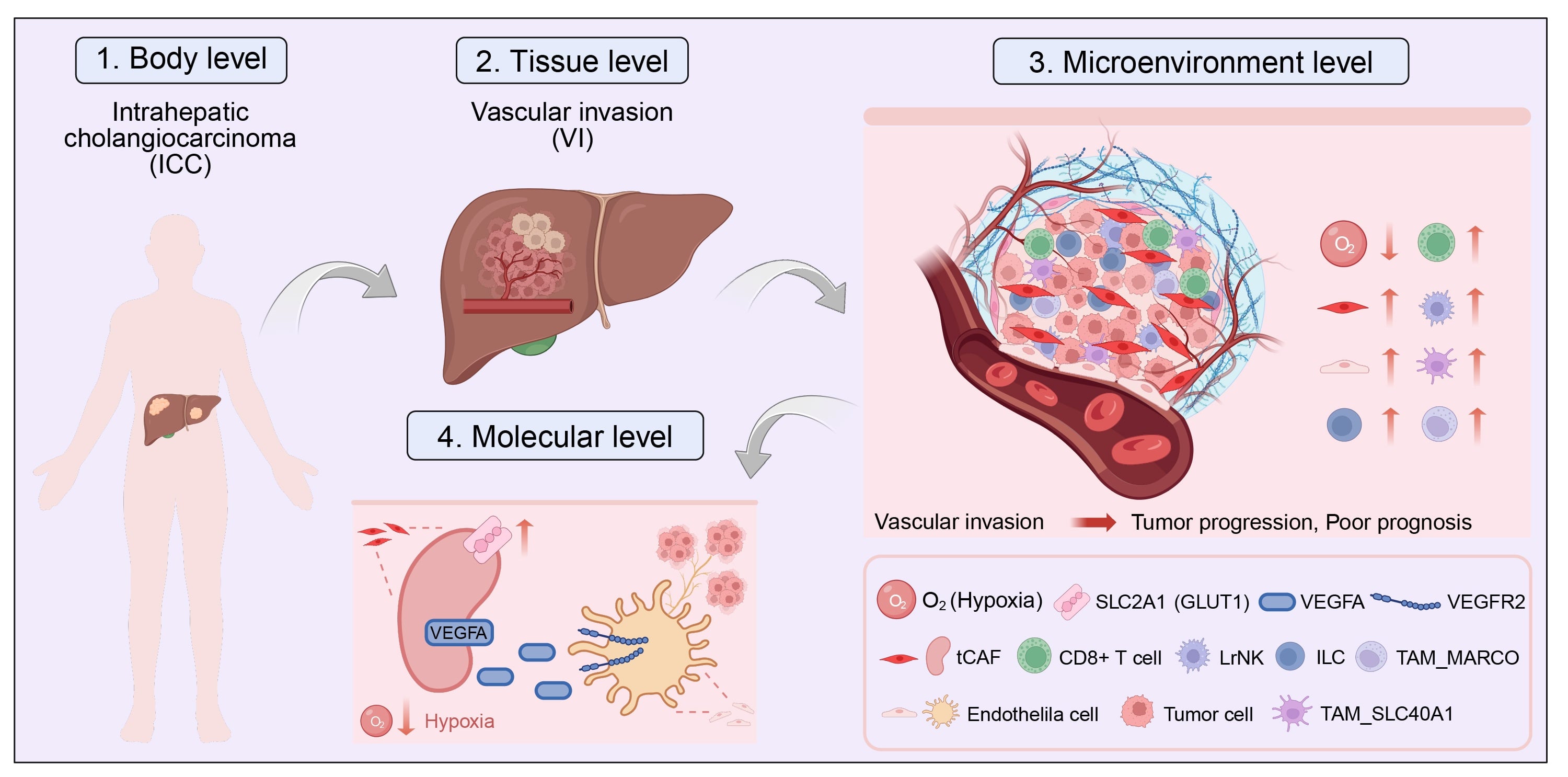
Intrahepatic cholangiocarcinoma (ICC) is an aggressive liver malignancy with a rising global incidence and limited therapeutic options. Vascular invasion (VI) is a hallmark of advanced disease, correlating with early recurrence and dismal prognosis, yet its tumor microenvironment (TME) drivers remain elusive. We analyzed single-cell RNA sequencing (scRNA-seq) data from 25 ICC samples to systematically characterize the cellular composition and molecular features related to VI. By integrating bulk RNA-seq data, spatial transcriptomics, and multiplex immunofluorescence, we identified a distinct subset of tumor-like cancer-associated fibroblasts (CAFs), termed tCAFs, enriched in VI-positive tumors. Functional enrichment analyses revealed that tCAFs were prominently associated with hypoxia and angiogenesis pathways, findings corroborated by the significant upregulation of tCAF markers (MME and NT5E) in ICC-derived CAFs under hypoxic conditions in vitro. Cell–cell communication analysis and spatial mapping uncovered that tCAFs might promote VI primarily through VEGF signaling interactions with endothelial cells. Integrative bioinformatics and RT-qPCR validation identified three key functional genes in tCAFs: SLC2A1, PTGS2, and PLOD2. In endothelial sprouting assays, pharmacological inhibition of SLC2A1 exerted a pronounced suppressive effect. Consistently, sprouting assays using ICC-derived CAFs with SLC2A1 knockdown confirmed that its downregulation significantly reduced endothelial sprouting capacity. Importantly, administration of the SLC2A1 inhibitor BAY-876 effectively suppressed tumor progression and intrahepatic metastasis in the orthotopic ICC mouse model. Our findings define a VI-associated cellular ecosystem and molecular landscape in ICC, unveiling a novel hypoxia–tCAFs–endothelial cells axis. Furthermore, we identify SLC2A1 as a clinically relevant therapeutic target, offering new insights into tumor VI.
Keywords: intrahepatic cholangiocarcinoma; vascular invasion; hypoxia; tCAFs; SLC2A1 intrahepatic cholangiocarcinoma; vascular invasion; hypoxia; tCAFs; SLC2A1
Graphical Abstract