



Is Recurrent Endometriosis a Reprogrammed Disease? Molecular Persistence Beyond Surgical Clearance

 ,
,  ,
,
Abstract
1. Introduction
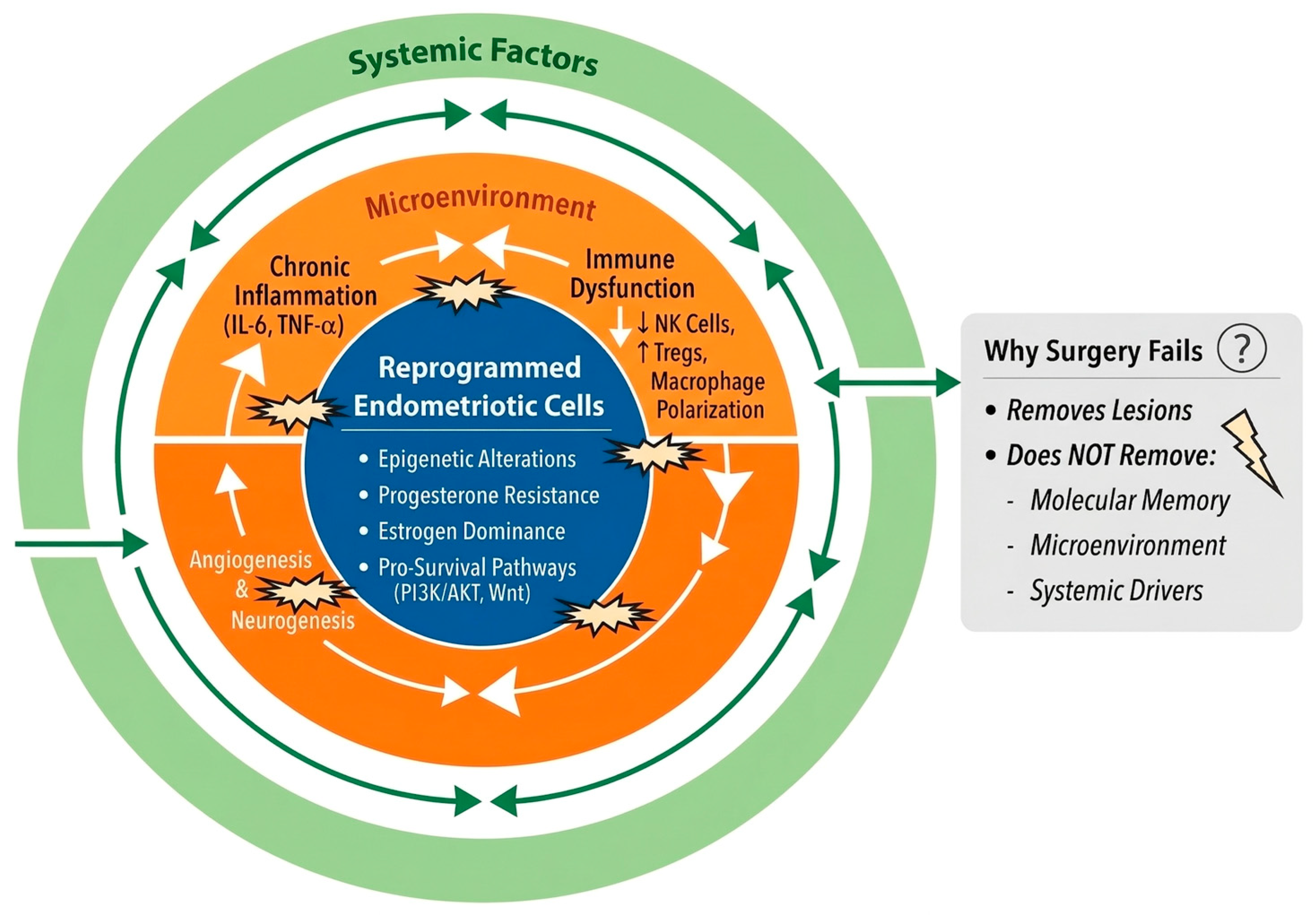
2. Why Surgery Fails: Beyond Incomplete Lesion Removal
2.1. The Limits of a Lesion-Based Surgical Paradigm
2.2. Microscopic Disease Versus Biological Persistence
2.3. Molecular Reprogramming and Resistance to Clearance
2.4. The Role of the Inflammatory and Immune Microenvironment
2.5. Systemic and Non-Local Drivers of Recurrence
2.6. Toward a New Conceptual Framework
3. Molecular Reprogramming of Endometriotic Cells
3.1. Endometriotic Cells as a Distinct Biological Entity
3.2. Hormonal Dysregulation and Progesterone Resistance
3.3. Epigenetic Mechanisms and Molecular Memory
3.4. Activation of Pro-Survival and Proliferative Signaling Pathways
3.5. Inflammatory Reprogramming and Immune Escape
3.6. Integration of Molecular Pathways: Toward a Reprogrammed Disease Model
4. The Microenvironment: A Permissive Niche for Disease Persistence
4.1. The Peritoneal Microenvironment as an Active Driver of Disease
4.2. Chronic Inflammation and Self-Sustaining Feedback Loops
4.3. Immune Dysregulation and Tolerance
4.4. Angiogenesis and Neurogenesis
4.5. Endocrine-Immune Crosstalk
4.6. The Emerging Role of the Microbiome
4.7. Integration: The Microenvironment as a Sustaining System
5. A Systemic Disease Model of Endometriosis
5.1. From a Localized Disorder to a Systemic Condition
5.2. Integration of Cellular, Microenvironmental, and Systemic Factors
5.3. Endometriosis as a Self-Sustaining Biological Network
5.4. Temporal Dynamics and Disease Evolution
5.5. Clinical Implications of a Systemic Model
5.6. Toward a Paradigm Shift
5.7. Limitations of Current Evidence
6. Implications of Molecular Reprogramming on Fertility
6.1. Endometrial Receptivity and Implantation
6.2. Peritoneal Environment and Gamete Quality
6.3. Impact on Ovarian Reserve
6.4. Implications for Assisted Reproductive Technologies (ART)
7. Conclusions
Author Contributions
Funding
Institutional Review Board Statement
Informed Consent Statement
Data Availability Statement
Conflicts of Interest
Abbreviations
| ER | estrogen receptor |
| PR | progesterone receptor |
| ERβ | estrogen receptor beta |
| ERα | estrogen receptor alpha |
| IL | interleukin |
| TNF | tumor necrosis factor |
| NF-κB | nuclear factor kappa B |
| PI3K | phosphoinositide 3-kinase |
| AKT | protein kinase B |
| mTOR | mechanistic target of rapamycin |
| Wnt | wingless-related integration site |
| TGF-β | transforming growth factor beta |
| VEGF | vascular endothelial growth factor |
| HIF-1α | hypoxia-inducible factor 1 alpha |
| NK | natural killer |
| Treg | regulatory T cell |
| ROS | reactive oxygen species |
| ECM | extracellular matrix |
| ncRNA | non-coding RNA |
| HOXA10 | homeobox A10 |
| ESR1 | estrogen receptor 1 |
| PGR | progesterone receptor gene |
References
- Bulun, S.E.; Yildiz, S.; Adli, M.; Chakravarti, D.; Parker, J.B.; Milad, M.; Yang, L.; Chaudhari, A.; Tsai, S.; Wei, J.J.; et al. Endometriosis and adenomyosis: Shared pathophysiology. Fertil. Steril. 2023, 119, 746–750. [Google Scholar] [CrossRef]
- Zondervan, K.T.; Becker, C.M.; Koga, K.; Missmer, S.A.; Taylor, R.N.; Viganò, P. Endometriosis. Nat. Rev. Dis. Primers 2018, 4, 9. [Google Scholar] [CrossRef] [PubMed]
- Bulun, S.E. Endometriosis caused by retrograde menstruation: Now demonstrated by DNA evidence. Fertil. Steril. 2022, 118, 535–536. [Google Scholar] [CrossRef]
- Chapron, C.; Marcellin, L.; Borghese, B.; Santulli, P. Rethinking mechanisms, diagnosis and management of endometriosis. Nat. Rev. Endocrinol. 2019, 15, 666–682. [Google Scholar] [CrossRef] [PubMed]
- Wilson-Mooney, C. The impact of endometriosis. Nursing 2025, 55, 25–30. [Google Scholar] [CrossRef]
- Vercellini, P.; Somigliana, E.; Viganò, P.; Abbiati, A.; Barbara, G.; Crosignani, P.G. Surgery for endometriosis-associated infertility: A pragmatic approach. Hum. Reprod. 2009, 24, 254–269. [Google Scholar] [CrossRef] [PubMed]
- Meuleman, C.; Tomassetti, C.; D’Hoore, A.; Van Cleynenbreugel, B.; Penninckx, F.; Vergote, I.; D’Hooghe, T. Surgical treatment of deeply infiltrating endometriosis with colorectal involvement. Hum. Reprod. Update 2011, 17, 311–326. [Google Scholar] [CrossRef]
- Roman, H.; Vassilieff, M.; Gourcerol, G.; Savoye, G.; Leroi, A.M.; Marpeau, L.; Michot, F.; Tuech, J.J. Surgical management of deep infiltrating endometriosis of the rectum: Pleading for a symptom-guided approach. Hum. Reprod. 2011, 26, 274–281. [Google Scholar] [CrossRef]
- Guo, S.W. Recurrence of endometriosis and its control. Hum. Reprod. Update 2009, 15, 441–461. [Google Scholar] [CrossRef]
- Abbott, J.; Hawe, J.; Hunter, D.; Holmes, M.; Finn, P.; Garry, R. Laparoscopic excision of endometriosis: A randomized, placebo-controlled trial. Fertil. Steril. 2004, 82, 878–884. [Google Scholar] [CrossRef]
- Vercellini, P.; Somigliana, E.; Viganò, P.; Abbiati, A.; Daguati, R.; Crosignani, P.G. Endometriosis: Current and future medical therapies. Best Pract. Res. Clin. Obstet. Gynaecol. 2008, 22, 275–306. [Google Scholar] [CrossRef]
- Burney, R.O.; Giudice, L.C. Pathogenesis and pathophysiology of endometriosis. Fertil. Steril. 2012, 98, 511–519. [Google Scholar] [CrossRef]
- Koninckx, P.R.; Ussia, A.; Adamyan, L.; Wattiez, A.; Gomel, V.; Martin, D.C. Pathogenesis of endometriosis: The genetic/epigenetic theory. Fertil. Steril. 2019, 111, 327–340. [Google Scholar] [CrossRef]
- Mariadas, H.; Chen, J.H.; Chen, K.H. The Molecular and Cellular Mechanisms of Endometriosis: From Basic Pathophysiology to Clinical Implications. Int. J. Mol. Sci. 2025, 26, 2458. [Google Scholar] [CrossRef]
- Sapkota, Y.; Steinthorsdottir, V.; Morris, A.P.; Fassbender, A.; Rahmioglu, N.; De Vivo, I.; Buring, J.E.; Zhang, F.; Edwards, T.L.; Jones, S.; et al. Meta-analysis identifies five novel loci associated with endometriosis highlighting key genes involved in hormone metabolism. Nat. Commun. 2017, 8, 15539. [Google Scholar] [CrossRef]
- Rahmioglu, N.; Nyholt, D.R.; Morris, A.P.; Missmer, S.A.; Montgomery, G.W.; Zondervan, K.T. Genetic variants underlying risk of endometriosis: Insights from meta-analysis of eight genome-wide association and replication datasets. Hum. Reprod. Update 2014, 20, 702–716. [Google Scholar] [CrossRef] [PubMed]
- Matsuzaki, S.; Darcha, C. Involvement of the Wnt/β-catenin signaling pathway in the cellular and molecular mechanisms of fibrosis in endometriosis. PLoS ONE 2013, 8, e76808. [Google Scholar] [CrossRef] [PubMed]
- Yin, X.; Pavone, M.E.; Lu, Z.; Wei, J.; Kim, J.J. Increased activation of the PI3K/AKT pathway compromises decidualization of stromal cells from endometriosis. J. Clin. Endocrinol. Metab. 2012, 97, E35–E43. [Google Scholar] [CrossRef]
- Xu, X.; Li, J.; Lin, H.; Lin, Z.; Ji, G. The role of TGF-β superfamily in endometriosis: A systematic review. Front. Immunol. 2025, 16, 1638604. [Google Scholar] [CrossRef] [PubMed]
- Zhang, X.; Ho, S.M. Epigenetics meets endocrinology. J. Mol. Endocrinol. 2011, 46, R11–R32. [Google Scholar] [CrossRef]
- Xue, Q.; Lin, Z.; Cheng, Y.H.; Huang, C.C.; Marsh, E.; Yin, P.; Milad, M.P.; Confino, E.; Reierstad, S.; Innes, J.; et al. Promoter methylation regulates estrogen receptor 2 in human endometrium and endometriosis. Biol. Reprod. 2007, 77, 681–687. [Google Scholar] [CrossRef]
- Psilopatis, I.; Vrettou, K.; Fleckenstein, F.N.; Theocharis, S. The Impact of Histone Modifications in Endometriosis Highlights New Therapeutic Opportunities. Cells 2023, 12, 1227. [Google Scholar] [CrossRef]
- Yilmaz, B.D.; Bulun, S.E. Endometriosis and nuclear receptors. Hum. Reprod. Update 2019, 25, 473–485. [Google Scholar] [CrossRef]
- Attia, G.R.; Zeitoun, K.; Edwards, D.; Johns, A.; Carr, B.R.; Bulun, S.E. Progesterone receptor isoform A but not B is expressed in endometriosis. J. Clin. Endocrinol. Metab. 2000, 85, 2897–2902. [Google Scholar] [CrossRef]
- Simpson, E.R.; Zhao, Y.; Agarwal, V.R.; Michael, M.D.; Bulun, S.E.; Hinshelwood, M.M.; Graham-Lorence, S.; Sun, T.; Fisher, C.R.; Qin, K.; et al. Aromatase expression in health and disease. Recent Prog. Horm. Res. 1997, 52, 185–214. [Google Scholar] [PubMed]
- Zeitoun, K.; Takayama, K.; Sasano, H.; Suzuki, T.; Moghrabi, N.; Andersson, S.; Johns, A.; Meng, L.; Putman, M.; Carr, B.; et al. Deficient 17beta-hydroxysteroid dehydrogenase type 2 expression in endometriosis: Failure to metabolize 17beta-estradiol. J. Clin. Endocrinol. Metab. 1998, 83, 4474–4480. [Google Scholar] [CrossRef]
- Lebovic, D.I.; Mueller, M.D.; Taylor, R.N. Immunobiology of endometriosis. Fertil. Steril. 2001, 75, 1–10. [Google Scholar] [CrossRef] [PubMed]
- Cakmak, H.; Guzeloglu-Kayisli, O.; Kayisli, U.A.; Arici, A. Immune-endocrine interactions in endometriosis. Front. Biosci. (Elite Ed.) 2009, 1, 429–443. [Google Scholar] [CrossRef] [PubMed]
- Greaves, E.; Temp, J.; Esnal-Zufiurre, A.; Mechsner, S.; Horne, A.W.; Saunders, P.T. Estradiol is a critical mediator of macrophage-nerve cross talk in peritoneal endometriosis. Am. J. Pathol. 2015, 185, 2286–2297. [Google Scholar] [CrossRef]
- Symons, L.K.; Miller, J.E.; Kay, V.R.; Marks, R.M.; Liblik, K.; Koti, M.; Tayade, C. The Immunopathophysiology of Endometriosis. Trends Mol. Med. 2018, 24, 748–762. [Google Scholar] [CrossRef]
- Vallvé-Juanico, J.; Houshdaran, S.; Giudice, L.C. The endometrial immune environment of women with endometriosis. Hum. Reprod. Update 2019, 25, 564–591. [Google Scholar] [CrossRef]
- Khan, K.N.; Kitajima, M.; Hiraki, K.; Fujishita, A.; Sekine, I.; Ishimaru, T.; Masuzaki, H. Immunopathogenesis of pelvic endometriosis: Role of hepatocyte growth factor, macrophages and ovarian steroids. Am. J. Reprod. Immunol. 2008, 60, 383–404. [Google Scholar] [CrossRef] [PubMed]
- Berbic, M.; Hey-Cunningham, A.J.; Ng, C.; Tokushige, N.; Ganewatta, S.; Markham, R.; Russell, P.; Fraser, I.S. The role of Foxp3+ regulatory T-cells in endometriosis: A potential controlling mechanism for a complex, chronic immunological condition. Hum. Reprod. 2010, 25, 900–907. [Google Scholar] [CrossRef]
- Christodoulakos, G.; Augoulea, A.; Lambrinoudaki, I.; Sioulas, V.; Creatsas, G. Pathogenesis of endometriosis: The role of defective ‘immunosurveillance’. Eur. J. Contracept. Reprod. Health Care Off. J. Eur. Soc. Contracept. 2007, 12, 194–202. [Google Scholar] [CrossRef]
- Herington, J.L.; Bruner-Tran, K.L.; Lucas, J.A.; Osteen, K.G. Immune interactions in endometriosis. Expert Rev. Clin. Immunol. 2011, 7, 611–626. [Google Scholar] [CrossRef]
- Capobianco, A.; Rovere-Querini, P. Endometriosis, a disease of the macrophage. Front. Immunol. 2013, 4, 9. [Google Scholar] [CrossRef] [PubMed]
- Wu, J.; Xie, H.; Yao, S.; Liang, Y. Macrophage and nerve interaction in endometriosis. J. Neuroinflamm. 2017, 14, 53. [Google Scholar] [CrossRef] [PubMed]
- As-Sanie, S.; Mackenzie, S.C.; Morrison, L.; Schrepf, A.; Zondervan, K.T.; Horne, A.W.; Missmer, S.A. Endometriosis: A Review. JAMA 2025, 334, 64–78. [Google Scholar] [CrossRef]
- Kolanska, K.; Alijotas-Reig, J.; Cohen, J.; Cheloufi, M.; Selleret, L.; d’Argent, E.; Kayem, G.; Valverde, E.E.; Fain, O.; Bornes, M.; et al. Endometriosis with infertility: A comprehensive review on the role of immune deregulation and immunomodulation therapy. Am. J. Reprod. Immunol. 2021, 85, e13384. [Google Scholar] [CrossRef]
- Baker, J.M.; Al-Nakkash, L.; Herbst-Kralovetz, M.M. Estrogen-gut microbiome axis: Physiological and clinical implications. Maturitas 2017, 103, 45–53. [Google Scholar] [CrossRef]
- Ata, B.; Yildiz, S.; Turkgeldi, E.; Brocal, V.P.; Dinleyici, E.C.; Moya, A.; Urman, B. The Endobiota Study: Comparison of Vaginal, Cervical and Gut Microbiota Between Women with Stage 3/4 Endometriosis and Healthy Controls. Sci. Rep. 2019, 9, 2204. [Google Scholar] [CrossRef]
- Liu, X.; Fan, M.; Wang, Y.; He, D.; Liu, L. Gut microbiota as a key regulator in endometriosis: Mechanisms, therapeutic opportunities, and future perspectives. Front. Cell. Infect. Microbiol. 2026, 15, 1730739. [Google Scholar] [CrossRef] [PubMed]
- Donnez, J.; Donnez, O.; Orellana, R.; Binda, M.M.; Dolmans, M.M. Endometriosis and infertility. Panminerva Medica 2016, 58, 143–150. [Google Scholar]
- Becker, C.M.; Bokor, A.; Heikinheimo, O.; Horne, A.W.; Jansen, F.; Kiesel, L.; King, K.; Kvaskoff, M.; Nap, A.; Petersen, K.; et al. ESHRE guideline: Endometriosis. Hum. Reprod. Open 2022, 2022, hoac009. [Google Scholar] [CrossRef] [PubMed]
- Liu, Y.; Gong, H.; Gou, J.; Liu, X.; Li, Z. Dienogest as a Maintenance Treatment for Endometriosis Following Surgery: A Systematic Review and Meta-Analysis. Front. Med. 2021, 8, 652505. [Google Scholar] [CrossRef] [PubMed]
- Ferrero, S.; Barra, F.; Leone Roberti Maggiore, U. Current and Emerging Therapeutics for the Management of Endometriosis. Drugs 2018, 78, 995–1012. [Google Scholar] [CrossRef]
- Redwine, D.B. Ovarian endometriosis: A marker for more extensive pelvic and intestinal disease. Fertil. Steril. 1999, 72, 310–315. [Google Scholar] [CrossRef]
- Nisolle, M.; Donnez, J. Peritoneal endometriosis, ovarian endometriosis, and adenomyotic nodules of the rectovaginal septum are three different entities. Fertil. Steril. 1997, 68, 585–596. [Google Scholar] [CrossRef]
- Murphy, A.A.; Green, W.R.; Bobbie, D.; dela Cruz, Z.C.; Rock, J.A. Unsuspected endometriosis documented by scanning electron microscopy in visually normal peritoneum. Fertil. Steril. 1986, 46, 522–524. [Google Scholar] [CrossRef]
- Shigesi, N.; Kvaskoff, M.; Kirtley, S.; Feng, Q.; Fang, H.; Knight, J.C.; Missmer, S.A.; Rahmioglu, N.; Zondervan, K.T.; Becker, C.M. The association between endometriosis and autoimmune diseases: A systematic review and meta-analysis. Hum. Reprod. Update 2019, 25, 486–503. [Google Scholar] [CrossRef]
- Rocha, A.L.; Reis, F.M.; Taylor, R.N. Angiogenesis and endometriosis. Obstet. Gynecol. Int. 2013, 2013, 859619. [Google Scholar] [CrossRef]
- McLaren, J. Vascular endothelial growth factor and endometriosis. Hum. Reprod. Update 2000, 6, 45–55. [Google Scholar] [CrossRef]
- Anaf, V.; Chapron, C.; El Nakadi, I.; De Moor, V.; Simonart, T.; Noël, J.C. Pain, mast cells, and nerves in peritoneal, ovarian, and deep infiltrating endometriosis. Fertil. Steril. 2006, 86, 1336–1343. [Google Scholar] [CrossRef]
- Berkley, K.J.; Rapkin, A.J.; Papka, R.E. The pains of endometriosis. Nat. Rev. Neurosci. 2005, 308, 1587–1589. [Google Scholar] [CrossRef]
- Kim, B.S.; Kim, B.; Yoon, S.; Park, W.; Bae, S.J.; Joo, J.; Kim, W.; Ha, K.T. Warburg-like Metabolic Reprogramming in Endometriosis: From Molecular Mechanisms to Therapeutic Approaches. Pharmaceuticals 2025, 18, 813. [Google Scholar] [CrossRef] [PubMed]
- Liao, Z.; Monsivais, D.; Matzuk, M.M. The long road of drug development for endometriosis—Pains, gains, and hopes. J. Control. Release Off. J. Control. Release Soc. 2024, 376, 429–440. [Google Scholar] [CrossRef] [PubMed]
- Pirtea, P.; Vigano, P.; Salmeri, N.; Vercellini, P.; Somigliana, E. Why does surgery for endometriosis-associated infertility often fail to improve pregnancy outcome? Hum. Reprod. 2026, 41, 658–664. [Google Scholar] [CrossRef]
- Bulun, S.E.; Cheng, Y.H.; Pavone, M.E.; Xue, Q.; Attar, E.; Trukhacheva, E.; Tokunaga, H.; Utsunomiya, H.; Yin, P.; Luo, X.; et al. Estrogen receptor-beta, estrogen receptor-alpha, and progesterone resistance in endometriosis. Semin. Reprod. Med. 2010, 28, 36–43. [Google Scholar] [CrossRef] [PubMed]
- Huang, X.; Zhong, Y.; Li, H.; Wu, L.; Li, Y.; Wang, R.; Qiao, X.; Han, Y.; Zhang, H.; Liu, D.; et al. Activated CD8(+) tissue-resident memory T cells impact the endometrial receptivity in minimal/mild endometriosis. J. Reprod. Immunol. 2025, 172, 104737. [Google Scholar] [CrossRef]
- Kisovar, A.; Becker, C.M.; Granne, I.; Southcombe, J.H. The role of CD8+ T cells in endometriosis: A systematic review. Front. Immunol. 2023, 14, 1225639. [Google Scholar] [CrossRef]
- Jeljeli, M.; Riccio, L.G.C.; Chouzenoux, S.; Moresi, F.; Toullec, L.; Doridot, L.; Nicco, C.; Bourdon, M.; Marcellin, L.; Santulli, P.; et al. Macrophage Immune Memory Controls Endometriosis in Mice and Humans. Cell Rep. 2020, 33, 108325. [Google Scholar] [CrossRef]
- Gueuvoghlanian-Silva, B.Y.; Hernandes, C.; Correia, R.P.; Podgaec, S. Deep Infiltrating Endometriosis and Activation and Memory Surface Markers and Cytokine Expression in Isolated Treg Cells. Reprod. Sci. 2020, 27, 599–610. [Google Scholar] [CrossRef]
- Szukiewicz, D. Epigenetic regulation and T-cell responses in endometriosis—Something other than autoimmunity. Front. Immunol. 2022, 13, 943839. [Google Scholar] [CrossRef]
- Huang, Z.X.; Lin, D.C.; Zhang, H.Y.; Yang, M.J.; Chen, J.H.; Ding, X.Y.; Dai, S.J.; Hong, Y.H.; Liang, G.S.; Li, Q.Y.; et al. The dysfunction of CD8+ T cells triggered by endometriotic stromal cells promotes the immune survival of endometriosis. Immunology 2024, 172, 469–485. [Google Scholar] [CrossRef]
- Filby, C.E.; Rombauts, L.; Montgomery, G.W.; Giudice, L.C.; Gargett, C.E. Cellular Origins of Endometriosis: Towards Novel Diagnostics and Therapeutics. Semin. Reprod. Med. 2020, 38, 201–215. [Google Scholar] [CrossRef] [PubMed]
- Ahmed, R.S.; Sherif, M.; Alghamdi, M.A.; El-Tallawy, S.N.; Alzaydan, O.K.; Pergolizzi, J.V.; Varrassi, G.; Zaghra, Z.; Abdelsalam, Z.S.; Kamal, M.T.; et al. Exploring the Immune System’s Role in Endometriosis: Insights into Pathogenesis, Pain, and Treatment. Cureus 2025, 17, e87091. [Google Scholar] [CrossRef]
- Kedzierska, A.E.; Lorek, D.; Slawek, A.; Karmowski, M.; Kalota, A.; Pajak, J.; Chrobak, A.; Grzymajlo, K.; Chelmonska-Soyta, A. IL-24 producing regulatory T and B lymphocytes in endometriosis. Front. Immunol. 2025, 16, 1582762. [Google Scholar] [CrossRef] [PubMed]
- Peng, Y.; Li, Y.; Wang, L.; Lin, S.; Xu, H. Causality of immune cells and endometriosis: A bidirectional mendelian randomization study. BMC Women’s Health 2024, 24, 574. [Google Scholar] [CrossRef]
- Hoogstad-van Evert, J.; Paap, R.; Nap, A.; van der Molen, R. The Promises of Natural Killer Cell Therapy in Endometriosis. Int. J. Mol. Sci. 2022, 23, 5539. [Google Scholar] [CrossRef]
- Wang, X.; Wu, N.; Xue, Q. Macrophages in endometriosis: Key roles and emerging therapeutic opportunities-a narrative review. Reprod. Biol. Endocrinol. RBE 2025, 23, 134. [Google Scholar] [CrossRef] [PubMed]
- Ochoa, S.; Rasquel-Oliveira, F.S.; McKinnon, B.; Haro, M.; Subramaniam, S.; Yu, P.; Coetzee, S.; Anglesio, M.S.; Wright, K.N.; Meyer, R.; et al. M2 Macrophages are Major Mediators of Germline Risk of Endometriosis and Explain Pleiotropy with Comorbid Traits. Adv. Sci. 2025, 12, e15285. [Google Scholar] [CrossRef]
- Roman, H.; Chanavaz-Lacheray, I.; Hennetier, C.; Tuech, J.J.; Dennis, T.; Verspyck, E.; Merlot, B. Long-term risk of repeated surgeries in women managed for endometriosis: A 1,092 patient-series. Fertil. Steril. 2023, 120, 870–879. [Google Scholar] [CrossRef]
- Rimbach, S.; Ulrich, U.; Schweppe, K.W. Surgical Therapy of Endometriosis: Challenges and Controversies. Geburtshilfe Und Frauenheilkd. 2013, 73, 918–923. [Google Scholar] [CrossRef]
- Valera, H.; Chen, A.; Grive, K.J. The Hypothalamic-Pituitary-Ovarian Axis, Ovarian Disorders, and Brain Aging. Endocrinology 2025, 166, bqaf137. [Google Scholar] [CrossRef] [PubMed]
- Yang, M.; Zhang, L.; Ding, X.; Wei, P.; Zhang, H.; Chen, J.; Zhang, Y.; Li, D.; Chen, Z.; Lin, D.; et al. Integrated Proteomics Reveals Spliceosome Dysregulation and Highlights DHX9 as a TGF-β Signaling-Driven Fibrosis Hub in Endometriosis. J. Proteome Res. 2025, 24, 4044–4059. [Google Scholar] [CrossRef] [PubMed]
- Rathod, S.; Shanoo, A.; Acharya, N. Endometriosis: A Comprehensive Exploration of Inflammatory Mechanisms and Fertility Implications. Cureus 2024, 16, e66128. [Google Scholar] [CrossRef] [PubMed]
- Petraglia, F.; Vannuccini, S.; Dolmans, M.M.; Speciale, A.R.; Bourdon, M.; Marcellin, L.; Donnez, J.; Chapron, C. The endocrine aspects of endometriosis. Eur. J. Endocrinol. 2025, 193, R17–R30. [Google Scholar] [CrossRef]
- Dyson, M.T.; Bulun, S.E. Cutting SRC-1 down to size in endometriosis. Nat. Med. 2012, 18, 1016–1018. [Google Scholar] [CrossRef]
- Coroleucă, C.A.; Coroleucă, C.B.; Coroleucă, R.; Brătilă, P.C.; Nodiți, A.R.; Roșca, I.; Brîndușe, L.A.; Brătilă, E.; Boț, M. Molecular Profile (Estrogen Receptor, Progesterone Receptor, Bcl-2 and Ki-67) of the Ectopic Endometrium in Patients with Endometriosis. Int. J. Mol. Sci. 2025, 26, 2983. [Google Scholar] [CrossRef]
- Chantalat, E.; Valera, M.C.; Vaysse, C.; Noirrit, E.; Rusidze, M.; Weyl, A.; Vergriete, K.; Buscail, E.; Lluel, P.; Fontaine, C.; et al. Estrogen Receptors and Endometriosis. Int. J. Mol. Sci. 2020, 21, 2815. [Google Scholar] [CrossRef]
- Lazim, N.; Elias, M.H.; Sutaji, Z.; Abdul Karim, A.K.; Abu, M.A.; Ugusman, A.; Syafruddin, S.E.; Mokhtar, M.H.; Ahmad, M.F. Expression of HOXA10 Gene in Women with Endometriosis: A Systematic Review. Int. J. Mol. Sci. 2023, 24, 12869. [Google Scholar] [CrossRef] [PubMed]
- Makker, A.; Goel, M.M.; Das, V.; Agarwal, A. PI3K-Akt-mTOR and MAPK signaling pathways in polycystic ovarian syndrome, uterine leiomyomas and endometriosis: An update. Gynecol. Endocrinol. Off. J. Int. Soc. Gynecol. Endocrinol. 2012, 28, 175–181. [Google Scholar] [CrossRef]
- Laganà, A.S.; Garzon, S.; Götte, M.; Viganò, P.; Franchi, M.; Ghezzi, F.; Martin, D.C. The Pathogenesis of Endometriosis: Molecular and Cell Biology Insights. Int. J. Mol. Sci. 2019, 20, 5615. [Google Scholar] [CrossRef] [PubMed]
- Wang, Y.; Jin, Z.; Blatchford, A.F.; Hosh, B.; Amer, M.; Akhatova, A.; Zondervan, K.; Greaves, E.; Dragovic, R.; Becker, C.M.; et al. Human Endometriotic Lesion-Derived Small Extracellular Vesicles Impair Macrophage Function in the Peritoneal Microenvironment. J. Extracell. Vesicles 2026, 15, e70227. [Google Scholar] [CrossRef]
- Susianto, I.A.; Susilaningsih, N.; Hidayat, S.T.; Tjandrawinata, R.R.; Rachmawati, B. The inhibition of deep peritoneal endometriosis by Andrographolide through macrophage M1 activity in an endometriosis mice model. Vet. Med. 2026, 71, 62–72. [Google Scholar] [CrossRef]
- Lisá, Z.; Fanta, M.; Kokavec, J.; Janoštiak, R. Global RNA expression analysis of patient samples identified potential diagnostic biomarkers specific for peritoneal, ovarian and deep endometriosis. Sci. Rep. 2026, 16, 5070. [Google Scholar] [CrossRef]
- Liu, T.; Zhang, L.; Joo, D.; Sun, S.C. NF-κB signaling in inflammation. Signal Transduct. Target. Ther. 2017, 2, 17023. [Google Scholar] [CrossRef] [PubMed]
- Liu, D.; Zhong, Z.; Karin, M. NF-κB: A Double-Edged Sword Controlling Inflammation. Biomedicines 2022, 10, 1250. [Google Scholar] [CrossRef]
- Sisnett, D.J.; Zutautas, K.B.; Vo, D.H.N.; Ravishanker, K.; Holmes, J.P.; Wodz, A.; Tayade, C. Immune dysregulation in endometriosis: The T cell perspective. Front. Immunol. 2026, 17, 1712360. [Google Scholar] [CrossRef]
- Yang, S.; Wang, H.; Li, D.; Li, M. An Estrogen-NK Cells Regulatory Axis in Endometriosis, Related Infertility, and Miscarriage. Int. J. Mol. Sci. 2024, 25, 3362. [Google Scholar] [CrossRef]
- Reis, J.L.; Rosa, N.N.; Martins, C.; Ângelo-Dias, M.; Borrego, L.M.; Lima, J. The Role of NK and T Cells in Endometriosis. Int. J. Mol. Sci. 2024, 25, 10141. [Google Scholar] [CrossRef] [PubMed]
- Parpex, G.; Nicco, C.; Chassaing, B.; Santulli, P.; Chouzenoux, S.; Bourdon, M.; Maignien, C.; Doridot, L.; Batteux, F.; Chapron, C.; et al. Microbiota insights in endometriosis. Microbiome 2025, 13, 251. [Google Scholar] [CrossRef]
- Sanabani, S.S. The Role of the Microbiome in Endometriosis. Reprod. Sci. 2025, 32, 3443–3456. [Google Scholar] [CrossRef]
- Xholli, A.; Cremonini, F.; Perugi, I.; Londero, A.P.; Cagnacci, A. Gut Microbiota and Endometriosis: Exploring the Relationship and Therapeutic Implications. Pharmaceuticals 2023, 16, 1696. [Google Scholar] [CrossRef]
- Martínez-Lara, A.; De Tena-Sanz, A.; Durán-González, E.; Reyes-Conde, M.L.; Díaz-López, C.; Pérez-Sánchez, M.; Ramírez-Tejero, J.A.; Cotán, D.; Almansa, J.A.H. Gut microbiota alterations in endometriosis: An observational study in a Spanish female cohort. Biol. Reprod. 2026, 114, 543–554. [Google Scholar] [CrossRef]
- Weber, I.; Sienko, A.; Urban, A.; Szwed, C.; Czajkowski, K.; Basta, P.; Sienko, J. Relationship between the gut microbiome and endometriosis and its role in pathogenesis, diagnosis, and treatment: A systematic review. Ginekol. Pol. 2023, 95, 893–901. [Google Scholar] [CrossRef]
- Sadłocha, M.; Toczek, J.; Major, K.; Staniczek, J.; Stojko, R. Endometriosis: Molecular Pathophysiology and Recent Treatment Strategies-Comprehensive Literature Review. Pharmaceuticals 2024, 17, 827. [Google Scholar] [CrossRef] [PubMed]
- Marino, Y.; Inferrera, F.; Genovese, T.; Cuzzocrea, S.; Fusco, R.; Di Paola, R. Mitochondrial dynamics: Molecular mechanism and implications in endometriosis. Biochimie 2025, 231, 163–175. [Google Scholar] [CrossRef] [PubMed]
- Pszczołowska, M.; Walczak, K.; Kołodziejczyk, W.; Kozłowska, M.; Kozłowski, G.; Gachowska, M.; Leszek, J. Understanding Deep Endometriosis: From Molecular to Neuropsychiatry Dimension. Int. J. Mol. Sci. 2025, 26, 839. [Google Scholar] [CrossRef]
- Tian, J.; Liu, X. Understanding the Molecular Landscape of Endometriosis: A Bioinformatics Approach to Uncover Signaling Pathways and Hub Genes. Iran. J. Pharm. Res. IJPR 2024, 23, e144266. [Google Scholar] [CrossRef]
- Cho, S.B. Molecular Mechanisms of Endometriosis Revealed Using Omics Data. Biomedicines 2023, 11, 2210. [Google Scholar] [CrossRef]
- Rosendo-Chalma, P.; Díaz-Landy, E.N.; Antonio-Véjar, V.; Ortiz Tejedor, J.G.; Reytor-González, C.; Simancas-Racines, D.; Bigoni-Ordóñez, G.D. Endometriosis: Challenges in Clinical Molecular Diagnostics and Treatment. Int. J. Mol. Sci. 2025, 26, 3979. [Google Scholar] [CrossRef]
- Ducreux, B.; Patrat, C.; Firmin, J.; Ferreux, L.; Chapron, C.; Marcellin, L.; Parpex, G.; Bourdon, M.; Vaiman, D.; Santulli, P.; et al. Systematic review on the DNA methylation role in endometriosis: Current evidence and perspectives. Clin. Epigenet. 2025, 17, 32. [Google Scholar] [CrossRef]
- Ortiz, C.N.; Torres-Reverón, A.; Appleyard, C.B. Metabolomics in endometriosis: Challenges and perspectives for future studies. Reprod. Fertil. 2021, 2, R35–R50. [Google Scholar] [CrossRef]
- Murgia, F.; Angioni, S.; D’Alterio, M.N.; Pirarba, S.; Noto, A.; Santoru, M.L.; Tronci, L.; Fanos, V.; Atzori, L.; Congiu, F. Metabolic Profile of Patients with Severe Endometriosis: A Prospective Experimental Study. Reprod. Sci. 2021, 28, 728–735. [Google Scholar] [CrossRef] [PubMed]
- Agic, A.; Djalali, S.; Diedrich, K.; Hornung, D. Apoptosis in endometriosis. Gynecol. Obstet. Investig. 2009, 68, 217–223. [Google Scholar] [CrossRef]
- Dutta, S.; Banu, S.K.; Arosh, J.A. Endocrine disruptors and endometriosis. Reprod. Toxicol. 2023, 115, 56–73. [Google Scholar] [CrossRef]
- Chang, L.; Shan, J.; Li, D.; Wang, X. Neuroendocrine-Immune Axis in Endometriosis: A Review on How the Nervous System Goes Beyond Pain Perception. Biomolecules 2025, 15, 1536. [Google Scholar] [CrossRef] [PubMed]
- Cho, Y.J.; Lee, S.H.; Park, J.W.; Han, M.; Park, M.J.; Han, S.J. Dysfunctional signaling underlying endometriosis: Current state of knowledge. J. Mol. Endocrinol. 2018, 60, R97–R113. [Google Scholar] [CrossRef] [PubMed]
- Reis, F.M.; Petraglia, F.; Taylor, R.N. Endometriosis: Hormone regulation and clinical consequences of chemotaxis and apoptosis. Hum. Reprod. Update 2013, 19, 406–418. [Google Scholar] [CrossRef]
- Marla, S.; Mortlock, S.; Houshdaran, S.; Fung, J.; McKinnon, B.; Holdsworth-Carson, S.J.; Girling, J.E.; Rogers, P.A.W.; Giudice, L.C.; Montgomery, G.W. Genetic risk factors for endometriosis near estrogen receptor 1 and coexpression of genes in this region in endometrium. Mol. Hum. Reprod. 2021, 27, gaaa082. [Google Scholar] [CrossRef]
- Palumbo, M.; Della Corte, L.; Ascione, M.; D’Angelo, G.; Colacurci, D.; Baldini, G.M.; Pellicano, M.; Giampaolino, P.; Bifulco, G. Genetic and Epigenetic Components in the Pathogenesis of Adenomyosis and Endometriosis in Adolescents. Biomedicines 2025, 13, 2988. [Google Scholar] [CrossRef]
- Watrowski, R.; Kostov, S.; Tsoneva, E.; Schäfer, S.D.; Sparić, R.; Palumbo, M.; Günther, V.; Akšam, S.; Yordanov, A.; Chieppa, P.; et al. Menstrual Effluent in the Pathogenesis and Diagnosis of Endometriosis-A Systematic Review. Diagnostics 2026, 16, 677. [Google Scholar] [CrossRef] [PubMed]
- Watrowski, R.; Kostov, S.; Palumbo, M.; Rosati, A.; Sparić, R.; Alkatout, I.; Juhasz-Böss, I.; Vitale, S.G.; Mereu, L. Non-Coding RNAs (microRNAs, lncRNAs, circRNAs) in Adenomyosis: A Systematic Review of Mechanistic and Translational Evidence. Int. J. Mol. Sci. 2025, 26, 10713. [Google Scholar] [CrossRef]
- Hong, Y.; Zhang, T.; Zhou, J.; Wang, L.; Wang, Y.; Shu, W.; Wang, H.; Chen, H. Systematic analyses uncover endocrine-disrupting chemical-responsive genes linked to endometriosis. Reprod. Toxicol. 2026, 140, 109148. [Google Scholar] [CrossRef]
- Akano, O.P.; Amos, V.O.; Fawole, I.O.; Oyindamola, A.C.; Ajayi, A.F. Epigenetics’ responsibility in endometriosis: A comprehensive assessment. J. Steroid Biochem. Mol. Biol. 2025, 253, 106814. [Google Scholar] [CrossRef]
- Rahmioglu, N.; Mortlock, S.; Ghiasi, M.; Møller, P.L.; Stefansdottir, L.; Galarneau, G.; Turman, C.; Danning, R.; Law, M.H.; Sapkota, Y.; et al. The genetic basis of endometriosis and comorbidity with other pain and inflammatory conditions. Nat. Genet. 2023, 55, 423–436. [Google Scholar] [CrossRef] [PubMed]
- Bulletti, C.; Coccia, M.E.; Battistoni, S.; Borini, A. Endometriosis and infertility. J. Assist. Reprod. Genet. 2010, 27, 441–447. [Google Scholar] [CrossRef]
- Pîrlog, L.-M.; Pătrășcanu, A.-A.; Ona, M.-D.; Cătană, A.; Rotar, I.C. HOXA10 and HOXA11 in human endometrial benign disorders: Unraveling molecular pathways and their impact on reproduction. Biomolecules 2025, 15, 563. [Google Scholar] [CrossRef]
- Joshi, N.R.; Kohan-Ghadr, H.R.; Roqueiro, D.S.; Yoo, J.Y.; Fru, K.; Hestermann, E.; Yuan, L.; Ho, S.M.; Jeong, J.W.; Young, S.L.; et al. Genetic and epigenetic changes in the eutopic endometrium of women with endometriosis: Association with decreased endometrial αvβ3 integrin expression. Mol. Hum. Reprod. 2021, 27, gaab018. [Google Scholar] [CrossRef] [PubMed]
- Lessey, B.A.; Young, S.L. Integrins and other cell adhesion molecules in endometrium and endometriosis. Semin. Reprod. Endocrinol. 1997, 15, 291–299. [Google Scholar] [CrossRef]
- Colombo, G.E.; Salmeri, N.; Leonardi, M. Integrating IVF and Surgical Management in Endometriosis-Associated Infertility: A Review. Adv. Ther. 2026, 43, 1004–1015. [Google Scholar] [CrossRef]
- Contestabile, M.; Marzi, I.; Mangione, C.; Franzoni, F.; Artini, P.G.; Daniele, S. Endometriosis and Oocyte Quality: Morphological Alterations, Developmental Competence, and Modifiable Strategies for Reproductive Longevity. Cells 2026, 15, 296. [Google Scholar] [CrossRef] [PubMed]
- Didziokaite, G.; Biliute, G.; Gudaite, J.; Kvedariene, V. Oxidative Stress as a Potential Underlying Cause of Minimal and Mild Endometriosis-Related Infertility. Int. J. Mol. Sci. 2023, 24, 3809. [Google Scholar] [CrossRef] [PubMed]
- Máté, G.; Bernstein, L.R.; Török, A.L. Endometriosis Is a Cause of Infertility. Does Reactive Oxygen Damage to Gametes and Embryos Play a Key Role in the Pathogenesis of Infertility Caused by Endometriosis? Front. Endocrinol. 2018, 9, 725. [Google Scholar] [CrossRef]
- Lee, J.; Yeo, S.G.; Lee, J.M.; Kim, S.S.; Lee, J.W.; Chung, N.; Park, D.C. Expression of Free Radicals and Reactive Oxygen Species in Endometriosis: Current Knowledge and Its Implications. Antioxidants 2025, 14, 877. [Google Scholar] [CrossRef]
- Tan, Z.; Gong, X.; Wang, C.C.; Zhang, T.; Huang, J. Diminished Ovarian Reserve in Endometriosis: Insights from In Vitro, In Vivo, and Human Studies-A Systematic Review. Int. J. Mol. Sci. 2023, 24, 15967. [Google Scholar] [CrossRef]
- Oral, E.; Demir, B.; Inceboz, U. Endometriosis and ovarian reserve. Women’s Health 2015, 11, 671–675. [Google Scholar] [CrossRef]
- Feng, H.; Li, W.; Zhan, C.; Li, X.; Ye, Q. Analysis of factors influencing ovarian reserve in patients with endometriosis. Arch. Gynecol. Obstet. 2025, 312, 1205–1213. [Google Scholar] [CrossRef]
- Latif, S.; Saridogan, E. Endometriosis, Oocyte, and Embryo Quality. J. Clin. Med. 2023, 12, 4186. [Google Scholar] [CrossRef] [PubMed]
- Findikli, N.; Janssens, S.; Fasano, G.; Demeestere, I.; Fastrez, M.; Houba, C.; Delbaere, A. The Effects of Endometriosis on Oocyte and Embryo Quality. J. Clin. Med. 2025, 14, 2339. [Google Scholar] [CrossRef]
- Cao, M.; Koroneos, Z.; Tyson, K.; Mooney, S.; Holdsworth-Carson, S. Fertility after endometriosis surgery: A systematic review and meta-analysis comparison of primary versus multiple surgical interventions. Eur. J. Obstet. Gynecol. Reprod. Biol. 2026, 320, 115011. [Google Scholar] [CrossRef]
- Ebrahimpoor, M.; Firouzabadi, R.D.; Javaheri, A.; Shamsi, F.; Dashti, S. The Impact of Endometriosis on Reproductive Outcomes in ART Cycles. Adv. Biomed. Res. 2024, 13, 89. [Google Scholar] [CrossRef] [PubMed]
- Somigliana, E.; Li Piani, L.; Paffoni, A.; Salmeri, N.; Orsi, M.; Benaglia, L.; Vercellini, P.; Vigano’, P. Endometriosis and IVF treatment outcomes: Unpacking the process. Reprod. Biol. Endocrinol. RBE 2023, 21, 107. [Google Scholar] [CrossRef] [PubMed]
- Lu, R.; Jiao, W.; Li, X.; Zeng, C.; Shang, J.; Xue, Q. Ovarian endometriosis negatively impacts pregnancy outcomes in young infertile women undergoing IVF/ICSI treatment. Eur. J. Med. Res. 2025, 30, 555. [Google Scholar] [CrossRef] [PubMed]
- Elizur, S.E.; Mostafa, J.; Berkowitz, E.; Orvieto, R. Endometriosis and infertility: Pathophysiology, treatment strategies, and reproductive outcomes. Arch. Gynecol. Obstet. 2025, 312, 1037–1048. [Google Scholar] [CrossRef]
- Palumbo, M.; Giampaolino, P.; Pellicano, M.; Graziano, V.; Bifulco, G.; Della Corte, L. New perspectives in managing chronic pelvic pain in endometriosis: The role of GnRH antagonists versus dienogest. Expert Opin. Pharmacother. 2026, 27, 495–510, Advance online publication. [Google Scholar] [CrossRef]

| Domain | Specific Alterations | Underlying Mechanisms | Functional Consequences | Supporting Evidence (Type) | Therapeutic Implications | References |
|---|---|---|---|---|---|---|
| Hormonal signaling | (↑) ERβ/ERα imbalance; (↓) PR expression | Aberrant receptor expression; altered steroid metabolism ((↑) aromatase) | Estrogen dominance, progesterone resistance, sustained proliferation | Transcriptomic, IHC, functional studies | Progestins resistance; rationale for GnRH antagonists | [24,78,79,80] |
| Gene expression | Dysregulation of ESR1, WNT4, inflammatory genes | Transcriptional reprogramming | Enhanced adhesion, invasion, implantation | RNA-seq, GWAS, comparative endometrium studies | Targeting signaling pathways | [14,15,16,17,18,19] |
| Epigenetic regulation | DNA hyper/hypomethylation; histone modifications; ncRNAs | Epigenetic silencing/activation of key genes (e.g., HOXA10, PGR) | Stable “molecular memory” phenotype | Epigenome-wide association studies | Epigenetic modulators (future therapies) | [20,21,22,81] |
| Cell survival | Activation of PI3K/AKT/mTOR; Wnt/β-catenin | Pro-survival signaling, anti-apoptotic pathways | Resistance to apoptosis, enhanced growth | In vitro/in vivo models | Targeted inhibitors (PI3K, mTOR) | [17,18,19,82] |
| Inflammatory signaling | (↑) IL-6, TNF-α, NF-κB activation | Cytokine-driven transcriptional activation | Chronic inflammation, angiogenesis, pain | Peritoneal fluid studies, molecular assays | Anti-inflammatory therapies | [27,28,29,30] |
| Immune evasion | (↓) NK cytotoxicity; macrophage M2 polarization | Immune tolerance mechanisms | Persistence of ectopic cells | Immunological profiling studies | Immune-targeted strategies | [31,32,33,34,69] |
| Angiogenesis | (↑) VEGF, HIF-1α | Hypoxia-driven signaling | Neovascularization of lesions | Histological and molecular data | Anti-angiogenic approaches | [27,50,51,52] |
| Component | Key Mediators/ Pathways | Mechanistic Role | Interaction with Cellular Reprogramming | Persistence After Surgery | Clinical Relevance | References |
|---|---|---|---|---|---|---|
| Peritoneal inflammation | IL-6, TNF-α, IL-1β, ROS | Sustains inflammatory loop and lesion growth | Reinforces NF-κB signaling and gene expression changes | Yes | Pain, disease progression | [27,28,29,30] |
| Immune dysfunction | NK cells (↓), Tregs (↑), macrophage M2 phenotype | Impaired clearance of ectopic cells | Supports immune escape of reprogrammed cells | Yes | Recurrence risk | [31,32,33,34,66,67,68,69] |
| Angiogenesis | VEGF, angiopoietins | Promotes vascular supply to lesions | Supports survival of invasive cells | Yes | Lesion maintenance | [50,51,52] |
| Neurogenesis | NGF, nerve fiber density | Pain sensitization | Linked to inflammatory signaling | Yes | Chronic pelvic pain | [53,54] |
| Endocrine system | Estrogen, aromatase, ERβ | Local estrogen production | Enhances proliferation and inflammation | Yes | Hormone- dependent persistence | [23,24,25,26] |
| Endocrine–immune crosstalk | Estrogen–cytokine feedback loops | Amplifies inflammation and immune modulation | Stabilizes reprogrammed phenotype | Yes | Therapy resistance | [23,24,25,27] |
| Microbiome (gut) | Estrobolome, dysbiosis | Modulates estrogen metabolism and immunity | Indirectly sustains hormonal imbalance | Emerging evidence | Systemic modulation target | [40,41,42] |
| Extracellular matrix | Fibrosis, TGF-β signaling | Tissue remodeling, lesion anchoring | Facilitates invasion | Yes | Deep infiltrating disease | [19,35,37] |
| Dimension | Lesion-Based Model | Reprogrammed Systemic Model | Implications for Practice | References |
|---|---|---|---|---|
| Disease definition | Anatomical presence of ectopic tissue | Persistent multi-level biological disorder | Shift toward systems biology | [1,2,3,4,38,39] |
| Pathogenesis | Retrograde menstruation, implantation | Cellular reprogramming + microenvironment + systemic factors | Multifactorial origin | [12,13,14,15,16,35,36,37] |
| Cellular phenotype | Normal endometrial cells | Genetically/epigenetically altered cells | Target cellular behavior | [14,15,16,20,21,22] |
| Role of epigenetics | Minimal or absent | Central (molecular memory) | New therapeutic targets | [20,21,22,111,112] |
| Inflammation | Secondary consequence | Primary driver | Anti-inflammatory strategies | [27,28,29,30] |
| Immune system | Limited involvement | Key regulator (tolerance, escape) | Immunomodulation | [31,32,33,34] |
| Hormonal role | Estrogen-dependent growth | Integrated endocrine–immune dysregulation | Personalized hormonal therapy | [23,24,25,26] |
| Recurrence explanation | Incomplete excision | Persistent molecular and systemic drivers | Long-term management required | [6,7,8,9,10,11,12,13] |
| Surgery | Potentially curative | Symptom control but not curative | Combine with systemic therapy | [6,7,8,43,44,45] |
| Therapeutic strategy | Surgical ± hormonal suppression | Multimodal (molecular, immune, endocrine) | Precision medicine approach | [43,44,45,72,73] |
| Disease nature | Local | Systemic, dynamic network | Redefinition of disease | [38,39] |
Disclaimer/Publisher’s Note: The statements, opinions and data contained in all publications are solely those of the individual author(s) and contributor(s) and not of MDPI and/or the editor(s). MDPI and/or the editor(s) disclaim responsibility for any injury to people or property resulting from any ideas, methods, instructions or products referred to in the content. |
© 2026 by the authors. Licensee MDPI, Basel, Switzerland. This article is an open access article distributed under the terms and conditions of the Creative Commons Attribution (CC BY) license.
Share and Cite
Palumbo, M.; Della Corte, L.; Conte, M.R.; D’Angelo, G.; Ascione, M.; Pollio, A.; Giampaolino, P.; Bifulco, G. Is Recurrent Endometriosis a Reprogrammed Disease? Molecular Persistence Beyond Surgical Clearance. Cells 2026, 15, 951. https://doi.org/10.3390/cells15100951
Palumbo M, Della Corte L, Conte MR, D’Angelo G, Ascione M, Pollio A, Giampaolino P, Bifulco G. Is Recurrent Endometriosis a Reprogrammed Disease? Molecular Persistence Beyond Surgical Clearance. Cells. 2026; 15(10):951. https://doi.org/10.3390/cells15100951
Chicago/Turabian StylePalumbo, Mario, Luigi Della Corte, Maria Rotonda Conte, Giuseppe D’Angelo, Mario Ascione, Antonisia Pollio, Pierluigi Giampaolino, and Giuseppe Bifulco. 2026. "Is Recurrent Endometriosis a Reprogrammed Disease? Molecular Persistence Beyond Surgical Clearance" Cells 15, no. 10: 951. https://doi.org/10.3390/cells15100951
APA StylePalumbo, M., Della Corte, L., Conte, M. R., D’Angelo, G., Ascione, M., Pollio, A., Giampaolino, P., & Bifulco, G. (2026). Is Recurrent Endometriosis a Reprogrammed Disease? Molecular Persistence Beyond Surgical Clearance. Cells, 15(10), 951. https://doi.org/10.3390/cells15100951

