The Biomechanics of Glioblastoma: Why Glioblastoma Models and Clinical Reality Diverge



Highlights
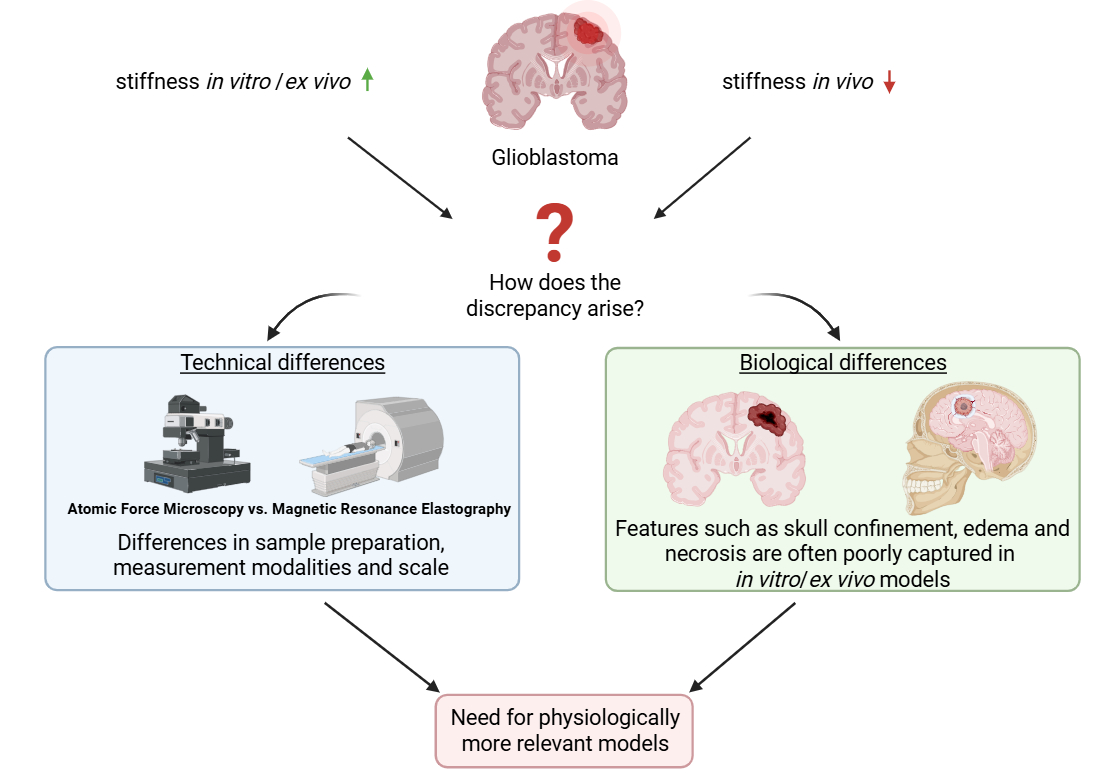
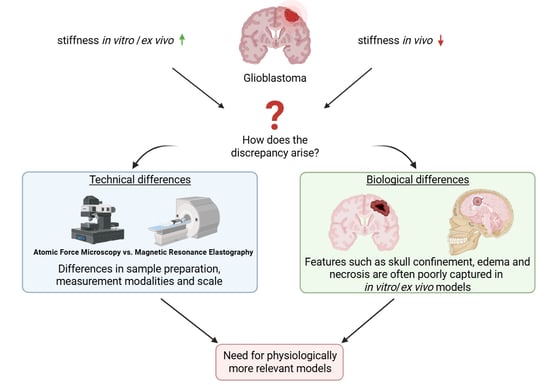
- Glioblastoma stiffness measurements differ between preclinical and clinical studies, with preclinical approaches often reporting increased stiffness and clinical studies often reporting decreased stiffness.
- These differences are driven by both technical and biological factors.
- Better alignment of preclinical and clinical stiffness assessment is needed to improve the biological interpretation and translational relevance of GB mechanobiology.
- More physiologically relevant models, longitudinal measurements, and standardized experimental approaches are required to clarify the role of mechanical forces in glioblastoma progression and develop therapies that effectively target these mechanical factors.
Abstract
1. Introduction
2. Mechanistic Basis of Glioblastoma Stiffness
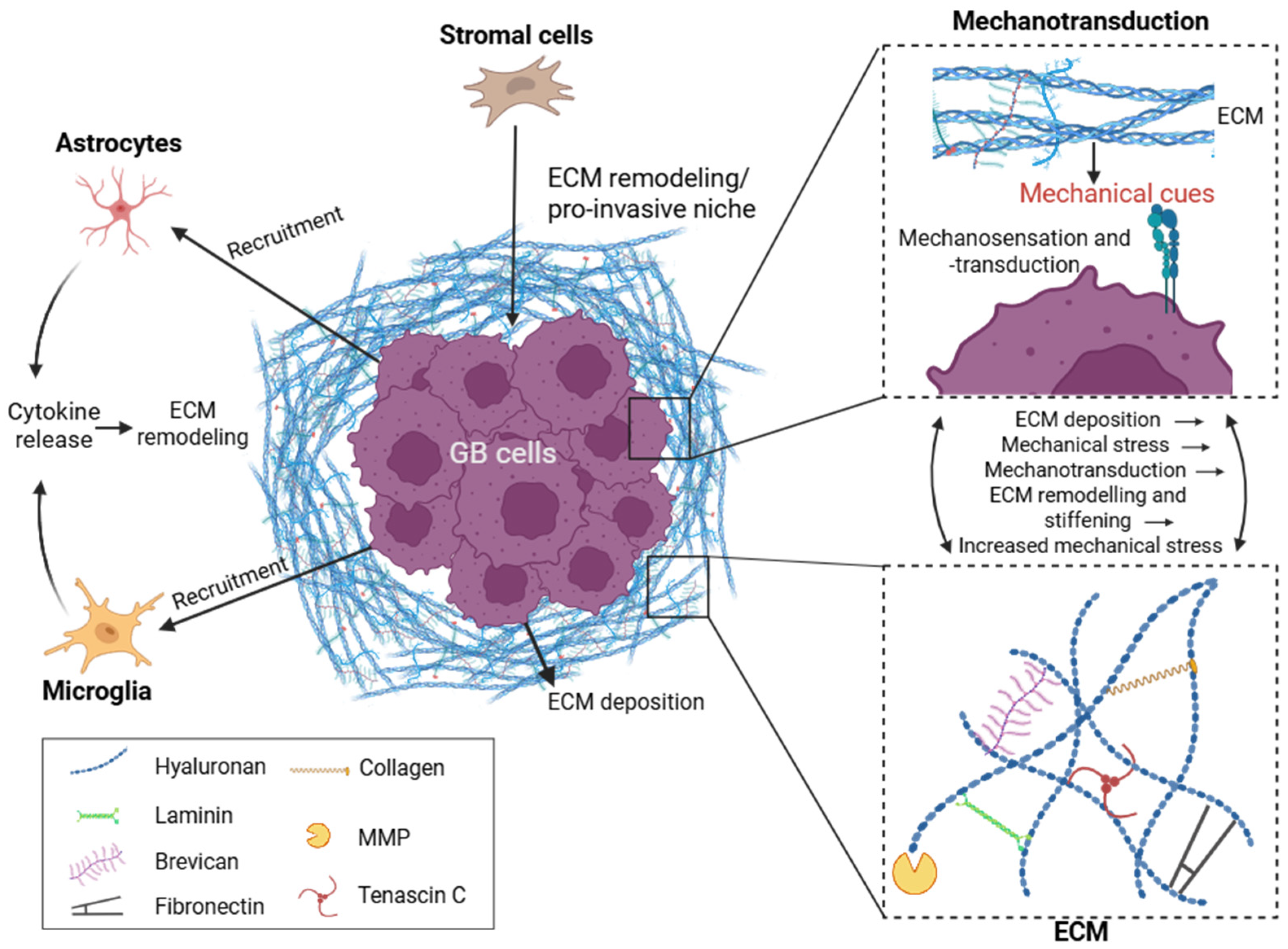
2.1. Molecular and Cellular Drivers of Glioblastoma Stiffness
2.2. ECM Remodeling in GB
2.3. Mechanotransduction Pathways in GB Cells
3. Experimental Models for Studying GB Stiffness
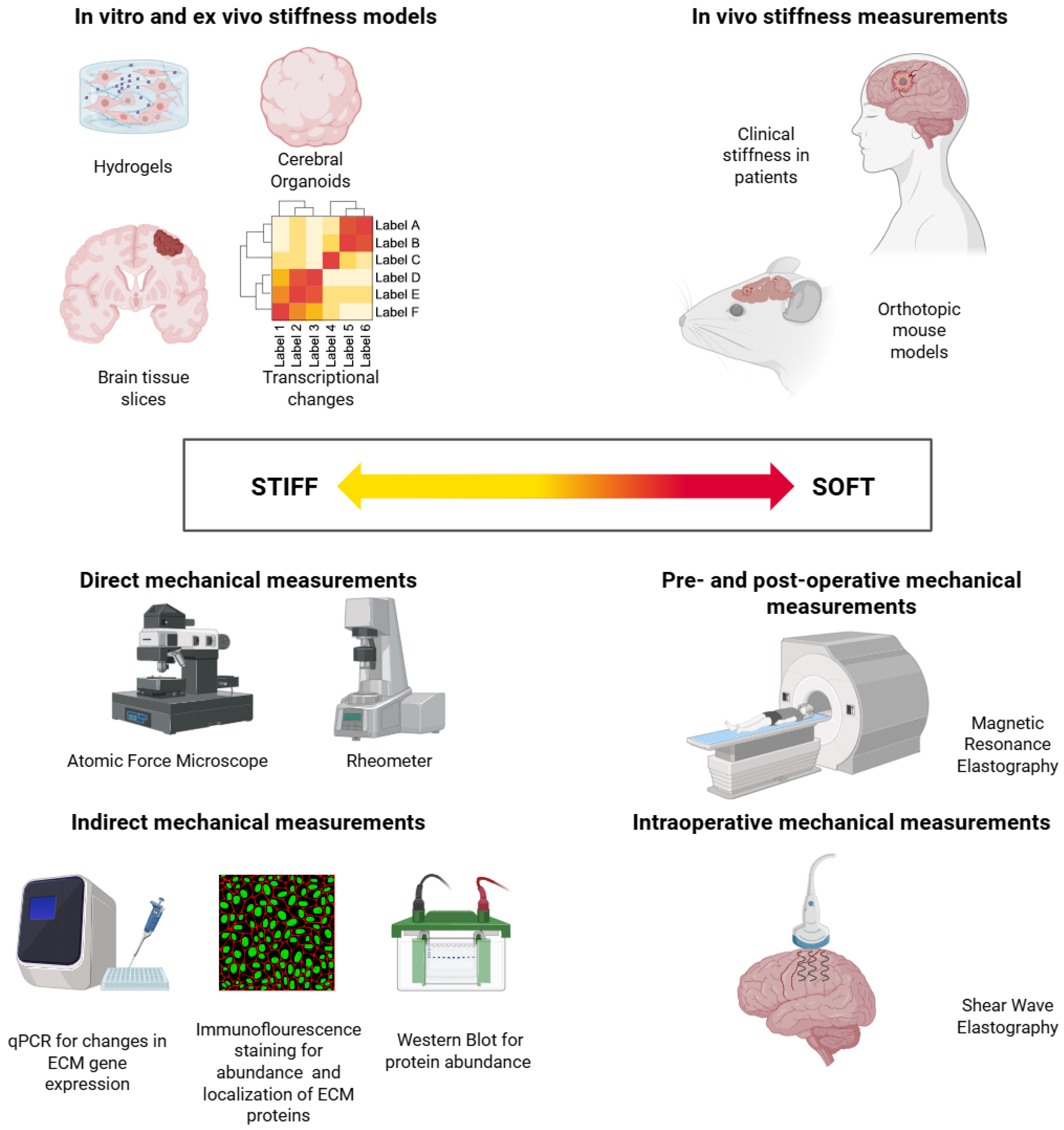
3.1. Primary Methods for In Vitro and Ex Vivo Stiffness Quantification
3.2. Hydrogel-Based In Vitro Models
3.3. Ex Vivo Tissue Stiffness Measurements
4. In Vivo Biomechanics of GB
4.1. Primary Methods for In Vivo GB Stiffness Quantification
4.2. GB Softness in Preclinical Mouse Models
4.3. GB Softness in Human Patients
5. Bridging the Gap: Why Models and Clinical Reality Diverge
5.1. Technical Factors Contributing to Apparent Stiffness Differences
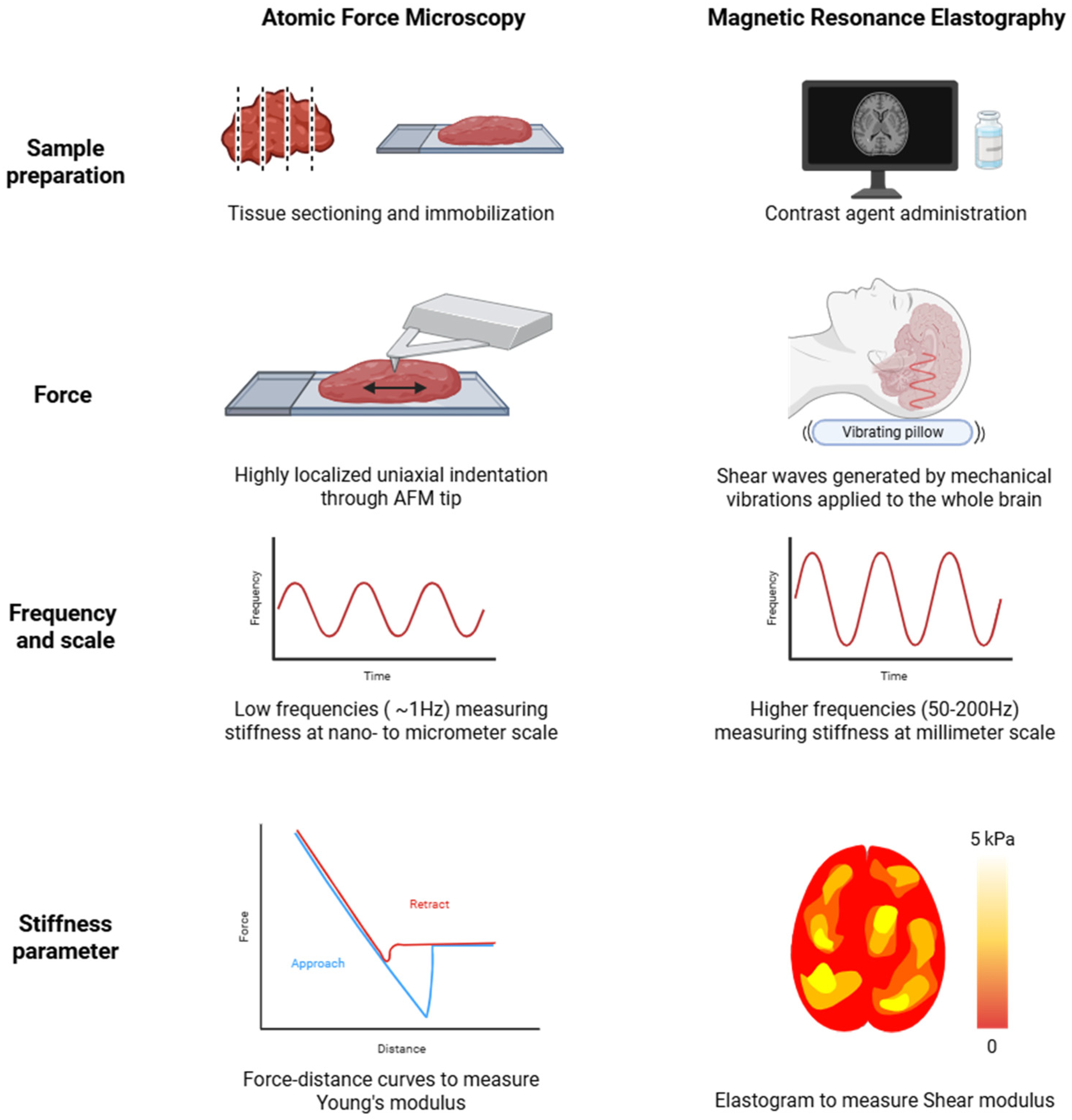
5.1.1. Sample Preparation
5.1.2. Stiffness Measurement Modalities and Principles
5.1.3. Force and Scale of Stiffness Measurements
5.2. Biological Factors Underlying Softness in Human GB
5.2.1. Necrosis
5.2.2. Leaky Vasculature and Edema
5.2.3. Intracranial Pressure and Confinement
5.2.4. Tumor Heterogeneity
6. Conclusions and Future Directions: Toward Mechanically Faithful GB Models Through the Integration of Biomechanics into GB Research
Author Contributions
Funding
Institutional Review Board Statement
Informed Consent Statement
Data Availability Statement
Acknowledgments
Conflicts of Interest
Abbreviations
| AFM | Atomic Force Microscope |
| ECM | Extracellular Matrix |
| FN1 | Fibronectin1 |
| GB | Glioblastoma |
| HA | Hyaluronan |
| ICP | Intracranial Pressure |
| LLCT | Low Load Compression Testing |
| MMP | Matrix Metalloproteinase |
| MRE | Magnetic Resonance Elastography |
| MRI | Magnetic Resonance Imaging |
| PEG | Polyethylene Glycol |
| SWE | Shear wave Elastography |
| TME | Tumor Microenvironment |
| TNC | Tenascin C |
| VEGF | Vascular Endothelial Growth Factor |
References
- Grochans, S.; Cybulska, A.M.; Simińska, D.; Korbecki, J.; Kojder, K.; Chlubek, D.; Baranowska-Bosiacka, I. Epidemiology of Glioblastoma Multiforme–Literature Review. Cancers 2022, 14, 2412. [Google Scholar] [CrossRef]
- Zhao, X.; He, M.; Yang, R.; Geng, N.; Zhu, X.; Tang, N. The Global, Regional, and National Brain and Central Nervous System Cancer Burden and Trends from 1990 to 2021: An Analysis Based on the Global Burden of Disease Study 2021. Front. Neurol. 2025, 16, 1574614. [Google Scholar] [CrossRef]
- White, J.; White, M.P.J.; Wickremesekera, A.; Peng, L.; Gray, C. The Tumour Microenvironment, Treatment Resistance and Recurrence in Glioblastoma. J. Transl. Med. 2024, 22, 540. [Google Scholar] [CrossRef]
- Fernández, C.; Ciérvide, R.; Díaz, A.; Garrido, I.; Couñago, F. Radiotherapy in Glioblastoma Multiforme: Evolution, Limitations, and Molecularly Guided Future. Biomedicines 2025, 13, 2136. [Google Scholar] [CrossRef] [PubMed]
- Grossen, A.; Smith, K.; Coulibaly, N.; Arbuckle, B.; Evans, A.; Wilhelm, S.; Jones, K.; Dunn, I.; Towner, R.; Wu, D.; et al. Physical Forces in Glioblastoma Migration: A Systematic Review. Int. J. Mol. Sci. 2022, 23, 4055. [Google Scholar] [CrossRef]
- Svensson, S.F.; Halldórsson, S.; Latysheva, A.; Fuster-Garcia, E.; Hjørnevik, T.; Fraser-Green, J.; Birkeland Bugge, R.A.; Grinband, J.; Holm, S.; Sinkus, R.; et al. MR Elastography Identifies Regions of Extracellular Matrix Reorganization Associated with Shorter Survival in Glioblastoma Patients. Neurooncol. Adv. 2023, 5, vdad021. [Google Scholar] [CrossRef]
- Deng, B.; Zhao, Z.; Kong, W.; Han, C.; Shen, X.; Zhou, C. Biological Role of Matrix Stiffness in Tumor Growth and Treatment. J. Transl. Med. 2022, 20, 540. [Google Scholar] [CrossRef] [PubMed]
- Cambria, E.; Coughlin, M.F.; Floryan, M.A.; Offeddu, G.S.; Shelton, S.E.; Kamm, R.D. Linking Cell Mechanical Memory and Cancer Metastasis. Nat. Rev. Cancer 2024, 24, 216–228. [Google Scholar] [CrossRef]
- Zhang, M.; Zhang, B. Extracellular Matrix Stiffness: Mechanisms in Tumor Progression and Therapeutic Potential in Cancer. Exp. Hematol. Oncol. 2025, 14, 54. [Google Scholar] [CrossRef]
- Khoonkari, M.; Liang, D.; Kamperman, M.; Kruyt, F.A.E.; van Rijn, P. Physics of Brain Cancer: Multiscale Alterations of Glioblastoma Cells under Extracellular Matrix Stiffening. Pharmaceutics 2022, 14, 1031. [Google Scholar] [CrossRef] [PubMed]
- Pontes, B.; Mendes, F.A. Mechanical Properties of Glioblastoma: Perspectives for YAP/TAZ Signaling Pathway and Beyond. Diseases 2023, 11, 86. [Google Scholar] [CrossRef]
- Suarez-Meade, P.; Whitehead, R.; Rosenfeld, S.; Schiapparelli, P.; Konstantopoulos, K.; Quinones-Hinojosa, A. Extracellular Matrix Stiffness Conditions Glioblastoma Cells for Long-Term Migration: Mechanical Memory as a Driver of Invasion and Recurrence in Glioblastoma. Neuro. Oncol. 2026, 28, 19–37. [Google Scholar] [CrossRef] [PubMed]
- Fattahi, N.; Arani, A.; Perry, A.; Meyer, F.; Manduca, A.; Glaser, K.; Senjem, M.L.; Ehman, R.L.; Huston, J. MR Elastography Demonstrates Increased Brain Stiffness in Normal Pressure Hydrocephalus. Am. J. Neuroradiol. 2016, 37, 462–467. [Google Scholar] [CrossRef] [PubMed]
- Hiscox, L.V.; Johnson, C.L.; Barnhill, E.; McGarry, M.D.J.; Huston, J.; Van Beek, E.J.R.; Starr, J.M.; Roberts, N. Magnetic Resonance Elastography (MRE) of the Human Brain: Technique, Findings and Clinical Applications. Phys. Med. Biol. 2016, 61, R401. [Google Scholar] [CrossRef]
- Baumgart, F. Stiffness-an Unknown World of Mechanical Science? Int. J. Care Inj. 2000, 3, 1. [Google Scholar]
- Luo, Q.; Kuang, D.; Zhang, B.; Song, G. Cell Stiffness Determined by Atomic Force Microscopy and Its Correlation with Cell Motility. Biochim. Biophys. Acta (BBA)-Gen. Subj. 2016, 1860, 1953–1960. [Google Scholar] [CrossRef]
- Wells, R.G. The Role of Matrix Stiffness in Regulating Cell Behavior. Hepatology 2008, 47, 1394–1400. [Google Scholar] [CrossRef] [PubMed]
- Kalli, M.; Stylianopoulos, T. Defining the Role of Solid Stress and Matrix Stiffness in Cancer Cell Proliferation and Metastasis. Front. Oncol. 2018, 8, 55. [Google Scholar] [CrossRef]
- Wei, R.; Zhou, J.; Bui, B.; Liu, X. Glioma Actively Orchestrate a Self-Advantageous Extracellular Matrix to Promote Recurrence and Progression. BMC Cancer 2024, 24, 974. [Google Scholar] [CrossRef]
- Lanza, M.; Casili, G.; Campolo, M.; Paterniti, I.; Colarossi, C.; Mare, M.; Giuffrida, R.; Caffo, M.; Esposito, E.; Cuzzocrea, S. Immunomodulatory Effect of Microglia-Released Cytokines in Gliomas. Brain Sci. 2021, 11, 466. [Google Scholar] [CrossRef]
- Hambardzumyan, D.; Gutmann, D.H.; Kettenmann, H. The Role of Microglia and Macrophages in Glioma Maintenance and Progression. Nat. Neurosci. 2015, 19, 20–27. [Google Scholar] [CrossRef] [PubMed]
- Hatlen, R.R.; Rajagopalan, P. Environmental Interplay: Stromal Cells and Biomaterial Composition Influence in the Glioblastoma Microenvironment. Acta Biomater. 2021, 132, 421–436. [Google Scholar] [CrossRef]
- Kim, S.; Lim, E.; Yoo, K.; Zhao, Y.; Kang, J.; Lim, E.; Shin, I.; Kang, S.; Lim, H.W.; Lee, S. Glioblastoma-educated Mesenchymal Stem-like Cells Promote Glioblastoma Infiltration via Extracellular Matrix Remodelling in the Tumour Microenvironment. Clin. Transl. Med. 2022, 12, e997. [Google Scholar] [CrossRef]
- Marino, S.; Menna, G.; Di Bonaventura, R.; Lisi, L.; Mattogno, P.; Figà, F.; Bilgin, L.; D’Alessandris, Q.G.; Olivi, A.; Della Pepa, G.M. The Extracellular Matrix in Glioblastomas: A Glance at Its Structural Modifications in Shaping the Tumoral Microenvironment—A Systematic Review. Cancers 2023, 15, 1879. [Google Scholar] [CrossRef]
- Mohiuddin, E.; Wakimoto, H. Extracellular Matrix in Glioblastoma: Opportunities for Emerging Therapeutic Approaches. Am. J. Cancer Res. 2021, 11, 3754. [Google Scholar]
- Ciasca, G.; Sassun, T.E.; Minelli, E.; Antonelli, M.; Papi, M.; Santoro, A.; Giangaspero, F.; Delfini, R.; De Spirito, M. Nano-Mechanical Signature of Brain Tumours. Nanoscale 2016, 8, 19629–19643. [Google Scholar] [CrossRef]
- Faisal, S.M.; Comba, A.; Varela, M.L.; Argento, A.E.; Brumley, E.; Abel, C.; Castro, M.G.; Lowenstein, P.R. The Complex Interactions between the Cellular and Non-Cellular Components of the Brain Tumor Microenvironmental Landscape and Their Therapeutic Implications. Front. Oncol. 2022, 12, 1005069. [Google Scholar] [CrossRef]
- Ananthanarayanan, B.; Kim, Y.; Kumar, S. Elucidating the Mechanobiology of Malignant Brain Tumors Using a Brain Matrix-Mimetic Hyaluronic Acid Hydrogel Platform. Biomaterials 2011, 32, 7913–7923. [Google Scholar] [CrossRef] [PubMed]
- Ferrer, V.P.; Moura Neto, V.; Mentlein, R. Glioma Infiltration and Extracellular Matrix: Key Players and Modulators. Glia 2018, 66, 1542–1565. [Google Scholar] [CrossRef]
- Park, J.B.; Kwak, H.J.; Lee, S.H. Role of Hyaluronan in Glioma Invasion. Cell Adh. Migr. 2008, 2, 202–207. [Google Scholar] [CrossRef]
- Pibuel, M.A.; Poodts, D.; Díaz, M.; Hajos, S.E.; Lompardía, S.L. The Scrambled Story between Hyaluronan and Glioblastoma. J. Biol. Chem. 2021, 296, 100549. [Google Scholar] [CrossRef]
- Chen, J.W.E.; Pedron, S.; Harley, B.A.C. The Combined Influence of Hydrogel Stiffness and Matrix-Bound Hyaluronic Acid Content on Glioblastoma Invasion. Macromol. Biosci. 2017, 17, 1700018. [Google Scholar] [CrossRef] [PubMed]
- Wolf, K.J.; Kumar, S. Hyaluronic Acid: Incorporating the Bio into the Material. ACS Biomater. Sci. Eng. 2019, 5, 3753–3765. [Google Scholar] [CrossRef]
- Tucić, M.; Stamenković, V.; Andjus, P. The Extracellular Matrix Glycoprotein Tenascin C and Adult Neurogenesis. Front. Cell Dev. Biol. 2021, 9, 674199. [Google Scholar] [CrossRef]
- Herold-Mende, C.; Mueller, M.M.; Bonsanto, M.M.; Schmitt, H.P.; Kunze, S.; Steiner, H.H. Clinical Impact and Functional Aspects of Tenascin-C Expression during Glioma Progression. Int. J. Cancer 2002, 98, 362–369. [Google Scholar] [CrossRef] [PubMed]
- Hirata, E.; Arakawa, Y.; Shirahata, M.; Yamaguchi, M.; Kishi, Y.; Okada, T.; Takahashi, J.A.; Matsuda, M.; Hashimoto, N. Endogenous Tenascin-C Enhances Glioblastoma Invasion with Reactive Change of Surrounding Brain Tissue. Cancer Sci. 2009, 100, 1451–1459. [Google Scholar] [CrossRef]
- Miroshnikova, Y.A.; Mouw, J.K.; Barnes, J.M.; Pickup, M.W.; Lakins, J.N.; Kim, Y.; Lobo, K.; Persson, A.I.; Reis, G.F.; McKnigh, T.R.; et al. Tissue Mechanics Promote IDH1-Dependent HIF1α-Tenascin C Feedback to Regulate Glioblastoma Aggression. Nat. Cell Biol. 2016, 18, 1336–1345. [Google Scholar] [CrossRef] [PubMed]
- Xia, S.; Lal, B.; Tung, B.; Wang, S.; Goodwin, C.R.; Laterra, J. Tumor Microenvironment Tenascin-C Promotes Glioblastoma Invasion and Negatively Regulates Tumor Proliferation. Neuro. Oncol. 2015, 18, 507–517. [Google Scholar] [CrossRef]
- Kabir, F.; Apu, M.N.H. Multi-Omics Analysis Predicts Fibronectin 1 as a Prognostic Biomarker in Glioblastoma Multiforme. Genomics 2022, 114, 110378. [Google Scholar] [CrossRef]
- Wu, S.; Liu, C.; Wei, X.; Nong, W.-X.; Lin, L.-N.; Li, F.; Xie, X.-X.; Liao, X.-S.; Luo, B.; Zhang, Q.-M.; et al. High Expression of Fibronectin 1 Predicts a Poor Prognosis in Glioblastoma. Curr. Med. Sci. 2022, 42, 1055–1065. [Google Scholar] [CrossRef]
- Kaspar, M.; Zardi, L.; Neri, D. Fibronectin as Target for Tumor Therapy. Int. J. Cancer 2006, 118, 1331–1339. [Google Scholar] [CrossRef]
- Serres, E.; Debarbieux, F.; Stanchi, F.; Maggiorella, L.; Grall, D.; Turchi, L.; Burel-Vandenbos, F.; Figarella-Branger, D.; Virolle, T.; Rougon, G.; et al. Fibronectin Expression in Glioblastomas Promotes Cell Cohesion, Collective Invasion of Basement Membrane in Vitro and Orthotopic Tumor Growth in Mice. Oncogene 2013, 33, 3451–3462. [Google Scholar] [CrossRef]
- Zheng, B.; Han, Y.; Zhang, H. Role of Matrix Metalloproteinases in the Invasion of Glioblastoma and Drug Interventions. Int. J. Mol. Med. 2025, 57, 33. [Google Scholar] [CrossRef]
- Hagemann, C.; Anacker, J.; Ernestus, R.; Vince, G. A Complete Compilation of Matrix Metalloproteinase Expression in Human Malignant Gliomas. World J. Clin. Oncol. 2012, 3, 67. [Google Scholar] [CrossRef]
- Lim, E.J.; Suh, Y.; Kim, S.; Kang, S.G.; Lee, S.J. Force-Mediated Proinvasive Matrix Remodeling Driven by Tumor-Associated Mesenchymal Stem-like Cells in Glioblastoma. BMB Rep. 2018, 51, 182–187. [Google Scholar] [CrossRef]
- Ulrich, T.A.; De Juan Pardo, E.M.; Kumar, S. The Mechanical Rigidity of the Extracellular Matrix Regulates the Structure, Motility, and Proliferation of Glioma Cells. Cancer Res. 2009, 69, 4167–4174. [Google Scholar] [CrossRef]
- Thakur, V.; Thakur, V.S.; Aguila, B.; Slepak, T.I.; Wang, M.; Song, W.; Konai, M.; Mobashery, S.; Chang, M.; Rana, A.B.; et al. Targeting Extracellular Matrix Remodeling Sensitizes Glioblastoma to Ionizing Radiation. Neurooncol. Adv. 2022, 4, vdac147. [Google Scholar] [CrossRef] [PubMed]
- Wang, J.; Long, L.; Sun, C.; Li, P.; Yao, S.; Wang, N.; Xiao, J. Stiffness Matters: Exploiting Mechanotransduction to Guide Cellular Behavior and Potentiate Cancer Therapy. Chem. Eng. J. 2025, 520, 166215. [Google Scholar] [CrossRef]
- Wang, C.; Tong, X.; Yang, F. Bioengineered 3D Brain Tumor Model to Elucidate the Effects of Matrix Stiffness on Glioblastoma Cell Behavior Using Peg-Based Hydrogels. Mol. Pharm. 2014, 11, 2115–2125. [Google Scholar] [CrossRef] [PubMed]
- Martino, F.; Perestrelo, A.R.; Vinarský, V.; Pagliari, S.; Forte, G. Cellular Mechanotransduction: From Tension to Function. Front. Physiol. 2018, 9, 378185. [Google Scholar] [CrossRef] [PubMed]
- Sun, Z.; Guo, S.S.; Fässler, R. Integrin-Mediated Mechanotransduction. J. Cell Biol. 2016, 215, 445–456. [Google Scholar] [CrossRef]
- Humphrey, J.D.; Dufresne, E.R.; Schwartz, M.A. Mechanotransduction and Extracellular Matrix Homeostasis. Nat. Rev. Mol. Cell Biol. 2014, 15, 802–812. [Google Scholar] [CrossRef]
- Pogoda, K.; Chin, L.; Georges, P.C.; Byfield, F.J.; Bucki, R.; Kim, R.; Weaver, M.; Wells, R.G.; Marcinkiewicz, C.; Janmey, P.A. Compression Stiffening of Brain and Its Effect on Mechanosensing by Glioma Cells. New J. Phys. 2014, 16, 075002. [Google Scholar] [CrossRef] [PubMed]
- Gomes, L.; Pardo-Pastor, C.; Rosenblatt, J.; Pouliopoulos, A.N. Mechanotransduction as a Therapeutic Target for Brain Tumours. EBioMedicine 2025, 117, 105808. [Google Scholar] [CrossRef] [PubMed]
- DuChez, B.J.; Doyle, A.D.; Dimitriadis, E.K.; Yamada, K.M. Durotaxis by Human Cancer Cells. Biophys. J. 2019, 116, 670–683. [Google Scholar] [CrossRef]
- Palamà, I.E.; D’Amone, S.; Ratano, P.; Donatelli, A.; Liscio, A.; Antonacci, G.; Testini, M.; Di Angelantonio, S.; Ragozzino, D.; Cortese, B. Mechanical Durotactic Environment Enhances Specific Glioblastoma Cell Responses. Cancers 2019, 11, 643. [Google Scholar] [CrossRef] [PubMed]
- Sohrabi, A.; Lefebvre, A.E.Y.T.; Harrison, M.J.; Condro, M.C.; Sanazzaro, T.M.; Safarians, G.; Solomon, I.; Bastola, S.; Kordbacheh, S.; Toh, N.; et al. Microenvironmental Stiffness Induces Metabolic Reprogramming in Glioblastoma. Cell Rep. 2023, 42, 113175. [Google Scholar] [CrossRef]
- Grabowska, M.; Kuczyński, K.; Piwecka, M.; Rabiasz, A.; Zemła, J.; Głodowicz, P.; Wawrzyniak, D.; Lekka, M.; Rolle, K. MiR-218 Affects the ECM Composition and Cell Biomechanical Properties of Glioblastoma Cells. J. Cell. Mol. Med. 2022, 26, 3913. [Google Scholar] [CrossRef]
- Grundy, T.J.; De Leon, E.; Griffin, K.R.; Stringer, B.W.; Day, B.W.; Fabry, B.; Cooper-White, J.; O’Neill, G.M. Differential Response of Patient-Derived Primary Glioblastoma Cells to Environmental Stiffness. Sci. Rep. 2016, 6, 23353. [Google Scholar] [CrossRef]
- Bhargav, A.G.; Domino, J.S.; Chamoun, R.; Thomas, S.M. Mechanical Properties in the Glioma Microenvironment: Emerging Insights and Theranostic Opportunities. Front. Oncol. 2022, 11, 805628. [Google Scholar] [CrossRef]
- Day, Z.I.; Roberts-Thomson, S.; Nouri, Y.J.; Dalton, N.S.; Wang, S.S.; Davenport, A.; Ludlow, L.E.; Hulett, M.D.; Cross, R.S.; Jenkins, M.R. Defining the Extracellular Matrix for Targeted Immunotherapy in Adult and Pediatric Brain Cancer. npj Precis. Oncol. 2025, 9, 184. [Google Scholar] [CrossRef]
- Najera, J.; Rosenberger, M.R.; Datta, M. Atomic Force Microscopy Methods to Measure Tumor Mechanical Properties. Cancers 2023, 15, 3285. [Google Scholar] [CrossRef]
- Cieśluk, M.; Pogoda, K.; Deptuła, P.; Werel, P.; Kułakowska, A.; Kochanowicz, J.; Mariak, Z.; Łysoń, T.; Reszeć, J.; Bucki, R. Nanomechanics and Histopathology as Diagnostic Tools to Characterize Freshly Removed Human Brain Tumors. Int. J. Nanomed. 2020, 15, 7509–7521. [Google Scholar] [CrossRef]
- Persano, F.; Parodi, A.; Pallaeva, T.; Kolesova, E.; Zamyatnin, A.A.; Pokrovsky, V.S.; De Matteis, V.; Leporatti, S.; Cascione, M. Atomic Force Microscopy: A Versatile Tool in Cancer Research. Cancers 2025, 17, 858. [Google Scholar] [CrossRef]
- Magazzù, A.; Marcuello, C. Investigation of Soft Matter Nanomechanics by Atomic Force Microscopy and Optical Tweezers: A Comprehensive Review. Nanomaterials 2023, 13, 963. [Google Scholar] [CrossRef] [PubMed]
- Bustamante, C.J.; Chemla, Y.R.; Liu, S.; Wang, M.D. Optical Tweezers in Single-Molecule Biophysics. Nat. Rev. Methods Primers 2021, 1, 25. [Google Scholar] [CrossRef] [PubMed]
- Coceano, G.; Yousafzai, M.S.; Ma, W.; Ndoye, F.; Venturelli, L.; Hussain, I.; Bonin, S.; Niemela, J.; Scoles, G.; Cojoc, D.; et al. Investigation into Local Cell Mechanics by Atomic Force Microscopy Mapping and Optical Tweezer Vertical Indentation. Nanotechnology 2016, 27, 065102. [Google Scholar] [CrossRef]
- Rezk, R.; Jia, B.Z.; Wendler, A.; Dimov, I.; Watts, C.; Markaki, A.E.; Franze, K.; Kabla, A.J. Spatial Heterogeneity of Cell-Matrix Adhesive Forces Predicts Human Glioblastoma Migration. Neurooncol. Adv. 2020, 2, vdaa081. [Google Scholar] [CrossRef]
- Logun, M.; Zhao, W.; Mao, L.; Karumbaiah, L. Microfluidics in Malignant Glioma Research and Precision Medicine. Adv. Biosyst. 2018, 2, 1700221. [Google Scholar] [CrossRef]
- Merson, J.; Parvez, N.; Picu, R.C. Probing Soft Fibrous Materials by Indentation. Acta Biomater. 2022, 163, 25. [Google Scholar] [CrossRef]
- Rashid, B.; Destrade, M.; Gilchrist, M.D. Mechanical Characterization of Brain Tissue in Compression at Dynamic Strain Rates. J. Mech. Behav. Biomed. Mater. 2012, 10, 23–38. [Google Scholar] [CrossRef]
- Canovic, E.P.; Qing, B.; Mijailovic, A.S.; Jagielska, A.; Whitfield, M.J.; Kelly, E.; Turner, D.; Sahin, M.; Van Vliet, K.J. Characterizing Multiscale Mechanical Properties of Brain Tissue Using Atomic Force Microscopy, Impact Indentation, and Rheometry. J. Vis. Exp. 2016, 2016, 54201. [Google Scholar] [CrossRef]
- Isik, S.; Yucel, D.; Hasirci, V. Development of a Hydrogel Platform with GBM and Microglia: A Potential Glioblastoma Tumor Model. ACS Appl. Bio Mater. 2025, 8, 7757–7770. [Google Scholar] [CrossRef]
- Thakor, J.; Ahadian, S.; Niakan, A.; Banton, E.; Nasrollahi, F.; Hasani-Sadrabadi, M.M.; Khademhosseini, A. Engineered Hydrogels for Brain Tumor Culture and Therapy. Biodes. Manuf. 2020, 3, 203. [Google Scholar] [CrossRef] [PubMed]
- Syed, S.; Karadaghy, A.; Zustiak, S. Simple Polyacrylamide-Based Multiwell Stiffness Assay for the Study of Stiffness-Dependent Cell Responses. J. Vis. Exp. 2015, 2015, 52643. [Google Scholar] [CrossRef]
- Wolf, K.J.; Chen, J.; Coombes, J.D.; Aghi, M.K.; Kumar, S. Dissecting and Rebuilding the Glioblastoma Microenvironment with Engineered Materials. Nat. Rev. Mater. 2019, 4, 651–669. [Google Scholar] [CrossRef]
- Tang, M.; Tiwari, S.K.; Agrawal, K.; Tan, M.; Dang, J.; Tam, T.; Tian, J.; Wan, X.; Schimelman, J.; You, S.; et al. Rapid 3D Bioprinting of Glioblastoma Model Mimicking Native Biophysical Heterogeneity. Small 2021, 17, e2006050. [Google Scholar] [CrossRef]
- Amereh, M.; Seyfoori, A.; Dallinger, B.; Azimzadeh, M.; Stefanek, E.; Akbari, M. 3D-Printed Tumor-on-a-Chip Model for Investigating the Effect of Matrix Stiffness on Glioblastoma Tumor Invasion. Biomimetics 2023, 8, 421. [Google Scholar] [CrossRef] [PubMed]
- Umesh, V.; Rape, A.D.; Ulrich, T.A.; Kumar, S. Microenvironmental Stiffness Enhances Glioma Cell Proliferation by Stimulating Epidermal Growth Factor Receptor Signaling. PLoS ONE 2014, 9, e101771. [Google Scholar] [CrossRef]
- Yui, A.; Oudin, M.J. The Rigidity Connection: Matrix Stiffness and Its Impact on Cancer Progression. Cancer Res. 2024, 84, 958–960. [Google Scholar] [CrossRef]
- Khan, M.; Kollenz, P.; Fritzenschaft, M.; Taheri, F.; Colombo, F.; Blumberg, J.W.; Schlotterose, L.; Schwarz, U.S.; Leal-Egaña, A.; Selhuber-Unkel, C. Dimensional Memory in Glioblastoma Mechanics: Traction Force Analysis of Cells Cultured in 2D versus 3D Collagen Environments. Bioact. Mater. 2026, 55, 515–528. [Google Scholar] [CrossRef]
- Beliveau, A.; Thomas, G.; Gong, J.; Wen, Q.; Jain, A. Aligned Nanotopography Promotes a Migratory State in Glioblastoma Multiforme Tumor Cells. Sci. Rep. 2016, 6, 26143. [Google Scholar] [CrossRef]
- Masud, N.; Hasib, M.H.H.; Ibironke, B.; Block, C.; Hughes, J.; Ekpenyong, A.; Sarkar, A. Exploring the Heterogeneity in Glioblastoma Cellular Mechanics Using In-Vitro Assays and Atomic Force Microscopy. Sci. Rep. 2025, 15, 19302. [Google Scholar] [CrossRef]
- Shmelev, M.E.; Farniev, V.M.; Shved, N.A.; Kumeiko, V.V. Nanomechanical Signatures in Glioma Cells Depend on CD44 Distribution in IDH1 Wild-Type but Not in IDH1R132H Mutant Early-Passage Cultures. Int. J. Mol. Sci. 2023, 24, 4056. [Google Scholar] [CrossRef]
- Zhang, T.; Ma, L.; Ling, S.; Chen, Y.; Zhang, Z.; Tian, D.; Yang, Y. Protocol for Measuring the Young’s Modulus of Organoids Using Atomic Force Microscopy. STAR Protoc. 2025, 6, 103825. [Google Scholar] [CrossRef] [PubMed]
- Stewart, D.C.; Rubiano, A.; Dyson, K.; Simmons, C.S. Mechanical Characterization of Human Brain Tumors from Patients and Comparison to Potential Surgical Phantoms. PLoS ONE 2017, 12, e0177561. [Google Scholar] [CrossRef] [PubMed]
- Tao, B.; Song, Y.; Wu, Y.; Yang, X.; Peng, T.; Peng, L.; Xia, K.; Xia, X.; Chen, L.; Zhong, C. Matrix Stiffness Promotes Glioma Cell Stemness by Activating BCL9L/Wnt/β-Catenin Signaling. Aging 2021, 13, 5284–5296. [Google Scholar] [CrossRef]
- Mahaffey, B.J.; Fowler, Z.P.; Lung, Z.; Dang, V.; Lee, H.; Johnson, A.M.K.; Munoz, M.A.; Goodin, D.A.; Frieboes, H.B.; Williams, B.J.; et al. The Prognostic Effect of Mechanical, Ultrastructural, and ECM Signatures in Glioblastoma Core and Rim. APL Bioeng. 2024, 8, 36101. [Google Scholar] [CrossRef] [PubMed]
- Chan, H.W.; Uff, C.; Chakraborty, A.; Dorward, N.; Bamber, J.C. Clinical Application of Shear Wave Elastography for Assisting Brain Tumor Resection. Front. Oncol. 2021, 11, 619286. [Google Scholar] [CrossRef]
- Chauvet, D.; Imbault, M.; Capelle, L.; Demene, C.; Mossad, M.; Karachi, C.; Boch, A.L.; Gennisson, J.L.; Tanter, M. In Vivo Measurement of Brain Tumor Elasticity Using Intraoperative Shear Wave Elastography. Ultraschall Med. 2016, 37, 584–590. [Google Scholar] [CrossRef]
- Kumarapuram, S.; Yu, R.; Manchiraju, P.; Attard, C.; Escamilla, J.; Navin, A.; Khuroo, M.; Elmogazy, O.; Gupta, G.; Sun, H.; et al. Applying Shear Wave and Magnetic Resonance Elastography to Grade Brain Tumors: Systematic Review and Meta-Analysis. World Neurosurg. 2023, 178, e147–e155. [Google Scholar] [CrossRef] [PubMed]
- Sack, I. Magnetic Resonance Elastography from Fundamental Soft-Tissue Mechanics to Diagnostic Imaging. Nat. Rev. Phys. 2023, 5, 25–42. [Google Scholar] [CrossRef]
- Fløgstad Svensson, S.; Fuster-Garcia, E.; Latysheva, A.; Fraser-Green, J.; Nordhøy, W.; Isam Darwish, O.; Thokle Hovden, I.; Holm, S.; Vik-Mo, E.O.; Sinkus, R.; et al. Decreased Tissue Stiffness in Glioblastoma by MR Elastography Is Associated with Increased Cerebral Blood Flow. Eur. J. Radiol. 2022, 147, 110136. [Google Scholar] [CrossRef]
- Duhon, B.H.; Thompson, K.; Fisher, M.; Kaul, V.F.; Nguyen, H.T.N.; Harris, M.S.; Varadarajan, V.; Adunka, O.F.; Prevedello, D.M.; Kolipaka, A.; et al. Tumor Biomechanical Stiffness by Magnetic Resonance Elastography Predicts Surgical Outcomes and Identifies Biomarkers in Vestibular Schwannoma and Meningioma. Sci. Rep. 2024, 14, 14561. [Google Scholar] [CrossRef] [PubMed]
- Jamin, Y.; Boult, J.K.R.; Li, J.; Popov, S.; Garteiser, P.; Ulloa, J.L.; Cummings, C.; Box, G.; Eccles, S.A.; Jones, C.; et al. Exploring the Biomechanical Properties of Brain Malignancies and Their Pathologic Determinants in Vivo with Magnetic Resonance Elastography. Cancer Res. 2015, 75, 1216–1224. [Google Scholar] [CrossRef]
- Schregel, K.; Nazari, N.; Nowicki, M.O.; Palotai, M.; Lawler, S.E.; Sinkus, R.; Barbone, P.E.; Patz, S. Characterization of Glioblastoma in an Orthotopic Mouse Model with Magnetic Resonance Elastography. NMR Biomed. 2018, 31, e3840. [Google Scholar] [CrossRef]
- Feng, Y.; Clayton, E.H.; Okamoto, R.J.; Engelbach, J.; Bayly, P.V.; Garbow, J.R. A Longitudinal Magnetic Resonance Elastography Study of Murine Brain Tumors Following Radiation Therapy. Phys. Med. Biol. 2016, 61, 6121. [Google Scholar] [CrossRef]
- Fels-Palesandro, H.; Heuer, S.; Boztepe, B.; Streibel, Y.; Ungermann, J.; Pan, C.; Scheck, J.G.; Fischer, M.; Sturm, V.J.; Azorín, D.D.; et al. Assessment of Tumor Cell Invasion and Radiotherapy Response in Experimental Glioma by Magnetic Resonance Elastography. J. Magn. Reson. Imaging 2024, 61, 1203–1218. [Google Scholar] [CrossRef]
- Streitberger, K.J.; Reiss-Zimmermann, M.; Freimann, F.B.; Bayerl, S.; Guo, J.; Arlt, F.; Wuerfel, J.; Braun, J.; Hoffmann, K.T.; Sack, I. High-Resolution Mechanical Imaging of Glioblastoma by Multifrequency Magnetic Resonance Elastography. PLoS ONE 2014, 9, e110588. [Google Scholar] [CrossRef]
- Schregel, K.; Nowicki, M.O.; Palotai, M.; Nazari, N.; Zane, R.; Sinkus, R.; Lawler, S.E.; Patz, S. Magnetic Resonance Elastography Reveals Effects of Anti-Angiogenic Glioblastoma Treatment on Tumor Stiffness and Captures Progression in an Orthotopic Mouse Model. Cancer Imaging 2020, 20, 35. [Google Scholar] [CrossRef]
- Reiss-Zimmermann, M.; Streitberger, K.J.; Sack, I.; Braun, J.; Arlt, F.; Fritzsch, D.; Hoffmann, K.T. High Resolution Imaging of Viscoelastic Properties of Intracranial Tumours by Multi-Frequency Magnetic Resonance Elastography. Clin. Neuroradiol. 2015, 25, 371–378. [Google Scholar] [CrossRef]
- Simon, M.; Guo, J.; Papazoglou, S.; Scholand-Engler, H.; Erdmann, C.; Melchert, U.; Bonsanto, M.; Braun, J.; Petersen, D.; Sack, I.; et al. Non-Invasive Characterization of Intracranial Tumors by Magnetic Resonance Elastography. New J. Phys. 2013, 15, 085024. [Google Scholar] [CrossRef]
- Sahai, S.; Wilkerson, M.; Zaske, A.M.; Olson, S.D.; Cox, C.S.; Triolo, F. A Cost-Effective Method to Immobilize Hydrated Soft-Tissue Samples for Atomic Force Microscopy. Biotechniques 2016, 61, 206–208. [Google Scholar] [CrossRef] [PubMed]
- Shen, Y.; Schmidt, T.; Diz-Muñoz, A. Protocol on Tissue Preparation and Measurement of Tumor Stiffness in Primary and Metastatic Colorectal Cancer Samples with an Atomic Force Microscope. STAR Protoc. 2020, 1, 100167. [Google Scholar] [CrossRef] [PubMed]
- Zemła, J.; Danilkiewicz, J.; Orzechowska, B.; Pabijan, J.; Seweryn, S.; Lekka, M. Atomic Force Microscopy as a Tool for Assessing the Cellular Elasticity and Adhesiveness to Identify Cancer Cells and Tissues. Semin. Cell Dev. Biol. 2018, 73, 115–124. [Google Scholar] [CrossRef]
- Chiou, Y.W.; Lin, H.K.; Tang, M.J.; Lin, H.H.; Yeh, M.L. The Influence of Physical and Physiological Cues on Atomic Force Microscopy-Based Cell Stiffness Assessment. PLoS ONE 2013, 8, e77384. [Google Scholar] [CrossRef]
- Sunyer, R.; Trepat, X.; Fredberg, J.J.; Farré, R.; Navajas, D. The Temperature Dependence of Cell Mechanics Measured by Atomic Force Microscopy. Phys. Biol. 2009, 6, 025009. [Google Scholar] [CrossRef]
- Urbanczyk, C.A.; Palmeri, M.L.; Bass, C.R. Material Characterization of in Vivo and in Vitro Porcine Brain Using Shear Wave Elasticity. Ultrasound Med. Biol. 2015, 41, 713–723. [Google Scholar] [CrossRef]
- Sicard, D.; Fredenburgh, L.E.; Tschumperlin, D.J. Measured Pulmonary Arterial Tissue Stiffness Is Highly Sensitive to AFM Indenter Dimensions. J. Mech. Behav. Biomed. Mater. 2017, 74, 118–127. [Google Scholar] [CrossRef] [PubMed]
- Nicolle, S.; Palierne, J.F. On the Efficiency of Attachment Methods of Biological Soft Tissues in Shear Experiments. J. Mech. Behav. Biomed. Mater. 2012, 14, 158–162. [Google Scholar] [CrossRef]
- Babu, P.K.V.; Radmacher, M. Mechanics of Brain Tissues Studied by Atomic Force Microscopy: A Perspective. Front. Neurosci. 2019, 13, 600. [Google Scholar] [CrossRef]
- Chaurasia, S.S.; Champakalakshmi, R.; Li, A.; Poh, R.; Tan, X.W.; Lakshminarayanan, R.; Lim, C.T.; Tan, D.T.; Mehta, J.S. Effect of Fibrin Glue on the Biomechanical Properties of Human Descemet’s Membrane. PLoS ONE 2012, 7, e37456. [Google Scholar] [CrossRef]
- Morgan, J.T.; Raghunathan, V.K.; Thomasy, S.M.; Murphy, C.J.; Russell, P. Robust and Artifact-Free Mounting of Tissue Samples for Atomic Force Microscopy. Biotechniques 2014, 56, 40. [Google Scholar] [CrossRef]
- Thomas, G.; Burnham, N.A.; Camesano, T.A.; Wen, Q. Measuring the Mechanical Properties of Living Cells Using Atomic Force Microscopy. J. Vis. Exp. 2013, 76, 50497. [Google Scholar] [CrossRef]
- Kontomaris, S.V.; Malamou, A.; Stylianou, A. The Hertzian Theory in AFM Nanoindentation Experiments Regarding Biological Samples: Overcoming Limitations in Data Processing. Micron 2022, 155, 103228. [Google Scholar] [CrossRef] [PubMed]
- Vichare, S.; Inamdar, M.M.; Sen, S. Influence of Cell Spreading and Contractility on Stiffness Measurements Using AFM. Soft Matter 2012, 8, 10464–10471. [Google Scholar] [CrossRef]
- Ahmine, A.N.; Bdiri, M.; Féréol, S.; Fodil, R. A Comprehensive Study of AFM Stiffness Measurements on Inclined Surfaces: Theoretical, Numerical, and Experimental Evaluation Using a Hertz Approach. Sci. Rep. 2024, 14, 25869. [Google Scholar] [CrossRef] [PubMed]
- Gavara, N. A Beginner’s Guide to Atomic Force Microscopy Probing for Cell Mechanics. Microsc. Res. Tech. 2017, 80, 75–84. [Google Scholar] [CrossRef]
- Kim, E.; Ramos Figueroa, A.L.; Schrock, M.; Zhang, E.; Newcomb, C.J.; Bao, Z.; Michalek, L. A Guide for Nanomechanical Characterization of Soft Matter via AFM: From Mode Selection to Data Reporting. STAR Protoc. 2025, 6, 103809. [Google Scholar] [CrossRef]
- Lilaj, L.; Herthum, H.; Meyer, T.; Shahryari, M.; Bertalan, G.; Caiazzo, A.; Braun, J.; Fischer, T.; Hirsch, S.; Sack, I. Inversion-Recovery MR Elastography of the Human Brain for Improved Stiffness Quantification near Fluid–Solid Boundaries. Magn. Reson. Med. 2021, 86, 2552–2561. [Google Scholar] [CrossRef]
- Herthum, H.; Carrillo, H.; Osses, A.; Uribe, S.; Sack, I.; Bertoglio, C. Multiple Motion Encoding in Phase-Contrast MRI: A General Theory and Application to Elastography Imaging. Med. Image Anal. 2022, 78, 102416. [Google Scholar] [CrossRef] [PubMed]
- Guo, J.; Savic, L.J.; Hillebrandt, K.H.; Sack, I. MR Elastography in Cancer. Investig. Radiol. 2023, 58, 578–586. [Google Scholar] [CrossRef]
- Samadi-Dooki, A.; Voyiadjis, G.Z.; Stout, R.W. A Combined Experimental, Modeling, and Computational Approach to Interpret the Viscoelastic Response of the White Matter Brain Tissue during Indentation. J. Mech. Behav. Biomed. Mater. 2018, 77, 24–33. [Google Scholar] [CrossRef]
- Noch, E.; Khalili, K. Molecular Mechanisms of Necrosis in Glioblastoma: The Role of Glutamate Excitotoxicity. Cancer Biol. Ther. 2009, 8, 1791. [Google Scholar] [CrossRef]
- Markwell, S.M.; Ross, J.L.; Olson, C.L.; Brat, D.J. Necrotic Reshaping of the Glioma Microenvironment Drives Disease Progression. Acta Neuropathol. 2022, 143, 291–310. [Google Scholar] [CrossRef]
- Gonzalez-Avila, G.; Sommer, B.; Flores-Soto, E.; Aquino-Galvez, A. Hypoxic Effects on Matrix Metalloproteinases’ Expression in the Tumor Microenvironment and Therapeutic Perspectives. Int. J. Mol. Sci. 2023, 24, 16887. [Google Scholar] [CrossRef]
- Ohmura, K.; Tomita, H.; Hara, A. Peritumoral Edema in Gliomas: A Review of Mechanisms and Management. Biomedicines 2023, 11, 2731. [Google Scholar] [CrossRef] [PubMed]
- Arvanitis, C.D.; Ferraro, G.B.; Jain, R.K. The Blood-Brain Barrier and Blood-Tumour Barrier in Brain Tumours and Metastases. Nat. Rev. Cancer 2020, 20, 26–41. [Google Scholar] [CrossRef] [PubMed]
- Yang, Y.; Han, Y.; Zhao, S.; Xiao, G.; Guo, L.; Zhang, X.; Cui, G. Spatial Heterogeneity of Edema Region Uncovers Survival-Relevant Habitat of Glioblastoma. Eur. J. Radiol. 2022, 154, 110423. [Google Scholar] [CrossRef]
- Liu, S.Y.; Mei, W.Z.; Lin, Z.X. Pre-Operative Peritumoral Edema and Survival Rate in Glioblastoma Multiforme. Onkologie 2013, 36, 679–684. [Google Scholar] [CrossRef]
- Qin, X.; Liu, R.; Akter, F.; Qin, L.; Xie, Q.; Li, Y.; Qiao, H.; Zhao, W.; Jian, Z.; Liu, R.; et al. Peri-Tumoral Brain Edema Associated with Glioblastoma Correlates with Tumor Recurrence. J. Cancer 2021, 12, 2082. [Google Scholar] [CrossRef]
- Mummareddy, N.; Salwi, S.R.; Kumar, N.G.; Zhao, Z.; Ye, F.; Le, C.H.; Mobley, B.C.; Thompson, R.C.; Chambless, L.B.; Mistry, A.M. Prognostic Relevance of CSF and Peri-Tumoral Edema Volumes in Glioblastoma. J. Clin. Neurosci. 2021, 84, 1–7. [Google Scholar] [CrossRef] [PubMed]
- Kuroiwa, T.; Ueki, M.; Ichiki, H.; Kobayashi, M.; Suemasu, H.; Taniguchi, I.; Okeda, R. Time Course of Tissue Elasticity and Fluidity in Vasogenic Brain Edema. Acta Neurochir. Suppl. 1997, 70, 87–90. [Google Scholar] [CrossRef]
- Rey, J.A.; Ewing, J.R.; Sarntinoranont, M. A Computational Model of Glioma Reveals Opposing, Stiffness-Sensitive Effects of Leaky Vasculature and Tumor Growth on Tissue Mechanical Stress and Porosity. Biomech. Model. Mechanobiol. 2021, 20, 1981–2000. [Google Scholar] [CrossRef] [PubMed]
- Esquenazi, Y.; Lo, V.P.; Lee, K. Critical Care Management of Cerebral Edema in Brain Tumors. J. Intensive Care Med. 2017, 32, 15–24. [Google Scholar] [CrossRef]
- Sorribes, I.C.; Moore, M.N.J.; Byrne, H.M.; Jain, H.V. A Biomechanical Model of Tumor-Induced Intracranial Pressure and Edema in Brain Tissue. Biophys. J. 2019, 116, 1560. [Google Scholar] [CrossRef]
- Vymola, P.; Garcia-Borja, E.; Cervenka, J.; Balaziova, E.; Vymolova, B.; Veprkova, J.; Vodicka, P.; Skalnikova, H.; Tomas, R.; Netuka, D.; et al. Fibrillar Extracellular Matrix Produced by Pericyte-like Cells Facilitates Glioma Cell Dissemination. Brain Pathol. 2024, 34, e13265. [Google Scholar] [CrossRef]
- Xu, J.; Zhang, J.; Chen, W.; Ni, X. The Tumor-Associated Fibrotic Reactions in Microenvironment Aggravate Glioma Chemoresistance. Front. Oncol. 2024, 14, 1388700. [Google Scholar] [CrossRef] [PubMed]
- Acerbi, I.; Cassereau, L.; Dean, I.; Shi, Q.; Au, A.; Park, C.; Chen, Y.Y.; Liphardt, J.; Hwang, E.S.; Weaver, V.M. Human Breast Cancer Invasion and Aggression Correlates with ECM Stiffening and Immune Cell Infiltration. Integr. Biol. 2015, 7, 1120. [Google Scholar] [CrossRef]
- Patel, B.K.; Pepin, K.; Brandt, K.R.; Mazza, G.L.; Pockaj, B.A.; Chen, J.; Zhou, Y.; Northfelt, D.W.; Anderson, K.; Kling, J.M.; et al. Association of Breast Cancer Risk, Density, and Stiffness: Global Tissue Stiffness on Breast MR Elastography (MRE). Breast Cancer Res. Treat. 2022, 194, 79. [Google Scholar] [CrossRef] [PubMed]
- Bevilacqua, C.; Sánchez-Iranzo, H.; Richter, D.; Diz-Muñoz, A.; Prevedel, R. Imaging Mechanical Properties of Sub-Micron ECM in Live Zebrafish Using Brillouin Microscopy. Biomed. Opt. Express 2019, 10, 1431. [Google Scholar] [CrossRef]
- Sánchez-Iranzo, H.; Bevilacqua, C.; Diz-Muñoz, A.; Prevedel, R. A 3D Brillouin Microscopy Dataset of the In-Vivo Zebrafish Eye. Data Brief 2020, 30, 105427. [Google Scholar] [CrossRef]
- Bian, S.; Repic, M.; Guo, Z.; Kavirayani, A.; Burkard, T.; Bagley, J.A.; Krauditsch, C.; Knoblich, J.A. Genetically Engineered Cerebral Organoids Model Brain Tumor Formation. Nat. Methods 2018, 15, 631–639. [Google Scholar] [CrossRef] [PubMed]
- Linkous, A.; Balamatsias, D.; Snuderl, M.; Edwards, L.; Miyaguchi, K.; Milner, T.; Reich, B.; Cohen-Gould, L.; Storaska, A.; Nakayama, Y.; et al. Modeling Patient-Derived Glioblastoma with Cerebral Organoids. Cell Rep. 2019, 26, 3203–3211.e5. [Google Scholar] [CrossRef]
- Liang, Y.; Voshart, D.; Paridaen, J.T.M.L.; Oosterhof, N.; Liang, D.; Thiruvalluvan, A.; Zuhorn, I.S.; den Dunnen, W.F.A.; Zhang, G.; Lin, H.; et al. CD146 Increases Stemness and Aggressiveness in Glioblastoma and Activates YAP Signaling. Cell. Mol. Life Sci. 2022, 79, 398. [Google Scholar] [CrossRef]
- Suong, D.N.A.; Imamura, K.; Kato, Y.; Inoue, H. Design of Neural Organoids Engineered by Mechanical Forces. IBRO Neurosci. Rep. 2024, 16, 190. [Google Scholar] [CrossRef] [PubMed]
- Lee, V.K.; Tejero, R.; Silvia, N.; Sattiraju, A.; Ramakrishnan, A.; Shen, L.; Wojcinski, A.; Kesari, S.; Friedel, R.H.; Zou, H.; et al. 3D Brain Vascular Niche Model Captures Glioblastoma Infiltration, Dormancy, and Gene Signatures. Adv. Sci. 2025, 12, e00689. [Google Scholar] [CrossRef]
- Roh, H.; Kim, H.; Park, J.K. Construction of a Fibroblast-Associated Tumor Spheroid Model Based on a Collagen Drop Array Chip. Biosensors 2021, 11, 506. [Google Scholar] [CrossRef]
- Delmas, C.; Cohen-Jonathan-Moyal, E.; Seva, C. Protocol to Establish Glioma Stem Cell Spheroids and an Enriched Cancer-Associated Fibroblast Population from a Single Patient Tumor Specimen. STAR Protoc. 2026, 7, 104359. [Google Scholar] [CrossRef]
- Ruan, Y.; He, L.; Chen, J.; Wang, J.; Zhao, S.; Guo, X.; Xie, Y.; Cai, Z.; Shen, X.; Li, C. Three-Dimensional Core-Shell Alginate Microsphere for Cancer Hypoxia Simulation in Vitro. Front. Bioeng. Biotechnol. 2023, 11, 1174206. [Google Scholar] [CrossRef] [PubMed]
- Sinha, S.; Fleck, M.; Ayushman, M.; Tong, X.; Mikos, G.; Jones, S.; Soto, L.; Yang, F. Matrix Stiffness Regulates GBM Migration and Chemoradiotherapy Responses via Chromatin Condensation in 3D Viscoelastic Matrices. ACS Appl. Mater. Interfaces 2025, 17, 10342–10359. [Google Scholar] [CrossRef] [PubMed]
- Feng, X.; Cao, F.; Wu, X.; Xie, W.; Wang, P.; Jiang, H. Targeting Extracellular Matrix Stiffness for Cancer Therapy. Front. Immunol. 2024, 15, 1467602. [Google Scholar] [CrossRef]
- Sferruzza, G.; Malcangi, M.; Bosco, L.; Finocchiaro, G. Reassessing the Efficacy of Bevacizumab in Newly Diagnosed Glioblastoma: A Systematic Review and External Pseudodata-Based Analysis. Neurooncol. Adv. 2024, 6, vdad174. [Google Scholar] [CrossRef]
- Ai, X.; Ye, Z.; Xiao, C.; Zhong, J.; Lancman, J.J.; Chen, X.; Pan, X.; Yang, Y.; Zhou, L.; Wang, X.; et al. Clinically Relevant Orthotopic Xenograft Models of Patient-Derived Glioblastoma in Zebrafish. Dis. Model. Mech. 2022, 15, dmm049109. [Google Scholar] [CrossRef] [PubMed]
- Topczewska, J.M.; Shoela, R.A.; Tomaszewski, J.P.; Mirmira, R.B.; Gosain, A.K. The Morphogenesis of Cranial Sutures in Zebrafish. PLoS ONE 2016, 11, e0165775. [Google Scholar] [CrossRef] [PubMed]



Disclaimer/Publisher’s Note: The statements, opinions and data contained in all publications are solely those of the individual author(s) and contributor(s) and not of MDPI and/or the editor(s). MDPI and/or the editor(s) disclaim responsibility for any injury to people or property resulting from any ideas, methods, instructions or products referred to in the content. |
© 2026 by the authors. Licensee MDPI, Basel, Switzerland. This article is an open access article distributed under the terms and conditions of the Creative Commons Attribution (CC BY) license.
Share and Cite
Köpke, K.; Zuhorn, I.S.; Kruyt, F.A.E. The Biomechanics of Glioblastoma: Why Glioblastoma Models and Clinical Reality Diverge. Cells 2026, 15, 876. https://doi.org/10.3390/cells15100876
Köpke K, Zuhorn IS, Kruyt FAE. The Biomechanics of Glioblastoma: Why Glioblastoma Models and Clinical Reality Diverge. Cells. 2026; 15(10):876. https://doi.org/10.3390/cells15100876
Chicago/Turabian StyleKöpke, Karina, Inge S. Zuhorn, and Frank A. E. Kruyt. 2026. "The Biomechanics of Glioblastoma: Why Glioblastoma Models and Clinical Reality Diverge" Cells 15, no. 10: 876. https://doi.org/10.3390/cells15100876
APA StyleKöpke, K., Zuhorn, I. S., & Kruyt, F. A. E. (2026). The Biomechanics of Glioblastoma: Why Glioblastoma Models and Clinical Reality Diverge. Cells, 15(10), 876. https://doi.org/10.3390/cells15100876