
Colon Organoids as Experimental Models to Study the Effect of Micro-Nanoparticles as a Driver of Early-Onset Colon Cancer
 , and
, and
Abstract
1. Introduction
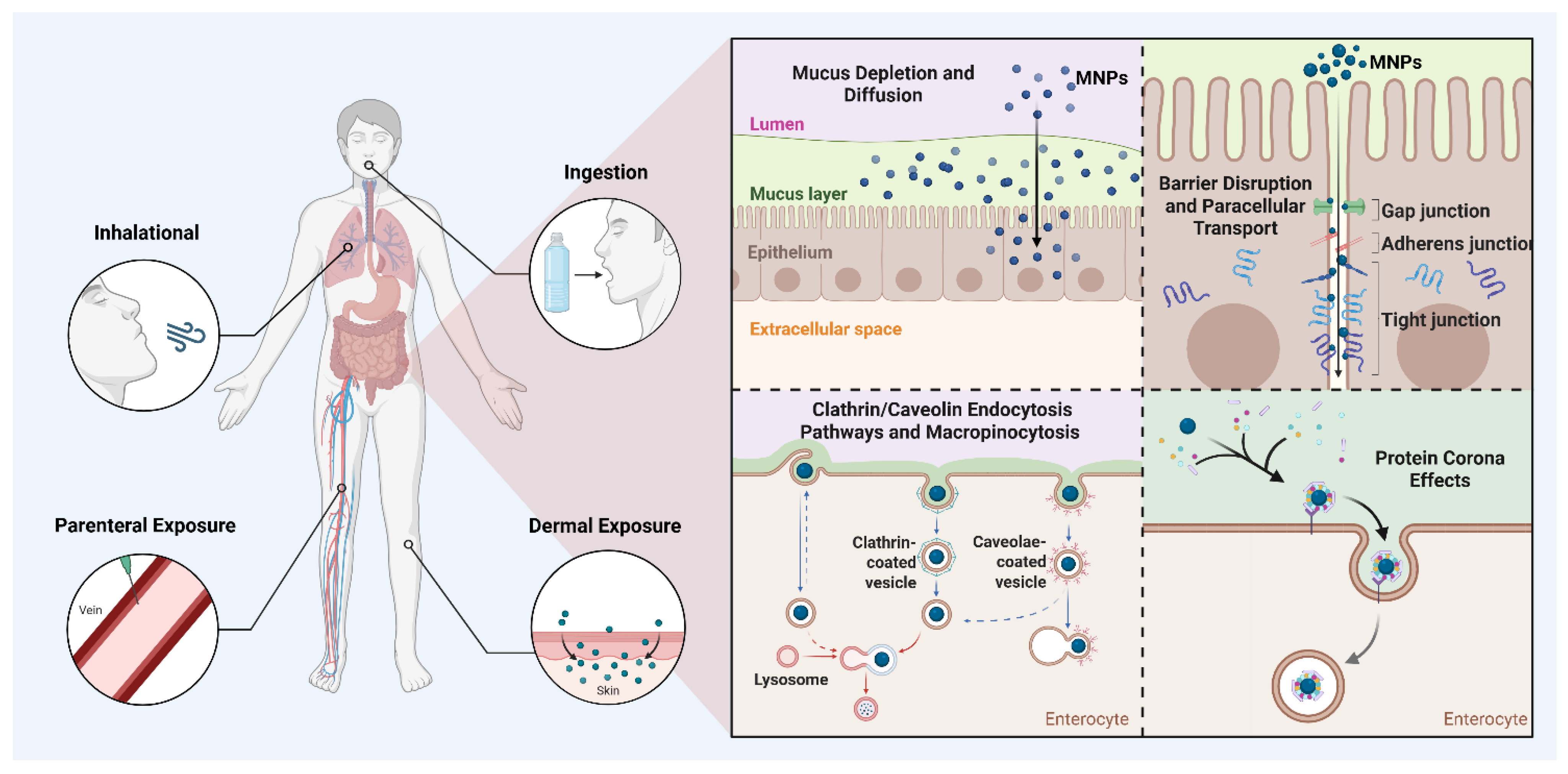
2. Types of Micro- and Nanoplastics, Biological Relevance and Mechanisms of Uptake
3. Early-Onset Colorectal Cancer: Clinical Significance and Molecular Signature
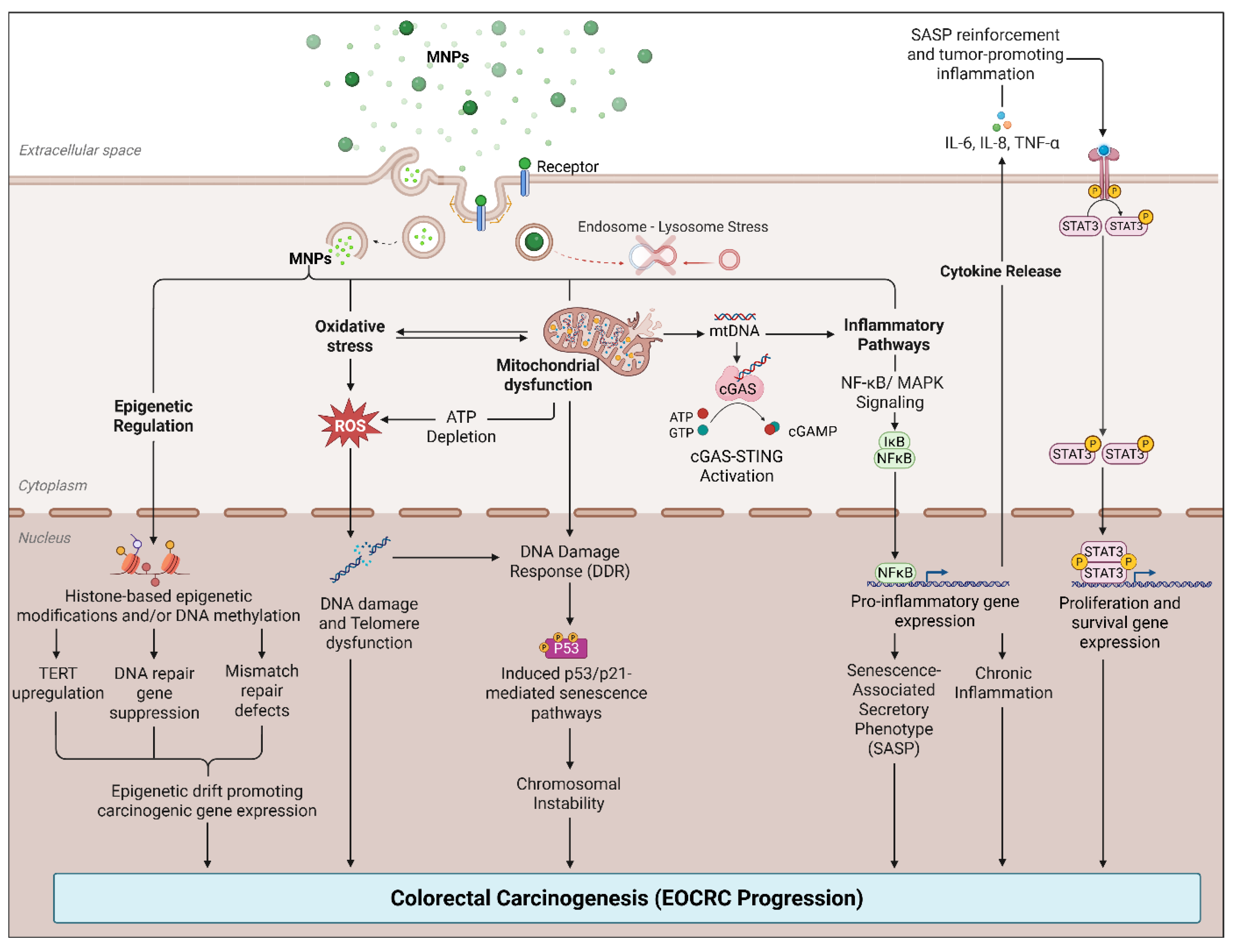
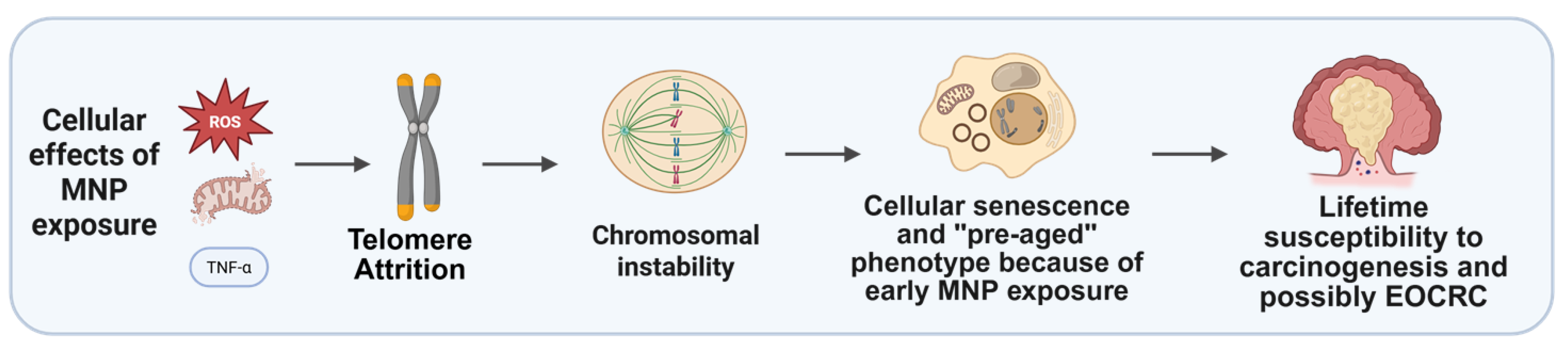
4. Microplastics and Colorectal Carcinogenesis: Integrating Telomere Biology and EOCRC Molecular Features
5. Colorectal Organoid Models and MNPs: State of the Field, Limitations, and Promise
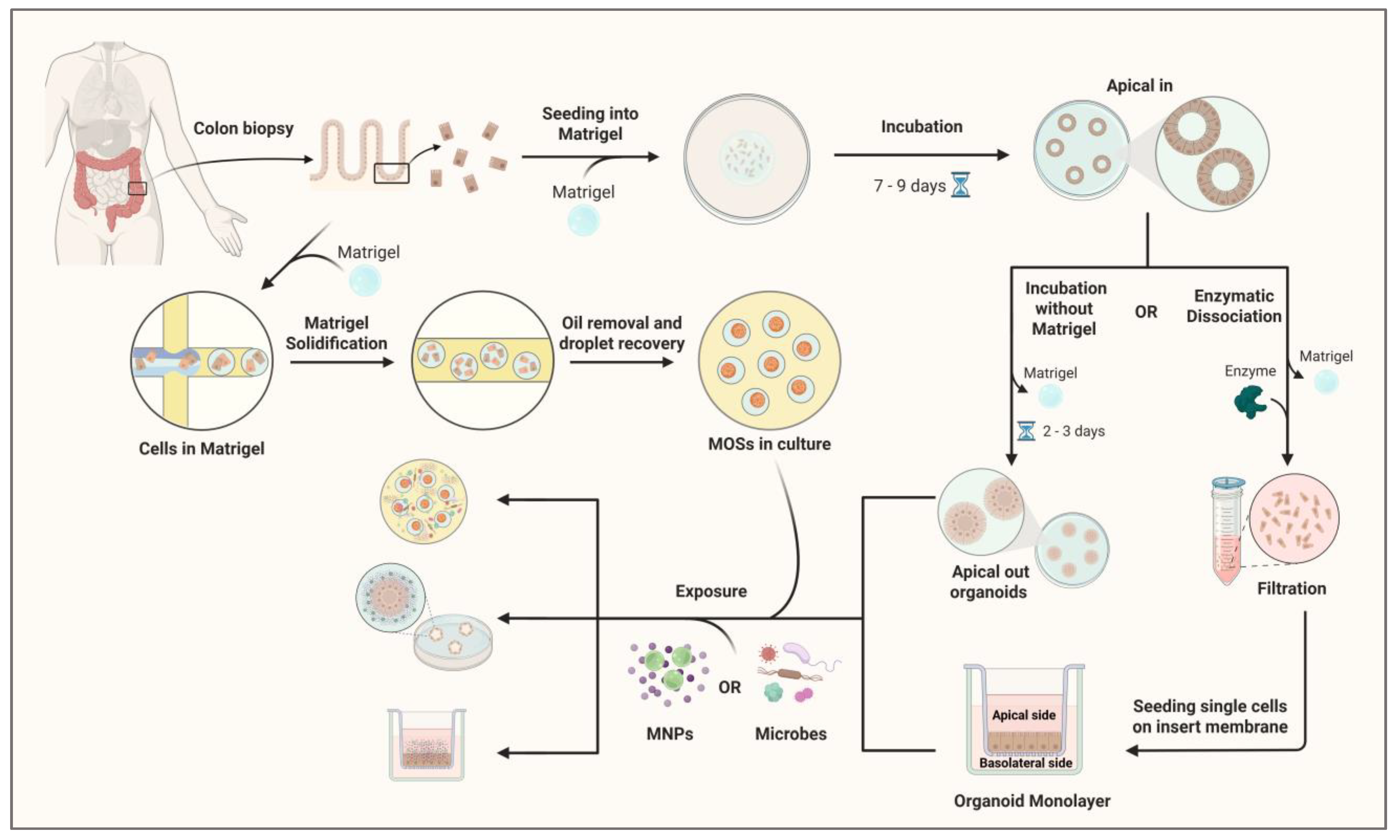
- Apical-Out organoids: Direct Luminal Exposure Models. A major innovation in organoid-based toxicology is the development of apical-out organoids, in which the luminal (apical) surface is oriented outward toward the culture medium (Figure 3). This configuration enables direct exposure of the epithelium to suspended MNPs, closely mimicking oral ingestion and supporting dynamic, high-resolution functional analyses [76]. In a recent study, apical-out small-intestinal organoids were combined with fluorescence lifetime imaging microscopy (FLIM) to track nanoparticle interactions in real time. Using pristine PMMA and polystyrene nanoparticles (<200 nm), the authors demonstrated topology-dependent uptake, with apical-out models showing faster and more uniform internalization compared to conventional basal-out organoids. FLIM further enabled ‘lifetime barcoding,’ allowing discrimination of particle types and mapping of interaction sites within the tissue microenvironment. Functionally, both short—(24 h) and long-term (72 h) exposures disrupted mitochondrial membrane potential and increased CXCL-8 secretion, reflecting early epithelial stress in intact 3D tissue. Together, these findings establish apical-out colorectal organoids as a highly powerful platform for modeling luminal exposure scenarios relevant to EOCRC [77]. While apical-out culture has been widely applied to tumor-derived and small-intestinal organoids, it is also feasible in normal human colon organoids, with careful handling in suspension to preserve epithelial polarity and viability. CRC-derived organoids are generally more robust in this configuration, facilitating broader experimental applications [76,78].
- Organoid-Derived Epithelial Monolayers: High-Throughput Barrier Models. To complement 3D systems, organoid-derived epithelial monolayers have been developed by dissociating organoids and seeding single cells onto permeable supports, where they reconstitute a polarized epithelial sheet. These models retain the diverse cell populations of colorectal organoids while offering enhanced accessibility to both apical and basolateral compartments (Figure 3). Importantly, they allow for quantitative assessment of barrier integrity, particle transport, and transepithelial permeability, parameters difficult to measure in 3D organoids [79]. A study using monolayers has shown that NPs as small as 50 nm can cross the epithelial barrier through clathrin-mediated endocytosis, preferentially accumulating in secretory and absorptive cell subsets. Co-exposure experiments with chlorpromazine, a clathrin pathway inhibitor, significantly reduced MNP internalization, underscoring the active, energy-dependent mechanisms underlying nanoparticle uptake. These monolayers also facilitate high-throughput screening of particle size, shape, and surface chemistry, helping to delineate structure–toxicity relationships at the human intestinal barrier [80]. Recent investigations using human intestinal or colon organoids have begun to illuminate how MNPs influence epithelial integrity, cell-specific uptake, and inflammatory signaling. M cells are specialized epithelial cells located in the follicle-associated epithelium of the gut that facilitate the transcytosis of luminal particles and antigens to underlying immune cells, thereby playing a key role in mucosal immunity and pathogen sampling. Chen et al. utilized human intestinal organoid–derived epithelial monolayers (with and without M cells) and demonstrated that particle uptake increases with size, concentration, and exposure time, and that M-cell–containing monolayers show significantly greater transport of larger particles and inflammatory cytokine release [81].
- Basal-Out organoids: Modeling Basolateral Exposure and Systemic Risk. Traditional basal-out organoids, where the apical surface faces inward toward the luminal space and the basal surface interfaces directly with the culture medium, are commonly employed in studies modeling systemic or basolateral exposure routes. While this configuration precludes direct luminal access, it remains invaluable for examining basolateral uptake mechanisms, intracellular trafficking, and epithelial–mesenchymal signaling. Indeed, this baseline cultural orientation has been foundational in modeling epithelial homeostasis and dysfunction in organoid systems [82].

| Feature | 3D Apical-In Organoids | 3D Apical-Out Organoids | Organoid-Derived 2D Transwell Monolayers |
|---|---|---|---|
| Polarity/Topology | Apical surface faces lumen; basolateral side exposed to medium | Apical surface faces outward; direct access to luminal side | Flat monolayer; apical and basolateral compartments separated |
| MNP Exposure Route: [Note: Exposure efficiency varies with MNP size and charge] | Microinjection into lumen or basolateral exposure | Direct addition to apical surface in medium | Apical exposure via top chamber or basolateral via bottom chamber |
| Advantages | Preserves stem cell niche and crypt-villus architecture; high physiological relevance | Directly mimics luminal exposure; easier MNP dose control; suitable for mucus and microbiome co-culture | High throughput; Transepithelial/Transendothelial Electrical Resistance (TEER) measurements possible; suitable for permeability, transport and signaling studies |
| Limitations | Technically challenging microinjection; lower throughput; difficult imaging of apical responses | Loss of some niche signaling; fragile polarity (Polarity can revert over time; difficult to sustain beyond several passages); limited chronic exposure modeling | Loss of 3D architecture; reduced stem cell maintenance; limited crypt-villus physiology |
| Best Applications | Studying stem cell niche response, genomic instability, telomere dynamics | Modeling MNP luminal exposure, epithelial barrier disruption, immune activation | Transport studies, high-throughput MNP screening, co-culture with immune or stromal cells |
| Telomere Assays | qPCR, Q-FISH, and STELA possible; reflects crypt cell-specific effects | qPCR and Q-FISH feasible; easier spatial mapping of apical vs. basal shortening | qPCR-based telomere length analysis; suitable for time-course telomere attrition studies |
| Barrier Function Tests | Limited; TEER not possible | Moderate; measure dye permeability but no TEER | Direct TEER measurement; tracer assays (FITC-dextran, Lucifer Yellow), Integration with microfluidic chips possible for real-time monitoring (especially Transwell) |
| Co-Culture Potential | Limited but possible with immune cells in basolateral medium | Good compatibility with mucus-producing bacteria and immune cells without microinjection. | Easiest integration of immune, stromal, or endothelial co-cultures |
| Physiological Fidelity | Highest, retains crypt-villus gradient | Moderate, partially recapitulates lumenal exposure | Lowest, but controllable environment |
| Chronic Exposure Modeling | Feasible with passaging; better reflects cumulative aging | Possible but polarity instability limits long-term studies | Highly suitable for repeated-dose MNP exposure experiments |
| Throughput | Low | Moderate | High |
| Cost & Technical Demand | High cost, technically challenging | Moderate cost, medium technical expertise required | Lower cost, simpler culture methods |
| Quality Control | Requires immunostaining, RNA-seq, and single-cell QC | Requires polarity markers and barrier integrity tests | TEER, staining, and transcriptomic QC feasible |
6. Leveraging Colon Organoid Models to Study MNP-Induced EOCRC
| Process | Mechanistic Focus | Model Type/Assays | Key Findings and References |
|---|---|---|---|
| Inflammation | Cytokine release, immune activation | Human colon organoids exposed to MPs; apoptosis and immune gene expression | MNPs (50–100 nm) ↓ viability, ↑ inflammatory/apoptotic genes [86] |
| Endocytic uptake and NF-κB activation | Intestinal organoids with PS-NPs; inflammatory response via endocytosis | PS NPs (~50 nm) accumulate, cause apoptosis/inflammation via clathrin-mediated endocytosis [80] | |
| Immune modulation and microenvironmental remodeling | Mouse colon microenvironment altered by NPs | NPs trigger IL-1β macrophages, Treg/Th17 skewing [92] | |
| DNA Damage | ROS generation, strand breaks | iPSC-derived intestinal/colon organoids exposed to food-grade TiO2 (E171) | Dose-dependent ROS and DNA damage; altered DNA repair pathways [93] |
| DNA cleavage and oxidative stress | Cell-free and epithelial cell assays with PS-NH2 NPs | PS-NH2 NPs cause DNA cleavage; size/surface chemistry matters [105] | |
| Cellular Senescence | Stem cell aging, SASP | Long-term culture of intestinal/colon organoids and organoids from aged mice | Organoid systems allow potential study of senescence markers (p16, SA-β-gal), highlights the value of organoid models for studying aging [97,106] |
| Epigenetic Alteration | DNA methylation reprogramming in hereditary CRC risk | FAP-patient–derived normal colon organoids | Identified distinct methylation landscapes in FAP organoids, revealing early epigenetic changes linked to CRC predisposition [96] |
| Multi-omics integration for MNP exposure profiling | Proposed organoid-based epigenetic platforms (ATAC-seq, ChIP-seq, RNA-seq) | Platform enables ATAC-seq/ChIP-seq/RNA-seq for epigenetic profiling [98] | |
| Combined Stress Effects | Signaling modulation post MNP + radiation | Murine intestinal organoids with chronic low-dose NP exposure + radiation | Chronic NP exposure enhances TGF-β1/Smad signaling and amplifies inflammatory injury [107] |
7. Conclusions
8. Challenges and Future Directions
Author Contributions
Funding
Data Availability Statement
Acknowledgments
Conflicts of Interest
References
- Heydari, Z.; Devasahayam Arokia Balaya, R.; Sarkar, G.; Boardman, L. The Role of Organoids in Advancing Colorectal Cancer Research: Insights and Future Directions. Cancers 2025, 17, 2129. [Google Scholar] [CrossRef]
- Morgan, E.; Arnold, M.; Gini, A.; Lorenzoni, V.; Cabasag, C.; Laversanne, M.; Vignat, J.; Ferlay, J.; Murphy, N.; Bray, F. Global burden of colorectal cancer in 2020 and 2040: Incidence and mortality estimates from GLOBOCAN. Gut 2023, 72, 338–344. [Google Scholar] [CrossRef]
- Willauer, A.N.; Liu, Y.; Pereira, A.A.; Lam, M.; Morris, J.S.; Raghav, K.P.; Morris, V.K.; Menter, D.; Broaddus, R.; Meric-Bernstam, F. Clinical and molecular characterization of early-onset colorectal cancer. Cancer 2019, 125, 2002–2010. [Google Scholar] [CrossRef]
- Bailey, C.E.; Hu, C.-Y.; You, Y.N.; Bednarski, B.K.; Rodriguez-Bigas, M.A.; Skibber, J.M.; Cantor, S.B.; Chang, G.J. Increasing disparities in the age-related incidences of colon and rectal cancers in the United States, 1975–2010. JAMA Surg. 2015, 150, 17–22. [Google Scholar] [CrossRef]
- Collaborative, R.; Zaborowski, A.M.; Abdile, A.; Adamina, M.; Aigner, F.; d’Allens, L.; Allmer, C.; Álvarez, A.; Anula, R.; Andric, M. Characteristics of early-onset vs late-onset colorectal cancer: A review. JAMA Surg. 2021, 156, 865–874. [Google Scholar] [CrossRef]
- Spaander, M.C.; Zauber, A.G.; Syngal, S.; Blaser, M.J.; Sung, J.J.; You, Y.N.; Kuipers, E.J. Young-onset colorectal cancer. Nat. Rev. Dis. Primers 2023, 9, 21. [Google Scholar] [CrossRef]
- Zinkeng, A.; Taylor, F.L.; Cheong, S.H.; Song, H.; Merchant, J.L. Early onset colorectal cancer: Molecular underpinnings accelerating occurrence. Cell. Mol. Gastroenterol. Hepatol. 2025, 19, 101425. [Google Scholar] [CrossRef] [PubMed]
- Pan, H.; Zhao, Z.; Deng, Y.; Zheng, Z.; Huang, Y.; Huang, S.; Chi, P. The global, regional, and national early-onset colorectal cancer burden and trends from 1990 to 2019: Results from the Global Burden of Disease Study 2019. BMC Public Health 2022, 22, 1896. [Google Scholar] [CrossRef] [PubMed]
- Coleman, O.I.; Haller, D. Microbe–mucus interface in the pathogenesis of colorectal cancer. Cancers 2021, 13, 616. [Google Scholar] [CrossRef] [PubMed]
- Purcell, R.V.; Pearson, J.; Aitchison, A.; Dixon, L.; Frizelle, F.A.; Keenan, J.I. Colonization with enterotoxigenic Bacteroides fragilis is associated with early-stage colorectal neoplasia. PLoS ONE 2017, 12, e0171602. [Google Scholar] [CrossRef]
- Sinicrope, F.A. Increasing incidence of early-onset colorectal cancer. N. Engl. J. Med. 2022, 386, 1547–1558. [Google Scholar] [CrossRef]
- Geyer, R.; Jambeck, J.R.; Law, K.L. Production, use, and fate of all plastics ever made. Sci. Adv. 2017, 3, e1700782. [Google Scholar] [CrossRef]
- Hofmann, T.; Ghoshal, S.; Tufenkji, N.; Adamowski, J.F.; Bayen, S.; Chen, Q.; Demokritou, P.; Flury, M.; Hüffer, T.; Ivleva, N.P. Plastics can be used more sustainably in agriculture. Commun. Earth Environ. 2023, 4, 332. [Google Scholar] [CrossRef]
- Walenna, M.A.; Hanami, Z.A.; Hidayat, R.; Damayanti, A.D.; Notodarmojo, S.; Caroles, L. Examining soil microplastics: Prevalence and consequences across varied land use contexts. Civ. Eng. J. 2024, 10, 1265–1291. [Google Scholar] [CrossRef]
- Kadac-Czapska, K.; Ośko, J.; Knez, E.; Grembecka, M. Microplastics and oxidative stress—Current problems and prospects. Antioxidants 2024, 13, 579. [Google Scholar] [CrossRef]
- Lugrin, J.; Rosenblatt-Velin, N.; Parapanov, R.; Liaudet, L. The role of oxidative stress during inflammatory processes. Biol. Chem. 2014, 395, 203–230. [Google Scholar] [CrossRef] [PubMed]
- Deng, Y.; Zhang, Y.; Lemos, B.; Ren, H. Tissue accumulation of microplastics in mice and biomarker responses suggest widespread health risks of exposure. Sci. Rep. 2017, 7, 46687. [Google Scholar] [CrossRef] [PubMed]
- Walczak, A.P.; Kramer, E.; Hendriksen, P.J.; Tromp, P.; Helsper, J.P.; Van Der Zande, M.; Rietjens, I.M.; Bouwmeester, H. Translocation of differently sized and charged polystyrene nanoparticles in in vitro intestinal cell models of increasing complexity. Nanotoxicology 2015, 9, 453–461. [Google Scholar] [CrossRef] [PubMed]
- Sato, T.; Stange, D.E.; Ferrante, M.; Vries, R.G.; Van Es, J.H.; Van Den Brink, S.; Van Houdt, W.J.; Pronk, A.; Van Gorp, J.; Siersema, P.D. Long-term expansion of epithelial organoids from human colon, adenoma, adenocarcinoma, and Barrett’s epithelium. Gastroenterology 2011, 141, 1762–1772. [Google Scholar] [CrossRef]
- Davoudi, Z.; Peroutka-Bigus, N.; Bellaire, B.; Jergens, A.; Wannemuehler, M.; Wang, Q. Gut organoid as a new platform to study alginate and chitosan mediated PLGA nanoparticles for drug delivery. Mar. Drugs 2021, 19, 282. [Google Scholar] [CrossRef]
- Gómez, D.P.; Boudreau, F. Organoids and their use in modeling gut epithelial cell lineage differentiation and barrier properties during intestinal diseases. Front. Cell Dev. Biol. 2021, 9, 732137. [Google Scholar] [CrossRef]
- Heydari, Z.; Moeinvaziri, F.; Mirazimi, S.M.A.; Dashti, F.; Smirnova, O.; Shpichka, A.; Mirzaei, H.; Timashev, P.; Vosough, M. Alteration in DNA methylation patterns: Epigenetic signatures in gastrointestinal cancers. Eur. J. Pharmacol. 2024, 973, 176563. [Google Scholar] [CrossRef]
- Wright, S.L.; Kelly, F.J. Plastic and human health: A micro issue? Environ. Sci. Technol. 2017, 51, 6634–6647. [Google Scholar] [CrossRef]
- Prata, J.C.; Da Costa, J.P.; Lopes, I.; Duarte, A.C.; Rocha-Santos, T. Environmental exposure to microplastics: An overview on possible human health effects. Sci. Total Environ. 2020, 702, 134455. [Google Scholar] [CrossRef] [PubMed]
- Lamoree, M.H.; van Boxel, J.; Nardella, F.; Houthuijs, K.J.; Brandsma, S.H.; Béen, F.; van Duursen, M.B. Health impacts of microplastic and nanoplastic exposure. Nat. Med. 2025, 31, 2873–2887. [Google Scholar] [CrossRef]
- Amato-Lourenço, L.F.; Carvalho-Oliveira, R.; Júnior, G.R.; dos Santos Galvão, L.; Ando, R.A.; Mauad, T. Presence of airborne microplastics in human lung tissue. J. Hazard. Mater. 2021, 416, 126124. [Google Scholar] [CrossRef]
- Cox, K.D.; Covernton, G.A.; Davies, H.L.; Dower, J.F.; Juanes, F.; Dudas, S.E. Human consumption of microplastics. Environ. Sci. Technol. 2019, 53, 7068–7074. [Google Scholar] [CrossRef]
- Ali, N.; Katsouli, J.; Marczylo, E.L.; Gant, T.W.; Wright, S.; De La Serna, J.B. The potential impacts of micro-and-nano plastics on various organ systems in humans. EBioMedicine 2024, 99, 104901. [Google Scholar] [CrossRef]
- Yarahmadi, A.; Heidari, S.; Sepahvand, P.; Afkhami, H.; Kheradjoo, H. Microplastics and environmental effects: Investigating the effects of microplastics on aquatic habitats and their impact on human health. Front. Public Health 2024, 12, 1411389. [Google Scholar] [CrossRef] [PubMed]
- Gigault, J.; Ter Halle, A.; Baudrimont, M.; Pascal, P.-Y.; Gauffre, F.; Phi, T.-L.; El Hadri, H.; Grassl, B.; Reynaud, S. Current opinion: What is a nanoplastic? Environ. Pollut. 2018, 235, 1030–1034. [Google Scholar] [CrossRef]
- Brouwer, H.; Porbahaie, M.; Boeren, S.; Busch, M.; Bouwmeester, H. The in vitro gastrointestinal digestion-associated protein corona of polystyrene nano-and microplastics increases their uptake by human THP-1-derived macrophages. Part. Fibre Toxicol. 2024, 21, 4. [Google Scholar] [CrossRef] [PubMed]
- Bruno, A.; Dovizio, M.; Milillo, C.; Aruffo, E.; Pesce, M.; Gatta, M.; Chiacchiaretta, P.; Di Carlo, P.; Ballerini, P. Orally ingested micro-and nano-plastics: A hidden driver of inflammatory bowel disease and colorectal cancer. Cancers 2024, 16, 3079. [Google Scholar] [CrossRef]
- Cheng, Y.; Chen, J.; Fu, R.; Zhang, P.; Chen, H.; Cao, H.; Jiang, Z.; Hong, Y.; Li, Y.; He, C. Molecular mechanism differences between nanoplastics and microplastics in colon toxicity: Nanoplastics induce ferroptosis-mediated immunogenic cell death, while microplastics cause cell metabolic reprogramming. J. Nanobiotechnol. 2025, 23, 505. [Google Scholar] [CrossRef]
- Fackelmann, G.; Sommer, S. Microplastics and the gut microbiome: How chronically exposed species may suffer from gut dysbiosis. Mar. Pollut. Bull. 2019, 143, 193–203. [Google Scholar] [CrossRef]
- Zeng, G.; Li, J.; Wang, Y.; Su, J.; Lu, Z.; Zhang, F.; Ding, W. Polystyrene microplastic-induced oxidative stress triggers intestinal barrier dysfunction via the NF-κB/NLRP3/IL-1β/MCLK pathway. Environ. Pollut. 2024, 345, 123473. [Google Scholar] [CrossRef] [PubMed]
- Cedervall, T.; Lynch, I.; Lindman, S.; Berggård, T.; Thulin, E.; Nilsson, H.; Dawson, K.A.; Linse, S. Understanding the nanoparticle–protein corona using methods to quantify exchange rates and affinities of proteins for nanoparticles. Proc. Natl. Acad. Sci. USA 2007, 104, 2050–2055. [Google Scholar] [CrossRef]
- Khan, A.; Jia, Z. Recent insights into uptake, toxicity, and molecular targets of microplastics and nanoplastics relevant to human health impacts. Iscience 2023, 26, 106061. [Google Scholar] [CrossRef] [PubMed]
- Fröhlich, E. The role of surface charge in cellular uptake and cytotoxicity of medical nanoparticles. Int. J. Nanomed. 2012, 7, 5577–5591. [Google Scholar] [CrossRef]
- Yee, M.S.-L.; Hii, L.-W.; Looi, C.K.; Lim, W.-M.; Wong, S.-F.; Kok, Y.-Y.; Tan, B.-K.; Wong, C.-Y.; Leong, C.-O. Impact of microplastics and nanoplastics on human health. Nanomaterials 2021, 11, 496. [Google Scholar] [CrossRef]
- van Wijngaarden, E.W.; Arias, S.L.; Rhee, M.; Silberstein, M.N.; Brito, I.L. The role of human intestinal mucus in the prevention of microplastic uptake and cell damage. Biomater. Sci. 2025, 13, 1010–1020. [Google Scholar] [CrossRef]
- Waldmann, A.; Borchers, P.; Katalinic, A. Temporal trends in age-and stage-specific incidence of colorectal adenocarcinomas in Germany. BMC Cancer 2023, 23, 1180. [Google Scholar] [CrossRef]
- Murphy, C.C.; Sandler, R.S.; Sanoff, H.K.; Yang, Y.C.; Lund, J.L.; Baron, J.A. Decrease in incidence of colorectal cancer among individuals 50 years or older after recommendations for population-based screening. Clin. Gastroenterol. Hepatol. 2017, 15, 903–909. e906. [Google Scholar] [CrossRef]
- Tonini, V.; Zanni, M. Why is early detection of colon cancer still not possible in 2023? World J. Gastroenterol. 2024, 30, 211. [Google Scholar] [CrossRef]
- Tsukanov, V.V.; Vasyutin, A.V.; Tonkikh, J.L. Risk factors, prevention and screening of colorectal cancer: A rising problem. World J. Gastroenterol. 2025, 31, 98629. [Google Scholar] [CrossRef] [PubMed]
- Siddique, S.; Wang, R.; Yasin, F.; Gaddy, J.J.; Zhang, L.; Gross, C.P.; Ma, X. USPSTF colorectal cancer screening recommendation and uptake for individuals aged 45 to 49 years. JAMA Netw. Open 2024, 7, e2436358. [Google Scholar] [CrossRef]
- Martel-Martel, A.; Corchete, L.A.; Martí, M.; Vidal-Tocino, R.; Hurtado, E.; Álvaro, E.; Jiménez, F.; Jiménez-Toscano, M.; Balaguer, F.; Sanz, G. Telomere length as a new risk marker of early-onset colorectal cancer. Int. J. Mol. Sci. 2023, 24, 3526. [Google Scholar] [CrossRef] [PubMed]
- Nelson, B.; Faquin, W. Decoding the mysterious surge in early-onset colorectal cancers: In this second of a two-part series on new investigations into rising breast and colorectal cancer rates, researchers are trying to tease out the risk factors that have fueled a troubling increase in early-onset colorectal cancers. Cancer Cytopathol. 2025, 133, e70025. [Google Scholar] [CrossRef] [PubMed]
- Abboud, Y.; Shah, A.; Fraser, M.; Montminy, E.M.; Pan, C.-W.; Hajifathalian, K.; Gaglio, P.J.; Al-Khazraji, A. Rising Incidence and Mortality of Early-Onset Colorectal Cancer in Young Cohorts Associated with Delayed Diagnosis. Cancers 2025, 17, 1500. [Google Scholar] [CrossRef]
- Wen, Q.; Han, S.; Cui, Y. Research progress of colorectal cancer in genomic and transcriptomic at multi-level. Front. Genet. 2025, 16, 1533817. [Google Scholar] [CrossRef]
- Myant, K.; Sansom, O.J. Wnt signaling and colorectal cancer. In Wnt Signaling in Development and Disease: Molecular Mechanisms and Biological Functions; John Wiley & Sons: Hoboken, NJ, USA, 2014; pp. 357–367. [Google Scholar] [CrossRef]
- Storandt, M.H.; Shi, Q.; Eng, C.; Lieu, C.; George, T.; Stoppler, M.C.; Mauer, E.; Yilma, B.; Fragkogianni, S.; Teslow, E.A. Genomic Landscapes of Early-Onset Versus Average-Onset Colorectal Cancer Populations. Cancers 2025, 17, 836. [Google Scholar] [CrossRef]
- Wen, J.; Yuhua, L. Invisible Invaders: Unveiling the Carcinogenic Threat of Microplastics and Nanoplastics in Colorectal Cancer-A Systematic Review. Front. Public Health 2025, 13, 1653245. [Google Scholar] [CrossRef] [PubMed]
- Li, S.; Keenan, J.I.; Shaw, I.C.; Frizelle, F.A. Could microplastics be a driver for early onset colorectal cancer? Cancers 2023, 15, 3323. [Google Scholar] [CrossRef]
- Marx, O.; Mankarious, M.; Yochum, G. Molecular genetics of early-onset colorectal cancer. World J. Biol. Chem. 2023, 14, 13. [Google Scholar] [CrossRef]
- Boardman, L.A.; Johnson, R.A.; Viker, K.B.; Hafner, K.A.; Jenkins, R.B.; Riegert-Johnson, D.L.; Smyrk, T.C.; Litzelman, K.; Seo, S.; Gangnon, R.E. Correlation of chromosomal instability, telomere length and telomere maintenance in microsatellite stable rectal cancer: A molecular subclass of rectal cancer. PLoS ONE 2013, 8, e80015. [Google Scholar] [CrossRef] [PubMed]
- Tricoli, J.V.; Boardman, L.A.; Patidar, R.; Sindiri, S.; Jang, J.S.; Walsh, W.D.; McGregor, P.M., III; Camalier, C.E.; Mehaffey, M.G.; Furman, W.L. A mutational comparison of adult and adolescent and young adult (AYA) colon cancer. Cancer 2018, 124, 1070–1082. [Google Scholar] [CrossRef]
- Chen, F.; Chen, J.; Luo, D.; Zhang, R.; Yang, Y.; Li, Q.; Li, X. Prognosis and clinicopathological features of patients with early-onset and late-onset colorectal cancer with second primary malignancies. J. Gastroenterol. Hepatol. 2025, 40, 133–141. [Google Scholar] [CrossRef]
- Blackwell, T.A.; Cervenka, I.; Khatri, B.; Brown, J.L.; Rosa-Caldwell, M.E.; Lee, D.E.; Perry, R.A., Jr.; Brown, L.A.; Haynie, W.S.; Wiggs, M.P. Transcriptomic analysis of the development of skeletal muscle atrophy in cancer-cachexia in tumor-bearing mice. Physiol. Genom. 2018, 50, 1071–1082. [Google Scholar] [CrossRef]
- Li, X.; Niu, H.; Huang, Z.; Zhang, M.; Xing, M.; Chen, Z.; Wu, L.; Xu, P. Deciphering the Role of the Gut Microbiota in Exposure to Emerging Contaminants and Diabetes: A Review. Metabolites 2024, 14, 108. [Google Scholar] [CrossRef]
- Zhang, Q.; Li, J.; Shen, L.; Li, Y.; Wang, X. Opportunities and challenges of immunotherapy for dMMR/MSI-H colorectal cancer. Cancer Biol. Med. 2023, 20, 706. [Google Scholar] [CrossRef]
- Veen, T.; Kanani, A.; Lea, D.; Søreide, K. Clinical trials of neoadjuvant immune checkpoint inhibitors for early-stage operable colon and rectal cancer. Cancer Immunol. Immunother. 2023, 72, 3135–3147. [Google Scholar] [CrossRef]
- Zhou, Y.; Chen, X.; Chen, J.; Kendrick, C.D.; Ramanathan, R.K.; Graham, R.P.; Kossick, K.F.; Boardman, L.A.; Barrett, M.T. Genomic landscape of diploid and aneuploid microsatellite stable early onset colorectal cancer. Sci. Rep. 2024, 14, 9368. [Google Scholar] [CrossRef]
- Zhao, J.; Ji, H.; Li, K.; Yu, G.; Zhou, S.; Xiao, Q.; Dunlop, M.; Theodoratou, E.; Li, X.; Ding, K. Decoding the genetic and environmental forces in propelling the surge of early-onset colorectal cancer. Chin. Med. J. 2025, 138, 1163–1174. [Google Scholar] [CrossRef]
- Xie, S.; Zhang, R.; Li, Z.; Liu, C.; Chen, Y.; Yu, Q. Microplastics perturb colonic epithelial homeostasis associated with intestinal overproliferation, exacerbating the severity of colitis. Environ. Res. 2023, 217, 114861. [Google Scholar] [CrossRef]
- Donkers, J.M.; Höppener, E.M.; Grigoriev, I.; Will, L.; Melgert, B.N.; van der Zaan, B.; van de Steeg, E.; Kooter, I.M. Advanced epithelial lung and gut barrier models demonstrate passage of microplastic particles. Microplastics Nanoplastics 2022, 2, 6. [Google Scholar] [CrossRef]
- Tamargo, A.; Molinero, N.; Reinosa, J.J.; Alcolea-Rodriguez, V.; Portela, R.; Bañares, M.A.; Fernández, J.F.; Moreno-Arribas, M.V. PET microplastics affect human gut microbiota communities during simulated gastrointestinal digestion, first evidence of plausible polymer biodegradation during human digestion. Sci. Rep. 2022, 12, 528. [Google Scholar] [CrossRef] [PubMed]
- Li, B.; Ding, Y.; Cheng, X.; Sheng, D.; Xu, Z.; Rong, Q.; Wu, Y.; Zhao, H.; Ji, X.; Zhang, Y. Polyethylene microplastics affect the distribution of gut microbiota and inflammation development in mice. Chemosphere 2020, 244, 125492. [Google Scholar] [CrossRef] [PubMed]
- O’Sullivan, J.; Risques, R.A.; Mandelson, M.T.; Chen, L.; Brentnall, T.A.; Bronner, M.P.; MacMillan, M.P.; Feng, Z.; Siebert, J.R.; Potter, J.D. Telomere length in the colon declines with age: A relation to colorectal cancer? Cancer Epidemiol. Biomark. Prev. 2006, 15, 573–577. [Google Scholar] [CrossRef] [PubMed]
- Boardman, L.A.; Litzelman, K.; Seo, S.; Johnson, R.A.; Vanderboom, R.J.; Kimmel, G.W.; Cunningham, J.M.; Gangnon, R.E.; Engelman, C.D.; Riegert-Johnson, D.L. The association of telomere length with colorectal cancer differs by the age of cancer onset. Clin. Transl. Gastroenterol. 2014, 5, e52. [Google Scholar] [CrossRef]
- Sandhu, S.; Blandon, C.; Kumar, S. Evaluating Risk Factors for Early-Onset Colorectal Cancer in a Large, Prospective Cohort. Dig. Dis. Sci. 2025, 70, 2834–2842. [Google Scholar] [CrossRef]
- Naing, C.; Aung, K.; Lai, P.K.; Mak, J.W. Association between telomere length and the risk of colorectal cancer: A meta-analysis of observational studies. BMC Cancer 2017, 17, 24. [Google Scholar] [CrossRef]
- Yang, Y.; Chen, Y.; Gao, Y.; Jin, Y.; Xu, F. Mapping research frontiers in microplastics-induced oxidative stress: A bibliometric analysis (2010–2024). Front. Environ. Sci. 2025, 13, 1555341. [Google Scholar] [CrossRef]
- de Sousa, A.K.A.; Pires, K.S.N.; Cavalcante, I.H.; Cavalcante, I.C.L.; Santos, J.D.; Queiroz, M.I.C.; Leite, A.C.R.; Crispim, A.C.; da Rocha Junior, E.R.; Aquino, T.M. Polystyrene microplastics exposition on human placental explants induces time-dependent cytotoxicity, oxidative stress and metabolic alterations. Front. Endocrinol. 2024, 15, 1481014. [Google Scholar] [CrossRef]
- Zhang, S.; Chen, H.; Li, L.; Li, Z.; Wang, D. Exposure to placental microplastic and placental and umbilical cord blood telomere length. Ecotoxicol. Environ. Saf. 2025, 302, 118536. [Google Scholar] [CrossRef]
- Mahmud, F.; Sarker, D.B.; Jocelyn, J.A.; Sang, Q.-X.A. Molecular and cellular effects of microplastics and nanoplastics: Focus on inflammation and senescence. Cells 2024, 13, 1788. [Google Scholar] [CrossRef]
- Devasahayam Arokia Balaya, R.; Heydari, Z.; Sarkar, G.; Garcia, E.M.C.; Hoyos-Vega, J.M.d.; Krueger, E.; Helgeson, L.; Revzin, A.; Ros, A.; Pandey, A. A Practical Guide to Developing and Troubleshooting Patient-Derived “Mini-Gut” Colorectal Organoids for Clinical Research. Methods Protoc. 2025, 8, 121. [Google Scholar] [CrossRef] [PubMed]
- Okkelman, I.A.; Zhou, H.; Borisov, S.M.; Debruyne, A.C.; Lefebvre, A.E.; Leomil Zoccoler, M.; Chen, L.; Devriendt, B.; Dmitriev, R.I. Visualizing the internalization and biological impact of nanoplastics in live intestinal organoids by Fluorescence Lifetime Imaging Microscopy (FLIM). Light Sci. Appl. 2025, 14, 272. [Google Scholar] [CrossRef] [PubMed]
- Co, J.Y.; Margalef-Català, M.; Monack, D.M.; Amieva, M.R. Controlling the polarity of human gastrointestinal organoids to investigate epithelial biology and infectious diseases. Nat. Protoc. 2021, 16, 5171–5192. [Google Scholar] [CrossRef]
- van Dooremalen, W.T.; Derksen, M.; Roos, J.L.; Barón, C.H.; Verissimo, C.S.; Vries, R.G.; Boj, S.F.; Pourfarzad, F. Organoid-derived epithelial monolayer: A clinically relevant in vitro model for intestinal barrier function. J. Vis. Exp. JoVE 2021, 173, e62074. [Google Scholar] [CrossRef]
- Hou, Z.; Meng, R.; Chen, G.; Lai, T.; Qing, R.; Hao, S.; Deng, J.; Wang, B. Distinct accumulation of nanoplastics in human intestinal organoids. Sci. Total Environ. 2022, 838, 155811. [Google Scholar] [CrossRef]
- Chen, Y.; Williams, A.M.; Gordon, E.B.; Rudolph, S.E.; Longo, B.N.; Li, G.; Kaplan, D.L. Biological effects of polystyrene micro-and nano-plastics on human intestinal organoid-derived epithelial tissue models without and with M cells. Nanomed. Nanotechnol. Biol. Med. 2023, 50, 102680. [Google Scholar] [CrossRef] [PubMed]
- Gopalakrishnan, S.; Bakke, I.; Hansen, M.D.; Skovdahl, H.K.; Granlund, A.v.B.; Sandvik, A.K.; Bruland, T. Comprehensive protocols for culturing and molecular biological analysis of IBD patient-derived colon epithelial organoids. Front. Immunol. 2023, 14, 1097383. [Google Scholar] [CrossRef]
- Wilson, S.S.; Tocchi, A.; Holly, M.K.; Parks, W.C.; Smith, J.G. A small intestinal organoid model of non-invasive enteric pathogen–epithelial cell interactions. Mucosal Immunol. 2015, 8, 352–361. [Google Scholar] [CrossRef]
- VanDussen, K.L.; Marinshaw, J.M.; Shaikh, N.; Miyoshi, H.; Moon, C.; Tarr, P.I.; Ciorba, M.A.; Stappenbeck, T.S. Development of an enhanced human gastrointestinal epithelial culture system to facilitate patient-based assays. Gut 2015, 64, 911–920. [Google Scholar] [CrossRef] [PubMed]
- Jattan, J.; Rodia, C.; Li, D.; Diakhate, A.; Dong, H.; Bataille, A.; Shroyer, N.F.; Kohan, A.B. Using primary murine intestinal enteroids to study dietary TAG absorption, lipoprotein synthesis, and the role of apoC-III in the intestine. J. Lipid Res. 2017, 58, 853–865. [Google Scholar] [CrossRef]
- Park, S.B.; Jung, W.H.; Choi, K.J.; Koh, B.; Kim, K.Y. A comparative systematic analysis of the influence of microplastics on colon cells, mouse and colon organoids. Tissue Eng. Regen. Med. 2023, 20, 49–58. [Google Scholar] [CrossRef] [PubMed]
- Mitrofanova, O.; Nikolaev, M.; Xu, Q.; Broguiere, N.; Cubela, I.; Camp, J.G.; Bscheider, M.; Lutolf, M.P. Bioengineered human colon organoids with in vivo-like cellular complexity and function. Cell Stem Cell 2024, 31, 1175–1186.e1177. [Google Scholar] [CrossRef]
- Sugihara, H.Y.; Okamoto, R.; Mizutani, T. Intestinal organoids: The path towards clinical application. Eur. J. Cell Biol. 2024, 104, 151474. [Google Scholar] [CrossRef]
- Tahara, S.; Rentsch, S.; Defaria, F.C.C.; Sarchet, P.; Karna, R.; Calore, F.; Pollock, R.E. Three-dimensional models: From cell culture to Patient-Derived Organoid and its application to future liposarcoma research. Oncol. Res. 2024, 33, 1. [Google Scholar] [CrossRef]
- Kuhn, M.R.; Wolcott, E.A.; Langer, E.M. Developments in gastrointestinal organoid cultures to recapitulate tissue environments. Front. Bioeng. Biotechnol. 2025, 13, 1521044. [Google Scholar] [CrossRef] [PubMed]
- Mo, S.; Dai, W.; Wang, H.; Lan, X.; Ma, C.; Su, Z.; Xiang, W.; Han, L.; Luo, W.; Zhang, L. Early detection and prognosis prediction for colorectal cancer by circulating tumour DNA methylation haplotypes: A multicentre cohort study. EClinicalMedicine 2023, 55, 101717. [Google Scholar] [CrossRef]
- Yang, Q.; Dai, H.; Wang, B.; Xu, J.; Zhang, Y.; Chen, Y.; Ma, Q.; Xu, F.; Cheng, H.; Sun, D. Nanoplastics shape adaptive anticancer immunity in the colon in mice. Nano Lett. 2023, 23, 3516–3523. [Google Scholar] [CrossRef] [PubMed]
- Bischoff, N.S.; Undas, A.K.; van Herwijnen, M.; Verheijen, M.; Briedé, J.J.; van Breda, S.G.; Sijm, D.T.; de Kok, T.M. E171-induced toxicity in human iPSC-derived colon organoids: Effects on cell viability, ROS generation, DNA damage, and gene expression changes. Toxicol. Vitr. 2025, 108, 106105. [Google Scholar] [CrossRef]
- Schröter, L.; Jentsch, L.; Maglioni, S.; Muñoz-Juan, A.; Wahle, T.; Limke, A.; von Mikecz, A.; Laromaine, A.; Ventura, N. A multisystemic approach revealed aminated polystyrene nanoparticles-induced neurotoxicity. Small 2024, 20, 2302907. [Google Scholar] [CrossRef]
- Jo, M.K.; Moon, C.M.; Jeon, H.-J.; Han, Y.; Lee, E.S.; Kwon, J.-H.; Yang, K.-M.; Ahn, Y.-H.; Kim, S.-E.; Jung, S.-A. Effect of aging on the formation and growth of colonic epithelial organoids by changes in cell cycle arrest through TGF-β-Smad3 signaling. Inflamm. Regen. 2023, 43, 35. [Google Scholar] [CrossRef]
- Devall, M.A.; Eaton, S.; Ali, M.W.; Dampier, C.H.; Weisenberger, D.; Powell, S.M.; Li, L.; Casey, G. DNA methylation analysis of normal colon organoids from familial adenomatous polyposis patients reveals novel insight into colon cancer development. Clin. Epigenetics 2022, 14, 104. [Google Scholar] [CrossRef]
- Yin, S.; Ray, G.; Kerschner, J.L.; Hao, S.; Perez, A.; Drumm, M.L.; Browne, J.A.; Leir, S.-H.; Longworth, M.; Harris, A. Functional genomics analysis of human colon organoids identifies key transcription factors. Physiol. Genom. 2020, 52, 234–244. [Google Scholar] [CrossRef] [PubMed]
- Howell, K.J.; Kraiczy, J.; Nayak, K.M.; Gasparetto, M.; Ross, A.; Lee, C.; Mak, T.N.; Koo, B.-K.; Kumar, N.; Lawley, T. DNA methylation and transcription patterns in intestinal epithelial cells from pediatric patients with inflammatory bowel diseases differentiate disease subtypes and associate with outcome. Gastroenterology 2018, 154, 585–598. [Google Scholar] [CrossRef] [PubMed]
- Thalheim, T.; Siebert, S.; Quaas, M.; Herberg, M.; Schweiger, M.R.; Aust, G.; Galle, J. Epigenetic drifts during long-term intestinal organoid culture. Cells 2021, 10, 1718. [Google Scholar] [CrossRef]
- Kharaghani, D.; DeLoid, G.M.; He, P.; Swenor, B.; Bui, T.H.; Zuverza-Mena, N.; Tamez, C.; Musante, C.; Verzi, M.; White, J.C. Toxicity and absorption of polystyrene micro-nanoplastics in healthy and Crohn’s disease human duodenum-chip models. J. Hazard. Mater. 2025, 490, 137714. [Google Scholar] [CrossRef]
- Wang, Z.; Boretto, M.; Millen, R.; Natesh, N.; Reckzeh, E.S.; Hsu, C.; Negrete, M.; Yao, H.; Quayle, W.; Heaton, B.E. Rapid tissue prototyping with micro-organospheres. Stem Cell Rep. 2022, 17, 1959–1975. [Google Scholar] [CrossRef]
- Ding, S.; Hsu, C.; Wang, Z.; Natesh, N.R.; Millen, R.; Negrete, M.; Giroux, N.; Rivera, G.O.; Dohlman, A.; Bose, S. Patient-derived micro-organospheres enable clinical precision oncology. Cell Stem Cell 2022, 29, 905–917.e906. [Google Scholar] [CrossRef] [PubMed]
- Inui, T.; Uraya, Y.; Yokota, J.; Yamashita, T.; Kawai, K.; Okada, K.; Ueyama-Toba, Y.; Mizuguchi, H. Functional intestinal monolayers from organoids derived from human iPS cells for drug discovery research. Stem Cell Res. Ther. 2024, 15, 57. [Google Scholar] [CrossRef] [PubMed]
- Lin, M.; Hartl, K.; Heuberger, J.; Beccaceci, G.; Berger, H.; Li, H.; Liu, L.; Müllerke, S.; Conrad, T.; Heymann, F. Establishment of gastrointestinal assembloids to study the interplay between epithelial crypts and their mesenchymal niche. Nat. Commun. 2023, 14, 3025. [Google Scholar] [CrossRef] [PubMed]
- Li, J.; Zhao, Y. Bioeffects of Nanoplastics: DNA Damage and Mechanism. Nano Lett. 2025, 25, 1660–1665. [Google Scholar] [CrossRef]
- Uchida, R.; Saito, Y.; Nogami, K.; Kajiyama, Y.; Suzuki, Y.; Kawase, Y. Epigenetic Silencing of Lgr5 Induces Senescence of Intestinal Epithelial Organoids During the Process of Aging. Npj Aging Mech. Dis. 2019, 5, 1. [Google Scholar] [CrossRef]
- Guo, P.; Bai, C.; Xuan, L.; Yi, W.; Luo, J.; Pan, H.; Chen, W.; Guan, H.; Zhou, P.; Huang, R. Toxicological assessments based on intestine 3D organoids reveal environmental low-dose nanosized microplastics (NPs) exposure aggravates radiation-induced intestine injury. Chemosphere 2025, 370, 143922. [Google Scholar] [CrossRef]


| Feature/Pathway | EOCRC | AOCRC |
|---|---|---|
| Microsatellite instability (MSI) | MSI in EOCRC (~10–15%), mostly hereditary (Lynch syndrome); sporadic MSI rare | MSI in AOCRC (~20%), mainly sporadic via MLH1 methylation. |
| CpG Island Methylator Phenotype (CIMP) | CIMP-high less prominent in EOCRC; when present, often in right-sided or BRAF-mutant subset | Common in older patients, often linked with BRAF mutations and serrated pathway |
| BRAF (V600E) mutation | Rare (<5%) | Common (~10–20%) |
| KRAS mutations | Moderate (30–40%) | Similar or slightly higher frequency (~40–50%). Note: While AOCRC may have a slightly higher frequency, KRAS remains a major player in both EOCRC and AOCRC. |
| TP53 mutations | More frequent (~60–70%); often early event | Common (~50–60%) |
| APC mutations | Less frequent and occur later; WNT activation via alternative mechanisms (e.g., RNF43 loss) | Very frequent (~80%) early driver event |
| PIK3CA mutations | Less common | More common (~15–20%) |
| Chromosomal instability (CIN) | Present but via different routes; more focal copy number changes | Classic CIN pathway with extensive aneuploidy |
| Epigenetic alterations | Distinct methylation patterns; lower age-related methylation drift. Note: Research has identified unique epigenetic alterations in EOCRC, sometimes linked to specific patient populations or racial/ethnic backgrounds. | Strong age-related methylation changes (epigenetic drift) |
| Tumor location | Predominantly left-sided (rectum, rectosigmoid, sigmoid colon) | More evenly distributed; more right-sided tumors with increasing age |
| Immune microenvironment | Enhanced immune infiltration and inflammatory signatures even in MSS tumors. Note: New research explores differences in T-cell receptor diversity, with higher diversity observed in EOCRC, suggesting distinct immune responses based on age of onset. | Variable; immune infiltration higher in MSI-H tumors only |
| Senescence and aging markers | Altered senescence pathways; upregulation of senescence associated secretory phenotype (SASP)-related genes | Accumulation of aging related senescence gene products. |
| Telomere dynamics | Shorter tumor telomeres associated with telomerase activation and chromosomal instability, longer tumor telomeres. Alternative lengthening of telomeres (ALT) and chromosomal stability (CSS) of tumor DNA | Shorter tumor telomeres, telomerase activation and chromosomally unstable tumor DNA; Longer tumor telomeres, ALT and CSS |
| Histology | Higher proportion of poorly differentiated tumors, mucinous carcinomas, and signet-ring cell carcinomas, which indicates more aggressive tumor biology. | Lower prevalence of aggressive histological features like mucinous and signet-ring cell carcinomas. |
| Gut microbiome association | Increased prevalence of Fusobacterium nucleatum, Bacteroides fragilis, Peptostreptococcus anaerobius | Microbiome dysbiosis, but less distinct composition. Note: Research continues to show distinct microbial profiles between EOCRC and AOCRC, though with some inconsistency across studies. Geographic location and diet are recognized as important confounding factors. |
| Pathways implicated | DNA damage response, metabolic reprogramming, immune regulation | Classic adenoma–carcinoma sequence via APC–KRAS–TP53 axis |
Disclaimer/Publisher’s Note: The statements, opinions and data contained in all publications are solely those of the individual author(s) and contributor(s) and not of MDPI and/or the editor(s). MDPI and/or the editor(s) disclaim responsibility for any injury to people or property resulting from any ideas, methods, instructions or products referred to in the content. |
© 2025 by the authors. Licensee MDPI, Basel, Switzerland. This article is an open access article distributed under the terms and conditions of the Creative Commons Attribution (CC BY) license.
Share and Cite
Heydari, Z.; Sarkar, G.; Helgeson, L.; Cruz Garcia, E.M.; Ros, A.; Khazaie, K.; Boardman, L. Colon Organoids as Experimental Models to Study the Effect of Micro-Nanoparticles as a Driver of Early-Onset Colon Cancer. Cells 2026, 15, 40. https://doi.org/10.3390/cells15010040
Heydari Z, Sarkar G, Helgeson L, Cruz Garcia EM, Ros A, Khazaie K, Boardman L. Colon Organoids as Experimental Models to Study the Effect of Micro-Nanoparticles as a Driver of Early-Onset Colon Cancer. Cells. 2026; 15(1):40. https://doi.org/10.3390/cells15010040
Chicago/Turabian StyleHeydari, Zahra, Gobinda Sarkar, Lauren Helgeson, Estela Mariel Cruz Garcia, Alexandra Ros, Khashayarsha Khazaie, and Lisa Boardman. 2026. "Colon Organoids as Experimental Models to Study the Effect of Micro-Nanoparticles as a Driver of Early-Onset Colon Cancer" Cells 15, no. 1: 40. https://doi.org/10.3390/cells15010040
APA StyleHeydari, Z., Sarkar, G., Helgeson, L., Cruz Garcia, E. M., Ros, A., Khazaie, K., & Boardman, L. (2026). Colon Organoids as Experimental Models to Study the Effect of Micro-Nanoparticles as a Driver of Early-Onset Colon Cancer. Cells, 15(1), 40. https://doi.org/10.3390/cells15010040