


Review

A Special Network Comprised of Macrophages, Epithelial Cells, and Gut Microbiota for Gut Homeostasis

1
Department of Immunology, School of Medicine, Nankai University, Tianjin 300071, China
2
Department of Chemical Pathology, The Chinese University of Hong Kong, Hong Kong 999077, China
3
Translational Medicine Institute, Affiliated Tianjin Union Medical Center, Nankai University, Tianjin 300071, China
4
State Key Laboratory of Medicinal Chemical Biology, Nankai University, Tianjin 300071, China
*
Author to whom correspondence should be addressed.
Cells 2022, 11(2), 307; https://doi.org/10.3390/cells11020307
Submission received: 14 December 2021 / Revised: 12 January 2022 / Accepted: 14 January 2022 / Published: 17 January 2022
(This article belongs to the Special Issue 10th Anniversary of Cells—Advances in Cell Microenvironment)

Abstract

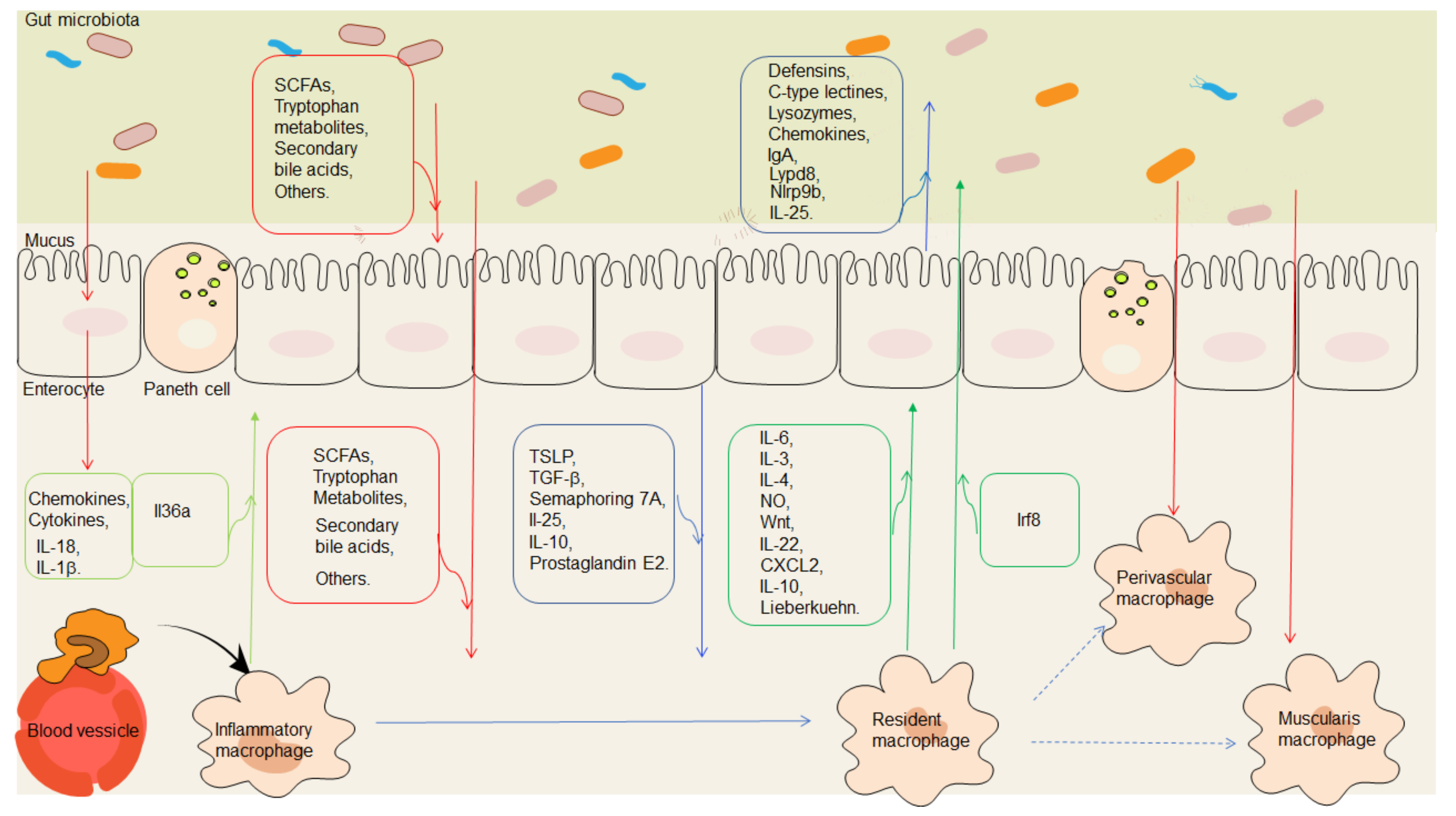
A number of gut epithelial cells derived immunological factors such as cytokines and chemokines, which are stimulated by the gut microbiota, can regulate host immune responses to maintain a well-balance between gut microbes and host immune system. Multiple specialized immune cell populations, such as macrophages, dendritic cells (DCs), innate lymphoid cells, and T regulatory (Treg) cells, can communicate with intestinal epithelial cells (IEC) and/or the gut microbiota bi-directionally. The gut microbiota contributes to the differentiation and function of resident macrophages. Situated at the interface between the gut commensals and macrophages, the gut epithelium is crucial for gut homeostasis in microbial recognition, signaling transformation, and immune interactions, apart from being a physical barrier. Thus, three distinct but interactive components—macrophages, microbiota, and IEC—can form a network for the delicate and dynamic regulation of intestinal homeostasis. In this review, we will discuss the crucial features of gut microbiota, macrophages, and IEC. We will also summarize recent advances in understanding the cooperative and dynamic interactions among the gut microbiota, gut macrophages, and IEC, which constitute a special network for gut homeostasis.
Keywords: gut macrophage; differentiation; tolerance; epithelial barrier; bacteria recognition; immunomodulation; proliferation gut macrophage; differentiation; tolerance; epithelial barrier; bacteria recognition; immunomodulation; proliferation

