Article

Stem Electrical Conductivity of Broccoli (Brassica oleracea L. var. italica Plenk) Under Nitrogen and Phosphorus Fertilizer Deficiency

Department of Environmental and Biological Chemistry, Chungbuk National University, Cheongju 28644, Chungbuk, Republic of Korea
*
Author to whom correspondence should be addressed.
Agronomy 2026, 16(8), 778; https://doi.org/10.3390/agronomy16080778
Submission received: 26 February 2026 / Revised: 17 March 2026 / Accepted: 8 April 2026 / Published: 9 April 2026

Abstract

Nitrogen (N) and phosphorus (P) are essential nutrients that play critical roles in plant physiological processes and the accumulation of N and P in broccoli head was significantly correlated with yield. Therefore, there is a need for a rapid, non-destructive diagnosis of crop status by detecting deficiencies in essential nutrients. This study evaluated the effects of N and P deficiency on field grown broccoli (Brassica oleracea L. var. italica Plenk) using a plant-induced electrical signal (PIES) sensor, in which needle electrodes are inserted into the stem to measure electrical conductivity reflecting plant water and ion status. Four treatments were established, including the control (N100P100) with sufficient N and P supply, N deficiency (N0P100), P deficiency (N100P0), and combined N–P deficiency (N0P0). For sufficient supply, urea and fused phosphate (FP) were applied at rates of 122 kg N ha−1 and 71 kg P ha−1, respectively. Soil, stem, and leaf nutrient contents, growth parameters, and stress related indicators were analyzed and their relationship with PIES values were evaluated. PIES was highest in control (N100P100) and lowest under N–P deficiency (N0P0). Higher PIES values were observed during the vegetative stage, whereas values declined during the reproductive stage, reflecting changes in physiological activity. Growth parameters such as shoot and root weight and stem diameter were generally superior in the control (N100P100) treatment, while leaf calcium (Ca), magnesium (Mg), and potassium (K) concentrations showed no significant differences among treatments. Total N content in leaves was higher in N fertilized treatments (control and P deficiency). Photosynthesis-related parameters, including soil plant analysis development (SPAD), Fv/Fm, and chlorophyll content, were lowest under N–P deficiency, which was reflected in the PIES. Principal component analysis (PCA) showed that the PIES was closely associated with growth and photosynthetic parameters and clearly distinguished N sufficient treatments (control and P deficiency) from N deficient treatments (N0P100, N0P0). Overall, these findings suggest that PIES monitoring can serve as a sensitive physiological indicator of nutrient stress and may be applied as an early diagnostic tool before visible growth inhibition occurs in broccoli cultivation.

1. Introduction

Sustainable agricultural development requires precise water and nutrient management to maintain crop yield and soil health [1]. Applying appropriate amounts of fertilizer is essential for sustaining crop productivity while preventing environmental pollution such as soil acidification and eutrophication [2]. Excess or deficient fertilization not only causes soil nutrient imbalance but also inhibits plant development and increases stress [3,4]. Supplying appropriate nutrients according to status of the crop is difficult because the symptoms may not appear immediately when crop development is hindered or abnormalities occur due to stress [5]. Therefore, monitoring bioinformation of the crop is required for early diagnosis of crop vitality and for timely nutrient management.
Sensors based on electrical properties such as resistance, capacitance, and electrochemical responses detect variations in potential, current, or impedance [6]. In plants, many physiological processes involve ion transport and redox reactions, leading to changes in membrane potential and electrical signaling [6,7]. When plants experience environmental stress, electrical signals are involved in coordinating physiological responses [7]. Therefore, sensors that measure changes in electrical signals in plants can be used to monitor crop physiological status and environmental stress responses.
A plant-induced electrical signal (PIES) assesses internal electrical conductivity using electrodes with three needles inserted on both sides of the plant stem reflecting water and ion content of the stem [8]. Evaluating crop stress caused by environmental factors requires time-consuming and destructive analysis through leaf sampling and laboratory testing, whereas needle-type electrochemical sensors such as a PIES minimize plant damage and enable real-time monitoring of plant conditions [6,9]. Therefore, a PIES can be used to monitor vigor and the stress-induced response of a crop in real-time under various growing conditions. Previous studies have shown that a PIES can be used to evaluate crop physiological responses to N fertilization under open-field conditions, including changes in yield and stem nitrate content [10,11].
In order to manage the nutrient supply in an open-field cropping system through PIES monitoring, the response of a PIES in relation to nutrient supply should be tested and validated across a range of open-field crop species. Broccoli is widely cultivated as a high-value vegetable crop and requires effective nutrient management, with conventional production systems typically relying on mineral fertilizers to supply essential nutrients such as N and P [12,13]. However, alternative nutritional protocols, including optimized fertilization and more sustainable cultivation practices, have also been explored to improve nutrient use efficiency and crop productivity [13]. Previous studies have shown that appropriate nutrient management strategies have a significant impact on broccoli growth, crop yield, and physiological performance [13,14].
In addition to N, P is also essential for crop growth. Phosphorus, a major nutrient in physiological processes, affects the development of broccoli head [15]. Nitrogen and P accumulation in broccoli head is significantly correlated with broccoli head size, dry weight, and yield [16]. Khan et al. [17] reported that P deficiency significantly influenced stomatal conductance and density across various plant species, leading to reductions in photosynthetic efficiency, plant growth, and water relations. Such physiological changes can alter plant water uptake and ion transport processes. Because a PIES reflects variations in water and ion movement within the stem, changes in P availability may influence the electrical conductivity detected by the sensor. Therefore, the objective of this study was to evaluate the relationships between PIES values, broccoli growth, nutrient status, and stress responses under N and P deficiencies.

2. Materials and Methods

2.1. Broccoli Growth Under N and P Fertilization

Seedlings of broccoli (Brassica oleracea L. var. italica Plenk) cv. Thunder Dome were obtained from a commercial nursery. Broccoli (Brassica oleracea L. var. italica Plenk) seedlings were transplanted and grown in open-field farmland of Chungbuk National University, Cheongju, Republic of Korea (36°37′29.3″ N, 127°27′15.5″ E; WGS84), with a cultivation area of 312 m2 for about 11 weeks from 5 September 2023, to 21 November 2023. Before fertilization, soil samples were collected and analyzed for physicochemical properties. The farmland soil was classified as sandy loam and exhibited a pH of 6.42, electrical conductivity (EC) of 0.058 dS m−1, and soil organic matter (SOM) content of 0.81%. In order to evaluate the effects of N and P deficiencies on broccoli growth, four treatment groups were established: control (N100P100) with standard fertilization, N deficiency (N0P100) without N fertilizer, P deficiency (N100P0) without P fertilizer, and N–P deficiency (N0P0) without both N and P fertilizer. All treatments were conducted in triplicate. Soil was analyzed for physicochemical properties and treated with urea (Namhae Chemical Corp., Ltd., Yeosu-si, Jeollanam-do, Republic of Korea) as N fertilizer and fused phosphate (FP) (KG Chemical co., Ltd., Ulsan, Republic of Korea) as P fertilizer. Based on the standard fertilization guidelines for broccoli provided by the Rural Development Administration [18], urea was applied in three split doses at a total rate of 122 kg N ha−1, and FP was applied as a basal fertilizer at a rate of 71 kg P ha−1 before transplanting. Potassium (K) was sufficient in the soil and was not supplied with fertilizer.

2.2. Monitoring of PIES and Environmental Conditions for Growth

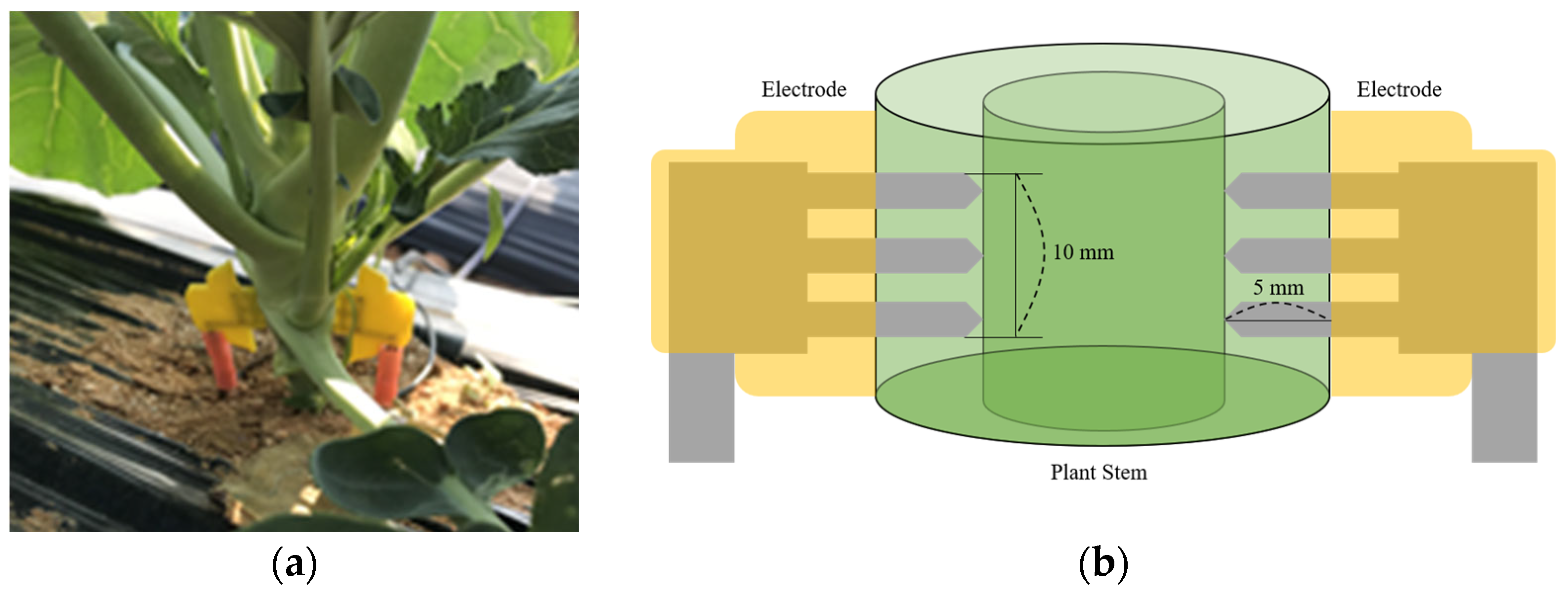
The physiological activity of broccoli in response to N and P fertilizer deficiencies was monitored by PIES during the growth period. Junsmeter II (Prumbio, Suwon, Republic of Korea) sensor used for monitoring PIESs measured the electrical resistance by inserting three stainless steel needle electrodes into the broccoli stem [8]. PIES sensors were installed on four plants per treatment to account for inter-individual variability, reduce the influence of outliers, and improve reproducibility. Figure 1 shows the structure of the PIES sensor and its insertion into the broccoli stem. The PIES sensor was installed 52 days after transplanting (DAT), when the stem diameter exceeded 1 cm and the stem diameter was measured for the calculation of electrical conductivity. The electrodes were inserted horizontally into the lower stem region at approximately 3 cm above the soil surface, with an insertion depth of 5 mm. Although needle insertion may induce local wound responses that could influence electrical resistance over time, the sensors were installed consistently across treatments; therefore, PIES values in this study were interpreted mainly for relative comparison among nutrient treatments. The stem electrical resistance measured at 1 h intervals was converted to electrical conductivity to evaluate the physiological activity of broccoli. The measured PIES was not the plant’s spontaneous bioelectric signal itself, but an index obtained from the electrical resistance between electrodes inserted into the stem. Accordingly, the PIES was interpreted as an indirect indicator of internal water and ionic status rather than a direct measure of these components. During the experiment, photosynthetic photon flux density (PPFD), CO2 concentration, atmospheric temperature, and relative humidity were monitored using an SH-VT260 sensor (SOHA TECH, Seoul, Republic of Korea).

2.3. Analysis of Nutrient Content in Soil

When broccoli was harvested, soil samples were collected and air-dried. The air-dried samples were sieved through a 2 mm mesh for analysis. Sand, silt and clay contents were analyzed using a hydrometer method [19] and soil texture was classified according to the United States Department Agriculture (USDA) soil texture triangle. For measurement of soil pH and electrical conductivity (EC), 5 g of soil was shaken with 25 mL of deionized water at 180 rpm for 30 min. The pH and EC of the extracted solution were measured using pH/conductivity meter (A215 pH/Conductivity Benchtop Multiparameter Meter, Thermo-Fisher Scientific, Waltham, MA, USA). Soil organic matter content was analyzed using the Walkley–Black method [20]. Exchangeable cations in the soil were extracted using 1 N ammonium acetate (Junsei Chemical Co., Ltd., Tokyo, Japan) and analyzed by ICP-OES (Avio 500, Perkin Elmer, Waltham, MA, USA). For the analysis of available N content, 2 g of wet soil was mixed with 20 mL of 2 M KCl (Samchun Chemicals Co., Ltd., Seoul, Republic of Korea). Ammonium (NH4+-N) and nitrate (NO3-N) contents in the extracted solution were analyzed using an indophenol-blue method and a VCl3-reduction method, respectively [21,22]. Available P content of soil was analyzed by Bray No. 1 method [23].

2.4. Measurement of Growth Parameters and Analysis of Stems and Leaves

At harvest, whole broccoli plants were collected, and fresh weight and height were measured. Broccoli stems were cut to 5 cm including the PIES electrode insertion point, and stem diameter was measured. For analysis of ion contents in broccoli stems, the cut stems were weighed and shaken with 100 mL of deionized water at 180 rpm for 2 h. Exchangeable cation contents in the extracted stem solution were analyzed using ICP-OES. Available P, NH4+-N, and NO3-N contents in the extracted stem solution were analyzed using the Bray No. 1 method, indophenol-blue method, and VCl3-reduction method, respectively. After stem extraction with deionized water, the whole plant including stem was dried in an oven at 60 °C for 72 h to measure dry weight.
To analyze nutrient content according to fertilizer treatment, dried broccoli leaves were ground. A 0.2 g ground sample was weighed and mixed with 5 mL of nitric acid (Samchun Chemicals Co., Ltd., Seoul, Republic of Korea) at room temperature. After 16 h, the mixed sample was digested on a hot plate at 140 °C. The digested sample was diluted to 100 mL with deionized water and nutrient contents (Ca, Ma, K, and P) were analyzed using ICP-OES. For analysis of total N content in broccoli leaves, 0.5 g of dried leaves were digested with 2 tablets of a digestion accelerator (1000 Kjeltabs Se/3.5, Foss, Hillerød, Denmark) and 12 mL of sulfuric acid (Samchun Chemicals Co., Ltd., Seoul, Republic of Korea) at 420 °C for 40 min. Total N content of the digested sample was analyzed using automatic analyzer (Kjeltec 2300, Foss, Hillerød, Denmark) [24].

2.5. Measurement of Soil Plant Analysis Development (SPAD) and Chlorophyll Fluorescence of Leaves

To analyze the chlorophyll-related and photosynthetic characteristics of leaves, SPAD values and chlorophyll fluorescence were measured at 63 DAT when broccoli heads form and develop. Measurements were taken on the third leaf from the top, avoiding the leaf veins. Leaf chlorophyll content was estimated based on SPAD values using a SPAD-502 chlorophyll meter (SPAD-502Plus, Konica Minolta, Osaka, Japan). Chlorophyll fluorescence was measured using FluorPen (FluorPen FP 110/D, Phyton Systems Instruments, Drásov, Czech Republic) after blocking the photosynthetic reaction in the leaves for more than 15 min using a clip.

2.6. Analysis of Chlorophyll and Proline of Leaves

After harvest, a portion of broccoli leaves were frozen, and stored for chlorophyll, and proline analyses. To analyze chlorophyll content in leaves, 0.2 g of the frozen leaves were homogenized with 5 mL of 80% acetone (Samchun Chemicals Co., Ltd., Seoul, Republic of Korea) for 1 min [25]. The mixed sample was centrifuged at 4000 rpm for 10 min, and absorbance was measured at 645 nm and 663 nm using a spectrophotometer (Multiskan SkyHigh Microplate Spectrophotometer, Thermo-Fisher Scientific, Waltham, MA, USA). The chlorophyll a and chlorophyll b contents were calculated using absorbance measured at 645 and 663 nm.
For analysis of proline, 0.5 g of frozen leaves were sonicated with 10 mL of 3% sulfosalicylic acid (Samchun Chemicals Co., Ltd., Seoul, Republic of Korea). The extracted solution was centrifuged at 4000 rpm for 10 min at 25 °C. After filtering through 0.45 μm syringe filter, 2 mL of the filtrate was reacted with 2 mL of acid-ninhydrin (Samchun Chemicals Co., Ltd., Seoul, Republic of Korea) and 2 mL of glacial acetic acid (Merck KGaA, Darmastadt, Germany) at 100 °C for 1 h. After cooling, the mixture was shaken with 4 mL toluene (Samchun Chemicals Co., Ltd., Seoul, Republic of Korea), and absorbance was measured at 520 nm with toluene as a blank [26].

2.7. Statistical Analysis

All analytical data and PIES monitoring were performed in three replicates, and results were presented as mean with standard deviation. One-way analysis of variance (ANOVA) was used to evaluate significant difference among the treatment groups using SPSS 27 software (IBM, Armonk, NY, USA). Post hoc analysis was performed with Duncan’s multiple range test at p < 0.05. Principal component analysis (PCA) was conducted to evaluate the correlation between PIES, nutrient contents, broccoli growth, and stress related parameters with normalization of the variables by subtracting its mean and scaling by the standard deviation using Xlstat-Student 2025.1.3.1431 (Addinsoft, Long Island, NY, USA). For PCA, PIES values were averaged from 7 A.M. to 1 P.M., which corresponded to the main period of diurnal increase from the daily minimum to maximum. This interval was chosen because treatment differences were more pronounced during the period of active water and nutrient uptake, and the mean value during this period was used as a representative daytime PIES value.

3. Results

3.1. PIES and Environmental Data During the Broccoli Growing Period, and Post-Harvest Growth Data

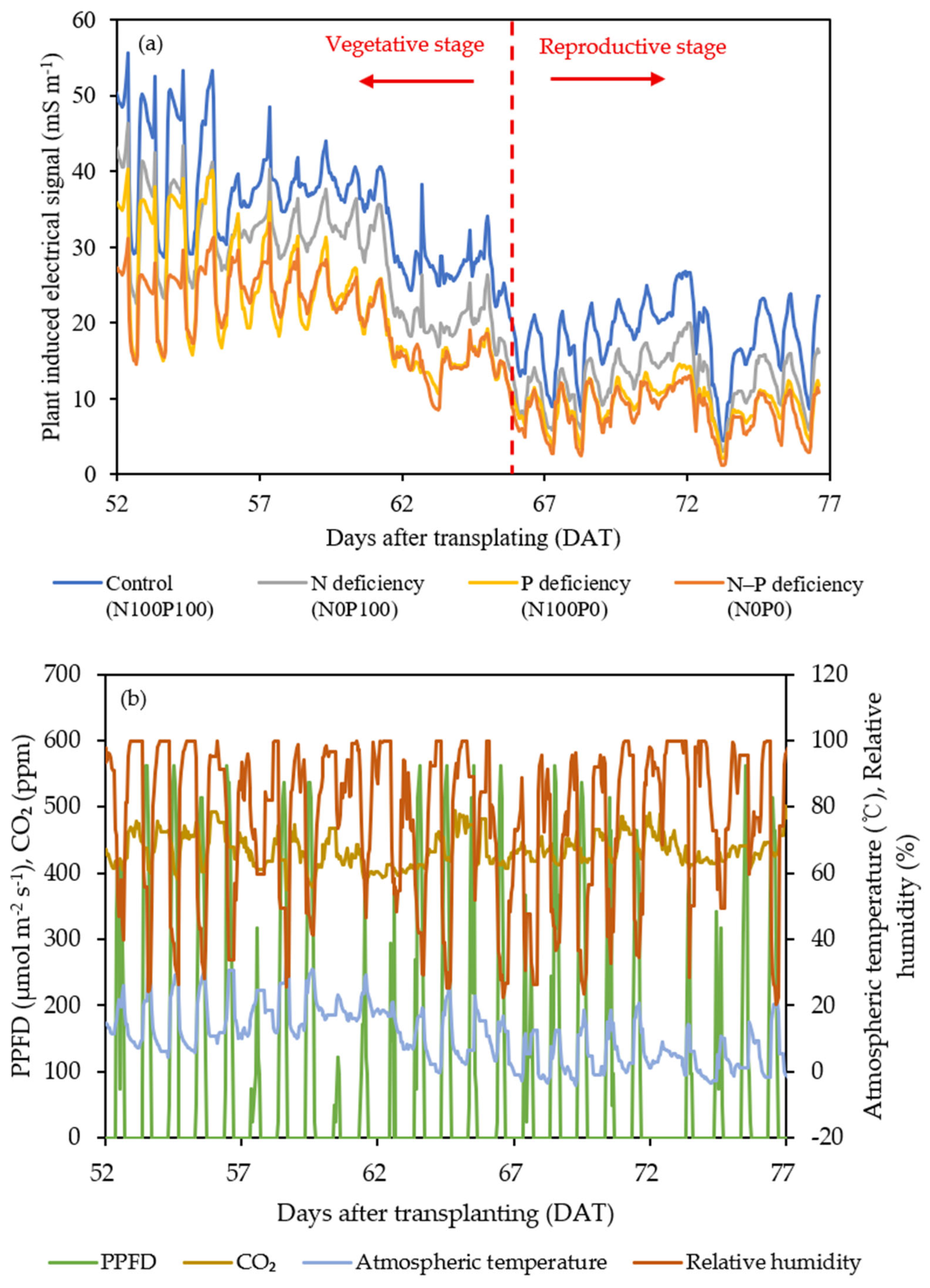
PIES values decreased further during reproductive growth (10–25 mS m−1) than vegetative growth (20–50 mS m−1) (Figure 2a). During the monitoring period, PIES values decreased in the order of control (N100P100) > N deficiency (N0P100) > P deficiency (N100P0) > N–P deficiency (N0P0) (Figure 2a). Based on environmental monitoring, until 7 November (63 DAT), which corresponds to the transition from the early to mid-growth stage, the PIES showed a negative association with PPFD, while exhibiting positive relationships with relative humidity and CO2 concentration (Figure 2 and Figure S1a). However, as plants progressed into the later growth stage, these relationships reversed (Figure 2 and Figure S1b).
The control (N100P100) showed significantly high growth parameters including shoot fresh weight, root fresh weight, and root dry weight (Table 1). P deficiency (N100P0) and N–P deficiency (N0P0) showed significantly lower values of root fresh weight and root dry weight compared to other treatments, indicating inhibited root development with P deficiency (Table 1).

3.2. Nutrient Contents of Soil and Broccoli Leaves and Stems

There was no significant difference in the exchangeable Ca content of broccoli soil among treatments since initial exchangeable Ca was sufficient in the soil (Table 2). Exchangeable Mg and K contents of the P-deficiency (N100P0) were significantly lower than N–P deficiency (N0P0) (Table 2). The NH4+-N content did not show significant difference, and NO3-N was not detected (Table 2). The available P content of broccoli soil was higher in the control (N100P100) than N deficiency (N0P100) (Table 2).
The Ca, Mg, and K contents of broccoli leaves did not show significant difference under N and/or P deficiency suggesting that assimilated nutrient amount was not different (Table 3). The total N content in broccoli leaves was significantly higher in the urea-applied treatment (N100P100 and N100P0) than in the N deficiency (N0P100 and N0P0) (Table 3). The leaf total N content in the N deficiency (N0P100) and N–P deficiency (N0P0) treatments was 26% and 51% lower, respectively, than that in the control (N100P100). In broccoli stem extracts, there were no significant differences among the treatment groups in Ca, Mg, K, and P contents, and the NH4+-N and NO3-N contents were not detected (Table 3).

3.3. Stress Related Parameters with N and P Deficiencies

The lowest SPAD value was observed in the N–P deficiency (N0P0) (Table 4). The Fv/Fm value, which reflects the photosynthetic performance of chlorophyll, was also lowest in the N–P deficiency (N0P0) treatment. In addition, all treatments were measured below 0.8 (Table 4). Values of Fv/Fm below 0.8 may indicate photoinhibition or stress-induced impairment of PSII, which can adversely affect plant growth [27]. The chlorophyll a and b contents showed a similar trend, following the order: P deficiency (N100P0) > control (N100P100) > N deficiency (N0P100) > N–P deficiency (N0P0) (Table 4). In contrast, proline content, as anti-stress metabolite, was significantly higher in P deficiency (N100P0) (Table 4).

3.4. Principal Component Analysis of PIES, Broccoli Growth, and Stress-Related Parameters in Broccoli

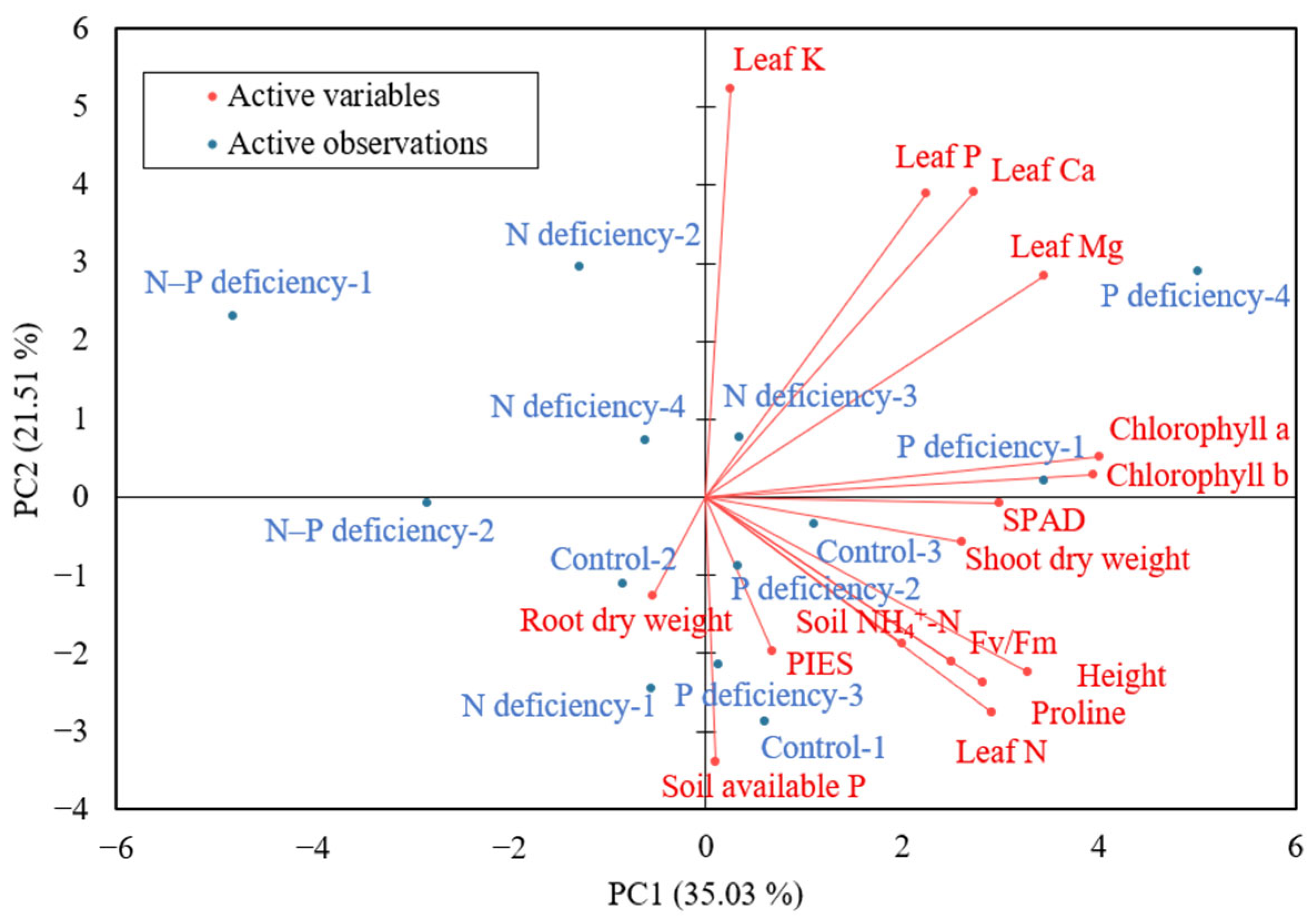
To investigate the relationships among the PIES, broccoli growth and stress-related parameters, a principal component analysis (PCA) was performed. The first two principal components (PC1 and PC2) explained 35.03% and 21.52% of the total variance, respectively (Figure 3). PC1 was primarily associated with growth and photosynthesis related variables, which exhibited high loading values on shoot dry weight, height, SPAD, Fv/Fm, and chlorophyll contents (Table 5). In addition, the control (N100P100) and P deficiency (N100P0) treatments, both of which received N fertilization, showed strong correlations with PC1. N deficiency (N0P100) and N–P deficiency (N0P0) treatments were separated along the negative direction of PC1 (Figure 3). In contrast, PC2 was characterized by positive loadings for leaf mineral nutrient contents, including Ca, Mg, P, and K, indicating that this axis reflects variation in nutrient composition rather than overall growth performance. The PIES showed its highest loading on PC3 (0.774), together with root dry weight (0.860) and shoot dry weight (0.659) (Table 5).

4. Discussion

4.1. Relationship Between PIES and Plant Growth Under N and P Deficiency

Changes in the PIES were observed across the growth stages of broccoli. Since the PIES measures electrical conductivity generated by plant water and nutrient uptake, higher values were observed during the vegetative stage. Kim et al. [11] also reported that PIES values of pepper (Capsicum annuum L.) were higher during the vegetative stage compared to the reproductive stage with different amounts of urea. During the vegetative stage, plant growth is vigorous, and transpiration increases rapidly due to the expansion of leaf surface area. Cecílio Filho et al. [28] reported that in broccoli, leaf growth slowed after the onset of inflorescence formation, and nutrient accumulation became increasingly concentrated in the inflorescence. That is why marked difference in PIES values was observed between daytime and nighttime during the vegetative stage. In addition, the vegetative stage is generally characterized by active photosynthesis and high nutrient demand, particularly for N [29]. In contrast, the reproductive stage is characterized by the remobilization of stored nutrients to flowers and fruits. During this stage, root growth is suppressed and water uptake capacity decreases [29]. In the case of N, both high-affinity transport systems and low-affinity transport systems are activated during the vegetative stage, facilitating efficient N uptake in conjunction with active photosynthesis. However, as the plant transitions to the reproductive stage, the activity of these transport systems significantly declines [30]. Nkoa et al. [31] demonstrated that N demand in broccoli was the highest during the mid-growth stage and gradually declined as the plant progressed toward maturity.
Both the PIES values and growth parameters were highest in the control (N100P100). This indicates that sufficient N and P fertilization positively affected broccoli growth. The PIES values decreased under N and/or P deficiency, with the lowest PIES value observed in the N–P deficiency (N0P0). As essential nutrients, N and P are key components of amino acids, nucleic acids, and other fundamental biomolecules involved in plant metabolism, and are therefore highly demanded for crop production [32,33]. Qiu et al. [34] reported that reducing N supply by 50% in tomato plants significantly decreased sap flow, SPAD values and leaf area. In addition, N and P fertilization appeared to promote anatomical development of the stem, such as increased stem diameter and thickness of xylem and phloem, which may enhance water uptake and physiological activity [35].
The PIES value under P deficiency (N100P0) was comparable to that under N–P deficiency (N0P0), suggesting reduced water and nutrient uptake. Phosphorus is a structural component of nucleic acids and phospholipids in plant cells, and it plays a crucial role throughout all stages of plant development, from seed germination to maturity [32,36]. Since P strongly influences the root system, under P deficiency, primary root growth is suppressed, allowing the plant to focus on acquiring P from the upper soil layer [37]. Teng et al. [38] also reported that P deficiency led to lower root dry weight and root length density in wheat, indicating limited root development. Therefore, in the P deficiency treatments (N100P0 and N0P0), insufficient P likely restricted root development, reducing the surface area for water and nutrient absorption and ultimately lowering overall plant physiological activity.
The growth stage-dependent reversal in the relationship between the PIES and environmental factors may be attributed to the composite nature of the PIES, which reflects not only xylem sap flow but also ion concentration within the stem, unlike sap flow [39]. While sap flow primarily reflects transportation-driven water movement, the PIES is simultaneously affected by changes in sap ion content and water transport dynamics. During the vegetative stage, increases in PPFD likely enhanced transpiration and sap flow, potentially leading to a relative dilution of ion concentration within the xylem sap [40]. Such dilution effects may explain the observed negative association between PPFD and the PIES during this period. In contrast, during the reproductive stage, enhanced ion redistribution and nutrient transport associated with developing sinks may have altered internal ion dynamics [41]. Under these conditions, increases in PPFD may have been accompanied by concurrent increases in both water flux and ion transport, resulting in a positive association between PPFD and PIES values. Taken together, these findings suggest that a PIES should not be interpreted as a simple indicator of water flux, but rather as an integrative physiological signal reflecting the coupled dynamics of water and ion transport within the plant. Furthermore, environmental variables such as PPFD, CO2 concentration, and relative humidity do not act independently, but interact with plant developmental stages and internal physiological regulation.

4.2. Broccoli Growth in Relation to Nutrient Contents in Soil and Plant Tissues

The lower exchangeable Mg and K contents in the P deficiency (N100P0) than in the N–P deficiency (N0P0) may be explained by soil acidification associated with urea application. At harvest, the soil pH in the urea applied treatments (control and P deficiency) was 5.74 and 6.03, respectively, indicating slight soil acidification. Although soil acidification in the urea applied treatments (control and P deficiency) might have affected rhizosphere ion availability, no significant differences were observed in the leaf contents of Ca, Mg, and K among treatments at harvest. This suggested that the contribution of soil pH to the overall nutrient status of the plants was limited, and that the PIES response was more closely related to nutrient deficiency-induced physiological changes than to soil pH alone. The supply of N and P fertilizers likely promoted plant growth and enhanced the uptake of nutrients such as K and Mg. For this reason, the higher residual contents of exchangeable Mg and K in the soil under the N–P deficiency (N0P0) treatment after harvest were likely due to reduced nutrient uptake caused by suppressed plant growth.
The absence of significant differences in soil available N content at harvest, together with non-detectable levels in some treatments, suggests that the residual soil N had returned to a level comparable to the initial N content before fertilizer application, likely due to the appropriate urea application rate based on the recommended fertilization for broccoli. The greater root dry weight in control (N100P100) may be associated with increased root exudation and the stimulation of plant growth-promoting rhizobacteria (PGPR), which could have enhanced N fixation, phosphate solubilization, or the production of plant-derived siderophores [18]. The secretion and decomposition of various organic compounds known as root exudates may have lowered the rhizosphere pH, potentially increasing the solubility of certain nutrients [42]. In particular, acid phosphatases and organic anions (carboxylates) released from the roots into the soil play an important role in improving P availability in soil [43].
This higher N content in broccoli leaves corresponds to increased shoot biomass, indicating that N availability is important for stimulating vegetative growth through enhanced N assimilation and biomass production. In grapevine, adequate N supplies enhanced vegetative growth, increasing lamina area expansion by approximately 45% compared with N-deficient plants [44]. The reduced total N content in the leaves of the treatments without N fertilization (N deficiency and N–P deficiency) was due to N deficiency. Similarly, da Silva et al. [45] reported that pepper plants grown without N supply had approximately 60% lower N content than those cultivated with a complete nutrient solution, along with visible chlorosis in leaves and fruits. No significant differences were observed in total P content in leaves. This may reflect regulatory adjustments in P starvation response (PSR) pathways that help maintain P homeostasis under P deficiency conditions [17]. At harvest, most inorganic N would have been assimilated into organic forms within plant tissues, which corresponds with the minimal levels of available N detected in the stem. The stem provides mechanical support and transport pathways rather than nutrient storage [46]. The high proportion of water in the stem might dilute ion concentrations in fresh extracts, as plant vegetative organs are largely composed of water, resulting in reduced apparent solute concentrations when extracted with water and expressed on a fresh mass basis [47].

4.3. Physiological and Biochemical Responses to N and P Deficiencies

SPAD value was lowest in the N–P deficiency (N0P0), suggesting that both N and P play an important role in chlorophyll production. The high SPAD value represented high chlorophyll content in leaves [48]. Muhammad et al. [49] reported that application of N fertilizer led to an increase in chlorophyll content. The lowest Fv/Fm value was observed in the N–P deficiency (N0P0). Nitrogen and P deficiencies are known to reduce stomatal conductance and net photosynthetic rate, and to impair the functioning of photosystem II (PS II) [50]. Therefore, the lowest chlorophyll fluorescence observed in the N–P deficiency (N0P0) treatment is likely attributable to the combined limitation of N and P availability.
All treatments showed Fv/Fm values below 0.8, which may be attributed to temperature stress because values of Fv/Fm below 0.8 indicate possible damage to PSII [27]. Although broccoli was grown under temperatures of 10–30 °C during the early-growth stage, it was exposed to relatively lower temperatures ranging from −4 to 20 °C during the mid- to late-growth stages when Fv/Fm was measured, which likely imposed temperature stress (Figure 2). Kaluzewicz et al. [51] reported that the optimal temperature range for broccoli growth is 15–25 °C. Because the experiment was conducted under open-field conditions, the possible interaction between low temperature and nutrient deficiency cannot be excluded. Therefore, the reduced Fv/Fm values are more appropriately interpreted as reflecting combined environmental and nutritional stresses.
Under P deficiency (N100P0), the imbalance between N and P availability may have resulted in a relative N excess, which likely contributed to the higher chlorophyll a and b contents. The highest proline content observed in the P deficiency (N100P0) also supports this interpretation, as enhanced N availability has been reported to promote proline accumulation through its role in proline biosynthesis [52]. Proline content was also relatively high in the control (N100P100), suggesting that adequate N supply supported proline biosynthesis even under less stressful conditions. In contrast, the significantly lower proline contents in the N deficiency (N0P100) and N–P deficiency (N0P0) may have resulted from limited N availability, which likely restricted proline synthesis.

4.4. Multivariate Relationships Among PIES, Broccoli Growth, and Stress-Related Parameters

The close association of the control (N100P100) and P deficiency (N100P0) with PC1 suggests that N application contributed to improved overall plant growth and nutritional status. In contrast, the separation of the N deficiency (N0P100) and N–P deficiency (N0P0) along the negative axis of PC1 indicates that N limitation was the primary factor constraining plant growth and physiological performance. This interpretation is further supported by the similar directional distribution of shoot dry weight, height, SPAD, chlorophyll a, chlorophyll b, Fv/Fm, and leaf N along PC1, suggesting that these growth and photosynthesis related parameters responded consistently to N availability. This pattern can be explained by the fundamental role of N in plant metabolism. Nitrogen is a key component of chlorophyll and plays a direct role in protein and enzyme synthesis as well as photosynthetic capacity [53]. Therefore, N deficiency likely limited chlorophyll formation and photosynthetic capacity, resulting in reduced plant growth compared with the control (N100P100) in the N deficiency (N0P100) and N–P deficiency (N0P0). In the PCA plot, SPAD showed a similar directional pattern to several leaf-related parameters such as chlorophyll a, chlorophyll b, and Fv/Fm, suggesting a comparable response across treatments. SPAD provides a relative, unitless estimate of leaf chlorophyll content by measuring transmitted light centered at the chlorophyll absorption peak of 650 nm and the non-chlorophyll absorption region of 940 nm, and converting the resulting signal into SPAD values [54].
PC2 was characterized by positive loading for leaf nutrient contents, particularly leaf K, P, Ca, and Mg, indicating that this axis primarily reflects variation in nutrient composition rather than overall growth performance. The divergence between these nutrient-related variables and the growth-related variables suggests that changes in tissue nutrient composition were not fully synchronized with biomass production or photosynthetic traits. In contrast, the high loadings of the PIES, root dry weight, and stem dry weight on PC3 suggest that the PIES is more closely associated with whole-plant biomass and root-driven physiological processes, including nutrient transport activity. Such a pattern supports the potential of a PIES as an integrative indicator of belowground–aboveground interactions under nutrient stress conditions.

5. Conclusions

This study demonstrated that a PIES reflects the growth and physiological activity of broccoli under N and P deficiency. The PIES also responded to changes in plant vitality across growth stages and represented not only sap flow but also the ionic status within the plant. In addition, the PIES exhibited close associations with growth parameters and effectively distinguished N and/or P deficiency treatments, suggesting its potential as a physiological indicator for discriminating multi-nutrient stress in broccoli. The results further showed that combined N–P deficiency caused greater reductions in growth and physiological activity than single nutrient deficiencies, emphasizing the importance of balanced nutrient management. Real-time monitoring using a PIES enables early diagnosis of plant growth and physiological stress while minimizing damage to the plant. For practical field application, PIES values falling below the reference range may indicate deterioration in plant status. Such deviations could serve as an early diagnostic signal, prompting growers to take corrective actions such as nutrient supplementation or irrigation before visible symptoms develop. Approach based on plant vitality rather than soil nutrient availability may contribute to more precise and sustainable nutrient management strategies, particularly under changing environmental conditions.

Supplementary Materials

The following supporting information can be downloaded at: https://www.mdpi.com/article/10.3390/agronomy16080778/s1, Figure S1: Temporal patterns of plant-induced electrical signal (PIES) and environmental variables during different growth stages of broccoli. (a) PIES values and environmental conditions during the early–mid-growth stage; (b) PIES and environmental variables during the late-growth stage.

Author Contributions

Conceptualization, J.H.P. and J.Y.K.; methodology, J.Y.K., S.K.S., Y.E.L. and J.H.P.; validation, J.H.P. and J.Y.K.; formal analysis, J.Y.K., S.K.S. and Y.E.L.; writing—original draft preparation, J.Y.K., S.K.S. and Y.E.L.; writing—review and editing, J.H.P.; visualization, J.Y.K.; supervision, J.H.P.; funding acquisition, J.H.P. All authors have read and agreed to the published version of the manuscript.

Funding

This work was carried out with the support of “Cooperative Research Program for Agriculture Science and Technology Development (Project No. PJ015050012023)” Rural Development Administration, Republic of Korea.

Data Availability Statement

The data presented in this study are available on request from the corresponding author.

Conflicts of Interest

The authors declare no conflict of interest.

References

  1. Xing, Y.; Wang, X. Precise application of water and fertilizer to crops: Challenges and opportunities. Front. Plant Sci. 2024, 15, 1444560. [Google Scholar] [CrossRef]
  2. Miao, Y.; Stewart, B.A.; Zhang, F. Long-term experiments for sustainable nutrient management in China. A review. Agron. Sustain. Dev. 2011, 31, 397–414. [Google Scholar] [CrossRef]
  3. Pahalvi, H.N.; Rafiya, L.; Rashid, S.; Nisar, B.; Kamili, A.N. Chemical fertilizers and their impact on soil health. In Microbiota and Biofertilizers, Vol 2: Ecofriendly Tools for Reclamation of Degraded Soil Environs; Springer: Cham, Switzerland, 2021; pp. 1–20. [Google Scholar]
  4. Kim, H.N.; Seok, Y.J.; Park, G.M.; Vyavahare, G.; Park, J.H. Monitoring of plant-induced electrical signal of pepper plants (Capsicum annuum L.) according to urea fertilizer application. Sci. Rep. 2023, 13, 291. [Google Scholar] [CrossRef] [PubMed]
  5. Kaur, P.; Harnal, S.; Tiwari, R.; Upadhyay, S.; Bhatia, S.; Mashat, A.; Alabdali, A.M. Recognition of leaf disease using hybrid convolutional neural network by applying feature reduction. Sensors 2022, 22, 575. [Google Scholar] [CrossRef]
  6. Zhou, S.; Zhou, J.; Pan, Y.; Wu, Q.; Ping, J. Wearable electrochemical sensors for plant small-molecule detection. Trends Plant Sci. 2024, 29, 219–231. [Google Scholar] [CrossRef]
  7. Zhou, J.; Fan, P.; Zhou, S.; Pan, Y.; Ping, J. Machine learning-assisted implantable plant electrophysiology microneedle sensor for plant stress monitoring. Biosens. Bioelectron. 2025, 271, 117062. [Google Scholar] [CrossRef]
  8. Park, H.J.; Park, J.H.; Park, K.S.; Ahn, T.I.; Son, J.E. Nondestructive measurement of paprika (Capsicum annuum L.) internal electrical conductivity and its relation to environmental factors. Hortic. Sci. Technol. 2018, 36, 691–701. [Google Scholar] [CrossRef]
  9. Ang, M.C.-Y.; Lew, T.T.S. Non-destructive technologies for plant health diagnosis. Front. Plant Sci. 2022, 13, 884454. [Google Scholar] [CrossRef] [PubMed]
  10. Kim, H.N.; Yi, P.H.; Park, J.H. Evaluation of plant-induced electrical signal and growth of Broccoli (Brassica oleracea var. italica) in response to urea application in soil. Hortic. Sci. Technol. 2022, 40, 210–218. [Google Scholar] [CrossRef]
  11. Kim, J.Y.; Sin, S.K.; Park, J.H. Electrical signal of pepper during cropping period affected by different amount of fertilizer. Appl. Biol. Chem. 2023, 66, 62. [Google Scholar] [CrossRef]
  12. Hossain, M.F.; Islam, M.S. Effects of Organic and Inorganic Fertilizers and Their Combination on Growth, Yield and Quality of Broccoli (Brassica oleracea L. var.‘Italica’). Int. J. Hortic. Sci. Technol. 2024, 11, 515. [Google Scholar]
  13. Peralta-Antonio, N.; Watthier, M.; Santos, R.H.S.; Martinez, H.E.P.; Vergütz, L. Broccoli nutrition and changes of soil solution with green manure and mineral fertilization. J. Soil Sci. Plant Nutr. 2019, 19, 816–829. [Google Scholar] [CrossRef]
  14. Garcia, G.; Treccarichi, S.; Calì, R.; Arena, D.; Tribulato, A.; Branca, F. Nitrogen use efficiency of microbial and amino acid treatments for organic broccoli (Brassica oleracea L. var. italica Plenk) seed production. Horticulturae 2025, 11, 253. [Google Scholar] [CrossRef]
  15. Mohamed, M.H.; Ali, M.; Eid, R.S.; El-Desouky, H.S.; Petropoulos, S.A.; Sami, R.; Al-Mushhin, A.A.; Ismail, K.A.; Zewail, R.M. Phosphorus and biofertilizer application effects on growth parameters, yield and chemical constituents of broccoli. Agronomy 2021, 11, 2210. [Google Scholar] [CrossRef]
  16. Li, H.; Jiang, H.; Li, T. Broccoli plant nitrogen, phosphorus, and water relations at field scale and in various growth media. Int. J. Veg. Sci. 2011, 17, 190–210. [Google Scholar] [CrossRef]
  17. Khan, F.; Siddique, A.B.; Shabala, S.; Zhou, M.; Zhao, C. Phosphorus plays key roles in regulating plants’ physiological responses to abiotic stresses. Plants 2023, 12, 2861. [Google Scholar] [CrossRef]
  18. Vacheron, J.; Desbrosses, G.; Bouffaud, M.-L.; Touraine, B.; Moënne-Loccoz, Y.; Muller, D.; Legendre, L.; Wisniewski-Dyé, F.; Prigent-Combaret, C. Plant growth-promoting rhizobacteria and root system functioning. Front. Plant Sci. 2013, 4, 356. [Google Scholar] [CrossRef] [PubMed]
  19. Gee, G.W.; Bauder, J.W. Particle-size analysis. In Methods of Soil Analysis: Part 1 Physical Mineralogical Methods; ASA: Madison, WI, USA, 1986; Volume 5, pp. 383–411. [Google Scholar]
  20. Walkley, A.; Black, I.A. An examination of the Degtjareff method for determining soil organic matter, and a proposed modification of the chromic acid titration method. Soil Sci. 1934, 37, 29–38. [Google Scholar] [CrossRef]
  21. Novamsky, I.; Van Eck, R.; Van Schouwenburg, C.; Walinga, I. Total nitrogen determination in plant material by means of the indophenol-blue method. Neth. J. Agric. Sci. 1974, 22, 3–5. [Google Scholar] [CrossRef]
  22. Doane, T.A.; Horwáth, W.R. Spectrophotometric determination of nitrate with a single reagent. Anal. Lett. 2003, 36, 2713–2722. [Google Scholar] [CrossRef]
  23. Bray, R.H.; Kurtz, L.T. Determination of total, organic, and available forms of phosphorus in soils. Soil Sci. 1945, 59, 39–46. [Google Scholar] [CrossRef]
  24. Kirk, P.L. Kjeldahl method for total nitrogen. Anal. Chem. 1950, 22, 354–358. [Google Scholar] [CrossRef]
  25. Guo, W.-L.; Wang, S.-B.; Chen, R.-G.; Chen, B.-H.; Du, X.-H.; Yin, Y.-X.; Gong, Z.-H.; Zhang, Y.-Y. Characterization and expression profile of CaNAC2 pepper gene. Front. Plant Sci. 2015, 6, 755. [Google Scholar] [CrossRef]
  26. Bates, L.S.; Waldren, R.; Teare, I. Rapid determination of free proline for water-stress studies. Plant Soil 1973, 39, 205–207. [Google Scholar] [CrossRef]
  27. Li, S.; Yang, W.; Yang, T.; Chen, Y.; Ni, W. Effects of cadmium stress on leaf chlorophyll fluorescence and photosynthesis of Elsholtzia argyi—A cadmium accumulating plant. Int. J. Phytoremediat. 2015, 17, 85–92. [Google Scholar] [CrossRef]
  28. Cecílio Filho, A.B.; Carmona, V.M.V.; Schiavon Junior, A. Broccoli growth and nutrient accumulation. Científica 2017, 45, 95–104. [Google Scholar] [CrossRef]
  29. Taiz, L.; Zeiger, E. Plant Physiology; Sinauer Association: Sunderland, MA, USA, 2010. [Google Scholar]
  30. Malagoli, P.; Lainé, P.; Le Deunff, E.; Rossato, L.; Ney, B.; Ourry, A. Modeling nitrogen uptake in oilseed rape cv Capitol during a growth cycle using influx kinetics of root nitrate transport systems and field experimental data. Plant Physiol. 2004, 134, 388–400. [Google Scholar] [CrossRef] [PubMed]
  31. Nkoa, R.; Coulombe, J.; Desjardins, Y.; Owen, J.; Tremblay, N. Nitrogen supply phasing increases broccoli (Brassica oleracea var. italica) growth and yield. Acta Hortic. 2000, 571, 163–170. [Google Scholar] [CrossRef]
  32. Malhotra, H.; Vandana; Sharma, S.; Pandey, R. Phosphorus nutrition: Plant growth in response to deficiency and excess. In Plant Nutrients and Abiotic Stress Tolerance; Springer: Berlin/Heidelberg, Germany, 2018; pp. 171–190. [Google Scholar]
  33. Anas, M.; Liao, F.; Verma, K.K.; Sarwar, M.A.; Mahmood, A.; Chen, Z.-L.; Li, Q.; Zeng, X.-P.; Liu, Y.; Li, Y.-R. Fate of nitrogen in agriculture and environment: Agronomic, eco-physiological and molecular approaches to improve nitrogen use efficiency. Biol. Res. 2020, 53, 47. [Google Scholar] [CrossRef]
  34. Qiu, R.; Du, T.; Kang, S.; Chen, R.; Wu, L. Influence of water and nitrogen stress on stem sap flow of tomato grown in a solar greenhouse. J. Am. Soc. Hortic. Sci. 2015, 140, 111–119. [Google Scholar] [CrossRef]
  35. Cai, Q.; Ji, C.; Yan, Z.; Jiang, X.; Fang, J. Anatomical responses of leaf and stem of Arabidopsis thaliana to nitrogen and phosphorus addition. J. Plant Res. 2017, 130, 1035–1045. [Google Scholar] [CrossRef] [PubMed]
  36. Shen, J.; Yuan, L.; Zhang, J.; Li, H.; Bai, Z.; Chen, X.; Zhang, W.; Zhang, F. Phosphorus dynamics: From soil to plant. Plant Physiol. 2011, 156, 997–1005. [Google Scholar] [CrossRef]
  37. Magalhaes, J.V.; de Sousa, S.M.; Guimaraes, C.T.; Kochian, L.V. The role of root morphology and architecture in phosphorus acquisition: Physiological, genetic, and molecular basis. In Plant Macronutrient Use Efficiency; Elsevier: Amsterdam, The Netherlands, 2017; pp. 123–147. [Google Scholar]
  38. Teng, W.; Deng, Y.; Chen, X.-P.; Xu, X.-F.; Chen, R.-Y.; Lv, Y.; Zhao, Y.-Y.; Zhao, X.-Q.; He, X.; Li, B. Characterization of root response to phosphorus supply from morphology to gene analysis in field-grown wheat. J. Exp. Bot. 2013, 64, 1403–1411. [Google Scholar] [CrossRef]
  39. Park, H.J.; Park, J.H.; Park, K.S.; Son, J.E. Evaluating plant stress conditions in paprika by comparing internal electrical conductivity, photosynthetic response, and sap flow. Hortic. Environ. Biotechnol. 2019, 60, 41–48. [Google Scholar] [CrossRef]
  40. Liu, C.; Du, T.; Li, F.; Kang, S.; Li, S.; Tong, L. Trunk sap flow characteristics during two growth stages of apple tree and its relationships with affecting factors in an arid region of northwest China. Agric. Water Manag. 2012, 104, 193–202. [Google Scholar] [CrossRef]
  41. Brant, A.N.; Chen, H.Y. Patterns and mechanisms of nutrient resorption in plants. Crit. Rev. Plant Sci. 2015, 34, 471–486. [Google Scholar] [CrossRef]
  42. Rengel, Z. Soil pH, soil health and climate change. In Soil Health and Climate Change; Springer: Berlin/Heidelberg, Germany, 2011; pp. 69–85. [Google Scholar]
  43. Wang, Y.; Lambers, H. Root-released organic anions in response to low phosphorus availability: Recent progress, challenges and future perspectives. Plant Soil 2020, 447, 135–156. [Google Scholar] [CrossRef]
  44. Metay, A.; Magnier, J.; Guilpart, N.; Christophe, A. Nitrogen supply controls vegetative growth, biomass and nitrogen allocation for grapevine (cv. Shiraz) grown in pots. Funct. Plant Biol. 2014, 42, 105–114. [Google Scholar] [CrossRef]
  45. da Silva, M.P.S.; Mendonça Freitas, M.S.; Cesar Santos, P.; de Carvalho, A.J.C.; Jorge, T.S. Capsicum annuum var. annuum under macronutrients and boron deficiencies: Leaf content and visual symptoms. J. Plant Nutr. 2019, 42, 417–427. [Google Scholar] [CrossRef]
  46. Skelton, R. Of storage and stems: Examining the role of stem water storage in plant water balance. Plant Physiol. 2019, 179, 1433–1434. [Google Scholar] [CrossRef] [PubMed]
  47. Ievinsh, G. Water content of plant tissues: So simple that almost forgotten? Plants 2023, 12, 1238. [Google Scholar] [CrossRef]
  48. Yoo, J.-H.; Luyima, D.; Lee, J.-H.; Park, S.-Y.; Yang, J.-W.; An, J.-Y.; Yun, Y.-U.; Oh, T.-K. Effects of brewer’s spent grain biochar on the growth and quality of leaf lettuce (Lactuca sativa L. var. crispa.). Appl. Biol. Chem. 2021, 64, 10. [Google Scholar] [CrossRef]
  49. Muhammad, I.; Yang, L.; Ahmad, S.; Farooq, S.; Al-Ghamdi, A.A.; Khan, A.; Zeeshan, M.; Elshikh, M.S.; Abbasi, A.M.; Zhou, X.-B. Nitrogen fertilizer modulates plant growth, chlorophyll pigments and enzymatic activities under different irrigation regimes. Agronomy 2022, 12, 845. [Google Scholar] [CrossRef]
  50. Chen, C.-T.; Lee, C.-L.; Yeh, D.-M. Effects of nitrogen, phosphorus, potassium, calcium, or magnesium deficiency on growth and photosynthesis of Eustoma. HortScience 2018, 53, 795–798. [Google Scholar] [CrossRef]
  51. Kaluzewicz, A.; Krzesinski, W.; Knaflewski, M. Effect of temperature on the yield and quality of broccoli heads. Veg. Crops Res. Bull. 2009, 71, 51. [Google Scholar]
  52. Abo El-Ezz, S.F.; Haffez, S.H. Effect of nitrogen fertilization, proline, plant spacing and irrigation intervals on growth of maize Plant. J. Soil Sci. Agric. Eng. 2019, 10, 447–456. [Google Scholar] [CrossRef]
  53. Fathi, A. Role of nitrogen (N) in plant growth, photosynthesis pigments, and N use efficiency: A review. Agrisost 2022, 28, 1–8. [Google Scholar]
  54. Zhang, R.; Yang, P.; Liu, S.; Wang, C.; Liu, J. Evaluation of the methods for estimating leaf chlorophyll content with SPAD chlorophyll meters. Remote Sens. 2022, 14, 5144. [Google Scholar] [CrossRef]
Figure 1. Plant-induced electrical signal (PIES) sensor: (a) PIES sensor installed on the broccoli stem; (b) structure of the PIES sensor and its insertion into the plant stem.
Agronomy 16 00778 g001
Figure 2. (a) Time-dependent changes in PIES values of broccoli subjected to N and P fertilizer deficiencies; (b) temporal changes in open-field environmental conditions (PPFD, CO2 concentration, atmospheric temperature, and relative humidity) during broccoli cultivation.
Agronomy 16 00778 g002
Figure 3. Principal component analysis (PCA) biplot showing relationships among PIES, growth, nutrients, and stress parameters of broccoli under control and N and/or P deficiency.
Agronomy 16 00778 g003
Table 1. Growth parameters of broccoli with N and P fertilizer deficiencies.
Shoot Fresh Weight (g)Root Fresh Weight (g)Shoot Dry Weight (g)Root Dry Weight (g)Height (cm)Stem Diameter (mm)
Control (N100P100)785 ± 197 a55.0 ± 22.1 a98.5 ± 29.9 a14.9 ± 7.91 a59.9 ± 0.98 a21.0 ± 1.92 a
N deficiency (N0P100)654 ± 209 ab43.3 ± 10.7 ab88.5 ± 25.5 a10.7 ± 4.52 ab56.4 ± 4.70 a20.6 ± 2.12 a
P deficiency (N100P0)684 ± 307 ab22.3 ± 4.99 b82.5 ± 45.0 a3.94 ± 1.29 b58.2 ± 4.22 a18.2 ± 3.42 ab
N–P deficiency (N0P0)340 ± 279 b27.3 ± 16.1 b44.5 ± 36.5 a6.11 ± 3.77 b43.8 ± 14.1 b16.0 ± 3.34 b
Same letter among the different treatments indicates that means are not significantly different followed by Duncan’s multiple range post hoc tests at p < 0.05.
Table 2. Nutrient contents of soil with N and P fertilizer deficiencies.
Ca
(mg kg−1)
Mg
(mg kg−1)
K
(mg kg−1)
Available P
(mg kg−1)
NH4+-N
(mg kg−1)
NO3-N
(mg kg−1)
pH
Control (N100P100)1006 ± 185 a131 ± 20.5 a86.6 ± 17.3 ab143 ± 45.4 a18.0 ± 22.8 aND5.74 ± 0.36 c
N deficiency (N0P100)973 ± 39.2 a111 ± 5.31 ab68.9 ± 17.0 ab4.21 ± 0 b1.35 ± 1.68 aND6.42 ± 0.08 b
P deficiency (N100P0)1017 ± 82.0 a98.5 ± 8.92 b53.3 ± 12.9 b2.15 ± 0.50 b28.8 ± 32.4 a0.51 ± 0.346.03 ± 0.17 bc
N–P deficiency (N0P0)1174 ± 89.7 a124 ± 10.0 a102 ± 22.8 a2.60 ± 0.62 b0.57 ± 0.71 aND7.25 ± 0.10 a
ND: Not detected. Same letter among the different treatments indicates that means are not significantly different followed by Duncan’s multiple range post hoc tests at p < 0.05.
Table 3. Nutrient contents of leaves and stem extract (calculated based on dry stem weight) with N and P fertilizer deficiencies.
CaMgKPNH4+-NNO3-NTotal N
Leaves(g kg−1)(g kg−1)(g kg−1)(g kg−1)(g kg−1)(g kg−1)(g kg−1)
Control (N100P100)22.0 ± 2.89 a2.76 ± 0.79 a23.0 ± 1.31 a5.23 ± 0.45 aNANA33.3 ± 4.09 a
N deficiency (N0P100)24.0 ± 3.89 a2.25 ± 0.36 a32.3 ± 12.7 a5.42 ± 1.54 aNANA24.6 ± 3.91 b
P deficiency (N100P0)26.8 ± 12.9 a2.92 ± 1.30 a27.3 ± 11.0 a5.55 ± 2.19 aNANA32.8 ± 1.75 a
N–P deficiency (N0P0)19.7 ± 4.12 a1.73 ± 0.43 a28.6 ± 4.70 a4.48 ± 1.01 aNANA16.3 ± 2.38 b
Stem(mg kg−1)(mg kg−1)(mg kg−1)(mg kg−1)(mg kg−1)(mg kg−1)(g kg−1)
Control (N100P100)67.2 ± 20.4 a16.1 ± 5.11 a745 ± 226 a45.7 ± 11.2 aNDNDNA
N deficiency (N0P100)50.8 ± 15.0 a11.7 ± 5.24 a676 ± 157 a37.1 ± 4.95 aNDNDNA
P deficiency (N100P0)84.9 ± 26.5 a17.0 ± 3.87 a686 ± 146 a39.0 ± 6.25 aNDNDNA
N–P deficiency (N0P0)69.8 ± 8.43 a12.6 ± 2.56 a653 ± 252 a43.6 ± 7.19 aNDNDNA
ND: Not Detected, NA: Not Analyzed. Same letter among the different treatments indicates that means are not significantly different followed by Duncan’s multiple range post hoc tests at p < 0.05.
Table 4. SPAD, Fv/Fm, chlorophyll contents, and proline of broccoli with N and P fertilizer deficiencies.
SPADFv/FmChlorophyll a (mg g−1)Chlorophyll b (mg g−1)Proline (μmol g−1)
Control (N100P100)65.0 ± 6.70 ab0.74 ± 0.08 ab0.35 ± 0.08 b0.12 ± 0.03 b45.5 ± 6.36 b
N deficiency (N0P100)67.0 ± 4.73 ab0.72 ± 0.04 ab0.34 ± 0.09 b0.12 ± 0.04 b15.3 ± 4.59 c
P deficiency (N100P0)69.3 ± 8.22 a0.75 ± 0.09 a0.53 ± 0.11 a0.18 ± 0.04 a113 ± 15.0 a
N–P deficiency (N0P0)58.0 ± 4.70 b0.56 ± 0.19 b0.19 ± 0.08 c0.07 ± 0.03 c20.9 ± 9.44 c
Same letter among the different treatments indicates that means are not significantly different followed by Duncan’s multiple range post hoc tests at p < 0.05.
Table 5. Factor loadings of growth, nutrients, and stress-related parameters, including the PIES, for the first four principal components derived from PCA.
PC1PC2PC3PC4
PIES0.154−0.3500.7740.382
Shoot dry weight0.590−0.1020.659−0.247
Root dry weight−0.123−0.2250.860−0.040
Height0.738−0.3980.320−0.276
SPAD0.675−0.0130.236−0.527
Fv/Fm0.566−0.3720.153−0.079
Soil available P0.022−0.5990.3700.475
Soil NH4+-N0.450−0.333−0.2880.715
Chlorophyll a0.9040.092−0.311−0.028
Chlorophyll b0.8900.051−0.329−0.047
Proline0.637−0.422−0.3050.227
Leaf Ca0.6180.6930.1150.233
Leaf Mg0.7780.5030.0180.239
Leaf P0.5080.6880.3580.168
Leaf K0.0580.9250.2400.078
Leaf N0.656−0.488−0.419−0.219
Eigenvalue5.6043.4422.8461.555
Variability (%)35.02721.51017.7889.720
Cumulative (%)35.02756.53774.32584.045
Values in bold indicate loadings greater than |0.5|.
Disclaimer/Publisher’s Note: The statements, opinions and data contained in all publications are solely those of the individual author(s) and contributor(s) and not of MDPI and/or the editor(s). MDPI and/or the editor(s) disclaim responsibility for any injury to people or property resulting from any ideas, methods, instructions or products referred to in the content.