Article

Aquatic Ecotoxicity Risk Assessment of Difenoconazole and Its Transformation Residues Using Experimental–In Silico Integrated Approach


by
Constantina-Bianca Vulpe
1,2,3,†,
Cosmina-Alecsia Cosma
4,†,
Andrijana Pujicic
2,3,4,
Bianca-Vanesa Agachi
2,3,4,*,
Adriana Isvoran
3,4 and
Adina-Daniela Iachimov-Datcu
2,3,4
1
Department of Scientific Research in Biology, Advanced Environmental Research Institute, West University of Timisoara, Oituz 4, 300086 Timisoara, Romania
2
The Academy of Romanian Scientists, Ilfov 3, 050044 Bucharest, Romania
3
One Health Initiative-Focused Multidisciplinary Biosciences Advanced Research Center, West University of Timisoara, Oituz 4, 300086 Timisoara, Romania
4
Department of Biology, Faculty of Chemistry, Biology, Geography, West University of Timisoara, Pestalozzi 16, 300115 Timisoara, Romania
*
Author to whom correspondence should be addressed.
These authors contributed equally to this work.
Agronomy 2026, 16(8), 774; https://doi.org/10.3390/agronomy16080774
Submission received: 17 February 2026 / Revised: 4 April 2026 / Accepted: 7 April 2026 / Published: 9 April 2026
(This article belongs to the Special Issue Pesticide Residues Abatement: A Central to Regenerative Agriculture)

Abstract

Difenoconazole is a triazole fungicide used to ensure sustainable agricultural, although it may also affect the aquatic environment. This study assessed the effects of this fungicide by both an experimental and a computational approach. The experimental assessment involved the acute exposure of Lemna minor to different concentrations of difenoconazole and the determination of main endpoints such as number of fronds and colony, as well as secondary endpoints represented by gravimetric, morphometrical and biochemical parameters. The in silico analysis consisted of the testing of difenoconazole and 14 of its transformation residues (TRs), using three computational tools (admetSAR, ADMETlab and T.E.S.T.) to assess either their toxicological endpoints (EC50, IGC50) or their probability of affecting a range of model aquatic organisms. The results highlighted a concentration-dependent effect of difenoconazole on both main and secondary endpoints. The calculated EC50 value was 2.47 mg/L (data validated by EC50 on Lemna gibba from Pesticides Properties DataBase), which categorizes difenoconazole as moderately toxic in the aquatic environment. The in silico assessment showed that two of the TRs showed lower toxicity, with these having only one aromatic ring compared to the others analyzed.

1. Introduction

The worldwide intensification of agricultural activities in recent years has led to an increased use of pesticides [1,2]. While these compounds are essential for crop protection and productivity, their extensive application results in residue accumulation in soils [3] and water bodies [4,5]. Pesticides are also known to impact non-target organisms, including plants [6,7,8,9,10], bacteria [11,12], algae [12,13], and animals [14,15,16], highlighting potential ecological risks that warrant further investigation. Among these, triazole fungicides are widely used in agriculture to protect a broad range of crops. These compounds have been detected in terrestrial and aquatic environments, as well as in fruits and vegetables, and are known to affect soil microorganisms, soil enzyme activity, aquatic organisms, and human health [17,18,19,20], raising concerns for ecosystem and human health.
Difenoconazole is a systemic triazole fungicide [21], widely used in modern agriculture for cereal [22,23,24] and fruit crops [25,26,27], and is of particular interest in this study due to its potential effects on non-target organisms. Its application is regulated under major EU frameworks, including Directive (EU) 2025/2360 of the European Parliament and of the Council of 12 November 2025 on soil monitoring and resilience (Soil Monitoring Law) [28] and Commission Implementing Decision (EU) 2025/439 of 28 February 2025 establishing a watch list of substances for Union-wide monitoring in the field of water policy pursuant to Directive 2008/105/EC of the European Parliament and of the Council (notified under document C (2025) 1244) [29], where the indicative analytical method for difenoconazole is SPE-LC-MS/MS, with a maximum acceptable quantification limit of 180 ng/L. Additional information is provided in the 5th Watch List Factsheets under the Water Framework Directive Annex III [30]. Environmental studies indicate that difenoconazole exhibits moderate persistence and relatively low degradation rates [31,32]. Laboratory experiments showed that over 85% of applied difenoconazole could accumulate in sediments under dark incubation conditions, with a degradation half-life (DegT50) of 315 days [33]. Field studies reported dissipation half-lives in rice paddy water ranging from 0.22 to 2.71 days and in paddy sediments from 2.82 to 23.26 days [34,35]. These properties allow difenoconazole to persist in soils, potentially affecting soil enzyme activity [36], and to be transported into nearby water bodies [37], where concentrations of 1.4 mg a.s./kg dry sediment were measured in a local reservoir in China [38].
Some studies reported the presence of triazole fungicides in surface waters, raising concerns about their potential impacts on aquatic organisms [1]. Assessing these residues and their ecological effects requires reliable bioindicator and bio accumulator species suitable for aquatic environments. Standardized ecotoxicity testing frameworks developed by organizations such as OECD, EPA or ISO provide internationally recognized guidelines incorporating a range of aquatic organisms, including primary producers (algae and macrophytes), invertebrates (mollusks, oligochaetes, crustaceans, and insects) and vertebrates (fish and amphibians) [39]. Among these, Lemna species serve as a key model organism for the present study. These floating macrophytes are often in close contact with pesticide residues in water bodies and are considered standardized, sensitive test organisms. Lemna exhibits rapid vegetative reproduction, high sensitivity to various pollutants, and ease of cultivation, making it widely used in ecotoxicological assessments [19,40]. Numerous pesticides [41,42,43], including fungicides, were tested on Lemna species [19,44,45], providing a robust background for evaluating biochemical and ecotoxicological endpoints.
Despite the widespread use of difenoconazole, data on its ecological effects in aquatic systems, particularly in Lemna minor, remain limited. To the best of our knowledge, based on a literature survey conducted using Google Scholar and cross-checked with Web of Science, only one study has directly examined its effects on this species [46]. While this study provided valuable initial insights, it was primarily restricted to general endpoints such as total biomass and chlorophyll content, leaving important aspects of organismal response insufficiently explored. The present study addresses this gap by expanding the range of investigated endpoints to include gravimetrical, morphometrical, and biochemical measures, allowing for a more comprehensive evaluation of biological effects. Additionally, by building on previously reported data on transformation products [1], we extend the scope beyond L. minor through in silico assessment of both difenoconazole and its transformation products, broadening the analysis from the limited number of species previously considered to a wider range of aquatic organisms.
In the context of transitioning toward more sustainable agriculture, it is essential to fully understand the environmental effects of these compounds to develop effective strategies for residue mitigation.
This study focuses on evaluating the ecological risks of the triazole fungicide difenoconazole and its potential transformation residues (TRs) on aquatic organisms, defining the scope as the assessment of their measurable physiological and biochemical effects. The objectives were to (i) provide a comprehensive assessment of the acute effects of difenoconazole on the physiology and biochemistry of Lemna minor, and (ii) extend this evaluation through computational predictions of potential impacts of difenoconazole and selected TRs on other aquatic organisms. Accordingly, this study was designed to test the hypothesis that difenoconazole and its potential transformation residues exert measurable physiological and biochemical effects on aquatic organisms and that explicitly linking experimental and in silico analyses can address key knowledge gaps regarding the ecological risks of triazole fungicides. Building on these objectives, we employed ADMETlab 3.0 [47], admetSAR 3.0 [48], and the Toxicity Estimation Software Tool (T.E.S.T.) 5.1.2 [49], whose use for predicting aqueous toxicity provides complementary predictions based on different computational approaches. T.E.S.T., developed by the United States Environmental Protection Agency, relies on transparent QSAR consensus models widely applied in environmental risk assessment and is considered a reference tool for environmental toxicity evaluation. In contrast, admetSAR 3.0 and ADMETlab 3.0 use advanced machine-learning and deep-learning algorithms trained on large toxicological datasets, emphasizing broad toxicological coverage and data-driven research. The combined use of these platforms enables cross-validation of predictions, broader endpoint coverage, and increased confidence in the estimated aquatic toxicity values. The selection of these tools was based on their complementary predictive methodologies, extensive coverage of aquatic species and toxicity endpoints, well-defined applicability domains, and prior successful application in assessing the ecotoxicological effects of other triazole fungicides [17], thereby ensuring both methodological reliability and relevance to the present study.

2. Materials and Methods

This study addressed the acute effects of difenoconazole on the aquatic macrophyte Lemna minor from an ecotoxicological perspective and was integrated with in silico predictions for the fungicide and some of its potential transformation products on other specific organisms from water bodies.

2.1. Difenoconazole

Difenoconazole (DIF) (CAS-No.: 119446-68-3) was used as the active substance in the commercial formulation DIFCOR 250 EC (250 g/L DIF) (Globachem NV, Sint-Truiden, Belgium). Available data indicate that this compound exhibits known toxicological effects on humans and the environment [50], and its potential human toxicity has also been predicted through computational approaches [51].

2.2. Testing Organism and Toxicity Assessment

The toxicity tests were accomplished on Lemna minor individuals, and the guideline utilized was OECD 221/23 March 2006, Lemna sp. Growth Inhibition Test [52].
Prior to toxicity testing, colonies were cultured for 14 days in Swedish Standard (SIS) Lemna growth medium [52], in order to adapt to the laboratory conditions [53]. Following acclimation, 10 fronds per sample (containing three colonies, one with 4 fronds and two with 3 fronds) were chosen by a single researcher and placed in a 30 mL test solution for the investigation of the effects of difenoconazole over the course of a seven-day exposure period. The concentrations of DIF tested in this study (125 mg a.s./L, 12.5 mg a.s./L, 1.25 mg a.s./L, 0.125 mg a.s./L and 0.0125 mg a.s./L) were selected based on preliminary range-finding experiments, in which a broader range (0.00125–12.5 g/L) was evaluated to identify levels producing measurable effects, such as changes in frond number, in L. minor. The lower concentrations reflect environmentally relevant levels in potentially polluted surface waters [1,54], while the highest concentration was included to induce strong inhibitory effects and allow accurate construction of full dose–response curves. This range enables both ecologically meaningful assessment and robust evaluation of sublethal and maximal effects. Also, two controls were examined under identical circumstances: the positive control was represented by a 0.5% zinc chloride solution, and the negative control comprised culture media. All tests were conducted in six replicates.
The endpoints of this toxicity assessment included the total number of fronds, the number of green and chlorotic fronds, and the number of colonies (every new frond was taken into consideration when it was visible in the colony). A dose–response curve was plotted based on total number of fronds and was used to determine the half-maximum effective concentration (EC50). Moreover, additional effects observed with regard to the signs of toxicity were taken into consideration. The calculated EC50 value was used to categorize the tested samples in accordance with the U.S. Environmental Protection Agency’s (EPA) guidelines on aquatic ecotoxicity. The categorization system described by the EPA is as follows: very highly toxic (<0.1 mg/L), highly toxic (0.1–1 mg/L), moderately toxic (>1–10 mg/L), slightly toxic (>10–100 mg/L) and practically non-toxic (>100 mg/L). A comparison has been accomplished of the computed EC50 value, as well as the aquatic ecotoxicity category, for DIF fungicide with other ecotoxicity data that has been published and/or deposited in the Pesticides Properties DataBase (PPDB) [55].

2.3. Secondary Endpoints Analyzed

To elucidate the potential toxicity mechanisms of DIF in L. minor, a series of secondary endpoints were analyzed, including morphometrical and gravimetric assessments, as well as biochemical parameters.

2.3.1. Gravimetric and Morphometrical Assessments

Fresh and dry weights of 10 colonies randomly selected for each experimental variant were determined. When extracted from the tested solution, the samples were pat-dried on absorbent paper and weighed (Kern analytical balance), in order to obtain fresh weight (FW). Next, the plant materials were placed in an oven (UF55, Memmert GmbH + Co. KG, Schwabach, Bavaria, Germany) for 24 h at 60 °C and reweighed, to obtain the dry weight (DW). The humidity (H%) of the samples was determined as the percentage of water content relative to the total sample mass.
In addition, photos were taken of five randomized colonies from each tested experimental variant. Then, using ImageJ v1.54g software [56,57], mean root lengths (RL) (mm), mean frond lengths (L) (mm), mean frond widths (W) (mm), and frond area (FA) (mm2) were determined.

2.3.2. Biochemical Assessment

To better understand the potential toxicity mechanisms of DIF on L. minor, a series of biochemical parameters were determined. After the growth inhibition test, colonies from each treatment were divided into two batches and weighed for FW. They were used to prepare two types of extracts (in 80% acetone or in phosphate buffer with pH 7), following the procedure previously described by Pujicic et al. 2025 [58], with minor modifications (15 min centrifugation time at 18,000 rpm). The obtained supernatants were then used to determine biochemical parameters spectrophotometrically using a microplate reader (Synergy H1, Agilent Technologies—formerly BioTek Instruments—Santa Clara, CA, USA), as detailed below.
Chlorophyll pigments were determined from the acetone extracts by reading the optical densities at 470 nm, 647 nm and 663 nm of 100 µL aliquots of the extracts in a 96-well microplate. The equations described by Lichtenthaler and Wellburn (1983) [59] for 80% acetone were used to calculate the concentrations of chlorophylls a (Chl a) and b (Chl b), of total chlorophylls (Chl a + b), and of carotenoids (xanthophylls + carotenes) (Chl x + c).
Total soluble protein concentrations (P), as well as catalase and guaiacol peroxidase activities, were determined from the phosphate buffer extract. Protein concentrations were quantified by the bicinconinic acid (BCA) method, using a BCA protein assay kit (PierceTM BCA Protein Assay Kit, Thermo Fisher Scientific Inc., Waltham, MA, USA), by pipetting 20 µL of extract with 160 µL of reaction mixture prepared according to the kit specifications. The microplate was then incubated at 37 °C for 30 min, and the optical densities at 562 nm were read. The concentration of proteins was calculated using a standard curve with bovine serum albumin.
Catalase (CAT) activity was measured at 240 nm as the consumption of substrate, hydrogen peroxide (0.2 M), in the presence of the enzyme from the phosphate buffer extracts [60], in a quartz microplate (96-well Quartz Microplate, Hellma Analytics). The reaction mixture was composed of 80 µL of 0.2 M hydrogen peroxide and 20 µL of extract. Guaiacol peroxidase (GPX) activity was similarly determined, by measuring kinetically at 470 nm the formation of reaction product tetraguaiacol from the substrate guaiacol (1%) [61]. The reaction was carried out in a 96-well microplate by mixing 50 µL of 1% guaiacol with 50 µL 0.2 M hydrogen peroxide, 130 µL of phosphate buffer and 20 µL extract.
All biochemical parameters were determined in triplicate.

2.4. Computational Assessment

To gain a more comprehensive understanding of the effects of DIF on the aquatic environment, an in silico study was conducted to predict the effects of both this fungicide and its potential transformation products in water and soil on selected model aquatic organisms.
The potential transformation residues in water and soil were identified by Man et al. (2021) using UHPLC-QTOF/MS analysis [1]. They reported 14 such compounds, which were used in the present study and labeled as M1 DIF to M14 DIF (Table S1). The SMILES formula of DIF was retrieved from PubChem [62], while the SMILES strings of the transformation products were generated using ACD/ChemSketch v2025.1.0 software (ACD/Labs). SwissADME [63] was used to predict the molecular weight, lipophilicity (consensus Log Po/w values) and water solubility (Log S ESOL values) of the analyzed compounds (Table S1). The accuracy of SwissADME predictions depends on the property being evaluated and the underlying models. Predictions for physicochemical properties are generally reliable, as they are based on well-established fragment- and rule-based models trained on diverse datasets to enhance predictive performance [63]. The information presented in Table S1 reveals that DIF and its TRs have low molecular weights and are moderately lipophilic. These properties may contribute to aquatic toxicity, as they facilitate diffusion across biological membranes and enhance uptake through fish gills and across invertebrate surfaces [64].
Three prediction tools were used to obtain ecotoxicity data for the selected compounds on aquatic organisms. ADMETlab 3.0 [47] and U.S. Environmental Protection Agency Toxicity Estimation Software Tool (T.E.S.T.) 5.1.2 [49] were used to obtain LC50 (Daphnia magna and Pimephales promelas) and IGC50 values (Tetrahymena pyriformis). These values were calculated in mg/L from −log10[(mg/L)/(1000 × molecular weight)]. admetSAR 3.0 [48] was used to obtain the probability (as a percentage) that the analyzed compounds would affect aquatic organisms such as T. pyriformis, Pseudokirchneriella subcapitata, crustaceans, D. magna, fish, fathead minnow (P. promelas), bluegill sunfish (Lepomis macrochirus), rainbow trout (Oncorhynchus mykiss), and sheepshead minnow (Cyprinodon variegatus). These tools were selected because they have been successfully used to predict the effects of other triazole fungicides on aquatic organisms [19]. For ecotoxicity predictions using admetSAR 3.0, the models applied in this study are trained on large compound datasets, with reported validation accuracies ranging from 0.667 for P. subcapitata to 0.955 for sheepshead minnow [48]. In the case of ADMETlab 3.0, predictive performance for aquatic toxicity endpoints (fish, Daphnia, and algae) typically falls within 60–75% for classification models, while regression models used to estimate LC50/EC50 values show moderate correlations (R2 ≈ 0.5–0.7) [47]. For T.E.S.T., benchmark evaluations indicate moderate predictive performance, with around 48% of LC50 values correctly classified and a predictive power of approximately 35% [65]. Although the predictive accuracy is moderate, these models provide useful preliminary insights into the potential ecotoxicity of compounds and are valuable tools for early-stage screening and prioritization in environmental risk assessment.

2.5. Statistical Analysis

For the processing of the data, Microsoft Office Excel 365 was utilized. Statistical analysis, including plotting the dose–response curve and other graphs, calculating the EC50 value with confidence intervals, was performed with OriginPro software (OriginPro Version 2025, OriginLab Corporation, Northampton, MA, USA). In order to test the normality of the data, a Shapiro–Wilk W test was carried out. Potential outliers were assessed using Grubbs’ test for normally distributed data and the interquartile range (IQR) for non-normally distributed data. As neither approach identified any outliers, all data points were retained for analysis. An ANOVA analysis was performed, followed by Tukey’s post hoc test, to analyze variances for normally distributed data. These tests were used for total no. of fronds and for the number of fronds/colony ratio. For non-normally distributed data, non-parametric analysis was used, represented by the Kruskal–Wallis test, followed by Dunn’s post hoc analysis used to examine variances. These tests were applied for no. of green fronds, no. of chlorotic fronds, and no. of colonies. Other endpoints and the relations between them were presented using a heatmap. The relationships between the predicted data and compound parameters—including molecular weight, lipophilicity, and water solubility—were analyzed using linear regression and Pearson correlation tests. The differences were considered significant for p < 0.05.

3. Results and Discussion

The following section presents the outcomes of the study, integrating both experimental and in silico approaches. Experimental findings on the ecotoxicity of DIF in Lemna minor are complemented by computational predictions of the effects of the fungicide and its potential transformation products on other aquatic organisms. The results are structured to first describe the experimental endpoints, including growth, morphometric, gravimetric, and biochemical parameters, followed by the in silico predictions and the relationships between predicted effects and physicochemical properties of the compounds.

3.1. Growth Inhibition Test

Exposure of Lemna minor to five concentrations of difenoconazole for seven days resulted in concentration-dependent toxic effects. The validity criterion of the standard growth inhibition test was fulfilled, as the doubling time in the negative control was below the required threshold of 2.5 days, reaching a value of 1.74 days.
The number of green and chlorotic fronds highlighted the concentration-dependent toxicity of DIF, showing statistically significant differences between some of the lower and the higher concentrations (Figure 1). The number of green fronds showed a slight growth compared to the control in the case of concentrations of 0.0125 and 0.125 mg/L, which could possibly be a mild hormesis effect. The highest two concentrations totally reduce the number of green fronds, showing signs of chlorosis or even being completely chlorotic as in the case of the positive control.
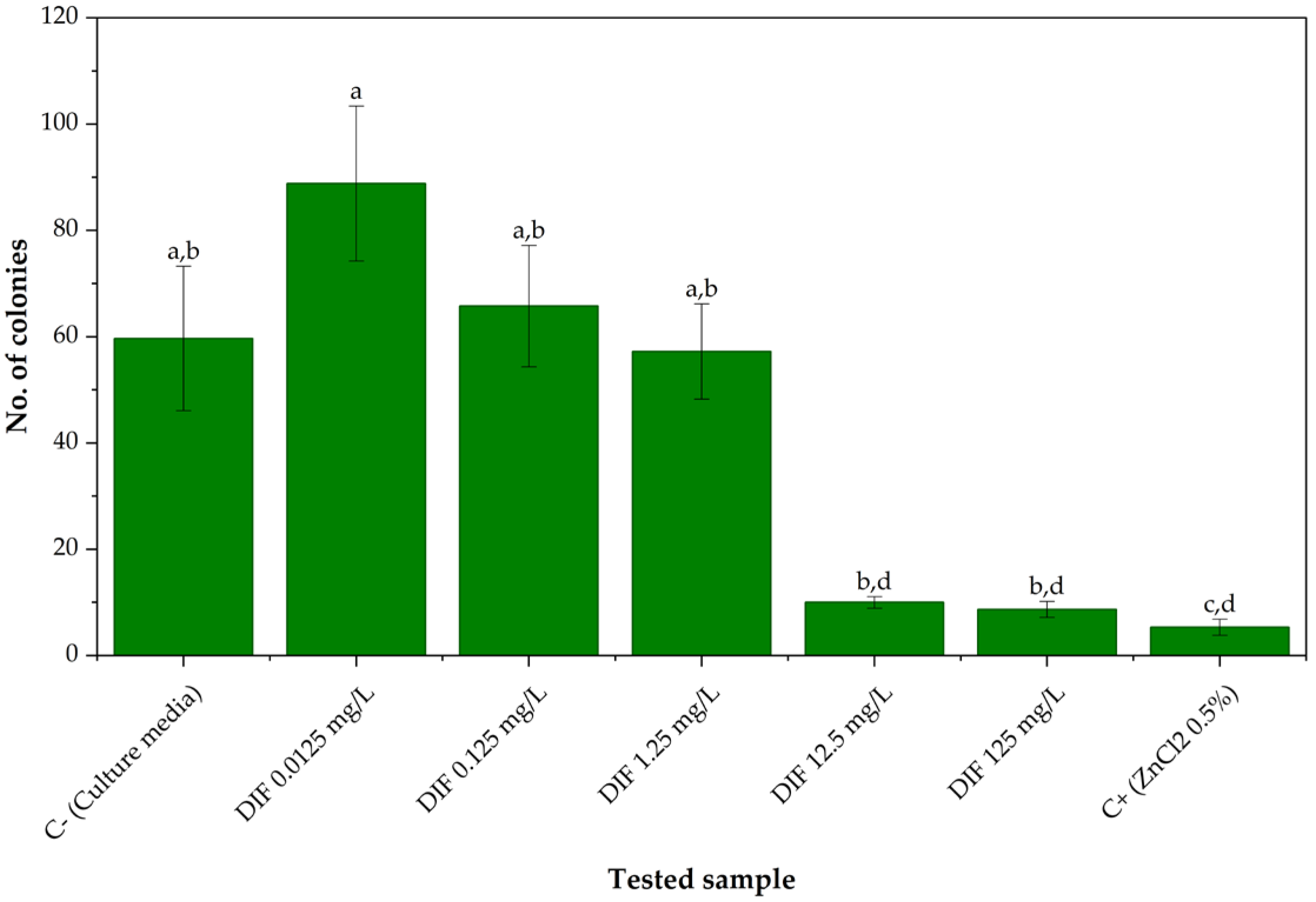
Colony counts exhibited a similar trend in response to the tested fungicide (Figure 2). Here, especially at 0.0125 mg/L DIF, the number of colonies is visibly higher than that of the negative control, while the highest concentration is similar to the positive control. These results are sustained by the statistical analysis, which shows significant difference between 0.0125 mg/L and the two highest concentrations.
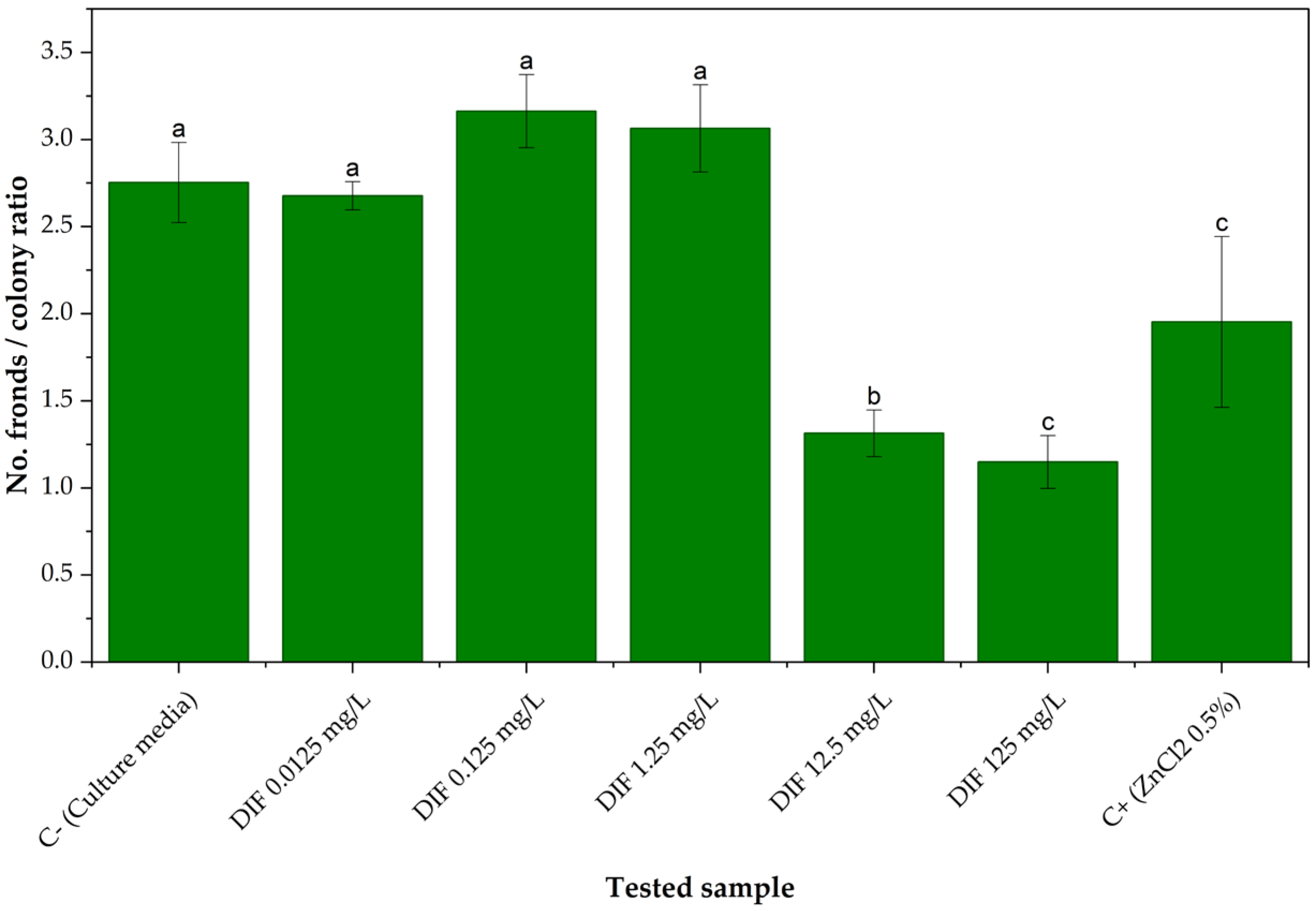
The total number of fronds (green + chlorotic) and the number of colonies were used to determine the no. of fronds/colony ratio. This ratio highlights a potential colony disintegration effect for 12.5 and 125 mg/L DIF, as these show lower values than both controls (Figure 3). For the lowest concentrations, no significant differences from the negative control are observed, showcasing the potential hormesis effect, not a subchronic toxic effect.
Various studies on Lemna minor were conducted for numerous pesticides [66,67,68,69,70], including different fungicides [5,71], such as copper and dimethomorph [44], clotrimazole [72], and more specific triazole fungicides, such as tetraconazole [73] or prothioconazole [74,75]. Concentration-dependent ecotoxicological effects on Lemna minor were also identified for six additional triazole fungicides—flutriafol, metconazole, myclobutanil, tebuconazole, tetraconazole, and triticonazole—as reported in our previous study [19]. However, in that investigation, the effects were not examined in detail with respect to frond and colony number.
The results obtained in the present study are consistent with those reported by Mendieta Herrera et al. (2023), who observed a concentration-dependent reduction in frond number in L. minor [46]. Similarly, our findings demonstrated a clear dose–response relationship following a seven-day exposure. In addition, the determination of EC50 value enabled quantitative characterization of toxicity, allowing classification according to aquatic toxicity categories and facilitating comparison with other compounds.
Beyond growth inhibition based on frond number, the present study broadened the assessment of phytotoxic effects by including additional developmental parameters. Colony number, frond-to-colony ratio, and detailed morphometric and gravimetric analyses were evaluated. The integration of these endpoints provides a more comprehensive understanding of sublethal effects on plant structure and growth dynamics, contributing to a more nuanced interpretation of toxicity.
Furthermore, the scope of the investigation was expanded through computational analysis, encompassing not only the parent fungicide but also its potential transformation residues formed in water and soil. The in silico prediction of ecotoxicological effects across multiple aquatic organisms complements the experimental findings and supports a more comprehensive environmental risk assessment.
Concentration-dependent ecotoxicological effects on Lemna minor were also identified for six additional triazole fungicides—flutriafol, metconazole, myclobutanil, tebuconazole, tetraconazole, and triticonazole—as reported in our previous study [19]. However, in that investigation, the effects were not examined in detail with respect to frond and colony number.

3.2. Aquatic Toxicity Evaluation

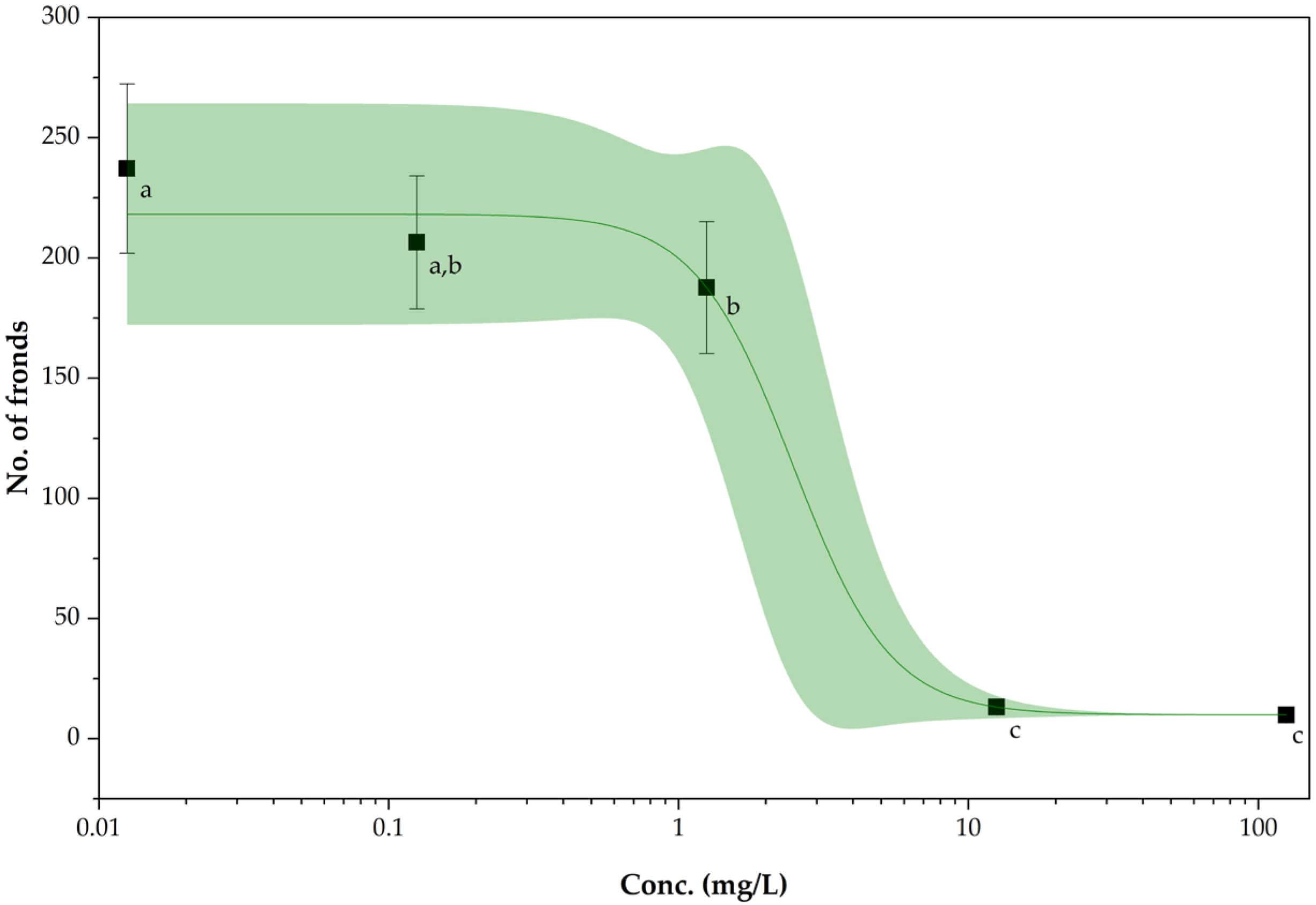
The total number of fronds was utilized to plot a dose–response curve for difenoconazole (Figure 4). This plot allowed the calculation of EC50 for DIF, which was 2.47 ± 0.44 (1.39–3.90 confidence interval). According to the U.S. Environmental Protection Agency, based on the calculated EC50 value, DIF can be categorized in terms of aquatic toxicity as moderately toxic.
Other studies have evaluated the ecotoxicity of difenoconazole (DIF) in additional aquatic model organisms, including algae [76,77], with reported EC50 values falling within the same aquatic ecotoxicity category as those identified in the present study.
Regarding aquatic invertebrates, investigations conducted on Daphnia magna [46], Palaemonetes paludosus [78], and Tubifex tubifex [21] reported median lethal concentration (LC50) values ranging from 0.9 to 3.4 mg/L. These values are generally comparable to those obtained in our study; however, D. magna exhibited lower LC50 values, indicating higher sensitivity to the presence of this fungicide.
At the level of aquatic vertebrates, toxicity data have been reported for fish species such as Danio rerio [79,80,81] and Opsariichthys bidens [82], with LC50 values of 1.2 mg/L (calculated as a mean of the data from the studies) and 4.7 mg/L, respectively. In comparison with our findings on Lemna minor, these results suggest that DIF displays higher toxicity toward D. rerio, lower toxicity toward O. bidens, and a comparable range of sensitivity across primary producers and aquatic fauna.
Data retrieved from the Pesticides Properties DataBase (PPDB) showed that the EC50 value determined in the present study (2.47 mg/L) is nearly identical to the value reported for Lemna gibba (2.5 mg/L), thereby confirming the consistency of our results. Furthermore, according to PPDB records, difenoconazole exhibits lower toxicity toward Lemna minor compared to other aquatic organisms, including the alga Desmodesmus subspicatus, the crustaceans Daphnia magna and Americamysis bahia, the insect Chironomus riparius, and the fishes Oncorhynchus mykiss and Danio rerio. For these species, reported effect concentrations are between 2- and 76-fold lower than those observed for L. minor, indicating comparatively higher sensitivity.
The observed pattern of differential sensitivity across taxa in our study aligns with species sensitivity distribution (SSD) analyses reported in the literature. SSD models for difenoconazole demonstrate that acute toxicity varies widely among aquatic organisms, often spanning several orders of magnitude [83]. In our experiments, Lemna minor showed an EC50 of 2.47 mg/L, indicating lower sensitivity compared to several animal taxa. Fish species such as D. rerio and O. mykiss, as well as invertebrates including D. magna, A. bahia, and C. riparius, exhibited much lower EC50 values in previously published studies, reflecting higher susceptibility. Conversely, some organisms, such as P. paludosus, T. tubifex, and O. bidens, appear less sensitive, with effect concentrations closer to that of L. minor. This interspecific variability is consistent with SSD theory, which captures taxon-dependent differences arising from physiological, metabolic, and ecological traits. Importantly, these differences highlight that relying on a single test species may underestimate the potential ecological risks posed by difenoconazole to more sensitive taxa. Consequently, combining experimental data on L. minor with in silico predictions across multiple aquatic species provides a more comprehensive and ecologically relevant assessment of difenoconazole toxicity.
The calculated EC50 value for difenoconazole was comparable to those previously reported for tebuconazole and flutriafol in our earlier study [19]. It was 4.6-fold higher than that of tetraconazole and 18.7-fold higher than that of metconazole, indicating lower toxicity relative to these two compounds. Conversely, difenoconazole exhibited greater toxicity than myclobutanil and triticonazole, with EC50 values 3.7-fold and 4.7-fold lower, respectively.
Data from the PPDB for nine additional fungicides approved by the European Union indicated that the EC50 value of difenoconazole was higher than those reported for bromuconazole, mefentrifluconazole, metconazole, paclobutrazol, penconazole, prothioconazole, tebuconazole, tetraconazole, and triticonazole for Lemna gibba. Difenoconazole exhibited similar, slightly lower EC50 values compared to mefentrifluconazole, tetraconazole, and triticonazole, whereas its EC50 was approximately 300-fold higher than that of paclobutrazol.
The comparison of tested concentrations and the EC50 with published environmental benchmarks [84] indicates that only the lowest concentration of 0.0125 mg a.s./L is below the Serious Risk Concentration for ecosystems (SRCeco) (0.0750 mg/L) but above the Maximum Acceptable Concentration for ecosystems (MACeco) (0.0078 mg/L), suggesting that effects observed even at this level may represent relatively high, near-risk exposure. All higher concentrations (0.125–125 mg a.s./L) exceed the SRCeco and therefore primarily reflect acute toxicity under extreme conditions rather than environmentally realistic scenarios. The EC50 is higher than all reference values, indicating that concentrations causing 50% effect are well above typical environmental levels. These results highlight that sublethal effects are most relevant at the lowest tested concentration, while higher concentrations mainly provide information on the upper bounds of toxicity.

3.3. Gravimetric, Morphological and Biochemical Effects

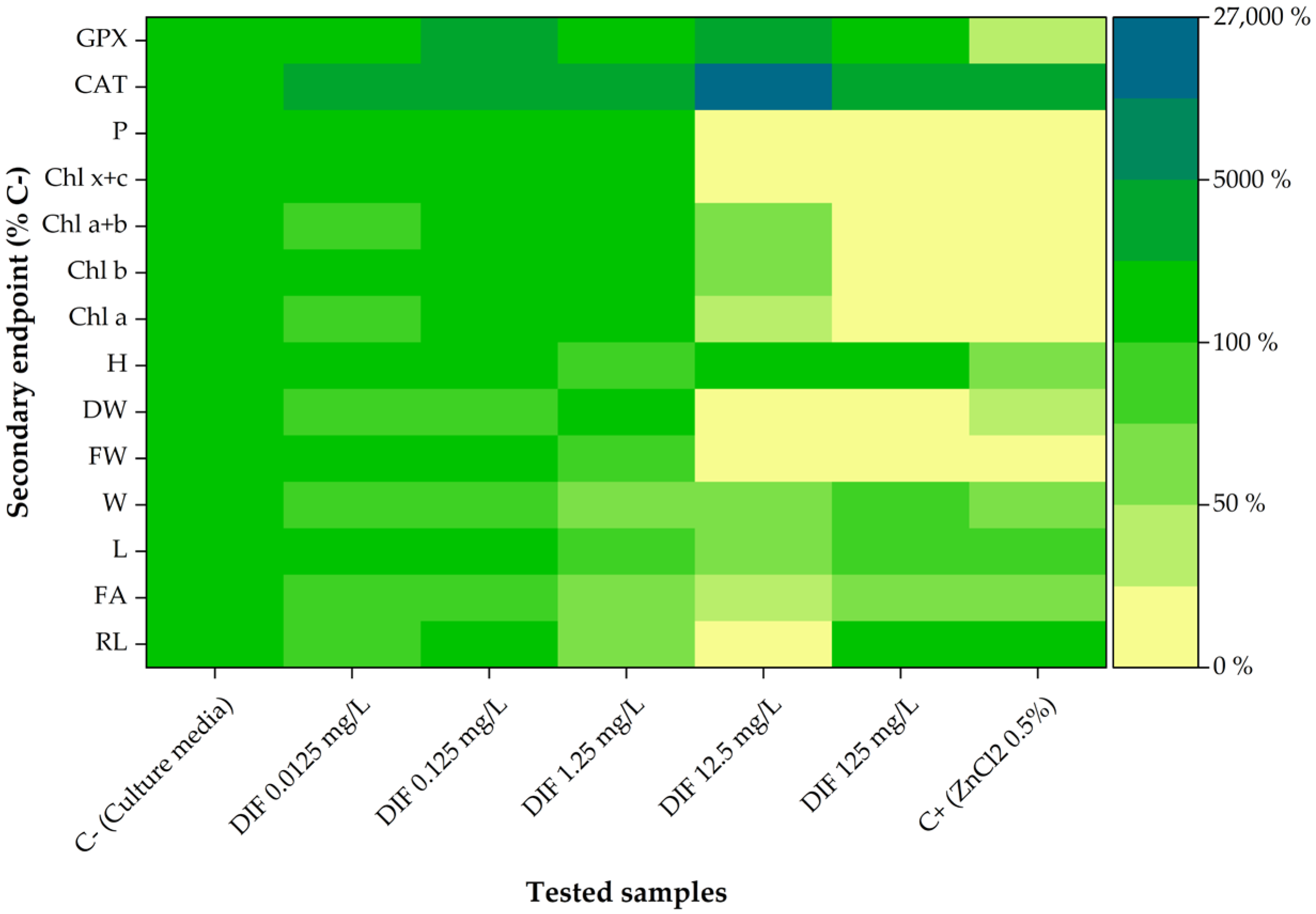
The analysis of the morphometrical secondary endpoints revealed that the strongest reduction in the measurements was induced by DIF 12.5 mg/L (Figure 5), especially for root length and frond area. Taking into account that DIF 125 mg/L also has a strong inhibitory effect on the number of fronds and colonies, the lack of reduction in morphometrical parameters could be attributed to the very sudden death of the plants. Thus, there is no sufficient time for morphometrical inhibition to appear.
The gravimetric measurements showed a reduction in both fresh and dry weight for the two highest fungicide concentrations, similar to the positive control (Figure 5). As the calculated humidity does not vary in a concentration-dependent manner, it is probable that the low values of FW and DW are due to the small number of fronds from these samples.
Regarding the biochemical endpoints, the chlorophyll content and protein concentration showed a reduction in DIF 12.5 and 125 mg/L, as well as C+. The chlorophyll content trend is in good agreement with the trend observed in the case of the number of green and chlorotic fronds.
The catalase activity shows an increase with the concentration of DIF, indicating potential oxidative stress induced by the fungicide. This is observable even for the lowest tested concentration, where the catalase activity is already 10 times higher than in the negative control. This induction of catalase is concentration-dependent, having its peak at 12.5 mg/L DIF, where is more than 250 times higher than C-. The lower CAT activity at 125 mg/L DIF also emphasizes the potential sudden death of fronds, with the plant not being able to respond biochemically to the stress created by the presence of the fungicide. Guaiacol peroxidase has a similar trend to catalase, highlighting the induction of oxidative stress.
While chlorophyll content has also previously been investigated as a physiological indicator of stress by Mendieta Herrera et al. (2023) [46], the present study further extended the biochemical evaluation by quantifying total soluble protein concentration and the activities of catalase and guaiacol peroxidase. These enzymatic markers offer mechanistic insight into oxidative stress responses, thereby strengthening the interpretation of observed growth inhibition and physiological alterations.

3.4. In Silico Prediction of Aquatic Toxicity

In the computational assessment of aquatic toxicity, a total of 15 compounds were evaluated, comprising difenoconazole (DIF) and 14 of its potential transformation products (TRs) (Table S1). Two complementary categories of data were generated: (i) probabilistic predictions of adverse effects on aquatic organisms derived from admetSAR, and (ii) quantitative toxicological endpoints, namely, IGC50 and LC50 values, estimated using ADMETlab and T.E.S.T. software.
A critical aspect in the interpretation of QSAR-based predictions is the concept of the applicability domain (AD), which defines the chemical space within which model outputs are considered reliable. Compounds that fall outside this domain—due to structural dissimilarity from the training dataset—may yield predictions with reduced accuracy, and such outputs should therefore be interpreted as approximate rather than definitive. Each computational platform employed in this study applies distinct methodologies for defining its AD, and the positioning of the investigated compounds relative to these domains is detailed in the Supplementary Materials (Tables S2–S4).
Within the applicability domains, the majority of compounds were predicted reliably; however, for admetSAR 3.0, difenoconazole itself fell at only ~50% coverage, while for ADMETlab 3.0, most compounds were within acceptable limits according to the domain diagram. For the EPA T.E.S.T. model, all tested endpoints for Pimephales promelas and Daphnia magna showed similarity to the training set below 70%, indicating moderate confidence in these predictions. Consequently, the results for these specific species and endpoints should be interpreted cautiously, as limited representation in the training data may increase uncertainty. Overall, despite some endpoints falling outside the optimal coverage, the majority of compounds are within the applicability domains of the selected models, supporting the general reliability of the predictions.
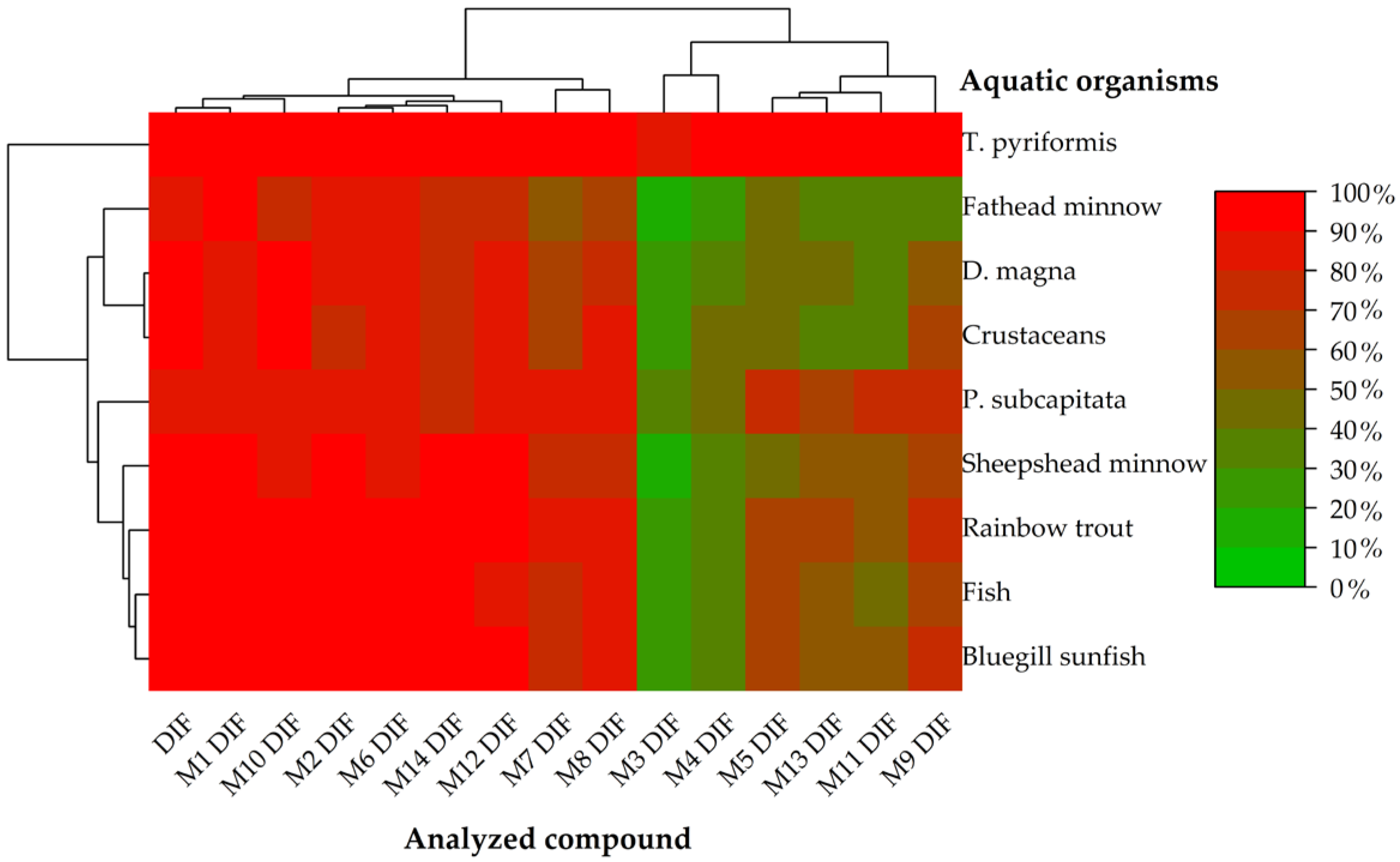
The data obtained from admetSAR showcased a high toxicity to aquatic organisms for both DIF and the majority of its transformation products (Figure 6). The least toxic TRs were M3 DIF and M4 DIF, which are the only two that only have one aromatic ring in their structure. Other transformation products that had lower probabilities were M5 DIF, M9 DIF, M11 DIF and M13 DIF. The similarities between these TRs are also highlighted by the dendrology of the figure, showing a tight clustering of these.
The aquatic organism that is the most sensitive to DIF is T. pyriformis, with the least sensitive being the fathead minnow. Regarding the aquatic organisms, clusters reveal a tight relation between fish as model organisms and between crustaceans in general and D. magna.
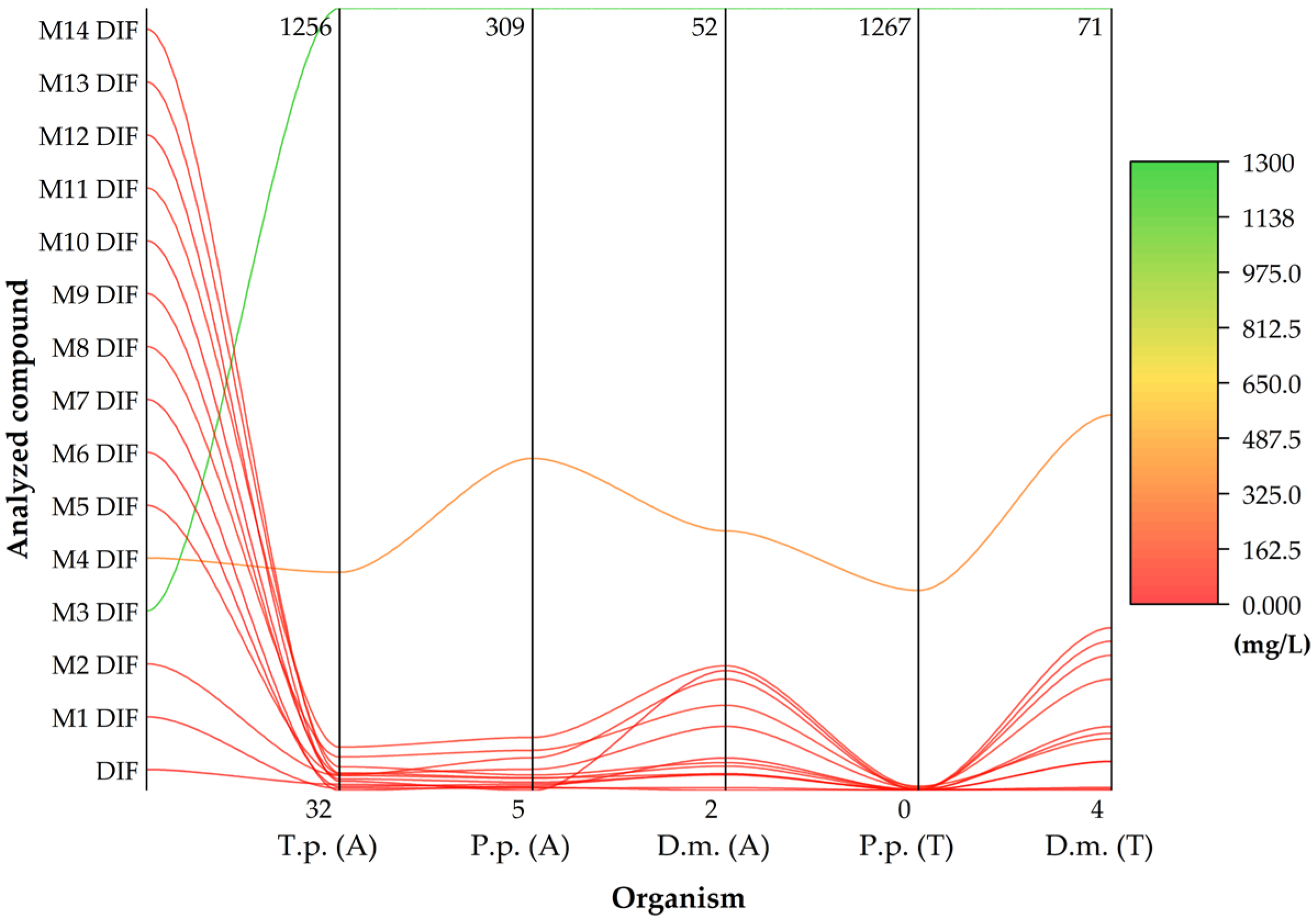
The parallel coordinated plot built on data regarding toxicity endpoints from ADMETlab and T.E.S.T. illustrates a similarity in toxicity for the majority of analyzed compounds (Figure 7). Only two exceptions are observed, M4 DIF, which has a higher but intermediate value for all five parameters, and M3 DIF, with the highest values. This data further supports the fact that the difference in toxicity of TRs might partially be due to the aromatic rings present in the structure.
The two computational tools gave similar results for the same species. The only difference was that T.E.S.T. could not compute an IGC50 value for T. pyriformis. The most sensitive organism was revealed to be P. promelas, and the least sensitive organism was D. magna.
Regression analyses between the computational parameters obtained using the three prediction programs and the physicochemical descriptors generated with SwissADME revealed potential causal relationships. These associations were further examined through Pearson correlation analysis, which demonstrated a strong positive correlation (approaching 1) between the predicted probability of effects on aquatic organisms and lipophilicity, as well as water solubility. In contrast, the correlation with molecular weight was moderate. A similar pattern was observed for the toxicity indices, although the correlation coefficients were slightly lower. These findings are consistent with established principles in environmental toxicology, where physicochemical properties such as hydrophobicity play a central role in bioavailability and membrane permeability.
The predicted ecotoxicological effects of difenoconazole transformation products in the present study are consistent with the study that originally identified these compounds [1]. In that study, ECOSAR data also indicated low aquatic toxicity for TRs M3 DIF (TP277C) and M4 DIF (TP295), in agreement with our results. The present study extended the in silico assessment to additional organisms beyond those considered previously (fish LC50, daphnid EC50, and algal EC50) by including Tetrahymena pyriformis IGC50. Moreover, we estimated the probability that both DIF and its TRs could affect a broader range of aquatic organisms, including T. pyriformis (protozoa), Pseudokirchneriella subcapitata (algae), crustaceans in general and D. magna, and fish in general and species such as fathead minnow, sheepshead minnow, rainbow trout, and bluegill sunfish. These analyses consistently indicate that TRs M3 DIF and M4 DIF exhibit lower toxicity relative to the parent compound.
Computational approaches to aquatic ecotoxicity provide valuable, rapid, and cost-effective insights into the potential hazards of chemical substances. However, such in silico assessments are inherently limited by the quality of input data, model assumptions, and applicability domains. Consequently, experimental determination of ecotoxicological endpoints remains essential for scientific validation, calibration of predictive models, and reduction in uncertainty. Empirical data not only serve to confirm computational findings but also contribute to model refinement and uncertainty reduction. The integration of computational predictions with empirically derived data ensures a more robust and defensible evaluation of environmental risk.
The complementary use of experimental and in silico approaches in this study enabled a more comprehensive evaluation of difenoconazole’s potential ecological effects. Laboratory tests on Lemna minor provided direct evidence of physiological and biochemical responses, while computational predictions facilitated assessment across multiple species and endpoints that could not be addressed experimentally. Integrating these approaches strengthened the overall interpretation by allowing the validation of predicted toxicity trends against observed responses, supporting extrapolation to additional aquatic organisms, and offering mechanistic insights into the compound’s ecotoxicological behavior.
A key aspect that highlights the novelty of this study is the combined expansion of experimental endpoints and the extension of computational analyses within a single, coherent framework. While previous research on Lemna minor has relied on biomass and chlorophyll as general indicators [46], the inclusion of additional endpoints in the present study enables a more nuanced interpretation of physiological and sublethal effects, improving the depth of biological insight. Furthermore, although one earlier study identified transformation products and evaluated their ecotoxicity computationally, typically limited to a small number of species such as fish and daphnids using tools like ECOSAR [1], our study extends this approach by applying three computational tools and broadening the analysis to a wider range of aquatic organisms. In parallel, by considering both the parent compound and its transformation products within the same study, we enable a direct and more comprehensive comparison of their potential effects. This combined experimental and expanded in silico perspective enhances the ecological relevance of the assessment and represents the principal novelty of the work.
Understanding the ecological risk posed by fungicides to aquatic organisms is critical for preventing and mitigating their adverse impacts on freshwater and marine ecosystems, especially in the One Health paradigm, which emphasizes the interconnectedness of environmental, animal, and human health. Aquatic species often exhibit varying sensitivities to chemical exposure, and sublethal effects can propagate through trophic levels, ultimately affecting ecosystem structure and function. Reliable toxicity data are therefore critical for informing mitigation strategies, including exposure control, optimized application practices, and sustainable product management.
Environmental protection frameworks increasingly rely on comprehensive risk assessments to regulate the release and use of potentially hazardous chemical compounds. Within this context, experimental aquatic ecotoxicity studies, complemented by computational predictions, contribute to a holistic understanding of environmental behavior and biological effects. Such integrated evidence supports regulatory decision-making, facilitates hazard classification, and informs the establishment of environmental quality standards designed to safeguard aquatic ecosystems.
Future research should prioritize the experimental validation of computational predictions to enhance model reliability and regulatory acceptance. In addition, particular attention should be directed toward the identification and experimental evaluation of transformation products of difenoconazole across a broad spectrum of aquatic organisms. These derivatives may exhibit toxicological profiles distinct from the parent compound, and differential species sensitivity underscores the necessity of multi-species testing to achieve an accurate assessment of ecological risk.

4. Conclusions

In this study, the aquatic ecotoxicity of difenoconazole and its transformation products was evaluated using an integrated experimental–computational approach, in line with the objective of providing a comprehensive evaluation of its effects on aquatic organisms. The experimental component focused on the acute effects of difenoconazole on Lemna minor, a model aquatic organism, using a growth inhibition assay complemented by the determination of gravimetric, morphometrical, and biochemical parameters.
The results demonstrated a concentration-dependent toxic effect of difenoconazole across most analyzed endpoints, confirming its impact on both physiological and biochemical processes. The calculated EC50 value of 2.47 mg/L indicates moderate toxicity. The observed reductions in morphometrical and gravimetric parameters, as well as in chlorophyll and protein content, together with increased activities of catalase and guaiacol peroxidase, indicate that oxidative stress is a key mechanism underlying the toxic response.
To address the objective of extending the assessment beyond a single species, in silico analyses were performed to predict the aquatic toxicity of difenoconazole and its transformation products for additional organisms (protozoan, algal, crustacean or fish species) using admetSAR, ADMETlab and T.E.S.T. computational tools. The predictions indicated generally lower toxicity for two transformation products across most model organisms, while indicating higher sensitivity in some taxa, suggesting a potential reduction in ecological risk following transformation. These findings are consistent with available experimental and computational data for difenoconazole and related triazole fungicides, as well as with data from the Pesticides Properties DataBase.
Overall, the combined experimental and computational results provide a more comprehensive understanding of the acute effects and potential environmental behavior of difenoconazole. The results indicate moderate toxicity to aquatic plants and support the relevance of combining experimental and computational approaches for improved environmental risk assessment.

Supplementary Materials

The following supporting information can be downloaded at: https://www.mdpi.com/article/10.3390/agronomy16080774/s1, Table S1: Analyzed compounds in the in silico assessment; Table S2: admetSAR 3.0 applicability domains and radar chart; Table S3: ADMETlab 3.0 applicability domains as radar charts; Table S4: US EPA T.E.S.T. model applicability as similarity to training chemicals.

Author Contributions

Conceptualization, B.-V.A. and A.-D.I.-D.; methodology, B.-V.A., C.-B.V. and A.I.; software, B.-V.A., A.P. and A.I.; validation, A.-D.I.-D., B.-V.A. and A.I.; formal analysis, C.-A.C., C.-B.V. and A.P.; investigation, C.-A.C., C.-B.V. and A.P.; resources, B.-V.A.; data curation, B.-V.A.; writing—original draft preparation, A.-D.I.-D. and B.-V.A.; writing—review and editing, A.-D.I.-D., B.-V.A. and A.I.; visualization, A.-D.I.-D., C.-B.V., C.-A.C., A.P. and A.I.; supervision, B.-V.A.; project administration, B.-V.A.; funding acquisition, B.-V.A. All authors have read and agreed to the published version of the manuscript.

Funding

This article was supported by the grant entitled “Integrating EXperimental and INformatics methodologies in TOXICological impact assessment: Investigating the effects of triazole fungicides on the environment and human health”, acronym EX-IN-TOX, 04.2025–12.2026, funded by the Academy of Romanian Scientists through the Academy of Romanian Scientists Research Projects Competition for Young Researchers “AOȘR-Teams-IV” Edition 2025–2026 “Digital Transformation in Sciences”, and the UVT 1000 Develop Fund of the West University of Timisoara.

Data Availability Statement

The original contributions presented in this study are included in the article. Further inquiries can be directed to the corresponding author.

Conflicts of Interest

The authors declare no conflicts of interest.

Abbreviations

The following abbreviations are used in this manuscript:
DIFDifenoconazole
H%Humidity
FWFresh weight
DWDry weight
FAFrond area
RLRoot length
LFrond length
WFrond width
Chl aChlorophyll a
Chl bChlorophyll b
Chl a + bTotal chlorophyll (a + b)
Chl x + cCarotenoids (carotene and xantophylls)
PTotal soluble protein concentration
CATCatalase
GPXGuaiacol peroxidase

References

  1. Man, Y.; Stenrød, M.; Wu, C.; Almvik, M.; Holten, R.; Clarke, J.L.; Yuan, S.; Wu, X.; Xu, J.; Dong, F.; et al. Degradation of difenoconazole in water and soil: Kinetics, degradation pathways, transformation products identification and ecotoxicity assessment. J. Hazard. Mater. 2021, 418, 126303. [Google Scholar] [CrossRef] [PubMed]
  2. Chen, Y.; Zhang, Y.; Yao, J.; Li, Y.-F.; Yang, X.; Wang, W.-X.; Zhang, A.-F.; Gao, T.-C. Frequency distribution of sensitivity of Ustilaginoidea virens to four EBI fungicides, prochloraz, difenoconazole, propiconazole and tebuconazole, and their efficacy in controlling rice false smut in Anhui Province of China. Phytoparasitica 2013, 41, 277–284. [Google Scholar] [CrossRef]
  3. Rajak, P.; Roy, S.; Ganguly, A.; Mandi, M.; Dutta, A.; Das, K.; Nanda, S.; Ghanty, S.; Biswas, G. Agricultural pesticides—Friends or foes to biosphere? J. Hazard. Mater. Adv. 2023, 10, 100264. [Google Scholar] [CrossRef]
  4. Dai, Y.; Xia, L. Toxicity Tolerance of Microorganisms in Water Bodies. Int. Core J. Eng. 2023, 9, 436–441. [Google Scholar] [CrossRef]
  5. Karnaš Babić, M.; Majić, I.; Dandić, A.; Rastija, V. The Future of Azoles in Agriculture—Balancing Effectiveness and Toxicity. Appl. Sci. 2025, 15, 12902. [Google Scholar] [CrossRef]
  6. Bernardes, P.M.; Andrade-Vieira, L.F.; Aragão, F.B.; Ferreira, A.; da Silva Ferreira, M.F. Toxicity of Difenoconazole and Tebuconazole in Allium cepa. Water Air Soil Pollut. 2015, 226, 207. [Google Scholar] [CrossRef]
  7. Chen, L.; Wang, Z.; Zhang, C.; Jiang, W.; Li, X. Environmental Hormone Effects and Bioaccumulation of Propiconazole and Difenoconazole in Procypris merus. Bull. Environ. Contam. Toxicol. 2022, 109, 823–830. [Google Scholar] [CrossRef]
  8. Aragão, F.B.; Bernardes, P.M.; Ferreira, A.; Ferreira, M.F.d.S.; Andrade-Vieira, L.F. Cyto(geno)toxicity of Commercial Fungicides Based on the Active Compounds Tebuconazole, Difenoconazole, Procymidone, and Iprodione in Lactuca sativa L. Meristematic Cells. Water Air Soil Pollut. 2019, 230, 25. [Google Scholar] [CrossRef]
  9. Elgueta, S.; Zhao, G.; Faundez, C.; Campos, M.; Aracena, A.; Zúñiga, C.; Molinett, S.; Contreras-Duarte, S. Surveillance of Pesticide Residues in Chile (2015–2023): MRL Exceedances, Sales Indicators and Highly Hazardous Pesticides. Agriculture 2026, 16, 723. [Google Scholar] [CrossRef]
  10. Elgueta, S.; Valenzuela, M.; Fuentes, M.; Ulloa, P.E.; Ramos, C.; Correa, A.; Molinett, S. Analysis of Multi-Pesticide Residues and Dietary Risk Assessment in Fresh Tomatoes (Lycopersicum esculentum) from Local Supermarkets of the Metropolitan Region, Chile. Toxics 2021, 9, 249. [Google Scholar] [CrossRef]
  11. Filimon, M.N.; Popescu, R.; Verdes, D.; Dumitrescu, G.; Voia, O.S.; Ahmadi, M.; Dronca, D. The effects of difenoconazole treatment on microorganism from soil. Rev. Chim. 2018, 69, 1129–1133. [Google Scholar] [CrossRef]
  12. Zhang, M.; Zhou, Z.; Zhang, J.; Yu, Y.; Sun, L.; Lu, T.; Qian, H. Metagenomic ecotoxicity assessment of trace difenoconazole on freshwater microbial community. Chemosphere 2022, 294, 133742. [Google Scholar] [CrossRef]
  13. Dai, Y.; Shen, J.; Sun, Y.; Li, Y. Study on the Single Toxicity of Five Azole Fungicides for Green Algae. E3S Web Conf. 2022, 338, 01040. [Google Scholar] [CrossRef]
  14. Sanches, A.L.M.; Daam, M.A.; Freitas, E.C.; Godoy, A.A.; Meireles, G.; Almeida, A.R.; Domingues, I.; Espíndola, E.L.G. Lethal and sublethal toxicity of abamectin and difenoconazole (individually and in mixture) to early life stages of zebrafish. Chemosphere 2018, 210, 531–538. [Google Scholar] [CrossRef]
  15. Mu, X.; Chai, T.; Wang, K.; Zhu, L.; Huang, Y.; Shen, G.; Li, Y.; Li, X.; Wang, C. The developmental effect of difenoconazole on zebrafish embryos: A mechanism research. Environ. Pollut. 2016, 212, 18–26. [Google Scholar] [CrossRef] [PubMed]
  16. Wang, N.; Liu, Y.; Li, J.; Xu, L.; Liang, X. Advances in Selective Bioactivity and Toxicity of Chiral Triazole Fungicides and Their Selective Behavior in Mammals. Chirality 2025, 37, e70055. [Google Scholar] [CrossRef]
  17. Gridan, I.M.; Ciorsac, A.; Isvoran, A. Prediction of ADME-Tox properties and toxicological endpoints of triazole fungicides used for cereals protection. ADMET DMPK 2019, 7, 161–173. [Google Scholar] [CrossRef]
  18. Roman, D.L.; Voiculescu, D.I.; Filip, M.; Ostafe, V.; Isvoran, A. Effects of Triazole Fungicides on Soil Microbiota and on the Activities of Enzymes Found in Soil: A Review. Agriculture 2021, 11, 893. [Google Scholar] [CrossRef]
  19. Boros, B.-V.; Roman, D.-L.; Isvoran, A. Evaluation of the Aquatic Toxicity of Several Triazole Fungicides. Metabolites 2024, 14, 197. [Google Scholar] [CrossRef] [PubMed]
  20. Roman, D.L.; Voiculescu, D.I.; Ostafe, V.; Ciorsac, A.; Isvoran, A. A review of the toxicity of triazole fungicides approved to be used in European Union to the soil and aqueous environment. Ovidius Univ. Ann. Chem. 2022, 33, 113–120. [Google Scholar] [CrossRef]
  21. Saha, S.; Saha, S.; Pastorino, P.; Saha, N.C. Effects of Difenoconazole on Tubifex tubifex: Antioxidant Activity, Insights from GUTS Predictions, and Multi-Biomarker Analysis. Biology 2025, 14, 302. [Google Scholar] [CrossRef]
  22. European Food Safety Authority; Bellisai, G.; Bernasconi, G.; Carrasco Cabrera, L.; Castellan, I.; del Aguila, M.; Ferreira, L.; Santonja, G.G.; Greco, L.; Jarrah, S.; et al. Modification of the existing maximum residue levels for difenoconazole in wheat and rye. EFSA J. 2023, 21, e08207. [Google Scholar] [CrossRef]
  23. Liu, R.; Li, J.; Zhang, L.; Feng, T.; Zhang, Z.; Zhang, B. Fungicide Difenoconazole Induced Biochemical and Developmental Toxicity in Wheat (Triticum aestivum L.). Plants 2021, 10, 2304. [Google Scholar] [CrossRef] [PubMed]
  24. Li, J.; Zheng, W.; Li, J.; Askari, K.; Tian, Z.; Liu, R. Salicylic acid mitigates the physiological and biochemistry toxicity of fungicide difenoconazole and reduces its accumulation in wheat (Triticum aestivum L.). Plant Physiol. Biochem. 2025, 220, 109504. [Google Scholar] [CrossRef]
  25. Utture, S.C.; Banerjee, K.; Dasgupta, S.; Patil, S.H.; Jadhav, M.R.; Wagh, S.S.; Kolekar, S.S.; Anuse, M.A.; Adsule, P.G. Dissipation and Distribution Behavior of Azoxystrobin, Carbendazim, and Difenoconazole in Pomegranate Fruits. J. Agric. Food Chem. 2011, 59, 7866–7873. [Google Scholar] [CrossRef] [PubMed]
  26. Liu, J.; Xu, X.; Wu, A.; Song, S.; Xu, L.; Xu, C.; Liu, L.; Kuang, H. Rapid and sensitive determination of difenoconazole in cucumber and pear samples using an immunochromatographic assay. Food Biosci. 2022, 47, 101745. [Google Scholar] [CrossRef]
  27. Su, L.; Zhao, J.; Liao, C.; Wang, H.; Xiong, S.; Deng, Y.; Gong, D. Dissipation, Residue Behavior and Dietary Risk Assessment of Difenoconazole on Jujube (Ziziphus jujuba Mill.). Agronomy 2022, 12, 3145. [Google Scholar] [CrossRef]
  28. European Union. Directive (EU) 2025/2360 of the European Parliament and of the Council of 12 November 2025 on Soil Monitoring and Resilience (Soil Monitoring Law). Available online: http://data.europa.eu/eli/dir/2025/2360/oj (accessed on 16 February 2026).
  29. European Union. Commission Implementing Decision (EU) 2025/439 of 28 February 2025 Establishing a Watch List of Substances for Union-Wide Monitoring in the Field of Water Policy Pursuant to Directive 2008/105/EC of the European Parliament and of the Council (Notified Under Document C(2025) 1244). Available online: https://eur-lex.europa.eu/eli/dec_impl/2025/439/oj (accessed on 16 February 2026).
  30. European Union. Factsheets of the Substances for the 5th Watch List Under the Water Framework Directive. Annex III. Available online: https://op.europa.eu/en/publication-detail/-/publication/c8f3b580-d3b9-11ef-be2a-01aa75ed71a1/language-en (accessed on 16 February 2026).
  31. Wang, T.; Sui, J.; Zhou, Y.; Wang, L.; Yang, J.; Chen, F.; Cui, X.; Yang, Y.; Zhang, W. Difenoconazole Degradation by Novel Microbial Consortium TA01: Metabolic Pathway and Microbial Community Analysis. Int. J. Mol. Sci. 2025, 26, 3142. [Google Scholar] [CrossRef]
  32. Bromilow, R.H.; Evans, A.A.; Nicholls, P.H. The influence of lipophilicity and formulation on the distribution of pesticides in laboratory-scale sediment/water systems. Pest Manag. Sci. 2003, 59, 238–244. [Google Scholar] [CrossRef]
  33. European Food Safety Authority; Álvarez, F.; Arena, M.; Auteri, D.; Leite, S.B.; Binaglia, M.; Castoldi, A.F.; Chiusolo, A.; Colagiorgi, A.; Colas, M.; et al. Peer review of the pesticide risk assessment for the active substance difenoconazole in light of confirmatory data submitted. EFSA J. 2024, 22, e8921. [Google Scholar] [CrossRef]
  34. Wang, K.; Wu, J.X.; Zhang, H.Y. Dissipation of difenoconazole in rice, paddy soil, and paddy water under field conditions. Ecotoxicol. Environ. Saf. 2012, 86, 111–115. [Google Scholar] [CrossRef] [PubMed]
  35. Yu, L.; Wen, Y.; Luo, X.; Xiang, Y.; Yuan, X.; Pang, S.; Ma, X.; Li, X. Effects of Biogas Residues on Dissipation of Difenoconazole in Paddy Sediment System Under Field Conditions. Front. Environ. Sci. 2022, 10, 814438. [Google Scholar] [CrossRef]
  36. Filimon, M.N.; Voia, S.O.; Vladoiu, D.L.; Isvoran, A.; Ostafe, V. Temperature dependent effect of difenoconazole on enzymatic activity from soil. J. Serbian Chem. Soc. 2015, 80, 1127–1137. [Google Scholar] [CrossRef]
  37. Granados, M.; Arrebola, F.J.; Domínguez, I.; Estrella-González, M.J.; Toribio, A.J.; Frenich, A.G.; Egea, F.J. Comprehensive Study of Difenoconazole in Soil: Kinetics, Dissipation, Metabolism, and Microbial Toxicity. J. Agric. Food Chem. 2025, 73, 12570–12581. [Google Scholar] [CrossRef] [PubMed]
  38. Dong, S.; Huang, G.; Lu, J.; Huang, T. Determination of fungicides in sediments using a dispersive liquid–liquid microextraction procedure based on solidification of floating organic drop. J. Sep. Sci. 2014, 37, 1337–1342. [Google Scholar] [CrossRef]
  39. Boros, B.-V.; Ostafe, V. Evaluation of Ecotoxicology Assessment Methods of Nanomaterials and Their Effects. Nanomaterials 2020, 10, 610. [Google Scholar] [CrossRef]
  40. Vulpe, C.-B.; Toplicean, I.-M.; Agachi, B.-V.; Datcu, A.-D. A Review on Uses of Lemna minor, a Beneficial Plant for Sustainable Water Treatments, in Relation to Bioeconomy Aspects. Water 2025, 17, 1400. [Google Scholar] [CrossRef]
  41. Olette, R.; Couderchet, M.; Biagianti, S.; Eullaffroy, P. Toxicity and removal of pesticides by selected aquatic plants. Chemosphere 2008, 70, 1414–1421. [Google Scholar] [CrossRef]
  42. Nath, A.; Ojha, P.K. Exploring aquatic toxicity of diverse pesticides against Chironomus riparius (harlequin fly) and Lemna gibba (swollen duckweed): Applications of QSTR, i-QSTTR, and novel q-RA approaches. Sci. Total Environ. 2025, 1000, 180384. [Google Scholar] [CrossRef] [PubMed]
  43. Ueda, K.; Nagai, T. Relative sensitivity of duckweed Lemna minor and six algae to seven herbicides. J. Pestic. Sci. 2021, 46, 267–273. [Google Scholar] [CrossRef]
  44. Megateli, S.; Dosnon-Olette, R.; Trotel-Aziz, P.; Geffard, A.; Semsari, S.; Couderchet, M. Simultaneous effects of two fungicides (copper and dimethomorph) on their phytoremediation using Lemna minor. Ecotoxicology 2013, 22, 683–692. [Google Scholar] [CrossRef] [PubMed]
  45. Dosnon-Olette, R.; Couderchet, M.; Eullaffroy, P. Phytoremediation of fungicides by aquatic macrophytes: Toxicity and removal rate. Ecotoxicol. Environ. Saf. 2009, 72, 2096–2101. [Google Scholar] [CrossRef]
  46. Mendieta Herrera, J.; Iñiguez Armijos, C.; Rosado Alcarria, D.; Aguilar Ramírez, S. Toxicity of Difenoconazole and Atrazine and Their Photodegradation Products on Aquatic Biota: Environmental Implications in Countries Lacking Good Agricultural Practices. Toxics 2023, 11, 213. [Google Scholar] [CrossRef]
  47. Fu, L.; Shi, S.; Yi, J.; Wang, N.; He, Y.; Wu, Z.; Peng, J.; Deng, Y.; Wang, W.; Wu, C.; et al. ADMETlab 3.0: An updated comprehensive online ADMET prediction platform enhanced with broader coverage, improved performance, API functionality and decision support. Nucleic Acids Res. 2024, 52, W422–W431. [Google Scholar] [CrossRef]
  48. Gu, Y.; Yu, Z.; Wang, Y.; Chen, L.; Lou, C.; Yang, C.; Li, W.; Liu, G.; Tang, Y. admetSAR3.0: A comprehensive platform for exploration, prediction and optimization of chemical ADMET properties. Nucleic Acids Res. 2024, 52, W432–W438. [Google Scholar] [CrossRef]
  49. United States Environmental Protection Agency. Toxicity Estimation Software Tool (TEST) Version 5.1.2. Available online: https://www.epa.gov/comptox-tools/toxicity-estimation-software-tool-test (accessed on 11 February 2026).
  50. Certis Belchim. Difcor 250 EC Safety Data Sheet. Available online: https://certisbelchim.co.uk/pdf/MSDS/Difcor_MSDS.pdf (accessed on 12 February 2026).
  51. Voiculescu, D.I.; Roman, D.L.; Ostafe, V.; Isvoran, A. A Cheminformatics Study Regarding the Human Health Risks Assessment of the Stereoisomers of Difenoconazole. Molecules 2022, 27, 4682. [Google Scholar] [CrossRef]
  52. Organisation for Economic Co-Operation and Development. Test No. 221: Lemna sp. Growth Inhibition Test; OECD Guidelines for the testing of chemicals; OECD: Paris, France, 2006. [Google Scholar] [CrossRef]
  53. Pęczuła, W. Links Between Two Duckweed Species (Lemna minor L. and Spirodela polyrhiza (L.) Schleid.), Light Intensity, and Organic Matter Removal from the Water—An Experimental Study. Water 2025, 17, 438. [Google Scholar] [CrossRef]
  54. Grillo-Avila, D.; Antón-Pardo, M.; Armengol, J.; Puche, E.; Moratalla-López, J.; Palacios-Abella, J.F.; López-Heras, I.; Rochera, C.; Picazo, A.; Camacho, A.; et al. Responses of mediterranean freshwater invertebrates to the fungicide difenoconazole across different macrophyte dominance conditions: A mesocosm study. Ecotoxicology 2026, 35, 58. [Google Scholar] [CrossRef] [PubMed]
  55. Lewis, K.; Green, A. The pesticide properties database. Chem. Int. 2011, 33, 30–31. Available online: https://uhra.herts.ac.uk/id/eprint/14696/ (accessed on 16 February 2026). [CrossRef][Green Version]
  56. ImageJ: Image Processing and Analysis in Java. Available online: https://imagej.net/ij/ (accessed on 10 February 2026).
  57. Rueden, C.T.; Schindelin, J.; Hiner, M.C.; DeZonia, B.E.; Walter, A.E.; Arena, E.T.; Eliceiri, K.W. ImageJ2: ImageJ for the next generation of scientific image data. BMC Bioinform. 2017, 18, 529. [Google Scholar] [CrossRef]
  58. Pujicic, A.; Agachi, B.-V.; Vulpe, C.-B.; Isvoran, A. Effects of tarragon hydrodistillate and essential oil on aquatic ecosystems. Toxics 2025, 13, 668. [Google Scholar] [CrossRef] [PubMed]
  59. Lichtenthaler, H.K.; Wellburn, A.R. Determinations of total carotenoids and chlorophylls a and b of leaf extracts in different solvents. Biochem. Soc. Trans. 1983, 11, 591–592. [Google Scholar] [CrossRef]
  60. Beers, R.F.; Sizer, I.W. A spectrophotometric method for measuring the breakdown of hydrogen peroxide by catalase. J. Biol. Chem. 1952, 195, 133–140. [Google Scholar] [CrossRef] [PubMed]
  61. Hammerschmidt, R.; Nuckles, E.M.; Kuć, J. Association of enhanced peroxidase activity with induced systemic resistance of cucumber to Colletotrichum lagenarium. Physiol. Plant Pathol. 1982, 20, 73–82. [Google Scholar] [CrossRef]
  62. Kim, S.; Chen, J.; Cheng, T.; Gindulyte, A.; He, J.; He, S.; Li, Q.; Shoemaker, B.A.; Thiessen, P.A.; Yu, B.; et al. PubChem in 2021: New data content and improved web interfaces. Nucleic Acids Res. 2020, 49, D1388–D1395. [Google Scholar] [CrossRef]
  63. Daina, A.; Michielin, O.; Zoete, V. SwissADME: A free web tool to evaluate pharmacokinetics, drug-likeness and medicinal chemistry friendliness of small molecules. Sci. Rep. 2017, 7, 42717. [Google Scholar] [CrossRef]
  64. Gajewicz-Skretna, A.; Furuhama, A.; Yamamoto, H.; Suzuki, N. Generating accurate in silico predictions of acute aquatic toxicity for a range of organic chemicals: Towards similarity-based machine learning methods. Chemosphere 2021, 280, 130681. [Google Scholar] [CrossRef]
  65. Melnikov, F.; Kostal, J.; Voutchkova-Kostal, A.; Zimmerman, J.B.; Anastas, P.T. Assessment of predictive models for estimating the acute aquatic toxicity of organic chemicals. Green Chem. 2016, 18, 4432–4445. [Google Scholar] [CrossRef]
  66. Peterson, H.G.; Boutin, C.; Martin, P.A.; Freemark, K.E.; Ruecker, N.J.; Moody, M.J. Aquatic phyto-toxicity of 23 pesticides applied at expected environmental concentrations. Aquat. Toxicol. 1994, 28, 275–292. [Google Scholar] [CrossRef]
  67. Richter, E.; Roller, E.; Kunkel, U.; Ternes, T.A.; Coors, A. Phytotoxicity of wastewater-born micropollutants—Characterisation of three antimycotics and a cationic surfactant. Environ. Pollut. 2016, 208, 512–522. [Google Scholar] [CrossRef]
  68. Ahmed, M.A.I. Ecotoxicity and Removal of Pesticides by Aquatic Plants. In Aquatic Ecotoxicology of Legacy Pollutants and Emerging Contaminants in Animals and Plants; Malafaia, G., Ed.; Springer Nature Link: Cham, Switzerland, 2025; pp. 43–69. [Google Scholar]
  69. Vechia, J.d.; Cruz, C.; Silva, A.; Cerveirajr, W.; Garlich, N. Macrophyte bioassay applications for monitoring pesticides in the aquatic environment. Planta Daninha 2016, 34, 597–603. [Google Scholar] [CrossRef]
  70. Tagun, R.; Boxall, A.B.A. The response of Lemna minor to mixtures of pesticides that are commonly used in Thailand. Bull. Environ. Contam. Toxicol. 2018, 100, 516–523. [Google Scholar] [CrossRef]
  71. Marinho, M.d.C.; Diogo, B.S.; Lage, O.M.; Antunes, S.C. Ecotoxicological evaluation of fungicides used in viticulture in non-target organisms. Environ. Sci. Pollut. Res. 2020, 27, 43958–43969. [Google Scholar] [CrossRef]
  72. Alkimin, G.D.d.; Santos, J.; Soares, A.M.V.M.; Nunes, B. Ecotoxicological effects of the azole antifungal agent clotrimazole on the macrophyte species Lemna minor and Lemna gibba. Comp. Biochem. Physiol. Part C Toxicol. Pharmacol. 2020, 237, 108835. [Google Scholar] [CrossRef] [PubMed]
  73. Aksakal, Ö. Effects of tetraconazole on antioxidant system in Lemna minor. Bull. Biotechnol. 2024, 5, 24–28. [Google Scholar] [CrossRef]
  74. Yang, Y.; Li, X.; Tang, Q.; Mei, L.; Cao, J.; Huang, H.; Zhang, Z. Aquatic ecological risk evaluation of chiral triazole fungicide prothioconazole and its metabolite prothioconazole-desthio on Lemna minor. Sustainability 2022, 14, 16292. [Google Scholar] [CrossRef]
  75. Zhai, W.; Zhang, L.; Cui, J.; Wei, Y.; Wang, P.; Liu, D.; Zhou, Z. The biological activities of prothioconazole enantiomers and their toxicity assessment on aquatic organisms. Chirality 2019, 31, 468–475. [Google Scholar] [CrossRef]
  76. Durjava, M.K.; Kolar, B.; Arnus, L.; Papa, E.; Kovarich, S.; Sahlin, U.; Peijnenburg, W. Experimental Assessment of the Environmental Fate and Effects of Triazoles and Benzotriazole. Altern. Lab. Anim. 2013, 41, 65–75. [Google Scholar] [CrossRef]
  77. Abd-Allah, S.M.; Gouda, N.A. Comparing ecological risks of pesticides on unicellular freshwater green alga; Pseudokirchneriella subcapitata using a risk quotient ranking approach. J. Plant Prot. Path. 2012, 3, 1001–1011. [Google Scholar] [CrossRef]
  78. Ahmad, H.; Rahman, M.R.; Nasir, S. Toxicity of difenoconazole pesticide on freshwater shrimp, Palaemonetes paludosus. In Proceedings of the International Conference on Environmental Research and Technology (ICERT 2017), Penang, Malaysia, 23–25 August 2017; pp. 79–83. Available online: https://www.academia.edu/89371929/International_Conference_on_Environmental_Research_and_Technology_ICERT_2017_79_TOXICITY_OF_DIFENOCONAZOLE_PESTICIDE_ON_FRESHWATER_SHRIMP_Palaemonetes_paludosus (accessed on 9 February 2026).
  79. Sanches, A.L.M.; Vieira, B.H.; Reghini, M.V.; Moreira, R.A.; Freitas, E.C.; Espíndola, E.L.G.; Daam, M.A. Single and mixture toxicity of abamectin and difenoconazole to adult zebrafish (Danio rerio). Chemosphere 2017, 188, 582–587. [Google Scholar] [CrossRef] [PubMed]
  80. Fan, R.; Zhang, W.; Jia, L.; Li, L.; Zhao, J.; Zhao, Z.; Peng, S.; Chen, Y.; Yuan, X. Combined Developmental Toxicity of the Pesticides Difenoconazole and Dimethomorph on Embryonic Zebrafish. Toxins 2021, 13, 854. [Google Scholar] [CrossRef]
  81. Wang, D.; Wang, Y.; Mao, L.; Liu, X.; Chen, C.; Wang, Y.; Yang, G. Elucidating the combined toxicity of dimethomorph and difenoconazole: Intergenerational effects on different biological processes in zebrafish. Ecotoxicol. Environ. Saf. 2025, 302, 118740. [Google Scholar] [CrossRef]
  82. Wang, D.; An, X.; Lu, P.; Wang, X.; Mao, L.; Tang, T.; Wang, Y.; Liu, X. Biochemical and molecular disruptions in hook snout carp induced by co-exposure to lambda-cyhalothrin and difenoconazole. Ecotoxicol. Environ. Saf. 2025, 307, 119417. [Google Scholar] [CrossRef]
  83. Sun, J.; Xiao, P.; Yin, X.; Zhu, G.; Brock, T.C.M. Aquatic and sediment ecotoxicity data of difenoconazole and its potential environmental risks in ponds bordering rice paddies. Ecotoxicol. Environ. Saf. 2024, 273, 116135. [Google Scholar] [CrossRef] [PubMed]
  84. Mensink, B. Environmental Risk Limits for Difenoconazole; National Institute for Public Health and the Environment: Bilthoven, The Netherlands, 2008; Available online: https://www.rivm.nl/bibliotheek/rapporten/601716005.pdf (accessed on 7 February 2026).
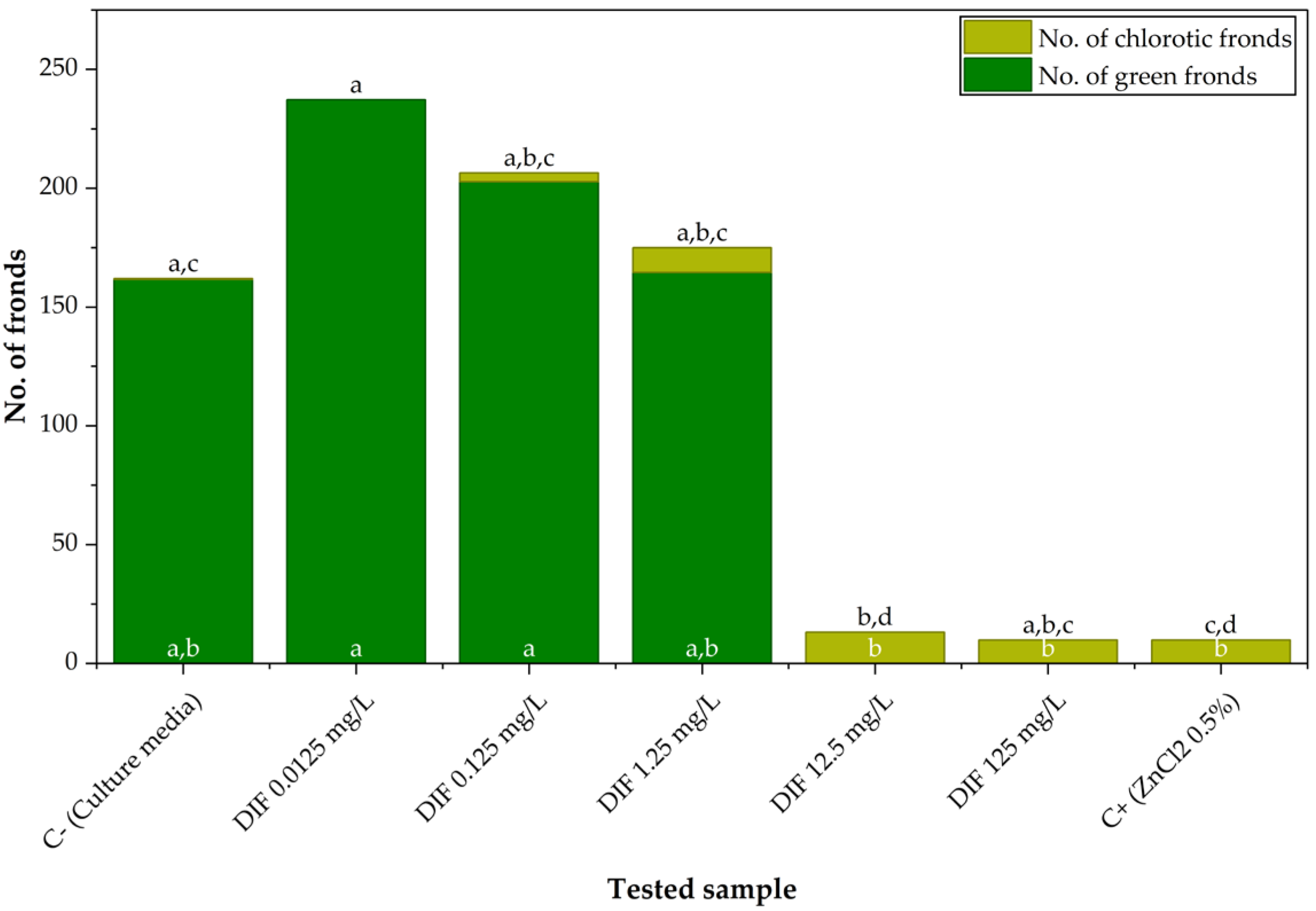
Figure 1. Effect of DIF exposure on the number of green and chlorotic fronds. Bars labeled with different letters represent treatments that are significantly different from each other (p < 0.05; one-way ANOVA followed by post hoc test). Treatments sharing the same letter are not significantly different. White labels represent data for no. of green fronds; black labels represent data for no. of chlorotic fronds.
Agronomy 16 00774 g001
Figure 2. Effect of DIF exposure on the number of colonies. Bars labeled with different letters represent treatments that are significantly different from each other (p < 0.05; one-way ANOVA followed by post hoc test). Treatments sharing the same letter are not significantly different.
Agronomy 16 00774 g002
Figure 3. Effect of DIF exposure on the number of fronds/colony ratio. Bars labeled with different letters represent treatments that are significantly different from each other (p < 0.05; one-way ANOVA followed by post hoc test). Treatments sharing the same letter are not significantly different.
Agronomy 16 00774 g003
Figure 4. Dose–response curve of total number of fronds and DIF concentration. Points labeled with different letters represent treatments that are significantly different from each other (p < 0.05; one-way ANOVA followed by post hoc test). Treatments sharing the same letter are not significantly different.
Agronomy 16 00774 g004
Figure 5. Heatmap of secondary endpoints measured in L. minor, expressed as percentages relative to the negative control for each tested sample. Morphometric (root length, frond length and width, frond area), gravimetric (fresh weight, dry weight, humidity), and biochemical (chlorophyll content, protein concentration, catalase and guaiacol peroxidase activity) responses are shown to facilitate visualization and comparison of treatment effects.
Agronomy 16 00774 g005
Figure 6. Clustered heatmap showing the predicted probability (%) of ecotoxicological effects for the 15 analyzed compounds across nine aquatic endpoints according to admetSAR 3.0. Hierarchical clustering was applied to identify similarities in toxicity profiles among compounds and endpoints.
Agronomy 16 00774 g006
Figure 7. Parallel coordinates plot of IGC50 (T. pyriformis) and LC50 (D. magna and P. promelas) values (mg/L) for the 15 analyzed compounds across five aquatic endpoints, illustrating differences in relative toxicity profiles among compounds. The model organisms are abbreviated as T.p. (T. pyriformis), D.m. (D. magna) and P.p. (P. promelas); ADMETlab results are shown as (A) and T.E.S.T. results as (T).
Agronomy 16 00774 g007
Disclaimer/Publisher’s Note: The statements, opinions and data contained in all publications are solely those of the individual author(s) and contributor(s) and not of MDPI and/or the editor(s). MDPI and/or the editor(s) disclaim responsibility for any injury to people or property resulting from any ideas, methods, instructions or products referred to in the content.