Article

Nitrogen Fertilizer Affects Culm Lodging Resistance by Regulating Phenylpropanoid Metabolism in Rice


1
Suzhou Polytechnic Institute of Agriculture, Suzhou 215008, China
2
College of Agriculture, Nanjing Agricultural University, Nanjing 210095, China
*
Author to whom correspondence should be addressed.
Agronomy 2026, 16(7), 765; https://doi.org/10.3390/agronomy16070765
Submission received: 5 March 2026 / Revised: 24 March 2026 / Accepted: 1 April 2026 / Published: 5 April 2026
(This article belongs to the Section Plant-Crop Biology and Biochemistry)

Abstract

Excessive nitrogen (N) fertilization is widely used to increase rice yield, but it often leads to lodging by weakening culm strength. This study aimed to elucidate the structural and molecular mechanisms underlying nitrogen-induced changes in culm lodging resistance in rice. Field and pot experiments with two nitrogen levels were conducted using a randomized design with three biological replicates to evaluate the effects of high nitrogen application on culm mechanical properties, secondary cell wall development, and associated metabolic pathways. Mechanical measurements and microscopic analysis revealed that high nitrogen significantly reduced culm rigidity and impaired sclerenchyma development. To investigate the underlying mechanisms, integrated transcriptomic and proteomic analyses were performed on developing internodes. Differentially expressed genes and proteins were predominantly enriched in carbohydrate metabolism and phenylpropanoid biosynthesis pathways. Notably, key enzymes involved in lignin biosynthesis were consistently downregulated at the protein level under high-nitrogen conditions. In contrast, genes and proteins related to cellulose and hemicellulose biosynthesis exhibited transient inhibition at early stages followed by recovery or upregulation at later stages. Consistent with these findings, histochemical staining and quantitative assays demonstrated a significant reduction (14–16%) in lignin content in the fourth internode, whereas cellulose content showed no substantial change. Furthermore, lignin biosynthetic genes (OsCAD2, Os4CL3, and OsCOMT) were persistently suppressed during critical stages of secondary wall formation, while cellulose synthase genes (OsCESA4, OsCESA7, and OsCESA9) displayed more variable and less sustained expression patterns. Collectively, these results demonstrate that excessive nitrogen application weakens rice culms primarily by inhibiting lignin accumulation rather than cellulose deposition. The preferential suppression of the phenylpropanoid pathway and disruption of secondary cell wall formation provide a mechanistic basis for nitrogen-induced lodging susceptibility in rice.

1. Introduction

Rice (Oryza sativa L.) is a major staple crop worldwide and serves as a primary food source for more than half of the global population [1]. However, rice culm lodging remains a significant challenge in rice production worldwide [2]. Lodging, the bending or breaking of rice culms, disrupts the photosynthetic capacity of the canopy, severely impairing grain filling and leading to substantial yield losses. Additionally, lodging results in reduced grain quality and increased harvesting costs, posing a major constraint to achieving balanced yield increases across large rice-growing areas [3]. Since the “Green Revolution”, significant progress has been made in improving lodging resistance through the reduction in plant height [3,4]. However, further reductions in plant height are impractical, as excessively dwarfed plants exhibit limited photosynthetic capacity, which negatively impacts yield potential [5]. Consequently, alternative strategies to enhance lodging resistance must focus on improving culm strength rather than further reducing plant height [6].
Over the past decades, numerous studies on morphological traits have identified key factors influencing rice culm strength, including plant height, basal internode length, culm diameter, and culm wall thickness [7,8]. Additionally, the dry weight of basal culms [9] and the accumulation of non-structural carbohydrates, such as starch [10,11], have been shown to significantly contribute to the physical strength of rice culms. In recent years, increasing attention has been directed toward the role of structural carbohydrates in the secondary cell wall, which is fundamental to the mechanical strength of culms. The secondary cell wall is primarily composed of cellulose, hemicelluloses, and lignin [12]. Significant correlations have been demonstrated between the accumulation of cellulose or lignin and the mechanical strength of crops such as rice [13,14,15], wheat [16,17], and maize [18,19]. Despite the complexity of cell wall biosynthesis, progress has been made through the identification and characterization of mutants, revealing that the accumulation of structural carbohydrates enhances cell wall thickening and culm strength. Increased lignin content has been shown to enhance culm mechanical strength [20]. Key genes in lignin biosynthesis, such as OsCAD2 and OsCAD7, encoding cinnamyl-alcohol dehydrogenase, were identified in gh2 and fc1 mutants, respectively. These mutants exhibit reduced lignin content and thinner sclerenchyma tissues [21,22]. Suppression of Os4CL3 and Os4CL4 expression also leads to significant lignin reduction and shorter plant growth [23,24]. Additionally, three rice cellulose synthase (CESA) genes associated with secondary cell wall cellulose formation have been identified through the use of Tos17 insertional mutants. Disruption of these genes leads to brittle culms and a dwarf phenotype, primarily due to a marked decrease in cellulose accumulation [25]. Similarly, a series of rice brittle culm mutants have been linked to cellulose deficiency [26]. Although fewer studies have directly examined the role of hemicellulose in lodging resistance, evidence suggests its importance. The complementation of xylan biosynthesis genes (OsIRX9, OsIRX9L, and OsIRX14) in Arabidopsis irregular xylem (irx) mutants restored normal growth and significantly increased stem strength [27]. These findings collectively suggest that structural carbohydrates in the secondary cell wall play a crucial role in improving rice culm mechanical strength and lodging resistance.
Nitrogen is a critical nutrient that often limits crop productivity. The application of nitrogen fertilizer before the panicle initiation stage can increase the number of spikelets per panicle, thereby enhancing rice yield [28]. However, to achieve high yields, farmers often apply excessive amounts of chemical nitrogen fertilizer. This practice increases the length of basal internodes and reduces culm diameter. It also decreases structural carbohydrates, particularly lignin. These changes weaken culm strength and elevate the risk of lodging in rice [13,14]. Despite these findings, most studies have focused primarily on lignin accumulation. Limited information is available regarding the underlying mechanisms through which nitrogen regulates the biosynthesis of secondary cell wall components in rice.
In this study, we aimed to comprehensively elucidate the physiological and molecular mechanisms by which nitrogen fertilization affects culm strength in rice. To this end, we used the lodging-susceptible japonica cultivar W3668 to evaluate the effects of nitrogen on culm mechanical properties and secondary cell wall formation. Following phenotypic and physiological assessments, we employed a systems biology approach to characterize transcriptomic and proteomic changes associated with secondary cell wall biosynthesis and related metabolic pathways.

2. Materials and Methods

2.1. Plant Materials and Growth Conditions

A field experiment was conducted during the rice growing season from June to October in 2015 and 2016 at the experimental base of Nanjing Agricultural University in Danyang City, Jiangsu Province, China (32°00′ N, 119°32′ E; altitude 7 m). Daily average temperature and precipitation during the whole rice growth stage were recorded (Supplementary Figure S1). The experimental site is characterized by a subtropical monsoon climate, with alluvial loamy soil. The main physicochemical parameters of the soil were as follows: 20.02 g/kg organic matter, 1.20 g/kg total nitrogen, 12.58 mg/kg available phosphorus, and 105.62 mg/kg available potassium, at a pH of 6.85. The japonica rice cultivar W3668, previously identified as lodging-susceptible, was used as the experimental material.
Seedlings were raised in nutrition seedling trays and subsequently transplanted to the field at the fifth-leaf stage. Transplantation spacing was 13.3 cm × 30.0 cm, with two seedlings per hill. The plots were 5 m2 × 6 m2 in size and arranged in a randomized block design with three replicates. Basal fertilizer was applied one day prior to transplanting at rates of 90 kg·ha−1 nitrogen (N), 140 kg·ha−1 P2O5, and 186 kg·ha−1 K2O, which is determined based on the local agronomic practices for japonica rice production. Two topdressing nitrogen treatments were established at the panicle initiation stage: low nitrogen (0 kg·ha−1) and high nitrogen (180 kg·ha−1). All treatments received identical basal applications of phosphorus and potassium to ensure that nitrogen was the only variable.
In addition to the field trial, a pot experiment was conducted under outdoor field conditions using the same rice cultivar. Six rice plants at the fifth-leaf stage were hand-transplanted into each plastic pot (height: 30 cm; top diameter: 34 cm) containing 15 kg of clay soil. The pot experiment followed the same nitrogen treatments as the field experiment, with fertilizer amounts adjusted proportionally based on soil weight to ensure consistency.

2.2. Culm Physical Parameter Measurements

Lodging-related traits and morphological parameters were assessed at 20 days after heading. Fifteen main culms exhibiting consistent growth were selected for physical parameter measurements. An AIKON RX-5 digital force gauge (AIKON, Osaka, Japan) was employed to determine the bending load of the fourth internode from the top, with a fixed distance of 8 cm between two fulcrum points.
The physical parameters were determined using the following equations:
(1)
Breaking strength (M, g·cm): M = F × L/4, where F is the bending load of the second basal internode (kg), and L is the span between the two supporting points (cm).
(2)
Cross-section modulus (Z, mm3): Z = π/32 × (a13b1 − a23b2)/a1, where a1 and a2 denote the outer and inner diameters along the minor axis, respectively, while b1 and b2 correspond to the outer and inner diameters along the major axis of the oval cross-section (mm).
(3)
Bending stress (BS, g·mm−2): BS = M/Z. Bending stress was used to evaluate culm mechanical strength.

2.3. Scanning Electron Microscopy

The fourth internodes were collected at designated time points following the jointing stage and immediately fixed in 2.5% glutaraldehyde solution. Transverse sections of approximately 400 μm in thickness were obtained using an automated vibrating blade microtome (Leica VT 1200S, Nussloch, Germany). The sections were subsequently subjected to critical point drying, sputter-coated with gold, and examined using a scanning electron microscope (Hitachi S-3000N, Tokyo, Japan).

2.4. Histochemical Staining

The fourth internodes were collected at 20 days after heading and fixed following the protocol described above. For lignin visualization, transverse sections of 100 μm thickness were incubated in phloroglucinol solution (1% in 70% ethanol [v/v], Sigma, St. Louis, MO, USA) for 10 min, followed by treatment with 18% hydrochloric acid for 5 min. Stained sections were then imaged using a fluorescence microscope (Zeiss Axio Imager. A1, Jena, Germany).
For cellulose staining, separate 100 μm transverse sections were incubated in a 0.005% aqueous solution of calcofluor (fluorescent brightener 28, Sigma) for 2 min and subsequently visualized using the same microscope.

2.5. Cell Wall Composition Analyses

The fourth internodes of rice culms exhibiting consistent growth were collected after removal of leaf sheaths. The tissues were first inactivated at 105 °C for 30 min, followed by drying at 70 °C until a constant weight was achieved. The dried samples were then finely ground and sieved through a 100-mesh screen before being used for cell wall composition analysis.
Cellulose content was determined using a modified protocol [29]. Briefly, 0.05 g of dried homogenized stem sample was placed in a test tube with 5 mL of acetic/nitric reagent and boiled in a water bath for 30 min. After cooling to room temperature, the mixture was centrifuged at 5000 rpm for 15 min, and the supernatant was discarded. This washing procedure was repeated three times until the residue appeared completely white. Subsequently, 5 mL of 72% sulfuric acid was added to the tube, thoroughly mixed, and allowed to stand overnight at room temperature until the precipitate was fully dissolved. The solution was carefully transferred to a 50 mL volumetric flask. The tube was rinsed several times, and each rinse was combined into the volumetric flask to reach a final volume of 50 mL. Absorbance was measured at 620 nm using the anthrone colorimetric method, and cellulose content was calculated based on a standard curve.
Lignin content was measured following the acetyl bromide lignin (ABL) method [30]. Briefly, 0.1 g of sample was first treated with 80% ethanol in an 80 °C water bath for 2 h. The tube was then centrifuged at 5000× g for 5 min, and the supernatant was discarded. This step was repeated three times. The sample was subsequently treated with 4 mL of chloroform at 62 °C for 1 h, followed by centrifugation at 5000× g for 10 min, after which the supernatant was discarded. The precipitate was air-dried in a fume hood. The dried residue was dissolved in 3.6 mL of 25% (v/v) acetyl bromide in acetic acid and incubated in a 70 °C water bath for 1 h, then cooled in iced water. An aliquot of 0.3 mL of this solution was added to 1.9 mL of a mixture containing 17.24% (v/v) 2 N sodium hydroxide and 82.76% (v/v) acetic acid. To terminate the reaction, 0.1 mL of 7.5 mol/L hydroxylamine hydrochloride was added. The final volume was adjusted to 5 mL with glacial acetic acid, and absorbance was measured at 280 nm. Lignin content was calculated according to the method described before [31].

2.6. Gene Expression Profiling Using RNA-Seq

RNA extraction: Total RNA was extracted with TRIzol reagent (Invitrogen) following the protocol provided by the manufacturer. To eliminate potential DNA contamination, the RNA samples were subjected to DNase I treatment. The purity and concentration of the isolated RNA were assessed using a NanoDrop spectrophotometer (Thermo Scientific, Waltham, MA, USA), while RNA integrity was examined with the 6000 Pico LabChip on an Agilent 2100 Bioanalyzer (Agilent Technologies, Inc., Santa Clara, CA, USA).
cDNA library synthesis and Illumina sequencing: For RNA sample preparation, equivalent amounts of RNA from each sample served as the starting material. All 12 samples exhibited RNA integrity number (RIN) values >9. Subsequently, the RNA samples were used to construct cDNA libraries with the Illumina kit (Illumina, Inc., San Diego, CA, USA). In brief, the procedure involved mRNA enrichment using oligo(dT)-coated magnetic beads, RNA fragmentation, synthesis of double-stranded cDNA, and PCR amplification, all carried out according to the Illumina RNA-Seq protocol. The quality and quantity of the resulting libraries were assessed using the Agilent 2100 Bioanalyzer and the ABI Step One Plus Real-Time PCR System. The library products were sequenced with Illumina HiSeq™ 2000.
Bioinformatics analysis: Raw sequencing reads were filtered to remove adapter sequences and low-quality reads. All subsequent bioinformatics analyses were conducted using high-quality clean data. The clean reads were aligned to the rice reference genome and reference gene sets using BWA [32] and Bowtie2 [33], respectively. Gene expression levels were normalized using the FPKM method, which represents the most widely adopted approach for estimating gene expression abundance [34]. DEGs between two groups were screened by the NOIseq method [35]. A fold change in log2Ratio ≥ 1 and divergent probability ≥ 0.8 as a threshold were set for DEG screening. Gene Ontology (GO) enrichment and KEGG pathway enrichment were conducted.

2.7. Proteomic Analysis by iTRAQ

Protein extraction: Protein extraction was performed according to the phenol extraction method [36] with some modifications. The detailed protocol has been described [37]. Protein concentrations were quantified using the BCA method [38].
Protein digestion and iTRAQ labelling: The FASP method [39] was used to digest protein. Briefly, the total protein (100 μg) of each sample solution was digested with sequencing grade trypsin (50 ng/μL) at 37 °C for 12 h. Subsequently, the peptides were subjected to drying using a vacuum freeze dryer. From each sample, 100 μg of peptides were labeled with iTRAQ 8-plex kits following the protocol supplied by the manufacturer (AB SCIEX Inc., Framingham, MA, USA), with the reaction carried out at room temperature for 2 h. After labeling, all samples were combined, pooled, and again dried in a vacuum freeze dryer prior to iTRAQ analysis.
LC-MS/MS Analysis: The labelled peptides were purified using a strong cation exchange chromatography (SCX) column by Agilent 1200 HPLC (Agilent). A total of 10 fractions were collected at 4.5-min intervals for 6–50 min The eluted fractions were then dried under a freeze vacuum. The fractions were re-suspended in Nano-RPLC buffer A (0.1% formic acid, 2% acetonitrile). Each fraction was loaded on the Eksigent nanoLC-Ultra™ 2D System (AB SCIEX) for separation and then subjected to a Triple TOF 5600 System (AB SCIEX) to obtain mass spectrometer data.
Bioinformatics analysis: Data were processed with Protein Pilot Software v. 5.0 (AB SCIEX) against the Oryza sativa database using the Paragon algorithm [40]. The experimental data from tandem mass spectrometry (MS) were used to match the theory data to the obtained results for protein identification. All protein and peptide identifications were based on 99% confidence and determined with FDR ≤ 1%. A fold change >1.5 or <0.67 and p-value < 0.05 were set as the screening criterion for DEPs. Gene Ontology (GO) enrichment and KEGG pathway enrichment were also conducted.

2.8. Quantitative RT-PCR Analysis

Total RNA was isolated from rice internode tissues using the RNAprep Pure Plant Kit (Tiangen, Beijing, China). First-strand cDNA synthesis, primer design, and quantitative PCR were carried out following the manufacturer’s instructions. Analysis of the relative gene expression was performed according to the comparative cycle threshold (2−ΔΔCT) method [41]. The housekeeping β-actin gene was used as the internal reference. The different sets of primers used for the amplification of the target genes are listed in Supplementary Table S1.

2.9. Statistical Analysis

All data are presented as mean ± standard deviation (SD). Statistical significance between treatments was determined using Student’s t-test. Differences were considered significant at p < 0.05 and highly significant at p < 0.01. Unless otherwise stated, all experiments were conducted with three biological replicates.

3. Results

3.1. Effects of Nitrogen on Plant Growth and Mechanical Strength in Rice

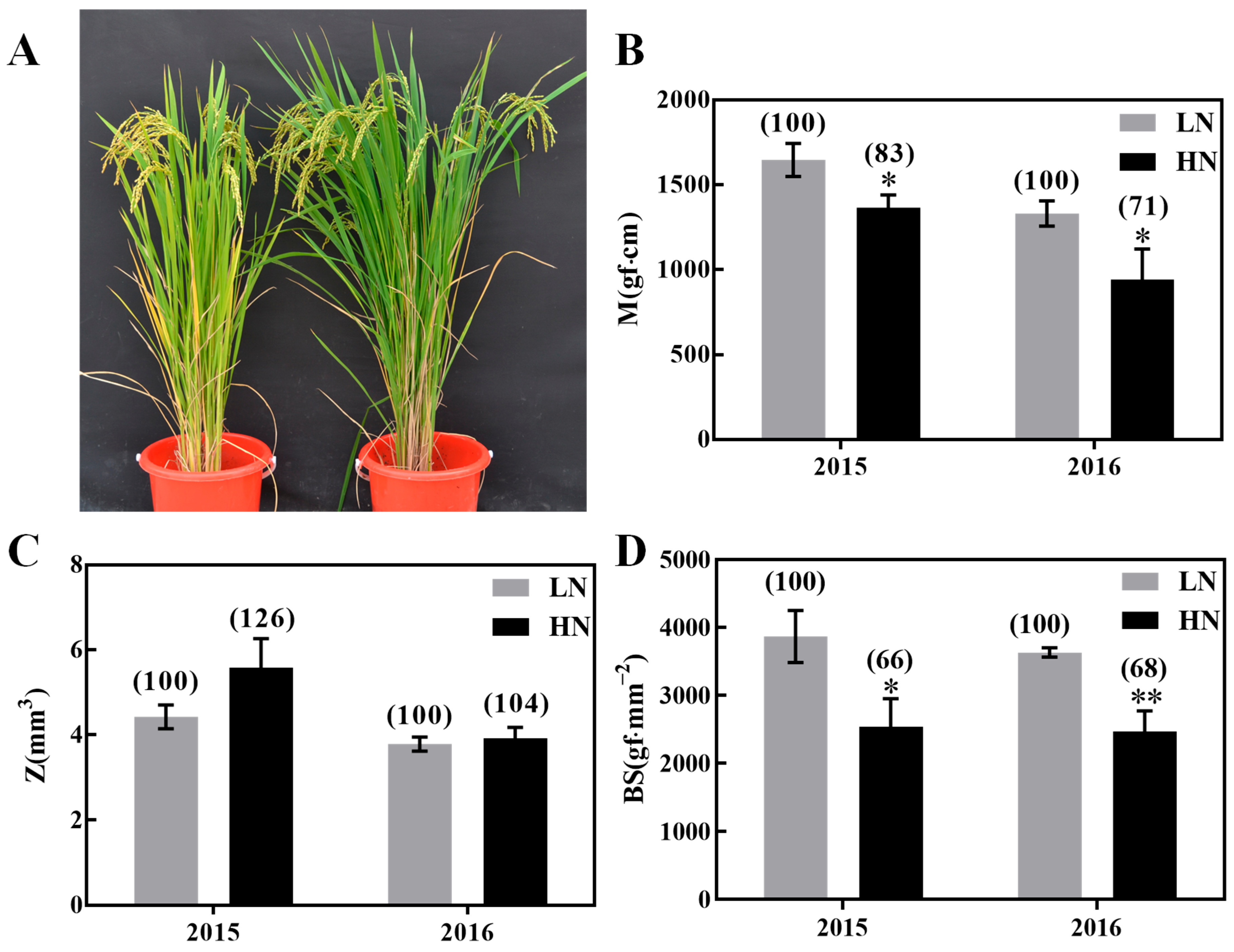
To examine the impact of nitrogen treatment on rice growth and development, plant phenotypes were observed at 20 days after heading. Notably, rice plants subjected to high nitrogen treatment exhibited greater plant height and greener leaves at later growth stages, indicating that senescence and maturity were delayed under high-nitrogen conditions (Figure 1A). To further investigate the effects of nitrogen levels on culm mechanical properties, breaking strength (M), section modulus (Z), and bending stress (BS) were measured at 20 days after heading in 2015 and 2016 (Figure 1B–D). Under high nitrogen treatment, M values decreased to 83% and 71% of the control levels in 2015 and 2016, respectively. Similarly, BS values in high-nitrogen plants were reduced to 66% and 68% of the control in the respective years. In contrast, Z values increased by 26% in 2015 and 4% in 2016, though no significant differences were detected between nitrogen treatments in either year. These results suggest that while high nitrogen application promotes plant height and delays maturity, it significantly reduces culm stiffness, potentially increasing susceptibility to lodging.

3.2. Effects of Nitrogen on Cell Wall Formation in Sclerenchyma Tissues

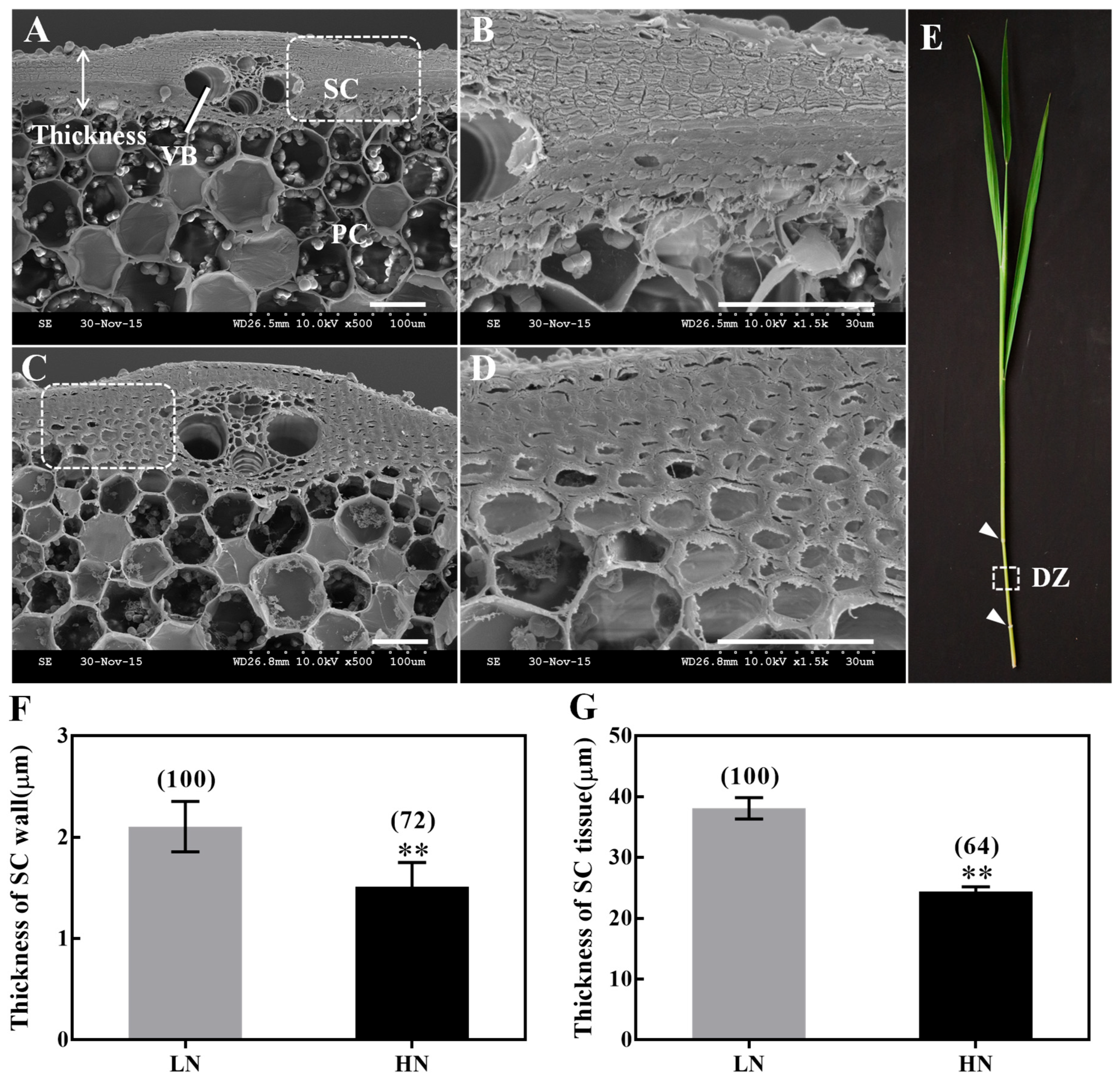
To determine whether the reduction in culm mechanical strength was associated with alterations in mechanical tissues or cell wall density, transverse sections of the fourth internode were examined using scanning electron microscopy (SEM) at 20 days after heading (Figure 2). High nitrogen treatment resulted in significant changes to the microstructure of mechanical tissues. Under low-nitrogen conditions, sclerenchyma cell walls were well thickened, whereas plants exposed to high nitrogen treatment exhibited numerous hollow sclerenchyma cells (Figure 2A–D). Quantitative analysis revealed that sclerenchyma cell wall thickness in high nitrogen-treated plants was only 72% of that observed under low-nitrogen conditions (Figure 2F). Similarly, the thickness of sclerenchyma tissue beneath the epidermis was reduced to 64% in high nitrogen-treated plants (Figure 2G). These results suggest that high nitrogen application disrupts cell wall formation in sclerenchyma tissues, potentially contributing to the observed decline in culm mechanical strength.

3.3. Transcriptomic and Proteomic Analyses of Developing Culms Under Nitrogen Treatments

The investigation of sclerenchyma tissue development in the fourth internode under varying nitrogen treatments revealed distinct temporal patterns across three developmental stages (3, 9, and 15 days after jointing; Supplementary Figure S2). Initial observations at 3 days after jointing indicated minimal cell wall thickening, with high nitrogen treatment exhibiting marginally thinner walls compared to control conditions. Subsequent analysis at 9 days demonstrated progressive cell wall thickening, with high nitrogen treatment significantly impeding this developmental process. By 15 days after jointing, cell walls were fully thickened, with nitrogen treatment effects becoming visually discernible through comparative histological analysis.
To elucidate the molecular mechanisms governing nitrogen-mediated cell wall development, comprehensive multi-omics analyses were conducted on fourth internode samples collected at 3 and 9 days after jointing (Figure 2E). Transcriptomic profiling through RNA sequencing (RNA-Seq) yielded 37,866 detectable genes across triplicate biological replicates per treatment. Differential expression analysis revealed a temporal expansion in nitrogen-responsive gene regulation, with 216 differentially expressed genes (DEGs) identified at 3 days compared to 1620 DEGs at 9 days after jointing (Supplementary Figure S3A). Parallel proteomic investigation using iTRAQ technology quantified 5889 and 4497 proteins at 3 and 9 days, respectively, with corresponding differential expression analysis identifying 330 and 763 DEPs at these time points (Supplementary Figure S3B).
KEGG pathway mapping of DEGs and DEPs (Supplementary Figures S4 and S5) demonstrated stage-specific metabolic pathway regulation. At 3 days after jointing, a limited subset of DEGs participated in fundamental carbohydrate metabolism pathways, including photosynthetic processes, glycolysis/gluconeogenesis, and amino sugar and nucleotide sugar metabolism. However, by 9 days after jointing, a substantial expansion of DEG involvement was observed in carbohydrate metabolism and cell wall biosynthesis pathways, particularly phenylpropanoid biosynthesis. Proteomic analysis corroborated these findings, identifying eight DEPs associated with phenylpropanoid biosynthesis and seven DEPs related to amino sugar and nucleotide sugar metabolism at the early time point. The subsequent analysis at 9 days revealed significant enrichment of DEPs in pathways related to carbohydrate metabolism, amino acid metabolism, and phenylpropanoid biosynthesis. These findings are particularly significant given the well-established role of phenylpropanoid biosynthesis in lignin biosynthesis and secondary cell wall formation.

3.4. Lignin-Related Phenylpropanoid Biosynthesis

Lignin, a complex three-dimensional polyphenolic polymer, is biosynthesized through the phenylpropanoid pathway. The lignin polymer primarily comprises three distinct types: p-hydroxyphenyl (H) lignin, guaiacyl (G) lignin, and syringyl (S) lignin, which are polymerized from the monolignols p-coumaryl alcohol, coniferyl alcohol, and sinapyl alcohol, respectively [42].
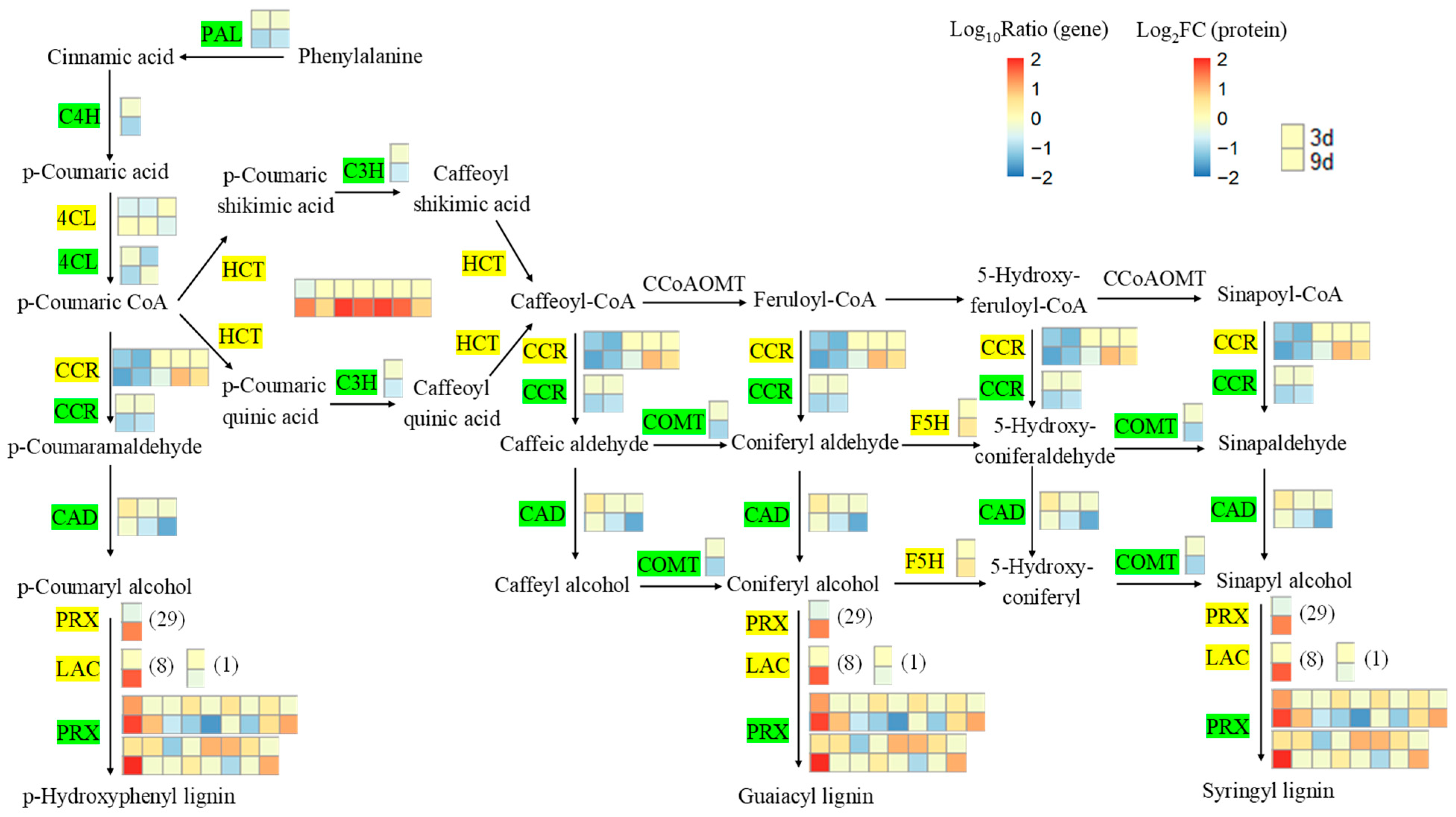
RNA-Seq and iTRAQ analyses have identified a substantial number of genes and proteins associated with lignin biosynthesis (Figure 3, Supplementary Table S2). Transcriptomic analysis revealed that three 4-coumarate:CoA ligase (4CL) genes in the lignin biosynthetic pathway were significantly downregulated under high nitrogen treatment at both 3 and 9 days after jointing. In contrast, seven hydroxycinnamoyl transferase (HCT) genes exhibited relatively higher expression levels at 9 days, while five cinnamoyl-CoA reductase (CCR) gene homologs displayed mixed expression patterns, with both upregulation and downregulation observed. Notably, a ferulate 5-hydroxylase (F5H) gene was significantly upregulated under high nitrogen treatment at 9 days.
Proteomic analysis further highlighted the regulatory effects of nitrogen on lignin biosynthesis (Figure 3, Supplementary Table S3). The abundances of key enzymes, including phenylalanine ammonia-lyase (PAL), 4-Coumarate:coenzyme A ligase (4CL), cinnamate 4-hydroxylase (C4H), p-coumarate 3-hydroxylase (C3H), cinnamoyl-CoA reductase (CCR), caffeic acid O-methyltransferase (COMT), and cinnamyl alcohol dehydrogenase (CAD), were generally reduced under high nitrogen treatment. An exception was observed for one CAD protein, which showed increased abundance at 3 days. Additionally, genes and proteins encoding peroxidase and laccase, which are critical for lignin polymerization, were identified. At the transcript level, most peroxidase and laccase genes were significantly upregulated under high nitrogen treatment at 9 days, except for OsLAC8. However, at the protein level, many peroxidases were downregulated at both 3 and 9 days, suggesting post-transcriptional regulation of these enzymes in response to nitrogen availability.
Given the critical role of laccase genes in lignin biosynthesis, the expression patterns of the nine identified laccase genes were further validated using quantitative real-time PCR (qPCR) (Supplementary Figure S6). The qPCR results exhibited a high degree of consistency with RNA-Seq data, confirming the reliability of transcriptomic analysis. Among these nine genes, only OsLAC4 displayed reduced expression under high nitrogen treatment at 3 days after jointing, although the decrease was not statistically significant. In contrast, OsLAC8 showed a significant reduction in expression under high-nitrogen conditions at 9 days after jointing.

3.5. Biosynthesis of Plant Cell Wall Polysaccharides

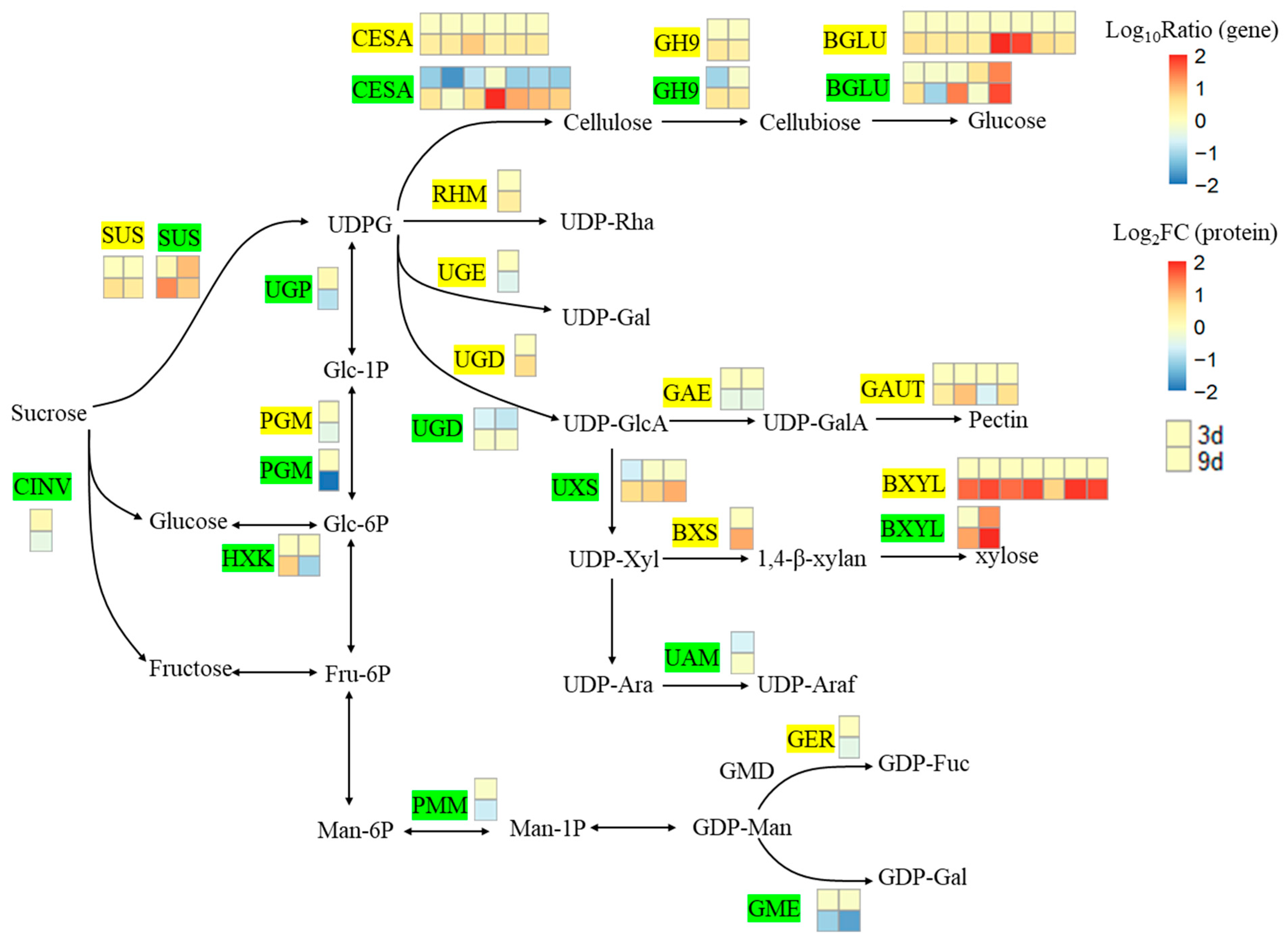
Plant cell walls are mainly composed of three main classes of polysaccharides—cellulose, hemicellulose, and pectin—of which cellulose is the most abundant biopolymer. Cellulose consists of linear β-1,4 glucan chains and is synthesized from UDP-Glc and crystallized by cellulose synthase (CesA) on the plasma membrane [43]. CesA genes are categorized into two functional groups responsible for primary and secondary cell wall biosynthesis, respectively. In rice, three well-characterized secondary cell wall CesA genes-OsCesA4, OsCesA7, and OsCesA9, were identified at both mRNA and protein levels in this study (Figure 4, Supplementary Table S2). Additionally, primary cell wall CesA genes, including OsCesA1, OsCesA3, OsCesA5, and OsCesA8, were also detected. Differential expression analysis revealed that CesA proteins were severely repressed at 3 days after jointing, while both gene and protein expression levels were upregulated at 9 days. Glycosyl hydrolase family 9 (GH9) proteins, which participate in carbohydrate hydrolysis, exhibited a similar expression pattern to CesA, while β-glucosidase (BGLU) proteins generally increased in abundance under high nitrogen treatment, except for BGLU4.
Hemicelluloses and pectins form a soluble polysaccharide matrix that cross-links cellulose microfibrils, thereby contributing to the mechanical strength of secondary cell walls [42,43]. Nucleotide sugars serve as universal sugar donors for polysaccharide biosynthesis. UDP-Glc, in addition to being a substrate for cellulose synthesis, is also a precursor for xyloglucan hemicelluloses and most other nucleotide sugars required for xylan, mannan, and pectin biosynthesis, except for GDP-D-mannose (GDP-Man) and GDP-L-fucose (GDP-Fuc). In this study, high nitrogen treatment significantly influenced the expression of genes and proteins involved in nucleotide sugar biosynthesis (Figure 4). Most of these genes and proteins were significantly upregulated at 9 days, except for UDP-glucose epimerase (UGE) and UDP-glucuronate 4-epimerase (GAE), while proteins generally exhibited lower abundance at 3 days. Overall, the expression pattern of nucleotide sugar biosynthesis closely resembled that of CesA. Additionally, several genes from the GT43 family, which mediate xylan backbone biosynthesis, and XAX1, which is involved in xylosyl arabinosyl substitution, were also upregulated at 9 days, mirroring the expression pattern of CesA (Supplementary Tables S2 and S3).

3.6. Effects of Nitrogen on the Accumulation of Lignin and Cellulose

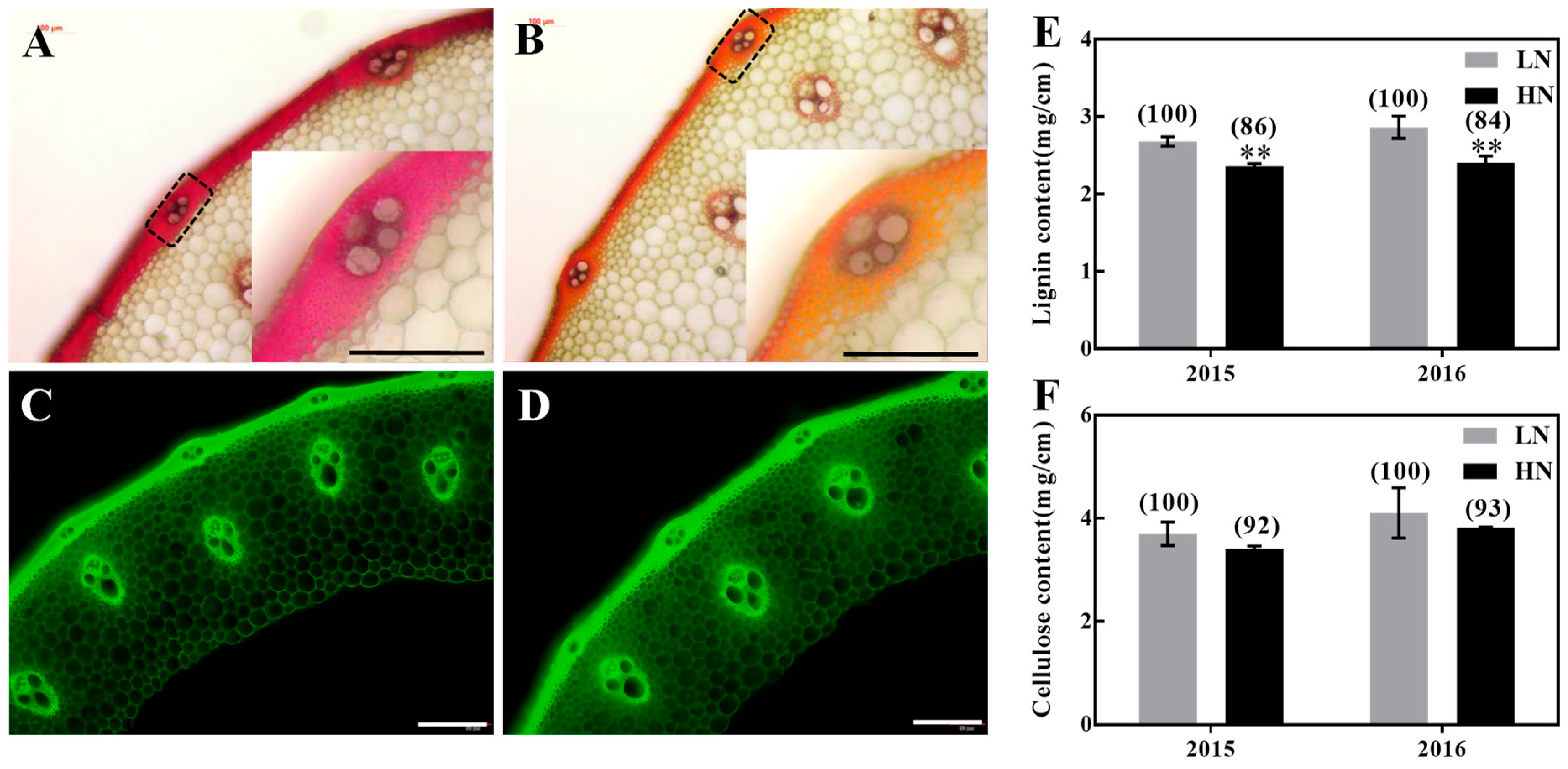
Lignin and cellulose, as the primary structural components of the rice cell wall, play a crucial role in determining the culm strength. In this study, histochemical staining of transverse sections was performed to assess the content and distribution of these structural substances in internodes under different nitrogen treatments at 20 days after heading (Figure 5A–D). Phloroglucinol, which reacts with lignin, was used to approximate total lignin content based on staining intensity, while fluorescent brightener staining was employed to estimate cellulose content through fluorescence intensity. Histochemical analysis revealed that the staining in sclerenchyma tissues and vascular bundles appeared significantly lighter under high-nitrogen conditions, indicating a reduction in lignin deposition (Figure 5A,B). In contrast, green fluorescent signals reflecting cellulose distribution showed no significant differences between nitrogen treatments (Figure 5C,D). Quantitative analysis of lignin and cellulose content in the fourth internodes at 20 days after heading further supported these observations (Figure 5E,F). Cellulose content did not differ significantly between nitrogen treatments in both years. However, high nitrogen treatment significantly reduced the lignin content, consistent with the histochemical staining results. Specifically, lignin content decreased by 14% and 16% under high-nitrogen conditions in 2015 and 2016, respectively.
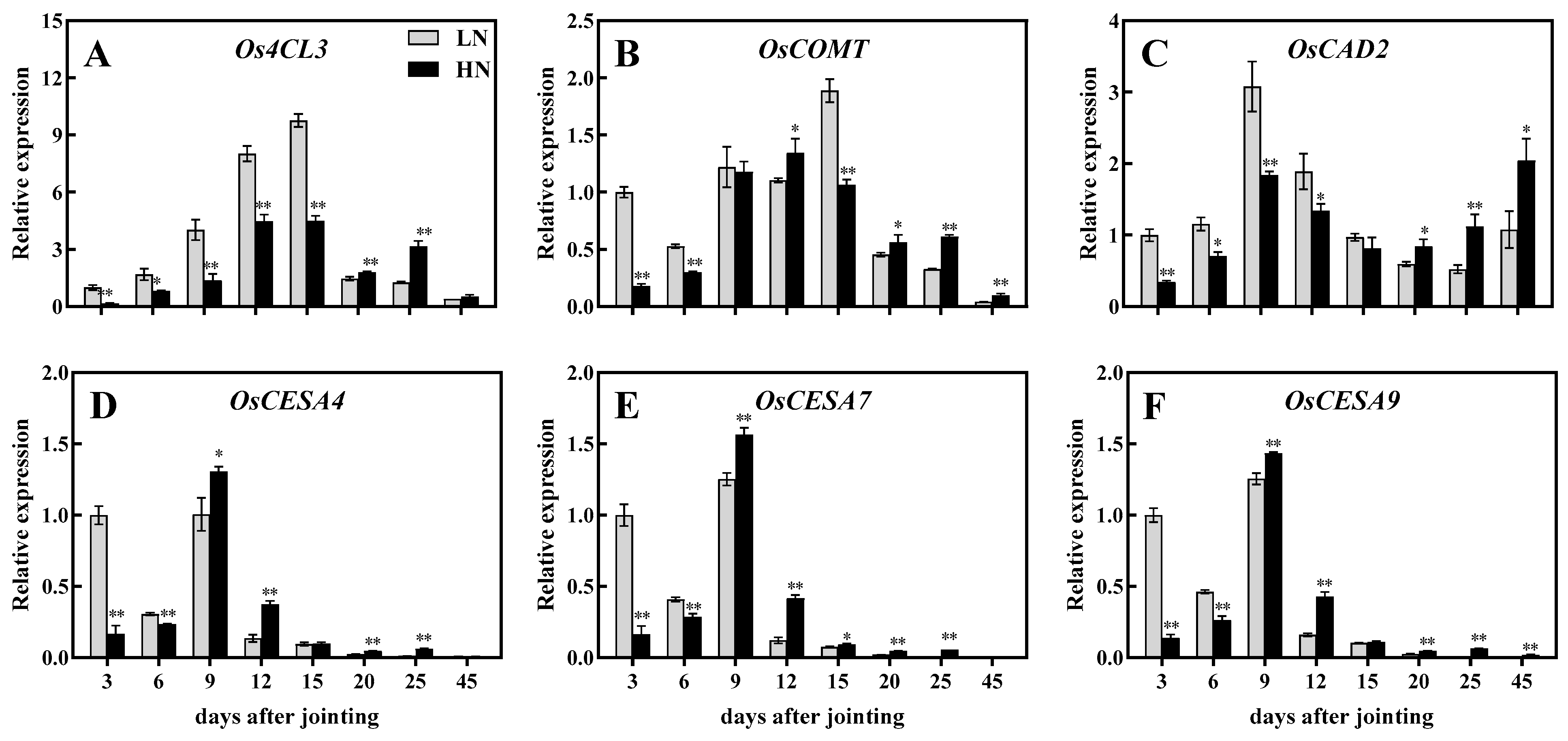
To elucidate the molecular mechanisms underlying these observations, the expression patterns of key genes involved in lignin and cellulose biosynthesis were analyzed throughout internode development (Figure 6). OsCAD2, Os4CL3, and OsCOMT, which are critical for lignin biosynthesis, exhibited an initial increase followed by a decrease in expression during internode development, peaking between 9 and 15 days after jointing. These genes responded consistently to nitrogen treatments, with significantly reduced expression under high-nitrogen conditions at 15 days after jointing but significantly increased expression at 20 days after jointing. Similarly, OsCESA4, OsCESA7, and OsCESA9, which encode cellulose synthases essential for secondary cell wall formation, showed an upregulation followed by downregulation during internode development, peaking between 9 and 12 days after jointing and declining to very low levels by 25 days. Notably, the expression of these cellulose synthase genes was significantly lower under high-nitrogen conditions during the early stages of internode development but became significantly higher under high nitrogen treatment starting around 9 days after jointing. These findings highlight the differential effects of nitrogen availability on lignin and cellulose biosynthesis, with high nitrogen treatment preferentially suppressing lignin accumulation and altering the temporal expression patterns of key biosynthetic genes.

4. Discussion

4.1. Nitrogen Reduces Culm Strength by Inhibiting Secondary Wall Accumulation

Lodging in rice disrupts canopy photosynthesis, thereby compromising grain filling and ultimately reducing yield [3]. Enhancing culm mechanical strength has therefore become a key strategy for improving lodging resistance. However, culm strength is highly sensitive to nitrogen application rates. The present field experiment demonstrated that excessive nitrogen fertilization significantly reduced culm mechanical strength (Figure 1), consistent with previous findings [2,14,44]. Both breaking strength (M) and bending stress (BS) declined markedly under high-nitrogen conditions in two consecutive years, indicating reduced culm stiffness and a higher risk of lodging. The absence of significant differences in section modulus (Z) suggests that the decline in mechanical strength was not mainly due to gross morphological changes in culm geometry, but rather to alterations in tissue structure and composition.
Microscopic observations further support this conclusion. Scanning electron microscopy revealed that high nitrogen treatment substantially altered sclerenchyma tissue development (Figure 2). Under high-nitrogen conditions, numerous hollow sclerenchyma cells were observed at 20 days after the heading stage, indicating impaired secondary wall deposition. Given the fundamental role of secondary cell walls in determining culm strength [45], the reduced thickness of both individual sclerenchyma cell walls and the overall sclerenchyma layer beneath the epidermis explains the observed decrease in mechanical strength.

4.2. Lignin Is More Responsive to Nitrogen Treatment

Previous studies have frequently focused on secondary wall lignification when examining how nitrogen influences lodging resistance [46,47,48]. Our results indicate that lignin biosynthesis is more sensitive to nitrogen availability than cellulose biosynthesis, both at the molecular and biochemical levels. Although lignin and cellulose are the principal structural components of secondary cell walls [42], high nitrogen treatment preferentially reduced lignin accumulation, while cellulose content remained largely unchanged (Figure 5). This differential response provides an important explanation for the observed decline in culm mechanical strength under excessive nitrogen supply.
These molecular patterns are consistent with the biochemical data showing a significant reduction in lignin content. In particular, the lignin biosynthetic genes OsCAD2, Os4CL3, and OsCOMT were markedly and persistently suppressed under excessive nitrogen, whereas the effects on cellulose-related pathways were weaker or transient (Figure 6). At the whole-pathway level, most key genes and proteins involved in lignin biosynthesis were downregulated, except peroxidases and laccases that function in lignin polymerization. In contrast, suppression of polysaccharide biosynthesis was not maintained beyond 9 days after jointing (Figure 3 and Figure 4, Supplementary Tables S2 and S3).
Together, these findings indicate that lignin biosynthesis is more directly and durably affected by nitrogen excess than other secondary wall components. This sensitivity may explain why lignin is often identified as a critical factor in lodging susceptibility. Indeed, lignin accumulation is known to respond to plant hormones [49,50] and environmental cues such as shading and elevated CO2 [51,52,53], further supporting its central role in mediating structural adaptation to changing growth conditions.

4.3. Potential Mechanisms by Which Nitrogen Fertilizer Regulates Lignin Formation in Rice Culms

Despite these advances, the regulatory mechanism linking nitrogen status to lignin biosynthesis remains to be clarified. Increasing evidence suggests that laccases may play a central role in this process. Laccases are key enzymes in lignin formation. Together with peroxidases, they catalyze the oxidative polymerization of lignin monomers into the final polymer structure [54]. In Arabidopsis, the double mutants lac4-1 lac17 and lac4-2 lac17 exhibit 20% and 40% reductions in stem lignin content, respectively [55], while the lac11 lac4 lac17 triple mutant shows almost complete loss of lignin deposition in roots [56]. Moreover, overexpression of the rice gene OsLAC10 in Arabidopsis significantly increases root lignin content [57]. These findings demonstrate that laccases are indispensable for normal lignin formation in plants.
Studies further indicate that laccase expression is tightly regulated at the post-transcriptional level by microRNAs. In poplar, overexpression of ptr-miR397a markedly suppresses laccase gene expression and leads to a significant reduction in lignin content [58]. Similarly, in Arabidopsis, miR397b and miR857 target LAC4 and LAC7, respectively, thereby reducing lignin biosynthesis [59,60]. In maize, nitrogen-rich conditions induce ZmmiR528, which decreases lignin accumulation and increases lodging susceptibility by targeting ZmLAC3 and ZmLAC5 [61]. In our study, nine laccase genes were detected at the transcript level, including OsLAC3 and OsLAC5. However, only OsLAC8 was significantly downregulated under nitrogen excess. This discrepancy suggests that nitrogen-dependent regulation of lignin biosynthesis may differ among species. Overall, our findings highlight lignin as a primary target of nitrogen regulation in rice culms and point to post-transcriptional level by microRNAs, as promising directions for future research

5. Conclusions

Excessive nitrogen application significantly weakens rice culm mechanical strength and increases lodging risk. This effect is primarily associated with impaired sclerenchyma development and reduced secondary cell wall thickening. Multi-omics analyses revealed that nitrogen excess preferentially suppresses the phenylpropanoid pathway, leading to decreased lignin biosynthesis, while cellulose accumulation is only transiently affected and remains largely unchanged. Our study provides a mechanistic framework linking nitrogen management to lodging resistance and identifies lignin biosynthesis as a critical target for improving rice structural stability under high-input conditions.

Supplementary Materials

The following supporting information can be downloaded at: https://www.mdpi.com/article/10.3390/agronomy16070765/s1, Figure S1: Meteorological conditions for the growth stage of rice in Danyang, Jiangsu from June to October. Figure S2: Development of sclerenchyma tissues in the culm under different nitrogen treatments at 3, 9 and 15 days after the jointing stage. Figure S3: Number of differentially expressed genes (DEGs) and proteins (DEPs) in response to different nitrogen treatments. Figure S4: KEGG pathway enrichment of significant differentially expressed genes in response to nitrogen treatments. Figure S5: KEGG pathway enrichment of significant differentially expressed genes or proteins in response to nitrogen treatments. Figure S6: RNA-seq and qPCR analysis of nine differentially expressed laccase genes in the fourth internode under different nitrogen treatments. Table S1: Primers used in the quantitative RT-PCR analysis. Table S2: The list of differentially expressed genes related to cell wall development. Table S3: The list of differentially expressed proteins related to cell wall development.

Author Contributions

Conceptualization, F.W.; Data curation, F.W., Y.W. and Q.L.; Formal analysis, F.W., Y.W. and G.L.; Funding acquisition, Y.D. and G.L.; Investigation, F.W., Y.W. and Q.L.; Writing—original draft, F.W. and Y.W.; Writing—review & editing, Y.D. and G.L. All authors have read and agreed to the published version of the manuscript.

Funding

This research was supported by the Basic Science (Natural Science) Research Project of Higher Education Institutions in Jiangsu Province (25KJD210006), the “Qinglan Project” for Outstanding Young Backbone Teachers in Jiangsu Universities (2023), and the Scientific Research and Innovation Team Program of Suzhou Polytechnic Institute of Agriculture (CXTD202410).

Data Availability Statement

The original contributions presented in this study are included in the article/Supplementary Materials. Further inquiries can be directed to the corresponding author.

Conflicts of Interest

The authors declare no conflicts of interest.

References

  1. Zahra, N.; Hafeez, M.B.; Nawaz, A.; Farooq, M. Rice production systems and grain quality. J. Cereal Sci. 2022, 105, 103463. [Google Scholar] [CrossRef]
  2. Berry, P. Lodging resistance in cereals. In Crop Science; Springer: Berlin/Heidelberg, Germany, 2019; pp. 209–227. [Google Scholar]
  3. Setter, T.; Laureles, E.; Mazaredo, A. Lodging reduces yield of rice by self-shading and reductions in canopy photosynthesis. Field Crops Res. 1997, 49, 95–106. [Google Scholar] [CrossRef]
  4. Peng, Y.; Hu, Y.; Qian, Q.; Ren, D. Progress and prospect of breeding utilization of green revolution gene SD 1 in rice. Agriculture 2021, 11, 611. [Google Scholar] [CrossRef]
  5. Croce, R.; Carmo-Silva, E.; Cho, Y.B.; Ermakova, M.; Harbinson, J.; Lawson, T.; McCormick, A.J.; Niyogi, K.K.; Ort, D.R.; Patel-Tupper, D. Perspectives on improving photosynthesis to increase crop yield. Plant Cell 2024, 36, 3944–3973. [Google Scholar] [CrossRef]
  6. Wang, T.; Jin, Y.; Deng, L.; Li, F.; Wang, Z.; Zhu, Y.; Wu, Y.; Qu, H.; Zhang, S.; Liu, Y. The transcription factor MYB110 regulates plant height, lodging resistance, and grain yield in rice. Plant Cell 2024, 36, 298–323. [Google Scholar] [CrossRef]
  7. Niu, Y.; Chen, T.; Zhao, C.; Zhou, M. Lodging prevention in cereals: Morphological, biochemical, anatomical traits and their molecular mechanisms, management and breeding strategies. Field Crops Res. 2022, 289, 108733. [Google Scholar] [CrossRef]
  8. Rehman, M.; Luo, D.; Mubeen, S.; Pan, J.; Cao, S.; Saeed, W.; Chen, P. Progress in agronomic crops lodging resistance and prevention: A review. J. Agron. Crop Sci. 2024, 210, e12785. [Google Scholar] [CrossRef]
  9. Islam, M.S.; Peng, S.; Visperas, R.M.; Ereful, N.; Bhuiya, M.S.U.; Julfiquar, A. Lodging-related morphological traits of hybrid rice in a tropical irrigated ecosystem. Field Crops Res. 2007, 101, 240–248. [Google Scholar] [CrossRef]
  10. Kashiwagi, T.; Hirotsu, N.; Ujiie, K.; Ishimaru, K. Lodging resistance locus prl5 improves physical strength of the lower plant part under different conditions of fertilization in rice (Oryza sativa L.). Field Crops Res. 2010, 115, 107–115. [Google Scholar] [CrossRef]
  11. Ishimaru, K.; Togawa, E.; Ookawa, T.; Kashiwagi, T.; Madoka, Y.; Hirotsu, N. New target for rice lodging resistance and its effect in a typhoon. Planta 2008, 227, 601–609. [Google Scholar] [CrossRef]
  12. Cosgrove, D.J. Structure and growth of plant cell walls. Nat. Rev. Mol. Cell Biol. 2024, 25, 340–358. [Google Scholar] [CrossRef]
  13. Zhang, W.; Wu, L.; Ding, Y.; Yao, X.; Wu, X.; Weng, F.; Li, G.; Liu, Z.; Tang, S.; Ding, C. Nitrogen fertilizer application affects lodging resistance by altering secondary cell wall synthesis in japonica rice (Oryza sativa). J. Plant Res. 2017, 130, 859–871. [Google Scholar] [CrossRef]
  14. Zhang, W.; Wu, L.; Wu, X.; Ding, Y.; Li, G.; Li, J.; Weng, F.; Liu, Z.; Tang, S.; Ding, C. Lodging Resistance of Japonica Rice (Oryza Sativa). Rice 2016, 9, 31. [Google Scholar] [CrossRef]
  15. Zhang, L.; Ma, Z.; He, N.; Tang, Z.; Wang, C.; Zheng, W.; Wang, H.; Sui, G.; Gao, H.; Wang, L. Lodging resistance of Japonica hybrid rice plants studied in relation to mechanical and physicochemical characteristics. Agronomy 2025, 15, 699. [Google Scholar] [CrossRef]
  16. Li, C.; Li, W.; Luo, Y.; Jin, M.; Chang, Y.; Cui, H.; Sun, S.; Li, Y.; Wang, Z. Mixed cropping increases grain yield and lodging resistance by improving the canopy light environment of wheat populations. Eur. J. Agron. 2023, 147, 126849. [Google Scholar] [CrossRef]
  17. Wang, Y.; Jin, M.; Luo, Y.; Chang, Y.; Zhu, J.; Li, Y.; Wang, Z. Effects of irrigation on stem lignin and breaking strength of winter wheat with different planting densities. Field Crops Res. 2022, 282, 108518. [Google Scholar] [CrossRef]
  18. Julius, B.T.; McCubbin, T.J.; Mertz, R.A.; Baert, N.; Knoblauch, J.; Grant, D.G.; Conner, K.; Bihmidine, S.; Chomet, P.; Wagner, R. Maize Brittle Stalk2-Like3, encoding a COBRA protein, functions in cell wall formation and carbohydrate partitioning. Plant Cell 2021, 33, 3348–3366. [Google Scholar] [CrossRef]
  19. Huang, G.; Liu, Y.; Guo, Y.; Peng, C.; Tan, W.; Zhang, M.; Li, Z.; Zhou, Y.; Duan, L. A novel plant growth regulator improves the grain yield of high-density maize crops by reducing stalk lodging and promoting a compact plant type. Field Crops Res. 2021, 260, 107982. [Google Scholar] [CrossRef]
  20. Li, Q.; Fu, C.; Liang, C.; Ni, X.; Zhao, X.; Chen, M.; Ou, L. Crop lodging and the roles of lignin, cellulose, and hemicellulose in lodging resistance. Agronomy 2022, 12, 1795. [Google Scholar] [CrossRef]
  21. Ookawa, T.; Inoue, K.; Matsuoka, M.; Ebitani, T.; Takarada, T.; Yamamoto, T.; Ueda, T.; Yokoyama, T.; Sugiyama, C.; Nakaba, S. Increased lodging resistance in long-culm, low-lignin gh2 rice for improved feed and bioenergy production. Sci. Rep. 2014, 4, 6567. [Google Scholar] [CrossRef]
  22. Li, X.; Yang, Y.; Yao, J.; Chen, G.; Li, X.; Zhang, Q.; Wu, C. FLEXIBLE CULM 1 encoding a cinnamyl-alcohol dehydrogenase controls culm mechanical strength in rice. Plant Mol. Biol. 2009, 69, 685–697. [Google Scholar] [CrossRef] [PubMed]
  23. Gui, J.; Shen, J.; Li, L. Functional characterization of evolutionarily divergent 4-coumarate:Coenzyme A ligases in rice. Plant Physiol. 2011, 157, 574–586. [Google Scholar] [CrossRef]
  24. Liu, S.; Zhao, L.; Liao, Y.; Luo, Z.; Wang, H.; Wang, P.; Zhao, H.; Xia, J.; Huang, C.F. Dysfunction of the 4-coumarate:Coenzyme A ligase 4CL4 impacts aluminum resistance and lignin accumulation in rice. Plant J. 2020, 104, 1233–1250. [Google Scholar] [CrossRef] [PubMed]
  25. Tanaka, K.; Murata, K.; Yamazaki, M.; Onosato, K.; Miyao, A.; Hirochika, H. Three distinct rice cellulose synthase catalytic subunit genes required for cellulose synthesis in the secondary wall. Plant Physiol. 2003, 133, 73–83. [Google Scholar] [CrossRef]
  26. Zhang, B.; Zhou, Y. Rice brittleness mutants: A way to open the ‘Black Box’of monocot cell wall biosynthesis free access. J. Integr. Plant Biol. 2011, 53, 136–142. [Google Scholar] [CrossRef]
  27. Chiniquy, D.; Varanasi, P.; Oh, T.; Harholt, J.; Katnelson, J.; Singh, S.; Auer, M.; Simmons, B.; Adams, P.D.; Scheller, H.V.; et al. Three Novel Rice Genes Closely Related to the Arabidopsis IRX9, IRX9L, and IRX14 Genes and Their Roles in Xylan Biosynthesis. Front. Plant Sci. 2013, 4, 83. [Google Scholar] [CrossRef]
  28. Liu, Y.; Zhu, X.; He, X.; Li, C.; Chang, T.; Chang, S.; Zhang, H.; Zhang, Y. Scheduling of nitrogen fertilizer topdressing during panicle differentiation to improve grain yield of rice with a long growth duration. Sci. Rep. 2020, 10, 15197. [Google Scholar] [CrossRef]
  29. Updegraff, D.M. Semimicro determination of cellulose inbiological materials. Anal. Biochem. 1969, 32, 420–424. [Google Scholar] [CrossRef]
  30. Syros, T.; Yupsanis, T.; Zafiriadis, H.; Economou, A. Activity and isoforms of peroxidases, lignin and anatomy, during adventitious rooting in cuttings of Ebenus cretica L. J. Plant Physiol. 2004, 161, 69–77. [Google Scholar] [CrossRef] [PubMed]
  31. Foster, C.E.; Martin, T.M.; Pauly, M. Comprehensive compositional analysis of plant cell walls (lignocellulosic biomass) part I: Lignin. J. Vis. Exp. 2010, 37, e1745. [Google Scholar] [PubMed]
  32. Li, H.; Durbin, R. Fast and accurate short read alignment with Burrows–Wheeler transform. Bioinformatics 2009, 25, 1754–1760. [Google Scholar] [CrossRef] [PubMed]
  33. Langmead, B.; Trapnell, C.; Pop, M.; Salzberg, S.L. Ultrafast and memory-efficient alignment of short DNA sequences to the human genome. Genome Biol. 2009, 10, R25. [Google Scholar] [CrossRef] [PubMed]
  34. Li, B.; Dewey, C.N. RSEM: Accurate transcript quantification from RNA-Seq data with or without a reference genome. BMC Bioinform. 2011, 12, 323. [Google Scholar] [CrossRef]
  35. Tarazona, S.; García-Alcalde, F.; Dopazo, J.; Ferrer, A.; Conesa, A. Differential expression in RNA-seq: A matter of depth. Genome Res. 2011, 21, 2213–2223. [Google Scholar] [CrossRef]
  36. Isaacson, T.; Damasceno, C.M.; Saravanan, R.S.; He, Y.; Catalá, C.; Saladié, M.; Rose, J.K. Sample extraction techniques for enhanced proteomic analysis of plant tissues. Nat. Protoc. 2006, 1, 769. [Google Scholar] [CrossRef]
  37. You, C.; Chen, L.; He, H.; Wu, L.; Wang, S.; Ding, Y.; Ma, C. iTRAQ-based proteome profile analysis of superior and inferior Spikelets at early grain filling stage in japonica Rice. BMC Plant Biol. 2017, 17, 100. [Google Scholar] [CrossRef]
  38. Smith, P.e.; Krohn, R.I.; Hermanson, G.; Mallia, A.; Gartner, F.; Provenzano, M.; Fujimoto, E.; Goeke, N.; Olson, B.; Klenk, D. Measurement of protein using bicinchoninic acid. Anal. Biochem. 1985, 150, 76–85. [Google Scholar] [CrossRef]
  39. Wiśniewski, J.R.; Zougman, A.; Nagaraj, N.; Mann, M. Universal sample preparation method for proteome analysis. Nat. Methods 2009, 6, 359. [Google Scholar] [CrossRef]
  40. Shilov, I.V.; Seymour, S.L.; Patel, A.A.; Loboda, A.; Tang, W.H.; Keating, S.P.; Hunter, C.L.; Nuwaysir, L.M.; Schaeffer, D.A. The Paragon Algorithm, a next generation search engine that uses sequence temperature values and feature probabilities to identify peptides from tandem mass spectra. Mol. Cell. Proteom. 2007, 6, 1638–1655. [Google Scholar] [CrossRef]
  41. Livak, K.J.; Schmittgen, T.D. Analysis of relative gene expression data using real-time quantitative PCR and the 2−ΔΔCT method. Methods 2001, 25, 402–408. [Google Scholar] [CrossRef]
  42. Zhang, B.; Gao, Y.; Zhang, L.; Zhou, Y. The plant cell wall: Biosynthesis, construction, and functions. J. Integr. Plant Biol. 2021, 63, 251–272. [Google Scholar] [CrossRef]
  43. Noack, L.C.; Persson, S. Cellulose synthesis across kingdoms. Curr. Biol. 2023, 33, R251–R254. [Google Scholar] [CrossRef]
  44. Lu, Y.; Cui, J.; Bao, S.; Liu, W.; Geng, Y.; Liang, X.; Li, S.; Guo, L.; Shao, X. Effects of nitrogen fertilizer application rate on lodging resistance for rice (Oryza sativa L.) stem. Sci. Rep. 2025, 15, 2149. [Google Scholar] [CrossRef]
  45. Yang, H.; Huang, J.; Ye, Y.; Xu, Y.; Xiao, Y.; Chen, Z.; Li, X.; Ma, Y.; Lu, T.; Rao, Y. Research Progress on Mechanical Strength of Rice Stalks. Plants 2024, 13, 1726. [Google Scholar] [CrossRef] [PubMed]
  46. Miao, W.; Li, F.; Lu, J.; Wang, D.; Chen, M.; Tang, L.; Xu, Z.; Chen, W. Biochar application enhanced rice biomass production and lodging resistance via promoting co-deposition of silica with hemicellulose and lignin. Sci. Total Environ. 2023, 855, 158818. [Google Scholar] [CrossRef] [PubMed]
  47. Raza, A.; Asghar, M.A.; Javed, H.H.; Ullah, A.; Cheng, B.; Xu, M.; Wang, W.; Liu, C.; Rahman, A.; Iqbal, T. Optimum nitrogen improved stem breaking resistance of intercropped soybean by modifying the stem anatomical structure and lignin metabolism. Plant Physiol. Biochem. 2023, 199, 107720. [Google Scholar] [CrossRef] [PubMed]
  48. Li, Z.; Gao, G.; Xu, L.; Wang, Z.; Wang, C.; Yang, T.; Kuai, J.; Wang, B.; Xu, Z.; Zhao, J. Reducing nitrogen application at high planting density enhances secondary cell wall formation and decreases stem lodging in rapeseed. Eur. J. Agron. 2024, 156, 127162. [Google Scholar] [CrossRef]
  49. Ma, D.; Wu, R.; Du, L.; Sun, Y.; Mo, Y.; Zhang, J.; Duan, L.; Li, Z.; Tan, W. Dihydrogibberellin improves grain yield and lodging resistance of direct seeded rice. Agron. J. 2024, 116, 2060–2080. [Google Scholar] [CrossRef]
  50. Zhu, M.; Lin, C.; Jiang, Z.; Yan, F.; Li, Z.; Tang, X.; Yang, F.; Ding, Y.; Li, W.; Liu, Z. Uniconazole enhances lodging resistance by increasing structural carbohydrate and sclerenchyma cell wall thickness of japonica rice (Oryza sativa L.) under shading stress. Environ. Exp. Bot. 2023, 206, 105145. [Google Scholar] [CrossRef]
  51. Weng, F.; Zhang, W.; Wu, X.; Xu, X.; Ding, Y.; Li, G.; Liu, Z.; Wang, S. Impact of low-temperature, overcast and rainy weather during the reproductive growth stage on lodging resistance of rice. Sci. Rep. 2017, 7, 46596. [Google Scholar] [CrossRef]
  52. Zhao, X.; Zhou, N.; Lai, S.; Frei, M.; Wang, Y.; Yang, L. Elevated CO2 improves lodging resistance of rice by changing physicochemical properties of the basal internodes. Sci. Total Environ. 2019, 647, 223–231. [Google Scholar] [CrossRef]
  53. Yang, Y.; Guo, X.; Hou, P.; Xue, J.; Liu, G.; Liu, W.; Wang, Y.; Zhao, R.; Ming, B.; Xie, R.; et al. Quantitative effects of solar radiation on maize lodging resistance mechanical properties. Field Crops Res. 2020, 255, 107906. [Google Scholar] [CrossRef]
  54. Yadav, S.; Chattopadhyay, D. Lignin: The building block of defense responses to stress in plants. J. Plant Growth Regul. 2023, 42, 6652–6666. [Google Scholar] [CrossRef]
  55. Berthet, S.; Demont-Caulet, N.; Pollet, B.; Bidzinski, P.; Cézard, L.; Le Bris, P.; Borrega, N.; Hervé, J.; Blondet, E.; Balzergue, S.J.T.P.C. Disruption of LACCASE4 and 17 results in tissue-specific alterations to lignification of Arabidopsis thaliana stems. Plant Cell 2011, 23, 1124–1137. [Google Scholar] [CrossRef]
  56. Zhao, Q.; Nakashima, J.; Chen, F.; Yin, Y.; Fu, C.; Yun, J.; Shao, H.; Wang, X.; Wang, Z.Y.; Dixon, R.A. Laccase is necessary and nonredundant with peroxidase for lignin polymerization during vascular development in Arabidopsis. Plant Cell 2013, 25, 3976–3987. [Google Scholar] [CrossRef] [PubMed]
  57. Liu, Q.; Luo, L.; Wang, X.; Shen, Z.; Zheng, L. Comprehensive Analysis of Rice Laccase Gene (OsLAC) Family and Ectopic Expression of OsLAC10 Enhances Tolerance to Copper Stress in Arabidopsis. Int. J. Mol. Sci. 2017, 18, 209. [Google Scholar] [CrossRef] [PubMed]
  58. Lu, S.; Li, Q.; Wei, H.; Chang, M.-J.; Tunlaya-Anukit, S.; Kim, H.; Liu, J.; Song, J.; Sun, Y.-H.; Yuan, L. Ptr-miR397a is a negative regulator of laccase genes affecting lignin content in Populus trichocarpa. Proc. Natl. Acad. Sci. USA 2013, 110, 10848–10853. [Google Scholar] [CrossRef] [PubMed]
  59. Wang, C.Y.; Zhang, S.; Yu, Y.; Luo, Y.C.; Liu, Q.; Ju, C.; Zhang, Y.C.; Qu, L.H.; Lucas, W.J.; Wang, X.; et al. MiR397b regulates both lignin content and seed number in Arabidopsis via modulating a laccase involved in lignin biosynthesis. Plant Biotechnol. J. 2014, 12, 1132–1142. [Google Scholar] [CrossRef] [PubMed]
  60. Zhao, Y.; Lin, S.; Qiu, Z.; Cao, D.; Wen, J.; Deng, X.; Wang, X.; Lin, J.; Li, X. MicroRNA857 Is Involved in the Regulation of Secondary Growth of Vascular Tissues in Arabidopsis. Plant Physiol. 2015, 169, 2539–2552. [Google Scholar] [CrossRef]
  61. Sun, Q.; Liu, X.; Yang, J.; Liu, W.; Du, Q.; Wang, H.; Fu, C.; Li, W.X. MicroRNA528 Affects Lodging Resistance of Maize by Regulating Lignin Biosynthesis under Nitrogen-Luxury Conditions. Mol. Plant 2018, 11, 806–814. [Google Scholar] [CrossRef] [PubMed]
Figure 1. Effects of nitrogen fertilizer on plant growth and the culm strength in W3668 at 20 days after the heading stage in 2015 and 2016. (A) Phenotypes of W3668 plants grown under low nitrogen (left) and high nitrogen (right) conditions; (B) Breaking strength, M; (C) Section modulus, Z; (D) Bending stress, BS. Error bars indicate the SD of three biological repeats. The values (%) in parentheses are the percentages relative to the low nitrogen treatment. Asterisks represent significant differences relative to low nitrogen treatment by Student’s t-test (*, p < 0.05 and **, p < 0.01).
Agronomy 16 00765 g001
Figure 2. Development of sclerenchyma tissues in the culm under different nitrogen treatments at 20 days after the heading stage. Transverse sections of fourth internodes were observed using a scanning electron microscope (SEM). (A,B) Low nitrogen; (C,D) High nitrogen. (B) and (D) are magnified areas of the white dash frame in (A) and (C), respectively. PC, parenchyma cells; SC, sclerenchyma cells; VB, vascular bundle. Scale bar: 30 μm. (E) The fourth internode from the top (between the white arrows). The white dash box indicates the differentiation zone (DZ) where samples were obtained. (F) Quantification of the thickness of sclerenchyma cell walls. Error bars indicate SD (n = 20). (G) Quantification of the thickness of sclerenchyma tissue. Error bars indicate SD (n = 10). The values (%) in parentheses are the percentages relative to the LN treatment. Asterisks represent significant differences relative to low nitrogen treatment by the Student’s t-test (**, p < 0.01).
Agronomy 16 00765 g002
Figure 3. Expression profiles of genes and proteins involved in phenylpropanoid biosynthesis under two nitrogen treatments. The number of genes for PRX and LAC are shown in parentheses due to space limitation. Black characters with yellow background are genes, whereas black characters with green background are proteins. Gradient colors indicate log10 ratio (HN/LN) in gene expressions and log2 fold-change (FC) in protein abundances at different time points (3d, 9d). Different columns represent different annotated homologues of the same gene or protein. Annotations of genes and proteins are available in Supplementary Tables S2 and S3.
Agronomy 16 00765 g003
Figure 4. Expression profiles of genes and proteins involved in nucleotide sugar metabolism under two nitrogen treatments. Differentially expressed genes or proteins are marked in the same way above. Annotations of genes and proteins are available in Supplementary Tables S2 and S3.
Agronomy 16 00765 g004
Figure 5. Effects of nitrogen fertilizer on the accumulation of lignin and cellulose in the fourth internode at 20 days after heading. Phloroglucinol staining for lignin. (A) Low nitrogen treatment; (B) High nitrogen treatment, scale bar: 100 μm. Insets show close-up images of the sclerenchyma cells indicated in black squares. Calcofluor staining for cellulose. (C) Low nitrogen treatment; (D) High nitrogen treatment, scale bar: 50 μm. (E) Lignin content; (F) cellulose content. Error bars indicate the SD of three biological repeats. The values (%) in parentheses are the percentages relative to the low nitrogen treatment. Asterisks represent significant differences relative to low nitrogen treatment by the Student’s t-test (**, p < 0.01).
Agronomy 16 00765 g005
Figure 6. Quantitative real-time PCR analysis of lignin biosynthesis genes and secondary cell wall genes CESAs in the fourth internode under different nitrogen treatments. (A) Os4CL3; (B) OsCOMT; (C) OsCAD2; (D) OsCESA4; (E) OsCESA7; (F) OsCESA9. Asterisks represent significant differences relative to low nitrogen treatment by the Student’s t-test (*, p < 0.05 and **, p < 0.01).
Agronomy 16 00765 g006
Disclaimer/Publisher’s Note: The statements, opinions and data contained in all publications are solely those of the individual author(s) and contributor(s) and not of MDPI and/or the editor(s). MDPI and/or the editor(s) disclaim responsibility for any injury to people or property resulting from any ideas, methods, instructions or products referred to in the content.