Article

Dynamics of Droplet Spectra and Physicochemical Properties Under Different Adjuvants and Spraying Pressures

by
Sérgio Basílio
1,*,
Marconi Ribeiro Furtado Júnior
1,
Cleyton Batista de Alvarenga
2,
Edney Leandro de Vitória
3,
Beatriz Costalonga Vargas
1,
Salvatore Privitera
4,*,
Sebastian Lupica
4,
Antonio Trusso Sfrazzetto
4,
Emanuele Cerruto
4 and
Giuseppe Manetto
4
1
Department of Agricultural Engineering, Federal University of Viçosa, Viçosa 36510-000, MG, Brazil
2
Institute of Agricultural Sciences, Federal University of Uberlândia, Uberlândia 38500-000, MG, Brazil
3
Department of Agricultural and Biological Science, Federal University of Espirito Santo, Vitória 29075-910, ES, Brazil
4
Department of Agriculture, Food and Environment (Di3A), Section of Mechanics and Mechanization, University of Catania, 95123 Catania, Italy
*
Authors to whom correspondence should be addressed.
Agronomy 2026, 16(6), 672; https://doi.org/10.3390/agronomy16060672
Submission received: 25 February 2026 / Revised: 16 March 2026 / Accepted: 18 March 2026 / Published: 23 March 2026

Abstract

Droplet size is a key factor in minimizing spray drift. Different types of adjuvants and sprayer operating pressures can affect the droplet size distribution in various ways. This study aimed to evaluate the effects of commercial adjuvants, namely, acids and surfactant (AS), silicone surfactant (SS), organosilicone surfactant (OS), mineral oil (MO and MO2), and copolymer (CP) adjuvants, on the droplet spectra and physicochemical properties of aqueous solutions. Hydrogen potential (pH), volumetric mass ( V M ), electrical conductivity (EC), surface tension (ST), contact angle (CA), and droplet spectra were measured. The droplet spectrum variables, including volumetric diameters ( D v 0.1 , D v 0.5 , and D v 0.9 ), the Relative Span Factor ( R S F ), and percentages of the total volume of droplets with a diameter smaller than 100 µm (V100) and larger than 500 µm (V500), were determined using a laser diffraction particle analyzer (Malvern Spraytec). Spraying tests were carried out using the AXI 11003 flat fan nozzle at pressures of (0.1, 0.2, 0.3, 0.4, and 0.5) MPa. The increase in pressure increased the V100 and the R S F , with greater sensitivity observed for SS. Adjuvants such as AS, MO2 and OS showed a more balanced trend, with a smaller increase in fine droplets and a greater reduction in coarse droplets. The principal component analysis (PCA) revealed that the droplet spectrum variables were the ones that best explained the variation among the solutions. A negative correlation was identified between EC and other physicochemical properties, such as pH, ST, and CA. Therefore, these properties alone did not determine the atomization pattern. The study demonstrates that optimizing spray quality and minimizing drift require a combined consideration of adjuvant physicochemical properties and their interaction with operational pressure.

1. Introduction

Spray drift from plant protection product (PPP) applications is one of the main sources of environmental contamination, with implications for ecosystem, human health, and agricultural sustainability [1]. The phenomenon of spray drift often results in off-target deposition, reduced PPP efficacy, and contamination of neighbouring areas, including water sources and untreated crops. To mitigate these losses, farmers often increase spray volumes, with the expectation that a higher number of droplets will increase the chance of reaching the target. Given these challenges, there is a need to adopt strategies that reconcile efficiency with reduced environmental impacts [2].
In the context of more sustainable agricultural practices, a growing trend is to apply reduced spray volumes, aiming to minimize environmental impacts without compromising application efficiency [3]. Nevertheless, even with low-volume applications, efficacy depends on adequate droplet deposition, retention, and absorption on plant surfaces [4].
Spray pressure is a key parameter influencing droplet characteristics, as it directly affects droplet size, velocity, and distribution pattern [5]. In general, working pressure regulates the atomization process, impacting the kinetic energy of droplets and their interaction with environmental factors such as wind speed, humidity, and temperature. Droplets released by pressurized systems reach a stable speed after traveling a short distance, determined by the sprayer configuration, environmental conditions, and the physicochemical properties of the spray solution. These properties can be modified by adding adjuvants [6].
In this context, a strategic drift containment strategy relies on using agricultural adjuvants to alter spray solution characteristics, including surface tension, droplet deformation capacity, and spreading behavior, thereby optimizing the spraying process [7,8]. However, their performance is not universal, as each type of adjuvant may have an ideal operating range that varies according to its physicochemical properties and atomization pressure [3,9]. Previous studies have indicated that increasing pressure generally reduces the volumetric median diameter (VMD or D v 0.5 ) and increases the proportion of fine droplets, while at the same time it can increase the variability in droplet size [10,11].
The interaction between operating pressure and adjuvant type determines the resulting spray pattern, making it essential to adjust both parameters according to the application objective. Thus, inadequate combinations of working pressure and adjuvant type can compromise the effectiveness and efficiency of an application and increase environmental risks [11]. Makhnenko et al. (2024) [12], for example, observed that the addition of surfactants promoted a reduction in droplet size, while oils resulted in larger droplets, which highlights the differentiated impact of each adjuvant on droplet formation under different operating conditions. Furthermore, for Sijs et al. (2020) [13], when spraying different surfactant-based solutions containing commercial adjuvants, the breakdown of the different liquids behaves in the same way as in sprays with water alone, but the droplet sizes are smaller.
Different adjuvants respond differently to pressure variations, making it possible to identify optimal pressure–adjuvant combinations that maximize application effectiveness while minimizing the risk of drift.
Understanding the interaction between spray pressure and the physicochemical properties of different adjuvants is essential to achieve efficient PPP application. Despite technological advances, there are still challenges in understanding how pressure variation affects droplet dynamics in the presence of different adjuvants. This lack of knowledge can lead to inappropriate technical decisions, reducing the efficiency of agricultural pesticide use and increasing the possibility of drift and runoff.
While the independent effects of operating pressure and adjuvant addition on spray quality are well-documented, few studies have explored the synergistic dynamics between distinct commercial formulations and a broad spectrum of working pressures. Field investigations often fail to establish a clear relationship between physicochemical properties and droplet size variables (e.g., volumetric diameters) and often lack a multivariate approach to integrate these variables to explain the variation among treatments. The current literature often deals with adjuvants as a uniform category, whereas this study considers different chemical classes. Thus, this study extends previous research by moving beyond simple droplet size characterization while employing the PCA approach to study the multidimensional variability in the physicochemical properties of different solutions and their relationships to the droplet spectrum variables. By these means, this research addresses a useful gap regarding the technical selection of adjuvant–pressure combinations.
The primary objective of this study was to quantitatively evaluate the influence of operating pressure on the droplet size spectra produced by different spray solutions containing various agricultural adjuvants. Specifically, the study aimed to analyze how pressure affects the main droplet size parameters, including volumetric diameters ( D v 0.1 , D v 0.5 , and D v 0.9 ), the Relative Span Factor ( R S F ), and the volume fractions of fine and coarse droplets (V100 and V500). In addition, the study addressed the relationships between the physicochemical properties of the studied spray mixtures and the resulting droplet characteristics to identify the optimal pressure–adjuvant combinations that may optimize spray performance during PPP application in terms of drift mitigation and target coverage.

2. Materials and Methods

2.1. Experimental Design

The experiments were carried out in a completely randomized design (CRD), evaluating the physicochemical properties of six aqueous solutions containing commercial adjuvants belonging to the classes of polymers, surfactants, and mineral oil (Table 1).
All solutions were prepared with distilled water and adjuvants, considering the maximum concentrations indicated by the manufacturers. The preparation was carried out in 0.6 L beakers, with homogenization in a magnetic stirrer model 550 W (RC LABOR., Campinas, São Paulo, Brazil) at 650 rpm for 5 min, ensuring adequate mixing of the components. After the stirring was finished, each solution was divided into three 0.20 L aliquots, transferred to 0.25 L beakers, corresponding to the repetitions of the experiment.
The solutions were also tested in a full factorial scheme with five working pressures of 0.1, 0.2, 0.3, 0.4, and 0.5 MPa using the AXI 11003 (Jacto., São Paulo, Brazil) nozzle. Although the pressure 0.1 MPa and 0.5 MPa fell outside that recommended by the manufacturer’s specification (around 0.15 MPa to 0.4 MPa), this range is commonly employed in Brazilian agriculture. While this represents a deviation from technical specifications, it is a well-established practice in the field, thereby justifying its inclusion in this study. From an experimental standpoint, as this constitutes a quantitative factor, it was important to ensure a sufficient number of pressure levels to allow for a robust analysis. Five replicates were performed at each pressure, and the corresponding droplet spectra were evaluated.
Water was used as a control treatment for all evaluated variables.

2.2. Physicochemical Property Assessment

The electrical conductivity (EC) and hydrogen potential (pH) of the solutions were determined using a benchtop conductivity meter model mCA150 (MS Tecnopon Instrumentação, Piracicaba, São Paulo, Brazil) and a portable K39 pH meter (KASVI., São Jose dos Pinhais, Paraná, Brazil), respectively. The conductivity meter had an accuracy of ±0.1 µS cm−1 and a measurement range of (0–20,000) µS cm−1, while the pH meter had a range of 0–14. The equipment was previously calibrated according to the manufacturers’ recommendations. Subsequently, the electrodes of the pH and EC meter were inserted separately into the beakers containing the solution. The readings were taken after the equipment had stabilized. After each measurement, the electrodes were washed with distilled water and dried with paper towels, as described by Polli et al. (2021) [14].
The volumetric mass ( V M ) of the solutions was determined according to ABNT NBR 13826 standard [15], using a 25 mL pycnometer and an analytical balance with a precision of 0.1 mg under a controlled temperature of (20 ± 0.5) °C, according to Equation (1):
V M = m 1 m V ,
where m 1 represents the mass of the pycnometer after the addition of the solution, m represents the mass of the pycnometer without solution, and V represents the volume of the pycnometer. The temperature of the samples was monitored by means of a type K thermocouple connected to a digital monitor TD890 (Icel Instrumentos e Componentes Eletrônicos Ltda., São Paulo, Brazil), ensuring measurement accuracy. Three repetitions were considered to evaluate the variables pH, EC, and V M .
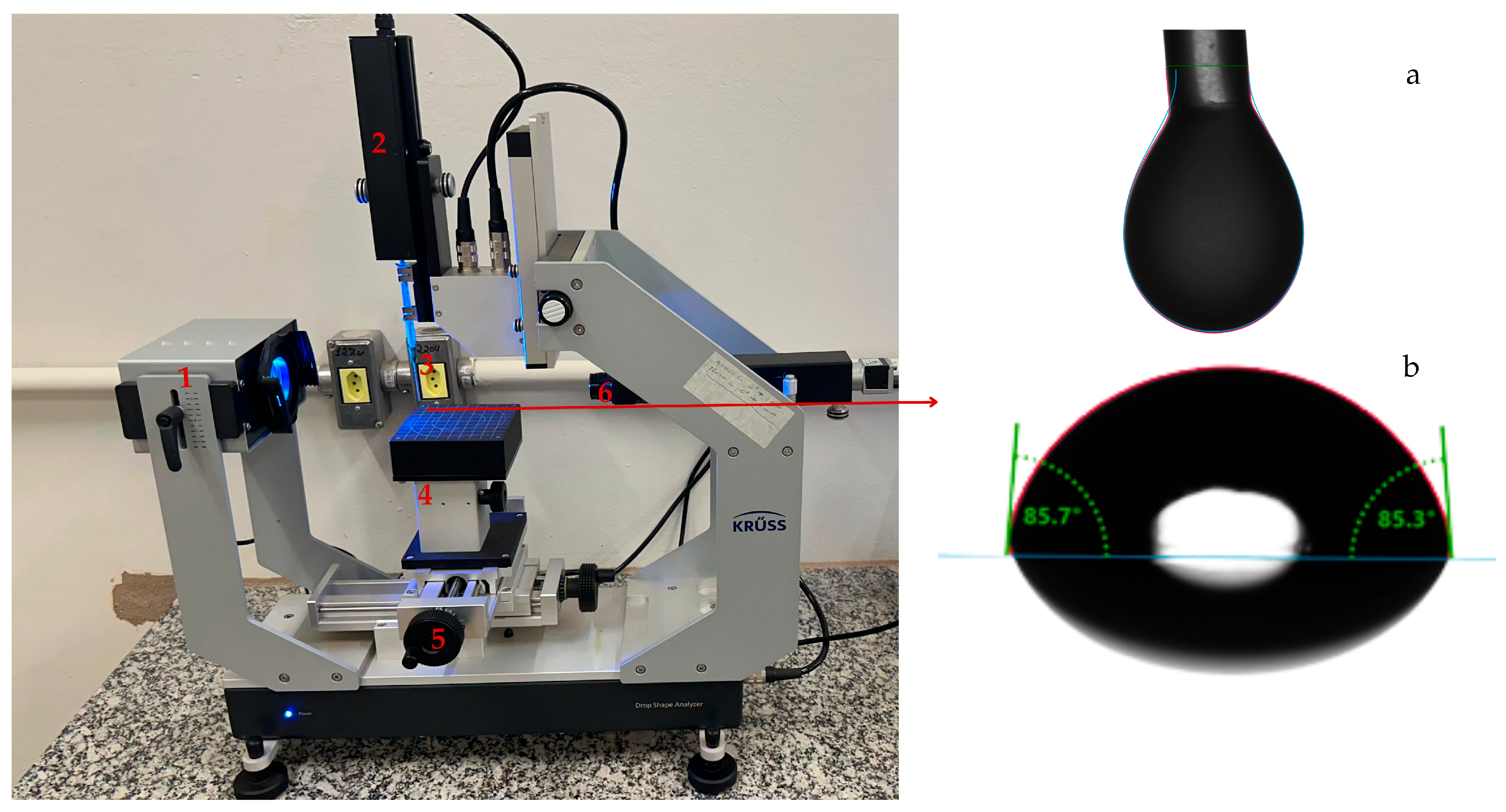
The surface tension (ST) and contact angles (CAs) of the solutions were measured using a DSA30 drop shape analyzer (KRÜSS GmbH., Hamburg, Germany) (Figure 1), employing the hanging drop and sessile drop methods, respectively (Figure 1a,b), as described by Milanowski et al. (2022) [16]. The dynamic ST measurements were taken at 2 milliseconds. Samples were collected using a 10 µL syringe equipped with a needle. For ST determination, the aspired droplet was maintained in a suspended state and analyzed based on the forces acting on the hanging liquid, with calculations adjusted to the Laplace–Young equation [17]. The CA measurements were obtained by depositing droplets on a standard plastic film surface, and the measurement was performed by means of the optical projection captured by the equipment. Using a standardized plastic surface for CA measurements was intended to ensure reproducible conditions and standardization when comparing the wetting behavior of the different spray mixtures. Nevertheless, it should be acknowledged that leaf morphology and heterogeneity exhibit distinct microstructures and chemical compositions (e.g., wax layers) that may affect droplet spreading and retention. Six repetitions per treatment were considered.

2.3. Droplet Spectrum Measurement

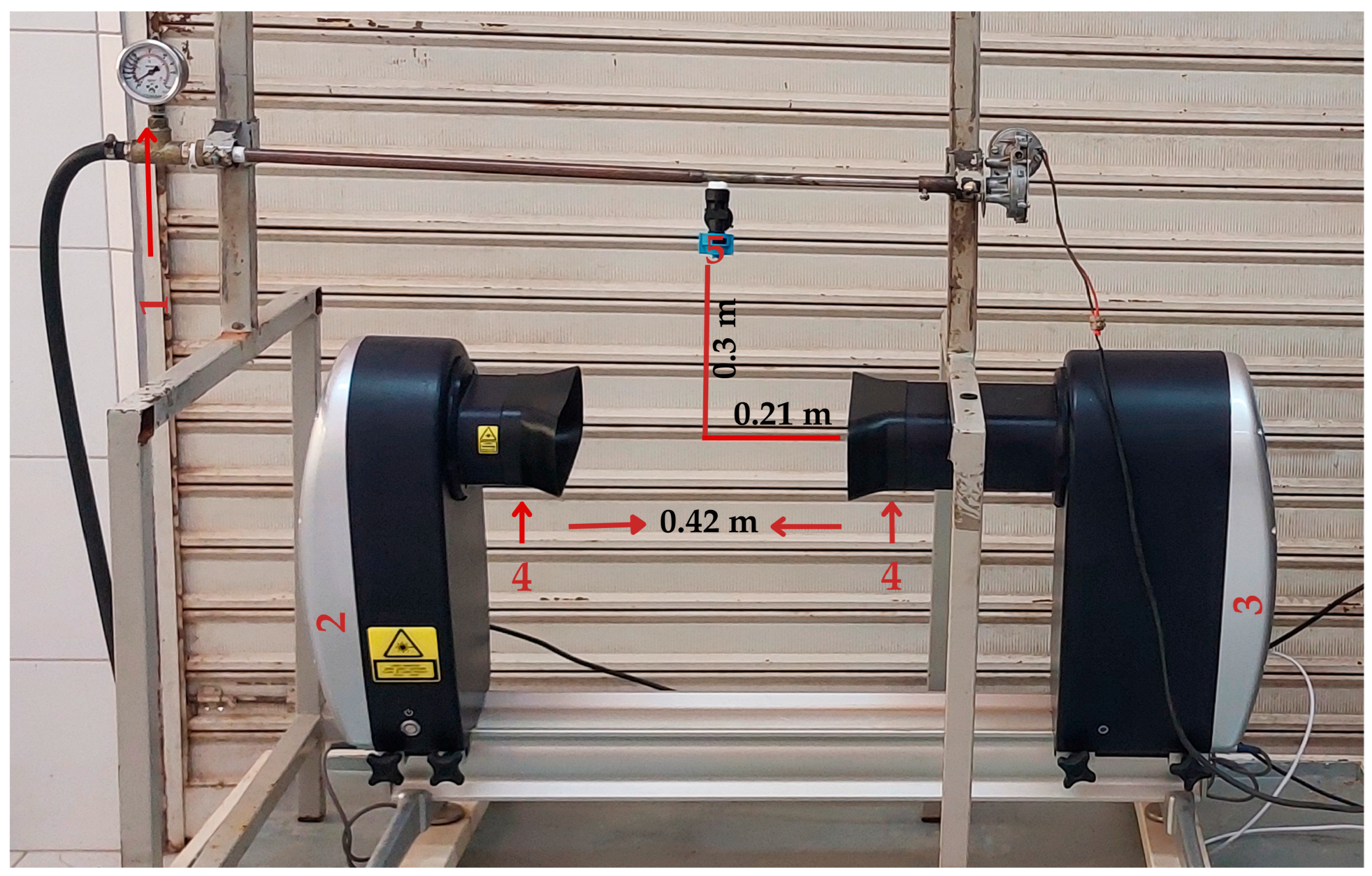
To determine the volumetric diameters ( D v 0.1 , D v 0.5 , and D v 0.9 ), the Relative Span Factor ( R S F ), and the percentages of spray volume carried by droplets smaller than 100 μm (V100) and larger than 500 μm (V500), a laser diffraction particle analyzer (Spraytec Malvern Instruments Ltd., Worcestershire, UK) was used. The equipment comprises two lenses with a diameter of 750 mm and is capable of detecting droplets in the size range from 2 μm to 2000 μm. The laser components are shown in Figure 2, according to Privitera et al. (2024) [18]. Before starting the actual measurements, the Spraytec software (v4.0, 2020) was used to perform background adjustment and align the laser beam with the center of the detectors to subtract light interference from the lenses and ensure consistent light intensity across all tests. Additionally, to guarantee that the optical path remained clean and free from interference by unwanted droplets, the lenses were cleaned between each measurement. A waiting period of 5 to 10 min was observed before the subsequent measurement.
Spraying tests were carried out using an AXI 110 03 flat fan nozzle (Jacto., Pompeia, São Paulo, Brazil) equipped with an anti-drip device. The nozzle was positioned at the center of the lenses, at a height of 0.30 m [19], such that the spray jet was perpendicular to the lenses. The solutions were pressurized by means of a hydraulic piston pump equipped with a pressure gauge. The use of the anti-drip system was necessary to avoid the release of unwanted droplets during application, which could have interfered with the accuracy of the measurements during the tests.
Readings were taken for 5 s at an acquisition frequency of 2500 Hz. After the readings, the values of the variables were obtained via the Spraytec software (v4.0, 2020). The R S F calculated by the laser diffraction equipment was based on Equation (2):
R S F = D v 0.9 D v 0.1 D v 0.5 ,
The nozzle was evaluated under the five operating pressures of 0.1, 0.2, 0.3, 0.4, and 0.5 MPa, with five repetitions per pressure and solution combination (adjuvant + water), considering the application with only water as the control treatment. These replicates were performed sequentially with the same solution. According to Yang et al. (2022) [17], this pressure range could satisfy the requirements for spraying pesticides in plant protection operations.

2.4. Statistical Analysis

Data on the physicochemical properties were analyzed by applying analysis of variance (ANOVA), followed by Tukey’s multiple comparison test at the 5% significance level, to identify significant differences among means. ANOVA was also used to evaluate the effects of the different working pressures and solutions on the droplet distribution parameters. When the interaction between the factors was significant, it was broken down for a more detailed analysis of the effect of the factors.
Prior to conducting the ANOVA, the underlying assumptions were evaluated: normality of residuals was assessed via the Shapiro–Wilk test, the homogeneity of variances through Levene’s test, and the independence of errors using the Durbin–Watson test. Although minor violations were observed, the parametric analysis was retained. This decision was supported by the established robustness of the F-test against moderate distributional departures, particularly in balanced experimental designs, which ensures the preservation of Type I error rates and statistical power.
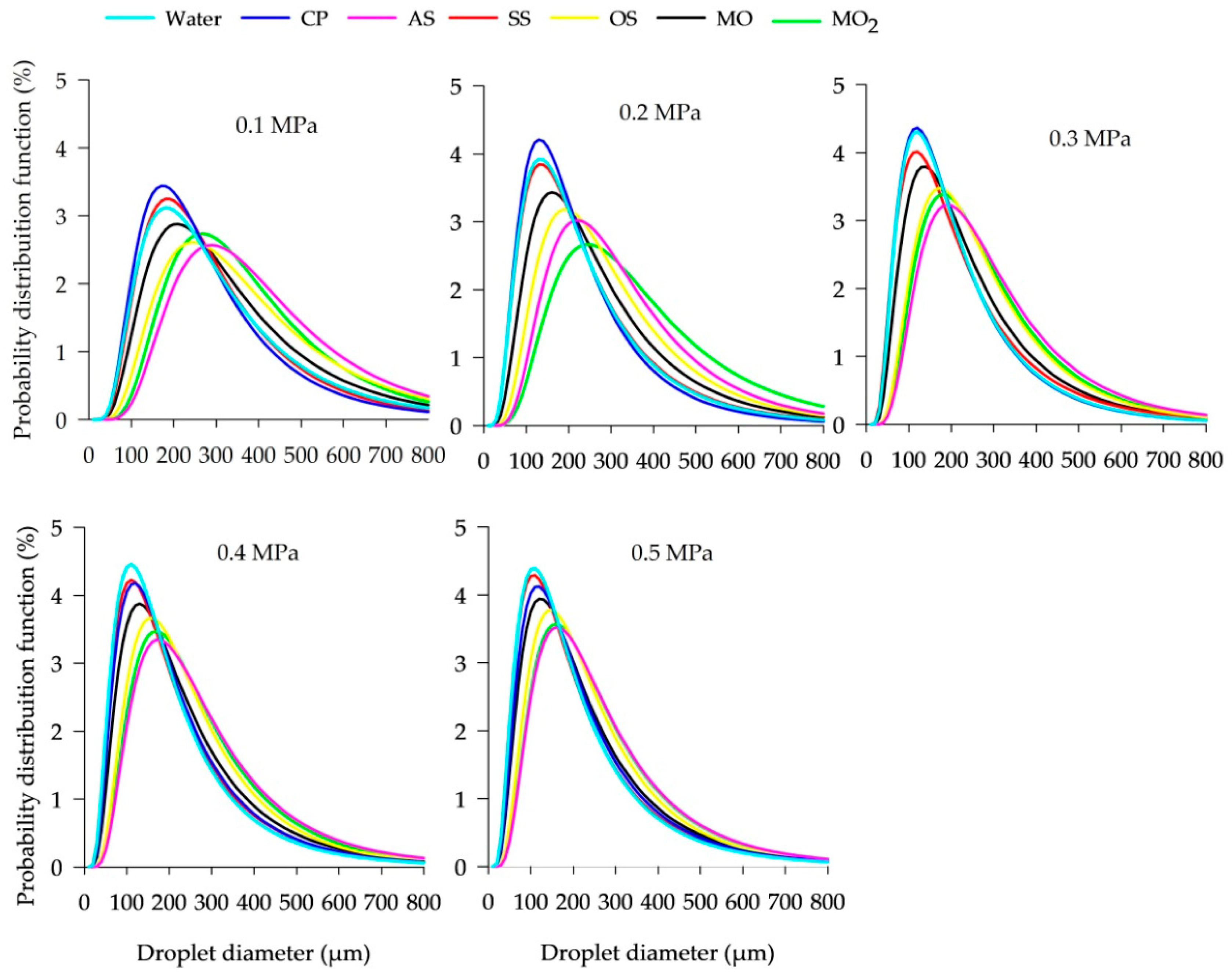
To better understand the distribution of droplet size, the droplet spectrum density curves were computed for each combination of adjuvant and working pressure, based on the fitting of the measured data to the log-normal distribution, as described by Lefebvre and McDonell (2017) [20]. This model was selected due to its proven efficacy in characterizing the right-skewed nature of the spray distributions and its frequent application to describe the fragmentation of liquid sheets. While alternative models (e.g., Rosin–Rammler distribution) were considered, the log-normal model provided a more consistent fit across the wide range of adjuvants and pressures tested. Based on the Akaike Information Criterion (AIC) and the Bayesian Information Criterion (BIC), the log-normal model exhibited the best fit. To express the distribution in percentage terms, the values were normalized so that the sum of all densities along the considered intervals equaled 100%. This procedure ensured that the results could be interpreted as percentage fractions of the droplet population in each diameter range (Equation (3)).
P D F D i , % = f D i f D i × 100 .
The goodness-of-fit performance was quantified using the fitness metrics R M S E (root mean square error, µm) (Equation (4)), M A E (mean absolute error, µm) (Equation (5)), and P B I A S (percent bias, %) (Equation (6)), along with the normalized error ( N R M S E ) (Equation (7)). The N R M S E was calculated by normalizing the R M S E by the standard deviation of the observed values ( sd y o ), enabling relative comparisons across treatments with different magnitudes and variability. In Equations (4)–(7), y p i and y o i denote the predicted and observed values, respectively. These metrics were calculated considering the set of percentiles D v 0.1 , D v 0.5 , and D v 0.9 for each experimental condition, allowing for simultaneous assessment of error magnitude, overestimation or underestimation trends, and the relative accuracy of the model as a function of pressure and adjuvant type.
R M S E = 1 n i = 1 n y p i y o i 2
M A E = 1 n i = 1 n y p i y o i
P B I A S = 100 i = 1 n y o i y p i i = 1 n y o i
N R M S E = 100 R M S E sd y o
In addition, the effect of pressure on volumetric diameters ( D v 0.1 , D v 0.5 , and D v 0.9 ), RSF, V100 and V500 was described for each adjuvant solution based on linear (Equation (8)) and quadratic models (Equation (9)). The regression models were chosen based on: (i) the coefficient of determination (R2) to assess the model’s goodness of fit; (ii) the non-significance of regression deviations, ensuring that the model errors were not significant; and (iii) the statistical significance of the model parameters, assessed using the t-test at the 5% significance level. For the second-order models, the minimum or maximum points were calculated.
y = b 0 + b 1 p
y = b 0 + b 1 p + b 2 p 2
For the V100 and V500 variables, the coefficient of variation (CV) was calculated as the ratio between the square root of the residual mean square and the mean of all observed data for each variable.
Finally, principal component analysis (PCA) was applied to explore the multidimensional variability of the physicochemical properties of the solutions and their relationships to the droplet spectrum variables. The PCA was performed on the correlation matrix, following z-score standardization of the variables to eliminate the influence of different measurement scales. The number of components retained for interpretation was determined based on the explained variance and the analysis of the eigenvalue plot (scatter plot or scree plot). The components that collectively explained the largest proportion of the total data variance were considered for interpretation [21]. All statistical procedures were performed using R software (version 4.2.3-2023).

3. Results and Discussion

3.1. Physicochemical Properties of the Applied Solutions

The different adjuvants significantly (p < 0.0001) altered the physicochemical properties of the solutions, resulting in variations in pH, EC, ST, and CA. Only V M did not differ statistically among treatments (p = 0.447) (Table 2).
The water and the OS solution presented a neutral pH, which is ideal for the stability of most agricultural pesticides. In contrast, the AS solution showed an extremely acidic pH (2.17), which may compromise the efficacy of active ingredients sensitive to acidic conditions. The remaining solutions presented pH values ranging from 5.60 to 6.30, corresponding to slightly to moderately acidic conditions. While this range may be advantageous for certain systemic herbicides, careful attention should be paid to tank-mix compatibility and product stability.
According to Fishel and Ferrell (2007) [22], most agricultural pesticides are more stable in solutions with pH values between 4 and 7, with an optimal range of 5.5 to 6.5 for the majority of products. Despite this ideal range, it is essential to consider the physicochemical compatibility of the mixtures and the order in which the products are added to the tank, since small variations in pH can influence the agronomic performance of the application. Although some herbicides, such as glyphosate and glufosinate, are more effective in slightly acidic solutions, a low pH can compromise the stability of certain active ingredients and increase the risk of spray precipitation [23]. In addition, pH can affect the mobility of herbicides in the soil [24]. Thus, the impact of adjuvants on physicochemical properties is influenced by the type of product being applied, limiting the applicability of generalized recommendations [9].
Acidic solutions with a pH < 4 can cause rapid corrosion of metal components in spraying equipment. Excessive acidification of a solution can be harmful, especially for products that already have a low pH in their formulation. These results reinforce the need to monitor the pH of solutions before their application. This can help farmers and users in the correct addition of products to tank mixes, improving the efficiency of application of agricultural pesticides and influencing the half-life of these products [6,25].
The EC varied among treatments, reflecting different proportions of the presence of dissolved salts or ions in each of the solutions tested. Products with different compositions and ionization had different EC values. Among the evaluated solutions, AS presented a high concentration of ions (668.73 µS cm−1), which could influence the ST by affecting the organization and efficiency of surfactant molecules at the liquid–air interface. Variations in EC can indirectly modify the ST and affect the final droplet size distribution. The EC can influence synergistic or antagonistic reactions of adjuvants with agricultural pesticides, which can affect the foliar absorption of the active ingredient and thus reduce the biological efficiency of the treatment [26]. On the other hand, solutions such as CP and OM presented conductivity values lower than 5 µS cm−1, which may indicate a lower risk of phytotoxicity, favored by the greater chemical stability of the solution, but also lower penetration efficiency, which requires greater attention to the products to be mixed. According to Cortes et al. [27], products with low EC minimize osmotic effects without significantly interfering with the ionic dynamics of plant cells, which reduces the risk of plant phytotoxicity.
The V M of the solutions varied between 985.33 kg m−3 and 1057.33 kg m−3. Although the SS solution presented the highest value among the treatments, no statistically significant differences were observed among the solutions. This result indicates that the addition of the evaluated adjuvants did not substantially modify the V M of the spray mixtures under the tested conditions. From a practical perspective, the similarity of the V M values suggests that differences observed in the droplet size spectra are more likely associated with other physicochemical characteristics (e.g., surface tension) rather than changes in liquid density.
ST was reduced in all solutions containing adjuvants with respect to water (73.49 mN m−1), evidencing the surfactant effect of the adjuvants. In particular, CP (25.93 mN m−1) and OS (27.93 mN m−1) presented the lowest ST values, facilitating the formation of smaller droplets by lowering the energy required for liquid surface breakup. This reduction is also reflected in lower CA values, which is crucial for greater spreading of spray droplets on plant surfaces in order to enhance foliar deposition, especially when applying contact pesticides [6]. Understanding this combined action is essential when selecting adjuvants, as modifications to these properties can influence the atomization dynamics and droplet retention.
The observed differences among the adjuvants indicate that their different performances may vary when combined with distinct pesticide formulations. Therefore, understanding the specific impact of each adjuvant is essential [4,28]. Furthermore, the type of surfactant added to the adjuvant formulation influences the reduction in ST, with organic surfactants being more effective compared to synthetic ones [29]. In addition, adjuvants of organic origin are more easily degraded, thus contributing to the reduction in environmental contamination [30].
The control treatment with only water exhibited the highest CA value (81.25°), indicating low wettability. In contrast, the CP and OS solutions significantly reduced this parameter, with angles lower than 50°, which promoted greater droplet adhesion to the leaf surface and better deposition (wetting), especially on leaves with epicuticular waxes [8]. Despite reductions in CA, the number of leaf stomata can influence the product absorption, as plants with different stomata can have different dynamics when treated with the same adjuvant [4]. The greater droplet adhesion induced by adjuvants can reduce the droplet rebound from plant surfaces [28]. Although OS and MO showed statistically similar ST values, they produced different reductions in CA, indicating that OS more effectively improves droplet wetting and spreading on leaf surfaces [31]. Considering the reduction in CA, OS adjuvants can act as efficient penetrating agents, in addition to being important allies in the application of herbicides that need to be translocated to the roots [28,32]. Furthermore, based on the results for ST and CA (Table 2), it can be said that MOs contribute more to retention than to spreading and can facilitate the rupture of the wax layer of plants, in addition to improving wetting [33,34]. This correlation, however, depends on the affinity between the applied solution and the leaf [34,35]. Thus, different types of adjuvants can have different degrees of CA [33].

3.2. Droplet Spectrum

3.2.1. Effect of Adjuvants on Volumetric Diameters

The ANOVA of the volumetric diameters ( D v 0.1 , D v 0.5 , and D v 0.9 ) indicated significant effects of the interaction between the working pressure and the applied solutions. In general, increasing pressure resulted in a reduction in droplet diameters across all solutions, as expected due to the greater shear forces generated at the nozzle orifices under higher operating pressures (Table 3).
For D v 0.1 , the solutions containing the adjuvants AS, MO2, and OS showed higher values than the other solutions (MO, SS and CP), especially at pressures of 0.1 MPa and 0.2 MPa. This result indicates that these formulations had a higher proportion of fine droplets. From 0.3 MPa upward, differences among solutions reduced, although AS continued to maintain the highest D v 0.1 values.
Regarding the volumetric median diameter (VMD), AS, MO2 and OS solutions presented the highest values at all pressure levels. This trend suggests that these formulations favor the generation of a droplet spectrum with a predominance of medium to coarse droplets, which is desirable for PPP applications targeting lower foliar deposition or conditions associated with an increased risk of evaporation and spray drift. According to Li et al. (2021) [36], oils alter the position of the liquid sheet rupture. Unlike surfactants, oils promote rupture closer to the nozzle exit, where the layer is thicker, thus resulting in a higher VMD. It is worth noting that this result may not be universal for all types of oil, as shown in the results of this research for MO2 and MO.
For D v 0.9 , the effects of the solutions were more pronounced at pressures of 0.1 MPa and 0.2 MPa. At these levels, AS and MO2 presented the highest values. However, from 0.3 MPa upward, the differences among solutions were no longer statistically significant, indicating that the effect of the working pressure overrode the effect of the formulations on D v 0.9 . The convergence of D v 0.9 values from 0.3 MPa demonstrates that the effect of working pressure on this variable outweighs that of the adjuvants, indicating that control depends more on the operational parameter than on the formulation.
The droplet size produced by a given nozzle may be related to the viscoelastic properties of the spray and deformation [37]. Solutions with greater viscoelasticity are more resistant to rupture, forming larger droplets, while those with lower viscoelasticity break more easily, generating a greater proportion of fine droplets [7]. Considering this, it can be said that oils have different viscoelasticity and deformation capacities, and this interferes with the formation of droplets.
These factors interact with the working pressure; as the pressure increases, the liquid velocity at the nozzle orifice also increases, causing the atomization to enter the wind-induced regime, in which the ambient air contributes significantly to the destabilization and rupture of the jet. In this regime, even more viscoelastic solutions can form smaller droplets due to the greater aerodynamic influence [17]. In this scenario, SS and CP solutions had lower VMD values, indicating finer droplets, potentially more suitable for applications that require greater leaf coverage. In polymeric adjuvants, agitation of the mixture influences their degradation, and this can affect the droplet spectrum [36].
According to Yang et al. (2022) [17], when the resistance of the spray molecules to breakup is low, the droplet size tends to present greater instability in the flow direction, which affects the Rayleigh regime that generates the main impact; thus, the ambient gas has little effect on the breakage of the liquid, resulting in larger drops. This dynamic may be more pronounced in formulations with higher VMD values, suggesting that they maintained physical characteristics that prolonged the length of the jet before breakage and favored the formation of medium to large droplets.
According to Cerruto et al. (2021) [38], the increase in working pressure reduced all volumetric diameters due to the greater atomization of the liquid. The results showed that both working pressure and solution formulation had a significant influence on the droplet spectra generated. The appropriate selection of adjuvant, associated with the optimal setting of pressure, can contribute to optimizing a PPP application, favoring agronomic efficiency and reducing environmental risks associated with spray drift.
Pressure also affected the R S F values; AS, OS and MO2 solutions were less susceptible to this variation at all pressures (from 1.33 to 1.57). Such formulations may be desirable when seeking greater homogeneity of the application spectrum. In contrast, SS, CP and water solutions presented significantly higher R S F values, reaching up to 2.08 in SS at 0.5 MPa, which indicates greater dispersion of the droplet sizes. According to Wang et al. (2022) [39], polymeric adjuvants may exhibit R S F values comparable to those obtained with only water. However, this does not imply that spraying without adjuvants is advantageous, as adjuvants can improve other critical spray characteristics, including droplet adhesion to leaf surfaces.
An inverse relationship was observed between volumetric diameters and R S F as the operating pressure increased. For all solutions applied, the increase in pressure resulted in a significant reduction in diameters, especially D v 0.1 , evidencing the greater production of fine droplets. However, this reduction did not occur proportionally between the extremes of the spectrum ( D v 0.1 and D v 0.9 ), which affected the increase in R S F , indicating greater heterogeneity of the droplet spectrum. Adjuvants affect the structure of the atomization process [17]. Therefore, under application conditions, it is necessary to adjust the working pressure and select adjuvants compatible with the application objectives to maximize application efficiency, reduce environmental risks and optimize the use of inputs.
The values for D v 0.1 , D v 0.5 , and D v 0.9 (Table 4) were related to pressure, determining the pressures corresponding to the smallest volumetric diameters observed for each, reflecting the conditions of atomization of the solutions. Based on second-order models, for D v 0.1 , the lowest values were estimated at pressures between 0.3966 MPa (SS) and 0.5261 MPa (MO). The adjuvants AS (0.4895 MPa), CP (0.4991 MPa) and MO2 (0.5111 MPa) presented minimum points at higher pressures, which indicates greater resistance to the breakage of the finest droplets and possible initial spray stability.
For D v 0.5 , the minimum values were observed between 0.3649 MPa (CP) and 0.4674 MPa (AS), suggesting that the volumetric median diameter is optimized at these pressures. Furthermore, in the solution with the adjuvant MO2, the equation indicated a reduction of 0.3256 µm for each unit of pressure, revealing a continuous linear action of fragmentation with increasing pressure.
For D v 0.9 , only the solutions with the adjuvants AS and OS presented estimable minimum points at 0.4670 MPa and 0.4377 MPa, respectively. In other solutions such as MO2, the trend was linear with a highlight for a reduction of up to 0.3900 per unit of pressure. On the other hand, the pressure had no significant effects on the reduction in D v 0.9 for the SS solution (Table 4). These results indicate that increasing the working pressure promotes droplet breakage and a reduction in droplet volumetric diameters, regardless of the type of adjuvant used, favoring the formation of finer spectra [17].
Regarding the effect of pressure on RSF, the results for the SS solution indicated that, for each increase of one unit of pressure, there was an increase of approximately 0.13% in the amplitude of the droplet spectrum. AS showed an increase of 0.05%, while MO2 showed an increase of 0.04% per unit of increased pressure. The OS adjuvant showed the smallest increase (0.03%). Such increases indicate that higher pressures contribute to a slight broadening of the droplet size distribution, with greater sensitivity observed for SS (Table 4). Increasing the operating pressure implies increasing the variation of fine and coarse droplets, which can affect the application quality. Thus, the most sensitive adjuvants require greater pressure control.
These results indicate that each adjuvant has an ideal operating range, determined by the working conditions to which it is subjected, such as pressure, nozzle type and other operational factors. Therefore, it is essential to use adjuvants within their ideal working range to ensure better efficiency in controlling pests, diseases and weeds.

3.2.2. Effect of Adjuvants on V100 and V500

The evaluation of the percentage of volume carried by droplets with a diameter lower than 100 µm (V100) indicated that the increase in working pressure promoted a significant increase in the production of fine droplets, regardless of the solution applied (Table 5). When the atomization pressure of the liquid increased, V100 increased due to greater fragmentation of the droplets [37].
It was observed that, at pressures of 0.3 MPa to 0.5 MPa, water, SS and CP solutions presented the highest V100 values, with the emphasis on SS and water, which reached the maximum values of 27.60% and 26.77% of fine droplets at a pressure of 0.5 MPa. This result is convergent due to the similarity in D v 0.5 presented by these solutions. This pattern suggests greater susceptibility to drift under these conditions. On the other hand, solutions containing AS, OS and MO2 adjuvants provided reductions in the formation of fine droplets at all pressures tested, which indicated their potential to minimize drift losses in applications with higher spray energy (Table 5).
The results for the percentage of volume carried by droplets with diameters greater than 500 µm (V500) indicated an inverse trend to that observed for V100. At the lowest pressure tested (0.1 MPa), the highest percentages of coarse droplets were observed for the solutions containing the AS, OS and MO2 adjuvants, with values above 20%. These percentages are undesirable, as the droplets can run off, influencing the amount of active ingredient on the target, especially in crops with a more closed canopy or in adverse environmental conditions [40].
On the other hand, these solutions should be evaluated for applications with backpack sprayers, since in this type of equipment the atomization pressure tends to be low. As the working pressure increased, there was a significant reduction in the fraction of coarse droplets for all solutions tested, with V500 values being below 6% at pressures of 0.3 MPa to 0.5 MPa. This pattern indicates that the increase in pressure favors the atomization of the spray, but with less retention of larger droplets, which are less susceptible to drift and evaporation (Table 5). These responses of the evaluated solutions suggest the influence of the rupture mechanisms of each of the adjuvants [41].
The high variability observed in the V500 data, reflected by the coefficient of variation (CV) of 41.01%, suggests greater sensitivity of this parameter to variations in the interaction between adjuvant type and working pressure. On the other hand, V100 presented lower variability (CV = 7.40%), indicating greater consistency in the formation of fine droplets among the treatments (Table 6).
For V100, all solutions indicated that the increase in pressure intensified the formation of these droplets, which may be undesirable in conditions prone to drift. The highest value was observed for SS, indicating that for each unit of pressure increase, the volume of fine droplets increased by 4.18%. Next, water stood out with an increase of 4.16% and MO with an increase of 3.76%. AS, OS and MO2 adjuvants also showed an increase, but on a smaller scale (approximately 2.68% to 2.81%), which suggests greater stability in the face of increased pressure. This is important to consider for applications where the aim is to reduce the risk of drift and contamination of ecosystems. The mechanisms of oscillation and perforations of the liquid sheets of the solutions are influenced by the operating pressure, consequently affecting the spectrum and volumes [41].
On the other hand, for V500, the increase in pressure reduced the percentage of droplets with the possibility of running off. In the AS adjuvant, the increase in pressure reached the minimum reduction point of V500 at 0.403 MPa. Meanwhile, in MO2 and OS, the pressure promoted reductions of 4.61% and 4.09%, respectively. Furthermore, the pressure did not present significant effects in SS and CP, as confirmed by the non-significance of b1 coefficients (Table 6). This finding suggests that, within the evaluated pressure range, V500 remained relatively stable for these spray mixtures. These results reinforce the importance of using adjuvants that promote a smaller increase in V100 and R S F , and a greater reduction in V500 with the increase in pressure, with AS, MO2 and OS being the adjuvants that presented the most balanced and technically desirable performance in this context.

3.2.3. Characterization of the Droplet Spectrum Using Density Functions

The curves show how the combination of pressure and adjuvant type changed the droplet distribution pattern (Figure 3). It was observed that, at pressures of 0.1 MPa and 0.2 MPa, solutions containing AS, MO2 and OS presented distributions shifted towards larger droplet sizes, with shorter tails on the left, indicating a lower proportion of fine droplets. On the other hand, water, SS and CP exhibited more asymmetric distributions, with a greater density in the fine droplet range, especially at pressures of 0.4 MPa and 0.5 MPa, which was in agreement with the highest V100 values observed.
Furthermore, at pressures of 0.3 MPa to 0.5 MPa, a narrowing of the distributions was observed in the solutions with AS, MO2 and SO, suggesting greater uniformity in the droplet spectrum, while the solutions with SS, CP and water presented wider distributions, reflecting greater variability, consistent with the higher R S F values obtained. Thus, CP adjuvant selection is more critical in low-volume, low-pressure applications.
The results of the performance metrics indicated that the prediction quality of the droplet spectrum percentiles ( D v 0.1 , D v 0.5 , and D v 0.9 ), obtained from the droplet diameter distribution density curves, varied as a function of the working pressure and the adjuvant used (Table 7). In general, the percent bias ( P B I A S ) ranged approximately from −5.16% to 4.94%, which indicates the absence of a consistent systematic tendency to overestimate or underestimate the predicted values. However, the absolute ( R M S E and M A E ) and relative ( N R M S E ) error metrics showed significant differences between treatments, indicating variation in model accuracy.
Better performance was observed for the CP and SS adjuvants, with the condition at 0.3 MPa in water being particularly notable for R M S E (2.34 µm), M A E (2.07 µm) and N R M S E (1.42%); SS also showed consistent dynamics across all pressures, and the N R M S E ranged between 3.69% and 6.04%. In contrast, the largest errors were found mainly for OS and MO2, with the N R M S E frequently above 9%. This included the worst fit for OS at 0.3 MPa ( R M S E : 28.40 µm, MAE: 21.73 µm, NRMSE: 17.26%) and high values for AS at 0.5 MPa ( R M S E : 29.04 µm, M A E : 24.20 µm, N R M S E : 17.04%).
These results suggest that, although the model exhibits low average bias, its predictive capability is reduced under conditions where specific adjuvants and pressures promote greater alteration in the shape of the droplet spectrum distribution, especially in the extreme percentiles, leading to increased error and lower reliability of the estimates. The larger observed errors indicate greater complexity in the spray’s physical dynamic, likely associated with changes in the spray mixture’s physicochemical properties that affect liquid breakup into droplets.

3.3. Principal Component Analysis

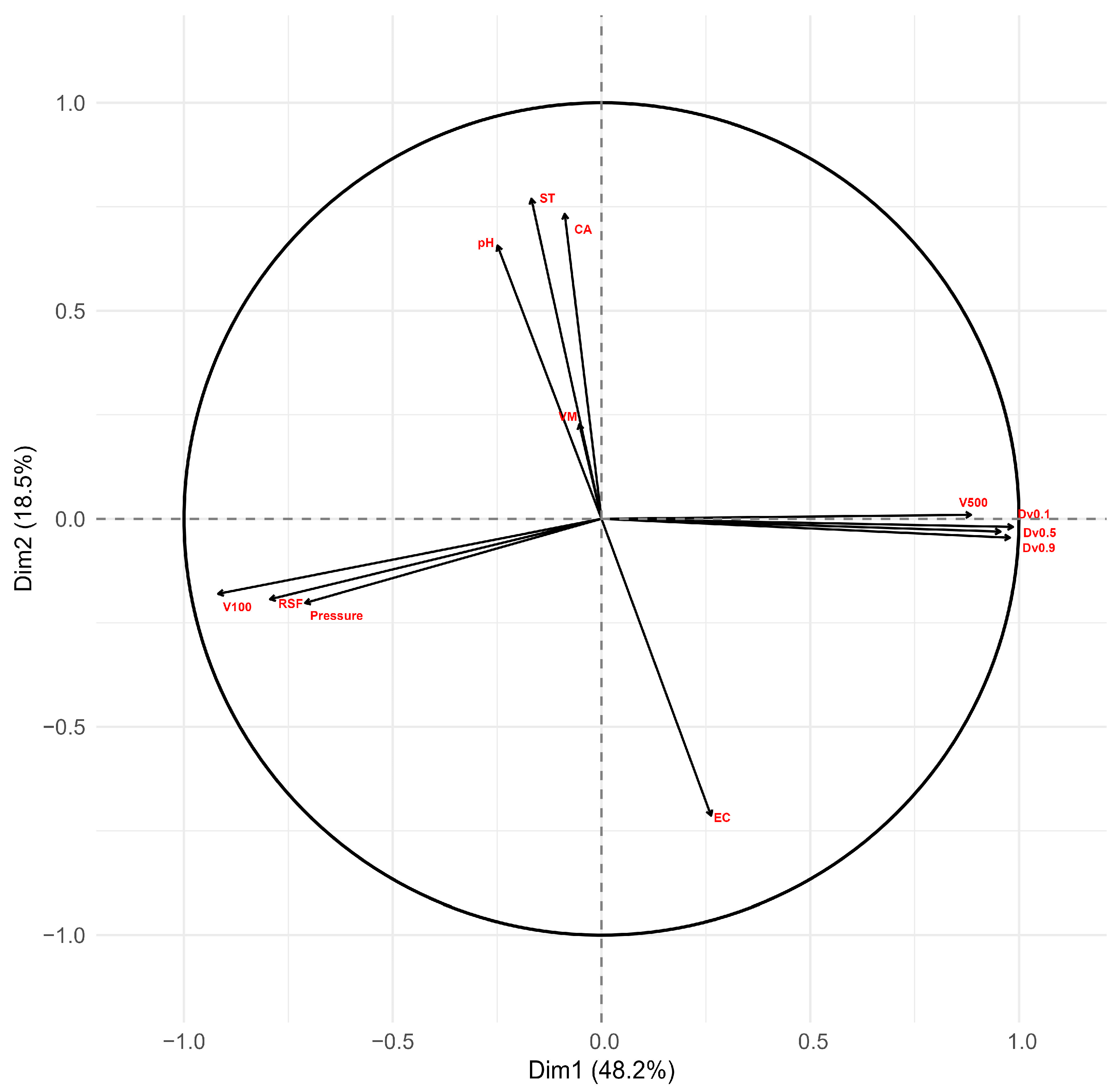
Principal component analysis (PCA) was used to identify the variables most associated with the variations observed between the solutions. The first two principal components jointly explained 66.7% of the total variance of the data, with the first component (Dim1) responsible for 48.2% and the second component (Dim2) responsible for 18.5% (Figure 4). Dim1 was associated with the variables D v 0.1 , D v 0.5 , D v 0.9 and V500, which presented a positive correlation with each other and a negative correlation with the R S F and V100, indicating that larger volumetric diameters and a greater volume of large droplets were related to smaller spectral amplitudes and a lower presence of fine droplets. These relationships were influenced by the working pressure and represented the main differentiating factors between the adjuvant solutions.
In addition, a negative correlation was observed between EC and pH, ST and CA. Solutions with higher conductivity, such as AS (668.73 µS cm−1) and OS (93.60 µS cm−1), presented lower pH, ST and CA values. On the other hand, those with lower conductivity, such as CP (1.47 µS cm−1) and MO (3.51 µS cm−1), presented higher values for these properties. This trend suggests that in highly ionized or acidic environments, the ability of surfactants to reduce ST and CA is partially modulated by the ionic competition at the droplet interface. These joint interactions define the viscoelasticity and the rupture of the liquid sheet from the nozzle orifice. As a consequence, the final atomization pattern is determined by the interaction between operating pressure, nozzle design and the solution’s physicochemical resistance, primarily given by the synergy of ST and chemical stability.
Although solutions with a lower ST, such as CP (25.93 mN m−1) and MO (28.85 mN m−1), generated droplets of larger diameter compared to water (73.49 mN m−1) and AS (54.87 mN m−1), no direct association was observed between this variable alone and droplet size. This suggests that ST should be interpreted in conjunction with other properties and that it is not, by itself, a determining factor of the atomization pattern.
Likewise, no clear trend was identified between volumetric mass and the size of the droplets generated, indicating that, despite the physical importance of this variable, its influence may be secondary compared to other properties, such as the rheological response of the solutions.
Dim2, in turn, was mainly influenced by the variables pH, ST, CA and V M , which showed a positive correlation with each other and a moderate contribution to this axis. However, V M was the variable that contributed least to explaining the variation of the adjuvants.

4. Conclusions

Knowing the importance of adjuvants, their use should be optimized to improve spray application performance. This requires selecting the most appropriate adjuvant and defining suitable operating conditions to enhance PPP application efficiency and minimize the negative impacts associated with inadequate pressure settings for specific use scenarios. When properly managed, these factors can contribute to the sustainability of agricultural ecosystems. The study allowed the following final conclusions to be drawn:
  • The operating pressure significantly influenced the droplet spectrum when spraying the different spray solutions, thus offering a practical framework for optimizing spray parameters in the field. Higher pressures increased both the volume fraction of fine droplets (V100) and the R S F , especially for solutions containing the SS and MO adjuvants. Using these adjuvants may enhance leaf coverage and improve the performance of contact pesticides, for instance, during fungicide treatments. However, their use under high-pressure conditions should be carefully managed due to the increased proportion of fine droplets, while simultaneously caution should be taken against drift risks. In contrast, the AS, MO2, and OS formulations showed greater stability under increasing pressure, with a smaller increase in fine droplets and a more pronounced reduction in the volume fraction of coarse droplets (V500). These adjuvants are therefore more suitable for applications requiring effective drift control, particularly under unfavorable weather conditions (wind and high temperature), while maintaining lower V100 values even at higher pressures (up to 0.5 MPa).
  • The PCA showed that the volumetric diameters ( D v 0.1 , D v 0.5 , and D v 0.9 ) and V500 were the primary variables differentiating the tested spray solutions. The physicochemical properties, such as pH, EC, ST, and CA, also affected droplet formation, contributing to the variability among the solutions. This indicated that modifications to the physicochemical properties can affect droplet size and atomization behavior. Therefore, the interaction between these characteristics and pressures plays a critical role in determining the resulting droplet size spectra.
  • Overall, adjuvant performance was attributed to the balance between their physicochemical characteristics and their response to different operating pressures. Consequently, the selection of adjuvants should account not only for their capacity to reduce surface tension, but also for their interaction with operational parameters, with the aim of optimizing the PPP application efficiency, as well as mitigating environmental risks, particularly in situations prone to spray drift.
Finally, as this study was conducted in a controlled environment, these findings should be interpretated as a technical baseline for improving spray quality rather than a direct measurement of field-scale environmental risk. While optimizing the droplet size distribution and the physicochemical behavior of spray solutions can contribute to more sustainable plant protection practices, the actual reduction in environmental pollution and the effectiveness of PPP applications in real field scenarios will depend on further validation under varying environmental conditions and different crop structures. Therefore, these results provide valuable guidance for the technical selection of adjuvant–pressure combinations that could serve as a precursor to field-level assessments.

Author Contributions

Conceptualization, S.B. and M.R.F.J.; methodology, S.B., M.R.F.J., C.B.d.A., B.C.V., S.P., S.L., A.T.S., E.C. and G.M.; validation, S.B., M.R.F.J., C.B.d.A., E.L.d.V., B.C.V., S.P., S.L., A.T.S., E.C. and G.M.; formal analysis, S.B.; investigation, S.B., M.R.F.J., C.B.d.A. and B.C.V.; data curation, M.R.F.J.; writing—original draft preparation, S.B.; writing—review and editing, S.B., M.R.F.J., C.B.d.A., E.L.d.V., B.C.V., S.P., S.L., A.T.S., E.C. and G.M.; visualization, S.B., M.R.F.J., C.B.d.A. and E.L.d.V.; supervision, M.R.F.J. and C.B.d.A.; project administration, M.R.F.J. All authors have read and agreed to the published version of the manuscript.

Funding

This research received no external funding.

Data Availability Statement

The raw data supporting the conclusions of this article will be made available by the authors on request.

Acknowledgments

This research was financed in part by the Coordenação de Aperfeiçoamento de Pessoal de Nível Superior, Brazil (CAPES)—Finance Code 001, Fundação de Amparo à pesquisa do estado de Minas Gerais (FAPEMIG) and Project APQ-00344-24. The authors thank the Department of Agricultural Engineering at the Federal University of Viçosa (UFV); the Institute of Agricultural Sciences at the Federal University of Uberlândia; and the Department of Agriculture, Food, and Environmental Science (Di3A) at the University of Catania for supporting this study.

Conflicts of Interest

The authors declare no conflicts of interest.

References

  1. Djouhri, M.; Loubet, B.; Bedos, C.; Dages, C.; Douzals, J.P.; Voltz, M. ADDI-Spraydrift: A comprehensive model of pesticide spray drift with an assessment in vineyards. Biosyst. Eng. 2023, 231, 57–77. [Google Scholar] [CrossRef]
  2. Jayasiri, M.M.; Yadav, S.; Propper, C.R.; Kumar, V.; Dayawansa, N.D.; Singleton, G.R. Assessing potential environmental impacts of pesticide usage in paddy ecosystems: A case study in the Deduru Oya River Basin, Sri Lanka. Environ. Toxicol. Chem. 2022, 41, 343–355. [Google Scholar] [CrossRef] [PubMed]
  3. Brankov, M.; Simić, M.; Vukadinović, J.; Zarić, M.; Tataridas, A.; Božinović, S.; Dragičević, V. Could adjuvants serve as an agroecological tool? Front. Agron. 2024, 6, 1523208. [Google Scholar] [CrossRef]
  4. Hu, H.; Ma, Y.; Song, X.; Wang, D.; Ren, X.; Wu, C.; Liu, C.; Ma, X.; Shan, Y.; Meng, Y.; et al. Tank-mix adjuvants enhance pesticide efficacy by improving physicochemical properties and spraying characteristics for application to cotton with unmanned aerial vehicles. ACS Omega 2024, 9, 31011–31025. [Google Scholar] [CrossRef]
  5. Li, S.; Chen, C.; Wang, Y.; Kang, F.; Li, W. Study on the atomization characteristics of flat fan nozzles for pesticide application at low pressures. Agriculture 2021, 11, 309. [Google Scholar] [CrossRef]
  6. Basílio, S.; Júnior, M.R.F.; de Alvarenga, C.B.; da Vitória, E.L.; Vargas, B.C.; Privitera, S.; Caruso, L.; Cerruto, E.; Manetto, G. Effect of adjuvants on physical–chemical properties, droplet size, and drift reduction potential. Agriculture 2024, 14, 2271. [Google Scholar] [CrossRef]
  7. Zhang, X.; Xiong, L. Effect of adjuvants on the spray droplet size of pesticide dilute emulsion. Colloids Surf. A Physicochem. Eng. Asp. 2021, 619, 126557. [Google Scholar] [CrossRef]
  8. Zhao, R.; Sun, Z.; Bird, N.; Gu, Y.C.; Xu, Y.; Zhang, Z.H.; Wu, X.M. Effects of tank-mix adjuvants on physicochemical properties and dosage delivery at low dilution ratios for unmanned aerial vehicle application in paddy fields. Pest Manag. Sci. 2022, 78, 1582–1593. [Google Scholar] [CrossRef]
  9. Assunção, H.H.T.D.; Campos, S.F.B.; Sousa, L.A.; Lemes, E.M.; Zandonadi, C.H.S.; Cunha, J.P.A.R.D. Adjuvants plus phytosanitary products and the effects on the physical-chemical properties of the spray liquids. Biosci. J. 2019, 35, 1878–1885. [Google Scholar] [CrossRef]
  10. Wang, S.; He, X.; Song, J.; Wang, S.; Jia, X.; Ling, Y. Effects of xanthan gum on atomization and deposition characteristics in water and Silwet 408 aqueous solution. Int. J. Agric. Biol. Eng. 2018, 11, 29–34. [Google Scholar] [CrossRef]
  11. Chen, C.; Li, S.; Wu, X.; Wang, Y.; Kang, F. Analysis of droplet size uniformity and selection of spray parameters based on the biological optimum particle size theory. Environ. Res. 2022, 204, 112076. [Google Scholar] [CrossRef]
  12. Makhnenko, I.; Nguyen, L.; Hogan, C.J.; Fredericks, S.A.; Colby, C.M.; Alonzi, E.R.; Dutcher, C.S. Spray droplet sizes from aqueous liquid sheets containing soluble surfactants and emulsified oils. At. Sprays 2024, 34, 21–36. [Google Scholar] [CrossRef]
  13. Sijs, R.; Bonn, D. The effect of adjuvants on spray droplet size from hydraulic nozzles. Pest Manag. Sci. 2020, 76, 3487–3494. [Google Scholar] [CrossRef]
  14. Polli, E.G.; Alves, G.S.; de Oliveira, J.V.; Kruger, G.R. Physical–chemical properties, droplet size, and efficacy of dicamba plus glyphosate tank mixture influenced by adjuvants. Agronomy 2021, 11, 1321. [Google Scholar] [CrossRef]
  15. ABNT NBR 13826; Pesticides—Determination of Density. Brazilian National Standards Organization: São Paulo, Brazil, 2016. Available online: https://www.dinmedia.de/en/standard/abnt-nbr-13826/256009333 (accessed on 2 April 2023).
  16. Milanowski, M.; Subr, A.; Combrzyński, M.; Różańska-Boczula, M.; Parafiniuk, S. Effect of adjuvant, concentration and water type on the droplet size characteristics in agricultural nozzles. Appl. Sci. 2022, 12, 5821. [Google Scholar] [CrossRef]
  17. Yang, W.; Jia, W.; Ou, M.; Zhong, W.; Jiang, L.; Wang, X. Effect of physical properties of an emulsion pesticide on the atomisation process and the spatial distribution of droplet size. Agriculture 2022, 12, 949. [Google Scholar] [CrossRef]
  18. Privitera, S.; Cerruto, E.; Manetto, G.; Lupica, S.; Nuyttens, D.; Dekeyser, D.; Zwertvaegher, I.; Furtado Júnior, M.R.; Vargas, B.C. Comparison between liquid immersion, laser diffraction, PDPA, and shadowgraphy in assessing droplet size from agricultural nozzles. Agriculture 2024, 14, 1191. [Google Scholar] [CrossRef]
  19. ANSI/ASAE S572.3; Spray Nozzle Classification by Droplet Spectra. American Society of Agricultural and Biological Engineers: St. Joseph, MI, USA, 2020.
  20. Lefebvre, A.H.; McDonell, V.G. Atomization and Sprays; CRC Press: Boca Raton, FL, USA, 2017. [Google Scholar] [CrossRef]
  21. D’Aspremont, A.; Bach, F.R.; Ghaoui, L.E. Full regularization path for sparse principal component analysis. In Proceedings of the 24th International Conference on Machine Learning; Association for Computing Machinery: New York, NY, USA, 2007; pp. 177–184. [Google Scholar] [CrossRef]
  22. Fishel, F.M.; Ferrell, J.A. Water pH and the Effectiveness of Pesticides; IFAS Extension, University of Florida: Gainesville, FL, USA, 2007. [Google Scholar] [CrossRef]
  23. Avila Neto, R.; Melo, A.A.; Ulguim, A.D.R.; Pedroso, R.M.; Barbieri, G.F.; Luchese, E.F.; Leichtweiss, E.M. Mixtures of 2,4-D and dicamba with other pesticides and their influence on application parameters. Int. J. Pest Manag. 2024, 70, 121–130. [Google Scholar] [CrossRef]
  24. Daramola, O.S.; Johnson, W.G.; Jordan, D.L.; Chahal, G.S.; Devkota, P. Spray water quality and herbicide performance: A review. Weed Technol. 2022, 36, 758–767. [Google Scholar] [CrossRef]
  25. Das, S.; Singha, D.; Kundu, A.; Saha, S.; Bhattacharyya, A.; Roy, S. Effect of pH on the hydrolytic transformation of a new mixture formulation of fomesafen and quizalofop-ethyl in water. Bull. Environ. Contam. Toxicol. 2020, 104, 471–476. [Google Scholar] [CrossRef]
  26. Tavares, R.M.; Cunha, J.P.A.R.D. Pesticide and adjuvant mixture impacts on the physical–chemical properties, droplet spectrum, and absorption of spray applied in soybean crop. AgriEngineering 2023, 5, 646–659. [Google Scholar] [CrossRef]
  27. Cortes, O.; Delgado, J.; Guillén, C.; Salas, E.; Araya, M. Determination of the electrical conductivity, pH and fertilizer concentration of insecticide-nematicide solutions and nutritional cocktails applied to pineapple (Ananas comosus MD-2). Int. J. Curr. Microbiol. Appl. Sci. 2024, 13, 119–133. [Google Scholar] [CrossRef]
  28. Zhao, P.; Zheng, L.; Li, Y.; Wang, C.; Cao, L.; Cao, C.; Huang, Q. Tank-mix adjuvants regulate the deposition, absorption, and permeation behavior of pesticide solutions on rice plant. Agriculture 2022, 12, 1119. [Google Scholar] [CrossRef]
  29. Silva, M.D.G.C.; Medeiros, A.O.; Converti, A.; Almeida, F.C.G.; Sarubbo, L.A. Biosurfactants: Promising biomolecules for agricultural applications. Sustainability 2024, 16, 449. [Google Scholar] [CrossRef]
  30. Bao, Z.; Wu, Y.; Song, R.; Gao, Y.; Zhang, S.; Zhao, K.; Wu, T.; Zhang, C.; Du, F. The simple strategy to improve pesticide bioavailability and minimize environmental risk by effective and ecofriendly surfactants. Sci. Total Environ. 2022, 851, 158169. [Google Scholar] [CrossRef]
  31. Song, Y.; Huang, Q.; Huang, G.; Liu, M.; Cao, L.; Li, F.; Zhao, P.; Cao, C. The effects of adjuvants on the wetting and deposition of insecticide solutions on hydrophobic wheat leaves. Agronomy 2022, 12, 2148. [Google Scholar] [CrossRef]
  32. Mullin, C.A.; Fine, J.D.; Reynolds, R.D.; Frazier, M.T. Toxicological risks of agrochemical spray adjuvants: Organosilicone surfactants may not be safe. Front. Public Health 2016, 4, 92. [Google Scholar] [CrossRef]
  33. Meng, Y.; Wu, Q.; Zhou, H.; Hu, H. How tank-mix adjuvant type and concentration influence the contact angle on wheat leaf surface. PeerJ 2023, 11, e16464. [Google Scholar] [CrossRef] [PubMed]
  34. Zheng, L.; Cao, C.; Chen, Z.; Cao, L.; Huang, Q.; Song, B. Efficient pesticide formulation and regulation mechanism for improving the deposition of droplets on the leaves of rice (Oryza sativa L.). Pest Manag. Sci. 2021, 77, 3198–3207. [Google Scholar] [CrossRef]
  35. Santos, C.A.M.D.; Santos, R.T.D.S.; Della’Vechia, J.F.; Griesang, F.; Polanczyk, R.A.; Ferreira, M.D.C. Effect of addition of adjuvants on physical and chemical characteristics of Bt bioinsecticide mixture. Sci. Rep. 2019, 9, 12525. [Google Scholar] [CrossRef]
  36. Li, C.; He, R.; He, Z.; Kumar, S.S.; Fredericks, S.A.; Hogan, C.J.; Hong, J. Spatially-resolved characterization of oil-in-water emulsion sprays. Int. J. Multiph. Flow. 2021, 145, 103813. [Google Scholar] [CrossRef]
  37. Lewis, R.W.; Evans, R.A.; Malic, N.; Saito, K.; Cameron, N.R. Polymeric drift control adjuvants for agricultural spraying. Macromol. Chem. Phys. 2016, 217, 2223–2242. [Google Scholar] [CrossRef]
  38. Cerruto, E.; Manetto, G.; Papa, R.; Longo, D. Modelling spray pressure effects on droplet size distribution from agricultural nozzles. Appl. Sci. 2021, 11, 9283. [Google Scholar] [CrossRef]
  39. Wang, S.; Li, X.; Zeng, A.; Song, J.; Xu, T.; Lv, X.; He, X. Effects of adjuvants on spraying characteristics and control efficacy in unmanned aerial application. Agriculture 2022, 12, 138. [Google Scholar] [CrossRef]
  40. Hoffman, H.; Sijs, R.; de Goede, T.; Bonn, D. Controlling droplet deposition with surfactants. Phys. Rev. Fluids 2021, 6, 033601. [Google Scholar] [CrossRef]
  41. Gong, C.; Kang, C.; Jia, W.; Yang, W.; Wang, Y. The effect of spray structure of oil-based emulsion spray on the droplet characteristics. Biosyst. Eng. 2020, 198, 78–90. [Google Scholar] [CrossRef]
Figure 1. Droplet shape analyzer (DSA30). The main elements of the tool are: (1) illumination, (2) the dosing unit, (3) the syringe, (4) the lifting table (z-axis), (5) the x-axis, and (6) the lens; (a) and (b) represent the surface tension and the contact angle, respectively.
Agronomy 16 00672 g001
Figure 2. Overview of the laser diffraction particle analyzer (Spraytec). The main parts of the instrument are: (1) the pressure gauge, (2) the laser beam emitter unit, (3) the laser beam receiver unit, (4) the lens, and (5) the nozzle.
Agronomy 16 00672 g002
Figure 3. Droplet density curves for water and six adjuvant solutions across five operating pressures. The curves represent the log-normal fit of the experimental data, showing the distribution of droplet volume as a function of diameter (µm). Curves shifted to the right indicate larger droplet sizes, while narrower curves represent higher droplet size uniformity. AS: acids and surfactant; MO and MO2: mineral oil; SS: silicone surfactant; OS: organosilicon surfactant; CP: copolymer.
Agronomy 16 00672 g003
Figure 4. Diagram of the principal component analysis of the evaluated variables.
Agronomy 16 00672 g004
Table 1. Description (composition, formulation type, and dose) of the solutions and the adjuvants studied.
AdjuvantsCompositionFormulation TypeDose, % V V−1
CPPolyether Polymethyl Siloxane Copolymer (100%)CS0.10
ASHydroxycarboxylic Acid, Manganese Sulphate, Phosphoric Acid, Polyol, Surfactant, and EmulsifierCS0.05
SSSurfactant, SiliconeCS0.20
OSOrganosilicone Surfactant (Polidimethyl Siloxane)CS0.04
MOMineral Oil 920 g L−1CE1.00
MO2Mineral Oil 782 g L−1CE1.00
CS: Concentrated suspension; CE: Concentrated emulsion.
Table 2. Comparison of the physicochemical properties of the solutions with different adjuvants. Values are reported as the mean ± standard error of the mean (SEM).
SolutionspHElectrical Conductivity
(µS cm−1)
Volumetric Mass
(kg m−3)
Surface Tension
(mN m−1)
Contact Angle
(°)
Water7.12a ± 0.024.44e ± 0.14996.77a ± 0.3873.49a ± 0.4281.25a ± 0.87
CP5.73bc ± 0.191.47f ± 0.01991.00a ± 0.3525.93e ± 0.2428.03e ± 1.88
AS2.17d ± 0.03668.73a ± 0.60996.40a ± 0.8354.87b ± 0.5463.01b ± 0.54
SS5.97bc ± 0.0964.75c ± 0.031057.33a ± 76.3034.48c ± 0.1048.71c ± 3.75
OS7.20a ± 0.0693.60b ± 0.001045.07a ± 5.4227.93d ± 0.2536.17d ± 0.74
MO6.30b ± 0.273.51e ± 0.87985.33a ± 0.5828.85d ± 0.6651.27c ± 1.18
MO25.60c ± 0.1018.03d ± 0.04991.93a ± 1.0935.04c ± 0.3947.54c ± 0.20
Fcal157.94 ***1,062,623 ***1.029 ns2044.3 ***157.95 ***
SW0.200.00050.0000020.250.00024
L0.450.160.0180.0450.028
DW0.980.460.210.080.022
Means followed by the same group of letters do not differ statistically at the 5% level by Tukey’s test. Fcal: calculated F statistics; ***: significant at 0.001 level; ns: not significant at 0.05 level. Statistics from the Shapiro–Wilk (SW) test, Levene’s (L) test, and the Durbin–Watson (DW) test. Values in bold indicate residuals that follow a normal distribution and exhibit homogeneity of variances and independence of errors (p > 0.05). Abbreviations: AS: acids and surfactant; MO and MO2: mineral oil; SS: silicone surfactant; OS: organosilicon surfactant; CP: copolymer.
Table 3. Effect of solutions on volumetric diameters and R S F at each pressure.
DiametersPressureSolutions
(µm)(MPa)WaterCPASSSOSMOMO2
D v 0.1 0.198.52d102.26d173.88a102.60d138.86c112.18d156.12b
0.274.97d78.20d127.3b77.71d106.7c88.25d142.58a
0.367.30b68.54b105.28a66.98b95.18a74.28b99.14a
0.460.89b64.91b93.20a63.90b85.05a69.93b90.49a
0.558.24c61.79c85.60a60.87c77.81ab64.85bc84.46a
D v 0.5 0.1256.28bc253.72c365.24a251.15c331.70a286.42b336.10a
0.2192.92e183.10e286.38b196.24e258.90bc227.7cd326.36a
0.3172.96b171.04b255.76a181.38b233.22a198.94b242.12a
0.4164.30c176.22c239.92a171.6c216.02ab192.6bc231.10a
0.5164.76d177.14cd224.48a167.60d205.76ab186.8bc220.92ab
D v 0.9 0.1496.56c476.56c660.06a484.96c619.0ab540.34bc606.28ab
0.2418.16cd407.26d527.94b439.74cd488.36bc460.08bc618.76a
0.3389.44b391.74b474.92a432.4ab442.86ab421.08ab451.48ab
0.4374.42a395.84a451.38a412.84a417.48a413.84a434.84a
0.5377.08a390.22a426.28a409.62a401.60a401.08a422.96a
RSF0.11.57ab1.59a1.33d1.52ab1.44c1.49bc1.33d
0.21.80a1.80a1.39c1.84b1.47c1.63b1.42c
0.31.86b1.49d1.44d2.01a1.49d1.74c1.45d
0.41.91b1.88b1.49d2.06a1.53d1.78c1.49d
0.51.93b1.89b1.51d2.08a1.57d1.80c1.53d
Means of different solutions at the same working pressure followed by the same group of letters do not differ statistically from each other at the 5% level by Tukey’s test. Abbreviations: AS: acids and surfactant; MO and MO2: mineral oil; SS: silicone surfactant; OS: organosilicon surfactant; CP: copolymer.
Table 4. Coefficients of the regression models for the volumetric diameters and RSF as a function of the working pressure for different sprayed solutions.
SolutionsDiameters (µm)b0b1b2R2
Water 121.9100−0.2792 ***0.0003 ***0.98
CP 127.3500−0.2995 ***0.0003 ***0.98
AS 224.1988−0.5874 ***0.0006 ***0.99
SS D v 0.1 129.2600−0.3173 ***0.0004 ***0.98
OS 169.4500−0.3633 ***0.0004 ***0.98
MO 139.4400−0.3157 ***0.0003 ***0.99
MO2 198.0800−0.4089 ***0.0004 ***0.94
Water 323.2120−0.8071 ***0.0010 ***0.97
CP 288.0160−0.6568 ***0.0009 ***0.92
AS 443.5600−0.9349 ***0.0010 ***0.98
SS D v 0.5 304.6200−0.6502 ***0.0008 ***0.97
OS 404.3280−0.8672 ***0.0010 ***0.98
MO 352.9240−0.7840 ***0.0009 ***0.98
MO2 369.0060−0.3256 *** 0.87
Water 495.9420−0.2827 *** 0.77
CP 467.5540−0.1841 *** 0.63
AS 793.1120−1.5878 ***0.0017 ***0.98
SS D v 0.9 482.6100ns
OS 750.3840−1.5756 ***0.0018 ***0.98
MO 544.8120−0.3258 *** 0.82
MO2 605.0300−0.3939 *** 0.64
Water 1.54250.0009 *** 0.84
CP 1.62120.0006 *** 0.60
AS 1.29750.0005 *** 0.98
SSRSF1.50490.0013 *** 0.82
OS 1.41000.0003 *** 0.97
MO 1.46320.0008 *** 0.89
MO2 1.31440.0004 *** 0.95
Abbreviations: AS: acids and surfactant; MO and MO2: mineral oil; SS: silicone surfactant; OS: organosilicon surfactant; CP: copolymer. *** significant at 0.001; ns: not significant at 5% level.
Table 5. Percentages of volumes with a diameter smaller than 100 µm (V100) and larger than 500 µm (V500) as a function of the working pressure and the different adjuvants applied.
Percentage
of Volumes
Pressure
(MPa)
Solutions
WaterCPASSSOSMOMO2
0.110.60a9.48ab2.90c9.45ab4.84c7.72b3.66c
0.219.24a19.00a5.82d18.24a8.65c13.43b5.65d
V1000.323.06a23.55a8.99c25.06a11.12c18.91b10.18c
0.426.77a24.03b11.42e25.42ab13.98d20.79c12.19de
0.527.60a24.58b13.48d26.77a16.26c22.82b13.80d
0.19.73b8.32b25.87a8.79b21.13a13.64b20.38a
0.24.60c4.53c12.36b6.48bc9.04bc6.99bc18.87a
V5000.33.28a3.83a7.91a6.35a5.60a466a6.10a
0.42.54a3.18a6.18a5.10a4.05a4.22a4.93a
0.52.70a3.24a4.41a5.83a3.17a3.50a4.30a
Means of different solutions at the same working pressure followed by the same group of letters do not differ statistically from each other at the 5% level by Tukey’s test. Abbreviations: AS: acids and surfactant; MO and MO2: mineral oil; SS: silicone surfactant; OS: organosilicon surfactant; CP: copolymer.
Table 6. Coefficients of the fitted models for V100 and V500 as a function of the working pressure for different sprayed solutions.
SolutionsVariablesb0b1b2R2
Water 9.12530.0416 *** 0.89
CP 9.55840.0352 *** 0.77
AS 04.9640.0268 *** 0.99
SSV1008.44730.0418 *** 0.83
OS 2.52850.0281 *** 0.99
MO 5.47030.0376 *** 0.93
MO2 1.05110.0268 *** 0.97
CV (%) 7.40
Water 9.4126−0.0161 *** 0.72
CP 4.7010ns
AS 39.1780−0.1614 ***0.0002 ***0.97
SSV5006.6900ns
OS 20.8772−0.0409 *** 0.77
MO 13.5235−0.0231 *** 0.77
MO2 24.7473−0.0461 *** 0.83
CV (%) 41.01
Abbreviations: AS: acids and surfactant; MO and MO2: mineral oil; SS: silicone surfactant; OS: organosilicon surfactant; CP: copolymer. *** significant at 0.001; ns: not significant at 5% level.
Table 7. Model performance metrics for predicting D v 0.1 , D v 0.5 , and D v 0.9 , obtained from droplet diameter distribution density curves under different working pressures and adjuvants.
MetricsPressure (MPa) Solutions
WaterCPASSSOSMOMO2
0.113.875.1930.4211.6321.8811.8919.51
0.27.626.574.176.8117.8812.3724.66
RMSE (µm)0.32.346.5115.109.8728.4012.5218.96
0.49.359.4023.358.2419.3112.2921.98
0.58.0112.1829.047.1022.4517.4122.52
0.1−1.011.784.94−1.343.63−0.112.59
0.2−2.032.780.171.920.46−1.804.39
PBIAS (%)0.3−0.051.79−2.883.05−5.16−2.26−3.44
0.4−1.73−2.05−4.533.50−4.38−0.69−4.44
0.5−1.65−1.73−3.122.83−5.08−4.18−4.35
0.113.734.8423.8111.2120.6111.318.75
0.26.606.193.716.0916.859.7920.85
MAE (µm)0.32.074.7511.858.9321.7311.1917.17
0.46.928.4918.457.6214.509.9418.59
0.56.489.5724.206.0315.4513.6217.83
0.16.922.7412.426.049.065.528.61
0.24.373.912.073.699.316.5910.27
NRMSE (%)0.31.423.948.135.2817.267.1310.70
0.45.855.5812.974.5511.537.0712.70
0.54.947.3117.043.9713.7710.2313.23
RMSE—Root Mean Square Error; MAE—Mean Absolute Error; PBIAS—Percent Bias; NRMSE—Normalized Root Mean Square Error.
Disclaimer/Publisher’s Note: The statements, opinions and data contained in all publications are solely those of the individual author(s) and contributor(s) and not of MDPI and/or the editor(s). MDPI and/or the editor(s) disclaim responsibility for any injury to people or property resulting from any ideas, methods, instructions or products referred to in the content.