Article

Estimation of Cotton Above-Ground Biomass Based on Fusion of UAV Spectral and Texture Features

1
Silk Road Economic Belt Cotton High-Quality and Efficient Collaborative Innovation Centre, Engineering Research Centre of Cotton, Ministry of Education, College of Agriculture, Xinjiang Agricultural University, 311 Nongda East Road, Urumqi 830052, China
2
State Key Laboratory of Cotton Biology, Institute of Cotton Research, Chinese Academy of Agricultural Sciences, Anyang 455000, China
3
Xinjiang Cotton Technology Innovation Center, Xinjiang Key Laboratory of Cotton Genetic Improvement and Intelligent Production, National Cotton Engineering Technology Research Center, Cotton Research Institute of Xinjiang Uyghur Autonomous Region Academy of Agricultural Sciences, Urumqi 830091, China
*
Authors to whom correspondence should be addressed.
Agronomy 2026, 16(6), 668; https://doi.org/10.3390/agronomy16060668
Submission received: 28 February 2026 / Revised: 17 March 2026 / Accepted: 19 March 2026 / Published: 22 March 2026

Abstract

Cotton above-ground biomass (AGB) is a key indicator of crop growth and yield potential. Traditional monitoring methods are labor-intensive and destructive, limiting their suitability for precision agriculture. This study developed a high-precision, non-destructive model for estimating cotton AGB by integrating spectral and texture features derived from UAV multispectral and RGB images. UAV data were collected at major growth stages in 2024. Eight vegetation indices (VIs) and eight texture features (TFs) were extracted. Four machine learning algorithms—support vector regression (SVR), random forest regression (RFR), partial least squares regression (PLSR), and extreme gradient boosting (XGB)—were evaluated using independent validation data. Models based on fused spectral and texture features outperformed single-feature models. RFR achieved the best performance (R2 = 0.811; RMSE = 2.931 t ha−1). Texture features alone also showed strong predictive capability (R2 = 0.789), highlighting their value in capturing canopy structural information. These results demonstrate that spectral–texture fusion significantly improves cotton AGB estimation and that RFR provides a robust modeling framework for UAV-based crop monitoring.

1. Introduction

Cotton above-ground biomass (AGB) is a core indicator for evaluating cotton growth status, serving not only as an important basis for assessing yield potential and nutrient uptake but also as a key data source for calculating crop nitrogen accumulation [1,2]. Nitrogen is a primary nutrient element required for cotton growth and development, and its accumulation exhibits a significant positive correlation with AGB. With the rapid advancement of precision agriculture technologies, accurate measurement of biomass (AGB) has become a core component in improving agricultural production efficiency and resource utilization. Therefore, precise estimation of AGB is of great significance for achieving high cotton yield and quality, efficient resource utilization, and environmentally sustainable development [3].
Traditional AGB monitoring methods primarily rely on ground-based manual sampling, obtaining plant samples through destructive means and subsequently determining dry matter weight. Although this approach can provide high-precision data at local scales, manual sampling is time-consuming and labor-intensive. Particularly in large-scale farmlands, the costs associated with sample collection and processing are substantial, and the limited number of sampling points makes it difficult to comprehensively capture the spatial heterogeneity of fields, resulting in biases in estimation outcomes [4,5]. Furthermore, destructive sampling may interfere with crop growth and fails to enable dynamic monitoring. As the demand for large-scale and precision agriculture increases, traditional methods are no longer sufficient to meet the requirements for efficient, real-time, and large-scale AGB monitoring [6]. In summary, although traditional methods provide accurate local measurements, they are inefficient, destructive, and unable to capture spatial heterogeneity, highlighting the need for non-destructive, large-scale monitoring techniques such as UAV remote sensing.
In recent years, UAV remote sensing technology has demonstrated great potential for crop growth monitoring and biomass estimation due to its advantages such as high spatiotemporal resolution, strong maneuverability, wide coverage, efficient data acquisition, and non-destructive monitoring capabilities [7,8]. By equipping multispectral, hyperspectral, or RGB cameras, UAVs can rapidly acquire spectral and structural information of the crop canopy, from which vegetation indices (VIs) such as the Normalized Difference Vegetation Index (NDVI) [9] and Enhanced Vegetation Index (EVI) [10] can be derived, thereby enabling indirect AGB estimation through the integration of these indices with machine learning models. Recent studies have further advanced this approach by incorporating multi-source data fusion and advanced algorithms to improve estimation accuracy across different crops and growth stages [10,11,12]. However, existing studies predominantly rely on data from a single sensor. This approach, on one hand, is susceptible to spectral saturation—a phenomenon where vegetation indices become insensitive to further increases in biomass under dense canopy conditions, as demonstrated by [13] in leaf chlorophyll assessment and [14] in their review of canopy radiative transfer processes—and overlooks the complementary information provided by different sensors, leading to substantial underestimation of AGB under high-crop-coverage conditions [14,15]. On the other hand, most research focuses on monitoring during a single growth stage, neglecting the impact of dynamic changes throughout the entire cotton growth cycle on AGB, thereby failing to capture biomass accumulation characteristics during critical growth phases. Furthermore, the potential of texture features has not been fully explored in current studies, despite their ability to reflect the three-dimensional structure of the crop canopy, which serves as a valuable complement for AGB estimation.
While previous studies have explored either spectral or texture features individually for biomass estimation, few have systematically evaluated the fusion of both across multiple growth stages of cotton using a comprehensive set of machine learning algorithms. This study aims to fill that gap. In response to the aforementioned issues, this study hypothesizes that spectral information can reflect crop physiological and biochemical characteristics as well as coverage conditions, thereby directly correlating with biomass accumulation; meanwhile, texture features can characterize the spatial structural heterogeneity of the canopy, compensating for the limitations of spectral data in representing canopy morphology. The fusion of these two data types is expected to complement each other’s advantages, mitigate the effects of spectral saturation and canopy overlap interference, and significantly enhance the accuracy and stability of biomass monitoring. The main novelty of this study lies in the systematic integration of multi-temporal spectral and texture features from UAV imagery, combined with a comparative assessment of four machine learning algorithms, to reveal the complementary roles of these features in improving AGB estimation accuracy across the entire cotton growth cycle. The overarching objective of this study is to develop a high-precision estimation model for cotton above-ground biomass (AGB) by integrating spectral and texture features derived from UAV multispectral and RGB imagery. The specific objectives were to: (1) analyze the response patterns of vegetation indices and texture features to AGB; (2) establish and compare machine learning estimation models based on single features versus fused multi-features; and (3) validate the effectiveness of the spectral–texture feature fusion strategy in improving the accuracy and stability of AGB estimation. This study aims to provide an efficient and non-destructive technical approach for cotton growth monitoring and precision management.

2. Materials and Methods

2.1. Study Area

The experiment was conducted from April to October 2024 at the experimental base of the Cotton Research Institute, Xinjiang Academy of Agricultural Sciences, located on the northern margin of the Tarim Basin (40°27′ N, 80°21′ E, 1025 m above sea level). This region represents a leading cotton production area characterized by a typical arid continental climate, with abundant sunshine and a high diurnal temperature range. The mean annual temperature is 11.5 °C, and the annual precipitation is only 46.4 mm, making agriculture entirely dependent on irrigation. The soil at the experimental site is classified as sandy loam with good permeability and drainage characteristics.

2.2. Experimental Design

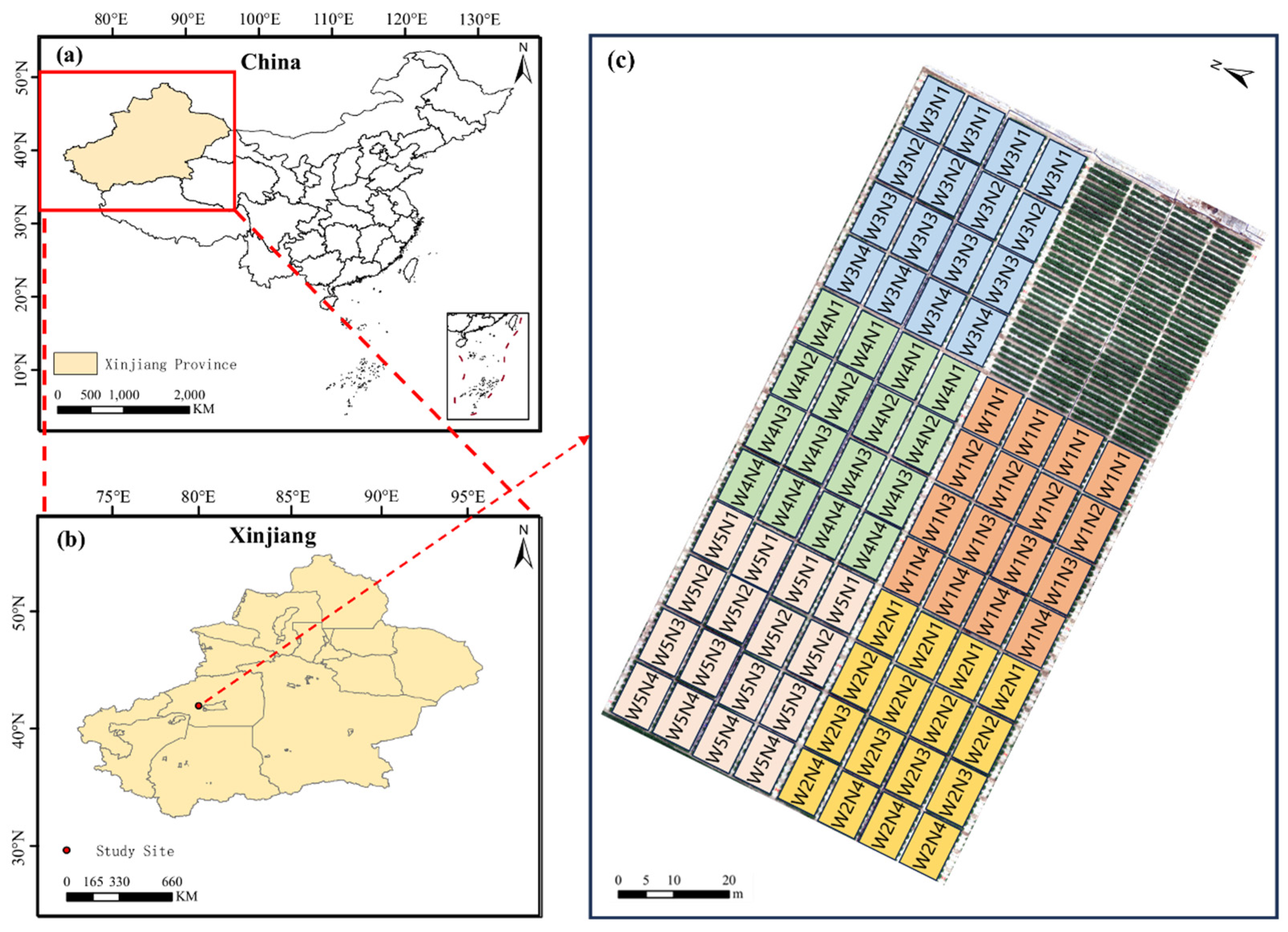
A field trial was implemented using a two-factor split-plot design, with irrigation level as the main plot factor and nitrogen application rate as the subplot factor (Figure 1). The irrigation treatments comprised five levels based on the crop water requirement (CWR): 40% CWR (W1, 2250 m3 ha−1), 55% CWR (W2, 3150 m3 ha−1), 70% CWR (W3, 4050 m3 ha−1), 85% CWR (W4, 4950 m3 ha−1), and 100% CWR (W5, 5850 m3 ha−1). The nitrogen treatments consisted of four nitrogen application rates using urea (46.4% N): 0 kg ha−1 (N1), 150 kg ha−1 (N2), 300 kg ha−1 (N3, conventional rate), and 450 kg ha−1 (N4).
The five irrigation levels (2250, 3150, 4050, 4950, and 5850 m3 ha−1) were designed to encompass both deficit and surplus conditions relative to the local conventional practice (approximately 4050 m3 ha−1). The four nitrogen rates (0, 150, 300, and 450 kg ha−1) include a zero-nitrogen control, a sub-optimal rate (150 kg ha−1), the conventional rate (300 kg ha−1), and a supra-optimal rate (450 kg ha−1) to capture a wide range of nitrogen supply conditions. This range allows for a comprehensive assessment of water–nitrogen interactions on cotton AGB accumulation.
Irrigation was applied using drip irrigation with 10 events during the growing season, scheduled at 7-day intervals from 17 June to 19 August, covering key phenological stages from squaring to boll opening. Nitrogen fertilizer (urea, 46% N) was applied through fertigation in 10 splits synchronized with each irrigation event. The nitrogen application followed a pattern of gradual increase from the first irrigation, peaking during the flowering and boll stages, and then decreasing toward the end of the season, consistent with local recommendations for high-yield cotton production.
Each plot measured 47.6 m2 (7 m × 6.8 m), with four replications per treatment combination. The cotton cultivar ‘Xinluzhong 88’ was grown under mulch with drip irrigation in a six-row machine-harvestable configuration, with a specific planting arrangement of [(66 cm + 10 cm) + 76 cm] × 11 cm. All other field management practices were maintained uniform across all plots, except for the prescribed irrigation and nitrogen treatments.

2.3. Data Collection

2.3.1. Ground-Based Measurements

At the squaring (13 June), flowering (7 July), boll (9 August), and boll-opening (6 September) stages, three representative cotton plants were randomly selected from each plot for sampling. The above-ground parts were collected, placed in paper bags, oven-dried at 105 °C for 30 min to de-enzyme, and then dried at 85 °C to constant weight. The dried samples were weighed, and the data were recorded. The mean sample weight was used to calculate the AGB value per unit area (t ha−1).
Although the experimental design included four replications per treatment combination, three replications were used in this study due to data quality considerations. A total of 60 plots (5 irrigation levels × 4 nitrogen levels × 3 replicates) were sampled at four growth stages, yielding 240 observations. These were randomly divided into a training set (70%, 168 samples) and a validation set (30%, 72 samples).
Although only three plants were sampled per plot, the large number of plots (60) and growth stages (4) resulted in 240 total observations, which is comparable to sample sizes used in similar UAV-based studies. Therefore, the sample size is considered sufficient for reliable AGB estimation and model calibration.

2.3.2. Spectral Imagery Data Acquisition

During the same periods as the ground-based data collection (under clear and cloudless sky conditions), canopy remote sensing imagery was acquired using a DJI M210 RTK V2 UAV platform (DJI Innovations Technology Co., Ltd., Shenzhen, China) equipped with a MicaSense RedEdge MX Dual multispectral camera (MicaSense Inc., Seattle, WA, USA) and a Zenmuse XT2 RGB camera (DJI Innovations Technology Co., Ltd., Shenzhen, China).
The UAV flight mission was conducted at an altitude of 30 m, with both forward and side overlap set to 75%, and a flight speed of 2 m s−1. Imaging was performed using an equal-interval trigger mode, with intervals set to one capture every 2 m. To ensure accurate geometric correction, 18 ground control points (calibration targets) were uniformly arranged within the experimental area.
Flight missions were planned and fully autonomous operations were controlled using the DJI Pilot application (v1.8.0, DJI Innovations Technology Co., Ltd., Shenzhen, China). Before and after each flight mission, radiometric calibration images were captured using the calibration panel provided with the camera system to support subsequent image stitching and radiometric calibration.
The ground sampling distance (GSD) of the acquired imagery was approximately 2.1 cm/pixel for the multispectral camera and 1.2 cm/pixel for the RGB camera, calculated based on the flight altitude of 30 m and the sensor specifications. Each flight mission covered the entire experimental area and lasted approximately 25 min, including takeoff, landing, and autonomous waypoint navigation.

2.3.3. Spectral Imagery Preprocessing

Mosaic generation and radiometric calibration of the multispectral and RGB images were performed using Pix4Dmapper software (Version 4.5.6, Pix4D S.A., Prilly, Switzerland). Radiometric calibration of the multispectral images was conducted using the calibration panel images captured before each flight mission. Pix4Dmapper’s radiometric calibration tool uses the known reflectance values of the panel to convert raw digital numbers (DN) to surface reflectance. For RGB images, only lens distortion correction and color balancing were applied, as radiometric calibration is not required for texture feature extraction. No additional ground-based spectrometer measurements were applied, as the panel-based calibration provided sufficient accuracy for the purpose of this study.
Due to geographical discrepancies between images acquired at different growth stages, geometric registration of the mosaicked images was conducted using ArcGIS (Version 10.6, Environmental Systems Research Institute, Inc. (ESRI), Redlands, CA, USA) to ensure spatial consistency and facilitate subsequent batch processing. To further extract the target area, non-experimental regions within the images were removed by masking. Specifically, vector boundaries were delineated for each experimental plot and overlaid onto the registered images to batch-extract the valid spectral information within all plot areas.

2.4. Feature Extraction

The eight vegetation indices (VIs) and eight texture features (TFs) used in this study were selected based on a comprehensive review of the literature, prioritizing those that have been widely reported as effective for crop biomass estimation (e.g., NDVI, OSAVI, RVI for VIs; Mean, Variance, Entropy for TFs). Although no formal feature selection was performed prior to modeling, machine learning algorithms such as Random Forest are inherently robust to multicollinearity, and feature importance analysis was subsequently used to identify the most influential variables.

2.4.1. Vegetation Index Extraction

Vegetation indices (VIs) are metrics constructed by combining spectral bands, which enhance vegetation information and exhibit greater sensitivity to crop growth parameters compared to single spectral bands. In this study, ENVI software (Version 5.6, Hexagon Geospatial, Stockholm, Sweden) was used to extract canopy reflectance values for each spectral band from the regions of interest within the cotton plots. Based on a comprehensive review of existing studies, eight VIs widely used for crop biomass monitoring were selected as feature variables for AGB estimation (Table 1).

2.4.2. Texture Feature Extraction

To capture spatial and structural variations within the canopy that are not conveyed by spectral data alone, eight texture features (TFs) were extracted from the high-resolution grayscale images derived from the RGB orthomosaics. The extraction process involved converting the original RGB images to grayscale, followed by the application of the Gray-Level Co-occurrence Matrix (GLCM) to quantify the spatial relationships among pixel gray-level values. All texture features were computed using ENVI 5.6 software following established methodologies. Following the approach of Yue et al. (2019) [6], the eight TFs selected in this study—Mean (MEA), Homogeneity (HOM), Variance (VAR), Entropy (ENT), Second Moment (SEC), Contrast (CON), Dissimilarity (DIS), and Correlation (COR)—were chosen for their proven ability to characterize canopy heterogeneity and structural complexity, which are critical for capturing biomass accumulation patterns. For instance, Variance and Contrast capture spatial heterogeneity within the canopy, while Entropy reflects the complexity of canopy structure. The mathematical formulas for these GLCM-based features are provided in Equations (1)–(8).
M E A = i j i × P i , j
H O M = i j 1 1 + i j 2 P i , j
V A R = i j i u 2 P i , j
E N T = i j P i , j log P i , j
S E C = i j P i , j 2
C O N = n = 0 N 8 n 2 i = 1 N 8 j = 1 N 8 P i , j i j = n
D I S = n = 1 N g 1 n i = 1 N 8 j = 1 N 8 P i , j i j = n
C O R = i j i , j P i , j μ x μ y σ x σ y
where p(i, j) denotes the value at the (i, j) entry of the gray-level co-occurrence matrix; Ng indicates the number of distinct gray levels in the quantized image; μx and σx represent the mean and standard deviation of the matrix values along the x-direction, respectively; and μy and σy refer to the mean and standard deviation along the y-direction, respectively.

2.5. Machine Learning Models

Four machine learning algorithms—support vector regression (SVR), random forest regression (RFR), partial least squares regression (PLSR), and extreme gradient boosting (XGB)—were selected for estimating cotton above-ground biomass (AGB) in this study. These four methods each possess distinct advantages in handling high-dimensional, nonlinear, and multi-feature remote sensing data, making them well-suited to address the modeling requirements of multi-source feature fusion in this research.
Random forest regression (RFR) is an ensemble learning algorithm based on decision trees [24] that performs well in handling complex nonlinear relationships and large numbers of features. The key parameters and their search ranges for RFR were as follows: number of trees (n_estimators) [100, 200, 300], maximum tree depth (max_depth) [5, 10, 15], minimum samples required to split an internal node (min_samples_split) [10, 15, 20], minimum samples required to be at a leaf node (min_samples_leaf) [4, 6, 8], and maximum number of features considered for splitting (max_features) [‘sqrt’, ‘log2’, 0.3]. All other parameters were kept at their default values in the scikit-learn library.
Support vector regression (SVR) achieves strong generalization capability by balancing model complexity and fitting error, making it particularly suitable for small-sample, high-dimensional nonlinear problems. Its advantages include a simple structure and strong robustness, effectively mitigating the risk of overfitting in research scenarios involving multiple features and complex sample combinations [25,26]. The key parameters and their search ranges for SVR were as follows: regularization parameter (C) [0.1, 1, 10, 100], epsilon in the epsilon-insensitive loss function (epsilon) [0.01, 0.1, 0.2, 0.5], and kernel type (kernel) [‘rbf’, ‘linear’, ‘poly’, ‘sigmoid’]. All other parameters were kept at their default values in the scikit-learn library.
Partial least squares regression (PLSR) offers the core advantage of addressing multicollinearity among high-dimensional variables. When confronted with numerous correlated features extracted from multi-source remote sensing data, PLSR extracts latent variables, eliminates redundant information, and reduces interference between features, thereby helping to improve model estimation accuracy. This makes PLSR especially suitable for quantitative inversion tasks involving high-dimensional correlated features, such as nitrogen estimation [27]. The key parameters and their search ranges for PLSR were as follows: number of components (n_components) [5, 10, 13], scaling option (scale) [True, False], maximum number of iterations (max_iter) [500, 1000], and tolerance for convergence (tol) [1 × 10⁻⁶, 1 × 10⁻⁸]. All other parameters were kept at their default values in the scikit-learn library.
Extreme gradient boosting (XGBoost) is built upon the gradient boosting decision tree (GBDT) framework, iteratively training weak prediction models (typically decision trees) and combining them into a strong predictive model. As an advanced gradient boosting algorithm, XGBoost has been widely adopted in data science due to its high efficiency, flexibility, and accuracy [28]. The key parameters and their search ranges for XGBoost were as follows: number of trees (n_estimators) [100, 200, 300], maximum tree depth (max_depth) [2, 3, 4], minimum child weight (min_child_weight) [2, 3, 4], gamma (gamma) [0, 0.1, 0.2], learning rate (learning_rate) [0.01, 0.02], L1 regularization term (reg_alpha) [0, 0.1], L2 regularization term (reg_lambda) [0, 0.1], subsample ratio (subsample) [0.6, 0.7], and column subsample ratio (colsample_bytree) [0.6, 0.7]. All other parameters were kept at their default values in the XGBoost library.
It should be noted that deep learning models were not employed in this study, primarily constrained by the sample size. Deep learning typically requires large-scale labeled data to adequately learn features, and with small samples, it is prone to overfitting and limited generalization performance. In contrast, the selected algorithms—SVR, RFR, PLSR, and XGB—demonstrate stronger adaptability under small-sample conditions, making them more compatible with the data foundation of this study.
To ensure a fair and comprehensive comparison of different algorithms and input variables, the entire dataset was randomly divided into training and validation sets at a ratio of 7:3, which were used for model calibration and performance evaluation, respectively. In addition, 5-fold cross-validation was applied on the training set during hyperparameter optimization to enhance the robustness of model selection. Model generalization capability was assessed using the root mean square error (RMSE) and the coefficient of determination (R2), where higher R2 values and lower RMSE values indicate superior model accuracy and generalization performance.
R 2 = 1 i = 1 n ( y i y ^ i ) 2 i = 1 n ( y i y ¯ ) 2
R M S E = 1 n i = 1 n ( y i x i ) 2

3. Results

3.1. Descriptive Statistics of Cotton Above-Ground Biomass at Main Growth Stages

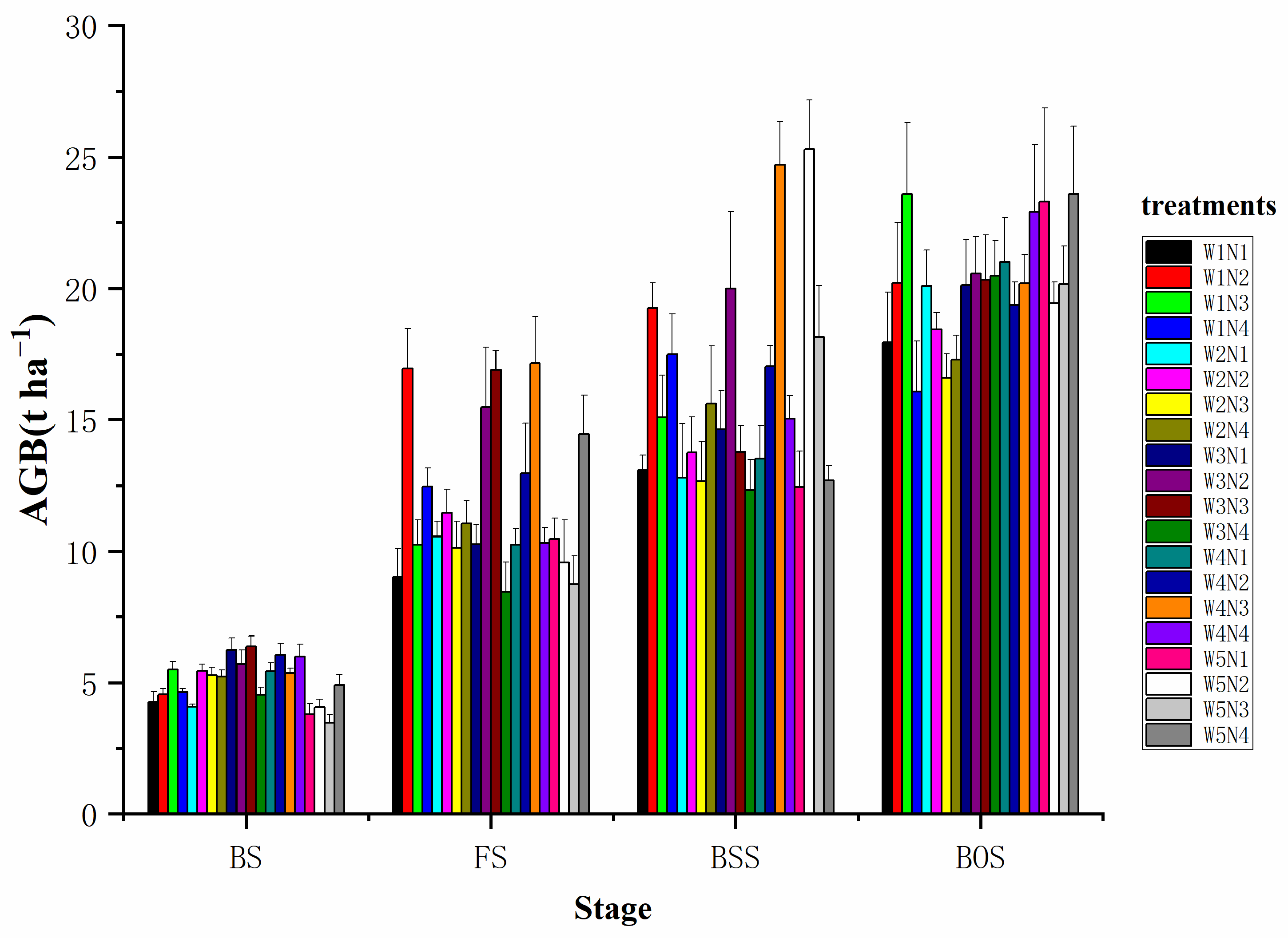
Figure 2 illustrates the dynamic changes in cotton above-ground biomass (AGB) under different water and nitrogen treatments across various growth stages. As shown in the figure, cotton AGB exhibited a significant increasing trend with the progression of growth stages. At the budding stage (BS), AGB across all treatments remained at relatively low levels. Under low- and medium-low-irrigation conditions (W1, W2), significant differences in AGB were observed between low-nitrogen treatments (N1 and N2), whereas under high-irrigation treatment (W5), significant differences in AGB were observed between high-nitrogen treatments (N3 and N4). At the flowering stage (FS), under low-irrigation conditions, AGB showed an increasing trend with higher nitrogen application rates. Specifically, W2N4 (12.054 t ha−1) was 17.23% higher than W2N2 (10.283 t ha−1), with a highly significant difference (p < 0.01). At the boll setting stage (BSS), the differences among treatments became more pronounced. The AGB of W3N4 (19.985 t ha−1) was 35.33% higher than that of W3N1 (14.767 t ha−1), representing an extremely significant difference (p < 0.01). At the boll opening stage (BOS), AGB reached its maximum value across the entire growth period. Under the same irrigation level, AGB exhibited an increasing trend with higher nitrogen application rates. The AGB of W4N4 (20.195 t ha−1) was 15.32% higher than that of W4N1 (17.512 t ha−1), with an extremely significant difference (p < 0.01). In summary, the coupling of water and nitrogen significantly regulates AGB accumulation in cotton at various growth stages. Appropriate combinations of water and nitrogen can effectively promote sustained biomass accumulation from the vegetative to reproductive growth stages, with particularly pronounced advantages during the boll opening stage, thereby laying a solid material foundation for achieving high cotton yield.
From an agronomic perspective, these trends can be explained by water–nitrogen coupling effects. Adequate water facilitates nitrogen uptake, while sufficient nitrogen promotes photosynthesis, jointly driving biomass accumulation. Water deficit (W1, W2) inhibits nitrogen uptake, limiting fertilizer effectiveness. Nitrogen deficiency (N1, N2) constrains photosynthesis, reducing AGB even under adequate irrigation. Excessive nitrogen (N4) without sufficient water may lead to imbalanced growth without proportional biomass gains. The most pronounced effects at flowering and boll stages coincide with peak water and nitrogen demand during cotton’s rapid growth phase.

3.2. Construction of Cotton Above-Ground Biomass Inversion Models Based on Vegetation Indices

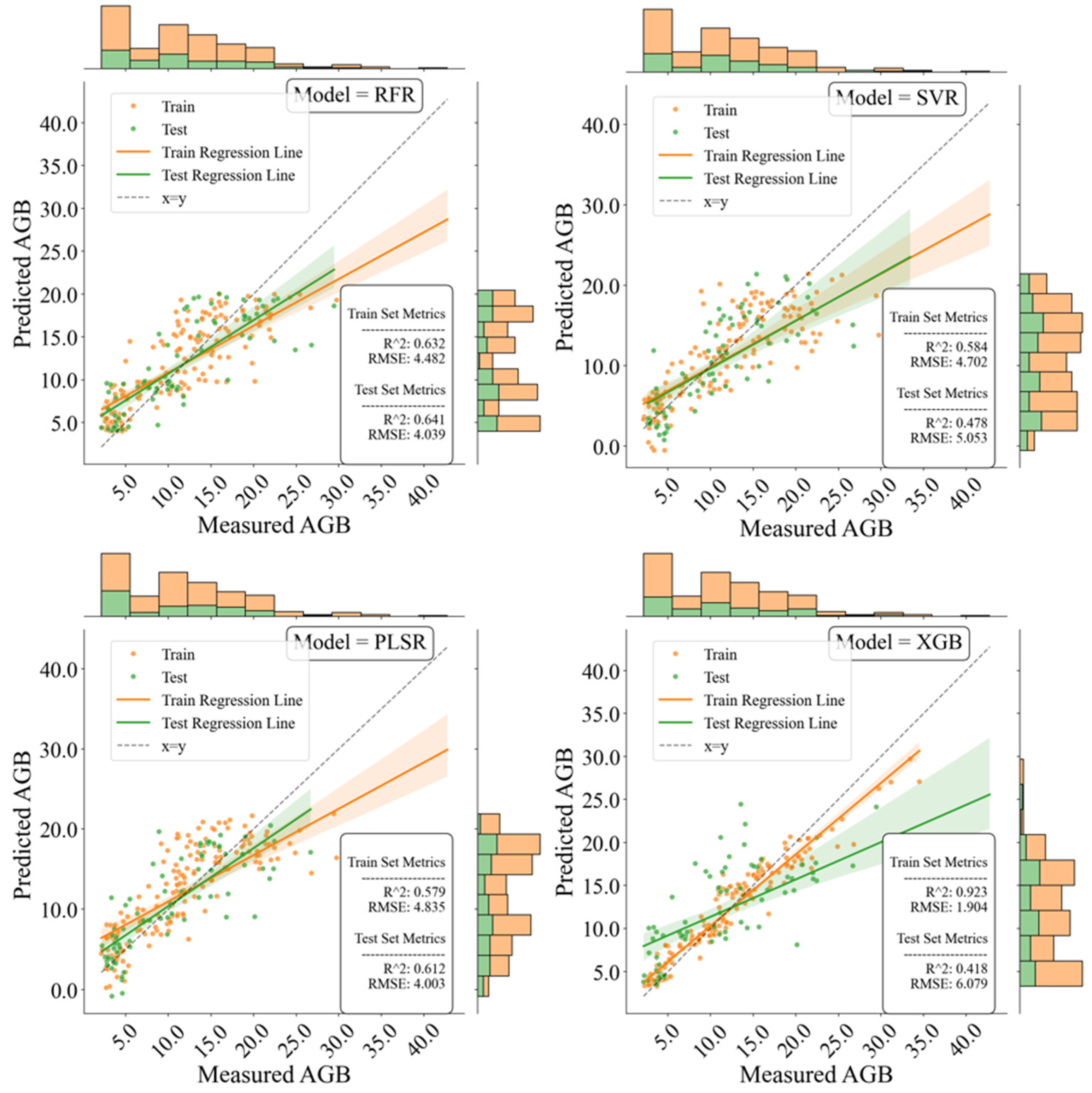
Figure 3 presents the estimation performance of four machine learning models for cotton above-ground biomass (AGB) based on vegetation indices (VIs). The four models exhibited varying results. Among them, RFR achieved the highest accuracy (R2 = 0.641, RMSE = 4.039 t ha−1), with its scatter points most tightly clustered around the 1:1 line, indicating superior fitting capability. In contrast, XGBoost showed the poorest performance, with substantial scatter and the lowest R2 (0.418), suggesting severe overfitting. SVR and PLSR performed moderately, with PLSR exhibiting better stability (RMSE = 4.003 t ha−1) than SVR. These results clearly demonstrate that RFR is the most effective algorithm for estimating cotton AGB using vegetation indices, owing to its strong nonlinear fitting ability and robustness to data variability. In contrast, XGBoost’s tendency to overfit makes it less suitable for this task, while PLSR offers a stable but less accurate alternative.

3.3. Construction of Cotton Above-Ground Biomass Inversion Models Based on Texture Features

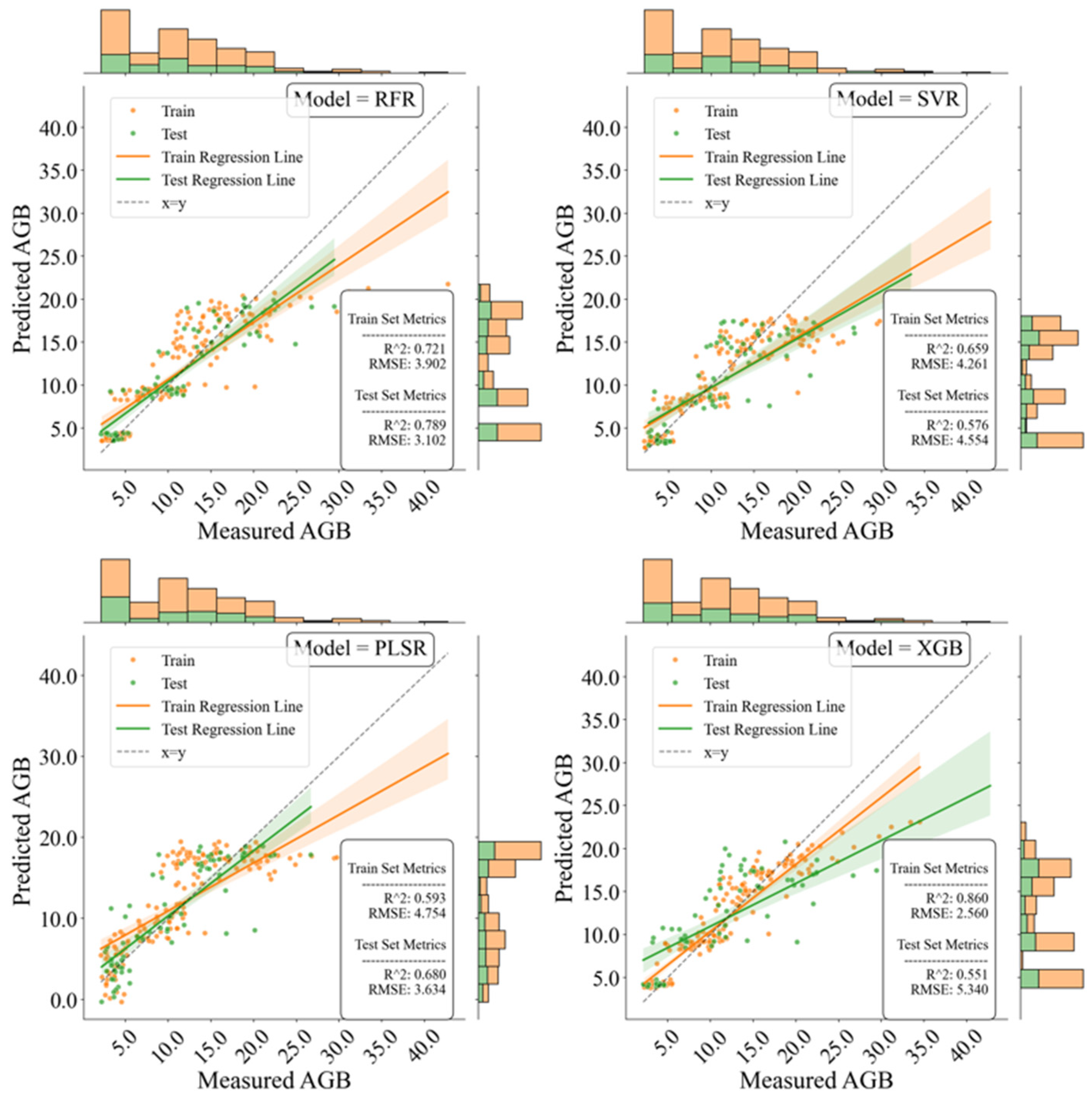
As shown in Figure 4, the four machine learning models exhibited varying performance when estimating cotton AGB using texture features. Notably, texture features alone yielded surprisingly good results, with RFR achieving the highest accuracy (R2 = 0.789, RMSE = 3.102 t ha−1), demonstrating the strong capability of textural information to capture canopy structural variation. PLSR also performed reasonably well, with validation R2 of 0.680 and balanced training/validation performance, indicating good stability. In contrast, SVR and XGBoost showed lower generalization ability; their validation set R2 dropped to 0.646, with XGBoost again exhibiting signs of overfitting. Although SVR and XGBoost demonstrated some fitting capability on the training set, their overall accuracy remained substantially lower than that of RFR and PLSR. These results confirm that RFR is the most effective algorithm for estimating cotton AGB using texture features, while PLSR offers a stable alternative, and tree-based boosting methods like XGBoost are prone to overfitting on this dataset.

3.4. Construction of Cotton Above-Ground Biomass Inversion Models Based on UAV Multi-Source Data Fusion

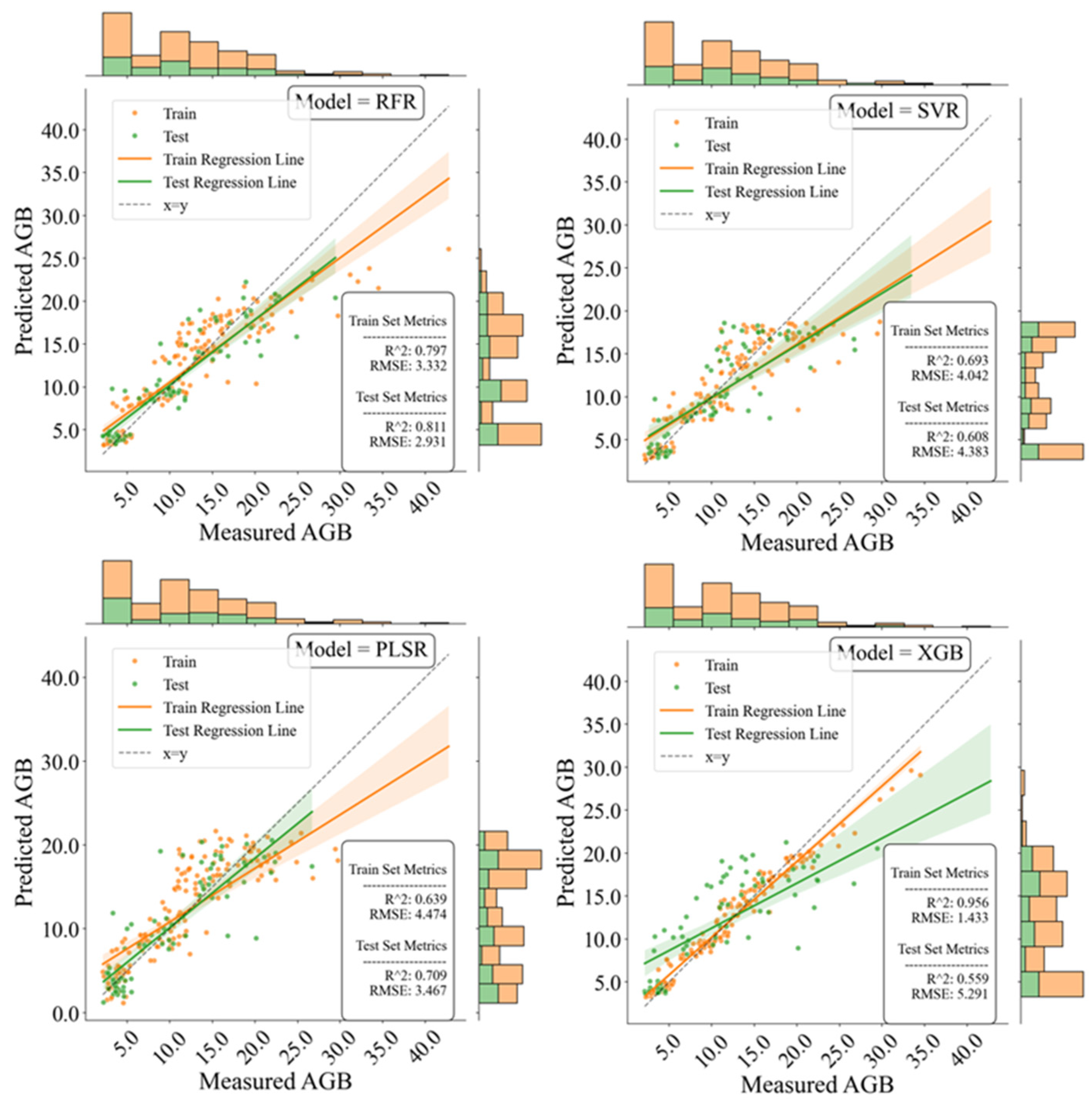
As shown in Figure 5, feature fusion substantially improved estimation accuracy for all machine learning models compared to using single features (vegetation indices or texture features alone). RFR benefited most significantly, achieving the best overall performance with validation R2 increasing to 0.811 and RMSE of 2.931 t ha−1, indicating that multi-source features effectively complemented each other. The improvement was most notable for PLSR, whose validation R2 increased from 0.680 (texture-only) to 0.709 (fusion). SVR also showed enhanced stability after fusion (validation R2 = 0.608). In contrast, XGBoost continued to exhibit pronounced overfitting, with a substantial gap between training and validation performance and the lowest validation R2 (0.559), rendering it unsuitable for this task. Under both single-feature and fused-feature conditions, RFR consistently outperformed SVR, PLSR, and XGBoost in terms of validation accuracy and generalization ability, highlighting its advantage in capturing complex nonlinear relationships between remote sensing features and AGB. In summary, feature fusion effectively improves cotton AGB estimation accuracy, with RFR representing the most recommendable predictive model for precision crop monitoring based on UAV remote sensing.

3.5. Spatial Inversion Mapping

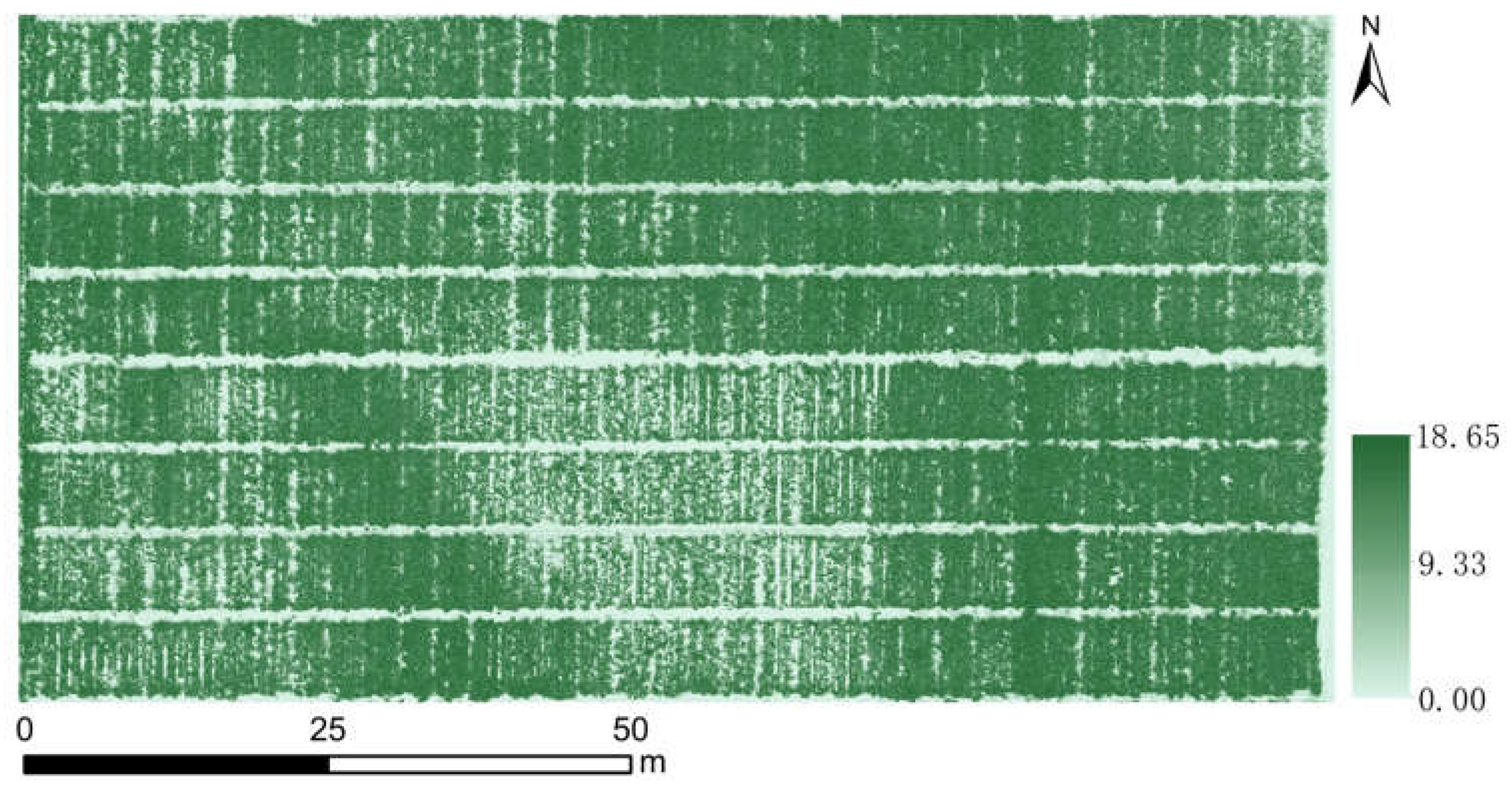
Based on the established optimal estimation model, a spatial inversion map of cotton above-ground biomass (AGB) was generated for 9 August 2024 (boll stage, 124 days after sowing), as shown in Figure 6. The map was produced by applying the optimal RFR model to each pixel of the fused multispectral and texture image, resulting in a spatial resolution of 2.1 cm (the original GSD of the multispectral imagery). For visualization purposes, the map was resampled to 1 m resolution. This map intuitively displays the spatial distribution differences of cotton canopy AGB within the experimental area. The color depth in the map is positively correlated with AGB values, with the color gradient transitioning from light green (0.00 t ha−1) to dark green (18.65 t ha−1), indicating that dark green areas represent high biomass accumulation zones, while light green areas represent low accumulation zones. The distribution range of pixel values in the inversion map aligns with the measured extremes, and the spatial heterogeneity patterns conform to agronomic expectations, demonstrating that this inversion map reliably reflects the actual spatial distribution of cotton above-ground biomass during the boll stage. These results validate that the estimation model constructed in this study possesses good regional applicability and spatial inference capability, which can provide intuitive and reliable spatial decision support for precision field management.

3.6. Feature Importance Analysis

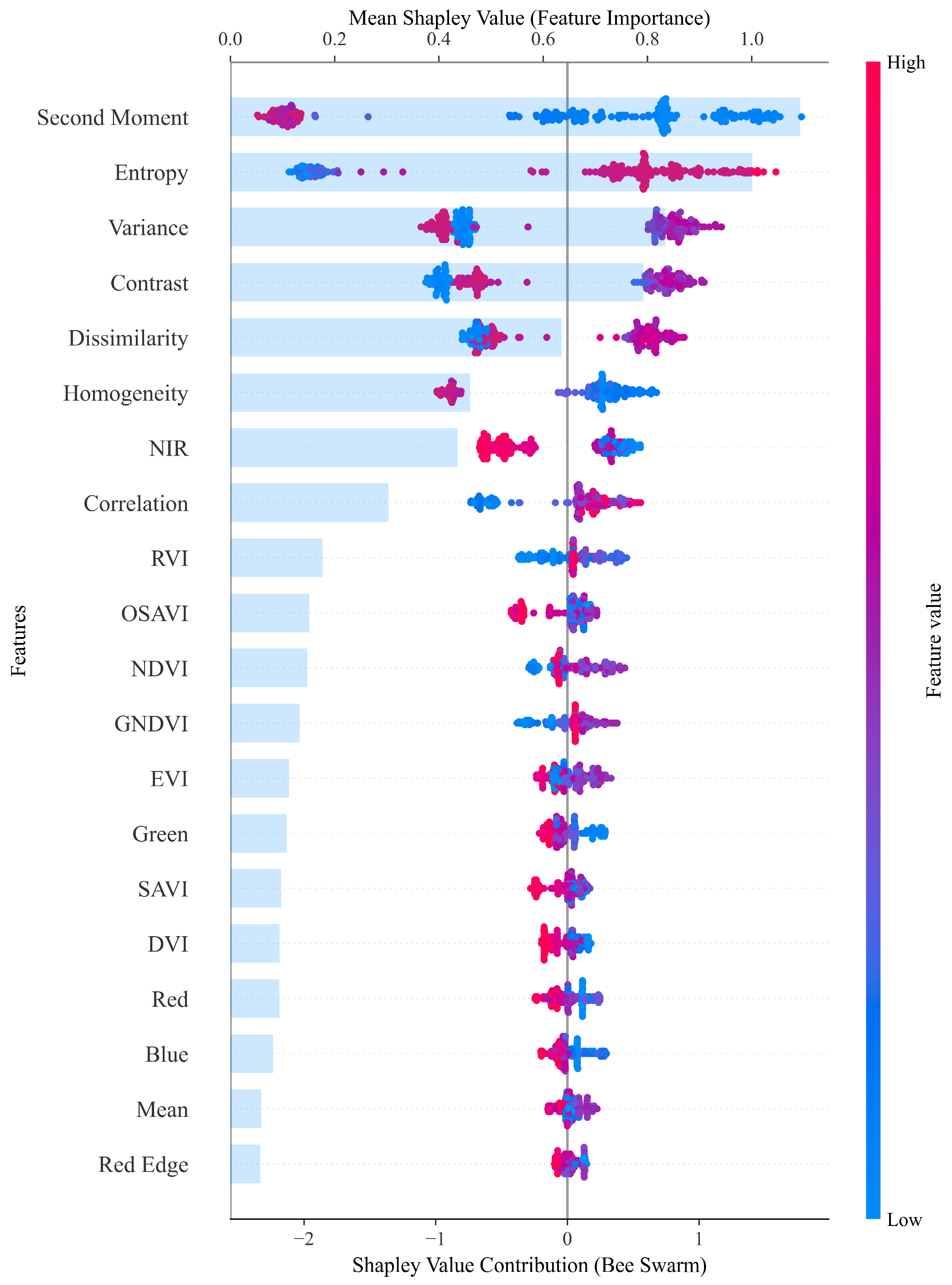
To assess the contribution of individual features to the estimation of cotton aboveground biomass (AGB), this study selected the optimal model (Random Forest) for SHAP visualization (Figure 7). Our results indicate that textural features were the dominant drivers in estimating AGB, followed by spectral features and vegetation indices.
Among all input variables, textural features exhibited the highest importance, with Second Moment, Entropy, and Variance ranking as the top three contributors. These features, derived from the gray-level co-occurrence matrix (GLCM), effectively captured the spatial heterogeneity and structural complexity of the cotton canopy. The dominance of textural features suggests that canopy structure information is more critical than spectral information alone for AGB estimation, particularly in high-coverage scenarios where spectral indices tend to saturate. Regarding spectral features, the near-infrared (NIR) band was the most important among all spectral variables. This finding aligns with plant physiological principles, as NIR reflectance is highly sensitive to canopy structure, leaf area, and biomass accumulation, with higher NIR values closely associated with vigorous canopies and high biomass. Vegetation indices, including RVI, OSAVI, NDVI, and GNDVI, showed moderate importance—valuable for capturing vegetation vigor, yet secondary to textural features.
In summary, the SHAP analysis reveals that textural information plays a more significant role than spectral information in estimating cotton AGB using UAV-based multi-source data. The integration of multi-source features—combining spectral bands, vegetation indices, and textural metrics—provided comprehensive information support for accurate AGB estimation across the whole growth period. This finding underscores the importance of incorporating canopy structural features in biomass modeling and provides a basis for future studies to prioritize textural metrics.

4. Discussion

By integrating spectral and texture information from UAV multispectral and RGB imagery, this study developed estimation models for cotton above-ground biomass (AGB) and validated the significant advantages of multi-source feature fusion in improving AGB prediction accuracy.

4.1. Effectiveness of Spectral and Texture Feature Fusion

The models integrating spectral and texture features achieved the best performance across all tested algorithms, confirming the complementary nature of these two information sources. Vegetation indices (VIs) primarily reflect the physiological and biochemical status of crops; however, they are prone to spectral saturation under conditions of high canopy closure, leading to underestimation of AGB [14,15,29]. Texture features (TFs), which characterize the three-dimensional structure and spatial heterogeneity of the canopy, effectively compensate for this limitation—a finding that aligns with the conclusions of Li et al. (2024) [29], who also emphasized the significant advantages of fusing spectral and texture information for improving the accuracy of crop biomass and nitrogen estimation.
Compared to studies that relied solely on spectral features [6], our results demonstrate that the inclusion of texture features led to a 23.1% increase in R2 (from 0.641 to 0.789) when using the RFR model alone, and a further improvement to 0.811 after fusion. This improvement is more pronounced in cotton during mid-to-late growth stages due to its denser canopy structure, which exacerbates spectral saturation. Similar findings were reported by [30] in cotton, where texture features effectively captured canopy structural variation and reduced saturation effects. These comparisons confirm that the fusion strategy is not only effective but also transferable across crops and sensors.

4.2. Comparison of Machine Learning Algorithm Performance

Among the four machine learning algorithms evaluated, random forest regression (RFR) demonstrated the optimal and most stable predictive performance under the fused feature condition. Specifically, the RFR model achieved an R2 value of 0.811 and an RMSE of 2.931 t ha−1, with its accuracy significantly surpassing that of support vector regression (SVR; R2 = 0.608, RMSE = 4.383 t ha−1), partial least squares regression (PLSR; R2 = 0.709, RMSE = 3.467 t ha−1), and extreme gradient boosting (XGB; R2 = 0.559, RMSE = 5.291 t ha−1). This suggests that RFR possesses distinct advantages in handling high-dimensional, nonlinear multi-source remote sensing data with complex inter-feature relationships, enabling it to effectively capture the synergistic contributions of spectral and texture information to AGB.
Although the RFR model performed best, the other models also exhibited their respective characteristics. SVR, which maps nonlinear problems through kernel functions, demonstrated good robustness. PLSR effectively mitigated noise and multicollinearity effects in high-dimensional data by extracting latent variables. XGB, as a powerful ensemble algorithm, possesses capabilities for regularization and missing value handling; however, under the sample size constraints of this study, it exhibited pronounced overfitting, resulting in insufficient generalization performance. In comparison, for medium-scale datasets involving UAV-based multi-source feature estimation of AGB, RFR emerges as a more reliable choice due to its capacity to capture complex relationships and its superior generalization stability.
The superior performance of RFR can be attributed to its ensemble nature, which reduces variance by averaging multiple decision trees and makes it robust to outliers and noise. In contrast, SVR is sensitive to hyperparameter tuning and may not generalize well if the parameters are not optimally selected. PLSR assumes a linear relationship between features and the target variable, which may not fully capture the complex nonlinear interactions between spectral and texture features. XGBoost, while powerful, is prone to overfitting on relatively small datasets (n = 240 in this study) due to its sequential boosting structure. These characteristics explain why RFR consistently outperformed the other algorithms in estimating cotton AGB.
Compared to previous studies, our results show both similarities and differences. Yue et al. (2019) [6] reported a 15% improvement from adding texture features in winter wheat, lower than our 23.1% improvement in cotton, likely due to cotton’s denser canopy structure exacerbating spectral saturation. Zheng et al. (2019) [31] found PLSR optimal for rice AGB estimation, whereas RFR performed best in our study, possibly because our larger dataset (n = 240 vs. 120) and higher feature complexity favored nonlinear models. Regarding texture features, our finding that Second Moment, Entropy, and Variance were the top contributors aligns with Pei et al. (2024) [30], though they emphasized Contrast for water stress detection while we highlight Entropy and Variance for biomass estimation, suggesting that different texture features are sensitive to different crop parameters.

4.3. The Role of Texture Features in Remote Sensing Estimation

When single features were employed for modeling, texture features (TFs) demonstrated superior predictive capability compared to vegetation indices (VIs) across all four algorithms. Taking the best-performing RFR model as an example, TF-based modeling achieved an R2 of 0.789, representing a 23.1% improvement over VI-based modeling (0.641), while the RMSE decreased by 23.2% (3.102 t ha−1 vs. 4.039 t ha−1). This advantage was similarly pronounced across the other algorithms: after incorporating TFs, the R2 values of SVR, PLSR, and XGB models increased by 20.5%, 11.1%, and 31.8%, respectively. This phenomenon aligns with previous research. For instance, Pei et al. (2024) [30] noted in their study on maize canopy biomass estimation that texture features, by capturing three-dimensional structural information such as canopy porosity and leaf arrangement, can effectively compensate for the limitations of spectral indices in describing canopy structure. In the present study, the superior performance of TFs across multiple algorithms further validates their generalizability in characterizing complex canopy structure. This indicates that texture features are an indispensable data source for improving AGB estimation accuracy, particularly during the mid-to-late growth stages of cotton when canopy closure is high and spectral information is prone to saturation.

4.4. Potential Applications of UAV Remote Sensing

This study validates that UAV remote sensing technology provides an efficient solution for rapidly and non-destructively monitoring field crop above-ground biomass (AGB). Compared with traditional methods relying on destructive manual sampling, UAV platforms offer advantages such as high spatiotemporal resolution, operational flexibility, and relatively low cost, enabling high-frequency dynamic monitoring at the field scale while overcoming the limitations of conventional approaches, which are time-consuming, labor-intensive, and inadequate for capturing spatial heterogeneity [31]. By integrating spectral and texture features from multispectral and RGB imagery, this study significantly improved AGB estimation accuracy, further enhancing the applicability of UAV remote sensing for dynamic growth monitoring throughout the entire crop growth cycle. This finding aligns with the approach of Yue et al. (2019) [6], who improved rice aboveground biomass estimation accuracy by integrating texture features and vegetation indices, collectively confirming the substantial potential of multi-source feature fusion techniques for precision crop monitoring [32].
In summary, the fusion of spectral and texture features offers three key advantages for crop AGB estimation. First, it provides complementary information: vegetation indices capture physiological and biochemical characteristics, while texture features characterize canopy structural heterogeneity. Second, it mitigates the spectral saturation problem under high canopy coverage, as texture features remain sensitive to structural changes even when spectral indices become insensitive. Third, it consistently improves model accuracy and robustness, as demonstrated by the R2 increase from 0.641 (spectral-only) and 0.789 (texture-only) to 0.811 (fusion) in this study. These advantages make spectral–texture fusion a valuable strategy for UAV-based crop monitoring in precision agriculture.

4.5. Research Limitations and Future Perspectives

This study was conducted based on a single cotton variety and within a specific experimental region; therefore, the generalizability of the findings requires further validation across different ecological zones, varieties, and cropping patterns. Future research should consider multi-location validation in major cotton-producing areas such as the Yellow River Basin and the Yangtze River Basin. Additionally, incorporating three-dimensional sensing data, such as that from light detection and ranging (LiDAR), could enable more accurate characterization of canopy structure and alleviate signal saturation issues under high-density planting conditions. Furthermore, with the expansion of sample sizes, attempts can be made to introduce lightweight deep learning models to enhance estimation accuracy while maintaining computational efficiency, thereby promoting the advancement of this technology toward real-time and intelligent monitoring applications.

5. Conclusions

By integrating spectral and texture features from UAV multispectral and RGB imagery, this study developed high-precision estimation models for cotton above-ground biomass (AGB). The results demonstrated that the fusion strategy combining spectral and texture features effectively overcame the saturation problem associated with using spectral information alone under conditions of high canopy closure, significantly improving AGB estimation accuracy (optimal model: R2 = 0.811, RMSE = 2.931 t ha−1). Among the machine learning algorithms compared, the random forest regression (RFR) model exhibited the optimal and most stable performance. Furthermore, texture features were confirmed as a critical data source for characterizing canopy structure and supplementing AGB information. This approach provides an effective technical solution for rapid, non-destructive, and low-cost monitoring of biomass throughout the entire cotton growth cycle, offering practical significance for supporting precision agriculture management. The high-resolution AGB maps generated by the model can be directly applied to site-specific management practices, such as variable-rate fertilization and precision irrigation, by identifying within-field variability and guiding differential inputs. Furthermore, the model can support early yield prediction and growth diagnosis, enabling farmers to make timely adjustments and optimize resource allocation. Future research should further validate the generalizability of this method across multiple ecological regions and varieties, and explore its integration with three-dimensional sensing technologies such as LiDAR. It should be noted that this study was conducted on a single soil type and for only one growing season. Therefore, the proposed model should be considered preliminary, and its robustness and generalizability require further validation across multiple years, soil types, and environmental conditions.

Author Contributions

Conceptualization, G.S. (Guldana Sarsen) and T.L.; methodology, G.S. (Guldana Sarsen), J.C. and T.L.; investigation, G.S. (Guldana Sarsen), G.S. (Guangyun Sun), F.L., N.Z., R.G., Y.A., L.W. and J.W.; formal analysis, G.S. (Guldana Sarsen); data curation, G.S. (Guldana Sarsen), G.S. (Guangyun Sun), F.L., N.Z., R.G., Y.A., L.W., J.W., J.C., Q.T., Y.L., Y.X., L.B. and Q.L.; writing—original draft preparation, G.S. (Guldana Sarsen); writing—review and editing, T.L.; supervision, J.C., Q.T. and T.L.; project administration, T.L. All authors have read and agreed to the published version of the manuscript.

Funding

This research was funded by the Key Research and Development Program of Xinjiang Uygur Autonomous Region (2024B02004); the National Key Research and Development Program of China (2024YFD2300604); the National Cotton Industry Technology System of China (CARS-15-12; CARS-15-13); the Xinjiang Tianshan Talent Training Program (2024TSYCCX0095); the Xinjiang Talent Development Fund (XJRC-2025-KJ-PY-KJLJ-038); the Central Government Guide to Local Projects (ZYYD2024CG23); and the Agricultural Science and Technology Innovation Stable Support Program of Xinjiang Academy of Agricultural Sciences (XJNKYWDZC-2023007).

Data Availability Statement

The original contributions presented in this study are included in the article/supplementary material. Further inquiries can be directed to the corresponding authors.

Acknowledgments

The authors sincerely thank Zhengdong Hu, Shiyu Fan, and Shuyuan Zhang for their assistance with data collection during the experiments.

Conflicts of Interest

The authors declare no conflicts of interest.

References

  1. Wang, T.; Gao, M.; Cao, C.; You, J.; Zhang, X.; Shen, L. Winter wheat chlorophyll content retrieval based on machine learning using in situ hyperspectral data. Comput. Electron. Agric. 2022, 193, 106728. [Google Scholar] [CrossRef]
  2. Huang, X.; Guan, H.; Bo, L.; Xu, Z.; Mao, X. Hyperspectral proximal sensing of leaf chlorophyll content of spring maize based on a hybrid of physically based modelling and ensemble stacking. Comput. Electron. Agric. 2023, 208, 107745. [Google Scholar] [CrossRef]
  3. Swaminathan, V.; Thomasson, J.A.; Rajan, N.; Hardin, R.G.; Pokhrel, P. Early estimation of nitrogen stress and uptake in cotton based on spectral and morphological features extracted from UAV multispectral images. In Proceedings of the Autonomous Air and Ground Sensing Systems for Agricultural Optimization and Phenotyping VII, Orlando, FL, USA, 3 June 2022; SPIE: Washington, DC, USA, 2022; p. 121140O. [Google Scholar] [CrossRef]
  4. Liao, Z.; He, B.; Quan, X.; van Dijk, A.I.J.M.; Qiu, S.; Yin, C. Biomass estimation in dense tropical forest using multiple information from single-baseline P-band PolInSAR data. Remote Sens. Environ. 2019, 221, 489–507. [Google Scholar] [CrossRef]
  5. Shafian, S.; Rajan, N.; Schnell, R.; Bagavathiannan, M.; Valasek, J.; Shi, Y.; Olsenholler, J. Unmanned aerial systems-based remote sensing for monitoring sorghum growth and development. PLoS ONE 2018, 13, e0196605. [Google Scholar] [CrossRef]
  6. Yue, J.; Yang, G.; Tian, Q.; Feng, H.; Xu, K.; Zhou, C. Estimate of winter-wheat above-ground biomass based on UAV ultrahigh-ground-resolution image textures and vegetation indices. ISPRS J. Photogramm. Remote Sens. 2019, 150, 226–244. [Google Scholar] [CrossRef]
  7. Packalen, P.; Strunk, J.; Packalen, T.; Maltamo, M.; Mehtätalo, L. Resolution dependence in an area-based approach to forest inventory with airborne laser scanning. Remote Sens. Environ. 2019, 224, 192–201. [Google Scholar] [CrossRef]
  8. Zhang, Y.; Shao, Z. Assessing of urban vegetation biomass in combination with LiDAR and high-resolution remote sensing images. Int. J. Remote Sens. 2021, 42, 964–985. [Google Scholar] [CrossRef]
  9. Yue, J.; Yang, G.; Li, C.; Li, Z.; Wang, Y.; Feng, H.; Xu, B. Estimation of winter wheat above-ground biomass using unmanned aerial vehicle-based snapshot hyperspectral sensor and crop height improved models. Remote Sens. 2017, 9, 708. [Google Scholar] [CrossRef]
  10. Hu, Z.; Fan, S.; Li, Y.; Tang, Q.; Bao, L.; Zhang, S.; Sarsen, G.; Guo, R.; Wang, L.; Zhang, N.; et al. Estimating stratified biomass in cotton fields using UAV multispectral remote sensing and machine learning. Drones 2025, 9, 186. [Google Scholar] [CrossRef]
  11. Chen, A.; Xu, C.; Zhang, M.; Guo, J.; Xing, X.; Yang, D.; Xu, B.; Yang, X. Cross-scale mapping of above-ground biomass and shrub dominance by integrating UAV and satellite data in temperate grassland. Remote Sens. Environ. 2024, 304, 114024. [Google Scholar] [CrossRef]
  12. Meng, L.; Ming, B.; Liu, Y.; Nie, C.; Fang, L.; Zhou, L.; Xin, J.; Xue, B.; Liang, Z.; Guo, H.; et al. Maize biomass estimation by integrating spectral, structural, and textural features from unmanned aerial vehicle data. Eur. J. Agron. 2025, 168, 127647. [Google Scholar] [CrossRef]
  13. Gitelson, A.A.; Gritz, Y.; Merzlyak, M.N. Relationships between leaf chlorophyll content and spectral reflectance and algorithms for non-destructive chlorophyll assessment in higher plant leaves. J. Plant Physiol. 2003, 160, 271–282. [Google Scholar] [CrossRef]
  14. Wang, W.; Nemani, R.; Hashimoto, H.; Ganguly, S.; Huang, D.; Knyazikhin, Y.; Myneni, R.; Bala, G. An interplay between photons, canopy structure, and recollision probability: A review of the spectral invariants theory of 3D canopy radiative transfer processes. Remote Sens. 2018, 10, 1805. [Google Scholar] [CrossRef]
  15. Li, H.; Li, D.; Xu, K.; Cao, W.; Jiang, X.; Ni, J. Monitoring of nitrogen indices in wheat leaves based on the integration of spectral and canopy structure information. Agronomy 2022, 12, 833. [Google Scholar] [CrossRef]
  16. Tucker, C.J. Red and photographic infrared linear combinations for monitoring vegetation. Remote Sens. Environ. 1979, 8, 127–150. [Google Scholar] [CrossRef]
  17. Candiago, S.; Remondino, F.; De Giglio, M.; Dubbini, M.; Gattelli, M. Evaluating multispectral images and vegetation indices for precision farming applications from UAV images. Remote Sens. 2015, 7, 4026–4047. [Google Scholar] [CrossRef]
  18. Rondeaux, G.; Steven, M.; Baret, F. Optimization of soil-adjusted vegetation indices. Remote Sens. Environ. 1996, 55, 95–107. [Google Scholar] [CrossRef]
  19. Hatfield, J.L.; Prueger, J.H. Value of using different vegetative indices to quantify agricultural crop characteristics at different growth stages under varying management practices. Remote Sens. 2010, 2, 562–578. [Google Scholar] [CrossRef]
  20. Ballester, C.; Brinkhoff, J.; Quayle, W.C.; Hornbuckle, J. Monitoring the effects of water stress in cotton using the green red vegetation index and red edge ratio. Remote Sens. 2019, 11, 873. [Google Scholar] [CrossRef]
  21. Broge, N.H.; Mortensen, J.V. Deriving green crop area index and canopy chlorophyll density of winter wheat from spectral reflectance data. Remote Sens. Environ. 2002, 81, 45–57. [Google Scholar] [CrossRef]
  22. Hernandez, A.; Jensen, K.; Larson, S.; Larsen, R.; Rigby, C.; Johnson, B.; Spickermann, C.; Sinton, S. Using unmanned aerial vehicles and multispectral sensors to model forage yield for grasses of semiarid landscapes. Grasses 2024, 3, 84–109. [Google Scholar] [CrossRef]
  23. Shen, Y.; Yan, Z.; Yang, Y.; Tang, W.; Sun, J.; Zhang, Y. Application of UAV-borne visible-infrared pushbroom imaging hyperspectral for rice yield estimation using feature selection regression methods. Sustainability 2024, 16, 632. [Google Scholar] [CrossRef]
  24. Breiman, L. Random forests. Mach. Learn. 2001, 45, 5–32. [Google Scholar] [CrossRef]
  25. James, G.; Witten, D.; Hastie, T.; Tibshirani, R. An Introduction to Statistical Learning: With Applications in R, 1st ed.; Springer: New York, NY, USA, 2013. [Google Scholar] [CrossRef]
  26. Drucker, H.; Burges, C.J.C.; Kaufman, L.; Smola, A.J.; Vapnik, V. Support vector regression machines. In Proceedings of the Advances in Neural Information Processing Systems 9, Denver, CO, USA, 2–5 December 1996; Mozer, M., Jordan, M.I., Petsche, T., Eds.; MIT Press: Cambridge, MA, USA, 1997; pp. 155–161. [Google Scholar]
  27. Adesokan, M.; Alamu, E.O.; Otegboyo, B.; Asfaw, A.; Afolabi, M.O.; Fawole, S.; Meghar, K.; Dufour, D.; Ayetigbo, O.; Davrieux, F.; et al. Rapid analysis of starch, sugar, and amylose in fresh yam tubers and boiled yam texture using near-infrared hyperspectral imaging and chemometrics. J. Food Compos. Anal. 2025, 142, 107425. [Google Scholar] [CrossRef]
  28. Chen, T.; Guestrin, C. XGBoost: A scalable tree boosting system. In Proceedings of the 22nd ACM SIGKDD International Conference on Knowledge Discovery and Data Mining, San Francisco, CA, USA, 13–17 August 2016; ACM Digital Library: New York, NY, USA, 2016; pp. 785–794. [Google Scholar] [CrossRef]
  29. Li, W.; Pan, K.; Liu, W.; Xiao, W.; Ni, S.; Shi, P.; Chen, X.; Li, T. Monitoring maize canopy chlorophyll content throughout the growth stages based on UAV MS and RGB feature fusion. Agriculture 2024, 14, 1265. [Google Scholar] [CrossRef]
  30. Pei, S.; Dai, Y.; Bai, Z.; Li, Z.; Zhang, F.; Yin, F.; Fan, J. Improved estimation of canopy water status in cotton using vegetation indices along with textural information from UAV-based multispectral images. Comput. Electron. Agric. 2024, 216, 109176. [Google Scholar] [CrossRef]
  31. Zheng, H.; Cheng, T.; Zhou, M.; Li, D.; Yao, X.; Tian, Y.; Cao, W.; Zhu, Y. Improved estimation of rice aboveground biomass combining textural and spectral analysis of UAV imagery. Precis. Agric. 2019, 20, 611–629. [Google Scholar] [CrossRef]
  32. Zhang, S.; Jing, H.; Dong, J.; Su, Y.; Hu, Z.; Bao, L.; Fan, S.; Sarsen, G.; Lin, T.; Jin, X. Accurate estimation of plant water content in cotton using UAV multi-source and multi-stage data. Drones 2025, 9, 163. [Google Scholar] [CrossRef]
Figure 1. Overview of the study area. Note: (a) Location of the study area within China; (b) Administrative map of Xinjiang; (c) Detailed layout of the experimental field, illustrating the split-plot design with different water (W1–W5) and nitrogen (N1–N4) treatments.
Agronomy 16 00668 g001
Figure 2. Dynamics of above-ground biomass (AGB) under different water and nitrogen treatments.
Agronomy 16 00668 g002
Figure 3. Performance of different machine learning models in estimating cotton above-ground biomass (AGB) using vegetation indices. The histograms above the X-axis and to the right of the Y-axis show the sample distributions of measured and predicted values, respectively.
Agronomy 16 00668 g003
Figure 4. Performance of different machine learning models in estimating cotton above-ground biomass (AGB) using texture features. The histograms above the X-axis and to the right of the Y-axis show the sample distributions of measured and predicted values, respectively.
Agronomy 16 00668 g004
Figure 5. Performance of different machine learning models in estimating cotton above-ground biomass (AGB) using fused features from multi-source imagery data. The histograms above the X-axis and to the right of the Y-axis show the sample distributions of measured and predicted values, respectively.
Agronomy 16 00668 g005
Figure 6. Spatial inversion map of cotton above-ground biomass (AGB) during the boll stage.
Agronomy 16 00668 g006
Figure 7. Feature importance ranking and SHAP analysis of the Random Forest model.
Agronomy 16 00668 g007
Table 1. Vegetation indices used and their calculation formulas.
Vegetation IndexFormulaReference
Normalized difference vegetation index (NDVI) ( N I R R ) / ( N I R + R ) [16]
Green normalized difference vegetation index (GNDVI) ( N I R G ) / ( N I R + G ) [17]
Optimized Soil-Adjusted Vegetation Index (OSAVI) 1.16 ( N I R R ) / ( N I R + R + 0.16 ) [18]
Soil-adjusted vegetation index (SAVI) 1.5 ( N I R R ) / ( N I R + R + 0.5 ) [19]
Green–Red Vegetation Index (GRVI) ( G R ) / ( G + R ) [20]
Ratio vegetation index (RVI) N I R / R [21]
Difference Vegetation Index (DVI) N I R R [22]
Enhanced vegetation index (EVI) 2.5 ( N I R R ) / ( N I R + 6 R 7.5 B + 1 ) [23]
Note: R: reflectance in the red band; G: reflectance in the green band; B: reflectance in the blue band; NIR: reflectance in the near-infrared band
Disclaimer/Publisher’s Note: The statements, opinions and data contained in all publications are solely those of the individual author(s) and contributor(s) and not of MDPI and/or the editor(s). MDPI and/or the editor(s) disclaim responsibility for any injury to people or property resulting from any ideas, methods, instructions or products referred to in the content.