Article

Identification and Characterization of Low-Nitrogen-Tolerant Potato Germplasm Resources

Qinghai Academy of Agriculture and Forestry Sciences, Qinghai University, Xining 810016, China
*
Authors to whom correspondence should be addressed.
Agronomy 2026, 16(6), 629; https://doi.org/10.3390/agronomy16060629
Submission received: 11 November 2025 / Revised: 13 March 2026 / Accepted: 14 March 2026 / Published: 16 March 2026

Abstract

Screening potato germplasm for low nitrogen (LN) tolerance is essential for improving nitrogen use efficiency and agricultural sustainability. A set of 156 potato genotypes from diverse sources—including the International Potato Center (CIP), the National Potato Germplasm Repository (CAAS), and varieties and lines bred by the Qinghai Academy of Agriculture and Forestry Sciences—was evaluated under optimal (60 mmol·L−1) and low (3 mmol·L−1) nitrogen conditions using tissue culture. Nine traits related to growth, nitrogen accumulation, and nitrogen use efficiency were measured. Under LN stress, nitrogen physiological efficiency (NPE), uptake efficiency (NUpE), and utilization efficiency (NUE) increased, while most growth-related traits declined. Considerable variation was observed in fresh weight (FW), dry weight (DW), nitrogen accumulation (NA), and NUE, with coefficients of variation ranging from 0.38 to 0.40 under LN and 0.17 to 0.42 under ON. Principal component analysis identified NA and NUpE as the primary contributors to phenotypic variation. Based on comprehensive D-values from cluster analysis, the genotypes were classified into five tolerance groups: Type I—(strong low-nitrogen tolerant (13 accessions); Type II—low-nitrogen tolerant (66 accessions); Type III—moderate low-nitrogen tolerant (36 accessions); Type IV—low-nitrogen sensitive (24 accessions); and Type V—highly low-nitrogen sensitive (17 accessions). Physiological validation revealed two distinct adaptive strategies: a nitrogen conservation strategy (Type I), characterized by high NA and nitrogen content (NC) alongside moderate physiological efficiency, and an efficiency-driven compensation strategy (Types II, IV, and V), marked by low NA and NC but high physiological efficiency. The congruence between multivariate clustering and subsequent physiological measurements confirms that this classification effectively captures genotypic differences in low nitrogen tolerance. Thirteen highly LN-tolerant genotypes—including PIMPERNEL, Favorita, and Spunta—were identified as promising genetic resources for breeding nitrogen-efficient potato cultivars. This tissue culture-based screening method provides a practical tool for evaluating nitrogen tolerance in plants and supports sustainable potato production under limited nitrogen availability.

1. Introduction

Nitrogen (N) is one of the most critical nutrients limiting plant growth. As a primary component of chlorophyll and proteins, it significantly influences leaf coloration, crop growth, and yield [1,2]. Insufficient nitrogen supply reduces leaf size, reduces chlorophyll content, and decreases biomass, ultimately compromising crop yield and quality [3]. Conversely, excessive nitrogen application contributes to aquatic and atmospheric pollution [4]. Therefore, improving nitrogen use efficiency (NUE) is essential for mitigating environmental pollution [5,6]. Physiologically, NUE is defined as the product of N uptake efficiency (NUpE, the capacity to absorb N from the medium) and N utilization efficiency (NUtE or NPE, the efficiency of converting absorbed N into biomass) [7,8,9]. This framework dissects NUE into two core components, guiding strategies for its improvement.
Current approaches to enhance NUE include engineering (e.g., controlled-release fertilizers), agronomic (e.g., precision fertilization), and biological strategies, notably breeding varieties with improved NUE [10,11,12,13,14,15]. Genetic improvement through selection of low-nitrogen-tolerant germplasm offers a sustainable avenue, yet systematic screening of potato germplasm for low N tolerance remains limited.
Currently, screening germplasm for low nitrogen tolerance represents an effective strategy for developing varieties with improved nitrogen use efficiency (NUE). Traditional field-based phenotypic selection, while reflecting comprehensive performance under realistic conditions, is susceptible to interference from soil heterogeneity, interannual climate variation, and biotic stresses. Such approaches typically require multi-year, multi-location trials, which are characterized by long cycles, high costs, and limited repeatability, rendering them unsuitable for rapid, large-scale germplasm evaluation [16,17]. Consequently, the development of controlled, high-throughput indoor evaluation systems has become imperative.
Tissue culture systems offer distinct advantages in this regard. First, they enable precise control over nitrogen concentration and form, effectively eliminating confounding environmental factors such as soil heterogeneity, water availability, and temperature fluctuations. This allows for phenotypic variation to be attributed primarily to genotypic differences, thereby significantly improving screening accuracy and repeatability [18,19]. Second, standardized culture conditions (light, temperature, humidity) facilitate synchronized, large-scale propagation of plant materials, substantially increasing screening throughput and efficiency [20]. Third, the closed, sterile environment minimizes nitrogen losses through volatilization, leaching, and microbial immobilization, ensuring stable nitrogen availability throughout the growth cycle. This creates ideal conditions for accurately quantifying nitrogen uptake, biomass allocation, and derived efficiency indices such as NUE, NUpE, and NPE [21].
Controlled-environment screening predicts field performance only when stress levels match actual soil conditions. Experiment therefore set the low-nitrogen treatment at 3 mmol·L−1 total N, a concentration documented in low-fertility agricultural soils and nitrogen-deficient natural ecosystems (1–5 mM NO3) [22,23]. In vitro media differ from soil solution in nutrient availability, rooting volume, and temporal dynamics, but the selected NO3 concentration falls within this reported range. In rainfed systems of sub-Saharan Africa and South Asia, available nitrogen frequently drops below 20 kg N·ha−1 during critical growth stages, equivalent to 2–4 mM NO3 in soil solution [24]. Sandy soils with low organic matter and regions prone to heavy leaching exhibit similar seasonal depletion [25]. By anchoring our experimental conditions to these field-documented limitations, we validate this in vitro system for screening germplasm with nitrogen stress tolerance relevant to actual production environments.
Critically, while controlled systems facilitate high-throughput screening, their predictive validity must ultimately be established through correlation with yield performance under production conditions. The transition from laboratory-based physiological assessments to field-relevant productivity represents a crucial validation step. Research indicates that a plant’s adaptive capacity under low N stress is primarily determined by genetic traits related to N uptake and remobilization [26,27], and these core physiological processes show consistency between controlled culture systems and field environments [8]. For instance, Inthapanya et al. [28] found that the N response characteristics of rice embryogenic callus in vitro were significantly correlated with the N efficiency of mature plants in the field. Similarly, Yuan et al. [29] and Zhai et al. [30] demonstrated that low-N tolerance indicators identified at the seedling stage in hydroponics could effectively predict the yield performance of soybean and rice under field conditions. This provides a theoretical basis for using in vitro systems for early screening of N-efficient germplasm, provided that yield-related traits are systematically evaluated to confirm the agronomic relevance of early-stage physiological responses.
Potato (Solanum tuberosum L.), the world’s fourth-largest staple crop, is cultivated in over 150 countries and regions, due to its remarkable adaptability, stable high yields, nutritional value, and diverse industrial applications [31,32]. The growth and development of potatoes critically depend on an adequate supply of nitrogen (N). Nitrogen deficiency results in stunted growth, leaf chlorosis, and reduced photosynthetic efficiency, ultimately diminishing tuber yield and quality [33]. Traditional field practices often involve high rates of nitrogen application to maximize yields; for example, potato fields in India receive 180–250 kg·ha−1 [34]. In China, the average nitrogen application rate is 270 kg·ha−1, with 81.9% derived from chemical and organic fertilizers, making China the world’s largest producer and consumer of nitrogen fertilizer [35]. Against this backdrop, screening and breeding N-efficient potato varieties is urgently needed to reduce N fertilizer dependency and mitigate environmental risks. To address this, the present study evaluated the low-nitrogen tolerance of 156 potato genotypes originating from three sources: the International Potato Center (CIP) core collection of wild and cultivated potatoes, the National Potato Germplasm Repository at the Institute of Vegetables and Flowers (Chinese Academy of Agricultural Sciences), and the varieties and lines bred by Qinghai Academy of Agriculture and Forestry Sciences.
This study tested whether (i) diverse potato germplasm shows genotypic variation in low nitrogen tolerance under controlled conditions; (ii) differences in nitrogen uptake efficiency (NUpE) and utilization efficiency (NUtE) explain this variation; (iii) multivariate trait analysis reliably distinguishes tolerance groups; and (iv) in vitro screening predicts field performance. We addressed these questions by screening 156 genotypes for growth and nitrogen use indicators under optimal and limiting nitrogen, dissecting trait contributions through correlation and principal component analyses, ranking tolerance via an integrated D-value, and validating tissue culture results against field trials.

2. Materials and Methods

2.1. Plant Materials

This study utilized a diverse panel of 156 potato (Solanum tuberosum L.) germplasm accessions, maintained at the Biotechnology Institute of the Qinghai Academy of Agricultural and Forestry Sciences. The collection comprised bred varieties of different maturities, advanced breeding lines, and germplasms with specific traits (e.g., resistance to late blight), ensuring broad genetic representation. This diversity inherently includes substantial variation in growth potential under both optimal and stress conditions, which is precisely the genetic variation that this study aims to characterize and exploit for low nitrogen tolerance breeding. Detailed codes and designations are provided in Supplementary Table S1.

2.2. In Vitro Screening Experiment

2.2.1. Experimental Design and Culture Establishment

This study utilized an in vitro tissue culture system to screen 156 diverse potato germplasms under controlled nitrogen regimes. Stem segments bearing a single leaf from the 3rd to 4th nodal positions were excised from 30-day-old aseptic mother plantlets. These explants were vertically inoculated into 50 mL culture vessels (five segments per vessel) containing the culture medium.
The experiment employed a two-factor design: Genotype (156 levels) and Nitrogen Treatment (2 levels: optimal nitrogen “NN” and Low nitrogen “LN”). To control for spatial environmental variability within the growth room, a Randomized Complete Block Design (RCBD) was implemented. Each nitrogen treatment for each genotype constituted one experimental unit. Each experimental unit was replicated three times (i.e., three independent biological replicates), with each replicate consisting of five culture vessels (technical replicates), resulting in a total of 15 explants assessed per genotype per treatment. All replicates were randomly positioned within the growth room and re-randomized weekly. All growth conditions (temperature, photoperiod, light intensity) were monitored daily and maintained as described in Section 2.2.3. Harvesting and data collection for all phenotypic traits were performed by the same two researchers within a single day to minimize operator-dependent variation.

2.2.2. Culture Medium and Nitrogen Treatments

The basal culture medium was a modified Murashige and Skoog (MS) formulation. To establish nitrogen treatments, this study established two nitrate concentration gradients: an optimal nitrogen supply (NN: 60 mmol·L−1 total N, with a NO3:NH4+ molar ratio of 2:1, consistent with standard MS basal medium) and a low-nitrogen stress treatment (LN: 3 mmol·L−1 total N). The LN concentration (3 mmol·L−1 total N) was determined through preliminary trials as an effective level to induce reproducible stress symptoms while allowing for survival and phenotypic differentiation of all genotypes [36,37]. This concentration was selected to represent severe but non-lethal nitrogen stress, corresponding to approximately 5% of the optimal nitrogen supply. Nitrogen reduction was achieved by the isosmotic substitution of KNO3 and NH4NO3, with the resultant potassium deficit compensated by adding equimolar KCl. All media were supplemented with 30 g·L−1 sucrose as the carbon source and solidified with 8 g·L−1 agar. The pH was adjusted to 5.8 ± 0.2 using 0.1 M NaOH or HCl prior to autoclaving. Apart from the nitrogen sources, the compositions of macronutrients, micronutrients, and organic components were kept identical across all treatments.

2.2.3. Growth Conditions and Stress Validation

Cultures were maintained in a controlled growth room at 25 ± 2 °C, 55 ± 5% relative humidity, with a 16 h photoperiod provided by cool-white LED lights (PPFD of 200 ± 10 μmol·m−2·s−1). The medium was not renewed during the 30-day cultivation period. The effective imposition of low-nitrogen stress was confirmed after 30 days by the presence of characteristic symptoms (significant growth inhibition and leaf chlorosis) in sensitive genotypes.

2.2.4. Selection of Evaluation Indicators

Evaluation traits were chosen for their established relevance to nitrogen metabolism and stress tolerance [38]. Plant height (PH) and root length (RL) reflect overall growth and development [39]; fresh weight (FW) and dry weight (DW) quantify biomass accumulation and carbon assimilation capacity under nitrogen stress [39]. We determined nitrogen content (NC, %) and calculated nitrogen accumulation (NA = NC × DW) to characterize plant nitrogen status and total uptake. Three efficiency indicators were then derived: (i) nitrogen physiological efficiency (NPE = DW/NA), the efficiency of converting accumulated nitrogen to biomass; (ii) nitrogen uptake efficiency (NUpE = NA/N supply), nitrogen acquisition from the medium; and (iii) nitrogen use efficiency (NUE = DW/N supply), the integrated product of NUpE and NPE [7,8,9]. This comprehensive set allows for NUE to be partitioned into uptake and utilization components, providing mechanistic insight into genotypic variation in low nitrogen tolerance.
All tolerance assessments used relative values—the ratio of low-nitrogen (LN) to optimal-nitrogen (ON) performance—benchmarked against each genotype’s own optimal growth potential.

2.2.5. Phenotypic Trait Measurement and Data Processing

Upon harvest, the following agronomic and physiological traits were quantified for all plantlets: plant height (PH), maximum root length (RL), fresh weight (FW), and dry weight (DW).
Plant height (PH) and maximum root length (RL) were recorded directly using a graduated scale bar.
Fresh weight determination: Roots were gently rinsed with distilled water to remove residual culture medium, then blotted dry with filter paper to eliminate excess moisture. The fresh weight (FW) of the entire plantlet (shoot + root) was immediately measured using a precision electronic balance (accuracy: 0.001 g).
Dry weight determination: Harvested samples were oven-dried in two stages to preserve tissue integrity while ensuring complete water removal: first at 105 °C for 30 min to halt enzymatic activity, then at 80 °C until a constant weight was achieved. Dry weight (DW) was recorded after cooling samples to room temperature in a desiccator.
Nitrogen-related trait analysis: Plant nitrogen content (NC, %) was determined from ground dry tissue using the Dumas combustion method [40] with an elemental analyzer. Based on NC and DW data, key physiological indices were calculated, including nitrogen accumulation (NA = NC × DW), nitrogen physiological efficiency (NPE), nitrogen uptake efficiency (NUpE), and nitrogen utilization efficiency (NUE), following established protocols.
Nitrogen Accumulation (NA, mg·plant−1): Total nitrogen content per plant, calculated as
N A = D W × N C
Nitrogen Physiological Efficiency (NPE, g·g−1): The biomass production per unit of nitrogen accumulated, indicating internal utilization efficiency:
N P E = D W N A
Nitrogen Use Efficiency (NUE, g·g−1): The efficiency of converting supplied nitrogen into plant biomass, calculated as the dry weight produced per unit of nitrogen supplied (NS):
N U E = D W N S
Nitrogen Uptake Efficiency (NUpE, g·g−1): The efficiency of nitrogen acquisition from the growth medium, calculated as the amount of nitrogen accumulated per unit of nitrogen supplied (NS):
N U pE = N A N S
Comprehensive Evaluation Using the Low-Nitrogen Tolerance Coefficient (D-value)
To integrate multiple traits and account for inherent growth differences among genotypes, we employed a comprehensive evaluation system based on the low nitrogen tolerance coefficient (D-value). The calculation proceeded in three steps:
Step 1: Calculation of Relative Values (Rx).
For each genotype and each measured index (X, e.g., DW, NA, NUE), a relative value under low nitrogen stress was calculated as its performance under LN conditions relative to its own performance under ON conditions:
R x = L D t r i a t N N t r i a t
Step 2: Standardization via Membership Function (Zx).
To enable comparison across traits with different units and scales, the relative value (Rx) of each index for each genotype was standardized to a 0–1 scale using a fuzzy membership function:
Z x = R x R x min R x max R x min ( 0 Zx 1 )
where Rx min and Rx max are the minimum and maximum values of Rx across all genotypes for that specific index.
Step 3: Integration into a Composite D-value.
Principal component analysis (PCA) was performed on the standardized membership values (Zx matrix) to determine the weight of each trait. The weight (Wj) for the j-th principal component was defined as its variance contribution rate (Pj). The composite score (Fj) for each genotype on the j-th component was calculated as
Fj = Σ(ai × Zi)
where ai are the eigenvectors (loadings) from the PCA and Zi are the standardized values for each trait.
F ( X j ) = i = 1 n a i j X i j
W j = P J j = 1 n P j
F(Xj) is the value of the jth composite indicator, Wj is the weight of the jth composite indicator, a is the eigenvector corresponding to the eigenvalue of each individual indicator, X is the standardized value of each individual indicator, Pj is the variance contribution rate of the jth composite indicator, and n is the number of terms summed in the formula.
Finally, the comprehensive evaluation D-value for each genotype was obtained by summing the weighted composite scores across all retained principal components:
D = j = 1 n F ( X j ) × W j
This D-value provides a single, integrated metric reflecting the overall low-nitrogen tolerance of each potato genotype.

2.2.6. Genotype Classification Using D-Values

Classification of the 156 genotypes employed K-means clustering of comprehensive D-values. The elbow method and silhouette coefficient indicated five optimal clusters. Robust solutions relied on 100 random algorithm starts. Cluster centroids and D-value distributions defined five tolerance classes: Type I (strong low-nitrogen tolerantstrongly tolerant), Type II (low-nitrogen tolerant), Type III (moderate low-nitrogen tolerant), Type IV (low-nitrogen sensitive), and Type V (highly low-nitrogen sensitive). This grouping underpinned subsequent trait comparisons across the tolerance spectrum.

2.3. Pot Experiment for Screening Validation

2.3.1. Plant Materials and Experimental Design

A pot experiment validated in vitro screening results under soil-based conditions. Selection of 25 representative genotypes spanned the five tolerance categories. The experimental design comprised a two-factor randomized complete block with Genotype (25 levels) and Nitrogen Treatment (ON, LN). Three replicates per treatment combination used one plant per pot as the biological replicate unit.

2.3.2. Growth Conditions and Nitrogen Management

Uniform seed tubers (25–30 g) were planted in 20 cm diameter × 18 cm height pots filled with an inert low-nutrient substrate (vermiculite/perlite, 2:1). Urea (46% N) served as the nitrogen source. Two nitrogen regimes were established: ON received 0.4 g N per pot (150 kg N ha−1); LN received no nitrogen, both applied entirely as basal fertilizer. Uniform basal application of phosphorus (superphosphate) and potassium (potassium sulfate) at non-limiting rates ensured nitrogen as the sole major limiting factor. Standardized irrigation and integrated pest management practices maintained conditions throughout the growth period.

2.3.3. Trait Measurement

Tuber harvest at 120 days (maturity) yielded per-plant yield records. NC, NA, and NPE calculations followed in vitro protocols.

2.4. Statistical Analysis

Data organization was performed using Microsoft Excel 2016. Statistical analyses were conducted using SPSS 27.0. Data normality and homogeneity of variances were verified prior to analysis. For the in vitro experiment, PCA and membership function analysis were conducted (KMO and Bartlett’s test confirmed suitability). Differences among multiple groups were analyzed by one-way ANOVA followed by Tukey’s HSD test. For two-group comparisons, Student’s *t*-test was used. K-means clustering was performed using R (version 4.3.0). For the pot experiment, two-way ANOVA was used to assess the effects of genotype, nitrogen treatment, and their interaction. Graphs were generated using OriginPro 2025 (OriginLab Corporation, Northampton, MA, USA) and RStudio (version 2025.05.0+496, “Mariposa Orchid”, 4 May 2025).

3. Results

3.1. Phenotypic Responses of Potato Seedlings to Low-Nitrogen Stress

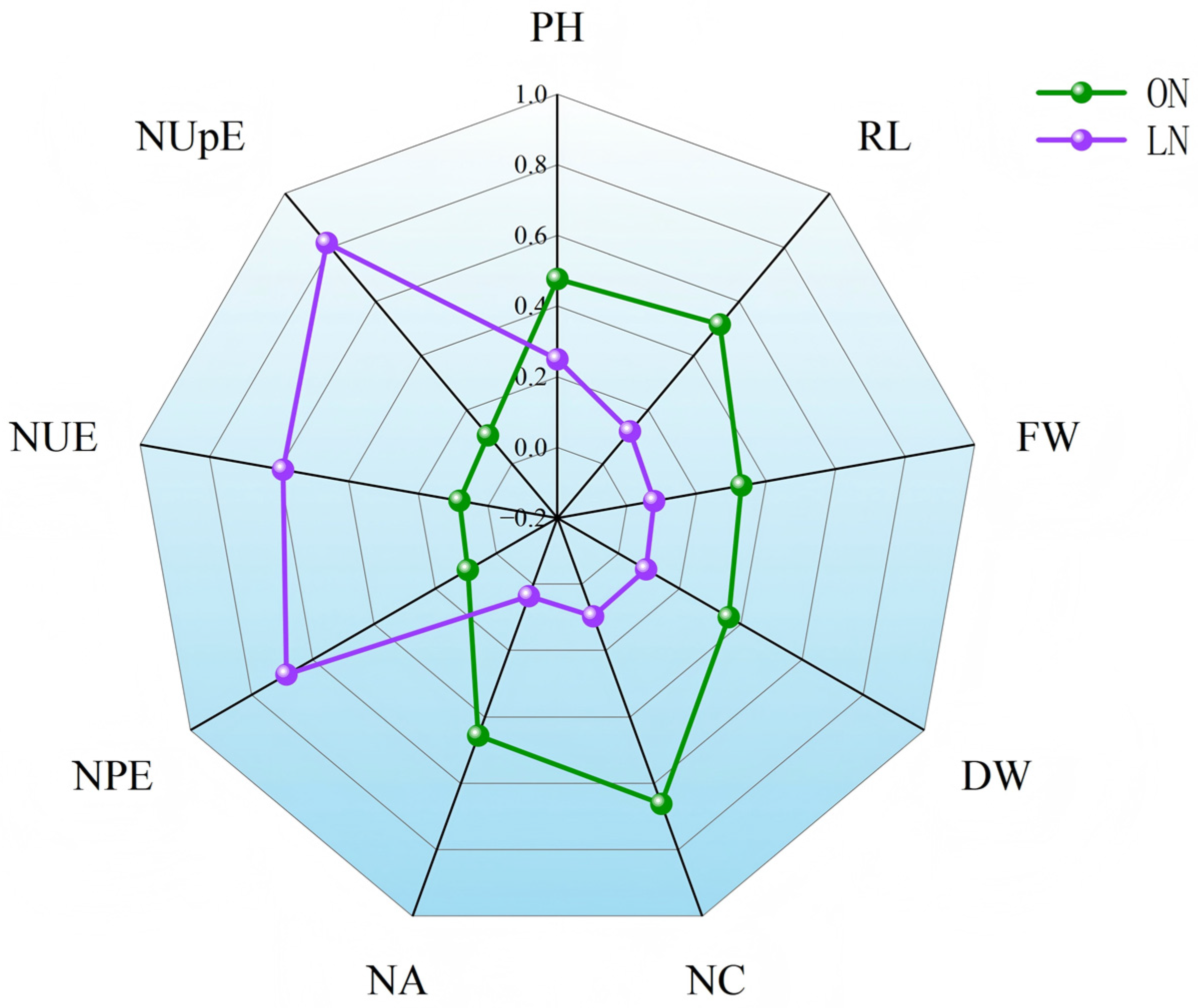
To eliminate the impact of different units of measurement across traits on intuitive comparison, a radar chart (Figure 1) was constructed based on the normalized mean values (0–1 scale) of nine key traits under two nitrogen levels. This chart systematically analyzed the relative changes in seedling height (PH), root length (RL), fresh weight (FW), dry weight (DW), nitrogen content (NC), nitrogen accumulation (NA), nitrogen physiological efficiency (NPE), nitrogen uptake efficiency (NUpE), and nitrogen use efficiency (NUE) under optimal nitrogen (ON) and low nitrogen (LN) conditions. The outer green polygon in the figure represents the ON treatment, while the inner purple polygon represents the LN treatment; the degree of contraction or expansion of the polygon along each trait axis directly reflects the impact of nitrogen deficiency on that trait. Results showed that under LN stress, NPE, NUE, and NUpE significantly increased, whereas the other six traits decreased. This indicates that the tolerance response of potato to LN stress is multifaceted, and a single indicator cannot fully characterize its low nitrogen tolerance.
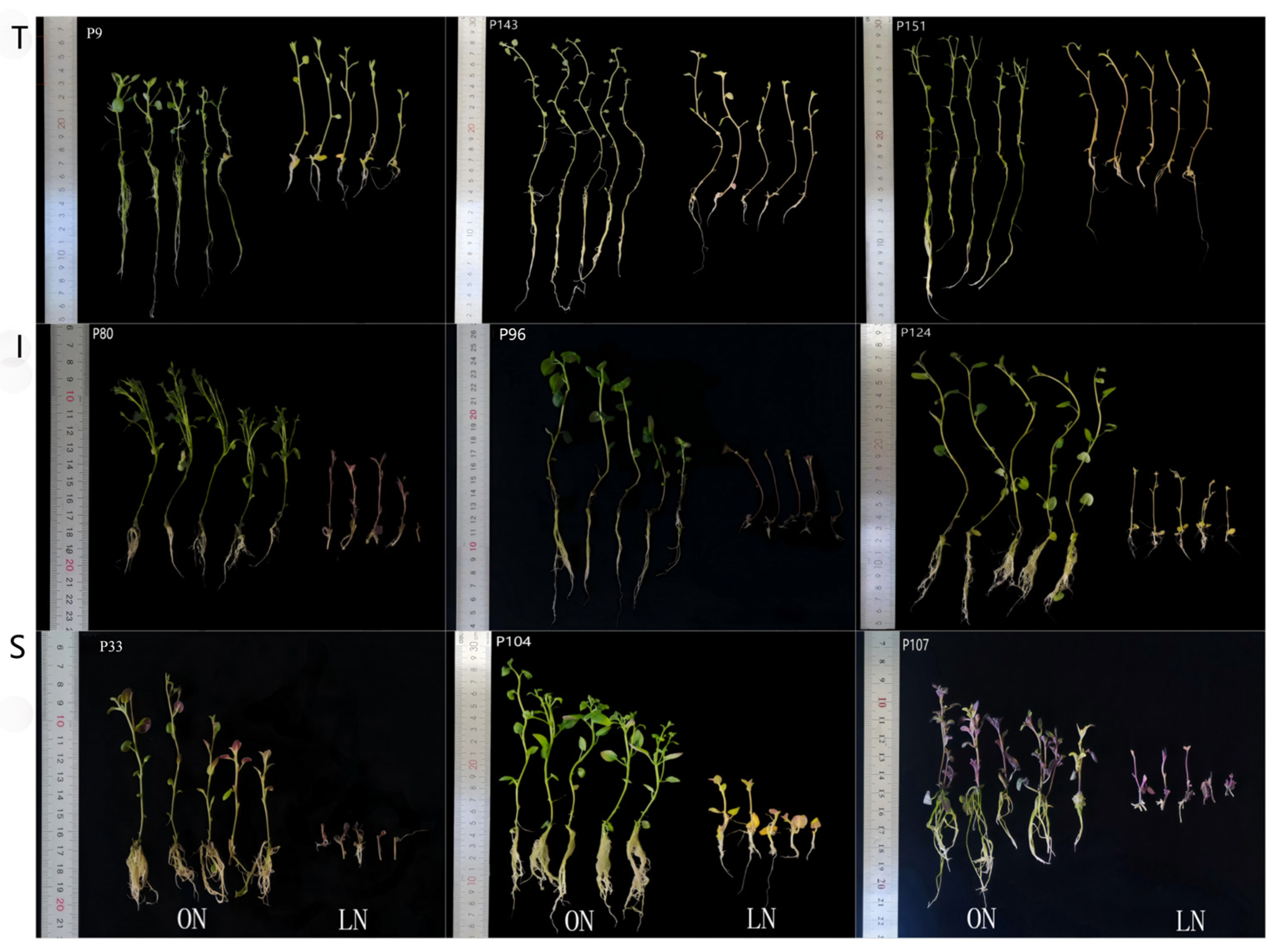
Significant morphological differences were observed among potato genotypes in response to nitrogen stress (Figure 2). After 30 days of culture under optimal nitrogen (ON, 60 mmol·L−1) and low nitrogen (LN, 3 mmol·L−1) conditions, LN treatment induced stunting and leaf chlorosis across all genotypes. Based on relative growth performance (LN/ON), the genotypes were classified as tolerant (P9, P143, P151), intermediate (P80, P96, P124), or sensitive (P33, P104, P107). This consistent phenotypic divergence, supported by physiological data, validates 3 mmol·L−1 N as an effective concentration for evaluating low-nitrogen tolerance in potato.
Descriptive statistical results in Table 1 show that compared with the ON treatment, LN stress significantly reduced the maximum, minimum, and mean values of PH, RL, FW, DW, NC, and NA (one-way ANOVA, p < 0.05). In contrast, the above statistical parameters of NPE, NUE, and NUpE were significantly higher under LN than under ON treatment (p < 0.05).
Calculation of the LN/ON ratio for each trait (reflecting the phenotypic plasticity of traits in response to LN stress) revealed that NUE had the highest ratio (6.50), followed by NPE (2.77) and NUpE (2.38), indicating that nitrogen-efficiency-related traits have the strongest response plasticity to nitrogen limitation. Further analysis of the coefficient of variation (CV) among genotypes showed that under LN conditions, FW, PH, RL, and DW among morphological traits, and NUE among physiological traits, had the highest CV values (overall range: 0.15–0.42), suggesting these traits are particularly sensitive for revealing genotypic differences under LN stress. Under ON conditions, FW, DW, NUE, and NA exhibited similar high sensitivity (CV range: 0.09–0.48).
In summary, based on their high sensitivity and stable genotypic discriminative power across both nitrogen levels, these four traits (FW, DW, NUE, and NA) were identified as robust and suitable indicators for screening low nitrogen tolerance in potato germplasm.

3.2. Identification of Key Traits for Low Nitrogen Tolerance Screening

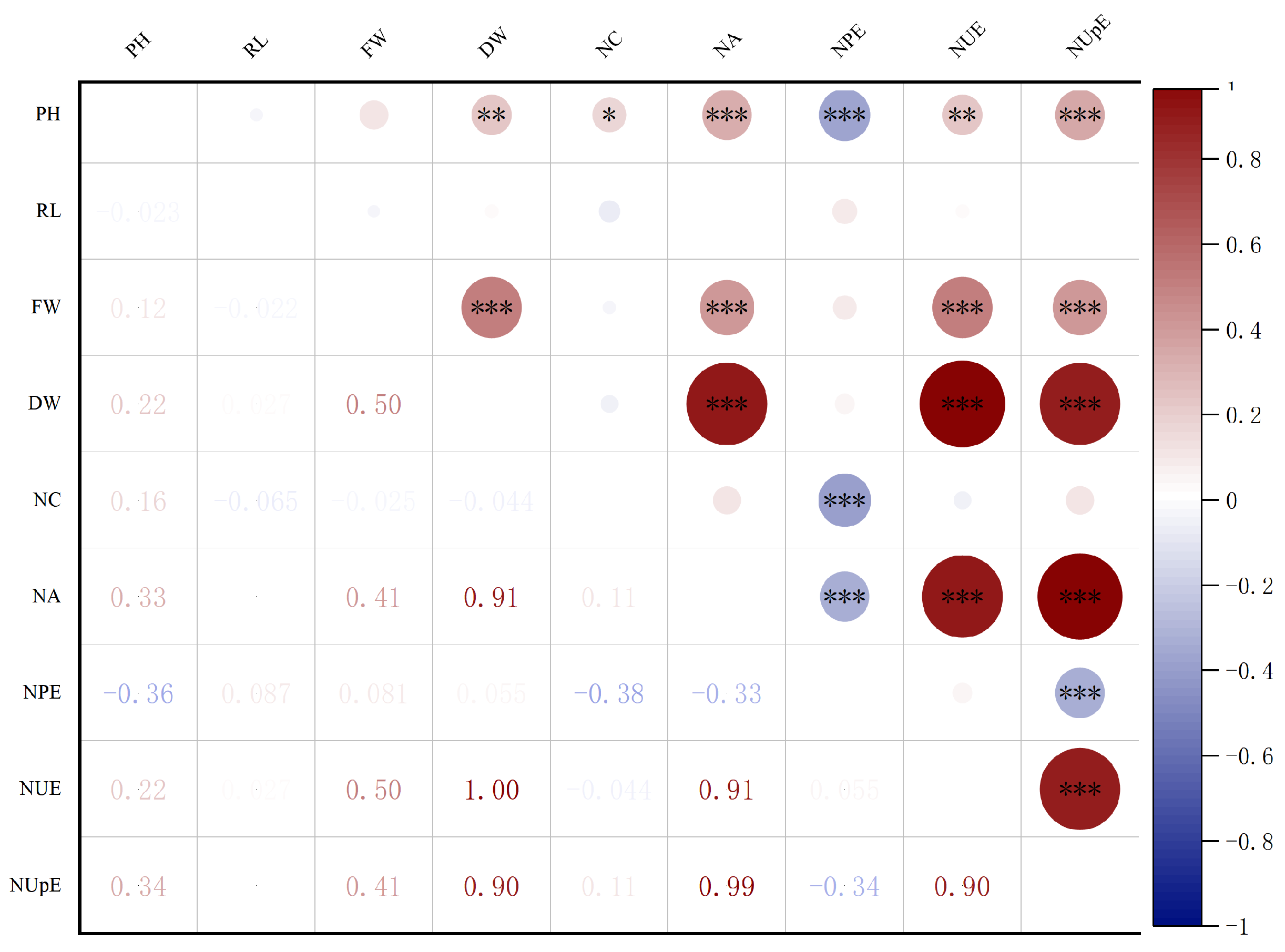
The correlation analysis of low nitrogen tolerance coefficients (Figure 3) revealed complex and variable interrelationships among the assessed traits, making it challenging to derive a single composite tolerance index without encountering multicollinearity issues. The heatmap displays pairwise Pearson correlation coefficients among nine low nitrogen tolerance indices (PH, RL, FW, DW, NC, NA, NPE, NUpE, NUE). The color gradient represents the magnitude of the correlation coefficient r: red indicates positive correlations, and blue indicates negative correlations, with darker shades representing stronger correlations. Numerical values within the cells indicate correlation coefficients, and asterisks denote significance levels (* p < 0.05, ** p < 0.01, *** p < 0.001). While some trait pairs, such as RL and DW, showed no significant correlation, the majority exhibited significant associations (p < 0.05). Notably, strong positive correlations (p < 0.001) were observed among key growth and accumulation traits (e.g., PH, FW, DW, NA) as well as between these traits and nitrogen efficiency parameters (NUE, NUpE). In contrast, NPE was significantly and negatively correlated with several other indicators (e.g., PH, NC, NA, NUpE). Given this substantial variability and multicollinearity, a composite index based on direct aggregation of all indicators would provide limited accuracy for evaluating low nitrogen tolerance. Therefore, to achieve a more robust and comprehensive assessment across genotypes, it is recommend to employ dimensionality reduction techniques such as principal component analysis in combination with membership function evaluation.

3.3. Factor Analysis of Major Agronomic Traits in Potatoes

Principal component analysis of nine traits under low nitrogen stress extracted three components (81.86% cumulative variance) (Table 2). PC1 explained 47.30% (eigenvalue 4.257), loaded primarily by NA, NUpE, NUE, and DW, pointing to nitrogen acquisition and overall use efficiency as principal axes of genotypic variation. PC2 accounted for 21.46% (eigenvalue 1.934), dominated by NPE, NUE, and DW, reflecting internal utilization efficiency as secondary. PC3 contributed 13.07% (eigenvalue 1.176) with loadings from NPE, PH, and RL, suggesting morphological traits capture additional independent variation.
Under optimal nitrogen, two PCs emerged (80.41% cumulative). PC1 explained 55.22%, loaded by NA, NUpE, NUE, DW, and FW, reflecting biomass accumulation and nitrogen uptake dominance under non-stress. PC2 accounted for 25.19%, dominated by NPE, highlighting independent utilization efficiency even when nitrogen is non-limiting.
NA and NUpE consistently dominated major PCs under both levels, serving as robust indicators for characterizing genotypic nitrogen response. This cross-regime consistency underscores nitrogen uptake capacity as fundamental to overall use efficiency regardless of availability.

3.4. Evaluation of Genotypic Variation Using Key Tolerance Indices

Based on the results of descriptive statistics and factor analysis of potato seedling traits, nitrogen accumulation (NA) and nitrogen uptake efficiency (NUpE) were identified as key evaluation indices for low nitrogen tolerance in potato seedlings. Analysis of these low nitrogen tolerance indices for different potato genotypes under both low nitrogen and optimal nitrogen conditions (Table 3) revealed that the lowest relative NA value (0.04) was observed in genotype P89, while the highest NA value (0.44) was observed in P121. The relative values of NUpE ranged from 0.79 to 8.8, with a mean of 2.70. The smallest relative NUpE value (0.79) was also found in P89, and the largest (8.74) in P121. These results indicate that genotypes can exhibit extreme values in individual key indices; however, reliance on a single trait may not adequately reflect overall low nitrogen tolerance. Therefore, a comprehensive evaluation integrating multiple traits through D-value cluster analysis was employed to reliably classify the genotypic tolerance.

3.5. Comprehensive Evaluation and Classification of Low Nitrogen Tolerance

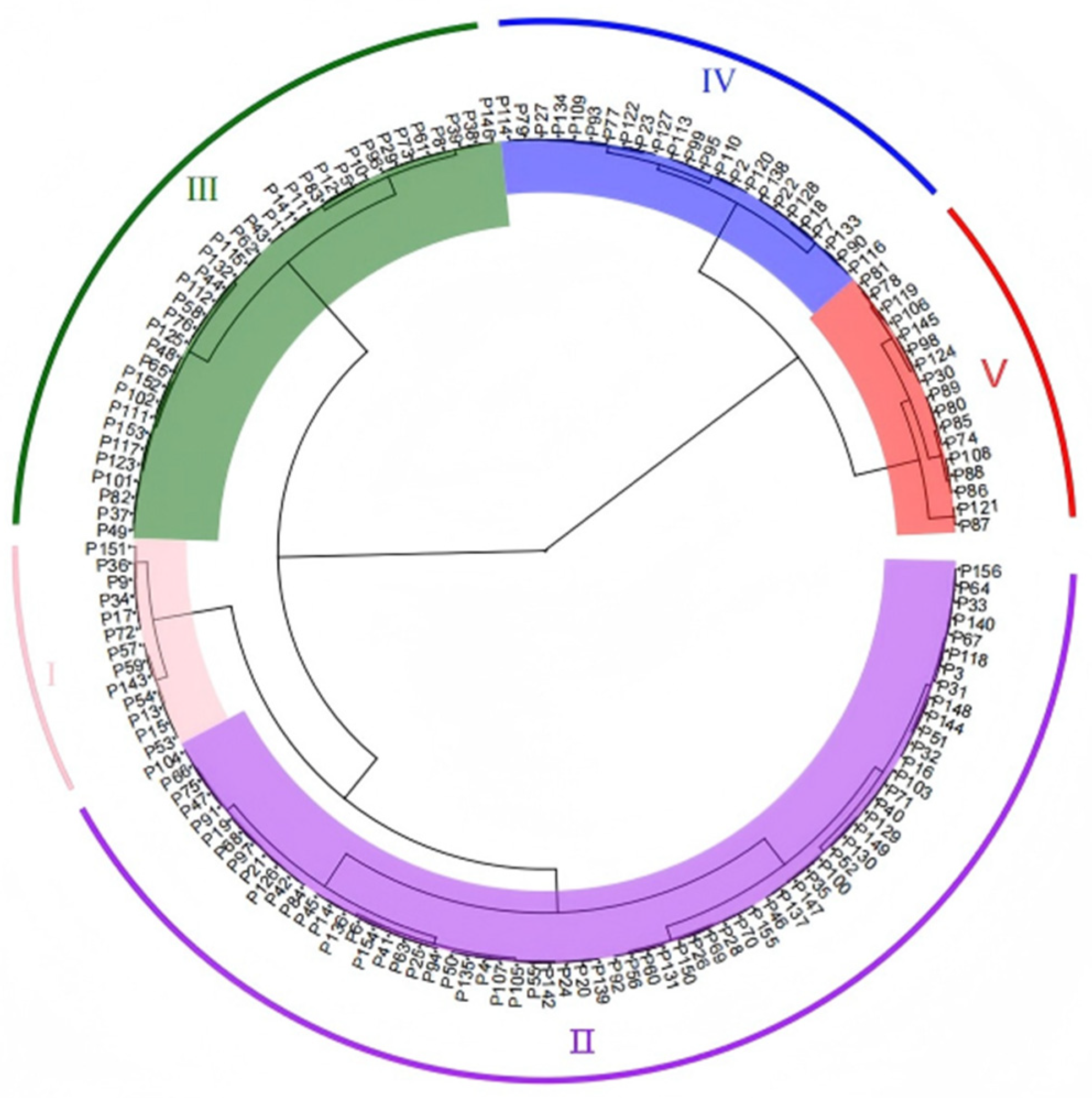
Based on this comprehensive evaluation approach, the 156 genotypes were clustered by K-means analysis of comprehensive D-values into five tolerance categories (Figure 4): Type I (strong low-nitrogen tolerant, D > 0.67), Type II (low-nitrogen tolerant, D = 0.56–0.64), Type III (moderate low-nitrogen tolerant, D = 0.49–0.55), Type IV (low-nitrogen sensitive, D = 0.40–0.48), and Type V (highly low-nitrogen sensitive, D < 0.39). Type II dominated the collection (42.3%, 66 genotypes), followed by Type III (23.1%, 36 genotypes). Types IV, I, and V accounted for 15.4% (24 genotypes), 8.3% (13 genotypes), and 10.9% (17 genotypes), respectively. Type I comprised 13 genotypes: Pimpernel, KE 8, DTO-2, H24, Qingshu No. 168, Zhengshu No. 1, Qingshu No. 9, Gannong No. 5, Kangyibai, Qingshu No. 3, Favorita, Spunta, and Longshu No. 3. Their mean D-value was 0.703 ± 0.027, ranging from 0.672 to 0.757.
Phenotypic characterization under LN conditions (Supplementary Table S2) revealed decreasing biomass (FW, DW) and NUpE from Type I to Type V, with NC showing slight increase—possibly a concentration effect in smaller plants. Type I genotypes maintained significantly higher NUpE and NA, reflecting superior nitrogen acquisition and utilization capacity under limiting conditions. These accessions represent promising candidates for breeding programs targeting improved nitrogen efficiency.

3.6. Validation of Low Nitrogen Tolerance Clustering Using Physiological Traits

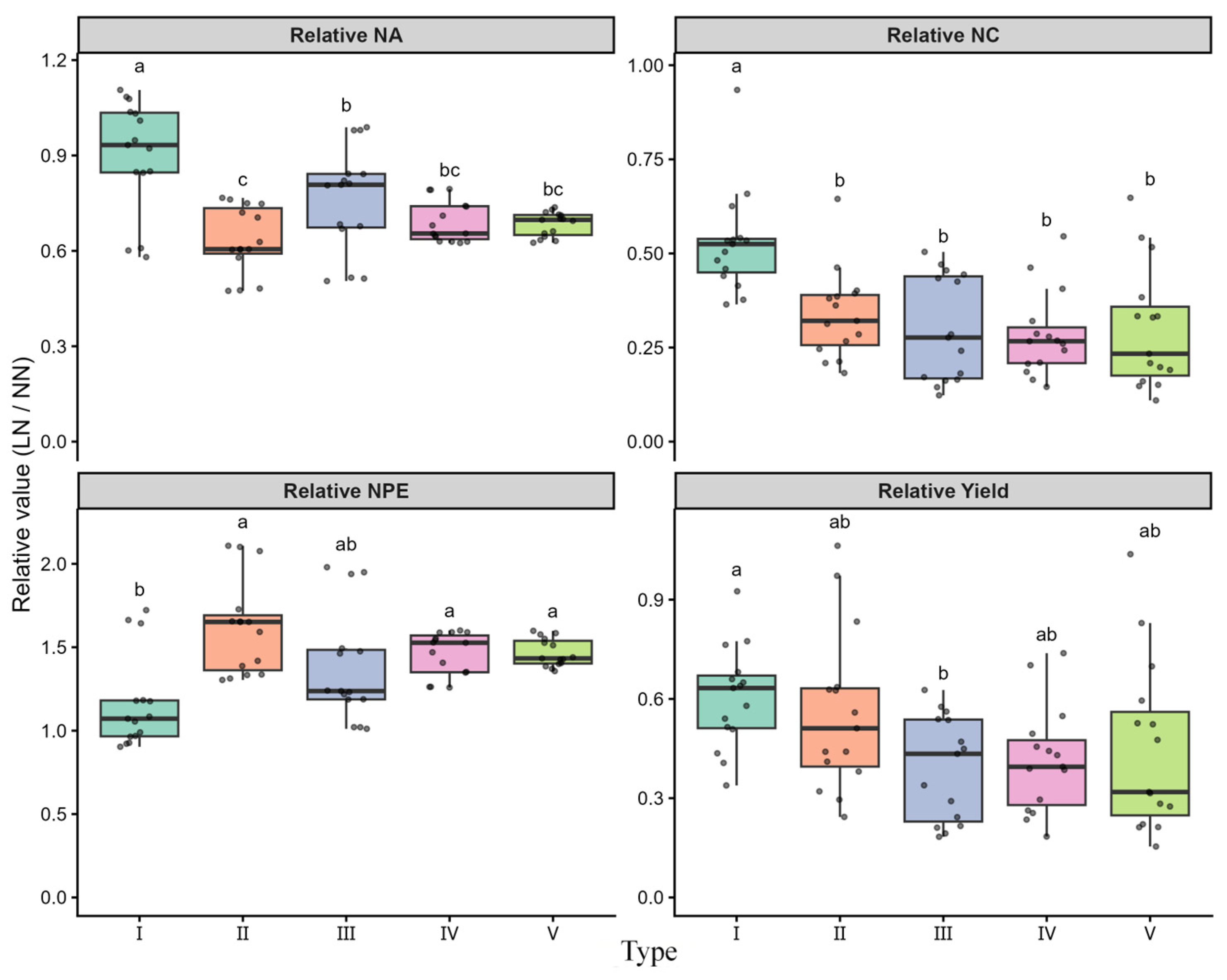
Validation of the five D-value clusters used 25 representative genotypes (five per cluster) grown under low nitrogen stress. Relative values (LN/ON) for yield, NA, NC, and NPE normalized for inherent vigor differences. One-way ANOVA with Tukey’s HSD test separated cluster means significantly (Figure 5), confirming biological relevance of the initial classification.
NA and NC distinguished clusters most clearly. Type I showed highest relative NA (0.90 ± 0.18) and NC (0.53 ± 0.14), exceeding all other clusters (p < 0.05). Type III held intermediate NA (0.76 ± 0.16), while Types II, IV, and V grouped at lower values (0.63–0.69). NC followed similarly: Type I led markedly, with remaining clusters clustering at 0.28–0.34 (no significant difference among them). These patterns match Type I’s designation as strongly tolerant—superior nitrogen maintenance under limitation.
NPE trends inverted. Types II, IV, and V reached highest relative NPE (1.46–1.62), surpassing Type I (1.16 ± 0.28, p < 0.05). Type III remained intermediate (1.38 ± 0.34). This implies compensation via efficiency upregulation in tolerant (Type II) and even sensitive (IV, V) genotypes, whereas Type I prioritized nitrogen retention over efficiency gains.
Validation thus distinguished three strategies: Type I (high accumulation, moderate efficiency), Type II (low accumulation, high efficiency compensation), Type III (intermediate), and IV/V (efficiency upregulation failing to offset accumulation deficit). Agreement between multivariate clustering and physiological response supports effective capture of genuine tolerance mechanisms.

4. Discussion

Given the genotype-dependent responses to nitrogen (N) limitation, identifying low-nitrogen-tolerant (LN-tolerant) germplasms is essential for promoting sustainable potato production [41,42], especially in ecologically sensitive regions like China’s Qinghai–Tibet Plateau [43]. In this study, the LN tolerance of 156 diverse potato genotypes was evaluated using an in vitro seedling system, and a robust multi-trait evaluation framework was established. Through the integration of phenotypic, physiological, and multivariate statistical analyses, the germplasm was classified into five distinct tolerance categories (Figure 4). Furthermore, the biological relevance of this clustering was experimentally validated by examining relative physiological responses under LN stress (Figure 5). The validation results confirmed that the clustering based on the comprehensive D-value effectively captures genuine genotypic differences in LN tolerance, rather than merely reflecting inherent growth vigor.
Identifying low-nitrogen-tolerant potato genotypes is inherently challenging. Nitrogen use efficiency is polygenic, with uptake, utilization, and remobilization components governed by distinct genetic architectures [5,6,7,8,9]. Field conditions compound this difficulty: high spatial and temporal heterogeneity in soil nitrogen often obscures genotypic potential, necessitating controlled screening environments to separate genetic from environmental variation [16,17]. Further complexity emerges from genotype-by-environment (G × E) interactions and physiological trade-offs—strategies beneficial under nitrogen limitation may impose fitness penalties under other stress regimes. A robust evaluation framework therefore requires not only high-throughput phenotyping capacity but also multi-trait analytical approaches capable of disentangling these adaptive components.
  • Methodological Rigor: Justification of the In Vitro System and Its Relevance to Field Conditions
A critical consideration in large-scale screening is balancing experimental control with biological relevance. An in vitro seedling system was employed for low nitrogen tolerance assessment—a choice requiring careful justification. While in vitro conditions cannot fully replicate field soil complexity, they offer precise nitrogen control (3 mmol·L−1 NO3) that eliminates confounding heterogeneity: variable mineralization rates and localized nitrate patches [44]. This uniformity attributes phenotypic differences primarily to genotype. The sterile environment excludes soil–microbiota interactions, isolating plant-autonomous nitrogen stress responses. This approach is accepted practice for rapid, cost-effective germplasm screening under controlled stress [41,45].
Biological relevance is evident from phenotypic symptoms: pronounced chlorosis and growth inhibition in sensitive genotypes (Figure 2) mirror classic field nitrogen deficiency [46]. System limitations are acknowledged. Agar restricts root architecture versus three-dimensional soil, potentially limiting foraging and other plasticity traits [47]. Biotic and abiotic field interactions are absent. Thus, while the system serves as a powerful tool for identifying intrinsic tolerance mechanisms, top candidates (PIMPERNEL, Qingshu No. 9) require field validation. Trials must assess performance under fluctuating nitrogen, mycorrhizal presence, and combined stresses. The 13 accessions identified are priorities for such resource-intensive validation. Initial screening provides phenotypic ranking; physiological validation subsequently tested the biological basis of cluster distinctions.
2.
Physiological Validation Confirms Clustering and Reveals Distinct Adaptive Strategies
Physiological analysis of representative genotypes validated that D-value clustering captured genuine adaptive strategies rather than vigor artifacts (Figure 5). Sensitive genotypes under low nitrogen stress displayed pronounced growth inhibition and chlorosis, symptoms matching classic field nitrogen deficiency [41,44,45,48].
A critical nuance in tolerance phenotyping is the distinction between relative values (LN/ON) and absolute stress performance. Genotype P121 demonstrates this: it exhibited the highest relative NA (0.44) and NUpE (8.74) among all accessions (Table 3), yet D-value clustering classified it as low-nitrogen sensitive (Type IV; Figure 4). This apparent paradox arises because relative values are strongly influenced by baseline vigor under optimal nitrogen. P121’s exceptionally high relatives reflect superior optimal-nitrogen performance—a “nitrogen-dependent” growth strategy—rather than low-nitrogen resilience. Its substantial decline from optimal to stressed conditions produced low comprehensive D-values. This case underscores that high individual trait relatives do not equate to overall tolerance, validating multi-trait integration for reliable evaluation.
Two primary strategies distinguished tolerant genotypes. Type I (strong low-nitrogen tolerant, e.g., P9) adopted nitrogen conservation: near-normal leaf color, vigorous shoot and root growth, minimal biomass reduction, and sustained high NA and NC. The cost was lower NPE. Presumably, roots upregulate high-affinity nitrate transporters (NRT2.1, NRT2.2) and ammonium transporters (AMT1.3) [49,50,51,52,53,54], maintaining nitrogen supply for chlorophyll biosynthesis genes (CHLH, POR) and photosynthetic integrity [55,56,57].
Type II (low-nitrogen tolerant, e.g., P80) employed contrasting efficiency maximization: low relative NA and NC but highest NPE, producing more biomass per unit nitrogen absorbed. This presumably involves elevated nitrate reductase (NR) and glutamine synthetase activity (GS) [58,59,60,61,62], rapid assimilation into amino acids, and optimized carbon-nitrogen allocation. This balance of acquisition restraint and metabolic efficiency parallels mechanisms in maize and rice [41,63].
Sensitive types (IV/V; e.g., P107) showed acquisition failure. Despite relatively high NPE, inadequate NA indicated efficiency could not compensate for poor uptake. Severe chlorosis, stunted shoots, and reduced root branching suggested systemic response failure—possibly insufficient NRT/AMT expression [64,65] or disrupted auxin signaling (PIN1, ARF7) [66]. Poor root development further limited foraging capacity. Agreement between clustering and these physiological distinctions confirms approach validity.
3.
Core Traits and Adaptive Mechanisms: An Integrated Analysis
Integrated analysis identified nitrogen acquisition as the primary driver of genotypic variation under low nitrogen stress. Phenotypic analysis (Table 1) showed high variation in FW, DW, and efficiency traits (CV 0.15–0.42), confirming their sensitivity as indicators [67]. NUE LN/ON ratio reached 6.50, reflecting dramatic efficiency gains under limitation and matching upper ranges in severely stressed crops [45]. The 41.3% NUpE superiority of best performer P121 over the mean highlighted substantial genetic potential for improvement.
Correlation and PCA (Figure 3) revealed trait hierarchy. NA and NUpE dominated PC1 (47.30% variance) across nitrogen regimes, establishing them as core proxies for genotypic variation. This aligns with resource allocation theory—acquisition is paramount when nitrogen limits growth [68,69]. Genetic variation in uptake capacity—transporter expression, root surface area—thus discriminates most effectively.
Biomass traits (FW, DW) correlated but functioned secondarily. These integrative outcomes reflect acquisition, utilization, photosynthesis, and partitioning; lower PCA loadings stem from their composite, environmentally noisy, polygenic nature [70]. They represent strategy outcomes rather than primary drivers.
Independent NPE loading on PC2 (21.46%) identified complementary utilization efficiency—internal flow and sink use following acquisition [9,71], mediated by NR, GS, and carbon–nitrogen metabolism [62,66,72]. PCA validated a two-tiered framework: primary acquisition (NUpE/NA) and secondary utilization (NPE). Type I (strongly tolerant) and Type II (efficient) represent successful optimizations—Type I prioritizing acquisition, Type II utilization.
Despite loading on PC3 rather than the dominant PC1/PC2 axes, RL accounted for 13.07% of variance, pointing to a distinct root architectural component. Under N limitation, elongation and branching increase soil exploration volume, a strategy evident in Type I genotypes that maintain root growth concurrent with transporter upregulation [73,74].

5. Conclusions

This study established a tissue culture-based multi-trait evaluation system for assessing low nitrogen tolerance in potato, validating the classification of 156 genotypes into five physiologically distinct groups. Two contrasting adaptive strategies were identified: a nitrogen conservation strategy (Type I), characterized by high nitrogen accumulation (NA) and content (NC) with moderate physiological efficiency, and an efficiency-driven compensation strategy (Types II, IV, and V), marked by high nitrogen physiological efficiency (NPE), uptake efficiency (NUpE), and utilization efficiency (NUE) but reduced NA and NC. Type III exhibited an intermediate phenotype, while sensitive types (IV and V) showed acquisition deficiencies that utilization efficiency could not compensate for. Thirteen highly tolerant genotypes—including PIMPERNEL, Favorita, Spunta, Qingshu No. 9, and Longshu No. 3—were identified as elite genetic resources. Physiological characterization of representative lines (P9, P80, P107) provided mechanistic insights into the differential regulation of nitrogen transport and assimilation pathways. The screening framework established here provides a practical tool for evaluating low nitrogen tolerance and supports the development of nitrogen-efficient potato cultivars for sustainable production in nitrogen-limited environments, particularly low-input and ecologically sensitive agricultural systems.

6. Limitations and Future Directions

This study provides a foundation with acknowledged limitations. The in vitro system, advantageous for controlled screening, simplifies rhizosphere complexity—field validation remains essential. Physiological analysis, though comprehensive, lacks parameters that would strengthen mechanistic interpretation: leaf chlorophyll (SPAD), metabolite pools (amino acids, carbohydrates), and assimilation enzyme activities (NR, GS). This absence limits interpretive depth. Transporter and enzyme activities are inferred from NA and NPE; direct measurements in contrasting genotypes (P9, P80, P107) would provide definitive evidence. Future studies should incorporate molecular and biochemical assays to validate proposed mechanisms.

Supplementary Materials

The following supporting information can be downloaded at: https://www.mdpi.com/article/10.3390/agronomy16060629/s1, Table S1: Screening list of potato germplasm resources; Table S2: Mean ± standard deviation (and range) of key traits for each tolerance type.

Author Contributions

H.G. and J.W. conceived the study and designed and supervised the experiments. W.Z. and Z.H. conducted the experiments and analyzed the data. W.Z. and H.G. wrote the manuscript. W.Z. and Z.H. contributed equally to this work and should be considered co-first authors. H.G. and J.W. are the corresponding authors. All authors have read and agreed to the published version of the manuscript.

Funding

This study was supported by the International Cooperation Special Project of Qinghai Provincial Department of Science and Technology (Grant No. 2025-HZ-812, 300,000 RMB), the Kunlun Talents Program of Qinghai Provincial Government (High-end Innovation and Entrepreneurship Talents, 140,000 RMB), and the Fundamental Research Project of the Academy of Agriculture and Forestry Sciences, Qinghai University (Functional analysis of ALaAT1.2 gene in potato nitrogen metabolism, 70,000 RMB).

Data Availability Statement

All data generated in this study are contained within the article.

Acknowledgments

We sincerely thank the College of Agricultural and Forestry Sciences of Qinghai University for providing the virus-free potato seedlings, and we are very grateful to Pingping Yuan and Shiwei Chang for their excellent experimental support.

Conflicts of Interest

The authors declare no competing interests.

References

  1. Hou, W.; Tränkner, M.; Lu, J.; Yan, S.; Chen, X.; Dittert, K. Interactive effects of nitrogen and potassium on photosynthesis and photosynthetic nitrogen allocation of rice leaves. BMC Plant Biol. 2019, 19, 302. [Google Scholar] [CrossRef] [PubMed]
  2. Fageria, N.K.; Baligar, V.C.; Jones, C.A. Growth and Mineral Nutrition of Field Crops, 3rd ed.; CRC Press: Boca Raton, FL, USA, 2011. [Google Scholar]
  3. Wang, Y.; Wang, D.; Shi, P.; Omasa, K. Estimating rice chlorophyll content and leaf nitrogen content with a digital still color camera under natural light. Plant Methods 2014, 10, 36. [Google Scholar] [CrossRef]
  4. Kaushal, S.S.; Groffman, P.M.; Band, L.E.; Elliott, E.M.; Shields, C.A.; Kendall, C. TraONing nonpoint source nitrogen pollution in human-impacted watersheds. Environ. Sci. Technol. 2011, 45, 8225–8232. [Google Scholar] [CrossRef]
  5. Zhang, F.; Cui, Z.; Fan, M.; Zhang, W.; Chen, X.; Jiang, R. Integrated soil–crop system management: Reducing environmental risk while increasing crop productivity and improving nutrient use efficiency in China. J. Environ. Qual. 2011, 40, 1051–1057. [Google Scholar] [CrossRef]
  6. Miao, Y.; Stewart, B.A.; Zhang, F. Long-term experiments for sustainable nutrient management in China: A review. Agron. Sustain. Dev. 2011, 31, 397–414. [Google Scholar] [CrossRef]
  7. Namai, S.; Toriyama, K.; Fukuta, Y. Genetic variations in dry matter production and physiological nitrogen use efficiency in rice (Oryza sativa L.) varieties. Breed. Sci. 2009, 59, 269–276. [Google Scholar] [CrossRef]
  8. Ranjan, R.; Yadav, R.; Kumar, A.; Mandal, S.N. Contributing traits for nitrogen use efficiency in selected wheat genotypes and corollary between screening methodologies. Acta Agric. Scand. Sect. B—Soil Plant Sci. 2019, 69, 588–595. [Google Scholar] [CrossRef]
  9. Xu, G.; Fan, X.; Miller, A.J. Plant Nitrogen Assimilation and Use Efficiency. Annu. Rev. Plant Biol. 2012, 63, 153–182. [Google Scholar] [CrossRef]
  10. Li, G.; Cheng, G.; Lu, W.; Zhang, Y.; Duan, L.; Wang, Y. Differences of yield and nitrogen use efficiency under different applications of slow release fertilizer in spring maize. J. Integr. Agric. 2021, 20, 554–564. [Google Scholar] [CrossRef]
  11. Li, J.; Zhao, Y.; Zhang, A.; Song, B.; Hill, R.T. A novel synthetic slow-release fertilizer with low energy production for efficient nutrient management. Sci. Total Environ. 2022, 831, 154844. [Google Scholar] [CrossRef]
  12. Duan, W.; Zhang, H.; Wang, Q.; Xie, B.; Zhang, L. Regulation of root development in nitrogen-susceptible and nitrogen-tolerant sweet potato cultivars under different nitrogen and soil moisture conditions. BMC Plant Biol. 2023, 23, 454. [Google Scholar] [CrossRef] [PubMed]
  13. Sharma, L.K.; Bali, S.K. A review of methods to improve nitrogen use efficiency in agriculture. Sustainability 2018, 10, 51. [Google Scholar] [CrossRef]
  14. Singh, B. Nitrogen use efficiency in crop production in India: Trends, issues, and challenges. Agric. Res. 2023, 12, 32–44. [Google Scholar] [CrossRef]
  15. Zhang, P.; Gang, D.; Wang, Y.; Guo, P.; Zhao, X.; Jiang, C.; Yu, H. Establishment of a comprehensive evaluation system for low nitrogen and screening of nitrogen-efficient germplasm in peanut. Horticulturae 2024, 10, 669. [Google Scholar] [CrossRef]
  16. Gawdiya, S.; Kumar, D.; Shivay, Y.S.; Kour, B.; Kumar, R.; Meena, S.; Saini, R.; Choudhary, K.; Al-Ansari, N.; Alataway, A.; et al. Field Screening of Wheat Cultivars for Enhanced Growth, Yield, Yield Attributes, and Nitrogen Use Efficiencies. Agronomy 2023, 13, 2011. [Google Scholar] [CrossRef]
  17. Zhan, N.; Xu, K.; Ji, G.; Yan, G.; Chen, B.; Wu, X.; Cai, G. Research progress in high-efficiency utilization of nitrogen in rapeseed. Int. J. Mol. Sci. 2023, 24, 7752. [Google Scholar] [CrossRef]
  18. Wijerathna-Yapa, A.; Hiti-Bandaralage, J. Tissue Culture—A sustainable approach to explore plant stresses. Life 2023, 13, 780. [Google Scholar] [CrossRef]
  19. Christensen, C.T.; Zotarelli, L.; Haynes, K.G.; Colee, J. Quantifying Solanum chacoense root morphology responses to limited nitrogen supply using in vitro, hydroponic, and field monolith methods. Am. J. Potato Res. 2021, 98, 157–170. [Google Scholar] [CrossRef]
  20. Jathunarachchi, A.S.; Salgadoe, A.S.; Gimhani, D.R.; Weerakoon, H.M.; Perera, P.I. In vitro selection of chili (Capsicum annuum) varieties tolerant to reduced nitrogen supplements. Plant Cell Tissue Organ Cult. 2023, 152, 491–506. [Google Scholar] [CrossRef]
  21. Hajari, E.; Snyman, S.J.; Watt, M.P. Nitrogen use efficiency of sugarcane (Saccharum spp.) varieties under in vitro conditions with varied N supply. Plant Cell Tissue Organ Cult. 2015, 122, 21–29. [Google Scholar] [CrossRef]
  22. Longchamps, L.; Mandal, D.; Khosla, R. Assessment of Soil Fertility Using Induced Fluorescence and Machine Learning. Sensors 2022, 22, 4644. [Google Scholar] [CrossRef] [PubMed]
  23. Hartemink, A.E.; Buresh, R.J.; Jama, B.; Janssen, B.H. Inorganic nitrogen dynamics in fallows and maize on an Oxisol and Alfisol in the highlands of Kenya. Geoderma 2000, 98, 11–33. [Google Scholar] [CrossRef]
  24. Mkoma, A.; Mahoo, H.; Mziray, M. Tillage Effect on Agronomic Efficiency of Nitrogen Under Rainfed Conditions of Tanzania. In Conservation Agriculture in Africa; CAB International: Oxfordshire, UK, 2022; pp. 177–194. [Google Scholar]
  25. Webb, J.; Sylvester-Bradley, R.; Seeney, F.M. The effects of site and season on the fate of nitrogen residues from root crops grown on sandy soils. J. Agric. Sci. 1997, 128, 445–460. [Google Scholar] [CrossRef]
  26. Sorgonà, A.; Abenavoli, M.R.; Gringeri, P.G.; Cacco, G. A comparison of nitrogen use efficiency definitions in Citrus rootstocks. Sci. Hortic. 2006, 109, 389–393. [Google Scholar] [CrossRef]
  27. Gaju, O.; Allard, V.; Martre, P.; Snape, J.W.; Heumez, E.; LeGouis, J.; Moreau, D.; Bogard, M.; Griffiths, S.; Orford, S.; et al. Identification of traits to improve the nitrogen-use efficiency of wheat genotypes. Field Crops Res. 2011, 123, 139–152. [Google Scholar] [CrossRef]
  28. Inthapanya, P.; Sipaseuth, P.; Sihavong, P.; Sihathep, V.; Chanphengsay, M.; Fukai, S.; Basnayake, J. Genotype differences in nutrient uptake and utilisation for grain yield production of rainfed lowland rice under fertilised and non-fertilised conditions. Field Crops Res. 2000, 65, 57–68. [Google Scholar] [CrossRef]
  29. Yuan, Y.; Yi, Y.; Zhan, Y.; Chen, L.; Yuan, S.; Huang, Y.; Xiao, Z.; Zhang, C.; Zhou, X. Distinguishing and evaluating high nitrogen-use-efficient soybean germplasm at seedling stage. Chin. J. Oil Crop Sci. 2022, 44, 539–547. [Google Scholar]
  30. Zhai, R.; Yu, P.; Ye, S.; Wang, J.; Wu, M.; Lin, J.; Zhu, G.; Zhang, X. Screening and comprehensive evaluation of low nitrogen tolerance of Zhejiang photosensitive japonica rice cultivars. J. Zhejiang Univ. (Agric. Life Sci.) 2016, 42, 565–572. [Google Scholar]
  31. Tiwari, J.K.; BuN1seth, T.; Zinta, R.; Saraswati, A.; Chakrabarti, S.K. Transcriptome analysis of potato shoots, roots and stolons under nitrogen stress. Sci. Rep. 2020, 10, 1152. [Google Scholar] [CrossRef]
  32. Zhang, J.; Wang, Y.; Zhao, Y.; Zhang, Y.; Zhang, J.; Ma, H.; Han, C. Transcriptome analysis reveals nitrogen deficiency induced alterations in leaf and root of three cultivars of potato (Solanum tuberosum L.). PLoS ONE 2020, 15, e0240662. [Google Scholar] [CrossRef]
  33. Wei, Q.; Yin, Y.; Deng, B.; Song, X.; Gong, Z.; Shi, Y. Transcriptome analysis of nitrogen-deficiency-responsive genes in two potato cultivars. Agronomy 2023, 13, 2164. [Google Scholar] [CrossRef]
  34. Trehan, S.P.; Singh, B.P. Nutrient efficiency of different crop species and potato varieties—In retrospect and prospect. Potato J. 2013, 40, 1–21. [Google Scholar]
  35. Fang, X.; Zhong, D.; Zhou, W.; Alami, M.J.; Cui, S.; Gao, B.; Huang, W. Regional-scale virtual nitrogen, phosphorus, and potassium factors of potato production in China. Agronomy 2023, 13, 2430. [Google Scholar] [CrossRef]
  36. Munthali, C.; Kinoshita, R.; Onishi, K.; Rakotondrafara, A.; Mikami, K.; Koike, M.; Tani, M.; Palta, J.; Aiuchi, D. A Model Nutrition Control System in Potato Tissue Culture and Its Influence on Plant Elemental Composition. Plants 2022, 11, 2718. [Google Scholar] [CrossRef]
  37. Nguyen, T.T.T.; Alizadeh, H.; Leung, D.W.M. Response of potato (Solanum tuberosum L., cv Iwa) nodal explants to low inorganic nitrogen supply in vitro. Biocatal. Agric. Biotechnol. 2021, 38, 102215. [Google Scholar] [CrossRef]
  38. Liu, H.; Gao, X.; Fan, W.; Fu, X. Optimizing carbon and nitrogen metabolism in plants: From fundamental principles to practical applications. J. Integr. Plant Biol. 2025, 67, 1447–1466. [Google Scholar] [CrossRef]
  39. Liu, C.; Gu, W.; Li, B.; Feng, Y.; Liu, C.; Shi, X.; Zhou, Y. Screening key sorghum germplasms for low-nitrogen tolerance at the seedling stage and identifying from the carbon and nitrogen metabolism. Front. Plant Sci. 2024, 15, 1340509. [Google Scholar] [CrossRef]
  40. Gupta, K.J. (Ed.) Nitrogen Metabolism in Plants: Methods and Protocols; Springer: New York, NY, USA, 2020. [Google Scholar] [CrossRef]
  41. Miao, J.; Shi, F.; Li, W.; Zhong, M.; Li, C.; Chen, S. Comprehensive screening of low nitrogen tolerant maize based on multiple traits at the seedling stage. PeerJ 2022, 10, e14218. [Google Scholar] [CrossRef] [PubMed]
  42. Tyagi, B.S.; Foulkes, J.; Singh, G.; Sareen, S.; Kumar, P.; Broadley, M.R.; Gupta, V.; Krishnappa, G.; Ojha, A.; Khokhar, J.S.; et al. Identification of wheat cultivars for low nitrogen tolerance using multivariable screening approaches. Agronomy 2020, 10, 417. [Google Scholar] [CrossRef]
  43. Wang, F.; Liu, S.; Liu, Y.; Sun, Y.; Yu, L.; Wang, Q.; Dong, Y.; Beazley, R. Long-term dynamics of nitrogen flow in a typical agricultural and pastoral region on the Qinghai-Tibet Plateau and its optimization strategy. Environ. Pollut. 2021, 288, 117684. [Google Scholar] [CrossRef]
  44. Hao, Q.N.; Zhou, X.A.; Sha, A.H.; Wang, C.; Zhou, R.; Chen, S.L. Identification of genes associated with nitrogen-use efficiency by genome-wide transcriptional analysis of two soybean genotypes. BMC Genom. 2011, 12, 525. [Google Scholar] [CrossRef] [PubMed]
  45. Chen, C.; Gong, H.Q.; Zhang, J.Z.; Xu, Y.J.; Gao, H.J. Evaluation of nitrogen nutrition characteristics of different rice cultivars at seedling stage. Chin. J. Eco-Agric. 2016, 24, 1347–1355. [Google Scholar]
  46. Liu, X.J.; Zhao, Y.J.; Hao, F. Development of nitrogen efficiency screening system in alfalfa (Medicago sativa L.) and analysis of alfalfa nitrogen efficiency types. PeerJ 2022, 10, e12921. [Google Scholar] [CrossRef]
  47. Kerstens, M.; Hesen, V.; Yalamanchili, K.; Bimbo, A.; Grigg, S.; Opdenacker, D.; Beeckman, T.; Heidstra, R.; Willemsen, V. Nature and Nurture: Genotype-Dependent Differential Responses of Root Architecture to Agar and Soil Environments. Genes 2021, 12, 1028. [Google Scholar] [CrossRef]
  48. Kumar, P.; Sharma, M. Nutrient Deficiencies of Field Crops: Guide to Diagnosis and Management; CABI: Oxfordshire, UK, 2013. [Google Scholar]
  49. Wang, Y.Y.; Hsu, P.K.; Tsay, Y.F. Uptake, allocation and signaling of nitrate. Trends Plant Sci. 2012, 17, 458–467. [Google Scholar] [CrossRef]
  50. Fang, X.; Fang, S.Q.; Ye, Z.; Liu, D.; Zhao, K.; Jin, C. NRT1.1 Dual-Affinity Nitrate Transport/Signalling and its Roles in Plant Abiotic Stress Resistance. Front. Plant Sci. 2021, 12, 715694. [Google Scholar] [CrossRef]
  51. Yue, L.; Liu, M.; Liao, J.; Zhang, K.; Wu, W.H.; Wang, Y. CPK28-mediated phosphorylation enhances nitrate transport activity of NRT2.1 during nitrogen deprivation. New Phytol. 2024, 245, 249–262. [Google Scholar] [CrossRef] [PubMed]
  52. Yang, W.; Dong, X.; Yuan, Z.; Zhang, Y.; Li, X.; Wang, Y. Genome-Wide Identification and Expression Analysis of the Ammonium Transporter Family Genes in Soybean. Int. J. Mol. Sci. 2023, 24, 3991. [Google Scholar] [CrossRef] [PubMed]
  53. von Wirén, N.; Gazzarrini, S.; Frommer, W.B. Regulation of mineral nitrogen uptake in plants. Plant Soil 2000, 215, 115–122. [Google Scholar]
  54. Loqué, D.; von Wirén, N. Regulatory levels for the transport of ammonium in plant roots. J. Exp. Bot. 2004, 55, 1293–1305. [Google Scholar] [CrossRef]
  55. Tanaka, A.; Tanaka, R. Chlorophyll metabolism. Curr. Opin. Plant Biol. 2006, 9, 248–255. [Google Scholar] [CrossRef]
  56. Adhikari, N.D.; Froehlich, J.E.; Strand, D.D.; Buck, S.M.; Kramer, D.M.; Larkin, R.M. GUN4-porphyrin complexes bind the ChlH/GUN5 subunit of Mg-Chelatase and promote chlorophyll biosynthesis in Arabidopsis. Plant Cell 2011, 23, 1449–1467. [Google Scholar] [CrossRef] [PubMed]
  57. Stephenson, P.G. The Regulation of Tetrapyrrole Biosynthesis in Arabidopsis thaliana. Doctoral Dissertation, University of Southampton, Southampton, UK, 2009. [Google Scholar]
  58. Lynch, J. Root Architecture and Plant Productivity. Plant Physiol. 1995, 109, 13–17. [Google Scholar] [CrossRef]
  59. Lynch, J. Root phenotypes for improved nutrient capture: An underexploited opportunity for global agriculture. New Phytol. 2019, 223, 548–564. [Google Scholar] [CrossRef]
  60. Freschet, G.T.; Roumet, C.; Comas, L.H.; Weemstra, M.; Bengough, A.G.; Rewald, B.; Bardgett, R.D.; De Deyn, G.B.; Johnson, D.; Klimešová, J.; et al. Root traits as drivers of plant and ecosystem functioning: Current understanding, pitfalls and future research needs. New Phytol. 2020, 232, 1123–1158. [Google Scholar] [CrossRef]
  61. Kaiser, W.M.; Huber, S.C. Post-translational regulation of nitrate reductase: Mechanism, physiological relevance and environmental triggers. J. Exp. Bot. 2001, 52, 1981–1989. [Google Scholar] [CrossRef]
  62. Masclaux-Daubrese, C.; Daniel-Vedele, F.; Dechorgnat, J.; Chardon, F.; Gaufichon, L.; Suzuki, A. Nitrogen uptake, assimilation and remobilization in plants: Challenges for sustainable and productive agriculture. Ann. Bot. 2010, 105, 1141–1157. [Google Scholar] [CrossRef] [PubMed]
  63. Ajmera, I.; Henry, A.; Radanielson, A.M.; Klein, S.P.; Ianevski, A.; Bennett, M.J.; Band, L.R.; Lynch, J.P. Integrated root phenotypes for improved rice performance under low nitrogen availability. Plant Cell Environ. 2022, 45, 805–822. [Google Scholar] [CrossRef]
  64. Reinbothe, C.; El Bakkouri, M.; Buhr, F.; Muraki, N.; Nomata, J.; Kurisu, G.; Fujita, Y.; Reinbothe, S. Chlorophyll biosynthesis: Spotlight on protochlorophyllide reduction. Trends Plant Sci. 2010, 15, 614–624. [Google Scholar] [CrossRef]
  65. Foyer, C.H.; Noctor, G.; Hodges, M. Respiration and nitrogen assimilation: Targeting mitochondria-associated metabolism as a means to enhance nitrogen use efficiency. J. Exp. Bot. 2011, 62, 1467–1482. [Google Scholar] [CrossRef]
  66. Petricka, J.J.; Winter, C.M.; Benfey, P.N. Control of Arabidopsis Root Development. Annu. Rev. Plant Biol. 2012, 63, 563–590. [Google Scholar] [CrossRef]
  67. Liu, C.; Gong, X.; Wang, H.; Dang, K.; Deng, X.; Feng, B. Low-nitrogen tolerance comprehensive evaluation and physiological response to nitrogen stress in broomcorn millet (Panicum miliaceum L.) seedling. Plant Physiol. Biochem. 2020, 151, 233–242. [Google Scholar] [CrossRef] [PubMed]
  68. Hirel, B.; Le Gouis, J.; Ney, B.; Gallais, A. The challenge of improving nitrogen use efficiency in crop plants: Towards a more central role for genetic variability and quantitative genetics within integrated approaches. J. Exp. Bot. 2007, 58, 2369–2387. [Google Scholar] [CrossRef] [PubMed]
  69. Garnier, E. Resource capture, biomass allocation and growth in herbaceous plants. Trends Ecol. Evol. 1991, 6, 126–131. [Google Scholar] [CrossRef] [PubMed]
  70. Cormier, F.; Foulkes, J.; Hirel, B.; Gouache, D.; Moënne-Loccoz, Y.; Gouis, J.L. Breeding for increased nitrogen-use efficiency: A review for wheat (T. aestivum L.). Plant Breed. 2016, 135, 255–278. [Google Scholar] [CrossRef]
  71. Han, M.; Okamoto, M.; Beatty, P.; Rothstein, S.; Good, A. The Genetics of Nitrogen Use Efficiency in Crop Plants. Annu. Rev. Genet. 2015, 49, 269–289. [Google Scholar] [CrossRef] [PubMed]
  72. Ullah, S.; Zhao, Q.; Wu, K.; Ali, I.; Liang, H.; Iqbal, A.; Wei, S.; Cheng, F.; Ahmad, S.; Jiang, L.; et al. Biochar application to rice with 15N-labelled fertilizers, enhanced leaf nitrogen concentration and assimilation by improving morpho-physiological traits and soil quality. Saudi J. Biol. Sci. 2021, 28, 3399–3413. [Google Scholar] [CrossRef]
  73. Lu, J.; Lankhost, J.A.; Stomph, T.J.; Schneider, H.M.; Chen, Y.; Mi, G.; Yuan, L.; Evers, J.B. Root plasticity improves maize nitrogen use when nitrogen is limiting: An analysis using 3D plant modelling. J. Exp. Bot. 2024, 75, 5989–6005. [Google Scholar] [CrossRef]
  74. Brown, K.; Lynch, J.; Tian, T. Responses of root architectural and anatomical traits to low nitrogen stress in rice. bioRxiv 2024. [Google Scholar] [CrossRef]
Figure 1. Effect of low nitrogen stress on various indicators in the tested potato varieties.
Agronomy 16 00629 g001
Figure 2. Morphological responses of representative potato genotypes to nitrogen stress. Note: The susceptibility classification of each genotype is labeled in black (T = tolerant; I = intermediate; S = sensitive). ON, optimal nitrogen supply; LN, low nitrogen stress. The stunted appearance of plants under LN conditions indicates severe growth inhibition induced by low-nitrogen stress.
Agronomy 16 00629 g002
Figure 3. Pearson correlation matrix of nine low-nitrogen-tolerance-related traits under. Trait abbreviations: PH: plant height; RL: root length; FW: fresh weight; DW: dry weight; NC: nitrogen content; NA: nitrogen accumulation; NPE: nitrogen physiological efficiency; NUE: nitrogen use efficiency; NUpE: nitrogen uptake efficiency. Note: The matrix visualizes pairwise Pearson correlation coefficients. Color intensity and circle size both represent the absolute magnitude of the correlation coefficient: red indicates positive correlations, blue indicates negative correlations, and saturation increases with coefficient magnitude. Statistical significance levels are denoted as * p < 0.05, ** p < 0.01, and *** p < 0.001. Non-significant correlations (p ≥ 0.05) are unmarked.
Agronomy 16 00629 g003
Figure 4. Cluster Analysis of 156 potato accessions based on Low Nitrogen Tolerance D Value. Note: Roman numerals (I, II, III, IV, V) indicate the five main clusters: [e.g., I = strong low-nitrogen tolerant; II = low-nitrogen tolerant; III = moderate low-nitrogen tolerant; IV = low-nitrogen sensitive; V = highly low-nitrogen sensitive].
Agronomy 16 00629 g004
Figure 5. Physiological validation of low nitrogen tolerance clusters based on relative traits. Note: Different lowercase letters indicate significant differences at p < 0.05 (one-way ANOVA followed by Tukey’s HSD test). Means with at least one common letter are not significantly different. Roman numerals (I–V) represent the five clusters: I = strong low-nitrogen tolerant; II = low-nitrogen tolerant; III = moderate low-nitrogen tolerant; IV = low-nitrogen sensitive; V = highly low-nitrogen sensitive. Trait abbreviations: NC, nitrogen content; NA, nitrogen accumulation; NPE, nitrogen physiological efficiency.
Agronomy 16 00629 g005
Table 1. Changes in potato seedling traits under different nitrogen supply levels.
IndexOptimal NitrogenLow Nitrogen
RangeAverageSDCVRangeAverageSDCV
PH (cm)33.79–146.7582.7125.420.3124.25–139.4354.7716.260.30
RL (cm)36.56–201.53108.4331.890.299.49–58.8032.597.670.24
FW (g)0.21–33.5011.045.280.480.02–9.072.661.100.42
DW (g)0.12–2.641.020.400.400.10–0.560.330.070.22
NC (%)2.82–9.887.180.770.111.94–6.802.700.570.21
NA (mg·plant−1)7.21–156.2772.9127.420.383.15–14.588.561.430.17
NPE (g·g−1)10.12–18.2614.001.300.0920.02–51.7738.715.940.15
NUE (g·g−1)0.56–12.574.851.920.409.80–53.1031.526.830.22
NUpE (g·g−1)0.03–0.740.340.130.380.30–0.990.810.130.16
Trait abbreviations: PH: plant height; RL: root length; FW: fresh weight; DW: dry weight; NC: nitrogen content; NA: nitrogen accumulation; NPE: nitrogen physiological efficiency; NUE: nitrogen use efficiency; NUpE: nitrogen uptake efficiency; CV: coefficient of variation; SD: standard deviation.
Table 2. Loading matrix of varimax rotation factors.
IndexOptimal NitrogenLow Nitrogen
PC 1PC 2PC 1PC 2PC 3
NA0.986−0.0760.980−0.0050.109
NUpE0.986−0.0760.964−0.0140.142
NUE0.9840.1390.7230.6650.058
DW0.9840.1390.7230.6650.058
FW0.9240.1400.3980.4770.175
PH0.473−0.4010.160−0.1350.789
NPE0.0220.9380.0120.962−0.012
NC−0.016−0.9330.011−0.890−0.023
RL0.0830.5410.0460.2270.807
Eigenvalue4.9702.2674.2571.9341.176
contribution rate (%)55.22425.19047.30321.48513.068
Accumulative contribution rate55.22480.41347.30368.78781.858
Trait abbreviations: PH: plant height; RL: root length; FW: fresh weight; DW: dry weight; NC: nitrogen content; NA: nitrogen accumulation; NPE: nitrogen physiological efficiency; NUE: nitrogen use efficiency; NUpE: nitrogen uptake efficiency.
Table 3. Tolerance index of potato seedling traits under different nitrogen supply conditions.
NumberNANUpENumberNANUpENumberNANUpE
P10.132.63P530.142.88P1050.071.39
P20.112.22P540.183.50P1060.081.53
P30.091.88P550.193.87P1070.142.77
P40.122.31P560.183.65P1080.071.45
P50.101.95P570.112.29P1090.142.73
P60.081.69P580.132.62P1100.183.68
P70.091.84P590.122.47P1110.173.38
P80.061.29P600.152.97P1120.244.72
P90.091.83P610.132.65P1130.132.62
P100.061.12P620.183.66P1140.050.93
P110.183.65P630.142.81P1150.101.93
P120.306.07P640.163.27P1160.101.97
P130.173.31P650.091.88P1170.091.83
P140.214.16P660.112.21P1180.183.62
P150.142.85P670.193.80P1190.050.97
P160.101.98P680.122.42P1200.173.37
P170.061.21P690.132.58P1210.448.74
P180.091.85P700.203.97P1220.142.75
P190.071.35P710.265.13P1230.153.01
P200.071.37P720.222.78P1240.112.29
P210.101.90P730.142.75P1250.163.24
P220.091.89P740.132.58P1260.142.76
P230.102.08P750.071.37P1270.163.27
P240.061.29P760.081.51P1280.071.41
P250.112.19P770.081.67P1290.193.85
P260.081.59P780.275.47P1300.112.11
P270.081.62P790.142.88P1310.214.18
P280.091.86P800.122.41P1320.081.66
P290.091.82P810.122.46P1330.142.84
P300.061.28P820.183.55P1340.091.72
P310.071.35P830.204.09P1350.132.60
P320.193.83P840.153.04P1360.122.44
P330.101.99P850.122.34P1370.132.66
P340.112.20P860.081.68P1380.071.44
P350.173.33P870.051.08P1390.265.15
P360.132.66P880.132.54P1400.306.00
P370.071.38P890.040.79P1410.132.68
P380.356.93P900.122.38P1420.183.67
P390.091.87P910.224.30P1430.163.14
P400.163.24P920.142.77P1440.254.96
P410.112.30P930.163.24P1450.142.82
P420.204.06P940.112.24P1460.091.72
P430.152.91P950.122.33P1470.163.23
P440.122.47P960.173.32P1480.132.68
P450.224.46P970.152.95P1490.112.10
P460.081.64P980.122.32P1500.122.31
P470.183.54P990.193.80P1510.203.92
P480.071.48P1000.091.72P1520.122.46
P490.122.34P1010.132.53P1530.112.16
P500.142.73P1020.183.63P1540.122.50
P510.101.91P1030.193.74P1550.152.99
P520.081.61P1040.091.73P1560.173.37
Disclaimer/Publisher’s Note: The statements, opinions and data contained in all publications are solely those of the individual author(s) and contributor(s) and not of MDPI and/or the editor(s). MDPI and/or the editor(s) disclaim responsibility for any injury to people or property resulting from any ideas, methods, instructions or products referred to in the content.