Elevated O3 Reduces Nitrogen Oxide Emissions from Rice Paddy Fields Under Warming

 ,
,  ,
, 
Abstract
1. Introduction
2. Materials and Methods
2.1. Experimental Site
2.2. The O3–T–FACE System
2.3. Field Plot Experimental Design and Management
2.4. Gas and Soil Sampling
2.5. Statistical Analysis
3. Results
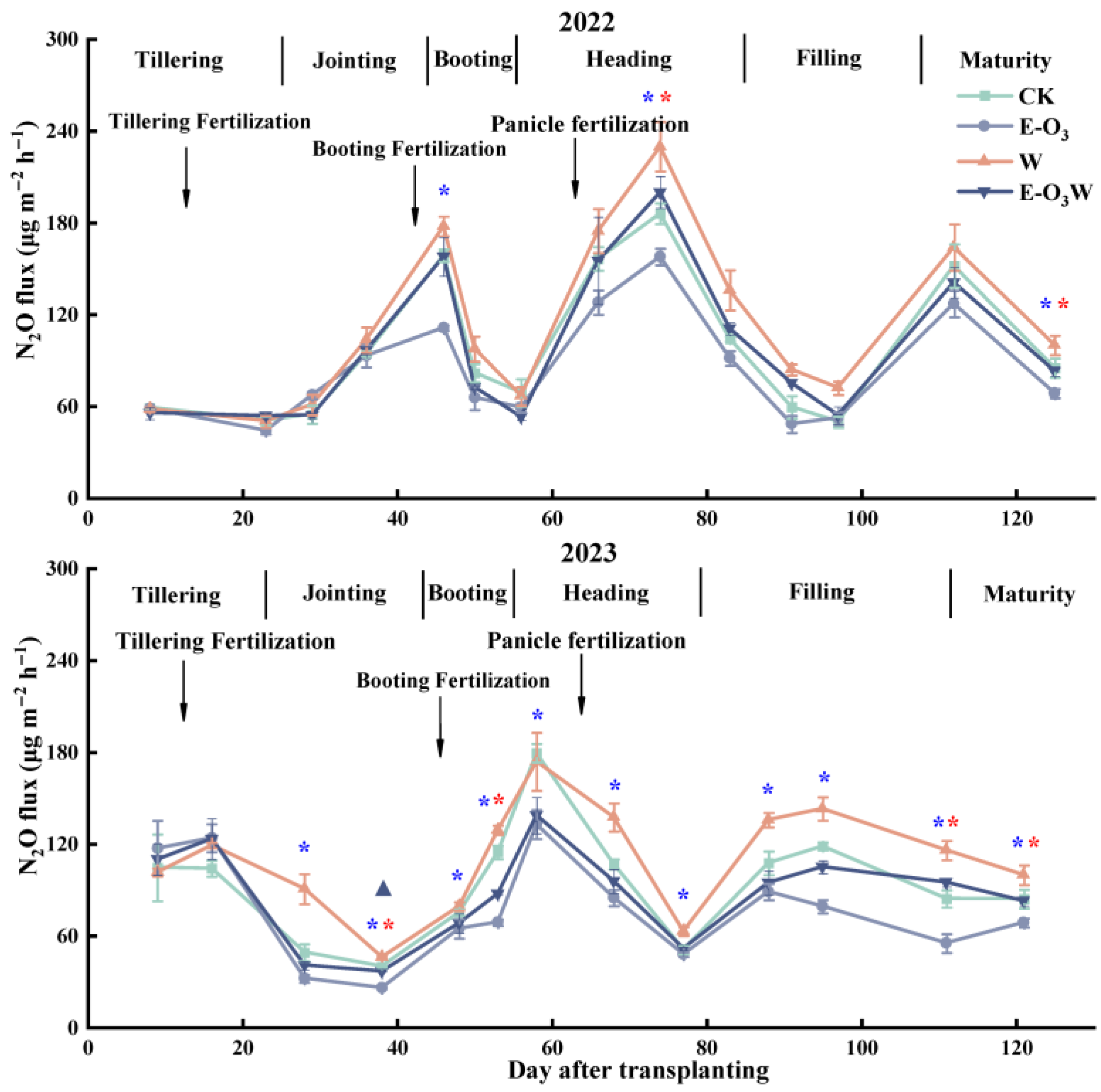
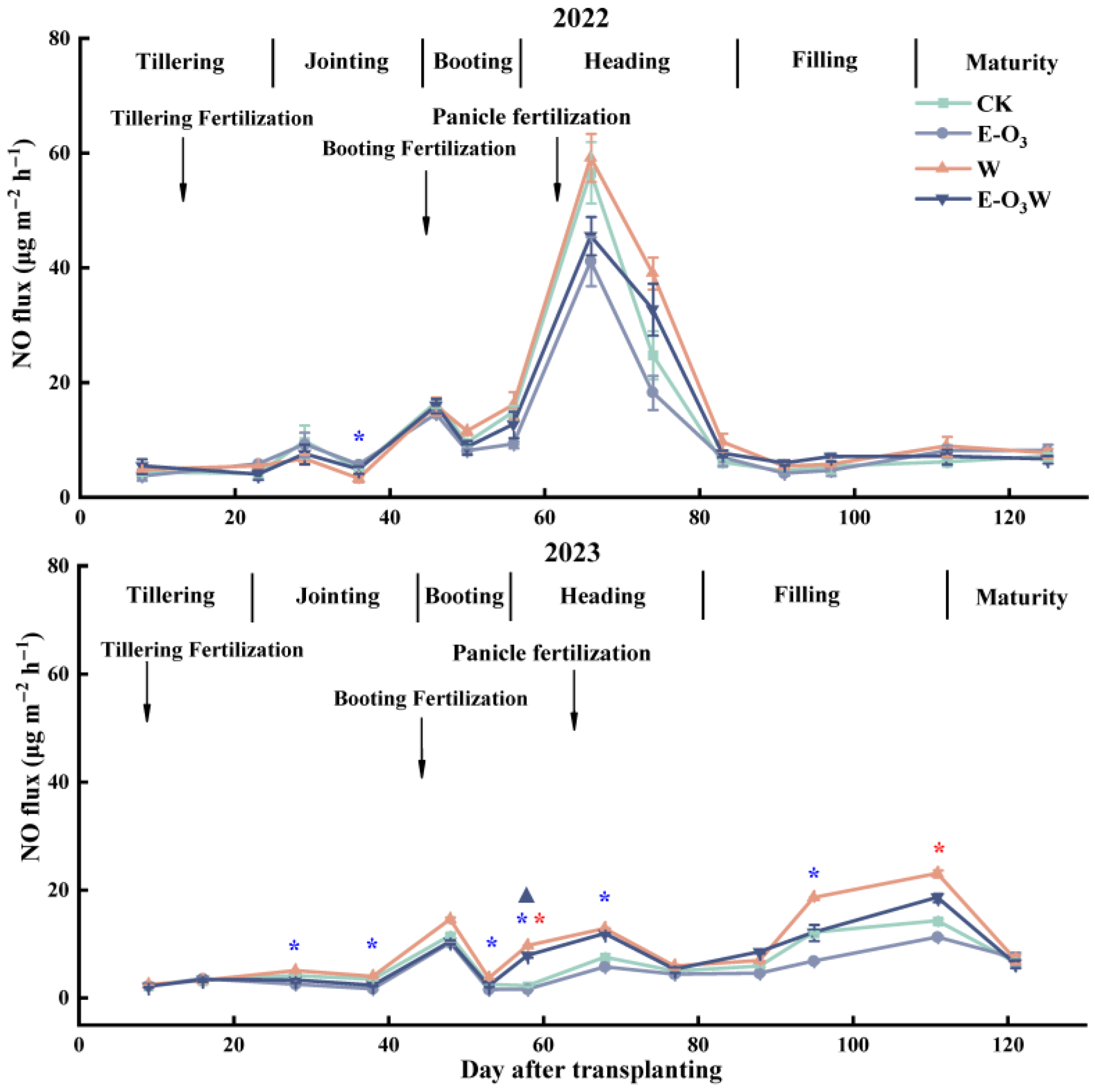
3.1. Seasonal N2O and NO Fluxes
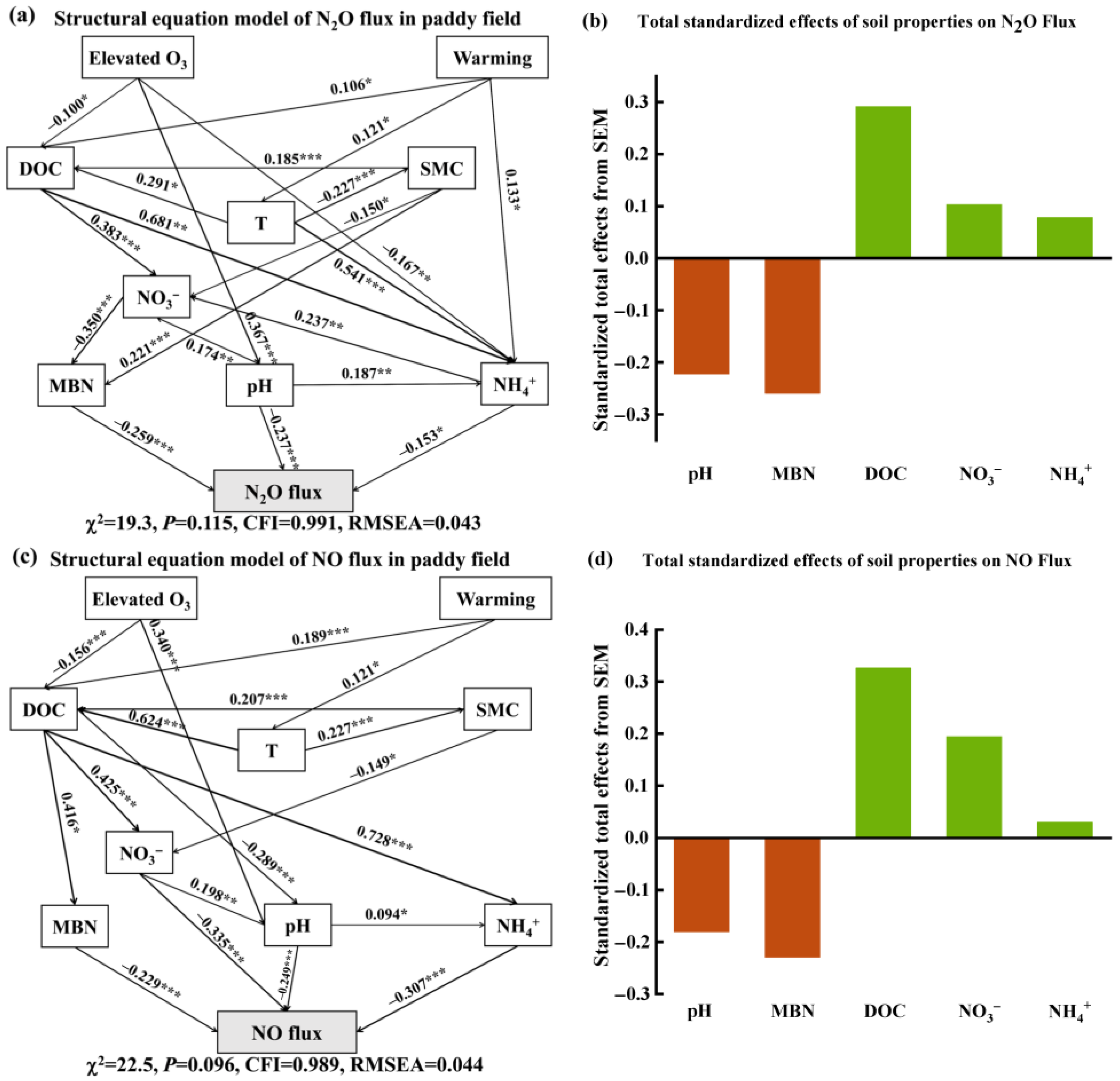
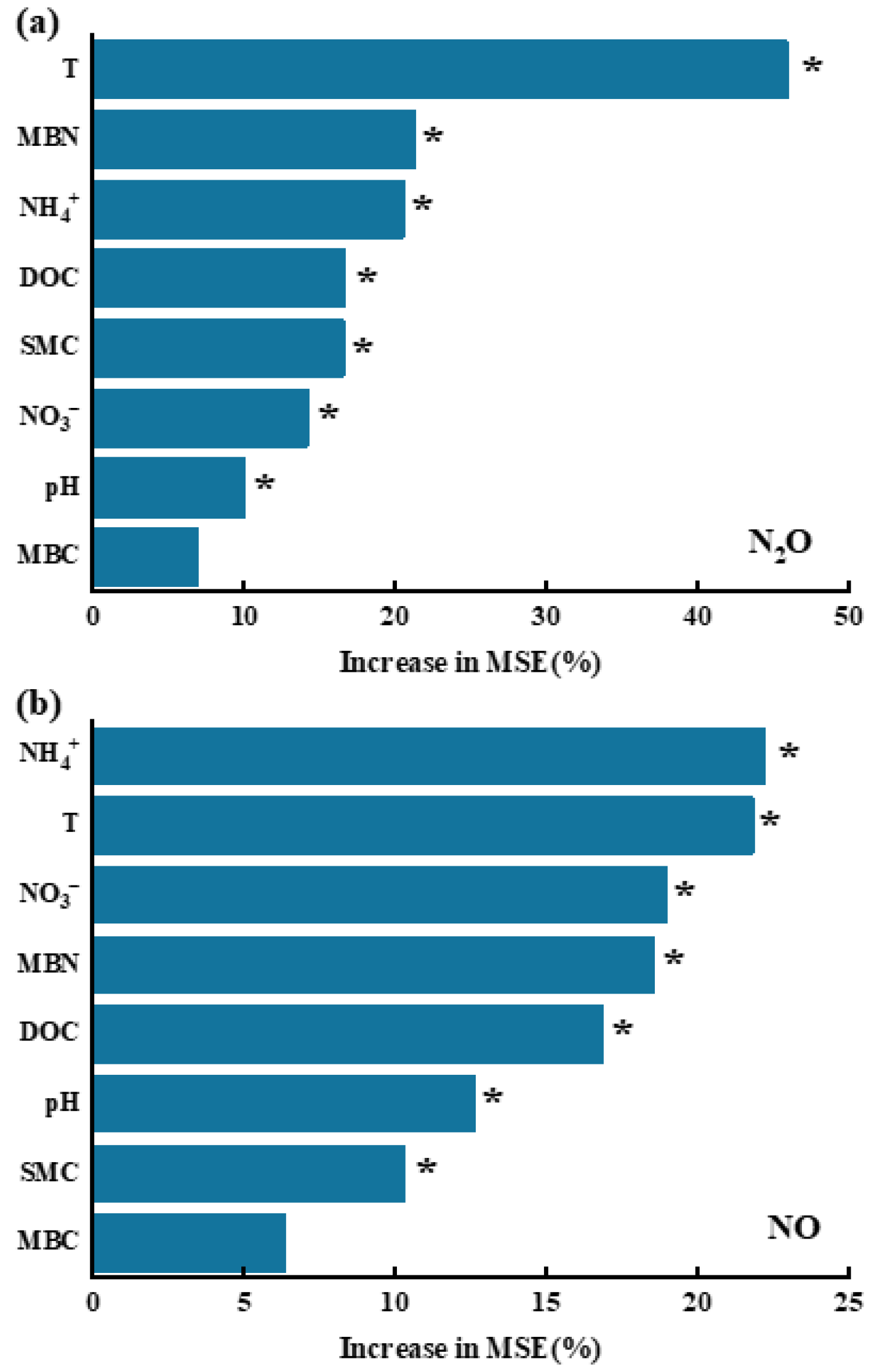
3.2. Effects of Soil Properties on Nitrogen Oxide Emissions
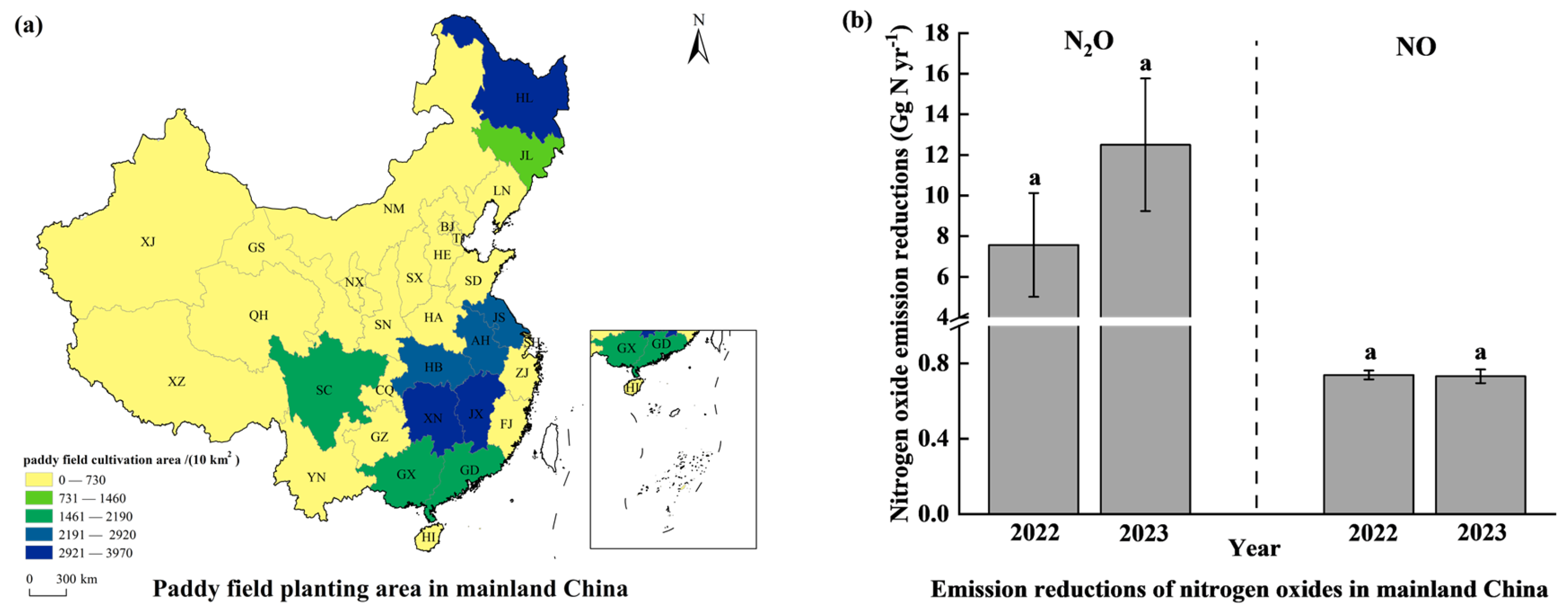
3.3. Estimating Nitrogen Oxide Emission Reduction in Chinese Rice Paddies
4. Discussion
4.1. Effects of Elevated O3 on Nitrogen Oxide Emissions in Paddy Fields
4.2. Effects of Warming on Nitrogen Oxide Emissions in Paddy Fields
4.3. Effect of Combined Treatment on Nitrogen Oxide Emissions in Paddy Fields
5. Conclusions
Supplementary Materials
Author Contributions
Funding
Data Availability Statement
Acknowledgments
Conflicts of Interest
References
- Shi, Y.J.; Wang, J.F.; Ao, Y.N.; Han, J.Y.; Guo, Z.H.; Liu, X.Y.; Zhang, J.W.; Mu, C.S.; Le Roux, X. Responses of soil N2O emissions and their abiotic and biotic drivers to altered rainfall regimes and co-occurring wet N deposition in a semi-arid grassland. Glob. Change Biol. 2021, 27, 4894–4908. [Google Scholar] [CrossRef]
- IPCC (Intergovernmental Panel on Climate Change). Climate Change: Synthesis Report; Contribution of Working Groups III and III to the Fifth Assessment Report of the Intergovernmental Panel on Climate Change; IPCC: Geneva, Switzerland, 2021. [Google Scholar]
- Sun, H.Y.; Yu, R.H.; Lu, X.X.; Lorke, A.; Cao, Z.X.; Liu, X.Y.; Li, X.W.; Zhang, Z.Z.; Cui, B.S. N2O emissions fueled by eutrophication in a shallow lake. J. Environ. Sci. 2023, 160, 166–173. [Google Scholar] [CrossRef] [PubMed]
- Tian, X.S.; Yin, Y.L.; He, K.; Qiu, R.N.; Cong, J.H.; Wang, Z.H.; Yu, H.T.; Chen, Z.; Chu, Y.Y.; Ying, H.; et al. Data-driven estimation of nitric oxide emissions from global soils based on dominant vegetation covers. Glob. Change Biol. 2023, 29, 5955–5967. [Google Scholar] [CrossRef] [PubMed]
- Ryalls, J.M.W.; Bishop, J.; Mofikoya, A.O.; Bromfield, L.M.; Nakagawa, S.; Girling, R.D. Air pollution disproportionately impairs beneficial invertebrates: A meta-analysis. Nat. Commun. 2024, 15, 5447. [Google Scholar] [CrossRef] [PubMed]
- Gaihre, Y.K.; Singh, U.; Bible, W.D.; Fugice, J.; Sanabria, J. Mitigating N2O and NO emissions from direct-seeded rice with nitrification inhibitor and urea deep pacement. Rice Sci. 2020, 27, 434–444. [Google Scholar] [CrossRef]
- Alexandratos, N.; Bruinsma, J. World Agriculture Towards 2030/2050; The 2012 Revision; FAO: Rome, Italy, 2012. [Google Scholar]
- Ge, T.; Li, B.; Zhu, Z.; Hu, Y.; Yuan, H.; Dorodnikov, M.; Jones, D.L.; Wu, J.; Kuzyakov, Y. Rice rhizodeposition and its utilization by microbial groups depends on N fertilization. Biol. Fertil. Soils 2017, 53, 37–48. [Google Scholar] [CrossRef]
- Hatano, R. Study on the occurrence, impact, and mitigation of soil-derived environmental loads in agricultural ecosystems. Soil Sci. Plant Nutr. 2025, 71, 371–384. [Google Scholar] [CrossRef]
- EPA Non-CO2 Greenhouse Gas Data Tool|US EPA [WWW Document]. A Data Exploration Tool for Viewing Non-CO2 GHG Projections and Mitigation Assessments as Compiled in the EPA Non-CO2 Greenhouse Emission Projections & Mitigation Potential Reports (2019 & 2022). 2022. Available online: https://cfpub.epa.gov/ghgdata/nonco2/ (accessed on 18 February 2023).
- Qin, H.L.; Wang, D.; Xing, X.Y.; Tang, Y.F.; Wei, X.M.; Chen, X.B.; Zhang, W.Z.; Chen, A.L.; Li, L.L.; Liu, Y.; et al. A few key nirK-and nosZ-denitrifier taxa play a dominant role in moisture-enhanced N2O emissions in acidic paddy soil. Geoderma 2021, 385, 114917. [Google Scholar] [CrossRef]
- Butterbach-Bahl, K.; Baggs, E.M.; Dannenmann, M.; Kiese, R.; Zechmeister-Boltenstern, S. Nitrous oxide emissions from soils: How well do we understand the processes and their controls? Philos. Trans. R. Soc. B 2013, 368, 20130122. [Google Scholar] [CrossRef]
- Zhou, Z.X.; Zheng, X.H.; Xie, B.H.; Liu, C.Y.; Song, T.; Han, S.H.; Zhu, J.G. Nitric oxide emissions from rice-wheat rotation fields in eastern China: Effect of fertilization, soil water content, and crop residue. Plant Soil 2010, 336, 87–98. [Google Scholar] [CrossRef]
- Wu, Z.R.; Wang, Y.Y.; Liu, C.; Yin, N.; Hu, Z.H.; Shen, L.D.; Towfiqul Islam, A.R.M.; Wei, Z.W.; Chen, S.T. Characteristics of soil N2O emission and N2O-producing microbial communities in paddy fields under elevated CO2 concentrations. Environ. Pollut. 2023, 318, 120872. [Google Scholar] [CrossRef]
- Deng, J.; Zhou, Z.X.; Zheng, X.H.; Liu, C.Y.; Yao, Z.S.; Xie, B.H.; Cui, F.; Han, S.H.; Zhu, J.G. Annual emissions of nitrous oxide and nitric oxide from rice-wheat rotation and vegetable fields: A case study in the Tai-Lake region, China. Plant Soil 2012, 360, 37–53. [Google Scholar] [CrossRef]
- Xu, X.B. Recent advances in studies of ozone pollution andimpacts in China: A short review. Curr. Opin. Environ. Sci. Health 2021, 19, 100225. [Google Scholar] [CrossRef]
- Wang, W.J.; Parrish, D.D.; Wang, S.W.; Bao, F.X.; Ni, R.J.; Li, X.; Yang, S.D.; Wang, H.L.; Cheng, Y.F.; Su, H. Long-term trend of ozone pollution in China during 2014–2020: Distinct seasonal and spatial characteristics and ozone sensitivity. Atmos. Chem. Phys. 2022, 22, 8935–8949. [Google Scholar] [CrossRef]
- Zhou, Y.; Yang, Y.; Wang, H.L.; Wang, J.; Li, M.Y.; Li, H.M.; Wang, P.Y.; Zhu, J.; Li, K.; Liao, H. Summer ozone pollution in China affected by the intensity of Asian monsoon systems. Sci. Total Environ. 2022, 849, 157785. [Google Scholar] [CrossRef] [PubMed]
- Agathokleous, E.; Feng, Z.Z.; Oksanen, E.; Sicard, P.; Wang, Q.; Saitanis, C.J.; Araminiene, V.; Blande, J.D.; Haye, F.; Calatayud, V.; et al. Ozone affects plant, insect, and soil microbial communities: A threat to terrestrial ecosystems and biodiversity. Sci. Adv. 2020, 6, eabc1176. [Google Scholar] [CrossRef] [PubMed]
- Wang, Y.; Yang, Y.J.; Yuan, Q.Q.; Li, T.W.; Zhou, Y.; Zong, L.; Wang, M.Y.; Xie, Z.Y.; Ho, H.C.; Gao, M.; et al. Substantially underestimated global health risks of current ozone pollution. Nat. Commun. 2025, 16, 102. [Google Scholar] [CrossRef]
- Akritidis, D.; Bacer, S.; Zanis, P.; Georgoulias, A.K.; Chowdhury, S.; Horowitz, L.W.; Naik, V.; O’Connor, F.M.; Keeble, J.; Sager, P.L.; et al. Strong increase in mortality attributable to ozone pollution under a climate change and demographic scenario. Environ. Res. Lett. 2024, 19, 024041. [Google Scholar] [CrossRef]
- Xia, L.L.; Lam, S.K.; Kiese, R.; Chen, D.L.; Luo, Y.Q.; van Groenigen, K.J.; Ainsworth, E.A.; Chen, J.; Liu, S.W.; Ma, L.; et al. Elevated CO2 negates O3 impacts on terrestrial carbon and nitrogen cycles. One Earth 2021, 4, 1752–1763. [Google Scholar] [CrossRef]
- Li, S.; Leakey, A.D.B.; Moller, C.A.; Montes, C.M.; Sacks, E.J.; Lee, D.; Ainsworth, E. Similar photosynthetic but different yield responses of C3 and C4 crops to elevated O3. Proc. Natl. Acad. Sci. USA 2023, 120, e2313591120. [Google Scholar] [CrossRef]
- Gu, X.; Wang, T.Z.; Li, C.H. Elevated ozone decreases the multifunctionality of belowground ecosystems. Glob. Change Biol. 2023, 29, 890–908. [Google Scholar] [CrossRef]
- Tang, H.Y.; Liu, G.; Zhu, J.; Kobayashi, K. Effects of elevated ozone concentration on CH4 and N2O emission from paddy soil under fully open-air field conditions. Glob. Change Biol. 2015, 21, 1727–1736. [Google Scholar] [CrossRef]
- Wu, D.M.; Deng, L.L.; Sun, Y.H.; Wang, R.H.; Zhang, L.; Wang, R.; Song, Y.Q.; Gao, Z.W.; Haider, H.; Wang, Y.; et al. Climate warming, but not Spartina alterniflora invasion, enhances wetland soil HONO and NOx emissions. Sci. Total Environ. 2022, 823, 153710. [Google Scholar] [CrossRef]
- Chen, C.; Van Groenigen, K.J.; Yang, H.; Hungate, B.A.; Yang, B.; Tian, Y.; Chen, J.; Dong, W.; Huang, S.; Deng, A.; et al. Global warming and shifts in cropping systems together reduce China’s rice production. Glob. Food Secur. 2020, 24, 100359. [Google Scholar] [CrossRef]
- Yue, K.; Fornara, D.A.; Yang, W.Q.; Peng, Y.; Peng, C.H.; Liu, Z.L.; Wu, F.Z. Influence of multiple global change drivers on terrestrial carbon storage: Additive effects are common. Ecol. Lett. 2017, 20, 663–672. [Google Scholar] [CrossRef] [PubMed]
- Dai, Z.M.; Yu, M.J.; Chen, H.H.; Zhao, H.C.; Huang, Y.L.; Su, W.Q.; Xia, F.; Chang, S.X.; Brookes, P.C.; Dahlgren, R.A.; et al. Elevated temperature shifts soil N cycling from microbial immobilization to enhanced mineralization, nitrification and denitrification across global terrestrial ecosystems. Glob. Change Biol. 2020, 26, 5267–5276. [Google Scholar] [CrossRef]
- Yvon-Durocher, G.; Allen, A.P.; Bastviken, D.; Conrad, R.; Gudasz, C.; St-Pierre, A.; Thanh-Duc, N.; del Giorgio, P.A. Methane fluxes show consistent temperature dependence across microbial to ecosystem scales. Nature 2014, 507, 488–491. [Google Scholar] [CrossRef]
- Zhang, N.; Wang, L.; Wang, L.; Wang, X.N.; Liu, Z.S.; Huang, S.; Wang, Z.H.; Cheng, C.Q.; Qian, H.Y.; Li, G.H.; et al. Effects of warming on greenhouse gas emissions from China’s rice paddies. Agric. Ecosyst. Environ. 2024, 366, 108953. [Google Scholar] [CrossRef]
- Feng, Z.Z.; Yuan, X.Y.; Fares, S.; Loreto, F.; Li, P.; Hoshika, Y.; Paoletti, E. Isoprene is more affected by climate drivers than monoterpenes: A meta-analytic review on plant isoprenoid emissions. Plant Cell Environ. 2019, 42, 1939–1949. [Google Scholar] [CrossRef]
- Ning, G.C.; Wardle, D.A.; Yim, S.H.L. Suppression of ozone formation at high temperature in China: From historical observations to future projections. Geophys. Res. Lett. 2022, 49, e2021GL097090. [Google Scholar] [CrossRef]
- Fu, W.K.; Zhao, T.L.; Sun, X.Y.; Bai, Y.Q.; Yang, Q.J.; Shen, L.J.; Liang, D.Y.; Tan, C.H.; Luo, Y.H.; Yang, K.; et al. Recent-year variations in O3 pollution with high-temperature suppression over central China. Environ. Pollut. 2024, 349, 123932. [Google Scholar] [CrossRef] [PubMed]
- Zeng, G.; Pyle, J.A.; Young, P.J. Impact of climate change on tropospheric ozone and its global budgets. Atmos. Chem. Phys. 2008, 8, 369–387. [Google Scholar] [CrossRef]
- Wang, Y.Y.; Hu, Z.H.; Shang, D.Y.; Xue, Y.; Towfiqul Islam, A.R.M.; Chen, S.Y. Effects of warming and elevated O3 concentrations on N2O emission and soil nitrification and denitrification rates in a wheat-soybean rotation cropland. Environ. Pollut. 2020, 257, 113556. [Google Scholar] [CrossRef] [PubMed]
- Zhong, X.; Shang, B.; Han, S.Y.; Wu, X.H.; Agathokleous, E.; Wu, J.H.; Xu, Y.S.; Feng, Z.Z. Elevated ozone mitigates warming-induced N2O and NO emissions in an intensified wheat field. Agric. Ecosyst. Environ. 2026, 397, 110046. [Google Scholar] [CrossRef]
- Ji, Y.; Ma, J.F.; Ma, L.S.; Xu, W.D.; Ji, Y.H.; Wang, L.S.; Feng, Y.F.; Feng, Z.Z. Combination of water-saving irrigation and controlled-release fertilizer application reduced gaseous nitrogen loss in single-crop paddy soil. J. Environ. Manag. 2025, 377, 124695. [Google Scholar] [CrossRef]
- Zheng, H.F.; Vesterdal, L.; Agathokleous, E.; Yuan, X.Y.; Yuan, M.Y.; Xu, Y.S.; Heděnec, P.; Shang, B.; Feng, Z.Z.; Rousk, J. Ozone strengthens the ex vivo but weakens the in vivo pathway of the microbial carbon pump in poplar plantations. Soil Biol. Biochem. 2024, 198, 109559. [Google Scholar] [CrossRef]
- Zhong, X.; Agathokleous, E.; Wu, J.H.; Zhang, Y.J.; Zhou, Y.Q.; Xu, Y.S.; Shang, B.; Ji, Y.; Feng, Z.Z. Elevated ozone mitigates warming-induced methane emissions in a rice paddy field. Agric. Ecosyst. Environ. 2025, 385, 109577. [Google Scholar] [CrossRef]
- R Core Team. R: A Language and Environment for Statistical Computing; R Foundation for Statistical Computing: Vienna, Austria, 2021; Available online: https://www.r-project.org/ (accessed on 20 November 2025).
- Han, Z.Q.; Wang, J.Y.; Xu, P.S.; Sun, Z.R.; Ji, C.; Li, S.Q.; Wu, S.; Liu, S.W.; Zou, J.W. Greater nitrous and nitric oxide emissions from the soil between rows than under the canopy in subtropical tea plantations. Geoderma 2021, 398, 115105. [Google Scholar] [CrossRef]
- Gaihre, Y.K.; Bible, W.D.; Singh, U.; Sanabria, J. Quantifying nitric oxide emissions under rice-wheat cropping systems. Environ. Pollut. 2019, 250, 856–862. [Google Scholar] [CrossRef]
- Sun, X.; Han, X.G.; Ping, F.; Zhang, L.; Zhang, K.S.; Chen, M.; Wu, W.X. Effect of rice-straw biochar on nitrous oxide emissions from paddy soils under elevated CO2 and temperature. Sci. Total Environ. 2018, 628, 1009–1016. [Google Scholar] [CrossRef]
- Tokida, T.; Fumoto, T.; Cheng, W.; Matsunami, T.; Adachi, M.; Katayanagi, N.; Matsushima, M.; Okawara, Y.; Nakamura, H.; Okada, M.; et al. Effects of free-air CO2 enrichment (FACE) and soil warming on CH4 emission from a rice paddy field: Impact assessment and stoichiometric evaluation. Biogeosciences 2010, 7, 2639–2653. [Google Scholar] [CrossRef]
- Kou, T.J.; Cheng, X.H.; Zhu, J.G.; Xie, Z.B. The influence of ozone pollution on CO2, CH4, and N2O emissions from a Chinese subtropical rice-wheat rotation system under free-air O3 exposure. Agric. Ecosyst. Environ. 2015, 204, 72–81. [Google Scholar] [CrossRef]
- Shang, B.; Tian, T.T.; Shen, D.Y.; Du, E.Z.; Agathokleous, E.; Feng, Z.Z. Can ethylenediurea (EDU) alter the effects of ozone on the source-sink regulation of nitrogen uptake and remobilization during grain filling period in rice? Sci. Total Environ. 2024, 920, 171030. [Google Scholar] [CrossRef]
- Xu, Y.S.; Tang, J.L.; Xia, J.X.; Ma, Y.Z.; Shang, B.; Liu, B.; Kobayashi, K.; Feng, Z.Z.; Agathokleous, E. Joint ozone pollution and climate warming reduce yield but enhance grain protein content in a resistant wheat variety. Glob. Change Biol. 2025, 31, e70351. [Google Scholar] [CrossRef]
- Ma, Y.Z.; Xu, Y.S.; Hu, X.T.; Agathokleous, E.; Kobayashi, K.; Yin, X.Y.; Cao, R.; Feng, Z.Z. Response of source capacity to elevated ozone during grain filling determines ozone sensitivity of wheat cultivars. Field Crops Res. 2026, 338, 110296. [Google Scholar] [CrossRef]
- Chen, Z.; Maltz, M.R.; Chao, J.X.; Yu, H.; Shang, H.; Aronson, E. Elevated O3 alters soil bacterial and fungal communities and the dynamics of carbon and nitrogen. Sci. Total Environ. 2024, 677, 272–280. [Google Scholar] [CrossRef]
- Cheng, L.; Booker, F.L.; Burkey, K.O.; Tu, C.; Shew, H.D.; Rufty, T.W.; Fiscus, E.L.; Deforest, J.L.; Hu, S.J. Soil microbial responses to elevated CO2 and O3 in a nitrogen-aggrading agroecosystem. PLoS ONE 2011, 6, 0021377. [Google Scholar] [CrossRef]
- Xu, X.R.; Ouyang, X.; Gu, Y.N.; Cheng, K.; Smith, P.; Sun, J.F.; Li, Y.P.; Pan, G.X. Climate change may interact with nitrogen fertilizer management leading to different ammonia loss in China’s croplands. Glob. Change Biol. 2021, 27, 6525–6535. [Google Scholar] [CrossRef]
- Lesk, C.; Coffel, E.; Winter, J.; Ray, D.; Zscheischler, J.; Seneviratne, S.I.; Horton, R. Stronger temperature-moisture couplings exacerbate the impact of climate warming on global crop yields. Nat. Food 2021, 2, 683–691. [Google Scholar] [CrossRef]
- Dusenge, M.E.; Duarte, A.G.; Way, D.A. Plant carbon metabolism and climate change: Elevated CO2 and temperature impacts on photosynthesis, photorespiration and respiration. New Phytol. 2018, 221, 32–49. [Google Scholar] [CrossRef]
- Richardson, A.D.; Hufkens, K.; Milliman, T.; Aubrecht, D.M.; Furze, M.E.; Seyednasrollah, B.; Krassovski, M.B.; Latimer, J.M.; Nettles, W.R.; Heiderman, R.R.; et al. Ecosystem warming extends vegetation activity but heightens vulnerability to cold temperatures. Nature 2018, 560, 368–371. [Google Scholar] [CrossRef]
- Frey, S.D.; Lee, J.; Melillo, J.M.; Six, J. The temperature response of soil microbial efficiency and its feedback to climate. Nat. Clim. Change 2013, 3, 395–398. [Google Scholar] [CrossRef]
- Oertel, C.; Matschullat, J.; Zurba, K.; Zimmermann, F.; Erasmi, S. Greenhouse gas emissions from soils-A review. Geochemisry 2016, 76, 327–352. [Google Scholar] [CrossRef]
- Harter, J.; Krause, H.M.; Schuettler, S.; Ruser, R.; Fromme, M.; Scholten, T.; Kappler, A.; Behrens, S. Linking N2O emissions from biochar-amended soil to the structure and function of the N-cycling microbial community. ISME J. 2014, 8, 660–674. [Google Scholar] [CrossRef]
- Rillig, M.C.; Lehmann, A.; Orr, J.A.; Rongstock, R. Factors of global change affecting plants act at different levels of the ecological hierarchy. Plant J. 2023, 117, 1781–1785. [Google Scholar] [CrossRef] [PubMed]
- Wang, T.; Xue, L.; Brimblecombe, P.; Lam, Y.F.; Li, L.; Zhang, L. Ozone pollution in China: A review of concentrations, meteoro-logical influences, chemical precursors, and effects. Sci. Total Environ. 2017, 575, 1582–1596. [Google Scholar] [CrossRef] [PubMed]
- Yue, T.; Tong, Y.; Gao, J.; Yuan, Y.; Wang, L.; Wei, H. High-precision spatio-temporal variations and future perspectives of multiple air pollutant emissions from Chinese biomass-fired industrial boilers. Sci. Total Environ. 2024, 907, 167982. [Google Scholar] [CrossRef] [PubMed]
- Yan, X.Y.; Ohara, T.; Akimoto, H. Statistical modeling of global soil NOx emissions. Glob. Biochem. Cycles 2005, 19, GB3019. [Google Scholar] [CrossRef]
- de Bruijn, A.M.G.; Grote, R.; Butterbach-Bahl, K. An alternative modelling approach to predict emissions of N2O and NO from forest soils. Eur. J. For. Res. 2011, 130, 755–773. [Google Scholar] [CrossRef]





| Fixed Effect | p-Value | |||||||
|---|---|---|---|---|---|---|---|---|
| N2O Flux | NO Flux | DOC | NH4+ | NO3− | MBC | MBN | pH | |
| O3 | <0.01 | <0.01 | 0.01 | 0.02 | 0.41 | 0.74 | 0.10 | 0.15 |
| W | <0.01 | <0.01 | <0.01 | <0.01 | <0.01 | 0.15 | 0.20 | 0.51 |
| Year | 0.25 | <0.01 | <0.01 | <0.01 | <0.01 | <0.01 | <0.01 | 0.54 |
| O3 × W | 0.14 | 0.61 | 0.33 | 0.25 | 0.51 | 0.88 | 0.62 | 0.88 |
| O3 × Year | 0.35 | 0.96 | 0.94 | 0.99 | 0.87 | 0.68 | 0.58 | <0.01 |
| W × Year | 0.99 | 0.48 | <0.01 | <0.01 | <0.01 | 0.76 | 0.57 | <0.01 |
| O3 × W × Year | 0.63 | 0.81 | 0.82 | 0.61 | 0.37 | 0.72 | 0.91 | 0.48 |
Disclaimer/Publisher’s Note: The statements, opinions and data contained in all publications are solely those of the individual author(s) and contributor(s) and not of MDPI and/or the editor(s). MDPI and/or the editor(s) disclaim responsibility for any injury to people or property resulting from any ideas, methods, instructions or products referred to in the content. |
© 2026 by the authors. Licensee MDPI, Basel, Switzerland. This article is an open access article distributed under the terms and conditions of the Creative Commons Attribution (CC BY) license.
Share and Cite
Zhong, X.; Shang, B.; Agathokleous, E.; Zhang, Y.; Feng, Z. Elevated O3 Reduces Nitrogen Oxide Emissions from Rice Paddy Fields Under Warming. Agronomy 2026, 16, 623. https://doi.org/10.3390/agronomy16060623
Zhong X, Shang B, Agathokleous E, Zhang Y, Feng Z. Elevated O3 Reduces Nitrogen Oxide Emissions from Rice Paddy Fields Under Warming. Agronomy. 2026; 16(6):623. https://doi.org/10.3390/agronomy16060623
Chicago/Turabian StyleZhong, Xin, Bo Shang, Evgenios Agathokleous, Yujie Zhang, and Zhaozhong Feng. 2026. "Elevated O3 Reduces Nitrogen Oxide Emissions from Rice Paddy Fields Under Warming" Agronomy 16, no. 6: 623. https://doi.org/10.3390/agronomy16060623
APA StyleZhong, X., Shang, B., Agathokleous, E., Zhang, Y., & Feng, Z. (2026). Elevated O3 Reduces Nitrogen Oxide Emissions from Rice Paddy Fields Under Warming. Agronomy, 16(6), 623. https://doi.org/10.3390/agronomy16060623