Article

The Efficacy of Botanical Insecticides Sold in the EU Against Metopolophium dirhodum, and Their Safety for Aphid Predators Aphidoletes aphidimyza and Chrysoperla carnea

1
Czech Agrifood Research Center, Drnovská 507, 161 06 Prague, Czech Republic
2
Department of Plant Protection, Czech University of Life Sciences Prague, 165 00 Prague, Czech Republic
3
Department of Plant Biotechnology, College of Life Sciences and Biotechnology, Korea University, Seoul 02841, Republic of Korea
*
Author to whom correspondence should be addressed.
Agronomy 2026, 16(5), 577; https://doi.org/10.3390/agronomy16050577
Submission received: 5 February 2026 / Revised: 2 March 2026 / Accepted: 5 March 2026 / Published: 7 March 2026

Abstract

Botanical insecticides represent environmentally acceptable alternatives to synthetic products, and botanical insecticides represent environmentally acceptable alternatives to synthetic insecticides, which are regulated in the European Union. Owing to their rapid biodegradation into non-toxic compounds and selectivity toward beneficial organisms, botanical pesticides are well suited for implementation into integrated pest management (IPM) programs. However, the plant protection market includes both effective and ineffective botanical insecticides. In this study, we evaluated the efficacy of nine botanical insecticides sold in the European Union against the aphid Metopolophium dirhodum. The products IPW®, Limocide J®, NATUREN Careo®, Oroganic®, Polysect GYO®, Pyregard®, and Rock Effect New® demonstrated a mortality rate of between 85.33% and 100%. We simultaneously assessed their safety for non-target organisms, specifically, the key aphid predators Aphidoletes aphidimyza and Chrysoperla carnea. All effective products were classified as harmless to A. aphidimyza. NATUREN Careo®, Pyregard®, and Rock Effect New® were also harmless to C. carnea, whereas IPW®, Limocide J®, and Polysect GYO® were slightly harmful, and Oroganic® moderately harmful. These results will contribute to the rational selection of botanical insecticides suitable for use in integrated and ecological plant protection systems. All experiments were conducted under laboratory conditions.

1. Introduction

Using synthetic pesticides as a means of achieving stable crop yields entails significant environmental and health risks. In addition, various populations of harmful organisms around the world have developed resistance to a number of active substances [1]. These factors have led to a worldwide interest in the development of alternative plant protection products, known as biopesticides. This category of products includes botanical pesticides, which are products based on secondary plant metabolites [2]. Several scientific teams around the world are currently dealing with research into botanical pesticides. However, in spite of a large number of scientific works describing the pesticidal activity of many plant metabolites, only a handful of plant substances have become the active substances of botanical pesticides [3]. Given their properties, particularly, rapid biodegradation into non-toxic products and selectiveness towards beneficial organisms, botanical pesticides are suitable for inclusion in integrated pest management (IPM), and they also fit the EU’s idea of a more sustainable agriculture [4,5]. Paradoxically, however, due to the excessive regulatory environment, EU countries only permit a handful of active substances of plant origin [4], such as orange oil, vegetable oils, natural pyrethrins, and plant extracts from Quassia amara L. or Cinnamomum spp. [6,7]. The effectiveness of various commercially available botanical pesticides containing these active substances may differ greatly [6,8]. The variability in their effectiveness against target pests and selectiveness towards beneficial organisms are significantly influenced by the product composition, including the presence of coformulants, applied dose, and method of exposure [9].
Metopolophium dirhodum (Walker) (Hemiptera: Aphididae) harms cereals and, unlike some other Central European cereal aphids, it sucks only leaves. Affected leaves yellow and wither. The damage caused by the sucking leads to reduced grain quality [10]. In addition, M. dirhodum is an important vector of the barley yellow dwarf virus (BYDV) [11]. Protection against this species has traditionally been based primarily on application of synthetic insecticides [12]. However, their long-term and frequently blanket application has numerous negative impacts, including selection of resistant pest populations, disruption of natural regulation mechanisms, and endangerment of non-target organisms [12,13].
The non-target organisms were Aphidoletes aphidimyza Rondani (Diptera: Cecidomyiidae) and Chrysoperla carnea Stephens (Neuroptera: Chrysopidae); both species are naturally present as key aphid predators and are also used in biological protection [14,15].
The objective of this study was to make a comparative assessment of nine botanical insecticides in terms of their effectiveness against the target pest and, at the same time, assess their safety for non-target organisms. The current results will contribute to the rational selection of botanical insecticides suitable for use in integrated and ecological plant protection systems. We tested products with different compositions and mechanisms of effect, applied at the maximum concentrations recommended by the manufacturer. All the products tested are sold as botanical insecticides targeting sucking pests.

2. Materials and Methods

2.1. Botanical Insecticides

Nine commercially available botanical insecticides were evaluated in this study. All products were tested at the highest concentration recommended by the manufacturer for field application.
Aradium® (cinnamon extract 50%, citrus peel extract 30%; Atlántica Agricola, Alicante, Spain) is recommended against aphids, thrips and mites. The product also enhances the inductive effect of plant defences. The maximum recommended concentration is 0.3%.
IPW® (citric acid 0.05%, lemongrass oil 1.5%, geranium oil 1.5%, peppermint oil 1.5%; ATHENA, Sacramento, CA, USA) is primarily intended for cannabis growers for medicinal and recreational purposes. IPW® is recommended against many soft-bodied insects such as white fly, spider mites, and aphids. It is also recommended for treating common fungal infections such as powdery mildew. The maximum recommended concentration is 3.17%.
Konflic® (potassium salts of vegetable oil fatty acids 50%, Quassia amara extract 50%; Atlántica Agricola, Alicante, Spain) is an insecticidal soap enriched with Q. amara extract, intended for the control of caterpillars, leaf miners, and sap-sucking insects. The maximum recommended concentration is 0.3%.
Limocide J® (orange oil 60 g L−1; SBM Life Sciences, Valencia, Spain) is mainly recommended for home gardeners to protect vegetables, fruit trees, and ornamental plants. It is registered for use against aphids, thrips, scale insects, whiteflies, spider mites, and small caterpillars, and is also claimed to be effective against powdery mildew. The maximum recommended concentration is 0.8%.
NATUREN Careo® (rapeseed oil 700 g L−1, pyrethrins 7 g L−1; The Scotts Company (UK) Ltd., Frimley, UK) is intended for the control of aphids, whiteflies, caterpillars, and scale insects on ornamental plants and woody species. The product contains two active substances with different modes of action. The maximum recommended concentration is 0.7%.
Oroganic® (orange oil 59 g L−1; ORO AGRI, Groningen, The Netherlands) is recommended against aphids, whiteflies, thrips, and leafhoppers. The product is also registered for the control of powdery mildew and other fungal diseases on strawberries, vegetables, and ornamental plants. In Europe, it is marketed under various trade names, including PREV-GOLD (France, Germany) and OROCIDE PLUS (France). The maximum recommended concentration is 0.8%.
Polysect GYO® (rapeseed oil 777 g L−1; Pokon, Veenendaal, The Netherlands) is intended for the suppression of sap-sucking pests in vegetable crops, fruit trees, and ornamental plants. The maximum recommended concentration is 2.0%.
Pyregard® (pyrethrins 40 g L−1; CERRUS s.a.s., Uboldo, Italy) is used against aphids and whiteflies. The active ingredients are natural pyrethrins extracted from Chrysanthemum cinerariifolium (Trevir.) Vis., acting through the same mode of action as synthetic pyrethroids. The maximum recommended concentration is 0.094%.
Rock Effect New® (oil of Pongamia pinnata 496.9 g L−1; Agro CS, Říkov, Czech Republic) is registered as an auxiliary plant protection product intended to enhance plant resistance against pests via antifeedant or repellent effects and, in gooseberry, against American gooseberry mildew. The active ingredient is pongamia (karanja) oil derived from Pongamia pinnata (L.) Panigrahi. The precise mode of action has not yet been fully elucidated. Rock Effect New® represents an improved formulation of the original Rock Effect® product. The maximum recommended concentration is 1.0%.

2.2. Insects

Wingless females of M. dirhodum (1–2 days old) were obtained via laboratory mass-rearing (Czech Agrifood Research Center, Prague, Czech Republic). Colonies of M. dirhodum aphids were maintained for >20 generations on Triticum aestivum L. in insect cages of dimensions 35 × 35 × 60 cm at a temperature of 21 ± 3 °C, 65 ± 5% R.H., and a 16:8 (L:D) photoperiod. Aphids were transmitted to new plants every 7 days. Only adults showing no signs of injury were selected from the rearing.
Third instar larvae of A. aphidimyza were obtained from established laboratory breeding (Czech Agrifood Research Center, Prague, Czech Republic). Insects were reared for >20 generations in insect cages of dimensions 35 × 35 × 60 cm. The larvae were fed on Myzus persicae (Sulzer, 1776) aphids that were raised on Brassica oleracea var. gongylodes L. Adults were fed honey supplied on cotton wool in containers placed in each cage. Breeding was maintained at a temperature of 21 ± 3 °C, 65 ± 5% RH and a 16:8 (L:D) photoperiod. Only larvae showing no signs of injury were selected from the rearing.
Second instar larvae C. carnea were purchased from a commercial biofactory (Koppert, Berkel en Rodenrijs, The Netherlands). This product was packaged in a bottle with buckwheat shells and Sitotroga cerealella (Olivier, 1789) eggs as a feed. The product was transported and stored at a temperature of 8–10 °C. Larvae were used in experiments immediately after delivery. Only larvae showing no signs of injury were selected from the package.

2.3. Bioassays

2.3.1. Acute Toxicity Against Metopolophium dirhodum

Wingless adult females of M. dirhodum (1–2 days old; 15 individuals per pot) were gently transferred using a fine brush onto wheat plants (Triticum aestivum, BBCH 11; five plants per pot) grown in standard peat substrate (pH 5.0–6.5) in 9 cm diameter pots. After transfer, aphids were allowed a 3 h acclimation period to initiate feeding.
Plants were then treated with the tested insecticides at the maximum recommended concentrations. Applications were performed using an electronic sprayer (P202VAL110, Beper S.r.l., Verona, Italy) at a spray volume of 3 mL per pot, corresponding to an equivalent field application rate of approximately 300 L ha−1. The negative control was treated with distilled water, while the positive control consisted of the commercial product Neudosan (active ingredient: potassium salts of natural fatty acids) applied at the manufacturer-recommended concentration (20 mL L−1).
After treatment, pots were covered with breathable plastic cages to prevent aphid escape and placed in a greenhouse under controlled conditions (21 ± 3 °C, 65 ± 5% RH, photoperiod 16:8 h L:D). Each treatment was replicated five times. Mortality was assessed 48 h after application; aphids were considered dead if they showed no response to mechanical stimulation.

2.3.2. Acute Toxicity Against Aphidoletes aphidimyza and Chrysoperla carnea

Third instar larvae of A. aphidimyza and second instar larvae of C. carnea were exposed to the tested insecticides using a dipping bioassay. Larvae were immersed for 3 s in Petri dishes containing aqueous emulsions of the tested products at the highest recommended concentrations. Distilled water served as the negative control, and Neudosan as the positive control.
Following treatment, larvae were transferred to plastic cups lined with circular filter paper and covered with perforated lids. Each replicate consisted of 15 larvae. Larvae of C. carnea were kept individually to prevent cannibalism. As food, Neomyzus circumflexus (Buckton, 1876) aphids were provided ad libitum.
Larvae were maintained under controlled greenhouse conditions (21 ± 3 °C, 65 ± 5% RH, photoperiod 16:8 h L:D). Each treatment was replicated three times. Mortality was recorded 48 h after exposure; larvae were considered dead if unresponsive to mechanical stimulation.

2.4. Evaluation of Non-Target Effects

The safety of botanical insecticides for non-target organisms was assessed and categorized according to the IOBC classification system [16], modified by Almasi et al. [17]: mortality < 30% (category 1, harmless), 30–79% (category 2, slightly harmful), 80–99% (category 3, moderately harmful), and >99% (category 4, harmful). It should be noted that, in contrast to the standard IOBC methodology, non-target larvae in this study were exposed using a dipping test.

2.5. Data Analysis

M. dirhodum, A. aphidimyza, and C. carnea mortality rates observed in acute toxicity experiments were adjusted in accordance with Abbott [18], via the following formula:
C o r r e c t e d   m o r t a l i t y   ( % ) = ( 1 T C ) × 100
where T is the observed proportion of surviving insects in the treatment and C is the observed proportion of surviving insects in the control.
Mortality data of M. dirhodum, A. aphidimyza, and C. carnea were analyzed via ANOVA, followed by Tukey’s HSD test (p ≤ 0.05).
The analysis was carried out using IBM SPSS Statistics 30.0 for ANOVA and Microsoft Excel for the Abbott correction.

3. Results

3.1. Acute Toxicity Against Metopolophium dirhodum

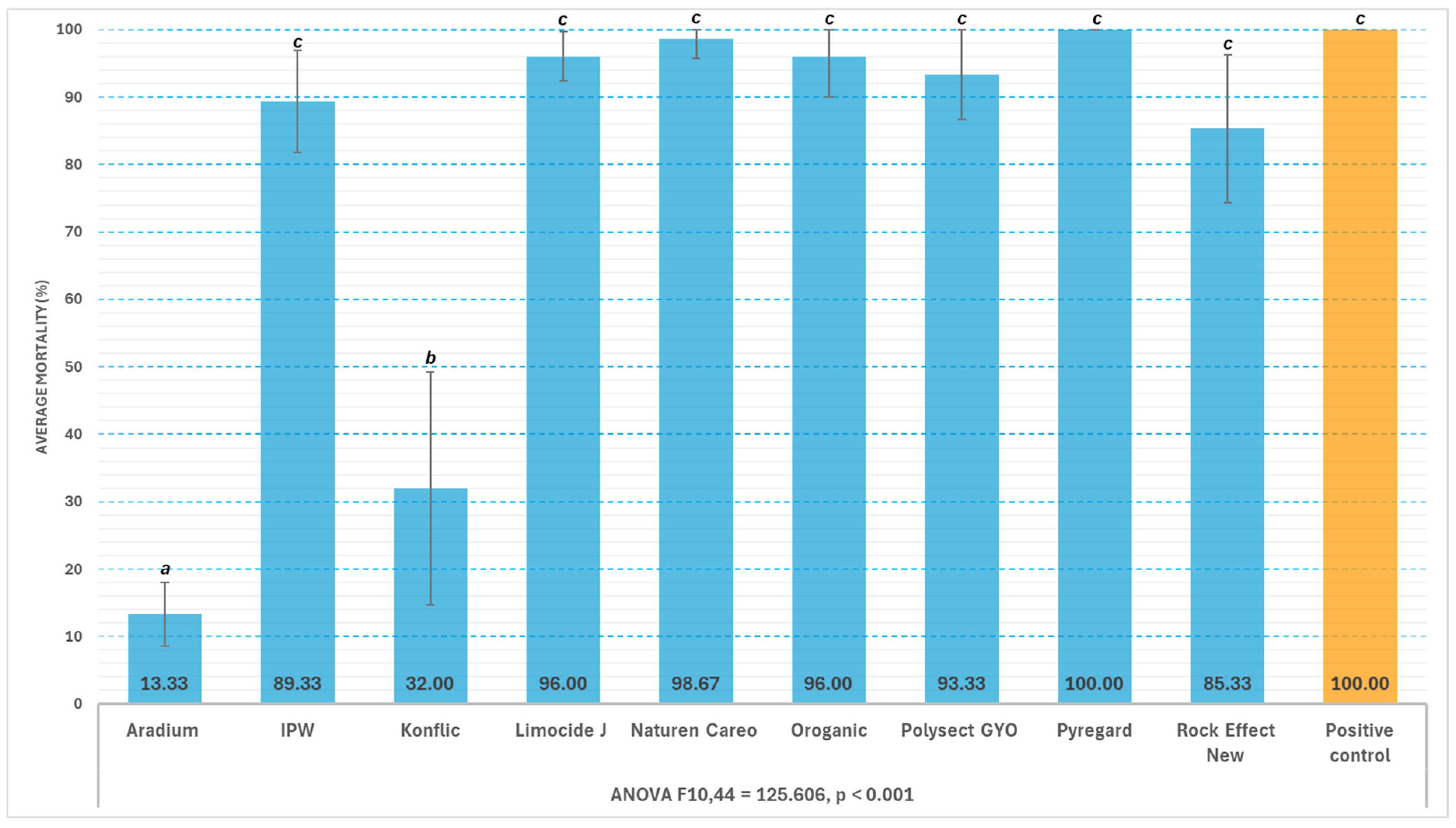
Out of the nine botanical insecticides tested, five products showed an average mortality above 90% in adult M. dirhodum. Pyregard® achieved 100% mortality, identical to the positive control group (Neudosan). Another two products showed mortality rates above 85%. Conversely, Aradium® and Konflic® showed low effectiveness and can be considered to have had little effect on the target pest (Figure 1).

3.2. Acute Toxicity Against Aphidoletes aphidimyza

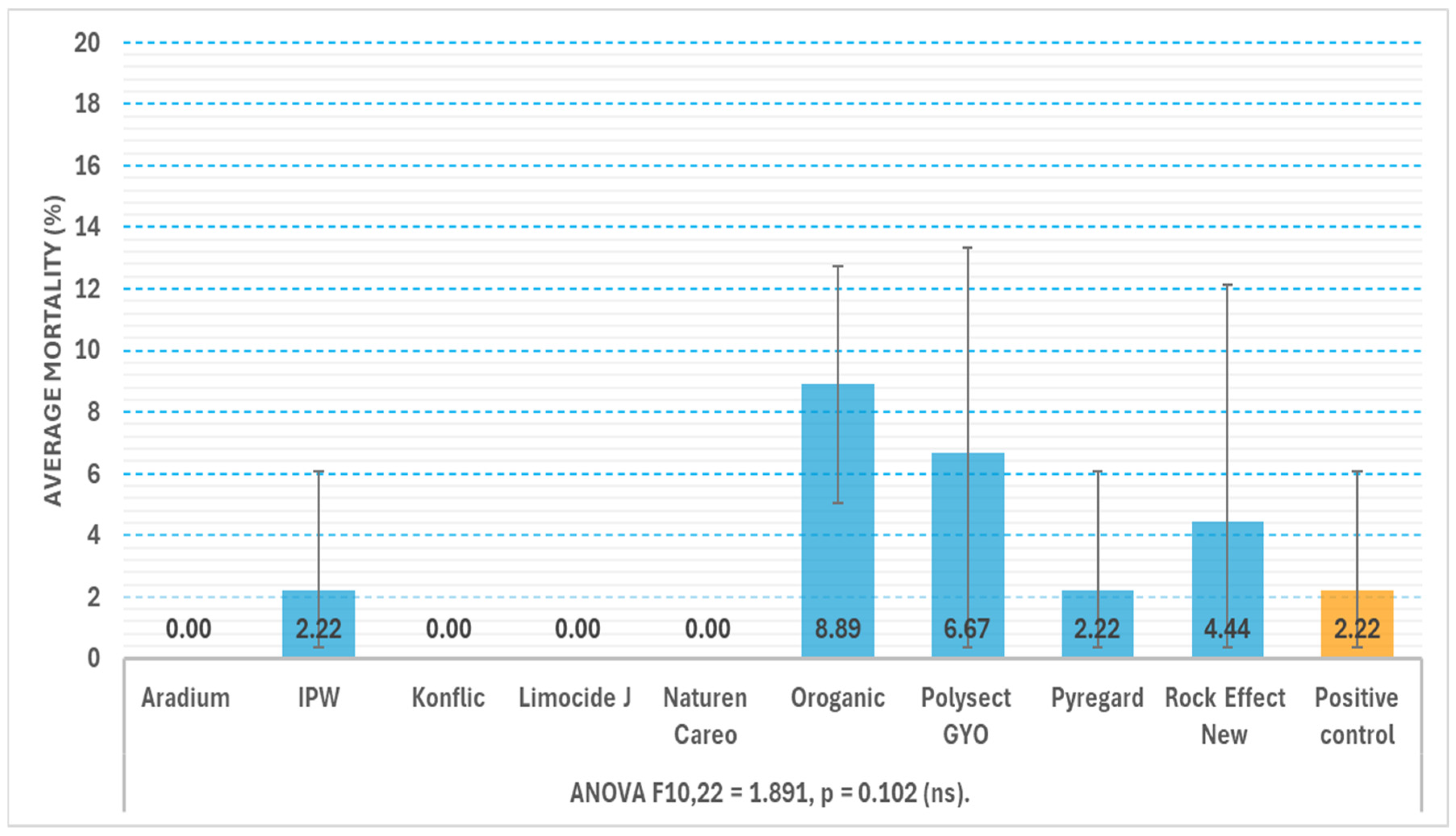
Larvae of A. aphidimyza were highly tolerant to all the products tested. All the products tested resulted in mortality rates below 10%; thus, they can all be classified in category 1 (harmless) for A. aphidimyza (Figure 2).

3.3. Acute Toxicity Against Chrysoperla carnea

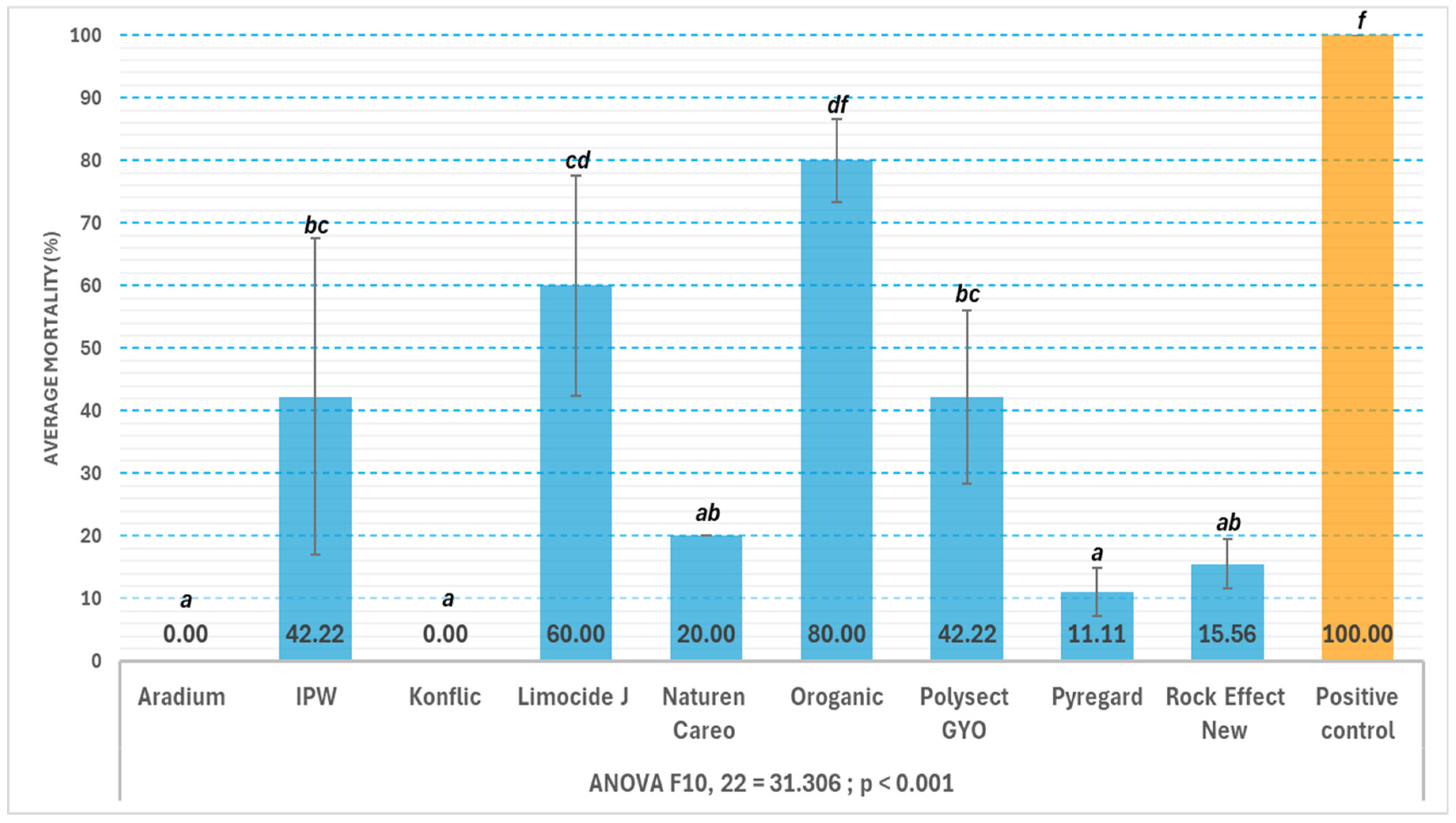
Larvae of C. carnea showed a significant difference across the products in terms of their effect on non-target predator mortality. The product Oroganic® falls into category 3 (moderately harmful). Another three products fall into category 2 (slightly harmful); the highest average mortality (60%) was observed for Limocide J®. The remaining five products showed mortality rates below 30%; they can therefore be classified as category 1 (harmless) (Figure 3).
Figure 2. Acute toxicity of botanical insecticides tested against A. aphidimyza larvae. No significant differences among means (ANOVA, Tukey’s HSD test, p < 0.05). Standard deviations are shown as error bars. Mortality rates were corrected using Abbott’s formula. Positive control = 20 mL L−1 Neudosan (active ingredient: potassium salts of fatty acids). IOBC/WPRS Working Group ‘Pesticides and Beneficial Organisms’ evaluation categories: 1 = harmless (<30%), 2 = slightly harmful (30–79%), 3 = moderately harmful (80–99%), 4 = harmful (>99%).
Agronomy 16 00577 g002
Figure 3. Acute toxicity of tested botanical insecticides against C. carnea larvae. The letters displayed above the bars indicate significant differences among means (ANOVA, Tukey’s HSD test, p < 0.05). Standard deviations are shown as error bars. Mortality rates were corrected using Abbott’s formula. Positive control = 20 mL L−1 Neudosan (active ingredient: potassium salts of fatty acids). IOBC/WPRS Working Group ‘Pesticides and Beneficial Organisms’ evaluation categories: 1 = harmless (<30%), 2 = slightly harmful (30–79%), 3 = moderately harmful (80–99%), 4 = harmful (>99%).
Agronomy 16 00577 g003

4. Discussion

The results of this study confirm that the effectiveness of botanical insecticides varies significantly across commercial products, which is in line with conclusions of previous works [6,19,20]. It is important to study the differences in effectiveness of commercial botanical insecticides, because products with little effect may have a negative influence on growers’ trust in botanical pesticides as a whole, thus slowing down their broader practical application [21].
The results of this study indicate that seven out of the nine products tested exhibited significant insecticidal effects against M. dirhodum. The most effective products in the test range were Pyregard® and Rock Effect New®, which demonstrated high effectiveness against the target pest while having minimal negative impact on the two tested predators. These properties are key from the perspective of integrated pest management, where retaining populations of natural enemies is a prerequisite for long-term efficiency [22].
Furthermore, the experiments with non-target organisms showed that A. aphidimyza tolerated all the products tested. This result supports its use in combination with botanical pesticides in greenhouse systems. In contrast, C. carnea was found to be more sensitive, but several of the products, including Rock Effect New®, Pyregard®, and NATUREN Careo®, can be regarded as compatible with this biological control agent. The products Aradium® and Konflic® showed zero mortality, but it has to be noted that these products were shown to have insufficient effect on the target pest.
In recent years, several studies have been published that have tested some of the products listed in the present work. However, it must be emphasized that it is very difficult to compare our results with those of other researchers, because the effectiveness of a BP may be influenced by differing methodology, different aphid sizes and species, and differing application methods and post-application conditions, notably, temperature.
Our results can be compared, for instance, with Moldovan et al. [6], who conducted a three-year experiment with aphids under laboratory conditions. The average mortality observed in unspecified aphids on plums treated with Konflic® from 2019–2021 ranged from 10 to 18%; the mortality for Prev-Am, which had a composition similar to the Oroganic® we tested and came from the same company, ranged from 78–90%. By comparison, we observed average mortality rates of 32% for Konflic® and 96% for Oroganic®.
The effectiveness of Pyregard® (0.75%) and Rock Effect New® (2.0%) was tested in laboratory experiments on the black cherry aphid (Myzus cerasi). Pyregard® caused a mortality of 100% and Rock Effect New® 91% [20]. Our study worked with slightly different concentrations; we observed an average mortality of 100% for Pyregard® (0.94%) and 85.33% for Rock Effect New® (1%). The product Limocide J® tested by Georgieva et al. [23] had 88–91% E (percentage of effectiveness) on Macrosiphum rosae.
Publications relating to the safety of tested products for A. aphidimyza and C. carnea are limited. Nevertheless, there are studies describing the toxicity of Limocide J® for some other insects and mites used as biological control agents. A mixed sample (larvae and adults) of Macrolophus pygmaeus suffered an average mortality of 23.33%, and a mixed sample of the predatory mite Amblyseius cucumeris demonstrated an average mortality of 27.78% [24]. El Aalaoui et al. [25] described low mortality rates (2–14%) in various instar larvae of Cryptolaemus montrouzieri. Such results suggest that the effects of botanical insecticides on non-target organisms are species-specific and cannot be generalized.
The products tested in the present paper showed diverse effective mechanisms. Products based on vegetable oils kill insects by way of suffocation: a thin layer of oil covers the entire insect body, so that air cannot enter tracheae, resulting in death of the treated insect [26]. Products based on potassium salt from vegetable oil cause insect death by disrupting the permeability of the cuticle and clogging the stigmata, leading to suffocation [27]. The effective mechanism of products based on orange oil involves chemical disruption of the pest’s cuticle, causing loss of its protective function, resulting in loss of liquid and subsequent death of the affected individual [28]. Q. amara extract contains compounds that act as acetylcholinesterase inhibitors or that disrupt the molting process [29], and the pyrethrins act as a modulator of nerve membrane sodium current by prolonging the opening of voltage-gated sodium (Na+) channels, resulting in overneuroexcitation. This causes a loss of control over coordinated movement, paralysis, and death in insects [30].
Nevertheless, the effective mechanisms of many botanical products have not all been sufficiently described. For example, according to the manufacturer, IPW® works by creating an oily film on the insect body, through which air exchange cannot proceed; thus, the insect suffocates. The product should also have an effective mechanism identical to that of products based on orange EO. However, taking the product composition into account, it has been found that the lemongrass oil and geranium oil contained in the product work as acetycholinesterase inhibitors [31,32]. In addition, the product also contains peppermint oil; its majority component, menthol, is known to increase the effectiveness of some acetylcholinesterase inhibitors [33]. These facts underline the need for more detailed study of the effective mechanisms of botanical pesticides.
As mentioned above, botanical insecticides have been a subject of interest of the international scientific community, reflected in the great number of scientific papers published on the topic. However, there has been a considerable lack of transfer of the results into practice in the form of newly developed products until recently. While their broader application was historically slowed down by strict regulatory requirements, the previous decade saw a certain relaxation of rules for low-risk pesticides, which has made it easier for more botanical products to enter the commercial market [4]. In the USA and Australia, BPs have even received a special status from the regulatory authorities, leading to faster approvals for new products [3]. However, only a limited number of active substances of plant origin remain permitted in the European Union, although botanical pesticides fit well within the modern and sustainable agriculture framework, particularly as part of IPM [5].
On the whole, however, it can be concluded that botanical insecticides are both toxicologically and environmentally safer than synthetic pesticides [34,35] and have application potential for both integrated and ecological production [5]. At the same time, however, it is necessary to systematically identify and reject low-effectiveness products, which may reduce user trust in this category of pesticides.

5. Conclusions

The present study demonstrates that botanical insecticides are not a homogeneous group of products and that their effectiveness as well as selectiveness differs significantly across commercial formulations. Only a part of the tested products met basic requirements for use in integrated pest management, namely, simultaneous high effectiveness on the target organism and low impact on non-target predatory species. Within the evaluated series, Pyregard® (natural pyrethrins–based) and Rock Effect New® (karanja oil–based achieved the most optimal outcome, combining strong target suppression with comparatively low non-target toxicity. Our results highlight the need for experimental assessment of specific commercial formulations and systematic rejection of underperforming products to ensure that botanical insecticides can be reliable components of integrated and ecological plant protection systems.

Author Contributions

Conceptualization, M.N. and R.P.; methodology, M.N. and R.P.; software, M.N. and R.P.; formal analysis, M.N. and R.P.; investigation, M.N.; data curation, R.P.; writing—original draft preparation, M.N. and R.P.; writing—review and editing, M.N. and R.P. All authors have read and agreed to the published version of the manuscript.

Funding

Financial support for this work was provided by the Technology Agency of the Czech Republic (Project no. FW06010376).

Data Availability Statement

The data presented in this study are available on request from the corresponding authors.

Conflicts of Interest

The authors declare no conflicts of interest.

Abbreviations

The following abbreviations are used in this manuscript:
BIsBotanical insecticides
EOEssential oil

References

  1. Cavoski, I.; Caboni, P.; Miano, T. Natural Pesticides and Future Perspectives. In Pesticides in the Modern World-Pesticides Use and Management, 1st ed.; Stoytcheva, M., Ed.; InTech: Rijeka, Croatia, 2011; Volume 4, pp. 169–190. [Google Scholar]
  2. Copping, L.G.; Menn, J.J. Biopesticides: A Review of Their Action, Applications and Efficacy. Pest Manag. Sci. 2000, 56, 651–676. [Google Scholar] [CrossRef]
  3. Isman, M.B. Bioinsecticides Based on Plant Essential Oils: A Short Overview. Z. Naturforsch. C 2020, 75, 179–182. [Google Scholar] [CrossRef] [PubMed]
  4. Isman, M.B. A Renaissance for Botanical Insecticides? Pest Manag. Sci. 2015, 71, 1587–1590. [Google Scholar] [CrossRef]
  5. Matyjaszczyk, E. Legislative Situation of Botanicals Used in Plant Protection in the European Union. J. Plant Dis. Prot. 2023, 130, 443–447. [Google Scholar] [CrossRef]
  6. Moldovan, C.; Zagrai, I.; Guzu, G.M.; Jakab-Ilyefalvi, Z.; Zagrai, L.A.; Mang, S.M.; Maxim, A. Alternative Ecological Products for Aphid Control on Plum. Plants 2023, 12, 3316. [Google Scholar] [CrossRef]
  7. Skalský, M.; Niedobová, J.; Popelka, J. The Efficacy of European Fruit Lecanium, Parthenolecanium corni (Bouché, 1844) Control Using Natural Products. Hort. Sci. 2019, 46, 195–200. [Google Scholar] [CrossRef]
  8. Souza, C.M.; Baldin, E.L.L.; Ribeiro, L.P.; Silva, I.F.; Morando, R.; Bicalho, K.U.; Vendramim, J.D.; Fernandes, J.B. Lethal and Growth Inhibitory Activities of Neotropical Annonaceae-Derived Extracts, Commercial Formulation, and an Isolated Acetogenin against Helicoverpa armigera. J. Pest Sci. 2017, 90, 701–709. [Google Scholar] [CrossRef]
  9. Maldonado-Reina, A.J.; López-Ruiz, R.; Frenich, A.G.; Arrebola, F.J.; Romero-González, R. Co-Formulants in Plant Protection Products: An Analytical Approach to Their Determination by Gas Chromatography–High Resolution Mass Accuracy Spectrometry. Talanta 2021, 234, 122641. [Google Scholar] [CrossRef]
  10. Honek, A.; Martinkova, Z. Host Plant Age and Population Development of a Cereal Aphid, Metopolophium dirhodum (Hemiptera: Aphididae). Bull. Entomol. Res. 2004, 94, 19–26. [Google Scholar] [CrossRef]
  11. Holt, J.; Griffiths, E.; Wratten, S.D. The Influence of Wheat Growth Stage on Yield Reductions Caused by the Rose-grain Aphid, Metopolophium dirhodum. Ann. Appl. Biol. 1984, 105, 7–14. [Google Scholar] [CrossRef]
  12. Gong, P.; Chen, D.; Wang, C.; Li, M.; Li, X.; Zhang, Y.; Li, X.; Zhu, X. Susceptibility of Four Species of Aphids in Wheat to Seven Insecticides and Its Relationship to Detoxifying Enzymes. Front. Physiol. 2021, 11, 623612. [Google Scholar] [CrossRef]
  13. Syrett, P.; Penman, D.R. Studies of Insecticide Toxicity to Lucerne Aphids and Their Predators. N. Z. J. Agric. Res. 1980, 23, 575–580. [Google Scholar] [CrossRef]
  14. Jandricic, S.E.; Wraight, S.P.; Gillespie, D.R.; Sanderson, J.P. Oviposition Behavior of the Biological Control Agent Aphidoletes aphidimyza (Diptera: Cecidomyiidae) in Environments with Multiple Pest Aphid Species (Hemiptera: Aphididae). Biol. Control 2013, 65, 235–245. [Google Scholar] [CrossRef]
  15. Carrillo, M.; Elanov, P. The Potential of Chrysoperla carnea as a Biological Control Agent of Myzus persicae in Glass Houses. Annl. Appl. Biol. 2004, 32, 433–439. [Google Scholar]
  16. Sterk, G.; Hassan, S.A.; Baillod, M.; Bakker, F.; Bigler, F.; Blümel, S.; Bogenschütz, H.; Boller, E.; Bromand, B.; Brun, J. Results of the Seventh Joint Pesticide Testing Programme Carried out by the IOBC/WPRS-Working Group ‘Pesticides and Beneficial Organisms’. BioControl 1999, 44, 99–117. [Google Scholar] [CrossRef]
  17. Almasi, A.; Sabahi, Q.; Talebi, K.; Mardani, A. Laboratory Evaluation of the Toxicity of Proteus, Pymetrozine, Deltamethrin, and Pirimicarb on Lady Beetle Hippodamia variegata (Goeze)(Col.: Coccinellidae). J. Plant Prot. Res. 2013, 53, 143–147. [Google Scholar] [CrossRef]
  18. Abbott, W.S. A Method of Computing the Effectiveness of an Insecticide. J. Econ. Entomol. 1925, 18, 265–267. [Google Scholar] [CrossRef]
  19. Ribeiro, L.P.; Akhtar, Y.; Vendramim, J.D.; Isman, M.B. Comparative Bioactivity of Selected Seed Extracts from Brazilian Annona Species and an Acetogenin-Based Commercial Bioinsecticide against Trichoplusia ni and Myzus persicae. Crop Prot. 2014, 62, 100–106. [Google Scholar] [CrossRef]
  20. Skalský, M.; Ouředníčková, J. Effectiveness of selected products against black cherry aphid. Vědecké Práce Ovocnářské 2025, 31, 55–62. [Google Scholar]
  21. Acheuk, F.; Basiouni, S.; Shehata, A.A.; Dick, K.; Hajri, H.; Lasram, S.; Yilmaz, M.; Emekci, M.; Tsiamis, G.; Spona-Friedl, M. Status and Prospects of Botanical Biopesticides in Europe and Mediterranean Countries. Biomolecules 2022, 12, 311. [Google Scholar] [CrossRef]
  22. Yarahmadi, F.; Rajabpour, A. Insecticides and Natural Enemies: Applications in Integrated Pest Management Programs–Challenges, Criteria, and Evaluation for Recommendations. In Insecticides in Pest Control-Impact, Challenges and Strategies, 1st ed.; Kumar, S., Ed.; InTechOpen: London, UK, 2024; Volume 16, pp. 307–325. [Google Scholar]
  23. Georgieva, R.; Manolov, I.; Manhart, S.; Steinkellner, S.; Möth, S. Sucking insect’s pest management in organic rose production. Agric. Sci. 2024, 16, 143–150. [Google Scholar] [CrossRef]
  24. Mineva, R.; Yankova, V.; Valchev, N. Side effect of insecticides against some beneficial species. Agric. Sci. 2024, 16, 42–51. [Google Scholar] [CrossRef]
  25. El Aalaoui, M.; El Bouhssini, M.; Bouharroud, R.; Sbaghi, M. Lethal and Sublethal Effects of the Insecticides D-Limonene, Mineral Oil, and Potassium Salts of Fatty Acid on Dactylopius opuntiae Potential Predator Cryptolaemus montrouzieri. Int. J. Trop. Insect Sci. 2021, 41, 2897–2906. [Google Scholar] [CrossRef]
  26. Walia, S.; Saha, S.; Rana, V.S. Phytochemical Pesticides. In Advances in Plant Biopesticides, 1st ed.; Singh, D., Ed.; Springer: New Delhi, India, 2014; pp. 295–322. [Google Scholar]
  27. Tremblay, É.; Bélanger, A.; Brosseau, M.; Boivin, G. Toxicity and Sublethal Effects of an Insecticidal Soap on Aphidius colemani (Hymenoptera: Braconidae). Pest Manag. Sci. 2008, 64, 249–254. [Google Scholar] [CrossRef]
  28. Popescu, I.E.; Gostin, I.N.; Blidar, C.F. An Overview of the Mechanisms of Action and Administration Technologies of the Essential Oils Used as Green Insecticides. AgriEngineering 2024, 6, 1195–1217. [Google Scholar] [CrossRef]
  29. Mostafa, M.E.; El-Rokh, A.R.; Abdel-Mogib, M.; Abd El Salam, M.; El-Sharkawy, R.A.; Refaat, M.; El-Masry, G.N.; Abd El-Mageed, A.E.M.; Soliman, A.F. Quassia amara Linn. (Simaroubaceae): Phytochemical Composition and Biopesticidal Potential. J. Plant Dis. Prot. 2025, 132, 97. [Google Scholar] [CrossRef]
  30. Chaudhary, S.; Yadav, S.K.; Verma, P.; Sagar, S.; Lal, M. Botanical Insecticides for Crop Protection: Major Classes and Possible Mechanisms of Action. In Insecticides in Pest Control-Impact, Challenges and Strategies, 1st ed.; Kumar, S., Ed.; InTechOpen: London, UK, 2024; Volume 16, pp. 161–188. [Google Scholar]
  31. Han, Y.; Zhu, M.; Qiu, B.; Ali, S.; Wu, J. Insecticidal Effect of Lemongrass Essential Oil Against Megalurothrips usitatus (Bagnall). Agronomy 2025, 15, 1733. [Google Scholar] [CrossRef]
  32. Aboelhadid, S.M.; Abdel-Baki, A.S.; Hassan, K.M.; Ibrahium, S.M.; Al-Quraishy, S.; Hassan, A.O.; Kamel, A.A. Insecticidal Efficacy of Geranium Oil Nanoemulsion and Synergism with Sesame Oil and Their Acetylcholinesterase Inhibition. Pak. J. Zool 2023, 56, 1–17. [Google Scholar] [CrossRef]
  33. Jankowska, M.; Lapied, B.; Jankowski, W.; Stankiewicz, M. The Unusual Action of Essential Oil Component, Menthol, in Potentiating the Effect of the Carbamate Insecticide, Bendiocarb. Pestic. Biochem. Physiol. 2019, 158, 101–111. [Google Scholar] [CrossRef] [PubMed]
  34. Ngegba, P.M.; Cui, G.; Khalid, M.Z.; Zhong, G. Use of Botanical Pesticides in Agriculture as an Alternative to Synthetic Pesticides. Agriculture 2022, 12, 600. [Google Scholar] [CrossRef]
  35. Pavela, R.; Benelli, G. Essential Oils as Ecofriendly Biopesticides? Challenges and Constraints. Trends Plant Sci. 2016, 21, 1000–1007. [Google Scholar] [CrossRef]
Figure 1. Acute toxicity of tested botanical insecticides against M. dirhodum adults. The letters displayed above the bars indicate significant differences among means (ANOVA, Tukey’s HSD test, p < 0.05). Standard deviations are shown as error bars. Mortality rates were corrected using Abbott’s formula. Positive control = 20 mL L−1 Neudosan (active ingredient: potassium salts of fatty acids).
Agronomy 16 00577 g001
Disclaimer/Publisher’s Note: The statements, opinions and data contained in all publications are solely those of the individual author(s) and contributor(s) and not of MDPI and/or the editor(s). MDPI and/or the editor(s) disclaim responsibility for any injury to people or property resulting from any ideas, methods, instructions or products referred to in the content.