Article

Genome-Wide Identification and Expression Analysis of R2R3-MYB Gene Family in Chrysanthemum indicum Under Low-Temperature Stress


1
College of Horticulture, Jilin Agricultural University, 2888 Xincheng Street, Changchun 130118, China
2
Jilin Provincial Key Laboratory of Horticultural Plant Genetics, Breeding and Biotechnology, 2888 Xincheng Street, Changchun 130118, China
*
Author to whom correspondence should be addressed.
Agronomy 2026, 16(5), 567; https://doi.org/10.3390/agronomy16050567
Submission received: 20 January 2026 / Revised: 28 February 2026 / Accepted: 4 March 2026 / Published: 5 March 2026
(This article belongs to the Section Crop Breeding and Genetics)

Abstract

Low-temperature stress is a major factor limiting the development of the chrysanthemum industry. Chrysanthemum indicum L., wild germplasm with strong cold tolerance within the genus, is an ideal material for mining cold resistance genes. Through preliminary transcriptome analysis of C. indicum under low-temperature stress (PRJNA1391062), we found that multiple R2R3-MYB family members were significantly differentially expressed (|log2FC| ≥ 1, p < 0.05), suggesting that this family may play important roles in cold stress responses. Within the C. indicum genome, we identified 63 R2R3-MYB members (CiMYBs) through HMMER and BLAST searches combined with domain validation. Phylogenetic analysis classified these genes into 19 subgroups, with most key nodes supported by bootstrap values > 80%. Promoter cis-element analysis revealed enrichment of elements related to light responsiveness, hormone signaling, and stress responses, including 41 low-temperature responsive elements distributed across 28 genes and 32 drought-induced MYB-binding sites present in 23 genes. Synteny analysis identified 13 duplicated gene pairs within the C. indicum genome and 41 collinear gene pairs between C. indicum and Arabidopsis thaliana L. Transcriptome data under low-temperature stress showed that 22 of the 63 CiMYB members were differentially expressed under 4 °C acclimation and −4 °C freezing stress, and they could be classified into three response patterns: acute stress-responsive (rapid upregulation upon initial stress), acclimation-induced (significant activation after 4 °C acclimation), and freezing-suppressed (downregulation after −4 °C freezing). Six differentially expressed genes were randomly selected for RT-qPCR validation, and the results showed consistent trends with the transcriptome data. This study provides a comprehensive identification of R2R3-MYB family members in C. indicum and reveals their expression divergence under low-temperature stress, offering candidate gene resources for deciphering the cold adaptation mechanisms of C. indicum and breeding new cold-resistant chrysanthemum cultivars.

1. Introduction

Chrysanthemum (Chrysanthemum spp.), an economically important plant with integrated ornamental [1], tea, and medicinal values [2], faces significant constraints in its industrial development due to low-temperature stress. Consequently, identifying key cold-tolerance genes and breeding resilient cultivars have become central objectives in chrysanthemum genetic improvement [3]. Chrysanthemum indicum is not only a valuable resource for traditional medicine and “medicinal-food homology” [4], but it also stands out as one of the most cold-tolerant wild relatives [5]. This makes it an ideal natural material for deciphering the molecular mechanisms of cold adaptation in chrysanthemums. Recently, a chromosome-scale high-quality genome assembly of C. indicum became publicly available [6], providing a solid foundation for genome-wide investigation of stress-related gene families.
The MYB transcription factor family represents one of the largest transcription factor families in plants and is ubiquitous across eukaryotes [7]. MYB proteins are characterized by a highly conserved N-terminal MYB domain (DNA-binding domain, DBD) composed of one to four incomplete repeats (R), and they are classified into four subfamilies according to the number of these R repeats: 4R-MYB, R1R2R3-MYB (3R-MYB), R2R3-MYB (2R-MYB), and 1R-MYB [8,9]. Among these, the R2R3-MYB family is the most expansive in terms of member count. The R2R3-MYB gene family has been systematically identified and classified in diverse plant species, including A. thaliana [8,9], Zingiber officinale Roscoe [10], Oryza sativa L. [11,12], Populus trichocarpa Torr. & A. Gray ex Hook [13], Hibiscus hamabo Sieb. et Zucc. [14], Pisum sativum L. [15], Nicotiana tabacum L. [16], Gossypium species L. [17] and Linum usitatissimum L. [18]. These studies consistently classify members into subgroups based on variation within their conserved C-terminal domains, with the number of subgroups varying greatly among species—for example, 25 in A. thaliana [8,9], 36 in P. sativum [15], and 34 in N. tabacum [16]. Functionally, R2R3-MYB transcription factors are key regulators of plant-specific processes, encompassing primary and secondary metabolism, cell fate and identity, developmental processes, and responses to biotic and abiotic stresses [19]. In the context of stress responses, they have been demonstrated to enhance tolerance to drought, salt, and cold stress [20,21,22] in taxa such as Populus davidiana Dode × P. bolleana Lauch, Malus domestica Borkh. and Solanum pennellii Correll.
Notably, R2R3-MYB genes act as central regulators in plant adaptation to low-temperature stress. For instance, overexpression of RmMYB108 from Rosa multiflora Thunb. in A. thaliana increases antioxidant enzyme activities, thereby alleviating oxidative damage and enhancing freezing tolerance [23]. Similarly, the PbMYB1L from Pyrus bretschneideri Rehd. not only activates key cold-response factors but also regulates anthocyanin synthesis, linking cold resistance with pigment metabolism [24]. This dual function, often mediated through the formation of MBW complexes or MBW-independent pathways, represents a widespread regulatory paradigm by which R2R3-MYB transcription factors coordinate cold tolerance with pigment metabolism across plant species [25]. In tomato (S. lycopersicum L.), the R2R3-MYB factor MYB15 is integrated into a transcriptional cascade where it is directly activated by HY5, and together, they coregulate the expression of CBF genes to modulate cold tolerance [26]. Beyond functioning individually, R2R3-MYBs often operate within complex regulatory networks. In Arachis hypogaea L., AhMYB30 modulates both the DREB/CBF and ABA signaling pathways to improve cold tolerance [27]. Synergistic interactions among members, such as CsMYB45, CsMYB46, and CsMYB105 in Camellia sinensis L., collectively enhance cold tolerance through interaction with jasmonic acid signaling [28].
This study performed a genome-wide identification of the R2R3-MYB family members (CiMYBs) in C. indicum using bioinformatic approaches. By integrating low-temperature transcriptome data with RT-qPCR validation, we delineated the low-temperature-responsive expression patterns of these genes and screened key candidate genes potentially involved in the cold stress response. This work lays a foundation for further deciphering the molecular basis of cold tolerance and mining valuable genetic resources in C. indicum.

2. Materials and Methods

2.1. Screening of R2R3-MYB Gene Family Members in C. indicum

The genomic information files of the reference genome for C. indicum were retrieved from the Chrysanthemum Genome Database [29] (https://cgd.njau.edu.cn/; accessed on 9 October 2025). The hidden Markov model (HMM) profile for the MYB domain (PF00249) was obtained from the EMBL Pfam database [30] (http://pfam.xfam.org/; accessed on 9 October 2025). A HMM search against the C. indicum protein database was conducted using HMMER software (version 3.1) with an E-value cutoff of 1 × 10⁻⁸ to identify protein sequences containing the MYB domain [31]. Furthermore, the protein sequences of R2R3-MYB transcription factors from A. thaliana were downloaded from The Arabidopsis Information Resource (TAIR, version 10) [32] (https://www.arabidopsis.org/; accessed on 9 October 2025). A local BLASTP search was performed on these sequences as queries against the C. indicum genome database with an E-value threshold of 1 × 10⁻¹⁰, a minimum sequence identity of 40%, and a query coverage of ≥50% to ensure significant homology and domain integrity [33]. The resulting candidate genes from both the HMMER and BLAST (version 2.16) searches were subsequently merged. Finally, to confirm the integrity of the MYB domain, the combined set of candidate genes was subjected to manual validation with the SMART (Genomic mode) [34] (https://smart.embl.de/; accessed on 9 October 2025) and Pfam databases (version 38.0) [35] (http://pfam.xfam.org/; accessed on 9 October 2025). The complete amino acid sequence of the MYB domain was screened to determine the members of the R2R3-MYB gene family. Only protein sequences confirmed by both databases to contain two complete and typical R2 and R3 MYB repeats, with no other disruptive domains, were retained as final CiMYB members. Sequences containing only a single or incomplete domain, or exhibiting abnormal domain arrangements, were excluded.

2.2. Phylogenetic Tree Construction, Chromosome Location and Collinearity Analysis

Multiple sequence alignment of MYB protein sequences from C. indicum and A. thaliana was performed with the MUSCLE algorithm (v3.8.31) implemented in MEGA 7.0. A phylogenetic tree was subsequently constructed based on the aligned sequences by using the Maximum Likelihood (ML) method implemented in IQ-TREE software (version 2.2.0) [36], with the more ancient R1/R2-type MYB gene (AtCCA1) [9] used as an outgroup for tree rooting. The best-fit amino acid substitution model was determined with the built-in ModelFinder program based on the Bayesian Information Criterion (BIC), and the VT+F+G4 model was selected. Branch support was assessed using the Ultrafast Bootstrap method with 1000 replicates. The tree was visualized and polished with the Chiplot online tool to generate a publication-ready circular tree. The chromosomal locations of CiMYBs were mapped with TBtools software (version 1.1.13). Synteny and gene duplication analyses were conducted employing the Circle Gene View and Advanced Circos functions within TBtools [37] (version 1.1.13). Segmental or whole-genome duplication pairs were required to be located within syntenic blocks identified through whole-genome synteny analysis, with their coding sequences meeting both of the following thresholds in a BLASTN search: alignment coverage ≥ 70% and sequence identity ≥ 70%. Tandem duplication pairs were defined as adjacent CiMYB genes located on the same chromosome with an intergenic distance of ≤100 kb.

2.3. Cis-Element Analysis in CiMYB Promoters

To ensure the biological accuracy of the cis-acting element analysis, we precisely defined the promoter regions in this study. First, high-confidence transcription start sites (TSS) for each CiMYB gene were predicted using the TSS Plant tool (http://www.softberry.com/; accessed on 13 February 2026), based on the FGENESH algorithm, leveraging the C. indicum genome annotation. Subsequently, the promoter region was strictly defined as the 2000 bp genomic sequence upstream of the TSS for each gene, and this region was extracted from the genome. Finally, the obtained promoter sequences were submitted to the PlantCARE database (https://bioinformatics.psb.ugent.be/webtools/plantcare/html/; accessed on 13 February 2026) for systematic identification of cis-regulatory elements within these authentic promoter sequences [38]. The distribution of cis-elements in the promoter regions of CiMYB genes was visualized by using TBtools software (version 1.1.13).

2.4. Expression Profile Analysis of CiMYBs Under Low-Temperature Stress Based on Transcriptome Data

To investigate the regulatory dynamics of the R2R3-MYB transcription factor family under low-temperature stress, this research analyzed transcriptomic datasets previously generated by our group and deposited in the NCBI SRA repository under accession number PRJNA1391062. The dataset comprises gene expression profiles (in FPKM values) across four experimental conditions, defined as follows: T01 (control, maintained at 25 °C); T02 (direct transfer to −4 °C for 4 h); T03 (4 °C for 4 h followed immediately by −4 °C for 4 h); and T04 (4 °C for 4 h).
The plant materials and experimental procedures for generating these data are as follows. Seeds of C. indicum, from the germplasm resource bank of the Horticulture College, Jilin Agricultural University, were sown in a mixed substrate (peat: garden soil: perlite: sand = 3:2:1:1, v/v/v/v) and grown in a controlled environment chamber at 25 ± 1 °C with 60 ± 5% relative humidity, under a 16/8 h light/dark photoperiod with a photosynthetic photon flux density of 30–40 μmol m−2 s−1. Seedlings were watered every three days and received no fertilizer throughout the 60-day growth period prior to treatments. Representative plant specimens are preserved in the laboratory of the College of Horticulture, Jilin Agricultural University for verification; formal herbarium vouchers were not deposited.
After 60 days, uniform seedlings were randomly allocated into the four treatment groups (T01–T04) with ten plants per group. Following treatment, leaves from the middle stem section of each plant were collected. For each treatment, samples from all ten plants were pooled to form three biological replicates, with each replicate comprising a mixture of leaves from 3–4 randomly selected plants. All pooled samples were flash-frozen in liquid nitrogen and stored at −80 °C until RNA extraction and subsequent transcriptome sequencing.
Clean reads were aligned to the C. indicum reference genome using hisat2, and gene expression levels (FPKM) were quantified with featureCounts. Expression profiles of the 63 CiMYB genes were extracted, and differential expression analysis was performed using DESeq2. Genes with Benjamini–Hochberg adjusted p-value ≤ 0.05 and |log2FC| ≥ 1 were considered significantly differentially expressed in pairwise comparisons [39].
CiMYB genes meeting these thresholds in at least one comparison were defined as low-temperature-responsive. Their expression patterns across treatments were visualized as a heatmap. Based on response patterns, these genes were classified into three types: (1) acute stress-responsive—significant in T02 vs. T01 but not in T04 vs. T01; (2) acclimation-responsive—significant in T03 vs. T01 or T04 vs. T01, with patterns distinct from T02 vs. T01; (3) persistently suppressed—significant downregulation in all three stress comparisons.
All classifications were based on stringent statistical thresholds and confirmed by consistent expression trends across three biological replicates, ensuring robustness and reliability of the identified response types.

2.5. RT-qPCR Validation Analysis

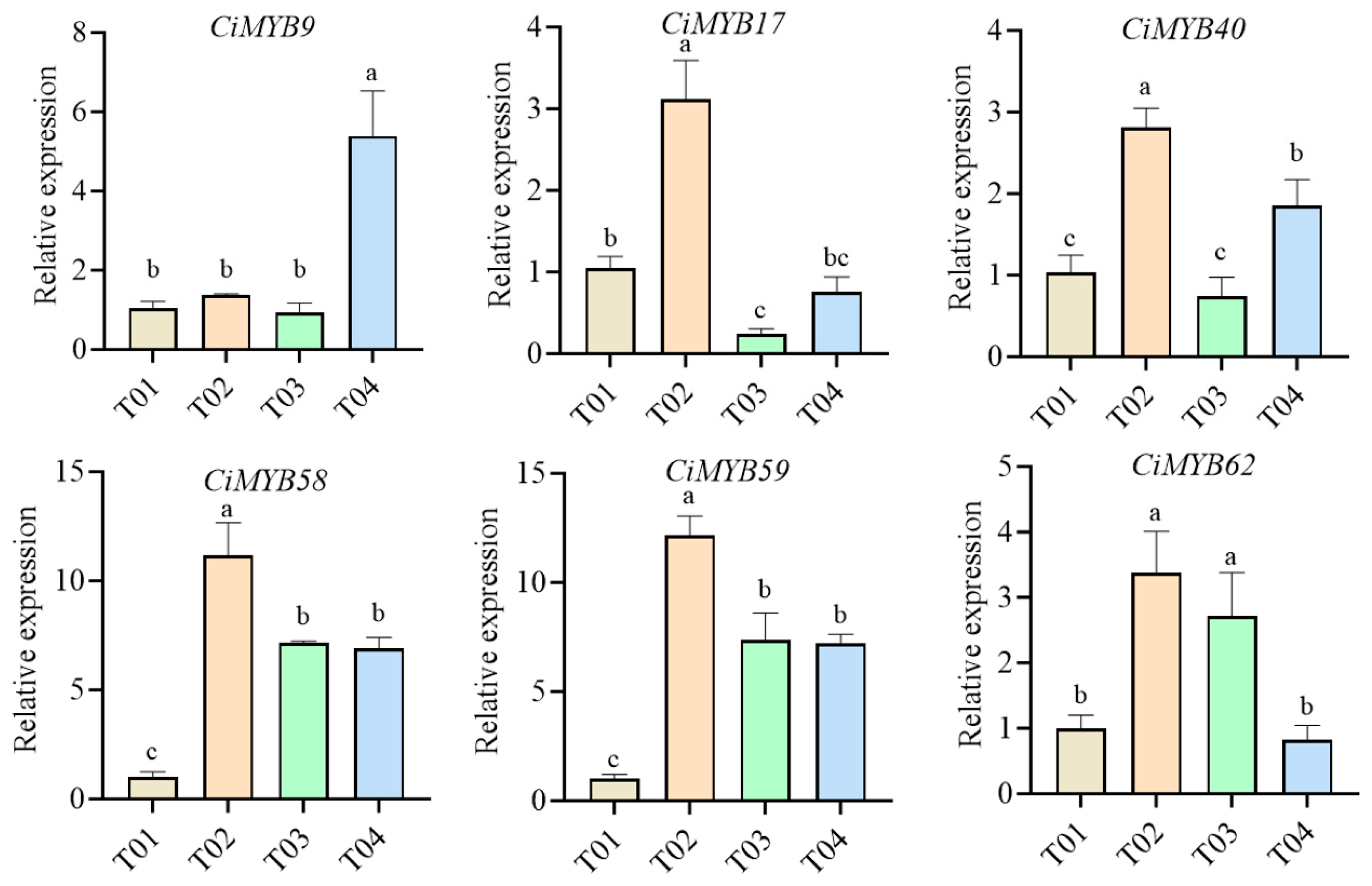
To validate the expression patterns observed by transcriptome analysis, six CiMYB genes were selected for RT-qPCR analysis. Total RNA for RT-qPCR was extracted from the same pooled leaf samples used for transcriptome sequencing, which were collected from C. indicum seedlings under the four treatment conditions (T01–T04). For each treatment, three biological replicates were used, with each replicate consisting of pooled leaves from 3–4 randomly selected plants. FastPure Plant Total RNA extraction kit (CWBIO, Taizhou, China) was used to extract total RNA from each sample, and a HiscriPt III RT SuperMix for qPCR kit (Novoprotein, Suzhou, China) was used to synthesize the first-strand cDNA. After the cDNA template was diluted 5 times, RT-qPCR was performed using a SYBR qPCR Supermix Plus kit (Novoprotein, Suzhou, China). The reaction procedure was as follows: pre-denaturation at 95 °C for 10 min; followed by 35 cycles of 95 °C for 10 s, 60 °C for 30 s, and 72 °C for 32 s. Gene-specific primers are listed in Table S1, and CiEF1a was used as the reference gene for normalization. The relative gene expression was calculated by 2−ΔΔCt method [40]. Statistical significance among treatment groups was assessed by one-way ANOVA followed by Tukey’s test (p < 0.05), and different lowercase letters indicate significant differences. The consistency between RNA-seq and RT-qPCR data was assessed by Pearson correlation and linear regression based on log2(FC) values. GraphPad Prism 8.0 visual PCR results were used.

3. Results

3.1. Identification and Phylogenetic Analysis of CiMYB Genes

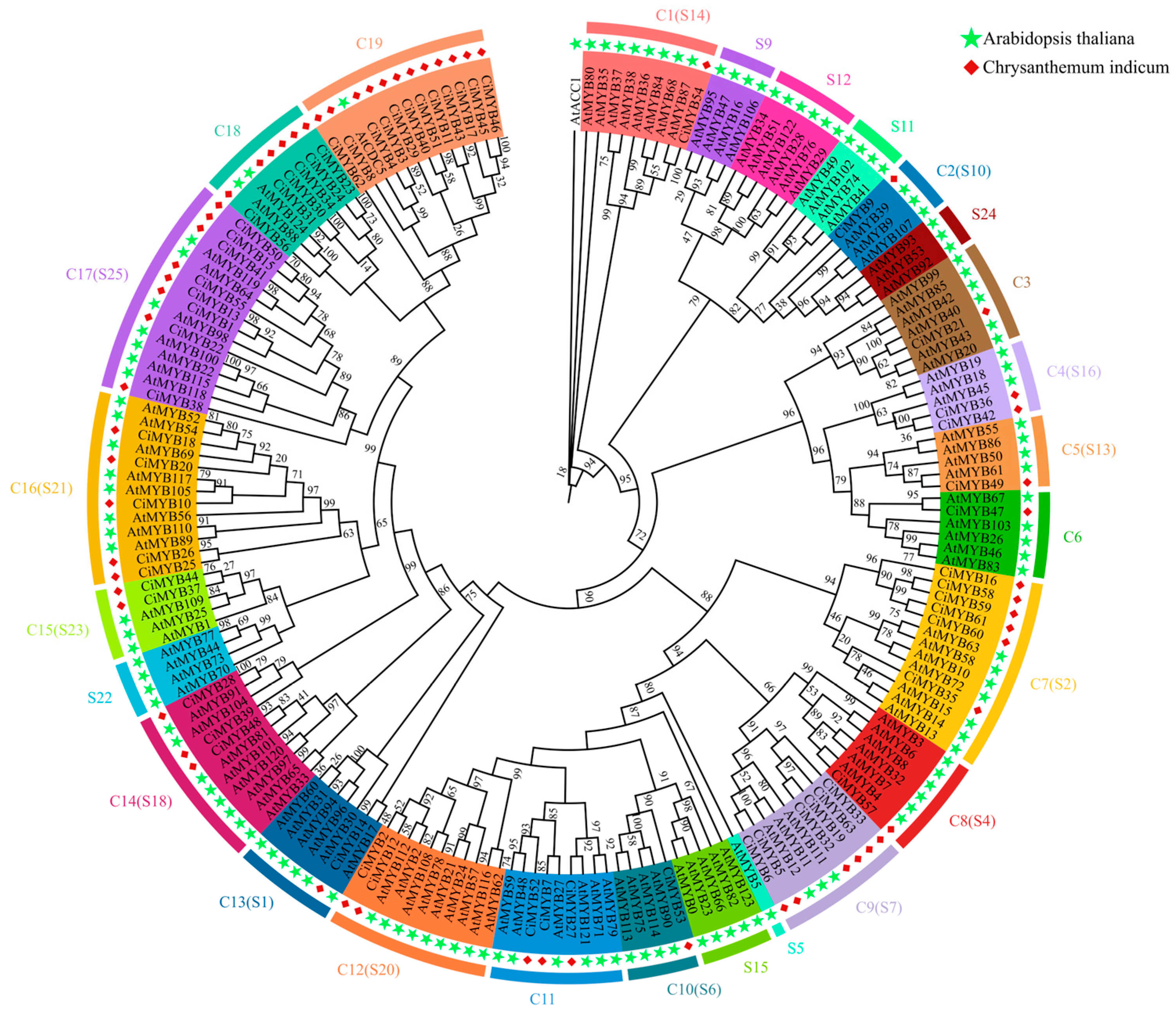
Through the Hmm model and local Blast comparison, in combination with the SMART, InterPro and CDD databases, 63 fully structured CiMYB family members were screened in the C. indicum genome database. To investigate the evolutionary relationships of CiMYBs, a phylogenetic tree was constructed, with the ancient R1/R2-type MYB gene AtCCA1 as an outgroup, comprising 63 C. indicum genes and 126 A. thaliana R2R3-MYB members (Figure 1). Based on the established Arabidopsis R2R3-MYB subfamily classification system, the CiMYBs were classified into 19 distinct subgroups, most of which were supported by high bootstrap values (>80%) at key nodes, providing statistical confidence for the subgroup assignments. The distribution of CiMYBs across these subgroups showed substantial variation. Overall, subgroups located in distal branches of the phylogenetic tree (i.e., those more distant from the outgroup) tended to contain more CiMYB members, whereas basal subgroups closer to the outgroup contained fewer members. For instance, the largest subgroups—C17, C18, and C19—were positioned in the most distal clades, with C19 containing 12 members. In contrast, basal subgroups such as C1 (S14), C2 (S10), C3, C5 (S13), C6, C8 (S4), C10 (S6), and C13 (S1) each contained only a single CiMYB member.

3.2. Chromosomal Distribution and Promoter Architecture of CiMYB Genes

63 CiMYBs were mapped on 9 chromosomes (Figure S1). There are 15 CiMYBs on chromosome 4, accounting for the largest proportion, whereas chromosome 3 contained the fewest, with only three members. Each C. indicum gene was named CiMYB1 to CiMYB63 based on chromosome positioning.
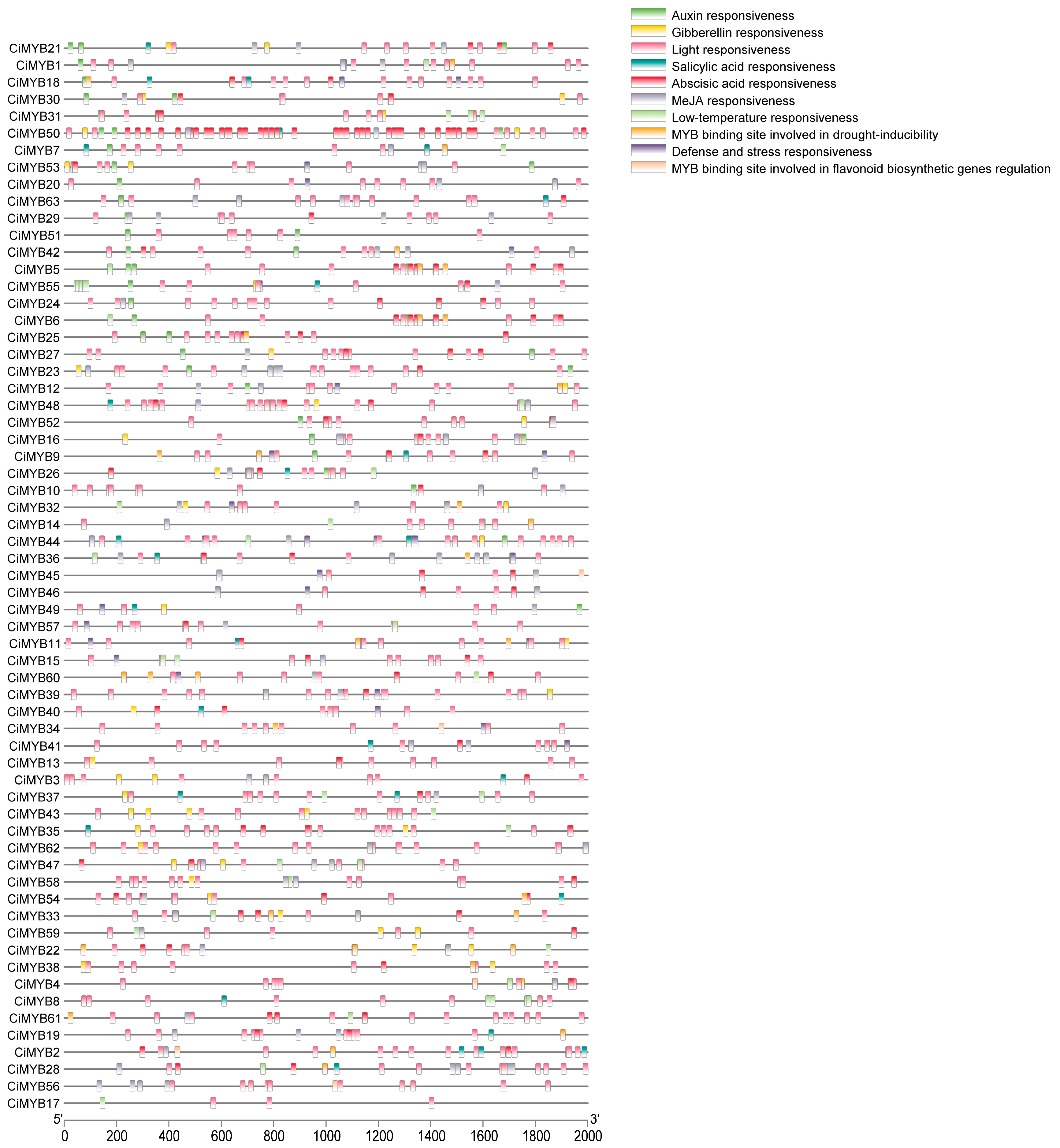
To investigate the transcriptional regulatory characteristics of CiMYB genes, we performed bioinformatic analysis of cis-acting elements in the promoter regions (defined as 2000 bp upstream of the transcription start site). Predictions from the PlantCARE database revealed an enrichment trend of cis-elements associated with light responsiveness, hormone signaling, and abiotic stress responses within this gene family (Figure 2). Extensive analysis was performed on hormone-responsive elements. A total of 502 hormone-responsive motifs were identified in the promoters of 61 genes, yet their distribution was markedly uneven. Among these hormone-related motifs, abscisic acid (ABA)-responsive elements constituted the majority. Additionally, elements responsive to auxin (Aux), gibberellin (GA), methyl jasmonate (MeJA), and salicylic acid (SA) were also widely detected. Among the stress-responsive elements, we identified 41 low-temperature responsive elements (LTREs) and 32 drought-induced MYB-binding sites. Specifically, the LTREs were distributed across the promoter regions of 28 CiMYB genes, while the drought-induced MYB-binding sites were present in the promoters of 23 genes. These elements represent important regulatory sites for genes to respond to environmental signals. Their distribution patterns in the CiMYB promoters provide important clues for further investigating the potential functions of this gene family in cold acclimation and stress responses.

3.3. Collinearity Analysis and Segmental Gene Duplication Analysis

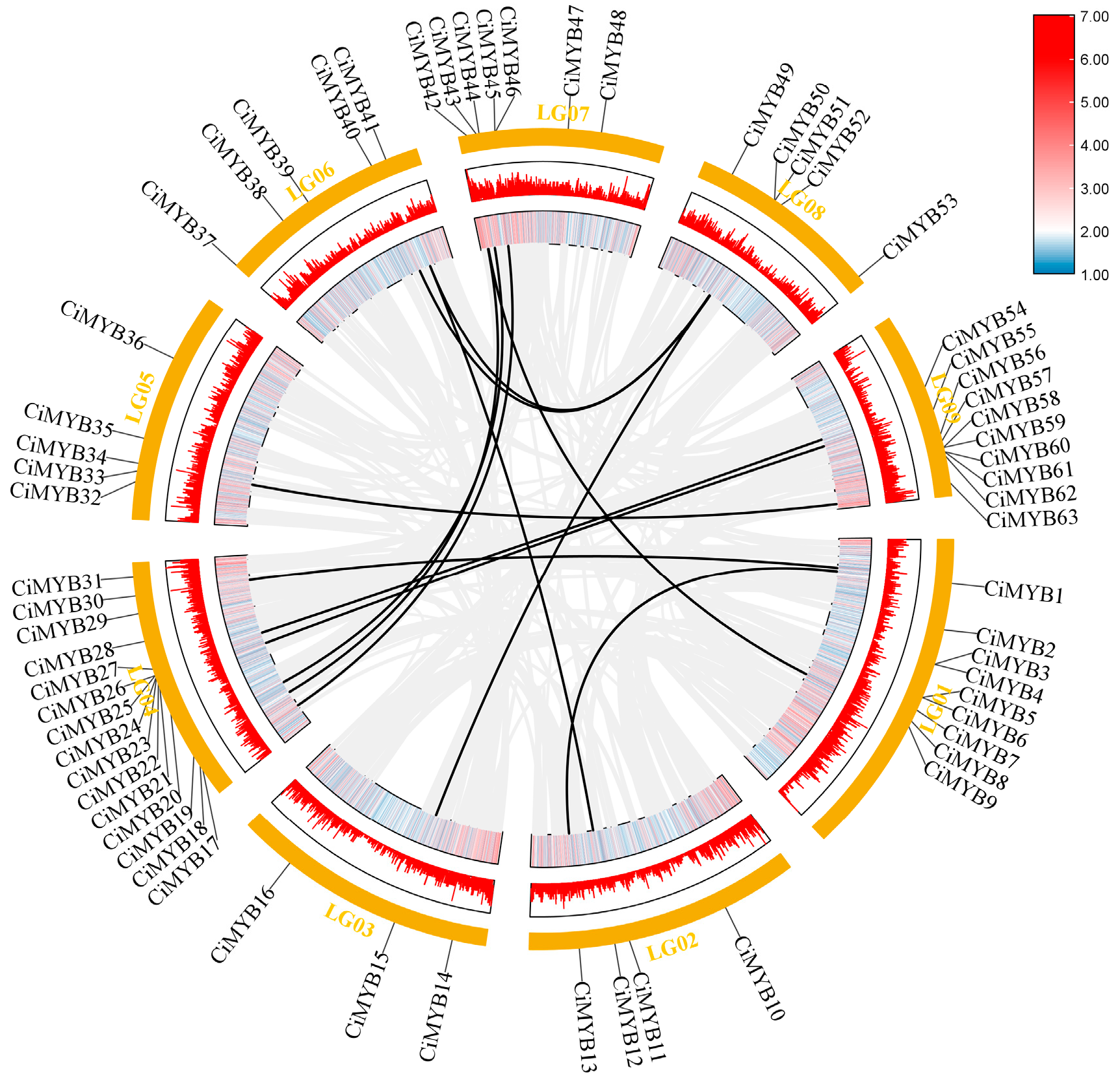
Analysis of syntenic relationships (Figure 3) revealed that CiMYBs display extensive collinearity across its nine chromosomes, with syntenic pairs identified on each. Within the genome, 13 duplicated gene pairs derived from whole-genome duplication (WGD) events were observed among these R2R3-MYB members. The highest number of duplicated genes was located on chromosomes 4 and 7, each containing three pairs. Chromosome 4 showed duplication links with chromosomes 1, 7, and 9. These duplication events may have contributed to the expansion of the R2R3-MYB family in C. indicum and may be associated with the functional diversification of specific subgroups.
Furthermore, comparative synteny analysis between C. indicum and A. thaliana R2R3-MYB families (Figure 4) identified 41 collinear gene pairs involving 26 CiMYBs and their counterparts in A. thaliana. The relatively high number of conserved syntenic pairs suggests that these genes may retain ancestral functions, providing a basis for functional inference across species [41].

3.4. Expression and Response Characteristics of CiMYB Genes Under Low-Temperature Stress

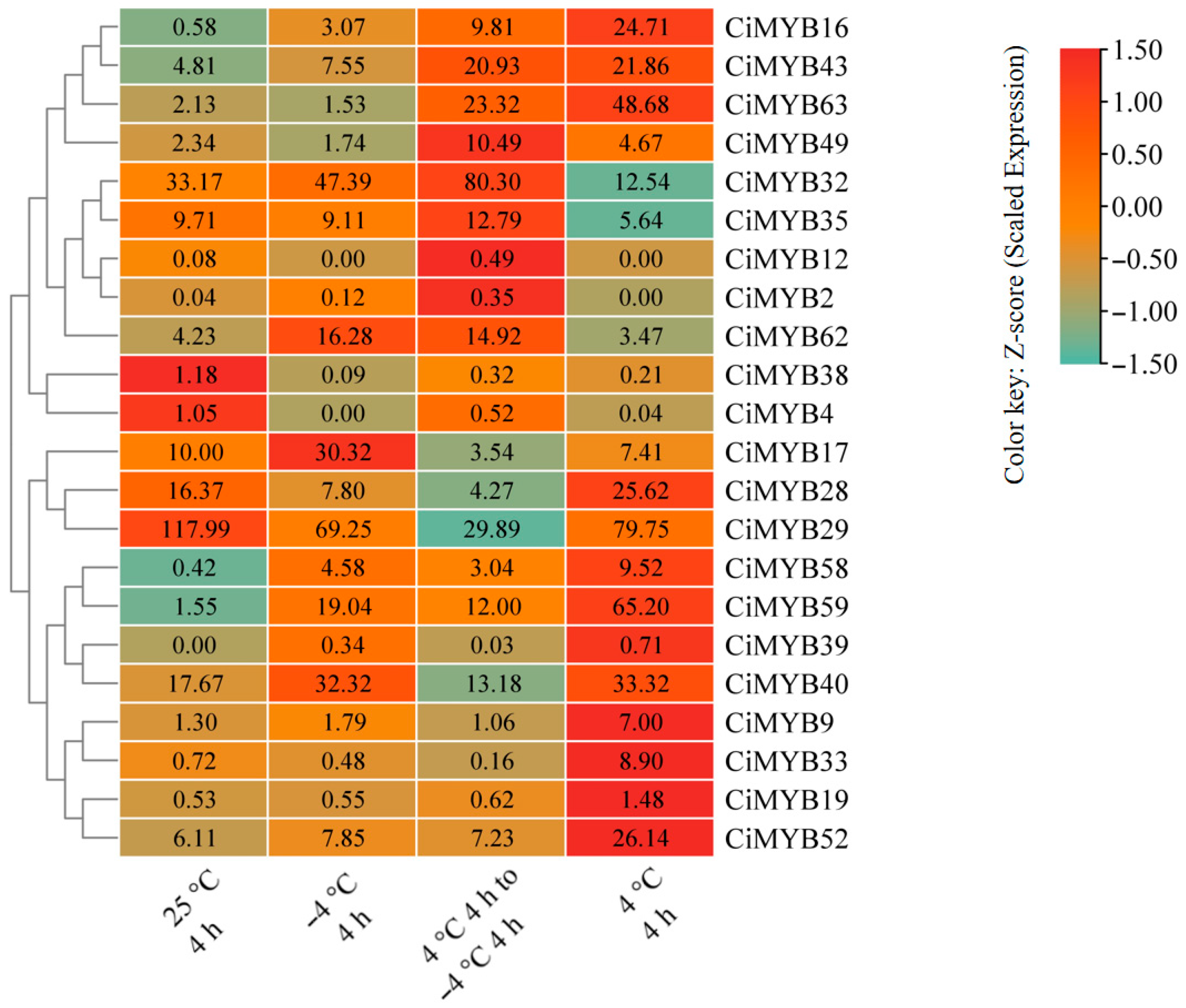
Based on pre-existing transcriptome data for C. indicum subjected to low-temperature conditions (accession number PRJNA1391062), this study aimed to elucidate the role of the CiMYBs in low-temperature stress. Analysis of four treatments—T01 (control), T02 (−4 °C low-temperature stress), T03 (4 °C cold acclimation followed by −4 °C stress), and T04 (4 °C cold acclimation)—revealed dynamic transcriptional responses within this family (Figure S2). As shown in Figure 5, compared to the control (T01), direct low-temperature stress (T02) altered the expression of 5 CiMYBs (T02 vs. T01), whereas cold acclimation alone (T04) affected 11 (T04 vs. T01). Furthermore, acclimated plants exposed to severe stress (T03) showed changes in 12 CiMYBs compared to the control (T03 vs. T01), suggesting acclimation modulates the subsequent stress response. Notably, the expression profile under acclimated stress (T03) differed from that under direct stress (T02), with 9 differentially expressed CiMYBs, indicating that acclimation reshapes the transcriptional response to subsequent severe stress (T03 vs. T02). Most notably, the comparison between acclimated (T04) and acclimated-stress (T03) states revealed the most substantial reprogramming, with 17 differentially expressed CiMYBs (T04 vs. T03), reflecting the profound functional shifts that occur when the plant transitions from a prepared, tolerant state to an actively resisting state.
As detailed in Figure 5, an in-depth analysis of key, differentially expressed R2R3-MYB genes revealed that CiMYB17 was strongly induced under direct chilling stress (T02), while its expression returned to baseline levels during acclimated stress (T03), displaying an “acute stress” pattern. This suggests its potential role in mediating a rapid initial response to sudden temperature drops. In contrast, CiMYB16, CiMYB32, CiMYB43, CiMYB49, CiMYB58, and CiMYB63 exhibited an “acclimation-responsive” pattern. Their expression showed minimal change under direct stress but was significantly upregulated during acclimated stress (T03), implying their potential involvement in establishing a sustained stress-tolerant state induced by cold acclimation. Furthermore, CiMYB38 was consistently downregulated across all chilling treatments, demonstrating a “persistently suppressed” pattern, which indicates that its expression is broadly inhibited by chilling stress signals. These results collectively demonstrate that cold acclimation reshapes the plant’s transcriptional response strategy to stress by modulating distinct sets of R2R3-MYB members: the induction of some acute response genes is attenuated, while an acclimation associated response program is specifically activated.
To validate the transcriptomic data, the expression of six CiMYB genes was examined by RT-qPCR under the four treatment conditions. The qPCR results (Figure 6) were consistent with the RNA-seq trends, confirming the reliability of the sequencing data and demonstrating the distinct transcriptional responses of these genes to low-temperature stress. Among the genes examined, CiMYB9 showed no significant alteration in expression under immediate cold exposure (T02), yet its transcript levels increased significantly following a prior acclimation phase (T04). Conversely, CiMYB58, CiMYB59, and CiMYB62 were upregulated under all low-temperature regimens, with the strongest induction observed under T02. CiMYB17 and CiMYB40 exhibited substantial induction during T02, but their expression declined markedly in T03, approaching baseline values. Collectively, these findings validate the dependability of the transcriptome dataset and provide finer insight into the differential regulatory functions performed by individual R2R3-MYB transcription factors during cold adaptation in C. indicum.
To assess the consistency between RNA-seq and RT-qPCR results, correlation analysis was performed on the expression levels of six selected CiMYB genes. The results showed a strong positive correlation overall, confirming the reliability of the transcriptome data (Figure S3). Among them, CiMYB9, CiMYB17, and CiMYB62 exhibited correlation coefficients above 0.99, with linear regression slopes close to 1, indicating high concordance in both expression trends and magnitudes. CiMYB40, CiMYB58, and CiMYB59 also showed good correlations, though slight discrepancies may be attributed to the broader dynamic range of RT-qPCR at very high expression levels or differences in primer specificity. In summary, this validation supports the accuracy of the RNA-seq data and provides a solid foundation for further functional studies of these CiMYB genes.

4. Discussion

We identified 63 CiMYB genes in the C. indicum genome, and phylogenetic analysis with their Arabidopsis homologs classified them into 19 subgroups. Subgroups located on distal branches (farther from the outgroup) tended to contain more CiMYB members, whereas basal subgroups (closer to the outgroup) contained fewer. For instance, the three largest subgroups—C17, C18, and C19—were positioned in the most distal clades, with C19 comprising 12 members (Figure 1). This distribution pattern suggests lineage-specific expansion of the R2R3-MYB family in C. indicum, with genes in distal branches likely originating from recent duplication events, while basal members may represent ancestral, conserved copies. Similar phenomena have been widely documented in other plant species, reflecting a common mechanism by which gene families achieve functional diversification through whole-genome and segmental duplications [42].
Chromosomal localization analysis revealed uneven distribution of CiMYB genes across the nine C. indicum chromosomes, with chromosome 4 harboring the highest number (15 members), forming a gene-dense region. This distribution pattern is closely linked to the paleopolyploidization events known to have shaped the Asteraceae genome. Phylogenomic studies have demonstrated that asterid plants underwent multiple whole-genome duplication events, including a critical paleopolyploidization event near the origin of Asteraceae [43,44]. The subsequent “diploidization” process following polyploidization typically involves extensive gene rearrangement, loss, and retention across chromosomes [45], leading to the formation of gene-rich regions. Consequently, the observed enrichment on chromosome 4 likely results from asymmetric gene retention after paleopolyploidization, and the retained duplicates in such regions may provide a genetic reservoir facilitating adaptation to diverse environmental conditions.
The presence of specific cis-acting elements within promoter regions is a major determinant of gene expression patterns and can provide key clues regarding potential gene functions [46,47]. For example, in radish (Raphanus sativus L.), RsMYB90 directly binds to the RsCOR78 promoter to activate its expression and enhance cold tolerance [48], while in pear (Petunia hybrida L.), PhMYB62 binds to and activates the promoter of POD genes in response to low temperature [49]. In this study, promoter analysis (defined as the 2000 bp region upstream of the predicted TSS) revealed the results showed that 37 MYB-binding sites identified across 26 genes are distributed from the TSS-proximal region to distal positions relative to the TSS (Figure 2). This suggests the existence of complex autoregulatory or cross-regulatory mechanisms within this transcription factor family. Furthermore, 502 hormone-responsive motifs identified in 61 genes exhibit a markedly uneven distribution, with ABA-responsive elements being overwhelmingly predominant. This finding aligns well with the established role of ABA as a core stress hormone [50] and clearly points to a central function of the CiMYB family in responses to abiotic stresses such as drought and low temperature. Meanwhile, the widespread presence of Aux, GA, MeJA, and SA-responsive elements suggests that this family also possesses the ability to integrate developmental signals and biotic stress cues [51], laying the groundwork for its role in multi-signal crosstalk. Additionally, 41 LTREs were found in the promoters of 28 genes, providing bioinformatic evidence that these genes may participate in transcriptional responses to cold stress. Notably, a short core region proximal to the transcription start site (TSS) of CiMYB55 was found to contain six consecutive LTREs arranged in a compact configuration. This dense clustering suggests that CiMYB55 may play a role in the low-temperature response. However, this gene did not exhibit significant changes in expression in our transcriptomic data, indicating that its regulatory mechanism may be complex and that its specific function requires further experimental validation. In summary, systematic analysis from TSS mapping to cis-element characterization demonstrates that the CiMYB family possesses complex regulatory potential, thereby establishing a computational foundation for future experimental studies aimed at deciphering the expression patterns and functional specificity of its transcriptional networks.
In this study, we observed that CiMYB genes in C. indicum exhibit distinct expression patterns in response to low-temperature treatment (Figure 5). Among them, certain members such as CiMYB16 and CiMYB32 display an “acclimation-induced” expression pattern: they are not significantly induced by direct −4 °C stress, but exhibit marked upregulation when 4 °C acclimation is followed by subsequent −4 °C stress. This acclimation-induced expression pattern points to the involvement of more intricate regulatory mechanisms. In tomato, for instance, the HY5-MYB15-CBFs cascade is significantly induced by 4 °C treatment [26], leading to the hypothesis that direct severe cold shock may fail to fully activate similar cascades due to insufficient signaling time. Meanwhile, post-translational modifications are also critical for MYB protein function. Given that CBF transcription factor activity is closely linked to cellular redox status [52], it is reasonable to hypothesize that MYB proteins acting upstream of or in parallel with the CBF pathway may likewise depend on the relatively stable cellular environment established during cold acclimation for precise functional modification. Additionally, epigenetic mechanisms may mediate the effects of low temperature on MYB gene transcription. For instance, studies on bell pepper (Capsicum annuum L.) have shown that cold stress induces DNA methylation at CHH sites in the promoter of CaMYB340, directly promoting its upregulation. This R2R3-MYB gene in turn negatively regulates fatty acid desaturation and the ICE-CBF cold response pathway [53]. In contrast, CiMYB38 is consistently downregulated across all low-temperature stresses, exhibiting a “persistently suppressed” pattern, suggesting that it may play a role as a negative regulator of cold tolerance in C.indicum. This hypothesis is consistent with findings in other species, where cold-downregulated MYB transcription factors such as AtMYB14 in Arabidopsis and MtMYB3 in Medicago truncatula Gaertn. function as negative modulators of the CBF cold-response pathway to suppress freezing tolerance [54,55]. The specific regulatory mechanisms underlying these distinct expression patterns, as well as the precise pathways through which cold acclimation primes MYB genes for efficient activation, warrant further investigation in future studies.

5. Conclusions

In this study, 63 CiMYB family members were identified in C. indicum and classified into 19 subgroups through phylogenetic analysis. Promoter cis-element analysis revealed the presence of 41 low-temperature responsive elements and 32 drought-induced MYB-binding sites, uncovering the potential regulatory basis for abiotic stress responses. Based on transcriptome data under low-temperature stress, 22 members were found to be differentially expressed, exhibiting three major expression patterns: acute stress-responsive, acclimation-induced, and freezing-suppressed. RT-qPCR validation confirmed the expression trends, showing high consistency with the transcriptome data. This study presents the expression profiles of CiMYB genes under low-temperature stress, providing important insights into their potential regulatory roles in cold adaptation of C. indicum. The identified candidate genes serve as valuable targets for genetic improvement of cold tolerance in chrysanthemum.

Supplementary Materials

The following supporting information can be downloaded at https://www.mdpi.com/article/10.3390/agronomy16050567/s1. Figure S1: Chromosomal distribution of 63 CiMYB genes in Chrysanthemum indicum; Figure S2: The expression patterns of 63 CiMYB genes under different low-temperature stresses; Figure S3: Correlation between RNA-seq and RT-qPCR Expression Data; Table S1: The primer sequences of used in this study.

Author Contributions

Conceptualization, S.W. and X.Y.; Methodology, S.W., J.Y., S.F., D.Z., X.L. and Y.Z.; Formal analysis, S.W., J.Y. and X.Y.; Investigation, S.W., J.Y., S.F., X.L. and D.Z.; Data curation, S.W., J.Y., S.F., D.Z., X.L., Y.B. and X.Y.; Funding Acquisition, Y.Z. and Y.B.; Writing—Original Draft, S.W.; Project Administration, Y.Z. and Y.B.; Writing—Review and Editing, S.W., J.Y., S.F., D.Z., X.Y., X.L., Y.Z. and Y.B. All authors have read and agreed to the published version of the manuscript.

Funding

This study was supported by the Scientific Research Start-up Funds of Jilin Agricultural University (202023298).

Data Availability Statement

The RNA-Seq data underlying this article are available in the SRA database at NCBI and can be accessed with PRJNA1391062. A related manuscript providing a comprehensive analysis of this dataset is currently under review elsewhere; the present study focuses exclusively on the expression changes in CiMYB genes under low-temperature stress and is scientifically independent from that work.

Conflicts of Interest

The authors declare that they have no known competing financial interests or personal relationships that could have appeared to influence the work reported in this paper.

Abbreviations

The following abbreviations are used in this manuscript:
DBDDNA-Binding Domain
HMMHidden Markov Model
TSSTranscription Start Site
LTRELow-Temperature-Responsive Element
ABAAbscisic Acid
AUXAuxin
GAGibberellin
MelAMethyl-Jasmonate
SASalicylic Acid
MLMaximum Likelihood
WGDWhole-Genome Duplication

References

  1. Su, J.S.; Jiang, J.F.; Zhang, F.; Liu, Y.; Ding, L.; Chen, S.M.; Chen, F. Current achievements and future prospects in the genetic breeding of chrysanthemum: A review. Hortic. Res. 2019, 6, 109. [Google Scholar] [CrossRef]
  2. Yuan, H.W.; Jiang, S.; Liu, Y.K.; Daniyal, M.; Jian, Y.Q.; Peng, C.Y.; Shen, J.L.; Liu, S.F.; Wang, W. The flower head of Chrysanthemum morifolium Ramat. (Juhua): A paradigm of flowers serving as Chinese dietary herbal medicine. J. Ethnopharmacol. 2020, 261, 113043. [Google Scholar] [CrossRef] [PubMed]
  3. Ao, N.; Ma, J.; Xu, T.T.; Su, J.S.; Yang, X.C.; Guan, Z.Y.; Fang, W.M.; Chen, F.; Zhang, F. Genetic variation and QTL mapping for cold tolerance in a chrysanthemum F1 population at different growth stages. Euphytica 2019, 215, 88. [Google Scholar] [CrossRef]
  4. Shao, Y.; Sun, Y.; Li, D.; Chen, Y. Chrysanthemum indicum L.: A comprehensive review of its botany, Phytochemistry and Pharmacology. Am. J. Chin. Med. 2020, 48, 871–897. [Google Scholar] [CrossRef]
  5. Youssef, F.S.; Eid, S.Y.; Alshammari, E.; Ashour, M.L.; Wink, M.; El-Readi, M.Z. Chrysanthemum indicum and Chrysanthemum morifolium: Chemical composition of their essential oils and their potential use as natural preservatives with antimicrobial and antioxidant activities. Foods 2020, 9, 1460. [Google Scholar] [CrossRef]
  6. Deng, Y.N.; Yang, P.; Zhang, Q.L.; Wu, Q.W.; Feng, L.F.; Shi, W.J.; Peng, Q.; Ding, L.; Tan, X.K.; Zhan, R.T.; et al. Genomic insights into the evolution of flavonoid biosynthesis and O-methyltransferase and glucosyltransferase in Chrysanthemum indicum. Cell Rep. 2024, 43, 113725. [Google Scholar] [CrossRef]
  7. Wu, X.; Xia, M.; Su, P.; Zhang, Y.; Tu, L.; Zhao, H.; Hu, Y. MYB transcription factors in plants: A comprehensive review of their discovery, structure, classification, functional diversity and regulatory mechanism. Int. J. Biol. Macromol. 2024, 282, 136652. [Google Scholar] [CrossRef]
  8. Stracke, R.; Werber, M.; Weisshaar, B. The R2R3-MYB gene family in Arabidopsis thaliana. Curr. Opin. Plant Biol. 2001, 4, 447–456. [Google Scholar] [CrossRef]
  9. Dubos, C.; Stracke, R.; Grotewold, E.; Weisshaar, B.; Martin, C.; Lepiniec, L. MYB transcription factors in Arabidopsis. Trends Plant Sci. 2010, 15, 573–581. [Google Scholar] [CrossRef] [PubMed]
  10. Yao, X.; Meng, F.; Wu, L.; Guo, X.; Sun, Z.; Jiang, W.; Xing, S. Genome-wide identification of R2R3-MYB family genes and gene response to stress in ginger. Plant Genome 2024, 17, e20258. [Google Scholar] [CrossRef] [PubMed]
  11. Kang, L.; Teng, Y.; Cen, Q.; Fang, Y.; Tian, Q.; Zhang, X.; Wang, H.; Zhang, X.; Xue, D. Genome-wide identification of R2R3-MYB transcription factor and expression analysis under abiotic stress in rice. Plants 2022, 11, 1928. [Google Scholar] [CrossRef]
  12. Zhang, H.C.; Gong, Y.H.; Tao, T.; Lu, S.; Zhou, W.Y.; Xia, H.; Leng, Y.J. Genome-wide identification of R2R3-MYB transcription factor subfamily genes involved in salt stress in rice (Oryza sativa L.). BMC Genom. 2024, 25, 797. [Google Scholar] [CrossRef] [PubMed]
  13. Yang, X.; Li, J.; Guo, T.; Guo, B.; Chen, Z.; An, X. Comprehensive analysis of the R2R3-MYB transcription factor gene family in Populus trichocarpa. Ind. Crops Prod. 2021, 168, 113614. [Google Scholar] [CrossRef]
  14. Xu, Y.; Ni, L.; Yu, C.; Hua, J.; Yin, Y.; Gu, C.; Wang, Z. Genome-wide study of the R2R3-MYB gene family and analysis of HhMYB111r-induced salt tolerance in Hibiscus hamabo Sieb. et Zucc. Plant Sci. 2025, 352, 112378. [Google Scholar] [CrossRef]
  15. Yang, Y.; Yuan, Z.; Ning, C.; Zhao, B.; Wang, R.; Zheng, X.; He, L. The pea R2R3-MYB gene family and its role in anthocyanin biosynthesis in flowers. Front. Genet. 2022, 13, 936051. [Google Scholar] [CrossRef]
  16. Yang, J.; Zhang, B.; Gu, G.; Yuan, J.; Shen, S.; Jin, L.; Xie, X. Genome-wide identification and expression analysis of the R2R3-MYB gene family in tobacco (Nicotiana tabacum L.). BMC Genom. 2022, 23, 432. [Google Scholar] [CrossRef]
  17. Wang, N.; Ma, Q.; Ma, J.; Pei, W.; Liu, G.; Cui, Y.; Wu, M.; Zang, X.; Zhang, J.; Yu, S.; et al. A comparative genome-wide analysis of the R2R3-MYB gene family among four Gossypium species and their sequence variation and association with fiber quality traits in an interspecific G. hirsutum × G. barbadense population. Front. Genet. 2019, 10, 741. [Google Scholar] [CrossRef]
  18. Tombuloglu, H. Genome-wide identification and expression analysis of R2R3, 3R-and 4R-MYB transcription factors during lignin biosynthesis in flax (Linum usitatissimum). Genomics 2020, 112, 782–795. [Google Scholar] [CrossRef]
  19. Wu, Y.; Wen, J.; Xia, Y.; Zhang, L.; Du, H. Evolution and functional diversification of R2R3-MYB transcription factors in plants. Hortic. Res. 2022, 9, uhac058. [Google Scholar] [CrossRef] [PubMed]
  20. Yang, X.; Wang, P.; Qin, N.; Tian, Z.; Wang, J.; Sun, S.; Li, X.; Wang, Y. PdbMYB44 enhances drought tolerance via PP2C-mediated modulation of ABA signaling and stomatal aperture. Plant Physiol. Biochem. 2026, 231, 111042. [Google Scholar] [CrossRef] [PubMed]
  21. Guo, X.L.; Wu, X.; Li, H.L.; Liu, R.X.; An, J.P.; You, C.X. The R2R3-MYB transcription factor MdMYB62 negatively regulates the drought and salt tolerance in apple. J. Plant Physiol. 2025, 311, 154527. [Google Scholar] [CrossRef]
  22. Jin, R.; Muhammad, T.; Jia, C.; Yang, T.; Yang, H.; Wang, J.; Wang, B.; Yu, Q. Overexpression of R2R3-MYB type transcription factor SpMYB1 enhances cold and drought tolerance in tomato. Plant Physiol. Biochem. 2025, 229, 110326. [Google Scholar] [CrossRef]
  23. Dong, J.; Cao, L.; Zhang, X.; Zhang, W.; Yang, T.; Zhang, J.; Che, D. An R2R3-MYB transcription factor RmMYB108 responds to chilling stress of Rosa multiflora and conferred cold tolerance of Arabidopsis. Front. Plant Sci. 2021, 12, 696919. [Google Scholar] [CrossRef] [PubMed]
  24. Zhou, X.; Lei, D.; Yao, W.; Li, S.; Wang, H.; Lu, J.; Zhang, Y. A novel R2R3-MYB transcription factor PbMYB1L of Pyrus bretschneideri regulates cold tolerance and anthocyanin accumulation. Plant Cell Rep. 2024, 43, 34. [Google Scholar] [CrossRef] [PubMed]
  25. Grünig, N.; Horz, J.M.; Pucker, B. Diversity and ecological functions of anthocyanins. BMC Plant Biol. 2025, 26, 146. [Google Scholar] [CrossRef] [PubMed]
  26. Zhang, L.; Jiang, X.; Liu, Q.; Ahammed, G.J.; Lin, R.; Wang, L.; Shao, S.; Yu, J.; Zhou, Y. The HY5 and MYB15 transcription factors positively regulate cold tolerance in tomato via the CBF pathway. Plant Cell Environ. 2020, 43, 2712–2726. [Google Scholar] [CrossRef]
  27. Chen, N.; Pan, L.; Yang, Z.; Su, M.; Xu, J.; Jiang, X.; Yin, X.; Wang, T.; Wan, F.; Chi, X. A MYB-related transcription factor from peanut, AhMYB30, improves freezing and salt stress tolerance in transgenic Arabidopsis through both DREB/CBF and ABA-signaling pathways. Front. Plant Sci. 2023, 14, 1136626. [Google Scholar] [CrossRef]
  28. Han, Z.; Zhang, C.; Zhang, H.; Duan, Y.; Zou, Z.; Zhou, L.; Zhu, X.; Fang, W.; Ma, Y. CsMYB transcription factors participate in jasmonic acid signal transduction in response to low temperature stress in tea plant (Camellia sinensis). Plants 2022, 11, 2869. [Google Scholar] [CrossRef]
  29. Ye, J.; Wang, C.; Liu, Y.; Chen, S.; Jin, J.; Zhang, L.; Liu, P.; Tang, J.; Zhang, J.; Wang, Z.; et al. CGD: A multi-omics database for Chrysanthemum genomic and biological research. Hortic. Res. 2024, 11, uhae238. [Google Scholar] [CrossRef]
  30. Mistry, J.; Chuguransky, S.; Williams, L.; Qureshi, M.; Salazar, G.A.; Sonnhammer, E.L.L.; Tosatto, S.C.E.; Paladin, L.; Raj, S.; Richardson, L.J.; et al. Pfam: The protein families database in 2021. Nucleic Acids Res. 2021, 49, D412–D419. [Google Scholar] [CrossRef]
  31. Chen, C.; Wu, Y.; Li, J.; Wang, X.; Zeng, Z.; Xu, J.; Xia, R. TBtools-II: A “one for all, all for one” bioinformatics platform for biological big-data mining. Mol. Plant 2023, 16, 1733–1742. [Google Scholar] [CrossRef]
  32. Garcia-Hernandez, M.; Berardini, T.Z.; Chen, G.; Crist, D.; Doyle, A.; Huala, E.; Knee, E.; Lambrecht, M.; Miller, N.; Mueller, L.A.; et al. TAIR: A resource for integrated Arabidopsis data. Funct. Integr. Genom. 2002, 2, 239–253. [Google Scholar] [CrossRef]
  33. Ladunga, I. Finding homologs in amino acid sequences using network BLAST searches. Curr. Protoc. Bioinform. 2009, 25, 3.4.1–3.4.34. [Google Scholar] [CrossRef]
  34. Letunic, I.; Bork, P. SMART v10: Three decades of the protein domain annotation resource. Nucleic Acids Res. 2026, 54, D499–D503. [Google Scholar] [CrossRef] [PubMed]
  35. Sonnhammer, E.L.L.; Eddy, S.R.; Birney, E.; Bateman, A.; Durbin, R. Pfam: Multiple sequence alignments and HMM-profiles of protein domains. Nucleic Acids Res. 1998, 26, 320–322. [Google Scholar] [CrossRef] [PubMed]
  36. Nguyen, L.T.; Schmidt, H.A.; Von Haeseler, A.; Minh, B.Q. IQ-TREE: A fast and effective stochastic algorithm for estimating maximum-likelihood phylogenies. Mol. Biol. Evol. 2015, 32, 268–274. [Google Scholar] [CrossRef] [PubMed]
  37. Chen, C.; Wu, Y.; Xia, R. A painless way to customize Circos plot: From data preparation to visualization using TBtools. iMeta 2022, 1, e35. [Google Scholar] [CrossRef]
  38. Lescot, M.; Déhais, P.; Thijs, G.; Marchal, K.; Moreau, Y.; Van de Peer, Y.; Rombauts, S. PlantCARE, a database of plant cis-acting regulatory elements and a portal to tools for in silico analysis of promoter sequences. Nucleic Acids Res. 2002, 30, 325–327. [Google Scholar] [CrossRef]
  39. Benjamini, Y.; Hochberg, Y. On the adaptive control of the false discovery rate in multiple testing with independent statistics. J. Educ. Behav. Stat. 2000, 25, 60–83. [Google Scholar] [CrossRef]
  40. Livak, K.J.; Schmittgen, T.D. Analysis of relative gene expression data using real-time quantitative PCR and the 2−ΔΔCT method. Methods 2001, 25, 402–408. [Google Scholar] [CrossRef]
  41. Cannon, S.B.; Mitra, A.; Baumgarten, A.; Young, N.D.; Ma, G. The roles of segmental and tandem gene duplication in the evolution of large gene families in Arabidopsis thaliana. BMC Plant Biol. 2004, 4, 10. [Google Scholar] [CrossRef]
  42. Du, H.; Liang, Z.; Zhao, S.; Nan, M.G.; Tran, L.-S.P.; Lu, K.; Huang, Y.-B.; Li, J.-N. The evolutionary history of R2R3-MYB proteins across 50 eukaryotes: New insights into subfamily classification and expansion. Sci. Rep. 2015, 5, 11037. [Google Scholar] [CrossRef]
  43. Zhang, C.; Zhang, T.; Luebert, F.; Xiang, Y.; Huang, C.-H.; Hu, Y.; Rees, M.; Frohlich, M.W.; Qi, J.; Weigend, M.; et al. Asterid Phylogenomics/Phylotranscriptomics uncover morphological evolutionary histories and support phylogenetic placement for numerous whole-genome duplications. Mol. Biol. Evol. 2020, 37, 3188–3210. [Google Scholar] [CrossRef]
  44. Barker, M.S.; Kane, N.C.; Matvienko, M.; Kozik, A.; Michelmore, R.W.; Knapp, S.J.; Rieseberg, L.H. Multiple Paleopolyploidizations during the evolution of the Compositae Reveal Parallel Patterns of Duplicate Gene Retention after Millions of Years. Mol. Biol. Evol. 2008, 25, 2445–2455. [Google Scholar] [CrossRef]
  45. Wendel, J.F. Genome evolution in polyploids. Plant Mol. Biol. 2000, 42, 225–249. [Google Scholar] [CrossRef] [PubMed]
  46. Roy, S. Function of MYB domain transcription factors in abiotic stress and epigenetic control of stress response in plant genome. Plant Signal. Behav. 2016, 11, e1117723. [Google Scholar] [CrossRef] [PubMed]
  47. Li, J.; Hun, G.; Sui, N. Research advances of MYB transcription factors in plant stress resistance and breeding. Plant Signal. Behav. 2019, 14, 1613131. [Google Scholar] [CrossRef]
  48. Qin, T.; Zhang, M.; Yi, X.; Yang, J.; Ying, J.; Wang, H.; Wang, Y. RsMYB90, a R2R3-MYB transcription factor, plays a positive role in regulating low temperature stress in radish. Plant Biol. 2026, 28, 69–78. [Google Scholar] [CrossRef]
  49. Li, Y.; Zhang, J.; Wang, S.; Liu, Y.; Yang, M.; Huang, Y. Genome-wide identification of the Pyrus R2R3-MYB gene family and PhMYB62 regulation analysis in Pyrus hopeiensis flowers at low temperature. Int. J. Biol. Macromol. 2024, 257, 128611. [Google Scholar] [CrossRef]
  50. Lin, Z.; Li, Y.; Wang, Y.; Liu, X.; Ma, L.; Zhang, Z. Initiation and amplification of SnRK2 activation in abscisic acid signaling. Nat. Commun. 2021, 12, 2456. [Google Scholar] [CrossRef] [PubMed]
  51. Du, H.; Wang, X.; Hu, J.; Tan, K.; Liu, C.; Ma, B. Identification and Functional Characterization of the CrRLK1L Gene Family in Salt Tolerance in Rice (Oryza sativa L.). Genes 2025, 12, 1454. [Google Scholar] [CrossRef] [PubMed]
  52. Kopeć, P.; Rapacz, M.; Arora, R. Post-translational activation of CBF for inducing freezing tolerance. Trends Plant Sci. 2022, 27, 415–417. [Google Scholar] [CrossRef] [PubMed]
  53. Ge, W.; Luo, M.; Sun, H.; Wei, B.D.; Zhou, X.; Zhou, Q.; Ji, S. CaMYB340 homo-and heterodimers mediate chilling injury in bell pepper by participating in fatty acid desaturation and the ICE-CBF pathway. 2024; Preprint from Authorea Preprints. [Google Scholar] [CrossRef]
  54. Chen, Y.; Chen, Z.; Kang, J.; Kang, D.; Gu, H.; Qin, G. AtMYB14 regulates cold tolerance in Arabidopsis. Plant Mol. Biol. Rep. 2013, 31, 87–97. [Google Scholar] [CrossRef]
  55. Zhang, Z.; Hu, X.; Zhang, Y.; Miao, Z.; Xie, C.; Meng, X.; Dong, J. Opposing control by transcription factors MYB61 and MYB3 increases freezing tolerance by relieving C-repeat binding factor suppression. Plant Physiol. 2016, 172, 1306–1323. [Google Scholar] [CrossRef] [PubMed]
Figure 1. Phylogenetic tree of CiMYB genes. In the figure, At and Ci denote genes from A. thaliana and C. indicum, respectively. Different colors represent the distinct subgroups of the R2R3-MYB gene family.
Agronomy 16 00567 g001
Figure 2. Regulatory characteristics of cis-acting elements in the promoter region of the CiMYB gene from C. indicum.
Agronomy 16 00567 g002
Figure 3. The intraspecific collinearity of CiMYB gene family. Black lines represent gene duplication events. Gray lines indicate putative colinear gene pairs within C. indicum genome.
Agronomy 16 00567 g003
Figure 4. Collinearity analysis of R2R3-MYB members between C. indicum and A. thaliana. LG01–LG09 represent the 9 chromosomes of C. indicum, and At1–At5 represent the 5 chromosomes of A. thaliana. Homologous relationships among members are connected by red lines. Gray lines indicate putative colinear gene pairs between C. indicum and A. thaliana.
Agronomy 16 00567 g004
Figure 5. Expression heatmap of differentially expressed CiMYB genes under low-temperature stresses. The color scale indicates Z-score normalized expression values; numbers in each grid represent the original FPKM values.
Agronomy 16 00567 g005
Figure 6. Expression analysis of six CiMYB genes under different cold treatments by RT-qPCR. Data are presented as mean ± SD (n = 3). One-way ANOVA followed by Tukey’s multiple comparison test was performed; different lowercase letters indicate statistically significant differences (p < 0.05).
Agronomy 16 00567 g006
Disclaimer/Publisher’s Note: The statements, opinions and data contained in all publications are solely those of the individual author(s) and contributor(s) and not of MDPI and/or the editor(s). MDPI and/or the editor(s) disclaim responsibility for any injury to people or property resulting from any ideas, methods, instructions or products referred to in the content.