Article

Improving Saline–Alkali Soils Through Organic Inputs: Ecological Pathways Shaping Microbial Community Assembly and Function

1
Crop Resources Institute, Heilongjiang Academy of Agricultural Sciences, Harbin 150086, China
2
School of Resources and Environment, Northeast Agricultural University, Harbin 150086, China
*
Author to whom correspondence should be addressed.
Agronomy 2026, 16(5), 531; https://doi.org/10.3390/agronomy16050531
Submission received: 14 January 2026 / Revised: 20 February 2026 / Accepted: 26 February 2026 / Published: 28 February 2026

Abstract

Soil salinization remains a major global challenge, and rice cultivation has been widely practiced in saline–alkali soils of the black soil region in Northeast China as an effective strategy for soil improvement. However, this practice is often slow to produce benefits and is prone to secondary salinization, limiting rapid gains in soil fertility and crop productivity. To address these limitations, this study evaluated the effects of four soil amendment strategies (microbial inoculant, organic fertilizer, biochar, and their combined application) on bacterial and fungal communities, as assessed by high-throughput sequencing of the 16S rRNA gene and the ITS region, respectively. The application of microbial inoculants significantly increased bacterial diversity and richness, while all amendment treatments promoted the enrichment of key microbial groups. Organic inputs strongly influenced microbial community assembly, with microbial inoculant and combined treatments shifting assembly toward more deterministic processes. In addition, the amendments altered microbial interaction networks, leading to widespread cooperative relationships dominated by positive associations and strong interactions across taxonomic groups. Notably, the combined treatment reshaped bacterial functional profiles and reduced the predicted abundance of pathogenic fungi. Overall, these results demonstrate that organic amelioration strategies can improve the ecological functioning of saline–alkali soils by regulating microbial community assembly and interactions. This study provides a robust theoretical framework and scalable practical solutions for the integrated management and sustainable development of saline–alkali agriculture.

1. Introduction

Soil salinization poses a severe threat to global food security, as it destroys soil structure, leading to soil degradation, and it is an urgent issue limiting global agricultural productivity and sustainability. It is estimated that over 1.381 billion hectares of land worldwide are affected by salinity, resulting in a significant reduction in crop yields [1,2]. In China, saline–alkaline soils are widely distributed, with the Songnen Plain being one of the major affected areas, encompassing approximately 3.73 million hectares of saline–alkaline soil [3]. The high concentration of soluble salts and sodium ions in these soils disrupts soil stability, reduces soil nutrient fertility, and inhibits microbial activity, subsequently leading to a decrease in biodiversity and hindering sustainable socio-economic development [4].
Rice (Oryza sativa L.), a staple food for over half of the global population, is generally regarded as a crop with moderate tolerance to salinity. Its salinity tolerance threshold is approximately 3.0 dS/m (ECe) [5]. Although it exhibits relative tolerance for growth in saline–alkaline soil compared to others, its growth and yield are still significantly affected under high salinity and alkalinity conditions [6,7]. Therefore, it is crucial to develop effective and sustainable strategies for saline–alkaline soils and enhance rice yield.
Conventional soil remediation approaches, including large-scale water leaching and chemical reclamation, are often expensive and energy-demanding, and can result in secondary environmental impacts [8]. In recent years, biological and organic reclamation strategies have gained increasing attention as sustainable alternatives. Among these methods, the application of microbial inoculants, organic fertilizers, biochar, and integrated treatments has shown considerable potential.
Microbial inoculants, composed of beneficial bacteria or fungi, can promote the acquisition of nutrients through nitrogen fixation, phosphate solubilization, and other mechanisms. Additionally, inoculants can improve growth by producing plant growth-promoting hormones and alleviating salt stress [9]. Microbial inoculation is currently a focal point in the engineering of saline–alkaline soil improvement. The composite inoculant comprising Bacillus oceanisediminis and Acinetobacter indicus has been reported to reduce the pH of heavily saline–alkaline soil from 8.8 to 7.2, decrease salinity by 60%, and simultaneously increase soil nitrogen, phosphorus, and potassium contents [10]. A long-term field experiment conducted by Sun et al. in Jiangxi, China, showed that the application of organic fertilizer significantly increased microbial growth rates in both bulk soil and aggregates of different particle sizes, and influenced microbial community assembly by regulating enzyme activity and substrate quality [11]. In addition, organic fertilizers can also enhance plant nitrogen uptake and yield in saline–alkali soils by reducing soil salinity and nitrogen loss, thereby demonstrating their potential for the amelioration of saline–alkali soil [12,13,14]. Biochar is a carbon-rich material produced from biomass pyrolysis, which can improve the physical, chemical, and biological properties of saline–alkaline soils by increasing water-holding capacity, reducing salt content, increasing pH buffering capacity, and providing a habitat for beneficial microorganisms [15,16]. Biochar has been shown to increase plant productivity in saline soils by an average of 29.3%, reshape soil microbial community structure, and preferentially activate bacteria-driven nutrient cycling [17]. While investigations on the separate effects of microbial inoculants (MI), organic fertilizers (OF), or biochar (BC) on crop growth have been conducted [18,19], the mechanisms underlying the roles of the three in saline–alkaline rice systems and whether they have synergistic effects are still unclear.
Despite facing severe abiotic stresses, saline–alkali soils still harbor unique microbial communities. Regulating these microbial communities through soil improvement strategies can effectively improve soil health and enhance agricultural productivity. Therefore, the objectives of this research were: (a) to assess the individual and combined impacts of four reclamation strategies (microbial inoculants, organic fertilizers, biochar, and integrated treatments) on bacterial and fungal soil microbiota in northeastern saline–alkaline soils; and (b) to explore how the four reclamation measures regulate the assembly process and network structure of the saline–alkaline soil microbiota. The findings of this study will provide valuable insights into developing comprehensive and sustainable management practices for saline–alkaline soil reclamation and rice cultivation.

2. Materials and Methods

2.1. Properties of the Saline–Alkali Soil

The saline–alkali soil used in this study was collected in April 2025 from the cultivated layer (0–20 cm depth) of a saline–alkali field located in Zhaodong City, Heilongjiang Province, China (46°39′ N, 125°53′41″ E), within the northern Songnen Plain. This land has long been managed under a crop rotation system, with maize, wheat, and soybean (the crop preceding sampling) as the rotation crops. Rice had not previously been cultivated on this soil to avoid the potential effects of high-density planting on the experimental system. This region has a mid-latitude continental monsoon climate, with an average annual temperature of 9.55 °C, a frost-free period of 140 days, and an average annual precipitation of 434.6 mm. A composite soil sample was prepared by mixing five randomly collected subsamples. The collected soil was air-dried, passed through a 2 mm sieve, and analyzed for physicochemical properties. The soil had a pH of 8.70 (soil: water = 1:5, w/v) and an electrical conductivity of 0.45 mS cm−1 (1:5, w/v), with an estimated exchangeable sodium percentage (ESP) of 15%. The soil was classified as silt loam (United States Department of Agriculture, USDA) with a particle size distribution of approximately 15% sand, 50% silt, and 35% clay, which is typical of moderately sodic black soils in the region.

2.2. Experimental Design

The potting method was employed for rice cultivation in the experiment, with each pot containing 7.5 kg of saline–alkali soils. The experiment included five treatments with three replicates each: untreated soil (CK), addition of a 0.5% microbial inoculum (MI), addition of a 1% organic fertilizer (OF), addition of a 5% biochar (BC), and addition of combined amendment (MOB, 0.5% microbial inoculum + 1% organic fertilizer + 5% biochar) [20,21,22]. The experiment was conducted under controlled conditions, which may not fully represent natural field environments. While this setup allowed precise control over variables, it limits the generalizability of the results to real-world, dynamic field conditions.
The soil mixtures containing the respective amendments were incubated for 10 days at 50% water-holding capacity (WHC) to activate the microorganisms. Plants were grown in plots under a 16 h light/8 h dark photoperiod, with mean day/night temperatures of 30/22 °C and a relative humidity of approximately 70%. Rice seeds (Dongnong427) were surface-sterilized with 30% H2O2 (Sinopharm Chemical Reagent Co., Ltd., Shanghai, China) for 20 min, rinsed thoroughly, and sown on 1 May 2025. Seedlings were transplanted into the pots on 26 June and grown for 140 days under controlled conditions, with moisture maintained at approximately 50% WHC. No fertilizer was applied during this period. Each pot contained six seedlings, and the pots were repositioned every two days to ensure randomized light exposure. Pot movements were performed according to a completely randomized design to minimize any potential bias in light exposure during the experiment.

2.3. Soil Sampling and Soil Property Analysis

The rhizosphere soils were collected after 140-day incubation (from May to September in 2025). Individual plants were carefully excavated using a sterile shovel, ensuring the integrity of the root system and surrounding soil. Approximately 20 g of rhizosphere soil per plant was collected by gently brushing the soil from the roots into sterile bags. To prevent microbial contamination, all sampling tools were sterilized between each collection. The collected rhizosphere soils were separated into two parts. One batch of samples was immediately sent to the laboratory and stored at −80 °C for high-throughput sequencing, while another batch of samples was air-dried in a cool, dark laboratory environment for subsequent analysis of soil chemical properties.
Soil pH was determined using a pH meter (FE20 FiveEasy™, Mettler Toledo, Giessen, Germany) in a 1:5 soil–water suspension. Soil organic matter (SOM) was determined using the Walkley–Black method, total nitrogen (TN) using the Kjeldahl method, total phosphorus (TP) using the molybdenum blue colorimetric method after acid digestion, and total potassium (TK) using the flame photometric method after acid digestion. Alkaline available nitrogen (AHN) was determined using the alkaline diffusion method, available phosphorus (AP) using the molybdenum blue colorimetric method after Olsen extraction with 0.5 M NaHCO3 (Sinopharm Chemical Reagent Co., Ltd., Shanghai, China), and available potassium (AK) using the flame photometric method after extraction with 1 M NH4OAc (Sinopharm Chemical Reagent Co., Ltd., Shanghai, China). Exchangeable K+ and Na+ were determined using the flame photometric method after extraction with 1 M NH4OAc. Standard methods were adopted to determine soil properties, as previously described [23,24] and shown in Table S1.

2.4. Statistical Analyses

All statistical analyses and data visualizations were performed using R software (version 4.3.0). The alpha diversity indices and non-metric multidimensional scaling (NMDS) based on Bray–Curtis distances were conducted to visualize the beta diversity patterns of bacterial and fungal communities, and permutational multivariate analysis of variance (PERMANOVA) with 999 permutations was performed to test the significance of treatment effects on microbial community structures using the vegan package [25]. The compositional dissimilarity (β diversity) among treatments was partitioned into replacement and richness difference components using the Podani family and Sørensen dissimilarity indices, implemented in the R package ade4 [26]. To identify the key environmental drivers shaping microbial communities, Mantel tests correlating Bray–Curtis distance matrices with soil properties were performed using the R package vegan. To identify microbial taxa that were significantly enriched under different treatments, linear discriminant analysis effect size (LEfSe) was employed with a threshold for the logarithmic LDA score set at 2.0 [27]. Likelihood ratio tests (p < 0.05) were employed, and a negative binomial generalized log-linear model was fitted to examine the differences in OTU abundances between paddy and upland soils using the “edgeR” package [28]. The β-nearest taxon index (βNTI) was calculated to quantify the relative influence of deterministic and stochastic processes [29]. The distribution of the Raup–Crick index (RCbray) was analyzed to further distinguish ecological processes.
Microbial interactions were characterized by constructing separate co-occurrence networks for bacterial and fungal communities through correlation analysis. For each kingdom, pairwise Spearman’s rank correlations were calculated between the relative abundances of OTUs. Spearman’s correlation coefficient was determined using the ‘psych’ package, with p-values adjusted for multiple comparisons using the false discovery rate (FDR) [30,31]. A threshold coefficient of <0.7 and a p-value > 0.01 were applied to exclude OTUs with weak correlations before constructing the bacterial and fungal networks [32]. Network properties, such as node degree and betweenness centrality, were calculated to identify keystone taxa. The topological roles of individual OTUs, including module hubs, connectors, and peripherals, were classified based on within-module connectivity (Zi) and among-module connectivity (Pi) metrics [33]. A framework integrating network topology and Zi-Pi analysis was used to select core taxa. The importance of identified core network nodes was further validated using the random forest using the vegan package.
The functional potential of the bacterial community was predicted from 16S rRNA gene sequences using the PICRUSt2 database [34]. Principal component analysis (PCA) was performed on the predicted KEGG pathway profiles to compare functional structures across treatments, and permutational multivariate analysis of variance (PERMANOVA) with 999 permutations was performed to test the significance of treatment effects on microbial community structures using the vegan package. Fungal functional guilds (Pathotrophs, Saprotrophs, and Symbiotrophs) were predicted from ITS sequences using the FUNGuild database [35].

3. Results

3.1. Soil Microbial Diversity

In this study, any sequences with poor quality scores (below 20) and those containing mismatched primers, barcodes, or ambiguous nucleotides were eliminated. Operational taxonomic units (OTUs) were then clustered using UPARSE v7.1 with a 97% similarity cut-off, and the enumeration of OTUs was accomplished using Usearch v7.0. In total, we obtained 2,330,284 quality sequences from all 15 samples, with 1,111,821 and 1,218,463 sequences obtained from bacterial and fungal communities, respectively, which were clustered into 7677 and 1420 OTUs clustering at 97% sequence similarity.
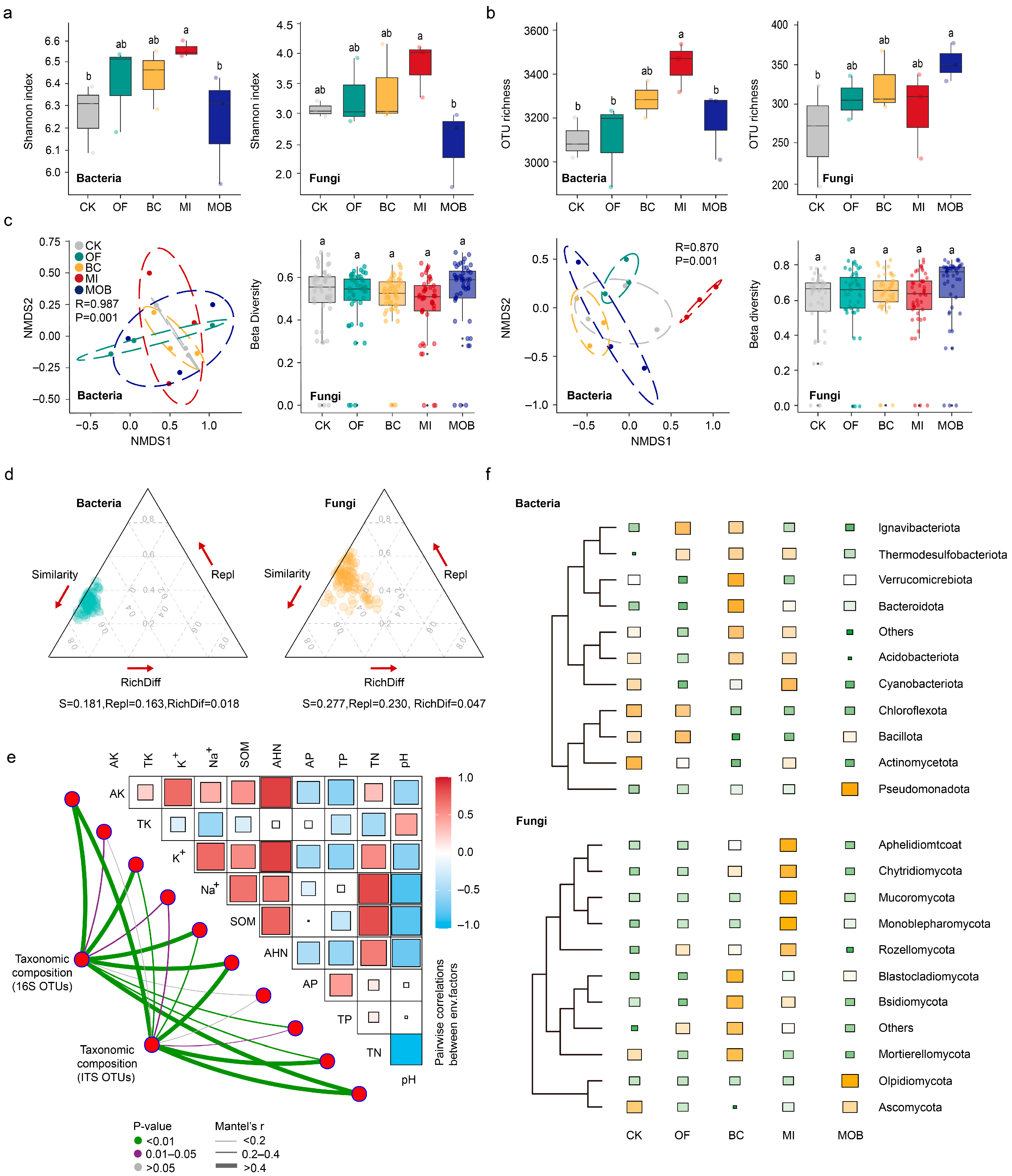
Compared with CK, the Shannon index and OTU richness of bacteria changed among treatments, and the MI treatment was significantly increased by 4.75% and 12.85%, respectively (p < 0.05) (Figure 1a,b). However, although the Shannon index and OTU richness of fungi also changed among treatments compared with CK, the Shannon index of MI treatment increased significantly by 23.8% compared with the CK treatment, while for OTU richness, the MOB treatment showed a significant increase of 33.84%, compared with CK (p < 0.05) (Figure 1a,b).
Based on NMDS analysis, different organic modification strategies significantly affected the composition of the microbial communities (Figure 1c). The bacterial community, compared to fungi, appeared to be more sensitive and consistent in its response to treatments (Figure 1c). Furthermore, there were no significant differences in intragroup variability among different treatment groups, further demonstrating that the segregation between groups was entirely treatment-induced, rather than due to uneven sample collection (Figure 1c). The fungal community exhibited a wider distribution of beta diversity than the bacterial community, indicating that the fungal community is more random or heterogeneous in spatial distribution than bacteria (Figure 1c). This study found through β-diversity decomposition analysis that there are significant differences in the assembly mechanisms of bacterial and fungal communities (Figure 1d). The β-diversity of bacterial and fungal communities is mainly driven by differences in species replacement (Repl) (Figure 1d). Mantel tests revealed that most environmental variables exhibited significant correlations with microbial communities, with AK, AHN, and pH identified as the primary drivers of community assembly (Figure 1e). Specifically, bacterial community structure was strongly associated with AK, AHN, pH, K+, and SOM, followed by TK and Na+. In contrast, fungal community structure showed significant correlations with AK, AHN, pH, and TN, with secondary influences from Na+ and TP.

3.2. Soil Microbial Community Composition

The top 10 dominant bacterial phyla were shown (Figure 1f). The relative abundance of dominant bacterial phyla was changed significantly under amendment treatments. Compared with CK, the relative abundance of Thermodesulfobacteriota in all treatments increased significantly (BC: +115.57%; OF: +101.02%; MOB: +52.51%; MI: +104.46%) (Figure 1f). Additionally, compared with CK, the relative abundance of Ignavibacteriota in the OF treatment increased by 103.2%, the relative abundance of Verrucomicrobiota and Bacteroidota in the BC treatment increased by 33.0% and 33.3% respectively, and the relative abundance of Pseudomonadota in the MOB treatment increased by 60.9% (Figure 1f). However, compared with CK, the relative abundance of Actinomycetota decreased in all treatments. Compared with CK, the relative abundance of Cyanobacteriota in the OF treatment decreased by 57.7%, and the relative abundance of Chloroflexota in the BC, MI, and MOB treatments decreased by 34.5%, 34.6%, and 36.7% respectively. The relative abundance of Bacillota in the BC and MI treatments decreased by 46.7% and 37.3% respectively. The relative abundance of Acidobacteriota in the MOB treatment decreased by 59.5%. In addition, the relative abundance of dominant fungal phyla was also changed significantly under amendment treatments. Compared with CK, the relative abundance of Rozellomycota increased in the OF, BC, and MI treatments, Basidiomycota and Mortierellomycota in the BC treatment increased by 95.4% and 48.1% respectively. The relative abundance of Aphelidiomycota and Chytridiomycota in the MI treatment increased by 722.0% and 299.0% respectively. However, compared with CK, the relative abundance of Ascomycota decreased in all treatments, especially with the BC treatment decreasing by 69.2%.
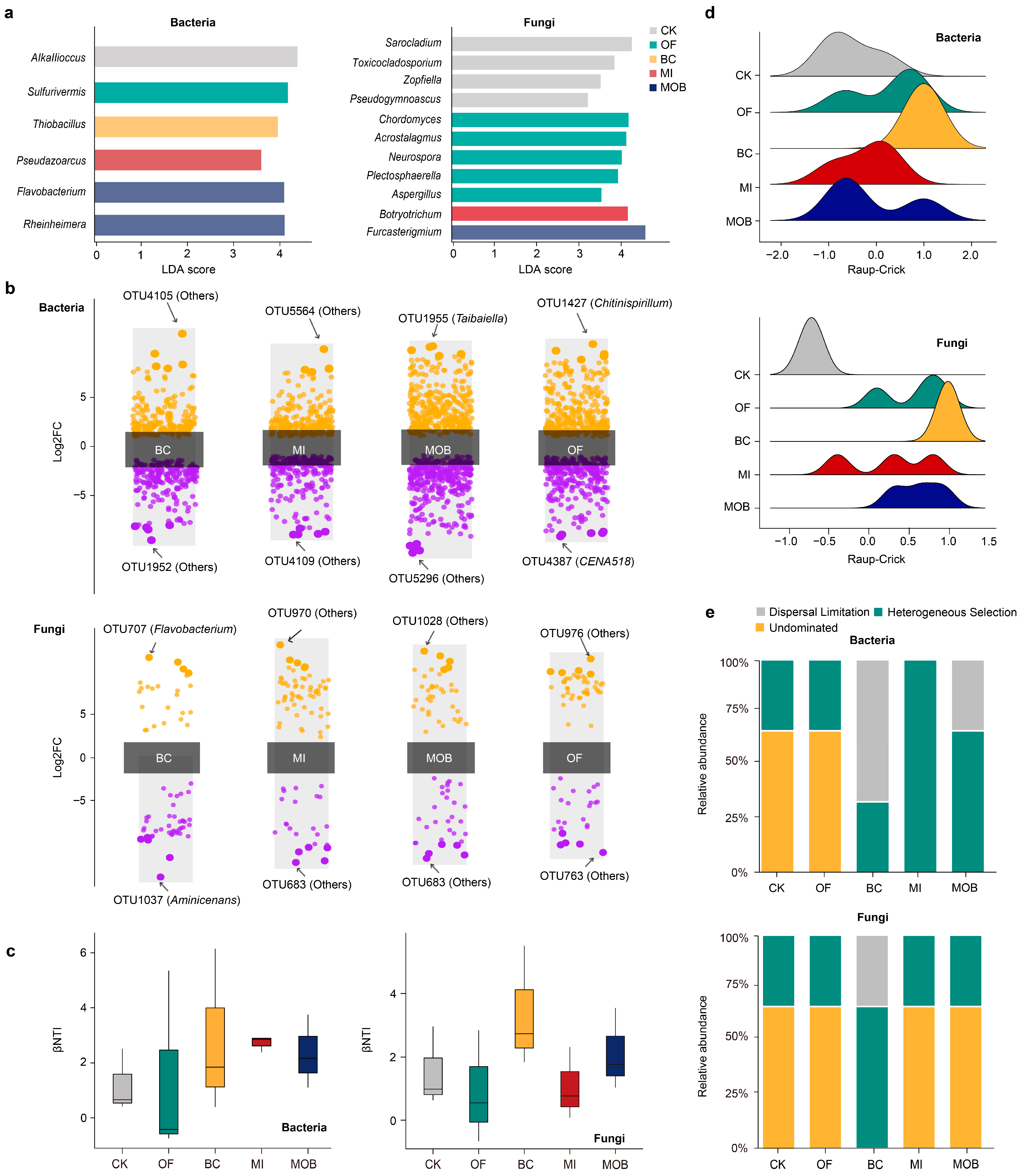
LEfSe analysis highlights the enrichment of specific taxa under different treatments, indicating that various fertilization treatments have a significant impact on the composition of microbial communities (Figure 2a). The CK treatment was characterized by an enrichment of Alkalicoccus, whereas the OF, BC, MI, and MOB treatments were predominantly enriched with Sulfurivermis, Thiobacillus, Pseudazoarcus, and Flavobacterium and Rheinheimera, respectively (Figure 2a). For the fungal communities, the CK treatment was enriched with Sarocladium and Toxicocladosporium, the OF treatment with Chordomyces and Acrostalagmus, the MI treatment with Botryotrichum, and the MOB treatment with Furcasterigmium (Figure 2a). Changes in relative abundance among the top 20 genera and their correlation with soil chemical properties are presented in Figures S1 and S2.

3.3. Soil Microbial Community Assembly

By analyzing significantly upregulated and downregulated OTUs, we selected the most abundant differential OTUs to represent the key microbial taxa (Figure 2b). Compared with CK, Taibaiella was significantly enriched by the MOB treatment, likely due to increased nitrogen availability in soil environment, while Chitinispirillum was significantly enriched by the OF treatment, possibly reflecting the enhanced organic matter degradation (Figure 2b). On the other hand, CENA518 was significantly downregulated by the OF treatment, potentially due to changes in redox conditions or organic matter availability in the soil (Figure 2b). In the fungal community, Flavobacterium was enriched, while Aminicenans was downregulated in the BC treatment, likely due to changes in organic substrate availability and soil conditions. To investigate microbial community assembly mechanisms, we quantified the relative importance of deterministic (homogeneous selection and heterogeneous selection) and stochastic processes (dispersal limitation, homogenizing dispersal, and drift) using the β–nearest taxon index (βNTI) and the modified Raup–Crick metric (RCbray) (Figure 2c,d). Deterministic and stochastic processes contributed to community assembly under the CK and OF treatments, with the assembly being predominantly governed by undominated processes in bacterial communities (Figure 2e). In contrast, stochastic processes played a major role in the BC treatment, among which dispersal limitation was identified as the primary stochastic component (Figure 2e). Meanwhile, heterogeneous selection emerged as the key deterministic process in the MI and MOB treatments. Fungal community assembly was largely stochastic across all treatments, except in BC, where heterogeneous selection dominated, with stochastic processes remaining influential in other treatments (Figure 2e).

3.4. Soil Microbial Network

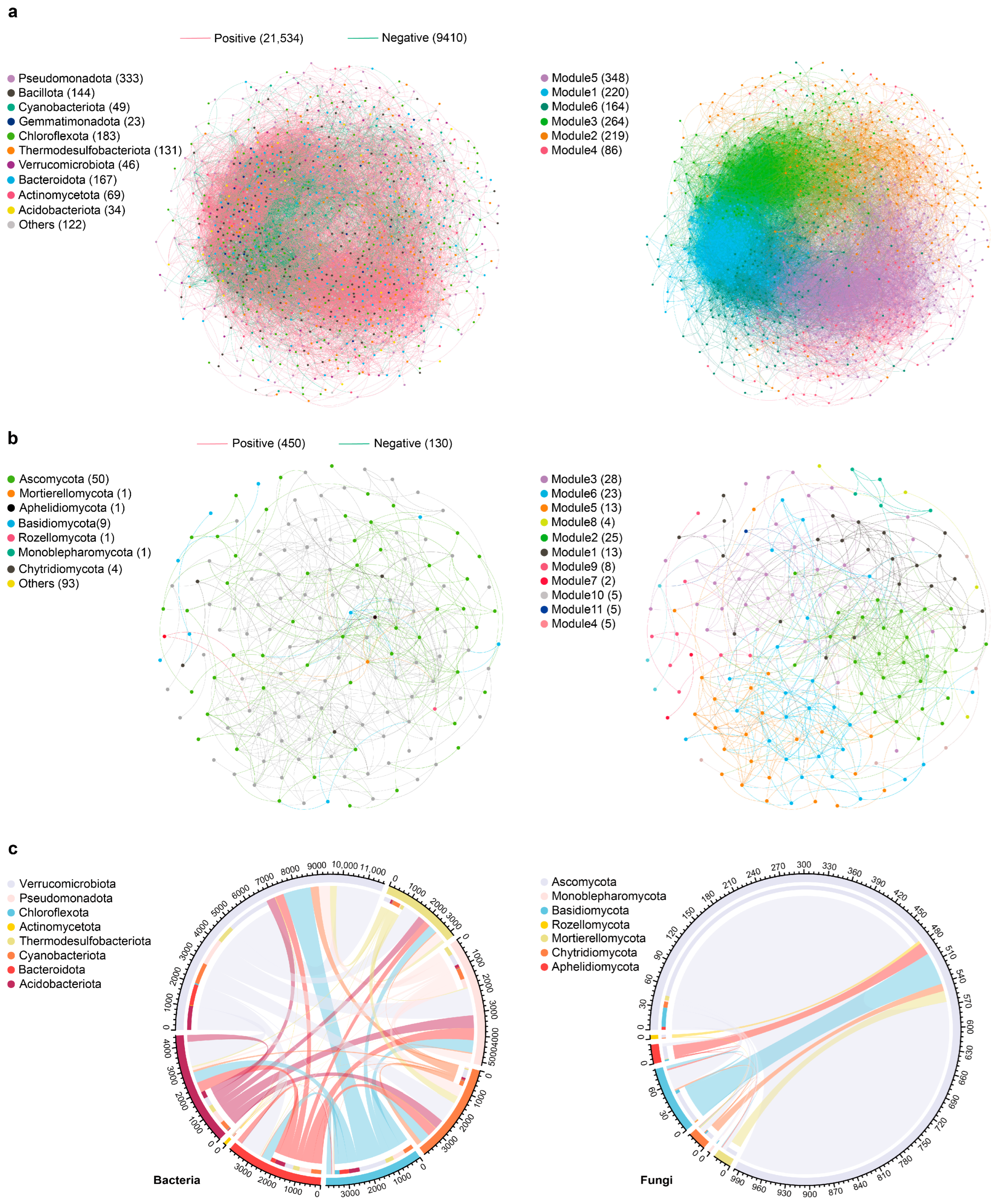
To characterize microbial interaction patterns across all processing systems, we constructed a bacterial co-occurrence network comprising 1301 nodes and 30,944 edges, and a fungal network containing 160 nodes and 580 edges (Figure 3a,b). The bacterial nodes were dominated by members of Pseudomonadota, Chloroflexota, Bacteroidota, Bacillota, and Thermodesulfobacteriota (Figure 3a). Within the bacterial network, nearly 30% of the edges represented intra-phylum co-occurrence relationships, whereas 70.51% represented inter-phylum relationships (Figure 3c). Likewise, in the fungal network, approximately 10% of the edges reflected intra-phylum interactions, while 50.36% reflected inter-phylum interactions (Figure 3c). Statistical analyses revealed positive co-occurrences suggestive of potential synergistic interactions, as indicated by the predominantly positive correlation coefficients (Figure 3a,b). These results suggest that, within the modified treatment system, microbial interactions rely on cooperative relationships among diverse soil microbial groups to maintain community stability.
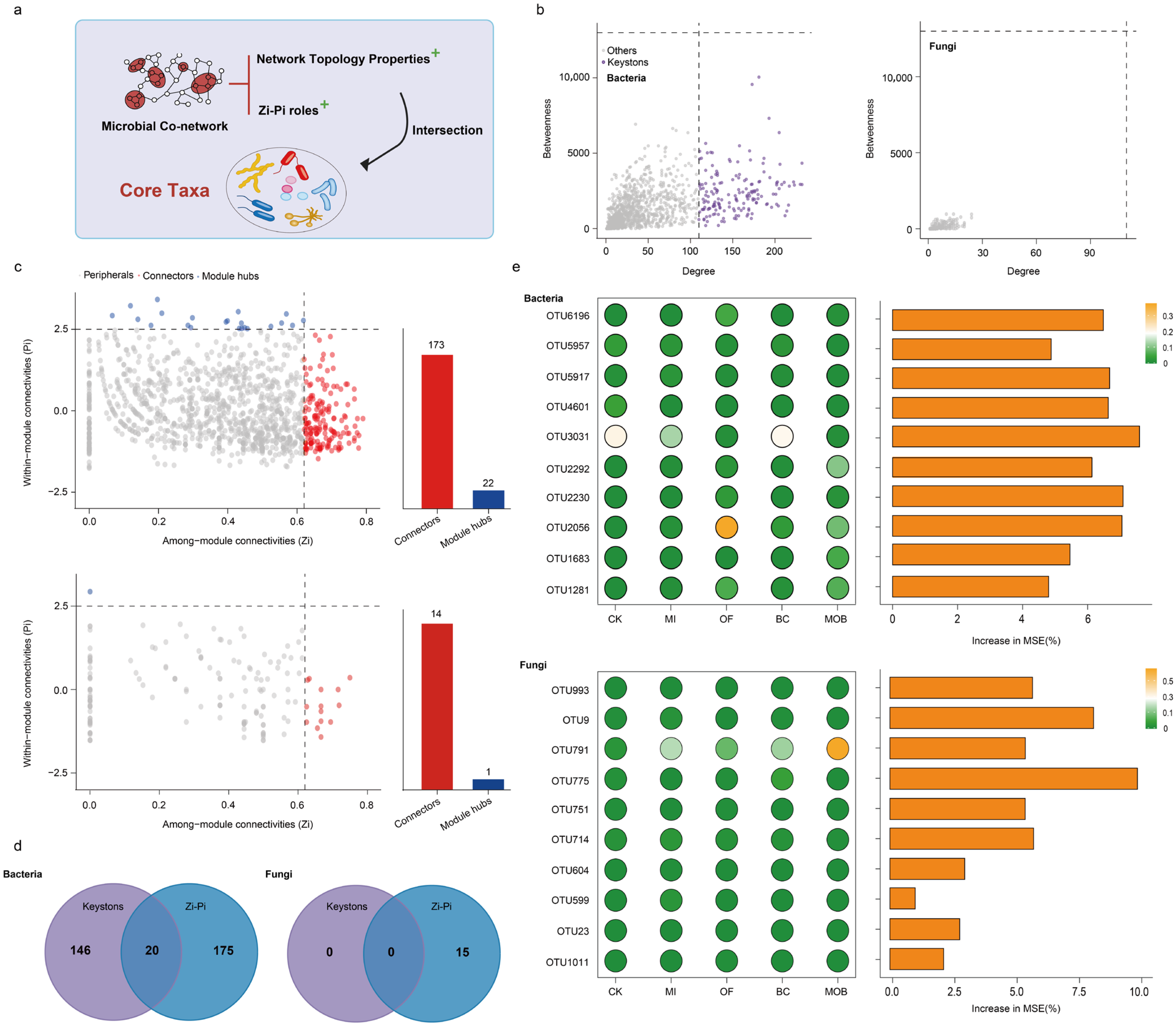
We determine the core species of microbial networks by constructing screening models for core species (Figure 4a). Through degree and betweenness of the bacterial network, we have identified 166 nodes within the bacterial network as belonging to the keystone (Figure 4b). However, owing to the sparse network of fungi, no nodes were identified as keystone (Figure 4b). Furthermore, based on Zi-Pi analysis, 173 nodes within the bacterial network were identified as connectors, with a Zi > 0.6 and Pi < 2.5 threshold, and 22 nodes were identified as module hubs, with a Zi < 0.6 and Pi > 2.5 threshold. In the same way, there are 14 nodes within the fungal network that were identified as connectors, and 1 node was identified as a module hub (Figure 4c).
Among these, 20 OTUs were characterized as important mutualistic taxa for bacterial communities (Figure 4d). Random forest ranking further revealed OTU3031, OTU2230, and OTU2056 as core hubs (Figure 4e). Compared to the CK treatment, OTU3031 was strongly influenced by M1 and MOB treatments, while both OTU2056 and OTU3031 were significantly affected by OF treatment, with the strongest response observed for OTU2056 (Figure 4e). In contrast, only three keystone taxa were identified in the fungal network: OTU775, OTU9, and OTU714, all of which belonged to Ascomycota (Table S2).

3.5. Soil Microbial Function Prediction

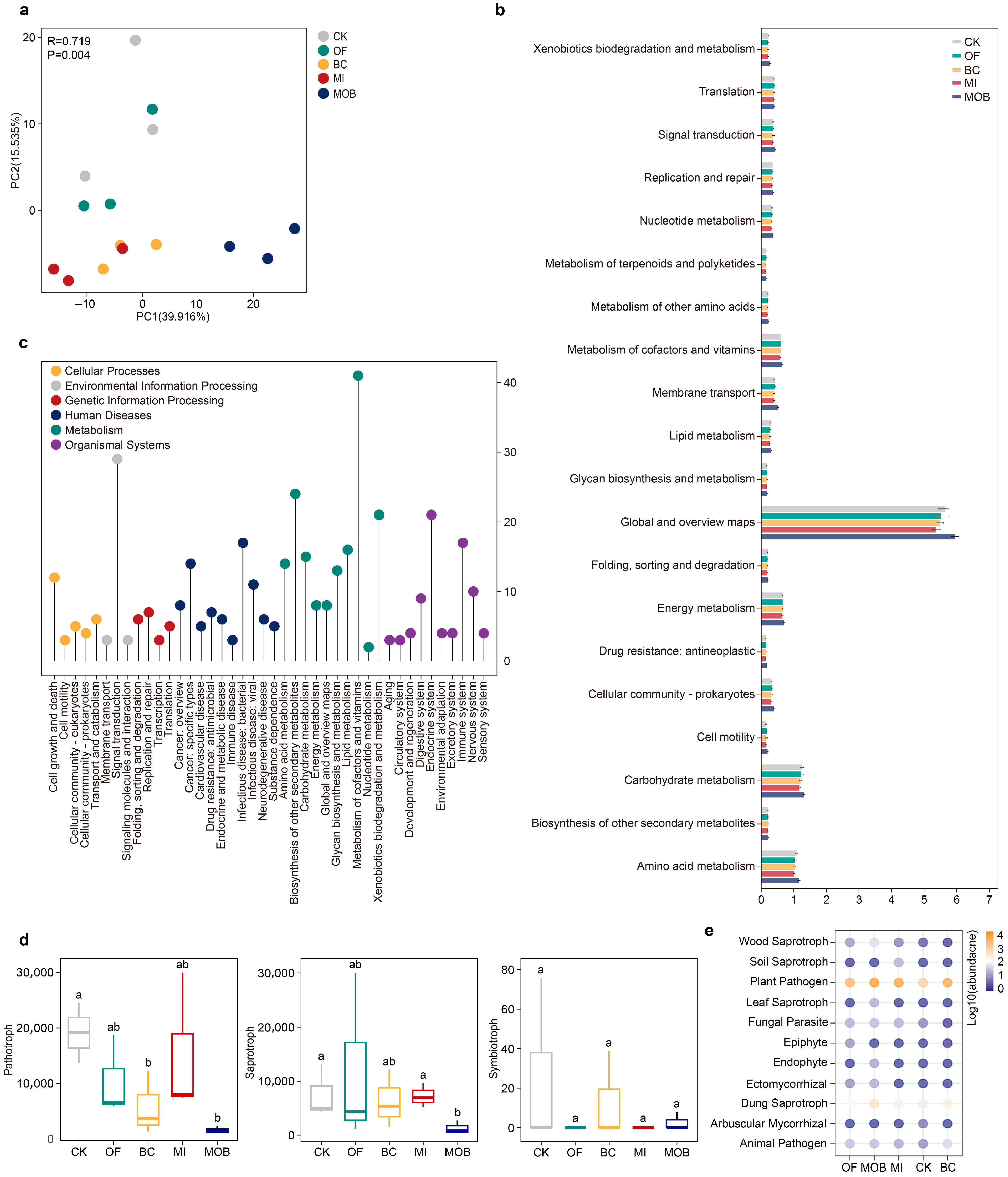
To examine the effects of different soil remediation measures on microbial community metabolic functions, we performed bacterial community functional prediction analysis using PICRUSt2 (Figure 5). Different remediation measures had significant effects on the metabolic functions of bacteria (Figure 5a). We then selected the top 20 level–2 metabolic pathways by abundance (Figure 5b). The results showed that, compared with CK, the MOB treatment increased the abundance in the carbohydrate metabolism and amino acid metabolism pathways (Figure 5b). In addition, MOB treatment was also significantly enriched in key pathways such as metabolism of cofactors and vitamins and energy metabolism (Figure 5b). In contrast, the predicted abundance in xenobiotic biodegradation and metabolism, nucleotide metabolism, carbohydrate metabolism, and amino acid metabolism for the OF, BC, and MI treatments was lower than that of CK (Figure 5b). To further analyze the functional diversity in level 2 pathways, we examined the number of nested level 3 pathways within each secondary metabolic pathway (Figure 5c). The study found that a total of 42 KEGG pathways were involved in carbohydrate metabolism (Figure 5c).
To assess the potential functional profiles of the fungal communities, we utilized the FUNGuild database to assign functional guilds to the detected taxa and estimate the relative abundances of pathotrophs, saprotrophs, and symbiotrophs (Figure 5d). Compared to CK, a significant reduction in the relative abundance of Pathotrophs was observed in the BC and MOB treatments. Conversely, the saprotrophic guild was most abundant in the OF treatment (Figure 5d). Meanwhile, the MOB treatment resulted in a significantly lower abundance of saprotrophs relative to CK. We then further clarified the effects of different improved measures on fungal functional groups (Figure 5e). Among the trophic guilds, plant pathogens were the most abundant across all treatments (Figure 5e). Notably, their relative abundance was significantly lower in the MOB and BC treatments compared to the CK (Figure S5).

4. Discussion

Soil salinization remains a significant issue threatening global soil quality, severely undermining many fundamental ecological functions of the soil and thereby constraining the sustainable development of agricultural production [36,37,38]. Therefore, research into the effects of organic amendment inputs on soil quality and crop productivity is crucial for the remediation and sustainable development of saline–alkali soil [39,40]. Although the application of organic amendments is a well-established strategy for ameliorating saline–alkali soils, the mechanisms governing microbial community assembly, particularly how they diverge under different organic material inputs, remain largely elusive. In this study, we observed that mixed organic materials exerted an inhibitory effect on microbial communities, potentially by intensifying competitive exclusion under conditions of high nutrient availability. Exogenous microbial inoculants have been identified as the primary inducing factor shaping microbial community assembly, with their influence overcoming that of other management practices.
Microbial diversity drives ecosystem functions [41,42]. Thus, changes in the ecological functions of saline–alkali soils serve as key indicators for evaluating soil improvement. Although microbial inoculation (MI) at a single dose typically promotes the dominance of the inoculant within the native community, this was not observed in the present study (Figure 1a). Typically, MI with a single inoculum leads to its dominance within the microbial community; however, the findings of this study contradict this pattern (Figure 1a). Exogenous inoculants may enhance the rhizosphere microenvironment by secreting EPS, producing organic acids to regulate pH, or inducing plants to secrete root exudates [43]. For instance, P. plecoglossicida inoculation has been reported to reshape the rhizosphere microbial community and enhance the exudation of root-derived metabolites (e.g., amino acids, carbohydrates, lipids, and terpenoids), ultimately supporting soil health maintenance [44]. Consequently, inoculated microbial agents may function not merely as “consumers” but as “producers” in saline–alkali soil remediation. This demonstrates that metabolic mutualistic interactions create additional ecological niches rather than competitive exclusion effects [45]. In contrast, while MOB treatment increased substrate diversity, it led to a decline in community diversity. This was likely primarily due to the introduction of excess readily available nutrients in the mixed material, triggering explosive growth of copiotrophic bacteria whilst crowding out oligotrophic bacteria [46]. Similarly, high microbial community richness is generally considered beneficial for ecosystem function and the health of soil organisms [41]. Saline–alkaline soils can create a stressful environment for bacteria, depending on the degree of salinity and alkalinity. High salt concentrations and elevated pH levels may inhibit the growth of many bacterial taxa [47]. MI enhanced plant growth, which, in turn, altered the microenvironment inhabited by rare bacterial communities in the rhizosphere under salt stress by modulating root exudate composition [48]. This lowered environmental survival thresholds, enabling rare bacterial taxa within the microbial community to persist and thereby significantly increasing species richness. Mixed organic matter provides a highly heterogeneous spectrum of carbon sources, with diverse food sources creating additional nutritional niches for saprophytic fungi [49]. It is noteworthy that higher taxonomic richness may harbor more potential undesirable taxa (such as pathogens) [50], as evidenced by the increased abundance of plant pathogens in the MI treatment relative to CK in this study. Saline–alkaline stress disrupts native microbial interactions and severs the inoculant’s connectivity with the resident community, temporarily reducing its beneficial effects. This stress shifts resource allocation toward protective molecules at the expense of pathogen-antagonistic compounds [51]. However, improved soil nutrient availability over time enables the inoculant to occupy its niche and colonize the rhizosphere [52].
The Adonis analysis demonstrated that although the addition of organic matter significantly altered microbial community structure, the beta diversity index showed no significant change, indicating a conservative community composition (Figure 1c). The Environmental Filtering theory may explain this phenomenon, whereby the pores of biochar, the nutrients in organic fertilizers, and competition between microbial inoculants and indigenous microorganisms act as filters, screening and reshaping distinct species assemblages [53]. The MI treatment may have introduced biotic pressure, which, while not sufficiently intense to cause community collapse (marked decline in diversity) (Figure 1c,d), acted as a potent biological filter. This process screened out certain sensitive indigenous microbes, with specific tolerant communities subsequently colonizing the niche [54]. This is also evident from the results showing turnover-dominated β–diversity changes, indicating that the fungal treatment drove species replacement (Figure 1e).
Soil ecosystem multifunctionality is jointly shaped by soil properties and microbial communities, with soil properties and microbial communities exhibiting stronger correlations under saline–alkali stress conditions [55,56]. This study confirms a significant correlation between soil properties and the dominant taxa within soil microbial communities (Figure 1f and Figure S1). In addition, AP is not the primary factor influencing microbial community structure (Figure 1f). According to Liebig’s Law of the Minimum, when phosphorus ceases to be the limiting factor, the succession of microbial communities no longer responds to variations in phosphorus concentration [57]. When phosphorus is no longer the most limiting factor, the microbial community does not respond directly to fluctuations in phosphorus availability. Instead, it is influenced indirectly through plant-mediated carbon allocation to the rhizosphere [58]. This indicates that the addition of organic matter primarily alters the availability of carbon sources, rather than phosphorus fertility. Similarly, TK appears to exert minimal influence on fungal community structure. Fungi are primarily driven by organic carbon sources, as their principal function is the degradation of lignin/cellulose [49,59]. Although potassium is essential, it primarily functions as an enzyme activator, regulating osmotic pressure rather than serving as a structural component like carbon. Consequently, fungal community composition is not predominantly influenced by total potassium availability (Figure 1f).
The MOB and OF treatment provided abundant carbon sources, rapidly activating carbon-responsive, eutrophication-inducing r-strategist bacteria while suppressing the k-strategist bacteria (Acidobacteriota) [60] (Figure S4). Similar to the findings of Cao et al., our results also demonstrate that organic fertilization treatments suppressed the abundance of Acidobacteriota [61]. In contrast, biochar primarily contains aromatic carbon, which is difficult for bacteria to utilize and does not stimulate an increase in the abundance of r-strategists (Figure S4) [62,63]. Biochar altered the composition of bacterial communities, with a significant change in the relative abundance of the key Bacillota, likely due to changes in soil nutrients, as previously reported [64]. Bacillota typically lack the oxidase systems required for degrading aromatic rings. For Bacillota reliant on readily available carbon sources, the biochar environment equates to a state of ‘carbon starvation’, incapable of supporting their rapid growth. This may also explain why OF treatment is significantly higher in abundance than BC (Figure S4) [65].
MOB typically comprises structural materials such as straw, which enhance soil porosity and aeration, thereby disrupting anaerobic microenvironments. Compared to OF, MOB promotes greater oxygen permeation, leading to reduced abundance of anaerobically preferential Ignavibacteriota [66]. The ubiquity and highest abundance of the MOB suggest that substrate heterogeneity and aerobic conditions may have favored this metabolically versatile phylum, potentially explaining its dominance over taxa in single-source or low-nutrient treatments [67,68,69]. Microscopic experiments controlling substrate complexity will be needed in the future to verify whether these factors synergistically expand the ecological niche already achieved by Pseudomonadota. Similarly, the abundance was significantly higher in BC than in CK (Figure S4). Oxygen struggles to diffuse into the deeper micropores of biochar, thereby creating countless minute anaerobic niches within it. This allows thermophilic desulphurizing bacteria to evade oxygen stress [70]. In microbial inoculation treatments (MI), the proliferation of indicates that parasitic Aphelidiomycetes subsequently multiply profusely when plant hosts overgrow due to fungal treatment interference, exhibiting a distinct parasitic ecological niche that starkly contrasts with the saprophytic pathway dominant in other soil conditioners (Figure S4) [71,72].
Pseudazoarcus may derive direct benefit from the Aphelidiomycetes (Figure 2a). These death-inducing substances of parasitic fungi, rich in aromatic compounds, promote niche release, thereby inducing a competitive advantage in Pseudazoarcus species [73]. Their enrichment signifies a shift towards ecological restoration in saline–alkali soil ecosystems, owing to their dual capacity for biological nitrogen fixation and saline–alkali land remediation [74,75]. A recent study also showed that the endophyte Pseudazoarcus was isolated from the roots of salt-tolerant wild soybean, where it was confirmed to enhance soybean salt tolerance through reprogramming of nitrogen metabolism [76]. This highlights the crucial role of root-associated microbiomes in maintaining the stability of rhizosphere communities and promoting plant–microbe interactions. Furthermore, it has been shown that the salt tolerance trait of Botrytis enables it to maintain its saprophytic function under saline–alkaline stress, which similarly links carbon mineralization to stress adaptation [77]. The enrichment of the Taibaiella indicates that MOB treatment of plant residues rich in cellulose and hemicellulose has successfully activated the degradation pathways for plant-derived structural carbon in the soil [78,79]. The increased abundance of Chitinispirillum under OF treatment indicates enhanced chitin turnover in the soil. This suggests that microbial communities actively recycle carbon and nitrogen by breaking down chitin derived from dead fungal material, thereby contributing to nutrient availability [80]. Our results show that Flavobacterium was a key taxon significantly enriched under BC treatment. This genus is known to produce extracellular polysaccharides, form biofilms on root surfaces, and exhibit gliding motility. These traits likely enable Flavobacterium to enter and colonize the micropores of biochar, allowing it to exploit this protected physical niche [81]. Understanding the factors that shape microbial community assembly is a central goal of microbial ecology. Differences in community composition arise from the combined effects of environmental selection, organism movement, and random demographic processes acting within the broader metacommunity [82,83]. Different soil improvement measures significantly altered microbial community assembly. Microbial community composition was shaped by the combined influence of multiple weak forces in CK and OF treatments, including random drift and low-intensity environmental selection.
The abundant availability of nutrients reduced the intensity of competition between species. When resources ceased to be a limiting factor, environmental selection pressure consequently diminished. This may explain why the addition of organic fertilizer alleviated nutrient limitations without altering the assembly of bacterial communities [84]. The microporous structure of biochar offers microorganisms protected spaces that help shield them from predators and unfavorable environmental conditions [85]. Once established within biochar pores, microbial communities become physically isolated from the surrounding soil, which limits their exchange with the external environment and restricts collective movement. This isolation imposes diffusion constraints on community assembly during biochar treatment (Figure 2e). Consistent with this pattern, only small differences in bacterial beta diversity were observed among samples (Figure 1c). Heterogeneous selection occurs when large environmental differences favor different species across sites. In the MI treatment, the introduction of high concentrations of functional bacteria disrupted existing niche balance, creating intense competitive pressures that strongly shaped community composition [86,87]. The combined action of biochar, organic fertilizer, and microbial inoculants creates a complex chemical environment for MOB treatments [88,89]. This high environmental heterogeneity, through a deterministic “environmental filtering” effect, drives microbial communities to evolve towards adaptation to local microenvironments (Figure 2e). Similarly, only the fungal communities treated with BC were dominated by Heterogeneous Selection (Figure 2e). Biochar provides a specific chemical environment that serves as a potent selection signal for fungi [90,91]. In saline–alkali soils, biochar offers a relatively stable “amended zone” with similar properties, compelling fungal communities to gravitate towards taxa that either utilize nutrients on the biochar surface or tolerate its alkalinity (such as Ascomycota) [92].
The high proportion of cross-phylum interactions indicates that the amendment promotes coupling between microbial communities performing distinct metabolic functions, facilitating metabolic cooperation across trophic levels. Pseudomonadota and Bacillota, as r-strategists, likely drive rapid initial decomposition of labile substrates, whereas Chloroflexota, as k-strategists, mediate slower breakdown of recalcitrant carbon [93,94]. Bacteroidetes bridge this continuum by converting complex polymers into intermediates (e.g., organic acids) that fuel Proteobacteria or Thermodesulfobacteria [95], enhancing overall carbon processing efficiency through metabolic handoffs. Such cross-phyla cooperation is reflected in the predominantly positive correlations and high-connectivity interactions among different phyla observed in the network of this study (Figure 3b). We observed that OTU2056 exhibited higher abundance in the OF treatment compared to the CK (Figure 4e and Table S2). The proliferation of Bacteroidetes marks the initiation of carbon cycling. Previous studies have confirmed that the addition of organic fertilizers promotes members of Bacteroidetes, which play a key role in determining the multifunctionality of soil [96]. Through the production of extracellular enzymes, they convert complex organic carbon into soluble organic carbon, thereby providing substrates for other cooperative microbial groups within the network [97]. In resource-limited saline–alkali soils, the OF treatment has a transient pulse of resource input. As r-strategists, Bacteroidetes exhibit high growth rates, enabling them to rapidly occupy newly formed ecological niches and thereby establish a central position within the network [66]. Acting as a core hub, they form cooperation with downstream microbial groups through the secretion of metabolic byproducts, which may drive energy flow throughout the entire community. Moreover, the activity of key microbial communities determines the turnover rate of carbon sources. These core communities significantly increase under organic fertilizer treatment, which implies that organic fertilizers not only enhance soil nutrients but also accelerate biogeochemical cycles in saline–alkali soils by activating the Bacteroidetes phylum as an efficient carbon supplier, which may play a key driving role in carbon cycling [97]. OTU791 is a keystone taxon in the fungal network and is strongly stimulated by the MOB treatment; it is taxonomically affiliated with Furcasterigmium (Figure 4e and Table S2). On the one hand, the pronounced proliferation of Sordariomycetes reflects its high efficiency in exploiting composite habitats rather than conditions created by a single amendment, as it preferentially inhabits niches specific to rice ecosystems [98]. On the other hand, the addition of biochar in the microbial oxidation (MOB) treatment acts as a strong environmental filter, selectively promoting the growth of certain taxa, such as Sordariomycetes, which can adapt to extreme surface conditions and exploit nutrients attached to the biochar [99,100]. This taxon may function as a “bridge” within the fungal community, linking the utilization of recalcitrant carbon introduced by biochar with the cycling of more labile carbon derived from organic fertilizer. Therefore, the homogeneous selection observed in the fungal community under the BC treatment is primarily attributable to the targeted recruitment of specific taxa such as Sordariomycetes (OTU791), reflecting the strong selective filtering effect of biochar on fungal functional lineages. In the same way, the application of microbial inoculants also induced an increase in the abundance of Sordariomycetes, which is consistent with the findings of Liu et al. [100].
The MOB treatment is completely separated from CK in functional space, indicating that the composite amendment not only alters species composition but also reshapes the overall functional potential. The high connectivity, positive correlations, and cross-trophic metabolic cooperation observed in the network of this study are corroborated at the functional level by the enrichment of signaling pathways and cofactor metabolism pathways. Among the top 20 most abundant secondary KEGG pathways, the MOB treatment significantly upregulated the abundance of carbohydrate metabolism and amino acid metabolism pathways, indicating an enhanced turnover efficiency of organic substrates [101,102]. Notably, the MOB treatment also significantly enriched pathways involved in the metabolism of cofactors and vitamins and energy metabolism, indicating that the community is transitioning toward a more robust and cooperative metabolic state [103]. Analysis of tertiary pathways revealed that a total of 15 specific KEGG groups are involved in carbohydrate metabolism, further highlighting the functional diversification under the amendment conditions. Compared with the CK, BC and MOB treatments significantly reduced the relative abundance of pathogenic fungi, suggesting that biochar-mediated changes in the soil environment may suppress potential soil-borne pathogens [104]. Saprotrophic fungi were most abundant under the OF treatment, likely due to the greater supply of easily decomposable organic matter. Saprotrophic fungi play a crucial role in soil health and nutrient cycling by efficiently decomposing organic matter and releasing plant-available nutrients, thereby promoting plant growth and development [105]. This underscores the positive contribution of organic fertilizer application to enhancing soil resilience. In contrast, their abundance under MOB was significantly lower than in CK, suggesting a shift in fungal ecological strategies toward more specialized functional roles. This shift may affect the diversity and ecological functions of the soil microbial community, particularly in saline–alkaline environments where microbial adaptability is of critical importance [106]. Despite these changes, plant pathogens remained a dominant functional group across all treatments, underscoring the strong and persistent environmental constraints characteristic of saline–alkali rice systems. This finding underscores the necessity of integrating the complexity and dynamics of soil ecosystems into plant management practices to develop effective strategies. Future research should therefore focus on optimizing the combined use of biochar and microbial fertilizers to enhance soil health and crop production.

5. Conclusions

This study systematically elucidates the complete pathway by which different organic amelioration measures drive microbial community assembly and functional enhancement in saline–alkali soils through differentiated ecological mechanisms. Microbial inoculants markedly increased bacterial diversity and promoted deterministic community assembly by generating complementary niches and strong selective pressures, shifting the bacterial community assembly from stochastic processes in the CK to deterministic processes under MI. Organic amendments do more than supply nutrients; they act as ecological filters (SOM, AHN, and AK) that guide microbial community assembly toward more stable and resilient soil functions in saline–alkali environments. In particular, the mixed-organism improvement strategy effectively reshaped soil functional profiles by strengthening metabolic interactions across microbial groups and reducing the prevalence of pathogenic bacteria. This study provides both theoretical foundations and practical frameworks for constructing microbial community management-based ecological remediation technologies for saline–alkali soils. To preserve the environment and reduce financial costs in cultivating saline–alkali soils, cultivating salt-tolerant crops could be an alternative solution in addition to the reclamation strategies presented in this study.

Supplementary Materials

The following supporting information can be downloaded at: https://www.mdpi.com/article/10.3390/agronomy16050531/s1.

Author Contributions

All authors contributed to the study conception and design. Conceptualization, M.S. and X.L.; methodology, M.S. and T.L.; validation, M.S. and B.Q.; formal analysis, M.S., Y.Z., and X.L.; investigation, M.S., T.L., and D.L.; data curation, T.L., D.L., B.Q., and Y.Z.; writing—original draft preparation, M.S., T.L., B.Q., and Y.Z.; writing—review and editing, M.S., T.L., D.L., B.Q., and X.L.; supervision, X.L. All authors have read and agreed to the published version of the manuscript.

Funding

This research was funded by Breeding, Extension and Industrialization of New Medium-late Maturing Rice Varieties with High Quality, High Yield and Wide Adaptability (CX23ZD02) and Longjiang Science and Technology Talent Spring Goose Support Program 2022 (CYQN0254).

Data Availability Statement

Data that support the findings of this study are available in the article/Supplementary Materials.

Conflicts of Interest

The authors declare no conflicts of interest.

References

  1. Basharat, S.; Saeed, W.; Liu, P.; Waseem, M.J.P.H. Abscisic acid mediated salinity stress tolerance in crops. Plant Horm. 2025, 1, e015. [Google Scholar] [CrossRef]
  2. Yan, B.; Ao, L.; Li, B.; Mao, L.; Sun, L.; Li, X. Response of soil nitrogen cycle microbial functions to ecological reconstruction in saline-alkali soils: A dual rerspective of natural succession and alfalfa cropping. Land Degrad. Dev. 2025, 36, 4753–4769. [Google Scholar] [CrossRef]
  3. Xie, Y.; Zhang, X.; Gao, Y.; Li, J.; Geng, Y.; Guo, L.; Shao, X.; Ran, C. Effects of different straw returning periods and nitrogen fertilizer combinations on rice roots and yield in saline–sodic soil. Agronomy 2024, 14, 2463. [Google Scholar] [CrossRef]
  4. Yu, H.; Wang, Z.; Mao, D.; Jia, M.; Chang, S.; Li, X. Spatiotemporal variations of soil salinization in China’s West Songnen Plain. Land Degrad. Dev. 2023, 34, 2366–2378. [Google Scholar] [CrossRef]
  5. Peng, W.; Zhu, X.; Zheng, W.; Xie, Q.; Wang, M.; Ran, E. Rice cultivation can mitigate soil salinization and alkalization by modifying the macropore structure in saline–sodic paddy fields. Agric. Water Manag. 2025, 313, 109473. [Google Scholar] [CrossRef]
  6. Xu, S.; Na, M.; Huang, Y.; Zhang, J.; Zhou, J.; Li, L.-J. Changes in microbial carbon cycling functions along rice cultivation chronosequences in saline-alkali soils. Soil Biol. Biochem. 2025, 202, 109699. [Google Scholar] [CrossRef]
  7. Chen, T.; Shabala, S.; Niu, Y.; Chen, Z.-H.; Shabala, L.; Meinke, H.; Venkataraman, G.; Pareek, A.; Xu, J.; Zhou, M. Molecular mechanisms of salinity tolerance in rice. Crop J. 2021, 9, 506–520. [Google Scholar] [CrossRef]
  8. Li, S.; Yang, Y.; Li, Y.; Gao, B.; Tang, Y.; Xie, J.; Zhao, H. Remediation of saline-sodic soil using organic and inorganic amendments: Physical, chemical, and enzyme activity properties. J. Soils Sediments 2020, 20, 1454–1467. [Google Scholar] [CrossRef]
  9. AbuQamar, S.F.; El-Saadony, M.T.; Saad, A.M.; Desoky, E.-S.M.; Elrys, A.S.; El-Mageed, T.A.A.; Semida, W.M.; Abdelkhalik, A.; Mosa, W.F.A.; Al Kafaas, S.S. Halotolerant plant growth-promoting rhizobacteria improve soil fertility and plant salinity tolerance for sustainable agriculture—A review. Plant Stress 2024, 12, 100482. [Google Scholar] [CrossRef]
  10. Li, D.; Qi, Z.; Guo, J.; Wang, T.; Li, X.; Hou, N. Study on the screening of high-efficiency salt alkali-tolerant microbial agents their roles mechanisms in enhancing saline-alkaline soil remediation. J. Clean. Prod. 2025, 519, 145992. [Google Scholar] [CrossRef]
  11. Sun, X.; Zhang, C.; Liu, K.; Xu, M.; Cai, A. Long-term manure application enhances carbon use efficiency in soil aggregates by regulating microbial communities in cropland. Soil Biol. Biochem. 2025, 210, 109945. [Google Scholar] [CrossRef]
  12. Hu, M.; Li, Y.; Chen, Z.; Lv, K.; Xiong, Y.; Huang, G. Drip irrigation combined with organic fertilizers improves crop N uptake and yield by reducing soil salinity and N loss in saline–alkali sunflower farmlands. Soil Tillage Res. 2026, 255, 106789. [Google Scholar] [CrossRef]
  13. Song, W.; Shu, A.; Liu, J.; Shi, W.; Li, M.; Zhang, W.; Li, Z.; Liu, G.; Yuan, F.; Zhang, S. Effects of long-term fertilization with different substitution ratios of organic fertilizer on paddy soil. Pedosphere 2022, 32, 637–648. [Google Scholar] [CrossRef]
  14. Guo, L.; Bai, X.; Zhang, W.; Xiong, Q.; Luo, L.; Chen, L.; An, Q.; Shi, Z.; Tao, Y.; Ye, X. Study on the matching of organic fertilizer supply characteristics rice nutrient demand. J. Anhui Agric. Univ. 2025, 52, 275–284. [Google Scholar] [CrossRef]
  15. Xu, Z.; Zhou, R.; Xu, G. Global analysis on potential effects of biochar on crop yields and soil quality. Soil Ecol. Lett. 2025, 7, 240267. [Google Scholar] [CrossRef]
  16. Qiu, X.; Xu, C.; Yan, D.; Li, W.; Wang, J.; Yang, Z.; Yuan, J.; Ji, C.; Wang, J.; Zhang, Y. Diversified cropping combined with biochar application enhances soil fertility, biodiversity, and crop productivity in a coastal saline–alkali soil. Agriculture 2025, 15, 2492. [Google Scholar] [CrossRef]
  17. Chang, L.; Ju, T.; Liang, K.; Li, Y. Biochar-influenced solubilization and mineralization mechanisms of phosphorus in saline-sodic soils. Soil Biol. Biochem. 2025, 209, 109890. [Google Scholar] [CrossRef]
  18. de Andrade, L.A.; Santos, C.H.B.; Frezarin, E.T.; Sales, L.R.; Rigobelo, E.C.J.M. Plant growth-promoting rhizobacteria for sustainable agricultural production. Microorganisms 2023, 11, 1088. [Google Scholar] [CrossRef]
  19. He, M.; Xiong, X.; Wang, L.; Hou, D.; Bolan, N.S.; Ok, Y.S.; Rinklebe, J.; Tsang, D.C.W. Acritical review on performance indicators for evaluating soil biota soil health of biochar-amended soils. J. Hazard. Mater. 2021, 414, 125378. [Google Scholar] [CrossRef]
  20. Quintarelli, V.; Borgatti, D.; Baretta, M.; Stazi, S.R.; Allevato, E.; Pancaldi, S.; Baldisserotto, C.; Mancinelli, R.; Tedeschi, P.; Radicetti, E.; et al. Microbial biofertilizers and algae-based biostimulant affect fruit yield characteristics of organic processing tomato. J. Sci. Food Agric. 2025, 1, 530–539. [Google Scholar] [CrossRef]
  21. Yuan, J.; Wen, T.; Yang, S.; Zhang, C.; Mengli, Z.; Guoqing, N.; Penghao, X.; Xiaoyu, L.; Xinyuan, Z.; Qirong, S.; et al. Growth substrates alter aboveground plant microbial and metabolic properties thereby influencing insect herbivore performance. Sci. China Life Sci. 2023, 66, 1728–1741. [Google Scholar] [CrossRef]
  22. Zhang, G.; Zhang, L.; Shi, Z.; Yang, Y.; Liu, J.Y. Microbial nutrient limitation and carbon use efficiency in saline-alkali soil amended with biochar: Insights from ecoenzymatic C:N:P stoichiometry. Biochar 2025, 7, 68. [Google Scholar] [CrossRef]
  23. Li, B.; Zhu, D.; Li, J.; Liu, X.; Yan, B.; Mao, L.; Zhang, M.; Wang, Y.; Li, X. Converting upland to paddy fields alters soil nitrogen microbial functions at different depths in black soil region. Agric. Ecosyst. Environ. 2024, 372, 109089. [Google Scholar] [CrossRef]
  24. Ruan, R.; Lambers, H.; Wang, Y. Comparative responses of two maize genotypes with contrasting drought tolerance to biochar application. Biochar 2024, 6, 66. [Google Scholar] [CrossRef]
  25. Oksanen, J.; Blanchet, F.G.; Friendly, M.; Kindt, R.; Legendre, P.; McGlinn, D.; Minchin, P.R.; O’Hara, R.B.; Simpson, G.L.; Solymos, P.; et al. R Package, version 2.5-7; vegan: Community Ecology Package; R Foundation for Statistical Computing: Vienna, Austria, 2008. Available online: https://CRAN.R-project.org/package=vegan (accessed on 5 January 2026).
  26. Shen, C.; Gunina, A.; Luo, Y.; Wang, J.; He, J.-Z.; Kuzyakov, Y.; Hemp, A.; Classen, A.T.; Ge, Y. Contrasting patterns and drivers of soil bacterial and fungal diversity across a mountain gradient. Environ. Microbiol. 2020, 22, 3287–3301. [Google Scholar] [CrossRef]
  27. Segata, N.; Izard, J.; Waldron, L.; Gevers, D.; Miropolsky, L.; Garrett, W.S.; Huttenhower, C. Metagenomic biomarker discovery and explanation. Genome Biol. 2011, 12, R60. [Google Scholar] [CrossRef]
  28. Robinson, M.D.; McCarthy, D.J.; Smyth, G.K. EdgeR: A bioconductor package for differential expression analysis of digital gene expression data. Bioinformatics 2010, 26, 139–140. [Google Scholar] [CrossRef] [PubMed]
  29. Stegen, J.C.; Lin, X.; Fredrickson, J.K.; Chen, X.; Kennedy, D.W.; Murray, C.J.; Rockhold, M.L.; Konopka, A. Quantifying community assembly processes and identifying features that impose them. ISME J. 2013, 7, 2069–2079. [Google Scholar] [CrossRef]
  30. Banerjee, S.; Kirkby, C.A.; Schmutter, D.; Bissett, A.; Kirkegaard, J.A.; Richardson, A.E. Network analysis reveals functional redundancy and keystone taxa amongst bacterial and fungal communities during organic matter decomposition in an arable soil. Soil Biol. Biochem. 2016, 97, 188–198. [Google Scholar] [CrossRef]
  31. Revelle, W. R Package, version 1.0-95; psych: Procedures for Psychological, Psychometric, and Personality Research; Northwestern University: Evanston, IL, USA, 2013.
  32. Widder, S.; Besemer, K.; Singer, G.A.; Ceola, S.; Bertuzzo, E.; Quince, C.; Sloan, W.T.; Rinaldo, A.; Battin, T.J. Fluvial network organization imprints on microbial co-occurrence networks. Proc. Natl. Acad. Sci. USA 2014, 111, 12799–12804. [Google Scholar] [CrossRef]
  33. Guimerà, R.; Amaral, L.A.N. Functional cartography of complex metabolic networks. Nature 2025, 433, 895–900. [Google Scholar] [CrossRef]
  34. Douglas, G.M.; Maffei, V.J.; Zaneveld, J.R.; Yurgel, S.N.; Brown, J.R.; Taylor, C.M.; Huttenhower, C.; Langille, M.G.I. PICRUSt2 for prediction of metagenome functions. Nat. Biotechnol. 2020, 38, 685–688. [Google Scholar] [CrossRef]
  35. Nguyen, N.H.; Song, Z.; Bates, S.T.; Branco, S.; Tedersoo, L.; Menke, J.; Schilling, J.S.; Kennedy, P.G. FUNGuild: An open annotation tool for parsing fungal community datasets by ecological guild. Fungal Ecol. 2016, 20, 241–248. [Google Scholar] [CrossRef]
  36. Song, J.S.; Zhang, H.Y.; Kumar, A.; Chang, F.D.; Yu, R.; Zhang, X.Q.; Wang, J.; Wang, W.N.; Liu, J.M.; Zhou, J. Combined organic ameliorants is benefits for improving ecosystem multi-functionality in saline soils. Ind. Crops Prod. 2025, 230, 121068. [Google Scholar] [CrossRef]
  37. Li, T.; Wang, S.N.; Liu, S.L.; Zhang, X.L.; Dong, H.L.; Dai, S.; Chai, L.Y.; Li, H.; Lv, Y.L.; Li, T.W. Trade-offs of organic amendment input on soil quality and crop productivity in saline-alkali land globally: A meta-analysis. Eur. J. Agron. 2025, 164, 127471. [Google Scholar] [CrossRef]
  38. Guo, S.Q.; Chen, Y.X.; Ju, Y.L.; Pan, C.Y.; Shan, J.X.; Ye, W.W.; Dong, N.Q.; Kan, Y.; Yang, Y.B.; Zhao, H.Y. Fine-tuning gibberellin improves rice alkali-thermal tolerance and yield. Nature 2025, 639, 162–171. [Google Scholar] [CrossRef]
  39. Li, S.P.; Zhao, L.; Wang, C.; Huang, H.Y.; Zhuang, M.H. Synergistic improvement of carbon sequestration and crop yield by organic material addition in saline soil: A global meta-analysis. Sci. Total Environ. 2023, 891, 164530. [Google Scholar] [CrossRef] [PubMed]
  40. Wagg, C.; Schlaeppi, K.; Banerjee, S.; Kuramae, E.E.; van der Heijden, M.G.A. Fungal-bacterial diversity and microbiome complexity predict ecosystem functioning. Nat. Commun. 2019, 10, 4841. [Google Scholar] [CrossRef]
  41. Banerjee, S.; van der Heijden, M.G.A. Soil microbiomes and one health. Nat. Rev. Microbiol. 2023, 21, 6–20. [Google Scholar] [CrossRef]
  42. Flemming, H.C.; van Hullebusch, E.D.; Little, B.J.; Neu, T.R.; Nielsen, P.H.; Seviour, T.; Stoodley, P.; Wingender, J.; Wuertz, S. Microbial extracellular polymeric substances in the environment, technology and medicine. Nat. Rev. Microbiol. 2024, 23, 87–105. [Google Scholar] [CrossRef]
  43. Giri, S.; Oña, L.; Waschina, S.; Shitut, S.; Yousif, G.; Kaleta, C.; Kost, C. Metabolic dissimilarity determines the establishment of cross-feeding interactions in bacteria. Curr. Biol. 2021, 31, 5547–5557.e6. [Google Scholar] [CrossRef]
  44. Qi, X.; Xu, X.; Xu, C.; Lv, G.; Cai, J.; Cheng, Z.; Yang, Z.; Yin, H. Pseudomonas plecoglossicida inoculation reshapes rhizosphere microbiome for BDE-47 dissipation in the alfalfa rhizosphere. J. Hazard. Mater. 2025, 495, 138959. [Google Scholar] [CrossRef]
  45. Yan, Y.Y.; Zhou, X.; Liu, L.L.; Cai, Z.C.; Penuelas, J.; Huang, X.Q. Soil Nutrient Enrichment Induces Trade-Offs in Bacterial Life-History Strategies Promoting Plant Productivity. Adv. Sci. 2025, 12, e10066. [Google Scholar] [CrossRef]
  46. Treseder, K.K. Ecological strategies of microbes: Thinking outside the triangle. J. Ecol. 2023, 111, 1832–1843. [Google Scholar] [CrossRef]
  47. Gunde-Cimerman, N.; Plemenitas, A.; Oren, A. Strategies of adaptation of microorganisms of the three domains of life to high salt concentrations. FEMS Microbiol. Rev. 2018, 42, 353–375. [Google Scholar] [CrossRef]
  48. Zhang, X.C.; Zhai, H.L.; Xu, H.Y.; Song, W.Z.; Liu, M.; Dong, X.F.; Sun, W.; Ma, J.Y. Different salt stress types regulated rhizosphere rare bacterial communities through root exudates and soil physicochemical properties. Plant Soil 2025, 516, 797–811. [Google Scholar] [CrossRef]
  49. Martin, F.; Tan, H. Saprotrophy-to-symbiosis continuum in fungi. Curr. Biol. 2025, 35, 469–475. [Google Scholar] [CrossRef] [PubMed]
  50. Labouyrie, M.; Ballabio, C.; Romero, F.; Panagos, P.; Jones, A.; Schmid, M.W.; Mikryukov, V.; Dulya, O.; Tedersoo, L.; Bahram, M. Patterns in soil microbial diversity across Europe. Nat. Commun. 2023, 14, 3311. [Google Scholar] [CrossRef] [PubMed]
  51. Li, C.; Chen, X.; Jia, Z. Meta-analysis reveals the effects of microbial inoculants on the biomass and diversity of soil microbial communities. Nat. Ecol. Evol. 2024, 8, 1270–1284. [Google Scholar] [CrossRef]
  52. He, C.; Gao, T.; Wang, X.; Chen, R.; Gao, H.; Liu, H. Co-inoculation of Bacillus subtilis and Bradyrhizobium liaoningense increased soybean yield and improved soil bacterial community composition in coastal saline-alkali land. Front. Plant Sci. 2025, 16, 1677763. [Google Scholar] [CrossRef]
  53. Keck, F.; Peller, T.; Alther, R.; Barouillet, C.; Blackman, R.; Capo, E.; Chonova, T.; Couton, M.; Fehlinger, L.; Kirschner, D.; et al. The global human impact on biodiversity. Nature 2025, 641, 395–400. [Google Scholar] [CrossRef]
  54. Liu, Y.; Jia, B.L.; Ren, Y.; Xun, W.B.; Stefanic, P.; Yang, T.J.; Miao, Y.Z.; Zhang, N.; Yao, Y.L.; Zhang, R.F. Bacterial social interactions in synthetic Bacillus consortia enhance plant growth. iMeta 2025, 4, e70053. [Google Scholar] [CrossRef] [PubMed]
  55. Wu, M.C.; Xie, S.Y.; Zang, J.X.; Sun, Y.Z.; Xu, S.M.; Li, S.; Wang, J. Multiple anthropogenic environmental stressors structure soil bacterial diversity and community network. Soil Biol. Biochem. 2024, 198, 109560. [Google Scholar] [CrossRef]
  56. Bai, X.; Wu, J.; Zhang, B.; Zhao, H.; Tian, F.; Wang, B. Metagenomics reveals functional profiles of soil nitrogen and phosphorus cycling under different amendments in saline-alkali soil. Environ. Res. 2025, 267, 120686. [Google Scholar] [CrossRef] [PubMed]
  57. Lu, Z.F.; Ren, T.; Li, Y.; Cakmak, I.; Lu, J.W. Nutrient limitations on photosynthesis: From individual to combinational stresses. Trends Plant Sci. 2025, 30, 872–885. [Google Scholar] [CrossRef] [PubMed]
  58. Wu, W.; Wang, F.; Xia, A.; Zhang, Z.; Wang, Z.; Wang, K.; Dong, J.; Li, T.; Wu, Y.; Che, R.; et al. Meta-analysis of the impacts of phosphorus addition on soil microbes. Agric. Ecosyst. Environ. 2022, 340, 108180. [Google Scholar] [CrossRef]
  59. Lankiewicz, T.S.; Choudhary, H.; Gao, Y.; Amer, B.; Lillington, S.P.; Leggieri, P.A.; Brown, J.L.; Swift, C.L.; Lipzen, A.; Na, H.Y.S.; et al. Lignin deconstruction by anaerobic fungi. Nat. Microbiol. 2023, 8, 596. [Google Scholar] [CrossRef]
  60. Chen, Y.P.; Chen, G.S.; Robinson, D.; Yang, Z.J.; Guo, J.F.; Xie, J.S.; Fu, S.L.; Zhou, L.X.; Yang, Y.S. Large amounts of easily decomposable carbon stored in subtropical forest subsoil are associated with r-strategy-dominated soil microbes. Soil Biol. Biochem. 2016, 95, 233–242. [Google Scholar] [CrossRef]
  61. Cao, X.; Liu, L.; Ma, Q.; Lu, R.; Kong, H.; Kong, Y.; Zhu, L.; Zhu, C.; Tian, W.; Jin, Q.; et al. Optimum organic fertilization enhances rice productivity and ecological multifunctionality via regulating soil microbial diversity in a double rice cropping system. Field Crops Res. 2024, 318, 109569. [Google Scholar] [CrossRef]
  62. Wang, W.Y.; Ding, S.J.; Guo, T.F.; Xu, X.P.; He, P.; Huang, S.M. Organic amendment strategies differentially regulate microbial carbon use efficiency: A long-term field study integrating microorganism and enzymatic stoichiometry. Agric. Ecosyst. Environ. 2026, 397, 110051. [Google Scholar] [CrossRef]
  63. Li, L.; Yang, J.K.; Yu, Y.L.; Shakoor, A.; Virk, A.L.; Li, F.M.; Yang, H.S.; Kan, Z.R. Crop straw converted to biochar increases soil organic carbon but reduces available carbon. Eur. J. Agron. 2025, 164, 127499. [Google Scholar] [CrossRef]
  64. Zhang, C.; Li, Z.; Miao, Y.; Liao, X. Combining effects of nitrogen fertilizer biochar on soil N2Oemissions microbial community in a subtropical rapeseed-soybean rotation. Eur. J. Agron. 2025, 126, 103750. [Google Scholar] [CrossRef]
  65. Li, Q.J.; Zheng, X.N.; Liu, M.J. Influence of Grass Mulching and Organic Fertilizer Addition on Soil Microbial Community Composition and Function in a ‘Dongzao’ Jujube (Ziziphus jujuba Mill. ‘Dongzao’) Orchard. Eurasian Soil. Sci. 2024, 57, 460–470. [Google Scholar] [CrossRef]
  66. Cai, X.; Yuan, X.; Singh, A.K.; Chen, C.; Zhu, X.; Liu, W. Tradeoffs between microbial life-history strategies drive soil carbon cycling during revegetation in karst ecosystems: A metagenomic perspective. J. Environ. Manag. 2025, 395, 127802. [Google Scholar] [CrossRef] [PubMed]
  67. Liu, N.; Zhang, Y.H.; Zhang, Y.S.; Yang, Y.; Long, H.; Huang, A.Y.; Zeng, Y.H.; Xie, Z.Y. Quorum sensing mediates spatiotemporal microbial community dynamics and nitrogen metabolism in biofloc-based Litopenaeus vannamei aquaculture systems. Bioresour. Technol. 2026, 440, 133459. [Google Scholar] [CrossRef] [PubMed]
  68. Li, L.; Xue, C.; Wang, Y.; Liu, M.T.; Guo, J.J.; Liu, M.Q.; Shen, Q.R.; Ling, N. Microbial lifestyles adapted to distinct soil fertility. Soil Biol. Biochem. 2026, 212, 110023. [Google Scholar] [CrossRef]
  69. Elling, F.J.; Pierrel, F.; Chobert, S.C.; Abby, S.S.; Evans, T.W.; Reveillard, A.; Pelosi, L.; Schnoebelen, J.; Hemingway, J.D.; Boumendjel, A.; et al. A novel quinone biosynthetic pathway illuminates the evolution of aerobic metabolism. Proc. Natl. Acad. Sci. USA 2025, 122, e2421994122. [Google Scholar] [CrossRef]
  70. Zhang, S.Y.; Liu, Z.T.; Zhao, X.D.; Gao, Z.Y.; Jiang, O.Y.; Li, J.; Li, X.M.; Kappler, A.; Xu, J.M.; Tang, X.J. Lignin and Peptide Promote the Abundance and Activity of Arsenic Methylation Microbes in Paddy Soils. Environ. Sci. Technol. 2025, 59, 2541–2553. [Google Scholar] [CrossRef]
  71. Quandt, C.A.; Marino, J.A.; Simmons, D.R.; Davis, W.J.; Hassett, B.T.; Picard, K.T.; James, T.Y. Evaluating the diversity of the enigmatic fungal phylum Cryptomycota across habitats using 18S rRNA metabarcoding. Fungal Ecol. 2023, 64, 101248. [Google Scholar] [CrossRef]
  72. Tarin, M.W.K.; Fan, L.L.; Xie, D.J.; Tayyab, M.; Rong, J.D.; Chen, L.Y.; Muneer, M.A.; Zheng, Y.S. Response of soil fungal diversity and community composition to varying levels of bamboo biochar in red soils. Microorganisms 2021, 9, 1385. [Google Scholar] [CrossRef]
  73. Nurfikari, A.; Leite, M.F.A.; Kuramae, E.E.; de Boer, W. Microbial community dynamics during decomposition of insect exuviae and frass in soil. Soil Biol. Biochem. 2024, 194, 109426. [Google Scholar] [CrossRef]
  74. Li, J.J.; Chen, W.X.; Lu, Z.Z.; Li, H.; Chi, X.; Ma, X.; Tang, Y.Q.; Liu, Y.; Lin, M.; Liu, Z. Nanoengineered Azotobacter Pseudomonas stutzeri A1501 for Soil Ecology Restoration and Biological Nitrogen Fixation. Acs Nano 2025, 19, 18143–18155. [Google Scholar] [CrossRef]
  75. Philippot, L.; Chenu, C.; Kappler, A.; Rillig, M.C.; Fierer, N. The interplay between microbial communities and soil properties. Nat. Rev. Microbiol. 2024, 22, 226–239. [Google Scholar] [CrossRef]
  76. Zhang, W.; Song, C.; Wang, T.; Liu, X.; Fang, Y.; Yan, Z.; Zhu, Y.; Zheng, N.; Ma, X.; Qin, G.; et al. Reprogramming of Gene Transcripts and Metabolites by the Wild Soybean Endophyte Pseudomonas sp. 77S3 Improves Soybean Salt Tolerance. Plant Biotechnol. J. 2025, 1–18. [Google Scholar] [CrossRef] [PubMed]
  77. Sun, Q.; Zhang, P.Y.; Zhao, Z.X.; Li, X.J.; Sun, X.F.; Jiang, W. Continuous Wheat/Soybean Cropping Influences Soybean Yield and Rhizosphere Microbial Community Structure and Function. Agronomy 2023, 13, 28. [Google Scholar] [CrossRef]
  78. Rodríguez-Berbel, N.; Soria, R.; Ortega, R.; Bastida, F.; Miralles, I. Quarry restoration treatments from recycled waste modify the physicochemical soil properties, composition and activity of bacterial communities and priming effect in semi-arid areas. Sci. Total Environ. 2021, 774, 145693. [Google Scholar] [CrossRef]
  79. Diallo, M.M.; Vural, C.; Cay, H.; Ozdemir, G. Enhanced biodegradation of crude oil in soil by a developed bacterial consortium and indigenous plant growth promoting bacteria. J. Appl. Microbiol. 2021, 130, 1192–1207. [Google Scholar] [CrossRef] [PubMed]
  80. Yang, L.Y.; Li, Q.W.; Lu, X.H.; Luo, Y.N.; Zhou, F.L.; Yang, D.F.; Pan, L.X. Characterization and Biocontrol Potential of a Novel Endochitinase CaChi19B from Chitinilyticum aquatile. J. Agric. Food Chem. 2025, 73, 20019–20030. [Google Scholar] [CrossRef] [PubMed]
  81. Pantigoso, H.A.; Ossowicki, A.; Stringlis, I.A.; Carrión, V.J. Hub metabolites at the root-microbiome interface: Unlocking plant drought resilience. Trends Plant Sci. 2025, 30, 1046–1059. [Google Scholar] [CrossRef]
  82. Stegen, J.C.; Lin, X.J.; Konopka, A.E.; Fredrickson, J.K. Stochastic and deterministic assembly processes in subsurface microbial communities. ISME J. 2012, 6, 1653–1664. [Google Scholar] [CrossRef]
  83. Li, B.; Ding, J.N.; Liu, X.Q.; Zhu, D.; Zhang, M.M.; Qu, L.N.; Li, W.; Wang, Y.; Li, X. Returning farmland to forests and grasslands promotes soil quality restoration in Northeast China: Evidence from soil nitrogen cycle. Appl. Soil Ecol. 2024, 203, 105655. [Google Scholar] [CrossRef]
  84. Muhammad, M.; Wahab, A.; Waheed, A.; Hakeem, K.R.; Mohamed, H.I.; Basit, A.; Toor, M.D.; Liu, Y.H.; Li, L.; Li, W.J. Navigating Climate Change: Exploring the Dynamics Between Plant-Soil Microbiomes and Their Impact on Plant Growth and Productivity. Glob. Change Biol. 2025, 31, e70057. [Google Scholar] [CrossRef]
  85. Hasnain, M.; Munir, N.; Abideen, Z.; Zulfiqar, F.; Koyro, H.W.; El-Naggar, A.; Caçador, I.; Duarte, B.; Rinklebe, J.; Yong, J.W.H. Biochar-plant interaction and detoxification strategies under abiotic stresses for achieving agricultural resilience: A critical review. Ecotoxicol. Environ. Saf. 2023, 249, 114408. [Google Scholar] [CrossRef]
  86. Huang, Y.X.; Tang, S.Y.; Liu, R.M.; Yu, P.G.; Liu, J.; Xiao, T.; Zhang, Y.; Fan, M.S.; Zhang, F.S.; Ni, B. Soil organic carbon mediates plant immunityrhizosphere microbiome interactions and controls colonization resistance to microbial inoculants. Cell Host Microbe 2025, 33, 1929–1944. [Google Scholar] [CrossRef]
  87. Causevic, S.; Dubey, M.; Morales, M.; Salazar, G.; Sentchilo, V.; Carraro, N.; Ruscheweyh, H.J.; Sunagawa, S.; van der Meer, J.R. Niche availability and competitive loss by facilitation control proliferation of bacterial strains intended for soil microbiome interventions. Nat. Commun. 2024, 15, 2557. [Google Scholar] [CrossRef] [PubMed]
  88. Bahram, M.; Hildebrand, F.; Forslund, S.K.; Anderson, J.L.; Soudzilovskaia, N.A.; Bodegom, P.M.; Bengtsson-Palme, J.; Anslan, S.; Coelho, L.P.; Harend, H.; et al. Structure and function of the global topsoil microbiome. Nature 2018, 560, 233. [Google Scholar] [CrossRef] [PubMed]
  89. Riddley, M.; Hepp, S.; Hardeep, F.N.U.; Nayak, A.; Liu, M.M.; Xing, X.; Zhang, H.L.; Liao, J.Q. Differential roles of deterministic and stochastic processes in structuring soil bacterial ecotypes across terrestrial ecosystems. Nat. Commun. 2025, 16, 2337. [Google Scholar] [CrossRef]
  90. He, C.; Harindintwali, J.D.; Cui, H.; Zheng, W.W.; Zhu, Q.Y.; Chang, S.X.; Wang, F.; Yang, J.P. Decoupled fungal and bacterial functional responses to biochar amendment drive rhizosphere priming effect on soil organic carbon mineralization. Biochar 2024, 6, 84. [Google Scholar] [CrossRef]
  91. Dong, M.H.; Zhou, H.J.; Wang, J.; Yang, J.H.; Lai, J.Z.; Chen, Y.L.; Sun, F.; Ye, X.F.; Wu, Y.J. Responses of soil microbial metabolism, function and soil quality to long-term addition of organic materials with different carbon sources. Biochar 2024, 6, 80. [Google Scholar] [CrossRef]
  92. Zhou, Z.H.; Wang, C.K.; Cha, X.Y.; Zhou, T.; Pang, X.S.; Zhao, F.Z.; Han, X.H.; Yang, G.H.; Wei, G.H.; Ren, C.J. The biogeography of soil microbiome potential growth rates. Nat. Commun. 2024, 15, 9472. [Google Scholar] [CrossRef]
  93. Liu, Z.H.; Kuzyakov, Y.; Fang, J.; He, Y.C.; Song, B.; Razavi, B.S.; Adams, J.M. Hotspots of enzyme activities reflect micro-scale heterogeneity in nutrient mobilization in paddy soils. Plant Soil 2025, 513, 1433–1450. [Google Scholar] [CrossRef]
  94. Ghosh, D.; Shi, Y.J.; Zimmermann, I.M.; Holzhauser, K.; von Bergen, M.; Kaster, A.; Spielvogel, S.; Dippold, M.A.; Müller, J.A.; Jehmlich, N. Cover Crop Root Channels Promote Bacterial Adaptation to Drought in the Maize Rhizosphere. Glob. Change Biol. 2025, 31, e70512. [Google Scholar] [CrossRef]
  95. Martin, H.; Rogers, L.A.; Moushtaq, L.; Brindley, A.A.; Forbes, P.; Quinton, A.R.; Murphy, A.R.J.; Hipperson, H.; Daniell, T.J.; Ndeh, D.; et al. Metabolism of hemicelluloses by root-associated Bacteroidota species. ISME J. 2025, 19, wraf022. [Google Scholar] [CrossRef] [PubMed]
  96. Luo, J.; Liao, G.; Banerjee, S.; Gu, S.; Liang, J.; Guo, X.; Zhao, H.; Liang, Y.; Li, T. Long-term organic fertilization promotes the resilience of soil multifunctionality driven by bacterial communities. Soil Biol. Biochem. 2023, 177, 108922. [Google Scholar] [CrossRef]
  97. Linares-Otoya, L.; Shirkey, J.D.; Chhetri, B.K.; Mira, A.; Biswas, A.; Neff, S.L.; Linares-Otoya, M.V.; Chen, Y.; Campos-Florian, J.V.; Ganoza-Yupanqui, M.L.; et al. Discovery of a widespread chemical signalling pathway in the Bacteroidota. Nature 2025, 646, 423–432. [Google Scholar] [CrossRef]
  98. Liang, Y.Q.; Wei, L.; Wang, S.; Hu, C.; Xiao, M.L.; Zhu, Z.K.; Deng, Y.W.; Wu, X.H.; Kuzyakov, Y.; Chen, J.P.; et al. Long-term fertilization suppresses rice pathogens by microbial volatile compounds. J. Environ. Manag. 2023, 336, 117722. [Google Scholar] [CrossRef]
  99. Ge, S.H.; Gao, J.; Chang, D.; He, T.Y.; Cai, H.Q.; Wang, M.X.; Li, C.B.; Luo, Z.B.; Yang, E.; Meng, J.; et al. Biochar contributes to resistance against root rot disease by stimulating soil polyphenol oxidase. Biochar 2023, 5, 55. [Google Scholar] [CrossRef]
  100. Liu, Q.M.; Xie, Z.L.; Tang, S.Y.; Xie, Q.Q.; He, X.Y.; Li, D.J. Synthetic microbial community enhances lignocellulose degradation during composting by assembling fungal communities. Bioresour. Technol. 2025, 419, 132068. [Google Scholar] [CrossRef] [PubMed]
  101. Wang, X.J.; Wang, W.C.; Deng, L.; Li, T.; Lei, S.L.; Zhang, L.; Liao, L.R.; Song, Z.L.; Liu, G.B.; Zhang, C. Shifts in Genome Size and Energy Utilization Strategies Sustain Microbial Functions Along an Aridity Gradient. Glob. Change Biol. 2025, 31, e70498. [Google Scholar] [CrossRef] [PubMed]
  102. Sokol, N.W.; Slessarev, E.; Marschmann, G.L.; Nicolas, A.; Blazewicz, S.J.; Brodie, E.L.; Firestone, M.K.; Foley, M.M.; Hestrin, R.; Hungate, B.A.; et al. Life and death in the soil microbiome: How ecological processes influence biogeochemistry. Nat. Rev. Microbiol. 2022, 20, 415–430. [Google Scholar] [CrossRef]
  103. Zhang, Y.; Bao, J.G.; Du, J.K.; Mao, Q.D.; Cheng, B.A. Comprehensive metagenomic and enzyme activity analysis reveals the inhibitory effects and potential toxic mechanism of tetracycline on denitrification in groundwater. Water Res. 2023, 247, 120803. [Google Scholar] [CrossRef] [PubMed]
  104. Cheng, Y.J.; Lu, K.; Chen, Z.M.; Li, N.; Wang, M.Z. Biochar Reduced the Risks of Human Bacterial Pathogens in Soil via Disturbing Quorum Sensing Mediated by Persistent Free Radicals. Environ. Sci. Technol. 2024, 58, 22343–22354. [Google Scholar] [CrossRef]
  105. Li, B.; Liu, X.; Zhu, D.; Su, H.; Guo, K.; Sun, G.; Li, X.; Sun, L. Crop diversity promotes the recovery of fungal communities in saline-alkali areas of the Western Songnen Plain. Front. Microbiol. 2023, 14, 1091117. [Google Scholar] [CrossRef] [PubMed]
  106. Sun, X.; Wu, J.; Jiang, L.; Yao, J.; Chen, X.; Liu, M. Nutrient limitation and saline–alkaline stress primarily drive community and function shifts in protists inhabiting saline–sodic soils. Agric. Ecosyst. Environ. 2026, 396, 110009. [Google Scholar] [CrossRef]
Figure 1. (a) The Shannon index of bacterial and fungal communities. (b) The OTU richness of bacteria and fungi communities; different letters indicate significant differences (p < 0.05) based on the Kruskal–Wallis test. (c) Non-metric multidimensional scaling (NMDS) and beta diversity index of bacterial and fungal communities; the effects of different treatments on the variation in bacterial and fungal community structure by PERMANOVA. (d) Triangular plots of beta diversity comparisons (using Sorensen dissimilarity index) for bacterial and fungal communities among all treatments. Its position is determined by atriplet of values from the S (similarity), Repl (replacement), and RichDiff (richness difference). (e) Mantel test correlating environmental factors with bacterial and fungal community composition. (f) Changes in dominant microbial phyla (top 10 in relative abundance) for bacterial and fungal communities.
Agronomy 16 00531 g001
Figure 2. (a) Linear discriminant analysis (LDA) scores of microbial taxa for bacterial and fungal communities. (b) Compared to the CK treatment, the top OTUs were further screened for significant changes in the up OTUs and down OTUs in the bacterial and fungal communities, which were strongly influenced by soil amendment technologies. (c) Variation in β nearest taxon index (βNTI) values under different soil amendment technologies. (d) Distribution of Raup–Crick index under different treatments (e) Relative contributions of major ecological processes to bacterial and fungal community assembly across sampling sites.
Agronomy 16 00531 g002
Figure 3. Co-occurrence network of microbial communities in saline–alkali soils, with nodes colored by phylum classification in bacterial (a) and fungal (b) communities. Positive and negative correlations are depicted in pink and green, respectively. Same network colored by modularity class. (c) Co-occurrence patterns in bacterial and fungal communities between different microbial phyla in saline–alkali soils.
Agronomy 16 00531 g003
Figure 4. (a) Core species selection framework, (b) node degree (>110), and betweenness (<13,000) properties of keystone taxa, based on the topological roles of OTUs within bacterial and fungal networks. (c) The Zi-Pi thresholds employed for classifying OTUs were 2.5 and 0.62 respectively. Red, blue, and gray represent connectors, module hubs, and normal network nodes, respectively. (d) Core nodes belonging to both keystone taxa and Zi-Pi analysis. (e) Random forest importance ranking identifies core network nodes as biomarkers.
Agronomy 16 00531 g004
Figure 5. (a) Principal component analysis (PCA) of the bacteria’s functional profiles predicted by PICRUSt2. The effects of treatments on the metabolic functions in bacterial and fungal community structure by PERMANOVA. (b) Top 20 abundant secondary metabolic pathways in KEGG pathways. (c) The relative abundance of the top differentially abundant KEGG pathways (Level 3). (d) Variations in fungal function for different soil amendment technologies. Different lowercase letters indicate significant differences (p < 0.05). (e) The composition of fungal functional groups (guilds) inferred by FUNGuild.
Agronomy 16 00531 g005
Disclaimer/Publisher’s Note: The statements, opinions and data contained in all publications are solely those of the individual author(s) and contributor(s) and not of MDPI and/or the editor(s). MDPI and/or the editor(s) disclaim responsibility for any injury to people or property resulting from any ideas, methods, instructions or products referred to in the content.