Article

Temperature-Responsive Antimicrobial Nanofibrous Film Encapsulating Cinnamon Oil for Chinese Bayberry Preservation

1
State Key Laboratory for Development and Utilization of Forest Food Resources, Co-Innovation Center for Sustainable Forestry in Southern China, College of Forestry and Grassland, Nanjing Forestry University, Nanjing 210037, China
2
Jiangsu Key Laboratory for Conservation and Utilization of Plant Resources, Institute of Botany, Jiangsu Province and Chinese Academy of Sciences (Nanjing Botanical Garden Mem. Sun Yat-Sen), Nanjing 210014, China
*
Authors to whom correspondence should be addressed.
Agronomy 2026, 16(5), 519; https://doi.org/10.3390/agronomy16050519
Submission received: 20 January 2026 / Revised: 11 February 2026 / Accepted: 25 February 2026 / Published: 27 February 2026

Abstract

This research developed an active food packaging system featuring a tailored controlled-release mechanism. The system was fabricated using temperature-responsive poly(N-vinylcaprolactam) (PNVCL) nanofibers with a core-shell architecture. The resulting film incorporated cinnamon essential oil (CEO) as a natural preservative within a composite structure consisting of PNVCL, polyvinyl alcohol (PVA), polylactic acid (PLA) and CEO. The nanofiber film obtained via coaxial electrospinning exhibited a sandwich-like structure; the obtained fiber membrane is abbreviated as PP/PC, and the number represents the essential oil content. The PP/PC-4 composite demonstrated exceptional physical barrier properties and mechanical strength, with a WVP as high as 5.74 ± 0.37 (g·mm)/(m2·h·kPa). It also achieved the highest maximum force, elastic modulus, and tensile strength, recorded at 3.08 ± 0.31 N, 228.86 ± 15.46 MPa, and 5.26 ± 0.72 MPa, respectively, along with superior thermal stability. FTIR spectroscopy confirmed molecular interactions, specifically through C–H bonding, between the PLA/CEO core and the PNVCL shell layers. After 5 d of storage at 40 °C, the PP/PC-4 film retained substantial antibacterial efficacy. The antifungal efficacy demonstrated the highest performance, exceeding the control group by 32%. The weight loss rate on day four was 28%, significantly lower than other groups, while the hardness retention rate was 73% higher than the control group and 44% higher than PLA/CEO (4%). Application of this material prolonged the shelf life of Chinese bayberry (Myrica rubra) by 4 d while enhancing key preservation metrics. Owing to its advanced barrier properties, mechanical performance and temperature-modulated release characteristics, this PNVCL-based nanofiber film demonstrated strong potential as an intelligent packaging material for prolonging the freshness of perishable food products.

1. Introduction

Chinese bayberry (Myrica rubra), a subtropical fruit of the Myricaceae family, holds a rich history in China. China has approximately 334,000 hectares of Chinese bayberry cultivation area, with an annual production reaching 950,000 tons, accounting for over 90% of the global total in both cultivation area and yield [1,2]. Chinese bayberry is valued for its bright color, distinctive flavor, juicy texture and significant antioxidant activity, which is largely attributed to its anthocyanin-rich pigmentation, unique polysaccharide and polyphenol composition [3,4]. However, Chinese bayberry is highly susceptible to mechanical damage, accelerating microbial invasion and shortening its postharvest shelf life [5]. Therefore, extending the shelf life of Chinese bayberry remains an important focus of current research.
Proper preservation of fruits is crucial for minimizing postharvest losses across the supply chain, driving significant interest in the development of a natural and effective preservative [6]. Essential oils (EOs) are volatile, aromatic compounds typically extracted via steam distillation or cold pressing from various botanical parts, including blossoms, foliage, wood, seeds, and rhizomes and have garnered attention due to their antimicrobial properties and biodegradability [7,8]. Cinnamon essential oil (CEO) is a volatile aromatic compound extracted primarily from the bark of the cinnamon tree, which is particularly valued for its potent antimicrobial properties [9]. However, the high volatility and chemical instability of CEO limit its direct use in food systems, underscoring the need for encapsulation or carrier strategies that can ensure controlled release and targeted delivery under specific environmental conditions. A recent study demonstrated that encapsulating CEO within zein/ethyl cellulose hybrid nanofibers not only enhanced the water resistance of the fibers but also achieved excellent preservation outcomes in stored white mushroom, illustrating the promise of biopolymer-based systems for stabilizing and deploying EOs in food-preservation applications [10].
PNVCL offered a solution for the controlled release of CEO. As a thermoresponsive polymer, PNVCL was often regarded as a compelling alternative to the widely used poly(N-isopropylacrylamide) (PNIPAM), primarily due to its reduced cytotoxicity upon hydrolysis [3]. Indeed, PNVCL presents a lower critical solution temperature between 32 °C and 35 °C in aqueous media, and its vinylamide-based structure combines hydrophilic amide segments with a hydrophobic polymer backbone. This amphiphilic nature facilitates self-assembly, rendering the polymer appropriate for various biomedical and functional applications. Due to its thermosensitive nature, PNVCL can effectively control the release of active compounds under temperature-variable environments [11]. This enhanced the utilization efficiency of active compounds while minimizing waste, thereby enabling PNVCL to play a critical role in the temperature-fluctuating environments characteristic of practical fruit storage and transportation.
Coaxial electrospinning is a unique method for producing nanofibers [12]. Li et al. fabricated an antimicrobial linalool/polycaprolactone (LL/PCL) film via coaxial electrospinning. The resulting nanofiber membrane exhibited effective barrier properties, hydrophobicity, thermal stability, and tensile strength, along with a sustained release profile for linalool. This film was subsequently applied to salmon preservation [13]. Yangyang Li et al. encapsulated EG in core-sheath PVP/Shellac fibrous films via coaxial electrospinning, which was then applied to strawberry preservation and effectively extended the fruit’s shelf life [14]. Traditionally, the preservation of Chinese bayberry was mainly based on chemical treatment. Studies on the application of coaxial electrospinning for the preservation of postharvest quality in Chinese bayberry remain scarce. Furthermore, coaxial electrospun scaffolds possess high surface area and a highly porous morphology, which can mimic the natural extracellular matrix (ECM) and promote desirable interfacial interactions [15]. These fibers have also shown exceptional potential in drug delivery, enabling targeted localization, sustained release, efficient gene delivery, rapid onset of action and favorable pharmacokinetics [16]. Therefore, integrating PNVCL with coaxial electrospinning to encapsulate antibacterial agents like CEO represents a novel and strategically rational approach for preserving fresh fruits under fluctuating temperatures.
A coaxial electrospinning approach was employed to fabricate a nanofibrous carrier with modulated release functionality. The system combined a thermosensitive PNVCL core with encapsulated CEO to achieve dual thermoresponsive and antimicrobial performance. The structural foundational of this intelligent packaging material was a polylactic acid (PLA) matrix, selected for its moisture resistance, structural integrity and food-grade safety [17]. Poly(vinyl alcohol) (PVA) matrix offered film-forming ability, clarity and water solubility, while CEO and PNVCL acted as the functional components [18]. We systematically evaluated the nanofibers’ morphology, mechanical properties and thermal stability. Furthermore, the preservation efficacy of these nanofiber films on postharvest Chinese bayberry under fluctuating temperatures was assessed, establishing fundamental insights for intelligent packaging systems targeting the shelf-life extension of highly perishable produce.

2. Materials and Methods

2.1. Materials

The CEO was purchased from Yuanye Bio-Technology Co., Ltd. (Shanghai, China). Polylactic acid (PLA, MW: 100 kDa), polyvinyl alcohol (PVA, MW: 44.05 kDa), and 2, 2-diphenyl-1-picrylhydrazyl (DPPH) were purchased from McLean Biochemical Technology Co., Ltd. (Shanghai, China). Hexafluoroisopropanol (HFIP) and ethanol were bought from Yasheng Chemical, Inc. (Wuxi, China). PNVCL (MW: 1400 kDa) was purchased from Hangzhou Yuhao Chemical Technology Co., Ltd. (Hangzhou, China). Three bacterial strains were used in this study, Escherichia coli, Staphylococcus aureus and Aspergillus niger; these strains were procured from Beijing Beina Chuanglian Biotechnology Co., Ltd. (Beijing, China).
The tested material was commercially available Chinese bayberry (Myrica rubra cv. Dongkui). The fruits were harvested manually when fully mature (dark purple) and were immediately transported to the laboratory within 2 h for subsequent analysis. After precooling at 4 ± 1 °C and 90 ± 5% RH for 12 h in the dark, fruits with uniform size, consistent maturity, free from mechanical injury and disease were selected and used directly for the preservation experiment, being placed into PET containers with six fruits per container, yielding a total of 36 containers. For each treatment, three random measurement points, with six fruits per replicate. Two measurement points per fruit. Treatments were arranged in a completely randomized design (CRD). The experiment was repeated three times to ensure the accuracy and repeatability of the results.

2.2. Preparation of PLA/CEO/PNVCL Film

2.2.1. The Core Solution for Coaxial Electrospinning

PLA solution (12% w/v) (PLA concentration here is referenced [19] based on the mechanical property and surface wettability) was prepared by dissolving 0.6 g of PLA in 5 mL of hexafluoroisopropanol (HFIP) with magnetic stirring at room temperature until complete dissolution. Subsequently, aliquots of 100 μL, 200 μL, or 300 μL of CEO were incorporated into the PLA solution, yielding final CEO concentrations of 2%, 4%, and 6% (v/v), respectively. The essential oil content was based on the results of our previous study [20] based on the antimicrobial property. Each mixture was homogenized via magnetic stirring to obtain uniform PLA/CEO spinning dopes.

2.2.2. The Shell Solution for Coaxial Electrospinning

A total of 0.1 g of PVA and 0.2 g of PNVCL (5:1, w/w) (Proportion screening was shown in Table S1) were dissolved together in 10 mL of deionized water. A magnetic stir bar was introduced to the mixture, which was then agitated on a magnetic stirrer until the components were fully dissolved, yielding a uniform PVA/PNVCL spinning solution.

2.2.3. Preparation of PLA/CEO/PNVCL Film by Coaxial Electrospinning

In the coaxial electrospinning process, the shell and core fluids were delivered from separate reservoirs: a 10 mL syringe containing the PVA/PNVCL solution and a 5 mL syringe filled with the PLA/CEO mixture, respectively. Electrospinning was performed using a syringe pump system at an applied voltage of 18 kV, with core and shell flow rates maintained at 0.2 mL h−1 and 0.4 mL h−1, respectively, and a working distance of 15 cm was maintained between the spinneret and the collector. The final core-shell fiber mats, composed of PLA, CEO, and PNVCL, were deposited onto a non-woven fabric substrate measuring approximately 27 by 17.5 cm. These membranes are designated as PP/PC, where the numerical suffix indicates the concentration (wt%) of essential oil in the core-layer solution, for example, PP/PC-4.

2.3. Characterization of Films and Selection of CEO Content

2.3.1. Electron Microscopy Observation

The morphological features of all fabricated fiber samples were examined through scanning electron microscopy (SEM) for structural analysis. Undamaged, uniform areas of the nanofiber films were chosen and trimmed into circular sections measuring 1 cm in diameter. These discs were then affixed to aluminum stubs for subsequent microscopic evaluation [20]. Following gold deposition, the surface and internal structure of the prepared specimens were visualized using a field-emission scanning electron microscope (FE-SEM, JEOL, Ltd., Tokyo, Japan). Imaging was performed with an accelerating voltage of 20 kV and the working distance was set to 10 mm during observation [21]. Three randomly selected fields per electrospun sample were imaged. The average diameter of the fibers was quantified with Nano Measurer 1.2 software, based on the manual measurement of 100 randomly selected fibers from each image. Corresponding diameter distribution histograms were subsequently generated for further evaluation.

2.3.2. Mechanical Properties

The tensile characteristics of all fiber specimens were evaluated under ambient conditions using an Instron 5944 universal testing system. For testing, each sample was precision-cut into rectangular strips measuring 30 mm by 5 mm. A micrometer screw gauge was employed to determine the mean thickness of each sample, with three separate measurements taken to ensure accuracy. Tensile tests were performed using a 50 N weighing sensor at a controlled loading rate of 2 mm min−1 [22]. Each sample was tested in triplicate, with the mean value of the results being used.

2.3.3. Water Contact Angle (WCA) and Water Vapor Permeability (WVP)

The surface wettability of the fiber mats was evaluated by quantifying the water contact angle (WCA) with an OCA20 goniometer (DataPhysics Instruments, Filderstadt, Germany). For each measurement, a 3.5 μL droplet of distilled water was deposited onto the film surface, and the contact angles on both the left and right sides of the droplet were automatically calculated. Three independent measurements per sample were performed to verify consistency [23]. Each sample was tested in triplicate, with the mean value of the results being used.
WVP was evaluated following the standard gravimetric procedure outlined in ASTM E96 [24]. The testing procedure commenced with the filling of a permeation cup with distilled water to establish a 100% relative humidity environment. The fiber film specimen was then securely sealed over the cup opening using a rubber band. This assembly was subsequently transferred to an environmental chamber maintained at 25 °C and 90% relative humidity. Before testing initiation, all samples underwent conditioning in a desiccator containing dry silica gel (0% RH) for 30 min to achieve equilibrium. Mass measurements were recorded at 12 h intervals over a 5 d monitoring period. The same is true for the test at 40 °C constant temperature. WVP was calculated as follows:
WVP   =   Δ M   ×   d Δ t   ×   A   ×   Δ P
where ΔM/Δt was the amount of water lost per unit of time (g h−1); d was the thickness of cushion (mm); A was the area of cushion exposed to water (m2); and ΔP was the water vapor pressure difference on the cushion (3.1671 kPa at 25 °C). Each sample was tested in triplicate, with the mean value of the results being used.

2.3.4. Fourier-Transform Infrared (FTIR) Spectrometry

FTIR spectral data were acquired using a Bruker spectrometer (Bruker, Billerica, MA, USA). Analysis was conducted using the attenuated total reflection (ATR) mode. The spectra were collected across the wavenumber range of 500 to 4000 cm−1, employing a spectral resolution of 4 cm−1 and accumulating 64 scans per measurement [25].

2.3.5. X-Ray Diffraction (XRD)

XRD was performed by X-ray diffraction analysis on a Rigaku Ultima IV instrument (Rigaku, Tokyo, Japan) equipped with a Cu Kα radiation source operated at 40 kV and 30 mA. Measurements were collected across a 2θ angular range from 5° to 50° at an angular velocity of 2° per minute [20].

2.3.6. Thermal Property (TG)

The thermal stability of the prepared film specimens was evaluated using a TG 209 F1 thermogravimetric analyzer (Netzsch, Berlin, Germany). Measurements were carried out under a nitrogen atmosphere with a constant heating rate of 10 °C per minute, scanning from 40 °C to 600 °C [20].

2.3.7. Antimicrobial Properties

Through the direct contact method of disc diffusion simulation [26]. To evaluate the effect of the films on the growth of S. agalactiae and E. coli after 24 h, bacterial cultures (1 mL of each) were inoculated into 9 mL of sterile LB broth and Tryptic Soy Broth (TSB), respectively. The bacterial suspensions were then incubated at 37 °C for 24 h. The bacterial suspensions were then diluted using phosphate-buffered saline (PBS) and calibrated to match the 0.5 McFarland turbidity standard, corresponding to a concentration of approximately 1.5 × 10⁸ CFU mL−1. These prepared suspensions, each with a volume of 100 µL, were uniformly inoculated onto the surface of Mueller–Hinton Agar (MHA) plates. Film discs with a diameter of 1 cm were aseptically placed directly onto the inoculated agar surfaces. Following sealing and encapsulation with the film, the plates underwent incubation at 37 °C for a 24 h period. Subsequently, the resulting inhibitory halos were quantified by measuring their diameters in millimeters with a vernier caliper.
In order to determine the efficiency of the antifungal activity of films, the antifungal activity was determined after the release period for 5 d at 40 °C (above the LCST) [27]. The film specimen was positioned on the surface of a Petri dish and incubated within a culture medium inoculated with Aspergillus niger [28]. Following a 48 h incubation period at 28 °C, the extent of fungal colonization was assessed by comparing the surface coverage of Aspergillus niger across the different film samples.

2.3.8. Antioxidant Properties

The free radical scavenging capacity of the film samples was evaluated using the established DPPH assay. For the analysis, 2 mg portions of each film were introduced into polystyrene test tubes containing 2 mL of a 0.2 mM ethanolic DPPH solution. Absorbance measurements at 517 nm were recorded using a Varian Cary 300 Scan microplate reader (Varian Cary 300 Scan, Agilent Technologies, Palo Alto, CA, USA) maintained at 25 °C and 35 °C, with data collected at scheduled intervals over a 24 h period. A control experiment was performed simultaneously using 2 mL of the 0.2 mM DPPH solution without any film sample [11]. The radical scavenging activity (RSA) quantifies the inhibitory effect on free radicals, expressed as a percentage, and was calculated using Equation (2):
RSA   ( % )   =   [ 1 A 1 A 2 ]   ×   1
where A1 denotes the absorbance reading of the test specimen at a given time point and A2 corresponds to the absorbance of the reference measurement. Each sample was tested in triplicate, with the mean value of the results being used.

2.4. Application for Bayberry Preservation

To evaluate the practical efficacy of the developed films under variable thermal regimes mimicking real supply chain scenarios, an investigation was conducted using freshly harvested Chinese bayberry as a model perishable commodity. To demonstrate the superiority of coaxial electrospinning in achieving controlled release and reduced consumption, the experimental design for evaluating preservation efficacy incorporated three distinct test cohorts. Among the three experimental groups, one was covered with PLA/CEO (4%) films (17.5 cm × 13.5 cm), one was covered with PP/PC-4 films (17.5 cm × 13.5 cm), and the third group without film coverage served as the control. The nanofibers mats were not in direct contact with the fruit samples. Detailed grouping and storage conditions are summarized in Table S2. All test specimens were initially maintained at standard ambient conditions (25 °C, 80% RH) for a 48 h period, after which they were subjected to accelerated storage testing at elevated temperatures (35 °C, 80% RH) for two subsequent days [19]. For each treatment, three replicate containers were analyzed for physiological and biochemical indicators at the beginning of storage and on days 1, 2, 3, and 4.

2.4.1. Appearance Evaluation

The Chinese bayberries with various film treatments were stored and photographed daily for their appearance during storage.

2.4.2. Storage Quality Analysis

The percentage of mass reduction was determined through gravimetric analysis, measuring the mass difference between the initial pre-treatment state and the final measurement taken after the complete storage cycle. Mass reduction was quantified as a percentage, derived from the measured decrease in sample mass relative to its original pre-storage weight. Textural firmness was determined using a fruit hardness tester (GY-4, Jinkelida Instrument Co., Ltd., Beijing, China) equipped with a 7.9 mm flat probe, with results recorded in Newtons. Simultaneously, total soluble solids (TSS) content was quantified employing a digital handheld refractometer (Atago PAL-1, Tokyo, Japan) and expressed as percentage values [20].

2.4.3. Variation in Fruit Color

Colorimetric analysis was performed using a 3NH SR-66 chroma meter (Shenzhen 3NH Technology Co., Ltd., Shenzhen, China) featuring an 8 mm measurement aperture. Six berries from each test group were randomly selected for color-parameter quantification. Color values were recorded in the CIE L*a*b* color space. The initial color of the fruits on day 0 was used as the reference, and the total color difference (ΔE) was determined using Equation (3):
Δ E = ( Δ L 2 + Δ a 2 + Δ b 2 )

2.5. Statistical Analysis

Statistical evaluation of the experimental data was performed through one-way analysis of variance (ANOVA) in SPSS Statistics (v21.0, SPSS Inc., Chicago, IL, USA). Subsequent multiple comparisons were conducted employing Duncan’s post-hoc test, with statistical significance established at a threshold of p < 0.05.

3. Results and Discussion

3.1. Characterization and Comparison of Different Films

3.1.1. Electron Microscopy Observation Analysis

The architecture and morphology of electrospun nanofibers constitute critical determinants governing packaging stability and functionality, ultimately dictating barrier performance, controlled-release kinetics and mechanical resilience in food preservation systems [29]. As evidenced in Figure 1, CEO-loaded polymer composite fiber films exhibited smooth, bead-free surfaces with homogeneous cylindrical morphology across all tested CEO concentrations. This structural integrity was attributed to PNVCL incorporation, which demonstrates exceptional spinnability and facilitates high-fidelity encapsulation of bioactive compounds within continuous fibers [30]. When CEO concentration was increased to 4%, the fiber diameter increased to 864.47 ± 21.20 nm, indicating effective incorporation of CEO into the PNVCL layer [9]. A distinct advantage of coaxial electrospinning was the core-shell structure, which effectively entrapped active ingredients within the core and thereby provided controlled release. This design is particularly advantageous for biomedical applications such as advanced drug delivery [31]. Despite the decrease in viscosity (Table S1), the average diameter of PP/PC-4 fibers increased. This observed behavior results from molecular-level associations formed between PNVCL polymer chains and CEO constituents [32]. The sharp decrease in the diameter of fiber films loaded with 6% CEO content may be attributed to the excessive CEO concentration, which caused the film to become transparent during the electrospinning process. This prevented the formation of a smooth and uniform fiber film, consequently leading to a reduction in fiber diameter. Therefore, the 6% CEO content represents the upper limit for this study [32].

3.1.2. Mechanical Properties Analysis

The mechanical properties of thermo-sensitive nanofibers fabricated via coaxial electrospinning are presented in Table 1. Fibers with 4% CEO content exhibited a maximum tensile force of 3.08 ± 0.31 N. Furthermore, the maximum force of the fiber film with 6% CEO content was substantially less than that of the film with 4% CEO content. This finding further supports the aforementioned discussion that the transparency and failure to form a smooth, uniform fiber film during the spinning process at 6% CEO content contributed to the observed reduction in mechanical strength. The elastic modulus quantifies a fiber material’s resistance to deformation [33]. As presented in Table 1, fiber mats with 4% and 6% CEO content exhibited significantly higher elastic moduli. This indicates greater resistance to deformation in these fiber mats, suggesting that CEO incorporation beyond a critical threshold enhances the nanofiber film’s ability to resist deformation. Conversely, PP/PC-2 nanofiber mats demonstrated the lowest elastic modulus, implying superior flexibility and ductility [9]; Tensile strength refers to the peak load-bearing capacity of a fibrous network immediately prior to its structural failure under axial tension. This property is governed by interfacial interactions among the mat’s constituents [34]. As evidenced by tensile strength measurements, nanofiber mats exhibited increased tensile strength with rising CEO content. Specifically, mats containing 4% and 6% CEO demonstrated significantly higher tensile strength than those with 0% and 2% CEO. However, as shown in Table 1, when the CEO loading reached 4% and 6%, both the elastic modulus and tensile strength of the fibers increased significantly with no difference between the two concentrations. This observed effect likely stems from molecular bridging induced by specific constituents within CEO that engage with the polymer network. Such interactions promote the formation of a consolidated architecture with restricted polymer chain mobility [35]. Furthermore, the hydrophobic character of the CEO might cause the decrease in water content of composite films [36], thus improving both the elastic modulus and tensile strength.

3.1.3. WCA and WVP Analysis

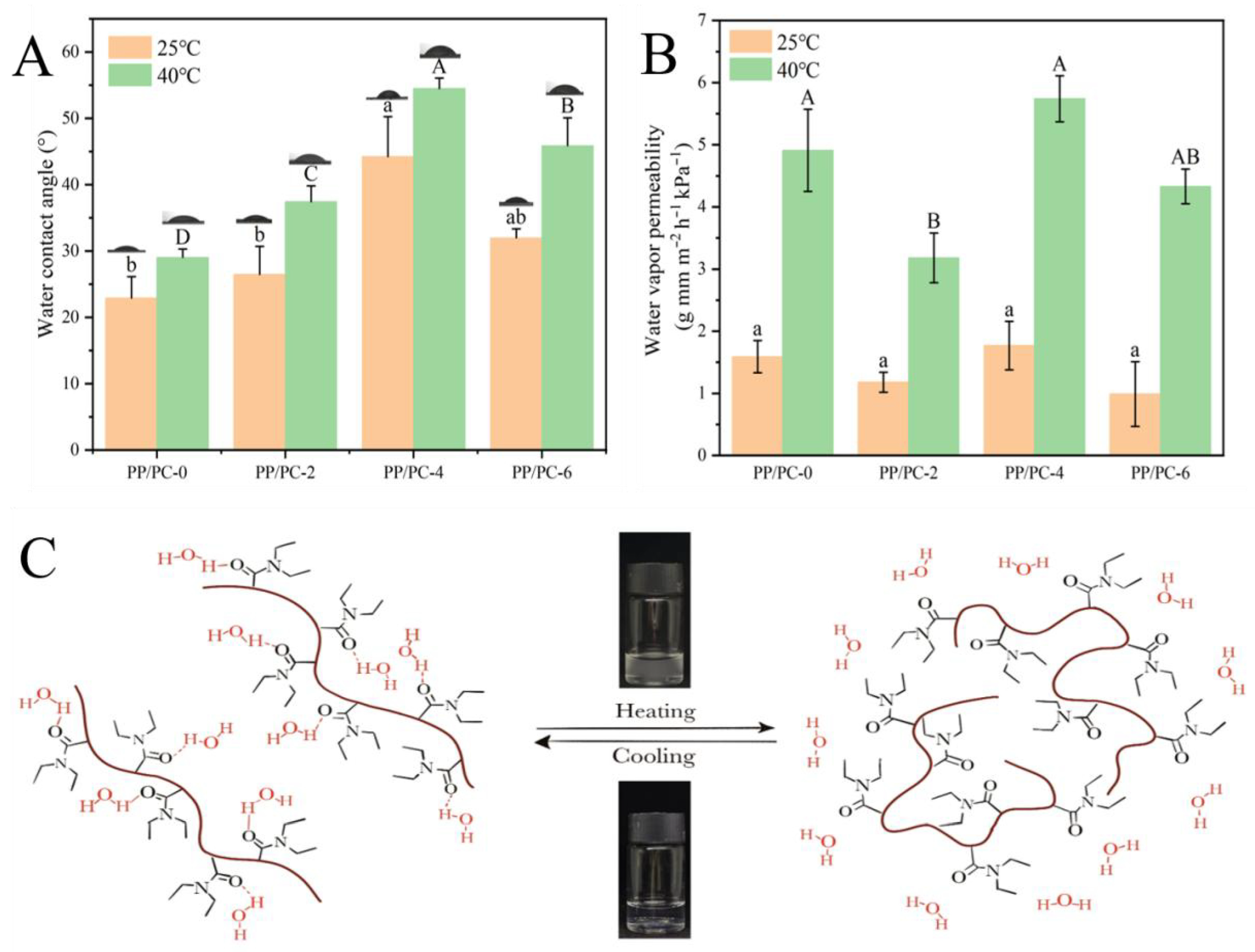
WCA defines the hydrophilicity/hydrophobicity of fiber mat surfaces. When the contact angle exceeds 90°, the fiber mat exhibits hydrophobicity. Conversely, it demonstrates hydrophilicity at contact angles below 90° [37]. The study revealed that all nanofiber mats exhibited hydrophilicity, arising from the presence of PVA and PNVCL. As CEO content in nanofiber mats increased from 0% to 6%, WCA value of PP/PC (0–6) fiber membrane progressively rose from 22.93° ± 3.23°, 26.49° ± 4.22°, 44.24° ± 6.02° and 31.98° ± 1.39° to 29.05° ± 1.24°, 37.44° ± 2.39°, 54.51° ± 1.55° and 45.88° ± 4.21°, respectively. Concurrently, as temperatures rose from 20 °C to 40 °C, all fiber mats exhibited enhanced hydrophobicity with elevated WCA values. This behavior stems from PNVCL’s LCST of 33 °C, where mats remain hydrophilic below this threshold but transition to hydrophobic above it [3]. However, an inverse relationship was observed between CEO concentration and surface hydrophobicity, with the 6% CEO-loaded fiber film exhibiting reduced WCA. This alteration in wetting behavior likely results from surface-active CEO components migrating to the polymer–air interface during film formation, where their hydrophilic functional groups decrease the material’s overall surface tension [38], the constituents of which engage with the hydrophilic amide functional groups present in the PNVCL polymer chains through hydrogen bonding and dipole interactions. This molecular attraction promotes water molecule adsorption at the interface, consequently increasing the material’s water affinity.
At temperatures below its lower critical solution temperature (LCST), the amide functionalities in PNVCL hydrate extensively via hydrogen bonding with water molecules. Specifically, the carbonyl oxygen atoms act as hydrogen bond acceptors, coordinating with hydrogen atoms from adjacent water molecules. This molecular arrangement enhances the material’s interfacial compatibility with aqueous environments, yielding a hydrophilic surface characteristic. As the temperature exceeds the LCST, the hydrogen bonds are disrupted, and water molecules are expelled from the polymer, leading to polymer precipitation [39]. As hydrogen bonds between PNVCL chains and water molecules are disrupted and the hydration layer collapses, the hydrophobic C–H backbones of PNVCL become exposed. The polymer chains subsequently undergo coiling and aggregation via intramolecular and intermolecular hydrophobic interactions. The thermally induced structural rearrangement, depicted in Figure 2C, facilitates regulated elution of encapsulated antimicrobial compounds in accordance with environmental temperature fluctuations.
WVP is a critical parameter for packaging materials, as it is closely related to moisture transfer and exchange between the food product and its surrounding environment [40]. As shown in Figure 2B, no significant differences were observed in the WVP of temperature-sensitive films with different CEO contents at ambient temperature. When the ambient temperature was elevated to 40 °C, surpassing the LCST of the thermoresponsive polymer, the WVP across all fibrous membranes demonstrated a substantial increase. This indicated that once the temperature surpassed the LCST, the structural collapse of PNVCL results in accelerated WVP. The sheath component of core-shell fibers undergoes a reversible structural reorganization when exposed to specific thermal stimuli. This transformation creates a more permeable matrix that facilitates enhanced water vapor transmission through the modified polymer architecture. A thermally induced structural rearrangement occurs within the sheath component of the core-shell fibers. This modification in the polymer matrix results in a more open architecture, thereby enhancing the material’s water vapor transmission rate. The experimental data indicate that the integration of PNVCL imparts improved hydrophilic character to the nanofibrous matrix, consequently elevating its water vapor transmission capability. The higher WVP observed in nanofibers with 0% CEO content is likely due to the inability of PNVCL to form intra- and intermolecular hydrogen bonds [41]. This is due to the fact that there are no donors–hydrogen in the molecular structure, allowing the carbonyl groups to act only as hydrogen bond acceptors for water molecules. The coaxial electrospinning of CEO and PNVCL with PLA nanofibers formed a stable physically cross-linked network. This interconnected framework creates a more tortuous pathway for water vapor, significantly impeding its molecular transit through the composite film and thereby enhancing its overall barrier efficacy against moisture [42]. Conversely, the fiber film incorporating 2% CEO demonstrated a significant reduction in water vapor permeability. This phenomenon may be attributed to surface-deposited CEO constituents forming a moisture-resistant interfacial layer, consequently impeding vapor transmission through the composite structure. This finding aligns with documented research on Hyssopus officinalis essential oil [43], consequently strengthening the protective characteristics of the composite architecture. Conversely, the nanofiber films with 4% and 6% CEO loading also exhibited considerably high WVP values, measuring 5.74 ± 0.37 and 4.33 ± 0.28 (g·mm)/(m2·h·kPa), respectively. Indeed, this effect arises from the increased concentration of the hydrophobic CEO within the composite matrix. This reduced the film’s overall hydrophilicity and disrupted the continuity of the polymer matrix, consequently leading to an increase in the water vapor transmission rate.

3.1.4. F-TIR Analysis

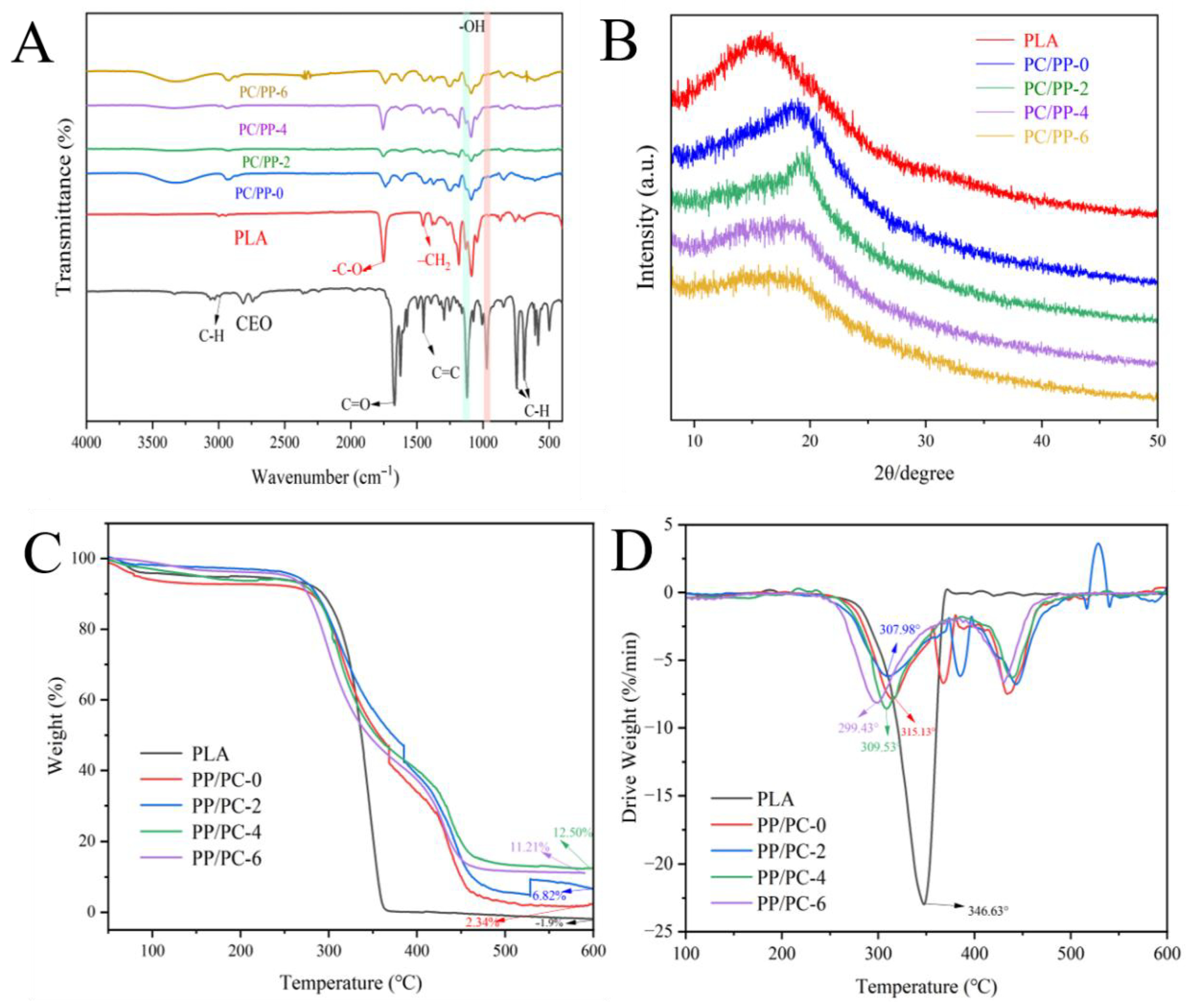
F-TIR spectroscopy was used to study chemical changes in films and possible interactions between the components in films (Figure 3A). Indeed, in the PLA spectrum at 1754 cm−1 a characteristic peak appeared corresponding to the stretching vibration of the C=O. The FTIR spectral analysis of CEO reveals a characteristic peak located at 2935 cm−1, which corresponds to the symmetric and asymmetric C–H stretching vibrations predominantly from methylene groups within the constituent molecules [32]. The FTIR spectrum of CEO displays a characteristic absorption at 1670 cm−1, corresponding to the C=O stretching vibration of its aldehyde constituents. Additionally, the signal observed at 1440 cm−1 arises from the resonant stretching of aromatic C=C bonds, confirming the presence of phenolic compounds in the essential oil [9]. The upper peaks of 745 and 687 cm−1 the C-H molecules of the benzene ring and alkene group in cinnamaldehyde respectively [44]. Their characteristic has its highest value at 1120 and 971 cm−1 which is said to be the C-O-H stretching of phenolic compounds in CEO [45]. Additionally, the spectra of the other nanofiber films showed characteristic absorption peaks of CEO, and this is the evidence to show that CEO has been successfully incorporated into the electrospun nanofiber mats. Concurrently, the distinctive infrared absorption signals of PNVCL observed at 1623 cm−1 and 3440 cm−1 correspond to the stretching modes of specific molecular bonds: the lower frequency band represents the amide C=O elongation, while the higher frequency signal arises from C-H bond vibrations within the polymer structure [46]. Furthermore, in the fiber films incorporated with CEO (2–6%), the characteristic peak of CEO shifted from 1440 cm−1 to 1450 cm−1, indicating interactions between CEO and PLA. This process entails carbon–hydrogen bond elongation and the establishment of intermolecular hydrogen bridges at the molecular scale. This observation suggested a concentration-independent physicochemical interaction that may contribute to the structural stability of the composite system [19].

3.1.5. X-Ray Diffraction Analysis

XRD is a qualitative and quantitative technique that enables the acquisition of information regarding the internal architecture of a specimen, including the identification of potential impurities and the determination of its crystallinity [47]. PLA exhibited a broad peak at 15.1°, suggesting it is either amorphous or slightly crystalline [48]. Following addition of PNVCL and CEO, the profile of the diffraction curves was observed to be the same as that of pure PLA nanofiber films, which implied that crystal structure was not normally disturbed much in PLA [49]. Additionally, XRD analysis of the fiber film loaded with 2% CEO revealed a distinct diffraction peak at 2θ = 20.60°, suggesting the presence of hydrogen bonding and covalent interactions within the film structure. This structural characteristic resulted in a dense and uniform film morphology, which subsequently improved the material’s optical clarity, mechanical strength and water resistance [35]. This outcome aligns with the data trends previously identified in both the WCA and WVP assessments, and the PP/PC-4 and PP/PC-6 films showed an intensified diffraction peak at 2θ = 19.71°; the peak exhibited broadening, suggesting that the essential oil may interact between the polymer chains, increasing their molecular mobility (free space between chains), thereby resulting in more flexible fibers and influencing their crystallization behavior [50,51].

3.1.6. Thermal Properties

Figure 3C showed the thermal properties of the temperature-sensitive films containing CEO. The thermal degradation profile of the films revealed three distinct mass-loss events occurring between 50 °C and 600 °C. The initial decomposition event, occurring between 50 °C and 200 °C, primarily corresponds to the elimination of unbound moisture and the volatilization of low-molecular-weight components [52]. The weight loss of the composite films with CEO was greater than the pure PLA film that can be explained by the loss of water and some amount of volatile essential oil substances [53]. A secondary phase of thermal decomposition was observed within the 200–400 °C. The major mass loss in this stage was primarily associated with polymer degradation and charring of the degradation products. The composite films exhibited reduced weight loss compared with that of pure PLA film, which can be attributed to the development of ester bonds between PNVCL degradation intermediates and CEO constituents, which increased thermal stability through crosslinking [54]. As shown in Figure 3D, the PLA nanofiber film exhibited the fastest degradation rate. The incorporation of both CEO and PNVCL significantly suppressed the thermal degradation rate of the nanofibrous membranes following the addition of CEO and PNVCL; PP/PC-4 film displayed the greatest change. These findings demonstrate that the introduced components effectively improved the thermal resistance of the polylactic acid nanofiber matrix, likely through reinforced molecular interactions and optimized structural integrity that collectively delay decomposition kinetics. In coaxial fiber films PP/PC-(0–6), mass loss commenced at 200 °C, primarily attributed to the decomposition of PNVCL and PLA [55]. The third degradation stage (400–600 °C) exhibited a slowed and stabilized mass loss in the PLA nanofiber film due to carbonization of its structure. The negative residual mass of PLA ultimately indicated near-complete decomposition into gaseous products [56]. Furthermore, the CEO-loaded nanofiber films exhibited higher residual mass compared to pure PLA nanofiber films. Among them, the film with 4% CEO content demonstrated the highest residual mass and an initial decomposition temperature exceeding that of other CEO-loaded formulations, indicating superior thermal stability. This suggests that the incorporation of 4% CEO effectively enhances the carbonization process and reduces volatile degradation products, likely due to reinforced intermolecular interactions or modified degradation pathways induced by CEO components.
In summary, although the initial decomposition temperature of the coaxial fiber films PP/PC was lower than that of pure PLA nanofiber films, a higher temperature was required to achieve complete decomposition. This greater residual mass at higher temperature should indicate that the coaxial sheath–core structure provided greater protection and increased the overall thermal stability of the core material as well as the entire system. This phenomenon might be due to the barrier effect of the shell layer hindering the release of volatile degradation products and the thermal degradation process.

3.2. Bioactive Properties of Different Films

A systematic investigation was conducted to evaluate the functional performance of thermoresponsive fibrous membranes by examining three key aspects: the correlation between CEO concentration and bioactivity, the role of fiber morphology on functional properties, and the distinctive benefits conferred by PNVCL integration. The assessment methodology included quantitative measurements of bacterial inhibition, fungal resistance and oxidative stabilization capacities.

3.2.1. Antibacterial Analysis

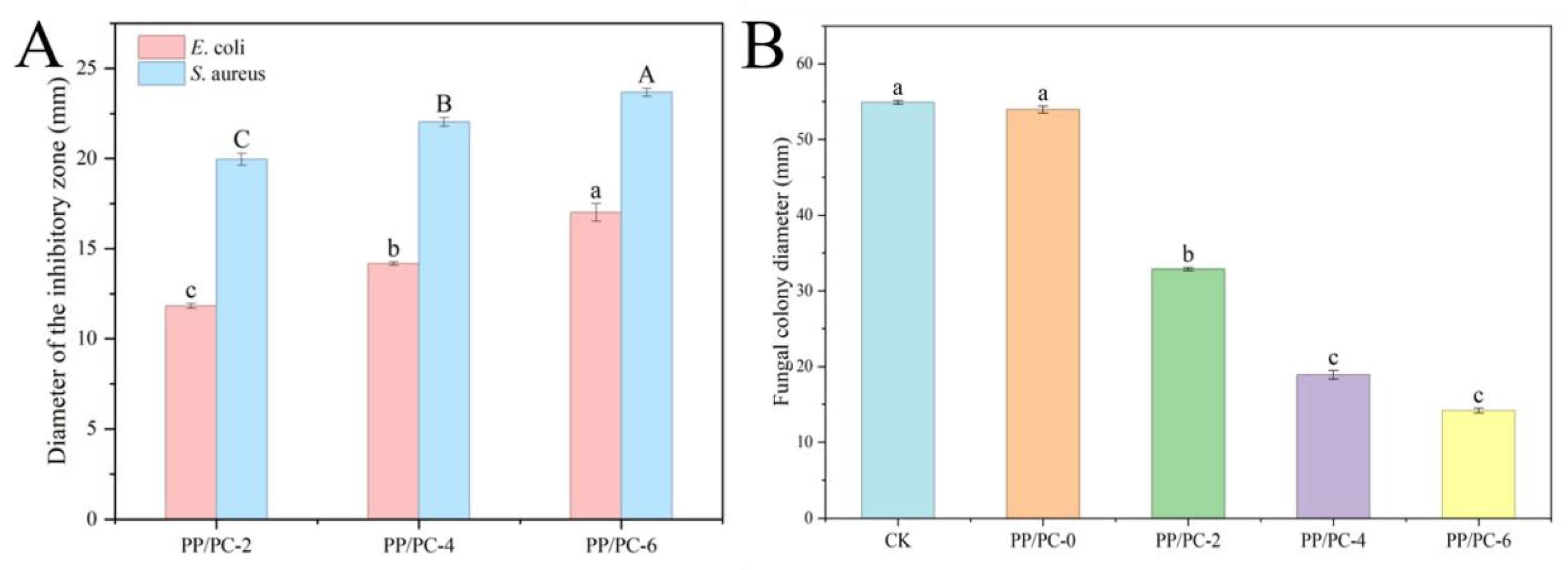
The composite materials demonstrated potent antibacterial activity against both E. coli and S. aureus through direct interfacial contact. Notably, gram-positive S. aureus was more susceptible to the antimicrobial interface than gram-negative E. coli. In addition, as shown in Figure 4A, the inhibition zone of S. aureus was larger than that of E. coli. The maximum inhibition zone diameter against S. aureus reached 23.68 ± 0.22 mm for the PP/PC-6 nanofiber film. The released CEO of the composite films interacts with the bacterial cell wall and biofilms, thereby interfering with the cellular metabolism ultimately resulting in bacteria lysis [57]. The lipopolysaccharide-rich outer membrane of gram-negative bacteria provides a protective layer that restricts the diffusion of hydrophobic molecules, thereby limiting their antimicrobial efficacy. Therefore, under identical conditions, the CEO-containing composite films exhibited stronger inhibitory effects against S. aureus compared to E. coli, as clearly evidenced in Figure S1.

3.2.2. Antifungal Analysis

The antifungal activity of the PP/PC nanofiber films against Aspergillus niger was a common postharvest rot fungus of Chinese bayberry, which was evaluated using the agar diffusion assay [58]. Figure 4B showed significant fungal growth suppression when CEO concentration reached or surpassed 4%, showing a dose-dependent efficacy against Aspergillus niger. Maximum antifungal performance was observed at higher loading rates, producing an inhibition zone diameter of 27.23 ± 2.31 mm. This result is attributed to the ability of the CEO to compromise the barrier function of the fungal cell film and wall, disrupting ionic homeostasis and thereby leading to cellular dysfunction [59]. Therefore, the incorporation of the CEO significantly enhanced the antimicrobial activity of the PP/PC-based nanofiber films, notably against the growth of Aspergillus niger.

3.2.3. Antioxidant Analysis

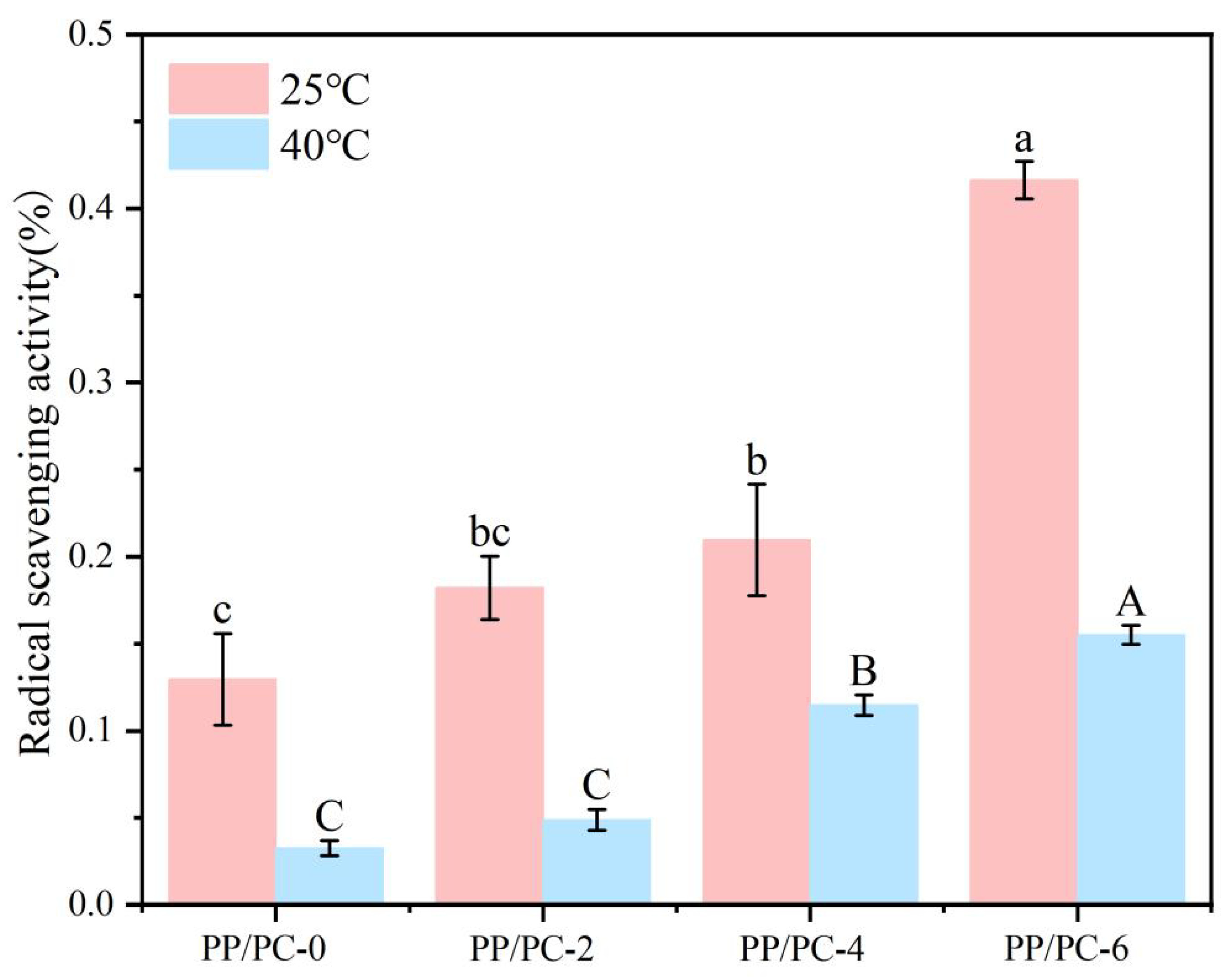
The deterioration of food quality during storage, primarily driven by oxidative processes, leads to the decline of key sensory characteristics including color, flavor, scent and mouthfeel along with a reduction in nutritional content. Consequently, the development of active packaging systems with integrated free radical scavenging capabilities becomes crucial to counteract these effects and preserve food integrity [60]. The free radical scavenging capacity of the nanofiber films was evaluated via the DPPH assay under two distinct temperature conditions (25 °C and 40 °C). The corresponding results, expressed as RSA percentages for each formulation, are shown in Figure 5. At 25 °C, the RSA increased with higher CEO content after 24 h, reaching a maximum scavenging rate of 82% for the film with 6% CEO loading, indicating a proportional enhancement of antioxidant activity with increasing CEO concentration [61]. This effect is primarily driven by cinnamaldehyde, a key constituent of CEO. The molecule donates active hydrogen atoms from its aldehyde group, effectively neutralizing free radical species and terminating the propagation of oxidative chain reactions [62], thereby inhibiting lipid peroxidation. The antioxidant activity of CEO has been reported by a number of researchers. For instance, Liu et al. [63] described an inhibition rate of 40% at a concentration of 10 mg mL−1, which is lower than that achieved in the present study, whereas an inhibition rate of 82% was achieved at a higher concentration of 80 mg mL−1. A similar pattern was observed for CEO: at concentrations below 10 mg mL−1, inhibition rates remained between 85 and 90%, whereas 20 mg mL−1 resulted in complete (100%) inhibition [64]. When the temperature increased to 40 °C, the RSA of all fiber films decreased by approximately 20%, 30%, 18% and 60%, respectively. This reduction indicates that the thermosensitive polymer PNVCL effectively suppressed the release of CEO at elevated temperatures, consequently diminishing its antioxidant efficacy [19]. Meanwhile, the PP/PC-4 fibrous film exhibited a smaller decrease in RSA scavenging rate, indicating its superior antioxidant activity compared to other fibrous films.
The antimicrobial activity and DPPH free radical scavenging activity load of cassia bark essential oil temperature-sensitive fiber membrane were analyzed in this study. In combination with related literatures [65], the bioactivities of the sample were compared with those of standard antimicrobial agents and standard antioxidants reported previously, which further verified the antimicrobial and antioxidant potential of CEO.

3.3. Preservation of Chinese Bayberry

Chinese bayberry reaches maturity during the warm, rain-intensive summers of southern China. This climatic combination results in a limited postharvest longevity for the fruit, which shows high susceptibility to mechanical injury, metabolic deterioration and microbiological infestation. As a result, its postharvest shelf life under ambient temperatures is limited to only 1 or 2 d [66]. Ongoing research advances have driven the continuous upgrading of storage technologies, preservation methods, and handling equipment for Chinese bayberry. Innovations in postharvest preservation have significantly improved the maintenance of fruit quality. Notably, incorporating antimicrobial and antioxidant compounds has proven effective in prolonging the freshness of perishable produce while reducing quality degradation [5,67]. They are quite successful in extending their shelf life. However, research on the preservation of Chinese bayberry using natural antibacterial agents, such as plant essential oils, remains limited. Most existing studies have been conducted under controlled conditions at either a constant low temperature (4 °C) or room temperature (25 °C), overlooking critical factors such as temperature fluctuations and summer temperature spikes (around 35 °C). These conditions were inevitably encountered during actual storage, transportation and retail stages. Such fluctuations not only further shorten the shelf life of Chinese bayberries but also reduce their market value. In order to understand the preservation effect of films in real storage and transportation conditions with temperature fluctuations, we conducted a fresh fruit storage experiment with Chinese bayberry.
Based on the aforementioned analyses, the fiber films with 4% and 6% CEO content demonstrated optimal mechanical properties, moisture barrier performance, antibacterial activity and antioxidant capacity. Among them, the film loaded with 4% CEO also exhibited superior thermal stability. As noted in Section 3.1.1, the 6% CEO-loaded film represented the upper limit of feasibility in this study. Therefore, the coaxial thermosensitive nanofilm with 4% CEO content was selected for the preservation experiment of Chinese bayberry. For comparative purposes, pure PLA nanofiber films and uniaxial PLA/CEO (4%) fiber films were also employed in the study.

3.3.1. Visual Appearance

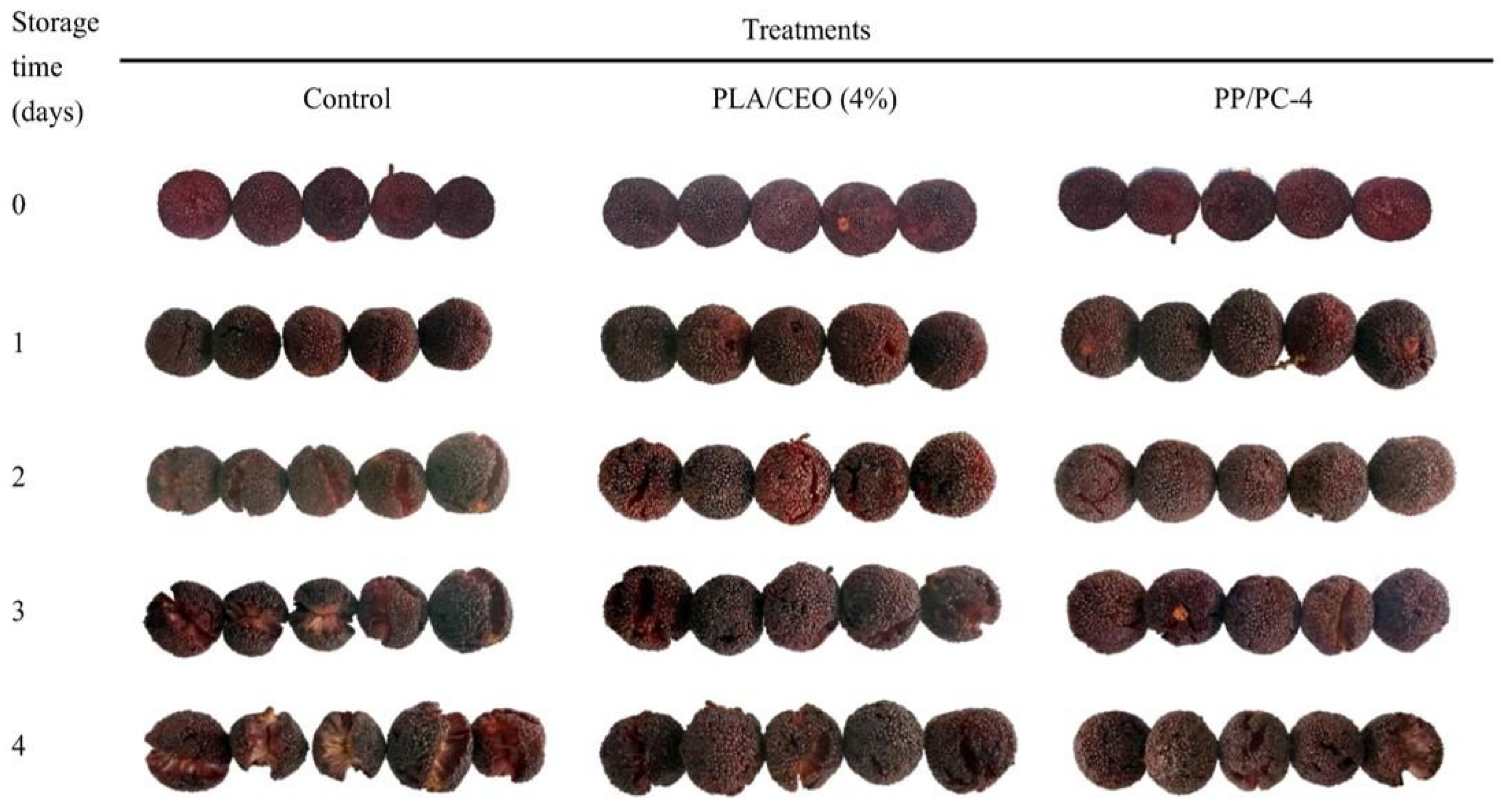
Representative images of Chinese bayberries during storage are presented in the corresponding Figure 6. After 2 d of storage at 25 °C, all fruits in the control group exhibited noticeable surface cracking, though no spoilage was observed. A small number of berries in the PLA/CEO (4%) group also showed minor surface cracking. Although some surface cracking was observed in the PP/PC-4 group, the fruits remained intact without severe splitting. This can be attributed to cinnamaldehyde in CEO, which exhibited broad-spectrum antimicrobial activity against various microorganisms, thus effectively inhibiting microbial invasion and consequently reducing stress induced by physical damage such as cracking [68]. Following a further 48 h storage period at 35 °C, the control group exhibited near-complete structural failure, with all bayberries having split. In contrast, samples from the PP/PC-4 treatment group demonstrated only minimal incidence of superficial splitting.

3.3.2. Postharvest Preservation of Chinese Bayberry

Total soluble solids (TSS) and titratable acidity (TA) are key indicators of ripeness and sensory quality in Chinese bayberry, directly associated with its flavor development and nutritional profile. However, these parameters gradually decline, reflecting a loss in both taste and nutritional value [69]. As shown in Table 2, both TSS and TA decreased to varying degrees. The observed decrease in TSS occurs because the fruit utilizes soluble carbohydrates, including simple sugars, maltose and other reducing sugars, as metabolic resources during respiration. These compounds are progressively consumed through various biochemical pathways over the storage duration. Meanwhile, the decline in TA is primarily due to the decomposition of organic acids, which serve as energy sources in metabolic reactions [70]. Over the 4 d storage period, the sugar content in all groups of bayberries decreased due to respiratory metabolism and microbial consumption, consequently leading to a reduction in TSS content [71].
During fruit storage, respiration is typically accompanied by moisture loss and a decrease in organic matter, ultimately resulting in a reduction of fruit weight [72]. As shown in the table above, the weight loss rates of the control bayberries reached approximately 20% and 24% on 1 and 2 d, respectively, at 25 °C, which was significantly higher than that of the PP/PC-4 group. This can be attributed to the antimicrobial activity of CEO in both the PLA/CEO (4%) and PP/PC-4 groups, which disrupts the microbial cell film, increasing its permeability and causing leakage of cellular contents. This will affect respiratory metabolism and quicken microbial death [73]. Under elevated temperature conditions (35 °C), the control group exhibited rapid quality deterioration, losing approximately 47% and 37% of their mass by 3 and 4 d, respectively. In contrast, both the PLA/CEO and PP/PC-4 treatment groups demonstrated effective preservation, maintaining significantly higher weight retention with only about 4% mass loss under the same storage conditions. Under simulated high-temperature storage at 35 °C, the PNVCL based film experienced a thermally induced structural rearrangement, prompting a controlled discharge of CEO. In contrast, the PLA/CEO fibers failed to form an effective barrier to modulate the release of CEO. Obviously, a large amount of CEO was released ahead of time during the initial storage process, and the preservative time was shortened.
Initial firmness measurements recorded for fresh Chinese bayberries averaged 4.89 N. Following 1 d of storage, the control group exhibited a marked reduction in firmness to 2.78 N. In contrast, all treatment groups demonstrated superior firmness retention relative to the control, an effect likely attributable to the combined antimicrobial and antioxidant activity conferred by the incorporated CEO. On 4 d of storage, a further reduction in firmness was observed within the control, with measurements decreasing to 1.69 N, whereas the PP/PC-4 group retained a firmness of 2.93 N, significantly higher than the other groups. This demonstrates the long-term effectiveness of the CEO, resulting from the core-shell structure of the nanofiber film. The temperature-responsive behavior of PNVCL effectively modulated the release of CEO and played a critical role in reducing the softening rate, owing to its excellent antibacterial (Figure 4A,B) and antioxidant properties (Figure 5).

3.3.3. Color Changes in Fruits

Based on the result, the color of Chinese bayberries will change in postharvest storage. It will influence the quality of appearance and the acceptance by consumers. Therefore, we measured the color difference (∆E) of the berries throughout the storage period. The table above displays the appearance of bayberries in the control, PLA/CEO (4%) and PP/PC-4 groups on days 0, 1, 2, 3 and 4. As shown in Table 2, the ∆E values increased in all treatment groups over time, though no significant differences were observed that were consistent with the trends described earlier [74]. During storage at both ambient (25 °C) and elevated (35 °C) temperatures, the berries in the control and PLA/CEO (4%) groups gradually transitioned from a saturated red color to a dry and pale appearance. In contrast, the berries in the PP/PC-4 group maintained better visual integrity even on day 4, as clearly evidenced in Figure 6. The enhanced color stability observed in the samples is principally due to the regulated elution of CEO from the nanofiber system. This controlled release mechanism, governed by the fiber’s structural configuration, effectively decelerates oxidative processes and minimizes dehydration, thereby preserving the visual quality of the product.
Overall, the biodegradable packaging exerted comprehensive preservation effects on Chinese bayberry through the synergistic mechanisms. Firstly, the packaging effectively maintained cell membrane integrity by inhibiting lipid peroxidation, reducing MDA accumulation and electrolyte leakage, thus alleviating oxidative damage and delaying fruit senescence [75,76]. Secondly, the favorable water vapor barrier property reduced water loss and weight loss, optimized the storage microenvironment, and maintained fruit firmness and appearance quality [77,78]. Thirdly, the packaging moderated the gas composition around the fruit, suppressed respiration and ethylene production, and slowed down softening and quality deterioration, thereby extending the storage life [76,79].
This study has several limitations: it was conducted at laboratory-scale with a relatively short storage period; sensory evaluation and consumer acceptance tests were not performed; artificial pathogen inoculation and in-depth antibacterial mechanism were not included. In future work, we will combine a sensory analysis, microbial challenge test and molecular mechanism to further clarify the preservation effects of biodegradable packaging on postharvest Chinese bayberry.

4. Conclusions

In this study, PNVCL/PLA/CEO films were fabricated using coaxial electrospinning. These films enabled controlled release of the CEO via the temperature-responsive properties of PNVCL, effectively maintaining the postharvest quality of Chinese bayberry under varied storage conditions. Among the different films, PP/PC-4 demonstrated outstanding mechanical strength, water resistance, thermal stability, along with superior antibacterial and antioxidant activities. PP/PC fiber presented a sandwich structure with a PVA/PNVCL outer layer and a PLA/CEO inner layer. The outer layer was regarded as a temperature-responsive “switch”, reducing excessive CEO loss and sustaining long-term effect under changing temperature. The film retained antibacterial efficacy for 5 d even at elevated temperatures (40 °C), demonstrating its strong potential for postharvest fruit preservation. However, current research remains confined to small-scale packaging applications. The suitability and effectiveness of these films for larger-scale formats or other product categories have not been investigated. Further investigation is needed to assess their long-term storage stability under practical warehouse conditions and economic feasibility. To address these limitations, future studies should focus on exploring broader application scenarios and enhancing commercial viability, thereby facilitating the practical translation and large-scale adoption of this technology.

Supplementary Materials

The following supporting information can be downloaded at: https://www.mdpi.com/article/10.3390/agronomy16050519/s1, Figure S1: Roadmap for preparation and characterization of fiber films; Table S1: Determination of liquid properties of coaxial electrospinning shell and core solution film; Table S2: Different treatment conditions description; Figure S2: Antibacterial activity images of coaxial electrospun fibrous films with different CEO loading contents. (F): Intuitive images of anti-E. coli (F1: 0%; F2: 2%; F3: 4%; F4: 6%); (G): Intuitive images of anti-Staphylococcus aureus (G1: 0%; G2: 2%; G3: 4%; G4: 6%); (M-Q) Intuitive images of antifungal.

Author Contributions

M.B.: writing—original draft, software, methodology, investigation, conceptualization; X.Z. and C.S.: writing—review and editing, resources; Y.W. (Yaqiong Wu), F.C. and Y.W. (Yicheng Wang): writing—review and editing; D.F.: methodology, investigation, formal analysis, conceptualization; W.L.: writing—review and editing, supervision, project administration, funding acquisition. All authors have read and agreed to the published version of the manuscript.

Funding

This work was financially supported by the Jiangsu Agricultural Science and Technology Innovation Fund (CX(24)1018), the Postgraduate Research and Practice Innovation Program of Jiangsu Province (KYCX24_1270), and the Ruihua Nonprofit Foundation.

Data Availability Statement

The original contributions presented in this study are included in the article/Supplementary Materials. Further inquiries can be directed to the corresponding authors.

Conflicts of Interest

The authors declare that they have no known competing financial interests or personal relationships that could have appeared to influence the work reported in this paper.

References

  1. Ren, H.; Wang, H.; Yu, Z.; Zhang, S.; Qi, X.; Sun, L.; Wang, Z.; Zhang, M.; Ahmed, T.; Li, B. Effect of Two Kinds of Fertilizers on Growth and Rhizosphere Soil Properties of Bayberry with Decline Disease. Plants 2021, 10, 2386. [Google Scholar] [CrossRef]
  2. Li, J.; Chen, J.; Liu, L.; Chen, N.; Li, X.; Cameron, K.M.; Fu, C.; Li, P. Domestication history reveals multiple genetic improvements of Chinese bayberry cultivars. Hortic. Res. 2022, 9, uhac126. [Google Scholar] [CrossRef]
  3. Li, H.; Liu, K.; Williams, G.R.; Wu, J.; Wu, J.; Wang, H.; Niu, S.; Zhu, L.-M. Dual temperature and pH responsive nanofiber formulations prepared by electrospinning. Colloids Surf. B Biointerfaces 2018, 171, 142–149. [Google Scholar] [CrossRef]
  4. Xie, Z.; Zheng, S.; Yang, S.; Tang, Y.; Yu, H.a.; Chang, Y.; Zhu, Y.; Zhan, X.; Zeng, G.; Chen, H. Comparative analysis of fruit microbiota and metabolites in two bayberry cultivars: Implications for fruit quality and postharvest disease control. Food Chem. X 2025, 29, 102773. [Google Scholar] [CrossRef] [PubMed]
  5. Chen, Z.; Wei, Y.; Liu, R.; Hu, C.; Sun, Y.; Yao, C.; Wu, Z.; Li, B.; Luo, Z.; Huang, C. Sodium carboxymethyl cellulose hydrogels containing montmorillonite-NaClO2 for postharvest preservation of Chinese bayberries. Food Chem. 2024, 454, 139799. [Google Scholar] [CrossRef] [PubMed]
  6. Ning, J.; Yue, S. Optimization of preparation conditions of eucalyptus essential oil microcapsules by response surface methodology. J. Food Process. Preserv. 2019, 43, e14188. [Google Scholar] [CrossRef]
  7. Tajkarimi, M.M.; Ibrahim, S.A.; Cliver, D.O. Antimicrobial herb and spice compounds in food. Food Control 2010, 21, 1199–1218. [Google Scholar] [CrossRef]
  8. Santos, M.I.S.; Marques, C.; Mota, J.; Pedroso, L.; Lima, A. Applications of Essential Oils as Antibacterial Agents in Minimally Processed Fruits and Vegetables—A Review. Microorganisms 2022, 10, 760. [Google Scholar] [CrossRef]
  9. Huang, X.; Teng, Z.; Xie, F.; Wang, G.; Li, Y.; Liu, X.; Li, S. Loading of cinnamon essential oil into electrospun octenylsuccinylated starch-pullulan nanofiber mats: Electrospinnability evaluation, structural characterization, and antibacterial potential. Food Hydrocoll. 2024, 148, 109426. [Google Scholar] [CrossRef]
  10. Niu, B.; Zhan, L.; Shao, P.; Xiang, N.; Sun, P.; Chen, H.; Gao, H. Electrospinning of zein-ethyl cellulose hybrid nanofibers with improved water resistance for food preservation. Int. J. Biol. Macromol. 2020, 142, 592–599. [Google Scholar] [CrossRef]
  11. Douaki, A.; Tran, T.N.; Suarato, G.; Bertolacci, L.; Petti, L.; Lugli, P.; Papadopoulou, E.L.; Athanassiou, A. Thermo-responsive nanofibers for on-demand biocompound delivery platform. Chem. Eng. J. 2022, 445, 136744. [Google Scholar] [CrossRef]
  12. Pant, B.; Park, M.; Park, S.-J. Drug Delivery Applications of Core-Sheath Nanofibers Prepared by Coaxial Electrospinning: A Review. Pharmaceutics 2019, 11, 305. [Google Scholar] [CrossRef]
  13. Li, T.; Zhang, X.; Mei, J.; Cui, F.; Wang, D.; Li, J. Preparation of Linalool/Polycaprolactone Coaxial Electrospinning Film and Application in Preserving Salmon Slices. Front. Microbiol. 2022, 13, 860123. [Google Scholar] [CrossRef]
  14. Li, Y.; Dong, Q.; Chen, J.; Li, L. Effects of coaxial electrospun eugenol loaded core-sheath PVP/shellac fibrous films on postharvest quality and shelf life of strawberries. Postharvest Biol. Technol. 2020, 159, 111028. [Google Scholar] [CrossRef]
  15. Yang, Q.; Guo, J.; Zhang, S.; Guan, F.; Yu, Y.; Yao, Q.; Zhang, X.; Xu, Y. PVA/PEO/PVA-g-APEG nanofiber membranes with cytocompatibility and anti-cell adhesion for biomedical applications. Colloids Surf. A Physicochem. Eng. Asp. 2023, 657, 130638. [Google Scholar] [CrossRef]
  16. Wang, Z.; Liu, C.; Zhu, D.; Gu, X.; Xu, Y.; Qin, Q.; Dong, N.; Zhang, S.; Wang, J. Untangling the co-effects of oriented nanotopography and sustained anticoagulation in a biomimetic intima on neovessel remodeling. Biomaterials 2020, 231, 119654. [Google Scholar] [CrossRef] [PubMed]
  17. Pace, B.; Cefola, M. Innovative Preservation Technology for the Fresh Fruit and Vegetables. Foods 2021, 10, 719. [Google Scholar] [CrossRef] [PubMed]
  18. Chu, Y.; Chai, S.; Li, F.; Han, C.; Sui, X.; Liu, T. Combined Strategy of Wound Healing Using Thermo-Sensitive PNIPAAm Hydrogel and CS/PVA Membranes: Development and In-Vivo Evaluation. Polymers 2022, 14, 2454. [Google Scholar] [CrossRef]
  19. Xia, S.; Fang, D.; Guo, Y.; Shi, C.; Wang, J.; Lyu, L.; Wu, Y.; Deng, Z.; Su, E.; Cao, F.; et al. Temperature-sensitive poly(N-isopropylacrylamide)/polylactic acid/lemon essential oil nanofiber films prepared via different electrospinning processes: Controlled release and preservation effect. Int. J. Biol. Macromol. 2024, 281, 136217. [Google Scholar] [CrossRef] [PubMed]
  20. Shi, C.; Zhou, A.; Fang, D.; Lu, T.; Wang, J.; Song, Y.; Lyu, L.; Wu, W.; Huang, C.; Li, W. Oregano essential oil/β-cyclodextrin inclusion compound polylactic acid/polycaprolactone electrospun nanofibers for active food packaging. Chem. Eng. J. 2022, 445, 136746. [Google Scholar] [CrossRef]
  21. Guo, J.; Wang, T.; Yan, Z.; Ji, D.; Li, J.; Pan, H. Preparation and evaluation of dual drug-loaded nanofiber membranes based on coaxial electrostatic spinning technology. Int. J. Pharm. 2022, 629, 122410. [Google Scholar] [CrossRef]
  22. Wang, L.; Lv, H.; Liu, L.; Zhang, Q.; Nakielski, P.; Si, Y.; Cao, J.; Li, X.; Pierini, F.; Yu, J.; et al. Electrospun nanofiber-reinforced three-dimensional chitosan matrices: Architectural, mechanical and biological properties. J. Colloid Interface Sci. 2020, 565, 416–425, Corrigendum in J. Colloid Interface Sci. 2022, 620, 486. [Google Scholar] [CrossRef]
  23. Lu, T.; Deng, Y.; Cui, J.; Cao, W.; Qu, Q.; Wang, Y.; Xiong, R.; Ma, W.; Lei, J.; Huang, C. Multifunctional Applications of Blow-Spinning Setaria viridis Structured Fibrous Membranes in Water Purification. ACS Appl. Mater. Interfaces 2021, 13, 22874–22883. [Google Scholar] [CrossRef] [PubMed]
  24. Zou, Y.; Zhang, C.; Wang, P.; Zhang, Y.; Zhang, H. Electrospun chitosan/polycaprolactone nanofibers containing chlorogenic acid-loaded halloysite nanotube for active food packaging. Carbohydr. Polym. 2020, 247, 116711. [Google Scholar] [CrossRef]
  25. Min, T.; Zhou, L.; Sun, X.; Du, H.; Bian, X.; Zhu, Z.; Wen, Y. Enzyme-responsive food packaging system based on pectin-coated poly (lactic acid) nanofiber films for controlled release of thymol. Food Res. Int. 2022, 157, 111256. [Google Scholar] [CrossRef]
  26. Bahmid, N.A.; Maharani, D.K.; Suloi, A.N.F.; Anwar, M.; Prasetyo, D.J.; Suryani, R.; Jatmiko, T.H.; Indrianingsih, A.W.; Dirpan, A.; Rumhayati, B.; et al. Cellulose acetate/chitosan composite film loaded with ground cinnamon for active packaging: Water vapor sorption kinetic, compounds release, and antimicrobial effect. Food Packag. Shelf Life 2024, 43, 101311. [Google Scholar] [CrossRef]
  27. Luo, S.; Saadi, A.; Fu, K.; Taxipalati, M.; Deng, L. Fabrication and characterization of dextran/zein hybrid electrospun fibers with tailored properties for controlled release of curcumin. J. Sci. Food Agric. 2021, 101, 6355–6367. [Google Scholar] [CrossRef]
  28. Zhang, H.; Zheng, X.; Wang, L.; Li, S.; Liu, R. Effect of yeast antagonist in combination with hot water dips on postharvest Rhizopus rot of strawberries. J. Food Eng. 2007, 78, 281–287. [Google Scholar] [CrossRef]
  29. Dai, J.; Bai, M.; Li, C.; Cui, H.; Lin, L. The improvement of sodium dodecyl sulfate on the electrospinning of gelatin O/W emulsions for production of core-shell nanofibers. Food Hydrocoll. 2023, 145, 109092. [Google Scholar] [CrossRef]
  30. Webster, M.; Miao, J.; Lynch, B.; Green, D.S.; Jones-Sawyer, R.; Linhardt, R.J.; Mendenhall, J. Tunable Thermo-Responsive Poly(N-vinylcaprolactam) Cellulose Nanofibers: Synthesis, Characterization, and Fabrication. Macromol. Mater. Eng. 2012, 298, 447–453. [Google Scholar] [CrossRef]
  31. Chen, Y.-P.; Lo, T.-S.; Lin, Y.-T.; Chien, Y.-H.; Lu, C.-J.; Liu, S.-J. Fabrication of Drug-Eluting Polycaprolactone/poly(lactic-co-glycolic Acid) Prolapse Mats Using Solution-Extrusion 3D Printing and Coaxial Electrospinning Techniques. Polymers 2021, 13, 2295. [Google Scholar] [CrossRef] [PubMed]
  32. Kesici Güler, H.; Cengiz Çallıoğlu, F.; Sesli Çetin, E. Antibacterial PVP/cinnamon essential oil nanofibers by emulsion electrospinning. J. Text. Inst. 2018, 110, 302–310. [Google Scholar] [CrossRef]
  33. Hu, H.; Guo, X.; Zhang, Y.; Chen, Z.; Wang, L.; Gao, Y.; Wang, Z.; Zhang, Y.; Wang, W.; Rong, M.; et al. Elasto-Plastic Design of Ultrathin Interlayer for Enhancing Strain Tolerance of Flexible Electronics. ACS Nano 2023, 17, 3921–3930. [Google Scholar] [CrossRef]
  34. Ghiasi, F.; Golmakani, M.-T.; Eskandari, M.H.; Hosseini, S.M.H. A new approach in the hydrophobic modification of polysaccharide-based edible films using structured oil nanoparticles. Ind. Crops Prod. 2020, 154, 112679. [Google Scholar] [CrossRef]
  35. Yu, H.; Zhou, Q.; He, D.; Yang, J.; Wu, K.; Chai, X.; Xiang, Y.; Duan, X.; Wu, X. Enhanced mechanical and functional properties of chitosan/polyvinyl alcohol/hydroxypropyl methylcellulose/alizarin composite film by incorporating cinnamon essential oil and tea polyphenols. Int. J. Biol. Macromol. 2023, 253, 126859. [Google Scholar] [CrossRef]
  36. Hosseini, M.H.; Razavi, S.H.; Mousavi, M.A. Antimicrobial, Physical and Mechanical Properties of Chitosan-Based Films Incorporated with Thyme, Clove and Cinnamon Essential Oils. J. Food Process. Preserv. 2009, 33, 727–743. [Google Scholar] [CrossRef]
  37. Xia, S.; Fang, D.; Shi, C.; Wang, J.; Lyu, L.; Wu, W.; Lu, T.; Song, Y.; Guo, Y.; Huang, C.; et al. Preparation of a thermosensitive nanofibre membrane for blackberry preservation. Food Chem. 2023, 415, 135752. [Google Scholar] [CrossRef]
  38. Xiang, H.-J.; Liao, J.-H.; Tang, Y.-T.; Wen, P.; Wang, H. Development of cinnamon essential oil-loaded core-shell nano film for the preservation of chilled flesh foods. Food Packag. Shelf Life 2024, 45, 101310. [Google Scholar] [CrossRef]
  39. Madhusudana Rao, K.; Mallikarjuna, B.; Krishna Rao, K.S.V.; Siraj, S.; Chowdoji Rao, K.; Subha, M.C.S. Novel thermo/pH sensitive nanogels composed from poly(N-vinylcaprolactam) for controlled release of an anticancer drug. Colloids Surf. B Biointerfaces 2013, 102, 891–897. [Google Scholar] [CrossRef] [PubMed]
  40. Mueller, E.; Hoffmann, T.G.; Schmitz, F.R.W.; Helm, C.V.; Roy, S.; Bertoli, S.L.; de Souza, C.K. Development of ternary polymeric films based on cassava starch, pea flour and green banana flour for food packaging. Int. J. Biol. Macromol. 2024, 256, 128436. [Google Scholar] [CrossRef]
  41. Liu, J.; Debuigne, A.; Detrembleur, C.; Jérôme, C. Poly(N-vinylcaprolactam): A Thermoresponsive Macromolecule with Promising Future in Biomedical Field. Adv. Healthc. Mater. 2014, 3, 1941–1968. [Google Scholar] [CrossRef] [PubMed]
  42. Gao, C.; Wang, S.; Liu, B.; Yao, S.; Dai, Y.; Zhou, L.; Qin, C.; Fatehi, P. Sustainable Chitosan-Dialdehyde Cellulose Nanocrystal Film. Materials 2021, 14, 5851. [Google Scholar] [CrossRef]
  43. Pirnia, M.; Shirani, K.; Tabatabaee Yazdi, F.; Moratazavi, S.A.; Mohebbi, M. Characterization of antioxidant active biopolymer bilayer film based on gelatin-frankincense incorporated with ascorbic acid and Hyssopus officinalis essential oil. Food Chem. X 2022, 14, 100300. [Google Scholar] [CrossRef] [PubMed]
  44. Montero, Y.; Souza, A.G.; Oliveira, É.R.; Rosa, D.d.S. Nanocellulose functionalized with cinnamon essential oil: A potential application in active biodegradable packaging for strawberry. Sustain. Mater. Technol. 2021, 29, e00289. [Google Scholar] [CrossRef]
  45. Ebrahimzadeh, S.; Bari, M.R.; Hamishehkar, H.; Kafil, H.S.; Lim, L.-T. Essential oils-loaded electrospun chitosan-poly(vinyl alcohol) nonwovens laminated on chitosan film as bilayer bioactive edible films. LWT 2021, 144, 111217. [Google Scholar] [CrossRef]
  46. Halligan, E.; Zhuo, S.; Colbert, D.M.; Alsaadi, M.; Tie, B.S.H.; Bezerra, G.S.N.; Keane, G.; Geever, L.M. Modulation of the Lower Critical Solution Temperature of Thermoresponsive Poly(N-vinylcaprolactam) Utilizing Hydrophilic and Hydrophobic Monomers. Polymers 2023, 15, 1595. [Google Scholar] [CrossRef]
  47. López-Cano, A.A.; Martínez-Aguilar, V.; Peña-Juárez, M.G.; López-Esparza, R.; Delgado-Alvarado, E.; Gutiérrez-Castañeda, E.J.; Del Angel-Monroy, M.; Pérez, E.; Herrera-May, A.L.; Gonzalez-Calderon, J.A. Chemically Modified Nanoparticles for Enhanced Antioxidant and Antimicrobial Properties with Cinnamon Essential Oil. Antioxidants 2023, 12, 2057. [Google Scholar] [CrossRef]
  48. Shi, C.; Fang, D.; Xia, S.; Guo, Y.; Wang, J.; Lyu, L.; Wu, W.; Huang, C.; Li, W. Poly(lactic acid)/polycaprolactone nanofibrous packaging containing different functional agents for blackberry postharvest preservation. Int. J. Biol. Macromol. 2024, 279, 134544. [Google Scholar] [CrossRef]
  49. Xu, M.; Fang, D.; Shi, C.; Xia, S.; Wang, J.; Deng, B.; Kimatu, B.M.; Guo, Y.; Lyu, L.; Wu, Y.; et al. Anthocyanin-loaded polylactic acid/quaternized chitosan electrospun nanofiber as an intelligent and active packaging film in blueberry preservation. Food Hydrocoll. 2025, 158, 110586. [Google Scholar] [CrossRef]
  50. Cardoso, L.G.; Pereira Santos, J.C.; Camilloto, G.P.; Miranda, A.L.; Druzian, J.I.; Guimarães, A.G. Development of active films poly (butylene adipate co-terephthalate)—PBAT incorporated with oregano essential oil and application in fish fillet preservation. Ind. Crops Prod. 2017, 108, 388–397. [Google Scholar] [CrossRef]
  51. Hernández-López, M.; Correa-Pacheco, Z.N.; Bautista-Baños, S.; Zavaleta-Avejar, L.; Benítez-Jiménez, J.J.; Sabino-Gutiérrez, M.A.; Ortega-Gudiño, P. Bio-based composite fibers from pine essential oil and PLA/PBAT polymer blend. Morphological, physicochemical, thermal and mechanical characterization. Mater. Chem. Phys. 2019, 234, 345–353. [Google Scholar] [CrossRef]
  52. Ye, H.; Zhou, X.; Mao, S.; Fan, X.; Xu, Y.; Lu, C. Sustained-release composite films incorporated with cinnamon essential oil: Characterization, release kinetics and application for cherry tomato preservation. J. Food Eng. 2025, 388, 112356. [Google Scholar] [CrossRef]
  53. Chu, Y.; Xu, T.; Gao, C.; Liu, X.; Zhang, N.; Feng, X.; Liu, X.; Shen, X.; Tang, X. Evaluations of physicochemical and biological properties of pullulan-based films incorporated with cinnamon essential oil and Tween 80. Int. J. Biol. Macromol. 2019, 122, 388–394. [Google Scholar] [CrossRef] [PubMed]
  54. Quan, J.; Zhang, J.; Li, J.; Zhang, X.; Wang, M.; Wang, N.; Zhu, Y. Three-dimensional AgNPs-graphene-AgNPs sandwiched hybrid nanostructures with sub-nanometer gaps for ultrasensitive surface-enhanced Raman spectroscopy. Carbon 2019, 147, 105–111. [Google Scholar] [CrossRef]
  55. Xia, S.; Bian, M.; Li, H.; Shi, C.; Xu, M.; Lyu, L.; Wu, Y.; Cao, F.; Wang, Y.; Li, W.; et al. Development of poly(lactic acid)/polyvinyl alcohol-based temperature-responsive shell-core nanofibers: Controlled release, biosafety evaluation, and application in raspberry preservation. Int. J. Biol. Macromol. 2025, 307, 142084. [Google Scholar] [CrossRef] [PubMed]
  56. Li, S.-F.; Wu, J.-H.; Hu, T.-G.; Wu, H. Encapsulation of quercetin into zein-ethyl cellulose coaxial nanofibers: Preparation, characterization and its anticancer activity. Int. J. Biol. Macromol. 2023, 248, 125797. [Google Scholar] [CrossRef]
  57. Falleh, H.; Jemaa, M.B.; Neves, M.A.; Isoda, H.; Nakajima, M.; Ksouri, R. Formulation, physicochemical characterization, and anti- E. coli activity of food-grade nanoemulsions incorporating clove, cinnamon, and lavender essential oils. Food Chem. 2021, 359, 129963. [Google Scholar] [CrossRef]
  58. Jakubowska, E.; Gierszewska, M.; Szydłowska-Czerniak, A.; Nowaczyk, J.; Olewnik-Kruszkowska, E. Development and characterization of active packaging films based on chitosan, plasticizer, and quercetin for repassed oil storage. Food Chem. 2023, 399, 133934. [Google Scholar] [CrossRef]
  59. Wang, M.; Liu, H.; Dang, Y.; Li, D.; Qiao, Z.; Wang, G.; Liu, G.; Xu, J.; Li, E.; Perumal, A.B. Antifungal Mechanism of Cinnamon Essential Oil against Chinese Yam-Derived Aspergillus niger. J. Food Process. Preserv. 2023, 2023, 5777460. [Google Scholar] [CrossRef]
  60. Hashim, S.B.H.; Tahir, H.E.; Lui, L.; Zhang, J.; Zhai, X.; Mahdi, A.A.; Ibrahim, N.A.; Mahunu, G.K.; Hassan, M.M.; Zou, X.; et al. Smart films of carbohydrate-based/sunflower wax/purple Chinese cabbage anthocyanins: A biomarker of chicken freshness. Food Chem. 2023, 399, 133824. [Google Scholar] [CrossRef]
  61. Lalami, A.E.O.; Moukhafi, K.; Bouslamti, R.; Lairini, S. Evaluation of antibacterial and antioxidant effects of cinnamon and clove essential oils from Madagascar. Mater. Today Proc. 2019, 13, 762–770. [Google Scholar] [CrossRef]
  62. Tohidi, B.; Rahimmalek, M.; Arzani, A. Essential oil composition, total phenolic, flavonoid contents, and antioxidant activity of Thymus species collected from different regions of Iran. Food Chem. 2017, 220, 153–161. [Google Scholar] [CrossRef]
  63. Liu, S.; Zhao, C.; Cao, Y.; Li, Y.; Zhang, Z.; Nie, D.; Tang, W.; Li, Y. Comparison of Chemical Compositions and Antioxidant Activity of Essential Oils from Litsea Cubeba, Cinnamon, Anise, and Eucalyptus. Molecules 2023, 28, 5051. [Google Scholar] [CrossRef]
  64. Chen, X.; Shang, S.; Yan, F.; Jiang, H.; Zhao, G.; Tian, S.; Chen, R.; Chen, D.; Dang, Y. Antioxidant Activities of Essential Oils and Their Major Components in Scavenging Free Radicals, Inhibiting Lipid Oxidation and Reducing Cellular Oxidative Stress. Molecules 2023, 28, 4559. [Google Scholar] [CrossRef]
  65. Zhang, C.; Fan, L.; Fan, S.; Wang, J.; Luo, T.; Tang, Y.; Chen, Z.; Yu, L. Cinnamomum cassia Presl: A Review of Its Traditional Uses, Phytochemistry, Pharmacology and Toxicology. Molecules 2019, 24, 3473. [Google Scholar] [CrossRef]
  66. Mo, J.; Rashwan, A.K.; Osman, A.I.; Eletmany, M.R.; Chen, W. Potential of Chinese Bayberry (Myrica rubra Sieb. et Zucc.) Fruit, Kernel, and Pomace as Promising Functional Ingredients for the Development of Food Products: A Comprehensive Review. Food Bioprocess Technol. 2024, 17, 3506–3524. [Google Scholar] [CrossRef]
  67. He, Z.; Li, C.; Ji, X.; Peng, H.; Liu, S.; Wu, W.; Pandiselvam, R. Effects of Aqueous Ozone on Microbial Growth, Quality, and Shelf Life Extension of Chinese Bayberry (Myrica rubra Sieb. et Zucc). J. Food Process. Preserv. 2025, 2025, 3838569. [Google Scholar] [CrossRef]
  68. Faikoh, E.N.; Hong, Y.-H.; Hu, S.-Y. Liposome-encapsulated cinnamaldehyde enhances zebrafish (Danio rerio) immunity and survival when challenged with Vibrio vulnificus and Streptococcus agalactiae. Fish Shellfish Immunol. 2014, 38, 15–24. [Google Scholar] [CrossRef]
  69. Prasanna, V.; Prabha, T.N.; Tharanathan, R.N. Fruit Ripening Phenomena–An Overview. Crit. Rev. Food Sci. Nutr. 2007, 47, 1–19. [Google Scholar] [CrossRef] [PubMed]
  70. Huang, F.; Liu, Y.; Zhang, R.; Bai, Y.; Dong, L.; Liu, L.; Jia, X.; Wang, G.; Zhang, M. Structural characterization and in vitro gastrointestinal digestion and fermentation of litchi polysaccharide. Int. J. Biol. Macromol. 2019, 140, 965–972. [Google Scholar] [CrossRef]
  71. Liu, J.-R.; Ye, Y.-L.; Lin, T.-Y.; Wang, Y.-W.; Peng, C.-C. Effect of floral sources on the antioxidant, antimicrobial, and anti-inflammatory activities of honeys in Taiwan. Food Chem. 2013, 139, 938–943. [Google Scholar] [CrossRef]
  72. Shao, P.; Zhang, H.; Niu, B.; Jiang, L. Antibacterial activities of R-(+)-Limonene emulsion stabilized by Ulva fasciata polysaccharide for fruit preservation. Int. J. Biol. Macromol. 2018, 111, 1273–1280. [Google Scholar] [CrossRef] [PubMed]
  73. Beyaz, M.O.; Yetiman, A.E.; Doğan, M.; Horzum, M. Examining the possibility of producing natural microbicides and antioxidant agents for food and cosmetic uses from the essential oils of Laurus nobilis (laurel), Syzygium aromaticum (clove), and Cinnamomum verum (cinnamon). Food Biosci. 2025, 69, 106840. [Google Scholar] [CrossRef]
  74. Zheng, Y.; Yang, Z.; Chen, X. Effect of high oxygen atmospheres on fruit decay and quality in Chinese bayberries, strawberries and blueberries. Food Control 2008, 19, 470–474. [Google Scholar] [CrossRef]
  75. Zhang, W.; Chen, K.; Zhang, B.; Sun, C.; Cai, C.; Zhou, C.; Xu, W.; Zhang, W.; Ferguson, I.B. Postharvest responses of Chinese bayberry fruit. Postharvest Biol. Technol. 2005, 37, 241–251. [Google Scholar] [CrossRef]
  76. Wang, K.; Jin, P.; Shang, H.; Li, H.; Xu, F.; Hu, Q.; Zheng, Y. A combination of hot air treatment and nano-packing reduces fruit decay and maintains quality in postharvest Chinese bayberries. J. Sci. Food Agric. 2010, 90, 2427–2432. [Google Scholar] [CrossRef]
  77. Nair, M.S.; Tomar, M.; Punia, S.; Kukula-Koch, W.; Kumar, M. Enhancing the functionality of chitosan- and alginate-based active edible coatings/films for the preservation of fruits and vegetables: A review. Int. J. Biol. Macromol. 2020, 164, 304–320. [Google Scholar] [CrossRef]
  78. Su, C.-Y.; Li, D.; Wang, L.-J.; Wang, Y. Biodegradation behavior and digestive properties of starch-based film for food packaging—A review. Crit. Rev. Food Sci. Nutr. 2022, 63, 6923–6945. [Google Scholar] [CrossRef]
  79. Mishra, B.; Panda, J.; Mishra, A.K.; Nath, P.C.; Nayak, P.K.; Mahapatra, U.; Sharma, M.; Chopra, H.; Mohanta, Y.K.; Sridhar, K. Recent advances in sustainable biopolymer-based nanocomposites for smart food packaging: A review. Int. J. Biol. Macromol. 2024, 279, 135583. [Google Scholar] [CrossRef]
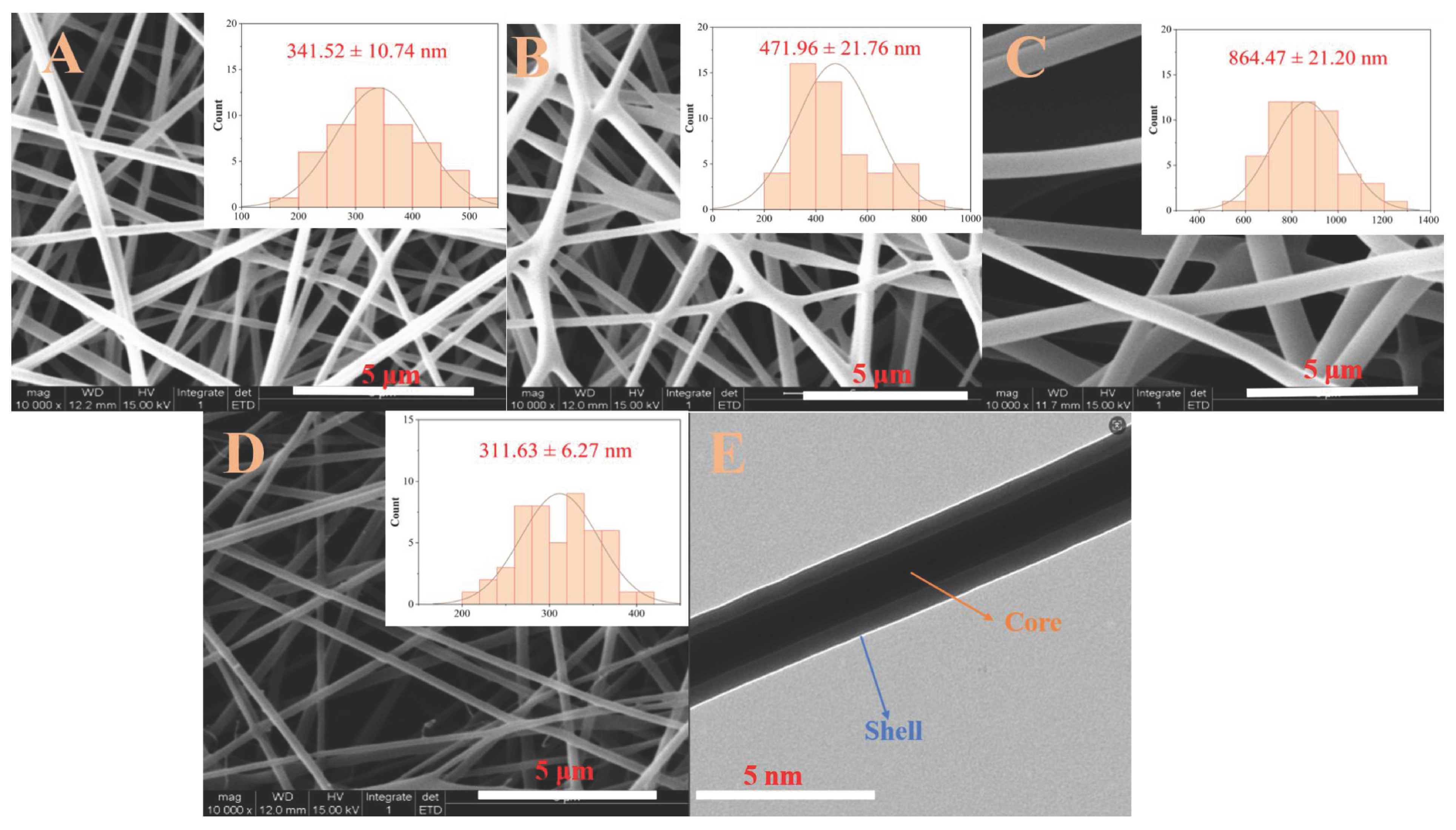
Figure 1. SEM images of coaxial electrospun fiber films with different cinnamon essential oil (CEO) loading contents. (A) PP/PC-0 fiber, (B) PP/PC-2 fiber, (C) PP/PC-4 fiber, (D) PP/PC-6 fiber, (E) Transmission electron microscopy (TEM) image of nuclear shell structure fiber.
Agronomy 16 00519 g001
Figure 2. Images of coaxial electrospun fibrous films with different cinnamon essential oil (CEO) loading contents: (A) Water contact angle (WCA values and images), (B) Water vapor permeability, and (C) Diagram of the phase transition mechanism of PNVCL. (The varying capitalization of letters in the image illustrates differences between content membranes of different CEOs within the same project (p < 0.05, n = 3)).
Agronomy 16 00519 g002
Figure 3. Images of coaxial electrospun fibrous films with different cinnamon essential oil (CEO) loading contents: (A) Fourier transform infrared (FTIR) spectroscopy, (B) X-ray diffraction (XRD) patterns, and thermogravimetric analysis of coaxial electrospun fibrous films with different cinnamon essential oil (CEO) loading contents: (C) TG curves; and (D) DTG curves.
Agronomy 16 00519 g003
Figure 4. Antibacterial activity of the films. (A) The antibacterial inhibition circle diameter of thermosensitive films with different CEO loadings using co-axial electrospinning; (B) The diameter of Aspergillus niger colonies on thermosensitive films with different loading levels of CEO prepared by coaxial electrospinning. The varying capitalization of letters in the image illustrates differences between content membranes of different CEOs within the same project (p < 0.05, n = 3).
Agronomy 16 00519 g004
Figure 5. Antioxidant activity of the film. DPPH clearance rate of coaxial electrospun fiber films with different cassia bark essential oil (CEO) addition amounts at room temperature 25 °C and 40 °C. The varying capitalization of letters in the image illustrates differences between content membranes of different CEOs within the same project (p < 0.05, n = 3).
Agronomy 16 00519 g005
Figure 6. Appearance changes in bayberry fruit under different treatments stored at 25 °C, 80% RH for 2 d before being transferred to 35 °C, 80% RH for 2 d. RH: relative humidity.
Agronomy 16 00519 g006
Table 1. Mechanical properties of coaxial electrospun fibrous films with different CEO loading contents.
SampleMaximum Force
(N)
Modulus of Elasticity
(MPa)
Tensile Strength
(MPa)
PP/PC-01.82 ± 0.03 b154.16 ± 17.62 b2.64 ± 0.26 b
PP/PC-22.93 ± 0.20 a28.11 ± 11.95 c3.40 ± 0.19 b
PP/PC-43.08 ± 0.31 a228.86 ± 15.46 a5.26 ± 0.72 a
PP/PC-61.75 ± 0.14 b239.11 ± 18.50 a5.14 ± 0.55 a
Note: Analysis of variance (ANOVA) was performed using SPSS software. Different lowercase letters in the same column indicate differences between different CEO content membranes in the same project (p < 0.05, n = 3).
Table 2. Appearance quality index of bayberry fruit under different treatments stored at 25 °C, 80% RH for 2 d before being transferred to 35 °C, 80% RH for 2 d. RH: relative.
DaysTreatmentFirm
(N)
TSS
(%)
TA
(%)
Weight Loss
(%)
∆E
0 4.89 ± 0.238.93 ± 0.191.60 ± 0.0600
1CK2.78 ± 0.17 a10.40 ± 0.35 b1.35 ± 0.12 a0.20 ± 0.03 a5.76 ± 2.25 a
PLA/CEO (4%)3.10 ± 0.03 a8.33 ± 0.22 c1.48 ± 0.23 a0.23 ± 0.01 a6.28 ± 0.71 a
PP/PC-42.96 ± 0.07 a12.07 ± 0.35 a1.58 ± 0.22 a0.05 ± 0.01 b3.55 ± 0.77 a
2CK2.33 ± 0.01 b7.63 ± 0.35 a1.12 ± 0.10 b0.24 ± 0.02 ab8.57 ± 0.53 a
PLA/CEO (4%)2.59 ± 0.07 a9.30 ± 0.72 a1.30 ± 0.14 ab0.29 ± 0.02 a7.12 ± 1.18 a
PP/PC-42.64 ± 0.05 a10.30 ± 1.51 a1.45 ± 0.03 a0.21 ± 0.01 b6.01 ± 0.87 a
3CK1.92 ± 0.12 b11.17 ± 0.44 a0.98 ± 0.03 b0.47 ± 0.01 a8.41 ± 0.52 a
PLA/CEO (4%)2.38 ± 0.07 a9.50 ± 0.78 a1.15 ± 0.06 ab0.35 ± 0.01 b8.00 ± 1.01 a
PP/PC-42.66 ± 0.12 a9.77 ± 0.43 a1.31 ± 0.12 a0.33 ± 0.01 b6.05 ± 0.59 a
4CK1.69 ± 0.13 b12.00 ± 1.03 a0.81 ± 0.04 c0.37 ± 0.01 a9.49 ± 0.78 a
PLA/CEO (4%)2.03 ± 0.06 b10.03 ± 0.24 a1.04 ± 0.02 b0.35 ± 0.002 ab10.55 ± 0.14 a
PP/PC-42.93 ± 0.18 a10.27 ± 0.48 a1.20 ± 0.05 a0.28 ± 0.04 b9.13 ± 0.82 a
Note: Analysis of variance (ANOVA) was performed using SPSS software. Different lowercase letters in the same column represent differences between different fibromembranes in the same column (p < 0.05, n = 18).
Disclaimer/Publisher’s Note: The statements, opinions and data contained in all publications are solely those of the individual author(s) and contributor(s) and not of MDPI and/or the editor(s). MDPI and/or the editor(s) disclaim responsibility for any injury to people or property resulting from any ideas, methods, instructions or products referred to in the content.