Article

Exogenous β-Glucan Promotes Growth and Exerts Regulatory Effects in Rice
1
Longping Agricultural College, Hunan University, Changsha 410125, China
2
Institute of Plant Protection, Hunan Academy of Agricultural Sciences, Changsha 410125, China
3
Yuelushan Laboratory, Changsha 410125, China
*
Authors to whom correspondence should be addressed.
Agronomy 2026, 16(5), 503; https://doi.org/10.3390/agronomy16050503
Submission received: 22 January 2026 / Revised: 19 February 2026 / Accepted: 22 February 2026 / Published: 25 February 2026

Abstract

Rice (Oryza sativa L.) is a highly valued staple food that is widely consumed worldwide. As the global population continues to grow rapidly, enhancing rice yields becomes essential to meet the increasing demand. β-Glucan has been recognized as a novel immunomodulatory agent. In the present study, we observed that β-glucan stimulates the growth of rice plants and activates the photosynthetic pathway. To explore the underlying molecular mechanisms, we conducted transcriptome sequencing and molecular validation on rice plants treated with either water or β-glucan. Our findings revealed that, compared to plants treated with water, those exposed to β-glucan exhibited a significant increase in the relative expression of genes linked to chloroplast development and photosynthesis. Additionally, we identified a total of 821 differentially expressed genes (DEGs) between rice plants treated with water and those treated with 50 mg/L of β-glucan, with 373 genes showing upregulation and 448 showing downregulation. Evaluations from the volcano plot, Gene Ontology (GO) functional annotation, and enrichment analysis indicated that these DEGs were mainly enriched in biological processes associated with carbohydrate metabolism and biomass regulation. This study concludes that β-glucan effectively enhances rice growth by improving photosynthetic efficiency. The results provide important insights into the application of exogenous β-glucan for boosting rice productivity.

1. Introduction

Oryza sativa L. is one of the most important cereal crops globally and serves as the staple food for nearly half of the world’s population [1]. While the development of modern agriculture drives farmers’ preference for rice varieties with shorter growth cycles to enhance planting efficiency and economic returns, the shorter growth duration may correspondingly reduce biomass accumulation and consequently lower yield [2,3]. A short growth cycle is one of the key objectives in rice breeding. However, there is still a limited amount of current research focused on enhancing rice growth.
β-Glucan is a polysaccharide polymer primarily composed of β-(1,3)-D-glucose, which is found in the cell walls of many eukaryotic organisms [4]. The cell wall of Saccharomyces cerevisiae contains β-(1,3)-d-glucan, β-(1,6)-d-glucan, chitin, and mannoproteins [5]. β-Glucan is prized for its blood glucose-lowering properties. With the ongoing optimization of its biosynthesis process, it finds extensive applications in diverse sectors including food, pharmaceuticals, cosmetics, chemicals, and feed. In agricultural production, β-glucan is primarily used to enhance plant immunity, improve soil quality, and control plant diseases. Studies have reported multiple biological functions of β-glucan in humans, such as antioxidant, anticancer, as well as hypolipidemic and cholesterol-lowering effects [6,7,8,9]. In food applications, the addition of β-glucan derived from Avena sativa L. has been proven to enhance the storage quality and taste of yogurt [10]. β-Glucan s are known to act as elicitors of resistance responses in plants. One specific example is that, in conjunction with laminarihexaose (a beta-(1→3)-glucan oligosaccharide), they stimulate protection reactions in rice cell suspensions [11]. It has been proposed that the cell wall (1→3) and (1→4)-β-D-glucans in the vegetative tissues of graminaceous plants may function similarly as an energy reserve [12]. β-1,3-Glucan oligomers released by hydrolysis of fungal cell walls can act as elicitors of defense responses and are recognized as Pathogen/Microbe-Associated Molecular Patterns (PAMPs/MAMPs) [13,14,15]. Elicitors possess the ability to activate multiple defense mechanisms in plants, including calcium flux, the initiation of mitogen-activated protein (MAP) kinase activity, and the production of secondary signals such as reactive oxygen species, nitric oxide, and plant hormones like jasmonic acid, ethylene, and salicylic acid [16,17]. Research has also indicated that β-glucan is capable of activating the MAPK pathway in alfalfa [18]. Studies have confirmed that β-glucan can not only act directly on plants but also indirectly enhance disease control efficacy by modulating beneficial microorganisms. For instance, Wang et al. (2018) found that inducing Cryptococcus podzolicus with 0.5% β-glucan significantly improved its biocontrol effect against postharvest blue mold in Malus pumila Mill [19]. Studies have shown that yeast-derived β-glucan can significantly promote the growth, improve survival rate, and enhance immune performance of shrimp [20]. The β-glucan extracted from microalgae demonstrates significant effects in terms of antioxidant activity and immune regulation [21]. Applying a foliar spray of chitosan at a concentration of 25 mg/L can significantly reduce the harm inflicted by low temperatures on loofah seedlings. This treatment enhances photosynthetic efficiency, aids in the accumulation of osmoregulatory compounds, and supports the growth of seedlings [22]. Research has indicated that polysaccharides found outside of cells can greatly improve the growth of crops and increase their resilience to various abiotic stressors [23]. Qu et al. (2026) [24] found that exogenous β-glucan can significantly reduce the harm inflicted by drought stress on pak choi (Brassica chinensis L.). When used at the right concentration, it has the potential to enhance the growth and development of pak choi, leading to greater yields and improved nutritional quality [24]. Paramylon can enhance the process of photosynthesis in plants through an increase in chlorophyll levels and by boosting the efficiency of light absorption. Consequently, this leads to elevated rates of carbon dioxide assimilation, which in turn supports greater biomass production and promotes plant growth [25].
It is still unclear whether β-glucan affects rice growth or what its specific mechanisms of action are. To investigate this mechanism, we examined the changes in growth indicators of rice treated with β-glucan. Subsequently, we explored the effects of β-glucan on plant chlorophyll levels. Finally, transcriptomic analysis fully demonstrated that β-glucan treatment promoted biomass accumulation. These experimental results will provide theoretical support and novel insights for promoting rice growth.

2. Materials and Methods

2.1. Plants

The tested rice variety was Nipponbare. Rice seeds were soaked in water for 48 h in a constant temperature incubator (temperature: 28 °C ± 2 °C, relative humidity: 70% ± 5%, photoperiod: 16L:8D). After soaking, they were transferred to plastic pots (top diameter: 9 cm, height: 6.8 cm, bottom diameter: 6.5 cm) containing nutrient soil and cultivated in a greenhouse (temperature: 26 °C ± 2 °C, relative humidity: 70% ± 5%, photoperiod: 14L:10D). One rice seedling was planted per plastic pot, with a distance of 5 cm between each pot. Watering was performed regularly. After 20 days of transplantation, rice plants with uniform growth and similar morphological size were selected for the experiment.

2.2. Screening for Effective β-Glucan Concentration

The β-glucan was sourced from Saccharomyces acquired from Shanghai Aladdin Bio-Chem Technology Co., Ltd. (Shanghai, China). First, the effective β-glucan concentrations for rice were selected. β-Glucan was diluted with ddH2O to 0, 25, 50, 100, and 200 mg/L. Then, 10 mL β-glucan in different concentrations was sprayed on rice plants with similar growth conditions. Rice survival rate in BPH which fed on different concentrations of β-glucan for 11 days was determined. The effective concentration was determined to be 50 mg/L β-glucan and this was selected to treat plants in the follow-up experiment. Each treatment was repeated three times.

2.3. Measurements of Rice Plant Growth Parameters

The fresh weight, leaf width, leaf length, and plant height of rice plants were measured using the following protocol. Plants were carefully uprooted from the plastic pots, and the soil attached to the roots was quickly rinsed off. The fresh weight was immediately determined using an electronic balance with a precision of 0.01 g. To measure plant height, the plant was held in its natural upright position alongside a vertical ruler. The height was recorded as the distance from the stem base (at the substrate surface) to the highest point of the plant. For leaf dimensions (width and length), the fourth true leaf was laid flat without stretching. A ruler was used to measure the maximum width at the mid-section of the leaf blade and the full length from the leaf base to the tip. All measurements were taken while maintaining the leaf’s natural state. Nineteenth biological replicates were included per treatment, and each replicate was measured three times to obtain a mean value.

2.4. Effect of β-Glucan on Plant Photosynthesis-Related Pathways

2.4.1. Effect of β-Glucan on Plant Chlorophyll and Nitrogen Content

After the rice plants were treated with β-glucan, the contents of chlorophyll and nitrogen of the four-true leaves of rice plants were measured using an OK-Y104 chlorophyll meter (Zhengzhou Okoqi instrument Manufacturing Co., Ltd., Zhengzhou, China) on day 7 after treatment. Each treatment was repeated three times.

2.4.2. Effects of β-Glucan on Chlorophyll Development, Chlorophyll Metabolism and Photosynthetic Gene Expression in Plants

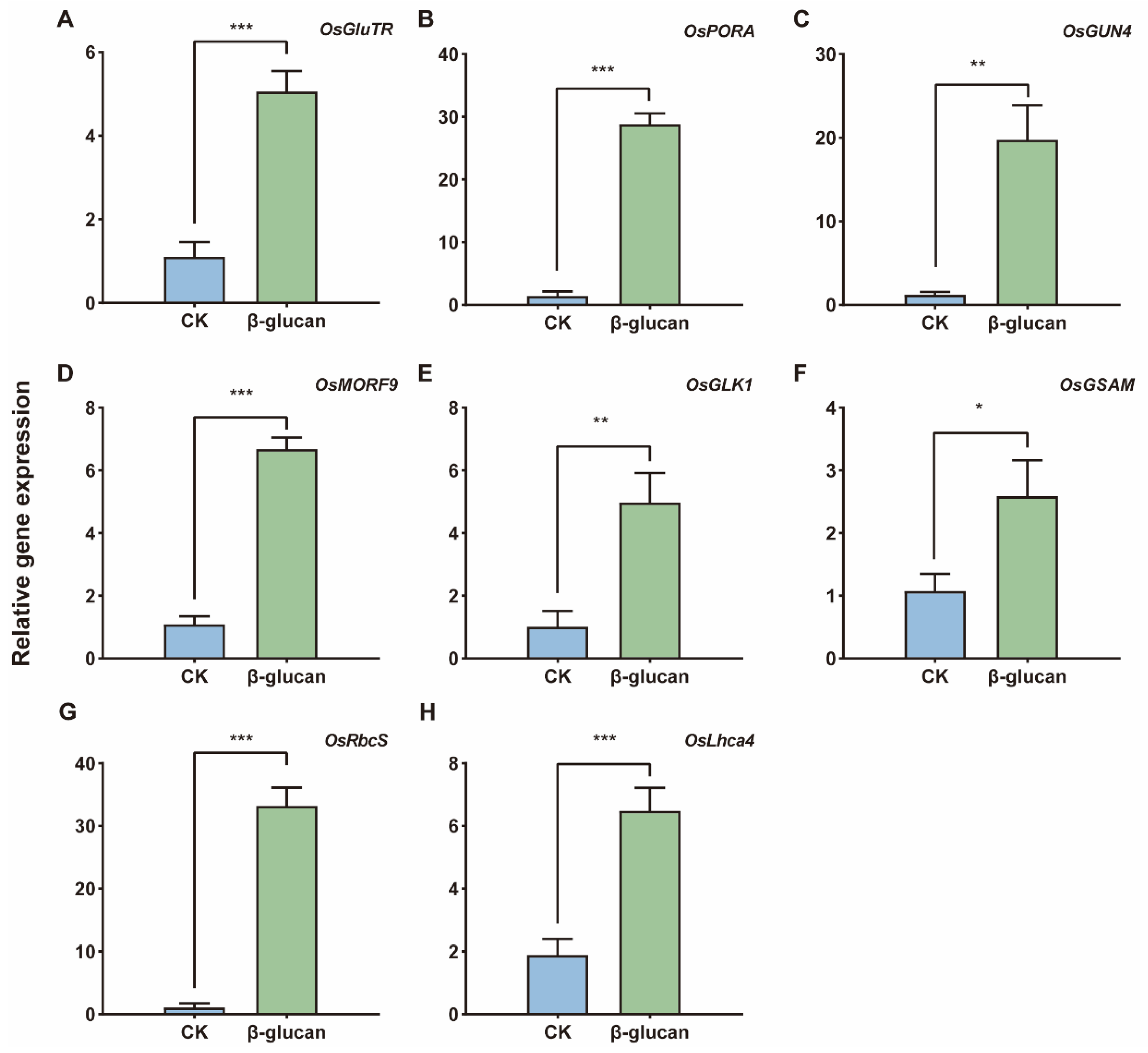
The β-glucan (50 mg/L) used to treat the plants was applied for 5 days. After the rice plants were treated with 50 mg/L β-glucan, four fully expanded leaves of rice plants were collected after 48 h. eIF-4a was used as the internal reference gene [26] (Table 1). The total RNA of rice plants was extracted using TRIzol reagent (Thermo Fisher Scientific Inc., Waltham, MA, USA). The first chain of cDNA was synthesized using the manufacturer’s instructions for a HiScript II 1st Strand cDNA Synthesis Kit (+gDNA wiper) (Vazyme Biology Co., Ltd., Nanjing, China). ChamQ Universal SYBR qPCR Master Mix was used for fluorescence quantitative PCR (Vazyme Biology Co., Ltd.). From earlier research, we selected the most significant genes associated with the synthesis of chlorophyll and the process of photosynthesis [27,28,29]. The expressions of glutamyl-tRNA reductase (OsGluTR), NADPH, protochlorophyllide oxidoreductase A (OsPORA), genomes uncoupled 4 (OsGUN4) and multiple organellar RNA editing factor (OsMORF9) related to the chlorophyll development pathway were monitored. The expressions of GOLDEN2-LIKE transcription factor (OsGLK1), glutamate-1-semialdehyde aminotransferase (OsGSAM), ribulose-1,5-bisphosphate carboxylase/oxygenase (Rubisco) small subunit (OsRbcS) and chlorophyll-a/b binding (OsLhca4) related to photosynthesis were measured. Each treatment was repeated three times.

2.5. Transcriptome Analysis

Rice plants were treated with either water (as the control) or 50 mg/L β-glucan on days 1, 3, and 5, respectively. Samples from all groups, including the control, were subsequently collected 48 h after the final treatment for transcriptome sequencing. The extraction of total RNA, library construction, and transcriptome sequencing were conducted by Shanghai OE Biotech Co., Ltd. (Shanghai, China), with four replicates per sample. Following sample quality control, sequencing was carried out on the Illumina platform to generate raw sequencing data. The raw data were then subjected to quality trimming using Trimmomatic 0.39 to remove low-quality reads, resulting in high-quality clean reads for subsequent analysis. Differentially expressed genes (DEGs) between different treatment groups were identified using the thresholds of |log2 Fold Change| ≥ 1.5 and p < 0.05. Further analysis of the DEGs was performed using DESeq2 1.22.2. Visualization and functional annotation, including volcano plots, heatmaps, and GO enrichment analysis, were completed using the OE Cloud platform.

2.6. The Functional Validation of Genes

A total of nine differentially expressed genes (DEGs) were selected for validation by RT-qPCR. Gene-specific primers were synthesized by Tsingke Biotechnology Co., Ltd. (Beijing, China), with their sequences listed in Table 1. cDNA was synthesized using a reverse transcription kit (Vazyme, Nanjing, China; item number: R212-01). The expression levels of the target DEGs were then quantified using a real-time quantitative PCR kit (Vazyme, Nanjing, China; item number: Q711-02), with eIF-4a serving as the reference gene. The real-time quantitative PCR reaction was performed in a total volume of 20.0 μL, containing 10.0 μL of 2 × Taq Pro Universal SYBR qPCR Master Mix, 1.0 μL of DNA template (500.0 ng/μL), 0.4 μL each of forward and reverse primers, and 8.2 μL of double-distilled water (ddH2O). The amplification protocol consisted of an initial denaturation at 95 °C for 30 s, followed by 40 cycles of denaturation at 95 °C for 10 s and annealing/extension at 60 °C for 30 s. A melting curve analysis was subsequently performed. All reactions were carried out with three biological replicates and three technical replicates. The relative expression of each gene was calculated using the 2−ΔΔCT method [30].

2.7. Data Analysis

All data analyses were performed using the Data Processing System (DPS) software v21.05. One-way analysis of variance (ANOVA) was performed to compare rice survival rates across different treatment concentrations, followed by Tukey’s test for multiple comparisons. Experimental data were considered statistically significant when p < 0.05. Independent-samples t-tests were employed to assess the effects of β-glucan treatment on the following parameters in rice plants: chlorophyll content, total nitrogen content, key indices of chlorophyll biosynthesis and photosynthesis-related genes, and the expression of genes validated by RT-qPCR.

3. Results

3.1. Concentration of Application of β-Glucan

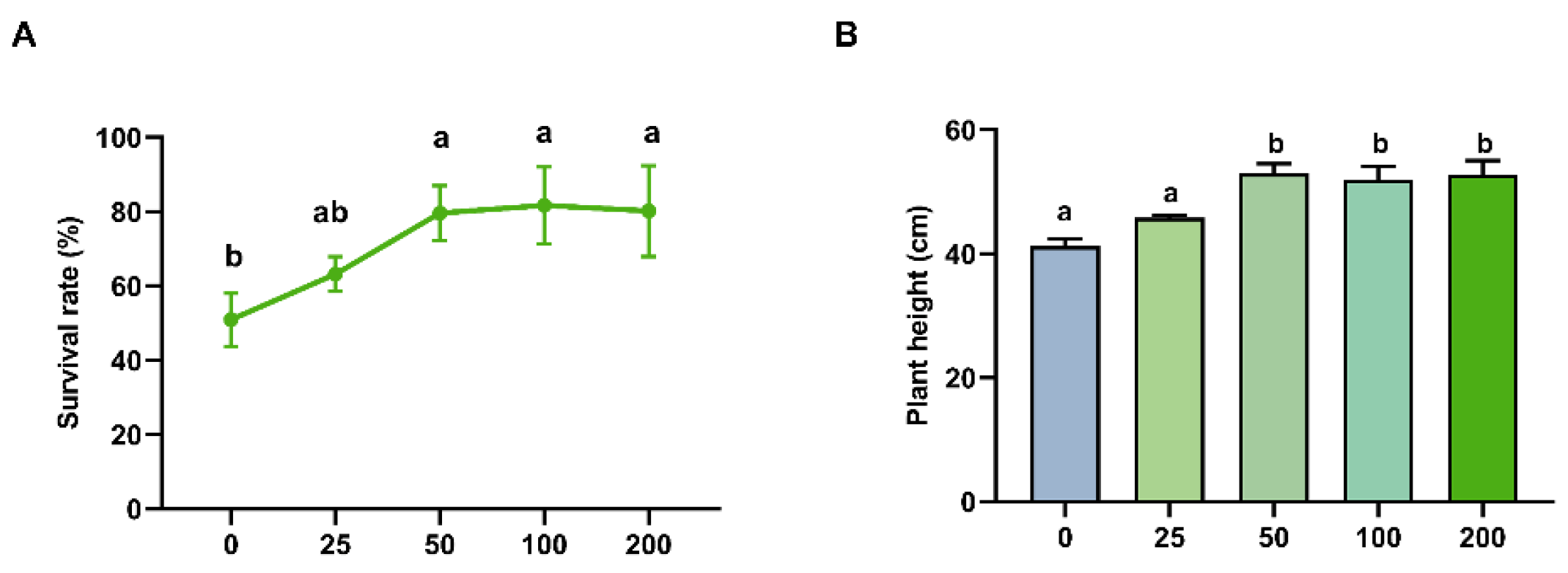
Rice plants were treated with β-glucan at concentrations of 0, 25, 50, 100, and 200 mg/L. Following treatment, all groups were infested with an equal number of Nilaparvata lugens (Stål) (brown planthoppers, BPH). After 11 days, rice plants treated with β-glucan showed a significantly higher survival rate compared to the water control group (0 mg/L). Specifically, survival did not differ significantly between the 25 mg/L treatment and the control. In contrast, treatments at 50, 100, and 200 mg/L significantly increased plant survival by 56.35%, 60.36%, and 67.88% respectively (Figure 1A). There was no significant difference in rice plant height between the 50 mg/L β-glucan treatment and the 100 and 200 mg/L β-glucan treatments (Figure 2B). Considering both efficacy and cost, the 50 mg/L β-glucan treatment is recommended as the optimal concentration.

3.2. Effect of β-Glucan on Plant Growth Parameters

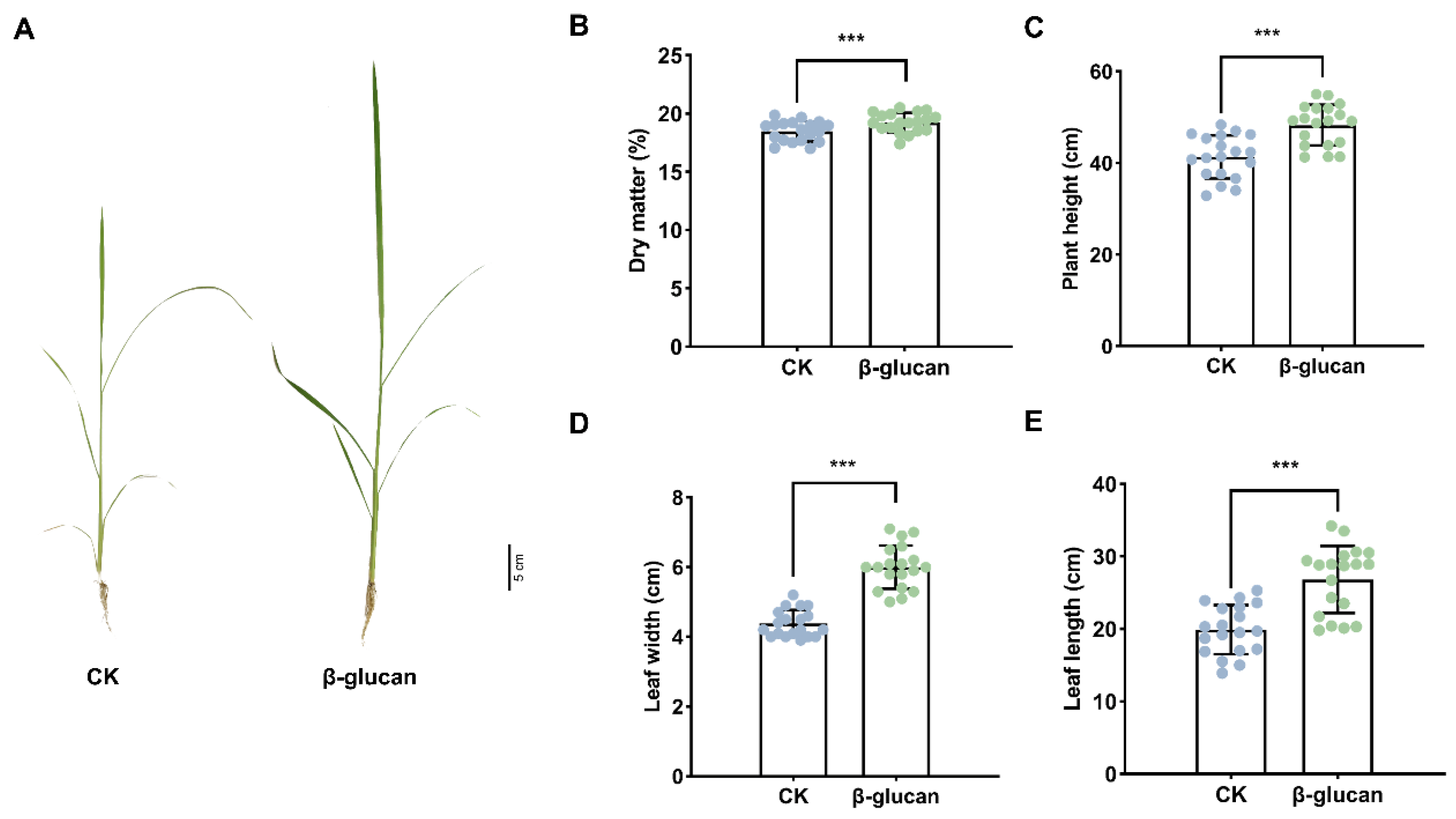
Following treatment with β-glucan administered once every two days for a total of three applications, the key growth parameters of rice plants were significantly higher than those of the water control group (Figure 2A). Specifically, dry matter increased by 4.09% (Figure 2B; p < 0.001), plant height increased by 16.89% (Figure 2C; p < 0.001), leaf width increased by 36.97% (Figure 2D; p < 0.001), and leaf length (measured on day 7) increased by 34.74% (Figure 2E; p < 0.001). These results demonstrate that the treatment significantly promotes plant growth.

3.3. Effect of β-Glucan on Plant Photosynthetic Pathways

3.3.1. Effects of Β-Glucan on the Contents of Chlorophyll and Nitrogen

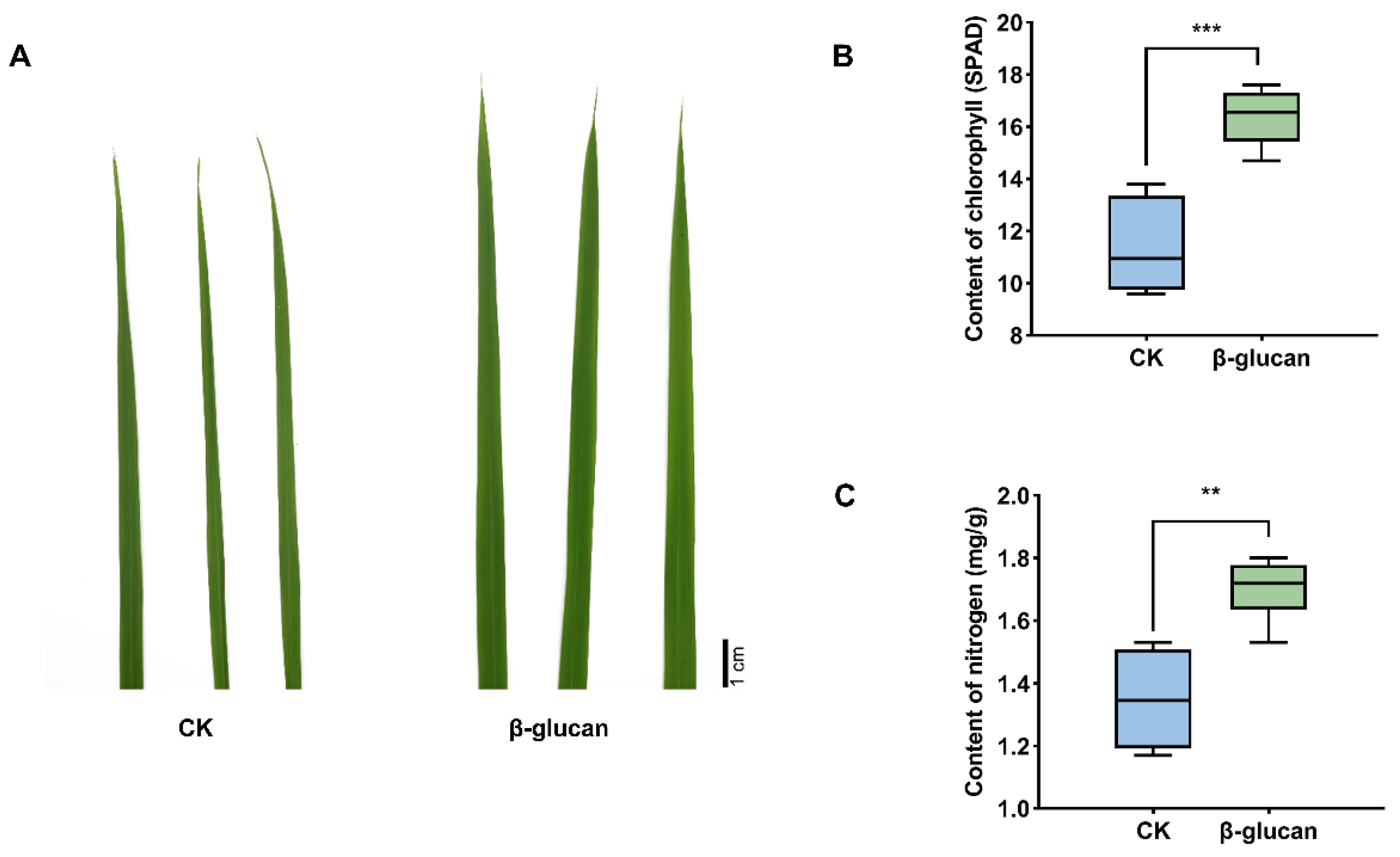
Compared to the control rice plants, β-glucan treatment resulted in a visibly greener phenotype of the rice leaves (Figure 3A). Following applications of β-glucan every two days for a total of three applications, the chlorophyll content in treated plants at day 7 was significantly higher than that in the control group (Figure 3B; p < 0.001), showing an increase of 43.92%. Concurrently, the nitrogen content in the treated plants was also significantly elevated compared to the control (Figure 3C; p < 0.01), with an increase of 26.21%.

3.3.2. Effects of β-Glucan on the Development of Chlorophyll and Photosynthetic Gene Expression in Plants

In comparison to the control group, a treatment period of 7 days with β-glucan notably increased the relative expression levels of genes linked to the chlorophyll biosynthesis pathway. This includes OsGluTR (Figure 4A; p < 0.001), OsPORA (Figure 4B; p < 0.001), OsGUN4 (Figure 4C; p < 0.01), and OsMORF9 (Figure 4D; p < 0.001). Additionally, a significant rise in the expression of genes related to photosynthesis, such as OsGLK1, OsGSAM, OsRbcS, and OsLhca4, was also observed (Figure 4E–H; p < 0.01 for OsGLK1, p < 0.05 for OsGSAM, p < 0.001 for OsRbcS, and p < 0.001 for OsLhca4).

3.4. Transcriptome Data Quality Assessment

A total of eight samples were subjected to transcriptome sequencing (Table 1), consisting of four biological replicates from rice plants treated with either water (as a control) or 50 mg/L β-glucan over a period of 7 days. The sequencing process produced more than 24,950,000 raw reads for each sample. Following quality assessment, 55.57 Gb of clean reads were acquired. The percentage of Q30 bases ranged between 93.42% and 93.81%, while the average GC content was found to be 52.47%. Subsequently, the clean reads were aligned to the reference genome, resulting in alignment rates that varied from 97.07% to 97.75%. These results demonstrate that the sequencing data obtained from all samples were of high quality and appropriate for further bioinformatics analysis.

3.5. Rice Gene Expression Exhibits Significant Alterations in Response to Exogenous β-Glucan Treatment

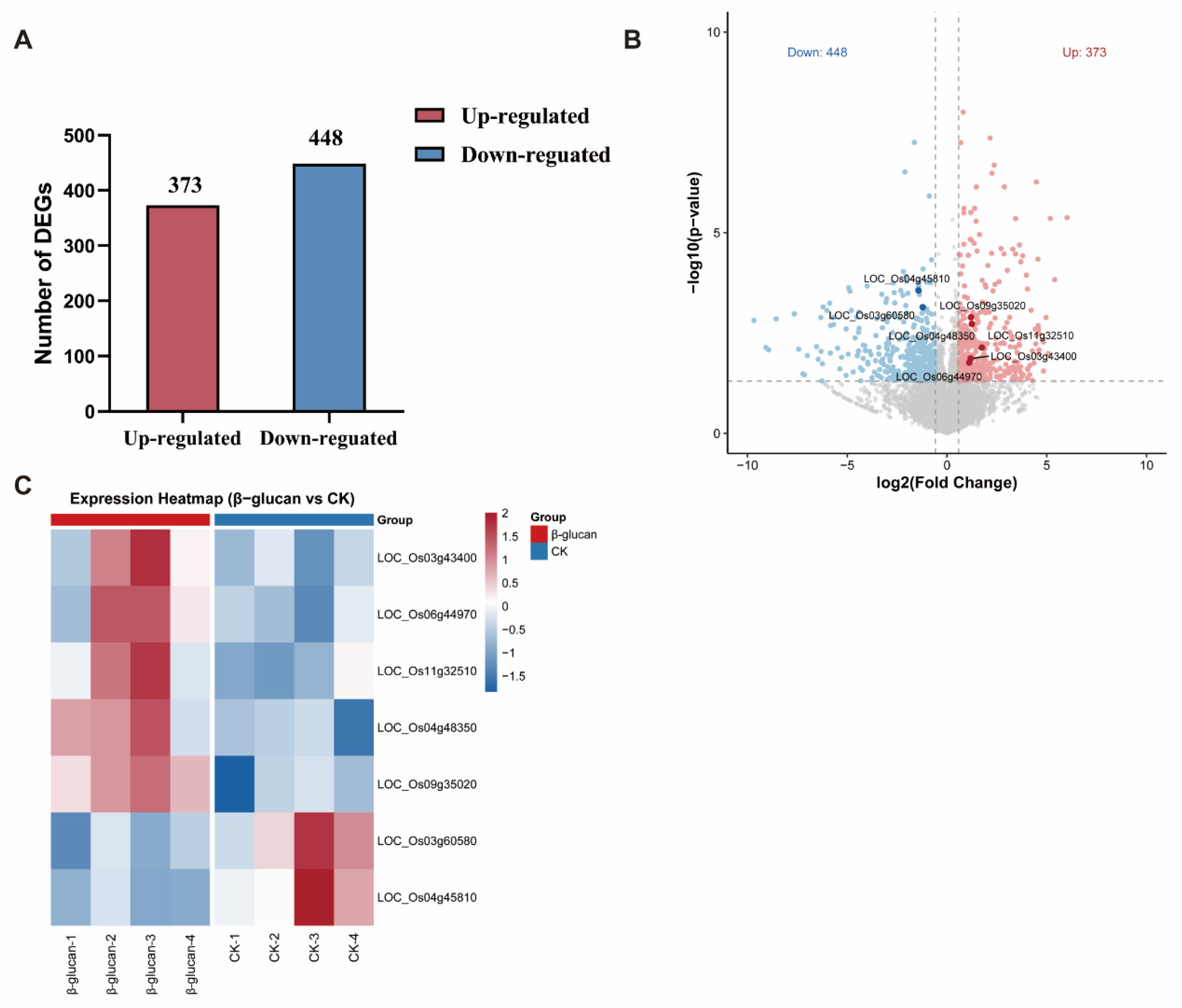
A volcano plot analysis was conducted to assess and visualize the transcriptomic effects of 50 mg/L β-glucan on rice. As illustrated in Figure 5A, applying thresholds of |log2 Fold Change| ≥ 1.5 and p < 0.05, a total of 821 differentially expressed genes (DEGs) were detected. Out of these, 373 genes exhibited up-regulation while 448 showed down-regulation. To provide deeper insight into the expression patterns of these genes, a heatmap displaying the seven most significant DEGs was created based on the RNA-seq data (Figure 5C). The findings distinctly separated the samples from both the control and the β-glucan treatment groups. The genes predominantly formed two main clusters, with Cluster II typically demonstrating up-regulation following treatment with 50 mg/L of β-glucan. Importantly, multiple known genes linked to growth and drought resistance were identified in areas of significant variation. This included genes associated with auxin (LOC_Os03g43400 and LOC_Os06g44970), a gene involved in indole-3-acetic acid (IAA) metabolism (LOC_Os11g32510), as well as genes related to drought tolerance (LOC_Os04g48350, LOC_Os09g35020, LOC_Os03g60580, LOC_Os04g45810). These findings suggest that the external application of 50 mg/L β-glucan can initiate a programmed adjustment in transcriptional regulation within rice. This reprogramming’s fundamental attributes encompass the activation of the auxin signaling pathway alongside the up-regulation of genes associated with growth.

3.6. Enrichment Analysis of Differentially Expressed Genes in Response to Exogenous β-Glucan Treatment

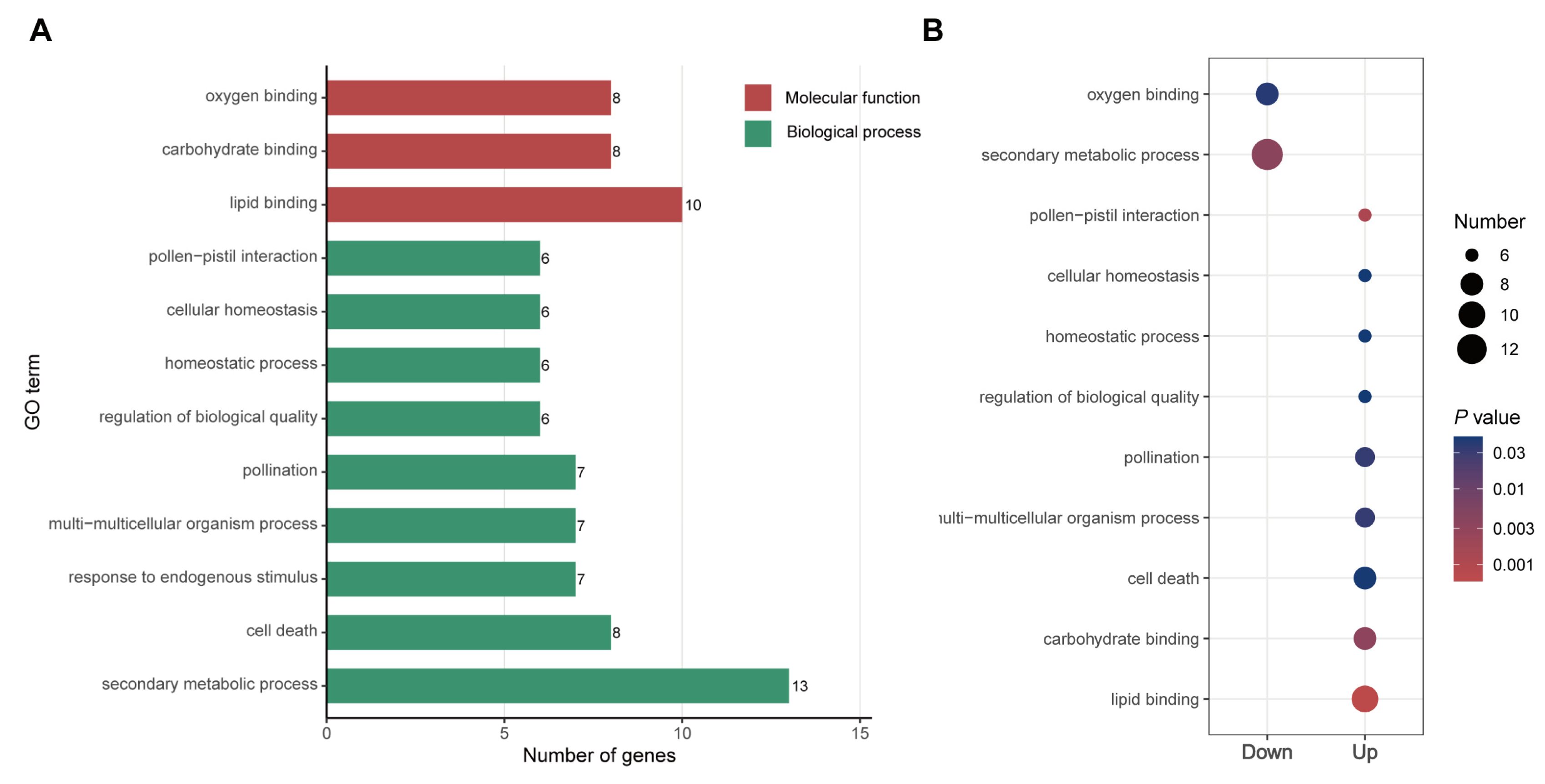
In order to investigate the potential biological roles of the differentially expressed genes (DEGs), we conducted a GO enrichment analysis. The resulting data is displayed in Figure 6A. All DEGs were categorized into two principal ontologies within the GO database: Molecular Function (MF), which encompasses 3 categories, and Biological Process (BP), which includes 9 categories. Specifically, in terms of molecular function, the genes that showed significant enrichment were largely linked to binding activities, involving 36 DEGs. For biological processes, these genes predominantly participated in cellular activities and metabolic functions, accounting for 21 DEGs and 13 DEGs, respectively. This enrichment analysis offers insights that contribute to a more comprehensive understanding of the functional roles of the DEGs in response to exogenous treatment with 50 mg/L β-glucan.
The results of the GO enrichment analysis for the differentially expressed genes are presented in Figure 6B. Significant enrichment was observed in two categories of ontology for these genes. Regarding molecular function, the primary enrichments were found in carbohydrate binding (GO:0030246) and lipid binding (GO:0008289). In the context of biological processes, notable enrichment was detected in pathways associated with the secondary metabolic process (GO:0019748) and the regulation of biological quality (GO:0065008). These findings indicate that the DEGs may play a role in influencing biomass accumulation, likely by modulating pathways involved in carbohydrate and lipid metabolism.

3.7. The Functional Validation of Genes

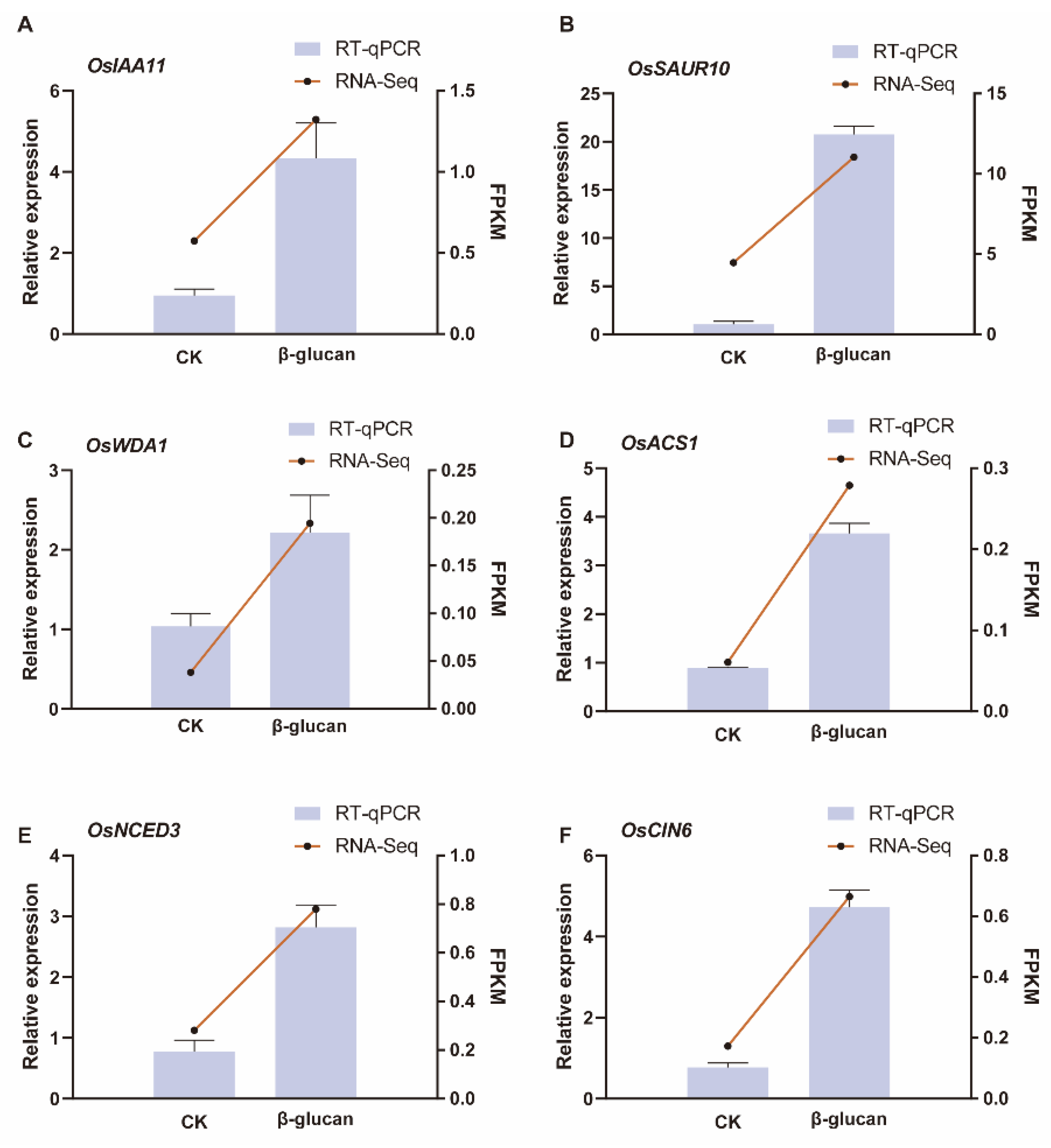
The reliability of the RNA-seq data was validated by quantitative real-time PCR (RT-qPCR) on 6 randomly selected genes from each treatment group. The primer sequences are listed in Table S1.
Validation was conducted on six genes representing five unique metabolic pathways. In particular, qRT-PCR analysis was utilized to validate the expression levels of two genes involved in the plant hormone signal transduction pathway: OsIAA11 (LOC_Os03g43400) and OsSAUR10 (LOC_Os02g30810) (Figure 7A,B). Additionally, OsWDA1 (LOC_Os10g33250) was assessed from the cutin, suberine and wax biosynthesis pathway (see Figure 7C); OsACS1 (LOC_Os03g51740) was evaluated from the secondary metabolite biosynthesis pathway (Figure 7D); OsNCED3 (LOC_Os03g44380) was selected from the carotenoid biosynthesis pathway (Figure 7E); and OsCIN6 (LOC_Os04g56920) was included from the starch and sucrose metabolism pathway (Figure 7F). The relative expression patterns obtained from this qRT-PCR analysis of the randomly chosen genes were generally in alignment with the trends seen in the transcriptome data, thereby affirming the validity of the RNA-seq findings presented in this research.

4. Discussion

In the past few years, products derived from rice that are fortified with the immunomodulatory agent β-glucan have appeared in the marketplace. Recent studies categorize β-glucan as a pathogen-associated molecular pattern (PAMP). The foundation of its immunomodulatory role is based on the interaction between β-glucan molecules and specific pattern recognition receptors (PRRs) found on innate immune cells’ surfaces. This interaction functions as a crucial signal that activates downstream immune reactions, mediating a wide array of physiological outcomes, such as the suppression of inflammation, resistance to tumors, modulation of gut microbiota, and enhancement of tissue repair [31]. While the immunomodulatory effects of β-glucan are widely acknowledged, its direct impact on crop growth-especially in staple crops like rice-and the mechanisms responsible for these effects have yet to be completely clarified. In this investigation, we comprehensively demonstrated the various growth-enhancing effects of exogenous β-glucan on rice through a combination of phenotypic analysis, measurement of physiological parameters, and transcriptomic studies. Additionally, we began to unravel its regulatory framework, which is focused on the development of chlorophyll and signaling related to photosynthesis, thus offering new insights into the molecular foundations of its growth-promoting capabilities.
β-Glucans are widely used as immunostimulants and antitumor agents. However, research on the application of β-glucan for regulating plant growth remains limited [32]. In this study, rice plants were treated with β-glucan at concentrations of 0, 25, 50, 100, and 200 mg/L, applied at intervals of every day, every three days, and every five days. Following treatment, an equal number of BPH were released. We observed no significant difference in the survival rates of rice plants between the 50 mg/L and 100 mg/L treatments after BPH infestation (Figure 1A). Variations in rice growth subjected to different levels of β-glucan before exposure to BPH feeding were observed. The statistical evaluation indicated outcomes analogous to rice’s resistance against planthoppers, demonstrating no notable difference in plant height between the rice treated with 50 mg/L compared to those receiving 100 or 200 mg/L (Figure 1B). This is consistent with the findings of Ramalingam P and Appu M (2025) that low-concentration β-glucan nanocomposites promoted tomato growth [33]. Therefore, to maintain efficacy while reducing costs, the application of 50 mg/L β-glucan is more suitable for treating rice plants. Consequently, β-glucan has the potential to function as a signaling molecule. Once β-glucan attains a specific concentration and its interaction with rice signaling molecules is fully saturated, any surplus β-glucan may become unnecessary but is unlikely to produce adverse effects.
The level of (1→3), (1→4)-β-D-glucan in the cell wall controls the elongation capacity of rice coleoptiles, and the relative content of β-glucan in the cell wall is positively correlated with the increment in coleoptile length. The turnover of β-glucan is one of the key factors regulating rice coleoptile growth [34]. Ahmad et al. (2022) reported that exogenous application of amino-oligosaccharin improved gas exchange parameters such as net photosynthetic rate, stomatal conductance, and transpiration rate, thereby enhancing plant carbon assimilation capacity and growth [35]. Furthermore, application of an appropriate concentration of trehalose effectively alleviated drought stress in sugarcane seedlings and ultimately promoted their growth [36]. The (1→3)-β-d-glucan degradation product obtained via gamma-ray irradiation significantly promotes the increase in plant height, root length, fresh weight, and dry matter content in mustard greens (Brassica juncea) [37]. Foliar application of a 50 ppm β-glucan-rich heteropolysaccharide enhanced chlorophyll content, promoted plant growth, and improved drought resistance in rice [38]. Muley et al. (2019) demonstrated that foliar application of chitosan and its oligomers at concentrations of 50–75 mg/L during the growth stage of potato plants effectively induces drought tolerance responses and concurrently enhances productivity [39]. The application of chitosan irradiated at higher doses significantly promotes the growth of Malabar spinach, demonstrating its role as an effective plant growth stimulant. Analogous results were reported by Rahman et al. (2013) in Malabar spinach, with the application of chitosan irradiated at higher doses significantly promoting the growth of Malabar spinach and demonstrating its role as an effective plant growth stimulant [40]. In this study, rice plants were treated with β-glucan every two days for a total of three applications, resulting in significant increases in dry matter, plant height, leaf width, leaf length, and fresh weight (Figure 2). This is consistent with the findings of Hoson and Nevins (1989) that β-D-glucan plays a significant regulatory role in elongation growth [41]. The application of β-glucan effectively promoted rice growth, offering a promising technical pathway for the development of novel environmentally friendly agricultural biostimulants.
Considerable progress has currently been achieved in understanding plant photosynthesis and the stress-responsive mechanisms that regulate growth and survival in fluctuating environments [42,43,44,45]. Chlorophyll is the essential pigment in plant leaves, required for photosynthesis and thus critical for plant survival and optimal growth. The alleviation of salt stress inhibition by 0.0625% oligochitosan pretreatment can be attributed to its role in stimulating root development, augmenting photosynthetic pigment content, and enhancing gas exchange efficiency, which collectively conferred improved stress tolerance [46]. Zhou et al. (2012) reported that the C-terminal residues of OsGUN4 are essential for activating the ChlH subunit of magnesium chelatase, which is crucial for chloroplast development in rice [47]. Perveen et al. (2020) found that overexpression of mEmBP-1 upregulates the expression of light-harvesting chlorophyll a/b complex (LHCA/LHCB) genes, thereby enhancing photosynthetic efficiency and yield in rice fields [48]. Following β-glucan application, the chlorophyll content in rice plants increased (Figure 3B), accompanied by a rise in nitrogen content (Figure 3C). These changes improved photosynthetic performance and significantly elevated the expression of genes associated with chlorophyll synthesis and photosynthesis (Figure 3B and Figure 4E–H). In this study, we also observed that β-glucan treatment upregulated the expression of chlorophyll synthesis-related genes (Figure 4A–D). This indicates that chlorophyll biosynthesis and photosynthesis-related pathway are accelerated in rice plants treated with β-glucan.
Transcriptome sequencing analysis provided molecular-level insights into the observed phenotypic and physiological changes. Differential expression gene analysis revealed that treatment with 50 mg/L β-glucan specifically activated the auxin regulatory pathway, significantly upregulating the expression of the auxin efflux carrier gene OsPIN2 and the indole-3-acetic acid-amido synthetase gene OsGH3.13. Among these, OsPIN2 regulates rice plant architecture by facilitating the polar auxin transport from the shoot base to the aerial parts through interaction with the auxin efflux carrier OsPIN1b and the tiller angle controller OsTAC1 [49]. OsGH3.13 catalyzes the conjugation of free IAA to amino acids, leading to increased levels of amino acid-conjugated IAA. Under drought stress, OsGH3.13 promotes the accumulation of conjugated IAA, thereby reducing free IAA content in the shoots, which modulates plant architecture (Figure 5). Concurrently, the upregulation of OsGH3.13 enhances drought tolerance by elevating the expression of stress-responsive LEA family genes [50]. This research indicates that the expression levels of OsPIN2 and OsGH3.13 influence the structural development of rice plants.
Notably, GO enrichment analysis revealed that the differentially expressed genes were significantly enriched in functional categories such as carbohydrate binding and biomass regulation (Figure 6). Treatment with β-glucan activates hormone signaling transduction mechanisms to enhance resistance against environmental stress, thereby improving environmental adaptation. Secondly, plants require energy to synthesize hormones, fatty acids, and other compounds in response to environmental stress. It has been reported that under environmental stress, the carotenoid biosynthesis pathway in plants is enhanced, leading to increased carotenoid content [51]. NCED is a member of the carotenoid cleavage dioxygenase (CCDs) family and is considered a key enzyme in ABA biosynthesis [52]. In Arabidopsis, NCED genes belong to a multigene family, with AtNCED3 being induced by drought stress and controlling endogenous ABA levels [53]. It has been reported that environmental stress promotes the enhancement of starch and sucrose metabolism, amino sugar and nucleotide sugar metabolism, boosts photosynthetic capacity, and facilitates carbohydrate accumulation to meet the energy demands for the synthesis of plant compounds, particularly under abiotic stress [54,55]. The accumulation and metabolism of sugars accelerate the synthesis and transport of plant hormones and fatty acids, thereby contributing to the promotion of tea plant growth and the enhancement of tea yield [56]. Thus, β-glucan treatment promotes the synthesis and transport of plant hormones and fatty acids in rice, thereby enhancing its environmental adaptability. This finding is highly consistent with the physiological data demonstrating increased plant height, leaf width, leaf length, dry matter, and enhanced photosynthesis in rice following β-glucan treatment. This aligns with the results reported by Zhu J and Wakisaka M (2018) [57], indicating that Paramylon has been discovered to facilitate the growth of plants by improving root development, boosting chlorophyll levels, and encouraging photosynthesis. Such effects may result in greater plant vitality, higher biomass yield, and improved crop output [57]. Furthermore, it provides deeper insight into how β-glucan promotes rice growth, indicating that the transport, allocation, and utilization of carbon assimilation products within the plant are simultaneously enhanced.
Currently, β-glucan is widely applied in various fields. Its utilization offers an efficient and environmentally friendly approach as a plant growth stimulant. The treatment of rice plants with 50 mg/L β-glucan establishes a foundation for future field applications. We found that β-glucan acts as a biostimulant, activating the photosynthetic pathway in rice and promoting the accumulation of chlorophyll and nitrogen content, thereby increasing rice plant biomass. However, the mechanism by which β-glucan enhances rice growth still requires further investigation. Further analyze the molecular details of β-glucan activating the rice photosynthetic pathway, screen and verify the specific binding factors of key photosynthesis-related genes under β-glucan regulation, clarify their transcriptional regulation mechanism, and elucidate the molecular association between photosynthetic pathway activation and the accumulation of chlorophyll and nitrogen content.

5. Conclusions

Foliar application of exogenous 50 mg/L β-glucan enhanced rice growth by promoting the accumulation of chlorophyll and nitrogen, which thereby boosted photosynthetic efficiency and increased biomass production. This was ultimately manifested as significant increases in plant height, leaf width, and dry matter. Transcriptomic analysis of differentially expressed genes (DEGs), validated by qRT-PCR, revealed that exogenous β-glucan acts as a saccharide signal that activates both auxin-regulated growth and drought resistance signaling pathways, coordinating overall plant development. This study provides a crucial theoretical foundation for the development and application of β-glucan as an efficient and green bio-stimulant for rice cultivation.

Supplementary Materials

The following supporting information can be downloaded at: https://www.mdpi.com/article/10.3390/agronomy16050503/s1, Table S1 Primer pairs used in this study were designed and synthesized for gene expression analysis.

Author Contributions

D.-Y.Z. and X.-B.S. conceived and designed the experiments. M.-T.H. performed the experiments. M.-T.H. analyzed the data. M.-Y.L., J.-B.C., J.D., X.-H.D. and Y.C. contributed reagents/materials/analytical tools. M.-T.H. and X.-B.S. wrote the paper. All authors have read and agreed to the published version of the manuscript.

Funding

This work was supported by the Yuelushan Laboratory Breeding Program (Grant No. YLS-2025-ZY03008), and the Agriculture Research System of China (Nos. CARS-23-D-02).

Institutional Review Board Statement

Not applicable.

Data Availability Statement

The original contributions presented in the study are included in the article, further inquiries can be directed to the corresponding authors.

Acknowledgments

Authors are grateful to anonymous reviewers for their constructive comments and suggestions to improve this manuscript. We also acknowledge that generative AI tools were utilized to assist in optimizing the English expression, grammar, and formatting of the manuscript. The tools were not involved in any core research processes.

Conflicts of Interest

The authors declare no conflicts of interest. The funders had no role in the design of the study; in the collection, analyses, or interpretation of data; in the writing of the manuscript, or in the decision to publish the results.

References

  1. Lee, K.W.; Chen, P.W.; Yu, S.M. Metabolic adaptation to sugar/O2 deficiency for anaerobic germination and seedling growth in rice. Plant Cell Environ. 2014, 37, 2234–2244. [Google Scholar] [CrossRef]
  2. Chen, J.; Cao, F.; Liu, Y.; Tao, Z.; Lei, T.; Abou-Elwafa, S.F.; Huang, M. Comparison of short-duration and long-duration rice cultivars cultivated in various planting densities. Agronomy 2022, 12, 1739. [Google Scholar] [CrossRef]
  3. Zou, Y.B.; Huang, M. Opportunities and challenges for crop production in China during the transition period. Acta Agron. Sin. 2018, 44, 791–795. [Google Scholar] [CrossRef]
  4. Hunter, K.W., Jr.; Gault, R.A.; Berner, M.D. Preparation of microparticulate beta-glucan from Saccharomyces cerevisiae for use in immune potentiation. Lett. Appl. Microbiol. 2002, 35, 267–271. [Google Scholar] [CrossRef] [PubMed]
  5. Kang, S.H.; Kim, H.R.; Kim, J.H.; Ahn, B.H.; Kim, T.W.; Lee, J.E. Identification of wild yeast strains and analysis of their β-glucan and glutathione levels for use in makgeolli brewing. Mycobiology 2014, 42, 361–367. [Google Scholar] [CrossRef] [PubMed]
  6. Gulmen, S.; Kiris, I.; Kocyigit, A.; Dogus, D.K.; Ceylan, B.G.; Meteoglu, I. β-Glucan protects against lung injury induced by abdominal aortic ischemia-reperfusion in rats. J. Surg. Res. 2010, 164, e325–e332. [Google Scholar] [CrossRef]
  7. Chan, G.C.; Chan, W.K.; Sze, D.M. The effects of beta-glucan on human immune and cancer cells. J. Hematol. Oncol. 2009, 10, 25. [Google Scholar] [CrossRef]
  8. Yoon, T.J.; Koppula, S.; Lee, K.H. The effects of β-glucans on cancer metastasis. Anticancer. Agents Med. Chem. 2013, 13, 699–708. [Google Scholar] [CrossRef]
  9. Chen, J.Z.; Seviour, R. Medicinal importance of fungal beta-(1→3), (1→6)-glucans. Mycol. Res. 2007, 635–652. [Google Scholar] [CrossRef]
  10. Li, Z.; Zhang, Y.; Cai, J.; Yang, Y.; Suo, B.; Ai, Z.L. Effects of oat β-glucan on fermentation characteristics and storage quality of set yogurt. J. Light. Ind. 2025, 40, 23–30. [Google Scholar]
  11. Inui, H.; Yamaguchi, Y.; Hirano, S. Elicitor actions of N-acetylchitooligosaccharides and laminarioligosaccharides for chitinase and L-phenylalanine ammonia-lyase induction in rice suspension culture. Biosci. Biotechnol. Biochem. 1997, 61, 975–978. [Google Scholar] [CrossRef] [PubMed]
  12. Roulin, S.; Buchala, A.J.; Fincher, G.B. Induction of (1→3, 1→4)-beta-D-glucan hydrolases in leaves of dark-incubated barley seedlings. Planta 2002, 215, 51–59. [Google Scholar] [CrossRef] [PubMed]
  13. Nürnberger, T.; Brunner, F.; Kemmerling, B.; Piater, L. Innate immunity in plants and animals: Striking similarities and obvious differences. Immunol. Rev. 2004, 198, 249–266. [Google Scholar] [CrossRef] [PubMed]
  14. Altenbach, D.; Robatzek, S. Pattern recognition receptors: From the cell surface to intracellular dynamics. Mol. Plant Microbe Interact. 2007, 20, 1031–1039. [Google Scholar] [CrossRef]
  15. Shetty, N.P.; Jensen, J.D.; Knudsen, A.; Finnie, C.; Geshi, N.; Blennow, A.; Collinge, D.B.; Jørgensen, H.J. Effects of beta-1,3-glucan from Septoria tritici on structural defence responses in wheat. J. Exp. Bot. 2009, 60, 4287–4300. [Google Scholar] [CrossRef]
  16. Melo, P.C.; Collela, C.F.; Sousa, T.; Pacheco, D.; Cotas, J.; Gonçalves, A.M.M.; Bahcevandziev, K.; Pereira, L. Seaweed-based products and mushroom β-glucan as tomato plant immunological inducers. Vaccines 2020, 8, 524. [Google Scholar] [CrossRef]
  17. Maffei, M.E.; Arimura, G.; Mithöfer, A. Natural elicitors, effectors and modulators of plant responses. Nat. Prod. Rep. 2012, 29, 1288–1303. [Google Scholar] [CrossRef]
  18. Cardinale, F.; Jonak, C.; Ligterink, W.; Niehaus, K.; Boller, T.; Hirt, H. Differential activation of four specific MAPK pathways by distinct elicitors. J. Biol. Chem. 2000, 275, 36734–36740. [Google Scholar] [CrossRef]
  19. Wang, Y.; Li, Y.; Xu, W.; Zheng, X.; Zhang, X.; Abdelhai, M.; Zhao, H.L.; Diao, J.; Zhang, H. Exploring the effect of β-glucan on the biocontrol activity of Cryptococcus podzolicus against postharvest decay of apples and the possible mechanisms involved. Biol. Control 2018, 121, 14–22. [Google Scholar] [CrossRef]
  20. Butt, U.D.; Lin, N.; Akhter, N.; Siddiqui, T.; Li, S.H.; Wu, B. Overview of the latest developments in the role of probiotics, prebiotics and synbiotics in shrimp aquaculture. Fish Shellfish. Immunol. 2021, 114, 263–281. [Google Scholar] [CrossRef]
  21. Carballo, C.; Chronopoulou, E.G.; Letsiou, S.; Maya, C.; Labrou, N.E.; Infante, C.; Power, D.M.; Manchado, M. Antioxidant capacity and immunomodulatory effects of a chrysolaminarin-enriched extract in Senegalese sole. Fish Shellfish. Immunol. 2018, 82, 1–8. [Google Scholar] [CrossRef] [PubMed]
  22. Lian, H.S.; Zhou, A.L.; Liang, L.; Li, H.X.; Tang, Y. Effects of foliar spraying chitosan on relieving low temperature stress on loofah seedlings. J. Yunnan Agric. Univ. (Nat. Sci.) 2023, 38, 298–305. [Google Scholar]
  23. Wei, H.Y.; Li, Y.; Peng, Y.S.; Huang, L.; Zhang, B.; Li, K.T.; Cheng, X. Promoting crop growth under stress conditions by exopolysaccharides: Review and perspective. JiangSu J. Agric. Sci. 2022, 38, 1123–1134. [Google Scholar]
  24. Qu, L.J.; Tian, G.Y.; Li, P.; Zhang, Y.Q.; Bao, W.J.; Tang, N. Effects of exogenous β-glucan on growth, quality and yield of Pakchoi under drought stress. J. Tianjin Univ. Sci. Technol. 2026. Epub ahead of printing. [Google Scholar] [CrossRef]
  25. Yuan, A.; Sui, F.Y.; Li, S.P.; Liu, Y.; Lu, X.X.; Lu, Y.; Fan, Y.W. Transcriptome analysis of the effects of different carbon dioxide concentrations on paramylon accumulation in Euglena gracilis Z. Bioresour. Technol. 2024, 393, 130114. [Google Scholar] [CrossRef]
  26. Ji, Y.; Tu, P.; Wang, K.; Gao, F.; Yang, W.; Zhu, Y.; Li, S. Defining reference genes for quantitative real-time PCR analysis of anther development in rice. Acta Biochim. Biophys. Sin. 2014, 46, 305–312. [Google Scholar] [CrossRef]
  27. Li, Y.H.; Cao, T.J.; Guo, Y.L.; Grimm, B.; Li, X.B.; Duanmu, D.; Lin, R.C. Regulatory and retrograde signaling networks in the chlorophyll biosynthetic pathway. J. Integr. Plant Biol. 2025, 67, 887–911. [Google Scholar] [CrossRef]
  28. Zhang, S.W.; Heyes, D.J.; Feng, L.L.; Sun, W.L.; Johannissen, L.O.; Liu, H.T.; Levy, C.W.; Li, X.M.; Yang, J.; Yu, X.L.; et al. Structural basis for enzymatic photocatalysis in chlorophyll biosynthesis. Nature 2019, 574, 722–725. [Google Scholar] [CrossRef]
  29. Long, S.P.; Wang, Y.; Carmo-Silva, E.; Cavanagh, A.P.; Jonikas, M.C.; Kromdijk, J.; Long, B.M.; Marshall-Colón, A.; Shukla, D.; Wilson, R.H.; et al. Feeding from the sun-Successes and prospects in bioengineering photosynthesis for food security. Cell 2025, 188, 6700–6719. [Google Scholar] [CrossRef]
  30. Livak, K.J.; Schmittgen, T.D. Analysis of relative gene expression data using Real-time quantitative PCR and the 2−ΔΔCT method. Methods 2001, 25, 402–408. [Google Scholar] [CrossRef]
  31. Weng, N.; Wu, J.; Tao, Y. Advances in the immunoregulatory effects of β-glucan. Curr. Immunol. 2025, 45, 754–758. [Google Scholar]
  32. Wu, L.; Zhao, J.; Zhang, X.; Liu, S.; Zhao, C. Antitumor effect of soluble β-glucan as an immune stimulant. Int. J. Biol. Macromol. 2021, 179, 116–124. [Google Scholar] [CrossRef] [PubMed]
  33. Ramalingam, P.; Appu, M. Aspergillus-derived β-glucan nanoparticles: A dual strategy for Fusarium Wilt management and tomato plant growth enhancement. Front. Plant Sci. 2025, 16, 1611582. [Google Scholar] [CrossRef] [PubMed]
  34. Chen, L.; Kamisaka, S.; Hoson, T. Suppression of (1→3), (1→4)-β-D-glucan turnover during light-induced inhibition of rice coleoptile growth. J. Plant Res. 1999, 112, 7–13. [Google Scholar] [CrossRef]
  35. Ahmad, B.; Dar, T.A.; Khan, M.M.A.; Ahmad, A.; Rinklebe, J.; Chen, Y.; Ahmad, P. Oligochitosan fortifies antioxidative and photosynthetic metabolism and enhances secondary metabolite accumulation in arsenic-stressed peppermint. Front. Plant Sci. 2022, 13, 987746. [Google Scholar] [CrossRef]
  36. Luo, Z.Y.; Hu, X.; Liu, X.L.; Wu, C.W.; Wu, Z.D.; Liu, J.Y.; Zeng, Q.C. Application of trehalose enhances drought resistance in sugarcane seedlings and promotes plant growth. Sci. Agric. Sin. 2023, 56, 4208–4218. [Google Scholar]
  37. Luan, L.Q.; Uyen, N.H. Radiation degradation of (1→3)-β-d-glucan from yeast with a potential application as a plant growth promoter. Int. J. Biol. Macromol. 2014, 69, 165–170. [Google Scholar] [CrossRef]
  38. Santra, H.K.; Banerjee, D. Production, optimization, characterization and drought stress resistance by β-glucan-rich heteropolysaccharide from an endophytic fungi Colletotrichum alatae LCS1 isolated from clubmoss (Lycopodium clavatum). Front. Fungal Biol. 2022, 2, 796010. [Google Scholar] [CrossRef]
  39. Muley, A.B.; Shingote, P.R.; Patil, A.P.; Dalvi, S.G.; Suprasanna, P. Gamma radiation degradation of chitosan for application in growth promotion and induction of stress tolerance in potato (Solanum tuberosum L.). Carbohydr. Polym. 2019, 210, 289–301. [Google Scholar] [CrossRef]
  40. Rahman, M.M.; Kabir, S.; Rashid, T.U.; Nesa, B.; Nasrin, R.; Haque, P.; Khan, M.A. Effect of γ-irradiation on the thermomechanical and morphological properties of chitosan obtained from prawn shell: Evaluation of potential for irradiated chitosan as plant growth stimulator for Malabar spinach. Radiat. Phys. Chem. 2013, 82, 112–118. [Google Scholar] [CrossRef]
  41. Hoson, T.; Nevins, D.J. β-D-Glucan antibodies inhibit auxin-induced cell elongation and changes in the cell wall of Zea coleoptile segments. Plant Physiol. 1989, 90, 1353–1358. [Google Scholar]
  42. Zhu, J.K. Abiotic stress signaling and responses in plants. Cell 2016, 167, 313–324. [Google Scholar] [CrossRef] [PubMed]
  43. Cruz, J.A.; Avenson, T.J. Photosynthesis: A multiscopic view. J. Plant Res. 2021, 134, 665–682. [Google Scholar] [CrossRef] [PubMed]
  44. Kohzuma, K.; Sonoike, K.; Hikosaka, K. Imaging, screening and remote sensing of photosynthetic activity and stress responses. J. Plant Res. 2021, 134, 649–651. [Google Scholar] [CrossRef] [PubMed]
  45. Lokstein, H.; Renger, G.; Götze, J.P. Photosynthetic light-harvesting (antenna) complexes-structures and functions. Molecules 2021, 26, 3378. [Google Scholar] [CrossRef]
  46. Ma, L.; Li, Y.; Yu, C.; Wang, Y.; Li, X.; Li, N.; Chen, Q.; Bu, N. Alleviation of exogenous oligochitosan on wheat seedlings growth under salt stress. Protoplasma 2012, 249, 393–399. [Google Scholar] [CrossRef]
  47. Zhou, S.; Sawicki, A.; Willows, R.D.; Luo, M. C-terminal residues of Oryza sativa GUN4 are required for the activation of the ChlH subunit of magnesium chelatase in chlorophyll synthesis. FEBS Lett. 2012, 586, 205–210. [Google Scholar] [CrossRef]
  48. Perveen, S.; Qu, M.; Chen, F.; Essemine, J.; Khan, N.; Lyu, M.A.; Chang, T.; Song, Q.; Chen, G.Y.; Zhu, X.G. Overexpression of maize transcription factor mEmBP-1 increases photosynthesis, biomass, and yield in rice. J. Exp. Bot. 2020, 71, 4944–4957. [Google Scholar] [CrossRef]
  49. Inahashi, H.; Shelley, I.J.; Yamauchi, T.; Nishiuchi, S.; Takahashi-Nosaka, M.; Matsunami, M.; Ogawa, A.; Noda, Y.; Inukai, Y. OsPIN2, which encodes a member of the auxin efflux carrier proteins, is involved in root elongation growth and lateral root formation patterns via the regulation of auxin distribution in rice. Physiol. Plant 2018, 164, 216–225. [Google Scholar] [CrossRef]
  50. Zhang, S.W.; Li, C.H.; Cao, J.; Zhang, Y.C.; Zhang, S.Q.; Xia, Y.F.; Sun, D.Y.; Sun, Y. Altered architecture and enhanced drought tolerance in rice via the down-regulation of indole-3-acetic acid by TLD1/OsGH3.13 activation. Plant Physiol. 2009, 151, 1889–1901. [Google Scholar] [CrossRef]
  51. Attia, M.S.; Abdelaziz, A.M.; Al-Askar, A.A.; Arishi, A.A.; Abdelhakim, A.M.; Hashem, A.H. Plant growth-promoting fungi as biocontrol tool against fusarium wilt disease of tomato plant. J. Fungi 2022, 8, 775. [Google Scholar] [CrossRef]
  52. Zhou, Y.; Zhao, C.; Du, T.; Li, A.; Qin, Z.; Zhang, L.; Dong, S.; Wang, Q.; Hou, F. Overexpression of 9-cis-epoxycarotenoid dioxygen-ase gene, IbNCED1, negatively regulates plant height in transgenic sweet potato. Int. J. Mol. Sci. 2023, 24, 10421. [Google Scholar] [CrossRef]
  53. Shohat, H.; Cheriker, H.; Cohen, A.; Weiss, D. Tomato ABA-IMPORTING TRANSPORTER 1.1 inhibits seed germi-nation under high salinity conditions. Plant Physiol. 2023, 191, 1404–1415. [Google Scholar] [CrossRef]
  54. Liang, G.; Niu, Y. The allelopathic effect of para-hydroxybenzoic acid on the gene expression of photosynthesis and respiration in Solanum lycopersicum. Curr. Plant Biol. 2022, 32, 100261. [Google Scholar] [CrossRef]
  55. Yu, Q.; Sun, W.; Han, Y.; Hao, J.; Qin, X.; Liu, C.; Fang, S. Exogenous spermidine improves the sucrose metabolism of lettuce to resist high-temperature stress. Plant Growth Regul. 2022, 96, 497–509. [Google Scholar] [CrossRef]
  56. Zhang, Q.; Zhang, Y.; Wang, Y.; Zou, J.; Lin, S.; Chen, M.; Miao, P.; Jia, X.; Cheng, P.; Pang, X.; et al. Transcriptomic analysis of the effect of pruning on growth, quality, and yield of Wuyi rock tea. Plants 2023, 12, 3625. [Google Scholar] [CrossRef]
  57. Zhu, J.; Wakisaka, M. Growth promotion of Euglena gracilis by ferulic acid from rice bran. AMB Express 2018, 8, 16. [Google Scholar] [CrossRef]
Figure 1. Effects of different concentrations of β-glucan on survival rate and growth status of rice. The survival of rice after feeding by BPH with different concentrations of β-glucan treatment (A). Phenotypic response of rice plant height to exogenous β-glucan treatments (B). Data are presented as mean ± SD; different letters above the bars indicate significant differences: p < 0.05.
Agronomy 16 00503 g001
Figure 2. Growth parameters of rice plants treated with water or 50 mg/L β-glucan. Rice plants treated with water and rice plants treated with β-glucan once every two days for a total of three applications (A). The statistics of dry matter in rice treated with either water or 50 mg/L β-glucan were recorded after three applications, administered once every two days (B). The statistics of plant height in rice treated with either water or 50 mg/L β-glucan were recorded after applying the treatments once every two days for a total of three applications (C). The statistics of leaf width in rice treated with water or 50 mg/L β-glucan were collected after applying the treatments every two days for a total of three applications (D). The statistics of leaf length in rice treated with water or 50 mg/L β-glucan were collected after applying the treatments every two days for a total of three applications (E). CK: The rice plant treated water. β-glucan: The rice plant treated with β-glucan. Data are presented as mean ± SD; asterisks above the bars indicate significant difference: *** p < 0.001.
Agronomy 16 00503 g002
Figure 3. Effect of β-glucan on plant photosynthesis-related pathways. Rice plants treated with water and rice plants treated with β-glucan after three applications, administered once every two days (A). The content of chlorophyll (SPAD) in rice plants (B). The content of nitrogen (mg/g) in rice plants (C). CK: The rice plant treated water. β-glucan: The rice plant treated with 50 mg/L β-glucan. Data are presented as mean ± SD; asterisks above the bars indicate significant difference: *** p < 0.001; ** p < 0.01.
Agronomy 16 00503 g003
Figure 4. Treatments of β-glucan affect the development of chlorophyll and the genes related to chlorophyll development and photosynthesis in rice plants after 7 days. The relative expression of OsGluTR, OsPORA, OsGUN4 and OsMORF9 in the chlorophyll development pathway (AD). The relative expression of, OsGLK1, OsGSAM, OsRbcS and OsLhca4 in the photosynthetic pathway (EH). CK: The rice plant treated water. β-glucan: The rice plant treated with 50 mg/L β-glucan. Data are presented as mean ± SD; asterisks above the bars indicate significant difference: *** p < 0.001; ** p < 0.01; * p < 0.05.
Agronomy 16 00503 g004
Figure 5. Statistics of upregulated and downregulated gene numbers in the gene sets DEGs_CK and DEGs 50 mg/L β-glucan (A), volcano plot of differentially expressed genes (B), and heatmap of differential genes (C).
Agronomy 16 00503 g005
Figure 6. GO enrichment analysis of differentially expressed genes in response to exogenous β-glucan spraying. GO functional annotation analysis of DEGs (A). GO functional term enrichment analysis of DEGs (B).
Agronomy 16 00503 g006
Figure 7. Expression patterns of genes verified by real-time fluorescence quantitative PCR (AF). CK: The rice plant treated water. β-glucan: The rice plant treated with 50 mg/L β-glucan. RT-qPCR: Real-time fluorescence quantitative PCR; RNA-seq: transcriptome sequencing.
Agronomy 16 00503 g007
Table 1. Transcriptome sequencing data of rice samples treated with clear water and 50 mg/L β-glucan.
SampleClean ReadsClean BasesQ30 (%)GC Content
β-glucan-123.826.8893.6652.59
β-glucan-224.286.9893.6552.29
β-glucan-324.547.0393.5752.5
β-glucan-423.836.9393.752.26
CK124.126.9493.5852.44
CK224.316.9193.4252.71
CK323.726.993.8151.89
CK424.2793.5153.06
Disclaimer/Publisher’s Note: The statements, opinions and data contained in all publications are solely those of the individual author(s) and contributor(s) and not of MDPI and/or the editor(s). MDPI and/or the editor(s) disclaim responsibility for any injury to people or property resulting from any ideas, methods, instructions or products referred to in the content.