Article

A High Proportion of Basal Nitrogen Application Mitigates Straw Return-Induced Nitrogen Immobilization and Sustains Winter Wheat Yield on the Jianghan Plain

by
Gabriel Hopla Akwakwa
1,2,
Kem Senou Pavel Daryl
1,2,
Meixue Zhou
3 and
Xiaoyan Wang
1,2,*
1
Department of Crop Science, College of Agriculture, Yangtze University, Jingzhou 434025, China
2
Engineering Research Center of Ecology and Agricultural Use of Wetland, Ministry of Education, Jingzhou 434025, China
3
Tasmanian Institute of Agriculture, University of Tasmania, Launceston 7250, Australia
*
Author to whom correspondence should be addressed.
Agronomy 2026, 16(5), 493; https://doi.org/10.3390/agronomy16050493
Submission received: 10 December 2025 / Revised: 23 January 2026 / Accepted: 4 February 2026 / Published: 24 February 2026
(This article belongs to the Section Agroecology Innovation: Achieving System Resilience)

Abstract

Winter wheat (Triticum aestivum L.) productivity in intensive rice–wheat systems of the Jianghan Plain is constrained by sub-optimal nitrogen (N) management and residue handling. Straw residue return (SRR) can increase soil organic carbon and improve soil structure but may also immobilize N and alter the temporal pattern of soil mineral N (SMN). Although straw return and N fertilization have been widely studied, the combined effects on SRR and N applications on wheat yield and soil N dynamics in this region remain insufficiently resolved. In this study, we evaluated three SRR levels (0, 50, and 100% of approximately 3.5 t rice straw ha−1) combined with four N application treatments over three years of field trials in the Jianghan Plain of Yangtze River Basin. Treatments were arranged in a randomized complete block design. Our results show that wheat performance is closely associated with SMN (NO3-N, NH4+-N, total N) at 0–20 soil layers from booting to maturity. Grain yield increased sharply with N application, with SRR further enhancing yield. The combination of a 100% SRR and 70/30 basal-to-overwinter N split with a total N rate of 180 kg ha−1 (T11) achieved the highest three-year mean grain yield. This superior performance was driven by optimized yield components, including a maximum of 55 grains per spike and a 1000-grain weight of 42.4 g under T11. Soil total N, nitrate-N, ammonium-N, and SOC were all significantly influenced by both N application timing and SRR. Across the three-year experiment, we concluded that 50–100% SRR combined with 70–100% basal N application represents an optimal agronomic practice for rice–wheat rotations in the Jianghan Plain.

1. Introduction

Winter wheat (Triticum aestivum L.) is pivotal to global food security, with China contributing approximately 17% of the winter wheat produced worldwide [1,2]. In the Jianghan Plain, intensive wheat–rice rotations under a subtropical monsoon climate and fertile alluvial soils reveal limits to current practices: declining soil quality, inefficient nitrogen (N) use, and increasing environmental risks [1,3,4]. Straw residue return (SRR) can increase soil organic carbon, improve structure, and alter nutrient cycling, while N fertilization remains the main yield lever [5,6,7]. Recent syntheses and long-term experiments show that combining straw return with N fertilizer can enhance yield and improve N use efficiency but may also increase soil N surplus and loss risks depending on rate, placement and climate [8,9,10,11,12,13]. However, the mechanistic understanding of how SRR and N applications jointly influence winter wheat productivity and the temporal pattern of soil mineral N (SMN), from booting to maturity, under this region’s pedoclimatic conditions remains limited [1,14,15].
A seven-year field experiment reported that combining straw return with a moderate N rate significantly increased winter wheat yield and above-ground nitrogen uptake [2]. This combination also elevated residual soil nitrate levels, particularly in the 70–170 cm soil layer, suggesting improved N availability. However, higher N rates (252–336 kg·hm−2) led to excessive N surplus, posing environmental risks [14,15]. In the North China Plain, incorporating straw into the soil in conjunction with synthetic N fertilization significantly reduced annual nitrous oxide (N2O) and nitric oxide (NO) emissions by over 30%, increased N use efficiency, and increased crop yields by 7–16%, highlighting its potential to mitigate environmental impacts while improving productivity [8]. Under sub-humid, drought-prone conditions, plowing ammoniated straw into the soil alongside N application improved soil water content, organic carbon, and total N levels and increased wheat yield and water use efficiency [9]. Conversely, ditch-buried straw return in rice–wheat rotation increased wheat yields and microbial biomass carbon and N but lowered ammonium and nitrate N levels in the soil, suggesting a complex interaction between straw return and soil N availability [10,11]. These mixed results across climates and management intensities underscore that SRR × N use responses are highly context-dependent and motivate a location-specific, stage-resolved test on the Jianghan Plain.
SRR can influence wheat yield through multiple pathways, including physical effects (aggregation, infiltration, water retention), biogeochemical effects (microbial immobilization/mineralization pulses that re-time SMN delivery), and root–soil interface effects (rhizosphere priming and rooting depth in improved structure). Full SRR can intensify early-season N immobilization and delay peaks in SMN, whereas full removal forfeits carbon inputs and soil structure benefits [16]. Partial SRR may balance these opposing effects by supplying organic inputs while tempering immobilization. In parallel, a moderate N rate may better synchronize N supply with crop demand, while a high N rate can overwhelm immobilization, increase SMN concentrations, and elevate residual nitrate at maturity [17]. Therefore, this study aimed to assess the integrated effects of SRR and the N rate and timing on soil properties from booting through anthesis, grain filling, and maturity and to link these responses to yield components and nitrogen use efficiency. We hypothesized that (i) full SRR without N application would depress early canopy development and tillering due to microbial N immobilization; (ii) a high proportion of basal N application (70–100% of 180 kg N ha−1) combined with partial to full SRR (50–100%) would alleviate SRR-induced N immobilization and increase grain yield; and (iii) increasing SRR at a given N rate would modify SMN dynamics by increasing plant-available N around booting while reducing residual nitrate at maturity.

2. Materials and Methods

2.1. Field Trials

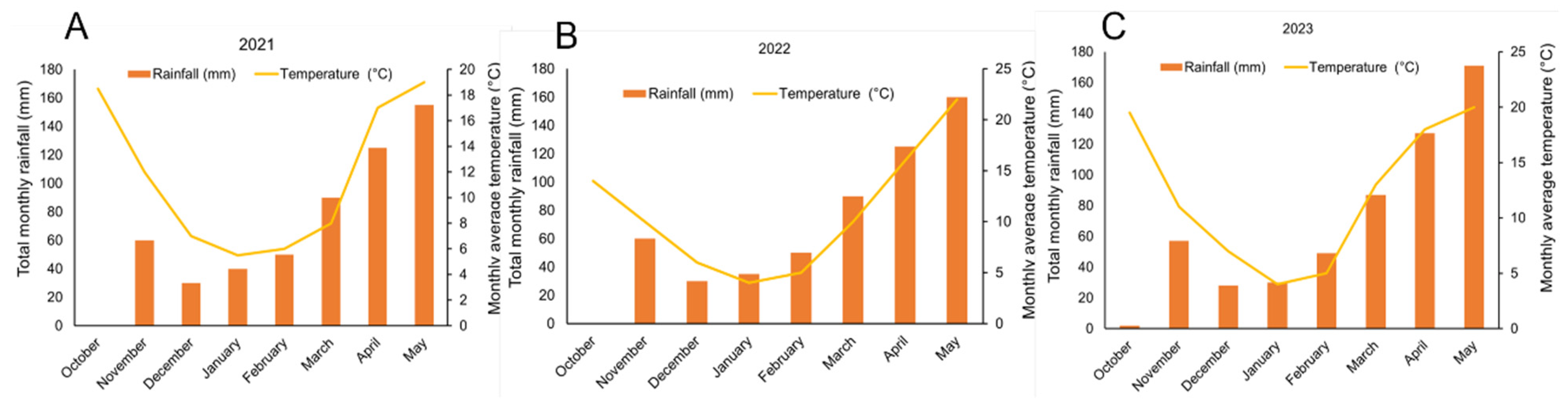
Field trials were conducted at the experimental farms of Yangtze University (30°03′60″ N, 112°00′80″ E) in the Jianghan Plain of Central China, a key winter wheat production region characterized by a subtropical monsoon climate and fertile alluvial clay loam soils, over three consecutive winter wheat cropping seasons: 2021/2022, 2022/2023 and 2023/2024. The site has a typical wheat–rice rotation system, which is common throughout the Jianghan Plain, a major grain-producing zone which is a vital component of the wheat production belt in the Yangtze River Basin [2]. Climatic conditions, including total rainfall and mean daily temperature, remained relatively consistent across all three winter wheat seasons (Figure 1). The soil at the site is classified as calcareous alluvial, with a sandy loam texture [4]. The widely cultivated wheat variety Yangmai 23 (YM23) was used in this experiment. Field experiments were laid out in a randomized complete block design (RCBD) with three replicates per treatment.
Prior to sowing, soil samples were collected to determine baseline soil physico-chemical properties. Rice straw from the preceding rice crop (approximately 3.5 t ha−1) was chopped and incorporated into the soil to a depth of about 40 cm. Twelve combinations of SRR and N application were designed to evaluate the effects of varying SRR rates and N management strategies on winter wheat growth and productivity (Table 1). SRR rates included 0, 50 and 100% of the preceding rice straw. Nitrogen application treatments comprised no N application (N0); 180 kg N ha−1 applied in three equal splits at the basal, overwintering, and jointing stages (N1); 180 kg N ha−1 applied in two splits, with 70% at the basal stage and 30% at the overwintering stage (N2); and 180 kg N ha−1 applied entirely at the basal stage (N3) (Table 1). Phosphorus (P2O5) (105 kg P2O4 kg ha−1) and potassium (K2O) (105 kg K2O kg ha−1) were applied uniformly across all plots based on regional fertilization guidelines to avoid nutrient limitations other than N. The plot size was 22 m long and 2 m wide. Standard agronomic practices were uniformly applied across all plots, except for SRR and N application treatments.

2.2. Measurements and Data Collection

Growth and physiological traits were assessed at three critical phenological stages, booting, anthesis, and milking. Measurements included leaf area index (LAI), assessed using a digital leaf area meter, assessed using a Sunscan LP 80 plant canopy analyzer (Delta T Devices Ltd., Cambridge, UK) [18], and chlorophyll content (SPAD values), measured using a SPAD-502 Plus chlorophyll meter (Konica Minolta Sensing/Konica Minolta, Inc., Osaka, Japan) [19] on the uppermost fully expanded leaf. Tiller numbers were recorded during the overwintering period. Flag leaf nitrogen content was determined at anthesis and maturity stages. Samples were oven-dried, ground and analyzed using the Kjeldahl method [18,20]. Above-ground dry matter accumulation was determined at maturity. The central 10 m of each plot was harvested for grain yield and various yield components, including spike number per ha, grains per spike, and 1000-grain weight. Harvest index (HI) was calculated as the ratio of grain yield to total above-ground dry biomass. Soil samples were collected at the jointing (JT), pre-flowering (BF), and maturity (MT) stages. At each sampling time, five random soil cores (0–20 cm) were randomly taken from each plot and combined into a composite sample. Samples were air-dried, sieved through a 2 mm mesh, and analyzed for soil organic carbon (SOC) using potassium dichromate oxidation, total nitrogen by Kjeldahl digestion, and nitrate and ammonium contents following extraction with 2 M KCl and continuous-flow analysis.

2.3. Statistical Analysis

Data from each growing season were subjected to a two-way analysis of variance (ANOVA) using R statistical software (R Foundation for Statistical Computing, Vienna, Austria), and key datasets were visualized with OriginPro (OriginLab Corporation, Northampton, MA, USA) and WPS Spreadsheets (Kingsoft Information Technology Co., Ltd., Beijing, China). Means were compared using the least significant difference (LSD) test at a 5% significance level. Interaction effects between N fertilization and SR were also examined across years.

3. Results

3.1. Effects of N Application and SRR on Leaf Area Index, Chlorophyll Contents (SPAD), and Plant N Contents

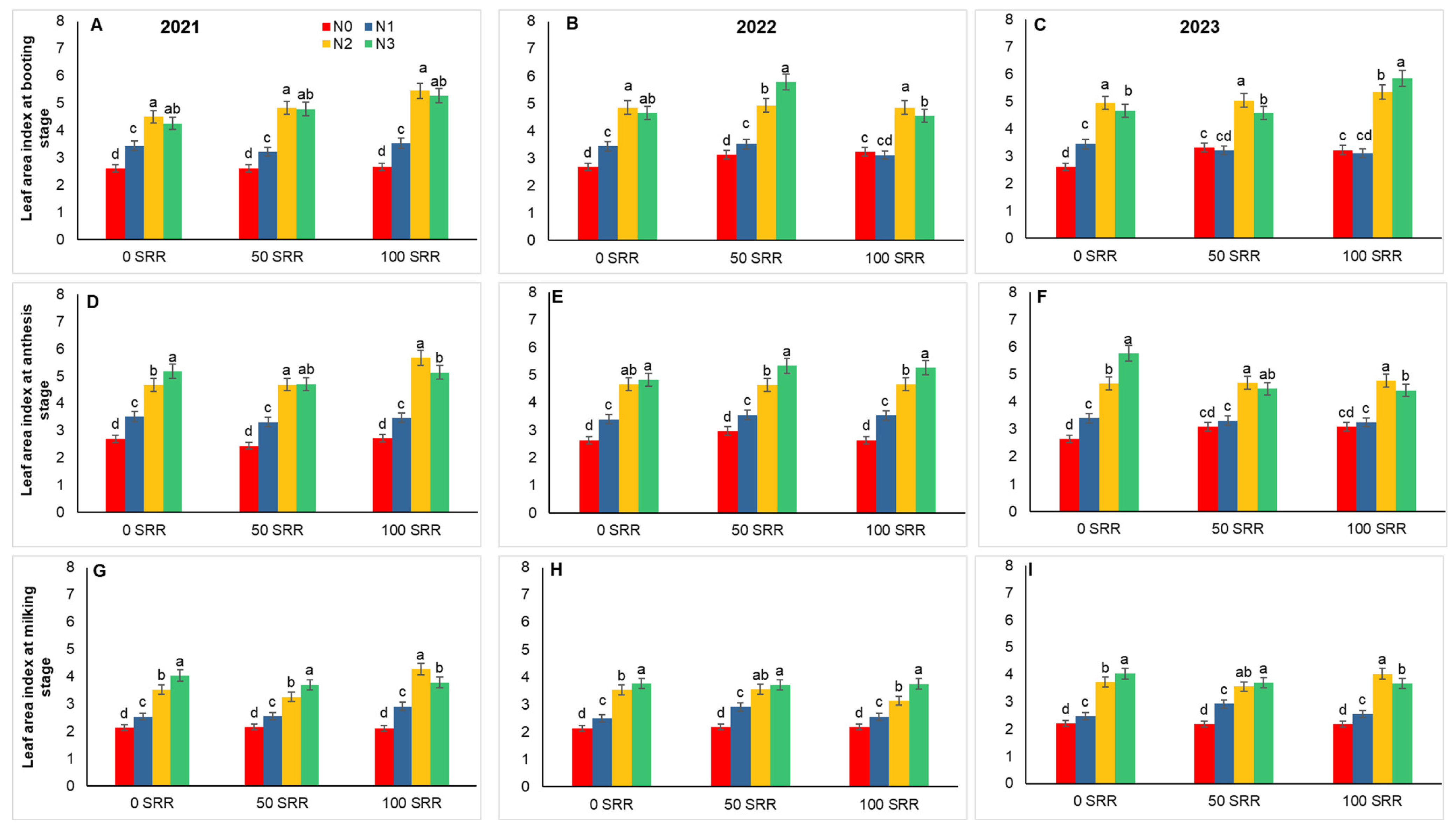
The leaf area index (LAI) at the booting, anthesis, and milking stages exhibited substantial variation across treatments (T1–T12) and years, reflecting the strong influence of both the straw return rate (SRR) and nitrogen fertilization rate and timing (Figure 2). At all three stages, the LAI was the lowest under the 0% N treatments (T1, T5, and T9) and increased steadily with split N applications, with higher values generally observed at N2 (T3, T7, and T11) and N3 (T4, T8, and T12).
Straw return exerted a secondary but measurable influence on the LAI. At a given N treatment, the LAI tended to be slightly higher under 50–100% SRR than under 0% SRR, especially at milking. For example, the three-year mean LAI at the booting stage under N1 increased from 4.52 in T2 (0% SRR) to 5.05 and 5.22 in T6 (50% SRR) and T10 (100% SRR), respectively. Similarly, under N2, the three-year mean LAI increased from 4.76 in T3 (0% SRR) to 4.93 and 5.22 in T7 (50% SRR) and T11 (100% SRR). The differences were smaller than those driven by N treatments but indicate that residue inputs can modestly enhance late-season canopy maintenance when N is non-limiting.
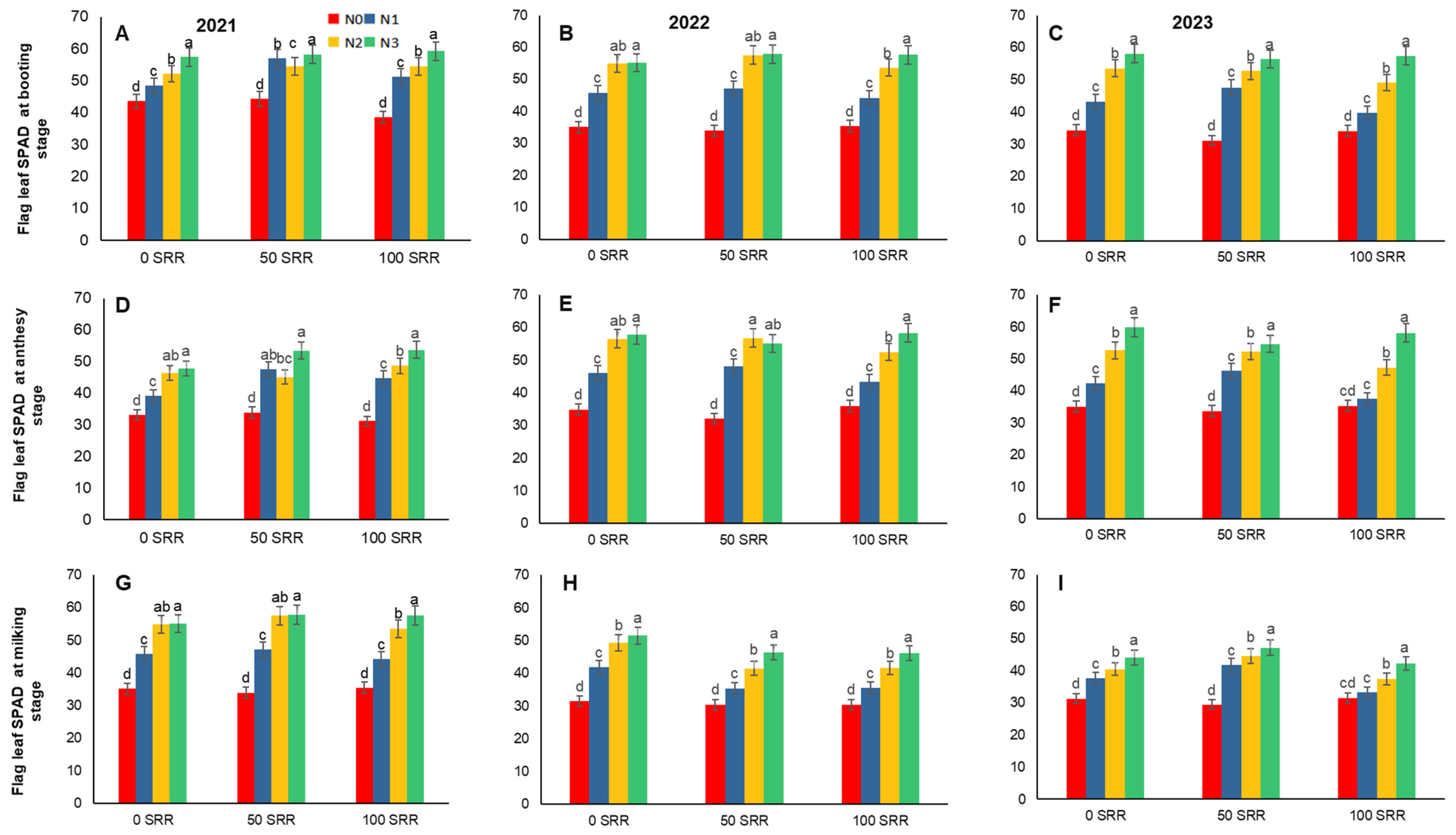
The chlorophyll content, expressed as SPAD values, was strongly affected by N rate and timing across all three growing seasons (Figure 3). At the booting and milking stages, N0 consistently resulted in the lowest SPAD, whereas N2 and N3 produced the highest values. When averaged across stages and years, SPAD was the greatest in T4 and T3, followed by T2. In contrast, SRR effects on SPAD were modest and less consistent than those of N treatments; at a given N treatment, differences in SPAD among 0, 50 and 100% SRR were comparatively small and did not show a uniform trend.
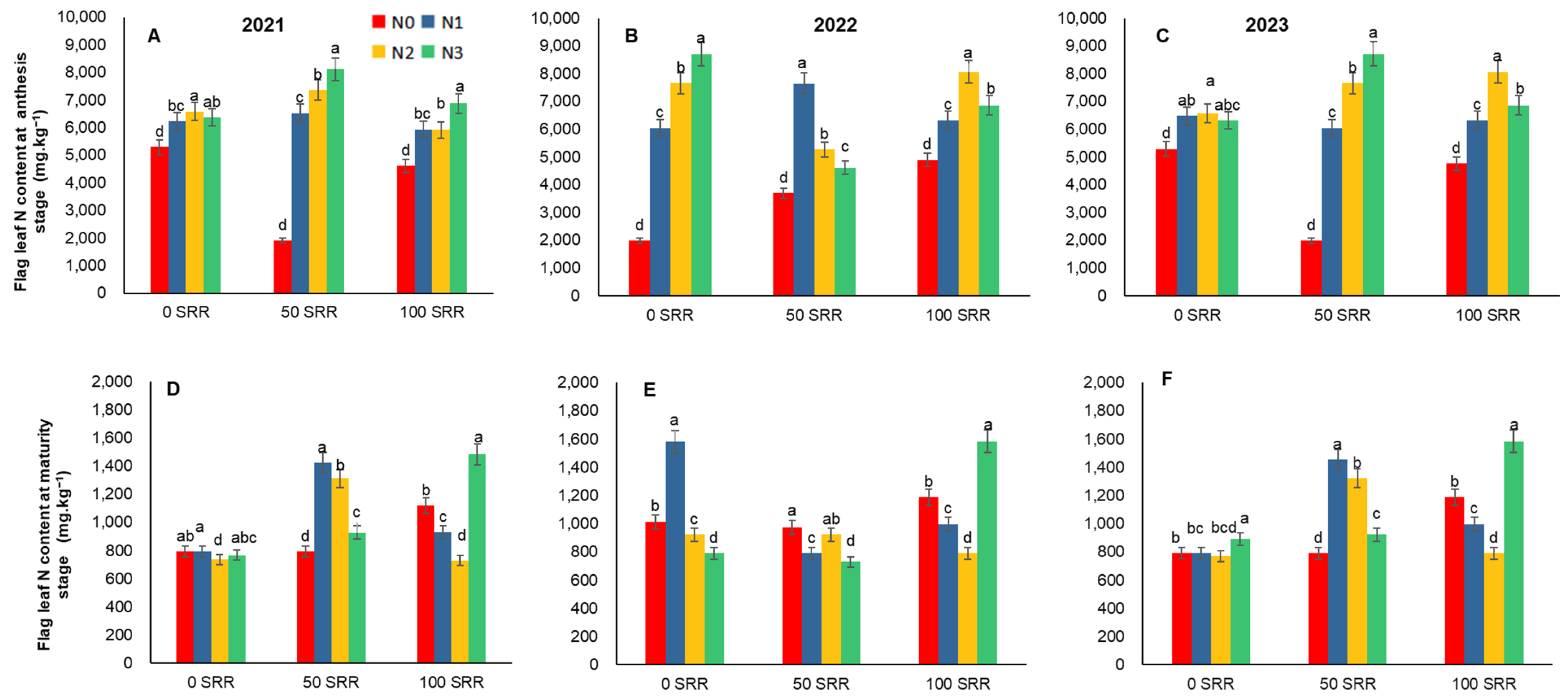
At anthesis, flag leaf N contents followed the same pattern as LAI and SPAD values, with N-fertilized treatments exhibiting higher N contents than N0, confirming that N treatment is the primary determinant of flag leaf N status (Figure 4). By maturity, the influence of SRR became more apparent: treatments with higher SRR generally showed higher leaf N contents at comparable N treatments, suggesting that residue-derived N contributed to late-season N availability. Although these differences were smaller than those driven by N application, they indicate that residue inputs can modestly enhance late-season canopy maintenance when N is non-limiting.

3.2. Effects of N Application Rate and Timing and SRR on Grain Yield and Yield Components

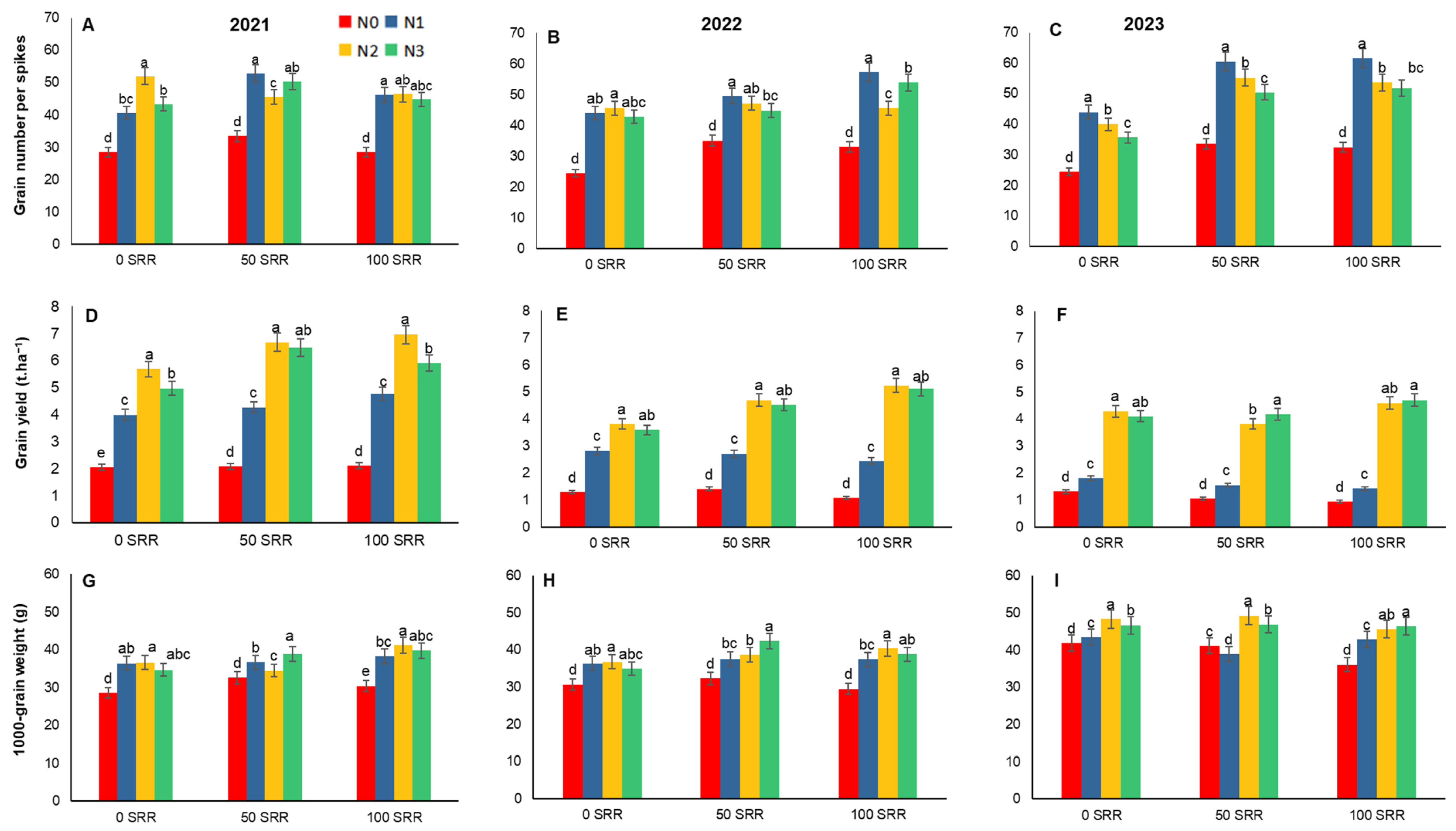
Grain yield responded strongly to N application in all three seasons (Figure 5). In the absence of N (T1, T5, and T9), yields ranged from 0.9 to 2.1 t·ha−1 across years, whereas N2 treatment (T3, T7, and T11) increased yields to 5.7–7.1 t·ha−1 in 2021. Across all SRR rates, the three-year mean grain yield increased from 1.4 t·ha−1 under N0 to 5.1 t·ha−1 under N2. The response to N3 was intermediate (4.9 t·ha−1), indicating diminishing returns beyond 70% of basal N application.
Straw return clearly improved grain yield at a given N treatment. When averaged across N treatment, the mean yield increased from 3.3 t·ha−1 under 0% SRR (T1–T4) to 3.6 and 3.8 t·ha−1 under 50% (T5–T8) and 100% SRR (T9–T12), respectively. At N3, yields increased from 4.2 t·ha−1 under 0% SRR to 5.0 t·ha−1 and 5.2 t·ha−1 under 50% and 100% SRR, respectively. Under 100% SRR, N2 slightly out yielded N3 treatment, with three-year means of 5.6 and 5.2 t·ha−1, respectively. No single treatment produced the highest yield in every year: the highest annual yields occurred in T11 (2021), T12 (2022), and T3 (2023). However, across all three seasons, the highest mean yield was recorded in T11 (100% SRR combined with N2).
Grain number per spike (GN) and thousand grain weight (TGW) were strongly influenced by N application (Figure 5). Across SRR treatments, the three-year mean GN increased from 49 grains spike−1 in T7 (50% SRR, N2) and 50 grains spike−1 in T8 (50% SRR, N3) to 55 grains spike−1 in T6 (50% SRR, N1). Similar trends were found in 100% SRR treatments. TGW increased with N application and was consistently highest under N2 and N3 treatments. Across years, TGW was the greatest in T8 (50% SRR + N3; 42.7 g) and T11 (100% SRR + N2; 42.4 g), followed closely by T12 (100% SRR + N3; 41.7 g). Notably, N2 combined with full SRR (T11) produced heavy grains comparable to, or slightly exceeding, those under the N3 treatment, highlighting a plateau response to basal N application when sufficient straw residue was retained (Figure 5).
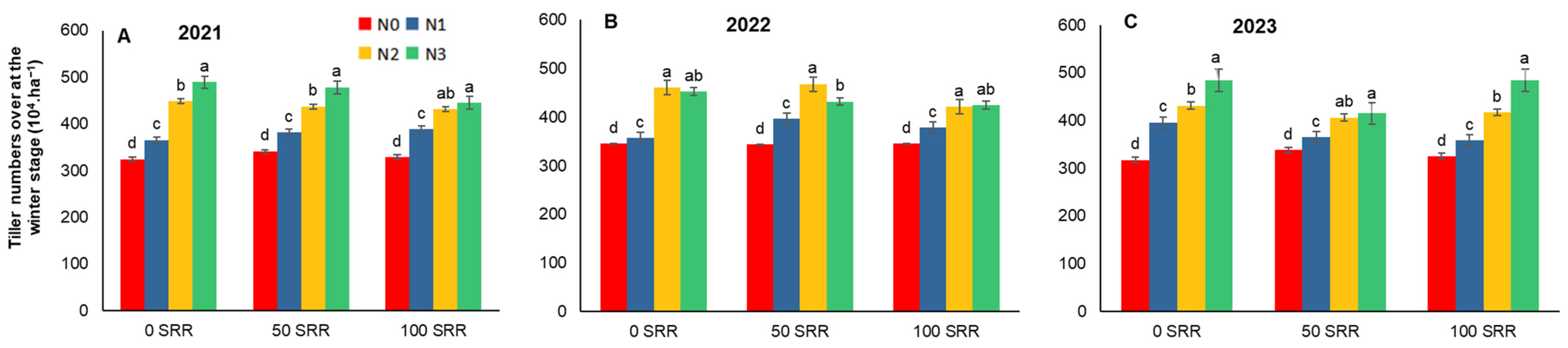
Nitrogen fertilization was the principal determinant of tiller production. In most cases, the higher the amount of basal N applied, the higher the tiller number. SRR showed no significant impact on tiller production (Figure 6).
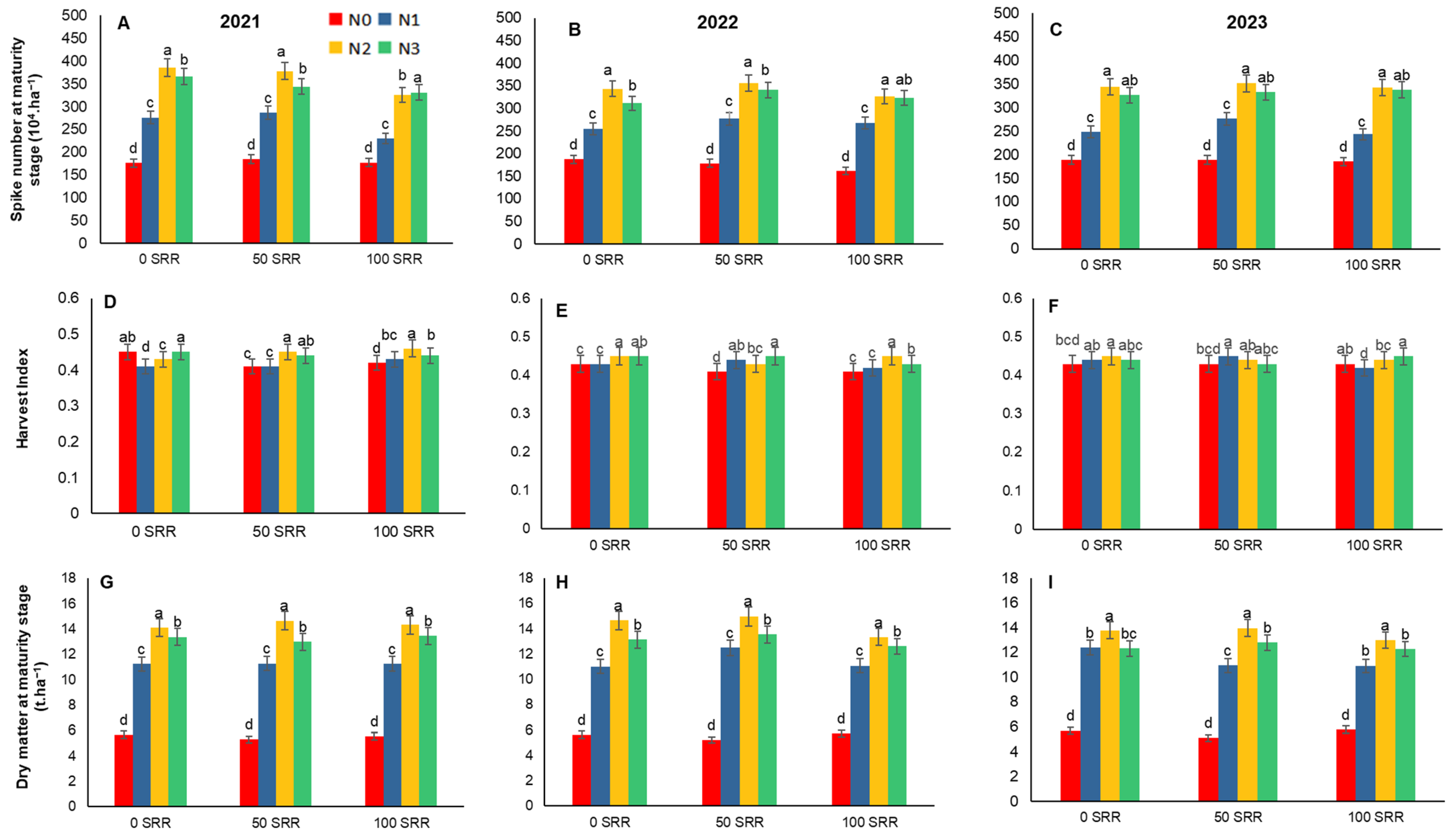
Similar to the tiller number, nitrogen fertilization was the main factor influencing the spike number per ha and above-ground dry matter, with the N2 and N3 treatments producing higher spike numbers (Figure 7). SSR showed less impact on the spike number. The N2 treatment resulted in the highest HI across the three seasons; however, differences among SRR and other N application treatments were not significant.

3.3. Influence of SRR and N Application Rate and Timing on Soil Physico-Chemical Properties

Straw return and nitrogen fertilization significantly influenced soil nitrogen dynamics across three consecutive winter wheat growing seasons (2021–2023). Treatments T8 (N3 + 50% SRR) and T7 (N2 + 50% SR) consistently resulted in the highest soil total nitrogen levels, particularly at maturity (MT). Soil nitrate (NO3) concentrations were significantly impacted by SRR and N treatment across three years. Nitrogen rate was the primary driver of soil ammonium (NH4+) content (Table 2). For example, the three-year mean soil ammonium at maturity was 1.95, 2.55, 2.61 and 1.87 mg‧kg−1 for treatments T1, T2, T3, and T4, respectively.
The soil organic carbon (SOC) content (p ≤ 0.05) across three winter wheat growing seasons (2021–2023) exhibited consistent seasonal dynamics, peaking at the jointing stage (JT) in each year. However, the SOC levels varied among years and treatments. Across the three-year period, the mean SOC content at the booting, jointing, and maturity stages was 11.4, 9.63, and 9.76 g kg−1, respectively (Table 3).

4. Discussion

4.1. N Application Determines Canopy and Tiller Development While SRR Modulates N Availability

Across seasons, nitrogen application remains the primary determinant of canopy development and yield components. Higher basal N application (70–100% of the recommended rate) consistently increased LAI, SPAD, grains spike−1, 1000-grain weight, and grain yield relative to lower basal N application (33.3%) and no N application, confirming the central role of N in building source capacity and reproductive sink size in winter wheat [21,22,23]. This pattern is reflected in the significant main effects of N application treatment on the LAI and SPAD at all stages and the strong positive response of the tiller number to N application. By contrast, full SRR without N consistently reduced early canopy and tiller number, consistent with microbial N immobilization during the decomposition of high-C:N residues [24,25,26].
The SRR-related penalty on early growth eased as the proportion of basal N application increased. Under 100% SRR, higher basal N application rates were required to achieve the same tiller number observed at lower SRR, underscoring that residue inputs shift the N requirement upward to overcome immobilization [4,27]. At a given N treatment, 50–100% SRR generally increased grain yield, and residue-rich treatments supported heavier grains (T8, T11, and T12) compared with residue removal. The fact that full SRR with a higher proportion of basal N application (100% SRR + N2/N3) produced higher mean yields than full SRR with a lower proportion of basal N application (100% SRR + N1) suggests that early application of N can alleviate the immobilization of N caused by SRR, thus sustaining canopy development [6,11]. Even though the immobilized N can be re-mineralized in time for sink formation [12,13], the highest absolute yields were still achieved in T8 (50% SRR + N3), emphasizing that under the current soil fertility and climate, SRR enhances wheat growth but needs sufficient basal fertilization.

4.2. Soil Reaction and Moisture as Modifying Factors

Soil measurements showed that SRR primarily influenced the timing and form of mineral N rather than only its instantaneous concentration. At anthesis, leaf N closely followed N application with higher flag leaf N at higher basal N application. By maturity, however, treatments combining SRR with moderate to high basal N application (e.g., T7 and T8) showed elevated total soil N and NH4+ concentrations relative to residue-removed plots, especially in the surface 0–20 cm layer (Table 2). These patterns are consistent with early immobilization of mineral N and subsequent re-mineralization aligning with late vegetative/early reproductive demand [9,11,23,28,29]. The small and less systematic differences in soil NO3 across treatments likely reflect rapid plant uptake, nitrification and leaching that blur treatment differences within the sampled profile [28,30].
In contrast, the more pronounced SRR effects on soil NH4+ and total N at maturity suggest improved N retention in the soil matrix, which can buffer inter-annual variability in N supply but also implies a need to manage residual N to avoid losses in subsequent crops. Our results therefore support a mechanistic picture in which N application sets the overall magnitude of SMN and plant uptake, while SRR modifies the temporal distribution and partitioning between NH4+ and NO3, with consequences for both yield formation and environmental N.

4.3. Productivity Implications and a Framework for Sustainable Intensification

Considering productivity, N application, and soil stewardship together, our three-year experiment indicates that combinations of moderate to high basal N application with substantial SRR (50–100%) provide a practical compromise. The highest three-year mean grain yield was obtained under T8 (50% SRR + N3), but full SRR with slightly reduced basal N application (T11: 100% SRR + N2) achieved 98% of this maximum yield while returning more residue to the soil. At each N application treatment, yields were higher with 50–100% SRR than with residue removal, indicating that straw retention consistently improves N use efficiency at the system scale.
These results suggest that in rice–wheat systems on the Jianghan Plain, complete residue removal combined with high N rate may maximize short term yields but forfeits gains in soil N status and relies on high external N inputs [2,4]. Full removal + high N rate often maximized short-term yield but provided fewer soil benefits, while full SRR without N suppressed canopy and tillers via immobilization of N. As measurable SOC gains from SRR typically require multi-year horizons and yield responses to SOC rise most clearly in lower-SOC contexts [31,32], our findings support partial SRR + a moderate or high proportion of basal N application as a realistic near-term pathway to sustainable intensification: it protects yield, buffers temporal N availability, and incrementally builds soil function while tempering fertilizer input and loss risks [7,8,10,33].
Although we did not conduct a full cost–benefit or partial budget analysis, the combination of near maximum yield and 30–70% lower labor cost in T11 and T12 suggests that such SRR × N application strategies are likely to be economically attractive. More importantly, SRR could have a long-term beneficial impact on soil properties. Future work should explicitly integrate agronomic, environmental and economic outcomes, including fertilizer costs, straw collection and incorporation costs, and labor and fuel use, into a unified assessment of sustainable intensification pathways for rice–wheat systems on the Jianghan Plain.

5. Conclusions

The nitrogen rate was the primary driver of winter wheat growth and yield on the Jianghan Plain, but straw return consistently improved performance at a given N application rate. Across three seasons, increasing the proportion of basal N application increased the LAI, SPAD, grains per spike, 1000-grain weight and grain yield, with yields plateauing at higher basal N rates near the regional recommendation of 180 kg N ha−1. Straw return (50–100%) enhanced grain yield and, under a high amount of basal N application, supported heavier grains compared with residue removal. These results indicate that a moderate to high proportion of basal N application combined with substantial straw return, rather than a single fixed combination, offers farmers a flexible set of management options to balance productivity with soil N conservation. Returning at least half, and preferably all, of the rice straw in combination with proper N application offers a robust pathway toward sustainable intensification of rice–wheat rotations on the Jianghan Plain.

Supplementary Materials

The following supporting information can be downloaded at https://www.mdpi.com/article/10.3390/agronomy16050493/s1, Table S1: Influence of combined nitrogen fertilization and rice-straw return on soil phosphorous and potassium contents.

Author Contributions

Conceptualization, X.W.; methodology, X.W.; formal analysis, G.H.A., K.S.P.D. and M.Z.; investigation, G.H.A. and K.S.P.D.; resources, writing—original draft preparation, G.H.A. and K.S.P.D.; writing—review and editing, G.H.A., M.Z. and X.W.; supervision, X.W.; project administration, X.W.; funding acquisition, X.W. All authors have read and agreed to the published version of the manuscript.

Funding

This study was funded by the National Natural Science Foundation of China (31871578). This work was also supported by the Engineering Research Center of Ecology and Agricultural Use of Wetland, Ministry of Education, China.

Data Availability Statement

The original contributions presented in this study are included in the article/Supplementary Materials. Further inquiries can be directed to the corresponding author.

Acknowledgments

During the preparation of this manuscript/study, the authors used a generative AI tool (ChatGPT) for reference research and for checking grammar and spelling. The authors have reviewed and edited the output and take full responsibility for the content of this publication.

Conflicts of Interest

The authors declare no conflicts of interest.

References

  1. Zhang, S.; Li, M.; Cui, X.; Pan, Y. Effect of different straw retention techniques on soil microbial community structure in wheat–maize rotation system. Front. Microbiol. 2023, 13, 251. [Google Scholar] [CrossRef]
  2. Akwakwa, G.H.; Daryl, K.S.P.; Riaz, A.; Xiaoyan, W. Varying nitrogen fertilization and soil bacterial community dynamics at three growth phases of winter wheat production. Plant Growth Regul. 2024, 104, 1383–1397. [Google Scholar] [CrossRef]
  3. Yuan, L.; Gao, Y.; Mei, Y.; Liu, J.; Kalkhajeh, Y.K.; Hu, H.; Huang, J. Effects of continuous straw returning on bacterial community structure and enzyme activities in rape-rice soil aggregates. Sci. Rep. 2023, 13, 2357. [Google Scholar] [CrossRef]
  4. Akwakwa, G.H.; Xiaoyan, W. Impact of rice–wheat straw incorporation and varying nitrogen fertilizer rates on soil physicochemical properties and wheat grain yield. Agronomy 2023, 13, 2363. [Google Scholar] [CrossRef]
  5. Wei, D.; Wei, S.; Peng, A.; Yang, C.; Chen, C. Responses of bacterial communities in soils under winter wheat to nightly warming and nitrogen addition. Agronomy 2022, 12, 1616. [Google Scholar] [CrossRef]
  6. Jin, Z.; Shah, T.; Zhang, L.; Liu, H.; Peng, S.; Nie, L. Effect of straw returning on soil organic carbon in rice–wheat rotation system: A review. Food Energy Secur. 2020, 9, 27. [Google Scholar] [CrossRef]
  7. Zhang, Z.; Liu, D.; Wu, M.; Xia, Y.; Zhang, F.; Fan, X. Long-term straw returning improves soil K balance and potassium supplying ability under rice and wheat cultivation. Sci. Rep. 2021, 11, 22260. [Google Scholar] [CrossRef]
  8. Yao, Z.; Yan, G.; Zheng, X.; Wang, R.; Liu, C.; Butterbach-Bahl, K. Straw return reduces yield-scaled N2O plus NO emissions from annual winter wheat-based cropping systems in the North China Plain. Sci. Total Environ. 2017, 590–591, 174–185. [Google Scholar] [CrossRef]
  9. Liu, Q.; Lu, L.; Hou, J.; Bai, J.; Dong, Q.; Feng, H.; Zou, Y.; Siddique, K.H.M. N Fertilizer in combination with straw improves soil physicochemical properties and crop productivity in sub-humid, drought-prone areas. Agronomy 2024, 14, 1721. [Google Scholar] [CrossRef]
  10. Hu, M.; Dong, W.; Wang, W.; Gaudel, G.; Mosongo, P.; Hu, C. The effects of deep application of nitrogen fertilization on ammonia volatilization in a winter wheat/summer maize rotation system in the North China Plain. Chin. J. Eco-Agric. 2020, 28, 1880–1889. [Google Scholar] [CrossRef]
  11. Zhai, S.; Xu, C.; Wu, Y.; Liu, J.; Meng, Y.; Yang, H. Long-term ditch-buried straw return alters soil carbon sequestration, nitrogen availability and grain production in a rice–wheat rotation system. Crop Pasture Sci. 2021, 72, 245–254. [Google Scholar] [CrossRef]
  12. Liu, Y.; Yu, J.; Zhang, L.; Wang, X.; Yin, G.; Zuo, W.; Bai, Y.; Huo, Z. Effects of fertilization on yield and nitrogen use efficiency of wheat and rice with straw return. Commun. Soil Sci. Plant Anal. 2021, 52, 1161–1170. [Google Scholar] [CrossRef]
  13. Islam, M.U.; Guo, Z.; Jiang, F.; Peng, X. Does straw return increase crop yield in the wheat–maize cropping system in China? A meta analysis. Field Crops Res. 2022, 279, 108447. [Google Scholar] [CrossRef]
  14. Liu, X.; Li, S. Temporal and spatial distribution characteristics of crop straw nutrient resources and returning to farmland in China. Trans. Chin. Soc. Agric. Eng. 2017, 33, 1–19. [Google Scholar] [CrossRef]
  15. Wang, X.; Zhao, S.; Zheng, X.; Wang, Z.; He, G. The impact of straw incorporation and nitrogen fertilizer application on winter wheat yield and nitrogen utilization. Chin. Agric. Sci. 2021, 54, 5043–5053. [Google Scholar] [CrossRef]
  16. Yang, L.; Muhammad, I.; Chi, Y.X.; Wang, D.; Zhou, X.B. Straw return and nitrogen fertilization to maize regulate soil properties, microbial community, and enzyme activities under a dual cropping system. Front. Microbiol. 2022, 13, 23. [Google Scholar] [CrossRef] [PubMed]
  17. Yang, R.; Liu, K.; Geng, S.; Zhang, C.; Yin, L.; Wang, X. Comparison of early season crop types for wheat production and nitrogen use efficiency in the Jianghan Plain in China. PeerJ 2021, 9, 32. [Google Scholar] [CrossRef]
  18. Bonelli, L.E.; Andrade, F.H. Maize radiation use-efficiency response to optimally distributed foliar-nitrogen-content depends on canopy leaf-area index. Field Crops Res. 2020, 247, 107557. [Google Scholar] [CrossRef]
  19. Shibaeva, T.G.; Mamaev, A.V.; Sherudilo, E.G. Evaluation of a SPAD-502 plus chlorophyll meter to estimate chlorophyll content in leaves with interveinal chlorosis. Russ. J. Plant Physiol. 2020, 67, 690–696. [Google Scholar] [CrossRef]
  20. Guebel, D.V.; Nudel, B.C.; Giulietti, A.M. A simple and rapid micro-Kjeldahl method for total nitrogen analysis. Biotechnol. Technol. 1991, 5, 427–430. [Google Scholar] [CrossRef]
  21. Zhang, L.; He, X.; Liang, Z.; Zhang, W.; Zou, C.; Chen, X. Tiller development affected by nitrogen fertilization in a high-yielding wheat production system. Crop Sci. 2020, 60, 1034–1047. [Google Scholar] [CrossRef]
  22. Wang, J.; Hussain, S.; Sun, X.; Zhang, P.; Javed, T.; Dessoky, E.S.; Ren, X.; Chen, X. Effects of nitrogen application rate under straw incorporation on photosynthesis, productivity and nitrogen use efficiency in winter wheat. Front. Plant Sci. 2022, 13, 21. [Google Scholar] [CrossRef] [PubMed]
  23. Pan, L.; Yin, W.; Zhao, L.; Wan, P.; Fan, Z.; Hu, F.; Nan, Y.; Sun, Y.; Fan, H.; He, W.; et al. No tillage with straw mulching enhanced radiation use efficiency of wheat via optimizing canopy radiation interception and photosynthetic properties. Field Crops Res. 2025, 326, 109854. [Google Scholar] [CrossRef]
  24. Wang, J.; Chen, Z.; Xu, C.; Elrys, A.S.; Shen, F.; Cheng, Y.; Chang, S.X. Organic amendment enhanced microbial nitrate immobilization with negligible denitrification nitrogen loss in an upland soil. Environ. Pollut. 2021, 288, 117721. [Google Scholar] [CrossRef] [PubMed]
  25. Meng, X.; Ran, C.; Liu, B.; Zhao, Z.; Bai, T.; Zhao, M.; Cheng, Z.; Chen, G.; Geng, Y. Effect of straw return with nitrogen fertilizer on photosynthetic characteristics and yield of rice in soda saline–alkali rice paddy fields. Cereal Res. Commun. 2022, 51, 509–526. [Google Scholar] [CrossRef]
  26. Cheng, M.; Zhan, W.; Chen, S.; Lan, T.; Liu, Z.; Shao, X.; Wang, L.; Lyu, Y.; Wang, Y. Effects of straw return and nitrogen fertilization on grain yield and leaf senescence of maize in northeast China. Int. J. Plant Prod. 2023, 17, 503–515. [Google Scholar] [CrossRef]
  27. Zhang, W.; Long, A.; Ji, X.; Sun, Z.; Tian, P.; Jin, C.; Gong, X.; Jiang, Y.; Qi, H.; Yu, H. Tillage combined with straw return increases maize yield and water use by regulating root morphological distribution and nitrogen metabolism in Northeast China. Soil Tillage Res. 2026, 256, 106876. [Google Scholar] [CrossRef]
  28. Meng, X.; Guo, Z.; Yang, X.; Su, W.; Li, Z.; Wu, X.; Ahmad, I.; Cai, T.; Han, Q. Straw incorporation helps inhibit nitrogen leaching in maize season to increase yield and efficiency in the Loess Plateau of China. Soil Tillage Res. 2021, 211, 23. [Google Scholar] [CrossRef]
  29. Wang, Y.; Li, M.; Pei, J.; An, T.; Saeed, M.F.; Shan, T.; Xu, Y.; Wang, K. Dynamics of maize straw–derived nitrogen in soil aggregates as affected by fertilization. J. Soils Sediments 2019, 19, 2882–2890. [Google Scholar] [CrossRef]
  30. Li, H.; Wang, L.; Peng, Y.; Zhang, S.; Lv, S.; Li, J.; Abdo, A.I.; Zhou, C.; Wang, L. Film mulching, residue retention and N fertilization affect ammonia volatilization through soil labile N and C pools. Agric. Ecosyst. Environ. 2021, 308, 107272. [Google Scholar] [CrossRef]
  31. Oldfield, E.E.; Bradford, M.A.; Wood, S.A. Global meta-analysis of the relationship between soil organic matter and crop yields. Soil 2019, 5, 15–32. [Google Scholar] [CrossRef]
  32. Li, N.; Lei, W.; Sheng, M.; Long, J.; Han, Z. Straw amendment and soil tillage alter soil organic carbon chemical composition and are associated with microbial community structure. Eur. J. Soil Biol. 2022, 110, 31–43. [Google Scholar] [CrossRef]
  33. Zhao, X.; Wang, H.; Lu, D.; Chen, X.; Zhou, M. The effects of straw return on potassium fertilization rate and time in the rice–wheat rotation. Soil Sci. Plant Nutr. 2019, 65, 176–182. [Google Scholar] [CrossRef]
Figure 1. Monthly total rainfall and mean temperatures recorded on-site in (A) 2021, (B) 2022 and (C) 2023 winter wheat-growing seasons in the study area.
Agronomy 16 00493 g001
Figure 2. Effects of nitrogen fertilization and straw return on leaf area index (LAI) of winter wheat at booting, anthesis and milking stages across three growing seasons. Panels (AC) show LAI at booting stage in 2021, 2022 and 2023, respectively; panels (DF) show LAI at anthesis stage; and panels (GI) show LAI at milking stage. Error bars represent standard deviation. Different letters indicate significant differences (p < 0.05) between different treatments. See Table 1 for details of treatments T1–T12.
Agronomy 16 00493 g002
Figure 3. Effects of nitrogen fertilization and straw return on flag leaf SPAD at booting (AC), anthesis (DF), and milking stages (GI) in 2021 (A,D,G), 2022 (B,E,H), and 2023 (C,F,I). Error bars represent standard deviation. Different letters indicate significant differences (p < 0.05) between different treatments. See Table 1 for details of treatments T1–T12.
Agronomy 16 00493 g003
Figure 4. Effects of nitrogen fertilization and straw return on flag leaf nitrogen content in winter wheat. Panels (AC) show flag leaf N at anthesis in 2021, 2022 and 2023, respectively; panels (DF) show flag leaf N at maturity in 2021, 2022 and 2023. Error bars represent standard deviation. Different letters indicate significant differences (p < 0.05) between different treatments. See Table 1 for details of treatments T1–T12.
Agronomy 16 00493 g004
Figure 5. Effects of nitrogen fertilization and straw return on grain number per spike in 2021 (A), 2022 (B), and 2023 (C); grain yield in 2021 (D), 2022 (E), and 2023 (F); and 1000-grain weight in 2021 (G), 2022 (H), and 2023 (I). Error bars represent standard deviation. Different letters indicate significant differences (p < 0.05) between different treatments. See Table 1 for details of treatments T1–T12.
Agronomy 16 00493 g005
Figure 6. Effects of nitrogen fertilization and straw return on tiller number during the wheat overwintering period in 2021 (A), 2022 (B), and 2023 (C). Error bars represent standard deviation. Different letters indicate significant differences (p < 0.05) between different treatments. See Table 1 for details of treatments T1–T12.
Agronomy 16 00493 g006
Figure 7. Effects of nitrogen fertilization and straw return on spike number in 2021 (A), 2022 (B), and 2023 (C) growing seasons; harvest index in 2021 (D), 2022 (E), and 2023 (F) growing seasons; and dry matter in 2021 (G), 2022 (H), and 2023 (I) growing seasons. Error bars represent standard deviation. Different letters indicate significant differences (p < 0.05) between different treatments. See Table 1 for details of treatments T1–T12.
Agronomy 16 00493 g007
Table 1. Treatment combinations employed in the study.
Treatment IDStraw Return Rate (SRR)Nitrogen Regime Total (N)
(kg ha−1)
Nitrogen Application Timing
BasalOverwinterJointing
T10% N00000
T20% N118033.3%33.3%33.3%
T30% N218070%30%0
T40% N3180100%
T550% N00000
T650%N118033.3%33.3%33.3%
T750% N218070%30%0
T850% N3180100%
T9100% N00000
T10100% N118033.3%33.3%33.3%
T11100% N218070%30%0
T12100% N3180100%
Table 2. Influence of combined nitrogen fertilization and rice–straw return on soil nitrogen and nitrate and ammonia contents per tissue under winter wheat cultivation during 2021, 2022 and 2023 seasons.
Treatment202120222023
BFJTMTBFJTMTBFJTMT
Soil nitrogen (g kg−1)
T10.45 ± 0.02 abc0.56 ± 0.05 ab0.45 ± 0.04 de0.44 ± 0.07 cd0.59 ± 0.03 b0.35 ± 0.07 de0.46 ± 0.01 a–d0.58 ± 0.05 ab0.44 ± 0.02 def
T20.53 ± 0.05 a0.50 ± 0.02 b0.41 ± 0.00 ef0.44 ± 0.02 cd0.49 ± 0.01 cde0.42 ± 0.00 cd0.52 ± 0.06 abc0.53 ± 0.02 b0.45 ± 0.00 de
T30.41 ± 0.02 bcd0.49 ± 0.00 b0.52 ± 0.02 c0.35 ± 0.05 de0.45 ± 0.02 def0.51 ± 0.04 c0.41 ± 0.03 de0.52 ± 0.02 b0.52 ± 0.04 cd
T40.39 ± 0.05 bcd0.60 ± 0.03 ab0.36 ± 0.02 fg0.37 ± 0.02 d0.54 ± 0.06 bc0.37 ± 0.06 cde0.41 ± 0.04 cde0.62 ± 0.02 ab0.40 ± 0.02 ef
T50.56 ± 0.05 a0.48 ± 0.00 b0.43 ± 0.02 de0.42 ± 0.02 cd0.48 ± 0.00 cde0.41 ± 0.04 cd0.53 ± 0.03 ab0.51 ± 0.00 b0.45 ± 0.04 de
T60.35 ± 0.02 cd0.49 ± 0.00 b0.72 ± 0.02 b0.35 ± 0.01 de0.51 ± 0.02 bcd0.72 ± 0.07 b0.37 ± 0.00 de0.52 ± 0.00 b0.74 ± 0.04 b
T70.30 ± 0.01 d0.68 ± 0.02 a0.87 ± 0.02 a0.25 ± 0.02 e0.69 ± 0.02 a0.97 ± 0.00 a0.33 ± 0.02 e0.69 ± 0.03 a0.90 ± 0.02 a
T80.35 ± 0.04 cd0.53 ± 0.05 b0.86 ± 0.04 a0.38 ± 0.02 d0.51 ± 0.02 bcd0.96 ± 0.00 a0.37 ± 0.06 de0.54 ± 0.07 b0.91 ± 0.02 a
T90.50 ± 0.03 ab0.59 ± 0.18 ab0.45 ± 0.03 de0.51 ± 0.04 bc0.38 ± 0.05 f0.34 ± 0.09 de0.50 ± 0.04 abc0.58 ± 0.10 ab0.44 ± 0.03 def
T100.53 ± 0.06 a0.49 ± 0.05 b0.31 ± 0.00 g0.56 ± 0.05 ab0.41 ± 0.02 ef0.30 ± 0.08 de0.56 ± 0.07 a0.50 ± 0.03 b0.35 ± 0.02 f
T110.56 ± 0.05 a0.50 ± 0.01 b0.42 ± 0.02 ef0.60 ± 0.04 ab0.38 ± 0.03 f0.24 ± 0.05 e0.53 ± 0.04 a0.53 ± 0.04 b0.44 ± 0.04 de
T120.49 ± 0.03 ab0.51 ± 0.06 b0.49 ± 0.01 cd0.61 ± 0.02 a0.41 ± 0.00 ef0.44 ± 0.02 cd0.54 ± 0.03 a0.50 ± 0.03 b0.55 ± 0.04 c
Soil nitrate (mg kg−1)
T120.60 ± 0.55 d20.12 ± 0.12 de11.60 ± 0.34 e21.75 ± 0.88 bcd20.23 ± 1.17 b–e13.41 ± 0.44 b20.87 ± 0.67 cd20.52 ± 0.82 bcd13.56 ± 0.3 ab
T222.94 ± 0.45 abc21.34 ± 0.26 bc13.56 ± 0.15 ab23.41 ± 0.32 ab23.50 ± 0.35 a13.16 ± 0.01 b21.54 ± 0.41 a–d20.60 ± 0.4 bc12.55 ± 0.28 bc
T323.95 ± 0.4 a18.59 ± 0.57 f12.76 ± 0.44 cd23.86 ± 0.21 a23.10 ± 0.92 ab14.24 ± 0.52 ab22.74 ± 0.38 ab18.58 ± 0.27 ef12.99 ± 0.19 abc
T423.14 ± 0.32 ab21.65 ± 0.38 b13.08 ± 0.3 bc23.26 ± 0.54 abc20.33 ± 0.42 b–e13.58 ± 0.31 ab22.74 ± 0.32 ab20.88 ± 0.29 bc12.91 ± 0.25 abc
T521.85 ± 0.57 bcd19.04 ± 0.17 f12.97 ± 0.14 bc21.34 ± 0.45 cde19.32 ± 0.59 cde13.47 ± 0.74 b21.93 ± 0.51 abc18.86 ± 0.56 def13.20 ± 0.81 abc
T620.96 ± 0.88 d22.90 ± 0.44 a13.14 ± 0.37 bc22.58 ± 0.71 abc19.54 ± 0.81 cde13.99 ± 0.34 ab21.17± 0.03 bcd22.64 ± 0.85 a12.18 ± 0.45 c
T721.61 ± 0.12 bcd17.27 ± 0.34 g13.96 ± 0.14 a21.71 ± 0.68 bcd17.87 ± 0.8 e14.18 ± 0.59 ab20.46 ± 0.96 cd17.62 ± 0.65 f13.69 ± 0.48 a
T823.65 ± 0.24 a19.44 ± 0.25 ef12.97 ± 0.15 bc21.71 ± 1.19 bcd19.21 ± 0.97 de13.96 ± 0.35 ab23.27 ± 0.28 a18.77 ± 0.4 ef12.21 ± 0.38 c
T921.43 ± 1.02 cd20.11 ± 0.31 de12.18 ± 0.15 de20.59 ± 0.9 de23.03 ± 2.32 ab14.20 ± 0.17 ab20.10 ± 1.23 d19.62 ± 0.87 cde12.16 ± 0.12 c
T1023.62 ± 0.55 a22.35 ± 0.26 ab12.76 ± 0.3 cd23.50 ± 0.57 ab22.21 ± 0.04 abc14.00 ± 0.26 ab22.12 ± 0.93 abc21.18 ± 0.33 abc12.51 ± 0.33 bc
T1121.56 ± 0.26 cd20.63 ± 0.57 cd13.95 ± 0.23 a19.38 ± 0.58 e21.95 ± 0.35 a–d14.64 ± 0.23 a20.82 ± 0.32 cd21.40 ± 0.56 ab12.73 ± 0.25 abc
T1222.75 ± 0.41 abc21.98 ± 0.15 ab13.42 ±0.27 abc23.66 ± 0.38 ab21.33 ± 1.11 a–d14.30 ± 0.13 ab22.17 ± 0.13 abc21.45 ± 0.62 ab12.52 ± 0.3 bc
Soil ammonium (mg kg−1)
T10.38 ± 0.04 ef0.40 ± 0.09 de2.52 ± 0.27 fg0.37 ± 0.06 cde0.17 ± 0.04 c0.65 ± 0.12 abc0.36 ± 0.03 ef0.50 ± 0.04 cd2.65 ± 0.11 e
T20.86 ± 0.1 bc0.47 ± 0.06 cde3.13 ± 0.29 def0.66 ± 0.13 bcd0.26 ± 0.08 bc1.38 ± 0.41 abc0.92 ± 0.08 cd0.50 ± 0.03 cd3.14 ± 0.26 cde
T30.14 ± 0.01 g0.58 ± 0.05 c3.46 ± 0.26 cd0.48 ±0.02 bcde0.43 ± 0.13 bc1.37 ± 0.26 abc0.21 ± 0.02 f0.69 ± 0.05 b3.01 ± 0.08 de
T41.14 ± 0.05 a0.56 ± 0.01 c3.25 ± 0.22 cde1.38 ± 0.23 a0.30 ± 0.13 bc1.05 ± 0.4 abc1.20 ± 0.08 bc0.62 ± 0.04 bc3.05 ± 0.16 cde
T50.10 ± 0.01 g0.87 ± 0.08 b1.88 ± 0.06 gh0.18 ± 0.02 e0.80 ± 0.26 ab0.54 ± 0.15 abc0.21 ± 0.03 f0.90 ± 0.11 a1.53 ± 0.2 f
T60.86 ± 0.09 bc1.02 ± 0.03 a4.99 ± 0.1 a0.71 ± 0.04 bc1.24 ± 0.33 a0.45 ± 0.19 bc0.92 ± 0.14 cd0.98 ± 0.05 a4.45 ± 0.28 a
T70.71 ± 0.02 cd0.46 ± 0.05 cde3.73 ± 0.04 cd0.62 ± 0.04 bcd0.84 ± 0.36 ab0.30 ± 0.02 c0.79 ± 0.05 d0.53 ± 0.12 bcd3.19 ± 0.04 cde
T80.53 ± 0.13 de0.36 ± 0.04 e3.90 ± 0.08 bc0.35 ± 0.05 de0.53 ± 0.2 bc1.53 ± 0.83 abc0.62 ± 0.07 de0.41 ± 0.05 d3.72 ± 0.28 bc
T90.22 ± 0.01 fg0.86 ± 0.04 b2.72 ± 0.06 ef0.31 ± 0.14 de0.36 ± 0.33 bc1.83 ± 0.51 ab0.26 ± 0.01 f0.89 ± 0.01 a2.70 ± 0.07 e
T101.13 ± 0.06 a0.50 ± 0.03 cd3.84 ± 0.59 c1.31 ± 0.15 a0.62 ± 0.08 bc1.07 ± 0.48 abc1.63 ± 0.06 a0.62 ± 0.04 bc3.54 ± 0.6 cd
T110.98 ± 0.04 ab0.54 ± 0.04 cd1.79 ± 0.06 h0.66 ± 0.24 bcd0.29 ± 0.13 bc1.44 ± 0.19 abc1.31 ± 0.29 b0.54 ± 0.04 bcd1.69 ± 0.04 f
T120.66 ± 0.04 d0.41 ± 0.02 de4.54 ± 0.17 ab0.75 ± 0.04 b0.25 ± 0.01 bc2.01 ± 1.26 a0.66 ± 0.08 de0.47 ± 0.02 cd4.34 ± 0.1 ab
Abbreviations: BF = before flowering, JT = jointing stage, MT = maturity stage. Different letters indicate significant differences (p < 0.05) between straw return and nitrogen fertilization treatments.
Table 3. Influence of combined nitrogen fertilization and rice–straw return on soil organic carbon (g kg−1).
Treatment202120222023
BFJTMTBFJTMTBFJTMT
T110.05 ± 0.01 a10.81 ± 0.05 cd9.88 ± 0.01 bc10.2 ± 0.17 a10.5 ± 0.37 ab10.7 ± 0.31 b–d10.55 ± 0.11 a10.81 ± 0.05 cd9.790 ± 0.05 a–c
T210.01 ± 0.07 a10.66 ± 0.19 de9.88 ± 0.01 bc9.74 ± 0.6 ab10.7 ± 0.08 ab9.47 ± 0.3 de10.09 ± 0.15 ab10.76 ± 0.11 cd9.770 ± 0.11 a–c
T39.620 ± 0.02 a11.85 ± 0.03 a8.96 ± 0.1 d9.64 ± 0.14 a–c10.8 ± 0.36 ab9.33 ± 0.1 de9.640 ± 0.06 b–d11.49 ± 0.19 ab9.190 ± 0.35 c
T49.860 ± 0.09 a11.35 ± 0.05 b9.89 ± 0.06 bc9.30 ± 0.35 a–d11.2 ± 0.12 ab10.5 ± 0.15 b–e9.750 ± 0.09 bc11.65 ± 0.06 a9.820 ± 0.03 a–c
T58.830 ± 0.04 b9.900 ± 0.07 f9.95 ± 0.03 a–c8.51 ± 0.2 de13.4 ± 3.41 a11.3 ± 0.06 bc9.000 ± 0.4 de9.960 ± 0.13 e9.930 ± 0.03 a–c
T69.060 ± 0.21 b11.86 ± 0.04 a10.1 ± 0.15 a–c9.06 ± 0.27 b–d11.5 ± 0.48 ab11.7 ± 0.17 ab9.360 ± 0.26 cd11.55 ± 0.28 ab10.03 ± 0.13 a–c
T78.110 ± 0.19 c10.82 ± 0.04 cd10.8 ± 0.84 a7.86 ± 0.26 e11.0 ± 0.17 ab12.9 ± 1.56 a8.520 ± 0.26 e10.73 ± 0.07 cd10.75 ± 0.86 a
T89.850 ± 0.21 a10.45 ± 0.17 e10.5 ± 0.27 ab9.71 ± 0.41 ab10.1 ± 0.34 b11.2 ± 0.07 bc10.14 ± 0.37 ab10.54 ± 0.18 d10.39 ± 0.41 ab
T910.09 ± 0.29 a10.94 ± 0.04 c9.26 ± 0.28 cd9.64 ± 0.4 a–c9.86 ± 0.22 b9.16 ± 0.18 e10.11 ± 0.19 ab10.37 ± 0.18 de9.510 ± 0.33 bc
T108.870 ± 0.01 b10.99 ± 0.06 c9.99 ± 0.12 a–c8.76 ± 0.26 c–e9.23 ± 0.19 b10.7 ± 0.28 b–d9.580 ± 0.3 b–d11.12 ± 0.28 bc10.07 ± 0.2 a–c
T119.620 ± 0.18 a10.68 ± 0.06 de8.96 ± 0.04 d9.03 ± 0.24 b–d9.89 ± 0.18 b10.1 ± 0.21 c–e9.620 ± 0.15 b–d10.67 ± 0.12 cd9.230 ± 0.25 c
T129.670 ± 0.29 a10.79 ± 0.06 cd9.62 ± 0.41 b–d9.87 ± 0.03 ab9.00 ± 0.38 b10.2 ± 0.18 c–e9.510 ± 0.28 b–d10.81 ± 0.09 cd10.18 ± 0.36 a–c
Abbreviations: BF = before flowering, JT = jointing stage, MT = maturity stage. Different letters indicate significant differences (p < 0.05) between straw return and nitrogen fertilization treatments.
Disclaimer/Publisher’s Note: The statements, opinions and data contained in all publications are solely those of the individual author(s) and contributor(s) and not of MDPI and/or the editor(s). MDPI and/or the editor(s) disclaim responsibility for any injury to people or property resulting from any ideas, methods, instructions or products referred to in the content.