1. Introduction
Wetlands are areas inundated with water either permanently or intermittently, encompassing swamps, peatlands, marshes, and coastal intertidal zones. They are extensively distributed across the globe, covering approximately 5–10% of the Earth’s land surface [
1]. Acting as ecotones between terrestrial and aquatic environments, wetlands provide critical ecosystem services such as hydrological regulation, water purification, flood mitigation, and biodiversity maintenance [
2], and possess irreplaceable ecological and economic values [
3]. In particular, wetlands play a critical dual role in the global carbon cycle, functioning as both natural sources and sinks for the major greenhouse gases carbon dioxide (CO
2) and methane (CH
4) [
4]. Additionally, wetlands are core sites for the long-term accumulation and sequestration of soil organic carbon (SOC) [
5]. However, this crucial ecological function is facing severe threats due to anthropogenic activities.
In recent years, with increasingly intensive anthropogenic activities, wetlands have started to degrade at an accelerated pace. It is estimated that approximately 54–57% of global wetlands have disappeared since 1900 [
6]. Although wetland degradation has persisted throughout human history, with anthropogenic activities continually triggering crises such as salinization and soil degradation, historical measures—including the cultivation of salt-tolerant crops and improved management practices—have partially alleviated these challenges in some regions [
7]. Nevertheless, the impacts of contemporary anthropogenic activities on wetlands remain widespread and severe [
8]. Under the current context of over-exploitation, anthropogenic hydrological alterations leading to wetland salinization, nutrient enrichment from over-fertilization and heavy metal pollution due to the conversion of wetlands into agricultural and industrial lands, and the massive input of microplastics (MPs) from the use of novel materials have profoundly impacted the ecological health and biogeochemical cycles of wetland areas. These environmental issues significantly influence carbon cycling processes related to CO
2 and CH
4 emissions.
The conservation and restoration of wetland ecosystems have become a critical issue in global ecological governance. Clarifying the response patterns of wetland carbon cycling to anthropogenic disturbances is central to achieving wetland sustainability and greenhouse gas mitigation. However, existing research has largely focused on the impact of single environmental stressors on wetland greenhouse gas emissions, lacking a systematic synthesis of multiple concurrent pressures. This paper explores urgent environmental threats to global wetlands from a microbial ecological perspective. By conducting a systematic review of the literature on anthropogenic impacts on CO2 and CH4 emissions, it evaluates the severity of these effects, especially regarding wetland salinization, nutrient enrichment from over-fertilization, heavy metal pollution and MP input. The clustering function of CiteSpace (version 6.1.R2) was also used to reflect the distribution of research hotspots in each field to better inform conservation policies and integrated management strategies. The findings ultimately aim to establish a framework for sustainable wetland development and greenhouse gas mitigation moving forward.
2. Methods
2.1. Literature Search Strategy
This study conducted a systematic literature search to synthesize current knowledge on anthropogenic impacts on carbon cycling and greenhouse gas dynamics in wetland ecosystems. We used two authoritative databases (Web of Science Core Collection and Google Scholar) to search for literature, covering peer-reviewed studies published from 2014 to 2024. Specifically, the search strategy combined “CO
2, wetlands” OR “CH
4, wetlands” with the four anthropogenic stressor terms. Searches were applied to titles, abstracts, and author keywords to ensure broad coverage of relevant studies. In addition to database searches, Google Scholar was used to retrieve complementary literature not fully captured by predefined keyword combinations. Detailed search strings for each database are provided in the
Supplementary Materials.
2.2. Study Selection Criteria and Screening
The screening and selection of studies followed a PRISMA-style workflow [
9], including duplicate removal, title and abstract screening, full-text eligibility assessment, and final inclusion. Full-text articles were assessed for eligibility based on predefined inclusion and exclusion criteria. Studies were included if they met the following criteria:
- (1)
Focused on natural, artificial, or restored wetland ecosystems;
- (2)
Addressed CO2 and/or CH4 emissions, carbon cycling, or closely related biogeochemical or microbial processes;
- (3)
Examined the influence of anthropogenic stressors, including salinization, nutrient enrichment, heavy metal pollution, or microplastic contamination.
Following screening and eligibility assessment, 352 studies related to salinization, 284 related to nutrient enrichment, 132 related to heavy metal pollution, and 87 related to microplastics were retained and included in the final qualitative synthesis and bibliometric analysis. Detailed screening criteria and step-by-step statistics are available in the
Supplementary Materials.
2.3. Bibliometric and Hotspot Analysis Using CiteSpace
To identify major research hotspots and development trends within each anthropogenic stressor category, a bibliometric analysis was conducted using CiteSpace (version 6.1.R2), which was developed by Professor Chaomei Chen from Drexel University, Philadelphia, USA [
10]. In CiteSpace, the time slicing was set to one year. Keywords were used as the node type to construct co-occurrence networks.
Clustering analysis was based on the log-likelihood ratio (LLR) algorithm. Values greater than 0.7 indicate robust and well-defined clusters [
10].
In this study, the average silhouette values for all four stressor categories ranged from 0.7422 to 0.8014, confirming reasonable cluster divisions. The resulting keyword clusters (as shown in
Tables S1–S4) provide a scientific basis for the narrative structure of each corresponding section in this review. Detailed CiteSpace parameter settings and hotspot interpretation criteria are presented in the
Supplementary Materials.
3. Carbon Dioxide and Methane Emissions in Wetlands
After the last glacial maximum, wetlands began to accumulate organic carbon continuously and formed a dense carbon pool [
11]. However, this dense carbon pool has been significantly disturbed by anthropogenic activities since the pre-industrial period, leading to significant changes in the carbon cycle in wetlands, including in the emissions of CO
2 and CH
4 [
12]. It was estimated that the degradation of wetlands could cause greenhouse gas emissions equivalent to about 408 gigatons of CO
2 between 2021 and 2100 [
12]. Specially, wetlands are the largest natural source of CH
4 emissions, accounting for about 62% of the natural CH
4 emissions, and representing the most important source of uncertainty in the CH
4 budget [
13].
In wetland soils, CO
2 emissions are primarily mediated through autotrophic root respiration and heterotrophic microbial decomposition processes. Conversely, wetlands serve as natural CO
2 sinks by sequestering atmospheric carbon in soils and vegetation biomass over long timescales [
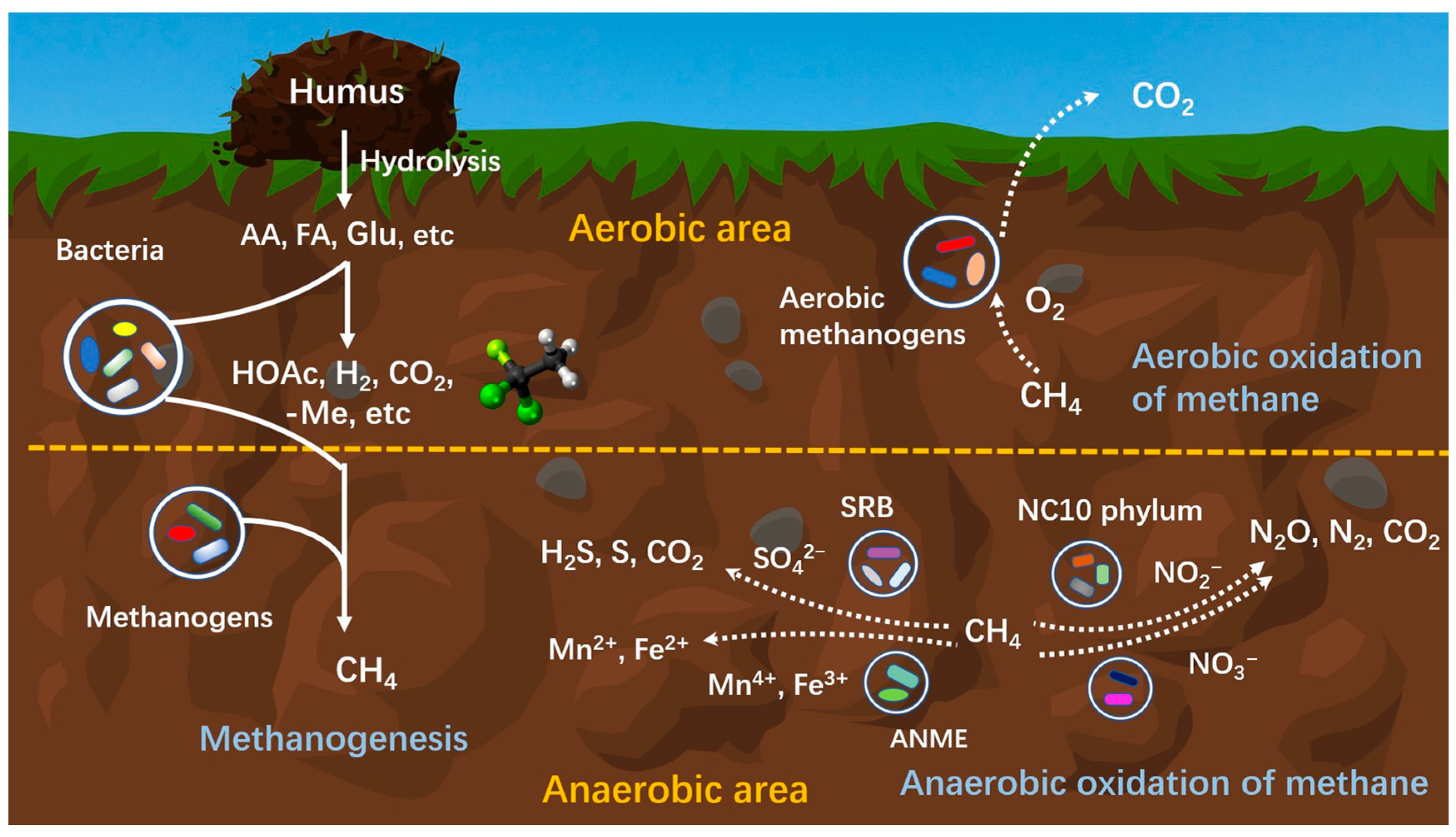
14]. CH
4 production and release in wetlands are driven by methanogenic archaea under anoxic conditions (
Table 1), via acetate fermentation, CO
2/hydrogen (H
2) reduction, and methylotrophic pathways [
15]. The quantity and pathway of CH
4 production depends on substrate type and availability, pH, temperature, and methanogenic community structure [
16].
Before being emitted to the atmosphere, a large proportion of produced CH
4 undergoes anaerobic oxidation in anoxic wetland soils by consortia of archaea and bacteria utilizing alternate electron acceptors like sulfate (SO
42−), nitrate (NO
3−)/nitrite (NO
2−), manganese (Mn), or iron (Fe) [
24]. This anaerobic methane oxidation (AOM) modulates a major CH
4 sink, estimated to consume over 30% and 90% of freshwater and marine wetland CH
4 emissions, respectively [
25]. Biogeochemical cycling of CO
2 and CH
4 in wetlands is intricately coupled and strongly mediated by microorganisms (
Figure 1) [
26]. Therefore, sustainable wetland management incorporating microbiology is key to regulating greenhouse gas emissions and sinks.
4. The Impact of Wetland Salinization on CO2 and CH4 Emissions
Human activities have disrupted hydrological patterns and altered soil salt distribution [
27]. Over-irrigation emerges as a significant driver of wetland salinization. For instance, extensive groundwater pumping for irrigation in the Murray River Basin, Australia, has significantly lowered groundwater levels since 2000. A total of 76 reaches (21%) had groundwater levels 10 m below the surface level from 2000 to 2019, disrupting groundwater–wetland connectivity and reducing water flow to downstream reaches, further increasing the risk of salinization of wetland soils [
28]. In addition, water infrastructure has also dramatically altered wetland hydrology. For example, the construction of the Three Gorges Dam in China reduced the connection between the Yangtze River and its floodplain wetlands, decreasing the frequency of freshwater inputs, while increasing the chances of seawater intrusion, leading to an increase in soil salinity in downstream wetlands [
29,
30]. Notably, numerous naturally occurring saline–alkaline habitats exist in nature (e.g., coastal salt marshes, salt lakes, and mangroves), where the vegetation and microbial communities have evolved strong salt tolerance, enabling them to adapt to high-salinity environments and maintain the stability of their own ecosystems [
31]. However, it is clear that human activities have extensively altered global wetland hydrology through a variety of mechanisms, inducing widespread secondary salinization. This anthropogenically driven salinization process often exceeds the adaptive capacity of the original wetland biota [
32], thereby jeopardizing agricultural productivity, ecological stability, and water resource sustainability. These problems are likely to intensify as climate change continues, necessitating integrated measures to mitigate and adapt to changes in wetland salinity and ensure the resilience and vitality of these important ecosystems.
Based on the CiteSpace clustering analysis of 352 publications, research on wetland salinization has shifted from isolated salinity monitoring toward a more integrated understanding of system-level feedbacks in carbon cycling. One dominant hotspot concerns blue carbon dynamics and vegetation regulation. Studies are highly concentrated on the roles of Spartina alterniflora and Phragmites australis in regulating greenhouse gas fluxes and blue carbon storage. Changes in plant composition and distribution are increasingly recognized as key mediators of wetland carbon sequestration and emissions under salinization stress [
33,
34,
35]. An emerging and rapidly growing hotspot is peat collapse induced by sea-level rise. This process has been identified as a critical risk factor that accelerates the release of previously stable carbon pools, highlighting the vulnerability of coastal and peatland wetlands to salinity-driven geomorphic and biogeochemical disturbances [
36,
37]. At the mechanistic level, soil respiration and litter decomposition responses to climate change, together with extracellular enzyme activity as an indicator of saltwater intrusion effects on organic matter mineralization, represent core research frontiers [
38,
39]. These micro-scale processes provide essential insights into how salinization alters carbon turnover and greenhouse gas emissions in wetlands.
4.1. Impact of Wetland Salinization on CO2 Emissions
Salinization severely disrupts the carbon cycle in coastal wetland ecosystems through interconnected pathways. Among them, microbe-mediated mineralization of organic matter is the main source of CO
2 emissions from wetland soils [
40]. In wetlands, mild salinization with a sodium chloride (NaCl) concentration of 3‰ inhibits microbial activity and thus reduces CO
2 production. A salinity level of 3‰ NaCl was shown to reduce cumulative CO
2 emissions by 15%, from 856 mg C/kg in an unsalted control to 723 mg C/kg [
41]. This inhibitory effect increases with increasing salinity. Severe salinization with a NaCl concentration of 10‰ significantly inhibits microbial respiration, reducing cumulative CO
2 emissions by 35% from 856 mg C kg
−1 to 558 mg C kg
−1 [
41].
Concurrently, salinization diminishes primary production and carbon fixation by imposing osmotic stress on plant tissues. High salinity inhibits chlorophyll synthesis, with subsequent inhibition of photosynthesis, and the degree of inhibition positively correlated with salinity levels [
42]. Additionally, high salt stress prompts competition between sodium (Na
+) and chloride (Cl
−) ions and essential nutrients such as potassium (K
+), calcium (Ca
2+), and magnesium (Mg
2+), resulting in reduced nutrient uptake and consequently affecting the plant’s nutrient balance [
42]. Despite these impacts, certain specialized microbial communities, such as gram-negative bacteria and anaerobic methane-oxidizing bacteria, may adapt to high salt environments and sustain a degree of CO
2 release [
42].
In summary, the salinization process disrupts the carbon cycle of wetland ecosystems through multiple pathways. It inhibits microbial activity, organic matter mineralization, and plant growth and photosynthesis, thereby reducing CO2 emissions and carbon fixation. Although some specialized microbial communities show some adaptability, they have a limited role in regulating the whole carbon cycle. In addition, changes in salinity can affect the extent of the damaging effects. Therefore, controlling salinity and maintaining appropriate salinity levels are essential to ensure the stable functioning of coastal wetland ecosystems and their carbon sink capacity.
4.2. Impact of Wetland Salinization on CH4 Emissions
Salinity could regulate the process of CH
4 production mainly by affecting substrate supply (e.g., quantity and quality of soil organic matter, plant secretion, and residue substrates) [
43]. There were differences in the responses of different types of wetlands to CH
4 fluxes during salinization. This was mainly attributed to differences in vegetation composition, primary productivity, root oxygen release, and availability of electron acceptors in different wetland types [
44]. Additionally, the sensitivity of distinct methanogen taxa to salinity changes could elicit contrasting feedbacks. For example, low concentrations of salinity (0–7.5‰) were not thought to inhibit methanogens. In contrast, CH
4 production rates could be significantly inhibited when salinity is 10‰ and above, with a 24% reduction in both potential CH
4 production, and thus a number of studies have pointed to 10‰ as an important threshold [
45]. However, some halophilic archaea (belonging to the family
Methanosarcinaceae,
Methanosarcinales) can thrive and produce CH
4 in salinities up to 120 g L
−1 [
46]. High salinity also increased soil pH, further inhibiting methanogens [
47]. Methanogens are most active at pH 6.5–7.5 [
48] and are suppressed under highly alkaline conditions above pH 9 [
49]. In summary, salinity could affect CH
4 production through interconnected pathways. Although hyper-salinity suppresses methanogenesis, some microorganisms have adapted to sustain the process.
AOM is a process in which CH
4 is reduced under anaerobic conditions, mediated by microorganisms. The capacity and rates of AOM are affected by salinity through multiple aspects. High salinity exceeding 292 g L
−1 severely suppresses AOM, likely by inhibiting the metabolisms of the microorganisms involved [
50]. This salinity effect may be attributed to ionic stress on cellular structures, osmotic stress on molecular pathways, and reduced bioenergetic yields at high salt levels [
51]. Comparing the upper limit of salinity tolerated by methanogenic and methane-oxidizing bacteria, salinity inhibited methanogenic archaea more significantly than methane-oxidizing bacteria [
52]. Thus, higher salinity could reduce CH
4 emissions, and the optimal salinity for sequestering CH
4 was hypothesized to be 24 g L
−1 based on Chen et al. [
4].
5. The Impact of Wetland Over-Fertilization on CO2 and CH4 Emissions
Since 1900, more than 50% of natural wetlands have been lost globally [
6]. The main type of conversion was agricultural land [
53]. Over-fertilization in agricultural lands severely disrupted the biogeochemistry of wetland soils. For example, Mississippi wetlands have received 60% and 56% of nitrogen (N) and phosphorus (P) inputs, respectively, from agricultural sources [
54]. Studies have shown that higher rates of N/P additions lead to soil acidification, decreased pH, and accelerated SOC mineralization, resulting in the loss of SOC [
55]. It is clear that over-fertilization destroyed the native habitat and microbial community structure of wetland soils. It also stimulated climate forcing through increased soil respiration and nitrous oxide emissions [
16]. These changes disrupted the nutrient mitigation capacity of wetlands and have implications for carbon emissions.
The CiteSpace clustering analysis of 284 publications reveals several key dimensions that currently dominate research on nutrient enrichment and over-fertilization in wetland ecosystems. Stoichiometric regulation emerges as a major research focus, particularly regarding how changes in carbon-to-nitrogen (C:N) ratios under nitrogen deposition influence ecosystem stability [
56]. This topic has been intensively studied in representative regions such as the Sanjiang Plain, where long-term fertilization experiments provide insights into nutrient–carbon coupling under external nutrient loading [
57,
58]. Another prominent hotspot centers on rice-based wetland ecosystems. Large research clusters address the responses of rice growth, microbial biomass, and 16S rRNA gene diversity to long-term fertilization [
59,
60]. These studies collectively aim to mitigate CH
4 emissions by regulating the microbial community structure while maintaining agricultural productivity in managed wetlands.
5.1. Impact of Wetland Over-Fertilization on CO2 Emissions
Currently, nitrogen is the most widely used fertilizer worldwide. Several studies have shown that both short-term and long-term N fertilizer applications enhance microbial respiration in wetlands and promote CO
2 emissions. This is because N fertilizer provides more available substrate and stimulates an increase in the soil microbial population [
61]. However, excessive N fertilization can have a suppressive effect and reduce CO
2 release [
62]. For example, the application of NH
4NO
3 fertilizer gradually increases soil acidity over time, which reduces enzyme activity and CO
2 production [
61]. At the same time, a Finnish study found that N fertilizers may increase CO
2 uptake by vegetation and offset the increase in soil emissions [
63]. However, the effect depends on site conditions such as soil properties and water table. Notably, in the context of global warming, temperature and nitrogen addition may interact to weaken each other’s effect on CO
2 production [
64]. This suggests that it is difficult to predict the combined effects of climate change and eutrophication on the wetland carbon cycle.
Similar to nitrogen fertilizer additions, both short-term and long-term phosphorus fertilizer inputs promote soil CO
2 emissions. Results from phosphorus application trials in Florida wetlands, USA, showed that the respiration rate of microorganisms increased significantly by 857.14% at a phosphorus application rate of 4.6 mg P g
−1 under the condition of low water levels and the provision of an available carbon source [
65]. Meanwhile, temperate wetlands yielded similar results in relatively low-phosphorus-addition trials (0.2 mg P g
−1) [
66]. Compared to short-term phosphorus application, long-term high-phosphorus inputs increased soil CO
2 emissions. The study shows that high-phosphorus inputs emit 14–40% more CO
2 than low-phosphorus controls. Long-term high-phosphorus inputs may promote soil CO
2 emissions. On the one hand, a higher microbial biomass P in high-phosphorus soils indicates activated microbial activity. On the other hand, high-phosphorus treatments can increase the aboveground biomass, enhancing autotrophic respiration.
However, excessive or prolonged phosphorus application inhibited microbe-driven CO
2 release. Studies have shown that nutrient overloading due to excess phosphorus is an important inhibitory mechanism [
67]. This is due to the large accumulation of phosphorus in the soil; more than 75–90% of the added phosphorus will form insoluble phosphorus salts. These phosphorus salts are immobilized, and it is difficult for them to be utilized by the plants and microorganisms, which inhibits the respiration of the organisms [
68]. At the same time, long-term over-application of phosphorus will inhibit the activity of soil enzymes that can dissolve fixed phosphorus, such as acid phosphatase [
69]. In fact, with 481.9 kg⋅ha
−1 of P application, the acid phosphatase activity was reduced by about 24.81% [
69], so that the conversion of fixed phosphorus to effective phosphorus was weakened, resulting in a reduction in effective phosphorus.
In conclusion, moderate nitrogen and phosphorus fertilization can stimulate the amount and activity of wetland microorganisms and promote CO2 emission; however, excessive or long-term fertilization can lead to soil acidification and inhibit enzyme activity or cause nutrient overload and inhibit microbial metabolism.
5.2. Impact of Wetland Over-Fertilization on CH4 Emissions
The impact of long-term heavy nitrogen fertilizer application on CH
4 emissions in soil has become a focal point for ecologists, but research findings are inconclusive. A meta-analysis by Aronson and Helliker [
70] reported that small amounts (<100 kg N ha
−1) of N tended to increase CH
4 oxidation, whereas large amounts tended to inhibit CH
4 oxidation. Specifically, a small amount of N application reduced CH
4 emissions from the marsh by 87%, especially during the hot summer months [
71]. This may be due to the fact that the nitrogen application increased the activity of methanotrophic bacteria using NO
2−/NO
3− as electron acceptors, thereby reducing CH
4 emissions [
71]. However, excess nitrogen fertilization can lead to soil acidification, and the optimal pH for
Methylomirabilis oxyfera, the main bacterium involved in the AOM denitrification-dependent anaerobic methane oxidation (DAMO) process, is 7.5 [
72]. This suggests that excess nitrogen fertilization could hinder the activity of functional bacteria, impede the AOM process, and ultimately exacerbate CH
4 emissions.
The long-term application of phosphorus fertilizer (around 5.6 kg P ha
−1) could suppress CH
4 emissions [
73]. In the Dipper Harbour wetland, CH
4 emissions from the high-phosphorus and low-nitrogen treatment groups were significantly lower than those from the control group, with a reduction of about 38%. This difference may be attributed to the fact that phosphorus fertilization enhanced vegetation growth, increased root density, and inhibited CH
4 production by increasing soil aeration. Moreover, the luxuriant vegetation may have altered the transport pathway of CH
4 from the deep soil to the atmosphere, reducing CH
4 emissions. In contrast, the effect of phosphorus fertilizer on CH
4 appeared to be weaker compared to the stimulatory effect of nitrogen fertilizer [
73].
It is worth noting that in actual farmland, the effects of the combined application of chemical and organic fertilizers may be different from the effects of single-fertilizer applications. Yuan et al. [
60] found that the application of organic fertilizers increased CH
4 emissions. The application of organic fertilizer favored acetoclastic methanogens as the primary group but suppressed hydrogenotrophic methanogens. This shift in the methanogenic community structure, coupled with increased carbon substrate availability, likely contributed to higher CH
4 production in the organic-treated compared to other treatments. However, the hybrid treatment approach had the potential to balance the forces of methanogenic and methane-oxidizing bacteria to partially reduce CH
4 emissions while maintaining high rice yields. Therefore, it is important to consider the interaction effect of fertilizer type and concentration when evaluating the effect of fertilizer application on CH
4 release.
6. The Impact of Wetland Heavy Metal Pollution on CO2 and CH4 Emissions
In recent years, urbanization and industrialization have led to the accumulation of heavy metals such as iron (Fe), manganese (Mn), copper (Cu), cadmium (Cd), and arsenic (As) in wetlands through industrial waste [
74], resulting in serious environmental pollution. In addition, livestock manure from wetland farming used as agricultural fertilizer can also lead to heavy metal accumulation in soil [
75]. This not only jeopardizes the soil properties, but also threatens the atmosphere, water bodies, and biosphere, and may endanger human health through water, food, and dermal contact [
76]. In addition, heavy metal pollution also directly affects the key ecological processes in mudflat wetlands [
77]. Studies have shown that different bacteria have different sensitivities to heavy metals, and thus heavy metals affect wetland ecosystems and carbon emission processes by altering microbial functions [
78]. However, the diverse effects of heavy metals on the ecosystem and the high complexity of the environment make the mechanism of this process controversial, and it needs to be further explored.
Clustering analysis of 132 publications indicates that research on heavy metal pollution in wetlands is increasingly moving toward an integrated framework combining ecological assessment and remediation. One major hotspot involves synergistic remediation strategies, particularly the interactions between constructed wetlands and arbuscular mycorrhizal fungi [
79,
80]. These approaches are widely investigated as effective means to reduce heavy metal contamination while maintaining carbon stability and ecosystem functioning. At the mechanistic frontier, the application of metagenomic and metatranscriptomic techniques has become a high-frequency research focus. These molecular tools are used to elucidate microbial tolerance mechanisms during heavy metal transformation and to reveal how microbial functional shifts drive carbon cycling under metal stress conditions [
81].
6.1. Impact of Wetland Heavy Metal Pollution on CO2 Emissions
The expansion of industrial activities often leads to the pollution of various heavy metals, which can significantly inhibit the CO
2 release from wetland soils. Cd, Hg, Cr, Cu, Zn, and Pb are the key heavy metal pollutants that have attracted much attention in wetland ecosystems [
82] (
Table 2). There is a clear nexus between metal contamination and the inhibition of microbial respiration, with the strength of inhibition being influenced by soil characteristics [
83]. It is noteworthy that the inhibitory effect is most pronounced in soils characterized by low pH values and limited organic matter content. Conversely, it is less obvious in soils with higher pH values and greater organic matter content [
84]. This can be ascribed to the disparate reactivity of metals in different soil matrices. Soils with higher organic matter content exhibit a greater resistance to metal contamination. The presence of ample organic matter facilitates the adsorption of metal ions, effectively mitigating their deleterious impact on microorganisms [
83]. Simultaneously, a low pH value (around 5) promotes the desorption of heavy metals from soil constituents and leads to a significant increase in the dissolution of heavy metals in the soil solution [
85], whereas a higher pH has the opposite effect. Consequently, these soils provide a more favorable environment for microbial communities, enabling them to sustain metabolic activity even in the presence of heavy metal pollutants.
It should be noted that the effect of mixed contamination with different heavy metals may be different from that of single-metal contamination. For example, Zn pollution did not inhibit soil respiration when a single heavy metal such as Zn at a moderate level (5018
) was polluted according to Beata et al. [
86]. However, heavy metal pollution with Zn at a lower level (234.82 ± 15.61
) and Cr (102.99 ± 1.71
) enriched in Futian National Mangrove Nature Reserve suppressed microbe-mediated CO
2 emissions, which were estimated to have decreased by 34.18% [
87]. In these two studies, Zn, functioning as a trace element, may induce short-term stimulation of soil respiration in the case of singular moderate Zn pollution. However, when experiencing mixed pollution comprising Zn (at a low level) and Cr, it manifested as an inhibition of microbial activity, resulting in a reduction in the soil respiration rate. It is important to acknowledge that Beata et al. used a glucose induction method to measure soil respiration, which may have overestimated the respiration rate of contaminated soil.
Table 2.
Comparative analysis of heavy metal pollutants: soil impact, human health effects, microbial responses, and greenhouse gas emission influences.
Table 2.
Comparative analysis of heavy metal pollutants: soil impact, human health effects, microbial responses, and greenhouse gas emission influences.
| Type | Object | C Emissions | Reference |
|---|
| Soil | Human | Microbe |
|---|
| Hg: CH3Hg+, Hg2+ | Present in soil through volatilization, dissolution or adsorption to the surface of soil particles. | Susceptible to mercury toxic encephalopathy, mental retardation, vomiting and diarrhea, and increased risk of cancer. | Low Hg concentrations are tolerated by microorganisms, reducing toxicity, while high concentrations inhibit their growth and reduce numbers. | Hg and Cd promote methanogenic archaea, increasing CH4 emissions but reducing CO2 emissions. | [87,88,89] |
| Cd: Cd2+ | Excessive cadmium adsorption alters soil properties, causing particle cementation and impeding water infiltration. | Susceptible to chronic obstructive pulmonary disease, lung cancer, cadmium bone disease, kidney cancer, and damage to the cardiovascular system. | Cd disrupts microbial proteins/enzymes via sulfhydryl binding, inhibiting activity, damaging cells, and affecting metabolism. Some microbes tolerate and absorb Cd. |
| Cu: Cu2+ | High concentrations reduce soil pH, fertility, disrupt soil structure and reduce soil water retention. | Moderate Cu intake is necessary, but excess can lead to Cu toxicity, Wilson’s disease, and interference with micronutrient absorption. | Impacts urease activity, reduces oxidative potential, inhibits microbial growth; Methylomonas, Methylobacter, and Methylomicrobium exhibit tolerance. | Increased emissions of CH4 and CO2 from wetland sediments. | [88,89,90,91,92] |
| Zn: Zn2+ | High concentration of Zn alters soil bicarbonate and organic matter content and affects soil pH. | Zn deficiency affects the sense of taste, leads to anemia and dermatitis, and weakens the immune system. Excessive intake can lead to nerve and liver damage. | Zn deficiency impairs energy metabolism, enzyme activity, and protein and DNA synthesis. Excess Zn inhibits enzyme activity and alters nutrient metabolism. | Insignificant effect on CH4, promotes CO2 emissions. | [88,89,93,94] |
| Pb: Pb2+ | Reduces soil pH, affects soil adsorption capacity, and reduces soil fertility. | Causes chronic kidney disease, bone pain, and anemia. Learning disabilities, mental decline irritability, and memory loss. | Lead disrupts cell membranes and binds to protein and nucleic acid groups, causing conformational changes, inhibiting cell division, and inducing protein denaturation. | Pb inhibits soil microorganisms, reducing both microbial respiration and CH4 production. | [83,89,95,96] |
| Cr: Cr6+ | Reduces soil pH, changes soil color, and reduces the rate of organic matter decomposition and nutrient cycling. | Chronic bronchitis, pulmonary fibrosis, dermatitis, increased risk of cancer. | Decreased urease, nitrate reductase, and catalase activities, inhibited microbial metabolism, and reduced the abundance of microbial communities. | Stress prompts bacteria to use more energy, increasing CO2 production. | [89,97] |
In general, heavy metal pollution significantly reduced CO2 emissions from wetlands, with the inhibitory effect being positively correlated with the type and concentration of pollution, and influenced by soil conditions. Since microorganisms are sensitive to heavy metals, the respiration rate can be greatly reduced by low-dose pollution.
6.2. Impact of Wetland Heavy Metal Pollution on CH4 Emissions
Cadmium (Cd) and copper (Cu) could inhibit CH
4 production, and their inhibition effects were correlated with suppressed activity of methanogenic archaea [
98]. It was published that 4 mg kg
−1 Cd(II) treatment reduced CH
4 production by 16–99% [
99]. This inhibition was likely due to Cd(II) suppressing the activity of enzymes involved in organic matter degradation, reducing the substrates available for methanogenic archaea [
99]. Cu(II) also markedly inhibited CH
4 production. Cu(II) toxicity is more pronounced in hydrogenotrophic methanogens, with 8.9 mg L
−1 Cu(II) causing a 50% decline in CH
4 production [
100]. Mechanistically, Cu(II) disrupts the integrity and selective permeability of archaeal cell membranes by binding to amino, carboxyl, and phosphate groups, compromising archaeal cells [
101]. Additionally, Cu(II) can competitively inhibit the activity of key archaeal enzymes like methane monooxygenase, further impeding CH
4 production [
100]. However, methanogenic archaea exhibit higher tolerance to heavy metals [
87]. This relative resilience allows methanogenic archaea to persist even under heavy metal stress.
Heavy metals also have significant effects on the AOM process. For example, iron (Fe) and manganese (Mn), which are important metastable metal elements in wetland environments, can act as electron acceptors in the AOM process. Beal et al. [
102] presented preliminary evidence for AOM-dependent Fe and Mn in California watersheds. Egger et al. [
103] found that moderate amounts of Fe(III) (48
) and Mn(IV) (56
) stimulated the rate of AOM by 5 and 3.5 times, respectively.
In addition to the involvement of Fe(III) and Mn(IV), numerous other metals including As(V), selenium (Se(VI)), Cu(II), Cr(VI), alum (V(V)), antimony (Sb(V)), and tellurium (Te(IV)) have also been found to mediate AOM, as documented in
Table 3. Cantera et al. [
90] found that increasing the Cu concentration from 0.05 uM to 25 uM led to a threefold increase in the maximum methane consumption rate (qmax), primarily regulating the methane-oxidizing bacterial community structure and methane monooxygenase expression. This significantly improved CH
4’s biodegradation kinetics, enhanced the CH
4 oxidation capacity, and reduced microbial CH
4 emissions. The copper (Cu) concentration has complex effects on methane-oxidizing bacteria; higher concentrations could inhibit soluble methane monooxygenase (sMMO) but enhance particulate methane monooxygenase (pMMO) expression, increasing CH
4 oxidation rates, while lower Cu concentrations promote sMMO expression and boost CH
4’s degradation rates [
104]. Shi et al. [
105] provided evidence that As can act as an alternative electron acceptor for AOM, where AOM bacteria reduce As through reverse methanogenesis and respiration. They further found that the genes responsible for these functions were prevalent in the natural environment, thereby indicating that this process may be a potentially global process that has been previously overlooked. Furthermore, Lai et al. [
106] demonstrated the complete reduction of selenate to SeO in a membrane bioreactor using CH
4 as the sole electron donor, and suggested that Methylomonas could directly reduce SeO
42− to SeO while oxidizing CH
4, thereby eliminating the toxicity of SeO
42−.
7. The Impact of Wetland Microplastic Input on CO2 and CH4 Emissions
With the widespread use of new plastic materials, microplastic (MP) pollution has become a global environmental problem [
114]. Studies have shown that MP contamination is also present to varying degrees in wetland soils [
115]. For example, the MP content in the surface soil of wetlands in the Yangtze River Delta, China, ranged from 1.62 ± 0.61 × 10
5 to 4.25 ± 3.87 × 10
6 items km
−2 [
116]. The MP content in the wetlands of Park’s Estuarine Sanctuary, USA, was as high as 1 × 10
5 to 7 × 10
5 items km
−2, mainly in the form of fragment and foam [
117]. This is mainly due to the input of MPs from wastewater effluent discharge, land application of biosolids, agricultural runoff containing plastic mulch fragments, and atmospheric deposition [
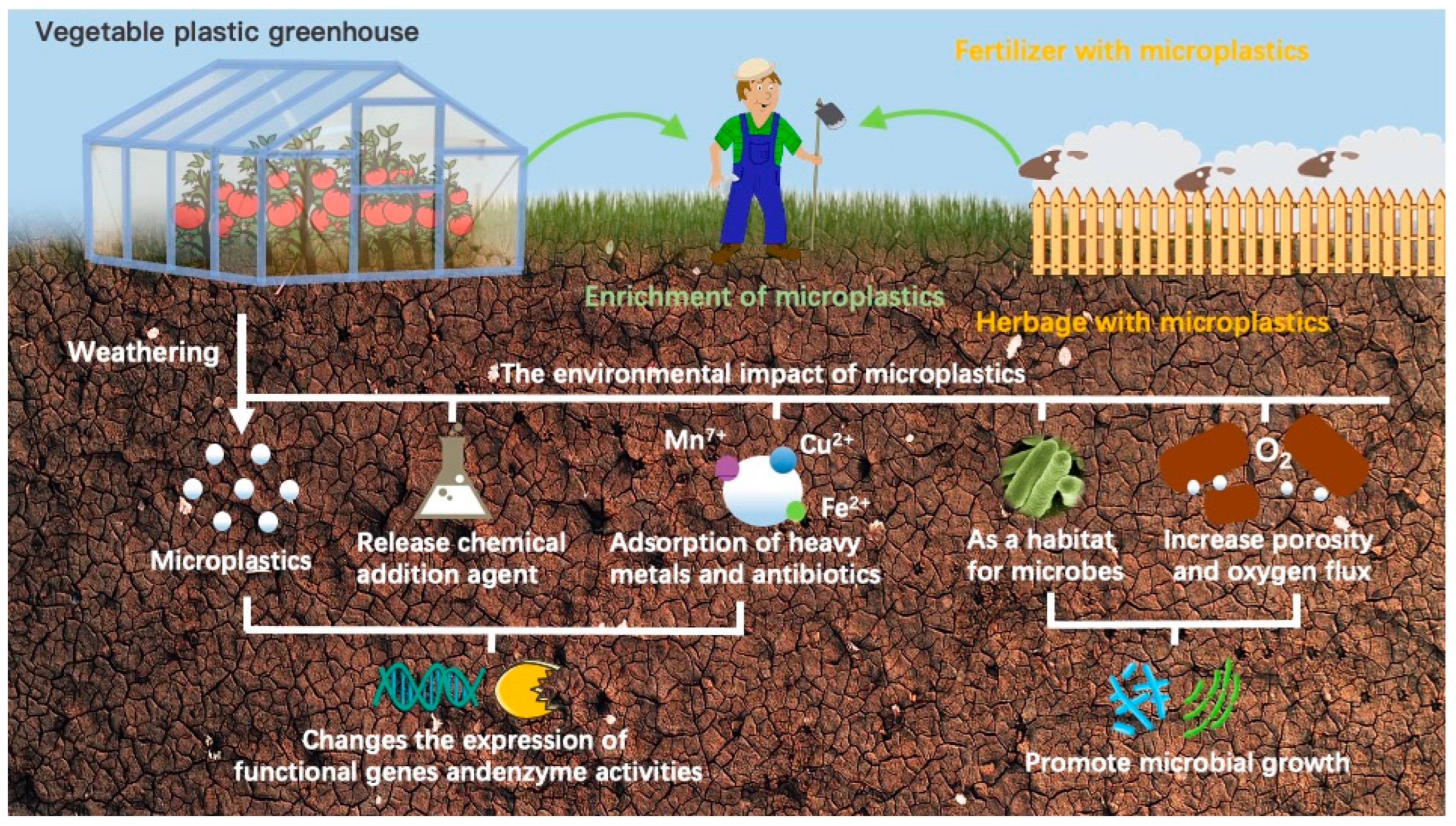
118]. The impact of MPs on the environment is multifaceted (
Figure 2). First, MPs can cause mechanical damage to organisms upon ingestion and release chemicals such as plasticizers during migration and transformation, resulting in toxic effects including reduced feeding efficiency, effects on development and reproduction, and even death [
119]. Second, MPs have the ability to adsorb heavy metals, antibiotics, and other contaminants, leading to their long-term coexistence and subsequent enrichment in organisms. Consequently, the toxic effects of these pollutants may be altered, with compounding effects on organisms and changes in the physicochemical properties of the environment, such as soil pH and bulk weight [
120]. In addition, MPs can act as carriers for microorganisms, algae, and insects, positively and negatively affecting these organisms as they undergo bioenergetic transport, including biological invasions [
121]. Thus, MPs in soil have the potential to pose varying degrees of risk to the environment, plant and animal health, and further threaten human health through food chain bioconcentration. Although MPs have been detected in many wetlands around the world, the effects of MPs on C-cycling microorganisms are not fully understood.
Taken together, the widespread use of plastics has introduced MPs into wetland soils, affecting microorganisms, soil properties, and potentially human health through the food chain. We thus detail the impact of MP input on wetlands’ carbon cycles, especially on CO2 and CH4 emissions. However, it must be noted that research on the influence of microplastics on wetland carbon cycling processes, particularly greenhouse gas emissions, is still in the preliminary stages of investigation. Most current studies on microplastics are mostly conducted under controlled laboratory conditions. The ecological effects of microplastics and their specific mechanisms of impact on carbon-cycling microorganisms require further field-based empirical research and systematic integration.
As an emerging environmental threat, the CiteSpace analysis of 87 publications indicates that research on microplastic inputs to wetlands is rapidly expanding in both scope and depth. Interactions between microplastics and wetland carbon pools represent a leading research frontier. In particular, growing attention has been paid to how microplastics regulate the transport and transformation of dissolved organic carbon (DOC), with implications for carbon mobility and greenhouse gas emissions [
122,
123]. Another key hotspot relates to the biodegradation potential of microplastics. Recent studies increasingly explore microbe- and photocatalytic-based degradation technologies and assess how these degradation processes feed back into greenhouse gas emissions [
33]. However, some studies indicate that higher biodegradability may be associated with a greater greenhouse gas (GHG) emission burden [
124,
125]. This line of research is widely regarded as a critical direction for future mitigation strategies in wetland ecosystems.
7.1. Impact of Wetland Microplastic Input on CO2 Emissions
With the extensive use of new plastic materials, various types of MP pollution have become a major environmental pressure on wetland ecosystems. There are differences in the effects of different types of MPs on soil microbial activity and CO
2 emissions [
126]. MPs are synthetic substances mainly composed of carbon, hydrogen, and oxygen, which are man-made substances with high carbon content [
127]. Their characteristic of not being easily decomposed allows them to accumulate in the soil. Studies have shown that their abundance is positively correlated with the organic carbon content in all study areas where MP pollution exists [
128]. In addition, the readily decomposable fraction of MPs can be utilized by microorganisms as a source of soil microbial carbon or organic substrate to promote the growth of associated functional bacteria [
129]. For example, Auta et al. [
130] demonstrated that
Bacillus sp. strain 27 and
Rhodococcus sp. strain 36 can utilize PP-MPs for growth in the sediment of mangroves.
Different types of MPs affect the activity of soil microorganisms through a variety of mechanisms, thus altering CO
2 emissions [
131]. These variations could be influenced by factors such as the type of MP, the dosage, exposure duration, and the specific soil properties [
132]. MPs generally increase soil respiration by 18.2%, with polypropylene (PP) causing the most pronounced effect (58.8%). Alkaline soils show a 77.9% increase in soil respiration without plants [
132]. PP microplastics significantly enhance enzyme activity, particularly β-glucosidase, acid phosphatase, and FDA hydrolase. Conversely, polyethylene terephthalate (PET) and polyethylene (PE) microplastics suppress soil enzyme activity, including urease, β-glucosidase, and hydrogen peroxidase [
132].
Industrial plastics contain various additives, including flame retardants, plasticizers, and ultraviolet (UV) stabilizers, some of which have been shown to affect the composition and function of microbial communities [
133]. Plasticizers, such as phthalates, can serve as carbon and energy sources for microorganisms, undergoing degradation and consumption by microbial communities [
134]. Photosynthetic microorganisms, such as cyanobacteria, are early colonizers of MP surfaces, contributing to biofilm formation and subsequent CO
2 fluxes. However, specific data on the effects of different types and concentrations of plasticizers on microbes and CO
2 emissions are still insufficient, necessitating further research. Additionally, the degradation of additives may complicate the assessment of plastic biodegradation.
The available data demonstrate that UV stabilizer-treated MPs exhibit 136–148% greater surface adhesion, facilitating initial microbial attachment. UV stabilizers induce the formation of reactive oxygen species (ROS) within microbial cells, promoting biofilm formation [
135]. While the toxicity of UV stabilizers can initially kill attached microorganisms, these deceased microorganisms can form a protective layer, inhibiting further UV stabilizer release and enabling subsequent microorganisms to grow on the biofilm of the deceased. Since biofilm formation stimulates microbial growth and metabolism, MP additives may indirectly increase CO
2 emissions by promoting biofilm formation. However, specific quantitative data on this phenomenon require further investigation. In contrast to plasticizers and UV stabilizers, flame retardants have been found to inhibit microbial growth and metabolic activities, potentially reducing CO
2 emissions. For instance, a study demonstrated that the presence of polybrominated diphenyl ethers (PBDEs), a common flame retardant, significantly decreased the abundance and diversity of soil microbial communities, leading to a corresponding reduction in CO
2 emissions [
136].
Overall, the impact of MP additives on CO2 emissions is multifaceted. Additives such as plasticizers and UV stabilizers may indirectly contribute to CO2 emissions by increasing microbial growth and biofilm formation, whereas other additives (e.g., flame retardants) may have an inhibitory effect. Further studies are needed to quantify the specific effects of different additives and their concentrations on microbial communities and associated CO2 emissions. In addition, potential interactions between the various additives and their combined effects deserve to be investigated.
7.2. Impact of Wetland Microplastic Input on CH4 Emissions
MPs exhibit diverse impacts on microbially mediated CH
4 emissions, primarily influenced by their type, dosage, and exposure duration [
137,
138]. Polystyrene (PS) and polyvinyl chloride (PVC) microplastics are strongly associated with the highest CH
4 yield [
139,
140], while other MP types, such as PE and PP, typically result in lower CH
4 yields [
139]. This discrepancy is primarily attributed to the varying interaction mechanisms between different MPs and microorganisms, which consequently impact the methanogenic pathway. For instance, PVC microplastics significantly promoted the accumulation of protein/phenol-like substances in soil dissolved organic matter, enriching methanogenic rice cluster bacteria, thereby elevating CH
4 emissions. PS microplastics stimulated hydrolytic enzyme activities and upregulated genes associated with both acetotrophic and hydrogenotrophic methanogenesis pathways, ultimately enhancing CH
4 yield [
138]. In contrast, PE and PP microplastics tend to enrich denitrifying and anaerobic ammonium-oxidizing bacteria, which may compete with methanogens for substrates, suppressing CH
4 production [
137].
Increasing the MP concentration inhibits CH
4 production, with CH
4 yield decreasing by 16–27% for every 0.1 g L
−1 increase in the MP concentration. This inhibition is partially attributed to the increased production of oxidative stress factors at higher MP concentrations, which negatively impact methanogenic archaea [
140].
Furthermore, MPs can impair methane-associated microorganisms through various mechanisms [
141]. For instance, under acidic soil conditions (pH 5.0), MPs significantly reduced methanogenic archaea activity by inhibiting the abundance of the CH
4 synthase gene
mcrA [
142], leading to a 16.9% reduction in CH
4 production. Concurrently, MPs can decrease the copy number of genes related to electron transfer, reduce the content of cytochrome, and decrease the activity of the electron transfer system, indirectly affecting CH
4 production and oxidation processes [
131,
143].
The impact of MPs extends beyond their physical presence due to the leaching of chemical additives. For instance, PVC microplastics significantly affect methane-associated microorganisms by releasing plasticizers, mainly bisphenol A (BPA). At low concentrations (10 particles g
−1 TS), PVC microplastics promote CH
4 production by inducing solubilization and increasing CH
4 yield by approximately 5.9% [
144]. However, at high concentrations (≥20 particles g
−1 TS), BPA inhibits CH
4 production, leading to a 9.4–24.2% reduction in yield [
144].
In summary, MPs exhibit diverse impacts on microbially mediated CH4 emissions, primarily influenced by their type, dosage, and exposure duration. These impacts are mediated through various mechanisms, including alterations in microbial community composition, the inhibition of methanogenic pathways, reduction of key gene copy numbers, impairment of electron transfer systems, and the release of chemical additives. Understanding these mechanisms is crucial for developing strategies to mitigate the adverse effects of MP pollution on greenhouse gas emissions from agricultural fields and anaerobic digesters.
8. Synergistic Bioengineering Approaches for Wetland Restoration and Carbon Emission Reduction
8.1. Pathways and Mechanisms of Bioremediation for Salinization and Carbon Emission Reduction
Mitigating wetland salinization and achieving carbon reduction is a systematic ecological engineering task that requires a variety of synergistic measures (
Table 4). In recent years, biotechnological approaches to ecological restoration have garnered widespread attention due to their sustainability and efficiency advantages.
Bio-organic fertilizers, particularly those based on lignite, are an effective biotechnological measure that can enhance the multi-metal saline soil remediation ability of alkali grass [
147]. Both manure-based organic fertilizer (MOF) and lignite-based organic fertilizer (LOF) can enrich beneficial microorganisms and modulate the microbial network, enhancing plant adaptation to heavy metals and salt stress, with bacteria playing a crucial role, especially in LOF treatment. In essence, bio-organic fertilizers, particularly those based on lignite, can regulate the soil microbial community, improving the remediation effectiveness of alkali grass in multi-metal saline soils.
Microbial fertilizers, primarily composed of fermented organic matter, can mitigate soil salinization in low-salinity soils (EC < 1.45 dS m
−1) by increasing the soil organic carbon content and promoting soil aggregate formation [
145]. However, their effects are limited under high-salinity conditions (EC ≥ 1.45 dS m
−1), possibly due to the inability of some microorganisms to tolerate high-salt environments.
In addition to the application of bio-organic fertilizers, certain agricultural practices can also be used for the amelioration of saline soils. Long-term straw mulching can increase microbial diversity and the carbon and nitrogen fixation capacity in coastal saline cotton fields, while deep plowing, although reducing soil pH and salinity and increasing the abundance of dominant microorganisms, does not further affect microbial carbon and nitrogen fixation [
148]. In this process, specific plant-associated bacteria and fungi, such as Bacillus, Pseudomonas, Fusarium, and Alternaria, play a key role in enhancing carbon and nitrogen fixation. In summary, these practices can optimize the microbial communities in coastal saline soils, improving carbon and nitrogen utilization and ensuring sustainable land use. Furthermore, long-term rice cultivation has also been proven to significantly improve the physicochemical properties of saline soils and promote microbial energy metabolism functions, especially those related to nitrogen, carbon, and sulfur cycles, with these effects peaking at 11–16 years of cultivation. Long-term rice cultivation can effectively restore the physicochemical balance and microbial functions of saline soils without other chemical or physical remediation measures, exhibiting sustainability and synergy, and providing a new perspective on saline soil management. However, it generally requires a longer time and may not be applicable to lands that require rapid restoration. Considering the growth characteristics of rice, this approach may be limited by geographic and climatic conditions in some areas where rice cultivation is impractical or inapplicable.
For the amelioration of saline–alkali soils, researchers have proposed plant microbe desalination cell (PMDC) technology [
149]. Compared to soil microbe desalination cells (SMDCs), PMDC technology more effectively reduces soil electrical conductivity and pH, removes ions such as sodium, potassium, and chloride, and improves soil physicochemical properties. PMDC technology combines plant remediation, microbial cells, and electrodialysis effects, representing a more effective new method for ameliorating saline–alkali soils.
8.2. Pathways and Mechanisms of Bioremediation for Over-Fertilization and Carbon Emission Reduction
Currently, the DAMO reaction, which utilizes CH
4 as an electron donor for NO
3−/NO
2− reduction, is widely regarded as a crucial link between global C and N nutrient cycles [
150]. The ability of
M. oxyfera and
Anammox bacteria to jointly utilize CH
4 and NH
4+ as electron donors suggests that the shared functional role of both could be utilized for soil denitrification in soils experiencing severe nitrogen pollution [
151]. This approach could significantly address nitrate and ammonium nitrogen pollution resulting from excessive use of nitrogen fertilizers over extended periods in wetland soils and could help mitigate the greenhouse effect.
The study [
152] proposes two methods to mitigate excessive nitrate accumulation in soils and plants: the use of nitrogen oxide inhibitors dicyandiamide (DCD) and 3,4-dimethylpyrazole phosphate (DMPP), and their combination with graphene oxide (GO). The research reveals that DCD/DMPP reduces the soil nitrate content by inhibiting the activity and abundance of functional nitrogen-cycling microorganisms, whereas GO contributes to nitrate reduction in soil by enhancing certain soil enzyme activities and altering the microbial composition. Furthermore, DCD/DMPP alters the nitrogen form ratio, hindering the conversion of ammonium nitrogen to nitrate, thus lowering nitrate levels in plants.
The anther mitigation of excessive nitrogen fertilization through reduced subsequent chemical N input (RCN) and organic fertilization (OF) improves soil health by leveraging microbial mechanisms [
153]. RCN reverses soil N enrichment, alleviates microbial N inhibition, and enhances the beneficial bacterial community structure and interactions, thereby increasing community stability. OF, on the other hand, substitutes chemical fertilizers, promotes microbial diversity, and enhances soil multifunctionality. Together, these strategies synergistically counteract the adverse effects of excessive N fertilization, fostering a resilient and sustainable soil microbiome and reducing chemical fertilizer dependence.
8.3. Pathways and Mechanisms of Bioremediation for Heavy Metal Pollution and Carbon Emission Reduction
Heavy metal pollution and greenhouse gas emissions are two major environmental challenges we face today. Traditional physical and chemical remediation methods are not only costly but may also lead to secondary pollution, prompting the need for efficient, cost-effective, and environmentally friendly bioremediation techniques [
154]. In recent years, microbe-based remediation strategies have shown great potential due to their unique mechanisms, not only for remediating heavy metal-contaminated soils but also contributing to climate change mitigation (
Table 5).
One innovative technique for remediating heavy metal-polluted soils is the use of Nano-Manganese Dioxide-Coated Microbial Communities (NMCMP) [
155]. The NMCMP technology significantly alters the microbial community composition, preserving soil microbial diversity and promoting the proliferation of key remediation microorganisms such as Flavisolibacter and Arthrobacter. Studies have shown that NMCMP technology not only enhances the remediation efficiency of hexavalent chromium but also inhibits the release of trivalent arsenic, achieving combined detoxification.
Another promising remediation technique is the use of Microbial Fuel Cells (MFCs) [
156]. In an MFC system, electrogenic microorganisms at the anode utilize readily degradable organic compounds to produce electrons, which are transferred through an external circuit to the cathode, generating an electric field between the electrodes. This electric field drives cationic heavy metal ions to migrate towards the cathode, where some ions (e.g., Cu
2+) are reduced and deposited, achieving removal. Apart from removing heavy metals, MFC systems can also alter soil properties like Eh and pH, influencing heavy metal speciation and bioavailability; compete with other microorganisms for organic compounds, limiting their mineral reduction activity; and modulate microbial community structure, facilitating heavy metal transformation and immobilization.
Moreover, optimizing the combination of inorganic amendments, organic fertilizers, and biochar has proven to be an effective remediation strategy. For instance, the S1A0.5B1.5 combination (seaweed fertilizer 1 part: phosphate rock 0.5 parts: biochar 1.5 parts) can optimize the soil bacterial community structure, significantly increasing the abundance of bacterial phyla such as Chloroflexi, Rokubacteria, and Firmicutes [
157]. The enhanced bacterial activity further reduces the bioavailability of heavy metals like cadmium, lead, and chromium in the soil, achieving heavy metal stabilization and insolubilization. Notably, the S1A0.5B1.5 combination also increases the relative abundance of functional microbes involved in organic matter decomposition and denitrification, improving overall soil functionality and contributing to carbon sequestration and greenhouse gas mitigation.
These bioremediation techniques achieve the efficient remediation of heavy metal-contaminated soils by modulating microbial activity, community composition, functional diversity, and interactions with heavy metals. Simultaneously, they contribute to climate change mitigation through novel bioremediation pathways. During the heavy metal remediation process, microorganisms enrich functionally relevant strains closely associated with carbon sequestration (such as those involved in organic matter decomposition and denitrification) through mechanisms like redox reactions, electron transfer, and enzyme production. Consequently, these remediation techniques achieve a dual effect of heavy metal pollution control and greenhouse gas mitigation to a certain extent.
8.4. Pathways and Mechanisms of Bioremediation for Microplastic Input and Carbon Emission Reduction
Microorganisms exert intricate mechanisms to combat MP pollution in soil, constituting a multifaceted approach crucial for environmental sustainability (
Table 6). One of the primary mechanisms is enzyme-mediated degradation. Microorganisms secrete hydrolytic enzymes and oxidoreductases that catalyze the breakdown of plastic polymers into smaller, metabolizable molecules [
159]. For instance, bacteria such as Pseudomonas, Bacillus, and Arthrobacter are proficient in degrading phthalate-based plasticizers [
160]. This illustrates that the microbial enzymatic activity has efficiency and potential in reducing plastic pollution.
Another pivotal strategy employed by microorganisms is biofilm formation. Microorganisms aggregate and adhere to MP surfaces, creating microenvironments that facilitate enhanced enzymatic degradation [
163]. This process significantly increases the surface area available for microbial activity, thereby boosting degradation efficiency. The role of organic fertilizers in promoting biofilm formation has been well documented. For instance, Zhang et al. [
141] found that the addition of organic fertilizers in black soil significantly increased the diversity of biofilms on MP surfaces. These biofilms, composed mainly of Ascomycetes and Actinomycetes, enhance the degradation process by creating favorable conditions for microbial activity [
141].
In addition to enzymatic activity and biofilm formation, microorganisms can directly utilize MPs as a carbon and energy source [
161]. Microorganisms metabolize microplastic-derived carbon through various pathways, contributing to their growth and the further degradation of MPs. Some degrading microorganisms, such as
Bacillus spp., Bacillus thuringiensis, and degrading enzymes involved in hydrolysis and oxidation reactions were identified in studies [
163]. This direct utilization not only aids in reducing MP pollution but also supports microbial proliferation and ecosystem health.
Furthermore, the incorporation of biochar into soil emerges as a promising strategy for mitigating MP pollution. Research shows that biochar-amended soils exhibit increased microbial diversity and enzymatic activity, which in turn enhances MP degradation rates. Moreover, biochar improves soil fertility and water retention, creating a more conducive environment for microbial processes [
162].
Microbial degradation methods also involve the adhesion of microorganisms to plastic surfaces, secretion of hydrolytic enzymes, and subsequent metabolization of plastic-derived carbon sources into CO
2 and H
2O [
161]. This comprehensive process is facilitated by the physicochemical properties of MPs, which influence microbial interactions and degradation efficiency. Additionally, environmental conditions like pH and salinity can be adjusted to optimize these microbial processes.
In conclusion, the detailed understanding of microbial mechanisms for MP degradation, coupled with empirical data on enzymatic activities, biofilm formation, and direct carbon utilization, provides valuable insights for the development of effective mitigation strategies. By leveraging microbial processes and soil amendment techniques, it is possible to address soil MP contamination comprehensively and sustainably. These strategies not only enhance the degradation of MPs but also contribute to overall soil health and ecosystem functionality, presenting a promising avenue for environmental remediation.
9. Conclusions and Prospects
Global wetlands, as the core carriers of the blue carbon cycle, have been continuously influenced by various anthropogenic activities. These anthropogenic activities have altered the source–sink roles of wetlands in terms of carbon dioxide and methane emissions through different mechanisms (
Table 7).
Salinization can inhibit wetland CO2 and CH4 emissions to varying degrees by inhibiting soil microbial activity and vegetation photosynthesis. However, individual saline microorganisms can partially compensate for the emissions. Microbial responses to salinity varied according to wetland types.
Over-fertilization destroys the microbial structure of wetland soil and affects carbon emissions. Nitrogen fertilizer can stimulate CO2 emissions in the short term, but inhibit it in the long term. Phosphorus fertilizer can stimulate emissions at a low level, but inhibit it at a high level. The interaction effect increases the uncertainty of prediction.
Different heavy metals can significantly inhibit microbial activity and reduce CO2 and CH4 emissions. However, they can also participate in anaerobic CH4 oxidation within a moderate range. Assessing their overall impact on greenhouse gas emissions is complex.
MP pollution has also become an emerging environmental pressure affecting the carbon cycle in wetlands. The impact on carbon emissions in wetlands varies depending on the type, concentration, exposure time, and additives. Different concentrations and types of MPs can have varying effects on soil microbial activity and CO2 emissions. They can also influence CH4 production and oxidation through chemical toxicity and physical effects.
Although existing studies have separately revealed the microbial regulatory mechanisms of single anthropogenic activities on carbon emissions, the interactive effects of multiple anthropogenic activities and the characteristics of microbial functional responses at the global scale remain unclear. This leads to the problem that it is difficult to integrate the conclusions of regional studies. Therefore, future research should establish a systematic observation and experimental framework, focusing on analyzing how complex anthropogenic activities such as salinity, nutrients, heavy metals, and microplastics synergistically regulate the activities of key microbial functional communities, such as methanogens, methane-oxidizing bacteria, and denitrifying bacteria, as well as the complex interactions among them. Additionally, the expression of functional genes such as mcrA and pmoA should be utilized to uncover the carbon cycle process and its microbe-driven mechanisms.
Moreover, the standardization of global wetland carbon emission research should be promoted. This includes unifying the specifications for measuring and calculating greenhouse gas fluxes, establishing a multi-monitoring system that covers key environmental variables such as redox potential, sulfate/nitrate, and dissolved organic carbon, as well as the abundance and diversity of microbial functional genes. Meanwhile, the standards for the sampling, characterization, and quantification of microplastics should be standardized to enhance the standardization and usability of data.
Future research should focus on formulating wetland restoration and management strategies based on microbial functions. At the same time, it is necessary to evaluate the applicability and thresholds of different management measures, such as nutrient interception, salinity regulation, and combined plant–microbe remediation, in various types of wetlands. In summary, future research should provide more standardized and sustainable management approaches for wetlands to cope with human disturbances and climate change.
Supplementary Materials
The following supporting information can be downloaded at:
https://www.mdpi.com/article/10.3390/agronomy16040466/s1. This file includes supplementary materials and methods, supplementary results, Figure S1 and Tables S1–S4. Supplementary materials and methods include literature search strategy, study selection criteria and screening, bibliometric and hotspot analysis using CiteSpace. Supplementary results include research hotspots on the effects of wetland salinization on C emissions, research hotspots on the effects of wetland over-fertilization on C emissions, research hotspots on the effects of wetland heavy metals pollution on C emissions, and research hotspots on the effects of wetland microplastic input on C emissions. Figure S1: PRISMA-style flow diagram of literature identification, screening, and inclusion; Table S1: Clustering and representative keywords of research areas on the effects of wetland salinity change or salinization on C emissions, 2014–2024; Table S2: Clustering and representative keywords of research areas on the effects of wetland over-fertilization on C emissions, 2014–2024; Table S3: Clustering and representative keywords of research areas on the effects of wetland heavy metal pollution on C emissions, 2014–2024; Table S4: Clustering and representative keywords of research areas on the effects of wetland microplastic input on C emissions, 2014–2024.
Author Contributions
Conceptualization, Y.H. and X.X. (Xinyi Xu); Methodology, Y.H., X.X. (Xinyi Xu), Z.L., X.S., and B.W.; Software, Y.Z. and X.S.; Formal Analysis, Y.Z., X.X. (Xinyi Xu), and X.G.; Investigation, L.Y., Y.Z., and X.X. (Xinyi Xu); Resources, X.X. (Xiaoya Xu); Data Curation, Y.H., L.Y., X.X. (Xinyi Xu), X.G., B.W., and Y.Z.; Writing—Original Draft Preparation, Y.H. and L.Y.; Writing—Review & Editing, Y.H., Z.L., X.G., X.X. (Xinyi Xu), and X.X. (Xiaoya Xu); Project Administration, X.X. (Xiaoya Xu); Funding Acquisition, X.X. (Xiaoya Xu). All authors have read and agreed to the published version of the manuscript.
Funding
This program was funded by the National Natural Science Foundation of China (42107316) and Natural Science Foundation of Shandong Province (ZR202102260221).
Data Availability Statement
The original contributions presented in this study are included in the article/
Supplementary Materials. Further inquiries can be directed to the corresponding author(s).
Conflicts of Interest
The authors declare no conflicts of interest.
References
- Kingsford, R.T.; Basset, A.; Jackson, L. Wetlands: Conservation’s poor cousins. Aquat. Conserv. Mar. Freshw. Ecosyst. 2016, 26, 892–916. [Google Scholar] [CrossRef]
- Guo, Y.H.; Xu, Y.F.; Zhu, C.M.; Li, P.P.; Zhu, Y.L.; Han, J.G. How Does Adjacent Land Use Influence Sediment Metals Content and Potential Ecological Risk in the Hongze Lake Wetland? Int. J. Environ. Res. Public Health 2022, 19, 10079. [Google Scholar] [CrossRef]
- Wu, S.N.; Dong, S.K.; Wang, Z.Y.; Li, S.M.; Ma, C.H.; Li, Z.Y. Response of species dominance and niche of plant community to wetland degradation along alpine lake riparian. Front. Plant Sci. 2024, 15, 1352834. [Google Scholar] [CrossRef] [PubMed]
- Chen, Q.F.; Guo, B.B.; Zhao, C.S.; Xing, B.X. Characteristics of CH4 and CO2 emissions and influence of water and salinity in the Yellow River delta wetland, China. Environ. Pollut. 2018, 239, 289–299. [Google Scholar] [CrossRef] [PubMed]
- Zhao, W.W.; Zhang, Z.S.; Zhang, X.H.; Xu, L.; Guan, Q.; Lu, K.L.; Wu, H.T.; Wang, W.F. Combination of mineral protection and molecular characteristics rather than alone to govern soil organic carbon stability in Qinghai-Tibetan plateau wetlands. J. Environ. Manag. 2023, 344, 118757. [Google Scholar] [CrossRef]
- Zhang, Y.; Kong, Z.C. Changes in wetland salinity, human activity and wetland vegetation abundances over the past 900 years. Glob. Planet. Change 2019, 182, 103000. [Google Scholar] [CrossRef]
- Twilley, R.R.; Bentley, S.J.; Chen, Q.; Edmonds, D.A.; Hagen, S.C.; Lam, N.S.N.; Willson, C.S.; Xu, K.H.; Braud, D.; Peele, R.H.; et al. Co-evolution of wetland landscapes, flooding, and human settlement in the Mississippi River Delta Plain. Sustain. Sci. 2016, 11, 711–731. [Google Scholar] [CrossRef]
- Mabwoga, S.O.; Thukral, A.K. Characterization of change in the Harike wetland, a Ramsar site in India, using landsat satellite data. Springerplus 2014, 3, 576. [Google Scholar] [CrossRef]
- Page, M.J.; McKenzie, J.E.; Bossuyt, P.M.; Boutron, I.; Hoffmann, T.C.; Mulrow, C.D.; Shamseer, L.; Tetzlaff, J.M.; Akl, E.A.; Brennan, S.E.; et al. The PRISMA 2020 statement: An updated guideline for reporting systematic reviews. PLoS Med. 2021, 18, e1003583. [Google Scholar] [CrossRef]
- Chen, Y.; Chen, C.M.; Liu, Z.Y.; Hu, Z.G.; Wang, X.W. The methodology function of CiteSpace mapping knowledge domains. Stud. Sci. Sci. 2015, 33, 242–253. [Google Scholar] [CrossRef]
- Loisel, J.; van Bellen, S.; Pelletier, L.; Talbot, J.; Hugelius, G.; Karran, D.; Yu, Z.C.; Nichols, J.; Holmquist, J. Insights and issues with estimating northern peatland carbon stocks and fluxes since the Last Glacial Maximum. Earth-Sci. Rev. 2017, 165, 59–80. [Google Scholar] [CrossRef]
- Zou, J.Y.; Ziegler, A.D.; Chen, D.L.; McNicol, G.; Ciais, P.; Jiang, X.; Zheng, C.M.; Wu, J.; Wu, J.; Lin, Z.Y.; et al. Rewetting global wetlands effectively reduces major greenhouse gas emissions. Nat. Geosci. 2022, 15, 627–632. [Google Scholar] [CrossRef]
- Nazaries, L.; Murrell, J.C.; Millard, P.; Baggs, L.; Singh, B.K. Methane, microbes and models: Fundamental understanding of the soil methane cycle for future predictions. Environ. Microbiol. 2013, 15, 2395–2417. [Google Scholar] [CrossRef] [PubMed]
- Valach, A.C.; Kasak, K.; Hemes, K.S.; Anthony, T.L.; Dronova, I.; Taddeo, S.; Silver, W.L.; Szutu, D.; Verfaillie, J.; Baldocchi, D.D. Productive wetlands restored for carbon sequestration quickly become net CO2 sinks with site-level factors driving uptake variability. PLoS ONE 2021, 16, e0248398. [Google Scholar] [CrossRef]
- Täumer, J.; Marhan, S.; Gross, V.; Jensen, C.; Kuss, A.W.; Kolb, S.; Urich, T. Linking transcriptional dynamics of CH4-cycling grassland soil microbiomes to seasonal gas fluxes. Isme J. 2022, 16, 1788–1797. [Google Scholar] [CrossRef]
- Lawrence, N.C.; Tenesaca, C.G.; VanLoocke, A.; Hall, S.J. Nitrous oxide emissions from agricultural soils challenge climate sustainability in the US Corn Belt. Proc. Natl. Acad. Sci. USA 2021, 118, e2112108118. [Google Scholar] [CrossRef]
- Ferry, J.G. Enzymology of one-carbon metabolism in methanogenic pathways. FEMS Microbiol. Rev. 1999, 23, 13–38. [Google Scholar] [CrossRef]
- Garcia, J.L. Taxonomy and ecology of methanogens. FEMS Microbiol. Rev. 1990, 7, 297–308. [Google Scholar] [CrossRef]
- Liu, Y.C.; Whitman, W.B. Metabolic, phylogenetic, and ecological diversity of the methanogenic archaea. In Incredible Anaerobes: From Physiology To Genomics To Fuels; Wiegel, J., Maier, R.J., Adams, M.W.W., Eds.; Annals of the New York Academy of Sciences; Wiley: Hoboken, NJ, USA, 2008; Volume 1125, pp. 171–189. [Google Scholar]
- Wang, J.; Yuan, J.J.; Liu, D.Y.; Xiang, J.; Ding, W.X.; Jiang, X.J. Research progresses on methanogenesis pathway and methanogens in coastal wetlands. Ying Yong Sheng Tai Xue Bao = J. Appl. Ecol. 2016, 27, 993–1101. [Google Scholar] [CrossRef]
- Biavati, B.; Vasta, M.; Ferry, J.G. Isolation and characterization of “Methanosphaera cuniculi” sp. nov. Appl. Environ. Microbiol. 1988, 54, 768–771. [Google Scholar] [CrossRef] [PubMed]
- Zhou, Z.; Zhang, C.J.; Liu, P.F.; Fu, L.; Laso-Pérez, R.; Yang, L.; Bai, L.P.; Li, J.; Yang, M.; Lin, J.Z.; et al. Non-syntrophic methanogenic hydrocarbon degradation by an archaeal species. Nature 2022, 601, 257–262. [Google Scholar] [CrossRef]
- Mayumi, D.; Mochimaru, H.; Tamaki, H.; Yamamoto, K.; Yoshioka, H.; Suzuki, Y.; Kamagata, Y.; Sakata, S. Methane production from coal by a single methanogen. Science 2016, 354, 222–225. [Google Scholar] [CrossRef] [PubMed]
- Wang, Z.H.; Li, J.Y.; Xu, X.Y.; Li, K.; Chen, Q.F. Denitrifying anaerobic methane oxidation and mechanisms influencing it in Yellow River Delta coastal wetland soil, China. Chemosphere 2022, 298, 134345. [Google Scholar] [CrossRef] [PubMed]
- Liu, W.B.; Xiao, H.W.; Ma, H.P.; Li, Y.Y.; Adyel, T.M.; Zhai, J. Reduction of methane emissions from manganese-rich constructed wetlands: Role of manganese-dependent anaerobic methane oxidation. Chem. Eng. J. 2020, 387, 123402. [Google Scholar] [CrossRef]
- Bonetti, G.; Trevathan-Tackett, S.M.; Carnell, P.E.; Macreadie, P.I. The potential of viruses to influence the magnitude of greenhouse gas emissions in an inland wetland. Water Res. 2021, 193, 116875. [Google Scholar] [CrossRef]
- Boretti, A.; Rosa, L. Reassessing the projections of the World Water Development Report. Npj Clean Water 2019, 2, 15. [Google Scholar] [CrossRef]
- Crosbie, R.; Wang, B.; Kim, S.; Mateo, C.; Vaze, J. Changes in the surface water-Groundwater interactions of the Murray-Darling basin (Australia) over the past half a century. J. Hydrol. 2023, 622, 129683. [Google Scholar] [CrossRef]
- Sun, G.Q.; Lei, G.C.; Qu, Y.; Zhang, C.X.; He, K. The Operation of the Three Gorges Dam Alters Wetlands in the Middle and Lower Reaches of the Yangtze River. Front. Environ. Sci. 2020, 8, 576307. [Google Scholar] [CrossRef]
- Ai, X.S.; Yu, Y.X.; Liang, Z.M.; Shi, X.Y.; Cao, R.; Zhang, X.K. Multilayer entropy-weighted TOPSIS method and its decision-making in ecological operation during the subsidence period of the Three Gorges Reservoir. Sci. Rep. 2025, 15, 2954. [Google Scholar] [CrossRef]
- Meinzer, M.; Ahmad, N.; Nielsen, B.L. Halophilic Plant-Associated Bacteria with Plant-Growth-Promoting Potential. Microorganisms 2023, 11, 2910. [Google Scholar] [CrossRef]
- Valiela, I.; Bowen, J.L.; York, J.K. Mangrove forests: One of the world’s threatened major tropical environments. Bioscience 2001, 51, 807–815. [Google Scholar] [CrossRef]
- Cao, Y.N.; Bian, J.; Han, Y.P.; Liu, J.G.; Ma, Y.P.; Feng, W.Y.; Deng, Y.X.; Yu, Y.J. Progress and Prospects of Microplastic Biodegradation Processes and Mechanisms: A Bibliometric Analysis. Toxics 2024, 12, 463. [Google Scholar] [CrossRef]
- Hu, M.J.; Sardans, J.; Yang, X.Y.; Peñuelas, J.; Tong, C. Patterns and environmental drivers of greenhouse gas fluxes in the coastal wetlands of China: A systematic review and synthesis. Environ. Res. 2020, 186, 109576. [Google Scholar] [CrossRef]
- Xu, X.; Wei, S.J.; Chen, H.Y.; Li, B.; Nie, M. Effects of Spartina invasion on the soil organic carbon content in salt marsh and mangrove ecosystems in China. J. Appl. Ecol. 2022, 59, 1937–1946. [Google Scholar] [CrossRef]
- Chambers, L.G.; Steinmuller, H.E.; Breithaupt, J.L. Toward a mechanistic understanding of “peat collapse” and its potential contribution to coastal wetland loss. Ecology 2019, 100, e02720. [Google Scholar] [CrossRef] [PubMed]
- Wilson, B.J.; Servais, S.; Charles, S.P.; Davis, S.E.; Gaiser, E.E.; Kominoski, J.S.; Richards, J.H.; Troxler, T.G. Declines in Plant Productivity Drive Carbon Loss from Brackish Coastal Wetland Mesocosms Exposed to Saltwater Intrusion. Estuaries Coasts 2018, 41, 2147–2158. [Google Scholar] [CrossRef]
- Luo, M.; Zhai, Z.F.; Ye, R.Z.; Xing, R.L.; Huang, J.F.; Tong, C. Carbon mineralization in tidal freshwater marsh soils at the intersection of low-level saltwater intrusion and ferric iron loading. Catena 2020, 193, 104644. [Google Scholar] [CrossRef]
- Servais, S.; Kominoski, J.S.; Charles, S.P.; Gaiser, E.E.; Mazzei, V.; Troxler, T.G.; Wilson, B.J. Saltwater intrusion and soil carbon loss: Testing effects of salinity and phosphorus loading on microbial functions in experimental freshwater wetlands. Geoderma 2019, 337, 1291–1300. [Google Scholar] [CrossRef]
- Raza, T.; Qadir, M.F.; Khan, K.S.; Eash, N.S.; Yousuf, M.; Chatterjee, S.; Manzoor, R.; Rehman, S.u.; Oetting, J.N. Unraveling the potential of microbes in decomposition of organic matter and release of carbon in the ecosystem. J. Environ. Manag. 2023, 344, 118529. [Google Scholar] [CrossRef]
- She, R.H.; Yu, Y.X.; Ge, C.R.; Yao, H.Y. Soil Texture Alters the Impact of Salinity on Carbon Mineralization. Agronomy 2021, 11, 128. [Google Scholar] [CrossRef]
- Balasubramaniam, T.; Shen, G.X.; Esmaeili, N.; Zhang, H. Plants’ Response Mechanisms to Salinity Stress. Plants 2023, 12, 2253. [Google Scholar] [CrossRef]
- Konnerup, D.; Betancourt-Portela, J.M.; Villamil, C.; Parra, J.P. Nitrous oxide and methane emissions from the restored mangrove ecosystem of the Cienaga Grande de Santa Marta, Colombia. Estuar. Coast. Shelf Sci. 2014, 140, 43–51. [Google Scholar] [CrossRef]
- Derby, R.K.; Needelman, B.A.; Roden, A.A.; Megonigal, J.P. Vegetation and hydrology stratification as proxies to estimate methane emission from tidal marshes. Biogeochemistry 2022, 157, 227–243. [Google Scholar] [CrossRef]
- Wang, C.; Tong, C.; Chambers, L.G.; Liu, X.T. Identifying the Salinity Thresholds that Impact Greenhouse Gas Production in Subtropical Tidal Freshwater Marsh Soils. Wetlands 2017, 37, 559–571. [Google Scholar] [CrossRef]
- Naitam, M.G.; Ramakrishnan, B.; Grover, M.; Kaushik, R. Rhizosphere-dwelling halophilic archaea: A potential candidate for alleviating salinity-associated stress in agriculture. Front. Microbiol. 2023, 14, 1212349. [Google Scholar] [CrossRef]
- Hossain, N.; Muhibbullah, M.; Ali, K.M.B.; Molla, M.H. Relationship between Soil Salinity and Physico-chemical Properties of Paddy Field Soils of Jhilwanja Union, Cox’s Bazar, Bangladesh. J. Agric. Sci. 2015, 7, 166. [Google Scholar] [CrossRef]
- Ma, L.; Jiang, X.L.; Liu, G.H.; Yao, L.G.; Liu, W.Z.; Pan, Y.T.; Zuo, Y.X. Environmental Factors and Microbial Diversity and Abundance Jointly Regulate Soil Nitrogen and Carbon Biogeochemical Processes in Tibetan Wetlands. Environ. Sci. Technol. 2020, 54, 3267–3277. [Google Scholar] [CrossRef]
- Calicioglu, O.; Shreve, M.J.; Richard, T.L.; Brennan, R.A. Effect of pH and temperature on microbial community structure and carboxylic acid yield during the acidogenic digestion of duckweed. Biotechnol. Biofuels 2018, 11, 275. [Google Scholar] [CrossRef] [PubMed]
- Maignien, L.; Parkes, R.J.; Cragg, B.; Niemann, H.; Knittel, K.; Coulon, S.; Akhmetzhanov, A.; Boon, N. Anaerobic oxidation of methane in hypersaline cold seep sediments. FEMS Microbiol. Ecol. 2013, 83, 214–231. [Google Scholar] [CrossRef]
- Frank, J.; Zhang, X.Q.; Marcellin, E.; Yuan, Z.G.; Hu, S.H. Salinity effect on an anaerobic methane- and ammonium-oxidising consortium: Shifts in activity, morphology, osmoregulation and syntrophic relationship. Water Res. 2023, 242, 120090. [Google Scholar] [CrossRef]
- Fagodiya, R.K.; Malyan, S.K.; Singh, D.; Kumar, A.; Yadav, R.K.; Sharma, P.C.; Pathak, H. Greenhouse Gas Emissions from Salt-Affected Soils: Mechanistic Understanding of Interplay Factors and Reclamation Approaches. Sustainability 2022, 14, 11876. [Google Scholar] [CrossRef]
- Verhoeven, J.T.A.; Setter, T.L. Agricultural use of wetlands: Opportunities and limitations. Ann. Bot. 2010, 105, 155–163. [Google Scholar] [CrossRef]
- Robertson, D.M.; Saad, D.A. Nitrogen and Phosphorus Sources and Delivery from the Mississippi/Atchafalaya River Basin: An Update Using 2012 SPARROW Models. J. Am. Water Resour. Assoc. 2021, 57, 406–429. [Google Scholar] [CrossRef]
- Li, J.Y.; Han, G.X.; Wang, G.M.; Liu, X.L.; Zhang, Q.Q.; Chen, Y.W.; Song, W.M.; Qu, W.D.; Chu, X.J.; Li, P.G. Imbalanced nitrogen-phosphorus input alters soil organic carbon storage and mineralisation in a salt marsh. Catena 2022, 208, 105720. [Google Scholar] [CrossRef]
- Ding, Y.D.; Song, C.C.; Chen, G.J.; Zhang, X.H.; Mao, R. Effects of long-term nitrogen addition on dissolved organic matter characteristics in a temperate wetland of Northeast China. Ecotoxicol. Environ. Saf. 2021, 226, 112822. [Google Scholar] [CrossRef]
- Wang, J.B.; Fu, X.L.; Zhang, Z.; Li, M.H.; Cao, H.J.; Zhou, X.L.; Ni, H.W. Responses of soil respiration to nitrogen addition in the Sanjiang Plain wetland, northeastern China. PLoS ONE 2019, 14, e0211456. [Google Scholar] [CrossRef]
- Zhang, R.T.; Fu, X.Y.; Zhong, H.X.; Sui, X.; Liu, Y.N. Changes in Soil Bacterial Community and Function in Winter Following Long-Term Nitrogen (N) Deposition in Wetland Soil in Sanjiang Plain, China. Microorganisms 2023, 11, 2634. [Google Scholar] [CrossRef]
- Soman, C.; Li, D.F.; Wander, M.M.; Kent, A.D. Long-term fertilizer and crop-rotation treatments differentially affect soil bacterial community structure. Plant Soil 2017, 413, 145–159. [Google Scholar] [CrossRef]
- Yuan, J.; Yuan, Y.K.; Zhu, Y.H.; Cao, L.K. Effects of different fertilizers on methane emissions and methanogenic community structures in paddy rhizosphere soil. Sci. Total Environ. 2018, 627, 770–781. [Google Scholar] [CrossRef] [PubMed]
- Min, K.; Kang, H.; Lee, D. Effects of ammonium and nitrate additions on carbon mineralization in wetland soils. Soil Biol. Biochem. 2011, 43, 2461–2469. [Google Scholar] [CrossRef]
- Huntingford, C.; Burke, E.J.; Jones, C.D.; Jeffers, E.S.; Wiltshire, A.J. Nitrogen cycle impacts on CO2 fertilisation and climate forcing of land carbon stores. Environ. Res. Lett. 2022, 17, 044072. [Google Scholar] [CrossRef]
- Czapla, K.M.; Anderson, I.C.; Currin, C.A. Net Ecosystem Carbon Balance in a North Carolina, USA, Salt Marsh. J. Geophys. Res. Biogeosci. 2020, 125, e2019JG005509. [Google Scholar] [CrossRef]
- Tao, B.X.; Song, C.C.; Guo, Y.D. Short-term Effects of Nitrogen Additions and Increased Temperature on Wetland Soil Respiration, Sanjiang Plain, China. Wetlands 2013, 33, 727–736. [Google Scholar] [CrossRef]
- Dattamudi, S.; Chanda, S.; Scinto, L.J. Microbial Respiration and Enzyme Activity Downstream from a Phosphorus Source in the Everglades, Florida, USA. Land 2021, 10, 696. [Google Scholar] [CrossRef]
- Hui, D.F.; Porter, W.; Phillips, J.R.; Aidar, M.P.M.; Lebreux, S.J.; Schadt, C.W.; Mayes, M.A. Phosphorus rather than nitrogen enhances CO2 emissions in tropical forest soils: Evidence from a laboratory incubation study. Eur. J. Soil Sci. 2020, 71, 495–510. [Google Scholar] [CrossRef]
- Griffiths, B.S.; Spilles, A.; Bonkowski, M. C:N:P stoichiometry and nutrient limitation of the soil microbial biomass in a grazed grassland site under experimental P limitation or excess. Ecol. Process. 2012, 1, 6. [Google Scholar] [CrossRef]
- Qin, X.C.; Guo, S.F.; Zhai, L.M.; Pan, J.T.; Khoshnevisan, B.; Wu, S.X.; Wang, H.Y.; Yang, B.; Ji, J.H.; Liu, H.B. How long-term excessive manure application affects soil phosphorous species and risk of phosphorous loss in fluvo-aquic soil. Environ. Pollut. 2020, 266, 115304. [Google Scholar] [CrossRef]
- Wu, Q.H.; Chen, D.W.; Zhou, W.L.; Zhang, X.X.; Ao, J.H. Long-term fertilization has different impacts on bacterial communities and phosphorus forms in sugarcane rhizosphere and bulk soils under low-P stress. Front. Plant Sci. 2022, 13, 1019042. [Google Scholar] [CrossRef]
- Aronson, E.L.; Helliker, B.R. Methane flux in non-wetland soils in response to nitrogen addition: A meta-analysis. Ecology 2010, 91, 3242–3251. [Google Scholar] [CrossRef]
- Shi, Y.; Ma, Q.X.; Kuzyakov, Y.; Sheng, L.X.; Liu, H.Y.; Wang, Z.Q. Nitrite-dependent anaerobic oxidation decreases methane emissions from peatlands. Soil Biol. Biochem. 2022, 169, 108658. [Google Scholar] [CrossRef]
- Zhao, R.; Zhu, L.; Wu, J.; Chang, J.L.; Shao, L.G.; Liang, P.; Huang, X. Effect of environmental factors on nitrite-dependent denitrifying anaerobic methane oxidation. Acta Sci. Circumstantiae 2017, 37, 178–184. [Google Scholar] [CrossRef]
- Chmura, G.L.; Kellman, L.; van Ardenne, L.; Guntenspergen, G.R. Greenhouse Gas Fluxes from Salt Marshes Exposed to Chronic Nutrient Enrichment. PLoS ONE 2016, 11, e0149937. [Google Scholar] [CrossRef]
- Yang, J.; Wang, J.Y.; Qiao, P.W.; Zheng, Y.M.; Yang, J.X.; Chen, T.B.; Lei, M.; Wan, X.M.; Zhou, X.Y. Identifying factors that influence soil heavy metals by using categorical regression analysis: A case study in Beijing, China. Front. Environ. Sci. Eng. 2020, 14, 37. [Google Scholar] [CrossRef]
- Yang, Z.H.; Ren, J.; Du, M.Y.; Zhao, Y.R.; Yu, K.Q. Enhanced Laser-Induced Breakdown Spectroscopy for Heavy Metal Detection in Agriculture: A Review. Sensors 2022, 22, 5679. [Google Scholar] [CrossRef] [PubMed]
- Yu, Y.H.; LV, J.S.; Wang, Y.M. Source Identification and Spatial Distribution of Heavy Metals in Soils in Typical Areas Around the Lower Yellow River. Environ. Sci. 2018, 39, 2865–2874. [Google Scholar] [CrossRef]
- Bai, J.H.; Yu, P.D.; Wen, X.J.; Wang, W.; Jia, J.; Wang, X. Effects of cadmium addition on net nitrogen mineralization processes in the urban constructed wetland soils of a Chinese delta. Environ. Geochem. Health 2021, 43, 1155–1164. [Google Scholar] [CrossRef]
- Li, C.C.; Quan, Q.; Gan, Y.D.; Dong, J.Y.; Fang, J.H.; Wang, L.F.; Liu, J. Effects of heavy metals on microbial communities in sediments and establishment of bioindicators based on microbial taxa and function for environmental monitoring and management. Sci. Total Environ. 2020, 749, 141555. [Google Scholar] [CrossRef]
- Xu, Z.Y.; Wu, Y.; Jiang, Y.H.; Zhang, X.L.; Li, J.L.; Ban, Y.H. Arbuscular mycorrhizal fungi in two vertical-flow wetlands constructed for heavy metal-contaminated wastewater bioremediation. Environ. Sci. Pollut. Res. 2018, 25, 12830–12840. [Google Scholar] [CrossRef] [PubMed]
- Gill, L.W.; Ring, P.; Casey, B.; Higgins, N.M.P.; Johnston, P.M. Long term heavy metal removal by a constructed wetland treating rainfall runoff from a motorway. Sci. Total Environ. 2017, 601, 32–44. [Google Scholar] [CrossRef]
- Zhu, Y.G.; Xue, X.M.; Kappler, A.; Rosen, B.P.; Meharg, A.A. Linking Genes to Microbial Biogeochemical Cycling: Lessons from Arsenic. Environ. Sci. Technol. 2017, 51, 7326–7339. [Google Scholar] [CrossRef]
- Panda, B.P.; Mohanta, Y.K.; Paul, R.; Prusty, B.A.K.; Parida, S.P.; Pradhan, A.; Saravanan, M.; Patowary, K.; Jiang, G.M.; Joshi, S.J.; et al. Assessment of environmental and carcinogenic health hazards from heavy metal contamination in sediments of wetlands. Sci. Rep. 2023, 13, 16314. [Google Scholar] [CrossRef]
- Kushwaha, A.; Hans, N.; Kumar, S.; Rani, R. A critical review on speciation, mobilization and toxicity of lead in soil microbe-plant system and bioremediation strategies. Ecotoxicol. Environ. Saf. 2018, 147, 1035–1045. [Google Scholar] [CrossRef] [PubMed]
- Romero-Freire, A.; Aragón, M.S.; Garzón, F.J.M.; Peinado, F.J.M. Is soil basal respiration a good indicator of soil pollution? Geoderma 2016, 263, 132–139. [Google Scholar] [CrossRef]
- Sukreeyapongse, O.; Holm, P.E.; Strobel, B.W.; Panichsakpatana, S.; Magid, J.; Hansen, H.C.B. pH-dependent release of cadmium, copper, and lead from natural and sludge-amended soils. J. Environ. Qual. 2002, 31, 1901–1909. [Google Scholar] [CrossRef] [PubMed]
- Klimek, B. Effect of Long-Term Zinc Pollution on Soil Microbial Community Resistance to Repeated Contamination. Bull. Environ. Contam. Toxicol. 2012, 88, 617–622. [Google Scholar] [CrossRef]
- Ma, J.J.; Ullah, S.; Niu, A.Y.; Liao, Z.N.; Qin, Q.H.; Xu, S.J.; Lin, C.X. Heavy metal pollution increases CH4 and decreases CO2 emissions due to soil microbial changes in a mangrove wetland: Microcosm experiment and field examination. Chemosphere 2021, 269, 128735. [Google Scholar] [CrossRef]
- Alengebawy, A.; Abdelkhalek, S.T.; Qureshi, S.R.; Wang, M.Q. Heavy Metals and Pesticides Toxicity in Agricultural Soil and Plants: Ecological Risks and Human Health Implications. Toxics 2021, 9, 42. [Google Scholar] [CrossRef]
- Tomno, R.M.; Nzeve, J.K.; Mailu, S.N.; Shitanda, D.; Waswa, F. Heavy metal contamination of water, soil and vegetables in urban streams in Machakos municipality, Kenya. Sci. Afr. 2020, 9, e00539. [Google Scholar] [CrossRef]
- Cantera, S.; Lebrero, R.; García-Encina, P.A.; Muñoz, R. Evaluation of the influence of methane and copper concentration and methane mass transport on the community structure and biodegradation kinetics of methanotrophic cultures. J. Environ. Manag. 2016, 171, 11–20. [Google Scholar] [CrossRef]
- Giannopoulos, G.; Hartop, K.R.; Brown, B.L.; Song, B.; Elsgaard, L.; Franklin, R.B. Trace Metal Availability Affects Greenhouse Gas Emissions and Microbial Functional Group Abundance in Freshwater Wetland Sediments. Front. Microbiol. 2020, 11, 560861. [Google Scholar] [CrossRef]
- Shabbir, Z.; Sardar, A.; Shabbir, A.; Abbas, G.; Shamshad, S.; Khalid, S.; Natasha; Murtaza, G.; Dumat, C.; Shahid, M. Copper uptake, essentiality, toxicity, detoxification and risk assessment in soil-plant environment. Chemosphere 2020, 259, 127436. [Google Scholar] [CrossRef]
- Kayalvizhi, K.; Kathiresan, K. Microbes from wastewater treated mangrove soil and their heavy metal accumulation and Zn solubilization. Biocatal. Agric. Biotechnol. 2019, 22, 101379. [Google Scholar] [CrossRef]
- Montoya, M.; Castellano-Hinojosa, A.; Vallejo, A.; Alvarez, J.M.; Bedmar, E.J.; Recio, J.; Guardia, G. Zinc fertilizers influence greenhouse gas emissions and nitrifying and denitrifying communities in a non-irrigated arable cropland. Geoderma 2018, 325, 208–217. [Google Scholar] [CrossRef]
- Liu, X.; Ju, Y.W.; Mandzhieva, S.; Pinskii, D.; Minkina, T.; Rajput, V.D.; Roane, T.; Huang, S.Q.; Ma, L.Q.; Li, Y.P.; et al. Sporadic Pb accumulation by plants: Influence of soil biogeochemistry, microbial community and physiological mechanisms. J. Hazard. Mater. 2023, 444, 130391. [Google Scholar] [CrossRef]
- Tao, Y.; Shen, L.; Han, S.Y.; Li, Z.X.; Cui, Y.H.; Lin, Y.L.; Qu, J.H.; Zhang, Y. Metagenomic study of carbon metabolism in black soil microbial communities under lead-lanthanum stress. J. Hazard. Mater. 2023, 446, 130666. [Google Scholar] [CrossRef] [PubMed]
- Shang, C.; Chai, Y.Z.; Peng, L.; Shao, J.H.; Huang, H.L.; Chen, A.W. Remediation of Cr(VI) contaminated soil by chitosan stabilized FeS composite and the changes in microorganism community. Chemosphere 2023, 327, 138517. [Google Scholar] [CrossRef] [PubMed]
- Mohanty, S.R.; Bharati, K.; Deepa, N.; Rao, V.R.; Adhya, T.K. Influence of heavy metals on methane oxidation in tropical rice soils. Ecotoxicol. Environ. Saf. 2000, 47, 277–284. [Google Scholar] [CrossRef] [PubMed]
- Jiang, O.Y.; Li, Y.; Zheng, Y.; Gustave, W.; Tang, X.J.; Xu, J.M. Cadmium reduced methane emissions by stimulating methane oxidation in paddy soils. Environ. Res. 2023, 238, 117096. [Google Scholar] [CrossRef]
- Karri, S.; Sierra-Alvarez, R.; Field, J.A. Toxicity of copper to acetoclastic and hydrogenotrophic activities of methanogens and sulfate reducers in anaerobic sludge. Chemosphere 2006, 62, 121–127. [Google Scholar] [CrossRef]
- Falcone, E.; Okafor, M.; Vitale, N.; Raibaut, L.; Sour, A.; Faller, P. Extracellular Cu2+ pools and their detection: From current knowledge to next-generation probes. Coord. Chem. Rev. 2021, 433, 213727. [Google Scholar] [CrossRef]
- Beal, E.J.; House, C.H.; Orphan, V.J. Manganese- and Iron-Dependent Marine Methane Oxidation. Science 2009, 325, 184–187. [Google Scholar] [CrossRef] [PubMed]
- Egger, M.; Rasigraf, O.; Sapart, C.J.; Jilbert, T.; Jetten, M.S.M.; Röckmann, T.; van der Veen, C.; Bânda, N.; Kartal, B.; Ettwig, K.F.; et al. Iron-Mediated Anaerobic Oxidation of Methane in Brackish Coastal Sediments. Environ. Sci. Technol. 2015, 49, 277–283. [Google Scholar] [CrossRef] [PubMed]
- Samanta, D.; Sani, R.K. Methane Oxidation via Chemical and Biological Methods: Challenges and Solutions. Methane 2023, 2, 279–303. [Google Scholar] [CrossRef]
- Shi, L.D.; Guo, T.; Lv, P.L.; Niu, Z.F.; Zhou, Y.J.; Tang, X.J.; Zheng, P.; Zhu, L.Z.; Zhu, Y.G.; Kappler, A.; et al. Coupled anaerobic methane oxidation and reductive arsenic mobilization in wetland soils. Nat. Geosci. 2020, 13, 799–805. [Google Scholar] [CrossRef]
- Lai, C.Y.; Wen, L.L.; Shi, L.D.; Zhao, K.K.; Wang, Y.Q.; Yang, X.E.; Rittmann, B.E.; Zhou, C.; Tang, Y.N.; Zheng, P.; et al. Selenate and Nitrate Bioreductions Using Methane as the Electron Donor in a Membrane Biofilm Reactor. Environ. Sci. Technol. 2016, 50, 10179–10186. [Google Scholar] [CrossRef]
- He, Z.F.; Geng, S.; Pan, Y.W.; Cai, C.Y.; Wang, J.Q.; Wang, L.Q.; Liu, S.; Zheng, P.; Xu, X.H.; Hu, B.L. Improvement of the trace metal composition of medium for nitrite-dependent anaerobic methane oxidation bacteria: Iron (II) and copper (II) make a difference. Water Res. 2015, 85, 235–243. [Google Scholar] [CrossRef]
- Lai, C.Y.; Zhong, L.; Zhang, Y.; Chen, J.X.; Wen, L.L.; Shi, L.D.; Sun, Y.P.; Ma, F.; Rittmann, B.E.; Zhou, C.; et al. Bioreduction of Chromate in a Methane-Based Membrane Biofilm Reactor. Environ. Sci. Technol. 2016, 50, 5832–5839. [Google Scholar] [CrossRef]
- Lai, C.Y.; Dong, Q.Y.; Chen, J.X.; Zhu, Q.S.; Yang, X.; Chen, W.D.; Zhao, H.P.; Zhu, L. Role of Extracellular Polymeric Substances in a Methane Based Membrane Biofilm Reactor Reducing Vanadate. Environ. Sci. Technol. 2018, 52, 10680–10688. [Google Scholar] [CrossRef]
- Dong, Q.Y.; Wang, Z.; Shi, L.D.; Lai, C.Y.; Zhao, H.P. Anaerobic methane oxidation coupled to chromate reduction in a methane-based membrane biofilm batch reactor. Environ. Sci. Pollut. Res. 2019, 26, 26286–26292. [Google Scholar] [CrossRef]
- Shi, L.D.; Du, J.J.; Wang, L.B.; Han, Y.L.; Cao, K.F.; Lai, C.Y.; Zhao, H.P. Formation of nanoscale Te0 and its effect on TeO32− reduction in CH4-based membrane biofilm reactor. Sci. Total Environ. 2019, 655, 1232–1239. [Google Scholar] [CrossRef] [PubMed]
- Zhang, B.G.; Jiang, Y.F.; Zuo, K.C.; He, C.; Dai, Y.R.; Ren, Z.J. Microbial vanadate and nitrate reductions coupled with anaerobic methane oxidation in groundwater. J. Hazard. Mater. 2020, 382, 121228. [Google Scholar] [CrossRef]
- Vigderovich, H.; Eckert, W.; Elul, M.; Rubin-Blum, M.; Elvert, M.; Sivan, O. Long-term incubations provide insight into the mechanisms of anaerobic oxidation of methane in methanogenic lake sediments. Biogeosciences 2022, 19, 2313–2331. [Google Scholar] [CrossRef]
- Ziani, K.; Ionita-Mindrican, C.B.; Mititelu, M.; Neacsu, S.M.; Negrei, C.; Morosan, E.; Draganescu, D.; Preda, O.T. Microplastics: A Real Global Threat for Environment and Food Safety: A State of the Art Review. Nutrients 2023, 15, 617. [Google Scholar] [CrossRef]
- Helcoski, R.; Yonkos, L.T.; Sanchez, A.; Baldwin, A.H. Wetland soil microplastics are negatively related to vegetation cover and stem density. Environ. Pollut. 2020, 256, 113391. [Google Scholar] [CrossRef] [PubMed]
- He, D.; Chen, X.J.; Zhao, W.; Zhu, Z.Q.; Qi, X.J.; Zhou, L.F.; Chen, W.; Wan, C.Y.; Li, D.W.; Zou, X.; et al. Microplastics contamination in the surface water of the Yangtze River from upstream to estuary based on different sampling methods. Environ. Res. 2021, 196, 110908. [Google Scholar] [CrossRef]
- Polanco, H.; Hayes, S.; Roble, C.; Krupitsky, M.; Branco, B. The presence and significance of microplastics in surface water in the Lower Hudson River Estuary 2016-2019: A research note. Mar. Pollut. Bull. 2020, 161, 111702. [Google Scholar] [CrossRef]
- Hale, R.C.; Seeley, M.E.; La Guardia, M.J.; Mai, L.; Zeng, E.Y. A Global Perspective on Microplastics. J. Geophys. Res. Ocean. 2020, 125, e2018JC014719. [Google Scholar] [CrossRef]
- Dey, T.K.; Uddin, M.E.; Jamal, M. Detection and removal of microplastics in wastewater: Evolution and impact. Environ. Sci. Pollut. Res. 2021, 28, 16925–16947. [Google Scholar] [CrossRef] [PubMed]
- Saeedi, M. How microplastics interact with food chain: A short overview of fate and impacts. J. Food Sci. Technol. 2024, 61, 403–413. [Google Scholar] [CrossRef]
- Shao, Y.; Zhou, X.H.; Liu, X.W.; Wang, L.L. Pre-oxidization-induced change of physicochemical characteristics and removal behaviours in conventional drinking water treatment processes for polyethylene microplastics. Rsc Adv. 2020, 10, 41488–41494. [Google Scholar] [CrossRef]
- Chen, Z.L.; Lee, S.Y. Contribution of Microplastics to Carbon Storage in Coastal Wetland Sediments. Environ. Sci. Technol. Lett. 2021, 8, 1045–1050. [Google Scholar] [CrossRef]
- Shen, M.C.; Liu, S.W.; Hu, T.; Zheng, K.X.; Wang, Y.L.; Long, H.M. Recent advances in the research on effects of micro/nanoplastics on carbon conversion and carbon cycle: A review. J. Environ. Manag. 2023, 334, 117529. [Google Scholar] [CrossRef]
- He, Y.Y.; Li, Y.M.; Yang, X.L.; Liu, Y.R.; Guo, H.X.; Wang, Y.F.; Zhu, T.T.; Tong, Y.D.; Ni, B.J.; Liu, Y.W. Biodegradable microplastics aggravate greenhouse gas emissions from urban lake sediments more severely than conventional microplastics. Water Res. 2024, 266, 122334. [Google Scholar] [CrossRef]
- Piao, Z.Y.; Boakye, A.A.A.; Yao, Y. Environmental impacts of biodegradable microplastics. Nat. Chem. Eng. 2024, 1, 661–669. [Google Scholar] [CrossRef]
- Wan, L.F.; Cheng, H.; Liu, Y.Q.; Shen, Y.; Liu, G.H.; Su, X.K. Global meta-analysis reveals differential effects of microplastics on soil ecosystem. Sci. Total Environ. 2023, 867, 161403. [Google Scholar] [CrossRef]
- Huang, Z.K.; Hu, B.; Wang, H. Analytical methods for microplastics in the environment: A review. Environ. Chem. Lett. 2023, 21, 383–401. [Google Scholar] [CrossRef] [PubMed]
- Zhang, W.Z.; Liu, X.M.; Liu, L.A.; Lu, H.X.; Wang, L.; Tang, J.C. Effects of microplastics on greenhouse gas emissions and microbial communities in sediment of freshwater systems. J. Hazard. Mater. 2022, 435, 129030. [Google Scholar] [CrossRef] [PubMed]
- Yao, Y.; Wang, L.L.; Pan, S.F.; Li, G.; Liu, H.M.; Xiu, W.M.; Gong, L.X.; Zhao, J.N.; Zhang, G.L.; Yang, D.L. Can microplastics mediate soil properties, plant growth and carbon/nitrogen turnover in the terrestrial ecosystem? Ecosyst. Health Sustain. 2022, 8, 2133638. [Google Scholar] [CrossRef]
- Auta, H.S.; Emenike, C.U.; Jayanthi, B.; Fauziah, S.H. Growth kinetics and biodeterioration of polypropylene microplastics by Bacillus sp. and Rhodococcus sp. isolated from mangrove sediment. Mar. Pollut. Bull. 2018, 127, 15–21. [Google Scholar] [CrossRef]
- Wang, F.Y.; Wang, Q.L.; Adams, C.A.; Sun, Y.H.; Zhang, S.W. Effects of microplastics on soil properties: Current knowledge and future perspectives. J. Hazard. Mater. 2022, 424, 127531. [Google Scholar] [CrossRef]
- Liu, X.H.; Li, Y.Y.; Yu, Y.X.; Yao, H.Y. Effect of nonbiodegradable microplastics on soil respiration and enzyme activity: A meta-analysis. Appl. Soil Ecol. 2023, 184, 104770. [Google Scholar] [CrossRef]
- Lear, G.; Kingsbury, J.M.; Franchini, S.; Gambarini, V.; Maday, S.D.M.; Wallbank, J.A.; Weaver, L.; Pantos, O. Plastics and the microbiome: Impacts and solutions. Environ. Microbiome 2021, 16, 2. [Google Scholar] [CrossRef] [PubMed]
- Wright, R.J.; Erni-Cassola, G.; Zadjelovic, V.; Latva, M.; Christie-Oleza, J.A. Marine Plastic Debris: A New Surface for Microbial Colonization. Environ. Sci. Technol. 2020, 54, 11657–11672. [Google Scholar] [CrossRef]
- Tarafdar, A.; Lim, J.Y.; Kwon, J.H. UV stabilizers can foster early development of biofilms on freshwater microplastics. Environ. Pollut. 2022, 315, 120444. [Google Scholar] [CrossRef] [PubMed]
- Chan, Y.K.; Li, A.; Gopalakrishnan, S.; Shin, P.K.S.; Wu, R.S.S.; Pointing, S.B.; Chiu, J.M.Y. Interactive effects of hypoxia and polybrominated diphenyl ethers (PBDEs) on microbial community assembly in surface marine sediments. Mar. Pollut. Bull. 2014, 85, 400–409. [Google Scholar] [CrossRef]
- Ji, M.Y.; Xiao, L.R.; Usman, M.; Liu, C.; Sang, W.J.; Treu, L.; Campanaro, S.; Luo, G.; Zhang, Y.L. Different microplastics in anaerobic paddy soils: Altering methane emissions by influencing organic matter composition and microbial metabolic pathways. Chem. Eng. J. 2023, 469, 144003. [Google Scholar] [CrossRef]
- Zhao, W.X.; Hu, T.Y.; Ma, H.; He, S.F.; Zhao, Q.L.; Jiang, J.Q.; Wei, L.L. Deciphering the role of polystyrene microplastics in waste activated sludge anaerobic digestion: Changes of organics transformation, microbial community and metabolic pathway. Sci. Total Environ. 2023, 901, 166551. [Google Scholar] [CrossRef]
- Ji, L.; Tian, C.J.; Kuramae, E.E. Phosphorus-mediated succession of microbial nitrogen, carbon, and sulfur functions in rice-driven saline-alkali soil remediation. Soil Biol. Biochem. 2023, 184, 109125. [Google Scholar] [CrossRef]
- Xu, R.Z.; Cao, J.S.; Ye, T.; Wang, S.N.; Luo, J.Y.; Ni, B.J.; Fang, F. Automated machine learning-based prediction of microplastics induced impacts on methane production in anaerobic digestion. Water Res. 2022, 223, 118975. [Google Scholar] [CrossRef]
- Zhang, S.W.; Li, Y.X.; Jiang, L.S.; Han, W.; Zhao, Y.; Jiang, X.M.; Li, J.; Shi, W.Z.; Zhang, X.L. Organic fertilizer facilitates the soil microplastic surface degradation and enriches the diversity of bacterial biofilm. J. Hazard. Mater. 2023, 459, 132139. [Google Scholar] [CrossRef]
- Zhang, Z.H.; Yang, Z.H.; Yue, H.W.; Xiao, M.L.; Ge, T.D.; Li, Y.Y.; Yu, Y.X.; Yao, H.Y. Discrepant impact of polyethylene microplastics on methane emissions from different paddy soils. Appl. Soil Ecol. 2023, 181, 104650. [Google Scholar] [CrossRef]
- Wang, S.; Wang, X.T.; Fessler, M.; Jin, B.; Su, Y.Y.; Zhang, Y.F. Insights into the impact of polyethylene microplastics on methane recovery from wastewater via bioelectrochemical anaerobic digestion. Water Res. 2022, 221, 118844. [Google Scholar] [CrossRef]
- Wei, W.; Huang, Q.S.; Sun, J.; Wang, J.Y.; Wu, S.L.; Ni, B.J. Polyvinyl Chloride Microplastics Affect Methane Production from the Anaerobic Digestion of Waste Activated Sludge through Leaching Toxic Bisphenol-A. Environ. Sci. Technol. 2019, 53, 2509–2517. [Google Scholar] [CrossRef]
- Cong, P.F.; Ouyang, Z.; Hou, R.X.; Han, D.R. Effects of application of microbial fertilizer on aggregation and aggregate-associated carbon in saline soils. Soil Tillage Res. 2017, 168, 33–41. [Google Scholar] [CrossRef]
- Wang, R.; Liu, T.; Lu, C.Y.; Zhang, Z.C.; Guo, P.R.; Jia, B.B.; Hao, B.H.; Wang, Y.C.; Guo, W. Bioorganic fertilizers improve the adaptability and remediation efficiency of Puccinellia distans in multiple heavy metals-contaminated saline soil by regulating the soil microbial community. J. Hazard. Mater. 2023, 448, 130982. [Google Scholar] [CrossRef] [PubMed]
- Song, J.S.; Zhang, H.Y.; Chang, F.D.; Yu, R.; Zhang, X.Q.; Wang, X.Q.; Wang, W.N.; Liu, J.M.; Zhou, J.; Li, Y.Y. Humic acid plus manure increases the soil carbon pool by inhibiting salinity and alleviating the microbial resource limitation in saline soils. Catena 2023, 233, 107527. [Google Scholar] [CrossRef]
- Zhang, L.; Su, X.Y.; Meng, H.; Men, Y.; Liu, C.M.; Yan, X.Y.; Song, X.L.; Sun, X.Z.; Mao, L.L. Cotton stubble return and subsoiling alter soil microbial community, carbon and nitrogen in coastal saline cotton fields. Soil Tillage Res. 2023, 226, 105585. [Google Scholar] [CrossRef]
- Han, X.Y.; Qu, Y.P.; Li, D.; Qiu, Y.; Yu, Y.L.; Feng, Y.J. Remediation of saline-sodic soil by plant microbial desalination cell. Chemosphere 2021, 277, 130275. [Google Scholar] [CrossRef]
- Shi, Y.; Hu, S.H.; Lou, J.Q.; Lu, P.L.; Keller, J.; Yuan, Z.G. Nitrogen Removal from Wastewater by Coupling Anammox and Methane-Dependent Denitrification in a Membrane Biofilm Reactor. Environ. Sci. Technol. 2013, 47, 11577–11583. [Google Scholar] [CrossRef]
- Zhu, J.X.; Yan, X.J.; Zhou, L.A.; Li, N.; Liao, C.M.; Wang, X. Insight of bacteria and archaea in Feammox community enriched from different soils. Environ. Res. 2022, 203, 111802. [Google Scholar] [CrossRef]
- Wang, Y.; Wang, F.; Ford, R.; Tang, W.H.; Zhou, M.Z.; Ma, B.; Zhang, M.Y. The influences of graphene oxide and nitrification inhibitor on vegetable growths and soil and endophytic bacterial communities: Double-edge sword effects and nitrate risk controls. Sci. Total Environ. 2023, 903, 166337. [Google Scholar] [CrossRef]
- Liu, X.; Zhang, Y.; Wang, F. Effect of reduced subsequent N supply and organic amendment on soil bacterial community in a wheat-maize rotation system with over-fertilization. Appl. Soil Ecol. 2023, 181, 104659. [Google Scholar] [CrossRef]
- Guérin, T.; Ghinet, A.; Waterlot, C. The phytoextraction power of Cichorium intybus L. on metal-contaminated soil: Focus on time- and cultivar-depending accumulation and distribution of cadmium, lead and zinc. Chemosphere 2022, 287, 132122. [Google Scholar] [CrossRef] [PubMed]
- Su, H.F.; Zhang, Y.Z.; Lu, Z.C.; Wang, Q.Y. A mechanism of microbial sensitivity regulation on interventional remediation by nanozyme manganese oxide in soil heavy metal pollution. J. Clean. Prod. 2022, 373, 133825. [Google Scholar] [CrossRef]
- Zhang, J.R.; Jiao, W.T.; Huang, S.; Wang, H.; Cao, X.; Li, X.N.; Sakamaki, T. Application of microbial fuel cell technology to the remediation of compound heavy metal contamination in soil. J. Environ. Manag. 2022, 320, 115670. [Google Scholar] [CrossRef]
- Hong, Y.; Li, D.; Xie, C.; Zheng, X.X.; Yin, J.; Li, Z.D.; Zhang, K.L.; Jiao, Y.Q.; Wang, B.J.; Hu, Y.M.; et al. Combined apatite, biochar, and organic fertilizer application for heavy metal co-contaminated soil remediation reduces heavy metal transport and alters soil microbial community structure. Sci. Total Environ. 2022, 851, 158033. [Google Scholar] [CrossRef] [PubMed]
- Jin, Y.Y.; Luan, Y.N.; Ning, Y.C.; Wang, L.Y. Effects and Mechanisms of Microbial Remediation of Heavy Metals in Soil: A Critical Review. Appl. Sci. 2018, 8, 1336. [Google Scholar] [CrossRef]
- Jain, R.; Gaur, A.; Suravajhala, R.; Chauhan, U.; Pant, M.; Tripathi, V.; Pant, G. Microplastic pollution: Understanding microbial degradation and strategies for pollutant reduction. Sci. Total Environ. 2023, 905, 167098. [Google Scholar] [CrossRef]
- Carmen, S. Microbial capability for the degradation of chemical additives present in petroleum-based plastic products: A review on current status and perspectives. J. Hazard. Mater. 2021, 402, 123534. [Google Scholar] [CrossRef]
- Feng, S.S.; Wang, H.D.; Wang, Y.; Cheng, Q.G. A review of the occurrence and degradation of biodegradable microplastics in soil environments. Sci. Total Environ. 2023, 904, 166855. [Google Scholar] [CrossRef]
- Khalid, A.R.; Shah, T.R.; Asad, M.; Ali, A.; Samee, E.; Adnan, F.; Bhatti, M.F.; Marhan, S.; Kammann, C.I.; Haider, G. Biochar alleviated the toxic effects of PVC microplastic in a soil-plant system by upregulating soil enzyme activities and microbial abundance. Environ. Pollut. 2023, 332, 121810, Expression of Concern in Environ. Pollut. 2025, 382, 126724. [Google Scholar] [CrossRef] [PubMed]
- Malla, M.A.; Dubey, A.; Kumar, A.; Yadav, S. Unlocking the biotechnological and environmental perspectives of microplastic degradation in soil-ecosystems using metagenomics. Process Saf. Environ. Prot. 2023, 170, 372–379. [Google Scholar] [CrossRef]
- Wang, Y.H.; Xv, X.; Shao, T.J.; He, Q.Y.; Guo, Z.Y.; Wang, Y.T.; Guo, Q.; Xing, B.S. A case on source to soil to solutions: Distribution characteristics of microplastics in farmland soil of the largest vegetable base in Northwest China. Sci. Total Environ. 2024, 907, 167910. [Google Scholar] [CrossRef] [PubMed]
Figure 1.
Schematic representation of CH4 production and oxidation processes in soil. The upper aerobic zone shows the oxidation of CH4 by aerobic methanotrophic bacteria using O2, with subsequent conversion of CH4 to CO2. The lower anaerobic zone involves methanogenesis, where organic matter (humus) is broken down by the bacteria into intermediates such as acetate (HOAc), hydrogen (H2), and CO2, which are used by methanogens to produce CH4. Anaerobic oxidation of methane (AOM) occurs in the anaerobic zone and utilizes sulfate (SO42−), nitrate (NO3−), and nitrite (NO2−) as electron acceptors through interactions with sulfate-reducing bacteria (SRB), ANME (anaerobic methanotrophic archaea), and NC10 phylum microbes. The role of metal ions (Mn2+, Fe2+, Mn4+, and Fe3+) and sulfur compounds in these processes is also shown.
Figure 1.
Schematic representation of CH4 production and oxidation processes in soil. The upper aerobic zone shows the oxidation of CH4 by aerobic methanotrophic bacteria using O2, with subsequent conversion of CH4 to CO2. The lower anaerobic zone involves methanogenesis, where organic matter (humus) is broken down by the bacteria into intermediates such as acetate (HOAc), hydrogen (H2), and CO2, which are used by methanogens to produce CH4. Anaerobic oxidation of methane (AOM) occurs in the anaerobic zone and utilizes sulfate (SO42−), nitrate (NO3−), and nitrite (NO2−) as electron acceptors through interactions with sulfate-reducing bacteria (SRB), ANME (anaerobic methanotrophic archaea), and NC10 phylum microbes. The role of metal ions (Mn2+, Fe2+, Mn4+, and Fe3+) and sulfur compounds in these processes is also shown.
Figure 2.
Environmental impacts of microplastics in agriculture. Shows that microplastics from sources such as greenhouse plastics can accumulate in the soil, release chemicals, adsorb pollutants, change soil properties, affect microbial activity and pose risks to ecosystems and health.
Figure 2.
Environmental impacts of microplastics in agriculture. Shows that microplastics from sources such as greenhouse plastics can accumulate in the soil, release chemicals, adsorb pollutants, change soil properties, affect microbial activity and pose risks to ecosystems and health.
Table 1.
Classification of different trophic methanogenic archaea in wetland soils at the level of order, family, and genus.
Table 1.
Classification of different trophic methanogenic archaea in wetland soils at the level of order, family, and genus.
| Type | Order | Family | Genus | Reference |
|---|
| Acetotrophic methanogens | [not assigned] | Methanosaetaceae | Methanosaeta | [17,18,19,20] |
| Methanosarcinales | Methanosarcinaceae | Methanosarcina |
| Hydrogenotrophic methanogens | Methanobacteriales | Methanobacteriaceae | Methanobacterium
Methanobrevibacter
Methanosphaera
Methanothermobacter | [19,20] |
| Methanothermaceae | Methanothermus |
| Methanococcales | Methanococcaceae | Methanococcus
Methanothermococcus |
| Methanocaldococcaceae | Methanocaldococcus
Methanotorris |
| Methanomicrobiales | Methanomicrobiaceae | Methanomicrobium
Methanoculleus
Methanofollis
Methanogenium
Methanolacinia
Methanoplanus |
| Methanoregulaceae | Methanosphaerula
Methanoregula |
| Methanospirillaceae | Methanospirillum |
| Methanocorpusculaceae | Methanocorpusculum |
| Methanosarcinales | Methanosarcinaceae | Methanimicrococcus |
| Methanopyrales | Methanopyraceae | Methanopyrus |
| Methanocellales | Methanocellaceae | Methanocella |
| Methanotrophic methanogenic | Methanosarcinales | Methanosarcinaceae | Methanococcoides
Methanohalobium
Methanohalophilus
Methanolobus
Methanomethylovorans
Methanimicrococcus
Methanosalsum
Halomethanococcu
Methanosarcina | [20,21,22] |
| Oxymethanotrophic methanogenic | Methanosarcinales | Methermicoccaceae | Methermicoccus | [23] |
| Long-chain alkyl hydrocarbon trophic methanogenic | “Candidatus Methanoliparales” | “Candidatus Methanoliparaceae” | “Candidatus Methanoliparum” | [23] |
Table 3.
Research progress on Metal–AOM (anaerobic oxidation of methane) including metal types, conclusions, year, and references.
Table 3.
Research progress on Metal–AOM (anaerobic oxidation of methane) including metal types, conclusions, year, and references.
| Metal Type | Conclusions | Year | Reference |
|---|
| Fe(II), Fe(III), Mn(II) | The first discovery of Fe- and Mn-dependent AOM has important global implications. | 2009 | [102] |
Fe(II),
Cu(II) | Fe(II) and Cu(II) (20 μmol·L−1 and 10 μmol·L−1, respectively) significantly promoted the activity and growth of N-DAMO bacteria. | 2015 | [107] |
| Cr(VI) | The bioreduction of chromate (Cr(VI)) with CH4 as the only electron donor was demonstrated for the first time. | 2016 | [108] |
| Sb(V) | CH4 was used as the sole electron donor for the reduction of antimonate (Sb(V)) in an anaerobic membrane biofilm interstitial reactor (MBBR). The results suggest that CH4 may play an important role in the Sb(V) reduction process. | 2018 | [109] |
| Cr(VI) | In a membrane biofilm reactor (MBfR), methanotrophic bacteria can reduce chromate. High Cr(VI) loading reduces the Cr(VI) flux by inhibiting CH4 oxidation. | 2019 | [110] |
| Te(IV) | This study confirms the ability of a CH4 matrix biofilm reactor (MBfR) in tellurium reduction and generation. | 2019 | [111] |
| V(V) | Vanadate reduction can be achieved via the combination of Methylomonas with CH4 oxidation or heterotrophic vanadate reducers with volatile fatty acids (VFAs) as intermediates, while the introduction of nitrate can inhibit vanadate reduction. | 2020 | [112] |
| Mn(IV) | Evidence of Mn(IV)-coupled methane anaerobic oxidation was found in freshwater ecosystems, and the microorganism that may be associated with Mn(IV)-coupled methane anaerobic oxidation was proposed as ANME-2d. | 2020 | [25] |
| Fe(III) | Cultured sediments from Kinneret Lake (Israel) showed the presence of Fe–AOM in the methanogenic zone, which removed about 10% to 15% of the CH4 produced in the lake sediments. | 2022 | [113] |
Table 4.
Pathways and mechanisms for salinization remediation, including methods, categories, microbial mechanisms, and references.
Table 4.
Pathways and mechanisms for salinization remediation, including methods, categories, microbial mechanisms, and references.
| Method | Category | Microbial Mechanism | Reference |
|---|
| Long-term rice cultivation | Phytoremediation | Improve soil physicochemical properties, promote microbial functions related to N, C, and S cycles. | [139] |
| Microbial fertilizer | Bioremediation | Increasing the mass ratio of large aggregates and decreasing the mass ratio of silt and clay particles resulted in the accumulation of SOC mainly in large aggregates and silt and clay particles. | [145] |
| Bioorganic fertilizer | Bioremediation | Enrich beneficial microbes, alter microbial network structure. Lignite-based fertilizer enhances alkali grass’ multi-metal saline soil remediation. | [146] |
| Humic acid and organic fertilizer | Bioremediation | Reduce microbial restrictions on N and P. | [147] |
| Cotton straw return and subsoiling | Combination of agricultural practices and bioremediation | Increase soil microbial abundance and diversity, enhance Bacillus, Pseudomonas, Fusarium, and Alternaria in carbon and nitrogen fixation. | [148] |
| Plant microbe desalination cell | Combination of electrochemical remediation and bioremediation | Dominant electrogenic bacteria and Spirochaetes in the anode, reduces soil electrical conductivity and pH, removes ions like sodium, potassium, and chloride. | [149] |
Table 5.
Pathways and mechanisms for heavy metal pollution remediation, including methods, categories, microbial mechanisms, and references.
Table 5.
Pathways and mechanisms for heavy metal pollution remediation, including methods, categories, microbial mechanisms, and references.
| Method | Category | Microbial Mechanism | Reference |
|---|
| Nano-Manganese Dioxide-Coated Microbial Communities (NMCMP) | Phytoremediation | Coating with nano-manganese dioxide preserves enzyme activity. Supports microbial vitality and functionality under adverse conditions. Catalytic enzymes enable reduction and oxidation reactions simultaneously. Promotes key remediation microbes (e.g., Flavisolibacter, Arthrobacter). Enhances remediation efficiency of hexavalent chromium. Inhibits release of trivalent arsenic. | [155] |
| Microbial Fuel Cells (MFCs) | Bioremediation | Efficient removal of heavy metals like Cr3+, Cu2+, and Pb2+. Influences heavy metal speciation and bioavailability. Supports heavy metal transformation and immobilization. | [156] |
| Combination of Inorganic Amendments, Organic Fertilizers, and Biochar | Bioremediation | Increases abundance of bacterial phyla (e.g., Chloroflexi, Rokubacteria, and Firmicutes). Reduces bioavailability of heavy metals like cadmium, lead, and chromium. Achieves heavy metal stabilization and insolubilization. Increases functional microbes involved in organic matter decomposition and denitrification. | [157,158] |
Table 6.
Pathways and mechanisms for microplastic input remediation, including methods, categories, mechanisms, and references.
Table 6.
Pathways and mechanisms for microplastic input remediation, including methods, categories, mechanisms, and references.
| Method | Category | Microbial Mechanism | Reference |
|---|
| Microbial degradation | Bioremediation | Enzyme-mediated degradation by microorganisms (e.g., Pseudomonas spp., Bacillus spp., Bacillus thuringiensis etc.). Microbial biofilm formation on microplastic surfaces. Direct microbial utilization of microplastics as carbon source modulation of soil microbial community structure and function. | [159,161] |
| Microbial fertilizer | Bioremediation | Increasing the mass ratio of large aggregates and decreasing the mass ratio of silt and clay particles resulted in the accumulation of SOC, mainly in large aggregates and silt and clay particles. | [145] |
| Soil fertilizer system | Bioremediation | Organic fertilizers increase oxidized functional groups on microplastic surfaces. Enrichment of microbial taxa like Ascomycetes and Actinobacteria. | [141] |
| Biochar remediation | Integrated remediation | Improvement of soil physicochemical properties. Mitigation of detrimental effects of PVC microplastics on soil microorganisms. | [162] |
| Microbial worm degradation | Bioremediation | Microbial biofilm formation and enzymatic degradation. Worms facilitate degradation and provide suitable microenvironment. | [163] |
| Policy and management | Administrative remediation | Development of biodegradable plastic. Improvement of agricultural film recovery rate. Proper treatment of agricultural wastes. | [164] |
Table 7.
The impact of various anthropogenic activities on greenhouse gas emissions.
Table 7.
The impact of various anthropogenic activities on greenhouse gas emissions.
| Anthropogenic Activity | Gas Type | Influence | The Main Driving Factors | Condition of the Occurrence | Reference |
|---|
| Salinization | CO2 | Inhibition | Inhibition of microbial activity and organic matter mineralization; impairment of plant photosynthesis; ionic competition for essential nutrients | Salinity 3‰ (mild): 15% reduction in CO2 emissions; salinity 10‰ (severe): CO2 emissions decreased to 558 mg C kg−1; more significant inhibition in soils with low pH and low organic matter content | [40,41,42] |
| CH4 | Inhibition (above 10‰ salinity threshold) | Suppression of methanogen activity; alteration of substrate supply; pH increase induced by high salinity; inhibition of AOM microbial metabolism | Salinity ≥10‰ (threshold): 24% reduction in CH4 production; salinity >292 g L−1 severely inhibits AOM; halophilic archaea can produce CH4 at salinity up to 120 g L−1 | [43,44,45,46,47,48,49,50,51,52] |
| Over-fertilization | CO2 | Promotion at appropriate levels, inhibition at excessive levels | Activation of microbial activity by appropriate N/P inputs; soil acidification caused by excessive N; formation of insoluble phosphate salts by excessive P | Nitrogen fertilizer: promotion in the short term, inhibition due to acidification in the long term; phosphorus fertilizer at 4.6 mg P g−1: 857% increase in respiration rate; high phosphorus at 481.9 kg ha−1: 24.81% reduction in acid phosphatase activity | [61,62,63,64,65,66,67,68,69] |
| CH4 | Nitrogen: emission reduction at low doses, emission increase at excessive doses; phosphorus: long-term inhibition | Enhancement of methanotroph activity by low-
nitrogen inputs; inhibition of DAMO process by excessive nitrogen; promotion of vegetation growth and soil aeration by phosphorus; fertilizer type | Nitrogen <100 kg ha−1: 87% reduction in CH4 emissions from swamps; high phosphorus and low nitrogen: 38% reduction in CH4 emissions from Dipper Harbour wetland; organic fertilizer increases methane emissions; combined organic-inorganic fertilizer reduces methane emissions | [60,70,71,72,73] |
| Heavy Metal Pollution | CO2 | Inhibition in most cases | Inhibition of microbial activity; damage to cell membranes and enzyme activity; enhanced heavy metal bioavailability at low pH | Combined pollution of Zn and Cr (Zn 234.82 mg kg−1 + Cr 102.99 mg kg−1): 34.18% reduction in CO2 emissions | [82,83,84,85,86,87] |
| CH4 | Inhibition in most cases, AOM-facilitated emission reduction by some metals | Inhibition of methanogens by Cd and Cu; Fe(III), Mn(IV), etc., serving as electron acceptors for AOM; regulation of effects by metal concentration and speciation | Cd 4 mg/kg: 16–99% reduction in CH4 production; Fe(III) 48 μmol y−1 cm−3: 5-fold increase in AOM rate; Cu 25 μmol L−1 increased the rate of CH4 consumption | [87,90,98,99,100,101,102,103,104,105,106] |
| Microplastic Input | CO2 | Promotion or inhibition depending on type/additives | PP activates enzyme activity, while PET/PE inhibits enzyme activity; plasticizers and UV stabilizers promote microbial growth; flame retardants inhibit community metabolism | PP microplastics: 58.8% increase in soil respiration; alkaline soil without plants: 77.9% increase in respiration, PBDE flame retardants reduce microbial abundance | [126,127,128,129,130,131,132,133,134,135,136] |
| CH4 | Promotion or inhibition depending on type/concentration | PS/PVC upregulates methanogenesis-related genes; PE/PP competes with methanogens for substrates; high concentration induces oxidative stress; effects of additive leaching | PS/PVC significantly increase CH4 production; 0.1 g L−1 increase in microplastic concentration: 16–27% reduction in CH4 production; low-concentration PVC (10 particles g−1 TS): 5.9% increase, high-concentration (≥20 particles g−1 TS): 9.4–24.2% reduction | [137,138,139,140,141,142,143,144] |
| Disclaimer/Publisher’s Note: The statements, opinions and data contained in all publications are solely those of the individual author(s) and contributor(s) and not of MDPI and/or the editor(s). MDPI and/or the editor(s) disclaim responsibility for any injury to people or property resulting from any ideas, methods, instructions or products referred to in the content. |