Article

Molecular Mapping of a Stripe Rust Resistance Locus on Chromosome 4A in Wheat

1
College of Agronomy, Shanxi Agricultural University, Taiyuan 030031, China
2
Shanxi Key Laboratory of Staple Crop Germplasm Innovation and Genetic Improvement, Taiyuan 030031, China
*
Authors to whom correspondence should be addressed.
These authors contributed equally to this work.
Agronomy 2026, 16(3), 397; https://doi.org/10.3390/agronomy16030397
Submission received: 28 December 2025 / Revised: 26 January 2026 / Accepted: 5 February 2026 / Published: 6 February 2026
(This article belongs to the Section Crop Breeding and Genetics)

Abstract

Wheat is among the most important staple crops worldwide; however, its yield and quality are severely threatened by stripe rust caused by Puccinia striiformis f. sp. tritici (Pst). CH806 is a Thinopyrum intermedium-derived resistant breeding line developed in our laboratory that is highly resistant to the prevalent Chinese Pst races CYR32, CYR33, and CYR34 in field trials. A genetic population was developed by crossing CH806 with the susceptible cultivar Chuanmai 24. Phenotypic evaluation of the progeny under field conditions revealed segregation for stripe rust resistance in the F2 generation. On the basis of the resistance phenotypes of the F2 and F2:3 populations, homozygous resistant and homozygous susceptible F2 individuals were selected to construct resistant and susceptible DNA bulks, respectively, for genotyping using the Wheat 120K SNP array. Bulked segregant analysis indicated that the most significant SNPs were predominantly clustered on chromosome 4A. Subsequently, publicly available simple sequence repeat (SSR) markers on chromosome 4A and newly developed SSR markers within the candidate region that were enriched for polymorphic SNPs were used for linkage analysis. The resistance locus, temporarily designated YrCH806, was mapped to an interval flanked by markers Xwmc48/Xwmc89 and SSR4A-60, with genetic distances of 4.4 cM and 2.5 cM, respectively, corresponding to a physical position of 515.8–574.7 Mb on the wheat reference genome. The closest flanking marker, SSR4A-60, was successfully converted into a Kompetitive Allele-Specific PCR (KASP) marker. This high-throughput marker was subsequently utilized to screen a panel of wheat germplasms for the distribution of YrCH806. This study provides a novel resistance source and associated molecular markers for improving stripe rust resistance in wheat breeding programs.

1. Introduction

Wheat (Triticum aestivum L., 2n = 6x = 42) ranks among the three major staple crops worldwide. With the global population projected to reach 10 billion by 2050, the demand for wheat is expected to increase substantially [1]. In China, the area and total yield of cultivated wheat are second only to those of maize and rice, with an annual planting area of approximately 24 million hectares and an output of approximately 130 million tons, accounting for nearly 18% of the total area and production of all grain crops [2]. Therefore, maintaining both the cultivation area and yield of wheat is critical not only for ensuring global food security and stability but also for safeguarding China’s food security, social stability, and sustainable population development [3].
During its entire growth and development cycle, wheat faces multiple constraints from both external environmental factors and internal influences, with the former being particularly significant. Among these factors, the impact of stripe rust stands out as one of the most severe factors limiting wheat yield [4,5]. Wheat stripe rust [Yellow rust (Yr)] is caused by Puccinia striiformis f. sp. tritici (Pst) infection and is a highly destructive wheat disease worldwide [6]. According to reports from more than 64 countries, the disease has substantially affected wheat production across major global wheat-growing regions [7]. In regular epidemic years, it can lead to yield losses of 10–30%, and in cases where highly susceptible cultivars are severely infected during the early growth stages, losses may even reach 100% [8,9]. From a regional perspective, China has experienced nine nationwide outbreaks of stripe rust since 1950, resulting in an estimated yield reduction over a cumulative area of 1.62 million hectares [10,11]. In Australia alone, the cost of fungicides for stripe rust control reached as high as 90 million US dollars in 2007 [12]. However, chemical control not only poses environmental risks but also significantly increases wheat production costs [13]. Consequently, breeding and promoting disease-resistant varieties has become the preferred strategy for economically viable, environmentally sound, and sustainable management of stripe rust.
To date, a total of 87 Stripe rust resistance loci have been formally designated in wheat, and the majority of the resistance alleles at these loci confer all-stage resistance (ASR) [14]. Among the identified resistance genes, 58 are classified as ASR types, while 29 belong to the adult plant resistance (APR) category. These two types of genes exhibit significant differences in their resistance mechanisms and application potential [15].
The primary advantage of ASR genes lies in their ability to provide resistance throughout the entire wheat growth cycle, typically by triggering a strong hypersensitive response to inhibit pathogen development. However, a major limitation of these genes is their strict specificity to particular pathogen races. Once the prevalent pathogen population shifts, resistance can breakdown, resulting in nondurable and unstable disease resistance in cultivars.
In contrast, APR genes display distinct resistance characteristics. Wheat seedlings carrying APR genes are susceptible to stripe rust, but the resistance gradually strengthens as the plant develops, reaching its peak at the heading stage. The key value of APR genes lies in their nonrace-specific or weakly race-specific nature, which reduces selection pressure on the pathogen population [16]. Furthermore, when 4–5 APR genes are pyramided, resistance can be significantly enhanced. Genetic studies have confirmed that the APR gene family is extensive and that interactions or additive effects among these genes can provide a high level of disease protection for wheat [17]. Research on APR genes has been most systematic for multi-disease resistance genes. Representative examples include Yr18/Lr34/Pm38/Sr57, Yr29/Lr46/Pm39/Sr58, Yr30/Lr27/Pm70/Sr2, and Yr46/Lr67/Pm46/Sr55, which confer resistance to multiple diseases, such as stripe rust and leaf rust, simultaneously [18]. In addition to these, numerous other stripe rust APR genes have been preliminarily identified and named, including Yr18, Yr29, Yr30, Yr36, Yr39, Yr46, Yr52, Yr54, Yr58, Yr59, Yr60, Yr62, Yr71, Yr78, Yr79, Yr80, Yr82, and Yr86. The literature confirms that the differential distribution and expression of these genes are major factors contributing to the observed variation in stripe rust resistance phenotypes among current wheat cultivars [19,20].
Currently, stripe rust remains a critical fungal disease that threatens wheat production in China. Pst is highly amenable to virulence evolution. The emergence and rapid spread of new virulent races have been reported in multiple countries worldwide. Notable examples include the virulence against Yr9 detected in 1990, the virulence against Yr27 in 2011, and the virulence against Yr32 in 2014. In 2015, the “Warrior” race, which has been widely disseminated in Egypt, evolved into a novel pathotype [21]. Frequent shifts in the virulence of the pathogen have directly led to the breakdown of resistance—many wheat cultivars previously considered resistant have become susceptible because of their inability to withstand infections by these new races [22,23,24]. This vicious cycle of “new race emergence–rapid loss of cultivar resistance” has become a central challenge for wheat breeders and producers.
The rapid evolution of stripe rust races has led to a significant decline in wheat resistance, rendering existing resistant varieties ineffective for sustained widespread use. Consequently, there is a pressing need to identify novel resistance genes for use in wheat breeding programs. This study aims to identify novel resistance germplasm and develop associated molecular markers for use in wheat breeding.

2. Materials and Methods

2.1. Plant Materials and Growing Environment

The Thinopyrum intermedium-derived breeding line CH806 was developed by Professor Chang Zhijian at Shanxi Agricultural University. Chuanmai 24 (CM24), a common wheat (Triticum aestivum L.) cultivar, was provided by the Crop Research Institute of the Sichuan Academy of Agricultural Sciences. By crossing CH806 with CM24, an F2 population consisting of 213 individuals and their corresponding F2:3 lines was generated. Additionally, a panel of 114 wheat accessions, comprising 63 landraces and 51 modern cultivars, was used to evaluate the distribution of the identified resistance locus across diverse genetic backgrounds (Table S1) [25]. All the plant materials were provided by the Shanxi Provincial Key Laboratory of Crop Genetics and Molecular Improvement.
The genetic populations and germplasm accessions were planted in the experimental fields of the Sichuan Academy of Agricultural Sciences in Chengdu, China, during the 2023 and 2024 growing seasons. Each plot consisted of a 1.5-m row with 10 seeds sown at approximately 15 cm spacing. The highly susceptible cultivar Taichang 29 (TC29) was planted every 20 rows as a spread control. The perimeter of the experimental area was planted with Chuanyu 12 (CY12) to serve as a disease spreader row for stripe rust infection.
A mixture of prevalent Chinese Pst races, CYR32, CYR33, and CYR34, was used for adult plant resistance evaluations. The isolates were kindly provided by Professor Yang Ennian of the Sichuan Academy of Agricultural Sciences.

2.2. Phenotyping

The procedure for identifying stripe rust resistance in wheat at the adult plant stage was as follows: in mid-January each year, after the parental lines and the genetic population had reached the adult plant stage, a mixed spore suspension was inoculated onto the penultimate leaves of the spreader rows planted with CY12. Disease assessments and recording of infection types (ITs) for stripe rust on adult plants were carried out once the spreader rows (CY12) and susceptible control (TC29) showed full disease development, while the resistant control (CH806) remained disease free.
ITs were scored using the standard 0–9 grading scale [26], which is based on the percentage of leaf area covered by uredinia. The specific grading criteria were as follows: 0 (immune), 1–2 (highly resistant), 3–4 (moderately resistant), 5–6 (moderately susceptible), and 7–9 (highly susceptible).
The plants from the CM24 × CH806 F2 population were harvested in May, threshed, and air-dried. Subsequently, grain-related traits, including thousand-grain weight (TGW), grain length (GL), grain width (GW), and grain diameter (GD), were measured using the TPKZ-3 Intelligent Seed Testing and Analysis System (Hangzhou Tuoyun Agricultural Technology Co., Ltd., Hangzhou, China).
The phenotypic differences between the parental lines were compared using an independent samples t test in SPSS (18.0).

2.3. BSA

BSA was performed on the basis of the adult-plant stripe rust resistance phenotypes of F2 individuals and their corresponding F2:3 families. The specific procedure was as follows:
Genomic DNA was first extracted from the leaves of F2 plants and their parents using the CTAB method [27]. In brief, 0.1 g of leaf tissue was ground in liquid nitrogen. Afterward, 600 μL of prewarmed 2% CTAB extraction buffer (containing β-mercaptoethanol) was added, followed by incubation in a 60 °C water bath for 60 min. The mixture was then subjected to chloroform/isoamyl alcohol (24:1) extraction, isopropanol precipitation, washing with 70% ethanol, dissolution in TE buffer, and storage at −20 °C.
On the basis of the phenotypes of the F2:3 families, 20 homozygous highly resistant F2 individuals (IT = 0) and 20 homozygous highly susceptible F2 individuals (IT = 9) were subsequently selected from the F2 population. Equal amounts of DNA from plants within each group were pooled to construct resistant (R-bulk) and susceptible (S-bulk) DNA bulks. The two parents and the two DNA bulks were subsequently genotyped using the Wheat 120K-4HWA SNP array (Chengdu Tiancheng Weilai Technology Co., Ltd., Chengdu, China). SNPs with an absolute difference in allele frequency (ΔAF) of ≥0.6 between R-bulk and S-bulk were selected as candidate polymorphic markers for subsequent analysis. The number and positions of SNPs that were polymorphic both between the parents and between the R-bulk and S-bulk were statistically analyzed for each chromosome.

2.4. Development of Simple Sequence Repeat (SSR) Markers

SSR markers were developed within the chromosomal region where differential SNP signals were concentrated, following our previously established laboratory method [28]. In brief, the genomic sequences of the target interval were retrieved from the Chinese Spring wheat reference genome. The software SSR Hunter 1.3 was then employed to identify SSR loci within these genomic segments. Specific primers were designed for each identified SSR locus (Table 1).
The parental lines, CH806 and CM24, were used as templates for PCR amplification to screen for SSR markers exhibiting stable polymorphism between them. The PCR amplification program consisted of initial denaturation at 94 °C for 5 min, followed by 33 cycles of 94 °C for 45 s, 60 °C for 45 s, and 72 °C for 30 s, with a final extension at 72 °C for 10 min and a hold at 4 °C. PCR products were separated using 8% nondenaturing polyacrylamide gel electrophoresis, visualized by silver staining, and analyzed to identify polymorphic SSR markers.

2.5. Mapping of the Stripe Rust Resistance Locus

The F2 population was genotyped using 23 publicly available SSR markers located on chromosome 4A (Table S4), along with the polymorphic SSR markers developed in this study. The obtained marker data and the stripe rust resistance phenotypic data of the F2 population were imported into JoinMap 4.0 software [29]. A genetic linkage map was constructed using the Kosambi mapping function to localize the resistance gene.

2.6. Development of a Kompetitive Allele-Specific PCR (KASP) Marker

On the basis of the genomic position of the marker most closely linked to the stripe rust resistance locus, SNPs located within 1000 bp upstream and downstream were retrieved from the Wheat Union database (the Wheat Genome Variation Consortium Database). KASP primers were designed based on these SNPs and validated for genotyping in the parental lines and the F2 population. The amplification reaction (5 μL total volume) contained 2.4 μL of genomic DNA (50 ng/μL), 2.5 μL of 2 × KASP Master Mix, 0.06 μL of KASP primer premix, and 0.04 μL of MgCl2. The PCR program was set as follows: an initial denaturation at 94 °C for 15 min; 10 cycles of touchdown annealing (94 °C for 20 s, 61 °C for 30 s with a decrease of 0.6 °C per cycle, 72 °C for 1 min), followed by 26 cycles of 94 °C for 20 s, 55 °C for 30 s, and 72 °C for 1 min; and a final extension at 57 °C for 60 s. The program was run on a real-time PCR instrument for genotyping result acquisition and analysis. This marker was subsequently used to assess the distribution frequency of the target resistance locus across a panel of 114 wheat accessions, comprising 63 landraces and 51 modern cultivars (Table S1) [25].

3. Results

3.1. Phenotypic Differences Between Parents

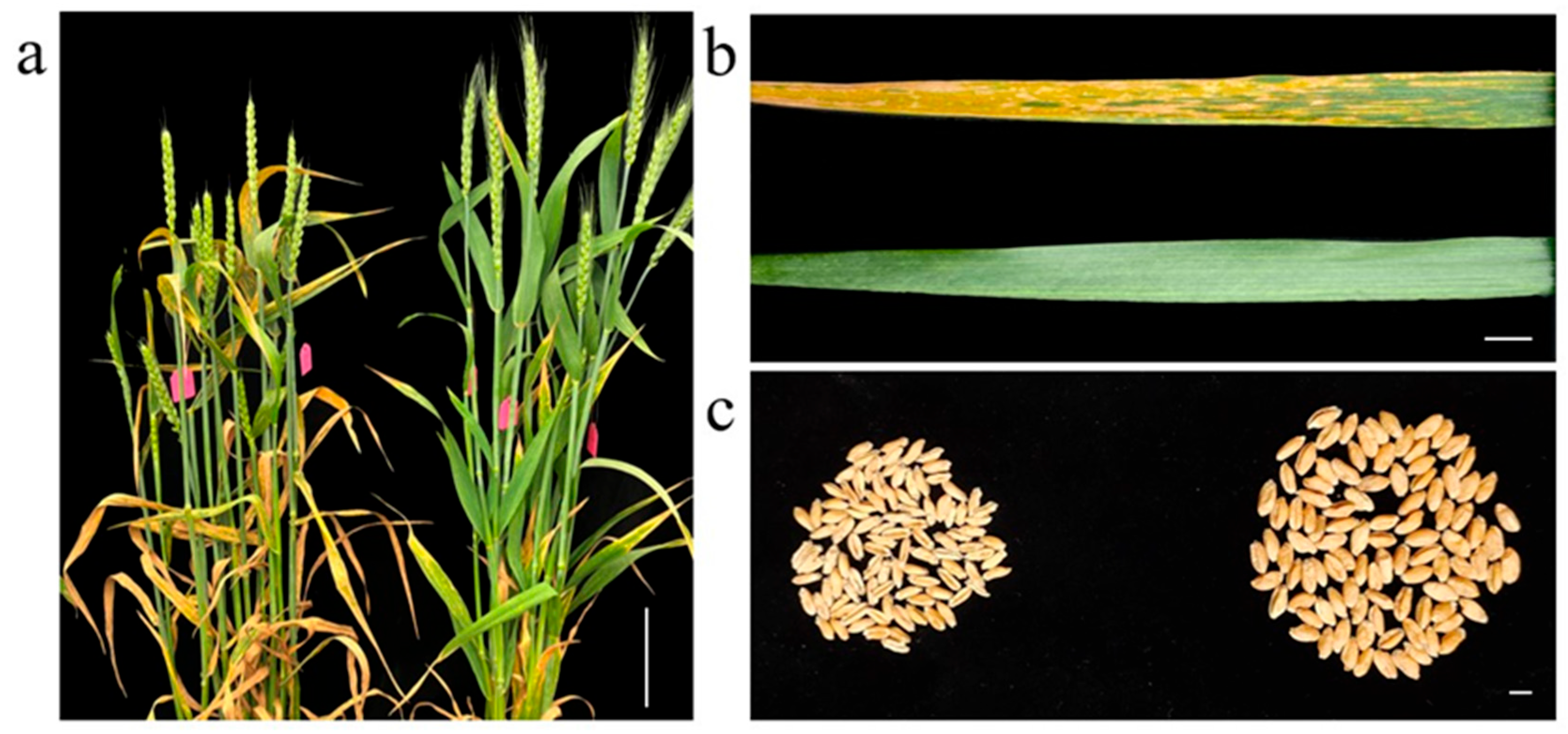
Under field conditions, CH806 exhibited resistance (IT = 0) to the mixed Pst isolate cocktail (CYR32 + CYR33 + CYR34), with no observable sporulation on its leaves. In contrast, CM24 was susceptible (IT = 8), displaying abundant spore production on the leaf surface (Figure 1).
Postharvest evaluations revealed significant differences in grain-related traits between CH806 and CM24. The total grain weight of CH806 (45.74 g) was significantly higher than that of CM24 (23.21 g; p = 0.0156). Furthermore, compared with CM24, CH806 showed significantly greater grain length, grain width, and grain diameter, with corresponding p values of 0.0003, 0.0003, and 0.0002, respectively (Table 2).

3.2. Segregation of Resistance in the Population

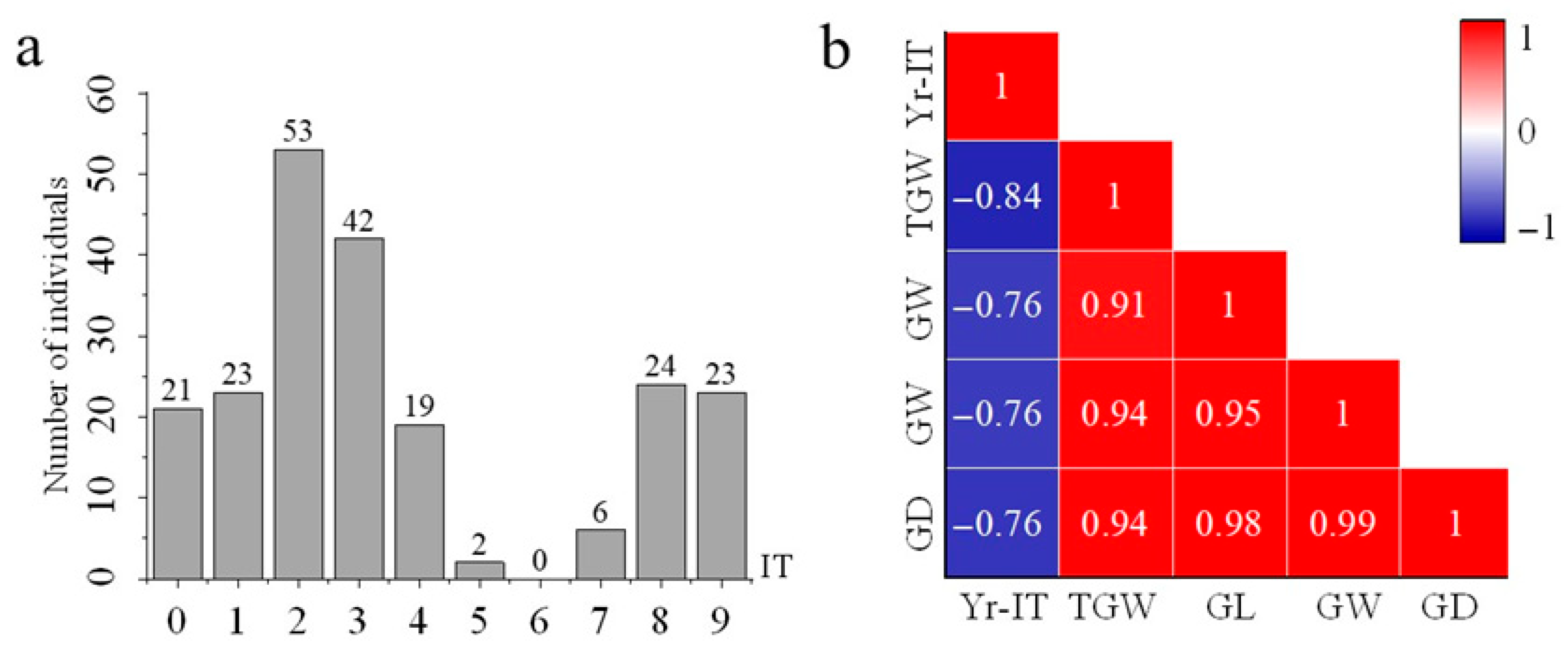
Phenotypic evaluation of the CH806 × CM24 F2 population, consisting of 213 individuals, revealed a segregation of ITs. The distribution was as follows: 21 plants with IT = 0, 23 with IT = 1, 53 with IT = 2, 42 with IT = 3, 19 with IT = 4, 2 with IT = 5, 6 with IT = 7, 24 with IT = 8, and 23 with IT = 9 (Figure 2a). On the basis of a threshold commonly separating resistant (IT 0–4) and susceptible (IT 5–9) reactions, the population contained 158 resistant and 55 susceptible plants, fitting a 3:1 segregation ratio (χ2 = 0.077; χ2(0.05,1) = 3.841). Combined with the results presented in Figure 2a, these data indicate that the resistance in CH806 is likely controlled by a single dominant gene.
The grain-related traits measured in the F2 individuals also displayed segregation (Table 2). The degree of variation in grain morphology (CV = 0.12–0.16) was lower than that for TGW (CV = 0.64). Correlation analysis indicated positive relationships among the grain morphological traits themselves. In contrast, the IT value was significantly negatively correlated with both the TGW and grain size parameters, suggesting that plants with stronger resistance to stripe rust tend to have larger grains and higher grain weight (Figure 2b).

3.3. Distribution of SNP Markers

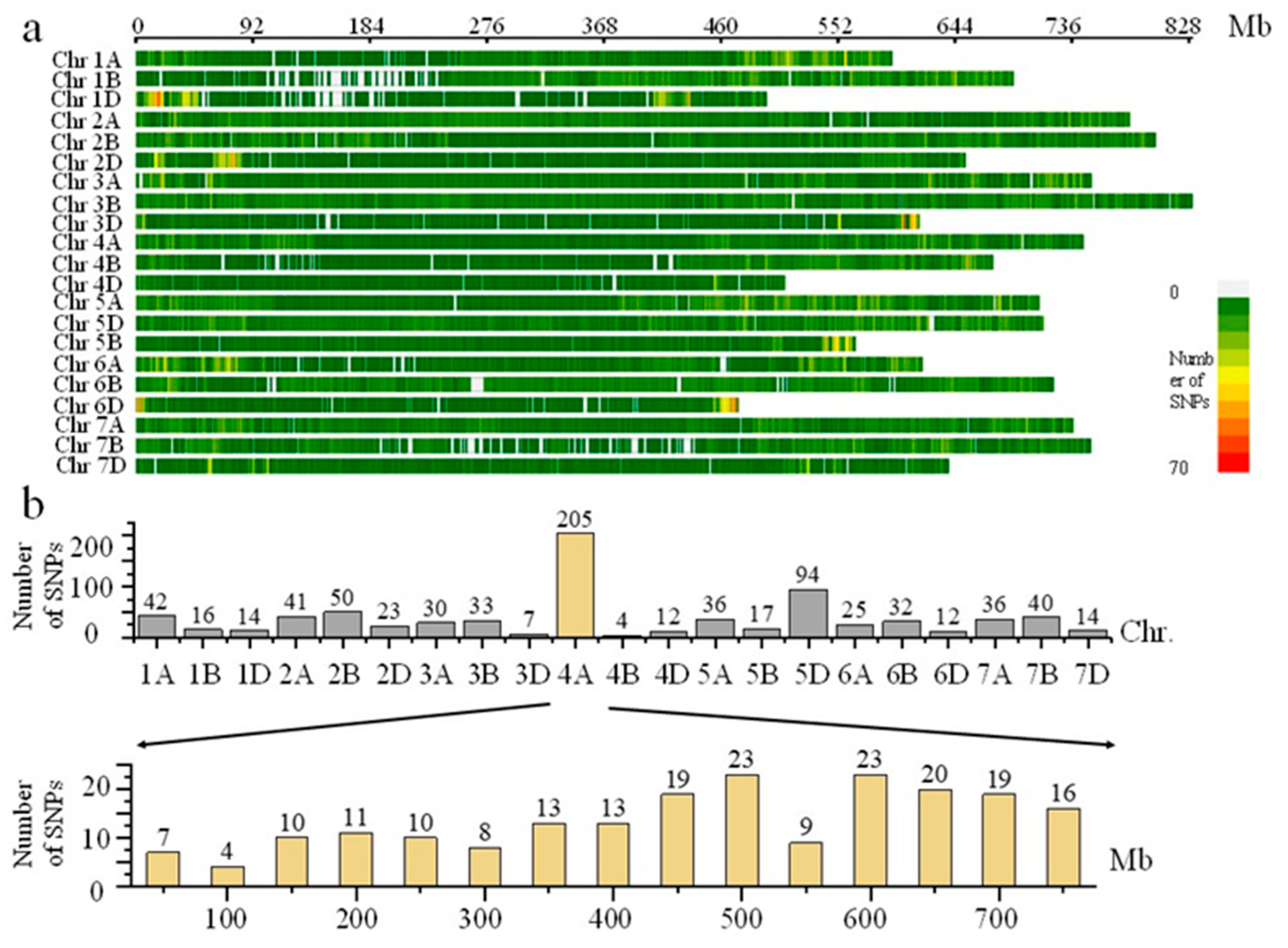
A high-density 120K SNP array, featuring markers evenly distributed across all 21 wheat chromosomes, was employed for genotyping (Figure 3a). Analysis revealed 783 markers exhibiting polymorphism between the resistant and susceptible bulks. Chromosome 4A harbored the highest number of these polymorphic markers (205), accounting for 26.18% of the total. These markers were predominantly clustered within the 450–500 Mb and 550–600 Mb intervals on chromosome 4A (Figure 3b). This pattern of concentrated polymorphism initially suggested the presence of a resistance locus on chromosome 4A.

3.4. Mapping of YrCH806

To localize the stripe rust resistance locus, 75 pairs of SSR primers were designed specifically for the 450–600 Mb region on chromosome 4A. These, combined with 23 publicly available SSR markers for wheat chromosome 4A, were screened for polymorphism between the parental lines CH806 and CM24. Between the parents of chromosome 4A, out of the 487 public SSR markers, 12 exhibited polymorphism between the parental lines, while 13 newly developed markers were also employed in the analysis. Nine SSR markers, Xwmc48, Xwmc89, Xwmc161, Xwmc617, SSR4A-14, SSR4A-43, SSR4A-60, SSR4A-71, and SSR4A-74, clearly exhibited polymorphism. These polymorphic markers were subsequently used to genotype the F2 population.
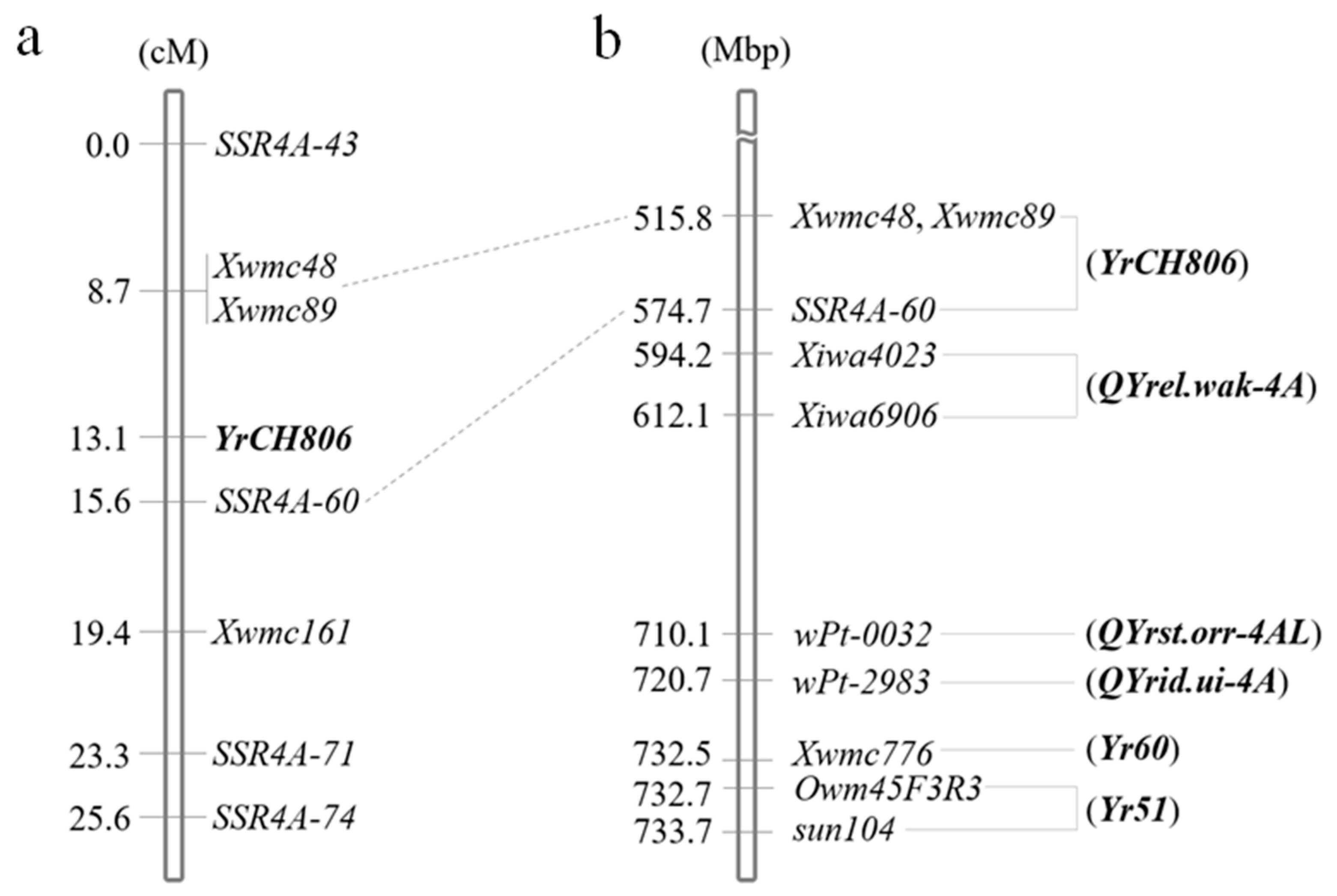
Linkage analysis was performed to integrate the genotypic data of the F2 individuals with their stripe rust resistance phenotypes. The resistance locus, temporarily designated YrCH806, was mapped to the long arm of chromosome 4A. YrCH806 was positioned in an interval flanked by the markers Xwmc48/Xwmc89 and SSR4A-60, with genetic distances of 4.4 cM and 2.5 cM, respectively. This interval corresponds to a physical position of 515.8–574.7 Mb on the reference genome (Figure 4).

3.5. KASP Marker Development

The marker SSR4A-60 showed the closest genetic linkage to YrCH806. An SNP [C/T] was identified 46 bp downstream of its SSR motif (CA)16 (TA)16 at the genomic position 4A:574,789,345. Following validation using the parental lines, a KASP marker, designated K4A-60, was successfully developed on the basis of this SNP. The genotyping results of K4A-60 are presented in Figure S1.
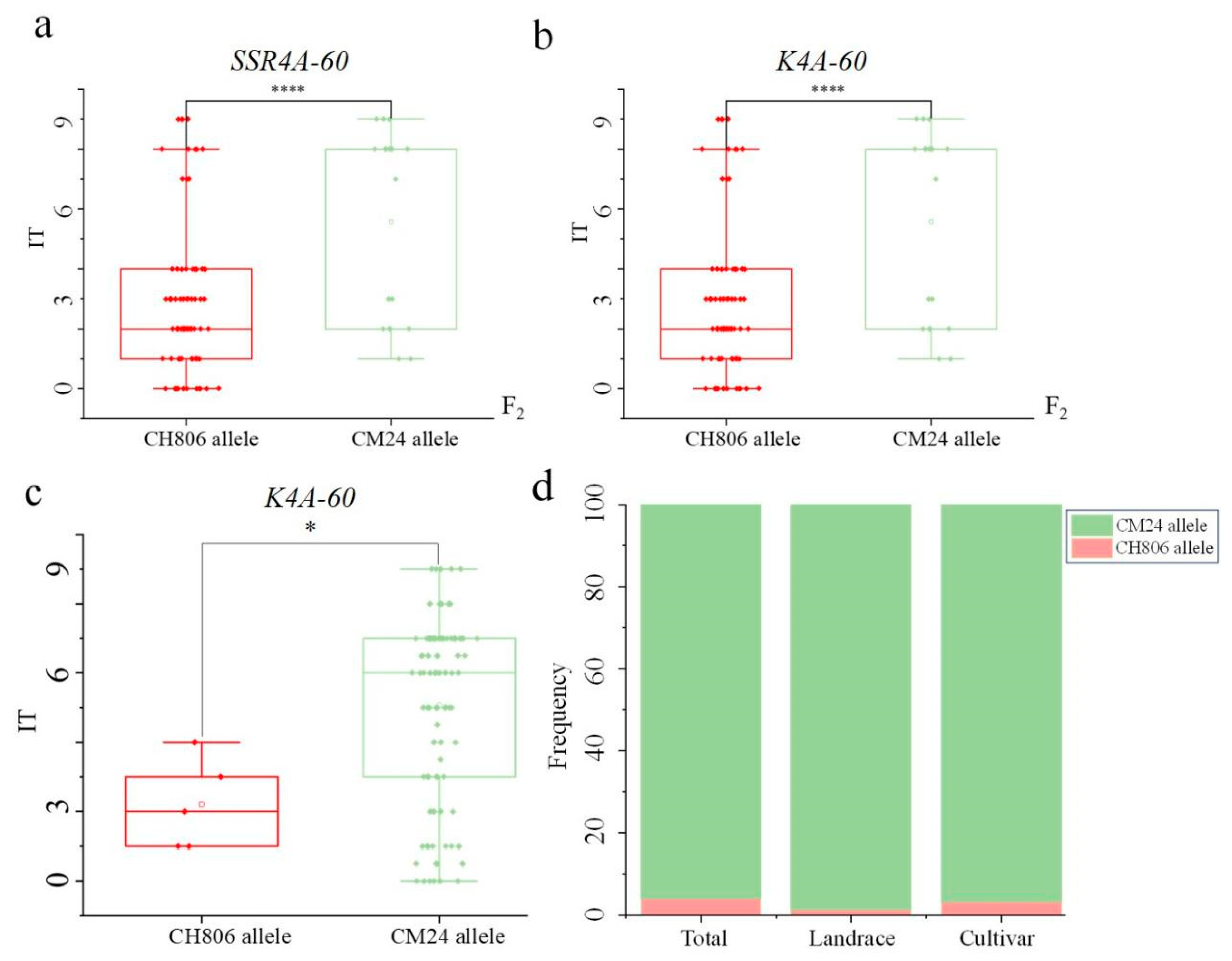
Within the F2 population, the CH806 allele at SSR4A-60 was associated with lower IT scores (higher resistance), whereas the CM24 allele was associated with higher IT scores (higher susceptibility). A highly significant phenotypic difference (p = 0.000437) was observed between plants carrying the two different SSR4A-60 alleles. The genotyping results from the KASP marker K4A-60 yielded a consistent, highly significant association (p = 0.000523) with the resistance phenotype (Figure 5a,b).

3.6. Distribution of the Two Alleles of YrCH806

Genotyping of the 114 wheat accessions with the KASP marker K4A-60 revealed that compared with those carrying the CM24 allele, the accessions carrying the CH806 allele presented a significantly lower IT index (p = 0.019) (Figure 5c). Among the 114 accessions, 109 (95.6%) carried the CM24 allele at the K4A-60 locus, which included 60 landraces and 49 modern cultivars. In contrast, only 5 accessions (4.4%) carried the CH806 allele (Figure 5d).

3.7. Annotated Genes Within the YrCH806 Region

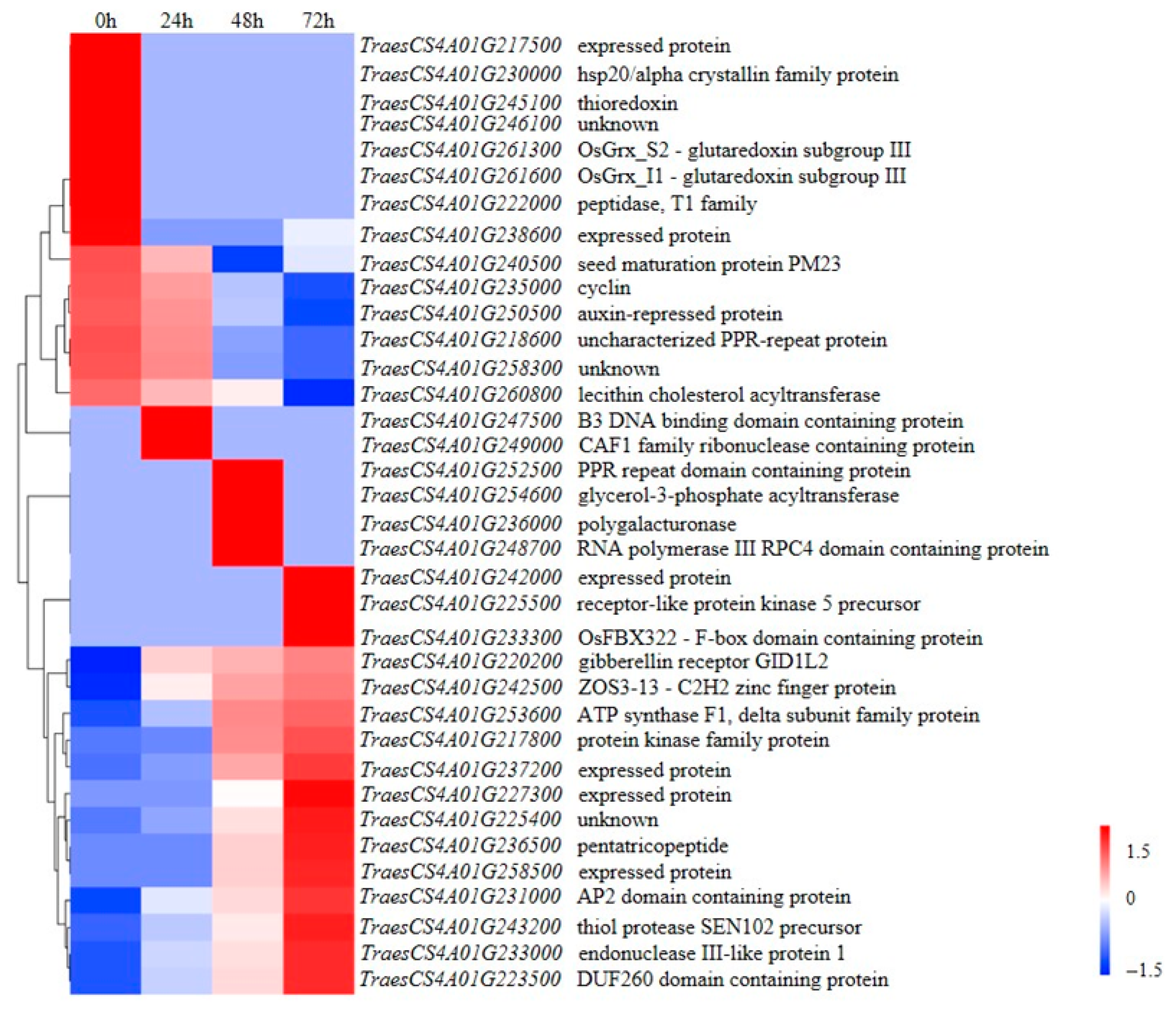
To identify candidate resistance genes within the YrCH806 interval, gene prediction analysis on the target chromosomal region (4A: 515.8–574.7 Mb) was performed by integrating coding sequence annotation information from the Chinese Spring wheat genome database (RefSeq v1.1) [30]. On the basis of tissue specificity and expression dynamics—including genes whose FPKM values consistently increased or decreased across 0, 24, 48, and 72 h, as well as those expressed exclusively at any single time point—a total of 36 genes were identified as potential candidates for YrCH806 (Table S3) [31].
The expression profiles of these 36 genes were further analyzed using a publicly available wheat gene expression dataset (Figure 6) (Table S2) [32]. Seven annotated genes were not expressed before inoculation with stripe rust but were expressed following inoculation. Among the remaining 29 genes, 13 were differentially expressed following inoculation with Pst, suggesting their potential involvement in regulating wheat resistance to stripe rust. Key differentially expressed candidate genes include TraesCS4A01G233300 (encoding an F-box domain protein), TraesCS4A01G223500 (encoding a DUF260 domain protein), TraesCS4A01G247500 (encoding a B3 DNA-binding domain protein), TraesCS4A01G254600 (encoding a glycerol-3-phosphate acyltransferase), and TraesCS4A01G236000 (encoding a polygalacturonase). The functional domains encoded by these genes are highly consistent with those of proteins known to be involved in plant disease resistance pathways. For subsequent validation of the identified genes, functional approaches such as gene editing or virus-induced gene silencing (VIGS) should be employed to confirm the roles of candidate genes.

4. Discussion

In this study, a single APR gene encoding a stripe rust resistance gene (temporarily designated as YrCH806) was successfully mapped to chromosome 4A. The resistance conferred by this gene showed a significant positive correlation with TGW. The CH806 allele of YrCH806 was retained in 1.2% of the landraces and detected in only 3.2% of the modern cultivars (Figure 5d), indicating that this allele has not been widely utilized in cultivated wheat breeding. Therefore, YrCH806 has potential for improving resistance in wheat varieties.
Several stripe rust resistance loci have been previously reported on chromosome 4A, including major genes such as Yr51 [33] and Yr60 [34] and QTLs such as QYr.sgi-4A-1 [35], QYr.sicau-4A [36], QYrel.wak-4A [37], and QYrsv.swust-4AL [38]. Notably, a cluster of QTLs, including QYr.sgi-4A.2 [39], QYr.spa-4A [40], and QYrPI181410.wgp-4AS [41], have been identified on the short arm of chromosome 4A.
The long arm of chromosome 4A also harbors multiple reported resistance loci, such as YrM8664-3 [42]. One notable QTL, QYr.dms-4A, was detected in a RIL population derived from the spring wheat cultivars Attila and CDC Go across multiple environments. Thus, it is an APR QTL. It is located at a physical position of 551.3 Mb on chromosome 4A, flanked by the markers wsnp_RFL_Contig25_2082245 and wsnp_Ra_c33762_42584098, and explains 8.5% of the phenotypic variance [43]. Another QTL, QYr.agis140, spans the physical interval 558.2–572.9 Mb; it is an APR QTL, with its closest marker being chr4A_565682828, and explains 2.96% of the phenotypic variance [44]. The gene identified in this study was mapped to the long arm region spanning 515.8–574.7 Mb, which is physically close to the previously mentioned QTLs. While all confer APR, YrCH806 is derived from a semi-spring wheat parent, whereas QYr.dms-4A and QYr.agis140 originate from spring wheat lines. This suggests a potential genetic relationship among these loci.
This study successfully developed two specific molecular markers (Xwmc48/Xwmc89 and SSR4A-60) for detecting this resistance locus. The development of these markers is of significant applied value. First, the markers provide a rapid, convenient, and efficient tool for identifying the stripe rust resistance locus, substantially reducing the time cost and potential errors associated with phenotypic evaluation. Second, they can be directly applied in marker-assisted selection (MAS) for wheat stripe rust resistance. By enabling the precise tracking of resistance genes during breeding, they will accelerate the development of improved, disease-resistant wheat varieties.
On the basis of the coding sequence annotations from the Chinese Spring wheat genome (RefSeq v1.1), we identified potential candidate genes for the target locus. Subsequent functional characterization revealed that the region harbors two classes of genes closely associated with plant disease resistance. The first category encodes secreted proteins containing cysteine-rich receptor-like domains [45], while the second comprises key genes involved in leaf cuticle synthesis [46]. Based on these findings, we hypothesize that the stripe rust resistance gene mapped in this study may confer enhanced resistance through a dual regulatory mechanism: (1) activating the wheat plant’s innate immune signaling pathways to initiate active defense responses and (2) regulating cuticle synthesis to reduce the plant’s susceptibility to Pst, thereby forming a physical or chemical barrier. This preliminary hypothesis regarding the resistance mechanism opens new avenues for subsequent research aimed at elucidating gene function and regulatory networks.
On the basis of the results of the comprehensive analysis presented above, we conclude that YrCH806 is likely a novel stripe rust resistance gene in wheat. We developed specific molecular markers for its detection and proposed its potential function through genomic analysis. Collectively, these findings enrich the genetic resources available for wheat stripe rust resistance and offer new targets for subsequent gene cloning and molecular breeding applications.

5. Conclusions

In this study, a novel stripe rust resistance locus, YrCH806, was identified within a 58.9 Mbp genomic region on the long arm of chromosome 4A in the wheat breeding line CH806, derived from Thinopyrum intermedium. Functional annotation of this interval revealed 36 potential candidate genes. Correlation analysis revealed a significant positive relationship between the presence of the YrCH806 locus and TGW. Furthermore, a diagnostic KASP marker, K4A-60, was successfully developed for YrCH806, providing an efficient tool for MAS in wheat breeding programs aimed at enhancing stripe rust resistance.

Supplementary Materials

The following supporting information can be downloaded at: https://www.mdpi.com/article/10.3390/agronomy16030397/s1, Table S1: 114 wheat germplasms used in this study; Table S2: A publicly available RNA sequencing dataset used in this study; Table S3: The 36 high-confidence genes in the YrCH806 interval; Table S4. Twenty-three publicly available SSR primers located on wheat chromosome 4A; Figure S1: Genotyping results of the KASP marker K4A-60.

Author Contributions

Conceptualization, X.L. (Xin Li); formal analysis, X.B. and L.W.; methodology, X.Z.; software, X.L. (Xue Li), X.B. and L.W.; investigation, X.B. and L.W.; resources, Z.C. and X.Z.; data curation, T.C.; writing—original draft preparation, X.B.; writing—review and editing, J.J.; project administration, X.L. (Xin Li). All authors have read and agreed to the published version of the manuscript.

Funding

This work was supported by the National Key R&D Program Project (2023YFD1201002), the Shanxi Province S & T Cooperation and Exchange Special Program (202104041101017), the Shanxi Province Key R&D Program Project (202302140601002-1), and the Shanxi Agricultural University S & T Innovation Enhancement Project (CXGC2023007).

Data Availability Statement

The original contributions presented in this study are included in the article/Supplementary Material. Further inquiries can be directed to the corresponding authors.

Conflicts of Interest

The authors declare no conflicts of interest.

References

  1. Sharma, R.; Chen, C.; Zhang, P.; Bharti, H.; Vikas, V.K.; Norman, M.; Dibley, K.; Riaz, A.; Hewitt, T.; Hoxha, S.; et al. Genomic analysis of two all-stage stripe rust resistance genes in the Vavilov wheat landrace AGG40807WHEA1. Theor. Appl. Genet. 2025, 138, 180. [Google Scholar] [CrossRef]
  2. Li, Y.; Yang, J.; Zhang, J.; Du, S.; Ji, H.; Liu, Z.; Tang, H.; Liu, P.; Wang, Q.; Zhang, H.; et al. Identification of QTLs for adult-plant stripe rust resistance in Chinese wheat landrace Yizhanghongkemai and assessment of their utility for decreasing yield loss. Mol. Breed. 2025, 45, 61. [Google Scholar] [CrossRef]
  3. He, Z.H.; Zhuang, Q.S.; Cheng, S.H.; Cheng, S.H.; Yu, Z.W.; Zhao, Z.D.; Liu, X. Wheat production and technology improvement in China. J. Agric. Sci. 2018, 8, 99–106. [Google Scholar]
  4. Duchenne-Moutien, R.A.; Neetoo, H. Climate Change and Emerging Food Safety Issues: A Review. J. Food Prot. 2021, 84, 1884–1897. [Google Scholar] [CrossRef] [PubMed]
  5. Hasegawa, T.; Sakurai, G.; Fujimori, S.; Takahashi, K.; Hijioka, Y.; Masui, T. Extreme climate events increase risk of global food insecurity and adaptation needs. Nat. Food 2021, 2, 587–595. [Google Scholar] [CrossRef] [PubMed]
  6. Chen, X.M. Epidemiology and control of stripe rust [Puccinia striiformis f. sp. tritici] on wheat. Can. J. Plant Pathol. 2005, 27, 314–337. [Google Scholar] [CrossRef]
  7. Carmona, M.; Sautua, F.; Pérez-Hérnandez, O.; Reis, E.M. Role of Fungicide Applications on the Integrated Management of Wheat Stripe Rust. Front. Plant Sci. 2020, 11, 733. [Google Scholar] [CrossRef]
  8. Zadoks, J.C. Yellow rust on wheat studies in epidemiology and physiologic specialization. Tijdschr. Over Plantenziekten 1961, 67, 69–256. [Google Scholar] [CrossRef]
  9. Rapilly, F. Yellow rust epidemiology. Annu. Rev. Phytopathol. 1979, 17, 59–73. [Google Scholar] [CrossRef]
  10. Zhao, J.; Kang, Z.S. Fighting wheat rusts in China: A look back and into the future. Phytopathol. Res. 2023, 5, 6. [Google Scholar] [CrossRef]
  11. Zeng, Q.D.; Zhao, J.; Wu, J.H.; Zhan, G.M.; Han, D.J.; Kang, Z.S. Wheat stripe rust and integration of sustainable control strategies in china. Front. Agr. Sci. Eng. 2022, 9, 37–51. [Google Scholar] [CrossRef]
  12. Wellings, C.R. Puccinia striiformis in Australia: A review of the incursion, evolution, and adaptation of stripe rust in the period 1979–2006. Aust. J. Agric. Res. 2007, 58, 567–575. [CrossRef]
  13. Line, R.F. Stripe rust of wheat and barley in North America: A retrospective historical review. Annu. Rev. Phytopathol. 2002, 40, 75–118. [Google Scholar] [CrossRef]
  14. Sharma, D.; Avni, R.; Gutierrez-Gonzalez, J.; Kumar, R.; Sela, H.; Prusty, M.R.; Shatil-Cohen, A.; Molnár, I.; Holušová, K.; Said, M.; et al. A single NLR gene confers resistance to leaf and stripe rust in wheat. Nat. Commun. 2024, 15, 9925. [Google Scholar] [CrossRef] [PubMed]
  15. Zhu, Z.; Cao, Q.; Han, D.; Wu, J.; Wu, L.; Tong, J.; Xu, X.; Yan, J.; Zhang, Y.; Xu, K.; et al. Molecular characterization and validation of adult-plant stripe rust resistance gene Yr86 in Chinese wheat cultivar Zhongmai 895. Theor. Appl. Genet. 2023, 136, 142. [Google Scholar] [CrossRef]
  16. Singh, R.P.; Huerta-Espino, J.; Rajaram, S. Achieving near-immunity to leaf and stripe rusts in wheat by combining slow rusting resistance genes. Acta Phytopathol. Entomol. Hung. 2000, 35, 133–139. [Google Scholar]
  17. Singh, R.P.; Singh, P.K.; Rutkoski, J.; Hodson, D.P.; He, X.; Jørgensen, L.N.; Hovmøller, M.S.; Huerta-Espino, J. Disease Impact on Wheat Yield Potential and Prospects of Genetic Control. Annu. Rev. Phytopathol. 2016, 54, 303–322. [Google Scholar] [CrossRef]
  18. Wiesner-Hanks, T.; Nelson, R. Multiple Disease Resistance in Plants. Annu. Rev. Phytopathol. 2016, 4, 229–252. [Google Scholar] [CrossRef]
  19. Hovmøller, M.S.; Walter, S.; Justesen, A.F. Escalating threat of wheat rusts. Science 2010, 329, 369. [Google Scholar] [CrossRef] [PubMed]
  20. Liu, L.; Han, J.; Zhang, D.; Li, Y.; Zhang, C.; Liu, S.; Yan, Z.; Zheng, W.; Li, C.; Zeng, Q.; et al. Genotyping by target sequencing (GBTS)-based genetic mapping uncovers synergistic interactions for stripe rust resistance in wheat cultivar Flanders. Theor. Appl. Genet. 2025, 138, 187. [Google Scholar] [CrossRef]
  21. AlHusnain, L.; Shahin, A.; Mehiar, F.; Attia, K.A.; Eid, M.; Hafez, Y.; Al-Harbi, N.A.; Abdelaal, K. Heritability of durable resistance to stripe rust in bread wheat (Triticum aestivum L.). Open Life Sci. 2025, 20, 20251072. [Google Scholar] [CrossRef]
  22. Shahin, A.A. Effective genes for resistance to wheat yellow rust and virulence of Puccinia striiformis f. sp. tritici in Egypt. Egypt. Acad. J. Biol. Sci. 2017, 8, 1–10. [Google Scholar] [CrossRef]
  23. Shahin, A.A. Occurrence of new races and virulence changes of the wheat stripe rust pathogen (Puccinia striiformis f. sp. tritici) in Egypt. Arch. Phytopathol. Plant. 2020, 53, 552–569. [Google Scholar] [CrossRef]
  24. Shahin, A.A.; Ashmawy, M.; El-Orabey, W.; Esmail, S. Yield losses in wheat caused by stripe rust (Puccinia striiformis) in Egypt. Am. J. Life Sci. 2020, 8, 127–134. [Google Scholar] [CrossRef]
  25. Chen, J.; Zhang, L.; Liu, Y.; Shen, X.; Guo, Y.; Ma, X.; Zhang, X.; Li, X.; Cheng, T.; Wen, H.; et al. RNA-Seq-Based WGCNA and Association Analysis Reveal the Key Regulatory Module and Genes Responding to Salt Stress in Wheat Roots. Plants 2024, 13, 274. [Google Scholar] [CrossRef]
  26. Line, R.F.; Qayoum, A. Virulence, Aggressiveness, Evolution, and Distribution of Races of ‘Puccinia striiformis’ (the Cause of Stripe Rust of Wheat) in North America, 1968–1987; Technical Bulletin (USA); United States Department of Agriculture, Agricultural Research Service: Washington, DC, USA, 1992. [Google Scholar]
  27. Doyle, J.J.; Doyle, J.L. A rapid DNA isolation procedure for small quantities of fresh leaf tissue. Phytochem. Bulletin. 1987, 19, 11–15. [Google Scholar]
  28. Qiao, L.; Zhang, X.; Li, X.; Zhang, L.; Zheng, J.; Chang, Z. Development of NBS-related microsatellite (NRM) markers in hexaploid wheat. Euphytica 2017, 213, 256. [Google Scholar] [CrossRef]
  29. Meng, L.; Li, H.H.; Zhang, L.Y.; Wang, J.K. QTL IciMapping: Integrated software for genetic linkage map construction and quantitative trait locus mapping in biparental populations. Crop J. 2015, 3, 269–283. [Google Scholar] [CrossRef]
  30. Wu, J.; Ma, S.; Niu, J.; Sun, W.; Dong, H.; Zheng, S.; Zhao, J.; Liu, S.; Yu, R.; Li, Y.; et al. Genomics-driven discovery of superior alleles and genes for yellow rust resistance in wheat. Nat. Genet. 2025, 57, 2017–2027. [Google Scholar] [CrossRef] [PubMed]
  31. Qiao, L.; Li, Y.; Wang, L.; Gu, C.; Luo, S.; Li, X.; Yan, J.; Lu, C.; Chang, Z.; Gao, W.; et al. Identification of Salt-Stress-Responding Genes by Weighted Gene Correlation Network Analysis and Association Analysis in Wheat Leaves. Plants 2024, 13, 2642. [Google Scholar] [CrossRef]
  32. Zhang, H.; Yang, Y.; Wang, C.; Liu, M.; Li, H.; Fu, Y.; Wang, Y.; Nie, Y.; Liu, X.; Ji, W. Large-scale transcriptome comparison reveals distinct gene activations in wheat responding to stripe rust and powdery mildew. BMC Genom. 2014, 15, 898. [Google Scholar] [CrossRef]
  33. Randhawa, M.; Bansal, U.; Valárik, M.; Klocová, B.; Doležel, J.; Bariana, H. Molecular mapping of stripe rust resistance gene Yr51 in chromosome 4AL of wheat. Theor. Appl. Genet. 2014, 127, 317–324. [Google Scholar] [CrossRef] [PubMed]
  34. Herrera-Foessel, S.A.; Singh, R.P.; Lan, C.X.; Huerta-Espino, J.; Calvo-Salazar, V.; Bansal, U.K.; Bariana, H.S.; Lagudah, E.S. Yr60, a Gene Conferring Moderate Resistance to Stripe Rust in Wheat. Plant Dis. 2015, 99, 508–511. [Google Scholar] [CrossRef]
  35. Maccaferri, M.; Zhang, J.; Bulli, P.; Abate, Z.; Chao, S.; Cantu, D.; Bossolini, E.; Chen, X.; Pumphrey, M.; Dubcovsky, J. A genome-wide association study of resistance to stripe rust (Puccinia striiformis f. sp. tritici) in a worldwide collection of hexaploid spring wheat (Triticum aestivum L.). G3 Genes Genomes Genet. 2015, 5, 449–465. [Google Scholar] [CrossRef]
  36. Ma, J.; Qin, N.; Cai, B.; Chen, G.; Ding, P.; Zhang, H.; Yang, C.; Huang, L.; Mu, Y.; Tang, H.; et al. Identification and validation of a novel major QTL for all-stage stripe rust resistance on 1BL in the winter wheat line 20828. Theor. Appl. Genet. 2019, 132, 1363–1373. [Google Scholar] [CrossRef]
  37. Klarquist, E.; Chen, X.; Carter, A. Novel QTL for stripe rust resistance on chromosomes 4A and 6B in soft white winter wheat cultivars. Agronomy 2016, 6, 4. [Google Scholar] [CrossRef]
  38. Zhou, X.; Zhong, X.; Roter, J.; Li, X.; Yao, Q.; Yan, J.; Yang, S.; Guo, Q.; Distelfeld, A.; Sela, H.; et al. Genome-Wide Mapping of Loci for Adult-Plant Resistance to Stripe Rust in Durum Wheat Svevo Using the 90K SNP Array. Plant Dis. 2021, 105, 879–888. [Google Scholar] [CrossRef]
  39. Prins, R.; Pretorius, A.Z.; Bender, M.C.; Lehmensiek, A. QTL mapping of stripe, leaf and stem rust resistance genes in a Kariega × Avocet S doubled haploid wheat population. Mol. Breeding. 2011, 27, 259–270. [Google Scholar] [CrossRef]
  40. Bokore, F.E.; Cuthbert, R.D.; Knox, R.E.; Randhawa, H.S.; Hiebert, C.W.; DePauw, R.M.; Singh, A.K.; Singh, A.; Sharpe, A.G.; N’Diaye, A.; et al. Quantitative trait loci for resistance to stripe rust of wheat revealed using global field nurseries and opportunities for stacking resistance genes. Theor. Appl. Genet. 2017, 130, 2617–2635. [Google Scholar] [CrossRef]
  41. Liu, Y.; Qie, Y.; Li, X.; Wang, M.; Chen, X. Genome-Wide Mapping of Quantitative Trait Loci Conferring All-Stage and High-Temperature Adult-Plant Resistance to Stripe Rust in Spring Wheat Landrace PI 181410. Int. J. Mol. Sci. 2020, 21, 478. [Google Scholar] [CrossRef]
  42. Chao, K.; Yang, J.; Liu, H.; Jing, J.; Li, Q.; Wang, B.; Ma, D. Genetic and Physical Mapping of a Putative Leymus mollis-Derived Stripe Rust Resistance Gene on Wheat Chromosome 4A. Plant Dis. 2018, 102, 1001–1007. [Google Scholar] [CrossRef] [PubMed]
  43. Zou, J.; Semagn, K.; Chen, H.; Iqbal, M.; Asif, M.; N’Diaye, A.; Navabi, A.; Perez-Lara, E.; Pozniak, C.; Yang, R.C.; et al. Mapping of QTLs associated with resistance to common bunt, tan spot, leaf rust, and stripe rust in a spring wheat population. Mol. Breed. 2017, 37, 144. [Google Scholar] [CrossRef]
  44. Cheng, S.; Feng, C.; Wingen, L.U.; Cheng, H.; Riche, A.B.; Jiang, M.; Leverington-Waite, M.; Huang, Z.; Collier, S.; Orford, S.; et al. Harnessing landrace diversity empowers wheat breeding. Nature 2024, 632, 823–831. [Google Scholar] [CrossRef]
  45. Huang, C.; Wang, D.; Chen, H.; Deng, W.; Chen, D.; Chen, P.; Wang, J. Genome-Wide Identification of DUF26 Domain-Containing Genes in Dongxiang Wild Rice and Analysis of Their Expression Responses under Submergence. Curr. Issues Mol. Biol. 2022, 44, 3351–3363. [Google Scholar] [CrossRef]
  46. Li, Y.; Beisson, F.; Koo, A.J.; Molina, I.; Pollard, M.; Ohlrogge, J. Identification of acyltransferases required for cutin biosynthesis and production of cutin with suberin-like monomers. Proc. Natl. Acad. Sci. USA 2007, 104, 18339–18344. [Google Scholar] [CrossRef] [PubMed]
Figure 1. Phenotypes of parental plants inoculated with the mixed Pst isolate cocktail (CYR32 + CYR33 + CYR34) under field conditions. (a) CM24 (left) and CH806 (right) plants. Scale bar = 15 cm. (b) Flag leaves of CM24 (upper) and CH806 (lower). Scale bar = 3 cm. (c) Grains of CM24 (left) and CH806 (right). Scale bar = 1 cm.
Agronomy 16 00397 g001
Figure 2. Phenotypic variation among individuals in the CH806 × CM24 F2 population. (a) Frequency distribution of ITs following inoculation. (b) Correlation analysis between the resistance phenotype IT and grain weight/size traits. Red indicates a positive correlation, and blue indicates a negative correlation.
Agronomy 16 00397 g002
Figure 3. Distribution of SNP markers across wheat chromosomes. (a) Overview of SNP markers on the 120K-4HWA array. (b) Number distribution of polymorphic SNP markers per chromosome.
Agronomy 16 00397 g003
Figure 4. Location of the stripe rust resistance QTL in the CH806 × CM24 population and its linked markers. (a) Genetic map; (b) Physical map.
Agronomy 16 00397 g004
Figure 5. Evaluation of the YrCH806 locus in the CH806 × CM24 population. Green and red represent the CM24 allele and the CH806 allele, respectively. (a) Differences in IT among F2 individuals based on homozygous genotypes for the marker SSR4A-60. (b) Differences in IT among F2 individuals based on homozygous genotypes for the marker after its conversion to the KASP marker K4A-60. (c) Differences in IT among 114 accessions (comprising 62 landraces and 52 modern cultivars) based on the two K4A-60 alleles. (d) Distribution frequency of the YrCH806 allele across the 114 accessions. * denotes p < 0.05, and **** denotes p < 0.0001.
Agronomy 16 00397 g005
Figure 6. Expression patterns of the 36 annotated genes within the YrCH806 region in flag leaves following inoculation with Pst strain CYR31. The color gradient from blue to red indicates an increase in FPKM values.
Agronomy 16 00397 g006
Table 1. Sequences of partial primers used in this study.
Primer NamePhysical Position (bp)Forward Primer Sequence (5′-3′)Reverse Primer Sequence (5′-3′)
SSR4A-434A-445763016CGGAGGGGAAAATCGCCAGCGGTACATCGATCGTTCG
SSR4A-604A-574789192GACATGAACACCACAGACGGGTACGTGACGCGTTTACT
SSR4A-714A-724007715CCATGGACCCTGCGTCTTTCTATCCCCTCGGCGAAC
SSR4A-744A-724266141CTAGGGTTTGGCATGGTGCAGAGAAAGAGGTGGATCAGC
K4A-604A-5747893451: GAAGGTGACCAAGTTCATGCTGCAACACAATTCTGAGTCTGC
2: GAAGGTCGGAGTCAACGGATTGCAACACAATTCTGAGTCTGT
ATGCGGTACGTGACGCGTT
Table 2. Phenotypic evaluation of the CH806 × CM24 F2 population and its parents.
TraitParentsF2 Population
CH806CM24.MinMaxMeanCV
IT08195.800.54
TGW (g)45.7423.21 ***2.0057.3824.230.64
GL (mm)9.868.83 ***4.917.826.360.12
GW (mm)4.833.83 ***1.973.682.750.16
GD (mm)6.775.71 ***3.085.264.150.14
IT: Infection Type; TGW: Thousand-Grain Weight; GL: Grain Length; GW: Grain Width; GD: Grain Diameter; CV: Coefficient of Variation. Significant differences are denoted as *** p < 0.001.
Disclaimer/Publisher’s Note: The statements, opinions and data contained in all publications are solely those of the individual author(s) and contributor(s) and not of MDPI and/or the editor(s). MDPI and/or the editor(s) disclaim responsibility for any injury to people or property resulting from any ideas, methods, instructions or products referred to in the content.