Article

Legume Intercropping Can Boost Early-Stage Carob Plantation Establishment

1
Department of Biological Sciences, University of Cyprus, Nicosia 1678, Cyprus
2
KES Research Centre, Nicosia 1055, Cyprus
3
School of Environmental Studies, KES College, Nicosia 1055, Cyprus
*
Author to whom correspondence should be addressed.
Agronomy 2026, 16(3), 396; https://doi.org/10.3390/agronomy16030396

Submission received: 30 December 2025 / Revised: 23 January 2026 / Accepted: 3 February 2026 / Published: 6 February 2026

Abstract

Tree intercropping systems with leguminous cover crops and aromatic plants may provide sustainable yields, which could be improved by beneficial microbes (BMs) and zeolite, while their effects on young tree growth remain unclear. We tested whether such systems enhance early growth in young carob trees compared with conservation tillage (TLG) trees growing under rainfed semi-arid conditions. Intercropping included carobs with (i) Lathyrus ochrus, Trifolium squarrosum, and Lens culinaris combined (CC-System), (ii) Thymbra capitata planted between legumes (CCT-System), and soil amended with (iii) BM (Micosat-F-Olivo) and zeolite. All systems outperformed TLG in annual tree height increase with the CC-System excelling (TLG +13%, CC-System +42%; p < 0.05). The CC-System also significantly outpaced TLG in stem thickening (TLG 62%, CC-System 167%; p < 0.01) with BM and/or zeolite also appearing as beneficial. Improved performance was related to significantly higher dry season soil moisture, while a high L. ochrus abundance reduced thyme survival (p < 0.01). The CCT-System was also found to be less capable in weed suppression during a wet year. Thus, applying our legume intercropping system (with BM/zeolite) represents an effective nature-based solution for enhancing young carob tree growth under rainfed conditions, while adding thyme may somewhat trade productivity for biodiversity and associated ecosystem services.

1. Introduction

The Mediterranean region is considered a climate change hot spot, with temperatures predicted to increase and rainfall to decline in the next decades, making its farming systems particularly vulnerable to drought [1,2,3]. Furthermore, widely adopted practices of intensive agriculture in the region, such as the application of tillage, the dependence on synthetic inputs, and monocropping, are quickly degrading limited soil resources, impairing soil biodiversity and reducing soils’ water infiltration capability [1,4,5]. On the other hand, nature-based farming solutions that help conserve water and protect soils from degradation may mitigate the above problems, particularly in drylands which are predicted to occupy 50% of the planet’s land mass by the end of this century [6].
Cover crops are primarily grown to protect the soil, support seedling establishment, and enhance soil properties between cropping periods [7]. The addition of annual and perennial cover crops or rows of herbaceous species within fruit trees systems, known as intercropping [8], can be a suitable nature-based farming solution to diversify agroecosystems. Intercropping can be an effective way to manage weeds [9,10,11], improve biodiversity [12,13] and diversify incomes for farmers [8,14], offering more stability under climate change. More specifically, intercropping with nitrogen-fixing leguminous plants, such as Lathyrus spp., can improve soil properties [15,16], enhance yields [4,17] and efficiently control weeds [18]. Moreover, combining clovers (Trifolium spp.) with unmanaged wild vegetation may improve biodiversity compared with tilled plots [19,20]. Although extensive research exists on annual legume intercropping systems and their benefits [14,21], systems based on woody plants and especially combining trees with perennial aromatics have not yet been sufficiently studied [10]. Aromatic plants can form perennial living mulch, which is a form of cover crop that can be maintained over multiple years without the need for reseeding [22]. Incorporating drought-adapted aromatic plants in dryland agroforestry systems is another approach that can improve soil water content [16,23] and help manage weeds [10] without sacrificing fruit yields [23,24,25].
However, intercropping multiple crop species, such as legumes and aromatic plants, may lead to competition for limited natural resources and require additional management [25,26]. Overall, the establishment of legume and aromatic intercropping systems may be assisted by beneficial microbes and other amendments [27,28,29].
Beneficial microbes are included in soil ecological engineering [30]. It involves the use of natural soil amendments to support plant establishment, particularly during their establishment phase under rainfed dryland conditions. During establishment, plants are more vulnerable to consecutive years of drought due to their shallow root system that does not permit access to deeper soil moisture [31,32]. These amendments can include soil beneficial microbes, notably arbuscular mycorrhizal fungi and plant growth-promoting bacteria, which can be valuable for improving crop tolerance to drought [33]. A further boost may be provided by natural minerals such as zeolites. These minerals have been found to increase available soil moisture [34] and moderate overall water and nutrient release [35], improving plant and beneficial microbe activity [36]. Several important Mediterranean tree crops (e.g., olive trees and grape wines) are being amended with beneficial microbes in their soil, improving yields and their response to disease and drought [37,38]. However, such treatments are under investigated for carob trees [39,40], which are a crop of rising commercial and ecological value [41].
Carob (Ceratonia siliqua L.) belongs to the Fabaceae family. The evergreen species typically occurs in mild, dry environments characterized by marginal, calcareous soils [42]. Carob fruit is increasingly used for nutritional and pharmaceutical purposes, including in gluten-free products, as a stabilizer and thickener, and in anti-cancer and antidiabetic drugs [41,42,43,44]. Carob cultivation has been widespread in the Mediterranean basin with carob-based agroforestry recorded in semi-arid and arid regions, such as Tunisia [45], Greece [46] and Cyprus [26]. One of the options for carob agroforestry is to combine it with nitrogen-fixing plants, as carob yields have been found to increase when nitrogen is applied [42].
Lathyrus sp., a genus with nitrogen fixing properties, has over 180 species [47], including Lathyrus ochrus (Cyprus vetch) [48]. Lathyrus sp. is widely used as animal fodder and green manure [49]. Known for its allelopathic properties [50] and drought resistance [49], Lathyrus ochrus could be adopted as an inter-cropping cover crop for weed management in dryland agroecosystems. Lens culinaris, a dryland-adapted legume with a recorded hardiness to drought stress, especially under no-till conditions [51], can conserve soil moisture and reduce weed competition [52] when used as a cover crop. Trifolium squarrosum as a cover crop can improve nitrogen uptake and yields in organic no-till vegetable systems [53] as well as reduce weed competition [54]. Such nitrogen-fixing plant species, when combined, can provide more efficient soil cover and weed suppression, as they grow at different distances from the ground [55]. Their roots can also penetrate the ground at different depths for more effective moisture retention [56,57], nitrogen enrichment in the soil and supporting belowground microbial communities [58]. These properties in turn may support the productivity of no-till carob and other dryland tree crop systems. However, to date, their combined effect has not been tested.
Thymbra capitata [(L.) Cav.], a synonym of Thymus capitatus (L.) Hoffmanns. et Link.J, is an aromatic plant well adapted to extreme drought stress and low water availability [59]. Intercropped with trees, thyme can improve soil properties [23,60], enhance water availability [61] and help control weeds [12]. When intercropped with productive trees under semi-arid conditions, T. capitata was found to improve both the trees’ water content and productivity while enhancing the agroforestry system’s environmental performance [26]. With blooming that expands over the dry summer months, T. capitata supports local pollinators [62,63], further enhancing biodiversity indices when included in intercropping agroecosystems.
Although legume- and aromatic-based intercropping systems have been increasingly studied, their effects on the early growth of trees under rainfed dryland conditions remain poorly understood. In this study, rainfed intercropping systems of young carob trees with combinations of leguminous cover crops, beneficial microbes, zeolite and thyme were tested under rainfed conditions in a semi-arid region to address the following research questions:
(1) Can leguminous cover crops improve young carob trees’ primary and secondary growth, compared with conservation tillage plots, when intercropped with rainfed carobs? Could beneficial microbes (BMs) and zeolite further improve the intercropping system’s performance?
It is not always clear if legume intercropping can be beneficial in dryland agroecosystems, as there are concerns mainly regarding competition for limited water resources. We hypothesize that legumes species that have low water needs and can also act as cover crops protecting soil from evaporation can boost tree growth compared with conservation tillage treatments by possibly improving soil moisture availability (and perhaps nutrients and soil microbial communities). This could further be enhanced with BMs and zeolite.
(2) What would be the effect on carob growth by adding mature Thymbra capitata plants in the above systems?
T. capitata has been recently shown to effectively act as living mulch when included in carob agroecosystems. We hypothesize that T. capitata as living mulch can improve soil moisture and tree growth compared with conservation tillage while promoting biodiversity and its ecosystem services.
(3) How is the survival rate of thyme affected when intercropped with Lathyrus ochrus?
Lathyrus ochrus is a fast-growing cover crop that can easily dominate in plant communities. Our hypothesis is that slow-growing thyme might be outcompeted by the Lathyrus, limiting its establishment in intercropping systems.
This paper provides an insight into the performance of novel intercropping systems under rainfed conditions and their potential application as nature-based solutions for sustainable agroforestry and for improving soil health in drylands threatened by desertification.

2. Materials and Methods

The field experiment was conducted under rainfed conditions in Cyprus in the site named Orites (Pafos district, 34°43′29.48″ N, 32°37′49.29″ E). The site spans over 29.5 hectares at ca. 429 m above sea level. Two-year-old carob trees (germinated in 2015) were planted on site during fall of 2017 at 7 m spacing in a 7 × 7 m arrangement, corresponding to a density of 204 trees ha−1.

2.1. Climate and Soil Conditions

Soil at the Orites site is characterized by a clayey, strongly calcareous soil (24.97% CaCO3) classified as skeletal calcaric Regosols/calcaric lithic Leptosols, with moderate organic matter (4.47%) but low available phosphorus (8.86 ppm) and mineral nitrogen (1.57 ppm), indicating moderate inherent fertility constrained by carbonate-induced nutrient availability limitations (Table 1). Soil analysis was performed at the Agricultural Research Institute of Cyprus.
Rainfall data were used from the closest to the site rainfall station, Orites (station number 141, 34°43′28.35″ N, 32°38′39.15″ E), at 380 m above sea level. Temperature data were retrieved from the closest meteorological station, Asprokremmos (station number 94, 34°43′39.70″ N, 32°33′6.55″ E), at 89 m above sea level. The stations belong to the network of the Cyprus Department of Meteorology and are less than 10 km away from the experimental site. As a measure of climatic dryness, the De Martonne’s Aridity Index (DMAI) was calculated, i.e., DMAI = r/(Ta + 10) [70], where r = total annual precipitation (mm) and Ta = annual mean temperature (°C) within the hydrological year (October–September) (Table 2). A DMAI below 20 signifies semi-arid conditions [70].
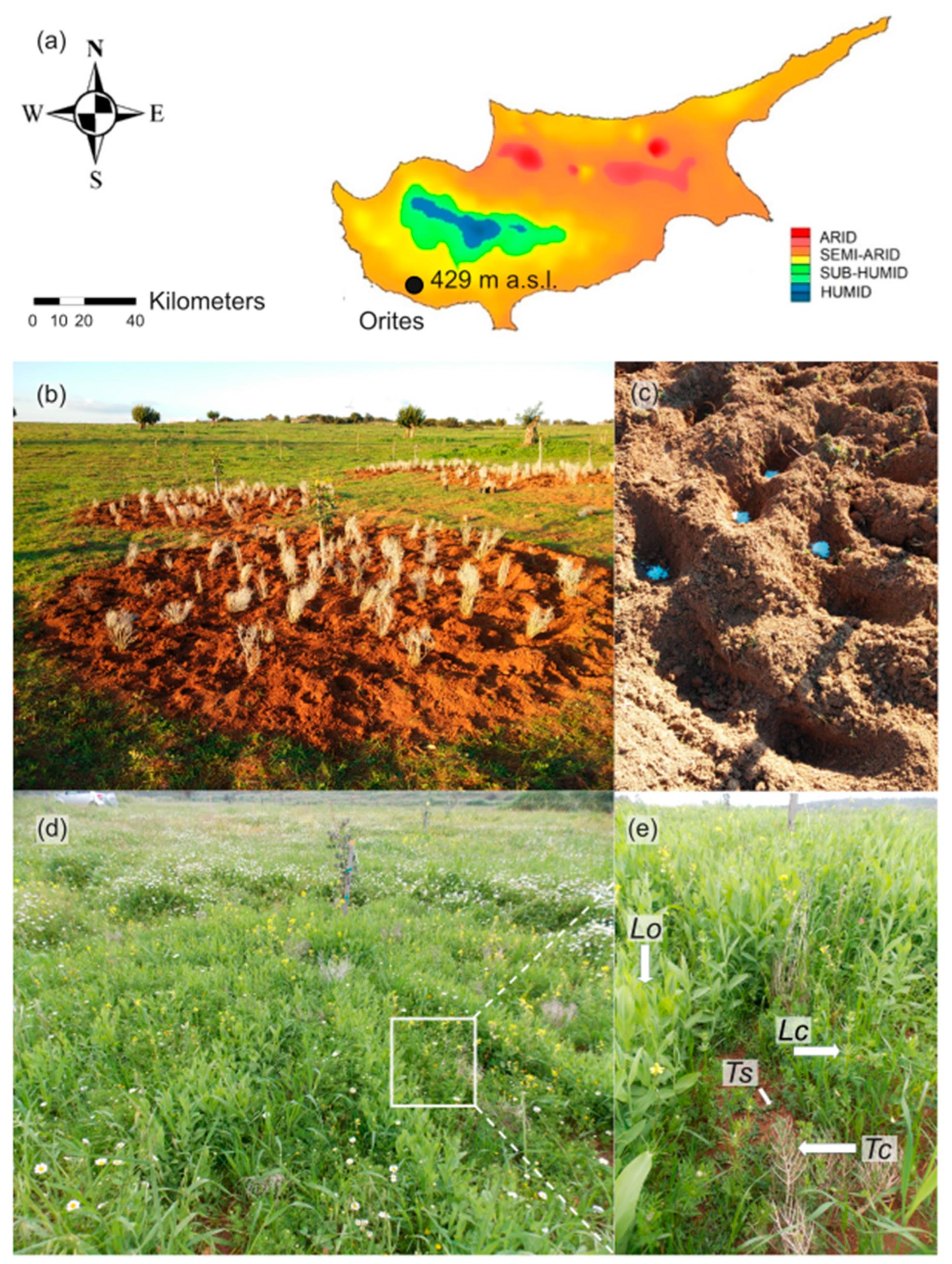
The area has a semi-arid climate under normal conditions with normal rainfall for the site at 481 mm (DMAI = 16, October–September, 1981–2010) [71] and an average temperature of 19.5 °C. The experiment spanned from December 2018 to April 2020. It fell within two hydrological years, namely Year 1 (Y1, October 2018–September 2019) and Year 2 (Y2, October 2019–September 2020). Over the course of the experiment, the plants experienced a long, dry season (rainfall below 2 mm per month for the 5 hottest months during the months studied), a rainy winter during Y1 and normal conditions during Y2. Specifically, very wet conditions prevailed during first wet season (Y1, 2018–2019; 179% of normal rainfall; 862 mm October–September rainfall; DMAI = 28; Table 2). This was followed by a normal hydrological year in 2019–2020 (Y2, 101% of normal rainfall; 487 mm October–September rainfall; DMAI = 16; Table 2), creating semi-arid conditions during Y2 of the experiment (Figure 1).

2.2. Intercropping Experimental Design

The experiment was conducted with young carob trees. Prior to experiment initiation, trees were irrigated during dry months and managed with conventional tillage for weed control for the first two years of tree establishment. The plots were not irrigated, weeded, or fertilized for the duration of the experiment. Smaller trees and those at the site edge were excluded from the study to minimize the edge effects on microclimate and resource competition, ensuring that neighboring trees had similar initial vigor and size. This minimized variation in competition for water and nutrients among selected trees. Trees meeting these criteria were randomly assigned to each treatment.
In total, 37 trees were selected. A ca. 13 m2 circular plot was delineated around each selected tree with a radius approximately twice the tree height. Seven intercropping plot types were tested (N = 3–5 trees in each plot type), as described in Section 2.2.1, Section 2.2.2, Section 2.2.3 and Section 2.2.4. The seven plot types were then organized in two main intercropping system groups as depicted in Table 3. In total, 12 trees were assigned to legume cover crops treatments (CC-System), 20 to legume cover crops combined with thyme plants (CCT-System) and 5 to conservation tillage (TLG). The CC- and CCT-Systems subgroups were tested for any possible effects of beneficial microbes and/or zeolite.
The description of the seven plot types established and monitored between December 2018 and April 2020 follows (also see Figures S1–S8).

2.2.1. Legume Cover Crops (C)

The legume cover crops plots contained a combination of Lathyrus ochrus, Lens culinaris and Trifolium squarrosum sown only once during the wet season of Y1 (C plots). Lathyrus ochrus seeds were first sown in 2–3 cm deep grooves radiating outward from the base of each tree at a density of ca. 44 gr/m2 during mid-January of Y1 (2019). In the spaces where sowed cover crops failed to sprout, Lens culinaris (Y1, early-February 2019, ca. 40 gr/m2) and Triforium squarrosum (Y1, mid-March 2019, ca. 47 gr/m2) were sown to assure full soil coverage during the following dry season months. Five C plots were established.

2.2.2. Legume Cover Crops with Beneficial Microbes (CM) and Zeolite (CMZ)

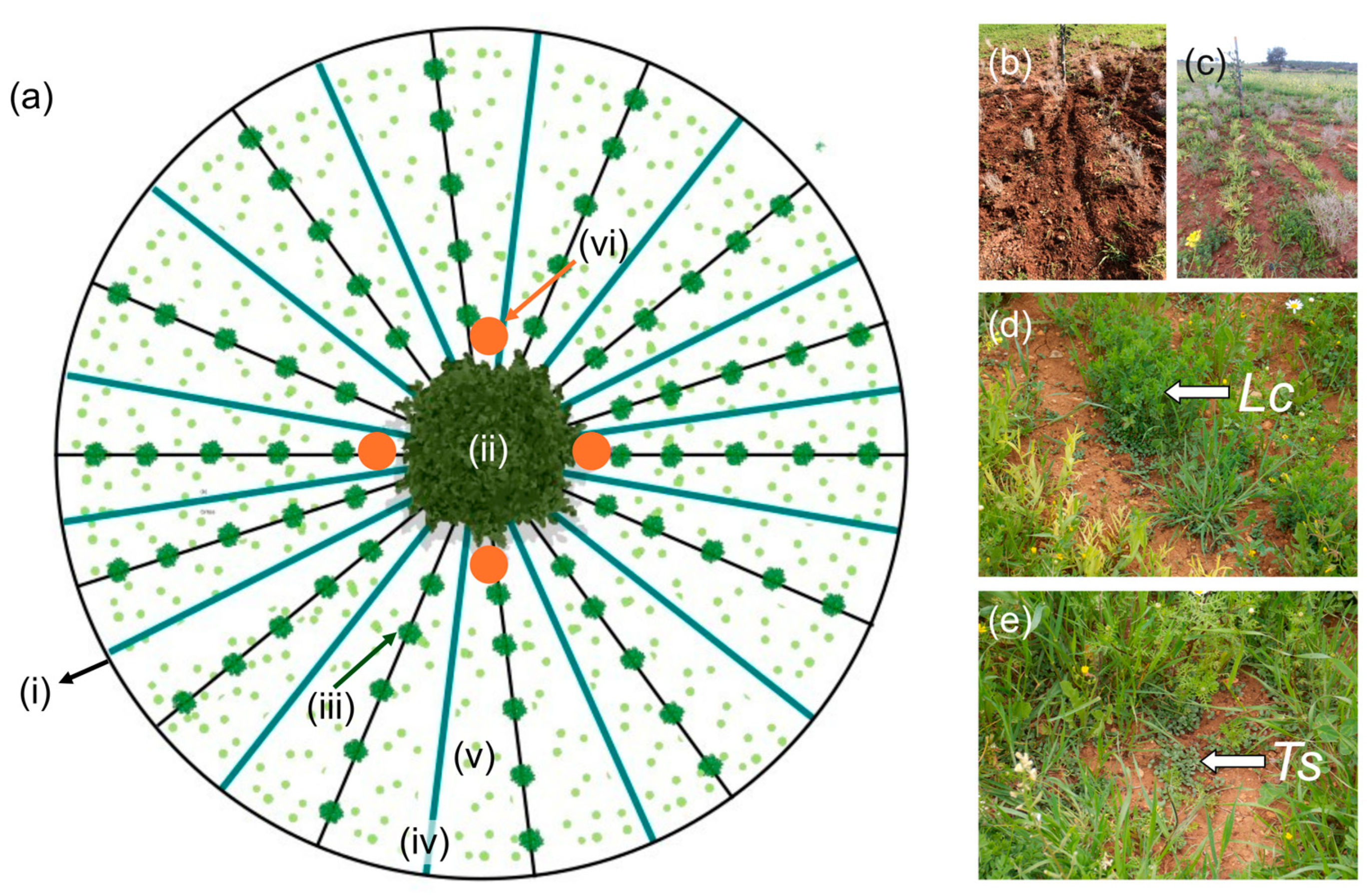
Legumes in CM were established following the C treatment protocol while also adding the Micosat-F® Olivo (C.C.S AOSTA, Quart, Italy) microgranular complex (BM). Micosat-F® Olivo consisted primarily of a mixture of Glomus spp., facilitating phosphorus uptake and Pseudomonas and Bacillus spp. for growth promotion. Specifically, BM included Glomus coronatum GO 01, Glomus viscosum GC 41 and Glomus intraradices GB 67 mycorrhiza strains, bacteria of Pseudomonas sp., Bacillus subtilis ΒA 41, Streptomyces sp. SA 51, saprotrophic fungi (Trichoderma sp., Trichoderma viride TV 03, Trichoderma harzianum TH 01), and yeast (Picia pastoris). At the same time, prior to legume sowing, 12 gr of BM were added at 5 cm deep holes in the soil at approximately 70 positions evenly distributed around each tree following the thyme planting scheme (Figure 2). Cylindrical holes (1 cm diameter, 10 cm depth) were created at four points around the tree trunk in a cross pattern approximately 10 cm from the tree trunk, and 10 gr of BM were added in each hole (Figure 2). Three CM plots were established, which were amended with approximately 880 gr of BM each. Four CMZ plots were established, similar to CM plots, by mixing 23 gr of zeolite (2.5–5 mm, Imerys Industrials Minerals, Kardzhali, Bulgaria) with the BM in 70, 5 cm holes around each tree (approximately 1.6 kg of zeolite per plot).

2.2.3. Legume Cover Crops with Thyme Plants (CT)

Within each CT plot, 70 two-year-old thyme plants (ca. 20–30 cm in height) (Thymbra capitata [(L.) Cav.]) were planted at ca. 40 cm spacing (December 2018) and arranged evenly in a radial pattern of ca. 12–15 radii per tree. Following the planting of thymes, legume cover crops were sowed as described in Section 2.2.1. Five CT plots were established.

2.2.4. Legume Cover Crops and Thyme Plants with Beneficial Microbes (CTM) and Zeolite (CTZ) Alone and Combined (CTMZ)

CTM treatments followed the process described for CT plots with the addition of BMs. Prior to planting each thyme, soil was ecologically engineered by installing 12 gr of BMs at the bottom of each planting hole. In addition, 10 gr of BMs was added in four holes around the tree’s trunk, as described in Section 2.2.2 (in total 880 gr of BM). Five CTM plots were established. CTZ treatments followed CT plot establishment with the addition of 23 gr of zeolite in the planting thyme hole prior to installing each thyme (approximately 1.6 kg per plot). Five CTZ plots were established. Treatment CTMZ followed the process described in CTM with the addition of 23 gr of zeolite in each thyme planting hole. Five CTMZ plots were established.
Based on the above, the CC-System contained the C, CM and CMZ (12 plots), while the CCT-System contained the CT, CTZ, CTM and CTMZ plot types (20 plots) (See Table 3).

2.2.5. Conservation Tillage Plots (TLG)

Five conservation tillage plots were established as controls. In these plots, wild vegetation was managed by tilling the soil to a depth of up to 15–20 cm once per year in spring (Spring 2019 and Spring 2020) with the objective of reducing vegetation cover to below approximately 30% during summer.

2.3. Experimental Monitoring

To assess carob tree growth, the height (primary growth) and basal area (secondary growth) of experimental trees were monitored. The trees’ height from the base of the trunk to the top of the tree was first recorded soon after the plots’ establishment (Spring Y1: April 2019), as the experiment progressed (Fall Y1: September 2019, Winter Y2: January 2020) and toward the end of the experiment (Spring Y2: April 2020). To estimate the percentage of height increase over the span of the experiment, the difference in height between Spring of Y2, 2020 (H2) and Spring of Y1, 2019 (H1) was calculated and then divided by the initial height value based on the equation Height Increase (ΔH-%) = (H2 − H1) × 100/H1. To monitor the secondary growth of each carob tree, the circumference of each experimental tree was recorded at distance of 20 cm from the base of the trunk. Circumference (C, cm) was transformed to basal area (BA, cm2) using the equation BA (cm2) = C2/4 × π [73]. To estimate it over the span of the experiment, the difference in the tree basal area between spring 2020 (BA2) and spring 2019 (BA1) was calculated and then divided by the initial value based on the equation Basel Area Increase (ΔBA-%) = (BA2 − BA1) × 100/BA1.
Soil moisture was monitored over a time span of 61 days during the experiment’s dry season (Y1: July–September 2019) using an EC5 Soil Moisture Smart Sensor (accuracy = ± 0.031 m3/m3) with a HOBO USB Micro Station Data Logger (Onset, Cape Cod, MA, USA). Ten sensors were placed at a south-facing exposure at 15 cm soil depth and a 25 cm distance from each tree’s trunk. For CCT-System plots, sensors were placed under L. ochrus mulch (N = 5, one sensor per plot, placed in 2 CTMZ and 3 CTM plots), and for TLG plots, they were placed in bare ground (N = 5). The volumetric water content indicated that the volume of water per volume of soil was recorded every thirty minutes with a total of 2895 observations recorded per sensor. Values were recorded in m3/m3 and were multiplied by a factor of 100 to be expressed in % and produced a Soil Moisture Index.
All living thyme plants (bearing green leaves) were counted in each CCT-System plot in the spring of Y2 (April 2020) to capture plant recovery following the experiment’s dry season (summer 2019). The thyme survival rate (TSR) was calculated as the percentage of living plants relative to the total number of thyme plants initially planted.
To assess competition dynamics between Lathyrus sp. cover crop and thyme in CCT-System plots, the number of Lathyrus plants resprouting within a 1 m2 quadrat were counted during the spring of Y2 (April 2020), following the second wet season of the experiment. We used Lathyrus regrowth as a proxy for prior season biomass and competition pressure hypothesizing that Lathyrus resprouting dynamics are related to its productivity (biomass and seeding success) during the previous season. Plots were categorized into high and low Lathyrus resprouting groups based on the observed data distribution, and thyme survival rates were analyzed for each group. In total, 12 CCT-System plots were monitored for Lathyrus regrowth. To assess wild vegetation pressure in intercropping system plots, the percentage of plot area covered by wild vegetation (% of total plot cover) was recorded during the mid-dry season of Y1 (July 2019). In total, 19 plots were monitored for wild vegetation cover (5 CC-system and 14 CCT-system plots).

2.4. Statistical Analysis

To test for the normality of the data sets, the One-Sample Kolmogorov–Smirnov Test was used. When data were non-normal, the Kruskal–Wallis test was conducted to compare medians, and standard box plots were produced for a graphic representation of results. Box plots display the interquartile range (Q1–Q3) as the box with the median indicated by a horizontal line within the box. Whiskers extend to the most extreme values within 1.5 × (the interquartile range) of the quartiles. To compare means for normally distributed data, one-way ANOVA was used followed by Tukey’s Honestly Significant Difference test (HSD) and the Bonferroni test to analyze multiple comparisons between homogenous groups. The level of significance used was set at p < 0.05. Correlations were assessed using Spearman’s and Pearson’s correlation coefficients for non-normally and normally distributed variables, respectively. All statistical analysis was carried out using SPSS Statistics 29 (SPSS, Chicago, IL, USA).

3. Results

3.1. Effects on Tree Primary and Secondary Growth

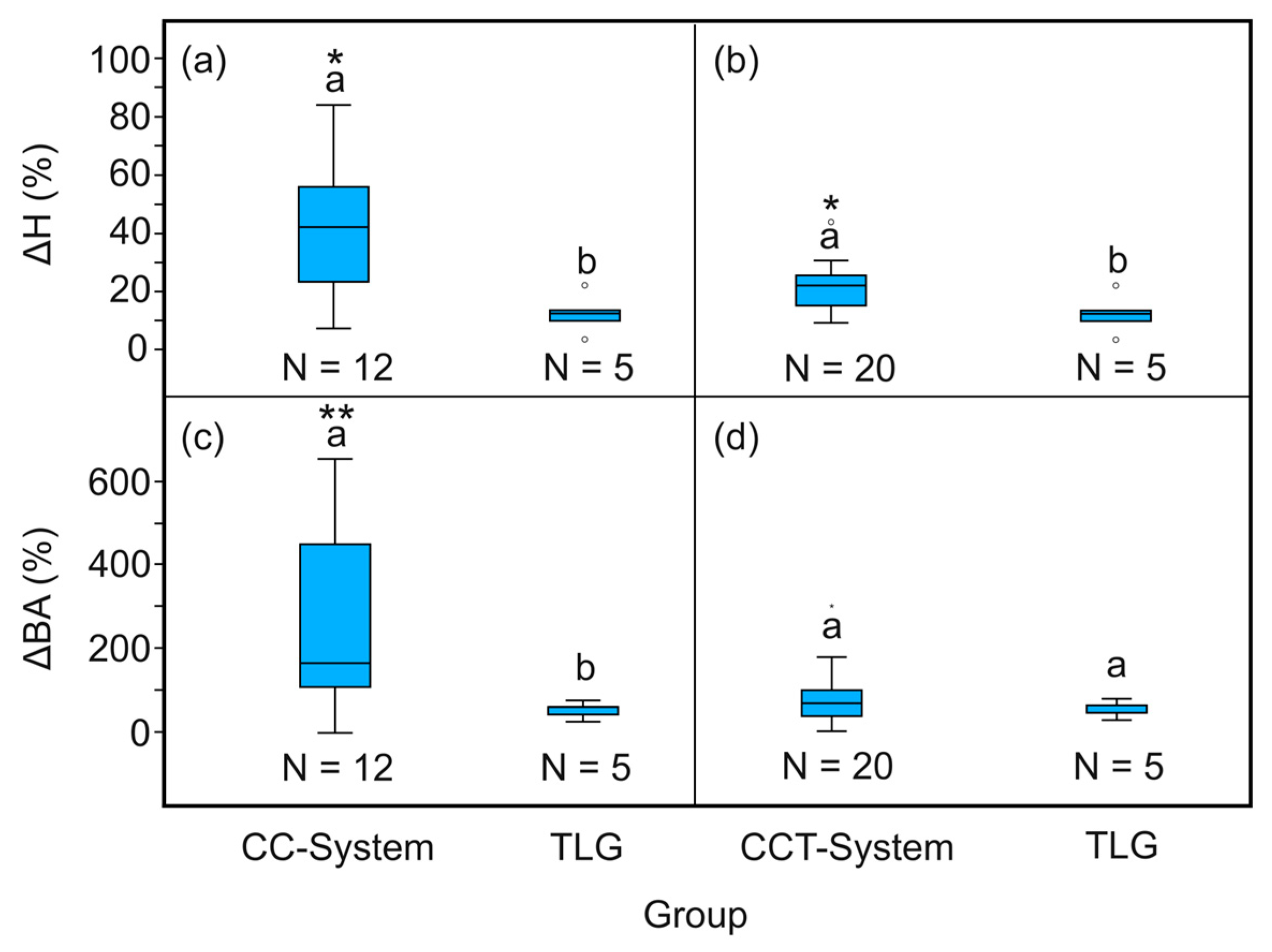
The tree height increase from Spring Y1 to Spring Y2 was significantly greater (p < 0.05) in both CC and CCT intercropping systems compared with TLG control plots (Figure 3a,b). The CC-System showed the greatest height increase with values 29 percentage points higher than conservation tillage plots (from 13% to 42%, p < 0.05; Figure 3a). Plots combining legumes with thyme (CCT-System) showed 9 percentage points greater tree height growth than TLG control plots (from 13% to 22%, p < 0.05; Figure 3b). The stem thickness growth was also greater for treatments intercropped with legume cover crops without the presence of thyme (CC-System) compared with conservation tillage plots (Figure 3c).
Within the one year, the basal area increased by 105 percentage points in the CC-System compared with TLG control plots (from 62 to 167%, p < 0.01, Figure 3c). No significant improvement in the trees’ secondary growth was recorded for plots intercropped with legume cover crops combined with thyme (CCT-System) compared with conservation tillage (Figure 3).
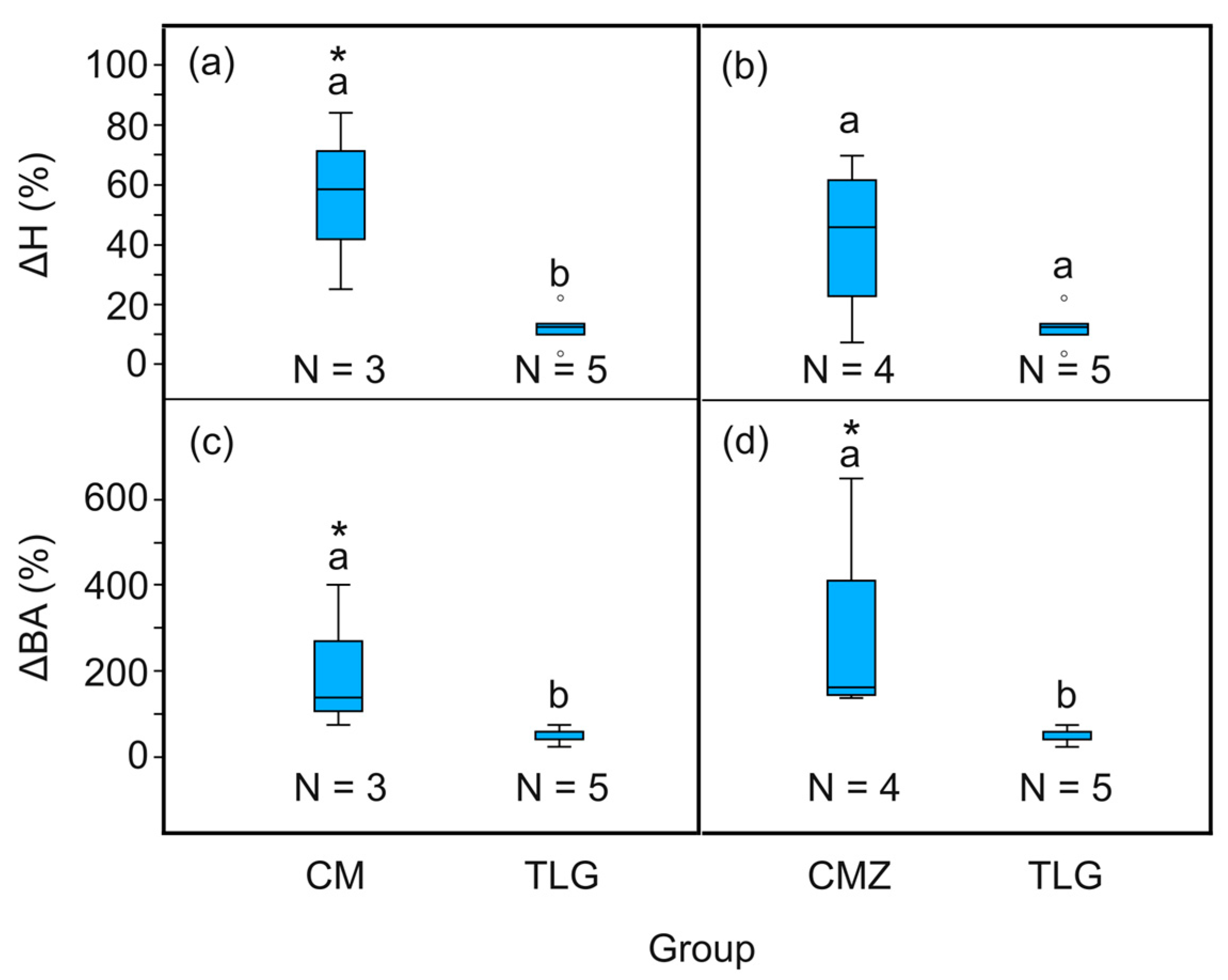
CM plots, i.e. legume cover crops amended with BM, saw a 46% increase in carob tree height (from 13 to 59%; p < 0.05, Figure 4a) and an 80% increase in stem thickness compared with TLG plot trees (from 62 to 142%; p < 0.05, Figure 4c). Moreover, in CMZ plots, i.e. legume cover crops amended with both beneficial microbes and zeolite, the increase in stem thickness was 105% greater than that in TLG plot trees (from 62 to 167%; p < 0.05, Figure 4d), and there was a 33% increase in carob tree height (from 13 to 46%, p = 0.14, Figure 4b).

3.2. Effects on Soil Moisture

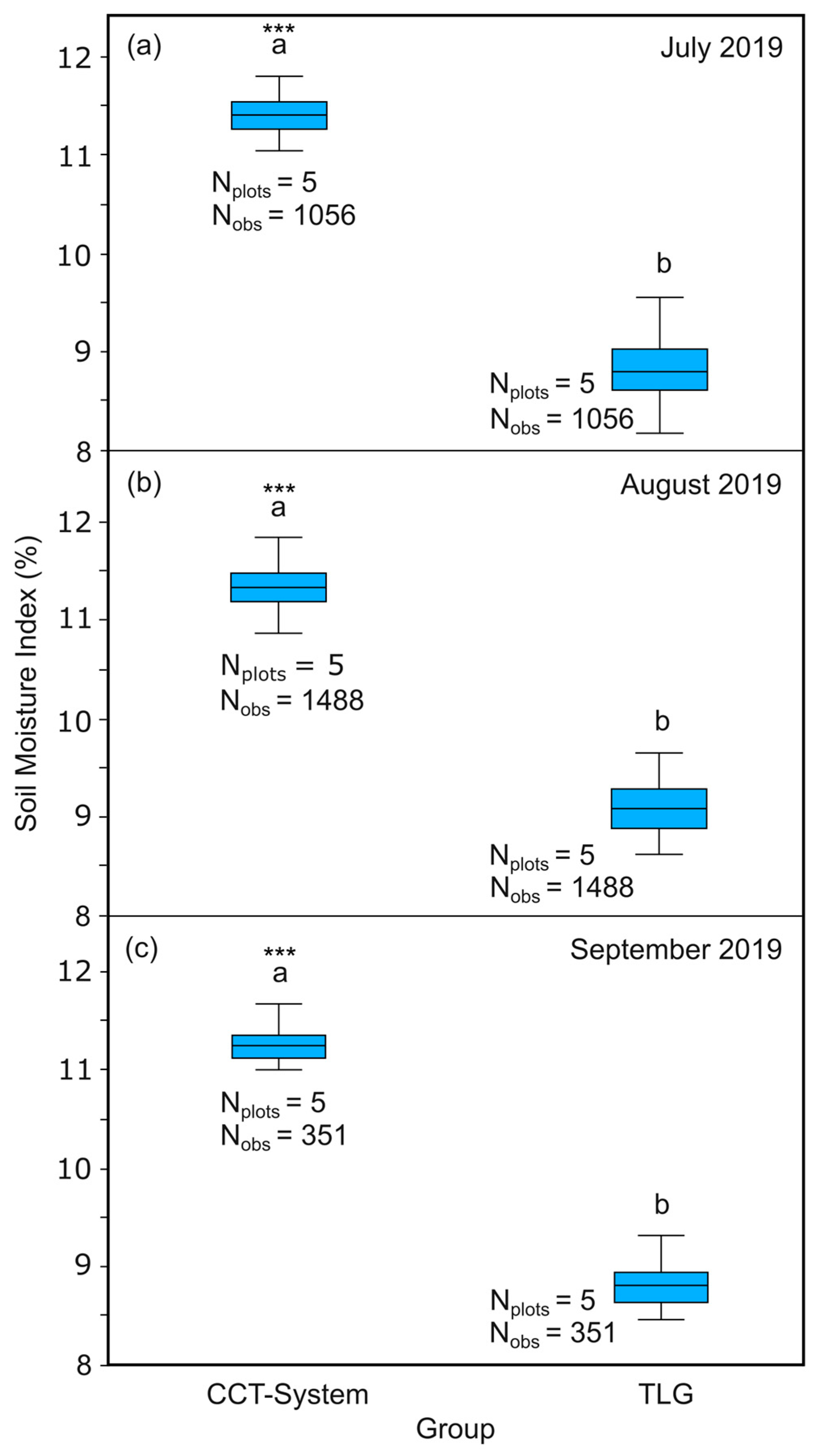
In plots where carob trees were intercropped with legume cover crops and thyme (CCT-System), the soil moisture index was significantly higher than that for the TLG control plots (Figure 5a–c, p < 0.001) during all months accessed (Y1, July–September 2019).
During the three dry months assessed, the soil moisture index in CCT-System plots was on average 22% higher than that in conservation tillage plots. For July, the soil moisture index median was at 8.8% for TLG and at 11.4% for the CCT-system; for August, it was at 9.1% for TLG and at 11.3% for the CCT-System; while for September, it was at 8.8% for TLG and at 11.2% for the CCT-system (p < 0.001; Figure 5a–c; see also Figure S9).

3.3. Competition Dynamics in Plots with Legumes and Thyme

During the second wet season monitored (winter 2020), Lathyrus ochrus re-germinated from seeds produced after the previous sowing (Y1, winter 2019). A high biomass of mature L. ochrus in Y1 is expected to produce a proportionate number of seeds. Thus, under adequate rainfall, the number of re-germinating Lathyrus plants can also be expected to be high during Y2. We used this principle to assess the biomass of Lathyrus in Y1 and in turn the competition pressure it exercised on thyme plants in plots where carob trees were intercropped with legume cover crops and thyme (CCT-System). In other words, Lathyrus re-germination was used as an indication for the competition pressure that thyme plants experienced from Lathyrus during the first experiment year.
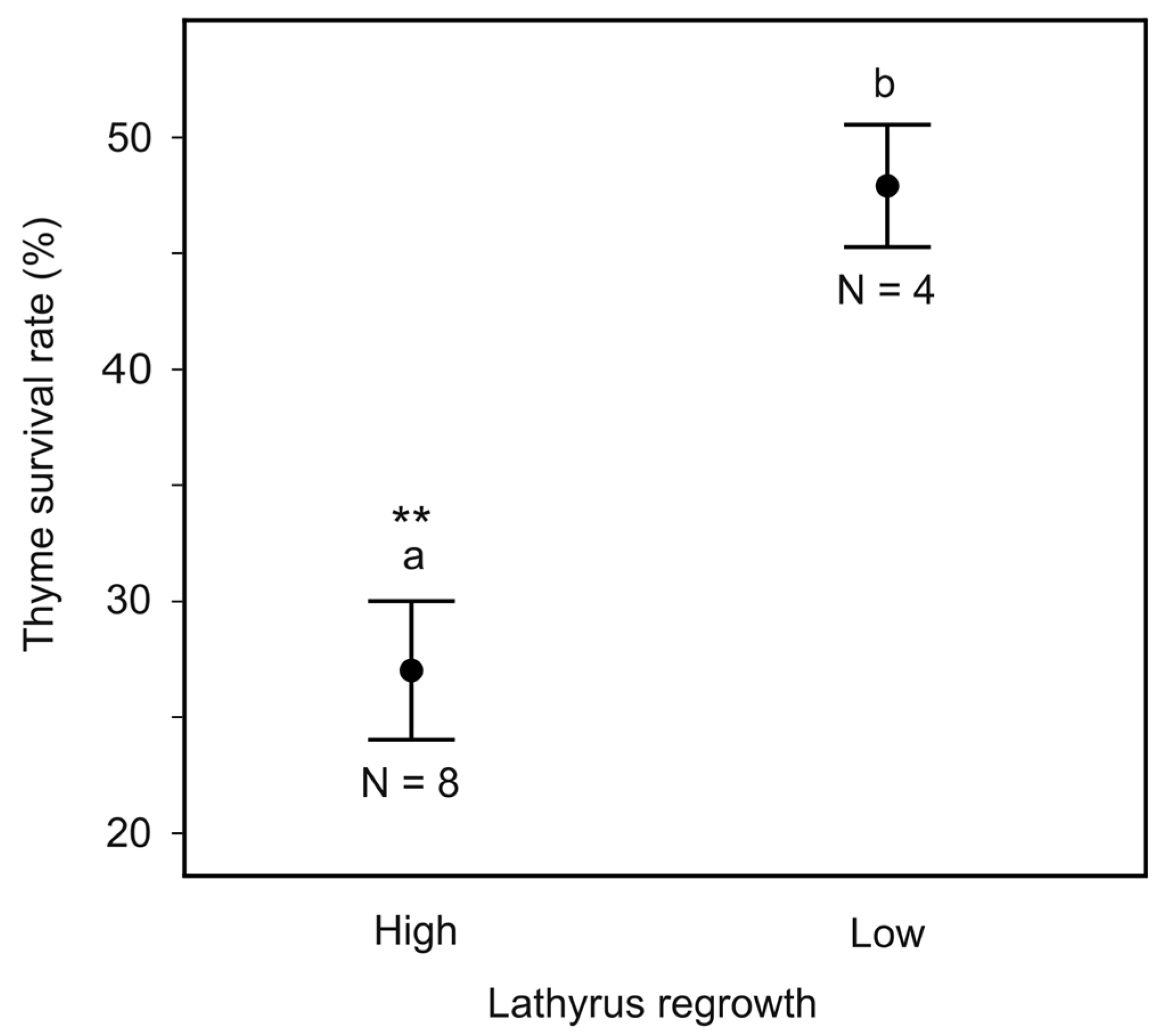
Pearson’s correlation analysis revealed a significant negative relationship between Lathyrus regrowth and thyme survival rate (TSR) (r2 = 0.52; p < 0.01), indicating that plots with the high Lathyrus re-germination had higher thyme mortality. In total, eight CCT-System plots had high Lathyrus regrowth (mean = 252 ± 16 Lathyrus individuals per 1 m2 quadrat monitored), while in four assessed plots, Lathyrus resprouting was low (mean = 36 ± 9 Lathyrus individuals per 1 m2 quadrat monitored). In plots where Lathyrus regrowth was high, the TSR reduced by 78% (from 48% to 27%, p < 0.01) compared with plots where Lathyrus re-germination was not high (Figure 6).

4. Discussion

4.1. Legume and Thyme Intercropping Systems Promoting Tree Growth

Our first hypothesis was that legumes can boost tree growth compared with conservation tillage treatments by possibly improving soil moisture availability and that this boost can be further enhanced with BM and zeolite. Our second hypothesis was that T. capitata as living mulch can improve soil moisture and tree growth compared with tillage while promoting biodiversity and its ecosystem services.
The legume cover crop systems alone (CC-System) and combined with thyme (CCT-System) significantly improved primary growth in young carob trees compared with soil tillage plots (TLG, Figure 3). The CC-System, with or without the amendment of BM and zeolite, boosted both primary and secondary tree growth compared with TLG (Figure 3 and Figure S10). The CC-System system appears to have provided sufficient soil cover during the dry season, likely conserving more soil water than the TLG system by significantly reducing evaporation [74]. This probably benefitted the soil moisture availability for carob trees in our system as well. The soil moisture availability recorded in CCT-System plots during the dry months was found to be significantly greater than TLG plots most likely, explaining the significantly greater height increase in the CCT-System compared with TLG trees (Figure 3, Figure 5 and Figure S10). In terms of soil cover, the CC-System plots appeared as efficient as CCT-System plots (Figure S11). Thus, although soil moisture was not measured in CC-System plots, we infer that their ability to retain soil moisture was not lower than that of CCT-System plots. However, a direct measurement would be needed to confirm our hypothesis.
All leguminous cover crops used are known for their ability to form an effective ground cover [52,54,75,76]. To reduce interspecific competition, we sowed them with spatial and temporal separation. Lathyrus was sown first in radial furrows extending from each tree (January 2019, Figure 2) followed by Lens and Trifolium in the spaces between the furrows (February and March 2019; Figure 2). As these leguminous crops grow to different heights, they can cover soil and suppress weeds more effectively when incorporated as a mix [55]. Furthermore, their distinct root systems penetrate the ground at different depths, most likely enabling rainfall to infiltrate more efficiently [56,57]. Similar complementary effects of mixed legume systems have been reported in agroecosystems both in temperate [77] and semi-arid regions [78], suggesting that these mechanisms may be broadly applicable beyond the conditions of our site. In such mixed systems, when sufficient rainfall is available, cover crops seem to improve water storage in the soil [79]. Thus, potential negative effects on the main crops can be counteracted through a reduction in soil evaporation and an increase in rainfall infiltration rates [74,80]. Note, however, that our experiment coincided with a very wet climatic year (Table 2; 79% above normal rainfall), which also promoted our cover crop establishment. When considering whether to incorporate cover crops in dryland intercropping systems, water can be a limiting factor [26,52,81]. Water deficiencies in cover crop systems are greatest during dry years, negatively impacting yields for the main crop [82]. Therefore, extending our investigation to cover dry years as well could provide more insights into the effect of our CC- and CCT-Systems.
Trees usually prioritize height over diameter growth [83]. In agroforestry systems, any competition between intercropped species is therefore expected to impact tree diameter growth first before height [84]. In a long-term study, conducted in a Mediterranean climate, young walnut trees were intercropped with leguminous crops under minimum agricultural management and no fertilization. During the early experiment years, impressive differences in the young tree’s height were recorded between intercropped and control trees, while tree diameter gains were only visible toward the end of the 8-year experiment [85]. These findings are in line with the responses of our CCT-System, where primary tree growth seems to have had a higher response rate to the applied treatments compared with stem thickness growth (Figure 3).

4.2. Effects of Soil Amendments

Of the seven intercropping subsystems tested, CM (cover crops with BM), CMZ (cover crops with BM and zeolite), and CTZ (cover crops with thyme and zeolite) showed the most significant improvement in tree height compared with conservation tillage plots. The tree height increase in CM and CMZ plots, compared with TLG, ranged from 33 to 46% (Figure 4), while C plot trees (without the addition of BM and zeolite) increased height by 20% (Figure S10). Considering that height increase is more responsive compared with thickness as a growth change indicator [84,85], this suggests that the addition of BM with or without zeolite most likely had a positive effect on tree growth. Apparently, more time is needed to assess whether such responses can also be related to stem thickness. For tree plots amended with BM and zeolite that included thyme (CTM, CTZ, CTMZ), a 7–13% increase in height was recorded compared with TLG vs. a 2% increase for the non-amended CT plots (Figure S10). Hence, the amendments applied have some potential to improve growth. Yet, CCT-System plots experienced a very high grass weed abundance, which could have masked the above responses (see Figures S11–S14 and discussion below).
All amended plots included either a Micosat-F-Olivo microbial complex and/or zeolite. The beneficial effects likely stem from multiple functions. The microbial consortium used could possibly have influenced nutrient cycling and plant stress physiology, improving nutrient use efficiency and the trees’ drought tolerance. Arbuscular mycorrhizal fungi and plant growth-promoting bacteria can both help mobilize phosphorus with the second further facilitating nitrogen fixation [86,87]. When carob trees were inoculated with arbuscular mycorrhiza fungi, which was included in our microbe complex, they demonstrate improved growth and nutrient status [39]. Plant growth-promoting bacteria, also included in the BM amended plots, have been shown to improve carob trees growth, which is likely through increased phosphorus uptake efficiency, phytohormone production and enhanced mineral nutrient uptake [40]. Furthermore, microbes included in the BM complex used can help reduce drought stress [88,89]. The lower drought stress observed in mycorrhiza-inoculated plants can be related to an improvement of membrane stability, stomatal conductance and the plant’s overall antioxidant system [90]. Zeolites can enhance nutrient use efficiency [91] and improve soil’s physicochemical properties, particularly the soil water-holding capacity [92], primarily through their high internal porosity and water absorption capacity [93]. Overall, for our BM and zeolite-amended plots, more time is possibly needed for microbial communities to become established and provide noticeable and consistent effects. Further investigation is required to clarify the effect of the beneficial microbes and the zeolite amendments introduced into our systems, including any synergies between them.

4.3. Effects of Cover Crops

In addition to the direct benefits of BM and zeolite amendments, diverse cover crop systems—such as the mixed legume-based intercropping systems used in this study—have been shown to influence the soil microbial communities associated with soil health and nutrient cycling [58]. Optimized intercropping systems such as the ones studied by [94] report substantial yield increases in cotton–soybean systems—up to 28% for cotton and 21% for soybean—compared with monoculture. In the six-year field experiment, soil properties improved and microbial communities diversified with a higher colonization rate for arbuscular mycorrhizal fungi, leading to optimized nutrient use efficiency. In alternate cotton–peanut intercropping systems, improvements in crop resource-use efficiency have been linked to enhanced soil microbial diversity [95]. Acknowledging the limitation of not directly measuring microbial community shifts or functional activities, we see the need of future research focusing on the interactions between microbial community dynamics and nutrient availability. Furthermore, monitoring shifts in soil temperature, which is closely linked to changes in microbial activity [96], can provide valuable insights into the benefits of cover crop soil cover, particularly during prolonged dry seasons. Under semi-arid, low-weed-competition conditions, surface temperatures measured during the peak of the dry season were significantly lower in plots intercropped with thyme living mulch (p < 0.001) and clover-based cover crop (p < 0.01) at the trees’ sun-exposed side compared with conservation tillage [26]. Monitoring these parameters, may help elucidate the mechanisms through which legume–carob intercropping positively influences early tree growth.
In the current study, it is evident that the CC-System performed significantly better than the CCT-System with the exception of the CTZ plot trees (Figures S10 and S15). In a previous three-year experiment, T. capitata acted as a buffer against high summertime soil thermal stress under semi-arid conditions with low weed competition when intercropped with 20-year-old rainfed carob trees [26]. This buffering effect reduced soil evaporation and increased soil moisture availability during the dry season, which in turn significantly alleviated leaf water stress and enhanced carob pod productivity. However, T. capitata has been found to compete poorly with fast-growing grasses and particularly Avena sp. [81]. When Avena sp. dominated carob tree plots, no improvement in leaf water stress could be identified compared with conservation tillage plots [26]. Our CCT-System in Orites was heavily affected primarily by Avena sp. and Lolium sp. (Figures S11 and S12).

4.4. Effects of Wild Vegetation

To further explore whether wild vegetation was the driving factor for the CCT-System’s reduced performance compared with the CC-System, we assessed whether the legume-based intercropping system (CC-System) could be more effective in suppressing weeds than the system combining legumes with thyme (CCT-System; Figures S11 and S13). An analysis of mid-dry season wild vegetation cover (Y1, July 2019; % of total plot area) showed that CCT-System plots had a 29% greater wild vegetation cover than CC-System plots (a mean of 74% vs. 45%; p < 0.001; Figure S13). The increased wild vegetation abundance in CCT-System plots was also associated with reduced carob tree growth. Spearman’s rank correlation analysis revealed a significant negative relationship between carob tree height increment (ΔH) and wild vegetation cover (rho = −0.69; p < 0.001; Figure S14). In contrast, no significant correlation was detected between tree height increment over the same period and thyme survival rate (rho = −0.43; p > 0.05).
Hence, the above findings suggest that thyme itself most possibly did not produce a negative impact on young carob trees’ growth. The reduced growth rates for trees in CCT-System plots were most likely driven by increased wild vegetation pressure. It could be the case that by incorporating T. capitata, a ‘back door’ was provided to Avena sp. primarily to partially invade the CCT-System plots and offset the positive impact provided by the legume cover crop system, particularly in terms of soil moisture availability. Surveys of wild vegetation composition and abundance in legume-only and legume–thyme intercropping systems could help to further substantiate this interpretation. The response of our systems under drier conditions should also be investigated, since the high weed abundance was recorded during a very wet hydrologic year (Table 2; 79% above normal rainfall). Notably, thyme survival was not significantly correlated with weed abundance. In contrast to findings from clover–thyme intercropping systems, where 2–3 cm tall thyme plants were almost eliminated (4% survival) by fast-growing clover during the first wet season [26], the thyme plants used in this study were mature (20–30 cm in height) and therefore less susceptible to competition from grass weeds. Instead, competition with the fast-growing Lathyrus during an unusually wet winter is the most likely explanation for the reduced thyme establishment observed in CCT-Systems.
Nonetheless, while the present study represents a short-term assessment, intercropping systems that include perennial aromatics such as thyme, over the long term, can provide farmers with diversified income [10,14] and enhance biodiversity indices [10,97]. For example, intercropping aromatic living mulch between olive trees increased the richness of beneficial insects, including pollinators and pest predators, without negatively affecting olive tree growth [12]. When integrating aromatic plants in nut tree-based agroecosystems, a better control of crop pests and pathogens was recorded, which was driven by higher biodiversity indices [10].

4.5. Competition Dynamics Between Legumes and Thyme

When combined, fast-growing Lathyrus was found to outcompete thyme, limiting its establishment, which was in line with our third hypothesis. Although the approach used to assess competition dynamics between intercropped species was indirect, the results indicate a significant negative correlation between the regrowth of Lathyrus sp. and thyme survival. This means that the greater the resprouting of the leguminous cover crop from last season’s seeds, the higher the mortality of thyme plants recorded in the CCT-System plots. L. ochrus likely outcompetes the slower-growing thyme via its high growth rates, fast biomass accumulation [98] and allelopathic properties [50]. This provides Lathyrus with an advantage in competition and resource acquisition. A similar response has been described in a thyme-clover intercropping system tested under rainfed semi-arid conditions where the fast-growing clover also outcompeted thyme, leading to mere 4% survival rates [26]. Thus, when combining legumes with T. capitata in intercropping systems, differentiating the establishment of the two cover crops over space and time is necessary to limit competition between the species. For example, thyme and legumes can be established using a row intercropping pattern, representing spatial differentiation between species [94] rather than being mixed within the same area. Alternatively, aromatics can be planted following the termination of annual legumes used to enrich the system’s nutrient content, representing a form of temporal differentiation during the establishment of legume–aromatic intercropping systems. Future work could adopt a more direct approach to assess the competition dynamics between the two intercropped species in order to confirm these findings. Moreover, as the annual cover crop Lathyrus depends on abundant rainfall for growth, lower competition with thyme may be expected during drier years. Longer-term studies would therefore allow an assessment of how competition dynamics between legumes and aromatic plants vary under different rainfall regimes.

5. Conclusions

Overall, our findings support that the legume-based intercropping we designed can enhance tree growth compared with conservation tillage potentially through initial improvements in soil moisture and in suppressing weeds. It is the first time that such responses have been documented in establishing carob intercropping systems, opening new ground in the more effective application of legume mixed systems in dryland agroforestry.
The addition of beneficial microbes and zeolite also appears to have positive effects, although further investigation is required to clarify their potential when used in isolation or combined. Future research should therefore focus on examining temporal changes in soil moisture and nutrient dynamics within legume-based intercropping systems as well as potential interactions between microbial community dynamics and nutrient availability. Such work would help to further explain the enhanced tree growth observed in legume-intercropped systems amended with beneficial microbes and zeolite compared with conservation tillage.
The intercropping system combining legumes with thyme also showed some potential in improving tree growth compared with conservation tillage. However, the combination of thyme with legumes resulted in smaller gains than the legume-only intercropping system—at least in the short term and during the unusually wet winter of our experiment. Such conditions resulted in high weed pressure and vigorous Lathyrus regrowth. Assessments of wild vegetation composition and abundance across varying annual rainfall conditions would provide further insight into the factors affecting tree growth in legume–thyme intercropping systems. While legume-thyme intercropping can improve early carob growth, the water demands of both trees and cover crops must be considered when designing rainfed systems in dryland conditions.
In the longer term, intercropping systems including thyme may represent a promising nature-based solution based on their potential to enhance biodiversity and overall agroecosystem services compared to conservation tillage. However, a careful design is needed that would not mix thyme with legumes, as Lathurus can outcompete thyme in wet years. Again, though, these systems would be less effective where grass weed abundance is high.
Collectively, our findings indicate that legume cover crops amended with beneficial microbes and zeolite may play an important role in supporting early-stage tree establishment in dryland agroforestry systems, particularly as drought frequency is expected to increase under climate change.

Supplementary Materials

The following supporting information can be downloaded at https://www.mdpi.com/article/10.3390/agronomy16030396/s1, Figure S1: Application of soil amendments; Figure S2: First growth stages of Lathyrus ochrus; Figure S3: Sowing of Lens culinaris; Figure S4: Sowing of Trifolium squarrosum; Figure S5: The legume cover crops combined with thyme (CCT-System) intercropping system in its final development phase; Figure S6: Formation of beans by Lathyrus ochrus and flowers by Lens culinaris; Figure S7: The thick mulch layer in a CCT-System plot created primarily by the drying of Lathyrus biomass; Figure S8: Conservation tillage plots establishment; Figure S9: Average soil moisture index for CCT-System and TLG plots; Figure S10: Carob growth increase for all systems investigated; Figure S11: Vegetation cover in CC- and CCT-System plots during the mid-dry season; Figure S12: Thymbra c. in a CCT-System plot engulfed in wild vegetation; Figure S13: Mid-dry season wild vegetation cover in CC- and CCT-System plots; Figure S14: Correlation between carob growth increase for tree height change from spring of Y2 to spring of Y1 and mid-dry season wild vegetation cover; Figure S15: Carob growth increase for CC and CCT-System trees.

Author Contributions

Conceptualization, D.S.; methodology, D.S. and S.M.; software, S.M.; formal analysis, D.S., and S.M.; investigation, D.S., S.P., E.C. and I.N.; writing—original draft preparation, D.S. and S.M.; writing—review and editing, D.S. and S.M.; visualization, D.S. and S.M.; supervision, D.S.; project administration, D.S.; funding acquisition, D.S. All authors have read and agreed to the published version of the manuscript.

Funding

This research was funded by the strategic program BlackGold of the University of Cyprus.

Data Availability Statement

The data set is available on request from the authors.

Acknowledgments

We would like to thank the post- and undergraduate students of the Department of Biological Sciences (UCY) for their contribution, particularly Anna Georgiou. We would like to thank Aristos for support with soil management during the experiment. We would also like to thank Antonis Kakas (UCY) for support via the BlackGold program, Spyros Sfenthourakis (UCY) for logistic support, Lakis Polycarpou for language editing and the University of Cyprus for access to the experimental sites. We are also most grateful to Panayiotis Dalias and the staff of the Agricultural Research Institute for supporting our soil analysis.

Conflicts of Interest

The authors declare that the research was conducted in the absence of any commercial or financial relationships that could be construed as a potential conflict of interest. The funder was not involved in the study design, collection, analysis, interpretation of data, the writing of this article or the decision to submit it for publication.

Abbreviations

The following key abbreviations are used in this manuscript:
BMBeneficial microbes
BABasal area
CLegume cover crops treatment
CC-SystemLegume cover crops system
CCT-SystemLegume cover crops combined with thyme plants system
CMLegume cover crops with beneficial microbes treatment
CMZLegume cover crops with beneficial microbes and zeolite treatment
CTLegume cover crops with thyme plants treatment
CTZLegume cover crops with thyme plants and zeolite treatment
CTMLegume cover crops and thyme plants with beneficial microbes treatment
CTMZLegume cover crops and thyme plants with beneficial microbes and zeolite treatment
DMAIDe Martonne’s Aridity Index
TLGConservation tillage plots
TSRThyme survival rate

References

  1. Aguilera, E.; Díaz-Gaona, C.; García-Laureano, R.; Reyes-Palomo, C.; Guzmán, G.I.; Ortolani, L.; Sánchez-Rodríguez, M.; Rodríguez-Estévez, V. Agroecology for adaptation to climate change and resource depletion in the Mediterranean region. A review. Agric. Syst. 2020, 181, 102809. [Google Scholar] [CrossRef]
  2. Azzopardi, B.; Balzan, M.V.; Cherif, S.; Doblas-Miranda, E.; dos Santos, M.; Dobrinski, P.; Falder, M.; Hassoun, A.E.R.; Giupponi, C.; Koubi, V.V.; et al. Climate and Environmental Change in the Mediterranean Basin–Current Situation and Risks for the Future. First Mediterranean Assessment Report. Available online: https://www.medecc.org/medecc-reports/climate-and-environmental-change-in-the-mediterranean-basin-current-situation-and-risks-for-the-future-1st-mediterranean-assessment-report/ (accessed on 1 November 2025).
  3. Tuel, A.; Eltahir, E.A. Why is the Mediterranean a climate change hot spot? J. Clim. 2020, 33, 5829–5843. [Google Scholar] [CrossRef]
  4. Merino, A.; Doni, S.; Evelpidou, N.; Ferreira, T.; García-Arias, A.I.; Masciandaro, G.; Rodríguez-González, P.M. Best Practices in Evaluation and Restoration of Degraded Mediterranean Environments; Monografías do IBADER—Serie Territorio; IBADER, Universidade de Santiago de Compostela: Lugo, Spain, 2019. [Google Scholar]
  5. Marcelino, S.M.; Gaspar, P.D.; do Paço, A.; Lima, T.M.; Monteiro, A.; Franco, J.C.; Santos, E.S.; Campos, R.; Lopes, C.M. Agricultural practices for biodiversity enhancement: Evidence and recommendations for the viticultural sector. AgriEngineering 2024, 6, 1175–1194. [Google Scholar] [CrossRef]
  6. Huang, J.; Yu, H.; Guan, X.; Wang, G.; Guo, R. Accelerated dryland expansion under climate change. Nat. Clim. Chang. 2015, 6, 166–171. [Google Scholar] [CrossRef]
  7. Soil Science Glossary Terms Committee; Soil Science Society of America. SSSA Glossary of Soil Science Terms; ASA-CSSA-SSSA: Madison, WI, USA, 2008. [Google Scholar]
  8. Lv, W.; Zhao, X.; Wu, P.; Lv, J.; He, H. A scientometric analysis of worldwide intercropping research based on web of science database between 1992 and 2020. Sustainability 2021, 13, 2430. [Google Scholar] [CrossRef]
  9. Gu, C.; Bastiaans, L.; Anten, N.P.R.; Makowski, D.; van der Werf, W. Annual intercropping suppresses weeds: A meta-analysis. Agric. Ecosyst. Environ. 2021, 322, 107658. [Google Scholar] [CrossRef]
  10. Marotti, I.; Whittaker, A.; Bağdat, R.B.; Akin, P.A.; Ergün, N.; Dinelli, G. Intercropping perennial fruit trees and annual field crops with aromatic and medicinal plants (MAPs) in the Mediterranean basin. Sustainability 2023, 15, 12054. [Google Scholar] [CrossRef]
  11. Scavo, A.; Restuccia, A.; Lombardo, S.; Fontanazza, S.; Abbate, C.; Pandino, G.; Anastasi, U.; Onofri, A.; Mauromicale, G. Improving soil health, weed management and nitrogen dynamics by Trifolium subterraneum cover cropping. Agron. Sustain. Dev. 2020, 40, 18. [Google Scholar] [CrossRef]
  12. Las Casas, G.; Ciaccia, C.; Iovino, V.; Ferlito, F.; Torrisi, B.; Lodolini, E.M.; Giuffrida, A.; Catania, R.; Nicolosi, E.; Bella, S. Effects of different inter-row soil management and intra-row living mulch on spontaneous flora, beneficial insects, and growth of young olive trees in Southern Italy. Plants 2022, 11, 545. [Google Scholar] [CrossRef]
  13. Tziolas, E.; Ispikoudis, S.; Mantzanas, K.; Koutsoulis, D.; Pantera, A. Economic and environmental assessment of olive agroforestry practices in Northern Greece. Agriculture 2022, 12, 851. [Google Scholar] [CrossRef]
  14. Maitra, S.; Hossain, A.; Brestic, M.; Skalicky, M.; Ondrisik, P.; Gitari, H.; Brahmachari, K.; Shankar, T.; Bhadra, P.; Palai, J.B.; et al. Intercropping—A low input agricultural strategy for food and environmental security. Agronomy 2021, 11, 343. [Google Scholar] [CrossRef]
  15. Ahmadnia, F.; Ebadi, A.; Hashemi, M.; Ghavidel, A.; Ghahremani, S. Evaluation of short-term effect of oat (Avena sativa L.) and chickling pea (Lathyrus sativus L.) cover crops on improving some soil properties. Appl. Soil Res. 2020, 9, 72–87. [Google Scholar]
  16. Zhang, Y.; Han, M.; Song, M.; Tian, J.; Song, B.; Hu, Y.; Zhang, J.; Yao, Y. Intercropping with aromatic plants increased the soil organic matter content and changed the microbial community in a pear orchard. Front. Microbiol. 2021, 12, 616932. [Google Scholar] [CrossRef]
  17. Kebede, E. Contribution, utilization, and improvement of legumes-driven biological nitrogen fixation in agricultural systems. Front. Sustain. Food Syst. 2021, 5, 767998. [Google Scholar] [CrossRef]
  18. Ranaldo, M.; Carlesi, S.; Costanzo, A.; Bàrberi, P. Functional diversity of cover crop mixtures enhances biomass yield and weed suppression in a Mediterranean agroecosystem. Weed Res. 2020, 60, 96–108. [Google Scholar] [CrossRef]
  19. Everwand, G.; Cass, S.; Dauber, J.; Williams, M.; Stout, J. Legume crops and biodiversity. In Legumes in Cropping Systems; CABI: Wallingford, UK, 2017; pp. 55–69. [Google Scholar]
  20. Simoes, M.P.; Belo, A.F.; Pinto-Cruz, C.; Pinheiro, A.C. Natural vegetation management to conserve biodiversity and soil water in olive orchards. Span. J. Agric. Res. 2014, 12, 633–643. [Google Scholar] [CrossRef]
  21. Stagnari, F.; Maggio, A.; Galieni, A.; Pisante, M. Multiple benefits of legumes for agriculture sustainability: An overview. Chem. Biol. Technol. Agric. 2017, 4, 2. [Google Scholar] [CrossRef]
  22. Cougnon, M.; Durand, J.L.; Julier, B.; Barre, P.; Litrico, I. Using perennial plant varieties for use as living mulch for winter cereals. A review. Agron. Sustain. Dev. 2022, 42, 110. [Google Scholar] [CrossRef]
  23. Sánchez-Navarro, V.; Shahrokh, V.; Martínez-Martínez, S.; Acosta, J.A.; Almagro, M.; Martínez-Mena, M.; Boix-Fayos, C.; Díaz-Pereira, E.; Zornoza, R. Perennial alley cropping contributes to decrease soil CO2 and N2O emissions and increase soil carbon sequestration in a Mediterranean almond orchard. Sci. Total Environ. 2022, 845, 157225. [Google Scholar] [CrossRef] [PubMed]
  24. Rao, M.R.; Palada, M.C.; Becker, B.N. Medicinal and aromatic plants in agroforestry systems. Agrofor. Syst. 2004, 61, 107–122. [Google Scholar] [CrossRef]
  25. Aćimović, M.; Navarro Rocha, J.; Ibraliu, A.; Červenski, J.; Sikora, V.; Winter, S.; Lončar, B.; Pezo, L.; Salamon, I. Intercropping medicinal and aromatic plants with other crops: Insights from a review of sustainable farming practices. Agronomy 2025, 15, 2692. [Google Scholar] [CrossRef]
  26. Matsi, S.; Sarris, D.; Litskas, V. Carob—Thyme intercropping systems can improve yield efficiency and environmental footprint compared to conservation tillage. Agronomy 2025, 15, 1560. [Google Scholar] [CrossRef]
  27. Ouhaddou, R.; Anli, M.; Ben-Laouane, R.; Boutasknit, A.; Baslam, M.; Meddich, A. The importance of the Glomus genus as a potential candidate for sustainable agriculture under arid environments: A review. Int. J. Plant Biol. 2025, 16, 32. [Google Scholar] [CrossRef]
  28. Jongen, M.; Albadran, B.; Beyschlag, W.; Unger, S. Can arbuscular mycorrhizal fungi mitigate drought stress in annual pasture legumes? Plant Soil 2022, 472, 295–310. [Google Scholar] [CrossRef]
  29. Israel, A.; Langrand, J.; Fontaine, J.; Lounès-Hadj Sahraoui, A. Significance of arbuscular mycorrhizal fungi in mitigating abiotic environmental stress in medicinal and aromatic plants: A review. Foods 2022, 11, 2591. [Google Scholar] [CrossRef]
  30. Bender, S.F.; Wagg, C.; van der Heijden, M.G.A. An underground revolution: Biodiversity and soil ecological engineering for agricultural sustainability. Trends Ecol. Evol. 2016, 31, 440–452. [Google Scholar] [CrossRef]
  31. Sarris, D.; Christodoulakis, D. Topographic and climatic effects on Pinus halepensis s.l. growth at its drought tolerance margins under climatic change. J. For. Res. 2024, 35, 102. [Google Scholar] [CrossRef]
  32. Eliades, F.; Sarris, D.; Bachofer, F.; Danezis, C.; Michaelides, S.; Hadjimitsis, D. Forests in a semi–arid climate die with a memory: Satellite signals predict forest mortality years after drought. J. For. Res. 2026. accepted . [Google Scholar]
  33. Lakshmanan, V.; Ray, P.; Craven, K.D. Toward a resilient, functional microbiome: Drought tolerance-alleviating microbes for sustainable agriculture. In Plant Stress Tolerance: Methods and Protocols; Springer: New York, NY, USA, 2017; pp. 69–84. [Google Scholar]
  34. Khan, M.R.; Tarafder, M.A.; Priti, M.S. Potential use of zeolites in agriculture: A review. SAARC J. Agric. 2024, 22, 17–30. [Google Scholar] [CrossRef]
  35. Nakhli, S.A.A.; Delkash, M.; Bakhshayesh, B.E.; Kazemian, H. Application of zeolites for sustainable agriculture: A review on water and nutrient retention. Water Air Soil Pollut. 2017, 228, 464. [Google Scholar] [CrossRef]
  36. Chander, K.; Joergensen, R.G. Decomposition of 14C labelled glucose in a Pb-contaminated soil remediated with synthetic zeolite and other amendments. Soil Biol. Biochem. 2002, 34, 643–649. [Google Scholar] [CrossRef]
  37. Dagher, D.; Taskos, D.; Mourouzidou, S.; Monokrousos, N. Microbial-enhanced abiotic stress tolerance in grapevines: Molecular mechanisms and synergistic effects of arbuscular mycorrhizal fungi, plant growth-promoting rhizobacteria, and endophytes. Horticulturae 2025, 11, 592. [Google Scholar] [CrossRef]
  38. Bizos, G.; Papatheodorou, E.M.; Chatzistathis, T.; Ntalli, N.; Aschonitis, V.G.; Nikolaos, M. The role of microbial inoculants on plant protection, growth stimulation, and crop productivity of the olive tree (Olea europea L.). Plants 2020, 9, 743. [Google Scholar] [CrossRef]
  39. Manaut, N.; Sanguin, H.; Ouahmane, L.; Bressan, M.; Thioulouse, J.; Baudoin, E.; Galiana, A.; Hafidi, M.; Prin, Y.; Duponnois, R. Potentialities of ecological engineering strategy based on native arbuscular mycorrhizal community for improving afforestation programs with carob trees in degraded environments. Ecol. Eng. 2015, 79, 113–119. [Google Scholar] [CrossRef]
  40. El Kahkahi, R.; Moustaine, M.; Channaoui, S.; Hafidi, M.; Zouhair, R.; Chitt, M.A.; Errakhi, R. Characterization of plant growth promoting rhizobacteria isolated from the rhizosphere of carob tree (Ceratonia siliqua L.) in Morocco. EurAsian J. Biosci. 2019, 13, 921–930. [Google Scholar]
  41. Palaiogianni, A.; Stylianou, M.; Sarris, D.; Agapiou, A. Carob-agro-industrial waste and potential uses in the circular economy. In Mediterranean Fruits Bio-Wastes: Chemistry, Functionality and Technological Applications; Springer International Publishing: Berlin/Heidelberg, Germany, 2022; pp. 765–797. [Google Scholar]
  42. Battle, I.; Tous, J. Carob tree Ceratonia siliqua L. In Promoting the Conservation and Use of Underutilized and Neglected Crops; Leibniz Institute of Plant Genetics and Crop Plant Research: Gatersleben, Germany, 1997. [Google Scholar]
  43. Goulas, V.; Stylos, E.; Chatziathanasiadou, M.V.; Mavromoustakos, T.; Tzakos, A.G. Functional components of carob fruit: Linking the chemical and biological space. Int. J. Mol. Sci. 2016, 17, 1875. [Google Scholar] [CrossRef]
  44. Stavrou, I.J.; Christou, A.; Kapnissi-Christodoulou, C.P. Polyphenols in carobs: A review on their composition, antioxidant capacity and cytotoxic effects, and health impact. Food Chem. 2018, 269, 355–374. [Google Scholar] [CrossRef]
  45. Flintan, F. Participatory rangeland management-an enabling process for improving silvopastoral management and governance. In Grazing with Trees; Haddad, F.F., Herrera, P.M., Besbes, B., Eds.; FAO: Rome, Italy, 2022; pp. 106–110. [Google Scholar]
  46. Valdecantos, A.; Vallejo, V.R.; Baeza, J.; Bautista, S.; Boeschoten, M.; Christoforou, M.; Daliakopoulos, I.N.; González-Pelayo, O.; Guixot, L.; Keizer, J.J.; et al. Report on the Restoration Potential for Preventing and Reversing Regime Shifts. Available online: https://research.wur.nl/en/publications/report-on-the-restoration-potential-for-preventing-and-reversing-/ (accessed on 1 November 2025).
  47. Singh, A.; Balech, R.; Barpete, S.; Gupta, P.; Bouhlal, O.; Tawkaz, S.; Kaul, S.; Tripathi, K.; Amri, A.; Maalouf, F.; et al. Wild Lathyrus—A Treasure of Novel Diversity. Plants 2024, 13, 3028. [Google Scholar] [CrossRef]
  48. Goufa, M.; Makeroufas, E.; Gerakari, M.; Sarri, E.; Ragkos, A.; Bebeli, P.J.; Balestrazzi, A.; Tani, E. Understanding the potential to increase adoption of orphan crops: The case of Lathyrus spp. cultivation in Greece. Agronomy 2024, 14, 108. [Google Scholar] [CrossRef]
  49. Campbell, C.G. Grass pea, Lathyrus sativus L. In Promoting the Conservation and Use of Underutilized and Neglected Crops (Vol. 18); Institute of Plant Genetics and Crop Plant Research: Gatersleben, Germany; Institute, International Plant Genetic Resources: Rome, Italy, 1997. [Google Scholar]
  50. Kalinova, J. Allelopathy and organic farming. In Sociology, Organic Farming, Climate Change and Soil Science; Lichtfouse, E., Ed.; Springer: Dordrecht, The Netherlands, 2009; pp. 379–418. [Google Scholar]
  51. Kumar, S.; Kumar, J.; Singh, R.G.; Sarker, A.; Baum, M. Lentils for dryland agriculture: Present status and future strategy. Flora Fauna 2011, 17, 100–107. [Google Scholar]
  52. Barroso, J.; Reardon, C.L.; Singh, S.; Machado, S.; Gourlie, J.A.; Namdar, G.F.; Oreja, F.H.; Pritchett, L.C.; Kriete, L.; Calderon, F.J.; et al. Biomass production, weed suppression, and soil water use of cover crops in dryland wheat production systems. Agron. J. 2025, 117, e70053. [Google Scholar] [CrossRef]
  53. Chehade, L.; Antichi, D.; Frasconi, C.; Sbrana, M.; Tramacere, L.G.; Mazzoncini, M.; Peruzzi, A. Legume Cover Crop Alleviates the Negative Impact of No-Till on Tomato Productivity in a Mediterranean Organic Cropping System. Agronomy 2023, 13, 2027. [Google Scholar] [CrossRef]
  54. Valiño, A.; Pardo-Muras, M.; Puig, C.G.; López-Periago, J.E.; Pedrol, N. Biomass from allelopathic agroforestry and invasive plant species as soil amendments for weed control—A review. Agronomy 2023, 13, 2880. [Google Scholar] [CrossRef]
  55. Kocira, A.; Staniak, M.; Tomaszewska, M.; Kornas, R.; Cymerman, J.; Panasiewicz, K.; Lipińska, H. Legume cover crops as one of the elements of strategic weed management and soil quality improvement. A review. Agriculture 2020, 10, 394. [Google Scholar] [CrossRef]
  56. Chu, M.; Jagadamma, S.; Walker, F.R.; Eash, N.S.; Buschermohle, M.J.; Duncan, L.A. Effect of multispecies cover crop mixture on soil properties and crop yield. Agric. Environ. Lett. 2017, 2, 170030. [Google Scholar] [CrossRef]
  57. Wortman, S.E.; Francis, C.A.; Bernards, M.L.; Drijber, R.A.; Lindquist, J.L. Optimizing cover crop benefits with diverse mixtures and an alternative termination method. Agron. J. 2012, 104, 1425–1435. [Google Scholar] [CrossRef]
  58. Peralta, A.L.; Sun, Y.; McDaniel, M.D.; Lennon, J.T. Crop rotational diversity increases disease suppressive capacity of soil microbiomes. Ecosphere 2018, 9, e02235. [Google Scholar] [CrossRef]
  59. Moradi, P.; Ford-Lloyd, B.; Pritchard, J. Plant-water responses of different medicinal plant thyme (Thymus spp.) species to drought stress condition. Aust. J. Crop Sci. 2014, 8, 666–673. [Google Scholar]
  60. Martínez-Mena, M.; Boix-Fayos, C.; Carrillo-López, E.; Díaz-Pereira, E.; Zornoza, R.; Sánchez-Navarro, V.; Acosta, J.A.; Martínez-Martínez, S.; Almagro, M. Short-term impact of crop diversification on soil carbon fluxes and balance in rainfed and irrigated woody cropping systems under semiarid Mediterranean conditions. Plant Soil 2021, 467, 499–514. [Google Scholar] [CrossRef]
  61. Almagro, M.; Díaz-Pereira, E.; Boix-Fayos, C.; Zornoza, R.; Sánchez-Navarro, V.; Re, P.; Fernández, C.; Martínez-Mena, M. The combination of crop diversification and no tillage enhances key soil quality parameters related to soil functioning without compromising crop yields in a low-input rainfed almond orchard under semiarid Mediterranean conditions. Agric. Ecosyst. Environ. 2023, 345, 108320. [Google Scholar] [CrossRef]
  62. Barbir, J.; Azpiazu, C.; Badenes-Pérez, F.R.; Fernández-Quintanilla, C.; Dorado, J. Functionality of selected aromatic Lamiaceae in attracting pollinators in Central Spain. J. Econ. Entomol. 2016, 109, 529–536. [Google Scholar] [CrossRef]
  63. Petanidou, T.; Vokou, D. Pollination ecology of Labiatae in a phryganic (East Mediterranean) ecosystem. Am. J. Bot. 1993, 80, 892–899. [Google Scholar] [CrossRef]
  64. Pierzynski, G.M. Methods of Phosphorus Analysis for Soils, Sediments, Residuals, and Waters; North Carolina State University: Raleigh, NC, USA, 2000. [Google Scholar]
  65. ASTM D4373-21; Standard Test Method for Rapid Determination of Carbonate Content of Soils. ASTM International: West Conshohocken, PA, USA, 2014.
  66. Nelson, D.W.; Sommers, L.E. Total carbon, organic carbon, and organic matter. In Methods of Soil Analysis: Part 3: Chemical methods; Sparks, D., Ed.; Soil Science Society of America: Madison, WI, USA, 1996; pp. 961–1010. [Google Scholar]
  67. Markides, L.; Pantelas, V.; Siamarias, N.; Aristokleous, G. 1:250,000 soil map of Cyprus. In Soil and Water Use Section; Department of Agriculture: Nicosia, Cyprus, 1999. [Google Scholar]
  68. Huluka, G.; Miller, R. Particle size determination by hydrometer method. In Soil Test Methods from The Southeastern United States; Southern Cooperative Series Bulletin No. 419; Southern Extension and Research Activity Information Exchange Group-6 (SERA-IEG-6): Fayetteville, AR, USA, 2014; pp. 180–184. [Google Scholar]
  69. Keeney, D.R.; Nelson, D.W. Nitrogen—Inorganic forms. In Methods of Soil Analysis: Part 2: Chemical and Microbiological Properties; Page, L., Ed.; American Society of Agronomy and Soil Science Society of America: New York, NY, USA, 1982; pp. 643–698. [Google Scholar]
  70. Leech, G. Classification of arid & semi-arid areas: A case study in Western Australia. ANU Undergrad. Res. J. 2013, 5, 79–99. [Google Scholar] [CrossRef]
  71. Department of Meteorology Cyprus. Mean Annual Water Precipitation Data; Department of Meteorology Cyprus: Nicosia, Cyprus, 2021.
  72. I.A.CO. Consultation Services for the Production of a National Action Plan to Combat Desertification in Cyprus—Contract No. 3/2007; Environment Service Executive Summary: Strovolos, Nicosia, Cyprus, 2007. [Google Scholar]
  73. Oyebade, B.A.; Anaba, J.C. Individual tree basal area equation for a young Tectona grandis (Teak) plantation in Choba, Port Harcourt, Rivers State, Nigeria. World News Nat. Sci. 2018, 16, 130–140. [Google Scholar]
  74. Haruna, S.I.; Anderson, S.H.; Udawatta, R.P.; Gantzer, C.J.; Phillips, N.C.; Cui, S.; Gao, Y. Improving soil physical properties through the use of cover crops: A review. Agrosyst. Geosci. Environ. 2020, 3, e20105. [Google Scholar] [CrossRef]
  75. Taye, T.; Abiye, W.; Lebay, M. Evaluations of grass pea relay inter-cropping with wheat on vertisol in Eastern Amhara region, Ethiopia. J. Trop. Crop Sci. 2024, 11, 365–374. [Google Scholar] [CrossRef]
  76. IPGRI. Descriptors for Lathyrus spp.; International Plant Genetic Resources Institute: Rome, Italy, 2000. [Google Scholar]
  77. Elsalahy, H.; Döring, T.; Bellingrath-kimura, S.; Arends, D. Weed suppression in only-legume cover. Agronomy 2019, 9, 648. [Google Scholar] [CrossRef]
  78. Wu, G.L.; Liu, Y.; Yang, Z.; Cui, Z.; Deng, L.; Chang, X.F.; Shi, Z.H. Root channels to indicate the increase in soil matrix water infiltration capacity of arid reclaimed mine soils. J. Hydrol. 2017, 546, 133–139. [Google Scholar] [CrossRef]
  79. Cúpina, B.; Vujić, S.; Krstić, D.; Radanović, Z.; Čabilovski, R.; Manojlović, M.; Latković, D. Winter cover crops as green manure in a temperate region: The effect on nitrogen budget and yield of silage maize. Crop Pasture Sci. 2017, 68, 1060–1069. [Google Scholar] [CrossRef]
  80. Dabney, S.M. Cover crop impacts on watershed hydrology. J. Soil Water Conserv. 1998, 53, 207–213. [Google Scholar] [CrossRef]
  81. Matsi, S.; Sarris, D.; Konstantinou, M. Effects of climate and weeds on the establishment of thyme-based living mulch systems in drylands of Cyprus. Int. J. Environ. Clim. Change 2024, 14, 791–803. [Google Scholar] [CrossRef]
  82. Krstić, D.; Vujić, S.; Jaćimović, G.; D’Ottavio, P.; Radanović, Z.; Erić, P.; Ćupina, B. The effect of cover crops on soil water balance in rain-fed conditions. Atmosphere 2018, 9, 492. [Google Scholar] [CrossRef]
  83. Oliver, C.D.; Larson, B.C. Forest Stand Dynamics, 1st ed.; John Wiley & Sons: New York, NY, USA, 1996. [Google Scholar]
  84. Piotto, D. A meta-analysis comparing tree growth in monocultures and mixed plantations. For. Ecol. Manag. 2008, 255, 781–786. [Google Scholar] [CrossRef]
  85. Dupraz, C.; Simorte, V.; Dauzat, M.; Bertoni, G.; Bernadac, A.; Masson, P. Growth and nitrogen status of young walnuts as affected by intercropped legumes in a mediterranean climate. Agrofor. Syst. 1998, 43, 71–80. [Google Scholar] [CrossRef]
  86. Zhang, L.; Shi, N.; Fan, J.; Wang, F.; George, T.S.; Feng, G. Arbuscular mycorrhizal fungi stimulate organic phosphate mobilization associated with changing bacterial community structure under field conditions. Environ. Microbiol. 2018, 20, 2639–2651. [Google Scholar] [CrossRef]
  87. Timofeeva, A.M.; Galyamova, M.R.; Sedykh, S.E. Plant growth-promoting soil bacteria: Nitrogen fixation, phosphate solubilization, siderophore production, and other biological activities. Plants 2023, 12, 4074. [Google Scholar] [CrossRef]
  88. Bahadur, A.; Batool, A.; Nasir, F.; Jiang, S.; Mingsen, Q.; Zhang, Q.; Pan, J.; Liu, Y.; Feng, H. Mechanistic insights into arbuscular mycorrhizal fungi-mediated drought stress tolerance in plants. Int. J. Mol. Sci. 2019, 20, 4199. [Google Scholar] [CrossRef]
  89. Fadiji, A.E.; Santoyo, G.; Yadav, A.N.; Babalola, O.O. Efforts towards overcoming drought stress in crops: Revisiting the mechanisms employed by plant growth-promoting bacteria. Front. Microbiol. 2022, 13, 962427. [Google Scholar] [CrossRef]
  90. Essahibi, A.; Benhiba, L.; Babram, M.A.; Ghoulam, C.; Qaddoury, A. Influence of arbuscular mycorrhizal fungi on the functional mechanisms associated with drought tolerance in carob (Ceratonia siliqua L.). Trees 2018, 32, 87–97. [Google Scholar] [CrossRef]
  91. Sandeep Jakkula, V.; Wani, S.P. Zeolites: Potential soil amendments for improving nutrient and water use efficiency and agriculture productivity. Sci. Rev. Chem. Commun. 2018, 8, 119. [Google Scholar]
  92. GirijaVeni, V.; Reddy, K.S.; Sharma, K.L.; Shankar, K.S.; Rohit, J. Role of zeolites in improving nutrient and water storage capacity of soil and their impact on overall soil quality and crop performance. In Soil Science: Fundamentals to Recent Advances; Springer: Singapore, 2021; pp. 449–467. [Google Scholar]
  93. Cataldo, E.; Salvi, L.; Paoli, F.; Fucile, M.; Masciandaro, G.; Manzi, D.; Masini, C.M.; Mattii, G.B. Application of zeolites in agriculture and other potential uses: A review. Agronomy 2021, 11, 1547. [Google Scholar] [CrossRef]
  94. Lv, Q.; He, N.; Chi, B.; Xu, S.; Li, Z.; Wang, L.; Zhang, Y.; Zhang, D.; Cui, Z.; Dai, J.; et al. Spatiotemporal diversification enables sustainable cotton-soybean production with enhanced yield and reduced emissions. J. Clean. Prod. 2025, 527, 146709. [Google Scholar] [CrossRef]
  95. Chi, B.; Dong, H. Alternate cotton-peanut intercropping: A new approach to increasing productivity and minimizing environmental impact. J. Cotton Res. 2024, 7, 4. [Google Scholar] [CrossRef]
  96. Riah-Anglet, W.; Trinsoutrot-Gattin, I.; Martin-Laurent, F.; Laroche-Ajzenberg, E.; Norini, M.P.; Latour, X.; Laval, K. Soil microbial community structure and function relationships: A heat stress experiment. Appl. Soil Ecol. 2015, 86, 121–130. [Google Scholar] [CrossRef]
  97. Moreira, B.; Gonçalves, A.; Pinto, L.; Prieto, M.A.; Carocho, M.; Caleja, C.; Barros, L. Intercropping systems: An opportunity for environment conservation within nut production. Agriculture 2024, 14, 1149. [Google Scholar] [CrossRef]
  98. de Casas, R.R.; Martín-Brull, I.; Milla, R.; Ocaña-Calahorro, F.J. Selection for domestication favored taxa characterized by fast growth and tolerance of high intraspecific density. Plants People Planet 2025, 7, 850–860. [Google Scholar] [CrossRef]
Figure 1. (a) Location of the Orites experimental site in Cyprus. Basemap source [72]. a.s.l. = above sea level. (b) Installation of Thymbra capitata around young carob trees before adding legumes in CCT-System plots. (c) Soil ecologically engineered with beneficial microbes (MICOSAT-F-Olivo) and zeolite prior to planting of thymes. (d) Example of CCT-System plot after legume establishment as a cover crop. (e) T. capitata (Tc) and the cover crops: Lathyrus ochrus (Lo), Lens culinaris (Lc) and Trifolium squarrosum (Ts) (Y1, early April 2019). T. squarrosum planted late so as not to reach flowering stage. For details, see Supplementary Figures S1–S8.
Agronomy 16 00396 g001
Figure 2. (a) Experimental layout for legume cover crops with or without thyme (intercropping CCT- and CC-Systems, respectively): (i) average plot surface of ca. 13 m2 per tree, (ii) young carob tree, (iii) Thymbra capitata with beneficial microbes (BMs) (12 gr) and/or zeolite (23 gr) at the bottom of each planting hole (ca. 70 positions per plot) for CCT-System or positions only with BM and/or zeolite in CC-System plots, (iv) Lathyrus ochrus sown in radii (44 g/m2 per radius), (v) Lens culinaris (40 g/m2) and Trifolium squarrosum (47 g/m2) sown between radii, (vi) soil in carob root zone amended with BM (12 gr). (b) L. ochrus sawn in grooves per radius (winter of Y1). Sprouting of (c) L. ochrus, (d) L. culinaris (Lc) and (e) T. squarrosum (Ts; spring of Y1). For details, see Supplementary Figures S1–S10.
Agronomy 16 00396 g002
Figure 3. Carob growth increase based on (a,b) tree height change (ΔH) and (c,d) change in tree basal area (ΔBA) between spring of Y2 and spring of Y1. a–b statistically different: * at p < 0.05, ** at p < 0.01. CC-System = Legume cover crops intercropping system. CCT-System = Legume cover crops combined with thyme intercropping system. TLG = Conservation tillage plots. N = Number of monitored plots. Box plots show the median (horizontal line), interquartile range (box) and non-outlier range (whiskers). Outliers as white open circles.
Agronomy 16 00396 g003
Figure 4. Carob growth increase based on (a,b) tree height change (ΔH) and (c,d) change in tree basal area (ΔBA) between spring of Y2 and spring of Y1. a–b statistically different: * at p < 0.05. CM = Legume cover crops with beneficial microbes (CC-System). CMZ = Legume cover crops with beneficial microbes and zeolite (CC-System). N = Number of monitored plots. Box plots show the median (horizontal line), interquartile range (box) and non-outlier range (whiskers). Outliers as white open circles.
Agronomy 16 00396 g004
Figure 5. Soil moisture index (in %), in carob tree plots with legume cover crops combined with thyme plants (CCT-System) and in conservation tillage tree plots (TLG) during (a) July, (b) August and (c) September of Y1 dry season; a–b statistically different: *** at p < 0.001. Nplots = number of monitored plots. Nobs = total number of soil moisture observations. Box plots show the median (horizontal line), interquartile range (box) and non-outlier range (whiskers).
Agronomy 16 00396 g005
Figure 6. Thyme survival rate in CCT-System plots in relation to Lathyrus regrowth from previous year’s seeds during the wet season of Y2 (March 2020). High = 252 ± 16, Low = 36 ± 9 Lathyrus plants resprouting per 1 m2 quadrat monitored (mean ± standard error). a–b statistically different: ** at p < 0.01. N = number of monitored plots. Error bars = ±1 standard error.
Agronomy 16 00396 g006
Table 1. Soil properties of site prior to the establishment of experimental plots (spring 2018).
Soil PropertyMethod AppliedResults
Available phosphorus Olsen [64]8.86 ppm
Calcium carbonate (CaCO3)Bernard calcimeter [65]24.97%
Organic carbon CHN elemental analyzer2.59%
Organic matter [66]4.47%
Soil classification1:250,000 Soil Map of Cyprus [67]skeletic-calcaric-Regosols/calcaric-lithic-Leptosols
Textural classification Bouyoucos Hydrometer [68] Clay
Total nitrogen CHN elemental analyzer0.15%
Inorganic nitrogen (Ν-NO3)Cadmium reduction [69]1.57 ppm
Table 2. Annual climate data for Orites site by experiment hydrological year (October–September). Ta = mean temperature. DMAI = De Martonne’s Aridity Index. R = rainfall (in italics if above the 1981–2010 mean).
Hydrological YearR
(mm)
% Change to Previous Year% of Normal R Ta (°C)DMAI
2018–2019862 17920.328
2019–2020487−4410120.716
Table 3. Plot treatments for CC and CCT intercropping systems and their subgroups. CC-System: C = Cover crops; CM = Cover crops with beneficial microbes; CMZ = Cover crops with beneficial microbes and zeolite. CCT-System: CT = Cover crops with thyme plants; CTZ = Cover crops with thyme plants and zeolite; CTM = Cover crops and thyme plants with beneficial microbes; CTMZ = Cover crops and thyme plants with beneficial microbes and zeolite. Cover crops = Lathyrus ochrus, Lens culinaris and Trifolium squarrosum. Thyme = Thymbra capitata. BM = Beneficial microbes. N = Number of plots. + is used to mark the composition of each subgroup.
Plot TypeNPlot Treatment
Cover CropsThymeBMZeolite
CC-SystemC5+
CM3+ +
CMZ4+ ++
CCT-SystemCT5++
CTZ5++ +
CTM5+++
CTMZ5++++
Disclaimer/Publisher’s Note: The statements, opinions and data contained in all publications are solely those of the individual author(s) and contributor(s) and not of MDPI and/or the editor(s). MDPI and/or the editor(s) disclaim responsibility for any injury to people or property resulting from any ideas, methods, instructions or products referred to in the content.