Review

Enhancing Cereal Crop Tolerance to Low-Phosphorus Conditions Through Fertilisation Strategies: The Role of Silicon in Mitigating Phosphate Deficiency


1
Doctoral School, University of Bialystok, 15-245 Bialystok, Poland
2
Department of Biology and Plant Ecology, Faculty of Biology, University of Bialystok, 15-245 Bialystok, Poland
*
Authors to whom correspondence should be addressed.
Agronomy 2026, 16(3), 388; https://doi.org/10.3390/agronomy16030388
Submission received: 29 December 2025 / Revised: 23 January 2026 / Accepted: 3 February 2026 / Published: 5 February 2026

Abstract

Phosphorus is a fundamental macronutrient, yet its low bioavailability in most soils makes phosphorus deficiency one of the most persistent constraints limiting global crop productivity. Although mineral fertilisation has long been the primary strategy for maintaining adequate P supply, inefficient fertiliser use and strong soil phosphorus fixation result in substantial losses. As a result, current research is shifting toward integrated phosphorus management approaches that combine optimised fertilisation techniques, unconventional phosphorus sources, and biological tools that mobilise soil-bound phosphorus. At the same time, silicon has emerged as a promising modulator of plant stress resilience, which can also influence phosphorus homeostasis. Silicon enhances plant physiological robustness by strengthening tissues, improving photosynthetic performance, and activating antioxidant pathways. Silicon may also modify phosphorus mobility in soils, promoting more efficient uptake and utilisation in plant tissues. This review synthesises current knowledge on physiological and molecular plant responses to phosphorus deficiency. It compares modern fertilisation strategies, ranging from precision fertilisation to unconventional phosphorus fertilisers. Particular attention is devoted to the emerging role of silicon in improving phosphorus availability and in enhancing crop plant phosphorus-use efficiency. The review concludes with future research directions that may help integrate silicon-based interventions into sustainable nutrient-management systems.

1. Introduction

Phosphorus (P) is an essential resource for all living organisms, underpinning processes such as energy conversion, signal transduction, and growth control. Emerging evidence suggests that changes in P levels profoundly influence metabolic pathways and various stress-response mechanisms [1]. Most of the phosphorus taken up by plants is in the form of soluble inorganic phosphate (Pi), which appears as different ions: H2PO4 or HPO42− [2]. In acidic soils with a pH below 5, phosphorus is rapidly bound by iron (Fe3+) and aluminium (Al3+) ions, whereas in alkaline soils with a pH above 7, it is bound by calcium (Ca2+) ions [3]. As a result, P forms insoluble complexes with these ions, decreasing its availability and mobility in the soil and thereby limiting crop productivity [3]. The availability of Pi is a key factor in global food security, affecting both crop yields and the quality of food produced. Rice, maize, and wheat crops form the basis of the diet of most of the world’s population and account for a significant proportion of global food production [4]. Intensive wheat and maize cultivation require balanced phosphorus fertilisation, as these species have high phosphorus requirements during critical growth stages, and insufficient phosphorus can limit yield potential [5,6].
Although phosphorus is present in soil in both organic and inorganic forms, over 40% of cultivated soils are often deficient in P [4]. Phosphorus deficiency contributes to many changes in plants, which are first visible in old leaves due to the high mobility of phosphorus in their tissues. Early symptoms of P deficiency include bluish/purple leaf colouration [7]. Since P is an essential element in many plant processes, such as photosynthesis, cell division, protein synthesis, and respiration, its deficiency can result in delayed leaf initiation, reduced growth, and an increased shoot-to-root ratio [8]. Limited phosphorus availability can impair reproductive development, resulting in delayed maturity and reduced fruit and seed production, as this nutrient is predominantly stored in seeds and grains in the form of phytic acid [7]. Other symptoms of low Pi levels in cytosol include increased branching, weakening of the stems, and faster senescence of older leaves [9].
Plants have developed various mechanisms in response to phosphorus deficiency, known as phosphorus starvation responses (PSR), intending to increase the efficiency of P uptake and/or utilisation. Local PSR are governed by the external phosphorus concentration in the rhizosphere, whereas systemic PSR are primarily driven by the plant’s internal P economy, relying on coordinated recycling and redistribution processes in relation to external P availability [10]. Changes in cellular Pi levels increase the biosynthesis of a variety of regulatory and metabolic components, including miRNAs, mRNAs, sugars, hormones and reactive oxygen species (ROS) [11]. Moreover, PSRs are modulated by interactions with other nutrients and hormonal pathways, highlighting the involvement of P in complex signalling crosstalk at multiple regulatory levels [7].
Crop production on more than 30% of the world’s arable land is limited by phosphorus availability, a crucial nutrient for crop productivity and yields [12]. To achieve optimal crop production levels that will meet the needs of an ever-growing population, it is essential to use phosphate fertilisers [4]. The majority of agricultural soils require phosphorus fertilisation to achieve optimal crop production levels. However, prevailing fertilisation strategies are not sustainable in the long term. Firstly, fertilisers are obtained from non-renewable phosphate deposits, which are a limited resource expected to deplete in the next few centuries [13]. The resources of this raw material are primarily dominated by several countries, of which Morocco and Western Sahara account for approximately 70% of global land reserves [14]. Secondly, plants absorb only 20–30% of the phosphorus contained in fertilisers. Due to its high solubility in water, the remaining P is washed out of the soil and contributes to water eutrophication [15,16]. Given the limitations of current P fertilisation practices, increasing attention is being directed toward strategies to enhance nutrient availability and uptake. Moreover, the world’s population is projected to continue growing, reaching approximately 9.4–9.7 billion by 2050. Meeting the resulting demand for food will require a significant increase in crop production, which in turn is strongly linked to greater dependence on mineral fertilisers and increased pressure on natural resources [17,18]. To address these challenges, researchers are actively seeking improved fertilisation approaches, including novel fertilisers, unconventional nutrient sources, and innovative application methods. In this context, silicon has emerged as a promising material.
Silicon (Si) is the second most abundant element in the Earth’s crust after oxygen and is predominantly found in soils as a variety of silicate minerals [19]. Si is predominantly absorbed by plant roots from the soil in the form of orthosilicic acid (H4SiO4), which serves as the mobile form facilitating its transport throughout the plant. In soil solutions, the concentration of this plant-available form typically ranges from 0.1 to 0.6 mM, approximately 100 times higher than that of Pi [20]. In plants, silicon is predominantly deposited in cell walls and intercellular spaces as phytoliths (SiO2). The extent of silicon accumulation varies considerably across taxa, with concentrations in dry tissues ranging from 0.1% to 10%. These differences underlie the variable responsiveness of crop plants to silicon fertilisation [21]. Although Si is not considered an essential nutrient for crop plant growth and development, numerous studies have demonstrated its beneficial effects, particularly under various stress conditions. Silicon has been reported to enhance plant resilience to drought, salinity, heavy metal toxicity, and pathogen attacks [21,22,23,24,25]. Moreover, silicon has also been shown to influence the availability and metabolism of other essential elements, including nitrogen, carbon, and phosphorus. Although the underlying mechanisms remain only partially understood, it is proposed that Si may modulate molecular processes that promote nutritional homeostasis, enhance nutrient use efficiency, and ultimately support plant growth [26,27,28]. Commercially available silicon fertilisers are increasingly employed in crop production, primarily as foliar applications, although some soil-applied formulations are also used. These fertilisers have been shown to enhance nutrient availability and improve plant stress tolerance [29]. This review examines the range of approaches proposed to mitigate soil phosphorus deficiency, with special attention given to silicon as a promising factor that can improve P availability and use efficiency.
Accordingly, this review focuses on phosphorus deficiency mitigation strategies in major crop species, highlighting silicon as a promising factor for improving P availability and P use efficiency.

2. Intracellular and Long-Distance Phosphate Transport in Plants

Plants acquire phosphate from the soil through a specialised and highly regulated root system. Due to the substantially lower Pi concentrations in the soil solution compared with root tissues, phosphate acquisition is an active, energy-dependent process [30]. This transport is mediated by specialised membrane transporters and channels that have been identified and molecularly characterised. Several families of transporters are involved in phosphate uptake and homeostasis in plants: the phosphate transporter (PHT) family, the SYG1/Pho81/XPR1 (SPX) domain-containing proteins, and the SPDT family [3]. Among the phosphate transporter families described to date, the PHT1 family remains the most extensively studied and best characterised, particularly in model plant species. In contrast, other classes of phosphate transporters, including tonoplast-localised transporters and the SPDT family, are less well understood and remain the subject of intensive investigation. Notably, several of these transporters have been identified and functionally characterised only within the last decade, underscoring the rapid progress and remaining knowledge gaps in plant phosphate transport research.
The PHT transporter family is divided into five groups based on sequence similarity and their predominant subcellular distribution. These include PHT1 proteins localised at the plasma membrane, PHT2 in chloroplasts, PHT3 in mitochondria, PHT4 in the Golgi apparatus, chloroplasts and non-photosynthetic plastids, and PHT5 in the vacuole [2]. Additionally, VPE transporters discovered in the last decade participate in Pi transport to/from vacuoles [30]. The PHT1 family comprises proton-coupled phosphate symporters that constitute the primary system for Pi uptake from the rhizosphere and for its subsequent movement between plant tissues [31]. Accumulating evidence suggests that PHT1 transporters play a role not only in root phosphate acquisition but also in long-distance allocation, including the transfer of Pi from roots to shoots. Notably, members of this family also contribute to directing phosphate from vegetative organs to developing seeds, underscoring their importance in reproductive nutrient supply [32]. For example, HvPht1;6 in barley is transcriptionally induced in leaves under P deficiency conditions and plays a key role in mediating phosphate transport between source and sink organs [33]. In rice, the high-affinity transporter OsPht1;8 has been shown to facilitate phosphate movement from older leaves to younger leaves, highlighting the importance of PHT1 members in the internal redistribution of Pi during plant development [32]. Members of the PHT2, PHT3, and PHT4 families are targeted to intracellular organelles, including chloroplasts and other plastids, mitochondria, and the Golgi apparatus. Through their organelle-specific localisation, these transporters regulate phosphate levels within subcellular compartments, thereby influencing central metabolic processes such as ATP production and carbohydrate metabolism [34,35,36]. In rice, OsPHT2;1 functions as a chloroplast-localised Pi influx transporter, and its over-/underexpression affects shoot phosphate accumulation under low phosphorus availability [37]. Beyond their roles in Pi homeostasis, some PHT4 transporters have been shown to mediate the transport of additional metabolites, such as ascorbate, highlighting the functional diversification of this group in supporting organelle function and stress adaptation [35]. In plant vegetative cells, the vacuole is the dominant intracellular compartment and typically stores between 70% and 95% of the total cellular phosphate, functioning as a key reservoir that helps maintain stable cytosolic Pi levels [38]. Vacuolar Pi storage is mediated by PHT5 transporters, whose transcript abundance does not respond to external phosphate availability, suggesting that their regulation occurs primarily at the protein level [39]. Recent studies have shown that PHT5 activity is reduced under Pi-deficient conditions or when the InsP/PP-InsP binding site within its SPX domain is disrupted, indicating that cellular phosphate status influences the efficiency of vacuolar Pi accumulation [40]. Excess Pi is stored in vacuoles in the form of inositol hexaphosphate (InsP6, phytate) [41]. In transgenic rice, overexpression of OsVPE1 and OsVPE2 reduces vacuolar Pi pools. These findings suggest that both transporters play crucial roles in regulating Pi release from the vacuole to the cytosol and in maintaining phosphate homeostasis [39].
SPX domain-containing proteins include several subfamilies, but those most relevant for phosphate transport are the SPX-MFS and SPX-EXS proteins, corresponding to members of the PHT5 and PHO1 families, respectively [3]. PHT5 transporters, as mentioned before, mediate vacuolar Pi storage, whereas PHO1 facilitates the movement of phosphate into the xylem apoplast, enabling its translocation from the root to the shoot. Beyond their transport roles, SPX domains function as intracellular phosphate sensors. They provide a binding site for inositol pyrophosphates (InsPs), whose levels reflect cellular phosphate status [42]. In both Arabidopsis and rice, InsPs promote the interaction of SPX proteins with PHR transcription factors, repressing Pi starvation responses when phosphate is sufficient [43,44,45]. Notably, InsP8 concentrations, but not InsP6 or InsP7, correlate positively with intracellular Pi, and mutants lacking the kinases responsible for InsP8 synthesis exhibit constitutive Pi starvation responses [42].
In 2017, a new group of phosphate transporters was identified within the sulphate transporter (SULTR) family and named SULTR-like phosphorus distribution transporters (SPDT). SPDT proteins are localised in the cell membrane and are predominantly expressed in the xylem regions of vascular bundles in the nodes. Their high expression in nodes suggests that SPDT is particularly important for directing phosphate from leaves to developing seeds [46]. Unlike classic Pi transporters, phosphate translocators (PTs) participate in the precise exchange of phosphates with specific phosphorylated compounds. PTs are localised in the inner envelope membrane of the plastid and include those mediating the exchange of triose-phosphate (TPT), phosphoenolpyruvate (PPT), glucose-6-phosphate (GPT), and xylulose-5-phosphate (XPT) with phosphate [47]. They are essential for maintaining the metabolic link between the plastid stroma and the cytosol and have also been implicated in key physiological processes, including the development of vegetative tissues and gametophytes, the regulation of redox signalling in leaves, the adjustment of photosynthetic activity under changing environmental conditions, and P homeostasis [47]. Expression profiling in oat revealed multiple members of the TPT, GPT, and PPT translocator families, all of which play roles in plastid-to-cytosol carbon and phosphate exchange during both photosynthesis and starch metabolism in cereal tissues [48]. Similarly, plastid-localised GPT translocators have been molecularly characterised from maize endosperm, illustrating that PT family members operate in the plastids of economically important cereals and contribute to metabolic fluxes relevant to grain filling and sink strength [49]. Collectively, the coordinated action of various Pi transporters underlies the efficient uptake, intracellular partitioning, and long-distance distribution of phosphate, ensuring cellular homeostasis and optimal plant growth. Understanding the regulation, specificity, and activity of these transporters provides valuable information in developing crop plants with improved phosphate uptake, targeted nutrient allocation, or greater tolerance to low phosphorus conditions, which will ultimately contribute to reduced dependence on mineral fertilisers and more sustainable agricultural practices.

3. Physiological and Molecular Responses of Plants to Pi Deficiency

When exposed to phosphorus deficiency, plants activate a coordinated suite of physiological and molecular responses that collectively enhance phosphate acquisition efficiency (PAE), mobilisation, and internal use efficiency (PUE) [15]. These adaptive strategies operate at multiple organisational levels, including changes in root system architecture and metabolic adjustments (Figure 1).

3.1. Plant Strategies to Improve the Efficiency of Phosphorus Acquisition

Plants can increase P acquisition efficiency in various ways, including modifications of root system architecture, secretion of protons, organic acids, and enzymes into the rhizosphere, and symbiosis with microorganisms [50,51,52]. Plant root systems exhibit substantial architectural diversity, primarily reflecting evolutionary differences between dicotyledonous and monocotyledonous species. Dicotyledonous plants typically develop a taproot system consisting of a primary root, lateral roots, and root hairs, with the primary root persisting throughout the plant lifecycle and serving as the central axis of root growth [53]. In contrast, monocotyledonous cereals form a fibrous root system composed of embryonic seminal roots and shoot-borne crown roots, which progressively replace the seminal root system during later developmental stages [54]. In both root system types, lateral roots and root hairs originate from the principal root axes, playing essential roles in increasing the root surface area and enhancing water and nutrient uptake. Plants exhibit high plasticity in their root system architecture, dynamically remodelling root growth and branching in response to variations in phosphate availability. This adaptive response is tightly regulated by interactions between phosphate starvation signalling and phytohormone pathways, allowing plants to optimise Pi acquisition under nutrient-limiting conditions [55]. Traits such as shallower root growth angles, increased numbers of axial roots, and enhanced lateral root branching are generally associated with improved acquisition of shallow soil resources [56]. However, different species react differently to reduced phosphorus availability. In rice, P deficiency induces an increase in the growth angle of crown roots, accompanied by elongation of root hairs, thereby improving nutrient uptake from the upper soil layers [57]. In contrast, oat maintains or even extends overall root system length under low P availability, while simultaneously exhibiting a marked increase in the root-to-shoot biomass ratio, reflecting a greater allocation of resources belowground [58]. Meanwhile, maize responds to phosphorus limitation primarily by intensifying the growth of the primary root, coupled with a reduction in lateral root formation [59]. Recent studies have highlighted the genetic basis of plasticity in root system architecture in response to Pi deficiency in maize. Natural variation in root traits enabled the identification of SNPs and candidate genes associated with phosphorus tolerance, including a transcription factor involved in auxin signalling. Notably, ARF7 and ARF10 promote primary root and root hair growth, ARF4 modulates lateral root development, and bZIP11 induces primary root elongation under low P conditions. These findings highlight the role of genetic variation in shaping adaptive root system architecture responses to P limitation in maize [60].
The secretion of organic acids (mainly malate and citrate) is a common strategy among members of the Proteaceae family, which have developed highly specialised, rich in root hairs cluster (proteoid) roots [50]. In maize, low-Pi-tolerant genotypes exhibit enhanced PAE, which has been linked to increased secretion of organic acids from roots [61]. Comparative analyses across sixteen crop species further indicate that plants with relatively thick roots tend to depend more on the release of Pi-mobilising organic acids to access poorly soluble phosphorus in the rhizosphere. In comparison, species characterised by finer roots generally rely more heavily on an intensified root branching pattern to explore the soil [62]. By altering the chemical environment of the rhizosphere, organic acids can promote the spread of beneficial microorganisms that solubilise minerals, thereby increasing the pool of nutrients available to roots [63]. In plants with Pi deficiency, the secretion of malate and citrate is closely coordinated with significant metabolic changes that enhance the biosynthetic capacity for organic acid production. P limitation contributes to increased synthesis of key enzymes, such as phosphoenolpyruvate carboxylase, malate dehydrogenase, and citrate synthase, as well as cell membrane transport systems that export these compounds to the rhizosphere [64]. Moreover, organic acids form stable, non-toxic complexes with aluminium and other heavy metal ions, such as copper and cadmium. This process is primarily mediated by two transporter families that facilitate the efflux of organic acids from root cells: the aluminium-activated malate transporters (ALMTs) and the aluminium-activated citrate transporters (AACTs). Pi-starved plants actively reshape the chemical environment surrounding their roots, improving access to nutrient resources while simultaneously decreasing metal toxicity [65].
Another key strategy is the enhanced synthesis and release of enzymes, most notably extracellular acid phosphatases (orthophosphoric monoester phosphohydrolases), that catalyse the breakdown of organic phosphorus compounds in the soil [58]. Under P-deficient conditions, crops like oat, barley or wheat increase the activity and secretion of these enzymes, particularly in the growing parts of the roots, as a physiological response to P scarcity [66,67]. The second important enzyme released by both plants and microorganisms is phytase. This enzyme plays a central role in P acquisition by converting phytate, which constitutes the primary organic P reservoir in soils, into forms that plants can take up [68].
Improved P availability often results from microbial activity, as microorganisms release phosphorus from insoluble complexes through solubilization and mineralisation [69]. Microorganisms involved in P mobilisation are broadly classified as PSMs, regardless of whether they mobilise phosphorus through solubilization or mineralisation. Estimates indicate that phosphate-solubilising bacteria (PSBs) can constitute from 0.1 to 50 per cent of the total soil bacterial community [70]. PSBs include species from several genera, such as Pseudomonas, Agrobacterium, Rhizobium, Bacillus, Enterobacter, and Azotobacter [71]. Microbial P solubilization is primarily facilitated by the release of low-molecular-weight organic acids, such as gluconic, oxalic, citric, and lactic acids, which lower the soil pH to chelate cations, mainly Fe2+, Ca2+ and Al3+, that are bound to Pi, thereby increasing the availability of P in the soil [72]. Bacterial mineralisation of organic P occurs in two steps, both of which are mediated by phosphatases. In the first step, phosphodiesterases hydrolyse complex organic P compounds into phosphomonoesters, such as mononucleotides and inositol phosphates. These intermediates are then further hydrolysed by phosphomonoesterases to release Pi [71].
Arbuscular mycorrhizal fungi (AMF), which are involved in approximately 70–80% of terrestrial plant symbioses, form an extensive network of rhizospheric mycelium that markedly enhances the nutrient absorption capacity of their host plants [71]. Through the hyphal network, AMF can acquire, transport, and deliver labile Pi beyond zones of root depletion, penetrate root cortical cells, and access soil micropores that are inaccessible to root hairs [73]. By establishing mutualistic interactions with plants, AMF improve plant nutrition by supplying phosphorus and other essential nutrients, including nitrogen, while receiving carbon derived from photosynthesis in return [74]. It has been estimated that AMF can satisfy up to 80% of a plant’s phosphorus requirements. Through a cooperative interaction, PSBs and AMF enhance P availability, with bacteria mobilising P from resistant compounds and fungi transporting it to host plants [75,76].

3.2. Mechanisms and Approaches to Enhance P Use Efficiency by Plants

The vacuole is the main reservoir of Pi, containing approximately 85% of the total phosphate in vegetative tissues [77]. When the demand for Pi exceeds its acquisition, Pi is mobilised from the vacuole to maintain cytosolic phosphate levels and support essential cellular processes [78]. When plants experience long-term phosphorus deficiency, depletion of vacuolar Pi leads to a significant decrease in cytosolic phosphorus levels, which in turn requires the remobilisation and redistribution of internal P resources to maintain growth and metabolic activity [79]. Lipid remodelling represents a key strategy by which plants enhance phosphorus (P) use efficiency without compromising membrane integrity or function. Under P-deficiency, plants significantly alter their membrane lipids, with phospholipids being degraded and gradually replaced by galactolipids and sulfolipids. This adaptation enables older leaves to release inorganic phosphate for redistribution to other parts of the plant while maintaining membrane function. Conversely, young leaves maintain a higher phospholipid content to protect membrane integrity during phases of rapid cell division and growth [80]. The remodelling process begins with the hydrolysis of phospholipids, yielding diacylglycerol and free phosphate, which can be distributed throughout the plant. This breakdown can occur via a direct, single-step pathway driven by phospholipase C or a two-step process involving phospholipase D followed by phosphatidate phosphatase [81]. Notably, when phosphate is limited, genes encoding phospholipase C, phospholipase D, and phosphatidate phosphatase are often upregulated, emphasising their key roles in adjusting membrane lipids during low-Pi stress [82,83,84]. In crop plants such as rice and maize, phosphorus deficiency induces extensive membrane lipid remodelling, including the replacement of phospholipids with galacto- and sulfolipids, thereby improving phosphorus use efficiency under prolonged low-P conditions. A considerable proportion of a plant’s internal phosphorus is stored in low-molecular-weight phosphate esters (including ATP, ADP and phosphorylated sugars), a group of metabolites that play central roles in energy transfer and primary carbon metabolism, including glycolysis, mitochondrial energy production, and photosynthetic reactions [85]. During periods of limited Pi availability, purple acid phosphatases play a central role by cleaving phosphate groups from esterified metabolites over a wide pH range, thereby replenishing the inorganic phosphate pool and facilitating efficient phosphorus utilisation [64].
Under severe P limitation, nucleic acids constitute the dominant fraction of organic P, with RNA making the most significant contribution to this pool [86]. Nucleic acids are fundamental to many essential processes, including DNA replication, protein synthesis, and RNA-mediated regulation. This contributes to the fact that the size and turnover of this phosphorus pool influence plant metabolism and growth [87]. Developing tissues have a particularly high demand for rRNA, as many ribosomes are needed to sustain the increased rate of protein production associated with rapid growth. In contrast, ageing gradually reduces protein synthesis and increases RNA degradation, ultimately leading to DNA degradation, which facilitates P remobilisation [88]. RNA turnover is mainly initiated by RNases, which catalyse the release of nucleotide monophosphates during RNA degradation. When RNA is delivered to the vacuole, RNases and phosphodiesterases cooperate to produce mononucleotides, after which purple acid phosphatases release inorganic phosphate. The released Pi is then transported back to the cytosol via vacuolar transporters and recycled into ATP and other organic P compounds, thereby supporting cellular metabolism during Pi deficiency [86]. DNA, particularly found in mitochondria and plastids, forms an additional P reservoir. Organelle genomes are present in multiple copies in photosynthetic tissues, such as mature leaves, and their controlled degradation may further contribute to phosphate (Pi) recycling [89]. Enhanced activities of nucleases, which contribute to internal Pi recycling, have been reported in crops such as rice and wheat under P-deficient conditions.
In response to Pi depletion, plants activate alternative metabolic pathways to more efficiently manage limited phosphate resources. Prolonged phosphorus deficiency forces plants to alter their respiratory metabolism, partly by activating adenylate- and Pi-independent electron transport pathways in mitochondria. A characteristic feature of plant mitochondria is their ability to maintain cyanide-resistant respiration, which is provided by the alternative oxidase (AOX). AOX accepts electrons from the ubiquinone pool and directly reduces O2 to H2O, bypassing complexes III and IV of the classical cytochrome pathway [90]. Since this bypass avoids the proton transport steps that generate proton motive force, ATP efficiency is reduced. Nevertheless, this alternative pathway becomes advantageous when low levels of intracellular ADP and Pi limit electron flow through the energy-conserving complexes of the conventional respiratory chain [91]. Moreover, AOX helps limit ROS formation, thereby protecting mitochondrial function during Pi limitation [81].
Increasing PUE is fundamental to achieving sustainable crop production and reducing dependence on fertilisers derived from non-renewable resources. The development of crop varieties that provide high yields with lower external phosphorus requirements will be the foundation of future agricultural systems.

3.3. Genetic Modifications Introduced by Researchers—For Better P Uptake and P Management in Crop Plants

Ensuring the long-term viability of agricultural production increasingly depends on our capacity to prevent soil degradation, improve the efficiency with which crops use available nutrients, and enhance their overall nutrient acquisition. These elements collectively shape the sustainability of modern food systems [92]. Within this context, genetic modification (GM) technologies have emerged as valuable tools, offering targeted strategies to address these agricultural challenges and support more resilient crop management. Increasing molecular and genetic knowledge of plant responses to phosphorus (P) deficiency is being utilised to develop cultivars with enhanced resistance to environmental stress. For example, in rice, overexpression of phosphate-transporter genes such as OsPHT1;1 or OsPHT1;4 has been shown to increase the phosphate uptake and improve P translocation within the plant, with OsPHT1;4 in particular enhancing P loading into grains [93,94]. In maize, constitutive or tissue-specific overexpression of various members of PHT transporter families improved P-acquisition efficiency, root architecture, biomass and stress tolerance in transgenic lines [95,96]. In addition, it is possible to modify the response to phosphate shortage and root development. Overexpression of the root-specific transcription factor ZmARF1 in maize enhanced lateral root development and provided tolerance to low phosphorus conditions [97]. A wide range of genetic modification techniques are currently in use, including both conventional methods and the latest precision genome engineering tools. These issues have been discussed in detail in numerous review publications [92,98]. Despite promising results from laboratory and controlled greenhouse or field experiments, plant varieties improved for phosphorus management are not yet widely implemented in agricultural practice. However, this situation may change in the future as increasingly precise and recognised safe genome-editing technologies develop, potentially increasing public and regulatory acceptance of such crops. Nevertheless, relying solely on advanced genome editing technologies may not be sufficient to meet immediate agricultural demands. As a result, alternative approaches based on conventional breeding and exploiting natural differences in phosphorus use efficiency are increasingly recognised as complementary strategies for crop improvement. The use of traditional cultivars and wild relatives as sources of adaptive root and physiological traits has demonstrated significant potential to enhance P acquisition and agronomic performance under low-P conditions [56,60].

4. Modern Fertilisation Strategies for Sustainable Phosphorus Management in Agriculture

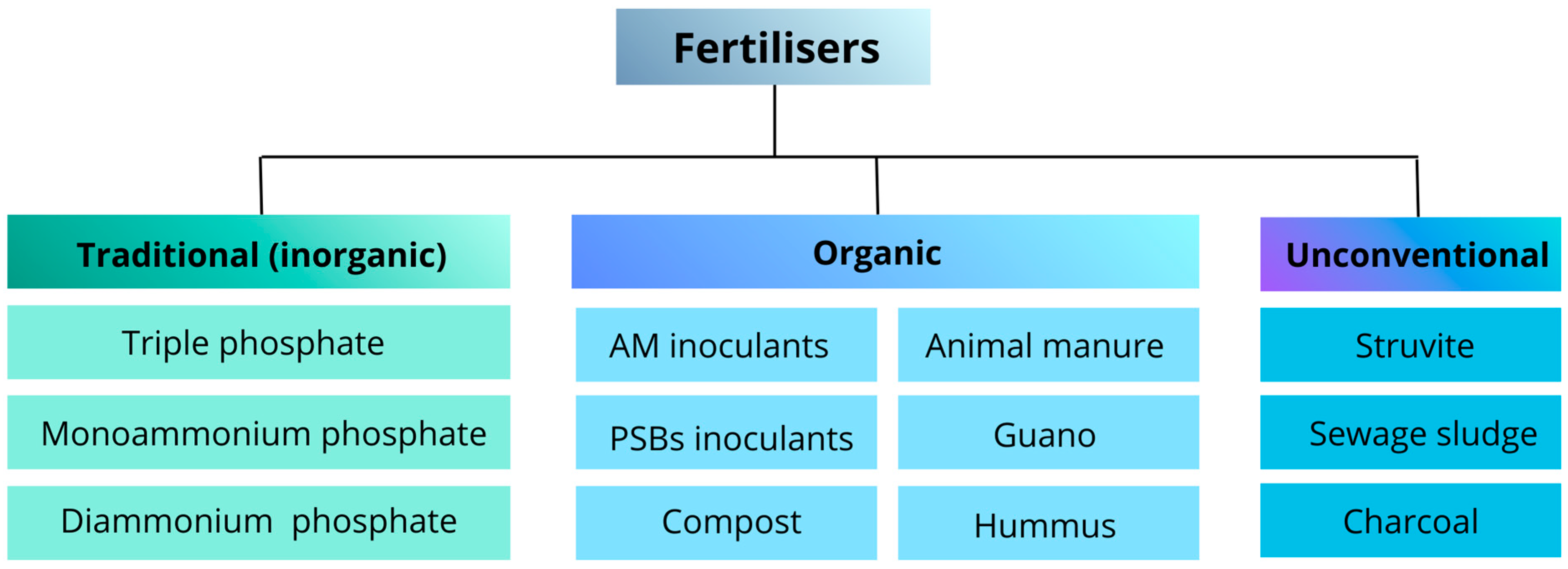
Phosphorus, an element without which life on earth would not exist, is an integral part of global food production. Nearly 90% of P mined from rock phosphate is directed toward the production of agricultural fertilisers, including triple superphosphate, monoammonium phosphate, and diammonium phosphate [99]. Current estimates suggest that global phosphate rock resources could sustain conventional fertiliser production for approximately 200–400 years. When additional resources that may become accessible through technological advancements are taken into account, this timeframe may extend to several centuries, although such estimates vary considerably among studies [100]. Due to limited phosphate resources, fertiliser costs and geopolitical dependencies are expected to increase. This challenge is exacerbated by the growing global population, increasing food demand, and the resulting need to maintain high agricultural productivity [101]. These pressures underscore the urgent need to adopt improved technologies and new fertilisers that supply crops with essential phosphorus while minimising environmental harm (Figure 2).

4.1. Organic Amendments in Modern Crop Management

Since ancient times, farmers have supplied essential nutrients to cultivated plants by adding organic materials, such as straw, animal waste, river or pond sediments, ash, and crushed bones, to the soil [102]. These practices laid the foundation for modern organic fertilisation, which continues to play a significant role in sustainable agriculture today. Contemporary organic fertilisers are typically derived from composting of animal manure, household waste, municipal refuse, agricultural residues and plant parts [103]. Their application enhances key soil properties, such as organic matter content and structure, increases nutrient availability and stimulates soil microbial activity, all of which contribute to improved crop performance [104]. In rice, the use of chicken manure has been associated with increases in plant height, tiller production, grain and straw yield, as well as elevated concentrations of nitrogen, phosphorus and potassium in harvested grains [105]. Similarly, applications of animal manure have led to notable improvements in rice growth parameters, including plant length, the number of tillers per hill, grain yield, and protein content, compared with mineral fertilisation alone [106]. In grapes, cow dung has been shown to boost root dry biomass and improve fruit traits, contributing to greater individual berry weight, higher fruit numbers per plant, and increased total yield [107]. For maize, poultry manure has been reported to stimulate vegetative growth as well as to increase grain yield, accompanied by improvements in grain protein and oil levels [108]. Despite their agronomic benefits, organic fertilisers present several limitations that restrict their broader use. Their nutrient content is inconsistent, making it challenging to supply crops with precise nutrient doses and often necessitating supplementation with mineral fertilisers. Large quantities are usually required, yet their availability can be limited. Additionally, the breakdown of organic materials proceeds slowly and is significantly influenced by soil moisture and temperature, leading to variable nutrient release patterns [109].
The most significant part of phosphorus introduced into the soil with organic fertilisers is phytate (myo-inositol hexakisphosphate salts), which can represent more than half of the total phosphorus content in soil. However, its direct availability is limited to plants. Its low bioavailability is primarily due to the high degree of phosphorylation of the molecule, which results in strong interactions with soil minerals and organic matter [110]. In plants, phytates primarily serve as a phosphorus storage compound, especially in seeds, where they can account for up to 80% of the total phosphorus content. Smaller amounts are found in vegetative tissues, where phytate is involved in various biochemical and signalling functions [111]. Animals consuming grain feed have a limited ability to absorb phosphorus bound in phytates. This limitation is particularly pronounced in monogastric species such as poultry and pigs, and even in ruminants, including cattle and sheep. P from phytates is not fully digested. As a result, significant amounts of phytate are excreted and accumulate in animal manure, especially in the case of a grain-rich diet [112]. Since plants cannot directly absorb organic P compounds, they must be converted into inorganic forms available to plants, a process that depends on PSB activity.

4.2. Role of Microbial Fertilisers in Sustainable Crop Production

Microbial fertilisers are a new class of organic fertilisers that utilise the life processes of microorganisms to provide plants with directly assimilable nutrients, thereby enhancing plant growth and yield. These fertilisers contain large populations of beneficial microorganisms that multiply in the soil, secreting enzymes and organic acids [113]. This microbial activity enriches the soil microbiome, increases the abundance of beneficial bacteria and fungi, enhances the soil’s physical and chemical properties, and increases the content of essential nutrients, including nitrogen, phosphorus, and potassium. Together, these mechanisms improve nutrient availability and increase crop yields [114]. It has been demonstrated that the use of microbial fertilisers based on PSBs significantly enhances phosphorus availability and yields under phosphorus deficiency. In the case of wheat, inoculation with strains such as Pseudomonas moraviensis, Bacillus safensis, and Falsibacillus pallidus increased the mobile fraction of P in the soil by more than 120% and increased grain yields by about 14% compared to controls without inoculation [115]. Furthermore, the application of PSBs together with poorly soluble phosphorus improved root characteristics and above-ground growth of wheat in P-deficient soils, demonstrating their ability to mobilise P that would otherwise be unavailable [116]. In maize, inoculation with PSBs increased shoot and root biomass by 5–8% compared to the controls [107]. In maize-soybean intercropping systems, strains such as Bacillus aryabhattai further enhanced organic acid secretion, increased soil phosphorus (P) availability, and promoted P uptake [117].
Microbial fertilisers represent a promising approach to sustainable agriculture, but their production and use still encounter several limitations. One of the primary challenges is selecting an appropriate carrier material. Commonly used carriers include straw, manure, and other organic residues, while more recent studies explore substrates such as household waste, coal dust, and nutrient-rich soils. These materials often have complex, variable compositions and may contain heavy metals or pathogenic microorganisms. Despite their capacity to stimulate plant growth and enhance soil biological activity, microbial fertilisers do not fully satisfy crop nutrient demand [114]. Future progress in this field is expected to focus on developing genetically modified microbial strains with greater multifunctionality and higher production efficiency. Advances in microbial fertilisers can not only reduce dependence on mineral fertilisers but also improve crop development and yield, while promoting sustainable soil health in the long term [118]. The use of effective microorganisms (EMs), defined as mixed cultures of beneficial bacteria and fungi, has been increasingly reported as a biological approach to improve nutrient dynamics in soils. EM-based preparations are most commonly applied in vegetable production, horticulture, home gardening, and organic farming systems, where they are valued for their potential to stimulate soil microbial activity, enhance nutrient cycling and support plant growth, particularly under reduced mineral fertiliser inputs [119]. Among biological fertilisers, mycorrhizal vaccines containing arbuscular mycorrhizal (AM) fungi are of particular interest to scientists due to their potential to increase phosphorus uptake and overall nutrient acquisition by plants. AM fungi form symbiotic relationships with most crop species, improving phosphorus nutrition by increasing the effective root surface area and facilitating access to otherwise unavailable soil phosphorus [120]. Although mycorrhizal preparations have shown promising results under controlled conditions and on a small scale, their effectiveness over large areas remains variable, partly due to interactions with soil properties, native microbial communities, and management practices [121].

4.3. Alternative Sources of Plant-Available Phosphorus

Recent decades of research into phosphorus recovery from various sources and waste have enabled the development of several innovative and practical applications. Numerous phosphorus recovery technologies are currently available, although they are often more expensive than traditional methods [122,123]. In a wastewater treatment plant, phosphorus can be recovered from various streams, including liquid effluents, slurries, or their combinations, such as secondary treated effluent after biological treatment, anaerobic digester supernatant, and sewage sludge or its derivatives. Most of these technologies are applied on-site and rely primarily on crystallisation and precipitation processes [122]. A common and valuable outcome of these processes is the production of struvite.
Struvite (MgNH4PO4·6H2O) is gaining increasing interest as a recyclable source of P, especially since it can be precipitated and recovered from municipal and industrial wastewater. Due to its low water solubility, struvite is considered a slow-release phosphorus source that can minimise P losses from agricultural fields, supporting both sustainable crop production and the protection of surface water quality [124]. The agronomic effectiveness of struvite varies depending on crop species and soil phosphorus status. Application of struvite in lettuce cultivation resulted in an approximate 54% increase in head weight compared to control plants, accompanied by a higher number of leaves and an expanded rosette diameter [125], and higher rates additionally increased extractable soil P ale plant biomass while contributing to a more stable soil P pool when combined with organic amendments [126]. Struvite demonstrated a strong capacity to support maize productivity while markedly reducing phosphorus losses through runoff and leaching [16]. Its use was also associated with improvements in soil properties, including higher pH and phosphatase activity [127]. In radish and spinach, the use of this recovered nutrient source supported germination, early growth, and physiological characteristics at levels comparable to those of conventional fertilisers [128]. Under organic field conditions, increasing application rates of this recycled P source enhanced wheat grain yield, tissue P concentration, and P accumulation, while also substantially improving forage performance, with residual benefits persisting into subsequent growing seasons. In contrast, flax showed minimal response, highlighting crop-specific differences in phosphorus use efficiency [129]. The struvite also supported competitive growth in lettuce and pepper, while reducing environmental impacts compared with conventional mineral P fertiliser [130]. Collectively, these results underscore the potential of struvite as a versatile, non-conventional phosphorus fertiliser that can maintain crop productivity across multiple species while contributing to more sustainable, environmentally responsible nutrient management in agriculture.
Another unconventional source of P is meat and bones from slaughterhouses. Animal bones are particularly rich in hydroxyapatite, with phosphorus content reaching up to approximately 10% of dry matter [131]. Slaughterhouse by-products are commonly processed into meat and bone meal, which is predominantly incinerated. The resulting ashes constitute a valuable source of P, suitable for use in fertilisers [132]. Studies have shown that applying bone char can significantly improve crop growth and biomass accumulation. Maize grown in P-deficient soils exhibited increased shoot biomass and P uptake when fertilised with bone char, achieving comparable results to those obtained with conventional fertilisers, such as triple superphosphate [133,134]. Long-term field experiments have also demonstrated improved yields for maize and soybean following repeated bone char applications [133]. In addition to enhancing nutrient availability, bone char can reduce heavy metal uptake in crops. For example, rice and cabbage grown in contaminated soils showed lower accumulation of toxic elements in the shoot while maintaining higher P content [135]. Overall, bone char represents a promising approach for simultaneously supplying phosphorus and improving soil quality, with beneficial effects on a range of crops.
In addition to these unconventional P sources, silicon-containing fertilisers are increasingly explored for their role in improving nutrient availability and crop performance (Table 1). Studies have demonstrated that Si fertilization can enhance the availability of phosphorus by modifying plant nutrient uptake and soil chemistry [136].
Silicon fertilisers are most commonly applied foliarly in field trials, although soil-applied formulations also exist. The effectiveness of these fertilisers depends on application method, dose, crop species, and growth stage [29]. While the interaction between foliar-applied Si and soil-applied P fertilisers, such as struvite, has not been fully evaluated, combined strategies may offer potential benefits for enhancing nutrient uptake and crop productivity.

4.4. Techniques for Targeted Nutrient Delivery

In overcoming P deficiency, not only the type of fertiliser used but also the method of its application play crucial roles in determining phosphorus availability in the rhizosphere and crop plants’ uptake efficiency. Foliar fertilisation enables nutrients to be absorbed directly by leaf tissues and subsequently translocated to other plant organs, allowing faster and more effective replenishment of nutrient deficiencies than soil fertilisation [144]. Moreover, nutrients can be applied at precisely defined growth stages and concentrations, allowing for better synchronisation of nutrient supply with crop demand [145]. In the case of P, foliar application is primarily used as a complementary strategy, particularly during the last developmental stages, where it mainly aims to improve crop quality rather than serve as the primary source of P nutrition [144]. It has been shown that maize effectively absorbs and utilises P, regardless of the leaf area to which it is applied. This method of application increased plant biomass and P concentration not only in the shoots but also in the root system [144,146]. As an alternative to broadcast application, banding applies fertiliser directly near the zone, improving grain yield and nutrient use efficiency, as proven in studies on maize and wheat [147,148,149]. Deep placement of fertilisers near the root zone enhances nutrient availability and uptake by crops while reducing losses from surface fixation or runoff. In potatoes, applying fertiliser at a depth of 20 cm increased tuber yield by up to 34% and improved root development and nutrient uptake [150]. Similarly, in winter wheat, deeper banding of P (16–24 cm) enhanced soil phosphorus availability, root growth, and P-use efficiency, leading to significant yield gains compared with shallower applications [149].

5. The Role of Silicon in Alleviating Phosphorus Deficiency

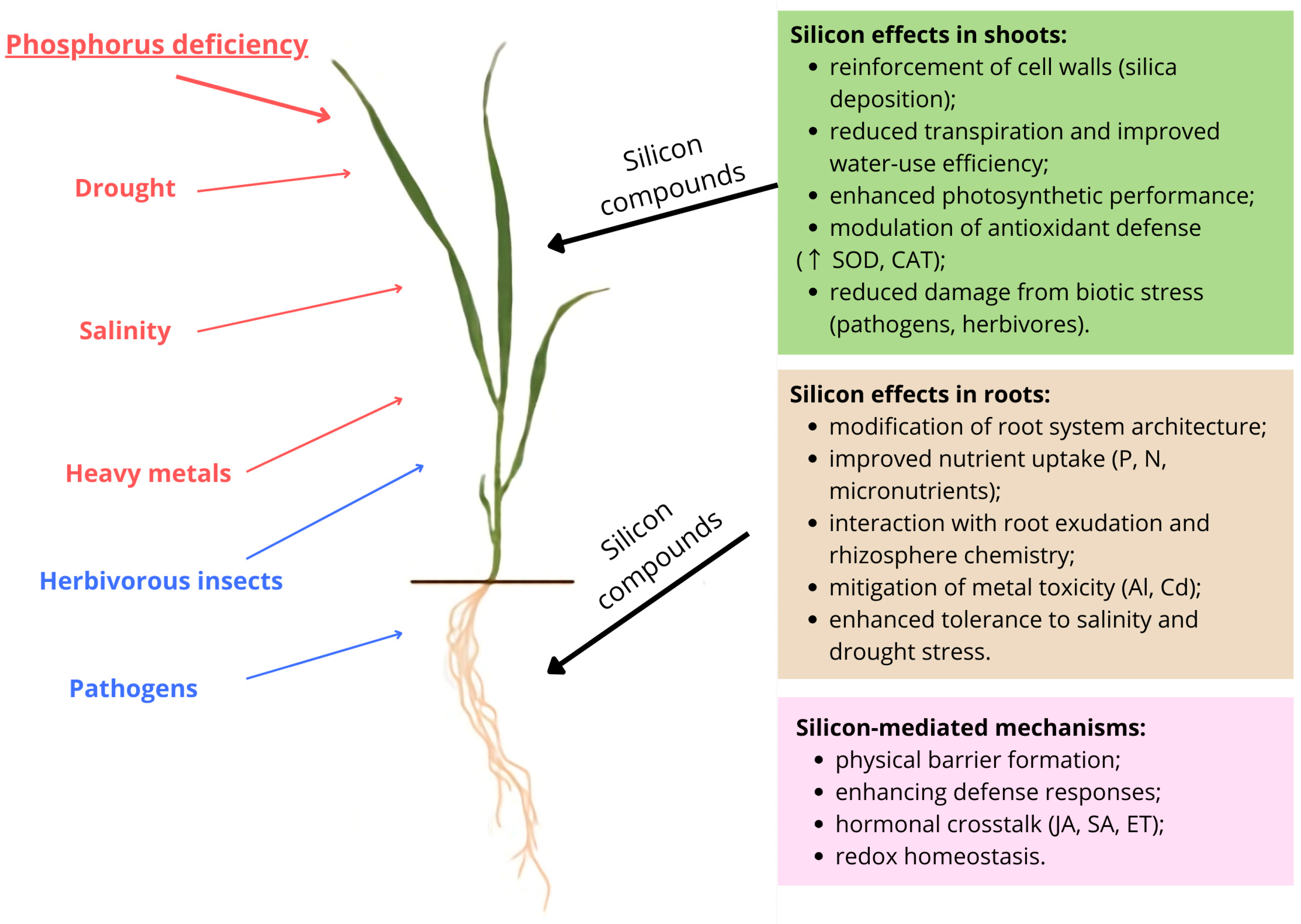
Although silicon is not an essential element for plants, accumulating evidence indicates that it plays a beneficial role in enhancing plant tolerance to a wide range of environmental stresses (Figure 3) [21,24,25,151,152,153,154,155,156,157,158]. Silicon-mediated stress alleviation is commonly associated with improved antioxidant defence capacity, maintenance of ionic and redox homeostasis, and modulation of stress-related hormonal signalling pathways. These responses have been documented across numerous crop species and are considered part of a conserved stress-mitigation strategy. Importantly, several physiological and biochemical disturbances observed under general abiotic stress conditions also occur during phosphorus deficiency. These include enhanced oxidative stress, nutrient imbalance, impaired membrane stability, and alterations in hormonal regulation. Recent studies increasingly suggest that silicon contributes to nutrient stress tolerance by supporting cellular homeostasis and by priming regulatory pathways involved in P acquisition and utilisation.
Recent studies have highlighted the role of silicon as a beneficial element that may improve P uptake by roots and enhance its utilisation within plant tissues (Table 2). Silicon enhances phosphorus uptake primarily by increasing soil P availability [21]. This effect is mediated through a range of biochemical mechanisms and has been reported in several plant species, including rice [159,160], maize [161], and wheat [28]. Silicon stimulates the release of root organic acids, such as malate and citrate, which compete with phosphate for adsorption sites on soil minerals, thereby reducing P fixation and increasing the pool of bioavailable Pi [162]. This response is associated with increased carbon flux through the tricarboxylic acid (TCA) cycle and enhanced activity of TCA cycle enzymes, leading to greater synthesis of organic acids in plant roots [163]. Moreover, Si can increase P availability by forming complexes with Al3+ and Fe3+ ions, modifying soil pH, and influencing microbial community dynamics [164,165]. These processes create a reinforcing link between Si and P cycling, in which low phosphorus availability can stimulate silicon uptake by plants, likely through increased carboxylate exudation that enhances the dissolution of silicon-containing minerals [166,167]. Nevertheless, the extent to which silicon enhances phosphorus availability depends on soil type, microbial activity, and both the form and application rate of Si fertilisers [168].
Beyond its effects on soil P mobilisation, silicon contributes to plant adaptation to P deficiency by mitigating stress-related physiological disturbances commonly associated with low P availability. Phosphorus deficiency induces oxidative stress, disrupts ionic balance, and alters osmotic regulation, processes that closely resemble plant responses to other abiotic stresses. Numerous studies have demonstrated that Si stimulates plant antioxidant defence systems under stress conditions by increasing the activity of key enzymes such as superoxide dismutase, catalase, and peroxidases, thereby limiting ROS accumulation and reducing oxidative damage to cellular membranes [169,170,171,172,173]. Silicon also plays a vital role in maintaining ionic homeostasis by restricting the uptake and translocation of toxic ions while promoting the accumulation of essential nutrients, which is critical under nutrient imbalance conditions [174]. In addition, Si has been shown to enhance the synthesis of osmoprotectants, including proline, glycine, and betaine, thereby improving cellular osmotic adjustment and stress tolerance [175]. Although these mechanisms have been primarily described under salinity and drought stress, they are likely to be equally relevant under P deficiency, where oxidative stress, nutrient imbalance, and osmotic disturbances frequently co-occur. For example, Si supplementation under P shortage in tomato resulted in increased activities of key ROS-scavenging enzymes, including SOD, CAT, and PODs, suggesting that Si-induced enhancement of antioxidant capacity contributes to the maintenance of cellular homeostasis under P limitation [176].
In addition to redox regulation, Si-mediated alleviation of P deficiency appears to involve complex interactions with phytohormonal signalling networks that coordinate root architecture, nutrient uptake, and stress adaptation. Phosphorus deficiency is known to disrupt hormonal balance, particularly pathways associated with abscisic acid and auxins, which play central roles in regulating root system development and P acquisition. Increasing evidence indicates that Si interacts with multiple phytohormones, including auxins, cytokinins, gibberellins, abscisic acid, brassinosteroids, salicylic acid, jasmonic acid, ethylene, and nitric oxide, thereby modulating plant growth and stress responses under nutrient-limited conditions [170]. Under stress conditions, Si-mediated hormonal modulation frequently involves the regulation of abscisic acid signalling, leading to improved stomatal control, gas exchange, and activation of stress-responsive genes, while simultaneously sustaining growth-promoting hormones such as auxins, cytokinins, and gibberellins, whose levels are often reduced under P limitation [154,155,156]. Through this hormonal rebalancing, Si may indirectly influence P acquisition by promoting root elongation, lateral root formation, and root hair development, all of which are critical traits for efficient phosphate foraging in low-P soils. Moreover, Si-associated modulation of defence-related hormonal pathways dependent on salicylic acid, jasmonic acid, and ethylene may contribute to enhanced stress signalling integration and improved physiological performance of plants under combined nutrient and environmental constraints [177,178].
The beneficial effects of Si on P nutrition are further strengthened by its interaction with soil microorganisms. The synergistic effect of Si, PSB and AMF is also crucial. Each of these factors can improve P availability individually, but their combined action appears more effective and functionally complementary. Phosphate-solubilising bacteria mobilise inorganic and organic P through acidification, organic acid production and phosphatase activity, thereby releasing Pi that can be readily absorbed by AMF hyphae [75]. Arbuscular mycorrhizal fungi efficiently acquire Pi from the soil and transport it to the host plant via their extensive extraradical hyphal network [179]. Importantly, AMF hyphae release carbon-rich exudates that stimulate PSB growth and activity in the hyphosphere, enhancing both inorganic P solubilization and organic P mineralisation [180,181,182]. Silicon further strengthens this interaction by increasing plant photosynthetic capacity and carbon allocation belowground, thereby supporting both AMF development and heterotrophic PSB metabolism [183]. In addition, PSBs can weather silicate minerals, thereby increasing the availability of soluble silicon. Silicon itself has been shown to stimulate beneficial bacterial populations in the rhizosphere [184]. Through these interconnected processes, Si enhances mycorrhizal effectiveness, PSBs activity, and microbial recruitment, ultimately creating a positive feedback loop that maximises P mobilisation, uptake, and plant nutritional status [21]. At the molecular level, emerging evidence indicates that Si modulates molecular components of P acquisition, including the expression of PHT genes. In wheat grown in low-P acidic soils, Si supplementation significantly upregulated root expression of the high-affinity Pi transporters TaPHT1;1 and TaPHT1;2, which was associated with enhanced Pi uptake and improved use efficiency under P-limited conditions [162]. Similarly, studies conducted on rice under phosphorus deficiency reported increased transcript levels of OsPT4 and OsPT8 following Si application, further supporting a conserved role of Si in promoting Pi transporter expression across monocot species [160]. Under conditions of sufficient phosphate, SPX proteins inhibit PHR activity. In contrast, phosphate deficiency alters inositol pyrophosphate signalling, weakening SPH-PHR interactions and releasing PHR, which then activates PHT1 family transporters and regulatory factors involved in Pi remobilisation and homeostasis [40]. As previously mentioned, Si modulates cellular redox homeostasis and phytohormone signalling, which are known to interact with P-deficiency responses. By alleviating oxidative stress and restoring hormonal signalling balance under P deficiency, Si may indirectly influence the activity of the PHT-SPX regulatory module, thereby promoting the transcription of phosphate transporter genes. In this regard, the Si-induced upregulation of PHT1 family members observed in diverse crop species, including wheat [162] and rice [160], under P-deficient conditions is unlikely to result from a direct transcriptional effect on transporter genes, but rather reflects broader modifications in regulatory signalling pathways in response to P deficiency.
Collectively, these physiological, biochemical, and molecular responses highlight the multifaceted role of Si in alleviating P deficiency in crop plants. Nevertheless, despite the considerable potential of Si to improve Pi uptake and stress resilience, the underlying regulatory mechanism and species-specific responses remain insufficiently characterised, underscoring the need for further molecular and field-based studies.
Table 2. Overview of mechanisms of Pi deficiency alleviation as induced by Si, including various reactions of the crop plants and involvement in plant-Pi-Si interactions—on selected examples from recent years of research *.
Silicon
Compound/
Treatment/
Concentration
Plant
Species
(Organ)
Pi Deficiency/
Stress Severity
The Effect of Si
on Plant
Cells/Rhizosphere
Improved Plants
Functioning Under
Low Pi
References
Potassium
silicate
(K2SiO3 nH2O)
(1.5 mM)
Solanum
lycopersicum (cv. Zhong Za “No. 9”)—(roots,
leaves, stems)
Early P deficiency (1–2 weeks), low P(P 0.44 mM + Si 1.5 mM)Si decreased ROS and malondialdehyde levels via increasing antioxidant enzyme activity (superoxide dismutase, peroxidase, catalase).Si compensated
P deficiency effects: increasing photosynthesis, antioxidant potential, nutrient content/homeostasis (K, Na, Ca, Mg, Fe, Mn).
[176]
Sodium
metasilicate
(10 μM)
Hordeum vulgare (roots)Short-term Pi deficiency (7 days)Auxin and NO participated in Si-mediated root elongation and Pi-transporter expression (HvPHT1).Increased Pi uptake by barley and improved root growth.[185]
Silicic acid
(0 and 120 mg Si kg−1)
Oryza sativa (seedlings, roots, rhizosphere)Low P soils,
45-day cultivation period
Si increases the dissolution of Fe–P complexes and expands acid phosphatase hotspots in the rhizosphere.The Si application increased acid phosphatase activity and seedling biomass. Si-induced changes in root architecture, including increases in maximum vertical extension and root angle.[159]
Sodium silicate (Na2SiO3,
400 mg Si
kg−1 dry soil)
Triticum aestivum
(cv. Pobeda)
(roots and shoots, root exudates)
Low P acidic soil
(4 weeks after germination)
Increased root exudation of organic acids (malate, citrate) mobilises Pi in the rhizosphere. High expression of Pi transporters (TaPHT1.1 and TaPHT1.2).The Si application increased wheat biomass and shoot P concentration, comparable to that
of P-fertilised plants.
[162]
Na2SiO3
(1.5 mM in hydroponics)
Triticum aestivum
(cv. Rubisko)
(shoots and roots)
Low Pi (30 days)
(0 or 0.2 mM KH2PO4)
Results demonstrated that Si promote P recycling from P-metabolites in P-deprived wheat.Wheat plants grown without external P but supplemented with Si showed high P levels.[186]
Silicon
fertiliser
(0 or
45 kg·ha−1)
Oryza sativa
(cv. Suigeng 18) (roots, exudation, rhizosphere, leaves)
Low Pi (45 days) (0, 25 and 75 P2O5 kg ha−1)
(water-saving rice cultivation)
Increased organic acid content (malate, succinate), enhanced acid phosphatase activity;
reduced ATPase
content.
Increased P content promoted shoot growth (downregulation of SUT1, SWEET11, CIN2). Upregulation of OsPT2, OsPT4, and OsPT8 in roots leads to improved
Pi uptake.
[160]
Silica gel
—as Si fertiliser (2 or 4 g
kg−1 Si)
Oryza sativa (cv. Haenuki) (high-density nursery seedlings)Dicalcium superphosphate—P fertiliser
(0 or 60 mg kg−1 P)
Si treatment stabilised early rice growth after transplanting seedlings to new culture conditions.P and Si application stabilised rice growth under transplanting stress.[187]
Silicic acid [Si(OH)4]
Si application (0, 50, 100, 200 and 400 mg kg−1 soil)
Avena sativa (cv. Faikbey)
(shoot,
leaves, roots)
P level in the soil (0, 10, 25, 50, 100 mg P kg−1 soil)Si treatment had beneficial effects on oat shoot dry mass, P content, and P uptake by oat plants.The Si application to moderately acidic soils can be
a method for the reduction in P deficiency stress as well as P toxicity in oats (by decreasing excess P absorption).
[188]
Sodium silicate (stabilised with sorbitol)Urochloa brizantha cv. Marandu and Megathyrsus maximum cv. MassaiMulti-nutrient
deficiency, including low-P stress
Beneficial effects of Si in stressed and non-stressed plants.The Si application increased the content of phenolic compounds, the quantum efficiency of photosystem II, the efficiency of P use, and shoot dry mass production.[189]
Si
nanoparticles
(8.5–9.7 nm)
(2 mM Si)
Capsicum annuum
bell pepper
(shoot,
leaves, roots)
Severe P deficiency
(up to 54 days after transplanting)
Si increased the antioxidant content (ascorbic acid, phenolics, carotenoids), photosynthetic apparatus efficiency and plant growth.
Si enhances plant yield and health.
Si overcame nutrient deficiencies. The key role of silicon (Si) is to mitigate the effects of P deficiency while providing benefits to plants that require sufficient phosphorus.[28]
Si
(0 or 14.36 kg H4SiO4
ha−1 year−1)
Carex myosuroides Poa pratensis (alpine grassland)
(leaves, soil samples)
Low P soil
(0, 49, 98, 148 kg P ha−1 year−1)
In addition, reduced lignin, cellulose, and hemicellulose contents in grass leaves.Si optimised structural carbon compounds, enhanced P and N uptake efficiency, and increased grass biomass production.[190]
Silicic acid
(344 g kg−1 total Si)
Oryza sativa
(inoculated with Rhizophagus irregularis)
(rice leaves and stems, soil samples)
Low P and high P availability (18 and 62 mg P kg−1)Si plays various roles in regulating AMF functioning and P content in leaves, as dependent on soil P levels.Under low P conditions, Si reduced arbuscular mycorrhizal fungi (AMF) colonisation. Under high P availability, the combination of Si and AMF increased
stem P content.
[191]
Potassium
silicate
(K2O3Si,
3 or 6 mL L−1)
Zea mays (cv. Yaqout)
(leaves, corn cobs, grains)
Low P (up to 60 days after
sowing)
+ AMF (Glomus spp.)
Si foliar application enhanced chlorophyll content, increased grain yield, and qualitySi and arbuscular mycorrhizal fungi (AMF) reduced the adverse effects of salinity on maize under low P conditions.[192]
Three Si
treatments:
Silicic acid (1 mmol/L),
organosilicon, Nano-silicon
(1 mmol/L)
Oryza sativa
(14 varieties of rice)
(shoot,
leaves, roots)
Lower P conditions—rice plants grown for 21 daysSi affects the assembly of cell wall components, thus affecting P adsorption.
Inorganic silicon and Nano-silicon altered the P adsorption of cell walls.
Inorganic Si is the best among the 3 Si materials for improving rice growth.
Si treatments changed the distribution of P in rice.
[193]
* Older papers are cited in [168,194].

6. Conclusions and Future Perspectives

Phosphorus deficiency remains a significant constraint to crop productivity. Over the past few decades, substantial progress has been made in understanding plant responses to P limitation, not only in model species but also in major, economically essential crops. This growing body of knowledge has significantly expanded the range of practical strategies to improve P acquisition, utilisation efficiency, and crop performance under P-limited conditions. Approaches such as foliar P fertilisation, organic and alternative fertilisers, and microbial inoculants have demonstrated considerable potential to enhance P availability and uptake. Importantly, this progress also opens up opportunities to develop crop varieties with improved nutrient use efficiency, which may become increasingly feasible in the near future as practical knowledge accumulates. Silicon plays a complementary and multifaceted role in this context by mitigating abiotic stress, promoting root development, regulating phytohormone balance, enhancing antioxidant defences, and facilitating the uptake of essential nutrients. Combining silicon with P fertilisation, organic amendments, or beneficial microorganisms represents a promising approach to improve phosphorus-use efficiency and stress resilience. At the same time, significant progress is being made toward developing alternative fertilisation solutions that could reduce dependence on non-renewable phosphorus resources and replace conventional fertilisation practices as these resources become scarce.
Despite the growing number of studies on the use of silicon in crop nutrition, significant knowledge gaps remain. In particular, the interactions between silicon and emerging alternative phosphorus sources are still poorly understood. Moreover, the effects of silicon in combination with microbial inoculants are not universally positive and appear to depend on application rates, nutritional status, environmental conditions, and crop species.
Future research should prioritise studies of silicon-phosphorus interactions at the rhizosphere level, including the effects of silicon on P solubilization, transporter gene expression, and root exudation under varying P availability. Particular attention should be paid to the synergistic effects of silicon in combination with alternative P sources, such as recycled P fertilisers. In parallel, optimisation of application strategies should include a systematic comparison of silicon forms (e.g., silicates, silicon nanoparticles, foliar and soil applications) and timing relative to P supply, along with assessments of phosphorus use efficiency, crop yield, and soil P fractions. Crucially, these results should be validated through multi-site field studies conducted in diverse soil types (acidic, calcareous, and phosphorus-poor) and climate zones (including temperate, semi-arid, and tropical agroecosystems). Such studies should incorporate agronomic, physiological, and environmental indicators to assess both yield gains and potential reductions in P losses. This focused, multi-scale research framework will provide a solid foundation for developing silicon-based fertilisation strategies that increase phosphorus use efficiency while supporting sustainable crop production under diverse agroecological conditions.

Author Contributions

Conceptualization, I.C. and I.K.; writing—original draft preparation, I.K.; writing—review and editing, I.K. and I.C. All authors have read and agreed to the published version of the manuscript.

Funding

This research received no external funding.

Data Availability Statement

No new data were created or analyzed in this study. Data sharing is not applicable to this article.

Conflicts of Interest

The authors declare that they have no conflicts of interest.

References

  1. Tan, Y.; Ning, Y.; Wang, S.; Li, F.; Cao, X.; Wang, Q.; Ren, A. Multilayered Regulation of Fungal Phosphate Metabolism: From Molecular Mechanisms to Ecological Roles in the Global Phosphorus Cycle. Life 2025, 15, 1676. [Google Scholar] [CrossRef] [PubMed]
  2. Lu, H.; Wang, F.; Wang, Y.; Lin, R.; Wang, Z.; Mao, C. Molecular Mechanisms and Genetic Improvement of Low-phosphorus Tolerance in Rice. Plant Cell Environ. 2022, 46, 1104–1119. [Google Scholar] [CrossRef] [PubMed]
  3. Yang, S.Y.; Lin, W.Y.; Hsiao, Y.M.; Chiou, T.J. Milestones in Understanding Transport, Sensing, and Signaling of the Plant Nutrient Phosphorus. Plant Cell 2024, 36, 1504–1523. [Google Scholar] [CrossRef] [PubMed]
  4. Solangi, F.; Zhu, X.; Khan, S.; Rais, N.; Majeed, A.; Sabir, D.-M.; Iqbal, R.; Ali, S.; Hafeez, A.; Ali, B.; et al. The Global Dilemma of Soil Legacy Phosphorus and Its Improvement Strategies under Recent Changes in Agro-Ecosystem Sustainability. ACS Omega 2023, 8, 23271–23282. [Google Scholar] [CrossRef]
  5. Sharifi, S.; Shi, S.; Obaid, H.; Dong, X.; He, X. Differential Effects of Nitrogen and Phosphorus Fertilization Rates and Fertilizer Placement Methods on P Accumulations in Maize. Plants 2024, 13, 1778. [Google Scholar] [CrossRef]
  6. Hou, P.; Li, B.; Cao, E.; Liu, Z.; Li, Y.; Sun, Z.; Xiao, Y.; Ma, C. Optimizing Nitrogen and Phosphorus Fertilizer Application for Wheat Yield on Alkali Soils: Mechanisms and Effects. Agronomy 2025, 15, 734. [Google Scholar] [CrossRef]
  7. Mishra, S.; Levengood, H.; Fan, J.; Zhang, C. Plants Under Stress: Exploring Physiological and Molecular Responses to Nitrogen and Phosphorus Deficiency. Plants 2024, 13, 3144. [Google Scholar] [CrossRef]
  8. Lopez, G.; Ahmadi, S.H.; Amelung, W.; Athmann, M.; Ewert, F.; Gaiser, T.; Gocke, M.I.; Kautz, T.; Postma, J.; Rachmilevitch, S.; et al. Nutrient Deficiency Effects on Root Architecture and Root-to-Shoot Ratio in Arable Crops. Front. Plant Sci. 2023, 13, 1067498. [Google Scholar] [CrossRef]
  9. Ajmera, I.; Hodgman, T.C.; Lu, C. An Integrative Systems Perspective on Plant Phosphate Research. Genes 2019, 10, 139. [Google Scholar] [CrossRef]
  10. Chien, P.-S.; Chiang, C.-P.; Leong, S.J.; Chiou, T.-J. Sensing and Signaling of Phosphate Starvation: From Local to Long Distance. Plant Cell Physiol. 2018, 59, 1714–1722. [Google Scholar] [CrossRef]
  11. Dissanayaka, S.; Ghahremani, M.; Siebers, M.; Wasaki, J.; Plaxton, W. Recent Insights into the Metabolic Adaptations of Phosphorus Deprived Plants. J. Exp. Bot. 2020, 72, 199–223. [Google Scholar] [CrossRef]
  12. Škarpa, P.; Školníková, M.; Antošovský, J.; Horký, P.; Smýkalová, I.; Horáček, J.; Dostálová, R.; Kozáková, Z. Response of Normal and Low-Phytate Genotypes of Pea (Pisum sativum L.) on Phosphorus Foliar Fertilization. Plants 2021, 10, 1608. [Google Scholar] [CrossRef]
  13. Ferron, L.M.E.; Van Groenigen, J.W.; Koopmans, G.F.; Vidal, A. Can Earthworms and Root Traits Improve Plant Struvite-P Uptake? A Field Mesocosm Study. Agric. Ecosyst. Environ. 2025, 377, 109255. [Google Scholar] [CrossRef]
  14. Martinon, T.L.M. The Urgent Recognition of Phosphate Resource Scarcity and Pollution. RSC Sustain. 2023, 1, 1594–1598. [Google Scholar] [CrossRef]
  15. Han, Y.; White, P.; Cheng, L. Mechanisms for Improving Phosphorus Utilization Efficiency in Plants: A Review. Ann. Bot. 2021, 129, 247–258. [Google Scholar] [CrossRef]
  16. Kokulan, V.; Schneider, K.; Macrae, M.; Wilson, H. Struvite Application to Field Corn Decreases the Risk of Environmental Phosphorus Loss While Maintaining Crop Yield. Agric. Ecosyst. Environ. 2024, 366, 108936. [Google Scholar] [CrossRef]
  17. Gu, D.; Andreev, K.; Dupre, M. Major Trends in Population Growth Around the World. China CDC Wkly. 2021, 3, 604–613. [Google Scholar] [CrossRef] [PubMed]
  18. Kumar, N.; Samota, S.R.; Venkatesh, K.; Tripathi, S. Global Trends in Use of Nano-Fertilizers for Crop Production: Advantages and Constraints—A Review. Soil Tillage Res. 2023, 228, 105645. [Google Scholar] [CrossRef]
  19. Rasoolizadeh, A.; Labbé, C.; Sonah, H.; Deshmukh, R.K.; Belzile, F.; Menzies, J.G.; Bélanger, R.R. Silicon Protects Soybean Plants against Phytophthora Sojae by Interfering with Effector-Receptor Expression. BMC Plant Biol. 2018, 18, 97. [Google Scholar] [CrossRef]
  20. YAN, G.; Nikolic, M.; YE, M.; Xiao, Z.; Liang, Y. Silicon Acquisition and Accumulation in Plant and Its Significance for Agriculture. J. Integr. Agric. 2018, 17, 2138–2150. [Google Scholar] [CrossRef]
  21. Etesami, H.; Jeong, B.R.; Glick, B. Contribution of Arbuscular Mycorrhizal Fungi, Phosphate–Solubilizing Bacteria, and Silicon to P Uptake by Plant. Front. Plant Sci. 2021, 12, 699618. [Google Scholar] [CrossRef]
  22. Khan, I.; Awan, S.; Rizwan, M.; Ali, S.; Hassan, M.; Brestic, M.; Zhang, X.; Huang, L. Effects of Silicon on Heavy Metal Uptake at the Soil-Plant Interphase: A Review. Ecotoxicol. Environ. Saf. 2021, 222, 112510. [Google Scholar] [CrossRef]
  23. Pavlovic, J.; Kostic, L.; Bosnic, P.; Kirkby, E.A.; Nikolic, M. Interactions of Silicon with Essential and Beneficial Elements in Plants. Front. Plant Sci. 2021, 12, 697592. [Google Scholar] [CrossRef]
  24. Ahmad, W.; Waraich, E.; Haider, A.; Mahmood, N.; Ramzan, T.; Alamri, S.; Siddiqui, M.; Akhtar, M.S. Silicon-Mediated Improvement in Drought and Salinity Stress Tolerance of Black Gram (Vigna mungo L.) by Modulating Growth, Physiological, Biochemical, and Root Attributes. ACS Omega 2024, 9, 37231–37242. [Google Scholar] [CrossRef]
  25. Hassan, K.; Ajaj, R.; Nazmy, A.; Ebrahim, M.; Hassan, I.; Hassan, F.; Alam-Eldein, S.; Ali, M.A.A. Silicon: A Powerful Aid for Medicinal and Aromatic Plants against Abiotic and Biotic Stresses for Sustainable Agriculture. Horticulturae 2024, 10, 806. [Google Scholar] [CrossRef]
  26. Olivera-Viciedo, D.; Oliveira, K.; Prado, R.; Habermann, E.; Martinez, C.; Zanine, A. Silicon Uptake and Utilization on Panicum Maximum Grass Modifies C:N:P Stoichiometry under Warming and Soil Water Deficit. Soil Tillage Res. 2024, 235, 105884. [Google Scholar] [CrossRef]
  27. Costa, M.; Prado, R.; Luiz Fabiano, P.; Souza, J., Jr. The Effect of Abiotic Stresses on Plant C:N:P Homeostasis and Their Mitigation by Silicon. Crop J. 2024, 12, 340–353. [Google Scholar] [CrossRef]
  28. Costa, M.; Silva, B.; Alves, D.; Lima, P.; Prado, R. Silicon, by Modulating Homeostasis and Nutritional Efficiency, Increases the Antioxidant Action and Tolerance of Bell Peppers to Phosphorus Deficiency. Sci. Hortic. 2025, 343, 114093. [Google Scholar] [CrossRef]
  29. Artyszak, A. Effect of Silicon Fertilization on Crop Yield Quantity and Quality—A Literature Review in Europe. Plants 2018, 7, 54. [Google Scholar] [CrossRef] [PubMed]
  30. Versaw, W.K.; Garcia, L.R. Intracellular Transport and Compartmentation of Phosphate in Plants. Curr. Opin. Plant Biol. 2017, 39, 25–30. [Google Scholar] [CrossRef]
  31. Ayadi, A.; David, P.; Arrighi, J.-F.; Chiarenza, S.; Thibaud, M.-C.; Nussaume, L.; Marin, E. Reducing the Genetic Redundancy of Arabidopsis PHOSPHATE TRANSPORTER1 Transporters to Study Phosphate Uptake and Signaling. Plant Physiol. 2015, 167, 1511–1526. [Google Scholar] [CrossRef]
  32. Li, Y.; Zhang, J.; Zhang, X.; Fan, H.; Gu, M.; Qu, H.; Xu, G. Phosphate Transporter OsPht1;8 in Rice Plays an Important Role in Phosphorus Redistribution from Source to Sink Organs and Allocation between Embryo and Endosperm of Seeds. Plant Sci. 2015, 230, 23–32. [Google Scholar] [CrossRef]
  33. Rae, A.L.; Cybinski, D.H.; Jarmey, J.M.; Smith, F.W. Characterization of Two Phosphate Transporters from Barley; Evidence for Diverse Function and Kinetic Properties among Members of the Pht1 Family. Plant Mol. Biol. 2003, 53, 27–36. [Google Scholar] [CrossRef]
  34. Zhu, W.; Miao, Q.; Sun, D.; Yang, G.; Wu, C.-A.; Huang, J.; Zheng, C. The Mitochondrial Phosphate Transporters Modulate Plant Responses to Salt Stress via Affecting ATP and Gibberellin Metabolism in Arabidopsis thaliana. PLoS ONE 2012, 7, e43530. [Google Scholar] [CrossRef] [PubMed]
  35. Miyaji, T.; Kuromori, T.; Takeuchi, Y.; Yamaji, N.; Yokosho, K.; Shimazawa, A.; Sugimoto, E.; Omote, H.; Shinozaki, K.; Moriyama, Y. AtPHT4;4 Is a Chloroplast-Localized Ascorbate Transporter in Arabidopsis. Nat. Commun. 2015, 6, 5928. [Google Scholar] [CrossRef]
  36. Karlsson, P.; Herdean, A.; Adolfsson, L.; Beebo, A.; Nziengui, H.; Irigoyen, S.; Unnep, R.; Zsiros, O.; Nagy, G.; Garab, G.; et al. The Arabidopsis Thylakoid Transporter PHT4;1 Influences Phosphate Availability for ATP Synthesis and Plant Growth. Plant J. 2015, 84, 99–110. [Google Scholar] [CrossRef] [PubMed]
  37. Liu, X.; Wang, L.; Wang, X.; Yan, Y.; Yang, X.; Xie, M.; Hu, Z.; Shen, X.; Ai, H.; Lin, H.; et al. Mutation of the Chloroplast-Localized Phosphate Transporter OsPHT2;1 Reduces Flavonoid Accumulation and UV Tolerance in Rice. Plant J. 2020, 102, 53–67. [Google Scholar] [CrossRef] [PubMed]
  38. Yang, S.-Y.; Huang, T.-K.; Kuo, H.-F.; Chiou, T.-J. Role of Vacuoles in Phosphorus Storage and Remobilization. J. Exp. Bot. 2017, 68, 3045–3055. [Google Scholar] [CrossRef]
  39. Xu, L.; Zhao, H.; Wan, R.; Liu, Y.; Xu, Z.; Tian, W.; Wenyuan, R.; Wang, F.; Deng, M.; Wang, J.; et al. Identification of Vacuolar Phosphate Efflux Transporters in Land Plants. Nat. Plants 2019, 5, 84–94. [Google Scholar] [CrossRef]
  40. Luan, M.; Zhao, F.; Sun, G.; Xu, M.; Fu, A.; Lan, W.; Luan, S. A SPX Domain Vacuolar Transporter Links Phosphate Sensing to Homeostasis in Arabidopsis. Mol. Plant 2022, 15, 1590–1601. [Google Scholar] [CrossRef]
  41. Nagy, R.; Grob, H.; Weder, B.; Green, P.; Klein, M.; Frelet-Barrand, A.; Schjoerring, J.; Brearley, C.; Martinoia, E. The Arabidopsis ATP-Binding Cassette Protein AtMRP5/AtABCC5 Is a High Affinity Inositol Hexakisphosphate Transporter Involved in Guard Cell Signaling and Phytate Storage. J. Biol. Chem. 2009, 284, 33614–33622. [Google Scholar] [CrossRef] [PubMed]
  42. Dong, J.; Ma, G.; Sui, L.; Wei, M.; Satheesh, V.; Zhang, R.; Ge, S.; Li, J.; Zhang, T.-E.; Wittwer, C.; et al. Inositol Pyrophosphate InsP8 Acts as an Intracellular Phosphate Signal in Arabidopsis. Mol. Plant 2019, 12, 1463–1473. [Google Scholar] [CrossRef] [PubMed]
  43. Guan, Z.; Zhang, Q.; Zhang, Z.; Zuo, J.; Chen, J.; Liu, R.; Savarin, J.; Broger, L.; Cheng, P.; Wang, Q.; et al. Mechanistic Insights into the Regulation of Plant Phosphate Homeostasis by the Rice SPX2—PHR2 Complex. Nat. Commun. 2022, 13, 1581. [Google Scholar] [CrossRef]
  44. Zhou, J.; Hu, Q.; Xiao, X.; Yao, D.; Ge, S.; Ye, J.; Li, H.; Cai, R.; Liu, R.; Meng, F.; et al. Mechanism of Phosphate Sensing and Signaling Revealed by Rice SPX1-PHR2 Complex Structure. Nat. Commun. 2021, 12, 7040. [Google Scholar] [CrossRef]
  45. Ried, M.; Wild, R.; Zhu, J.; Pipercevic, J.; Sturm, K.; Broger, L.; Harmel, R.; Abriata, L.; Hothorn, L.; Fiedler, D.; et al. Inositol Pyrophosphates Promote the Interaction of SPX Domains with the Coiled-Coil Motif of PHR Transcription Factors to Regulate Plant Phosphate Homeostasis. Nat. Commun. 2021, 12, 384. [Google Scholar] [CrossRef] [PubMed]
  46. Yamaji, N.; Takemoto, Y.; Miyaji, T.; Mitani-Ueno, N.; Yoshida, K.T.; Ma, J.F. Reducing Phosphorus Accumulation in Rice Grains with an Impaired Transporter in the Node. Nature 2017, 541, 92–95. [Google Scholar] [CrossRef]
  47. Fabiańska, I.; Bucher, M.; Häusler, R. Intracellular Phosphate Homeostasis—A Short Way from Metabolism to Signaling. Plant Sci. 2019, 286, 57–67. [Google Scholar] [CrossRef]
  48. Toyota, K.; Tamura, M.; Ohdan, T.; Nakamura, Y. Expression Profiling of Starch Metabolism-Related Plastidic Translocator Genes in Rice. Planta 2006, 223, 248–257. [Google Scholar] [CrossRef]
  49. Kammerer, B.; Fischer, K.; Hilpert, B.; Schubert, S.; Gutensohn, M.; Weber, A.; Flügge, U.-I. Molecular Characterization of a Carbon Transporter in Plastids from Heterotrophic Tissues: The Glucose 6-Phosphate/Phosphate Antiporter. Plant Cell 1998, 10, 105–117. [Google Scholar] [CrossRef]
  50. Wang, Y.; Lambers, H. Root-Released Organic Anions in Response to Low Phosphorus Availability: Recent Progress, Challenges and Future Perspectives. Plant Soil 2020, 447, 135–156. [Google Scholar] [CrossRef]
  51. Zhang, B.; Zhu, X.; Yuan, P.; Bei, H.; Wu, T.; Din, I.; Wang, C.; Hammond, J.; Wang, S.; Ding, G.; et al. Root Morphological Adaptation and Leaf Lipid Remobilization Drive Differences in Phosphorus Use Efficiency in Rapeseed Seedlings. Crop J. 2025, 13, 524–535. [Google Scholar] [CrossRef]
  52. Zhang, L.; Shi, N.; Fan, J.; Wang, F.; George, T.S.; Feng, G. Arbuscular Mycorrhizal Fungi Stimulate Organic Phosphate Mobilization Associated with Changing Bacterial Community Structure under Field Conditions. Environ. Microbiol. 2018, 20, 2639–2651. [Google Scholar] [CrossRef]
  53. Bellini, C.; Pacurar, D.; Perrone, I. Adventitious Roots and Lateral Roots: Similarities and Differences. Annu. Rev. Plant Biol. 2014, 65, 639–666. [Google Scholar] [CrossRef] [PubMed]
  54. Orman-Ligeza, B.; Parizot, B.; Gantet, P.; Beeckman, T.; Bennett, M.; Draye, X. Post-Embryonic Root Organogenesis in Cereals: Branching out from Model Plants. Trends Plant Sci. 2013, 18, 459–467. [Google Scholar] [CrossRef] [PubMed]
  55. Lu, H.; Ren, M.; Lin, R.; Jin, K.; Mao, C. Developmental Responses of Roots to Limited Phosphate Availability: Research Progress and Application in Cereals. Plant Physiol. 2024, 196, 2162–2174. [Google Scholar] [CrossRef]
  56. Lynch, J.P. Harnessing Root Architecture to Address Global Challenges. Plant J. 2022, 109, 415–431. [Google Scholar] [CrossRef]
  57. Huang, G.; Zhang, D. The Plasticity of Root Systems in Response to External Phosphate. Int. J. Mol. Sci. 2020, 21, 5955. [Google Scholar] [CrossRef] [PubMed]
  58. Żebrowska, E.; Milewska, M.; Ciereszko, I. Mechanisms of Oat (Avena sativa L.) Acclimation to Phosphate Deficiency. PeerJ 2017, 5, e3989. [Google Scholar] [CrossRef]
  59. Li, Z.; Xu, C.; Li, K.; Yan, S.; Qu, X.; Zhang, J. Phosphate Starvation of Maize Inhibits Lateral Root Formation and Alters Gene Expression in the Lateral Root Primordium Zone. BMC Plant Biol. 2012, 12, 89. [Google Scholar] [CrossRef]
  60. Rajput, P.; Urfan, M.; Sharma, S.; Hakla, H.R.; Nandan, B.; Das, R.; Roychowdhury, R.; Chowdhary, S.P. Natural Variation in Root Traits Identifies Significant SNPs and Candidate Genes for Phosphate Deficiency Tolerance in Zea mays L. Physiol. Plant. 2024, 176, e14396. [Google Scholar] [CrossRef]
  61. Luo, B.; Ma, P.; Nie, Z.; Zhang, X.; He, X.; Ding, X.; Feng, X.; Lu, Q.; Ren, Z.; Lin, H.; et al. Metabolite Profiling and Genome-Wide Association Studies Reveal Response Mechanisms of Phosphorus Deficiency in Maize Seedling. Plant J. 2019, 97, 947–969. [Google Scholar] [CrossRef]
  62. Wen, Z.; Li, H.; Shen, Q.; Tang, X.; Xiong, C.; Li, H.; Pang, J.; Ryan, M.; Lambers, H.; Shen, J. Tradeoffs among Root Morphology, Exudation and Mycorrhizal Symbioses for Phosphorus-acquisition Strategies of 16 Crop Species. New Phytol. 2019, 223, 882–895. [Google Scholar] [CrossRef]
  63. Panchal, P.; Miller, A.J.; Giri, J. Organic Acids: Versatile Stress-Response Roles in Plants. J. Exp. Bot. 2021, 72, 4038–4052. [Google Scholar] [CrossRef]
  64. Plaxton, W.C.; Tran, H.T. Metabolic Adaptations of Phosphate-Starved Plants. Plant Physiol. 2011, 156, 1006–1015. [Google Scholar] [CrossRef] [PubMed]
  65. Chen, Z.; Liao, H. Organic Acid Anions: An Effective Defensive Weapon for Plants against Aluminum Toxicity and Phosphorus Deficiency in Acidic Soils. J. Genet. Genom. 2016, 43, 631–638. [Google Scholar] [CrossRef] [PubMed]
  66. Redel, Y.; Staunton, S.; Duran, P.; Gianfreda, L.; Rumpel, C.; Mora, M.L. Fertilizer P Uptake Determined by Soil P Fractionation and Phosphatase Activity. J. Soil Sci. Plant Nutr. 2019, 19, 166–174. [Google Scholar] [CrossRef]
  67. Ciereszko, I.; Balwicka, H.; Żebrowska, E. Acid Phosphatases Activity and Growth of Barley, Oat, Rye and Wheat Plants as Affected by Pi Deficiency. Open Plant Sci. J. 2017, 10, 110–122. [Google Scholar] [CrossRef]
  68. Tian, J.; Liao, H. The Role of Intracellular and Secreted Purple Acid Phosphatases in Plant Phosphorus Scavenging and Recycling. In Annual Plant Reviews Volume 48; John Wiley & Sons, Ltd.: Hoboken, NJ, USA, 2015; pp. 265–287. [Google Scholar]
  69. Elhaissoufi, W.; Ghoulam, C.; Barakat, A.; Youssef, Z.; Adnane, B. Phosphate Bacterial Solubilization: A Key Rhizosphere Driving Force Enabling Higher P Use Efficiency and Crop Productivity. J. Adv. Res. 2021, 38, 13–28. [Google Scholar] [CrossRef]
  70. Djuuna, I.; Prabawardani, S.; Massora, M. Population Distribution of Phosphate-Solubilizing Microorganisms in Agricultural Soil. Microbes Environ. 2022, 37, ME21041. [Google Scholar] [CrossRef]
  71. Gómez-Gallego, T.; Sánchez-Castro, I.; Molina, L.; Trasar-Cepeda, C.; García-Izquierdo, C.; Ramos, J.; Segura, A. Phosphorus Acquisition by Plants: Challenges and Promising Strategies for Sustainable Agriculture in the XXI Century. Pedosphere 2024, 35, 193–215. [Google Scholar] [CrossRef]
  72. Hinsinger, P.; Herrmann, L.; Lesueur, D.; Robin, A.; Trap, J.; Waithaisong, K.; Plassard, C. Impact of Roots, Microorganisms and Microfauna on the Fate of Soil Phosphorus in the Rhizosphere. In Phosphorus Metabolism in Plants; John Wiley & Sons, Ltd.: Hoboken, NJ, USA, 2015; pp. 375–407. [Google Scholar]
  73. van der Heijden, M.G.A.; Martin, F.M.; Selosse, M.-A.; Sanders, I.R. Mycorrhizal Ecology and Evolution: The Past, the Present, and the Future. New Phytol. 2015, 205, 1406–1423. [Google Scholar] [CrossRef]
  74. Martin, F.; Van der Heijden, M. The Mycorrhizal Symbiosis: Research Frontiers in Genomics, Ecology, and Agricultural Application. New Phytol. 2024, 242, 1486–1506. [Google Scholar] [CrossRef]
  75. Zhang, L.; Xu, M.; Liu, Y.; Zhang, F.; Hodge, A.; Feng, G. Carbon and Phosphorus Exchange May Enable Cooperation between an Arbuscular Mycorrhizal Fungus and a Phosphate-Solubilizing Bacterium. New Phytol. 2016, 210, 1022–1032. [Google Scholar] [CrossRef]
  76. Igiehon, N.O.; Babalola, O.O. Biofertilizers and Sustainable Agriculture: Exploring Arbuscular Mycorrhizal Fungi. Appl. Microbiol. Biotechnol. 2017, 101, 4871–4881. [Google Scholar] [CrossRef] [PubMed]
  77. Veneklaas, E.; Lambers, H.; Bragg, J.; Finnegan, P.; Lovelock, C.; Plaxton, W.; Price, C.; Scheible, W.; Shane, M.; White, P.; et al. Opportunities for Improving Phosphorus-Use Efficiency in Crop Plants. New Phytol. 2012, 195, 306–320. [Google Scholar] [CrossRef] [PubMed]
  78. Liu, J.; Yang, L.; Luan, M.; Wang, Y.; Zhang, C.; Zhang, B.; Shi, J.; Zhao, F.; Lan, W.; Luan, S. A Vacuolar Phosphate Transporter Essential for Phosphate Homeostasis in Arabidopsis. Proc. Natl. Acad. Sci. USA 2015, 112, E6571–E6578. [Google Scholar] [CrossRef]
  79. Lambers, H.; Finnegan, P.; Jost, R.; Plaxton, W.; Shane, M.; Stitt, M. Phosphorus Nutrition in Proteaceae and Beyond. Nat. Plants 2015, 1, 15109. [Google Scholar] [CrossRef]
  80. Lambers, H.; Clode, P.; Hawkins, H.; Laliberté, E.; Oliveira, R.; Reddell, P.; Shane, M.; Stitt, M.; Weston, P. Metabolic Adaptations of the Non-Mycotrophic Proteaceae to Soils with Low Phosphorus Availability. In Phosphorus Metabolism in Plants. Annual Plant Reviews; John Wiley & Sons, Ltd.: Hoboken, NJ, USA, 2015; Volume 48, pp. 289–336. [Google Scholar]
  81. Dissanayaka, S.; Plaxton, W.; Lambers, H.; Siebers, M.; Marambe, B.; Wasaki, J. Molecular Mechanisms Underpinning Phosphorus-Use Efficiency in Rice. Plant Cell Environ. 2018, 41, 1483–1496. [Google Scholar] [CrossRef] [PubMed]
  82. Jeong, K.; Baten, A.; Waters, D.; Pantoja, O.; Julia, C.; Wissuwa, M.; Heuer, S.; Kretzschmar, T.; Rose, T. Phosphorus Remobilization from Rice Flag Leaves during Grain Filling: An RNA-Seq Study. Plant Biotechnol. J. 2016, 15, 15–26. [Google Scholar] [CrossRef]
  83. Mehra, P.; Pandey, B.; Giri, J. Comparative Morphophysiological Analyses and Molecular Profiling Reveal Pi-Efficient Strategies of a Traditional Rice Genotype. Front. Plant Sci. 2016, 6, 1184. [Google Scholar] [CrossRef]
  84. Mehra, P.; Giri, J. Rice and Chickpea GDPDs Are Preferentially Influenced by Low Phosphate and CaGDPD1 Encodes an Active Glycerophosphodiester Phosphodiesterase Enzyme. Plant Cell Rep. 2016, 35, 1699–1717. [Google Scholar] [CrossRef] [PubMed]
  85. Ye, D.; Chen, J.; Li, T.; Zhang, X. Changes in P Accumulation, Tissue P Fractions and Acid Phosphatase Activity of Pilea Sinofasciata in Poultry Manure-Impacted Soil. Plant Physiol. Biochem. 2018, 132, 72–79. [Google Scholar] [CrossRef]
  86. Stigter, K.; Plaxton, W. Molecular Mechanisms of Phosphorus Metabolism and Transport during Leaf Senescence. Plants 2015, 4, 773–798. [Google Scholar] [CrossRef]
  87. Ellsworth, D.; Crous, K.; Lambers, H.; Cooke, J. Phosphorus Recycling in Photorespiration Maintains High Photosynthetic Capacity in Woody Species. Plant Cell Environ. 2014, 38, 1142–1156. [Google Scholar] [CrossRef]
  88. Lovelock, C.E.; Reef, R.; Pandolfi, J.M. Variation in Elemental Stoichiometry and RNA:DNA in Four Phyla of Benthic Organisms from Coral Reefs. Funct. Ecol. 2014, 28, 1299–1309. [Google Scholar] [CrossRef]
  89. Takami, T.; Ohnishi, N.; Kurita, Y.; Iwamura, S.; Ohnishi, M.; Kusaba, M.; Mimura, T.; Sakamoto, W. Organelle DNA Degradation Contributes to the Efficient Use of Phosphate in Seed Plants. Nat. Plants 2018, 4, 1044–1055. [Google Scholar] [CrossRef] [PubMed]
  90. Del-Saz, N.; Ribas-Carbo, M.; McDonald, A.; Lambers, H.; Fernie, A.; Florez-Sarasa, I. An In Vivo Perspective of the Role(s) of the Alternative Oxidase Pathway. Trends Plant Sci. 2017, 23, 206–219. [Google Scholar] [CrossRef]
  91. Del-Saz, N.F.; Romero-Munar, A.; Cawthray, G.R.; Palma, F.; Aroca, R.; Baraza, E.; Florez-Sarasa, I.; Lambers, H.; Ribas-Carbó, M. Phosphorus Concentration Coordinates a Respiratory Bypass, Synthesis and Exudation of Citrate, and the Expression of High-Affinity Phosphorus Transporters in Solanum Lycopersicum. Plant Cell Environ. 2018, 41, 865–875. [Google Scholar] [CrossRef]
  92. Sadikiel Mmbando, G.; Ngongolo, K. The Recent Genetic Modification Techniques for Improve Soil Conservation, Nutrient Uptake and Utilization. GM Crops Food 2024, 15, 233–247. [Google Scholar] [CrossRef]
  93. Ojeda-Rivera, J.; Alejo-Jacuinde, G.; Najera, R.; López-Arredondo, D. Prospects of Genetics and Breeding for Low Phosphate Tolerance: An Integrated Approach from Soil to Cell. Theor. Appl. Genet. 2021, 35, 4125–4150. [Google Scholar] [CrossRef] [PubMed]
  94. Kopriva, S.; Chu, C. Are We Ready to Improve Phosphorus Homeostasis in Rice? J. Exp. Bot. 2018, 69, 3515–3522. [Google Scholar] [CrossRef]
  95. Li, Z.; Gao, Q.; Liu, Y.; He, C.; Zhang, X.; Zhang, J. Overexpression of Transcription Factor ZmPTF1 Improves Low Phosphate Tolerance of Maize by Regulating Carbon Metabolism and Root Growth. Planta 2011, 233, 1129–1143. [Google Scholar] [CrossRef] [PubMed]
  96. Zhu, S.; Wang, W. Functional Validation of Maize Phosphate Transporters Using Overexpression Lines. Maize Genom. Genet. 2025, 16, 219–228. [Google Scholar] [CrossRef]
  97. Wu, F.; Yahaya, B.S.; Gong, Y.; He, B.; Gou, J.; He, Y.; Li, J.; Kang, Y.; Xu, J.; Wang, Q.; et al. ZmARF1 Positively Regulates Low Phosphorus Stress Tolerance via Modulating Lateral Root Development in Maize. PLoS Genet. 2024, 20, e1011135. [Google Scholar] [CrossRef]
  98. Grant, C. Genetic Methods to Improve Phosphorus Use Efficiency in Crops. Preprints 2025. [Google Scholar] [CrossRef]
  99. Brye, J.; Della Lunga, D.; Brye, K. Rice Response to Struvite and Other Phosphorus Fertilizers in a Phosphorus-Deficient Soil Under Simulated Furrow-Irrigation. J. Soil Sci. Plant Nutr. 2024, 24, 7491–7506. [Google Scholar] [CrossRef]
  100. Argus Media; International Fertilizer Association (IFA). Phosphate Rock Resources and Reserves; International Fertilizer Association (IFA): Paris, France, 2023. [Google Scholar]
  101. Kataki, S.; West, H.; Clarke, M.; Baruah, D. Phosphorus Recovery as Struvite: Recent Concerns for Use of Seed, Alternative Mg Source, Nitrogen Conservation and Fertilizer Potential. Resour. Conserv. Recycl. 2015, 107, 142–156. [Google Scholar] [CrossRef]
  102. Antonkiewicz, J.; Łabętowicz, J. Innowacje Chemiczne w Odżywianiu Roślin Od Starożytnej Gracji i Rzymu Po Czasy Najnowsze. Praca Przeglądowa. Ann. UMCS Agric. 2017, 1, 1–18. [Google Scholar] [CrossRef]
  103. Kit Wayne, C.; Chia, S.R.; Yen, H.-W.; Nomanbhay, S.; Ho, Y.-C.; Show, P.-L. Transformation of Biomass Waste into Sustainable Organic Fertilizers. Sustainability 2019, 11, 2266. [Google Scholar] [CrossRef]
  104. Liu, Y.; Lan, X.; Hou, H.; Ji, J.; Liu, X.; Lv, Z. Multifaceted Ability of Organic Fertilizers to Improve Crop Productivity and Abiotic Stress Tolerance: Review and Perspectives. Agronomy 2024, 14, 1141. [Google Scholar] [CrossRef]
  105. Anisuzzaman, M.; Rafii, M.; Jaafar, N.; Izan, S.; Ikbal, M.; Haque, M. Effect of Organic and Inorganic Fertilizer on the Growth and Yield Components of Traditional and Improved Rice (Oryza sativa L.) Genotypes in Malaysia. Agronomy 2021, 11, 1830. [Google Scholar] [CrossRef]
  106. Kakar, K.; Dang Xuan, T.; Noori, Z.; Aryan, S.; Gulab, G. Effects of Organic and Inorganic Fertilizer Application on Growth, Yield, and Grain Quality of Rice. Agriculture 2020, 10, 544. [Google Scholar] [CrossRef]
  107. Chakma, R.; Ullah, H.; Sonprom, J.; Biswas, A.; Himanshu, S.; Datta, A. Effects of Silicon and Organic Manure on Growth, Fruit Yield, and Quality of Grape Tomato Under Water-Deficit Stress. Silicon 2022, 15, 763–774. [Google Scholar] [CrossRef]
  108. Shah, M.; Wright, D.; Hussain, S.; Koutroubas, S.; Seepaul, R.; George, S.; Shahkar, A.; Naveed, M.; Khan, M.; Altaf, M.; et al. Organic Fertilizer Sources Improve the Yield and Quality Attributes of Maize (Zea mays L.) Hybrids by Improving Soil Properties and Nutrient Uptake under Drought Stress. J. King Saud Univ. Sci. 2023, 35, 102570. [Google Scholar] [CrossRef]
  109. Bhatt, M.; Labanya, R.; Joshi, H. Influence of Long-Term Chemical Fertilizers and Organic Manures on Soil Fertility—A Review. Univers. J. Agric. Res. 2019, 7, 177–188. [Google Scholar] [CrossRef]
  110. Yan, Y.; Li, W.; Yang, J.; Zheng, A.; Liu, F.; Feng, X.; Sparks, D.L. Mechanism of Myo-Inositol Hexakisphosphate Sorption on Amorphous Aluminum Hydroxide: Spectroscopic Evidence for Rapid Surface Precipitation. Environ. Sci. Technol. 2014, 48, 6735–6742. [Google Scholar] [CrossRef]
  111. Liu, X.; Han, R.; Cao, Y.; Turner, B.L.; Ma, L.Q. Enhancing Phytate Availability in Soils and Phytate-P Acquisition by Plants: A Review. Environ. Sci. Technol. 2022, 56, 9196–9219. [Google Scholar] [CrossRef]
  112. Brinch-Pedersen, H.; Sørensen, L.D.; Holm, P.B. Engineering Crop Plants: Getting a Handle on Phosphate. Trends Plant Sci. 2002, 7, 118–125. [Google Scholar] [CrossRef] [PubMed]
  113. Liu, H.; Li, S.; Qiang, R.; Lu, E.; Cuilan, L.; Zhang, J.-J.; Gao, Q. Response of Soil Microbial Community Structure to Phosphate Fertilizer Reduction and Combinations of Microbial Fertilizer. Front. Environ. Sci. 2022, 10, 899727. [Google Scholar] [CrossRef]
  114. Wang, T.; Xu, J.; Chen, J.; Liu, P.; Hou, X.; Yang, L.; Zhang, L. Progress in Microbial Fertilizer Regulation of Crop Growth and Soil Remediation Research. Plants 2024, 13, 346. [Google Scholar] [CrossRef]
  115. Wang, Z.; Zhang, H.; Liu, L.; Li, S.; Xie, J.; Xue, X.; Jiang, Y. Screening of Phosphate-Solubilizing Bacteria and Their Abilities of Phosphorus Solubilization and Wheat Growth Promotion. BMC Microbiol. 2022, 22, 296. [Google Scholar] [CrossRef] [PubMed]
  116. Elhaissoufi, W.; Said, K.; Ibnyasser, A.; Ghoulam, C.; Rchiad, Z.; Youssef, Z.; Lyamlouli, K.; Adnane, B. Phosphate Solubilizing Rhizobacteria Could Have a Stronger Influence on Wheat Root Traits and Aboveground Physiology Than Rhizosphere P Solubilization. Front. Plant Sci. 2020, 11, 979. [Google Scholar] [CrossRef]
  117. Song, C.; Wang, W.; Gan, Y.; Wang, L.; Chang, X.L.; Wang, Y.; Yang, W. Growth Promotion Ability of Phosphate-solubilizing Bacteria from the Soybean Rhizosphere under Maize–Soybean Intercropping Systems. J. Sci. Food Agric. 2021, 102, 1430–1442. [Google Scholar] [CrossRef]
  118. Wei, X.; Xie, B.; Wan, C.; Song, R.; Zhong, W.; Xin, S.; Song, K. Enhancing Soil Health and Plant Growth through Microbial Fertilizers: Mechanisms, Benefits, and Sustainable Agricultural Practices. Agronomy 2024, 14, 609. [Google Scholar] [CrossRef]
  119. Olle, M.; Williams, I. Effective Microorganisms and Their Influence on Vegetable Production—A Review. J. Hortic. Sci. Biotechnol. 2013, 88, 380–386. [Google Scholar] [CrossRef]
  120. Bagyaraj, D.; Sharma, M.; Maiti, D. Phosphorus Nutrition of Crops through Arbuscular Mycorrhizal Fungi. Curr. Sci. 2015, 108, 1288–1293. [Google Scholar]
  121. Sudheer, S.; Johny, L.; Srivastava, S.; Adholeya, A. The Trade-in-Trade: Multifunctionalities, Current Market and Challenges for Arbuscular Mycorrhizal Fungal Inoculants. Symbiosis 2023, 89, 259–272. [Google Scholar] [CrossRef]
  122. Witek-Krowiak, A.; Gorazda, K.; Szopa, D.; Trzaska, K.; Moustakas, K.; Chojnacka, K. Phosphorus Recovery from Wastewater and Bio-Based Waste: An Overview. Bioengineered 2022, 13, 13474–13506. [Google Scholar] [CrossRef] [PubMed]
  123. Weeks, J.J., Jr.; Hettiarachchi, G.M. A Review of the Latest in Phosphorus Fertilizer Technology: Possibilities and Pragmatism. J. Environ. Qual. 2019, 48, 1300–1313. [Google Scholar] [CrossRef] [PubMed]
  124. Everaert, M.; da Silva, R.; Degryse, F.; McLaughlin, M.; Smolders, E. Limited Dissolved Phosphorus Runoff Losses from Layered Double Hydroxide and Struvite Fertilizers in a Rainfall Simulation Study. J. Environ. Qual. 2018, 47, 371. [Google Scholar] [CrossRef]
  125. Jama-Rodzeńska, A. The Effect of Phosgreen Fertilization on the Growth and Phosphorus Uptake of Lettuce (Lactuca sativa). Int. J. Agric. Biol. 2022, 27, 1–7. [Google Scholar] [CrossRef]
  126. Santos, A.; Carreira, G.; Mota, M.; Gando-Ferreira, L.; Quina, M.; Alvarenga, P. Greenhouse Evaluation of the Agronomic Potential of Urban Wastewater-Based Fertilizers: Sewage Sludge and Struvite for Lettuce Production in Sandy Soil. Agronomy 2025, 15, 2589. [Google Scholar] [CrossRef]
  127. Sun, L.; Wei, B.; Wu, D.; Sun, K.; Jiao, J.; Zhang, W. The Effects of Struvite on Biomass and Soil Phosphorus Availability and Uptake in Chinese Cabbage, Cowpea, and Maize. Agronomy 2024, 14, 1852. [Google Scholar] [CrossRef]
  128. Neofytou, G.; Chrysargyris, A.; Antoniou, M.G.; Tzortzakis, N. Radish and Spinach Seedling Production and Early Growth in Response to Struvite Use as a Phosphorus Source. Plants 2024, 13, 2917. [Google Scholar] [CrossRef]
  129. Thiessen Martens, J.; Entz, M.; Schneider, K.; Zvomuya, F.; Wilson, H. Response of Organic Grain and Forage Crops to Struvite Application in an Alkaline Soil. Agron. J. 2021, 114, 795–810. [Google Scholar] [CrossRef]
  130. Arcas-Pilz, V.; Parada, F.; Rufí-Salis, M.; Stringari, G.; González, R.; Villalba, G.; Gabarrell, X. Extended Use and Optimization of Struvite in Hydroponic Cultivation Systems. Resour. Conserv. Recycl. 2022, 179, 106130. [Google Scholar] [CrossRef]
  131. Someus, E.; Pugliese, M. Concentrated Phosphorus Recovery from Food Grade Animal Bones. Sustainability 2018, 10, 2349. [Google Scholar] [CrossRef]
  132. Staroń, P.; Kowalski, Z.; Staroń, A.; Seidlerová, J.; Banach, M. Residues from the Thermal Conversion of Waste from the Meat Industry as a Source of Valuable Macro- and Micronutrients. Waste Manag. 2016, 49, 337–345. [Google Scholar] [CrossRef]
  133. Wakweya, T.; Nigussie, A.; Worku, G.; Biresaw, A.; Aticho, A.; Hirko, O.; Ambaw, G.; Mamuye, M.; Dume, B.; Ahmed, M. Long-Term Effects of Bone Char and Lignocellulosic Biochar-Based Soil Amendments on Phosphorus Adsorption–Desorption and Crop Yield in Low-Input Acidic Soils. Soil Use Manag. 2022, 38, 703–713. [Google Scholar] [CrossRef]
  134. Zwetsloot, M.; Lehmann, J.; Bauerle, T.; Vanek, S.; Hestrin, R.; Nigussie, A. Phosphorus Availability from Bone Char in a P-Fixing Soil Influenced by Root-Mycorrhizae-Biochar Interactions. Plant Soil 2016, 408, 95–105. [Google Scholar] [CrossRef]
  135. Amin, A.E.-E.A.Z. Using Bone Char as a Renewable Resource of Phosphate Fertilizers in Sustainable Agriculture and Its Effects on Phosphorus Transformations and Remediation of Contaminated Soils as Well as the Growth of Plants. J. Soil Sci. Plant Nutr. 2024, 24, 6980–6998. [Google Scholar] [CrossRef]
  136. Tayade, R.; Ghimire, A.; Khan, W.; Lay, L.; Attipoe, J.Q.; Kim, Y. Silicon as a Smart Fertilizer for Sustainability and Crop Improvement. Biomolecules 2022, 12, 1027. [Google Scholar] [CrossRef] [PubMed]
  137. Wang, J.; Xue, L.; Hou, P.; Hao, T.; Xue, L.; Zhang, X.; Sun, T.; Lobanov, S.; Yang, L. Struvite as P Fertilizer on Yield, Nutrient Uptake and Soil Nutrient Status in the Rice–Wheat Rotation System: A Two-Year Field Observation. Agronomy 2023, 13, 2948. [Google Scholar] [CrossRef]
  138. Sharma, M.; Pang, J.; Mickan, B.S.; Ryan, M.H.; Jenkins, S.N.; Siddique, K.H.M. Wastewater-Derived Struvite Has the Potential to Substitute for Soluble Phosphorus Fertiliser for Growth of Chickpea and Wheat. J. Soil Sci. Plant Nutr. 2024, 24, 3011–3025. [Google Scholar] [CrossRef]
  139. Siebers, N.; Godlinski, F.; Leinweber, P. Bone Char as Phosphorus Fertilizer Involved in Cadmium Immobilization in Lettuce, Wheat, and Potato Cropping. J. Plant Nutr. Soil Sci. 2014, 177, 75–83. [Google Scholar] [CrossRef]
  140. Panten, K.; Leinweber, P. Agronomic Evaluation of Bone Char as Phosphorus Fertiliser after Five Years of Consecutive Application. J. Kult. 2020, 72, 561–576. [Google Scholar] [CrossRef]
  141. Artyszak, A.; Gozdowski, D.; Jonczak, J.; Pągowski, K.; Popielec, R.; Ahmad, Z. Yield and Quality of Maize Grain in Response to Soil Fertilization with Silicon, Calcium, Magnesium, and Manganese and the Foliar Application of Silicon and Calcium: Preliminary Results. Agronomy 2025, 15, 837. [Google Scholar] [CrossRef]
  142. Yuan, S.; Han, Y.; Cui, C.; Chen, P.; Tu, N.; Rang, Z.; Yi, Z. Silicon–Calcium Fertilizer Increased Rice Yield and Quality by Improving Soil Health. Sci. Rep. 2024, 14, 13088. [Google Scholar] [CrossRef]
  143. Kowalska, I.; Kowalczyk, M.; Mołdoch, J.; Pawelec, S.; Radzikowski, P.; Feledyn-Szewczyk, B. The Effects of a Cultivar and Silicon Treatments on Grain Parameters and Bioactive Compound Content in Organic Spring Wheat. Foods 2025, 14, 2406. [Google Scholar] [CrossRef]
  144. Görlach, B.M.; Mühling, K.H. Phosphate Foliar Application Increases Biomass and P Concentration in P Deficient Maize. J. Plant Nutr. Soil Sci. 2021, 184, 360–370. [Google Scholar] [CrossRef]
  145. Niu, J.; Liu, C.; Huang, M.; Liu, K.; Yan, D. Effects of Foliar Fertilization: A Review of Current Status and Future Perspectives. J. Soil Sci. Plant Nutr. 2021, 21, 104–118. [Google Scholar] [CrossRef]
  146. Arsic, M.; Persson, D.P.; Schjoerring, J.K.; Thygesen, L.G.; Lombi, E.; Doolette, C.L.; Husted, S. Foliar-Applied Manganese and Phosphorus in Deficient Barley: Linking Absorption Pathways and Leaf Nutrient Status. Physiol. Plant. 2022, 174, e13761. [Google Scholar] [CrossRef]
  147. Alam, M.K.; Bell, R.W.; Salahin, N.; Pathan, S.; Mondol, A.T.M.A.I.; Alam, M.J.; Rashid, M.H.; Paul, P.L.C.; Hossain, M.I.; Shil, N.C. Banding of Fertilizer Improves Phosphorus Acquisition and Yield of Zero Tillage Maize by Concentrating Phosphorus in Surface Soil. Sustainability 2018, 10, 3234. [Google Scholar] [CrossRef]
  148. Harish, M.N.; Choudhary, A.K.; Kumar, S.; Dass, A.; Singh, V.K.; Sharma, V.K.; Varatharajan, T.; Dhillon, M.K.; Sangwan, S.; Dua, V.K.; et al. Double Zero Tillage and Foliar Phosphorus Fertilization Coupled with Microbial Inoculants Enhance Maize Productivity and Quality in a Maize–Wheat Rotation. Sci. Rep. 2022, 12, 3161. [Google Scholar] [CrossRef]
  149. Liu, P.; Yan, H.; Xu, S.; Lin, X.; Wang, W.; Wang, D. Moderately Deep Banding of Phosphorus Enhanced Winter Wheat Yield by Improving Phosphorus Availability, Root Spatial Distribution, and Growth. Soil Tillage Res. 2022, 220, 105388. [Google Scholar] [CrossRef]
  150. Niedziński, T.; Rutkowska, B.; Łabętowicz, J.; Szulc, W. Effect of Deep Placement Fertilization on the Distribution of Biomass, Nutrients, and Root System Development in Potato Plants. Plants 2023, 12, 1880. [Google Scholar] [CrossRef]
  151. Khan, I.; Awan, S.A.; Rizwan, M.; Brestic, M.; Xie, W. Silicon: An Essential Element for Plant Nutrition and Phytohormones Signaling Mechanism under Stressful Conditions. Plant Growth Regul. 2023, 100, 301–319. [Google Scholar] [CrossRef]
  152. Bukhari, M.; Ahmad, Z.; Ashraf, M.; Afzal, M.; Nawaz, F.; Nafees, M.; Jatoi, W.N.; Malghani, N.A.; Shah, A.N.; Manan, A. Silicon Mitigates Drought Stress in Wheat (Triticum aestivum L.) Through Improving Photosynthetic Pigments, Biochemical and Yield Characters. Silicon 2021, 13, 4757–4772. [Google Scholar] [CrossRef]
  153. Eghlima, G.; Mohammadi, M.; Ranjabr, M.-E.; Nezamdoost, D.; Mammadov, A. Foliar Application of Nano-Silicon Enhances Drought Tolerance Rate of Pot Marigold (Calendula officinalis L.) by Regulation of Abscisic Acid Signaling. BMC Plant Biol. 2024, 24, 1220. [Google Scholar] [CrossRef]
  154. Sabir, A.; Waraich, E.; Ahmad, M.; Hussain, S.; Asghar, H.; Haider, A.; Ahmad, Z.; Ullah, S. Silicon-Mediated Improvement in Maize (Zea mays L.) Resilience: Unrevealing Morpho-Physiological, Biochemical, and Root Attributes Against Cadmium and Drought Stress. Silicon 2024, 16, 3095–3109. [Google Scholar] [CrossRef]
  155. Sah, S.; Reddy, K.; Li, J. Silicon Enhances Plant Vegetative Growth and Soil Water Retention of Soybean (Glycine max) Plants under Water-Limiting Conditions. Plants 2022, 11, 1687. [Google Scholar] [CrossRef]
  156. Liang, Y.; Liu, H.; Fu, Y.; Li, P.; Li, S.; Gao, Y. Regulatory Effects of Silicon Nanoparticles on the Growth and Photosynthesis of Cotton Seedlings under Salt and Low-Temperature Dual Stress. BMC Plant Biol. 2023, 23, 504. [Google Scholar] [CrossRef] [PubMed]
  157. Wang, B.; Chu, C.; Wei, H.; Zhang, L.; Ahmad, Z.; Wu, S.; Xie, B. Ameliorative Effects of Silicon Fertilizer on Soil Bacterial Community and Pakchoi (Brassica chinensis L.) Grown on Soil Contaminated with Multiple Heavy Metals. Environ. Pollut. 2020, 267, 115411. [Google Scholar] [CrossRef]
  158. Sirisuntornlak, N.; Ullah, H.; Sonjaroon, W.; Anusontpornperm, S.; Arirob, W.; Datta, A. Interactive Effects of Silicon and Soil PH on Growth, Yield and Nutrient Uptake of Maize. Silicon 2021, 13, 289–299. [Google Scholar] [CrossRef]
  159. Gao, J.-L.; Xu, K.-X.; Zhang, C.; Qiu, L.-X.; Liu, Y.-W.; Qiang, Z.-Y.; Huang, J.; Guan, D.-X. Silicon Application Increases Phosphorus Uptake by Rice: Dynamic Rhizosphere Processes. Earth Crit. Zone 2025, 2, 100038. [Google Scholar] [CrossRef]
  160. Jiang, H.; Li, W.; Jiang, Z.; Li, Y.; Shen, X.; Nuo, M.; Zhang, H.; Xue, B.; Zhao, G.; Tian, P.; et al. Silicon Enhanced Phosphorus Uptake in Rice under Dry Cultivation through Root Organic Acid Secretion and Energy Distribution in Low Phosphorus Conditions. Front. Plant Sci. 2025, 16, 1544893. [Google Scholar] [CrossRef]
  161. Al-Rubie, J.A.J.; Abdulkareem, M.A. Phosphorus and Silicon Uptake By Corn (Zea mays L.) in Response to Silicon Application in Calcareous Soil. Nabatia 2024, 12, 103–119. [Google Scholar] [CrossRef]
  162. Kostic, L.; Nikolic, N.; Bosnic, D.; Samardzic, J.; Nikolic, M. Silicon Increases Phosphorus (P) Uptake by Wheat under Low P Acid Soil Conditions. Plant Soil 2017, 419, 447–455. [Google Scholar] [CrossRef]
  163. Das, P.; Manna, I.; Sil, P.; Biswas, A.; Bandyopadhyay, M. Exogenous Silicon Alters Organic Acid Production and Enzymatic Activity of TCA Cycle in Two NaCl Stressed Indica Rice Cultivars. Plant Physiol. Biochem. 2018, 136, 76–91. [Google Scholar] [CrossRef] [PubMed]
  164. Li, M.; Wang, Q.; Liu, Z.; Pan, X.; Zhang, Y. Silicon Application and Related Changes in Soil Bacterial Community Dynamics Reduced Ginseng Black Spot Incidence in Panax Ginseng in a Short-Term Study. BMC Microbiol. 2019, 19, 263. [Google Scholar] [CrossRef] [PubMed]
  165. Schaller, J.; Puppe, D.; Kaczorek, D.; Ellerbrock, R.; Sommer, M. Silicon Cycling in Soils Revisited. Plants 2021, 10, 295. [Google Scholar] [CrossRef] [PubMed]
  166. Da, G.; Júnior, S.; Prado, R.; Campos, C.; Agostinho, F.; Silva, S.L.; Santos, L.; Castellanos, L. Silicon Mitigates Ammonium Toxicity in Yellow Passionfruit Seedlings. Chil. J. Agric. Res. 2019, 79, 425–434. [Google Scholar] [CrossRef]
  167. Tian, Q.; Lu, P.; Ma, P.; Zhou, H.; Yang, M.; Zhai, X.; Chen, M.; Wang, H.; Li, W.; Bai, W.; et al. Processes at the Soil–Root Interface Determine the Different Responses of Nutrient Limitation and Metal Toxicity in Forbs and Grasses to Nitrogen Enrichment. J. Ecol. 2021, 109, 927–938. [Google Scholar] [CrossRef]
  168. Hu, A.Y.; Xu, S.N.; Qin, D.N.; Li, W.; Zhao, X.Q. Role of Silicon in Mediating Phosphorus Imbalance in Plants. Plants 2021, 10, 51. [Google Scholar] [CrossRef]
  169. Arif, Y.; Singh, P.; Bajguz, A.; Alam, P.; Hayat, S. Silicon Mediated Abiotic Stress Tolerance in Plants Using Physio-Biochemical, Omic Approach and Cross-Talk with Phytohormones. Plant Physiol. Biochem. 2021, 166, 278–289. [Google Scholar] [CrossRef]
  170. Kim, Y.-H.; Khan, A.; Lee, I.-J. Silicon: A Duo Synergy for Regulating Crop Growth and Hormonal Signaling under Abiotic Stress Conditions. Crit. Rev. Biotechnol. 2015, 36, 1099–1109. [Google Scholar] [CrossRef]
  171. Merhij, E.; Abu Altemen, W.; Jasim, A. The Effect of Silicon, Tillage and the Interaction between Them on Some Antioxidants and Phytohormones during Drought Stress of Maize (Zea mays L.) Plants. Plant Arch. 2019, 19, 67–74. [Google Scholar]
  172. Tripathi, D.; Vishwakarma, K.; Singh, V.; Prakash, V.; Sharma, S.; Muneer, S.; Nikolic, M.; Deshmukh, R.; Vaculík, M.; Corpas, F. Silicon Crosstalk with Reactive Oxygen Species, Phytohormones and Other Signaling Molecules. J. Hazard. Mater. 2021, 408, 124820. [Google Scholar] [CrossRef]
  173. Khan, A.; Bilal, S.; Khan, A.L.; Imran, M.; Shahzad, R.; Al-Harrasi, A.; Al-Rawahi, A.; Al-Azhri, M.; Mohanta, T.K.; Lee, I.-J. Silicon and Gibberellins: Synergistic Function in Harnessing ABA Signaling and Heat Stress Tolerance in Date Palm (Phoenix dactylifera L.). Plants 2020, 9, 620. [Google Scholar] [CrossRef] [PubMed]
  174. Al Murad, M.; Khan, A.L.; Muneer, S. Silicon in Horticultural Crops: Cross-Talk, Signaling, and Tolerance Mechanism under Salinity Stress. Plants 2020, 9, 460. [Google Scholar] [CrossRef] [PubMed]
  175. Souri, Z.; Khanna, K.; Karimi, N.; Ahmad, P. Silicon and Plants: Current Knowledge and Future Prospects. J. Plant Growth Regul. 2021, 40, 906–925. [Google Scholar] [CrossRef]
  176. Yi, Z.; Liang, Y.; Zhao, X.; Jin, X.; Hou, L.; Shi, Y.; Ahammed, G.J. Silicon Compensates Phosphorus Deficit-Induced Growth Inhibition by Improving Photosynthetic Capacity, Antioxidant Potential, and Nutrient Homeostasis in Tomato. Agronomy 2019, 9, 733. [Google Scholar] [CrossRef]
  177. Singh, S.; Prasad, S.; Sharma, S.; Dubey, N.; Ramawat, N.; Prasad, R.; Singh, V.; Tripathi, D.; Chauhan, D. Silicon and Nitric Oxide-mediated Mechanisms of Cadmium Toxicity Alleviation in Wheat Seedlings. Physiol. Plant. 2022, 174, e13065. [Google Scholar] [CrossRef] [PubMed]
  178. Hamayun, M.; Sohn, E.-Y.; Afzal Khan, S.; Shinwari, Z.; Khan, A.; Lee, I.-J. Silicon Alleviates the Adverse Effects of Salinity and Drought Stress on Growth and Endogenous Plant Growth Hormones of Soybean (Glycine max L.). Abstr. Pap. 2010, 42, 1713–1722. [Google Scholar]
  179. Tisserant, E.; Malbreil, M.; Kuo, A.; Kohler, A.; Symeonidi, A.; Balestrini, R.; Charron, P.; Duensing, N.; Frei Dit Frey, N.; Gianinazzi-Pearson, V.; et al. Genome of an Arbuscular Mycorrhizal Fungus Provides Insight into the Oldest Plant Symbiosis. Proc. Natl. Acad. Sci. USA 2013, 111, 20117–20122. [Google Scholar] [CrossRef] [PubMed]
  180. Wang, F.; Shi, N.; Jiang, R.; Zhang, F.; Feng, G. In Situ Stable Isotope Probing of Phosphate-Solubilizing Bacteria in the Hyphosphere. J. Exp. Bot. 2016, 67, erv561. [Google Scholar] [CrossRef]
  181. Zhang, L.; Fan, J.; Ding, X.; Zhang, F.; Feng, G. Hyphosphere Interactions between an Arbuscular Mycorrhizal Fungus and a Phosphate Solubilizing Bacterium Promote Phytate Mineralization in Soil. Soil Biol. Biochem. 2014, 74, 177–183. [Google Scholar] [CrossRef]
  182. Zhang, L.; Feng, G.; Declerck, S. Signal beyond Nutrient, Fructose, Exuded by an Arbuscular Mycorrhizal Fungus Triggers Phytate Mineralization by a Phosphate Solubilizing Bacterium. ISME J. 2018, 12, 2339–2351. [Google Scholar] [CrossRef]
  183. Hajiboland, R.; Moradtalab, N.; Aliasgharzad, N.; Es’haghi, Z.; Feizy, J. Silicon Influences Growth and Mycorrhizal Responsiveness in Strawberry Plants. Physiol. Mol. Biol. Plants 2018, 24, 1103–1115. [Google Scholar] [CrossRef]
  184. Lee, K.-E.; Adhikari, A.; Kang, S.-M.; You, Y.-H.; Joo, G.-J.; Kim, J.-H.; Kim, S.-J.; Lee, I.-J. Isolation and Characterization of the High Silicate and Phosphate Solubilizing Novel Strain Enterobacter Ludwigii GAK2 That Promotes Growth in Rice Plants. Agronomy 2019, 9, 144. [Google Scholar] [CrossRef]
  185. Kandhol, N.; Rai, P.; Mishra, V.; Pandey, S.; Kumar, S.; Deshmukh, R.; Sharma, S.; Singh, V.; Tripathi, D. Silicon Regulates Phosphate Deficiency through Involvement of Auxin and Nitric Oxide in Barley Roots. Planta 2024, 259, 144. [Google Scholar] [CrossRef]
  186. Cuyas, L.; Jing, L.; Pluchon, S.; Arkoun, M. Effect of Si on P-Containing Compounds in Pi-Sufficient and Pi-Deprived Wheat. J. Soil Sci. Plant Nutr. 2022, 22, 1873–1884. [Google Scholar] [CrossRef]
  187. Nasukawa, H.; Tajima, R. Preliminary Results on the Application of Phosphorus and Silicon to Improve the Post-Transplantation Growth of High-Density Nursery Seedlings. Agronomy 2025, 15, 937. [Google Scholar] [CrossRef]
  188. Bakir, R.; Horuz, A. Role of silicon in the phosphorus nutrition and growth of the oats (Avena sativa L.) at different phosphorus levels. J. Anim. Plant Sci. 2021, 31, 1610–1621. [Google Scholar] [CrossRef]
  189. Araújo, W.B.S.; Teixeira, G.C.M.; de Mello Prado, R.; Rocha, A.M.S. Silicon Mitigates Nutritional Stress of Nitrogen, Phosphorus, and Calcium Deficiency in Two Forages Plants. Sci. Rep. 2022, 12, 6611. [Google Scholar] [CrossRef] [PubMed]
  190. Huang, B.; Xu, D.; Zhou, W.; Wu, Y.; Mou, W. Silicon Reduce Structural Carbon Components and Its Potential to Regulate the Physiological Traits of Plants. Plants 2025, 14, 1779. [Google Scholar] [CrossRef]
  191. Qiu, L.-X.; Guan, D.-X.; Liu, Y.-W.; Luo, Y.; Teng, H.H.; Kuzyakov, Y.; Ma, L.Q. Interactions of Silicon and Arbuscular Mycorrhizal Fungi on Phosphorus Uptake during Rice Vegetative Growth. Geoderma 2025, 454, 117184. [Google Scholar] [CrossRef]
  192. AbdEL-Azeiz, E.; Faiyad, R. Improving Maize Tolerance to Salinity and Low Available Phosphorus Situation by Arbuscular Mycorrhizal Fungi and Potassium Silicate. Egypt. J. Soil Sci. 2025, 65, 1499–1515. [Google Scholar] [CrossRef]
  193. Yin, W.; Pang, Z.; Feng, X.; Wang, Y.; Peng, H.; Liang, Y. Comparison of the Effects of Silicic Acid, Organosilicon and Nano-Silicon on Rice Cell Wall Phosphorus. Plant Physiol. Biochem. 2025, 227, 110089. [Google Scholar] [CrossRef]
  194. Mückschel, F.; Selzer, T.; Hauschild, M.; Santner, J. Enhancing Crop P Uptake and Reducing Fertilizer P Loss by Si-P Co-Fertilization? Plant Soil 2025, 517, 179–203. [Google Scholar] [CrossRef]
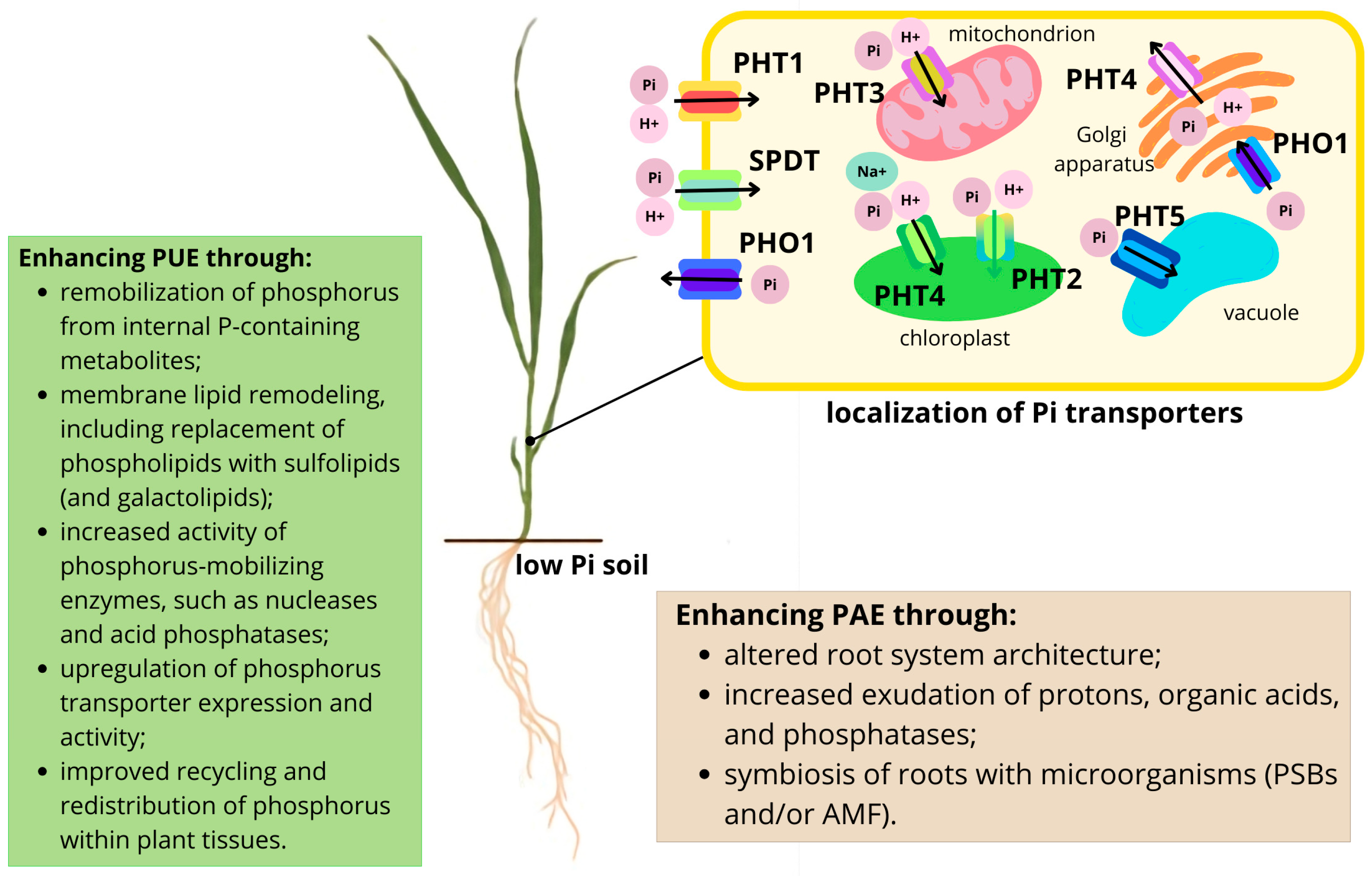
Figure 1. Localisation of Pi transporters in the cell and mechanisms enabling plant roots to adapt to phosphorus deficiency in the soil. Abbreviations: PAE—phosphorus acquisition efficiency; PUE—phosphorus use efficiency; PHT1–PHT5—phosphate transporter families 1–5; SPDT—SULTR-like phosphorus distribution transporter; PHO1—phosphate exporter; PSPBs—phosphate-solubilising bacteria; AMF—arbuscular mycorrhizal fungi.
Agronomy 16 00388 g001
Figure 2. Types of fertilisers used in crop production. Abbreviations: AM—arbuscular mycorrhiza; PSBs—phosphate-solubilising bacteria.
Agronomy 16 00388 g002
Figure 3. Silicon-mediated response of cereal plants improving tolerance to several abiotic stresses, including P deficiency and biotic stresses (red arrows: abiotic, blue arrows: biotic). Abbreviations: CAT—enzyme catalase; ET—ethylene; JA—jasmonic acid; SA—salicylic acid; SOD—superoxide dismutase.
Agronomy 16 00388 g003
Table 1. Examples of alternative and Si-containing fertilisers, application rates, soil types, crops, and observed effects in field trials.
FertilizerApplied Rate/MethodSoil Type (pH)Crop/RotationObserved EffectReference
Struvite (recovered from chicken manure)30–60 kg P ha−1Alluvial soil (pH 6.22, available P 14.9 mg/kg)Oryza sativa, Triticum aestivum rotationSustained grain yield over two seasons, increased soil available P and Mg, improved P uptake efficiency.[137]
Struvite (Crystal Green SGN 300, Ostara)11.4 Mg ha−1Loamy soil (pH 7.4)Zea maysYield comparable to soluble P fertilisers, reduced P runoff.[16]
Struvite (from wastewater)257 kg P ha−1Acidic soil (pH 5.7)Cicer arietinum (cv. Neelam), Triticum aestivum (cv. Scepter)Increased root growth and P uptake, improved nodulation under low P.[138]
Bone char4 t ha−1 yr−1Acidic soil (pH 5.08)Zea mays, Glycine maxIncreased grain yield and improved soil P, Ca, Mg.[133]
Bone char49 kg ha−1 (average of 3 crops)Moderately Cd-contaminated, P-deficient soil (pH 5.3–6.4)Lactuca sativa var. crispa (cv. Lollo Rossa), Triticum aestivum (cv. Fiorina), Solanum tuberosum (cv. Molli)Increased yield and dry matter, Cd immobilisation.[139]
Surface-modified bone char (BCplus)45 kg P ha−1Sandy, P-deficient soil (pH 5.2)Hordeum vulgare, Brassica napus, Triticum aestivum, Lupinus angustifolius, Secale cerealeEnhanced soil-available P and improved P uptake.[140]
SiGS ® + Barrier Si-Ca ®500 kg ha−1 soil + 1 dm3 ha−1 foliarSandy soil (pH 5.4–6.3)Zea maysIncreased grain yield, improved yield quality and dry matter.[141]
Si-Ca fertiliser (≥25% CaO, ≥SiO2)2.25 t ha−1Mildly Cd-contaminated paddy soil (pH 6.0, available P 8.54 mg/kg)Oryza sativaImproved soil quality, increased yield and grain quality.[142]
Silicon biopreparations (AdeSil, ZumSil)Seed dressing 0.5 kg/100 kg seed + foliar 0.5 L ha−1 (2×)CambisolTriticum aestivum (cv. Harenda, Serenada, Rusałka)Increased yield, improved disease resistance.[143]
Disclaimer/Publisher’s Note: The statements, opinions and data contained in all publications are solely those of the individual author(s) and contributor(s) and not of MDPI and/or the editor(s). MDPI and/or the editor(s) disclaim responsibility for any injury to people or property resulting from any ideas, methods, instructions or products referred to in the content.