Article

Effects of Calcium Nutrition on Soybean Growth and Symbiotic Nitrogen Fixation

1
College of Agriculture, Northeast Agricultural University, Harbin 150030, China
2
Institute of Crop Cultivation and Tillage, Heilongjiang Academy of Agricultural Sciences, Harbin 150086, China
*
Authors to whom correspondence should be addressed.
Agronomy 2026, 16(3), 357; https://doi.org/10.3390/agronomy16030357
Submission received: 28 December 2025 / Revised: 16 January 2026 / Accepted: 27 January 2026 / Published: 2 February 2026
(This article belongs to the Section Soil and Plant Nutrition)

Abstract

Calcium is essential for legume symbiotic nitrogen fixation, acting as both a nutrient and a signal. Yet, how varying calcium levels—from deficiency to toxicity—affect the soybean ‘root-nodule-stem’ balance has not been fully elucidated. To investigate this mechanism, a two-year sand culture experiment was conducted with three treatments: low calcium (0.1 mmol/L), moderate calcium (1 mmol/L), and high calcium (10 mmol/L), to systematically analyze their effects on soybean plant growth, nitrogenase activity, and nitrogen fixation capacity. The results indicated that the moderate calcium treatment supported the best root growth and nodule development, with both leghemoglobin (Lb) content and specific nitrogenase activity (SNA) reaching their peak levels. Low calcium stress significantly inhibited root elongation, while poor nodule development accompanied by a decrease in Lb content, thereby suppressing nitrogen fixation potential. In contrast to the low calcium treatment, although high calcium treatment inhibited root growth, it significantly increased the allocation of total plant dry matter to the root system. Under high calcium treatment, the ureide content in nodules increased significantly, whereas the ureide content in stems decreased substantially. This distributional imbalance suggests that high calcium obstructed the long-distance transport of nitrogen fixation products, subsequently leading to a significant decline in nitrogenase activity through a negative metabolic feedback mechanism. Calcium deficiency primarily resulted in structural impairments in nodule development, whereas high calcium induced functional inhibition by blocking ureide transport. Maintaining calcium homeostasis is important for ensuring efficient nitrogen fixation and source-sink balance in soybeans.

1. Introduction

Soybean (Glycine max (L.) Merr.), as one of the most important leguminous crops globally, not only provides a vital source of plant protein and oil for humans and livestock but also occupies an essential position in sustainable agricultural development [1]. The uniqueness of soybean lies in its ability to establish a symbiotic relationship with rhizobia, possessing the unique ability to assimilate atmospheric N2 into bio-available forms via symbiosis with rhizobia. This process significantly reduces the dependence of agricultural production on chemical nitrogen fertilizers [2,3]. However, symbiotic nitrogen fixation is a highly energy-consuming physiological process that is strictly regulated by environmental factors. It is highly susceptible to limitations from environmental constraints such as drought, soil salinization, and mineral nutrient imbalance, which can significantly reduce nitrogen fixation efficiency and crop yield [4]. Among numerous mineral elements, calcium (Ca), serving as both an essential macronutrient and a key second messenger, plays an irreplaceable role in balancing vegetative growth and reproductive development in legumes [5].
Calcium plays a dual role in plant physiological metabolism [5]. On one hand, calcium exists in the cell wall in the form of calcium pectate, maintaining the structural stability of the cell wall. On the other hand, the oscillation of cytosolic calcium ion concentration is a key early event in the recognition of rhizobial nodulation factors by legumes and the initiation of the symbiotic signaling pathway [6,7]. Studies have indicated that insufficient calcium supply directly alters root system architecture by inhibiting cell division in the root apical meristem, leading to hindered root development and thereby physically limiting the infection sites for rhizobia [8]. Furthermore, calcium deficiency reduces the stability of leghemoglobin (Lb) within nodules and disrupts the integrity of the peribacteroid membrane, consequently inhibiting nitrogenase activity [9].
Although the detrimental effects of calcium deficiency on soybean have been extensively documented, secondary soil salinization and calcium accumulation resulting from excessive fertilization are becoming increasingly prevalent in agricultural production and protected cultivation [10]. However, research regarding the effects of high calcium stress on soybean physiological characteristics remains relatively scarce [11]. A high-calcium environment may inhibit the uptake of other key cations, such as magnesium and potassium, through ionic antagonism, thereby disrupting intracellular ion homeostasis. More critically, excessive calcium may lead to intensified root lignification or induce structural changes in the nodule cortex, subsequently increasing resistance to oxygen diffusion. This phenomenon may be associated with the premature senescence of nodule function [12].
Symbiotic nitrogen fixation is an important physiological process for nitrogen acquisition in soybean, and the maintenance of its efficiency relies heavily on a precise “source-sink” balance system [13]. Within this system, nitrogen fixed by nodules is transported upward to the shoot in the form of ureides, which creates a rigorous metabolic feedback loop with the allocation of photosynthates to nodules; together, these processes determine the sustainability of nitrogen fixation [14]. Current research outcomes are primarily focused on singular calcium deficiency studies, and there is a lack of comprehensive reporting on how varying calcium levels (ranging from deficiency and moderate to excess) systematically regulate biomass allocation, nodule nitrogenase activity, and the long-distance transport mechanisms of ureides within the soybean “root-nodule-stem” system, which is a synergistic system composed of root support and absorption, nodule nitrogen fixation, and stem transport, serving to maintain the plant’s carbon-nitrogen balance [15].
Therefore, this study employed a sand culture experiment with controlled applications of varying calcium concentrations to systematically analyze the effects of calcium levels on soybean morphological indices (plant height, stem diameter), dry matter accumulation and allocation, nodule development characteristics (number, weight), physiological and biochemical indices (nitrogenase activity, leghemoglobin content), and ureide metabolism. The objectives were to reveal the physiological mechanisms by which moderate calcium coordinates the synchronous growth of soybean shoots and roots, and to elucidate the distinct pathways by which low and high calcium stresses inhibit nitrogen fixation efficiency. These findings aim to provide a theoretical basis for precise calcium fertilizer management in high-yield and high-efficiency soybean cultivation.

2. Materials and Methods

2.1. Experimental Materials

The experiment was conducted at the experimental station of Northeast Agricultural University in 2024 and 2025. The soybean variety tested was ‘Heike 59’. Uniform, plump, and healthy seeds were selected for sand culture experiments in plastic pots (28 cm in height and approximately 25 cm in diameter) filled with washed river sand. The bottom of each pot had two circular holes (approximately 0.5 cm in diameter) covered with gauze to ensure nutrient solution leaching and prevent sand loss. Two soybean plants were maintained per pot. During the experimental period, the plants were grown under natural lighting conditions.
Soybean nodules from ‘Heike 59’ cultivated in soil at the Northeast Agricultural University experimental base during the previous autumn were collected, placed in a buffer containing glycerol [16], and transferred to a −80 °C freezer. In the year of the experiment, the nodules were retrieved, washed with distilled water, and ground. The ground nodule material was then mixed into the common nutrient solution at a concentration of approximately 5 g/L to serve as the rhizobial inoculum [17]. This method was chosen to ensure the inoculation of the specific indigenous rhizobial strains adapted to the local ‘Heike 59’ variety, and successful nodulation was visually confirmed in all treatments 10 days post-inoculation.

2.2. Experimental Treatments

The experiment employed a single-factor design with three different calcium concentration treatments, supplying 0.1, 1, and 10 mmol/L CaCl2, designated as Ca0.1, Ca1, and Ca10, respectively. Each treatment was replicated four times, with each pot serving as a replicate. Prior to the full expansion of the opposite true leaves, seedlings were irrigated once daily with 500 mL of nutrient solution. After the flowering stage, irrigation was increased to twice daily, with 500 mL applied per pot each time.
With the exception of calcium, the nutrient composition remained identical across all treatments. The nutrient types and concentrations (mg/L) were as follows: KH2PO4, 136.00; MgSO4, 240.00; (NH4)2SO4, 235.60; Na2MoO4·H2O, 0.03; CuSO4·5H2O, 0.08; ZnSO4·7H2O, 0.22; MnCl2·4H2O, 4.90; H3BO3, 2.86. The specific concentration of Fe-EDTA was prepared by dissolving 5.57 g of FeSO4·7H2O and 7.45 g of Na2EDTA separately and making up to a volume of 1 L; 1 mL of this stock solution was added per liter of nutrient solution for application (In this experiment, the concentrations of chloride ions and (NH4)2SO4 did not have a negative impact on soybean plants [18,19]).

2.3. Sampling Methods

Sampling Timing and Conditions: Sampling was conducted during the R1 (beginning bloom) and R5 (beginning seed) stages on sunny mornings between 9:00 and 10:00.
Shoots: The aboveground parts of the soybean plants were excised at the cotyledonary node and separated into stems, leaves, and petioles, then placed in envelopes.
Roots: Roots were washed with distilled water, blotted dry with filter paper, and placed in envelopes.
Sample Preservation: Four pots were selected from each treatment. Fresh nodules were detached. The nodules, along with the stems, leaves, petioles, and roots, were wrapped in aluminum foil, flash-frozen in liquid nitrogen, and subsequently stored at −80 °C for future analysis.

2.4. Measurement Indices and Methods

Morphological Measurements:
Measurement Stages: Emergence (VE), Beginning Bloom (R1), Full Bloom (R2), Beginning Seed (R5), and Full Maturity (R8).
Plant Height: Measured from the cotyledonary node to the growing point using a ruler with 1 mm precision.
Stem Diameter: Measured at the first internode above the cotyledonary node using a digital vernier caliper.
Physiological and Biochemical Assays:
Nitrogenase Activity: Measured using the Acetylene Reduction Assay (ARA). After washing the roots, root segments containing nodules were excised, placed in sealed incubation bottles, incubated at room temperature for 2 h with 10% (v/v) acetylene, and analyzed using a Shanghai Tianmei GC7900 (Shanghai Tianmei Scientific Instrument Co., Ltd., Shanghai, China) Gas Chromatograph.
Leghemoglobin (Lb) and Ureide Content: Nodules were separated from roots, stems, and leaves immediately after sampling. Nodules were used for Lb determination. Ureide content in each organ was measured to analyze nitrogen assimilation and transport status. The determination of leghemoglobin followed the method described by Wilson (1963) [20], and the ureide determination followed the method described by King (2005) [21].
Total Calcium Content: The remaining samples from each organ were heat-treated and dried. Digestion was performed using a nitric-perchloric acid wet digestion method, and measurements were taken using Atomic Absorption Spectroscopy (AAS) (Shanghai Primesci Co., Ltd., Shanghai, China).
All the above measurements were performed with four replicates per treatment.

2.5. Data Analysis

Data processing and statistical analysis were performed using Microsoft Excel 2016 and SPSS 21.0 (SPSS Inc., Chicago, IL, USA). All data were tested for normality and homogeneity of variance prior to One-Way Analysis of Variance (ANOVA). Means were compared using Duncan’s Multiple Range Test at a significance level of p < 0.05.

3. Results

3.1. Effects of Calcium Nutrition on Soybean Plant Growth

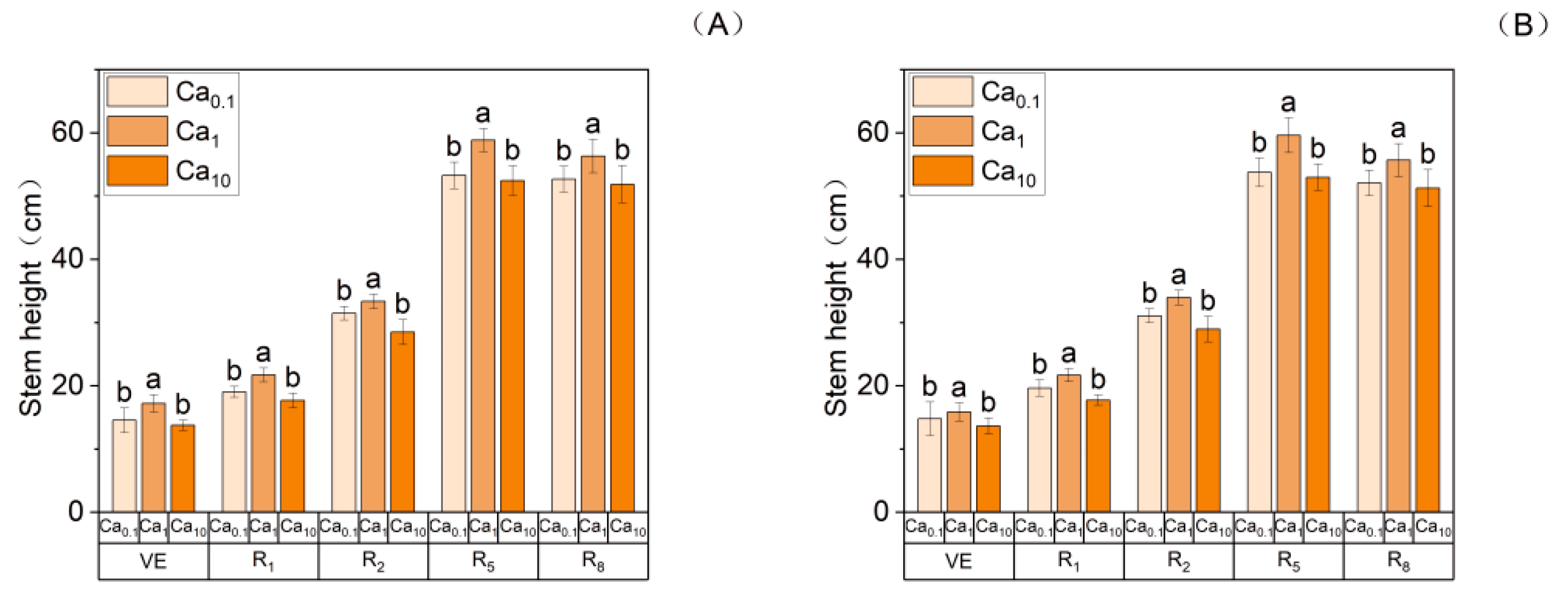
Figure 1 illustrates the effects of different calcium concentrations on soybean plant height. The influence of calcium treatments on plant height exhibited a bell-shaped curve. Moderate calcium treatment (Ca1) was most beneficial for plant height development, whereas both low (Ca0.1) and high (Ca10) calcium stresses inhibited stem elongation to varying degrees. Plant height peaked at the R5 stage and declined slightly during the late growth stage (R8); this reduction may be attributed to tissue dehydration and stem shrinkage associated with plant maturity.
In 2024 (Figure 1A), plant height in the Ca1 treatment group reached its maximum at the R5 stage (58.04 ± 2.73 cm), which was 7% and 9% higher than that of the low calcium (Ca0.1) and high calcium (Ca10) groups, respectively (p < 0.05). In 2025 (Figure 1B), the variation trend in soybean plant height was consistent with that of 2024, with the Ca1 group exhibiting significantly greater plant height than the other two treatments at the R5 stage. Overall, moderate calcium treatment significantly promoted soybean plant height, whereas both low and high calcium stresses inhibited stem elongation.
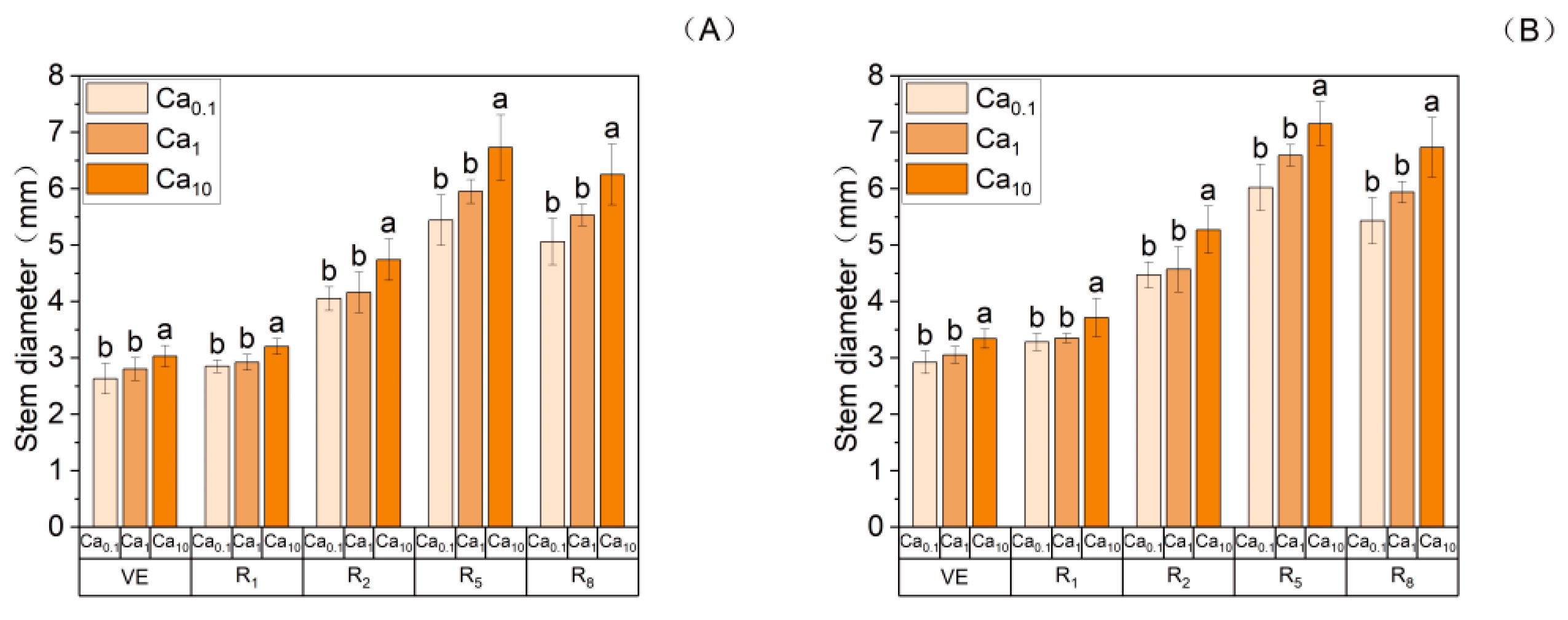
Figure 2 illustrates the effects of different calcium concentrations on the stem diameter of soybean plants. The impact of calcium treatments on stem diameter differed from that on plant height; stem diameter exhibited an increasing trend with rising calcium concentrations. At the R5 stage, the stem diameter under high calcium treatment (Ca10) reached its maximum value and was significantly greater than that under the low and moderate calcium treatments. This indicates distinct compensatory thickening, representing a trade-off against the inhibition of plant height. Although stem diameter decreased slightly during the late growth stage (R8), this reduction is attributed to water loss as the plants entered the physiological maturity and desiccation phases. The high calcium treatment (Ca10) significantly increased stem diameter at all growth stages (VE, R1, R2, R5, and R8).
In 2024 (Figure 2A), the stem diameter of the Ca10 group peaked at the R5 stage (6.73 ± 0.58 mm), which was 23.7% and 13.1% higher than that of the low calcium (Ca0.1) and moderate calcium (Ca1) groups, respectively (p < 0.05). In 2025 (Figure 2B), the variation trend of stem diameter was consistent with that of 2024. The stem diameter of the Ca10 group reached a maximum of 6.68 ± 0.58 mm at the R5 stage, which was significantly higher than that of the low calcium group (Ca0.1, 5.47 ± 0.41 mm) and the moderate calcium control group (Ca1, 5.99 ± 0.19 mm) (p < 0.05). Overall, increasing calcium concentration within a certain range can consistently and significantly increase the stem diameter of soybean plants.
Table 1 presents the effects of different calcium treatments on dry matter accumulation and the root-shoot ratio of soybean. As shown in Table 1, calcium concentration had a significant influence on both dry matter accumulation and root-shoot ratio at different growth stages (p < 0.05). Moderate calcium supply (Ca1) was most conducive to biomass accumulation. At the R1 and R5 stages, both shoot and root dry weights in the Ca1 treatment were significantly higher than those in the low calcium (Ca0.1) and high calcium (Ca10) treatments.
However, low calcium stress (Ca0.1) inhibited root growth most significantly, with root dry weight consistently remaining at the lowest level across the two-year experiment. Conversely, high calcium stress (Ca10) had a more pronounced inhibitory effect on shoot growth. Taking the R5 stage in 2024 as an example, the shoot dry weight of the high calcium treatment (21.96 g/plant) was significantly lower than that of the low calcium treatment (25.19 g/plant), indicating that excessive calcium severely hindered the accumulation of photosynthates in the shoots. Consequently, the root-shoot ratio showed a significant increasing trend with rising calcium concentrations (Ca0.1 < Ca1 < Ca10).
In summary, moderate calcium application coordinates the synchronous growth of shoots and roots, thereby maximizing dry matter accumulation. Low calcium mainly restricted root development, while high calcium primarily inhibited shoot growth; both conditions significantly reduced total dry matter accumulation by disrupting the source-sink balance.
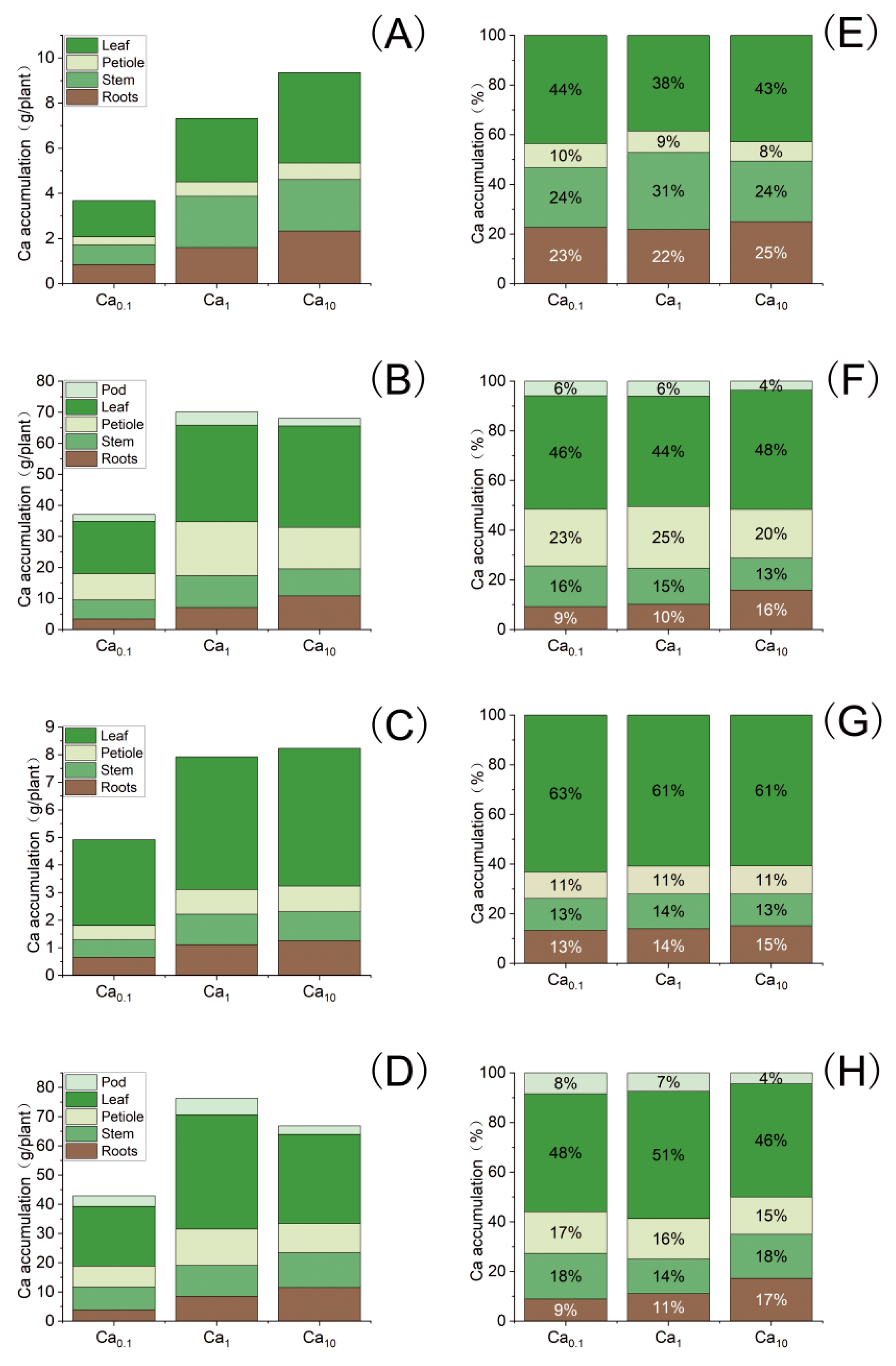
Figure 3 illustrates the calcium accumulation (Figure 3A–D) and its distribution proportions (Figure 3E–H) in various organs across different growth stages. As shown, the calcium accumulation per plant exhibited a significant increasing trend with the elevation of calcium supply levels. In both 2024 (Figure 3A,B) and 2025 (Figure 3C,D), the per-plant accumulation under high calcium treatment (Ca10) was significantly higher than that under the moderate (Ca1) and low (Ca0.1) calcium treatments at both the R1 and R5 stages.
Regarding the allocation strategy (Figure 3E–H), calcium was preferentially partitioned into the leaves and stems. Notably, high calcium stress altered this distribution pattern: at the R1 (Figure 3E) and R5 (Figure 3F) stages in 2024, as well as the corresponding stages in 2025 (Figure 3G,H), the proportion of calcium accumulation in the roots significantly increased in the Ca10 group (reaching 15.1–17.2%), which was considerably higher than that in the moderate calcium treatment (8.9–14%). This indicates that high calcium stress leads to calcium retention in the roots. Although the total calcium accumulation in root nodules was relatively low, accounting for only 3–9% of the total, this was primarily due to their small biomass. The calcium concentration in nodules was highly sensitive to the treatments, showing significant variations across different calcium supply levels.

3.2. Effects of Calcium Nutrition on Nitrogen Fixation of Soybean Root Nodules

Table 2 presents the effects of different calcium treatments on the dry weight and number of soybean root nodules. As shown in Table 2, calcium levels significantly influenced the formation and growth of soybean nodules. Both high (Ca10) and low (Ca0.1) calcium treatments significantly inhibited nodule number and weight across both years and growth stages.
Notably, low calcium stress (Ca0.1) exerted the most severe inhibitory effect on nodule number. Compared with the moderate calcium control (Ca1), the nodule number under low calcium treatment decreased by 43.5% and 48.1% at the R1 and R5 stages in 2024, respectively; in 2025, the corresponding reductions were 43.9% and 46.5%. Meanwhile, the individual nodule weight under low calcium conditions was significantly lower than that in the other two groups. This reduction may be attributed to the restricted root growth caused by the low calcium environment, which hindered rhizobial infection and consequently limited nodule development.
Conversely, high calcium stress (Ca10) had a relatively weaker inhibitory effect on nodule number but a significant impact on nodule dry weight. The individual nodule weight in the high calcium treatment remained significantly lower than that in the moderate calcium treatment. This suggests that under excessive calcium conditions, although soybean plants can undergo normal nodulation, the subsequent development of the nodules is compromised.
In summary, a moderate calcium supply is most beneficial for the growth and development of soybean nodules, whereas both calcium deficiency and excess reduce nodule biomass and impair their activity to varying degrees.
Table 3 presents the effects of different calcium treatments on the nitrogenase activity of soybean root nodules. As indicated by the data, calcium supply levels had a significant impact on soybean root nodule nitrogenase activity (SNA) (p < 0.05). At both the R1 and R5 growth stages, the SNA in the Ca1 treatment was significantly higher than that in the Ca0.1 and Ca10 treatments, whereas the difference between the Ca0.1 and Ca10 treatments was not significant.
The relative relationship of nitrogenase activity among the different calcium treatments remained highly consistent. In the R1 stage of 2024, the SNA of the Ca1 treatment was approximately 11% higher than that of Ca0.1 and 13% higher than that of Ca10. In 2025, these increases were approximately 9% and 10%, respectively, with no significant difference observed between the stress treatments. This strongly demonstrates that the promotional effect of moderate calcium on nitrogenase activity is consistent; that is, a moderate calcium concentration maintains maximal nitrogenase activity.
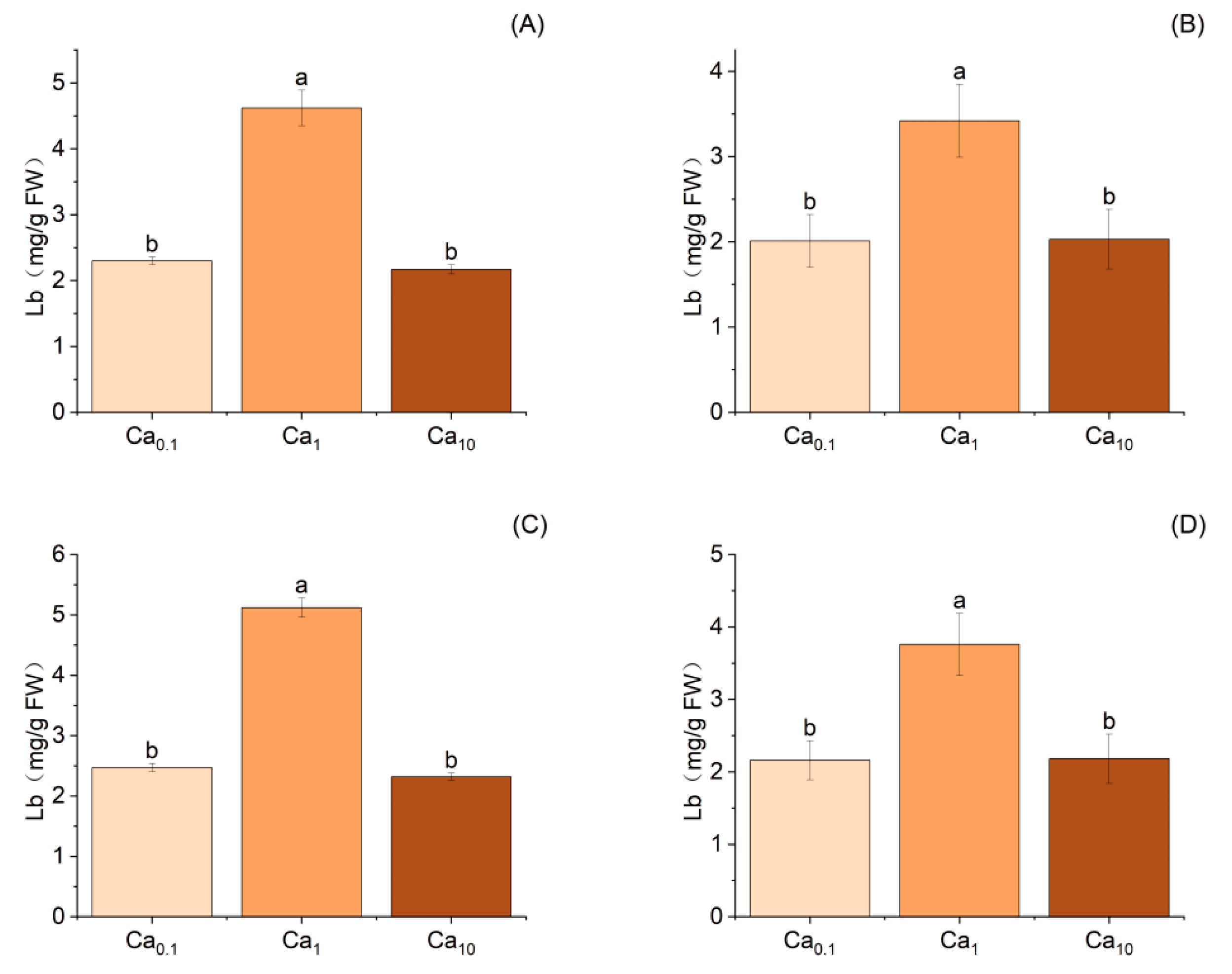
As shown in Figure 4, calcium supply levels significantly affected the leghemoglobin (Lb) content in root nodules, and the trends were consistent across the two-year experiment. At the R1 and R5 stages, Lb content reached its maximum under the moderate calcium treatment (Ca1), whereas both calcium deficiency (Ca10) treatments led to a significant decrease in Lb content.
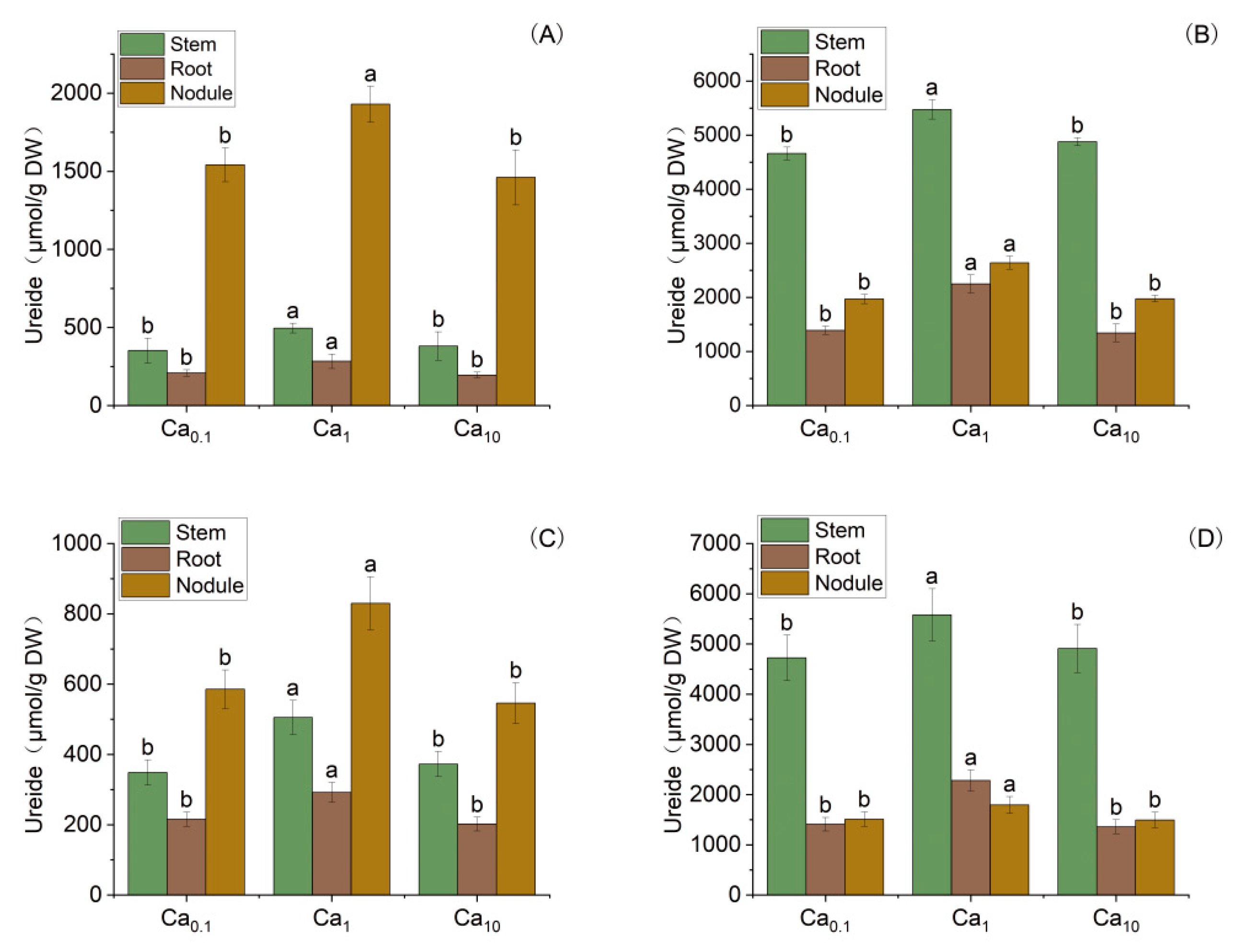
As shown in Figure 5, the ureide content in nodules was highest under the moderate calcium treatment, indicating that nitrogen fixation was most active. In contrast, nodule ureide content significantly decreased under both low and high calcium treatments, confirming that unsuitable calcium concentrations inhibited nitrogen assimilation and ureide biosynthesis.
The distribution of ureides among organs showed clear growth-stage specificity. At the R1 stage, when nitrogen fixation had just initiated, the majority of ureides were retained in the nodules, while the content in the stems was relatively low (Figure 5A,C). After the R5 stage, with the arrival of peak nitrogen fixation, large amounts of ureides were transported to the shoots. Under moderate calcium conditions (Ca1), the ureide content in stems increased sharply (Figure 5B,D), significantly exceeding that in nodules and roots. However, under high calcium treatment (Ca10), not only was ureide synthesis in the nodules reduced, but the ureide content in the stems was also significantly lower than that in the moderate calcium treatment.

4. Discussion

4.1. Physiological Regulation of Soybean Plant Growth by Calcium Levels

Calcium, as an essential mineral element for plants, plays a pivotal role in soybean cell wall architecture, biomembrane stabilization, and intracellular signal transduction. This study demonstrates that the vegetative growth of soybean exhibits a high dependence on environmental calcium concentrations. Both insufficient and excessive calcium inputs disrupt the physiological homeostasis within the plant, which is consistent with the dual role of calcium as a “structural nutrient” and a “second messenger” emphasized in previous reviews [22].
The calcium concentration gradients (0.1, 1, and 10 mmol/L) established in this study were designed to create three nutritional levels—deficiency, sufficiency, and excess—with significant physiological differences, in order to investigate the response mechanism of the soybean symbiotic nitrogen fixation system to calcium levels. Although the optimal calcium threshold for soybeans in agricultural production aimed at maximizing yield might lie within a more precise range, the results of this experiment showed that plants under the 1 mmol/L treatment exhibited good growth status without deficiency symptoms, and their biomass accumulation and nodule development were significantly superior to those of the 0.1 mmol/L stress group (Figure 1 and Figure 2). This indicates that under sand culture conditions, 1 mmol/L was sufficient to meet the basic physiological requirements for normal soybean growth and development, serving as an effective control benchmark for elucidating the mechanisms of calcium deficiency and toxicity.
In this experiment, calcium deficiency (Ca0.1) resulted in a significant reduction in soybean plant height and stem diameter. From a cell biological perspective, this morphological inhibition is primarily attributed to the loss of cell wall mechanical properties. Cosgrove (2016) pointed out that the irreversible elongation of plant cells depends on cell wall extensibility, and the pectin network cross-linked by calcium ions might be a major factor affecting cell wall strength [23]. In this study, we observed that under the Ca0.1 treatment, soybean plant height and stem diameter consistently remained at the lowest levels throughout the growth period (R1–R8), and root dry weight was significantly lower than that of the control group. This highlights that calcium deficiency leads to abnormal cell wall loosening, rendering cells unable to resist turgor pressure to maintain normal morphology and directional elongation.
Root development was most sensitive to calcium deficiency. The meristematic zone of soybean root tips lacks a functional Casparian strip and relies entirely on apoplastic transport from the external solution [24]. Hirschi (2004) found in an omics study on soybean under low calcium stress that calcium deficiency rapidly compromises the selective permeability of root plasma membranes, leading to cytosolic electrolyte leakage and metabolic disorders; this collapse of the membrane system is the root cause of root tip meristem necrosis and the limitation of taproot deepening [25]. Furthermore, Himschoot et al. (2017) noted that cell plate formation during late cytokinesis requires calcium-mediated vesicle fusion; calcium deficiency directly hinders mitotic progression, further limiting tissue growth [26]. However, under the low calcium conditions of this experiment, soybean root growth did not cease completely but rather exhibited a significant lag in biomass accumulation, indicating that both cell division and elongation processes were severely restricted but had not yet reached a lethal threshold.
In contrast, the inhibition of soybean growth by excessive calcium (Ca10) stemmed primarily from the disruption of ion homeostasis and alterations in morphogenetic strategies. Rhodes et al. (2018) quantified this effect in field crop research, confirming that high rhizosphere calcium significantly reduces the uptake kinetics of potassium (K+) and magnesium (Mg2+) through competitive inhibition, leading to severe latent nutrient deficiencies in tissues [27]. Additionally, Hochmal et al. (2015) pointed out in a study on the calcium-dependent regulation of photosynthesis that excessive calcium ions in the chloroplast stroma directly inhibit the activity of key enzymes in the Calvin cycle, thereby affecting biomass accumulation [28].
Furthermore, to cope with high calcium stress, soybean plants adopted a strategy of retaining calcium in the roots (as shown in Figure 3). However, this defense strategy resulted in abnormalities in soybean growth. In this experiment, although the shoot biomass under the Ca10 treatment did not show the extreme decline observed under calcium deficiency, the stem diameter exhibited an anomalous increase (Figure 2). Combining this with the research of Sutka et al. (2011), we propose that this phenotype is not a benign trait; rather, excessive calcium accumulation in the roots promoted cell wall stiffening [29]. Huang et al. (2024) also found that excessive calcium in leaves might interfere with calcium oscillation signals in stomatal guard cells, leading to decreased stomatal conductance and limiting CO2 fixation [30]. This caused soybean plants to exhibit symptoms similar to “physiological drought.” To cope with these calcium-induced symptoms, soybean plants likely strengthened mechanical support by increasing the lignification of stem vascular bundles, but this came at the expense of photosynthate allocation, thus causing the severe imbalance in the root-shoot ratio observed in this experiment (Table 1).

4.2. Regulation of Root Nodule Development and Nitrogen Fixation by Calcium Supply

The efficiency of biological nitrogen fixation depends on the successful establishment of “host-rhizobium” symbiotic signaling and the precise regulation of the internal microenvironment of nodules. The data from this experiment indicate that calcium plays a multidimensional role in this process, ranging from signal initiation to metabolic feedback.
The sharp reduction in nodule number under low calcium treatment underscores the key role of calcium signaling. Roy et al. (2020) emphasized in a recent review on legume symbiotic signaling that Nod factors secreted by rhizobia must induce periodic calcium spiking in the nucleus, which is an absolute prerequisite for activating downstream transcription factors (such as NIN) [31]. Oldroyd (2013) pointed out that the absence of this calcium signal directly leads to the arrest of cortical cell division, making it impossible to form nodule primordia [32]. Furthermore, the extension of infection threads requires dynamic remodeling of the cell wall. A study by Zhang et al. (2024) indicated that the continuum formed by the interconnection of the plant cell wall, membrane system, and cytoskeleton provides the cellular basis for rhizobial infection and nodule development [33]. The low nitrogenase activity observed under calcium deficiency in this experiment may be attributed to the plant’s failure to successfully construct this cell wall-membrane-cytoskeleton continuum under low calcium conditions, thereby affecting the structural foundation of the nodules.
Mortier et al. (2012) added in a review on long-distance signaling in legumes that host plants precisely control nodule number through “Autoregulation of Nodulation” (AON), and an imbalance in calcium nutrition may interfere with phloem signaling within this system, leading to abnormal nodule development [34]. Meanwhile, delaying nodule senescence relies on precise redox regulation. Research by Puppo et al. (2005) elucidated that nodule senescence is accompanied by a burst of reactive oxygen species (ROS) and membrane lipid peroxidation; calcium deficiency weakens the cellular enzymatic capacity to scavenge ROS, thereby accelerating the oxidative degradation of leghemoglobin (Lb) and the loss of nodule function [35]. This is consistent with the significant decrease in Lb content observed under low calcium treatment in this experiment, suggesting that the low calcium environment caused premature oxidative damage to the nodules and destroyed the microaerophilic environment required by nitrogenase. Early research by Minchin et al. (2007) also showed that the oxygen diffusion barrier in the nodule cortex is composed of glycoprotein cross-links, a process that is also regulated by calcium ions [36].
In this experiment, Lb content and specific nitrogenase activity (SNA) synchronously peaked under moderate calcium (Ca1) conditions, fully demonstrating that a moderate calcium concentration is the material basis for maintaining highly efficient nitrogen fixation in nodules. Coba de la Peña et al. (2018) confirmed in a systematic review on symbiotic calcium homeostasis in legumes that the integrity of the peribacteroid membrane (PBM) is highly sensitive to calcium concentration, and calcium is key to maintaining the stability of the PBM phospholipid bilayer and preventing the activation of host defense responses [37]. The fact that the Ca1 treatment group maintained the highest Lb content and nitrogenase activity from the R1 to R5 stages in this study indicates that adequate calcium supply ensures the functional stability of the symbiosome. Specifically, the results imply that while moderate calcium maintains PBM stability, insufficient or excessive calcium levels disrupt this barrier. This disruption likely compromises the low-oxygen environment required by nitrogenase, leading to the observed decrease in Lb content due to oxidative damage or accelerated senescence.
Although high calcium stress (Ca10) did not completely prevent nodulation, it significantly reduced nitrogen fixation efficiency. As soybean is a typical ureide-exporting plant, the abnormal changes in ureide content in its stems revealed obstacles in the nitrogen transport process. This study found that although ureide content in nodules remained at a high level under Ca10 treatment, the content in stems was significantly lower than that in the moderate calcium treatment (Figure 5), and nitrogenase activity dropped sharply at the R5 stage. This sharp decline indicates that high calcium stress restricted the metabolic flux of nitrogen, leading to an insufficient nitrogen supply to the shoots despite the accumulation in nodules. This contrast provides direct physiological evidence of transport obstruction. Collier and Tegeder (2012) identified a key soybean ureide transporter (UPS1) and confirmed that its function is highly dependent on the developmental status of the vasculature [38]. As pointed out by Arrese-Igor et al. (2011) in a review, ureides retained in nodules downregulate nitrogenase activity through metabolic feedback [39]. The sharp decline in nitrogenase activity in the Ca10 group at the R5 stage observed in this experiment (Table 3) is a response to this feedback mechanism. Combined with the phenotype of abnormally increased stem diameter, we speculate that high-calcium-induced cell wall thickening might have compressed or occluded xylem vessels, thereby potentially limiting ureide transport capacity. Although direct measurements of xylem sap flow rate were not conducted in this study, the sharp contrast between ureide accumulation in nodules and depletion in stems provides strong indirect evidence for this transport bottleneck. This not only explains the forced accumulation of nitrogen fixation products in nodules but also validates the applicability of the classical theory of King and Purcell [21] at the level of modern molecular physiology.

5. Conclusions

Our study demonstrates that calcium homeostasis is key to coordinating soybean growth and nitrogen fixation. Moderate calcium treatment achieved the overall maximization of biomass and nitrogenase activity. Low calcium stress inhibited root and nodule development, leading to decreased nitrogenase activity. Although high calcium stress increased stem diameter, it likely induced negative metabolic feedback potentially associated with obstructed ureide transport, which may lead to a decline in nitrogen fixation capacity. Compared to prior research limited to the effects of calcium deficiency, the novelty of this study lies in elucidating the divergent mechanisms between deficiency and toxicity, particularly the obstruction of long-distance ureide transport under high calcium stress. In summary, maintaining an appropriate calcium concentration is central to ensuring the normal physiological functions of soybean; precise calcium management is critical for optimizing the synergistic relationship between soybean growth and symbiotic nitrogen fixation.

Author Contributions

Conceptualization, X.L.; methodology, S.Z., X.L., C.Y. and Q.S.; validation, X.K. and M.L.; formal analysis, S.Z.; investigation, S.Z., X.K. and M.L.; data curation, S.Z.; writing—original draft preparation, S.Z.; writing—review and editing, X.L., C.Y. and Q.S.; supervision, X.L., C.Y. and Q.S.; project administration, X.L., C.Y. and Q.S.; funding acquisition, X.L., C.Y. and Q.S. All authors have read and agreed to the published version of the manuscript.

Funding

This research was funded by the National Key R&D Program of China (grant number 2023YFD1501600) and the Heilongjiang Provincial Postdoctoral Science Research Startup Project.

Data Availability Statement

The data presented in this study are available on request from the corresponding authors.

Acknowledgments

We thank the members of the College of Agriculture at Northeast Agricultural University and the Institute of Crop Cultivation and Tillage at Heilongjiang Academy of Agricultural Sciences for their helpful discussions and assistance during the experiment.

Conflicts of Interest

The authors declare no conflicts of interest. The funders had no role in the design of the study; in the collection, analyses, or interpretation of data; in the writing of the manuscript; or in the decision to publish the results.

Abbreviations

The following abbreviations are used in this manuscript:
DWDry weight
SNASpecific nitrogenase activity
ARAAcetylene reduction activity
LbLeghemoglobin

References

  1. Stagnari, F.; Maggio, A.; Galieni, A.; Pisante, M. Multiple Benefits of Legumes for Agriculture Sustainability: An Overview. Chem. Biol. Technol. Agric. 2017, 4, 2. [Google Scholar] [CrossRef]
  2. Ferguson, B.J.; Mens, C.; Hastwell, A.H.; Zhang, M.; Su, H.; Jones, C.H.; Chu, X.; Gresshoff, P.M. Legume Nodulation: The Host Controls the Party. Plant Cell Environ. 2019, 42, 41–51. [Google Scholar] [CrossRef] [PubMed]
  3. Soumare, A.; Diedhiou, A.G.; Thuita, M.; Hafidi, M.; Ouhdouch, Y.; Gopalakrishnan, S.; Kouisni, L. Exploiting Biological Nitrogen Fixation: A Route Towards a Sustainable Agriculture. Plants 2020, 9, 1011. [Google Scholar] [CrossRef] [PubMed]
  4. Zahran, H.H. Rhizobium -Legume Symbiosis and Nitrogen Fixation under Severe Conditions and in an Arid Climate. Microbiol. Mol. Biol. Rev. 1999, 63, 968–989. [Google Scholar] [CrossRef]
  5. Thor, K. Calcium—Nutrient and Messenger. Front. Plant Sci. 2019, 10, 440. [Google Scholar] [CrossRef]
  6. Zipfel, C.; Oldroyd, G.E.D. Plant Signalling in Symbiosis and Immunity. Nature 2017, 543, 328–336. [Google Scholar] [CrossRef]
  7. Marsollier, A.-C.; Ingram, G. Getting Physical: Invasive Growth Events during Plant Development. Curr. Opin. Plant Biol. 2018, 46, 8–17. [Google Scholar] [CrossRef]
  8. White, P.J. Calcium in Plants. Ann. Bot. 2003, 92, 487–511. [Google Scholar] [CrossRef]
  9. Zartdinova, R.; Nikitin, A. Calcium in the Life Cycle of Legume Root Nodules. Indian J. Microbiol. 2023, 63, 410–420. [Google Scholar] [CrossRef]
  10. Han, J.; Shi, J.; Zeng, L.; Xu, J.; Wu, L. Effects of Nitrogen Fertilization on the Acidity and Salinity of Greenhouse Soils. Environ. Sci. Pollut. Res. 2015, 22, 2976–2986. [Google Scholar] [CrossRef]
  11. Rietra, R.P.J.J.; Heinen, M.; Dimkpa, C.O.; Bindraban, P.S. Effects of Nutrient Antagonism and Synergism on Yield and Fertilizer Use Efficiency. Commun. Soil Sci. Plant Anal. 2017, 48, 1895–1920. [Google Scholar] [CrossRef]
  12. Le Gall, H.; Philippe, F.; Domon, J.-M.; Gillet, F.; Pelloux, J.; Rayon, C. Cell Wall Metabolism in Response to Abiotic Stress. Plants 2015, 4, 112–166. [Google Scholar] [CrossRef]
  13. Udvardi, M.; Poole, P.S. Transport and Metabolism in Legume-Rhizobia Symbioses. Annu. Rev. Plant Biol. 2013, 64, 781–805. [Google Scholar] [CrossRef] [PubMed]
  14. Carter, A.M.; Tegeder, M. Increasing Nitrogen Fixation and Seed Development in Soybean Requires Complex Adjustments of Nodule Nitrogen Metabolism and Partitioning Processes. Curr. Biol. 2016, 26, 2044–2051. [Google Scholar] [CrossRef] [PubMed]
  15. Tegeder, M.; Masclaux-Daubresse, C. Source and Sink Mechanisms of Nitrogen Transport and Use. New Phytol. 2018, 217, 35–53. [Google Scholar] [CrossRef] [PubMed]
  16. Beattie, G.A.; Handelsman, J. A Rapid Method for the Isolation and Identification of Rhizobium from Root Nodules. J. Microbiol. Methods 1989, 9, 29–33. [Google Scholar] [CrossRef]
  17. Somasegaran, P.; Hoben, H.J. Methods in Legume-Rhizobium Technology; University of Hawaii: Honolulu, HI, USA, 1985. [Google Scholar]
  18. Essa, T.A. Effect of Salinity Stress on Growth and Nutrient Composition of Three Soybean (Glycine max L. Merrill) Cultivars. J. Agron. Crop Sci. 2002, 188, 86–93. [Google Scholar] [CrossRef]
  19. Osborne, S.L.; Riedell, W.E. Starter Nitrogen Fertilizer Impact on Soybean Yield and Quality in the Northern Great Plains. Agron. J. 2006, 98, 1569–1574. [Google Scholar] [CrossRef]
  20. Wilson, D.O.; Reisenauer, H.M. Determination of Leghemoglobin in Legume Nodules. Anal. Biochem. 1963, 6, 27–30. [Google Scholar] [CrossRef]
  21. King, C.A.; Purcell, L.C. Inhibition of N2 Fixation in Soybean Is Associated with Elevated Ureides and Amino Acids. Plant Physiol. 2005, 137, 1389–1396. [Google Scholar] [CrossRef]
  22. Kudla, J.; Batistič, O.; Hashimoto, K. Calcium Signals: The Lead Currency of Plant Information Processing. Plant Cell 2010, 22, 541–563. [Google Scholar] [CrossRef]
  23. Cosgrove, D.J. Plant Cell Wall Extensibility: Connecting Plant Cell Growth with Cell Wall Structure, Mechanics, and the Action of Wall-Modifying Enzymes. J. Exp. Bot. 2016, 67, 463–476. [Google Scholar] [CrossRef] [PubMed]
  24. Thomas, R.; Fang, X.; Ranathunge, K.; Anderson, T.R.; Peterson, C.A.; Bernards, M.A. Soybean Root Suberin: Anatomical Distribution, Chemical Composition, and Relationship to Partial Resistance to Phytophthora sojae. Plant Physiol. 2007, 144, 299–311. [Google Scholar] [CrossRef] [PubMed]
  25. Hirschi, K.D. The Calcium Conundrum. Both Versatile Nutrient and Specific Signal. Plant Physiol. 2004, 136, 2438–2442. [Google Scholar] [CrossRef] [PubMed]
  26. Himschoot, E.; Pleskot, R.; Van Damme, D.; Vanneste, S. The Ins and Outs of Ca2+ in Plant Endomembrane Trafficking. Curr. Opin. Plant Biol. 2017, 40, 131–137. [Google Scholar] [CrossRef]
  27. Rhodes, R.; Miles, N.; Hughes, J.C. Interactions between Potassium, Calcium and Magnesium in Sugarcane Grown on Two Contrasting Soils in South Africa. Field Crops Res. 2018, 223, 1–11. [Google Scholar] [CrossRef]
  28. Hochmal, A.K.; Schulze, S.; Trompelt, K.; Hippler, M. Calcium-Dependent Regulation of Photosynthesis. Biochim. Biophys. Acta (BBA)-Bioenerg. 2015, 1847, 993–1003. [Google Scholar] [CrossRef]
  29. Sutka, M.; Li, G.; Boudet, J.; Boursiac, Y.; Doumas, P.; Maurel, C. Natural Variation of Root Hydraulics in Arabidopsis Grown in Normal and Salt-Stressed Conditions. Plant Physiol. 2011, 155, 1264–1276. [Google Scholar] [CrossRef]
  30. Huang, S.; Roelfsema, M.R.G.; Gilliham, M.; Hetherington, A.M.; Hedrich, R. Guard Cells Count the Number of Unitary Cytosolic Ca2+ Signals to Regulate Stomatal Dynamics. Curr. Biol. 2024, 34, 5409–5416.e2. [Google Scholar] [CrossRef]
  31. Roy, S.; Liu, W.; Nandety, R.S.; Crook, A.; Mysore, K.S.; Pislariu, C.I.; Frugoli, J.; Dickstein, R.; Udvardi, M.K. Celebrating 20 Years of Genetic Discoveries in Legume Nodulation and Symbiotic Nitrogen Fixation. Plant Cell 2020, 32, 15–41. [Google Scholar] [CrossRef]
  32. Oldroyd, G.E.D. Speak, Friend, and Enter: Signalling Systems That Promote Beneficial Symbiotic Associations in Plants. Nat. Rev. Microbiol. 2013, 11, 252–263. [Google Scholar] [CrossRef]
  33. Zhang, X.; Wu, J.; Kong, Z. Cellular Basis of Legume–Rhizobium Symbiosis. Plant Commun. 2024, 5, 101045. [Google Scholar] [CrossRef]
  34. Mortier, V.; De Wever, E.; Vuylsteke, M.; Holsters, M.; Goormachtig, S. Nodule Numbers Are Governed by Interaction between CLE Peptides and Cytokinin Signaling. Plant J. 2012, 70, 367–376. [Google Scholar] [CrossRef]
  35. Puppo, A.; Groten, K.; Bastian, F.; Carzaniga, R.; Soussi, M.; Lucas, M.M.; De Felipe, M.R.; Harrison, J.; Vanacker, H.; Foyer, C.H. Legume Nodule Senescence: Roles for Redox and Hormone Signalling in the Orchestration of the Natural Aging Process. New Phytol. 2005, 165, 683–701. [Google Scholar] [CrossRef]
  36. Minchin, F.R.; James, E.K.; Becana, M. Oxygen Diffusion, Production of Reactive Oxygen and Nitrogen Species, and Antioxidants in Legume Nodules. In Nitrogen-Fixing Leguminous Symbioses; Dilworth, M.J., James, E.K., Sprent, J.I., Newton, W.E., Eds.; Nitrogen Fixation: Origins, Applications, and Research Progress; Springer Netherlands: Dordrecht, The Netherlands, 2007; Volume 7, pp. 321–362. ISBN 978-1-4020-3545-6. [Google Scholar]
  37. Coba De La Peña, T.; Fedorova, E.; Pueyo, J.J.; Lucas, M.M. The Symbiosome: Legume and Rhizobia Co-Evolution toward a Nitrogen-Fixing Organelle? Front. Plant Sci. 2018, 8, 2229. [Google Scholar] [CrossRef]
  38. Collier, R.; Tegeder, M. Soybean Ureide Transporters Play a Critical Role in Nodule Development, Function and Nitrogen Export. Plant J. 2012, 72, 355–367. [Google Scholar] [CrossRef]
  39. Arrese-Igor, C.; González, E.M.; Marino, D.; Ladrera, R.; Larrainzar, E.; Gil-Quintana, E. Physiological Responses of Legume Nodules to Drought. Plant Stress 2011, 5, 24–31. [Google Scholar]
Figure 1. Plant height of soybean at different growth stages under different calcium treatments. Ca0.1, Ca1 and Ca10 represent soybean plants treated with nutrient solutions containing calcium concentrations of 0.1, 1, and 10 mmol/L, respectively. Different lowercase letters indicate significant differences among treatments at p < 0.05. (A) represents 2024; (B) represents 2025.
Agronomy 16 00357 g001
Figure 2. Stem diameter of soybean plants at different growth stages under different calcium treatments. Ca0.1, Ca1 and Ca10 represent soybean plants treated with nutrient solutions containing calcium concentrations of 0.1, 1, and 10 mmol/L, respectively. Different lowercase letters indicate significant differences among treatments at p < 0.05. (A) represents 2024; (B) represents 2025.
Agronomy 16 00357 g002
Figure 3. Calcium accumulation in various organs of soybean plants at the R1 and R5 stages under different calcium treatments (Ca0.1, Ca1, Ca10). The organs are listed from top to bottom as: pods (R5 stage), leaves, petioles, stems, and roots. (AD) Calcium accumulation amount: (A) 2024 R1 stage; (B) 2024 R5 stage; (C) 2025 R1 stage; (D) 2025 R5 stage. (EH) Percentage of calcium accumulation in each organ relative to total accumulation: (E) 2024 R1 stage; (F) 2024 R5 stage; (G) 2025 R1 stage; (H) 2025 R5 stage. Note: Due to the small biomass of root nodules and their low contribution to total calcium accumulation, they were incorporated into the root analysis.
Agronomy 16 00357 g003
Figure 4. Effects of calcium nutrition on leghemoglobin content in soybean root nodules. (A,B) R1 and R5 stages in 2024; (C,D) R1 and R5 stages in 2025. Data are presented as the mean ± standard deviation (n = 4). Different lowercase letters indicate significant differences among treatments at p < 0.05. Ca0.1, Ca1 and Ca10 represent calcium concentrations of 0.1, 1, and 10 mmol/L, respectively. Lb: Leghemoglobin.
Agronomy 16 00357 g004
Figure 5. Effects of calcium nutrition on ureide content in different organs of soybean. (A,B) R1 and R5 stages in 2024; (C,D) R1 and R5 stages in 2025. The bars in the figure represent nodules, roots, and stems, respectively. Data are presented as the mean ± standard deviation (n = 4). Different lowercase letters indicate significant differences among treatments at p < 0.05. Ca0.1, Ca1 and Ca10 represent calcium concentrations of 0.1, 1, and 10 mmol/L, respectively.
Agronomy 16 00357 g005
Table 1. Effects of different calcium treatments on dry matter accumulation and root/shoot ratio of soybean in 2024–2025.
YearGrowth StageTreatmentDW (g/Plant)R/S Ratio
Shoot DWRoot DW
2024R1Ca0.12.35 ± 0.05 b1.58 ± 0.07 c0.67 ± 0.04 c
Ca12.89 ± 0.14 a2.14 ± 0.01 a0.74 ± 0.04 b
Ca102.12 ± 0.05 b1.74 ± 0.02 b0.82 ± 0.03 a
R5Ca0.125.19 ± 0.69 b5.40 ± 0.22 c0.21 ± 0.01 c
Ca132.10 ± 1.84 a8.45 ± 0.31 a0.26 ± 0.01 b
Ca1021.96 ± 0.73 c7.08 ± 0.41 b0.32 ± 0.01 a
2025R1Ca0.12.57 ± 0.18 a1.84 ± 0.03 c0.72 ± 0.05 c
Ca12.93 ± 0.32 a2.40 ± 0.27 a0.82 ± 0.07 b
Ca102.20 ± 0.16 b2.03 ± 0.13 b0.92 ± 0.04 a
R5Ca0.124.95 ± 0.84 a7.10 ± 0.29 c0.28 ± 0.01 c
Ca126.14 ± 2.92 a9.98 ± 1.17 a0.38 ± 0.03 b
Ca1014.23 ± 1.81 b7.58 ± 0.31 b0.54 ± 0.07 a
Note: DW: Dry Weight. Data in the table are presented as the mean ± standard deviation (n = 4). Different lowercase letters indicate significant differences among treatments at p < 0.05 (comparison within the same column). Ca0.1, Ca1 and Ca10 represent calcium concentrations of 0.1, 1, and 10 mmol/L, respectively.
Table 2. Effects of different calcium treatments on the dry weight and number of soybean root nodules in 2024–2025.
YearGrowth StageTreatmentNodule Weight
(g)
Nodule Number
(Per Plant)
Single
Nodule Weight (mg)
2024R1Ca0.10.26 ± 0.03 c88.75 ± 7.97 c2.60 ± 0.20 c
Ca10.46 ± 0.03 a126.25 ± 4.19 a3.60 ± 0.30 a
Ca100.34 ± 0.04 b105.75 ± 6.99 b3.20 ± 0.30 b
R5Ca0.11.58 ± 0.06 c224.00 ± 10.17 c7.00 ± 0.30 c
Ca13.40 ± 0.17 a316.50 ± 19.40 a10.80 ± 0.90 a
Ca102.21 ± 0.10 b262.00 ± 18.78 b8.40 ± 0.20 b
2025R1Ca0.10.32 ± 0.01 c102.33 ± 5.68 c3.10 ± 0.20 c
Ca10.57 ± 0.04 a142.00 ± 18.87 a4.00 ± 0.30 a
Ca100.41 ± 0.04 b120.33 ± 12.71 b3.40 ± 0.20 b
R5Ca0.11.65 ± 0.32 c119.50 ± 5.32 c12.30 ± 1.20 c
Ca13.55 ± 0.22 a202.25 ± 17.35 a17.40 ± 1.80 a
Ca102.13 ± 0.17 b151.00 ± 0.92 b14.50 ± 0.40 b
Note: Data in the table are presented as the mean ± standard deviation (n = 4). Different lowercase letters indicate significant differences among treatments at p < 0.05 (comparison within the same column). Ca0.1, Ca1 and Ca10 represent calcium concentrations of 0.1, 1, and 10 mmol/L, respectively.
Table 3. Effects of different calcium treatments on nitrogenase activity of soybean root nodules in 2024–2025.
YearTreatmentSNA (C2H4 µmol h−1 g−1·DW)ARA (C2H4 µmol h−1 plant−1)
R1R5R1R5
2024Ca0.141.90 ± 1.71 b20.60 ± 1.93 b4.33 ± 0.52 b17.67 ± 2.03 b
Ca146.55 ± 1.72 a28.69 ± 2.57 a5.64 ± 0.74 a20.74 ± 1.27 a
Ca1041.17± 8.71 b19.78 ± 1.15 b4.28 ± 1.68 b13.87 ± 3.82 b
2025Ca0.184.89 ± 11.32 b36.65 ± 5.35 b11.42 ± 1.52 b24.75 ± 3.26 b
Ca192.03 ± 10.40 a53.85 ± 8.75 a13.73 ± 1.68 a40.42 ± 7.47 a
Ca1083.77 ± 13.56 b36.39 ± 4.04 b10.26 ± 1.42 b16.10 ± 1.42 b
Note: Data in the table are presented as the mean ± standard deviation (n = 4). Different lowercase letters indicate significant differences among treatments at p < 0.05 (comparison within the same column). Ca0.1, Ca1, and Ca10 represent calcium concentrations of 0.1, 1, and 10 mmol/L, respectively. DW: dry weight. SNA: specific nitrogenase activity. ARA: acetylene reduction activity.
Disclaimer/Publisher’s Note: The statements, opinions and data contained in all publications are solely those of the individual author(s) and contributor(s) and not of MDPI and/or the editor(s). MDPI and/or the editor(s) disclaim responsibility for any injury to people or property resulting from any ideas, methods, instructions or products referred to in the content.