
Article

Development and Characterization of Novel St-R Translocation Triticale from a Trigeneric Hybrid

1
Key Laboratory of Molecular Cytogenetics and Genetic Breeding of Heilongjiang Province, College of Life Science and Technology, Harbin Normal University, Harbin 150025, China
2
Xianghu Laboratory, Institute of Biotechnology, Hangzhou 311231, China
3
Institute of Pratacultural Science, Heilongjiang Academy of Agricultural Sciences, Harbin 150086, China
4
College of Agriculture, Shanxi Agricultural University, Taiyuan 030031, China
*
Authors to whom correspondence should be addressed.
These authors contributed equally to this work.
Agronomy 2026, 16(3), 336; https://doi.org/10.3390/agronomy16030336
Submission received: 24 December 2025 / Revised: 20 January 2026 / Accepted: 27 January 2026 / Published: 29 January 2026
(This article belongs to the Topic Plant Breeding, Genetics and Genomics, 2nd Edition)

Abstract

Triticale (×Triticosecale Wittmack), a synthetic hybrid of wheat (Triticum spp.) and rye (Secale cereale), is a valuable dual-purpose crop for its high yield and stress tolerance. Introducing beneficial alien chromatin is crucial for expanding genetic diversity and improving cultivars. This study aimed to introduce Thinopyrum intermedium St genome chromatin into hexaploid triticale via trigeneric hybridization to develop novel germplasm. Six stable lines were selected from crosses between an octoploid wheat-Th. intermedium partial amphiploid line Maicao 8 and a hexaploid triticale cultivar Hashi 209. Agronomic traits were evaluated over two cropping seasons, revealing that the translocation lines exhibited superior agronomic performance compared to the parental triticales. These lines showed longer spikes, higher tiller numbers, and increased grain protein content, without compromising thousand-kernel weight. Cytogenetic analysis using sequential multicolor genomic in situ hybridization (smGISH), fluorescence in situ hybridization (FISH), and oligonucleotide probes, alongside validation with species-specific molecular markers, identified all six lines as St-R terminal translocation lines containing 14 rye chromosomes. Three lines carried a small terminal St segment on chromosome 1R, while the other three carried St segments on both 1RL and 4RS chromosomes. This work demonstrates that trigeneric hybridization is an effective strategy for inducing intergeneric recombination between Thinopyrum intermedium and rye chromosomes, leading to stable, small-segment terminal translocations. The developed St-R translocation lines represent a novel and valuable germplasm resource for enriching genetic diversity and breeding improved triticale cultivars with enhanced yield and quality traits.

1. Introduction

Triticale (×Triticosecale Wittmack) is an artificially synthesized polyploid crop derived from intergeneric hybridization between wheat (Triticum spp.) and rye (Secale cereale L.) with chromosome doubling. It integrates wheat’s high yield potential and superior grain quality with rye’s strong disease resistance and stress tolerance [1,2,3]. It exhibits a robust tillering capacity, often 40–60% higher than that of common wheat [4], and significant resistance to key wheat diseases, including rusts, Fusarium head blight and powdery mildew [5]. As an effective cover crop, triticale can reduce soil erosion, enhance water infiltration, suppress weeds and pests, and improve soil health, maintaining stable biomass production even under saline conditions [2,6,7]. These traits make triticale a valuable dual-purpose crop for grain and forage, with great potential in semi-arid regions and sustainable agricultural systems [8,9,10].
The breeding history of triticale dates back to the 19th century. In 1875, Wilson achieved the first wheat-rye hybrid [11], and in 1891, Rimpau obtained the first stable octoploid line, Triticale Rimpau, through spontaneous chromosome doubling [12]. After the 1950s, systematic breeding methods accelerated the agricultural development of triticale. The first cultivated variety, Rosner, was developed in Canada. The International Maize and Wheat Improvement Center (CIMMYT) created the chromosome substitution line Armadillo (2R/2D), which reduced plant height by 35 cm, shortened the growth period by 12–15 days, and achieved an 82% seed setting rate [13]. Hybridization of durum wheat (T. durum Desf.) with rye, combined with colchicine doubling and in vitro embryo rescue techniques, significantly improved the synthesis efficiency of hexaploid triticale (AABBRR), promoting high-yielding germplasm application [14].
Triticale varieties are characterized by high yield, disease resistance, and adaptability; for example, early European varieties like Pawo, Witon, and Sorento [15,16,17]. Forage-type triticale varieties like Amphidiploid 256, Bouquet, and Garne can achieve grain yields of 7.5–10.5 t/ha and green forage yields of 45–65 t/ha across Ukraine’s ecological zone. Food and general-purpose varieties like Amos, Nicanor, and Raritet exhibit outstanding performance in yield (8.5–11.5 t/ha) and processing quality [18]. The Polish cultivar Sorento is resistant to powdery mildew and leaf rust [19]. Sekundo is widely used as a parent in chromosome engineering [20,21]. The Australian cultivar Yukuri exhibits broad-spectrum resistance to powdery mildew and stripe rust [22]. In China, an octoploid population with an 80% seed setting rate was developed using bridging parents like Chinese Spring and multi-parent convergent hybridization [23]. The first octoploid cultivar, Xiaoheimai 3, was successfully trialed in 1973 [24]. Subsequently, multiple varieties with stress tolerance, disease resistance, high yield, and high protein content were developed, including stripe rust-resistant cultivar Beilian 1, drought-tolerant and powdery mildew-resistant cultivar Zhongsi 237 [25], powdery mildew-immune varieties Zhongsi 828 with −25 °C cold tolerance [26], Shida 1 adapted to northwestern China [27], high-protein line AL69 [28], promising forage quality and lodging-resistant cultivar Jisi 3 [29], and the powdery mildew-resistant line YT9 [30].
Furthermore, the hybridization between octoploid and hexaploid triticale integrates the genetic resources of wheat and rye, resulting in secondary triticale lines. This approach not only improves agronomic traits such as low seed setting, late maturity, and difficult threshing but also enhances stress resistance, making it a key strategy for developing novel triticale germplasm [31]. Italian secondary triticale cultivars such as Mizar, Rigel, and Oceania, exhibit high and stable yields, strong lodging resistance, and tolerance to abiotic stresses like drought [32]. The Algerian secondary triticale cultivar Elkouahi, demonstrates moderate salt tolerance [33], and other secondary triticale lines such as Hewo, Magnat, and Giannillo-92, are known for their outstanding stress resistance [7,34].
Chromosome composition of triticale is classified into hexaploid (AABBRR, 2n = 42) and octoploid (AABBDDRR, 2n = 56). Hexaploid triticale is synthesized by hybridizing tetraploid durum wheat (AABB, 2n = 28) with diploid rye (RR, 2n = 14), and doubling chromosomes. It combines rye’s stress resistance with wheat’s fertility and plump grains, increasing thousand-kernel weight by about 45% compared to rye [34,35]. Octoploid triticale is mainly synthesized by direct hybridization between hexaploid common wheat and rye or intraspecific hybridization of octoploid triticale materials [36]. Octoploid triticale exhibits outstanding biomass accumulation and nutritional quality with higher crude protein content than common wheat [37].
The genus Thinopyrum Á. Löve belongs to perennial loosely tufted rhizomatous grasses in the Poaceae family. As one of the widely utilized wild genetic resources among wheat relatives, it exhibits resistance to multiple fungal diseases and serves as an effective gene source for pests and pathogens such as the wheat curl mite (Aceria tosichella), cereal cyst nematode (Heterodera avenae and H. filipjevi) [38,39]. Thinopyrum intermedium (2n = 6x = 42; StStJrJrJvsJvs), characterized by a well-developed root system and strong regenerative capacity, demonstrates traits including cold resistance, drought and salt-alkali tolerance, and high forage quality, rendering it suitable as fodder and for windbreak, sand fixation, and soil conservation [40,41,42]. The introgression of Th. intermedium chromosomal segments has been shown to enhance abiotic stress tolerance, with proteomic analyses revealing upregulation of proteins involved in defense responses, energy metabolism, and protein folding under drought and related stresses [43]. Advances in molecular marker development and chromosome visualization have enabled precise identification of novel resistance loci and recombination events associated with Th. intermedium introgressions, providing a solid molecular framework for targeted gene transfer in wheat improvement programs [44].
Intergeneric hybridization involves crossing plants from three or more genera to combine favorable genes from multiple species for breeding new varieties [45,46,47]. Trigeneric hybrids are often used as bridges to transfer desirable genes from wild species into wheat, creating new germplasm with superior traits and facilitating studies on chromosome relationships among different genera [48,49,50,51]. Kang et al. [52,53] obtained cytologically stable trigeneric hybrids by crossing wheat-Th. intermedium partial amphidiploids with wheat-Psathyrostachys huashanica amphidiploids, which exhibited resistance to stripe rust. Li et al. [54] introduced Th. intermedium ssp. trichophorum chromosomes into wheat via trigeneric hybridization involving Triticum, Secale, and Thinopyrum, resulting in the development of four stable chromosome substitution, addition, and translocation lines. Chen et al. [55] developed six hexaploid triticale lines with introgressed D-genome chromosomes derived from wheat × rye × P. huashanica trigeneric hybridization.
We have developed various types of Trititrigia (wheat × Thinopyrum hybrids) and triticale through hybridization between triticale and Trititrigia [47,56]. Field selection and cytogenetic analysis have led to the breeding of new triticale germplasm with different genetic backgrounds. In the present study, six triticale lines selected from the progeny of crosses between octoploid Trititrigia (AABBDDXX) and hexaploid triticale (AABBRR) were analyzed for major agronomic traits and chromosomal constitution using morphological and molecular cytogenetic approaches. The objectives were to clarify the agronomic characteristics and genomic composition of these lines, identify and screen new triticale germplasm with rich genetic diversity and breeding potential, and provide a scientific basis for research on chromosomal inheritance in trigeneric hybridization involving triticale.

2. Materials and Methods

2.1. Plant Materials

The present study investigated six wheat-rye-Thinopyrum trihybrids derived from crosses between the octoploid Trititrigia line Maicao 8 and hexaploid triticale cultivar Hashi 209. Maicao 8 (2n = 8x = 56, genome AABBDDXX) originated from a hybridization between common wheat and Th. intermedium. Hashi 209 (2n = 6x = 42, AABBRR), secondary hexaploid triticale, was developed from a cross between octoploid triticale cultivar Xiaoheimai 2 and hexaploid triticale cultivar Rosner. Control materials included Th. intermedium, common wheat landrace Chinese Spring, Hashi 209, and Maicao 8. Shengli rye (RR), Dasypyrum villosum (VV), Pseudoroegneria strigosa (StSt), and Th. bessarabicum (JbJb) were used as sources of genomic DNA for preparing GISH probes.

2.2. Experimental Design and Evaluation of Agronomic Traits

A two-year field trial was conducted in Minzhu (45°50′, 126°51′), Heilongjiang Province, over two cropping seasons (2023 and 2024). Triticale lines were arranged in a randomized complete block design with three replicates. Each plot consisted of two rows 1.5 m long and spaced 0.3 m apart, with 30 seeds planted per row in late March. Standard agricultural practices, including irrigation, fertilization, and pesticide application, were implemented following local protocols [57].
Agronomic traits were evaluated in June each year. Plant height, spike length, and number of spikelets per spike were recorded in five randomly sampled plants from each plot. Plant height was measured from ground level to the top of the spike, and spike length was measured from the base of rachis to the top of the spike. The number of spikelets per spike was enumerated, and natural lodging traits were assessed in the field after seed maturity. Thousand-kernel weight (TKW) was determined using an automatic seed analyzer of model HC-B2003 (Huaxu Weighing Instrument Co., Ltd., Cixi, China).

2.3. Protein Content of Measurement

For each line, 400 seeds were placed into a sample cell. The seed protein content was measured using a DA7200 multi-function near-infrared spectrophotometer (Perten, Canton of Solothurn, Switzerland) with three replicates.

2.4. Molecular Marker Analysis

Rye chromatin was detected using simple sequence repeat (SSR) marker, the universal primers pSc119.1 (forward: 5′-TTGGCCCTCATGCCTTTAGA-3′, reverse: 5′-CTTGGCCCTCTCCGCTTGAC-3′). This primer pair amplifies a diagnostic 750 bp fragment with an annealing temperature of 55 °C [58]. Th. intermedium chromatin was analyzed using the universal primers 2P1 and 2P2 (forward: 5′-ACAATCTGAAAATCTGGACA-3′, reverse: 5′-TCATATTGAGACTCCTATAA-3′). This primer pair yields a fragment of 277 bp in length with an annealing temperature set at 50 °C [59]. PCR products were separated by agarose gel electrophoresis, and fragment sizes were estimated using a DNA ladder of DL2000 (Beijing Tsingke Biotech Co., Ltd., Beijing, China).

2.5. Molecular Cytogenetic Analyses

Ten seeds per line were used for sequential multicolor genomic in situ hybridization (smGISH) and multicolor fluorescence in situ hybridization (mcFISH) analyses. Seeds were germinated on moist filter paper in Petri dishes at 23.5 °C for 24 h. Root-tips were collected for chromosome preparations according to [60]. Chromosome slides were examined under an Olympus BH-2 phase contrast microscope.
Genomic DNA was extracted from young leaves of Ps. strigosa, Th. bessarabicum, D. villosum, and S. cereale accessions using the cetyltrimethylammonium bromide (CTAB) method [61] for St-, Jb-, V-, and R-genomic probes. St- and V-genomic DNA were labeled with fluorescein-12-dUTP (green) using the BioNick labeling system (Invitrogen, Waltham, MA, USA), while Jb- and R-genomic DNA were labeled with tetramethylrhodamine-5-dUTP (red) using the DIG-nick translation mix (Roche Diagnostics, Mannheim, Germany). The first round of smGISH used St and R genome probes, followed by V and Jb genome probes in the second round [62].
For mcFISH analysis, R-genome chromosomes were detected using the oligonucleotide probe Oligo-pSc119.2-1 (green), labeled with 6-carboxyfluorescein (FAM) [63]. The standard R genome karyotype was referenced from ref. [64].

2.6. Statistical Analysis

Analysis of variance (ANOVA) was performed on agronomic traits (plant height, spike length) and yield components (tillering, protein content, spikelet number per spike, TKW, and floret number). The main factors analyzed included material type and year, with means calculated as the average of five biological replicates for each parameter in each accession. All statistical analyses were conducted using IBM SPSS Statistics 27 (IBM Corp., Armonk, NY, USA). Fisher’s least significant difference (LSD) test was applied at the significance level of p < 0.05 to assess significant differences among the means.

3. Results

3.1. Development of Triticale Lines and Evaluation of Morphological and Agronomic Traits

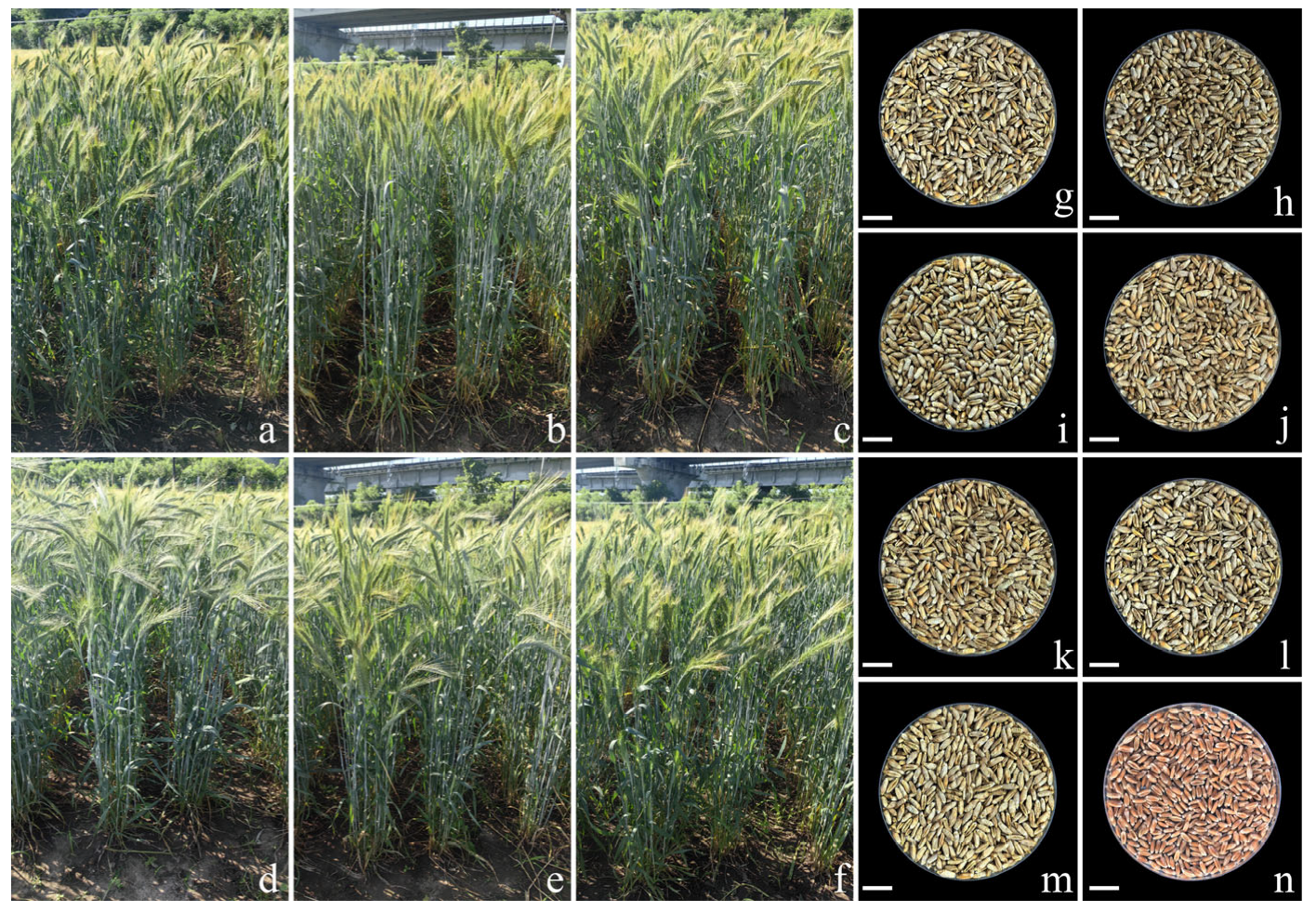
In 2008, the octoploid trititrigia accession Maicao 8 was crossed with the hexaploid triticale cultivar Hashi 209. Six triticale lines were selected from the F5 generation and subjected to 12 cycles of selfing (Figure 1). All triticale lines exhibited robust stems, high tillering capacity, free from any disease symptoms, and promising lodging resistance (Figure 2a–f). Their spike morphology resembled that of the parental line Hashi 209 but showed slight variations, including long awns, dense spikes, pubescence on the spikelets, and stem hairiness. Line 4283-2 displayed an erect spike type (Figure 2b).
Agronomic trait evaluation revealed that the plant height of the six triticale lines was comparable to that of the control Hashi 209 during 2023 and 2024 cropping seasons. Among the lines, line 4290-2 was identified as a tall-stature line. All triticale lines exhibited superior spike traits compared to Hashi 209. The spike length of lines 4280-2, 4290-2 and 4292-2 was significantly greater than that of Hashi 209. The lines 4290-2 and 4292-2 had similar spikelet number per spike compared to Hashi 209. Lines 4280-2 and 4290-2 also had more florets per spikelet compared to Hashi 209. Tillering number was generally higher than in the control, with line 4292-2 far exceeding that of Hashi 209. The tiller numbers of lines 4290-2 and 4295-1 were also significantly higher than those of Hashi 209 (Table 1).
The grains of the six triticale lines were smaller but plumper compared to those of Hashi 209 (Figure 2g–n). Their TKW was comparable to that of Hashi 209 with lines 4290-2 and 4284-2 exhibiting TKW values closest to the control, representing excellent performance. The TKW of the other triticale lines was also above 32 g (Table 1). Across growing years, the TKW of most lines remained stable or showed a slight increase, indicating good trait stability. The grain protein content of all triticale lines was consistently higher than that of Hashi 209, ranging from 12.8% to 14.9%, representing a significant advantageous trait. Lines 4295-1 and 4284-2 had the highest protein content (Table 1).

3.2. Molecular Marker Analysis with Genome-Specific Primers pSc119.1, and 2P1-2P2

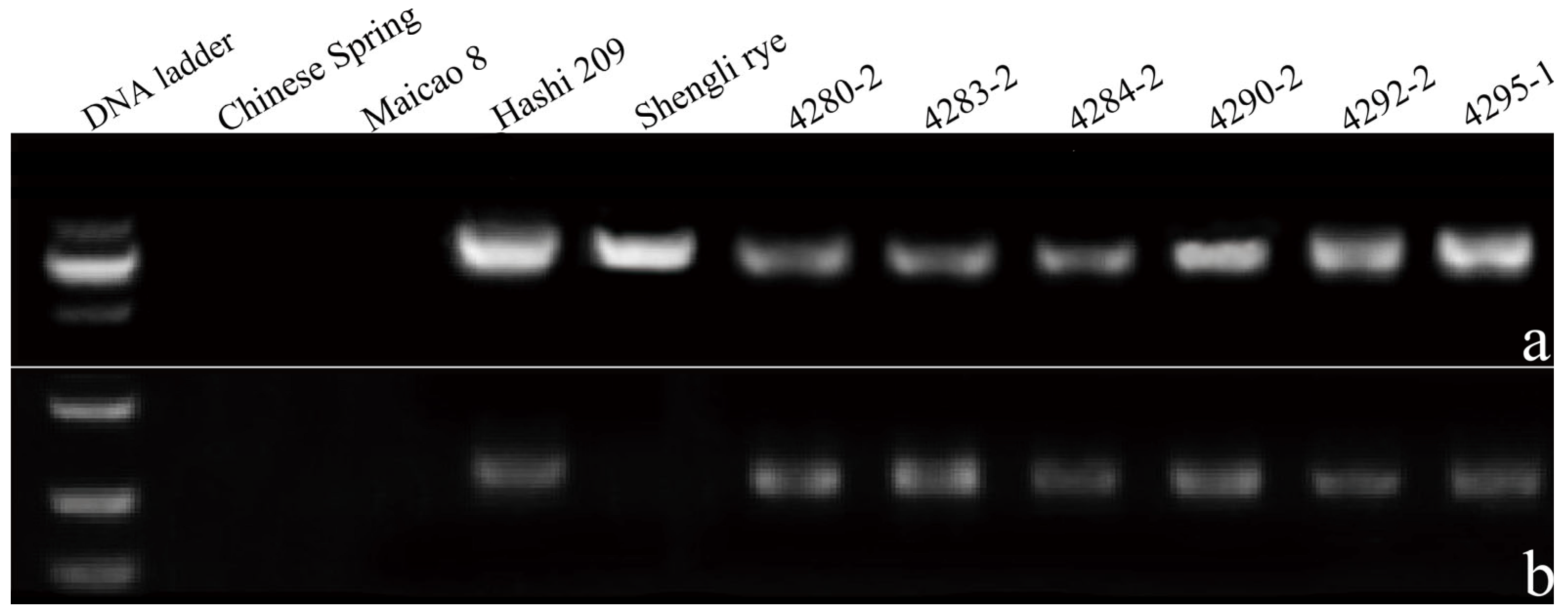
Molecular marker analysis using the R-genome-specific primer pSc119.1 showed that a 750 bp target band was amplified in the positive control Shengli rye, the parental line Hashi 209, and six St-R triticale translocation lines. No target band was observed in the negative controls, Chinese Spring and Maicao 8 (Figure 3a). Detection with the Thinopyrum genome-specific primer pair 2P1 and 2P2 amplified a 277 bp diagnostic band in Th. intermedium, Maicao 8, and the six triticale translocation lines. This band was not detected in Hashi 209, Chinese Spring, and Shengli rye (Figure 3b). These results confirm the presence of Th. intermedium and rye chromatin in all triticale lines.

3.3. Cytogenetics Analysis of Triticale with smGISH and FISH

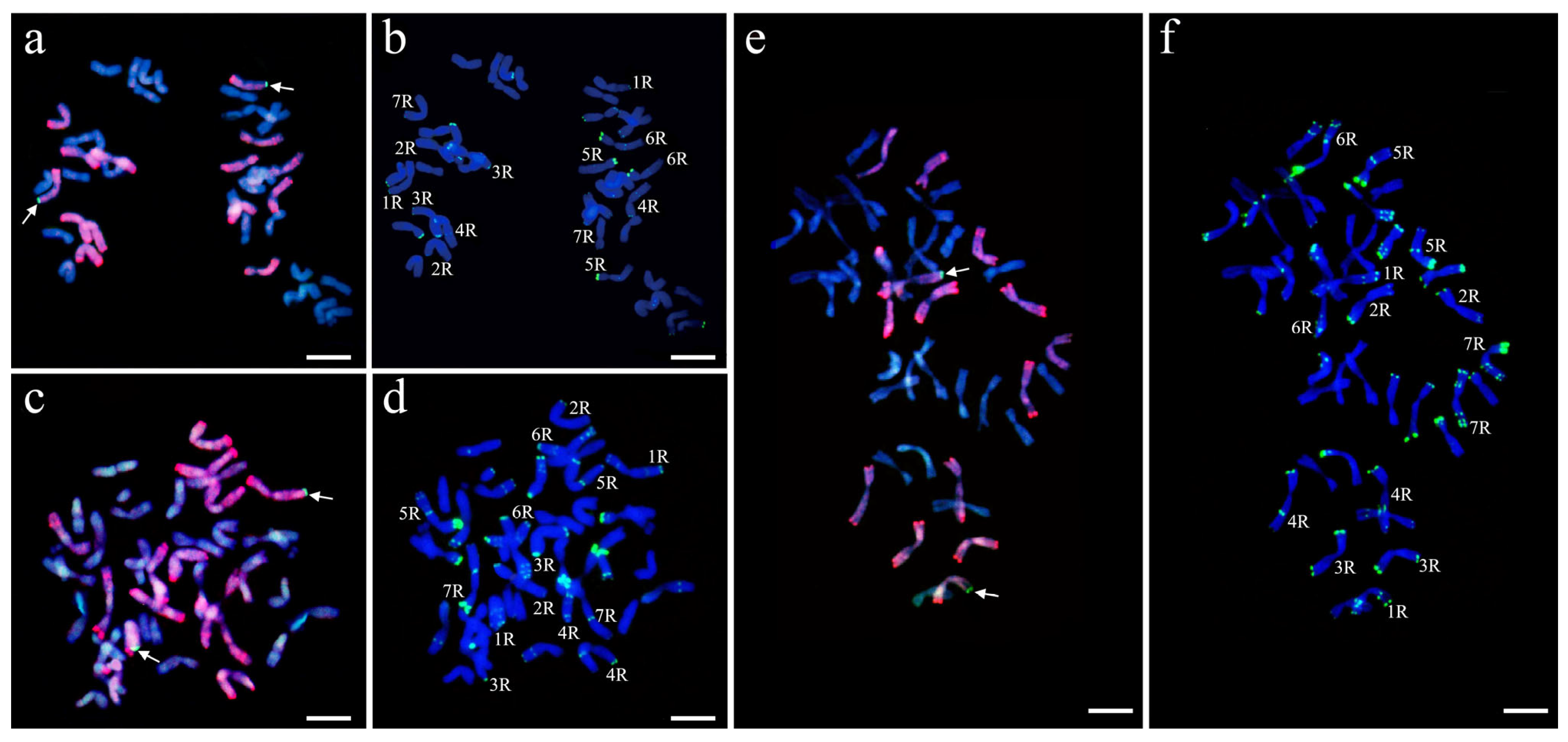
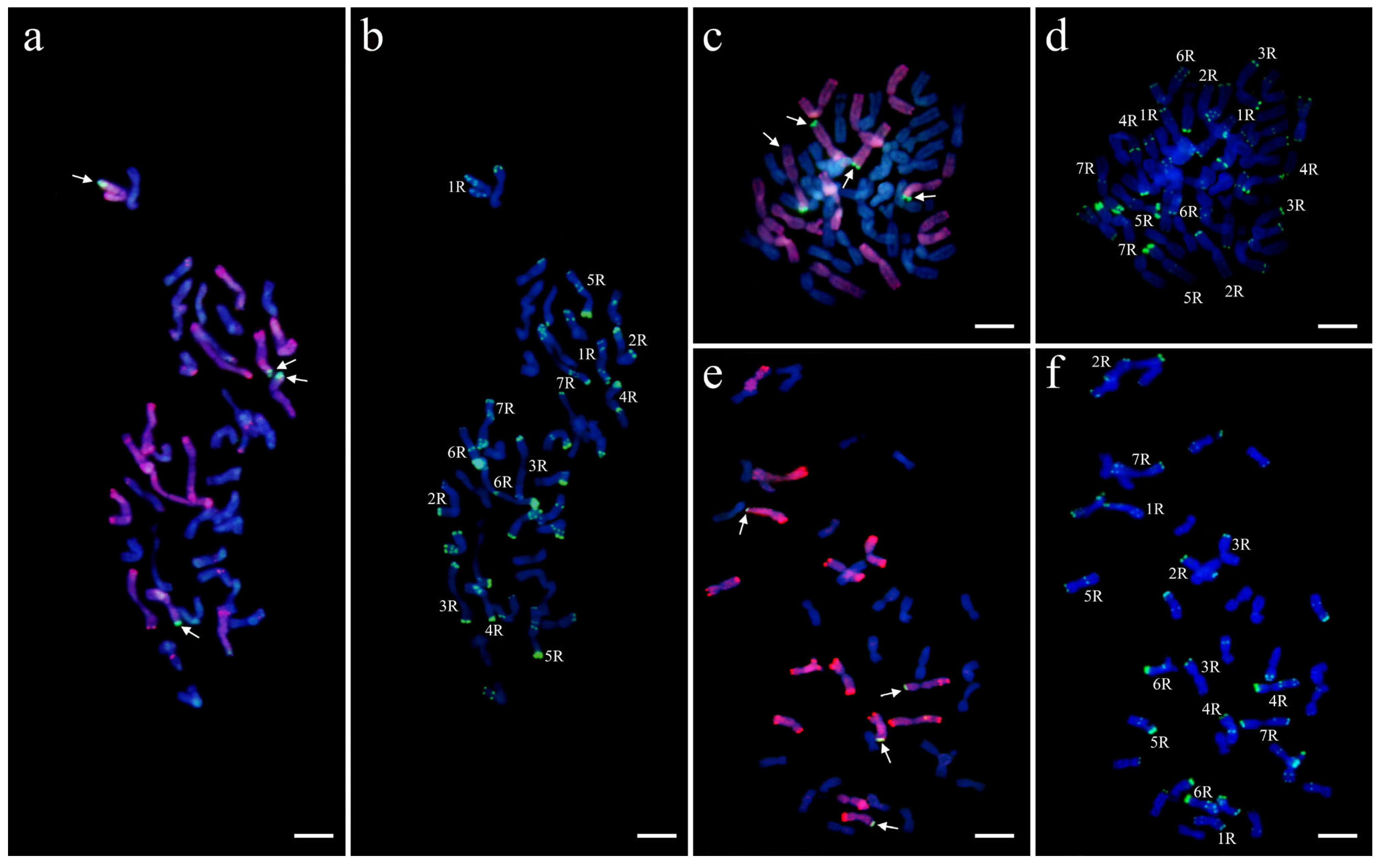
All lines contained 42 chromosomes. The first GISH analysis using genomic probes from diploid Th. bessarabicum (Jb) and D. villosum (V) revealed no hybridization signals in any of the lines. In second GISH analysis, which employed genomic probes from diploid Ps. strigosa (St, green) and rye (R, red), all triticale lines exhibited complete red hybridization signals corresponding to the R-genome probe on 14 chromosomes. Three lines, 4283-2, 4284-2, and 4295-1, displayed additional green St-genome probe signals at the terminal regions of two R chromosomes (Figure 4a,c,e). The remaining three lines, 4280-2, 4290-2, and 4292-2, showed similar terminal green St-probed signals on four R chromosomes. In addition, some hybridization signals from R-genome probes were also detected on wheat chromosomes of line 4292-2 (Figure 5a,c,e). These results indicate the presence of terminal St-R chromosome translocations in all six triticale lines.
Subsequent mcFISH analysis using the oligonucleotide probe Oligo-pSc119.2 identified that the two R-genome chromosomes carrying terminal St-genome signals correspond to the long arm of chromosome 1R (Figure 4b,d,f), while the four R-genome chromosomes with terminal St-genome signals correspond to the long arm of chromosomes 1R and the short arm of 4R (Figure 5b,d,f). Collectively, these results demonstrate that lines 4283-2, 4284-2, and 4295-1 carry St-1RL terminal translocations, whereas lines 4280-2, 4290-2, and 4292-2 carry both St-1RL and St-4RS terminal translocations.

4. Discussion

Triticale has become a crucial breeding material for global dual-purpose (grain and forage) crop improvement by integrating wheat’s high yield potential with rye’s stress tolerance [1,2]. For forage purposes, triticale demonstrates prominent advantages, including high protein content, high biomass, and superior nutritional quality [65,66,67]. Numerous high-quality triticale cultivars, such as Sorento, Yukuri, Zhongsi 237, and Jisi 3, have been developed [16,22,25,29]. Therefore, expanding the triticale gene pool holds practical significance for enhancing the forage industry. In this study, a wheat-rye-Thinopyrum intergeneric hybrid was used to create St-R triticale translocation lines. These lines exhibited superior comprehensive agronomic traits compared to the parental triticale cultivar Hashi 209, without a significant reduction in yield. Lines 4290-2, 4292-2, and 4295-1 displayed outstanding performance in plant height, spike length, tiller number, and grain protein content. These results indicate that the novel lines developed in this study can be served as valuable germplasm resources for triticale breeding and application.
Introducing alien chromosomal components into the wheat creates translocation or introgression lines, which broadens its genetic base and enhances diversity. Commonly used alien genera for wheat improvement include Secale, Thinopyrum, Psathyrostachys, and Aegilops [40,53,68,69,70,71]. Traditional methods for introducing alien chromatin include wide hybridization, ionizing radiation, chemical mutagenesis, or gametocidal systems [72,73,74]. Wheat intergeneric or multi-generic hybridization transfers advantageous genetic resources from multiple related genera into wheat through crossing, creating new germplasm with desirable traits. Beyond the wheat-rye-Thinopyrum triple hybrid, other hybrid combinations include wheat-rye-Leymus and wheat-Psathyrostachys huashanica-rye/Th. intermedium hybrids [75]. For instance, He et al. [76] crossed octoploid triticale Jinsong 19 with the Tritileymus line 950059, introducing six rye and Leymus chromosomes into the wheat background in the F1 generation, producing powdery mildew-resistant progeny.
This study effectively introduced Th. intermedium St-genome chromosome segments into the rye (R) genome of triticale through hybridization between triticale and trititrigia. Six hexaploid triticale lines harboring St-R terminal translocations were developed, exhibiting characteristics of a wheat-rye-Thinopyrum intergeneric hybrid. No significant genetic burden was observed in their agronomic traits. These lines displayed Th. intermedium traits, including tall plant stature, long spikes, high tillering capacity, and high grain protein content, thereby improving the yield performance and grain protein content of triticale. This demonstrates that intergeneric hybridization involving three genera is effective for creating chromosome translocation lines. Previous studies indicate that intergeneric hybridization often results in stable small-segment translocations in terminal chromosome regions [45,52,55]. The St-R chromosome translocations occurred in the terminal regions of the R genome chromosomes. These translocation lines showed genetic stability through cultivation and selection. The St segments were inserted into the terminal regions of rye chromosomes 1RL and 4RS, compared to prior translocation types such as T1RS-1BL, T6BS-6RL, or 2RL-1DL [77,78,79]. This shows that the three-genus hybridization system can introduce Thinopyrum chromosomes and facilitate recombination between Thinopyrum and rye chromosomes, indicating homology [80]. The introgression of Th. intermedium chromatin into rye via small terminal translocations is rarely reported. As both are superior forage species, merging their genetic resources offers a novel strategy to enhance triticale by introducing advantageous Thinopyrum genes, thereby complementing specific deficiencies in the crop.
Th. intermedium is characterized by large spikes with multiple florets, high tillering capacity, and high grain protein content, making it a valuable donor for wheat breeding [62]. The superior genes carried on the chromosomes of Th. intermedium subgenomes have played a significant role in wheat genetic improvement [74,81]. Previous studies have shown that trititrigia lines and wheat-Th. intermedium derived lines containing St subgenome chromatin exhibit disease resistance and high grain protein content, linking St chromosomes to these traits [82,83,84]. Among the six triticale translocation lines, two have St-R chromosome translocations on 1R and 4R. Lines 4290-2 and 4292-2, carrying both translocations, showed superior traits compared to lines with only the 1R translocation. This likely results from the introduction of more St chromatin. However, St-R translocations did not consistently improve all traits or protein content. This suggests that St segment effects may be locus-specific or background-dependent, requiring refined gene mapping and functional analysis for clarification. In addition, the phenotypic evaluation in this study is only for the purpose of preliminary characterization. The final agronomic evaluation needs many years and multi-site trials in the future to clarify its utilization value.

5. Conclusions

We developed six novel St-R triticale translocation lines, representing a new wheat-rye-Th. intergeneric hybrid germplasm. These lines carry 14 rye chromosomes with small terminal St chromosome segments translocated to chromosomes 1RL and 4RS. They exhibited typical triticale phenotypes, but displayed superior agronomic traits compared to the parental triticale. These lines serve as a valuable genetic resource for development of new triticale cultivars. Future studies will expand cultivation across various regions to evaluate stress resistance traits, including saline–alkali tolerance, and will integrate fine mapping and gene expression studies to elucidate the functional value of these small St segments and their potential applications in wheat or triticale breeding.

Author Contributions

C.J. and M.H. conducted most of the experiments and analyzed the data. H.Z., H.J., R.Z., R.D., D.K. and K.Y. conducted the field management and morphological observation. A.S. and C.J. performed molecular marker, smGISH and FISH experiments. X.Y., Q.X., Y.Q. and X.L. conducted the yield components analysis and the statistical analysis. L.C., H.L. and Y.Z. conceived the project and revised the manuscript. Y.Z. designed and supervised the research. All authors have read and agreed to the published version of the manuscript.

Funding

This research was financially supported by the National Natural Science Foundation of China (Major Program, 32494771), the Heilongjiang Provincial National Science Foundation of China (PL2024C020), the Basic Research Funds for Undergraduate Universities in Heilongjiang Province (2023-KYWF-1431), the Fundamental Agricultural Science and Technology Innovation Program under Heilongjiang Provincial Agricultural Science and Technology Innovation Leap Project (CX25JC23), and the Natural Science Foundation of Shanxi Province, China (202203021221177).

Institutional Review Board Statement

Not applicable.

Informed Consent Statement

Written informed consent for publication was obtained from all participants.

Data Availability Statement

All data generated or analyzed during this study are included in this published article.

Acknowledgments

We thank Zengjun Qi, Nanjing Agricultural University, Nanjing, China, and Zujun Yang, University of Electronic Science and Technology, Chengdu, China, for kindly providing seeds of Th. bessarabicum and D. villosum. We also thank Dalhoe Koo, Kansas State University, Manhattan, KS, USA, for kindly providing the DNA of Ps. strigosa.

Conflicts of Interest

The authors declare that they have no conflicts of interest.

References

  1. Kalinka, A.; Achrem, M. Reorganization of wheat and rye genomes in octoploid triticale (×Triticosecale). Planta 2018, 247, 807–829. [Google Scholar] [CrossRef] [PubMed]
  2. Deng, C.H.; Zhang, Z.B.; Yan, G.R.; Wang, F.; Zhao, L.J.; Liu, N.; Abudurezike, A.; Li, Y.S.; Wang, W.; Shi, S.B. Salt-responsive transcriptome analysis of triticale reveals candidate genes involved in key metabolic pathways in response to salt stress. Sci. Rep. 2020, 10, 20669. [Google Scholar] [CrossRef] [PubMed]
  3. Saed-Moucheshi, A.; Babaei, S.; Ansarshourijeh, F. Innovative multi-trial breeding and genotype screening in triticale (×Triticosecale Wittmack) for enhanced stability under drought stress. Sci. Rep. 2024, 14, 28273. [Google Scholar] [CrossRef] [PubMed]
  4. García del Moral, L.F.; Boujenna, A.; Yañez, J.A.; Ramos, J.M. Forage production, grain yield, and protein content in dual-purpose triticale grown for both grain and forage. Agron. J. 1995, 87, 902–908. [Google Scholar] [CrossRef]
  5. Miedaner, T.; Flath, K.; Starck, N.; Weißmann, S.; Maurer, H.P. Quantitative-genetic evaluation of resistances to five fungal diseases in a large triticale diversity panel (×Triticosecale). Crops 2022, 2, 218–232. [Google Scholar] [CrossRef]
  6. Ayalew, H.; Kumssa, T.T.; Butler, T.J.; Ma, X.F. Triticale improvement for forage and cover crop uses in the southern Great Plains of the United States. Front. Plant Sci. 2018, 9, 1130. [Google Scholar] [CrossRef]
  7. Mohammadi Alagoz, S.; Hadi, H.; Toorchi, M.; Pawłowski, T.A.; Asgari Lajayer, B.; Price, G.W.; Farooq, M.; Astatkie, T. Morpho-physiological responses and growth indices of triticale to drought and salt stresses. Sci. Rep. 2023, 13, 8896. [Google Scholar] [CrossRef]
  8. Guo, X.R.; Shi, Q.H.; Wang, M.; Yuan, J.; Zhang, J.; Wang, J.; Liu, Y.; Su, H.D.; Wang, Z.; Li, J.B.; et al. Functional analysis of the glutathione S-transferases from Thinopyrum and its derivatives on wheat Fusarium head blight resistance. Plant Biotechnol. J. 2023, 21, 1091–1093. [Google Scholar] [CrossRef]
  9. Golebiowska-Paluch, G.; Stawoska, I.; Jelonek-Kozioł, M.; Wesełucha-Birczyńska, A.; Kornaś, A. Soil salinity differentiates winter triticale genotypes in physiological and biochemical characteristics of seedlings and consequently their yield. Int. J. Mol. Sci. 2024, 25, 12971. [Google Scholar] [CrossRef]
  10. Cui, L.; Xu, L.Y.; Wang, H.H.; Fan, X.T.; Yan, C.H.; Zhang, Y.M.; Jiang, C.T.; Zhou, T.; Guo, Q.; Sun, Y.; et al. Evaluation of dual-purpose triticale: Grain and forage productivity and quality under semi-arid conditions. Agronomy 2025, 15, 881. [Google Scholar] [CrossRef]
  11. Wilson, S., II. Wheat and rye hybrids. Trans. Bot. Soc. Edinb. 1873, 12, 286–288. [Google Scholar] [CrossRef]
  12. Ávila, C.M.; Rodríguez-Suárez, C.; Atienza, S.G. Tritordeum: Creating a new crop species-the successful use of plant genetic resources. Plants 2021, 10, 1029. [Google Scholar] [CrossRef] [PubMed]
  13. Hurni, S.; Brunner, S.; Buchmann, G.; Herren, G.; Jordan, T.; Krukowski, P.; Wicker, T.; Yahiaoui, N.; Mago, R.; Keller, B. Rye Pm8 and wheat Pm3 are orthologous genes and show evolutionary conservation of resistance function against powdery mildew. Plant J. 2013, 76, 957–969. [Google Scholar] [CrossRef] [PubMed]
  14. del Pozo, A.D.; Méndez-Espinoza, A.M.; Castillo, D. Triticale. In Neglected and Underutilized Crops; Elsevier: Amsterdam, The Netherlands, 2023; pp. 325–362. [Google Scholar]
  15. Wolski, T. Present and future in small grain breeding and seed production in Poland. Fragm. Agron. 1995, 12, 52–55. [Google Scholar]
  16. Wolski, T.; Szołkowski, A.; Gryka, J.; Pojmaj, M.S. Current status of winter triticale breeding in Danko. Biuletyn. IHAR 1998, 205/206, 289–297. [Google Scholar]
  17. Wolski, T.; Oleksiak, T. Triticale production and breeding in Poland: Cultivar development and global impact. In Proceedings of the 5th International Triticale Symposium; Arseniuk, E., Ed.; Plant Breeding and Acclimatization Institute: Radzikow, Poland, 2002; Volume 1, pp. 131–134. [Google Scholar]
  18. Shchipak, G.V.; Tsupko, Y.V.; Boguslavskyi, R.L.; Matviyets, V.G.; Shchipak, V.G.; Woś, H.; Brzeziński, W. Breeding hexaploid triticale (× Triticosecale Wittmack) of various varietal types with high bread making quality. In Proceedings of the International Scientific-Practical Conference “Triticale-Crop of the 21st Century”; TOV “NIlan-LTD”: Kharkiv, Ukraine, 2017; pp. 57–59. [Google Scholar]
  19. Li, F.; Li, Y.H.; Cao, L.R.; Liu, P.Y.; Geng, M.M.; Zhang, Q.; Qiu, L.N.; Sun, Q.X.; Xie, C.J. Simultaneous transfer of leaf rust and powdery mildew resistance genes from hexaploid triticale cultivar Sorento into bread wheat. Front. Plant Sci. 2018, 9, 85. [Google Scholar] [CrossRef]
  20. Ulaszewski, W.; Belter, J.; Wiśniewska, H.; Szymczak, J.; Skowrońska, R.; Phillips, D.; Kwiatek, M.T. Recovery of 2R·2Sk triticale-Aegilops kotschyi Robertsonian chromosome translocations. Agronomy 2019, 9, 646. [Google Scholar] [CrossRef]
  21. Kwiatek, M.T.; Belter, J.; Ulaszewski, W.; Skowrońska, R.; Noweiska, A.; Wiśniewska, H. Molecular identification of triticale introgression lines carrying leaf rust resistance genes transferred from Aegilops kotschyi Boiss. and Ae. tauschii Coss. J. Appl. Genet. 2021, 62, 431–439. [Google Scholar] [CrossRef]
  22. Wang, T.T.; Li, G.R.; Jiang, C.Z.; Zhou, Y.W.; Yang, E.N.; Li, J.B.; Zhang, P.; Dundas, I.; Yang, Z.J. Development of a set of wheat-rye derivative lines from hexaploid triticale with complex chromosomal rearrangements to improve disease resistance, agronomic and quality traits of wheat. Plants 2023, 12, 3885. [Google Scholar] [CrossRef]
  23. Bao, W.K. Genetics and breeding. Sci. Agric. Sin. 1962, 7, 17–23. [Google Scholar]
  24. He, L.X.; Yu, L.; Xing, H.T. Cytogenetics and traits of hybrids F1 between octoploid triticale and common wheat. Acta Bot. Boreali-Occident. Sin. 1994, 14, 9–23. [Google Scholar]
  25. Wu, T.; Sun, Y.S.; Wu, Z.X. A new triticale cultivar with high yield and good quality-Zhongsi 237. J. Triticeae Crops 2001, 3, 97. [Google Scholar] [CrossRef]
  26. Wang, Z.Y.; Sun, Y.S.; Chen, X.Z.; Li, Z.; Liu, S.F. Breeding and application of high-quality forage triticale Zhongsi 828. Crops 2003, 6, 49. [Google Scholar] [CrossRef]
  27. Li, C.; Kong, G.C.; Ainiwaer Li, W.H.; Qi, J.C.; Wei, L.J.; Shi, P.C.; Cao, L.P. A new winter forage triticale variety: Shida No. 1. J. Triticeae Crops 2010, 30, 400. [Google Scholar]
  28. Han, G.H.; Yan, H.W.; Wang, J.; Cao, L.J.; Liu, S.Y.; Li, X.Q.; Zhou, Y.L.; Fan, J.R.; Li, L.H.; An, D.G. Molecular cytogenetic identification of a new wheat-rye 6R addition line and physical localization of its powdery mildew resistance gene. Front. Plant Sci. 2022, 13, 889494. [Google Scholar] [CrossRef]
  29. You, Y.L.; Zhao, H.M.; Li, Y.; Wu, R.X.; Liu, G.B. Breeding of new forage triticale ‘Jisi No.3′ with stress resistance and high yield. Acta Agrestia. Sin. 2020, 28, 1145–1152. [Google Scholar] [CrossRef]
  30. Yan, H.W.; Han, G.H.; Gu, T.T.; Shi, Z.P.; Cao, L.J.; Wang, J.; Liu, H.; Wang, C.L.; Zhuo, S.Y.; Li, L.H.; et al. Cytogenetic characterization of a novel wheat-rye 2R (2D) substitution line YT9 conferring powdery mildew resistance from the three-leaf stage and physical mapping of PmYT9. Theor. Appl. Genet. 2025, 138, 167. [Google Scholar] [CrossRef]
  31. Li, J.L.; Ben, Y.X.; Wang, T.C.; Xu, X.L.; Xue, X. Some problems involved in the cross between octoploid and hexaploid forms of triticale. Acta Agron. Sin. 1988, 14, 104–109. [Google Scholar]
  32. Facchini, N.; Morcia, C.; Terzi, V.; Rizza, F.; Badeck, F.W. Triticale in Italy. Biology 2023, 12, 1308. [Google Scholar] [CrossRef]
  33. Bouafiane, M.; Ameur-Zaimeche, O.; Mehda, S.; Touil, S.; Heddam, S.; Cimmino, A. Evaluating salinity stress tolerance of a novel triticale genotype: Wheat crop improvement for arid agroecosystems. J. Umm Al-Qura Univ. Appl. Sci. 2025. [Google Scholar] [CrossRef]
  34. Golebiowska-Paluch, G.; Dyda, M. The genome regions associated with abiotic and biotic stress tolerance, as well as other important breeding traits in triticale. Plants 2023, 12, 619. [Google Scholar] [CrossRef] [PubMed]
  35. Tyrka, M.; Chełkowski, J. Enhancing the resistance of triticale by using genes from wheat and rye. J. Appl. Genet. 2004, 45, 283–295. [Google Scholar] [PubMed]
  36. Zou, J.W.; Zhang, S.S.; Zhang, Z.W.; Ren, X.; Sun, H.; Hu, T.; Zhou, Y.; Lin, X. Breeding and identification of stripe rust resistant line HB20121023 derived from wheat-octoploid triticale hybrid. Seed 2016, 35, 101–104. [Google Scholar] [CrossRef]
  37. Wu, J.H.; Ji, W.Q.; Li, F.Z. Advances in application of rye for wheat improvement. J. Triticeae Crops 2005, 25, 115–119. [Google Scholar] [CrossRef]
  38. Li, H.J.; Arterburn, M.; Jones, S.S.; Murray, T.D. Resistance to eyespot of wheat, caused by Tapesia yallundae, derived from Thinopyrum intermedium homoeologous group 4 chromosome. Theor. Appl. Genet. 2005, 111, 932–940. [Google Scholar] [CrossRef]
  39. Li, H.J.; Cui, L.; Li, H.L.; Wang, X.M.; Murray, T.D.; Conner, R.L.; Wang, L.J.; Gao, X.; Sun, Y.; Sun, S.C.; et al. Effective resources in wheat and wheat–Thinopyrum derivatives for resistance to Heterodera filipjevi in China. Crop Sci. 2012, 52, 1209–1217. [Google Scholar] [CrossRef]
  40. Li, H.J.; Wang, X.M. Thinopyrum ponticum and Th. intermedium: The promising source of resistance to fungal and viral diseases of wheat. J. Genet. Genom. 2009, 36, 557–565. [Google Scholar] [CrossRef]
  41. Lin, Z.S.; Huang, D.H.; Du, L.P.; Ye, X.G.; Xin, Z.Y. Identification of wheat–Thinopyrum intermedium 2Ai-2 ditelosomic addition and substitution lines with resistance to barley yellow dwarf virus. Plant Breed. 2006, 125, 114–119. [Google Scholar] [CrossRef]
  42. Jiang, B.; Zhang, S.X.; Wang, H.; Shi, Y.; Li, Z.Q.; Zhu, L.; Song, W.F.; Yang, X.F.; Song, Q.J.; Li, X.L.; et al. Genetic improvement and genomics-assisted breeding of the germplasm resource Thinopyrum intermedium. J. Plant Genet. Resour. 2020, 21, 1385–1394. [Google Scholar] [CrossRef]
  43. Lu, F.K.; Duan, W.J.; Cui, Y.; Zhang, J.W.; Zhu, D.; Zhang, M.; Yan, Y.M. 2D-DIGE based proteome analysis of wheat-Thinopyrum intermedium 7XL/7DS translocation line under drought stress. BMC Genom. 2022, 23, 369. [Google Scholar] [CrossRef]
  44. Li, G.R.; Chen, Q.H.; Jiang, W.N.; Zhang, A.H.; Yang, E.N.; Yang, Z.J. Molecular and cytogenetic identification of wheat-Thinopyrum intermedium double substitution line-derived progenies for stripe rust resistance. Plants 2023, 12, 28. [Google Scholar] [CrossRef]
  45. Jiang, J.; Friebe, B.; Gill, B.S. Recent advances in alien gene transfer in wheat. Euphytica 1993, 73, 199–212. [Google Scholar] [CrossRef]
  46. Kang, H.Y.; Zeng, J.; Xie, Q.; Tao, S.; Zhong, M.Y.; Zhang, H.Q.; Fan, X.; Sha, L.N.; Xu, L.L.; Zhou, Y.H. Molecular cytogenetic characterization and stripe rust response of a trigeneric hybrid involving Triticum, Psathyrostachys and Thinopyrum. Genome 2012, 55, 383–390. [Google Scholar] [CrossRef] [PubMed]
  47. Wang, C.Y.; Gao, J.D.; Liu, J.Y.; Zhang, Y.; Song, W.; Yang, X.; Song, Q.; Li, J.; Zhang, Y. Identification of new trigeneric hybrid materials from progeny of Thinopyrum-wheat and triticale. J. Agric. Biotechnol. 2017, 25, 547–557. [Google Scholar]
  48. Kang, H.Y.; Zhong, M.Y.; Xie, Q.; Zhang, H.Q.; Fan, X.; Sha, L.N.; Xu, L.L.; Zhou, Y.H. Production and cytogenetics of trigeneric hybrid involving Triticum, Psathyrostachys and Secale. Genet. Resour. Crop Evol. 2012, 59, 445–453. [Google Scholar] [CrossRef]
  49. Ji, J.; Zhang, A.M.; Wang, Z.G.; Wang, J.; Wei, Z.; Liu, D.C.; Li, J.M. A wheat-Thinopyrum ponticum-rye trigeneric germplasm line with resistance to powdery mildew and stripe rust. Euphytica 2012, 188, 199–207. [Google Scholar] [CrossRef]
  50. Kosina, R.; Heslop-Harrison, J.S. Molecular cytogenetics of an amphiploid trigeneric hybrid between Triticum durum, Thinopyrum distichum and Lophopyrum elongatum. Ann. Bot. 1996, 78, 583–589. [Google Scholar] [CrossRef]
  51. Fradkin, M.; Greizerstein, E.J.; Grassi, E.; Ferreira, V.; Ferrari, M.R.; Poggio, L. Cytogenetic analysis of meiotic behaviour and stability in a trigeneric hybrid (triticale × trigopiro). Protoplasma 2024, 261, 1221–1231. [Google Scholar] [CrossRef]
  52. Kang, H.Y.; Huang, J.; Zhu, W.; Li, D.Y.; Diao, C.D.; Tang, L.; Wang, Y.; Xu, L.L.; Zeng, J.; Fan, X.; et al. Cytogenetic behavior of trigeneric hybrid progeny involving wheat, rye and Psathyrostachys huashanica. Cytogenet. Genome Res. 2016, 148, 74–82. [Google Scholar] [CrossRef]
  53. Kang, H.Y.; Tang, L.; Li, D.Y.; Diao, C.D.; Zhu, W.; Tang, Y.; Wang, Y.; Fan, X.; Xu, L.L.; Zeng, J.; et al. Cytogenetic study and stripe rust response of the derivatives from a wheat-Thinopyrum intermedium-Psathyrostachys huashanica trigeneric hybrid. Genome 2017, 60, 393–401. [Google Scholar] [CrossRef]
  54. Li, J.B.; Lang, T.; Li, B.; Yu, Z.H.; Wang, H.J.; Li, G.R.; Yang, E.N.; Yang, Z.J. Introduction of Thinopyrum intermedium ssp. trichophorum chromosomes to wheat by trigeneric hybridization involving Triticum, Secale and Thinopyrum genera. Planta 2017, 245, 1121–1135. [Google Scholar] [CrossRef] [PubMed]
  55. Chen, J.Y.; Tang, Y.Q.; Yao, L.S.; Wu, H.; Tu, X.Y.; Zhuang, L.F.; Qi, Z.J. Molecular cytogenetic characterization of a novel multiplex oligonucleotide probe for efficient identification of wheat-Thinopyrum bessarabicum chromatin. Mol. Breed. 2019, 39, 146. [Google Scholar] [CrossRef]
  56. Li, Y.P.; Jiang, B.; Li, Y.X.; Zhang, J.; Li, J.; Zhang, Y. Molecular cytogenetic detection of trigeneric hybrid progeny in wheat. Mol. Plant Breed. 2013, 11, 163–167. [Google Scholar]
  57. Yan, W.; Jin, X.; Jiang, B.; Qi, X.Y.; Chen, Y.X.; Li, X.L.; Liu, X.Q.; Ren, Y.K.; Cui, L.; Song, Q.J.; et al. Development and molecular cytogenetic characterization of cold-hardy perennial wheatgrass adapted to northeastern China. Front. Plant Sci. 2020, 11, 582. [Google Scholar] [CrossRef]
  58. Ren, R.Y.; Xiao, Z.M.; Li, J.L. Screening of universal specific DNA probes for rye. J. Triticeae Crops 2007, 27, 382–385. [Google Scholar] [CrossRef]
  59. Li, H.J.; Arterburn, M.; Jones, S.S.; Murray, T.D. A new source of resistance to Tapesia yallundae associated with a homoeologous group 4 chromosome in Thinopyrum ponticum. Phytopathology 2004, 94, 932–937. [Google Scholar] [CrossRef]
  60. Liu, Y.Z.; Song, W.S.; Song, A.N.; Wu, C.F.; Ding, J.R.; Yu, X.N.; Song, J.; Liu, M.M.; Yang, X.Y.; Jiang, C.T.; et al. Improvement of agronomic performances in cold weather conditions for perennial wheatgrass by crossing Thinopyrum intermedium with wheat-Th. intermedium partial amphiploids. Front. Plant Sci. 2023, 14, 1207078. [Google Scholar] [CrossRef]
  61. Doyle, J.J.; Doyle, J.L. A rapid DNA isolation procedure for small quantities of fresh leaf tissue. Phytochem. Bull. 1987, 19, 11–15. [Google Scholar]
  62. Zhao, X.Y.; Zhang, Z.M.; Ding, J.R.; Wu, C.F.; Qu, Y.F.; Song, A.N.; Zhao, H.B.; Song, W.W.; Liu, M.; Yang, D.H.; et al. Cytogenetics and genomics analysis of cold-hardy perennial wheatgrass: Insights into agronomic performance, chromosome composition, and gene expression. Plant J. 2025, 122, e70179. [Google Scholar] [CrossRef]
  63. Tang, Z.X.; Yang, Z.J.; Fu, S.L. Oligonucleotides replacing the roles of repetitive sequences pAs1, pSc119.2, pTa-535, pTa71, CCS1, and pAWRC.1 for FISH analysis. J. Appl. Genet. 2014, 55, 313–318. [Google Scholar] [CrossRef]
  64. Fu, S.L.; Chen, L.; Wang, Y.Y.; Li, M.; Yang, Z.J.; Qiu, L.; Yan, B.J.; Ren, Z.L.; Tang, Z.X. Oligonucleotide probes for ND-FISH analysis to identify rye and wheat chromosomes. Sci. Rep. 2015, 5, 10552. [Google Scholar] [CrossRef]
  65. McGoverin, C.M.; Snyders, F.; Muller, N.; Botes, W.; Fox, G.; Manley, M. A review of triticale uses and the effect of growth environment on grain quality. J. Sci. Food Agric. 2011, 91, 1155–1165. [Google Scholar] [CrossRef]
  66. Cazzato, E.; Laudadio, V.; Tufarelli, V. Effects of harvest period, nitrogen fertilization and mycorrhizal fungus inoculation on triticale (×Triticosecale Wittmack) forage yield and quality. Renew. Agric. Food Syst. 2012, 27, 278–286. [Google Scholar] [CrossRef]
  67. Baron, V.S.; Juskiw, P.E.; Aljarrah, M. Triticale as a forage. In Triticale; Eudes, F., Ed.; Springer: Cham, Switzerland, 2015. [Google Scholar] [CrossRef]
  68. Jia, H.W.; Feng, H.; Yang, G.T.; Li, H.W.; Fu, S.L.; Li, B.; Li, Z.S.; Zheng, Q. Establishment and identification of six wheat-Thinopyrum ponticum disomic addition lines derived from partial amphiploid Xiaoyan 7430. Theor. Appl. Genet. 2022, 135, 3277–3291. [Google Scholar] [CrossRef] [PubMed]
  69. Tan, B.W.; Gao, J.; Yao, Z.J.; Zhu, W.; Xu, L.L.; Cheng, Y.R.; Wang, Y.; Zeng, J.; Fan, X.; Sha, L.N.; et al. Development and identification of wheat–Psathyrostachys huashanica 7NsS small segment translocation lines with early heading date gene Ehd-7Ns. Crop. J. 2025, 13, 1186–1196. [Google Scholar] [CrossRef]
  70. Gong, B.R.; Zhang, H.; Lu, Y.X.; Chen, L.F.; Zhu, W.; Xu, L.L.; Wu, D.D.; Cheng, Y.R.; Wang, Y.; Zeng, J.; et al. Fine mapping of the all-stage stripe rust resistance gene Yr4EL and its utilization in wheat resistance breeding. Plant Cell Environ. 2025, 49, 1064–1077. [Google Scholar] [CrossRef]
  71. Yazdani, M.; Rouse, M.N.; Bajgain, P.; Danilova, T.V.; Motsnyi, I.; Steffenson, B.J.; Patpour, M.; Rahmatov, M. Identification and characterization of Sr59-mediated stem rust resistance in a novel wheat-rye translocation T2BL·2BS-2RL. Crop. J. 2025, 13, 909–918. [Google Scholar] [CrossRef]
  72. Vilperte, V.; Boehm, R.; Debener, T. A highly mutable GST is essential for bract colouration in Euphorbia pulcherrima Willd. Ex Klotsch. BMC Genom. 2021, 22, 208. [Google Scholar] [CrossRef]
  73. Chen, L.Z.; Duan, L.; Sun, M.H.; Yang, Z.; Li, H.Y.; Hu, K.M.; Yang, H.; Liu, L. Current trends and insights on EMS mutagenesis application to studies on plant abiotic stress tolerance and development. Front. Plant Sci. 2023, 13, 1052569. [Google Scholar] [CrossRef]
  74. Said, M.; Gaál, E.; Farkas, A.; Molnár, I.; Bartoš, J.; Doležel, J.; Cabrera, A.; Endo, T.R. Gametocidal genes: From a discovery to the application in wheat breeding. Front. Plant Sci. 2024, 15, 1396553. [Google Scholar] [CrossRef]
  75. Wang, X.Y.; Zhao, H.B.; Zhang, Y.M.; Li, X.L. Research progress on trigeneric hybridization in cereal crops. Mol. Plant Breed. 2020, 18, 7530–7536. [Google Scholar] [CrossRef]
  76. He, F.; Liu, H.Y.; Wang, H.G.; Li, X.F. Chromosome behavior during microsporogenesis in trigeneric hybrid F1 of Triticeae. J. Mol. Cell Biol. 2008, 41, 335–339. [Google Scholar]
  77. Li, D.Y.; Long, D.; Li, T.H.; Wu, Y.L.; Wang, Y.; Zeng, J.; Xu, L.L.; Fan, X.; Sha, L.N.; Zhang, H.Q.; et al. Cytogenetics and stripe rust resistance of wheat-Thinopyrum elongatum hybrid derivatives. Mol. Cytogenet. 2018, 11, 16. [Google Scholar] [CrossRef] [PubMed]
  78. Zhu, S.Y.; Du, H.N.; Su, F.Y.; Wang, J.; Meng, Q.F.; Liu, T.L.; Guo, R.; Chen, Z.Z.; Li, H.H.; Liu, W.X.; et al. Molecular cytogenetic analyses of two new wheat-rye 6RL translocation lines with resistance to wheat powdery mildew. Crop. J. 2023, 11, 584–592. [Google Scholar] [CrossRef]
  79. Ji, Y.Z.; Han, G.H.; Gong, W.P.; Han, R.; Wang, X.L.; Bao, Y.G.; Li, J.B.; Liu, A.F.; Li, H.S.; Liu, J.J.; et al. Development and characterization of a novel wheat-rye T2DS·2DL-2RL translocation line with high stripe rust resistance. Phytopathol. Res. 2024, 6, 57. [Google Scholar] [CrossRef]
  80. Wang, R.R.-C.; Larson, S.R.; Jensen, K.B.; Bushman, B.S.; DeHaan, L.R.; Wang, S.W.; Yan, X.B. Genome evolution of intermediate wheatgrass as revealed by EST-SSR markers developed from its three progenitor diploid species. Genome 2015, 58, 63–70. [Google Scholar] [CrossRef]
  81. Wang, H.; Cheng, S.W.; Shi, Y.; Zhang, S.X.; Yan, W.; Song, W.F.; Yang, X.F.; Song, Q.J.; Jang, B.; Qi, X.Y.; et al. Molecular cytogenetic characterization and fusarium head blight resistance of five wheat-Thinopyrum intermedium partial amphiploids. Mol. Cytogenet. 2021, 14, 15. [Google Scholar] [CrossRef]
  82. Bao, Y.; Li, X.; Liu, S.; Cui, F.; Wang, H. Molecular cytogenetic characterization of a new wheat-Thinopyrum intermedium partial amphiploid resistant to powdery mildew and stripe rust. Cytogenet. Genome Res. 2009, 126, 390–395. [Google Scholar] [CrossRef]
  83. Yang, G.T.; Zhang, N.; Boshoff, W.H.P.; Li, H.W.; Li, B.; Li, Z.S.; Zheng, Q. Identification and introgression of a novel leaf rust resistance gene from Thinopyrum intermedium chromosome 7Js into wheat. Theor. Appl. Genet. 2023, 136, 231. [Google Scholar] [CrossRef]
  84. Wu, C.F.; Zhao, X.Y.; Li, M.Y.; Qu, Y.F.; Yan, X.Y.; Ding, J.R.; Zhou, T.; Jiang, C.Y.; Liu, Q.H.; Jiang, J.R.; et al. Development and molecular cytogenetic characterization of black-grain wheat derived from wheat-Thinopyrum intermedium hybridization. Theor. Appl. Genet. 2025, 138, 184. [Google Scholar] [CrossRef]
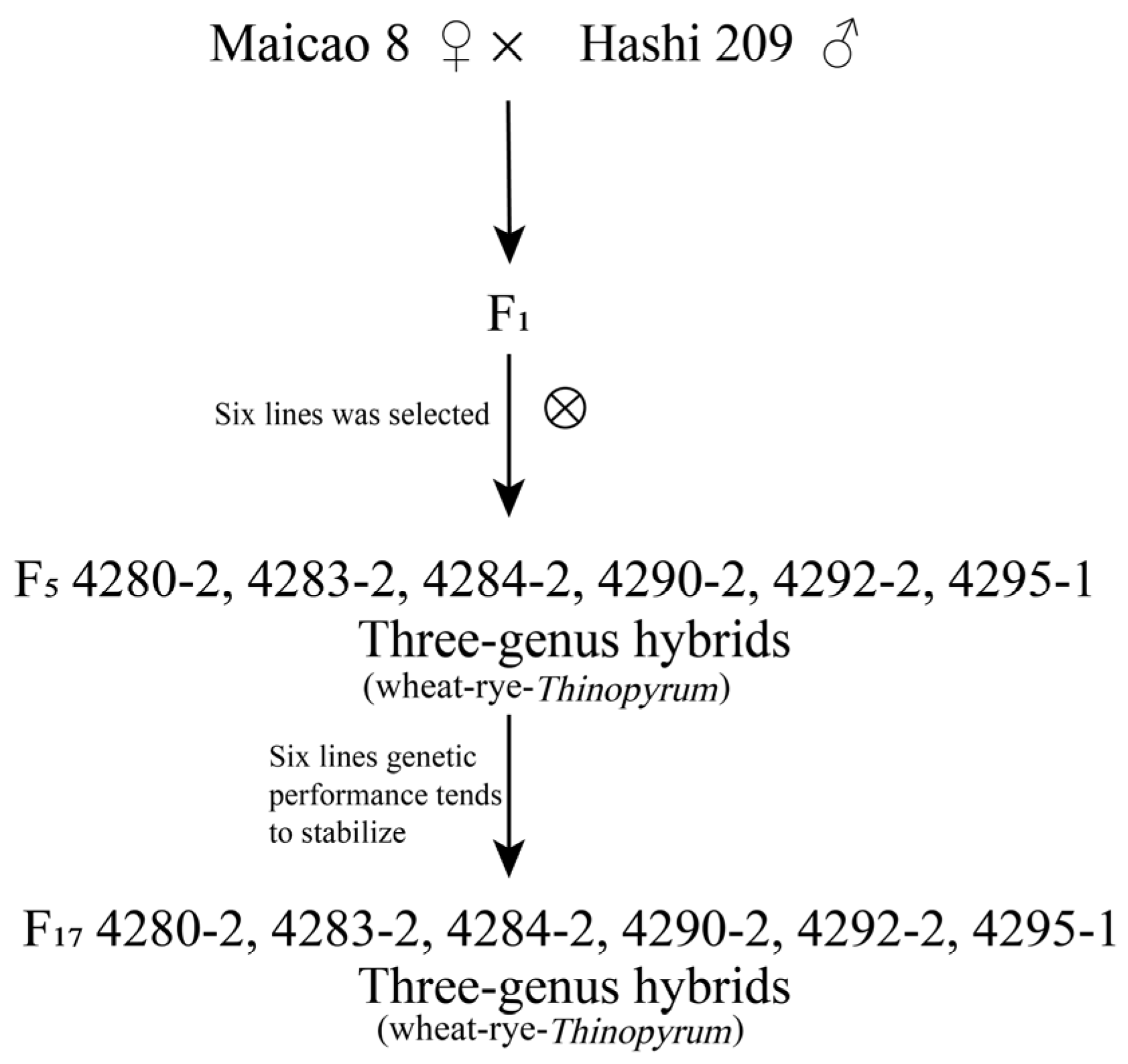
Figure 1. The pedigree of St-R triticale translocation lines.
Agronomy 16 00336 g001
Figure 2. Field performance and grain pattern of six St-R triticale translocation lines. (af): Field grown plants. (gn): Grains. (a,g): 4295-1; (b,h): 4283-2; (c,i): 4284-2; (d,j): 4280-2; (e,k): 4290-2; (f,l): 4292-2; (m): Hashi 209; (n): Maicao 8. Bar = 2 cm.
Agronomy 16 00336 g002
Figure 3. Molecular marker analysis of St-R triticale translocation lines. (a): Detection with universal primer pSc119.1 for the R genome (750 bp); (b): Detection with universal primers 2P1 and 2P2 for the Th. intermedium genome (277 bp). The DNA ladder employed DL2000 DNA marker, showing six bands in the range of 100–2000 bp.
Agronomy 16 00336 g003
Figure 4. In situ hybridization analysis of St–R triticale lines with 1RL translocations. (a,b): Line 4283-2; (c,d): Line 4284-2; (e,f): Line 4295-1. A translocation of small fragments from an St-genome chromosome to the terminal region at the long arm of chromosome 1R (1RL). Probe regime: R-genomic probes (red), St-genomic and oligo-pSc119.2 probes (green). White arrows indicate the translocation fragments. Bar = 10 μm.
Agronomy 16 00336 g004
Figure 5. In situ hybridization analysis of St–R triticale lines with 1RL and 4RS translocations. (a,b): Line 4292-2; (c,d): Line 4280-2; (e,f): Line 4290-2. Two small fragment translocations from the St-genome chromosomes at the terminal region of chromosomes 1RL and 4RS were detected with R-genomic probes (red), St-genomic, and oligo-pSc119.2 probes (green). White arrows indicate the translocation fragments. Bar = 10 μm.
Agronomy 16 00336 g005
Table 1. Morphological traits of St-R triticale translocation lines during two cropping seasons.
(A)
LinesPlant Height (cm)Spike Length (cm)Spikelet Number per SpikeFloret Number
20232024202320242023202420232024
4280-2115.2 f154.7 b12.38 b11.3 de25 f25 f5 a5 a
4283-2112.8 g143.0 d10.4 de10.6 ef26 ef26 ef5 a4 b
4284-2144.8 b123.0 e11.3 de10.5 ef27 de27 de4 b4 b
4290-2150.0 a158.7 a12.1 bc13.2 b28 cd28 cd5 a5 a
4292-2121.5 d148.6 c12.5 b12.5 bc29 bc29 bc5 a4 b
4295-1121.6 d147.9 c10.5 de11.9 cd30 ab30 ab4 b4 b
Hashi 209120.5 e153.6 c10.3 e10.1 f31 a31 a4 b4 b
Maicao 8129.4 c142.1 d15.4 a17.7 a16 g19 f3 c3 c
(B)
LinesTiller Number per PlantThousand-Grain Weight (g)Protein Content (%)
202320242023202420232024
4280-28 e12 bc37.5 c35.2 b13.1 d13.8 d
4283-213 c10 de34.9 f34.0 c13.3 c14.3 d
4284-28 e14 a38.2 bc35.1 b13.7 b14.8 b
4290-214 b11 cd38.1 b35.9 a13.0 d14.5 c
4292-217 a13 ab36.4 d33.9 c12.8 d13.4 d
4295-113 c12 bc38.5 a32.6 d13.9 b14.9 b
Hashi 20910 d9 e37.8 c34.9 b11.2 e12.2 e
Maicao 88 e9 e29.4 g32.6 d17.8 a20.1 a
Five replicates of each trait were subjected to statistical analysis. Different letters in the same column indicate significant differences among different materials in the same growing season. Fisher’s least significant difference (LSD) test, p < 0.05.
Disclaimer/Publisher’s Note: The statements, opinions and data contained in all publications are solely those of the individual author(s) and contributor(s) and not of MDPI and/or the editor(s). MDPI and/or the editor(s) disclaim responsibility for any injury to people or property resulting from any ideas, methods, instructions or products referred to in the content.