Article

Azadirachtin and Its Nanoformulation Reshape the Maize Phyllosphere Microbiome While Maintaining Overall Microbial Diversity

1
National Key Laboratory of Green Pesticide, South China Agricultural University, Guangzhou 510642, China
2
Guangdong Zhenge Biotechnology Co., Guangzhou 510642, China
*
Author to whom correspondence should be addressed.
Agronomy 2026, 16(3), 334; https://doi.org/10.3390/agronomy16030334
Submission received: 29 December 2025 / Revised: 19 January 2026 / Accepted: 24 January 2026 / Published: 29 January 2026

Abstract

The phyllosphere microbiome is an important component of plant-associated ecosystems, and its structure is susceptible to biotic stress and agricultural interventions. However, the non-target effects of plant-derived pesticides and their nanoformulations on the phyllosphere microbial community remain unclear. By using 16S rRNA amplicon sequencing, we investigated the non-target effects of azadirachtin (Aza) and its nanoformulation (O-carboxymethyl chitosan-loaded azadirachtin, O-cmc-aza) on the phyllosphere microbial community of maize, including Spodoptera frugiperda herbivory stress (Attack) as an additional treatment. The results showed that all three treatments significantly altered the phyllosphere microbial community structure, while the overall microbial diversity indices remained stable. Specifically, the Attack treatment significantly enriched bacterial genera such as Akkermansia and Burkholderia-Caballeronia-Paraburkholderia; the Aza treatment mainly increased the abundance of taxa such as Stenotrophomonas and Herbaspirillum, which have been associated in the literature with plant growth promotion; and the O-cmc-aza treatment specifically enriched microbial groups such as Ralstonia and Sphingomonas, which have been reported to include strains involved in pollutant degradation and nitrogen cycling, while reducing the ACE index but maintaining high community evenness. Our results indicated that azadirachtin and its nanoformulations induced compositional changes in the phyllosphere microbiome, without causing marked decline in microbial diversity. This study provides data support for evaluating plant-derived pesticides and nanoformulations with respect to their non-target effect on phyllosphere microbial communities in green agricultural systems.

1. Introduction

Microorganisms perform fundamental ecological functions that underpin ecosystem stability and agricultural productivity. Their roles encompass essential processes including biogeochemical cycling, organic matter decomposition, and the modulation of plant physiological performance [1,2,3,4,5,6,7]. The phyllosphere microbiome, constituting the microbial consortia inhabiting aerial plant surfaces, represents a functionally specialized and structurally heterogeneous ecological niche. Its composition demonstrates varies substantially across plant genotypes, organ types (e.g., roots versus leaves), and microenvironmental conditions [8,9,10,11,12]. These epiphytic microbial assemblages contribute to host plant development, immune competence, nutrient acquisition efficiency, and ultimately crop yield [13,14]. Despite its functional relevance, the phyllosphere is continuously exposed to agricultural chemicals, raising concerns about still poorly understood effects on non-target organisms. Consequently, investigation of the phyllosphere microbiome is imperative not only to elucidate fundamental plant–microbe interactions but also to harness its biotechnological potential for sustainable agricultural intensification.
The advent of high-throughput sequencing technologies and advanced bioinformatic pipelines has substantially advanced our understanding of the mechanistic principles governing phyllosphere community assembly. Current research emphasizes the regulatory influences exerted by host plant genetics and physiological status, alongside environmental filtering processes [8,15,16,17]. Microbial colonization of the phyllosphere originates from multifarious sources (including soil, atmosphere, seeds, and insect vectors) with community structure being shaped by host phenotypic traits, abiotic factors, and ecological mechanisms such as priority effects [13,18,19,20,21,22,23,24,25,26,27]. Nevertheless, these sophisticated microbial networks face escalating disruption from anthropogenic stressors, particularly agricultural chemical inputs. While pesticidal applications effectively suppress target pests, they concurrently deposit chemical residues on phyllosphere surfaces that may adversely impact non-target microbial communities [8,15,28]. Empirical evidence indicates that conventional pesticides including S-metolachlor and glyphosate can significantly reduce microbial diversity and reshape community composition, thereby disrupting beneficial plant–microbe interactions and potentially compromising crop performance [28,29]. Although the adverse effects of synthetic pesticides on phyllosphere microorganisms are well documented, there remains little information on the effects of botanical insecticides, often considered environmentally friendly alternatives, on microbial communities in the phyllosphere.
Recently, the development of nanoparticle-based pesticide carriers and plant-derived pesticides has been proposed to assess the impact of pesticides on non-target organisms [30,31,32]. This approach effectively controls pest outbreaks while protecting the environment and reducing pollution. In this regard, biopesticides have been adopted as alternatives to synthetic pesticides, but their non-target effects on phyllosphere microbial communities remain insufficiently explored. Concurrently, nanotechnology has enabled nano-formulation strategies for improving pesticidal efficacy while mitigating ecological impacts [33,34,35]. Of these nano-enabled delivery systems, polysaccharide-based matrices such as carboxymethyl chitosan have shown enhanced rainfastness, improved foliar adhesion, and reduced environmental dissipation [36,37,38,39,40]. However, most studies focused on the safety of natural enemies such as earthworms, bees, and ladybugs, with less attention given to microorganisms [41,42]. As the most widely distributed group, changes in microbial abundance clearly affect host plants [43]. Azadirachtin, a tetranortriterpenoid compound naturally extracted from the seeds, leaves, and bark of the neem tree (Azadirachta indica A. Juss), is a broad-spectrum plant-derived pesticide with high efficacy and low toxicity. Despite the proven pesticidal efficiencies of azadirachtin, most research has focused on target pest control, whereas its impact on non-target phyllosphere microorganisms has received limited attention. As a ubiquitous natural biotic stressor in maize fields, herbivory by S. frugiperda can directly alter plant physiological metabolism and further drive the structural remodeling of phyllosphere microbial communities [44]. Therefore, it is crucial to assess how azadirachtin affects the phyllosphere microbial community and the subsequent feedback effects of these microbial shifts on host plant performance, with S. frugiperda herbivory stress incorporated as a critical comparative treatment to distinguish pesticide-mediated microbial changes from those induced by natural biotic stress. Furthermore, given that polysaccharide nanocarriers can remain on leaf surfaces for extended periods, their potential effects on the structure and function of the phyllosphere microbial community also warrant further investigation.
To verify these hypotheses, this study used 16S rRNA amplicon sequencing of maize (Zea mays) phyllosphere samples. The objective was to investigate the effects of azadirachtin (Aza), O-carboxymethyl chitosan-loaded azadirachtin (O-cmc-aza), and S. frugiperda herbivory stress (Attack) on the structure and composition of maize phyllosphere microbial communities. This work makes a relevant contribution to understanding how phyllosphere microbial communities are affected by specific treatments.

2. Materials and Methods

2.1. Materials

O-cmc (deacetylation grade > 80%, MW: 543.5 kDa) and CaCl (purity > 98%) were purchased from Yuanye Biotechnology (Shanghai, China). The active ingredient azadirachtin (Aza, purity 95%) was provided by the State Key Laboratory of Green Pesticide, South China Agricultural University. Maize cultivar Quanyu-1233 was purchased from Win-All Hi-Tech Seeds (Hefei, China). S. frugiperda was provided by the State Key Laboratory of Green Pesticide, South China Agricultural University. Genetically stable second-instar larvae were used for subsequent experiments.

2.2. Characterization of O-cmc-aza

O-cmc-aza were prepared in one pot by dissolving 200 mg of O-cmc powder in 20 mL of pure water, stirring for 2 h and then slowly adding 4 mL of 0.05% calcium chloride solution and 0.5 mL of 4% AZA acetone solution. The particles were fully crosslinked by continuous stirring for 2 h [45]. The average particle size and the polydispersity index (PDI) were measured via laser scattering using a Zeta-sizer Nano ZSE (Malvern Instruments, Worcestershire, UK) (Figure 1a,b). Particle morphology was observed using a field emission scanning electron microscope (Verios 460, Thermo Fisher Scientific, Waltham, MA, USA) [46] (Figure 1c). The particle size was 210.01 ± 14.14 nm, particle dispersion index was 0.347 ± 0.03. The solution potential was 33.75 ± 3.89 mV. After spraying O-cmc-aza solution onto leaf surfaces and allowing it to dry, appropriate-sized samples were freeze-dried. A specific portion of the dried samples was cut and placed on conductive adhesive for gold spraying, followed by observation using an SEM. The results showed that, compared to the smooth leaf surface in the control, O-cmc-aza formed a rough, film-like layer on the leaf surface with good adhesion properties (Figure 1d).

2.3. Preparation and Handling of Maize Leaves

The experiment was conducted indoors at South China Agricultural University, Guangzhou (23°15′ N, 113°35′ E), under controlled conditions of 25 ± 2 °C and 80 ± 5% relative humidity. Maize seeds (cultivar Quanyu-1233) were sown in plastic pots (20 cm diameter × 15 cm height) filled with nutrient soil to a depth of 13 cm, with one seedling per pot to ensure experimental independence; all potted plants were cultivated under identical environmental conditions until reaching the uniform V4 growth stage. A total of four treatments were established with three biological replicates each (3 plants per replicate, 9 plants per treatment, 36 plants in total): (1) S. frugiperda herbivory stress (Attack): 3–5 third-instar larvae were artificially inoculated per plant; (2) Azadirachtin treatment (Aza): Foliar spraying of azadirachtin solution at a volume of 10 mL per plant; (3) O-cmc-azadirachtin nanoformulation treatment (O-cmc-aza): Foliar spraying of O-cmc-aza nanoformulation solution at a volume of 10 mL per plant; (4) Untreated control: No spraying or larval inoculation.
Before foliar spraying (Aza and O-cmc-aza groups), all plants were transferred to an open area to avoid cross-contamination between treatments. After the implementation of all treatments (spraying or larval inoculation), the plants (including those with S. frugiperda larvae) were returned to the original controlled growth environment for continuous incubation. Leaf samples were collected 2 days after treatment for phyllosphere microbial community analysis.

2.4. Microbiome Analysis

Phyllosphere microbiota were collected from maize leaf samples via sterile elution. Briefly, three fully expanded leaves were randomly selected from each plant, cut into 1 cm × 1 cm fragments, and placed into a sterile conical flask containing 50 mL sterile PBS (pH 7.0, 20 mM, containing 0.1% Tween 80), sonicated for 10 min in an ultrasonic cleaner water bath and shaken in a vibrator at 30 °C, 200 rpm for 30 min. The supernatant was concentrated onto 0.22 μm nitrocellulose membrane filters for subsequent DNA extraction [47]. DNA extraction was performed using the HiPure Soil DNA Kits (Thermo Fisher Scientific (China) Co., Ltd.; Shanghai, China). Primers 341F and 806R were used to amplify the V4 region of the 16S rRNA gene, and the nucleic acid samples integrity was checked by agarose gel electrophoresis. PCR products were purified using AMPure XP Beads and quantified by Qubit 3.0. Sequencing libraries were constructed using the Illumina DNA Prep Kit (Illumina (China) Scientific Instruments Co., Ltd.; Shanghai, China). Library quality was checked using the ABI StepOnePlus Real-Time PCR System (Applied Biosystems, Inc.; Beijing, China), and sequencing was performed on a Novaseq 6000 with PE250 mode pooling (Illumina (China) Scientific Instruments Co., Ltd.; Shanghai, China).

2.5. Bioinformatic and Statistical Analysis

Raw sequencing reads were quality-filtered using FASTP, and paired-end reads were spliced into tags with FLASH (v1.2.11). The resulting tags were further filtered to generate clean tags, which were then clustered into operational taxonomic units (OTUs) at a 97% sequence similarity threshold. Chimeric tags identified during clustering were removed using the UCHIME algorithm to obtain effective tags, followed by OTU abundance quantification. Microbial diversity (richness and evenness) was evaluated using the Chao, Shannon, and Simpson indices. The Chao index was used to assess the number of OTUs in a sample. A higher Chao index indicated more OTUs, suggesting greater species richness in the sample. The Shannon index was used to estimate microbial diversity within a sample; a higher Shannon value indicated greater community diversity. The Simpson index, proposed by Edward Hugh Simpson [48], was used to estimate microbial diversity within a sample. It is commonly employed to quantitatively describe biodiversity indicators for a given region. Bray distance calculation was performed using the Vegan package (Ver. 2.7) for the R language, and the Wilcoxon rank-sum test was used to analyze the differential microorganisms (p-value < 0.05) statistically. Visual network diagrams were performed using Pearson correlation construction.
All data are presented as means ± standard error (SE). Origin 2022 (OriginLab Corporation, Northampton, MA, USA) were used to create the graphs. Statistical analysis (significant difference analysis) was performed using SPSS software (Ver. 17.0). Bioinformatic analysis was performed using Omicsmart (Ver. 3.0), a real-time interactive online platform for data analysis (http://www.omicsmart.com).

3. Results

3.1. Analysis of Microbial Diversity on Leaf Surfaces

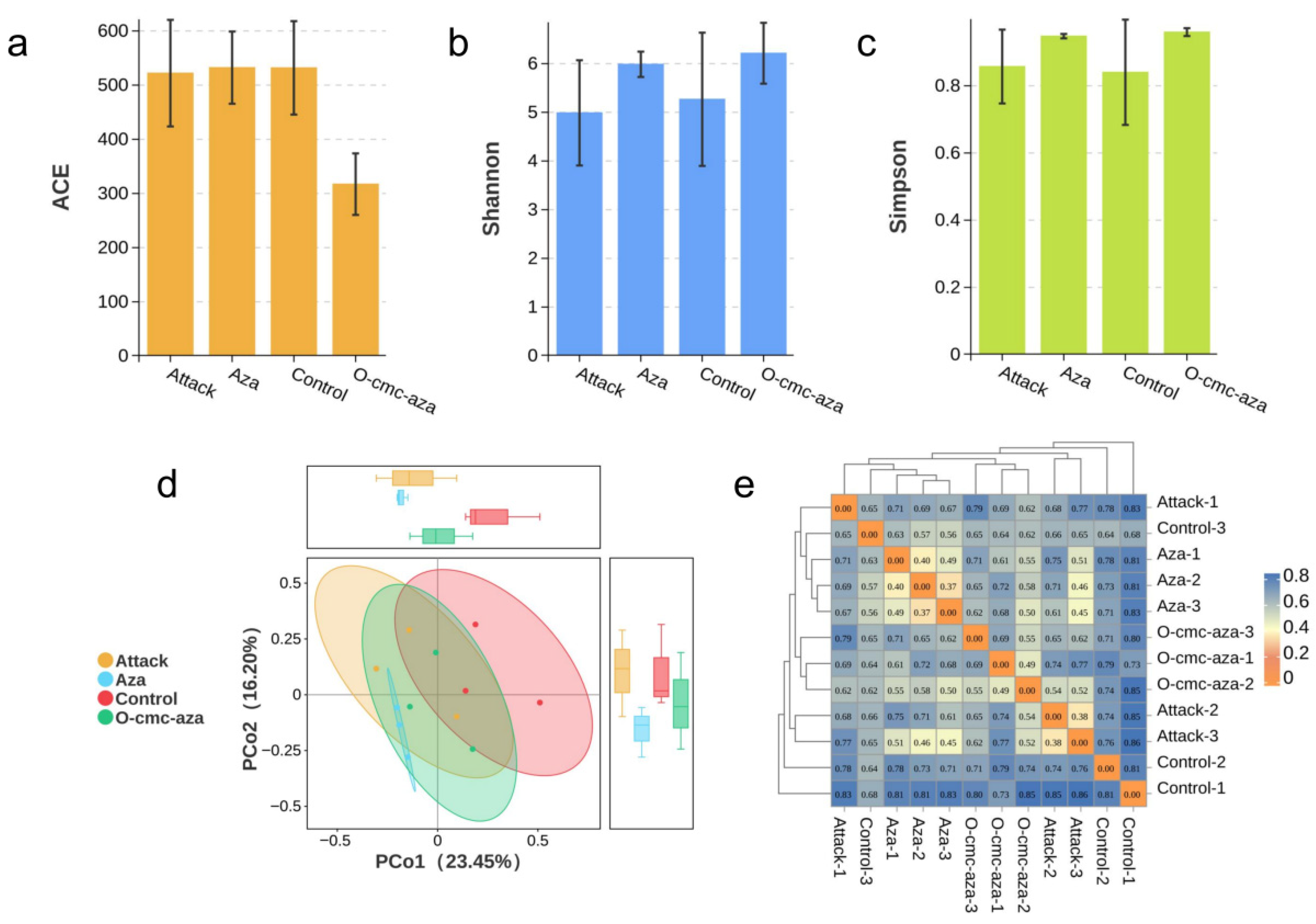
Although the ACE index was significantly lower under the O-cmc-aza treatment (Figure 2a), no significant differences were observed in the Shannon and Simpson indices among treatments (Figure 2b,c), indicating that post-treatment leaf surface microbial communities exhibited high diversity and evenness. The results of the β-diversity analysis indicated that Aza treatment was more distant from the control with greater differences, while the O-cmc-aza, Attack, and control treatments were closer together with smaller differences (Figure 2d). The heatmap analysis revealed significant differences between treatments, with the Aza treatment showing the most pronounced divergence from the control (Figure 2e).

3.2. Microbial Abundance Analysis

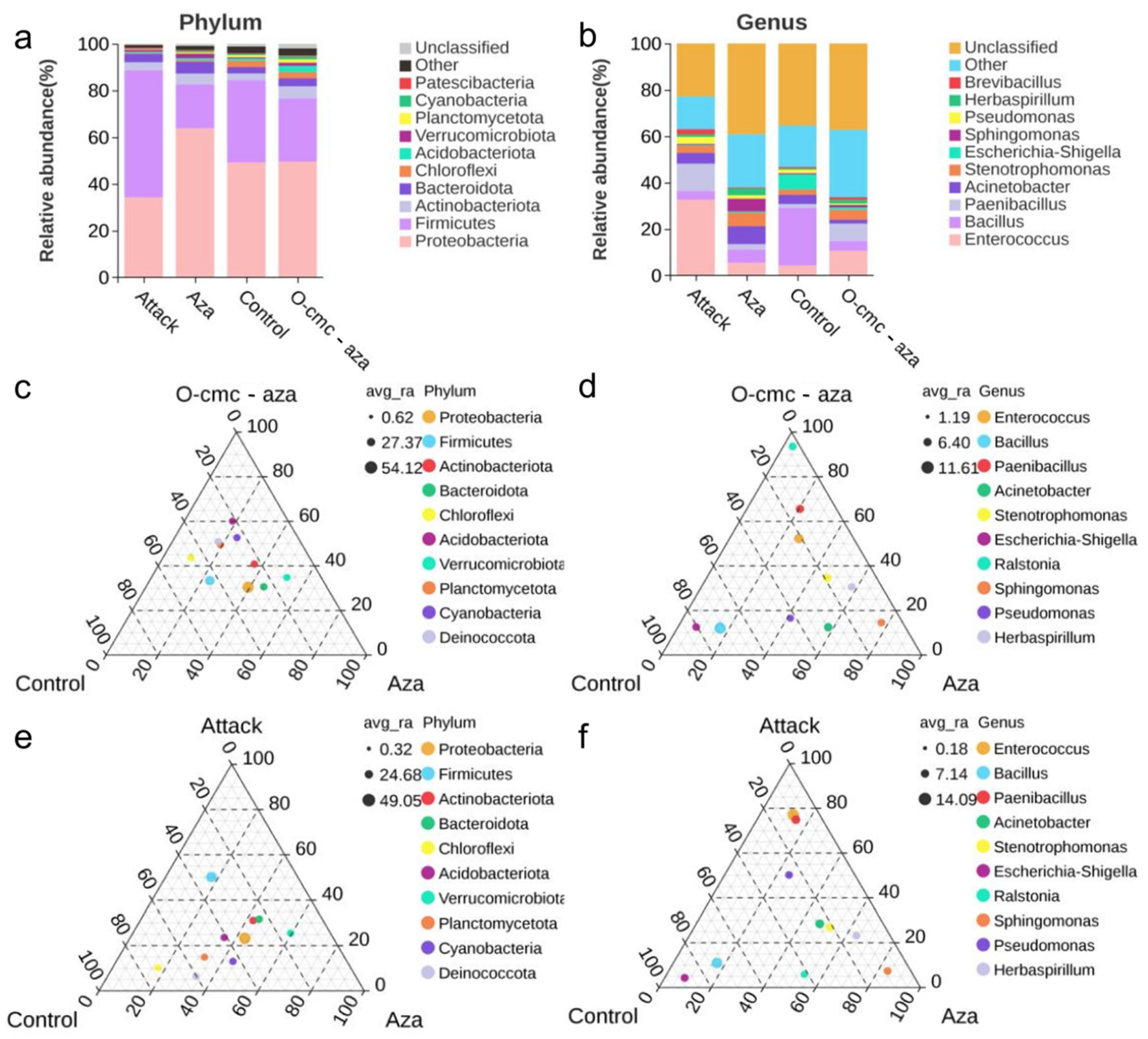
The results showed that at the phylum level, Proteobacteria and Firmicutes were the dominant taxa across all treatments, but their relative abundances varied markedly between groups. Specifically, Proteobacteria exhibited the highest relative abundance in the Aza treatment, whereas Firmicutes was most abundant in the Attack treatment (Figure 3a). At the genus level, Enterococcus, Bacillus, and Paenibacillus were the predominant genera; notable shifts were observed in their distributions, with Enterococcus enriched in the Attack treatment and Bacillus and Paenibacillus most abundant in the control group (Figure 3b). A ternary plot of species distribution showed that Chloroflexi at the phylum level had the highest relative abundance contribution to the Aza treatment; Proteobacteria and Bacteroidota contributed most to the O-cmc-aza treatment, and Verrucomicrobiota contributed most to the control (Figure 3c). At the genus level, Ralstonia had the highest relative abundance contribution to the Aza treatment; Escherichia-Shigella contributed most to the O-cmc-aza treatment, and Sphingomonas contributed most to the control treatment (Figure 3d). Similarly, Chloroflexi relative abundance at the phylum level contributed the most to the Attack treatment, Verrucomicrobiota relative abundance contributed most to the control treatment, and Firmicutes contributed most to the Aza treatment (Figure 3e). At the genus level, the contribution of Escherichia-Shigella relative abundance was most to the Attack treatment, Enterococcus relative abundance was most to the Aza treatment, and Sphingomonas relative abundance was most to the control treatment (Figure 3f).

3.3. Differential Abundance Analysis

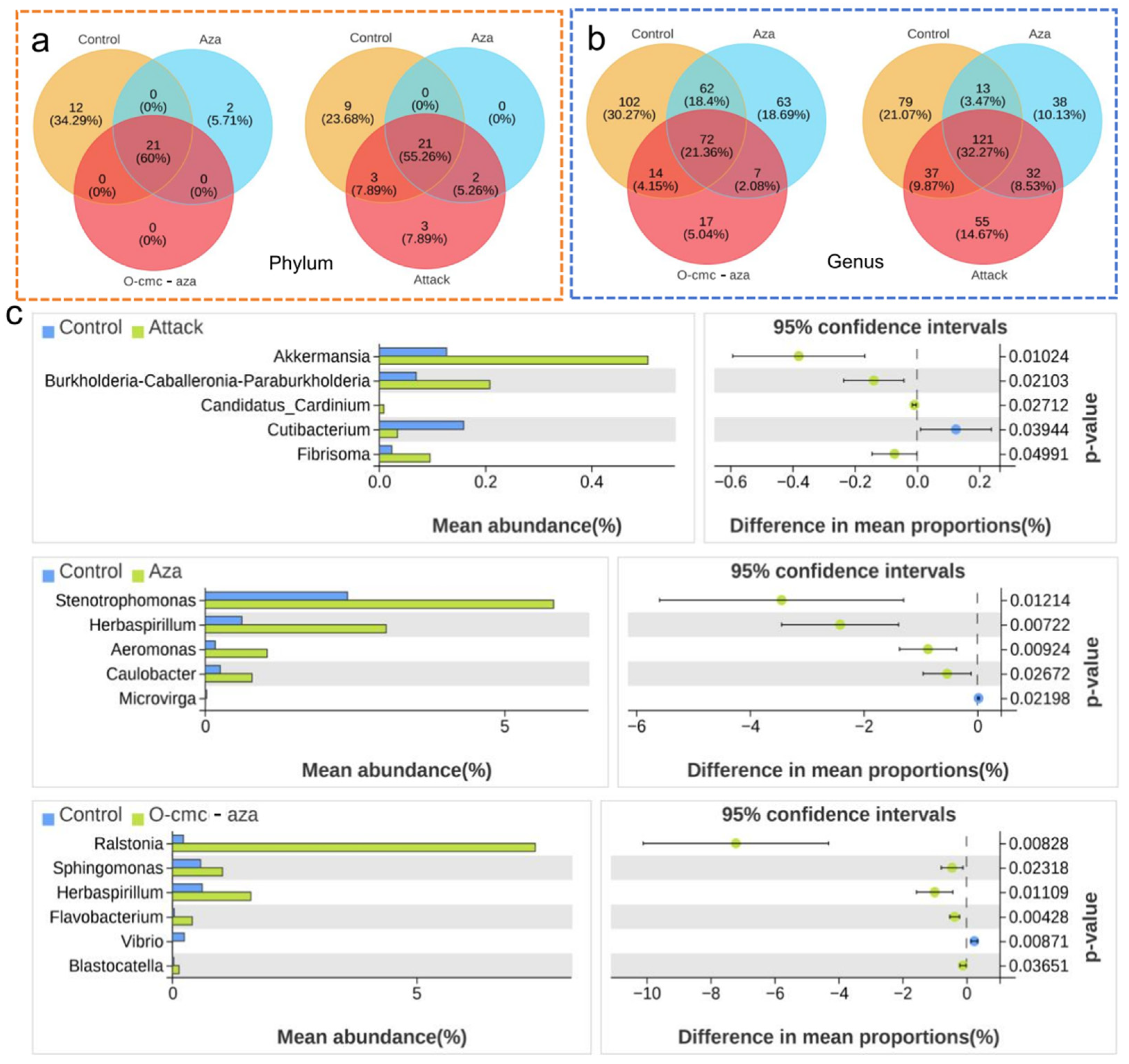
Analysis of the Venn diagram revealed that the phylum-level microbial taxa of the Aza and O-cmc-aza treatments exhibited high overlap with the control group, with 34.29% of unique microbial taxa exclusive to the control and 5.17% exclusive to the Aza treatment. By contrast, the Attack treatment shared only 7.89% of its taxa with both the control and Aza treatments, while harboring 7.89% of treatment-specific microbial taxa (Figure 4a). At the genus level, the control group contained 30.27% of unique taxa, followed by the Aza treatment (18.69%) and the O-cmc-aza treatment (5.04%), indicating notable variation in the extent of taxon overlap among treatments. The Attack treatment possessed 14.67% of unique taxa; additionally, the control and Aza treatments had 21.07% and 10.13% of unique taxa, respectively, while the three treatments shared 32.27% of their total microbial taxa (Figure 4b). Statistical analysis of microbial differences showed significantly higher relative abundances of Akkermansia, Burkholderia-Caballeronia-Paraburkholderia, Candidatus_Cardinium and Fibrisoma at the genus level under the Attack treatment compared to the control, while the relative abundance of Cutibacterium was significantly lower than in the control. The relative abundance of Stenotrophomonas, Herbaspirillum, Aeromonas and Caulobacter were significantly higher in the Aza treatment than in the control, and the relative abundance of Microvirga was significantly lower than in the control. The relative abundance of Ralstonia, Sphingomonas, Herbaspirillum, Flavobacterium and Blastocatella under the O-cmc-aza treatment was significantly higher than that in the control, and the relative abundance of Vibrio was significantly lower than in the control (Figure 4c).
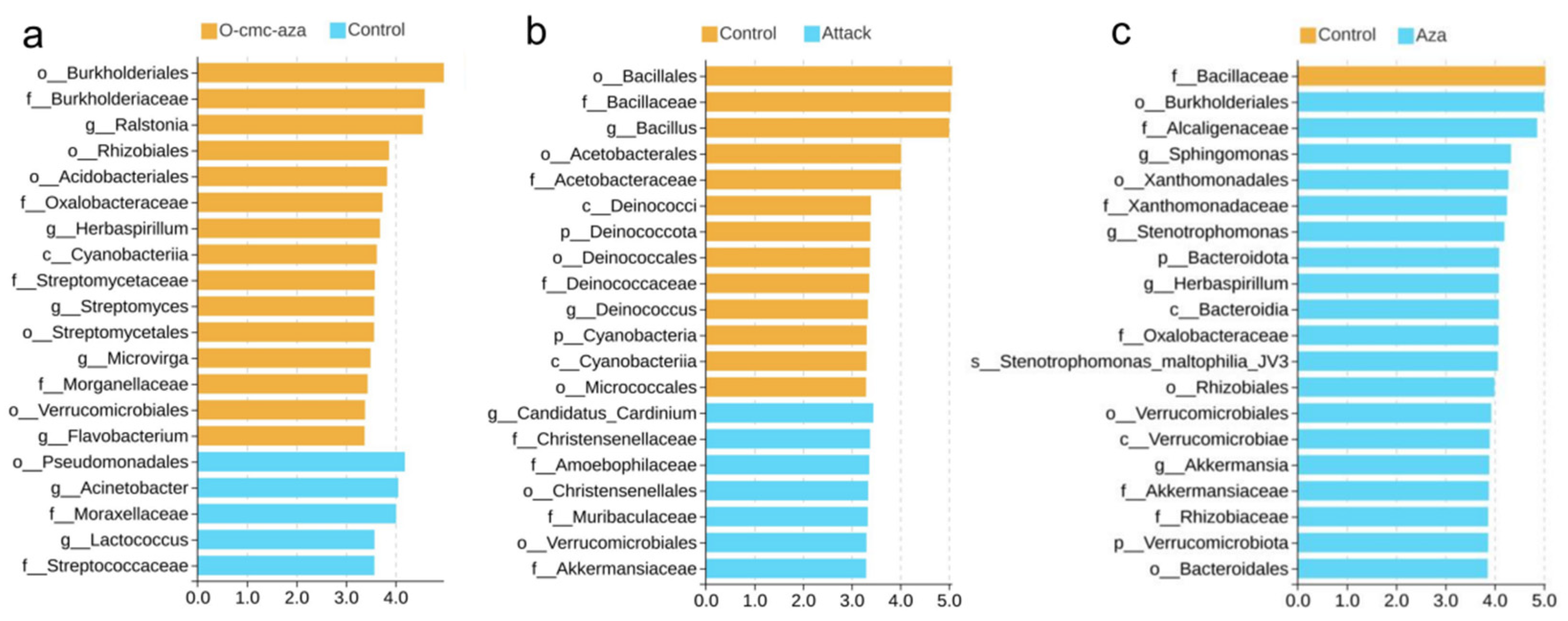
The contributions of differentially abundant microorganisms between treatments are shown in Figure 5 and Figure S1. Compared to the control, the O-cmc-aza treatment is characterized by higher relative contributions from the genera Ralstonia, Herbaspirillum, Streptomyces, Microvirga, and Flavobacterium. In comparison, Lactococcus and Acinetobacter had higher contributions to the control (Figure 5a). Between the Attack treatment and the control, Candidatus_Cardinium (genus level) had a higher contribution to the Attack treatment. When compared, Bacillus and Deinococcus had a higher contribution to the control (Figure 5b). Between the Aza treatment and the control, Stenotrophomonas, Akkermansia, Herbaspirillum, and Sphingomonas (genus level) had higher contributions in the Aza treatment. In comparison, Bacillaceae at family level had a higher contribution to the control (Figure 5c).

4. Discussion

The phyllosphere microbiome serves as an important interface between plants and their environment, influencing responses to biotic stress and agricultural management practices [13,43]. As environmentally friendly alternatives to chemical pesticides, plant-derived pesticides and nano-formulated pesticides are increasingly used in sustainable agriculture, but their non-target effects on the phyllosphere microbiome remain largely unknown [30,41]. This study investigated the impact of S. frugiperda herbivory, azadirachtin, and O-cmc-aza on the maize phyllosphere microbial community. The results found that different treatments induced distinct restructuring of the microbial community, with significant enrichment of treatment-associated bacterial taxa. For instance, at the phylum level, Proteobacteria and Firmicutes were dominant in the maize phyllosphere microbiome across all treatments. These phyla are adapted to the leaf microenvironment and constitute core components of the plant above-ground microbial community [12,13]. However, significant differences in community composition were observed between treatments: the Attack treatment increased the relative abundance of Firmicutes (54.40%), the Aza treatment significantly enriched Proteobacteria (63.77%), while the O-cmc-aza treatment showed relative abundances of 49.47% and 27.08% for these, respectively. This differentiation reflects the different selective pressures exerted on the phyllosphere microbiome by biotic stress and the application of plant-derived pesticides.
Compared to the Aza treatment, the feeding behavior of S. frugiperda led to a significant increase in the number of unique microbial species, which may be attributed to the release of plant volatile organic compounds and secretions upon leaf damage, creating a nutrient-rich niche that attracts external microorganisms [44,49]. Notably, the attack treatment significantly enriched genera such as Burkholderia-Caballeronia-Paraburkholderia, Acinetobacter, and Candidatus. Burkholderia-Caballeronia-Paraburkholderia has been extensively studied for its roles in biocontrol, plant growth promotion, and degradation of xenobiotics [50], suggesting a possible association between maize recruitment of these bacteria and mitigation of herbivory stress. This is consistent with the “cry for help” hypothesis, where plants actively shape their microbiome to enhance stress resistance [16,25]. Unlike the increased abundance of Pseudomonas reported by Humphrey et al. [44] in leaves under herbivory, this study found a lower relative abundance of Pseudomonas in the attack treatment group. This difference may stem from variations in host plant species and herbivorous insects, as plant genotypes and herbivore-specific feeding patterns can alter the composition of microbial communities [51,52]. Furthermore, the decreased abundance of Curtobacterium in the attack treatment may reflect its sensitivity to plant defense responses induced by herbivory, as this genus is typically associated with stable, unstressed plant surfaces [4].
The Aza significantly altered phyllosphere microbial community structure, and exhibited greater β-diversity differences compared to the control. Notably, the Aza treatment significantly enriched bacterial genera, including Stenotrophomonas, Herbaspirillum, Aeromonas, and Caulobacter. Stenotrophomonas and Herbaspirillum are known endophytes that can induce systemic resistance in plants against biotic and abiotic stresses [53,54]; Herbaspirillum also possesses nitrogen-fixing capabilities, supplementing available nitrogen sources for maize under nutrient-limited conditions [55,56]. These findings indicate that azadirachtin altered phyllosphere microbial community structure and enriched specific bacteria, offering a unique advantage over traditional chemical pesticides. For example, Zhu et al. [57] reported that the chemical pesticide λ-cyhalothrin altered the abundance of Acinetobacter, Marinobacter, and Acidovorax in the phyllosphere environment, while Chen et al. [58] found that fungicides increased the abundance of Acinetobacter but did not affect microbial diversity. In tea plants, pesticide application increased the abundance of Actinobacteria [59]. These differences apparently stem from variations in pesticide mechanisms of action, plant metabolic characteristics, and inherent microbial community structures [51], indicating that plant-derived pesticides like azadirachtin possibly possess unique non-target effects.
The O-cmc-aza treatment significantly restructured the microbial community structure, significantly enriching genera such as Ralstonia, Sphingomonas, Herbaspirillum, Flavobacterium, and Blastocatella. This enrichment can be attributed to the dual action of azadirachtin and O-carboxymethyl chitosan (O-cmc): first, a biodegradable polysaccharide, O-cmc provides carbon sources and energy for bacteria (such as Bifidobacterium and Lactobacillus), promoting their proliferation [60]; second, the antibacterial activity of O-cmc against pathogenic bacteria (such as Escherichia coli and Staphylococcus aureus) [60] reduces microbial competition, favoring the colonization of bacterial taxa; third, the film-forming properties of O-cmc on the leaf surface (Figure 1d) create a stable microenvironment, protecting microorganisms from environmental stress. Notably, Ralstonia and Sphingomonas—specifically enriched in the O-cmc-aza treatment—possess metabolic capabilities to degrade toxic organic compounds [61,62], which may help mitigate potential environmental pollutants on the leaf surface. The co-enrichment of nitrogen-fixing bacteria (Rhizobium) and Flavobacterium (reported biocontrol functions) [63] further diversifies the functional diversity of the phyllosphere microbiome. This finding is consistent with Wu et al. [64], who reported that nanocarriers can enrich beneficial microbial communities in the soil. It extends this finding to the phyllosphere environment, highlighting the ecological benefits of nano-formulated pesticides.
This study compared the effects of plant-derived pesticides, nanoformulated pesticides, and herbivore stress on the maize leaf microbiome, providing a reference for understanding the non-target impacts of plant-derived pesticides on plant-associated microorganisms. The results showed that plant-derived pesticides and nanoformulated pesticides significantly altered community structure, leading to a significant enrichment of unique bacteria. This contrasts sharply with the destructive effects of many synthetic pesticides [28,29], suggesting a higher potential for sustainable application. Despite these findings, it should be noted that the results were obtained under controlled conditions and do not directly assess microbial function, plant performance, or long-term field responses. Furthermore, multi-omics approaches should be used to analyze the interactive effects of azadirachtin and S. frugiperda feeding on the phyllosphere microbiome.
This study confirms that the herbivorous behavior of the S. frugiperda and the application of plant-derived pesticides trigger a restructuring of the maize leaf microbiome, selectively enriching microbial communities. The plant-derived pesticide O-cmc-aza, acting as a polysaccharide carrier, synergistically enhances the abundance of specific microbial populations on the leaf surface, providing a feasible strategy for balancing pest control and environmental sustainability. These findings deepen our understanding of plant–microbe–environment interactions and provide a scientific basis for the rational application of plant-derived pesticides in agricultural systems.

5. Conclusions

In summary, this study aimed to investigate how plant-derived pesticide Aza, its nanoformulation (O-cmc-aza), and S. frugiperda herbivory stress modulate the phyllosphere bacterial community structure of maize via 16S rRNA amplicon sequencing The results demonstrated that all three treatments induced distinct restructuring of the maize phyllosphere bacterial community, with clear treatment-specific β-diversity differentiation and consistent domination of Proteobacteria and Firmicutes across all groups. Specifically, Aza significantly enriched Stenotrophomonas and Herbaspirillum; O-cmc-aza elevated Ralstonia and Sphingomonas, reducing ACE index; and the Attack treatment increased Akkermansia and Burkholderia-Caballeronia-Paraburkholderia. These baseline data documented the plant-derived pesticide and nanoformulated-induced microbiome responses, providing hypotheses for functional validation and field studies, with an emphasis on long-term trials to fully evaluate both ecological impacts and agronomic implications.

Supplementary Materials

The following supporting information can be downloaded at: https://www.mdpi.com/article/10.3390/agronomy16030334/s1, Figure S1: LEfSe analysis.

Author Contributions

A.-T.S., Y.-N.L. and H.W.: Conceptualization, Methodology, Software, Investigation, Formal analysis, Data curation, Writing—original draft. M.Z.: Writing—review and editing. Z.-X.Z.: Conceptualization, Resources, Supervision, Fund acquisition, Writing—review and editing, Project administration. All authors have read and agreed to the published version of the manuscript.

Funding

This work was supported by National Key Research and Development Program of China (2023YFD1701103) and Guangdong Province Key Research and Development Plan (No. 2023B0202080001).

Data Availability Statement

Data is contained within the article or Supplementary Material.

Acknowledgments

Thanks to Muhammad Zeeshan for his help in revising the manuscript. We used ChatGPT 4.0 to improve the clarity, conciseness and overall readability of the manuscript.

Conflicts of Interest

Authors Ai-Ting Song and Hao Wu were employed by the company Guangdong Zhenge Biotechnology Co. The remaining authors declare that the research was conducted in the absence of any commercial or financial relationships that could be construed as a potential conflict of interest.

References

  1. Qu, Q.; Zhang, Z.; Peijnenburg, W.J.G.M.; Liu, W.; Lu, T.; Hu, B.; Chen, J.; Chen, J.; Lin, Z.; Qian, H. Rhizosphere Microbiome Assembly and Its Impact on Plant Growth. J. Agric. Food Chem. 2020, 68, 5024–5038. [Google Scholar] [CrossRef]
  2. Lu, T.; Ke, M.; Lavoie, M.; Jin, Y.; Fan, X.; Zhang, Z.; Fu, Z.; Sun, L.; Gillings, M.; Peñuelas, J.; et al. Rhizosphere Microorganisms Can Influence the Timing of Plant Flowering. Microbiome 2018, 6, 231. [Google Scholar] [CrossRef]
  3. Yu, Y.; Zhang, Q.; Zhang, Z.; Xu, N.; Li, Y.; Jin, M.; Feng, G.; Qian, H.; Lu, T. Assessment of Residual Chlorine in Soil Microbial Community Using Metagenomics. Soil Ecol. Lett. 2023, 5, 66–78. [Google Scholar] [CrossRef]
  4. Bahram, M.; Hildebrand, F.; Forslund, S.K.; Anderson, J.L.; Soudzilovskaia, N.A.; Bodegom, P.M.; Bengtsson-Palme, J.; Anslan, S.; Coelho, L.P.; Harend, H.; et al. Structure and Function of the Global Topsoil Microbiome. Nature 2018, 560, 233–237. [Google Scholar] [CrossRef]
  5. Lu, T.; Xu, N.; Zhang, Q.; Zhang, Z.; Debognies, A.; Zhou, Z.; Sun, L.; Qian, H. Understanding the Influence of Glyphosate on the Structure and Function of Freshwater Microbial Community in a Microcosm. Environ. Pollut. 2020, 260, 114012. [Google Scholar] [CrossRef] [PubMed]
  6. Qu, Q.; Li, Y.; Zhang, Z.; Cui, H.; Zhao, Q.; Liu, W.; Lu, T.; Qian, H. Effects of S-Metolachlor on Wheat (Triticum aestivum L.) Seedling Root Exudates and the Rhizosphere Microbiome. J. Hazard. Mater. 2021, 411, 125137. [Google Scholar] [CrossRef] [PubMed]
  7. Zhang, Q.; Zhang, Z.; Lu, T.; Yu, Y.; Penuelas, J.; Zhu, Y.-G.; Qian, H. Gammaproteobacteria, a Core Taxon in the Guts of Soil Fauna, Are Potential Responders to Environmental Concentrations of Soil Pollutants. Microbiome 2021, 9, 196. [Google Scholar] [CrossRef]
  8. Xu, N.; Qu, Q.; Zhang, Z.; Yuan, W.; Cui, H.; Shen, Y.; Lin, W.; Lu, T.; Qian, H. Effects of Residual S-Metolachlor in Soil on the Phyllosphere Microbial Communities of Wheat (Triticum aestivum L.). Sci. Total Environ. 2020, 748, 141342. [Google Scholar] [CrossRef]
  9. Schauer, S.; Kutschera, U. A Novel Growth-Promoting Microbe, Methylobacterium funariae Sp. Nov., Isolated from the Leaf Surface of a Common Moss. Plant Signal. Behav. 2011, 6, 510–515. [Google Scholar] [CrossRef] [PubMed]
  10. Thaiss, C.A.; Zmora, N.; Levy, M.; Elinav, E. The Microbiome and Innate Immunity. Nature 2016, 535, 65–74. [Google Scholar] [CrossRef]
  11. Andrews, J.H.; Harris, R.F. The Ecology and Biogeography of Microorganisms on Plant Surfaces. Annu. Rev. Phytopathol. 2000, 38, 145–180. [Google Scholar] [CrossRef] [PubMed]
  12. Laforest-Lapointe, I.; Messier, C.; Kembel, S.W. Host Species Identity, Site and Time Drive Temperate Tree Phyllosphere Bacterial Community Structure. Microbiome 2016, 4, 27. [Google Scholar] [CrossRef]
  13. Liu, H.; Brettell, L.E.; Singh, B. Linking the Phyllosphere Microbiome to Plant Health. Trends Plant Sci. 2020, 25, 841–844. [Google Scholar] [CrossRef]
  14. Thapa, S.; Prasanna, R. Prospecting the Characteristics and Significance of the Phyllosphere Microbiome. Ann. Microbiol. 2018, 68, 229–245. [Google Scholar] [CrossRef]
  15. Qiu, D.; Ye, Y.; Ke, M.; Xu, N.; Zhang, Z.; Zhang, F.; Kang, J.; Yu, Y.; Lu, T.; Qian, H. Effects of Chiral Herbicide Dichlorprop on Arabidopsis Thaliana Metabolic Profile and Its Implications for Microbial Communities in the Phyllosphere. Environ. Sci. Pollut. Res. 2022, 29, 28256–28266. [Google Scholar] [CrossRef]
  16. Chen, T.; Nomura, K.; Wang, X.; Sohrabi, R.; Xu, J.; Yao, L.; Paasch, B.C.; Ma, L.; Kremer, J.; Cheng, Y.; et al. A Plant Genetic Network for Preventing Dysbiosis in the Phyllosphere. Nature 2020, 580, 653–657. [Google Scholar] [CrossRef]
  17. Li, Y.; Zhang, Z.; Liu, W.; Ke, M.; Qu, Q.; Zhou, Z.; Lu, T.; Qian, H. Phyllosphere Bacterial Assemblage Is Affected by Plant Genotypes and Growth Stages. Microbiol. Res. 2021, 248, 126743. [Google Scholar] [CrossRef]
  18. Carlström, C.I.; Field, C.M.; Bortfeld-Miller, M.; Müller, B.; Sunagawa, S.; Vorholt, J.A. Synthetic Microbiota Reveal Priority Effects and Keystone Strains in the Arabidopsis Phyllosphere. Nat. Ecol. Evol. 2019, 3, 1445–1454. [Google Scholar] [CrossRef]
  19. Knief, C.; Ramette, A.; Frances, L.; Alonso-Blanco, C.; Vorholt, J.A. Site and Plant Species Are Important Determinants of the Methylobacterium Community Composition in the Plant Phyllosphere. ISME J. 2010, 4, 719–728. [Google Scholar] [CrossRef] [PubMed]
  20. Grady, K.L.; Sorensen, J.W.; Stopnisek, N.; Guittar, J.; Shade, A. Assembly and Seasonality of Core Phyllosphere Microbiota on Perennial Biofuel Crops. Nat. Commun. 2019, 10, 4135. [Google Scholar] [CrossRef] [PubMed]
  21. Hardoim, P.R.; Hardoim, C.C.P.; van Overbeek, L.S.; van Elsas, J.D. Dynamics of Seed-Borne Rice Endophytes on Early Plant Growth Stages. PLoS ONE 2012, 7, e30438. [Google Scholar] [CrossRef]
  22. Johnston-Monje, D.; Mousa, W.K.; Lazarovits, G.; Raizada, M.N. Impact of Swapping Soils on the Endophytic Bacterial Communities of Pre-Domesticated, Ancient and Modern Maize. BMC Plant Biol. 2014, 14, 233. [Google Scholar] [CrossRef]
  23. Maignien, L.; DeForce, E.A.; Chafee, M.E.; Eren, A.M.; Simmons, S.L. Ecological Succession and Stochastic Variation in the Assembly of Arabidopsis Thaliana Phyllosphere Communities. mBio 2014, 5, 10-1128. [Google Scholar] [CrossRef]
  24. Chi, F.; Shen, S.-H.; Cheng, H.-P.; Jing, Y.-X.; Yanni, Y.G.; Dazzo, F.B. Ascending Migration of Endophytic Rhizobia, from Roots to Leaves, inside Rice Plants and Assessment of Benefits to Rice Growth Physiology. Appl. Environ. Microbiol. 2005, 71, 7271–7278. [Google Scholar] [CrossRef] [PubMed]
  25. Vogel, C.; Bodenhausen, N.; Gruissem, W.; Vorholt, J.A. The Arabidopsis Leaf Transcriptome Reveals Distinct but Also Overlapping Responses to Colonization by Phyllosphere Commensals and Pathogen Infection with Impact on Plant Health. New Phytol. 2016, 212, 192–207. [Google Scholar] [CrossRef]
  26. Mullens, A.; Jamann, T.M. Colonization and Movement of Green Fluorescent Protein-Labeled Clavibacter Nebraskensis in Maize. Plant Dis. 2021, 105, 1422–1431. [Google Scholar] [CrossRef]
  27. Xiang, Q.; Lott, A.A.; Assmann, S.M.; Chen, S. Advances and Perspectives in the Metabolomics of Stomatal Movement and the Disease Triangle. Plant Sci. 2021, 302, 110697. [Google Scholar] [CrossRef]
  28. Ke, M.; Ye, Y.; Li, Y.; Zhou, Z.; Xu, N.; Feng, L.; Zhang, J.; Lu, T.; Cai, Z.; Qian, H. Leaf Metabolic Influence of Glyphosate and Nanotubes on the Arabidopsis thaliana Phyllosphere. J. Environ. Sci. 2021, 106, 66–75. [Google Scholar] [CrossRef] [PubMed]
  29. Korenblum, E.; Dong, Y.; Szymanski, J.; Panda, S.; Jozwiak, A.; Massalha, H.; Meir, S.; Rogachev, I.; Aharoni, A. Rhizosphere Microbiome Mediates Systemic Root Metabolite Exudation by Root-to-Root Signaling. Proc. Natl. Acad. Sci. USA 2020, 117, 3874–3883. [Google Scholar] [CrossRef] [PubMed]
  30. Pan, X.; Guo, X.; Zhai, T.; Zhang, D.; Rao, W.; Cao, F.; Guan, X. Nanobiopesticides in Sustainable Agriculture: Developments, Challenges, and Perspectives. Environ. Sci. Nano 2023, 10, 41–61. [Google Scholar] [CrossRef]
  31. Li, X.; Chen, Y.; Xu, J.; Lynch, I.; Guo, Z.; Xie, C.; Zhang, P. Advanced Nanopesticides: Advantage and Action Mechanisms. Plant Physiol. Biochem. 2023, 203, 108051. [Google Scholar] [CrossRef] [PubMed]
  32. Guo, C.; Wang, L.; Chen, N.; Zhang, M.; Jia, J.; Lv, L.; Li, M. Advances in Research and Utilization of Botanical Pesticides for Agricultural Pest Management in Inner Mongolia, China. Chin. Herb. Med. 2024, 16, 248–262. [Google Scholar] [CrossRef]
  33. Zeeshan, M.; Sun, C.; Wang, X.; Hu, Y.; Wu, H.; Li, S.; Salam, A.; Zhu, S.; Khan, A.H.; Holford, P.; et al. Insights into the Ameliorative Effect of ZnONPs on Arsenic Toxicity in Soybean Mediated by Hormonal Regulation, Transporter Modulation, and Stress Responsive Genes. Front. Plant Sci. 2024, 15, 1427367. [Google Scholar] [CrossRef]
  34. Zeeshan, M.; Khan, A.H.; Salam, A.; Hu, Y.; Iqbal, A.; Hou, R.; Umar, A.W.; Wu, F.; Chen, X.; Zhang, Z. Nano-Selenium Mitigates Arsenate Toxicity in Soybean Roots by Modulating Phenylalanine and Salicylic Acid Pathways. BMC Plant Biol. 2025, 25, 699. [Google Scholar] [CrossRef]
  35. Yuan, M.; Liang, X.; Cao, D.; Wu, H.; Xiao, S.; Liang, H.; Li, H.; Huang, Y.; Wei, H.; Peng, W.; et al. Dictamnine Suppresses the Development of Pear Ring Rot Induced by Botryosphaeria dothidea Infection by Disrupting the Chitin Biosynthesis. Pestic. Biochem. Physiol. 2023, 195, 105534. [Google Scholar] [CrossRef]
  36. Li, X.; Yun, Y.; Wang, Y.; Zhu, W.; Bu, Q.; Fan, Y.; Wang, H. High-Performance Delivery Capsules Co-Assembled from Lignin and Chitosan with Avermectin for Sustainable Pest Management. Int. J. Biol. Macromol. 2025, 289, 138894. [Google Scholar] [CrossRef]
  37. Hou, R.; Fu, G.; Ma, S.; Tang, S.; Guo, F.; Wang, Y.; Huang, S.; Cheng, D.; Zhang, Z.; Zhao, C. Double-Layer Nanopesticide for Duckweed Management: Employing Natural α-Terthienyl to Disrupt the Leaf Epidermal to Enhance the Efficacy of Prometryn. Chem. Eng. J. 2025, 515, 163805. [Google Scholar] [CrossRef]
  38. Yang, L.; Chen, H.; Kaziem, A.E.; Miao, X.; Huang, S.; Cheng, D.; Xu, H.; Zhang, Z. Effects of Exposure to Different Types of Metal–Organic Framework Nanoparticles on the Gut Microbiota and Liver Metabolism of Adult Zebrafish. ACS Nano 2024, 18, 25425–25445. [Google Scholar] [CrossRef] [PubMed]
  39. Wang, Y.; Chang, J.; Wang, R.; Liu, J.; Hou, R.; Wu, H.; Miao, X.; Zhang, Z.; Xu, H. Application of an Environmentally Friendly Nanopesticide Translocation System Based on Metarhizium anisopliae: Using Biodegradable Chitosan Nanopesticides to Control Spodoptera frugiperda. Int. J. Biol. Macromol. 2025, 310, 143261. [Google Scholar] [CrossRef]
  40. Hou, R.; Zhou, J.; Song, Z.; Zhang, N.; Huang, S.; Kaziem, A.E.; Zhao, C.; Zhang, Z. pH-Responsive λ-Cyhalothrin Nanopesticides for Effective Pest Control and Reduced Toxicity to Harmonia axyridis. Carbohydr. Polym. 2023, 302, 120373. [Google Scholar] [CrossRef]
  41. Wei, Y.; Chen, J.; Dong, M.; Yin, M.; Shen, J.; Gao, L.; Yan, S. Nano-Enabled Insecticides for Efficient Pest Management: Definition, Classification, Synergistic Mechanism, and Safety Assessment. Nanomaterials 2025, 15, 1050. [Google Scholar] [CrossRef] [PubMed]
  42. Kapeleka, J.A.; Mwema, M.F. State of Nano Pesticides Application in Smallholder Agriculture Production Systems: Human and Environmental Exposure Risk Perspectives. Heliyon 2024, 10, e39225. [Google Scholar] [CrossRef]
  43. Seabloom, E.W.; Caldeira, M.C.; Davies, K.F.; Kinkel, L.; Knops, J.M.H.; Komatsu, K.J.; MacDougall, A.S.; May, G.; Millican, M.; Moore, J.L.; et al. Globally Consistent Response of Plant Microbiome Diversity across Hosts and Continents to Soil Nutrients and Herbivores. Nat. Commun. 2023, 14, 3516. [Google Scholar] [CrossRef] [PubMed]
  44. Humphrey, P.T.; Whiteman, N.K. Insect Herbivory Reshapes a Native Leaf Microbiome. Nat. Ecol. Evol. 2020, 4, 221–229. [Google Scholar] [CrossRef]
  45. Zheng, W.; Chen, Z.; Yang, Y.-H.; Yang, R.; Yang, T.; Lai, P.-L.; Chen, T.; Qiu, S.; Wang, S.; Liao, L. Improved Stabilization of Coix Seed Oil in a Nanocage-Coating Framework Based on Gliadin-Carboxymethyl Chitosan-Ca2+. Carbohydr. Polym. 2021, 257, 117557. [Google Scholar] [CrossRef]
  46. Chang, J.; Shao, X.; Wang, X.; Liu, J.; Wu, J.; Zeeshan, M.; Zhu, S.; Liu, P.; Miao, X.; Du, P.; et al. pH-Responsive MOF Nanoparticles Equipped with Hydrophilic “Armor” Assist Fungicides in Controlling Peanut Southern Blight. ACS Appl. Mater. Interfaces 2024, 16, 59962–59978. [Google Scholar] [CrossRef]
  47. Kong, X.; Han, Z.; Tai, X.; Jin, D.; Ai, S.; Zheng, X.; Bai, Z. Maize (Zea mays L. Sp.) Varieties Significantly Influence Bacterial and Fungal Community in Bulk Soil, Rhizosphere Soil and Phyllosphere. FEMS Microbiol. Ecol. 2020, 96, fiaa020. [Google Scholar] [CrossRef] [PubMed]
  48. Simpson, E.H. Measurement of Diversity. Nature 1949, 163, 688. [Google Scholar] [CrossRef]
  49. Truchado, P.; Gil, M.I.; Moreno-Candel, M.; Allende, A. Impact of Weather Conditions, Leaf Age and Irrigation Water Disinfection on the Major Epiphytic Bacterial Genera of Baby Spinach Grown in an Open Field. Food Microbiol. 2019, 78, 46–52. [Google Scholar] [CrossRef]
  50. Van Dommelen, A.; Vanderleyden, J. Chapter 12—Associative Nitrogen Fixation. In Biology of the Nitrogen Cycle; Bothe, H., Ferguson, S.J., Newton, W.E., Eds.; Elsevier: Amsterdam, The Netherlands, 2007; pp. 179–192. [Google Scholar]
  51. Zhu, Y.-G.; Xiong, C.; Wei, Z.; Chen, Q.-L.; Ma, B.; Zhou, S.-Y.-D.; Tan, J.; Zhang, L.-M.; Cui, H.-L.; Duan, G.-L. Impacts of Global Change on the Phyllosphere Microbiome. New Phytol. 2022, 234, 1977–1986. [Google Scholar] [CrossRef]
  52. Guo, M.; Hu, J.; Jiang, C.; Zhang, Y.; Wang, H.; Zhang, X.; Hsiang, T.; Shi, C.; Wang, Q.; Wang, F. Response of Microbial Communities in the Tobacco Phyllosphere under the Stress of Validamycin. Front. Microbiol. 2024, 14, 1328179. [Google Scholar] [CrossRef]
  53. Matteoli, F.P.; Olivares, F.L.; Venancio, T.M.; Oliveira da Rocha, L.; Souza da Silva Irineu, L.E.; Canellas, L.P. Chapter 23—Herbaspirillum. In Beneficial Microbes in Agro-Ecology; Amaresan, N., Senthil Kumar, M., Annapurna, K., Kumar, K., Sankaranarayanan, A., Eds.; Academic Press: Cambridge, MA, USA, 2020; pp. 493–508. [Google Scholar]
  54. Ritpitakphong, U.; Falquet, L.; Vimoltust, A.; Berger, A.; Métraux, J.-P.; L’Haridon, F. The Microbiome of the Leaf Surface of Arabidopsis Protects against a Fungal Pathogen. New Phytol. 2016, 210, 1033–1043. [Google Scholar] [CrossRef]
  55. Chubatsu, L.S.; Monteiro, R.A.; de Souza, E.M.; de Oliveira, M.A.S.; Yates, M.G.; Wassem, R.; Bonatto, A.C.; Huergo, L.F.; Steffens, M.B.R.; Rigo, L.U.; et al. Nitrogen Fixation Control in Herbaspirillum Seropedicae. Plant Soil 2012, 356, 197–207. [Google Scholar] [CrossRef]
  56. Irineu, L.E.S.d.S.; Soares, C.d.P.; Soares, T.S.; Almeida, F.A.d.; Almeida-Silva, F.; Gazara, R.K.; Meneses, C.H.S.G.; Canellas, L.P.; Silveira, V.; Venancio, T.M.; et al. Multiomic Approaches Reveal Hormonal Modulation and Nitrogen Uptake and Assimilation in the Initial Growth of Maize Inoculated with Herbaspirillum Seropedicae. Plants 2023, 12, 48. [Google Scholar] [CrossRef]
  57. Zhu, Z.; He, Y.; Xu, J.; Zhou, Z.; Kumar, A.; Xia, Z. Effects of pesticide application and plant sexual identity on leaf physiological traits and phyllosphere bacterial communities. J. Plant Ecol. 2023, 16, rtac084. [Google Scholar] [CrossRef]
  58. Chen, X.; Wicaksono, W.A.; Berg, G.; Cernava, T. Bacterial Communities in the Plant Phyllosphere Harbour Distinct Responders to a Broad-Spectrum Pesticide. Sci. Total Environ. 2021, 751, 141799. [Google Scholar] [CrossRef] [PubMed]
  59. Cernava, T.; Chen, X.; Krug, L.; Li, H.; Yang, M.; Berg, G. The Tea Leaf Microbiome Shows Specific Responses to Chemical Pesticides and Biocontrol Applications. Sci. Total Environ. 2019, 667, 33–40. [Google Scholar] [CrossRef] [PubMed]
  60. Yang, B.; Liu, B.; Gao, Y.; Wei, J.; Li, G.; Zhang, H.; Wang, L.; Hou, Z. PEG-Crosslinked O-Carboxymethyl Chitosan Films with Degradability and Antibacterial Activity for Food Packaging. Sci. Rep. 2024, 14, 10825. [Google Scholar] [CrossRef]
  61. Asaf, S.; Numan, M.; Khan, A.L.; Al-Harrasi, A. Sphingomonas: From Diversity and Genomics to Functional Role in Environmental Remediation and Plant Growth. Crit. Rev. Biotechnol. 2020, 40, 138–152. [Google Scholar] [CrossRef] [PubMed]
  62. Gutschmann, B.; Bock, M.C.E.; Jahns, S.; Neubauer, P.; Brigham, C.J.; Riedel, S.L. Untargeted Metabolomics Analysis of Ralstonia Eutropha during Plant Oil Cultivations Reveals the Presence of a Fucose Salvage Pathway. Sci. Rep. 2021, 11, 14267. [Google Scholar] [CrossRef]
  63. Asaf, S.; Khan, A.L.; Khan, M.A.; Imran, Q.M.; Yun, B.-W.; Lee, I.-J. Osmoprotective Functions Conferred to Soybean Plants via Inoculation with Sphingomonas Sp. LK11 and Exogenous Trehalose. Microbiol. Res. 2017, 205, 135–145. [Google Scholar] [CrossRef]
  64. Wu, T.; Zhao, K.; Liu, S.; Bao, Z.; Zhang, C.; Wu, Y.; Song, R.; Gu, Y.; Gao, Y.; Du, F. Promising Nanocarriers Endowing Non-Systemic Pesticides with Upward Translocation Ability and Microbial Community Enrichment Effects in Soil. Chem. Eng. J. 2023, 474, 145570. [Google Scholar] [CrossRef]
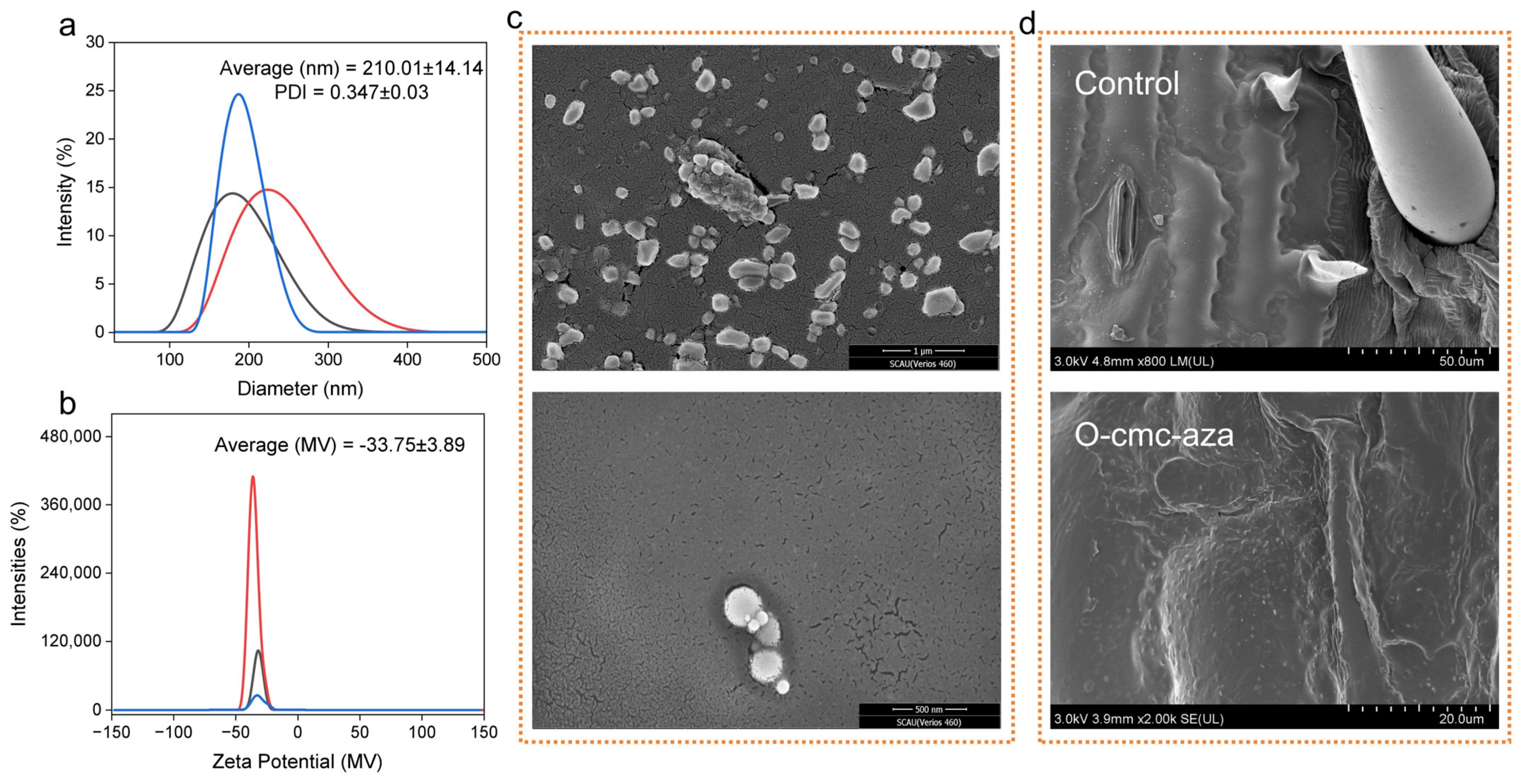
Figure 1. Characterization and adhesion properties of O-cmc-aza. (a) Size distribution of O-cmc-aza. (b) Zeta potential value of O-cmc-aza. Different colors represent the number of repetitions. (c) SEM pictures of O-cmc-aza. (d) SEM reveals the adhesion on maize leaves treated with O-cmc-aza solution and untreated blank leaves.
Agronomy 16 00334 g001
Figure 2. Sequencing diversity analysis. (a) ACE index analysis. (b) Shannon index analysis. (c) Simpson index analysis. (d) PCoA analysis. Different colors represent different treatment groups, and the box plots display the corresponding values on the coordinate axes for each treatment. (e) Similarity analysis between samples. Samples exhibiting similar beta diversity patterns were grouped together to visualize treatment-specific clustering. Differences in community structure between samples are represented by color: bluer hues indicate higher index values and greater structural divergence, while yellower hues indicate minor differences.
Agronomy 16 00334 g002
Figure 3. Analysis of microbial abundance differences under different treatments at the phylum level and genus level. (a) Stacked map of species distributions at the phylum level. (b) Stacked map of species distributions at the genus level. (c,d) Ternary plot of species abundance as a percentage of control, O-cmc-aza treatment, and Attack treatment at the phylum level (c) and genus level (d). (e,f) Ternary plot of species abundance as a percentage of control, Aza treatment, and Attack treatment groups at the phylum level (e) and genus level (f). Different colored circles represent microbial species, while black circles of varying sizes indicate the average abundance of species across comparison groups. The numerical values represent the contribution rates to the corresponding microbial abundances.
Agronomy 16 00334 g003
Figure 4. Analysis of microbial abundance differences under different treatments. (a,b) Species Wayne diagrams at the phylum level (a) and genus level (b). Overlapping areas represent the number of shared species, while non-overlapping areas indicate the number of species uniqueness to each treatment. (c) Analysis of differential microbial species between treatments at genus level. Statistical analysis using Wilcoxon rank sum test within a 95% confidence interval, p < 0.05.
Agronomy 16 00334 g004
Figure 5. Assessment of the contributions of differential microbial species under different treatments. (ac) represent contribution of species differing between the O-cmc-aza and the control treatment (a), the Attack and the control treatment (b), and the Aza and the control treatment (c). LDA scores represent linear discriminant scores. Higher scores indicated greater contribution.
Agronomy 16 00334 g005
Disclaimer/Publisher’s Note: The statements, opinions and data contained in all publications are solely those of the individual author(s) and contributor(s) and not of MDPI and/or the editor(s). MDPI and/or the editor(s) disclaim responsibility for any injury to people or property resulting from any ideas, methods, instructions or products referred to in the content.