Article

Emergy and Environmental Assessment of Various Greenhouse Cultivation Systems

1
College of Horticulture, Xinjiang Agricultural University, Urumqi 830052, China
2
State Key Laboratory of Vegetable Biobreeding, Institute of Vegetables and Flowers, Chinese Academy of Agricultural Sciences, Beijing 100081, China
3
Institute of Environment and Sustainable Development in Agriculture, Chinese Academy of Agriculture Sciences, Beijing 100081, China
*
Authors to whom correspondence should be addressed.
These authors contributed equally to this work.
Agronomy 2026, 16(3), 325; https://doi.org/10.3390/agronomy16030325
Submission received: 1 December 2025 / Revised: 4 January 2026 / Accepted: 26 January 2026 / Published: 28 January 2026
(This article belongs to the Section Farming Sustainability)

Abstract

Horticultural facilities can boost crop yields and quality. However, their structures, costs, and resource efficiency vary significantly. Many facility operators prioritize short-term economic gains at the expense of long-term investments in energy efficiency and environmental management, ultimately leading to increased energy consumption and higher greenhouse gas emissions. A systems-based assessment of tomato production is essential for optimizing resource use. This study integrated emergy analysis (EMA) and life cycle assessment (LCA) to evaluate the sustainability of three tomato production systems: polytunnels, solar greenhouses, and glass greenhouses. The Results demonstrated that polytunnels exhibited the best environmental performance, with the lowest environmental loading ratio (ELR, 19.06) and environmental final index (EFI, 1.62). Solar greenhouses showed the best environmental composite index (ECI), outperforming others in mitigating potential environmental impacts. Glass greenhouses imposed the greatest environmental pressure (ELR, 168.51), primarily due to substantial natural gas consumption and infrastructure investment. Scenario analyses revealed that environmental performance across all systems could be significantly enhanced through shortening transport distance, extending the service life of construction materials, and managing energy use. The maximum reduction potentials for the environmental composite index (ECI)were 23.80% for polytunnels, 18.60% for solar greenhouses, and 19.90% for glass greenhouses. This study confirms that polytunnels are the most environmentally friendly option, and targeted management strategies can effectively steer facility-based agriculture toward a more sustainable trajectory.

1. Introduction

Protected agriculture enhances crop yield and quality by creating optimized growing environments [1], offering advantages including extreme weather resilience, year-round production, and improved resource efficiency. It also enables cultivation on non-arable land, expanding agricultural boundaries while promoting rural development. However, this approach still faces challenges in capital investment, energy consumption, ecological impact, technical management, and waste disposal. As China’s protected agriculture sector undergoes critical transformation and upgrading, there is an urgent need to clarify the functional positioning of different facility types. This study conducts a comparative analysis of polytunnels, solar greenhouses, and glass greenhouses—three representative facilities that form a techno-economic gradient in Chinese protected horticulture—to comprehensively reflect the overall development status of China’s protected agriculture.
Polytunnels have a simple structure, are inexpensive, and are easy to install, but they suffer from poor thermal insulation and limited interior space [2]. The solar greenhouse is an energy-efficient semi-enclosed horticultural facility that utilizes solar energy to maintain optimal crop growth conditions [3]. Specifically designed for winter cultivation of fruit and vegetables in cold northern regions of China, it features an insulated north wall and transparent roofing [4]. Glass greenhouses facilitate year-round production via advanced climate control systems, incorporating spectrally tuned glazing, dynamic lighting control, and closed-loop environmental systems [5]. However, glass greenhouses face challenges such as high construction costs and suboptimal land-use efficiency [5]—and environmental control technologies [6]. Scientifically assessing the sustainability of different protected agriculture models has become crucial for promoting industrial optimization and upgrading.
Emergy analysis (EMA) offers a distinct angle for analysis and accounting of environmental and economic compound systems by renovating the energy and material flow into standard solar emjoules (sej), making it appropriate for both naturally and anthropogenically interrupted systems [7]. This framework integrates natural, economic and social resources, evaluating products and services based on their “objective value” rather than market value, providing an innovative sustainability assessment method for eco-economic systems [8]. It has been widely applied in resource accounting and efficiency evaluation [9]. Emergy analysis enables complex energy systems to incorporate natural environmental resources and human inputs often neglected by other assessment approaches, thereby facilitating the identification of critical areas and key impacts to enhance sustainability [10]. For instance, it elucidates the structural patterns and characteristics of environmental and resource utilization within a protected vegetable production system [11]. Asghariour et al. [12] conducted an emergy analysis of four greenhouse vegetable production ecosystems in Iran and found that the sustainability of these systems could be compromised by non-renewable resources such as fertilizers (particularly nitrogen), labor, and ropes. Furthermore, emergy can be used to evaluate the renewability of energy inputs and to compare the sustainability of production systems across different regions [13]. However, comparative emergy analysis of different greenhouse cultivation systems in Beijing remains unstudied. Life cycle assessment (LCA), as a systematic environmental management tool, has evolved from industrial applications to agricultural system evaluations [14]. For instance, studies have shown that in Iran, using mass- and land area-based functional units, the environmental impact of greenhouse tomatoes is lower than that of cucumbers, with natural gas, electricity, and nylon identified as the primary contributors to the impact categories [15]. In a study conducted in Sweden using yield as the functional unit, key factors affecting the environmental performance of vertical hydroponic systems include growing media, pots, electricity demand, transportation of raw materials, and product distribution [16]. Similarly, another study in Greece, which set the functional unit as a yield of 1000 kg of marketable pepper fruits, identified the main environmental hotspots for organic pepper cultivation as irrigation, machinery use, and manure loading and spreading processes [17]. In Lyon, a study using 1 kg of leafy greens as the functional unit found that the environmental impact of hydroponic greenhouses was lower than that of heated greenhouse cultivation [18]. In protected horticulture, LCA research has demonstrated that energy structures [12], and cultivation techniques [19] significantly influence system environmental performance, while optimized material selection and supply chain layout have been shown to reduce ecological footprints. However, relying solely on LCA entails inherent limitations, as it often fails to comprehensively account for the full spectrum of material, energy, and capital inputs that sustain life cycle production [20]. Methodologically, LCA is oriented toward assessing the environmental impacts arising from system outputs and emissions, while EMA prioritizes the analysis of system inputs and resource utilization—reflecting a fundamental distinction in their respective analytical focus [21]. To overcome this shortfall and achieve a more comprehensive sustainability evaluation, developing a synergistic EMA-LCA approach is essential. As evidenced by Wang’s application of this integrated framework, large-scale pig farming systems were shown to have a low level of sustainability [22]. Song combined an approach consisting of EMA and LCA and revealed that the e-waste treatment trial project is not sustainable in the long term [23]. While integrated LCA-EMA frameworks have been introduced [22], their application in comparing tomato cultivation sustainability across facility types remains a gap. It should be noted that integrating LCA and EMA also presents certain challenges. On a practical level, the absence of mature software for automated coupled computation is a significant hurdle. Methodologically, the integration process itself can lead to constraints and complexities in defining the appropriate system scope and boundaries.
In this study, the present study employs EMA, LCA, and an integrated EMA-LCA approach to evaluate tomato production across the three greenhouse types. The research aims to: (1) quantify the environmental pressures and identify their contributions and critical hotspots in impact categories such as global warming, eutrophication, acidification, and so on; (2) assess the efficiency with which these systems utilize various local and global renewable resources, thereby elucidating their inherent dependencies on and contributions to the natural eco-economic system. By transcending conventional single-method evaluations and integrating LCA and EMA. Integrating life cycle assessment with emergy analysis offers a more comprehensive evaluation perspective, thereby yielding more reliable sustainability assessment outcomes.

2. Materials and Methods

2.1. Study Area and Data Collection

Beijing is located in the northern region of the North China Plain, at 39°54′ N, 116°24′ E, with an average elevation of 43.5 m above sea level. The city experiences a warm temperate monsoon climate, characterized by average annual temperatures ranging from 14 to 15 °C and annual precipitation levels between 500 and 800 mm [24]. The study included four districts (Changping, Daxing, Miyun, and Shunyi) of the Beijing municipality with three main types (polytunnel, solar and glass greenhouse) of horticulture facilities (Figure 1). Field surveys were conducted from July 2023 to July 2024, collecting input and output data related to construction, annual tomato production cycles (including seedlings, pesticides, fertilizers, labor, electricity, and yield) from 21 polytunnels, 88 solar greenhouses, and 2 glass greenhouses (Table S1). The sample size for each type reflects their actual prevalence in the region, with solar greenhouses constituting the majority of protected horticulture. As multiple tomato varieties are typically cultivated within these facilities, this study did not differentiate between specific cultivars.

2.2. Study Methods

2.2.1. Emergy Analysis

The emergy input in this study comprised artificial environment construction, labor input, material and energy consumption, and natural resource utilization (Figures S1–S3). The calculation formulas are as follows [25]:
E i   =   f i   ×   U E V i
Eᵢ represents the solar energy joules (sej) of the i-th input item, fᵢ denotes the energy, mass, or monetary value of the i-th resource, and UEVᵢ indicates the unit emergy value of the i-th resource (UEVs, Table S2).
Emergy analysis tables for the tomato production systems across all three facility types were systematically compiled (Table S3), with all emergy values standardized using the most recent global biosphere emergy baseline of 12.00 × 1024 sej/year [26]. In this analysis, the functional unit is the surface area (hectare, ha). The computational formulas for key emergy indicators are presented as follows:
E S R   =   R + N / U
EIR = F N + F R / ( N + R )
E Y R = R + N + P R / P R
E L R = N + F N / R + F R
E S I = E Y R / E L R
T R A =   U / Y
ESR, the emergy self-sufficiency ratio. R, renewable natural resources. N, non-renewable natural resources. U, total emergy input. FN, non-renewable purchased resources. FR, renewable purchased resources. EIR, the emergy investment ratio. EYR, the emergy yield ratio. PR, purchased resources. ELR, the environmental loading ratio. ESI, the emergy sustainability index. TRA, the transformity. Y, total emergy output.

2.2.2. Life Cycle Assessment

The scope of the study was set from cradle to gate, including the production and transportation processes of construction materials (e.g., greenhouse film, bricks, glass, steel, etc.) and agricultural production materials (e.g., fertilizers, pesticides, etc.) used in the growing of tomatoes in the three greenhouse types (Table S4), as well as the growing process of tomatoes in the greenhouses (Table S5). The functional unit (FU), reflecting the product’s function at a unit level, serves as a critical basis for comparing and analyzing alternative products or services [27]. In this study, the functional unit was defined as one hectare (ha) of facility area [28]. Data was collected during the course of 2024 through questionnaire-based interviews with the directors of the relevant polytunnel, solar greenhouse and glass greenhouse. Environmental impacts were assessed using LCA, including the steps of characterization, normalization, and weighting [29]. The average transportation distance for construction materials was 50 km, while that for agricultural production materials was 741 km [30].
(1) Characterization
Based on the life cycle inventory data (Tables S4 and S5) and their environmental relevance, this study employed the CML-IA baseline method [31] to assess abiotic resource depletion (AD), while adopting CML v4.8 2016 methodology to analyze multiple impact categories [31]. All calculations of characterization values were performed using openLCA 1.10 software [32], with reference to the Ecoinvent 3.9.1 life cycle inventory database [33].
I P ( X ) = I P ( X ) i = Q ( X ) i I F ( X ) i
Iₚ(X) represents the characterized environmental impact value of the system for the x-th impact category; IP(X) denotes the potential impact value of the i-th stressor contributing to the x-th environmental impact category; Q(X) indicates the emission quantity of the i-th stressor associated with the x-th impact category; and IF(X) refers to the equivalency factor (characterization factor) of the i-th stressor for the x-th environmental impact category [27] (Table S6).
(2) Normalization
Normalization serves to eliminate dimensional and magnitude differences among individual impact results. Following Liang’s methodology [34], we performed normalization of the LCA characterization (Table S7).
N x = I P ( x ) / S y e a r ( x )
Nx represents the normalized result of the system’s characterized environmental impact for the x-th impact category, where Syear(x) denotes the reference value for the x-th environmental impact in the selected baseline year. This study employs the year 2000 global per capita reference values as its normalization baseline [35].
(3) Weighting
The specific weighting factors were assigned to each impact category, and the normalized results were further evaluated through weighted assessment (Equation (10)).
E F I = N i   ×   W i
The environmental final index (EFI) represents the aggregated environmental impact score, where Nᵢ denotes the normalized value for each impact category and Wᵢ indicates its corresponding weighting factor. The reference values and weighting factors were derived from Liang [34], Huijbregts [36] and Wang [37] (Table S7).

2.2.3. EMA-LCA Analysis

The characterized results from the LCA of facility tomato production were incorporated into emergy analysis to evaluate the environmental service contributions required for pollution mitigation across three environmental compartments: atmospheric, aquatic, and pedospheric systems. The quantity of environmental services required for pollution abatement was calculated based on the energy inputs driving dilution processes and their associated potential environmental impacts from system operations [22] (Equations (11)–(15)). Subsequently, the environmental energy flows necessary for pollution mitigation were computed according to the respective energy contributions from wind energy (atmospheric), surface water chemical energy (aquatic), and topsoil energy (pedospheric) (Equations (13)–(15)) [22].
M = d   ×   W 1 / c
M =   W 2 / c
E A = DC   ×   m A   ×   v 2
E w = m W   ×   G
E s = m s   ×   P O M   ×   T
M represents the mass of air (EA), surface water (EW), or soil (ES) required for pollution dilution (kg), d denotes the density of a given pollutant causing potential environmental impacts in the atmosphere or water bodies, c indicates the standard limit concentration for the target pollutant of the x-th environmental impact category, as specified in ecological conservation regulations (Table S8). DC denotes the drag coefficient (0.002), v denotes the wind speed (1.7 m/s), G denotes the Gibbs free energy (4900 J/kg), Pom denotes the soil organic matter content (g/kg), T denotes the energy conversion coefficient for organic matter, 20,900 J/g [22].
The potential environmental impact index (ECI) is a comprehensive index measuring the potential environmental impact caused by system emissions [22]. The calculation formulas for the sustainability indicators—reduction, recycling, controllability, and system sustainability—are presented as follows:
(1) Reduction indicator
Emergy   consumption   rate   per   unit   effective   product   ( sej / J ) = Y / E Y
Recommended   standard   translation   ( sej / J ) = F O / E Y
Fertilizer   emergy   demand   degree   ( sej / J ) = M / E Y
Fossil   energy   demand   degree   ( sej / J ) = F f / E Y
Non - renewable   resource   consumption   rate   ( sej / J ) = N / E Y
(2) Recycling indicator
Renewable   environmental   emergy   utilization   rate   ( sej / J ) = L R / E Y
(3) Controllability indicator
Emergy   demand   for   air   pollution   reduction   ( sej / J ) = A / E Y
Emergy   demand   for   water   pollution   reduction   ( sej / J ) = W / E Y
Emergy   demand   for   soil   pollution   reduction   ( sej / J ) = S / E Y
(4) System sustainability indicator
Comprehensive   environmental   impact   index   ( E C I ) = Σ E I i / E Y
EY represents effective energy output of system products, Y represents total emergy input to the system, FO represents emergy from external sources outside system boundaries, M represents emergy invested in chemical fertilizers, Ff represents emergy from fossil energy sources, N represents total non-renewable emergy inputs, LR represents locally sourced renewable environmental emergy, A represents total emergy required for atmospheric pollution mitigation, W represents total emergy required for water pollution remediation, S represents total emergy required for soil pollution treatment, EI represents weighted average result of environmental impact category i.

2.2.4. Scenario Analysis

Based on the EMA-LCA methodology, this study systematically evaluates and optimizes tomato production in three main greenhouse types. By closely focusing on the structural characteristics, energy consumption patterns, and key environmental impact sources of each greenhouse system, targeted future optimization scenarios have been proposed based on the feasible potential of technological improvements and management optimizations. These include P1, S1, G1, and G3, which involve extending the lifespan of the main structural materials (based on the recommended design life in the Chinese national technical code for horticultural greenhouse engineering (GB/T 51057-2015) https://gf.cabr-fire.com/article-62311.htm), (accessed on the 15 January 2025); P2, S2, and G2, which aim to shorten transport distance for agricultural production materials [38]; P3, which focuses on reducing irrigation water usage; G4, which targets reducing natural gas consumption; and P3 and G4, measures designed based on operational experience, targeting irrigation water and natural gas savings, respectively. In addition, comprehensive strategies (P4, P7, S3, S6, G5, G7) have been formulated by combining specific measures tailored to each greenhouse type. (P4, P7, S3, S6, G5, G7) (Tables S9–S11).

3. Results

3.1. Emergy Analysis of Tomato Production in Three Types of Facilities

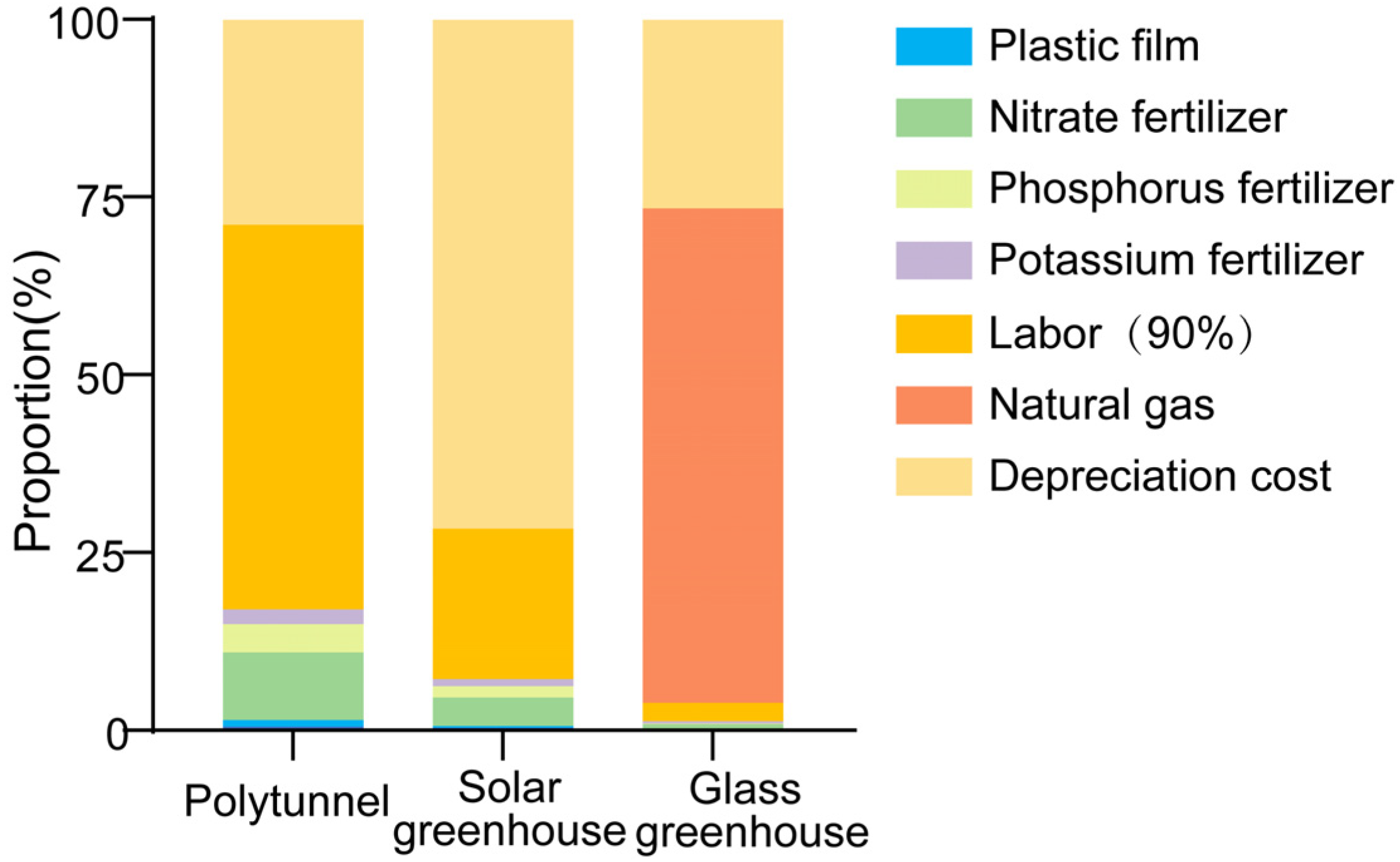
All three cultivation systems primarily relied on purchased and non-renewable resources (Table S12, Figures S4–S6), yet exhibit distinct emergy structures: polytunnels depend predominantly on labor input (49.68%), solar greenhouses are dominated by infrastructure depreciation (67.14%), while glass greenhouses rely mainly on natural gas consumption (68.66%) (Figure 2).
In terms of emergy indices, polytunnels show the highest EYR (1.14), indicating superior resource conversion and utilization efficiency, followed by solar greenhouses (1.04), with glass greenhouses having the lowest ratio (1.01) (Table 1). All three facility systems have EYR values below 5, demonstrating production models heavily dependent on external resources. Additionally, all systems exceed the ELR threshold of 10 and show ESI values below 1, indicating significant environmental pressure and poor sustainability performance (Table 1). ESR and EIR are two core indicators for evaluating resource dependence. Polytunnels show the highest ESR (0.12), reflecting their heavy reliance on external resources, lowest dependence on local natural resources, and relatively weak resource self-sufficiency. In contrast, glass greenhouses have the lowest ESR (0.01). All three tomato production systems show high EIR values, with glass greenhouses having the highest EIR (175.50), indicating the most advanced agricultural modernization level but also the greatest investment intensity (Table 1).

3.2. LCA of Tomato Production in Three Types of Facilities

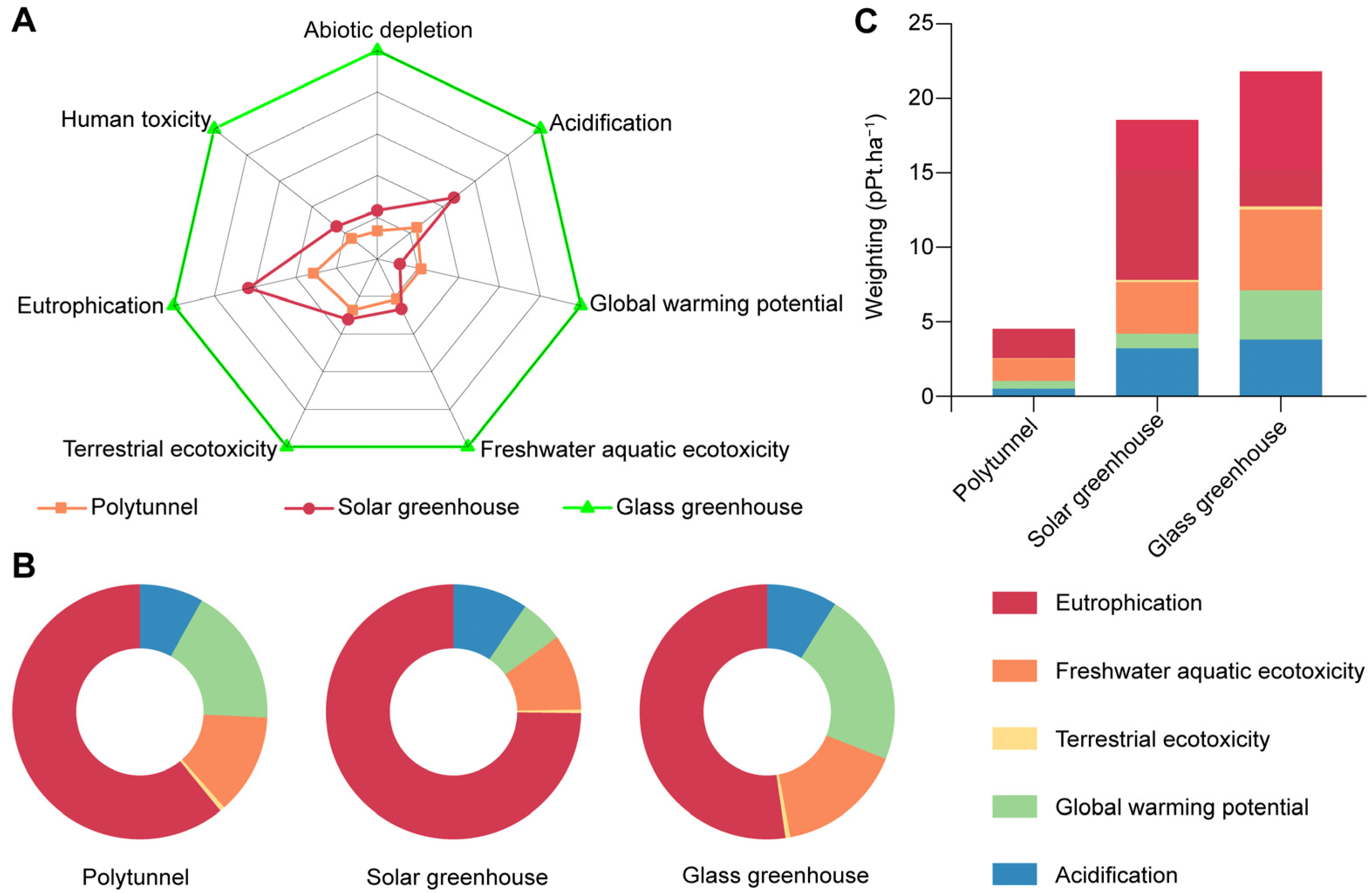
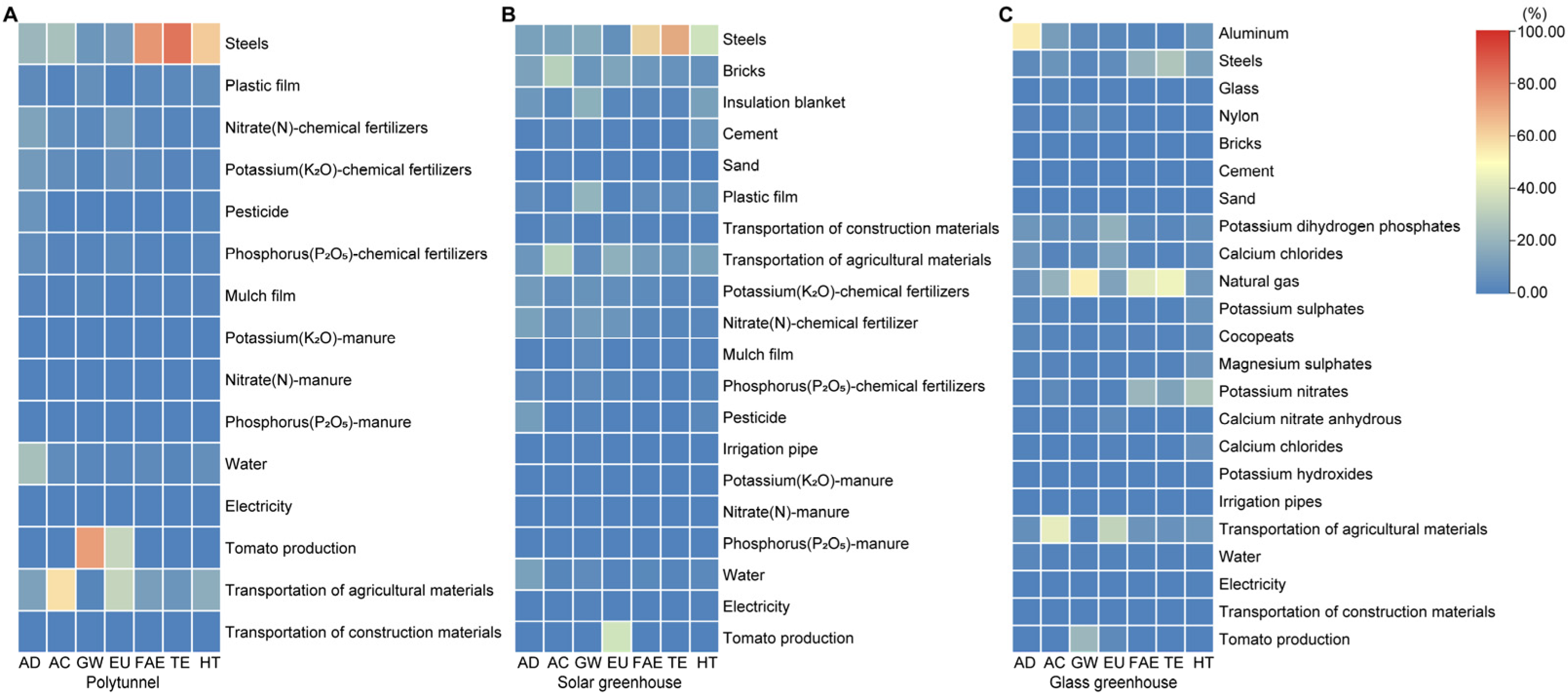
The glass greenhouse exhibited the highest environmental load across all impact categories, while the polytunnel demonstrated the best environmental efficiency, with the solar greenhouse positioned between the two (Figure 3A,C). Eutrophication (EU) was the most significant environmental impact category common to all three facilities (Figure 3B). Further analysis revealed distinct key environmental impact stages among the facilities: for polytunnels, the primary impacts originated from agricultural material production (AMP), transportation (TAM), and construction material production (CMP); in solar greenhouses, construction material production (CMP) dominated as the main influencing stage; whereas in glass greenhouses, the key impacts were attributed to construction material production (CMP) and agricultural material production (AMP) (Figure S7). In terms of key substance contributions, the main environmental impact substances in polytunnels were water consumption, tomato production emissions, and steel production; in solar greenhouses, the key substances included brick materials, transportation, plastic film, and steel production; while in glass greenhouses, aluminum production and natural gas consumption were identified as the primary sources of environmental impact (Figure 4).

3.3. EMA-LCA Analysis of Tomato Production in Three Types of Facilities

There are significant differences in the emergy required from environmental services to control production-related environmental impacts across different greenhouse systems: glass greenhouses have the highest demand, while polytunnels have the lowest (Tables S13 and S14). In terms of resource efficiency, polytunnels exhibit the lowest emergy consumption per unit product, the least dependence on external emergy, and the greatest advantage in fossil energy demand. In contrast, glass greenhouses demonstrate the highest fertilizer use efficiency but also the highest emergy consumption per unit product (Table S14). The efficiency of renewable resource utilization shows a graded decline across the three systems: polytunnels rank the highest, followed by solar greenhouses, with glass greenhouses being the least efficient (Table S14). The emergy required for pollution mitigation varies by type: glass greenhouses perform best in atmospheric pollution mitigation, while solar greenhouses excel in water and soil pollution mitigation (Table S14). The overall sustainability evaluation indicates that solar greenhouses possess the best comprehensive performance in reducing potential environmental impacts (Table S14).

3.4. Scenario Analysis Based on EMA-LCA

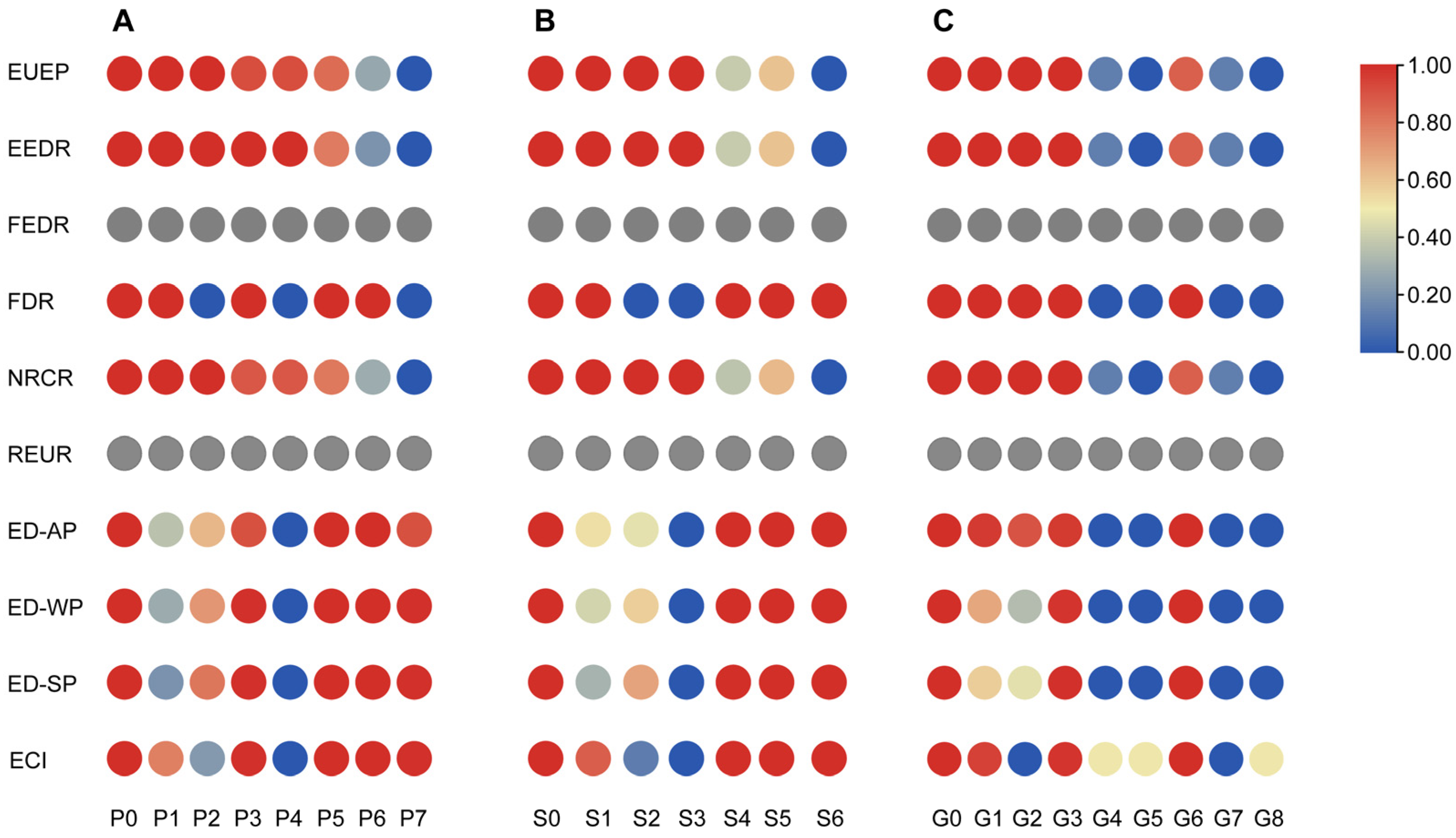
Through multi-dimensional optimization of the tomato production system in polytunnels, significant improvements in environmental performance can be achieved. Specifically, compared with P0, extending the service life of steel structures reduces the emergy demand for pollution mitigation by 2.77–27.80% and decreases the system’s ECI by 6.63%. Optimizing the transport distance for agricultural production materials to 100 km substantially reduces fossil energy demand by 83.50% and lowers the ECI by 23.8%, compared with P0. Precision irrigation maintains stable yield while reducing multiple emergy consumption indicators by 1.38–3.82%, compared with P0. The integrated optimization of steel structures, transport, and irrigation further reduces the emergy demand for pollution mitigation by 4.66–35.4%, compared with P0. In terms of management factors, reducing facility depreciation costs improves energy efficiency by 2.39–35.40%, compared with P0. Although reducing labor input lowers resource consumption, it increases the environmental load rate by 13.10%, compared with P0. The synergistic regulation of the three factors achieves a reduction in resource consumption indicators by 13.40–83.50%, compared with P0. Comprehensive comparison demonstrates that management of transport distance for agricultural production materials and integrated improvement measures have the most prominent effects on enhancing environmental performance (Figure 5A).
The environmental performance of tomato production systems in solar greenhouses has been enhanced through multi-path optimization strategies. Compared with S0, extending the service life of steel structures reduces the emergy demand for pollution mitigation by 3.20–14.10% and decreases the system’s ECI by 2.39%. Shortening the transport distance for agricultural production materials lowers fossil energy demand by 30.80% and reduces overall environmental impact by 16.30%. The synergistic regulation of both structural and transport factors achieves even greater improvements, with pollution mitigation emergy demand decreasing by 6.79–21.10% and ECI declining by 18.60%. In terms of management elements, reducing facility depreciation costs enhances dematerialization indicators by 6.72–7.01% and increases the sustainability index by 7.71%. Although labor reduction decreases resource consumption by 4.04–4.58%, it leads to a 19.80% rise in the environmental load rate and a 16.30% drop in the sustainability index. The integrated regulation of three elements achieves an 11.10% reduction in unit product emergy consumption and an 11.60% decrease in external emergy demand, albeit with an 11.20% increase in environmental load rate. Comprehensive analysis demonstrates that the synergistic measures combining structural optimization and transport management contribute most significantly to environmental performance enhancement (Figure 5B).
The environmental performance of the tomato production system in glass greenhouses has been significantly enhanced through multi-dimensional optimization measures. Compared with G0, extending the service life of steel structures reduces pollution across three major media by 0.36–4.52%, leading to a 1.07% decrease in comprehensive environmental impact. Shortening the transport distance for agricultural production materials lowers the emergy demand for pollution mitigation by 1.10–6.58%, reducing the environmental index by 19.90%. Prolonging the service life of aluminum structures improves pollution mitigation demand by 0.11–0.34%. The regulation of natural gas has yielded particularly notable results: reducing consumption achieves dematerialization benefits of 17.20–25.00% and increases the sustainability index by 21.00%. Multi-system integrated regulation further enhances these effects, achieving a 19.80–25.00% improvement in dematerialization and a 25.00% growth in the sustainability index. Facility depreciation regulation results in a 2.63–2.65% reduction in resource consumption and a 2.74% increase in sustainability, while the coordinated management of asset depreciation and natural gas utilization achieves even greater dematerialization effects of 24.70–33.30% and a 24.90% rise in sustainability. Comprehensive analysis demonstrates that system-integrated regulation and natural gas management are the most effective approaches for enhancing environmental performance (Figure 5C).

4. Discussion

4.1. Emergy-Based Assessment of Energy Efficiency Characteristics and Environmental Sustainability in Protected Tomato Production Systems

Climatic factors (solar radiation, temperature) constitute fundamental environmental elements for maintaining ecosystem stability, with sunshine duration and diurnal temperature variation exerting particularly significant influences on ecosystem productivity [39]. The proper functioning of facility-based tomato production systems relies on the synergistic interaction between natural resources and purchased inputs. Research consistently demonstrates the pivotal role of purchased inputs in sustaining the development of such systems. For instance, an emergy analysis of protected vegetables production by Guo [40] indicated that purchased resources constituted 92.29% of the total energy input, exceeding the proportion from environmental resources. Similarly, this study found that purchased resources accounted for 87.94%, 97.86%, and 99.43% of the total emergy input in polytunnels, solar greenhouses, and glass greenhouses, respectively—a result consistent with the trend reported by Guo. This pattern can be attributed to differences in artificial environment construction and vegetable production processes across the three systems. In contrast, Su et al. [41] reported that purchased resources represented 57.92% of total emergy input, a notably lower proportion. This discrepancy likely stems from two main factors: differences in initial capital investments—such as in facility structures, irrigation, and fertilization equipment—and variations in system boundaries. These insights provide a critical foundation for optimizing resource allocation and enhancing the overall sustainability of facility-based agricultural systems.
The transformity ratio (TRA) serves as a critical indicator for evaluating input-output efficiency in production systems, where higher TRA values signify lower emergy utilization efficiency. Chinese protected vegetable production systems generally exhibit high TRA values. Zhao’s study [8] demonstrated that protected vegetable systems exhibit significantly higher TRA compared to open-field vegetable systems, conventional field crop systems [42] and selected international cropping patterns [43]. In this study, all three protected tomato production systems demonstrated lower TRA compared to the two pollution-free vegetable cultivation modes (1.76 × 10⁶ sej/J and 2.83 × 10⁶ sej/J, respectively) reported in Wang’s research [44], indicating relatively higher emergy utilization efficiency.
The emergy yield ratio (EYR), a crucial indicator for evaluating the energy output and local resource utilization efficiency of agricultural production systems, reflects the ratio of system output emergy to external input emergy [45]. A higher EYR indicates greater resource utilization efficiency and stronger reliance on local resources within the system [46]. In this study, the polytunnel tomato production system achieved an EYR of 1.14, which exceeds the national averages for protected vegetable production (1.083) and open-field vegetable cultivation (1.05) [47], yet remains below China’s average EYR for crop systems (1.42) [48]. This may be attributed to the construction of polytunnels, which improve light and temperature conditions, extend the growing season, and effectively control pests and diseases. As a result, the system enhances output efficiency per unit of resource input and achieves higher energy output compared to open-field cultivation and some simple protected systems. In contrast, field crop production relies primarily on free environmental resources such as solar energy and rainfall, with a significantly lower proportion of purchased resource inputs than facility-based agricultural systems, which typically leads to a higher EYR. Of note, the previously reported EYR of 1.05 for open-field vegetable cultivation may reflect excessive reliance on purchased inputs, including the intensive use of chemical fertilizers and pesticides. The solar greenhouse and glass greenhouse achieved EYR values of 1.04 and 1.01, respectively, both lower than the aforementioned study’s benchmarks. Compared to other vegetable production systems, the three facilities in this study demonstrated lower EYR values than the pollution-free vegetable systems employing eggplant–spinach (1.33) and cucumber–eggplant (1.39) rotations, indicating that vegetable production relied heavily on the economic system. These values were higher than greenhouse single-crop systems such as cucumber (1.017), tomato (1.008), bell pepper (1.009), and eggplant (1.016) [12]. Crop rotation enables the three-dimensional and continuous utilization of soil space, light, moisture, and nutrients across both time and space, thereby reducing resource idleness and waste. As a result, the EYR of crop rotation in greenhouse systems is relatively high. However, in the Beijing region, insufficient sunlight and low temperatures during winter necessitate increased fuel energy consumption to maintain normal greenhouse operations. Consequently, constrained by local resource conditions, both the solar greenhouse and the multi-span greenhouse exhibit lower EYR values. Improving resource use efficiency in these two types of facilities will therefore be an important pathway to enhance their EYR. The three protected tomato production systems exhibited characteristics of high input but low output [49], glass greenhouses demonstrate the highest fertilizer use efficiency but also the highest emergy consumption per unit product—a finding consistent with the research results of Hollingsworth [50]. This capital-intensive input-dominated production model reflects an imbalance between resource allocation and economic benefits in protected tomato production systems, highlighting the necessity to optimize resource use efficiency.
The environmental loading ratio (ELR) serves as a critical indicator for assessing the environmental pressure exerted by agricultural production systems [51]. In this study, the three protected tomato production systems exhibited lower ELR than those reported by Asgharipour [12] and Wu [52], yet remained higher than both pollution-free vegetable systems (0.960) and organic protected vegetable production systems (2.140) [53]. This divergence primarily originates from the intensive dependence on non-renewable energy inputs in protected cultivation systems—exemplified by the substantial natural gas consumption in glass greenhouses and the significant construction material requirements across all greenhouse types. These findings are consistent with prior research [40], providing further evidence of the considerable environmental pressures associated with facility-based tomato production.
The environmental sustainability index (ESI) serves as a critical metric for evaluating the balance between environmental pressure and economic benefits within production systems. When 1 < ESI < 10, the system exhibits strong vitality and superior sustainability; whereas an ESI < 1 indicates significant environmental pressure [54]. Higher intensification levels correlate with more pronounced negative impacts [55]. Research indicates that agricultural systems generally exhibit low ESI values. For instance, China’s field corn production demonstrates an ESI of 0.45 [56], while certain tropical fruit systems record even lower values (ESI < 0.40) [57]. The ESI values for legume production systems in Iran were remarkably low, ranging only 0.03–0.08 [58]. Wu [52] recorded a notably lower ESI of 0.0033 for protected vegetable systems. The considerably lower value, compared to those in this study’s tomato systems, can largely be explained by the higher management intensity involved. The temperate corn-growing regions and tropical fruit tree ecosystems possess a certain degree of regulatory and supportive service capacity, which results in a higher ESI for these production systems compared to that observed in the present study. By contrast, agriculture in Iran’s arid regions suffers from severe water scarcity and relies on over-extracting groundwater—a practice that induces soil salinization and desertification, consequently yielding a lower ESI. The ESI values of protected tomato production in Beijing remain lower than those of pollution-free vegetable systems (1.72 and 1.45, respectively) [59], indicating the need for further optimization of production models and reduced environmental pressure to advance sustainable development. For example, under the models of plastic greenhouses and solar greenhouses, ESI can be enhanced by introducing natural predators, adopting organic management, collecting rainwater, or by exploring ways to integrate or compensate for the lost ecosystem services in glass greenhouses.

4.2. Environmental Footprint Assessment of Protected Tomato Production Systems

Glass greenhouses, due to their reliance on natural gas heating to maintain winter production, demonstrate the highest energy consumption and greater environmental impact compared to polytunnels and solar greenhouses. This energy consumption pattern aligns with findings from Naseer [60]. Tomato production systems heavily depend on non-renewable energy sources, with significant energy consumption related to fertilizers, chemicals. [61]. Therefore, by improving the utilization efficiency of fertilizers and pesticides or optimizing their manufacturing processes, the consumption of non-renewable energy can be reduced.
In this study, all three protected cultivation systems exhibited higher greenhouse gas (GHG) emissions compared to China’s 2016 vegetable production average (6244 kg CO2-eq/ha) and conventional wheat/maize systems [62]. The differences in greenhouse gas (GHG) emissions among the three protected cultivation systems are primarily influenced by construction materials [63], agricultural inputs, and yield levels [64], resulting in the following hierarchy: glass greenhouses > solar greenhouses > polytunnels. This pattern correlates with the structural complexity and production efficiency of the facilities [60]. Polytunnels exhibit higher greenhouse gas (GHG) emissions and eutrophication risks due to low fertilizer use efficiency, aligning with findings from Zhang [63]. In contrast, solar greenhouses and glass greenhouses mitigate emissions through precision nutrient management. However, excessive nitrogen/phosphorus fertilization and phosphorus-rich pesticide use remain dominant drivers of eutrophication in both polytunnels and solar greenhouses.
The acidification potential in tomato production primarily stems from NH3 volatilization during nitrogen fertilizer application [65]. Increased application of organic fertilizers exacerbates nitrogen loss through leaching and runoff [66]. At the agricultural input level, organic fertilizers are the primary contributors to acidification potential; at the emission level, NH3 released during cultivation significantly drives the acidification potential of tomato production. This study reveals that the acidification potential of solar greenhouses primarily originates from the building material production phase, a finding consistent with the results reported by Romero-Gámez [67] in protected cultivation systems in northern Spain.
Furthermore, the study found that transportation processes also contribute to environmental impacts. The combustion emissions of nitrogen oxides (NOx) and sulfur oxides (SOx) during transport exacerbate both acidification and eutrophication. The study by Hueso-Kortekaas [68] demonstrated that 77% of energy consumption and carbon emissions in greenhouse tomato production in southern Spain originate from packaging and transportation processes. In this study, the acidification potential of polytunnels and glass greenhouses was also found to be predominantly driven by agricultural input transportation, aligning with prior research findings.
This study adopts “unit production area” as the functional unit for life cycle assessment, which can intuitively reflect the direct environmental load of different facilities in terms of land occupation. This provides clear reference value for land resource planning and ecological design in facility construction [69]. However, this choice also has limitations. The definition of the functional unit directly impacts the assessment results [70]. For example, if the functional unit were replaced with “unit yield” or “unit monetary output,” the resource and environmental efficiency per unit of high-input, high-output systems might become more prominent, potentially leading to changes in the performance rankings among the facilities. This constitutes a limitation of this study. In future research, adopting a multi-dimensional functional unit approach (e.g., area, yield, monetary value) for systematic parallel comparisons and sensitivity analysis would help provide more comprehensive and nuanced decision-making insights from different perspectives—such as ecological intensity, production efficiency, and eco-economic efficiency—thereby more precisely supporting the sustainable transition of facility agriculture.

4.3. Sustainability Optimization of Protected Agriculture Based on Emergy Analysis of Ecosystem Services

Sustainable agricultural development requires balancing resource utilization with ecological conservation. This study quantified environmental impacts using pollutant dilution energy input (environmental service emergy) [71]. The results revealed that the environmental service emergy values (for air, water, and soil) of polytunnels and solar greenhouses were lower than those reported in Shen [72] (7.42 × 10¹⁰, 6.03 × 10¹⁶, and 1.59 × 10¹² J, respectively), whereas glass greenhouses exhibited higher values than Shen’s study [72].
By optimizing labor inputs in polytunnels and solar greenhouses, the EYR was increased, but at the cost of reducing the ESI. This suggests that solely improving resource use efficiency may negatively impact the system’s long-term sustainability. Optimizing natural gas usage in glass greenhouses successfully achieved the dual objectives of reducing the ELR and increasing the ESI. After scenario optimization, the reduction in environmental service emergy varied across systems. For polytunnels, water and soil emergy achieved significant decreases, whereas air emergy showed marginal improvement due to inherent material limitations in volatile organic compound containment. Polytunnels achieved reductions of 0.24–4.66% in air, 0.38–35.4% in water, and 0.21–34.7% in soil emergy demands. Solar greenhouses showed decreases of 3.20–6.79% in air, 0.38–21.10% in water, and 6.41–20.50% in soil emergy requirements. Glass greenhouses exhibited reductions of 0.34–12.80% in air, 0.18–11.2% in water, and 0.11–11.90% in soil emergy inputs. Both solar greenhouses and glass greenhouses exhibited smaller reductions in air, water, and soil emergy demands compared to the findings of prior research [72].
To avoid the limitations of a single method in providing a comprehensive assessment, this study focuses on key factors with significant weights in both LCA and EMA to implement targeted energy-saving and emission-reduction technological optimizations. By comparing indicators such as reduction, recycling, controllability, and system sustainability before and after optimization, the effectiveness of the proposed solutions is evaluated. It offers quantitative foundations for developing management strategies that balance efficiency and sustainability [22].

5. Conclusions

This study comprehensively employed emergy analysis, life cycle assessment, and the integrated EMA-LCA approach to systematically evaluate the sustainability of three greenhouse tomato production systems. The conclusions are as follows: Regarding resource utilization and environmental impact, all three systems rely heavily on external non-renewable resources, exhibit significant environmental loads, and demonstrate overall poor sustainability, with clear differences among them. Polytunnels show the highest resource conversion efficiency, the lowest emergy consumption per surface area (hectare, ha) product, and the smallest environmental load. Solar greenhouses perform best in comprehensive sustainability, particularly excelling in balancing environmental impact and reducing potential environmental damage. In contrast, although multi-span glass greenhouses represent the highest level of agricultural modernization, their high dependence on natural gas and heavy building materials results in immense environmental pressure and the lowest sustainability. In this study, the calculation of environmental impacts based on the LCA method has been integrated into the conventional EMA through the definition of potential environmental services. Additionally, the results indicate that polytunnels should focus on optimizing transportation distance and irrigation management; the key for solar greenhouses lies in structural optimization and transportation coordination; while glass greenhouses urgently need to promote energy structure transformation, particularly by reducing natural gas dependence and enhancing synergistic regulation of building material systems. This study provides a scientific basis for the differentiated development and precise regulation of facility agriculture, demonstrating that optimizing resource management strategies can effectively steer the industry toward a more sustainable trajectory.

Supplementary Materials

The following supporting information can be downloaded at: https://www.mdpi.com/article/10.3390/agronomy16030325/s1, Table S1. Construction and planting specifications for the three facility types. Table S2. Unit energy conversion rate of each element. Table S3. Calculation results of system emergy values. Table S4. Inventory of construction materials and agricultural production inputs for three types of facilities. Table S5. Life cycle inventory data for the crop period of tomatoes. Table S6. The equivalent coefficient of the emissions inventory for environmental impact potentials. Table S7. Reference value and weight of environmental impact. Table S8. Environmental safety concentrations of related pollutants in air, surface water and arable land in China. Table S9. Optimization of polytunnel tomato production based on EMA-LCA. Table S10. Optimization of solar greenhouse tomato production based on EMA-LCA. Table S11. Optimization of glass greenhouse tomato production based on EMA-LCA. Table S12. Emergy flow in three types of facility tomato production systems. Table S13. Quantity of environmental services required for pollution reduction in tomato production systems. Table S14. Emergy of environmental services required for pollution reduction in tomato production systems. Figure S1. Emergy system diagram of a polytunnel. Figure S2. Emergy system diagram of a solar greenhouse. Figure S3. Emergy system diagram of a glass greenhouse. Figure S4. Analysis diagram of emergy input structure for tomato production in polytunnel. Figure S5. Analysis diagram of emergy input structure for tomato production in solar greenhouse. Figure S6. Analysis diagram of emergy input structure for tomato production in glass greenhouse. Figure S7. Environmental impact contribution diagrams of key stages for the three types of facilities. References [45,52,73,74,75,76,77,78] are cited in Supplementary Materials.

Author Contributions

L.Z.: Writing—Review and Editing, Writing—Original Draft, Investigation, Data Curation. H.Y.: Writing—Original Draft, Formal Analysis. S.I.: Writing—Review and Editing, Visualization, Software. T.M.: Visualization, Formal Analysis. Q.L.: Writing—Review and Editing, Supervision, Funding Acquisition. W.J.: Writing—Review and Editing, Supervision. All authors have read and agreed to the published version of the manuscript.

Funding

This research was financially supported by the Xinjiang Uygur Autonomous Region Key Research and Development Program (2023B02024-3) and China Agricultural Research System (CARS-23-B07).

Data Availability Statement

The original contributions presented in this study are included in the article/Supplementary Material. Further inquiries can be directed to the corresponding authors.

Conflicts of Interest

The authors declare that they have no known competing financial interests or personal relationships that could have appeared to influence the work reported in this paper.

References

  1. Gao, P.; Tian, Z.; Lu, Y.; Lu, M.; Zhang, H.; Wu, H.; Hu, J. A Decision-Making Model for Light Environment Control of Tomato Seedlings Aiming at the Knee Point of Light-Response Curves. Comput. Electron. Agric. 2022, 198, 107103. [Google Scholar] [CrossRef]
  2. Wang, S.; Li, X.; Liu, Y.; Lv, X.; Zheng, W. Comparison of a New Knapsack Mist Sprayer and Three Traditional Sprayers for Pesticide Application in Plastic Tunnel Greenhouse. Phytoparasitica 2022, 50, 177–190. [Google Scholar] [CrossRef]
  3. Yang, Y.; Gao, P.; Sun, Z.; Wang, H.; Lu, M.; Liu, Y.; Hu, J. Multistep Ahead Prediction of Temperature and Humidity in Solar Greenhouse Based on FAM-LSTM Model. Comput. Electron. Agric. 2023, 213, 108261. [Google Scholar] [CrossRef]
  4. Liu, X.; Wu, X.; Xia, T.; Fan, Z.; Shi, W.; Li, Y.; Li, T. New Insights of Designing Thermal Insulation and Heat Storage of Chinese Solar Greenhouse in High Latitudes and Cold Regions. Energy 2022, 242, 122953. [Google Scholar] [CrossRef]
  5. Ravishankar, E.; Booth, R.E.; Hollingsworth, J.A.; Ade, H.; Sederoff, H.; DeCarolis, J.F.; O’Connor, B.T. Organic Solar Powered Greenhouse Performance Optimization and Global Economic Opportunity. Energy Environ. Sci. 2022, 15, 1659–1671. [Google Scholar] [CrossRef]
  6. Mingzhi, Z.; Yingjie, L.; Zheng, H.; Chun, C.; Daorina, B.; Rasakhodzhaev, B.S.; Jobir, A. Research on the Influence of Solar Radiation Fuzzy Adaptive System on the Wet and Hot Environment in Greenhouse. Case Stud. Therm. Eng. 2024, 58, 104440. [Google Scholar] [CrossRef]
  7. Odum, H.T. Self-Organization, Transformity, and Information. Science 1988, 242, 1132–1139. [Google Scholar] [CrossRef]
  8. Zhao, H.; Zhai, X.; Guo, L.; Yang, Y.; Li, J.; Ren, C.; Wang, K.; Liu, X.; Zhan, R.; Wang, K. Comparing Protected Cucumber and Field Cucumber Production Systems in China Based on Emergy Analysis. J. Clean. Prod. 2019, 236, 117648. [Google Scholar] [CrossRef]
  9. Chen, Y.; Liu, C.; Chen, J.; Hu, N.; Zhu, L. Evaluation on Environmental Consequences and Sustainability of Three Rice-Based Rotation Systems in Quanjiao, China by an Integrated Analysis of Life Cycle, Emergy and Economic Assessment. J. Clean. Prod. 2021, 310, 310. [Google Scholar] [CrossRef]
  10. Li, Y.; Cai, G.; Tan, K.; Zeng, R.; Chen, X.; Wang, X. Emergy−based Efficiency and Sustainability Assessments of Diversified Multi−cropping Systems in South China. J. Clean. Prod. 2023, 414, 137660. [Google Scholar] [CrossRef]
  11. Amaral, L.P.; Martins, N.; Gouveia, J.B. A Review of Emergy Theory, Its Application and Latest Developments. Renew. Sustain. Energy Rev. 2016, 54, 882–888. [Google Scholar] [CrossRef]
  12. Asgharipour, M.R.; Amiri, Z.; Campbell, D.E. Evaluation of the Sustainability of Four Greenhouse Vegetable Production Ecosystems Based on an Analysis of Emergy and Social Characteristics. Ecol. Model. 2020, 424, 109021. [Google Scholar] [CrossRef]
  13. Shah, S.M.; Liu, G.; Yang, Q.; Wang, X.; Casazza, M.; Agostinho, F.; Lombardi, G.V.; Giannetti, B.F. Emergy-Based Valuation of Agriculture Ecosystem Services and Dis-Services. J. Clean. Prod. 2019, 239, 118019. [Google Scholar] [CrossRef]
  14. Xu, C.; Chen, W.; Hong, J. Life-Cycle Environmental and Economic Assessment of Sewage Sludge Treatment in China. J. Clean. Prod. 2014, 67, 79–87. [Google Scholar] [CrossRef]
  15. Khoshnevisan, B.; Rafiee, S.; Omid, M.; Mousazadeh, H.; Clark, S. Environmental Impact Assessment of Tomato and Cucumber Cultivation in Greenhouses Using Life Cycle Assessment and Adaptive Neuro-Fuzzy Inference System. J. Clean. Prod. 2014, 73, 183–192. [Google Scholar] [CrossRef]
  16. Martin, M.; Molin, E. Environmental Assessment of an Urban Vertical Hydroponic Farming System in Sweden. Sustainability 2019, 11, 4124. [Google Scholar] [CrossRef]
  17. Chatzisymeon, E.; Foteinis, S.; Borthwick, A.G.L. Life Cycle Assessment of the Environmental Performance of Conventional and Organic Methods of Open Field Pepper Cultivation System. Int. J. Life Cycle Assess. 2017, 22, 896–908. [Google Scholar] [CrossRef]
  18. Romeo, D.; Vea, E.B.; Thomsen, M. Environmental Impacts of Urban Hydroponics in Europe: A Case Study in Lyon. Procedia CIRP 2018, 69, 540–545. [Google Scholar] [CrossRef]
  19. Wildeman, R. Vertical Farming: A Future Perspective or a Mere Conceptual Idea? A Comprehensive Life Cycle Analysis on the Environmental Impact of a Vertical Farm Compared to Rural Agriculture in the US. Master’s Thesis, University of Twente, Enschede, The Netherlands, 2020. Available online: https://docslib.org/doc/5148487/vertical-farming-a-future-perspective-or-a (accessed on 25 January 2026).
  20. Cai, S.; Wang, W.; Zou, Y.; Li, S.; Tu, Z. Performance and Sustainability Assessment of PEMFC/Solar-Driven CCP Systems with Different Energy Storage Devices. Energy 2023, 278, 127863. [Google Scholar] [CrossRef]
  21. Lin, H.-F.; Mansir, I.B.; Ameen, H.F.M.; Cherif, A.; Abdulwahab, A.; Dahari, M.; Lin, H.; Aly, A.A.; Nasr, S. Economic, Environmental and Multi Objective Optimization of a Clean Tri-Generation System Based Co-Firing of Natural Gas and Biomass: An Emergy Evaluation. Process Saf. Environ. Prot. 2023, 173, 289–303. [Google Scholar] [CrossRef]
  22. Wang, X.; Dadouma, A.; Chen, Y.; Sui, P.; Gao, W.; Jia, L. Sustainability Evaluation of the Large-Scale Pig Farming System in North China: An Emergy Analysis Based on Life Cycle Assessment. J. Clean. Prod. 2015, 102, 144–164. [Google Scholar] [CrossRef]
  23. Song, Q.; Wang, Z.; Li, J. Sustainability Evaluation of E-Waste Treatment Based on Emergy Analysis and the LCA Method: A Case Study of a Trial Project in Macau. Ecol. Indic. 2013, 30, 138–147. [Google Scholar] [CrossRef]
  24. Zhao, J.; Xie, H.; Liu, D.; Huang, R.; Peng, H. Climate-Smart Management for Increasing Crop Yield and Reducing Greenhouse Gas Emission in Beijing-Tianjin-Hebei Region, China. Agric. For. Meteorol. 2023, 339, 109569. [Google Scholar] [CrossRef]
  25. Wang, J.; Chen, B. Emergy analysis of a biogas-linked agricultural system in rural Chinada case study in Gongcheng Yao Autonomous County. Appl. Energ. 2014, 118, 173–182. [Google Scholar] [CrossRef]
  26. Campbell, D.E. Emergy Baseline for the Earth: A Historical Review of the Science and a New Calculation. Ecol. Model. 2016, 339, 96–125. [Google Scholar] [CrossRef]
  27. Rebitzer, G.; Ekvall, T.; Frischknecht, R.; Hunkeler, D.; Norris, G.; Rydberg, T.; Schmidt, W.-P.; Suh, S.; Weidema, B.P.; Pennington, D.W. Life Cycle Assessment: Part 1: Framework, Goal and Scope Definition, Inventory Analysis, and Applications. Environ. Int. 2004, 30, 701–720. [Google Scholar] [CrossRef]
  28. Wang, Y.; Zhao, G. Life Cycle Assessment of Potential Pollutant-Induced Human Capital Loss Caused by Different Agricultural Production Systems in Beijing, China. J. Clean. Prod. 2019, 240, 118141. [Google Scholar] [CrossRef]
  29. Curran, M.A. Overview of Goal and Scope Definition in Life Cycle Assessment; LCA Compendium-The Complete World of Life Cycle Assessment; Springer: Berlin/Heidelberg, Germany, 2017. [Google Scholar] [CrossRef]
  30. Shen, J.; Chen, Q.Y.; Li, Z.M.; Gao, L.H. Life cycle assessment of three greenhouse construction types. Trans. Chin. Soc. Agric. Eng. 2012, 28, 8. Available online: https://lib.cqvip.com/Qikan/Article/Detail?id=40823971 (accessed on 25 January 2026).
  31. Rybaczewska-Błażejowska, M.; Jezierski, D. Comparison of ReCiPe 2016, ILCD 2011, CML-IA Baseline and IMPACT 2002+ LCIA Methods: A Case Study Based on the Electricity Consumption Mix in Europe. Int. J. Life Cycle Assess. 2024, 29, 1799–1817. [Google Scholar] [CrossRef]
  32. Ciroth, A.; Di Noi, C.; Lohse, T.; Srocka, M. openLCA, version 1.10; Comprehensive User Manual; GreenDelta: Berlin, Germany, 2020. [Google Scholar]
  33. Famiglietti, J.; Madioum, H.; Motta, M. Developing a New Data-Driven LCA Tool at the Urban Scale: The Case of the Embodied Environmental Profile of the Building Sector. Sustainability 2023, 15, 11518. [Google Scholar] [CrossRef]
  34. Liang, J.F.; Qi, Q.Z.; Jia, X.H. Investigation of Quality in Organic Fertilizers in Beijing Suburb. Soil Fertil. Ences China 2009, 6, 79–83. [Google Scholar]
  35. He, X.; Qiao, Y.; Liu, Y.; Dendler, L.; Yin, C.; Martin, F. Environmental Impact Assessment of Organic and Conventional Tomato Production in Urban Greenhouses of Beijing City, China. J. Clean. Prod. 2016, 134, 251–258. [Google Scholar] [CrossRef]
  36. Huijbregts, M.A.J.; Thissen, U.; Guinée, J.B.; Jager, T.; Kalf, D.; Meent, D.V.D.; Ragas, A.M.J.; Sleeswijk, A.W.; Reijnders, L. Priority Assessment of Toxic Substances in Life Cycle Assessment. Part I: Calculation of Toxicity Potentials for 181 Substances with the Nested Multi-Media Fate, Exposure and Effects Model USES-LCA. Chemosphere 2000, 41, 541–573. [Google Scholar] [CrossRef] [PubMed]
  37. Wang, M.; Wu, W.; Liu, W.; Bao, Y. Life Cycle Assessment of the Winter Wheat-Summer Maize Production System on the North China Plain. Int. J. Sustain. Dev. World Ecol. 2007, 14, 400–407. [Google Scholar] [CrossRef]
  38. Li, L.I.; Yang, X. Distribution Route Optimization for Multi-Vehicle Agricultural Materials Considering Carbon Emission Cost. INMATEH-Agric. Eng. 2023, 71, 611. [Google Scholar] [CrossRef]
  39. Zhao, Y.Y.; He, C.Y.; Li, X.B.; Huang, Q.X.; Yang, Y. Comprehensive impact assessment of aridification and land use change on the natural productivity potential of grasslands and farmlands in the agro-pastoral ecotone of northern China. J. Nat. Resour. 2009, 24, 123–135. Available online: https://lib.cqvip.com/Qikan/Article/Detail?id=29341921 (accessed on 25 January 2026).
  40. Guo, Y.; Wang, H.; Zhang, W.; Chen, B.; Song, D. Sustainability Evaluation of Protected Vegetables Production in China Based on Emergy Analysis. J. Clean. Prod. 2023, 388, 135928. [Google Scholar] [CrossRef]
  41. Su, F.; Liu, H.; Zhu, D.; Li, L.; Wang, T. Sustainability Assessment of the Liaohe Estuary Wetland Based on Emergy Analysis. Ecol. Indic. 2020, 119, 106837. [Google Scholar] [CrossRef]
  42. Zhang, D.Y.; Leng, F.L.; Zhang, L.F.; Zhang, S.Q.; Liu, X.T.; Gao, W.S. Emergy analysis of crop production systems in gongzhuling city, a major grain-producing area of the northeast China plain. Trans. Chin. Soc. Agric. Eng. 2005, 21, 12–17. Available online: http://dianda.cqvip.com/Qikan/Article/Detail?id=15910997 (accessed on 25 January 2026). [CrossRef]
  43. Liu, G.; Hao, Y.; Dong, L.; Yang, Z.; Zhang, Y.; Ulgiati, S. An Emergy-LCA Analysis of Municipal Solid Waste Management. Resour. Conserv. Recycl. 2017, 120, 131–143. [Google Scholar] [CrossRef]
  44. Wang, Y.; Cai, Y.; Liu, G.; Zhang, P.; Shu, T. Evaluation of Sustainable Crop Production from an Ecological Perspective Based Emergy Analysis: A Case of China’s Provinces. J. Clean. Prod. 2021, 313, 127912. [Google Scholar] [CrossRef]
  45. Zhang, L.X.; Yang, Z.F.; Chen, G.Q. Emergy Analysis of Cropping-Grazing System in Inner Mongolia Autonomous Region, China. Energy Policy 2007, 35, 3843–3855. [Google Scholar] [CrossRef]
  46. Chen, G.; Jiang, M.; Chen, B.; Yang, Z.; Lin, C. Emergy Analysis of Chinese Agriculture. Agric. Ecosyst. Environ. 2006, 115, 161–173. [Google Scholar] [CrossRef]
  47. Lu, H.; Bai, Y.; Ren, H.; Campbell, D.E. Integrated Emergy, Energy and Economic Evaluation of Rice and Vegetable Production Systems in Alluvial Paddy Fields: Implications for Agricultural Policy in China. J. Environ. Manag. 2010, 91, 2727–2735. [Google Scholar] [CrossRef]
  48. Li, M.U.; Jun-Xiu, L.; Hui-Juan, L.; Li-Qun, C. Emergy Analyses of Wheat and Pea Production under Conservation Tillage. Agric. Res. Arid. Areas 2015, 33, 153–158. Available online: https://www.oalib.com/research/5322531 (accessed on 25 January 2026).
  49. Li, X.; Cui, D.; Ma, C.; Liu, R. Ecological Design Strategies of Wetland Based on Avian Habitats Restoration and Creation. Chin. Landsc. Archit 2020, 36, 133–138. Available online: http://jchla.ijournals.cn/ch/reader/view_abstract.aspx?file_no=20200522&flag=1 (accessed on 25 January 2026).
  50. Hollingsworth, J.A.; Ravishankar, E.; O’Connor, B.; Johnson, J.X.; DeCarolis, J.F. Environmental and Economic Impacts of Solar-Powered Integrated Greenhouses. J. Ind. Ecol. 2020, 24, 234–247. [Google Scholar] [CrossRef]
  51. Houshyar, E.; Wu, X.F.; Chen, G.Q. Sustainability of Wheat and Maize Production in the Warm Climate of Southwestern Iran: An Emergy Analysis. J. Clean. Prod. 2017, 172, 2246–2255. [Google Scholar] [CrossRef]
  52. Wu, X.; Wu, F.; Tong, X.; Jiang, B. Emergy-Based Sustainability Assessment of an Integrated Production System of Cattle, Biogas, and Greenhouse Vegetables: Insight into the Comprehensive Utilization of Wastes on a Large-Scale Farm in Northwest China. Ecol. Eng. 2013, 61, 335–344. [Google Scholar] [CrossRef]
  53. Wang, H. Analysis on Facility Vegetable Production Efficiency and Production Structure in Beijing-Based on Data Collected from Vegetable Farmer Householders. China Veg. 2015, 1, 45–49. Available online: https://www.sciengine.com/AES/doi/10.5846/stxb201306041318 (accessed on 25 January 2026).
  54. Ulgiati, S.; Brown, M.T. Monitoring Patterns of Sustainability in Natural and Man-Made Ecosystems. Ecol. Model. 1998, 108, 23–36. [Google Scholar] [CrossRef]
  55. Cavalett, O.; De Queiroz, J.F.; Ortega, E. Emergy Assessment of Integrated Production Systems of Grains, Pig and Fish in Small Farms in the South Brazil. Ecol. Model. 2006, 193, 205–224. [Google Scholar] [CrossRef]
  56. Zhang, L.; Song, B.; Chen, B. Emergy-Based Analysis of Four Farming Systems: Insight into Agricultural Diversification in Rural China. J. Clean. Prod. 2012, 28, 33–44. [Google Scholar] [CrossRef]
  57. Lu, H.-F.; Kang, W.-L.; Campbell, D.E.; Ren, H.; Tan, Y.-W.; Feng, R.-X.; Luo, J.-T.; Chen, F.-P. Emergy and Economic Evaluations of Four Fruit Production Systems on Reclaimed Wetlands Surrounding the Pearl River Estuary, China. Ecol. Eng. 2009, 35, 1743–1757. [Google Scholar] [CrossRef]
  58. Asgharipour, M.R.; Shahgholi, H.; Campbell, D.E.; Khamari, I.; Ghadiri, A. Comparison of the Sustainability of Bean Production Systems Based on Emergy and Economic Analyses. Environ. Monit. Assess. 2018, 191, 2. [Google Scholar] [CrossRef]
  59. Wang, X.; Han, Y.; Chen, Y.; Sui, P.; Gao, W.; Wu, X.; Du, C. Efficiency and Sustainability Evaluation of a Pollution-Free Vegetable Production System Based on Emergy Analysis. Acta Ecol. Sin. 2015, 35, 2136–2145. [Google Scholar] [CrossRef]
  60. Naseer, M.; Persson, T.; Hjelkrem, A.-G.R.; Ruoff, P.; Verheul, M.J. Life Cycle Assessment of Tomato Production for Different Production Strategies in Norway. J. Clean. Prod. 2022, 372, 133659. [Google Scholar] [CrossRef]
  61. João, P.; João, C.; Thais, M.; Tulio de, A.; Juliana, L.; Anderson, G. Greenhouse gas emissions and energy consumption from different soil management practices in industrial tomato production in Brazil. Environ. Dev. 2026, 57, 101347. [Google Scholar] [CrossRef]
  62. Chen, X.; Cui, Z.; Fan, M.; Vitousek, P.; Zhao, M.; Ma, W.; Wang, Z.; Zhang, W.; Yan, X.; Yang, J.; et al. Producing More Grain with Lower Environmental Costs. Nature 2014, 514, 486–489. [Google Scholar] [CrossRef]
  63. Zhang, F.; Liu, F.; Ma, X.; Guo, G.; Liu, B.; Cheng, T.; Liang, T.; Tao, W.; Chen, X.; Wang, X. Greenhouse Gas Emissions from Vegetables Production in China. J. Clean. Prod. 2021, 317, 128449. [Google Scholar] [CrossRef]
  64. Xu, X.; Lan, Y. Spatial and Temporal Patterns of Carbon Footprints of Grain Crops in China. J. Clean. Prod. 2017, 146, 218–227. [Google Scholar] [CrossRef]
  65. Brentrup, F.; Küsters, J.; Lammel, J.; Barraclough, P.; Kuhlmann, H. Environmental Impact Assessment of Agricultural Production Systems Using the Life Cycle Assessment (LCA) Methodology II. The Application to N Fertilizer Use in Winter Wheat Production Systems. Eur. J. Agron. 2004, 20, 265–279. [Google Scholar] [CrossRef]
  66. Jia, W.; Wang, L.; Chen, Q. Seasonal Differences in Net Mineralization Rate of Organic Nitrogen in Vegetable Field of North China Plain. Acta Agric. Boreali.-Sin. 2013, 28, 198–205. Available online: https://jglobal.jst.go.jp/en/detail?JGLOBAL_ID=201502219352391346 (accessed on 25 January 2026).
  67. Romero-Gámez, M.; Audsley, E.; Suárez-Rey, E.M. Life Cycle Assessment of Cultivating Lettuce and Escarole in Spain. J. Clean. Prod. 2014, 73, 193–203. [Google Scholar] [CrossRef]
  68. Hueso-Kortekaas, K.; Romero, J.C.; González-Felipe, R. Energy-Environmental Impact Assessment of Greenhouse Grown Tomato: A Case Study in Almeria (Spain). World 2021, 2, 425–441. [Google Scholar] [CrossRef]
  69. Cerutti, A.K.; Bruun, S.; Beccaro, G.L.; Bounous, G. A Review of Studies Applying Environmental Impact Assessment Methods on Fruit Production Systems. J. Environ. Manag. 2011, 92, 2277–2286. [Google Scholar] [CrossRef]
  70. Nemecek, T.; Huguenin-Elie, O.; Dubois, D.; Gaillard, G.; Schaller, B.; Chervet, A. Life Cycle Assessment of Swiss Farming Systems: II. Extensive and Intensive Production. Agric. Syst. 2011, 104, 233–245. [Google Scholar] [CrossRef]
  71. Ulgiati, S.; Brown, M.T. Quantifying the Environmental Support for Dilution and Abatement of Process Emissions: The Case of Electricity Production. J. Clean. Prod. 2002, 10, 335–348. [Google Scholar] [CrossRef]
  72. Shen, Y.; Wang, H.H.; Tao, Y.Y.; Lu, C.Y.; Dong, L.L.; Shi, L.L.; Jin, M.J.; Zhou, X.W.; Shen, M.X. Regulation of modern “grass-sheep-field” agro-pastoral circular system based on life cycle assessment. Trans. Chin. Soc. Agric. Eng. 2021, 37, 2093. Available online: http://tcsae.org/cn/article/doi/10.11975/j.issn.1002-6819.2021.24.030 (accessed on 25 January 2026).
  73. Odum, H.T. Environmental Accounting: Emergy and Environmental Decision Making. 1996. Available online: https://www.wiley.com/en-cn/Environmental+Accounting%3A+Emergy+and+Environmental+Decision+Making-p-9780471114420 (accessed on 25 January 2026).
  74. Odum, H.T. Handbook of Emergy Evaluation. 2000. Available online: https://www.emergysociety.com (accessed on 25 January 2026).
  75. Brown, M.T.; Ulgiati, S. Assessing the Global Environmental Sources Driving the Geobiosphere: A Revised Emergy Baseline. Ecol. Model. 2016, 339, 126–132. [Google Scholar] [CrossRef]
  76. Lan, S.; Odum, H.T.; Liu, X. Energy Flow and Emergy Analysis of the Agroecosystems of China. Ecol. Sci. 1998, 17, 32–39. Available online: https://xueshu.baidu.com/usercenter/paper/show?paperid=e3ad1b1477a81fd50c08e2af5f88cedc&site=xueshu_se&svcp_stk=1_u8wwg2Zr5R9Y2C2p930-9rw76Y2-5eLvmOFoTG9LOLHvIwzAMfeqNVieHhhyMIHjM3d2_mZxCNFFRB2H4uA1PmcyJmUIGwDRJCBOqo3yYcMLwCXrMot5vZOVWSL0ED1tIUL4SvS6ZKq4K_Ldw4jWouW5MJnUHiUFZFkbSx8bUOJlQPw5Bg3iyCYah8sjjJjv (accessed on 25 January 2026).
  77. Xie, H.; Huang, Y.; Choi, Y.; Shi, J. Evaluating the Sustainable Intensification of Cultivated Land Use Based on Emergy Analysis. Technol. Forecast. Soc. Change 2021, 165, 120449. [Google Scholar] [CrossRef]
  78. Zhang, Q.; Yue, D.; Fang, M.; Yu, Q.; Huang, Y.; Su, K.; Ma, H.; Wang, Y. Study on Sustainability of Land Resources in Dengkou County Based on Emergy Analysis. J. Clean. Prod. 2018, 171, 580–591. [Google Scholar] [CrossRef]

Figure 1. Three different types of agricultural facilities in China. (A) A polytunnel, a greenhouse constructed from polyethylene supported by a metal frame. (B) A solar greenhouse, characterized by its solid walls on the north, east, and west sides, with the south side being covered by a plastic film. (C) A glass greenhouse is typically equipped with heating, cooling, and ventilation systems to regulate temperature and humidity year-round.
Agronomy 16 00325 g001
Figure 2. Proportion of non-renewable resources input in three types of facilities.
Agronomy 16 00325 g002
Figure 3. Comparison of (A) characterization, (B) normalization, and (C) weighting values for the three facility types.
Agronomy 16 00325 g003
Figure 4. Environmental impact contribution diagrams of key substances for (A) polytunnel; (B) solar greenhouse and (C) glass greenhouse. In the heat maps, red indicates the highest contribution, while blue represents the lowest.
Agronomy 16 00325 g004
Figure 5. Comprehensive evaluation of (A) polytunnel, (B) solar greenhouse and (C) glass greenhouse tomato production based on scenario simulation using the EMA-LCA. P0, S0, and G0 are the control groups without scenario simulation for polytunnels, solar greenhouses, and glass greenhouses, respectively. EUEP, emergy consumption rate per unit effective product; EEDR, external emergy demand ratio; FEDR, fertilizer emergy demand ratio; FDR, fossil energy demand ratio; NRCR, non-renewable resource consumption rate; REUR, renewable environmental emergy utilization rate; ED-AP, emergy demand for atmospheric pollution mitigation; ED-WP, emergy demand for water pollution mitigation; ED-SP, emergy demand for soil pollution mitigation; ECI, environmental composite index.
Agronomy 16 00325 g005
Table 1. Emergy evaluation indices in three types of facility tomato production systems.
ElementPolytunnelSolar GreenhouseGlass Greenhouse
Transformity (TRA, sej/J)3.65 × 105 ± 5.20 × 10³ c4.62 × 105 ± 1.36 × 10³ b1.31 × 106 ± 7.00 × 10⁴ a
Emergy yield ratio (EYR)1.14 ± 0.00 a1.04 ± 0.00 b1.01 ± 0.00 c
Environmental loading ratio (ELR)20.32 ± 0.19 c45.9 ± 0.24 b171.00 ± 6.00 a
Emergy sustainability index (ESI)0.06 ± 0.00 a0.02 ± 0.00 b0.01 ± 0.00 c
Emergy self-sufficiency ratio (ESR)0.12 ± 0.00 a0.04 ± 0.00 b0.01 ± 0.00 c
Emergy investment ratio (EIR)7.33 ± 0.13 c23.51 ± 0.11 b175.50 ± 9.50 a
Notes: Values are means of the mean ± standard. Letters indicate significant differences among facilities at p < 0.05 level by Duncan’s multiple range test.
Disclaimer/Publisher’s Note: The statements, opinions and data contained in all publications are solely those of the individual author(s) and contributor(s) and not of MDPI and/or the editor(s). MDPI and/or the editor(s) disclaim responsibility for any injury to people or property resulting from any ideas, methods, instructions or products referred to in the content.