Article

Physiological Mechanisms of Nano-CeO2 and Nano-TiO2 as Seed-Priming Agents in Enhancing Drought Tolerance of Barley Seedlings


The Key Laboratory of Oasis Eco-Agriculture, Xinjiang Production and Construction Group, College of Agriculture, Shihezi University, Shihezi 832003, China
*
Author to whom correspondence should be addressed.
Agronomy 2026, 16(3), 316; https://doi.org/10.3390/agronomy16030316
Submission received: 16 December 2025 / Revised: 14 January 2026 / Accepted: 22 January 2026 / Published: 27 January 2026
(This article belongs to the Section Plant-Crop Biology and Biochemistry)

Abstract

Nanotechnology holds great promise for alleviating drought stress in crops. This study elucidates and compares the distinct physiological mechanisms by which two nanomaterials, nano-cerium oxide (CeO2) and nano-titanium dioxide (TiO2), function as seed-priming agents to enhance drought tolerance in barley. A comprehensive analysis encompassing germination performance, hormonal dynamics, starch metabolism, osmotic adjustment, photosynthetic pigments, and the antioxidant system revealed that each nanomaterial operates through a unique pathway. Specifically, priming with 150 mg·L−1 nano-CeO2 (CP-150) primarily promoted root development and stress resilience. This effect was achieved by persistently reducing abscisic acid (ABA) levels, elevating gibberellin (GA3), enhancing amylase activity to mobilize seed reserves, and increasing soluble protein accumulation in roots. In contrast, priming with 500 mg·L−1 nano-TiO2 (TP-500) was more effective in enhancing shoot physiology and adaptive capacity by rapidly inducing auxin (IAA), robustly stimulating the antioxidant enzyme system, and increasing photosynthetic pigment content. The temporally and spatially complementary actions of these nanomaterials, with nano-CeO2 fostering root-based resilience and nano-TiO2 boosting shoot-level functions, synergistically support seed germination and seedling establishment under drought conditions. This study provides a mechanistic foundation for designing targeted nano-priming strategies to improve crop drought resistance.

1. Introduction

As the fourth-largest cereal crop globally, barley (Hordeum vulgare L.) is a cornerstone of global food security due to its reliable production [1]. However, the increasing frequency and intensity of drought events, driven by climate change, pose a severe threat to barley growth, development, and ultimately yield [2,3]. The seed germination stage is particularly vulnerable to water scarcity [4], which disrupts key physiological and biochemical processes. These disruptions, including imbalances in endogenous hormone signaling and impaired mobilization of stored reserves, lead to poor seedling establishment and reduced vigor [5,6]. Therefore, developing pre-sowing strategies that can specifically enhance drought resilience during this critical phase is of paramount importance for sustainable barley production.
Seed priming, a pre-sowing hydration technique that allows seeds to undergo pre-germinative metabolic activities without radicle protrusion, has been shown to improve germination uniformity and seedling performance under adverse conditions [7]. While conventional priming methods like hydro-priming offer benefits, their effects can be inconsistent. The emergence of nanotechnology has opened new avenues for developing more potent and targeted priming agents. Nano-priming, which utilizes nanomaterials (NMs), leverages their unique physicochemical properties, such as small size and high surface area-to-volume ratio. Beyond merely improving water uptake, NMs can act as bioactive elicitors, participating in and modulating intricate physiological processes within seeds. These processes potentially include rebalancing hormone homeostasis, as well as activating metabolic enzymes and the antioxidant system, thereby conferring enhanced stress tolerance [8,9,10].
Among various NMs, metal-based nanoparticles such as titanium dioxide (nano-TiO2) and cerium dioxide (nano-CeO2) have shown promising results in ameliorating the negative effects of abiotic stresses and promoting seed germination and seedling growth in several plant species [11,12,13]. For instance, studies on wheat [14], apple [15], and okra [16] under drought stress have indicated the potential of these nanomaterials. However, the effectiveness of nano-priming depends on the type of nanomaterial, its optimal concentration, and the specific plant species.
Despite these promising findings, critical knowledge gaps persist. Most existing studies focus on the phenotypic effects of a single nanomaterial. A systematic, side-by-side comparison of the physiological mechanisms triggered by different types of nanoparticles (e.g., nano-CeO2 vs. nano-TiO2) in the same crop under drought stress is lacking. Specifically, it remains unclear whether these nanomaterials operate through common or distinct pathways in regulating hormone balance, resource mobilization, and organ-specific adaptations. Addressing this gap is essential for moving from empirical observation to mechanistic understanding and for designing tailored nano-priming strategies.
Therefore, this study was designed to systematically investigate and compare the effects of nano-CeO2 and nano-TiO2 priming on barley under drought stress. We hypothesized that nano-CeO2 and nano-TiO2 would enhance drought tolerance through distinct and complementary physiological mechanisms. The primary objectives were as follows: (1) identify the optimal concentrations of nano-CeO2 and nano-TiO2 for drought resistance in barley; (2) decipher their specific effects on hormonal dynamics (ABA, GA3, IAA), starch metabolism, and osmotic adjustment during germination; (3) elucidate their organ-specific roles in modulating antioxidant defense and photosynthetic capacity in seedlings. This work aims to provide a comparative mechanistic foundation for the precise application of nano-priming technology in improving crop drought resistance.

2. Materials and Methods

2.1. Experimental Materials

Barley seeds used in this experiment were Ganpi 8, provided by the Agricultural College of Shihezi University, Shihezi, Xinjiang, China. The tested nanoparticles were cerium oxide nanoparticles (nano-CeO2, Macklin Biochemical Technology Co., Ltd., Shanghai, China) and titanium oxide nanoparticles (nano-TiO2, Aladdin Biochemical Technology Co., Ltd., Shanghai, China). Nano-CeO2 (CAS number 1306-38-3, particle size 20–50 nm, purity > 99.5%). Nano-TiO2 (CAS number 13463-67-7, particle size 10–25 nm, purity > 99.8%).

2.2. Seed Priming Treatment

Plump and uniformly sized barley seeds (100 g) were selected and disinfected by soaking in a 10% (v/v) sodium hypochlorite solution (Aladdin Biochemical Technology Co., Ltd., Shanghai, China) for 10 min, followed by thorough rinsing. Subsequently, 100 mL of priming solutions with different concentrations of nano-CeO2 (50 mg·L−1, 150 mg·L−1, and 300 mg·L−1) and nano-TiO2 (250 mg·L−1, 500 mg·L−1, and 1000 mg·L−1) were prepared. These treatments were designated as CP-50, CP-150, CP-300, TP-250, TP-500, and TP-1000, respectively. The hydro-priming treatment with H2O was designated as HP. An appropriate amount of the sterilized seeds was placed into conical flasks containing the different priming solutions. The flasks were then incubated on a shaker in the dark for 24 h. After incubation, the seeds were removed, thoroughly rinsed with distilled water, and air-dried at room temperature. Non-primed seeds served as the control.

2.3. Characterization of Nanoparticles and Analysis of Seed Interaction

The morphology and primary size of nano-CeO2 and nano-TiO2 were characterized using field emission scanning electron microscopy (FE-SEM, Nova Nano SEM-450, FEI Company, Hillsboro, OR, USA). A small amount of powder was adhered to conductive tape, sputter-coated with platinum, and observed at an acceleration voltage of 15 kV. The size of at least 200 randomly selected particles from representative SEM images was measured using Fiji/ImageJ software(version 2.5.0/1.53c) to calculate the average particle size and distribution. The hydrodynamic size and zeta potential of the nanoparticles in the aqueous priming working solutions were measured using a nanoparticle analyzer (Zetasizer Nano ZS, ZEN3600, Malvern Panalytical, Great Malvern, UK). Prior to measurement, the suspensions at working concentrations were sonicated in an ultrasonic bath (KQ-300DE, Kunshan Ultrasonic Instruments Co., Ltd., Suzhou, Jiangsu, China 40 kHz, 300 W) for 30 min to ensure dispersion and minimize aggregation. All measurements were performed in triplicate at 25 °C.
To preliminarily investigate the interaction between nanoparticles and seeds, SEM coupled with energy-dispersive X-ray spectroscopy (EDS) was employed to analyze the distribution of nanoscale elements within primed seeds. Specifically, barley seeds subjected to different nano-priming treatments (CP-150, TP-500) and controls (CK, HP) were gently rinsed with deionized water, immediately frozen in liquid nitrogen, and then freeze-dried to preserve their microstructure. After drying, the seeds were transversely sectioned along the ventral groove using a sharp surgical blade to obtain a clean cross-section. The section was mounted face-up on a metal stub using conductive carbon tape and coated with an approximately 10 nm thick platinum (Pt) layer using an ion sputter coater to enhance conductivity. The internal seed structures (e.g., aleurone layer, endosperm) were observed under FE-SEM. EDS point or area scanning was performed on selected regions to detect the characteristic X-ray signals of titanium (Ti) and cerium (Ce) elements, providing preliminary evidence for the localization of nanomaterials within the seed tissues.

2.4. Seed Water Absorption Test

Drought stress was simulated using a 20% (w/v) polyethylene glycol 6000 (PEG-6000) solution (Aladdin Biochemical Technology Co., Ltd., Shanghai, China). Fifty primed seeds from each treatment were weighed and evenly distributed onto germination trays lined with four layers of filter paper, each containing 40 mL of the 20% PEG-6000 solution. The trays were then incubated in a constant-temperature incubator at 25 °C. The seed water absorption rate and relative moisture content were measured at 12, 24, and 36 h. Each treatment was replicated four times, with 50 seeds per replicate. Unprimed seeds served as the control (CK). The calculation formulas were as follows:
Water absorption rate (%) = [(FW − SW)/SW] × 100%
where FW is the fresh weight, and SW is the dry weight of the seed.
Relative moisture content (%) = [(FW − DW)/(SFW − DW)] × 100%
where FW is the fresh weight, SFW is the saturated fresh weight, and DW is the dry weight.

2.5. Germination Test

The same PEG-6000 solution was used to simulate drought stress as described in Section 2.4. The seeds were evenly distributed onto germination trays lined with four layers of filter paper and containing 40 mL of the 20% PEG-6000 solution. The trays were then incubated in a constant-temperature incubator under the following conditions: a 12/12 h (light/dark) photoperiod, with day/night temperatures of (28 ± 1) °C/ (25 ± 1) °C, a light intensity of approximately 400 μmol·m−2·s−1, and a relative humidity of 60% to 70%. A seed was considered germinated when the radicle length reached the seed length. The number of germinated seeds was recorded daily. Germination indices were calculated according to the following formulas:
Germination rate = (∑G7/N) × 100%
where G7 is the number of seeds germinating normally within 7 days, and N is the total number of seeds tested.
Vigor Index = (∑Gt/Dt) × SL (where Gt is the number of seeds germinated on day t, Dt is the corresponding germination day, and SL is the shoot length (cm))
On day 7 of germination, six uniformly grown barley seedlings were randomly selected per treatment. After rinsing with distilled water, the following parameters were measured: root length (cm), shoot length (cm), fresh above-ground weight (g), fresh below-ground weight (g), dry above-ground weight (g), and dry below-ground weight (g). The seedlings were then oven-dried at 80 °C to a constant weight to determine the dry weights.

2.6. Determination of Physiological Indices

At 1, 3, 5, and 7 days of seed germination, germinated seeds were collected. After removing the roots and shoots, the starch content and amylase activity were measured using commercial assay kits (Solarbio, Beijing, China). The endogenous hormone content in the seeds was determined using enzyme-linked immunosorbent assay (ELISA) kits (Hengyuan Biological Technology Co., Ltd., Shanghai, China).
Roots and shoots from 7-day-old barley seedlings were sampled for the following analyses: soluble protein content was determined using the Coomassie Brilliant Blue method [17]; soluble sugar content was measured by the anthrone colorimetric method [18]; proline content was assayed using the sulfosalicylic acid method [19]; superoxide dismutase (SOD) activity was determined by the nitroblue tetrazolium (NBT) reduction method [20]; malondialdehyde (MDA) content was measured using the thiobarbituric acid (TBA) colorimetric method [21]; the activities of peroxidase (POD) and catalase (CAT) were detected using commercial assay kits (Solarbio, Beijing, China); and the contents of chlorophyll and carotenoids were determined according to the method described by Luo [22]. The activities of α-amylase and β-amylase in seed embryos were measured after 7 days of germination using the 3,5-dinitrosalicylic acid (DNS) method [23]. The activity of β-amylase was calculated by subtracting the activity of α-amylase from the total amylase activity.

2.7. Data Processing

Data were organized, and figures were plotted using Microsoft Excel 2025. Statistical analysis was performed using SPSS 25 software, involving analysis of variance (ANOVA) followed by multiple comparisons. Differences were considered statistically significant at p < 0.05.

3. Results

3.1. Characterization of Nanoparticles

The fundamental physicochemical properties of the nanoparticles used for priming are presented in Figure 1. Representative scanning electron microscopy (SEM) images revealed distinct morphologies: nano-TiO2 particles exhibited a uniform rod-like shape, while nano-CeO2 appeared as aggregates composed of irregular spherical particles (Figure 1A). Statistical analysis of multiple particles from SEM images indicated that the primary particle sizes were 19.58 ± 2.68 nm for nano-TiO2 and 24.38 ± 2.73 nm for nano-CeO2 (Figure 1B). The surface charge, quantified by zeta potential measurement, showed a clear contrast: nano-TiO2 possessed a negative charge of approximately −17.78 ± 3.85 mV, whereas nano-CeO2 carried a positive charge of about +11.65 ± 4.51 mV in the aqueous priming solution (Figure 1C) This opposite surface charge suggests potentially different interaction mechanisms with seed tissues.
Preliminary evidence for the association of nanoparticles with seed tissues was obtained using backscattered electron (BSE) imaging and energy-dispersive X-ray spectroscopy (EDS). For seeds primed with nano-TiO2 (TP-500), the BSE image and corresponding Ti elemental map confirmed the localization of titanium signals within internal seed structures (Figure 1D). Similarly, analysis of seeds primed with nano-CeO2 (CP-150) detected characteristic cerium signals in comparable tissue regions (Figure 1E). The accompanying EDS spectra provided further confirmation, showing clear peaks for Ti and Ce in their respective primed seeds, which were absent in the control seeds. These findings offer direct physico-chemical evidence that the nanoparticles were associated with, and likely internalized into, key seed tissues during the priming process, thereby supporting the premise of a direct nano-priming effect.

3.2. Effects of Nano-Priming on Seed Germination and Early Seedling Growth (Concentration Screening)

3.2.1. Seed Germination Indices, Water Uptake Rate, and Relative Moisture Content

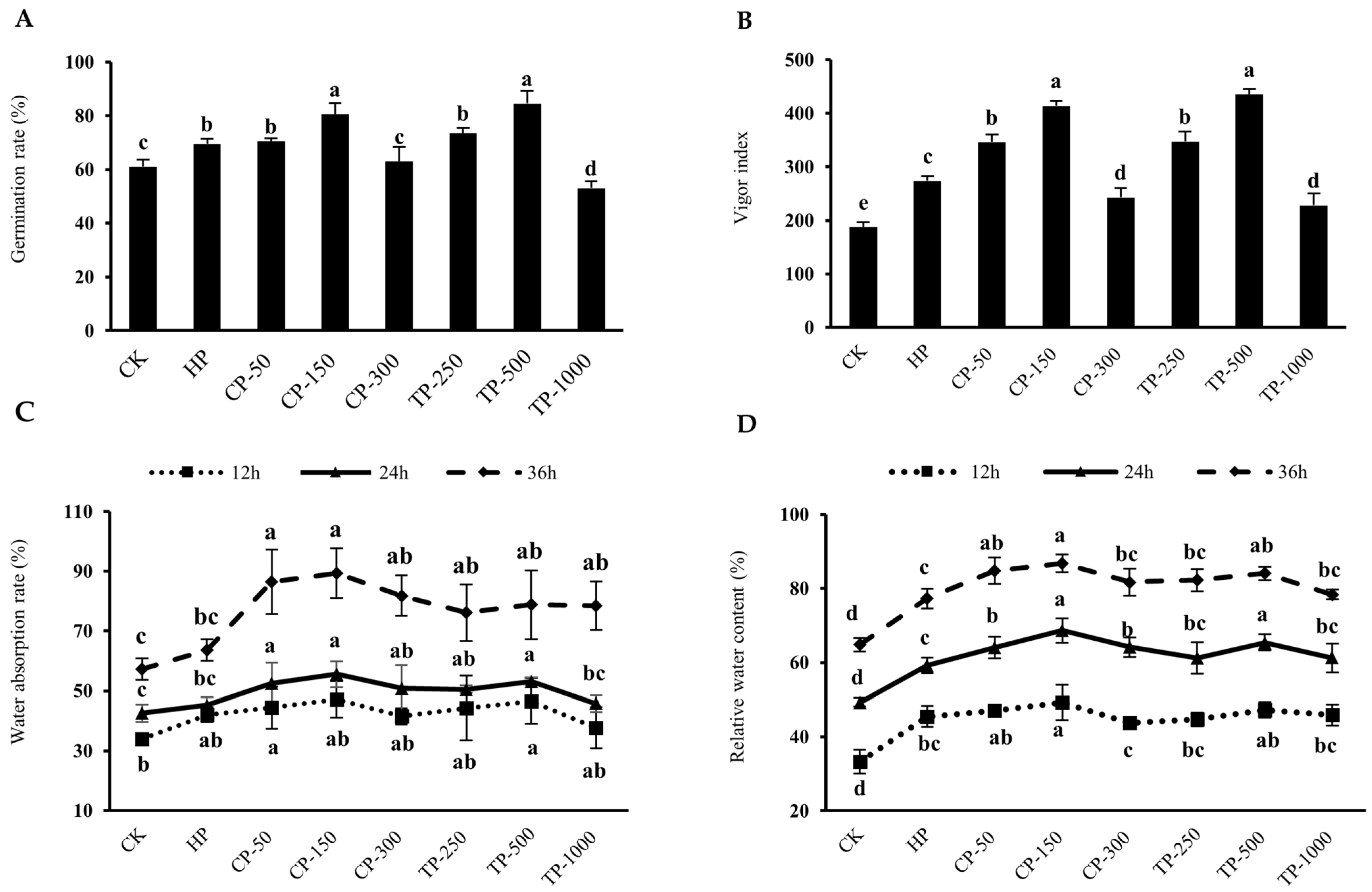
Seed germination performance was significantly influenced by priming treatments (Figure 2A,B). Compared to the non-primed control (CK), hydro-priming (HP) increased the final germination rate by 13.93%. Priming with 150 mg·L−1 nano-CeO2 (CP-150) and 500 mg·L−1 nano-TiO2 (TP-500) increased the germination rate by 31.97% and 38.52%, respectively. The germination rates under CP-150 and TP-500 were 15.83% and 21.58% higher than those under HP, respectively. In contrast, the highest concentrations tested—300 mg·L−1 nano-CeO2 (CP-300) and 1000 mg·L−1 nano-TiO2 (TP-1000)—showed no significant benefit or an inhibitory effect on germination rate compared to CK.
The vigor index was enhanced by all priming treatments relative to CK. The CP-150 and TP-500 treatments showed the greatest increase, elevating the vigor index by 121.11% and 132.40%, respectively. The increases under HP, CP-50, CP-300, TP-250, and TP-1000 were 46.13%, 84.74%, 29.77%, 85.52%, and 21.84%, respectively (Figure 2B).
Seed water uptake and retention under drought were improved by nano-priming (Figure 2C,D). At 12 h after imbibition, the water absorption rate was 38.67% and 36.98% higher in the CP-150 and TP-500 treatments, respectively, than in CK. From 24 to 36 h. All nano-priming treatments except TP-1000 maintained significantly higher water absorption rates than CK, with CP-150 and TP-500 showing the most pronounced effects. Concurrently, the relative water content of seeds during germination remained significantly higher in all nano-primed groups than in CK, with the CP-150 treatment exhibiting the highest value (Figure 2D).

3.2.2. Seedling Growth and Biomass Accumulation

Early seedling growth and biomass accumulation exhibited concentration-dependent and organ-specific responses (Table 1). After 7 days of growth under drought, all priming treatments alleviated the stress-induced inhibition on seedling growth compared to CK. The HP treatment improved all measured growth parameters relative to CK.
Among the nano-CeO2 treatments, CP-150 most effectively promoted root development. It increased root length and root dry weight by 22.06% and 17.86%, respectively, compared to CK. Conversely, among the nano-TiO2 treatments, TP-500 most strongly enhanced shoot growth. It increased shoot length, shoot fresh weight, and shoot dry weight by 20.58%, 13.86%, and 35.00%, respectively, compared to CK (Table 1). The root fresh weight under CP-150 and TP-500 did not differ significantly from each other, but both were higher than that under HP.
Based on their consistent and superior performance across germination, water relations, and seedling growth metrics, the treatments CP-150 (150 mg·L−1 nano-CeO2) and TP-500 (500 mg·L−1 nano-TiO2) were selected as the optimal concentrations for subsequent detailed physiological analysis.

3.3. Physiological Effects of Nano-Priming on Seed Germination Under Drought Stress

Based on the phenotypic screening results, the two optimal priming treatments, CP-150 (150 mg·L−1 nano-CeO2) and TP-500 (500 mg·L−1 nano-TiO2), were selected for in-depth analysis of physiological mechanisms during germination.

3.3.1. Endogenous Hormones

The dynamics of key endogenous hormones in barley seeds were differentially altered by the priming treatments under drought stress (Figure 3).
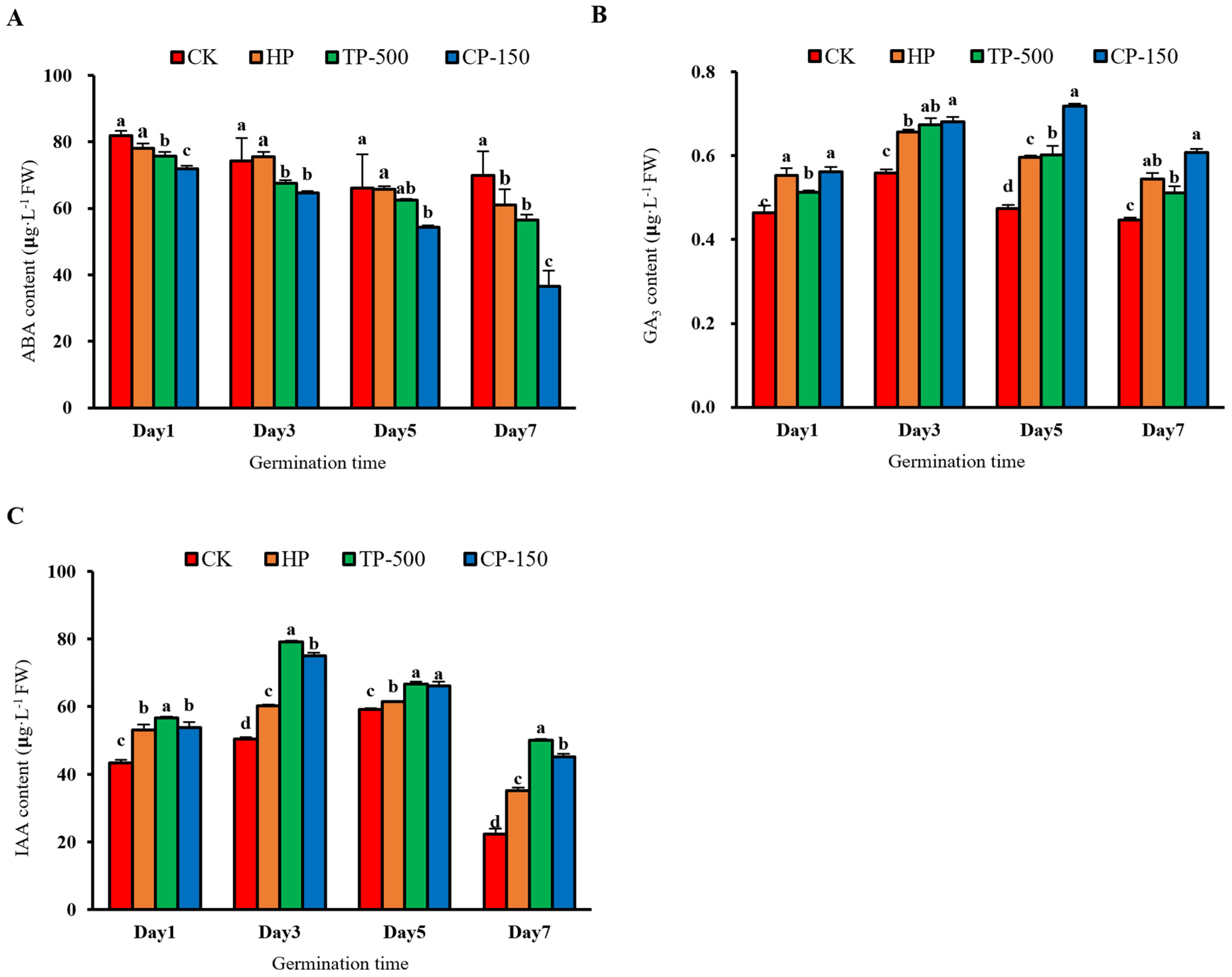
The content of abscisic acid (ABA), a germination inhibitor, decreased progressively from day 1 to day 7 in all groups (Figure 3A). Compared to the hydro-primed (HP) control, the TP-500 treatment significantly reduced ABA levels during the early germination stage (days 1–3), with reductions of 3.05% to 10.61%. The CP-150 treatment induced a more profound and sustained decrease in ABA throughout the entire 7-day period, showing reductions of 7.90% to 40.16% relative to HP.
The levels of gibberellic acid (GA3) and indole-3-acetic acid (IAA) exhibited a pattern of initial increase followed by a decrease (Figure 3B,C). In HP-treated seeds, both hormones peaked on day 5. The CP-150 treatment significantly increased GA3 content specifically during the mid-germination phase (days 3–5), with a maximum increase of 11.76% over HP on day 5. In contrast, the TP-500 treatment triggered an earlier and sharper accumulation of IAA, which peaked on day 3 at a level 31.55% higher than that in HP seeds. The CP-150 treatment also elevated IAA, but its peak increase (24.78% over HP) was lower than that of TP-500.

3.3.2. Starch Metabolism and Amylase Activity

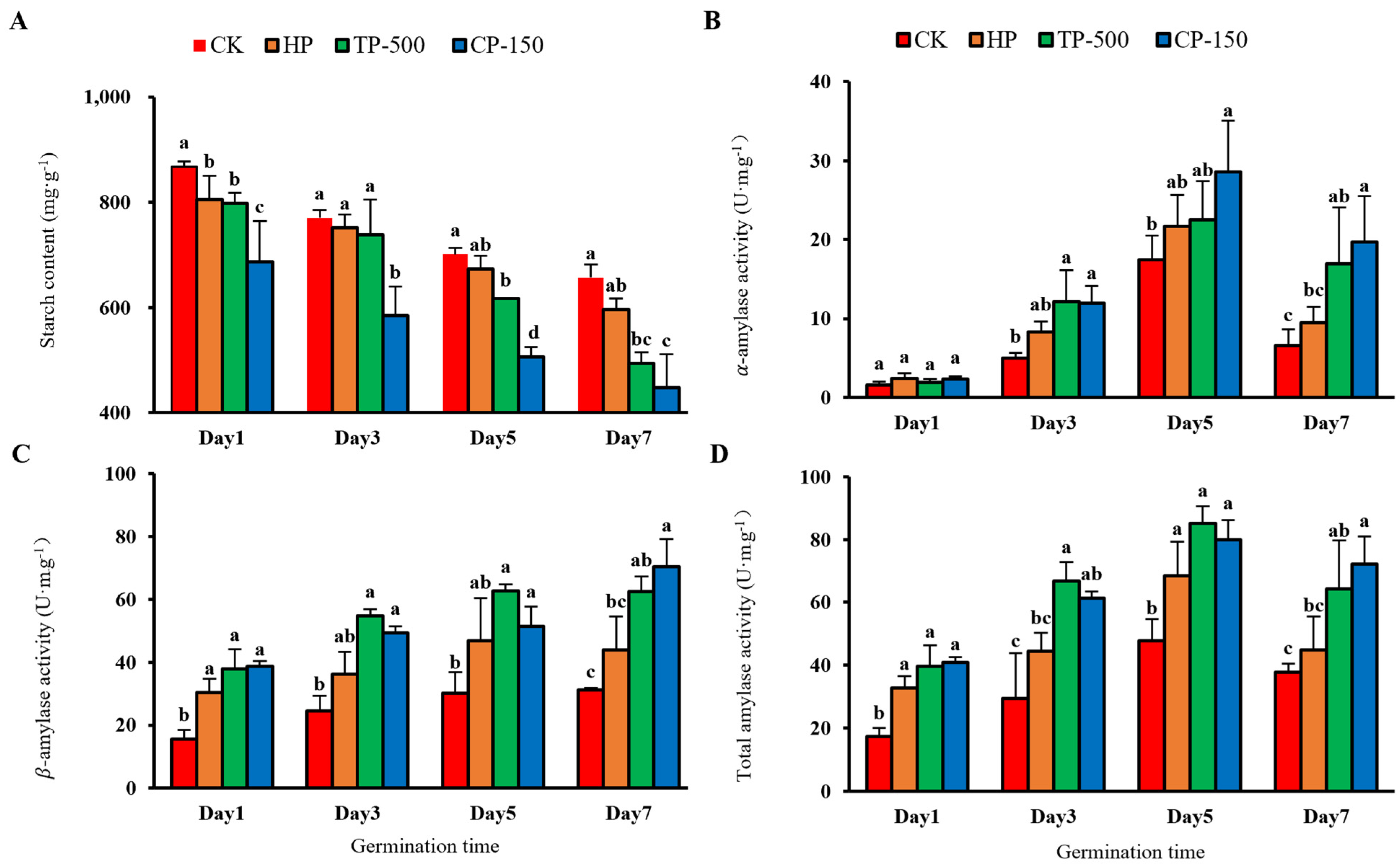
Starch content declined continuously during germination in all treatments (Figure 4A). The CP-150 treatment resulted in the lowest starch content from days 1 to 7, showing reductions of 14.75% to 24.89% compared to HP. The TP-500 treatment had no significant effect on starch content relative to HP.
The activities of α-amylase, β-amylase, and total amylase were differentially affected (Figure 4B–D). α-Amylase activity peaked on day 5. The CP-150 treatment significantly increased α-amylase activity from days 3 to 7, with enhancements ranging from 43.59% to 108.98% over HP. The TP-500 treatment showed only a slight, non-significant increase (Figure 4B). Both β-amylase and total amylase activities increased during germination. The CP-150 treatment significantly increased β-amylase activity by 60.28% compared to HP on day 7, and increased total amylase activity by 60.71% on the same day. The TP-500 treatment led to a significant increase in total amylase activity (50.23% over HP) on day 3 (Figure 4C,D).

3.3.3. Osmotic Adjustment Substances

The accumulation of osmoregulatory compounds during germination showed treatment-specific temporal patterns (Figure 5).
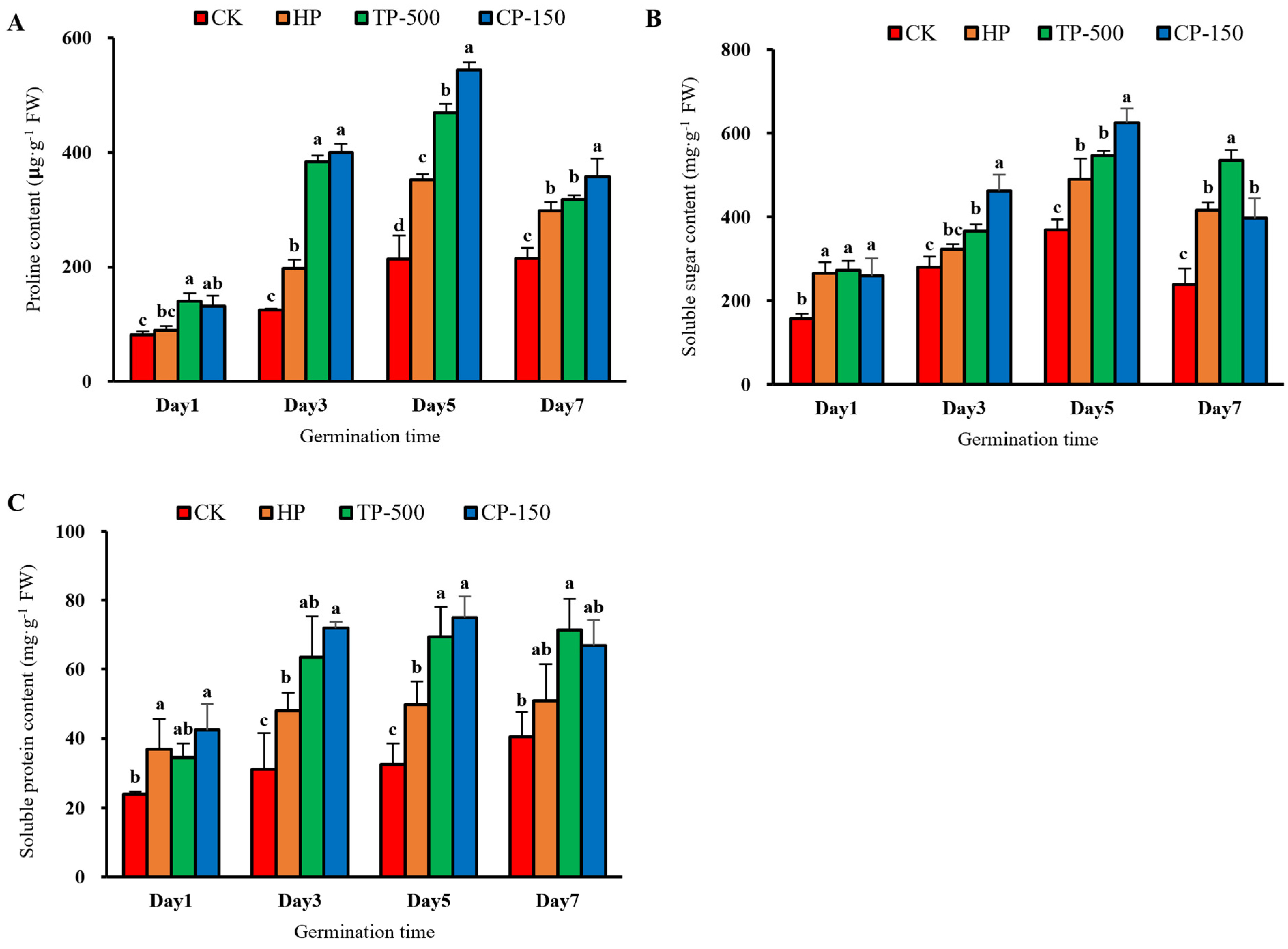
Proline content increased under drought stress (Figure 5A). On day 1, the TP-500 treatment had the highest proline content (57.65% higher than HP). From days 3 to 7, proline levels in HP seeds were significantly higher than in the non-primed control (CK). Compared to HP, the TP-500 treatment further increased proline by 33.33% to 93.93% during days 3–5, while the CP-150 treatment maintained significantly higher levels from days 3 to 7, with the greatest increase (101.94%) occurring on day 3.
Soluble sugar content showed an initial rise followed by a decline (Figure 5B). The CP-150 treatment consistently resulted in the highest soluble sugar levels from days 3 to 5, with increases of 11.76% to 13.23% over HP. By day 7, soluble sugar content had decreased in all groups, but remained higher than in CK; at this stage, the TP-500 treatment showed a significant increase (28.50% over HP).
Soluble protein content generally increased and stabilized between days 5 and 7 (Figure 5C). The CP-150 treatment demonstrated superior performance during the mid-germination phase (days 3–5), with soluble protein content 32.47% to 39.34% higher than HP. Conversely, the TP-500 treatment exhibited greater efficacy during the late germination phase (days 5–7), increasing soluble protein content by 31.19% to 50.62% compared to HP.

3.4. Physiological Effects of Nano-Priming on Barley Seedlings Under Drought Stress

The physiological responses of 7-day-old barley seedlings to the optimal priming treatments (CP-150 and TP-500) were investigated, focusing on photosynthetic capacity, antioxidant defense, membrane integrity, and osmotic adjustment.

3.4.1. Photosynthetic Pigments

The content of photosynthetic pigments in seedling leaves was differentially enhanced by the priming treatments (Table 2). Compared to the non-primed control (CK), hydro-priming (HP) significantly increased only chlorophyll a content (by 12.37%). The nano-priming treatments showed more pronounced and broader effects. The TP-500 treatment significantly increased the contents of chlorophyll a, chlorophyll b, and total chlorophyll by 59.54%, 55.02%, and 57.10%, respectively, relative to HP. The CP-150 treatment primarily increased chlorophyll b content (by 58.48% over HP), with no significant effect on chlorophyll a or total chlorophyll compared to HP. The carotenoid content was significantly higher under both CP-150 and TP-500 treatments than under CK, but was not significantly different from HP.

3.4.2. Antioxidant Enzyme Activity

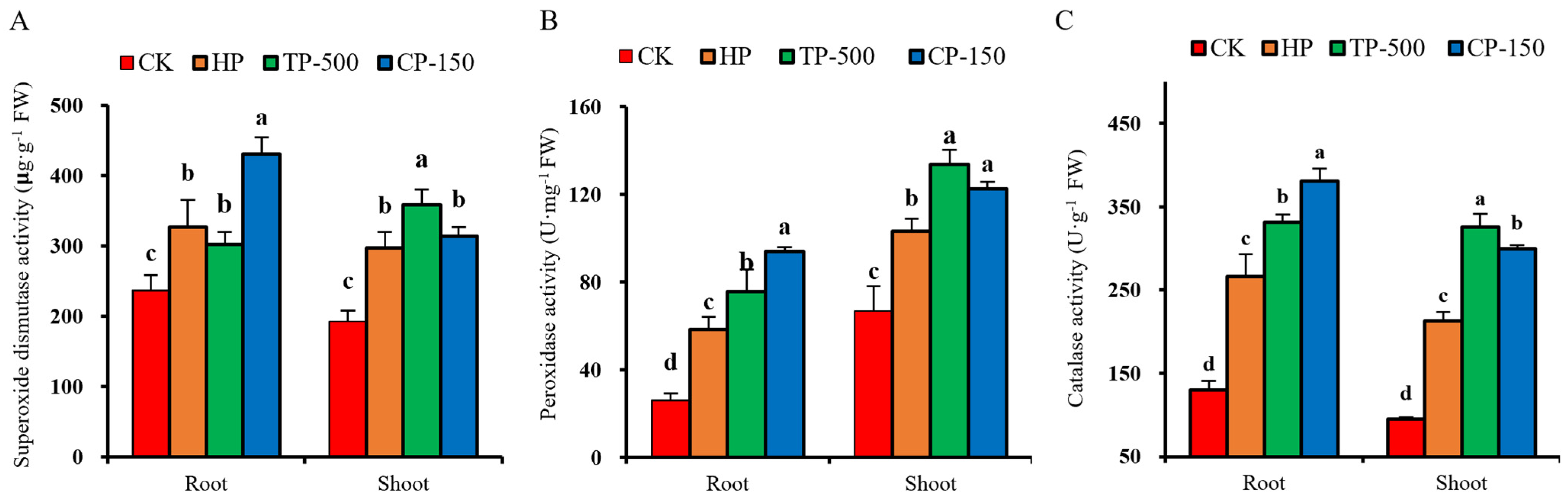
The activities of key antioxidant enzymes in roots and shoots were significantly modulated by nano-priming (Figure 6). The HP treatment increased the activities of superoxide dismutase (SOD), peroxidase (POD), and catalase (CAT) in both roots and shoots compared to CK. Compared to HP, the nano-priming treatments exhibited organ-specific enhancement patterns. In shoots, the TP-500 treatment significantly elevated the activities of all three enzymes, increasing SOD, POD, and CAT by 20.58%, 29.58%, and 53.00%, respectively. In roots, the CP-150 treatment most comprehensively enhanced the antioxidant system, increasing SOD, POD, and CAT activities by 31.97%, 61.27%, and 43.07%, respectively, compared to HP. The CP-150 treatment also significantly increased shoot POD activity (by 18.81% over HP).

3.4.3. Membrane Stability and Osmoregulatory Substances

Nano-priming treatments effectively protected cellular membranes and promoted the accumulation of osmoregulators in seedlings (Figure 7 and Figure 8).
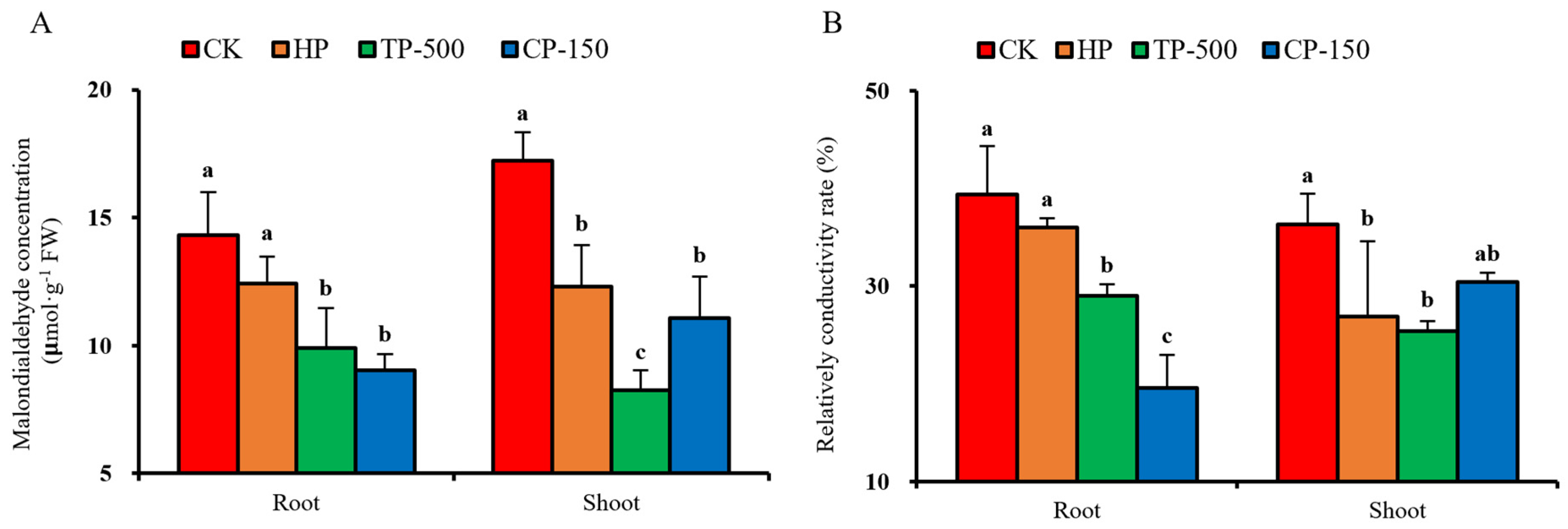
Malondialdehyde (MDA) content and relative electrical conductivity (REC) were assessed (Figure 7). In roots, both TP-500 and CP-150 treatments significantly reduced MDA content by 20.47% and 27.23%, respectively, compared to HP. In shoots, all priming treatments significantly suppressed MDA accumulation, with the TP-500 treatment showing the greatest reduction (52.02% lower than CK). For REC, the CP-150 treatment in roots showed the optimal effect, achieving a 50.40% reduction compared to HP, and the effect of TP-500 was also significant. In shoots, all priming treatments significantly lowered REC compared to CK, with the TP-500 treatment exhibiting the greatest reduction (29.98%); however, no significant differences were observed among the different priming treatments in shoots.
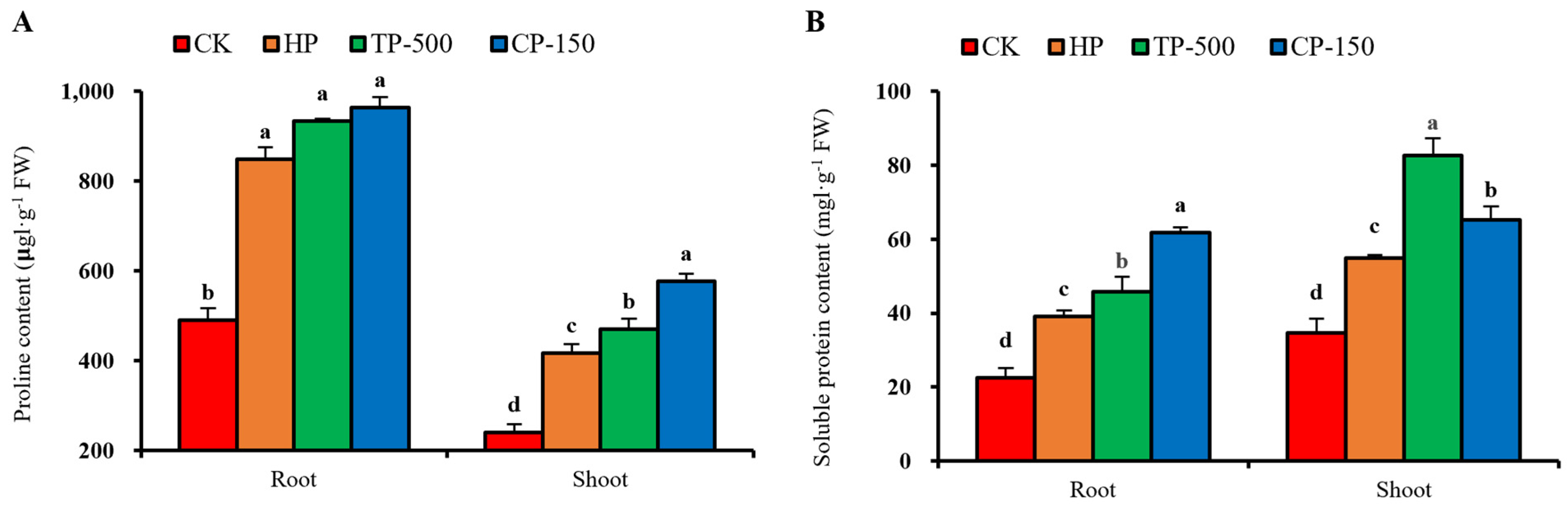
The accumulation of proline and soluble protein was measured in seedling tissues (Figure 8). Proline content in roots showed no significant differences among treatments. In shoots, both nano-priming treatments resulted in significantly higher proline content than HP, with the CP-150 treatment showing the highest level (38.34% increase over HP). Soluble protein content was significantly elevated by nano-priming in both organs. In roots, the CP-150 treatment increased soluble protein content by 58.11% compared to HP. In shoots, the TP-500 treatment exhibited the greatest enhancement, with a 50.62% increase over HP.

4. Discussion

4.1. Nano-Priming Treatment Promotes Seed Germination and Seedling Growth

Seed germination represents the critical founding stage of crop establishment, with germination rates exerting a substantial influence on ultimate yield potential. Seed priming is a well-established agronomic practice known to enhance germination efficiency compared to standard methods [24,25,26]. While traditional priming agents (e.g., osmotic substances, hormones, or inorganic salts) often target single physiological pathways, nano-priming is emerging as a multifaceted elicitor capable of modulating a broader spectrum of seed physiological processes. Extending this approach, our study demonstrates that nano-priming with CeO2 and TiO2 significantly modulates barley seed germination and early seedling growth under drought stress. The effects of both nanomaterials exhibited a distinct concentration-dependent response, following a classic “low-promotion, high-inhibition” hormetic pattern. Specifically, priming with 150 mg L−1 nano-CeO2 (CP-150) and 500 mg L−1 nano-TiO2 (TP-500) yielded the most pronounced improvements across multiple germination indices. This confirms that optimally dosed nano-priming can effectively counter the inhibitory impact of drought stress on barley seed germination.
This concentration-dependent phytostimulatory effect aligns with previous reports for other abiotic stresses. For instance, moderate concentrations of nano-TiO2 have been shown to alleviate germination inhibition in wheat and rice under cadmium and copper stress [27,28], while nano-CeO2 exhibits a similar biphasic response under salinity [29]. Our findings not only corroborate this general principle but also define the optimal concentrations (CP-150 and TP-500) for maximizing germination enhancement in barley under drought stress, underscoring the context-specific nature of nanomaterial efficacy.
A more remarkable effect was observed in the seedling vigor index, a key metric of seedling robustness. CP-150 and TP-500 enhanced the vigor index by 121.11% and 132.40%, respectively, far surpassing the improvement achieved by conventional hydro-priming (HP, 46.13%). This indicates that the benefit of optimal nano-priming extends beyond breaking dormancy to profoundly activating early seedling metabolic potential, fueling the rapid elongation of the radicle and plumule. We hypothesize that this activation is initiated by improved water relations. The unique physicochemical properties of nanomaterials, such as their small size and high specific surface area [30,31], are thought to enhance seed water uptake capacity. Our water imbibition data support this hypothesis: CP-150 and TP-500 seeds exhibited the highest water uptake rate within the first 12 h of germination.
During the critical 24–36 h imbibition phase, all nano-priming treatments (except the supra-optimal TP-1000) maintained significantly higher water uptake rates than the HP control. This sustained enhancement likely stems from nanomaterial-induced micro-modifications of the seed coat (e.g., increased porosity) and/or the upregulation of aquaporin-mediated water transport [32,33,34]. Consequently, CP-150 and TP-500 treatments maintained the highest seed relative water content throughout germination, demonstrating superior water retention capacity consistent with other studies [35,36]. This fundamental improvement in water status provided the foundation for subsequent physiological advantages.
The improved hydration and metabolic activation culminated in significant biomass accumulation. Both nano-priming treatments effectively alleviated drought-induced growth inhibition, with optimal concentrations (CP-150, TP-500) yielding the greatest biomass. Strikingly, the two nanomaterials promoted growth in distinct, organ-specific patterns. Nano-CeO2 (CP-150) preferentially stimulated root system development, a response consistent with its effects in maize and wheat [37,38,39]. This root-specific sensitization suggests that nano-CeO2 may enhance drought tolerance primarily by optimizing root architecture for resource acquisition [40,41], though interspecific variations exist. In contrast, nano-TiO2 (TP-500) selectively enhanced shoot biomass, a phenomenon also observed in tomato and maize under various stresses [42,43].

4.2. Nano-Priming Modulates Key Physiological Processes in a Material-Specific Manner

Endogenous hormones are master regulators of seed germination and dormancy, and their balance is disrupted under drought stress [44,45]. While hydro-priming (HP) partially restored this balance by GA3 and IAA and decreasing ABA later in germination, the nano-priming treatments elicited more potent and temporally distinct responses. In plant physiology, abscisic acid (ABA) is well established as a key germination inhibitor [45]. Our finding that the nano-CeO2 (CP-150) treatment significantly and sustainably reduced ABA content from days 1 to 7, while elevating GA3 levels specifically during the mid-germination stage (days 3–5). This “sustained ABA suppression with mid-phase GA3 boost” pattern is highly effective in releasing ABA-mediated dormancy and synchronizing GA3-driven radicle emergence and elongation [46,47]. This hormonal milieu is perfectly suited to support the robust root development observed with CP-150 treatment. Conversely, nano-TiO2 (TP-500) rapidly reduced ABA levels in the early germination stage (days 1–3), which coincided with a sharp, transient peak in IAA content on day 3. The early alleviation of ABA inhibition, coupled with a burst of IAA, creates a favorable hormonal environment for the rapid elongation of the coleoptile and hypocotyl, directly explaining the superior shoot growth promoted by TP-500 [48,49].
Starch is the primary storage substance in barley seeds [50], and drought stress often inhibits its catabolism, leading to a relative increase in starch content [51]. Our results show a material-specific divergence in how nano-priming regulates starch metabolism. Nano-CeO2 (CP-150) acted as a powerful amplifier of starch catabolism. It induced a significant and sustained increase in the activities of both α-amylase and β-amylase throughout germination. This enzyme activation led to the most rapid and extensive depletion of seed starch reserves. The mid-germination rise in GA3 induced by CP-150 is a likely upstream signal for this amylase activation, as GA is a known inducer of amylase synthesis. The resultant surge in soluble sugars supplied the abundant carbon skeletons and energy required to fuel the pronounced root growth characteristic of this treatment [52,53].
In marked contrast, nano-TiO2 (TP-500) treatment did not significantly alter starch content or amylase activity compared to the HP control. This indicates that the dramatic shoot growth promoted by TP-500 is not primarily driven by enhanced mobilization of seed starch reserves. Instead, it appears to be predominantly fueled by its ability to improve early water uptake and promote elongation hormone IAA, which likely directs resources towards shoot development [54].

4.3. Nano-Priming Enhances Photosynthetic Performance and Antioxidant Defense Capacity

Maintaining photosynthetic efficiency and scavenging reactive oxygen species are critical physiological processes for plants to sustain normal growth under drought stress. This study demonstrates that nano-priming treatments significantly enhanced barley seedling drought tolerance by protecting photosynthetic pigments and strengthening the antioxidant defense system.
Regarding photosynthetic capacity, conventional hydro-priming (HP) offered only marginal protection, slightly increasing chlorophyll a content with negligible effects on chlorophyll b and carotenoids. In contrast, the nano-priming treatments provided more comprehensive protection. The TP-500 treatment was particularly effective for shoot photosynthetic apparatus, significantly elevating chlorophyll a, chlorophyll b, and total chlorophyll content by over 55%. Meanwhile, the CP-150 treatment specifically increased chlorophyll b content. These findings align with previous reports on the protective effects of nanomaterials on photosynthetic pigments [55,56]. Both treatments also maintained higher levels of carotenoids. This enhancement of photosynthetic and photoprotective pigments likely improves the seedlings’ capacity to utilize and dissipate light energy safely, providing crucial protection for the photosynthetic machinery under drought.
Regarding antioxidant defense, the nano-priming responses exhibited distinct organ specificity. The TP-500 treatment most significantly boosted antioxidant enzyme activities in the shoots, particularly increasing CAT activity by 53.00%. This specific enhancement of shoot CAT activity by nano-TiO2 priming aligns with findings by Abdalla [57] and Parveen [58] in salt-stressed soybean and disease-infected tomato plants, respectively. This suggests that nano-TiO2 may activate a conserved defense pathway centered on H2O2 scavenging, thereby strengthening plant resistance to various stresses, particularly in the shoot tissues [59]. In contrast, the CP-150 treatment exhibited a more comprehensive enhancement of the antioxidant defense system in the roots, with significantly higher activities of SOD, POD, and CAT compared to the HP treatment. This root-specific antioxidant response pattern aligns with the reported effects of nano-CeO2 on apple [15] and maize [60] roots. These consistent findings across species suggest that different nanomaterials may enhance plant antioxidant capacity through distinct, organ-preferential molecular mechanisms.

4.4. Nano-Priming Enhances Membrane Stability and Osmoregulatory Capacity

Under drought stress, cell membrane stability and osmoregulatory capacity are crucial physiological indicators of plant drought tolerance. The results indicate that nano-priming treatments effectively enhanced barley seedling drought resistance by mitigating membrane damage and strengthening osmoregulation [61]. Compared to conventional hydro-priming (HP), nano-priming treatments significantly influenced the metabolic dynamics of key osmoregulators, such as proline, soluble sugars, and soluble proteins, demonstrating greater temporal specificity. The CP-150 treatment induced a sustained accumulation of proline during the mid-to-late germination stage (days 3–7). This pattern suggests that nano-CeO2 may facilitate systemic and long-term osmotic protection by modulating proline homeostasis, a strategy observed in plant adaptation to stress [62]. In contrast, the TP-500 treatment triggered a sharp, “explosive” increase in proline during the early-to-mid germination stage (days 3–5), which may represent an emergency response mechanism to rapidly establish the initial osmotic potential under stress [63].
For soluble sugars, the significant advantage of the CP-150 treatment during the critical germination window (days 3–5) was a direct metabolic consequence of its efficient starch degradation (Section 3.3.2), successfully converting stored carbon into osmotically active solutes [64]. Regarding soluble proteins, the advantage of the TP-500 treatment during the later stage (days 5–7) likely relates to supporting the sustained metabolic demands of rapid shoot growth.

4.5. Scientific Novelty, Application, and Future Perspectives

The most significant scientific contribution of this work is the identification of a “temporally and spatially complementary” mechanism between nano-CeO2 and nano-TiO2 priming. This mechanistic insight transcends mere growth promotion, providing a rationale for the targeted selection or combination of nanomaterials based on desired physiological outcomes—for instance, employing nano-CeO2 to bolster root resilience and nano-TiO2 to protect photosynthetic tissues. This positions nano-priming as a precision tool for crop management under climate stress.
We acknowledge that these findings originate from controlled laboratory studies using 20% PEG-6000, a standard method for inducing uniform osmotic stress. While this approach is essential for dissecting fundamental physiological responses, it simplifies the complex soil–plant dynamics of field drought. Nevertheless, the core mechanisms elucidated here—hormonal rebalancing, enhanced resource mobilization, and organ-specific antioxidant activation—constitute fundamental components of drought tolerance, as supported by the established literature [65,66]. Therefore, they provide a robust physiological foundation and testable hypotheses for translational research.
The logical and necessary next step is field validation to assess whether these targeted physiological improvements translate into enhanced drought resilience and yield stability in soil-grown barley. Concurrently, deepening the mechanistic understanding—including elucidating the precise uptake pathways of nanoparticles and the associated molecular signaling events—remains a critical focus for ongoing research. Together, efforts in both applied field testing and fundamental mechanism research will bridge the gap between laboratory discovery and sustainable agricultural practice.

5. Conclusions

This study demonstrates that seed priming with nano-CeO2 and nano-TiO2 significantly enhances drought tolerance in barley during germination and early seedling growth, with their effects exhibiting clear concentration dependence and distinct, organ-specific mechanisms. Comprehensive analysis determined the optimal concentrations for achieving the maximum beneficial effects: 150 mg·L−1 for nano-CeO2 and 500 mg·L−1 for nano-TiO2. Nano-CeO2 primarily strengthened the root system by enhancing antioxidant enzyme activities, stabilizing cellular membranes, and promoting the accumulation of osmoregulatory substances. In contrast, nano-TiO2 mainly benefited the shoot system by increasing photosynthetic pigment content, boosting antioxidant capacity (notably catalase activity), and facilitating the accumulation of osmoregulatory compounds. Both nanomaterials optimized endogenous hormonal balance by reducing abscisic acid (ABA) levels and promoting the synthesis of growth-stimulating hormones in a tissue-specific manner.
Collectively, our findings provide a mechanistic foundation for designing targeted nano-priming strategies. By understanding the complementary roles, nano-priming can be developed as a precision tool for crop stress management. Future research should focus on field validation of these promising results under real drought conditions and investigate the underlying molecular signaling pathways to fully unlock the translational potential of this approach for sustainable agriculture.

Author Contributions

Investigation, R.S.; Resources, R.S.; Data curation, X.Y. and R.S.; Writing—original draft, X.Y.; Writing—review & editing, X.Y.; Visualization, X.Y.; Supervision, J.Q.; Project administration, J.Q.; Funding acquisition, J.Q. All authors have read and agreed to the published version of the manuscript.

Funding

This research was funded by the China Agriculture Research System of MOF and MARA (CARS-05-19B).

Data Availability Statement

The original contributions presented in the study are included in the article; further inquiries can be directed to the corresponding author.

Conflicts of Interest

The authors declare no conflicts of interest.

References

  1. Abdelrady, A.; Ma, Z.; Elshawy, E.E.; Wang, L.; Askri, S.M.H.; Ibrahim, Z.; Dennis, E.; Kanwal, F.; Zeng, F.; Shamsi, I.H. Physiological and biochemical mechanisms of salt tolerance in barley under salinity stress. Plant Stress 2024, 11, 100403. [Google Scholar] [CrossRef]
  2. Song, R.J.; Shi, P.; Xiang, L.; He, Y.; Dong, Y.; Miao, Y.; Qi, J. Evaluation of barley genotypes for drought adaptability: Based on stress indices and comprehensive evaluation as criteria. Front. Plant Sci. 2024, 15, 1436872. [Google Scholar] [CrossRef] [PubMed]
  3. Akbari, M.; Sabouri, H.; Sajadi, S.J.; Yarahmadi, S.; Ahangar, L. Classification and prediction of drought and salinity stress tolerance in barley using GenPhenML. Sci. Rep. 2024, 14, 17420. [Google Scholar] [CrossRef] [PubMed]
  4. Bewley, J. Seed germination and dormancy. Plant Cell 1997, 9, 1055–1066. [Google Scholar] [CrossRef] [PubMed]
  5. Acharya, P.; Jayaprakasha, G.K.; Crosby, K.M.; Jifon, J.L.; Patil, B.S. Nanoparticle-mediated seed priming improves germination, growth, yield, and quality of watermelons (Citrullus lanatus) at multi-locations in Texas. Sci. Rep. 2020, 10, 5037. [Google Scholar] [CrossRef]
  6. Espanany, A.; Fallah, S.; Tadayyon, A. Seed priming improves seed germination and reduces oxidative stress in black cumin (Nigella sativa) in presence of cadmium. Ind. Crops Prod. 2016, 79, 195–204. [Google Scholar] [CrossRef]
  7. Fu, Y.F.; Ma, L.; Li, J.C.; Hou, D.; Zeng, B.; Zhang, L.; Liu, C.; Bi, Q.; Tan, J.; Yu, X. Factors influencing seed dormancy and germination and advances in seed priming technology. Plants 2024, 13, 1319. [Google Scholar] [CrossRef]
  8. Rasheed, A.; Li, H.; Tahir, M.M.; Mahmood, A.; Nawaz, M.; Shah, A.N.; Aslam, M.T.; Negm, S.; Moustafa, M.; Hassan, M.U.; et al. The role of nanoparticles in plant biochemical, physiological, and molecular responses under drought stress: A review. Front. Plant Sci. 2022, 13, 976179. [Google Scholar] [CrossRef]
  9. Wu, H.H.; Li, Z.H. Recent advances in nano-enabled agriculture for improving plant performance. Crop J. 2022, 10, 1–12. [Google Scholar] [CrossRef]
  10. Imtiaz, H.; Shiraz, M.; Mir, A.R.; Siddiqui, H.; Hayat, S. Nano-Priming Techniques for Plant Physio-Biochemistry and Stress Tolerance. J. Plant Growth Regul. 2023, 42, 6870–6890. [Google Scholar] [CrossRef]
  11. Zhao, L.; Lu, L.; Wang, A.; Zhang, H.; Huang, M.; Wu, H.; Xing, B.; Wang, Z.; Ji, R. Nano-biotechnology in agriculture: Use of nanomaterials to promote plant growth and stress tolerance. J. Agric. Food Chem. 2020, 68, 1935–1947. [Google Scholar] [CrossRef] [PubMed]
  12. Abdelhameed, R.E.; Hegazy, H.S.; Abdalla, H.; Adarosy, M.H. Efficacy of green synthesized titanium dioxide nanoparticles in attenuation salt stress in Glycine max plants: Modulations in metabolic constituents and cell ultrastructure. BMC Plant Biol. 2025, 25, 221. [Google Scholar] [CrossRef]
  13. An, J.; Hu, P.G.; Li, F.J.; Wu, H.H.; Shen, Y.; White, J.C.; Tian, X.L.; Li, Z.H.; Giraldo, J.P. Emerging investigator series: Molecular mechanisms of plant salinity stress tolerance improvement by seed priming with cerium oxide nanoparticles. Environ. Sci. Nano 2020, 7, 2214–2228. [Google Scholar] [CrossRef]
  14. Boora, R.; Rani, N.; Kumari, S.; Goel, S.; Arya, A.; Grewal, S. Exploring the role of green synthesized cerium nanoparticles in enhancing wheat’s drought tolerance: A comprehensive study of biochemical parameters and gene expression. Cereal Res. Commun. 2024, 52, 1487–1498. [Google Scholar] [CrossRef]
  15. Soleymani, S.; Piri, S.; Aazami, M.A.; Salehi, B. Cerium oxide nanoparticles alleviate drought stress in apple seedlings by regulating ion homeostasis, antioxidant defense, gene expression, and phytohormone balance. Sci. Rep. 2025, 15, 11805. [Google Scholar] [CrossRef]
  16. Wang, J.; Xu, J.; Yang, M.; Miao, M. Influence of SiO2, Al2O3 and TiO2 nanoparticles on okra seed germination under PEG-6000 simulated water deficit stress. J. Seed Sci. 2023, 45, e202345274866. [Google Scholar] [CrossRef]
  17. Zhao, L.; Li, T.; Chen, X.; Lan, R.; Pang, Z.; Wu, S.; Xiong, Y.; Wu, Y.; Wu, Y.; Lu, H.; et al. Resistance mechanism of Abies beshanzuensis under heat stress was elucidated through the integration of physiological and transcriptomic analyses. BMC Plant Biol. 2025, 25, 621. [Google Scholar] [CrossRef]
  18. Li, Z.G.; Gong, M. Comprehensive and Design-Oriented Experimental Tutorial in Plant Physiology; Huazhong University of Science and Technology Press: Wuhan, China, 2014; pp. 52–55. [Google Scholar]
  19. Dong, Q.; Huang, T.; Zhou, C.; Wan, X.; He, X.; Miao, P.; Cheng, H.; Wang, X.; Yu, H.; Hu, M.; et al. Nano-priming with selenium nanoparticles reprograms seed germination, antioxidant defense, and phenylpropanoid metabolism to enhance Fusarium graminearum resistance in maize seedlings. J. Adv. Res. 2025; in press. [Google Scholar] [CrossRef] [PubMed]
  20. Heath, R.L.; Packer, L. Photoperoxidation in isolated chloroplasts: I. kinetics and stoichiometry of fatty acid peroxidation. Arch. Biochem. Biophys. 1968, 125, 189–198. [Google Scholar] [CrossRef] [PubMed]
  21. Gui, X.; Zhang, Z.; Liu, S.; Ma, Y.; Zhang, P.; He, X.; Li, Y.; Zhang, J.; Li, H.; Rui, Y.; et al. Fate and phytotoxicity of CeO2 nanoparticles on lettuce cultured in the potting soil environment. PLoS ONE 2015, 10, e0134261. [Google Scholar] [CrossRef]
  22. Luo, H.; Duan, M.; Xing, P.; Zhang, Y.; Qi, J.; Kong, L.; Tang, X. Effects of L-glutamic acid application on yield, grain quality, photosynthetic pigments, 2-acetyl-1-pyrroline, and antioxidant system of aromatic rice. Field Crops Res. 2023, 303, 109134. [Google Scholar] [CrossRef]
  23. Biju, S.; Fuentes, S.; Gupta, D. Silicon improves seed germination and alleviates drought stress in lentil crops by regulating osmolytes, hydrolytic enzymes and antioxidant defense system. Plant Physiol. Biochem. 2017, 119, 250–264. [Google Scholar] [CrossRef]
  24. Hosseinifard, M.; Stefaniak, S.; Ghorbani, J.M.; Soltani, E.; Wojtyla, Ł.; Garnczarska, M. Contribution of exogenous proline to abiotic stresses tolerance in plants: A review. Int. J. Mol. Sci. 2022, 3, 5186. [Google Scholar] [CrossRef]
  25. Choudhary, R.; Rajput, V.D.; Ghodake, G.; Ahmad, F.; Meena, M.; Rehman, R.U.; Prasad, R.; Sharma, R.K.; Singh, R.; Seth, C.S. Comprehensive journey from past to present to future about seed priming with hydrogen peroxide and hydrogen sulfide concerning drought, temperature, UV and ozone stresses—A review. Plant Soil 2024, 500, 351–373. [Google Scholar] [CrossRef]
  26. Balabusta, M.; Szafrańska, K.; Posmyk, M.M. Exogenous melatonin improves antioxidant defense in cucumber seeds (Cucumis sativus L.) germinated under chilling stress. Front. Plant Sci. 2016, 7, 575. [Google Scholar] [CrossRef] [PubMed]
  27. Rizwan, M.; Ali, S.; Rehman, M.Z.; Malik, S.; Adrees, M.; Qayyum, M.F.; Alamri, S.A.; Alyemeni, M.N.; Ahmad, P. Effect of foliar applications of silicon and titanium dioxide nanoparticles on growth, oxidative stress, and cadmium accumulation by rice (Oryza sativa). Acta Physiol. Plant. 2019, 41, 35. [Google Scholar] [CrossRef]
  28. Alshegaihi, R.M.; Saleem, M.H.; Saleem, A.; Ali, B.; Aziz, H.; Fahad, S.; Alataway, A.; Dewidar, A.Z.; Elansary, H.O. Silicon and titanium dioxide mitigate copper stress in wheat (Triticum aestivum L.) through regulating antioxidant defense mechanisms. J. Plant Growth Regul. 2024, 43, 1519–1535. [Google Scholar] [CrossRef]
  29. Liu, J.; Li, G.; Chen, L.; Gu, J.; Wu, H.; Li, Z. Cerium oxide nanoparticles improve cotton salt tolerance by enabling better ability to maintain cytosolic K+/Na+ ratio. J. Nanobiotechnol. 2021, 19, 153. [Google Scholar] [CrossRef] [PubMed]
  30. Khan, M.N.; Li, Y.; Khan, Z.; Chen, L.; Liu, J.; Hu, J.; Wu, H.; Li, Z. Nanoceria seed priming enhanced salt tolerance in rapeseed through modulating ROS homeostasis and α-amylase activities. J. Nanobiotechnol. 2021, 19, 276. [Google Scholar] [CrossRef]
  31. Verma, S.K.; Das, A.K.; Patel, M.K.; Shah, A.; Kumar, V.; Gantait, S. Engineered nanomaterials for plant growth and development: A perspective analysis. Sci. Total Environ. 2018, 630, 1413–1435. [Google Scholar] [CrossRef]
  32. Nile, S.H.; Thiruvengadam, M.; Wang, Y.; Samynathan, R.; Shariati, M.A.; Rebezov, M.; Nile, A.; Sun, M.; Venkidasamy, B.; Xiao, J.B.; et al. Nano-priming as emerging seed priming technology for sustainable agriculture—Recent developments and future perspectives. J. Nanobiotechnol. 2022, 20, 254. [Google Scholar] [CrossRef]
  33. Mahakham, W.; Sarmah, A.K.; Maensiri, S.; Theerakulpisut, P. Nanopriming technology for enhancing germination and starch metabolism of aged rice seeds using phytosynthesized silver nanoparticles. Sci. Rep. 2017, 7, 8263. [Google Scholar] [CrossRef]
  34. Akdemir, H. Evaluation of transcription factor and aquaporin gene expressions in response to Al2O3 and ZnO nanoparticles during barley germination. Plant Physiol. Biochem. 2021, 166, 466–476. [Google Scholar] [CrossRef] [PubMed]
  35. Maurel, C.; Boursiac, Y.; Luu, D.-T.; Santoni, V.; Shahzad, Z.; Verdoucq, L. Aquaporins in plants. Physiol. Rev. 2015, 95, 1321–1358. [Google Scholar] [CrossRef]
  36. Wang, M.G.; Sun, G.Y.; Li, G.L.; Hu, G.H.; Fu, L.X.; Hu, S.X.; Yang, J.F.; Wang, Z.G.; Gu, W.R. Effects of multi walled carbon nanotubes and nano-SiO2 on key enzymes for seed germination and endogenous hormone level in maize seedling. Agronomy 2024, 14, 2908. [Google Scholar] [CrossRef]
  37. El-Badri, A.M.; Batool, M.; Mohamed, I.A.A.; Wang, Z.; Wang, C.; Tabl, K.M.; Khatab, A.; Kuai, J.; Wang, J.; Wang, B.; et al. Mitigation of the salinity stress in rapeseed (Brassica napus L.) productivity by exogenous applications of bio-selenium nanoparticles during the early seedling stage. Environ. Pollut. 2022, 310, 119815. [Google Scholar] [CrossRef]
  38. Wei, L.; Ji, L.; Rico, C.; He, C.; Shakoor, I.; Fakunle, M.; Lu, X.H.; Xia, Y.; Hou, Y.; Hong, J. Transcriptomics reveals the pathway for increasing Brassica chinensis L. yield under foliar application of titanium oxide nanoparticles. J. Agric. Food Chem. 2024, 72, 18957–18970. [Google Scholar] [CrossRef]
  39. López-Moreno, M.L.; de la Rosa, G.; Hernández-Viezcas, J.A.; Peralta-Videa, J.R.; Gardea-Torresdey, J.L. X-ray Absorption Spectroscopy (XAS) corroboration of the uptake and storage of CeO2 nanoparticles and assessment of their differential toxicity in four edible plant species. J. Agric. Food Chem. 2010, 58, 3689–3693. [Google Scholar] [CrossRef] [PubMed]
  40. Sun, C.; Zhao, C.; Wang, G.; Mao, Q.W.; Han, R. Cerium oxide nanoparticles alleviate enhanced UV-B radiation-induced stress in wheat seedling roots by regulating reactive oxygen species. Phyton-Int. J. Exp. Bot. 2025, 94, 455–479. [Google Scholar] [CrossRef]
  41. Gomez-Garay, A.; Pintos, B.; Manzanera, J.A.; Lobo, C.; Villalobos, N.; Martín, L. Uptake of CeO2 nanoparticles and its effect on growth of Medicago arborea in vitro plantlets. Biol. Trace Elem. Res. 2014, 161, 143–150. [Google Scholar] [CrossRef]
  42. Cevik, S. TiO2 nanoparticles alleviates the effects of drought stress in tomato seedlings. Bragantia 2022, 82, e20220203. [Google Scholar] [CrossRef]
  43. Karvar, M.; Azari, A.; Rahimi, A.; Maddah-Hosseini, S.; Ahmadi-Lahijani, M.J. Titanium dioxide nanoparticles (TiO2-NPs) enhance drought tolerance and grain yield of sweet corn (Zea mays L.) under deficit irrigation regimes. Acta Physiol. Plant. 2022, 44, 14. [Google Scholar] [CrossRef]
  44. Gupta, A.; Rico-Medina, A.; Caño-Delgado, A.I. The physiology of plant responses to drought. Science 2020, 368, 266–269. [Google Scholar] [CrossRef]
  45. Hojjati, M.; Jahromi, M.G.; Abdossi, V.; Torkashvand, A.M. Exogenous melatonin modulated drought stress by regulating physio-biochemical attributes and fatty acid profile of sweet cherry (Prunus avium L.). J. Plant Growth Regul. 2024, 43, 299–313. [Google Scholar] [CrossRef]
  46. Cai, Z.Y.; Ma, C.X.; Hao, Y.; Jia, W.L.; Cao, Y.N.; Wu, H.H.; Xu, X.X.; Han, L.F.; Li, C.Y.; Shang, H.P.; et al. Molecular evidence of CeO2 nanoparticle modulation of ABA and genes containing ABA-responsive cis-elements to promote rice drought resistance. Environ. Sci. Technol. 2024, 58, 21804–21816. [Google Scholar] [CrossRef]
  47. Li, W.L.; Qiu, H.; Li, X.; He, E. Intergenerational transfer of nano-CeO2 in clonal strawberry and associated modulation of the hormonal network to enhance offspring ramet growth. Environ. Sci. Technol. 2025, 59, 23202–23215. [Google Scholar] [CrossRef]
  48. Mustafa, N.; Raja, N.I.; Ilyas, N.; Ikram, M.; Mashwani, Z.U.; Ehsan, M. Foliar applications of plant-based titanium dioxide nanoparticles to improve agronomic and physiological attributes of wheat (Triticum aestivum L.) plants under salinity stress. Green Process. Synth. 2021, 10, 246–257. [Google Scholar] [CrossRef]
  49. Hojjat, S.S.; Louis, G.H. TiO2 nanoparticle improve germination and seedling parameters and enhance tolerance of bitter vetch (Vicia ervilia L.) plants under salinity and drought stress. Nanobiotechnol. Rep. 2022, 17, 411–419. [Google Scholar] [CrossRef]
  50. Drebenstedt, I.; Schmid, I.; Poll, C.; Marhan, S.; Kahle, R.; Kandeler, E.; Högy, P. Effects of soil warming and altered precipitation patterns on photosynthesis, biomass production and yield of barley. J. Appl. Bot. Food Qual. 2020, 93, 44–53. [Google Scholar] [CrossRef]
  51. Kandic, V.; Dodig, D.; Secanski, M.; Prodanovic, S.; Brankovic, G.; Titan, P. Grain yield, agronomic traits, and protein content of two- and six-row barley genotypes under terminal drought conditions. J. Cereal Sci. 2019, 79, 648–657. [Google Scholar] [CrossRef]
  52. Ahmadi, H.; Farhadi, H.; Morshedloo, M.R.; Maggi, F. Modeling and optimizing concentration of exogenous application of γ-aminobutyric acid on NaCl-stressed pineapple mint (Mentha suaveolens) using response surface methodology: An investigation into secondary metabolites and physiological parameters. BMC Plant Biol. 2023, 23, 309. [Google Scholar] [CrossRef] [PubMed]
  53. Wu, Y.X.; Xu, S.; Sun, M.Q.; Wei, H.; Muhammad, F.; Liu, L.Z.; Shi, G.L.; Gao, Y. Mn-doped cerium dioxide nanozyme mediates ROS homeostasis and hormone metabolic network to promote wheat germination under low-temperature conditions. Chem. Biol. Technol. Agric. 2025, 12, 92. [Google Scholar] [CrossRef]
  54. Maity, D.; Gupta, U.; Saha, S. Biosynthesized metal oxide nanoparticles for sustainable agriculture: Next-generation nanotechnology for crop production, protection and management. Nanoscale 2022, 149, 13950–13989. [Google Scholar] [CrossRef] [PubMed]
  55. Faraji, J.; Sepehri, A. Exogenous nitric oxide improves the protective effects of TiO2 nanoparticles on growth, antioxidant system and photosynthetic performance of wheat seedlings under drought stress. J. Soil Sci. Plant Nutr. 2020, 20, 703–714. [Google Scholar] [CrossRef]
  56. Adisa, I.O.; Pullagurala, V.L.; Rawat, S.; Hernandez-Viezcas, J.A.; Dimkpa, C.O.; Elmer, W.H.; White, J.C.; Peralta-Videa, J.R.; Gardea-Torresdey, J.L. Role of cerium compounds in Fusarium wilt suppression and growth enhancement in tomato (Solanum lycopersicum). J. Agric. Food Chem. 2018, 66, 5959–5970. [Google Scholar] [CrossRef]
  57. Abdalla, H.; Adarosy, M.H.; Hegazy, H.S.; Abdelhameed, R.E. Potential of green synthesized titanium dioxide nanoparticles for enhancing seedling emergence, vigor and tolerance indices and DPPH free radical scavenging in two varieties of soybean under salinity stress. BMC Plant Biol. 2022, 22, 560. [Google Scholar] [CrossRef]
  58. Parveen, A.; Siddiqui, Z.A. Foliar spray and seed priming of titanium dioxide nanoparticles and their impact on the growth of tomato, defense enzymes and some bacterial and fungal diseases. Arch. Phytopathol. Plant Prot. 2022, 55, 527–548. [Google Scholar] [CrossRef]
  59. Babaei, M.J.; Ebrahimi, A.; Heidari, P.; Azadvari, E.; Gharanjik, S.; Chaghakaboodi, Z. Titanium dioxide -mediated regulation of enzymatic and non-enzymatic antioxidants, pigments, and diosgenin content promotes cold stress tolerance in Trigonella foenum-graecum L. Sci. Rep. 2025, 15, 1837. [Google Scholar] [CrossRef]
  60. Zhao, L.J.; Peralta-Videa, J.R.; Varela-Ramirez, A.; Castillo-Michel, H.; Li, C.Q.; Zhang, J.; Aguilera, R.J.; Keller, A.A.; Gardea-Torresdey, J.L. Effect of surface coating and organic matter on the uptake of CeO2NPs by corn plants grown in soil: Insight into the uptake mechanism. J. Hazard. Mater. 2012, 225–226, 131–138. [Google Scholar] [CrossRef] [PubMed]
  61. Karami, A.; Sepehri, A. Nano titanium dioxide and nitric oxide alleviate salt induced changes in seedling growth, physiological and photosynthesis attributes of barley. Zemdirb. Agric. 2018, 105, 123–132. [Google Scholar] [CrossRef]
  62. Raza, A.; Charagh, S.; Abbas, S.; Hassan, M.U.; Saeed, F.; Haider, S.; Sharif, R.; Anand, A.; Corpas, F.J.; Jin, W.; et al. Assessment of proline function in higher plants under extreme temperatures. Plant Biol. 2023, 25, 379–395. [Google Scholar] [CrossRef]
  63. Rossi, L.; Zhang, W.L.; Schwab, A.P.; Ma, X.X. Uptake, accumulation, and in planta distribution of coexisting cerium oxide nanoparticles and cadmium in Glycine max (L.) Merr. Environ. Sci. Technol. 2017, 51, 12815–12824. [Google Scholar] [CrossRef]
  64. Azarkina, R.; Makeeva, A.; Mamaeva, A.; Kovalchuk, S.; Ganaeva, D.; Tikhonovich, I.; Fesenko, I. The proteomic and peptidomic response of wheat (Triticum aestivum L.) to drought Stress. Plants 2025, 14, 2168. [Google Scholar] [CrossRef] [PubMed]
  65. Seleiman, M.F.; Al-Suhaibani, N.; Ali, N.; Akmal, M.; Alotaibi, M.; Refay, Y.; Dindaroglu, T.; Abdul-Wajid, H.H.; Battaglia, M.L. Drought stress impacts on plants and different approaches to alleviate its adverse effects. Plants 2021, 10, 259. [Google Scholar] [CrossRef] [PubMed]
  66. Osmolovskaya, N.; Shumilina, J.; Kim, A.; Didio, A.; Grishina, T.; Bilova, T.; Keltsieva, O.A.; Zhukov, V.; Tikhonovich, I.; Tarakhovskaya, E. Methodology of drought stress research: Experimental setup and physiological characterization. Int. J. Mol. Sci. 2018, 19, 4089. [Google Scholar] [CrossRef] [PubMed]
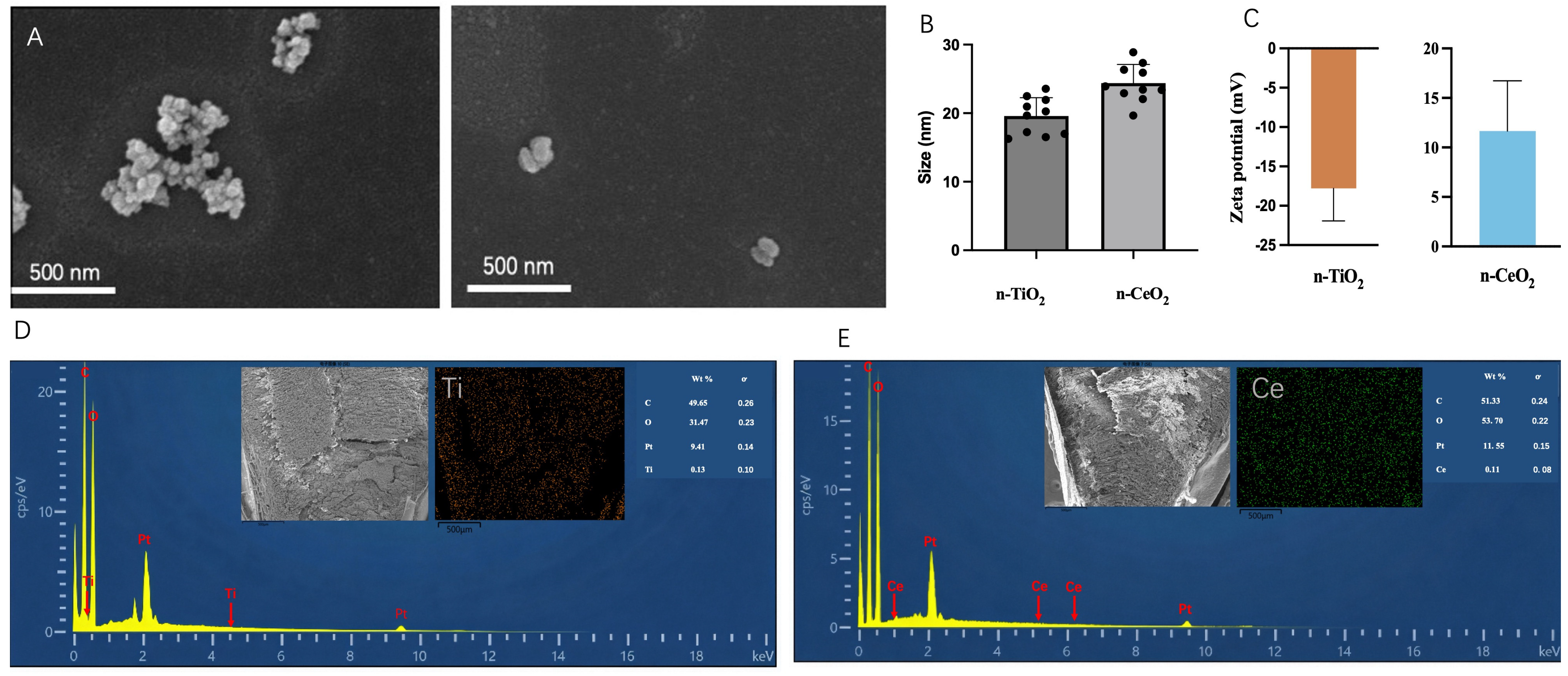
Figure 1. Characterization of nano-TiO2 and nano-CeO2 and preliminary evidence of their association with barley seeds. (A): the SEM images of nano-CeO2 (left) and nano-TiO2 (right); (B): the size of nano-TiO2 and nano-CeO2 (Mean ± SD, n = 10); (C): the charge of nano-TiO2 and nano-CeO2 (Mean ± SD, n = 3); (D): the evidence for titanium localization in a seed primed with TP-500; (E): the evidence for cerium localization in a seed primed with CP-150.
Agronomy 16 00316 g001
Figure 2. Effects of different concentrations of nano-CeO2 and nano-TiO2 on the germination indices, water absorption rate, and relative water content of barley seeds. CK: non-primed; HP: hydro-priming; CP-50: nano-CeO2 with concentrations of 50 mg·L−1; CP-150: nano-CeO2 with concentrations of 150 mg·L−1; CP-300: nano-CeO2 with concentrations of 300 mg·L−1; TP-250: nano-TiO2 with concentrations of 250 mg·L−1; TP-500: nano-TiO2 with concentrations of 500 mg·L−1; TP-1000: nano-TiO2 with concentrations of 1000 mg·L−1. (A): germination rate; (B): vigor index; (C): water absorption rate; (D): relative water content. Mean ± SD (n = 3). Different letters in the same column indicate significant differences among treatments at the p < 0.05 level.
Agronomy 16 00316 g002
Figure 3. Effect of nano-priming on endogenous hormones in barley seeds. CK: non-primed; HP: hydro-priming; TP-500: nano-TiO2 with concentrations of 500 mg·L−1; CP-150: nano-CeO2 with concentrations of 150 mg·L−1. (A): abscisic acid (ABA) content; (B): gibberellic acid (GA3) content; (C): auxin acid (IAA) content. Mean ± SD (n = 3). Different letters in the same column indicate significant differences among treatments at the p < 0.05.
Agronomy 16 00316 g003
Figure 4. Effect of nano-priming on starch and amylase activity in barley seeds. CK: non-primed; HP: hydro-priming; TP-500: nano-TiO2 with concentrations of 500 mg·L−1; CP-150: nano-CeO2 with concentrations of 150 mg·L−1. (A): starch content; (B): α-amylase activity; (C): β-amylase activity; (D): total amylase activity. Mean ± SD (n = 3). Different letters in the same column indicate significant differences among treatments at the p < 0.05.
Agronomy 16 00316 g004
Figure 5. Effect of nano-priming on osmotic regulatory substances in barley seeds. CK: non-primed; HP: hydro-priming; TP-500: nano-TiO2 with concentrations of 500 mg·L−1; CP-150: nano-CeO2 with concentrations of 150 mg·L−1. (A): proline content; (B): soluble sugar content; (C): soluble protein content. Mean ± SD (n = 3). Different letters in the same column indicate significant differences among treatments at the p < 0.05.
Agronomy 16 00316 g005
Figure 6. Effect of nano-priming on antioxidant enzymes in barley seedlings. CK: non-primed; HP: hydro-priming; TP-500: nano-TiO2 with concentrations of 500 mg·L−1; CP-150: nano-CeO2 with concentrations of 150 mg·L−1. (A): superoxide dismutase (SOD); (B): peroxidase (POD); (C): catalase (CAT). Mean ± SD (n = 3). Different letters in the same column indicate significant differences among treatments at p < 0.05.
Agronomy 16 00316 g006
Figure 7. Effect of nano-priming on malondialdehyde and relative conductivity in barley seedlings. CK: non-primed; HP: hydro-priming; TP-500: nano-TiO2 with concentrations of 500 mg·L−1; CP-150: nano-CeO2 with concentrations of 150 mg·L−1. (A): malondialdehyde (MDA) content; (B): relative electrical conductivity. Mean ± SD (n = 3). Different letters in the same column indicate significant differences among treatments at the p < 0.05.
Agronomy 16 00316 g007
Figure 8. Effect of nano-priming on proline and soluble protein in barley seedlings. CK: non-primed; HP: hydro-priming; TP-500: nano-TiO2 with concentrations of 500 mg·L−1; CP-150: nano-CeO2 with concentrations of 150 mg·L−1. (A): proline content; (B): soluble protein content. Mean ± SD (n = 3). Different letters in the same column indicate significant differences among treatments at the p < 0.05.
Agronomy 16 00316 g008
Table 1. Effects of priming treatments on growth and biomass accumulation of barley seedlings under drought stress.
TreatmentRoot Length
(cm)
Shoot Length
(cm)
Shoot Fresh Weight (g)Root
Fresh Weight (g)
Shoot
Dry Weight (g)
Root
Dry
Weight (g)
CK4.52 ± 0.12 e4.72 ± 0.12 d1.53 ± 0.10 d1.89 ± 0.04 ef0.10 ± 0.01 e0.24 ± 0.01 d
HP5.35 ± 0.17 c5.88 ± 0.11 c2.02 ± 0.12 b2.06 ± 0.09 cd0.20 ± 0.01 c0.28 ± 0.08 bc
CP-505.98 ± 0.31 b6.39 ± 0.14 b1.95 ± 0.11 bc2.19 ± 0.04 b0.23 ± 0.02 b0.27 ± 0.02 c
CP-1506.53 ± 0.20 a6.51 ± 0.23 b2.10 ± 0.09 ab2.43 ± 0.11 a0.24 ± 0.01 b0.33 ± 0.01 a
CP-3005.33 ± 0.19 c5.59 ± 0.26 c1.82 ± 0.13 c1.96 ± 0.11 de0.18 ± 0.01 d0.22 ± 0.02 d
TP-2505.43 ± 0.16 c6.67 ± 0.24 b1.92 ± 0.05 bc2.10 ± 0.10 bc0.24 ± 0.01 b0.29 ± 0.03 b
TP-5005.86 ± 0.14 b7.09 ± 0.11 a2.23 ± 0.19 a2.36 ± 0.09 a0.27 ± 0.01 a0.28 ± 0.01 bc
TP-10004.92 ± 0.25 d5.78 ± 0.34 c1.64 ± 0.11 d1.77 ± 0.09 f0.19 ± 0.00 cd0.27 ± 0.01 c
Note: CK: non-primed; HP: hydro-priming; CP-50: nano-CeO2 with concentrations of 50 mg·L−1; CP-150: nano-CeO2 with concentrations of 150 mg·L−1; CP-300: nano-CeO2 with concentrations of 300 mg·L−1; TP-250: nano-TiO2 with concentrations of 250 mg·L−1; TP-500: nano-TiO2 with concentrations of 500 mg·L−1; TP-1000: nano-TiO2 with concentrations of 1000 mg·L−1. Mean ± SD (n = 6). Different letters in the same column indicate significant differences among treatments at the p < 0.05 level.
Table 2. Effects of nano-priming treatments on the photosynthetic pigments of barley seedlings.
TreatmentChlorophyll a
(mg·g−1)
Chlorophyll b
(mg·g−1)
Total Chlorophyll
Content (mg·g−1)
Carotenoid
(mg·g−1)
CK0.26 ± 0.13 c0.62 ± 0.03 c0.88 ± 0.16 b0.14 ± 0.03 b
HP0.47 ± 0.14 bc0.70 ± 0.08 b1.17 ± 0.20 b0.19 ± 0.02 ab
CP-1500.75 ± 0.11 a1.08 ± 0.02 a1.83 ± 0.12 a0.33 ± 0.12 a
TP-5000.75 ± 0.07 a0.87 ± 0.05 ab1.58 ± 0.22 ab0.35 ± 0.13 a
Note: CK: non-primed; HP: hydro-priming; TP-500: nano-TiO2 with concentrations of 500 mg·L−1; CP-150: nano-CeO2 with concentrations of 150 mg·L−1. Mean ± SD (n = 3). Different letters in the same column indicate significant differences among treatments at the p < 0.05.
Disclaimer/Publisher’s Note: The statements, opinions and data contained in all publications are solely those of the individual author(s) and contributor(s) and not of MDPI and/or the editor(s). MDPI and/or the editor(s) disclaim responsibility for any injury to people or property resulting from any ideas, methods, instructions or products referred to in the content.