Article

Optimized Water Management Promotes Greenhouse Gas Mitigation in Global Rice Cultivation Without Compromising Yield

Department of Biosystems Engineering, Zhejiang University, Hangzhou 310058, China
*
Author to whom correspondence should be addressed.
Agronomy 2026, 16(3), 301; https://doi.org/10.3390/agronomy16030301
Submission received: 15 December 2025 / Revised: 10 January 2026 / Accepted: 22 January 2026 / Published: 25 January 2026
(This article belongs to the Section Agroecology Innovation: Achieving System Resilience)

Abstract

Rice is a vital staple food crop worldwide and also one of the major sources of greenhouse gas (GHG) emissions, generating substantial methane (CH4) and nitrous oxide (N2O). As one of the key management practices for rice production, the GHG mitigation potential of water management has attracted extensive attention, whereas its global scalability remains to be further investigated. Based on 15,458 global observations of field experimental data, we employed advanced machine learning methods to quantify the GHGs and soil carbon sequestration of global rice systems around 2020. Furthermore, we identified the optimal spatial distribution of GHG mitigation for five rice water management practices (continuous flooding (CF), flooding–midseason drainage–reflooding (FDF), alternate wetting and drying irrigation (AWD), flooding–midseason drainage–intermittent irrigation (FDI), and rainfed cultivation (RF)) through scenario simulation, under the premise of no yield reduction. The results of machine learning simulation showed that optimizing water management could reduce global rice greenhouse gas emissions by 39.17%, equivalent to 340.46 Mt CO2 eq, while increasing rice yields by 3.55%. This study provides valuable insights for the optimization of agricultural infrastructure and the realization of agricultural sustainable development.

1. Introduction

Rice (Oryza sativa L.), a staple food crop for more than half of the world’s population, boasts a long cultivation history [1]. While serving as a critical source of dietary energy, rice is also recognized as one of the largest sources of greenhouse gas (GHG) emissions globally [2]. On the one hand, the unique flooding process in rice fields facilitates anaerobic microbial reactions in the rhizosphere, thereby elevating methane (CH4) emissions [3]. On the other hand, the excessive application of nitrogen fertilizers stimulates substantial nitrous oxide (N2O) emissions from the soil [4]. Since the signing of the Paris Agreement, numerous countries have set ambitious GHG reduction targets, and carbon mitigation in rice production has emerged as a pivotal component in efforts to achieve global GHG abatement goals [5,6].
Water management is a crucial component in rice production [7]. Conventional continuous flooding irrigation induces the formation of a strongly anaerobic environment in paddy soils, which in turn provides favorable conditions for the proliferation and metabolism of methanogenic archaea, ultimately leading to substantial methane emissions [8]. In contrast, optimized water management practices can effectively interrupt the CH4 generation chain by breaking the continuity of the soil anaerobic environment [9]. For instance, mid-season drainage restores aerobic conditions in the soil through temporary drying, which significantly inhibits the activity of methanogenic archaea while promoting the growth of methanotrophs, thereby accelerating the oxidative degradation of residual methane in the soil [10]. The alternate wetting and drying mode, through the cyclic regulation of “wetting–drying” processes, can significantly reduce methane emissions on the premise of meeting the water demand for rice growth. However, the aforementioned optimized management practices pose the risk of increasing N2O emissions while reducing CH4 emissions [11,12]. Additionally, rice ecosystems exhibit a certain capacity for carbon sequestration, and water management practices are highly likely to modulate this carbon sequestration potential of rice systems [13]. Most importantly, water management is closely associated with rice yield, and thus the optimization of rice water management essentially entails a tripartite balance among GHG emissions, soil carbon sequestration rate (SOCSR), and rice yield [14].
Traditional field experiments of water management trials were conducted within a single field plot, resulting in research conclusions with certain geographical limitations [15]. Process-based models, such as DNDC, APSIM, and DSSAT, can predict GHG emissions, SOCSR, and crop yields by simulating biochemical processes; however, they often require intricate parameterization and calibration to achieve high simulation accuracy [16]. As a data-driven statistical tool, machine learning models can learn from existing field management experiences, enabling large-scale field simulations with high precision in a relatively short time [17]. Xiao et al. [18] optimized the irrigation amount and nitrogen application rate for wheat and maize in the North China Plain through a framework integrating machine learning and genetic algorithms, and developed grid-level agricultural management measures that achieve both emission reduction and yield increase. Yao et al. [19] optimized the water and nitrogen management of rice under different future climate scenarios in China using machine learning, which realized the triple benefits of nitrogen fertilizer reduction, GHG mitigation, and rice yield improvement.
To address the aforementioned research gaps, this study aims to achieve three core objectives: (1) develop high-accuracy machine learning models to predict key indicators (CH4, N2O, SOCSR, and rice yield) and interpret the impacts of water management practices on these target variables; (2) quantify the spatial patterns of these indicators for global rice production around 2020; (3) identify region-specific optimal water management regimes that minimize net GHG emissions without compromising yield. By fulfilling these objectives, this study is expected to provide a scientific basis for the optimization of agricultural water management infrastructure, offer actionable insights for sustainable rice production worldwide, and contribute to the achievement of global climate action and food security goals.

2. Materials and Methods

In this study, we compiled a global dataset of field trial observations and constructed four machine learning models to predict the indicators CH4, N2O, SOCSR, and rice grain yield. Subsequently, SHAP (SHapley Additive exPlanations) analysis was employed to evaluate the impacts of different water management regimes on the respective prediction targets. We then conducted simulations of net greenhouse gas (nGHG) emissions and rice grain yields at a spatial resolution of 0.05° across the globe around the year 2020. On this basis, we identified the water management regime with the minimum nGHG emissions for each rice-growing grid cell, subject to the constraint of maintaining current yield levels.

2.1. Data Collection

In this study, CH4 and N2O, SOCSR, and grain yield in rice cultivation were considered. The relevant data were obtained from peer-reviewed articles sourced from CNKI and Web of Science. The search language used was “(rice AND (CH4 OR methane)) OR (rice AND (N2O OR “nitrous oxide”)) OR (rice AND (“soil organic carbon sequestration” OR SOCSR OR SOC)) OR (rice AND yield)”. All the literature included in our dataset was required to meet the following criteria:
(1)
Field-based experiments were considered, while pot or greenhouse studies were excluded.
(2)
Information on experimental duration, latitude, and longitude was provided.
(3)
Detailed descriptions of agricultural management practices were given, covering water management, fertilization, straw management, and tillage.
(4)
At least one season of measured data on CH4 emissions, N2O emissions, SOCSR, or grain yield was reported, with model-simulated results excluded.
(5)
For CH4 and N2O emissions, we exclusively collected data measured via the static chamber method, given its status as the most widely adopted technique for field-based greenhouse gas flux measurements [20].
(6)
For the SOCSR, we retained data of the topsoil layer (0–20 cm).
(7)
For rice yield, we only included data that reported, or allowed for the calculation of, grain yield on a dry-weight basis.
(8)
All data collected are based on measurements over a single growing season. Studies that neither reported nor allowed for the indirect calculation of any of these four target variables for one growing season were excluded from the dataset.
(9)
For references without direct reporting of the SOCSR, we calculated the SOCSR during the rice growing season using the following formula:
S O C S R = ( S O C t × B D t S O C i × B D i ) × H × 10 1 / t
where S O C t and S O C i denote the soil organic carbon content (g kg−1) at the time t and in the initial time i , respectively. B D t and B D i represent the soil bulk density (g cm−3) at the time t and in the initial year i , respectively.   H is the soil depth (20 cm here). 10 1 is the unit conversion factor and denotes the experiment duration (season).
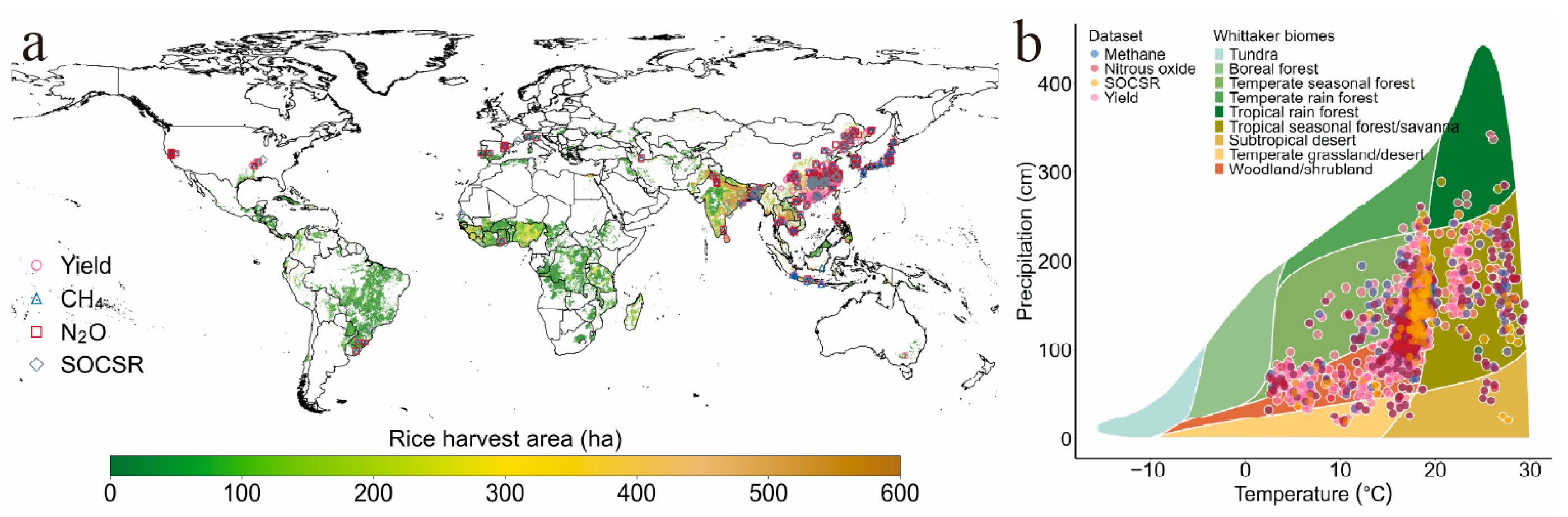
Based on these criteria, a total of 2341 CH4 records, 1819 N2O records, 800 SOCSR records, and 10,498 grain yield records were compiled, covering almost all major geographic and climatic zones for global rice cultivation (Figure 1, Table S1).

2.2. Machine Learning Models

For the four variables, including CH4 emissions, N2O emissions, SOCSR, and grain yield, we employed machine learning models (details presented later in the text) to predict their global distributions. The input features for the models comprised climate parameters, soil properties, and agricultural management practices. Climate parameters, including mean annual temperature and total annual precipitation, were extracted from the CRU TS 4.0 dataset [21] based on the geographic coordinates and experimental years of each site. Soil parameters consisted of soil texture (silt, sand, and clay content), pH, soil organic matter, total soil nitrogen, and bulk density. These were primarily obtained from the filtered literature; where such data were missing, they were supplemented using the Harmonized World Soil Database v2.0 [22] according to the site coordinates. Agricultural management practices covered water management (continuous flooding (CF) and flooding–midseason drainage–reflooding (FDF), alternate wetting and drying irrigation (AWD), flooding–midseason drainage–intermittent irrigation (FDI), and rainfed (RF) cultivation), fertilizer application (synthetic nitrogen, phosphorus, and potassium fertilization; organic nitrogen input), tillage (conventional tillage vs. no-till), and straw return rate (0–100%). The five water management options were encoded using one-hot encoding, with 1 indicating the adoption of a given practice and 0 otherwise, ensuring that only one water regime was assigned per observation. Tillage was treated as a binary variable, where 1 represented conventional tillage and 0 represented no-till. All remaining variables were continuous numerical inputs.
To identify the most accurate machine learning model, four classical machine learning algorithms, including Random Forest [23], Support Vector Regressor [24] (SVR), Gradient Boosting Decision Tree Regression [25] (GBDT), and eXtreme Gradient Boosting Regression [26] (XGBoost), were employed as candidate models for predicting the four target variables. First, all data collected in the dataset were divided into training and testing sets in an 8:2 ratio. Subsequently, the input features of the training dataset were standardized using Z-score (Equation (2)), where Z i is the standardized value of the i-th feature, X i is its original value, and μ i and σ i represent the mean and standard deviation of the i-th feature, respectively. We performed hyperparameter tuning using five-fold cross-validation on the normalized training set, selecting the hyperparameter set that yielded the highest coefficient of determination (R2) as the optimal configuration for each model (see the ranges of hyperparameters in Table S2). Using these optimized hyperparameters, the models were trained on the full training set. Their performance was then evaluated on the test set using R2, root mean square error (RMSE), and mean absolute error (MAE) as metrics for model selection (Equations (3)–(5))
Z i = X i μ i σ i
R 2 = 1 i = 1 n ( y T i y P i ) 2 i = 1 n ( y T i y T ¯ ) 2
R M S E = 1 n i = 1 n ( y T i y P i ) 2
M A E = 1 n i = 1 n y T i y P i
where y T i and y P i denote the observed and predicted values of each target variable for the i-th instance, and n denotes the number of observations in the testing set. For each target variable, the model that performed optimally across the R2, RMSE, and MAE metrics was selected as the final model. The final models utilized to simulate global rice GHG emissions, SOCSR, and grain yield were retrained on the entire dataset [27]. Considering that our machine learning model does not account for factors such as natural disasters and socio-economic conditions, our yield predictions may deviate from the actual situation. We therefore applied a correction factor to the predicted yield of each rice grid cell in each country [15], aligning the national total predicted yield with the 2020 statistical data (Equations (6) and (7)). In these equations, Y i j p r e d represents the directly machine-learning-predicted yield for grid cell i in country j , α j denotes the correction factor of country j , and Y i j a d j is the adjusted yield. The term Y t o t a l j p r e d corresponds to the uncorrected sum of predicted yields across all grid cells in country j , while Y t o t a l j F A O is the total rice production for that country in 2020 recorded in FAOSTAT [28]. To further investigate the uncertainty of the machine learning model, we performed a bootstrap uncertainty analysis on the prediction results, as detailed in Text S1.
Y i j a d j = Y i j p r e d · α j
α j = Y t o t a l j p r e d Y t o t a l j F A O
To investigate the impact of different water management practices on the target variables, we employed the SHAP (SHapley Additive exPlanations) framework, an interpretable machine learning approach, to explain their impact in the final machine learning model [29]. Based on cooperative game theory, SHAP quantifies the contribution of each input feature to the model output using Shapley values. A positive Shapley value indicates that the feature has a positive effect on the prediction, while a negative value signifies a negative influence [30]. The sum of the Shapley values across all features equals the model’s predicted outcome. Using the entire dataset as input to the SHAP interpretability framework, we analyzed the effects of the five water management practices on variables CH4, N2O, SOCSR, and rice grain yield.

2.3. Global Mapping

Based on the finalized machine learning model, we simulated the baseline conditions of CH4 emissions, N2O emissions, SOCSR, and rice grain yield for global rice production. We utilized the global CROPGRIDS dataset [31] at a 0.05° resolution and, based on the latitude and longitude of each cultivation site, matched climate and soil parameters for each location from the CRU TS v4.0 [21] and HWSD v2.0 [22] datasets, using the average of years 2018–2022 as the reference. Subsequently, inorganic nitrogen, phosphorus, and potassium fertilizer application rates, as well as organic fertilizer inputs, were obtained from the NPKGRIDS dataset [32] and the study by Adalibieke et al. [33], according to the geographic location of each site. Data on straw management and tillage practices were sourced from global datasets by Smerald et al. [34] and Porwollik et al. [35], respectively. For water management, we used the global raster dataset by Grogan et al. [36] to extract the proportion of rainfed area for each location. Due to the absence of a more detailed dataset on current water management practices, we assumed that, apart from the rainfed areas specified in the Grogan et al. dataset, all other areas employed traditional continuous flooding irrigation.

2.4. Water Management Optimization

Based on the aforementioned climate and soil parameters as well as local agricultural management practices, we optimized water management for global rice cultivation grids at a 0.05° resolution. The specific approach involved, for each grid cell, keeping all other management practices unchanged while sequentially applying the best machine learning models to estimate GHG emissions and grain yields under five water management regimes: CF, FDF, AWD, FDI, and RF cultivation. nGHG emissions were calculated using Equation (8), which is derived from the IPCC AR6 [37]. The coefficients 27 and 273 represent the 100-year global warming potentials used to convert emissions of CH4 and N2O into CO2-equivalent emissions. The factor 44/12 is the stoichiometric conversion coefficient used to convert changes in soil organic carbon (expressed in mass of C, as in SOCSR) into equivalent CO2 emissions or removals. Maintaining yields without compromise to ensure food security constitutes a fundamental prerequisite for agricultural environmental mitigation research [38]. For each grid cell, we selected the water management practice that minimized nGHG emissions ( n G H G i ) without reducing yield under the baseline scenario as the optimal water management mode (Equation (9)). In this equation, n G H G i ( W i ) represents nGHG emissions under water management W i , while Y b a s e l i n e i and Y o p t i m i z e d i denote rice yields under the baseline and optimized scenarios, respectively. By multiplying the nGHG emissions ( n G H G t o t a l j ) and yields ( y t o t a l j ) of each grid i with its respective harvest area ( A i ) and aggregating the results within country j , we obtained the total value of nGHG emissions and rice production for each country under both baseline and optimized scenarios (Equations (10) and (11)) [15,39].
n G H G = 27 × C H 4 + 273 × N 2 O 44 12 × S O C S R
m i n : n G H G i ( W i ) s . t .     Y o p t i m i z e d i ( W i ) Y b a s e l i n e i
n G H G t o t a l j = i = 1 m A i · n G H G i
y t o t a l j = i = 1 m A i · y i
To further analyze the driving factors behind the optimized water management strategies, we computed the Pearson correlation coefficients between the five global optimized water management schemes and other climatic, soil, and agricultural management variables as follows:
r x y = i = 1 n ( W i W ¯ ) ( y i y ¯ ) i = 1 n ( W i W ¯ ) ( y i y ¯ )
where r x y represents the correlation coefficient between variable W i (water management regime) and variable y (climatic, soil, or agricultural management factor), n denotes the number of observations, and W ¯ and y ¯ are the respective sample means.

3. Results

3.1. Performance of Machine Learning Models

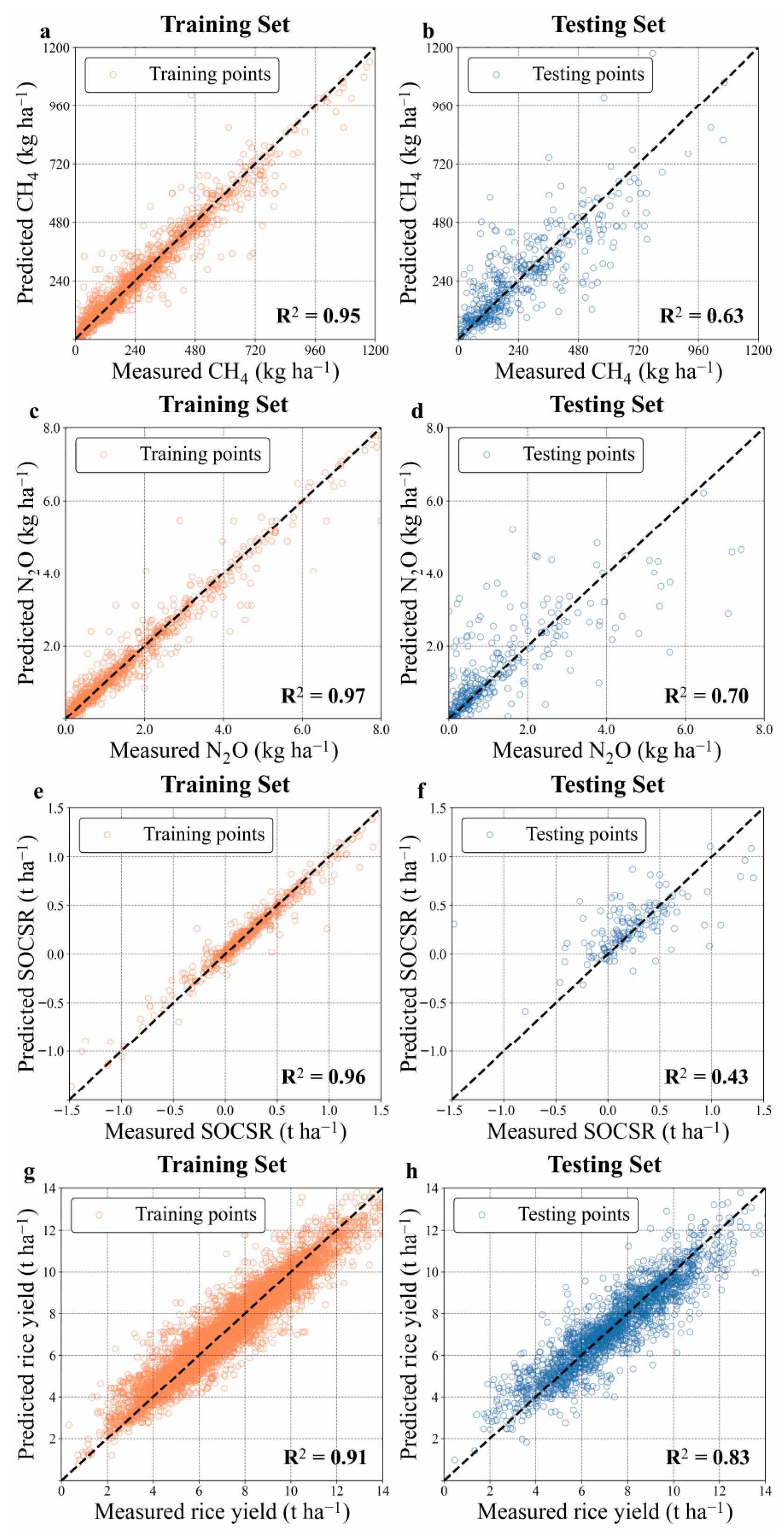
The training results of the machine learning models are presented in Table 1. Based on a comprehensive evaluation of test-set performance (R2, MAE, RMSE), XGBoost was selected as the final predictive model for CH4 and N2O emissions, while GBDT was chosen for SOCSR and grain yield. For CH4 and N2O, XGBoost achieved the highest test-set R2 (0.63 and 0.70, respectively) alongside the lowest or competitive MAE and RMSE among all candidates. For SOCSR and grain yield, GBDT attained the highest test-set R2 (0.43 and 0.83, respectively) and the lowest error metrics (MAE and RMSE). This selection is attributed to their consistent outperformance over Random Forest and SVR, which can be explained by several factors: (1) both XGBoost and GBDT employ gradient boosting frameworks that iteratively correct errors from previous models, thereby enhancing predictive precision and robustness [40]; (2) they inherently handle non-linear relationships and complex interactions more effectively through additive model construction and advanced regularization techniques [41]; (3) compared to Random Forest, they often achieve lower bias and better generalization by optimizing a differentiable loss function, while outperforming SVR in scalability and efficiency when dealing with large-scale, high-dimensional agricultural dataset [25,26]. The regression results of the four optimal models on both the training and test sets are shown in Figure 2. The prediction accuracy for grain yield was the highest on the test set, reaching 0.83. The prediction accuracy for the two GHGs, CH4 and N2O, ranked second and third, achieving values of 0.63 and 0.70 on the test set, respectively. Due to the pronounced volatility of SOCSR, the R2 of its optimal machine learning model on the test set was relatively low at 0.43. The uncertainty of the machine learning model can be found in Figure S1.

3.2. Effect of Water Management on Rice Production

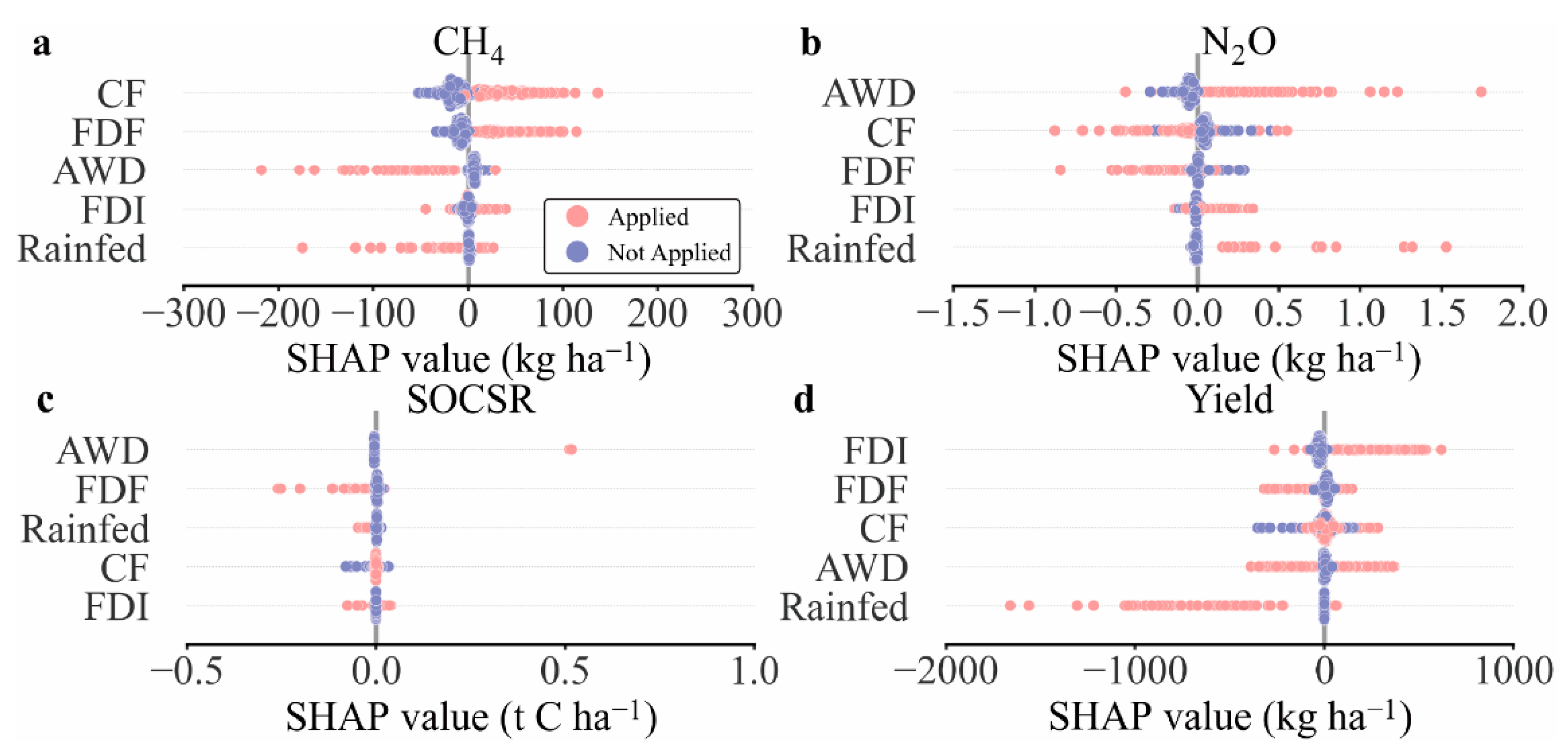
The SHAP-based interpretability analysis for water management in the machine learning model is illustrated in Figure 3. For the majority of the datasets, the SHAP values for CF and FDF were predominantly positive with respect to CH4 emissions, indicating a consistent positive association between these water regimes and CH4 release in the model. Notably, data points under FDF generally exhibited lower SHAP values than those under CF, a comparatively weaker positive association with CH4 emissions. In contrast, most observations under AWD and RF cultivation yielded negative SHAP values, reflecting a negative association with methane emissions in our model predictions. This pattern is consistent with field experiments [42] and meta-analyses [43,44], which attribute the observed reduction to decreased anaerobic conditions and thus lower methanogenic activity. Although FDI also showed predominantly positive SHAP values for CH4, their magnitudes were substantially smaller than those under CF and FDF, indicating a comparatively weaker promotion effect and a certain degree of mitigation relative to these two regimes in the model’s representation. These SHAP-derived patterns directly correspond to the biogeochemical cycles governing CH4 dynamics in paddy soils. Prolonged anaerobic conditions under specific water regimes sustain methanogen activity and organic matter decomposition cycles, while periodic aerobic phases disrupt these cycles to suppress CH4 generation [2]. For N2O, in contrast to CH4, water management practices that reduce CH4 emissions, including AWD, FDI, and RF cultivation, mostly produced positive SHAP values, suggesting a positive association with N2O emissions. Conversely, CF and FDF showed negative SHAP values, which is consistent with the inherent trade-off effect between anaerobic conditions favoring CH4 and aerobic phases promoting N2O production. Regarding SOCSR, except for a few outliers, none of the five water management practices exhibited a strong linear relationship with SOCSR, though FDF showed a slight negative influence. For grain yield, RF was consistently associated with reduced yield in the model’s outputs, while CF, FDF, and AWD displayed complex nonlinear relationships with yield. In contrast, FDI was predominantly associated with yield increase in most experimental observations.

3.3. Global GHG Emissions and Rice Yield

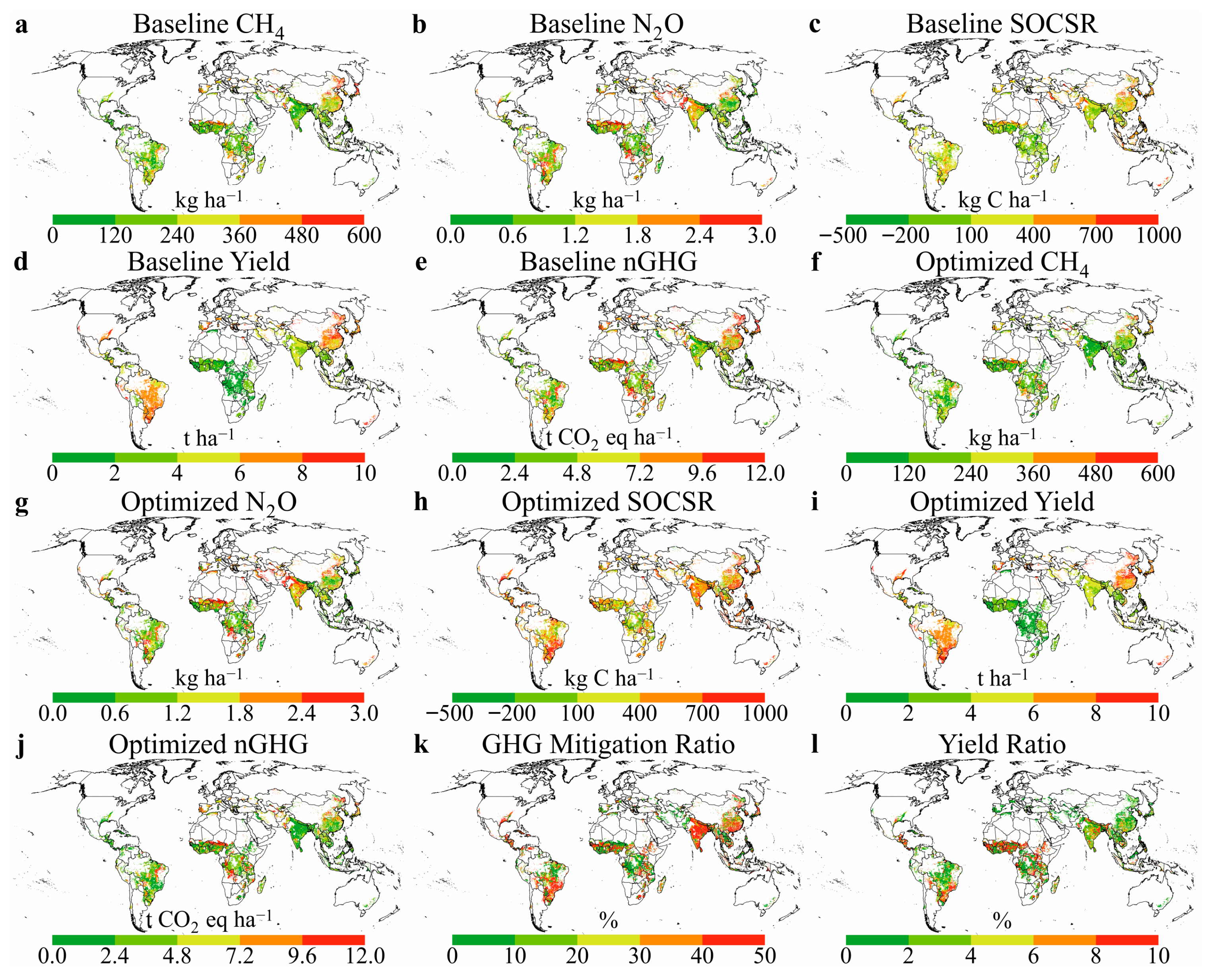
We mapped the global patterns of CH4 emissions, N2O emissions, SOCSR, and grain yield in rice cultivation (Figure 4a–d). High CH4 emissions were primarily concentrated in irrigated rice-growing regions, such as China, Japan, and Western Europe. Elevated N2O emissions were observed in parts of the Middle East, India, sub-Saharan Africa, and South America, which aligns with our earlier finding that RF systems tend to promote N2O emissions, as these regions have substantial RF rice areas [45].
Strong soil organic carbon (SOC) sequestration was evident in regions such as China and West Asia. This positive trend may be attributed to several factors, including sufficient fertilizer input, widespread adoption of residue return practices, and increased application of organic amendments in these areas [46,47,48,49]. In contrast, many regions across Africa generally exhibited a net loss of SOC. This pattern is likely driven by factors such as lower organic matter inputs due to limited crop residue management, higher rates of soil erosion under conventional tillage systems, and potentially faster mineralization rates in warmer climates [50,51]. These observations align with findings from previous studies [16,52]. High-yielding areas were mainly distributed in East Asia, the United States, and South America, which typically benefit from higher fertilizer inputs and mechanized farming conditions [1]. In contrast, grain yields in sub-Saharan Africa were notably lower than in other regions. Regions with higher nGHG emissions were concentrated in East Asia, parts of sub-Saharan Africa, and east-central Brazil. The status of CH4, N2O, and SOCSR for major rice-producing countries is summarized in Table 1.

3.4. Optimization Results and Driving Factor Analysis

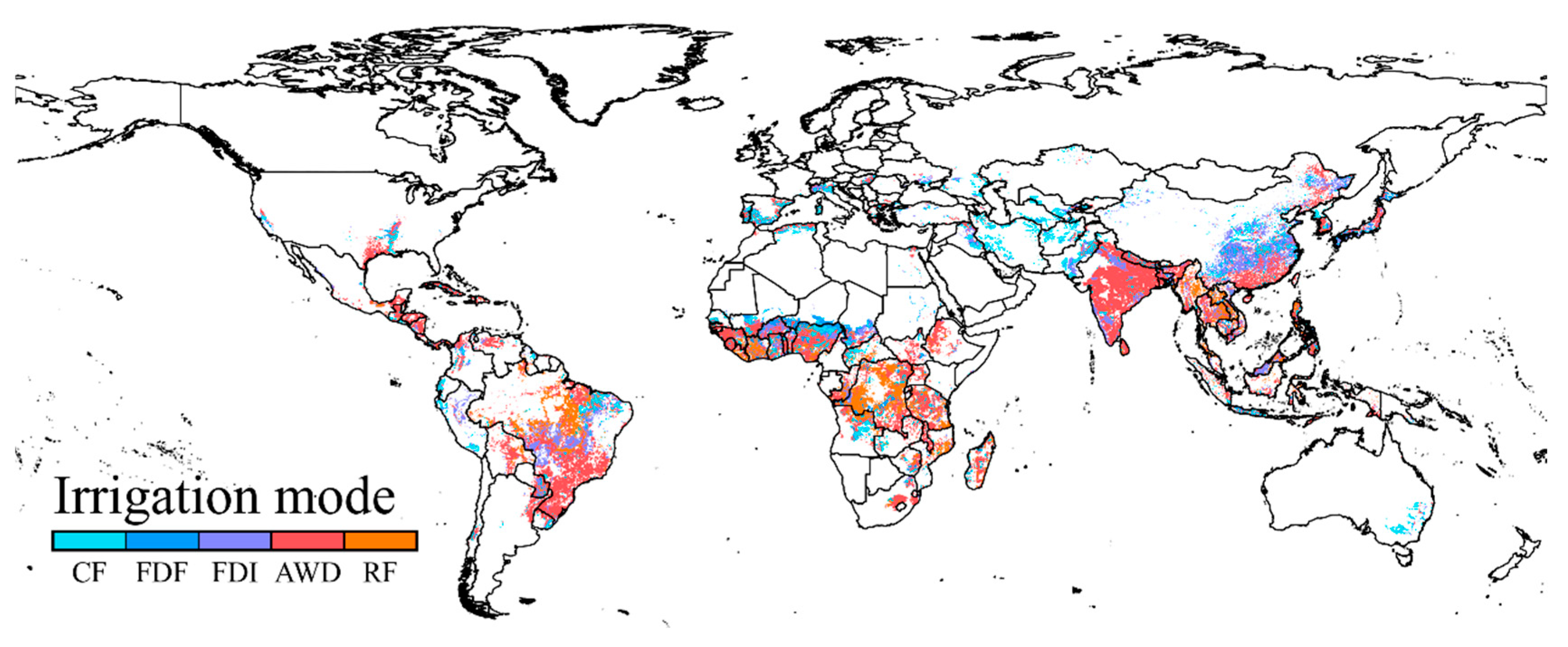
The spatial distribution of optimized water management practices is illustrated in Figure 5. We found that AWD is predominantly implemented in southern China, northeastern China, India, southern South America, and the southern United States. FDI is mainly concentrated in the central, western, and eastern regions of China. CF remains the primary management practice in the Middle East and Europe. RF cultivation is largely adopted in areas with abundant precipitation, such as the Amazon rainforest, equatorial Africa, and parts of Southeast Asia.
The corresponding impacts of these optimized practices on CH4 emissions, N2O emissions, SOCSR, and grain yield are shown in Figure 4f–i and summarized in Table 2 and Table 3. Following the implementation of optimized water management schemes, global rice greenhouse gas emissions are reduced by 39.17%, equivalent to 340.46 Mt CO2 eq, while rice yields increase by 3.55%. We observed a systematic trade-off in this emission reduction process: the reduction in CH4 emissions and the increase in SOCSR are achieved at the expense of elevated N2O emissions (Table 2).
Results showed that the most significant GHG reduction occurred in regions including southern China, across India, southern Brazil, and North America, where emission reductions exceeded 50% (Figure 4k, Table 3). In contrast, the lowest reductions were achieved in the Middle East and Europe, which is consistent with the continued use of CF management in these regions (Figure 5). Yield increases were most pronounced in Africa, with an overall rise of 6.31% (Figure 4l), followed by certain parts of India and Southeast Asia. We noted that regions with more advanced agricultural technology, such as China, the United States, and Europe, exhibited relatively lower proportional yield increases (0.82–2.17%) under optimal water management, which may be attributed to their already high baseline yield levels.
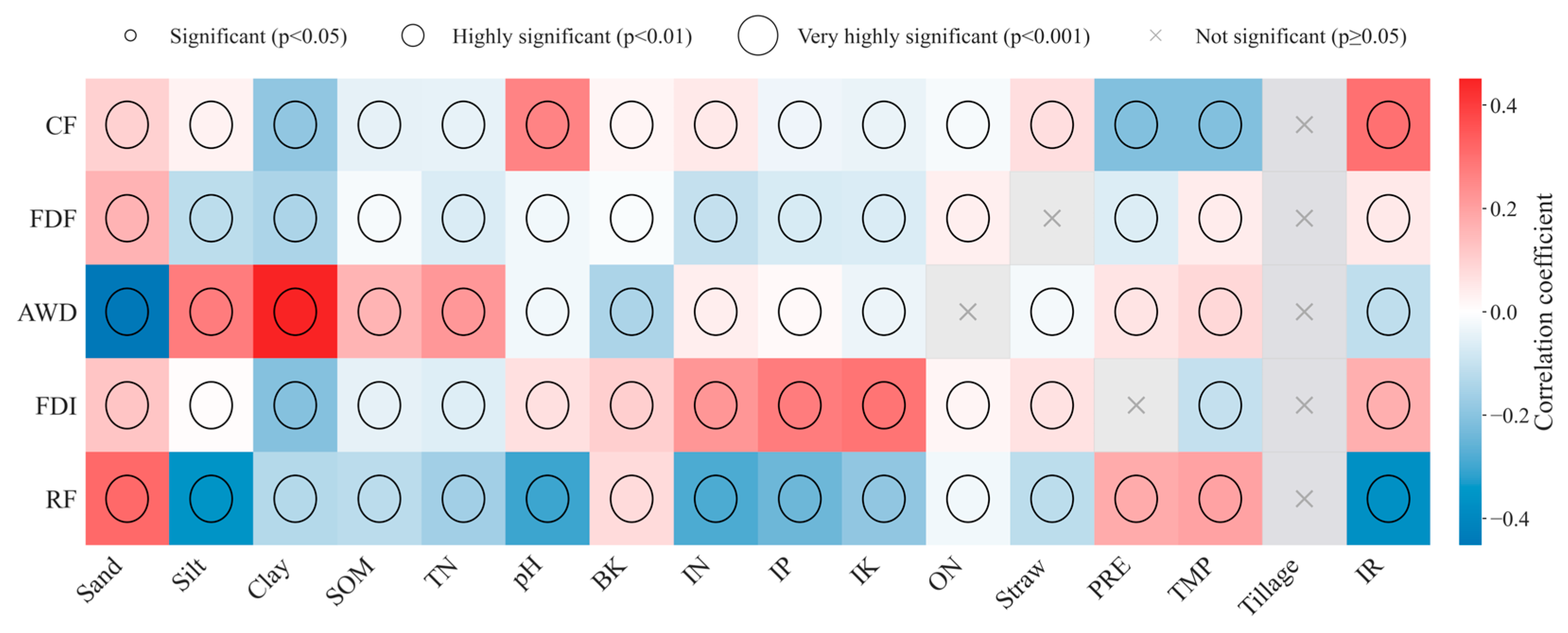
The Pearson correlation coefficients (r) between optimized water management parameters and various input features are shown in Figure 6. We found that CF exhibited the strongest positive correlation with the baseline irrigation ratio (r = 0.2987), indicating that regions with higher baseline irrigation ratios showed a co-occurrence with the selection of CF in our optimization results. CF also showed a strong positive correlation with soil pH (r = 0.2603). In contrast, the adoption of CF was negatively correlated with mean annual temperature (r = −0.2117) and soil clay content (r = −0.1896). Clay-rich soils, characterized by poor aeration and prolonged waterlogging under flooding, can promote anaerobic conditions that enhance CH4 emissions [53,54]. Within the framework of our emission-reduction optimization objective, this inverse statistical relationship is consistent with the model’s output, which less frequently selects CF for regions with high clay content.
FDF exhibited weak correlations (|r| < 0.2) with most other variables. It showed a weak positive correlation with sand content (r = 0.1624), as sandy soils, which may be related to the better aeration of sandy soils, facilitating soil structure recovery after mid-season drainage [55]. FDF was also weakly negatively correlated with silt content (r = −0.1149) and inorganic nitrogen input (r = −0.1053). Soils with higher silt content retain water more effectively, reducing the necessity for mid-season drainage, while fields with lower inorganic nitrogen inputs may rely more on drainage to regulate soil nitrogen availability. The generally low correlations between FDF and other climatic or management variables suggest that this regime appears less strongly constrained by climate and management practices, offering greater flexibility in application.
AWD showed a strong negative correlation with sand content (r = −0.4524). Sandy soils, due to their poor water retention, lose moisture rapidly during wet–dry cycles, which can pose challenges for maintaining the alternating “wet–dry” rhythm required by AWD and pose a risk to yield stability [56]. Correspondingly, in our model results, AWD shows a low co-occurrence with areas with high sand content. Conversely, AWD demonstrated a strong positive correlation with clay content (r = 0.4484). Clay soils, with their high water-holding capacity, can maintain soil moisture during dry phases and retain water during wet phases, properties that are consistent with the requirements of AWD. AWD also showed moderate positive correlations with silt content (r = 0.2731) and soil total nitrogen (r = 0.2158). Soils with moderate silt content balance water retention and aeration, and soils with higher total nitrogen can release nutrients under wet–dry alternation, meeting the nutrient demands of this regime. AWD was weakly negatively correlated with the baseline irrigation ratio (r = −0.1113), a pattern that is consistent with its lower dependence on irrigation and its conceptual suitability for areas with limited irrigation access. This aligns with the core water-saving advantage of alternate wetting and drying.
FDI showed moderate positive correlations with inorganic potassium (r = 0.2898), inorganic phosphorus (r = 0.2735), and inorganic nitrogen (r = 0.2222) fertilization, a pattern that aligns with the reported higher demand for inorganic NPK fertilizers under this regime. The sequential water management stages (flooding, drainage, intermittent irrigation) can accelerate soil nutrient loss, which may require greater fertilizer supplementation to maintain yields [57,58]. FDI also exhibited a weak positive correlation with the baseline irrigation ratio (r = 0.1670), a relationship that corresponds to the multi-stage water management requiring controlled irrigation infrastructure to support phased water regulation.
RF showed a moderate negative correlation with the baseline irrigation ratio (r = −0.3684), which is consistent with its conceptual definition as a rainfed system and its prevalent adoption in regions with low irrigation dependency. It also showed moderate negative correlations with silt content (r = −0.3558) and soil pH (r = −0.3008), indicating a statistical association between RF and areas characterized by lower silt content (i.e., higher proportions of sand or clay) and more acidic soils. RF was moderately positively correlated with sand content (r = 0.3136), a pattern that aligns with the characteristic of sandy soils to drain well, which may reduce the risk of waterlogging under RF conditions. RF showed weak negative correlations with the application rates of inorganic nitrogen, phosphorus, and potassium fertilizers (r ranging from −0.2831 to −0.1904), consistent with the typically low fertilizer inputs in regions where RF is widely practiced, such as sub-Saharan Africa and parts of Southeast Asia [59,60,61]. Finally, we observed that none of the water management regimes showed significant correlations with tillage practices.

4. Discussion

In this study, we employed a machine learning-based approach to predict global rice GHG, SOCSR, and grain yield. Traditional process-based models require the extensive and complex parameter tuning of soil, meteorological, and other input parameters to achieve high prediction accuracy [62,63]. This process involves substantial trial and error and demands advanced expertise in mechanistic modeling [64]. In contrast, while machine learning models also require parameter adjustment, the tuning focuses on model hyperparameters, which can be efficiently optimized through methods such as grid search within a short timeframe, making it accessible even to researchers without specialized process-modeling experience. In terms of simulation efficiency, process-based models typically incorporate numerous differential equations and empirical functions to simulate complex biochemical processes starting from crop growth, resulting in longer computational times [65]. Global-scale simulations with such models often entail substantial time and resource investments. Machine learning models, particularly tree-based algorithms such as Random Forest, that are now widely adopted in environmental sciences, rely on relatively simpler statistical simulation procedures. These models can predict global environmental indicators within minutes on a standard personal computer. However, compared to process-based models, machine learning models often function as “black boxes,” lacking sufficient interpretability [66,67]. This limitation has been addressed by interpretable machine learning frameworks such as SHAP and Partial Dependence Plots (PDP). In our research, SHAP effectively elucidated the influence of water management practices on the four target variables. Unlike meta-analysis, SHAP operates as a case-driven factor analysis tool capable of revealing both global and individual contributions of input features to the target variables. Nevertheless, compared to meta-analysis, SHAP relies on high-accuracy machine learning models trained on large datasets to yield reliable results, which may limit its applicability in research domains with limited data availability.
We observed significant spatial heterogeneity in both the baseline conditions and optimized outcomes of global rice GHG emissions, SOCSR, and yield. This pattern results from the combined effects of climate, soil properties, and current agricultural management practices. This highlights the necessity of moving away from a “one-size-fits-all” approach to global rice GHG mitigation. Instead, region-specific management strategies must be tailored to achieve the dual benefits of emissions reduction and yield enhancement. Furthermore, trade-offs represent another key challenge in GHG mitigation through water management optimization. As identified in our driver analysis, reducing CH4 emissions may often lead to increased N2O emissions, while simultaneously exerting non-linear influences on SOCSR and yield. Identifying such trade-offs requires high-accuracy simulation models to capture the complex interactions among these interconnected processes. Our study is closely aligned with the United Nations Sustainable Development Goals (SDGs), where reducing GHG emissions from rice cultivation corresponds to SDG 13 (Climate Action), while enhancing yield distribution contributes to SDG 2 (Zero Hunger). The trade-offs identified above further illustrate that advancing multiple SDGs often entails balancing conflicting objectives. Optimizing for synergistic benefits, therefore, represents a critical focus for future research.
While our study identifies the optimal water management practice for each rice cultivation grid cell, its practical implementation remains a considerable challenge. First, switching water management regimes often requires substantial investment in additional irrigation infrastructure. Especially in regions with a high concentration of low-income countries, such as sub-Saharan Africa, although the optimized scenarios can enhance yield, the cost of adopting entirely new irrigation systems may be prohibitive for local farmers, necessitating further support from governments and international organizations [68]. Second, due to data limitations, we only classified water management into five broad categories. In reality, rice water management typically requires more precise, real-time adjustments based on actual weather conditions, for example, increasing drainage during heavy rainfall to prevent waterlogging or supplementing irrigation during droughts to avoid crop water stress [69]. Finally, water management is only one component of agricultural management practices. To achieve greater emission reduction and yield improvement, coupling water management with other management strategies in an integrated optimization framework should be considered in future research. It is therefore crucial to distinguish between the biophysical mitigation potential mapped in this study and its practical adoptability. Our optimization provides a spatially explicit benchmark of what is theoretically achievable under idealized conditions. Translating this potential into on-ground reality, however, is contingent upon overcoming the socioeconomic constraints noted above (e.g., infrastructure, cost, labor, institutions). Future policy and research should bridge this gap by integrating biophysical optimization with socioeconomic feasibility analysis to design context-specific implementation pathways.
Our study has several limitations. First, while we endeavored to include comprehensive data on rice GHG emissions, SOCSR, and grain yield, the training dataset remains deficient in regions such as sub-Saharan Africa, South America, and Southeast Asia. This may lead to higher uncertainty in the simulation results for these areas. Second, given the scarcity of observational data, we were compelled to adopt certain assumptions and simplifications in our calculations, which had the potential introduce a degree of uncertainty. For instance, baseline water management practices for rice had to be assumed to estimate net greenhouse gas emissions and yields, which may lead to an overestimation of the optimization potential. As current spatially explicit cropland datasets do not distinguish between upland and paddy rice systems, our analysis does not differentiate between these cultivation types. Third, although machine learning models generally achieve high predictive accuracy, their application across diverse global climatic, soil, and socioeconomic conditions inevitably introduces a degree of error. Therefore, the effectiveness of the optimal water management modes identified requires further validation through field experiments. Fourth, our optimization framework did not account for the influence of socioeconomic factors such as infrastructure, labor, and water rights, which should be a key focus of future research. Furthermore, the SHAP and correlation analysis used to infer potential drivers of optimized water management choices is inherently observational. The identified associations, while informative for pattern recognition, do not establish causation. They reflect statistical co-occurrences within our global model and dataset, and their interpretation should be tempered by the complex, multi-factorial nature of real-world agricultural systems. Finally, as noted earlier, our optimization does not account for local socioeconomic conditions. Consequently, the identified optimal water management practices may not necessarily translate into the most favorable economic or environmental outcomes in practice.

5. Conclusions

In this study, we developed a global-scale assessment framework to quantify the potential of water management for reducing greenhouse gas (GHG) emissions while maintaining rice yield. Using 15,458 field observations, machine learning models were trained to predict key sustainability indicators. The XGBoost model achieved the highest predictive accuracy for CH4 and N2O, while the GBDT model performed best for SOCSR and rice grain yield. SHAP analysis revealed the distinct and interpretable roles of five water regimes on these variables. Applying this framework globally, we simulated that optimized water management could achieve a model-projected 39.17% reduction in GHG emissions alongside a 3.55% increase in yields, with strategies influenced differentially by local soil, climate, and management contexts. This analysis provides a data-driven, spatially explicit roadmap for targeting water management interventions in rice systems. However, the identified potential represents an idealized benchmark. Translating this potential into practice will require future efforts that integrate our findings with local socio-economic feasibility studies. This research provides valuable insights for advancing agricultural carbon emission mitigation and promoting sustainable agricultural development.

Supplementary Materials

The following supporting information can be downloaded at: https://www.mdpi.com/article/10.3390/agronomy16030301/s1, Text S1: Uncertainty analysis; Text S2: The studies included in our dataset are available at the following GitHub repository: https://github.com/GarfieldLCG/Dataset-of-global-rice-GHG-emissions, accessed on 9 January 2026; Figure S1: Coefficient of variation (CV) for (a) CH4 (b) N2O (c) soil organic carbon sequestration rate (SOCSR) and rice grain yield; Table S1: Details of input features and target variables for machine learning training; Table S2: Hyperparameter ranges for machine learning training; Table S3: Best hyperparameters for the CH4; Table S4: Best hyperparameters for the N2O; Table S5: Best hyperparameters for the SOCSR; Table S6: Best hyperparameters for the yield.

Author Contributions

Conceptualization, Q.J. and S.L.; methodology, S.L.; software, S.L. and Y.W.; validation, S.L. and Y.W.; formal analysis, S.L.; data curation, S.L.; writing—original draft preparation, S.L. and Y.Y.; writing—review and editing, Q.J.; visualization, S.L. and Y.W.; supervision, Q.J.; project administration, Q.J.; funding acquisition, Q.J. All authors have read and agreed to the published version of the manuscript.

Funding

This research was funded by Sub-project of the National Key Research and Development Program (grant number: 2024YFD2301102) and the National Natural Science Foundation of China (grant number: 32271980).

Data Availability Statement

Data will be made available on request.

Acknowledgments

The authors gratefully acknowledge Ruitao Lou, Yueer Yu, Yichen Huang and Weijie Song for their insightful contributions to the discussion and conceptualization of this research topic.

Conflicts of Interest

The authors declare no conflicts of interest.

Abbreviations

The following abbreviations are used in this manuscript:
GHGGreenhouse gas
nGHGNet greenhouse gas
SOCSRSoil organic carbon sequestration rate
CFContinuous flooding
FDFFlooding–midseason drainage–reflooding
AWDAlternate wetting and drying
FDIFlooding–Midseason Drainage–Intermittent Irrigation
RFRainfed
SVRSupport Vector Regression
XGBoosteXtreme Gradient Boosting
GBDTGradient Boosting Decision Tree

References

  1. Yuan, S.; Linquist, B.A.; Wilson, L.T.; Cassman, K.G.; Stuart, A.M.; Pede, V.; Miro, B.; Saito, K.; Agustiani, N.; Aristya, V.E.; et al. Sustainable intensification for a larger global rice bowl. Nat. Commun. 2021, 12, 7163. [Google Scholar] [CrossRef]
  2. Qian, H.; Zhu, X.; Huang, S.; Linquist, B.; Kuzyakov, Y.; Wassmann, R.; Minamikawa, K.; Martinez-Eixarch, M.; Yan, X.; Zhou, F.; et al. Greenhouse gas emissions and mitigation in rice agriculture. Nat. Rev. Earth Environ. 2023, 4, 716–732. [Google Scholar] [CrossRef]
  3. Chen, Y.; Guo, W.; Ngo, H.H.; Wei, W.; Ding, A.; Ni, B.; Hoang, N.B.; Zhang, H. Ways to mitigate greenhouse gas production from rice cultivation. J. Environ. Manag. 2024, 368, 122139. [Google Scholar] [CrossRef]
  4. Chang, J.; Costa, O.Y.A.; Sun, Y.; Wang, J.; Tian, L.; Shi, S.; Wang, E.; Ji, L.; Wang, C.; Pang, Y.; et al. Domesticated rice alters the rhizosphere microbiome, reducing nitrogen fixation and increasing nitrous oxide emissions. Nat. Commun. 2025, 16, 2038. [Google Scholar] [CrossRef]
  5. Zhang, S.; Huang, G.; Zhang, Y.; Lv, X.; Wan, K.; Liang, J.; Feng, Y.; Dao, J.; Wu, S.; Zhang, L.; et al. Sustained productivity and agronomic potential of perennial rice. Nat. Sustain. 2023, 6, 28–38. [Google Scholar] [CrossRef]
  6. Zhang, X.; Zhong, J.; Zhang, X.; Zhang, D.; Miao, C.; Wang, D.; Guo, L. China Can Achieve Carbon Neutrality in Line with the Paris Agreement’s 2 °C Target: Navigating Global Emissions Scenarios, Warming Levels, and Extreme Event Projections. Engineering 2025, 44, 207–214. [Google Scholar] [CrossRef]
  7. He, G.; Wang, Z.; Cui, Z. Managing irrigation water for sustainable rice production in China. J. Clean. Prod. 2020, 245, 118928. [Google Scholar] [CrossRef]
  8. Cowan, N.; Bhatia, A.; Drewer, J.; Jain, N.; Singh, R.; Tomer, R.; Kumar, V.; Kumar, O.; Prasanna, R.; Ramakrishnan, B.; et al. Experimental comparison of continuous and intermittent flooding of rice in relation to methane, nitrous oxide and ammonia emissions and the implications for nitrogen use efficiency and yield. Agric. Ecosyst. Environ. 2021, 319, 107571. [Google Scholar] [CrossRef]
  9. Weng, W.; Liao, P.; Li, X.; Sun, M.; Ling, Y.; Xing, Z.; Qu, J.; Chen, J.; Wei, H.; Gao, H.; et al. Optimized water management in intelligent cultivation systems mitigates greenhouse gas emissions and energy demand while ensuring rice yield sustainability. Agric. Water Manag. 2025, 318, 109711. [Google Scholar] [CrossRef]
  10. Perry, H.; Carrijo, D.R.; Duncan, A.H.; Fendorf, S.; Linquist, B.A. Mid-season drain severity impacts on rice yields, greenhouse gas emissions and heavy metal uptake in grain: Evidence from on-farm studies. Field Crops Res. 2024, 307, 109248. [Google Scholar] [CrossRef]
  11. Lagomarsino, A.; Agnelli, A.E.; Linquist, B.; Adviento-Borbe, M.A.; Agnelli, A.; Gavina, G.; Ravaglia, S.; Ferrara, R.M. Alternate Wetting and Drying of Rice Reduced CH4 Emissions but Triggered N2O Peaks in a Clayey Soil of Central Italy. Pedosphere 2016, 26, 533–548. [Google Scholar] [CrossRef]
  12. Zhao, C.; Qiu, R.; Zhang, T.; Luo, Y.; Agathokleous, E. Effects of Alternate Wetting and Drying Irrigation on Methane and Nitrous Oxide Emissions from Rice Fields: A Meta-Analysis. Glob. Change Biol. 2024, 30, e17581. [Google Scholar] [CrossRef]
  13. Peng, L.; Deng, S.; Yi, W.; Wu, Y.; Cui, B.; Zhang, Y.; Yao, X.; Zhang, X.; Yang, H.; Tang, X. Modulation of greenhouse gas emissions and soil organic carbon in rice paddies through various crop rotation systems combined with water-saving irrigation: Insights into soil bacterial composition and functional alterations. Agric. Ecosyst. Environ. 2025, 394, 109897. [Google Scholar] [CrossRef]
  14. Balmford, A.; Amano, T.; Bartlett, H.; Chadwick, D.; Collins, A.; Edwards, D.; Field, R.; Garnsworthy, P.; Green, R.; Smith, P.; et al. The environmental costs and benefits of high-yield farming. Nat. Sustain. 2018, 1, 477–485. [Google Scholar] [CrossRef] [PubMed]
  15. Gao, Y.; Cui, J.; Zhang, X.; Hoogenboom, G.; Wallach, D.; Huang, Y.; Reis, S.; Lin, T.; Gu, B. Cost-effective adaptations increase rice production while reducing pollution under climate change. Nat. Food 2025, 6, 260–272. [Google Scholar] [CrossRef] [PubMed]
  16. Liu, S.; He, Y.; Qi, Z.; Liu, Y.; Jiang, Q. Tracing the life cycle carbon footprint of staple crops in Belt and Road Initiative countries. Resour. Conserv. Recycl. 2025, 220, 108382. [Google Scholar] [CrossRef]
  17. Martini, G.; Bracci, A.; Riches, L.; Jaiswal, S.; Corea, M.; Rivers, J.; Husain, A.; Omodei, E. Machine learning can guide food security efforts when primary data are not available. Nat. Food 2022, 3, 716–728. [Google Scholar] [CrossRef]
  18. Xiao, L.; Wang, G.; Wang, E.; Liu, S.; Chang, J.; Zhang, P.; Zhou, H.; Wei, Y.; Zhang, H.; Zhu, Y.; et al. Spatiotemporal co-optimization of agricultural management practices towards climate-smart crop production. Nat. Food 2024, 5, 59–71. [Google Scholar] [CrossRef]
  19. Yao, X.; Zhang, Z.; Li, K.; Yuan, F.; Xu, X.; Long, X.; Song, C. Optimizing water and nitrogen management to balance greenhouse gas emissions and yield in Chinese rice paddies. Field Crops Res. 2024, 319, 109621. [Google Scholar] [CrossRef]
  20. Qian, H.; Jin, Y.; Chen, J.; Huang, S.; Liu, Y.; Zhang, J.; Deng, A.; Zou, J.; Pan, G.; Ding, Y.; et al. Acclimation of CH4 emissions from paddy soil to atmospheric CO2 enrichment in a growth chamber experiment. Crop J. 2022, 10, 140–146. [Google Scholar] [CrossRef]
  21. Harris, I.; Osborn, T.J.; Jones, P.; Lister, D. Version 4 of the CRU TS monthly high-resolution gridded multivariate climate dataset. Sci. Data 2020, 7, 109. [Google Scholar] [CrossRef]
  22. FAO; IIASA. The Harmonized World Soil Database Version 2.0; FAO: Rome, Italy; International Institute for Applied Systems Analysis (IIASA): Laxenburg, Austria, 2023. [Google Scholar] [CrossRef]
  23. Breiman, L. Random forests. Mach. Learn. 2001, 45, 5–32. [Google Scholar] [CrossRef]
  24. Cortes, C.; Vapnik, V. Support-vector networks. Mach. Learn. 1995, 20, 273–297. [Google Scholar] [CrossRef]
  25. Friedman, J.H. Greedy function approximation: A gradient boosting machine. Ann. Stat. 2001, 29, 1189–1232. [Google Scholar] [CrossRef]
  26. Chen, T.Q.; Guestrin, C. XGBoost: A Scalable Tree Boosting System. In Proceedings of the 22nd ACM SIGKDD International Conference on Knowledge Discovery and Data Mining, San Francisco, CA, USA, 13–17 August 2016; pp. 785–794. [Google Scholar]
  27. Xu, P.; Li, G.; Zheng, Y.; Fung, J.C.H.; Chen, A.; Zeng, Z.; Shen, H.; Hu, M.; Mao, J.; Zheng, Y.; et al. Fertilizer management for global ammonia emission reduction. Nature 2024, 626, 792–798. [Google Scholar] [CrossRef]
  28. FAOSTAT. Food and Agriculture Data; FAOSTAT: Rome, Italy, 2024. [Google Scholar]
  29. Xie, J.; Liu, X.; Jasechko, S.; Berghuijs, W.R.; Wang, K.; Liu, C.; Reichstein, M.; Jung, M.; Koirala, S. Majority of global river flow sustained by groundwater. Nat. Geosci. 2024, 17, 770–777. [Google Scholar] [CrossRef]
  30. Lundberg, S.M.; Lee, S.-I. A unified approach to interpreting model predictions. In Proceedings of the 31st International Conference on Neural Information Processing Systems, Long Beach, CA, USA, 4–9 December 2017; pp. 4768–4777. [Google Scholar]
  31. Tang, F.H.M.; Nguyen, T.H.; Conchedda, G.; Casse, L.; Tubiello, F.N.; Maggi, F. CROPGRIDS: A global geo-referenced dataset of 173 crops. Sci. Data 2024, 11, 413. [Google Scholar] [CrossRef]
  32. Nguyen, T.H.; Tang, F.H.M.; Conchedda, G.; Casse, L.; Obli-Laryea, G.; Tubiello, F.N.; Maggi, F. NPKGRIDS: A global georeferenced dataset of N, P2O5, and K2O fertilizer application rates for 173 crops. Sci. Data 2024, 11, 1179. [Google Scholar] [CrossRef] [PubMed]
  33. Adalibieke, W.; Cui, X.; Cai, H.; You, L.; Zhou, F. Global crop-specific nitrogen fertilization dataset in 1961–2020. Sci. Data 2023, 10, 617. [Google Scholar] [CrossRef] [PubMed]
  34. Smerald, A.; Rahimi, J.; Scheer, C. A global dataset for the production and usage of cereal residues in the period 1997–2021. Sci. Data 2023, 10, 685. [Google Scholar] [CrossRef]
  35. Porwollik, V.; Rolinski, S.; Heinke, J.; Müller, C. Generating a rule-based global gridded tillage dataset. Earth Syst. Sci. Data 2019, 11, 823–843. [Google Scholar] [CrossRef]
  36. Grogan, D.; Frolking, S.; Wisser, D.; Prusevich, A.; Glidden, S. Global gridded crop harvested area, production, yield, and monthly physical area data circa 2015. Sci. Data 2022, 9, 15. [Google Scholar] [CrossRef] [PubMed]
  37. IPCC. Climate Change 2022: Impacts, Adaptation, and Vulnerability; Cambridge University Press: Cambridge, UK, 2023. [Google Scholar]
  38. Leach, A.; Gomez, A.A.; Kaplan, I. Threshold-based management reduces insecticide use by 44% without compromising pest control or crop yield. Commun. Earth Environ. 2025, 6, 710. [Google Scholar] [CrossRef]
  39. Dai, K.; Cheng, C.; Li, B.; Xie, Y.; Gomez, J.A.; Wang, Z.; Wu, X. Mapping the harvest area of a comprehensive set of crop types in China from 1990 to 2020 at a 1-km resolution. Sci. Data 2025, 12, 1371. [Google Scholar] [CrossRef] [PubMed]
  40. Bentéjac, C.; Csörgő, A.; Martínez-Muñoz, G. A comparative analysis of gradient boosting algorithms. Artif. Intell. Rev. 2021, 54, 1937–1967. [Google Scholar] [CrossRef]
  41. Tang, H.; Liu, J.; Zhao, M.; Gong, X. Progressive Layered Extraction (PLE): A Novel Multi-Task Learning (MTL) Model for Personalized Recommendations. In Proceedings of the 14th ACM Conference on Recommender Systems, Virtual, 22–26 September 2020; pp. 269–278. [Google Scholar]
  42. Zhang, L.; Li, L.; Tang, Q.; Xu, H.; Zheng, H.; Wang, F.; Tang, J. Intermittent irrigation as a solution for reduced emissions and increased yields in ratoon rice systems. Plant Soil 2024, 501, 225–236. [Google Scholar] [CrossRef]
  43. Wu, Q.; He, Y.; Qi, Z.; Jiang, Q. Drainage in paddy systems maintains rice yield and reduces total greenhouse gas emissions on the global scale. J. Clean. Prod. 2022, 370, 133515. [Google Scholar] [CrossRef]
  44. Jiang, Y.; Carrijo, D.; Huang, S.; Chen, J.; Balaine, N.; Zhang, W.; van Groenigen, K.J.; Linquist, B. Water management to mitigate the global warming potential of rice systems: A global meta-analysis. Field Crops Res. 2019, 234, 47–54. [Google Scholar] [CrossRef]
  45. Kebede, E.A.; Oluoch, K.O.a.; Siebert, S.; Mehta, P.; Hartman, S.; Jägermeyr, J.; Ray, D.; Ali, T.; Brauman, K.A.; Deng, Q.; et al. A global open-source dataset of monthly irrigated and rainfed cropped areas (MIRCA-OS) for the 21st century. Sci. Data 2025, 12, 208. [Google Scholar] [CrossRef]
  46. Lin, Z.; Lu, X.; Xu, Y.; Sun, W.; Yu, Y.; Zhang, W.; Mishra, U.; Kuzyakov, Y.; Wang, G.; Qin, Z. Increased straw return promoted soil organic carbon accumulation in China’s croplands over the past 40 years. Sci. Total Environ. 2024, 945, 173903. [Google Scholar] [CrossRef]
  47. Bai, X.; Tang, J.; Wang, W.; Ma, J.; Shi, J.; Ren, W. Organic amendment effects on cropland soil organic carbon and its implications: A global synthesis. CATENA 2023, 231, 107343. [Google Scholar] [CrossRef]
  48. Rathore, S.S.; Babu, S.; El-Sappah, A.H.; Shekhawat, K.; Singh, V.K.; Singh, R.K.; Upadhyay, P.K.; Singh, R. Integrated agroforestry systems improve soil carbon storage, water productivity, and economic returns in the marginal land of the semi-arid region. Saudi J. Biol. Sci. 2022, 29, 103427. [Google Scholar] [CrossRef] [PubMed]
  49. Paramesh, V.; Mohan Kumar, R.; Rajanna, G.A.; Gowda, S.; Nath, A.J.; Madival, Y.; Jinger, D.; Bhat, S.; Toraskar, S. Integrated nutrient management for improving crop yields, soil properties, and reducing greenhouse gas emissions. Front. Sustain. Food Syst. 2023, 7, 1173258. [Google Scholar] [CrossRef]
  50. Sommer, R.; Bossio, D. Dynamics and climate change mitigation potential of soil organic carbon sequestration. J. Environ. Manag. 2014, 144, 83–87. [Google Scholar] [CrossRef]
  51. Wei, F.; Wang, L.; Jia, L.; Huang, Y. Global patterns and determinants of erosion-induced soil carbon translocation. Geogr. Sustain. 2025, 6, 100328. [Google Scholar] [CrossRef]
  52. Liu, Y.; Ge, T.; van Groenigen, K.J.; Yang, Y.; Wang, P.; Cheng, K.; Zhu, Z.; Wang, J.; Li, Y.; Guggenberger, G.; et al. Rice paddy soils are a quantitatively important carbon store according to a global synthesis. Commun. Earth Environ. 2021, 2, 154. [Google Scholar] [CrossRef]
  53. Li, D.; Li, H.; Chen, D.; Xue, L.; He, H.; Feng, Y.; Ji, Y.; Yang, L.-Z.; Chu, Q. Clay-hydrochar composites mitigated CH4 and N2O emissions from paddy soil: A whole rice growth period investigation. Sci. Total Environ. 2021, 780, 146532. [Google Scholar] [CrossRef]
  54. Vor, T.; Dyckmans, J.; Loftfield, N.; Beese, F.; Flessa, H. Aeration effects on CO2, N2O, and CH4 emission and leachate composition of a forest soil. J. Plant Nutr. Soil Sci. 2003, 166, 39–45. [Google Scholar] [CrossRef]
  55. Darzi-Naftchali, A.; Karandish, F.; Šimůnek, J. Numerical modeling of soil water dynamics in subsurface drained paddies with midseason drainage or alternate wetting and drying management. Agric. Water Manag. 2018, 197, 67–78. [Google Scholar] [CrossRef]
  56. Phoeurn, C.A.; Orn, C.; Tho, T.; Oeurng, C.; Degré, A.; Ket, P. Assessing the feasibility of alternate wetting and drying (AWD) technique for improving water use efficiency in dry-season rice production. Paddy Water Environ. 2025, 23, 229–242. [Google Scholar] [CrossRef]
  57. Halli, H.M.; Shivakumar, B.G.; Wasnik, V.K.; Govindasamy, P.; Yadav, V.K.; Swami, S.; Kumar, V.; Senthamil, E.; Gangana Gowdra, V.M.; Basavaraj, P.S.; et al. Co-implementation of deficit irrigation and nutrient management strategies to strengthen soil-plant-seed nexus, water use efficiency, and yield sustainability in fodder corn. Eur. J. Agron. 2025, 168, 127609. [Google Scholar] [CrossRef]
  58. Nakayama, Y.; Arreguin, S.; Leon, P.; Douglass, M.; Becker, T.; Margenot, A.J. Nitrogen losses under soybean production are mitigated by substituting ammonium phosphates with triple superphosphate but non-fertilizer losses remain appreciable. Agric. Ecosyst. Environ. 2025, 378, 109274. [Google Scholar] [CrossRef]
  59. McDowell, R.W.; Haygarth, P.M. Soil phosphorus stocks could prolong global reserves and improve water quality. Nat. Food 2025, 6, 31–35. [Google Scholar] [CrossRef] [PubMed]
  60. Snapp, S.; Sapkota, T.B.; Chamberlin, J.; Cox, C.M.; Gameda, S.; Jat, M.L.; Marenya, P.; Mottaleb, K.A.; Negra, C.; Senthilkumar, K.; et al. Spatially differentiated nitrogen supply is key in a global food–fertilizer price crisis. Nat. Sustain. 2023, 6, 1268–1278. [Google Scholar] [CrossRef]
  61. Brownlie, W.J.; Alexander, P.; Maslin, M.; Cañedo-Argüelles, M.; Sutton, M.A.; Spears, B.M. Global food security threatened by potassium neglect. Nat. Food 2024, 5, 111–115. [Google Scholar] [CrossRef]
  62. Hollós, R.; Fodor, N.; Merganičová, K.; Hidy, D.; Árendás, T.; Grünwald, T.; Barcza, Z. Conditional interval reduction method: A possible new direction for the optimization of process based models. Environ. Model. Softw. 2022, 158, 105556. [Google Scholar] [CrossRef]
  63. Jabloun, M.; Li, X.; Zhang, X.; Tao, F.; Hu, C.; Olesen, J.E. Sensitivity of simulated crop yield and nitrate leaching of the wheat-maize cropping system in the North China Plain to model parameters. Agric. For. Meteorol. 2018, 263, 25–40. [Google Scholar] [CrossRef]
  64. Xia, W.; Shoemaker, C.A. A Repetitive Parameterization and Optimization Strategy for the Calibration of Complex and Computationally Expensive Process-Based Models with Application to a 3D Water Quality Model of a Tropical Reservoir. Water Resour. Res. 2022, 58, e2021WR031054. [Google Scholar] [CrossRef]
  65. Hu, Q.; Li, J.; Xie, H.; Huang, Y.; Canadell, J.G.; Yuan, W.; Wang, J.; Zhang, W.; Yu, L.; Li, S.; et al. Global methane emissions from rice paddies: CH4MOD model development and application. iScience 2024, 27, 111237. [Google Scholar] [CrossRef]
  66. Wood, D.A. More transparent and explainable machine learning algorithms are required to provide enhanced and sustainable dataset understanding. Ecol. Model. 2024, 498, 110898. [Google Scholar] [CrossRef]
  67. ŞAhiN, E.; Arslan, N.N.; Özdemir, D. Unlocking the black box: An in-depth review on interpretability, explainability, and reliability in deep learning. Neural Comput. Appl. 2025, 37, 859–965. [Google Scholar] [CrossRef]
  68. Dirwai, T.L.; Taguta, C.; Senzanje, A.; Nhamo, L.; Cofie, O.; Lankford, B.; Nyambe, H.; Mabhaudhi, T. Status of agricultural water management practices in Africa: A review for the prioritisation and operationalisation of the Africa Union’s irrigation development and agricultural water management (AU-IDAWM) strategy. Environ. Res. Lett. 2024, 19, 103005. [Google Scholar] [CrossRef]
  69. Bwire, D.; Saito, H.; Sidle, R.C.; Nishiwaki, J. Water Management and Hydrological Characteristics of Paddy-Rice Fields under Alternate Wetting and Drying Irrigation Practice as Climate Smart Practice: A Review. Agronomy 2024, 14, 1421. [Google Scholar] [CrossRef]
Figure 1. Distribution of the global dataset in this study. (a) Geographic locations of experiments in the dataset. (b) Whittaker biomes map of distribution sites.
Agronomy 16 00301 g001
Figure 2. Performance of the best machine learning models. Performance of (a) CH4 (c) N2O (e) SOCSR and (g) rice grain yield on training set. Performance of (b) CH4 (d) N2O (f) SOCSR and (h) rice grain yield on testing set.
Agronomy 16 00301 g002
Figure 3. SHAP values of different water management on the entire dataset. (a) CH4, (b) N2O (c) SOCSR (d) rice grain yield.
Agronomy 16 00301 g003
Figure 4. Global rice greenhouse gas (GHG) emissions, soil carbon sequestration rate (SOCSR), and rice grain yields under baseline and optimized scenarios. (a) CH4, (b) N2O, (c) SOCSR, (d) rice grain yield, and (e) net greenhouse gas (nGHG) emissions under baseline scenarios. (f) CH4, (g) N2O (h) SOCSR (i) rice grain yield, and (j) nGHG emissions under optimized scenarios. Projected changes in (k) GHG mitigation rate and (l) rice grain yield increase rate.
Agronomy 16 00301 g004
Figure 5. Water management under the optimized scenario. CF, FDF, FDI, AWD, and RF for continuous flooding, midseason drainage, flooding–midseason drainage–intermittent irrigation, alternate wetting and drying irrigation during the whole cultivation and rainfed.
Agronomy 16 00301 g005
Figure 6. Pearson correlation coefficient between optimized water management and other features. CF, FDF, FDI, AWD and RF for continuous flooding, midseason drainage, flooding-midseason drainage-alternate wetting and drying irrigation, alternate wetting and drying irrigation during whole cultivation and rainfed; SOM for soil organic matter; TN for soil total nitrogen; BK for soil bulk density; IN, IP and IK for inorganic nitrogen, phosphorus and potassium fertilizer; ON for organic fertilizer; PRE for annual total precipitation; TMP for annual mean temperature; IR for proportion of irrigated fields under baseline scenario.
Agronomy 16 00301 g006
Table 1. Coefficient of determination (R2), mean absolute error (MAE), and root mean square error (RMSE) of four machine learning models for CH4, N2O, soil organic carbon sequestration rate (SOCSR), and rice yield datasets. “Train” and “Test” denote the model’s performance on the training set and test set, respectively.
TargetModelDatasetR2MAERMSE
CH4Random ForestTrain0.930.04 Mg ha−10.07 Mg ha−1
Test0.580.09 Mg ha−10.15 Mg ha−1
SVRTrain0.470.10 Mg ha−10.18 Mg ha−1
Test0.320.11 Mg ha−10.19 Mg ha−1
XGBoostTrain0.950.02 Mg ha−10.05 Mg ha−1
Test0.630.08 Mg ha−10.14 Mg ha−1
GBDTTrain0.930.04 Mg ha−10.06 Mg ha−1
Test0.600.08 Mg ha−10.14 Mg ha−1
N2ORandom ForestTrain0.930.24 kg ha−10.44 kg ha−1
Test0.590.61 kg ha−11.15 kg ha−1
SVRTrain0.820.29 kg ha−10.73 kg ha−1
Test0.630.61 kg ha−11.09 kg ha−1
XGBoostTrain0.970.14 kg ha−10.27 kg ha−1
Test0.700.54 kg ha−10.99 kg ha−1
GBDTTrain0.950.21 kg ha−10.37 kg ha−1
Test0.670.56 kg ha−11.03 kg ha−1
SOCSRRandom ForestTrain0.920.07 Mg ha−10.12 Mg ha−1
Test0.380.20 Mg ha−10.32 Mg ha−1
SVRTrain0.780.12 Mg ha−10.20 Mg ha−1
Test0.260.22 Mg ha−10.36 Mg ha−1
XGBoostTrain0.980.03 Mg ha−10.09 Mg ha−1
Test0.430.20 Mg ha−10.31 Mg ha−1
GBDTTrain0.960.05 Mg ha−10.09 Mg ha−1
Test0.430.19 Mg ha−10.31 Mg ha−1
YieldRandom ForestTrain0.910.47 Mg ha−10.67 Mg ha−1
Test0.810.73 Mg ha−11.00 Mg ha−1
SVRTrain0.521.18 Mg ha−11.57 Mg ha−1
Test0.501.22 Mg ha−11.61 Mg ha−1
XGBoostTrain0.920.43 Mg ha−10.62 Mg ha−1
Test0.820.68 Mg ha−10.94 Mg ha−1
GBDTTrain0.910.48 Mg ha−10.67 Mg ha−1
Test0.830.69 Mg ha−10.93 Mg ha−1
Table 2. Methane (CH4), nitrous oxide (N2O), and soil carbon sequestration rate (SOCSR) per hectare under baseline (BSL) and optimized (OPT) scenarios.
RegionBSL
CH4
(kg ha−1)
OPT
CH4
(kg ha−1)
BSL
N2O
(kg ha−1)
OPT
N2O
(kg ha−1)
BSL
SOCSR
(t C ha−1)
OPT
SOCSR
(t C ha−1)
Bangladesh188.02170.250.991.000.210.51
China327.83239.181.121.390.320.47
Indonesia191.53170.740.800.780.370.63
India151.98109.011.551.870.160.53
Japan486.81348.960.731.220.380.58
Thailand221.49196.881.361.380.290.49
United States218.78146.461.321.750.420.72
Vietnam295.62181.001.071.150.370.55
Africa203.54192.451.511.520.090.34
Asia222.03172.141.301.480.260.52
Europe353.68281.641.491.700.340.45
North America204.46147.241.221.540.340.66
Oceania197.18180.391.621.660.470.50
South America213.33185.521.551.560.240.47
Global220.20174.741.331.490.240.50
Table 3. Rice grain yield and greenhouse gas (GHG) emissions under baseline (BSL) and optimized (OPT) scenarios.
RegionBSL
Yield
(kg ha−1)
OPT
Yield
(kg ha−1)
Yield
Increase Rate
(%)
BSL
nGHG
(kg CO2 eq ha−1)
OPT
nGHG
(kg CO2 eq ha−1)
nGHG
Mitigation
rate (%)
Bangladesh4596.854703.472.324577.853006.4334.33
China6969.487120.892.177988.425116.5135.95
Indonesia5125.945369.914.764024.932512.5337.58
India4090.984276.414.533945.341519.5561.48
Japan6831.516993.512.3711,957.537641.4036.10
Thailand2931.673008.142.615296.033912.4426.13
United States8540.198714.232.044725.011789.0262.14
Vietnam6004.596276.924.546904.213195.6553.71
Africa2398.182549.416.315574.664368.1221.64
Asia4870.825037.203.425407.333161.7341.53
Europe6416.116468.710.828696.246414.3426.24
North America7209.927425.402.994610.411980.9357.03
Oceania7683.867795.691.464052.233497.3513.69
South America5993.106205.903.555299.443703.3630.12
Global4670.564836.563.555426.183300.8139.17
Disclaimer/Publisher’s Note: The statements, opinions and data contained in all publications are solely those of the individual author(s) and contributor(s) and not of MDPI and/or the editor(s). MDPI and/or the editor(s) disclaim responsibility for any injury to people or property resulting from any ideas, methods, instructions or products referred to in the content.