Recycled Phosphorus from Biomass Ash: Fertilizer Performance Across Crops


Abstract
1. Introduction
2. Materials and Methods
2.1. Soil Characteristics
2.2. Design of the Experiment and Treatment Applications
2.2.1. Pot Experiment I
2.2.2. Pot Experiment II
2.3. Analysis of Ashes and Applied Substrates
2.4. Plant Analysis
2.5. Soil Analysis
2.6. Data Processing, Standardization and Statistics
3. Results
3.1. Pot Experiment I
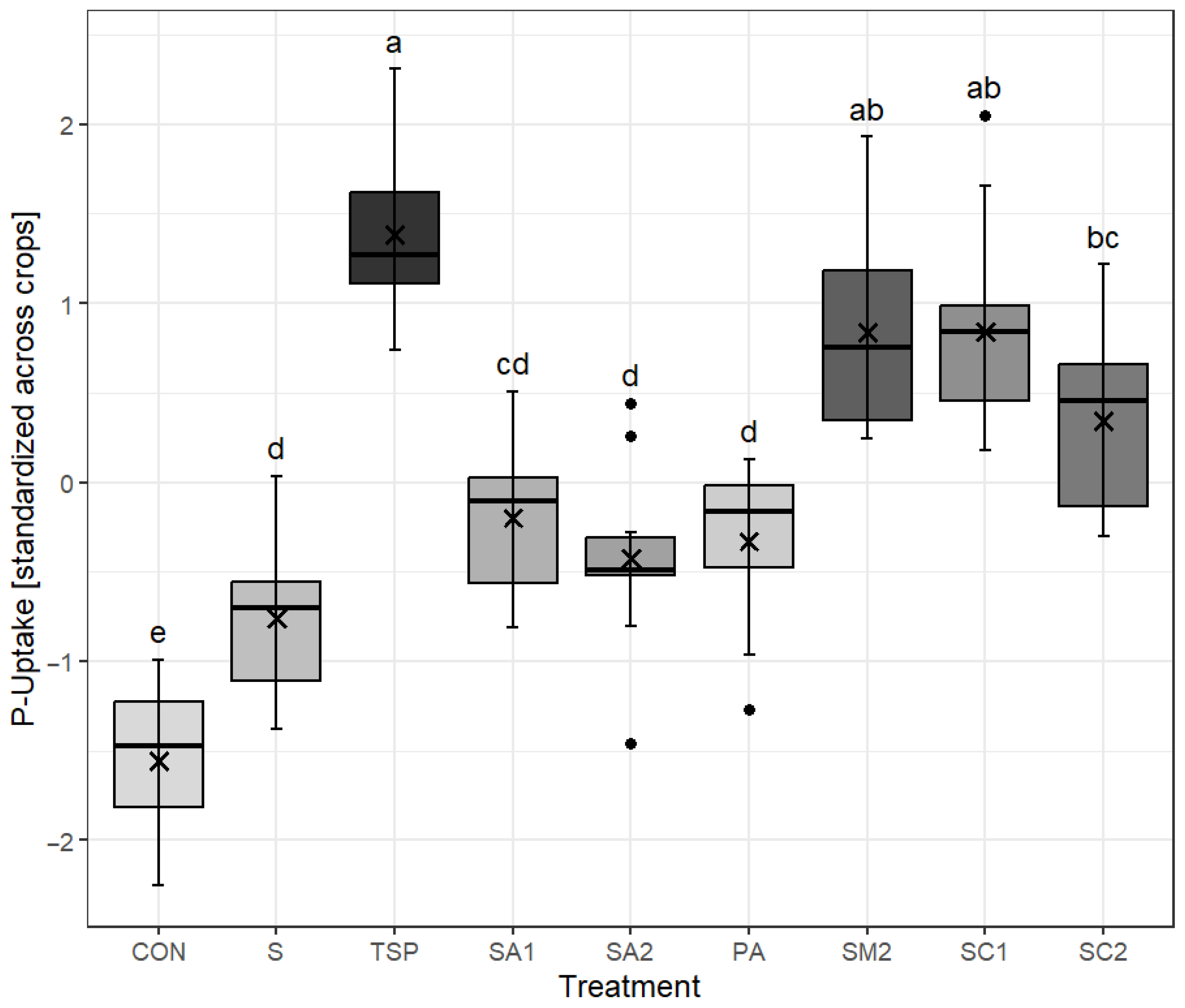
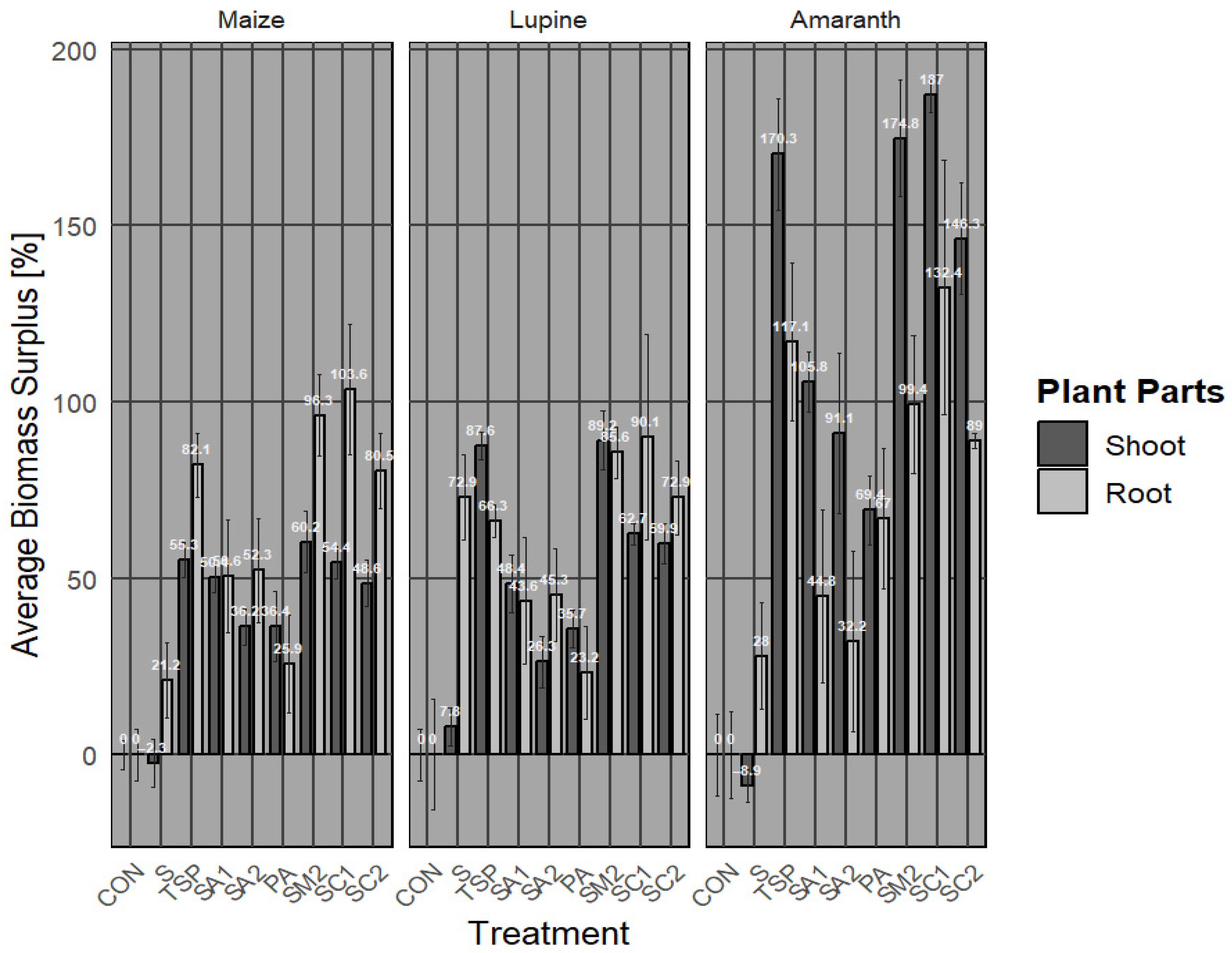
3.1.1. Effects of Biomass Ashes on Soil Properties on Plant P Uptake
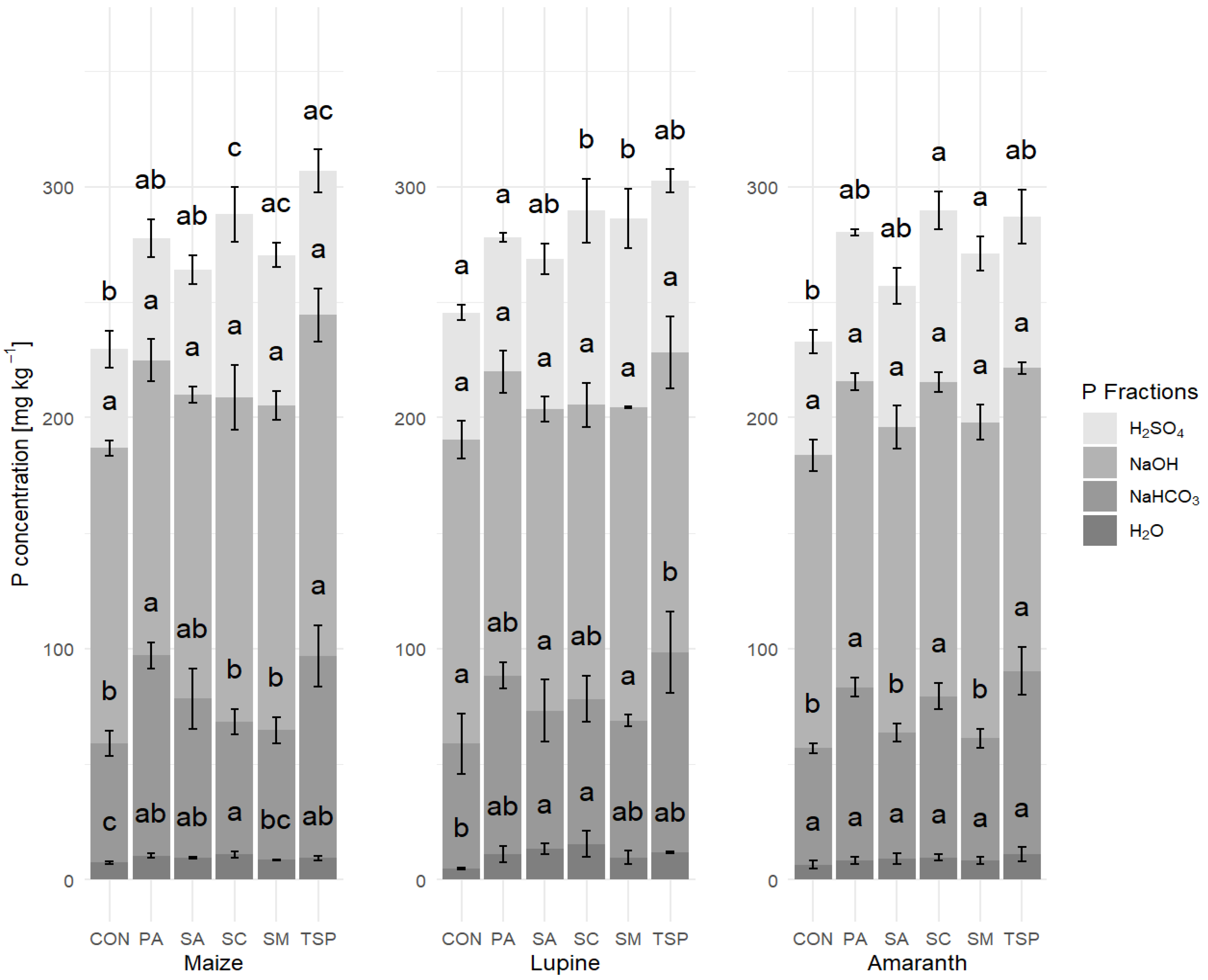
3.1.2. Effects of Biomass Ashes on Soil Properties
3.2. Pot Experiment II
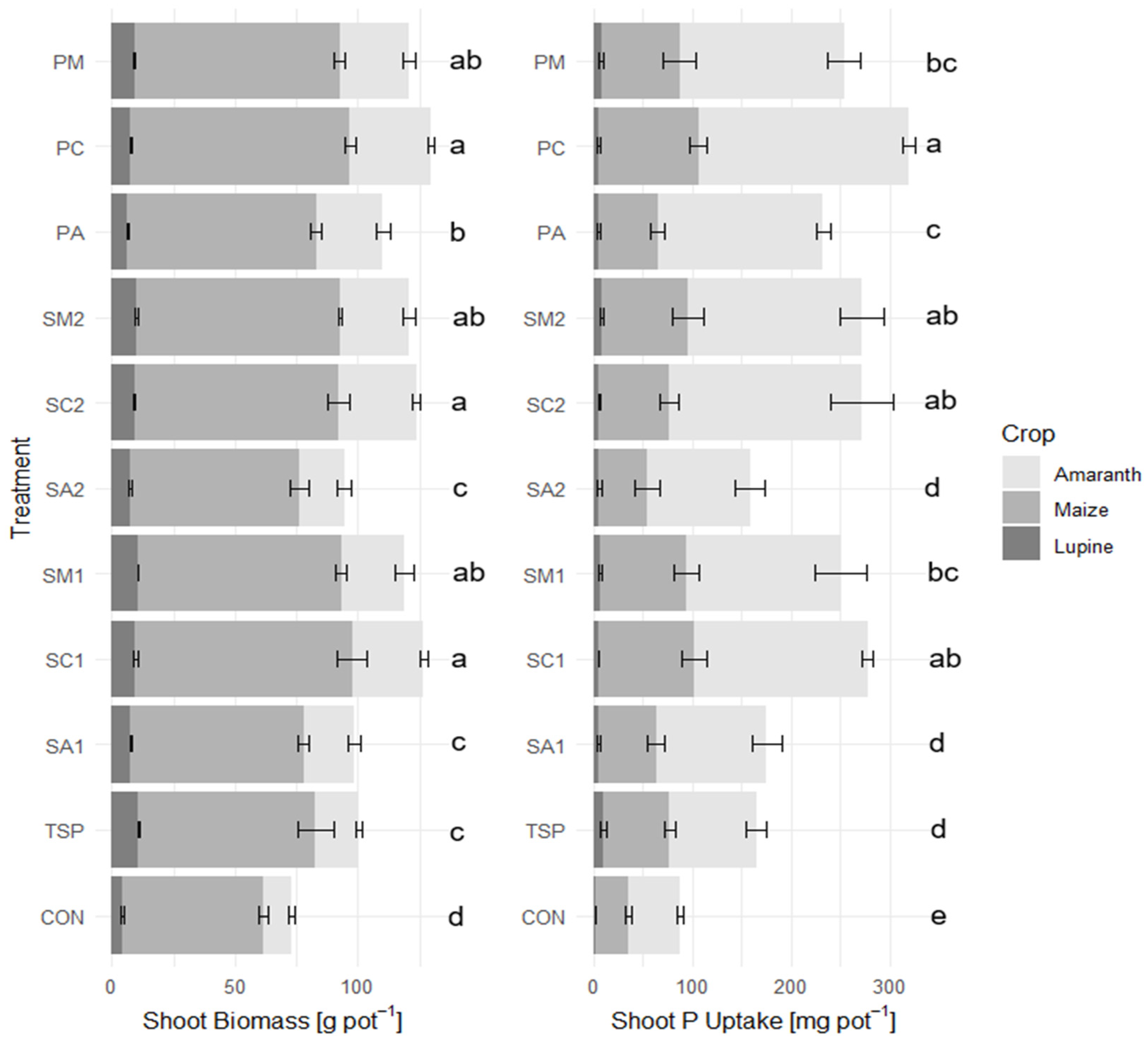
3.2.1. Residual Effects of Biomass Ashes on Crop P Uptake
3.2.2. Residual Effects of Biomass Ashes on Soil Properties
4. Discussion
4.1. Impact on Untreated and Treated Biomass Ashes on Plant P Uptake and Soil P Availability
4.2. Crop Effects on Soil Characteristics in Combination with Fertilizer Treatments
5. Conclusions
Supplementary Materials
Author Contributions
Funding
Data Availability Statement
Acknowledgments
Conflicts of Interest
References
- European Environment Agency. Renewables, Electrification and Flexibility for a Competitive EU Energy System Transformation by 2030; European Environment Agency: Copenhagen, Denmark, 2025. [Google Scholar]
- Silva, F.C.; Cruz, N.C.; Tarelho, L.A.C.; Rodrigues, S.M. Use of Biomass Ash-Based Materials as Soil Fertilisers: Critical Review of the Existing Regulatory Framework. J. Clean. Prod. 2019, 214, 112–124. [Google Scholar] [CrossRef]
- Odzijewicz, J.I.; Wołejko, E.; Wydro, U.; Wasil, M.; Jabłońska-Trypuć, A. Utilization of Ashes from Biomass Combustion. Energies 2022, 15, 9653. [Google Scholar] [CrossRef]
- Schiemenz, K.; Eichler-Löbermann, B. Biomass Ashes and Their Phosphorus Fertilizing Effect on Different Crops. Nutr. Cycl. Agroecosyst. 2010, 87, 471–482. [Google Scholar] [CrossRef]
- Cordell, D.; Drangert, J.-O.; White, S. The Story of Phosphorus: Global Food Security and Food for Thought. Glob. Environ. Change 2009, 19, 292–305. [Google Scholar] [CrossRef]
- Leinweber, P.; Bathmann, U.; Buczko, U.; Douhaire, C.; Eichler-Löbermann, B.; Frossard, E.; Ekardt, F.; Jarvie, H.; Krämer, I.; Kabbe, C.; et al. Handling the Phosphorus Paradox in Agriculture and Natural Ecosystems: Scarcity, Necessity, and Burden of P. Ambio 2018, 47, 3–19. [Google Scholar] [CrossRef]
- Raniro, H.R.; Serrano-Gomez, J.; Mort, H.L.; Kalpakchiev, T.; Kooij, J.; Zhao, Y.; Valença, R.M.; Magaya, S.; Guerrero-Esquivel, A.J.; Korving, L.; et al. Overcoming Recycling Barriers to Transform Global Phosphorus Management. Nat. Rev. Earth Environ. 2025. [Google Scholar] [CrossRef]
- Eichler-Loebermann, B.; Schiemenz, K.; Makadi, M.; Vágó, I.; Koeppen, D. Nutrient Cycling by Using Residues of Bio-Energy Production—Effects of Biomass Ashes on Plant and Soil Parameters. Cereal Res. Commun. 2008, 36, 1259–1262. [Google Scholar]
- Leng, L.; Bogush, A.A.; Roy, A.; Stegemann, J.A. Characterisation of Ashes from Waste Biomass Power Plants and Phosphorus Recovery. Sci. Total Environ. 2019, 690, 573–583. [Google Scholar] [CrossRef]
- Cruz-Paredes, C.; López-García, Á.; Rubæk, G.H.; Hovmand, M.F.; Sørensen, P.; Kjøller, R. Risk Assessment of Replacing Conventional P Fertilizers with Biomass Ash: Residual Effects on Plant Yield, Nutrition, Cadmium Accumulation and Mycorrhizal Status. Sci. Total Environ. 2017, 575, 1168–1176. [Google Scholar] [CrossRef]
- Li, X.; Rubæk, G.H.; Sørensen, P. High Plant Availability of Phosphorus and Low Availability of Cadmium in Four Biomass Combustion Ashes. Sci. Total Environ. 2016, 557–558, 851–860. [Google Scholar] [CrossRef]
- Kurzemann, F.R.; Juárez, M.F.; Probst, M.; Gómez-Brandón, M.; Spiegel, H.; Resch, R.; Insam, H.; Pötsch, E.M. Biomass Ash as a Substitute for Lime and Its Impact on Grassland Soil, Forage, and Soil Microbiota. Agronomy 2024, 14, 1568. [Google Scholar] [CrossRef]
- Demeyer, A.; Voundi Nkana, J.C.; Verloo, M.G. Characteristics of Wood Ash and Influence on Soil Properties and Nutrient Uptake: An Overview. Bioresour. Technol. 2001, 77, 287–295. [Google Scholar] [CrossRef]
- Deinert, L.; Schmalenberger, A. Reuse of Soils Fertilized with Ash as Recycling Derived Fertilizer Revealed Strong Stimulation of Microbial Communities Involved in P Mobilization in Lolium perenne Rhizospheres. Environments 2024, 11, 49. [Google Scholar] [CrossRef]
- Huang, X.; Pan, G.; Li, L.; Zhang, X.; Wang, H.; Bolan, N.; Singh, B.P.; Ma, C.; Liang, F.; Chen, Y.; et al. Combined Resource Utilization of Ash from Biomass Power Generation and Wheat Straw Biochar for Soil Remediation. Appl. Soil Ecol. 2024, 193, 105150. [Google Scholar] [CrossRef]
- Hedayati, A.; Lindgren, R.; Skoglund, N.; Boman, C.; Kienzl, N.; Öhman, M. Ash Transformation during Single-Pellet Combustion of Agricultural Biomass with a Focus on Potassium and Phosphorus. Energy Fuels 2021, 35, 1449–1464. [Google Scholar] [CrossRef]
- Singla Just, B.; Binder, P.M.; Guerra-Gorostegi, N.; Díaz-Guerra, L.; Vilaplana, R.; Frison, N.; Meers, E.; Llenas, L.; Robles Aguilar, A. Phosphorus Release Dynamics from Ashes during a Soil Incubation Study: Effect of Feedstock Characteristics and Combustion Conditions. Agronomy 2024, 14, 935. [Google Scholar] [CrossRef]
- Brod, E.; Øgaard, A.F.; Krogstad, T.; Haraldsen, T.K.; Frossard, E.; Oberson, A. Drivers of Phosphorus Uptake by Barley Following Secondary Resource Application. Front. Nutr. 2016, 3, 12. [Google Scholar] [CrossRef]
- Kremper, R.; Hidvégi, R.; Balláné Kovács, A.; Loch, J. The Study of the Fertilizing Effect of Wheat Straw Ash in a Greenhouse Experiment. Acta Agrar. Debreceniensis 2016, 70, 47–51. [Google Scholar] [CrossRef] [PubMed]
- Maj, I.; Niesporek, K.; Płaza, P.; Maier, J.; Łój, P. Biomass Ash: A Review of Chemical Compositions and Management Trends. Sustainability 2025, 17, 4925. [Google Scholar] [CrossRef]
- Hu, Y.; Dehmer, K.J.; Willner, E.; Turan, V.; Eichler-Löbermann, B.; Hu, Y.; Dehmer, K.J.; Willner, E.; Turan, V.; Eichler-Löbermann, B. Assessment of Inter- and Intraspecific P Efficiency in Forage Legumes as Affected by Recycling Fertiliser. Agronomy 2024, 14, 901. [Google Scholar] [CrossRef]
- Platače, R.; Adamovics, A. The Evaluation of Ash Content in Grass Biomass Used for Energy Production; WIT Press: Southampton, UK, 2014; Volume 190, p. 1065. ISBN 978-1-84564-816-9. [Google Scholar]
- Geurts, J.J.M.; Oehmke, C.; Lambertini, C.; Eller, F.; Sorrell, B.K.; Mandiola, S.R.; Grootjans, A.P.; Brix, H.; Wichtmann, W.; Lamers, L.P.M.; et al. Nutrient Removal Potential and Biomass Production by Phragmites Australis and Typha Latifolia on European Rewetted Peat and Mineral Soils. Sci. Total Environ. 2020, 747, 141102. [Google Scholar] [CrossRef]
- van den Berg, M.; Gremmen, T.M.; Vroom, R.J.E.; van Huissteden, J.; Boonman, J.; van Huissteden, C.J.A.; van der Velde, Y.; Smolders, A.J.P.; van de Riet, B.P. A Case Study on Topsoil Removal and Rewetting for Paludiculture: Effect on Biogeochemistry and Greenhouse Gas Emissions from Typha Latifolia, Typha Angustifolia, and Azolla Filiculoides. Biogeosciences 2024, 21, 2669–2690. [Google Scholar] [CrossRef]
- Hinsinger, P. Bioavailability of Soil Inorganic P in the Rhizosphere as Affected by Root-Induced Chemical Changes: A Review. Plant Soil 2001, 237, 173–195. [Google Scholar] [CrossRef]
- Pearse, S.J.; Veneklaas, E.J.; Cawthray, G.R.; Bolland, M.D.A.; Lambers, H. Carboxylate Release of Wheat, Canola and 11 Grain Legume Species as Affected by Phosphorus Status. Plant Soil 2006, 288, 127–139. [Google Scholar] [CrossRef]
- Eichler, B. Soil Acid and Alkaline Phosphatase Activities in Regulation to Crop Species and Fungal Treatment. Landbauforsch. Völkenrode 2004, 54, 1–5. [Google Scholar]
- Lambers, H.; Plaxton, W.C. Phosphorus: Back to the Roots. In Annual Plant Reviews Volume 48; Plaxton, W.C., Lambers, H., Eds.; Wiley: Hoboken, NJ, USA, 2015; pp. 1–22. ISBN 978-1-118-95885-8. [Google Scholar]
- Codling, E.E.; Chaney, R.L.; Sherwell, J. Poultry Litter Ash as a Potential Phosphorus Source for Agricultural Crops. J. Environ. Qual. 2002, 31, 954–961. [Google Scholar] [CrossRef] [PubMed]
- Lindvall, E.; Gustavsson, A.-M.; Samuelsson, R.; Magnusson, T.; Palmborg, C. Ash as a Phosphorus Fertilizer to Reed Canary Grass: Effects of Nutrient and Heavy Metal Composition on Plant and Soil. GCB Bioenergy 2015, 7, 553–564. [Google Scholar] [CrossRef]
- Johansen, J.L.; Nielsen, M.L.; Vestergård, M.; Mortensen, L.H.; Cruz-Paredes, C.; Rønn, R.; Kjøller, R.; Hovmand, M.; Christensen, S.; Ekelund, F. The Complexity of Wood Ash Fertilization Disentangled: Effects on Soil pH, Nutrient Status, Plant Growth and Cadmium Accumulation. Environ. Exp. Bot. 2021, 185, 104424. [Google Scholar] [CrossRef]
- Jian, C.; Hamamoto, T.; Inoue, C.; Chien, M.-F.; Naganuma, H.; Mori, T.; Sawada, A.; Hidaka, M.; Setoyama, H.; Makino, T. Effects of Wood Ash Fertilizer on Element Dynamics in Soil Solution and Crop Uptake. Agronomy 2025, 15, 1097. [Google Scholar] [CrossRef]
- Arshad, M.A.; Soon, Y.K.; Azooz, R.H.; Lupwayi, N.Z.; Chang, S.X. Soil and Crop Response to Wood Ash and Lime Application in Acidic Soils. Agron. J. 2012, 104, 715–721. [Google Scholar] [CrossRef]
- Dombinov, V.; Herzel, H.; Meiller, M.; Müller, F.; Willbold, S.; Zang, J.W.; Da Fonseca-Zang, W.A.; Adam, C.; Klose, H.; Poorter, H.; et al. Sugarcane Bagasse Ash as Fertilizer for Soybeans: Effects of Added Residues on Ash Composition, Mineralogy, Phosphorus Extractability and Plant Availability. Front. Plant Sci. 2022, 13, 1041924. [Google Scholar] [CrossRef]
- Maresca, A.; Krüger, O.; Herzel, H.; Adam, C.; Kalbe, U.; Astrup, T.F. Influence of Wood Ash Pre-Treatment on Leaching Behaviour, Liming and Fertilising Potential. Waste Manag. 2019, 83, 113–122. [Google Scholar] [CrossRef]
- Zhao, H.; Ahmad, S.; Wu, N.; Suo, L.; Tian, X.; Zhao, Y.; Yu, J.; Wang, L.; Si, B. Effect of Straw and Wood Ash on Soil Carbon Sequestration and Bacterial Community in a Calcareous Soil. Front. Microbiol. 2022, 13, 926506. [Google Scholar] [CrossRef] [PubMed]
- Brod, E.; Haraldsen, T.K.; Breland, T.A. Fertilization Effects of Organic Waste Resources and Bottom Wood Ash: Results from a Pot Experiment. Agric. Food Sci. 2012, 21, 332–347. [Google Scholar] [CrossRef]
- IEA Bioenergy. Options for Increased Use of Ash from Biomass Combustion and Co-Firing; IEA: Paris, France, 2018. [Google Scholar]
- Greinert, A.; Mrówczyńska, M.; Szefner, W. Study on the Possibilities of Natural Use of Ash Granulate Obtained from the Combustion of Pellets from Plant Biomass. Energies 2019, 12, 2569. [Google Scholar] [CrossRef]
- Ochecova, P.; Mercl, F.; Kosnar, Z.; Tlustos, P. Fertilization Efficiency of Wood Ash Pellets Amended by Gypsum and Superphosphate in the Ryegrass Growth. Plant Soil Environ. 2017, 63, 47–54. [Google Scholar] [CrossRef]
- Bachmann, S.; Uptmoor, R.; Eichler-Löbermann, B. Phosphorus Distribution and Availability in Untreated and Mechanically Separated Biogas Digestates. Sci. Agric. 2016, 73, 9–17. [Google Scholar] [CrossRef]
- Kape, H.-E.; Nawotke, C.; Wacker-Fester, K.; Holst, F.; Pöplau, R.; Korten, K.; Kastell, S. Richtwerte Für Die Untersuchung Und Beratung Zur Umsetzung Der Düngeverordnung 2020 in Mecklenburg-Vorpommern; Umwelt Mecklenburg-Vorpommern: Schwerin, Germany, 2021. [Google Scholar]
- Hoffmann, M. Effekte der Düngung mit Gärresten auf Bodenfruchtbarkeit und Pflanzen. Doctoral Dissertation, Lebenswissenschaftlichen Fakultät der Humboldt-Universität zu Berlin, Berlin, Germany, 2019. [Google Scholar]
- Tiessen, H.; Stewart, J.W.B.; Moir, J.O. Changes in Organic and Inorganic Phosphorus Composition of Two Grassland Soils and Their Particle Size Fractions during 60–90 Years of Cultivation. J. Soil Sci. 1983, 34, 815–823. [Google Scholar] [CrossRef]
- Dou, Z.; Toth, J.; Galligan, D.; Ramberg, C.; Ferguson, J. Laboratory Procedures for Characterizing Manure Phosphorus. J. Environ. Qual. 2000, 29, 508–514. [Google Scholar] [CrossRef]
- Tabatabai, M.A.; Bremner, J.M. Use of P-Nitrophenol Phosphate for the Assay of Soil Phosphatase Activity. Soil Biol. Biochem. 1969, 1, 301–307. [Google Scholar] [CrossRef]
- Thalmann, A. Zur Methodik Der Bestimmung Der Dehydrogenaseaktivitat Im Boden Mittels Triphenyltetrazoliumchlorid (TTC). Landwirtsch. Forsch. 1968, 21, 249–258. [Google Scholar]
- Kemper, W.D.; Rosenau, R.C. Aggregate Stability and Size Distribution. In Methods of Soil Analysis; Klute, A., Ed.; Number 9 (Part 1) in the Series Agronomy; Wiley: Madison, WI, USA, 1986; ISBN 978-0-89118-864-3. [Google Scholar]
- Singh, I.; Thind, H.S.; Sharma, S.; Singh, Y.; Bhat, M.A. Phosphorus Fertilizing Potential of Biomass Ashes and Their Effect on Bioavailability of Micronutrients in Wheat (Triticum aestivum. L). J. Appl. Nat. Sci. 2017, 9, 744–753. [Google Scholar] [CrossRef]
- Johan, P.D.; Ahmed, O.H.; Omar, L.; Hasbullah, N.A. Phosphorus Transformation in Soils Following Co-Application of Charcoal and Wood Ash. Agronomy 2021, 11, 2010. [Google Scholar] [CrossRef]
- Kopp, C.; Sica, P.; Lu, C.; Tobler, D.; Stoumann Jensen, L.; Müller-Stöver, D. Increasing Phosphorus Plant Availability from P-Rich Ashes and Biochars by Acidification with Sulfuric Acid. J. Environ. Chem. Eng. 2023, 11, 111489. [Google Scholar] [CrossRef]
- Abelenda, A.M.; Aiouache, F. Wood Ash Based Treatment of Anaerobic Digestate: State-of-the-Art and Possibilities. Processes 2022, 10, 147. [Google Scholar] [CrossRef]
- Bhattacharya, S.S.; Chattopadhyay, G.N. Increasing Bioavailability of Phosphorus from Fly Ash through Vermicomposting. J. Environ. Qual. 2002, 31, 2116–2119. [Google Scholar] [CrossRef]
- Brännvall, E.; Wolters, M.; Sjöblom, R.; Kumpiene, J. Elements Availability in Soil Fertilized with Pelletized Fly Ash and Biosolids. J. Environ. Manag. 2015, 159, 27–36. [Google Scholar] [CrossRef]
- Qin, J.; Hovmand, M.F.; Ekelund, F.; Rønn, R.; Christensen, S.; de Groot, G.A.; Mortensen, L.H.; Skov, S.; Krogh, P.H. Wood Ash Application Increases pH but Does Not Harm the Soil Mesofauna. Environ. Pollut. 2017, 224, 581–589. [Google Scholar] [CrossRef]
- Blombäck, K.; Bolster, C.H.; Lindsjö, A.; Hesse, K.; Linefur, H.; Parvage, M.M. Comparing Measures for Determination of Phosphorus Saturation as a Method to Estimate Dissolved P in Soil Solution. Geoderma 2021, 383, 114708. [Google Scholar] [CrossRef]
- Blanco-Canqui, H.; Lal, R. Mechanisms of Carbon Sequestration in Soil Aggregates. Crit. Rev. Plant Sci. 2004, 23, 481–504. [Google Scholar] [CrossRef]
- Alghamdi, A.G.; Majrashi, M.A.; Ibrahim, H.M. Improving the Physical Properties and Water Retention of Sandy Soils by the Synergistic Utilization of Natural Clay Deposits and Wheat Straw. Sustainability 2024, 16, 46. [Google Scholar] [CrossRef]
- Hinsinger, P.; Betencourt, E.; Bernard, L.; Brauman, A.; Plassard, C.; Shen, J.; Tang, X.; Zhang, F. P for Two, Sharing a Scarce Resource: Soil Phosphorus Acquisition in the Rhizosphere of Intercropped Species. Plant Physiol. 2011, 156, 1078–1086. [Google Scholar] [CrossRef]
- Angers, D.A.; Recous, S. Decomposition of Wheat Straw and Rye Residues as Affected by Particle Size. Plant Soil 1997, 189, 197–203. [Google Scholar] [CrossRef]
- Turner, B.L. Variation in pH Optima of Hydrolytic Enzyme Activities in Tropical Rain Forest Soils. Appl. Environ. Microbiol. 2010, 76, 6485–6493. [Google Scholar] [CrossRef]
- Kumar, B.; Dhar, S.; Paul, S.; Paramesh, V.; Dass, A.; Upadhyay, P.K.; Kumar, A.; Abdelmohsen, S.A.M.; Alkallas, F.H.; El-Abedin, T.K.Z.; et al. Microbial Biomass Carbon, Activity of Soil Enzymes, Nutrient Availability, Root Growth, and Total Biomass Production in Wheat Cultivars under Variable Irrigation and Nutrient Management. Agronomy 2021, 11, 669. [Google Scholar] [CrossRef]
- Hinsinger, P.; Bengough, A.G.; Vetterlein, D.; Young, I.M. Rhizosphere: Biophysics, Biogeochemistry and Ecological Relevance. Plant Soil 2009, 321, 117–152. [Google Scholar] [CrossRef]
- Kiani, M.; Ylivainio, K. Methods for Testing Short- and Long-Term Phosphorus Fertilizing Efficiency of Products with Varying Solubility. Sci. Total Environ. 2024, 922, 170965. [Google Scholar] [CrossRef] [PubMed]
- Aronsson, K.A.; Ekelund, N.G.A. Biological Effects of Wood Ash Application to Forest and Aquatic Ecosystems. J. Environ. Qual. 2004, 33, 1595–1605. [Google Scholar] [CrossRef]
- Albiach, R.; Canet, R.; Pomares, F.; Ingelmo, F. Microbial Biomass Content and Enzymatic Activities after the Application of Organic Amendments to a Horticultural Soil. Bioresour. Technol. 2000, 75, 43–48. [Google Scholar] [CrossRef]
- Mndzebele, B.; Ncube, B.; Fessehazion, M.; Mabhaudhi, T.; Amoo, S.; du Plooy, C.; Venter, S.; Modi, A.; Mndzebele, B.; Ncube, B.; et al. Effects of Cowpea-Amaranth Intercropping and Fertiliser Application on Soil Phosphatase Activities, Available Soil Phosphorus, and Crop Growth Response. Agronomy 2020, 10, 79. [Google Scholar] [CrossRef]
- Garg, S.; Bahl, G.S. Phosphorus Availability to Maize as Influenced by Organic Manures and Fertilizer P Associated Phosphatase Activity in Soils. Bioresour. Technol. 2008, 99, 5773–5777. [Google Scholar] [CrossRef]
- Rao, A.V.; Bala, K.; Tarafdar, J.C. Dehydrogenase and Phosphatase Activities in Soil as Influenced by the Growth of Arid-Land Crops. J. Agric. Sci. 1990, 115, 221–225. [Google Scholar] [CrossRef]
- Gao, X.; Shi, D.; Lv, A.; Wang, S.; Yuan, S.; Zhou, P.; An, Y. Increase Phosphorus Availability from the Use of Alfalfa (Medicago sativa L) Green Manure in Rice (Oryza sativa L.) Agroecosystem. Sci. Rep. 2016, 6, 36981. [Google Scholar] [CrossRef]
- Sakib, T.U.; Nelson, N.O.; Hettiarachchi, G.M.; Moorberg, C.J.; Nippert, J.B.; Whitaker, S. Soil Phosphorus Availability as Affected by Root Exudates of Cover Crop Species. Sci. Rep. 2025, 15, 33443. [Google Scholar] [CrossRef] [PubMed]
- Lambers, H.; Shane, M.W.; Cramer, M.D.; Pearse, S.J.; Veneklaas, E.J. Root Structure and Functioning for Efficient Acquisition of Phosphorus: Matching Morphological and Physiological Traits. Ann. Bot. 2006, 98, 693–713. [Google Scholar] [CrossRef] [PubMed]
- Xu, F.-Q.; Meng, L.-L.; Kuča, K.; Wu, Q.-S. The Mechanism of Arbuscular Mycorrhizal Fungi-Alleviated Manganese Toxicity in Plants: A Review. Plant Physiol. Biochem. 2024, 213, 108808. [Google Scholar] [CrossRef]
- Ma, X.; Liu, Y.; Shen, W.; Kuzyakov, Y. Phosphatase Activity and Acidification in Lupine and Maize Rhizosphere Depend on Phosphorus Availability and Root Properties: Coupling Zymography with Planar Optodes. Appl. Soil Ecol. 2021, 167, 104029. [Google Scholar] [CrossRef]



| Experiment | Pdl | Kdl | Mgdl | pH | N | C | SOM |
|---|---|---|---|---|---|---|---|
| mg kg−1 | % | ||||||
| PE I | 30.1 | 83.6 | 103 | 5.39 | 0.09 | 0.84 | 2.52 |
| PE II | 37.8 | 82.7 | 106 | 5.46 | 0.09 | 0.86 | 2.60 |
| Treatments | Abbrev. | Part of | pH | Ptot | Application | P Amount |
|---|---|---|---|---|---|---|
| % | g pot−1 | g pot−1 | ||||
| Control | CON | PE I and PE II | - | - | - | - |
| TSP | TSP | PE I and PE II | 2.97 | 20.3 | 1.04 | 0.21 |
| Raw Straw | S | PE I | 7.22 | 0.15 | 70.4 | 0.11 |
| Straw Ash 1 | SA1 | PE I and PE II | 12.2 | 1.31 | 16.1 | 0.21 |
| Straw Compactate 1 | SC1 | PE I and PE II | 12.2 | 1.31 | 16.1 | 0.21 |
| Straw Ash Mix 1 | SM1 | PE II | 11.7 | 1.19 | 17.7 | 0.21 |
| Straw Ash 2 | SA2 | PE I and PE II | 10.8 | 0.44 | 48.0 | 0.21 |
| Straw Compactate 2 | SC2 | PE I and PE II | 10.7 | 0.44 | 48.0 | 0.21 |
| Straw Ash Mix 2 | SM2 | PE I and PE II | 10.3 | 0.89 | 25.4 | 0.21 |
| Paludic. Ash | PA | PE I and PE II | 13.1 | 2.09 | 10.1 | 0.21 |
| Paludic. Compactate | PC | PE II | 13.2 | 2.09 | 10.1 | 0.21 |
| Paludic. Ash Mix | PM | PE II | 12.5 | 1.92 | 11.0 | 0.21 |
| Ash/ Substrate | Maize | Lupine | Amaranth | Maize | Lupine | Amaranth |
|---|---|---|---|---|---|---|
| Plant Biomass [g pot−1] | Plant P Uptake [mg pot−1] | |||||
| SA1 | 117 (±9.53) abc | 18.7 (±2.08) cd | 49.5 (±7.15) bc | 163 (±15.0) b | 22.8 (±4.12) cd | 216 (±53.3) bc |
| SC1 | 126 (±9.01) ab | 21.1 (±1.02) abc | 71.6 (±6.77) a | 195 (±13.5) ab | 29.8 (±3.33) bc | 376 (±75.3) a |
| S | 78.7 (±9.61) d | 14.8 (±1.32) ef | 30.5 (±9.53) de | 160 (±10.7) b | 16.9 (±1.59) de | 123 (±34.5) cd |
| SA2 | 106 (±7.31) bc | 16.3 (±1.74) def | 45.8 (±10.1) cd | 160 (±23.9) b | 18.6 (±4.95) de | 206 (±37.0) bc |
| SC2 | 119 (±6.32) abc | 20.0 (±2.30) bcd | 62.8 (±4.50) abc | 187 (±18.5) ab | 25.0 (±3.97) bcd | 295 (±54.3) ab |
| SM2 | 129 (±8.34) a | 23.9 (±1.85) a | 66.6 (±8.63) ab | 207 (±19.7) a | 34.1 (±6.46) ab | 285 (±25.9) ab |
| PA | 104 (±9.81) c | 17.0 (±1.21) de | 44.8 (±4.81) cde | 159 (±23.6) b | 20.8 (±3.66) cde | 209 (±28.6) bc |
| TSP | 124 (±8.15) abc | 23.4 (±0.97) ab | 67.3 (±8.41) ab | 214 (±12.3) a | 39.7 (±4.45) a | 362 (±33.2) a |
| CON | 77.4 (±4.02) d | 12.7 (±1.30) f | 26.6 (±5.61) e | 98.4 (±12.5) c | 12.7 (±2.25) e | 99.1 (±28.2) d |
| MEAN | 109 (±20.1) A | 18.6 (±3.90) C | 50.8 (±17.0) B | 171 (±36.7) B | 24.5 (±9.04) C | 236 (±98.6) A |
| Ash/ Substrate | Maize | Lupine | Amaranth | Maize | Lupine | Amaranth | Maize | Lupine | Amaranth |
|---|---|---|---|---|---|---|---|---|---|
| pH | Pw [mg kg−1] | Pdl [mg kg−1] | |||||||
| SA1 | 5.24 (±0.16) a | 5.47 (±0.03) a | 5.51 (±0.35) ns | 8.48 (±0.87) ab | 12.9 (±2.14) ab | 9.79 (±1.46) ns | 42.9 (±2.74) a | 42.8 (±3.96) a | 33.5 (±5.79) ns |
| SC1 | 5.19 (±0.20) ab | 5.45 (±0.08) ab | 5.37 (±0.05) ns | 8.89 (±1.14) a | 15.3 (±2.91) a | 10.2 (±1.65) ns | 41.7 (±2.33) a | 45.6 (±4.31) a | 41.5 (±4.69) ns |
| S | 4.96 (±0.18) ab | 5.21 (±0.13) c | 5.09 (±0.12) ns | 8.40 (±1.05) ab | 8.81 (±6.08) ab | 8.40 (±3.83) ns | 25.2 (±4.46) b | 29.6 (±2.98) bc | 26.6 (±10.7) ns |
| SA2 | 5.15 (±0.07) ab | 5.52 (±0.14) a | 5.37 (±0.26) ns | 9.15 (±0.51) ab | 13.5 (±3.54) ab | 9.90 (±1.41) ns | 42.2 (±2.37) a | 47.0 (±8.64) a | 28.0 (±8.60) ns |
| SC2 | 5.14 (±0.05) ab | 5.39 (±0.09) abc | 5.45 (±0.32) ns | 9.60 (±0.53) ab | 12.7 (±2.38) a | 9.71 (±2.17) ns | 38.2 (±2.10) a | 41.5 (±1.77) a | 35.2 (±9.32) ns |
| SM2 | 5.04 (±0.03) ab | 5.39 (±0.07) abc | 5.38 (±0.22) ns | 9.23 (±0.62) ab | 11.7 (±1.49) a | 10.9 (±2.91) ns | 36.6 (±3.67) a | 40.3 (±2.49) ab | 36.9 (±10.0) ns |
| PA | 5.17 (±0.22) ab | 5.39 (±0.08) abc | 5.46 (±0.29) ns | 9.15 (±0.89) ab | 11.5 (±0.46) ab | 9.79 (±1.46) ns | 40.3 (±2.29) a | 42.6 (±5.74) a | 27.7 (±6.77) ns |
| TSP | 4.92 (±0.03) ab | 5.21 (±0.07) c | 5.10 (±0.18) ns | 9.64 (±0.94) a | 11.8 (±0.33) ab | 11.0 (±3.01) ns | 38.2 (±3.27) a | 47.3 (±6.19) a | 40.7 (±8.75) ns |
| CON | 4.88 (±0.11) b | 5.25 (±0.02) bc | 5.02 (±0.07) ns | 7.43 (±0.56) b | 4.90 (±0.31) b | 6.04 (±1.20) ns | 25.8 (±1.32) b | 28.2 (±3.82) c | 26.0 (±5.45) ns |
| Mean | 5.08 (±0.17) B | 5.37 (±0.13) A | 5.30 (±0.27) A | 8.88 (±0.98) B | 11.6 (±3.73) A | 9.51 (±2.54) B | 36.8 (±6.90) AB | 40.6 (±7.97) A | 32.9 (±9.14) B |
| Ash/ Substrate | Maize | Lupine | Amaranth | Maize | Lupine | Amaranth | Maize | Lupine | Amaranth |
|---|---|---|---|---|---|---|---|---|---|
| Acid Phosphatase Activity [μg p-Nitrophenol g−1 TM 24 h−1] | Alkaline Phosphatase Activity [μg p-Nitrophenol g−1 TM 24 h−1] | Dehydrogenase Activity mg TPF g−1 24 h−1 | |||||||
| SA1 | 105 (±25.7) ns | 94.1 (±38.5) b | 174 (±53.2) ns | 35.1 (±7.59) ns | 59.6 (±15.8) ns | 61.7 (±10.8) ab | 36.5 (±2.62) ns | 53.1 (±5.29) b | 41.0 (±21.4) ns |
| SC1 | 117 (±50.4) ns | 116 (±18.1) ab | 162 (±62.0) ns | 31.2 (±9.78) ns | 49.8 (±9.25) ns | 56.2 (±25.7) ab | 43.8 (±12.1) ns | 41.5 (±8.28) b | 30.2 (±16.5) ns |
| S | 124 (±41.6) ns | 145 (±15.6) ab | 181 (±51.2) ns | 47.7 (±9.06) ns | 65.2 (±6.52) ns | 86.0 (±17.9) a | 62.3 (±15.2) ns | 128 (±21.0) a | 64.8 (±25.6) ns |
| SA2 | 93.2 (±24.3) ns | 105 (±8.34) ab | 172 (±11.7) ns | 40.7 (±4.15) ns | 68.0 (±20.0) ns | 54.1 (±14.1) ab | 44.4 (±4.81) ns | 58.0 (±15.6) b | 31.7 (±18.9) ns |
| SC2 | 101 (±20.9) ns | 124 (±8.12) ab | 152 (±20.7) ns | 40.3 (±11.6) ns | 75.8 (±21.0) ns | 48.6 (±14.2) b | 50.0 (±7.02) ns | 55.9 (±12.2) b | 40.3 (±10.3) ns |
| SM2 | 107 (±38.1) ns | 113 (±11.2) ab | 169 (±33.4) ns | 33.4 (±8.46) ns | 65.7 (±11.7) ns | 71.5 (±10.1) ab | 51.7 (±12.0) ns | 48.5 (±20.8) b | 43.8 (±15.2) ns |
| PA | 96.2 (±10.6) ns | 122 (±30.4) ab | 169 (±40.5) ns | 32.8 (±17.4) ns | 60.5 (±18.6) ns | 55.0 (±9.22) ab | 47.8 (±12.2) ns | 49.3 (±14.0) b | 28.4 (±4.79) ns |
| TSP | 121 (±28.7) ns | 105 (±12.9) ab | 180 (±29.5) ns | 30.8 (±8.64) ns | 56.6 (±5.72) ns | 49.1 (±8.45) b | 41.9 (±15.3) ns | 46.8 (±11.8) b | 27.2 (±12.0) ns |
| CON | 123 (±31.8) ns | 157 (±35.1) a | 211 (±52.4) ns | 31.6 (±8.09) ns | 65.9 (±21.3) ns | 66.8 (±10.9) ab | 42.5 (±9.09) ns | 53.4 (±7.48) b | 33.4 (±16.2) ns |
| Mean | 110 (±30.5) B | 120 (±27.6) B | 175 (±39.5) A | 36.0 (±10.4) B | 63.0 (±15.4) A | 61.1 (±16.8) A | 46.8 (±11.9) B | 59.4 (±27.9) A | 38.1 (±18.5) B |
| Ash/ Substrate | Aggregates Size Composition [%] | MWD | ||
|---|---|---|---|---|
| >2 mm | 2–0.25 mm | <0.25 mm | mm | |
| SA2 | 7.8 (±1.3) b | 50.3 (±3.7) ns | 41.9 (±3.1) ab | 0.82 (±0.04) b |
| SC2 | 14.1 (±2.3) a | 56.0 (±4.3) ns | 29.9 (±6.5) b | 0.91 (±0.03) a |
| SM2 | 13.3 (±3.4) a | 54.5 (±2.9) ns | 32.2 (±3.3) b | 0.88 (±0.05) ab |
| TSP | 6.2 (±1.5) b | 48.5 (±4.7) ns | 45.3 (±4.1) a | 0.77 (±0.04) b |
| CON | 5.9 (±2.0) b | 48.7 (±4.0) ns | 45.4 (±5.1) a | 0.79 (±0.03) b |
| Ash/ Substrate | Lupine→ | Maize→ | Amaranth | Lupine→ | Maize→ | Amaranth |
|---|---|---|---|---|---|---|
| Shoot Biomass [g pot−1] | Shoot P Uptake [g pot−1] | |||||
| SA1 | 7.71 (±0.51) c | 70.3 (±19.8) c | 20.6 (±2.60) cd | 5.36 (±1.88) ab | 58.0 (±9.19) def | 113 (±14.6) c |
| SC1 | 9.63 (±0.80) ab | 88.0 (±19.9) a | 29.1 (±1.57) ab | 5.28 (±0.12) ab | 97.3 (±12.9) ab | 175 (±5.17) ab |
| SM1 | 10.7 (±0.28) a | 82.6 (±12.9) ab | 25.5 (±3.73) bc | 6.71 (±2.21) ab | 86.9 (±12.5) abc | 157 (±25.9) b |
| SA2 | 7.26 (±0.71) cd | 69.0 (±33.5) c | 18.2 (±2.94) d | 5.66 (±2.15) ab | 49.2 (±9.97) ef | 104 (±15.1) c |
| SC2 | 9.16 (±0.32) b | 83.0 (±4.57) ab | 31.6 (±1.56) ab | 5.84 (±1.24) ab | 70.7 (±15.3) bcde | 196 (±32.2) ab |
| SM2 | 10.0 (±0.34) ab | 83.1 (±0.59) ab | 27.9 (±2.54) ab | 8.54 (±0.98) a | 87.3 (±15.3) abc | 176 (±21.8) ab |
| PA | 6.47 (±0.34) d | 76.6 (±2.42) bc | 27.3 (±2.68) ab | 5.10 (±1.34) ab | 60.1 (±7.52) cdef | 168 (±6.95) b |
| PC | 7.76 (±0.38) cd | 89.3 (±2.34) a | 32.8 (±1.07) a | 5.15 (±1.64) ab | 101 (±8.99) a | 213 (±6.64) a |
| PM | 9.08 (±0.30) b | 83.6 (±2.25) ab | 28.1 (±2.46) ab | 7.80 (±2.96) a | 79.2 (±16.3) abcd | 167 (±16.6) b |
| TSP | 10.8 (±0.38) a | 72.1 (±7.31) c | 17.8 (±1.30) d | 9.68 (±3.29) a | 67.6 (±5.21) bcde | 88.1 (±10.5) cd |
| CON | 4.43 (±0.73) e | 57.3 (±1.90) d | 11.3 (±1.09) e | 1.96 (±0.37) b | 33.5 (±3.63) f | 52.5 (±3.27) d |
| MEAN | 8.44 (±1.94) C | 77.7 (±9.68) A | 24.6 (±6.69) B | 6.10 (±2.06) C | 71.9 (±20.9) B | 146 (±49.7) A |
| Ash/ Substrate | Lupine→ | Maize→ | Amaranth | Lupine→ | Maize→ | Amaranth | Lupine→ | Maize→ | Amaranth |
|---|---|---|---|---|---|---|---|---|---|
| pH | Pw [mg kg−1] | Pdl [mg kg−1] | |||||||
| SA1 | 5.79 (±0.54) ns | 5.37 (±0.48) ns | 5.42 (±0.47) ab | 5.65 (±1.04) ab | 4.04 (±1.55) ns | 13.1 (±1.38) a | 89.7 (±18.2) a | 47.7 (±8.85) ab | 51.5 (±2.88) ab |
| SC1 | 5.85 (±0.29) ns | 5.51 (±0.42) ns | 5.62 (±0.51) ab | 5.49 (±0.89) ab | 2.81 (±0.78) ns | 15.0 (±2.88) a | 56.3 (±9.53) bcd | 66.6 (±12.1) a | 70.3 (±20.5) a |
| SM1 | 5.67 (±0.53) ns | 5.36 (±0.17) ns | 6.02 (±0.70) b | 5.18 (±2.31) ab | 3.03 (±0.93) ns | 13.8 (±5.25) a | 47.8 (±5.36) cd | 54.3 (±8.67) ab | 65.2 (±3.66) ab |
| SA2 | 5.85 (±0.50) ns | 5.40 (±0.39) ns | 5.36 (±0.40) ab | 6.88 (±1.85) ab | 4.12 (±1.36) ns | 9.67 (±2.53) ab | 73.7 (±15.7) abc | 48.1 (±4.32) ab | 51.1 (±7.23) ab |
| SC2 | 5.86 (±0.68) ns | 5.51 (±0.34) ns | 6.41 (±0.05) b | 5.17 (±0.34) ab | 2.80 (±0.71) ns | 18.7 (±6.86) a | 54.0 (±12.7) bcd | 64.5 (±2.84) a | 74.9 (±6.70) a |
| SM2 | 5.63 (±0.33) ns | 5.38 (±0.44) ns | 5.36 (±0.68) ab | 4.78 (±0.37) a | 3.26 (±0.48) ns | 15.4 (±4.78) a | 57.6 (±12.4) bcd | 67.2 (±21.2) a | 62.2 (±4.03) ab |
| PA | 5.78 (±0.50) ns | 5.39 (±0.59) ns | 6.13 (±0.20) b | 5.91 (±1.57) ab | 3.57 (±0.97) ns | 13.9 (±3.86) a | 64.9 (±10.0) abc | 42.4 (±3.55) ab | 55.1 (±4.71) ab |
| PC | 5.81 (±0.49) ns | 5.52 (±0.27) ns | 5.46 (±0.58) ab | 5.32 (±1.28) ab | 3.03 (±0.58) ns | 16.5 (±4.18) a | 54.7 (±6.26) bcd | 56.9 (±2.59) ab | 69.2 (±11.2) ab |
| PM | 5.56 (±0.55) ns | 5.41 (±0.50) ns | 5.49 (±0.59) ab | 5.70 (±1.00) ab | 4.34 (±1.56) ns | 16.1 (±3.80)a | 59.9 (±9.71) bcd | 68.0 (±24.8) a | 65.9 (±14.4) ab |
| TSP | 5.11 (±0.12) ns | 5.13 (±0.18) ns | 5.15 (±0.12) a | 7.81 (±0.72) a | 3.92 (±1.51) ns | 9.44 (±2.05) b | 79.9 (±13.7) ab | 59.8 (±8.24) ab | 49.1 (±6.74) ab |
| CON | 5.22 (±0.08) ns | 5.04 (±0.21) ns | 5.06 (±0.23) a | 4.27 (±0.82) b | 3.02 (±0.68) ns | 9.17 (±1.01) b | 34.7 (±2.77) d | 33.6 (±3.68) b | 42.5 (±4.92) b |
| Mean | 5.65 (±0.47) A | 5.37 (±0.37) B | 5.58 (±0.57) AB | 5.65 (±1.44) B | 3.45 (±1.09) C | 13.7 (±4.41) A | 61.3 (±18.0) NS | 55.3 (±15.1) NS | 59.8 (±13.0) NS |
| Ash/ Substrate | Lupine→ | Maize→ | Amaranth | Lupine→ | Maize→ | Amaranth | Lupine→ | Maize→ | Amaranth |
|---|---|---|---|---|---|---|---|---|---|
| Acid Phosphatase Activity [μg p-Nitrophenol g−1 TM h−1] | Alkaline Phosphatase Activity [μg p-Nitrophenol g−1 TM h−1] | Dehydrogenase Activity [lg (g DW)−1 h−1] | |||||||
| SA1 | 85.1 (±10.5) ns | 72.4 (±19.8) ab | 155 (±36.8) abc | 15.0 (±7.53) ns | 24.0 (±3.47) ns | 25.9 (±3.36) c | 9.37 (±2.53) b | 62.2 (±6.43) ab | 29.4 (±6.53) ab |
| SC1 | 113 (±40.2) ns | 52.5 (±19.9) a | 69.3 (±31.2) c | 25.7 (±5.55) ns | 17.7 (±7.80) ns | 41.6 (±11.4) abc | 12.6 (±5.20) b | 33.4 (±18.2) ab | 32.6 (±9.25) ab |
| SM1 | 90.8 (±13.2) ns | 82.6 (±12.9) ab | 127 (±33.8)abc | 17.4 (±18.6) ns | 10.8 (±6.85) ns | 39.0 (±1.30) abc | 47.8 (±14.1) ab | 109 (±29.6) a | 47.8 (±14.1) ab |
| SA2 | 93.4 (±7.54) ns | 83.1 (±33.5) ab | 151 (±22.9) abc | 23.0 (±3.64) ns | 15.5 (±8.25) ns | 26.0 (±6.98) bc | 15.2 (±7.30) b | 64.0 (±4.76) ab | 28.2 (±7.30) ab |
| SC2 | 96.3 (±4.83) ns | 59.4 (±26.4) ab | 86.1 (±51.3) bc | 11.7 (±3.57) ns | 13.3 (±9.57) ns | 49.1 (±3.47) ab | 44.7 (±6.59) ab | 43.8 (±33.1) ab | 44.7 (±6.59) ab |
| SM2 | 92.2 (±42.6) ns | 66.1 (±15.3) ab | 111 (±37.1) abc | 21.6 (±10.8) ns | 18.3 (±2.98) ns | 44.4 (±14.4) abc | 59.2 (±16.5) a | 87.5 (±51.7) ab | 59.2 (±16.5) a |
| PA | 78.8 (±42.3) ns | 77.6 (±34.4) ab | 138 (±12.2) abc | 25.5 (±9.88) ns | 14.2 (±10.5) ns | 32.9 (±9.42) abc | 21.0 (±20.2) ab | 49.1 (±37.7) ab | 41.0 (±20.2) ab |
| PC | 93.6 (±65.2) ns | 45.7 (±25.8) a | 79.8 (±48.0) bc | 25.1 (±6.92) ns | 11.5 (±6.56) ns | 50.9 (±17.4) a | 36.5 (±18.1) ab | 57.3 (±10.8) ab | 36.5 (±18.1) ab |
| PM | 93.4 (±43.8) ns | 45.9 (±17.5) a | 102 (±7.14) abc | 29.6 (±13.9) ns | 10.5 (±6.97) ns | 32.8 (±2.49) ab | 56.9 (±20.7) a | 61.8 (±35.5) ab | 56.9 (±20.6) ab |
| TSP | 54.3 (±24.1) ns | 84.5 (±11.7) ab | 179 (±10.7) a | 29.3 (±14.3) ns | 18.2 (±4.59) ns | 30.5 (±8.60) abc | 16.8 (±14.8) b | 26.9 (±22.1) b | 16.8 (±4.81) c |
| CON | 127 (±17.0) ns | 114 (±35.1) a | 166 (±31.8) ab | 9.00 (±3.17) ns | 21.4 (±14.1) ns | 23.4 (±3.67) c | 12.6 (±5.83) b | 21.7 (±16.0) b | 12.6 (±5.83) c |
| Mean | 92.6 (±34.6) B | 71.2 (±27.8) C | 123 (±44.8) A | 21.1 (±11.2) B | 15.8 (±7.99) B | 37.4 (±12.1) A | 31.5 (±21.8) B | 56.3 (±34.2) A | 27.7 (±15.6) B |
| Ash/ Substrate | Aggregates Size Composition [%] | MWD | ||
|---|---|---|---|---|
| >2 mm | 2–0.25 mm | <0.25 mm | mm | |
| SA1 | 9.2 (±0.9) bc | 50.3 (±5.1) ns | 40.5 (±4.1) ab | 0.80 (±0.04) bc |
| SC1 | 19.5 (±2.2) a | 55.0 (±4.4) ns | 25.5 (±5.5) c | 0.92 (±0.02) a |
| SM1 | 16.7 (±3.2) a | 49.4 (±5.7) ns | 33.9 (±4.7) abc | 0.84 (±0.04) ab |
| SA2 | 8.4 (±1.2) bc | 48.5 (±6.0) ns | 43.1 (±5.5) a | 0.79 (±0.04) bc |
| SC2 | 18.9 (±2.0) a | 52.8 (±5.4) ns | 28.3 (±5.6) bc | 0.89 (±0.02) ab |
| SM2 | 16.0 (±3.6) ab | 46.9 (±6.3) ns | 37.1 (±7.0) ab | 0.86 (±0.03) ab |
| PA | 10.6 (±4.3) abc | 48.3 (±4.9) ns | 41.1 (±6.4) ab | 0.78 (±0.06) bc |
| PC | 19.9 (±5.1) a | 53.0 (±5.5) ns | 27.1 (±5.1) c | 0.94 (±0.03) a |
| PM | 18.2 (±4.8) a | 49.9 (±7.2) ns | 31.9 (±5.4) bc | 0.86 (±0.07) ab |
| TSP | 7.2 (±3.8) c | 47.0 (±5.9) ns | 45.8 (±7.8) a | 0.73 (±0.03) c |
| CON | 6.7 (±3.0) c | 46.9 (±7.5) ns | 46.4 (±7.0) a | 0.69 (±0.05) c |
Disclaimer/Publisher’s Note: The statements, opinions and data contained in all publications are solely those of the individual author(s) and contributor(s) and not of MDPI and/or the editor(s). MDPI and/or the editor(s) disclaim responsibility for any injury to people or property resulting from any ideas, methods, instructions or products referred to in the content. |
© 2026 by the authors. Licensee MDPI, Basel, Switzerland. This article is an open access article distributed under the terms and conditions of the Creative Commons Attribution (CC BY) license.
Share and Cite
Koal, P.; Putzenlechner, B.; Eichler-Löbermann, B. Recycled Phosphorus from Biomass Ash: Fertilizer Performance Across Crops. Agronomy 2026, 16, 224. https://doi.org/10.3390/agronomy16020224
Koal P, Putzenlechner B, Eichler-Löbermann B. Recycled Phosphorus from Biomass Ash: Fertilizer Performance Across Crops. Agronomy. 2026; 16(2):224. https://doi.org/10.3390/agronomy16020224
Chicago/Turabian StyleKoal, Philipp, Birgitta Putzenlechner, and Bettina Eichler-Löbermann. 2026. "Recycled Phosphorus from Biomass Ash: Fertilizer Performance Across Crops" Agronomy 16, no. 2: 224. https://doi.org/10.3390/agronomy16020224
APA StyleKoal, P., Putzenlechner, B., & Eichler-Löbermann, B. (2026). Recycled Phosphorus from Biomass Ash: Fertilizer Performance Across Crops. Agronomy, 16(2), 224. https://doi.org/10.3390/agronomy16020224