Article

Accurate Estimation of Spring Maize Aboveground Biomass in Arid Regions Based on Integrated UAV Remote Sensing Feature Selection

1
College of Hydraulic and Civil Engineering, Xinjiang Agricultural University, Urumqi 830052, China
2
Xinjiang Key Laboratory of Hydraulic Engineering Safety and Water Disaster Prevention, Urumqi 830052, China
3
Key Laboratory of North-West Oasis Water-Saving Agriculture, Ministry of Agriculture and Rural Affairs, Xinjiang Academy of Agricultural and Reclamation Sciences, Shihezi 832000, China
4
College of Water Resources and Architectural Engineering, North West Agriculture and Forestry University, Xianyang 712100, China
*
Authors to whom correspondence should be addressed.
These authors contributed equally to this work.
Agronomy 2026, 16(2), 219; https://doi.org/10.3390/agronomy16020219
Submission received: 7 December 2025 / Revised: 7 January 2026 / Accepted: 14 January 2026 / Published: 16 January 2026

Abstract

Maize is one of the top three crops globally, ranking only behind rice and wheat, making it an important crop of interest. Aboveground biomass is a key indicator for assessing maize growth and its yield potential. This study developed an efficient and stable biomass prediction model to estimate the aboveground biomass (AGB) of spring maize (Zea mays L.) under subsurface drip irrigation in arid regions, based on UAV multispectral remote sensing and machine learning techniques. Focusing on typical subsurface drip-irrigated spring maize in arid Xinjiang, multispectral images and field-measured AGB data were collected from 96 sample points (selected via stratified random sampling across 24 plots) over four key phenological stages in 2024 and 2025. Sixteen vegetation indices were calculated and 40 texture features were extracted using the gray-level co-occurrence matrix method, while an integrated feature-selection strategy combining Elastic Net and Random Forest was employed to effectively screen key predictor variables. Based on the selected features, six machine learning models were constructed, including Elastic Net Regression (ENR), Gradient Boosting Decision Trees (GBDT), Gaussian Process Regression (GPR), Partial Least Squares Regression (PLSR), Random Forest (RF), and Extreme Gradient Boosting (XGB). Results showed that the fused feature set comprised four vegetation indices (GRDVI, RERVI, GRVI, NDVI) and five texture features (R_Corr, NIR_Mean, NIR_Vari, B_Mean, B_Corr), thereby retaining red-edge and visible-light texture information highly sensitive to AGB. The GPR model based on the fused features exhibited the best performance (test set R2 = 0.852, RMSE = 2890.74 kg ha−1, MAE = 1676.70 kg ha−1), demonstrating high fitting accuracy and stable predictive ability across both the training and test sets. Spatial inversions over the two growing seasons of 2024 and 2025, derived from the fused-feature GPR optimal model at four key phenological stages, revealed pronounced spatiotemporal heterogeneity and stage-dependent dynamics of spring maize AGB: the biomass accumulates rapidly from jointing to grain filling, slows thereafter, and peaks at maturity. At a constant planting density, AGB increased markedly with nitrogen inputs from N0 to N3 (420 kg N ha−1), with the high-nitrogen N3 treatment producing the greatest biomass; this successfully captured the regulatory effect of the nitrogen gradient on maize growth, provided reliable data for variable-rate fertilization, and is highly relevant for optimizing water–fertilizer coordination in subsurface drip irrigation systems. Future research may extend this integrated feature selection and modeling framework to monitor the growth and estimate the yield of other crops, such as rice and cotton, thereby validating its generalizability and robustness in diverse agricultural scenarios.

1. Introduction

Spring maize is a key crop in agricultural production, not only bearing the responsibility for regional food security and feed supply but also constituting an important component of the agroeconomy [1]. Aboveground biomass (AGB), as a key indicator of crop growth status and yield potential, directly reflects photosynthetic efficiency and carbon assimilation capacity, and thus holds considerable importance for precision agricultural management and food security assurance [2]. Especially in arid and semi-arid regions, accurate monitoring and estimation of the biomass of major staple crops such as maize is particularly crucial for optimizing water and nutrient management, improving resource use efficiency, and ensuring sustainable agricultural development [3]. Given Xinjiang’s typical arid to semi-arid climate, water and soil conditions exert significant influence on crop growth; in recent years, the widespread adoption of plastic-film mulching combined with drip irrigation in the cultivation of major crops such as spring maize and cotton [4,5,6] has markedly improved field water and nutrient use efficiency. Plastic-film mulching helps raise soil temperature, reduce evaporative losses, and suppress weed growth; however, it also has disadvantages, including introducing plastic contamination into the field, which affects the soil ecosystem and contributes to contamination in subsequent crops [7]. Conventional methods for determining aboveground biomass rely on extensive manual sampling and laboratory analyses; although these approaches can provide high-precision point measurements, they are time-consuming, labor-intensive, and difficult to scale to large-area, high spatiotemporal resolution monitoring [8].
In recent years, remote sensing has emerged as a novel alternative for monitoring crop AGB [9], and UAV multispectral remote sensing, with its high resolution, flexibility, and cost-effectiveness, has become a key tool for agricultural biomass monitoring [10]. Wang et al. employed UAV hyperspectral remote sensing to enhance cotton field soil salinity monitoring [11], and by contrast, UAV multispectral remote sensing provides a powerful means for rapid, non-destructive estimation of spring maize aboveground biomass. UAVs equipped with high-resolution multispectral sensors can flexibly and frequently acquire high spatial resolution imagery over large farm plots, capturing subtle spatial heterogeneity in crop growth and supporting multi-temporal monitoring [12], thereby greatly improving spatiotemporal resolution; compared with satellites or manned-aircraft platforms, UAVs exhibit clear advantages in resolution, deployment flexibility, and cost-effectiveness, especially suited to small [13], fragmented fields and refined management scenarios in arid agriculture. Previous studies have shown that relying solely on vegetation indices to estimate crop AGB across multiple growth stages may lead to unstable results [14]. However, by analyzing both vegetation indices and texture features in combination with machine learning models, a precise estimate of crop growth status can be achieved [15]. Numerous studies have demonstrated the effectiveness of UAV-based crop AGB estimation approaches [16,17,18], highlighting the advantage of multi-feature methods in improving AGB estimation accuracy, particularly when combined with machine learning models, thus necessitating the use of effective feature selection and advanced machine learning techniques to enhance estimation robustness and precision. However, the high dimensionality of remote sensing data and the multicollinearity among variables pose challenges for feature selection and model development. Elastic Net regression, which integrates L1 and L2 regularization, effectively balances variable selection and multicollinearity, and studies have shown that applying Elastic Net to high-dimensional data outperforms traditional methods [19], such as Principal Component Analysis (PCA) and Variance Inflation Factor (VIF) analysis. Meanwhile, Random Forest models, with their strong nonlinear fitting capabilities and feature importance assessment mechanisms, can further improve the stability and interpretability of feature screening [20]. Merging both methods within a single feature selection framework, and leveraging importance aggregation together with cross-validation, boosts the stability, explainability, and generalizability of feature choice, simultaneously achieving efficient dimensionality reduction and lowering subsequent modeling costs, which is expected to compensate for the shortcomings of either approach alone and to elevate the model’s generalizability and predictive precision.
This study focused on subsurface drip-irrigated spring maize in arid Xinjiang, employing two years of multi-temporal UAV multispectral imagery and measured biomass data, integrating Elastic Net and Random Forest for fused feature selection, and combining six machine learning algorithms to develop AGB estimation models while systematically evaluating their performance in estimating AGB. The goal was to reveal the contributions of key spectral and texture features to biomass estimation, optimize model architectures, and achieve high-precision, stable biomass retrievals, thereby providing a basis for understanding the spatiotemporal dynamics of spring maize AGB and offering scientific evidence and technical support for precision agriculture in arid regions.

2. Materials and Methods

2.1. Overview of the Study Area

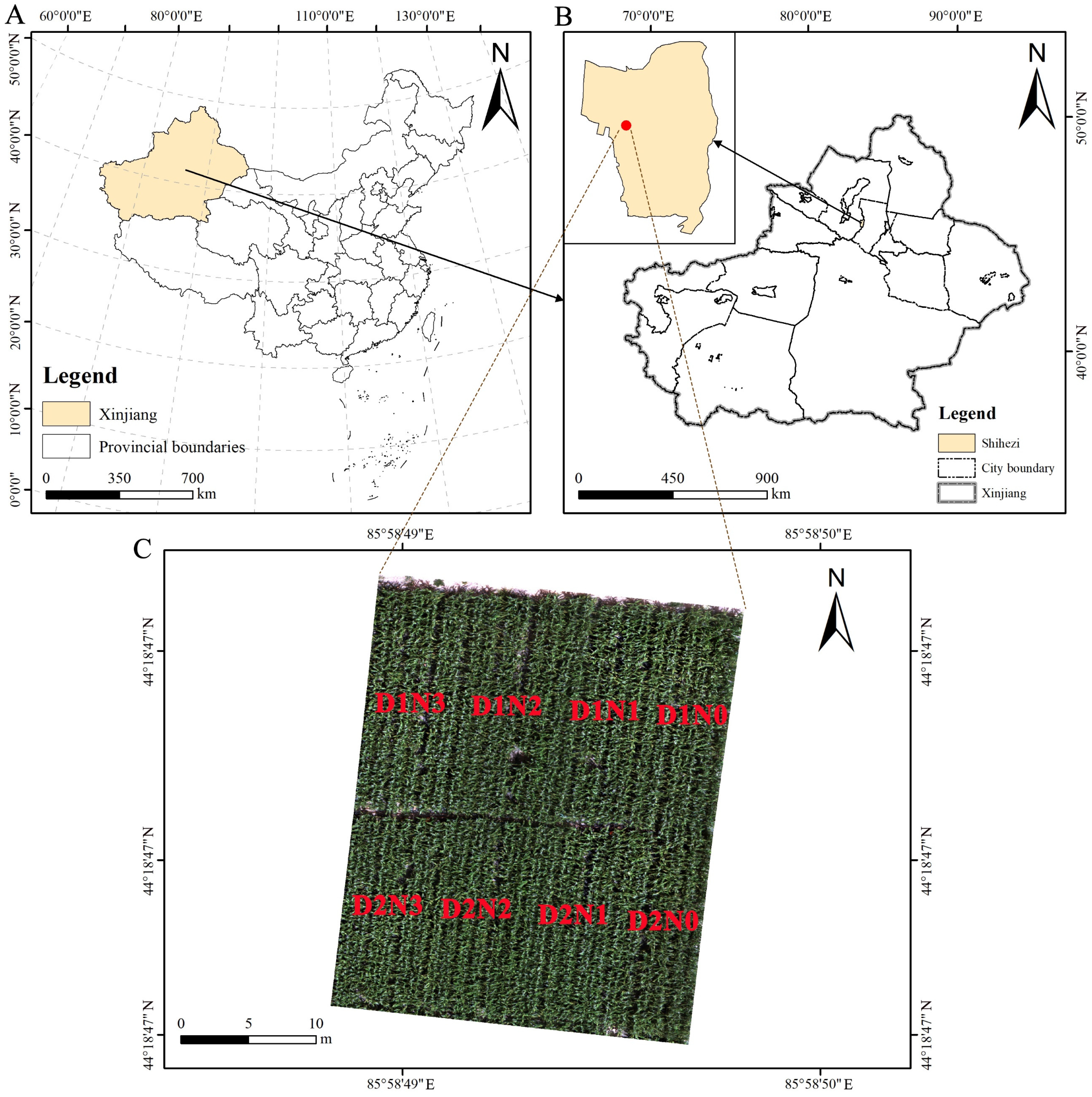
The study area is located at the experimental fields of the Xinjiang Academy of Agricultural Reclamation in Shihezi City (44°18′ N, 86°03′ E), with a mean elevation of approximately 450.8 m. Located in northern Xinjiang, near the Tarim and Junggar basins, the area is characterized by flat terrain, an arid to semi-arid continental climate, abundant sunshine (2721–2818 h yr−1), and concentrated thermal resources. Maize is the predominant crop in this area, playing a key role in food security as well as agricultural and economic stability. Maize cultivation here is adapted to low rainfall and high evaporation; particularly under subsurface drip irrigation with plastic film mulching, water use efficiency and sustainable production have improved, making it a cornerstone of precision agriculture in arid zones. The experimental site is characterized by an annual mean temperature of 6.4–7.3 °C, with annual precipitation of 115 ± 12.5 mm and evaporation totaling 1942 ± 56.3 mm, as recorded by an on-site automatic weather station. The soil is classified as sandy loam. Prior to the experiment, soil properties were measured (mean ± SD, n = 3) and are summarized as follows: alkaline hydrolyzable nitrogen 55.4 mg kg−1, available phosphorus 18.6 mg kg−1, and available potassium 210.5 mg kg−1. The soil bulk density is 1.24 ± 0.05 g cm−3, with a saturated water content of 43.6 ± 2%, field capacity of 0.359 ± 0.01%, wilting point of 0.172 ± 0.01%, soil organic carbon (SOC) content of 12.5 ± 1.5 g/kg, and total nitrogen content of 1.1 ± 0.2 g/kg. The geographic location and climatic characteristics of the study area are shown in Figure 1.

2.2. Experimental Design

The experiment was conducted from April to September in 2024 and 2025 at subsidiary farms around Shihezi City, Xinjiang, China. Spring maize cultivation in the study area followed the standard practices of plastic-film-mulched drip irrigation, using the “Xianyu 335” cultivar sown on 21 April 2024, and harvested on 20 August 2024, and sown on 30 April 2025, and harvested on 21 August 2025. Subsurface drip irrigation combined with a 40 cm + 70 cm wide-narrow row configuration was adopted, applying basal fertilizer (45 kg ha−1 diammonium phosphate) and ten irrigation events during the growing season under a fertigation scheme, each delivering 54 mm for a cumulative 540 mm. A two-factor experimental design was implemented using a randomized complete block design (RCBD) with a factorial arrangement. The eight treatment combinations were randomly assigned to plots within each of the three blocks. Guided by local agricultural recommendations, four nitrogen levels (0, 300, 360, and 420 kg N ha−1; N0–N3) and two planting densities (75,000 and 90,000 plants ha−1; D1–D2) were established, resulting in eight treatments, each replicated three times. Throughout the entire growth period, 105 kg ha−1 of monoammonium phosphate and 120 kg ha−1 of potassium sulfate were applied. Detailed proportions of the fertilizers are provided in Table 1.

2.3. Data Collection and Preparation

This study acquired UAV multispectral imagery at four key growth stages of spring maize in 2024 and 2025, alongside synchronized field measurements of aboveground biomass (AGB). Data acquisition was synchronized across the four key phenological stages: jointing, tasseling, grain filling, and maturity. To ensure data consistency, field destructive sampling was completed within 24 h of the UAV flights (typically immediately following the flight on the same day) to minimize biomass changes due to crop growth.
The specific acquisition dates and corresponding days after sowing (DAS) were: 24 June 2024 (jointing, 64 DAS); 29 June 2025 (jointing, 60 DAS); 8 July 2024 (tasseling, 78 DAS); 10 July 2025 (tasseling, 71 DAS); 27 July 2024 (grain filling, 97 DAS); 29 July 2025 (grain filling, 90 DAS); 18 August 2024 (maturity, 119 DAS); and 21 August 2025 (maturity, 113 DAS).

2.3.1. Measurement of Spring Maize Aboveground Biomass (AGB)

At each growth stage, three uniformly developed spring maize plants were randomly selected from each replicate, and the chosen plants were harvested with a sickle at the soil surface to preserve the integrity of their aboveground parts. The plant samples were harvested with a sickle at the soil surface to preserve the integrity of their aboveground parts. To prevent moisture loss, the plant samples were immediately placed in sealed plastic bags and transported to the laboratory within 30 min of harvesting (the distance from the field to the laboratory was approximately 2 km). Upon arrival, the samples were separated into three components: leaves, stems, and ears. Samples were heat-treated at 105 °C for 30 min in a drying oven (Model DHG-9245AE-2, Shanghai Yiheng Scientific Instrument Co., Ltd., Shanghai, China) to denature endogenous enzymes and halt metabolism, after which they were dried at 85 °C to constant weight (weight differences between consecutive measurements less than 5%); the dry weight of each plant component was then weighed, using an electronic balance (Model ME2002, Mettler Toledo, Zurich, Switzerland, accuracy: 0.01 g), merged, and documented. Final aboveground biomass per unit area was calculated and expressed in kg ha−1.

2.3.2. UAV Multispectral Data Collection and Preprocessing

This experiment used a DJI Phantom 4 Multispectral UAV platform (DJI Agriculture, Shenzhen, China) to acquire multispectral remote sensing imagery of the spring maize canopy. The drone has a takeoff weight of 1.487 kg, a wheelbase of 350 mm, a flight time of approximately 28 min, and is equipped with a D-RTK™ high-precision positioning system delivering centimeter-level accuracy. The camera array consists of six 1/2.9-inch CMOS sensors (one color RGB and five single-band multispectral sensors), providing 2.08 million effective pixels. Remote sensing imagery was captured between 12:00 and 14:00 local time under clear skies during each target growth stage to ensure optimal illumination for the UAV multispectral sensors. Flights were conducted at an altitude of 30 m with 80% longitudinal and 70% lateral overlap. Post-flight processing yielded RGB true-color images alongside five multispectral bands: Red (R), Green (G), Blue (B), Red Edge (REG), and Near Infrared (NIR). Pix4Dmapper (Version 4.8, Pix4D S.A., Prilly, Switzerland) was used to stitch the images, followed by radiometric correction, mosaicking, and band combination in ENVI (Version 5.6, L3Harris Geospatial, Broomfield, CO, USA), ultimately producing UAV mosaics from which vegetation indices and texture features were extracted. The spectral parameters of the multispectral sensor are detailed in Table 2.
To ensure the accuracy and reliability of UAV multispectral imaging, a series of preprocessing procedures were performed. These steps encompassed radiometric calibration, geometric correction, and mosaicking. During image acquisition, radiometric calibration was conducted to correct sensor-specific biases and changes in ambient illumination. The built-in radiometric calibration function of Pix4D Mapper was used to adjust the raw digital numbers (DN) to physically meaningful reflectance values, ensuring consistency across all images. Geometric correction was applied to remove distortions caused by UAV motion and terrain variations. This process leveraged the D-RTK™ high-precision positioning system integrated into the DJI Phantom 4 Multispectral and the Pix4D Mapper software. Pix4D Mapper was employed to stitch the UAV-captured images into seamless orthomosaics. During this process, forward and side overlaps of 80% and 70%, respectively, guaranteed complete coverage of the study area. Quality control checks, including visual inspections of the orthomosaic and reflectance values, were conducted after each processing step to ensure data integrity and accuracy.

2.4. Feature Extraction Methods

2.4.1. Vegetation Index Extraction

Vegetation indices, computed from specific combinations of spectral bands, can effectively represent key parameters such as vegetation cover, chlorophyll content, and biomass [21]. Vegetation indices were extracted using ENVI software (Version 5.6); based on previous studies, sixteen indices known for their strong performance in crop growth monitoring were selected, with particular attention to their sensitivity and accuracy in evaluating key growth parameters. The vegetation indices calculations are presented in Table 3.

2.4.2. Texture Feature Extraction

Texture features (TF) describe the spatial repetition, arrangement and local variations in pixel values in an image, serving as key information to characterize the surface details and spatial organization of land cover. UAV multispectral imagery not only supplies spectral information but also contains abundant spatial texture information closely related to crop growth [37], reflecting regional roughness, contrast, directionality and homogeneity by depicting the joint occurrence frequency of gray-level pairs under given spatial relationships. In this study, texture features were extracted using the gray-level co-occurrence matrix (GLCM), with ENVI 5.6 employed to analyze the five spectral bands of the multispectral imagery; the analysis window size was set to 5 × 5 based on the spatial resolution, and calculations were performed along the 45° orientation. Eight texture metrics—Mean, Contrast, Dissimilarity, Variance, Angular Second Moment (ASM), Homoheterogeneity, Entropy, and Correlation [38]-were calculated for each band, yielding forty texture descriptors in total to provide rich spatial information for subsequent analyses. To more intuitively present the texture characteristics of each spring maize band and their relationships with crop vigor, we adopted the naming convention “band_feature” (e.g., G_Mean denotes the mean reflectance of the green band) uniformly across all texture metrics.

2.5. Feature Variable Selection and Model Development

In this study, to enhance the robustness and discriminative power of feature selection, we adopted a strategy that combines Random Forest-based cross-validation (RFCV) selection with Elastic Net cross-validation (ENCV) selection, and defined the intersection of their candidate features as the final feature set. This strategy leverages Random Forest’s strength in nonlinear fitting and feature importance evaluation to capture complex associations, while relying on Elastic Net’s sparsification and regularization capabilities under high-dimensional correlated variables to remove redundant and collinear attributes; the two methods complement each other, reducing biases inherent to single techniques and enhancing the interpretability and generalizability of the results. Unlike dimensionality reduction methods such as Principal Component Analysis (PCA), which transform original variables into abstract components and obscure physical meaning, this integrated strategy preserves the original feature space, ensuring that the selected spectral and textural indicators remain biologically interpretable and practically actionable for agricultural management.

2.5.1. Feature Selection Based on Elastic Net

The ENCV-based selection employs the Elastic Net regression model, integrating the regularization strengths of the L1 norm (Least Absolute Shrinkage and Selection Operator, Lasso) and L2 norm (Ridge), and automatically tunes the regularization parameters (alpha and l1_ratio) via cross-validation to shrink the coefficients of important features to zero, thereby improving the stability of feature selection and the model’s generalization while simultaneously performing variable selection and mitigating multicollinearity. Initially, the raw data undergo missing-value imputation (replacing missing entries with the mean value of the corresponding feature column) and requisite standardization so that every feature engages the model training process at the same scale. First, missing values in the raw data are imputed and necessary standardization is applied to ensure that all features participate in model training on a consistent scale. Next, Elastic Net with embedded cross-validation automatically adjusts the regularization parameters (including the weight ratio between L1 and L2 and the penalty strength) and employs multi-fold cross-validation to optimize the model’s generalization ability. After the model training is completed, important variables are identified by analyzing the features with nonzero coefficients, since these coefficients indicate that the corresponding features make significant contributions to the predicted target. This method is well suited to high-dimensional data and strongly correlated feature sets because it can consistently select a sparse, interpretable set of important predictors, thereby reducing model complexity and enhancing predictive performance. Unlike dimensionality reduction techniques such as PCA, which transform features into abstract orthogonal components, ENCV retains the original physical variables, ensuring that the selected predictors remain biologically interpretable. Meanwhile, ENCV provides a scientific parameter-selection mechanism that reduces subjective manual tuning and enables an automated feature-selection workflow. The Elastic Net objective function is shown in Equation (1).
min β 1 2 n y X β 2 2 + α ρ β 1 + 1 ρ 2 β 2 2
In this equation, y denotes the response vector, X represents the input feature matrix, β is the coefficient vector (feature weights), α is the overall regularization strength (automatically chosen via cross-validation), and ρ is the mixing parameter that controls the L1/L2 weight balance (also selected through cross-validation). Elastic Net performs k-fold cross-validation over a predefined grid of α and ρ values, selecting the pair ( α *, ρ *) that minimizes the validation error; with this optimal pair, features whose corresponding coefficients remain nonzero are retained as the final key variable set.

2.5.2. Feature Selection Based on Random Forest

The Random Forest-based feature selection method (RFCV) is an embedded feature selection approach centered on a supervised learning model. The workflow of this method comprises three stages. First, the data are lightly preprocessed (dropping entirely empty columns and imputing numeric columns with column means), and either a regression or classification Random Forest is automatically selected based on the target type while fixing random seeds to ensure reproducibility. Second, three importance metrics are computed in parallel—the intrinsic impurity decrease importance, permutation importance, and the average importance obtained from repeated bootstrap training—each normalized to the [0, 1] range, averaged into a composite score, and the top k features by score are retained as candidates. Finally, K-fold cross-validation is used to compare the generalization performance of the candidate subset against that of the full feature set to validate the selection, while TreeExplainer computes SHAP values and plots them to inspect feature contributions from a nonlinear perspective.

2.5.3. Model Development and Modeling Approaches

This study employed six machine learning algorithms to construct models for estimating spring maize aboveground biomass (AGB). The algorithms comprised Elastic Net Regression (ENR), Gradient Boosting Decision Trees (GBDT), Gaussian Process Regression (GPR), Partial Least Squares Regression (PLSR), Random Forest (RF), and Extreme Gradient Boosting (XGB). These six models were selected for their complementary strengths across different data types and prediction tasks, as well as their suitability for the study objectives. The dataset was randomly split into a training subset (70%) and an independent testing subset (30%). To strictly prevent data leakage and ensure robust hyperparameter tuning, we employed k-fold cross-validation within the training subset (serving the function of a validation set), whereas the testing subset was reserved exclusively for the final evaluation of model performance. Model fit performance was evaluated, and the best-performing model was selected for inverting and estimating spring maize AGB.
ENR is a linear regression approach that integrates L1 (Lasso) and L2 (Ridge) penalties, enabling variable selection and reducing the risk of overfitting, making it well suited to datasets with a large number of potential predictors [39]. GBDT is a tree-based sequential boosting method that iteratively fits the residuals from the previous round to build weak learners and accumulates them to reduce bias, enabling it to model complex nonlinear relationships with some robustness to outliers [40]. GPR is a Bayesian nonparametric model that relies on kernel functions to construct a probabilistic representation of the input space, making it particularly effective at capturing nonlinear relationships [41]. PLSR is a powerful statistical modeling method that combines PCA with multivariate regression to reduce dimensionality, making it especially suitable for high-dimensional datasets with multicollinearity [42]. RF is a tree-based parallel ensemble (bagging) method that trains multiple trees on different bootstrap samples and randomly samples candidate features at node splits to reduce variance and decorrelate prediction errors among the trees [43]. XGB is a gradient-boosting–based ensemble method that iteratively minimizes residuals to enhance predictive accuracy, is particularly effective at capturing complex interactions in large datasets, and provides efficient computation [44].

2.5.4. Model Accuracy Evaluation Metrics

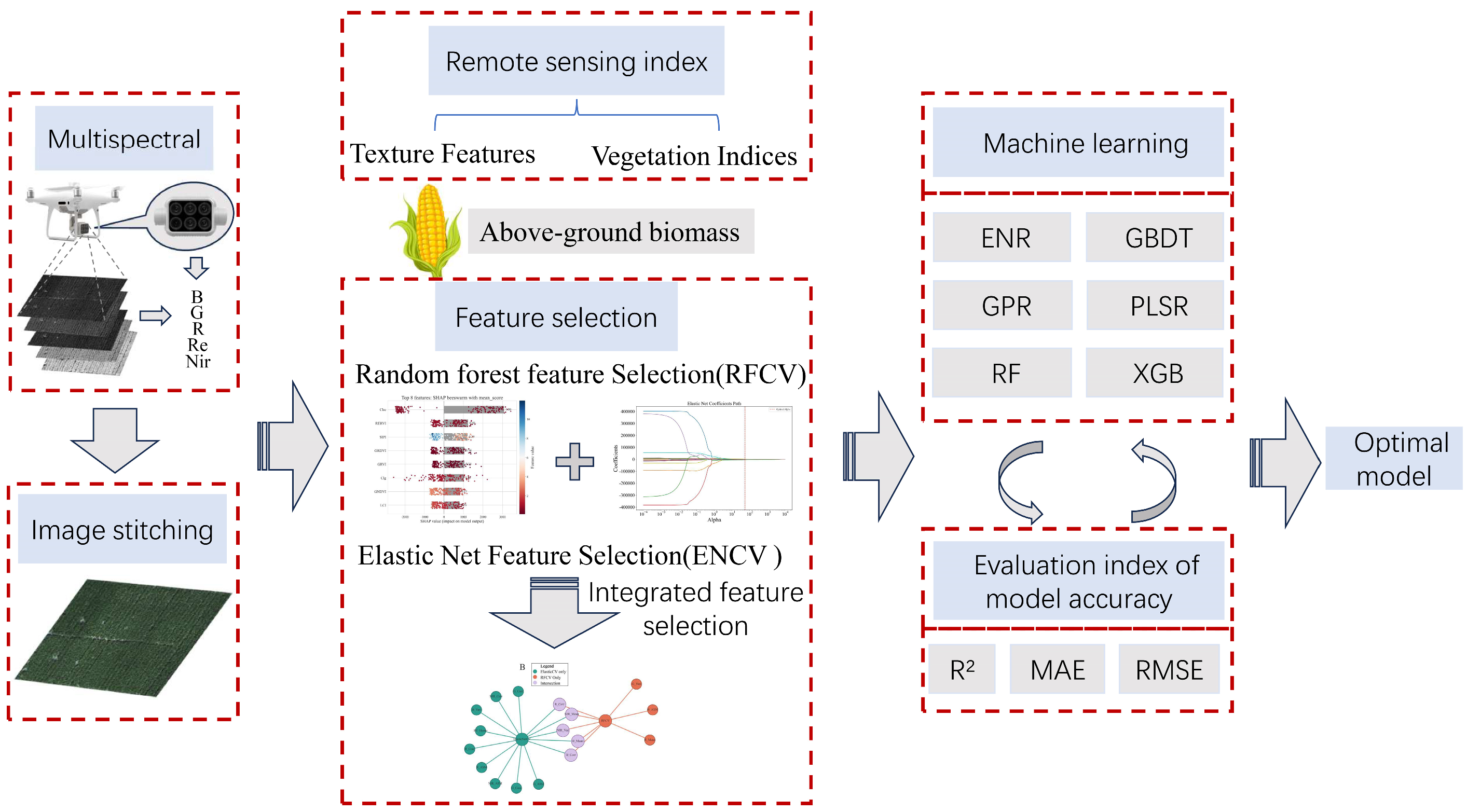
To fully evaluate the accuracy of the spring maize AGB monitoring models, this study employed the coefficient of determination (R2), root mean square error (RMSE), and mean absolute error (MAE) as evaluation metrics [45,46,47]. R2 quantifies the explanatory power of a model and ranges from 0 to 1, with values approaching 1 indicating better fit. RMSE represents the standard deviation of the prediction error, shares the same units as the original variable, and is more sensitive to large errors, making it suitable for contexts concerned with substantial deviations; smaller RMSE values denote higher predictive accuracy. MAE reflects the average magnitude of deviations, is relatively robust, and is less affected by extreme errors, making it appropriate for assessing the overall average prediction error. R2 emphasizes explanatory power, RMSE stresses punishment of large deviations, and MAE focuses on average error magnitude; their formulas are provided in Equations (2)–(4), and their combined use enables a more comprehensive assessment of the regression model’s performance and stability. The schematic of feature selection and optimal model evaluation is presented in Figure 2.
R 2 = 1 i 1 n A i   B i 2 A i   B 2
R M S E = 1 n i = 1 n ( A i B i ) 2 = M S E
M A E = 1 n i = 1 n A i B i
where A i is the actual value, B i is the predicted value, B is the mean of all observed values, and n is the total number of samples.

3. Results

3.1. Temporal Dynamics of Spring Maize AGB Under Subsurface Drip Irrigation Conditions

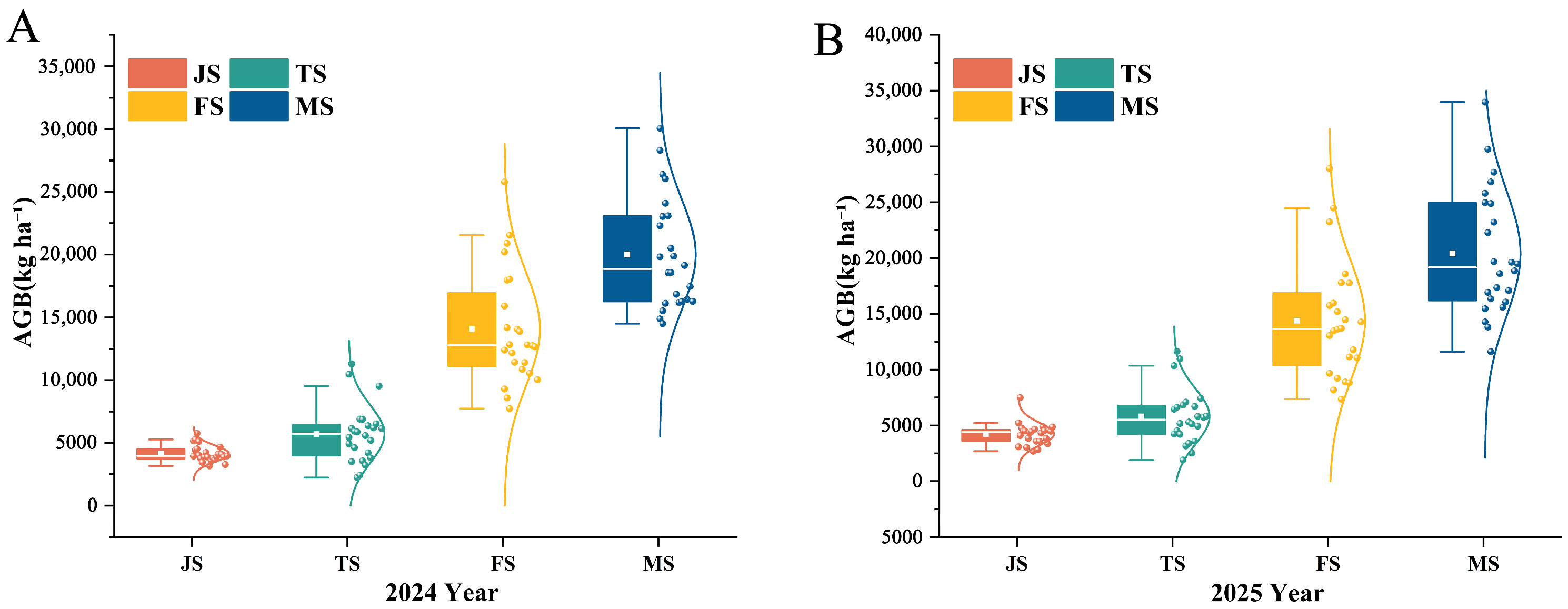
Spring maize AGB exhibits pronounced phenological-stage-dependent variations under subsurface drip irrigation (Figure 3, Table 4). During both growing seasons (n = 24 per season), AGB continuously accumulated from jointing to maturity, reaching its apex at the mature stage. The ratio of mean AGB between the two years was approximately 0.98, which indicates clearly accumulating stand biomass throughout the season with similar overall increments across years. The period from tasseling to grain filling constitutes the key phase for rapid biomass accumulation, with mean increments of approximately 8372.7 and 8581.5 kg ha−1 in 2024 and 2025, respectively—substantially larger than those from jointing to tasseling and from grain filling to maturity—highlighting grain filling as the main stage for dry matter synthesis and translocation to the ears and a decisive phase for final yield regulation. Spatial variability follows an increase-then-decrease trend over the growing stages, with coefficients of variation (CV) indicating greater heterogeneity in mid to late stages; CVs during tasseling and grain filling exceed that of jointing (0.157/0.233), reflecting substantial differences in multi-year cumulative values. The temporal AGB information not only reveals the physiological and population-level accumulation patterns of spring maize growth but also supplies indispensable ground-truth data for constructing subsequent AGB monitoring models, thereby directly informing field management decisions.

3.2. Feature Variable Selection Based on Elastic Net (ENCV)

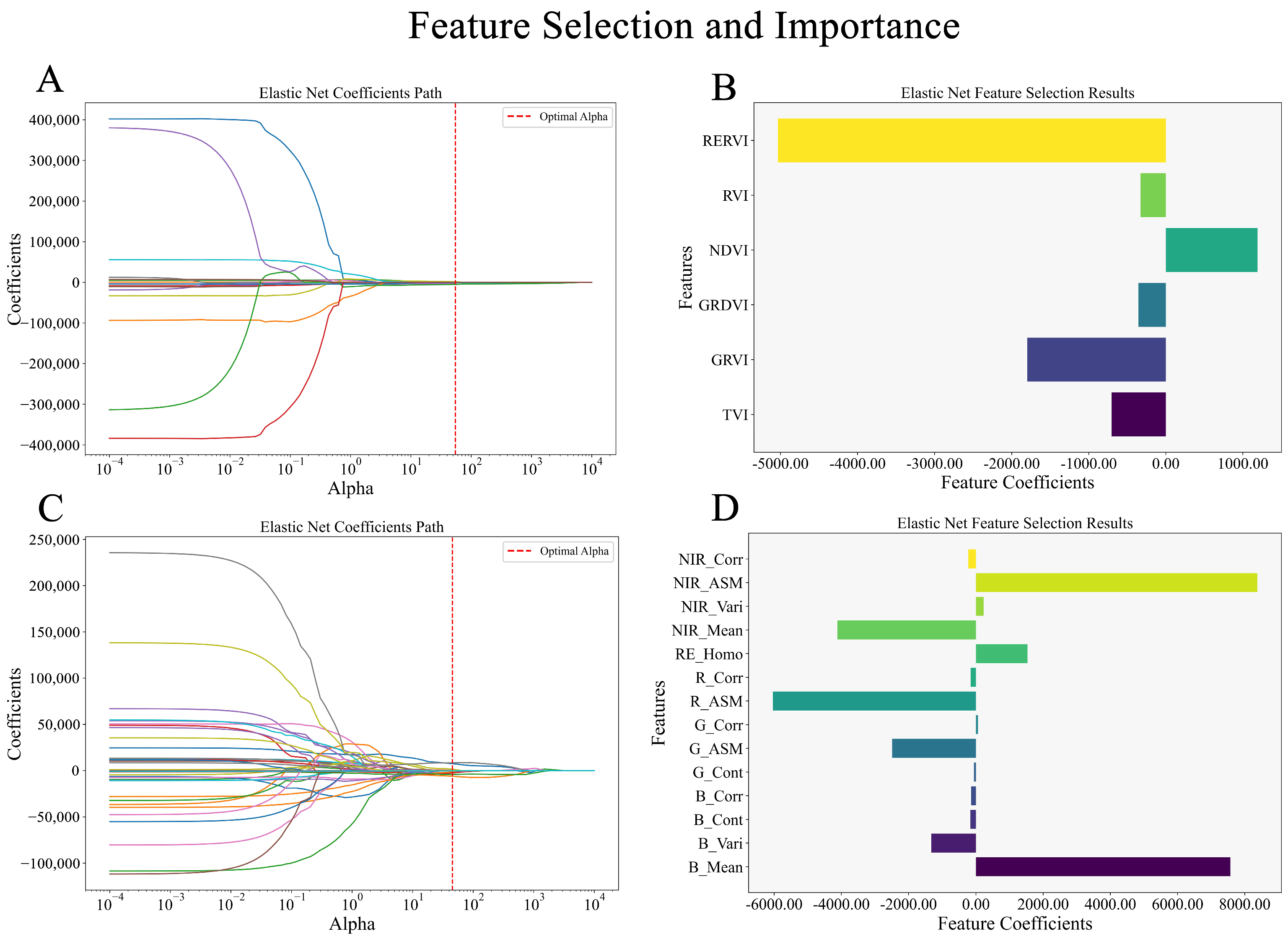
To strengthen the stability of the spring maize AGB estimation models, key features were selected from 16 vegetation indices and 40 texture metrics using ENCV. For each feature group (vegetation indices and texture features), grid search combined with fivefold cross-validation was used to optimize the overall regularization parameter α and the mixing parameter l1_ratio, that governs the balance between L1 and L2 penalties. As shown in Figure 4A, for the vegetation indices the Elastic Net regression achieved the optimal balance between fit and regularization at α = 54.623 and l1_ratio = 0.4 (i.e., 40% L1 and 60% L2), resulting in six key variables with nonzero coefficients: RERVI, RVI, NDVI, GRDVI, GRVI, and TVI. The feature-importance analysis in Figure 4B shows that RERVI has the largest absolute coefficient followed by GRVI, both contributing most strongly with negative signs; NDVI is the only significantly positive coefficient, suggesting a positive correlation with the response variable, while TVI, RVI, and GRDVI exhibit smaller negative coefficients and play secondary roles. For the texture features (Figure 4C), the Elastic Net model achieved the best trade-off between fit and regularization at α = 45.349 and l1_ratio = 0.7, selecting 14 key variables with nonzero coefficients (NIR_Corr, NIR_ASM, NIR_Vari, NIR_Mean, RE_Homo, R_Corr, R_ASM, G_Corr, G_ASM, G_Cont, B_Corr, B_Cont, B_Vari, and B_Mean); the importance analysis in Figure 4D further shows that NIR_ASM has the largest absolute coefficient, followed by B_Mean, both contributing positively. Coefficient paths and feature-importance plots are shown in Figure 4.

3.3. Elastic Net-Random Forest Fusion Feature Selection Approach

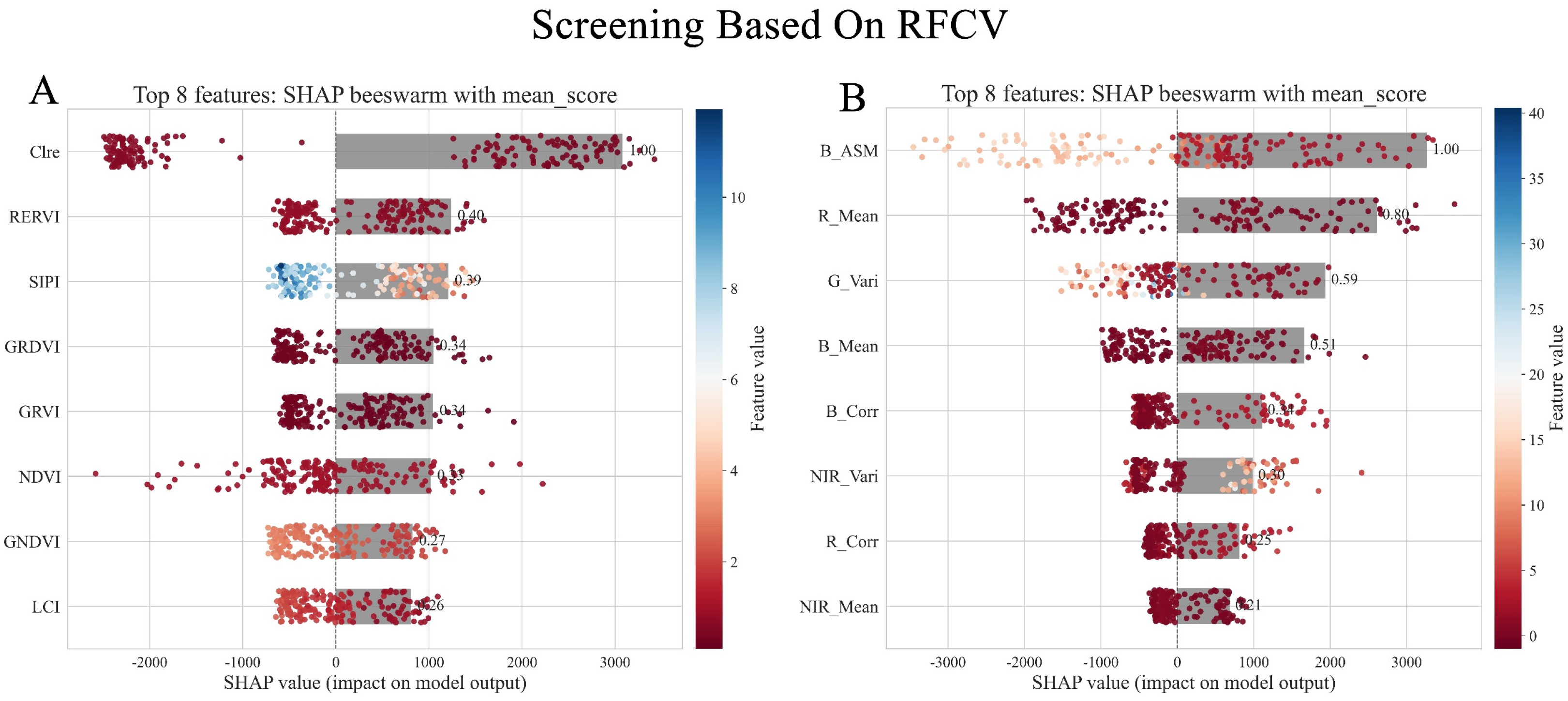
The 16 extracted vegetation indices and 40 texture features served as input variables for the RF model. The RF-based feature selection model employed TreeExplainer to compute SHapley Additive exPlanations (SHAP) values for 56 features. The final importance score was calculated as the sample mean of the SHAP values and normalized so that the maximum equals 1. For vegetation indices, the RF-based SHAP analysis (Figure 5A) indicated that Clre was the most important individual predictor (normalized mean score = 1.00), followed by RERVI (0.40), SIPI (0.39), GRDVI (0.34), GRVI (0.34), NDVI (0.33), GNDVI (0.27), and LCI (0.26); Clre’s SHAP values spanned the widest range and exerted pronounced bidirectional influences on the predictions, suggesting a leading nonlinear regulatory role, while the remaining key features—mainly spectral and color/texture indices—provided moderate to strong and stable contributions. For texture features, the RF-based SHAP analysis (Figure 5B) showed that B_ASM exerted the largest influence on model output (normalized mean score = 1.00), followed by R_Mean (0.80), G_Vari (0.59), B_Mean (0.51), B_Corr (0.34), NIR_Vari (0.30), R_Corr (0.25), and NIR_Mean (0.21). The point distributions reveal that many samples of B_ASM, R_Mean, and B_Mean correspond to positive SHAP values, indicating that these brightness/texture metrics tend to raise the predicted values overall; by contrast, G_Vari, B_Corr, and NIR_Vari display both positive and negative effects across different value ranges, which suggests nonlinear or threshold/interaction effects with the response variable. The SHAP importance plots from the RF feature selection are shown in Figure 5. In these plots, the horizontal axis depicts SHAP values, indicating each feature’s contribution to model predictions (positive values increase the prediction, negative values decrease it), while the vertical axis lists the top eight selected features. Point colors encode the magnitude of the feature values, ranging from blue (high) to red (low). The gray bars represent the mean absolute SHAP values, serving as the global importance score for each feature.

3.4. Fusion Feature Selection Approach That Integrates Elastic Net with Random Forest

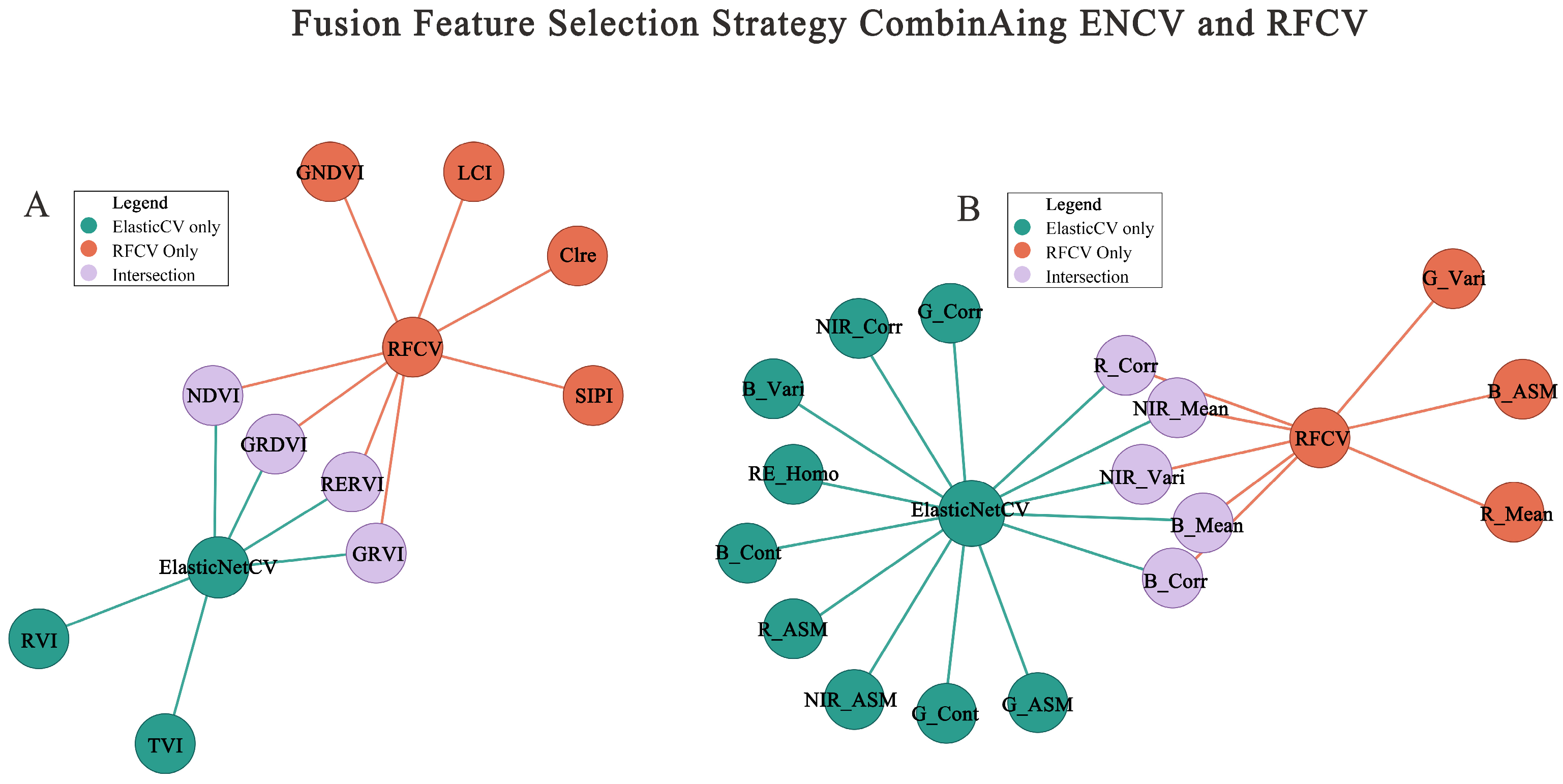
To obtain a set of candidate variables that are both predictive and scientifically interpretable under high-dimensional, multi-collinear, and potentially nonlinear data conditions, and to provide reliable inputs for subsequent regression or classification modeling, this study implemented a hybrid feature selection strategy combining Elastic Net and Random Forest, which effectively enhanced feature selection stability, reduced the impact of multicollinearity, and improved model generalization. Four vegetation index variables were retained: GRDVI, RERVI, GRVI and NDVI. The final set of texture-derived predictors comprised R_Corr, NIR_Mean, NIR_Vari, B_Mean and B_Corr. Using the fused feature set derived from vegetation indices and texture attributes, the screened variables were used as inputs to the estimation models to predict spring maize AGB. The results of the hybrid feature selection strategy that combines Elastic Net and Random Forest are shown in Figure 6.

3.5. Development and Accuracy Evaluation of Spring Maize AGB Estimation Models

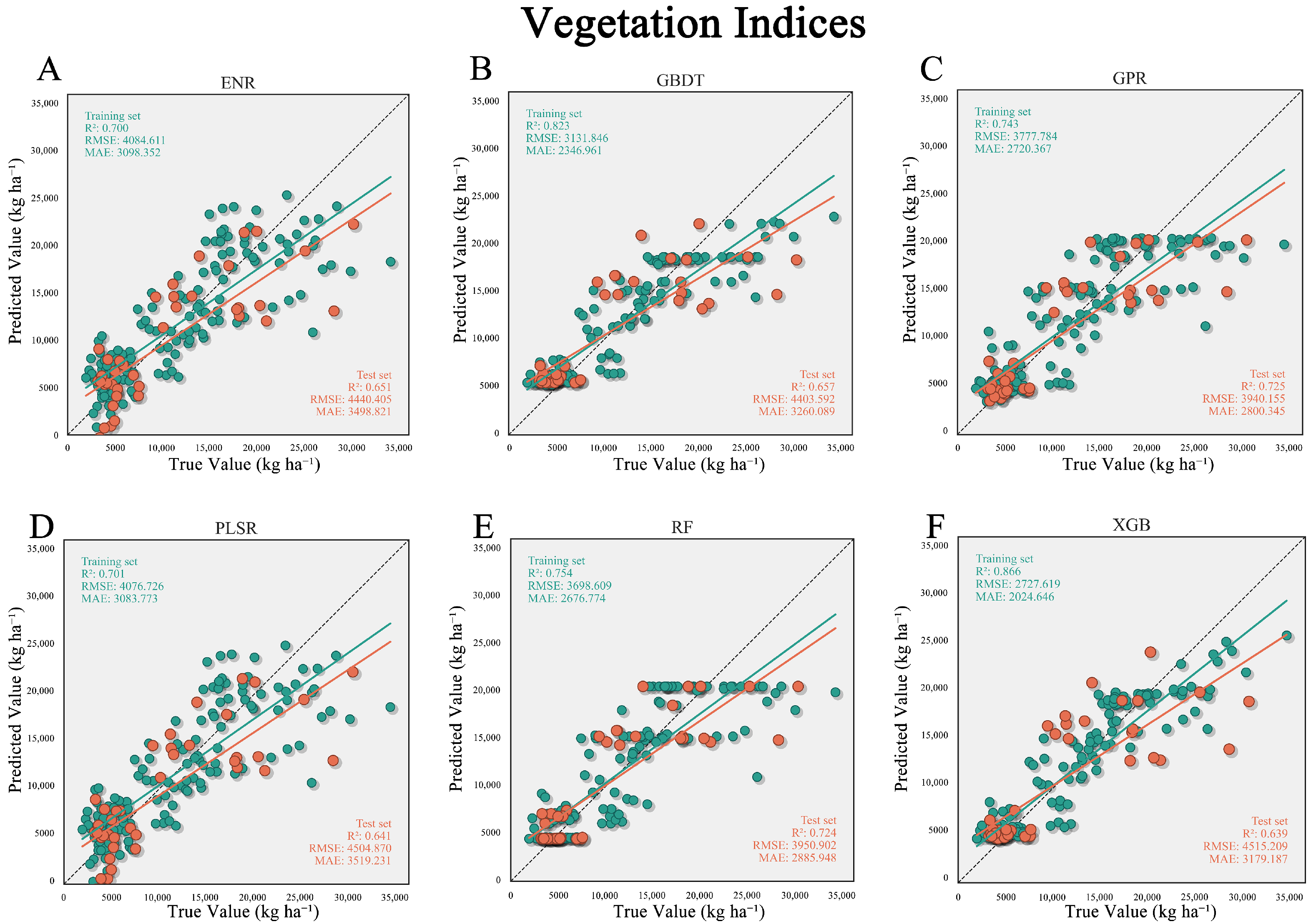
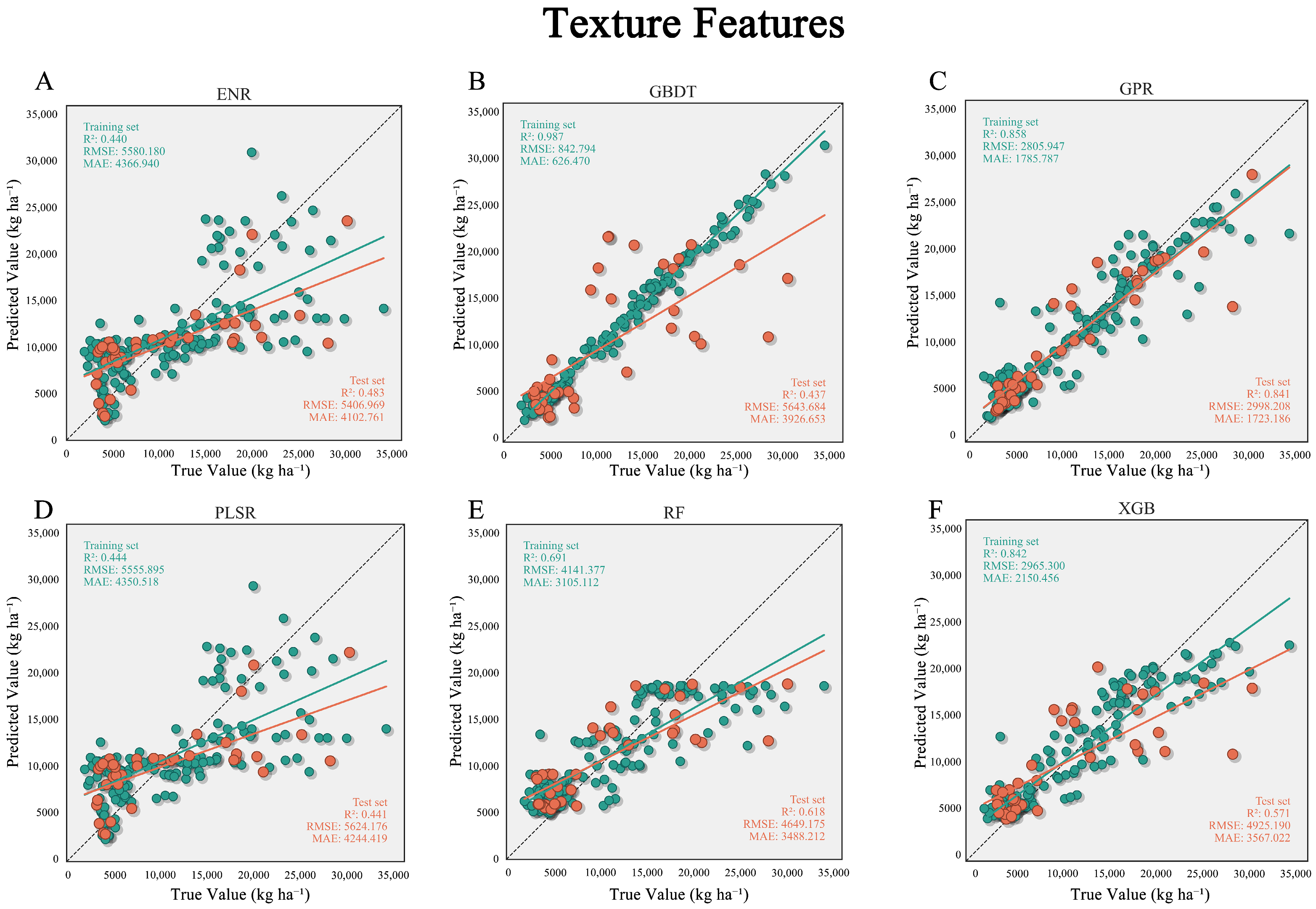
Through the hybrid feature selection strategy combining Elastic Net and Random Forest, four vegetation indices (GRDVI, RERVI, GRVI, NDVI) and five texture features (R_Corr, NIR_Mean, NIR_Vari, B_Mean, B_Corr) were retained as the key predictors of spring maize AGB. Using these nine predictors, six machine learning algorithms (ENR, GBDT, GPR, PLSR, RF, XGB) were trained under three input scenarios: (i) vegetation indices only, (ii) texture features only, and (iii) fused features (vegetation indices plus texture features). The dataset was randomly split into a 70% training subset and a 30% testing subset, and model performance was evaluated by R2, RMSE, and MAE (Table 5). Detailed accuracy comparisons are presented in Figure 7, Figure 8 and Figure 9.
Model evaluation using vegetation indices as the only input features (Figure 7, Table 5) revealed that Gaussian Process Regression (GPR) exhibited superior accuracy with test set metrics of R2 = 0.725, RMSE = 3940.155 kg ha−1, and MAE = 2800.345 kg ha−1. The Random Forest (RF) model showed the second-best performance (R2 = 0.724) due to its robust feature segmentation capability, though its MAE exceeded GPR by 85.603 kg ha−1, indicating constraints in capturing continuous spectral-AGB relationships. Linear models (ENR, PLSR) demonstrated constrained explanatory capacity, with all R2 values falling below 0.651 as they failed to model nonlinear relationships. Although boosting tree models (GBDT/XGB) achieved high training accuracy (R2 > 0.82), their test set performance dropped significantly (R2 < 0.65), validating the overfitting vulnerability to vegetation index variations. These findings demonstrate the existence of nonlinear relationships between vegetation indices and aboveground biomass (AGB). Under vegetation index-only input conditions, GPR provided the highest precision and reliability, with RF exhibiting the second-highest performance. Both linear models (ENR, PLSR) and boosting tree models (GBDT/XGB) showed suboptimal performance.
Model evaluation using texture features exclusively (Figure 8, Table 5) revealed GPR’s superior performance (test set R2 = 0.841, RMSE = 2998.208 kg ha−1, MAE = 1723.186 kg ha−1), exhibiting a 36.08% improvement in R2 and 35.6% reduction in RMSE relative to Random Forest (R2 = 0.618, RMSE = 4649.175 kg ha−1). Conversely, boosting tree models (GBDT/XGB) demonstrated high training accuracy (R2 > 0.84) yet experienced substantial test set degradation (R2 = 0.437–0.571, RMSE increase > 50%), validating their susceptibility to texture noise overfitting and inadequate operational reliability. Linear models (ENR, PLSR) showed constrained explanatory capacity (R2 ≤ 0.44). These findings confirm that under texture-only input conditions, GPR delivers optimal accuracy and reliability, with RF as the secondary performer, whereas boosting tree and linear models (ENR, PLSR) yield inferior results.
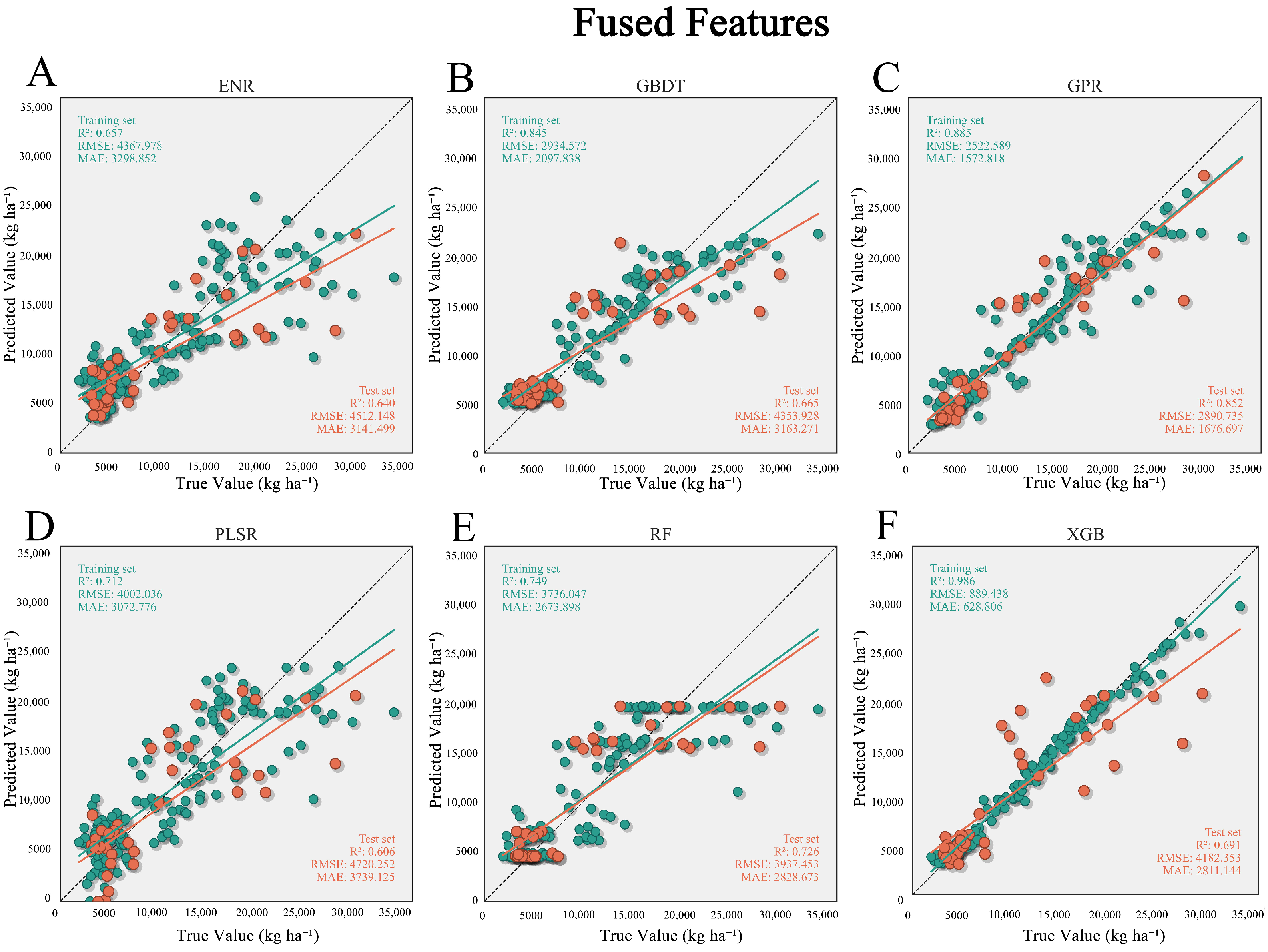
Model evaluation with fused features as the sole input (Figure 9, Table 5) revealed GPR’s superior accuracy (test set R2 = 0.852, RMSE = 2890.735 kg ha−1, MAE = 1676.697 kg ha−1), demonstrating a 1.3% R2 improvement and 107.473 kg ha−1 RMSE reduction relative to texture-only approaches, which validates the synergistic benefits of multi-source feature integration. Random Forest (RF) exhibited the second-highest performance (R2 = 0.726, RMSE = 3937.453 kg ha−1, MAE = 2828.673 kg ha−1), showing a significant accuracy decline (14.7% lower R2 relative to GPR) that cannot fulfill high-precision variable rate fertilization operational demands. Conversely, boosting tree models (GBDT/XGB) demonstrated deceptively high training accuracy yet substantial independent test set performance reduction; linear models (ENR, PLSR) yielded negligible accuracy gains (<5%) due to ineffective fused feature utilization. These findings confirm that fused features enhance model performance beyond single feature sets through spectral-textural synergy, establishing it as the optimal input strategy for spring maize AGB estimation; GPR emerges as the most accurate estimator for spring maize AGB, demonstrating superior fitting-generalization trade-off (test set R2 = 0.852, RMSE = 2890.735 kg ha−1), smallest training-test discrepancy, most homogeneous residual patterns, and robustness in modeling complex feature nonlinearities and uncertainties.
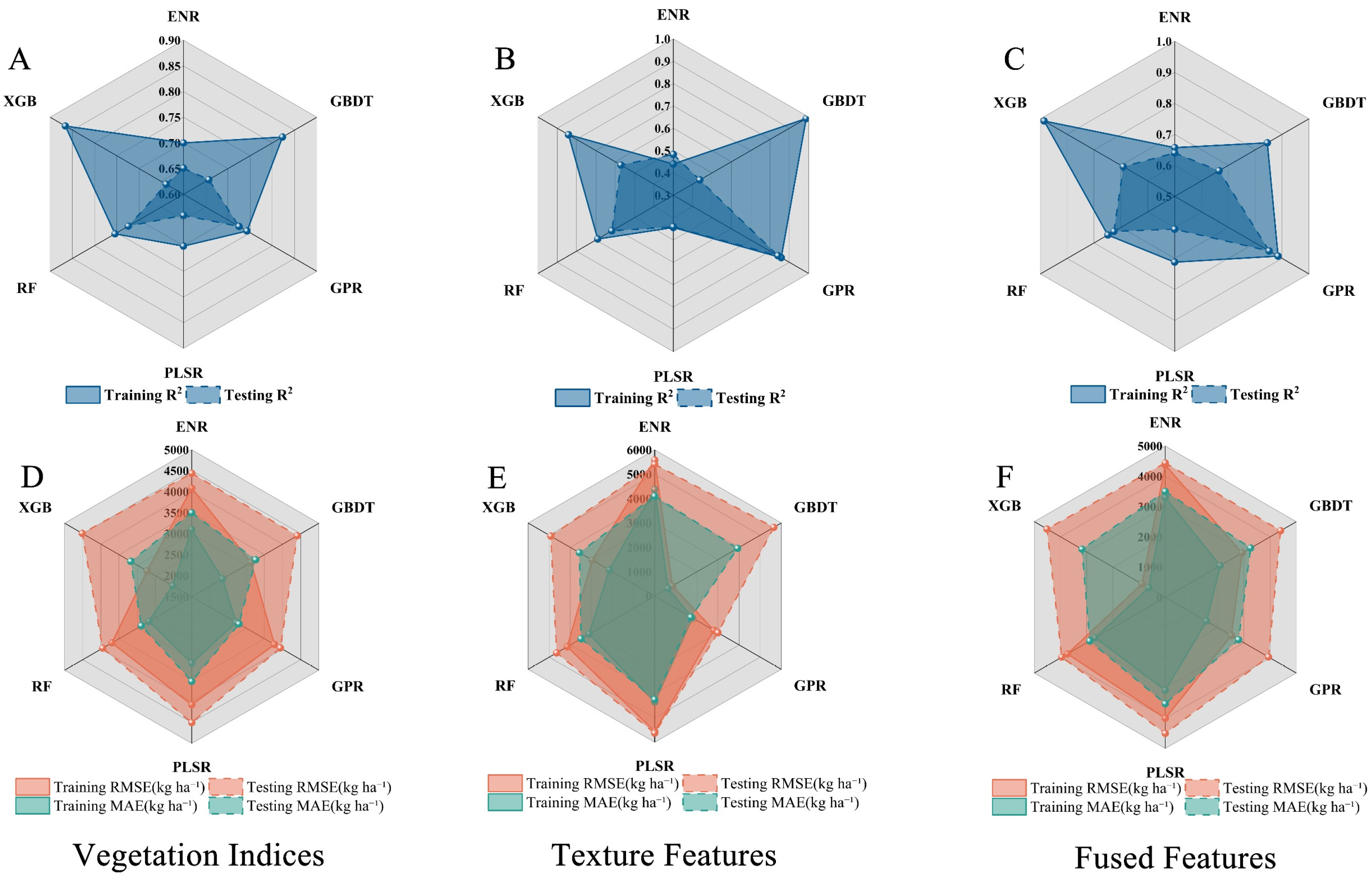
The radar charts in Figure 10 synthesize the three evaluation metrics (R2, RMSE, and MAE) across all models and scenarios, clearly indicating that fused-feature models outperform single-feature ones, with GPR and RF offering the best trade-off between accuracy and robustness. Considering the fused-feature GPR model’s high R2, comparatively low errors, and stable behavior between training and testing sets, we selected it as the optimal AGB estimation model and applied it for the spatial inversion and analysis of spring maize biomass in the study area.

3.6. Application of the Optimal Spring Maize AGB Estimation Model

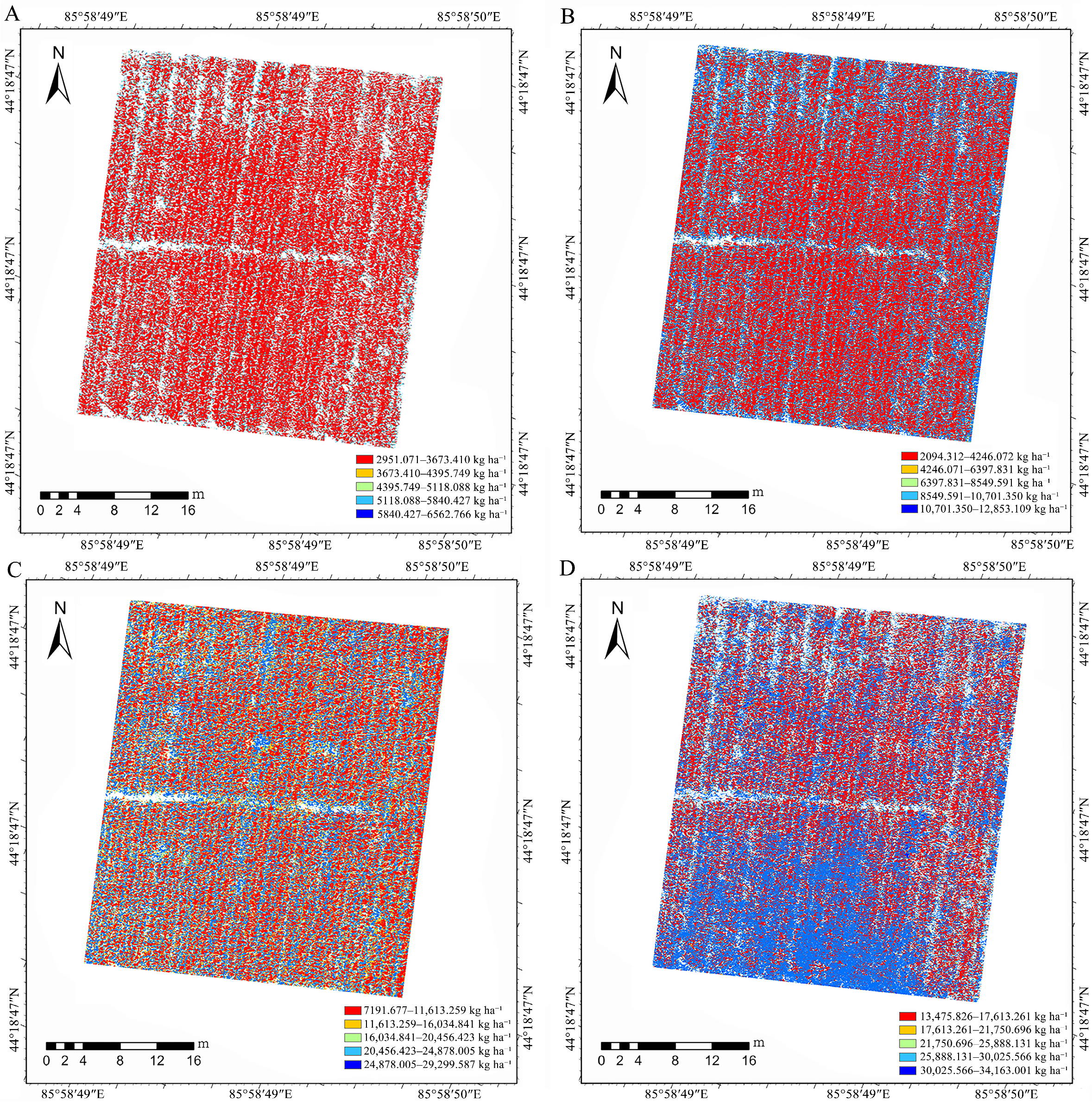
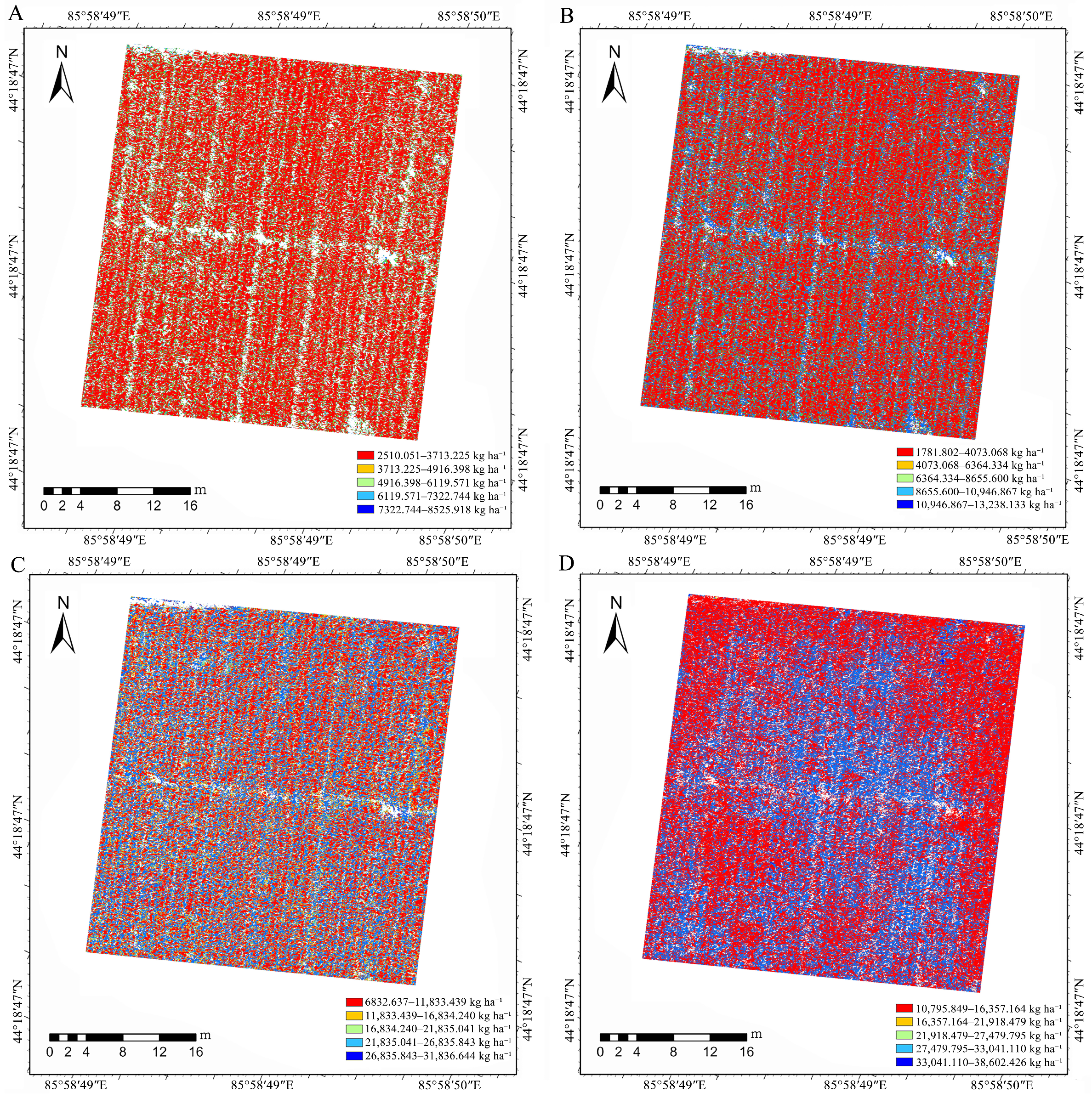
An overall evaluation of the spring maize AGB inversion models indicated that the optimal estimator (GPR) delivered superior fit and minimal error. The selected optimal model was able to delineate the spatiotemporal distribution of spring maize AGB at the field scale across jointing, tasseling, grain filling, and maturity stages, revealing distinct row-to-row and plot-to-plot variability as well as phenological dynamics (overall accumulation through grain filling followed by grain translocation or decline at maturity). Using the optimal estimator (GPR), spatial inversions of spring maize AGB were carried out for the four key growth stages and corresponding spatial distribution maps were produced (Figure 11 and Figure 12). The predictions exhibited marked spatial heterogeneity, with warmer colors dominating the southwest (indicating relatively higher biomass) and showing regular banded fluctuations along the planting rows, reflecting differences in crop canopy structure, field operations, and microtopography/soil properties. In 2024, the spring maize AGB ranged from 2951.071 to 6562.766 kg ha−1 at jointing, 2094.312–12,853.109 kg ha−1 at tasseling, 7191.677–29,299.587 kg ha−1 at grain filling, and 13,475.826–34,163.001 kg ha−1 at maturity. In 2025, AGB ranged from 2510.051 to 8525.918 kg ha−1 at jointing, 1781.802–13,238.133 kg ha−1 at tasseling, 6832.637–31,836.644 kg ha−1 at grain filling, and 10,795.849–38,602.426 kg ha−1 at maturity. The results show that the model is sensitive to microscale anomalies such as low-vigor bands, uneven irrigation, or machine tracks in the field, facilitating rapid localization of problematic areas. Spring maize AGB rises steadily across successive growth stages, with growth slowing after grain filling and peaking at maturity, consistent with field observations. With a fixed planting density, AGB increased with nitrogen input, with the N3 treatment producing the highest biomass because abundant nitrogen under N3 increased leaf area index (LAI) and chlorophyll content, thereby enhancing photosynthesis and carbon assimilation and promoting organ development and dry matter accumulation. Moreover, under experimental conditions the N3 regime offered a relatively balanced nutrient supply conducive to nitrogen uptake, translocation, and accumulation, thereby maximizing aboveground biomass. The biomass inversion maps from the fused-feature GPR model effectively captured the spatial variability and phenological dynamics of spring maize growth, providing actionable remote-sensing support for precision fertilization, irrigation regulation, anomaly detection, and yield estimation, thus supporting refined field management.

4. Discussion

4.1. Influence of the Integrated Feature Selection Strategy on the Accuracy of Spring Maize AGB Estimation

This study combined Elastic Net selection (ENCV) with Random Forest-based screening (RFCV), yielding a fused feature set of four vegetation indices (GRDVI, RERVI, GRVI, NDVI) and five texture features (R_Corr, NIR_Mean, NIR_Vari, B_Mean, B_Corr). This set enabled efficient dimensionality reduction. In arid regions under drip irrigation, maize growth is strictly constrained by water and nitrogen coupling. The selected red-edge indices (e.g., RERVI) are highly sensitive to chlorophyll fluctuations caused by water-nitrogen stress, while texture features (e.g., NIR_Vari) effectively capture the canopy structural heterogeneity (such as leaf rolling or gaps) induced by the arid environment. This combination provides features with clear physiological and physical significance. Earlier studies further indicated that indicators like GRVI, NDVI, R_Corr, and NIR_Vari effectively track crop growth [48,49], and that texture descriptors outperform pure spectral indices in enhancing biomass estimation accuracy [50]; the documented high sensitivity of red-edge-related indices to chlorophyll and biomass aligns with our findings [51] and highlights the complementary role of texture in inversion [52]. Compared with using vegetation indices or texture features alone, the fused feature set significantly improved predictive accuracy and generalization across all machine learning models: the test R2 increased by more than 0.10 on average and the training–testing gap narrowed, substantially enhancing AGB estimation precision and robustness, which is consistent with Manu et al.’s report on the high sensitivity of red-edge, blue, and texture combinations to spring maize AGB [53]. The results demonstrate that the integrated feature selection strategy offers a pronounced advantage when dealing with high-dimensional remote sensing data [54] and serves as a key technical route for improving crop biomass estimation accuracy.

4.2. Impact of Machine Learning Models on AGB Estimation

The six machine learning models exhibited notable performance differences under the fused feature set. Gaussian Process Regression (GPR) achieved the best balance between accuracy and generalization (test R2 = 0.852, RMSE = 2890.74 kg ha−1), with highly consistent training and testing performance, minimal overfitting risk, and suitability for capturing the complex nonlinearities and uncertainties between biomass and remote sensing features. Random Forest (RF), although slightly less accurate (R2 = 0.726), exhibited a small gap between training and testing performance and strong robustness, making it a dependable alternative for operational use. By contrast, the tree-based boosting models GBDT and XGB demonstrated extremely high fit on the training set (R2 > 0.98) but suffered a clear drop in accuracy on the independent test set, indicating some overfitting risk; linear models such as ENR and PLSR yielded lower overall accuracy because they struggled to represent nonlinear relationships fully. The results indicate that GPR and RF are better suited for high-precision remote sensing inversion of spring maize AGB in arid areas, and that the fused-feature GPR model offers an efficient and reliable solution for AGB monitoring, providing essential support for precision nitrogen management and yield forecasting.

4.3. Spatiotemporal Dynamics and Nitrogen Response

Spatial inversions derived from the fused-feature GPR optimal model across the four key phenological stages of two growing seasons revealed pronounced spatiotemporal heterogeneity and stage-dependent dynamics of spring maize AGB, with rapid accumulation from jointing through grain filling, a slowdown thereafter, and a peak at maturity. Spatially, higher biomass occurred in the eastern and southeastern portions of the field, with regular banded fluctuations along the planting rows, reflecting variability in field management, microtopography, and soil nutrient status. At a constant planting density, AGB increased significantly as nitrogen inputs rose from N0 to N3 (420 kg N ha−1), with the high-nitrogen N3 treatment producing the largest biomass and exhibiting the characteristic diminishing marginal returns [55], indicating that sufficient nitrogen enhances leaf area and chlorophyll to boost canopy photosynthesis and dry matter accumulation. The fused-feature GPR model delivered accurate biomass estimates, successfully captured the regulatory effects of the nitrogen gradient on maize growth, and provided reliable data support for variable-rate fertilization, which has important implications for optimizing water–fertilizer synergy in subsurface drip irrigation systems.

4.4. Implications for the Development of Precision Agriculture in Arid Areas

This study validated the feasibility and superiority of the “UAV multispectral + integrated feature selection + machine learning” technical chain for high-precision biomass monitoring of spring maize under subsurface drip irrigation in arid areas, consistent with previous UAV-based biomass monitoring research [56]. This approach is non-destructive, low-cost, and offers high spatiotemporal resolution, enabling large-scale, multi-temporal monitoring of AGB dynamics and providing scientific support for regional-scale precision fertilization, irrigation scheduling, and yield prediction. Feature selection results indicate that red-edge-related vegetation indices and high-resolution texture features dominate AGB estimation, suggesting that in arid/semi-arid environments sensors and processing workflows that preserve the red-edge band and fine-grained textures should be prioritized to enhance sensitivity to early stress and subtle growth differences. Deploying this technology in typical arid regions such as Xinjiang is expected to markedly improve water and nutrient use efficiency, cut production costs, and promote green, sustainable agricultural development.

5. Conclusions

Accurate and non-destructive estimation of Aboveground Biomass (AGB) is critical for precision nitrogen management and yield optimization in arid agricultural zones. This study aimed to develop a robust framework for spring maize AGB monitoring by integrating UAV-based multispectral imagery with a hybrid feature selection strategy. Using a novel approach that combines Elastic Net (ENCV) with Random Forest (RFCV), nine optimal variables (including GRDVI, RERVI, GRVI, NDVI, and texture features R_Corr, NIR_Mean, NIR_Vari, B_Mean, B_Corr) were effectively screened from 56 candidates. This strategy successfully reduced data dimensionality and mitigated multicollinearity while highlighting the red-edge and spatial texture information that is highly sensitive to crop growth, thereby significantly lowering model complexity. Evaluation of six machine learning algorithms revealed that Gaussian Process Regression (GPR) based on the fused feature set yielded the best performance (test R2 = 0.852, RMSE = 2890.74 kg ha−1), balancing high accuracy with strong generalization. Random Forest (RF) also demonstrated excellent robustness, making it a viable alternative for operational use, whereas GBDT and XGB exhibited signs of overfitting. The inverted multi-temporal maps showed that spring maize AGB exhibits pronounced spatial heterogeneity, with the highest biomass concentrated in the southwestern part of the field. Furthermore, the crop responded positively to nitrogen application with diminishing marginal returns, where the N3 treatment (420 kg N ha−1) produced the highest biomass. Overall, this study offers an efficient solution for rapid crop monitoring in precision agriculture. However, limitations remain regarding the transferability of the model across different environmental conditions. Future studies should focus on validating this framework over larger spatial scales and multiple growing seasons. Additionally, integrating other data sources, such as hyperspectral or LiDAR data, could further enhance the spectral and structural information available for improving estimation accuracy under complex field conditions.

Author Contributions

Conceptualization, F.L. and Z.Z.; Methodology, F.L., Y.M., N.L., Z.G., G.W., Z.Z., L.S. and C.Z.; Software, Y.G., L.S. and C.Z.; Validation, Y.G., N.L., Z.G., G.W., Z.Z., L.S. and C.Z.; Formal analysis, Y.G., Z.G. and G.W.; Investigation, Y.G., G.W., L.S. and C.Z.; Resources, F.L., Y.M., N.L. and Z.G.; Data curation, F.L., Y.G., G.W., L.S. and C.Z.; writing—original draft preparation, F.L. and Y.G.; Writing—review and editing, F.L., Y.G., Y.M., N.L., Z.G., G.W., Z.Z., L.S. and C.Z.; Visualization, Y.G.; Supervision, F.L., Y.M., N.L., Z.G., G.W. and L.S.; Project administration, F.L., Y.M., N.L. and Z.G.; Funding acquisition, F.L., Y.M., N.L. and Z.G. All authors have read and agreed to the published version of the manuscript.

Funding

This research was funded by the Major Scientific and Technological Special Project of Xinjiang Province, grant number No. 2023A02002; the Natural Science Foundation of Xinjiang Uygur Autonomous Region, grant number No. 2022D01B28; the National Key Research and Development Program Project, grant number No. 2022YFD1900405; the Xinjiang Water Special Project, grant number No.2024.D-003; the 2021 Open Topics of the Xinjiang Key Laboratory of Hydraulic Engineering Safety and Water Disaster Prevention, grant number No. ZDSYS-JS-2021-07; the Corn Industry Technology System of Xinjiang, grant number No. XJARS-02-14.

Data Availability Statement

The datasets generated and analyzed during this study are not publicly available due to confidentiality restrictions but are available from the corresponding authors upon reasonable request.

Acknowledgments

We express our sincere appreciation to Xinjiang Agricultural University’s College of Water Resources and Civil Engineering, the Xinjiang Key Laboratory of Safety and Disaster Prevention for Hydropower Engineering, and the Northwest Oasis Water-Saving Agriculture Key Laboratory of the Ministry of Agriculture and Rural Affairs (Xinjiang Academy of Agricultural Reclamation). These institutions have made important contributions to this work, offering key experimental facilities, technical expertise, and research resources.

Conflicts of Interest

The authors declare no conflicts of interest.

References

  1. Xia, Y.; Wang, B.; Zhu, L.; Wu, W.; Sun, S.; Zhu, Z.; Li, X.; Weng, J.; Duan, C. Identification of a Fusarium Ear Rot Resistance Gene in Maize by QTL Mapping and RNA Sequencing. Front. Plant Sci. 2022, 13, 954546. [Google Scholar] [CrossRef]
  2. Yin, Q.; Yu, X.; Li, Z.; Du, Y.; Ai, Z.; Qian, L.; Huo, X.; Fan, K.; Wang, W.; Hu, X. Estimating Summer Maize Biomass by Integrating UAV Multispectral Imagery with Crop Physiological Parameters. Plants 2024, 13, 3070. [Google Scholar] [CrossRef]
  3. Li, Y.; Zhang, W.; Zhang, D.; Zheng, Y.; Xu, Y.; Liu, B.; Li, Q. Mechanism of [CO2] Enrichment Alleviated Drought Stress in the Roots of Cucumber Seedlings Revealed via Proteomic and Biochemical Analysis. Int. J. Mol. Sci. 2022, 23, 14911. [Google Scholar] [CrossRef]
  4. Zhao, Z.; Shi, F.; Guan, F. Effects of Plastic Mulching on Soil CO2 Efflux in a Cotton Field in Northwestern China. Sci. Rep. 2022, 12, 4969. [Google Scholar] [CrossRef]
  5. Adeleke, A.A. Technological Advancements in Cotton Agronomy: A Review and Prospects. Technol. Agron. 2024, 4, e008. [Google Scholar] [CrossRef]
  6. Feng, L.; Dai, J.; Tian, L.; Zhang, H.; Li, W.; Dong, H. Review of the Technology for High-Yielding and Efficient Cotton Cultivation in the Northwest Inland Cotton-Growing Region of China. Field Crops Res. 2017, 208, 18–26. [Google Scholar] [CrossRef]
  7. Fan, Y.; Yuan, Y.; Yuan, Y.; Duan, W.; Gao, Z. Research Progress on the Impact of Climate Change on Wheat Production in China. PeerJ 2025, 13, e18569. [Google Scholar] [CrossRef] [PubMed]
  8. Yang, X. Mapping Desert Shrub Aboveground Biomass in the Junggar Basin, Xinjiang, China Using Quantile Regression Forest (QRF). PeerJ 2025, 13, e19099. [Google Scholar] [CrossRef] [PubMed]
  9. Fei, S.; Hassan, M.A.; He, Z.; Chen, Z.; Shu, M.; Wang, J.; Li, C.; Xiao, Y. Assessment of Ensemble Learning to Predict Wheat Grain Yield Based on UAV-Multispectral Reflectance. Remote Sens. 2021, 13, 2338. [Google Scholar] [CrossRef]
  10. Guo, F.; Feng, Q.; Yang, S.; Yang, W. Estimation of Potato Canopy Leaf Water Content in Various Growth Stages Using UAV Hyperspectral Remote Sensing and Machine Learning. Front. Plant Sci. 2024, 15, 1458589. [Google Scholar] [CrossRef]
  11. Wang, Z.; Ding, J.; Tan, J.; Liu, J.; Zhang, T.; Cai, W.; Meng, S. UAV Hyperspectral Analysis of Secondary Salinization in Arid Oasis Cotton Fields: Effects of FOD Feature Selection and SOA-RF. Front. Plant Sci. 2024, 15, 1358965. [Google Scholar] [CrossRef]
  12. Yang, M.; Hassan, M.A.; Xu, K.; Zheng, C.; Rasheed, A.; Zhang, Y.; Jin, X.; Xia, X.; Xiao, Y.; He, Z. Assessment of Water and Nitrogen Use Efficiencies Through UAV-Based Multispectral Phenotyping in Winter Wheat. Front. Plant Sci. 2020, 11, 927. [Google Scholar] [CrossRef]
  13. Cui, J.; Zhang, L.; Gao, L.; Bai, C.; Yang, L. Cherry-Net: Real-Time Segmentation Algorithm of Cherry Maturity Based on Improved PIDNet. Front. Plant Sci. 2025, 16, 1607205. [Google Scholar] [CrossRef]
  14. Yue, J.; Tian, J.; Philpot, W.; Tian, Q.; Feng, H.; Fu, Y. VNAI-NDVI-Space and Polar Coordinate Method for Assessing Crop Leaf Chlorophyll Content and Fractional Cover. Comput. Electron. Agric. 2023, 207, 107758. [Google Scholar] [CrossRef]
  15. Luo, S.; Jiang, X.; He, Y.; Li, J.; Jiao, W.; Zhang, S.; Xu, F.; Han, Z.; Sun, J.; Yang, J.; et al. Multi-Dimensional Variables and Feature Parameter Selection for Aboveground Biomass Estimation of Potato Based on UAV Multispectral Imagery. Front. Plant Sci. 2022, 13, 948249. [Google Scholar] [CrossRef] [PubMed]
  16. Dai, Y.; Yu, S.; Ma, T.; Ding, J.; Chen, K.; Zeng, G.; Xie, A.; He, P.; Peng, S.; Zhang, M. Improving the Estimation of Rice Above-Ground Biomass Based on Spatio-Temporal UAV Imagery and Phenological Stages. Front. Plant Sci. 2024, 15, 1328834. [Google Scholar] [CrossRef] [PubMed]
  17. Zhai, W.; Li, C.; Cheng, Q.; Mao, B.; Li, Z.; Li, Y.; Ding, F.; Qin, S.; Fei, S.; Chen, Z. Enhancing Wheat Above-Ground Biomass Estimation Using UAV RGB Images and Machine Learning: Multi-Feature Combinations, Flight Height, and Algorithm Implications. Remote Sens. 2023, 15, 3653. [Google Scholar] [CrossRef]
  18. Tian, Y.; Huang, H.; Zhou, G.; Zhang, Q.; Tao, J.; Zhang, Y.; Lin, J. Aboveground Mangrove Biomass Estimation in Beibu Gulf Using Machine Learning and UAV Remote Sensing. Sci. Total Environ. 2021, 781, 146816. [Google Scholar] [CrossRef]
  19. Cao, C.; Wang, T.; Gao, M.; Li, Y.; Li, D.; Zhang, H. Hyperspectral Inversion of Nitrogen Content in Maize Leaves Based on Different Dimensionality Reduction Algorithms. Comput. Electron. Agric. 2021, 190, 106461. [Google Scholar] [CrossRef]
  20. Wang, Z.; Wang, Y. Emotion Recognition Based on Multimodal Physiological Electrical Signals. Front. Neurosci. 2025, 19, 1512799. [Google Scholar] [CrossRef]
  21. Li, J.; Li, J.; Zhao, D.; Cao, Q.; Yu, F.; Cao, Y.; Feng, S.; Xu, T. High-Throughput Method for Improving Rice AGB Estimation Based on UAV Multi-Source Remote Sensing Image Feature Fusion and Ensemble Learning. Front. Plant Sci. 2025, 16, 1576212. [Google Scholar] [CrossRef]
  22. Veneros, J.; Chavez, S.; Oliva, M.; Arellanos, E.; Maicelo, J.L.; Garcia, L. Comparing Six Vegetation Indexes between Aquatic Ecosystems Using a Multispectral Camera and a Parrot Disco-Pro Ag Drone, the ArcGIS, and the Family Error Rate: A Case Study of the Peruvian Jalca. Water 2023, 15, 3103. [Google Scholar] [CrossRef]
  23. Bannari, A.; Mohamed, A.M.A.; Peddle, D.R. Bio-Physiological Spectral Indices Retrieval and Statistical Analysis for Red Palm Weevil Stress-Attack Prediction Using Worldview-3 Data. In Proceedings of the 2016 IEEE International Geoscience and Remote Sensing Symposium (IGARSS), Beijing, China, 10–15 July 2016; IEEE: New York, NY, USA, 2016; pp. 3512–3515. [Google Scholar] [CrossRef]
  24. Peng, X.; Han, W.; Ao, J.; Wang, Y. Assimilation of LAI Derived from UAV Multispectral Data into the SAFY Model to Estimate Maize Yield. Remote Sens. 2021, 13, 1094. [Google Scholar] [CrossRef]
  25. Broge, N.H.; Leblanc, E. Comparing Prediction Power and Stability of Broadband and Hyperspectral Vegetation Indices for Estimation of Green Leaf Area Index and Canopy Chlorophyll Density. Remote Sens. Environ. 2001, 76, 156–172. [Google Scholar] [CrossRef]
  26. Chen, A.; Orlov-Levin, V.; Meron, M. Applying High-Resolution Visible-Channel Aerial Imaging of Crop Canopy to Precision Irrigation Management. Agric. Water Manag. 2019, 216, 196–205. [Google Scholar] [CrossRef]
  27. Candiago, S.; Remondino, F.; De Giglio, M.; Dubbini, M.; Gattelli, M. Evaluating Multispectral Images and Vegetation Indices for Precision Farming Applications from UAV Images. Remote Sens. 2015, 7, 4026–4047. [Google Scholar] [CrossRef]
  28. Daughtry, C.S.T.; Walthall, C.L.; Kim, M.S.; de Colstoun, E.B.; McMurtrey, J.E. Estimating Corn Leaf Chlorophyll Concentration from Leaf and Canopy Reflectance. Remote Sens. Environ. 2000, 74, 229–239. [Google Scholar] [CrossRef]
  29. Cao, Q.; Miao, Y.; Feng, G.; Gao, X.; Li, F.; Liu, B.; Yue, S.; Cheng, S.; Ustin, S.L.; Khosla, R. Active Canopy Sensing of Winter Wheat Nitrogen Status: An Evaluation of Two Sensor Systems. Comput. Electron. Agric. 2015, 112, 54–67. [Google Scholar] [CrossRef]
  30. Pei, S.; Zeng, H.; Dai, Y.; Bai, W.; Fan, J. Nitrogen Nutrition Diagnosis for Cotton under Mulched Drip Irrigation Using Unmanned Aerial Vehicle Multispectral Images. J. Integr. Agric. 2023, 22, 2536–2552. [Google Scholar] [CrossRef]
  31. Pokhrel, A.; Virk, S.; Snider, J.L.; Vellidis, G.; Hand, L.C.; Sintim, H.Y.; Parkash, V.; Chalise, D.P.; Lee, J.M.; Byers, C. Estimating Yield-Contributing Physiological Parameters of Cotton Using UAV-Based Imagery. Front. Plant Sci. 2023, 14, 1248152. [Google Scholar] [CrossRef]
  32. Li, T.; Wang, H.; Cui, J.; Wang, W.; Li, W.; Jiang, M.; Shi, X.; Song, J.; Wang, J.; Lv, X.; et al. Improving the Accuracy of Cotton Seedling Emergence Rate Estimation by Fusing UAV-Based Multispectral Vegetation Indices. Front. Plant Sci. 2024, 15, 1333089. [Google Scholar] [CrossRef]
  33. Fan, X.; Gao, P.; Zhang, M.; Cang, H.; Zhang, L.; Zhang, Z.; Wang, J.; Lv, X.; Zhang, Q.; Ma, L. The Fusion of Vegetation Indices Increases the Accuracy of Cotton Leaf Area Prediction. Front. Plant Sci. 2024, 15, 1357193. [Google Scholar] [CrossRef]
  34. Barzin, R.; Lotfi, H.; Varco, J.J.; Bora, G.C. Machine Learning in Evaluating Multispectral Active Canopy Sensor for Prediction of Corn Leaf Nitrogen Concentration and Yield. Remote Sens. 2022, 14, 120. [Google Scholar] [CrossRef]
  35. Song, X.; Xu, D.-Y.; Huang, S.-M.; Huang, C.-C.; Zhang, S.-Q.; Guo, D.-D.; Zhang, K.-K.; Yue, K. Nitrogen content inversion of wheat canopy leaf based on ground spectral reflectance data. Ying Yong Sheng Tai Xue Bao 2020, 31, 1636–1644. [Google Scholar] [CrossRef]
  36. Farella, M.M.; Barnes, M.L.; Breshears, D.D.; Mitchell, J.; van Leeuwen, W.J.D.; Gallery, R.E. Evaluation of Vegetation Indices and Imaging Spectroscopy to Estimate Foliar Nitrogen across Disparate Biomes. Ecosphere 2022, 13, e3992. [Google Scholar] [CrossRef]
  37. Yang, K.; Gong, Y.; Fang, S.; Duan, B.; Yuan, N.; Peng, Y.; Wu, X.; Zhu, R. Combining Spectral and Texture Features of UAV Images for the Remote Estimation of Rice LAI throughout the Entire Growing Season. Remote Sens. 2021, 13, 3001. [Google Scholar] [CrossRef]
  38. Wang, Q.; Chen, X.; Meng, H.; Miao, H.; Jiang, S.; Chang, Q. UAV Hyperspectral Data Combined with Machine Learning for Winter Wheat Canopy SPAD Values Estimation. Remote Sens. 2023, 15, 4658. [Google Scholar] [CrossRef]
  39. Avagyan, V.; Boer, M.P.; Solin, J.; van Dijk, A.D.J.; Bustos-Korts, D.; van Rossum, B.-J.; Ramakers, J.J.C.; van Eeuwijk, F.; Kruijer, W. Penalized Factorial Regression as a Flexible and Computationally Attractive Reaction Norm Model for Prediction in the Presence of GxE. Theor. Appl. Genet. 2025, 138, 88. [Google Scholar] [CrossRef] [PubMed]
  40. Li, X.; Chen, M.; He, S.; Xu, X.; He, L.; Wang, L.; Gao, Y.; Tang, F.; Gong, T.; Wang, W.; et al. Estimation of Soybean Yield Based on High-Throughput Phenotyping and Machine Learning. Front. Plant Sci. 2024, 15, 1395760. [Google Scholar] [CrossRef] [PubMed]
  41. Nagy, A.; Szabó, A.; Elbeltagi, A.; Nxumalo, G.S.; Bódi, E.B.; Tamás, J. Hyperspectral Indices Data Fusion-Based Machine Learning Enhanced by MRMR Algorithm for Estimating Maize Chlorophyll Content. Front. Plant Sci. 2024, 15, 1419316. [Google Scholar] [CrossRef]
  42. Burglewski, N.; Srinivasagan, S.; Ketterings, Q.; van Aardt, J. Spatial and Spectral Dependencies of Maize Yield Estimation Using Remote Sensing. Sensors 2024, 24, 3958. [Google Scholar] [CrossRef]
  43. Kenduiywo, B.K.; Miller, S. Seasonal Maize Yield Forecasting in South and East African Countries Using Hybrid Earth Observation Models. Heliyon 2024, 10, e33449. [Google Scholar] [CrossRef]
  44. Huang, J.; Cheng, C.-Y.; Brooks, M.D.; Jeffers, T.L.; Doner, N.M.; Shih, H.-J.; Frangos, S.; Katari, M.S.; Coruzzi, G.M. Model-to-Crop Conserved NUE Regulons Enhance Machine Learning Predictions of Nitrogen Use Efficiency. Plant Cell 2025, 37, koaf093. [Google Scholar] [CrossRef] [PubMed]
  45. Wang, Y.; Tan, S.; Jia, X.; Qi, L.; Liu, S.; Lu, H.; Wang, C.; Liu, W.; Zhao, X.; He, L.; et al. Estimating Relative Chlorophyll Content in Rice Leaves Using Unmanned Aerial Vehicle Multi-Spectral Images and Spectral-Textural Analysis. Agronomy 2023, 13, 1541. [Google Scholar] [CrossRef]
  46. Berhane, A.; Abrha, B.; Worku, W.; Hadgu, G. Modeling the Response of Sesame (Sesamum indicum L.) to Different Soil Fertility Levels under Rain-Fed Conditions in the Semi-Arid Areas of Western Tigray, Ethiopia. Heliyon 2024, 10, e36084. [Google Scholar] [CrossRef] [PubMed]
  47. Karim, M.R.; Ahmed, S.; Reza, M.N.; Lee, K.-H.; Sung, J.; Chung, S.-O. Geometric Feature Characterization of Apple Trees from 3D LiDAR Point Cloud Data. J. Imaging 2025, 11, 5. [Google Scholar] [CrossRef] [PubMed]
  48. Ruwanpathirana, P.P.; Sakai, K.; Jayasinghe, G.Y.; Nakandakari, T.; Yuge, K.; Wijekoon, W.M.C.J.; Priyankara, A.C.P.; Samaraweera, M.D.S.; Madushanka, P.L.A. Evaluation of Sugarcane Crop Growth Monitoring Using Vegetation Indices Derived from RGB-Based UAV Images and Machine Learning Models. Agronomy 2024, 14, 2059. [Google Scholar] [CrossRef]
  49. Ma, Y.; Ma, L.; Zhang, Q.; Huang, C.; Yi, X.; Chen, X.; Hou, T.; Lv, X.; Zhang, Z. Cotton Yield Estimation Based on Vegetation Indices and Texture Features Derived From RGB Image. Front. Plant Sci. 2022, 13, 925986. [Google Scholar] [CrossRef]
  50. Xu, L.; Zhou, L.; Meng, R.; Zhao, F.; Lv, Z.; Xu, B.; Zeng, L.; Yu, X.; Peng, S. An Improved Approach to Estimate Ratoon Rice Aboveground Biomass by Integrating UAV-Based Spectral, Textural and Structural Features. Precis. Agric. 2022, 23, 1276–1301. [Google Scholar] [CrossRef]
  51. Gitelson, A.A.; Gritz, Y.; Merzlyak, M.N. Relationships between Leaf Chlorophyll Content and Spectral Reflectance and Algorithms for Non-Destructive Chlorophyll Assessment in Higher Plant Leaves. J. Plant Physiol. 2003, 160, 271–282. [Google Scholar] [CrossRef]
  52. Lee, H.; Wang, J.; Leblon, B. Using Linear Regression, Random Forests, and Support Vector Machine with Unmanned Aerial Vehicle Multispectral Images to Predict Canopy Nitrogen Weight in Corn. Remote Sens. 2020, 12, 2071. [Google Scholar] [CrossRef]
  53. Manu, M.; Onete, M. Satellite Remote Sensing—A Modern Tool for Monitoring Mites (Acari). Anim. Taxon. Ecol. 2025, 71, 97–116. [Google Scholar] [CrossRef]
  54. Li, X.; Zhang, M.; Long, J.; Lin, H. A Novel Method for Estimating Spatial Distribution of Forest Above-Ground Biomass Based on Multispectral Fusion Data and Ensemble Learning Algorithm. Remote Sens. 2021, 13, 3910. [Google Scholar] [CrossRef]
  55. Fageria, N.K. Nitrogen Harvest Index and Its Association with Crop Yields. J. Plant Nutr. 2014, 37, 795–810. [Google Scholar] [CrossRef]
  56. Biswal, S.; Pathak, N.; Chatterjee, C.; Mailapalli, D.R. Estimation of Aboveground Biomass from Spectral and Textural Characteristics of Paddy Crop Using UAV-Multispectral Images and Machine Learning Techniques. Geocarto Int. 2024, 39, 2364725. [Google Scholar] [CrossRef]
Figure 1. Overview of the study region (The map uses the WGS 1984 geographic coordinate system). (A) Location of the study area. (B) The experimental field is located at the Experimental Site of the Academy of Agricultural Reclamation Sciences in Shihezi City, Xinjiang Uygur Autonomous Region, China. (C) The distribution of the experimental field area.
Agronomy 16 00219 g001
Figure 2. Schematic Diagram of Feature Selection and Optimal Model Evaluation. Presents the experimental methods and data processing workflow.
Agronomy 16 00219 g002
Figure 3. Illustrates the phenological distribution of spring maize aboveground biomass over the two growing seasons. Panel (A) shows the AGB distributions across the four key growth stages in 2024, and panel (B) shows those for 2025; “JS” denotes the Jointing Stage, “TS” the Tasseling Stage, “FS” the Filling Stage, and “MS” the Maturity Stage.
Agronomy 16 00219 g003
Figure 4. Screening feature value and feature importance diagram based on ENCV. (A,C) show the coefficient path plots for Elastic Net feature selection, where each colored line represents the coefficient trajectory of an individual feature variable (vegetation indices in (A), texture features in (C)) as the regularization parameter changes. With the x-axis as the regularization parameter Alpha and the y-axis as the standardized coefficients for each feature. The red dashed line marks the “Optimal Alpha”. Cross-validation helps select Alpha to balance bias and variance, retaining non-zero coefficients as the final features. (B,D) display feature importance plots, where features with larger absolute coefficients are more important.
Agronomy 16 00219 g004
Figure 5. SHAP (SHapley Additive exPlanations) summary plots illustrating feature importance and their impact on model output based on Random Forest cross-validation (RFCV). (A) Vegetation indices; (B) Texture features.
Agronomy 16 00219 g005
Figure 6. Schematic of the hybrid feature selection strategy combining ENCV and RFCV for (A) vegetation indices and (B) texture features. The large central circles represent the two selection methods, while the peripheral small circles denote the screened features; connecting lines indicate that the method selected the corresponding feature. Color coding: green indicates features selected exclusively by ENCV, orange-red marks those chosen only by RFCV, and purple denotes the intersection (features selected by both).
Agronomy 16 00219 g006
Figure 7. Scatter plots illustrating the prediction accuracy of six machine learning models for estimating spring maize AGB based on vegetation indices. (A) ENR Model; (B) GBDT Model; (C) GPR Model; (D) PLSR Model; (E) RF Model; (F) XGB Model.
Agronomy 16 00219 g007
Figure 8. Scatter plots illustrating the prediction accuracy of six machine learning models for estimating spring maize AGB based on texture features. (A) ENR Model; (B) GBDT Model; (C) GPR Model; (D) PLSR Model; (E) RF Model; (F) XGB Model.
Agronomy 16 00219 g008
Figure 9. Scatter plots illustrating the prediction accuracy of six machine learning models for estimating spring maize AGB based on fused features. (A) ENR Model; (B) GBDT Model; (C) GPR Model; (D) PLSR Model; (E) RF Model; (F) XGB Model.
Agronomy 16 00219 g009
Figure 10. Presents radar charts comparing the performance of six regression models across three feature sets. Panels A/D represent vegetation indices, B/E texture features, and C/F the fused feature sets. The upper row (AC) shows training and testing set R2 values, with solid lines for training and dashed lines for testing. The lower row (DF) depicts RMSE and MAE for training and test sets (units: kg ha−1; see legend for colors and line styles).
Agronomy 16 00219 g010
Figure 11. Spatial distribution maps of spring maize AGB at different phenological stages in 2024. (A) is the jointing stage; (B) is the tasseling stage; (C) is the filling stage; (D) is the maturation stage; where AGB is expressed in kg ha−1.
Agronomy 16 00219 g011
Figure 12. Spatial distribution maps of spring maize AGB at different phenological stages in 2025. (A) is the jointing stage; (B) is the tasseling stage; (C) is the filling stage; (D) is the maturation stage; where AGB is expressed in kg ha−1.
Agronomy 16 00219 g012
Table 1. Application ratio and time of each fertilizer.
FertilizerUreaAmmonium PhosphatePotassium Sulfate
Fertilizer application time2024 Year6–1212.5%12.5%15.0%
6–2212.5%12.5%15.0%
6–2812.5%12.5%15.0%
7–0612.5%12.5%22.0%
7–1520.0%20.0%22.0%
7–2520.0%20.0%11.0%
8–0210.0%10.0%0
2025 Year6–1512.5%12.5%15.0%
6–2212.5%12.5%15.0%
7–0112.5%12.5%15.0%
7–0712.5%12.5%22.0%
7–1420.0%20.0%22.0%
7–2120.0%20.0%11.0%
8–0110.0%10.0%0
Table 2. Band specifications of the multispectral sensor.
BandBand Center/nmBand Width/nm
Blue45016
Green56016
Red65016
Near-Infrared84026
Red-Edge73016
Table 3. Vegetation index definitions and calculation equations.
Vegetation IndicesEquationReference
Chlorophyll Index (LCI)LCI = (NIR − RE)/(NIR + R)[22]
Structure-Insensitive Pigment Index (SIPI)SIPI = (NIR − B)/(NIR − R)[23]
Enhanced Vegetation Index (EVI)EVI = 2.5 × [(NIR − R)/(NIR + 6R − 7.5B + 1)][24]
Transformed Vegetation Index (TVI)TVI = (NDVI + 0.5)1/2[25]
Green-Red Vegetation Index (GRVI)GRVI = (G − R)/(G + R)[26]
Green Normalized Difference Vegetation Index (GNDVI)GNDVI = (NIR − G)/(NIR + G)[27]
Green Chlorophyll Index (Clg)Clg = (NIR/G) − 1[28]
Green-Red Difference Vegetation Index (GRDVI)GRDVI = G − R[29]
Normalized Difference Vegetation Index (NDVI)NDVI = (NIR − R)/(NIR + R)[30]
Ratio Vegetation Index (RVI)RVI = NIR/R[31]
Optimized Soil-Adjusted Vegetation Index (OSAVI)OSAVI = 1.16 × [(NIR − R)/(NIR + R + 0.16)][32]
Modified Simple Ratio Index (MSR)MSR = [(NIR/R) − 1]/[(NIR/R + 1)0.5][33]
Red Edge Ratio Vegetation Index (RERVI)RERVI= NIR/RE[34]
Red Edge Normalized Difference Index (NDRE)NDRE = (NIR − RE)/(NIR + RE)[35]
Red Edge Chlorophyll (Clre)Clre = (NIR/RE) − 1[36]
Red Edge Green-Light Difference Vegetation Index (REGDVI)REGDVI = RE − G[29]
Where B, G, R, NIR, and RE denote the blue, green, red, near-infrared, and the red-edge band, respectively.
Table 4. Statistical analysis of AGB indicators across different growth stages of spring maize.
YearDescriptive
Statistics
Jointing StageTasseling StageFilling StageMaturity StageWhole Growth Stage
2024Sample size2424242496
Maximum
(kg ha−1)
5761.811,300.425,781.430,063.630,063.6
Minimum
(kg ha−1)
3165.752243.257731.7514,498.12243.25
Average
(kg ha−1)
4146.685708.1014,080.8120,011.8510,986.86
Standard
Deviation
(kg ha−1)
652.912279.384527.734455.557279.13
Coefficient of
Variation (%)
0.1570.3990.3220.2230.663
2025Sample size2424242496
Maximum
(kg ha−1)
7490.3411,639.4128,015.2633,972.4833,972.48
Minimum
(kg ha−1)
2690.891906.767345.1611,612.481906.76
Average
(kg ha−1)
4233.675815.8314,397.3320,426.2311,218.26
Standard
Deviation
(kg ha−1)
986.192475.185282.755628.537734.09
Coefficient of
Variation (%)
0.2330.4260.3670.2760.689
Table 5. Comparison of six machine learning models for AGB prediction.
Modeling FactorsModel CategoriesTraining SetTest Set
R2RMSE
(kg ha−1)
MAE
(kg ha−1)
R2RMSE
(kg ha−1)
MAE
(kg ha−1)
Vegetation
Indices
Features
ENR0.7004084.6113098.3520.6514440.4053498.821
GBDT0.8233131.8462346.9610.6574403.5923260.089
GPR0.7433777.7842720.3670.7253940.1552800.345
PLSR0.7014076.7263083.7730.6414504.8703519.231
RF0.7543698.6092676.7740.7243950.9022885.948
XGB0.8662727.6192024.6460.6394515.2093179.187
Texture
Features
ENR0.4405580.1804366.9400.4835406.9694102.761
GBDT0.987842.794626.4700.4375643.6843926.653
GPR0.8582805.9471785.7870.8412998.2081723.186
PLSR0.4445555.8954350.5180.4415624.1764244.419
RF0.6914141.3773105.1120.6184649.1753488.212
XGB0.8422965.3002150.4560.5714925.1903567.022
Fused FeaturesENR0.6574367.9783298.8520.6404512.1483141.499
GBDT0.8452934.5722097.8380.6654353.9283163.271
GPR0.8852522.5891572.8180.8522890.7351676.697
PLSR0.7124002.0363072.7760.6064720.2523739.125
RF0.7493736.0472673.8980.7263937.4532828.673
XGB0.986889.438628.8060.6914182.3532811.144
Where the model categories include Elastic Net Regression (ENR), Gradient Boosting Decision Trees (GBDT), Gaussian Process Regression (GPR), Partial Least Squares Regression (PLSR), Random Forest (RF), Extreme Gradient Boosting (XGB). The evaluation metrics are coefficient of determination (R2), root mean squared error (RMSE), and mean absolute error (MAE).
Disclaimer/Publisher’s Note: The statements, opinions and data contained in all publications are solely those of the individual author(s) and contributor(s) and not of MDPI and/or the editor(s). MDPI and/or the editor(s) disclaim responsibility for any injury to people or property resulting from any ideas, methods, instructions or products referred to in the content.