


Abstract
Enzymatic browning, driven by polyphenol oxidase (PPO), remains a major postharvest challenge for potato (Solanum tuberosum L.), reducing product quality, shelf life, and consumer acceptance. To mitigate this trait in the elite tetraploid cultivar ‘Yagana-INIA’, we applied a geminivirus-derived CRISPR–Cas9 system to edit the StPPO genes most highly expressed in tubers, StPPO1 and particularly StPPO2. A paired-gRNA strategy generated a double-cut deletion in StPPO1, while StPPO2 editing required a complementary single-gRNA screening workflow. High-resolution fragment analysis and sequencing identified three StPPO2-edited lines, including one that lacked GFP, Cas9, and Rep/RepA sequences, confirming a transgene-free editing outcome. Edited tubers exhibited visibly reduced browning relative to wild type, and biochemical assays showed decreased PPO activity consistent with targeted disruption of StPPO2. Amplicon sequencing verified monoallelic editing at the gRNA2 site in the non-transgenic line. These results demonstrate the utility of a replicon-based CRISPR system for achieving targeted, transgene-free edits in tetraploid potato and identify a non-GM StPPO2-edited line with improved postharvest quality under Chile’s regulatory framework.
1. Introduction
Enzymatic browning in potato (Solanum tuberosum L.) tubers remains a persistent postharvest problem. The effects of this disorder reduce tuber visual quality and ultimately affect consumer acceptance, both domestic and industrial. The disorder is primarily driven by polyphenol oxidases (PPOs), a family of copper-dependent enzymes that catalyze the oxidation of phenolic compounds into pigmented quinones [1].
Within the StPPO gene family, two members, StPPO1 and StPPO2 (the major contributor to visible browning in tuber parenchyma), show high expression in tuber tissues and direct roles in browning reactions [2]. Differential gene silencing of the StPPO gene family was achieved by using artificial microRNAs [2], and a series of browning phenotypes showed pronounced reduction by suppressing StPPO1 to StPPO4 genes alone and in combination, with StPPO2 accounting for most PPO activity (55%), followed by StPPO1 (25–30%). Silencing of the remaining tuber-specific members, StPPO3 and StPPO4, together accounted for less than 15% of the overall impact on browning. Because StPPO2 is highly expressed in parenchymal cells [2,3], it is considered the principal agent of visible browning in sliced tubers, while StPPO1 has been shown to be expressed in vascular tissues [4], contributing to discoloration under stress or wounding. These results support the selection of StPPO1 and StPPO2 as strategic targets for genetic intervention.
Advances in CRISPR/Cas genome editing have enabled precise, transgene-free modifications in vegetatively propagated crops like potato. As highlighted in comparative methodological studies [5] and efforts addressing the generation of StPPO2 mutants [6], including recent reviews on CRISPR applications in potato [7], multiple strategies have been employed to reduce browning. These range from ribonucleoprotein-mediated disruption of StPPO2 [6], to antioxidant pathway modulation via StPHB3 [8], and base editing using SaCas9 [9]. Collectively, these approaches converge on a common goal: minimizing PPO activity and enhancing postharvest quality through targeted genetic and biochemical interventions.
Chen et al. [10] have noted that the success of genome editing in crops depends not only on editing precision but also on the efficiency of delivering editor components, regulatory classification, and public trust. Although Agrobacterium-mediated delivery remains the most widely used approach for genome editing in potato, it is not the only available method. RNP-based editing and protoplast-derived regeneration have been demonstrated in several cultivars; however, these systems are technically demanding, highly genotype-dependent, and often difficult to implement in elite commercial varieties [10]. For this reason, Agrobacterium-based delivery remains the most feasible and reproducible platform for editing elite cultivars [10]. In this context, geminivirus-derived replicon vectors represent an important innovation because they enable high-copy, transient expression of CRISPR reagents from episomal DNA, reducing the likelihood of stable integration while supporting efficient mutagenesis [11,12]. This provides a valuable alternative for CRISPR delivery in crops where Agrobacterium-mediated transformation remains the most practical method, offering a path toward efficient and regulatory-compliant gene-edited cultivars with improved agronomic traits [13]. Additionally, although potato can be propagated through true botanical seed, elite commercial cultivars are maintained vegetatively, making transgene-free editing especially important because integrated transgenes cannot be removed through sexual segregation.
Geminivirus-derived replicons function as high-copy, episomal DNA molecules that transiently express CRISPR reagents without integrating into the plant genome [11]. In modified T-DNA systems, the viral coat protein and movement protein genes are removed, preventing systemic spread and autonomous replication in planta, while the long and short intergenic regions (LIR and SIR) support rolling-circle amplification within transformed cells [11]. Following delivery of CRISPR–Cas components, this transient high-copy phase drives elevated Cas9 and gRNA expression, enabling efficient DNA cleavage before the replicon is naturally degraded [12]. Because no viral genes or replication machinery are retained in the host genome, editing proceeds without stable transgene integration, allowing the recovery of transgene-free edited lines.
In this work we present molecular and biochemical characterization of edited lines in the elite Chilean variety ‘Yagana-INIA’ (‘Yagana’) [14], targeting StPPO1 and StPPO2 as the primary determinants of browning. The study resulted in the identification of a single mutation in a non-transgenic line of StPPO2 (line 286). Amplicon sequencing confirmed targeted indels in mono- to biallelic configuration in 286, meeting Chilean biosafety guidelines for non-GMO classification, as derived from PCR analyses of vector elements in its genome. Oxidative activity assays revealed reduced PPO-associated browning in this edited non-GM line, showing the functional impact of the edit. Together, these results demonstrate a methodologically transferable workflow for generating targeted, transgene-free edits in tetraploid potato and reinforce the relevance of StPPO2 editing for improving postharvest quality in elite cultivars.
2. Materials and Methods
2.1. Plant Material and Growth Conditions
In vitro plantlets of Solanum tuberosum L. cv. ‘Yagana’ were propagated on Murashige and Skoog (MS) medium under controlled conditions (16 h photoperiod, 22 ± 2 °C). Fully expanded leaves from 4 to 6-week-old plants served as explants for transformation. Leaf discs (~1 cm2) were preconditioned on callus induction medium for 24 h prior to Agrobacterium inoculation.
2.2. Vector Design and Agrobacterium Preparation
The pGEF-U vector (Addgene catalogue number 251731) integrates Cas9, paired guide RNAs targeting StPPO1 or StPPO2, and a GFP marker within a geminivirus-derived T-DNA cassette (Supplementary Figure S1). Guide RNAs were assembled via Golden Gate cloning [15] and inserted into the plasmid backbone. Agrobacterium tumefaciens strain GV3101 was transformed with pGEF-U and cultured into LB medium with rifampicin and kanamycin at 28 °C following the procedures previously described [16]. Cultures were adjusted to OD600 = 0.5 and resuspended in infiltration buffer (10 mM MgCl2, 100 μM acetosyringone, 10 mM MES, pH 5.6), followed by a 2 h incubation at room temperature.
2.3. Transformation and Regeneration
Explants were vacuum-infiltrated at−70 kPa for 5 min using a Savant 6715 Two Stage Vacuum pump (Savant Instruments, Holbrook, NY, USA), blotted dry, and co-cultivated on PCM400cc medium [16] in the dark for 48 h. Green Fluorescent Protein (GFP) fluorescence was assessed at 7 d post-infiltration using an epifluorescence microscope (Zeiss Axioscope Lab A.1 equipped with Filter Set 09, BP 450–490 nm and Filter Set 38, BP 470/540 nm; Zeiss, Oberkochen, Germany). Explants with strong GFP signal were selected for subsequent regeneration. Regeneration followed a three-phase protocol [16]: (a) callus induction (PCM400cc, 5 weeks), (b) bud formation (PSM400cc, 8 weeks), and plantlet development (PRM100c, 16–24 weeks). Media compositions and hormone concentrations are listed in Supplementary Table S1.
2.4. Guide RNA Design and Target Selection
Guide RNAs were designed using a custom pipeline “Potato CRISPR Search Tool” [16]. The platform is based on the DM potato reference genome and the selected gRNAs are detailed in the Supplementary Table S2. Candidate gRNAs were screened for PAM site conservation, thermodynamic stability, and off-target potential via BLAST+ version 2.17.0 using the same site’s tools, and paired gRNAs were selected to induce large deletions in conserved domains. Primary information on StPPO1 and StPPO2 genes is summarized in Supplementary Table S3. Editing regions in StPPO1 and 2 genes were validated in ‘Yagana’ using gene-specific oligonucleotides, PCR, cloning and sequencing. Based on the architecture of the pGEF-U vector (Supplementary Figure S1), gRNAs were expressed independently under the Arabidopsis U6 promoter and Cas9 was driven by the CaMV 35S promoter. All the selected gRNAs were subjected to off-target prediction using the “Potato CRISPR Search Tool” as previously described [16].
2.5. DNA Extraction and Transgene Detection
Genomic DNA was extracted from leaf tissue according to a protocol previously described [17]. Isolates were used to identify target genes in ‘Yagana’, confirm the presence of editing reagents, and verify the genetic status of regenerated potato lines. DNA quality and concentration were assessed via spectrophotometry and agarose gel electrophoresis. Endpoint PCR was performed using primers specific to GFP, Cas9, and Rep/RepA (Supplementary Table S4). PCR conditions were adjusted according to the expected amplicon size for each target sequence. For GFP (265 bp) and Cas9 (374 bp), the extension step at 72 °C was set to 30 s, while for Rep/RepA (602 bp), the extension time was increased to 45 s to ensure complete fragment amplification. All reactions began with an initial denaturation at 95 °C for 3 min, followed by 35 cycles of 95 °C for 30 s, 58 °C for 30 s, and the size-specific extension step at 72 °C. A final extension at 72 °C for 3 min was included. PCR products were resolved on 1.5% agarose gels and visualized under UV illumination.
2.6. Evaluation Strategy for CRISPR/Cas9 Editing Events
Genome editing outcomes were assessed using two complementary detection strategies: (i) verification of double-cut deletions induced by dual gRNA constructs using PCR, and (ii) detection of single-guide editing events using fragment size analysis complemented by sequencing. These approaches enabled identification and molecular characterization of edited lines with varying structural outcomes and transgene status.
2.6.1. Verification of Edited Lines via Double gRNA Strategy
After candidate lines were identified, 3 to 5 leaves per plantlet were harvested for DNA extraction using the protocol previously described [17]. PCR reactions were performed with primer pairs made to check for double-cut editing (Supplementary Table S3) using Phusion High-Fidelity DNA Polymerase (Thermo Fisher Scientific, Waltham, MA, USA) and following the instructions from the company. In each 20 µL reaction, there was 1 µL of genomic DNA (100 ng), 4 µL of 5× Phusion HF buffer, 0.8 µL of primer mix (10 µM), 0.4 µL of dNTPs (10 mM), 0.2 µL of Phusion polymerase, and 13.6 µL of water that did not contain nucleases. The thermal profile included initial denaturation at 98 °C for 30 s, followed by 35 cycles of 98 °C for 10 s, 58 °C for 10 s, and 72 °C for 10 s, with a final extension at 72 °C for 5 min. Three microliters of each PCR product were used in ligation reactions for cloning into the pCR™4Blunt-TOPO® vector (Thermo Fisher Scientific) following the manufacturer’s instructions. Ligation mixtures were left at room temperature for 30 min and then used for transformation of E. coli One Shot® Top10 cells according to manufacturer’s instructions. Positive clones were sequenced at Macrogen Inc. (Seoul, Republic of Korea) using M13-universal-Fw and M13-universal-Rv primers (Supplementary Table S4) for final identification.
2.6.2. Detection of Single gRNA Editing Events in In Vitro Plants
Single-gRNA editing in ‘Yagana-INIA’ in vitro plants was evaluated by PCR-based fragment size analysis. Primers were designed to flank the gRNA1 and gRNA2 cut sites in StPPO1 and StPPO2 (Supplementary Table S3). PCR products were resolved using the Fragment Analyzer System 5200 (Agilent Technologies, Santa Clara, CA, USA) with the DNF-910 dsDNA Reagent Kit, optimized for high-resolution DNA fragment sizing. Samples were considered potential edited events when they exhibited a fragment size difference or an altered migration profile relative to the corresponding amplicon from the unedited wild-type (WT) ‘Yagana’ allele, which served as an internal reference. Reference amplicons were cloned into the pCR™4Blunt-TOPO® vector (Thermo Fisher Scientific) following the manufacturer’s instructions. Ligation mixtures were incubated for 30 min at room temperature and transformed into One Shot® TOP10 chemically competent E. coli cells. Positive clones were sequenced using the M13-universal-Fw and M13-universal-Rv primers (Supplementary Table S4) by Macrogen Inc. Sequencing of these candidates enabled the precise identification of CRISPR-induced variants, including small insertions or deletions that are not distinguishable by fragment-based screening alone.
2.7. Amplicon Sequencing and Mutation Analysis
To evaluate CRISPR-induced modifications at the StPPO2 locus, a 531 bp amplicon surrounding the gRNA2 target site was amplified using high-fidelity polymerase from genomic DNA of edited lines and WT controls. We confirmed the amplicons by Sanger sequencing and sent them to Psomagen Inc., (Rockville, MD, USA) for long-read sequencing with Oxford Nanopore Technologies (ONT, Oxford, UK). The European Galaxy Server (https://usegalaxy.eu/, accessed on 20 September 2025 was used to process the raw FASTQ files. We used Trimmomatic [18] to trim the reads and then filtered them based on a minimum average Phred score of 10 and a minimum read length of 400 bp. Minimap2 with Nanopore-optimized presets was used to align high-quality reads to the ‘Yagana’ consensus sequence. We used the web-based IGV viewer to inspect aligned BAM files. At the gRNA2:1309 target site, we quantified the number of deletions, insertions, and base substitutions. Allelic configurations derived from deletion-containing reads were reconstructed using the CRISPResso2 tool version 2.3.3 [19].
2.8. Enzymatic Activity Assays
Enzymatic activity assays were performed on tuber tissue samples harvested from edited (lines 464, 108, 286) and WT ‘Yagana’ control plants. Approximately 500 mg of fresh tuber tissue was homogenized in 2 mL of ice-cold 100 mM sodium phosphate buffer (pH 6.5), followed by centrifugation at 16,000× g for 25 min at 5 °C. The resulting supernatant was collected and used immediately for enzymatic analyses to minimize protein degradation.
Polyphenol oxidase (PPO; EC 1.10.3.1) activity was quantified spectrophotometrically using catechol as the substrate, following a modified protocol based on González et al. [6]. A reaction mixture containing 50 µL of crude enzyme extract, 500 µL of 100 mM phosphate buffer (pH 7.0), 200 µL of 120 mM catechol (Sigma-Aldrich, St. Louis, MO, USA), and 250 µL of distilled water was incubated at room temperature. The increase in absorbance at 420 nm was monitored for 60 sec using quartz cuvettes in a UV-Vis spectrophotometer (Shimadzu UV-1800, Shimadzu, Kyoto, Japan). PPO activity was expressed as nanomoles of quinone formed per minute per milligram of total soluble protein (nmol min−1 mg−1 protein).
Guaiacol peroxidase (POD; EC 1.11.1.7) activity was assessed using guaiacol as the hydrogen donor. The reaction mixture consisted of 50 µL of enzyme extract, 650 µL of 100 mM phosphate buffer (pH 7.0), 50 µL of 20 mM guaiacol (Sigma-Aldrich), and 250 µL of distilled water. After initiating the reaction with 10 µL of 10 mM H2O2 (final concentration 0.1 mM), the change in absorbance at 470 nm was recorded over 60 sec. POD activity was calculated using an extinction coefficient of 26.6 mM−1 cm−1 for tetraguaiacol [20] and expressed as µmoles min−1 mg−1 protein.
Total soluble protein content was determined using the Bradford assay [21], with bovine serum albumin (BSA; Sigma-Aldrich) as the standard. Absorbance was measured at 595 nm, and protein concentrations were interpolated from a standard curve generated with BSA concentrations ranging from 0 to 1.0 mg mL−1.
All enzymatic activities were normalized to total soluble protein content and reported as specific activity (mmoles per minute x mg of protein). Each assay was performed in triplicate, and data represent means ± standard deviation.
2.9. Statistical Analysis
Data were evaluated for overall distribution and dataset structure. Results are reported as mean ± standard error from independent biological replicates, with statistical significance set at p < 0.05. All analyses were performed using GraphPad Prism 9.0 (GraphPad Software, San Diego, CA, USA).
3. Results
3.1. CRISPR Editing Strategy and Recovery of Edited Lines
The starting genome editing strategy used a dual-guide CRISPR/Cas9 system (gRNA1 and gRNA2) to target the StPPO1 and StPPO2 genes in ‘Yagana’. This design aimed to induce double-cut deletions by excising defined genomic segments in these genes (434 bps in StPPO1 and 542 bps in StPPO2), thereby disrupting PPO enzymatic activity. As shown in Table 1, screening of the StPPO1-targeted population resulted in successful transformation, regeneration, and recovery of one line (464) carrying the expected double-cut deletion. However, no double-cut events were detected in the StPPO2-targeted population.
Table 1.
Transformation efficiency and double cut editing outcomes for StPPO1 and StPPO2 in Yagana.
To address this limitation, the screening strategy was adapted to identify single-cut editing events. A guide-specific PCR workflow was created that made two amplicons, one for each of the gRNA1 and gRNA2 target sites in StPPO2. Using a high-resolution Fragment Analyzer system, we detected size shifts in amplicons relative to wild-type (WT) controls. Edited lines were flagged based on fragment displacement, and amplicons showing altered sizes were sequenced to confirm that size shifts corresponded to genuine sequence modifications. This pipeline allowed for massive screening of the StPPO2-targeted population and resulted in the identification of three edited lines: 145 (gRNA1), 108 (gRNA2), and 286 (gRNA2) (Table 2), which were selected for further analysis.
Table 2.
Detection and validation of single edits.
Given the low editing efficiency typically observed in vegetatively propagated tetraploid potatoes, the recovery of a single transgene-free StPPO2-edited event (line 286) aligns with expectations for this crop and reflects the study’s emphasis on molecular validation rather than event frequency.
Off-target prediction for the selected gRNAs identified one potential off-target site for StPPO1 gRNA1, but this was only relevant to line 464, which is transgenic. Therefore, off-target analysis was not pursued further, as the focus remained on the StPPO2-edited, non-GM line 286.
3.2. Selection and Early Phenotyping Assessment of Edited Lines
Because edited potato lines often regenerate with variable vigor and produce limited tuber material, not all individuals yielded sufficient tissue for every downstream assay. Consequently, each analysis was performed on the lines that generated adequate biological material, while others were included as molecular references to maintain internal consistency across experiments.
Among the recovered lines, line 145 (gRNA1-edited), was initially selected for downstream analyses; however, the line was lost during propagation, leaving no viable material for molecular or phenotypic characterization. Molecular screening of Line 108 (gRNA2-edited) confirmed the presence of Cas9, GFP, and Rep/RepA sequences, validating its classification as a genetically modified (GM) line (Table 2). This line was retained for comparison to evaluate editing efficiency within a GM background.
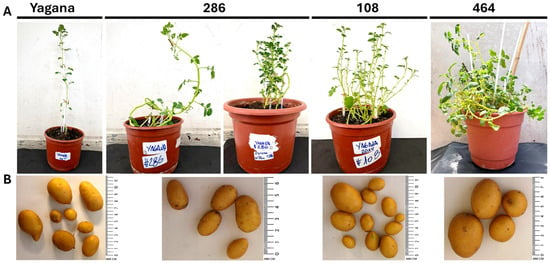
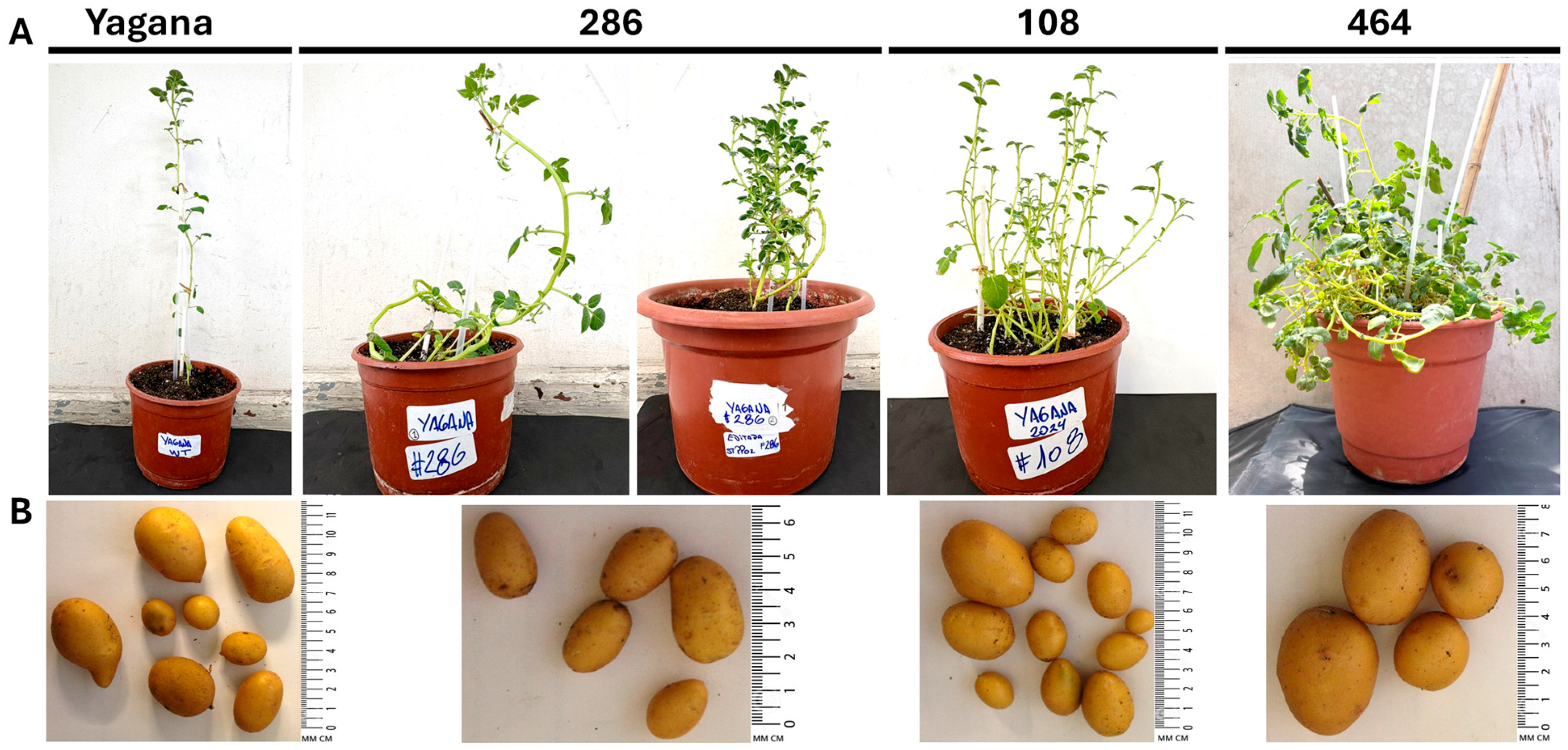
Conversely, PCR analysis of line 286 showed no stable transgene integration, as indicated by the absence of Cas9, GFP, and Rep/RepA sequences. Thus, line 286 was classified as non-GM. To strengthen the analysis of transgene-free editing outcomes, two independent regenerants from line 286 were preserved and propagated separately (Figure 1A).
Figure 1.
Regeneration and tuber production in edited and control lines of ‘Yagana’. Representative greenhouse-grown plants (A) and harvested tubers (B) from wild type (Yagana), edited line 286 (StPPO2, transgene-free), edited line 108 (StPPO2, transgenic), and edited line 464 (StPPO1, transgenic). All lines showed vigorous growth and robust tuber formation with no difference to the wild type.
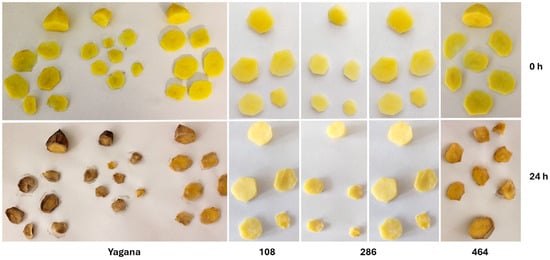
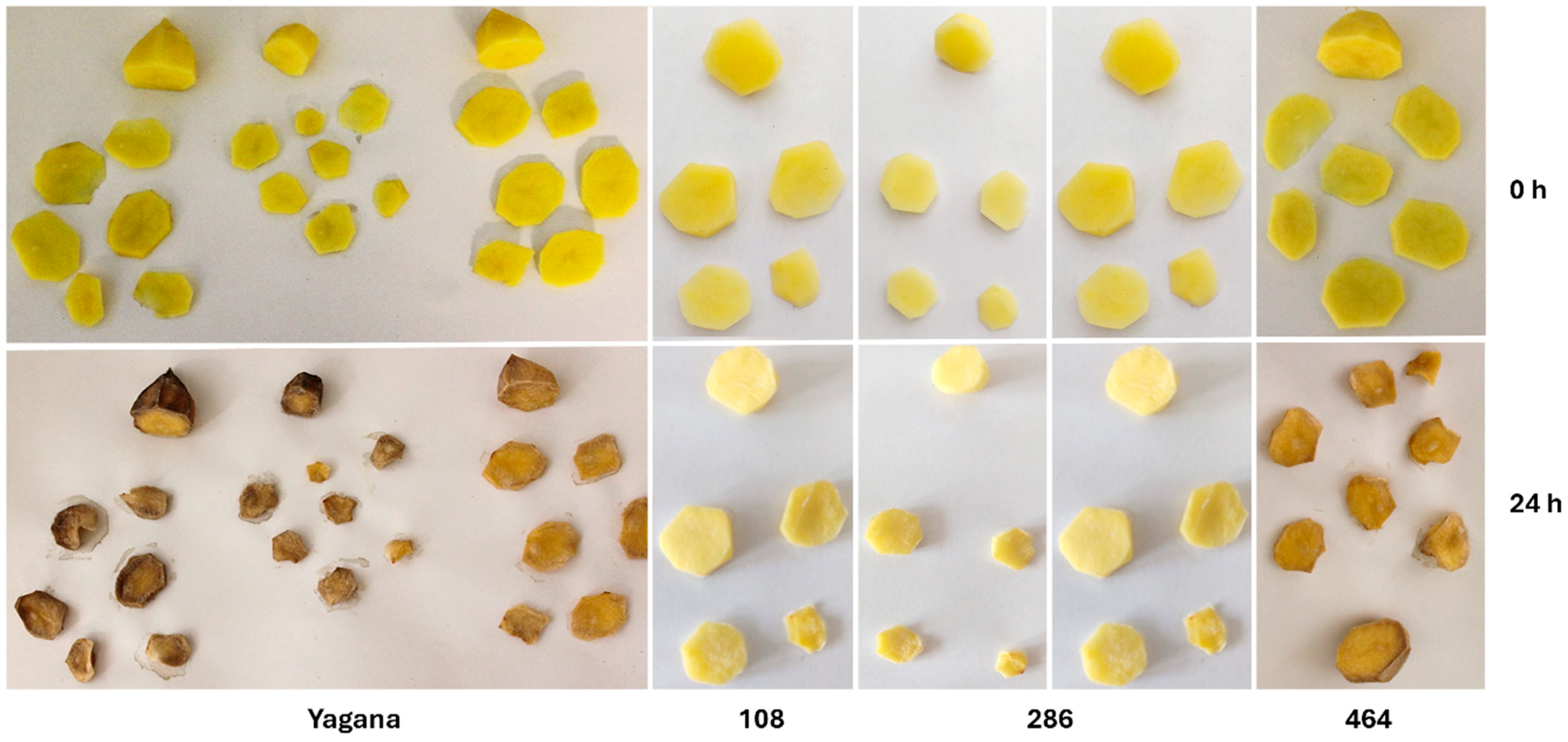
Greenhouse propagated materials yielded tubers 4–6 months after transfer (Figure 1B). Freshly harvested tubers from WT and edited lines were sliced and monitored over 24 h under ambient conditions (Figure 2). At 0 h, all genotypes displayed smooth, uniformly colored surfaces. After 24 h, WT slices exhibited pronounced browning, indicative of active PPO activity. In contrast, edited lines showed reduced discoloration, with line 286 maintaining the lightest tissue, consistent with suppressed PPO2 function. Line 464 (StPPO1-edited) also showed reduced browning, supporting the contribution of both PPO isoforms to the phenotype. This qualitative assay provided early phenotypic evidence of PPO suppression and guided subsequent biochemical analyses.
Figure 2.
Postharvest browning in wild-type and edited potato lines. Sliced tubers from wild type (Yagana), edited line 108 (StPPO2, transgenic), edited line 286 (StPPO2, transgene-free), and edited line 464 (StPPO1, transgenic) were monitored over 24 h under ambient conditions. At 0 h, all genotypes displayed uniform coloration. After 24 h, wild-type slices exhibited pronounced browning, while edited lines showed visibly reduced discoloration. Line 286 maintained the lightest tissue, consistent with suppressed PPO2 activity. Line 464 also showed reduced browning, supporting the functional contribution of both PPO isoforms.
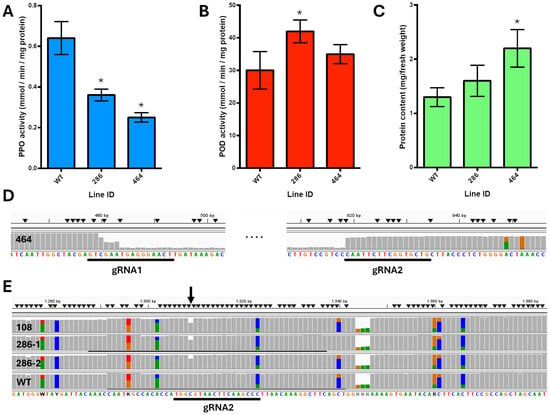
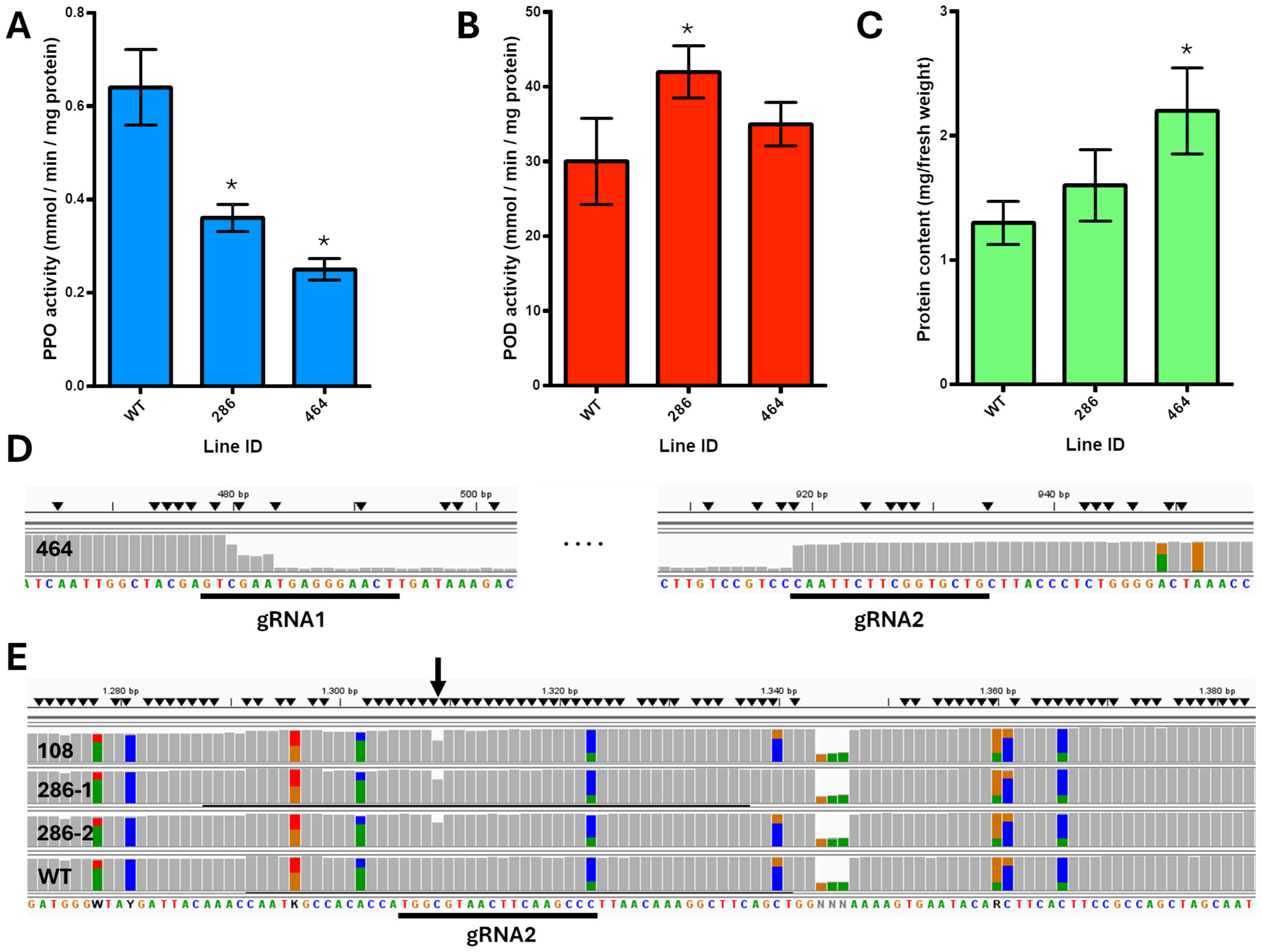
Quantitative enzyme assays were then performed on line 286 (StPPO2-edited), non-GM) and line 464 (StPPO1-edited). Polyphenol oxidase activity (PPO), expressed as nmol of quinone formed per minute per milligram of total soluble protein (nmol min−1 mg−1 protein), was highest in WT, intermediate in line 286 and lowest in line 464 (Figure 3A). This gradient correlated with the observed phenotypic phenotypes.
Figure 3.
Biochemical and molecular validation of PPO suppression in edited Yagana potato lines. Tuber extracts from line 464 (transgenic, double-cut at StPPO1), line 108 (transgenic, edited at the gRNA2 site of StPPO2), and two independent regenerants from line 286 (#1 and #2; non-transgenic, edited at the gRNA2 site of StPPO2) were analyzed for polyphenol oxidase (PPO) activity (A), guaiacol peroxidase (POD) activity (B), and total soluble protein content (C). All values are expressed as nmol min−1 mg−1 protein or mg g−1 fresh weight (FW), and compared against wild-type (WT) controls. Genomic DNA from the same individuals was subjected to PCR and long-read amplicon sequencing to confirm edits at the StPPO1 locus in line 464 (D), and at the gRNA2 target site in StPPO2 across lines 108, 286, and WT (E). Ellipses (“…”) in panel (D) indicate omitted internal regions of the gene sequence and are used intentionally to represent the deleted segment for clarity. The arrow in panel (E) marks the gRNA2 cleavage site; black bars indicate gRNA positions. In panel (E), colored blocks represent the allelic variants detected by amplicon sequencing: gray denotes wild-type alleles, red indicates deletions, blue indicates insertions, and yellow indicates base substitutions; the length of each block reflects the relative frequency of that variant within the sample. Editing ratios in the tetraploid background were inferred using CRISPResso2 (see Table 3), based on the proportion of modified versus unmodified reads. Data in panels (A–C) represent mean ± standard error (SE) from three independent biological replicates and were analyzed by one-way ANOVA followed by Tukey’s post hoc test. Asterisks denote statistically significant differences from WT (p < 0.05).
Guaiacol peroxidase (POD) activity, expressed as micromoles per minute per milligram of protein (µmol min−1 mg−1 protein), was elevated in both edited lines relative to WT (30 µmol min−1 mg−1 protein) (Figure 3B). The WT exhibited a baseline POD activity of approximately 30 µmol min−1 mg−1 protein; in contrast, line 286 had the highest level at roughly 42 µmol/min/mg protein and line 464 reached approximately 35 µmol/min/mg protein. These results suggest that genome editing indirectly modulated this defense-related enzyme.
Total soluble protein content (mg g−1 fresh weight) was higher in edited lines than in WT, suggesting a potential compensatory metabolic response (Figure 3C). Together, these biochemical data corroborate the visual suppression of browning and confirm functional disruption of PPO activity in edited lines.
3.3. Editing Outcomes at StPPO2 via gRNA2
To confirm the editing status of the StPPO2 non-GM line 286, amplicon sequencing was performed on two independent regenerants and compared with line 108, which carries the same gRNA2-directed modification but retains transgenic elements. Line 464 was included as a reference, as it was the only line exhibiting double-cut editing at StPPO1.
Sequencing of the StPPO2 target region in lines 286 #1, 286 #2, and 108 revealed a consistent single-nucleotide deletion at the gRNA2 target site, absent in WT. Visualization of read alignments using IGV enabled direct inspection and quantification of editing events (Figure 3D,E). As expected, line 464 confirmed the double-cut editing at StPPO1, while all StPPO2-edited samples showed the same mutation co-localizing with the gRNA2 site, validating the CRISPR/Cas9 activity. No insertions or large deletions were detected.
Deletion frequencies calculated with CRISPResso2 showed that double-cut editing at StPPO1 reached 98%, whereas single-cut editing at StPPO2 (gRNA2:1309) ranged from 33 to 50% (Table 3). Lines 286 #1 and #2 were consistent with monoallelic editing, while line 108 (showed higher modification levels (50.76%), supporting biallelic editing. Retention of the reference base (C) in many reads alongside deletions highlights the importance of structural variant analysis beyond simple base calls.
Long-read amplicon sequencing of PPO2 revealed that line 286 carries a 1 bp deletion at the gRNA2 target site, producing a frameshift. In silico translation indicated that this frameshift generates a short stretch of altered amino acids followed by a premature stop codon, resulting in a truncated PPO2 protein lacking the C-terminal copper-binding catalytic domain (Supplementary Figure S2). This provides a mechanistic explanation for the strongly reduced PPO activity observed in this line.
Table 3.
CRISPR editing summary at gRNA2:1309 (Yagana reference).
To clarify the functional consequence of the CRISPR edit, we performed an in silico analysis of the PPO2 coding sequence. Comparison of the wild-type CDS with the edited sequence from line 286 (Supplementary Figure S2) revealed that the deletion of a cytosine within the coding region induces a frameshift. Translation of the edited CDS displays a short stretch of altered amino acids followed by a premature stop codon shortly downstream. The resulting truncated PPO2 protein is predicted to lack the C-terminal copper-binding catalytic domain, providing a mechanistic explanation for the marked reduction in PPO activity observed in this line.
4. Discussion
This study shows that modified T-DNAs based on geminivirus-derived replicon systems provide a viable and regulation-aligned platform for precise genome editing in vegetatively propagated, highly heterozygous crops such as potato. By enabling transient, episomal expression of editing components, this delivery strategy reduces the chances for stable transgene integration while offering possibilities for effective gene-editing capability, a combination that is particularly valuable for public breeding programs operating under increasingly stringent biosafety frameworks. In the tetraploid cultivar ‘Yagana’, our workflow successfully generated targeted edits at StPPO2 and recovered a transgene-free line (286), which retained only the intended nucleotide modification and exhibited clear biochemical and phenotypic suppression of enzymatic browning.
In vegetatively propagated tetraploid potatoes, low editing frequencies and the recovery of a single transgene-free event are expected outcomes rather than stochastic anomalies, and the successful identification of line 286 reflects the intended focus of this workflow on generating regulatory-compliant edits rather than maximizing event frequency. The efficiency of replicon-mediated editing in vegetatively propagated tetraploid potato is inherently constrained by several biological factors, including allele dosage, regeneration bottlenecks, and the transient nature of replicon activity. Although only one transgene-free StPPO2-edited line was recovered, this frequency is consistent with reports in other clonally propagated crops using replicon-based systems [12]. Future improvements may include optimizing gRNA architecture, increasing transient Cas9 expression, enhancing replicon copy number, or refining regeneration and tissue culture conditions to increase the proportion of edited cells that successfully form shoots. These considerations highlight that the approach is methodologically transferable, even if event frequency remains low in elite tetraploid backgrounds.
Importantly, even at modest efficiency, the system was able to generate a fully validated, transgene-free edited line, demonstrating that replicon-mediated delivery can produce agronomically meaningful edits despite the inherent complexity of potato genetics. The results are relevant considering the inherent challenges of achieving allele-specific edits in polyploid genomes, where dosage effects and chimerism often complicate their detection, functional interpretation, and downstream product development [22].
4.1. Regulatory and Deployment Implications for StPPO2-Edited Potato
The ability to obtain a non-GM edited line with validated monoallelic disruption and measurable postharvest benefits positions this approach as a scalable template for trait improvement in other elite cultivars, especially in countries such as Chile, where regulatory frameworks distinguish genome-edited, transgene-free products from conventional GMOs [13]. The absence of any “new DNA recombination” is a mandatory criterion for exemption from GMO regulation [13,23], and from this perspective, line 286 represents a non-GMO prototype, as no PCR-detectable integration of Cas9, GFP, or Rep/RepA sequences was found in its genome.
This case-by-case regulatory approach, in which the presence or absence of a new combination of genetic material determines the classification, allows genome-edited plants lacking stable transgene integration to be considered equivalent to conventionally bred varieties. Similar criteria have been adopted in Argentina [24], Brazil [25], and Colombia [23], where gene-edited crops lacking integrated foreign DNA are exempt from GMO regulation, consistent with broader international trends distinguishing transgene-free genome editing from conventional genetic modification. In contrast, the European Union is advancing a legislative framework for plants developed by the New Genomic Techniques (NGTs), including CRISPR-based editing. Under the current EU proposal, gene-edited plants may be exempt from GMO regulation if they contain no foreign DNA and no more than 20 nucleotide modifications [26].
4.2. Genetic and Biochemical Significance of the StPPO2 Editing
Fresh cut and enzyme activity assays showed that changes made to StPPO2 via gRNA2 led to decreased enzymatic browning in the generated tubers from the selected line 286. The mutation’s effect on the phenotype was confirmed by lighter tissue color and lower PPO activity compared to the WT control. Our results were consistent with previous studies that showed that StPPO2 accounts for approximately 55% of total PPO activity in tubers [2], and that browning and PPO activity can be diminished by up to 73% and 69%, respectively, when the four alleles of StPPO2 are targeted with CRISPR/Cas9 [6]. Additionally, the double-cut edit at StPPO1 line 464 further supported the involvement of this isoform in the degradative process. Earlier works using artificial microRNAs (amiRNAs) revealed a synergistic effect among PPO isoforms when multiple genes were targeted simultaneously, with the most significant reduction in browning occurring upon joint silencing of StPPO1 through StPPO4 [2].
Across the edited lines, PPO activity displayed a clear isoform-dependent pattern that illustrates the distinct biological roles of StPPO1 and StPPO2 in tuber browning [6]. The StPPO2-edited, non-transgenic line 286 displayed a moderate but consistent reduction in PPO activity relative to the WT, aligning with the central contribution of StPPO2 to parenchymal browning.
Although StPPO2 is the major contributor to PPO activity in tubers, line 286 carried a monoallelic edit, which explains why the reduction in enzymatic activity was only partial. In contrast, the double-cut St PPO1 edited line 464, resulted in a more complete disruption of this isoform and therefore an even lower PPO activity. This allelic contrast highlights the importance of dosage effects in tetraploid genomes, where the number of disrupted alleles directly influences the biochemical magnitude of the phenotype.
Interestingly, our results also show that editing a single StPPO2 allele was sufficient to produce a measurable and agronomically relevant reduction in browning. This observation challenges the common assumption that multiallelic disruption is required to obtain functional phenotypes in tetraploid species. The monoallelic edit in line 286 therefore provides empirical evidence that partial loss of PPO2 dosage can significantly alter browning physiology, underscoring the dominant contribution of this isoform to tuber discoloration.
Despite line 464 exhibiting the lowest total PPO activity, its tubers did not show the strongest delay in visible browning. This outcome reflects the isoform-specific and tissue-specific roles of PPO enzymes [6]. StPPO2 is the dominant contributor to browning in parenchymal tissue, where wound-induced oxidation of phenolics occurs, whereas StPPO1 is expressed primarily in vascular tissues and contributes proportionally less to the visible browning phenotype despite its contribution to total PPO activity [2,4,6]. Thus, the extent of browning is governed not only by total PPO activity but also by which isoform is disrupted and in which tissues it is predominantly expressed [2,6].
The elevated POD activity observed in both edited lines represents a compensatory oxidative response rather than a causal determinant of browning. When PPO activity is reduced, phenolic substrates accumulate and are redirected toward alternative oxidative pathways, including peroxidase-mediated reactions, which are activated under wound or stress conditions [27,28]. Therefore, the apparent association between higher POD activity and reduced browning is indirect: POD activity increases because of altered phenolic flux, but PPO remains the primary driver of enzymatic browning intensity in potato tubers.
Line 464 exhibited the lowest PPO activity among all genotypes, indicating that disruption of StPPO1 produces a stronger biochemical effect despite its lower baseline contribution to visible browning (Figure 2). This differential response underscores the complementary roles of both isoforms: StPPO2 drives the bulk of browning intensity [6], while StPPO1 contributes substantially to total PPO enzymatic capacity [2]. Interestingly, POD activity showed an inverse trend, with both edited lines displaying elevated levels compared to WT. The strongest increase occurred in line 286, supporting the compensatory activations of peroxidase-mediated oxidative pathways following partial suppression of StPPO2 [27]. Line 464 also exhibited enhanced POD activity, though to a lesser extent, consistent with a more complete reduction in PPO-mediated oxidation. Together, these results reveal that targeted editing of StPPO1 and StPPO2 produces distinct biochemical signatures, reduced PPO activity proportional to the disrupted isoform and a compensatory rise in POD activity. The results highlight the interconnected nature of oxidative metabolism in potato tubers, reinforcing that by lowering PPO activity, the phenolic flux is redirected toward alternative oxidation routes, leading to a compensatory increase in POD activity [27,28].
The two regenerants derived from line 286 displayed different deletion frequencies, which is consistent with the independent origin of each shoot during regeneration. In tetraploid potato, regenerated plantlets frequently arise from distinct cell lineages, leading to natural variation in allele dosage, editing mosaicism, and somaclonal divergence. These differences are expected in polyploid tissue-culture systems and reflect the biological heterogeneity inherent to vegetative regeneration rather than methodological inconsistency.
In the edited lines in which the tuber-specific PPO2 isoform was suppressed, we observed a trend indicating an increased total protein content, which was determined by the Bradford assay. The result may be explained, at least in part, by reduced generation of quinones derived from the oxidation of phenolic compounds, which would decrease protein-phenol crosslinking and the formation of insoluble aggregates during tuber development and extraction, thereby increasing the soluble protein fraction quantifiable by Coomassie [29,30]. Additionally, suppression of this PPO isoform could modulate defense metabolism and the tissue’s redox balance, favoring nitrogen allocation toward storage proteins and enhancing the stability of structural proteins [6]. Nevertheless, these results should be contrasted with independent methods for total nitrogen quantification and proteomic analyses to distinguish between methodological effects and actual changes in protein accumulation.
From a technological perspective, our replicon system has proven effective for delivering CRISPR/Cas9 components and generating edits within a complex polyploid genome. Its compatibility with Agrobacterium-mediated transformation makes it accessible to previously uncharacterized cultivars, many of which represent elite genetic backgrounds that must be preserved. Veillet et al. [9] employed transient T-DNA expression rather than a replicating episomal system, yet their results highlight a key principle: minimizing stable transgene integration increases the likelihood of recovering edited but non-transgenic plants. Our work confirms and extends this concept, as the episomal behavior of the replicon supports efficient editing while reducing integration events, although further gains in efficiency remain desirable. Importantly, the adaptability and regulatory versatility of this approach are evidenced by the recovery of both transgenic and non-transgenic edited lines from the same vector system. In public breeding contexts—where technical robustness and regulatory flexibility must coexist, this dual outcome is particularly advantageous.
From a breeding perspective, line 286 represents a viable option for introgression into new cultivars that represent an important commercial and productive variety. Its edited phenotype provides noticeable gains in postharvest performance, and its non-GM status makes downstream deployment and regulatory clearance easier. This method bridges the gap between molecular innovation and agronomic relevance by offering a transferable model for trait-specific editing in vegetatively propagated crops [31].
However, there are still several restrictions. Complete gene knockout and dose control are difficult due to the allele complexity present in tetraploid genomes [6]. As shown by RNP-based editing systems that revealed no detectable off-targets in StPPO1 or StPPO4, future research should address off-target screening to verify edit specificity [6]. To confirm the durability of the modified phenotype, it will also be crucial to assess tuber storage performance in commercial settings. The scalability and impact of the replicon system will be further evaluated by incorporating additional traits, such as disease resistance [32] and reduced cold-induced sweetening [31].
5. Conclusions
In summary, we validated a regulatory-compliant workflow for genome editing in potato that combines molecular precision with clear agronomic relevance. Although the overall editing efficiency was modest, the successful recovery of a fully validated, transgene-free StPPO2-edited line demonstrates that geminivirus-derived replicon systems can generate targeted edits even within the biological constraints of a highly heterozygous tetraploid genome.
Beyond the phenotypic and biochemical validation, this work introduces two advances that distinguish it from previous PPO-silencing and PPO2-editing efforts. First, it provides the first demonstration that a geminivirus-derived replicon can generate a transgene-free StPPO2-edited line in an elite commercial tetraploid cultivar, a capability not achieved by earlier approaches based on stable transgenes, artificial microRNAs, or RNP delivery. Second, it shows that a monoallelic edit of StPPO2 (despite the complexity of the tetraploid genome) is sufficient to produce a measurable reduction in enzymatic browning in a non-GM background. These findings establish a practical and regulatory-aligned route for introducing quality traits into vegetatively propagated potato germplasm.
Line 286 represents a valuable non-GMO prototype with improved postharvest traits, suitable for direct use or integration into breeding programs. This work reinforces the utility of replicon-based systems for crop improvement in elite germplasm and highlights their strategic potential within innovation-oriented regulatory landscapes, particularly within the proactive frameworks emerging across Latin America.
Supplementary Materials
The following supporting information can be downloaded at: https://www.mdpi.com/article/10.3390/agronomy16020216/s1, Table S1: Composition of media used in this work; Table S2: Selected guide RNAs for StPPO1 and StPPO2 editing; Table S3: Gene codes; Table S4: Primer sequences; Figure S1: Structural map of the pGEF-U vector used for CRISPR/Cas9 delivery in potato; Figure S2: In silico comparison of PPO2 CDS between wild-type and edited allele in line 286.
Author Contributions
Conceptualization, H.P. and R.V.; methodology, M.M., F.O., G.E.Z., M.G., G.V. and R.V.; software, M.G. and H.P.; validation, G.A., R.V., F.O., R.M.; formal analysis, G.A., H.P. and M.G.; investigation, M.M., B.O., M.G. and G.V.; resources, H.P., G.A.; data curation, H.P.; writing—original draft preparation, H.P.; writing—review and editing, H.P., G.E.Z., F.O., M.G.; visualization, H.P. and M.G.; supervision, H.P.; project administration, H.P.; funding acquisition, H.P. All authors have read and agreed to the published version of the manuscript.
Funding
This research was funded by INIA-CHILE, grant number 503866-71 “Mejoramiento Genético Estratégico en INIA: Desarrollo de Plataformas de Edición Génica Basadas en CRISPR/Cas”, and FONTAGRO/PROCISUR grant number ATN/RF-18757-RG “Edición génica para el mejoramiento en especies vegetales y animales”.
Data Availability Statement
All data supporting the findings of this study are included within the article and its Supplementary Materials. No additional datasets were generated or analyzed. Sequencing results, CRISPResso2 outputs, and all experimental details required to reproduce the work are fully provided in the manuscript. The pGEF-U plasmid is available from Addgene (catalogue number 251731, https://www.addgene.org/251731/, accessed on 15 December 2025). Further information is available from the corresponding author upon request.
Acknowledgments
We acknowledge Manuel Muñoz, leader of the National Potato Breeding Program at INIA Remehue, for providing the Yanaga-INIA plant materials that enabled the initiation of this research.
Conflicts of Interest
The authors declare no conflicts of interest.
Abbreviations
The following abbreviations are used in this manuscript:
| ANOVA | Analysis of variance |
| amiRNA | Artificial micro-RNA |
| BSA | Bovine serum albumin |
| Cas9 | CRISPR-associated protein 9 |
| CRISPR | Clustered regularly interspaced short palindromic repeats |
| DM | Solanum tuberosum Group Tuberosum reference genome (DM) |
| DNA | Deoxyribonucleic acid |
| dNTP | Deoxynucleotide triphosphate |
| EC | Enzyme Commission number |
| GFP | Green fluorescent protein |
| GM-GMO | Genetically modified (organism) |
| gRNA | Guide RNA |
| IGV | Integrative Genomics Viewer |
| LB | Left border |
| MES | 2-(N-morpholino) ethane sulfonic acid |
| MS | Murashige and Skoog medium |
| ONT | Oxford Nanopore Technologies |
| PAM | Protospacer adjacent motif |
| PCR | Polymerase chain reaction |
| POD | Guaiacol peroxidase |
| PPO | Polyphenol oxidase |
| Rep/RepA | Replication-associated proteins from geminivirus replicons |
| RNA | Ribonucleic acid |
| SaCas9 | Staphylococcus aureus Cas9 |
| sgRNA | Single-guide RNA |
| T-DNA | Transfer DNA |
| WT | Wild type |
References
- Sánchez-Ferrer, Á.; Rodríguez-López, J.N.; García-Cánovas, F.; García-Carmona, F. Tyrosinase: A comprehensive review of its mechanism. Biochim. Biophys. Acta 1995, 1247, 1–11. [Google Scholar] [CrossRef] [Scilit] [PubMed]
- Chi, M.; Bhagwat, B.; Lane, W.D.; Tang, G.; Su, Y.; Sun, R.; Oomah, B.D.; Wiersma, P.A.; Xiang, Y. Reduced polyphenol oxidase gene expression and enzymatic browning in potato (Solanum tuberosum L.) with artificial microRNAs. BMC Plant Biol. 2014, 14, 62. [Google Scholar] [CrossRef] [Scilit] [PubMed]
- Rasmussen, C.B.; Enghild, J.J.; Scavenius, C. Identification of polyphenol oxidases in potato tuber (Solanum tuberosum) and purification and characterization of the major polyphenol oxidases. Food Chem. 2021, 365, 130454. [Google Scholar] [CrossRef] [Scilit]
- Guan, Q.; Li, W.; Dai, M.; Qiao, J.; Wu, B.; Zhang, Z.; Shi, J.; Song, Z. Key factors uncovered by transcriptomic analysis in the regulation of glutamic acid repressing the browning of fresh-cut potatoes. Postharvest Biol. Technol. 2025, 219, 113242. [Google Scholar] [CrossRef] [Scilit]
- González, M.N.; Massa, G.A.; Andersson, M.; Décima Oneto, C.A.; Turesson, H.; Storani, L.; Olsson, N.; Fält, A.-S.; Hofvander, P.; Feingold, S.E. Comparative potato genome editing: Agrobacterium tumefaciens-mediated transformation and protoplast transfection delivery of CRISPR/Cas9 components directed to StPPO2 gene. Plant Cell Tissue Organ Cult. 2021, 145, 291–305. [Google Scholar] [CrossRef] [Scilit]
- González, M.N.; Massa, G.A.; Andersson, M.; Turesson, H.; Olsson, N.; Fält, A.-S.; Storani, L.; Décima Oneto, C.A.; Hofvander, P.; Feingold, S.E. Reduced enzymatic browning in potato tubers by specific editing of a polyphenol oxidase gene via ribonucleoprotein complexes delivery of the CRISPR/Cas9 system. Front. Plant Sci. 2020, 10, 1649. [Google Scholar] [CrossRef] [Scilit]
- Nahirñak, V.; Almasia, N.I.; González, M.N.; Massa, G.A.; Décima Oneto, C.A.; Feingold, S.E.; Hopp, H.E.; Vázquez Rovere, C. State of the art of genetic engineering in potato: From the first report to its future potential. Front. Plant Sci. 2022, 12, 768233. [Google Scholar] [CrossRef] [Scilit]
- Shi, J.; Xie, W.; Li, S.; Wang, Y.; Wang, Q.; Li, Q. Prohibitin StPHB3 affects the browning of fresh-cut potatoes via influencing antioxidant capacity and polyphenol oxidase activation. Postharvest Biol. Technol. 2024, 207, 112598. [Google Scholar] [CrossRef] [Scilit]
- Veillet, F.; Perrot, L.; Chauvin, L.; Kermarrec, M.-P.; Guyon-Debast, A.; Chauvin, J.-E.; Nogué, F.; Mazier, M. Transgene-free genome editing in tomato and potato plants using Agrobacterium-mediated delivery of a CRISPR/Cas9 cytidine base editor. Int. J. Mol. Sci. 2019, 20, 402. [Google Scholar] [CrossRef] [Scilit]
- Chen, K.; Wang, Y.; Zhang, R.; Zhang, H.; Gao, C. CRISPR/Cas genome editing and precision plant breeding in agriculture. Annu. Rev. Plant Biol. 2019, 70, 667–697. [Google Scholar] [CrossRef] [Scilit]
- Baltes, N.J.; Gil-Humanes, J.; Čermák, T.; Atkins, P.A.; Voytas, D.F. DNA replicons for plant genome engineering. Plant Cell 2014, 26, 151–163. [Google Scholar] [CrossRef] [Scilit]
- Olivares, F.; Loyola-Muñoz, R.; Olmedo, B.; Miccono, M.; Aguirre, C.; Vergara, R.; Riquelme-Toledo, D.; Madrid, G.; Plantat, P.; Roco, R.; et al. CRISPR/Cas9 targeted editing of genes associated with fungal susceptibility in Vitis vinifera L. cv. Thompson Seedless using geminivirus-derived replicons. Front. Plant Sci. 2021, 12, 791030. [Google Scholar] [CrossRef] [Scilit] [PubMed]
- Eriksson, D.; Kershen, D.; Nepomuceno, A.; Pogson, B.J.; Prieto, H.; Purnhagen, K.; Smyth, S.; Wesseler, J.; Whelan, A. A comparison of the EU regulatory approach to directed mutagenesis with that of other jurisdictions. New Phytol. 2018, 222, 1673–1684. [Google Scholar] [CrossRef] [Scilit] [PubMed]
- Muñoz, D.M. Variedades de Papa. Ficha Técnica INIA Remehue 2015, 04. Available online: https://hdl.handle.net/20.500.14001/66832 (accessed on 15 December 2025).
- Xing, H.L.; Dong, L.; Wang, Z.P.; Zhang, H.Y.; Han, C.Y.; Liu, B.; Wang, X.C.; Chen, Q.J. A CRISPR/Cas9 toolkit for multiplex genome editing in plants. BMC Plant Biol. 2014, 14, 327. [Google Scholar] [CrossRef] [Scilit] [PubMed]
- Acha, G.; Vergara, R.; Muñoz, M.; Mora, R.; Aguirre, C.; Muñoz, M.; Kalazich, J.; Prieto, H. A traceable DNA-replicon derived vector to speed up gene editing in potato. Plants 2021, 10, 1882. [Google Scholar] [CrossRef] [Scilit]
- Steenkamp, J.; Wiid, I.; Lourens, A.; van Helden, P. Improved method for DNA extraction from Vitis vinifera. Am. J. Enol. Vitic. 1994, 45, 102–106. [Google Scholar] [CrossRef] [Scilit]
- Bolger, A.; Lohse, M.; Usadel, B. Trimmomatic: A flexible trimmer for Illumina sequence data. Bioinformatics 2014, 30, 2114–2120. [Google Scholar] [CrossRef] [Scilit]
- Clement, K.; Rees, H.; Canver, M.C.; Gehrke, J.M.; Farouni, R.; Hsu, J.Y.; Cole, M.A.; Liu, D.R.; Joung, J.K.; Bauer, D.E.; et al. CRISPResso2 provides accurate and rapid genome editing sequence analysis. Nat. Biotechnol. 2019, 37, 224–226. [Google Scholar] [CrossRef] [Scilit]
- Chance, B.; Maehly, A.C. Assay of catalases and peroxidases. Methods Enzymol. 1955, 2, 764–775. [Google Scholar] [CrossRef] [Scilit]
- Bradford, M.M. A rapid and sensitive method for the quantitation of microgram quantities of protein. Anal. Biochem. 1976, 72, 248–254. [Google Scholar] [CrossRef]
- Andersson, M.; Turesson, H.; Nicolia, A.; Fält, A.S.; Samuelsson, M.; Hofvander, P. Efficient targeted multiallelic mutagenesis in tetraploid potato by transient CRISPR-Cas9 expression in protoplasts. Plant Cell Rep. 2017, 36, 117–128. [Google Scholar] [CrossRef] [Scilit]
- Segretin, M.E.; Soto, G.C.; Lorenzo, C.D. Latin America: A hub for agrobiotechnological innovations. Ann. Bot. 2025, 135, 629–641. [Google Scholar] [CrossRef] [Scilit]
- Whelan, A.I.; Lema, M.A. Regulatory framework for gene editing and other new breeding techniques in Argentina. GM Crops Food 2015, 6, 253–265. [Google Scholar] [CrossRef] [Scilit]
- CTNBio. Normative Resolution No. 16: Norms for the Regulatory Classification of Products Developed Using New Breeding Techniques; Comissão Técnica Nacional de Biossegurança: Brasília, Brazil, 2018. [Google Scholar]
- CJEU. Judgment of the Court (Grand Chamber) of 25 July 2018. Case C-528/16. 2018. Available online: https://eur-lex.europa.eu/legal-content/EN/TXT/?uri=CELEX%3A62016CJ0528 (accessed on 21 October 2025).
- Zheng, J.; Jiang, Y.; Li, A.; Peng, M.; Wang, T.; Kou, R.; Kang, J.; Liu, X. The super anti-browning effect of high-oxygen pretreatment combined with cod peptides on fresh-cut potatoes during storage. Foods 2025, 14, 1564. [Google Scholar] [CrossRef] [Scilit] [PubMed]
- Santos, M.N.; Lima, P.C.; Araújo, F.F.; Araújo, N.O.; Finger, F.L. Activity of polyphenol oxidase and peroxidase in non-dormant potato tubers treated with sprout suppressors. Food Sci. Technol. 2020, 40, 222–227. [Google Scholar] [CrossRef] [Scilit]
- Mahadevan, C.; Watts, E.C.; Zheng, K.; Song, S.J.; van der Hoorn, R.A.L. Polyphenol oxidase silencing avoids protein cross-linking and enzymatic browning in Nicotiana benthamiana leaf extracts. Plant Biotechnol. J. 2025. [Google Scholar] [CrossRef] [Scilit] [PubMed]
- Alneamah, S.J.A.; Aldhalemi, A.A.J.; Jannah, S.M.A.; Aldhalemi, M.A.J.; Al-Obaidi, L.F.H. Extraction, purification and characterization of polyphenol oxidase from potato and apple and inhibition of enzymatic browning. South East. Eur. J. Public Health 2024, 610–622. [Google Scholar] [CrossRef] [Scilit]
- Martínez-Prada, M.M.; Curtin, S.J.; Gutiérrez-González, J.J. Potato improvement through genetic engineering. GM Crops Food 2021, 12, 479–496. [Google Scholar] [CrossRef] [Scilit]
- Veillet, F.; Kermarrec, M.-P.; Chauvin, L.; Chauvin, J.-E.; Nogué, F. CRISPR-induced indels and base editing using the Staphylococcus aureus Cas9 in potato. PLoS ONE 2020, 15, e0235942. [Google Scholar] [CrossRef] [Scilit]

Disclaimer/Publisher’s Note: The statements, opinions and data contained in all publications are solely those of the individual author(s) and contributor(s) and not of MDPI and/or the editor(s). MDPI and/or the editor(s) disclaim responsibility for any injury to people or property resulting from any ideas, methods, instructions or products referred to in the content. |
© 2026 by the authors. Licensee MDPI, Basel, Switzerland. This article is an open access article distributed under the terms and conditions of the Creative Commons Attribution (CC BY) license.