Predicting Phenological Stages for Cherry and Apple Orchards: A Comparative Study with Meteorological and Satellite Data

 ,
,  , ,
, , 
 , ,
, ,
Abstract
1. Introduction
2. Materials and Methods
2.1. Study Area
2.2. Ground Data
2.3. Remote Sensing Dataset
2.4. Empirical Modeling
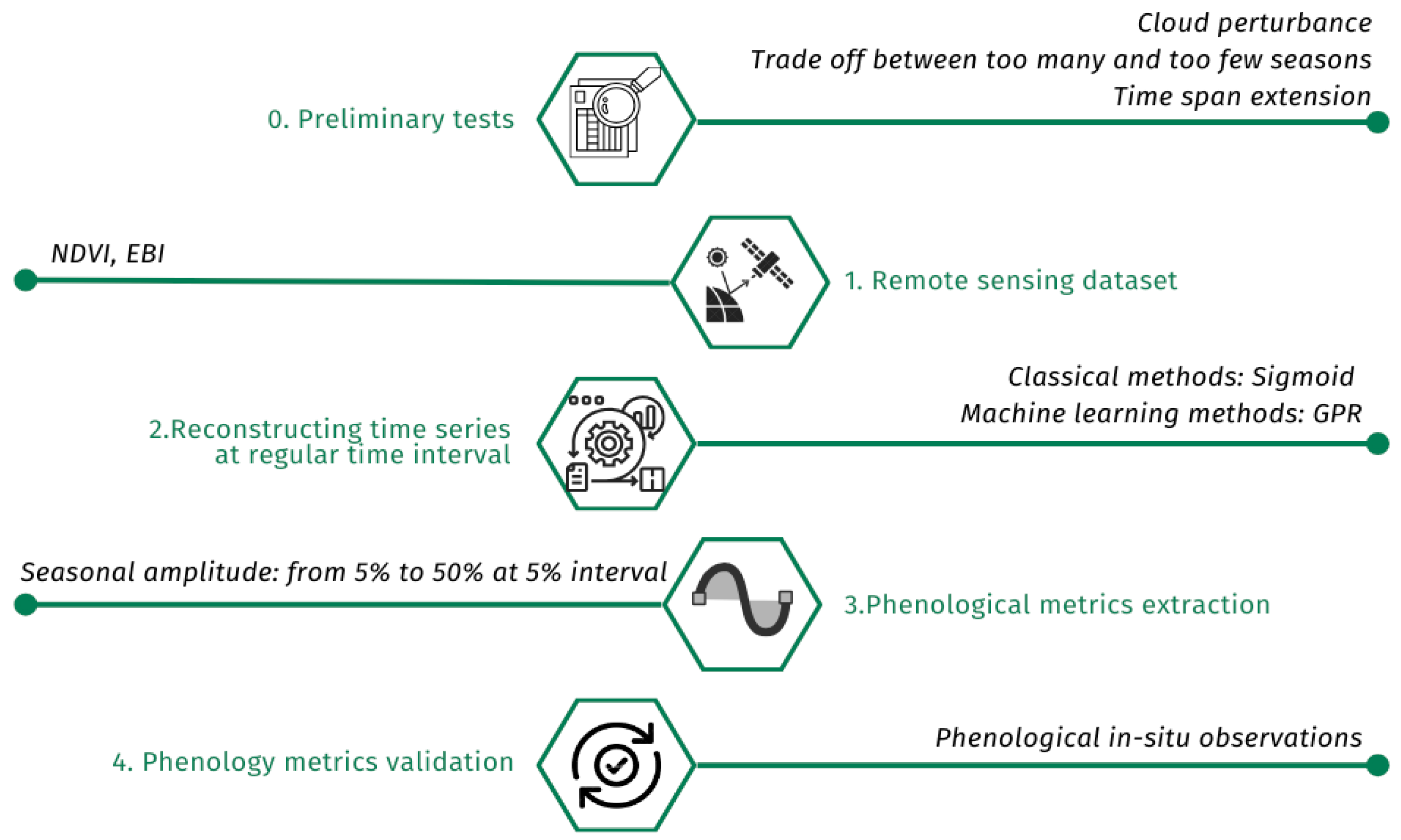
2.5. LSP Modeling
3. Results
3.1. Empirical Models
3.2. Sentinel-2 Results
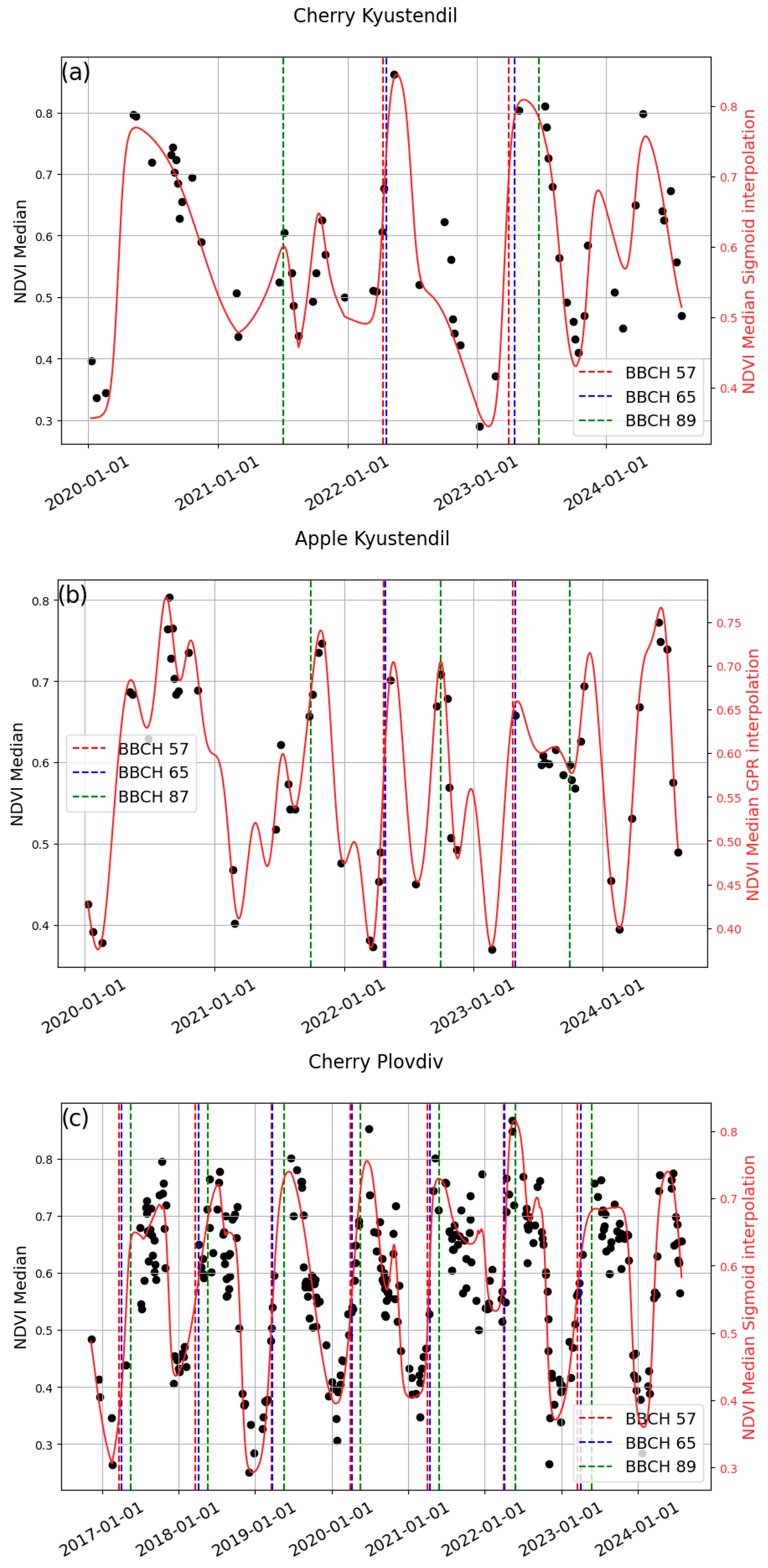
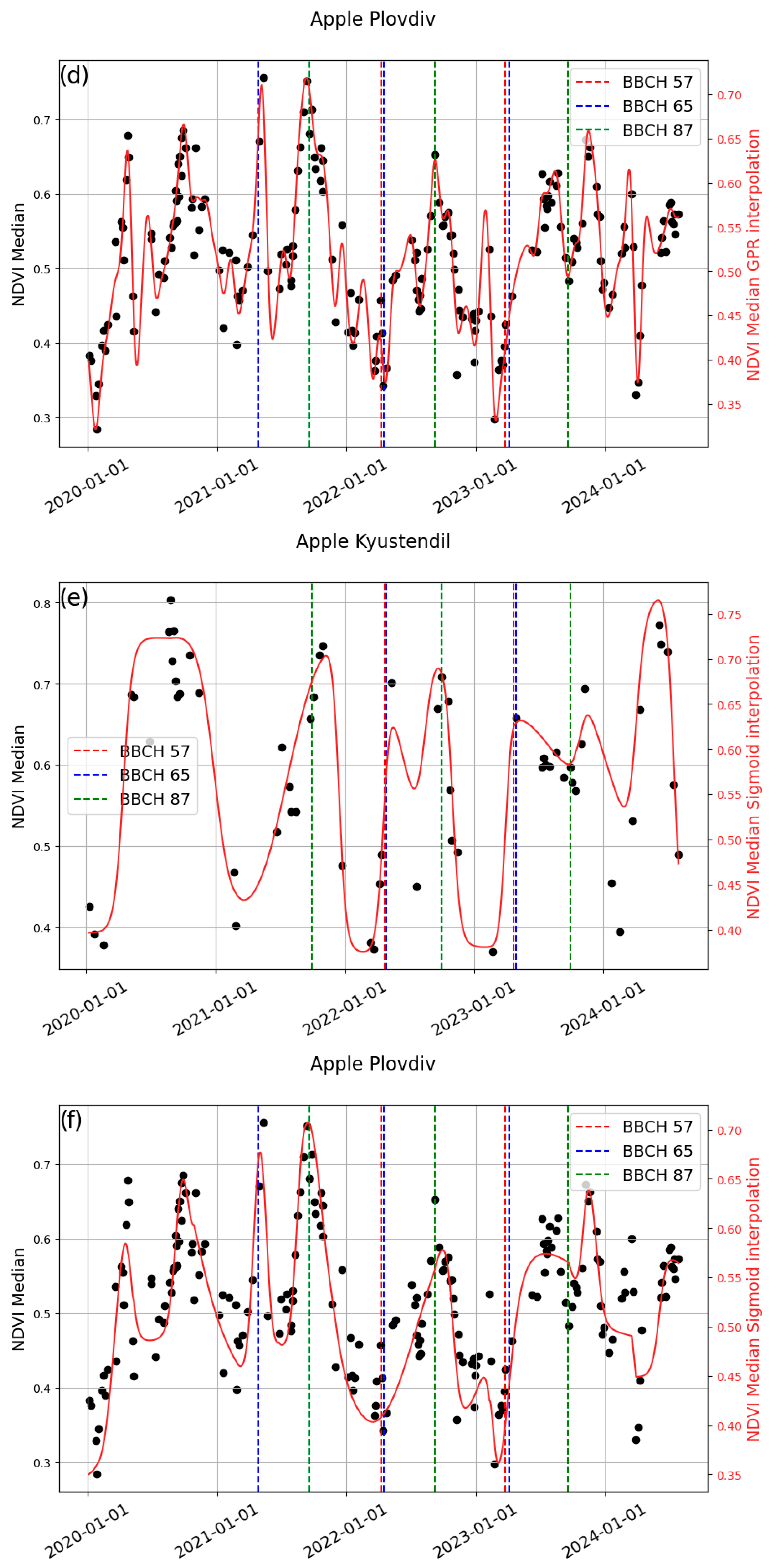
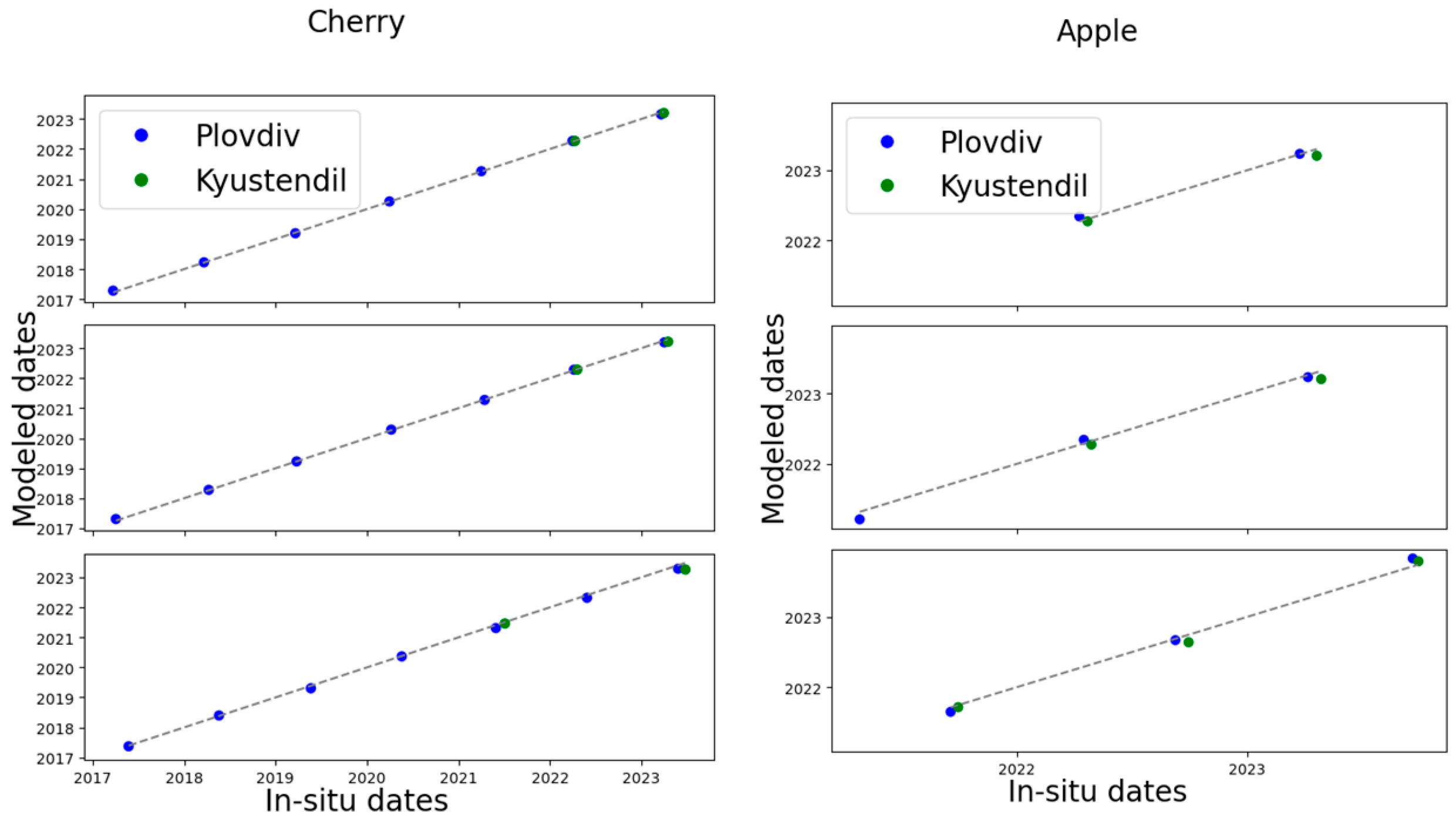
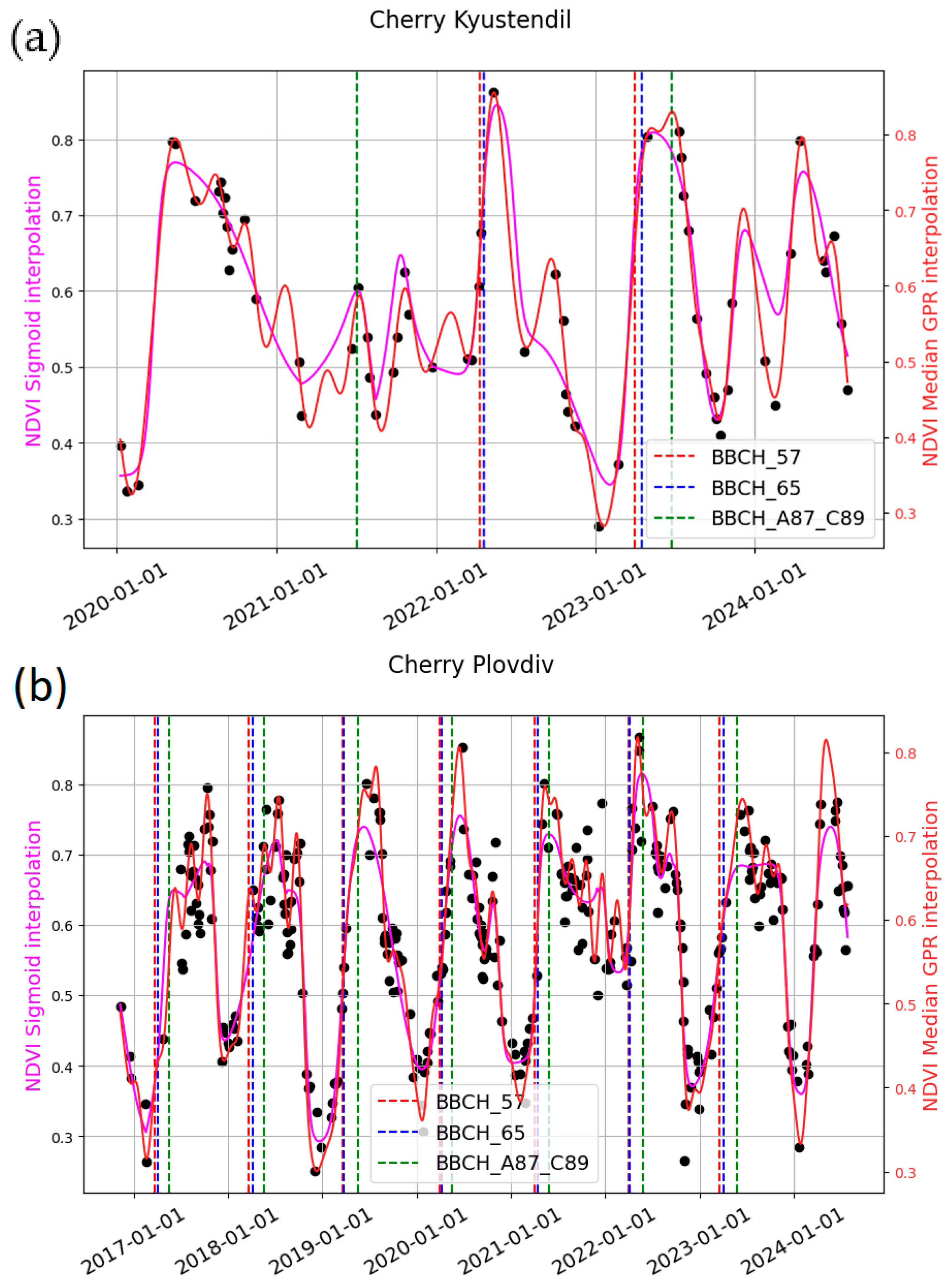
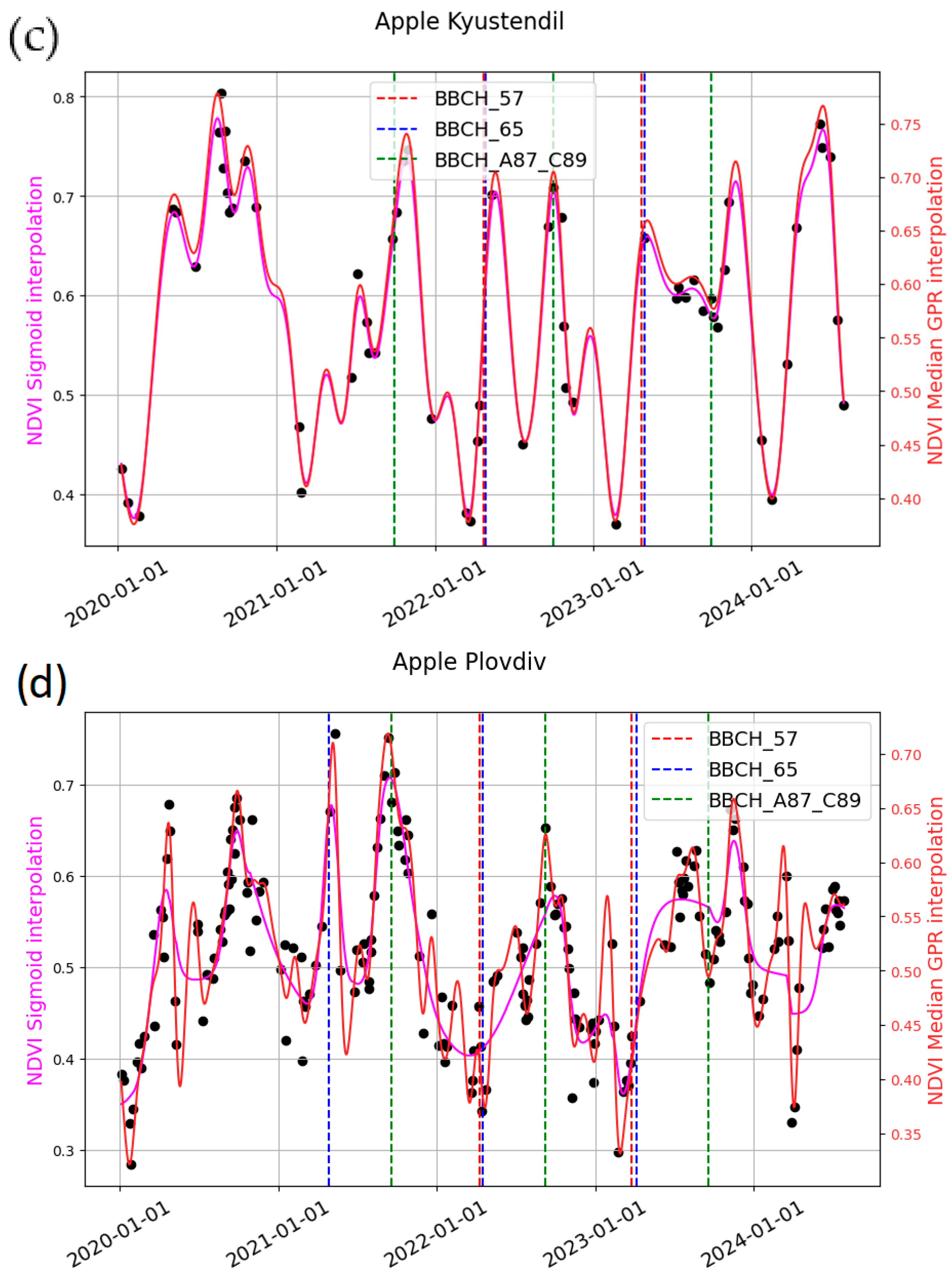
3.2.1. By Location and Fruit Tree
- With GPR

| Location, Fruit Tree | SoS for BBCH57 | SoS for BBCH65 | BBCH87/89 as |
|---|---|---|---|
| Plovdiv, apple | Samples: 2, RMSE = 17, with NDVI& = 0.2 | Samples: 3, RMSE = 26, with NDVI& = 0.3 | Samples: 3, EoS: RMSE = 13, with EBI& = 0.55 |
| Plovdiv, cherry | Samples: 7, RMSE = 18 with NDVI& = 0.35 | Samples: 7, RMSE = 21, with NDVI& = 0.5 | Samples: 7, SoS: RMSE = 38, with NDVI& = 0.7 |
| Kyustendil, apple | Samples: 2, RMSE = 10, with NDVI& = 0.8 | Samples: 2, RMSE = 9, with NDVI& = 0.95 | Samples: 3, SoS: RMSE = 25, with NDVI& = 0.7 |
| Kyustendil, cherry | Samples: 2, RMSE = 4, with NDVI& = 0.65 | Samples: 2, RMSE = 5, with NDVI& = 0.85 | Samples: 2, EoS: RMSE = 12, with NDVI& = 0.95 |
- With Sigmoid
| Location, Fruit Tree | SoS for BBCH57 | SoS for BBCH65 | BBCH87/89 as |
|---|---|---|---|
| Plovdiv, apple | Samples: 2, RMSE = 8, with NDVI& = 0.05 | Samples: 3, RMSE = 23, with NDVI& = 0.1 | Samples: 3, SoS: RMSE = 24, with NDVI& = 0.9 |
| Plovdiv, cherry | Samples: 7, RMSE = 12, with NDVI& = 0.4 | Samples: 7, RMSE = 12, with NDVI& = 0.55 | Samples: 7, SoS: RMSE = 27, with NDVI& = 0.85 |
| Kyustendil, apple | Samples: 2, RMSE = 15, with NDVI& = 0.55 | Samples: 2, RMSE = 20, with NDVI& = 0.55 | Samples: 3, SoS: RMSE = 27, with NDVI& = 0.85 |
| Kyustendil, cherry | Samples: 2, RMSE = 7, with NDVI& = 0.65 | Samples: 2, RMSE = 10, with NDVI& = 0.85 | Samples: 2, EoS: RMSE = 8, with NDVI& = 0.95 |
3.2.2. Results by Fruit Tree Type
- With GPR
| Location, Fruit Tree | SoS for BBCH57 | SoS for BBCH65 | BBCH87/89 as |
|---|---|---|---|
| Plovdiv and Kyustendil, cherry | Samples: 9, RMSE = 18, with NDVI& = 0.4 | Samples: 9, RMSE = 21, with NDVI& = 0.6 | Samples: 9, EoS: RMSE = 60, with EBI& = 0.75 |
| Plovdiv & Kyustendil, apple | Samples: 4, RMSE = 23, with NDVI& = 0.3 | Samples: 5, RMSE = 29, with NDVI& = 0.3 | Samples: 6, EoS: RMSE = 29, with EBI& = 0.55 |
- With Sigmoid
| Location, Fruit Tree | SoS for BBCH57 | SoS for BBCH65 | BBCH87/89 as |
|---|---|---|---|
| Plovdiv & Kyustendil, cherry | Samples: 9, RMSE = 12, with NDVI& = 0.4 | Samples: 9, RMSE = 14, with NDVI& = 0.55 | Samples: 9, SoS: RMSE = 36, with NDVI& = 0.85 |
| Plovdiv and Kyustendil, apple | Samples: 4, RMSE = 27, with NDVI& = 0.1 | Samples: 5, RMSE = 30, with NDVI& = 0.2 | Samples: 6, SoS: RMSE = 26, with NDVI& = 0.85 |
4. Discussion
4.1. With an Empirical Model
4.2. With Sentinel-2
5. Conclusions
- With LSP modeling, NDVI outperforms EBI in most cases. Depending on the dataset, GPR or sigmoid models performed better. SOS proved to be the more appropriate phenological metric for BBCH 87/89. The best RMSE for cherry and apple trees falls within 12 to 36 days, but it is unsuitable for operational use in orchard monitoring. Modeling homogeneous and large orchards of only one species should provide better results using Sentinel-2 images.
- All results presented in this study are at the species level. Attempts at separation by variety are tentative and possible only if the variety data are presorted. This type of separation is difficult or impossible to perform numerically and remotely from satellite images at this stage.
- In compiling the empirical relationships, multi-year average values of GDD for mass occurrence of bud burst, flowering, and fruit ripening were used as predictors. In addition, the values of CU and GDH from the dormant period, and GDD for bud swelling were used as predictors.
- To prepare more precise forecasts, it is recommended to combine both methods, as their positive qualities complement each other well. Satellite images facilitate the mapping of fruit plant conditions and development, while meteorological and agrometeorological indices data support the forecasting process. These data are recommended for predicting the timing of bud burst, flowering, and fruit ripening.
Author Contributions
Funding
Data Availability Statement
Acknowledgments
Conflicts of Interest
References
- Pio, R.; de Souza, F.B.M.; Kalcsits, L.; Bisi, R.B.; Farias, D.H. Advances in the production of temperate fruits in the tropics. Acta Sci. 2019, 41, e39549. [Google Scholar] [CrossRef] [Scilit]
- Campoy, J.A.; Ruiz, D.; Egea, J. Dormancy in temperate fruit trees in a global warming context: A review. Sci. Hortic. 2011, 130, 357–372. [Google Scholar] [CrossRef] [Scilit]
- Fadón, E.; Fernández, E.; Behn, H.; Luedeling, E. A conceptual framework for winter dormancy in deciduous trees. Agronomy 2020, 10, 241. [Google Scholar] [CrossRef] [Scilit]
- Yang, Q.; Gao, Y.; Wu, X.; Moriguchi, T.; Bai, S.; Teng, Y. Bud endodormancy in deciduous fruit trees: Advances and prospects. Hortic. Res. 2021, 8, 139. [Google Scholar] [CrossRef] [Scilit]
- Saure, M.C. Dormancy release in deciduous fruit. Hortic. Rev. 2011, 7, 239. [Google Scholar]
- Mounzer, O.H.; Conejero, W.; Nicolás, E.; Abrisqueta, I.; Garcia-Orellana, Y.V.; Tapia, L.M.; Vera, J.; Abrisqueta, J.M.; del Carmen Ruiz-Sánchez, M. Growth pattern and phenological stages of early-maturing peach trees under a Mediterranean climate. HortScience 2008, 43, 1813–1818. [Google Scholar] [CrossRef] [Scilit]
- Salazar, M.R.; Jones, J.W.; Chaves, B.; Cooman, A.; Fischer, G. Base temperature and simulation model for nodes appearance in Cape gooseberry (Physalis peruviana L.). Rev. Bras. Frutic. 2008, 30, 862–867. [Google Scholar] [CrossRef] [Scilit]
- Viator, R.P.; Nuti, R.C.; Edmisten, K.L.; Wells, R. Predicting cotton boll maturation period using degree days and other climatic factors. Agron. J. 2005, 97, 494–499. [Google Scholar] [CrossRef] [Scilit]
- Goeckeritz, C.; Hollender, C.A. There is more to flowering than those DAM genes: The biology behind bloom in rosaceous fruit trees. Curr. Opin. Plant Biol. 2021, 59, 101995. [Google Scholar] [CrossRef] [Scilit]
- Dicenta, F.; García-Gusano, M.; Ortega, E.; Martinez-Gómez, P. The possibilities of early selection of late-flowering almonds as a function of seed germination or leafing time of seedlings. Plant Breed. 2005, 124, 305–309. [Google Scholar] [CrossRef] [Scilit]
- Richardson, A.D.; Keenan, T.F.; Migliavacca, M.; Ryu, Y.; Sonnentag, O.; Toomey, M. Climate change, phenology, and phenological control of vegetation feedbacks to the climate system. Agric. For. Meteorol. 2013, 169, 156–173. [Google Scholar] [CrossRef] [Scilit]
- Haokip, S.W.; Shankar, K.; Lalrinngheta, J. Climate Change and Its Impact on Fruit Crops. J. Pharmacogn. Phytochem. 2020, 9, 435–438. [Google Scholar]
- Grab, S.; Craparo, A. Advance of apple and pear tree full bloom dates in response to climate change in the south-western Cape, South Africa: 1973–2009. Agric. For. Meteorol. 2011, 151, 406–413. [Google Scholar] [CrossRef] [Scilit]
- Vedwan, N.; Rhoades, R.E. Climate change in the Western Himalayas of India: A study of local perception and response. Clim. Res. 2001, 19, 109–117. [Google Scholar] [CrossRef] [Scilit]
- Narandžić, T.; Ljubojević, M.; Ostojić, J.; Barać, G.; Ognjanov, V. Investigation of stem anatomy about hydraulic conductance, vegetative growth, and yielding potential of ‘Summit’ Cherry trees grafted on different rootstock candidates. Folia Hortic. 2021, 33, 248–264. [Google Scholar] [CrossRef] [Scilit]
- Ceglovski, M.; Dawidko, T. Wpliw Przewodniej na Regeneracje Uszkodzen Mrozowych u Odmiany Idared. Prace ISK-Skierniewire, No 1-4; University of Prgue: Prague, Czech Republic, 1987. [Google Scholar]
- Jaumien, F.; Starzynski, R. Ocena Uszkodgen Mrozowych Drzew Jabloni Odmiany Bankroft po Zimie 1986/87; Prace ISK Skierniewicach, No 1-4; University of Prgue: Prague, Czech Republic, 1987. [Google Scholar]
- Georgiev, V.; Borovinova, M.; Koleva, A. Cherry; Matkom: Sofia, Bulgaria, 2007; p. 351. (In Bulgarian) [Google Scholar]
- Aygün, A.; Şan, B. The late-spring frost hardiness of some apple varieties at various stages of flower bud development. Tarim Bilim. Derg. 2005, 11, 283–285. [Google Scholar]
- Tomasz, L.; Lipecki, J.; Janisz, A.; Sienkiewicz, P. Effects of spring frosts in selected apple and pear orchards in the Lublin region in the years 2000, 2005, and 2007. Acta Agrobot. 2008, 61, 131–139. [Google Scholar]
- Cebulj, A.; Mikulič-Petkovšek, M.; Veberič, R.; Jakopic, J. Effect of Spring Frost Damage on Apple Fruit (Malus domestica Borkh.) Inner Quality at Harvest. Agriculture 2022, 12, 14. [Google Scholar] [CrossRef] [Scilit]
- Demirsoy, H.; Demirsoy, L.; Lang, G.A. Research on spring frost damage in cherries. Hort. Sci. 2022, 49, 89–94. [Google Scholar] [CrossRef] [Scilit]
- Eccher, T.; Hajnaajar, H. Fluctuations of endogenous gibberellin A4 and A7 content in apple fruits with different sensitivity to russet. Acta Hortic. 2006, 727, 537–543. [Google Scholar] [CrossRef] [Scilit]
- Eccel, E.; Rea, R.; Caffarra, A.; Crisci, A. Risk of spring frost to apple production under future climate scenarios: The role of phenological acclimation. Int. J. Biometeorol. 2009, 53, 273–286. [Google Scholar] [CrossRef] [Scilit]
- Blanke, M.; Kunz, M.A. Effects of climate change on pome fruit phenology and precipitation. Acta Hortic. 2011, 922, 381–386. [Google Scholar] [CrossRef] [Scilit]
- Zhelev, Z. Development Conditions and Prognosis of Dangerous Pathogens in Cereal Crops. “Plant protection”. 2018. Available online: https://www.plant-protection.com/article/852?lang=en (accessed on 7 January 2026). (In Bulgarian)
- Ilic, M.; Ilic, S.; Jovic, S.; Panic, S. Early Cherry fruit pathogen disease detection based on data mining prediction. Comput. Electron. Agric. 2018, 150, 418–425. [Google Scholar] [CrossRef] [Scilit]
- Rossi, V.; Giosuè, S.; Bugiani, R. A-scab (Apple-scab), a simulation model for estimating the risk of Venturia inaequalis primary infections. EPPO Bull. 2007, 37, 300–308. [Google Scholar] [CrossRef] [Scilit]
- Kim, K.S.; Wang, T.C.; Yang, X.B. Simulation of apparent infection rate to predict severity of soybean rust using a fuzzy logic system. Phytopathology 2005, 95, 1122–1131. [Google Scholar] [CrossRef] [Scilit]
- Darbyshire, R.; Lopez, N.J.; Song, X.; Wenden, B.; Close, D. Modeling Cherry full bloom using ‘space-for-time’ across climatically diverse growing environments. Agric. For. Meteorol. 2020, 284, 107901. [Google Scholar] [CrossRef] [Scilit]
- Wang, Q.; Chen, H.; Xu, F.; Bento, V.A.; Zhang, R.; Wu, X.; Guo, P. Understanding vegetation phenology responses to easily ignored climate factors in China’s mid-high latitudes. Sci. Rep. 2024, 14, 8773. [Google Scholar] [CrossRef] [Scilit]
- Ritchie, J.T.; NeSmith, D.S. Temperature and crop development. In Modeling Plant and Soil Systems; Hanks, J., Ritchie, J.T., Eds.; Agronomy Monographs Serie; Wiley: Hoboken, NJ, USA, 1991; Volume 31, pp. 5–29. [Google Scholar]
- Trudgill, D.; Honek, A.D.L.I.; Li, D.; van Straalen, N.M. Thermal time–concepts and utility. Ann. Appl. Biol. 2005, 146, 1–14. [Google Scholar] [CrossRef] [Scilit]
- Steinmaus, S.J.; Prather, T.S.; Holt, J.S. Estimation of Base Temperatures for Nine Weed Species. J. Exp. Bot. 2000, 51, 275–286. [Google Scholar] [CrossRef] [Scilit]
- Ellis, R.H.; Covell, S.; Roberts, E.H.; Summerfield, R.J. The influence of temperature on seed germination rate in grain legumes. J. Exp. Bot. 1986, 37, 1503–1515. [Google Scholar] [CrossRef] [Scilit]
- Granier, C.; Tardieu, F. Water deficit and spatial pattern of leaf development: Variability in responses can be simulated using a simple model of leaf development. Plant Physiol. 1999, 119, 609–619. [Google Scholar] [CrossRef] [Scilit]
- Hadley, T.; Aikawa, M.; Miller, L.H. Plasmodium knowlesi: Studies on invasion of rhesus erythrocytes by merozoites in the presence of protease inhibitors. Exp. Parasitol. 1983, 55, 306–311. [Google Scholar] [CrossRef] [Scilit]
- Vegis, A. Dormancy in Higher Plants. Annu. Rev. Plant Physiol. 1964, 15, 185–224. [Google Scholar] [CrossRef] [Scilit]
- Lang, G.A.; Lang, G.; Early, J.D.; Martin, G.C.; Darnell, R.L.; Martin, A.J.; Darnell, R.; Lang, G.; Early, J.D.; Martin, A.J.; et al. Endodormancy, Paradormancy, and Ecodormancy-Physiological Terminology and Classification for Dormancy Research. Hortscience 1987, 22, 371–377. [Google Scholar] [CrossRef] [Scilit]
- Heide, O.M.; Prestrud, O.M. Low temperature, but not photoperiod, controls growth cessation and dormancy induction and release in apple and pear. Tree Physiol. 2005, 25, 109–114. [Google Scholar] [CrossRef] [Scilit] [PubMed]
- Landsberg, J. Apple Fruit Bud Development and Growth; Analysis and an Empirical Model. Ann. Bot. 2005, 38, 1013–1023. [Google Scholar] [CrossRef] [Scilit]
- Cannell, M.G.R.; Smith, R.I. Thermal Time, Chill Days and Prediction of Budburst in Picea sitchensis. J. Appl. Ecol. 1983, 20, 951–963. [Google Scholar] [CrossRef] [Scilit]
- Pope, B.D.; Ryba, T.; Dileep, V.; Yue, F.; Wu, W.; Denas, O.; Vera, D.L.; Wang, Y.; Hansen, R.S.; Canfield, T.K.; et al. Topologically associating domains are stable units of replication- timing regulation. Nature 2014, 515, 402–405. [Google Scholar] [CrossRef] [Scilit]
- Czernecki, B.; Nowosad, J.; Jabłońska, K. Machine learning modeling of plant phenology based on coupling satellite and gridded meteorological dataset. Int. J. Biometeorol. 2018, 62, 1297–1309. [Google Scholar] [CrossRef] [Scilit] [PubMed]
- Wenden, B.; Campoy, J.A.; Lecourt, J.; López Ortega, G.; Blanke, M.; Radičević, S.; Schüller, E.; Spornberger, A.; Christen, D.; Magein, H.; et al. A collection of European.Cherry phenology data for assessing climate change. Sci. Data 2016, 3, 160108. [Google Scholar] [CrossRef] [Scilit]
- Vimont, N.; Schwarzenberg, A.; Domijan, M.; Donkpegan, A.S.L.; Beauvieux, R.; le Dantec, L.; Arkoun, M.; Jamois, F.; Yvin, J.-C.; Wigge, P.A.; et al. Fine-tuning of hormonal signaling is linked to dormancy status in sweet Cherry flower buds. Tree Physiol. 2021, 41, 544–561. [Google Scholar] [CrossRef] [Scilit]
- Castède, S.; Campoy, J.A.; García, J.Q.; Le Dantec, L.; Lafargue, M.; Barreneche, T.; Wenden, B.; Dirlewanger, E. Genetic determinism of phenological traits highly affected by climate change in Prunus avium: Flowering date dissected into chilling and heat requirements. New Phytol. 2014, 202, 703–715. [Google Scholar] [CrossRef] [Scilit]
- Henebry, G.M.; de Beurs, K.M. Remote sensing of land surface phenology: A prospectus. In Phenology: An Integrative Environmental Science; Schwartz, M.D., Ed.; Springer: Dordrecht, The Netherlands, 2013; pp. 385–411. [Google Scholar] [CrossRef] [Scilit]
- Weiss, M.; Jacob, F.; Duveiller, G. Remote Sensing for Agricultural Applications: A Meta-Review. Remote Sens. Environ. 2020, 236, 111402. [Google Scholar] [CrossRef] [Scilit]
- Rouse, J.; Haas, R.; Schell, J.; Deering, D. Monitoring Vegetation Systems in the Great Plains with ERTS. In Proceedings of the Goddard Space Flight Center 3d ERTS-1 Symposium, Washington, DC, USA, 10–14 December 1973; NASA Special Publication: Washington, DC, USA, 1973; Volume 1. [Google Scholar]
- Zeng, L.; Wardlow, B.D.; Xiang, D.; Hu, S.; Li, D. A Review of Vegetation Phenological Metrics Extraction Using Time-Series, Multispectral Satellite Data. Remote Sens. Environ. 2020, 237, 111511. [Google Scholar] [CrossRef] [Scilit]
- Caparros-Santiago, J.A.; Rodriguez-Galiano, V.; Dash, J. Land Surface Phenology as an Indicator of Global Terrestrial Ecosystem Dynamics: A Systematic Review. ISPRS J. Photogramm. Remote Sens. 2021, 171, 330–347. [Google Scholar] [CrossRef] [Scilit]
- Anderson, J.L.; Richardson, E.A.; Kesner, C.D. Validation of chill unit and flower bud phenology models for “Montmorency” sour cherry. Acta Hort. 1986, 184, 71–78. [Google Scholar] [CrossRef] [Scilit]
- Richardson, E.A.; Seeley, S.D.; Walker, D.R. A model for estimating the completion of rest for ‘Redhaven’ and ‘Alberta’ peach trees. HortScience 1974, 9, 331–332. [Google Scholar] [CrossRef] [Scilit]
- Meier, U.; Graf, H.; Hess, M.; Kennel, W.; Klose, R.; Mappes, D.; Seipp, D.; Stauss, R.; Streif, J.; van den Boom, T. Phänologische Entwicklungsstadien des Kernobstes (Malus domestica Borkh. und Pyrus communis L.), des Steinobstes (Prunus-Arten), der Johannisbeere (Ribes-Arten) und der Erdbeere (Fragaria x ananassa Duch.). Nachrichtenbl. Deut. Pflanzenschutzd. 1994, 46, 141–153. [Google Scholar]
- Chen, B.; Jin, Y.; Brown, P. An enhanced bloom index for quantifying floral phenology using multi-scale remote sensing observations. ISPRS J. Photogramm. Remote Sens. 2019, 156, 108–120. [Google Scholar] [CrossRef] [Scilit]
- Belda, S.; Pipia, L.; Morcillo-Pallarés, P.; Rivera-Caicedo, J.P.; Amin, E.; De Grave, C.; Verrelst, J. DATimeS: A Machine Learning Time Series GUI Toolbox for Gap-Filling and Vegetation Phenology Trends Detection. Environ. Model. Softw. 2020, 127, 104666. [Google Scholar] [CrossRef] [Scilit]
- Kooistra, L.; Berger, K.; Brede, B.; Graf, L.V.; Aasen, H.; Roujean, J.-L.; Machwitz, M.; Schlerf, M.; Atzberger, C.; Prikaziuk, E.; et al. Reviews and syntheses: Remotely sensed optical time series for monitoring vegetation productivity. Biogeosciences 2024, 21, 473–511. [Google Scholar] [CrossRef] [Scilit]
- De Beurs, K.M.; Henebry, G.M. Land Surface Phenology, Climatic Variation, and Institutional Change: Analyzing Agricultural Land Cover Change in Kazakhstan. Remote Sens. Environ. 2004, 89, 497–509. [Google Scholar] [CrossRef] [Scilit]
- De Beurs, K.M.; Henebry, G.M. Land Surface Phenology and Temperature Variation in the International Geosphere-Biosphere Program High-Latitude Transects. Glob. Change Biol. 2005, 11, 779–790. [Google Scholar] [CrossRef] [Scilit]
- Rasmussen, C.; Williams, C. Gaussian Processes for Machine Learning; The MIT Press: New York, NY, USA, 2006. [Google Scholar]
- Berra, E.F.; Gaulton, R. Remote Sensing of Temperate and Boreal Forest Phenology: A Review of Progress, Challenges, and Opportunities in the Intercomparison of in-Situ and Satellite Phenological Metrics. For. Ecol. Manag. 2021, 480, 118663. [Google Scholar] [CrossRef] [Scilit]
- Richardson, A.D.; Braswell, B.H.; Hollinger, D.Y.; Jenkins, J.P.; Ollinger, S.V. Near-Surface Remote Sensing of Spatial and Temporal Variation in Canopy Phenology. Ecol. Appl. 2009, 19, 1417–1428. [Google Scholar] [CrossRef] [Scilit]


| Stage | Daily and Hourly Air Temp T °C | GDD | GDH | CU |
|---|---|---|---|---|
| Bud Swelling | + | − | + | + |
| Bud Burst | + | + | + | + |
| Bud Flowering | + | + | + | − |
| Fruit Ripening | + | + | − | − |
| Location, Fruit Tree | Sort of the Fruit | Requested Period for the Time Series | Number of Downloaded Images |
|---|---|---|---|
| Plovdiv, apple | Cooper 4, Chadel, Florina | 2020–2024 | 192 |
| Plovdiv, cherry | Kfiosara, Rosita, Rozalina | 2016–2024 | 305 |
| Kyustendil, apple | Mutsu, Florina | 2020–2024 | 61 |
| Kyustendil, cherry | Bing | 2020–2024 | 62 |
| Parameter | Value |
|---|---|
| Interpolation method | GPR and sigmoid |
| Minimum prominence | 0.2 |
| Minimum separation | 100 |
| Seasonal amplitude left | 0.05, 0.1, 0.15, 0.2, 0.25, 0.3, 0.35, 0.4, 0.45, 0.5, 0.55, 0.6, 0.65, 0.7, 0.75, 0.8, 0.85, 0.9, 0.95 |
| Seasonal amplitude right | 0.05, 0.1, 0.15, 0.2, 0.25, 0.3, 0.35, 0.4, 0.45, 0.5, 0.55, 0.6, 0.65, 0.7, 0.75, 0.8, 0.85, 0.9, 0.95 |
| Parameter | Cherry | Apple | ||
|---|---|---|---|---|
| Plovdiv(%) | Kyustendil (%) | Plovdiv (%) | Kyustendil (%) | |
| CU/GDD | 27 | 24 | 18 | 22 |
| GDH | 39 | 41 | 45 | 46 |
| Day | 34 | 35 | 36 | 32 |
| Stages | Bud Burst | Bud Break | Flowering | Fruit Ripening |
|---|---|---|---|---|
| Kyustendil | ||||
| Bud burst | 100 | 0 | 0 | 0 |
| Bud break | 6 | 94 | 0 | 0 |
| Flowering | 0 | 0 | 100 | 0 |
| Fruit ripening | 0 | 0 | 0 | 100 |
| Plovdiv | ||||
| Bud burst | 94 | 0 | 6 | 0 |
| Bud break | 3 | 95 | 3 | 0 |
| Flowering | 0 | 0 | 95 | 5 |
| Fruit ripening | 0 | 0 | 0 | 100 |
| Stages | Bud Burst | Bud Break | Flowering | Fruit Ripening |
|---|---|---|---|---|
| Kyustendil | ||||
| Bud burst | 100 | 0 | 0 | 0 |
| Bud break | 3 | 97 | 0 | 0 |
| Flowering | 0 | 1 | 97 | 2 |
| Fruit ripening | 0 | 0 | 1 | 99 |
| Plovdiv | ||||
| Bud burst | 100 | 0 | 0 | 0 |
| Bud break | 3 | 97 | 0 | 0 |
| Flowering | 0 | 2 | 98 | 0 |
| Fruit ripening | 0 | 0 | 1 | 99 |
| Years | BBCH 57 | BBCH65 | BBCH 87 | ||||||
|---|---|---|---|---|---|---|---|---|---|
| GDD | GDH | Day | GDD | GDH | Day | GDD | GDH | Day | |
| Kyustendil | |||||||||
| 2021 | 16.2 | 1423 | 82 | 38.3 | 1801 | 91 | 82.2 | 2491 | 107 |
| 2022 | 40 | 1144 | 89 | 67 | 1499 | 95 | 136 | 2600 | 110 |
| 2023 | 73 | 2135 | 85 | 74 | 2191 | 88 | 153 | 3247 | 108 |
| Plovdiv | |||||||||
| 2021 | 14 | 2872 | 79 | 39 | 3740 | 92 | 168 | 4890 | 117 |
| 2022 | 52 | 1446 | 83 | 131 | 3225 | 94 | 228 | 4265 | 108 |
| 2023 | 52 | 3549 | 81 | 98 | 5281 | 93 | 234 | 5741 | 111 |
| Years | BBCH 57 | BBCH65 | BBCH 89 | ||||||
|---|---|---|---|---|---|---|---|---|---|
| GDD | GDH | Day | GDD | GDH | Day | GDD | GDH | Day | |
| Kyustendil | |||||||||
| 2021 | 56 | 1749 | 84 | 76 | 2278 | 91 | 244 | 3860 | 118 |
| 2022 | 24 | 406 | 73 | 39 | 1042 | 89 | 153 | 3811 | 117 |
| 2023 | 69 | 1167 | 69 | 57 | 1607 | 81 | 235 | 4066 | 117 |
| Plovdiv | |||||||||
| 2021 | 14 | 2872 | 79 | 39 | 3740 | 92 | 168 | 4890 | 117 |
| 2022 | 39 | 1446 | 92 | 131 | 3225 | 94 | 228 | 4265 | 108 |
| 2023 | 52 | 3549 | 81 | 98 | 5281 | 93 | 234 | 5741 | 111 |
| Stations/Years | Kyustendil | Plovdiv | ||||
|---|---|---|---|---|---|---|
| BBCH 57 | BBCH 65 | BBCH 87/89 | BBCH 57 | BBCH 65 | BBCH 87/89 | |
| Cherry | ||||||
| 2021 | 0 | 0 | 0 | 1 | 0 | −2 |
| 2022 | 1 | 0 | 0 | 0 | 0 | 0 |
| 2023 | 0 | 0 | 0 | −2 | 0 | 0 |
| Apple | ||||||
| 2021 | 1 | 0 | 1 | 1 | 0 | 1 |
| 2022 | 0 | 0 | −6 | 0 | 0 | 2 |
| 2023 | 0 | 0 | 0 | 1 | 0 | 0 |
Disclaimer/Publisher’s Note: The statements, opinions and data contained in all publications are solely those of the individual author(s) and contributor(s) and not of MDPI and/or the editor(s). MDPI and/or the editor(s) disclaim responsibility for any injury to people or property resulting from any ideas, methods, instructions or products referred to in the content. |
© 2026 by the authors. Licensee MDPI, Basel, Switzerland. This article is an open access article distributed under the terms and conditions of the Creative Commons Attribution (CC BY) license.
Share and Cite
Kazandjiev, V.; Ganeva, D.; Roumenina, E.; Jelev, G.; Georgieva, V.; Tsenova, B.; Malasheva, P.; Nesheva, M.; Malchev, S.; Dimitrova, S.; et al. Predicting Phenological Stages for Cherry and Apple Orchards: A Comparative Study with Meteorological and Satellite Data. Agronomy 2026, 16, 200. https://doi.org/10.3390/agronomy16020200
Kazandjiev V, Ganeva D, Roumenina E, Jelev G, Georgieva V, Tsenova B, Malasheva P, Nesheva M, Malchev S, Dimitrova S, et al. Predicting Phenological Stages for Cherry and Apple Orchards: A Comparative Study with Meteorological and Satellite Data. Agronomy. 2026; 16(2):200. https://doi.org/10.3390/agronomy16020200
Chicago/Turabian StyleKazandjiev, Valentin, Dessislava Ganeva, Eugenia Roumenina, Georgi Jelev, Veska Georgieva, Boryana Tsenova, Petia Malasheva, Marieta Nesheva, Svetoslav Malchev, Stanislava Dimitrova, and et al. 2026. "Predicting Phenological Stages for Cherry and Apple Orchards: A Comparative Study with Meteorological and Satellite Data" Agronomy 16, no. 2: 200. https://doi.org/10.3390/agronomy16020200
APA StyleKazandjiev, V., Ganeva, D., Roumenina, E., Jelev, G., Georgieva, V., Tsenova, B., Malasheva, P., Nesheva, M., Malchev, S., Dimitrova, S., & Stoeva, A. (2026). Predicting Phenological Stages for Cherry and Apple Orchards: A Comparative Study with Meteorological and Satellite Data. Agronomy, 16(2), 200. https://doi.org/10.3390/agronomy16020200