Article

The Effect of Light Intensity on the Photosynthetic Parameters of Tomato Rootstocks

1
Lithuanian Research Centre for Agriculture and Forestry, Institute of Horticulture, Kauno Str. 30, LT-54333 Babtai, Lithuania
2
Department of Horticulture and Landscape Architecture, Agricultural University of Tirana, Str. ‘Paisi Vodica’, 1029 Tirana, Albania
*
Author to whom correspondence should be addressed.
Agronomy 2026, 16(2), 154; https://doi.org/10.3390/agronomy16020154
Submission received: 24 November 2025 / Revised: 29 December 2025 / Accepted: 5 January 2026 / Published: 7 January 2026
(This article belongs to the Section Horticultural and Floricultural Crops)

Abstract

The quality and yield of grafted tomato seedlings are significantly influenced by the selection of high-quality and robust rootstocks. The effectiveness of these rootstocks is dependent on various environmental factors and genetic traits. One of the most critical factors in cultivation is light, as its intensity plays a vital role in seedling growth, overall development, metabolic processes, the efficiency of the photosynthetic system, and other essential plant functions. The aim of this study was to investigate the changes in the photosynthetic system activity and the growth of tomato rootstocks depending on the light intensity. The study was conducted at the Institute of Horticulture, Lithuanian Center for Agricultural and Forestry Sciences, focusing on four tomato rootstock varieties grown in a controlled environment. The plants were grown at a temperature of +23/19 °C and a relative humidity of 55–60%, under different levels of illumination (high-pressure sodium lamps), PPFD: 150, 250 and 350 ± 10 µmol m−2 s−1. The results indicated that optimal growth and biomass accumulation occurred at around 250 µmol m−2 s−1, with the most significant growth observed in the rootstocks ‘Auroch’ and ‘Goldrake’. Higher light intensities, specifically at 350 µmol m−2 s−1, did not consistently enhance growth and could even lead to a reduction in leaf area and overall growth in some cultivars such as ‘Auroch’ and ‘TOR23901’. Although photosynthetic parameters improved with increased light intensity up to 350 µmol m−2 s−1, these enhancements did not translate into additional growth benefits.

1. Introduction

Tomatoes constitute one of the most widely consumed vegetables on a global scale and represent a vital crop for human consumption. Approximately 5 million hectares are allocated to tomato cultivation, resulting in an average yield ranging from 35 to 36 tons per hectare [1]. Yet, tomato crops are increasingly threatened by soil contamination with various pathogens, such as bacterial wilt, fusarium wilt, corky root, root-knot nematodes, etc. [2,3,4], and abiotic stresses, such as frost, drought, salinity, and fluctuations in soil pH.
For many years, grafting was considered an alternative to ensure successful tomato cultivation in adverse conditions and to extend the growing season [5]. The primary purpose of grafted seedlings was to increase the yield and quality of fruits by combining a disease-resistant rootstock with a genetically superior scion [6]. Later, improved tolerances to environmental stresses were successfully achieved [7,8]. Due to grafting, the yields can be boosted by 27% to 50%, or even more [9,10]. However, the grafting effects depend not only on the genetic characteristics of the scion and rootstock and their interactions but also on the quality of the rootstock [11,12].
Research indicates that the genotype of the scion has a predominant influence on the majority of agronomic traits observed in graft combinations. Conversely, the rootstock contributes additional sources of genotypic and phenotypic variability to the crop [10,13,14,15,16]. The advancement of innovative rootstocks aimed at adapting to evolving abiotic and biotic factors is progressing rapidly; however, this development concurrently presents new challenges regarding the suitability of growing conditions and the compatibility with scions [15,17]. Testing and evaluating their effectiveness under diverse production systems and growing conditions is an ongoing task.
The quality of rootstocks is influenced not only by their genetic composition but also by the environmental conditions in which they are cultivated. To facilitate an earlier harvest, tomato seedlings are often grown in early spring or even during the winter months, despite the inadequate levels of natural light available during this time [18,19]. In this context, lighting is a pivotal factor [12]. The light intensity significantly influences not only the growth of seedlings but also their development, metabolic processes, and the functionality of the photosynthetic system [20,21]. Due to the lack of light in many areas, supplementary lighting is often required, leading to increased energy consumption.
While the scientifically validated advantages of utilizing rootstocks in tomato cultivation are evident, there is a notable deficiency in studies examining the influence of growing conditions on the quality of rootstocks, specifically light intensity. Consequently, the aim of this study was to investigate the changes in the photosynthetic system activity and the growth of tomato rootstocks depending on the light intensity.

2. Materials and Methods

2.1. Growing Conditions

The research was conducted at the Institute of Horticulture, Lithuanian Research Centre for Agriculture and Forestry. Four varieties of tomato rootstocks were grown in a controlled environment walk-in chamber at +23/19 °C temperature and 55–60% relative air humidity, with a 16 h thermoperiod and photoperiod. Four rootstocks (Solanum lycopersicum) from two distinct sources were selected for this study: ‘Auroch’ and ‘Ficus’ (seeds from ‘Sakata’, Uchaud, France), and ‘Goldrake’ and ‘TOR23901’ (seeds from ‘ESASEM’, Casaleone, Italy). ‘Goldrake’ is a well-established commercial tomato rootstock recognized for its high resistance to diseases. This rootstock is instrumental in ensuring consistent fruit quality and size, particularly during the later stages of harvest, and is especially beneficial in winter planting cycles. ‘Ficus’—also a well-known high vigor rootstock, is perfect for medium- and long-cycle cultivation, used for increased yield potential, especially for long-cycle cultivation. ‘Auroch’ and ‘TOR23901’ are new, still little-known rootstocks with high disease resistance and can be used to maintain growth potential during a long growing cycle. Each rootstock was individually sown in 0.5-L pots filled with peat substrate. The experiment was conducted with three replicates, each containing seven plants, using a complete randomization method. The average amounts of primary nutrients (mg L−1) in the substrate were N, 110; P2O5, 50; K2O, 160 with sufficient microelements Fe, Mn, Cu, B, Mo, and Zn; electrical conductivity (EC) varied between 1.0 and 2.5 m S/cm (‘Durpeta’ peat substrate, Netoniai, Lithuania). Plants were watered as needed, seeking to maintain equal humidity.
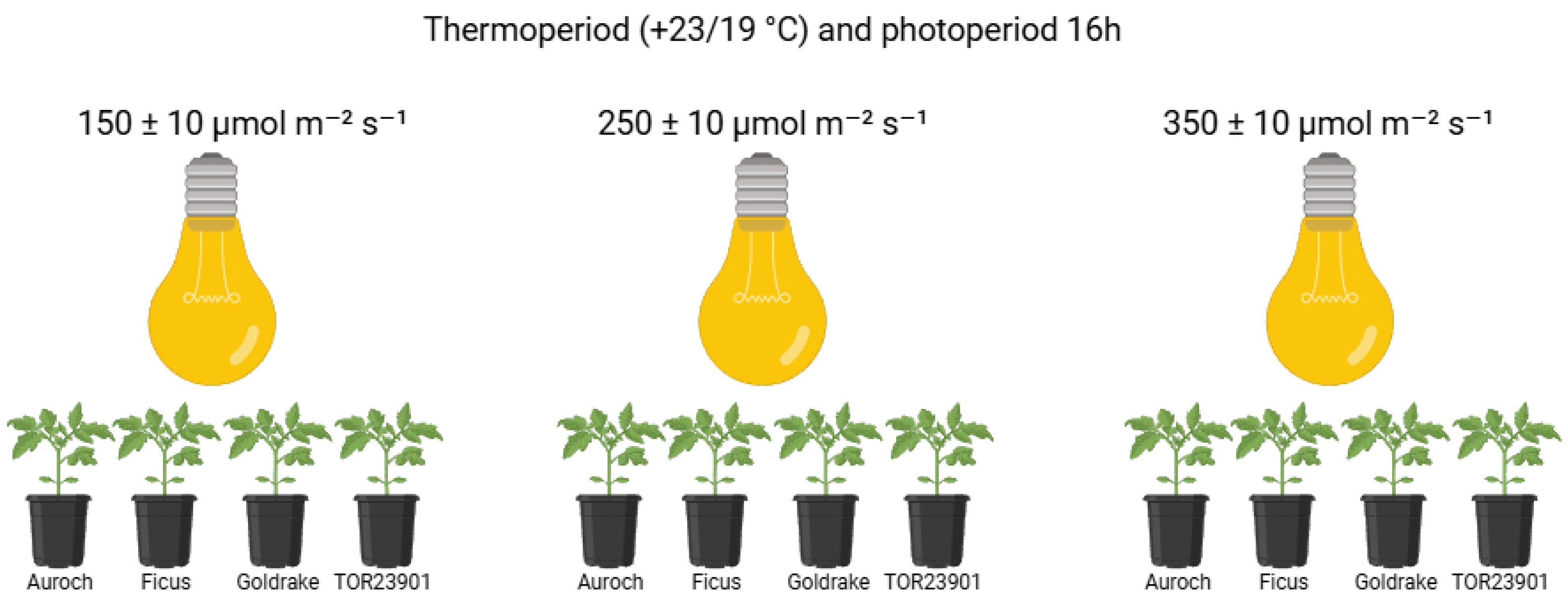
The plants were cultivated from sowing to18 days under three different lighting Photosynthetic Photon Flux Density (PPFD) levels: 150, 250, and 350 ± 10 µmol m−2 s−1, constituting daily light integrals (DLIs) of 8.64, 14.4, and 20,16 mol−2d−1, respectively, starting from the sowing stage (Figure 1). Standard high-pressure sodium lamps (HPS) (SON-T Agro, 600 W, Philips, Eindhoven, The Netherlands) were used in the chamber. PPFD was measured and regulated at the plant level using a photometer–radiometer (RF-100, Sonopan, Bialystok, Poland) during rootstock growth. 18 days after sowing, when the plants had an average of 3–4 true leaves (grafting size), 5 randomly selected plants per replicate were used for measurements.

2.2. Measurements

For biometric measurements, leaf area was measured as the area of all true leaves excluding cotyledons using an automatic leaf area meter. (Delta-T Devices, Wallingford, UK). To measure the roots, the substrate was removed from the plant roots and they were carefully and thoroughly washed. The length of the roots was measured using a ruler with an accuracy of 1 mm. To determine the dry mass, water was drained from the washed roots before weighing, shoots and roots were dried in a drying oven (Venticell, MBT, 2, Brno, Czech Republic) at 70 °C for 48 h. The fresh shoot and root weights were determined (using laboratory scales with an accuracy of 0.001 g) for 5 plants per replicate; the experiment was performed in three replicates (n = 5 × 3 = 15). The diameter of the plant stem was measured with a caliper (Mitutoyo Europe GmbH in Neuss, Germany) (accuracy of 0.1 mm) above the first embryonic leaves.
Leaf gas exchange indices: photosynthesis rate (Pr, µmol CO2 m−2·s−1), transpiration rate (Tr, mmol·H2O·m−2·s−1), stomatal conductance (gs, mol·H2O·m−2·s−1), internal CO2 concentration (Ci, ppm) were measured on the third developed leaf (Goldrake-150 and TOR23901-150—if it did not have three leaves, the second fully developed leaf was measured), using a portable photosynthesis system (LI-COR 6400XT, Lincoln, NE, USA) under the leaf chamber conditions of 23 °C, with a CO2 concentration of 400 µmol·mol−1 and 60% relative humidity, PPFD 1000 µmol·m−2·s−1. Measurements were performed for 3 plants per replicate; the experiment was performed in three replicates (n = 3 × 3 = 9) for 1 min (19 measurements per plant) from 9 to 12 a.m.
Chlorophyll fluorescence was measured using an imaging-PAM fluorometer (M-Series MAXI-Version (Walz, Effeltrich, Germany)) [22,23]. Measurements of light-adapted steady (light intensity—according to growing conditions) state chlorophyll fluorescence (F′), light-saturated chlorophyll fluorescence (F′m), and F′0 were used to calculate the relative PSII (photosystem II) operating efficiency (ΦPSII). Dark-adapted (40 min) F0 and Fm measurement allowed the calculation of the maximum quantum efficiency of PSII (Fv/Fm). Before measurement, plants were kept in the dark to minimize all quenching processes (dark adaptation). Basal (Fo) and maximal dark fluorescence (Fm) measurements were made directly from the dark. The Imaging-PAM fluorometer uses actinic light to simulate daylight conditions and drive photosynthesis in plant samples. The actinic light intensity is increased with each pulse starting from 1 to 1251 μmol m−2 s−1. Measurements were performed for 3 plants per replicate, the experiment was performed in three replicates (n = 3 × 3 = 9).
The Non-Photochemical Quenching (NPQ) coefficient is calculated as [23]:
N P Q = F m F m F m
where:
  • F m = maximum fluorescence yield in the dark-adapted state
  • F m = maximum fluorescence yield under actinic illumination
The effective quantum yield of Photosystem II Y(II) was determined as:
Y ( I I ) = F m F F m
where:
  • F = steady-state fluorescence yield under actinic light
  • F m = maximum fluorescence yield obtained during a saturating pulse under the same light.
The electron transport rate (ETR) is generally calculated as:
E T R = P A R × Y ( I I ) × 0.5 × 0.84
where:
  • PAR = photosynthetically active radiation (μmol photons m−2 s−1)
  • 0.5 assumes equal energy distribution between PSII and PSI
  • 0.84 represents the typical leaf absorptivity value.

2.3. Statistical Analysis

Statistical analysis was performed using Microsoft Excel and Addinsoft XLSTAT 2025 XLSTAT statistical and data analysis (Long Island, NY, USA). The effects of factors A, B, and their interaction (A × B) were evaluated using F-tests in a two-way ANOVA.Two-way analysis of variance (ANOVA) followed by Tukey’s honestly significant difference test (p < 0.05) for multiple comparisons was used to evaluate differences between means of measurements. The principal component analysis (PCA) was used for light and rootstock variety impact comparison.

3. Results

The growth of rootstocks and their biometric indicators are significantly influenced not only by the variety, but also by the light intensity in which the plants grew (Table 1). ‘Auroch’ and ‘Ficus’ rootstocks exhibited the highest plant height and the largest leaf area (Table S1). Notably, ‘Auroch’ rootstocks cultivated under a light intensity of 250 µmol m−2 s−1 exhibited particularly elevated plant height, leaf area, and stem diameter. Additionally, light intensities of 250 µmol m−2 s−1 and 350 µmol m−2 s−1 contributed to the development of longer root systems and larger stem diameters across all rootstocks in comparison to the 150 µmol m−2 s−1 light intensity. Consequently, these rootstocks are deemed more suitable for grafting purposes for vigorous tomato varieties. In contrast, the light intensity of 150 µmol m−2 s−1 resulted in decreased plant height and leaf area (Table S2), as well as poorly developed root systems and smaller stem diameters, which ranged from 1.20 to 2.02 mm (Table 1). The number of true leaves exhibited considerable variation among the different rootstocks, with the majority developing approximately four leaves (Table 1). Notably, the ‘Goldrake’ and ‘TOR23901’ rootstocks, when cultivated under a light intensity of 150 µmol m−2 s−1, yielded only two true leaves, which is half the number produced by plants under light intensities of 250 µmol m−2 s−1 and 350 µmol m−2 s−1. The ratio of shoot dry and fresh weight displayed no significant variation, except ‘TOR23901’, which demonstrated the least accumulation of dry matter, particularly under the lower light intensity of 150 µmol m−2 s−1. Conversely, the ratios of root dry mass to fresh mass revealed greater variability than those of the shoots. It was observed that under lower light conditions, rootstocks were shorter, their root systems were shorter and smaller, and they also accumulated more dry matter in their roots, but less in shoots (Table S2).
As light intensity increased, the efficiency of photosynthesis improved for all four rootstocks; however, the level of statistical significance varied among them. The highest photosynthetic activity was recorded at an intensity of 350 µmol m−2 s−1. Nonetheless, for the ‘Ficus’ and ‘Goldrake’ rootstocks, this difference was not statistically significant when compared to the 250 µmol m−2 s−1 light intensity level (Table 2).
The variety of rootstock had a more pronounced effect on stomatal conductance, which exhibited a significant reduction at the 150 µmol m−2 s−1 light intensity level in comparison to the higher light intensities (Table S1). This trend was similarly reflected in transpiration rates, which were nearly 1.5 times lower at the 150 µmol m−2 s−1 intensity level compared to the 250 µmol m−2 s−1 and 350 µmol m−2 s−1.
The maximum quantum efficiency of photosystem II (PSII) ranged from 0.71 to 0.80. The ‘Auroch’ and ‘Ficus’ rootstocks demonstrated comparable responses, with their lowest Fv/Fm values observed at the lowest light intensity. Conversely, ‘Goldrake’ and ‘TOR23901’ exhibited a significant decline in Fv/Fm at the 350 µmol m−2 s−1 light intensity, indicating that these plants experienced stress due to excessively high light intensity, which may have led to damage within their photosynthetic systems.
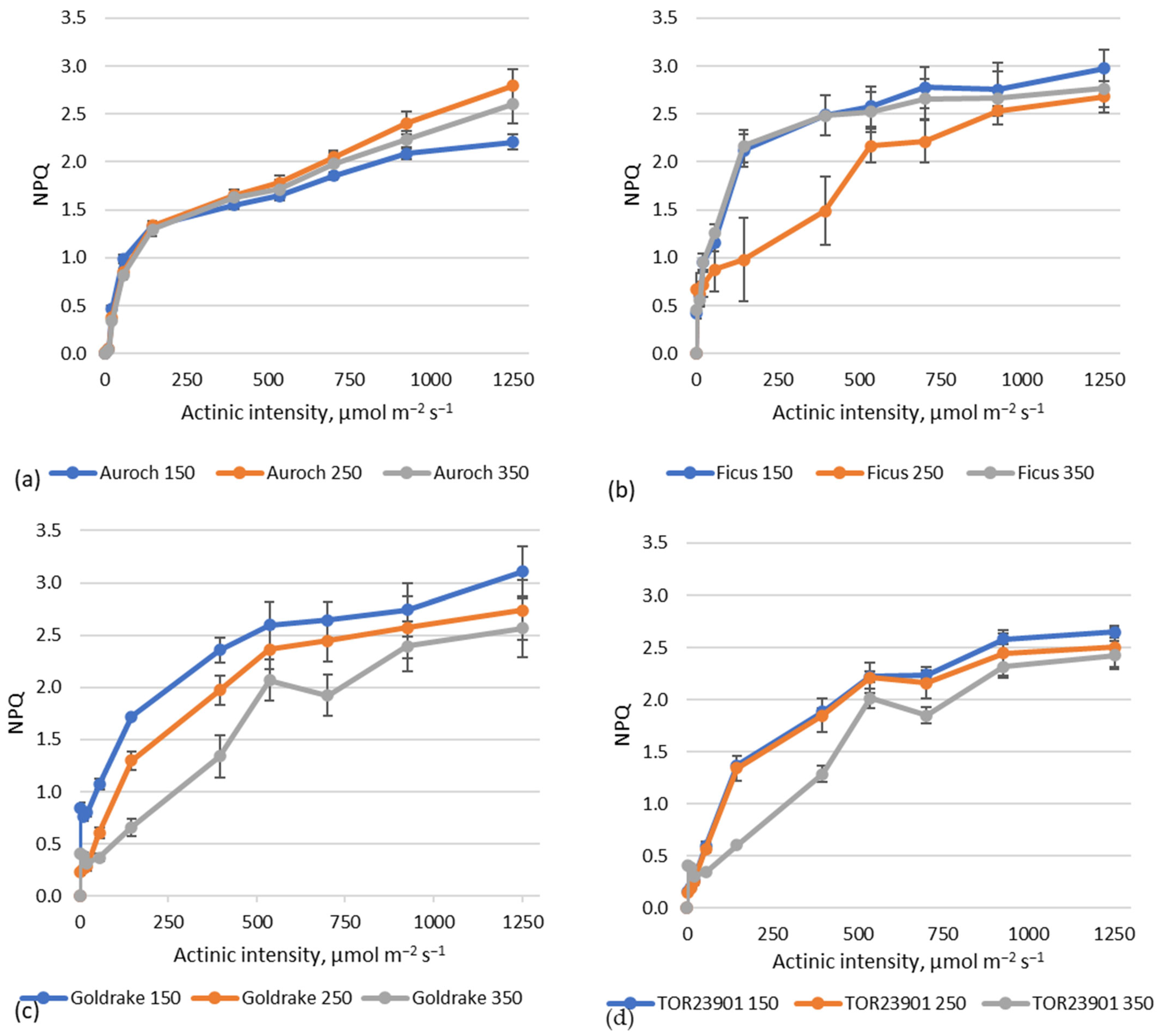
The non-photochemical quenching index (NPQ) demonstrated that various rootstock species activate their defense mechanisms in distinct manners (Figure S1). The NPQ value associated with the ‘TOR23901’ rootstock exhibited a significant increase, although it remained lower than that of the other three rootstocks, ranging from 2.4 to 2.65 (Figure 2d). Initially, plants cultivated under 350 µmol m−2 s−1 light displayed the strongest response, yet their NPQ levels were consistently lower than those observed in the other treatments at higher light intensities. As the actinic light intensity increased to 900 µmol m−2 s−1, the NPQ values across all three ‘TOR23901’ treatments became almost equal, with no significant differences.
In the case of the ‘Auroch’ rootstock, the NPQ activity increased uniformly across the three light intensities (Figure 2a). Notably, at an actinic light intensity of 1251 µmol m−2 s−1, plants grown under 250 µmol m−2 s−1 and 350 µmol m−2 s−1 exhibited significant differences in NPQ, with the levels continuing to rise. Conversely, the NPQ in plants grown under 150 µmol m−2 s−1 light exhibited a lesser rate of increase.
For ‘Ficus’ rootstock, the NPQ levels attained a range between 2.7 and 3.0 (Figure 2b). Initially, the NPQ in plants cultivated under 250 µmol m−2 s−1 light demonstrated the most substantial increase; however, this increment subsequently diminished, resulting in NPQ values that were significantly lower than those recorded for plants cultivated under 150 µmol m−2 s−1 and 350 µmol m−2 s−1 light. When the actinic light intensity exceeded 1000 µmol m−2 s−1, the NPQ values for plants at 250 µmol m−2 s−1 and 350 µmol m−2 s−1 equated to 2.7.
Regarding the ‘Goldrake’ rootstock, consistent differences in NPQ levels were observed across the three light intensities (Figure 2c). The highest NPQ was recorded in plants grown at 150 µmol m−2 s−1, whereas the lowest was observed in plants grown at 350 µmol m−2 s−1.
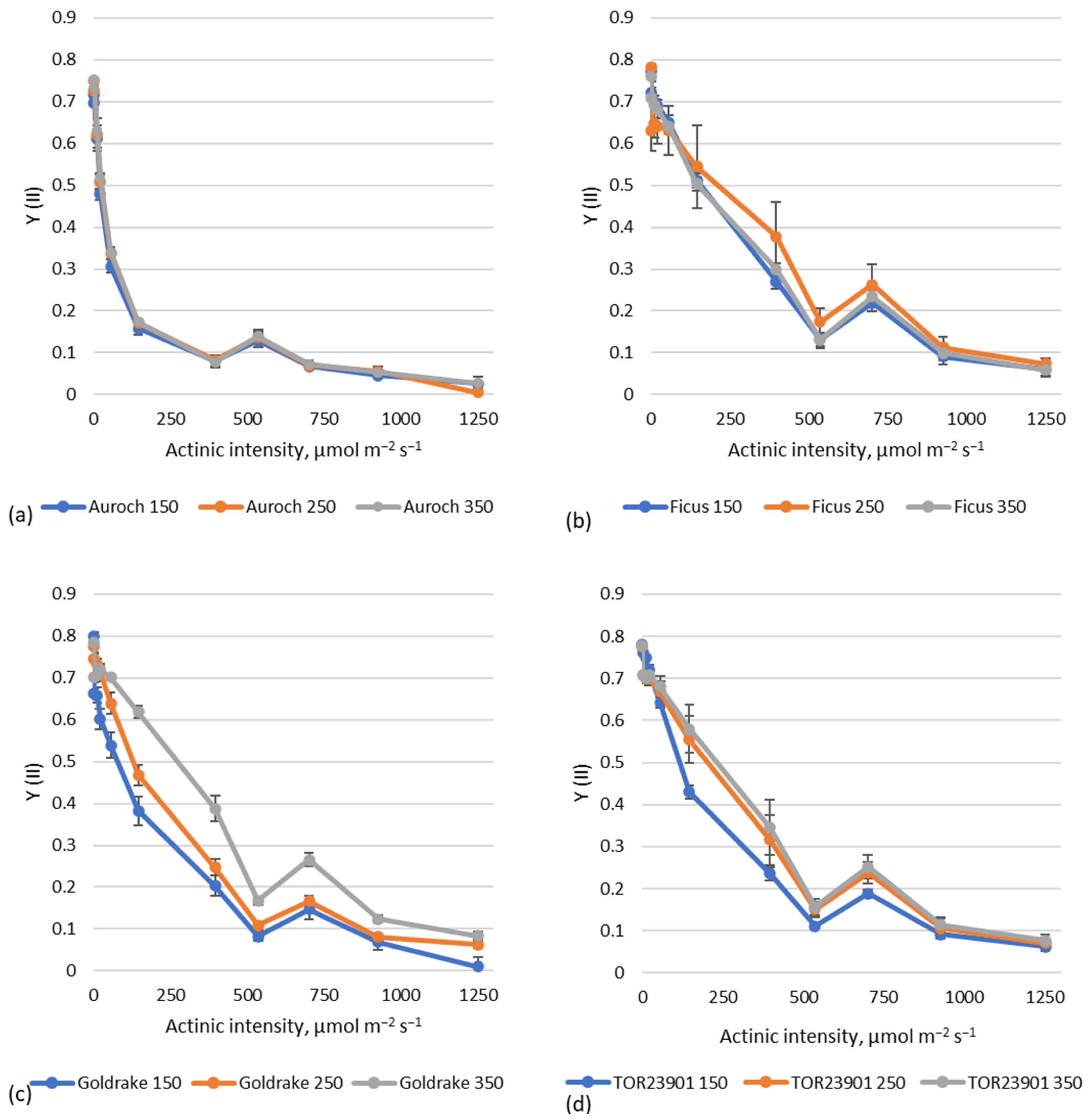
Initial measurements of Y(II) efficiency revealed optimal values across all treatments, ranging from 0.77 to 0.80 (Figure S2). Notably, the ‘Auroch’ rootstock exhibited values approaching 0.70, which suggests potential for plant stress. The lowest initial Y(II) values were recorded in plants subjected to a light intensity of 150 µmol m−2 s−1.
The decline in Y(II) for ‘Auroch’ occurred rapidly and significantly; at an actinic light intensity of 146 µmol m−2 s−1, Y(II) fell to approximately 0.16 (Figure 3a). For all three light treatments, Y(II) values dropped below 0.05 once actinic light intensity surpassed 1000 µmol m−2 s−1. Similarly, both ‘Ficus’ and ‘TOR23901’ rootstocks experienced a pronounced decrease in Y(II) when the actinic light intensity reached approximately 100 µmol m−2 s−1 (Figure 3b,d).
‘Goldrake’ rootstock demonstrated distinct variations in Y(II) values across different light treatments. It exhibited the greatest decline in Y(II) from the initial actinic light pulses in plants cultivated under 150 µmol m−2 s−1 and continued to exhibit the lowest values as actinic light intensity increased (Figure 3c). Conversely, ‘Goldrake’ plants grown under 350 µmol m−2 s−1 maintained optimal Y(II) levels until actinic light intensity exceeded 100 µmol m−2 s−1.
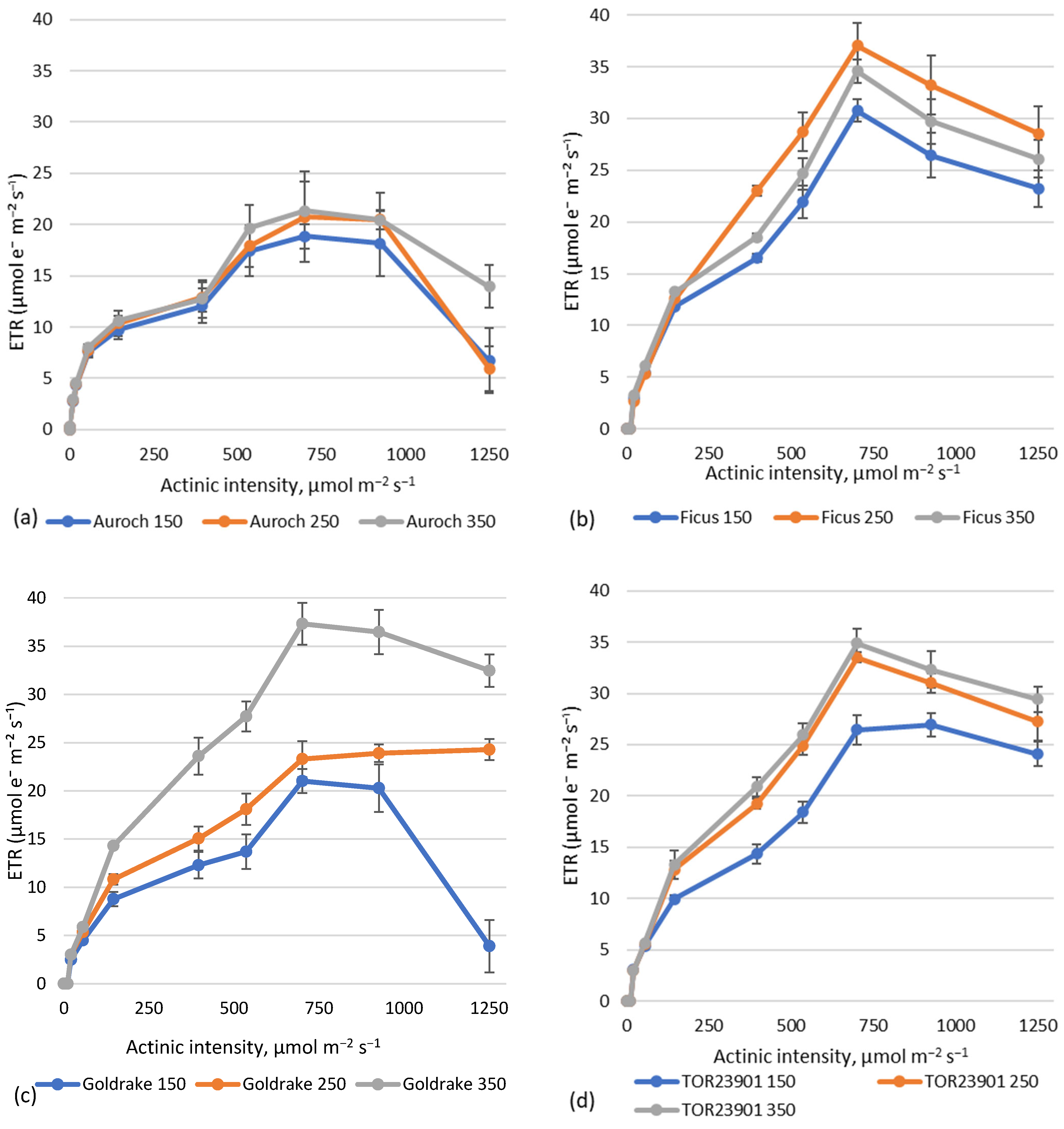
The electron transport reaction rate (ETR) was influenced by both light intensity and the specific type of rootstock utilized (Figure S3). The peak ETR values varied from 24 to 37 (Figure S3), contingent upon the rootstock type and the light intensity during cultivation. Most rootstocks achieved their maximum ETR at an actinic light intensity of 700 µmol m−2 s−1. However, beyond this intensity, a decline in ETR was observed, except for the ‘Goldrake’ variety grown under light intensity of 250 µmol m−2 s−1, which maintained elevating ETR (Figure 4c).
All four rootstocks grown under a light intensity of 150 µmol m−2 s−1 demonstrated the lowest ETR values. Furthermore, the differences in ETR of the ‘Auroch’, ‘Ficus’, and ‘TOR23901’ plants at light intensities of 250 µmol m−2 s−1 and 350 µmol m−2 s−1 were mostly not significant (Figure 4a–d).
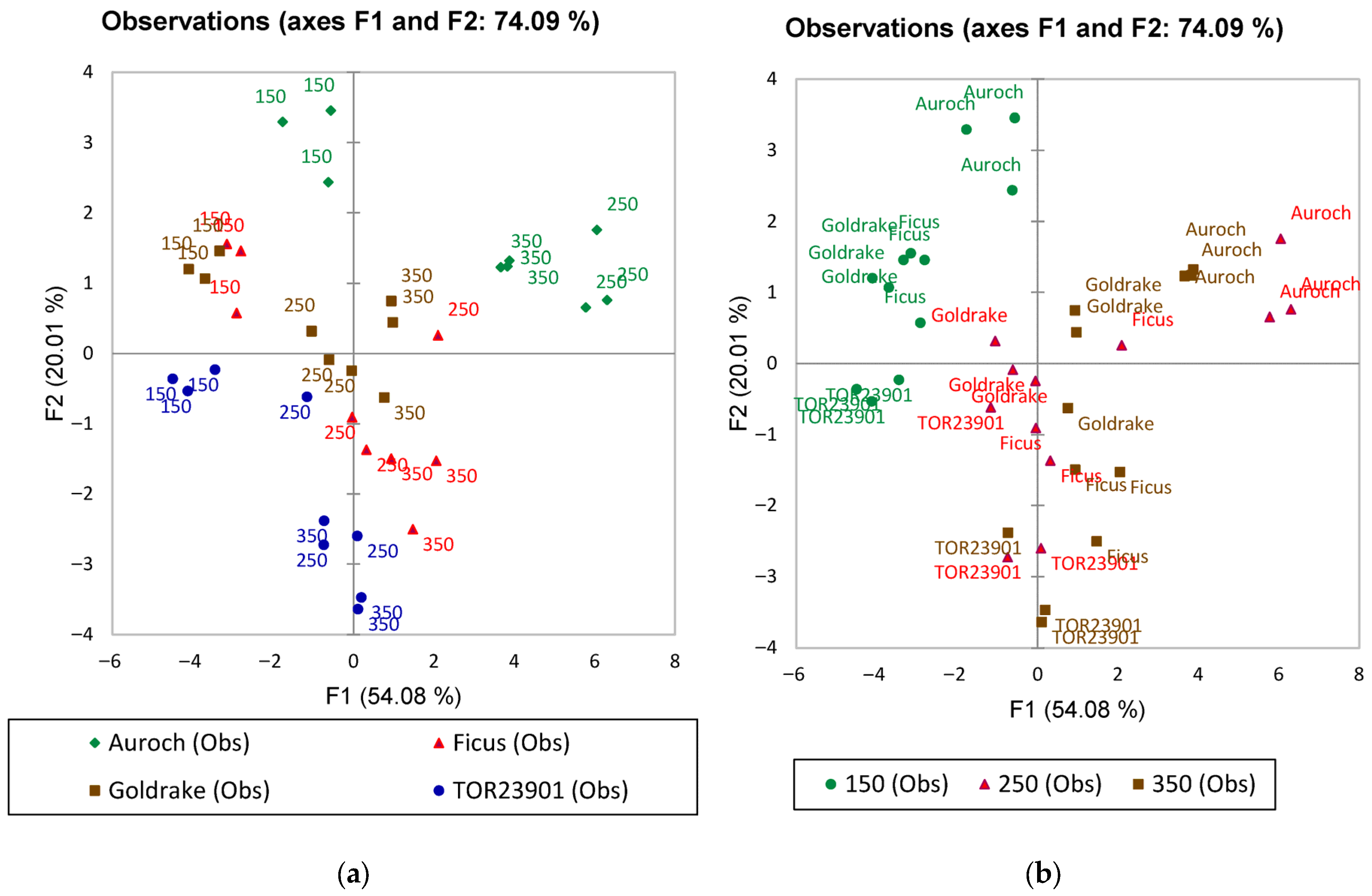
The findings from the principal component analysis (PCA) reveal that two principal components (F1 and F2) collectively account for approximately 74% of the total variation observed in the data (Figure 5). According to factor loadings, the first component (F1) is significantly correlated with growth parameters, including leaf area, stem height, stem diameter, stomatal conductance, and transpiration rate, thereby reflecting the vegetative potential of the plants (Table 3). Conversely, the second component (F2) is primarily associated with internal CO2 concentration and the ratio of intracellular to stomatal CO2 concentrations, emphasizing the characteristics of gas exchange.
The PCA effectively visualizes the phenotypic differences among the rootstocks ‘Auroch’, ‘Ficus’, ‘Goldrake’, and ‘TOR23901’, with respect to their responses to different light intensities (150, 250, and 350 µmol m−2 s−1) (Figure 5a). Distinct clustering in the PCA plot indicates that the ‘Auroch’ and ‘Goldrake’ rootstocks exhibit heightened vegetative potency (F1) under elevated light intensities, while the TOR23901 rootstock is predominantly located on the negative axis, indicative of lesser growth and lower physiological activity.
Data of the ‘Auroch’ rootstock is prominently positioned on the right side of the PCA plot (positive F1 axis), particularly at the highest light intensity (350 µmol m−2 s−1). This positioning suggests that ‘Auroch’ rootstock plants achieve optimal performance, including maximum growth, enhanced vegetative activity, and effective CO2 metabolism, in higher light conditions. In contrast, ‘Goldrake’ exhibits robust growth and favorable physiological characteristics across both medium (250 µmol m−2 s−1) and high (350 µmol m−2 s−1) light levels, further confirming its placement on the right side of the plot (Figure 5b). Ficus rootstock data is located near the center of the PCA plot or slightly to the right of the origin, indicating a moderate response with slightly improved productivity at lower light intensity levels. In comparison, TOR23901 is situated towards the left and lower regions of the plot (negative F1 and F2 values), particularly at low light intensity (150 µmol m−2 s−1). This rootstock generally displays the lowest growth and physiological parameters under higher light conditions (Figure 5b).

4. Discussion

Light intensity significantly affects plant growth. Recent research shows that the maximum stem diameter and height of tomatoes occur at approximately 240 µmol m−2 s−1. At higher light intensities (335–350 µmol m−2 s−1), the growth was even slightly inhibited [12]. Similarly, we found that ‘Auroch’ rootstock exhibited the best growth parameters at 250 µmol m−2 s−1, while at 350 µmol m−2 s−1, it displayed a smaller size and reduced leaf area (Table 1). A similar trend was noted for the ‘TOR23901’ rootstock. In contrast, ‘Ficus’ and ‘Goldrake’ showed less differences between 250 and 350 µmol m−2 s−1 treatments regarding the growth parameters. This demonstrates that, in addition to light intensity, the growth of a specific rootstock is profoundly influenced by its genetic characteristics. Furthermore, while numerous studies have investigated various tomato varieties, they do not effectively address the responses of rootstocks. In our study, ‘Auroch’ and ‘Goldrake’ showed stronger growth and higher dry matter mass compared to ‘TOR23901’, which exhibited lower dry matter accumulation in both roots and shoots (Table 1).
Previous studies have indicated that certain cultivars of rootstocks achieve optimal growth and biomass accumulation at LED light intensities of around 150–250 µmol m−2 s−1, while higher light intensities may hinder growth depending on the genotype [24,25,26]. Similarly, Bagdonavičienė et al., [27] demonstrated that tomato seedlings grown under LED lamps with an intensity of about 250 µmol m−2 s−1 accumulated the most fresh and dry mass. A higher dry mass was accumulated in the roots compared to other lighting conditions. However, our data show that 150 µmol m−2 s−1 is insufficient for effective rootstock growth. Leaf area tends to increase at medium and high light levels (250–350 µmol m−2 s−1). However, excessive light intensity or prolonged exposure can decrease leaf area due to photo stress [28]. A significant reduction in leaf area was observed in ‘Auroch’ when the light intensity increased from 250 µmol m−2 s−1 to 350 µmol m−2 s−1. The average leaf area of the rootstock decreased from 125.4 cm2 to just 77 cm2, even though the average number of leaves per plant remained consistent.
Root data revealed trends similar to those of the shoots. Previous studies on tomato growth have found that root length and mass are greatest at light intensities between 240 and 250 µmol m−2 s−1 [12]. With optimal lighting levels for shoots, roots also develop better and improve the plant’s ability to absorb nutrients [12,28]. Our data confirmed that rootstocks respond to various light intensities similarly to tomato cultivars. Each of the rootstocks has significantly increased the root length at 250 µmol m−2 s−1. No further increase in the root length was recorded at a higher light intensity.
Meanwhile, the photosynthetic rate (Pn), stomatal conductance (Gs), and transpiration rate (Tr), according to literature, significantly increase with increasing light intensity [24,29,30]. In a study of Lv et al. [24], plants exposed to 300 µmol m−2 s−1 showed a net photosynthetic rate of about 9.68 μmol CO2 m−2 s−1, a stomatal conductance of about 0.071 mol H2O m−2 s−1, and a transpiration rate of 1.223 mmol H2O m−2 s−1. In our study, the photosynthesis rate for rootstocks ranged from 9.6 μmol CO2 m−2 s−1 (250 µmol m−2 s−1) to 11.5 μmol CO2 m−2 s−1 (350 µmol m−2 s−1). Meantime, the transpiration rate varied greatly depending on the rootstock type, up to 2.5 times. Data from another study [26], shows that a medium light intensity (200–350 µmol m−2 s−1) maintains the photosynthesis rate in tomato leaves stable or slightly increases it, whereas the stomatal conductance and transpiration correlate with light quality and intensity [26]. Medium PPFD reduces excessive transpiration and water loss, ensuring better water use efficiency and stable Pn [31,32]. The most significant differences in transpiration rate among rootstocks were observed between the light intensity of 150 µmol m−2 s−1 and the other two light regimes. The difference between 250 µmol m−2 s−1 and 350 µmol m−2 s−1 light intensity on transpiration rate was not significant. However, other studies with light intensity higher than 350 µmol m−2 s−1 have proved that strong (highly intensive) light leads to a significant decrease in Pn, Gs, and Tr due to plant stress, which inhibits Rubisco activity and causes photosystem damage [25,33]. Since increasing the illumination from 250 µmol m−2 s−1 to 350 µmol m−2 s−1 did not result in any significant increases in rootstock photosynthetic rate, it indicates that we did not get significant benefits from increasing the illumination. In line with the previous publications [34,35], our data suggest that a light intensity of 250–350 µmol m−2 s−1 is most favorable for photosynthetic efficiency and water metabolism, whereas higher light intensities can cause stress to the plant and a decrease in plant metabolism.
A study examining tomato seedlings cultivated under a constant light intensity of 300 µmol m−2 s−1 using LED illumination demonstrates that the Fv/Fm values remain largely stable or exhibit only minimal variation [18,34]. This observation indicates that the maximum photosynthetic efficiency of photosystem II is not significantly constrained by this level of light exposure, particularly in the absence of additional stressors. Furthermore, an additional study highlights that light intensities approaching 350 µmol m−2 s−1 do not adversely affect the Fv/Fm values in tomato leaves, as the threshold for photoinhibition has not been surpassed [29]. By showing that the maximum quantum efficiency of PSII remains impeccable in the range of 150–350 µmol m−2 s−1 light intensity, our data of tomato rootstocks fully support this conclusion.
Under conditions of moderate light intensity, approximately 300 μmol⋅m−2⋅s−1 the non-photochemical quenching (NPQ) values in tomato plants average between 0.5 and 1.5 [35]. These values exhibit variation based on the time of day and the spectral composition of light. Such NPQ levels do not reach excessive thresholds, indicating that the plant effectively utilizes a portion of the available energy for photosynthesis while safely dissipating any excess energy. As light intensity increases beyond 500 μmol⋅m−2⋅s−1, NPQ values may rise to 2.0 or higher, which reflects a more active defensive mechanism against photo stress [35,36]. This elevation in NPQ is typically accompanied by a decline in photochemical efficiency (ΦPSII) values to below 0.4–0.5, suggesting partial inhibition of photosystem activity due to elevated light intensity [35,37]. The adaptive capacity of various tomato rootstocks to initiate protective mechanisms in response to increasing light intensity is significantly variable. Notably, the light intensity experienced by the ‘Auroch’ tomato rootstock did not have a substantial impact on NPQ, whereas ‘Goldrake’ demonstrated significant variations in NPQ across the three different lighting conditions examined (Figure 2). This underscores the importance of both light intensity during cultivation and the specific plant characteristics in influencing NPQ responses. The higher intensity of the growing light, the more energy is directed to NPQ mechanisms, and Y(II) decreases accordingly due to the reduced effective photosynthetic quantum yield. One study shows that as the growing light intensity increases from 100 to 300 μmol⋅m−2⋅s−1, Y(II) remains high—usually above 0.6, indicating active photosynthesis and low photo stress [18]. Another study describes how light quality and intensity affect photosynthetic efficiency, indicating that when tomatoes are grown under 200–300 μmol⋅m−2⋅s−1 LED light, Y(II) also remains stably high, while higher intensities (>400 μmol⋅m−2⋅s−1) may reduce Y(II) due to the increased photoprotection requirement [35,37]. Three of the four tomato rootstocks tested in our study showed that different light intensities ranging from 150 to 350 μmol⋅m−2⋅s−1 did not have significant differences in Y(II) (Figure 3). The photosynthetic systems of these rootstocks worked very similarly; only the Y(II) of the ‘Goldrake’ rootstock differed between the different light treatments. We also see that in this case, the rootstock cultivars did not have any significant difference.
A study focused on the photosynthetic apparatus of tomato seedlings demonstrated that the electron transport rate (ETR) increases with rising light intensity, peaking at approximately 300 µmol m−2 s−1, where optimal levels are attained [18]. Subsequent research corroborates that light intensities ranging from 200 to 350 µmol m−2 s−1 ensure elevated electron transport rates and enhanced photosynthetic efficiency in tomato plants [38]. Studies involving continuous light sources reveal that moderate light intensities effectively sustain high ETR, thereby optimizing growth conditions. Some investigations identify 150 µmol m−2 s−1 as a limiting intensity, given that the indicators of photosynthetic quantum yield (Y(II)) and ETR at this intensity are elevated, albeit not at maximum capacity [29,34,39]. Research indicates that low light intensities, approximately 50 to 100 µmol m−2 s−1, constrain ETR, photosynthetic rates, and overall growth, although prolonged cultivation under low light conditions may induce adaptive changes in chlorophyll and metabolic processes. Although 150 µmol m−2 s−1 does not surpass the threshold of low light intensities, it is frequently regarded as a lower-moderate illumination level suitable for the growth of young tomato plants, although not the most optimal for overall development [18,29,34,37,39,40]. Observations reveal that tomato rootstocks cultivated under 150 µmol m−2 s−1 exhibited significantly lower ETR values compared to conditions involving more intense lighting. Meanwhile, illumination at 250 and 350 µmol m−2 s−1 for three of the four tested rootstocks (except ‘Goldrake’, which exhibited nearly doubled ETR values beyond 350 µmol m−2 s−1) produced negligible differences in ETR outcomes (Figure 4).
Summarizing the findings of our study, we indicate that tomato rootstocks exhibit optimal growth and biomass accumulation at a light intensity of approximately 250–350 µmol m−2 s−1 depending on rootstock. At the 250 µmol m−2 s−1 light intensity, the rootstocks ‘Auroch’ and ‘Goldrake’ demonstrated the most significant growth and dry mass increase. Higher light intensities, specifically 350 µmol m−2 s−1, do not consistently promote further growth. Furthermore, the photosynthetic parameters—including photosynthesis rate (Pn), stomatal conductance (Gs), and transpiration (Tr)—were increased at elevated light intensities up to 250 and 350 µmol m−2 s−1. Any further increase does not induce additional growth benefits and entails higher energy expenditure necessary to sustain the increased light intensity.

5. Conclusions

Growth data suggest that a light intensity of 250 µmol m−2 s−1 constitutes an effective and optimal selection for rootstocks such as ‘Goldrake’ and ‘Ficus.’ This specific light intensity fosters robust vegetative growth and physiological activity, while also exhibiting superior energy efficiency in comparison to the maximum light intensity of 350 µmol m−2 s−1. While the rootstock ‘Auroch’ demonstrates optimal growth at a light level of 350 µmol m−2 s−1, it achieves favorable outcomes even at the intensity of 250 µmol m−2 s−1.

Supplementary Materials

The following supporting information can be downloaded at: https://www.mdpi.com/article/10.3390/agronomy16020154/s1, Table S1. The rootstock variety effect on rootstock parameters; Table S2. The light intensity effect on rootstock parameters; Figure S1. The impact of light intensity and variety on the nonphotochemical chlorophyll fluorescence quenching (NPQ) of tomato rootstocks. The mean value (n = 3) ± standard deviation is presented; Figure S2. The impact of light intensity and variety on the effective quantum yield of Photosystem II (Y(II)) of tomato rootstocks. The mean value (n = 3) ± standard deviation is presented; Figure S3. The impact of light intensity and variety on the Electron Transport Rate (ETR) of tomato rootstocks. The mean value (n = 3) ± standard deviation is presented.

Author Contributions

Conceptualization, K.L.; methodology, K.L.; formal analysis, K.L.; investigation, K.L., V.L. and T.R.; data curation, K.L.; writing—original draft preparation, K.L. and V.L.; writing—review and editing, K.L. and A.B.; visualization, V.L.; supervision, K.L. All authors have read and agreed to the published version of the manuscript.

Funding

This research received no external funding.

Data Availability Statement

The original contributions presented in this study are included in the article/Supplementary Material. Further inquiries can be directed to the corresponding author.

Conflicts of Interest

The authors declare no conflicts of interest.

Abbreviations

The following abbreviations are used in this manuscript:
Pnphotosynthetic rate
Gsstomatal conductance
Trtranspiration rate
Fv/Fmmaximum quantum efficiency of PSII
Y(II)effective quantum yield of PSII
NPQnon-photochemical quenching
ETRelectron transport rate
LEDLight Emitting Diode
PSIIphotosystem II
PPFDPhotosynthetic Photon Flux Density
DLIsDaily Light Integrals
PCAprincipal component analysis

References

  1. FAOSTAT. Available online: https://www.fao.org/faostat/en/#data/QCL (accessed on 3 September 2025).
  2. Awu, J.E.; Nyaku, S.T.; Amissah, J.N.; Okorley, B.A.; Agyapong, P.J.A.; Doku, F.E.; Nkansah, G.O. Grafting for Sustainable Management of Fusarium Wilt Disease in Tomato Production in Ghana. J. Agric. Food Res. 2023, 14, 100710. [Google Scholar] [CrossRef]
  3. King, S.R.; Davis, A.R.; Liu, W.; Levi, A. Grafting for Disease Resistance. HortScience 2008, 43, 1673–1676. [Google Scholar] [CrossRef]
  4. Spanò, R.; Ferrara, M.; Gallitelli, D.; Mascia, T. The Role of Grafting in the Resistance of Tomato to Viruses. Plants 2020, 9, 1042. [Google Scholar] [CrossRef] [PubMed]
  5. Ghanem, W.; Kaplan, I. Integrating Grafting and Companion Planting to Improve Crop Performance in Intensive High-Tunnel Tomato Production. J. Sustain. Agric. Environ. 2023, 2, 388–396. [Google Scholar] [CrossRef]
  6. Lee, H.; Hong, K.H.; Kwon, D.H.; Cho, M.C.; Lee, J.G.; Hwang, I.; Ahn, Y.K. Changes of Growth and Yield by using Rootstocks in Tomato. J. Bio Environ. Control 2020, 29, 456–463. [Google Scholar] [CrossRef]
  7. Edelstein, M.; Ben-Hur, M.; Leib, L.; Plaut, Z. Mechanism Responsible for Restricted Boron Concentration in Plant Shoots Grafted on Pumpkin Rootstocks. Isr. J. Plant Sci. 2011, 59, 207–215. [Google Scholar] [CrossRef]
  8. Fernández-Paz, J.; Cortés, A.J.; Hernández-Varela, C.A.; Mejía-de-Tafur, M.S.; Rodriguez-Medina, C.; Baligar, V.C. Rootstock-Mediated Genetic Variance in Cadmium Uptake by Juvenile Cacao (Theobroma cacao L.) Genotypes, and Its Effect on Growth and Physiology. Front. Plant Sci. 2021, 12, 207–215. [Google Scholar] [CrossRef]
  9. Khopade, R.Y.; Sawargaonkar, G.L.; Rakesh, S.; Davala, M.S.; Kishore, K.K.; Siddam, Y.; Singh, R.; Jat, M.L. Vegetable Grafting: A Scientific Innovation to Enhance Productivity and Profitability of Tomato Growers under Climate Change. Front. Agron. 2025, 7, 1514673. [Google Scholar] [CrossRef]
  10. Schwarz, D.; Öztekin, G.B.; Tüzel, Y.; Brückner, B.; Krumbein, A. Rootstocks Can Enhance Tomato Growth and Quality Characteristics at Low Potassium Supply. Sci. Hortic. 2013, 149, 70–79. [Google Scholar] [CrossRef]
  11. Guo, M.; Wang, X.-S.; Guo, H.-D.; Bai, S.-Y.; Khan, A.; Wang, X.-M.; Gao, Y.-M.; Li, J.-S. Tomato Salt Tolerance Mechanisms and Their Potential Applications for Fighting Salinity: A Review. Front. Plant Sci. 2022, 13, 949541. [Google Scholar] [CrossRef]
  12. Zheng, Y.; Zou, J.; Lin, S.; Jin, C.; Shi, M.; Yang, B.; Yang, Y.; Jin, D.; Li, R.; Li, Y.; et al. Effects of Different Light Intensity on the Growth of Tomato Seedlings in a Plant Factory. PLoS ONE 2023, 18, e0294876. [Google Scholar] [CrossRef]
  13. Davis, M.; Stone, A.; Selman, L.; Merscher, P.; Garrett, A. Grafting onto Tomato Rootstocks Improves Outcomes for Dry-Farmed Tomato. HortTechnology 2024, 34, 313–321. [Google Scholar] [CrossRef]
  14. Gong, T.; Brecht, J.K.; Hutton, S.F.; Koch, K.E.; Zhao, X. Tomato Fruit Quality is More Strongly Affected by Scion Type and Planting Season than by Rootstock Type. Front. Plant Sci. 2022, 13, 948556. [Google Scholar] [CrossRef] [PubMed]
  15. Venema, J.H.; Giuffrida, F.; Paponov, I.; Albacete, A.; Pérez-Alfocea, F.; Dodd, I.C. Rootstock-Scion Signalling: Key Factors Mediating Scion Performance. In Vegetable Grafting: Principles and Practices; CABI Books: Wallingford, UK, 2017; pp. 94–131. ISBN 978-1-78064-897-2. [Google Scholar]
  16. Wang, R.; Yang, Y.; Xu, K.; Wang, T.; Elsadek, M.A.; Yuan, L.; Hu, Z.; Lv, Y.; Yuan, X.; Chen, X.; et al. Multi-Omics Analysis Reveals Improvement of Tomato Quality by Grafting on Goji Rootstock. Food Qual. Saf. 2024, 8, fyae023. [Google Scholar] [CrossRef]
  17. López-Marín, J.; Gálvez, A.; del Amor, F.M.; Albacete, A.; Fernández, J.A.; Egea-Gilabert, C.; Pérez-Alfocea, F. Selecting Vegetative/Generative/Dwarfing Rootstocks for Improving Fruit Yield and Quality in Water Stressed Sweet Peppers. Sci. Hortic. 2017, 214, 9–17. [Google Scholar] [CrossRef]
  18. Yousef, A.F.; Ali, M.M.; Rizwan, H.M.; Tadda, S.A.; Kalaji, H.M.; Yang, H.; Ahmed, M.A.A.; Wróbel, J.; Xu, Y.; Chen, F. Photosynthetic Apparatus Performance of Tomato Seedlings Grown under Various Combinations of LED Illumination. PLoS ONE 2021, 16, e0249373. [Google Scholar] [CrossRef]
  19. Meiramkulova, K.; Tanybayeva, Z.; Kydyrbekova, A.; Turbekova, A.; Aytkhozhin, S.; Zhantasov, S.; Taukenov, A. The Efficiency of LED Irradiation for Cultivating High-Quality Tomato Seedlings. Sustainability 2021, 13, 9426. [Google Scholar] [CrossRef]
  20. Utasi, L.; Kovács, V.; Gulyás, Z.; Marcek, T.; Janda, T.; Darko, E. Threshold or Not: Spectral Composition and Light-Intensity Dependence of Growth and Metabolism in Tomato Seedlings. Sci. Hortic. 2023, 313, 111946. [Google Scholar] [CrossRef]
  21. Huber, B.M.; Louws, F.J.; Hernández, R. Impact of Different Daily Light Integrals and Carbon Dioxide Concentrations on the Growth, Morphology, and Production Efficiency of Tomato Seedlings. Front. Plant Sci. 2021, 12, 615853. [Google Scholar] [CrossRef]
  22. Stock, W.; Blommaert, L.; Daveloose, I.; Vyverman, W.; Sabbe, K. Assessing the Suitability of Imaging-PAM Fluorometry for Monitoring Growth of Benthic Diatoms. J. Exp. Mar. Biol. Ecol. 2019, 513, 35–41. [Google Scholar] [CrossRef]
  23. Murchie, E.H.; Lawson, T. Chlorophyll Fluorescence Analysis: A Guide to Good Practice and Understanding Some New Applications. J. Exp. Bot. 2013, 64, 3983–3998. [Google Scholar] [CrossRef] [PubMed]
  24. Lv, X.; Ai, X.; Zhu, X. Effects of Light Intensity, Water Content, and the Application of Biochar Nanoparticles on the Growth and Development of Tomato Seedlings. J. Biobased Mater. Bioenergy 2024, 18, 803–809. [Google Scholar] [CrossRef]
  25. Lu, T.; Meng, Z.; Zhang, G.; Qi, M.; Sun, Z.; Liu, Y.; Li, T. Sub-High Temperature and High Light Intensity Induced Irreversible Inhibition on Photosynthesis System of Tomato Plant (Solanum lycopersicum L.). Front. Plant Sci. 2017, 8, 365. [Google Scholar] [CrossRef] [PubMed]
  26. Lanoue, J.; Leonardos, E.D.; Grodzinski, B. Effects of Light Quality and Intensity on Diurnal Patterns and Rates of Photo-Assimilate Translocation and Transpiration in Tomato Leaves. Front. Plant Sci. 2018, 9, 756. [Google Scholar] [CrossRef]
  27. Bagdonavičienė, A.; Brazaitytė, A.; Jankauskienė, J.; Vaštakaitė, V.; Duchovskis, P. Pramoninių LED Šviestuvų Fotonų Srauto Tankio Poveikis Pomidorų Daigams. Žemės Ūkio Moksl. 2015, 22. [Google Scholar] [CrossRef]
  28. Lanoue, J.; Thibodeau, A.; Little, C.; Zheng, J.; Grodzinski, B.; Hao, X. Light Spectra and Root Stocks Affect Response of Greenhouse Tomatoes to Long Photoperiod of Supplemental Lighting. Plants 2021, 10, 1674. [Google Scholar] [CrossRef]
  29. Song, J.; Chen, Z.; Zhang, A.; Wang, M.; Jahan, M.S.; Wen, Y.; Liu, X. The Positive Effects of Increased Light Intensity on Growth and Photosynthetic Performance of Tomato Seedlings in Relation to Night Temperature Level. Agronomy 2022, 12, 343. [Google Scholar] [CrossRef]
  30. Heuvelink, E.; Acevedo-Siaca, L.G.; Van de Poel, B.; Van der Jeucht, L.; Vialet-Chabrand, S.; Steppe, K.; Ji, Y.; Körner, O.; Kusuma, P.; Langer, S.; et al. Tomato in the Spotlight: Light Regulation of Whole-Plant Physiology in Tomato. J. Exp. Bot. 2025, 76, 6289–6310. [Google Scholar] [CrossRef]
  31. Yoshiyama, Y.; Wakabayashi, Y.; Mercer, K.L.; Kawabata, S.; Kobayashi, T.; Tabuchi, T.; Yamori, W. Natural Genetic Variation in Dynamic Photosynthesis Is Correlated with Stomatal Anatomical Traits in Diverse Tomato Species across Geographical Habitats. J. Exp. Bot. 2024, 75, 6762–6777. [Google Scholar] [CrossRef]
  32. Chandra, S.; Lata, H.; Khan, I.A.; Elsohly, M.A. Photosynthetic Response of Cannabis Sativa L. to Variations in Photosynthetic Photon Flux Densities, Temperature and CO2 Conditions. Physiol. Mol. Biol. Plants 2008, 14, 299–306. [Google Scholar] [CrossRef]
  33. Zhang, Y.; Kaiser, E.; Li, T.; Marcelis, L.F.M. NaCl Affects Photosynthetic and Stomatal Dynamics by Osmotic Effects and Reduces Photosynthetic Capacity by Ionic Effects in Tomato. J. Exp. Bot. 2022, 73, 3637–3650. [Google Scholar] [CrossRef]
  34. Kula-Maximenko, M.; Niewiadomska, E.; Maksymowicz, A.; Ostrowska, A.; Oklestkova, J.; Pěnčík, A.; Janeczko, A. Insight into Details of the Photosynthetic Light Reactions and Selected Metabolic Changes in Tomato Seedlings Growing under Various Light Spectra. Int. J. Mol. Sci. 2021, 22, 11517. [Google Scholar] [CrossRef]
  35. Lazzarin, M.; Driever, S.; Wassenaar, M.; Marcelis, L.F.M.; van Ieperen, W. Shining Light on Diurnal Variation of Non-Photochemical Quenching: Impact of Gradual Light Intensity Patterns on Short-Term NPQ over a Day. Physiol. Plant. 2024, 176, e14410. [Google Scholar] [CrossRef]
  36. Nan, G.-N.; Zhou, X.-Q.; Zhang, X.-M.; Zhang, Q.-S.; Hu, Z.-M.; Huang, R.-P.; Zhang, D. Xanthophyll Cycle-Related Non-Photochemical Quenching Protects Sargassum Thunbergii from High Light-Induced Photoinhibition. Front. Mar. Sci. 2022, 9, 1067596. [Google Scholar] [CrossRef]
  37. Trojak, M.; Skowron, E. Light Quality-Dependent Regulation of Non-Photochemical Quenching in Tomato Plants. Biology 2021, 10, 721. [Google Scholar] [CrossRef] [PubMed]
  38. Wickramanayake, J.S.; Goss, J.A.; Zou, M.; Goggin, F.L. Loss of Function of Fatty Acid Desaturase 7 in Tomato Enhances Photosynthetic Carbon Fixation Efficiency. Front. Plant Sci. 2020, 11, 932. [Google Scholar] [CrossRef] [PubMed]
  39. Nguyen, T.K.L.; Cho, K.M.; Lee, H.-Y.; Sim, H.-S.; Kim, J.-H.; Son, K.-H. Growth, Fruit Yield, and Bioactive Compounds of Cherry Tomato in Response to Specific White-Based Full-Spectrum Supplemental LED Lighting. Horticulturae 2022, 8, 319. [Google Scholar] [CrossRef]
  40. Velez-Ramirez, A.I.; Vreugdenhil, D.; Millenaar, F.F.; van Ieperen, W. Phytochrome A Protects Tomato Plants from Injuries Induced by Continuous Light. Front. Plant Sci. 2019, 10, 19. [Google Scholar] [CrossRef]
Figure 1. Experimental scheme (Created in https://BioRender.com accessed on 30 January 2025).
Agronomy 16 00154 g001
Figure 2. The impact of light intensity and tomato rootstock variety on the nonphotochemical chlorophyll fluorescence quenching (NPQ) of tomato rootstocks: (a) ‘Auroch’; (b) ‘Ficus’; (c) ‘Goldrake’; (d) ‘TOR23901’. The mean value (n = 9) ± standard deviation is presented.
Agronomy 16 00154 g002
Figure 3. The impact of light intensity and variety on the effective quantum yield of Photosystem II (Y(II)) of tomato rootstocks: (a) ‘Auroch’; (b) ‘Ficus’; (c) ‘Goldrake’; (d) ‘TOR23901’. The mean value (n = 9) ± standard deviation is presented.
Agronomy 16 00154 g003
Figure 4. The impact of light intensity and variety on the Electron Transport Rate (ETR) of tomato rootstocks: (a) ‘Auroch’; (b) ‘Ficus’; (c) ‘Goldrake’; (d) ‘TOR23901’. The mean value (n = 9) ± standard deviation is presented.
Agronomy 16 00154 g004
Figure 5. The principal component analysis (PCA) of the effects of four different rootstocks (a) and light intensities (b) on plant physiological and growth parameters.
Agronomy 16 00154 g005
Table 1. The impact of light intensity and variety on the growth of tomato rootstocks, 18 days after sowing. The mean value (n = 15) ± standard deviation is presented. The data were analyzed using a two-way analysis of variance (ANOVA) and the Tukey (HSD) test at a confidence level of p = 0.05. The different letters in columns indicate significant differences.
Rootstock Light
Intensity
µmol m−2 s−1
Plant Height, cm Root Length, cm Leaf Area,
cm2
Stem
Diameter, mm
Number of True Leaves DW/FW Ratio
Shoots
DW/FW Ratio
Roots
Fresh Weight of Shoot,
g
Fresh Weight of Root,
g
Dry Weight of Shoot,
g
Dry Weight of Root,
g
‘Auroch’1506.0 ± 0.84 efg12.3 ± 0.84
e
37.6 ± 12.18 efgh2.02 ± 0.22
cdef
3.0 ± 0.00 b0.06 ± 0.01 ab0.10 ± 0.03
bc
0.82 ± 0.302
f
0.132 ± 0.020
d
0.050 ± 0.020
e
0.013 ± 0.006
b
25012.0 ± 0.50 a25.5 ± 0.50 a125.4 ± 11.96 a3.49 ± 0.16
a
4.3 ± 0.58 a0.10 ± 0.00 ab0.05 ± 0.02
bcd
4.03 ± 0.348
a
0.541 ± 0.103
c
0.423 ± 0.049
a
0.027 ± 0.006
ab
3507.6 ± 0.17 cde23.9 ± 0.17 ab77.0 ± 5.64 bc3.14 ± 0.12
ab
4.0 ± 0.00 a0.12 ± 0.01 a0.05 ± 0.01
bcd
2.51 ± 0.111
bcd
0.534 ± 0.086
c
0.313 ± 0.006
abc
0.025 ± 0.001
ab
‘Ficus’1506.1 ± 0.36 efg13.0 ± 0.36 de27.4 ± 4.35 fgh1.70 ± 0.12
efg
3.0 ± 0.00 b0.13 ± 0.02 a0.12 ± 0.02
abc
0.73 ± 0.138
f
0.052 ± 0.005
c
0.096 ± 0.015
de
0.006 ± 0.001
c
2509.7 ± 1.04
b
16.7 ± 1.04 bcde79.5 ± 14.25 bc2.43 ± 0.19
bcd
4.0 ± 0.00 a0.12 ± 0.01 ab0.12 ± 0.03
ab
2.32 ± 0.445
bcde
0.208 ± 0.060
d
0.269 ± 0.061
bc
0.024 ± 0.002
ab
3508.5 ± 0.00
bcd
20.3 ± 0.00 abcd86.7 ± 4.91 b2.59 ± 0.36
bc
4.3 ± 0.58 a0.14 ± 0.04 a0.05 ± 0.00
bcd
2.75 ± 0.071
bcd
0.565 ± 0.065
d
0.381 ± 0.090
ab
0.030 ± 0.006
a
‘Goldrake’1505.3 ± 0.76
fg
12.2 ± 0.76 e21.3 ± 4.19
gh
1.41 ± 0.16
fg
2.0 ± 0.00 c0.15 ± 0.08 a0.19 ± 0.08
a
0.59 ± 0.139
f
0.043 ± 0.014
c
0.088 ± 0.059
e
0.007 ± 0.001
c
2508.7 ± 0.76
bc
21.3 ± 0.76 ab65.8 ± 4.39 bcd2.29 ± 0.27
cde
3.0 ± 0.00 b0.10 ± 0.00 ab0.10 ± 0.00
bc
2.08 ± 0.199
de
0.095 ± 0.017
d
0.203 ± 0.026
cde
0.010 ± 0.002
b
3509.4 ± 0.36
b
17.5 ± 0.36 bcde57.5 ± 4.55
cde
2.54 ± 0.14
bcd
4.0 ± 0.00 a0.12 ± 0.00 a0.08 ± 0.02
bcd
2.15 ± 0.086
cde
0.219 ± 0.070
d
0.259 ± 0.014
bc
0.018 ± 0.008
b
TOR239011504.8 ± 0.29
g
13.5 ± 0.29 cde17.3 ± 1.72 h1.20 ± 0.28
g
2.0 ± 0.00 c0.03 ± 0.02 b0.01 ± 0.00
d
1.80 ± 0.081
e
0.707 ± 0.002
bc
0.057 ± 0.040
e
0.009 ± 0.001
b
2507.5 ± 0.50
cde
17.5 ± 0.50 bcde48.7 ± 5.80 def1.98 ± 0.40
cdef
3.7 ± 0.58
ab
0.07 ± 0.02 ab0.04 ± 0.01 bcd2.80 ± 0.261
bc
0.897 ± 0.132
ab
0.193 ± 0.072
cde
0.032 ± 0.007
a
3506.8 ± 0.76
def
20.7 ± 0.76 abc42.6 ± 6.30
efg
1.85 ± 0.31
defg
4.0 ± 0.00
a
0.08 ± 0.02 ab0.03 ± 0.00 cd2.92 ± 0.209
b
0.958 ± 0.074
a
0.247 ± 0.081
bcd
0.031 ± 0.006
a
F actual
Factor A
(Rootstock)
***********
Factor B
(light intensity)
***********
Interaction AB***********
Two-way ANOVA (F-test). * indicate significance at p < 0.05.
Table 2. The impact of light intensity and variety on the photosynthetic parameters of tomato rootstocks, 18 days after sowing. The mean value (n = 9) ± standard deviation is presented. The data were analyzed using a two-way analysis of variance (ANOVA) and the Tukey (HSD) test at a confidence level of p = 0.05. The different letters in columns indicate significant differences.
Rootstock Light
Intensity
µmol m−2 s−1
Photosynthesis Rate,
µmol CO2 m−2·s−1
Stomatal
Conductance,
mol·H2O·m−2·s−1
Transpiration Rate
mmol·H2O·m−2·s−1
Maximum Quantum Efficiency of PSII (Fv/Fm)
‘Auroch’1509.4±0.78abc0.18±0.01b2.11±0.12b0.71±0.017g
2509.9±0.66abc0.36±0.03a3.32±0.21a0.75±0.003e
35011.8±0.28a0.32±0.01a3.15±0.06a0.75±0.001de
‘Ficus’1507.4±0.32c0.08±0.00cd1.07±0.03d0.77±0.002bc
25010.4±0.32ab0.11±0.04cd1.47±0.42bcd0.78±0.006bc
35010.9±0.18ab0.11±0.03cd1.45±0.28bcd0.80±0.001a
‘Goldrake’1508.7±1.97bc0.08±0.03cd1.21±0.24cd0.80±0.002a
2509.6±1.65abc0.09±0.01cd1.31±0.16cd0.79±0.003ab
35010.9±0.13ab0.14±0.02bc1.80±0.20bc0.77±0.003cd
TOR
23901
1507.6±0.38c0.06±0.01d0.94±0.06d0.78±0.002bc
2509.6±1.12abc0.09±0.03cd1.31±0.43cd0.77±0.002bc
35011.5±0.72a0.08±0.00cd1.14±0.01cd0.73±0.005f
F actual
Factor A
(Rootstock)
****
Factor B
(light intensity)
****
Interaction AB****
Two-way ANOVA (F-test). * indicate significance at p < 0.05.
Table 3. Factor loadings of principal component analyses.
Factor Loadings: F1 F2
Plant height (cm)0.838−0.100
Root Length (cm)0.795−0.262
Leave area0.923−0.053
Stem diameter (mm)0.9400.102
No. of true leaves0.802−0.371
Fresh wt. of shoot (g)0.788−0.494
Fresh wt. of root (g)0.235−0.684
Dry wt. of shoot (g)0.869−0.337
Dry wt. of root (g)0.543−0.488
Photosynthesis rate0.600−0.294
Stomatal conductance0.8340.462
Internal CO2 concentration0.6440.746
Transpiration rate0.8310.480
Intracellular-to-ambient CO2 ratio0.6540.739
Fv/Fm−0.286−0.276
Bold numbers indicate statistically significant values.
Disclaimer/Publisher’s Note: The statements, opinions and data contained in all publications are solely those of the individual author(s) and contributor(s) and not of MDPI and/or the editor(s). MDPI and/or the editor(s) disclaim responsibility for any injury to people or property resulting from any ideas, methods, instructions or products referred to in the content.