Article

Maize–Potato Intercropping: Application Potential of Conventional Tillage Pattern for Safe Production in High-Geological-Cadmium Background Farmland


1
Chongqing Academy of Agricultural Sciences, Chongqing 401329, China
2
Chongqing Station for Agricultural Ecology and Resource Protection, Chongqing 401121, China
3
Institute of Plant Nutrition, Resources and Environment, Beijing Academy of Agriculture and Forestry Sciences, Beijing 100097, China
*
Authors to whom correspondence should be addressed.
Agronomy 2026, 16(18), 1827; https://doi.org/10.3390/agronomy16181827
Submission received: 20 August 2026 / Revised: 13 September 2026 / Accepted: 15 September 2026 / Published: 17 September 2026
(This article belongs to the Section Innovative Cropping Systems)

Abstract

Traditional intercropping systems represent an economically feasible and sustainable strategy for the safe utilization of cadmium (Cd) contaminated farmland. To assess the safe production potential of a maize potato intercropping system in high-heological-Cd background agricultural areas, four planting patterns were set up in the Chongqing karst area, China: maize monoculture (T1), maize–potato intercropping with a 1:1 row ratio (T2), maize–potato intercropping with a 2:2 row ratio (T3), and potato monoculture (T4). We systematically compared soil pH, total Cd, and available Cd across the different planting patterns. Cd concentrations were determined in multiple organs of the two crops: roots, stems, nodes, leaves, husks, cobs, and grains for maize; and roots, stems, leaves, and tubers for potato. Furthermore, Cd bioconcentration factors (BCF), translocation factors (TF), dietary health risks posed by edible organs, and economic benefits under each cropping system were analyzed. The results revealed that: (1) Maize and potato cultivation modified the microenvironment of the soil surrounding the roots. Total and available Cd concentrations in the soil surrounding potato roots were lower than those in the soil surrounding maize roots, although the difference was not significant (p < 0.05). (2) Compared with potato monoculture, 1:1 and 2:2 row ratios of maize–potato intercropping significantly reduced Cd concentrations in fresh potato tubers by 38.81% and 38.01%, respectively; tuber Cd concentrations complied with the national food safety limit. (3) Marked interspecific differences were observed in Cd accumulation and translocation traits between maize and potato. The bioconcentration factor (BCF) of all maize organs was below 1, and Cd concentration and accumulation capacity exhibited a decreasing gradient trend following the order: roots > leaves > nodes > husks ≈ stems > cobs > grains. For potato, the BCF values of roots, stems, leaves, and tubers were all greater than 1, and their Cd accumulation capacities were 9.13-, 67.33-, 20.84-, and 37.67-fold higher than the respective organs of maize, respectively. (4) Based on health risk assessment and economic benefit evaluation, the two maize potato intercropping systems (T2 and T3) achieved substantially higher combined economic returns than maize monoculture (T1), while presenting markedly lower dietary health risks than potato monoculture (T4). This case study validates the hypothesis that maize–potato intercropping alters cadmium translocation and distribution responses within the soil–crop system, and demonstrates its potential to improve farmland economic benefits while guaranteeing agricultural product safety. Consequently, these intercropping patterns represent a promising strategy for promoting safe and green production on High-Geological-Cd background farmland.

1. Introduction

Cadmium (Cd) contamination in agricultural soils has emerged as a critical environmental and public health concern worldwide [1]. Developing field-adapted, highly operable technologies for the safe utilization of Cd-contaminated farmland is of great practical significance, with phytoremediation serving as a key technical strategy in this field [2]. Current research on phytoremediation has predominantly focused on establishing intercropping and rotation systems combining hyperaccumulators with staple food crops. Representative cropping patterns include maize–Solanum nigrum intercropping [3], rice intercropping with wetland plants, industrial hemp, Sesbania cannabina, and Thalia dealbata [4,5,6,7], as well as rice rotated with Sedum plumbizincicola, chicory, or flax [8,9,10,11]. Nevertheless, these phytoremediation strategies are subject to inherent constraints. The inclusion of hyperaccumulators competes for arable land, and their remediation performance in the field is highly sensitive to fluctuating environmental factors, leading to inconsistent remediation effects [12]. Furthermore, supplementary procedures, including seedling cultivation, field maintenance, and the centralized collection, transportation, and harmless disposal of Cd-enriched plant residues, substantially increase agricultural management costs, thereby restricting the large-scale promotion and application of these technologies. Given the imperative of ensuring safe agricultural production, a more pragmatic approach lies in fully exploring the intrinsic regulatory capacities of locally dominant crops and traditional cropping systems. Such an approach can effectively realize lightweight field management, while simultaneously reducing costs and enhancing the efficiency of remediation in contaminated farmland.
Intercropping, a traditional and prevalent agricultural practice, contributes 15–20% of global food supply [13]. This planting pattern can enhance plant utilization efficiency of light, heat, water, and soil nutrients [14,15], while offering multiple ecological and agronomic advantages, including enhanced environmental resource utilization and crop productivity, increased agricultural biodiversity, and reduced pest and weed pressures [16]. A growing number of studies have demonstrated that well-designed rational intercropping systems can effectively regulate the uptake and accumulation of heavy metals such as Cd in crops [17], and that different crop combinations and field management practices lead to different patterns of metal accumulation [18]. Maize Cd concentrations vary significantly depending on the intercropped vegetable species. For example, maize Cd content decreases by 72.90% in a maize–safflower intercropping system [19]. Intercropping with soybean ensures safe grain production of low-Cd-accumulating maize in Cd-contaminated soils [20]. Specifically, amaranth can accumulate substantial Cd and simultaneously inhibit Cd accumulation in intercropped maize; similarly, rape exhibits strong aboveground Cd absorption capacity and reduces Cd concentrations in the aerial organs of co-planted maize [21]. The intercropping of high- and low-Cd-accumulating rice varieties can not only simultaneously improve land use efficiency but also mitigate Cd pollution [22]. Higher Cd levels in high-accumulator rice varieties can further reduce grain Cd concentrations of low-accumulator rice cultivars [17], and this intercropping pattern significantly increases the total Cd removal rate by 38.55% compared with monoculture systems [23].
Potato (Solanum tuberosum L.) and maize (Zea mays L.) are major dryland food crops worldwide. As a short-stature, shade-tolerant C3 crop with a shallow root system, potato is commonly intercropped with tall, deep-rooted C4 crops such as maize. Previous studies have demonstrated that maize has a relatively low Cd accumulation capacity [24,25], whereas potato is considered a promising remediation crop. It exhibits high Cd accumulation coefficients in roots, stems, and leaves but low Cd accumulation in edible tubers, and exhibits strong adaptability to degraded soil environments [26]. Nevertheless, research on the remediation potential of maize–potato intercropping systems remains limited. The contiguous karst regions spanning Yunnan, Guizhou, Guangxi, and Chongqing in southwestern China are typical geogenic high-Cd areas, characterized by high Cd levels in parent materials and enrichment through secondary weathering [27]. Soils in these regions feature high total Cd concentrations but low Cd bioavailability [28,29]. The average soil Cd concentration can be as high as 1.76 mg/kg [30,31], far exceeding China’s soil background value [32]. Monoculture and intercropping of maize and potato are the dominant dryland cropping patterns in this region, whereas their potential for safe production and Cd remediation in local high-Cd farmland has yet to be fully explored.
Based on the scientific hypothesis that planting patterns can reshape the rhizosphere soil environment and alter crop Cd uptake and translocation characteristics, this study established four typical local cultivation patterns for field comparative experiments: maize monoculture (T1), maize–potato intercropping with a 1:1 row ratio (T2), maize–potato intercropping with a 2:2 row ratio (T3), and potato monoculture (T4). The core research objectives were to address the following questions: (1) whether soil microenvironmental properties in the rhizosphere differ significantly between maize and potato under different planting systems; (2) whether intercropping significantly affects Cd concentrations in the edible parts of maize and potato; (3) how intercropping modulates Cd transport and distribution along the soil–crop continuum; and (4) how health risk reduction and economic benefits vary among different cultivation patterns. This study aims to provide a theoretical basis and technical reference for the green and safe utilization of farmland at high Cd risk in karst regions.

2. Materials and Methods

2.1. Experimental Materials

The maize cultivar employed in the experiment was Mengyu 508, a widely grown local cultivar, whereas the potato cultivar was a traditional local field variety. All experimental cultivars were supplied by the local Agricultural and Rural Affairs Commission.

2.2. Experimental Design

2.2.1. Experimental Site

This field experiment was conducted in Chengkou County, Chongqing Municipality, Southwest China, a typical region with high geological Cd background. The experimental site lies at an altitude of 1420 m. Based on the WRB soil classification system [33], the soil is classified as Haplic Cambisol. Its parent material is Quaternary residual-colluvial deposits, and the soil texture is loam. Soil organic matter is 31.6 g·kg−1, cation exchange capacity (CEC) is 14.3 cmol(+)·kg−1, electrical conductivity is 0.0532 mS·cm−1, and pH is 5.12 ± 0.27. The concentrations of mercury, arsenic, lead, and chromium in the soil were all below the respective risk screening values specified in the Soil Environmental Quality—Risk Control Standard for Soil Contamination of Agricultural Land (GB 15618) [34]. The total soil Cd content was 2.60 ± 0.40 mg·kg−1, which exceeded the soil Cd risk control value of 1.5 mg·kg−1 for farmland with pH < 5.5. The available Cd concentration in soil was 0.90 ± 0.40 mg·kg−1. Furthermore, the Cd concentrations in edible parts of maize and potato exceeded the maximum permissible values set by the Chinese national standard Maximum Levels of Contaminants in Foods (GB 2762) [35] and the Codex General Standard for Contaminants and Toxins in Food and Feed [36].

2.2.2. Plot Design

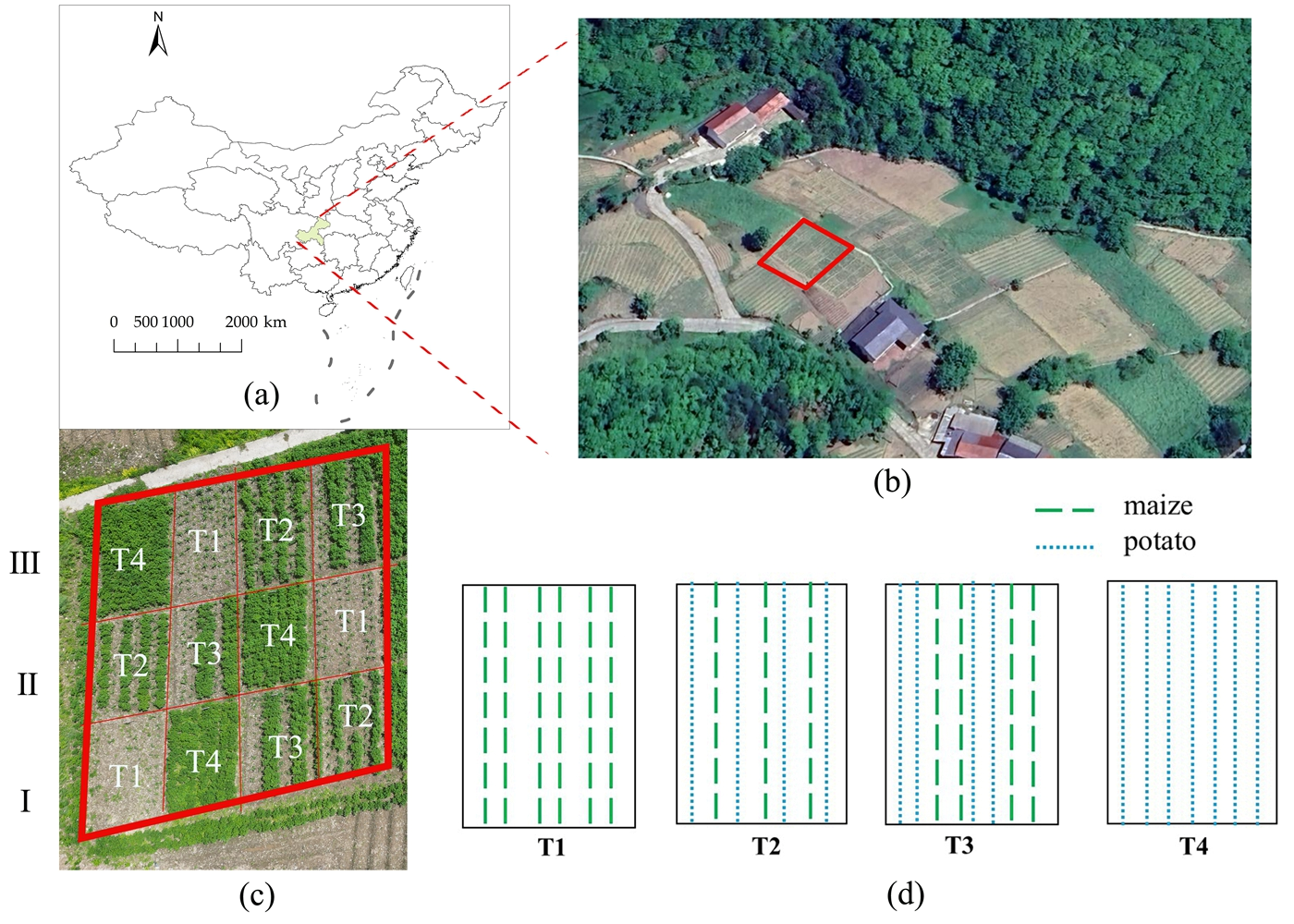
Four planting treatments were designed, including maize monoculture and maize–potato intercropping with different row ratios. A randomized block design was employed with three replications for each treatment. All experimental plots were of uniform dimensions, measuring 5 m in length and 4 m in width (20 m2). At least two rows of potatoes were planted around each experimental plot as buffers to minimize edge effects. All experimental plots were cultivated following local conventional field management practices. The layout of the field plot is shown in Figure 1, and the detailed planting configurations are described below.
The maize monoculture treatment (T1) used a wide-narrow row pattern with 80 cm wide rows, 50 cm narrow rows, and 50 cm hill spacing. Each plot had six maize rows with eight planting holes and two plants per hole, yielding 96 maize plants per plot.
The 1:1 row-ratio maize–potato intercropping treatment (T2) had a uniform 60 cm spacing between adjacent maize and potato rows. Specifically, maize was planted in three rows (50 cm row spacing) with eight holes and two plants per hole (48 plants total), while potato was planted in four rows with 33 cm hill spacing, sixteen holes and one plant per hole (64 plants total).
The 2:2 row-ratio maize–potato intercropping treatment (T3) adopted a wide-narrow row configuration. The spacing between maize and potato ridges was 70 cm, with 50 cm intra-maize row spacing and 33 cm intra-potato row spacing. Each plot contained four maize rows and four potato rows. Maize had eight holes and two plants per row (64 plants total), and potato had sixteen holes and one plant per row (64 plants total), resulting in equal plant numbers for the two crops.
The potato monoculture treatment (T4) adopted a large-ridge double-row pattern with 100 cm ridge spacing, 25 cm intra-ridge row spacing, and 33 cm hill spacing. Each plot included eight potato rows with sixteen holes and one plant per row, with a total of 128 potato plants.
The experimental field was thoroughly leveled before sowing to minimize soil heterogeneity. Field management followed local conventional high-yield cultivation practices, and all fertilizers were applied in hills. For maize, compound fertilizer (N-P2O5-K2O, 15-15-15) was applied as basal fertilizer, and urea (46%, N) was top-dressed at jointing. For potato, the same compound fertilizer (N-P2O5-K2O, 15-15-15) was applied as basal fertilizer at sowing, without additional topdressing during the growing season. Fertilizer rates per hill for maize were calculated based on the monoculture standard, 600 kg·hm−2 (25 g·hill−1) of compound fertilizer and 75 kg·hm−2 (3.02 g·hill−1) of urea. For potato, fertilizer rates per hill were also determined according to the monoculture regime, with compound fertilizer applied at 900 kg·hm−2 (7.03 g·hill−1). Maize was sown on 9 April, 2024 and harvested on 12 September 2024, with a growing period of 156 days. Potato was sown on 13 March 2024 and harvested on 2 July 2024, with a growing period of 111 days.

2.3. Sample Collection and Determination

2.3.1. Sample Collection and Pretreatment

Plant samples of maize and potato were collected at full maturity. From each plot, five healthy and uniformly growing plants were randomly selected and combined into a single composite sample. Meanwhile, topsoil (0–20 cm) samples were collected from the rhizosphere and sealed in self-sealing bags for storage.
After collection, all plant samples were cleaned to remove surface soil and adhering debris. Loose surface soil was carefully brushed off with a soft brush. Potato plants were separated into four parts, including roots, stems, leaves, and tubers, whereas maize plants were divided into seven parts consisting of roots, stems, nodes, leaves, bracts, cobs, and grains. All plant parts were rinsed successively with tap water and deionized water, three times each, and surface moisture was removed with sterile gauze before further processing. Each potato tuber was divided into two subsamples: one was kept fresh for Cd detection to evaluate food safety standards, and the other was dried for further analysis. Specifically, half of the fresh tuber was chopped and homogenized with an organ homogenizer to determine Cd concentrations, and the remaining portion was sliced for drying. All potato and maize organ samples were first heated at 105 °C in an oven to deactivate enzymes and then dried at 65 °C until constant weight. The dried samples were ground, sieved, and hermetically sealed for subsequent analysis. Throughout the entire pretreatment process, non-heavy-metal tools were exclusively used to avoid contamination.
Collected soil samples were transported to the laboratory and air-dried at room temperature. After air-drying, the soil samples were spread evenly on a processing plate and gently crushed with non-metallic tools to remove stones, plant residues, and other debris. Fine fibrous root residues were removed through electrostatic adsorption. The processed soil samples were first sieved through a 2-mm mesh for determination of soil pH and available Cd concentrations. Subsequently, representative subsamples were collected from the sieved soil by the quartering method and finely ground with an agate ball mill to pass through a 0.149-mm mesh, which were prepared for total soil Cd analysis. All pretreatment procedures were conducted with non-metallic tools only to avoid cross-contamination by heavy metals.

2.3.2. Determination Methods

All physicochemical properties were determined according to official Chinese national and industrial standards. Soil pH was measured by the potentiometric method with an FE28 pH meter(Mettler-Toledo (China) Co., Ltd., Shanghai, China) at a soil–water mass ratio of 2.5:1, in accordance with NY/T 121.2 [37]. Total soil Cd was analyzed based on HJ 803 [38]: soil samples were digested with aqua regia, and Cd concentrations were quantified using microwave digestion coupled with inductively coupled plasma mass spectrometry (ICP-MS) (NexION 1000,PerkinElmer, Waltham, MA, USA). Available soil Cd was extracted with diethylenetriaminepentaacetic acid (DTPA) solution according to HJ 804 [39] and analyzed using an ICP5110 inductively coupled plasma optical emission spectrometer (ICP-OES)(ICP 5110,Agilent Technologies, Santa Clara, CA, USA). Cd concentrations in various maize and potato organs were measured in compliance with the national food safety standard GB 5009.268 [40]. Plant samples were pretreated by muffle furnace dry ashing and analyzed with a NexION 1000 ICP-MS, and all results were expressed on a dry weight basis as mg·kg−1. The detection limits for total soil Cd, available soil Cd, and plant total Cd were 0.07 mg·kg−1, 0.007 mg·kg−1, and 0.002 mg·kg−1, respectively. All analytical measurements were performed by an accredited third-party laboratory holding valid CMA and CATL certifications.

2.4. Data Processing

2.4.1. Data Processing and Statistical Analysis

Microsoft Excel 2007 was used for raw data organization. Analysis of variance (ANOVA) and graphical visualization were conducted using R 4.3.2. Significant differences among treatments were evaluated via the least significant difference (LSD) test at a probability level of p < 0.05.

2.4.2. Bioconcentration and Translocation Evaluation Methods

In accordance with established methods [25,41,42], the bioconcentration factor (BCF) and translocation factor (TF) were used to evaluate Cd accumulation and translocation, with the corresponding calculation formulas defined as follows.
B C F o r g a n = C o r g a n / C s o i l
T F s o u r c e s i n k = C s i n k / C s o u r c e
where Corgan and Csoil denote the Cd concentration in plant organs and total soil, respectively (mg·kg−1). Csource and Csink represent the Cd levels in source and sink organs, respectively (mg·kg−1). The bioconcentration factor (BCF), defined as the ratio of Cd concentration in plant organs to total soil Cd concentration, was applied to evaluate the Cd accumulation capacity of plants [25]. A BCF value greater than 1 indicates Cd enrichment in the corresponding plant organ, with higher values reflecting greater Cd accumulation ability. The translocation factor (TF) is a critical parameter for assessing plant Cd migration and translocation. Larger TF values indicate more efficient Cd translocation from source organs to sink organs [43].

2.4.3. Health Risk Assessment Methods

The US EPA Target Hazard Quotient (THQ) model was utilized to evaluate dietary non-carcinogenic health risks associated with Cd exposure [44,45]. The relevant calculation formula is provided as follows.
C D I = C × I R × E F × E D × F B W × A T
T H Q = C D I R f D
where CDI (mg·kg−1·d−1) is the average daily cadmium intake. C refers to the measured cadmium concentration in the edible organs (dry weight for maize, fresh weight for potato). IR is the average daily staple food intake, F is the dietary contribution fraction of the test crops, EF is the annual exposure days, ED is the exposure duration, BW is the average body weight, AT is the total exposure duration for non-carcinogenic risk assessment, and RfD is the oral reference dose of cadmium. The total 70-year human exposure period was categorized into childhood (0–12 years) and adulthood (13–70 years) for weighted risk estimation. For childhood, the average body weight (BWc) was 25 kg, daily staple food intake (Fc) was 0.2 kg·d−1, and exposure duration (EDc) was 12 years. For adults, the average body weight (BWa) was 60 kg, daily staple food intake (Fa) was 0.4 kg·d−1, and exposure duration (EDa) was 58 years. For both developmental stages, unified parameters were adopted: a crop dietary contribution proportion (F) was 50%, an annual exposure frequency (EF) was 365 d·a−1, a total non-carcinogenic exposure time was 25,550 d, and a cadmium reference dose (RfD) was 0.001 mg·kg−1·d−1. THQ denotes the target hazard quotient. A THQ value below 1 indicates negligible dietary health risk, whereas a THQ value ≥ 1 suggests potential adverse health risks from dietary cadmium exposure, with higher THQ values reflecting greater risk.

2.4.4. Input–Output Evaluation Methods

Net return per hectare (N) and input-output ratio (R) [46,47] under various cropping patterns were calculated using survey data obtained from local agricultural and rural authorities, with the relevant computational formulas provided as follows.
N = Y I
R = Y / I
where N is the net return per hectare (CNY·hm−2); Y is the gross output value per hectare (CNY·hm−2); I is the total input per hectare (CNY·hm−2); and R is the input-output ratio. The gross output value per hectare is the sum of individual crops’ output values. The total input per hectare consists of material-based costs and labor costs. The input-output ratio is the ratio of gross output value per hectare to total input per hectare. Seed, fertilizer, and labor inputs during field production were included in the economic calculation. For agricultural products meeting food safety standards, market prices for local edible commodities were adopted. For products exceeding food safety limits but meeting feed standards [48], feed-grade prices were applied. Given that local production is predominantly smallholder self-farming, land rent, pesticide costs, and agricultural machinery operation expenses were excluded from this economic assessment.

3. Results and Analysis

3.1. Effects of Intercropping on Soil Properties

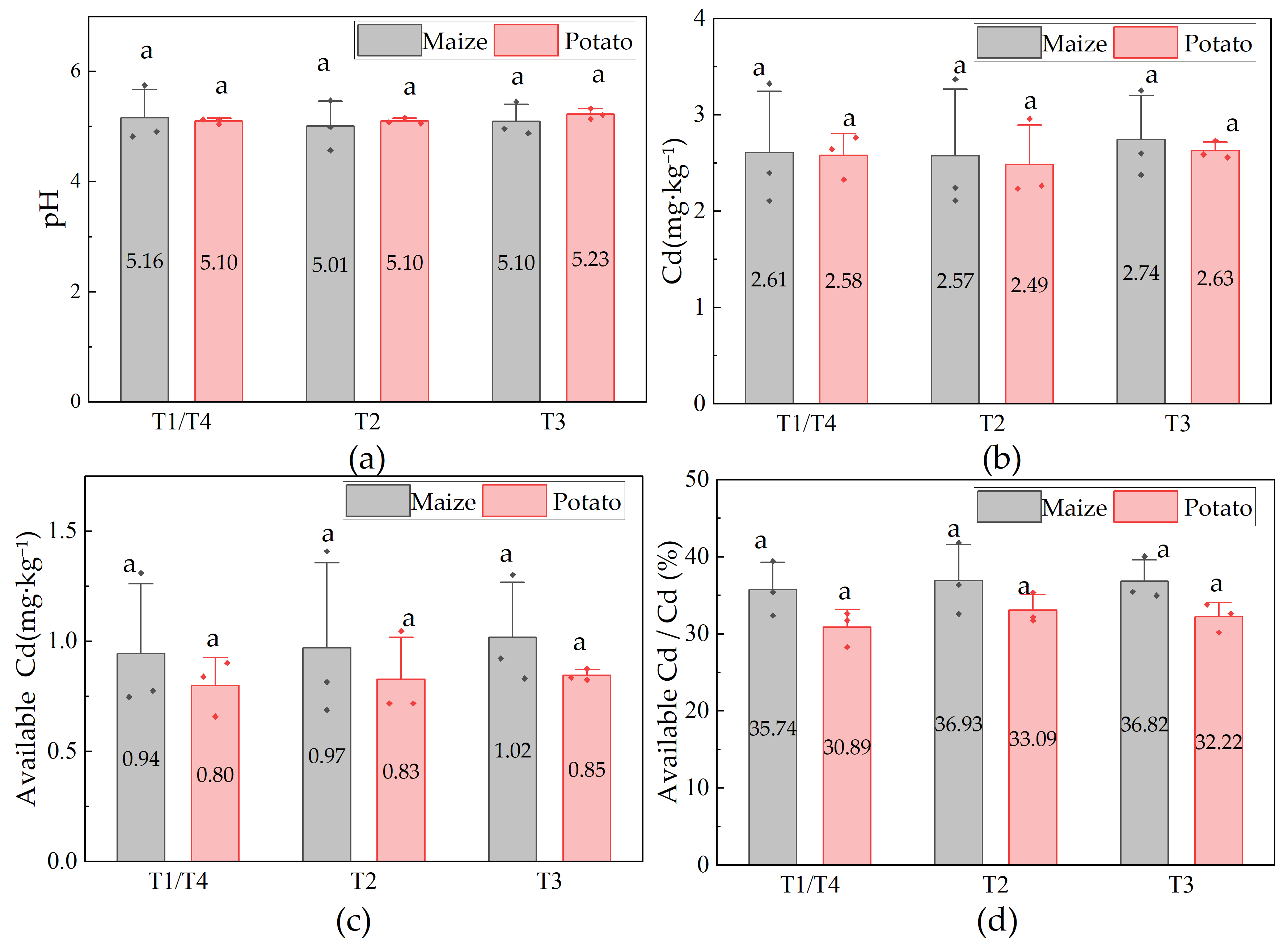
Figure 2 presents a comparison of soil indicators for potato and maize plants under the same treatments. Overall, the average soil pH was 5.09 ± 0.38 for maize and 5.14 ± 0.09 for potato. Total cadmium concentrations were 2.64 ± 0.53 mg·kg−1 and 2.56 ± 0.25 mg·kg−1, while available cadmium concentrations were 0.98 ± 0.28 mg·kg−1 and 0.82 ± 0.12 mg·kg−1, respectively. The ratios of available-to-total cadmium reached 36.50% ± 3.38% for maize and 32.07% ± 2.02% for potato.
None of these soil indicators exhibited statistically significant differences between the two crops under the same treatment (p < 0.05). However, total cadmium concentration, available cadmium concentration, and the available-to-total cadmium ratio all tended to be lower in soil around potato than around maize. Combined with cadmium data in plant organs, this pattern may imply that potato has higher cadmium-uptake efficiency from soil and preferentially absorbs available cadmium. This consequently reduces total cadmium, available cadmium, and the available-to-total cadmium ratio in soil around potato relative to maize.

3.2. Effects of Intercropping Patterns on Cd Concentrations in Edible Organs of Maize and Potato

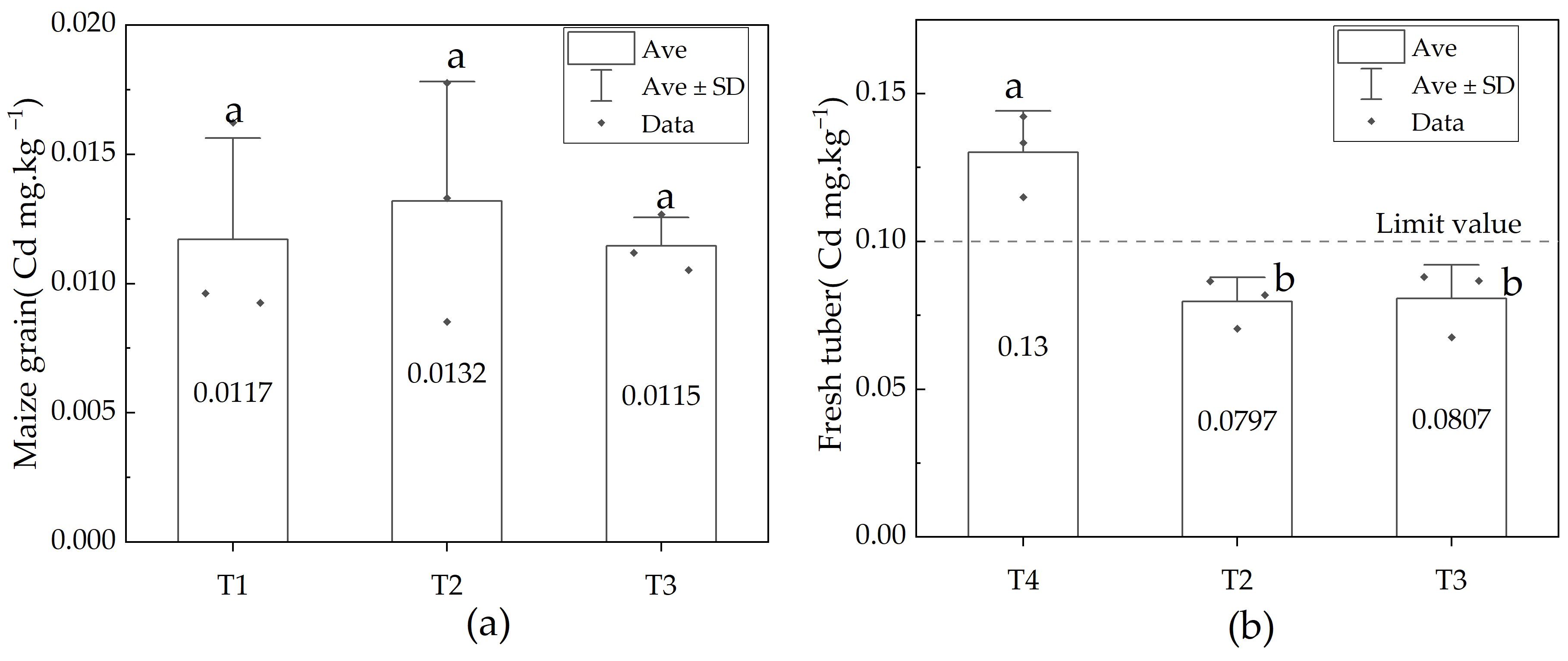
Figure 3 illustrates the effects of maize and potato monoculture and intercropping patterns on cadmium (Cd) concentrations in maize grain and fresh potato tuber. Panel a shows that the average Cd concentrations in maize grain organs under the three planting treatments (T1, T2, and T3) were 0.0117, 0.0132, and 0.0115 mg·kg−1, respectively. All values were substantially lower than the national food safety limit of 0.1 mg·kg−1 (dry weight basis), demonstrating the edible safety of maize grain organs across all treatments. One-way ANOVA revealed no significant differences in Cd concentrations of maize grain organs among the three treatments.
In contrast, distinct differences were observed in potato tuber organs (Figure 3b). The average Cd concentrations in fresh potato tuber organs under monoculture T4, T2, and T3 were 0.13, 0.0797, and 0.0807 mg·kg−1, respectively. Relative to the 0.1 mg·kg−1 food safety threshold, potato tuber under monoculture exceeded the limit, indicating potential dietary health risks. In comparison with monoculture, maize–potato intercropping with 1:1 row ratio and 2:2 row ratio reduced tuber Cd concentrations by 38.81% and 38.01%, respectively, thus meeting the food safety requirements. Overall, the responses of Cd accumulation in edible organs to intercropping regimes were species-specific. Compared with maize grain, potato tuber was more susceptible to Cd accumulation under different planting regimes.

3.3. Effects of Intercropping Patterns on Cadmium Partitioning in Maize and Potato

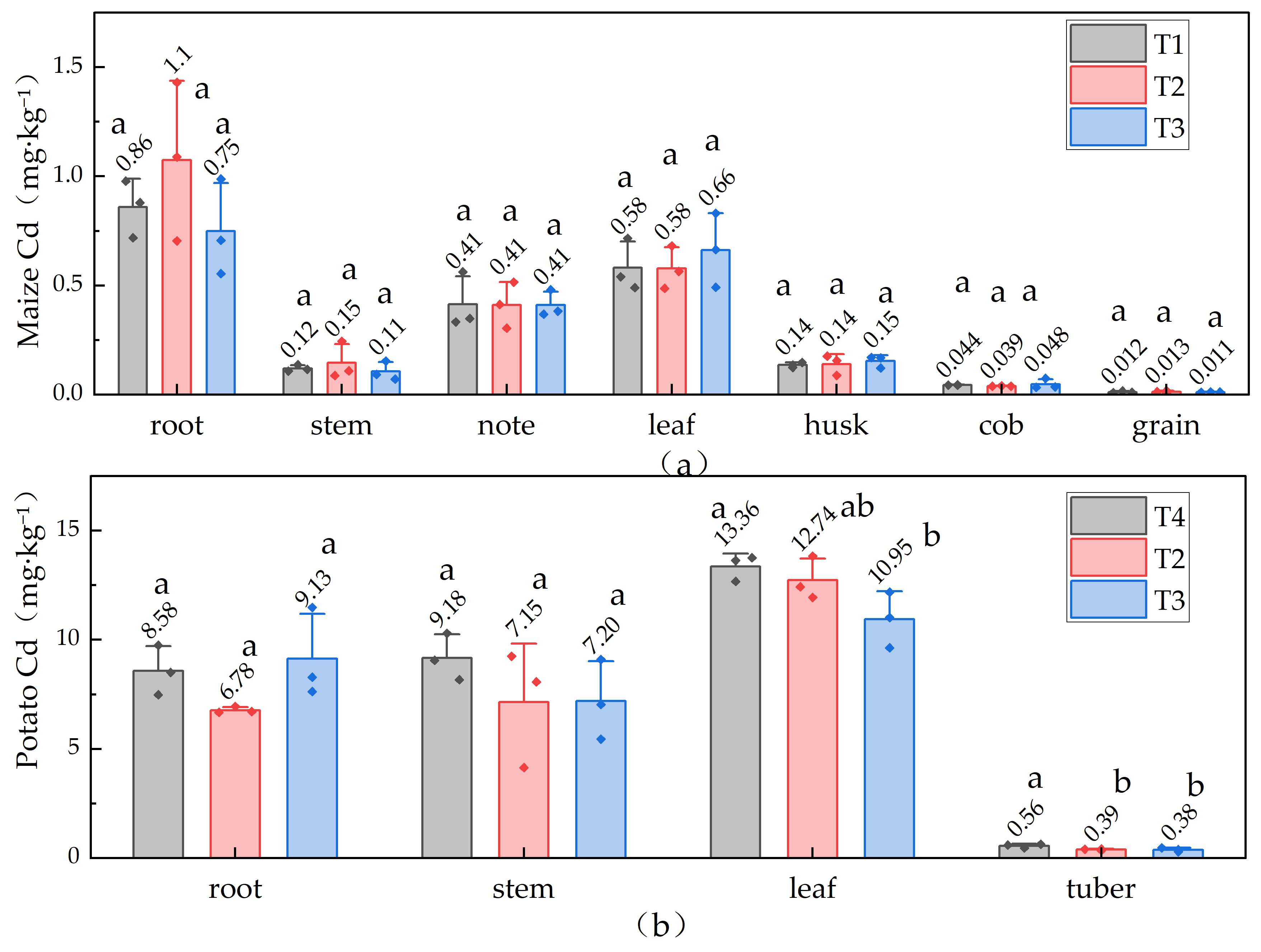
To further explore the effects of intercropping regimes on Cd distribution in maize and potato, Cd concentrations in their different organs were determined. Figure 4a illustrates the Cd accumulation characteristics in maize organs under different planting treatments. The average Cd concentration in maize organs followed the order: roots (0.894 mg·kg−1) > leaves (0.623 mg·kg−1) > nodes (0.418 mg·kg−1) > husks (0.143 mg·kg−1) ≈ stems (0.121 mg·kg−1) > cobs (0.044 mg·kg−1) > grains (0.012 mg·kg−1). Overall, Cd concentrations in all maize organs were lower than those in the rhizosphere soil, showing a gradual decrease from underground roots to aboveground organs. Specifically, the Cd concentration in maize grains was only 1.3% of that in roots and 1.9% of that in leaves. One-way ANOVA revealed no significant differences in Cd concentrations of any maize organs among the T1, T2, and T3 treatments (p > 0.05).
Figure 4b presents the Cd accumulation characteristics in potato organs under different planting treatments. The average Cd concentration in potato organs followed the order: leaves (12.35 mg·kg−1) > stems (7.84 mg·kg−1) ≈ roots (8.16 mg·kg−1) > tubers (0.44 mg·kg−1). Except for tubers, Cd concentrations in potato roots, stems and leaves were all higher than the soil Cd concentration. For most potato organs (excluding roots), intercropping reduced the average Cd concentration in stems, leaves and tubers compared with monoculture; however, no significant difference was observed in stem Cd concentration between monoculture and intercropping groups. Significant differences in leaf Cd concentration were detected between monoculture (T4) and maize–potato intercropping with a 2:2 row ratio (T3) (p < 0.05). Furthermore, tuber Cd concentrations in maize–potato intercropping with a 1:1 row ratio (T2) and 2:2 row ratio (T3) were both significantly lower than those in monoculture (T4) (p < 0.05).

3.4. Effects of Intercropping on Cd Bioconcentration and Translocation in Maize and Potato

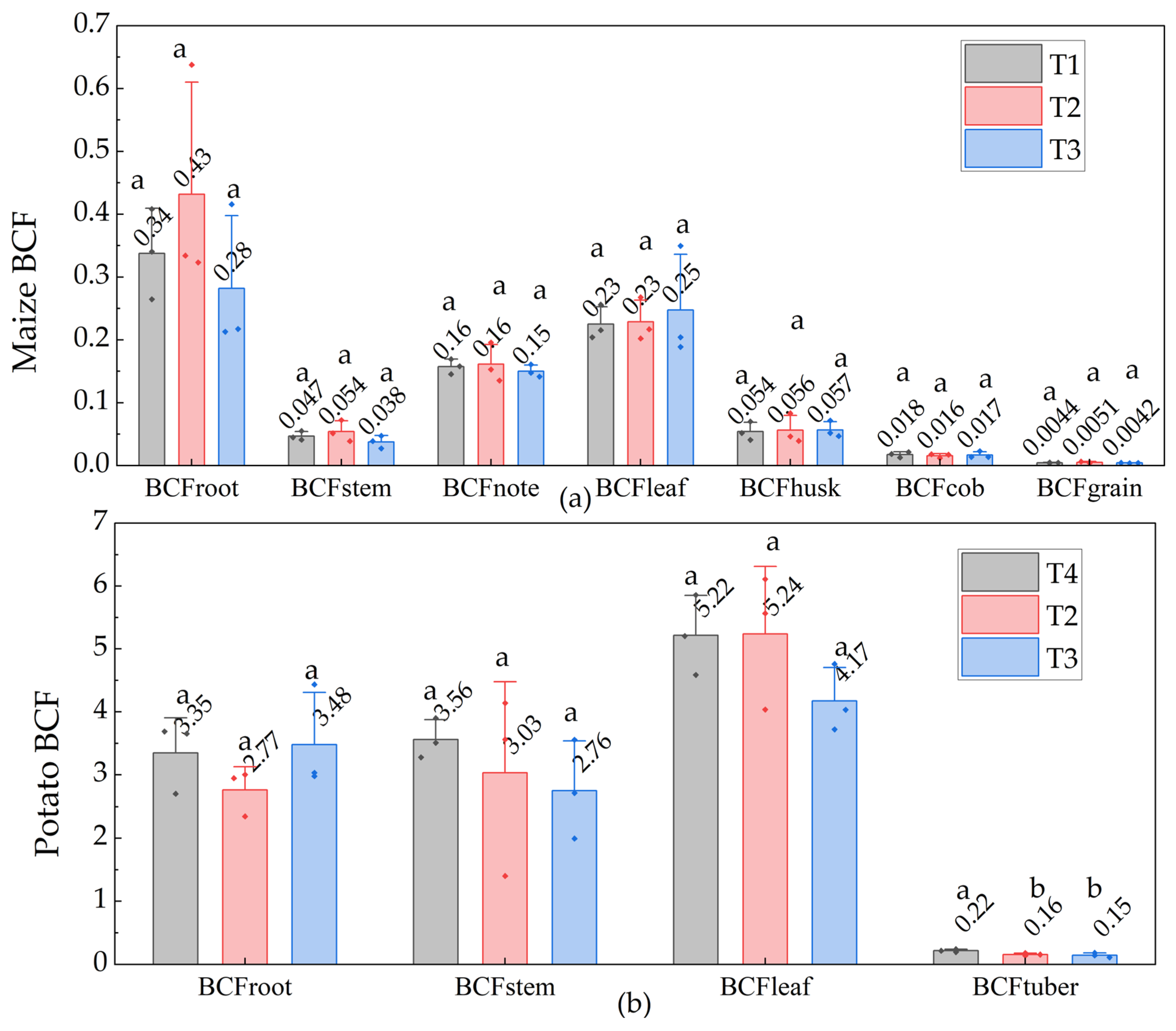
Figure 5 revealed a distinct organ-specific pattern of Cd bioconcentration in maize and potato. As shown in Figure 5a, the BCF values of maize followed the order: BCFroot > BCFleaf > BCFnode ≈ BCFhusk > BCFstem > BCFcob > BCFgrain. All maize organs had BCF values < 1, suggesting that maize lacked Cd bioconcentration capacity from soil. For potato, the BCF order was BCFleaf > BCFroot ≈ BCFstem > BCFtuber. Except for tubers, all potato vegetative organs except tubers had BCF > 1. Among the three planting treatments, no significant differences were detected in BCF values for any potato organ except tuber BCF (p < 0.05). Consistent with tuber Cd concentration, means of BCFtuber followed the order T4 (0.22) > T2 (0.16) ≈ T3 (0.15).
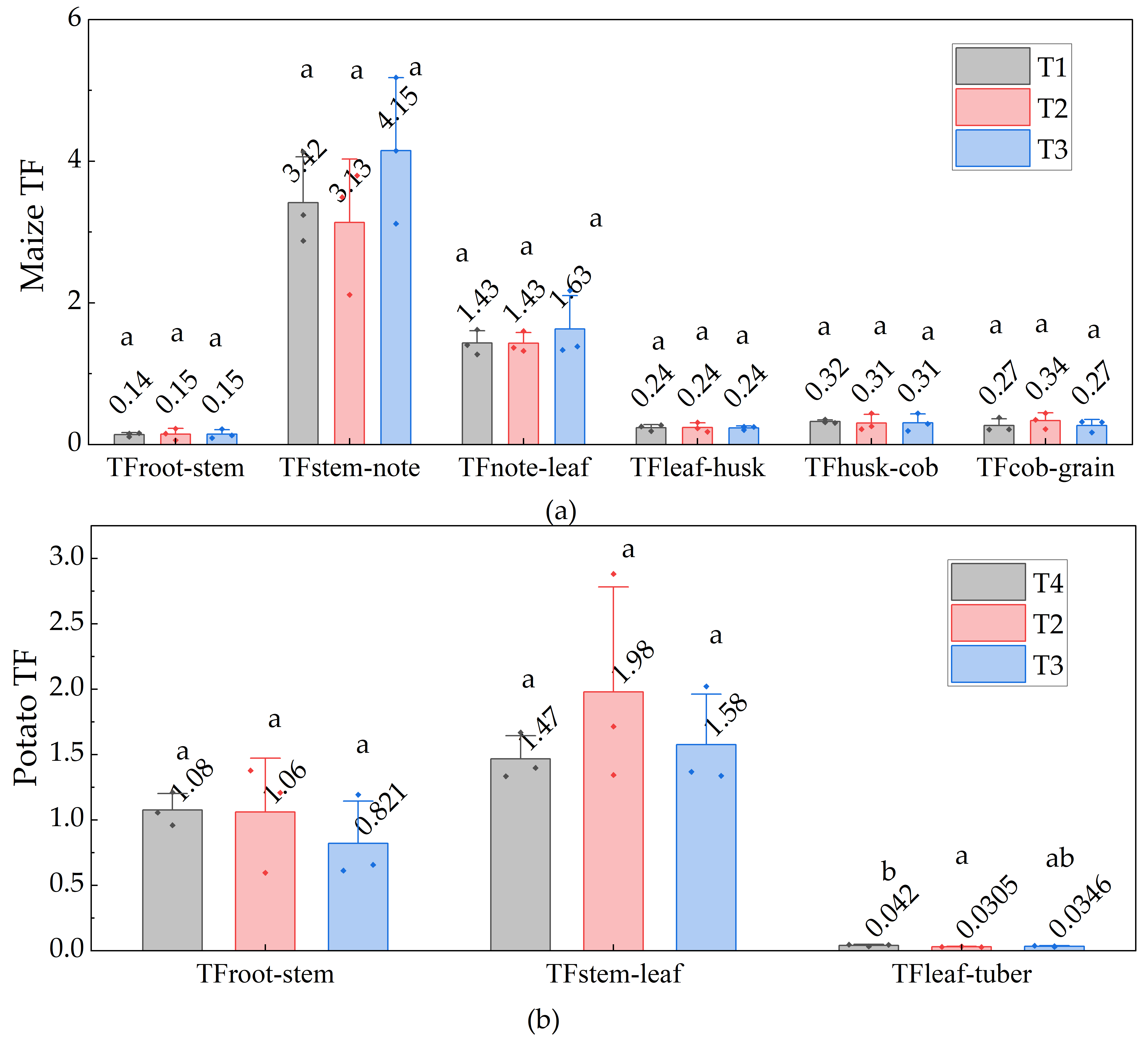
The translocation factor (TF) reflects the Cd mobilization capacity between adjacent organs. Figure 6a showed that Cd translocation in maize followed the order: TFstem–node > TFnode–leaf > TFleaf–husk > TFhusk–cob ≈ TFcob–grain > TFroot–stem. The TF values for stem-to-node and node-to-leaf translocation were both > 1, indicating strong Cd translocation capacity during these two processes, with nodes and leaves serving as Cd sinks. In contrast, TFroot–stem, TFleaf–husk, TFhusk–cob, and TFcob–grain were all <1, suggesting weak Cd translocation from roots to stems, leaves to husks, husks to cobs, and cobs to grains. Notably, the root-to-stem barrier was the strongest in maize.
Figure 6b illustrated Cd translocation characteristics in potato, with TF values ranked as TFstem–leaf > TFroot–stem > TFleaf–tuber. Potato exhibited the strongest Cd translocation from stems to leaves, whereas the mean TF for leaf-to-tuber translocation was only 2.4% of that for stem-to-leaf translocation, indicating extremely limited Cd migration from leaves to tubers. Taken together with the bioconcentration factor results, the translocation factor effectively explained why Cd preferentially accumulated in stems and nodes of maize and was primarily retained in the aboveground stems and leaves of potato. For all Cd translocation processes except for TFleaf–tuber in potato, no significant differences were observed among different planting treatments.

3.5. Evaluation of the Popularization Potential of Different Intercropping Patterns

Adopting the US-EPA non-carcinogenic health risk assessment model and a field economic benefit evaluation system, this study analyzed Cd bioconcentration in crops, dietary health risks, and field productivity across different planting patterns. The practical advantages of maize–potato intercropping for safe production on Cd-contaminated farmland were further clarified.
Under an extreme-exposure scenario assuming a 70-year lifetime consumption and a 50% contribution of the tested crops to staple-food intake, Cd concentrations in edible organs, dietary exposure (CDI), and health-risk index (THQ) were calculated for crops under different treatments (Table 1). The Cd concentrations of maize in T1, T2, and T3 were 0.0117, 0.0132, and 0.0115 mg·kg−1, respectively, all below the limit of 0.1 mg·kg−1 set by GB 2762 [35]. Potato Cd concentrations in T2 and T3 were 0.08 and 0.081 mg·kg−1, respectively, which also complied with this limit. By contrast, monocropping potato (T4) reached 0.13 mg·kg−1 and exceeded the Cd limit for potato tubers. The THQ values for maize and potato across all treatments were substantially lower than 1, indicating no non-carcinogenic dietary health risk from Cd exposure. In contrast, the health-risk estimates for potato were substantially higher than those for maize. Among all treatments, intercropping patterns T2 and T3 produced the lowest Cd accumulation and the associated health risks for both crops. Accordingly, maize–potato intercropping (T2 and T3) can effectively keep potato Cd concentrations within the safe threshold, reduce Cd-related risks in agricultural products, and balance the demands of safe agricultural production and ecological remediation. Therefore, it represents a promising planting regime for Cd-contaminated farmland.
Table 2 presents the input–output accounting parameters of different maize–potato intercropping and sole cropping patterns, covering planting density, fertilizer, seed/seed tuber, labor inputs together with corresponding prices, and crop yield and product market price. These parameters were used to calculate seed, fertilizer, and labor costs for economic analysis, while land rent, pesticide, and agricultural machinery operation expenses were omitted, considering the local smallholder self-farming characteristics. Specifically, when agricultural products meet food safety standards, both maize and potato are calculated at the conventional local market price of 2 CNY kg−1. For products exceeding food safety limits [35] but satisfying feed standards [48], the feed-grade price of 0.8 CNY kg−1 is applied.
Table 2. Input–output accounting parameters of different intercropping patterns.
TreatmentCropDensity (Hill·hm−2)Base FertilizerTop-Dressing FertilizerSeeds/Seed TubersLaborOutput
Amount (g·Hill−1)Price (CNY·kg−1)Amount (g·Hill−1)Price (CNY·kg−1)Amount (kg·hm−2)Price (CNY·kg−1)Amount (d·hm−2)Price (CNY·d−1)Yield (kg·hm−2)Price (CNY·kg−1)
T1M24,0002543.02237.5503213060002
T2M12,000253.0218.75504630002
P32,0007.0301125411,2502
T3M16,000253.0225.05504940002
P32,0007.0301125411,2502
T4P64,0007.030225043822,5000.8
Notes: M = maize; P = potato.
Table 3 shows that all planting patterns generated positive net returns except for potato monoculture (T4), which suffered economic losses. Maize–potato intercropping (T2 and T3) yielded relatively high output values and net income. Treatment T2 had an input-output ratio of 2.10, indicating the highest input use efficiency. Treatment T3 involved slightly higher inputs but produced the highest net income of 15,781.12 CNY·hm−2 among all treatments, with an input-output ratio of 2.07. The economic returns of T2 and T3 were substantially higher than the net income of 3420.04 CNY·hm−2 under maize monoculture (T1). Potato monoculture (T4) required the highest total input. Because Cd concentrations in potato tubers exceeded the GB 2762 limit, the harvested tubers could only be sold as low-priced feed, resulting in low output value. Consequently, its net income was −11,239.68 CNY·hm−2 with an input-output ratio of 0.62, rendering this pattern economically unfeasible for practical production. Collectively, maize–potato intercropping can balance farmland profitability and Cd safety control for potato tubers, and represents a promising, locally recommended planting pattern for safe production.

4. Discussion

4.1. Differential Responses of Maize and Potato to Cd Stress

Maize and potato displayed divergent responses to Cd stress, along with variations in rhizosphere soil properties and plant Cd accumulation and translocation. Under both monoculture and intercropping planting patterns, total Cd concentration, available Cd concentration, and the proportion of available Cd in potato rhizosphere soil were all lower than those in maize rhizosphere, but the difference was not significant (p > 0.05). Such divergence may be explained by interspecific differences in root-secreted small-molecule compounds (e.g., organic acids and amino acids) and root-associated microbial communities [49,50,51]. Potato roots possess stronger Cd accumulation capacity than maize roots. During plant growth, potato roots continuously acquire bioavailable Cd from the rhizosphere soil, gradually reducing the pool and relative proportion of available Cd and thereby decreasing available Cd concentrations in the surrounding soil.
Maize and potato differ in Cd bioconcentration, translocation, and allocation. Maize exhibits weak Cd bioconcentration across all organs, with BCF values below 1, which is consistent with Yan, Q. et al. [19]. In maize, Cd bioconcentration decreases in the order: root > leaf > node > husk ≈ stem > cob > grain. Translocation efficiencies for stem-to-node and node-to-leaf pathways are relatively high (2.11–5.18 and 1.27–2.17, respectively), but low for other organs. These traits partly limit the sensitivity of Cd concentration in maize grain to changes in environmental conditions.
By contrast, potato is characterized by high Cd bioconcentration in vegetative organs but low in tubers. Except for tubers, all potato organs have BCF > 1, indicating a substantially higher plant-level Cd bioconcentration than maize. This agrees with Xie, N. et al. [43]. Cross-species comparison reveals that Cd concentrations in potato organs are markedly higher than those in the corresponding maize organs. In the present study, the Cd bioconcentration capacities of potato roots, stems, leaves and tubers were 9.13-, 67.33-, 20.84-, and 37.67-fold those of the corresponding maize organs, respectively. Potato is more sensitive to soil Cd stress and displays higher plasticity in internal Cd translocation and allocation. This trait provides opportunities to reduce tuber Cd concentration via agronomic management practices.

4.2. Effects of Intercropping Patterns on Food Safety of Maize and Potato

Translocation factor comparisons further indicate that intercropping affects tuber Cd bioconcentration mainly by significantly altering the leaf-to-tuber translocation pathway. The migration of soil-borne Cd into the edible parts of maize and potato involves four sequential processes: root uptake, root vacuolar sequestration, long-distance translocation in aboveground organs, and final partitioning into grains or tubers [52,53]. Among these processes, Cd translocation from stems and leaves to tubers serves as a critical process limiting Cd bioconcentration in potato tubers [54]. Under monoculture conditions, potato exhibited a higher Cd translocation efficiency toward tubers, with an average fresh tuber Cd concentration of 0.1302 mg·kg−1. In contrast, T2 and T3 intercropping treatments reduced the leaf-to-tuber TF of potato by 30.77% and 23.08%, respectively. Accordingly, intercropping effectively inhibited Cd translocation from aboveground vegetative organs to tubers. A large proportion of Cd was retained in non-edible vegetative tissues (roots, stems, and leaves), thereby significantly reducing Cd accumulation in potato tubers. Under T2 and T3, fresh tuber Cd concentrations fell to 0.0797 mg·kg−1 and 0.0807 mg·kg−1, representing significant reductions of 38.79% and 38.02% compared with monoculture, respectively. This physiological process is closely associated with the expression level, transport activity, and organ-specific localization of Cd transporters [55]. Nonetheless, the specific regulatory mechanism induced by intercropping remains to be further explored.
Heavy metal uptake by crops is primarily determined by plant intrinsic genetic traits and external environmental conditions. Phenological asynchrony between maize and potato, combined with intercropping-induced microenvironmental regulation, may create essential conditions for safe potato production. Potato is harvested approximately two months earlier than maize. During the critical tuber swelling and Cd accumulation stage of potato, maize provides moderate shading to reduce field microenvironmental temperature [56], suppress pests and diseases [16], optimize nutrient allocation to stress resistance in potato plants, and enhance their tolerance to Cd stress. When maize enters its key Cd accumulation stages (jointing, anthesis, and grain filling), potato has already been harvested, exerting negligible effects on Cd accumulation in maize aboveground organs. Collectively, these advantages support the safe production of low-Cd potato tubers under intercropping systems.

4.3. Popularization and Application Value of Intercropping Patterns

Optimized intercropping patterns can achieve the safe utilization of Cd-contaminated farmland while ensuring the economic income of farmers in polluted regions, which aligns with the goals of sustainable agricultural development [57]. Health risk assessment results indicated that, under an extremely conservative exposure scenario with a 70-year lifelong intake period and tested crops contributing 50% of staple food consumption, the target hazard quotient (THQ) values of Cd in maize and potato under all planting treatments were far below 1. This finding demonstrated that the non-carcinogenic dietary health risks of Cd from all planting systems in the study area were within the safe threshold. Among all treatments, the T3 maize–potato intercropping pattern exhibited the lowest Cd bioconcentration level and dietary health risk for both crops.
Economic benefit analysis further revealed that among all qualified safe planting patterns, the T3 intercropping pattern achieved the highest net income of 15,781.12 CNY·hm−2, while the T2 intercropping pattern exhibited a better input–output ratio. Both intercropping systems presented substantially better comprehensive economic benefits than the T1 maize monoculture. In comparison, potato tubers under the T4 potato monoculture exceeded the Cd limit of 0.1 mg·kg−1 [35]. These non-compliant potato tubers can only be sold at a discounted price as feed raw materials, leading to poor comprehensive farmland economic returns and limited health safety values.
Reasonable crop intercropping optimizes the soil environment around crop roots and modulates the mobility and bioconcentration of heavy metals via interspecific interactions. This approach effectively reduces heavy metal risks in crop edible organs and supports stable and safe agricultural production on Cd-contaminated farmland [57]. The maize–potato intercropping system exhibits promising potential for popularization and sustainable application in high-geological-Cd-background farmland of Southwest China. A 2:2 potato-maize planting ratio can maximize the comprehensive yield per unit area [58,59]. Furthermore, intercropping can significantly improve multiple photosynthetic physiological indicators in potato, including leaf area index, relative chlorophyll content, net photosynthetic rate, stomatal conductance, and transpiration rate [60,61]. In terms of nutrient uptake and soil microecology, potatoes in intercropping obtain significantly higher uptake and utilization efficiency of soil phosphorus and potassium nutrients than those under monoculture [62,63]. Additionally, intercropping can effectively optimize the structure of soil fungal communities in the potato roots and alleviate continuous cropping obstacles [51]. As a traditional practice compatible with conventional tillage, maize–potato intercropping requires no additional engineering investment or material input. Therefore, it possesses important practical significance for cultivated land utilization and food security in High-Geological-Cd areas of Southwest China. This planting pattern can stabilize farmers’ economic returns, reduce dietary Cd exposure risks, and guarantee the edible safety of agricultural products. It well matches China’s current farmland management strategy for Cd-contaminated soil, which prioritizes safe utilization over remediation under limited arable land resources. Overall, maize–potato intercropping provides valuable practical support for the safe utilization of High-Geological-Cd background farmland, regional food security, and stable yield and income growth of farmers in Southwest China.

4.4. Analysis of Uncertainties

Nevertheless, this study has several limitations and uncertainties under the current experimental conditions. Future research could be improved in four aspects. First, more detailed experiments are needed to systematically explore how the intercropping process regulates the Cd translocation from potato leaves to tubers. Second, subsequent studies should fully evaluate the effects of interannual climate variation, soil hydrothermal conditions, and seasonal nutrient fluctuations on crop Cd accumulation and soil Cd speciation transformation. Establishing experimental treatments with different pollution gradients and soil environmental conditions would further clarify the applicability of this planting system. Third, maize and potato plant populations vary between monoculture and intercropping systems, which may alter plot-scale total Cd uptake and rhizosphere microenvironments. This factor should be incorporated into the refined experimental design of future studies to improve result accuracy. In addition, field-measured data should be adopted to quantitatively analyze the differences in crop yield and economic output among various intercropping treatments. Meanwhile, social sustainability indicators, such as farmers’ willingness to adopt, should be incorporated and optimized in subsequent evaluation systems. These further investigations will provide solid theoretical foundations and empirical evidence for the standardized regional promotion and application of the maize–potato intercropping system.

5. Conclusions

There were significant interspecific differences in Cd bioconcentration and translocation characteristics between maize and potato. The bioconcentration factor (BCF) values of all maize organs were less than 1, and the Cd concentration and bioconcentration capacity followed the decreasing order: root > leaf > node > husk ≈ stem > cob > grain. For potato, Cd concentration and bioconcentration capacity followed the order: leaf > stem ≈ root > tuber. The BCF values of all potato organs were greater than 1 except for tubers. Specifically, the Cd bioconcentration capacities of potato roots, stems, leaves and tubers were 9.13-, 67.33-, 20.84-, and 37.67-fold those of the corresponding maize organs, respectively.
Field observations from four planting patterns, including maize monoculture (T1), maize–potato intercropping with a 1:1 row ratio (T2), maize–potato intercropping with a 2:2 row ratio (T3), and potato monoculture (T4), revealed that planting pattern exerted a limited influence on Cd levels in crop vegetative organs. Specifically, only potato tubers under monoculture (T4) accumulated significantly higher Cd concentrations than those under the T2 and T3 intercropping systems, whereas Cd bioconcentration in other plant organs remained insensitive to planting regimes. Relative to potato monoculture, single-row and double-row intercropping markedly decreased tuber Cd concentrations by 38.81% and 38.01%, respectively. Maize–potato intercropping efficiently inhibits the downward translocation of cadmium from potato leaves to tubers. This practice reduces cadmium accumulation in potato tubers and facilitates the safe production of potatoes.
Based on the integrated findings of health risk assessment and economic benefit evaluation, the two maize–potato intercropping patterns (T2 and T3) yielded substantially higher overall economic benefits than maize monoculture (T1), while presenting remarkably lower dietary health risks than potato monoculture (T4). These intercropping regimes exhibit potential for application and promotion for the safe and green production of staple crops in karst regions with high geological Cd background.
Future research should further explore the microscopic mechanisms underlying Cd transport regulation under maize–potato intercropping. Comprehensive evaluation is required regarding the influences of interannual climate variation, soil hydrothermal conditions, and seasonal nutrient fluctuation on crop Cd uptake and accumulation, as well as transformations of Cd fractions in soil. The applicable scope of this intercropping system also needs to be clarified to provide integrated theoretical and data support for its standardized regional extension.

Author Contributions

Conceptualization, R.T. and H.Z.; methodology, R.T.and L.C.; software, W.L. and L.C.; validation, H.T. and S.Z.; formal analysis, R.T.; investigation, R.T., H.Z., S.Z.and X.H.; resources, X.H.; data curation, S.Z.; writing—original draft preparation, R.T., L.C. and X.H.; writing—review and editing, R.T. and J.L.; visualization, R.T. and W.L.; supervision, Y.W. and J.L.; project administration, R.T.; funding acquisition, R.T., Y.W. and H.T. All authors have read and agreed to the published version of the manuscript.

Funding

This research was funded by the Chongqing Municipal Financial Science and Technology Innovation Project (KYLX20260200040), the Core Technology Research Project of Chongqing Academy of Agricultural Sciences (KYLX20250600045), Chongqing Special Fund for Soil Pollution Prevention and Control (Yunongfa [2024] 59) and Key Project of Chongqing Technology Innovation and Application Development Special Program (CSTB2022TIAD-KPX0006).

Data Availability Statement

The data presented in this study are available on request from the corresponding author due to ongoing follow−up research based on the dataset.

Acknowledgments

We acknowledge the authors of all primary studies included in our analysis. We also thank Doubao AI (web version) for its assistance with text proofreading and reference checking.

Conflicts of Interest

The authors declare no conflicts of interest.

References

  1. Ali, H.; Khan, E.; Ilahi, I. Environmental Chemistry and Ecotoxicology of Hazardous Heavy Metals: Environmental Persistence, Toxicity, and Bioaccumulation. J. Chem. 2019, 2019, 6730305. [Google Scholar] [CrossRef] [Scilit]
  2. Chen, C.; Lan, Y.; Mi, R.; Xu, M.; Liu, Y.; Wu, J.; Zhang, Y.; Long, L.; Yang, G. Effects of Intercropping Ryegrass with Hollyhock and Inoculation with Bacillus thuringiensis on Enhancing Phytoremediation of Cd-Contaminated Soils. Chemosphere 2023, 311, 136974. [Google Scholar] [CrossRef] [Scilit] [PubMed]
  3. Yan, R. Study on the Effect and Mechanism of Cd Enrichment Under the Condition of Intercropping of Maize and Hyperaccumulator. Master’s Thesis, Graduate School, Chinese Academy of Agricultural Sciences, Beijing, China, 2020. (In Chinese) [Google Scholar]
  4. Xiang, H.; Lan, N.; Wang, F.; Zhao, B.; Wei, H.; Zhang, J. An Effective Planting Model to Decrease Cadmium Accumulation in Rice Grains and Plants: Intercropping Rice with Wetland Plants. Pedosphere 2023, 33, 355–364. [Google Scholar] [CrossRef] [Scilit]
  5. Kang, Z.; Gong, M.; Li, Y.; Chen, W.; Yang, Y.; Qin, J.; Li, H. Low Cd-Accumulating Rice Intercropping with Sesbania cannabina L. Reduces Grain Cd while Promoting Phytoremediation of Cd-Contaminated Soil. Sci. Total Environ. 2021, 800, 149600. [Google Scholar] [CrossRef] [Scilit] [PubMed]
  6. Wang, J.; Lu, X.; Zhang, J.; Ouyang, Y.; Wei, G.; Xiong, Y. Rice Intercropping with Alligator Flag (Thalia dealbata): A Novel Model to Produce Safe Cereal Grains while Remediating Cadmium-Contaminated Paddy Soil. J. Hazard. Mater. 2020, 394, 122505. [Google Scholar] [CrossRef] [Scilit] [PubMed]
  7. Gu, J. Effect of Different Rice Varieties and Rice-Sesbania Intercropping on the Environmental Behavior of Cadmium in Flooded Soil. Master’s Thesis, Zhejiang A&F University, Hangzhou, China, 2019. (In Chinese) [Google Scholar]
  8. Cao, X.; Tan, C.; Cai, R.; Cheng, X.; Liu, L.; Zhang, X.; Huang, S. Potential of Plant Rotation Patterns for Phytoremediation of Cadmium-Contaminated Farmland. J. Agro-Environ. Sci. 2022, 41, 765–773. (In Chinese) [Google Scholar]
  9. Li, X.; Zhu, Y.; Zhu, J.; Wang, P.; Tang, C.; Liu, Z. Remediation and Micro-Ecological Regulation of Cadmium and Arsenic Co-Contaminated Soils by Rotation of High-Biomass Crops and Sedum alfredii Hance: A Field Study. Sustainability 2022, 14, 5717. [Google Scholar] [CrossRef] [Scilit]
  10. Deng, X.; Wu, S.; Yang, Y.; Qin, Y.; Huang, Q.; Wu, W.; Rong, X.; Zeng, Q. A Rice-Chicory Rotation Pattern Ensures Safe Grain Production and Phytoremediation of Cadmium-Contaminated Paddy Fields: A Four-Year Field Experiment in Southern China. Chemosphere 2023, 322, 138198. [Google Scholar] [CrossRef] [Scilit] [PubMed]
  11. Chen, Y.; Deng, X.; Yang, Y.; Zeng, Q. The Potential of Flax–Rice Rotation for Remediation of Cadmium Contaminated Soil. Crop Res. 2022, 36, 126–131. (In Chinese) [Google Scholar]
  12. Khan, S.; Naushad, M.; Lima, E.C.; Zhang, S.; Shaheen, S.M.; Rinklebe, J. Global Soil Pollution by Toxic Elements: Current Status and Future Perspectives on the Risk Assessment and Remediation Strategies—A Review. J. Hazard. Mater. 2021, 417, 126039. [Google Scholar] [CrossRef] [Scilit] [PubMed]
  13. Lithourgidis, A.S.; Dordas, C.A.; Damalas, C.A.; Vlachostergios, D.N. Annual Intercrops: An Alternative Pathway for Sustainable Agriculture. Aust. J. Crop Sci. 2011, 5, 396–410. [Google Scholar]
  14. Huang, C.; Zhao, S.; Wang, L.; Wang, J.; Zhao, Y.; Cai, Y.; Teng, Y.; Yang, G. Effect of Potato/Maize Intercropping on Photosynthetic Characteristics and Yield in Two Potato Varieties. Acta Agron. Sin. 2013, 39, 330–342. (In Chinese) [Google Scholar] [CrossRef] [Scilit]
  15. Li, L. Intercropping Enhances Agroecosystem Services and Functioning: Current Knowledge and Perspectives. Chin. J. Eco-Agric. 2016, 24, 403–415. (In Chinese) [Google Scholar]
  16. Ma, X.; Feng, C.; Zhang, Y.; Xiang, W.; Yang, S.; Bai, W.; Dong, Z. Research on Progress and Prospect of Maize Intercropping System Controlling Crop Diseases and Insect Pests. Liaoning Agric. Sci. 2022, 50–54. (In Chinese) [Google Scholar]
  17. Xu, Y.; Feng, J.; Li, H. How Intercropping and Mixed Systems Reduce Cadmium Concentration in Rice Grains and Improve Grain Yields. J. Hazard. Mater. 2021, 402, 123762. [Google Scholar] [CrossRef] [Scilit] [PubMed]
  18. Tan, J.; Shi, C.; Li, H.; Tang, B.; Guo, H.; Cao, Z.; Zeng, Q.; Chen, Z. Research Progress on Effects and Mechanisms of Intercropping Regulating Cadmium Uptake in Plants. Hunan Agric. Sci. 2022, 104–107. (In Chinese) [Google Scholar]
  19. Wang, J.; Zu, Y.; Li, Y.; Zhan, F.; Qin, L.; Yang, J.; Fu, Z. Effects of Maize and Vegetable Intercropping System on Accumulation of Pb, Cu and Cd in Plants. J. Agro-Environ. Sci. 2011, 30, 2168–2173. (In Chinese) [Google Scholar]
  20. Li, H.; Huang, D.; Huang, S.; Tang, B.; Guo, H.; Cao, Z.; Chen, S.; Chen, Z. Primary Research on Cadmium Accumulation in Maize and Soybean Intercropping System. J. Agro-Environ. Sci. 2020, 39, 1900–1907. (In Chinese) [Google Scholar]
  21. Li, N.; Li, Z.; Ding, Y.; Zou, B.; Zhuang, P. Effects of Intercropping Different Crops with Maize on the Cd Uptake by Maize. Chin. J. Appl. Ecol. 2008, 19, 1369–1373. (In Chinese) [Google Scholar]
  22. Chen, W.; Kang, Z.; Yang, Y.; Li, Y.; Qiu, R.; Qin, J.; Li, H. Interplanting of Rice Cultivars with High and Low Cd Accumulation Can Achieve the Goal of “Repairing While Producing” in Cd-Contaminated Soil. Sci. Total Environ. 2022, 851, 158229. [Google Scholar] [CrossRef] [Scilit] [PubMed]
  23. Xue, T.; Liao, X.; Li, H.; Xie, Y.; Wei, W.; Chen, J.; Liu, Z.; Ji, X. Remediation of Cd Contaminated Paddy Fields by Intercropping of the High and Low Cd Accumulating Rice Cultivars. Sci. Total Environ. 2023, 878, 163133. [Google Scholar] [CrossRef] [Scilit] [PubMed]
  24. Feng, L.; Yan, H.; Dai, C.; Xu, W.; Gu, F.; Zhang, F.; Li, T.; Xian, J.; He, X.; Yu, Y.; et al. The Systematic Exploration of Cadmium-Accumulation Characteristics of Maize Kernel in Acidic Soil with Different Pollution Levels in China. Sci. Total Environ. 2020, 729, 138972. [Google Scholar] [CrossRef] [Scilit] [PubMed]
  25. Xu, M.; Yang, L.; Chen, Y.; Jing, H.; Wu, P.; Yang, W. The Selection of Rice and Maize Varieties with Low Cadmium Accumulation and Derivation of Soil Environmental Thresholds in Karst. Ecotoxicol. Environ. Saf. 2022, 247, 114219. [Google Scholar] [CrossRef] [Scilit] [PubMed]
  26. Mengist, M.F.; Creedon, J.; Milbourne, D.; Jones, P.W.; Griffin, D.; Alves, S.; McLaughlin, M.J. Cadmium Uptake and Partitioning in Potato (Solanum tuberosum L.) Cultivars with Different Tuber-Cd Concentration. Environ. Sci. Pollut. Res. 2017, 24, 27384–27391. [Google Scholar] [CrossRef] [Scilit] [PubMed]
  27. Tang, X.; Ke, X.; Yang, Z.; Zhou, Y.; Li, M.; Tam, N.F.Y.; Lee, F.W.F.; Xu, S.J.L.; Zhu, Z.; Pan, M.; et al. Geochemical and Ecological Assessment of Heavy Metal Contamination in a High-Cd Agricultural Ecosystem of Guangxi Karst Regions, China: Emphasis on Cd-Zn and Cd-Se Interactions. Agronomy 2026, 16, 908. [Google Scholar] [CrossRef] [Scilit]
  28. Lin, K.; Li, B.; Guan, D.; Wu, Z.; Li, X.; Ji, W.; Liu, W.; Yu, T.; Yang, Z. Enrichment Mechanisms of Cadmium in Natural Manganese-Rich Nodules from Karst Soils. Environ. Sci. Technol. 2025, 59, 7256–7267. [Google Scholar] [CrossRef] [Scilit] [PubMed]
  29. Cui, H.; Zhou, R.; Zeng, Q.; Luo, Q.; Liu, X.; Yang, F.; Han, T.; Li, W.; He, B.; Wei, S. Risk Assessment and Sustainable Management of Cadmium in Paddy Fields of the Southwestern Karst Region. Agronomy 2026, 16, 1149. [Google Scholar] [CrossRef] [Scilit]
  30. Luo, Y.M.; Teng, Y. Regional Difference in Soil Pollution and Strategy of Soil Zonal Governance and Remediation in China. BCAS 2018, 33, 145–152. (In Chinese) [Google Scholar]
  31. Tang, R.; Zhang, H.; Liu, W.; Wang, Y.; Zhu, S.; Hang, X.; Wang, Y.; Liu, J. Edible Safety and Utilization Potential of Potato in Karst Areas with a High-Geological-Cadmium Background. Agriculture 2026, 16, 1486. [Google Scholar] [CrossRef] [Scilit]
  32. China National Environmental Monitoring Centre. Background Values of Soil Elements in China; China Environmental Science Press: Beijing, China, 1990. (In Chinese) [Google Scholar]
  33. IUSS Working Group WRB. World Reference Base for Soil Resources: International Soil Classification System for Naming Soils and Creating Legends for Soil Maps, 4th ed.; International Union of Soil Sciences (IUSS): Vienna, Austria, 2022. [Google Scholar]
  34. GB 15618-2018; Soil Environmental Quality—Risk Control Standard for Soil Contamination of Agricultural Land. Ministry of Ecology and Environment: Beijing, China; State Administration for Market Regulation: Beijing, China, 2018. (In Chinese)
  35. GB 2762-2025; National Food Safety Standard—Limits of Contaminants in Food. National Health Commission of the People’s Republic of China: Beijing, China; State Administration for Market Regulation: Beijing, China, 2025. (In Chinese)
  36. CXS 193-1995; General Standard for Contaminants and Toxins in Food and Feed. Codex Alimentarius Commission: Rome, Italy, 1995.
  37. NY/T 1121.2-2006; Soil Testing Part 2: Method for Determination of Soil pH. Ministry of Agriculture of the People’s Republic of China: Beijing, China, 2006. (In Chinese)
  38. HJ 803-2016; Soil and Sediment—Determination of Aqua Regia Extracts of 12 Metal Elements—Inductively Coupled Plasma Mass Spectrometry. Ministry of Environmental Protection of the People’s Republic of China: Beijing, China, 2016. (In Chinese)
  39. HJ 804-2016; Soil—Determination of Bioavailable Form of Eight Elements—Extraction with Buffered DTPA Solution/Inductively Coupled Plasma Optical Emission Spectrometry. Ministry of Environmental Protection of the People’s Republic of China: Beijing, China, 2016. (In Chinese)
  40. GB 5009.268-2025; National Food Safety Standard—Determination of Multi-Elements in Foods. National Health Commission of the People’s Republic of China: Beijing, China; State Administration for Market Regulation: Beijing, China, 2025. (In Chinese)
  41. Zhang, N.; Tao, R.; Zhang, H.; Zhou, X.; Gao, C.; Hu, Z.; Ma, Y. Differences in Cadmium Accumulation and Translocation in Different Varieties of Zea mays. J. Agric. Resour. Environ. 2022, 39, 1208–1216. (In Chinese) [Google Scholar]
  42. Javaid, S.; Ashraf, K.; Sultan, K.; Siddiqui, M.H.; Ali, H.M.; Chen, Y.; Zaman, Q.U. Water and Plant Continuum of Fragrant Rice. Agronomy 2022, 12, 1347. [Google Scholar]
  43. Xie, N.; Kang, C.; Ren, D.; Zhang, L. Assessment of the Variation of Heavy Metal Pollutants in Soil and Crop Plants through Field and Laboratory Tests. Sci. Total Environ. 2022, 811, 152343. [Google Scholar] [CrossRef] [Scilit] [PubMed]
  44. U.S. Environmental Protection Agency. Volume I: Human Health Evaluation Manual (Part A). In Risk Assessment Guidance for Superfund (RAGS); Office of Emergency and Remedial Response: Washington, DC, USA, 1989. [Google Scholar]
  45. U.S. Environmental Protection Agency. Risk-Based Concentration Table; U.S. Environmental Protection Agency: Philadelphia, PA, USA, 2000.
  46. Zhang, Z.H. The cost-benefit analysis of rice production in Henan Province. Chin. J. Agric. Resour. Reg. Plan. 2016, 37, 49–53. (In Chinese) [Google Scholar]
  47. Tang, R.L.; Tang, X.L.; Zhang, W.J.; Duan, X.J.; Li, J.Y.; Yao, X. Economic and ecological sustainability assessments of single mid-season rice systems under different planting modes in hilly areas. Chin. J. Eco-Agric. 2023, 31, 90–101. (In Chinese) [Google Scholar]
  48. GB 13078-2017; Hygienical Standard for Feeds. General Administration of Quality Supervision, Inspection and Quarantine. Standardization Administration of the People’s Republic of China: Beijing, China, 2017. (In Chinese)
  49. Liu, X.W.; Guo, H.C. Effects of Potato and Maize Compound Planting on Soil Allelochemicals and Soil Bacterial Community Structure. Chin. J. Eco-Agric. 2020, 28, 794–802. (In Chinese) [Google Scholar]
  50. Lu, M.; Zhao, J.; Li, Y.; Wang, Z.; Fan, M. Effects of Intercropping of Maize and Potato on Rhizosphere Soil Enzyme Activity and Aggregate Stability. Res. Soil Water Conserv. 2023, 30, 123–132. (In Chinese) [Google Scholar]
  51. Wang, T.; Li, Y.; Wang, Z.; Xiao, J.; Bai, L.; Fan, M. Effects of Intercropping on Maize Root Exudates and Soil Aggregate Stability. J. Soil Water Conserv. 2018, 32, 185–190. (In Chinese) [Google Scholar]
  52. Wang, X.J.; Wang, W.B.; Yang, L.; Jin, L.; Song, Y.; Jiang, S.J.; Qin, L.L. Transport Pathways of Cadmium (Cd) and Its Regulatory Mechanisms in Plants. Acta Ecol. Sin. 2015, 35, 7921–7929. (In Chinese) [Google Scholar] [CrossRef] [Scilit]
  53. Ma, J.F.; Shen, R.F.; Shao, J.F. Transport of cadmium from soil to grain in cereal crops: A review. Pedosphere 2021, 31, 3–10. [Google Scholar] [CrossRef] [Scilit]
  54. Reid, R.J.; Dunbar, K.R.; McLaughlin, M.J. Cadmium Loading into Potato Tubers: The Roles of the Periderm, Xylem and Phloem. Plant Cell Environ. 2003, 26, 201–206. [Google Scholar] [CrossRef] [Scilit]
  55. Yang, Z.; Yang, F.; Liu, J.L.; Wu, H.T.; Yang, H.; Yi, S.; Liu, J.; Zhang, Y.F.; Luo, Y.R.; Chen, K.M. Heavy Metal Transporters: Functional Mechanisms, Regulation, and Application in Phytoremediation. Sci. Total Environ. 2022, 809, 151123. [Google Scholar] [CrossRef] [Scilit] [PubMed]
  56. Ye, X.Q.; Luo, J.C. The Microclimate Effect of the Integrated Vertical Planting of Potatoes and Corn. Chin. J. Agrometeorol. 1993, 14, 23–26. (In Chinese) [Google Scholar]
  57. Liang, Z.W.; Neményi, A.; Kovács, G.P.; Gyuricza, C. Incorporating Functional Traits into Heavy Metals Phytoremediation: The Future of Field-Based Phytoremediation. Ecol. Indic. 2024, 166, 112262. [Google Scholar] [CrossRef] [Scilit]
  58. Qiao, B.J.; Yang, X.H.; Wu, J.; Xu, B.L. Progress in Research of Potato-Maize Intercropping Model. Chin. Potato J. 2021, 35, 463–468. (In Chinese) [Google Scholar]
  59. Zheng, S.L.; Yuan, J.C.; Li, D.L.; Hao, K.; Yang, C.Y. Optimum Plant Patterns and Group Control Under Relay Cropping Mode of Potatoes and Corn. Chin. Potato J. 2010, 24, 80–83. (In Chinese) [Google Scholar]
  60. Tian, S.Y. Effects of Row Ratio on Potato Yield, Quality and Carbohydrate Content in Potato-Maize Intercropping. Master’s Thesis, Guizhou University, Guiyang, China, 2021. (In Chinese) [Google Scholar]
  61. Xiao, J.P.; Xie, W.Q.; Guo, H.C. Characteristics of Photosynthesis and Yield in Potato Intercropping with Maize. Chin. Potato J. 2011, 25, 339–341. (In Chinese) [Google Scholar]
  62. Wang, D.; Li, H.; Yi, W.B.; Chen, L.K.; Zhao, P.; Long, G.Q. Promoting Effect of Potato Intercropping on Functional Diversity of Soil Microbial Metabolism and Nitrogen Regulation. Chin. J. Eco-Agric. 2022, 30, 1164–1173. (In Chinese) [Google Scholar]
  63. Xiao, L.L.; Tian, S.J.; Tian, S.Y.; Luo, R.; Li, Y.P.; Cao, G.F. Effects of Maize and Potato Intercropping on Dry Matter Accumulation, Nutrient Absorption and Distribution of Potato. Chin. Potato J. 2021, 35, 520–528. (In Chinese) [Google Scholar]
Figure 1. Schematic diagram of test site location and experimental layout. (a) Location map of test site; (b) sample plot location; (c) field plot arrangement; (d) schematic diagram of plant arrangement within plot. T1: maize monoculture; T2: maize–potato intercropping with a 1:1 row ratio; T3: maize–potato intercropping with a 2:2 row ratio; T4: potato monoculture. I, II, III represent the blocks of the randomized block experiment.
Agronomy 16 01827 g001
Figure 2. Effects of intercropping on soil surrounding the roots of maize and potato. (ad) represent statistical comparisons of soil pH, total soil Cd, soil available Cd, and the proportion of available Cd, respectively. T1: maize monoculture; T2: maize–potato intercropping with a 1:1 row ratio; T3: maize–potato intercropping with a 2:2 row ratio; T4: potato monoculture. Lowercase letters indicate significant differences (LSD test, p < 0.05) between maize and potato under the same planting pattern.
Agronomy 16 01827 g002
Figure 3. Effects of intercropping on Cd concentrations in edible parts of maize and potato. (a) Cd concentration in edible parts of maize; (b) Cd concentration in fresh potato tubers. Bars show ave ± SD. Lowercase letters indicate significant differences among different treatments. (LSD, p < 0.05).
Agronomy 16 01827 g003
Figure 4. Cd concentrations in various organs of maize and potato under different intercropping systems. (a) Cd concentrations in different organs of maize (dry weight); (b) Cd concentrations in different organs of potato (dry weight). Cd concentrations were measured using dry samples. Lowercase letters indicate significant differences in the same organ of maize or potato among treatments (LSD, p < 0.05).
Agronomy 16 01827 g004
Figure 5. Effects of intercropping on cadmium bioconcentration factor (BCF) in edible parts of maize and potato. (a) Accumulation factors in different organs of maize; (b) accumulation factors in different organs of potato. Lowercase letters indicate significant differences in BCF values for maize or potato among treatments (LSD test, p < 0.05).
Agronomy 16 01827 g005
Figure 6. Effects of intercropping systems on Cd translocation (TF) in maize and potato plants. (a) Translocation factors between different organs of maize; (b) translocation factors between different organs of potato. Lowercase letters indicate significant differences in TF values for maize or potato among treatments (LSD test, p < 0.05).
Agronomy 16 01827 g006
Table 1. Dietary health risks of maize and potato under different intercropping patterns.
TreatmentCropCd (mg·kg−1)Limit (mg·kg−1)Out of LimitCDI (mg.kg−1.d−1)THQRisk
T1M0.01170.1No2.73 × 10−50.0273Acceptable
T2M0.01320.1No3.08 × 10−50.0308Acceptable
T2P0.080.1No1.87 × 10−40.187Acceptable
T3M0.01150.1No2.68 × 10−50.0268Acceptable
T3P0.0810.1No1.89 × 10−40.189Acceptable
T4P0.130.1Yes3.03 × 10−40.303Acceptable
Notes: M = maize; P = potato. Values in the table are means. Cd concentrations of potato are expressed on a fresh weight basis. Limit refers to the food limit standard for contaminants. No = not exceeding the limit; YES = exceeding the limit. Risk indicates non-carcinogenic dietary health risk. “Risk = Acceptable” refers to non-significant human health risk based on THQ evaluation, which is independent of the food limit standard for contaminants.
Table 3. Economic input and output of various intercropping patterns.
TreatmentI (CNY·hm−2)Y (CNY·hm−2)N (CNY·hm−2)R
T18579.9612,000.003420.041.40
T213,589.8228,500.0014,910.182.10
T314,718.9830,500.1015,781.122.07
T429,239.6818,000.00−11,239.680.62
Notes: I represents total input per hectare; Y represents total output value per hectare; N represents net benefit per hectare; R represents input–output ratio.
Disclaimer/Publisher’s Note: The statements, opinions and data contained in all publications are solely those of the individual author(s) and contributor(s) and not of MDPI and/or the editor(s). MDPI and/or the editor(s) disclaim responsibility for any injury to people or property resulting from any ideas, methods, instructions or products referred to in the content.